EP3736742B1 - Maschinelles lernsystem, sowie ein verfahren, ein computerprogramm und eine vorrichtung zum erstellen des maschinellen lernsystems - Google Patents
Maschinelles lernsystem, sowie ein verfahren, ein computerprogramm und eine vorrichtung zum erstellen des maschinellen lernsystems Download PDFInfo
- Publication number
- EP3736742B1 EP3736742B1 EP20168788.6A EP20168788A EP3736742B1 EP 3736742 B1 EP3736742 B1 EP 3736742B1 EP 20168788 A EP20168788 A EP 20168788A EP 3736742 B1 EP3736742 B1 EP 3736742B1
- Authority
- EP
- European Patent Office
- Prior art keywords
- machine learning
- learning system
- filter
- images
- input variable
- Prior art date
- Legal status (The legal status is an assumption and is not a legal conclusion. Google has not performed a legal analysis and makes no representation as to the accuracy of the status listed.)
- Active
Links
Images



Classifications
-
- G—PHYSICS
- G06—COMPUTING OR CALCULATING; COUNTING
- G06N—COMPUTING ARRANGEMENTS BASED ON SPECIFIC COMPUTATIONAL MODELS
- G06N3/00—Computing arrangements based on biological models
- G06N3/02—Neural networks
- G06N3/04—Architecture, e.g. interconnection topology
-
- G—PHYSICS
- G06—COMPUTING OR CALCULATING; COUNTING
- G06N—COMPUTING ARRANGEMENTS BASED ON SPECIFIC COMPUTATIONAL MODELS
- G06N3/00—Computing arrangements based on biological models
- G06N3/02—Neural networks
- G06N3/04—Architecture, e.g. interconnection topology
- G06N3/0495—Quantised networks; Sparse networks; Compressed networks
-
- G—PHYSICS
- G05—CONTROLLING; REGULATING
- G05D—SYSTEMS FOR CONTROLLING OR REGULATING NON-ELECTRIC VARIABLES
- G05D1/00—Control of position, course, altitude or attitude of land, water, air or space vehicles, e.g. using automatic pilots
- G05D1/0088—Control of position, course, altitude or attitude of land, water, air or space vehicles, e.g. using automatic pilots characterized by the autonomous decision making process, e.g. artificial intelligence, predefined behaviours
-
- G—PHYSICS
- G06—COMPUTING OR CALCULATING; COUNTING
- G06N—COMPUTING ARRANGEMENTS BASED ON SPECIFIC COMPUTATIONAL MODELS
- G06N20/00—Machine learning
-
- G—PHYSICS
- G06—COMPUTING OR CALCULATING; COUNTING
- G06N—COMPUTING ARRANGEMENTS BASED ON SPECIFIC COMPUTATIONAL MODELS
- G06N3/00—Computing arrangements based on biological models
- G06N3/02—Neural networks
- G06N3/04—Architecture, e.g. interconnection topology
- G06N3/045—Combinations of networks
-
- G—PHYSICS
- G06—COMPUTING OR CALCULATING; COUNTING
- G06N—COMPUTING ARRANGEMENTS BASED ON SPECIFIC COMPUTATIONAL MODELS
- G06N3/00—Computing arrangements based on biological models
- G06N3/02—Neural networks
- G06N3/04—Architecture, e.g. interconnection topology
- G06N3/0464—Convolutional networks [CNN, ConvNet]
-
- G—PHYSICS
- G06—COMPUTING OR CALCULATING; COUNTING
- G06N—COMPUTING ARRANGEMENTS BASED ON SPECIFIC COMPUTATIONAL MODELS
- G06N3/00—Computing arrangements based on biological models
- G06N3/02—Neural networks
- G06N3/06—Physical realisation, i.e. hardware implementation of neural networks, neurons or parts of neurons
- G06N3/063—Physical realisation, i.e. hardware implementation of neural networks, neurons or parts of neurons using electronic means
-
- G—PHYSICS
- G06—COMPUTING OR CALCULATING; COUNTING
- G06N—COMPUTING ARRANGEMENTS BASED ON SPECIFIC COMPUTATIONAL MODELS
- G06N3/00—Computing arrangements based on biological models
- G06N3/02—Neural networks
- G06N3/08—Learning methods
-
- G—PHYSICS
- G06—COMPUTING OR CALCULATING; COUNTING
- G06N—COMPUTING ARRANGEMENTS BASED ON SPECIFIC COMPUTATIONAL MODELS
- G06N3/00—Computing arrangements based on biological models
- G06N3/02—Neural networks
- G06N3/08—Learning methods
- G06N3/09—Supervised learning
-
- G—PHYSICS
- G06—COMPUTING OR CALCULATING; COUNTING
- G06T—IMAGE DATA PROCESSING OR GENERATION, IN GENERAL
- G06T7/00—Image analysis
Definitions
- the invention relates to a machine learning system with quantized parameters. Furthermore, the invention relates to a method and a computer program, as well as a device for creating the machine learning system.
- the unpublished document DE 10 2017 218 889.8 discloses an artificial intelligence module which is designed to process one or more input variables through an internal processing chain to one or more output variables.
- the internal processing chain is defined by one or more parameters.
- a distribution module is provided which is designed to determine the parameters depending on at least one statistical distribution
- the unpublished document DE 10 2018 216 471.1 reveals a quantized neural network.
- Recurrent neural networks have the advantage that they can also process information that is in a temporal dimension of LEE HYUNHOON ET AL: "Fixed-Point Quantization of 3D Convolutional Neural Networks for Energy Efficient Action Recognition", 2018 INTERNATIONAL SOC DESIGN CONFERENCE (ISOCC), IEEE, November 12, 2018 propose a simplification of 3D convolutional neural networks (CNNs) to reduce the energy consumption of action recognition. Instead of using floating-point weights and input values, which leads to a large amount of processing energy, the authors introduce a systematic method to quantize all values of 3D CNNs without compromising the recognition accuracy.
- MD ZAHANGIR ALOM ET AL "Effective Quantization Approaches for Recurrent Neural Networks", ARXIV.ORG, CORNELL UNIVERSITY LIBRARY, 201 OLIN LIBRARY CORNELL UNIVERSITY ITHACA, NY 14853 , propose an effective quantization approach for Recurrent Neural Networks (RNN) techniques including Long Short Term Memory (LSTM), Gated Recurrent Units (GRU) and Convolutional Long Short Term Memory (ConvLSTM).
- RNN Recurrent Neural Networks
- LSTM Long Short Term Memory
- GRU Gated Recurrent Units
- ConvLSTM Convolutional Long Short Term Memory
- the authors have implemented various quantization methods including Binary Connect ⁇ -1, 1 ⁇ , Ternary Connect ⁇ -1, 0, 1 ⁇ and Quaternary Connect ⁇ -1, - 0.5, 0.5, 1 ⁇ .
- SHUIWANG JI ET AL "3D Convolutional Neural Networks for Human Action Recognition", IEEE TRANSACTIONS ON PATTERN ANALYSIS AND MACHINE INTELLIGENCE, IEEE COMPUTER SOCIETY, USA, Vol. 35, No. 1, January 1, 2013 disclose a development of a novel 3D CNN model for action recognition. This model extracts features from both the spatial and temporal dimensions by performing 3D convolutions, thus capturing the motion information encoded in multiple neighboring frames.
- independent claim 1 it is proposed to use neural networks with temporal convolutions instead of RNNs.
- This has the advantage that these neural networks, despite a computationally intensive convolution, can surprisingly be more energy-efficient when quantizing their parameters than comparable RNNs while retaining the above-mentioned advantage of RNNs.
- the machine learning system with the features according to claim 1 comprises at least one filter, wherein at least filter coefficients of the filter are quantized. It is also conceivable that in addition to the filter coefficients, further parameters of the machine learning system are quantized. In addition, at least activations could be quantized. The quantization of the activations can be useful if a number of activations exceeds a number of parameters (e.g. weights) of the machine learning system.
- the machine learning system is set up to determine an output variable using the filter depending on an input variable.
- the input variable comprises a temporal sequence of images.
- a plurality of variables recorded one after the other in time such as one-dimensional sensor data, can be used.
- the machine learning system is also set up to apply the filter to a sequence of pixels, all of which are located at the same coordinates of the images or at the same coordinates of intermediate results of the machine learning system, in particular intermediately processed images.
- the filter is applied to data points of the captured quantities or intermediate results that are each at the same position.
- the intermediate results are, for example, activations of layers of the neural network.
- the filter coefficients and preferably the other parameters of the machine learning system each have a value from a predeterminable quantized value range.
- the predeterminable quantized value range can be defined by a predeterminable number of quantization levels and/or by a predeterminable number of bits.
- Quantized can be understood to mean that the filter coefficients can only accept quantized values in decimal representation, preferably quantized values in a floating, fixed-point or integer number format.
- the filter coefficients are quantized with a maximum of bits.
- Quantized can also be understood to mean that the filter coefficients have been rounded up or down to the nearest quantization level of a plurality of predefinable quantization levels.
- the filter coefficients then each have a value of the majority of the quantization levels, with these values being stored in a memory.
- the advantage of this is that the quantization levels can be stored in a memory-efficient manner.
- the number of quantization levels depends on the number of bits used for quantization.
- a trained machine learning system can be quantized in which its parameters were adjusted at full resolution during training and then quantized.
- the predefinable quantized value range can also be a list. It is conceivable that the filter coefficients have a reduced resolution, whereby the resolution was reduced by means of quantization.
- the resolution can characterize how many different possible, especially quantized, values are used to represent the parameters and/or the intermediate results.
- Applying the filter can be understood as mathematically convolving the filter with the data points or sections that all have the same coordinates.
- the machine learning system has the advantage that quantization requires fewer bits to store the filter coefficients, and consequently less storage space is required. This allows smaller memories to be used, which allows a more compact design of the machine learning system in hardware. Since the energy consumption for storing and reading the parameters and activations is proportional to the number of bits and for multiplications is at least quadratic to the resolution (number of bits) of the parameters and activations, a reduction in the number of bits, in particular through quantization, is particularly computer resource efficient. Even if the machine learning system is implemented in software, these advantages come into play because less memory is required.
- the filters Since, in addition to high-resolution input variables such as images, the filters have the greatest influence on energy consumption, quantization of the filters is advantageous. Because of the resulting use of computer resources, the machine learning system can be used for both stationary (e.g. in data centers) and mobile applications (e.g. mobile data processing systems or embedded systems). Machine learning systems quantized in this way are particularly suitable for processing measured data close to the sensor or in the sensor itself, which means that measured data can be compressed and transmitted more bandwidth-efficiently.
- the images can be lidar, radar, ultrasound or camera images.
- the input variable is a tensor comprising the majority of the acquired variables or the sequence of images.
- the acquired variables or the images are arranged along a first dimension of the tensor.
- the filter is then applied at least along the first dimension.
- the application of the filter along the first dimension, which characterizes the temporal sequence, is therefore referred to as a temporal convolution.
- the filter is multidimensional and that the machine learning system is further configured to apply the filter to a sequence of sections, all of which are located at the same coordinates of the images or at the same coordinates of the intermediate results.
- a section comprises a plurality of data points or pixels that lie at the respective coordinates of the recorded sizes or images or intermediate results.
- the sections can be one- or multi-dimensional, and a number of dimensions of the filter must be selected accordingly. It should be noted that this means that several pixels or data points that all lie along the first dimension, in particular parallel to the first dimension, are also taken into account when filtering along the first dimension.
- the section can be a line or a rectangle.
- Different alignments of the sections within the images are conceivable, e.g. vertical, horizontal or diagonal.
- the machine learning system is further configured to additionally apply the filter to a sequence of further sections, each of which is located at different coordinates within the images or each of which is located at different coordinates within the intermediate results.
- the advantage here is that by applying the filter along the recorded quantities, additional information is incorporated into the output quantity. This means that the filter is applied to additional dimensions of the tensor. This can be referred to as a temporal and spatial convolution.
- intermediate results each have a value from the predefinable quantized value range or a further predefinable quantized value range.
- the filter coefficients and/or the intermediate results are binary or ternary. This means that the respective filter coefficients and/or the intermediate results can assume a maximum of 2 or 3 different values. These different values are advantageously represented using a maximum of one or two bits. Ideally using one bit, since this creates a binary neural network that is particularly computationally and memory efficient.
- the filter omits individual data points during filtering, especially along the temporal dimension. This has the advantage that a larger field of view of the filter can be achieved by using fewer filter coefficients, allowing one to look further into the past.
- the machine learning system includes a pooling operation located immediately after the filter.
- a discard operation means that individual filtered data points or filtered pixels are neglected, in particular discarded.
- Local discarding is preferably used, in which data points within a cluster whose values are close to zero are neglected.
- average pooling can be used.
- the images or recorded sizes are arranged one after the other in a predeterminable order, in particular depending on the respective time at which the image or the recorded size was recorded.
- the arrangement is preferably in ascending or descending order according to a time of recording.
- a computer-implemented method for operating the machine learning system of the first aspect of the invention comprises the steps: Grouping the majority of the recorded variables to form the input variable of the machine learning system. Followed by determining the output variable using the filter depending on the input variable.
- the filter of the machine learning system is used here and, in particular, a temporal filtering of the input variable or the intermediate result is carried out.
- the images are captured one after the other at an immediately subsequent point in time. Then, when the output variable has been determined, a new captured image is added to the input variable and one of the images contained, in particular the image contained for the longest time, is removed from the input variable.
- the images of the input variable are shifted by one position along the first dimension of the tensor, with the new captured image being added to the freed-up position and the oldest captured image of the input variable being removed from the tensor.
- variables are each assigned to a point in time in a sequence of points in time at which the respective variable was recorded, wherein a new variable is recorded at each point in time and the new, recorded variable is added to the input variable alongside the variable recorded at the immediately preceding point in time and the recorded variable assigned to the point in time furthest past is removed from the input variable.
- a method for training the machine learning system of the first aspect comprises at least the steps of providing training data.
- the training data comprise at least a plurality of image sequences or time series of recorded variables. This is followed by determining at least one output variable for each of the image sequences or time series. This is followed by determining a cost function depending on the determined output variables and the training data. This is followed by adjusting parameters of the machine learning system depending on the cost function so that the cost function is optimal with regard to a predefinable criterion. This is followed by quantizing the parameters, in particular the filter coefficients.
- quantization is used right from the start and the machine learning system is trained taking this into account.
- the machine learning system of the first aspect or that was generated according to the second aspect can determine an output variable depending on detected sensor variables, in particular the images, of a sensor, which is then used to determine a control variable by means of a control unit.
- the control variable can be used to control an actuator of a technical system.
- the technical system can be, for example, an at least partially autonomous machine, an at least partially autonomous vehicle, a robot, a tool, a machine tool or a flying object such as a drone.
- the input variable can, for example, be determined depending on recorded sensor data and provided to the machine learning system.
- the sensor data can be recorded by a sensor, such as a camera, of the technical system or alternatively received externally.
- a computer program is proposed.
- the computer program is designed to carry out one of the previously mentioned methods of the second aspect of the invention.
- the computer program comprises instructions that cause a computer to carry out one of these mentioned methods with all its steps when the computer program is running on the computer.
- a machine-readable memory module is proposed on which the computer program is stored.
- Figure 1 shows a schematic representation of a diagram in which a measured energy consumption E of a neural network with temporal filtering (NN-temp) and a measured energy consumption E of an RNN are plotted against a quantization resolution Q. Care was taken to ensure that the two networks achieve similar results on the same data sets.
- the y-axis indicates the energy consumption E, which is lowest at the origin of the diagram and increases with increasing distance from the origin.
- the quantization resolution Q is plotted on the x-axis, which increases towards the origin of the diagram. So the closer to the origin, the higher the quantization resolution, in particular the number of bits to represent the parameters.
- the neural network with temporal filtering (NN-temp) for a high quantization resolution has a significantly higher energy consumption than a comparable RNN with the same quantization resolution.
- the min. quantization resolution of the neural network with temporal filtering (NN-temp) is compared with the min. quantization resolution of the RNN, it is noticeable that the min. quantization resolution of the neural network with temporal filtering (NN-temp) is significantly lower than the min. quantization resolution of the RNN, under the condition that the quality of the results of the two neural networks remains essentially unchanged. This means that the neural network with temporal filtering (NN-temp) consumes less energy than the RNN due to the strong quantization.
- FIG 2 shows a schematic representation of a machine learning system (10), in particular a deep neural network.
- the machine learning system (10) comprises a plurality of layers (11) which are connected to one another in a predeterminable order.
- the machine learning system (10) determines an output variable y depending on an input variable (12).
- the machine learning system (10) can output as output variable y a classification, a segmentation of one of the images or one of the most recently acquired images, of the input variable (12).
- the output variable y can be a regression.
- the input variable (12) is a tensor in this embodiment.
- the tensor comprises a plurality of images (13) acquired one after the other.
- the images are arranged along a first dimension of the tensor.
- the layers can be fully connected layers, with at least one of the layers being set up to perform temporal filtering.
- temporal filtering is used. The temporal filtering is described in the following Figure 3 explained in more detail.
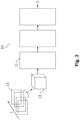
- Figure 3 shows a schematic representation of temporal convolution, in other words temporal filtering.
- the illustrated tensor (20) in Figure 3 can be either the input variable (12) or an intermediate variable of the machine learning system (10).
- the intermediate variable is, for example, an output variable of one of the layers (11).
- a coordinate system (23) is shown schematically to the left below the tensor (20).
- the coordinate system (23) comprises, for example, three dimensions (h, t, w) along which the tensor (20) extends. It should be noted that the images (13) are arranged one after the other in the tensor (20) along the "time" dimension t.
- the dimensions h and w are, for example, spatial dimensions in which the images (13) extend.
- the tensor (20) is now filtered in time using the filter (21). This is done by the filter carrying out a filtering along the "time" dimension t along the tensor (20).
- An example of the temporal convolution, in particular the temporal convolution, of the filter (21) with the tensor (20) is shown schematically using the dashed arrows (22).
- the temporal filtering can alternatively be carried out with one of the further filters (21a, 21b, 21c).
- the further filters differ from one another in that they have a different number of dimensions.
- the further filter (21c) is a three-dimensional filter.
- a possible course of the convolution of the three-dimensional filter (21c) with the tensor (20) is shown as an example by the dashed arrows (22b) next to the three-dimensional filter (21c). It should be noted that filtering the three-dimensional filter (21c) with the tensor (20) represents both temporal and spatial filtering if the convolution is carried out according to the dashed arrows (22b).
- Figure 4 shows a schematic flow diagram of a method for operating the machine learning system (10).
- the method begins with step S40.
- the input variable (12) is provided to the machine learning system (10).
- the provided input variable (12) is propagated by the machine learning system (10).
- the Input variable (12) or an intermediate variable of the machine learning system (10) is filtered in time using the filter (21), see explanations for Figure 3 .
- the filter has quantized filter coefficients. Preferably, all other parameters of the machine learning system (10) are also quantized.
- step S42 the output of the machine learning system is output.
- the method is then repeatedly executed with all its steps S40 to S43.
- steps S40 to S43 are used to train the machine learning system (10).
- the parameters of the machine learning system are also optimized after step S43 depending on a loss function.
- the cost function characterizes a deviation between the determined output variables of the machine learning system (10) and the associated training output variables of the respective input variables used.
- already quantized parameters can be used.
- the optimization of the cost function via the parameters of the machine learning system can be carried out, for example, using a gradient descent method, such as "backpropagation-(through-time)".
- the gradient descent method is used to minimize or maximize the cost function depending on the parameters.
- the parameters are quantized.
- a resolution of the parameters of at least 32 bits is advantageously used to optimize the parameters. During quantization, the resolution is then reduced, for example to 8 bits or even to 1 bit.
- the Output variable of the machine learning system (10) can be used to control an at least partially autonomous robot depending on this output variable.
- the at least partially autonomous robot is in the following Figure 5 shown as an example.
- Figure 5 shows a schematic representation of the at least partially autonomous robot, which in a first embodiment is provided by an at least partially autonomous vehicle (100).
- the at least partially autonomous robot can be a service, assembly or stationary production robot, alternatively an autonomous flying object, such as a drone.
- the at least partially autonomous vehicle (100) can comprise a detection unit (30).
- the detection unit (30) can be, for example, a camera that detects an environment of the vehicle (100).
- the detection unit (30) can be connected to a machine learning system (10).
- the machine learning system (10) determines an output variable depending on a provided input variable, e.g. provided by the detection unit (30), and depending on a plurality of parameters of the machine learning system (10).
- the output variable can be forwarded to a control unit (40).
- the control unit (40) controls an actuator depending on the output variable of the machine learning system (10), preferably controlling the actuator in such a way that the vehicle (100) carries out a collision-free maneuver.
- the actuator can be a motor or a braking system of the vehicle (100).
- the semi-autonomous robot can be a tool, a machine tool or a production robot.
- a material of a workpiece can be classified using the machine learning system (10).
- the actuator can be, for example, a motor that operates a grinding head.
- the vehicle (100) in particular the semi-autonomous robot, comprises a computing unit (50) and a machine-readable storage element (60).
- a computer program can be stored on the storage element (60), which comprises instructions which, when the instructions are executed on the computing unit (50), lead to the machine learning system (10) is operated by means of the computing unit (50).
Landscapes
- Engineering & Computer Science (AREA)
- Physics & Mathematics (AREA)
- Theoretical Computer Science (AREA)
- Health & Medical Sciences (AREA)
- General Physics & Mathematics (AREA)
- Biophysics (AREA)
- Biomedical Technology (AREA)
- Life Sciences & Earth Sciences (AREA)
- Software Systems (AREA)
- Evolutionary Computation (AREA)
- Artificial Intelligence (AREA)
- Mathematical Physics (AREA)
- Data Mining & Analysis (AREA)
- Computing Systems (AREA)
- General Engineering & Computer Science (AREA)
- Computational Linguistics (AREA)
- General Health & Medical Sciences (AREA)
- Molecular Biology (AREA)
- Neurology (AREA)
- Medical Informatics (AREA)
- Computer Vision & Pattern Recognition (AREA)
- Aviation & Aerospace Engineering (AREA)
- Game Theory and Decision Science (AREA)
- Radar, Positioning & Navigation (AREA)
- Remote Sensing (AREA)
- Automation & Control Theory (AREA)
- Business, Economics & Management (AREA)
- Image Analysis (AREA)
- Image Processing (AREA)
Applications Claiming Priority (1)
| Application Number | Priority Date | Filing Date | Title |
|---|---|---|---|
| DE102019206621.6A DE102019206621A1 (de) | 2019-05-08 | 2019-05-08 | Maschinelles Lernsystem, sowie ein Verfahren, ein Computerprogramm und eine Vorrichtung zum Erstellen des maschinellen Lernsystems |
Publications (2)
| Publication Number | Publication Date |
|---|---|
| EP3736742A1 EP3736742A1 (de) | 2020-11-11 |
| EP3736742B1 true EP3736742B1 (de) | 2025-01-29 |
Family
ID=70277229
Family Applications (1)
| Application Number | Title | Priority Date | Filing Date |
|---|---|---|---|
| EP20168788.6A Active EP3736742B1 (de) | 2019-05-08 | 2020-04-08 | Maschinelles lernsystem, sowie ein verfahren, ein computerprogramm und eine vorrichtung zum erstellen des maschinellen lernsystems |
Country Status (6)
| Country | Link |
|---|---|
| US (1) | US11790218B2 (https=) |
| EP (1) | EP3736742B1 (https=) |
| JP (1) | JP7493380B2 (https=) |
| KR (1) | KR20200130153A (https=) |
| CN (1) | CN111914990B (https=) |
| DE (1) | DE102019206621A1 (https=) |
Families Citing this family (3)
| Publication number | Priority date | Publication date | Assignee | Title |
|---|---|---|---|---|
| US11755469B2 (en) * | 2020-09-24 | 2023-09-12 | Argo AI, LLC | System for executing structured tests across a fleet of autonomous vehicles |
| US12356219B2 (en) * | 2020-10-15 | 2025-07-08 | Qualcomm Incorporated | Update resolution signaling in federated learning |
| US12517983B2 (en) * | 2022-08-22 | 2026-01-06 | Nec Corporation | SNR detection with few-shot trained models |
Family Cites Families (8)
| Publication number | Priority date | Publication date | Assignee | Title |
|---|---|---|---|---|
| JP3827037B2 (ja) * | 1997-05-23 | 2006-09-27 | ソニー株式会社 | 学習方法および装置、ロボット、並びに記録媒体 |
| US20180336469A1 (en) * | 2017-05-18 | 2018-11-22 | Qualcomm Incorporated | Sigma-delta position derivative networks |
| CN107633223A (zh) * | 2017-09-15 | 2018-01-26 | 深圳市唯特视科技有限公司 | 一种基于深层对抗网络的视频人体属性识别方法 |
| DE102017218889A1 (de) * | 2017-10-23 | 2019-04-25 | Robert Bosch Gmbh | Unscharf parametriertes KI-Modul sowie Verfahren zum Betreiben |
| DE102018220608A1 (de) | 2018-09-26 | 2020-03-26 | Robert Bosch Gmbh | Maschinelles Lernsystem, sowie ein Verfahren, ein Computerprogramm und eine Vorrichtung zum Erstellen des maschinellen Lernsystems |
| US10999606B2 (en) * | 2019-01-08 | 2021-05-04 | Intel Corporation | Method and system of neural network loop filtering for video coding |
| US11481991B2 (en) * | 2020-07-15 | 2022-10-25 | Visual Defence Inc. | System and method for detecting and transmitting incidents of interest of a roadway to a remote server |
| US20220309320A1 (en) * | 2021-03-25 | 2022-09-29 | Smart Engines Service, LLC | Almost-indirect convolution in quantized neural networks |
-
2019
- 2019-05-08 DE DE102019206621.6A patent/DE102019206621A1/de active Pending
-
2020
- 2020-04-08 EP EP20168788.6A patent/EP3736742B1/de active Active
- 2020-04-28 US US16/860,449 patent/US11790218B2/en active Active
- 2020-05-06 KR KR1020200053662A patent/KR20200130153A/ko active Pending
- 2020-05-07 CN CN202010376808.5A patent/CN111914990B/zh active Active
- 2020-05-07 JP JP2020081985A patent/JP7493380B2/ja active Active
Non-Patent Citations (1)
| Title |
|---|
| MATTHIEU COURBARIAUX ET AL: "Binarized Neural Networks: Training Neural Networks with Weights and Activations Constrained to +1 or -1", ARXIV.ORG, 17 March 2016 (2016-03-17), pages 1 - 11, XP055405835, Retrieved from the Internet <URL:https://arxiv.org/pdf/1602.02830.pdf> * |
Also Published As
| Publication number | Publication date |
|---|---|
| US20200356845A1 (en) | 2020-11-12 |
| CN111914990A (zh) | 2020-11-10 |
| KR20200130153A (ko) | 2020-11-18 |
| CN111914990B (zh) | 2025-08-15 |
| JP2020184341A (ja) | 2020-11-12 |
| US11790218B2 (en) | 2023-10-17 |
| JP7493380B2 (ja) | 2024-05-31 |
| EP3736742A1 (de) | 2020-11-11 |
| DE102019206621A1 (de) | 2020-11-12 |
Similar Documents
| Publication | Publication Date | Title |
|---|---|---|
| EP3785177B1 (de) | Verfahren und vorrichtung zum ermitteln einer netzkonfiguration eines neuronalen netzes | |
| DE202017102235U1 (de) | Trainingssystem | |
| EP3736742B1 (de) | Maschinelles lernsystem, sowie ein verfahren, ein computerprogramm und eine vorrichtung zum erstellen des maschinellen lernsystems | |
| DE202017102238U1 (de) | Aktorsteuerungssystem | |
| DE69626156T2 (de) | Bildverarbeitungsverfahren und -vorrichtung | |
| DE102019115244A1 (de) | Aktivieren des null-bypasses und des weight-pruning in neuronalen netzwerken für fahrzeugwahrnehmungssysteme | |
| WO2020069964A1 (de) | Verfahren, künstliches neuronales netz, vorrichtung, computerprogramm und maschinenlesbares speichermedium zur semantischen segmentierung von bilddaten | |
| DE102018217091A1 (de) | Verfahren, künstliches neuronales Netz, Vorrichtung, Computerprogramm und maschinenlesbares Speichermedium zur semantischen Segmentierung von Bilddaten | |
| EP3785178B1 (de) | Verfahren und vorrichtung zum ermitteln einer netzkonfiguration eines neuronalen netzes | |
| EP3857455B1 (de) | Maschinelles lernsystem, sowie ein verfahren, ein computerprogramm und eine vorrichtung zum erstellen des maschinellen lernsystems | |
| DE69612284T2 (de) | Datenverarbeitungsverfahren- und vorrichtung | |
| EP3786853B1 (de) | Komprimieren eines tiefen neuronalen netzes | |
| DE102019213523A1 (de) | Verfahren und Vorverarbeitungsvorrichtung zum Vorverarbeiten von Kamerarohdaten eines Bildsensors einer Kamera | |
| DE102018211875A1 (de) | Verfahren und Vorrichtung zum Betreiben eines Steuerungssystems | |
| DE102020211262A1 (de) | Verfahren und Vorrichtung zum Komprimieren eines neuronalen Netzes | |
| DE102021201497A1 (de) | Verfahren und System zur Verarbeitung von Bildinformationen mit einem künstlichen neuronalen Netz | |
| DE102020116013A1 (de) | Verfahren zum Bereitstellen eines komprimierten künstlichen neuronalen Netzes mittels eines Autoencoders | |
| DE102020203998A1 (de) | Verfahren und Vorrichtung zum Betreiben eines Klassifikators | |
| EP3956820B1 (de) | Verfahren, vorrichtung und computerprogramm zum erstellen eines neuronalen netzes | |
| EP3908984B1 (de) | Logikbaustein, insbesondere asic, zur durchführung neuronaler netzwerkberechnungen zum verarbeiten von daten mittels eines neuronalen netzwerks | |
| DE202019103323U1 (de) | Vorrichtung zum Erstellen eines maschinellen Lernsystems | |
| DE102019214436A1 (de) | Verfahren, Vorrichtung und Computerprogramm zum Betreiben eines künstlichen neuronalen Netzes | |
| DE202020104727U1 (de) | Vorrichtung zum Transferlernen zwischen modifizierten Aufgaben | |
| DE102024003656B3 (de) | Verfahren zur Erstellung eines rekonstruierten Bildes, Computerprogrammprodukt, sowie Kraftfahrzeug | |
| DE102024209264A1 (de) | Konvolutionales neuronales Netzwerk und Verfahren zum Betreiben des konvolutionalen neuronalen Netzwerks |
Legal Events
| Date | Code | Title | Description |
|---|---|---|---|
| PUAI | Public reference made under article 153(3) epc to a published international application that has entered the european phase |
Free format text: ORIGINAL CODE: 0009012 |
|
| STAA | Information on the status of an ep patent application or granted ep patent |
Free format text: STATUS: THE APPLICATION HAS BEEN PUBLISHED |
|
| AK | Designated contracting states |
Kind code of ref document: A1 Designated state(s): AL AT BE BG CH CY CZ DE DK EE ES FI FR GB GR HR HU IE IS IT LI LT LU LV MC MK MT NL NO PL PT RO RS SE SI SK SM TR |
|
| AX | Request for extension of the european patent |
Extension state: BA ME |
|
| STAA | Information on the status of an ep patent application or granted ep patent |
Free format text: STATUS: REQUEST FOR EXAMINATION WAS MADE |
|
| 17P | Request for examination filed |
Effective date: 20210511 |
|
| RBV | Designated contracting states (corrected) |
Designated state(s): AL AT BE BG CH CY CZ DE DK EE ES FI FR GB GR HR HU IE IS IT LI LT LU LV MC MK MT NL NO PL PT RO RS SE SI SK SM TR |
|
| STAA | Information on the status of an ep patent application or granted ep patent |
Free format text: STATUS: EXAMINATION IS IN PROGRESS |
|
| 17Q | First examination report despatched |
Effective date: 20230216 |
|
| REG | Reference to a national code |
Ref legal event code: R079 Ipc: G06N0003046400 Ref country code: DE Ref document number: 502020010298 Country of ref document: DE Free format text: PREVIOUS MAIN CLASS: G06N0003040000 |
|
| GRAP | Despatch of communication of intention to grant a patent |
Free format text: ORIGINAL CODE: EPIDOSNIGR1 |
|
| STAA | Information on the status of an ep patent application or granted ep patent |
Free format text: STATUS: GRANT OF PATENT IS INTENDED |
|
| RIC1 | Information provided on ipc code assigned before grant |
Ipc: G06N 3/09 20230101ALI20241011BHEP Ipc: G06N 3/0495 20230101ALI20241011BHEP Ipc: G06N 3/0464 20230101AFI20241011BHEP |
|
| INTG | Intention to grant announced |
Effective date: 20241025 |
|
| GRAS | Grant fee paid |
Free format text: ORIGINAL CODE: EPIDOSNIGR3 |
|
| GRAA | (expected) grant |
Free format text: ORIGINAL CODE: 0009210 |
|
| STAA | Information on the status of an ep patent application or granted ep patent |
Free format text: STATUS: THE PATENT HAS BEEN GRANTED |
|
| AK | Designated contracting states |
Kind code of ref document: B1 Designated state(s): AL AT BE BG CH CY CZ DE DK EE ES FI FR GB GR HR HU IE IS IT LI LT LU LV MC MK MT NL NO PL PT RO RS SE SI SK SM TR |
|
| REG | Reference to a national code |
Ref country code: GB Ref legal event code: FG4D Free format text: NOT ENGLISH |
|
| REG | Reference to a national code |
Ref country code: CH Ref legal event code: EP |
|
| REG | Reference to a national code |
Ref country code: DE Ref legal event code: R096 Ref document number: 502020010298 Country of ref document: DE |
|
| REG | Reference to a national code |
Ref country code: IE Ref legal event code: FG4D Free format text: LANGUAGE OF EP DOCUMENT: GERMAN |
|
| REG | Reference to a national code |
Ref country code: NL Ref legal event code: MP Effective date: 20250129 |
|
| PG25 | Lapsed in a contracting state [announced via postgrant information from national office to epo] |
Ref country code: NL Free format text: LAPSE BECAUSE OF FAILURE TO SUBMIT A TRANSLATION OF THE DESCRIPTION OR TO PAY THE FEE WITHIN THE PRESCRIBED TIME-LIMIT Effective date: 20250129 |
|
| PG25 | Lapsed in a contracting state [announced via postgrant information from national office to epo] |
Ref country code: RS Free format text: LAPSE BECAUSE OF FAILURE TO SUBMIT A TRANSLATION OF THE DESCRIPTION OR TO PAY THE FEE WITHIN THE PRESCRIBED TIME-LIMIT Effective date: 20250429 |
|
| PG25 | Lapsed in a contracting state [announced via postgrant information from national office to epo] |
Ref country code: FI Free format text: LAPSE BECAUSE OF FAILURE TO SUBMIT A TRANSLATION OF THE DESCRIPTION OR TO PAY THE FEE WITHIN THE PRESCRIBED TIME-LIMIT Effective date: 20250129 |
|
| PG25 | Lapsed in a contracting state [announced via postgrant information from national office to epo] |
Ref country code: PL Free format text: LAPSE BECAUSE OF FAILURE TO SUBMIT A TRANSLATION OF THE DESCRIPTION OR TO PAY THE FEE WITHIN THE PRESCRIBED TIME-LIMIT Effective date: 20250129 |
|
| PGFP | Annual fee paid to national office [announced via postgrant information from national office to epo] |
Ref country code: DE Payment date: 20250624 Year of fee payment: 6 |
|
| PG25 | Lapsed in a contracting state [announced via postgrant information from national office to epo] |
Ref country code: ES Free format text: LAPSE BECAUSE OF FAILURE TO SUBMIT A TRANSLATION OF THE DESCRIPTION OR TO PAY THE FEE WITHIN THE PRESCRIBED TIME-LIMIT Effective date: 20250129 |
|
| REG | Reference to a national code |
Ref country code: LT Ref legal event code: MG9D |
|
| PG25 | Lapsed in a contracting state [announced via postgrant information from national office to epo] |
Ref country code: NO Free format text: LAPSE BECAUSE OF FAILURE TO SUBMIT A TRANSLATION OF THE DESCRIPTION OR TO PAY THE FEE WITHIN THE PRESCRIBED TIME-LIMIT Effective date: 20250429 Ref country code: IS Free format text: LAPSE BECAUSE OF FAILURE TO SUBMIT A TRANSLATION OF THE DESCRIPTION OR TO PAY THE FEE WITHIN THE PRESCRIBED TIME-LIMIT Effective date: 20250529 |
|
| PG25 | Lapsed in a contracting state [announced via postgrant information from national office to epo] |
Ref country code: HR Free format text: LAPSE BECAUSE OF FAILURE TO SUBMIT A TRANSLATION OF THE DESCRIPTION OR TO PAY THE FEE WITHIN THE PRESCRIBED TIME-LIMIT Effective date: 20250129 |
|
| PG25 | Lapsed in a contracting state [announced via postgrant information from national office to epo] |
Ref country code: PT Free format text: LAPSE BECAUSE OF FAILURE TO SUBMIT A TRANSLATION OF THE DESCRIPTION OR TO PAY THE FEE WITHIN THE PRESCRIBED TIME-LIMIT Effective date: 20250529 Ref country code: LV Free format text: LAPSE BECAUSE OF FAILURE TO SUBMIT A TRANSLATION OF THE DESCRIPTION OR TO PAY THE FEE WITHIN THE PRESCRIBED TIME-LIMIT Effective date: 20250129 |
|
| PG25 | Lapsed in a contracting state [announced via postgrant information from national office to epo] |
Ref country code: BG Free format text: LAPSE BECAUSE OF FAILURE TO SUBMIT A TRANSLATION OF THE DESCRIPTION OR TO PAY THE FEE WITHIN THE PRESCRIBED TIME-LIMIT Effective date: 20250129 Ref country code: GR Free format text: LAPSE BECAUSE OF FAILURE TO SUBMIT A TRANSLATION OF THE DESCRIPTION OR TO PAY THE FEE WITHIN THE PRESCRIBED TIME-LIMIT Effective date: 20250430 |
|
| PG25 | Lapsed in a contracting state [announced via postgrant information from national office to epo] |
Ref country code: SE Free format text: LAPSE BECAUSE OF FAILURE TO SUBMIT A TRANSLATION OF THE DESCRIPTION OR TO PAY THE FEE WITHIN THE PRESCRIBED TIME-LIMIT Effective date: 20250129 |
|
| PG25 | Lapsed in a contracting state [announced via postgrant information from national office to epo] |
Ref country code: SM Free format text: LAPSE BECAUSE OF FAILURE TO SUBMIT A TRANSLATION OF THE DESCRIPTION OR TO PAY THE FEE WITHIN THE PRESCRIBED TIME-LIMIT Effective date: 20250129 |
|
| PG25 | Lapsed in a contracting state [announced via postgrant information from national office to epo] |
Ref country code: DK Free format text: LAPSE BECAUSE OF FAILURE TO SUBMIT A TRANSLATION OF THE DESCRIPTION OR TO PAY THE FEE WITHIN THE PRESCRIBED TIME-LIMIT Effective date: 20250129 |
|
| PG25 | Lapsed in a contracting state [announced via postgrant information from national office to epo] |
Ref country code: IT Free format text: LAPSE BECAUSE OF FAILURE TO SUBMIT A TRANSLATION OF THE DESCRIPTION OR TO PAY THE FEE WITHIN THE PRESCRIBED TIME-LIMIT Effective date: 20250129 |
|
| PG25 | Lapsed in a contracting state [announced via postgrant information from national office to epo] |
Ref country code: EE Free format text: LAPSE BECAUSE OF FAILURE TO SUBMIT A TRANSLATION OF THE DESCRIPTION OR TO PAY THE FEE WITHIN THE PRESCRIBED TIME-LIMIT Effective date: 20250129 Ref country code: CZ Free format text: LAPSE BECAUSE OF FAILURE TO SUBMIT A TRANSLATION OF THE DESCRIPTION OR TO PAY THE FEE WITHIN THE PRESCRIBED TIME-LIMIT Effective date: 20250129 |
|
| PG25 | Lapsed in a contracting state [announced via postgrant information from national office to epo] |
Ref country code: RO Free format text: LAPSE BECAUSE OF FAILURE TO SUBMIT A TRANSLATION OF THE DESCRIPTION OR TO PAY THE FEE WITHIN THE PRESCRIBED TIME-LIMIT Effective date: 20250129 |
|
| PG25 | Lapsed in a contracting state [announced via postgrant information from national office to epo] |
Ref country code: SK Free format text: LAPSE BECAUSE OF FAILURE TO SUBMIT A TRANSLATION OF THE DESCRIPTION OR TO PAY THE FEE WITHIN THE PRESCRIBED TIME-LIMIT Effective date: 20250129 |
|
| REG | Reference to a national code |
Ref country code: DE Ref legal event code: R097 Ref document number: 502020010298 Country of ref document: DE |
|
| REG | Reference to a national code |
Ref country code: CH Ref legal event code: H13 Free format text: ST27 STATUS EVENT CODE: U-0-0-H10-H13 (AS PROVIDED BY THE NATIONAL OFFICE) Effective date: 20251125 |
|
| PLBE | No opposition filed within time limit |
Free format text: ORIGINAL CODE: 0009261 |
|
| STAA | Information on the status of an ep patent application or granted ep patent |
Free format text: STATUS: NO OPPOSITION FILED WITHIN TIME LIMIT |
|
| PG25 | Lapsed in a contracting state [announced via postgrant information from national office to epo] |
Ref country code: LU Free format text: LAPSE BECAUSE OF NON-PAYMENT OF DUE FEES Effective date: 20250408 |
|
| PG25 | Lapsed in a contracting state [announced via postgrant information from national office to epo] |
Ref country code: MC Free format text: LAPSE BECAUSE OF FAILURE TO SUBMIT A TRANSLATION OF THE DESCRIPTION OR TO PAY THE FEE WITHIN THE PRESCRIBED TIME-LIMIT Effective date: 20250129 |
|
| GBPC | Gb: european patent ceased through non-payment of renewal fee |
Effective date: 20250429 |
|
| REG | Reference to a national code |
Ref country code: BE Ref legal event code: MM Effective date: 20250430 |
|
| 26N | No opposition filed |
Effective date: 20251030 |
|
| PG25 | Lapsed in a contracting state [announced via postgrant information from national office to epo] |
Ref country code: GB Free format text: LAPSE BECAUSE OF NON-PAYMENT OF DUE FEES Effective date: 20250429 |
|
| PG25 | Lapsed in a contracting state [announced via postgrant information from national office to epo] |
Ref country code: FR Free format text: LAPSE BECAUSE OF NON-PAYMENT OF DUE FEES Effective date: 20250430 |
|
| PG25 | Lapsed in a contracting state [announced via postgrant information from national office to epo] |
Ref country code: BE Free format text: LAPSE BECAUSE OF NON-PAYMENT OF DUE FEES Effective date: 20250430 |
|
| PG25 | Lapsed in a contracting state [announced via postgrant information from national office to epo] |
Ref country code: CH Free format text: LAPSE BECAUSE OF NON-PAYMENT OF DUE FEES Effective date: 20250430 |
|
| PG25 | Lapsed in a contracting state [announced via postgrant information from national office to epo] |
Ref country code: IE Free format text: LAPSE BECAUSE OF NON-PAYMENT OF DUE FEES Effective date: 20250408 |