EP3736718A1 - Tpm-basiertes sicheres mehrparteien-computersystem mit einem nicht umgehbaren gateway - Google Patents
Tpm-basiertes sicheres mehrparteien-computersystem mit einem nicht umgehbaren gateway Download PDFInfo
- Publication number
- EP3736718A1 EP3736718A1 EP20162186.9A EP20162186A EP3736718A1 EP 3736718 A1 EP3736718 A1 EP 3736718A1 EP 20162186 A EP20162186 A EP 20162186A EP 3736718 A1 EP3736718 A1 EP 3736718A1
- Authority
- EP
- European Patent Office
- Prior art keywords
- gateway
- service
- execution
- data
- key
- Prior art date
- Legal status (The legal status is an assumption and is not a legal conclusion. Google has not performed a legal analysis and makes no representation as to the accuracy of the status listed.)
- Granted
Links
Images






Classifications
-
- G—PHYSICS
- G06—COMPUTING OR CALCULATING; COUNTING
- G06F—ELECTRIC DIGITAL DATA PROCESSING
- G06F21/00—Security arrangements for protecting computers, components thereof, programs or data against unauthorised activity
- G06F21/50—Monitoring users, programs or devices to maintain the integrity of platforms, e.g. of processors, firmware or operating systems
- G06F21/55—Detecting local intrusion or implementing counter-measures
- G06F21/56—Computer malware detection or handling, e.g. anti-virus arrangements
- G06F21/566—Dynamic detection, i.e. detection performed at run-time, e.g. emulation, suspicious activities
-
- H—ELECTRICITY
- H04—ELECTRIC COMMUNICATION TECHNIQUE
- H04L—TRANSMISSION OF DIGITAL INFORMATION, e.g. TELEGRAPHIC COMMUNICATION
- H04L9/00—Cryptographic mechanisms or cryptographic arrangements for secret or secure communications; Network security protocols
- H04L9/08—Key distribution or management, e.g. generation, sharing or updating, of cryptographic keys or passwords
- H04L9/0816—Key establishment, i.e. cryptographic processes or cryptographic protocols whereby a shared secret becomes available to two or more parties, for subsequent use
- H04L9/0819—Key transport or distribution, i.e. key establishment techniques where one party creates or otherwise obtains a secret value, and securely transfers it to the other(s)
- H04L9/083—Key transport or distribution, i.e. key establishment techniques where one party creates or otherwise obtains a secret value, and securely transfers it to the other(s) involving central third party, e.g. key distribution center [KDC] or trusted third party [TTP]
-
- G—PHYSICS
- G06—COMPUTING OR CALCULATING; COUNTING
- G06F—ELECTRIC DIGITAL DATA PROCESSING
- G06F21/00—Security arrangements for protecting computers, components thereof, programs or data against unauthorised activity
- G06F21/50—Monitoring users, programs or devices to maintain the integrity of platforms, e.g. of processors, firmware or operating systems
- G06F21/52—Monitoring users, programs or devices to maintain the integrity of platforms, e.g. of processors, firmware or operating systems during program execution, e.g. stack integrity ; Preventing unwanted data erasure; Buffer overflow
- G06F21/53—Monitoring users, programs or devices to maintain the integrity of platforms, e.g. of processors, firmware or operating systems during program execution, e.g. stack integrity ; Preventing unwanted data erasure; Buffer overflow by executing in a restricted environment, e.g. sandbox or secure virtual machine
-
- H—ELECTRICITY
- H04—ELECTRIC COMMUNICATION TECHNIQUE
- H04L—TRANSMISSION OF DIGITAL INFORMATION, e.g. TELEGRAPHIC COMMUNICATION
- H04L63/00—Network architectures or network communication protocols for network security
- H04L63/02—Network architectures or network communication protocols for network security for separating internal from external traffic, e.g. firewalls
-
- G—PHYSICS
- G06—COMPUTING OR CALCULATING; COUNTING
- G06F—ELECTRIC DIGITAL DATA PROCESSING
- G06F21/00—Security arrangements for protecting computers, components thereof, programs or data against unauthorised activity
- G06F21/50—Monitoring users, programs or devices to maintain the integrity of platforms, e.g. of processors, firmware or operating systems
- G06F21/55—Detecting local intrusion or implementing counter-measures
- G06F21/56—Computer malware detection or handling, e.g. anti-virus arrangements
-
- G—PHYSICS
- G06—COMPUTING OR CALCULATING; COUNTING
- G06F—ELECTRIC DIGITAL DATA PROCESSING
- G06F21/00—Security arrangements for protecting computers, components thereof, programs or data against unauthorised activity
- G06F21/50—Monitoring users, programs or devices to maintain the integrity of platforms, e.g. of processors, firmware or operating systems
- G06F21/55—Detecting local intrusion or implementing counter-measures
- G06F21/56—Computer malware detection or handling, e.g. anti-virus arrangements
- G06F21/562—Static detection
- G06F21/565—Static detection by checking file integrity
-
- G—PHYSICS
- G06—COMPUTING OR CALCULATING; COUNTING
- G06F—ELECTRIC DIGITAL DATA PROCESSING
- G06F21/00—Security arrangements for protecting computers, components thereof, programs or data against unauthorised activity
- G06F21/50—Monitoring users, programs or devices to maintain the integrity of platforms, e.g. of processors, firmware or operating systems
- G06F21/55—Detecting local intrusion or implementing counter-measures
- G06F21/56—Computer malware detection or handling, e.g. anti-virus arrangements
- G06F21/567—Computer malware detection or handling, e.g. anti-virus arrangements using dedicated hardware
-
- G—PHYSICS
- G06—COMPUTING OR CALCULATING; COUNTING
- G06F—ELECTRIC DIGITAL DATA PROCESSING
- G06F21/00—Security arrangements for protecting computers, components thereof, programs or data against unauthorised activity
- G06F21/50—Monitoring users, programs or devices to maintain the integrity of platforms, e.g. of processors, firmware or operating systems
- G06F21/57—Certifying or maintaining trusted computer platforms, e.g. secure boots or power-downs, version controls, system software checks, secure updates or assessing vulnerabilities
-
- G—PHYSICS
- G06—COMPUTING OR CALCULATING; COUNTING
- G06F—ELECTRIC DIGITAL DATA PROCESSING
- G06F21/00—Security arrangements for protecting computers, components thereof, programs or data against unauthorised activity
- G06F21/70—Protecting specific internal or peripheral components, in which the protection of a component leads to protection of the entire computer
- G06F21/71—Protecting specific internal or peripheral components, in which the protection of a component leads to protection of the entire computer to assure secure computing or processing of information
-
- H—ELECTRICITY
- H04—ELECTRIC COMMUNICATION TECHNIQUE
- H04L—TRANSMISSION OF DIGITAL INFORMATION, e.g. TELEGRAPHIC COMMUNICATION
- H04L12/00—Data switching networks
- H04L12/66—Arrangements for connecting between networks having differing types of switching systems, e.g. gateways
-
- H—ELECTRICITY
- H04—ELECTRIC COMMUNICATION TECHNIQUE
- H04L—TRANSMISSION OF DIGITAL INFORMATION, e.g. TELEGRAPHIC COMMUNICATION
- H04L63/00—Network architectures or network communication protocols for network security
- H04L63/04—Network architectures or network communication protocols for network security for providing a confidential data exchange among entities communicating through data packet networks
- H04L63/0428—Network architectures or network communication protocols for network security for providing a confidential data exchange among entities communicating through data packet networks wherein the data content is protected, e.g. by encrypting or encapsulating the payload
-
- H—ELECTRICITY
- H04—ELECTRIC COMMUNICATION TECHNIQUE
- H04L—TRANSMISSION OF DIGITAL INFORMATION, e.g. TELEGRAPHIC COMMUNICATION
- H04L63/00—Network architectures or network communication protocols for network security
- H04L63/06—Network architectures or network communication protocols for network security for supporting key management in a packet data network
- H04L63/062—Network architectures or network communication protocols for network security for supporting key management in a packet data network for key distribution, e.g. centrally by trusted party
-
- H—ELECTRICITY
- H04—ELECTRIC COMMUNICATION TECHNIQUE
- H04L—TRANSMISSION OF DIGITAL INFORMATION, e.g. TELEGRAPHIC COMMUNICATION
- H04L63/00—Network architectures or network communication protocols for network security
- H04L63/08—Network architectures or network communication protocols for network security for authentication of entities
- H04L63/083—Network architectures or network communication protocols for network security for authentication of entities using passwords
-
- H—ELECTRICITY
- H04—ELECTRIC COMMUNICATION TECHNIQUE
- H04L—TRANSMISSION OF DIGITAL INFORMATION, e.g. TELEGRAPHIC COMMUNICATION
- H04L63/00—Network architectures or network communication protocols for network security
- H04L63/12—Applying verification of the received information
- H04L63/123—Applying verification of the received information received data contents, e.g. message integrity
-
- H—ELECTRICITY
- H04—ELECTRIC COMMUNICATION TECHNIQUE
- H04L—TRANSMISSION OF DIGITAL INFORMATION, e.g. TELEGRAPHIC COMMUNICATION
- H04L63/00—Network architectures or network communication protocols for network security
- H04L63/14—Network architectures or network communication protocols for network security for detecting or protecting against malicious traffic
-
- H—ELECTRICITY
- H04—ELECTRIC COMMUNICATION TECHNIQUE
- H04L—TRANSMISSION OF DIGITAL INFORMATION, e.g. TELEGRAPHIC COMMUNICATION
- H04L63/00—Network architectures or network communication protocols for network security
- H04L63/14—Network architectures or network communication protocols for network security for detecting or protecting against malicious traffic
- H04L63/1408—Network architectures or network communication protocols for network security for detecting or protecting against malicious traffic by monitoring network traffic
- H04L63/1416—Event detection, e.g. attack signature detection
-
- H—ELECTRICITY
- H04—ELECTRIC COMMUNICATION TECHNIQUE
- H04L—TRANSMISSION OF DIGITAL INFORMATION, e.g. TELEGRAPHIC COMMUNICATION
- H04L63/00—Network architectures or network communication protocols for network security
- H04L63/16—Implementing security features at a particular protocol layer
- H04L63/166—Implementing security features at a particular protocol layer at the transport layer
-
- H—ELECTRICITY
- H04—ELECTRIC COMMUNICATION TECHNIQUE
- H04L—TRANSMISSION OF DIGITAL INFORMATION, e.g. TELEGRAPHIC COMMUNICATION
- H04L63/00—Network architectures or network communication protocols for network security
- H04L63/20—Network architectures or network communication protocols for network security for managing network security; network security policies in general
-
- H—ELECTRICITY
- H04—ELECTRIC COMMUNICATION TECHNIQUE
- H04L—TRANSMISSION OF DIGITAL INFORMATION, e.g. TELEGRAPHIC COMMUNICATION
- H04L9/00—Cryptographic mechanisms or cryptographic arrangements for secret or secure communications; Network security protocols
- H04L9/08—Key distribution or management, e.g. generation, sharing or updating, of cryptographic keys or passwords
- H04L9/0816—Key establishment, i.e. cryptographic processes or cryptographic protocols whereby a shared secret becomes available to two or more parties, for subsequent use
- H04L9/0819—Key transport or distribution, i.e. key establishment techniques where one party creates or otherwise obtains a secret value, and securely transfers it to the other(s)
- H04L9/0827—Key transport or distribution, i.e. key establishment techniques where one party creates or otherwise obtains a secret value, and securely transfers it to the other(s) involving distinctive intermediate devices or communication paths
-
- H—ELECTRICITY
- H04—ELECTRIC COMMUNICATION TECHNIQUE
- H04L—TRANSMISSION OF DIGITAL INFORMATION, e.g. TELEGRAPHIC COMMUNICATION
- H04L9/00—Cryptographic mechanisms or cryptographic arrangements for secret or secure communications; Network security protocols
- H04L9/08—Key distribution or management, e.g. generation, sharing or updating, of cryptographic keys or passwords
- H04L9/0816—Key establishment, i.e. cryptographic processes or cryptographic protocols whereby a shared secret becomes available to two or more parties, for subsequent use
- H04L9/0838—Key agreement, i.e. key establishment technique in which a shared key is derived by parties as a function of information contributed by, or associated with, each of these
- H04L9/0841—Key agreement, i.e. key establishment technique in which a shared key is derived by parties as a function of information contributed by, or associated with, each of these involving Diffie-Hellman or related key agreement protocols
- H04L9/0844—Key agreement, i.e. key establishment technique in which a shared key is derived by parties as a function of information contributed by, or associated with, each of these involving Diffie-Hellman or related key agreement protocols with user authentication or key authentication, e.g. ElGamal, MTI, MQV-Menezes-Qu-Vanstone protocol or Diffie-Hellman protocols using implicitly-certified keys
-
- H—ELECTRICITY
- H04—ELECTRIC COMMUNICATION TECHNIQUE
- H04L—TRANSMISSION OF DIGITAL INFORMATION, e.g. TELEGRAPHIC COMMUNICATION
- H04L9/00—Cryptographic mechanisms or cryptographic arrangements for secret or secure communications; Network security protocols
- H04L9/08—Key distribution or management, e.g. generation, sharing or updating, of cryptographic keys or passwords
- H04L9/0894—Escrow, recovery or storing of secret information, e.g. secret key escrow or cryptographic key storage
- H04L9/0897—Escrow, recovery or storing of secret information, e.g. secret key escrow or cryptographic key storage involving additional devices, e.g. trusted platform module [TPM], smartcard or USB
-
- H—ELECTRICITY
- H04—ELECTRIC COMMUNICATION TECHNIQUE
- H04L—TRANSMISSION OF DIGITAL INFORMATION, e.g. TELEGRAPHIC COMMUNICATION
- H04L2209/00—Additional information or applications relating to cryptographic mechanisms or cryptographic arrangements for secret or secure communication H04L9/00
- H04L2209/12—Details relating to cryptographic hardware or logic circuitry
- H04L2209/127—Trusted platform modules [TPM]
-
- H—ELECTRICITY
- H04—ELECTRIC COMMUNICATION TECHNIQUE
- H04L—TRANSMISSION OF DIGITAL INFORMATION, e.g. TELEGRAPHIC COMMUNICATION
- H04L2209/00—Additional information or applications relating to cryptographic mechanisms or cryptographic arrangements for secret or secure communication H04L9/00
- H04L2209/46—Secure multiparty computation, e.g. millionaire problem
Definitions
- Embodiments of the invention relate generally to secure multiparty computing. More particularly, embodiments of the invention relate to a trusted platform module (TPM)-based secure multiparty computing system using a non-bypassable gateway.
- TPM trusted platform module
- Sensitive transactions are increasingly being performed by cloud based servers.
- Cloud-based is a term that refers to applications, services or resources made available to users on demand via the Internet from cloud servers.
- the multiparty or multitenant nature of cloud based servers has an increasing need for securing a multitenant computing environment from unauthorized accesses by untrusted parties. For example, during computation, data from one party may be accessible by untrusted parties. Thus, there is a need to secure data during computation. Furthermore, cryptographic based multiparty computation solutions are slow and thus may not be practical.
- the invention is defined by a method according to claim 1, a non-transitory machine-readable medium according to claim 13, and a data processing system according to claim 14. Further embodiments are defined by the dependent claims. With this invention, it may prevent data of a client from leaking to untrusted parties in a multiparty computation environment.
- Embodiments of the disclosure disclose a system to prevent data of a client from leaking to untrusted parties in a multiparty computation environment.
- a gateway e.g., a non-bypassable gateway
- the system in response to a request received at a gateway (e.g., a non-bypassable gateway) of a server from a user device of a user over a network to process user data by an execution service, the system sanitizes the user data by scanning the user data for malicious code.
- the system selects a trusted execution environment (TEE) worker from a number of TEE workers and initiates an execution of the execution service by the selected TEE worker.
- the system receives execution results from the selected TEE worker.
- the system transmits the execution results to the user device of the user.
- TEE trusted execution environment
- FIG. 1 is a block diagram illustrating an example of system configuration for a computing system for secure multiparty computation using a non-bypassable gateway according to one embodiment.
- system configuration 100 includes, but is not limited to, one or more client devices 101-102 communicatively coupled to data processing server 104 over network 103.
- Client devices 101-102 may be any type of client devices such as a personal computer (e.g., desktops, laptops, and tablets), a "thin" client, a personal digital assistant (PDA), a Web enabled appliance, a Smartwatch, or a mobile phone (e.g., Smartphone), etc.
- client devices 101-102 may be other servers.
- Network 103 may be any type of networks such as a local area network (LAN), a wide area network (WAN) such as the Internet, or a combination thereof, wired or wireless.
- LAN local area network
- WAN wide area network
- the communication between client devices 101-102, data processing server 104, and management services server 160 over network 103 can be secured, e.g., via TLS/SSL.
- Data processing server (e.g., host) 104 may be any kind of servers or a cluster of servers, such as Web or cloud servers, application servers, backend servers, or a combination thereof.
- Server 104 can include an interface to allow a client such as client devices 101-102 to access resources or services provided by server 104, key management server 160, services provider 161, or cloud operator 162.
- server 104 may be a cloud server or a server of a data center operated by cloud operator 162.
- Server 104 can provide a variety of cloud services to clients, such as, for example, cloud storage, cloud computing services, big data services, modeling services, machine-learning training services, data mining services, etc.
- Server 104 may be configured as a part of software-as-a-service (SaaS) or platform-as-a-service (PaaS) system over the cloud, which may be a private cloud, public cloud, or a hybrid cloud.
- the interface may include a Web interface, an application programming interface (API), and/or a command line interface (CLI).
- API application programming interface
- CLI command line interface
- Data processing server 104 can include RAM disk file system (ramfs) 121 and one or more CPU(s) (not shown) equipped with a security module, such as a trusted platform module (TPM) 120, for secure boot.
- TPM trusted platform module
- a TPM is a specialized chip on an endpoint device that stores cryptographic keys (e.g., RSA cryptographic keys) specific to the host system for hardware authentication.
- Each TPM chip can contain one or more RSA key pairs (e.g., public and private key pairs) called endorsement keys (EK) or endorsement credentials (EC), i.e., root keys.
- EK endorsement keys
- EC endorsement credentials
- TPM chip on the host machine can thus be used as a root of trust for secure boot for server 104 so an operating system or an execution environment (e.g., TEE workers 108-109) of server 104 can be trusted.
- Data processing server 104 can include non-bypassable gateway 106 (e.g., gateway) and one or more trusted execution environments 108-109.
- Non-bypassable gateway 106 can be a trusted gateway that mediates all network traffics, including data traffic and access control traffic between clients 101-102 and TEE workers 108-109, KMS 160 and TEE worker 108-109, and service provider 161 and TEE worker 108-109.
- gateway 106 can enforce 4A services (e.g., Authentication, Authorization, Audit, or Account), and can perform code analysis, firewall services, and data sanitization based on the mediated network traffics to mitigate potential exploits.
- gateway 106 can communicate with client devices 101-102 to facilitate client requests.
- Gateway 106 can launch trusted execution environments, such as environments 108-109, to execute various execution services for different clients and/or client requests.
- trusted execution environments are sandboxed execution environments which are isolated from each other and from the operating system of server 104.
- the TEE can run in parallel with the operating system to ensure confidentiality and integrity for code and data loaded in the TEE.
- a TEE can be a runtime container that performs an operating system level virtualization (e.g., Kata container) with standalone kernel, networking, and/or input/output.
- a TEE can use both hardware (e.g., TPM) and software (e.g., Intel software guard extension (SGX)) to further protect data and code.
- TPM hardware
- SGX Intel software guard extension
- system 100 includes a cluster of computing server nodes and server 104 is one of the computing server nodes in the cluster.
- the cluster may be a reliable, replicated, redundant, and fault-tolerant (RAFT) cluster.
- RAFT refers to a consensus algorithm that allows a collection of nodes (e.g., including server 104) to work as a coherent group that can survive the failures of some of its node members.
- gateway 106 of server 104 may execute a RAFT service as part of the RAFT cluster.
- gateway 106 can maintain a consistent copy of a state machine and/or a replicated log among the nodes in the cluster so it appears to clients 101-102 that they are interacting with a single, reliable machine, even if a minority of the nodes in the cluster fails.
- the consistency of a state machine and/or a replicated log among the nodes in the cluster can be maintained by electing a leader node, where the leader node is responsible for state machine/log replication to the follower nodes.
- the leader regularly informs the followers of its existence by sending a heartbeat message.
- Each follower has a timeout in which it expects the heartbeat from the leader. The timeout is reset on receiving the heartbeat.
- a service request from client device 101 can be logged by gateway 106 while a state of the request can be logged in a state machine.
- the state machine/log can be replicated among the server nodes in the cluster by a chosen leader node.
- the logged state machine/log can ensure the client request can be serviced by any of the nodes in the cluster in the event server 104 subsequently becomes inoperable.
- gateway 106 can communicate with key management server (KMS) 160 to obtain cryptographic keys.
- KMS 160 may be any kind of server.
- Server 160 can include an interface (e.g., API or CLI) to allow data processing server 104 to access key management services provided by server 160, such as key generation, authentication/verification, and key retrieval services for asymmetric keys, symmetric keys, and session keys.
- gateway 106 can request and obtain a dedicated key pair for any of TEE workers 108-109 from KMS 160.
- Gateway 106 can then provide key services such as requests for cryptographic keys for various entities (e.g., client devices 101-102 and TEE workers 108-109) in communication with gateway 106 and maintain these keys in a protected list within gateway 106.
- KMS 160 is executed in a secure enclave, such as an Intel SGX enclave. In another embodiment, KMS 160 can ensure TEE workers are trusted by attesting the TEE workers using SGX remote attestation. Although shown as a single server, in some embodiments, key management server 160 may represent many servers, or may be an integrated with data processing server 104.
- Service provider 161 may be any kind of server.
- gateway 106 can communicate with service provider 161 to obtain execution service binaries representing executors/software executables/codes to execute various services requested by client devices 101-102 without leaking client data to service provider 161.
- Some execution services can include computing services to scan a code, big data analysis, modeling, machine learning (artificial intelligence) inference/training tasks, etc.
- service provider 161 can include an interface (e.g., API or CLI) to allow data processing server 104 to access the services binaries provided by server 161.
- interface e.g., API or CLI
- service provider 161 may represent many servers, or may be an integrated with KMS 160 and/or data processing server 104.
- Cloud operator 162 can provide cloud operation services to data processing server 104. Such services include management, provisioning and configuration of a cloud network which server 104 may be a part of. Although shown as a single server, in some embodiments, cloud operator 162 may represent many servers, or may be an integrated with KMS 160, services provider 161, and/or data processing server 104.
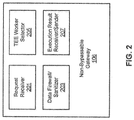
- FIG. 2 is a block diagram illustrating an example of a non-bypassable gateway according to one embodiment.
- Gateway 106 can be dedicated to mediate all network traffic for host server 104 and these network traffic must pass through gateway 106, e.g., gateway 106 is non-bypassable.
- gateway 106 includes modules such as request receiver 201, data firewall/sanitizer 203, TEE worker selector/launcher 205, execution results retriever/sender 207.
- Request receiver 201 can receive a client request from client devices 101-102.
- the client request can include client data and identifiers/names for execution services to be performed using the client data.
- Data firewall/sanitizer 203 can scan and sanitize the received client data.
- the client data can be scanned for, and/or flagged for removal for malicious code, or code that can access, control, or modify a function of server 104.
- data firewall/sanitizer 203 can act as a firewall and monitor traffic data for unusual activities to prevent malicious intrusions.
- TEE worker selector/launcher 205 can select or launch a TEE worker (such as TEE worker 108-109 of Figure 1 ) to service the client request.
- Execution result receiver/sender 207 can receive execution results from the selected TEE worker for the requested execution service and send the execution results to the requesting client devices 101-102.
- FIG 3 is a flow chart illustrating an example of a key registration protocol for a secure multiparty computing system according to one embodiment.
- a key registration protocol may be performed by system 100 of Figure 1 .
- the key registration protocol can be a communication protocol between KMS 160 and a gateway, such as gateway 106 of Figure 1 .
- Gateway 106 may request a key to encrypt/decrypt a client data, or to associate the key with an entity that needs to authenticate its identity.
- gateway 106 may request a key to encrypt/decrypt a client data and to save the encrypted client data within RAMFS 121 so the client data can be retrieved at a later time.
- entities include, but are not limited to, TEE workers, client devices, and other host servers connected to the network.
- example 300 registers a symmetrical key or an asymmetrical key pair by gateway 106 through KMS 160.
- gateway 106 communicates with KMS 160 and performs a TLS handshake for the communication.
- the two communicating parties here, gateway 106 and KMS 160
- exchange messages to acknowledge/verify each other.
- the two parties can establish an encryption algorithm and agree on a session key to be used for the communication session.
- gateway 106 may be a secure entity because it is booted with a root of trust using a secure module (e.g., TPM), KMS 160 may not be aware of the secure boot. Similarly, KMS 160 may not be trusted by gateway 106. In one embodiment, at operation 302, gateway 106 performs attestation on KMS 160 to ensure KMS 160 is a trusted entity. Attestation can include TPM key attestation, or various other types of attestation such as attestation from Intel SGX, ARM TrustZone, AMD (secure encrypted virtualization) SEV, etc., depending on the available attestation supported by KMS 160.
- TPM secure module
- attestation can include TPM key attestation, or various other types of attestation such as attestation from Intel SGX, ARM TrustZone, AMD (secure encrypted virtualization) SEV, etc., depending on the available attestation supported by KMS 160.
- a software-based virtual TPM can be used by any of the entities of Figure 1 , such as gateway 106, KMS 160, or service provider(s) 161, to support multiple hosts or service providers.
- gateway 106 requests a key from KMS 160.
- the key may be a symmetric key or an asymmetric key pair.
- KMS 160 generates a new key.
- KMS 160 signs the key, and at operation 307, KMS 160 distributes the signed key to gateway 106.
- gateway 106 can record keys in a protected list (e.g., in a protected memory separate from a memory of the operating system), and can identify a particular key issued to a respective client data or entity.
- gateway 106 can be seen as providing key generation and maintenance services for server 104. Note that some of the above operations may be optional, such as operations for TLS handshake, attestation, and signing for the key pairs.
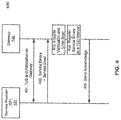
- FIG 4 is a flow chart illustrating an example of an execution service registration protocol for a secure multiparty computing system according to one embodiment.
- An execution service registration protocol can be a communication protocol between a service provider (e.g., SP 161 of Figure 1 ) and a gateway (e.g., gateway 106 of Figure 1 ), for registration of an execution service as a TEE worker so the execution service is available to a client in communication with the gateway.
- the execution service registration protocol example 400 may be performed by system 100 of Figure 1 .
- SP 161 performs a TLS handshake and attestation on gateway 106. Similar to the above, the attestation can be TPM-based or any other types of attestations available for gateway 106.
- SP 161 transmits a service binary with a service description to gateway 106.
- the service description includes a signature to verify the service binary.
- gateway 106 verifies an integrity of the service binary (e.g., the service binary includes all of the expected data packets) and scans the binary for malicious code. For example, gateway 106 may verify a checksum for the service binary. Gateway 106 may further authenticity of the data, e.g., the service binary is associated with SP 161.
- gateway 106 registers the service binary as a TEE worker (such as TEE worker 108).
- gateway 106 sends the acknowledgement to SP 161.
- different execution services can be registered as one or more TEE workers to service client requests. Note that, some of the above operations may be optional, such as operations for TLS handshake and attestation.
- FIG. 5 is a flow chart illustrating an example of a client-gateway data upload protocol according to one embodiment.
- the client-gateway data upload protocol can be a communication protocol between a client (e.g., client device 101-102) and a gateway (gateway 106 of Figure 1 ) for the client to upload client data to the gateway.
- the client-gateway data upload protocol example 500 may be performed by system 100 of Figure 1 .
- the client data may be uploaded prior to, or at the same time, the client invokes an execution service.
- client 101 performs a TLS handshake and attestation on gateway 106. Similar to the above, the attestation can be TPM-based or any other types of attestations available for gateway 106.
- client uploads client data to gateway 106.
- the client data can be an input data to invoke an execution service.
- gateway 106 retrieves key(s) from a KMS to encrypt the client data. Key(s) can be retrieved by a key registration protocol such as the example shown in Figure 3 .
- gateway 106 encrypts the client data.
- gateway 106 saves the encrypted client data to RAMFS 121 or any memory system accessible by gateway 106 and generates a universally unique identifier (UUID) for the client data.
- gateway 106 returns the UUID to client 101. The UUID can then be used by client 101 to subsequently recall the uploaded client data to invoke an execution service.
- UUID universally unique identifier
- FIG. 6 is a flow chart illustrating an example of a client-gateway data download protocol according to one embodiment.
- the client-gateway data download protocol can be a communication protocol between a client (e.g., client device 101-102) and a gateway (gateway 106 of Figure 1 ) for the client to download data (e.g., execution results) from the gateway.
- the client-gateway data download protocol example 600 may be performed by system 100 of Figure 1 .
- the client may download any data related to the client from gateway 106.
- client 101 performs a TLS handshake and attestation on gateway 106. Similar to the above, the attestation can be TPM-based or any other types of attestations available for gateway 106.
- gateway 106 retrieves the data corresponding to the UUID from RAMFS 121.
- gateway 106 determines an encryption key associated with the data and decrypts the data.
- gateway 106 returns the data to client 101.
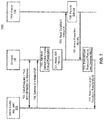
- FIG. 7 is a flow chart illustrating an example of an execution service invocation protocol for a secure multiparty computing system according to one embodiment.
- An execution service invocation protocol can be a communication protocol between a client device (e.g., client device 101-102) and a gateway (e.g., gateway 106 of Figure 1 ), for invocation of an execution service with the gateway so the execution service can be executed by a TEE worker of the gateway.
- Execution service invocation protocol example 700 may be performed by system 100 of Figure 1 .
- client device 101 sends a service request and performs a TLS handshake and attestation on gateway 106.
- the attestation can be TPM-based or any other types of attestations available for gateway 106.
- client device 101 transmits service ID and data UUID to gateway 106.
- the service ID includes a unique name or identifier identifying execution service(s) to be executed by server 104.
- the data UUID can be a UUID identifying client data on RAMFS 121, as the input data, for the execution service(s).
- gateway 106 retrieves the data from RAMFS 121 using the UUID, decrypts the data, and further sanitizes the data by scanning the data for malicious code.
- the input data is directly transmitted by client device 101 to gateway 106 as part of the client request.
- gateway 106 selects a TEE worker (e.g., TEE worker 108) that is registered for the particular execution service to service the client request.
- gateway 106 sends the retrieved data to TEE worker 108 and starts the service execution.
- TEE worker executes the execution service using the data.
- TEE worker returns execution results to gateway 106.
- gateway 106 encrypts and saves a copy of the execution results locally, e.g., on to RAMFS 121.
- gateway 106 generates a UUID and associates the UUID to the execution results.
- gateway 106 returns the execution results or a UUID associated with the execution results to client device 101.
- the UUID can be mapped to the execution results by a mapping table and the mapping table can be maintained by gateway 106.Note that, some operations may be optional, such as operations for TLS handshake and attestation.
- FIG. 8 is a flow diagram illustrating an example of a method according to one embodiment.
- Process 800 may be performed by processing logic which may include software, hardware, or a combination thereof.
- process 800 may be performed by gateway 106 of data processing server (e.g., host) 104 of Figure 1 .
- processing logic in response to a request received at a gateway of a server from a user device of a user over a network to process user data by an execution service, processing logic sanitizes the user data by scanning the user data for malicious code.
- processing logic selects a TEE worker from a number of TEE workers and initiates an execution of the execution service by the selected TEE worker.
- processing logic receive execution results from the selected TEE worker.
- processing logic transmits the execution results to the user device of the user.
- the request is one of a number of requests received from a number of user devices associated with a number of users, and where each of the requests is processed within a respective one of a number of TEE workers.
- the gateway is attested by the user device to be trusted prior to the user device transmitting the request.
- processing logic further registers the execution service with the gateway prior to invoking the execution service for the client request.
- registering the service includes in response to receiving a service binary and a description of the service from a service provider, verifying an integrity and authenticity of the service binary; scanning the service binary for malicious code; and registering the service binary as one of a number of TEE workers.
- the service provider attests the gateway to be a trusted prior to the service provider transmitting the service binary to the gateway.
- processing logic further obtains a key to encrypt a client data from a key management server (KMS).
- KMS key management server
- obtaining the public key includes: transmitting by the gateway a request to obtain the key to the KMS; receiving the key from the KMS, where the KMS generated a symmetric key or a key pair, and where the key is signed by the KMS for the gateway to verify authenticity of the key.
- processing logic further attests the KMS to be a trusted entity and the KMS attests the gateway to be a trusted entity prior to the gateway transmitting, and the KMS receiving, the request.
- the gateway enforces authentication, authorization, audit, and account for network traffic for the gateway.
- the gateway provides reliable, replicated, redundant, and fault-tolerant (RAFT) services.
- the gateway is a non-bypassable gateway.
- Figure 9 is a block diagram illustrating an example of a data processing system which may be used with one embodiment of the invention.
- system 1500 may represent any of data processing systems described above performing any of the processes or methods described above, such as, for example, a client device or a server described above, such as, for example, clients 101-102, and server 104, as described above.
- System 1500 can include many different components. These components can be implemented as integrated circuits (ICs), portions thereof, discrete electronic devices, or other modules adapted to a circuit board such as a motherboard or add-in card of the computer system, or as components otherwise incorporated within a chassis of the computer system.
- ICs integrated circuits
- portions thereof discrete electronic devices
- modules adapted to a circuit board such as a motherboard or add-in card of the computer system, or as components otherwise incorporated within a chassis of the computer system.
- System 1500 is intended to show a high level view of many components of the computer system. However, it is to be understood that additional components may be present in certain implementations and furthermore, different arrangement of the components shown may occur in other implementations.
- System 1500 may represent a desktop, a laptop, a tablet, a server, a mobile phone, a media player, a personal digital assistant (PDA), a Smartwatch, a personal communicator, a gaming device, a network router or hub, a wireless access point (AP) or repeater, a set-top box, or a combination thereof.
- PDA personal digital assistant
- AP wireless access point
- system 1500 is intended to show a high level view of many components of the computer system. However, it is to be understood that additional components may be present in certain implementations and furthermore, different arrangement of the components shown may occur in other implementations.
- System 1500 may represent a desktop, a laptop, a tablet, a server, a mobile phone, a media player, a personal digital assistant (PDA),
- system 1500 includes processor 1501, memory 1503, and devices 1505-1508 via a bus or an interconnect 1510.
- Processor 1501 may represent a single processor or multiple processors with a single processor core or multiple processor cores included therein.
- Processor 1501 may represent one or more general-purpose processors such as a microprocessor, a central processing unit (CPU), or the like. More particularly, processor 1501 may be a complex instruction set computing (CISC) microprocessor, reduced instruction set computing (RISC) microprocessor, very long instruction word (VLIW) microprocessor, or processor implementing other instruction sets, or processors implementing a combination of instruction sets.
- CISC complex instruction set computing
- RISC reduced instruction set computing
- VLIW very long instruction word
- Processor 1501 may also be one or more special-purpose processors such as an application specific integrated circuit (ASIC), a cellular or baseband processor, a field programmable gate array (FPGA), a digital signal processor (DSP), a network processor, a graphics processor, a network processor, a communications processor, a cryptographic processor, a co-processor, an embedded processor, or any other type of logic capable of processing instructions.
- ASIC application specific integrated circuit
- FPGA field programmable gate array
- DSP digital signal processor
- network processor a graphics processor
- network processor a communications processor
- cryptographic processor a co-processor
- co-processor a co-processor
- embedded processor or any other type of logic capable of processing instructions.
- Processor 1501 which may be a low power multi-core processor socket such as an ultra-low voltage processor, may act as a main processing unit and central hub for communication with the various components of the system. Such processor can be implemented as a system on chip (SoC). Processor 1501 is configured to execute instructions for performing the operations and steps discussed herein.
- System 1500 may further include a graphics interface that communicates with optional graphics subsystem 1504, which may include a display controller, a graphics processor, and/or a display device.
- Processor 1501 may communicate with memory 1503, which in one embodiment can be implemented via multiple memory devices to provide for a given amount of system memory.
- Memory 1503 may include one or more volatile storage (or memory) devices such as random access memory (RAM), dynamic RAM (DRAM), synchronous DRAM (SDRAM), static RAM (SRAM), or other types of storage devices.
- RAM random access memory
- DRAM dynamic RAM
- SDRAM synchronous DRAM
- SRAM static RAM
- Memory 1503 may store information including sequences of instructions that are executed by processor 1501, or any other device. For example, executable code and/or data of a variety of operating systems, device drivers, firmware (e.g., input output basic system or BIOS), and/or applications can be loaded in memory 1503 and executed by processor 1501.
- BIOS input output basic system
- An operating system can be any kind of operating systems, such as, for example, Windows® operating system from Microsoft®, Mac OS®/iOS® from Apple, Android® from Google®, Linux®, Unix®, or other real-time or embedded operating systems such as VxWorks.
- System 1500 may further include IO devices such as devices 1505-1508, including network interface device(s) 1505, optional input device(s) 1506, and other optional IO device(s) 1507.
- Network interface device 1505 may include a wireless transceiver and/or a network interface card (NIC).
- the wireless transceiver may be a WiFi transceiver, an infrared transceiver, a Bluetooth transceiver, a WiMax transceiver, a wireless cellular telephony transceiver, a satellite transceiver (e.g., a global positioning system (GPS) transceiver), or other radio frequency (RF) transceivers, or a combination thereof.
- the NIC may be an Ethernet card.
- Input device(s) 1506 may include a mouse, a touch pad, a touch sensitive screen (which may be integrated with display device 1504), a pointer device such as a stylus, and/or a keyboard (e.g., physical keyboard or a virtual keyboard displayed as part of a touch sensitive screen).
- input device 1506 may include a touch screen controller coupled to a touch screen.
- the touch screen and touch screen controller can, for example, detect contact and movement or break thereof using any of a number of touch sensitivity technologies, including but not limited to capacitive, resistive, infrared, and surface acoustic wave technologies, as well as other proximity sensor arrays or other elements for determining one or more points of contact with the touch screen.
- IO devices 1507 may include an audio device.
- An audio device may include a speaker and/or a microphone to facilitate voice-enabled functions, such as voice recognition, voice replication, digital recording, and/or telephony functions.
- Other IO devices 1507 may further include universal serial bus (USB) port(s), parallel port(s), serial port(s), a printer, a network interface, a bus bridge (e.g., a PCI-PCI bridge), sensor(s) (e.g., a motion sensor such as an accelerometer, gyroscope, a magnetometer, a light sensor, compass, a proximity sensor, etc.), or a combination thereof.
- USB universal serial bus
- sensor(s) e.g., a motion sensor such as an accelerometer, gyroscope, a magnetometer, a light sensor, compass, a proximity sensor, etc.
- Devices 1507 may further include an imaging processing subsystem (e.g., a camera), which may include an optical sensor, such as a charged coupled device (CCD) or a complementary metal-oxide semiconductor (CMOS) optical sensor, utilized to facilitate camera functions, such as recording photographs and video clips.
- an imaging processing subsystem e.g., a camera
- an optical sensor such as a charged coupled device (CCD) or a complementary metal-oxide semiconductor (CMOS) optical sensor, utilized to facilitate camera functions, such as recording photographs and video clips.
- CCD charged coupled device
- CMOS complementary metal-oxide semiconductor
- Certain sensors may be coupled to interconnect 1510 via a sensor hub (not shown), while other devices such as a keyboard or thermal sensor may be controlled by an embedded controller (not shown), dependent upon the specific configuration or design of system 1500.
- a mass storage may also couple to processor 1501.
- this mass storage may be implemented via a solid state device (SSD).
- the mass storage may primarily be implemented using a hard disk drive (HDD) with a smaller amount of SSD storage to act as a SSD cache to enable non-volatile storage of context state and other such information during power down events so that a fast power up can occur on re-initiation of system activities.
- a flash device may be coupled to processor 1501, e.g., via a serial peripheral interface (SPI). This flash device may provide for non-volatile storage of system software, including a basic input/output software (BIOS) as well as other firmware of the system.
- BIOS basic input/output software
- Storage device 1508 may include computer-accessible storage medium 1509 (also known as a machine-readable storage medium or a computer-readable medium) on which is stored one or more sets of instructions or software (e.g., module, unit, and/or logic 1528) embodying any one or more of the methodologies or functions described herein.
- Processing module/unit/logic 1528 may represent any of the components described above, such as, for example, gateway 106 or host server 104 of Figure 1 .
- Processing module/unit/logic 1528 may also reside, completely or at least partially, within memory 1503 and/or within processor 1501 during execution thereof by data processing system 1500, memory 1503 and processor 1501 also constituting machine-accessible storage media.
- Processing module/unit/logic 1528 may further be transmitted or received over a network via network interface device 1505.
- Computer-readable storage medium 1509 may also be used to store the some software functionalities described above persistently. While computer-readable storage medium 1509 is shown in an exemplary embodiment to be a single medium, the term "computer-readable storage medium” should be taken to include a single medium or multiple media (e.g., a centralized or distributed database, and/or associated caches and servers) that store the one or more sets of instructions. The terms “computer-readable storage medium” shall also be taken to include any medium that is capable of storing or encoding a set of instructions for execution by the machine and that cause the machine to perform any one or more of the methodologies of the present invention. The term “computer-readable storage medium” shall accordingly be taken to include, but not be limited to, solid-state memories, and optical and magnetic media, or any other non-transitory machine-readable medium.
- Processing module/unit/logic 1528, components and other features described herein can be implemented as discrete hardware components or integrated in the functionality of hardware components such as ASICS, FPGAs, DSPs or similar devices.
- processing module/unit/logic 1528 can be implemented as firmware or functional circuitry within hardware devices.
- processing module/unit/logic 1528 can be implemented in any combination hardware devices and software components.
- system 1500 is illustrated with various components of a data processing system, it is not intended to represent any particular architecture or manner of interconnecting the components; as such details are not germane to embodiments of the present invention. It will also be appreciated that network computers, handheld computers, mobile phones, servers, and/or other data processing systems which have fewer components or perhaps more components may also be used with embodiments of the invention.
- the techniques shown in the figures can be implemented using code and data stored and executed on one or more electronic devices.
- Such electronic devices store and communicate (internally and/or with other electronic devices over a network) code and data using computer-readable media, such as non-transitory computer-readable storage media (e.g., magnetic disks; optical disks; random access memory; read only memory; flash memory devices; phase-change memory) and transitory computer-readable transmission media (e.g., electrical, optical, acoustical or other form of propagated signals - such as carrier waves, infrared signals, digital signals).
- non-transitory computer-readable storage media e.g., magnetic disks; optical disks; random access memory; read only memory; flash memory devices; phase-change memory
- transitory computer-readable transmission media e.g., electrical, optical, acoustical or other form of propagated signals - such as carrier waves, infrared signals, digital signals.
- processing logic that comprises hardware (e.g. circuitry, dedicated logic, etc.), firmware, software (e.g., embodied on a non-transitory computer readable medium), or a combination of both.
- processing logic comprises hardware (e.g. circuitry, dedicated logic, etc.), firmware, software (e.g., embodied on a non-transitory computer readable medium), or a combination of both.
Landscapes
- Engineering & Computer Science (AREA)
- Computer Security & Cryptography (AREA)
- Computer Hardware Design (AREA)
- General Engineering & Computer Science (AREA)
- Computer Networks & Wireless Communication (AREA)
- Signal Processing (AREA)
- Theoretical Computer Science (AREA)
- Software Systems (AREA)
- Computing Systems (AREA)
- Physics & Mathematics (AREA)
- General Physics & Mathematics (AREA)
- General Health & Medical Sciences (AREA)
- Virology (AREA)
- Health & Medical Sciences (AREA)
- Mathematical Physics (AREA)
- Computer And Data Communications (AREA)
- Mobile Radio Communication Systems (AREA)
- Information Transfer Between Computers (AREA)
Applications Claiming Priority (1)
| Application Number | Priority Date | Filing Date | Title |
|---|---|---|---|
| US16/406,797 US11295014B2 (en) | 2019-05-08 | 2019-05-08 | TPM-based secure multiparty computing system using a non-bypassable gateway |
Publications (2)
| Publication Number | Publication Date |
|---|---|
| EP3736718A1 true EP3736718A1 (de) | 2020-11-11 |
| EP3736718B1 EP3736718B1 (de) | 2024-01-31 |
Family
ID=69804523
Family Applications (1)
| Application Number | Title | Priority Date | Filing Date |
|---|---|---|---|
| EP20162186.9A Active EP3736718B1 (de) | 2019-05-08 | 2020-03-10 | Tpm-basiertes sicheres mehrparteien-computersystem mit einem nicht umgehbaren gateway |
Country Status (5)
| Country | Link |
|---|---|
| US (1) | US11295014B2 (de) |
| EP (1) | EP3736718B1 (de) |
| JP (1) | JP7000491B2 (de) |
| KR (1) | KR102363080B1 (de) |
| CN (1) | CN111917696B (de) |
Cited By (1)
| Publication number | Priority date | Publication date | Assignee | Title |
|---|---|---|---|---|
| WO2024144792A1 (en) * | 2022-12-30 | 2024-07-04 | Google Llc | Secure workflows that enhance data security using sandboxes hosted by trusted execution environments |
Families Citing this family (9)
| Publication number | Priority date | Publication date | Assignee | Title |
|---|---|---|---|---|
| CN112600830B (zh) * | 2020-12-07 | 2024-03-26 | 腾讯科技(深圳)有限公司 | 业务数据处理方法、装置、电子设备及存储介质 |
| US12113902B2 (en) * | 2020-12-22 | 2024-10-08 | Intel Corporation | Scalable attestation for trusted execution environments |
| US20210110070A1 (en) * | 2020-12-22 | 2021-04-15 | Anjo Lucas Vahldiek-Oberwagner | Reducing latency of hardware trusted execution environments |
| CN112926051B (zh) * | 2021-03-25 | 2022-05-06 | 支付宝(杭州)信息技术有限公司 | 多方安全计算方法和装置 |
| EP4145762B1 (de) * | 2021-09-06 | 2023-10-25 | Axis AB | Verfahren und system zur sicheren verarbeitung von daten mittels einer verarbeitungsanwendung |
| CN113904806A (zh) * | 2021-09-07 | 2022-01-07 | 天翼电子商务有限公司 | 一种可信执行环境多节点认证方法 |
| CN114021141B (zh) * | 2021-10-29 | 2025-08-15 | 中国银联股份有限公司 | 一种电子设备、可信应用调用方法、装置、设备及介质 |
| US20250240293A1 (en) * | 2024-01-19 | 2025-07-24 | Dell Products L.P. | Multi-tenant secrets manager |
| GB2640873A (en) | 2024-05-08 | 2025-11-12 | Ibm | Controlling workload execution on trusted execution environments |
Citations (3)
| Publication number | Priority date | Publication date | Assignee | Title |
|---|---|---|---|---|
| US20140208123A1 (en) * | 2013-01-22 | 2014-07-24 | Amazon Technologies, Inc. | Privileged cryptographic services in a virtualized environment |
| US20140317686A1 (en) * | 2013-04-22 | 2014-10-23 | Oracle International Corporation | System with a trusted execution environment component executed on a secure element |
| CN109101822A (zh) * | 2018-07-10 | 2018-12-28 | 西安交通大学 | 一种解决多方计算中数据隐私泄露问题的方法 |
Family Cites Families (23)
| Publication number | Priority date | Publication date | Assignee | Title |
|---|---|---|---|---|
| US20050188087A1 (en) * | 2002-05-28 | 2005-08-25 | Dai Nippon Printing Co., Ltd. | Parallel processing system |
| JP4128849B2 (ja) | 2002-10-29 | 2008-07-30 | 株式会社東芝 | セキュア通信システム、方法及びプログラム |
| US7463637B2 (en) * | 2005-04-14 | 2008-12-09 | Alcatel Lucent | Public and private network service management systems and methods |
| JP5058088B2 (ja) | 2008-07-14 | 2012-10-24 | 日本電信電話株式会社 | サービスコンポーネントの擾乱防止方法、およびサービスコンポーネントの擾乱制御装置 |
| US8341427B2 (en) * | 2009-02-16 | 2012-12-25 | Microsoft Corporation | Trusted cloud computing and services framework |
| JP2011114799A (ja) | 2009-11-30 | 2011-06-09 | Nippon Telegr & Teleph Corp <Ntt> | セキュリティシステム、中継装置、セキュリティ方法、及びプログラム |
| US9047476B2 (en) * | 2011-11-07 | 2015-06-02 | At&T Intellectual Property I, L.P. | Browser-based secure desktop applications for open computing platforms |
| US9319897B2 (en) * | 2012-08-15 | 2016-04-19 | Qualcomm Incorporated | Secure behavior analysis over trusted execution environment |
| WO2014142858A1 (en) * | 2013-03-14 | 2014-09-18 | Intel Corporation | Trusted data processing in the public cloud |
| US10007790B2 (en) * | 2014-06-06 | 2018-06-26 | Empire Technology Development Llc | Secure application development and execution |
| US10061915B1 (en) * | 2014-09-03 | 2018-08-28 | Amazon Technologies, Inc. | Posture assessment in a secure execution environment |
| JP6391439B2 (ja) | 2014-11-21 | 2018-09-19 | キヤノン株式会社 | 情報処理装置、サーバ装置、情報処理システム、制御方法及びコンピュータプログラム |
| CN105930040A (zh) * | 2015-02-27 | 2016-09-07 | 三星电子株式会社 | 包含电子支付系统的电子装置及其操作方法 |
| US10193858B2 (en) * | 2015-12-22 | 2019-01-29 | Mcafee, Llc | Attestation device custody transfer protocol |
| US9860195B2 (en) * | 2015-12-31 | 2018-01-02 | Hughes Network Systems, Llc | Method and system of providing carrier grade NAT (CGN) to a subset of a subscriber base |
| CN109644153B (zh) | 2016-04-12 | 2020-10-13 | 伽德诺克斯信息技术有限公司 | 具有被配置为实现安全锁定的相关设备的特别编程的计算系统及其使用方法 |
| US10592670B2 (en) * | 2016-06-28 | 2020-03-17 | Intel Corporation | Technologies for provisioning and managing secure launch enclave with platform firmware |
| US10528721B2 (en) * | 2016-10-20 | 2020-01-07 | Intel Corporation | Trusted packet processing for multi-domain separatization and security |
| US11044267B2 (en) * | 2016-11-30 | 2021-06-22 | Agari Data, Inc. | Using a measure of influence of sender in determining a security risk associated with an electronic message |
| US10521612B2 (en) * | 2017-06-21 | 2019-12-31 | Ca, Inc. | Hybrid on-premises/software-as-service applications |
| JP6888445B2 (ja) | 2017-07-10 | 2021-06-16 | 大日本印刷株式会社 | セキュアエレメント、コンピュータプログラム、デバイス、サーバ及びトラステッドアプリケーションのインストレーション方法 |
| GB2566263A (en) * | 2017-09-01 | 2019-03-13 | Trustonic Ltd | Post-manufacture certificate generation |
| CN109241016B (zh) * | 2018-08-14 | 2020-07-07 | 阿里巴巴集团控股有限公司 | 多方安全计算方法及装置、电子设备 |
-
2019
- 2019-05-08 US US16/406,797 patent/US11295014B2/en active Active
-
2020
- 2020-03-06 CN CN202010151251.5A patent/CN111917696B/zh active Active
- 2020-03-10 EP EP20162186.9A patent/EP3736718B1/de active Active
- 2020-04-09 JP JP2020070291A patent/JP7000491B2/ja active Active
- 2020-05-07 KR KR1020200054369A patent/KR102363080B1/ko active Active
Patent Citations (3)
| Publication number | Priority date | Publication date | Assignee | Title |
|---|---|---|---|---|
| US20140208123A1 (en) * | 2013-01-22 | 2014-07-24 | Amazon Technologies, Inc. | Privileged cryptographic services in a virtualized environment |
| US20140317686A1 (en) * | 2013-04-22 | 2014-10-23 | Oracle International Corporation | System with a trusted execution environment component executed on a secure element |
| CN109101822A (zh) * | 2018-07-10 | 2018-12-28 | 西安交通大学 | 一种解决多方计算中数据隐私泄露问题的方法 |
Cited By (3)
| Publication number | Priority date | Publication date | Assignee | Title |
|---|---|---|---|---|
| WO2024144792A1 (en) * | 2022-12-30 | 2024-07-04 | Google Llc | Secure workflows that enhance data security using sandboxes hosted by trusted execution environments |
| EP4579561A3 (de) * | 2022-12-30 | 2025-07-09 | Google Llc | Sichere arbeitsabläufe zur verbesserung der datensicherheit unter verwendung von sandboxen, die von vertrauenswürdigen ausführungsumgebungen gehostet sind |
| US12530446B2 (en) | 2022-12-30 | 2026-01-20 | Google Llc | Secure workflows that enhance data security using sandboxes hosted by trusted execution environments |
Also Published As
| Publication number | Publication date |
|---|---|
| US20200356670A1 (en) | 2020-11-12 |
| EP3736718B1 (de) | 2024-01-31 |
| KR20200130164A (ko) | 2020-11-18 |
| KR102363080B1 (ko) | 2022-02-14 |
| CN111917696A (zh) | 2020-11-10 |
| JP7000491B2 (ja) | 2022-01-19 |
| JP2020184326A (ja) | 2020-11-12 |
| CN111917696B (zh) | 2022-09-23 |
| US11295014B2 (en) | 2022-04-05 |
Similar Documents
| Publication | Publication Date | Title |
|---|---|---|
| EP3736718B1 (de) | Tpm-basiertes sicheres mehrparteien-computersystem mit einem nicht umgehbaren gateway | |
| EP3695587B1 (de) | Bereitstellung sicherer kommunikationen zwischen einem host-system und einem datenverarbeitungsbeschleuniger | |
| US11799651B2 (en) | Data processing accelerator having a security unit to provide root trust services | |
| EP3794771B1 (de) | Verfahren und system für schlüsselverteilung und -austausch für datenverarbeitungsbeschleuniger | |
| US11574032B2 (en) | Systems and methods for signing an AI model with a watermark for a data processing accelerator | |
| EP3811557B1 (de) | Verfahren und system zur ableitung eines sitzungsschlüssels zur sicherung eines informationsaustauschkanals zwischen einem host-system und einem datenverarbeitungsbeschleuniger | |
| US11392687B2 (en) | Method and system for validating kernel objects to be executed by a data processing accelerator of a host system | |
| US11019033B1 (en) | Trust domain secure enclaves in cloud infrastructure | |
| US11411934B2 (en) | System and method to securely broadcast a message to accelerators with switch | |
| US11609766B2 (en) | Method and system for protecting data processed by data processing accelerators | |
| WO2022161182A1 (zh) | 基于数据流的可信计算的方法及装置 | |
| US11616651B2 (en) | Method for establishing a secure information exchange channel between a host system and a data processing accelerator | |
| EP3794763B1 (de) | Bestätigungsprotokoll zwischen einem hostsystem und einem datenverarbeitungsbeschleuniger | |
| US12355878B2 (en) | Secret management in distributed systems through onboarding | |
| US11516010B2 (en) | System and method to securely broadcast a message to accelerators using virtual channels | |
| US20250141924A1 (en) | Securing communication channels in distributed systems | |
| US11281251B2 (en) | Data processing accelerator having a local time unit to generate timestamps | |
| US12574419B2 (en) | Management of location-based security policies using out of band methods | |
| US12621129B2 (en) | Systems and methods for managing storage devices for data processing systems using out-of-band methods | |
| US20250337563A1 (en) | Systems and methods for managing storage devices for data processing systems using out-of-band methods |
Legal Events
| Date | Code | Title | Description |
|---|---|---|---|
| PUAI | Public reference made under article 153(3) epc to a published international application that has entered the european phase |
Free format text: ORIGINAL CODE: 0009012 |
|
| STAA | Information on the status of an ep patent application or granted ep patent |
Free format text: STATUS: THE APPLICATION HAS BEEN PUBLISHED |
|
| AK | Designated contracting states |
Kind code of ref document: A1 Designated state(s): AL AT BE BG CH CY CZ DE DK EE ES FI FR GB GR HR HU IE IS IT LI LT LU LV MC MK MT NL NO PL PT RO RS SE SI SK SM TR |
|
| AX | Request for extension of the european patent |
Extension state: BA ME |
|
| STAA | Information on the status of an ep patent application or granted ep patent |
Free format text: STATUS: REQUEST FOR EXAMINATION WAS MADE |
|
| 17P | Request for examination filed |
Effective date: 20210504 |
|
| RBV | Designated contracting states (corrected) |
Designated state(s): AL AT BE BG CH CY CZ DE DK EE ES FI FR GB GR HR HU IE IS IT LI LT LU LV MC MK MT NL NO PL PT RO RS SE SI SK SM TR |
|
| STAA | Information on the status of an ep patent application or granted ep patent |
Free format text: STATUS: EXAMINATION IS IN PROGRESS |
|
| 17Q | First examination report despatched |
Effective date: 20220228 |
|
| GRAP | Despatch of communication of intention to grant a patent |
Free format text: ORIGINAL CODE: EPIDOSNIGR1 |
|
| STAA | Information on the status of an ep patent application or granted ep patent |
Free format text: STATUS: GRANT OF PATENT IS INTENDED |
|
| INTG | Intention to grant announced |
Effective date: 20231016 |
|
| GRAS | Grant fee paid |
Free format text: ORIGINAL CODE: EPIDOSNIGR3 |
|
| GRAA | (expected) grant |
Free format text: ORIGINAL CODE: 0009210 |
|
| STAA | Information on the status of an ep patent application or granted ep patent |
Free format text: STATUS: THE PATENT HAS BEEN GRANTED |
|
| P01 | Opt-out of the competence of the unified patent court (upc) registered |
Effective date: 20231212 |
|
| AK | Designated contracting states |
Kind code of ref document: B1 Designated state(s): AL AT BE BG CH CY CZ DE DK EE ES FI FR GB GR HR HU IE IS IT LI LT LU LV MC MK MT NL NO PL PT RO RS SE SI SK SM TR |
|
| REG | Reference to a national code |
Ref country code: GB Ref legal event code: FG4D Ref country code: CH Ref legal event code: EP |
|
| REG | Reference to a national code |
Ref country code: DE Ref legal event code: R096 Ref document number: 602020024935 Country of ref document: DE |
|
| REG | Reference to a national code |
Ref country code: IE Ref legal event code: FG4D |
|
| REG | Reference to a national code |
Ref country code: LT Ref legal event code: MG9D |
|
| REG | Reference to a national code |
Ref country code: NL Ref legal event code: MP Effective date: 20240131 |
|
| PG25 | Lapsed in a contracting state [announced via postgrant information from national office to epo] |
Ref country code: IS Free format text: LAPSE BECAUSE OF FAILURE TO SUBMIT A TRANSLATION OF THE DESCRIPTION OR TO PAY THE FEE WITHIN THE PRESCRIBED TIME-LIMIT Effective date: 20240531 |
|
| PG25 | Lapsed in a contracting state [announced via postgrant information from national office to epo] |
Ref country code: LT Free format text: LAPSE BECAUSE OF FAILURE TO SUBMIT A TRANSLATION OF THE DESCRIPTION OR TO PAY THE FEE WITHIN THE PRESCRIBED TIME-LIMIT Effective date: 20240131 |
|
| PG25 | Lapsed in a contracting state [announced via postgrant information from national office to epo] |
Ref country code: GR Free format text: LAPSE BECAUSE OF FAILURE TO SUBMIT A TRANSLATION OF THE DESCRIPTION OR TO PAY THE FEE WITHIN THE PRESCRIBED TIME-LIMIT Effective date: 20240501 |
|
| REG | Reference to a national code |
Ref country code: AT Ref legal event code: MK05 Ref document number: 1654350 Country of ref document: AT Kind code of ref document: T Effective date: 20240131 |
|
| PG25 | Lapsed in a contracting state [announced via postgrant information from national office to epo] |
Ref country code: HR Free format text: LAPSE BECAUSE OF FAILURE TO SUBMIT A TRANSLATION OF THE DESCRIPTION OR TO PAY THE FEE WITHIN THE PRESCRIBED TIME-LIMIT Effective date: 20240131 Ref country code: RS Free format text: LAPSE BECAUSE OF FAILURE TO SUBMIT A TRANSLATION OF THE DESCRIPTION OR TO PAY THE FEE WITHIN THE PRESCRIBED TIME-LIMIT Effective date: 20240430 Ref country code: NL Free format text: LAPSE BECAUSE OF FAILURE TO SUBMIT A TRANSLATION OF THE DESCRIPTION OR TO PAY THE FEE WITHIN THE PRESCRIBED TIME-LIMIT Effective date: 20240131 |
|
| PG25 | Lapsed in a contracting state [announced via postgrant information from national office to epo] |
Ref country code: ES Free format text: LAPSE BECAUSE OF FAILURE TO SUBMIT A TRANSLATION OF THE DESCRIPTION OR TO PAY THE FEE WITHIN THE PRESCRIBED TIME-LIMIT Effective date: 20240131 |
|
| PG25 | Lapsed in a contracting state [announced via postgrant information from national office to epo] |
Ref country code: AT Free format text: LAPSE BECAUSE OF FAILURE TO SUBMIT A TRANSLATION OF THE DESCRIPTION OR TO PAY THE FEE WITHIN THE PRESCRIBED TIME-LIMIT Effective date: 20240131 |
|
| PG25 | Lapsed in a contracting state [announced via postgrant information from national office to epo] |
Ref country code: RS Free format text: LAPSE BECAUSE OF FAILURE TO SUBMIT A TRANSLATION OF THE DESCRIPTION OR TO PAY THE FEE WITHIN THE PRESCRIBED TIME-LIMIT Effective date: 20240430 Ref country code: NO Free format text: LAPSE BECAUSE OF FAILURE TO SUBMIT A TRANSLATION OF THE DESCRIPTION OR TO PAY THE FEE WITHIN THE PRESCRIBED TIME-LIMIT Effective date: 20240430 Ref country code: NL Free format text: LAPSE BECAUSE OF FAILURE TO SUBMIT A TRANSLATION OF THE DESCRIPTION OR TO PAY THE FEE WITHIN THE PRESCRIBED TIME-LIMIT Effective date: 20240131 Ref country code: LT Free format text: LAPSE BECAUSE OF FAILURE TO SUBMIT A TRANSLATION OF THE DESCRIPTION OR TO PAY THE FEE WITHIN THE PRESCRIBED TIME-LIMIT Effective date: 20240131 Ref country code: IS Free format text: LAPSE BECAUSE OF FAILURE TO SUBMIT A TRANSLATION OF THE DESCRIPTION OR TO PAY THE FEE WITHIN THE PRESCRIBED TIME-LIMIT Effective date: 20240531 Ref country code: HR Free format text: LAPSE BECAUSE OF FAILURE TO SUBMIT A TRANSLATION OF THE DESCRIPTION OR TO PAY THE FEE WITHIN THE PRESCRIBED TIME-LIMIT Effective date: 20240131 Ref country code: GR Free format text: LAPSE BECAUSE OF FAILURE TO SUBMIT A TRANSLATION OF THE DESCRIPTION OR TO PAY THE FEE WITHIN THE PRESCRIBED TIME-LIMIT Effective date: 20240501 Ref country code: FI Free format text: LAPSE BECAUSE OF FAILURE TO SUBMIT A TRANSLATION OF THE DESCRIPTION OR TO PAY THE FEE WITHIN THE PRESCRIBED TIME-LIMIT Effective date: 20240131 Ref country code: ES Free format text: LAPSE BECAUSE OF FAILURE TO SUBMIT A TRANSLATION OF THE DESCRIPTION OR TO PAY THE FEE WITHIN THE PRESCRIBED TIME-LIMIT Effective date: 20240131 Ref country code: BG Free format text: LAPSE BECAUSE OF FAILURE TO SUBMIT A TRANSLATION OF THE DESCRIPTION OR TO PAY THE FEE WITHIN THE PRESCRIBED TIME-LIMIT Effective date: 20240131 Ref country code: AT Free format text: LAPSE BECAUSE OF FAILURE TO SUBMIT A TRANSLATION OF THE DESCRIPTION OR TO PAY THE FEE WITHIN THE PRESCRIBED TIME-LIMIT Effective date: 20240131 |
|
| PG25 | Lapsed in a contracting state [announced via postgrant information from national office to epo] |
Ref country code: PL Free format text: LAPSE BECAUSE OF FAILURE TO SUBMIT A TRANSLATION OF THE DESCRIPTION OR TO PAY THE FEE WITHIN THE PRESCRIBED TIME-LIMIT Effective date: 20240131 Ref country code: PT Free format text: LAPSE BECAUSE OF FAILURE TO SUBMIT A TRANSLATION OF THE DESCRIPTION OR TO PAY THE FEE WITHIN THE PRESCRIBED TIME-LIMIT Effective date: 20240531 |
|
| PG25 | Lapsed in a contracting state [announced via postgrant information from national office to epo] |
Ref country code: SE Free format text: LAPSE BECAUSE OF FAILURE TO SUBMIT A TRANSLATION OF THE DESCRIPTION OR TO PAY THE FEE WITHIN THE PRESCRIBED TIME-LIMIT Effective date: 20240131 Ref country code: PT Free format text: LAPSE BECAUSE OF FAILURE TO SUBMIT A TRANSLATION OF THE DESCRIPTION OR TO PAY THE FEE WITHIN THE PRESCRIBED TIME-LIMIT Effective date: 20240531 Ref country code: PL Free format text: LAPSE BECAUSE OF FAILURE TO SUBMIT A TRANSLATION OF THE DESCRIPTION OR TO PAY THE FEE WITHIN THE PRESCRIBED TIME-LIMIT Effective date: 20240131 Ref country code: LV Free format text: LAPSE BECAUSE OF FAILURE TO SUBMIT A TRANSLATION OF THE DESCRIPTION OR TO PAY THE FEE WITHIN THE PRESCRIBED TIME-LIMIT Effective date: 20240131 |
|
| PG25 | Lapsed in a contracting state [announced via postgrant information from national office to epo] |
Ref country code: DK Free format text: LAPSE BECAUSE OF FAILURE TO SUBMIT A TRANSLATION OF THE DESCRIPTION OR TO PAY THE FEE WITHIN THE PRESCRIBED TIME-LIMIT Effective date: 20240131 |
|
| PG25 | Lapsed in a contracting state [announced via postgrant information from national office to epo] |
Ref country code: SM Free format text: LAPSE BECAUSE OF FAILURE TO SUBMIT A TRANSLATION OF THE DESCRIPTION OR TO PAY THE FEE WITHIN THE PRESCRIBED TIME-LIMIT Effective date: 20240131 |
|
| PG25 | Lapsed in a contracting state [announced via postgrant information from national office to epo] |
Ref country code: EE Free format text: LAPSE BECAUSE OF FAILURE TO SUBMIT A TRANSLATION OF THE DESCRIPTION OR TO PAY THE FEE WITHIN THE PRESCRIBED TIME-LIMIT Effective date: 20240131 Ref country code: CZ Free format text: LAPSE BECAUSE OF FAILURE TO SUBMIT A TRANSLATION OF THE DESCRIPTION OR TO PAY THE FEE WITHIN THE PRESCRIBED TIME-LIMIT Effective date: 20240131 |
|
| PG25 | Lapsed in a contracting state [announced via postgrant information from national office to epo] |
Ref country code: SK Free format text: LAPSE BECAUSE OF FAILURE TO SUBMIT A TRANSLATION OF THE DESCRIPTION OR TO PAY THE FEE WITHIN THE PRESCRIBED TIME-LIMIT Effective date: 20240131 |
|
| PG25 | Lapsed in a contracting state [announced via postgrant information from national office to epo] |
Ref country code: SM Free format text: LAPSE BECAUSE OF FAILURE TO SUBMIT A TRANSLATION OF THE DESCRIPTION OR TO PAY THE FEE WITHIN THE PRESCRIBED TIME-LIMIT Effective date: 20240131 Ref country code: SK Free format text: LAPSE BECAUSE OF FAILURE TO SUBMIT A TRANSLATION OF THE DESCRIPTION OR TO PAY THE FEE WITHIN THE PRESCRIBED TIME-LIMIT Effective date: 20240131 Ref country code: RO Free format text: LAPSE BECAUSE OF FAILURE TO SUBMIT A TRANSLATION OF THE DESCRIPTION OR TO PAY THE FEE WITHIN THE PRESCRIBED TIME-LIMIT Effective date: 20240131 Ref country code: EE Free format text: LAPSE BECAUSE OF FAILURE TO SUBMIT A TRANSLATION OF THE DESCRIPTION OR TO PAY THE FEE WITHIN THE PRESCRIBED TIME-LIMIT Effective date: 20240131 Ref country code: DK Free format text: LAPSE BECAUSE OF FAILURE TO SUBMIT A TRANSLATION OF THE DESCRIPTION OR TO PAY THE FEE WITHIN THE PRESCRIBED TIME-LIMIT Effective date: 20240131 Ref country code: CZ Free format text: LAPSE BECAUSE OF FAILURE TO SUBMIT A TRANSLATION OF THE DESCRIPTION OR TO PAY THE FEE WITHIN THE PRESCRIBED TIME-LIMIT Effective date: 20240131 |
|
| REG | Reference to a national code |
Ref country code: CH Ref legal event code: PL |
|
| REG | Reference to a national code |
Ref country code: DE Ref legal event code: R097 Ref document number: 602020024935 Country of ref document: DE |
|
| PG25 | Lapsed in a contracting state [announced via postgrant information from national office to epo] |
Ref country code: LU Free format text: LAPSE BECAUSE OF NON-PAYMENT OF DUE FEES Effective date: 20240310 |
|
| PG25 | Lapsed in a contracting state [announced via postgrant information from national office to epo] |
Ref country code: MC Free format text: LAPSE BECAUSE OF FAILURE TO SUBMIT A TRANSLATION OF THE DESCRIPTION OR TO PAY THE FEE WITHIN THE PRESCRIBED TIME-LIMIT Effective date: 20240131 |
|
| PG25 | Lapsed in a contracting state [announced via postgrant information from national office to epo] |
Ref country code: MC Free format text: LAPSE BECAUSE OF FAILURE TO SUBMIT A TRANSLATION OF THE DESCRIPTION OR TO PAY THE FEE WITHIN THE PRESCRIBED TIME-LIMIT Effective date: 20240131 Ref country code: LU Free format text: LAPSE BECAUSE OF NON-PAYMENT OF DUE FEES Effective date: 20240310 |
|
| PLBE | No opposition filed within time limit |
Free format text: ORIGINAL CODE: 0009261 |
|
| STAA | Information on the status of an ep patent application or granted ep patent |
Free format text: STATUS: NO OPPOSITION FILED WITHIN TIME LIMIT |
|
| REG | Reference to a national code |
Ref country code: BE Ref legal event code: MM Effective date: 20240331 |
|
| 26N | No opposition filed |
Effective date: 20241101 |
|
| PG25 | Lapsed in a contracting state [announced via postgrant information from national office to epo] |
Ref country code: BE Free format text: LAPSE BECAUSE OF NON-PAYMENT OF DUE FEES Effective date: 20240331 |
|
| PG25 | Lapsed in a contracting state [announced via postgrant information from national office to epo] |
Ref country code: IE Free format text: LAPSE BECAUSE OF NON-PAYMENT OF DUE FEES Effective date: 20240310 |
|
| PG25 | Lapsed in a contracting state [announced via postgrant information from national office to epo] |
Ref country code: IE Free format text: LAPSE BECAUSE OF NON-PAYMENT OF DUE FEES Effective date: 20240310 Ref country code: BE Free format text: LAPSE BECAUSE OF NON-PAYMENT OF DUE FEES Effective date: 20240331 Ref country code: CH Free format text: LAPSE BECAUSE OF NON-PAYMENT OF DUE FEES Effective date: 20240331 |
|
| PG25 | Lapsed in a contracting state [announced via postgrant information from national office to epo] |
Ref country code: SI Free format text: LAPSE BECAUSE OF FAILURE TO SUBMIT A TRANSLATION OF THE DESCRIPTION OR TO PAY THE FEE WITHIN THE PRESCRIBED TIME-LIMIT Effective date: 20240131 |
|
| PGFP | Annual fee paid to national office [announced via postgrant information from national office to epo] |
Ref country code: IT Payment date: 20250331 Year of fee payment: 6 |
|
| PG25 | Lapsed in a contracting state [announced via postgrant information from national office to epo] |
Ref country code: CY Free format text: LAPSE BECAUSE OF FAILURE TO SUBMIT A TRANSLATION OF THE DESCRIPTION OR TO PAY THE FEE WITHIN THE PRESCRIBED TIME-LIMIT; INVALID AB INITIO Effective date: 20200310 |
|
| PG25 | Lapsed in a contracting state [announced via postgrant information from national office to epo] |
Ref country code: HU Free format text: LAPSE BECAUSE OF FAILURE TO SUBMIT A TRANSLATION OF THE DESCRIPTION OR TO PAY THE FEE WITHIN THE PRESCRIBED TIME-LIMIT; INVALID AB INITIO Effective date: 20200310 |
|
| PG25 | Lapsed in a contracting state [announced via postgrant information from national office to epo] |
Ref country code: TR Free format text: LAPSE BECAUSE OF FAILURE TO SUBMIT A TRANSLATION OF THE DESCRIPTION OR TO PAY THE FEE WITHIN THE PRESCRIBED TIME-LIMIT Effective date: 20240131 |
|
| PGFP | Annual fee paid to national office [announced via postgrant information from national office to epo] |
Ref country code: GB Payment date: 20260203 Year of fee payment: 7 |
|
| PGFP | Annual fee paid to national office [announced via postgrant information from national office to epo] |
Ref country code: DE Payment date: 20260320 Year of fee payment: 7 |
|
| PGFP | Annual fee paid to national office [announced via postgrant information from national office to epo] |
Ref country code: FR Payment date: 20260209 Year of fee payment: 7 |