EP3736428B1 - Gorge de joint rapportée pour accouplement par cannelures - Google Patents
Gorge de joint rapportée pour accouplement par cannelures Download PDFInfo
- Publication number
- EP3736428B1 EP3736428B1 EP20173233.6A EP20173233A EP3736428B1 EP 3736428 B1 EP3736428 B1 EP 3736428B1 EP 20173233 A EP20173233 A EP 20173233A EP 3736428 B1 EP3736428 B1 EP 3736428B1
- Authority
- EP
- European Patent Office
- Prior art keywords
- annular
- insert
- accessory
- coupling device
- shaft
- Prior art date
- Legal status (The legal status is an assumption and is not a legal conclusion. Google has not performed a legal analysis and makes no representation as to the accuracy of the status listed.)
- Active
Links
Images



Classifications
-
- F—MECHANICAL ENGINEERING; LIGHTING; HEATING; WEAPONS; BLASTING
- F02—COMBUSTION ENGINES; HOT-GAS OR COMBUSTION-PRODUCT ENGINE PLANTS
- F02C—GAS-TURBINE PLANTS; AIR INTAKES FOR JET-PROPULSION PLANTS; CONTROLLING FUEL SUPPLY IN AIR-BREATHING JET-PROPULSION PLANTS
- F02C7/00—Features, components parts, details or accessories, not provided for in, or of interest apart form groups F02C1/00 - F02C6/00; Air intakes for jet-propulsion plants
- F02C7/36—Power transmission arrangements between the different shafts of the gas turbine plant, or between the gas-turbine plant and the power user
-
- F—MECHANICAL ENGINEERING; LIGHTING; HEATING; WEAPONS; BLASTING
- F01—MACHINES OR ENGINES IN GENERAL; ENGINE PLANTS IN GENERAL; STEAM ENGINES
- F01D—NON-POSITIVE DISPLACEMENT MACHINES OR ENGINES, e.g. STEAM TURBINES
- F01D25/00—Component parts, details, or accessories, not provided for in, or of interest apart from, other groups
- F01D25/18—Lubricating arrangements
- F01D25/183—Sealing means
-
- F—MECHANICAL ENGINEERING; LIGHTING; HEATING; WEAPONS; BLASTING
- F02—COMBUSTION ENGINES; HOT-GAS OR COMBUSTION-PRODUCT ENGINE PLANTS
- F02C—GAS-TURBINE PLANTS; AIR INTAKES FOR JET-PROPULSION PLANTS; CONTROLLING FUEL SUPPLY IN AIR-BREATHING JET-PROPULSION PLANTS
- F02C7/00—Features, components parts, details or accessories, not provided for in, or of interest apart form groups F02C1/00 - F02C6/00; Air intakes for jet-propulsion plants
- F02C7/28—Arrangement of seals
-
- F—MECHANICAL ENGINEERING; LIGHTING; HEATING; WEAPONS; BLASTING
- F16—ENGINEERING ELEMENTS AND UNITS; GENERAL MEASURES FOR PRODUCING AND MAINTAINING EFFECTIVE FUNCTIONING OF MACHINES OR INSTALLATIONS; THERMAL INSULATION IN GENERAL
- F16D—COUPLINGS FOR TRANSMITTING ROTATION; CLUTCHES; BRAKES
- F16D1/00—Couplings for rigidly connecting two coaxial shafts or other movable machine elements
- F16D1/10—Quick-acting couplings in which the parts are connected by simply bringing them together axially
- F16D1/101—Quick-acting couplings in which the parts are connected by simply bringing them together axially without axial retaining means rotating with the coupling
-
- F—MECHANICAL ENGINEERING; LIGHTING; HEATING; WEAPONS; BLASTING
- F16—ENGINEERING ELEMENTS AND UNITS; GENERAL MEASURES FOR PRODUCING AND MAINTAINING EFFECTIVE FUNCTIONING OF MACHINES OR INSTALLATIONS; THERMAL INSULATION IN GENERAL
- F16D—COUPLINGS FOR TRANSMITTING ROTATION; CLUTCHES; BRAKES
- F16D3/00—Yielding couplings, i.e. with means permitting movement between the connected parts during the drive
- F16D3/84—Shrouds, e.g. casings, covers; Sealing means specially adapted therefor
- F16D3/843—Shrouds, e.g. casings, covers; Sealing means specially adapted therefor enclosed covers
- F16D3/848—Shrouds, e.g. casings, covers; Sealing means specially adapted therefor enclosed covers allowing relative movement of joint parts due to sliding between parts of the cover
-
- F—MECHANICAL ENGINEERING; LIGHTING; HEATING; WEAPONS; BLASTING
- F05—INDEXING SCHEMES RELATING TO ENGINES OR PUMPS IN VARIOUS SUBCLASSES OF CLASSES F01-F04
- F05D—INDEXING SCHEME FOR ASPECTS RELATING TO NON-POSITIVE-DISPLACEMENT MACHINES OR ENGINES, GAS-TURBINES OR JET-PROPULSION PLANTS
- F05D2260/00—Function
- F05D2260/40—Transmission of power
- F05D2260/403—Transmission of power through the shape of the drive components
-
- F—MECHANICAL ENGINEERING; LIGHTING; HEATING; WEAPONS; BLASTING
- F05—INDEXING SCHEMES RELATING TO ENGINES OR PUMPS IN VARIOUS SUBCLASSES OF CLASSES F01-F04
- F05D—INDEXING SCHEME FOR ASPECTS RELATING TO NON-POSITIVE-DISPLACEMENT MACHINES OR ENGINES, GAS-TURBINES OR JET-PROPULSION PLANTS
- F05D2260/00—Function
- F05D2260/98—Lubrication
-
- F—MECHANICAL ENGINEERING; LIGHTING; HEATING; WEAPONS; BLASTING
- F16—ENGINEERING ELEMENTS AND UNITS; GENERAL MEASURES FOR PRODUCING AND MAINTAINING EFFECTIVE FUNCTIONING OF MACHINES OR INSTALLATIONS; THERMAL INSULATION IN GENERAL
- F16D—COUPLINGS FOR TRANSMITTING ROTATION; CLUTCHES; BRAKES
- F16D1/00—Couplings for rigidly connecting two coaxial shafts or other movable machine elements
- F16D1/10—Quick-acting couplings in which the parts are connected by simply bringing them together axially
- F16D2001/103—Quick-acting couplings in which the parts are connected by simply bringing them together axially the torque is transmitted via splined connections
-
- F—MECHANICAL ENGINEERING; LIGHTING; HEATING; WEAPONS; BLASTING
- F16—ENGINEERING ELEMENTS AND UNITS; GENERAL MEASURES FOR PRODUCING AND MAINTAINING EFFECTIVE FUNCTIONING OF MACHINES OR INSTALLATIONS; THERMAL INSULATION IN GENERAL
- F16D—COUPLINGS FOR TRANSMITTING ROTATION; CLUTCHES; BRAKES
- F16D2300/00—Special features for couplings or clutches
- F16D2300/06—Lubrication details not provided for in group F16D13/74
-
- F—MECHANICAL ENGINEERING; LIGHTING; HEATING; WEAPONS; BLASTING
- F16—ENGINEERING ELEMENTS AND UNITS; GENERAL MEASURES FOR PRODUCING AND MAINTAINING EFFECTIVE FUNCTIONING OF MACHINES OR INSTALLATIONS; THERMAL INSULATION IN GENERAL
- F16D—COUPLINGS FOR TRANSMITTING ROTATION; CLUTCHES; BRAKES
- F16D2300/00—Special features for couplings or clutches
- F16D2300/08—Details or arrangements of sealings not provided for in group F16D3/84
-
- F—MECHANICAL ENGINEERING; LIGHTING; HEATING; WEAPONS; BLASTING
- F16—ENGINEERING ELEMENTS AND UNITS; GENERAL MEASURES FOR PRODUCING AND MAINTAINING EFFECTIVE FUNCTIONING OF MACHINES OR INSTALLATIONS; THERMAL INSULATION IN GENERAL
- F16D—COUPLINGS FOR TRANSMITTING ROTATION; CLUTCHES; BRAKES
- F16D3/00—Yielding couplings, i.e. with means permitting movement between the connected parts during the drive
- F16D3/02—Yielding couplings, i.e. with means permitting movement between the connected parts during the drive adapted to specific functions
- F16D3/06—Yielding couplings, i.e. with means permitting movement between the connected parts during the drive adapted to specific functions specially adapted to allow axial displacement
Definitions
- the invention relates to a spline coupling device for two aircraft turbomachine members.
- the field of application of the invention is that of turbomachines for aircraft or helicopter engines, as well as for auxiliary power units (or APU for Auxiliary Power Unit).
- an airplane or helicopter turbomachine comprises for example a box for driving several accessories of the turbine or ancillary equipment, commonly called AGB (acronym for Accessory Gear Box).
- Turbine accessories or equipment include, for example, various pumps for hydraulic power generation, fuel supply, lubrication, electrical generators for electrical power generation, etc.
- such an AGB box comprises one or more gear trains which are each composed of several toothed wheels and which are driven in rotation by a power transmission shaft, the latter being coupled to a shaft of the turbine .
- Each accessory is generally mounted against one of the side faces of the housing and comprises a drive shaft which is coupled to one of the toothed wheels of the or gear trains, according to a coupling such as that described in the document EP-3.043.091-A1 .
- part of the mechanical power generated is taken from a shaft of the turbomachine via a gear and a power transmission shaft which conveys it to the AGB box in which the gear trains then distribute it to the various accessories mounted on the AGB box in order to actuate them.
- AGB boxes depend on the number and nature of the accessories to be powered. When designing an AGB box, however, it is important to reduce the size and mass of this box as much as possible, by playing on the positioning of the accessories in relation to each other according to their individual size and their speed and direction of rotation. To this end, the coupling of the equipment to the gear trains is generally carried out by means of splined couplings.
- the gear trains comprise toothed wheels or pinions meshing with each other and to which the equipment or accessories are coupled.
- the sprockets comprise internal splines for coupling to complementary splines of the shafts of the accessories or equipment.
- the accessories or equipment are fixed to two axially opposite faces of the AGB box and are often coupled in pairs to common pinions.
- the transmission of the movement between the shaft of the turbomachine and the accessory box is moreover generally carried out by a substantially radial shaft in two parts, each of these parts being coupled to the other via of grooves. Due to the great length of this shaft, significant misalignments may occur, and to do this the two shaft parts are coupled via curved coupling splines, which makes it possible to couple the two parts of shaft to each other despite a lack of coaxiality.
- the bulge produced in fact allows the splines to move relatively according to a ball joint and thus allows relative movements between the two shaft parts.
- the coupling can be direct, or carried out by means of a coupling sleeve which is interposed between these elements.
- the sleeve comprises for example external coupling splines with internal splines of the pinion, and internal coupling splines with external splines of the accessory shaft.
- the sleeve may include internal splines mating with external splines of the pinion, and external splines mating with internal splines of the accessory shaft.
- the sleeve therefore ensures the coupling between the shaft and the pinion and it is associated with a distributor and annular seals to ensure distribution and circulation of oil at and through the splines with a view to lubricating them.
- the oil retention, and therefore the oil seal between the splines of the male and female members of this assembly is conventionally ensured by an annular or O-ring which is interposed between a groove of the male member and a cylindrical surface. of the female member which is offset axially with respect to its internal splines.
- the throat of the male member is formed in the splines of this member, so that its walls are defined by the free ends of the splines and are discontinuous.
- Another solution that can be used is that of a lip ring which is installed on the side of the internal splines.
- a lip ring which is installed on the side of the internal splines.
- Such a ring has the advantage of being less sensitive to misalignment, but it also has the disadvantage of bending each time the external splines pass during the assembly or disassembly operations of the shaft or the sleeve, hence a risk of degradation of the latter during assembly and dismantling.
- the replacement of such a ring during maintenance operations is also not easy.
- the invention aims to remedy this drawback by proposing a coupling device which preserves the annular seal from wear.
- the invention proposes a spline coupling device for two aircraft turbomachine members, including a male member comprising external splines engaged in a female member comprising complementary internal splines, said device further comprising a system lubricating oil level retainer circulating through said complementary splines, said oil retainer system comprising an annular seal which is received in an annular seal receiving groove carried by the male member and which cooperates with a surface internal cylindrical part of the female member offset axially from the internal splines, characterized in that the said annular receiving groove is formed in an annular insert which is fitted in a fixed annular groove formed in the external splines of the male member.
- the invention also relates to an aircraft turbine engine comprising an accessory shaft and a drive pinion of an accessory box, characterized in that it comprises a coupling device of the type described above interposed between said shaft accessory and said drive sprocket.
- the turbomachine comprising a casing and the accessory box mounted on said casing of said turbomachine, said box carrying at least one accessory comprising the accessory shaft connected in rotation to said turbomachine and the box accessory comprising an internal gear train comprising at least the drive pinion coupled to the accessory shaft of said accessory via the coupling device.
- turbomachine 10 with a multi-body gas turbine 11 of axis A, in particular intended to equip an aircraft.
- the turbomachine 10 comprises at least one low-pressure rotating body 12 and one high-pressure rotating body 14.
- the low-pressure 12 and high-pressure 14 bodies are here co-rotating but could also be counter-rotating.
- the low pressure body (LP) 12 essentially comprises, in the direction of gas flow "G", a LP compressor rotor 16 connected by a LP shaft 18 to a LP turbine rotor 20.
- the high pressure (HP) body 14 essentially comprises, depending on the direction of gas flow, an HP compressor rotor 22 connected by an HP shaft 24 to an HP turbine rotor 26.
- a combustion chamber 25 is mounted between the HP compressor 22 and the HP turbine 26 and delivers combustion gases to the HP turbine, in which the combustion gases expand to rotate the rotor of the HP turbine 26, which in turn drives the compressor rotor HP 22 through the HP 24 shaft.
- the BP 18 and HP 24 shafts are coaxial.
- the tubular HP 24 shaft is crossed axially by the LP shaft 18 which is thus surrounded by the HP 24 shaft.
- the LP compressor 16 supplies air to the HP compressor 22 which in turn supplies air to the combustion chamber (not shown).
- the HP turbine 26 supplies combustion gas to the LP turbine 20.
- the LP shaft 18 for its part drives a fan 28 placed upstream of the low pressure 12 and high pressure 14 bodies.
- This fan drives the gas flow G which breaks down into a primary flow P which passes through the gas turbine engine 11 and a secondary flow S which circulates around the gas turbine engine 11.
- the primary flows P and S meet at a nozzle (not shown) of the engine 10.
- the engine 10 comprises a drive unit 30 for accessory equipment of said engine, or accessory unit, which is mounted on a fan casing 32 or the HP compressor casing (not shown) of the engine and which carries at least one starter and a number of items of equipment or accessories capable of being connected in rotation to said turbomachine such as, in particular, an electric generator, an alternator, and hydraulic fuel and oil pumps (not shown).
- a gear train internal to the housing 30, which is shown in the figure 1 an input pinion 34 is coupled in rotation to the high-pressure body 14 via a radial shaft 36, in particular to allow this body 14 to be driven in rotation in order to start said engine.
- the accessory equipment drive unit 30 is intended in particular to equip any type of turbomachine, such as a turbojet, a turboprop or an airplane or helicopter turbine engine.
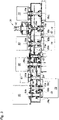
- the housing 30 has been shown more particularly in figure 2 . It comprises a casing 38 of substantially arcuate shape intended to substantially match the shape of an outer casing 40 of the turbomachine which has been shown in figure 1 .
- the housing 38 has ports 42, 44, 46, 48 for coupling accessories such as a starter 50.
- Each of these ports 42, 44, 46, 48 can accommodate a shaft such as shaft 52 d an accessory (not shown) which has been introduced into the housing 30 for its coupling to a gear train internal to the housing 30.
- the box 30 has been shown very schematically in picture 2 . It comprises in its casing 38 a front side face 54 and a rear side face 56. In the casing 38 are mounted a first gear train 58 composed of three toothed wheels or pinions 58a-58c meshing together and a second gear train 60 consisting of four cogwheels or pinions 60a-60d meshing together.
- a power transmission shaft 62 is rotationally coupled to the first and second gear sets by means of a double toothed wheel or pinion 64. Shaft 62 emerges from front side face 54 of housing 30.
- nine separate gas turbine accessories 50 and 64, 66, 68, 70, 72, 74, 76 are mounted against the side faces of the housing and each include a respective shaft 50a and 64a, 66a , 68a, 70a, 72a, 74a, 76a which is rotationally coupled to one of the pinions of the two gear trains.
- the figure 4 shows by way of example a coupling device intended for example to drive the drive pinion 60b of at least one accessory 68, 74 previously described in picture 3 , according to a state of the prior art.
- the pinion (not shown on the figure 4 ) is here capable of driving two coaxial shafts of two accessories, of which only the shaft 68a has been shown here which penetrates through the rear side face 56 of the casing 30 of the accessory box 30.
- the accessories are located respectively on the two faces opposite sides of the housing.
- the pinion (not shown on the figure 4 ) comprises a sleeve 86 coupled to the cylindrical shaft 68a of the accessory.
- the sleeve 86 comprises for this purpose first rectilinear internal splines 88 for coupling cooperating with external splines 90 of the shaft 68a of the accessory.
- This arrangement does not limit the invention and the coupling by splines could be made without a sleeve, directly between the shaft 68a and the pinion.
- the splines 88, 90 allow relative axial movements between the shaft 68a of the accessory 68 and the pinion.
- this conventional coupling device 89 comprises a lubricating oil retaining system flowing through the splines 88, 90.
- an annular groove 102 for receiving an annular seal 106, in particular O-ring, is located near of coupling by splines 88, 90 to ensure a certain level of lubricating oil in these splines.
- the annular seal 106 cooperates with a cylindrical surface 107 of the sleeve 86.
- a lubricating oil distributor is further mounted inside the sleeve 86.
- the shaft 68a may be hollow and the distributor comprises an axial passage 104 and at least one radial bore 108 for supplying oil to the splines 88, 90.
- the shaft 68a here forms a male member, the external splines 90 of which are complementary engaged with the internal splines 88 of the sleeve 86 which here forms a female member.
- the annular groove 102 for receiving the annular seal 106 cooperates with the cylindrical surface 107 of the sleeve 86 which is offset axially with respect to the internal grooves 88 of the sleeve 86.
- the groove 102 for receiving the male member, here the shaft 68a is formed directly in the external splines 90, which it interrupts, so that the transverse walls of the groove 102, which form bearing surfaces of the seal 106, are defined by the free ends 110, 112 of the splines 90 and are discontinuous.
- the invention proposes a modification of the bearing surfaces of the seal 106 by separating the receiving groove 102 of the seal 106 from the groove of the shaft 68a.
- the invention proposes a coupling device 89 of the type described above, characterized in that the annular receiving groove 102 is formed in an annular insert 114 which is fitted in a fixed annular groove 116 formed in the outer splines 90 of the male member 68a.
- the annular insert 114 can have different sections.
- the insert 114 may have a section presenting, in section in an axial plane, a U-shape, as shown in figures 6 and 7 .
- the annular insert 114 comprises at least one annular bottom wall 118 extending axially along a bottom of the fixed annular groove 116 and at least two transverse annular walls 120 extending radially from this annular bottom wall , which axially delimit the annular receiving groove 102.
- the two transverse annular walls 120 bear on either side of the bottom annular wall 118 on one of the two free axial ends 110, 112 of the external splines 90 of the shaft 67a forming the male member, interrupted by the fixed annular groove 116, with reduced axial play. In this way, they perfectly immobilize the insert 114 axially in the groove 116 while protecting the seal 106 from wear.
- the bottom annular wall 118 and the two transverse annular walls 120 are of the same thickness.
- the insert 114 is for example produced by stamping.
- the bottom annular wall 118 and the two transverse annular walls 120 are not of the same thickness, the bottom annular wall 118 being thicker than the two transverse annular walls 120.
- the insert 114 is produced by molding, by 3D printing or by machining a solid ring.
- the annular receiving groove 102 may have the shape of an annular gutter, molded or machined, which delimits the bottom annular wall 116 and the two transverse annular walls 120, and which is arranged along a diameter D greater than the diameter of the game of external splines 90.
- the gutter can be of semi-circular axial section. It can be made by molding or by machining.
- the insert 114 may have an axial section in the shape of ⁇ , as shown according to a third embodiment of the insert visible at figure 8 .
- the insert 114 further comprises two axial tubular walls 122, of an internal diameter corresponding to the diameter d of the external splines 90, which extend on either side from the transverse annular walls 120 taking bearing on an outer diameter of diameter d of the outer splines 90. This configuration thus reinforces the stability of the insert 114 and therefore of the seal 106.
- annular face 124 of the annular bottom wall 118 of the insert 114 comprises cells 126 passing axially through the insert 114 to allow oil to circulate under the insert 114.
- the insert 114 comprises at least one opening means 128 of the annular insert 114 which is configured to allow a temporary increase in diameter of said insert 114 allowing it to be fitted in the fixed annular groove 116.
- the opening means 128 of the annular insert 114 comprises at least one slot 130 intersecting the annular insert.
- insert 114 may have a beveled slot 130, or as shown in figure 12 , a slot 130 chevron.
- the opening means 128 of the annular insert 114 may comprise two diametrically opposed slots 130 cutting the annular insert 114 into two semi-annular half-inserts 114a, 114b and removable means 132 for fixing the two half-inserts half -annular 114a, 114b to each other.
- the invention therefore makes it possible to advantageously improve the longevity of an annular joint of such a coupling by splines 89.
Landscapes
- Engineering & Computer Science (AREA)
- General Engineering & Computer Science (AREA)
- Mechanical Engineering (AREA)
- Chemical & Material Sciences (AREA)
- Combustion & Propulsion (AREA)
- General Details Of Gearings (AREA)
- Sealing Devices (AREA)
- Gasket Seals (AREA)
Description
- L'invention concerne un dispositif d'accouplement par cannelures de deux organes de turbomachine d'aéronef. Le domaine d'application de l'invention est celui des turbomachines pour moteurs d'avions ou d'hélicoptères, ainsi que pour les groupes auxiliaires de puissance (ou APU pour Auxiliary Power Unit).
- Dans une turbomachine d'aéronef, de nombreux organes sont accouplés par l'intermédiaire de dispositifs d'accouplement à cannelures, tels que des dispositifs décrits dans les documents
EP-1.177.918-A2 ,GB-796.806-A US-2016/273592-A1 . - En particulier, une turbomachine d'avion ou d'hélicoptère comporte par exemple un boîtier pour l'entraînement de plusieurs accessoires de la turbine ou d'équipements annexes, couramment appelé AGB (acronyme de Accessory Gear Box). Les accessoires de la turbine ou équipements comportent par exemple diverses pompes pour la production d'énergie hydraulique, l'alimentation en carburant, la lubrification, des générateurs électriques pour la production de puissance électrique, etc.
- De façon connue en soi, un tel boîtier AGB comporte un ou plusieurs trains d'engrenages qui sont composés chacun de plusieurs roues dentées et qui sont entraînés en rotation par un arbre de transmission de puissance, ce dernier étant couplé à un arbre de la turbine. Chaque accessoire est généralement monté contre l'une des faces latérales du boîtier et comporte un arbre d'entraînement venant se coupler sur l'une des roues dentées du ou des trains d'engrenages, selon un accouplement tel que celui décrit dans le document
EP-3.043.091-A1 . - Lors du fonctionnement de la turbomachine, une partie de la puissance mécanique générée est prélevée sur un arbre de la turbomachine par l'intermédiaire d'un engrenage et d'un arbre de transmission de puissance qui l'achemine vers le boitier AGB dans lequel les trains d'engrenages la répartissent ensuite aux différents accessoires montés sur le boîtier AGB afin de les actionner.
- Les types de boîtiers AGB sont fonction du nombre et de la nature des accessoires à alimenter. Lors de la conception d'un boîtier AGB, il est toutefois important de réduire le plus possible l'encombrement et la masse de ce boîtier, en jouant sur le positionnement des accessoires les uns par rapport aux autres en fonction de leur encombrement individuel et de leur vitesse et sens de rotation. A cet effet, l'accouplement des équipements aux trains d'engrenages sont généralement réalisés par l'intermédiaire d'accouplement cannelés.
- En particulier, les trains d'engrenages comportent des roues dentées ou pignons engrenant les uns avec les autres et auxquels sont accouplés les équipements ou accessoires. Pour cela, les pignons comprennent des cannelures internes d'accouplement à des cannelures complémentaires des arbres des accessoires ou équipements.
- Pour augmenter la compacité du boîtier AGB et de ses équipements, les accessoires ou équipements sont fixés à deux faces axialement opposées du boîtier AGB et sont souvent accouplés par paire à des pignons communs.
- Il est donc nécessaire d'autoriser des déplacements axiaux relatifs entre l'arbre de chaque accessoire et le pignon associé, ce que permet la présence de cannelures.
- La transmission du mouvement entre l'arbre de la turbomachine et le boîtier d'accessoires est par ailleurs réalisée généralement par un arbre sensiblement radial en deux parties, chacune de ces parties étant accouplée à l'autre par l'intermédiaire de cannelures. Du fait de la grande longueur de cet arbre, des désalignements importants peuvent survenir, et pour ce faire les deux parties d'arbre sont accouplées par l'intermédiaire de cannelures d'accouplement bombées, ce qui permet d'accoupler les deux parties d'arbre l'une à l'autre malgré un défaut de coaxialité. Le bombé réalisé permet en effet aux cannelures de se mouvoir relativement selon une articulation de rotule et autorise ainsi des déplacements relatifs entre les deux parties d'arbre.
- Qu'il s'agisse de l'accouplement des accessoires aux pignons, ou de deux parties d'arbre entre elles, l'accouplement peut être direct, ou réalisé par l'intermédiaire d'un manchon d'accouplement qui est interposé entre ces éléments.
- Par exemple, dans le cas de l'accouplement entre un pignon et un arbre de l'accessoire comportant un tel manchon, le manchon comprend par exemple des cannelures externes d'accouplement avec des cannelures internes du pignon, et des cannelures internes d'accouplement avec des cannelures externes de l'arbre de l'accessoire. En variante, le manchon peut comprendre des cannelures internes d'accouplement avec des cannelures externes du pignon, et des cannelures externes d'accouplement avec des cannelures internes de l'arbre de l'accessoire.
- Le manchon assure donc l'accouplement entre l'arbre et le pignon et il est associé à un distributeur et des joints annulaires pour assurer une distribution et une circulation d'huile au niveau et à travers des cannelures en vue de leur lubrification.
- La rétention d'huile, et donc l'étanchéité à l'huile entre les cannelures des organes mâles et femelles de ce montage est conventionnellement assurée par un joint annulaire ou torique qui est interposé entre une gorge de l'organe mâle et une surface cylindrique de l'organe femelle qui est décalée axialement par rapport à ses cannelures internes. La gorge de l'organe mâle est formée dans les cannelures de cet organe, de sorte que ses parois sont définies par les extrémités libres des cannelures et sont discontinues.
- Une autre solution pouvant être utilisée est celle d'une bague à lèvre qui est installée du côté des cannelures internes. Une telle bague présente l'avantage d'être moins sensible au désalignement, mais elle présente aussi l'inconvénient de se plier à chaque passage des cannelures externes lors des opérations de montage ou démontage de l'arbre ou du manchon, d'où un risque de dégradation de celle-ci au fil des montages et démontages. Le remplacement d'une telle bague lors des opérations de maintenance n'est en outre pas aisé.
- A l'usage, du fait du déplacement axial et angulaire relatif des cannelures mâles par rapport aux cannelures femelles, on a constaté une usure du joint annulaire entre les cannelures. Ceci conduit à une perte d'étanchéité entre les cannelures mâle et femelle. Cette perte d'étanchéité s'accompagnant d'un déficit de lubrification, elle peut conduire à terme à l'endommagement des cannelures, voire à leur destruction.
- L'invention vise à remédier à cet inconvénient en proposant un dispositif d'accouplement qui préserve le joint annulaire de l'usure.
- Dans ce but, l'invention propose un dispositif d'accouplement par cannelures de deux organes de turbomachine d'aéronef, dont un organe mâle comportant des cannelures externes engagé dans un organe femelle comportant des cannelures internes complémentaires, ledit dispositif comportant en outre un système de retenue de niveau d'huile de lubrification circulant à travers lesdites cannelures complémentaires, ledit système de retenue d'huile comportant un joint annulaire qui est reçu dans une gorge annulaire de réception du joint portée par l'organe mâle et qui coopère avec une surface cylindrique interne de l'organe femelle décalée axialement des cannelures internes, caractérisé en ce que ladite gorge annulaire de réception est formée dans un insert annulaire qui est rapporté dans une gorge annulaire fixe formée dans les cannelures externes de l'organe mâle.
- Selon d'autres caractéristiques du dispositif d'accouplement
- l'insert annulaire comporte au moins une paroi annulaire de fond s'étendant axialement le long d'un fond de la gorge annulaire fixe et au moins deux parois annulaires transversales s'étendant radialement à partir de cette paroi annulaire de fond, qui délimitent axialement la gorge annulaire de réception, lesdites deux parois annulaires transversales prenant appui de part et d'autre de la paroi annulaire de fond sur l'une des deux extrémités axiales libres des cannelures externes de l'organe mâle interrompues par ladite gorge annulaire fixe,
- l'insert comporte en outre deux parois tubulaires axiales, d'un diamètre interne correspondant à celui du jeu de cannelures externes, qui s'étendent de part et d'autre à partir des parois annulaires transversales en prenant appui sur un diamètre externe dudit jeu de cannelures externe,
- la gorge annulaire de réception présente une forme de gouttière annulaire, notamment de section axiale semi-circulaire qui délimite la paroi annulaire de fond et les deux parois annulaires transversales, et qui est agencée selon un diamètre supérieur à celui du jeu de cannelures externes,
- le dispositif comporte au moins un moyen d'ouverture de l'insert annulaire qui est configuré pour permettre une augmentation temporaire de diamètre dudit insert permettant son montage dans la gorge annulaire fixe,
- ledit au moins un moyen d'ouverture de l'insert annulaire comporte au moins une fente coupant l'insert annulaire,
- ledit au moins un moyen d'ouverture de l'insert annulaire comporte deux fentes diamétralement opposées coupant l'insert annulaire en deux demi-inserts semi-annulaires et des moyens de fixation amovibles des deux demi-inserts semi-annulaires l'un à l'autre,
- une face annulaire de la paroi annulaire de fond de l'insert comporte des alvéoles traversant axialement l'insert pour permettre une circulation d'huile sous l'insert.
- L'invention concerne aussi une turbomachine d'aéronef comportant un arbre d'accessoire et un pignon d'entraînement d'un boîtier d'accessoires, caractérisée en ce qu'elle comporte un dispositif d'accouplement du type décrit précédemment interposé entre ledit arbre d'accessoire et ledit pignon d'entraînement.
- Selon une autre caractéristique de la turbomachine, la turbomachine comportant un carter et le boîtier d'accessoires monté sur ledit carter de ladite turbomachine, ledit boîtier portant au moins un accessoire comportant l'arbre d'accessoire lié en rotation à ladite turbomachine et le boîtier d'accessoires comportant un train d'engrenages interne comportant au moins le pignon d'entraînement accouplé à l'arbre d'accessoire dudit accessoire par l'intermédiaire du dispositif d'accouplement.
- D'autres caractéristiques et avantages de l'invention apparaitront au cours de la lecture de la description détaillée qui va suivre pour la compréhension de laquelle on se reportera aux dessins annexés dans lesquels :
- [
Fig. 1 ] Lafigure 1 est une vue en coupe axiale d'une turbomachine connue de l'état de la technique ; - [
Fig. 2 ] Lafigure 2 est une vue en perspective du boîtier d'accessoires de la turbomachine de l'état de la technique de lafigure 1 ; - [
Fig. 3 ] Lafigure 3 est une vue très schématique d'un boîtier d'accessoires de la turbomachine de l'état de la technique de lafigure 1 , sur lequel sont montés des équipements ; - [
Fig. 4 ] Lafigure 4 est une vue d'un dispositif d'accouplement selon l'état de la technique entre un arbre d'un accessoire et un manchon d'accouplement ; - [
Fig. 5 ] Lafigure 5 est une vue de détail du dispositif d'accouplement de lafigure 4 ; - [
Fig. 6 ] Lafigure 6 est une vue de détail d'un dispositif d'accouplement selon l'invention comportant un premier mode de réalisation d'un insert annulaire interposé entre un arbre d'un accessoire et le manchon d'accouplement analogues à ceux desfigures 4 et 5 ; - [
Fig. 7 ] Lafigure 7 est une vue de détail d'un dispositif d'accouplement selon l'invention comportant un deuxième mode de réalisation d'un insert annulaire interposé entre un arbre d'un accessoire et le manchon d'accouplement desfigures 4 et 5 ; - [
Fig. 8 ] Lafigure 8 est une vue de détail d'un dispositif d'accouplement selon l'invention comportant un troisième mode de réalisation d'un insert annulaire interposé entre un arbre d'un accessoire et le manchon d'accouplement desfigures 4 et 5 ; - [
Fig. 9 ] Lafigure 9 est une vue de détail d'un dispositif d'accouplement selon l'invention comportant un quatrième mode de réalisation d'un insert annulaire interposé entre un arbre d'un accessoire et le manchon d'accouplement desfigures 4 et 5 ; - [
Fig. 10 ] Lafigure 10 est une vue en perspective d'un insert annulaire selon l'invention comportant un premier mode de réalisation d'un moyen d'ouverture dudit insert ; - [
Fig. 11 ] Lafigure 11 est une vue en perspective d'un insert annulaire selon l'invention comportant un deuxième mode de réalisation d'un moyen d'ouverture dudit insert ; et - [
Fig. 12 ] Lafigure 12 est une vue en perspective d'un insert annulaire selon l'invention comportant un troisième mode de réalisation d'un moyen d'ouverture dudit insert. - On a représenté sur la
figure 1 une turbomachine 10 à turbine à gaz 11 multi-corps d'axe A, notamment destinée à équiper un aéronef. - De manière connue, comme l'illustre la
figure 1 , la turbomachine 10 comporte au moins un corps tournant basse pression 12 et un corps tournant haute pression 14. Les corps basse pression 12 et haute pression 14 sont ici co-rotatifs mais pourraient également être contra-rotatifs. - Le corps basse pression (BP) 12 comporte pour l'essentiel, suivant le sens d'écoulement des gaz "G", un rotor de compresseur BP 16 relié par un arbre BP 18 à un rotor de turbine BP 20.
- Le corps haute pression (HP) 14 comporte pour l'essentiel, suivant le sens d'écoulement des gaz, un rotor de compresseur HP 22 relié par un arbre HP 24 à un rotor de turbine HP 26. Une chambre de combustion 25 est montée entre le compresseur HP 22 et la turbine HP 26 et délivre des gaz de combustion à la turbine HP, dans laquelle les gaz de combustion se détendent pour entraîner en rotation le rotor de la turbine HP 26, qui entraîne à son tour le rotor de compresseur HP 22 par l'intermédiaire de l'arbre HP 24.
- Les arbres BP 18 et HP 24 sont coaxiaux. L'arbre HP 24 tubulaire est traversé axialement par l'arbre BP 18 qui est ainsi entouré par l'arbre HP 24.
- Dans cette configuration, le compresseur BP 16 alimente en air le compresseur HP 22 qui alimente à son tour en air la chambre de combustion (non représentée). La turbine HP 26 alimente en gaz de combustion la turbine BP 20.
- L'arbre BP 18 entraîne pour sa part une soufflante 28 placée en amont des corps basse pression 12 et haute pression 14. Cette soufflante entraîne le flux des gaz G qui se décompose en un flux primaire P qui traverse le moteur à turbine à gaz 11 et un flux secondaire S qui circule autour du moteur à turbine à gaz 11. Les flux primaire P et S se rejoignent au niveau d'une tuyère (non représentée) du moteur 10.
- De manière connue, le moteur 10 comporte un boîtier 30 d'entraînement d'équipements accessoires dudit moteur, ou boîtier d'accessoires, qui est monté sur un carter de soufflante 32 ou le carter compresseur HP (non représenté) du moteur et qui porte au moins un démarreur et un certain nombre d'équipements ou accessoires aptes à être liés en rotation à ladite turbomachine tels que, notamment, un générateur électrique, un alternateur, et des pompes hydrauliques à carburant et à huile (non représentés). Un train d'engrenages interne au boîtier 30, dont on a représenté sur la
figure 1 un pignon d'entrée 34, est accouplé en rotation au corps haute pression 14 par l'intermédiaire d'un arbre radial 36, pour permettre notamment l'entraînement de ce corps 14 en rotation afin de démarrer ledit moteur. - Le boîtier d'entraînement des équipements accessoires 30 est notamment destiné à équiper tout type de turbomachine, telle qu'un turboréacteur, un turbopropulseur ou un turbomoteur d'avion ou d'hélicoptère.
- Le boîtier 30 a été représenté plus particulièrement à la
figure 2 . Il comporte un carter 38 de forme sensiblement en arc de cercle destiné à épouser sensiblement la forme d'un carter extérieur 40 de la turbomachine qui a été représenté à lafigure 1 . - Le carter 38 comporte des ports 42, 44, 46, 48 pour l'accouplement d'accessoires tels qu'un démarreur 50. Chacun de ces ports 42, 44, 46, 48 permet de recevoir un arbre tel que l'arbre 52 d'un accessoire (non représenté) qui a été introduit dans le boîtier 30 pour son accouplement à un train d'engrenages interne au boîtier 30.
- Le boîtier 30 a été représenté de manière très schématique à la
figure 2 . Il comprend dans son carter 38 une face latérale avant 54 et une face latérale arrière 56. Dans le carter 38 sont montés un premier train d'engrenages 58 composé de trois roues dentées ou pignons 58a-58c engrenant ensemble et un second train d'engrenages 60 composé de quatre roues dentées ou pignons 60a-60d engrenant ensemble. - Un arbre de transmission de puissance 62 est couplé en rotation au premier et au second train d'engrenages au moyen d'une roue dentée ou pignon double 64. L'arbre 62 émerge de la face latérale avant 54 du boîtier 30.
- Dans l'exemple représenté, nullement limitatif, neuf accessoires 50 et 64, 66, 68, 70, 72, 74, 76 distincts de turbine à gaz sont montés contre les faces latérales du boîtier et comportent chacun un arbre respectif 50a et 64a, 66a, 68a, 70a, 72a, 74a, 76a qui est couplé en rotation à l'un des pignons des deux trains d'engrenages.
- La
figure 4 montre à titre d'exemple un dispositif d'accouplement destiné par exemple à entrainer le pignon d'entrainement 60b d'au moins un accessoire 68, 74 précédemment décrit à lafigure 3 , selon un état de la technique antérieure. - Le pignon (non représenté sur la
figure 4 ) est ici apte à entraîner deux arbres coaxiaux de deux accessoires, dont on a représenté ici seulement l'arbre 68a qui pénètre par la face latérale arrière 56 du carter 30 du boîtier d'accessoires 30. Les accessoires sont situés respectivement sur les deux faces opposées du carter. - Le pignon (non représenté sur la
figure 4 ) comporte un manchon 86 accouplé à l'arbre cylindrique 68a de l'accessoire. Le manchon 86 comporte à cet effet des premières cannelures rectilignes internes 88 d'accouplement coopérant avec des cannelures externes 90 de l'arbre 68a de l'accessoire. Cette disposition n'est pas limitative de l'invention et l'accouplement par cannelures pourrait être réalisé sans manchon, directement entre l'arbre 68a et le pignon. - Les cannelures 88, 90 autorisent des déplacements axiaux relatifs entre l'arbre 68a de l'accessoire 68 et le pignon.
- Comme l'illustre la
figure 5 , ce dispositif d'accouplement conventionnel 89 comporte un système de retenue d'huile de lubrification circulant à travers les cannelures 88, 90. A cet effet une gorge annulaire 102 de réception d'un joint annulaire 106, notamment torique, est située à proximité de l'accouplement par cannelures 88, 90 pour assurer un certain niveau d'huile de lubrification dans ces cannelures. Le joint annulaire 106 coopère avec une surface cylindrique 107 du manchon 86. - Un distributeur d'huile de lubrification est en outre monté à l'intérieur du manchon 86. Comme l'illustre la
figure 4 , l'arbre 68a peut être creux et le distributeur comprend un passage axial 104 et au moins un perçage radial 108 pour l'alimentation en huile des cannelures 88, 90. - L'arbre 68a forme ici un organe mâle dont les cannelures externes 90 sont engagées complémentairement avec les cannelures internes 88 du manchon 86 qui forme ici un organe femelle. La gorge annulaire 102 de réception du joint annulaire 106 coopère avec la surface cylindrique 107 du manchon 86 qui est décalée axialement par rapport aux cannelures internes 88 du manchon 86.
- Conventionnellement la gorge 102 de réception de l'organe mâle, ici l'arbre 68a, est formée directement dans les cannelures externes 90, qu'elle interrompt, de sorte que des parois transversales de la gorge 102, qui forment surfaces d'appui du joint 106, sont définies par les extrémités libres 110, 112 des cannelures 90 et sont discontinues.
- A l'usage, et du fait du déplacement axial et angulaire relatif des cannelures mâles 90 par rapport aux cannelures femelles 88, on a constaté une usure du joint annulaire 106 entre les cannelures 90. Ceci conduit à une perte d'étanchéité entre les cannelures 90 mâle et 88 femelle.
- Pour remédier à cet inconvénient, l'invention propose une modification des surfaces d'appui du joint 106 en séparant la gorge de réception 102 du joint 106 de la gorge de l'arbre 68a.
- Dans ce but, comme l'illustre la
figure 6 , l'invention propose un dispositif d'accouplement 89 du type décrit précédemment, caractérisé en ce que la gorge annulaire de réception 102 est formée dans un insert annulaire 114 qui est rapporté dans une gorge annulaire fixe 116 formée dans les cannelures externes 90 de l'organe mâle 68a. - L'insert annulaire 114 peut présenter différentes sections.
- Par exemple, l'insert 114 peut présenter une section présentant, en coupe dans un plan axial, une forme de U, comme représenté aux
figures 6 et 7 . - L'insert annulaire 114 comporte au moins une paroi annulaire de fond 118 s'étendant axialement le long d'un fond de la gorge annulaire fixe 116 et au moins deux parois annulaires transversales 120 s'étendant radialement à partir de cette paroi annulaire de fond, qui délimitent axialement la gorge annulaire de réception 102.
- Les deux parois annulaires transversales 120 prennent appui de part et d'autre de la paroi annulaire de fond 118 sur l'une des deux extrémités axiales libres 110, 112 des cannelures externes 90 de l'arbre 67a formant l'organe mâle, interrompues par la gorge annulaire fixe 116, avec un jeu axial réduit. De la sorte, elles immobilisent parfaitement axialement l'insert 114 dans la gorge 116 tout en protégeant le joint 106 de l'usure.
- Dans le premier mode de réalisation de la
figure 6 , la paroi annulaire de fond 118 et les deux parois annulaires transversales 120 sont de même épaisseur. De manière non limitative, l'insert 114 est par exemple réalisé par emboutissage. - Dans le deuxième mode de réalisation de la
figure 7 , la paroi annulaire de fond 118 et les deux parois annulaires transversales 120 ne sont pas de même épaisseur, la paroi annulaire de fond 118 étant plus épaisse que les deux parois annulaires transversales 120. L'insert 114 est réalisé par moulage, par impression 3D ou par usinage d'une bague pleine. - Par exemple, comme l'illustre la
figure 7 , la gorge annulaire de réception 102 peut présenter la forme de gouttière annulaire, venue de moulage ou d'usinage, qui délimite la paroi annulaire de fond 116 et les deux parois annulaires transversales 120, et qui est agencée selon un diamètre D supérieur au diamètre du jeu de cannelures externes 90. De manière non limitative de l'invention, la gouttière peut être de section axiale semi-circulaire. Elle peut être réalisée par moulage ou par usinage. - L'insert 114 peut présenter une section axiale en forme de Ω, comme représenté selon un troisième mode de réalisation de l'insert visible à la
figure 8 . - Dans ce cas, l'insert 114 comporte en outre deux parois tubulaires axiales 122, d'un diamètre interne correspondant au diamètre d des cannelures externes 90, qui s'étendent de part et d'autre à partir des parois annulaires transversales 120 en prenant appui sur un diamètre externe de diamètre d des cannelures externes 90. Cette configuration conforte ainsi la stabilité de l'insert 114 et donc du joint 106.
- Comme l'illustre la
figure 9 , une face annulaire 124 de la paroi annulaire de fond 118 de l'insert 114 comporte des alvéoles 126 traversant axialement l'insert 114 pour permettre une circulation d'huile sous l'insert 114. - Pour permettre le montage de l'insert 114 sur l'arbre 68a et en particulier dans les cannelures 90, l'insert 114 comporte au moins un moyen d'ouverture 128 de l'insert annulaire 114 qui est configuré pour permettre une augmentation temporaire de diamètre dudit insert 114 permettant son montage dans la gorge annulaire fixe 116.
- Par exemple, comme l'illustrent les
figures 10 à 12 , le moyen d'ouverture 128 de l'insert annulaire 114 comporte au moins une fente 130 coupant l'insert annulaire. Comme l'illustre lafigure 11 , l'insert 114 peut comporter une fente 130 en biseau, ou comme l'illustre lafigure 12 , une fente 130 en chevron. - En variante comme l'illustre la
figure 10 , le moyen d'ouverture 128 de l'insert annulaire 114 peut comporter deux fentes 130 diamétralement opposées coupant l'insert annulaire 114 en deux demi-inserts 114a, 114b semi-annulaires et des moyens de fixation 132 amovibles des deux demi-inserts semi-annulaires 114a, 114b l'un à l'autre. - L'invention permet donc d'améliorer avantageusement la longévité d'un joint annulaire d'un tel accouplement par cannelures 89.
Claims (9)
- Dispositif d'accouplement par cannelures (89) de deux organes (68a, 86) de turbomachine d'aéronef, dont un organe mâle (68a) comportant des cannelures externes (90) engagé dans un organe femelle (86) comportant des cannelures internes (88) complémentaires, ledit dispositif (89) comportant en outre un système de retenue d'huile de lubrification circulant à travers lesdites cannelures (88, 90), ledit système de retenue d'huile comportant un joint annulaire (106) qui est reçu dans une gorge annulaire de réception (102) du joint, portée par l'organe mâle (68a) et qui coopère avec une surface cylindrique interne (107) de l'organe femelle (86) décalée axialement des cannelures internes (88), caractérisé en ce que ladite gorge annulaire (102) de réception du joint est formée dans un insert annulaire (114) qui est rapporté dans une gorge annulaire fixe (16) formée dans les cannelures externes (90) de l'organe mâle (68a).
- Dispositif d'accouplement (89) selon la revendication 1, caractérisé en ce que l'insert annulaire (114) comporte au moins une paroi annulaire de fond (118) s'étendant axialement le long d'un fond de la gorge annulaire fixe (116) et au moins deux parois annulaires transversales (120) s'étendant radialement à partir de cette paroi annulaire de fond (118), qui délimitent axialement la gorge annulaire de réception (102), lesdites deux parois annulaires transversales (120) prenant appui de part et d'autre de la paroi annulaire de fond (118) sur une extrémité axiale libre (110, 112) des cannelures externes (90) de l'organe mâle interrompues par ladite gorge annulaire fixe (102).
- Dispositif d'accouplement (89) selon la revendication 2, caractérisé en que l'insert (114) comporte en outre deux parois tubulaires axiales (122), d'un diamètre interne (d) correspondant à celui des cannelures externes (90), qui s'étendent de part et d'autre à partir des parois annulaires transversales (120) en prenant appui sur un diamètre externe (d) des cannelures externes (90).
- Dispositif d'accouplement (89) selon l'une des revendications 2 ou 3, caractérisé en ce que la gorge annulaire de réception (102) présente une forme de gouttière annulaire qui délimite la paroi annulaire de fond (116) et les deux parois annulaires transversales (120), et qui est agencée selon un diamètre supérieur à celui (d) des cannelures externes (90).
- Dispositif d'accouplement (89) selon l'une des revendications 1 à 4, caractérisé en ce qu'il comporte au moins un moyen d'ouverture (128) de l'insert annulaire (114) qui est configuré pour permettre une augmentation temporaire de diamètre dudit insert (114) permettant son montage dans la gorge annulaire fixe (116).
- Dispositif d'accouplement (89) selon la revendication 5, caractérisé en ce que ledit au moins un moyen d'ouverture (128) de l'insert annulaire (114) comporte au moins une fente (130) coupant l'insert annulaire (114).
- Dispositif d'accouplement (89) selon la revendication 6, caractérisé en ce que ledit au moins un moyen d'ouverture (128) de l'insert annulaire (114) comporte deux fentes (130) diamétralement opposées coupant l'insert annulaire (114) en deux demi-inserts (114a, 114b) semi-annulaires et des moyens de fixation amovibles (132) des deux demi-inserts semi-annulaires (114a, 114b) l'un à l'autre.
- Turbomachine d'aéronef comportant un arbre d'accessoire (68a) et un pignon d'entraînement (60b) d'un boîtier d'accessoires (30), caractérisée en ce qu'elle comporte un dispositif d'accouplement (89) selon l'une des revendications 1 à 7 interposé entre ledit arbre d'accessoire (68a) et ledit pignon d'entraînement (60b).
- Turbomachine selon la revendication 8 comportant un carter et le boîtier (30) d'accessoires monté sur ledit carter de ladite turbomachine, ledit boîtier portant au moins un accessoire comportant l'arbre d'accessoire (68a) lié en rotation à ladite turbomachine et le boîtier (30) d'accessoires comportant un train d'engrenages interne comportant au moins le pignon d'entraînement accouplé à l'arbre d'accessoire (68a) dudit accessoire par l'intermédiaire du dispositif d'accouplement (89).
Applications Claiming Priority (1)
| Application Number | Priority Date | Filing Date | Title |
|---|---|---|---|
| FR1904739A FR3095841B1 (fr) | 2019-05-06 | 2019-05-06 | Gorge de joint rapportée pour accouplement par cannelures |
Publications (2)
| Publication Number | Publication Date |
|---|---|
| EP3736428A1 EP3736428A1 (fr) | 2020-11-11 |
| EP3736428B1 true EP3736428B1 (fr) | 2022-11-23 |
Family
ID=67262762
Family Applications (1)
| Application Number | Title | Priority Date | Filing Date |
|---|---|---|---|
| EP20173233.6A Active EP3736428B1 (fr) | 2019-05-06 | 2020-05-06 | Gorge de joint rapportée pour accouplement par cannelures |
Country Status (2)
| Country | Link |
|---|---|
| EP (1) | EP3736428B1 (fr) |
| FR (1) | FR3095841B1 (fr) |
Families Citing this family (1)
| Publication number | Priority date | Publication date | Assignee | Title |
|---|---|---|---|---|
| FR3135755B1 (fr) * | 2022-05-23 | 2024-04-19 | Safran Trans Systems | Boitier de relais d’accessoires pour une turbomachine |
Family Cites Families (4)
| Publication number | Priority date | Publication date | Assignee | Title |
|---|---|---|---|---|
| GB796806A (en) * | 1956-08-23 | 1958-06-18 | Gelenkwellenbau Gmbh | Means for lubricating splined couplings between universal joints and propeller shafts |
| JP3956619B2 (ja) * | 2000-07-31 | 2007-08-08 | 日本精工株式会社 | 車輪用駆動ユニットとその組立方法 |
| US10344862B2 (en) * | 2015-01-12 | 2019-07-09 | Rolls-Royce Corporation | Shaft coupling seal assembly |
| JP6497997B2 (ja) * | 2015-03-19 | 2019-04-10 | 日立オートモティブシステムズ株式会社 | 動力伝達軸 |
-
2019
- 2019-05-06 FR FR1904739A patent/FR3095841B1/fr not_active Expired - Fee Related
-
2020
- 2020-05-06 EP EP20173233.6A patent/EP3736428B1/fr active Active
Also Published As
| Publication number | Publication date |
|---|---|
| FR3095841B1 (fr) | 2021-04-30 |
| EP3736428A1 (fr) | 2020-11-11 |
| FR3095841A1 (fr) | 2020-11-13 |
Similar Documents
| Publication | Publication Date | Title |
|---|---|---|
| CA2929798C (fr) | Enceinte avant etanche lors du desassemblage modulaire d'un turboreacteur a reducteur | |
| CA2938385C (fr) | Turbomachine equipee d'un groupe de lubrification | |
| EP3137740B1 (fr) | Assemblage pour turbomachine d'aeronef et son procede de montage | |
| EP3158210B1 (fr) | Dispositif et procédé de lubrification d'un palier a roulement de turbomachine | |
| FR2987416A1 (fr) | Dispositif de lubrification d'un reducteur epicycloidal. | |
| EP2576995B1 (fr) | Boite d'engrenages dans une turbomachine | |
| EP3705705A1 (fr) | Réducteur mécanique de turbomachine d'aéronef | |
| WO2022195217A1 (fr) | Module de soufflante equipe d'un dispositif de transfert d'huile | |
| EP3715607B1 (fr) | Pignon d entrainement d'au moins un arbre d'accessoire pour un boitier d'accessoires de turbomachine d'aeronef | |
| FR3098847A1 (fr) | Reducteur a train epicycloïdal pour une turbomachine | |
| EP3696448B1 (fr) | Lubrification d'un porte-satellites pour un reducteur mecanique de turbomachine, en particulier d'aeronef | |
| EP3736428B1 (fr) | Gorge de joint rapportée pour accouplement par cannelures | |
| EP4023909B1 (fr) | Porte-satellites pour un reducteur mecanique de turbomachine d aeronef | |
| EP4308793A1 (fr) | Module de soufflante equipe d'un dispositif de transfert d'huile | |
| EP3807508B1 (fr) | Porte-satellites tournant pour un reducteur mecanique d'une turbomachine | |
| WO2022144514A1 (fr) | Module de turbomachine equipe d'une machine electrique et turbomachine equipee d'un tel module | |
| EP3810911A1 (fr) | Turbomachine d'aeronef a au moins deux corps et prelevement de puissance | |
| WO2026083030A1 (fr) | Ensemble d'engrènement comprenant deux pignons et une rondelle interposée entre les deux pignons | |
| FR3154761A1 (fr) | Module de turbomachine equipe d’un systeme de changement de pas et d’un dispositif de transfert de fluide | |
| WO2025215317A1 (fr) | Turbomachine equipee d'une machine electrique dans son enceinte de lubrification | |
| WO2025215318A1 (fr) | Turbomachine equipee d'une machine electrique agencee dans son enceinte dediee et d'un systeme de lubrification de l'enceinte dediee | |
| FR3135755A1 (fr) | Boitier de relais d’accessoires pour une turbomachine | |
| WO2025248198A1 (fr) | Boitier d'accessoires pour une turbomachine d'aeronef | |
| FR3110934A1 (fr) | Dispositif de support d’un arbre de soufflante d’une turbomachine, turbomachine munie de celui-ci |
Legal Events
| Date | Code | Title | Description |
|---|---|---|---|
| PUAI | Public reference made under article 153(3) epc to a published international application that has entered the european phase |
Free format text: ORIGINAL CODE: 0009012 |
|
| STAA | Information on the status of an ep patent application or granted ep patent |
Free format text: STATUS: REQUEST FOR EXAMINATION WAS MADE |
|
| 17P | Request for examination filed |
Effective date: 20200506 |
|
| AK | Designated contracting states |
Kind code of ref document: A1 Designated state(s): AL AT BE BG CH CY CZ DE DK EE ES FI FR GB GR HR HU IE IS IT LI LT LU LV MC MK MT NL NO PL PT RO RS SE SI SK SM TR |
|
| AX | Request for extension of the european patent |
Extension state: BA ME |
|
| GRAP | Despatch of communication of intention to grant a patent |
Free format text: ORIGINAL CODE: EPIDOSNIGR1 |
|
| STAA | Information on the status of an ep patent application or granted ep patent |
Free format text: STATUS: GRANT OF PATENT IS INTENDED |
|
| INTG | Intention to grant announced |
Effective date: 20220826 |
|
| GRAS | Grant fee paid |
Free format text: ORIGINAL CODE: EPIDOSNIGR3 |
|
| GRAA | (expected) grant |
Free format text: ORIGINAL CODE: 0009210 |
|
| STAA | Information on the status of an ep patent application or granted ep patent |
Free format text: STATUS: THE PATENT HAS BEEN GRANTED |
|
| AK | Designated contracting states |
Kind code of ref document: B1 Designated state(s): AL AT BE BG CH CY CZ DE DK EE ES FI FR GB GR HR HU IE IS IT LI LT LU LV MC MK MT NL NO PL PT RO RS SE SI SK SM TR |
|
| REG | Reference to a national code |
Ref country code: GB Ref legal event code: FG4D Free format text: NOT ENGLISH |
|
| REG | Reference to a national code |
Ref country code: CH Ref legal event code: EP |
|
| REG | Reference to a national code |
Ref country code: DE Ref legal event code: R096 Ref document number: 602020006399 Country of ref document: DE |
|
| REG | Reference to a national code |
Ref country code: AT Ref legal event code: REF Ref document number: 1533271 Country of ref document: AT Kind code of ref document: T Effective date: 20221215 |
|
| REG | Reference to a national code |
Ref country code: IE Ref legal event code: FG4D Free format text: LANGUAGE OF EP DOCUMENT: FRENCH |
|
| REG | Reference to a national code |
Ref country code: LT Ref legal event code: MG9D |
|
| REG | Reference to a national code |
Ref country code: NL Ref legal event code: MP Effective date: 20221123 |
|
| REG | Reference to a national code |
Ref country code: AT Ref legal event code: MK05 Ref document number: 1533271 Country of ref document: AT Kind code of ref document: T Effective date: 20221123 |
|
| PG25 | Lapsed in a contracting state [announced via postgrant information from national office to epo] |
Ref country code: SE Free format text: LAPSE BECAUSE OF FAILURE TO SUBMIT A TRANSLATION OF THE DESCRIPTION OR TO PAY THE FEE WITHIN THE PRESCRIBED TIME-LIMIT Effective date: 20221123 Ref country code: PT Free format text: LAPSE BECAUSE OF FAILURE TO SUBMIT A TRANSLATION OF THE DESCRIPTION OR TO PAY THE FEE WITHIN THE PRESCRIBED TIME-LIMIT Effective date: 20230323 Ref country code: NO Free format text: LAPSE BECAUSE OF FAILURE TO SUBMIT A TRANSLATION OF THE DESCRIPTION OR TO PAY THE FEE WITHIN THE PRESCRIBED TIME-LIMIT Effective date: 20230223 Ref country code: LT Free format text: LAPSE BECAUSE OF FAILURE TO SUBMIT A TRANSLATION OF THE DESCRIPTION OR TO PAY THE FEE WITHIN THE PRESCRIBED TIME-LIMIT Effective date: 20221123 Ref country code: FI Free format text: LAPSE BECAUSE OF FAILURE TO SUBMIT A TRANSLATION OF THE DESCRIPTION OR TO PAY THE FEE WITHIN THE PRESCRIBED TIME-LIMIT Effective date: 20221123 Ref country code: ES Free format text: LAPSE BECAUSE OF FAILURE TO SUBMIT A TRANSLATION OF THE DESCRIPTION OR TO PAY THE FEE WITHIN THE PRESCRIBED TIME-LIMIT Effective date: 20221123 Ref country code: AT Free format text: LAPSE BECAUSE OF FAILURE TO SUBMIT A TRANSLATION OF THE DESCRIPTION OR TO PAY THE FEE WITHIN THE PRESCRIBED TIME-LIMIT Effective date: 20221123 |
|
| PG25 | Lapsed in a contracting state [announced via postgrant information from national office to epo] |
Ref country code: RS Free format text: LAPSE BECAUSE OF FAILURE TO SUBMIT A TRANSLATION OF THE DESCRIPTION OR TO PAY THE FEE WITHIN THE PRESCRIBED TIME-LIMIT Effective date: 20221123 Ref country code: PL Free format text: LAPSE BECAUSE OF FAILURE TO SUBMIT A TRANSLATION OF THE DESCRIPTION OR TO PAY THE FEE WITHIN THE PRESCRIBED TIME-LIMIT Effective date: 20221123 Ref country code: LV Free format text: LAPSE BECAUSE OF FAILURE TO SUBMIT A TRANSLATION OF THE DESCRIPTION OR TO PAY THE FEE WITHIN THE PRESCRIBED TIME-LIMIT Effective date: 20221123 Ref country code: IS Free format text: LAPSE BECAUSE OF FAILURE TO SUBMIT A TRANSLATION OF THE DESCRIPTION OR TO PAY THE FEE WITHIN THE PRESCRIBED TIME-LIMIT Effective date: 20230323 Ref country code: HR Free format text: LAPSE BECAUSE OF FAILURE TO SUBMIT A TRANSLATION OF THE DESCRIPTION OR TO PAY THE FEE WITHIN THE PRESCRIBED TIME-LIMIT Effective date: 20221123 Ref country code: GR Free format text: LAPSE BECAUSE OF FAILURE TO SUBMIT A TRANSLATION OF THE DESCRIPTION OR TO PAY THE FEE WITHIN THE PRESCRIBED TIME-LIMIT Effective date: 20230224 |
|
| PG25 | Lapsed in a contracting state [announced via postgrant information from national office to epo] |
Ref country code: NL Free format text: LAPSE BECAUSE OF FAILURE TO SUBMIT A TRANSLATION OF THE DESCRIPTION OR TO PAY THE FEE WITHIN THE PRESCRIBED TIME-LIMIT Effective date: 20221123 |
|
| PG25 | Lapsed in a contracting state [announced via postgrant information from national office to epo] |
Ref country code: SM Free format text: LAPSE BECAUSE OF FAILURE TO SUBMIT A TRANSLATION OF THE DESCRIPTION OR TO PAY THE FEE WITHIN THE PRESCRIBED TIME-LIMIT Effective date: 20221123 Ref country code: RO Free format text: LAPSE BECAUSE OF FAILURE TO SUBMIT A TRANSLATION OF THE DESCRIPTION OR TO PAY THE FEE WITHIN THE PRESCRIBED TIME-LIMIT Effective date: 20221123 Ref country code: EE Free format text: LAPSE BECAUSE OF FAILURE TO SUBMIT A TRANSLATION OF THE DESCRIPTION OR TO PAY THE FEE WITHIN THE PRESCRIBED TIME-LIMIT Effective date: 20221123 Ref country code: DK Free format text: LAPSE BECAUSE OF FAILURE TO SUBMIT A TRANSLATION OF THE DESCRIPTION OR TO PAY THE FEE WITHIN THE PRESCRIBED TIME-LIMIT Effective date: 20221123 Ref country code: CZ Free format text: LAPSE BECAUSE OF FAILURE TO SUBMIT A TRANSLATION OF THE DESCRIPTION OR TO PAY THE FEE WITHIN THE PRESCRIBED TIME-LIMIT Effective date: 20221123 |
|
| REG | Reference to a national code |
Ref country code: DE Ref legal event code: R097 Ref document number: 602020006399 Country of ref document: DE |
|
| PG25 | Lapsed in a contracting state [announced via postgrant information from national office to epo] |
Ref country code: SK Free format text: LAPSE BECAUSE OF FAILURE TO SUBMIT A TRANSLATION OF THE DESCRIPTION OR TO PAY THE FEE WITHIN THE PRESCRIBED TIME-LIMIT Effective date: 20221123 Ref country code: AL Free format text: LAPSE BECAUSE OF FAILURE TO SUBMIT A TRANSLATION OF THE DESCRIPTION OR TO PAY THE FEE WITHIN THE PRESCRIBED TIME-LIMIT Effective date: 20221123 |
|
| PLBE | No opposition filed within time limit |
Free format text: ORIGINAL CODE: 0009261 |
|
| STAA | Information on the status of an ep patent application or granted ep patent |
Free format text: STATUS: NO OPPOSITION FILED WITHIN TIME LIMIT |
|
| 26N | No opposition filed |
Effective date: 20230824 |
|
| PG25 | Lapsed in a contracting state [announced via postgrant information from national office to epo] |
Ref country code: SI Free format text: LAPSE BECAUSE OF FAILURE TO SUBMIT A TRANSLATION OF THE DESCRIPTION OR TO PAY THE FEE WITHIN THE PRESCRIBED TIME-LIMIT Effective date: 20221123 |
|
| REG | Reference to a national code |
Ref country code: CH Ref legal event code: PL |
|
| PG25 | Lapsed in a contracting state [announced via postgrant information from national office to epo] |
Ref country code: MC Free format text: LAPSE BECAUSE OF FAILURE TO SUBMIT A TRANSLATION OF THE DESCRIPTION OR TO PAY THE FEE WITHIN THE PRESCRIBED TIME-LIMIT Effective date: 20221123 |
|
| REG | Reference to a national code |
Ref country code: BE Ref legal event code: MM Effective date: 20230531 |
|
| PG25 | Lapsed in a contracting state [announced via postgrant information from national office to epo] |
Ref country code: MC Free format text: LAPSE BECAUSE OF FAILURE TO SUBMIT A TRANSLATION OF THE DESCRIPTION OR TO PAY THE FEE WITHIN THE PRESCRIBED TIME-LIMIT Effective date: 20221123 Ref country code: LU Free format text: LAPSE BECAUSE OF NON-PAYMENT OF DUE FEES Effective date: 20230506 Ref country code: LI Free format text: LAPSE BECAUSE OF NON-PAYMENT OF DUE FEES Effective date: 20230531 Ref country code: CH Free format text: LAPSE BECAUSE OF NON-PAYMENT OF DUE FEES Effective date: 20230531 |
|
| REG | Reference to a national code |
Ref country code: IE Ref legal event code: MM4A |
|
| PG25 | Lapsed in a contracting state [announced via postgrant information from national office to epo] |
Ref country code: IE Free format text: LAPSE BECAUSE OF NON-PAYMENT OF DUE FEES Effective date: 20230506 |
|
| PG25 | Lapsed in a contracting state [announced via postgrant information from national office to epo] |
Ref country code: IE Free format text: LAPSE BECAUSE OF NON-PAYMENT OF DUE FEES Effective date: 20230506 |
|
| PG25 | Lapsed in a contracting state [announced via postgrant information from national office to epo] |
Ref country code: IT Free format text: LAPSE BECAUSE OF FAILURE TO SUBMIT A TRANSLATION OF THE DESCRIPTION OR TO PAY THE FEE WITHIN THE PRESCRIBED TIME-LIMIT Effective date: 20221123 Ref country code: BE Free format text: LAPSE BECAUSE OF NON-PAYMENT OF DUE FEES Effective date: 20230531 |
|
| PG25 | Lapsed in a contracting state [announced via postgrant information from national office to epo] |
Ref country code: BG Free format text: LAPSE BECAUSE OF FAILURE TO SUBMIT A TRANSLATION OF THE DESCRIPTION OR TO PAY THE FEE WITHIN THE PRESCRIBED TIME-LIMIT Effective date: 20221123 |
|
| PG25 | Lapsed in a contracting state [announced via postgrant information from national office to epo] |
Ref country code: BG Free format text: LAPSE BECAUSE OF FAILURE TO SUBMIT A TRANSLATION OF THE DESCRIPTION OR TO PAY THE FEE WITHIN THE PRESCRIBED TIME-LIMIT Effective date: 20221123 |
|
| PGFP | Annual fee paid to national office [announced via postgrant information from national office to epo] |
Ref country code: DE Payment date: 20250519 Year of fee payment: 6 |
|
| PGFP | Annual fee paid to national office [announced via postgrant information from national office to epo] |
Ref country code: GB Payment date: 20250527 Year of fee payment: 6 |
|
| PGFP | Annual fee paid to national office [announced via postgrant information from national office to epo] |
Ref country code: FR Payment date: 20250522 Year of fee payment: 6 |
|
| PG25 | Lapsed in a contracting state [announced via postgrant information from national office to epo] |
Ref country code: CY Free format text: LAPSE BECAUSE OF FAILURE TO SUBMIT A TRANSLATION OF THE DESCRIPTION OR TO PAY THE FEE WITHIN THE PRESCRIBED TIME-LIMIT; INVALID AB INITIO Effective date: 20200506 |
|
| PG25 | Lapsed in a contracting state [announced via postgrant information from national office to epo] |
Ref country code: HU Free format text: LAPSE BECAUSE OF FAILURE TO SUBMIT A TRANSLATION OF THE DESCRIPTION OR TO PAY THE FEE WITHIN THE PRESCRIBED TIME-LIMIT; INVALID AB INITIO Effective date: 20200506 |
|
| PG25 | Lapsed in a contracting state [announced via postgrant information from national office to epo] |
Ref country code: TR Free format text: LAPSE BECAUSE OF FAILURE TO SUBMIT A TRANSLATION OF THE DESCRIPTION OR TO PAY THE FEE WITHIN THE PRESCRIBED TIME-LIMIT Effective date: 20221123 |