EP3733933A1 - Extruded article containing conductive fibers and having a metallic coating thereon - Google Patents
Extruded article containing conductive fibers and having a metallic coating thereon Download PDFInfo
- Publication number
- EP3733933A1 EP3733933A1 EP19213521.8A EP19213521A EP3733933A1 EP 3733933 A1 EP3733933 A1 EP 3733933A1 EP 19213521 A EP19213521 A EP 19213521A EP 3733933 A1 EP3733933 A1 EP 3733933A1
- Authority
- EP
- European Patent Office
- Prior art keywords
- metallic
- fibers
- thermoplastic
- metallic fibers
- metallic coating
- Prior art date
- Legal status (The legal status is an assumption and is not a legal conclusion. Google has not performed a legal analysis and makes no representation as to the accuracy of the status listed.)
- Pending
Links
Images

Classifications
-
- B—PERFORMING OPERATIONS; TRANSPORTING
- B29—WORKING OF PLASTICS; WORKING OF SUBSTANCES IN A PLASTIC STATE IN GENERAL
- B29C—SHAPING OR JOINING OF PLASTICS; SHAPING OF MATERIAL IN A PLASTIC STATE, NOT OTHERWISE PROVIDED FOR; AFTER-TREATMENT OF THE SHAPED PRODUCTS, e.g. REPAIRING
- B29C64/00—Additive manufacturing, i.e. manufacturing of three-dimensional [3D] objects by additive deposition, additive agglomeration or additive layering, e.g. by 3D printing, stereolithography or selective laser sintering
- B29C64/10—Processes of additive manufacturing
- B29C64/165—Processes of additive manufacturing using a combination of solid and fluid materials, e.g. a powder selectively bound by a liquid binder, catalyst, inhibitor or energy absorber
-
- C—CHEMISTRY; METALLURGY
- C23—COATING METALLIC MATERIAL; COATING MATERIAL WITH METALLIC MATERIAL; CHEMICAL SURFACE TREATMENT; DIFFUSION TREATMENT OF METALLIC MATERIAL; COATING BY VACUUM EVAPORATION, BY SPUTTERING, BY ION IMPLANTATION OR BY CHEMICAL VAPOUR DEPOSITION, IN GENERAL; INHIBITING CORROSION OF METALLIC MATERIAL OR INCRUSTATION IN GENERAL
- C23C—COATING METALLIC MATERIAL; COATING MATERIAL WITH METALLIC MATERIAL; SURFACE TREATMENT OF METALLIC MATERIAL BY DIFFUSION INTO THE SURFACE, BY CHEMICAL CONVERSION OR SUBSTITUTION; COATING BY VACUUM EVAPORATION, BY SPUTTERING, BY ION IMPLANTATION OR BY CHEMICAL VAPOUR DEPOSITION, IN GENERAL
- C23C24/00—Coating starting from inorganic powder
- C23C24/02—Coating starting from inorganic powder by application of pressure only
- C23C24/04—Impact or kinetic deposition of particles
-
- B—PERFORMING OPERATIONS; TRANSPORTING
- B29—WORKING OF PLASTICS; WORKING OF SUBSTANCES IN A PLASTIC STATE IN GENERAL
- B29C—SHAPING OR JOINING OF PLASTICS; SHAPING OF MATERIAL IN A PLASTIC STATE, NOT OTHERWISE PROVIDED FOR; AFTER-TREATMENT OF THE SHAPED PRODUCTS, e.g. REPAIRING
- B29C48/00—Extrusion moulding, i.e. expressing the moulding material through a die or nozzle which imparts the desired form; Apparatus therefor
- B29C48/022—Extrusion moulding, i.e. expressing the moulding material through a die or nozzle which imparts the desired form; Apparatus therefor characterised by the choice of material
-
- B—PERFORMING OPERATIONS; TRANSPORTING
- B29—WORKING OF PLASTICS; WORKING OF SUBSTANCES IN A PLASTIC STATE IN GENERAL
- B29C—SHAPING OR JOINING OF PLASTICS; SHAPING OF MATERIAL IN A PLASTIC STATE, NOT OTHERWISE PROVIDED FOR; AFTER-TREATMENT OF THE SHAPED PRODUCTS, e.g. REPAIRING
- B29C48/00—Extrusion moulding, i.e. expressing the moulding material through a die or nozzle which imparts the desired form; Apparatus therefor
- B29C48/15—Extrusion moulding, i.e. expressing the moulding material through a die or nozzle which imparts the desired form; Apparatus therefor incorporating preformed parts or layers, e.g. extrusion moulding around inserts
- B29C48/154—Coating solid articles, i.e. non-hollow articles
-
- B—PERFORMING OPERATIONS; TRANSPORTING
- B29—WORKING OF PLASTICS; WORKING OF SUBSTANCES IN A PLASTIC STATE IN GENERAL
- B29C—SHAPING OR JOINING OF PLASTICS; SHAPING OF MATERIAL IN A PLASTIC STATE, NOT OTHERWISE PROVIDED FOR; AFTER-TREATMENT OF THE SHAPED PRODUCTS, e.g. REPAIRING
- B29C48/00—Extrusion moulding, i.e. expressing the moulding material through a die or nozzle which imparts the desired form; Apparatus therefor
- B29C48/16—Articles comprising two or more components, e.g. co-extruded layers
-
- B—PERFORMING OPERATIONS; TRANSPORTING
- B29—WORKING OF PLASTICS; WORKING OF SUBSTANCES IN A PLASTIC STATE IN GENERAL
- B29C—SHAPING OR JOINING OF PLASTICS; SHAPING OF MATERIAL IN A PLASTIC STATE, NOT OTHERWISE PROVIDED FOR; AFTER-TREATMENT OF THE SHAPED PRODUCTS, e.g. REPAIRING
- B29C48/00—Extrusion moulding, i.e. expressing the moulding material through a die or nozzle which imparts the desired form; Apparatus therefor
- B29C48/25—Component parts, details or accessories; Auxiliary operations
- B29C48/285—Feeding the extrusion material to the extruder
- B29C48/288—Feeding the extrusion material to the extruder in solid form, e.g. powder or granules
- B29C48/2886—Feeding the extrusion material to the extruder in solid form, e.g. powder or granules of fillers or of fibrous materials, e.g. short-fibre reinforcements
-
- B—PERFORMING OPERATIONS; TRANSPORTING
- B29—WORKING OF PLASTICS; WORKING OF SUBSTANCES IN A PLASTIC STATE IN GENERAL
- B29C—SHAPING OR JOINING OF PLASTICS; SHAPING OF MATERIAL IN A PLASTIC STATE, NOT OTHERWISE PROVIDED FOR; AFTER-TREATMENT OF THE SHAPED PRODUCTS, e.g. REPAIRING
- B29C64/00—Additive manufacturing, i.e. manufacturing of three-dimensional [3D] objects by additive deposition, additive agglomeration or additive layering, e.g. by 3D printing, stereolithography or selective laser sintering
- B29C64/10—Processes of additive manufacturing
- B29C64/106—Processes of additive manufacturing using only liquids or viscous materials, e.g. depositing a continuous bead of viscous material
- B29C64/118—Processes of additive manufacturing using only liquids or viscous materials, e.g. depositing a continuous bead of viscous material using filamentary material being melted, e.g. fused deposition modelling [FDM]
-
- B—PERFORMING OPERATIONS; TRANSPORTING
- B29—WORKING OF PLASTICS; WORKING OF SUBSTANCES IN A PLASTIC STATE IN GENERAL
- B29C—SHAPING OR JOINING OF PLASTICS; SHAPING OF MATERIAL IN A PLASTIC STATE, NOT OTHERWISE PROVIDED FOR; AFTER-TREATMENT OF THE SHAPED PRODUCTS, e.g. REPAIRING
- B29C64/00—Additive manufacturing, i.e. manufacturing of three-dimensional [3D] objects by additive deposition, additive agglomeration or additive layering, e.g. by 3D printing, stereolithography or selective laser sintering
- B29C64/30—Auxiliary operations or equipment
-
- B—PERFORMING OPERATIONS; TRANSPORTING
- B33—ADDITIVE MANUFACTURING TECHNOLOGY
- B33Y—ADDITIVE MANUFACTURING, i.e. MANUFACTURING OF THREE-DIMENSIONAL [3D] OBJECTS BY ADDITIVE DEPOSITION, ADDITIVE AGGLOMERATION OR ADDITIVE LAYERING, e.g. BY 3D PRINTING, STEREOLITHOGRAPHY OR SELECTIVE LASER SINTERING
- B33Y10/00—Processes of additive manufacturing
-
- B—PERFORMING OPERATIONS; TRANSPORTING
- B33—ADDITIVE MANUFACTURING TECHNOLOGY
- B33Y—ADDITIVE MANUFACTURING, i.e. MANUFACTURING OF THREE-DIMENSIONAL [3D] OBJECTS BY ADDITIVE DEPOSITION, ADDITIVE AGGLOMERATION OR ADDITIVE LAYERING, e.g. BY 3D PRINTING, STEREOLITHOGRAPHY OR SELECTIVE LASER SINTERING
- B33Y40/00—Auxiliary operations or equipment, e.g. for material handling
-
- B—PERFORMING OPERATIONS; TRANSPORTING
- B33—ADDITIVE MANUFACTURING TECHNOLOGY
- B33Y—ADDITIVE MANUFACTURING, i.e. MANUFACTURING OF THREE-DIMENSIONAL [3D] OBJECTS BY ADDITIVE DEPOSITION, ADDITIVE AGGLOMERATION OR ADDITIVE LAYERING, e.g. BY 3D PRINTING, STEREOLITHOGRAPHY OR SELECTIVE LASER SINTERING
- B33Y70/00—Materials specially adapted for additive manufacturing
-
- B—PERFORMING OPERATIONS; TRANSPORTING
- B33—ADDITIVE MANUFACTURING TECHNOLOGY
- B33Y—ADDITIVE MANUFACTURING, i.e. MANUFACTURING OF THREE-DIMENSIONAL [3D] OBJECTS BY ADDITIVE DEPOSITION, ADDITIVE AGGLOMERATION OR ADDITIVE LAYERING, e.g. BY 3D PRINTING, STEREOLITHOGRAPHY OR SELECTIVE LASER SINTERING
- B33Y80/00—Products made by additive manufacturing
-
- C—CHEMISTRY; METALLURGY
- C23—COATING METALLIC MATERIAL; COATING MATERIAL WITH METALLIC MATERIAL; CHEMICAL SURFACE TREATMENT; DIFFUSION TREATMENT OF METALLIC MATERIAL; COATING BY VACUUM EVAPORATION, BY SPUTTERING, BY ION IMPLANTATION OR BY CHEMICAL VAPOUR DEPOSITION, IN GENERAL; INHIBITING CORROSION OF METALLIC MATERIAL OR INCRUSTATION IN GENERAL
- C23C—COATING METALLIC MATERIAL; COATING MATERIAL WITH METALLIC MATERIAL; SURFACE TREATMENT OF METALLIC MATERIAL BY DIFFUSION INTO THE SURFACE, BY CHEMICAL CONVERSION OR SUBSTITUTION; COATING BY VACUUM EVAPORATION, BY SPUTTERING, BY ION IMPLANTATION OR BY CHEMICAL VAPOUR DEPOSITION, IN GENERAL
- C23C14/00—Coating by vacuum evaporation, by sputtering or by ion implantation of the coating forming material
-
- C—CHEMISTRY; METALLURGY
- C25—ELECTROLYTIC OR ELECTROPHORETIC PROCESSES; APPARATUS THEREFOR
- C25D—PROCESSES FOR THE ELECTROLYTIC OR ELECTROPHORETIC PRODUCTION OF COATINGS; ELECTROFORMING; APPARATUS THEREFOR
- C25D5/00—Electroplating characterised by the process; Pretreatment or after-treatment of workpieces
- C25D5/54—Electroplating of non-metallic surfaces
- C25D5/56—Electroplating of non-metallic surfaces of plastics
-
- B—PERFORMING OPERATIONS; TRANSPORTING
- B22—CASTING; POWDER METALLURGY
- B22F—WORKING METALLIC POWDER; MANUFACTURE OF ARTICLES FROM METALLIC POWDER; MAKING METALLIC POWDER; APPARATUS OR DEVICES SPECIALLY ADAPTED FOR METALLIC POWDER
- B22F2303/00—Functional details of metal or compound in the powder or product
- B22F2303/40—Layer in a composite stack of layers, workpiece or article
-
- B—PERFORMING OPERATIONS; TRANSPORTING
- B29—WORKING OF PLASTICS; WORKING OF SUBSTANCES IN A PLASTIC STATE IN GENERAL
- B29K—INDEXING SCHEME ASSOCIATED WITH SUBCLASSES B29B, B29C OR B29D, RELATING TO MOULDING MATERIALS OR TO MATERIALS FOR MOULDS, REINFORCEMENTS, FILLERS OR PREFORMED PARTS, e.g. INSERTS
- B29K2071/00—Use of polyethers, e.g. PEEK, i.e. polyether-etherketone or PEK, i.e. polyetherketone or derivatives thereof, as moulding material
-
- B—PERFORMING OPERATIONS; TRANSPORTING
- B29—WORKING OF PLASTICS; WORKING OF SUBSTANCES IN A PLASTIC STATE IN GENERAL
- B29K—INDEXING SCHEME ASSOCIATED WITH SUBCLASSES B29B, B29C OR B29D, RELATING TO MOULDING MATERIALS OR TO MATERIALS FOR MOULDS, REINFORCEMENTS, FILLERS OR PREFORMED PARTS, e.g. INSERTS
- B29K2081/00—Use of polymers having sulfur, with or without nitrogen, oxygen or carbon only, in the main chain, as moulding material
- B29K2081/04—Polysulfides, e.g. PPS, i.e. polyphenylene sulfide or derivatives thereof
-
- B—PERFORMING OPERATIONS; TRANSPORTING
- B29—WORKING OF PLASTICS; WORKING OF SUBSTANCES IN A PLASTIC STATE IN GENERAL
- B29K—INDEXING SCHEME ASSOCIATED WITH SUBCLASSES B29B, B29C OR B29D, RELATING TO MOULDING MATERIALS OR TO MATERIALS FOR MOULDS, REINFORCEMENTS, FILLERS OR PREFORMED PARTS, e.g. INSERTS
- B29K2305/00—Use of metals, their alloys or their compounds, as reinforcement
-
- C—CHEMISTRY; METALLURGY
- C23—COATING METALLIC MATERIAL; COATING MATERIAL WITH METALLIC MATERIAL; CHEMICAL SURFACE TREATMENT; DIFFUSION TREATMENT OF METALLIC MATERIAL; COATING BY VACUUM EVAPORATION, BY SPUTTERING, BY ION IMPLANTATION OR BY CHEMICAL VAPOUR DEPOSITION, IN GENERAL; INHIBITING CORROSION OF METALLIC MATERIAL OR INCRUSTATION IN GENERAL
- C23C—COATING METALLIC MATERIAL; COATING MATERIAL WITH METALLIC MATERIAL; SURFACE TREATMENT OF METALLIC MATERIAL BY DIFFUSION INTO THE SURFACE, BY CHEMICAL CONVERSION OR SUBSTITUTION; COATING BY VACUUM EVAPORATION, BY SPUTTERING, BY ION IMPLANTATION OR BY CHEMICAL VAPOUR DEPOSITION, IN GENERAL
- C23C18/00—Chemical coating by decomposition of either liquid compounds or solutions of the coating forming compounds, without leaving reaction products of surface material in the coating; Contact plating
-
- C—CHEMISTRY; METALLURGY
- C23—COATING METALLIC MATERIAL; COATING MATERIAL WITH METALLIC MATERIAL; CHEMICAL SURFACE TREATMENT; DIFFUSION TREATMENT OF METALLIC MATERIAL; COATING BY VACUUM EVAPORATION, BY SPUTTERING, BY ION IMPLANTATION OR BY CHEMICAL VAPOUR DEPOSITION, IN GENERAL; INHIBITING CORROSION OF METALLIC MATERIAL OR INCRUSTATION IN GENERAL
- C23C—COATING METALLIC MATERIAL; COATING MATERIAL WITH METALLIC MATERIAL; SURFACE TREATMENT OF METALLIC MATERIAL BY DIFFUSION INTO THE SURFACE, BY CHEMICAL CONVERSION OR SUBSTITUTION; COATING BY VACUUM EVAPORATION, BY SPUTTERING, BY ION IMPLANTATION OR BY CHEMICAL VAPOUR DEPOSITION, IN GENERAL
- C23C24/00—Coating starting from inorganic powder
Definitions
- the present disclosure relates generally to additive manufacturing systems for printing three-dimensional (3D) parts. More specifically, the present disclosure relates to additively manufacturing a part and then applying a metal coating on the additively manufactured part.
- metal parts are very strong and durable.
- metal parts are very heavy and require a great deal of fuel to fly.
- Many traditionally metal parts can be substituted for using composite materials, which are much lighter and require less fuel to fly than aircraft using all metal parts.
- the aircraft part formed of composite materials can be built, for example, using additive manufacturing techniques.
- Additive manufacturing systems are used to build 3D parts from digital representations of the 3D parts (e.g., STL format files) using one or more additive manufacturing techniques.
- additive manufacturing techniques include extrusion-based techniques, ink jetting, selective laser sintering, powder/binder jetting, electron-beam melting, and stereolithographic processes.
- the digital representation of the 3D part is initially sliced into multiple horizontal layers.
- a tool path is then generated, which provides instructions for the particular additive manufacturing system to form the given layer.
- a 3D part or model may be printed from a digital representation of the 3D part in a layer-by-layer manner by extruding a flowable part material.
- the part material is extruded through an extrusion tip carried by a print head of the system, and is deposited as a sequence of roads on a substrate in an x-y plane.
- the extruded part material fuses to previously deposited part material, and solidifies upon a drop in temperature.
- the position of the print head relative to the substrate is then incremented along a z-axis (perpendicular to the x-y plane), and the process is then repeated to form a 3D part resembling the digital representation.
- Some aircraft parts are subjected to high temperatures and pressures during the flight of an aircraft, and a part formed solely from composite materials may not be strong enough or durable enough to withstand the cyclic high temperatures and pressures achieved during flight.
- An article includes a body, which includes a thermoplastic or thermoset material and a plurality of metallic fibers distributed throughout the thermoplastic or thermoset material and has a first subset of the plurality of metallic fibers extending onto a first surface of the body.
- the manufactured article includes a metallic coating metallically bonded to the first subset of the plurality of metallic fibers.
- the metal fibers extending onto the first surface are configured to bond with the metallic coating.
- a method of manufacturing a coated article includes co-extruding a thermoplastic or thermoset material with a plurality of metallic fibers distributed throughout the thermoplastic or thermoset material.
- the method includes forming a body from the co-extruded material, which has a first subset of the plurality of metallic fibers extending onto a first surface of the thermoplastic or thermoset material.
- the metal fibers extending onto the first surface are configured to bond with a metallic coating.
- the method includes applying a metallic coat to the body, which is metallically bonded to the first subset of the plurality of metallic fibers.
- An article comprises a body formed from a thermoplastic or thermoset material; a plurality of metallic fibers distributed throughout the thermoplastic or thermoset material; and a metallic coating covering the first surface of the body, wherein the plurality of metallic fibers is configured to allow the metallic coating to be applied directly on a first surface of the body and wherein the metallic coating is applied directly on the first surface of the body using an electroplating, ion vapor deposition, or a dynamic cold spray process.
- thermoplastic or thermoset materials While it is desirable to apply a metal coating on a thermoplastic or thermoset material, these materials are non-conductive and are not amenable to electroplating or dynamic cold spray techniques. Although carbon fibers can be added to the thermoplastic resin matrix to increase conductivity, the material is, nonetheless, not conductive enough for direct electroplating.
- Prior efforts to metallize thermoplastic or thermoset materials have included activating the surface of the thermoplastic material. For example, thermoplastic or thermoset materials may be initially etched in a chromic acid-based solution to enhance its adhesive capabilities. Any excess chromic acid that is produced must then be neutralized. A solution consisting of palladium and tin salts is then applied to the material (salt immersion step).
- the surface of the material is coated with either nickel or copper from an electroless plating solution.
- the palladium and tin salt solution serves as a catalyst when combined with nickel or copper.
- the material is now ready for electroplating using standard plating technology.
- the bonding strength of the metal coating to the surface of the thermoplastic or thermoset material is low and the metal coating may be easily pried away.
- the bonding strength of a metal coating using this technique is derived from the total encapsulation of the component.
- the deposited metals adhere to their adjacent neighbors in the coating, which can create a sealed envelope around the underlying plastic.
- a method for applying a metallic coating using electroplating or dynamic cold spray techniques to a thermoplastic or thermoset material.
- Metal fibers or particles can be co-extruded with a thermoplastic or thermoset for use in fused filament fabrication (FFF) printing processes.
- the co-extruded material can be used to print components for prototyping or production, which then can be metalized with various coating processes such as, for example, electroplating, ion vapor deposition, and dynamic cold spray.
- the metal coating forms a strong metal-metal bond with partially exposed metallic fibers on the surface that are otherwise mechanically interlocked within the thermoplastic or thermoset material.
- the metallic fibers protrude far enough from the surface or are exposed enough on the surface of the thermoplastic or thermoset material to form metal-metal bonds through electroplating, ion vapor deposition, or dynamic cold spray techniques.
- the metal fibers create sufficient conductivity on the surface of the thermoplastic or thermoset material to allow a metal coating to be formed on the surface of the thermoplastic or thermoset material using electroplating, ion vapor deposition, or dynamic cold spray techniques.
- This metal coating may be very difficult to pry away from the thermoplastic or thermoset material compared to a metal coating applied using, for example, an electroless plating, corona discharge, flame treatment, or plasma treatment method.
- FIG. 1 is a cross-sectional view of article 100.
- FIG. 1 shows article 100 including thermoplastic resin 110, first surface 115, metallic fibers 120, metal coating 130, interior feature 140, second surface 145, and body 150.
- Thermoplastic resin 110 is formed of any thermoplastic or thermoset material that can be used in an additive manufacturing process such as, for example, polyphenylene sulfide, polyether imide, polyarylether ketones, and combinations thereof.
- Thermoplastic resin 110 of article 100 is built in a layer-by-layer process using additive manufacturing techniques and has first surface 115.
- Metallic fibers 120 are distributed throughout thermoplastic resin 110, which includes first surface 115 of thermoplastic resin 110. In other words, at least some of metallic fibers 120 are not completely embedded internally within thermoplastic resin 110. Of each metallic fiber 120 that is not completely embedded in thermoplastic resin 110, some can have a small portion of metallic fiber 120 exposed on first surface 115 such as one end or other surface of a metallic fiber 120. Other metallic fibers 120 also not completely embedded can have a large portion of metallic fiber 120 exposed on first surface 115 such as a metallic fiber 120 laying in the same plane as first surface 115. Other metallic fibers 120 exposed on first surface 115 can have a range in between a small portion and a large portion exposed on first surface 115. The aggregate surface area of metallic fibers 120 exposed on first surface 115 can, for example, depend on orientation of metallic fibers 120 relative to first surface 115.
- Metallic fibers 120 can be formed of any amount of any metal or alloy, which imparts sufficient conductivity to allow a metallic coat to be applied to first surface 115 by electroplating, ion vapor deposition, or dynamic cold spray techniques.
- Metallic fibers 120 can have a particulate, filament, or fiber structure and be formed entirely from any metal or alloy capable of forming a metal-metal bond with metal coating 130.
- metallic fibers 120 can be formed of a core material coated with the metal or alloy.
- Core materials for example, can be carbon structures such as, for example, graphite, graphene, carbon fibers, carbon nanotubes, and combinations thereof.
- Metal coating 130 can be applied directly to first surface 115 by an electroplating technique. Alternatively, metal coating 130 can be applied directly to first surface 115 by an ion vapor deposition technique. Alternatively, metal coating 130 can be applied directly to first surface 115 by a dynamic cold spray technique. Neither electroplating, ion vapor deposition, nor dynamic cold spray requires any surface preparation of first surface 115 prior to deposition of metal coating 130 such as, for example, an electroless plating, corona discharge, flame treatment, or plasma treatment step.
- Metal coating 130 can be formed of any metal or alloy, which provides conductivity and additional strength or heat resistance to article 100 such as, for example, chromium, nickel, aluminum, titanium, cobalt, iron, copper, gold, silver, stainless steel, Inconel, Waspaloy, Hastelloy, and combinations thereof. Specific metals or alloys can be selected based on the required amount of strength or heat resistance needed. For example, aluminum has good heat resistance below about 425° C, whereas, some chromium and nickel alloys can tolerate heat at temperatures well above 425° C.
- Metal coating 130 can be any thickness that imparts strength and heat resistance to article 100 sufficient to survive the stresses within an aircraft under load.
- article 100 can be placed anywhere in an aircraft such that the stresses experienced by article 100 do not alter the shape of article 100.
- metal coating 130 is not thicker than necessary because additional thickness will unnecessarily add more weight to article 100 without a concomitant gain in strength and/or heat resistance.
- Article 100 may optionally include interior feature 140.
- Interior feature 140 can be a hole or void, which could be used, for example, as a cooling hole for cooling article 100.
- second surface 145 can also have a metal coating applied to the surface of thermoplastic resin 110.
- interior feature 140 can be a structural feature formed of any material such as a metal or alloy or another thermoplastic resin.
- interior feature 140 together with thermoplastic resin 110 containing metallic fibers 120 form body 150.
- body 150 can be just formed of thermoplastic resin 110 containing metallic fibers 120.
- the material for interior feature 140 can be selected based upon the requirements of the individual part.
- a metal core may be selected if a part needs to be particularly rigid or strong.
- the material for interior feature 140 can also be either the same thermoplastic resin selected for thermoplastic resin 110 or be a different thermoplastic or thermoset resin than thermoplastic resin 110.
- Interior feature 140 formed of a thermoplastic resin may or may not also have metal fibers 120.
- interior feature 140 can be made of a thermoplastic resin without any metal fibers formed by additive manufacturing. Then as article 100 is built up layer-by-layer, a layer of thermoplastic resin 110 having metal fibers 120 is added on second surface 145 of interior feature 140 forming body 150. The layer of thermoplastic resin 110 is then coated with metal coating 130.
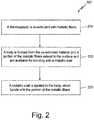
- FIG. 2 is a process for manufacturing article 100.
- FIG. 2 shows process 200 including steps 210, 220, and 230.
- a thermoplastic or thermoset is co-extruded with metallic particles, filaments, or fibers or other material having a metallic coat. At least some of the metallic fibers extend onto the surface of the thermoplastic resin and are available to bond with a metallic coat.
- Many thermoplastic or thermoset resins are non-conductive. As such, a structure formed from such materials cannot be directly coated with a metallic substrate using electroplating, ion vapor deposition, or dynamic cold spray techniques. In some circumstances, a non-conductive structure can be immersed in a salt bath, which can enable a thin metal layer to be applied to the structure by an electroless plating process. The thin metal layer can then allow additional plating of a metal substrate to the structure using an electroplating technique.
- Co-extruding metallic fibers with the thermoplastic imparts sufficient conductivity to the surface to allow a metal substrate to be directly bonded to the body, forming a metallic bond between the metallic fibers and the metallic coating, and obviates the need for any additional activation steps such as a salt immersion or electroless plating step prior to using an electroplating, ion vapor deposition, or dynamic cold spray technique.
- a body is formed from the co-extruded material.
- the metallic fibers can be evenly distributed throughout the thermoplastic resin.
- a structure formed of another material such as a metal, alloy, a different thermoplastic resin, or the same thermoplastic resin without the metallic fibers can be formed first (interior feature 140 in FIG. 1 ) and then a layer of the co-extruded material can be applied on the surface of the formed body.
- a structure can be formed of a first thermoplastic resin and built up layer-by-layer by an additive manufacturing process.
- a second thermoplastic resin containing metallic fibers can be added as a layer on top of the first thermoplastic resin using the same additive manufacturing process or a different manufacturing process forming a body. At least some of the metallic fibers at least partially extend onto the surface of the body and are available to bond with a metal substrate.
- the second thermoplastic resin can contain metallic fibers with known, non-random distributions of orientations.
- a metallic coat is applied to the body.
- the metallic coat bonds with the metallic fibers that at least partially extend onto the surface of the body.
- the amount of metallic fibers coextruded with the thermoplastic resin is sufficient to allow direct plating of a metal substrate to occur on the surface of the body by an electroplating method without any prior activation steps such as, for example, a salt immersion step or an electroless plating step.
- Typical metallic coats applied by an electroplating method can be formed of, for example, chromium, nickel, cobalt, copper, gold, or silver.
- Typical metallic coats applied by a dynamic cold spray method can be formed of, for example, stainless steel, nickel, titanium, aluminum, Inconel, Waspaloy, or Hastelloy.
- the metallic coat can be applied using ion vapor deposition.
- a typical metallic coat applied by ion vapor deposition can be formed of aluminum. Any metal or alloy can be used whose vapor temperature does not exceed the temperature of the thermoplastic or thermoset material where it changes shape.
- the metallic coat can provide, for example, wear resistance or minimize moisture absorption, which can extend the useful life of the part.
- the metallic coat can also provide, for example, electro-magnetic interference shielding or electrostatic dissipation.
- the amount of metallic fibers in the thermoplastic resin may also be adjusted based upon a desired overall strength of the body. For example, a greater amount of metallic fibers can be added to a body which will experience higher pressures and greater stresses under load.
- the amount of metallic fibers and similarly the thickness of the metal coat can be optimized to result in a part having a desired strength and durability and at the same time weigh as little as possible to maximize fuel usage savings.
- the metal coating can also bond more strongly with the metallic fibers in the thermoplastic resin compared to a body which has been immersed in a salt bath.
- Metal coatings applied to non-conductive materials can result in the metal layer easily being pried off or otherwise being separated from the non-conductive material.
- a metal coating bonded to a thermoplastic resin with metallic fibers can be more resistant to separation of the metal coating from the thermoplastic resin compared to a thermoplastic resin without metallic fibers.
- An article includes a body, which includes a thermoplastic or thermoset material and a plurality of metallic fibers distributed throughout the thermoplastic or thermoset material and has a first subset of the plurality of metallic fibers extending onto a first surface of the body.
- the manufactured article includes a metallic coating metallically bonded to the first subset of the plurality of metallic fibers.
- the metal fibers extending onto the first surface are configured to bond with the metallic coating.
- the first subset of the plurality of metallic fibers is configured to allow the metallic coating to be applied directly on the first surface of the body.
- the metallic coating is applied directly on the first surface of the body using an electroplating process, ion vapor deposition, or a dynamic cold spray process.
- thermoplastic or thermoset is selected from the group consisting of polyphenylene sulfide, polyether imide, polyarylether ketones, or combinations thereof.
- the metallic coating is formed of a metal or alloy selected from the group consisting of chromium, nickel, aluminum, titanium, cobalt, iron, copper, gold, silver, stainless steel, Inconel, Waspaloy, Hastelloy, or combinations thereof.
- the plurality of metallic fibers is formed entirely of a metal or alloy capable of forming a metallic bond with the metallic coating.
- the plurality of metallic fibers is metallic coated particles and the particles are selected from the group consisting of graphite, graphene, carbon fibers, carbon nanotubes, or combinations thereof.
- the article includes an interior feature formed within the body, which is a cooling void and a second surface, lining the cooling void, which has a second subset of the plurality of metallic fibers extending onto the second surface of the body and is configured to bond with the metallic coating.
- the article includes an interior feature formed within the body, which is formed of a different material than the body.
- a method of manufacturing a coated article includes co-extruding a thermoplastic or thermoset material with a plurality of metallic fibers distributed throughout the thermoplastic or thermoset material.
- the method includes forming a body from the co-extruded material, which has a first subset of the plurality of metallic fibers extending onto a first surface of the thermoplastic or thermoset material and is configured to bond with a metallic coating.
- the method includes applying a metallic coat to the body, which is metallically bonded to the first subset of the plurality of metallic fibers.
- the method of the preceding paragraph can optionally include, additionally and/or alternatively, any one or more of the following features, configurations and/or additional components:
- the plurality of metallic fibers is configured to allow the metallic coating to be applied directly on the surface of the body.
- the metallic coating is applied directly on the first surface of the body using an electroplating process, ion vapor deposition, or a dynamic cold spray process.
- thermoplastic or thermoset is selected from the group consisting of polyphenylene sulfide, polyether imide, polyarylether ketones, or combinations thereof.
- the metallic coating is formed of a metal or alloy selected from the group consisting of chromium, nickel, aluminum, titanium, cobalt, iron, copper, gold, silver, stainless steel, Inconel, Waspaloy, Hastelloy, or combinations thereof.
- the plurality of metallic fibers is formed entirely of a metal or alloy capable of forming a metallic bond with the metallic coating.
- the plurality of metallic fibers is metallic coated particles and the particles are selected from the group consisting of graphite, graphene, carbon fibers, carbon nanotubes, or combinations thereof.
- the method includes forming an interior feature within the body, which is a cooling void and forming a second surface, lining the cooling void, which has a second subset of the plurality of metallic fibers extending onto the second surface of the thermoplastic or thermoset material and is configured to metallically bond with the metallic coating.
- the method includes forming an interior feature within the body, which is formed of a different material than the body.
- Forming the body is carried out using a fused filament fabrication printing process.
- An article includes a body formed from a thermoplastic or thermoset material and a plurality of metallic fibers distributed throughout the thermoplastic or thermoset material.
- the article includes a metallic coating covering the first surface of the body, which is configured to allow the metallic coating to be applied directly on a first surface of the body and which is applied directly on the first surface of the body using an electroplating, ion vapor deposition, or a dynamic cold spray process.
Landscapes
- Chemical & Material Sciences (AREA)
- Engineering & Computer Science (AREA)
- Materials Engineering (AREA)
- Manufacturing & Machinery (AREA)
- Mechanical Engineering (AREA)
- Physics & Mathematics (AREA)
- Optics & Photonics (AREA)
- Chemical Kinetics & Catalysis (AREA)
- Metallurgy (AREA)
- Organic Chemistry (AREA)
- Electrochemistry (AREA)
- Other Surface Treatments For Metallic Materials (AREA)
Abstract
Description
- The present disclosure relates generally to additive manufacturing systems for printing three-dimensional (3D) parts. More specifically, the present disclosure relates to additively manufacturing a part and then applying a metal coating on the additively manufactured part.
- Traditionally, many aircraft parts have been formed of metal or alloys. On the one hand metal parts are very strong and durable. On the other hand, metal parts are very heavy and require a great deal of fuel to fly. Many traditionally metal parts can be substituted for using composite materials, which are much lighter and require less fuel to fly than aircraft using all metal parts. The aircraft part formed of composite materials can be built, for example, using additive manufacturing techniques.
- Additive manufacturing systems are used to build 3D parts from digital representations of the 3D parts (e.g., STL format files) using one or more additive manufacturing techniques. Examples of commercially available additive manufacturing techniques include extrusion-based techniques, ink jetting, selective laser sintering, powder/binder jetting, electron-beam melting, and stereolithographic processes. For each of these techniques, the digital representation of the 3D part is initially sliced into multiple horizontal layers. For each sliced layer, a tool path is then generated, which provides instructions for the particular additive manufacturing system to form the given layer.
- For example, in an extrusion-based additive manufacturing system, a 3D part or model may be printed from a digital representation of the 3D part in a layer-by-layer manner by extruding a flowable part material. The part material is extruded through an extrusion tip carried by a print head of the system, and is deposited as a sequence of roads on a substrate in an x-y plane. The extruded part material fuses to previously deposited part material, and solidifies upon a drop in temperature. The position of the print head relative to the substrate is then incremented along a z-axis (perpendicular to the x-y plane), and the process is then repeated to form a 3D part resembling the digital representation.
- Some aircraft parts are subjected to high temperatures and pressures during the flight of an aircraft, and a part formed solely from composite materials may not be strong enough or durable enough to withstand the cyclic high temperatures and pressures achieved during flight.
- An article includes a body, which includes a thermoplastic or thermoset material and a plurality of metallic fibers distributed throughout the thermoplastic or thermoset material and has a first subset of the plurality of metallic fibers extending onto a first surface of the body. The manufactured article includes a metallic coating metallically bonded to the first subset of the plurality of metallic fibers. The metal fibers extending onto the first surface are configured to bond with the metallic coating.
- A method of manufacturing a coated article includes co-extruding a thermoplastic or thermoset material with a plurality of metallic fibers distributed throughout the thermoplastic or thermoset material. The method includes forming a body from the co-extruded material, which has a first subset of the plurality of metallic fibers extending onto a first surface of the thermoplastic or thermoset material. The metal fibers extending onto the first surface are configured to bond with a metallic coating. The method includes applying a metallic coat to the body, which is metallically bonded to the first subset of the plurality of metallic fibers.
- An article comprises a body formed from a thermoplastic or thermoset material; a plurality of metallic fibers distributed throughout the thermoplastic or thermoset material; and a metallic coating covering the first surface of the body, wherein the plurality of metallic fibers is configured to allow the metallic coating to be applied directly on a first surface of the body and wherein the metallic coating is applied directly on the first surface of the body using an electroplating, ion vapor deposition, or a dynamic cold spray process.
-
-
FIG. 1 is a cross-sectional view of an article containing conductive fibers. -
FIG. 2 is a process for manufacturing an article containing conductive fibers. - While it is desirable to apply a metal coating on a thermoplastic or thermoset material, these materials are non-conductive and are not amenable to electroplating or dynamic cold spray techniques. Although carbon fibers can be added to the thermoplastic resin matrix to increase conductivity, the material is, nonetheless, not conductive enough for direct electroplating. Prior efforts to metallize thermoplastic or thermoset materials have included activating the surface of the thermoplastic material. For example, thermoplastic or thermoset materials may be initially etched in a chromic acid-based solution to enhance its adhesive capabilities. Any excess chromic acid that is produced must then be neutralized. A solution consisting of palladium and tin salts is then applied to the material (salt immersion step). Next, the surface of the material is coated with either nickel or copper from an electroless plating solution. The palladium and tin salt solution serves as a catalyst when combined with nickel or copper. The material is now ready for electroplating using standard plating technology. However, the bonding strength of the metal coating to the surface of the thermoplastic or thermoset material is low and the metal coating may be easily pried away. The bonding strength of a metal coating using this technique is derived from the total encapsulation of the component. The deposited metals adhere to their adjacent neighbors in the coating, which can create a sealed envelope around the underlying plastic.
- Herein, a method is disclosed for applying a metallic coating using electroplating or dynamic cold spray techniques to a thermoplastic or thermoset material. Metal fibers or particles can be co-extruded with a thermoplastic or thermoset for use in fused filament fabrication (FFF) printing processes. The co-extruded material can be used to print components for prototyping or production, which then can be metalized with various coating processes such as, for example, electroplating, ion vapor deposition, and dynamic cold spray. Using this method, the metal coating forms a strong metal-metal bond with partially exposed metallic fibers on the surface that are otherwise mechanically interlocked within the thermoplastic or thermoset material. At least some of the metallic fibers protrude far enough from the surface or are exposed enough on the surface of the thermoplastic or thermoset material to form metal-metal bonds through electroplating, ion vapor deposition, or dynamic cold spray techniques. In other words, the metal fibers create sufficient conductivity on the surface of the thermoplastic or thermoset material to allow a metal coating to be formed on the surface of the thermoplastic or thermoset material using electroplating, ion vapor deposition, or dynamic cold spray techniques. This metal coating may be very difficult to pry away from the thermoplastic or thermoset material compared to a metal coating applied using, for example, an electroless plating, corona discharge, flame treatment, or plasma treatment method.
-
FIG. 1 is a cross-sectional view ofarticle 100.FIG. 1 showsarticle 100 includingthermoplastic resin 110,first surface 115,metallic fibers 120,metal coating 130,interior feature 140,second surface 145, andbody 150. -
Thermoplastic resin 110 is formed of any thermoplastic or thermoset material that can be used in an additive manufacturing process such as, for example, polyphenylene sulfide, polyether imide, polyarylether ketones, and combinations thereof.Thermoplastic resin 110 ofarticle 100 is built in a layer-by-layer process using additive manufacturing techniques and hasfirst surface 115. -
Metallic fibers 120 are distributed throughoutthermoplastic resin 110, which includesfirst surface 115 ofthermoplastic resin 110. In other words, at least some ofmetallic fibers 120 are not completely embedded internally withinthermoplastic resin 110. Of eachmetallic fiber 120 that is not completely embedded inthermoplastic resin 110, some can have a small portion ofmetallic fiber 120 exposed onfirst surface 115 such as one end or other surface of ametallic fiber 120. Othermetallic fibers 120 also not completely embedded can have a large portion ofmetallic fiber 120 exposed onfirst surface 115 such as ametallic fiber 120 laying in the same plane asfirst surface 115. Othermetallic fibers 120 exposed onfirst surface 115 can have a range in between a small portion and a large portion exposed onfirst surface 115. The aggregate surface area ofmetallic fibers 120 exposed onfirst surface 115 can, for example, depend on orientation ofmetallic fibers 120 relative tofirst surface 115. -
Metallic fibers 120 can be formed of any amount of any metal or alloy, which imparts sufficient conductivity to allow a metallic coat to be applied tofirst surface 115 by electroplating, ion vapor deposition, or dynamic cold spray techniques.Metallic fibers 120 can have a particulate, filament, or fiber structure and be formed entirely from any metal or alloy capable of forming a metal-metal bond withmetal coating 130. Alternatively,metallic fibers 120 can be formed of a core material coated with the metal or alloy. Core materials, for example, can be carbon structures such as, for example, graphite, graphene, carbon fibers, carbon nanotubes, and combinations thereof. -
Metal coating 130 can be applied directly tofirst surface 115 by an electroplating technique. Alternatively,metal coating 130 can be applied directly tofirst surface 115 by an ion vapor deposition technique. Alternatively,metal coating 130 can be applied directly tofirst surface 115 by a dynamic cold spray technique. Neither electroplating, ion vapor deposition, nor dynamic cold spray requires any surface preparation offirst surface 115 prior to deposition ofmetal coating 130 such as, for example, an electroless plating, corona discharge, flame treatment, or plasma treatment step.Metal coating 130 can be formed of any metal or alloy, which provides conductivity and additional strength or heat resistance toarticle 100 such as, for example, chromium, nickel, aluminum, titanium, cobalt, iron, copper, gold, silver, stainless steel, Inconel, Waspaloy, Hastelloy, and combinations thereof. Specific metals or alloys can be selected based on the required amount of strength or heat resistance needed. For example, aluminum has good heat resistance below about 425° C, whereas, some chromium and nickel alloys can tolerate heat at temperatures well above 425° C. -
Metal coating 130 can be any thickness that imparts strength and heat resistance toarticle 100 sufficient to survive the stresses within an aircraft under load. For example,article 100 can be placed anywhere in an aircraft such that the stresses experienced byarticle 100 do not alter the shape ofarticle 100. However,metal coating 130 is not thicker than necessary because additional thickness will unnecessarily add more weight toarticle 100 without a concomitant gain in strength and/or heat resistance. -
Article 100 may optionally includeinterior feature 140.Interior feature 140 can be a hole or void, which could be used, for example, as a cooling hole for coolingarticle 100. Wheninterior feature 140 is a hole or void,second surface 145 can also have a metal coating applied to the surface ofthermoplastic resin 110. Alternatively,interior feature 140 can be a structural feature formed of any material such as a metal or alloy or another thermoplastic resin. Wheninterior feature 140 is optionally included,interior feature 140 together withthermoplastic resin 110 containingmetallic fibers 120form body 150. Alternatively,body 150 can be just formed ofthermoplastic resin 110 containingmetallic fibers 120. When a structural feature, the material forinterior feature 140 can be selected based upon the requirements of the individual part. For example, a metal core may be selected if a part needs to be particularly rigid or strong. The material forinterior feature 140 can also be either the same thermoplastic resin selected forthermoplastic resin 110 or be a different thermoplastic or thermoset resin thanthermoplastic resin 110.Interior feature 140 formed of a thermoplastic resin may or may not also havemetal fibers 120. For example,interior feature 140 can be made of a thermoplastic resin without any metal fibers formed by additive manufacturing. Then asarticle 100 is built up layer-by-layer, a layer ofthermoplastic resin 110 havingmetal fibers 120 is added onsecond surface 145 ofinterior feature 140 formingbody 150. The layer ofthermoplastic resin 110 is then coated withmetal coating 130.FIG. 2 is a process formanufacturing article 100.FIG. 2 showsprocess 200 includingsteps - In
step 210, a thermoplastic or thermoset is co-extruded with metallic particles, filaments, or fibers or other material having a metallic coat. At least some of the metallic fibers extend onto the surface of the thermoplastic resin and are available to bond with a metallic coat. Many thermoplastic or thermoset resins are non-conductive. As such, a structure formed from such materials cannot be directly coated with a metallic substrate using electroplating, ion vapor deposition, or dynamic cold spray techniques. In some circumstances, a non-conductive structure can be immersed in a salt bath, which can enable a thin metal layer to be applied to the structure by an electroless plating process. The thin metal layer can then allow additional plating of a metal substrate to the structure using an electroplating technique. Co-extruding metallic fibers with the thermoplastic imparts sufficient conductivity to the surface to allow a metal substrate to be directly bonded to the body, forming a metallic bond between the metallic fibers and the metallic coating, and obviates the need for any additional activation steps such as a salt immersion or electroless plating step prior to using an electroplating, ion vapor deposition, or dynamic cold spray technique. - In
step 220, a body is formed from the co-extruded material. The metallic fibers can be evenly distributed throughout the thermoplastic resin. Alternatively, a structure formed of another material such as a metal, alloy, a different thermoplastic resin, or the same thermoplastic resin without the metallic fibers can be formed first (interior feature 140 inFIG. 1 ) and then a layer of the co-extruded material can be applied on the surface of the formed body. For example, a structure can be formed of a first thermoplastic resin and built up layer-by-layer by an additive manufacturing process. Then, a second thermoplastic resin containing metallic fibers can be added as a layer on top of the first thermoplastic resin using the same additive manufacturing process or a different manufacturing process forming a body. At least some of the metallic fibers at least partially extend onto the surface of the body and are available to bond with a metal substrate. In some embodiments, the second thermoplastic resin can contain metallic fibers with known, non-random distributions of orientations. - In
step 230, a metallic coat is applied to the body. The metallic coat bonds with the metallic fibers that at least partially extend onto the surface of the body. The amount of metallic fibers coextruded with the thermoplastic resin is sufficient to allow direct plating of a metal substrate to occur on the surface of the body by an electroplating method without any prior activation steps such as, for example, a salt immersion step or an electroless plating step. Typical metallic coats applied by an electroplating method can be formed of, for example, chromium, nickel, cobalt, copper, gold, or silver. Alternatively, there is enough metallic fibers present on the surface of the thermoplastic resin to allow a metal substrate to adhere to the surface of the body during a dynamic cold spray process. Typical metallic coats applied by a dynamic cold spray method can be formed of, for example, stainless steel, nickel, titanium, aluminum, Inconel, Waspaloy, or Hastelloy. Alternatively, the metallic coat can be applied using ion vapor deposition. A typical metallic coat applied by ion vapor deposition can be formed of aluminum. Any metal or alloy can be used whose vapor temperature does not exceed the temperature of the thermoplastic or thermoset material where it changes shape. The metallic coat can provide, for example, wear resistance or minimize moisture absorption, which can extend the useful life of the part. The metallic coat can also provide, for example, electro-magnetic interference shielding or electrostatic dissipation. - The amount of metallic fibers in the thermoplastic resin may also be adjusted based upon a desired overall strength of the body. For example, a greater amount of metallic fibers can be added to a body which will experience higher pressures and greater stresses under load. The amount of metallic fibers and similarly the thickness of the metal coat can be optimized to result in a part having a desired strength and durability and at the same time weigh as little as possible to maximize fuel usage savings.
- The metal coating can also bond more strongly with the metallic fibers in the thermoplastic resin compared to a body which has been immersed in a salt bath. Metal coatings applied to non-conductive materials can result in the metal layer easily being pried off or otherwise being separated from the non-conductive material. A metal coating bonded to a thermoplastic resin with metallic fibers can be more resistant to separation of the metal coating from the thermoplastic resin compared to a thermoplastic resin without metallic fibers.
- The following are non-exclusive descriptions of possible embodiments of the present invention.
- An article includes a body, which includes a thermoplastic or thermoset material and a plurality of metallic fibers distributed throughout the thermoplastic or thermoset material and has a first subset of the plurality of metallic fibers extending onto a first surface of the body. The manufactured article includes a metallic coating metallically bonded to the first subset of the plurality of metallic fibers. The metal fibers extending onto the first surface are configured to bond with the metallic coating.
- The article of the preceding paragraph can optionally include, additionally and/or alternatively, any one or more of the following features, configurations and/or additional components:
- The first subset of the plurality of metallic fibers is configured to allow the metallic coating to be applied directly on the first surface of the body.
- The metallic coating is applied directly on the first surface of the body using an electroplating process, ion vapor deposition, or a dynamic cold spray process.
- The thermoplastic or thermoset is selected from the group consisting of polyphenylene sulfide, polyether imide, polyarylether ketones, or combinations thereof.
- The metallic coating is formed of a metal or alloy selected from the group consisting of chromium, nickel, aluminum, titanium, cobalt, iron, copper, gold, silver, stainless steel, Inconel, Waspaloy, Hastelloy, or combinations thereof.
- The plurality of metallic fibers is formed entirely of a metal or alloy capable of forming a metallic bond with the metallic coating.
- The plurality of metallic fibers is metallic coated particles and the particles are selected from the group consisting of graphite, graphene, carbon fibers, carbon nanotubes, or combinations thereof.
- The article includes an interior feature formed within the body, which is a cooling void and a second surface, lining the cooling void, which has a second subset of the plurality of metallic fibers extending onto the second surface of the body and is configured to bond with the metallic coating.
- The article includes an interior feature formed within the body, which is formed of a different material than the body.
- A method of manufacturing a coated article includes co-extruding a thermoplastic or thermoset material with a plurality of metallic fibers distributed throughout the thermoplastic or thermoset material. The method includes forming a body from the co-extruded material, which has a first subset of the plurality of metallic fibers extending onto a first surface of the thermoplastic or thermoset material and is configured to bond with a metallic coating. The method includes applying a metallic coat to the body, which is metallically bonded to the first subset of the plurality of metallic fibers.
- The method of the preceding paragraph can optionally include, additionally and/or alternatively, any one or more of the following features, configurations and/or additional components:
- The plurality of metallic fibers is configured to allow the metallic coating to be applied directly on the surface of the body.
- The metallic coating is applied directly on the first surface of the body using an electroplating process, ion vapor deposition, or a dynamic cold spray process.
- The thermoplastic or thermoset is selected from the group consisting of polyphenylene sulfide, polyether imide, polyarylether ketones, or combinations thereof.
- The metallic coating is formed of a metal or alloy selected from the group consisting of chromium, nickel, aluminum, titanium, cobalt, iron, copper, gold, silver, stainless steel, Inconel, Waspaloy, Hastelloy, or combinations thereof.
- The plurality of metallic fibers is formed entirely of a metal or alloy capable of forming a metallic bond with the metallic coating.
- The plurality of metallic fibers is metallic coated particles and the particles are selected from the group consisting of graphite, graphene, carbon fibers, carbon nanotubes, or combinations thereof.
- The method includes forming an interior feature within the body, which is a cooling void and forming a second surface, lining the cooling void, which has a second subset of the plurality of metallic fibers extending onto the second surface of the thermoplastic or thermoset material and is configured to metallically bond with the metallic coating.
- The method includes forming an interior feature within the body, which is formed of a different material than the body.
- Forming the body is carried out using a fused filament fabrication printing process.
- An article includes a body formed from a thermoplastic or thermoset material and a plurality of metallic fibers distributed throughout the thermoplastic or thermoset material. The article includes a metallic coating covering the first surface of the body, which is configured to allow the metallic coating to be applied directly on a first surface of the body and which is applied directly on the first surface of the body using an electroplating, ion vapor deposition, or a dynamic cold spray process.
- While the invention has been described with reference to an exemplary embodiment(s), it will be understood by those skilled in the art that various changes may be made and equivalents may be substituted for elements thereof without departing from the scope of the invention. In addition, many modifications may be made to adapt a particular situation or material to the teachings of the invention without departing from the essential scope thereof. Therefore, it is intended that the invention not be limited to the particular embodiment(s) disclosed, but that the invention will include all embodiments falling within the scope of the appended claims.
Claims (15)
- An article (100) comprising:a body (105) comprising:a thermoplastic or thermoset material; anda plurality of metallic fibers distributed throughout the thermoplastic or thermoset material, wherein a first subset of the plurality of metallic fibers extends onto a first surface of the body; anda metallic coating (130) metallically bonded to the first subset of the plurality of metallic fibers, wherein the first subset of the plurality of metallic fibers (120) is configured to bond with the metallic coating.
- The article of claim 1, wherein the first subset of the plurality of metallic fibers is configured to allow the metallic coating to be applied directly on the first surface of the body, and optionally wherein the metallic coating is applied directly on the first surface of the body using an electroplating, ion vapor deposition, or a dynamic cold spray process.
- The article of any preceding claim, wherein the thermoplastic or thermoset is selected from the group consisting of polyphenylene sulfide, polyether imide, polyarylether ketones, or combinations thereof.
- The article of any preceding claim, wherein the metallic coating is formed of a metal or alloy selected from the group consisting of chromium, nickel, aluminum, titanium, cobalt, iron, copper, gold, silver, stainless steel, Inconel, Waspaloy, Hastelloy, or combinations thereof.
- The article of any preceding claim, wherein the plurality of metallic fibers is formed entirely of a metal or alloy capable of forming a metallic bond with the metallic coating, or wherein the plurality of metallic fibers is metallic coated particles and the particles are selected from the group consisting of graphite, graphene, carbon fibers, carbon nanotubes, or combinations thereof.
- The body of any preceding claim and further comprising:an interior feature formed within the body, wherein the interior feature is a cooling void; anda second surface, lining the cooling void, wherein a second subset of the plurality of metallic fibers extends onto the second surface of the body and is configured to metallically bond with the metallic coating.
- The body of any preceding claim and further comprising:
an interior feature formed within the body, wherein the interior feature is formed of a different material than the body. - A method of manufacturing a coated article, the method comprising:co-extruding a thermoplastic or thermoset material with a plurality of metallic fibers distributed throughout the thermoplastic or thermoset material;forming a body from the co-extruded material, wherein a first subset of the plurality of metallic fibers extends onto a first surface of the thermoplastic or thermoset material and is configured to bond with a metallic coating; andapplying the metallic coating to the body, wherein the metallic coat is metallically bonded to the first subset of the plurality of metallic fibers.
- The method of claim 8, wherein the plurality of metallic fibers is configured to allow the metallic coating to be applied directly on the first surface of the body, and optionally wherein the metallic coating is applied directly on the first surface of the body using an electroplating, ion vapor deposition, or a dynamic cold spray process.
- The method of any of claims 8 or 9, wherein the thermoplastic or thermoset is selected from the group consisting of polyphenylene sulfide, polyether imide, polyarylether ketones, or combinations thereof.
- The method of any of claims 8 to 10, wherein the metallic coating is formed of a metal or alloy selected from the group consisting of chromium, nickel, aluminum, titanium, cobalt, iron, copper, gold, silver, stainless steel, Inconel, Waspaloy, Hastelloy, or combinations thereof.
- The method of any of claims 8 to 11, wherein the plurality of metallic fibers is formed entirely of a metal or alloy capable of forming a metallic bond with the metallic coating, or wherein the plurality of metallic fibers is metallic coated particles and the particles are selected from the group consisting of graphite, graphene, carbon fibers, carbon nanotubes, or combinations thereof.
- The method of any of claims 8 to 12 and further comprising:forming an interior feature within the body, wherein the interior feature is a cooling void; andforming a second surface, lining the cooling void, wherein a second subset of the plurality of metallic fibers extends onto the second surface of the thermoplastic or thermoset material and is configured to metallically bond with the metallic coating.
- The method of any of claims 8 o 13 and further comprising:
forming an interior feature within the body, wherein the interior feature is formed of a different material than the body. - The method of any of claims 8 to 14, wherein forming the body is carried out using a fused filament fabrication printing process.
Applications Claiming Priority (1)
| Application Number | Priority Date | Filing Date | Title |
|---|---|---|---|
| US16/401,250 US11691338B2 (en) | 2019-05-02 | 2019-05-02 | Article containing conductive fibers |
Publications (1)
| Publication Number | Publication Date |
|---|---|
| EP3733933A1 true EP3733933A1 (en) | 2020-11-04 |
Family
ID=68771497
Family Applications (1)
| Application Number | Title | Priority Date | Filing Date |
|---|---|---|---|
| EP19213521.8A Pending EP3733933A1 (en) | 2019-05-02 | 2019-12-04 | Extruded article containing conductive fibers and having a metallic coating thereon |
Country Status (2)
| Country | Link |
|---|---|
| US (1) | US11691338B2 (en) |
| EP (1) | EP3733933A1 (en) |
Cited By (3)
| Publication number | Priority date | Publication date | Assignee | Title |
|---|---|---|---|---|
| US11662300B2 (en) | 2019-09-19 | 2023-05-30 | Westinghouse Electric Company Llc | Apparatus for performing in-situ adhesion test of cold spray deposits and method of employing |
| US11898986B2 (en) | 2012-10-10 | 2024-02-13 | Westinghouse Electric Company Llc | Systems and methods for steam generator tube analysis for detection of tube degradation |
| US11935662B2 (en) | 2019-07-02 | 2024-03-19 | Westinghouse Electric Company Llc | Elongate SiC fuel elements |
Citations (2)
| Publication number | Priority date | Publication date | Assignee | Title |
|---|---|---|---|---|
| US5702584A (en) * | 1996-07-01 | 1997-12-30 | Ford Motor Company | Enhanced plating adhesion through the use of metallized fillers in plastic substrate |
| CN102409319A (en) * | 2009-12-30 | 2012-04-11 | 比亚迪股份有限公司 | Preparation method of plastic product and plastic product |
Family Cites Families (5)
| Publication number | Priority date | Publication date | Assignee | Title |
|---|---|---|---|---|
| US6899777B2 (en) | 2001-01-02 | 2005-05-31 | Advanced Ceramics Research, Inc. | Continuous fiber reinforced composites and methods, apparatuses, and compositions for making the same |
| BR112013001706A2 (en) * | 2010-07-23 | 2016-05-31 | Syscom Advanced Materials Inc | continuous process for preparation and use of electrically conductive metal coated fibers |
| CA2917922A1 (en) * | 2013-07-09 | 2015-01-15 | United Technologies Corporation | Erosion and wear protection for composites and plated polymers |
| CA3008667A1 (en) | 2015-12-16 | 2017-06-22 | Desktop Metal, Inc. | Methods and systems for additive manufacturing |
| US10011922B2 (en) | 2016-03-21 | 2018-07-03 | Stratasys, Inc. | Core-shell morphology of composite filaments for use in extrusion-based additive manufacturing systems |
-
2019
- 2019-05-02 US US16/401,250 patent/US11691338B2/en active Active
- 2019-12-04 EP EP19213521.8A patent/EP3733933A1/en active Pending
Patent Citations (2)
| Publication number | Priority date | Publication date | Assignee | Title |
|---|---|---|---|---|
| US5702584A (en) * | 1996-07-01 | 1997-12-30 | Ford Motor Company | Enhanced plating adhesion through the use of metallized fillers in plastic substrate |
| CN102409319A (en) * | 2009-12-30 | 2012-04-11 | 比亚迪股份有限公司 | Preparation method of plastic product and plastic product |
Cited By (3)
| Publication number | Priority date | Publication date | Assignee | Title |
|---|---|---|---|---|
| US11898986B2 (en) | 2012-10-10 | 2024-02-13 | Westinghouse Electric Company Llc | Systems and methods for steam generator tube analysis for detection of tube degradation |
| US11935662B2 (en) | 2019-07-02 | 2024-03-19 | Westinghouse Electric Company Llc | Elongate SiC fuel elements |
| US11662300B2 (en) | 2019-09-19 | 2023-05-30 | Westinghouse Electric Company Llc | Apparatus for performing in-situ adhesion test of cold spray deposits and method of employing |
Also Published As
| Publication number | Publication date |
|---|---|
| US11691338B2 (en) | 2023-07-04 |
| US20200346401A1 (en) | 2020-11-05 |
Similar Documents
| Publication | Publication Date | Title |
|---|---|---|
| US11691338B2 (en) | Article containing conductive fibers | |
| EP3328158B1 (en) | Heating circuit assembly and method of manufacture | |
| CN105189826B (en) | Electrodeposited compositions and nanolaminated alloys for articles prepared by additive manufacturing processes | |
| CN103080577A (en) | Bearing component, in particular roller bearing cage, and method for the production thereof | |
| US20180043618A1 (en) | Embedding apparatus and method utilizing additive manufacturing | |
| CN102027150B (en) | Method for coating fiber composite parts for spacecraft or aircraft and fiber composite parts produced by the method | |
| KR20150135068A (en) | Modified shank fasteners for electromagnetic effect (eme) technology | |
| US10293956B2 (en) | Method for placing electrical conductors interior to a composite structure prior to curing | |
| GB2521600A (en) | A building block for a mechanical construction | |
| CN101952475A (en) | The structure of making by matrix material with metallic surface | |
| KR101822314B1 (en) | Copper foil with carrier, method for manufacturing copper foil with carrier, copper foil with carrier for printed circuit board, and printed circuit board | |
| EP4238753A1 (en) | Composite laminates with metal layers and methods thereof | |
| CA2676731C (en) | Fibre composite material with metal matrix and method for the production thereof | |
| EP3296365B1 (en) | Method for promoting electrical conduction between metallic components and composite materials | |
| CN101610895A (en) | The method and apparatus of production part coated article | |
| EP4238761A1 (en) | Cold sprayed electrical circuits and methods thereof | |
| MXPA06003754A (en) | Method for making an infused composite. | |
| US5009927A (en) | Method for coating fabric surface with electrically conductive film | |
| DE102006046518B4 (en) | Process for coating a substrate | |
| CN108048763B (en) | A kind of metal-base composites 3D printing method modified based on continuous fiber surface | |
| Dietz et al. | Surface technology for polymer parts for space applications made by additive manufacturing | |
| EP4339320A1 (en) | Expansive coatings for anchoring to composite substrates | |
| JPH0447932A (en) | Production of thermal spraying member based on synthetic resin material | |
| Singh et al. | Realization of Rf Hardware Models and Associated Aspects Employing Additive Manufacturing For Aerospace Application | |
| JPS63286564A (en) | Production of metal mold for molding |
Legal Events
| Date | Code | Title | Description |
|---|---|---|---|
| PUAI | Public reference made under article 153(3) epc to a published international application that has entered the european phase |
Free format text: ORIGINAL CODE: 0009012 |
|
| STAA | Information on the status of an ep patent application or granted ep patent |
Free format text: STATUS: THE APPLICATION HAS BEEN PUBLISHED |
|
| AK | Designated contracting states |
Kind code of ref document: A1 Designated state(s): AL AT BE BG CH CY CZ DE DK EE ES FI FR GB GR HR HU IE IS IT LI LT LU LV MC MK MT NL NO PL PT RO RS SE SI SK SM TR |
|
| AX | Request for extension of the european patent |
Extension state: BA ME |
|
| STAA | Information on the status of an ep patent application or granted ep patent |
Free format text: STATUS: REQUEST FOR EXAMINATION WAS MADE |
|
| 17P | Request for examination filed |
Effective date: 20210428 |
|
| RBV | Designated contracting states (corrected) |
Designated state(s): AL AT BE BG CH CY CZ DE DK EE ES FI FR GB GR HR HU IE IS IT LI LT LU LV MC MK MT NL NO PL PT RO RS SE SI SK SM TR |
|
| STAA | Information on the status of an ep patent application or granted ep patent |
Free format text: STATUS: EXAMINATION IS IN PROGRESS |
|
| 17Q | First examination report despatched |
Effective date: 20231002 |
|
| GRAP | Despatch of communication of intention to grant a patent |
Free format text: ORIGINAL CODE: EPIDOSNIGR1 |
|
| STAA | Information on the status of an ep patent application or granted ep patent |
Free format text: STATUS: GRANT OF PATENT IS INTENDED |
|
| INTG | Intention to grant announced |
Effective date: 20251029 |