EP3733884A1 - Solvent extraction method - Google Patents
Solvent extraction method Download PDFInfo
- Publication number
- EP3733884A1 EP3733884A1 EP18909626.6A EP18909626A EP3733884A1 EP 3733884 A1 EP3733884 A1 EP 3733884A1 EP 18909626 A EP18909626 A EP 18909626A EP 3733884 A1 EP3733884 A1 EP 3733884A1
- Authority
- EP
- European Patent Office
- Prior art keywords
- extractant
- volume
- aqueous solution
- magnesium
- sulfuric acid
- Prior art date
- Legal status (The legal status is an assumption and is not a legal conclusion. Google has not performed a legal analysis and makes no representation as to the accuracy of the status listed.)
- Granted
Links
Images


Classifications
-
- B—PERFORMING OPERATIONS; TRANSPORTING
- B01—PHYSICAL OR CHEMICAL PROCESSES OR APPARATUS IN GENERAL
- B01D—SEPARATION
- B01D11/00—Solvent extraction
- B01D11/04—Solvent extraction of solutions which are liquid
- B01D11/0492—Applications, solvents used
-
- C—CHEMISTRY; METALLURGY
- C22—METALLURGY; FERROUS OR NON-FERROUS ALLOYS; TREATMENT OF ALLOYS OR NON-FERROUS METALS
- C22B—PRODUCTION AND REFINING OF METALS; PRETREATMENT OF RAW MATERIALS
- C22B23/00—Obtaining nickel or cobalt
- C22B23/04—Obtaining nickel or cobalt by wet processes
- C22B23/0453—Treatment or purification of solutions, e.g. obtained by leaching
-
- B—PERFORMING OPERATIONS; TRANSPORTING
- B01—PHYSICAL OR CHEMICAL PROCESSES OR APPARATUS IN GENERAL
- B01D—SEPARATION
- B01D11/00—Solvent extraction
- B01D11/04—Solvent extraction of solutions which are liquid
-
- B—PERFORMING OPERATIONS; TRANSPORTING
- B01—PHYSICAL OR CHEMICAL PROCESSES OR APPARATUS IN GENERAL
- B01D—SEPARATION
- B01D11/00—Solvent extraction
- B01D11/04—Solvent extraction of solutions which are liquid
- B01D11/0488—Flow sheets
-
- C—CHEMISTRY; METALLURGY
- C22—METALLURGY; FERROUS OR NON-FERROUS ALLOYS; TREATMENT OF ALLOYS OR NON-FERROUS METALS
- C22B—PRODUCTION AND REFINING OF METALS; PRETREATMENT OF RAW MATERIALS
- C22B26/00—Obtaining alkali, alkaline earth metals or magnesium
- C22B26/20—Obtaining alkaline earth metals or magnesium
- C22B26/22—Obtaining magnesium
-
- C—CHEMISTRY; METALLURGY
- C22—METALLURGY; FERROUS OR NON-FERROUS ALLOYS; TREATMENT OF ALLOYS OR NON-FERROUS METALS
- C22B—PRODUCTION AND REFINING OF METALS; PRETREATMENT OF RAW MATERIALS
- C22B3/00—Extraction of metal compounds from ores or concentrates by wet processes
- C22B3/20—Treatment or purification of solutions, e.g. obtained by leaching
- C22B3/26—Treatment or purification of solutions, e.g. obtained by leaching by liquid-liquid extraction using organic compounds
- C22B3/38—Treatment or purification of solutions, e.g. obtained by leaching by liquid-liquid extraction using organic compounds containing phosphorus
- C22B3/384—Pentavalent phosphorus oxyacids, esters thereof
- C22B3/3846—Phosphoric acid, e.g. (O)P(OH)3
-
- Y—GENERAL TAGGING OF NEW TECHNOLOGICAL DEVELOPMENTS; GENERAL TAGGING OF CROSS-SECTIONAL TECHNOLOGIES SPANNING OVER SEVERAL SECTIONS OF THE IPC; TECHNICAL SUBJECTS COVERED BY FORMER USPC CROSS-REFERENCE ART COLLECTIONS [XRACs] AND DIGESTS
- Y02—TECHNOLOGIES OR APPLICATIONS FOR MITIGATION OR ADAPTATION AGAINST CLIMATE CHANGE
- Y02P—CLIMATE CHANGE MITIGATION TECHNOLOGIES IN THE PRODUCTION OR PROCESSING OF GOODS
- Y02P10/00—Technologies related to metal processing
- Y02P10/20—Recycling
Definitions
- the present invention relates to a solvent extraction method. More specifically, the present invention relates to a solvent extraction method to separate magnesium from an acidic aqueous solution of sulfuric acid containing nickel, cobalt, and magnesium.
- NCM nickel-cobalt-manganese
- NCA nickel-cobalt-aluminum
- the positive electrode material containing nickel like the NCM-based positive electrode material and the NCA-based positive electrode material are manufactured by processing an aqueous solution containing a salt of a metal, such as nickel, with an alkali and performing a burning process on the obtained metallic hydroxide.
- the metal salt used as the raw material includes chloride (nickel chloride) and sulfate (nickel sulfate).
- the use of the chloride generates a chlorine gas in the burning process, and therefore a firing furnace is likely to be corroded. Therefore, the sulfate is generally used as the metal salt.
- the sulfate is, for example, manufactured by nickel smelting using a nickel oxide ore as a raw material.
- the nickel-oxidized ore usually contains a cobalt oxide. Therefore, the nickel smelting obtains an acidic aqueous solution of sulfuric acid containing nickel and cobalt. There may be a case where this acidic aqueous solution of sulfuric acid contains magnesium as impurities.
- the positive electrode material with the acidic aqueous solution of sulfuric acid containing the magnesium as the raw material results in containing the magnesium as the impurities in the positive electrode material.
- a lithium-ion battery using the positive electrode material possibly deteriorates battery properties, such as a charge/discharge capacity. Accordingly, preliminarily removing the magnesium from the acidic aqueous solution of sulfuric acid is desired.
- Patent Document 1 discloses that a solvent extraction method separates and recovers a nickel sulfate aqueous solution and a cobalt sulfate aqueous solution from an acidic aqueous solution of sulfuric acid containing nickel and cobalt.
- Use of a monothiophosphinic acid compound as an extractant allows obtaining a cobalt sulfate aqueous solution that hardly contains magnesium.
- the magnesium is contained in the nickel sulfate aqueous solution. Thus, selectively separating the magnesium from the acidic aqueous solution of sulfuric acid containing the nickel and the magnesium is difficult.
- Patent Document 1 Japanese Patent No. 4225514
- an object of the present invention is to provide a solvent extraction method that allows selectively separating magnesium from an acidic aqueous solution of sulfuric acid containing nickel, cobalt, and magnesium.
- a solvent extraction method includes: bringing an acidic aqueous solution of sulfuric acid containing nickel, cobalt, and magnesium in contact with an organic solvent to extract the magnesium into the organic solvent; and using the organic solvent produced by diluting an extractant made of alkylphosphonic acid ester with a diluent.
- a concentration of the extractant in the organic solvent is set to 40 volume% or more and 60 volume% or less and a pH of the acidic aqueous solution of sulfuric acid is set to 1.5 or more and 2.0 or less, or the concentration of the extractant in the organic solvent is set to 20 volume% or more and 50 volume% or less and the pH of the acidic aqueous solution of sulfuric acid is set to 2.0 or more and 2.5 or less.
- the concentration of the extractant in the organic solvent is set to 40 volume% or more and 50 volume% or less and the pH of the acidic aqueous solution of sulfuric acid is set to 1.5 or more and 2.0 or less, or the concentration of the extractant in the organic solvent is set to 20 volume% or more and 30 volume% or less and the pH of the acidic aqueous solution of sulfuric acid is set to 2.0 or more and 2.5 or less.
- the concentration of the extractant in the organic solvent is set to 30 volume% or more and 50 volume% or less and the pH of the acidic aqueous solution of sulfuric acid is set to 2.0 or more and
- the present invention allows selectively separating the magnesium from the acidic aqueous solution of sulfuric acid containing the nickel, the cobalt, and the magnesium.
- a solvent extraction method of this embodiment brings an acidic aqueous solution of sulfuric acid containing nickel, cobalt, and magnesium in contact with an organic solvent to extract the magnesium into the organic solvent. While the nickel and the cobalt are caused to remain in a water phase, the magnesium is extracted to an organic phase to selectively separate the magnesium.
- a device used for the solvent extraction is not specifically limited.
- a solvent extraction device includes a mixer-settler extractor.
- Alkylphosphonic acid ester is used as the extractant.
- the alkylphosphonic acid ester includes bis(2-ethylhexyl) hydrogen phosphate (D2EHPA), 2-ethylhexyl hydrogen -2-ethylhexylphosphonate (PC-88A), and Diisooctylphosphinic acid (CYANEX272).
- D2EHPA bis(2-ethylhexyl) hydrogen phosphate
- PC-88A 2-ethylhexyl hydrogen -2-ethylhexylphosphonate
- CYANEX272 Diisooctylphosphinic acid
- the bis(2-ethylhexyl) hydrogen phosphate is preferably used as the extractant.
- the diluent is not specifically limited.
- a naphthene-based solvent and an aromatic-based solvent can be employed.
- the alkylphosphonic acid ester is one kind of an acid extractant.
- an extraction reaction is a pure acid-base reaction.
- An amount of substance of the extractant contributing to the extraction reaction is determined according to a concentration and a valence of an element to be extracted in the aqueous solution.
- a separation factor between the elements does not depend on the concentration of the extractant in the organic solvent.
- the alkylphosphonic acid ester also acts as a chelate extractant.
- the alkylphosphonic acid ester contains phosphorus and oxygen in molecules.
- an element that forms a coordinate bond with phosphorus or oxygen is extracted by formation of a chelate compound.
- Increasing the concentration of the extractant in the organic solvent promotes the formation of the chelate compound.
- an element that facilitates the formation of the chelate compound increases an extraction rate compared with that of an element that is less likely to form the chelate compound.
- a formation trend of the chelate compound by nickel, cobalt, and magnesium is in the order of nickel > cobalt ⁇ magnesium. That is, the nickel preferentially forms the chelate compound.
- concentration of the extractant increases, the extraction of the nickel is promoted compared with that of the magnesium, and therefore a separation factor of the magnesium relative to the nickel (hereinafter referred to as a "Mg/Ni separation factor") decreases.
- Mg/Ni separation factor a separation factor of the magnesium relative to the nickel
- the concentration of the extractant hardly affects the separation factor of the magnesium relative to the cobalt (hereinafter referred to as a "Mg/Co separation factor"). Accordingly, as the concentration of the extractant decreases, the Mg/Ni separation factor can be increased, thereby ensuring efficiently separating the magnesium chemically.
- the concentration of the extractant is adjusted to ensure maintaining a desired magnesium extraction rate.
- the concentration of the extractant allows increasing the extraction rate of the magnesium while the extraction rates of the nickel and the cobalt are suppressed to be low.
- the concentration of the extractant is preferably adjusted to be from 20 to 60 volume%. This allows selectively separating the magnesium from the acidic aqueous solution of sulfuric acid containing the nickel, the cobalt, and the magnesium.
- the acidic aqueous solution of sulfuric acid processed by the solvent extraction method according to this embodiment decreases. Therefore, the acidic aqueous solution of sulfuric acid can be used as, for example, a raw material of a positive electrode material, such as an NCM-based positive electrode material and an NCA-based positive electrode material.
- the solvent extraction method extracts the magnesium as impurities in the organic solvent.
- the obj ective metals in the organic phase need to be back-extracted in a water phase in a post-process.
- an agent used for the back extraction such as alkali and acid, is required.
- the objective metals remain in the water phase in this embodiment, the operation of back-extracting the objective metals is unnecessary.
- the magnesium extracted in the organic phase is a trace, usage of the agent used for the back extraction of the magnesium can be reduced.
- an acidic aqueous solution of sulfuric acid containing nickel, cobalt, and magnesium was prepared as a raw solution.
- Anickel concentration is 120 g/L
- a cobalt concentration is 5 g/L
- a magnesium concentration is 5 g/L in the acidic aqueous solution of sulfuric acid.
- an extractant was diluted with a diluent to prepare an organic solvent.
- Bis(2-ethylhexyl) hydrogen phosphate (BAYSOLVEX D2EHPA manufactured by LANXESS Corporation) was used as the extractant.
- a naphthene-based solvent (Teclean N20 manufactured by JXTG Nippon Oil & Energy Corporation) was used as the diluent.
- Six kinds of organic solvents whose concentrations of the extractants were different were prepared. The concentrations of the extractants in the respective organic solvents are 10 volume%, 20 volume%, 30 volume%, 40 volume%, 50 volume%, and 60 volume%.
- the mixed liquid was left for phase separation and the water phase (acidic aqueous solution of sulfuric acid) and an organic phase (organic solvent) were each recovered.
- a nickel concentration, a cobalt concentration, and a magnesium concentration of the water phase and the organic phase were analyzed by ICP optical emission spectrometer. Respective masses of the nickel, the cobalt, and the magnesium in the organic phase were obtained from analysis values. Extraction rates of the nickel, the cobalt, and the magnesium were each calculated by dividing the mass in the organic phase by a mass in the raw solution. Distribution ratios of the nickel, the cobalt, and the magnesium were each calculated by dividing the concentration in the organic phase by the concentration in the water phase. Then, the distribution ratio of the magnesium was divided by the distribution ratio of the cobalt to obtain a Mg/Co separation factor. The distribution ratio of the magnesium was divided by the distribution ratio of the nickel to obtain a Mg/Ni separation factor.
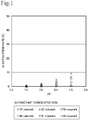
- Table 1 and Fig. 1 show the extraction rate of the nickel.
- Table 2 and Fig. 2 show the extraction rate of the cobalt.
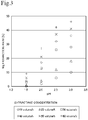
- Table 3 and Fig. 3 show the extraction rate of the magnesium.
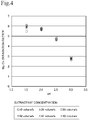
- Table 4 and Fig. 4 show the Mg/Co separation factor.
- Table 5 and Fig. 5 show the Mg/Ni separation factor.
- the concentration of the extractant hardly affects the Mg/Co separation factor.
- the Mg/Ni separation factor depends on the concentration of the extractant. The lower the concentration of the extractant is, the higher the Mg/Ni separation factor becomes. That is, as the concentration of the extractant lowers, the separation of the magnesium from the nickel and the cobalt is facilitated.
- the concentration of the extractant is set to be 40 volume% or more and the pH of the acidic aqueous solution of sulfuric acid is set to be 1.5 or more, the concentration of the extractant is set to be 20 volume% or more and the pH of the acidic aqueous solution of sulfuric acid is set to be 2.0 or more, or the concentration of the extractant is set to be 10 volume% or more and the pH of the acidic aqueous solution of sulfuric acid is set to be 2.5 or more. Doing so allows obtaining the extraction rate of the magnesium of 4% or more.
- the concentration of the extractant is set to be 30 volume% or more and the pH of the acidic aqueous solution of sulfuric acid is set to be 2.0 or more, or the concentration of the extractant is set to be 20 volume% or more and the pH of the acidic aqueous solution of sulfuric acid is set to be 2.5 or more. Doing so allows obtaining the extraction rate of the magnesium of 10% or more.
- the pH of the acidic aqueous solution of sulfuric acid is preferably set to be 2.5 or less. Doing so allows obtaining the Mg/Co separation factor of 4 or more.
- the concentration of the extractant is set to be 50 volume% or less and the pH of the acidic aqueous solution of sulfuric acid is set to be 2.5 or less, or the concentration of the extractant is set to be 60 volume% or less and the pH of the acidic aqueous solution of sulfuric acid is set to be 2.0 or less. Doing so allows obtaining the Mg/Ni separation factor of 15 or more.
- the concentration of the extractant is set to be 30 volume% or less and the pH of the acidic aqueous solution of sulfuric acid is set to be 2.5 or less, or the concentration of the extractant is set to be 50 volume% or less and the pH of the acidic aqueous solution of sulfuric acid is set to be 2.0 or less. Doing so allows obtaining the Mg/Ni separation factor of 20 or more.
- the concentration of the extractant is set to be 40 to 60 volume% and the pH of the acidic aqueous solution of sulfuric acid is set to be 1.5 to 2.0, or the concentration of the extractant is set to be 20 to 50 volume% and the pH of the acidic aqueous solution of sulfuric acid is set to be 2.0 to 2.5. Doing so allows obtaining the extraction rate of the magnesium of 4% or more, the Mg/Co separation factor of 4 or more, and the Mg/Ni separation factor of 15 or more.
- the concentration of the extractant is set to be 40 to 50 volume% and the pH of the acidic aqueous solution of sulfuric acid is set to be 1.5 to 2.0, or the concentration of the extractant is set to be 20 to 30 volume% and the pH of the acidic aqueous solution of sulfuric acid is set to be 2.0 to 2.5. Doing so allows obtaining the extraction rate of the magnesium of 4% or more, the Mg/Co separation factor of 4 or more, and the Mg/Ni separation factor of 20 or more.
- concentration of the extractant is set to be 30 to 50 volume% and the pH of the acidic aqueous solution of sulfuric acid is set to be 2.0 to 2.5. Doing so allows obtaining the extraction rate of the magnesium of 10% or more, the Mg/Co separation factor of 4 or more, and the Mg/Ni separation factor of 15 or more.
Landscapes
- Chemical & Material Sciences (AREA)
- Engineering & Computer Science (AREA)
- Mechanical Engineering (AREA)
- Manufacturing & Machinery (AREA)
- Materials Engineering (AREA)
- Metallurgy (AREA)
- Organic Chemistry (AREA)
- Chemical Kinetics & Catalysis (AREA)
- Geology (AREA)
- General Life Sciences & Earth Sciences (AREA)
- Environmental & Geological Engineering (AREA)
- Life Sciences & Earth Sciences (AREA)
- Geochemistry & Mineralogy (AREA)
- Manufacture And Refinement Of Metals (AREA)
- Extraction Or Liquid Replacement (AREA)
Abstract
Description
- The present invention relates to a solvent extraction method. More specifically, the present invention relates to a solvent extraction method to separate magnesium from an acidic aqueous solution of sulfuric acid containing nickel, cobalt, and magnesium.
- Various positive electrode materials have been developed as a positive electrode material of a lithium-ion battery as a secondary battery. A nickel-cobalt-manganese (NCM)-based positive electrode material referred to as a ternary system and a nickel-cobalt-aluminum (NCA)-based positive electrode material referred to as a nickel-base have been recently gathering attention.
- The positive electrode material containing nickel like the NCM-based positive electrode material and the NCA-based positive electrode material are manufactured by processing an aqueous solution containing a salt of a metal, such as nickel, with an alkali and performing a burning process on the obtained metallic hydroxide. The metal salt used as the raw material includes chloride (nickel chloride) and sulfate (nickel sulfate). The use of the chloride generates a chlorine gas in the burning process, and therefore a firing furnace is likely to be corroded. Therefore, the sulfate is generally used as the metal salt.
- The sulfate is, for example, manufactured by nickel smelting using a nickel oxide ore as a raw material. The nickel-oxidized ore usually contains a cobalt oxide. Therefore, the nickel smelting obtains an acidic aqueous solution of sulfuric acid containing nickel and cobalt. There may be a case where this acidic aqueous solution of sulfuric acid contains magnesium as impurities.
- Manufacturing the positive electrode material with the acidic aqueous solution of sulfuric acid containing the magnesium as the raw material results in containing the magnesium as the impurities in the positive electrode material. A lithium-ion battery using the positive electrode material possibly deteriorates battery properties, such as a charge/discharge capacity. Accordingly, preliminarily removing the magnesium from the acidic aqueous solution of sulfuric acid is desired.
-
Patent Document 1 discloses that a solvent extraction method separates and recovers a nickel sulfate aqueous solution and a cobalt sulfate aqueous solution from an acidic aqueous solution of sulfuric acid containing nickel and cobalt. Use of a monothiophosphinic acid compound as an extractant allows obtaining a cobalt sulfate aqueous solution that hardly contains magnesium. However, the magnesium is contained in the nickel sulfate aqueous solution. Thus, selectively separating the magnesium from the acidic aqueous solution of sulfuric acid containing the nickel and the magnesium is difficult. - Patent Document 1: Japanese Patent No.
4225514 - In consideration of the circumstances, an object of the present invention is to provide a solvent extraction method that allows selectively separating magnesium from an acidic aqueous solution of sulfuric acid containing nickel, cobalt, and magnesium.
- A solvent extraction method according to a first invention includes: bringing an acidic aqueous solution of sulfuric acid containing nickel, cobalt, and magnesium in contact with an organic solvent to extract the magnesium into the organic solvent; and using the organic solvent produced by diluting an extractant made of alkylphosphonic acid ester with a diluent. A concentration of the extractant in the organic solvent is set to 40 volume% or more and 60 volume% or less and a pH of the acidic aqueous solution of sulfuric acid is set to 1.5 or more and 2.0 or less, or the concentration of the extractant in the organic solvent is set to 20 volume% or more and 50 volume% or less and the pH of the acidic aqueous solution of sulfuric acid is set to 2.0 or more and 2.5 or less.
- In a solvent extraction method according to a second invention, which is in the first invention, the concentration of the extractant in the organic solvent is set to 40 volume% or more and 50 volume% or less and the pH of the acidic aqueous solution of sulfuric acid is set to 1.5 or more and 2.0 or less, or the concentration of the extractant in the organic solvent is set to 20 volume% or more and 30 volume% or less and the pH of the acidic aqueous solution of sulfuric acid is set to 2.0 or more and 2.5 or less.
- In a solvent extraction method according to a third invention, which is in the first invention, the concentration of the extractant in the organic solvent is set to 30 volume% or more and 50 volume% or less and the pH of the acidic aqueous solution of sulfuric acid is set to 2.0 or more and
- In a solvent extraction method according to a fourth invention, which is in the first, second, or third invention, bis(2-ethylhexyl) hydrogen phosphate is used as the extractant.
- The present invention allows selectively separating the magnesium from the acidic aqueous solution of sulfuric acid containing the nickel, the cobalt, and the magnesium.
-
-
Fig. 1 is a graph showing a nickel extraction rate. -
Fig. 2 is a graph showing a cobalt extraction rate. -
Fig. 3 is a graph showing a magnesium extraction rate. -
Fig. 4 is a graph showing a Mg/Co separation factor. -
Fig. 5 is a graph showing a Mg/Ni separation factor. - Next, one embodiment of the present invention will be described.
- A solvent extraction method of this embodiment brings an acidic aqueous solution of sulfuric acid containing nickel, cobalt, and magnesium in contact with an organic solvent to extract the magnesium into the organic solvent. While the nickel and the cobalt are caused to remain in a water phase, the magnesium is extracted to an organic phase to selectively separate the magnesium.
- A device used for the solvent extraction is not specifically limited. A solvent extraction device includes a mixer-settler extractor.
- As the organic solvent, a solvent produced by diluting an extractant with a diluent is employed. Alkylphosphonic acid ester is used as the extractant. The alkylphosphonic acid ester includes bis(2-ethylhexyl) hydrogen phosphate (D2EHPA), 2-ethylhexyl hydrogen -2-ethylhexylphosphonate (PC-88A), and Diisooctylphosphinic acid (CYANEX272). Among these substances, the bis(2-ethylhexyl) hydrogen phosphate is preferably used as the extractant.
- As long as the extractant can be dissolved, the diluent is not specifically limited. As examples of the diluent, a naphthene-based solvent and an aromatic-based solvent can be employed.
- The alkylphosphonic acid ester is one kind of an acid extractant. Taking only an action as the acid extractant into consideration, an extraction reaction is a pure acid-base reaction. An amount of substance of the extractant contributing to the extraction reaction is determined according to a concentration and a valence of an element to be extracted in the aqueous solution. In a case where the extraction reaction to all the elements is the acid-base reaction, a separation factor between the elements does not depend on the concentration of the extractant in the organic solvent.
- Note that the alkylphosphonic acid ester also acts as a chelate extractant. The alkylphosphonic acid ester contains phosphorus and oxygen in molecules. In addition to the acid-base reaction, an element that forms a coordinate bond with phosphorus or oxygen is extracted by formation of a chelate compound. Increasing the concentration of the extractant in the organic solvent promotes the formation of the chelate compound. Among the elements in the aqueous solution, an element that facilitates the formation of the chelate compound increases an extraction rate compared with that of an element that is less likely to form the chelate compound.
- A formation trend of the chelate compound by nickel, cobalt, and magnesium is in the order of nickel > cobalt ≈ magnesium. That is, the nickel preferentially forms the chelate compound. As the concentration of the extractant increases, the extraction of the nickel is promoted compared with that of the magnesium, and therefore a separation factor of the magnesium relative to the nickel (hereinafter referred to as a "Mg/Ni separation factor") decreases. Meanwhile, the formation trends of the chelate compound of the cobalt and the magnesium are approximately the same. Accordingly, the concentration of the extractant hardly affects the separation factor of the magnesium relative to the cobalt (hereinafter referred to as a "Mg/Co separation factor"). Accordingly, as the concentration of the extractant decreases, the Mg/Ni separation factor can be increased, thereby ensuring efficiently separating the magnesium chemically.
- However, the decrease in the concentration of the extractant reduces a reaction volume, resulting in decrease in the extraction rate of the magnesium. Industrially, some extent of the magnesium extraction rate needs to be maintained. Therefore, the concentration of the extractant is adjusted to ensure maintaining a desired magnesium extraction rate.
- Appropriately adjusting the concentration of the extractant allows increasing the extraction rate of the magnesium while the extraction rates of the nickel and the cobalt are suppressed to be low. Specifically, the concentration of the extractant is preferably adjusted to be from 20 to 60 volume%. This allows selectively separating the magnesium from the acidic aqueous solution of sulfuric acid containing the nickel, the cobalt, and the magnesium.
- In the acidic aqueous solution of sulfuric acid processed by the solvent extraction method according to this embodiment, the magnesium concentration decreases. Therefore, the acidic aqueous solution of sulfuric acid can be used as, for example, a raw material of a positive electrode material, such as an NCM-based positive electrode material and an NCA-based positive electrode material.
- Note that the solvent extraction method according to this embodiment extracts the magnesium as impurities in the organic solvent. In a case where the nickel and the cobalt, which are the obj ective metals, are extracted in the organic solvent, the obj ective metals in the organic phase need to be back-extracted in a water phase in a post-process. In a case where a large amount of the objective metals is contained in the acidic aqueous solution of sulfuric acid, a large amount of an agent used for the back extraction, such as alkali and acid, is required. In contrast to this, since the objective metals remain in the water phase in this embodiment, the operation of back-extracting the objective metals is unnecessary. Additionally, since the magnesium extracted in the organic phase is a trace, usage of the agent used for the back extraction of the magnesium can be reduced.
- Next, the examples will be described.
- First, an acidic aqueous solution of sulfuric acid containing nickel, cobalt, and magnesium was prepared as a raw solution. Anickel concentration is 120 g/L, a cobalt concentration is 5 g/L, and a magnesium concentration is 5 g/L in the acidic aqueous solution of sulfuric acid.
- Next, an extractant was diluted with a diluent to prepare an organic solvent. Bis(2-ethylhexyl) hydrogen phosphate (BAYSOLVEX D2EHPA manufactured by LANXESS Corporation) was used as the extractant. A naphthene-based solvent (Teclean N20 manufactured by JXTG Nippon Oil & Energy Corporation) was used as the diluent. Six kinds of organic solvents whose concentrations of the extractants were different were prepared. The concentrations of the extractants in the respective organic solvents are 10 volume%, 20 volume%, 30 volume%, 40 volume%, 50 volume%, and 60 volume%.
- 20 ml of the raw solution and 20 ml of the organic solvent were put in a 50 ml beaker and stirred for 20 minutes. During the stirring, a sulfuric acid or sodium hydroxide aqueous solution was added, and a pH of a water phase (acidic aqueous solution of sulfuric acid) was adjusted to be any of 1.5, 2.0, 2.5, and 3.0. Note that a final additive amount of the sulfuric acid and the sodium hydroxide aqueous solutions was 1 ml or less.
- After ending the stirring, the mixed liquid was left for phase separation and the water phase (acidic aqueous solution of sulfuric acid) and an organic phase (organic solvent) were each recovered. A nickel concentration, a cobalt concentration, and a magnesium concentration of the water phase and the organic phase were analyzed by ICP optical emission spectrometer. Respective masses of the nickel, the cobalt, and the magnesium in the organic phase were obtained from analysis values. Extraction rates of the nickel, the cobalt, and the magnesium were each calculated by dividing the mass in the organic phase by a mass in the raw solution. Distribution ratios of the nickel, the cobalt, and the magnesium were each calculated by dividing the concentration in the organic phase by the concentration in the water phase. Then, the distribution ratio of the magnesium was divided by the distribution ratio of the cobalt to obtain a Mg/Co separation factor. The distribution ratio of the magnesium was divided by the distribution ratio of the nickel to obtain a Mg/Ni separation factor.
- Table 1 and
Fig. 1 show the extraction rate of the nickel. Table 2 andFig. 2 show the extraction rate of the cobalt. Table 3 andFig. 3 show the extraction rate of the magnesium. Table 4 andFig. 4 show the Mg/Co separation factor. Table 5 andFig. 5 show the Mg/Ni separation factor.[Table 1] Ni Extraction Rate [%] pH Extractant concentration [volume%] 10 20 30 40 50 60 1.5 0.01 0.04 0.10 0.18 0.31 0.53 2.0 0.06 0.15 0.58 0.92 1.26 2.00 2.5 0.19 0.48 1.50 2.50 3.41 4.75 3.0 0.39 1.08 2.90 5.17 6.67 9.17 [Table 2] Co Extraction Rate [%] pH Extractant concentration [volume%] 10 20 30 40 50 60 1.5 0.1 0.2 0.4 0.7 1.1 1.6 2.0 0.4 0.8 2.5 3.6 4.5 6.2 2.5 1.3 2.8 6.8 9.1 11.2 13.6 3.0 3.7 7.0 12.8 17.8 20.4 23.1 [Table 3] Mg Extraction Rate [%] pH Extractant concentration [volume%] 10 20 30 40 50 60 1.5 0 1 3 4 6 9 2.0 2 4 13 17 21 27 2.5 6 12 26 32 37 42 3.0 10 18 28 36 41 46 [Table 4] Mg/Co Separation Factor pH Extractant concentration [volume%] 10 20 30 40 50 60 1.5 5.5 5.9 6.0 6.1 5.8 5.9 2.0 5.7 5.8 5.8 5.6 5.7 5.6 2.5 4.9 4.8 4.7 4.7 4.6 4.6 3.0 2.9 2.8 2.7 2.6 2.8 2.8 [Table 5] Mg/Ni Separation Factor pH Extractant concentration [volume%] 10 20 30 40 50 60 1.5 35 29 26 23 22 19 2.0 36 30 25 23 21 18 2.5 34 28 22 18 17 14 3.0 28 19 13 10 10 8 - As seen from
Fig. 1 to Fig. 3 , as the pH increases, the extraction rate of each metallic element increases. In the case of the nickel and the cobalt, as the pH increases, the extraction rate increases in an accelerated manner. Meanwhile, in the case of the magnesium, especially setting the concentration of the extractant to 30 volume% or more asymptotically increases the extraction rate as the pH increases. Accordingly, it is predicted that the low pH improves separation efficiency of the magnesium from the nickel and the cobalt. - The separation factors back up the above-described prediction. As seen from
Fig. 4 , the lower the pH is, the higher the Mg/Co separation factor becomes. Additionally, as seen fromFig. 5 , as the pH decreases, the Mg/Ni separation factor tends to be high. Accordingly, it can be said that the decrease in pH facilitates separating the magnesium from the nickel and the cobalt. - As seen from
Fig. 4 , the concentration of the extractant hardly affects the Mg/Co separation factor. Meanwhile, as seen fromFig. 5 , the Mg/Ni separation factor depends on the concentration of the extractant. The lower the concentration of the extractant is, the higher the Mg/Ni separation factor becomes. That is, as the concentration of the extractant lowers, the separation of the magnesium from the nickel and the cobalt is facilitated. - However, as seen from
Fig. 3 , the lower the concentration of the extractant is, the lower the extraction rate of the magnesium becomes. When the extraction rate of the magnesium is excessively low, it is not realistic to industrially separate the magnesium from the acidic aqueous solution of sulfuric acid. - Therefore, it is preferred that the concentration of the extractant is set to be 40 volume% or more and the pH of the acidic aqueous solution of sulfuric acid is set to be 1.5 or more, the concentration of the extractant is set to be 20 volume% or more and the pH of the acidic aqueous solution of sulfuric acid is set to be 2.0 or more, or the concentration of the extractant is set to be 10 volume% or more and the pH of the acidic aqueous solution of sulfuric acid is set to be 2.5 or more. Doing so allows obtaining the extraction rate of the magnesium of 4% or more. Additionally, it is more preferred that the concentration of the extractant is set to be 30 volume% or more and the pH of the acidic aqueous solution of sulfuric acid is set to be 2.0 or more, or the concentration of the extractant is set to be 20 volume% or more and the pH of the acidic aqueous solution of sulfuric acid is set to be 2.5 or more. Doing so allows obtaining the extraction rate of the magnesium of 10% or more.
- As seen from
Fig. 4 , from a perspective of separating the magnesium from the cobalt, the pH of the acidic aqueous solution of sulfuric acid is preferably set to be 2.5 or less. Doing so allows obtaining the Mg/Co separation factor of 4 or more. - As seen from
Fig. 5 , from a perspective of separating the magnesium from the nickel, it is preferred that the concentration of the extractant is set to be 50 volume% or less and the pH of the acidic aqueous solution of sulfuric acid is set to be 2.5 or less, or the concentration of the extractant is set to be 60 volume% or less and the pH of the acidic aqueous solution of sulfuric acid is set to be 2.0 or less. Doing so allows obtaining the Mg/Ni separation factor of 15 or more. Additionally, it is more preferred that the concentration of the extractant is set to be 30 volume% or less and the pH of the acidic aqueous solution of sulfuric acid is set to be 2.5 or less, or the concentration of the extractant is set to be 50 volume% or less and the pH of the acidic aqueous solution of sulfuric acid is set to be 2.0 or less. Doing so allows obtaining the Mg/Ni separation factor of 20 or more. - In conclusion, it is preferred that the concentration of the extractant is set to be 40 to 60 volume% and the pH of the acidic aqueous solution of sulfuric acid is set to be 1.5 to 2.0, or the concentration of the extractant is set to be 20 to 50 volume% and the pH of the acidic aqueous solution of sulfuric acid is set to be 2.0 to 2.5. Doing so allows obtaining the extraction rate of the magnesium of 4% or more, the Mg/Co separation factor of 4 or more, and the Mg/Ni separation factor of 15 or more.
- It is more preferred that the concentration of the extractant is set to be 40 to 50 volume% and the pH of the acidic aqueous solution of sulfuric acid is set to be 1.5 to 2.0, or the concentration of the extractant is set to be 20 to 30 volume% and the pH of the acidic aqueous solution of sulfuric acid is set to be 2.0 to 2.5. Doing so allows obtaining the extraction rate of the magnesium of 4% or more, the Mg/Co separation factor of 4 or more, and the Mg/Ni separation factor of 20 or more.
- It is further preferred that concentration of the extractant is set to be 30 to 50 volume% and the pH of the acidic aqueous solution of sulfuric acid is set to be 2.0 to 2.5. Doing so allows obtaining the extraction rate of the magnesium of 10% or more, the Mg/Co separation factor of 4 or more, and the Mg/Ni separation factor of 15 or more.
Claims (4)
- A solvent extraction method comprising:bringing an acidic aqueous solution of sulfuric acid containing nickel, cobalt, and magnesium in contact with an organic solvent to extract the magnesium into the organic solvent; andusing the organic solvent produced by diluting an extractant made of alkylphosphonic acid ester with a diluent, whereina concentration of the extractant in the organic solvent is set to 40 volume% or more and 60 volume% or less and a pH of the acidic aqueous solution of sulfuric acid is set to 1.5 or more and 2.0 or less, or the concentration of the extractant in the organic solvent is set to 20 volume% or more and 50 volume% or less and the pH of the acidic aqueous solution of sulfuric acid is set to 2.0 or more and 2.5 or less.
- The solvent extraction method according to claim 1, wherein
the concentration of the extractant in the organic solvent is set to 40 volume% or more and 50 volume% or less and the pH of the acidic aqueous solution of sulfuric acid is set to 1.5 or more and 2.0 or less, or the concentration of the extractant in the organic solvent is set to 20 volume% or more and 30 volume% or less and the pH of the acidic aqueous solution of sulfuric acid is set to 2.0 or more and 2.5 or less. - The solvent extraction method according to claim 1, wherein
the concentration of the extractant in the organic solvent is set to 30 volume% or more and 50 volume% or less and the pH of the acidic aqueous solution of sulfuric acid is set to 2.0 or more and 2.5 or less. - The solvent extraction method according to claim 1, 2, or 3, wherein
bis(2-ethylhexyl) hydrogen phosphate is used as the extractant.
Applications Claiming Priority (2)
| Application Number | Priority Date | Filing Date | Title |
|---|---|---|---|
| JP2018043768A JP6766838B2 (en) | 2018-03-12 | 2018-03-12 | Solvent extraction method |
| PCT/JP2018/042919 WO2019176175A1 (en) | 2018-03-12 | 2018-11-21 | Solvent extraction method |
Publications (3)
| Publication Number | Publication Date |
|---|---|
| EP3733884A1 true EP3733884A1 (en) | 2020-11-04 |
| EP3733884A4 EP3733884A4 (en) | 2021-03-24 |
| EP3733884B1 EP3733884B1 (en) | 2024-12-25 |
Family
ID=67908185
Family Applications (1)
| Application Number | Title | Priority Date | Filing Date |
|---|---|---|---|
| EP18909626.6A Active EP3733884B1 (en) | 2018-03-12 | 2018-11-21 | Solvent extraction method |
Country Status (8)
| Country | Link |
|---|---|
| US (1) | US20210039011A1 (en) |
| EP (1) | EP3733884B1 (en) |
| JP (1) | JP6766838B2 (en) |
| CN (1) | CN111886352B (en) |
| AU (1) | AU2018412839B2 (en) |
| CA (1) | CA3089549C (en) |
| PH (1) | PH12020500657A1 (en) |
| WO (1) | WO2019176175A1 (en) |
Cited By (2)
| Publication number | Priority date | Publication date | Assignee | Title |
|---|---|---|---|---|
| WO2023118037A1 (en) | 2021-12-20 | 2023-06-29 | Umicore | Process for preparing a high-purity nickel sulphate solution |
| WO2024042115A1 (en) | 2022-08-24 | 2024-02-29 | Umicore | Process for preparing a high-purity nickel sulphate solution |
Families Citing this family (8)
| Publication number | Priority date | Publication date | Assignee | Title |
|---|---|---|---|---|
| JP7348130B2 (en) * | 2020-04-24 | 2023-09-20 | Jx金属株式会社 | Method for removing magnesium ions from metal-containing solution and method for recovering metals |
| JP7099592B1 (en) * | 2021-06-25 | 2022-07-12 | 住友金属鉱山株式会社 | Manufacturing method of cobalt sulfate |
| CN113800578B (en) * | 2021-08-03 | 2022-11-15 | 广东邦普循环科技有限公司 | Method for preparing nickel sulfate by using low-nickel ferronickel |
| CN115215302A (en) * | 2022-07-08 | 2022-10-21 | 新希望化工投资有限公司 | A kind of method for producing sulfuric acid |
| WO2024053147A1 (en) * | 2022-09-09 | 2024-03-14 | Jx金属株式会社 | Metal recovery method |
| CN115652110B (en) * | 2022-11-16 | 2024-02-27 | 包头市世博稀土萃取装备有限公司 | Method for separating magnesium and nickel |
| KR102626570B1 (en) * | 2022-12-16 | 2024-01-19 | 한국지질자원연구원 | Method for manufacturing magnesium oxide from waste refractory material through hydrometallurgical separation and purification process, and magnesium oxide manufactured thereby |
| CN122122322A (en) * | 2023-11-08 | 2026-05-29 | 株式会社安积理研 | Valuable metal recovery method |
Family Cites Families (11)
| Publication number | Priority date | Publication date | Assignee | Title |
|---|---|---|---|---|
| FI49185C (en) * | 1972-06-02 | 1975-04-10 | Outokumpu Oy | A way to separate metals by liquid-liquid extraction |
| WO2002022896A1 (en) * | 2000-09-15 | 2002-03-21 | Commonwealth Scientific And Industrial Research Organisation | Solvent extraction process for recovering nickel and cobalt from leach solutions |
| JP2003277846A (en) * | 2002-03-22 | 2003-10-02 | Sumitomo Metal Mining Co Ltd | Nickel recovery method from monolithic ceramic capacitor scrap |
| AU2005248188B2 (en) | 2004-05-27 | 2007-08-30 | Pacific Metals Co., Ltd | Method of recovering nickel and cobalt |
| CN1301337C (en) * | 2005-10-08 | 2007-02-21 | 罗爱平 | Once process for extracting and separating Ni, Mg and Co from nickel sulfate solution recovered from waste nickel-hydrogen and nickel-cadmium cells |
| CN100540163C (en) * | 2005-11-17 | 2009-09-16 | 深圳市格林美高新技术股份有限公司 | Metal Recycling Process for Automotive and Electronic Scrap |
| AR082146A1 (en) * | 2010-07-09 | 2012-11-14 | Res Inst Ind Science & Tech | METHOD FOR THE ECONOMIC EXTRACTION OF MAGNESIUM, BORUS AND CALCIUM OF A LITIO CARRIER SOLUTION |
| CN103898323B (en) * | 2012-12-28 | 2015-09-30 | 北京有色金属研究总院 | The method of magnesium is reclaimed in a kind of lower concentration nickel cobalt biochemical lixivium |
| FI126968B (en) * | 2016-03-22 | 2017-08-31 | Norilsk Nickel Harjavalta Oy | Process for separating cobalt and magnesium from an incoming nickel extraction solution |
| JP6471912B2 (en) * | 2016-06-21 | 2019-02-20 | 住友金属鉱山株式会社 | Method for producing high purity cobalt sulfate aqueous solution |
| CN106348321B (en) * | 2016-08-30 | 2017-10-24 | 荆门市格林美新材料有限公司 | The method that magnesium prepares high-purity fire retardant is reclaimed from the industrial magnesium solution containing cobalt of cobalt nickel |
-
2018
- 2018-03-12 JP JP2018043768A patent/JP6766838B2/en active Active
- 2018-11-21 EP EP18909626.6A patent/EP3733884B1/en active Active
- 2018-11-21 CA CA3089549A patent/CA3089549C/en active Active
- 2018-11-21 WO PCT/JP2018/042919 patent/WO2019176175A1/en not_active Ceased
- 2018-11-21 CN CN201880090654.4A patent/CN111886352B/en active Active
- 2018-11-21 US US16/979,607 patent/US20210039011A1/en not_active Abandoned
- 2018-11-21 AU AU2018412839A patent/AU2018412839B2/en active Active
-
2020
- 2020-08-27 PH PH12020500657A patent/PH12020500657A1/en unknown
Cited By (4)
| Publication number | Priority date | Publication date | Assignee | Title |
|---|---|---|---|---|
| WO2023118037A1 (en) | 2021-12-20 | 2023-06-29 | Umicore | Process for preparing a high-purity nickel sulphate solution |
| US12570542B2 (en) | 2021-12-20 | 2026-03-10 | Umicore | Process for preparing a high-purity nickel sulphate solution |
| WO2024042115A1 (en) | 2022-08-24 | 2024-02-29 | Umicore | Process for preparing a high-purity nickel sulphate solution |
| US12509361B2 (en) | 2022-08-24 | 2025-12-30 | Umicore | Process for preparing a high-purity nickel sulphate solution |
Also Published As
| Publication number | Publication date |
|---|---|
| CN111886352A (en) | 2020-11-03 |
| WO2019176175A1 (en) | 2019-09-19 |
| JP2019157188A (en) | 2019-09-19 |
| PH12020500657A1 (en) | 2021-11-22 |
| AU2018412839B2 (en) | 2021-07-01 |
| EP3733884B1 (en) | 2024-12-25 |
| CN111886352B (en) | 2021-11-09 |
| CA3089549C (en) | 2022-09-27 |
| US20210039011A1 (en) | 2021-02-11 |
| JP6766838B2 (en) | 2020-10-14 |
| AU2018412839A1 (en) | 2020-08-13 |
| CA3089549A1 (en) | 2019-09-19 |
| EP3733884A4 (en) | 2021-03-24 |
Similar Documents
| Publication | Publication Date | Title |
|---|---|---|
| EP3733884B1 (en) | Solvent extraction method | |
| US12291762B2 (en) | Method for manufacturing nickel and cobalt-containing solution from hydroxide containing nickel and cobalt | |
| CA2853224C (en) | Method for producing high-purity cobalt sulfate aqueous solution | |
| CA2860149C (en) | Method for producing cobalt sulfate | |
| KR20190066351A (en) | A Method for Preparing Nickel-Cobalt-Manganese Complex Sulfate Solution by Recycling A Waste Cathode Material of Lithium Secondary Battery Using Solvent Extraction Process to Control Impurities | |
| KR102188441B1 (en) | Method for preparing a solution containing nickel and cobalt | |
| US20240344168A1 (en) | Metal recovery apparatus and metal recovery method | |
| JP7365846B2 (en) | Method for producing high purity cobalt sulfate solution and method for producing cobalt sulfate | |
| US20220098702A1 (en) | Method for recovering valuable metal | |
| JP2011214132A (en) | Recovery method for cobalt | |
| JP5867727B2 (en) | Separation method of rare earth elements | |
| KR20220057136A (en) | Method for recovering mixed solution for prepararing precursor from ternary cathode active material of spent lithium ion batteries | |
| EP4707412A1 (en) | Alkaline-earth metal saponifying agent and use thereof | |
| EP2913412A1 (en) | Method for collecting silver | |
| Schmitz et al. | Co-Precipitation of Metal Oxalates from Organic Leach Solution Derived from Spent Lithium-Ion Batteries (LIBs). Metals 2024, 14, 80 | |
| JP6565591B2 (en) | Calcium separation method | |
| CN108892158B (en) | Method for extracting lithium ions by taking non-fluorine non-iron ion liquid as co-extraction agent | |
| US20240052458A1 (en) | Cadmium removal in lithium-ion battery recycling | |
| EP4545662A1 (en) | Cadmium removal in lithium-ion battery recycling | |
| WO2025046997A1 (en) | Solvent extraction method for selectively extracting cobalt | |
| KR20240024618A (en) | Method of preparing nickel sulfate |
Legal Events
| Date | Code | Title | Description |
|---|---|---|---|
| STAA | Information on the status of an ep patent application or granted ep patent |
Free format text: STATUS: THE INTERNATIONAL PUBLICATION HAS BEEN MADE |
|
| PUAI | Public reference made under article 153(3) epc to a published international application that has entered the european phase |
Free format text: ORIGINAL CODE: 0009012 |
|
| STAA | Information on the status of an ep patent application or granted ep patent |
Free format text: STATUS: REQUEST FOR EXAMINATION WAS MADE |
|
| 17P | Request for examination filed |
Effective date: 20200730 |
|
| AK | Designated contracting states |
Kind code of ref document: A1 Designated state(s): AL AT BE BG CH CY CZ DE DK EE ES FI FR GB GR HR HU IE IS IT LI LT LU LV MC MK MT NL NO PL PT RO RS SE SI SK SM TR |
|
| AX | Request for extension of the european patent |
Extension state: BA ME |
|
| REG | Reference to a national code |
Ref country code: DE Ref legal event code: R079 Free format text: PREVIOUS MAIN CLASS: C22B0026220000 Ipc: C22B0003000000 Ref country code: DE Ref legal event code: R079 Ref document number: 602018078028 Country of ref document: DE Free format text: PREVIOUS MAIN CLASS: C22B0026220000 Ipc: C22B0003000000 |
|
| A4 | Supplementary search report drawn up and despatched |
Effective date: 20210218 |
|
| RIC1 | Information provided on ipc code assigned before grant |
Ipc: C22B 3/38 20060101ALI20210212BHEP Ipc: B01D 11/04 20060101ALI20210212BHEP Ipc: C22B 3/00 20060101AFI20210212BHEP Ipc: C22B 26/22 20060101ALI20210212BHEP |
|
| DAV | Request for validation of the european patent (deleted) | ||
| DAX | Request for extension of the european patent (deleted) | ||
| STAA | Information on the status of an ep patent application or granted ep patent |
Free format text: STATUS: EXAMINATION IS IN PROGRESS |
|
| 17Q | First examination report despatched |
Effective date: 20220930 |
|
| GRAP | Despatch of communication of intention to grant a patent |
Free format text: ORIGINAL CODE: EPIDOSNIGR1 |
|
| STAA | Information on the status of an ep patent application or granted ep patent |
Free format text: STATUS: GRANT OF PATENT IS INTENDED |
|
| INTG | Intention to grant announced |
Effective date: 20240906 |
|
| GRAS | Grant fee paid |
Free format text: ORIGINAL CODE: EPIDOSNIGR3 |
|
| GRAA | (expected) grant |
Free format text: ORIGINAL CODE: 0009210 |
|
| STAA | Information on the status of an ep patent application or granted ep patent |
Free format text: STATUS: THE PATENT HAS BEEN GRANTED |
|
| P01 | Opt-out of the competence of the unified patent court (upc) registered |
Free format text: CASE NUMBER: APP_57165/2024 Effective date: 20241018 |
|
| AK | Designated contracting states |
Kind code of ref document: B1 Designated state(s): AL AT BE BG CH CY CZ DE DK EE ES FI FR GB GR HR HU IE IS IT LI LT LU LV MC MK MT NL NO PL PT RO RS SE SI SK SM TR |
|
| REG | Reference to a national code |
Ref country code: GB Ref legal event code: FG4D |
|
| REG | Reference to a national code |
Ref country code: CH Ref legal event code: EP |
|
| REG | Reference to a national code |
Ref country code: DE Ref legal event code: R096 Ref document number: 602018078028 Country of ref document: DE |
|
| REG | Reference to a national code |
Ref country code: IE Ref legal event code: FG4D |
|
| REG | Reference to a national code |
Ref country code: LT Ref legal event code: MG9D |
|
| PG25 | Lapsed in a contracting state [announced via postgrant information from national office to epo] |
Ref country code: HR Free format text: LAPSE BECAUSE OF FAILURE TO SUBMIT A TRANSLATION OF THE DESCRIPTION OR TO PAY THE FEE WITHIN THE PRESCRIBED TIME-LIMIT Effective date: 20241225 |
|
| PG25 | Lapsed in a contracting state [announced via postgrant information from national office to epo] |
Ref country code: FI Free format text: LAPSE BECAUSE OF FAILURE TO SUBMIT A TRANSLATION OF THE DESCRIPTION OR TO PAY THE FEE WITHIN THE PRESCRIBED TIME-LIMIT Effective date: 20241225 |
|
| PG25 | Lapsed in a contracting state [announced via postgrant information from national office to epo] |
Ref country code: BG Free format text: LAPSE BECAUSE OF FAILURE TO SUBMIT A TRANSLATION OF THE DESCRIPTION OR TO PAY THE FEE WITHIN THE PRESCRIBED TIME-LIMIT Effective date: 20241225 |
|
| PG25 | Lapsed in a contracting state [announced via postgrant information from national office to epo] |
Ref country code: NO Free format text: LAPSE BECAUSE OF FAILURE TO SUBMIT A TRANSLATION OF THE DESCRIPTION OR TO PAY THE FEE WITHIN THE PRESCRIBED TIME-LIMIT Effective date: 20250325 |
|
| PG25 | Lapsed in a contracting state [announced via postgrant information from national office to epo] |
Ref country code: LV Free format text: LAPSE BECAUSE OF FAILURE TO SUBMIT A TRANSLATION OF THE DESCRIPTION OR TO PAY THE FEE WITHIN THE PRESCRIBED TIME-LIMIT Effective date: 20241225 Ref country code: GR Free format text: LAPSE BECAUSE OF FAILURE TO SUBMIT A TRANSLATION OF THE DESCRIPTION OR TO PAY THE FEE WITHIN THE PRESCRIBED TIME-LIMIT Effective date: 20250326 |
|
| PG25 | Lapsed in a contracting state [announced via postgrant information from national office to epo] |
Ref country code: RS Free format text: LAPSE BECAUSE OF FAILURE TO SUBMIT A TRANSLATION OF THE DESCRIPTION OR TO PAY THE FEE WITHIN THE PRESCRIBED TIME-LIMIT Effective date: 20250325 |
|
| REG | Reference to a national code |
Ref country code: NL Ref legal event code: MP Effective date: 20241225 |
|
| PG25 | Lapsed in a contracting state [announced via postgrant information from national office to epo] |
Ref country code: NL Free format text: LAPSE BECAUSE OF FAILURE TO SUBMIT A TRANSLATION OF THE DESCRIPTION OR TO PAY THE FEE WITHIN THE PRESCRIBED TIME-LIMIT Effective date: 20241225 |
|
| REG | Reference to a national code |
Ref country code: AT Ref legal event code: MK05 Ref document number: 1754195 Country of ref document: AT Kind code of ref document: T Effective date: 20241225 |
|
| PG25 | Lapsed in a contracting state [announced via postgrant information from national office to epo] |
Ref country code: SM Free format text: LAPSE BECAUSE OF FAILURE TO SUBMIT A TRANSLATION OF THE DESCRIPTION OR TO PAY THE FEE WITHIN THE PRESCRIBED TIME-LIMIT Effective date: 20241225 |
|
| PG25 | Lapsed in a contracting state [announced via postgrant information from national office to epo] |
Ref country code: PL Free format text: LAPSE BECAUSE OF FAILURE TO SUBMIT A TRANSLATION OF THE DESCRIPTION OR TO PAY THE FEE WITHIN THE PRESCRIBED TIME-LIMIT Effective date: 20241225 |
|
| PG25 | Lapsed in a contracting state [announced via postgrant information from national office to epo] |
Ref country code: ES Free format text: LAPSE BECAUSE OF FAILURE TO SUBMIT A TRANSLATION OF THE DESCRIPTION OR TO PAY THE FEE WITHIN THE PRESCRIBED TIME-LIMIT Effective date: 20241225 |
|
| PG25 | Lapsed in a contracting state [announced via postgrant information from national office to epo] |
Ref country code: IS Free format text: LAPSE BECAUSE OF FAILURE TO SUBMIT A TRANSLATION OF THE DESCRIPTION OR TO PAY THE FEE WITHIN THE PRESCRIBED TIME-LIMIT Effective date: 20250425 |
|
| PG25 | Lapsed in a contracting state [announced via postgrant information from national office to epo] |
Ref country code: PT Free format text: LAPSE BECAUSE OF FAILURE TO SUBMIT A TRANSLATION OF THE DESCRIPTION OR TO PAY THE FEE WITHIN THE PRESCRIBED TIME-LIMIT Effective date: 20250428 |
|
| PG25 | Lapsed in a contracting state [announced via postgrant information from national office to epo] |
Ref country code: EE Free format text: LAPSE BECAUSE OF FAILURE TO SUBMIT A TRANSLATION OF THE DESCRIPTION OR TO PAY THE FEE WITHIN THE PRESCRIBED TIME-LIMIT Effective date: 20241225 |
|
| PG25 | Lapsed in a contracting state [announced via postgrant information from national office to epo] |
Ref country code: RO Free format text: LAPSE BECAUSE OF FAILURE TO SUBMIT A TRANSLATION OF THE DESCRIPTION OR TO PAY THE FEE WITHIN THE PRESCRIBED TIME-LIMIT Effective date: 20241225 Ref country code: AT Free format text: LAPSE BECAUSE OF FAILURE TO SUBMIT A TRANSLATION OF THE DESCRIPTION OR TO PAY THE FEE WITHIN THE PRESCRIBED TIME-LIMIT Effective date: 20241225 |
|
| PG25 | Lapsed in a contracting state [announced via postgrant information from national office to epo] |
Ref country code: SK Free format text: LAPSE BECAUSE OF FAILURE TO SUBMIT A TRANSLATION OF THE DESCRIPTION OR TO PAY THE FEE WITHIN THE PRESCRIBED TIME-LIMIT Effective date: 20241225 |
|
| PG25 | Lapsed in a contracting state [announced via postgrant information from national office to epo] |
Ref country code: CZ Free format text: LAPSE BECAUSE OF FAILURE TO SUBMIT A TRANSLATION OF THE DESCRIPTION OR TO PAY THE FEE WITHIN THE PRESCRIBED TIME-LIMIT Effective date: 20241225 |
|
| PG25 | Lapsed in a contracting state [announced via postgrant information from national office to epo] |
Ref country code: IT Free format text: LAPSE BECAUSE OF FAILURE TO SUBMIT A TRANSLATION OF THE DESCRIPTION OR TO PAY THE FEE WITHIN THE PRESCRIBED TIME-LIMIT Effective date: 20241225 |
|
| PG25 | Lapsed in a contracting state [announced via postgrant information from national office to epo] |
Ref country code: SE Free format text: LAPSE BECAUSE OF FAILURE TO SUBMIT A TRANSLATION OF THE DESCRIPTION OR TO PAY THE FEE WITHIN THE PRESCRIBED TIME-LIMIT Effective date: 20241225 |
|
| REG | Reference to a national code |
Ref country code: DE Ref legal event code: R097 Ref document number: 602018078028 Country of ref document: DE |
|
| PG25 | Lapsed in a contracting state [announced via postgrant information from national office to epo] |
Ref country code: DK Free format text: LAPSE BECAUSE OF FAILURE TO SUBMIT A TRANSLATION OF THE DESCRIPTION OR TO PAY THE FEE WITHIN THE PRESCRIBED TIME-LIMIT Effective date: 20241225 |
|
| PLBE | No opposition filed within time limit |
Free format text: ORIGINAL CODE: 0009261 |
|
| STAA | Information on the status of an ep patent application or granted ep patent |
Free format text: STATUS: NO OPPOSITION FILED WITHIN TIME LIMIT |
|
| REG | Reference to a national code |
Ref country code: CH Ref legal event code: L10 Free format text: ST27 STATUS EVENT CODE: U-0-0-L10-L00 (AS PROVIDED BY THE NATIONAL OFFICE) Effective date: 20251105 |
|
| 26N | No opposition filed |
Effective date: 20250926 |
|
| PGFP | Annual fee paid to national office [announced via postgrant information from national office to epo] |
Ref country code: GB Payment date: 20251114 Year of fee payment: 8 |
|
| PGFP | Annual fee paid to national office [announced via postgrant information from national office to epo] |
Ref country code: FR Payment date: 20251126 Year of fee payment: 8 |
|
| REG | Reference to a national code |
Ref country code: DE Ref legal event code: R119 Ref document number: 602018078028 Country of ref document: DE |
|
| REG | Reference to a national code |
Ref country code: CH Ref legal event code: H13 Free format text: ST27 STATUS EVENT CODE: U-0-0-H10-H13 (AS PROVIDED BY THE NATIONAL OFFICE) Effective date: 20260623 |
|
| PG25 | Lapsed in a contracting state [announced via postgrant information from national office to epo] |
Ref country code: LT Free format text: LAPSE BECAUSE OF FAILURE TO SUBMIT A TRANSLATION OF THE DESCRIPTION OR TO PAY THE FEE WITHIN THE PRESCRIBED TIME-LIMIT Effective date: 20241225 |
|
| PG25 | Lapsed in a contracting state [announced via postgrant information from national office to epo] |
Ref country code: MC Free format text: LAPSE BECAUSE OF FAILURE TO SUBMIT A TRANSLATION OF THE DESCRIPTION OR TO PAY THE FEE WITHIN THE PRESCRIBED TIME-LIMIT Effective date: 20241225 |
|
| PG25 | Lapsed in a contracting state [announced via postgrant information from national office to epo] |
Ref country code: LU Free format text: LAPSE BECAUSE OF NON-PAYMENT OF DUE FEES Effective date: 20251121 Ref country code: CH Free format text: LAPSE BECAUSE OF NON-PAYMENT OF DUE FEES Effective date: 20251130 |