EP3733638A1 - Method for manufacturing crosslinker compound - Google Patents
Method for manufacturing crosslinker compound Download PDFInfo
- Publication number
- EP3733638A1 EP3733638A1 EP19888643.4A EP19888643A EP3733638A1 EP 3733638 A1 EP3733638 A1 EP 3733638A1 EP 19888643 A EP19888643 A EP 19888643A EP 3733638 A1 EP3733638 A1 EP 3733638A1
- Authority
- EP
- European Patent Office
- Prior art keywords
- diyl
- compound
- chemical formula
- crosslinker
- methylbutane
- Prior art date
- Legal status (The legal status is an assumption and is not a legal conclusion. Google has not performed a legal analysis and makes no representation as to the accuracy of the status listed.)
- Granted
Links
Classifications
-
- C—CHEMISTRY; METALLURGY
- C07—ORGANIC CHEMISTRY
- C07C—ACYCLIC OR CARBOCYCLIC COMPOUNDS
- C07C67/00—Preparation of carboxylic acid esters
- C07C67/14—Preparation of carboxylic acid esters from carboxylic acid halides
-
- C—CHEMISTRY; METALLURGY
- C07—ORGANIC CHEMISTRY
- C07C—ACYCLIC OR CARBOCYCLIC COMPOUNDS
- C07C67/00—Preparation of carboxylic acid esters
- C07C67/44—Preparation of carboxylic acid esters by oxidation-reduction of aldehydes, e.g. Tishchenko reaction
-
- C—CHEMISTRY; METALLURGY
- C08—ORGANIC MACROMOLECULAR COMPOUNDS; THEIR PREPARATION OR CHEMICAL WORKING-UP; COMPOSITIONS BASED THEREON
- C08J—WORKING-UP; GENERAL PROCESSES OF COMPOUNDING; AFTER-TREATMENT NOT COVERED BY SUBCLASSES C08B, C08C, C08F, C08G or C08H
- C08J3/00—Processes of treating or compounding macromolecular substances
- C08J3/02—Making solutions, dispersions, lattices or gels by other methods than by solution, emulsion or suspension polymerisation techniques
- C08J3/03—Making solutions, dispersions, lattices or gels by other methods than by solution, emulsion or suspension polymerisation techniques in aqueous media
- C08J3/075—Macromolecular gels
-
- B—PERFORMING OPERATIONS; TRANSPORTING
- B01—PHYSICAL OR CHEMICAL PROCESSES OR APPARATUS IN GENERAL
- B01J—CHEMICAL OR PHYSICAL PROCESSES, e.g. CATALYSIS OR COLLOID CHEMISTRY; THEIR RELEVANT APPARATUS
- B01J23/00—Catalysts comprising metals or metal oxides or hydroxides, not provided for in group B01J21/00
- B01J23/38—Catalysts comprising metals or metal oxides or hydroxides, not provided for in group B01J21/00 of noble metals
- B01J23/40—Catalysts comprising metals or metal oxides or hydroxides, not provided for in group B01J21/00 of noble metals of the platinum group metals
- B01J23/44—Palladium
-
- C—CHEMISTRY; METALLURGY
- C07—ORGANIC CHEMISTRY
- C07C—ACYCLIC OR CARBOCYCLIC COMPOUNDS
- C07C29/00—Preparation of compounds having hydroxy or O-metal groups bound to a carbon atom not belonging to a six-membered aromatic ring
- C07C29/17—Preparation of compounds having hydroxy or O-metal groups bound to a carbon atom not belonging to a six-membered aromatic ring by hydrogenation of carbon-to-carbon double or triple bonds
- C07C29/172—Preparation of compounds having hydroxy or O-metal groups bound to a carbon atom not belonging to a six-membered aromatic ring by hydrogenation of carbon-to-carbon double or triple bonds with the obtention of a fully saturated alcohol
-
- C—CHEMISTRY; METALLURGY
- C07—ORGANIC CHEMISTRY
- C07C—ACYCLIC OR CARBOCYCLIC COMPOUNDS
- C07C29/00—Preparation of compounds having hydroxy or O-metal groups bound to a carbon atom not belonging to a six-membered aromatic ring
- C07C29/36—Preparation of compounds having hydroxy or O-metal groups bound to a carbon atom not belonging to a six-membered aromatic ring increasing the number of carbon atoms by reactions with formation of hydroxy groups, which may occur via intermediates being derivatives of hydroxy, e.g. O-metal
- C07C29/38—Preparation of compounds having hydroxy or O-metal groups bound to a carbon atom not belonging to a six-membered aromatic ring increasing the number of carbon atoms by reactions with formation of hydroxy groups, which may occur via intermediates being derivatives of hydroxy, e.g. O-metal by reaction with aldehydes or ketones
- C07C29/42—Preparation of compounds having hydroxy or O-metal groups bound to a carbon atom not belonging to a six-membered aromatic ring increasing the number of carbon atoms by reactions with formation of hydroxy groups, which may occur via intermediates being derivatives of hydroxy, e.g. O-metal by reaction with aldehydes or ketones with compounds containing triple carbon-to-carbon bonds, e.g. with metal-alkynes
-
- C—CHEMISTRY; METALLURGY
- C07—ORGANIC CHEMISTRY
- C07C—ACYCLIC OR CARBOCYCLIC COMPOUNDS
- C07C29/00—Preparation of compounds having hydroxy or O-metal groups bound to a carbon atom not belonging to a six-membered aromatic ring
- C07C29/44—Preparation of compounds having hydroxy or O-metal groups bound to a carbon atom not belonging to a six-membered aromatic ring increasing the number of carbon atoms by addition reactions, i.e. reactions involving at least one carbon-to-carbon double or triple bond
-
- C—CHEMISTRY; METALLURGY
- C07—ORGANIC CHEMISTRY
- C07C—ACYCLIC OR CARBOCYCLIC COMPOUNDS
- C07C31/00—Saturated compounds having hydroxy or O-metal groups bound to acyclic carbon atoms
- C07C31/18—Polyhydroxylic acyclic alcohols
- C07C31/20—Dihydroxylic alcohols
-
- C—CHEMISTRY; METALLURGY
- C07—ORGANIC CHEMISTRY
- C07C—ACYCLIC OR CARBOCYCLIC COMPOUNDS
- C07C33/00—Unsaturated compounds having hydroxy or O-metal groups bound to acyclic carbon atoms
- C07C33/04—Acyclic alcohols with carbon-to-carbon triple bonds
- C07C33/042—Acyclic alcohols with carbon-to-carbon triple bonds with only one triple bond
- C07C33/044—Alkynediols
- C07C33/046—Butynediols
-
- C—CHEMISTRY; METALLURGY
- C07—ORGANIC CHEMISTRY
- C07C—ACYCLIC OR CARBOCYCLIC COMPOUNDS
- C07C67/00—Preparation of carboxylic acid esters
- C07C67/48—Separation; Purification; Stabilisation; Use of additives
- C07C67/62—Use of additives, e.g. for stabilisation
-
- C—CHEMISTRY; METALLURGY
- C07—ORGANIC CHEMISTRY
- C07C—ACYCLIC OR CARBOCYCLIC COMPOUNDS
- C07C69/00—Esters of carboxylic acids; Esters of carbonic or haloformic acids
- C07C69/52—Esters of acyclic unsaturated carboxylic acids having the esterified carboxyl group bound to an acyclic carbon atom
- C07C69/602—Dicarboxylic acid esters having at least two carbon-to-carbon double bonds
-
- C—CHEMISTRY; METALLURGY
- C08—ORGANIC MACROMOLECULAR COMPOUNDS; THEIR PREPARATION OR CHEMICAL WORKING-UP; COMPOSITIONS BASED THEREON
- C08J—WORKING-UP; GENERAL PROCESSES OF COMPOUNDING; AFTER-TREATMENT NOT COVERED BY SUBCLASSES C08B, C08C, C08F, C08G or C08H
- C08J3/00—Processes of treating or compounding macromolecular substances
- C08J3/12—Powdering or granulating
-
- C—CHEMISTRY; METALLURGY
- C08—ORGANIC MACROMOLECULAR COMPOUNDS; THEIR PREPARATION OR CHEMICAL WORKING-UP; COMPOSITIONS BASED THEREON
- C08J—WORKING-UP; GENERAL PROCESSES OF COMPOUNDING; AFTER-TREATMENT NOT COVERED BY SUBCLASSES C08B, C08C, C08F, C08G or C08H
- C08J3/00—Processes of treating or compounding macromolecular substances
- C08J3/24—Crosslinking, e.g. vulcanising, of macromolecules
-
- C—CHEMISTRY; METALLURGY
- C08—ORGANIC MACROMOLECULAR COMPOUNDS; THEIR PREPARATION OR CHEMICAL WORKING-UP; COMPOSITIONS BASED THEREON
- C08J—WORKING-UP; GENERAL PROCESSES OF COMPOUNDING; AFTER-TREATMENT NOT COVERED BY SUBCLASSES C08B, C08C, C08F, C08G or C08H
- C08J3/00—Processes of treating or compounding macromolecular substances
- C08J3/24—Crosslinking, e.g. vulcanising, of macromolecules
- C08J3/243—Two or more independent types of crosslinking for one or more polymers
-
- C—CHEMISTRY; METALLURGY
- C08—ORGANIC MACROMOLECULAR COMPOUNDS; THEIR PREPARATION OR CHEMICAL WORKING-UP; COMPOSITIONS BASED THEREON
- C08J—WORKING-UP; GENERAL PROCESSES OF COMPOUNDING; AFTER-TREATMENT NOT COVERED BY SUBCLASSES C08B, C08C, C08F, C08G or C08H
- C08J3/00—Processes of treating or compounding macromolecular substances
- C08J3/24—Crosslinking, e.g. vulcanising, of macromolecules
- C08J3/245—Differential crosslinking of one polymer with one crosslinking type, e.g. surface crosslinking
-
- C—CHEMISTRY; METALLURGY
- C08—ORGANIC MACROMOLECULAR COMPOUNDS; THEIR PREPARATION OR CHEMICAL WORKING-UP; COMPOSITIONS BASED THEREON
- C08K—Use of inorganic or non-macromolecular organic substances as compounding ingredients
- C08K5/00—Use of organic ingredients
- C08K5/0008—Organic ingredients according to more than one of the "one dot" groups of C08K5/01 - C08K5/59
- C08K5/0025—Crosslinking or vulcanising agents; including accelerators
-
- C—CHEMISTRY; METALLURGY
- C08—ORGANIC MACROMOLECULAR COMPOUNDS; THEIR PREPARATION OR CHEMICAL WORKING-UP; COMPOSITIONS BASED THEREON
- C08K—Use of inorganic or non-macromolecular organic substances as compounding ingredients
- C08K5/00—Use of organic ingredients
- C08K5/04—Oxygen-containing compounds
- C08K5/10—Esters; Ether-esters
- C08K5/11—Esters; Ether-esters of acyclic polycarboxylic acids
-
- C—CHEMISTRY; METALLURGY
- C08—ORGANIC MACROMOLECULAR COMPOUNDS; THEIR PREPARATION OR CHEMICAL WORKING-UP; COMPOSITIONS BASED THEREON
- C08J—WORKING-UP; GENERAL PROCESSES OF COMPOUNDING; AFTER-TREATMENT NOT COVERED BY SUBCLASSES C08B, C08C, C08F, C08G or C08H
- C08J2433/00—Characterised by the use of homopolymers or copolymers of compounds having one or more unsaturated aliphatic radicals, each having only one carbon-to-carbon double bond, and only one being terminated by only one carboxyl radical, or of salts, anhydrides, esters, amides, imides, or nitriles thereof; Derivatives of such polymers
- C08J2433/02—Homopolymers or copolymers of acids; Metal or ammonium salts thereof
Definitions
- the present disclosure relates to a method for preparing a crosslinker compound in which a crosslinker compound capable of using for the production of a super absorbent polymer can be obtained in a higher yield by a simple manner.
- Super absorbent polymer is a synthetic polymer material capable of absorbing moisture from about 500 to about 1,000 times its own weight, and each manufacturer has denominated it as different names such as SAM (Super Absorbency Material), AGM (Absorbent Gel Material) or the like.
- SAM Super Absorbency Material
- AGM Absorbent Gel Material
- Such super absorbent polymers started to be practically applied in sanitary products, and now they are widely used for production of hygiene products such as paper diapers for children or sanitary napkins, water retaining soil products for gardening, water stop materials for the civil engineering and construction, sheets for raising seedling, fresh-keeping agents for food distribution fields, materials for poultice or the like.
- these super absorbent polymers have been widely used in the field of sanitary materials such as diapers or sanitary napkins. For these uses, it is necessary to absorb body fluids discharged in large quantities at once within a short time. In general, in order to increase the absorbing amount of the body fluids discharged at once, a method of controlling the crosslink density of the super absorbent polymer to be low is used.
- the absorbing amount of the super absorbent polymer can be increased.
- the adhesiveness of the crosslinked polymer increases, which causes problems in the production processes of the super absorbent polymer, such as polymerization and pulverization, and the crosslinked structure becomes loose, the gel strength decreases, and the absorbency under pressure decreases.
- a thermally decomposable crosslinker compound represented by the following Chemical Formula 4 is disclosed in Japanese Unexamined Patent Publication No. 2008-522003 : wherein, R 1 is a divalent organic group derived from an alkane having 1 to 10 carbon atoms, R 2 and R 3 are each independently an alkyl group having 1 to 5 carbon atoms, and R 4 is hydrogen or a methyl group.
- the functional group at the portion indicated by a red circle can be thermally decomposed during the surface crosslinking process in the process of producing the super absorbent polymer. Therefore, when such a crosslinker compound is used as an internal crosslinking agent and subsequent surface crosslinking process is performed at a high temperature, a super absorbent polymer can be produced in which the crosslink density of the surface is greatly improved, and the gel strength of the surface is high, and also the internal crosslink density is controlled to be low by thermal decomposition.
- the present disclosure provides a method for preparing a crosslinker compound in which a crosslinker compound capable of using for producing a super absorbent polymer can be obtained in a higher yield by a simple manner.
- the present disclosure provides a method for producing a super absorbent polymer using the crosslinker compound obtained by the above preparation method as an internal crosslinking agent, and a super absorbent polymer produced therefrom.
- a method for preparing a crosslinker compound which is used as an internal crosslinking agent or a thermally decomposable crosslinker for the production of a super absorbent polymer comprising the steps of:
- a method for preparing a crosslinker compound which is used as an internal crosslinking agent or a thermally decomposable crosslinker for the production of a super absorbent polymer comprising the steps of:
- the hydrogenation reaction of the compound of Chemical Formula 1 having a triple bond is performed to thereby prepare a diol compound of Chemical Formula 2, which is a main precursor for the preparation of the crosslinker compound of Chemical Formula 4, which is then subjected to a conventional esterification reaction to prepare a crosslinker compound of Chemical Formula 4.
- a crosslinker compound may be prepared in a higher yield.
- the crosslinker compound can be prepared through continuous preparation processes of compounds having the same reactive group to increase the production amount of the crosslinker compound and so increase the productivity thereof.
- the hydrogenation reaction does not need to be performed in an inert atmosphere such as a nitrogen atmosphere, and can be performed in an oxygen/air atmosphere, which can reduce the difficulty in the process.
- a thermally decomposable functional group (binding sites of R 2 and R 3 ) in Chemical Formula 4 can be introduced into only one moiety, whereas in the method of one embodiment, such a thermally decomposable functional group can also be introduced into R 1 (see Example 2 described below).
- thermally decomposable crosslinker compound having a more diverse structure can be easily produced in a high yield by the method of one embodiment, and this can be preferably used in the process of producing a super absorbent polymer.
- the compound of Chemical Formula 1 may be formed.
- Such compound of Chemical Formula 1 can be prepared, for example, by reacting a compound of the following Chemical Formula 1a with ketone in the presence of a base: wherein, R 1 " has a triple bond at the terminal and is a monovalent organic group having 1 to 9 carbon atoms, and R 2 and R 3 are each independently an alkyl group having 1 to 5 carbon atoms.
- the triple bond at the terminal of R 1 " can be linked with a methyl group of ketone to form a compound of Chemical Formula 1.
- the ketone can be used in an amount of 1 to 4 molar equivalents, or 1.5 to 3 molar equivalents with respect to the compound of Chemical Formula 1a to allow the reaction to proceed.
- the base one or more selected from the group consisting of potassium hydroxide, sodium hydroxide, sodium hydride and potassium hydride may be used, and various other bases can be used without particular limitation.
- reaction step for forming Chemical Formula 1 can be performed at a temperature of 20 to 50° C for 1 to 24 hours.
- the compound of Chemical Formula 1 After the compound of Chemical Formula 1 is formed in this manner, it can be hydrogenated under a noble metal catalyst to form a diol compound of Chemical Formula 2.
- a noble metal catalyst to form a diol compound of Chemical Formula 2.
- the introduction of such a hydrogenation process allows the method of one embodiment makes it possible to prepare a crosslinker compound in a higher yield by a more simplified method.
- the hydrogenation step may be performed in the presence of a noble metal catalyst including at least one selected from the group consisting of Pd, Pt, Ni and Rh.
- a noble metal catalyst including at least one selected from the group consisting of Pd, Pt, Ni and Rh.
- it can be performed in the presence of various noble metal catalysts known to be usable for hydrogenation.
- a Pd/C catalyst or the like can be more appropriately used.
- the noble metal catalyst for the hydrogenation may be used in an amount of 0.1 to 5 mol%, or 0.5 to 3 mol% with respect to the compound of Chemical Formula 1, whereby the diol compound of Chemical Formula 2 can be efficiently obtained in a higher yield.
- the hydrogenation step may be performed at a temperature of 10 to 50°C, and it can be performed in the presence of conventional solvents applied to the hydrogenation step, for example, one or more solvents selected from the group consisting of ethyl acetate, methanol, isopropanol, and tetrahydrofuran.
- the acryloyl halide compound of Chemical Formula 3 may be subjected to an esterification reaction with the diol compound of Chemical Formula 2 to prepare a crosslinker compound of Chemical Formula 4.
- This esterification step can be performed in the presence of an amine-based base selected from the group consisting of triethylamine, dimethylaminopyridine, diisopropylethylamine, and 1,8-diazabicyclo[5,4,0]undec-7-ene.
- an amine-based base selected from the group consisting of triethylamine, dimethylaminopyridine, diisopropylethylamine, and 1,8-diazabicyclo[5,4,0]undec-7-ene.
- an acryloyl halide compound of Chemical Formula 3 typically, an acryloyl chloride compound can be used to obtain a crosslinker compound in a higher yield.
- the crosslinker compound of Chemical Formula 4 may be prepared in high yield, and such a crosslinker compound can be preferably applied as an internal crosslinking agent that can be thermally decomposed in the production process of the super absorbent polymer.
- R 1 is a divalent organic group derived from an alkane having 1 to 10 carbon atoms
- R 4 is hydrogen or a methyl group.
- the alkane may be a linear, branched or cyclic alkane
- the divalent organic group derived from such alkane may be a divalent organic group in which two hydrogens are removed from one carbon, or a divalent organic group in which one hydrogen is respectively removed from mutually different carbons.
- the R 1 may be methane-1,1-diyl, ethane-1,2-diyl, ethane-1,1-diyl, propane-1,3-diyl, propane-1,2-diyl, propane-1,1-diyl, n-butane-1,4-diyl, n-butane-1,3-diyl, n-butane-1,2-diyl, n-butane-1,1-diyl, 2-methylpropane-1,3-diyl, 2-methylpropane-1,2-diyl, 2-methylpropane-1,1-diyl, 2-methylbutane-1,4-diyl, 2-methylbutane-2,4-diyl, 2-methylbutane-3,4-diyl, 2-methylbutane-4,4-diyl, 2-methylbutane-1,3-diyl, 2-methylbutane-1,2-diyl,
- the R 1 in Chemical Formula 4 may be methane-1,1-diyl, propane-1,3-diyl, propane-1,2-diyl, propane-1,1-diyl, n-butane-1,4-diyl, n-butane-1,3-diyl, n-butane-1,2-diyl, n-butane-1,1-diyl, 2-methylpropane-1,3-diyl, 2-methylpropane-1,2-diyl, 2-methylpropane-1,1-diyl, 2-methylbutane-1,4-diyl, 2-methylbutane-2,4-diyl, 2-methylbutane-3,4-diyl, 2-methylbutane-4,4-diyl, 2-methylbutane-1,3-diyl, 2-methylbutane-1,2-diyl, 2-methylbutane-1,1-diyl or 2-methylbutan
- the R 1 in Chemical Formula 4 may be methane-1,1-diyl, propane-1,3-diyl or propane-1,2-diyl. More specifically, the R 1 in Chemical Formula 4 may be propane-1,3-diyl or propane-1,2-diyl.
- the compound in which the R 1 in Chemical Formula 4 is the divalent organic groups listed above may provide an internal crosslinked structure that can easily adjust the resolution by thermal energy, and after decomposition, byproducts or water-soluble components that change the overall physical properties of the super absorbent polymer may not be produced.
- the production method of the super absorbent polymer using the above-mentioned crosslinker compound may include, for example, the steps of:
- the super absorbent polymer prepared by the above method can have an internal crosslink density controlled to be relatively low, while having a high surface crosslink density and gel strength due to a high additional crosslinking reaction. Therefore, such a super absorbent polymer simultaneously exhibits excellent gel strength and absorbency under pressure together with high absorbency, and thus can be used for various hygienic materials.
- the production method of the super absorbent polymer can be in accordance with the conventional production method and conditions of the super absorbent polymer disclosed in Japanese Unexamined Patent Publication No. 2008-522003 , etc., except that a crosslinker compound prepared by the method of one embodiment is used..
- a crosslinker compound of Chemical Formula 4 that can be used for the production of a super absorbent polymer can be obtained in a high yield by a simple method.
Landscapes
- Chemical & Material Sciences (AREA)
- Organic Chemistry (AREA)
- Chemical Kinetics & Catalysis (AREA)
- Health & Medical Sciences (AREA)
- Medicinal Chemistry (AREA)
- Polymers & Plastics (AREA)
- Dispersion Chemistry (AREA)
- Engineering & Computer Science (AREA)
- Materials Engineering (AREA)
- Organic Low-Molecular-Weight Compounds And Preparation Thereof (AREA)
- Addition Polymer Or Copolymer, Post-Treatments, Or Chemical Modifications (AREA)
- Processes Of Treating Macromolecular Substances (AREA)
Abstract
Description
- This application claims the benefit of priority based on Korean Patent Application No.
10-2018-0149736 filed on November 28, 2018 - The present disclosure relates to a method for preparing a crosslinker compound in which a crosslinker compound capable of using for the production of a super absorbent polymer can be obtained in a higher yield by a simple manner.
- Super absorbent polymer (SAP) is a synthetic polymer material capable of absorbing moisture from about 500 to about 1,000 times its own weight, and each manufacturer has denominated it as different names such as SAM (Super Absorbency Material), AGM (Absorbent Gel Material) or the like. Such super absorbent polymers started to be practically applied in sanitary products, and now they are widely used for production of hygiene products such as paper diapers for children or sanitary napkins, water retaining soil products for gardening, water stop materials for the civil engineering and construction, sheets for raising seedling, fresh-keeping agents for food distribution fields, materials for poultice or the like.
- In most common cases, these super absorbent polymers have been widely used in the field of sanitary materials such as diapers or sanitary napkins. For these uses, it is necessary to absorb body fluids discharged in large quantities at once within a short time. In general, in order to increase the absorbing amount of the body fluids discharged at once, a method of controlling the crosslink density of the super absorbent polymer to be low is used.
- When the overall crosslink density of the super absorbent polymer is controlled to be low, the absorbing amount of the super absorbent polymer can be increased. However, the adhesiveness of the crosslinked polymer increases, which causes problems in the production processes of the super absorbent polymer, such as polymerization and pulverization, and the crosslinked structure becomes loose, the gel strength decreases, and the absorbency under pressure decreases.
- Due to the above-mentioned problems, there is a continous need to develop a super absorbent polymer in which the gel strength of the surface is high and the crosslink density of the interior is controlled to be low. As one means for enabling the development of these super absorbent polymers, a thermally decomposable crosslinker compound represented by the following Chemical Formula 4 is disclosed in Japanese Unexamined Patent Publication No.
2008-522003 

- In the crosslinker compound, the functional group at the portion indicated by a red circle can be thermally decomposed during the surface crosslinking process in the process of producing the super absorbent polymer. Therefore, when such a crosslinker compound is used as an internal crosslinking agent and subsequent surface crosslinking process is performed at a high temperature, a super absorbent polymer can be produced in which the crosslink density of the surface is greatly improved, and the gel strength of the surface is high, and also the internal crosslink density is controlled to be low by thermal decomposition.
- Meanwhile, conventionally, for producing these crosslinker compounds, a method of producing a diol compound through a ring-opening reaction using a Grignard reagent or the like, and then proceeding an esterification reaction with an acyl chloride compound has been generally applied. By the way, in such a conventional method, the ring-opening reaction needs to be carried out in an inert atmosphere such as a nitrogen atmosphere, and there is a difficulty in the process. Furthermore, there is a disadvantage that the yield of the ring-opening reaction is not high, and so the overall yield of the crosslinker compound is lowered.
- The present disclosure provides a method for preparing a crosslinker compound in which a crosslinker compound capable of using for producing a super absorbent polymer can be obtained in a higher yield by a simple manner.
- Further, the present disclosure provides a method for producing a super absorbent polymer using the crosslinker compound obtained by the above preparation method as an internal crosslinking agent, and a super absorbent polymer produced therefrom.
- In one aspect of the present disclosure, there is provided a method for preparing a crosslinker compound which is used as an internal crosslinking agent or a thermally decomposable crosslinker for the production of a super absorbent polymer, the method comprising the steps of:
- hydrogenating a compound of the following Chemical Formula 1 under a noble metal catalyst to form a diol compound of the following Chemical Formula 2; and
- subjecting a diol compound of the following Chemical Formula 2 and a compound of the following Chemical Formula 3 to an esterification reaction to form a compound of the following Chemical Formula 4.


- wherein, R1' has a triple bond and is a divalent organic group having 1 to 10 carbon atoms, R1 is a divalent organic group derived from an alkane having 1 to 10 carbon atoms, R2 and R3 are each independently an alkyl group having 1 to 5 carbon atoms, R4 is hydrogen or a methyl group, and X is halogen.
- In another aspect of the present disclosure, there is provided a method for producing a super absorbent polymer comprising the steps of:
- forming a crosslinker compound by the above-mentioned method;
- performing crosslinking polymerization of a water-soluble ethylenically unsaturated monomer having an acidic group of which at least a part is neutralized, in the presence of an internal crosslinking agent including the crosslinker compound to form a hydrogel polymer;
- drying, pulverizing and classifying the hydrogel polymer to form a base resin powder; and
- further cross-linking the surface of the base resin powder in the presence of a surface crosslinking agent to form a surface cross-linked layer.
- In yet another aspect of the present disclosure, there is provided a super absorbent polymer produced by the above-mentioned method.
- Hereinafter, a method for preparing a crosslinker compound, and the like according to embodiments of the present disclosure will be described in detail.
- According to one embodiment of the present disclosure, there is provided a method for preparing a crosslinker compound which is used as an internal crosslinking agent or a thermally decomposable crosslinker for the production of a super absorbent polymer, the method comprising the steps of:
- hydrogenating a compound of the following Chemical Formula 1 under a noble metal catalyst to form a diol compound of the following Chemical Formula 2; and
- subjecting a diol compound of the following Chemical Formula 2 and a compound of the following Chemical Formula 3 to an esterification reaction to form a compound of the following Chemical Formula 4.


- wherein, R1' has a triple bond and is a divalent organic group having 1 to 10 carbon atoms, R1 is a divalent organic group derived from an alkane having 1 to 10 carbon atoms, R2 and R3 are each independently an alkyl group having 1 to 5 carbon atoms, R4 is hydrogen or a methyl group, and X is halogen.
- In the method of one embodiment, instead of the ring-opening reaction using a Grignard reagent applied in a conventional method, the hydrogenation reaction of the compound of Chemical Formula 1 having a triple bond is performed to thereby prepare a diol compound of Chemical Formula 2, which is a main precursor for the preparation of the crosslinker compound of Chemical Formula 4, which is then subjected to a conventional esterification reaction to prepare a crosslinker compound of Chemical Formula 4.
- As a result of further experiments by the present inventors, it has been found that as the diol compound of Chemical Formula 2 is prepared through the hydrogenation reaction, a crosslinker compound may be prepared in a higher yield. Furthermore, the crosslinker compound can be prepared through continuous preparation processes of compounds having the same reactive group to increase the production amount of the crosslinker compound and so increase the productivity thereof. In addition, in the above preparation method, the hydrogenation reaction does not need to be performed in an inert atmosphere such as a nitrogen atmosphere, and can be performed in an oxygen/air atmosphere, which can reduce the difficulty in the process.
- Further, in the conventional method, a thermally decomposable functional group (binding sites of R2 and R3) in Chemical Formula 4 can be introduced into only one moiety, whereas in the method of one embodiment, such a thermally decomposable functional group can also be introduced into R1 (see Example 2 described below).
- Therefore, a thermally decomposable crosslinker compound having a more diverse structure can be easily produced in a high yield by the method of one embodiment, and this can be preferably used in the process of producing a super absorbent polymer.
- Hereinafter, the preparation process of such a crosslinker compound will be described in more detail for each step.
- In the method of the one embodiment, first, the compound of Chemical Formula 1 may be formed. Such compound of Chemical Formula 1 can be prepared, for example, by reacting a compound of the following Chemical Formula 1a with ketone in the presence of a base:

- In such reaction step, the triple bond at the terminal of R1" can be linked with a methyl group of ketone to form a compound of Chemical Formula 1. For their suitable reaction, the ketone can be used in an amount of 1 to 4 molar equivalents, or 1.5 to 3 molar equivalents with respect to the compound of Chemical Formula 1a to allow the reaction to proceed.
- In such a reaction step, as the base, one or more selected from the group consisting of potassium hydroxide, sodium hydroxide, sodium hydride and potassium hydride may be used, and various other bases can be used without particular limitation.
- In addition, the reaction step for forming Chemical Formula 1 can be performed at a temperature of 20 to 50° C for 1 to 24 hours.
- After the compound of Chemical Formula 1 is formed in this manner, it can be hydrogenated under a noble metal catalyst to form a diol compound of Chemical Formula 2. The introduction of such a hydrogenation process allows the method of one embodiment makes it possible to prepare a crosslinker compound in a higher yield by a more simplified method.
- In the process of forming these diol compounds, the hydrogenation step may be performed in the presence of a noble metal catalyst including at least one selected from the group consisting of Pd, Pt, Ni and Rh. In addition, it can be performed in the presence of various noble metal catalysts known to be usable for hydrogenation. However, in consideration of the yield or the like of the hydrogenation step, a Pd/C catalyst or the like can be more appropriately used.
- Further, the noble metal catalyst for the hydrogenation may be used in an amount of 0.1 to 5 mol%, or 0.5 to 3 mol% with respect to the compound of Chemical Formula 1, whereby the diol compound of Chemical Formula 2 can be efficiently obtained in a higher yield.
- And, the hydrogenation step may be performed at a temperature of 10 to 50°C, and it can be performed in the presence of conventional solvents applied to the hydrogenation step, for example, one or more solvents selected from the group consisting of ethyl acetate, methanol, isopropanol, and tetrahydrofuran.
- Meanwhile, after forming the diol compound of Chemical Formula 2 through the hydrogenation step, the acryloyl halide compound of Chemical Formula 3 may be subjected to an esterification reaction with the diol compound of Chemical Formula 2 to prepare a crosslinker compound of Chemical Formula 4.
- This esterification step can be performed in the presence of an amine-based base selected from the group consisting of triethylamine, dimethylaminopyridine, diisopropylethylamine, and 1,8-diazabicyclo[5,4,0]undec-7-ene. Of course, it can also be performed in the presence of various amine-based bases. Further, as the acryloyl halide compound of Chemical Formula 3, typically, an acryloyl chloride compound can be used to obtain a crosslinker compound in a higher yield.
- Specific reaction conditions and methods of the esterification reaction step are also described in Examples below, and may be in accordance with conventional esterification reaction conditions and methods.
- According to the method of one embodiment described above, the crosslinker compound of Chemical Formula 4 may be prepared in high yield, and such a crosslinker compound can be preferably applied as an internal crosslinking agent that can be thermally decomposed in the production process of the super absorbent polymer.
- For proper use as such an internal crosslinking agent, in Chemical Formula 4, R1 is a divalent organic group derived from an alkane having 1 to 10 carbon atoms, and R4 is hydrogen or a methyl group. At this time, the alkane may be a linear, branched or cyclic alkane, and the divalent organic group derived from such alkane may be a divalent organic group in which two hydrogens are removed from one carbon, or a divalent organic group in which one hydrogen is respectively removed from mutually different carbons. Specifically, the R1 may be methane-1,1-diyl, ethane-1,2-diyl, ethane-1,1-diyl, propane-1,3-diyl, propane-1,2-diyl, propane-1,1-diyl, n-butane-1,4-diyl, n-butane-1,3-diyl, n-butane-1,2-diyl, n-butane-1,1-diyl, 2-methylpropane-1,3-diyl, 2-methylpropane-1,2-diyl, 2-methylpropane-1,1-diyl, 2-methylbutane-1,4-diyl, 2-methylbutane-2,4-diyl, 2-methylbutane-3,4-diyl, 2-methylbutane-4,4-diyl, 2-methylbutane-1,3-diyl, 2-methylbutane-1,2-diyl, 2-methylbutane-1,1-diyl or 2-methylbutane-2,3-diyl.
- Among them, the R1 in Chemical Formula 4 may be methane-1,1-diyl, propane-1,3-diyl, propane-1,2-diyl, propane-1,1-diyl, n-butane-1,4-diyl, n-butane-1,3-diyl, n-butane-1,2-diyl, n-butane-1,1-diyl, 2-methylpropane-1,3-diyl, 2-methylpropane-1,2-diyl, 2-methylpropane-1,1-diyl, 2-methylbutane-1,4-diyl, 2-methylbutane-2,4-diyl, 2-methylbutane-3,4-diyl, 2-methylbutane-4,4-diyl, 2-methylbutane-1,3-diyl, 2-methylbutane-1,2-diyl, 2-methylbutane-1,1-diyl or 2-methylbutane-2,3-diyl. Specifically, the R1 in Chemical Formula 4 may be methane-1,1-diyl, propane-1,3-diyl or propane-1,2-diyl. More specifically, the R1 in Chemical Formula 4 may be propane-1,3-diyl or propane-1,2-diyl.
- The compound in which the R1 in Chemical Formula 4 is the divalent organic groups listed above may provide an internal crosslinked structure that can easily adjust the resolution by thermal energy, and after decomposition, byproducts or water-soluble components that change the overall physical properties of the super absorbent polymer may not be produced.
- The production method of the super absorbent polymer using the above-mentioned crosslinker compound may include, for example, the steps of:
- forming a crosslinker compound by the method of one embodiment described above;
- performing crosslinking polymerization of a water-soluble ethylenically unsaturated monomer having an acidic group of which at least a part is neutralized, in the presence of an internal crosslinking agent including the crosslinker compound to form a hydrogel polymer;
- drying, pulverizing and classifying the hydrogel polymer to form a base resin powder; and
- further cross-linking the surface of the base resin powder in the presence of a surface crosslinking agent to form a surface cross-linked layer.
- In this method, after the compound of Chemical Formula 4 forms an internal crosslinked structure during the crosslinking polymerization process, a decomposition reaction can be caused by heat treatment in a subsequent additional crosslinking process. As a result, the super absorbent polymer prepared by the above method can have an internal crosslink density controlled to be relatively low, while having a high surface crosslink density and gel strength due to a high additional crosslinking reaction. Therefore, such a super absorbent polymer simultaneously exhibits excellent gel strength and absorbency under pressure together with high absorbency, and thus can be used for various hygienic materials.
- On the other hand, the production method of the super absorbent polymer can be in accordance with the conventional production method and conditions of the super absorbent polymer disclosed in Japanese Unexamined Patent Publication No.
2008-522003 - As described above, according to the present disclosure, a crosslinker compound of Chemical Formula 4 that can be used for the production of a super absorbent polymer can be obtained in a high yield by a simple method.
- Hereinafter, the action and effect of the present disclosure will be described with reference to examples. However, these examples are given for illustrative purposes only and are not intended to limit the scope of the present disclosure thereto.
-

- To a 250 mL round bottom flask, 20.0 g (357 mmol) of propargyl alcohol was added, and 75 mL of toluene was added. 24.02g (428.1 mmol, 1.2 eq) of potassium hydroxide was further added, 62.16g (1.07 mol, 3.0 eq) of acetone was slowly added for 2 hours, and the temperature was adjusted so as not to rise above 50°C. After the addition of acetone was completed and the reaction was performed at 50°C for 1 hour, the temperature was slowly decreased to room temperature, and the mixture was reacted for 12 hours. When the reaction was completed, 25.7 g (428.1 mmol) of acetic acid and 50 mL of water were added to prepare a toluene layer. To the mixed solution of acetic acid and water, 40 mL of ethyl acetate was added, diluted, and extracted twice. Magnesium sulfate was added to the extracted ethyl acetate layer to remove water, and the resulting mixture was filtered using a celite pad. The filtered ethyl acetate solution was concentrated to obtain 32.5 g (yield: 80%)of A1 of Reaction Scheme 1.
1H NMR (500MHz, CDCl3) 4.2(2H, s), 1.25(6H, s)
- 30.0 g (263 mmol) of A1 was added to an autoclave, and 60 mL of ethyl acetate was added. 0.285 g (2.63 mmol, 1 mol%) of Pd/C catalyst was further added, and hydrogen gas was slowly added so that it becomes 10 bar. When the reaction was performed at room temperature and hydrogen gas was consumed, it was allowed to continuously maintain 10 bar. When the hydrogenation reaction was performed for 12 hours and then the reaction was completed, hydrogen gas was removed, and the autoclave was opened. The resulting mixture was filtered using a celite pad. The filtered ethyl acetate solution was concentrated to obtain 25.5 g (yield: 90%) of A2 of Reaction Scheme 2.
1H NMR (500MHz, CDCl3) 3.67(2H, t), 2.11(2H, br), 1.68(2H, m), 1.60(2H, d), 1.25(6H, s)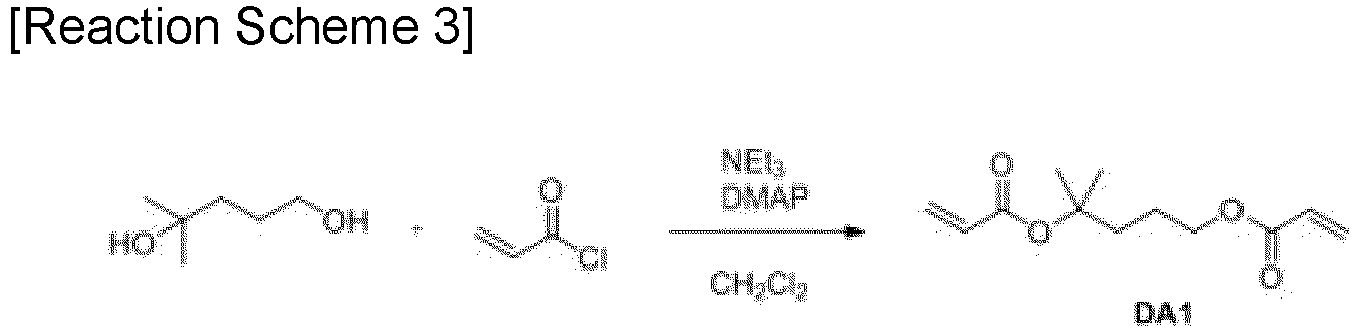
- To a 250 mL round bottom flask, 20.0 g (169 mmol) of the product A2 was added, and 120 mL of methylene chloride was added. 51.38g (508 mmol, 3.0 eq) of triethylamine and 2.07g (16.92 mmol, 0.1 eq) of 4-dimethylaminopyridine were further added, and a mixed solution of 45.95 g (507.7 mmol, 3.0 eq) of acryloyl chloride and 50 mL of methylene chloride was slowly added at 0°C for 2 hours. After reacting at 0°C for 1 hour, the temperature was slowly raised to room temperature, and the mixture was reacted for 12 hours. When the reaction was completed, the solvent methylene chloride was removed under reduced pressure. 200 mL of n-hexane was added and diluted, and washed twice with 200 mL of water. 20 mL of acetonitrile was added to the extracted n-hexane solution and washed. Magnesium sulfate was added to the final extracted n-hexane solution to remove water, and the resulting mixture was filtered using a celite pad. The filtered n-hexane solution was concentrated to obtain 23.4 g (yield: 82.8%) of the crosslinker compound DA1 of Reaction Scheme 3.
1H NMR (500MHz, CDCl3) 6.43(1H, dd), 6.32(1H, dd), 6.04(1H, dd), 5.84(1H, dd), 5.77(1H, dd), 4.17(2H, t), 1.88(2H, m), 1.75(2H, m), 1.50(6H, s) -

- To a 250 mL round bottom flask, 30.0 g (357 mmol) of 2-methyl-3-butyn-ol was added, and 75 mL of toluene was added. 24.02g (428.1 mmol, 1.2 eq) of potassium hydroxide was further added and 62.16g (1.07 mol, 3.0 eq) of acetone was slowly added for 2 hours, and the temperature was adjusted so as not to rise above 50°C. After the addition of acetone was completed and the reaction was performed at 50°C for 1 hour, the temperature was slowly decreased to room temperature, and the mixture was reacted for 12 hours. When the reaction was completed, 25.7 g (428.1 mmol) of acetic acid and 50 mL of water were added to prepare a toluene layer. To the mixed solution of acetic acid and water, 40 mL of ethyl acetate was added, diluted, and extracted twice. Magnesium sulfate was added to the extracted ethyl acetate layer to remove water, and the resulting mixture was filtered using a celite pad. The filtered ethyl acetate solution was concentrated to obtain 43.6 g (yield: 86%) of A3 of Reaction Scheme 4.
1H NMR (500MHz, CDCl3) 1.51(12H, s)
- 37.4 g (263 mmol) of A3 was added to an autoclave, and 60 mL of ethyl acetate was added. 0.285 g (2.63 mmol, 1 mol%) of Pd/C catalyst was further added, and hydrogen gas was slowly added so that it becomes 10 bar. When the reaction was performed at room temperature and hydrogen gas was consumed, it was allowed to continuously maintain 10 bar. When the hydrogenation reaction was performed for 12 hours and then the reaction was completed, hydrogen gas was removed, and the autoclave was opened. The resulting mixture was filtered using a celite pad. The filtered ethyl acetate solution was concentrated to obtain 32.3 g (yield: 84%) of A4 of Reaction Scheme 5.
1H NMR (500MHz, CDCl3) 2.89(2H, bs), 1.71(4H, s), 1.25(12H, s)
- To a 250 mL round bottom flask, 24.7 g (169 mmol) of the product A4 was added, and 120 mL of methylene chloride was added. 51.38g (508 mmol, 3.0 eq) of triethylamine and 2.07g (16.92 mmol, 0.1 eq) of 4-dimethylaminopyridine were further added, and a mixed solution of 45.95 g (507.7 mmol, 3.0 eq) of acryloyl chloride and 50 mL of methylene chloride was slowly added at 0°C for 2 hours. After reacting at 0°C for 1 hour, the temperature was slowly raised to room temperature, and the mixture was reacted for 12 hours. When the reaction was completed, the solvent methylene chloride was removed under reduced pressure. 200 mL of n-hexane was added and diluted, and washed twice with 200 mL of water. 20 mL of acetonitrile was added to the extracted n-hexane solution and washed. Magnesium sulfate was added to the final extracted n-hexane solution to remove water, and the resulting mixture was filtered using a celite pad. The filtered n-hexane solution was concentrated to obtain 27.5 g (yield: 84%) of the crosslinker compound DA2 of Reaction Scheme 6.
1H NMR (500MHz, CDCl3) 6.43(2H, dd), 6.32(2H, dd), 6.04(2H, dd), 1.93 (s, 4H), 1.51 (s, 12H) -
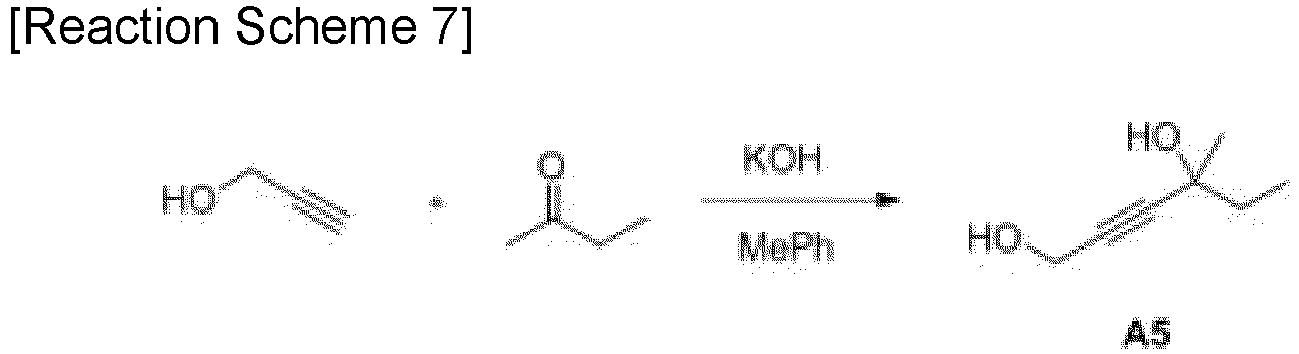
- To a 250 mL round bottom flask, 20.0 g (357 mmol) of propargyl alcohol was added, and 75 mL of toluene was added. 24.02g (428.1 mmol, 1.2 eq) of potassium hydroxide was further added, 77.17 g (1.07 mol, 3.0 eq) of butan-2-one was slowly added for 2 hours, and the temperature was adjusted so as not to rise above 50°C. After the addition of 2-butanone was completed and the reaction was performed at 50°C for 1 hour, the temperature was slowly raised to room temperature, and the mixture was reacted for 12 hours. When the reaction was completed, 25.7 g (428.1 mmol) of acetic acid and 50 mL of water were added to prepare a toluene layer. To the mixed solution of acetic acid and water, 40 mL of ethyl acetate was added, diluted, and extracted twice. Magnesium sulfate was added to the extracted ethyl acetate layer to remove water, and the resulting mixture was filtered using a celite pad. The filtered ethyl acetate solution was concentrated to obtain 38.9 g (yield: 85%)of A5 of Reaction Scheme 7.
1H NMR (500MHz, CDCl3) 4.35(s, 2H), 2.84(bs, 2H), 1.42-1.72(m, 2H), 1.41 (s, 3H), 1.36(t, 3H)
- 33.7 g (263 mmol) of A5 was added to an autoclave, and 60 mL of ethyl acetate was added. 0.285 g (2.63 mmol, 1 mol%) of Pd/C catalyst was further added, and hydrogen gas was slowly added so that it becomes 10 bar. When the reaction was performed at room temperature and hydrogen gas was consumed, it was allowed to continuously maintain 10 bar. When the hydrogenation reaction was performed for 12 hours and then the reaction was completed, hydrogen gas was removed, and the autoclave was opened. The resulting mixture was filtered using a celite pad. The filtered ethyl acetate solution was concentrated to obtain 30.6 g (yield: 88%) of A6 of Reaction Scheme 8.
1H NMR (500MHz, CDCl3) 4.35 (bs, 1H, 1-OH), 3.95 (s, 1H, 2-OH), 3.42 (m, 2H), 1.29-1.43 (m, 4H), 0.71 (t, 3H)
- To a 250 mL round bottom flask, 22.4 g (169 mmol) of the product A6 was added, and 120 mL of methylene chloride was added. 51.38 g (508 mmol, 3.0 eq) of triethylamine and 2.07 g (16.92 mmol, 0.1 eq) of 4-dimethylaminopyridine were further added, and a mixed solution of 45.95 g (507.7 mmol, 3.0 eq) of acryloyl chloride and 50 mL of methylene chloride was slowly added at 0°C for 2 hours. After reacting at 0°C for 1 hour, the temperature was slowly raised to room temperature, and the mixture was reacted for 12 hours. When the reaction was completed, the solvent methylene chloride was removed under reduced pressure. 200 mL of n-hexane was added and diluted, and washed twice with 200 mL of water. 20 mL of acetonitrile was added to the extracted n-hexane solution and washed. Magnesium sulfate was added to the final extracted n-hexane solution to remove water, and the resulting mixture was filtered using a celite pad. The filtered n-hexane solution was concentrated to obtain 28.9 g (yield: 71%) of the crosslinker compound DA3 of Reaction Scheme 9.
1H NMR (500MHz, CDCl3) 6.43(2H, dd), 6.32(2H, dd), 6.04(2H, dd), 4.2(t, 2H), 1.29-1.43 (m, 6H), 1.2(s, 3H), 0.91(t, 3H) -

- To a 1 L round bottom flask, 25.0 g (290.4 mmol) of γ-butyrolactone was added, and 290 mL (1M) of tetrahydrofuran (THF) was added to the flask. 242 mL of methyl magnesium bromide solution (3M in diethyl ether, 2.5 eq) was added slowly at 0°C, and care was taken not to increase the temperature. When the addition of the methyl magnesium bromide solution at 0°C was completed, the temperature was raised to room temperature, and the mixture was reacted for 12 hours or more under a nitrogen atmosphere. When the reaction was completed, tetrahydrofuran was removed by distillation under reduced pressure, diluted with 125 mL of ethyl acetate, and washed with 125 mL of water. The product was extracted by adding 125 mL of ethyl acetate to the washed water. Magnesium sulfate was added to the ethyl acetate solution to remove water, and then resulting mixture was filtered using a celite pad. The filtered ethyl acetate solution was concentrated to obtain 24.7 g (72%) of the product 1 of Reaction Scheme 10.
1H NMR (500 MHz, CDCl3) 3.67(2H, t), 2.11(2H, br), 1.68(2H, m), 1.60(2H, d), 1.25 (6H, s)
- To a 250 mL round bottom flask, 20.0 g (169 mmol) of the product 1 was added, and 120 mL of methylene chloride was added. 51.38g (508 mmol, 3.0 eq) of triethylamine and 2.07g (16.92 mmol, 0.1 eq) of 4-dimethylaminopyridine were further added, and a mixed solution of 45.95 g (507.7 mmol, 3.0 eq) of acryloyl chloride and 50 mL of methylene chloride was slowly added at 0°C for 2 hours. After reacting at 0°C for 1 hour, the temperature was slowly raised to room temperature, and the mixture was reacted for 12 hours. When the reaction was completed, the solvent methylene chloride was removed under reduced pressure. 200 mL of n-hexane was added and diluted, and washed twice with 200 mL of water. 20 mL of acetonitrile was added to the extracted n-hexane solution and washed. Magnesium sulfate was added to the final extracted n-hexane solution to remove water, and the resulting mixture was filtered using a celite pad. The filtered n-hexane solution was concentrated to obtain 23.4 g (yield: 61 %) of the crosslinker compound DA2 of Reaction Scheme 11.
1H NMR (500 MHz, CDCl3) 6.43(1H, dd), 6.32(2H, dd), 6.13(1H, dd), 6.04(1H, dd), 5.84(1H, dd), 5.77(1H, dd), 4.17(2H, t), 1.88(2H, m), 1.75(2H, m), 1.50(6H, s) -

- To a 1 L round bottom flask, 30.0 g (299.7 mmol) of 5-valerolactone was added, and 300 mL (1M) of tetrahydrofuran (THF) was added to the flask. 250 mL of methyl magnesium bromide solution (3M in diethyl ether, 2.5eq) was added slowly at 0°C, and care was taken not to increase the temperature. When the addition of the methyl magnesium bromide solution at 0°C was completed, the temperature was raised to room temperature, and the mixture was reacted for 12 hours or more under a nitrogen atmosphere. When the reaction was completed, tetrahydrofuran was removed by distillation under reduced pressure, diluted with 150 mL of ethyl acetate, and washed with 150 mL of water. The product was extracted by adding 150 mL of ethyl acetate to the washed water. Magnesium sulfate was added to the ethyl acetate solution to remove water, and then resulting mixture was filtered using a celite pad. The filtered ethyl acetate solution was concentrated to obtain 30.9 g (78%) of the product 2 of Reaction Scheme 12.
1H NMR (500 MHz, CDCl3) 3.63(2H, t), 2.11(2H, br), 1.59-1.40(6H, m), 1.20 (6H, s)
- To a 250 mL round bottom flask, 22.4 g (169 mmol) of the product 2 was added, and 120 mL of methylene chloride was added. 51.38g (508 mmol, 3.0 eq) of triethylamine and 2.07g (16.92 mmol, 0.1 eq) of 4-dimethylaminopyridine were further added, and a mixed solution of 45.95 g (507.7 mmol, 3.0 eq) of acryloyl chloride and 50 mL of methylene chloride was slowly added at 0°C for 2 hours. After reacting at 0°C for 1 hour, the temperature was slowly raised to room temperature, and the mixture was reacted for 12 hours. When the reaction was completed, the solvent methylene chloride was removed under reduced pressure. 250 mL of n-hexane was added and diluted, and washed twice with 200 mL of water. 20 mL of acetonitrile was added to the extracted n-hexane solution and washed. Magnesium sulfate was added to the final extracted n-hexane solution to remove water, and the resulting mixture was filtered using a celite pad. The filtered n-hexane solution was concentrated to obtain 26.1 g (yield: 64%) of the crosslinker compound DA3 of Reaction Scheme 13.
1H NMR (500 MHz, CDCl3) 6.43(1H, dd), 6.32(2H, dd), 6.13(1H, dd), 6.04(1H, dd), 5.84(1H, dd), 5.77(1H, dd), 4.17(2H, t), 1.88(2H, m), 1.75-1.52(4H, m), 1.50(6H, s) - Referring to the Examples and Comparative Examples, it was confirmed that in the Examples, higher yields can be exhibited, especially in the process of preparing the diol compound of Chemical Formula 2, In contrast, it was confirmed that in the Comparative Examples, in the process of preparing the diol compound of Chemical Formula 2, a relatively low yield is exhibited even while requiring to proceed under a nitrogen atmosphere.
Claims (9)
- A method for preparing a crosslinker compound which is used as an internal crosslinking agent or a thermally decomposable crosslinker for the production of a super absorbent polymer, the method comprising the steps of:hydrogenating a compound of the following Chemical Formula 1 under a noble metal catalyst to form a diol compound of the following Chemical Formula 2; andsubjecting a diol compound of the following Chemical Formula 2 and a compound of the following Chemical Formula 3 to an esterification reaction to form a compound of the following Chemical Formula 4.


 wherein, R1' has a triple bond and is a divalent organic group having 1 to 10 carbon atoms, R1 is a divalent organic group derived from an alkane having 1 to 10 carbon atoms, R2 and R3 are each independently an alkyl group having 1 to 5 carbon atoms, R4 is hydrogen or a methyl group, and X is halogen.
 - The method for preparing a crosslinker compound according to claim 1, wherein the compound of Chemical Formula 1 is formed by reacting a compound of the following Chemical Formula 1a with ketone in the presence of a base:

- The method for preparing a crosslinker compound according to claim 2, wherein the base comprises one or more selected from the group consisting of potassium hydroxide, sodium hydroxide, sodium hydride and potassium hydride.
- The method for preparing a crosslinker compound according to claim 1, wherein the hydrogenation step is performed in the presence of a noble metal catalyst including at least one selected from the group consisting of Pd, Pt, Ni and Rh.
- The method for preparing a crosslinker compound according to claim 1, wherein the hydrogenation step is performed in the presence of one or more solvents selected from the group consisting of ethyl acetate, methanol, isopropanol, and tetrahydrofuran.
- The method for preparing a crosslinker compound according to claim 1, wherein the esterification step is performed in the presence of an amine-based base selected from the group consisting of triethylamine, dimethylaminopyridine, diisopropylethylamine, and 1,8-diazabicyclo[5,4,0]undec-7-ene.
- The method for preparing a crosslinker compound according to claim 1, wherein in Chemical Formula 4, R1 is methane-1,1-diyl, propane-1,3-diyl, propane-1,2-diyl, propane-1,1-diyl, n-butane-1,4-diyl, n-butane-1,3-diyl, n-butane-1,2-diyl, n-butane-1,1-diyl, 2-methylpropane-1,3-diyl, 2-methylpropane-1,2-diyl, 2-methylpropane-1,1-diyl, 2-methylbutane-1,4-diyl, 2-methylbutane-2,4-diyl, 2-methylbutane-3,4-diyl, 2-methylbutane-4,4-diyl, 2-methylbutane-1,3-diyl, 2-methylbutane-1,2-diyl, 2-methylbutane-1,1-diyl or 2-methylbutane-2,3-diyl.
- A method for producing a super absorbent polymer comprising the steps of:forming a crosslinker compound by the method of claim 1;performing crosslinking polymerization of a water-soluble ethylenically unsaturated monomer having an acidic group of which at least a part is neutralized, in the presence of an internal crosslinking agent including the crosslinker compound to form a hydrogel polymer;drying, pulverizing and classifying the hydrogel polymer to form a base resin powder; andfurther cross-linking the surface of the base resin powder in the presence of a surface crosslinking agent to form a surface cross-linked layer.
- A super absorbent polymer produced by the method of claim 8.
Applications Claiming Priority (2)
| Application Number | Priority Date | Filing Date | Title |
|---|---|---|---|
| KR1020180149736A KR102434452B1 (en) | 2018-11-28 | 2018-11-28 | Prepration method of cross-linking compound |
| PCT/KR2019/013125 WO2020111496A1 (en) | 2018-11-28 | 2019-10-07 | Method for manufacturing crosslinker compound |
Publications (3)
| Publication Number | Publication Date |
|---|---|
| EP3733638A1 true EP3733638A1 (en) | 2020-11-04 |
| EP3733638A4 EP3733638A4 (en) | 2021-04-28 |
| EP3733638B1 EP3733638B1 (en) | 2026-01-14 |
Family
ID=70854068
Family Applications (1)
| Application Number | Title | Priority Date | Filing Date |
|---|---|---|---|
| EP19888643.4A Active EP3733638B1 (en) | 2018-11-28 | 2019-10-07 | Method for manufacturing crosslinker compound |
Country Status (6)
| Country | Link |
|---|---|
| US (1) | US11987550B2 (en) |
| EP (1) | EP3733638B1 (en) |
| JP (1) | JP7176817B2 (en) |
| KR (1) | KR102434452B1 (en) |
| CN (1) | CN111699171A (en) |
| WO (1) | WO2020111496A1 (en) |
Families Citing this family (1)
| Publication number | Priority date | Publication date | Assignee | Title |
|---|---|---|---|---|
| JPWO2024195685A1 (en) * | 2023-03-20 | 2024-09-26 |
Family Cites Families (24)
| Publication number | Priority date | Publication date | Assignee | Title |
|---|---|---|---|---|
| US2992278A (en) * | 1957-12-12 | 1961-07-11 | Air Reduction | Process for production of 1, 4 saturated diols |
| US3371121A (en) * | 1964-12-09 | 1968-02-27 | Universal Oil Prod Co | Process for producing saturated diols |
| CH478909A (en) * | 1966-08-03 | 1969-09-30 | Givaudan & Cie Sa | Fragrance compositions |
| GB8806526D0 (en) * | 1988-03-18 | 1988-04-20 | Shell Int Research | Process for preparation of alkanediols |
| US5444170A (en) * | 1994-01-10 | 1995-08-22 | Air Products And Chemicals, Inc. | Hydrogenation of acetylenic compounds |
| DE19907532A1 (en) * | 1999-02-22 | 2000-08-31 | Basf Ag | Process for the production of acetylene alcohols and their secondary products |
| US6355702B1 (en) * | 1999-03-08 | 2002-03-12 | Cornell Research Foundation, Inc. | Acyclic monomers which when cured are reworkable through thermal decomposition |
| CN1083414C (en) * | 1999-08-25 | 2002-04-24 | 成都惟精防水材料研究所 | One-step synthesizing process of 2,5-dimethyl-2,5-hexanediol |
| US6376618B1 (en) * | 1999-09-07 | 2002-04-23 | Basf Aktiengesellschaft | Surface-treated superabsorbent polymer particles |
| JP4507381B2 (en) | 2000-10-11 | 2010-07-21 | 日油株式会社 | Method for producing decrosslinked resin |
| JP4714981B2 (en) | 2000-10-24 | 2011-07-06 | 日油株式会社 | Ethylene polymer composition |
| US6660892B2 (en) * | 2002-02-13 | 2003-12-09 | Shell Oil Company | Synthesis of aliphatic 1,3-diols utilizing reduced ligand concentration and water extraction |
| JP2004123611A (en) * | 2002-10-03 | 2004-04-22 | Yasuhara Chemical Co Ltd | (meth)acrylic acid ester and its (co)polymer |
| US7619125B2 (en) | 2004-03-31 | 2009-11-17 | Kanto Kagaku Kabushiki Kaisha | Hydrogenation promoter, hydrogenation catalyst, and process for producing alkene compound |
| EP1835941A2 (en) * | 2004-12-03 | 2007-09-26 | Stockhausen GmbH | Crosslinker for superabsorbent polymers |
| EP1808426A1 (en) * | 2006-01-16 | 2007-07-18 | DSMIP Assets B.V. | Process for the preparation of alkynediols |
| KR102070052B1 (en) * | 2012-03-29 | 2020-01-29 | 바스프 에스이 | Polymerizable alkylidene-1,3-dioxolan-2-ones and use thereof |
| CN105085168B (en) * | 2015-09-06 | 2017-03-29 | 河南农业大学 | Wheat midge sex pheromone precursor and wheat midge sex pheromone |
| KR102056302B1 (en) * | 2016-03-24 | 2019-12-16 | 주식회사 엘지화학 | A method for preparing super absorbent polymer resin fiber |
| KR102103000B1 (en) | 2016-10-19 | 2020-04-21 | 주식회사 엘지화학 | Preparation method of super absorbent polymer |
| WO2018074665A1 (en) * | 2016-10-19 | 2018-04-26 | 주식회사 엘지화학 | Method for preparing superabsorbent polymer |
| CN108779264B (en) | 2016-10-19 | 2021-01-05 | 株式会社Lg化学 | Superabsorbent polymers |
| PL3406638T3 (en) | 2016-10-19 | 2021-07-19 | Lg Chem, Ltd. | Super absorbent polymer |
| EP3404050B1 (en) | 2016-10-19 | 2021-04-07 | LG Chem, Ltd. | Super absorbent polymer |
-
2018
- 2018-11-28 KR KR1020180149736A patent/KR102434452B1/en active Active
-
2019
- 2019-10-07 EP EP19888643.4A patent/EP3733638B1/en active Active
- 2019-10-07 WO PCT/KR2019/013125 patent/WO2020111496A1/en not_active Ceased
- 2019-10-07 US US16/968,999 patent/US11987550B2/en active Active
- 2019-10-07 JP JP2020542556A patent/JP7176817B2/en active Active
- 2019-10-07 CN CN201980012769.6A patent/CN111699171A/en active Pending
Also Published As
| Publication number | Publication date |
|---|---|
| WO2020111496A1 (en) | 2020-06-04 |
| JP2021513527A (en) | 2021-05-27 |
| KR20200064246A (en) | 2020-06-08 |
| EP3733638B1 (en) | 2026-01-14 |
| KR102434452B1 (en) | 2022-08-19 |
| JP7176817B2 (en) | 2022-11-22 |
| US11987550B2 (en) | 2024-05-21 |
| US20210024451A1 (en) | 2021-01-28 |
| EP3733638A4 (en) | 2021-04-28 |
| CN111699171A (en) | 2020-09-22 |
Similar Documents
| Publication | Publication Date | Title |
|---|---|---|
| CA2777070C (en) | Treprostinil production | |
| CN114096513B (en) | Novel quaternary ammonium compounds | |
| CN102421746B (en) | Process for the preparation of ethylene glycol and related compounds | |
| EP3733638B1 (en) | Method for manufacturing crosslinker compound | |
| DE60315667T2 (en) | METHOD FOR PRODUCING A CATALYST FOR THE POLYMERIZATION OF ALIPHATIC POLYCARBONATE AND METHOD FOR POLYMERIZING ALIPHATIC POLYCARBONATE USING THEREOF | |
| EP4467556A1 (en) | Binuclear schiff base cobalt complex, and preparation method therefor and use thereof | |
| US9850340B2 (en) | Apopinene as a biorenewable monomer for ring-opening metathesis polymerization | |
| JP2017502031A (en) | Ent-progesterone and intermediate synthesis | |
| CN113996339A (en) | Catalyst for preparing cyclic carbonate and preparation method of cyclic carbonate | |
| CN107541530A (en) | One kind is containing double tellurium biodegradable polymers and preparation method thereof | |
| JP4979230B2 (en) | Tetrahydropyran compound production method and tetrahydropyran compound produced by the production method | |
| KR102159703B1 (en) | Method for preparing polytetrahydrofuran-based polymer | |
| KR102285438B1 (en) | Preparation method of acrylic acid ester compound | |
| Zhang et al. | Allenation of Terminal Alkynes for Allene Synthesis | |
| CN113501828B (en) | 2,8-dioxaspiro [4.5] decane-1-ketone, and preparation method and application thereof | |
| CN110759878B (en) | Synthetic method of phenyl tetrahydrofuran ether compound | |
| JPH0372439A (en) | Production of alkenyl ethers | |
| JPWO2005080364A1 (en) | Method for producing alicyclic oxetane compound | |
| CN120157689A (en) | A type of bimetallic zinc catalyst, preparation method and application in depolymerization of polycaprolactone | |
| WO2016025675A1 (en) | Polyester stereocomplexes, compositions comprising same, and methods of making and using same | |
| JP2023166272A (en) | Copolymer and its manufacturing method, and cyclic carbonate compound | |
| JP2010254655A (en) | δ-valerolactones and process for producing the same | |
| CN111378099A (en) | Catalytic method of caprolactone polymerization using asymmetric dinuclear amine imine aluminum complex | |
| CN108047432A (en) | Utilize the method for the asymmetric aluminum complex catalysis caprolactone polymerization of the derivative containing acetylacetone,2,4-pentanedione | |
| WO2013157388A1 (en) | 2-ethenyl oxy methyl-2-hydroxymethyl adamantine and 2,2-bis(ethenyl oxy methyl)adamantine, and method for producing same |
Legal Events
| Date | Code | Title | Description |
|---|---|---|---|
| STAA | Information on the status of an ep patent application or granted ep patent |
Free format text: STATUS: THE INTERNATIONAL PUBLICATION HAS BEEN MADE |
|
| PUAI | Public reference made under article 153(3) epc to a published international application that has entered the european phase |
Free format text: ORIGINAL CODE: 0009012 |
|
| STAA | Information on the status of an ep patent application or granted ep patent |
Free format text: STATUS: REQUEST FOR EXAMINATION WAS MADE |
|
| 17P | Request for examination filed |
Effective date: 20200729 |
|
| AK | Designated contracting states |
Kind code of ref document: A1 Designated state(s): AL AT BE BG CH CY CZ DE DK EE ES FI FR GB GR HR HU IE IS IT LI LT LU LV MC MK MT NL NO PL PT RO RS SE SI SK SM TR |
|
| AX | Request for extension of the european patent |
Extension state: BA ME |
|
| RIN1 | Information on inventor provided before grant (corrected) |
Inventor name: LIM, WON TAECK Inventor name: KIM, KI HYUN Inventor name: KIM, YONGJIN Inventor name: KIM, JI EUN Inventor name: KIM, GICHEUL Inventor name: CHOI, WONMUN |
|
| A4 | Supplementary search report drawn up and despatched |
Effective date: 20210329 |
|
| RIC1 | Information provided on ipc code assigned before grant |
Ipc: C07C 67/14 20060101AFI20210323BHEP Ipc: C07C 67/62 20060101ALI20210323BHEP Ipc: C07C 69/54 20060101ALI20210323BHEP Ipc: C07C 29/17 20060101ALI20210323BHEP Ipc: B01J 23/44 20060101ALI20210323BHEP Ipc: C07C 31/20 20060101ALI20210323BHEP Ipc: C07C 33/044 20060101ALI20210323BHEP Ipc: C08K 5/00 20060101ALI20210323BHEP Ipc: C08K 5/11 20060101ALI20210323BHEP Ipc: C07C 29/42 20060101ALI20210323BHEP Ipc: C08J 3/12 20060101ALI20210323BHEP Ipc: C08J 3/24 20060101ALI20210323BHEP |
|
| DAV | Request for validation of the european patent (deleted) | ||
| DAX | Request for extension of the european patent (deleted) | ||
| STAA | Information on the status of an ep patent application or granted ep patent |
Free format text: STATUS: EXAMINATION IS IN PROGRESS |
|
| 17Q | First examination report despatched |
Effective date: 20230512 |
|
| GRAP | Despatch of communication of intention to grant a patent |
Free format text: ORIGINAL CODE: EPIDOSNIGR1 |
|
| STAA | Information on the status of an ep patent application or granted ep patent |
Free format text: STATUS: GRANT OF PATENT IS INTENDED |
|
| RIC1 | Information provided on ipc code assigned before grant |
Ipc: C07C 67/14 20060101AFI20250908BHEP Ipc: C08J 3/075 20060101ALI20250908BHEP Ipc: C08J 3/24 20060101ALI20250908BHEP Ipc: C08J 3/12 20060101ALI20250908BHEP Ipc: C07C 29/42 20060101ALI20250908BHEP Ipc: C08K 5/11 20060101ALI20250908BHEP Ipc: C08K 5/00 20060101ALI20250908BHEP Ipc: C07C 33/044 20060101ALI20250908BHEP Ipc: C07C 31/20 20060101ALI20250908BHEP Ipc: B01J 23/44 20060101ALI20250908BHEP Ipc: C07C 29/17 20060101ALI20250908BHEP Ipc: C07C 69/54 20060101ALI20250908BHEP Ipc: C07C 67/62 20060101ALI20250908BHEP |
|
| INTG | Intention to grant announced |
Effective date: 20250930 |
|
| GRAS | Grant fee paid |
Free format text: ORIGINAL CODE: EPIDOSNIGR3 |
|
| GRAA | (expected) grant |
Free format text: ORIGINAL CODE: 0009210 |
|
| STAA | Information on the status of an ep patent application or granted ep patent |
Free format text: STATUS: THE PATENT HAS BEEN GRANTED |
|
| AK | Designated contracting states |
Kind code of ref document: B1 Designated state(s): AL AT BE BG CH CY CZ DE DK EE ES FI FR GB GR HR HU IE IS IT LI LT LU LV MC MK MT NL NO PL PT RO RS SE SI SK SM TR |
|
| REG | Reference to a national code |
Ref country code: CH Ref legal event code: F10 Free format text: ST27 STATUS EVENT CODE: U-0-0-F10-F00 (AS PROVIDED BY THE NATIONAL OFFICE) Effective date: 20260114 Ref country code: GB Ref legal event code: FG4D |
|
| REG | Reference to a national code |
Ref country code: DE Ref legal event code: R096 Ref document number: 602019080460 Country of ref document: DE |
|
| REG | Reference to a national code |
Ref country code: IE Ref legal event code: FG4D |