EP3733284A1 - Catalyst for use in hydrolysis of carbonyl sulfide, and method for producing same - Google Patents
Catalyst for use in hydrolysis of carbonyl sulfide, and method for producing same Download PDFInfo
- Publication number
- EP3733284A1 EP3733284A1 EP18897554.4A EP18897554A EP3733284A1 EP 3733284 A1 EP3733284 A1 EP 3733284A1 EP 18897554 A EP18897554 A EP 18897554A EP 3733284 A1 EP3733284 A1 EP 3733284A1
- Authority
- EP
- European Patent Office
- Prior art keywords
- catalyst
- compound
- barium
- cos
- test example
- Prior art date
- Legal status (The legal status is an assumption and is not a legal conclusion. Google has not performed a legal analysis and makes no representation as to the accuracy of the status listed.)
- Pending
Links
Images

Classifications
-
- C—CHEMISTRY; METALLURGY
- C10—PETROLEUM, GAS OR COKE INDUSTRIES; TECHNICAL GASES CONTAINING CARBON MONOXIDE; FUELS; LUBRICANTS; PEAT
- C10K—PURIFYING OR MODIFYING THE CHEMICAL COMPOSITION OF COMBUSTIBLE GASES CONTAINING CARBON MONOXIDE
- C10K1/00—Purifying combustible gases containing carbon monoxide
- C10K1/002—Removal of contaminants
- C10K1/003—Removal of contaminants of acid contaminants, e.g. acid gas removal
- C10K1/004—Sulfur containing contaminants, e.g. hydrogen sulfide
-
- B—PERFORMING OPERATIONS; TRANSPORTING
- B01—PHYSICAL OR CHEMICAL PROCESSES OR APPARATUS IN GENERAL
- B01J—CHEMICAL OR PHYSICAL PROCESSES, e.g. CATALYSIS OR COLLOID CHEMISTRY; THEIR RELEVANT APPARATUS
- B01J23/00—Catalysts comprising metals or metal oxides or hydroxides, not provided for in group B01J21/00
- B01J23/02—Catalysts comprising metals or metal oxides or hydroxides, not provided for in group B01J21/00 of the alkali- or alkaline earth metals or beryllium
- B01J23/04—Alkali metals
-
- B—PERFORMING OPERATIONS; TRANSPORTING
- B01—PHYSICAL OR CHEMICAL PROCESSES OR APPARATUS IN GENERAL
- B01J—CHEMICAL OR PHYSICAL PROCESSES, e.g. CATALYSIS OR COLLOID CHEMISTRY; THEIR RELEVANT APPARATUS
- B01J21/00—Catalysts comprising the elements, oxides, or hydroxides of magnesium, boron, aluminium, carbon, silicon, titanium, zirconium, or hafnium
- B01J21/06—Silicon, titanium, zirconium or hafnium; Oxides or hydroxides thereof
- B01J21/063—Titanium; Oxides or hydroxides thereof
-
- B—PERFORMING OPERATIONS; TRANSPORTING
- B01—PHYSICAL OR CHEMICAL PROCESSES OR APPARATUS IN GENERAL
- B01J—CHEMICAL OR PHYSICAL PROCESSES, e.g. CATALYSIS OR COLLOID CHEMISTRY; THEIR RELEVANT APPARATUS
- B01J23/00—Catalysts comprising metals or metal oxides or hydroxides, not provided for in group B01J21/00
- B01J23/02—Catalysts comprising metals or metal oxides or hydroxides, not provided for in group B01J21/00 of the alkali- or alkaline earth metals or beryllium
-
- B—PERFORMING OPERATIONS; TRANSPORTING
- B01—PHYSICAL OR CHEMICAL PROCESSES OR APPARATUS IN GENERAL
- B01J—CHEMICAL OR PHYSICAL PROCESSES, e.g. CATALYSIS OR COLLOID CHEMISTRY; THEIR RELEVANT APPARATUS
- B01J37/00—Processes, in general, for preparing catalysts; Processes, in general, for activation of catalysts
- B01J37/02—Impregnation, coating or precipitation
-
- B—PERFORMING OPERATIONS; TRANSPORTING
- B01—PHYSICAL OR CHEMICAL PROCESSES OR APPARATUS IN GENERAL
- B01J—CHEMICAL OR PHYSICAL PROCESSES, e.g. CATALYSIS OR COLLOID CHEMISTRY; THEIR RELEVANT APPARATUS
- B01J37/00—Processes, in general, for preparing catalysts; Processes, in general, for activation of catalysts
- B01J37/02—Impregnation, coating or precipitation
- B01J37/0201—Impregnation
- B01J37/0203—Impregnation the impregnation liquid containing organic compounds
-
- B—PERFORMING OPERATIONS; TRANSPORTING
- B01—PHYSICAL OR CHEMICAL PROCESSES OR APPARATUS IN GENERAL
- B01J—CHEMICAL OR PHYSICAL PROCESSES, e.g. CATALYSIS OR COLLOID CHEMISTRY; THEIR RELEVANT APPARATUS
- B01J37/00—Processes, in general, for preparing catalysts; Processes, in general, for activation of catalysts
- B01J37/02—Impregnation, coating or precipitation
- B01J37/0236—Drying, e.g. preparing a suspension, adding a soluble salt and drying
-
- B—PERFORMING OPERATIONS; TRANSPORTING
- B01—PHYSICAL OR CHEMICAL PROCESSES OR APPARATUS IN GENERAL
- B01J—CHEMICAL OR PHYSICAL PROCESSES, e.g. CATALYSIS OR COLLOID CHEMISTRY; THEIR RELEVANT APPARATUS
- B01J37/00—Processes, in general, for preparing catalysts; Processes, in general, for activation of catalysts
- B01J37/08—Heat treatment
-
- B—PERFORMING OPERATIONS; TRANSPORTING
- B01—PHYSICAL OR CHEMICAL PROCESSES OR APPARATUS IN GENERAL
- B01J—CHEMICAL OR PHYSICAL PROCESSES, e.g. CATALYSIS OR COLLOID CHEMISTRY; THEIR RELEVANT APPARATUS
- B01J37/00—Processes, in general, for preparing catalysts; Processes, in general, for activation of catalysts
- B01J37/08—Heat treatment
- B01J37/082—Decomposition and pyrolysis
- B01J37/086—Decomposition of an organometallic compound, a metal complex or a metal salt of a carboxylic acid
-
- C—CHEMISTRY; METALLURGY
- C10—PETROLEUM, GAS OR COKE INDUSTRIES; TECHNICAL GASES CONTAINING CARBON MONOXIDE; FUELS; LUBRICANTS; PEAT
- C10K—PURIFYING OR MODIFYING THE CHEMICAL COMPOSITION OF COMBUSTIBLE GASES CONTAINING CARBON MONOXIDE
- C10K1/00—Purifying combustible gases containing carbon monoxide
- C10K1/34—Purifying combustible gases containing carbon monoxide by catalytic conversion of impurities to more readily removable materials
-
- Y—GENERAL TAGGING OF NEW TECHNOLOGICAL DEVELOPMENTS; GENERAL TAGGING OF CROSS-SECTIONAL TECHNOLOGIES SPANNING OVER SEVERAL SECTIONS OF THE IPC; TECHNICAL SUBJECTS COVERED BY FORMER USPC CROSS-REFERENCE ART COLLECTIONS [XRACs] AND DIGESTS
- Y02—TECHNOLOGIES OR APPLICATIONS FOR MITIGATION OR ADAPTATION AGAINST CLIMATE CHANGE
- Y02E—REDUCTION OF GREENHOUSE GAS [GHG] EMISSIONS, RELATED TO ENERGY GENERATION, TRANSMISSION OR DISTRIBUTION
- Y02E20/00—Combustion technologies with mitigation potential
- Y02E20/16—Combined cycle power plant [CCPP], or combined cycle gas turbine [CCGT]
-
- Y—GENERAL TAGGING OF NEW TECHNOLOGICAL DEVELOPMENTS; GENERAL TAGGING OF CROSS-SECTIONAL TECHNOLOGIES SPANNING OVER SEVERAL SECTIONS OF THE IPC; TECHNICAL SUBJECTS COVERED BY FORMER USPC CROSS-REFERENCE ART COLLECTIONS [XRACs] AND DIGESTS
- Y02—TECHNOLOGIES OR APPLICATIONS FOR MITIGATION OR ADAPTATION AGAINST CLIMATE CHANGE
- Y02E—REDUCTION OF GREENHOUSE GAS [GHG] EMISSIONS, RELATED TO ENERGY GENERATION, TRANSMISSION OR DISTRIBUTION
- Y02E20/00—Combustion technologies with mitigation potential
- Y02E20/16—Combined cycle power plant [CCPP], or combined cycle gas turbine [CCGT]
- Y02E20/18—Integrated gasification combined cycle [IGCC], e.g. combined with carbon capture and storage [CCS]
Definitions
- the present invention relates to a catalyst for hydrolysis of carbonyl sulfide and a method of producing the same, and it particularly relates to a catalyst for hydrolysis of carbonyl sulfide for use in fuel gas of a gas turbine and a method of producing the same.
- the present application claims the priority based on Japanese Patent Application No. 2017-251592 filed on December 27, 2017 , entire contents of which are hereby incorporated herein.
- a method of removing sulfur compounds contained in a coal-gasified gas as a raw material gas to prevent air pollution and equipment corrosion in the plants has been performed.
- COS carbonyl sulfide
- H 2 S hydrogen sulfide
- the gas from which sulfur compounds have been removed is used for example as a fuel for gas turbines.
- a catalyst for hydrolyzing carbonyl sulfide obtained by adding a metal sulfate or a metal carbonate as a co-catalyst to be supported on anatase type titanium and a method for hydrolyzing carbonyl sulfide in the presence of water and the catalyst in an atmosphere of a reducing gas is known (for example, Patent Document 1).
- Patent Document 1 JP 11-276897A
- the COS conversion rate for converting COS in the raw material gas into H 2 S tends to increase as the operating temperature increases.
- the COS conversion rate does not exceed a predetermined value based on chemical equilibrium, so that there is a possibility that the catalyst cannot be used for a raw material gas containing high concentration COS.
- an object of the present invention is to provide a catalyst for COS hydrolysis capable of improving the COS conversion rate at a low temperature and a method of producing the same.
- An aspect of the present invention is a catalyst for COS hydrolysis.
- the catalyst includes a catalyst containing titanium dioxide supporting a barium compound, and a co-catalyst, the co-catalyst being at least one selected from the group consisting of a potassium compound, a sodium compound and a cesium compound.
- the catalyst containing titanium dioxide supporting the barium compound is a molded catalyst, and the co-catalyst is supported on the molded catalyst.
- the co-catalyst is supported in a molar ratio from 1 to 4 with respect to the barium compound.
- the barium compound is supported in an amount of 2% by weight or greater and 8% by weight or less in terms of barium oxide with respect to the catalyst supporting the barium compound.
- the co-catalyst is preferably a potassium compound.
- the present invention is a method of producing a catalyst for COS hydrolysis.
- the production method includes the process of: impregnating a catalyst containing titanium dioxide supporting a barium compound with an aqueous solution containing a metal salt of a co-catalyst, drying the impregnated catalyst, and calcining the dried catalyst to allow the co-catalyst to be supported on the catalyst, where the co-catalyst is at least one selected from the group consisting of a potassium compound, a sodium compound and a cesium compound.
- the catalyst containing titanium dioxide supporting a barium compound is a molded catalyst molded using a substrate, and the co-catalyst is supported on the molded catalyst.
- the co-catalyst is supported at a molar ratio from 1 to 4 with respect to the barium compound.
- the barium compound is supported in an amount of 2% by weight or greater and 8% by weight or less in terms of barium oxide with respect to the catalyst supporting the barium compound.
- the co-catalyst is a potassium compound.
- the present invention provides a catalyst for COS hydrolysis that can improve the COS conversion rate at a low temperature and a method of producing the same.
- the catalyst for COS hydrolysis according to the present embodiment includes at least a first catalyst and a co-catalyst.
- the first catalyst is a catalyst containing titanium dioxide (TiO 2 ) supporting a barium compound. Titanium dioxide functions as a carrier.
- the first catalyst is preferably a catalyst including titanium dioxide supporting a barium compound.
- the carrier include anatase type, rutile type, and brookite type titanium dioxide. Among these, from a practical viewpoint, the carrier is preferably an anatase type titanium dioxide.
- the specific surface area of the carrier may be, for example, from 30 to 300 m 2 /g. Additionally, the carrier may be a carrier capable of supporting a barium compound, and includes aluminum oxide (Al 2 O 3 ) and zirconium oxide (ZrO 2 ).
- the first catalyst is preferably a molded catalyst formed by a substrate for a catalyst, and more preferably a molded catalyst having a predetermined shape.
- the shape of the molded catalyst is spherical, plate-like, pellet shaped, and honeycomb shaped. Among these, the shape of the molded catalyst is preferably a honeycomb shape from a practical viewpoint.
- the substrate for the catalyst include monolith substrates made of ceramics such as cordierite, and titanium oxide.
- the specific surface area of the molded catalyst may be, for example, from 30 to 300 m 2 /g.
- the amount of the barium compound may be any amount that can be supported on the carrier.
- the amount is 1% by weight or greater, preferably 2% by weight or greater and 8% by weight or less, and preferably 2% by weight or greater and 6% by weight or less in terms of barium oxide (BaO) with respect to the first catalyst.
- BaO barium oxide
- the COS conversion rate can be improved by increasing the speed of converting the COS.
- the co-catalyst is at least one catalyst selected from the group consisting of potassium compounds, sodium compounds and cesium compounds.
- the co-catalyst is preferably a potassium compound from a practical viewpoint.
- the above-described metal compound may be any compound that can support the metal on the carrier. However, from a practical viewpoint, each of them can be regarded as a metal oxide or a metal salt compound such as acetate, sulfate, carbonate, hydroxide, or nitrate.
- the co-catalyst can be supported on the first catalyst by adding its aqueous metal salt solution to the first catalyst.
- the amount of the co-catalyst may be an amount greater than 0 in terms of the molar ratio with respect to the barium compound, and is preferably in the range from 1 to 4 in terms of the molar ratio with respect to barium oxide, with the barium compound converted to barium oxide.
- the molar ratio of the barium compound in terms of barium oxide supported on the carrier to the co-catalyst is in the range from 1:1 to 4.
- the COS conversion rate can be maintained at a high temperature exceeding 250°C during hydrolysis, and the COS conversion rate can be improved even at a low temperature of 250°C or lower.
- the amount of the potassium compound may be more than 0% by weight with respect to the first catalyst, and is preferably in the range from approximately 2.5 to 9.8% by weight in terms of potassium oxide (K 2 O).
- the amount of the sodium compound may be more than 0% by weight with respect to the first catalyst, and is preferably in the range of about 1.6 to 6.5% by weight in terms of sodium oxide (Na 2 O).
- the amount of the cesium compound may be more than 0% by weight with respect to the first catalyst, and is preferably in the range of about 7.4 to 29.4% by weight in terms of cesium oxide (Cs 2 O).
- the catalyst for COS hydrolysis according to the present embodiment includes at least an impregnation process, a drying process, and a calcining process.
- the first catalyst is impregnated with an aqueous solution containing a metal salt of a co-catalyst.
- the impregnation method include a method in which the first catalyst is immersed in a container filled with an aqueous solution of a metal salt of a co-catalyst, and a method in which the first catalyst is sprayed with an aqueous solution. After the impregnation process, it is sufficient that the above-described predetermined amount of the co-catalyst is supported on the first catalyst, and after the impregnating or spraying, the aqueous solution may be blown off if necessary.
- the aqueous solution of the metal salt may be any solution that can impregnate the first catalyst with the metal salt of the co-catalyst by adding it to the first catalyst.
- Examples of the aqueous solution of the metal salt include aqueous solutions of potassium acetate (CH 3 COOK), sodium acetate (CH 3 COONa), sodium hydroxide (NaOH), and cesium acetate (CH 3 COOCs).
- a molded catalyst which is obtained by molding a catalyst containing titanium dioxide supporting a barium compound using a substrate for catalyst, is used as the first catalyst.
- the molded catalyst can be prepared by, for example, a kneading method or a wash coat method.
- the substrate for the catalyst include monolith substrates made of ceramics such as cordierite, and titanium oxide.
- the substrate for the catalyst is preferably a honeycomb substrate from a practical viewpoint.
- the catalyst after the impregnation process is dried at a predetermined temperature and time.
- the temperature and time of the drying process may be any temperature and time that allow the catalyst after the impregnation process to be dried, and may be, for example, 110°C and 3 hours.
- the co-catalyst is supported on the first catalyst by calcining the catalyst after the drying process at a predetermined temperature and time.
- the temperature of the calcining process is, for example, 400°C or higher and 600°C or lower.
- the time of the calcining process is, for example, 4 hours or more and 8 hours or less.
- FIG. 1 illustrates a system that can suitably employ the catalyst for hydrolysis of carbonyl sulfide according to the present embodiment.
- a fuel gas suitable for power generation by a gas turbine can be purified from a raw material gas obtained by gasifying coal.
- a gasification device 10 such as a gasification furnace
- coal is gasified under conditions where at least oxygen (O 2 ) is present, thereby forming a coal-gasified gas, which is a raw material gas.
- the raw material gas is sent to the COS conversion device 20 including the catalyst according to the present embodiment.
- COS conversion device 20 in the presence of the above-described catalyst, as represented by the following formula (I), COS and water (H 2 O) in the gas are converted into carbon dioxide (CO 2 ) and hydrogen sulfide (H 2 S).
- COS is decomposed and removed from the raw material gas.
- the temperature measured by the thermometer 20a is adjusted to a low temperature of, for example, 250°C or lower.
- impurities such as halogen are mixed in the gas from which the COS has been removed.
- Impurities in the gas are removed by washing with water or the like in a washing device 30 such as a water wash column.
- a washing device 30 water soluble ammonia (NH 3 ) mainly contained in the gas is removed by a remover such as water.
- the gas that has passed through the washing device 30 contacts the amine absorption liquid of an aqueous solution of an alkanolamine, such as methyldiethanolamine (C 5 H 13 NO 2 ), in the H 2 S removal device 40, thereby absorbing and removing H 2 S in the gas into the absorption liquid.
- CO 2 is also removed by absorption of carbon dioxide by the amine-absorbing liquid.
- the gas that has passed through the H 2 S removal device 40 is sent to the gas turbine 50 as a purified gas.
- the purified gas is mixed with compressed air, which has been compressed by a compressor (not illustrated), in the gas turbine 50 and burned. As a result, a high-temperature and high-pressure combustion gas is generated.
- the gas turbine drives the turbine by the combustion gas and drives a power generation means (not illustrated) to generate power.
- the present invention will be described in further detail hereinafter with reference to examples.
- the catalyst for hydrolysis of carbonyl sulfide and the method of producing the same according to the present invention are not limited by the following examples.
- Test Example 1 6 g of molded catalyst (2 ⁇ 2 cells, 150 mmL), which had a honeycomb shape and included titanium dioxide (TiO 2 ) supporting 4% by weight of barium compound in terms of barium oxide with respect to the whole catalyst, was prepared. Titanium dioxide as a carrier was anatase type titanium dioxide.
- the molded catalyst of Test Example 1 was impregnated with a barium acetate ((CH 3 COO) 2 Ba) aqueous solution so that the barium compound was added to the molded catalyst in an amount of 4% by weight in terms of barium oxide.
- the molded catalyst after impregnation with water was dried under conditions at 110°C, and then fired in air at 500°C for 3 hours, whereby 4% by weight of barium oxide with respect to the molded catalyst was supported on the molded catalyst.
- a catalyst containing a barium compound in an amount of 8% by weight in terms of barium oxide was prepared by adding 4% by weight of a barium compound in terms of barium oxide as a co-catalyst to the molded catalyst of Test Example 1 containing 4% by weight of a barium compound in terms of barium oxide.
- a catalyst was prepared in the same manner as in Test Example 2, except that a potassium acetate (CH 3 COOK) aqueous solution was used in place of a barium acetate aqueous solution, whereby 2.5% by weight of a potassium compound in terms of potassium oxide was supported on the molded catalyst.
- a catalyst containing a barium compound and a potassium compound in a molar ratio of 1:1 was prepared by adding the same molar number of the potassium compound as the barium compound as a co-catalyst to the molded catalyst of Test Example 1 containing 4% by weight of the barium compound in terms of barium oxide.
- Test Example 4 was prepared in the same manner as in Test Example 3, except that the amount of the potassium acetate aqueous solution was 4.9% by weight in terms of potassium oxide with respect to the molded catalyst,
- a catalyst containing a barium compound and a potassium compound in a molar ratio of 1:2 was prepared by adding twice as many moles of the potassium compound as a co-catalyst to the molded catalyst of Test Example 1 containing 4% by weight of the barium compound in terms of barium oxide.
- Test Example 5 was prepared in the same manner as in Test Example 3 except that the amount of the potassium acetate aqueous solution was 9.8% by weight in terms of potassium oxide with respect to the molded catalyst.
- a catalyst containing a barium compound and a potassium compound in a molar ratio of 1:4 was prepared by adding, as a co-catalyst, a potassium compound in an amount of 4 times the number of moles of the barium compound to the molded catalyst of Test Example 1 containing 4% by weight of a barium compound in terms of barium oxide.
- catalysts were prepared by adding, as a co-catalyst, to a barium compound or a potassium compound to the molded catalyst including a barium compound supported on titanium dioxide.
- Table 1 below indicates the catalyst composition and composition ratio when the barium compound is regarded as barium oxide and the potassium compound is regarded as potassium oxide.
- Table 1 below indicates the molar ratio of Test Example 1 to barium oxide as the composition ratio.
- the catalysts of Test Examples 1 to 5 were subjected to a hydrolysis reaction of carbonyl sulfide at different processing temperatures.
- the pressure was the absolute pressure calculated from the value measured by a pressure gauge.
- the processing temperature was the average value of the catalyst temperatures measured at the catalyst inlet and outlet by a thermocouple (catalyst layer average temperature).
- the COS concentration at the catalyst outlet at each processing temperature was measured by a gas chromatograph equipped with an FPD detector. Table 2 below shows the test conditions.
- the COS conversion rate was determined by the following formula. In the present specification, GHSV indicates gas amount/catalyst amount. FIG. 2 indicates the results.
- COS conversion rate % 1 ⁇ COS concentration at catalyst outlet / COS concentration at catalyst inlet ⁇ 100 )
- the COS conversion rate was about 62% at a processing temperature of 150°C, about 84% at 200°C, about 90% at 250°C, and about 92% at 300°C.
- the COS conversion rate was about 73% at 150°C.
- the COS conversion rate was about 84 to 88% at 150°C, about 93 to 94% at 200°C, about 94 to 96% at 250°C, and about 95 to 96% at 300°C.
- a catalyst was prepared in the same manner as in Test Example 2, except that a sodium acetate(CH 3 COONa) aqueous solution was used in place of the barium acetate aqueous solution, whereby 1.6% by weight of a sodium compound in terms of potassium oxide (Na 2 O) was supported on the molded catalyst.
- a catalyst containing a barium compound and a sodium compound in a molar ratio of 1:1 was prepared by adding, in place of the potassium compound, the same mole number of the sodium compound as the barium compound to the molded catalyst of Test Example 1 containing 4% by weight of the barium compound in terms of barium oxide.
- a catalyst was prepared in the same manner as in Test Example 2, except that a cesium acetate (CH 3 COOCs) aqueous solution was used in place of the barium acetate aqueous solution, whereby 7.4% by weight of a cesium compound in terms of cesium oxide (Cs 2 O) was supported on the molded catalyst.
- a cesium acetate (CH 3 COOCs) aqueous solution was used in place of the barium acetate aqueous solution, whereby 7.4% by weight of a cesium compound in terms of cesium oxide (Cs 2 O) was supported on the molded catalyst.
- a catalyst containing a barium compound and a cesium compound in a molar ratio of 1:1 was prepared by adding, as a co-catalyst, the same mole number of the cesium compound as the barium compound in place of the potassium compound to the molded catalyst of Test Example 1 containing 4% by weight of the barium compound in terms of barium oxide,
- catalysts were prepared by adding a sodium compound or a cesium compound as a co-catalyst to a molded catalyst including a barium compound supported on titanium dioxide.
- Table 3 below shows the catalyst composition and composition ratio.
- Table 3 below shows the molar ratio to barium oxide in Test Example 1 as the composition ratio.
- Catalyst composition and composition ratio Catalyst composition Molar ratio BaO K 2 O Na 2 O Cs 2 O Test Example 1 BaO/TiO 2 1 - - - Test Example 3 BaO-K 2 O/TiO 2 1 1 - - Test Example 6 BaO-Na 2 O/TiO 2 1 - 1 - Test Example 7 BaO-Cs 2 O/TiO 2 1 - - 1
- the hydrolysis reaction of the carbonyl sulfide was performed on the catalysts of Test Example 1, Test Example 3, Test Example 6, and Test Example 7.
- Table 4 indicates the test conditions.
- the processing temperature, the COS conversion rate, and the COS concentration at the catalyst outlet at each processing temperature were measured in the same manner as described above.
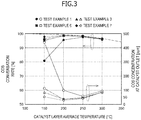
- FIG. 3 indicates the results.
- the chemical equilibrium curve is indicated by a dotted line.
- the COS conversion rate was about 81% at a processing temperature of 150°C, about 96% at 200°C, about 97% at 250°C, and about 96% at 300°C.
- Test Example 3 Test Example 6, and Test Example 7, the COS conversion rate was about 95 to 97% at 150°C, about 99% at 200°C, about 98% at 250°C, and about 96% at 300°C.
- the COS addition rates of all the test examples became values approaching the equilibrium curve.
- the COS concentration decreased from 2300 ppm to about 440 ppm at a processing temperature of 150°C, about 100 ppm at 200°C, about 60 ppm at 250°C, and about 97 ppm at 300°C.
- Test Example 3 Test Example 6, and Test Example 7, the COS concentration decreased from 2300 ppm to about 50 to 110 ppm at 150°C, about 25 to 32 ppm at 200°C, about 35 to 50 ppm at 250°C, and about 87 to 95 ppm at 300°C.
- Test Example 3 Test Example 6, and Test Example 7 in which a potassium compound, a sodium compound, or a cesium compound was added, it was found that the COS conversion rate was improved by up to about 26% as compared with Test Example 1 at a low temperature of 250°C or lower. Furthermore, in Test Example 3, Test Example 6, and Test Example 7 in which a potassium compound, a sodium compound, or a cesium compound was added, it was found that the COS concentration could be reduced from 2300 ppm to a minimum of about 25 ppm even at a low temperature of 250°C or lower.
- the catalyst for COS hydrolysis and the method of producing the same according to the present invention can improve COS conversion rate at low temperatures.
Landscapes
- Chemical & Material Sciences (AREA)
- Engineering & Computer Science (AREA)
- Organic Chemistry (AREA)
- Chemical Kinetics & Catalysis (AREA)
- Materials Engineering (AREA)
- Combustion & Propulsion (AREA)
- General Chemical & Material Sciences (AREA)
- Oil, Petroleum & Natural Gas (AREA)
- Thermal Sciences (AREA)
- Physics & Mathematics (AREA)
- Inorganic Chemistry (AREA)
- Catalysts (AREA)
- Industrial Gases (AREA)
Abstract
Description
- The present invention relates to a catalyst for hydrolysis of carbonyl sulfide and a method of producing the same, and it particularly relates to a catalyst for hydrolysis of carbonyl sulfide for use in fuel gas of a gas turbine and a method of producing the same. The present application claims the priority based on Japanese Patent Application No.
2017-251592 filed on December 27, 2017 - Typically, in gas production plants such as coal gasification plants, a method of removing sulfur compounds contained in a coal-gasified gas as a raw material gas to prevent air pollution and equipment corrosion in the plants has been performed. For example, in an integrated coal gasification combined cycle (IGCC) plant, carbonyl sulfide (COS) in coal-gasified gas is converted into hydrogen sulfide (H2S) using a catalyst that hydrolyzes COS, and then the H2S in the gas is removed, thereby removing sulfur compounds from the raw material gas. The gas from which sulfur compounds have been removed is used for example as a fuel for gas turbines.
- As such a catalyst and a method, a catalyst for hydrolyzing carbonyl sulfide obtained by adding a metal sulfate or a metal carbonate as a co-catalyst to be supported on anatase type titanium, and a method for hydrolyzing carbonyl sulfide in the presence of water and the catalyst in an atmosphere of a reducing gas is known (for example, Patent Document 1).
- Patent Document 1:
JP 11-276897A - As to the catalyst, the COS conversion rate for converting COS in the raw material gas into H2S tends to increase as the operating temperature increases. However, at high temperatures, the COS conversion rate does not exceed a predetermined value based on chemical equilibrium, so that there is a possibility that the catalyst cannot be used for a raw material gas containing high concentration COS. In addition, there is a problem that a high COS conversion rate cannot be achieved at a low temperature.
- In view of the above circumstances, an object of the present invention is to provide a catalyst for COS hydrolysis capable of improving the COS conversion rate at a low temperature and a method of producing the same.
- An aspect of the present invention is a catalyst for COS hydrolysis. The catalyst includes a catalyst containing titanium dioxide supporting a barium compound, and a co-catalyst, the co-catalyst being at least one selected from the group consisting of a potassium compound, a sodium compound and a cesium compound.
- In one aspect of the present invention, as for the catalyst for COS hydrolysis, it is preferable that the catalyst containing titanium dioxide supporting the barium compound is a molded catalyst, and the co-catalyst is supported on the molded catalyst.
- In one aspect of the present invention, as for the catalyst for COS hydrolysis, it is preferable that the co-catalyst is supported in a molar ratio from 1 to 4 with respect to the barium compound.
- In one aspect of the present invention, as for the catalyst for COS hydrolysis, it is preferable that the barium compound is supported in an amount of 2% by weight or greater and 8% by weight or less in terms of barium oxide with respect to the catalyst supporting the barium compound.
- In one aspect of the present invention, as for the catalyst for COS hydrolysis, the co-catalyst is preferably a potassium compound.
- In one aspect, the present invention is a method of producing a catalyst for COS hydrolysis. The production method includes the process of: impregnating a catalyst containing titanium dioxide supporting a barium compound with an aqueous solution containing a metal salt of a co-catalyst, drying the impregnated catalyst, and calcining the dried catalyst to allow the co-catalyst to be supported on the catalyst, where the co-catalyst is at least one selected from the group consisting of a potassium compound, a sodium compound and a cesium compound.
- In one aspect of the present invention, according to the above-described method, it is preferable that the catalyst containing titanium dioxide supporting a barium compound is a molded catalyst molded using a substrate, and the co-catalyst is supported on the molded catalyst.
- In one aspect of the present invention, according to the above-described method, it is preferable that the co-catalyst is supported at a molar ratio from 1 to 4 with respect to the barium compound.
- In one aspect of the present invention, according to the above-described method, it is preferable that the barium compound is supported in an amount of 2% by weight or greater and 8% by weight or less in terms of barium oxide with respect to the catalyst supporting the barium compound.
- In one aspect of the present invention, according to the above-described method, it is preferable that the co-catalyst is a potassium compound.
- The present invention provides a catalyst for COS hydrolysis that can improve the COS conversion rate at a low temperature and a method of producing the same.
-
-
FIG. 1 is a conceptual diagram for illustrating the structure and operating principle of a system for an embodiment in which the catalyst for hydrolysis of carbonyl sulfide according to the present invention is employed in an actual machine. -
FIG. 2 is a graph indicating the results of the COS conversion rate with respect to the processing temperature in Examples as for the catalyst for hydrolyzing carbonyl sulfide according to the present invention and the method of producing the same. -
FIG. 3 is a graph indicating the results of the relationship between the COS conversion rate and the COS concentration with respect to the processing temperature in Examples as for the catalyst for hydrolyzing carbonyl sulfide according to the present invention and the method of producing the same. - Hereinafter, embodiments of the catalyst for hydrolysis of carbonyl sulfide (COS) and the method of producing the same according to the present invention will be described in detail while referring to the attached drawings. The present invention is not limited by the embodiments described below. The accompanying drawings are for illustrating the overview of the present embodiment, and some of the attached devices are omitted.
- Embodiments of the catalyst for COS hydrolysis according to the present invention will be described. The catalyst for COS hydrolysis according to the present embodiment includes at least a first catalyst and a co-catalyst.
- The first catalyst is a catalyst containing titanium dioxide (TiO2) supporting a barium compound. Titanium dioxide functions as a carrier. The first catalyst is preferably a catalyst including titanium dioxide supporting a barium compound. Examples of the carrier include anatase type, rutile type, and brookite type titanium dioxide. Among these, from a practical viewpoint, the carrier is preferably an anatase type titanium dioxide. The specific surface area of the carrier may be, for example, from 30 to 300 m2/g. Additionally, the carrier may be a carrier capable of supporting a barium compound, and includes aluminum oxide (Al2O3) and zirconium oxide (ZrO2).
- In addition, the first catalyst is preferably a molded catalyst formed by a substrate for a catalyst, and more preferably a molded catalyst having a predetermined shape. The shape of the molded catalyst is spherical, plate-like, pellet shaped, and honeycomb shaped. Among these, the shape of the molded catalyst is preferably a honeycomb shape from a practical viewpoint. Examples of the substrate for the catalyst include monolith substrates made of ceramics such as cordierite, and titanium oxide. The specific surface area of the molded catalyst may be, for example, from 30 to 300 m2/g.
- The amount of the barium compound may be any amount that can be supported on the carrier. For example, the amount is 1% by weight or greater, preferably 2% by weight or greater and 8% by weight or less, and preferably 2% by weight or greater and 6% by weight or less in terms of barium oxide (BaO) with respect to the first catalyst. When the amount of the barium compound is in the range of 2% by weight or greater and 8% by weight or less, the COS conversion rate can be improved by increasing the speed of converting the COS.
- The co-catalyst is at least one catalyst selected from the group consisting of potassium compounds, sodium compounds and cesium compounds. Among these, the co-catalyst is preferably a potassium compound from a practical viewpoint. In addition, the above-described metal compound may be any compound that can support the metal on the carrier. However, from a practical viewpoint, each of them can be regarded as a metal oxide or a metal salt compound such as acetate, sulfate, carbonate, hydroxide, or nitrate. The co-catalyst can be supported on the first catalyst by adding its aqueous metal salt solution to the first catalyst.
- The amount of the co-catalyst may be an amount greater than 0 in terms of the molar ratio with respect to the barium compound, and is preferably in the range from 1 to 4 in terms of the molar ratio with respect to barium oxide, with the barium compound converted to barium oxide. When reduced, the molar ratio of the barium compound in terms of barium oxide supported on the carrier to the co-catalyst is in the range from 1:1 to 4. When the molar ratio of barium oxide in terms of barium oxide to co-catalyst is in the range from 1:1 to 4, the COS conversion rate can be maintained at a high temperature exceeding 250°C during hydrolysis, and the COS conversion rate can be improved even at a low temperature of 250°C or lower.
- Furthermore, for the amount of the co-catalyst, specifically, the amount of the potassium compound may be more than 0% by weight with respect to the first catalyst, and is preferably in the range from approximately 2.5 to 9.8% by weight in terms of potassium oxide (K2O). The amount of the sodium compound may be more than 0% by weight with respect to the first catalyst, and is preferably in the range of about 1.6 to 6.5% by weight in terms of sodium oxide (Na2O). The amount of the cesium compound may be more than 0% by weight with respect to the first catalyst, and is preferably in the range of about 7.4 to 29.4% by weight in terms of cesium oxide (Cs2O).
- An embodiment of the method of producing a catalyst for COS hydrolysis according to the present invention will be described. The catalyst for COS hydrolysis according to the present embodiment includes at least an impregnation process, a drying process, and a calcining process.
- In the impregnation process, the first catalyst is impregnated with an aqueous solution containing a metal salt of a co-catalyst. Examples of the impregnation method include a method in which the first catalyst is immersed in a container filled with an aqueous solution of a metal salt of a co-catalyst, and a method in which the first catalyst is sprayed with an aqueous solution. After the impregnation process, it is sufficient that the above-described predetermined amount of the co-catalyst is supported on the first catalyst, and after the impregnating or spraying, the aqueous solution may be blown off if necessary. The aqueous solution of the metal salt may be any solution that can impregnate the first catalyst with the metal salt of the co-catalyst by adding it to the first catalyst. Examples of the aqueous solution of the metal salt include aqueous solutions of potassium acetate (CH3COOK), sodium acetate (CH3COONa), sodium hydroxide (NaOH), and cesium acetate (CH3COOCs).
- Furthermore, in the impregnation process, it is preferable that a molded catalyst, which is obtained by molding a catalyst containing titanium dioxide supporting a barium compound using a substrate for catalyst, is used as the first catalyst. The molded catalyst can be prepared by, for example, a kneading method or a wash coat method. Examples of the substrate for the catalyst include monolith substrates made of ceramics such as cordierite, and titanium oxide. The substrate for the catalyst is preferably a honeycomb substrate from a practical viewpoint.
- In the drying process, the catalyst after the impregnation process is dried at a predetermined temperature and time. The temperature and time of the drying process may be any temperature and time that allow the catalyst after the impregnation process to be dried, and may be, for example, 110°C and 3 hours.
- In the calcining process, the co-catalyst is supported on the first catalyst by calcining the catalyst after the drying process at a predetermined temperature and time. The temperature of the calcining process is, for example, 400°C or higher and 600°C or lower. The time of the calcining process is, for example, 4 hours or more and 8 hours or less.
-
FIG. 1 illustrates a system that can suitably employ the catalyst for hydrolysis of carbonyl sulfide according to the present embodiment. According to the system illustrated inFIG. 1 , using the catalyst according to the present embodiment, a fuel gas suitable for power generation by a gas turbine can be purified from a raw material gas obtained by gasifying coal. - As illustrated in
FIG. 1 , in agasification device 10 such as a gasification furnace, coal is gasified under conditions where at least oxygen (O2) is present, thereby forming a coal-gasified gas, which is a raw material gas. The raw material gas is sent to theCOS conversion device 20 including the catalyst according to the present embodiment. In aCOS conversion device 20, in the presence of the above-described catalyst, as represented by the following formula (I), COS and water (H2O) in the gas are converted into carbon dioxide (CO2) and hydrogen sulfide (H2S). As a result, COS is decomposed and removed from the raw material gas. In theCOS conversion device 20, the temperature measured by thethermometer 20a is adjusted to a low temperature of, for example, 250°C or lower.
[Chemical Formula 1]
COS + H2O ↔ CO2 + H2S (I)
- In addition, impurities such as halogen are mixed in the gas from which the COS has been removed. Impurities in the gas are removed by washing with water or the like in a
washing device 30 such as a water wash column. In thewashing device 30, water soluble ammonia (NH3) mainly contained in the gas is removed by a remover such as water. The gas that has passed through thewashing device 30 contacts the amine absorption liquid of an aqueous solution of an alkanolamine, such as methyldiethanolamine (C5H13NO2), in the H2S removal device 40, thereby absorbing and removing H2S in the gas into the absorption liquid. In the H2S removal device 40, CO2 is also removed by absorption of carbon dioxide by the amine-absorbing liquid. The gas that has passed through the H2S removal device 40 is sent to thegas turbine 50 as a purified gas. The purified gas is mixed with compressed air, which has been compressed by a compressor (not illustrated), in thegas turbine 50 and burned. As a result, a high-temperature and high-pressure combustion gas is generated. The gas turbine drives the turbine by the combustion gas and drives a power generation means (not illustrated) to generate power. - The present invention will be described in further detail hereinafter with reference to examples. The catalyst for hydrolysis of carbonyl sulfide and the method of producing the same according to the present invention are not limited by the following examples.
- As Test Example 1, 6 g of molded catalyst (2 × 2 cells, 150 mmL), which had a honeycomb shape and included titanium dioxide (TiO2) supporting 4% by weight of barium compound in terms of barium oxide with respect to the whole catalyst, was prepared. Titanium dioxide as a carrier was anatase type titanium dioxide.
- As Test Example 2, the molded catalyst of Test Example 1 was impregnated with a barium acetate ((CH3COO)2Ba) aqueous solution so that the barium compound was added to the molded catalyst in an amount of 4% by weight in terms of barium oxide. The molded catalyst after impregnation with water was dried under conditions at 110°C, and then fired in air at 500°C for 3 hours, whereby 4% by weight of barium oxide with respect to the molded catalyst was supported on the molded catalyst. In Test Example 2, a catalyst containing a barium compound in an amount of 8% by weight in terms of barium oxide was prepared by adding 4% by weight of a barium compound in terms of barium oxide as a co-catalyst to the molded catalyst of Test Example 1 containing 4% by weight of a barium compound in terms of barium oxide.
- As Test Example 3, a catalyst was prepared in the same manner as in Test Example 2, except that a potassium acetate (CH3COOK) aqueous solution was used in place of a barium acetate aqueous solution, whereby 2.5% by weight of a potassium compound in terms of potassium oxide was supported on the molded catalyst. In Test Example 3, a catalyst containing a barium compound and a potassium compound in a molar ratio of 1:1 was prepared by adding the same molar number of the potassium compound as the barium compound as a co-catalyst to the molded catalyst of Test Example 1 containing 4% by weight of the barium compound in terms of barium oxide.
- Test Example 4 was prepared in the same manner as in Test Example 3, except that the amount of the potassium acetate aqueous solution was 4.9% by weight in terms of potassium oxide with respect to the molded catalyst, In Test Example 4, a catalyst containing a barium compound and a potassium compound in a molar ratio of 1:2 was prepared by adding twice as many moles of the potassium compound as a co-catalyst to the molded catalyst of Test Example 1 containing 4% by weight of the barium compound in terms of barium oxide.
- Test Example 5 was prepared in the same manner as in Test Example 3 except that the amount of the potassium acetate aqueous solution was 9.8% by weight in terms of potassium oxide with respect to the molded catalyst. In Test Example 5, a catalyst containing a barium compound and a potassium compound in a molar ratio of 1:4 was prepared by adding, as a co-catalyst, a potassium compound in an amount of 4 times the number of moles of the barium compound to the molded catalyst of Test Example 1 containing 4% by weight of a barium compound in terms of barium oxide.
- As described above, in Test Examples 1 to 5, catalysts were prepared by adding, as a co-catalyst, to a barium compound or a potassium compound to the molded catalyst including a barium compound supported on titanium dioxide. Table 1 below indicates the catalyst composition and composition ratio when the barium compound is regarded as barium oxide and the potassium compound is regarded as potassium oxide. Table 1 below indicates the molar ratio of Test Example 1 to barium oxide as the composition ratio.
-
Table 1. Catalyst composition and composition ratio Catalyst composition Molar ratio BaO K2O Test Example 1 BaO/TiO2 1 - Test Example 2 BaO/TiO2 2 - Test Example 3 BaO-K2O/ TiO 21 1 Test Example 4 BaO-K2O/ TiO 21 2 Test Example 5 BaO-K2O/ TiO 21 4 - The catalysts of Test Examples 1 to 5 were subjected to a hydrolysis reaction of carbonyl sulfide at different processing temperatures. The pressure was the absolute pressure calculated from the value measured by a pressure gauge. The processing temperature was the average value of the catalyst temperatures measured at the catalyst inlet and outlet by a thermocouple (catalyst layer average temperature). The COS concentration at the catalyst outlet at each processing temperature was measured by a gas chromatograph equipped with an FPD detector. Table 2 below shows the test conditions. The COS conversion rate was determined by the following formula. In the present specification, GHSV indicates gas amount/catalyst amount.
FIG. 2 indicates the results.
-
Table 2. Test conditions Pressure (MPa) GHSV (h-1) Gas properties at catalyst inlet H2 (mol%) CO (mol%) CO2 (mol%) H2O (mol%) N2 H2S (ppm) COS (ppm) 0.9 12,000 7.4 27 7 3.7 Base 9200 2300 - As illustrated in
FIG. 2 , in Test Example 1, the COS conversion rate was about 62% at a processing temperature of 150°C, about 84% at 200°C, about 90% at 250°C, and about 92% at 300°C. In Test Example 2, the COS conversion rate was about 73% at 150°C. On the other hand, in Test Examples 3 to 5, the COS conversion rate was about 84 to 88% at 150°C, about 93 to 94% at 200°C, about 94 to 96% at 250°C, and about 95 to 96% at 300°C. - From the results, in Test Example 2 in which a barium compound was added, the COS conversion rate was improved only by about 11% at a low temperature of 150°C as compared with Test Example 1. On the other hand, in Test Examples 3 to 5 in which a potassium compound was added, it was found that the COS conversion rate could be improved up to about 26% at a low temperature of 250°C as compared with Test Example 1, and the COS conversion rate could be improved up to about 15% as compared with Test Example 2.
- As Test Example 6, a catalyst was prepared in the same manner as in Test Example 2, except that a sodium acetate(CH3COONa) aqueous solution was used in place of the barium acetate aqueous solution, whereby 1.6% by weight of a sodium compound in terms of potassium oxide (Na2O) was supported on the molded catalyst. In Test Example 6, a catalyst containing a barium compound and a sodium compound in a molar ratio of 1:1 was prepared by adding, in place of the potassium compound, the same mole number of the sodium compound as the barium compound to the molded catalyst of Test Example 1 containing 4% by weight of the barium compound in terms of barium oxide.
- As Test Example 7, a catalyst was prepared in the same manner as in Test Example 2, except that a cesium acetate (CH3COOCs) aqueous solution was used in place of the barium acetate aqueous solution, whereby 7.4% by weight of a cesium compound in terms of cesium oxide (Cs2O) was supported on the molded catalyst. In Test Example 7, a catalyst containing a barium compound and a cesium compound in a molar ratio of 1:1 was prepared by adding, as a co-catalyst, the same mole number of the cesium compound as the barium compound in place of the potassium compound to the molded catalyst of Test Example 1 containing 4% by weight of the barium compound in terms of barium oxide, In Test Examples 6 and Test Example 7, catalysts were prepared by adding a sodium compound or a cesium compound as a co-catalyst to a molded catalyst including a barium compound supported on titanium dioxide. Table 3 below shows the catalyst composition and composition ratio. Table 3 below shows the molar ratio to barium oxide in Test Example 1 as the composition ratio.
-
Table 3. Catalyst composition and composition ratio Catalyst composition Molar ratio BaO K2O Na2O Cs2O Test Example 1 BaO/TiO2 1 - - - Test Example 3 BaO-K2O/ TiO 21 1 - - Test Example 6 BaO-Na2O/TiO2 1 - 1 - Test Example 7 BaO-Cs2O/TiO2 1 - - 1 - The hydrolysis reaction of the carbonyl sulfide was performed on the catalysts of Test Example 1, Test Example 3, Test Example 6, and Test Example 7. Table 4 below indicates the test conditions. The processing temperature, the COS conversion rate, and the COS concentration at the catalyst outlet at each processing temperature were measured in the same manner as described above.
FIG. 3 indicates the results. In the figure, the chemical equilibrium curve is indicated by a dotted line. -
Table 4. Test conditions Pressure (MPa) GHSV (h-1 ) Gas properties at catalyst inlet H2 (mol%) CO (mol%) CO2 (mol%) H2O (mol%) N2 H2S (ppm) COS (ppm) 0.9 6000 7.4 27 7 3.7 Base 9200 2300 - As indicated in
FIG. 3 , in Test Example 1, the COS conversion rate was about 81% at a processing temperature of 150°C, about 96% at 200°C, about 97% at 250°C, and about 96% at 300°C. On the other hand, in Test Example 3, Test Example 6, and Test Example 7, the COS conversion rate was about 95 to 97% at 150°C, about 99% at 200°C, about 98% at 250°C, and about 96% at 300°C. At processing temperatures exceeding 250°C, the COS addition rates of all the test examples became values approaching the equilibrium curve. - In addition, in Test Example 1, the COS concentration decreased from 2300 ppm to about 440 ppm at a processing temperature of 150°C, about 100 ppm at 200°C, about 60 ppm at 250°C, and about 97 ppm at 300°C. On the other hand, in Test Example 3, Test Example 6, and Test Example 7, the COS concentration decreased from 2300 ppm to about 50 to 110 ppm at 150°C, about 25 to 32 ppm at 200°C, about 35 to 50 ppm at 250°C, and about 87 to 95 ppm at 300°C.
- From the results, in Test Example 3, Test Example 6, and Test Example 7 in which a potassium compound, a sodium compound, or a cesium compound was added, it was found that the COS conversion rate was improved by up to about 26% as compared with Test Example 1 at a low temperature of 250°C or lower. Furthermore, in Test Example 3, Test Example 6, and Test Example 7 in which a potassium compound, a sodium compound, or a cesium compound was added, it was found that the COS concentration could be reduced from 2300 ppm to a minimum of about 25 ppm even at a low temperature of 250°C or lower.
- The catalyst for COS hydrolysis and the method of producing the same according to the present invention can improve COS conversion rate at low temperatures.
-
- 10
- Gasification device
- 20
- COS conversion device
- 20a
- Thermometer
- 30
- Washing device
- 40
- H2S removal device
- 50
- Gas turbine
Claims (10)
- A catalyst for COS hydrolysis comprising:a catalyst containing titanium dioxide supporting a barium compound; anda co-catalyst,wherein the co-catalyst is at least one selected from the group consisting of a potassium compound, a sodium compound, and a cesium compound.
- The catalyst for COS hydrolysis according to claim 1, wherein the catalyst containing titanium dioxide supporting the barium compound is a molded catalyst, and the co-catalyst is supported on the molded catalyst.
- The catalyst for COS hydrolysis according to claim 1 or 2, wherein the co-catalyst is supported in a molar ratio from 1 to 4 with respect to the barium compound.
- The catalyst for COS hydrolysis according to any one of claims 1 to 3, wherein the barium compound is supported in an amount of 2% by weight or greater and 8% by weight or less in terms of barium oxide with respect to the catalyst supporting the barium compound.
- The catalyst for COS hydrolysis according to any one of claims 1 to 4, wherein the co-catalyst is a potassium compound.
- A method of producing a catalyst for COS hydrolysis, the method comprising the steps of:impregnating a catalyst containing titanium dioxide supporting a barium compound with an aqueous solution containing a metal salt of a co-catalyst;drying the impregnated catalyst; andcalcining the dried catalyst to allow the co-catalyst to be supported on the catalyst,wherein the co-catalyst is at least one selected from the group consisting of a potassium compound, a sodium compound, and a cesium compound.
- The method of producing a catalyst for COS hydrolysis according to claim 6, wherein the catalyst containing titanium dioxide supporting the barium compound is used as a molded catalyst, and the co-catalyst is supported on the molded catalyst.
- The method of producing a catalyst for COS hydrolysis according to claim 6 or 7, wherein the co-catalyst is supported in a molar ratio from 1 to 4 with respect to the barium compound.
- The method of producing a catalyst for COS hydrolysis according to any one of claims 6 to 8, wherein the barium compound is supported in an amount of 2% by weight or greater and 8% by weight or less in terms of barium oxide with respect to the catalyst supporting the barium compound.
- The method of producing a catalyst for COS hydrolysis according to any one of claims 6 to 9, wherein the co-catalyst is a potassium compound.
Applications Claiming Priority (2)
| Application Number | Priority Date | Filing Date | Title |
|---|---|---|---|
| JP2017251592A JP7039286B2 (en) | 2017-12-27 | 2017-12-27 | Hydrolysis catalyst for carbonyl sulfide and its production method |
| PCT/JP2018/042519 WO2019130899A1 (en) | 2017-12-27 | 2018-11-16 | Catalyst for use in hydrolysis of carbonyl sulfide, and method for producing same |
Publications (2)
| Publication Number | Publication Date |
|---|---|
| EP3733284A1 true EP3733284A1 (en) | 2020-11-04 |
| EP3733284A4 EP3733284A4 (en) | 2020-12-30 |
Family
ID=67067018
Family Applications (1)
| Application Number | Title | Priority Date | Filing Date |
|---|---|---|---|
| EP18897554.4A Pending EP3733284A4 (en) | 2017-12-27 | 2018-11-16 | CATALYST FOR USE IN THE HYDROLYSIS OF CARBONYL SULFIDE AND METHOD FOR MANUFACTURING THEREOF |
Country Status (5)
| Country | Link |
|---|---|
| US (1) | US20200398256A1 (en) |
| EP (1) | EP3733284A4 (en) |
| JP (1) | JP7039286B2 (en) |
| CN (1) | CN111432924A (en) |
| WO (1) | WO2019130899A1 (en) |
Cited By (1)
| Publication number | Priority date | Publication date | Assignee | Title |
|---|---|---|---|---|
| CN111468141A (en) * | 2019-11-21 | 2020-07-31 | 中山大学 | A kind of preparation method of two-dimensional amorphous-crystalline heterojunction and its application |
Families Citing this family (2)
| Publication number | Priority date | Publication date | Assignee | Title |
|---|---|---|---|---|
| CN110639494A (en) * | 2019-10-31 | 2020-01-03 | 北京北科环境工程有限公司 | Blast furnace gas carbonyl sulfide hydrolytic agent and preparation method thereof |
| CN113663665B (en) * | 2021-08-09 | 2023-09-22 | 中国科学院大学 | Organic sulfur hydrolysis catalyst suitable for Claus process and its preparation method and application |
Family Cites Families (13)
| Publication number | Priority date | Publication date | Assignee | Title |
|---|---|---|---|---|
| JPS58210848A (en) * | 1982-06-03 | 1983-12-08 | Shokubai Kasei Kogyo Kk | Catalyst for hydrolysis of carbonyl sulfide |
| US4511668A (en) * | 1983-10-25 | 1985-04-16 | Catalysts & Chemicals Industries Co., Ltd. | Catalyst for use in hydrolysis of carbonyl sulfide |
| DE4206913A1 (en) * | 1992-03-05 | 1993-09-09 | Kronos Titan Gmbh | CATALYST FOR CARBONYL SULFID HYDROLYSIS |
| MY117311A (en) * | 1996-08-22 | 2004-06-30 | Shell Int Research | Process for reducing total sulphur content in gases containing hydrogen sulphide and other sulphur components |
| JP3746609B2 (en) | 1998-03-30 | 2006-02-15 | 三菱重工業株式会社 | Hydrolysis catalyst and hydrolysis method of carbonyl sulfide |
| CN1102420C (en) * | 2000-07-11 | 2003-03-05 | 中国科学院山西煤炭化学研究所 | Hydrolytic catalyst of carbonyl sulfur and its preparing process and application |
| CN100441287C (en) * | 2002-04-18 | 2008-12-10 | 触媒化成工业株式会社 | Titanium dioxide powder for honeycomb exhaust gas treatment catalyst and exhaust gas treatment catalyst |
| CN101239319B (en) * | 2008-03-17 | 2010-12-29 | 中国石油大学(北京) | Carbonyl sulfide hydrolysis catalyst |
| CN102039137B (en) * | 2009-10-21 | 2012-09-12 | 中国石油化工股份有限公司 | Honeycomb catalyst for catalytically incinerating sulfur recovery tail gases and preparation method |
| CN102039129B (en) * | 2009-10-21 | 2012-09-19 | 中国石油化工股份有限公司 | Honeycomb sulfur-containing gas catalytic incineration catalyst and preparation method |
| CN102179241B (en) * | 2011-03-17 | 2015-06-17 | 浙江三龙催化剂有限公司 | Catalyst for removing organic sulfur in clean coal gas through hydrolysis and preparation method thereof |
| JP5955026B2 (en) * | 2012-02-24 | 2016-07-20 | 三菱重工業株式会社 | Use of catalysts for hydrolysis of carbonyl sulfide and hydrogen cyanide and titanium oxide-based compositions |
| JP6147663B2 (en) * | 2013-12-27 | 2017-06-14 | 三菱重工業株式会社 | Catalyst regeneration method for COS conversion catalyst |
-
2017
- 2017-12-27 JP JP2017251592A patent/JP7039286B2/en active Active
-
2018
- 2018-11-16 US US16/957,234 patent/US20200398256A1/en not_active Abandoned
- 2018-11-16 WO PCT/JP2018/042519 patent/WO2019130899A1/en not_active Ceased
- 2018-11-16 EP EP18897554.4A patent/EP3733284A4/en active Pending
- 2018-11-16 CN CN201880076627.1A patent/CN111432924A/en active Pending
Cited By (2)
| Publication number | Priority date | Publication date | Assignee | Title |
|---|---|---|---|---|
| CN111468141A (en) * | 2019-11-21 | 2020-07-31 | 中山大学 | A kind of preparation method of two-dimensional amorphous-crystalline heterojunction and its application |
| CN111468141B (en) * | 2019-11-21 | 2021-08-13 | 中山大学 | A kind of preparation method of two-dimensional amorphous-crystalline heterojunction and its application |
Also Published As
| Publication number | Publication date |
|---|---|
| JP2019115891A (en) | 2019-07-18 |
| CN111432924A (en) | 2020-07-17 |
| US20200398256A1 (en) | 2020-12-24 |
| EP3733284A4 (en) | 2020-12-30 |
| WO2019130899A1 (en) | 2019-07-04 |
| JP7039286B2 (en) | 2022-03-22 |
Similar Documents
| Publication | Publication Date | Title |
|---|---|---|
| JP5414786B2 (en) | Catalytic treatment with hydrogen for control of NOx emissions | |
| JP5955026B2 (en) | Use of catalysts for hydrolysis of carbonyl sulfide and hydrogen cyanide and titanium oxide-based compositions | |
| EP2962754B1 (en) | Method of producing co shift catalyst | |
| US20200398256A1 (en) | Catalyst for use in hydrolysis of carbonyl sulfide, and method of producing same | |
| CN104138761B (en) | Sulfur-resistant membrane type low-temperature denitration catalyst and preparation method thereof | |
| US9486797B2 (en) | Method for regenerating COS hydrolysis catalyst | |
| JP5404774B2 (en) | CO shift catalyst, CO shift reaction apparatus, and purification method of gasification gas | |
| US11439981B2 (en) | Catalyst for hydrolysis of carbonyl sulfide and method of producing same | |
| KR20170101160A (en) | Acid-resistant catalyst for decomposing perfluorinated compounds and use thereof | |
| US4002658A (en) | Methanation catalyst and process of using the same | |
| WO2022089072A1 (en) | Catalyst and method for sulfur-tolerant shift catalytic reaction | |
| US9604206B2 (en) | Method for regenerating COS hydrolysis catalyst | |
| JP5595385B2 (en) | CO shift catalyst and method for producing the same, and CO shift reaction apparatus using CO shift catalyst | |
| CN112206823A (en) | Carbonyl sulfide hydrolysis catalyst with modified silica gel as carrier and preparation method thereof | |
| CN115569647A (en) | Composite oxide catalyst and preparation method and application thereof | |
| US20110183839A1 (en) | Catalyst for cleaning up nitrogen oxides and a method for producing same | |
| KR101770914B1 (en) | Nitrogen oxide reduction catalyst and method of manufacturing the same | |
| JP2000051694A (en) | Catalyst for decomposing carbonyl sulfide and/or hydrogen cyanide and decomposition method | |
| CN111359604A (en) | A kind of medium and low temperature denitration and anti-sulfur and anti-water catalyst and preparation method thereof | |
| Mandić et al. | Sol-gel Derived MixedMetal Oxide Sorbents for High Temperature Gas Desulfurization | |
| KR20240068297A (en) | Multi-internal structure for efficiency improvement of the carbon dioxide reforming process | |
| CN111589437A (en) | Denitration catalyst and denitration device | |
| Jothimurugesan et al. | Simultaneous removal of H {sub 2} S and NH {sub 3} in coal gasification processes.[Quarterly report], January 1, 1994--March 31, 1994 | |
| WO2017110846A1 (en) | Mercury oxidation catalyst and mercury oxidation reaction device |
Legal Events
| Date | Code | Title | Description |
|---|---|---|---|
| STAA | Information on the status of an ep patent application or granted ep patent |
Free format text: STATUS: THE INTERNATIONAL PUBLICATION HAS BEEN MADE |
|
| PUAI | Public reference made under article 153(3) epc to a published international application that has entered the european phase |
Free format text: ORIGINAL CODE: 0009012 |
|
| STAA | Information on the status of an ep patent application or granted ep patent |
Free format text: STATUS: REQUEST FOR EXAMINATION WAS MADE |
|
| 17P | Request for examination filed |
Effective date: 20200618 |
|
| AK | Designated contracting states |
Kind code of ref document: A1 Designated state(s): AL AT BE BG CH CY CZ DE DK EE ES FI FR GB GR HR HU IE IS IT LI LT LU LV MC MK MT NL NO PL PT RO RS SE SI SK SM TR |
|
| AX | Request for extension of the european patent |
Extension state: BA ME |
|
| A4 | Supplementary search report drawn up and despatched |
Effective date: 20201202 |
|
| RIC1 | Information provided on ipc code assigned before grant |
Ipc: B01J 37/02 20060101ALI20201126BHEP Ipc: B01J 37/08 20060101ALI20201126BHEP Ipc: C10K 1/34 20060101ALI20201126BHEP Ipc: B01J 23/04 20060101AFI20201126BHEP |
|
| DAV | Request for validation of the european patent (deleted) | ||
| DAX | Request for extension of the european patent (deleted) | ||
| STAA | Information on the status of an ep patent application or granted ep patent |
Free format text: STATUS: EXAMINATION IS IN PROGRESS |
|
| 17Q | First examination report despatched |
Effective date: 20221024 |
|
| RAP3 | Party data changed (applicant data changed or rights of an application transferred) |
Owner name: MHI ENGINEERING, LTD. |
|
| RAP3 | Party data changed (applicant data changed or rights of an application transferred) |
Owner name: MHI ENGINEERING, LTD. |
|
| RAP1 | Party data changed (applicant data changed or rights of an application transferred) |
Owner name: MITSUBISHI HEAVY INDUSTRIES, LTD. |