EP3733281A1 - Hydrocarbon removal system - Google Patents
Hydrocarbon removal system Download PDFInfo
- Publication number
- EP3733281A1 EP3733281A1 EP18895622.1A EP18895622A EP3733281A1 EP 3733281 A1 EP3733281 A1 EP 3733281A1 EP 18895622 A EP18895622 A EP 18895622A EP 3733281 A1 EP3733281 A1 EP 3733281A1
- Authority
- EP
- European Patent Office
- Prior art keywords
- hydrocarbon
- adsorption catalyst
- pore size
- removal system
- hydrocarbon adsorption
- Prior art date
- Legal status (The legal status is an assumption and is not a legal conclusion. Google has not performed a legal analysis and makes no representation as to the accuracy of the status listed.)
- Pending
Links
Images




Classifications
-
- B—PERFORMING OPERATIONS; TRANSPORTING
- B01—PHYSICAL OR CHEMICAL PROCESSES OR APPARATUS IN GENERAL
- B01J—CHEMICAL OR PHYSICAL PROCESSES, e.g. CATALYSIS OR COLLOID CHEMISTRY; THEIR RELEVANT APPARATUS
- B01J20/00—Solid sorbent compositions or filter aid compositions; Sorbents for chromatography; Processes for preparing, regenerating or reactivating thereof
- B01J20/02—Solid sorbent compositions or filter aid compositions; Sorbents for chromatography; Processes for preparing, regenerating or reactivating thereof comprising inorganic material
- B01J20/10—Solid sorbent compositions or filter aid compositions; Sorbents for chromatography; Processes for preparing, regenerating or reactivating thereof comprising inorganic material comprising silica or silicate
- B01J20/16—Alumino-silicates
- B01J20/18—Synthetic zeolitic molecular sieves
- B01J20/186—Chemical treatments in view of modifying the properties of the sieve, e.g. increasing the stability or the activity, also decreasing the activity
-
- B—PERFORMING OPERATIONS; TRANSPORTING
- B01—PHYSICAL OR CHEMICAL PROCESSES OR APPARATUS IN GENERAL
- B01D—SEPARATION
- B01D53/00—Separation of gases or vapours; Recovering vapours of volatile solvents from gases; Chemical or biological purification of waste gases, e.g. engine exhaust gases, smoke, fumes, flue gases, aerosols
- B01D53/02—Separation of gases or vapours; Recovering vapours of volatile solvents from gases; Chemical or biological purification of waste gases, e.g. engine exhaust gases, smoke, fumes, flue gases, aerosols by adsorption, e.g. preparative gas chromatography
-
- B—PERFORMING OPERATIONS; TRANSPORTING
- B01—PHYSICAL OR CHEMICAL PROCESSES OR APPARATUS IN GENERAL
- B01D—SEPARATION
- B01D53/00—Separation of gases or vapours; Recovering vapours of volatile solvents from gases; Chemical or biological purification of waste gases, e.g. engine exhaust gases, smoke, fumes, flue gases, aerosols
- B01D53/02—Separation of gases or vapours; Recovering vapours of volatile solvents from gases; Chemical or biological purification of waste gases, e.g. engine exhaust gases, smoke, fumes, flue gases, aerosols by adsorption, e.g. preparative gas chromatography
- B01D53/04—Separation of gases or vapours; Recovering vapours of volatile solvents from gases; Chemical or biological purification of waste gases, e.g. engine exhaust gases, smoke, fumes, flue gases, aerosols by adsorption, e.g. preparative gas chromatography with stationary adsorbents
-
- B—PERFORMING OPERATIONS; TRANSPORTING
- B01—PHYSICAL OR CHEMICAL PROCESSES OR APPARATUS IN GENERAL
- B01D—SEPARATION
- B01D53/00—Separation of gases or vapours; Recovering vapours of volatile solvents from gases; Chemical or biological purification of waste gases, e.g. engine exhaust gases, smoke, fumes, flue gases, aerosols
- B01D53/34—Chemical or biological purification of waste gases
- B01D53/92—Chemical or biological purification of waste gases of engine exhaust gases
- B01D53/94—Chemical or biological purification of waste gases of engine exhaust gases by catalytic processes
- B01D53/9481—Catalyst preceded by an adsorption device without catalytic function for temporary storage of contaminants, e.g. during cold start
- B01D53/9486—Catalyst preceded by an adsorption device without catalytic function for temporary storage of contaminants, e.g. during cold start for storing hydrocarbons
-
- B—PERFORMING OPERATIONS; TRANSPORTING
- B01—PHYSICAL OR CHEMICAL PROCESSES OR APPARATUS IN GENERAL
- B01J—CHEMICAL OR PHYSICAL PROCESSES, e.g. CATALYSIS OR COLLOID CHEMISTRY; THEIR RELEVANT APPARATUS
- B01J20/00—Solid sorbent compositions or filter aid compositions; Sorbents for chromatography; Processes for preparing, regenerating or reactivating thereof
- B01J20/02—Solid sorbent compositions or filter aid compositions; Sorbents for chromatography; Processes for preparing, regenerating or reactivating thereof comprising inorganic material
- B01J20/06—Solid sorbent compositions or filter aid compositions; Sorbents for chromatography; Processes for preparing, regenerating or reactivating thereof comprising inorganic material comprising oxides or hydroxides of metals not provided for in group B01J20/04
-
- B—PERFORMING OPERATIONS; TRANSPORTING
- B01—PHYSICAL OR CHEMICAL PROCESSES OR APPARATUS IN GENERAL
- B01J—CHEMICAL OR PHYSICAL PROCESSES, e.g. CATALYSIS OR COLLOID CHEMISTRY; THEIR RELEVANT APPARATUS
- B01J20/00—Solid sorbent compositions or filter aid compositions; Sorbents for chromatography; Processes for preparing, regenerating or reactivating thereof
- B01J20/02—Solid sorbent compositions or filter aid compositions; Sorbents for chromatography; Processes for preparing, regenerating or reactivating thereof comprising inorganic material
- B01J20/10—Solid sorbent compositions or filter aid compositions; Sorbents for chromatography; Processes for preparing, regenerating or reactivating thereof comprising inorganic material comprising silica or silicate
- B01J20/16—Alumino-silicates
- B01J20/18—Synthetic zeolitic molecular sieves
-
- B—PERFORMING OPERATIONS; TRANSPORTING
- B01—PHYSICAL OR CHEMICAL PROCESSES OR APPARATUS IN GENERAL
- B01J—CHEMICAL OR PHYSICAL PROCESSES, e.g. CATALYSIS OR COLLOID CHEMISTRY; THEIR RELEVANT APPARATUS
- B01J20/00—Solid sorbent compositions or filter aid compositions; Sorbents for chromatography; Processes for preparing, regenerating or reactivating thereof
- B01J20/28—Solid sorbent compositions or filter aid compositions; Sorbents for chromatography; Processes for preparing, regenerating or reactivating thereof characterised by their form or physical properties
-
- B—PERFORMING OPERATIONS; TRANSPORTING
- B01—PHYSICAL OR CHEMICAL PROCESSES OR APPARATUS IN GENERAL
- B01J—CHEMICAL OR PHYSICAL PROCESSES, e.g. CATALYSIS OR COLLOID CHEMISTRY; THEIR RELEVANT APPARATUS
- B01J20/00—Solid sorbent compositions or filter aid compositions; Sorbents for chromatography; Processes for preparing, regenerating or reactivating thereof
- B01J20/28—Solid sorbent compositions or filter aid compositions; Sorbents for chromatography; Processes for preparing, regenerating or reactivating thereof characterised by their form or physical properties
- B01J20/28002—Solid sorbent compositions or filter aid compositions; Sorbents for chromatography; Processes for preparing, regenerating or reactivating thereof characterised by their form or physical properties characterised by their physical properties
-
- B—PERFORMING OPERATIONS; TRANSPORTING
- B01—PHYSICAL OR CHEMICAL PROCESSES OR APPARATUS IN GENERAL
- B01J—CHEMICAL OR PHYSICAL PROCESSES, e.g. CATALYSIS OR COLLOID CHEMISTRY; THEIR RELEVANT APPARATUS
- B01J20/00—Solid sorbent compositions or filter aid compositions; Sorbents for chromatography; Processes for preparing, regenerating or reactivating thereof
- B01J20/28—Solid sorbent compositions or filter aid compositions; Sorbents for chromatography; Processes for preparing, regenerating or reactivating thereof characterised by their form or physical properties
- B01J20/28014—Solid sorbent compositions or filter aid compositions; Sorbents for chromatography; Processes for preparing, regenerating or reactivating thereof characterised by their form or physical properties characterised by their form
- B01J20/28016—Particle form
-
- B—PERFORMING OPERATIONS; TRANSPORTING
- B01—PHYSICAL OR CHEMICAL PROCESSES OR APPARATUS IN GENERAL
- B01J—CHEMICAL OR PHYSICAL PROCESSES, e.g. CATALYSIS OR COLLOID CHEMISTRY; THEIR RELEVANT APPARATUS
- B01J20/00—Solid sorbent compositions or filter aid compositions; Sorbents for chromatography; Processes for preparing, regenerating or reactivating thereof
- B01J20/28—Solid sorbent compositions or filter aid compositions; Sorbents for chromatography; Processes for preparing, regenerating or reactivating thereof characterised by their form or physical properties
- B01J20/28054—Solid sorbent compositions or filter aid compositions; Sorbents for chromatography; Processes for preparing, regenerating or reactivating thereof characterised by their form or physical properties characterised by their surface properties or porosity
-
- B—PERFORMING OPERATIONS; TRANSPORTING
- B01—PHYSICAL OR CHEMICAL PROCESSES OR APPARATUS IN GENERAL
- B01J—CHEMICAL OR PHYSICAL PROCESSES, e.g. CATALYSIS OR COLLOID CHEMISTRY; THEIR RELEVANT APPARATUS
- B01J20/00—Solid sorbent compositions or filter aid compositions; Sorbents for chromatography; Processes for preparing, regenerating or reactivating thereof
- B01J20/28—Solid sorbent compositions or filter aid compositions; Sorbents for chromatography; Processes for preparing, regenerating or reactivating thereof characterised by their form or physical properties
- B01J20/28054—Solid sorbent compositions or filter aid compositions; Sorbents for chromatography; Processes for preparing, regenerating or reactivating thereof characterised by their form or physical properties characterised by their surface properties or porosity
- B01J20/28057—Surface area, e.g. B.E.T specific surface area
-
- B—PERFORMING OPERATIONS; TRANSPORTING
- B01—PHYSICAL OR CHEMICAL PROCESSES OR APPARATUS IN GENERAL
- B01J—CHEMICAL OR PHYSICAL PROCESSES, e.g. CATALYSIS OR COLLOID CHEMISTRY; THEIR RELEVANT APPARATUS
- B01J20/00—Solid sorbent compositions or filter aid compositions; Sorbents for chromatography; Processes for preparing, regenerating or reactivating thereof
- B01J20/28—Solid sorbent compositions or filter aid compositions; Sorbents for chromatography; Processes for preparing, regenerating or reactivating thereof characterised by their form or physical properties
- B01J20/28054—Solid sorbent compositions or filter aid compositions; Sorbents for chromatography; Processes for preparing, regenerating or reactivating thereof characterised by their form or physical properties characterised by their surface properties or porosity
- B01J20/28069—Pore volume, e.g. total pore volume, mesopore volume, micropore volume
-
- B—PERFORMING OPERATIONS; TRANSPORTING
- B01—PHYSICAL OR CHEMICAL PROCESSES OR APPARATUS IN GENERAL
- B01J—CHEMICAL OR PHYSICAL PROCESSES, e.g. CATALYSIS OR COLLOID CHEMISTRY; THEIR RELEVANT APPARATUS
- B01J20/00—Solid sorbent compositions or filter aid compositions; Sorbents for chromatography; Processes for preparing, regenerating or reactivating thereof
- B01J20/28—Solid sorbent compositions or filter aid compositions; Sorbents for chromatography; Processes for preparing, regenerating or reactivating thereof characterised by their form or physical properties
- B01J20/28054—Solid sorbent compositions or filter aid compositions; Sorbents for chromatography; Processes for preparing, regenerating or reactivating thereof characterised by their form or physical properties characterised by their surface properties or porosity
- B01J20/28069—Pore volume, e.g. total pore volume, mesopore volume, micropore volume
- B01J20/28071—Pore volume, e.g. total pore volume, mesopore volume, micropore volume being less than 0.5 ml/g
-
- B—PERFORMING OPERATIONS; TRANSPORTING
- B01—PHYSICAL OR CHEMICAL PROCESSES OR APPARATUS IN GENERAL
- B01J—CHEMICAL OR PHYSICAL PROCESSES, e.g. CATALYSIS OR COLLOID CHEMISTRY; THEIR RELEVANT APPARATUS
- B01J20/00—Solid sorbent compositions or filter aid compositions; Sorbents for chromatography; Processes for preparing, regenerating or reactivating thereof
- B01J20/28—Solid sorbent compositions or filter aid compositions; Sorbents for chromatography; Processes for preparing, regenerating or reactivating thereof characterised by their form or physical properties
- B01J20/28054—Solid sorbent compositions or filter aid compositions; Sorbents for chromatography; Processes for preparing, regenerating or reactivating thereof characterised by their form or physical properties characterised by their surface properties or porosity
- B01J20/28078—Pore diameter
- B01J20/28083—Pore diameter being in the range 2-50 nm, i.e. mesopores
-
- B—PERFORMING OPERATIONS; TRANSPORTING
- B01—PHYSICAL OR CHEMICAL PROCESSES OR APPARATUS IN GENERAL
- B01J—CHEMICAL OR PHYSICAL PROCESSES, e.g. CATALYSIS OR COLLOID CHEMISTRY; THEIR RELEVANT APPARATUS
- B01J20/00—Solid sorbent compositions or filter aid compositions; Sorbents for chromatography; Processes for preparing, regenerating or reactivating thereof
- B01J20/28—Solid sorbent compositions or filter aid compositions; Sorbents for chromatography; Processes for preparing, regenerating or reactivating thereof characterised by their form or physical properties
- B01J20/28054—Solid sorbent compositions or filter aid compositions; Sorbents for chromatography; Processes for preparing, regenerating or reactivating thereof characterised by their form or physical properties characterised by their surface properties or porosity
- B01J20/28088—Pore-size distribution
- B01J20/2809—Monomodal or narrow distribution, uniform pores
-
- B—PERFORMING OPERATIONS; TRANSPORTING
- B01—PHYSICAL OR CHEMICAL PROCESSES OR APPARATUS IN GENERAL
- B01J—CHEMICAL OR PHYSICAL PROCESSES, e.g. CATALYSIS OR COLLOID CHEMISTRY; THEIR RELEVANT APPARATUS
- B01J20/00—Solid sorbent compositions or filter aid compositions; Sorbents for chromatography; Processes for preparing, regenerating or reactivating thereof
- B01J20/30—Processes for preparing, regenerating, or reactivating
- B01J20/305—Addition of material, later completely removed, e.g. as result of heat treatment, leaching or washing, e.g. for forming pores
- B01J20/3057—Use of a templating or imprinting material ; filling pores of a substrate or matrix followed by the removal of the substrate or matrix
-
- B—PERFORMING OPERATIONS; TRANSPORTING
- B01—PHYSICAL OR CHEMICAL PROCESSES OR APPARATUS IN GENERAL
- B01J—CHEMICAL OR PHYSICAL PROCESSES, e.g. CATALYSIS OR COLLOID CHEMISTRY; THEIR RELEVANT APPARATUS
- B01J20/00—Solid sorbent compositions or filter aid compositions; Sorbents for chromatography; Processes for preparing, regenerating or reactivating thereof
- B01J20/30—Processes for preparing, regenerating, or reactivating
- B01J20/32—Impregnating or coating ; Solid sorbent compositions obtained from processes involving impregnating or coating
-
- B—PERFORMING OPERATIONS; TRANSPORTING
- B01—PHYSICAL OR CHEMICAL PROCESSES OR APPARATUS IN GENERAL
- B01J—CHEMICAL OR PHYSICAL PROCESSES, e.g. CATALYSIS OR COLLOID CHEMISTRY; THEIR RELEVANT APPARATUS
- B01J20/00—Solid sorbent compositions or filter aid compositions; Sorbents for chromatography; Processes for preparing, regenerating or reactivating thereof
- B01J20/30—Processes for preparing, regenerating, or reactivating
- B01J20/32—Impregnating or coating ; Solid sorbent compositions obtained from processes involving impregnating or coating
- B01J20/3202—Impregnating or coating ; Solid sorbent compositions obtained from processes involving impregnating or coating characterised by the carrier, support or substrate used for impregnation or coating
- B01J20/3204—Inorganic carriers, supports or substrates
-
- B—PERFORMING OPERATIONS; TRANSPORTING
- B01—PHYSICAL OR CHEMICAL PROCESSES OR APPARATUS IN GENERAL
- B01J—CHEMICAL OR PHYSICAL PROCESSES, e.g. CATALYSIS OR COLLOID CHEMISTRY; THEIR RELEVANT APPARATUS
- B01J20/00—Solid sorbent compositions or filter aid compositions; Sorbents for chromatography; Processes for preparing, regenerating or reactivating thereof
- B01J20/30—Processes for preparing, regenerating, or reactivating
- B01J20/32—Impregnating or coating ; Solid sorbent compositions obtained from processes involving impregnating or coating
- B01J20/3214—Impregnating or coating ; Solid sorbent compositions obtained from processes involving impregnating or coating characterised by the method for obtaining this coating or impregnating
- B01J20/3217—Resulting in a chemical bond between the coating or impregnating layer and the carrier, support or substrate, e.g. a covalent bond
- B01J20/3221—Resulting in a chemical bond between the coating or impregnating layer and the carrier, support or substrate, e.g. a covalent bond the chemical bond being an ionic interaction
-
- B—PERFORMING OPERATIONS; TRANSPORTING
- B01—PHYSICAL OR CHEMICAL PROCESSES OR APPARATUS IN GENERAL
- B01J—CHEMICAL OR PHYSICAL PROCESSES, e.g. CATALYSIS OR COLLOID CHEMISTRY; THEIR RELEVANT APPARATUS
- B01J20/00—Solid sorbent compositions or filter aid compositions; Sorbents for chromatography; Processes for preparing, regenerating or reactivating thereof
- B01J20/30—Processes for preparing, regenerating, or reactivating
- B01J20/32—Impregnating or coating ; Solid sorbent compositions obtained from processes involving impregnating or coating
- B01J20/3231—Impregnating or coating ; Solid sorbent compositions obtained from processes involving impregnating or coating characterised by the coating or impregnating layer
- B01J20/3234—Inorganic material layers
- B01J20/3236—Inorganic material layers containing metal, other than zeolites, e.g. oxides, hydroxides, sulphides or salts
-
- B—PERFORMING OPERATIONS; TRANSPORTING
- B01—PHYSICAL OR CHEMICAL PROCESSES OR APPARATUS IN GENERAL
- B01J—CHEMICAL OR PHYSICAL PROCESSES, e.g. CATALYSIS OR COLLOID CHEMISTRY; THEIR RELEVANT APPARATUS
- B01J20/00—Solid sorbent compositions or filter aid compositions; Sorbents for chromatography; Processes for preparing, regenerating or reactivating thereof
- B01J20/30—Processes for preparing, regenerating, or reactivating
- B01J20/32—Impregnating or coating ; Solid sorbent compositions obtained from processes involving impregnating or coating
- B01J20/3291—Characterised by the shape of the carrier, the coating or the obtained coated product
- B01J20/3293—Coatings on a core, the core being particle or fiber shaped, e.g. encapsulated particles, coated fibers
-
- B—PERFORMING OPERATIONS; TRANSPORTING
- B01—PHYSICAL OR CHEMICAL PROCESSES OR APPARATUS IN GENERAL
- B01J—CHEMICAL OR PHYSICAL PROCESSES, e.g. CATALYSIS OR COLLOID CHEMISTRY; THEIR RELEVANT APPARATUS
- B01J20/00—Solid sorbent compositions or filter aid compositions; Sorbents for chromatography; Processes for preparing, regenerating or reactivating thereof
- B01J20/30—Processes for preparing, regenerating, or reactivating
- B01J20/34—Regenerating or reactivating
- B01J20/3408—Regenerating or reactivating of aluminosilicate molecular sieves
-
- B—PERFORMING OPERATIONS; TRANSPORTING
- B01—PHYSICAL OR CHEMICAL PROCESSES OR APPARATUS IN GENERAL
- B01J—CHEMICAL OR PHYSICAL PROCESSES, e.g. CATALYSIS OR COLLOID CHEMISTRY; THEIR RELEVANT APPARATUS
- B01J20/00—Solid sorbent compositions or filter aid compositions; Sorbents for chromatography; Processes for preparing, regenerating or reactivating thereof
- B01J20/30—Processes for preparing, regenerating, or reactivating
- B01J20/34—Regenerating or reactivating
- B01J20/345—Regenerating or reactivating using a particular desorbing compound or mixture
- B01J20/3458—Regenerating or reactivating using a particular desorbing compound or mixture in the gas phase
-
- B—PERFORMING OPERATIONS; TRANSPORTING
- B01—PHYSICAL OR CHEMICAL PROCESSES OR APPARATUS IN GENERAL
- B01J—CHEMICAL OR PHYSICAL PROCESSES, e.g. CATALYSIS OR COLLOID CHEMISTRY; THEIR RELEVANT APPARATUS
- B01J20/00—Solid sorbent compositions or filter aid compositions; Sorbents for chromatography; Processes for preparing, regenerating or reactivating thereof
- B01J20/30—Processes for preparing, regenerating, or reactivating
- B01J20/34—Regenerating or reactivating
- B01J20/3483—Regenerating or reactivating by thermal treatment not covered by groups B01J20/3441 - B01J20/3475, e.g. by heating or cooling
-
- B—PERFORMING OPERATIONS; TRANSPORTING
- B01—PHYSICAL OR CHEMICAL PROCESSES OR APPARATUS IN GENERAL
- B01J—CHEMICAL OR PHYSICAL PROCESSES, e.g. CATALYSIS OR COLLOID CHEMISTRY; THEIR RELEVANT APPARATUS
- B01J23/00—Catalysts comprising metals or metal oxides or hydroxides, not provided for in group B01J21/00
- B01J23/70—Catalysts comprising metals or metal oxides or hydroxides, not provided for in group B01J21/00 of the iron group metals or copper
- B01J23/72—Copper
-
- B—PERFORMING OPERATIONS; TRANSPORTING
- B01—PHYSICAL OR CHEMICAL PROCESSES OR APPARATUS IN GENERAL
- B01J—CHEMICAL OR PHYSICAL PROCESSES, e.g. CATALYSIS OR COLLOID CHEMISTRY; THEIR RELEVANT APPARATUS
- B01J29/00—Catalysts comprising molecular sieves
- B01J29/04—Catalysts comprising molecular sieves having base-exchange properties, e.g. crystalline zeolites
- B01J29/06—Crystalline aluminosilicate zeolites; Isomorphous compounds thereof
- B01J29/40—Crystalline aluminosilicate zeolites; Isomorphous compounds thereof of the pentasil type, e.g. types ZSM-5, ZSM-8 or ZSM-11, as exemplified by patent documents US3702886, GB1334243 and US3709979, respectively
-
- B—PERFORMING OPERATIONS; TRANSPORTING
- B01—PHYSICAL OR CHEMICAL PROCESSES OR APPARATUS IN GENERAL
- B01J—CHEMICAL OR PHYSICAL PROCESSES, e.g. CATALYSIS OR COLLOID CHEMISTRY; THEIR RELEVANT APPARATUS
- B01J29/00—Catalysts comprising molecular sieves
- B01J29/04—Catalysts comprising molecular sieves having base-exchange properties, e.g. crystalline zeolites
- B01J29/06—Crystalline aluminosilicate zeolites; Isomorphous compounds thereof
- B01J29/40—Crystalline aluminosilicate zeolites; Isomorphous compounds thereof of the pentasil type, e.g. types ZSM-5, ZSM-8 or ZSM-11, as exemplified by patent documents US3702886, GB1334243 and US3709979, respectively
- B01J29/42—Crystalline aluminosilicate zeolites; Isomorphous compounds thereof of the pentasil type, e.g. types ZSM-5, ZSM-8 or ZSM-11, as exemplified by patent documents US3702886, GB1334243 and US3709979, respectively containing iron group metals, noble metals or copper
- B01J29/46—Iron group metals or copper
-
- B—PERFORMING OPERATIONS; TRANSPORTING
- B01—PHYSICAL OR CHEMICAL PROCESSES OR APPARATUS IN GENERAL
- B01J—CHEMICAL OR PHYSICAL PROCESSES, e.g. CATALYSIS OR COLLOID CHEMISTRY; THEIR RELEVANT APPARATUS
- B01J29/00—Catalysts comprising molecular sieves
- B01J29/04—Catalysts comprising molecular sieves having base-exchange properties, e.g. crystalline zeolites
- B01J29/06—Crystalline aluminosilicate zeolites; Isomorphous compounds thereof
- B01J29/70—Crystalline aluminosilicate zeolites; Isomorphous compounds thereof of types characterised by their specific structure not provided for in groups B01J29/08 - B01J29/65
- B01J29/72—Crystalline aluminosilicate zeolites; Isomorphous compounds thereof of types characterised by their specific structure not provided for in groups B01J29/08 - B01J29/65 containing iron group metals, noble metals or copper
- B01J29/723—CHA-type, e.g. Chabazite, LZ-218
-
- B—PERFORMING OPERATIONS; TRANSPORTING
- B01—PHYSICAL OR CHEMICAL PROCESSES OR APPARATUS IN GENERAL
- B01J—CHEMICAL OR PHYSICAL PROCESSES, e.g. CATALYSIS OR COLLOID CHEMISTRY; THEIR RELEVANT APPARATUS
- B01J29/00—Catalysts comprising molecular sieves
- B01J29/04—Catalysts comprising molecular sieves having base-exchange properties, e.g. crystalline zeolites
- B01J29/06—Crystalline aluminosilicate zeolites; Isomorphous compounds thereof
- B01J29/70—Crystalline aluminosilicate zeolites; Isomorphous compounds thereof of types characterised by their specific structure not provided for in groups B01J29/08 - B01J29/65
- B01J29/72—Crystalline aluminosilicate zeolites; Isomorphous compounds thereof of types characterised by their specific structure not provided for in groups B01J29/08 - B01J29/65 containing iron group metals, noble metals or copper
- B01J29/76—Iron group metals or copper
- B01J29/7615—Zeolite Beta
-
- B—PERFORMING OPERATIONS; TRANSPORTING
- B01—PHYSICAL OR CHEMICAL PROCESSES OR APPARATUS IN GENERAL
- B01J—CHEMICAL OR PHYSICAL PROCESSES, e.g. CATALYSIS OR COLLOID CHEMISTRY; THEIR RELEVANT APPARATUS
- B01J29/00—Catalysts comprising molecular sieves
- B01J29/04—Catalysts comprising molecular sieves having base-exchange properties, e.g. crystalline zeolites
- B01J29/06—Crystalline aluminosilicate zeolites; Isomorphous compounds thereof
- B01J29/80—Mixtures of different zeolites
-
- B—PERFORMING OPERATIONS; TRANSPORTING
- B01—PHYSICAL OR CHEMICAL PROCESSES OR APPARATUS IN GENERAL
- B01J—CHEMICAL OR PHYSICAL PROCESSES, e.g. CATALYSIS OR COLLOID CHEMISTRY; THEIR RELEVANT APPARATUS
- B01J35/00—Catalysts, in general, characterised by their form or physical properties
- B01J35/60—Catalysts, in general, characterised by their form or physical properties characterised by their surface properties or porosity
- B01J35/61—Surface area
-
- B—PERFORMING OPERATIONS; TRANSPORTING
- B01—PHYSICAL OR CHEMICAL PROCESSES OR APPARATUS IN GENERAL
- B01J—CHEMICAL OR PHYSICAL PROCESSES, e.g. CATALYSIS OR COLLOID CHEMISTRY; THEIR RELEVANT APPARATUS
- B01J35/00—Catalysts, in general, characterised by their form or physical properties
- B01J35/60—Catalysts, in general, characterised by their form or physical properties characterised by their surface properties or porosity
- B01J35/61—Surface area
- B01J35/615—100-500 m2/g
-
- B—PERFORMING OPERATIONS; TRANSPORTING
- B01—PHYSICAL OR CHEMICAL PROCESSES OR APPARATUS IN GENERAL
- B01J—CHEMICAL OR PHYSICAL PROCESSES, e.g. CATALYSIS OR COLLOID CHEMISTRY; THEIR RELEVANT APPARATUS
- B01J35/00—Catalysts, in general, characterised by their form or physical properties
- B01J35/60—Catalysts, in general, characterised by their form or physical properties characterised by their surface properties or porosity
- B01J35/61—Surface area
- B01J35/617—500-1000 m2/g
-
- B—PERFORMING OPERATIONS; TRANSPORTING
- B01—PHYSICAL OR CHEMICAL PROCESSES OR APPARATUS IN GENERAL
- B01J—CHEMICAL OR PHYSICAL PROCESSES, e.g. CATALYSIS OR COLLOID CHEMISTRY; THEIR RELEVANT APPARATUS
- B01J35/00—Catalysts, in general, characterised by their form or physical properties
- B01J35/60—Catalysts, in general, characterised by their form or physical properties characterised by their surface properties or porosity
- B01J35/63—Pore volume
-
- B—PERFORMING OPERATIONS; TRANSPORTING
- B01—PHYSICAL OR CHEMICAL PROCESSES OR APPARATUS IN GENERAL
- B01J—CHEMICAL OR PHYSICAL PROCESSES, e.g. CATALYSIS OR COLLOID CHEMISTRY; THEIR RELEVANT APPARATUS
- B01J35/00—Catalysts, in general, characterised by their form or physical properties
- B01J35/60—Catalysts, in general, characterised by their form or physical properties characterised by their surface properties or porosity
- B01J35/64—Pore diameter
- B01J35/647—2-50 nm
-
- B—PERFORMING OPERATIONS; TRANSPORTING
- B01—PHYSICAL OR CHEMICAL PROCESSES OR APPARATUS IN GENERAL
- B01J—CHEMICAL OR PHYSICAL PROCESSES, e.g. CATALYSIS OR COLLOID CHEMISTRY; THEIR RELEVANT APPARATUS
- B01J35/00—Catalysts, in general, characterised by their form or physical properties
- B01J35/60—Catalysts, in general, characterised by their form or physical properties characterised by their surface properties or porosity
- B01J35/66—Pore distribution
- B01J35/69—Pore distribution bimodal
-
- F—MECHANICAL ENGINEERING; LIGHTING; HEATING; WEAPONS; BLASTING
- F01—MACHINES OR ENGINES IN GENERAL; ENGINE PLANTS IN GENERAL; STEAM ENGINES
- F01N—GAS-FLOW SILENCERS OR EXHAUST APPARATUS FOR MACHINES OR ENGINES IN GENERAL; GAS-FLOW SILENCERS OR EXHAUST APPARATUS FOR INTERNAL-COMBUSTION ENGINES
- F01N3/00—Exhaust or silencing apparatus having means for purifying, rendering innocuous, or otherwise treating exhaust
- F01N3/08—Exhaust or silencing apparatus having means for purifying, rendering innocuous, or otherwise treating exhaust for rendering innocuous
- F01N3/0807—Exhaust or silencing apparatus having means for purifying, rendering innocuous, or otherwise treating exhaust for rendering innocuous by using absorbents or adsorbents
- F01N3/0828—Exhaust or silencing apparatus having means for purifying, rendering innocuous, or otherwise treating exhaust for rendering innocuous by using absorbents or adsorbents characterised by the absorbed or adsorbed substances
- F01N3/0835—Hydrocarbons
-
- B—PERFORMING OPERATIONS; TRANSPORTING
- B01—PHYSICAL OR CHEMICAL PROCESSES OR APPARATUS IN GENERAL
- B01D—SEPARATION
- B01D2253/00—Adsorbents used in seperation treatment of gases and vapours
- B01D2253/10—Inorganic adsorbents
- B01D2253/106—Silica or silicates
- B01D2253/108—Zeolites
-
- B—PERFORMING OPERATIONS; TRANSPORTING
- B01—PHYSICAL OR CHEMICAL PROCESSES OR APPARATUS IN GENERAL
- B01D—SEPARATION
- B01D2253/00—Adsorbents used in seperation treatment of gases and vapours
- B01D2253/10—Inorganic adsorbents
- B01D2253/106—Silica or silicates
- B01D2253/108—Zeolites
- B01D2253/1085—Zeolites characterized by a silicon-aluminium ratio
-
- B—PERFORMING OPERATIONS; TRANSPORTING
- B01—PHYSICAL OR CHEMICAL PROCESSES OR APPARATUS IN GENERAL
- B01D—SEPARATION
- B01D2253/00—Adsorbents used in seperation treatment of gases and vapours
- B01D2253/10—Inorganic adsorbents
- B01D2253/112—Metals or metal compounds not provided for in B01D2253/104 or B01D2253/106
- B01D2253/1124—Metal oxides
-
- B—PERFORMING OPERATIONS; TRANSPORTING
- B01—PHYSICAL OR CHEMICAL PROCESSES OR APPARATUS IN GENERAL
- B01D—SEPARATION
- B01D2253/00—Adsorbents used in seperation treatment of gases and vapours
- B01D2253/25—Coated, impregnated or composite adsorbents
-
- B—PERFORMING OPERATIONS; TRANSPORTING
- B01—PHYSICAL OR CHEMICAL PROCESSES OR APPARATUS IN GENERAL
- B01D—SEPARATION
- B01D2253/00—Adsorbents used in seperation treatment of gases and vapours
- B01D2253/30—Physical properties of adsorbents
- B01D2253/302—Dimensions
- B01D2253/308—Pore size
-
- B—PERFORMING OPERATIONS; TRANSPORTING
- B01—PHYSICAL OR CHEMICAL PROCESSES OR APPARATUS IN GENERAL
- B01D—SEPARATION
- B01D2253/00—Adsorbents used in seperation treatment of gases and vapours
- B01D2253/30—Physical properties of adsorbents
- B01D2253/302—Dimensions
- B01D2253/311—Porosity, e.g. pore volume
-
- B—PERFORMING OPERATIONS; TRANSPORTING
- B01—PHYSICAL OR CHEMICAL PROCESSES OR APPARATUS IN GENERAL
- B01D—SEPARATION
- B01D2257/00—Components to be removed
- B01D2257/70—Organic compounds not provided for in groups B01D2257/00 - B01D2257/602
- B01D2257/702—Hydrocarbons
-
- B—PERFORMING OPERATIONS; TRANSPORTING
- B01—PHYSICAL OR CHEMICAL PROCESSES OR APPARATUS IN GENERAL
- B01D—SEPARATION
- B01D2257/00—Components to be removed
- B01D2257/70—Organic compounds not provided for in groups B01D2257/00 - B01D2257/602
- B01D2257/702—Hydrocarbons
- B01D2257/7022—Aliphatic hydrocarbons
-
- B—PERFORMING OPERATIONS; TRANSPORTING
- B01—PHYSICAL OR CHEMICAL PROCESSES OR APPARATUS IN GENERAL
- B01D—SEPARATION
- B01D2257/00—Components to be removed
- B01D2257/70—Organic compounds not provided for in groups B01D2257/00 - B01D2257/602
- B01D2257/702—Hydrocarbons
- B01D2257/7027—Aromatic hydrocarbons
-
- B—PERFORMING OPERATIONS; TRANSPORTING
- B01—PHYSICAL OR CHEMICAL PROCESSES OR APPARATUS IN GENERAL
- B01D—SEPARATION
- B01D2257/00—Components to be removed
- B01D2257/70—Organic compounds not provided for in groups B01D2257/00 - B01D2257/602
- B01D2257/708—Volatile organic compounds V.O.C.'s
-
- B—PERFORMING OPERATIONS; TRANSPORTING
- B01—PHYSICAL OR CHEMICAL PROCESSES OR APPARATUS IN GENERAL
- B01D—SEPARATION
- B01D2258/00—Sources of waste gases
- B01D2258/01—Engine exhaust gases
-
- B—PERFORMING OPERATIONS; TRANSPORTING
- B01—PHYSICAL OR CHEMICAL PROCESSES OR APPARATUS IN GENERAL
- B01D—SEPARATION
- B01D2259/00—Type of treatment
- B01D2259/40—Further details for adsorption processes and devices
- B01D2259/40083—Regeneration of adsorbents in processes other than pressure or temperature swing adsorption
- B01D2259/40088—Regeneration of adsorbents in processes other than pressure or temperature swing adsorption by heating
-
- B—PERFORMING OPERATIONS; TRANSPORTING
- B01—PHYSICAL OR CHEMICAL PROCESSES OR APPARATUS IN GENERAL
- B01J—CHEMICAL OR PHYSICAL PROCESSES, e.g. CATALYSIS OR COLLOID CHEMISTRY; THEIR RELEVANT APPARATUS
- B01J2220/00—Aspects relating to sorbent materials
- B01J2220/40—Aspects relating to the composition of sorbent or filter aid materials
- B01J2220/42—Materials comprising a mixture of inorganic materials
-
- Y—GENERAL TAGGING OF NEW TECHNOLOGICAL DEVELOPMENTS; GENERAL TAGGING OF CROSS-SECTIONAL TECHNOLOGIES SPANNING OVER SEVERAL SECTIONS OF THE IPC; TECHNICAL SUBJECTS COVERED BY FORMER USPC CROSS-REFERENCE ART COLLECTIONS [XRACs] AND DIGESTS
- Y02—TECHNOLOGIES OR APPLICATIONS FOR MITIGATION OR ADAPTATION AGAINST CLIMATE CHANGE
- Y02T—CLIMATE CHANGE MITIGATION TECHNOLOGIES RELATED TO TRANSPORTATION
- Y02T10/00—Road transport of goods or passengers
- Y02T10/10—Internal combustion engine [ICE] based vehicles
- Y02T10/12—Improving ICE efficiencies
Definitions
- the present invention relates to a hydrocarbon removal system using a catalyst for hydrocarbon removal.
- HC hydrocarbons
- PM partate matter
- the HC is mostly oxidized by three-way catalysts (TWCs), and the three-way catalysts are activated at a temperature of about 200 to 300 °C or higher, and thus, in a cold start section in which the three-way catalysts are not activated, HC corresponding to 50 to 80 % of total HC emission is emitted.
- TWCs three-way catalysts
- HC trap hydrocarbon adsorbent
- the hydrocarbon adsorbent is a device that adsorbs HC emitted in the cold start section, and desorbs the HC when the three-way catalyst becomes activated at a temperature of 200 to 300 °C.
- hydrocarbon adsorbent As a hydrocarbon adsorbent, zeolite having high physical and chemical stability have been much studied. Performance of the hydrocarbon adsorbent is tested by measuring adsorption/desorption of propene and toluene, which are typical HC emission materials. Studies on the performance of the hydrocarbon adsorbent according to a zeolite structure, a Si/Al ratio, and whether or not metal impregnation is performed, have been conducted.
- the present invention has been made in an effort to provide a hydrocarbon removal system that may effectively adsorb hydrocarbons by suppressing slip of hydrocarbons having a small number of carbon atoms.
- An exemplary embodiment of the present invention provides a hydrocarbon removal system, including: a first area including a first hydrocarbon adsorption catalyst having a first pore size; and a second area including a second hydrocarbon adsorption catalyst having a second pore size.
- the first pore size may be smaller than the second pore size
- the first hydrocarbon adsorption catalyst may include CHA zeolite
- the second hydrocarbon adsorption catalyst may include ZSM-5 zeolite.
- the pore size of the first hydrocarbon adsorption catalyst may be 3.0 ⁇ to 4.4 ⁇ .
- the pore size of the second hydrocarbon adsorption catalyst may be 4.5 ⁇ to 9.0 ⁇ .
- a weight ratio of the first hydrocarbon adsorption catalyst and the second hydrocarbon adsorption catalyst in the hydrocarbon removal system may be 1:9 to 5:5.
- a hydrocarbon removal system including: a first hydrocarbon adsorption catalyst having a first pore size and a second hydrocarbon adsorption catalyst having a second pore size.
- the first hydrocarbon adsorption catalyst and the second hydrocarbon adsorption catalyst may be mixed, the first pore size may be smaller than the second pore size, the first hydrocarbon adsorption catalyst may include CHA zeolite, and the second hydrocarbon adsorption catalyst may include ZSM-5 zeolite.
- the pore size of the first hydrocarbon adsorption catalyst may be 3.5 ⁇ to 4.5 ⁇ .
- the pore size of the second hydrocarbon adsorption catalyst may be 4.5 ⁇ to 9.0 ⁇ .
- a mixed weight ratio of the first hydrocarbon adsorption catalyst and the second hydrocarbon adsorption catalyst may be 1:9 to 5:5.
- hydrocarbon removal system that may effectively adsorb hydrocarbons by suppressing slip of hydrocarbons having a small number of carbon atoms.
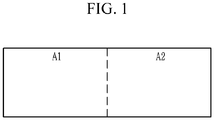
- FIG. 1 illustrates a hydrocarbon removal system according to an exemplary embodiment of the present invention.
- the hydrocarbon removal system includes a first area A1 including a first hydrocarbon adsorption catalyst having a first pore size and a second area A2 including a second hydrocarbon adsorption catalyst having a second pore size, and the first pore size is smaller than the second pore size.
- the first hydrocarbon adsorption catalyst may include CHA zeolite
- the second hydrocarbon adsorption catalyst may include ZSM-5 zeolite.
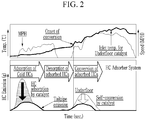
- FIG. 2 illustrates a configuration of purifying exhaust gas of a gasoline vehicle with a three-way catalyst.
- exhaust gas of a gasoline vehicle is purified by a three-way catalyst, and when a temperature of the catalyst is 400 °C or greater, the catalyst has a purification performance of about 100 %.
- the three-way catalyst may not be normally operated, thus the exhaust gas is not purified and is discharged into the atmosphere. Particularly, it is known that about 70 % of the hydrocarbons are discharged in the cold start section.
- the zeolite-based hydrocarbon adsorbent since the zeolite-based hydrocarbon adsorbent is introduced into the exhaust gas system, until a warm-up operation of the three-way catalyst is completed, the hydrocarbons discharged in the cold start section are adsorbed by the hydrocarbon adsorbent, and then, when the hydrocarbons are desorbed from the hydrocarbon adsorbent at the end of the warm-up of the three-way catalyst, it may be purified through the three-way catalyst.
- hydrocarbons C 1 H x to C 5 H y
- hydrocarbons C 1 H x to C 5 H y
- T/P HC EM tail pipe hydrocarbon emission
- the present invention includes a configuration to delay emission of hydrocarbons having a small number of carbon atoms until a time point of activation of a three-way catalyst (TWC) at a temperature of about 350 °C at which the hydrocarbons may be purified for purification of the hydrocarbons having the small number of carbon atoms that are difficult to chemically adsorb by a hydrocarbon adsorbent.
- TWC three-way catalyst
- the first hydrocarbon adsorption catalyst having a small pore size delays flow of hydrocarbons having 5 or less carbon atoms, so that the hydrocarbons having 5 or less carbon atoms are effectively adsorbed.
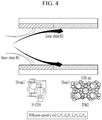
- FIG. 4 schematically illustrates a hydrocarbon removal system according to an exemplary embodiment.
- zeolite such as CHA having a narrow pore size traps hydrocarbons having a small number of carbon atoms.
- the hydrocarbons having the small number of carbon atoms for example a diffusion speed of C 2 H 2 , C 2 H 6 , C 4 H 8 , and C 5 H 12 .
- zeolite such as ZSM-5 with a large pore size on a rear surface traps long chain hydrocarbons (hydrocarbons with a large number of carbon atoms).
- the present invention includes a hydrocarbon adsorption catalyst having a pore size corresponding to a size of hydrocarbons that would slip.
- FIG. 1 illustrates a configuration in which the first area and the second area are separated from each other, but referring to FIG. 5 , the first hydrocarbon adsorption catalyst having the first pore size and the second hydrocarbon adsorption catalyst having the second pore size are mixed with each other, thereby evenly positioning them. Even in this case, the diffusion of the hydrocarbons having the small number of carbon atoms may be suppressed as in FIG. 1 .
- the hydrocarbon adsorption catalyst having a large pore size and the hydrocarbon adsorption catalyst having a small pore size are shown with different sizes.
- a ratio of weights of the first hydrocarbon adsorption catalyst and the second hydrocarbon adsorption catalyst in the hydrocarbon removal system of the present invention may be 1:9 to 5:5. That is, the ratio of the weights (g/L) of the hydrocarbon adsorption catalysts coated on the same area, that is, the ratio of the first hydrocarbon adsorption catalyst: the second hydrocarbon adsorption catalyst, may be 1:9 to 5:5, which is a range of mixing ratio that may effectively suppress the slip of hydrocarbons having a small number of carbon atoms. Effects of these ratios will be described later through experimental examples.
- the zeolite used in the present invention was prepared by calcining NH4-form Zeolite at 550 °C for 12 hours in the ambient atmosphere.
- the adsorption/desorption evaluation of the hydrocarbon adsorbent was performed by filling 60 mg of powdered H-CHA/ZSM-5 zeolite in a reaction tube after tandem mixing; after pre-treating it for 30 minutes at a temperature of 600 °C under He flow, adsorbing it under flow of a mixed gas of C 3 H 6 , C 7 H 8 , O 2 , and a carrier gas Ar/He for 5 minutes at a temperature of 70 °C; and then increasing a temperature at a heating speed of 53 °C/min.
- FIG. 6 illustrates a test temperature of an adsorption and desorption evaluation test
- FIG. 7 illustrates a specific experimental condition.
- FIG. 8 illustrates the evaluation results according to the present experiment.
- the C 3 H 6 hydrocarbon provided better adsorption performance in a CHA zeolite.
- a pore size of the CHA zeolite is 3.8 ⁇ *4.2 ⁇ , which is smaller than that of ZSM-5 zeolite (diameter 5.6 ⁇ ). Since a molecular size of C 3 H 6 to be adsorbed was 4.5 ⁇ , which was smaller than the pore size of the ZSM-5 and similar to the pore size of the CHA, it was confirmed that the CHA provided better adsorption performance.
- a slip degree of hydrocarbons was measured while varying the mixing ratio of the hydrocarbon adsorbent adsorbing a hydrocarbon having a large number of carbon atoms and the hydrocarbon adsorbent adsorbing a hydrocarbon having a small number of carbon atoms, and this is illustrated in FIG. 9 .
- a mixed weight ratio of the hydrocarbon adsorbent adsorbing the hydrocarbon having the large number of carbon atoms: the hydrocarbon adsorbent adsorbing the hydrocarbon having the small number of carbon atoms was 9:1 to 5:5, it can be conformed that a highest initial hydrocarbon slip reduction effect was obtained.
Landscapes
- Chemical & Material Sciences (AREA)
- Chemical Kinetics & Catalysis (AREA)
- Organic Chemistry (AREA)
- Analytical Chemistry (AREA)
- Engineering & Computer Science (AREA)
- Materials Engineering (AREA)
- Inorganic Chemistry (AREA)
- Oil, Petroleum & Natural Gas (AREA)
- General Chemical & Material Sciences (AREA)
- Crystallography & Structural Chemistry (AREA)
- Combustion & Propulsion (AREA)
- Nanotechnology (AREA)
- Thermal Sciences (AREA)
- Physics & Mathematics (AREA)
- Biomedical Technology (AREA)
- Health & Medical Sciences (AREA)
- Environmental & Geological Engineering (AREA)
- General Engineering & Computer Science (AREA)
- Mechanical Engineering (AREA)
- Solid-Sorbent Or Filter-Aiding Compositions (AREA)
- Catalysts (AREA)
- Exhaust Gas After Treatment (AREA)
- Silicates, Zeolites, And Molecular Sieves (AREA)
- Exhaust Gas Treatment By Means Of Catalyst (AREA)
- Treating Waste Gases (AREA)
- Separation Of Gases By Adsorption (AREA)
Abstract
Description
- This application claims priority to and the benefit of Korean Patent Application No.
10-2017-0183959 PCT/KR2018/016590 - The present invention relates to a hydrocarbon removal system using a catalyst for hydrocarbon removal.
- As interest in air pollution increases, regulations for a vehicle's exhaust gas such as CO, NOx, HC (hydrocarbons), and PM (particulate matter) in countries such as the United States and Europe are being strengthened. Among them, the HC is mostly oxidized by three-way catalysts (TWCs), and the three-way catalysts are activated at a temperature of about 200 to 300 °C or higher, and thus, in a cold start section in which the three-way catalysts are not activated, HC corresponding to 50 to 80 % of total HC emission is emitted. In order to reduce the HC emission, studies on a hydrocarbon adsorbent (HC trap) are being conducted. The hydrocarbon adsorbent is a device that adsorbs HC emitted in the cold start section, and desorbs the HC when the three-way catalyst becomes activated at a temperature of 200 to 300 °C.
- As a hydrocarbon adsorbent, zeolite having high physical and chemical stability have been much studied. Performance of the hydrocarbon adsorbent is tested by measuring adsorption/desorption of propene and toluene, which are typical HC emission materials. Studies on the performance of the hydrocarbon adsorbent according to a zeolite structure, a Si/Al ratio, and whether or not metal impregnation is performed, have been conducted.
- The present invention has been made in an effort to provide a hydrocarbon removal system that may effectively adsorb hydrocarbons by suppressing slip of hydrocarbons having a small number of carbon atoms.
- An exemplary embodiment of the present invention provides a hydrocarbon removal system, including: a first area including a first hydrocarbon adsorption catalyst having a first pore size; and a second area including a second hydrocarbon adsorption catalyst having a second pore size. The first pore size may be smaller than the second pore size, the first hydrocarbon adsorption catalyst may include CHA zeolite, and the second hydrocarbon adsorption catalyst may include ZSM-5 zeolite.
- The pore size of the first hydrocarbon adsorption catalyst may be 3.0 Å to 4.4 Å.
- The pore size of the second hydrocarbon adsorption catalyst may be 4.5 Å to 9.0 Å.
- A weight ratio of the first hydrocarbon adsorption catalyst and the second hydrocarbon adsorption catalyst in the hydrocarbon removal system may be 1:9 to 5:5.
- Another exemplary embodiment of the present invention provides a hydrocarbon removal system, including: a first hydrocarbon adsorption catalyst having a first pore size and a second hydrocarbon adsorption catalyst having a second pore size. The first hydrocarbon adsorption catalyst and the second hydrocarbon adsorption catalyst may be mixed, the first pore size may be smaller than the second pore size, the first hydrocarbon adsorption catalyst may include CHA zeolite, and the second hydrocarbon adsorption catalyst may include ZSM-5 zeolite.
- The pore size of the first hydrocarbon adsorption catalyst may be 3.5 Å to 4.5 Å.
- The pore size of the second hydrocarbon adsorption catalyst may be 4.5 Å to 9.0 Å.
- A mixed weight ratio of the first hydrocarbon adsorption catalyst and the second hydrocarbon adsorption catalyst may be 1:9 to 5:5.
- As described above, it is possible to provide a hydrocarbon removal system that may effectively adsorb hydrocarbons by suppressing slip of hydrocarbons having a small number of carbon atoms.
-
-
FIG. 1 illustrates a hydrocarbon removal system according to an exemplary embodiment of the present invention. -
FIG. 2 illustrates a configuration for purifying exhaust gas of a gasoline vehicle with a three-way catalyst. -
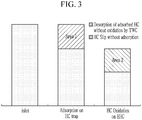
FIG. 3 illustrates a ratio of hydrocarbons that are not adsorbed in a hydrocarbon adsorbent. -
FIG. 4 schematically illustrates a hydrocarbon removal system according to an exemplary embodiment. -
FIG. 5 illustrates a hydrocarbon removal system according to another exemplary embodiment. -
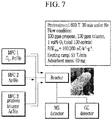
FIG. 6 illustrates a test temperature of an adsorption and desorption evaluation test, andFIG. 7 illustrates a specific experimental condition. -
FIG. 8 illustrates an evaluation result according to Experimental Example 1. -
FIG. 9 illustrates an evaluation result according to Experimental Example 2. - The present invention will be described more fully hereinafter with reference to the accompanying drawings, in which an embodiment of the invention is shown. As those skilled in the art would realize, the described embodiments may be modified in various different ways, all without departing from the spirit or scope of the present invention.
- A hydrocarbon removal system according to an exemplary embodiment of the present invention will now be described in detail with reference to the drawings.
-
FIG. 1 illustrates a hydrocarbon removal system according to an exemplary embodiment of the present invention. Referring toFIG. 1 , the hydrocarbon removal system according to this exemplary embodiment includes a first area A1 including a first hydrocarbon adsorption catalyst having a first pore size and a second area A2 including a second hydrocarbon adsorption catalyst having a second pore size, and the first pore size is smaller than the second pore size. For example, the first hydrocarbon adsorption catalyst may include CHA zeolite, and the second hydrocarbon adsorption catalyst may include ZSM-5 zeolite. - The hydrocarbon removal system according to the present embodiment will now be described in more detail.
-
FIG. 2 illustrates a configuration of purifying exhaust gas of a gasoline vehicle with a three-way catalyst. Referring toFIG. 2 , exhaust gas of a gasoline vehicle is purified by a three-way catalyst, and when a temperature of the catalyst is 400 °C or greater, the catalyst has a purification performance of about 100 %. However, in a cold-start section immediately after an engine starts, the three-way catalyst may not be normally operated, thus the exhaust gas is not purified and is discharged into the atmosphere. Particularly, it is known that about 70 % of the hydrocarbons are discharged in the cold start section. - However, in this exemplary embodiment, since the zeolite-based hydrocarbon adsorbent is introduced into the exhaust gas system, until a warm-up operation of the three-way catalyst is completed, the hydrocarbons discharged in the cold start section are adsorbed by the hydrocarbon adsorbent, and then, when the hydrocarbons are desorbed from the hydrocarbon adsorbent at the end of the warm-up of the three-way catalyst, it may be purified through the three-way catalyst.
- During this process, hydrocarbons (C1Hx to C5Hy) with a small number of carbon atoms that are not adsorbed by the hydrocarbon adsorbent and are emitted at the same time as the engine starts, occupy about 30 % of a total of tail pipe hydrocarbon emission (T/P HC EM). This is illustrated in
FIG. 3 . That is, the hydrocarbons with a small number of carbon atoms are not absorbed but are quickly discharged, and in order to respond to strengthened exhaust regulations in the future, it is urgent to improve purification performance for the hydrocarbons with the small number of carbon atoms. - Therefore, the present invention includes a configuration to delay emission of hydrocarbons having a small number of carbon atoms until a time point of activation of a three-way catalyst (TWC) at a temperature of about 350 °C at which the hydrocarbons may be purified for purification of the hydrocarbons having the small number of carbon atoms that are difficult to chemically adsorb by a hydrocarbon adsorbent.
- That is, in the present invention, by mixing and using hydrocarbon removal catalysts having different pore sizes, a problem that hydrocarbons with a small number of carbon atoms rapidly exit a hydrocarbon removal system and thus are not adsorbed therein is solved. In this case, the first hydrocarbon adsorption catalyst having a small pore size delays flow of hydrocarbons having 5 or less carbon atoms, so that the hydrocarbons having 5 or less carbon atoms are effectively adsorbed.
-
FIG. 4 schematically illustrates a hydrocarbon removal system according to an exemplary embodiment. Referring toFIG. 4 , zeolite such as CHA having a narrow pore size traps hydrocarbons having a small number of carbon atoms. Thus, the hydrocarbons having the small number of carbon atoms, for example a diffusion speed of C2H2, C2H6, C4H8, and C5H12, is reduced. In addition, zeolite such as ZSM-5 with a large pore size on a rear surface traps long chain hydrocarbons (hydrocarbons with a large number of carbon atoms). - That is, in order to reduce emission of hydrocarbons (C1Hx to C5Hy) having a small number of carbon atoms that are discharged without being adsorbed to the hydrocarbon adsorbent during an initial cold start, the present invention includes a hydrocarbon adsorption catalyst having a pore size corresponding to a size of hydrocarbons that would slip. Therefore, by zone-coating or mixing two or more hydrocarbon adsorption catalysts having different pores to arrange and use them in a 1 to 2 layered structure and thus delaying diffusion of hydrocarbons (C1Hx to C5Hy) having a physically small number of carbon atoms, it is possible to improve hydrocarbon emission in a cold start section by oxidizing them with a three-way catalyst (TWC) activated by an electrically heated catalyst (EHC).
-
FIG. 1 illustrates a configuration in which the first area and the second area are separated from each other, but referring toFIG. 5 , the first hydrocarbon adsorption catalyst having the first pore size and the second hydrocarbon adsorption catalyst having the second pore size are mixed with each other, thereby evenly positioning them. Even in this case, the diffusion of the hydrocarbons having the small number of carbon atoms may be suppressed as inFIG. 1 . InFIG. 5 , the hydrocarbon adsorption catalyst having a large pore size and the hydrocarbon adsorption catalyst having a small pore size are shown with different sizes. - A ratio of weights of the first hydrocarbon adsorption catalyst and the second hydrocarbon adsorption catalyst in the hydrocarbon removal system of the present invention may be 1:9 to 5:5. That is, the ratio of the weights (g/L) of the hydrocarbon adsorption catalysts coated on the same area, that is, the ratio of the first hydrocarbon adsorption catalyst: the second hydrocarbon adsorption catalyst, may be 1:9 to 5:5, which is a range of mixing ratio that may effectively suppress the slip of hydrocarbons having a small number of carbon atoms. Effects of these ratios will be described later through experimental examples.
- Hereinafter, a hydrocarbon removal system according to an embodiment of the present invention will be described in detail through specific experimental examples.
- The zeolite used in the present invention was prepared by calcining NH4-form Zeolite at 550 °C for 12 hours in the ambient atmosphere. The adsorption/desorption evaluation of the hydrocarbon adsorbent was performed by filling 60 mg of powdered H-CHA/ZSM-5 zeolite in a reaction tube after tandem mixing; after pre-treating it for 30 minutes at a temperature of 600 °C under He flow, adsorbing it under flow of a mixed gas of C3H6, C7H8, O2, and a carrier gas Ar/He for 5 minutes at a temperature of 70 °C; and then increasing a temperature at a heating speed of 53 °C/min.
-
FIG. 6 illustrates a test temperature of an adsorption and desorption evaluation test, andFIG. 7 illustrates a specific experimental condition. -
FIG. 8 illustrates the evaluation results according to the present experiment. - Referring to
FIG. 8 , the C3H6 hydrocarbon provided better adsorption performance in a CHA zeolite. A pore size of the CHA zeolite is 3.8 Å*4.2 Å, which is smaller than that of ZSM-5 zeolite (diameter 5.6 Å). Since a molecular size of C3H6 to be adsorbed was 4.5 Å, which was smaller than the pore size of the ZSM-5 and similar to the pore size of the CHA, it was confirmed that the CHA provided better adsorption performance. - In contrast, since C7H8 had a molecular size (5.85 Å) that was difficult to pass through the pore of the CHA, it was confirmed that it was hardly adsorbed to the CHA. However, in ZSM-5 having a similar size thereto, it can be seen that high adsorption performance for C7H8 was provided and the desorption temperature was high.
- A slip degree of hydrocarbons was measured while varying the mixing ratio of the hydrocarbon adsorbent adsorbing a hydrocarbon having a large number of carbon atoms and the hydrocarbon adsorbent adsorbing a hydrocarbon having a small number of carbon atoms, and this is illustrated in
FIG. 9 . Referring toFIG. 9 , when a mixed weight ratio of the hydrocarbon adsorbent adsorbing the hydrocarbon having the large number of carbon atoms: the hydrocarbon adsorbent adsorbing the hydrocarbon having the small number of carbon atoms was 9:1 to 5:5, it can be conformed that a highest initial hydrocarbon slip reduction effect was obtained. - While this invention has been described in connection with what is presently considered to be practical embodiments, it is to be understood that the invention is not limited to the disclosed embodiments, but, on the contrary, is intended to cover various modifications and equivalent arrangements included within the spirit and scope of the appended claims.
Claims (8)
- A hydrocarbon removal system, comprising:a first area comprising a first hydrocarbon adsorption catalyst having a first pore size; anda second area comprising a second hydrocarbon adsorption catalyst having a second pore size,wherein the first pore size is smaller than the second pore size,the first hydrocarbon adsorption catalyst comprises CHA zeolite, andthe second hydrocarbon adsorption catalyst comprises ZSM-5 zeolite.
- The hydrocarbon removal system of claim 1, wherein
the pore size of the first hydrocarbon adsorption catalyst is 3.5 Å to 4.4 Å. - The hydrocarbon removal system of claim 1, wherein
the pore size of the second hydrocarbon adsorption catalyst is 4.5 Å to 9.0 Å. - The hydrocarbon removal system of claim 1, wherein
a weight ratio of the first hydrocarbon adsorption catalyst and the second hydrocarbon adsorption catalyst in the hydrocarbon removal system is 1:9 to 5:5. - A hydrocarbon removal system, comprising:a first hydrocarbon adsorption catalyst having a first pore size and a second hydrocarbon adsorption catalyst having a second pore size, wherein the first hydrocarbon adsorption catalyst and the second hydrocarbon adsorption catalyst are mixed;the first pore size is smaller than the second pore size;the first hydrocarbon adsorption catalyst includes CHA zeolite; andthe second hydrocarbon adsorption catalyst includes ZSM-5 zeolite.
- The hydrocarbon removal system of claim 5, wherein
the pore size of the first hydrocarbon adsorption catalyst is 3.5 Å to 4.5 Å. - The hydrocarbon removal system of claim 5, wherein
the pore size of the second hydrocarbon adsorption catalyst is 4.5 Å to 9.0 Å. - The hydrocarbon removal system of claim 5, wherein
a mixed weight ratio of the first hydrocarbon adsorption catalyst and the second hydrocarbon adsorption catalyst is 1:9 to 5:5.
Applications Claiming Priority (3)
| Application Number | Priority Date | Filing Date | Title |
|---|---|---|---|
| KR1020170183959A KR102085652B1 (en) | 2017-12-29 | 2017-12-29 | Hydrocarbon Trap Comprising Metal-impregnated Zeolite Particles Having Regular Mesopores and Method of Preparing the Same |
| PCT/KR2018/016590 WO2019132482A1 (en) | 2017-12-29 | 2018-12-24 | Hydrocarbon adsorbent with metal-impregnated zeolite particle having regular mesopore and manufacturing method therefor |
| PCT/KR2018/016906 WO2019132612A1 (en) | 2017-12-29 | 2018-12-28 | Hydrocarbon removal system |
Publications (2)
| Publication Number | Publication Date |
|---|---|
| EP3733281A1 true EP3733281A1 (en) | 2020-11-04 |
| EP3733281A4 EP3733281A4 (en) | 2021-08-25 |
Family
ID=67067909
Family Applications (3)
| Application Number | Title | Priority Date | Filing Date |
|---|---|---|---|
| EP18893856.7A Withdrawn EP3733280A4 (en) | 2017-12-29 | 2018-12-24 | HYDROCARBON ADSORBANT WITH A METAL-IMPREGNATED ZEOLITE PARTICLE HAVING A REGULAR MESOPORE AND ITS MANUFACTURING PROCESS |
| EP18895622.1A Pending EP3733281A4 (en) | 2017-12-29 | 2018-12-28 | HYDROCARBON REMOVAL SYSTEM |
| EP18896734.3A Withdrawn EP3733282A4 (en) | 2017-12-29 | 2018-12-28 | HYDROCARBON ADSORBANT |
Family Applications Before (1)
| Application Number | Title | Priority Date | Filing Date |
|---|---|---|---|
| EP18893856.7A Withdrawn EP3733280A4 (en) | 2017-12-29 | 2018-12-24 | HYDROCARBON ADSORBANT WITH A METAL-IMPREGNATED ZEOLITE PARTICLE HAVING A REGULAR MESOPORE AND ITS MANUFACTURING PROCESS |
Family Applications After (1)
| Application Number | Title | Priority Date | Filing Date |
|---|---|---|---|
| EP18896734.3A Withdrawn EP3733282A4 (en) | 2017-12-29 | 2018-12-28 | HYDROCARBON ADSORBANT |
Country Status (6)
| Country | Link |
|---|---|
| US (5) | US20200360891A1 (en) |
| EP (3) | EP3733280A4 (en) |
| JP (3) | JP7217278B2 (en) |
| KR (1) | KR102085652B1 (en) |
| CN (3) | CN111542388A (en) |
| WO (3) | WO2019132482A1 (en) |
Cited By (1)
| Publication number | Priority date | Publication date | Assignee | Title |
|---|---|---|---|---|
| GB2581776B (en) * | 2019-02-19 | 2022-08-17 | Jaguar Land Rover Ltd | Catalytic converter core having first and second regions with different thermal inertia |
Families Citing this family (10)
| Publication number | Priority date | Publication date | Assignee | Title |
|---|---|---|---|---|
| JP7540167B2 (en) * | 2020-03-10 | 2024-08-27 | 東ソー株式会社 | Hydrophobic MFI zeolite, its production method, and its uses |
| WO2021201018A1 (en) * | 2020-03-31 | 2021-10-07 | 東ソー株式会社 | Hydrocarbon adsorbent and hydrocarbon adsorption method |
| JPWO2022085753A1 (en) * | 2020-10-23 | 2022-04-28 | ||
| KR20220067569A (en) * | 2020-11-16 | 2022-05-25 | 현대자동차주식회사 | Catalyst for adsorbing hydrocarbon and hydrocarbon trap comprising the same |
| KR102509811B1 (en) * | 2020-11-24 | 2023-03-14 | 고려대학교 산학협력단 | Hydrocarbon adsorption and desorption complex comprising gas-adsorption-part and reinforcement-part and preparation method thereof |
| KR102529419B1 (en) * | 2020-11-24 | 2023-05-08 | 고려대학교 산학협력단 | Hydrocarbon adsorption and desorption complex comprising zeolite with controlled cation ratio and preparation method thereof |
| KR102529420B1 (en) * | 2020-11-24 | 2023-05-08 | 고려대학교 산학협력단 | Hydrocarbon adsorption and desorption complex comprising zeolite with controlled cation and preparation method thereof |
| KR20240068833A (en) * | 2022-11-08 | 2024-05-20 | 현대자동차주식회사 | Method for preparing a hydrocarbon adsorption catalyst, a hydrocarbon adsorption catalyst prepared thereby, and a hydrocarbon trap comprising the same |
| CN115770612A (en) * | 2022-12-06 | 2023-03-10 | 中国科学院青岛生物能源与过程研究所 | Catalyst for preparing methanol by carbon dioxide hydrogenation and preparation method and application thereof |
| CN115920589B (en) * | 2022-12-21 | 2023-08-11 | 可迪尔空气技术(北京)有限公司 | Treatment method of low-concentration sewage pool waste gas |
Family Cites Families (37)
| Publication number | Priority date | Publication date | Assignee | Title |
|---|---|---|---|---|
| US3895080A (en) * | 1972-06-06 | 1975-07-15 | Sun Research Development | Separation of cyclic compounds by adsorption on partially sorbed metallic zeolites |
| US3929669A (en) * | 1972-12-22 | 1975-12-30 | Universal Oil Prod Co | Method for manufacturing an adsorbent useful for olefin separation |
| US4297328A (en) * | 1979-09-28 | 1981-10-27 | Union Carbide Corporation | Three-way catalytic process for gaseous streams |
| JPS59196745A (en) * | 1983-03-31 | 1984-11-08 | Res Assoc Residual Oil Process<Rarop> | Iron-containing zeolite composition |
| US5185305A (en) * | 1991-11-08 | 1993-02-09 | Ford Motor Company | Catalyst system for treating the exhaust from a lean-burn gasoline-fueled engine |
| JP3616112B2 (en) * | 1992-12-28 | 2005-02-02 | 日産自動車株式会社 | Hydrocarbon adsorbent |
| JP3207577B2 (en) * | 1993-01-20 | 2001-09-10 | 三菱重工業株式会社 | Hydrocarbon adsorbent and adsorption purification method |
| JP3190780B2 (en) * | 1994-03-17 | 2001-07-23 | 出光興産株式会社 | Hydrocarbon adsorption catalyst for exhaust gas purification |
| JPH0810613A (en) * | 1994-07-05 | 1996-01-16 | Ngk Insulators Ltd | Adsorbing material for purifying exhaust gas of car |
| JPH0975721A (en) * | 1995-09-12 | 1997-03-25 | Tokyo Gas Co Ltd | Adsorbent for removing trace components in hydrocarbon gas and removal method |
| EP0768111A1 (en) * | 1995-10-16 | 1997-04-16 | Corning Incorporated | Method of modifying a hydrocarbon adsorber and its use |
| KR100490511B1 (en) * | 1996-05-29 | 2005-08-04 | 엑손모빌 케미칼 패턴츠 인코포레이티드 | Zeolite catalyst and its use in hydrocarbon conversion |
| JP3918305B2 (en) * | 1997-07-02 | 2007-05-23 | 東ソー株式会社 | Hydrocarbon adsorbent and exhaust gas purification catalyst |
| DE69826768T2 (en) * | 1997-07-02 | 2006-03-09 | Tosoh Corp., Shinnanyo | Adsorbent for hydrocarbon and catalyst for exhaust gas purification |
| JP3417309B2 (en) * | 1997-10-28 | 2003-06-16 | トヨタ自動車株式会社 | Hydrocarbon adsorbent |
| WO2000066263A1 (en) * | 1999-05-05 | 2000-11-09 | Exxon Chemical Patents Inc. | Zeolite bound catalyst containing at least three different zeolites; use for hydrocarbon conversion |
| FR2863909B1 (en) * | 2003-12-22 | 2006-05-26 | Ceca Sa | PROCESS FOR PURIFYING GASEOUS STREAMS CONTAMINATED BY CO2 AND HYDROCARBON (S) AND / OR NITROGEN OXIDE (S) BY AGGLOMERIC ZEOLITIC ADSORBENT |
| WO2007080288A1 (en) * | 2005-12-22 | 2007-07-19 | Institut Francais Du Petrole | Irregularly shaped, non-spherical supported catalyst and process for hydroconversion of heavy petroleum fractions |
| DE102005061713B4 (en) * | 2005-12-22 | 2015-05-21 | Süd-Chemie Ip Gmbh & Co. Kg | Volatile hydrocarbon adsorber unit, method of making a zeolitic adsorbent material and zeolitic adsorbent material obtainable by the method |
| FR2895283B1 (en) * | 2005-12-22 | 2008-02-01 | Inst Francais Du Petrole | CATALYST COMPRISING EUO ZEOLITHE, 10MR ZEOLITE AND 12MR ZEOLITE AND ITS USE IN ISOMERIZATION OF AROMATIC C8 COMPOUNDS |
| JP4956112B2 (en) | 2006-09-22 | 2012-06-20 | 三菱自動車工業株式会社 | Method for preparing HC trap catalyst |
| US8413433B2 (en) * | 2008-07-17 | 2013-04-09 | Ford Global Technologies, Llc | Hydrocarbon retaining and purging system |
| KR101062666B1 (en) * | 2009-02-02 | 2011-09-06 | 한국과학기술원 | Palladium-supported mesoporous zeolite |
| US8147588B2 (en) * | 2009-10-06 | 2012-04-03 | Basf Corporation | Lower reactivity adsorbent and higher oxygenate capacity for removal of oxygenates from olefin streams |
| CN102946998A (en) * | 2010-04-08 | 2013-02-27 | 巴斯夫欧洲公司 | Cu-CHA/Fe-MFI hybrid zeolite catalyst and method of using same for treating NOx in gas streams |
| JP2011240273A (en) | 2010-05-19 | 2011-12-01 | Jx Nippon Oil & Energy Corp | Adsorbent, its production method and fuel desulfurization method |
| MX343465B (en) * | 2010-05-21 | 2016-11-07 | Pq Corp | Novel metal - containing zeolite beta for nox reduction. |
| GB201100595D0 (en) * | 2010-06-02 | 2011-03-02 | Johnson Matthey Plc | Filtration improvements |
| KR101147669B1 (en) * | 2010-07-05 | 2012-05-21 | 한국과학기술원 | Zeolite materials and their analogue materials comprising regularly or randomly arranged mesopore , and producing method thereof |
| KR101451902B1 (en) * | 2012-11-26 | 2014-10-22 | 한국과학기술원 | Zeolite with MRE structure and their analogue materials possessing mesopore, and synthesis method thereof |
| DK3016741T3 (en) * | 2013-07-05 | 2020-07-27 | Univ Danmarks Tekniske | Process for the production of zeolites and zeotypes |
| JP6398448B2 (en) * | 2013-08-30 | 2018-10-03 | 東ソー株式会社 | Pentasil-type zeolite and method for producing the same |
| US9463447B2 (en) * | 2014-01-29 | 2016-10-11 | Ford Global Technologies, Llc | Hydrocarbon trap with increased zeolite loading and improved adsorption capacity |
| JP6294127B2 (en) * | 2014-03-31 | 2018-03-14 | 株式会社キャタラー | SCR catalyst and exhaust gas purification catalyst system |
| BR112018015547A2 (en) * | 2016-02-19 | 2018-12-26 | Exxonmobil Res & Eng Co | small crystal emm-30 zeolites, high surface area, their synthesis and use |
| US10105691B2 (en) * | 2016-03-31 | 2018-10-23 | Ford Global Technologies, Llc | Multiple zeolite hydrocarbon traps |
| BR112018072009A2 (en) * | 2016-04-26 | 2019-02-12 | Basf Corporation | exhaust gas treatment system and method for reducing carbon monoxide present in an exhaust gas stream |
-
2017
- 2017-12-29 KR KR1020170183959A patent/KR102085652B1/en active Active
-
2018
- 2018-12-24 EP EP18893856.7A patent/EP3733280A4/en not_active Withdrawn
- 2018-12-24 CN CN201880084499.5A patent/CN111542388A/en active Pending
- 2018-12-24 WO PCT/KR2018/016590 patent/WO2019132482A1/en not_active Ceased
- 2018-12-24 JP JP2020535532A patent/JP7217278B2/en active Active
- 2018-12-28 US US16/957,658 patent/US20200360891A1/en not_active Abandoned
- 2018-12-28 JP JP2020535596A patent/JP2021509086A/en active Pending
- 2018-12-28 CN CN201880084423.2A patent/CN111655367A/en active Pending
- 2018-12-28 US US16/957,927 patent/US20210370219A1/en not_active Abandoned
- 2018-12-28 JP JP2020536557A patent/JP2021509087A/en active Pending
- 2018-12-28 EP EP18895622.1A patent/EP3733281A4/en active Pending
- 2018-12-28 EP EP18896734.3A patent/EP3733282A4/en not_active Withdrawn
- 2018-12-28 CN CN201880084462.2A patent/CN111526941A/en active Pending
- 2018-12-28 WO PCT/KR2018/016905 patent/WO2019132611A1/en not_active Ceased
- 2018-12-28 WO PCT/KR2018/016906 patent/WO2019132612A1/en not_active Ceased
-
2020
- 2020-06-26 US US16/913,671 patent/US20200391178A1/en not_active Abandoned
- 2020-06-26 US US16/913,466 patent/US20200324268A1/en not_active Abandoned
-
2023
- 2023-02-03 US US18/163,914 patent/US20230191362A1/en not_active Abandoned
Cited By (1)
| Publication number | Priority date | Publication date | Assignee | Title |
|---|---|---|---|---|
| GB2581776B (en) * | 2019-02-19 | 2022-08-17 | Jaguar Land Rover Ltd | Catalytic converter core having first and second regions with different thermal inertia |
Also Published As
| Publication number | Publication date |
|---|---|
| JP2021509635A (en) | 2021-04-01 |
| US20200391178A1 (en) | 2020-12-17 |
| EP3733280A4 (en) | 2021-10-27 |
| WO2019132612A1 (en) | 2019-07-04 |
| EP3733282A4 (en) | 2021-11-03 |
| WO2019132611A8 (en) | 2019-08-01 |
| JP2021509086A (en) | 2021-03-18 |
| CN111526941A (en) | 2020-08-11 |
| EP3733282A1 (en) | 2020-11-04 |
| EP3733281A4 (en) | 2021-08-25 |
| CN111655367A (en) | 2020-09-11 |
| WO2019132482A1 (en) | 2019-07-04 |
| US20230191362A1 (en) | 2023-06-22 |
| CN111542388A (en) | 2020-08-14 |
| JP7217278B2 (en) | 2023-02-02 |
| KR20190081424A (en) | 2019-07-09 |
| US20210370219A1 (en) | 2021-12-02 |
| JP2021509087A (en) | 2021-03-18 |
| EP3733280A1 (en) | 2020-11-04 |
| US20200324268A1 (en) | 2020-10-15 |
| US20200360891A1 (en) | 2020-11-19 |
| KR102085652B1 (en) | 2020-03-06 |
| WO2019132611A1 (en) | 2019-07-04 |
Similar Documents
| Publication | Publication Date | Title |
|---|---|---|
| US20210370219A1 (en) | Hydrocarbon removal system | |
| JP3311051B2 (en) | Exhaust gas purification method and apparatus | |
| CN201513221U (en) | Aftertreatment systems used in lean burn engines | |
| US10926240B2 (en) | Hydrocarbon trap with increased zeolite loading and improved adsorption capacity | |
| CN105813717A (en) | Passive NOx Adsorbent Comprising Noble Metals and Small Pore Molecular Sieves | |
| US9446395B2 (en) | Low temperature catalyst/hydrocarbon trap | |
| CN115430458A (en) | Cold start catalyst and use thereof in exhaust systems | |
| JP2001300319A (en) | Exhaust gas purification catalyst and method for producing the same | |
| EP2802408A2 (en) | Improved nox trap | |
| US20080159936A1 (en) | Treatment of cold start engine exhaust | |
| JP2020514014A (en) | NOx adsorber catalyst | |
| JP3854134B2 (en) | Exhaust gas purification device for internal combustion engine | |
| WO2015066312A1 (en) | Three-way catalyst comprising a silver-containing extruded zeolite substrate and its use in exhaust systems | |
| CN103375231A (en) | Combined hydrocarbon trap and catalyst | |
| JP7579260B2 (en) | Catalyst for reducing nitrogen oxides | |
| JPH07332073A (en) | Exhaust gas purification device | |
| JPH06200744A (en) | System and method of converting exhaust gas | |
| JP4145019B2 (en) | Exhaust gas purification device | |
| CN101466467A (en) | Adsorbent for exhaust gas | |
| JPH05317701A (en) | Engine exhaust purification adsorbent | |
| JP2002239346A (en) | Exhaust gas purification device and manufacturing method | |
| JPH0985078A (en) | Exhaust gas purification device for engine | |
| JP2004097900A (en) | Cleaning catalyst for hydrocarbon-containing exhaust gas | |
| JPH0985056A (en) | Exhaust gas purification device for engine | |
| JP2003260362A (en) | Hydrocarbon adsorption/combustion catalyst and its manufacturing method |
Legal Events
| Date | Code | Title | Description |
|---|---|---|---|
| STAA | Information on the status of an ep patent application or granted ep patent |
Free format text: STATUS: THE INTERNATIONAL PUBLICATION HAS BEEN MADE |
|
| PUAI | Public reference made under article 153(3) epc to a published international application that has entered the european phase |
Free format text: ORIGINAL CODE: 0009012 |
|
| STAA | Information on the status of an ep patent application or granted ep patent |
Free format text: STATUS: REQUEST FOR EXAMINATION WAS MADE |
|
| 17P | Request for examination filed |
Effective date: 20200623 |
|
| AK | Designated contracting states |
Kind code of ref document: A1 Designated state(s): AL AT BE BG CH CY CZ DE DK EE ES FI FR GB GR HR HU IE IS IT LI LT LU LV MC MK MT NL NO PL PT RO RS SE SI SK SM TR |
|
| AX | Request for extension of the european patent |
Extension state: BA ME |
|
| DAV | Request for validation of the european patent (deleted) | ||
| DAX | Request for extension of the european patent (deleted) | ||
| RAP3 | Party data changed (applicant data changed or rights of an application transferred) |
Owner name: HYUNDAI MOTOR COMPANY Owner name: KOREA UNIVERSITY RESEARCH AND BUSINESS FOUNDATION Owner name: KIA CORPORATION |
|
| A4 | Supplementary search report drawn up and despatched |
Effective date: 20210728 |
|
| RIC1 | Information provided on ipc code assigned before grant |
Ipc: B01J 20/32 20060101AFI20210722BHEP Ipc: B01J 20/28 20060101ALI20210722BHEP Ipc: B01J 20/18 20060101ALI20210722BHEP Ipc: B01D 53/04 20060101ALI20210722BHEP Ipc: B01J 29/72 20060101ALI20210722BHEP Ipc: B01J 29/80 20060101ALI20210722BHEP Ipc: B01J 29/40 20060101ALI20210722BHEP Ipc: B01J 35/00 20060101ALI20210722BHEP Ipc: B01J 20/30 20060101ALI20210722BHEP Ipc: B01J 20/34 20060101ALI20210722BHEP |
|
| P01 | Opt-out of the competence of the unified patent court (upc) registered |
Effective date: 20230527 |
|
| STAA | Information on the status of an ep patent application or granted ep patent |
Free format text: STATUS: EXAMINATION IS IN PROGRESS |
|
| 17Q | First examination report despatched |
Effective date: 20250219 |