EP3732438B1 - Vision laser receiver - Google Patents
Vision laser receiver Download PDFInfo
- Publication number
- EP3732438B1 EP3732438B1 EP18837076.1A EP18837076A EP3732438B1 EP 3732438 B1 EP3732438 B1 EP 3732438B1 EP 18837076 A EP18837076 A EP 18837076A EP 3732438 B1 EP3732438 B1 EP 3732438B1
- Authority
- EP
- European Patent Office
- Prior art keywords
- receptive surface
- light receptive
- laser
- light
- laser receiver
- Prior art date
- Legal status (The legal status is an assumption and is not a legal conclusion. Google has not performed a legal analysis and makes no representation as to the accuracy of the status listed.)
- Active
Links
Images






Classifications
-
- G—PHYSICS
- G01—MEASURING; TESTING
- G01C—MEASURING DISTANCES, LEVELS OR BEARINGS; SURVEYING; NAVIGATION; GYROSCOPIC INSTRUMENTS; PHOTOGRAMMETRY OR VIDEOGRAMMETRY
- G01C9/00—Measuring inclination, e.g. by clinometers, by levels
- G01C9/02—Details
- G01C9/06—Electric or photoelectric indication or reading means
-
- G—PHYSICS
- G01—MEASURING; TESTING
- G01C—MEASURING DISTANCES, LEVELS OR BEARINGS; SURVEYING; NAVIGATION; GYROSCOPIC INSTRUMENTS; PHOTOGRAMMETRY OR VIDEOGRAMMETRY
- G01C15/00—Surveying instruments or accessories not provided for in groups G01C1/00 - G01C13/00
- G01C15/002—Active optical surveying means
- G01C15/004—Reference lines, planes or sectors
- G01C15/006—Detectors therefor
-
- G—PHYSICS
- G01—MEASURING; TESTING
- G01S—RADIO DIRECTION-FINDING; RADIO NAVIGATION; DETERMINING DISTANCE OR VELOCITY BY USE OF RADIO WAVES; LOCATING OR PRESENCE-DETECTING BY USE OF THE REFLECTION OR RERADIATION OF RADIO WAVES; ANALOGOUS ARRANGEMENTS USING OTHER WAVES
- G01S17/00—Systems using the reflection or reradiation of electromagnetic waves other than radio waves, e.g. lidar systems
- G01S17/87—Combinations of systems using electromagnetic waves other than radio waves
- G01S17/875—Combinations of systems using electromagnetic waves other than radio waves for determining attitude
-
- G—PHYSICS
- G01—MEASURING; TESTING
- G01C—MEASURING DISTANCES, LEVELS OR BEARINGS; SURVEYING; NAVIGATION; GYROSCOPIC INSTRUMENTS; PHOTOGRAMMETRY OR VIDEOGRAMMETRY
- G01C9/00—Measuring inclination, e.g. by clinometers, by levels
- G01C9/02—Details
- G01C9/06—Electric or photoelectric indication or reading means
- G01C2009/066—Electric or photoelectric indication or reading means optical
Definitions
- the present invention relates generally to laser receivers, and more particularly, to laser receivers of the type utilized in a variety of worksite applications such as construction and/or agricultural applications.
- Worksite preparation typically includes grading and excavating portions of the worksite to form desired slopes or footprints.
- Relative elevation measurement is a critical element in most construction and agricultural worksite applications and the use of laser receivers to facilitate elevation measurement in such applications is widespread.
- laser receivers are commonly attached to construction equipment (e.g., dozers, scrapers, excavators, and the like) to improve grading and excavating accuracy.
- these laser receivers typically include multiple radiation or sensing arrays, which are spatially arranged in a vertical pattern and which respond to impingement by a radiation source such as a laser beam.
- a radiation source such as a laser beam.
- Such lasers typically utilize three (3) or four (4) sensing arrays spaced at 120 degree or 90 degree intervals, as the case may be.
- Each array of the laser receiver requires multiple individual photo detectors and associated monitoring circuitry.
- EP 2 559 967 A1 discloses an electronic light detection circuit for detecting an intensity modulated light signal on a photosensitive element under backlight condition.
- the circuit comprises the photosensitive element, in particular as a light position detector for detecting a striking position of the light signal spot within a detection window, an amplifier with high input resistance connected to an output of the photosensitive element and a backlight suppression circuitry.
- the backlight suppression circuitry is connected to the output of the photosensitive element in parallel to the amplifier and comprises an electronic active resonator structure.
- the active resonator structure is designed in such a way to provide a load impedance to an output of the photosensitive element with a low load impedance for low frequencies for suppression of natural and artificial backlight-saturation of the photosensitive element and a high load impedance at the frequency of intensity modulation.
- a vision laser receiver having a light receptive surface with a fixed geometry such that laser light striking the sensing surface will illuminate a particular section of the sensing surface and be visible, observable and/or detectable.
- An image sensor configured internal will observe and detect the illumination of the light receptive surface manifesting as an arc with a fixed radius based on the fixed geometry of the light receptive surface and the precise elevation and/or tilt of the laser receiver will be determined from the illumination of the light receptive surface.
- a laser receiver which comprises a housing and a light receptive surface configured therein having a fixed geometry and which is light receptive.
- the term "light receptive” will be understood to mean a surface that is receptive to an incoming light beam such that the light beam is visible, observable and/or detectable at or on the surface.
- the light receptive surface can be in the shape of a cone, column, cylinder or other similar fixed, geometric shape.
- the geometry of the light receptive surface, together with the light receptivity of the surface, will facilitate the elevation determination in accordance with various embodiments as detailed further herein below.
- the laser receiver also has an image sensor, illustratively, a camera, charge-coupled device (CCD) or CMOS image sensor for observing and detecting an incoming radiation source (e.g., a laser beam) to the laser receiver and detecting a position on the light receptive surface which is impinged by the radiation source.
- the laser receiver further includes a processor (e.g., digital signal processor (DSP)) which is responsive to the impingement of the light receptive surface through the processing of data collected from the illuminated region of the light receptive surface and for determining the laser position (i.e., the elevation of the laser) therefrom.
- DSP digital signal processor
- laser light striking the light receptive surface will illuminate a particular section of the light receptive surface which will be detected and observed by the image sensor and provided as input to the digital signal processor which will execute vision recognition steps to determine the position of the radiation strike on the illuminated light receptive surface and, in turn, determine the precise elevation of the laser.
- the laser receiver is further able to determine any tilt (i.e., the tilt angle) in the laser receiver.
- any tilt i.e., the tilt angle
- adjustments and compensations are made as a function of the angle of the plane on which the laser strikes the light receptive surface thereby allowing for the determination of the tilt angle.
- a vision laser receiver having a light receptive surface such that laser light received at the light receptive surface will illuminate a particular section of the light receptive surface (i.e., will be visible, observable and/or detectable).
- the light receptive surface has a defined geometry and is light receptive.
- An image sensor will detect and observe the illumination of the light receptive surface and determine a precise position (e.g., vertical position) of such illuminated section on the light receptive surface. The elevation of the laser can then be determined from such detected position.
- each light sensing array will have multiple individual photo detectors and multiple circuit boards and connectors for the individual sensor arrays 140-1, 140-2, and 140-3.
- Laser receivers, such laser receiver 100 deliver excellent precision and are widely used but their design requirements tend to increase factors such as part count, mechanical and electrical complexity, and cost.
- FIG. 2 shows a fully assembled view of laser receiver 200 configured in accordance with an embodiments including an example of a reflective mode, wherein the reflective mode is not claimed according to the wording of the claims .
- laser receiver 200 has a housing 230, housing top 210, housing base 220 and power and data connector 280 built into housing base 220.
- Housing 230 is illustratively constructed to include a fully transparent portion to allow for the detection of laser light.
- the transparent housing may be dyed (e.g., red) to allow light of a desired wavelength to pass and block other wavelengths in a well-known fashion. In this way, the dyed transparent housing will eliminate the need for image sensor 260 to filter out any unwanted light.
- Laser receiver 200 is further configured to include image sensor 260, illustratively, a camera, charge-coupled device (CCD) or CMOS image sensor for observing and detecting a source of incoming radiation (e.g., a laser beam) to laser receiver 200 and detecting impingement by the incoming radiation on light receptive surface 240 .
- Laser receiver 200 further includes processor 270 (e.g., digital signal processor (DSP)) which is responsive to the impingement and illumination of light receptive surface 240 and for analyzing the illumination to accurately determine the laser position (i.e., the elevation and tilt of the laser).
- image sensor 260 and processor 270 are mounted on circuit board 250 in a well-known fashion.
- laser light will illuminate a particular section of light receptive surface 240 which will be detected and observed by image sensor 260 and provided as input to processor 270 which will execute well-known vision recognition steps to determine the position of the radiation strike on light receptive surface 240 and, in turn, determine the precise elevation of the laser.
- processor 270 will execute well-known vision recognition steps to determine the position of the radiation strike on light receptive surface 240 and, in turn, determine the precise elevation of the laser.
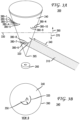
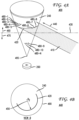
- FIGs. 3A, 3B , 4A, and 4B will be discussed together with the main difference in the described embodiments including an example of a reflective mode, wherein the reflective mode is not claimed according to the wording of the claims being where (i.e., below or above) the laser plane strikes the respective light receptive surface. That is, in the FIG. 3A/3B depiction laser plane 310 strikes light receptive surface 240 below centerline 330 thereby illuminating and forming intersection curve 320 on light receptive surface 240, that is, the intersection of laser plane 310 with light receptive surface 240. In the FIG.
- the illumination of light receptive surface 240 will result in a projection of intersection curve 320 in a defined manner as prescribed by the geometric shape of light receptive surface 240, here, the shape of a cone. More particularly, laser light from laser plane 310 striking the cone shape of light receptive surface 240 will result in intersection curve 320 having an arc shape.
- light receptive surface is a substantially vertical orientation (i.e., no tilt).
- light receptive surface 240 having a cone shape
- light receptive surface 240 is analogous to a projection screen (e.g., in a movie theater) such that the light is projected on to the surface and is thereby detectable and observable, for example, by image sensor 260.
- light receptive surface 240 has a plurality of pixels 380-1, 380-2, 380-3, 380-4, 380-5, 380-6, 380-7, 380-8, 380-9, 380-10 through 380-N that are mathematically defined in a contiguous manner across light receptive surface 240 which are representative of the light projected onto the surface by laser plane 310.
- FIG. 3B shows a bottom view 340 (also designated as View B on FIG.
- laser plane 410 is projected on (or at) light receptive surface 240 from direction 440 and at a point above (see, directional arrows 460 and 470, respectively, indicating above and below directions) centerline 430.
- light receptive surface 240 has a plurality of pixels 480-1, 480-2, 480-3, 480-4, 480-5, 480-6, 480-7, 480-8, 480-9, 480-10 through 480-N that are mathematically defined in contiguous manner across light receptive surface 240.
- intersection curves e.g., intersection curve 320
- a received laser beam e.g., from laser plane 310
- an edge detection algorithm can be used to isolate the arc of the laser from the background. This will provide a group of pixels with corresponding x and y coordinates that represent the arc of the laser.
- an algorithm that finds the middle of the mass of the laser arc can be used to provide a more precise x and y coordinate representation of the arc. Once the x and y coordinates are known that describe the arc, this information can be combined with a knowledge of the shape that the laser is striking such that the radius of the arc (or focal points if elliptical in shape) can be determined. This information would allow one to determine the elevation and tilt of the laser including as further detailed herein below in FIG. 5A and FIG. 5B directed to an embodiment including an example of a reflective mode, wherein the reflective mode is not claimed according to the wording of the claims involving tilt of the laser receiver.
- intersection curves having a smaller radius than that of laser light above centerline 330 (see, directional arrow 360).
- radius Ri 350 of intersection curve 320 will be smaller than that of an intersection curve resulting from a laser light above centerline 330 as will be further illustrated herein below.
- intersection curve 320 will be illuminated and detected by image sensor 260.
- intersection curve 320 is shown encompassing three (3) pixels, namely pixels 380-6, 380-7 and 380-8, but it will be understood that the intersection curve line will encompass pixels over the entire length of the illuminated light receptive array region, for example the entire arc of intersection curve 320.
- Information about intersection curve 320 detected by image sensor 260 will be used as input to processor 270 (see, FIG. 2 ) which will use well-known vision recognition operations to determine the position of the received laser beam on light receptive surface 240 and, in turn, determine the precise elevation of the laser.
- the location of the plurality of pixels 380-1 through 380-N can be determined in a fixed coordinate system to facilitate the determination of the location of the laser beam on light receptive surface 240 (i.e., how far up or down the incoming laser beam is on the light receptive surface) which, in turn, allows for the determination of the elevation itself.
- the production calibration of the laser receiver would consist of having a laser strike the light receptive surface at known elevations and having the image sensor store mathematical constants to adjust its interior arc fitting formulas so that the known arc matches the known elevation of the calibration laser strike. This could be done for several elevations along the length of the surface to accommodate for variances in assembly of the image sensor. Notability, no field calibration of the laser receiver is necessary in any of the embodiments herein but can be optionally utilized.
- intersection curve 420 is shown encompassing three (3) pixels, namely pixels 480-6, 480-7 and 480-8, but it will be understood that the intersection curve line will encompass pixels over the entire length of the illuminated sensing array region, for example, the entire arc line of intersection curve 420.
- information about intersection curve 420 detected by image sensor 260 will be used as input to processor 270 (see, FIG. 2 ) which will use well-known vision recognition operations, as detailed herein above, to determine the position of the received laser beam on light receptive surface 240 and, in turn, determine the precise elevation of the laser.
- a laser receiver is realized that provides a streamlined mechanical and electrical design, reduced cost, and increased reliability without sacrificing any precision or accuracy.
- the tilt of the laser receiver can also be determined as shown in the further embodiment including an example of a reflective mode, wherein the reflective mode is not claimed according to the wording of the claims of FIG. 5A and FIG. 5B .
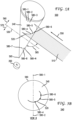
- exploded view 500 shows laser plane 510 is projected on (or at) light receptive surface 240 at a point above centerline 530 (see, directional arrows 560 and 570, respectively indicating above and below directions).
- the laser light from laser plane 510 is not parallel to base 595 of light receptive surface 240 thereby defining angle 585 in the received laser beam from laser plane 510 on light receptive surface 240.
- the defined geometric configuration of light receptive surface 240 the illumination of light receptive surface 240 will produce intersection curve 520 in a defined manner as prescribed by the geometric shape of light receptive surface 240, here, a conical shape. More particularly, laser light from laser plane 510 striking the conical shape of light receptive surface 240 will result in intersection curve 520 having an elliptical shape.
- the illumination of light receptive surface 240 having a cone shape, will manifest as an ellipse due to the angle of the strike and the tilt of the laser receiver.
- This is different from the embodiments including an example of a reflective mode, wherein the reflective mode is not claimed according to the wording of the claims described herein above (see, FIGs. 3A, 3B , 4A, and 4B ) where the laser plane is parallel the base of light receptive surface 240 and renders a circular shape.
- the tilt of the laser receiver is also determined utilizing circular pattern 590 as illuminated by laser plane 510.
- the intersection of laser plane 510 with light receptive surface 240 is, in geometric terms, an intersection of a plane with a cone which results in an ellipse being transcribed along the cone by the plane.
- the resulting ellipse and its associated mathematical properties such as foci, vertices and eccentricity taken in combination with the known mathematical properties of the cone shape facilitates the determination of the angle at which the laser plane is with respect to the laser receiver in accordance with the above-described embodiment including an example of a reflective mode, wherein the reflective mode is not claimed according to the wording of the claims.
- light receptive surface 240 has a plurality of pixels 580-1, 580-2, 580-3, 580-4, 580-5, 580-6, 580-7, 580-8 through 580-N that are contiguous across light receptive surface 240.
- FIG. 5B shows bottom view 540 (designated as View B on FIG.
- intersection curve 520 is shown encompassing three (3) pixels, namely pixels 580-4, 580-5 and 580-6, but it will be understood that the intersection curve line will encompass pixels over the entire length of the illuminated light receptive array region, for example, the entire elliptical line of intersection curve 520.
- processor 270 see, FIG. 2
- FIG. 2 the precise elevation of the laser.
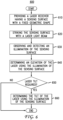
- FIG. 6 shows a flowchart of illustrative operations 600 for determining elevation and tilt angle in accordance with an embodiment including an example of a reflective mode, wherein the reflective mode is not claimed according to the wording of the claims. More particularly, step 610 details receiving a laser beam at a light receptive surface which illuminates a defined intersection curve in the light receptive surface whereby observing and detecting an illumination of the light receptive surface (step 620) will identify the intersection curve. As noted herein, such detection can be in accordance with either of the reflective embodiments including an example of a reflective mode, wherein the reflective mode is not claimed according to the wording of the claims or transmissive embodiments as disclosed herein.
- the light receptive surface is illustratively a cone shaped surface such as light receptive surface 240 as shown in FIG. 2 .
- this sensing can be accomplished using an image sensor in the same field of vision as the light receptive surface and that monitors the light receptive surface.
- step 630 details determining an elevation of the laser from the illumination of the light receptive surface.
- the precise elevation of the laser is determined using well-known vision algorithms that will calculate a location of the received laser light on the light receptive surface and, in turn, calculate the elevation of the laser therefrom.
- determining a tilt of the laser receiver from the illumination of the light receptive surface is accomplished as detailed above with respect to the embodiment including an example of a reflective mode, wherein the reflective mode is not claimed according to the wording of the claims of FIG. 5A and FIG. 5B .
- FIG. 7 shows a diagrammatic view of user 710 operating within laser system 700 configured in accordance with an embodiment including an example of a reflective mode, wherein the reflective mode is not claimed according to the wording of the claims.
- laser system 700 utilizes laser receiver 200 configured in accordance with the embodiment including an example of a reflective mode, wherein the reflective mode is not claimed according to the wording of the claims of FIG. 2 and pointed at a desired target (e.g., target 740) being measured.
- a desired target e.g., target 740
- laser receiver 805 as described herein below, can also be utilized in a similar fashion.
- transmitter 720 e.g., a rotating laser
- transmitter 720 is transmitting laser plane 730 which will be received by laser receiver 200 to determine the precise elevation (E) 750 and tilt angle (A) 760 as detailed hereinabove.
- user 710 may mount laser receiver 200 on a pole to increase stability when holding laser receiver 200 in the field (e.g., a construction site).
- Another alternative is to mount laser receiver 200 on a dozer or other construction vehicle, to name just a few.
- a laser receiver configuration (and elevation and tilt determination methodology) is realized that has a streamlined mechanical and electrical design, reduced cost, and increased reliability without sacrificing any accuracy characteristics.
- the observation and the detection of the incoming laser strike is observed and detected from a position within (i.e., inside) the light reflective surface no matter the shape (e.g., cone, rectangle, etc.).
- the reflective mode is not claimed according to the wording of the claims and transmissive embodiments
- the image processing is the same for both embodiments. This will be highlighted further herein below in the description of the transmissive embodiments and as set forth in FIGs. 8A through 8D .
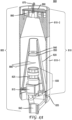
- FIG. 8A shows a cross section view 800 of fully assembled laser receiver 805.
- laser receiver 805 includes housing 810 which is comprised of transparent housing 810-1 and non-transparent housing 810-2 where transparent housing 810-1 allows for the penetration and detection of laser light.
- transparent housing 810-1 may be dyed to allow light of a desired wavelength to pass and block other wavelengths in a well-known fashion. In this way, the dyed transparent housing will eliminate the need for image sensor 830 (illustratively shown as being comprised by camera 815 and lens 825 in FIG. 8A ) to filter out any unwanted light.
- image sensor 830 illustrated as being comprised by camera 815 and lens 825 in FIG. 8A
- image sensor 830 is located inside of the cone-shaped light receptive surface 820 and is directed towards mirror element 840 which is an annular element in-line with and near photodiode 860 (see also, e.g., FIG. 8C )
- Mirror element 840 and filter element 850 may be glued in place to the inside area of light receptive surface 805, or in an alternative embodiment, may be molded. Alternatively, in accordance with an embodiment, filter element 850 may be removed entirely if no optical filtering is necessary.
- Laser receiver 805 also includes base 890, image sensor housing 835, mounting cap 845 and photodiode 860 having a pair of leads 870 extending through base 890 which includes, illustratively, a circuit board with at least a processor mounted thereon (e.g., processor 270 as shown in FIG. 2 ).
- the operation and functionality of photodiode 860 is further detailed herein below.
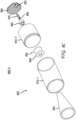
- FIG. 8B and FIG. 8C show different exploded views of laser receiver 805.
- FIG. 8B shows exploded view 800-1 of laser receiver 805 from the perspective of the image sensor 830 end of laser receiver 805
- FIG. 8C shows view 800-2 from the perspective of the photodiode 860 end of laser receiver 805.
- Camera 815 may be a small, digital camera such as the Basler Ace USB3 1300x30 digital camera as commercially available from Basler AG, Ahrensburg, Germany.
- laser receiver 805 is configured with mounting cap 845 and image sensor housing 835 which provides a housing for camera 815 and lens 825.
- FIG. 8A shows mounting cap 845 and image sensor housing 835 which provides a housing for camera 815 and lens 825.
- image sensor housing 835 is mounted to mounting cap 845 in such a way to position image sensor 830 within the inside area of image receptive surface 820 (illustratively, a cone shape) and pointing at mirror element 840 and filter element 850 which are each mounted respectively within the inside area of image receptive surface 820.
- Image receptive surface 820 is affixed to the underside of image sensor housing 835 and within transparent housing 810-1.
- Laser receiver 805, in accordance with the embodiment shown in FIG. 8C further comprises compound parabolic concentrator 865 configured in front of photodiode 860 having leads 870 which are mounted into base 890 which, illustratively, includes at least processor 855.
- compound parabolic concentrator 865 configured in front of photodiode 860 having leads 870 which are mounted into base 890 which, illustratively, includes at least processor 855.
- Such configuration allows for enhancing the synchronization between the incoming laser strike and triggering of the shutter of camera 815 in capturing the image in the annular mirror (i.e., mirror element 840). That is, as will be readily understood, a certain level of ambient light surrounding laser receiver 815 (e.g. sunlight) that may penetrate transparent housing 810-1 substantially contemporaneously with the light beam from laser plane 880 may decrease the efficiency of capturing the laser strike in annular mirror 85 by camera 815.
- ambient light surrounding laser receiver 815 e.g. sunlight
- concentrator 865 improves the light gathering capability of photo diode 860 which is essentially performing exposure management to minimize the exposure duration and synchronize the shutter of camera 815 with the incoming laser beam. So, photodiode 860 is detecting a flash of light (i.e., the incoming laser beam strike) and signaling camera 815 to open its shutter at a specific time in order to match the camera's open shutter with the laser strike.
- a flash of light i.e., the incoming laser beam strike
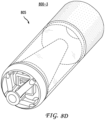
- FIGs. 8A-8D are directed to transmissive embodiments where the laser plane and associated observation and detecting of the laser beam striking the light receptive surface occurs on the inside (i.e., the interior of) of the light receptive surface.
- FIG. 8D shows a fully assembled view 800-3 of laser receiver 805 in accordance with such transmissive embodiments. Notwithstanding the somewhat different physical characteristics between the disclosed reflective embodiments including an example of a reflective mode, wherein the reflective mode is not claimed according to the wording of the claims and transmissive embodiments it will be understood that the image processing (as detailed above) is the same for both embodiments.
- FIG. 9 shows a photograph image 900 of a laser receiver configured in accordance with FIGs. 8A-8D incurring an actual laser beam strike.
- the photograph image 900 therefore shows the form of the laser strike.
- the incoming laser beam has illuminated light receptive surface 920 to manifest intersection curve 910 as described hereinabove.
- FIG. 10 is a high-level block diagram of an exemplary computer 1000 that may be used for implementing a method for determining laser elevation and/or tilt in accordance with the various embodiments herein.
- Computer 1000 comprises a processor 1010 operatively coupled to a data storage device 1020 and a memory 1030.
- Processor 1010 controls the overall operation of computer 1000 by executing computer program instructions that define such operations.
- Communications bus 1060 facilitates the coupling and communication between the various components of computer 1000.
- the computer program instructions may be stored in data storage device 1020, or a non-transitory computer readable medium, and loaded into memory 1030 when execution of the computer program instructions is desired.
- the steps of the disclosed method can be defined by the computer program instructions stored in memory 1030 and/or data storage device 1020 and controlled by processor 1010 executing the computer program instructions.
- the computer program instructions can be implemented as computer executable code programmed by one skilled in the art to perform the illustrative operations defined by the disclosed method. Accordingly, by executing the computer program instructions, processor 1010 executes an algorithm defined by the disclosed method.
- Computer 1000 also includes one or more communication interfaces 1050 for communicating with other devices via a network (e.g., a wireless communications network) or communications protocol (e.g., Bluetooth ® ).
- a network e.g., a wireless communications network
- communications protocol e.g., Bluetooth ®
- Such communication interfaces may be a receiver, transceiver or modem for exchanging wired or wireless communications in any number of well-known fashions.
- Computer 1000 also includes one or more input/output devices 1040 that enable user interaction with computer 1000 (e.g., camera, display, keyboard, mouse, speakers, microphone, buttons, etc.).
- Processor 1010 may include both general and special purpose microprocessors, and may be the sole processor or one of multiple processors of computer 1000.
- Processor 1010 may comprise one or more central processing units (CPUs), for example.
- CPUs central processing units
- Processor 1010, data storage device 1020, and/or memory 1030 may include, be supplemented by, or incorporated in, one or more application-specific integrated circuits (ASICs) and/or one or more field programmable gate arrays (FPGAs).
- ASICs application-specific integrated circuits
- FPGAs field programmable gate arrays
- Input/output devices 1040 may include peripherals, such as a camera, printer, scanner, display screen, etc.
- input/output devices 1040 may include a display device such as a cathode ray tube (CRT), plasma or liquid crystal display (LCD) monitor for displaying information to the user, a keyboard, and a pointing device such as a mouse or a trackball by which the user can provide input to computer 1000.
- a display device such as a cathode ray tube (CRT), plasma or liquid crystal display (LCD) monitor for displaying information to the user
- keyboard a keyboard
- pointing device such as a mouse or a trackball by which the user can provide input to computer 1000.
- any flowcharts, flow diagrams, state transition diagrams, pseudo code, program code and the like represent various processes which may be substantially represented in a computer readable medium and so executed by a computer, machine or processor, whether or not such computer, machine or processor is explicitly shown.
- One skilled in the art will recognize that an implementation of an actual computer or computer system may have other structures and may contain other components as well, and that a high level representation of some of the components of such a computer is for illustrative purposes.
Landscapes
- Physics & Mathematics (AREA)
- Engineering & Computer Science (AREA)
- General Physics & Mathematics (AREA)
- Radar, Positioning & Navigation (AREA)
- Remote Sensing (AREA)
- Electromagnetism (AREA)
- Computer Networks & Wireless Communication (AREA)
- Length Measuring Devices By Optical Means (AREA)
Description
- This application claims the benefit of
U.S. Utility Patent Application No. 15/856,318, filed December 28, 2017 - The present invention relates generally to laser receivers, and more particularly, to laser receivers of the type utilized in a variety of worksite applications such as construction and/or agricultural applications.
- Worksite preparation typically includes grading and excavating portions of the worksite to form desired slopes or footprints. Relative elevation measurement is a critical element in most construction and agricultural worksite applications and the use of laser receivers to facilitate elevation measurement in such applications is widespread. For example, laser receivers are commonly attached to construction equipment (e.g., dozers, scrapers, excavators, and the like) to improve grading and excavating accuracy.
- With respect to laser detection, these laser receivers typically include multiple radiation or sensing arrays, which are spatially arranged in a vertical pattern and which respond to impingement by a radiation source such as a laser beam. To achieve high precision and 360 degree detection such lasers typically utilize three (3) or four (4) sensing arrays spaced at 120 degree or 90 degree intervals, as the case may be. Each array of the laser receiver requires multiple individual photo detectors and associated monitoring circuitry. These laser receivers achieve high accuracy levels but design requirements do increase the overall part count, mechanical and electrical complexity, and cost of such laser receivers, as well as, increasing the potential for decreased reliability given the increased part count and overall complexity.
-
WO 2010/054519 A1 discloses a device and method for measuring 6 dimension posture of moving object. A device and method for measuring 6 dimension posture of moving object are provided. The device comprises a computing and processing unit, at least one receiver and at least one theodolite; the computing and processing unit and the theodolite are installed on the fixed ground; the receiver is installed on the moving object to be measured; the theodolite and the receiver are communicated with the computing and processing unit, and the theodolite is connected with the receiver via the laser optical path. -
EP 2 559 967 A1 discloses an electronic light detection circuit for detecting an intensity modulated light signal on a photosensitive element under backlight condition. The circuit comprises the photosensitive element, in particular as a light position detector for detecting a striking position of the light signal spot within a detection window, an amplifier with high input resistance connected to an output of the photosensitive element and a backlight suppression circuitry. The backlight suppression circuitry is connected to the output of the photosensitive element in parallel to the amplifier and comprises an electronic active resonator structure. The active resonator structure is designed in such a way to provide a load impedance to an output of the photosensitive element with a low load impedance for low frequencies for suppression of natural and artificial backlight-saturation of the photosensitive element and a high load impedance at the frequency of intensity modulation. - Therefore, a need exists for a laser receiver configuration that has a streamlined mechanical and electrical design, reduced cost, and increased reliability without sacrificing any precision or accuracy.
- The invention provides a laser receiver according to
claim 1, a method according to claim 5, and a non-transitory computer-readable medium according to claim 8. In accordance with various embodiments, a vision laser receiver is disclosed having a light receptive surface with a fixed geometry such that laser light striking the sensing surface will illuminate a particular section of the sensing surface and be visible, observable and/or detectable. An image sensor configured internal will observe and detect the illumination of the light receptive surface manifesting as an arc with a fixed radius based on the fixed geometry of the light receptive surface and the precise elevation and/or tilt of the laser receiver will be determined from the illumination of the light receptive surface. - In accordance with an embodiment, a laser receiver is provided which comprises a housing and a light receptive surface configured therein having a fixed geometry and which is light receptive. As used herein with respect to the light receptive surface, the term "light receptive" will be understood to mean a surface that is receptive to an incoming light beam such that the light beam is visible, observable and/or detectable at or on the surface. For example, the light receptive surface can be in the shape of a cone, column, cylinder or other similar fixed, geometric shape. The geometry of the light receptive surface, together with the light receptivity of the surface, will facilitate the elevation determination in accordance with various embodiments as detailed further herein below. The laser receiver also has an image sensor, illustratively, a camera, charge-coupled device (CCD) or CMOS image sensor for observing and detecting an incoming radiation source (e.g., a laser beam) to the laser receiver and detecting a position on the light receptive surface which is impinged by the radiation source. The laser receiver further includes a processor (e.g., digital signal processor (DSP)) which is responsive to the impingement of the light receptive surface through the processing of data collected from the illuminated region of the light receptive surface and for determining the laser position (i.e., the elevation of the laser) therefrom. That is, in accordance with an embodiment, laser light striking the light receptive surface will illuminate a particular section of the light receptive surface which will be detected and observed by the image sensor and provided as input to the digital signal processor which will execute vision recognition steps to determine the position of the radiation strike on the illuminated light receptive surface and, in turn, determine the precise elevation of the laser.
- In accordance with an embodiment, the laser receiver is further able to determine any tilt (i.e., the tilt angle) in the laser receiver. In accordance with this embodiment, given the fixed geometry of the light receptive surface and its associate mathematical characteristics, adjustments and compensations are made as a function of the angle of the plane on which the laser strikes the light receptive surface thereby allowing for the determination of the tilt angle.
- The various embodiments disclosed herein are directed to either so-called "reflective" embodiments including an example of a reflective mode, wherein the reflective mode is not claimed according to the wording of the claims in that the laser plane and associated observation and detecting of the laser beam striking the light receptive surface occurs on the outside (i.e., the exterior) of the light receptive surface, or so-called "transmissive" embodiments where the laser plane and associated observation and detecting of the laser beam striking the light receptive surface occurs on the inside (i.e., the interior) of the light receptive surface. Notwithstanding these somewhat different physical characteristics between the disclosed reflective embodiments including an example of a reflective mode, wherein the reflective mode is not claimed according to the wording of the claims and transmissive embodiments it will be understood that the image processing (as detailed herein below) is the same for both embodiments.
- These and other advantages of the embodiments will be apparent to those of ordinary skill in the art by reference to the following detailed description and the accompanying drawings.
-
-
FIG. 1 shows an exploded view of a conventional laser receiver; -
FIG. 2 shows an assembled view of a laser receiver configured for a reflective mode of operation in accordance with an embodiment including an example of a reflective mode, wherein the reflective mode is not claimed according to the wording of the claims ; -
FIG. 3A and FIG. 3B show an exploded view of the light receptive surface and image sensor of the laser receiver ofFIG. 2 with an incoming laser beam in accordance with an embodiment including an example of a reflective mode, wherein the reflective mode is not claimed according to the wording of the claims ; -
FIG. 4A and FIG. 4B show an exploded view of the light receptive surface and image sensor of the laser receiver ofFIG. 2 with an incoming laser beam in accordance with an embodiment including an example of a reflective mode, wherein the reflective mode is not claimed according to the wording of the claims ; -
FIG. 5A and FIG. 5B show an exploded view of the light receptive surface and image sensor of the laser receiver ofFIG. 2 with an incoming laser beam in accordance with an embodiment including an example of a reflective mode, wherein the reflective mode is not claimed according to the wording of the claims where the laser receiver is tilted; -
FIG. 6 shows a flowchart of illustrative operations for determining an elevation and tilt in accordance with an embodiment; -
FIG. 7 shows a diagrammatic view of a user operating a laser system configured in accordance with the embodiments including an example of a reflective mode, wherein the reflective mode is not claimed according to the wording of the claims ofFIG. 4 A/B andFIG. 5 A/B; and -
FIG. 8A shows a cross section view of a fully assembled laser receiver configured for a transmissive mode of operation in accordance with an embodiment. -
FIG. 8B shows an exploded view of the laser receiver ofFIG. 8A from the perspective of the image sensor end of the laser receiver; -
FIG. 8C shows an exploded view of the laser receiver ofFIG. 8A from the perspective of the photodiode end of the laser receiver; -
FIG. 8D shows a fully assembled view of the laser receiver ofFIGs. 8A-8C ; -
FIG. 9 shows a photograph image of a laser receiver configured in accordance withFIGs. 8A-8D incurring an actual laser beam strike; and -
FIG. 10 is a high-level block diagram of an exemplary computer in accordance with an embodiment. - In accordance with various embodiments, a vision laser receiver is disclosed having a light receptive surface such that laser light received at the light receptive surface will illuminate a particular section of the light receptive surface (i.e., will be visible, observable and/or detectable). Illustratively, the light receptive surface has a defined geometry and is light receptive. An image sensor will detect and observe the illumination of the light receptive surface and determine a precise position (e.g., vertical position) of such illuminated section on the light receptive surface. The elevation of the laser can then be determined from such detected position.
-
FIG. 1 shows an exploded view of a conventional laser receiver. As shown,laser receiver 100 is used in a variety of applications such as on construction or agricultural sites and is typically mounted on a machine (e.g., a dozer) for 360 degree receiving, or mounted on a surveying pole or carried by the housing for handheld applications. An example of one such commercially available laser receiver is the Topcon LS-B2 laser receiver (part of the LS Series machine mounted laser receivers) available from Topcon Corporation.Laser receiver 100 has ahousing top 120,housing base 110,LED panel 130 and a mountingpost 150. Configured around mountingpost 150 is a series of light sensors, in particular, individual light senor arrays 140-1, 140-2, and 140-3 which are symmetrically placed in a circular fashion to enable 360 degree laser receiving of an incoming laser beam from a laser transmitter (or radiation source). As will be appreciated, and while not shown inFIG. 1 , each light sensing array will have multiple individual photo detectors and multiple circuit boards and connectors for the individual sensor arrays 140-1, 140-2, and 140-3. Laser receivers,such laser receiver 100, deliver excellent precision and are widely used but their design requirements tend to increase factors such as part count, mechanical and electrical complexity, and cost. -
FIG. 2 shows a fully assembled view oflaser receiver 200 configured in accordance with an embodiments including an example of a reflective mode, wherein the reflective mode is not claimed according to the wording of the claims . As shown,laser receiver 200 has ahousing 230,housing top 210,housing base 220 and power anddata connector 280 built intohousing base 220.Housing 230 is illustratively constructed to include a fully transparent portion to allow for the detection of laser light. In an alternative embodiment, the transparent housing may be dyed (e.g., red) to allow light of a desired wavelength to pass and block other wavelengths in a well-known fashion. In this way, the dyed transparent housing will eliminate the need forimage sensor 260 to filter out any unwanted light. Configured withinhousing 230 is lightreceptive surface 240 having a fixed geometric shape and traversing substantially the entire length ofhousing 230. Lightreceptive surface 240 is illustratively shown as having a cone shape in accordance with the embodiment including an example of a reflective mode, wherein the reflective mode is not claimed according to the wording of the claims but it will be understood that other geometric shapes can be used including, but not limited to, cylinders, rectangles, spheres ellipsoids, or paraboloids. The main requirements for selecting the shape of lightreceptive surface 240 are directed to having a fixed geometric shape, light receptive qualities and size depending on the overall physical footprint desired for the receiver. The fixed geometry and light receptivity will allow for elevation and/or tilt determination as detailed herein below in accordance with various embodiments. -
Laser receiver 200 is further configured to includeimage sensor 260, illustratively, a camera, charge-coupled device (CCD) or CMOS image sensor for observing and detecting a source of incoming radiation (e.g., a laser beam) tolaser receiver 200 and detecting impingement by the incoming radiation on lightreceptive surface 240 .Laser receiver 200 further includes processor 270 (e.g., digital signal processor (DSP)) which is responsive to the impingement and illumination of lightreceptive surface 240 and for analyzing the illumination to accurately determine the laser position (i.e., the elevation and tilt of the laser). Illustratively,image sensor 260 andprocessor 270 are mounted oncircuit board 250 in a well-known fashion. As such, in accordance with an embodiment including an example of a reflective mode, wherein the reflective mode is not claimed according to the wording of the claims, laser light will illuminate a particular section of lightreceptive surface 240 which will be detected and observed byimage sensor 260 and provided as input toprocessor 270 which will execute well-known vision recognition steps to determine the position of the radiation strike on lightreceptive surface 240 and, in turn, determine the precise elevation of the laser. Further details oflaser receiver 200 and the determination of laser elevation and/or tilt in accordance with various embodiments including an example of a reflective mode, wherein the reflective mode is not claimed according to the wording of the claims will now be discussed. -
FIG. 3A and FIG. 3B show an explodedview 300 of lightreceptive surface 240 andimage sensor 260 oflaser receiver 200 as shown inFIG. 2 . InFIG. 3A ,laser plane 310 is shown which strikes lightreceptive surface 240 from aparticular direction 340. As will be understood,laser plane 310 is generated by a laser transmitter capable of generating visible laser light. Such laser transmitters are well-known and may be stationary or rotating lasers. For example, one such commercially available laser is the Topcon RL-H4C construction laser available from Topcon Corporation. The laser receiver of the various embodiments including an example of a reflective mode, wherein the reflective mode is not claimed according to the wording of the claims described herein is capable of being utilized with any type of visible laser source.Laser plane 310 strikes lightreceptive surface 240 belowcenterline 330 thereby illuminating and formingintersection curve 320 on lightreceptive surface 240, that is, the intersection oflaser plane 310 with lightreceptive surface 240. - For furthering the understanding of the present disclosure,
FIGs. 3A, 3B ,4A, and 4B will be discussed together with the main difference in the described embodiments including an example of a reflective mode, wherein the reflective mode is not claimed according to the wording of the claims being where (i.e., below or above) the laser plane strikes the respective light receptive surface. That is, in theFIG. 3A/3B depiction laser plane 310 strikes lightreceptive surface 240 belowcenterline 330 thereby illuminating and formingintersection curve 320 on lightreceptive surface 240, that is, the intersection oflaser plane 310 with lightreceptive surface 240. In theFIG. 4A/4B depiction,laser plane 410 is projected on (or at) lightreceptive surface 240 fromdirection 440 and at a point above (see,directional arrows centerline 430. - As shown in the embodiment including an example of a reflective mode, wherein the reflective mode is not claimed according to the wording of the claims of
FIG. 3A and FIG. 3B , given the defined geometric shape and configuration of lightreceptive surface 240, the illumination of lightreceptive surface 240 will result in a projection ofintersection curve 320 in a defined manner as prescribed by the geometric shape of lightreceptive surface 240, here, the shape of a cone. More particularly, laser light fromlaser plane 310 striking the cone shape of lightreceptive surface 240 will result inintersection curve 320 having an arc shape. In this embodiment, as shown, light receptive surface is a substantially vertical orientation (i.e., no tilt). That is, the illumination of lightreceptive surface 240, having a cone shape, will manifest as an arc given this orientation. As such, in this embodiments including an example of a reflective mode, wherein the reflective mode is not claimed according to the wording of the claims, lightreceptive surface 240 is analogous to a projection screen (e.g., in a movie theater) such that the light is projected on to the surface and is thereby detectable and observable, for example, byimage sensor 260. That is, lightreceptive surface 240 has a plurality of pixels 380-1, 380-2, 380-3, 380-4, 380-5, 380-6, 380-7, 380-8, 380-9, 380-10 through 380-N that are mathematically defined in a contiguous manner across lightreceptive surface 240 which are representative of the light projected onto the surface bylaser plane 310. To further the description and understanding of this feature,FIG. 3B shows a bottom view 340 (also designated as View B onFIG. 3B ) of lightreceptive surface 240 which illustrates the arc shape ofintersection curve 320 having radius Ri 350 (resulting fromcircular pattern 390 that is illuminated given thatlaser plane 310 strikes lightreceptive surface 240 in a parallel fashion to base 395 of light receptive surface 240). As will be appreciated, the conical shape of light receptive surface presents certain characteristics that can be exploited in determining laser elevation in accordance with the embodiment including an example of a reflective mode, wherein the reflective mode is not claimed according to the wording of the claims. - Similar to the above-described embodiment including an example of a reflective mode, wherein the reflective mode is not claimed according to the wording of the claims, the embodiment including an example of a reflective mode, wherein the reflective mode is not claimed according to the wording of the claims of
FIG. 4A and FIG. 4B further illustrates the advantages of the disclosed vision laser receiver. In this embodiment including an example of a reflective mode, wherein the reflective mode is not claimed according to the wording of the claims,laser plane 410 is projected on (or at) lightreceptive surface 240 fromdirection 440 and at a point above (see,directional arrows centerline 430. Again, given the defined geometric configuration of lightreceptive surface 240 the illumination of lightreceptive surface 240 will produceintersection curve 420 in a defined manner as prescribed by the geometric shape of lightreceptive surface 240, here, the shape of a cone. More particularly, laser light fromlaser plane 410 striking the conical shape of lightreceptive surface 240 will result inintersection curve 420 having an arc shape. Again, lightreceptive surface 240 has a plurality of pixels 480-1, 480-2, 480-3, 480-4, 480-5, 480-6, 480-7, 480-8, 480-9, 480-10 through 480-N that are mathematically defined in contiguous manner across lightreceptive surface 240.FIG. 4B shows bottom view 440 (designated as View B onFIG. 4B ) of lightreceptive surface 240 which illustrates the arch (or conic) shape ofintersection curve 420 having radius R2 450 (resulting fromcircular pattern 490 that is illuminated given thatlaser plane 410 strikes lightreceptive surface 240 in a parallel fashion to base 495 of light receptive surface 240). As will appreciated from the discussion above,intersection curve 420 is of a larger radius than intersection curve 320 (seeFIGs. 3A and 3B ) given the projected laser beam was in a region of lightreceptive surface 240 that lies abovecenterline 430. This can also be determined by a comparison ofradius R 2 450 and radius Ri 350 (see,FIG. 3B ), respectively. - That is, given the conical shape of light
receptive surface 240 the intersection curves (e.g., intersection curve 320) produced by a received laser beam (e.g., from laser plane 310) will have known, quantifiable geometric and location characteristics that can be used, in conjunction with well-known vision algorithms or computer vision techniques, to determine elevation. For example, given that the light of the laser on the surface will be at a different brightness, in accordance with an embodiment including an example of a reflective mode, wherein the reflective mode is not claimed according to the wording of the claims, an edge detection algorithm can be used to isolate the arc of the laser from the background. This will provide a group of pixels with corresponding x and y coordinates that represent the arc of the laser. Alternatively, an algorithm that finds the middle of the mass of the laser arc can be used to provide a more precise x and y coordinate representation of the arc. Once the x and y coordinates are known that describe the arc, this information can be combined with a knowledge of the shape that the laser is striking such that the radius of the arc (or focal points if elliptical in shape) can be determined. This information would allow one to determine the elevation and tilt of the laser including as further detailed herein below inFIG. 5A and FIG. 5B directed to an embodiment including an example of a reflective mode, wherein the reflective mode is not claimed according to the wording of the claims involving tilt of the laser receiver. Laser light projected on lightreceptive surface 240 that is below centerline 330 (see, directional arrow 370) will produce intersection curves having a smaller radius than that of laser light above centerline 330 (see, directional arrow 360). As will be appreciated,radius Ri 350 ofintersection curve 320 will be smaller than that of an intersection curve resulting from a laser light abovecenterline 330 as will be further illustrated herein below. - In accordance with the embodiment including an example of a reflective mode, wherein the reflective mode is not claimed according to the wording of the claims shown,
intersection curve 320 will be illuminated and detected byimage sensor 260. For ease of illustration,intersection curve 320 is shown encompassing three (3) pixels, namely pixels 380-6, 380-7 and 380-8, but it will be understood that the intersection curve line will encompass pixels over the entire length of the illuminated light receptive array region, for example the entire arc ofintersection curve 320. Information aboutintersection curve 320 detected byimage sensor 260 will be used as input to processor 270 (see,FIG. 2 ) which will use well-known vision recognition operations to determine the position of the received laser beam on lightreceptive surface 240 and, in turn, determine the precise elevation of the laser. - As will be understood, given the fixed geometrical shape of light
receptive surface 240, the location of the plurality of pixels 380-1 through 380-N can be determined in a fixed coordinate system to facilitate the determination of the location of the laser beam on light receptive surface 240 (i.e., how far up or down the incoming laser beam is on the light receptive surface) which, in turn, allows for the determination of the elevation itself. As will be understood, the production calibration of the laser receiver would consist of having a laser strike the light receptive surface at known elevations and having the image sensor store mathematical constants to adjust its interior arc fitting formulas so that the known arc matches the known elevation of the calibration laser strike. This could be done for several elevations along the length of the surface to accommodate for variances in assembly of the image sensor. Notability, no field calibration of the laser receiver is necessary in any of the embodiments herein but can be optionally utilized. - In accordance with the embodiment including an example of a reflective mode, wherein the reflective mode is not claimed according to the wording of the claims shown in
FIG. 4A and 4B , the illumination ofintersection curve 420 will be observed and detected byimage sensor 260. For ease of illustration,intersection curve 420 is shown encompassing three (3) pixels, namely pixels 480-6, 480-7 and 480-8, but it will be understood that the intersection curve line will encompass pixels over the entire length of the illuminated sensing array region, for example, the entire arc line ofintersection curve 420. As before, information aboutintersection curve 420 detected byimage sensor 260 will be used as input to processor 270 (see,FIG. 2 ) which will use well-known vision recognition operations, as detailed herein above, to determine the position of the received laser beam on lightreceptive surface 240 and, in turn, determine the precise elevation of the laser. - Advantageously, as detailed above, a laser receiver is realized that provides a streamlined mechanical and electrical design, reduced cost, and increased reliability without sacrificing any precision or accuracy.
- In addition to determining the elevation of a laser, the tilt of the laser receiver can also be determined as shown in the further embodiment including an example of a reflective mode, wherein the reflective mode is not claimed according to the wording of the claims of
FIG. 5A and FIG. 5B . In this further embodiment including an example of a reflective mode, wherein the reflective mode is not claimed according to the wording of the claims, explodedview 500 showslaser plane 510 is projected on (or at) lightreceptive surface 240 at a point above centerline 530 (see,directional arrows laser plane 510 is not parallel to base 595 of lightreceptive surface 240 thereby definingangle 585 in the received laser beam fromlaser plane 510 on lightreceptive surface 240. Again, the defined geometric configuration of lightreceptive surface 240 the illumination of lightreceptive surface 240 will produceintersection curve 520 in a defined manner as prescribed by the geometric shape of lightreceptive surface 240, here, a conical shape. More particularly, laser light fromlaser plane 510 striking the conical shape of lightreceptive surface 240 will result inintersection curve 520 having an elliptical shape. That is, the illumination of lightreceptive surface 240, having a cone shape, will manifest as an ellipse due to the angle of the strike and the tilt of the laser receiver. This is different from the embodiments including an example of a reflective mode, wherein the reflective mode is not claimed according to the wording of the claims described herein above (see,FIGs. 3A, 3B ,4A, and 4B ) where the laser plane is parallel the base of lightreceptive surface 240 and renders a circular shape. - Advantageously, in addition to the elevation determination, in accordance with this further embodiment including an example of a reflective mode, wherein the reflective mode is not claimed according to the wording of the claims, the tilt of the laser receiver is also determined utilizing
circular pattern 590 as illuminated bylaser plane 510. As will be understood, the intersection oflaser plane 510 with lightreceptive surface 240 is, in geometric terms, an intersection of a plane with a cone which results in an ellipse being transcribed along the cone by the plane. The resulting ellipse and its associated mathematical properties such as foci, vertices and eccentricity taken in combination with the known mathematical properties of the cone shape facilitates the determination of the angle at which the laser plane is with respect to the laser receiver in accordance with the above-described embodiment including an example of a reflective mode, wherein the reflective mode is not claimed according to the wording of the claims. - Certain of the embodiments detailed herein may require certain alignment correction from time-to-time (see, e.g.,
FIG. 3 andFIG. 4 ). As in those previous embodiments including an example of a reflective mode, wherein the reflective mode is not claimed according to the wording of the claims, lightreceptive surface 240 has a plurality of pixels 580-1, 580-2, 580-3, 580-4, 580-5, 580-6, 580-7, 580-8 through 580-N that are contiguous across lightreceptive surface 240.FIG. 5B shows bottom view 540 (designated as View B onFIG. 5B ) of lightreceptive surface 240 which illustratescircular pattern 590 ofintersection curve 520 having foci Fi 590-1 and foci F2 590-2 (resulting fromcircular pattern 590 that is illuminated given thatlaser plane 510 is received by lightreceptive surface 240 at an angle to base 595 of light receptive surface 240). - In accordance with the embodiment including an example of a reflective mode, wherein the reflective mode is not claimed according to the wording of the claims shown in
FIG. 5A and 5B , the illumination ofintersection curve 520 will be observed and detected byimage sensor 260. For ease of illustration,intersection curve 520 is shown encompassing three (3) pixels, namely pixels 580-4, 580-5 and 580-6, but it will be understood that the intersection curve line will encompass pixels over the entire length of the illuminated light receptive array region, for example, the entire elliptical line ofintersection curve 520. As before, information from the illumination ofintersection curve 520 detected byimage sensor 260 will be used as input to processor 270 (see,FIG. 2 ) which will use well-known vision recognition operations to determine the position of the radiation strike on lightreceptive surface 240 and, in turn, determine the precise elevation of the laser. -
FIG. 6 shows a flowchart ofillustrative operations 600 for determining elevation and tilt angle in accordance with an embodiment including an example of a reflective mode, wherein the reflective mode is not claimed according to the wording of the claims. More particularly,step 610 details receiving a laser beam at a light receptive surface which illuminates a defined intersection curve in the light receptive surface whereby observing and detecting an illumination of the light receptive surface (step 620) will identify the intersection curve. As noted herein, such detection can be in accordance with either of the reflective embodiments including an example of a reflective mode, wherein the reflective mode is not claimed according to the wording of the claims or transmissive embodiments as disclosed herein. The light receptive surface is illustratively a cone shaped surface such as lightreceptive surface 240 as shown inFIG. 2 . As detailed above, this sensing can be accomplished using an image sensor in the same field of vision as the light receptive surface and that monitors the light receptive surface. - From the intersection curve illuminated in the light receptive surface,
step 630 details determining an elevation of the laser from the illumination of the light receptive surface. As detailed above, the precise elevation of the laser is determined using well-known vision algorithms that will calculate a location of the received laser light on the light receptive surface and, in turn, calculate the elevation of the laser therefrom. In accordance with an alternative embodiment, if the laser tilt is required (step 640) then determining a tilt of the laser receiver from the illumination of the light receptive surface (step 650) is accomplished as detailed above with respect to the embodiment including an example of a reflective mode, wherein the reflective mode is not claimed according to the wording of the claims ofFIG. 5A and FIG. 5B . -
FIG. 7 shows a diagrammatic view ofuser 710 operating withinlaser system 700 configured in accordance with an embodiment including an example of a reflective mode, wherein the reflective mode is not claimed according to the wording of the claims. Illustratively,laser system 700 utilizeslaser receiver 200 configured in accordance with the embodiment including an example of a reflective mode, wherein the reflective mode is not claimed according to the wording of the claims ofFIG. 2 and pointed at a desired target (e.g., target 740) being measured. Alternatively,laser receiver 805, as described herein below, can also be utilized in a similar fashion. In this embodiment including an example of a reflective mode, wherein the reflective mode is not claimed according to the wording of the claims, transmitter 720 (e.g., a rotating laser) is transmittinglaser plane 730 which will be received bylaser receiver 200 to determine the precise elevation (E) 750 and tilt angle (A) 760 as detailed hereinabove. Of course, as will be appreciated, there are numerous applications and configurations for delivering the laser receiver and the elevation and tilt angle determination of the various embodiments. For example,user 710 may mountlaser receiver 200 on a pole to increase stability when holdinglaser receiver 200 in the field (e.g., a construction site). Another alternative is to mountlaser receiver 200 on a dozer or other construction vehicle, to name just a few. Advantageously, in accordance with various embodiments, a laser receiver configuration (and elevation and tilt determination methodology) is realized that has a streamlined mechanical and electrical design, reduced cost, and increased reliability without sacrificing any accuracy characteristics. - The above-detailed embodiments including an example of a reflective mode, wherein the reflective mode is not claimed according to the wording of the claims are directed to reflective embodiments including an example of a reflective mode, wherein the reflective mode is not claimed according to the wording of the claims in that the laser plane and associated observation and detecting of the laser beam striking the light receptive surface occurs on the outside (i.e., the exterior of) of the light receptive surface. For example, the outside of light
receptive surface 240 ofFIG. 2 . The discussion that follows next herein below will be directed to transmissive embodiments where the laser plane and associated observation and detecting of the laser beam striking the light receptive surface occurs on the inside (i.e., the interior of) of the light receptive surface. That is, the observation and the detection of the incoming laser strike is observed and detected from a position within (i.e., inside) the light reflective surface no matter the shape (e.g., cone, rectangle, etc.). Notwithstanding these somewhat different physical characteristics between the disclosed reflective embodiments including an example of a reflective mode, wherein the reflective mode is not claimed according to the wording of the claims and transmissive embodiments it will be understood that the image processing (as detailed above) is the same for both embodiments. This will be highlighted further herein below in the description of the transmissive embodiments and as set forth inFIGs. 8A through 8D . -
FIG. 8A shows across section view 800 of fully assembledlaser receiver 805. As shown,laser receiver 805 includeshousing 810 which is comprised of transparent housing 810-1 and non-transparent housing 810-2 where transparent housing 810-1 allows for the penetration and detection of laser light. As mentioned above, in an alternative embodiment, transparent housing 810-1 may be dyed to allow light of a desired wavelength to pass and block other wavelengths in a well-known fashion. In this way, the dyed transparent housing will eliminate the need for image sensor 830 (illustratively shown as being comprised bycamera 815 andlens 825 inFIG. 8A ) to filter out any unwanted light. In accordance with embodiment ofFIG. 8A ,image sensor 830 is located inside of the cone-shaped lightreceptive surface 820 and is directed towardsmirror element 840 which is an annular element in-line with and near photodiode 860 (see also, e.g.,FIG. 8C )Mirror element 840 andfilter element 850 may be glued in place to the inside area of lightreceptive surface 805, or in an alternative embodiment, may be molded. Alternatively, in accordance with an embodiment,filter element 850 may be removed entirely if no optical filtering is necessary. - In accordance with the embodiment shown, as laser light from
laser plane 880 strikes lightreceptive surface 820,image sensor 830 will observe and detect a position on light receptive surface that is impinged by the laser light (i.e., radiation source) byviewing mirror element 840 and the associated image thereupon.Laser receiver 805 also includesbase 890,image sensor housing 835, mountingcap 845 andphotodiode 860 having a pair ofleads 870 extending throughbase 890 which includes, illustratively, a circuit board with at least a processor mounted thereon (e.g.,processor 270 as shown inFIG. 2 ). The operation and functionality ofphotodiode 860 is further detailed herein below. - To further facilitate the understanding of the configuration and operation of
laser receiver 805,FIG. 8B andFIG. 8C show different exploded views oflaser receiver 805. In particular,FIG. 8B shows exploded view 800-1 oflaser receiver 805 from the perspective of theimage sensor 830 end oflaser receiver 805, andFIG. 8C shows view 800-2 from the perspective of thephotodiode 860 end oflaser receiver 805.Camera 815 may be a small, digital camera such as the Basler Ace USB3 1300x30 digital camera as commercially available from Basler AG, Ahrensburg, Germany. As shown inFIG. 8A ,laser receiver 805 is configured with mountingcap 845 andimage sensor housing 835 which provides a housing forcamera 815 andlens 825. Again, as shown inFIG. 8A ,image sensor housing 835 is mounted to mountingcap 845 in such a way to positionimage sensor 830 within the inside area of image receptive surface 820 (illustratively, a cone shape) and pointing atmirror element 840 andfilter element 850 which are each mounted respectively within the inside area of imagereceptive surface 820. Imagereceptive surface 820 is affixed to the underside ofimage sensor housing 835 and within transparent housing 810-1. -
FIG. 8C shows exploded view 800-2 oflaser receiver 805 from the perspective of thephotodiode 860 end oflaser receiver 805. As shown,laser receiver 805 is configured with lightreceptive surface 820 which fits inside transparent housing 810-1. In turn, in accordance with the embodiment shown inFIG. 8C ,laser receiver 805 includesmirror element 840, illustratively shown as an annular flat mirror, which allows for the present configuration oflaser receiver 805 wherebyimage sensor 830 is configured within lightreceptive surface 830. As such, as will be understood,mirror element 840 increases the focal length ofcamera 815 such thatcamera 815 can observe and detect, in themirror element 840, an incoming light beam to light receptive surface. In a further embodiment,mirror element 840 can be configured as a concave mirror to provide for a so-called "powered surface" for further enhancement of the observation taking place at themirror element 840 byimage sensor 830. -
Laser receiver 805, in accordance with the embodiment shown inFIG. 8C , further comprises compoundparabolic concentrator 865 configured in front ofphotodiode 860 havingleads 870 which are mounted intobase 890 which, illustratively, includes atleast processor 855. Such configuration allows for enhancing the synchronization between the incoming laser strike and triggering of the shutter ofcamera 815 in capturing the image in the annular mirror (i.e., mirror element 840). That is, as will be readily understood, a certain level of ambient light surrounding laser receiver 815 (e.g. sunlight) that may penetrate transparent housing 810-1 substantially contemporaneously with the light beam fromlaser plane 880 may decrease the efficiency of capturing the laser strike in annular mirror 85 bycamera 815. As such, in accordance with the embodiment,concentrator 865 improves the light gathering capability ofphoto diode 860 which is essentially performing exposure management to minimize the exposure duration and synchronize the shutter ofcamera 815 with the incoming laser beam. So,photodiode 860 is detecting a flash of light (i.e., the incoming laser beam strike) andsignaling camera 815 to open its shutter at a specific time in order to match the camera's open shutter with the laser strike. - Again, as detailed above, the embodiments of
FIGs. 8A-8D are directed to transmissive embodiments where the laser plane and associated observation and detecting of the laser beam striking the light receptive surface occurs on the inside (i.e., the interior of) of the light receptive surface. To this end,FIG. 8D shows a fully assembled view 800-3 oflaser receiver 805 in accordance with such transmissive embodiments. Notwithstanding the somewhat different physical characteristics between the disclosed reflective embodiments including an example of a reflective mode, wherein the reflective mode is not claimed according to the wording of the claims and transmissive embodiments it will be understood that the image processing (as detailed above) is the same for both embodiments. -
FIG. 9 shows aphotograph image 900 of a laser receiver configured in accordance withFIGs. 8A-8D incurring an actual laser beam strike. Thephotograph image 900 therefore shows the form of the laser strike. As shown inimage 900, the incoming laser beam has illuminated lightreceptive surface 920 to manifestintersection curve 910 as described hereinabove. - As detailed above, the various embodiments herein can be embodied in the form of methods and apparatuses for practicing those methods. The disclosed methods may be performed by a combination of hardware, software, firmware, middleware, and computer-readable medium (collectively "computer") installed in and/or communicatively connected to a user device.
FIG. 10 is a high-level block diagram of anexemplary computer 1000 that may be used for implementing a method for determining laser elevation and/or tilt in accordance with the various embodiments herein.Computer 1000 comprises aprocessor 1010 operatively coupled to adata storage device 1020 and amemory 1030.Processor 1010 controls the overall operation ofcomputer 1000 by executing computer program instructions that define such operations.Communications bus 1060 facilitates the coupling and communication between the various components ofcomputer 1000. The computer program instructions may be stored indata storage device 1020, or a non-transitory computer readable medium, and loaded intomemory 1030 when execution of the computer program instructions is desired. Thus, the steps of the disclosed method (see, e.g.,FIG. 6 and the associated discussion herein above) can be defined by the computer program instructions stored inmemory 1030 and/ordata storage device 1020 and controlled byprocessor 1010 executing the computer program instructions. For example, the computer program instructions can be implemented as computer executable code programmed by one skilled in the art to perform the illustrative operations defined by the disclosed method. Accordingly, by executing the computer program instructions,processor 1010 executes an algorithm defined by the disclosed method.Computer 1000 also includes one ormore communication interfaces 1050 for communicating with other devices via a network (e.g., a wireless communications network) or communications protocol (e.g., Bluetooth®). For example, such communication interfaces may be a receiver, transceiver or modem for exchanging wired or wireless communications in any number of well-known fashions.Computer 1000 also includes one or more input/output devices 1040 that enable user interaction with computer 1000 (e.g., camera, display, keyboard, mouse, speakers, microphone, buttons, etc.). -
Processor 1010 may include both general and special purpose microprocessors, and may be the sole processor or one of multiple processors ofcomputer 1000.Processor 1010 may comprise one or more central processing units (CPUs), for example.Processor 1010,data storage device 1020, and/ormemory 1030 may include, be supplemented by, or incorporated in, one or more application-specific integrated circuits (ASICs) and/or one or more field programmable gate arrays (FPGAs). -
Data storage device 1020 andmemory 1030 each comprise a tangible non-transitory computer readable storage medium.Data storage device 1020, andmemory 1030, may each include high-speed random access memory, such as dynamic random access memory (DRAM), static random access memory (SRAM), double data rate synchronous dynamic random access memory (DDR RAM), or other random access solid state memory devices, and may include non-volatile memory, such as one or more magnetic disk storage devices such as internal hard disks and removable disks, magnetooptical disk storage devices, optical disk storage devices, flash memory devices, semiconductor memory devices, such as erasable programmable read-only memory (EPROM), electrically erasable programmable read-only memory (EEPROM), compact disc read-only memory (CD-ROM), digital versatile disc read-only memory (DVD-ROM) disks, or other non-volatile solid state storage devices. - Input/
output devices 1040 may include peripherals, such as a camera, printer, scanner, display screen, etc. For example, input/output devices 1040 may include a display device such as a cathode ray tube (CRT), plasma or liquid crystal display (LCD) monitor for displaying information to the user, a keyboard, and a pointing device such as a mouse or a trackball by which the user can provide input tocomputer 1000. - It should be noted that for clarity of explanation, the illustrative embodiments described herein may be presented as comprising individual functional blocks or combinations of functional blocks. The functions these blocks represent may be provided through the use of either dedicated or shared hardware, including, but not limited to, hardware capable of executing software. Illustrative embodiments may comprise digital signal processor ("DSP") hardware and/or software performing the operation described herein. Thus, for example, it will be appreciated by those skilled in the art that the block diagrams herein represent conceptual views of illustrative functions, operations and/or circuitry of the principles described in the various embodiments herein. Similarly, it will be appreciated that any flowcharts, flow diagrams, state transition diagrams, pseudo code, program code and the like represent various processes which may be substantially represented in a computer readable medium and so executed by a computer, machine or processor, whether or not such computer, machine or processor is explicitly shown. One skilled in the art will recognize that an implementation of an actual computer or computer system may have other structures and may contain other components as well, and that a high level representation of some of the components of such a computer is for illustrative purposes.
- The foregoing Detailed Description is to be understood as being in every respect illustrative and exemplary, but not restrictive, and the scope of the invention disclosed herein is not to be determined from the Detailed Description, but rather from the claims as interpreted according to the full breadth permitted by the patent laws. It is to be understood that the embodiments shown and described herein are only illustrative of the principles of the present invention and that various modifications may be implemented by those skilled in the art without departing from the scope of the invention as defined by the appending claims. Those skilled in the art could implement various other feature combinations without departing from the scope of the invention as defined by the appending claims.
Claims (10)
- A laser receiver comprising:a light receptive surface (240) having a fixed geometry;an image sensor (830) configured internal to the light receptive surface for detecting an illumination of the light receptive surfacecharacterized by the illumination of the light receptive surface manifesting as an arc with a fixed radius based on the fixed geometry of the light receptive surface; anda processor (270) for determining an elevation using the illumination of the light receptive surface detected by the image sensor.
- The laser receiver of claim 1, wherein a tilt angle is determined by the processor using the illumination of the light receptive surface.
- The laser receiver of claim 1, wherein the image sensor is one of a charge-coupled device (CCD), digital camera and CMOS image sensor.
- The laser receiver of claim 1, further comprising:
a mirror for use in the detecting of the illumination of the light receptive surface by the image sensor. - A method for determining an elevation of a laser receiver, the method comprising:receiving a light beam by a light receptive surface, the light receptive surface having a fixed geometry;detecting an illumination of the light receptive surface using an image sensor that is configured internal to the light receptive surface,characterized by the illumination of the light receptive surface manifesting as an arc with fixed radius based on the fixed geometry of the light receptive surface anddetermining the elevation using the illumination of the light receptive surface.
- The method of claim 5, further comprising:
determining a tilt angle using the illumination of the light receptive surface. - A system for determining an elevation of an object, comprising: a transmitter (720) transmitting a laser plane; and a laser receiver according to any of claims 1 to 4.
- A non-transitory computer-readable medium storing computer program instructions for determining an elevation of a laser receiver, the laser receiver having a light receptive surface with a fixed geometry, the computer program instructions, when executed on a processor, cause the processor to perform the following operations:detecting an illumination of the light receptive surface using an image sensor that is configured internal to the light receptive surface,characterized bythe illumination of the light receptive surface manifesting as an arc with a fixed radius based on the fixed geometry of the light receptive surface; anddetermining the elevation of the laser receiver using the illumination of the light receptive surface.
- The non-transitory computer-readable medium of claim 8, wherein the operations further comprise:
determining a tilt angle of the laser receiver using the illumination of the light receptive surface. - The laser receiver of claim 1, method of claim 5, or system of claim 7, or non-transitory computer-readable medium of claim 8, wherein the fixed geometry of the light receptive surface is a cone.
Applications Claiming Priority (2)
| Application Number | Priority Date | Filing Date | Title |
|---|---|---|---|
| US15/856,318 US10928196B2 (en) | 2017-12-28 | 2017-12-28 | Vision laser receiver |
| PCT/US2018/067493 WO2019133599A1 (en) | 2017-12-28 | 2018-12-26 | Vision laser receiver |
Publications (2)
| Publication Number | Publication Date |
|---|---|
| EP3732438A1 EP3732438A1 (en) | 2020-11-04 |
| EP3732438B1 true EP3732438B1 (en) | 2024-10-02 |
Family
ID=65139217
Family Applications (1)
| Application Number | Title | Priority Date | Filing Date |
|---|---|---|---|
| EP18837076.1A Active EP3732438B1 (en) | 2017-12-28 | 2018-12-26 | Vision laser receiver |
Country Status (3)
| Country | Link |
|---|---|
| US (1) | US10928196B2 (en) |
| EP (1) | EP3732438B1 (en) |
| WO (1) | WO2019133599A1 (en) |
Families Citing this family (2)
| Publication number | Priority date | Publication date | Assignee | Title |
|---|---|---|---|---|
| US10731977B1 (en) * | 2018-08-03 | 2020-08-04 | Rockwell Collins, Inc. | Automated zone accuracy for lever-arm and euler-angle alignment |
| CN114242270B (en) * | 2021-12-20 | 2025-08-22 | 上海交通大学 | A composite parabolic focusing target and its preparation process |
Family Cites Families (22)
| Publication number | Priority date | Publication date | Assignee | Title |
|---|---|---|---|---|
| US4231700A (en) | 1979-04-09 | 1980-11-04 | Spectra-Physics, Inc. | Method and apparatus for laser beam control of backhoe digging depth |
| US4830489A (en) | 1986-08-20 | 1989-05-16 | Spectra-Physics, Inc. | Three dimensional laser beam survey system |
| US5742069A (en) | 1996-03-20 | 1998-04-21 | Laser Alignment, Inc. | Digitally filtered laser receiver |
| US5935183A (en) | 1996-05-20 | 1999-08-10 | Caterpillar Inc. | Method and system for determining the relationship between a laser plane and an external coordinate system |
| JP2000266540A (en) | 1999-03-17 | 2000-09-29 | Topcon Corp | Electronic level |
| AU2001279795A1 (en) | 2000-08-01 | 2002-02-13 | Mirko Essling | Measuring device and measuring method for determining distance and/or position |
| AU2003245713A1 (en) | 2002-07-10 | 2004-01-23 | Harman Becker Automotive Systems Gmbh | System for texturizing electronic representations of objects |
| US7277053B2 (en) | 2004-09-08 | 2007-10-02 | Lucid Dimensions, Llc | Apparatus and methods for detecting and locating signals |
| US7293376B2 (en) | 2004-11-23 | 2007-11-13 | Caterpillar Inc. | Grading control system |
| US7350711B2 (en) * | 2006-02-28 | 2008-04-01 | Symbol Technologies, Inc. | Ambient light shield and color filter for imaging-based bar code reader |
| CN101490505B (en) | 2006-07-12 | 2012-06-06 | 天宝导航有限公司 | Altitude Corrected Handheld Laser Detector Using GPS Receiver to Provide 2D Position Data |
| US7486403B2 (en) | 2006-07-20 | 2009-02-03 | Canon Kabushiki Kaisha | Droplet shape measuring method and apparatus |
| CN101715542B (en) | 2007-05-23 | 2012-09-05 | 特里伯耶拿有限公司 | Leveling apparatus and method |
| US8550444B2 (en) | 2007-10-23 | 2013-10-08 | Gii Acquisition, Llc | Method and system for centering and aligning manufactured parts of various sizes at an optical measurement station |
| KR20100026284A (en) | 2008-08-29 | 2010-03-10 | 엘지이노텍 주식회사 | 3d lrf sensor : three dimensions laser range finder sensor |
| CN101738161B (en) | 2008-11-14 | 2012-11-07 | 中国科学院沈阳自动化研究所 | Equipment and method for measuring six-dimensional pose of moving object |
| US8304733B2 (en) * | 2009-05-22 | 2012-11-06 | Motorola Mobility Llc | Sensing assembly for mobile device |
| US20110102763A1 (en) | 2009-10-30 | 2011-05-05 | Microvision, Inc. | Three Dimensional Imaging Device, System and Method |
| EP2559967A1 (en) | 2011-08-16 | 2013-02-20 | Leica Geosystems AG | Light detection circuit |
| US8723068B2 (en) | 2011-09-08 | 2014-05-13 | Michael G. Nygaard | Method and system for optically inspecting manufactured rounds of ammunition or cylindrical components of the rounds to obtain rounds which exhibit superior accuracy when fired |
| EA031929B1 (en) | 2012-12-14 | 2019-03-29 | Бипи Корпорейшн Норд Америка Инк. | Apparatus and method for three dimensional surface measurement |
| DE102012223928A1 (en) | 2012-12-20 | 2014-06-26 | Hilti Aktiengesellschaft | Method and device for determining the location coordinates of a target object |
-
2017
- 2017-12-28 US US15/856,318 patent/US10928196B2/en active Active
-
2018
- 2018-12-26 WO PCT/US2018/067493 patent/WO2019133599A1/en not_active Ceased
- 2018-12-26 EP EP18837076.1A patent/EP3732438B1/en active Active
Also Published As
| Publication number | Publication date |
|---|---|
| EP3732438A1 (en) | 2020-11-04 |
| US20190204078A1 (en) | 2019-07-04 |
| WO2019133599A1 (en) | 2019-07-04 |
| US10928196B2 (en) | 2021-02-23 |
Similar Documents
| Publication | Publication Date | Title |
|---|---|---|
| EP2825843B1 (en) | Laser system with a laser receiver capable to detect its own movements | |
| JP7163085B2 (en) | Surveying method, surveying device and program | |
| JP6753962B2 (en) | A method for comparing a received beam incident on a laser receiver with a rotating laser beam | |
| CN103797330B (en) | light detection circuit | |
| CN109416252B (en) | Method for comparing received rays incident on a laser receiver with rotated received rays | |
| CN201622345U (en) | Laser distance measurement device | |
| US9482756B2 (en) | Tracker unit and method in a tracker unit | |
| CN109313027B (en) | Method for comparing a received beam projected onto a laser receiver with a rotating laser beam | |
| CN103733025B (en) | Many PSD arrangements and circuit | |
| US11656338B2 (en) | Retroreflector with sensor | |
| EP3732438B1 (en) | Vision laser receiver | |
| CH709876A2 (en) | geodesy instrument. | |
| US12238416B2 (en) | Information processing apparatus, information processing method, and program | |
| US20200371242A1 (en) | Method for Operating a Laser Distance Measuring Device | |
| KR20140069333A (en) | Method for measuring spatial points | |
| JP2012103009A (en) | Position change monitor and position change monitoring system including the same | |
| CN107395929B (en) | 360° detection sensor and detection method based on area array CCD/CMOS | |
| AU2011203114A1 (en) | Threat detection systems and methods using position-sensing photodiodes | |
| KR20080070084A (en) | Position detection of electromagnetic beam projection | |
| KR101501458B1 (en) | 3-dimension position detecting method using single ccd-camera | |
| JP2018142873A (en) | Photoreceiver | |
| CN204142249U (en) | Measure the equipment of air level bubble position and comprise the air level of this equipment | |
| CN104880155A (en) | Long-distance reference laser displacement sensor and distance measurement method thereof | |
| EP2664890B1 (en) | Method and device for measuring the angular position of an emitting or reflecting object with hyperacuity | |
| JP2016085214A (en) | Photoelectric sensor |
Legal Events
| Date | Code | Title | Description |
|---|---|---|---|
| STAA | Information on the status of an ep patent application or granted ep patent |
Free format text: STATUS: UNKNOWN |
|
| STAA | Information on the status of an ep patent application or granted ep patent |
Free format text: STATUS: THE INTERNATIONAL PUBLICATION HAS BEEN MADE |
|
| PUAI | Public reference made under article 153(3) epc to a published international application that has entered the european phase |
Free format text: ORIGINAL CODE: 0009012 |
|
| STAA | Information on the status of an ep patent application or granted ep patent |
Free format text: STATUS: REQUEST FOR EXAMINATION WAS MADE |
|
| 17P | Request for examination filed |
Effective date: 20200618 |
|
| AK | Designated contracting states |
Kind code of ref document: A1 Designated state(s): AL AT BE BG CH CY CZ DE DK EE ES FI FR GB GR HR HU IE IS IT LI LT LU LV MC MK MT NL NO PL PT RO RS SE SI SK SM TR |
|
| AX | Request for extension of the european patent |
Extension state: BA ME |
|
| DAV | Request for validation of the european patent (deleted) | ||
| DAX | Request for extension of the european patent (deleted) | ||
| STAA | Information on the status of an ep patent application or granted ep patent |
Free format text: STATUS: EXAMINATION IS IN PROGRESS |
|
| 17Q | First examination report despatched |
Effective date: 20220406 |
|
| P01 | Opt-out of the competence of the unified patent court (upc) registered |
Effective date: 20230524 |
|
| GRAP | Despatch of communication of intention to grant a patent |
Free format text: ORIGINAL CODE: EPIDOSNIGR1 |
|
| STAA | Information on the status of an ep patent application or granted ep patent |
Free format text: STATUS: GRANT OF PATENT IS INTENDED |
|
| GRAJ | Information related to disapproval of communication of intention to grant by the applicant or resumption of examination proceedings by the epo deleted |
Free format text: ORIGINAL CODE: EPIDOSDIGR1 |
|
| STAA | Information on the status of an ep patent application or granted ep patent |
Free format text: STATUS: EXAMINATION IS IN PROGRESS |
|
| INTG | Intention to grant announced |
Effective date: 20240404 |
|
| INTC | Intention to grant announced (deleted) | ||
| GRAP | Despatch of communication of intention to grant a patent |
Free format text: ORIGINAL CODE: EPIDOSNIGR1 |
|
| STAA | Information on the status of an ep patent application or granted ep patent |
Free format text: STATUS: GRANT OF PATENT IS INTENDED |
|
| INTG | Intention to grant announced |
Effective date: 20240604 |
|
| GRAS | Grant fee paid |
Free format text: ORIGINAL CODE: EPIDOSNIGR3 |
|
| GRAA | (expected) grant |
Free format text: ORIGINAL CODE: 0009210 |
|
| STAA | Information on the status of an ep patent application or granted ep patent |
Free format text: STATUS: THE PATENT HAS BEEN GRANTED |
|
| AK | Designated contracting states |
Kind code of ref document: B1 Designated state(s): AL AT BE BG CH CY CZ DE DK EE ES FI FR GB GR HR HU IE IS IT LI LT LU LV MC MK MT NL NO PL PT RO RS SE SI SK SM TR |
|
| REG | Reference to a national code |
Ref country code: GB Ref legal event code: FG4D |
|
| REG | Reference to a national code |
Ref country code: CH Ref legal event code: EP |
|
| REG | Reference to a national code |
Ref country code: IE Ref legal event code: FG4D |
|
| REG | Reference to a national code |
Ref country code: DE Ref legal event code: R096 Ref document number: 602018075015 Country of ref document: DE |
|
| REG | Reference to a national code |
Ref country code: LT Ref legal event code: MG9D |
|
| REG | Reference to a national code |
Ref country code: NL Ref legal event code: MP Effective date: 20241002 |
|
| REG | Reference to a national code |
Ref country code: AT Ref legal event code: MK05 Ref document number: 1728792 Country of ref document: AT Kind code of ref document: T Effective date: 20241002 |
|
| PG25 | Lapsed in a contracting state [announced via postgrant information from national office to epo] |
Ref country code: NL Free format text: LAPSE BECAUSE OF FAILURE TO SUBMIT A TRANSLATION OF THE DESCRIPTION OR TO PAY THE FEE WITHIN THE PRESCRIBED TIME-LIMIT Effective date: 20241002 |
|
| PG25 | Lapsed in a contracting state [announced via postgrant information from national office to epo] |
Ref country code: NL Free format text: LAPSE BECAUSE OF FAILURE TO SUBMIT A TRANSLATION OF THE DESCRIPTION OR TO PAY THE FEE WITHIN THE PRESCRIBED TIME-LIMIT Effective date: 20241002 |
|
| PG25 | Lapsed in a contracting state [announced via postgrant information from national office to epo] |
Ref country code: IS Free format text: LAPSE BECAUSE OF FAILURE TO SUBMIT A TRANSLATION OF THE DESCRIPTION OR TO PAY THE FEE WITHIN THE PRESCRIBED TIME-LIMIT Effective date: 20250202 Ref country code: PT Free format text: LAPSE BECAUSE OF FAILURE TO SUBMIT A TRANSLATION OF THE DESCRIPTION OR TO PAY THE FEE WITHIN THE PRESCRIBED TIME-LIMIT Effective date: 20250203 Ref country code: HR Free format text: LAPSE BECAUSE OF FAILURE TO SUBMIT A TRANSLATION OF THE DESCRIPTION OR TO PAY THE FEE WITHIN THE PRESCRIBED TIME-LIMIT Effective date: 20241002 |
|
| PG25 | Lapsed in a contracting state [announced via postgrant information from national office to epo] |
Ref country code: FI Free format text: LAPSE BECAUSE OF FAILURE TO SUBMIT A TRANSLATION OF THE DESCRIPTION OR TO PAY THE FEE WITHIN THE PRESCRIBED TIME-LIMIT Effective date: 20241002 |
|
| PG25 | Lapsed in a contracting state [announced via postgrant information from national office to epo] |
Ref country code: BG Free format text: LAPSE BECAUSE OF FAILURE TO SUBMIT A TRANSLATION OF THE DESCRIPTION OR TO PAY THE FEE WITHIN THE PRESCRIBED TIME-LIMIT Effective date: 20241002 |
|
| PG25 | Lapsed in a contracting state [announced via postgrant information from national office to epo] |
Ref country code: ES Free format text: LAPSE BECAUSE OF FAILURE TO SUBMIT A TRANSLATION OF THE DESCRIPTION OR TO PAY THE FEE WITHIN THE PRESCRIBED TIME-LIMIT Effective date: 20241002 |
|
| PG25 | Lapsed in a contracting state [announced via postgrant information from national office to epo] |
Ref country code: NO Free format text: LAPSE BECAUSE OF FAILURE TO SUBMIT A TRANSLATION OF THE DESCRIPTION OR TO PAY THE FEE WITHIN THE PRESCRIBED TIME-LIMIT Effective date: 20250102 |
|
| PG25 | Lapsed in a contracting state [announced via postgrant information from national office to epo] |
Ref country code: LV Free format text: LAPSE BECAUSE OF FAILURE TO SUBMIT A TRANSLATION OF THE DESCRIPTION OR TO PAY THE FEE WITHIN THE PRESCRIBED TIME-LIMIT Effective date: 20241002 Ref country code: GR Free format text: LAPSE BECAUSE OF FAILURE TO SUBMIT A TRANSLATION OF THE DESCRIPTION OR TO PAY THE FEE WITHIN THE PRESCRIBED TIME-LIMIT Effective date: 20250103 Ref country code: AT Free format text: LAPSE BECAUSE OF FAILURE TO SUBMIT A TRANSLATION OF THE DESCRIPTION OR TO PAY THE FEE WITHIN THE PRESCRIBED TIME-LIMIT Effective date: 20241002 |
|
| PG25 | Lapsed in a contracting state [announced via postgrant information from national office to epo] |
Ref country code: CZ Free format text: LAPSE BECAUSE OF FAILURE TO SUBMIT A TRANSLATION OF THE DESCRIPTION OR TO PAY THE FEE WITHIN THE PRESCRIBED TIME-LIMIT Effective date: 20241002 Ref country code: PL Free format text: LAPSE BECAUSE OF FAILURE TO SUBMIT A TRANSLATION OF THE DESCRIPTION OR TO PAY THE FEE WITHIN THE PRESCRIBED TIME-LIMIT Effective date: 20241002 |
|
| PG25 | Lapsed in a contracting state [announced via postgrant information from national office to epo] |
Ref country code: RS Free format text: LAPSE BECAUSE OF FAILURE TO SUBMIT A TRANSLATION OF THE DESCRIPTION OR TO PAY THE FEE WITHIN THE PRESCRIBED TIME-LIMIT Effective date: 20250102 |
|
| PG25 | Lapsed in a contracting state [announced via postgrant information from national office to epo] |
Ref country code: SM Free format text: LAPSE BECAUSE OF FAILURE TO SUBMIT A TRANSLATION OF THE DESCRIPTION OR TO PAY THE FEE WITHIN THE PRESCRIBED TIME-LIMIT Effective date: 20241002 |
|
| REG | Reference to a national code |
Ref country code: DE Ref legal event code: R097 Ref document number: 602018075015 Country of ref document: DE |
|
| PG25 | Lapsed in a contracting state [announced via postgrant information from national office to epo] |
Ref country code: MC Free format text: LAPSE BECAUSE OF FAILURE TO SUBMIT A TRANSLATION OF THE DESCRIPTION OR TO PAY THE FEE WITHIN THE PRESCRIBED TIME-LIMIT Effective date: 20241002 |
|
| PG25 | Lapsed in a contracting state [announced via postgrant information from national office to epo] |
Ref country code: DK Free format text: LAPSE BECAUSE OF FAILURE TO SUBMIT A TRANSLATION OF THE DESCRIPTION OR TO PAY THE FEE WITHIN THE PRESCRIBED TIME-LIMIT Effective date: 20241002 |
|
| PG25 | Lapsed in a contracting state [announced via postgrant information from national office to epo] |
Ref country code: EE Free format text: LAPSE BECAUSE OF FAILURE TO SUBMIT A TRANSLATION OF THE DESCRIPTION OR TO PAY THE FEE WITHIN THE PRESCRIBED TIME-LIMIT Effective date: 20241002 |
|
| PG25 | Lapsed in a contracting state [announced via postgrant information from national office to epo] |
Ref country code: RO Free format text: LAPSE BECAUSE OF FAILURE TO SUBMIT A TRANSLATION OF THE DESCRIPTION OR TO PAY THE FEE WITHIN THE PRESCRIBED TIME-LIMIT Effective date: 20241002 |
|
| PG25 | Lapsed in a contracting state [announced via postgrant information from national office to epo] |
Ref country code: SK Free format text: LAPSE BECAUSE OF FAILURE TO SUBMIT A TRANSLATION OF THE DESCRIPTION OR TO PAY THE FEE WITHIN THE PRESCRIBED TIME-LIMIT Effective date: 20241002 |
|
| PG25 | Lapsed in a contracting state [announced via postgrant information from national office to epo] |
Ref country code: IT Free format text: LAPSE BECAUSE OF FAILURE TO SUBMIT A TRANSLATION OF THE DESCRIPTION OR TO PAY THE FEE WITHIN THE PRESCRIBED TIME-LIMIT Effective date: 20241002 |
|
| REG | Reference to a national code |
Ref country code: CH Ref legal event code: PL |
|
| PLBE | No opposition filed within time limit |
Free format text: ORIGINAL CODE: 0009261 |
|
| STAA | Information on the status of an ep patent application or granted ep patent |
Free format text: STATUS: NO OPPOSITION FILED WITHIN TIME LIMIT |
|
| PG25 | Lapsed in a contracting state [announced via postgrant information from national office to epo] |
Ref country code: LU Free format text: LAPSE BECAUSE OF NON-PAYMENT OF DUE FEES Effective date: 20241226 |
|
| PG25 | Lapsed in a contracting state [announced via postgrant information from national office to epo] |
Ref country code: SE Free format text: LAPSE BECAUSE OF FAILURE TO SUBMIT A TRANSLATION OF THE DESCRIPTION OR TO PAY THE FEE WITHIN THE PRESCRIBED TIME-LIMIT Effective date: 20241002 |
|
| 26N | No opposition filed |
Effective date: 20250703 |
|
| REG | Reference to a national code |
Ref country code: BE Ref legal event code: MM Effective date: 20241231 |
|
| PG25 | Lapsed in a contracting state [announced via postgrant information from national office to epo] |
Ref country code: BE Free format text: LAPSE BECAUSE OF NON-PAYMENT OF DUE FEES Effective date: 20241231 |
|
| PG25 | Lapsed in a contracting state [announced via postgrant information from national office to epo] |
Ref country code: FR Free format text: LAPSE BECAUSE OF NON-PAYMENT OF DUE FEES Effective date: 20241231 |
|
| PG25 | Lapsed in a contracting state [announced via postgrant information from national office to epo] |
Ref country code: CH Free format text: LAPSE BECAUSE OF NON-PAYMENT OF DUE FEES Effective date: 20241231 |
|
| PG25 | Lapsed in a contracting state [announced via postgrant information from national office to epo] |
Ref country code: IE Free format text: LAPSE BECAUSE OF NON-PAYMENT OF DUE FEES Effective date: 20241226 |
|
| PGFP | Annual fee paid to national office [announced via postgrant information from national office to epo] |
Ref country code: GB Payment date: 20251223 Year of fee payment: 8 |
|
| PGFP | Annual fee paid to national office [announced via postgrant information from national office to epo] |
Ref country code: DE Payment date: 20251229 Year of fee payment: 8 |