EP3732059B1 - Wheel having a stiffening rib - Google Patents
Wheel having a stiffening rib Download PDFInfo
- Publication number
- EP3732059B1 EP3732059B1 EP18894759.2A EP18894759A EP3732059B1 EP 3732059 B1 EP3732059 B1 EP 3732059B1 EP 18894759 A EP18894759 A EP 18894759A EP 3732059 B1 EP3732059 B1 EP 3732059B1
- Authority
- EP
- European Patent Office
- Prior art keywords
- wheel
- rib
- rim
- disc face
- open end
- Prior art date
- Legal status (The legal status is an assumption and is not a legal conclusion. Google has not performed a legal analysis and makes no representation as to the accuracy of the status listed.)
- Active
Links
Images




Classifications
-
- B—PERFORMING OPERATIONS; TRANSPORTING
- B60—VEHICLES IN GENERAL
- B60B—VEHICLE WHEELS; CASTORS; AXLES FOR WHEELS OR CASTORS; INCREASING WHEEL ADHESION
- B60B21/00—Rims
- B60B21/02—Rims characterised by transverse section
- B60B21/026—Rims characterised by transverse section the shape of rim well
-
- B—PERFORMING OPERATIONS; TRANSPORTING
- B60—VEHICLES IN GENERAL
- B60B—VEHICLE WHEELS; CASTORS; AXLES FOR WHEELS OR CASTORS; INCREASING WHEEL ADHESION
- B60B3/00—Disc wheels, i.e. wheels with load-supporting disc body
- B60B3/02—Disc wheels, i.e. wheels with load-supporting disc body with a single disc body integral with rim
-
- B—PERFORMING OPERATIONS; TRANSPORTING
- B60—VEHICLES IN GENERAL
- B60B—VEHICLE WHEELS; CASTORS; AXLES FOR WHEELS OR CASTORS; INCREASING WHEEL ADHESION
- B60B21/00—Rims
- B60B21/02—Rims characterised by transverse section
-
- B—PERFORMING OPERATIONS; TRANSPORTING
- B60—VEHICLES IN GENERAL
- B60B—VEHICLE WHEELS; CASTORS; AXLES FOR WHEELS OR CASTORS; INCREASING WHEEL ADHESION
- B60B21/00—Rims
- B60B21/02—Rims characterised by transverse section
- B60B21/023—Rims characterised by transverse section the transverse section being non-symmetrical
-
- B—PERFORMING OPERATIONS; TRANSPORTING
- B60—VEHICLES IN GENERAL
- B60B—VEHICLE WHEELS; CASTORS; AXLES FOR WHEELS OR CASTORS; INCREASING WHEEL ADHESION
- B60B3/00—Disc wheels, i.e. wheels with load-supporting disc body
- B60B3/06—Disc wheels, i.e. wheels with load-supporting disc body formed by casting
Definitions
- the present invention relates to a wheel rim for providing reduced weight at a constant load rating.
- the wheel rim can include one or more ribs in order to permit weight reduction without negatively impacting load ratings, stresses and/or tire pressure ratings of the wheel and without risking brake interference.
- a wheel is provided.
- the wheel includes a disc face.
- the wheel also includes an open end opposing the disc face.
- the wheel also includes a wheel rim extending between the disc face and the open end.
- the wheel rim includes a rib extending radially inward from the rim.
- Such a wheel is for example known from US 5350220 A .
- the wheel rim also includes a rim section including the rib, wherein a centroid of the rib is positioned proximate a longitudinal center of the rim section, the rim section having a second moment of area configured to enable the wheel to have a) a substantially similar load rating and/or tire pressure rating as a wheel of similar size, and b) a lower weight than the wheel of similar size.
- the disc face is positioned at a disc end of the wheel.
- the wheel also includes a second open end, the disc face positioned between the open end and the second open end.
- the wheel complies with SAE J1865 brake clearance standards.
- a weight of the wheel is between 15.4 kg to 17.7 kg (34 pounds to 39 pounds).
- the weight of the wheel is between 15.4 kg to 17.2 kg (34 pounds to 38 pounds).
- the weight of the wheel is between 15.9 kg to 16.3 kg (35 pounds to 36 pounds).
- the rib extends between 0.701 cm to 1.501 cm (0.276 in to 0.591 in) radially inward.
- the rib extends between 0.701 cm to 1.400 cm (0.276 in to 0.551 in) radially inward. In some embodiments, the rib extends between 0.701 cm to 1.300 cm (0.276 in to 0.512 in) radially inward. In some embodiments, the rib extends between 0.701 cm to 1.199 cm (0.276 in to 0.472 in) radially inward. In some embodiments, the rib extends between 0.701 cm to 1.100 cm (0.276 in to 0.433 in) radially inward. In some embodiments, the rib extends between 0.701 cm to 1.001 cm (0.276 in to 0.394 in) radially inward.
- rib extends between 0.701 cm to 0.899 cm (0.276 in to 0.354 in) radially inward. In some embodiments, the rib extends 0.800 cm (0.315 in) radially inward. In some embodiments, the rim section includes a second moment of area between 6243 mm 4 to 24972 mm 4 (0.0150 in 4 to 0.0600 in 4 ). In some embodiments, the rim section includes a second moment of area between 7075 mm 4 to 16648 mm 4 (0.0170 in 4 to 0.0400 in 4 ). In some embodiments, the rim section includes a second moment of area between 8324 mm 4 to 12486 mm 4 (0.0200 in 4 to 0.0300 in 4 ).
- the rim section extends from the centroid of the rib to the open end, and a substantially equal distance from the centroid of the rib toward the disc face.
- the wheel rim further comprises a tire side profile including an open end flange, a disc face flange, a first angle wall extending from the disc face flange toward the open end flange, a second angle wall extending from the open end flange toward the disc face flange, and a drop well connecting the first angle wall and the second angle wall.
- the wheel is formed from at least one of steel, aluminum, steel alloys, aluminum alloys, or combinations thereof. In some embodiments, the wheel is formed from a 6xxx aluminum alloy.
- the weight of the wheel is between 22.7 kg to 23.6 kg (50 pounds to 52 pounds). In some embodiments, the weight of the wheel is between 23.0 kg to 23.2 kg (50.8 pounds to 51.2 pounds). In some embodiments, the rib extends between 0.100 cm to 1.501 cm (0.0394 in to 0.591 in) radially inward. In some embodiments, the rib extends between 0.200 cm to 0.399 cm (0.0787 in to 0.157 in) radially inward. In some embodiments, the rib extends between 0.300 cm to 0.399 cm (0.118 in to 0.157 in) radially inward.
- the rim section includes a second moment of area between 4994 mm 4 to 16648 mm 4 (0.0120 in 4 to 0.040 in 4 ). In some embodiments, the rim section includes a second moment of area between 4994 mm 4 to 8324 mm 4 (0.0120 in 4 to 0.020 in 4 ). In some embodiments, the rim section includes a second moment of area between 4994 mm 4 to 5827 mm 4 (0.0120 in 4 to 0.0140 in 4 ). In some embodiments, the rim section extends from the centroid of the rib to the open end, and a substantially equal distance from the centroid of the rib toward the disc face.
- the wheel rim further comprises a tire side profile including an open end flange, a disc face flange, a first angle wall extending from the disc face flange toward the open end flange, a second angle wall extending from the open end flange toward the disc face flange, and a drop well connecting the first angle wall and the second angle wall.
- the wheel is formed from at least one of steel, aluminum, steel alloys, aluminum alloys, or combinations thereof. In some embodiments, the wheel is formed from a 6xxx aluminum alloy.
- a method includes at least one of forging, casting, or machining a wheel, the wheel having a disc face, an open end opposing the disc face, and a wheel rim extending between the disc face and the open end.
- the wheel rim includes a rib extending radially inward from the rim.
- the wheel rim also includes a rim section including the rib, wherein a centroid of the rib is positioned proximate a longitudinal center of the rim section, the rim section having a second moment of area configured to enable the wheel to have a) a substantially similar load rating and/or tire pressure rating as a wheel of similar size, and b) a lower weight than the wheel of similar size.
- the wheel rim further comprises a tire side profile including an open end flange, a disc face flange, a first angle wall extending from the disc face flange toward the open end flange, a second angle wall extending from the open end flange toward the disc face flange, and a drop well connecting the first angle wall and the second angle wall.
- the method also includes forming a valve hole in at least one of the first angle wall, the second angle wall, or the drop well.
- the method also includes forming at least one hole in the disc face.
- the method also includes forming a mount flange extending radially inward from the disc face.
- the wheel is forged or cast from at least one of steel, aluminum, steel alloys, aluminum alloys, or combinations thereof. In some embodiments, the wheel is formed from a 6xxx aluminum alloy.
- a wheel comprises a disc face; and a rim circumscribing the disc face and extending between the disc face and an open end thereof, the rim including: a rib extending radially inward from the rim, and a rim section including the rib having a second moment of area configured to enable the wheel to have: a) a substantially similar load rating and/or tire pressure rating as a wheel of similar size without the rib; and b) a lower weight than the wheel of similar size.
- the wheel further comprises a second rib extending radially inward from the rim proximate the disc face.
- the wheel complies with SAE J1865 brake clearance standards.
- a weight of the wheel is between 15.4 kg to 17.7 kg (34 pounds to 39 pounds).
- the rib extends between 0.701 cm to 1.501 cm (0.276 in to 0.591 in) radially inward.
- the rib extends between 0.701 cm to 1.001 cm (0.276 in to 0.394 in) radially inward.
- the rim section has a second moment of area between 6243 mm 4 to 24972 mm 4 (0.0150 in 4 to 0.0600 in 4 ).
- the rim section has a second moment of area between 7075 mm 4 to 16648 mm 4 (0.0170 in 4 to 0.0400 in 4 ).
- the rim section extends: a first distance from a centroid of the rib to the open end, and a second distance substantially equal to the first distance from the centroid of the rib toward the disc face.
- the rim further comprises a tire side profile including: an open end flange, a disc face flange, a first angle wall extending from the disc face flange toward the open end flange; a second angle wall extending from the open end flange toward the disc face flange; and a drop well connecting the first angle wall and the second angle wall.
- the wheel is formed from a 6xxx aluminum alloy.
- the weight of the wheel is between 22.7 kg to 23.6 kg (50 pounds to 52 pounds).
- the rib extends between 0.100 cm to 1.501 cm (0.0394 in to 0.591 in) radially inward.
- the rib extends between 0.200 cm to 0.399 cm (0.0787 in to 0.157 in) radially inward.
- the rim section has a second moment of area between 4994 mm 4 to 16648 mm 4 (0.0120 in 4 to 0.04 in 4 ).
- the rim section has a second moment of area between 4994 mm 4 to 5827 mm 4 (0.0120 in 4 to 0.0140 in 4 ).
- the rim section extends: a first distance from a centroid of the rib to the open end, and a second distance substantially equal to the first distance from the centroid of the rib toward the disc face.
- the wheel is formed from a 6xxx aluminum alloy.
- a method for making a wheel comprises: at least one of forging, casting, or machining a wheel, the wheel having a disc face, a rim circumscribing the disc face, the rim having an open end distal to the disc face and extending between the disc face and the open end, the rim including: a rib extending radially inward therefrom, and a rim section including the rib having a second moment of area configured to enable the wheel to have: a) a substantially similar load rating and/or tire pressure rating as a wheel of similar size without the rib; and b) a lower weight than the wheel of similar size.
- the rim further comprises a tire side profile including: an open end flange, a disc face flange, a first angle wall extending from the disc face flange toward the open end flange; a second angle wall extending from the open end flange toward the disc face flange; and a drop well connecting the first angle wall and the second angle wall and wherein the wheel is forged or cast from a 6xxx aluminum alloy.
- Embodiments of the present disclosure generally apply to wheels.
- the various embodiments of the present disclosure can provide single piece heavy duty wheels having a high load rating and a high tire inflation pressure rating for use in connection with wheeled vehicles such as, for example, cars, trucks, buses, aircraft landing gear, amphibious vehicles, or any other wheeled vehicle.
- FIGS. 1A-1H illustrate a wheel 100 having a disc end 100a and an opposing open end 100b in accordance with various embodiments of the present invention.
- the wheel 100 can include a mount flange 101 at the disc end 100a extending radially inward from a disc face 103 for mounting the wheel 100 to a wheel hub (not shown).
- the wheel 100 can also include a wheel rim 105 extending between the disc face 103 and the open end 100b and a rib 129 extending radially inward from the rim 105.
- the mount flange and disc face can be positioned between two open ends of the rim.
- the mount flange 101 in accordance with various embodiments, can include one or more bolt holes 107 extending therethrough for bolting or otherwise fastening the wheel 100 to the wheel hub.
- the mount flange 101 is shown in FIGS. 1A-1H as having 10 bolt holes 107, it will be apparent in view of this invention that any number and/or size bolt holes 107 can be used in accordance with various embodiments to permit engagement between the mount flange 101 and any complimentary wheel hub design.
- the mount flange 101 in accordance with various embodiments, can include a substantially planar outer face 101a for providing a stable bearing surface for engagement with one or more bolt heads of one or more bolts when the wheel 100 is bolted to the wheel hub.
- the mount flange 101 in accordance with various embodiments can also include a substantially planar inner face 101b for providing a stable bearing surface for engagement with the wheel hub when the wheel 100 is bolted to the wheel hub.
- the disc face 103 in accordance with various embodiments, can extend substantially conically between the mount flange 101 and the wheel rim 105 for providing a transition and structural support between the wheel rim 105 and the mount flange 101.
- the disc face 103 may not be conical and can instead extend radially between the mount flange 101 and the wheel rim 105.
- the disc face 103 in accordance with various embodiments, can include one or more hand holes 109 extending therethrough for permitting handling of the wheel, for providing cooling ventilation to a brake or brakes proximate the wheel, and/or for providing accessibility to a valve hole 121 for inflation and valve installation.
- the disc face 103 is shown in FIGS. 1A-1H as having 10 hand holes 109, it will be apparent in view of this invention that any number and/or size and/or shape hand holes 109 can be used in accordance with various embodiments.
- the wheel rim 105 in accordance with various embodiments, can be configured for mounting a tire thereto.
- the wheel rim 105 can, in accordance with various embodiments, include an outer "tire side” 105a and an inner “inboard side” 105b.
- the tire side 105a of the wheel rim 105 can include a disc end flange 111 at the disc end 100a, an open end flange 113 at the open end 100b, a first angle wall 115 extending from the disc end flange 111 toward the open end flange 113, a second angle wall 117 extending from the open end flange 113 toward the disc end flange 111, and a drop well 119 connecting the first angle wall 115 to the second angle wall 117.
- the wheel rim 105 can also include a valve hole 121 extending through at least one of the first angle wall 115, the second angle wall 117, or the drop well 119.
- the first angle wall 115, second angle wall 117, and drop well 119 can be sized and shaped to have a tire side profile geometry conforming to the Tire and Rim Association Standard for drop center rims and flat base rims.
- the valve hole 121 in accordance with various embodiments, can be any size, shape, configuration, and orientation suitable for installation of an inflation valve therein.
- the valve hole 121 can include a through hole 123, a tire side counterbore 125, and an inboard counterbore 127.
- the disc end flange 111 and the open end flange 113 can each generally be sized and shaped to have a tire side profile geometry conforming to the Tire and Rim Association Standard for drop center rims and flat base rims.
- particular profiles of the tire side and inboard sides of the disc end flange 111 and the open end flange 113 can be configured, within the Tire and Rim Association Standard for drop center rims and flat base rims, to assist in achieving desired load ratings and tire pressure ratings at a reduced weight without increasing the risk of the tire demounting from the rim.
- the disc end flange 111 and the open end flange 113 can include mirrored tire side and inboard side profile patterns. In some embodiments, the disc end flange 111 and the open end flange 113 can include different tire side and/or inboard side profile patterns while conforming to the Tire and Rim Association Standards.
- the inboard side 105b of the wheel rim 105 can include a rib 129 extending radially inward from the rim 105.
- the rib 129 can extend circumferentially around the inboard side 105b of the wheel rim 105 for stiffening the wheel rim 105.
- one or more additional ribs can be included.
- one rib can be included on either side of the disc face, proximate each open end of the rim.
- the rib 129 can be formed in any size and/or shape that is compliant with brake clearance requirements and imparts a desired increase in second moment of area to the wheel 100 to support a desired reduced weight.
- any of the ribs 201a-201g depicted in FIGS. 2A-2G can provide for a weight reduction from a 18.1 kg (40 lb) aluminum wheel to an aluminum wheel weighing less than 16.3 kg (36 lbs), without reducing load ratings, tire pressure ratings, or part life.
- the ribs 129, 201a-201g can provide the reduced weight wheel with sufficient second moment of area and geometric clearance to comply with SAE J1865 brake clearance standards.
- the rib 129 can extend radially inward by about 1.501 cm (about 0.591 in) or less (e.g., by about 0.701 cm to about 1.501 cm (about 0.276 in to about 0.591 in), by about 0.701 cm to about 1.400 cm (about 0.276 in to about 0.551 in), by about 0.701 cm to about 1.300 cm (about 0.276 in to about 0.512 in), by about 0.701 cm to about 1.199 cm (about 0.276 in to about 0.472 in), by about 0.701 cm to about 1.100 cm (about 0.276 in to about 0.433 in), by about 0.701 cm to about 1.001 cm (about 0.276 in to about 0.394 in), by about 0.701 cm to about 0.899 cm (about 0.276 in to about 0.354 in), and by about 0.701 cm to about 0.800 cm (about 0.276 in to about 0.315 in)) from the inboard side 105b of the wheel rim 105.
- the bending stiffness or second moment of area can be determined for a rim section 131 including the rib 129.
- the rim section 131 can extend substantially equidistant from a centroid 130 of the rib 129 toward the disc end 100a and toward the open end 100b of the wheel 100.
- the rim section 131 can extend from the centroid 130 of the rib 129 to the open end 100b and a substantially equal distance from the centroid 130 toward the disc end.
- the centroid 130 of the rib 129 can, in some embodiments, be located proximate a longitudinal center of the rim section 131 (in a plane containing the axis of rotation/symmetry of the wheel).
- the second moment of area of the rim section 131 can be, for example, between about 6243 mm 4 to about 24972 mm 4 (about 0.0150 in 4 to about 0.0600 in 4 ), including about 7075 mm 4 to about 20810 mm 4 (about 0.0170 in 4 to about 0.0500 in 4 ), about 7075 mm 4
- the rib design can be implemented in connection with wheels having any combination of wheel weight, wheel material, load rating requirements, tire pressure rating requirements, part life requirements, brake clearance requirements, bending stiffness requirements, rim section definitions, or local moments of inertia.
- use of the rib 129 can provide for a weight reduction from a 24.0 kg (53 lb) aluminum wheel to an aluminum wheel weighing 23.1 kg (51 lbs), without reducing load ratings, tire pressure ratings, or part life.
- the rib 129 can provide the reduced weight wheel with sufficient second moment of area and geometric clearance to comply with applicable brake clearance standards.
- the rib 129 can extend radially inward by about 1.501 cm (about 0.591 in) or less (e.g., by about 0.100 cm to about 0.200 cm (about 0.0394 in to about 0.0787 in), by about 0.300 cm to about 0.399 cm (about 0.118 in to about 0.157 in), and by about 0.701 cm to about 1.000 cm (about 0.276 in to about 0.394in)) from the inboard side 105b of the wheel rim 105.
- the bending stiffness or second moment of area can be determined for the rim section 131 including the rib 129.
- the second moment of area of the rim section 131 can be, for example, between about 4786 mm 4 to about 16648 mm 4 (about 0.0115 in 4 to about 0.040 in 4 ), including about 4994 mm 4 to about 5827 mm 4 (about 0.0120 in 4 to about 0.0140 in 4 ), and about 4994 mm 4 to about 8324 mm 4 (about 0.0120 in 4 to about 0.020 in 4 ).
- the wheel 100 in accordance with various embodiments, can be a single-piece or mutli-piece wheel made by forging, casting, or any other suitable manufacturing method for the wheel 100, for example, one or more of impression die forging, cold forging, open die forging, seamless rolled forging, any expendable mold casting (e.g., sand casting, plaster mold casting, shell molding, investment casting, low or high pressure casting), any non-expendable mold casting (e.g., permanent mold casting, die casting, centrifugal casting), gravity filled casting, low-pressure filled casting, high-pressure filled casting, vacuum casting, any other method of forging or casting, or combinations thereof.
- any expendable mold casting e.g., sand casting, plaster mold casting, shell molding, investment casting, low or high pressure casting
- any non-expendable mold casting e.g., permanent mold casting, die casting, centrifugal casting
- gravity filled casting low-pressure filled casting, high-pressure filled casting, vacuum casting, any other method of forging or
- single-piece means that the wheel 100 is formed from a single piece (e.g., casting or forging) and does not require welding, screwing, bolting, press-fitting, adhering, or otherwise fastening, attaching, or affixing separate parts.
- multi-piece means that the wheel 100 is formed from at least two pieces (e.g., castings or forgings) and requires welding, screwing, bolting, press-fitting, adhering, or otherwise fastening, attaching, or affixing separate pieces.
- the wheel 100 in accordance with various embodiments can be made from any suitable material including, for example, steel, aluminum, steel alloys, aluminum alloys (e.g., 6xxx aluminum), any other metal, any other alloy, and/or combinations thereof.
- each of the features can be formed during forging or casting.
- one or more of the features of the wheel 100 can be subsequently added by any of one or more suitable techniques such as, for example, turning lathe machining, computer numerical control (CNC) machining, drilling, electrical discharge machining, electrochemical machining, any other suitable technique, and/or combinations thereof.
- CNC computer numerical control
- FIGS. 2A-2G illustrate detail views of various example ribs 201a-201g which can, in accordance with various embodiments, be similar to, but are not limited to, the rib 129 discussed above with reference to FIGS. 1A-1H .
- FIG. 2A illustrates a first rib 201a.
- the first rib 201a For a wheel constructed of aluminum and having a weight of 16.1 kg (35.6 lb), the first rib 201a extends about 0.899 cm (about 0.354 in) radially inward from the rim 205a on the inboard side.
- the first rib 201a for a rim section extending from the centroid 230a of the first rib 201a to the open end and a substantially equal distance from the centroid 230a toward the disc end, can have a second moment of area of about 9489 mm 4 (about 0.0228 in 4 ).
- FIG. 2B illustrates a first rib 201b.
- the first rib 201a For a wheel constructed of aluminum and having a weight of 16.2 kg (35.8 lb), the first rib 201a extends about 0.800 cm (about 0.315 in) radially inward from the rim 205b on the inboard side.
- the first rib 201b for a rim section extending from the centroid 230b of the first rib 201b to the open end and a substantially equal distance from the centroid 230b toward the disc end, can have a second moment of area of about 7159 mm 4 (about 0.0172 in 4 ).
- FIG. 2C illustrates a first rib 201c.
- the first rib 201c For a wheel constructed of aluminum and having a weight of 16.3 kg (35.9 lb), the first rib 201c extends about 0.899 cm (0.354 in) radially inward from the rim 205c on the inboard side.
- the first rib 201c for a rim section extending from the centroid 230c of the first rib 201c to the open end and a substantially equal distance from the centroid 230c toward the disc end, can have a second moment of area of about 11029 mm 4 (0.0265 in 4 ).
- FIG. 2D illustrates a first rib 201d.
- the first rib 201d extends about 1.100 cm (0.433 in) radially inward from the rim 205d on the inboard side.
- the first rib 201d for a rim section extending from the centroid 230d of the first rib 201d to the open end and a substantially equal distance from the centroid 230d toward the disc end, can have a second moment of area of about 12277.9 mm 4 (0.0295 in 4 ).
- FIG. 2E illustrates a first rib 201e.
- the first rib 201e For a wheel constructed of aluminum and having a weight of 16.3 kg (35.9 lb), the first rib 201e extends about 0.899 cm (0.354 in) radially inward from the rim 205e on the inboard side.
- the first rib 201e for a rim section extending from the centroid 230e of the first rib 201e to the open end and a substantially equal distance from the centroid 230e toward the disc end, can have a second moment of area of about 11029 mm 4 (0.0265 in 4 ).
- FIG. 2F illustrates a first rib 201f.
- the first rib 201f For a wheel constructed of aluminum and having a weight of 16.2 kg (35.8 lb), the first rib 201f extends about 1.001 cm (0.394 in) radially inward from the rim 205f on the inboard side.
- the first rib 201f for a rim section extending from the centroid 230f of the first rib 201f to the open end and a substantially equal distance from the centroid 230f toward the disc end, can have a second moment of area of about 10030 mm 4 (0.0241 in 4 ).
- FIG. 2G illustrates a first rib 201g.
- the first rib 201g For a wheel constructed of aluminum and having a weight of 16.3 kg (35.9 lb), the first rib 201g extends about 1.001 cm (0.394 in) radially inward from the rim 205g on the inboard side.
- the first rib 201g for a rim section extending from the centroid 230g of the first rib 201g to the open end and a substantially equal distance from the centroid 230g toward the disc end, can have a second moment of area of about 10738 mm 4 (0.0258 in 4 ).
- the first rib For a wheel constructed of aluminum and having a weight of 22.9 kg (50.4 lb) (not shown), the first rib extends about 0.200 cm (0.0787 in) radially inward from the rim on the inboard side.
- the first rib for a rim section extending from the centroid of the first rib to the open end and a substantially equal distance from the centroid toward the disc end, can have a second moment of area of about 5702 mm 4 (0.0137 in 4 ).
- the first rib For a wheel constructed of aluminum and having a weight of 23.0 kg (50.8 lb) (not shown), the first rib extends about 0.200 cm (0.0787 in) radially inward from the rim on the inboard side.
- the first rib for a rim section extending from the centroid of the first rib to the open end and a substantially equal distance from the centroid toward the disc end, can have a second moment of area of about 5702 mm 4 (0.0137 in 4 ).
Landscapes
- Engineering & Computer Science (AREA)
- Mechanical Engineering (AREA)
- Tires In General (AREA)
- Braking Arrangements (AREA)
Description
- This application claims the benefit of
U.S. Provisional Application No. 62/612,061, filed December 29, 2017 - Conventionally, reducing the weight of a wheel results in increased local stresses and displacements under a target load. An increase in such stresses and displacements can negatively impact wheel performance by, for example, reducing maximum service life of the wheel, reducing the maximum load rating of the wheel.
- In order to limit an increase in stresses with the target load a local moment of inertia can be increased to improve the bending stiffness which will help to reduce the stresses under the same load. The present invention relates to a wheel rim for providing reduced weight at a constant load rating. In particular, the wheel rim can include one or more ribs in order to permit weight reduction without negatively impacting load ratings, stresses and/or tire pressure ratings of the wheel and without risking brake interference.
- According to a first aspect of the present invention, a wheel is provided. The wheel includes a disc face. The wheel also includes an open end opposing the disc face. The wheel also includes a wheel rim extending between the disc face and the open end. The wheel rim includes a rib extending radially inward from the rim. Such a wheel is for example known from
US 5350220 A . According to the present invention the wheel rim also includes a rim section including the rib, wherein a centroid of the rib is positioned proximate a longitudinal center of the rim section, the rim section having a second moment of area configured to enable the wheel to have a) a substantially similar load rating and/or tire pressure rating as a wheel of similar size, and b) a lower weight than the wheel of similar size. - In some embodiments of the invention, , the disc face is positioned at a disc end of the wheel. In some embodiments, the wheel also includes a second open end, the disc face positioned between the open end and the second open end. In some embodiments, the wheel complies with SAE J1865 brake clearance standards. In some embodiments, a weight of the wheel is between 15.4 kg to 17.7 kg (34 pounds to 39 pounds). In some embodiments, the weight of the wheel is between 15.4 kg to 17.2 kg (34 pounds to 38 pounds). In some embodiments, the weight of the wheel is between 15.9 kg to 16.3 kg (35 pounds to 36 pounds). In some embodiments, the rib extends between 0.701 cm to 1.501 cm (0.276 in to 0.591 in) radially inward. In some embodiments, the rib extends between 0.701 cm to 1.400 cm (0.276 in to 0.551 in) radially inward. In some embodiments, the rib extends between 0.701 cm to 1.300 cm (0.276 in to 0.512 in) radially inward. In some embodiments, the rib extends between 0.701 cm to 1.199 cm (0.276 in to 0.472 in) radially inward. In some embodiments, the rib extends between 0.701 cm to 1.100 cm (0.276 in to 0.433 in) radially inward. In some embodiments, the rib extends between 0.701 cm to 1.001 cm (0.276 in to 0.394 in) radially inward. In some embodiments, rib extends between 0.701 cm to 0.899 cm (0.276 in to 0.354 in) radially inward. In some embodiments, the rib extends 0.800 cm (0.315 in) radially inward. In some embodiments, the rim section includes a second moment of area between 6243 mm4 to 24972 mm4 (0.0150 in4 to 0.0600 in4). In some embodiments, the rim section includes a second moment of area between 7075 mm4 to 16648 mm4 (0.0170 in4 to 0.0400 in4). In some embodiments, the rim section includes a second moment of area between 8324 mm4 to 12486 mm4 (0.0200 in4 to 0.0300 in4). In some embodiments, the rim section extends from the centroid of the rib to the open end, and a substantially equal distance from the centroid of the rib toward the disc face. In some embodiments, the wheel rim further comprises a tire side profile including an open end flange, a disc face flange, a first angle wall extending from the disc face flange toward the open end flange, a second angle wall extending from the open end flange toward the disc face flange, and a drop well connecting the first angle wall and the second angle wall. In some embodiments, the wheel is formed from at least one of steel, aluminum, steel alloys, aluminum alloys, or combinations thereof. In some embodiments, the wheel is formed from a 6xxx aluminum alloy.
- In some embodiments, the weight of the wheel is between 22.7 kg to 23.6 kg (50 pounds to 52 pounds). In some embodiments, the weight of the wheel is between 23.0 kg to 23.2 kg (50.8 pounds to 51.2 pounds). In some embodiments, the rib extends between 0.100 cm to 1.501 cm (0.0394 in to 0.591 in) radially inward. In some embodiments, the rib extends between 0.200 cm to 0.399 cm (0.0787 in to 0.157 in) radially inward. In some embodiments, the rib extends between 0.300 cm to 0.399 cm (0.118 in to 0.157 in) radially inward. In some embodiments, the rim section includes a second moment of area between 4994 mm4 to 16648 mm4 (0.0120 in4 to 0.040 in4). In some embodiments, the rim section includes a second moment of area between 4994 mm4 to 8324 mm4 (0.0120 in4 to 0.020 in4). In some embodiments, the rim section includes a second moment of area between 4994 mm4 to 5827 mm4 (0.0120 in4 to 0.0140 in4). In some embodiments, the rim section extends from the centroid of the rib to the open end, and a substantially equal distance from the centroid of the rib toward the disc face. In some embodiments, the wheel rim further comprises a tire side profile including an open end flange, a disc face flange, a first angle wall extending from the disc face flange toward the open end flange, a second angle wall extending from the open end flange toward the disc face flange, and a drop well connecting the first angle wall and the second angle wall. In some embodiments, the wheel is formed from at least one of steel, aluminum, steel alloys, aluminum alloys, or combinations thereof. In some embodiments, the wheel is formed from a 6xxx aluminum alloy.
- In some embodiments, a method is provided. The method includes at least one of forging, casting, or machining a wheel, the wheel having a disc face, an open end opposing the disc face, and a wheel rim extending between the disc face and the open end. The wheel rim includes a rib extending radially inward from the rim. The wheel rim also includes a rim section including the rib, wherein a centroid of the rib is positioned proximate a longitudinal center of the rim section, the rim section having a second moment of area configured to enable the wheel to have a) a substantially similar load rating and/or tire pressure rating as a wheel of similar size, and b) a lower weight than the wheel of similar size.
- In some embodiments, the wheel rim further comprises a tire side profile including an open end flange, a disc face flange, a first angle wall extending from the disc face flange toward the open end flange, a second angle wall extending from the open end flange toward the disc face flange, and a drop well connecting the first angle wall and the second angle wall. In some embodiments, the method also includes forming a valve hole in at least one of the first angle wall, the second angle wall, or the drop well. In some embodiments, the method also includes forming at least one hole in the disc face. In some embodiments, the method also includes forming a mount flange extending radially inward from the disc face. In some embodiments, the wheel is forged or cast from at least one of steel, aluminum, steel alloys, aluminum alloys, or combinations thereof. In some embodiments, the wheel is formed from a 6xxx aluminum alloy.
- In some embodiments, a wheel comprises a disc face; and a rim circumscribing the disc face and extending between the disc face and an open end thereof, the rim including: a rib extending radially inward from the rim, and a rim section including the rib having a second moment of area configured to enable the wheel to have: a) a substantially similar load rating and/or tire pressure rating as a wheel of similar size without the rib; and b) a lower weight than the wheel of similar size.
- In some embodiments, the wheel further comprises a second rib extending radially inward from the rim proximate the disc face.
- In some embodiments, the wheel complies with SAE J1865 brake clearance standards.
- In some embodiments, a weight of the wheel is between 15.4 kg to 17.7 kg (34 pounds to 39 pounds).
- In some embodiments, the rib extends between 0.701 cm to 1.501 cm (0.276 in to 0.591 in) radially inward.
- In some embodiments, the rib extends between 0.701 cm to 1.001 cm (0.276 in to 0.394 in) radially inward.
- In some embodiments, the rim section has a second moment of area between 6243 mm4 to 24972 mm4 (0.0150 in4 to 0.0600 in4).
- In some embodiments, the rim section has a second moment of area between 7075 mm4 to 16648 mm4 (0.0170 in4 to 0.0400 in4).
- In some embodiments, the rim section extends: a first distance from a centroid of the rib to the open end, and a second distance substantially equal to the first distance from the centroid of the rib toward the disc face.
- In some embodiments, the rim further comprises a tire side profile including: an open end flange, a disc face flange, a first angle wall extending from the disc face flange toward the open end flange; a second angle wall extending from the open end flange toward the disc face flange; and a drop well connecting the first angle wall and the second angle wall.
- In some embodiments, the wheel is formed from a 6xxx aluminum alloy.
- In some embodiments, the weight of the wheel is between 22.7 kg to 23.6 kg (50 pounds to 52 pounds).
- In some embodiments, the rib extends between 0.100 cm to 1.501 cm (0.0394 in to 0.591 in) radially inward.
- In some embodiments, the rib extends between 0.200 cm to 0.399 cm (0.0787 in to 0.157 in) radially inward.
- In some embodiments, the rim section has a second moment of area between 4994 mm4 to 16648 mm4 (0.0120 in4 to 0.04 in4).
- In some embodiments, the rim section has a second moment of area between 4994 mm4 to 5827 mm4 (0.0120 in4 to 0.0140 in4).
- In some embodiments, the rim section extends: a first distance from a centroid of the rib to the open end, and a second distance substantially equal to the first distance from the centroid of the rib toward the disc face.
- In some embodiments, the wheel is formed from a 6xxx aluminum alloy.
- In a second aspect of the invention, a method for making a wheel comprises: at least one of forging, casting, or machining a wheel, the wheel having a disc face, a rim circumscribing the disc face, the rim having an open end distal to the disc face and extending between the disc face and the open end, the rim including: a rib extending radially inward therefrom, and a rim section including the rib having a second moment of area configured to enable the wheel to have: a) a substantially similar load rating and/or tire pressure rating as a wheel of similar size without the rib; and b) a lower weight than the wheel of similar size.
- In some embodiments of the invention, the rim further comprises a tire side profile including: an open end flange, a disc face flange, a first angle wall extending from the disc face flange toward the open end flange; a second angle wall extending from the open end flange toward the disc face flange; and a drop well connecting the first angle wall and the second angle wall and wherein the wheel is forged or cast from a 6xxx aluminum alloy.
- Illustrative, non-limiting example embodiments of the invention will be more clearly understood from the following detailed description taken in conjunction with the accompanying drawings.
-
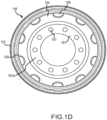
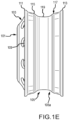
FIGS. 1A-1H are front perspective, rear perspective, front, back, side, top, bottom, and cross-sectional views of a wheel in accordance with various embodiments. -
FIGS. 2A-2G are detail views of various rib configurations of the wheel in accordance with various embodiments. - Various exemplary embodiments will be described more fully hereinafter with reference to the accompanying drawings, in which some example embodiments are shown. The present invention may, however, be embodied in many different forms and should not be construed as limited to the example embodiments set forth herein. Rather, these example embodiments are provided so that this disclosure will be thorough and complete, and will fully convey the scope of the present invention to those skilled in the art. In the drawings, the sizes and relative sizes of layers and regions may be exaggerated for clarity. Like numerals refer to like elements throughout.
- It will be understood that when an element is referred to as being "connected" or "coupled" to another element, it can be directly connected or coupled to the other element or intervening elements may be present. In contrast, when an element is referred to as being "directly connected" or "directly coupled" to another element, there are no intervening elements present. Other words used to describe the relationship between elements should be interpreted in a like fashion (e.g., "between" versus "directly between," "adjacent" versus "directly adjacent," etc.).
- Unless otherwise defined, all terms (including technical and scientific terms) used herein have the same meaning as commonly understood by one of ordinary skill in the art to which this invention belongs. It will be further understood that terms, such as those defined in commonly used dictionaries, should be interpreted as having a meaning that is consistent with their meaning in the context of the relevant art and will not be interpreted in an idealized or overly formal sense unless expressly so defined herein.
- The figures constitute a part of this specification and include illustrative embodiments of the present invention and illustrate various objects and features thereof. In addition, any measurements, specifications and the like shown in the figures are intended to be illustrative, and not restrictive. Therefore, specific structural and functional details disclosed herein are not to be interpreted as limiting, but merely as a representative basis for teaching one skilled in the art to variously employ the present invention.
- Among those benefits and improvements that have been disclosed, other objects and advantages of this invention will become apparent from the following description taken in conjunction with the accompanying figures . Detailed embodiments of the present invention are disclosed herein; however, it is to be understood that the disclosed embodiments are merely illustrative of the invention that may be embodied in various forms. In addition, each of the examples given in connection with the various embodiments of the invention is intended to be illustrative, and not restrictive.
- Throughout the specification and claims, the following terms take the meanings explicitly associated herein, unless the context clearly dictates otherwise. The phrases "in one embodiment" and "in some embodiments" as used herein do not necessarily refer to the same embodiment(s), though it may. Furthermore, the phrases "in another embodiment" and "in some other embodiments" as used herein do not necessarily refer to a different embodiment, although it may. Thus, as described below, various embodiments of the invention may be readily combined, without departing from the scope of the invention.
- In addition, as used herein, the term "or" is an inclusive "or" operator, and is equivalent to the term "and/or," unless the context clearly dictates otherwise. The term "based on" is not exclusive and allows for being based on additional factors not described, unless the context clearly dictates otherwise. In addition, throughout the specification, the meaning of "a," "an," and "the" include plural references. The meaning of "in" includes "in" and "on".
- Embodiments of the present disclosure generally apply to wheels. The various embodiments of the present disclosure can provide single piece heavy duty wheels having a high load rating and a high tire inflation pressure rating for use in connection with wheeled vehicles such as, for example, cars, trucks, buses, aircraft landing gear, amphibious vehicles, or any other wheeled vehicle.
-
FIGS. 1A-1H illustrate awheel 100 having adisc end 100a and an opposingopen end 100b in accordance with various embodiments of the present invention. Thewheel 100 can include amount flange 101 at thedisc end 100a extending radially inward from adisc face 103 for mounting thewheel 100 to a wheel hub (not shown). Thewheel 100 can also include awheel rim 105 extending between thedisc face 103 and theopen end 100b and arib 129 extending radially inward from therim 105. However, it will be apparent in view of this invention that other wheel configurations can be used in accordance with various embodiments. For example, in some embodiments (not shown), the mount flange and disc face can be positioned between two open ends of the rim. - The
mount flange 101, in accordance with various embodiments, can include one or more bolt holes 107 extending therethrough for bolting or otherwise fastening thewheel 100 to the wheel hub. Although themount flange 101 is shown inFIGS. 1A-1H as having 10 bolt holes 107, it will be apparent in view of this invention that any number and/or size bolt holes 107 can be used in accordance with various embodiments to permit engagement between themount flange 101 and any complimentary wheel hub design. - As shown in
FIGS. 1A and1C , themount flange 101, in accordance with various embodiments, can include a substantially planarouter face 101a for providing a stable bearing surface for engagement with one or more bolt heads of one or more bolts when thewheel 100 is bolted to the wheel hub. As shown inFIGS. 1B and1D , themount flange 101, in accordance with various embodiments can also include a substantially planarinner face 101b for providing a stable bearing surface for engagement with the wheel hub when thewheel 100 is bolted to the wheel hub. - As shown in
FIGS. 1A ,1C ,1E ,1F , and1H , thedisc face 103, in accordance with various embodiments, can extend substantially conically between themount flange 101 and thewheel rim 105 for providing a transition and structural support between thewheel rim 105 and themount flange 101. However, it will be apparent in view of this invention that thedisc face 103 may not be conical and can instead extend radially between themount flange 101 and thewheel rim 105. Thedisc face 103, in accordance with various embodiments, can include one ormore hand holes 109 extending therethrough for permitting handling of the wheel, for providing cooling ventilation to a brake or brakes proximate the wheel, and/or for providing accessibility to avalve hole 121 for inflation and valve installation. Although thedisc face 103 is shown inFIGS. 1A-1H as having 10hand holes 109, it will be apparent in view of this invention that any number and/or size and/or shapehand holes 109 can be used in accordance with various embodiments. - The
wheel rim 105, in accordance with various embodiments, can be configured for mounting a tire thereto. Thewheel rim 105 can, in accordance with various embodiments, include an outer "tire side" 105a and an inner "inboard side" 105b. In some embodiments, thetire side 105a of thewheel rim 105 can include adisc end flange 111 at thedisc end 100a, anopen end flange 113 at theopen end 100b, afirst angle wall 115 extending from thedisc end flange 111 toward theopen end flange 113, asecond angle wall 117 extending from theopen end flange 113 toward thedisc end flange 111, and a drop well 119 connecting thefirst angle wall 115 to thesecond angle wall 117. In some embodiments, thewheel rim 105 can also include avalve hole 121 extending through at least one of thefirst angle wall 115, thesecond angle wall 117, or the drop well 119. - In accordance with various embodiments, the
first angle wall 115,second angle wall 117, and drop well 119 can be sized and shaped to have a tire side profile geometry conforming to the Tire and Rim Association Standard for drop center rims and flat base rims. Thevalve hole 121, in accordance with various embodiments, can be any size, shape, configuration, and orientation suitable for installation of an inflation valve therein. For example, in some embodiments, thevalve hole 121 can include a through hole 123, atire side counterbore 125, and aninboard counterbore 127. - The
disc end flange 111 and theopen end flange 113, in some embodiments, can each generally be sized and shaped to have a tire side profile geometry conforming to the Tire and Rim Association Standard for drop center rims and flat base rims. In some embodiments, particular profiles of the tire side and inboard sides of thedisc end flange 111 and theopen end flange 113 can be configured, within the Tire and Rim Association Standard for drop center rims and flat base rims, to assist in achieving desired load ratings and tire pressure ratings at a reduced weight without increasing the risk of the tire demounting from the rim. - In some embodiments, the
disc end flange 111 and theopen end flange 113 can include mirrored tire side and inboard side profile patterns. In some embodiments, thedisc end flange 111 and theopen end flange 113 can include different tire side and/or inboard side profile patterns while conforming to the Tire and Rim Association Standards. - The
inboard side 105b of thewheel rim 105, in accordance with various embodiments, can include arib 129 extending radially inward from therim 105. In some embodiments, therib 129 can extend circumferentially around theinboard side 105b of thewheel rim 105 for stiffening thewheel rim 105. It will be apparent in view of this invention in some embodiments, one or more additional ribs can be included. For example, in an embodiment (not shown) as described above wherein the disc face and mount flange are positioned between two open ends of the rim, one rib can be included on either side of the disc face, proximate each open end of the rim. It will further be apparent in view of this invention that therib 129 can be formed in any size and/or shape that is compliant with brake clearance requirements and imparts a desired increase in second moment of area to thewheel 100 to support a desired reduced weight. - For example, in some embodiments, use of any of the
ribs 201a-201g depicted inFIGS. 2A-2G can provide for a weight reduction from a 18.1 kg (40 lb) aluminum wheel to an aluminum wheel weighing less than 16.3 kg (36 lbs), without reducing load ratings, tire pressure ratings, or part life. In addition, theribs rib 129 can extend radially inward by about 1.501 cm (about 0.591 in) or less (e.g., by about 0.701 cm to about 1.501 cm (about 0.276 in to about 0.591 in), by about 0.701 cm to about 1.400 cm (about 0.276 in to about 0.551 in), by about 0.701 cm to about 1.300 cm (about 0.276 in to about 0.512 in), by about 0.701 cm to about 1.199 cm (about 0.276 in to about 0.472 in), by about 0.701 cm to about 1.100 cm (about 0.276 in to about 0.433 in), by about 0.701 cm to about 1.001 cm (about 0.276 in to about 0.394 in), by about 0.701 cm to about 0.899 cm (about 0.276 in to about 0.354 in), and by about 0.701 cm to about 0.800 cm (about 0.276 in to about 0.315 in)) from theinboard side 105b of thewheel rim 105. - As shown in
FIG. 1H , in some embodiments, the bending stiffness or second moment of area (also referred to as moment of inertia (MOI)), can be determined for arim section 131 including therib 129. In some embodiments, therim section 131 can extend substantially equidistant from acentroid 130 of therib 129 toward thedisc end 100a and toward theopen end 100b of thewheel 100. In some embodiments, therim section 131 can extend from thecentroid 130 of therib 129 to theopen end 100b and a substantially equal distance from thecentroid 130 toward the disc end. Thus, thecentroid 130 of therib 129 can, in some embodiments, be located proximate a longitudinal center of the rim section 131 (in a plane containing the axis of rotation/symmetry of the wheel). In some embodiments, for example, for awheel 100 weighing 17.7 kg (39 lbs) or less (e.g., including about 15.4 kg to about 17.7 kg (about 34 lbs to about 39 lbs), about 15.4 kg to about 17.2 kg (about 34 lbs to about 38 lbs), about 15.4 kg to about 16.8 kg (about 34 lbs to about 37 lbs), and about 15.9 kg to about 16.3 kg (about 35 lbs to about 36 lbs)), the second moment of area of therim section 131 can be, for example, between about 6243 mm4 to about 24972 mm4 (about 0.0150 in4 to about 0.0600 in4), including about 7075 mm4 to about 20810 mm4 (about 0.0170 in4 to about 0.0500 in4), about 7075 mm4 to about 16648 mm4 (about 0.0170 in4 to about 0.0400 in4), and about 8324 mm4 to about 12486 mm4 (about 0.0200 in4 to about 0.0300 in4). - It will be apparent in view of this invention, however, that in some embodiments the rib design can be implemented in connection with wheels having any combination of wheel weight, wheel material, load rating requirements, tire pressure rating requirements, part life requirements, brake clearance requirements, bending stiffness requirements, rim section definitions, or local moments of inertia.
- For example, in some embodiments, use of the
rib 129 can provide for a weight reduction from a 24.0 kg (53 lb) aluminum wheel to an aluminum wheel weighing 23.1 kg (51 lbs), without reducing load ratings, tire pressure ratings, or part life. In addition, therib 129 can provide the reduced weight wheel with sufficient second moment of area and geometric clearance to comply with applicable brake clearance standards. To that end, in some embodiments, therib 129 can extend radially inward by about 1.501 cm (about 0.591 in) or less (e.g., by about 0.100 cm to about 0.200 cm (about 0.0394 in to about 0.0787 in), by about 0.300 cm to about 0.399 cm (about 0.118 in to about 0.157 in), and by about 0.701 cm to about 1.000 cm (about 0.276 in to about 0.394in)) from theinboard side 105b of thewheel rim 105. - Referring again to
FIG. 1H , in such embodiments, the bending stiffness or second moment of area, can be determined for therim section 131 including therib 129. In such embodiments, for example, for awheel 100 weighing 23.6 kg (52 lbs) or less (e.g., including about 22.7 kg to about 23.6 kg (about 50 lbs to about 52 lbs), about 22.9 kg to about 23.4 kg (about 50.4 lbs to about 51.6 lbs), and about 23.0 kg to about 23.2 kg (about 50.8 lbs to about 51.2 lbs)), the second moment of area of therim section 131 can be, for example, between about 4786 mm4 to about 16648 mm4 (about 0.0115 in4 to about 0.040 in4), including about 4994 mm4 to about 5827 mm4 (about 0.0120 in4 to about 0.0140 in4), and about 4994 mm4 to about 8324 mm4 (about 0.0120 in4 to about 0.020 in4). - The
wheel 100, in accordance with various embodiments, can be a single-piece or mutli-piece wheel made by forging, casting, or any other suitable manufacturing method for thewheel 100, for example, one or more of impression die forging, cold forging, open die forging, seamless rolled forging, any expendable mold casting (e.g., sand casting, plaster mold casting, shell molding, investment casting, low or high pressure casting), any non-expendable mold casting (e.g., permanent mold casting, die casting, centrifugal casting), gravity filled casting, low-pressure filled casting, high-pressure filled casting, vacuum casting, any other method of forging or casting, or combinations thereof. As used herein, single-piece means that thewheel 100 is formed from a single piece (e.g., casting or forging) and does not require welding, screwing, bolting, press-fitting, adhering, or otherwise fastening, attaching, or affixing separate parts. As used herein, multi-piece means that thewheel 100 is formed from at least two pieces (e.g., castings or forgings) and requires welding, screwing, bolting, press-fitting, adhering, or otherwise fastening, attaching, or affixing separate pieces. Thewheel 100, in accordance with various embodiments can be made from any suitable material including, for example, steel, aluminum, steel alloys, aluminum alloys (e.g., 6xxx aluminum), any other metal, any other alloy, and/or combinations thereof. - In some embodiments, each of the features (e.g.,
mount flange 101,disc face 103,wheel rim 105, bolt holes 107,hand holes 109,disc end flange 111,open end flange 113, first andsecond angle walls wheel 100 can be formed during forging or casting. In some embodiments, one or more of the features of thewheel 100 can be subsequently added by any of one or more suitable techniques such as, for example, turning lathe machining, computer numerical control (CNC) machining, drilling, electrical discharge machining, electrochemical machining, any other suitable technique, and/or combinations thereof. -
FIGS. 2A-2G illustrate detail views ofvarious example ribs 201a-201g which can, in accordance with various embodiments, be similar to, but are not limited to, therib 129 discussed above with reference toFIGS. 1A-1H . -
FIG. 2A illustrates afirst rib 201a. For a wheel constructed of aluminum and having a weight of 16.1 kg (35.6 lb), thefirst rib 201a extends about 0.899 cm (about 0.354 in) radially inward from therim 205a on the inboard side. Thefirst rib 201a, for a rim section extending from the centroid 230a of thefirst rib 201a to the open end and a substantially equal distance from the centroid 230a toward the disc end, can have a second moment of area of about 9489 mm4 (about 0.0228 in4). -
FIG. 2B illustrates afirst rib 201b. For a wheel constructed of aluminum and having a weight of 16.2 kg (35.8 lb), thefirst rib 201a extends about 0.800 cm (about 0.315 in) radially inward from therim 205b on the inboard side. Thefirst rib 201b, for a rim section extending from thecentroid 230b of thefirst rib 201b to the open end and a substantially equal distance from thecentroid 230b toward the disc end, can have a second moment of area of about 7159 mm4 (about 0.0172 in4). -
FIG. 2C illustrates afirst rib 201c. For a wheel constructed of aluminum and having a weight of 16.3 kg (35.9 lb), thefirst rib 201c extends about 0.899 cm (0.354 in) radially inward from therim 205c on the inboard side. Thefirst rib 201c, for a rim section extending from thecentroid 230c of thefirst rib 201c to the open end and a substantially equal distance from thecentroid 230c toward the disc end, can have a second moment of area of about 11029 mm4 (0.0265 in4). -
FIG. 2D illustrates afirst rib 201d. For a wheel constructed of aluminum and having a weight of 15.9 kg (35.1 lb), thefirst rib 201d extends about 1.100 cm (0.433 in) radially inward from therim 205d on the inboard side. Thefirst rib 201d, for a rim section extending from the centroid 230d of thefirst rib 201d to the open end and a substantially equal distance from the centroid 230d toward the disc end, can have a second moment of area of about 12277.9 mm4 (0.0295 in4). -
FIG. 2E illustrates afirst rib 201e. For a wheel constructed of aluminum and having a weight of 16.3 kg (35.9 lb), thefirst rib 201e extends about 0.899 cm (0.354 in) radially inward from therim 205e on the inboard side. Thefirst rib 201e, for a rim section extending from the centroid 230e of thefirst rib 201e to the open end and a substantially equal distance from the centroid 230e toward the disc end, can have a second moment of area of about 11029 mm4 (0.0265 in4). -
FIG. 2F illustrates afirst rib 201f. For a wheel constructed of aluminum and having a weight of 16.2 kg (35.8 lb), thefirst rib 201f extends about 1.001 cm (0.394 in) radially inward from therim 205f on the inboard side. Thefirst rib 201f, for a rim section extending from the centroid 230f of thefirst rib 201f to the open end and a substantially equal distance from the centroid 230f toward the disc end, can have a second moment of area of about 10030 mm4 (0.0241 in4). -
FIG. 2G illustrates a first rib 201g. For a wheel constructed of aluminum and having a weight of 16.3 kg (35.9 lb), the first rib 201g extends about 1.001 cm (0.394 in) radially inward from therim 205g on the inboard side. The first rib 201g, for a rim section extending from the centroid 230g of the first rib 201g to the open end and a substantially equal distance from the centroid 230g toward the disc end, can have a second moment of area of about 10738 mm4 (0.0258 in4). - For a wheel constructed of aluminum and having a weight of 22.9 kg (50.4 lb) (not shown), the first rib extends about 0.200 cm (0.0787 in) radially inward from the rim on the inboard side. The first rib, for a rim section extending from the centroid of the first rib to the open end and a substantially equal distance from the centroid toward the disc end, can have a second moment of area of about 5702 mm4 (0.0137 in4).
- For a wheel constructed of aluminum and having a weight of 23.0 kg (50.8 lb) (not shown), the first rib extends about 0.200 cm (0.0787 in) radially inward from the rim on the inboard side. The first rib, for a rim section extending from the centroid of the first rib to the open end and a substantially equal distance from the centroid toward the disc end, can have a second moment of area of about 5702 mm4 (0.0137 in4).
- While a number of embodiments of the present invention have been described, it is understood that these embodiments are illustrative only, and not restrictive, and that many modifications may become apparent to those of ordinary skill in the art on the basis of the scope of the invention as defined by the appended claims.
Claims (15)
- A wheel (100) comprising:a disc face (103); anda rim (105) circumscribing the disc face and extending between the disc face and an open end (100b) thereof, the rim including:a rib (129) extending radially inward from the rim, characterised in that the rim further includesa rim section (131) including the rib having a second moment of area configured to enable the wheel to have:a) a substantially similar load rating and/or tire pressure rating as a wheel of similar size without the rib; andb) a lower weight than the wheel of similar size.
- The wheel (100) of claim 1, further comprising a second rib extending radially inward from the rim (105) proximate the disc face (103).
- The wheel (100) of claim 1, wherein the wheel complies with SAE J1865 brake clearance standards.
- The wheel (100) of claim 1, wherein a weight of the wheel is between 15.4 kg to 17.7 kg (34 pounds to 39 pounds).
- The wheel (100) of claim 4, wherein the rib (129) extends between 0.701 cm to 1.501 cm (0.276 in to 0.591 in) radially inward, and preferably wherein the rib extends between 0.701 cm to 1.001 cm (0.276 in to 0.394 in) radially inward.
- The wheel (100) of claim 4, wherein the rim section (131) has a second moment of area between 6243 mm4 to 24972 mm4 (0.0150 in4 to 0.0600 in4), and preferably wherein the rim section has a second moment of area between 7075 mm4 to 16648 mm4 (0.0170 in4 to 0.0400 in4).
- The wheel (100) of claim 1, wherein the rim section (131) extends:a first distance from a centroid (130) of the rib (129) to the open end (100b), anda second distance substantially equal to the first distance from the centroid of the rib toward the disc face (103).
- The wheel (100) of claim 1, wherein the rim (105) further comprises a tire side profile including:an open end flange (113),a disc face flange (111),a first angle wall (115) extending from the disc face flange toward the open end flange;a second angle wall (117) extending from the open end flange toward the disc face flange; anda drop well (119) connecting the first angle wall and the second angle wall.
- The wheel (100) of claim 1, wherein the weight of the wheel is between 22.7 kg to 23.6 kg (50 pounds to 52 pounds).
- The wheel (100) of claim 9, wherein the rib (129) extends between 1.001 cm to 1.501 cm (0.0394 in to 0.591 in) radially inward, or between 0.200 cm to 0.399 cm (0.0787 in to 0.157 in) radially inward.
- The wheel (100) of claim 9, wherein the rim section (131) has a second moment of area between 4994 mm4 to 16648 mm4 (0.0120 in4 to 0.04 in4), and preferably wherein the rim section has a second moment of area between 4994 mm4 to 5827 mm4 (0.0120 in4 to 0.0140 in4).
- The wheel (100) of claim 9, wherein the rim section (131) extends:a first distance from a centroid (130) of the rib (129) to the open end (100b), anda second distance substantially equal to the first distance from the centroid of the rib toward the disc face (103).
- The wheel (100) of claim 4 or claim 9, wherein the wheel is formed from a 6xxx aluminum alloy.
- A method for making a wheel (100) comprising:
at least one of forging, casting, or machining a wheel, the wheel having a disc face (103), a rim (105) circumscribing the disc face, the rim having an open end (100b) distal to the disc face and extending between the disc face and the open end, the rim including:a rib (129) extending radially inward therefrom, anda rim section (131) including the rib having a second moment of area configured to enable the wheel to have:a) a substantially similar load rating and/or tire pressure rating as a wheel of similar size without the rib; andb) a lower weight than the wheel of similar size. - The method of claim 14, wherein the rim (105) further comprises a tire side profile including:an open end flange (113),a disc face flange (111),a first angle wall (115) extending from the disc face flange toward the open end flange;a second angle wall (117) extending from the open end flange toward the disc face flange; anda drop well (119) connecting the first angle wall and the second angle wall and wherein the wheel is forged or cast from a 6xxx aluminum alloy.
Applications Claiming Priority (2)
| Application Number | Priority Date | Filing Date | Title |
|---|---|---|---|
| US201762612061P | 2017-12-29 | 2017-12-29 | |
| PCT/US2018/065904 WO2019133318A1 (en) | 2017-12-29 | 2018-12-17 | Wheel having a stiffening rib |
Publications (4)
| Publication Number | Publication Date |
|---|---|
| EP3732059A1 EP3732059A1 (en) | 2020-11-04 |
| EP3732059A4 EP3732059A4 (en) | 2021-10-06 |
| EP3732059B1 true EP3732059B1 (en) | 2023-07-19 |
| EP3732059C0 EP3732059C0 (en) | 2023-07-19 |
Family
ID=67064139
Family Applications (1)
| Application Number | Title | Priority Date | Filing Date |
|---|---|---|---|
| EP18894759.2A Active EP3732059B1 (en) | 2017-12-29 | 2018-12-17 | Wheel having a stiffening rib |
Country Status (5)
| Country | Link |
|---|---|
| US (1) | US20200262237A1 (en) |
| EP (1) | EP3732059B1 (en) |
| CA (1) | CA3077096A1 (en) |
| HU (1) | HUE062384T2 (en) |
| WO (1) | WO2019133318A1 (en) |
Families Citing this family (5)
| Publication number | Priority date | Publication date | Assignee | Title |
|---|---|---|---|---|
| US11529826B2 (en) | 2018-09-07 | 2022-12-20 | Howmet Aerospace Inc. | Wheel cover assembly with installable wheel rib and wheel cover |
| USD951165S1 (en) * | 2019-01-08 | 2022-05-10 | Howmet Aerospace Inc. | Vehicle wheel disc |
| WO2020172046A1 (en) | 2019-02-20 | 2020-08-27 | Howmet Aerospace Inc. | Improved aluminum-magnesium-zinc aluminum alloys |
| JP7643097B2 (en) | 2021-03-10 | 2025-03-11 | マツダ株式会社 | Vehicle Wheels |
| US20230017058A1 (en) * | 2021-07-14 | 2023-01-19 | Howmet Aerospace Inc. | Vehicle wheels and methods of use |
Family Cites Families (13)
| Publication number | Priority date | Publication date | Assignee | Title |
|---|---|---|---|---|
| US3799618A (en) * | 1971-09-14 | 1974-03-26 | S Martinoli | Wheel balancing systems |
| US5350220A (en) * | 1993-11-22 | 1994-09-27 | Chrysler Corporation | Vehicle wheel with balance weights |
| FR2746708A1 (en) * | 1996-04-02 | 1997-10-03 | Michelin & Cie | WHEEL FOR MOTOR VEHICLES |
| FR2748695B1 (en) * | 1996-05-15 | 1998-06-26 | Michelin & Cie | WHEEL WITH RIM HAVING OUTSIDE INCLINED SEATS |
| US5772288A (en) * | 1996-06-11 | 1998-06-30 | Accuride Corporation | Vehicle wheel |
| JP2002234303A (en) * | 2001-02-09 | 2002-08-20 | Washi Kosan Kk | Tire wheel with easy-to-detach members that assist driving force |
| DE102006056229A1 (en) * | 2006-11-29 | 2008-06-05 | Bayerische Motoren Werke Ag | Rim for motor vehicle i.e. multilane motor vehicle, wheel, has clamp with T-shape cross section and formed with shoulder so that clamp is attached to inner end of shoulder against clamp sections respectively extending outwards and inwards |
| JP2008137562A (en) * | 2006-12-05 | 2008-06-19 | Washi Kosan Co Ltd | Vehicle wheel |
| US20100123350A1 (en) * | 2008-11-18 | 2010-05-20 | Mcneill Christopher King | Wheel and Balancer |
| JP2011148405A (en) * | 2010-01-21 | 2011-08-04 | Washi Kosan Co Ltd | Light alloy wheel |
| JP2012091576A (en) * | 2010-10-25 | 2012-05-17 | Washimaiyaa Kk | Rim flange |
| US9604498B2 (en) * | 2014-02-04 | 2017-03-28 | Arconic Inc. | Wheel assembly |
| WO2016148239A1 (en) * | 2015-03-19 | 2016-09-22 | トピー工業株式会社 | Vehicle wheel |
-
2018
- 2018-12-17 WO PCT/US2018/065904 patent/WO2019133318A1/en not_active Ceased
- 2018-12-17 HU HUE18894759A patent/HUE062384T2/en unknown
- 2018-12-17 EP EP18894759.2A patent/EP3732059B1/en active Active
- 2018-12-17 CA CA3077096A patent/CA3077096A1/en not_active Abandoned
-
2020
- 2020-03-25 US US16/829,054 patent/US20200262237A1/en active Pending
Also Published As
| Publication number | Publication date |
|---|---|
| WO2019133318A1 (en) | 2019-07-04 |
| CA3077096A1 (en) | 2019-07-04 |
| HUE062384T2 (en) | 2023-10-28 |
| EP3732059A4 (en) | 2021-10-06 |
| US20200262237A1 (en) | 2020-08-20 |
| EP3732059A1 (en) | 2020-11-04 |
| EP3732059C0 (en) | 2023-07-19 |
Similar Documents
| Publication | Publication Date | Title |
|---|---|---|
| US20200262237A1 (en) | Wheel Having a Stiffening Rib | |
| US11345188B2 (en) | Single piece heavy duty wheel | |
| CA2560888C (en) | Wheel hub with improved pilot construction and a method for manufacturing | |
| AU2016235526B2 (en) | Steering knuckles with integrated brake mounting provisions | |
| EP3103652A1 (en) | Vehicle wheel | |
| US5868409A (en) | Aluminum axle journal or wheel mount with an inserted steel pivot and a method for the production thereof | |
| AU2018256422A1 (en) | Vehicle suspension with common hub and/or knuckle assembly | |
| US8371422B2 (en) | Torque plate for a brake assembly | |
| CN114228391B (en) | Assembled vehicle wheel and wheel disc thereof | |
| WO2014145182A2 (en) | Aerodynamically efficient spoke design for a vehicle wheel | |
| US20040032161A1 (en) | Multi-piece vehicle wheel assembly | |
| US6398241B1 (en) | Support arrangement for motor vehicles | |
| US20080296860A1 (en) | Hydroformed Steering Knuckle Assembly for Vehicles and Method of Making Same | |
| US9834035B2 (en) | Aerodynamically efficient spoke design for a vehicle wheel | |
| JPS5922093B2 (en) | composite brake drum | |
| WO2026080115A1 (en) | Wheel with reinforced disc face | |
| WO2008052284A1 (en) | A wheel and an assembly method for the same | |
| US20060108763A1 (en) | Suspension control arm assembly for vehicles | |
| CN217892386U (en) | High strength automobile wheel hub outer lane forging | |
| CN108087464B (en) | Pin shaft type hub brake disc assembly with brake disc heat dissipation function for commercial vehicle | |
| EP3463928B1 (en) | Aerodynamically efficient spoke design for a vehicle wheel | |
| CN112292269B (en) | Vehicle wheel rim | |
| CN208411287U (en) | A kind of automotive hub with top load performance | |
| JP2009287595A (en) | Rolling bearing device | |
| JPH0939505A (en) | Split type lightweight hub for vehicle |
Legal Events
| Date | Code | Title | Description |
|---|---|---|---|
| STAA | Information on the status of an ep patent application or granted ep patent |
Free format text: STATUS: THE INTERNATIONAL PUBLICATION HAS BEEN MADE |
|
| PUAI | Public reference made under article 153(3) epc to a published international application that has entered the european phase |
Free format text: ORIGINAL CODE: 0009012 |
|
| STAA | Information on the status of an ep patent application or granted ep patent |
Free format text: STATUS: REQUEST FOR EXAMINATION WAS MADE |
|
| 17P | Request for examination filed |
Effective date: 20200330 |
|
| AK | Designated contracting states |
Kind code of ref document: A1 Designated state(s): AL AT BE BG CH CY CZ DE DK EE ES FI FR GB GR HR HU IE IS IT LI LT LU LV MC MK MT NL NO PL PT RO RS SE SI SK SM TR |
|
| AX | Request for extension of the european patent |
Extension state: BA ME |
|
| DAV | Request for validation of the european patent (deleted) | ||
| DAX | Request for extension of the european patent (deleted) | ||
| A4 | Supplementary search report drawn up and despatched |
Effective date: 20210903 |
|
| RIC1 | Information provided on ipc code assigned before grant |
Ipc: B60B 3/06 20060101ALI20210830BHEP Ipc: B60B 21/02 20060101ALI20210830BHEP Ipc: B60B 3/02 20060101ALI20210830BHEP Ipc: B60B 25/06 20060101AFI20210830BHEP |
|
| GRAP | Despatch of communication of intention to grant a patent |
Free format text: ORIGINAL CODE: EPIDOSNIGR1 |
|
| STAA | Information on the status of an ep patent application or granted ep patent |
Free format text: STATUS: GRANT OF PATENT IS INTENDED |
|
| INTG | Intention to grant announced |
Effective date: 20230405 |
|
| GRAS | Grant fee paid |
Free format text: ORIGINAL CODE: EPIDOSNIGR3 |
|
| GRAA | (expected) grant |
Free format text: ORIGINAL CODE: 0009210 |
|
| STAA | Information on the status of an ep patent application or granted ep patent |
Free format text: STATUS: THE PATENT HAS BEEN GRANTED |
|
| AK | Designated contracting states |
Kind code of ref document: B1 Designated state(s): AL AT BE BG CH CY CZ DE DK EE ES FI FR GB GR HR HU IE IS IT LI LT LU LV MC MK MT NL NO PL PT RO RS SE SI SK SM TR |
|
| REG | Reference to a national code |
Ref country code: GB Ref legal event code: FG4D |
|
| REG | Reference to a national code |
Ref country code: CH Ref legal event code: EP |
|
| REG | Reference to a national code |
Ref country code: DE Ref legal event code: R096 Ref document number: 602018053843 Country of ref document: DE |
|
| REG | Reference to a national code |
Ref country code: IE Ref legal event code: FG4D |
|
| U01 | Request for unitary effect filed |
Effective date: 20230728 |
|
| U07 | Unitary effect registered |
Designated state(s): AT BE BG DE DK EE FI FR IT LT LU LV MT NL PT SE SI Effective date: 20230803 |
|
| REG | Reference to a national code |
Ref country code: HU Ref legal event code: AG4A Ref document number: E062384 Country of ref document: HU |
|
| REG | Reference to a national code |
Ref country code: LT Ref legal event code: MG9D |
|
| U20 | Renewal fee for the european patent with unitary effect paid |
Year of fee payment: 6 Effective date: 20231121 |
|
| PG25 | Lapsed in a contracting state [announced via postgrant information from national office to epo] |
Ref country code: GR Free format text: LAPSE BECAUSE OF FAILURE TO SUBMIT A TRANSLATION OF THE DESCRIPTION OR TO PAY THE FEE WITHIN THE PRESCRIBED TIME-LIMIT Effective date: 20231020 |
|
| PG25 | Lapsed in a contracting state [announced via postgrant information from national office to epo] |
Ref country code: IS Free format text: LAPSE BECAUSE OF FAILURE TO SUBMIT A TRANSLATION OF THE DESCRIPTION OR TO PAY THE FEE WITHIN THE PRESCRIBED TIME-LIMIT Effective date: 20231119 |
|
| PG25 | Lapsed in a contracting state [announced via postgrant information from national office to epo] |
Ref country code: RS Free format text: LAPSE BECAUSE OF FAILURE TO SUBMIT A TRANSLATION OF THE DESCRIPTION OR TO PAY THE FEE WITHIN THE PRESCRIBED TIME-LIMIT Effective date: 20230719 Ref country code: NO Free format text: LAPSE BECAUSE OF FAILURE TO SUBMIT A TRANSLATION OF THE DESCRIPTION OR TO PAY THE FEE WITHIN THE PRESCRIBED TIME-LIMIT Effective date: 20231019 Ref country code: IS Free format text: LAPSE BECAUSE OF FAILURE TO SUBMIT A TRANSLATION OF THE DESCRIPTION OR TO PAY THE FEE WITHIN THE PRESCRIBED TIME-LIMIT Effective date: 20231119 Ref country code: HR Free format text: LAPSE BECAUSE OF FAILURE TO SUBMIT A TRANSLATION OF THE DESCRIPTION OR TO PAY THE FEE WITHIN THE PRESCRIBED TIME-LIMIT Effective date: 20230719 Ref country code: GR Free format text: LAPSE BECAUSE OF FAILURE TO SUBMIT A TRANSLATION OF THE DESCRIPTION OR TO PAY THE FEE WITHIN THE PRESCRIBED TIME-LIMIT Effective date: 20231020 |
|
| PG25 | Lapsed in a contracting state [announced via postgrant information from national office to epo] |
Ref country code: PL Free format text: LAPSE BECAUSE OF FAILURE TO SUBMIT A TRANSLATION OF THE DESCRIPTION OR TO PAY THE FEE WITHIN THE PRESCRIBED TIME-LIMIT Effective date: 20230719 |
|
| REG | Reference to a national code |
Ref country code: DE Ref legal event code: R097 Ref document number: 602018053843 Country of ref document: DE |
|
| PG25 | Lapsed in a contracting state [announced via postgrant information from national office to epo] |
Ref country code: ES Free format text: LAPSE BECAUSE OF FAILURE TO SUBMIT A TRANSLATION OF THE DESCRIPTION OR TO PAY THE FEE WITHIN THE PRESCRIBED TIME-LIMIT Effective date: 20230719 |
|
| PG25 | Lapsed in a contracting state [announced via postgrant information from national office to epo] |
Ref country code: SM Free format text: LAPSE BECAUSE OF FAILURE TO SUBMIT A TRANSLATION OF THE DESCRIPTION OR TO PAY THE FEE WITHIN THE PRESCRIBED TIME-LIMIT Effective date: 20230719 Ref country code: RO Free format text: LAPSE BECAUSE OF FAILURE TO SUBMIT A TRANSLATION OF THE DESCRIPTION OR TO PAY THE FEE WITHIN THE PRESCRIBED TIME-LIMIT Effective date: 20230719 Ref country code: ES Free format text: LAPSE BECAUSE OF FAILURE TO SUBMIT A TRANSLATION OF THE DESCRIPTION OR TO PAY THE FEE WITHIN THE PRESCRIBED TIME-LIMIT Effective date: 20230719 Ref country code: CZ Free format text: LAPSE BECAUSE OF FAILURE TO SUBMIT A TRANSLATION OF THE DESCRIPTION OR TO PAY THE FEE WITHIN THE PRESCRIBED TIME-LIMIT Effective date: 20230719 Ref country code: SK Free format text: LAPSE BECAUSE OF FAILURE TO SUBMIT A TRANSLATION OF THE DESCRIPTION OR TO PAY THE FEE WITHIN THE PRESCRIBED TIME-LIMIT Effective date: 20230719 |
|
| PLBE | No opposition filed within time limit |
Free format text: ORIGINAL CODE: 0009261 |
|
| STAA | Information on the status of an ep patent application or granted ep patent |
Free format text: STATUS: NO OPPOSITION FILED WITHIN TIME LIMIT |
|
| 26N | No opposition filed |
Effective date: 20240422 |
|
| REG | Reference to a national code |
Ref country code: CH Ref legal event code: PL |
|
| PG25 | Lapsed in a contracting state [announced via postgrant information from national office to epo] |
Ref country code: MC Free format text: LAPSE BECAUSE OF FAILURE TO SUBMIT A TRANSLATION OF THE DESCRIPTION OR TO PAY THE FEE WITHIN THE PRESCRIBED TIME-LIMIT Effective date: 20230719 |
|
| PG25 | Lapsed in a contracting state [announced via postgrant information from national office to epo] |
Ref country code: MC Free format text: LAPSE BECAUSE OF FAILURE TO SUBMIT A TRANSLATION OF THE DESCRIPTION OR TO PAY THE FEE WITHIN THE PRESCRIBED TIME-LIMIT Effective date: 20230719 |
|
| REG | Reference to a national code |
Ref country code: IE Ref legal event code: MM4A |
|
| PG25 | Lapsed in a contracting state [announced via postgrant information from national office to epo] |
Ref country code: IE Free format text: LAPSE BECAUSE OF NON-PAYMENT OF DUE FEES Effective date: 20231217 |
|
| PG25 | Lapsed in a contracting state [announced via postgrant information from national office to epo] |
Ref country code: CH Free format text: LAPSE BECAUSE OF NON-PAYMENT OF DUE FEES Effective date: 20231231 |
|
| PG25 | Lapsed in a contracting state [announced via postgrant information from national office to epo] |
Ref country code: IE Free format text: LAPSE BECAUSE OF NON-PAYMENT OF DUE FEES Effective date: 20231217 Ref country code: CH Free format text: LAPSE BECAUSE OF NON-PAYMENT OF DUE FEES Effective date: 20231231 |
|
| U20 | Renewal fee for the european patent with unitary effect paid |
Year of fee payment: 7 Effective date: 20241121 |
|
| PG25 | Lapsed in a contracting state [announced via postgrant information from national office to epo] |
Ref country code: CY Free format text: LAPSE BECAUSE OF FAILURE TO SUBMIT A TRANSLATION OF THE DESCRIPTION OR TO PAY THE FEE WITHIN THE PRESCRIBED TIME-LIMIT; INVALID AB INITIO Effective date: 20181217 |
|
| PG25 | Lapsed in a contracting state [announced via postgrant information from national office to epo] |
Ref country code: TR Free format text: LAPSE BECAUSE OF FAILURE TO SUBMIT A TRANSLATION OF THE DESCRIPTION OR TO PAY THE FEE WITHIN THE PRESCRIBED TIME-LIMIT Effective date: 20230719 |
|
| U20 | Renewal fee for the european patent with unitary effect paid |
Year of fee payment: 8 Effective date: 20251119 |
|
| PGFP | Annual fee paid to national office [announced via postgrant information from national office to epo] |
Ref country code: GB Payment date: 20251119 Year of fee payment: 8 |
|
| PGFP | Annual fee paid to national office [announced via postgrant information from national office to epo] |
Ref country code: HU Payment date: 20251212 Year of fee payment: 8 |