EP3731325B1 - Non-aqueous electrolyte for lithium-ion battery, and lithium-ion battery - Google Patents
Non-aqueous electrolyte for lithium-ion battery, and lithium-ion battery Download PDFInfo
- Publication number
- EP3731325B1 EP3731325B1 EP18890978.2A EP18890978A EP3731325B1 EP 3731325 B1 EP3731325 B1 EP 3731325B1 EP 18890978 A EP18890978 A EP 18890978A EP 3731325 B1 EP3731325 B1 EP 3731325B1
- Authority
- EP
- European Patent Office
- Prior art keywords
- compound
- ion battery
- lithium ion
- aqueous electrolyte
- structural formula
- Prior art date
- Legal status (The legal status is an assumption and is not a legal conclusion. Google has not performed a legal analysis and makes no representation as to the accuracy of the status listed.)
- Active
Links
Classifications
-
- H—ELECTRICITY
- H01—ELECTRIC ELEMENTS
- H01M—PROCESSES OR MEANS, e.g. BATTERIES, FOR THE DIRECT CONVERSION OF CHEMICAL ENERGY INTO ELECTRICAL ENERGY
- H01M10/00—Secondary cells; Manufacture thereof
- H01M10/05—Accumulators with non-aqueous electrolyte
- H01M10/056—Accumulators with non-aqueous electrolyte characterised by the materials used as electrolytes, e.g. mixed inorganic/organic electrolytes
- H01M10/0564—Accumulators with non-aqueous electrolyte characterised by the materials used as electrolytes, e.g. mixed inorganic/organic electrolytes the electrolyte being constituted of organic materials only
- H01M10/0566—Liquid materials
- H01M10/0569—Liquid materials characterised by the solvents
-
- H—ELECTRICITY
- H01—ELECTRIC ELEMENTS
- H01M—PROCESSES OR MEANS, e.g. BATTERIES, FOR THE DIRECT CONVERSION OF CHEMICAL ENERGY INTO ELECTRICAL ENERGY
- H01M10/00—Secondary cells; Manufacture thereof
- H01M10/05—Accumulators with non-aqueous electrolyte
- H01M10/052—Li-accumulators
- H01M10/0525—Rocking-chair batteries, i.e. batteries with lithium insertion or intercalation in both electrodes; Lithium-ion batteries
-
- H—ELECTRICITY
- H01—ELECTRIC ELEMENTS
- H01M—PROCESSES OR MEANS, e.g. BATTERIES, FOR THE DIRECT CONVERSION OF CHEMICAL ENERGY INTO ELECTRICAL ENERGY
- H01M10/00—Secondary cells; Manufacture thereof
- H01M10/05—Accumulators with non-aqueous electrolyte
- H01M10/056—Accumulators with non-aqueous electrolyte characterised by the materials used as electrolytes, e.g. mixed inorganic/organic electrolytes
- H01M10/0564—Accumulators with non-aqueous electrolyte characterised by the materials used as electrolytes, e.g. mixed inorganic/organic electrolytes the electrolyte being constituted of organic materials only
- H01M10/0566—Liquid materials
- H01M10/0567—Liquid materials characterised by the additives
-
- H—ELECTRICITY
- H01—ELECTRIC ELEMENTS
- H01M—PROCESSES OR MEANS, e.g. BATTERIES, FOR THE DIRECT CONVERSION OF CHEMICAL ENERGY INTO ELECTRICAL ENERGY
- H01M2300/00—Electrolytes
- H01M2300/0017—Non-aqueous electrolytes
- H01M2300/0025—Organic electrolyte
-
- Y—GENERAL TAGGING OF NEW TECHNOLOGICAL DEVELOPMENTS; GENERAL TAGGING OF CROSS-SECTIONAL TECHNOLOGIES SPANNING OVER SEVERAL SECTIONS OF THE IPC; TECHNICAL SUBJECTS COVERED BY FORMER USPC CROSS-REFERENCE ART COLLECTIONS [XRACs] AND DIGESTS
- Y02—TECHNOLOGIES OR APPLICATIONS FOR MITIGATION OR ADAPTATION AGAINST CLIMATE CHANGE
- Y02E—REDUCTION OF GREENHOUSE GAS [GHG] EMISSIONS, RELATED TO ENERGY GENERATION, TRANSMISSION OR DISTRIBUTION
- Y02E60/00—Enabling technologies; Technologies with a potential or indirect contribution to GHG emissions mitigation
- Y02E60/10—Energy storage using batteries
Definitions
- the present application belongs to the technical field of lithium ion batteries, and particularly relates to a non-aqueous electrolyte for lithium ion battery and a lithium ion battery.
- Lithium ion battery has made great progress in the field of portable electronic products because of its high working voltage, high safety, long life and no memory effect. At the same time, with the development of new energy vehicles, lithium ion batteries have great application prospects in power supply systems for new energy vehicles.
- non-aqueous electrolyte lithium ion batteries non-aqueous electrolyte is the key factor that affects the high and low temperature performances of battery.
- additives in non-aqueous electrolyte are especially important for the high and low temperature performances of battery.
- lithium ions in positive electrode material of the battery are released and embedded into carbon negative electrode through electrolyte. Due to its high reactivity, the electrolyte reacts on the surface of the carbon negative electrode to produce compounds such as Li 2 CO 3 , LiO, LiOH, etc., thus forming a passivation film on the surface of the negative electrode, which is called a solid electrolyte interface film (SEI).
- SEI solid electrolyte interface film
- the SEI film formed during the initial charge not only prevents the electrolyte from further decomposing on the surface of the carbon negative electrode, but also acts as a lithium ion tunnel, allowing the passage of only lithium ions. Therefore, the SEI film determines the performances of lithium ion battery.
- the battery is prone to generate gas during high-temperature storage, causing the battery to expand.
- the passivation film formed with vinylene carbonate has high impedance, especially at low temperature where lithium precipitation is likely to occur during charge, which affects the safety of the battery.
- Fluoroethylene carbonate can also form a passivation film on the surface of the negative electrode to improve the cycle performance of the battery, and the formed passivation film has relatively low impedance and can improve the low-temperature discharge performance of the battery.
- fluoroethylene carbonate produces more gas when stored at high-temperature, which obviously reduces the high-temperature storage performance of the battery.
- Cide CN 106252710A discloses a lithium ion battery non-aqueous electrolyte containing bicyclic sulfate compound, which can inhibit gas production when stored at high-temperature, thereby improving the high-temperature storage performance of the battery.
- US2016359196 A1 discloses a series of bicyclic sulfates which may be used as liquid electrolyte additives in lithium ion secondary batteries in order to improve the performances at high temperature of the batteries.
- the present application provides a non-aqueous electrolyte for lithium ion battery, and a lithium ion battery.
- the application provides a non-aqueous electrolyte for lithium ion battery, comprising a bicyclic sulfate compound and a compound A represented by structural formula 1:
- R 3 , R 4 , R 5 , R 6 , R 7 and R 8 are each independently selected from hydrogen, fluorine atom or a group containing 1 ⁇ 5 carbon atoms.
- the group containing 1 ⁇ 5 carbon atoms is selected from hydrocarbyl, halogenated hydrocarbyl, oxygen-containing hydrocarbyl, silicon-containing hydrocarbyl, or cyano-containing substituted hydrocarbyl.
- R 3 , R 4 , R 5 , R 6 , R 7 and R 8 are each independently selected from hydrogen atom, fluorine atom, methyl group, ethyl group, methoxy group, ethoxy group, trimethylsiloxy group, cyano group, or trifluoromethyl group.
- the compound A represented by structural formula 1 is selected from the following compounds:
- the bicyclic sulfate compound is selected from compound B represented by structural formula 2 and/or compound C represented by structural formula 3:
- R 1 is R is a single bond or methylene group; and m is an integer of 1-4, n is an integer of 0-2;
- R 2 is a single bond, alkyl with 1-5 carbon atoms, oxyalkyl with 1-5 carbon atoms, h and f are integers of 1 or 2, k, l, q and e are integers of 0-4.
- the compound B represented by structural formula 2 is selected from the following compounds:
- the compound C represented by structural formula 3 is selected from the following compounds:
- the percentage mass content of the bicyclic sulfate compound is 0.1% ⁇ 5.0% and the compound A is 0.1% ⁇ 5.0% based on the total mass of the non-aqueous electrolyte for lithium ion battery being 100%.
- the non-aqueous electrolyte further comprises at least one of unsaturated cyclic carbonate, fluorinated cyclic carbonate, cyclic sultone, and cyclic sulfate.
- the unsaturated cyclic carbonate comprises at least one of vinylene carbonate, vinyl ethylene carbonate, and methylene ethylene carbonate;
- the present application provides a lithium ion battery, comprising a positive electrode, a negative electrode, a separator interposed between the positive electrode and the negative electrode, and the non-aqueous electrolyte for lithium ion battery as described above.
- the non-aqueous electrolyte for lithium ion battery is added with a bicyclic sulfate compound, and the bicyclic sulfate compound can form a passivation film on the surface of negative electrode, but the stability of the passivation film needs to be further improved.
- the composite passivation film has higher thermal stability than a passivation film formed by a compound containing only bicyclic sulfate or the compound presented by structural formula 1 alone, and can further inhibit gas expansion of the battery when stored at high-temperature, thereby further improving the retention and recovery capability of the high-temperature storage capacity of the battery and further improving the high-temperature cycle performance of the battery.
- the embodiment of the invention provides a non-aqueous electrolyte for lithium ion battery, comprising a bicyclic sulfate compound and a compound A represented by structural formula 1:
- R 3 , R 4 , R 5 , R 6 , R 7 and R 8 are each independently selected from hydrogen, fluorine atom or a group containing 1 ⁇ 5 carbon atoms.
- the two can be decomposed on the surface of the negative electrode together to form a composite passivation film.
- the composite passivation film has higher thermal stability than a passivation film formed by a compound containing only bicyclic sulfate or the compound presented by structural formula 1 alone, and can further inhibit gas expansion of the battery when stored at high-temperature, thereby further improving the retention and recovery capability of the high-temperature storage capacity of the battery and further improving the high-temperature cycle performance of the battery.
- the group containing 1 ⁇ 5 carbon atoms is selected from hydrocarbyl, halogenated hydrocarbyl, oxygen-containing hydrocarbyl, silicon-containing hydrocarbyl, or cyano-containing substituted hydrocarbyl.
- R 3 , R 4 , R 5 , R 6 , R 7 and R 8 are each independently selected from hydrogen atom, fluorine atom, methyl group, ethyl group, methoxy group, ethoxy group, trimethylsiloxy group, cyano group, or trifluoromethyl group.
- the compound A represented by structural formula 1 is selected from the following compounds:
- the compound A represented by structural formula 1 above can be prepared by ester exchange reaction of polyols (such as erythritol, xylitol, etc.) and carbonates (such as dimethyl carbonate, diethyl carbonate, ethylene carbonate, etc.) in the presence of alkaline catalyst, followed by recrystallization or column chromatography purification.
- polyols such as erythritol, xylitol, etc.
- carbonates such as dimethyl carbonate, diethyl carbonate, ethylene carbonate, etc.
- the fluorine-containing compound in compound A is prepared by fluorinating the corresponding carbonate and the mixture of F 2 /N 2 , and then purified by recrystallization or column chromatography.
- An example of its synthetic route is as follows:
- the cyano-containing compound in compound A is prepared by performing chlorination reaction on the corresponding carbonate and sulfonyl chloride, and reacting with NaCN or KCN, then purified by recrystallization or column chromatography.
- An example of its synthetic route is as follows:
- the trimethylsiloxy-containing compound in compound A is prepared by performing substitution reaction on the corresponding hydroxy carbonate and silazane, then purified by recrystallization or column chromatography.
- An example of its synthetic route is as follows:
- the bicyclic sulfate compound is selected from compound B represented by structural formula 2 and/or compound C represented by structural formula 3:
- R 1 is R is a single bond or methylene group; and m is an integer of 1-4, n is an integer of 0-2;
- R 2 is a single bond, alkyl with 1-5 carbon atoms, oxyalkyl with 1-5 carbon atoms, h and f are integers of 1 or 2, k, l, q and e are integers of 0-4.
- the compound B represented by structural formula 2 is selected from the following compounds:
- the compound C represented by structural formula 3 is selected from the following compounds:
- the percentage mass content of the bicyclic sulfate compound is 0.1% ⁇ 5.0% and the compound A is 0.1% ⁇ 5.0% based on the total mass of the non-aqueous electrolyte for lithium ion battery being 100%.
- the non-aqueous electrolyte further comprises at least one of unsaturated cyclic carbonate, fluorinated cyclic carbonate, cyclic sultone, and cyclic sulfate.
- the unsaturated cyclic carbonate comprises at least one of vinylene carbonate (CAS: 872-36-6 , VC), vinyl ethylene carbonate ( CAS: 4427-96-7 , VEC), and methylene ethylene carbonate ( CAS: 124222-05-5 );
- the fluorinated cyclic carbonate comprises at least one of fluoroethylene carbonate ( CAS: 114435-02-8 , FEC), trifluoromethyl ethylene carbonate ( CAS: 167951-80-6 ) and di-fluoro ethylene carbonate ( CAS: 311810-76-1 );
- the cyclic sultone comprises at least one of 1,3- propane sultone (CAS: 1120-71-4 , PS), 1,4-butane sultone ( CAS: 1633-83-6 ) and propene -1,3- sultone ( CAS: 21806-61-1 );
- the cyclic sulfate is selected from at least one of ethylene sulfate ( CAS: 1072-53-3 , DTD) and 4-methyl-1,3,2-dioxathiolane-2,2-dioxide ( CAS: 5689-83-8 ).
- the non-aqueous electrolyte for lithium ion battery contains solvents and lithium salts, and there is no special limitation on the type or content of the solvent for the present application, for example, the solvent of the non-aqueous electrolyte for lithium ion battery comprises cyclic carbonate and chain carbonate.
- the cyclic carbonate comprises at least one of ethylene carbonate, propylene carbonate, and butylene carbonate;
- the chain carbonate comprises at least one of dimethyl carbonate, diethyl carbonate, methyl ethyl carbonate and methyl propyl carbonate.
- the lithium salt of the present invention is not particularly limited, the existing lithium salts may be used, for example, the lithium salt may be selected from at least one of LiPF 6 , LiBF 4 , LiBOB, LiDFOB, LiN(SO 2 CF 3 ) 2 and LiN(SO 2 F) 2 .
- the content of the lithium salt can vary within a large range, and preferably, the content of the lithium salt in the non-aqueous electrolyte for lithium ion battery is 0.1-15%.
- a lithium ion battery comprising a positive electrode, a negative electrode, a separator interposed between the positive electrode and the negative electrode, and the non-aqueous electrolyte for lithium ion battery as described above.
- the positive electrode comprises a positive electrode active material, wherein the positive electrode active material is at least one of LiNi x Co y MnzL (1-x-y-z) O 2 , LiCo x' L (1-x') O 2 , LiNi x" L'y ' Mn ( 2-x"-y') O 4 and Li z' MPO 4 ; wherein L is at least one of Al, Sr, Mg, Ti, Ca, Zr, Zn, Si and Fe; 0 ⁇ x ⁇ 1, 0 ⁇ y ⁇ 1, 0 ⁇ z ⁇ 1, 0 ⁇ x+y+z ⁇ 1, 0 ⁇ x' ⁇ 1, 0.3 ⁇ x" ⁇ 0.6, 0.01 ⁇ y' ⁇ 0.2; L' is at least one of Co, Al, Sr, Mg, Ti, Ca, Zr, Zn, Si and Fe; 0.5 ⁇ z' ⁇ 1, m is at least one of Fe, Mn and Co.
- the positive electrode active material is at least one of LiNi x Co y MnzL (1-
- the negative electrode comprises a negative electrode active material
- the negative electrode active material may be made of carbon material, metal alloy, lithium-containing oxide and silicon-containing material.
- the negative electrode active material is selected from artificial graphite and natural graphite. Obviously, it is not limited to the two listed.
- the separator is a regular diaphragm in the field of lithium ion batteries, and therefore, it will not be described again.
- the lithium ion battery provided by the embodiment of the invention has better high-temperature cycle performance and high-temperature storage performance because it contains the non-aqueous electrolyte described above.
- the embodiment is used for explaining the non-aqueous electrolyte for lithium ion battery, the lithium ion battery and the preparation method thereof, comprising the following steps:
- the preparation process of the positive electrode is: mixing a positive electrode active material lithium nickel cobalt manganese oxide (LiNi 0.5 Co 0.2 Mn 0.3 O 2 ), conductive carbon black Super-P and a binder polyvinylidene fluoride (PVDF) according to a mass ratio of 92:4:3, dispersing in N-methyl-2-pyrrolidone (NMP) to obtain positive electrode slurry, uniformly coating the positive electrode slurry on two sides of an aluminum foil, drying, calendering and vacuum drying, then welding an aluminum lead wire with an ultrasonic welder to obtain a positive electrode plate, wherein the thickness of the positive electrode plate is between 120 and 150 ⁇ m.
- a positive electrode active material lithium nickel cobalt manganese oxide (LiNi 0.5 Co 0.2 Mn 0.3 O 2 ),
- the preparation process of the negative electrode is: mixing artificial graphite, conductive carbon black Super-P, binder styrene butadiene rubber (SBR) and carboxymethyl cellulose (CMC) according to a mass ratio of 94:1:2.5:2.5, dispersing in deionized water to obtain negative electrode slurry, coating the negative electrode slurry on two sides of a copper foil, drying, calendering and vacuum drying, then welding a nickel lead wire with an ultrasonic welder to obtain a negative electrode plate, wherein the thickness of the negative electrode plate is between 120 and 150 ⁇ m.
- SBR binder styrene butadiene rubber
- CMC carboxymethyl cellulose
- the preparation process of the non-aqueous electrolyte is: mixing a lithium salt, a solvent, the bicyclic sulfate compound and the compound A represented by structural formula 1 to obtain an electrolyte, wherein the bicyclic sulfate compound is selected from compound 10, the compound A represented by structural formula 1 is selected from compound 1, and the bicyclic sulfate compound is 1% and the compound A is 1% based on the total mass of the non-aqueous electrolyte for lithium ion battery being 100%.
- the preparation process of the separator is: the separator is made of a three-layer isolation film with a thickness of 20 ⁇ m.
- the assembly steps of the battery are as follows: the separator of three-layer isolation film is placed between the positive electrode plate and the negative electrode plate, then a sandwich structure consisting of the positive electrode plate, the negative electrode plate and the separator is wound, the wound body is flattened and put into an aluminum foil packaging bag, then vacuum baked at 85°C for 24 hours, to obtain a battery core to be injected; In a glove box with dew point below -40°C, the electrolyte prepared above is injected into the battery core, and then is vacuum sealed and left standing for 24 hours.
- the initial formation charge is performed according to the following steps: charged with 0.05C constant current for 180min, then charged to 3.95V with 0.2C constant current, vacuum sealed again, then further charged to 4.2V with 0.2C constant current, left standing at room temperature for 24 hours, then discharged to 3.0V with 0.2C constant current to obtain a 4.2V LiNi 0.5 Co 0.2 Mn 0.3 O 2 / artificial graphite lithium ion battery.
- Embodiments 2 ⁇ 14 are used for illustrating the non-aqueous electrolyte for lithium ion battery, the lithium ion battery and the preparation method thereof, and include most of the operation steps in Embodiment 1, with the difference that: based on the total weight of the non-aqueous electrolyte being 100%, the non-aqueous electrolyte contains the components (in percentage by mass) shown in Embodiments 2 ⁇ 14 in Table 1.
- Comparative Examples 1 ⁇ 6 are used for illustrating the non-aqueous electrolyte for lithium ion battery, the lithium ion battery and the preparation method thereof, and include most of the operation steps in Embodiment 1, with the difference that: based on the total weight of the non-aqueous electrolyte being 100%, the non-aqueous electrolyte contains the components (in percentage by mass) shown in Comparative Examples 1 ⁇ 6 in Table 1.
- the formed battery was charged with 1C constant current/constant voltage to 4.2V, the cutoff current was 0.01C, and then discharged to 3.0V with 1C constant current. After such charge/discharge for N cycles, the capacity retention rate after N cycles is calculated to evaluate its high-temperature cycle performance.
- the calculation formula of the Nth cycle capacity retention rate at 45°C 1C is as follows:
- the Nth cycle capacity retention rate (%) (the Nth cycle discharge capacity/ the first cycle discharge capacity) ⁇ 100%.
- the formed battery was charged to 4.2V with 1C constant current/constant voltage at room temperature, the cutoff current was 0.01C, then discharged to 3.0V with 1C constant current, the initial discharge capacity of the battery was measured, then charged to 4.2V with 1C constant current/constant voltage, the cutoff current was 0.01C, the initial thickness of the battery was measured, then the battery was stored at 60°C for N days, the thickness of the battery was measured, then discharged to 3.0V with 1C constant current, the retention capacity of the battery was measured, then charged to 4.2V with 1C constant current/constant voltage, the cutoff current was 0.01C, and then discharged to 3.0V with 1C constant current.
- Battery capacity retention rate % retention capacity / initial capacity * 100 %
- Battery capacity recovery rate % recovery capacity / initial capacity * 100 %
- Battery thickness expansion rate % thickness after N days ⁇ initial thickness / initial thickness * 100 % .
Landscapes
- Chemical & Material Sciences (AREA)
- Engineering & Computer Science (AREA)
- Manufacturing & Machinery (AREA)
- Chemical Kinetics & Catalysis (AREA)
- Electrochemistry (AREA)
- General Chemical & Material Sciences (AREA)
- Physics & Mathematics (AREA)
- Condensed Matter Physics & Semiconductors (AREA)
- General Physics & Mathematics (AREA)
- Inorganic Chemistry (AREA)
- Materials Engineering (AREA)
- Secondary Cells (AREA)
Description
- The present application belongs to the technical field of lithium ion batteries, and particularly relates to a non-aqueous electrolyte for lithium ion battery and a lithium ion battery.
- Lithium ion battery has made great progress in the field of portable electronic products because of its high working voltage, high safety, long life and no memory effect. At the same time, with the development of new energy vehicles, lithium ion batteries have great application prospects in power supply systems for new energy vehicles.
- In non-aqueous electrolyte lithium ion batteries, non-aqueous electrolyte is the key factor that affects the high and low temperature performances of battery. In particular, additives in non-aqueous electrolyte are especially important for the high and low temperature performances of battery. During the initial charge of the lithium ion battery, lithium ions in positive electrode material of the battery are released and embedded into carbon negative electrode through electrolyte. Due to its high reactivity, the electrolyte reacts on the surface of the carbon negative electrode to produce compounds such as Li2CO3, LiO, LiOH, etc., thus forming a passivation film on the surface of the negative electrode, which is called a solid electrolyte interface film (SEI). The SEI film formed during the initial charge not only prevents the electrolyte from further decomposing on the surface of the carbon negative electrode, but also acts as a lithium ion tunnel, allowing the passage of only lithium ions. Therefore, the SEI film determines the performances of lithium ion battery.
- In order to improve the various performances of lithium ion battery, many researchers have tried to improve the quality of SEI film by adding different negative film-forming additives (such as vinylene carbonate, fluoroethylene carbonate, vinyl ethylene carbonate) to the electrolyte. For example,
Japanese Patent Laid-Open No. 2000-123867 CN 106252710A discloses a lithium ion battery non-aqueous electrolyte containing bicyclic sulfate compound, which can inhibit gas production when stored at high-temperature, thereby improving the high-temperature storage performance of the battery.US2016359196 A1 discloses a series of bicyclic sulfates which may be used as liquid electrolyte additives in lithium ion secondary batteries in order to improve the performances at high temperature of the batteries. - However, the applicant found through a large number of experiments that although the bicyclic sulfate-containing compound can improve the high-temperature storage performance of the battery, the high-temperature storage performance and the high-temperature cycle performance still need to be further improved.
- Aiming at the problem that the existing lithium ion battery has insufficient high-temperature storage performance and high-temperature cycle performance, the present application provides a non-aqueous electrolyte for lithium ion battery, and a lithium ion battery.
- The technical solution adopted by the application for solving the technical problem is as follows:
- In one aspect, the application provides a non-aqueous electrolyte for lithium ion battery, comprising a bicyclic sulfate compound and a compound A represented by structural formula 1:

- In structural formula 1, R3, R4, R5, R6, R7 and R8 are each independently selected from hydrogen, fluorine atom or a group containing 1~5 carbon atoms.
- Optionally, the group containing 1~5 carbon atoms is selected from hydrocarbyl, halogenated hydrocarbyl, oxygen-containing hydrocarbyl, silicon-containing hydrocarbyl, or cyano-containing substituted hydrocarbyl.
- Optionally, R3, R4, R5, R6, R7 and R8 are each independently selected from hydrogen atom, fluorine atom, methyl group, ethyl group, methoxy group, ethoxy group, trimethylsiloxy group, cyano group, or trifluoromethyl group.
- Optionally, the compound A represented by structural formula 1 is selected from the following compounds:


- Optionally, the bicyclic sulfate compound is selected from compound B represented by structural formula 2 and/or compound C represented by structural formula 3:
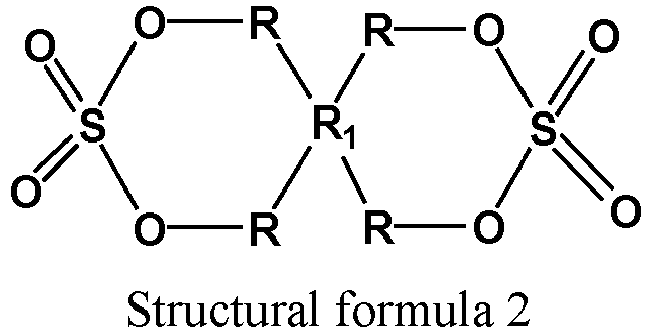
- In structural formula 2, R1 is


- In structural formula 3, R2 is a single bond, alkyl with 1-5 carbon atoms, oxyalkyl with 1-5 carbon atoms,

- Optionally, the compound B represented by structural formula 2 is selected from the following compounds:


- Optionally, the percentage mass content of the bicyclic sulfate compound is 0.1%~5.0% and the compound A is 0.1%~5.0% based on the total mass of the non-aqueous electrolyte for lithium ion battery being 100%.
- Optionally, the non-aqueous electrolyte further comprises at least one of unsaturated cyclic carbonate, fluorinated cyclic carbonate, cyclic sultone, and cyclic sulfate.
- Optionally, the unsaturated cyclic carbonate comprises at least one of vinylene carbonate, vinyl ethylene carbonate, and methylene ethylene carbonate;
- the fluorinated cyclic carbonate comprises at least one of fluoroethylene carbonate, trifluoromethyl ethylene carbonate and di-fluoro ethylene carbonate;
- the cyclic sultone comprises at least one of 1,3-propane sultone, 1,4-butane sultone and prop-1-ene-1,3 -sultone;
- the cyclic sulfate is selected from at least one of ethylene sulfate and 4-methyl-1,3,2-dioxathiolane-2,2-dioxide.
- In anothet aspect, the present application provides a lithium ion battery, comprising a positive electrode, a negative electrode, a separator interposed between the positive electrode and the negative electrode, and the non-aqueous electrolyte for lithium ion battery as described above.
- According to the present application, the non-aqueous electrolyte for lithium ion battery is added with a bicyclic sulfate compound, and the bicyclic sulfate compound can form a passivation film on the surface of negative electrode, but the stability of the passivation film needs to be further improved. The applicant found through a large number of experiments that when the bicyclic sulfate compound and the compound A presented by structural formula 1 are used together, they can be decomposed on the surface of the negative electrode together to form a composite passivation film. The composite passivation film has higher thermal stability than a passivation film formed by a compound containing only bicyclic sulfate or the compound presented by structural formula 1 alone, and can further inhibit gas expansion of the battery when stored at high-temperature, thereby further improving the retention and recovery capability of the high-temperature storage capacity of the battery and further improving the high-temperature cycle performance of the battery.
- In order to make the technical problems to be solved, technical solutions and beneficial effects more apparent and clearer, the present application will be described in further detail below with reference to embodiments. It should be understood that the specific embodiments described herein are only for the purpose of explaining the present invention and are not intended to limit the present invention.
- The embodiment of the invention provides a non-aqueous electrolyte for lithium ion battery, comprising a bicyclic sulfate compound and a compound A represented by structural formula 1:

- In structural formula 1, R3, R4, R5, R6, R7 and R8 are each independently selected from hydrogen, fluorine atom or a group containing 1~5 carbon atoms.
- When the bicyclic sulfate compound and the compound A presented by structural formula 1 are used together, the two can be decomposed on the surface of the negative electrode together to form a composite passivation film. The composite passivation film has higher thermal stability than a passivation film formed by a compound containing only bicyclic sulfate or the compound presented by structural formula 1 alone, and can further inhibit gas expansion of the battery when stored at high-temperature, thereby further improving the retention and recovery capability of the high-temperature storage capacity of the battery and further improving the high-temperature cycle performance of the battery.
- In some embodiments, the group containing 1~5 carbon atoms is selected from hydrocarbyl, halogenated hydrocarbyl, oxygen-containing hydrocarbyl, silicon-containing hydrocarbyl, or cyano-containing substituted hydrocarbyl.
- In some embodiments, R3, R4, R5, R6, R7 and R8 are each independently selected from hydrogen atom, fluorine atom, methyl group, ethyl group, methoxy group, ethoxy group, trimethylsiloxy group, cyano group, or trifluoromethyl group.
- In some embodiments, the compound A represented by structural formula 1 is selected from the following compounds:


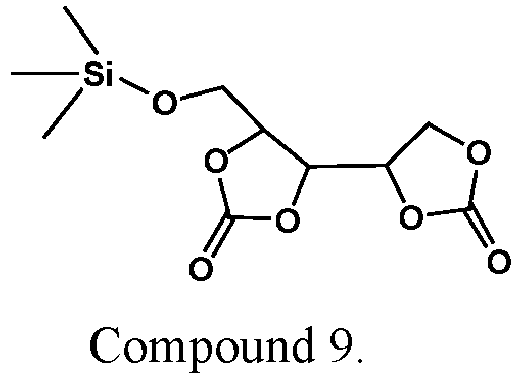
- It should be noted that the above are some compounds claimed by the present application, but they are not limited thereto and should not be construed as limiting the application.
- The compound A represented by structural formula 1 above can be prepared by ester exchange reaction of polyols (such as erythritol, xylitol, etc.) and carbonates (such as dimethyl carbonate, diethyl carbonate, ethylene carbonate, etc.) in the presence of alkaline catalyst, followed by recrystallization or column chromatography purification. The specific synthetic route is as follows:

- The fluorine-containing compound in compound A is prepared by fluorinating the corresponding carbonate and the mixture of F2/N2, and then purified by recrystallization or column chromatography. An example of its synthetic route is as follows:

- The cyano-containing compound in compound A is prepared by performing chlorination reaction on the corresponding carbonate and sulfonyl chloride, and reacting with NaCN or KCN, then purified by recrystallization or column chromatography. An example of its synthetic route is as follows:

- The trimethylsiloxy-containing compound in compound A is prepared by performing substitution reaction on the corresponding hydroxy carbonate and silazane, then purified by recrystallization or column chromatography. An example of its synthetic route is as follows:

- In some embodiments, the bicyclic sulfate compound is selected from compound B represented by structural formula 2 and/or compound C represented by structural formula 3:

- In structural formula 2, R1 is


- In structural formula 3, R2 is a single bond, alkyl with 1-5 carbon atoms, oxyalkyl with 1-5 carbon atoms,

- In a more preferred embodiments, the compound B represented by structural formula 2 is selected from the following compounds:


- In some embodiments, the percentage mass content of the bicyclic sulfate compound is 0.1%~5.0% and the compound A is 0.1%~5.0% based on the total mass of the non-aqueous electrolyte for lithium ion battery being 100%.
- The non-aqueous electrolyte further comprises at least one of unsaturated cyclic carbonate, fluorinated cyclic carbonate, cyclic sultone, and cyclic sulfate.
- In a more preferred embodiment, the unsaturated cyclic carbonate comprises at least one of vinylene carbonate (CAS: 872-36-6, VC), vinyl ethylene carbonate (CAS: 4427-96-7, VEC), and methylene ethylene carbonate (CAS: 124222-05-5);
- The fluorinated cyclic carbonate comprises at least one of fluoroethylene carbonate (CAS: 114435-02-8, FEC), trifluoromethyl ethylene carbonate (CAS: 167951-80-6) and di-fluoro ethylene carbonate (CAS: 311810-76-1);
- The cyclic sultone comprises at least one of 1,3- propane sultone (CAS: 1120-71-4, PS), 1,4-butane sultone (CAS: 1633-83-6) and propene -1,3- sultone (CAS: 21806-61-1);
- The cyclic sulfate is selected from at least one of ethylene sulfate (CAS: 1072-53-3, DTD) and 4-methyl-1,3,2-dioxathiolane-2,2-dioxide (CAS: 5689-83-8).
- The same as that in the prior art, the non-aqueous electrolyte for lithium ion battery contains solvents and lithium salts, and there is no special limitation on the type or content of the solvent for the present application, for example, the solvent of the non-aqueous electrolyte for lithium ion battery comprises cyclic carbonate and chain carbonate.
- Optionally, the cyclic carbonate comprises at least one of ethylene carbonate, propylene carbonate, and butylene carbonate; The chain carbonate comprises at least one of dimethyl carbonate, diethyl carbonate, methyl ethyl carbonate and methyl propyl carbonate.
- The lithium salt of the present invention is not particularly limited, the existing lithium salts may be used, for example, the lithium salt may be selected from at least one of LiPF6, LiBF4, LiBOB, LiDFOB, LiN(SO2CF3)2 and LiN(SO2F)2. The content of the lithium salt can vary within a large range, and preferably, the content of the lithium salt in the non-aqueous electrolyte for lithium ion battery is 0.1-15%.
- Another embodiment of the present invention discloses a lithium ion battery, comprising a positive electrode, a negative electrode, a separator interposed between the positive electrode and the negative electrode, and the non-aqueous electrolyte for lithium ion battery as described above.
- The positive electrode comprises a positive electrode active material, wherein the positive electrode active material is at least one of LiNixCoyMnzL(1-x-y-z)O2, LiCox'L(1-x')O2, LiNix"L'y'Mn( 2-x"-y')O4 and Liz'MPO4; wherein L is at least one of Al, Sr, Mg, Ti, Ca, Zr, Zn, Si and Fe; 0≤x≤1, 0≤y≤1, 0≤z≤1, 0<x+y+z≤1, 0<x'≤1, 0.3≤x"≤0.6, 0.01≤y'≤0.2; L' is at least one of Co, Al, Sr, Mg, Ti, Ca, Zr, Zn, Si and Fe; 0.5≤z'≤1, m is at least one of Fe, Mn and Co.
- The negative electrode comprises a negative electrode active material, the negative electrode active material may be made of carbon material, metal alloy, lithium-containing oxide and silicon-containing material. Preferably, the negative electrode active material is selected from artificial graphite and natural graphite. Obviously, it is not limited to the two listed.
- The separator is a regular diaphragm in the field of lithium ion batteries, and therefore, it will not be described again.
- The lithium ion battery provided by the embodiment of the invention has better high-temperature cycle performance and high-temperature storage performance because it contains the non-aqueous electrolyte described above.
- The invention will be further illustrated by the following examples.
- The embodiment is used for explaining the non-aqueous electrolyte for lithium ion battery, the lithium ion battery and the preparation method thereof, comprising the following steps:
The preparation process of the positive electrode is: mixing a positive electrode active material lithium nickel cobalt manganese oxide (LiNi0.5Co0.2Mn0.3O2), conductive carbon black Super-P and a binder polyvinylidene fluoride (PVDF) according to a mass ratio of 92:4:3, dispersing in N-methyl-2-pyrrolidone (NMP) to obtain positive electrode slurry, uniformly coating the positive electrode slurry on two sides of an aluminum foil, drying, calendering and vacuum drying, then welding an aluminum lead wire with an ultrasonic welder to obtain a positive electrode plate, wherein the thickness of the positive electrode plate is between 120 and 150 µm. - The preparation process of the negative electrode is: mixing artificial graphite, conductive carbon black Super-P, binder styrene butadiene rubber (SBR) and carboxymethyl cellulose (CMC) according to a mass ratio of 94:1:2.5:2.5, dispersing in deionized water to obtain negative electrode slurry, coating the negative electrode slurry on two sides of a copper foil, drying, calendering and vacuum drying, then welding a nickel lead wire with an ultrasonic welder to obtain a negative electrode plate, wherein the thickness of the negative electrode plate is between 120 and 150 µm.
- The preparation process of the non-aqueous electrolyte is: mixing a lithium salt, a solvent, the bicyclic sulfate compound and the compound A represented by structural formula 1 to obtain an electrolyte, wherein the bicyclic sulfate compound is selected from compound 10, the compound A represented by structural formula 1 is selected from compound 1, and the bicyclic sulfate compound is 1% and the compound A is 1% based on the total mass of the non-aqueous electrolyte for lithium ion battery being 100%.
- The preparation process of the separator is: the separator is made of a three-layer isolation film with a thickness of 20 µm.
- The assembly steps of the battery are as follows: the separator of three-layer isolation film is placed between the positive electrode plate and the negative electrode plate, then a sandwich structure consisting of the positive electrode plate, the negative electrode plate and the separator is wound, the wound body is flattened and put into an aluminum foil packaging bag, then vacuum baked at 85°C for 24 hours, to obtain a battery core to be injected; In a glove box with dew point below -40°C, the electrolyte prepared above is injected into the battery core, and then is vacuum sealed and left standing for 24 hours.
- Then, the initial formation charge is performed according to the following steps: charged with 0.05C constant current for 180min, then charged to 3.95V with 0.2C constant current, vacuum sealed again, then further charged to 4.2V with 0.2C constant current, left standing at room temperature for 24 hours, then discharged to 3.0V with 0.2C constant current to obtain a 4.2V LiNi0.5Co0.2Mn0.3O2/ artificial graphite lithium ion battery.
- Embodiments 2~14 are used for illustrating the non-aqueous electrolyte for lithium ion battery, the lithium ion battery and the preparation method thereof, and include most of the operation steps in Embodiment 1, with the difference that:
based on the total weight of the non-aqueous electrolyte being 100%, the non-aqueous electrolyte contains the components (in percentage by mass) shown in Embodiments 2~14 in Table 1. - Comparative Examples 1~6 are used for illustrating the non-aqueous electrolyte for lithium ion battery, the lithium ion battery and the preparation method thereof, and include most of the operation steps in Embodiment 1, with the difference that:
based on the total weight of the non-aqueous electrolyte being 100%, the non-aqueous electrolyte contains the components (in percentage by mass) shown in Comparative Examples 1~6 in Table 1. - The lithium ion batteries prepared in Embodiments 1~14 and Comparative Examples 1~6 were subjected to the following performance tests:
- At 45°C, the formed battery was charged with 1C constant current/constant voltage to 4.2V, the cutoff current was 0.01C, and then discharged to 3.0V with 1C constant current. After such charge/discharge for N cycles, the capacity retention rate after N cycles is calculated to evaluate its high-temperature cycle performance.
- The calculation formula of the Nth cycle capacity retention rate at 45°C 1C is as follows:
The Nth cycle capacity retention rate (%) = (the Nth cycle discharge capacity/ the first cycle discharge capacity) ∗ 100%. - The formed battery was charged to 4.2V with 1C constant current/constant voltage at room temperature, the cutoff current was 0.01C, then discharged to 3.0V with 1C constant current, the initial discharge capacity of the battery was measured, then charged to 4.2V with 1C constant current/constant voltage, the cutoff current was 0.01C, the initial thickness of the battery was measured, then the battery was stored at 60°C for N days, the thickness of the battery was measured, then discharged to 3.0V with 1C constant current, the retention capacity of the battery was measured, then charged to 4.2V with 1C constant current/constant voltage, the cutoff current was 0.01C, and then discharged to 3.0V with 1C constant current. The calculation formulas for capacity retention rate and capacity recovery rate are as follows:


- The test results are shown in Table 1.
Table 1 Embodi ment/ Compara tive Example Bicyclic sulfate compound and its content Compound represented by structural formula 1 Other compou nds and content s The 500th cycle capacity retention rate (%) at 45°C 1C After 30 days of storage at 60°C Capacit y retentio n rate Capacity recovery rate Thicknes s expansio n rate Embodi ment1 Compound 10:1% Compound 1:1% - 84.1% 83.8% 88.7% 15.2% Embodi ment2 Compound 11:1% Compound 2:1% - 82.4% 82.7% 86.2% 15.4% Embodi ment3 Compound 12:1% Compound 1:1% - 82.2% 82.7% 87.4% 14.4% Embodi ment4 Compound 13:1% Compound 2:1% - 83.2% 82.5% 86.5% 13.1% Embodi ment5 Compound 10:2% Compound 1:1% - 86.4% 85.2% 90.1% 10.4% Embodi ment6 Compound 10:3% Compound 1:1% - 80.5% 87.44% 91.5% 8.4% Embodi ment7 Compound 10:1% Compound 1:2% - 87.4% 88.2% 92.5% 8.1% Embodi ment8 Compound 10:2% Compound 1:2% - 89.4% 90.4% 94.5% 6.4% Embodi ment9 Compound 10:1% Compound 1:0.5% - 80.1% 81.6% 86.9% 15.3% Embodi ment10 Compound 10: 1% Compound 1:1% VC: 1% 88.8% 84.1% 88.7% 18.2% Embodi ment11 Compound 10: 1% Compound 1:1% FEC: 1% 86.8% 82.1% 87.7% 20.8% Embodi ment12 Compound 10: 1% Compound 1:1% 1,3-PS : 1% 84.4% 90.4% 94.7% 10.4% Embodi ment13 Compound 10: 1% Compound 1:1% DTD: 1% 86.2% 84.4% 88.8% 15.4% Embodi ment14 Compound 10: 1% Compound 1:1% LiN(SO 2F)2: 1% 85.6% 85.7% 89.7% 14.2% Compara tive Example 1 Compound 10:1% - - 75.4% 74.4% 78.5% 18.4% Compara tive Example 2 Compound 10:1% - VC: 1% 80.6% 75.1% 80.5% 21.5% Compara tive Example 3 Compound 10:1% - FEC: 1% 79.8% 72.2% 77.8% 25.5% Compara tive Example 4 Compound 10:1% - 1,3-PS : 1% 75.9% 80.4% 85.4% 11.1% Compara tive Example 5 Compound 10:1% - DTD: 1% 77.3% 76.7% 81.5% 15.6% Compara tive Example 6 Compound 10:1% - LiN(SO 2F)2: 1% 77.9% 77.5% 82.4% 16.7% - From the data of Embodiments 1~14 and Comparative Examples 1~6 in table 1, it can be seen that compared with adding bicyclic sulfate compound alone, adding both the bicyclic sulfate compound and the compound A represented by structural formula 1 can form a composite passivation film with better thermal stability on the surface of the negative electrode, and can obviously improve the high-temperature cycle and high-temperature storage performance of the battery. Meanwhile, it can be seen that the high-temperature cycle and high-temperature storage performance of the battery can be further improved with the increase of the content of compound A represented by structural formula 1.
- Comparing the data of Embodiments 10~14 and Comparative Examples 2~6, it can be seen that in a mixed system of bicyclic sulfate compound, vinylene carbonate, fluoroethylene carbonate, 1,3-propane sultone, ethylene sulfate and LiN(SO2F)2, further adding the compound A represented by structural formula 1 can improve the high-temperature cycle and high-temperature storage performance of the battery.
Claims (10)
- A non-aqueous electrolyte for lithium ion battery, characterized by comprising a bicyclic sulfate compound and a compound A represented by structural formula 1:

- The non-aqueous electrolyte for lithium ion battery of claim 1, wherein the group containing 1~5 carbon atoms is selected from hydrocarbyl, halogenated hydrocarbyl, oxygen-containing hydrocarbyl, silicon-containing hydrocarbyl, or cyano-containing substituted hydrocarbyl.
- The non-aqueous electrolyte for lithium ion battery of claim 2, wherein R3, R4, R5, R6, R7 and R8 are each independently selected from hydrogen atom, fluorine atom, methyl group, ethyl group, methoxy group, ethoxy group, trimethylsiloxy group, cyano group, or trifluoromethyl group.
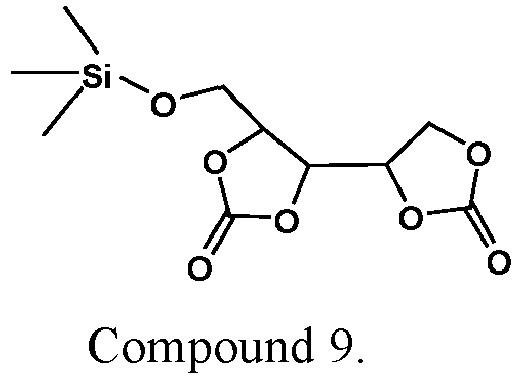
- The non-aqueous electrolyte for lithium ion battery of claim 1, wherein the compound A represented by structural formula 1 is selected from the following compounds:


- The non-aqueous electrolyte for lithium ion battery of claim 1, wherein the bicyclic sulfate compound is selected from compound B represented by structural formula 2 and/or compound C represented by structural formula 3:


- The non-aqueous electrolyte for lithium ion battery of claim 5, wherein the compound B represented by structural formula 2 is selected from the following compounds:


- The non-aqueous electrolyte for lithium ion battery of claim 1, wherein the percentage mass content of the bicyclic sulfate compound is 0.1%~5.0% and the compound A is 0.1%~5.0% based on the total mass of the non-aqueous electrolyte for lithium ion battery being 100%.
- The non-aqueous electrolyte for lithium ion battery of claim 1, wherein the non-aqueous electrolyte further comprises at least one of unsaturated cyclic carbonate, fluorinated cyclic carbonate, cyclic sultone, and cyclic sulfate.
- The non-aqueous electrolyte for lithium ion battery of claim 8, wherein the unsaturated cyclic carbonate comprises at least one of vinylene carbonate, vinyl ethylene carbonate, and methylene ethylene carbonate;the fluorinated cyclic carbonate comprises at least one of fluoroethylene carbonate, trifluoromethyl ethylene carbonate and di-fluoro ethylene carbonate;the cyclic sultone comprises at least one of 1,3-propane sultone, 1,4-butane sultone and prop-1 -ene-1,3 -sultone;the cyclic sulfate is selected from at least one of ethylene sulfate and 4-methyl-1,3,2-dioxathiolane-2,2-dioxide.
- A lithium ion battery, characterized by comprising a positive electrode, a negative electrode, a separator interposed between the positive electrode and the negative electrode, and the non-aqueous electrolyte for lithium ion battery of claims 1~9.
Priority Applications (1)
| Application Number | Priority Date | Filing Date | Title |
|---|---|---|---|
| PL18890978T PL3731325T3 (en) | 2017-12-21 | 2018-06-27 | Non-aqueous electrolyte for lithium-ion battery, and lithium-ion battery |
Applications Claiming Priority (2)
| Application Number | Priority Date | Filing Date | Title |
|---|---|---|---|
| CN201711391825.0A CN109950621B (en) | 2017-12-21 | 2017-12-21 | A lithium ion battery non-aqueous electrolyte and lithium ion battery |
| PCT/CN2018/092969 WO2019119765A1 (en) | 2017-12-21 | 2018-06-27 | Non-aqueous electrolyte for lithium-ion battery, and lithium-ion battery |
Publications (3)
| Publication Number | Publication Date |
|---|---|
| EP3731325A1 EP3731325A1 (en) | 2020-10-28 |
| EP3731325A4 EP3731325A4 (en) | 2021-01-20 |
| EP3731325B1 true EP3731325B1 (en) | 2021-12-29 |
Family
ID=66993070
Family Applications (1)
| Application Number | Title | Priority Date | Filing Date |
|---|---|---|---|
| EP18890978.2A Active EP3731325B1 (en) | 2017-12-21 | 2018-06-27 | Non-aqueous electrolyte for lithium-ion battery, and lithium-ion battery |
Country Status (6)
| Country | Link |
|---|---|
| US (1) | US11881555B2 (en) |
| EP (1) | EP3731325B1 (en) |
| CN (1) | CN109950621B (en) |
| HU (1) | HUE059137T2 (en) |
| PL (1) | PL3731325T3 (en) |
| WO (1) | WO2019119765A1 (en) |
Cited By (1)
| Publication number | Priority date | Publication date | Assignee | Title |
|---|---|---|---|---|
| CN116097471A (en) * | 2022-02-09 | 2023-05-09 | 东莞新能源科技有限公司 | Electrochemical device and electronic device comprising same |
Families Citing this family (26)
| Publication number | Priority date | Publication date | Assignee | Title |
|---|---|---|---|---|
| CN108933292B (en) * | 2017-05-27 | 2020-04-21 | 深圳新宙邦科技股份有限公司 | Lithium-ion battery non-aqueous electrolyte and lithium-ion battery |
| CN110931869B (en) | 2019-12-02 | 2022-05-27 | 广州天赐高新材料股份有限公司 | High-temperature lithium secondary battery electrolyte and battery |
| CN111244548A (en) * | 2020-03-04 | 2020-06-05 | 江苏中兴派能电池有限公司 | Lithium ion battery electrolyte with long cycle life containing disulfide heterocyclic ring additive |
| CN111354978A (en) * | 2020-03-09 | 2020-06-30 | 东莞维科电池有限公司 | High-voltage ternary lithium ion battery electrolyte and high-voltage ternary lithium ion battery |
| CN111668546B (en) * | 2020-06-24 | 2021-12-07 | 远景动力技术(江苏)有限公司 | Nonaqueous electrolyte solution and lithium ion battery using same |
| CN111900472A (en) * | 2020-06-30 | 2020-11-06 | 远景动力技术(江苏)有限公司 | Non-aqueous electrolyte of lithium ion battery |
| CN111934017A (en) * | 2020-08-28 | 2020-11-13 | 珠海市赛纬电子材料股份有限公司 | Non-aqueous electrolyte for lithium ion battery and lithium ion battery containing same |
| CN114122491A (en) * | 2020-08-31 | 2022-03-01 | 深圳新宙邦科技股份有限公司 | Lithium ion battery |
| CN114122494A (en) * | 2020-08-31 | 2022-03-01 | 深圳新宙邦科技股份有限公司 | Lithium ion battery |
| CN114447432B (en) * | 2020-11-03 | 2023-12-15 | 深圳新宙邦科技股份有限公司 | Non-aqueous electrolyte of lithium ion battery and lithium ion battery |
| CN112421109B (en) * | 2020-11-19 | 2022-04-26 | 中节能万润股份有限公司 | Cyclic sulfonate lithium ion battery electrolyte additive, preparation method and application thereof |
| CN118899538A (en) * | 2020-12-28 | 2024-11-05 | 深圳新宙邦科技股份有限公司 | A non-aqueous electrolyte and battery |
| KR20220105936A (en) * | 2021-01-21 | 2022-07-28 | 삼성에스디아이 주식회사 | Additive for electrolyte of lithium battery, organic electrolytic solution comprising the same and Lithium battery using the solution |
| US20240097188A1 (en) * | 2021-01-22 | 2024-03-21 | Soulbrain Co., Ltd. | Electrolyte solution and secondary battery including the same |
| EP4283740A4 (en) * | 2021-01-22 | 2025-12-31 | Soulbrain Co Ltd | ELECTROLYTE SOLUTION AND SECONDARY BATTERY SOLUTION |
| US20240097189A1 (en) * | 2021-01-22 | 2024-03-21 | Soulbrain Co., Ltd. | Electrolyte solution and secondary battery including the same |
| CN116491005A (en) * | 2021-03-29 | 2023-07-25 | 株式会社Lg化学 | Nonaqueous electrolyte solution additive for lithium secondary battery, nonaqueous electrolyte solution for lithium secondary battery and lithium secondary battery containing same |
| ES3060465T3 (en) * | 2021-07-30 | 2026-03-26 | Contemporary Amperex Technology Hong Kong Ltd | Electrolyte, secondary battery, battery module, battery pack, and electric device |
| CN116982189A (en) * | 2021-10-25 | 2023-10-31 | 宁德时代新能源科技股份有限公司 | An electrochemical device and an electrical device including the electrochemical device |
| US20230231126A1 (en) * | 2022-01-19 | 2023-07-20 | Shenzhen Capchem Technology Co., Ltd. | Lithium ion battery |
| CN114725392A (en) * | 2022-04-26 | 2022-07-08 | 惠州市豪鹏科技有限公司 | A lithium-ion battery |
| CN117477027A (en) * | 2022-07-21 | 2024-01-30 | 深圳新宙邦科技股份有限公司 | A kind of non-aqueous electrolyte and secondary battery |
| US20240339660A1 (en) * | 2023-04-07 | 2024-10-10 | Lg Energy Solution, Ltd. | Lithium Secondary Battery |
| WO2024243862A1 (en) * | 2023-05-31 | 2024-12-05 | 宁德时代新能源科技股份有限公司 | Non-aqueous electrolyte, secondary battery, and electrical device |
| WO2024250144A1 (en) * | 2023-06-05 | 2024-12-12 | 宁德时代新能源科技股份有限公司 | Secondary battery and electric device |
| WO2025063750A1 (en) * | 2023-09-22 | 2025-03-27 | 주식회사 엘지에너지솔루션 | Nonaqueous electrolyte and lithium secondary battery comprising same |
Family Cites Families (10)
| Publication number | Priority date | Publication date | Assignee | Title |
|---|---|---|---|---|
| JP3957415B2 (en) | 1998-10-20 | 2007-08-15 | 日立マクセル株式会社 | Non-aqueous secondary battery |
| JP5055536B2 (en) * | 2005-02-09 | 2012-10-24 | 国立大学法人宇都宮大学 | Highly immobilized carbon dioxide |
| WO2008035928A1 (en) * | 2006-09-20 | 2008-03-27 | Lg Chem, Ltd. | Additive for non-aqueous electrolyte and secondary battery using the same |
| JP2011238373A (en) * | 2010-05-06 | 2011-11-24 | Sony Corp | Secondary battery, electrolytic solution for secondary battery, electric tool, electric vehicle, and power storage system |
| EP2913880B1 (en) * | 2012-10-29 | 2018-01-10 | GS Yuasa International Ltd. | Nonaqueous electrolyte secondary battery and method for manufacturing nonaqueous electrolyte secondary battery |
| JP2015092476A (en) * | 2013-10-04 | 2015-05-14 | 旭化成株式会社 | Nonaqueous electrolyte, electrolyte for lithium ion secondary batteries and nonaqueous electrolyte battery |
| JP2015072863A (en) * | 2013-10-04 | 2015-04-16 | 旭化成株式会社 | Nonaqueous electrolyte, electrolyte for lithium ion secondary battery, and lithium ion secondary battery |
| JP6229453B2 (en) * | 2013-11-22 | 2017-11-15 | 宇部興産株式会社 | Non-aqueous electrolyte and power storage device using the same |
| KR102451966B1 (en) * | 2015-06-08 | 2022-10-07 | 에스케이온 주식회사 | Electrolyte for Secondary Battery and Lithium Secondary Battery Containing the Same |
| CN109326824B (en) * | 2017-07-31 | 2020-04-21 | 深圳新宙邦科技股份有限公司 | Lithium-ion battery non-aqueous electrolyte and lithium-ion battery |
-
2017
- 2017-12-21 CN CN201711391825.0A patent/CN109950621B/en active Active
-
2018
- 2018-06-27 WO PCT/CN2018/092969 patent/WO2019119765A1/en not_active Ceased
- 2018-06-27 EP EP18890978.2A patent/EP3731325B1/en active Active
- 2018-06-27 PL PL18890978T patent/PL3731325T3/en unknown
- 2018-06-27 HU HUE18890978A patent/HUE059137T2/en unknown
- 2018-06-27 US US16/770,281 patent/US11881555B2/en active Active
Cited By (2)
| Publication number | Priority date | Publication date | Assignee | Title |
|---|---|---|---|---|
| CN116097471A (en) * | 2022-02-09 | 2023-05-09 | 东莞新能源科技有限公司 | Electrochemical device and electronic device comprising same |
| EP4475219A4 (en) * | 2022-02-09 | 2025-08-27 | Dongguan Amperex Tech Ltd | ELECTROCHEMICAL DEVICE AND ELECTRONIC DEVICE WITH ELECTROCHEMICAL DEVICE |
Also Published As
| Publication number | Publication date |
|---|---|
| EP3731325A4 (en) | 2021-01-20 |
| CN109950621A (en) | 2019-06-28 |
| WO2019119765A1 (en) | 2019-06-27 |
| US20200313237A1 (en) | 2020-10-01 |
| CN109950621B (en) | 2022-05-03 |
| PL3731325T3 (en) | 2022-02-21 |
| US11881555B2 (en) | 2024-01-23 |
| HUE059137T2 (en) | 2022-10-28 |
| EP3731325A1 (en) | 2020-10-28 |
Similar Documents
| Publication | Publication Date | Title |
|---|---|---|
| US11881555B2 (en) | Non-aqueous electrolyte for lithium ion battery and lithium ion battery | |
| EP3907803B1 (en) | Non-aqueous electrolyte for lithium ion battery and lithium ion battery | |
| JP6963068B2 (en) | Non-aqueous electrolyte for lithium-ion batteries | |
| CN109950620B (en) | Non-aqueous electrolyte for lithium ion battery and lithium ion battery | |
| EP3483972B1 (en) | Non-aqueous electrolyte solution for lithium-ion battery, and lithium-ion battery using the same | |
| CN109994776B (en) | A lithium ion battery non-aqueous electrolyte and lithium ion battery | |
| EP3664212B1 (en) | Non-aqueous electrolyte for lithium-ion battery, and lithium-ion battery comprising the same | |
| CN110931865A (en) | Novel additive-containing electrolyte for lithium ion battery and lithium ion battery | |
| EP4325620A1 (en) | Iron phosphate lithium battery | |
| EP4379887A1 (en) | Lithium ion battery | |
| CN114122493B (en) | Nonaqueous electrolyte for lithium ion battery and lithium ion battery | |
| CN110416611B (en) | Non-aqueous electrolyte of lithium ion battery and lithium ion battery using same | |
| CN111384439A (en) | Non-aqueous electrolyte and lithium ion battery | |
| WO2019210559A1 (en) | Non-aqueous electrolyte for lithium ion battery and lithium ion battery | |
| CN109994779A (en) | A lithium ion battery non-aqueous electrolyte and lithium ion battery | |
| CN106602139B (en) | A kind of non-aqueous electrolyte and lithium ion battery containing this non-aqueous electrolyte | |
| CN112310466B (en) | Lithium-ion battery non-aqueous electrolyte and lithium-ion battery containing the same | |
| EP4243146A1 (en) | Lithium ion battery non-aqueous electrolyte and lithium ion battery | |
| CN111490292A (en) | Functional additives for non-aqueous electrolytes, non-aqueous electrolytes and lithium-ion batteries | |
| CN110247116B (en) | Non-aqueous electrolyte of lithium ion battery and lithium ion battery using same | |
| CN114447429B (en) | Nonaqueous electrolyte for lithium ion battery and lithium ion battery | |
| CN111864262A (en) | Lithium ion battery non-aqueous electrolyte and lithium ion battery |
Legal Events
| Date | Code | Title | Description |
|---|---|---|---|
| STAA | Information on the status of an ep patent application or granted ep patent |
Free format text: STATUS: THE INTERNATIONAL PUBLICATION HAS BEEN MADE |
|
| PUAI | Public reference made under article 153(3) epc to a published international application that has entered the european phase |
Free format text: ORIGINAL CODE: 0009012 |
|
| STAA | Information on the status of an ep patent application or granted ep patent |
Free format text: STATUS: REQUEST FOR EXAMINATION WAS MADE |
|
| 17P | Request for examination filed |
Effective date: 20200630 |
|
| AK | Designated contracting states |
Kind code of ref document: A1 Designated state(s): AL AT BE BG CH CY CZ DE DK EE ES FI FR GB GR HR HU IE IS IT LI LT LU LV MC MK MT NL NO PL PT RO RS SE SI SK SM TR |
|
| AX | Request for extension of the european patent |
Extension state: BA ME |
|
| REG | Reference to a national code |
Ref country code: DE Ref legal event code: R079 Ref document number: 602018028970 Country of ref document: DE Free format text: PREVIOUS MAIN CLASS: H01M0010052500 Ipc: H01M0010056700 |
|
| A4 | Supplementary search report drawn up and despatched |
Effective date: 20201221 |
|
| RIC1 | Information provided on ipc code assigned before grant |
Ipc: H01M 10/0567 20100101AFI20201215BHEP Ipc: H01M 10/0525 20100101ALI20201215BHEP Ipc: H01M 10/0569 20100101ALI20201215BHEP |
|
| DAV | Request for validation of the european patent (deleted) | ||
| DAX | Request for extension of the european patent (deleted) | ||
| GRAP | Despatch of communication of intention to grant a patent |
Free format text: ORIGINAL CODE: EPIDOSNIGR1 |
|
| STAA | Information on the status of an ep patent application or granted ep patent |
Free format text: STATUS: GRANT OF PATENT IS INTENDED |
|
| INTG | Intention to grant announced |
Effective date: 20210728 |
|
| GRAS | Grant fee paid |
Free format text: ORIGINAL CODE: EPIDOSNIGR3 |
|
| GRAA | (expected) grant |
Free format text: ORIGINAL CODE: 0009210 |
|
| STAA | Information on the status of an ep patent application or granted ep patent |
Free format text: STATUS: THE PATENT HAS BEEN GRANTED |
|
| AK | Designated contracting states |
Kind code of ref document: B1 Designated state(s): AL AT BE BG CH CY CZ DE DK EE ES FI FR GB GR HR HU IE IS IT LI LT LU LV MC MK MT NL NO PL PT RO RS SE SI SK SM TR |
|
| REG | Reference to a national code |
Ref country code: GB Ref legal event code: FG4D |
|
| REG | Reference to a national code |
Ref country code: CH Ref legal event code: EP |
|
| REG | Reference to a national code |
Ref country code: AT Ref legal event code: REF Ref document number: 1459352 Country of ref document: AT Kind code of ref document: T Effective date: 20220115 |
|
| REG | Reference to a national code |
Ref country code: IE Ref legal event code: FG4D |
|
| REG | Reference to a national code |
Ref country code: DE Ref legal event code: R096 Ref document number: 602018028970 Country of ref document: DE |
|
| REG | Reference to a national code |
Ref country code: SE Ref legal event code: TRGR |
|
| REG | Reference to a national code |
Ref country code: NL Ref legal event code: FP |
|
| REG | Reference to a national code |
Ref country code: LT Ref legal event code: MG9D |
|
| PG25 | Lapsed in a contracting state [announced via postgrant information from national office to epo] |
Ref country code: RS Free format text: LAPSE BECAUSE OF FAILURE TO SUBMIT A TRANSLATION OF THE DESCRIPTION OR TO PAY THE FEE WITHIN THE PRESCRIBED TIME-LIMIT Effective date: 20211229 Ref country code: LT Free format text: LAPSE BECAUSE OF FAILURE TO SUBMIT A TRANSLATION OF THE DESCRIPTION OR TO PAY THE FEE WITHIN THE PRESCRIBED TIME-LIMIT Effective date: 20211229 Ref country code: FI Free format text: LAPSE BECAUSE OF FAILURE TO SUBMIT A TRANSLATION OF THE DESCRIPTION OR TO PAY THE FEE WITHIN THE PRESCRIBED TIME-LIMIT Effective date: 20211229 Ref country code: BG Free format text: LAPSE BECAUSE OF FAILURE TO SUBMIT A TRANSLATION OF THE DESCRIPTION OR TO PAY THE FEE WITHIN THE PRESCRIBED TIME-LIMIT Effective date: 20220329 |
|
| REG | Reference to a national code |
Ref country code: AT Ref legal event code: MK05 Ref document number: 1459352 Country of ref document: AT Kind code of ref document: T Effective date: 20211229 |
|
| PG25 | Lapsed in a contracting state [announced via postgrant information from national office to epo] |
Ref country code: NO Free format text: LAPSE BECAUSE OF FAILURE TO SUBMIT A TRANSLATION OF THE DESCRIPTION OR TO PAY THE FEE WITHIN THE PRESCRIBED TIME-LIMIT Effective date: 20220329 Ref country code: LV Free format text: LAPSE BECAUSE OF FAILURE TO SUBMIT A TRANSLATION OF THE DESCRIPTION OR TO PAY THE FEE WITHIN THE PRESCRIBED TIME-LIMIT Effective date: 20211229 Ref country code: HR Free format text: LAPSE BECAUSE OF FAILURE TO SUBMIT A TRANSLATION OF THE DESCRIPTION OR TO PAY THE FEE WITHIN THE PRESCRIBED TIME-LIMIT Effective date: 20211229 Ref country code: GR Free format text: LAPSE BECAUSE OF FAILURE TO SUBMIT A TRANSLATION OF THE DESCRIPTION OR TO PAY THE FEE WITHIN THE PRESCRIBED TIME-LIMIT Effective date: 20220330 |
|
| PG25 | Lapsed in a contracting state [announced via postgrant information from national office to epo] |
Ref country code: SM Free format text: LAPSE BECAUSE OF FAILURE TO SUBMIT A TRANSLATION OF THE DESCRIPTION OR TO PAY THE FEE WITHIN THE PRESCRIBED TIME-LIMIT Effective date: 20211229 Ref country code: SK Free format text: LAPSE BECAUSE OF FAILURE TO SUBMIT A TRANSLATION OF THE DESCRIPTION OR TO PAY THE FEE WITHIN THE PRESCRIBED TIME-LIMIT Effective date: 20211229 Ref country code: RO Free format text: LAPSE BECAUSE OF FAILURE TO SUBMIT A TRANSLATION OF THE DESCRIPTION OR TO PAY THE FEE WITHIN THE PRESCRIBED TIME-LIMIT Effective date: 20211229 Ref country code: PT Free format text: LAPSE BECAUSE OF FAILURE TO SUBMIT A TRANSLATION OF THE DESCRIPTION OR TO PAY THE FEE WITHIN THE PRESCRIBED TIME-LIMIT Effective date: 20220429 Ref country code: ES Free format text: LAPSE BECAUSE OF FAILURE TO SUBMIT A TRANSLATION OF THE DESCRIPTION OR TO PAY THE FEE WITHIN THE PRESCRIBED TIME-LIMIT Effective date: 20211229 Ref country code: EE Free format text: LAPSE BECAUSE OF FAILURE TO SUBMIT A TRANSLATION OF THE DESCRIPTION OR TO PAY THE FEE WITHIN THE PRESCRIBED TIME-LIMIT Effective date: 20211229 Ref country code: CZ Free format text: LAPSE BECAUSE OF FAILURE TO SUBMIT A TRANSLATION OF THE DESCRIPTION OR TO PAY THE FEE WITHIN THE PRESCRIBED TIME-LIMIT Effective date: 20211229 |
|
| PG25 | Lapsed in a contracting state [announced via postgrant information from national office to epo] |
Ref country code: AT Free format text: LAPSE BECAUSE OF FAILURE TO SUBMIT A TRANSLATION OF THE DESCRIPTION OR TO PAY THE FEE WITHIN THE PRESCRIBED TIME-LIMIT Effective date: 20211229 |
|
| PG25 | Lapsed in a contracting state [announced via postgrant information from national office to epo] |
Ref country code: IS Free format text: LAPSE BECAUSE OF FAILURE TO SUBMIT A TRANSLATION OF THE DESCRIPTION OR TO PAY THE FEE WITHIN THE PRESCRIBED TIME-LIMIT Effective date: 20220429 |
|
| REG | Reference to a national code |
Ref country code: DE Ref legal event code: R097 Ref document number: 602018028970 Country of ref document: DE |
|
| REG | Reference to a national code |
Ref country code: HU Ref legal event code: AG4A Ref document number: E059137 Country of ref document: HU |
|
| PG25 | Lapsed in a contracting state [announced via postgrant information from national office to epo] |
Ref country code: DK Free format text: LAPSE BECAUSE OF FAILURE TO SUBMIT A TRANSLATION OF THE DESCRIPTION OR TO PAY THE FEE WITHIN THE PRESCRIBED TIME-LIMIT Effective date: 20211229 Ref country code: AL Free format text: LAPSE BECAUSE OF FAILURE TO SUBMIT A TRANSLATION OF THE DESCRIPTION OR TO PAY THE FEE WITHIN THE PRESCRIBED TIME-LIMIT Effective date: 20211229 |
|
| PLBE | No opposition filed within time limit |
Free format text: ORIGINAL CODE: 0009261 |
|
| STAA | Information on the status of an ep patent application or granted ep patent |
Free format text: STATUS: NO OPPOSITION FILED WITHIN TIME LIMIT |
|
| 26N | No opposition filed |
Effective date: 20220930 |
|
| PG25 | Lapsed in a contracting state [announced via postgrant information from national office to epo] |
Ref country code: MC Free format text: LAPSE BECAUSE OF FAILURE TO SUBMIT A TRANSLATION OF THE DESCRIPTION OR TO PAY THE FEE WITHIN THE PRESCRIBED TIME-LIMIT Effective date: 20211229 |
|
| REG | Reference to a national code |
Ref country code: BE Ref legal event code: MM Effective date: 20220630 |
|
| PG25 | Lapsed in a contracting state [announced via postgrant information from national office to epo] |
Ref country code: SI Free format text: LAPSE BECAUSE OF FAILURE TO SUBMIT A TRANSLATION OF THE DESCRIPTION OR TO PAY THE FEE WITHIN THE PRESCRIBED TIME-LIMIT Effective date: 20211229 |
|
| PG25 | Lapsed in a contracting state [announced via postgrant information from national office to epo] |
Ref country code: LU Free format text: LAPSE BECAUSE OF NON-PAYMENT OF DUE FEES Effective date: 20220627 Ref country code: IE Free format text: LAPSE BECAUSE OF NON-PAYMENT OF DUE FEES Effective date: 20220627 |
|
| PG25 | Lapsed in a contracting state [announced via postgrant information from national office to epo] |
Ref country code: IT Free format text: LAPSE BECAUSE OF FAILURE TO SUBMIT A TRANSLATION OF THE DESCRIPTION OR TO PAY THE FEE WITHIN THE PRESCRIBED TIME-LIMIT Effective date: 20211229 Ref country code: BE Free format text: LAPSE BECAUSE OF NON-PAYMENT OF DUE FEES Effective date: 20220630 |
|
| P01 | Opt-out of the competence of the unified patent court (upc) registered |
Effective date: 20230601 |
|
| PG25 | Lapsed in a contracting state [announced via postgrant information from national office to epo] |
Ref country code: MK Free format text: LAPSE BECAUSE OF FAILURE TO SUBMIT A TRANSLATION OF THE DESCRIPTION OR TO PAY THE FEE WITHIN THE PRESCRIBED TIME-LIMIT Effective date: 20211229 Ref country code: CY Free format text: LAPSE BECAUSE OF FAILURE TO SUBMIT A TRANSLATION OF THE DESCRIPTION OR TO PAY THE FEE WITHIN THE PRESCRIBED TIME-LIMIT Effective date: 20211229 |
|
| PG25 | Lapsed in a contracting state [announced via postgrant information from national office to epo] |
Ref country code: MT Free format text: LAPSE BECAUSE OF FAILURE TO SUBMIT A TRANSLATION OF THE DESCRIPTION OR TO PAY THE FEE WITHIN THE PRESCRIBED TIME-LIMIT Effective date: 20211229 |
|
| PGFP | Annual fee paid to national office [announced via postgrant information from national office to epo] |
Ref country code: NL Payment date: 20250528 Year of fee payment: 8 |
|
| PGFP | Annual fee paid to national office [announced via postgrant information from national office to epo] |
Ref country code: PL Payment date: 20250522 Year of fee payment: 8 Ref country code: DE Payment date: 20250617 Year of fee payment: 8 |
|
| PGFP | Annual fee paid to national office [announced via postgrant information from national office to epo] |
Ref country code: GB Payment date: 20250625 Year of fee payment: 8 |
|
| PGFP | Annual fee paid to national office [announced via postgrant information from national office to epo] |
Ref country code: HU Payment date: 20250530 Year of fee payment: 8 Ref country code: FR Payment date: 20250630 Year of fee payment: 8 |
|
| PGFP | Annual fee paid to national office [announced via postgrant information from national office to epo] |
Ref country code: SE Payment date: 20250619 Year of fee payment: 8 |
|
| PGFP | Annual fee paid to national office [announced via postgrant information from national office to epo] |
Ref country code: CH Payment date: 20250701 Year of fee payment: 8 |
|
| PG25 | Lapsed in a contracting state [announced via postgrant information from national office to epo] |
Ref country code: TR Free format text: LAPSE BECAUSE OF FAILURE TO SUBMIT A TRANSLATION OF THE DESCRIPTION OR TO PAY THE FEE WITHIN THE PRESCRIBED TIME-LIMIT Effective date: 20211229 |