EP3726195A1 - Wear-amount prediction method, wear-amount prediction device, and wear-amount prediction program - Google Patents
Wear-amount prediction method, wear-amount prediction device, and wear-amount prediction program Download PDFInfo
- Publication number
- EP3726195A1 EP3726195A1 EP18888527.1A EP18888527A EP3726195A1 EP 3726195 A1 EP3726195 A1 EP 3726195A1 EP 18888527 A EP18888527 A EP 18888527A EP 3726195 A1 EP3726195 A1 EP 3726195A1
- Authority
- EP
- European Patent Office
- Prior art keywords
- wear
- aircraft
- energy
- wear energy
- aircraft tires
- Prior art date
- Legal status (The legal status is an assumption and is not a legal conclusion. Google has not performed a legal analysis and makes no representation as to the accuracy of the status listed.)
- Granted
Links
Images




Classifications
-
- G—PHYSICS
- G01—MEASURING; TESTING
- G01M—TESTING STATIC OR DYNAMIC BALANCE OF MACHINES OR STRUCTURES; TESTING OF STRUCTURES OR APPARATUS, NOT OTHERWISE PROVIDED FOR
- G01M17/00—Testing of vehicles
- G01M17/007—Wheeled or endless-tracked vehicles
- G01M17/02—Tyres
-
- B—PERFORMING OPERATIONS; TRANSPORTING
- B60—VEHICLES IN GENERAL
- B60C—VEHICLE TYRES; TYRE INFLATION; TYRE CHANGING; CONNECTING VALVES TO INFLATABLE ELASTIC BODIES IN GENERAL; DEVICES OR ARRANGEMENTS RELATED TO TYRES
- B60C11/00—Tyre tread bands; Tread patterns; Anti-skid inserts
- B60C11/24—Wear-indicating arrangements
- B60C11/246—Tread wear monitoring systems
-
- B—PERFORMING OPERATIONS; TRANSPORTING
- B64—AIRCRAFT; AVIATION; COSMONAUTICS
- B64C—AEROPLANES; HELICOPTERS
- B64C25/00—Alighting gear
- B64C25/32—Alighting gear characterised by elements which contact the ground or similar surface
- B64C25/34—Alighting gear characterised by elements which contact the ground or similar surface wheeled type, e.g. multi-wheeled bogies
- B64C25/36—Arrangements or adaptations of wheels, tyres or axles in general
-
- G—PHYSICS
- G01—MEASURING; TESTING
- G01N—INVESTIGATING OR ANALYSING MATERIALS BY DETERMINING THEIR CHEMICAL OR PHYSICAL PROPERTIES
- G01N3/00—Investigating strength properties of solid materials by application of mechanical stress
- G01N3/56—Investigating resistance to wear or abrasion
-
- B—PERFORMING OPERATIONS; TRANSPORTING
- B60—VEHICLES IN GENERAL
- B60C—VEHICLE TYRES; TYRE INFLATION; TYRE CHANGING; CONNECTING VALVES TO INFLATABLE ELASTIC BODIES IN GENERAL; DEVICES OR ARRANGEMENTS RELATED TO TYRES
- B60C2200/00—Tyres specially adapted for particular applications
- B60C2200/02—Tyres specially adapted for particular applications for aircrafts
Definitions
- the present invention relates to a wear amount estimation method, a wear amount estimation device, and a wear amount estimation program.
- Patent Literature 1 A technique is known that estimates a wear amount of aircraft tires (for example, Patent Literature 1).
- the method disclosed in Patent Literature 1 acquires plural kinds of wear energy corresponding to plural running states (such as a touching down state, a deceleration state after touching down, and a taxiing state) classified depending on the conditions of use, and estimates the wear amount of the respective aircraft tires based on the acquired wear energy.
- the method disclosed in Patent Literature 1 uses measurement data of a test device disclosed in Patent Literature 2, for example, when estimating the wear amount of the aircraft tires.
- Patent Literature 1 still may not be able to accurately estimate the wear amount of the respective aircraft tires in the situation in which the aircraft tires are actually used.
- the reason for this is that, in the situation in which the aircraft tires are actually used, the wear amount of the aircraft tires typically greatly varies depending on the state of the ground surface in each airport, a distance necessary for taxiing, a frequency of circling, a total weight of an aircraft body, and the position of the center of gravity of the aircraft body which changes due to seating positions of passengers or baggage, for example.
- the method disclosed in Patent Literature 1 thus cannot accurately estimate the wear amount of the respective aircraft tires in the situation in which the aircraft tires are actually used if the measurement data does not include these pieces of information.
- the present invention provides a wear amount estimation method, a wear amount estimation device, and a wear amount estimation program capable of accurately estimating a wear amount of aircraft tires in a situation in which the aircraft tires are actually used.
- a wear amount estimation method calculates wear energy E P , which depends on an internal pressure of the aircraft tires, in accordance with the internal pressure and wear energy E FR of the aircraft tires in a state of a free rolling run.
- the wear amount estimation method calculates wear energy E L , which depends on a load acting on the aircraft tires, in accordance with the load and the wear energy E FR .
- the wear amount estimation method calculates wear energy Ev, which depends on a velocity of the aircraft, in accordance with the velocity and the wear energy E FR .
- the wear amount estimation method calculates wear energy ⁇ E S , which depends on a slip angle caused in the aircraft tires, in accordance with the slip angle and the wear energy E FR .
- the wear amount estimation method calculates wear energy ⁇ E B , which depends on a braking force of the aircraft, in accordance with the braking force and the wear energy E FR .
- the wear amount estimation method estimates the wear amount wear of the aircraft tires in accordance with the wear energy E P , the wear energy E L , the wear energy Ev, the wear energy ⁇ E S , the wear energy ⁇ E B , and a wear resistance R indicating a relationship between predetermined wear energy and a predetermined wear amount.
- the present invention can accurately estimate the wear amount of the aircraft tires in a situation in which the aircraft tires are actually used.
- a wear amount estimation device 10 is a general-purpose computer, for example, including a processor including a CPU and a memory such as a read-only memory (ROM) and a random-access memory (RAM).
- the CPU reads out a program stored in the ROM to the RAM and executes the program.
- the wear amount estimation device 10 may be either a built-in terminal device or a mobile terminal device easy to carry (such as a smartphone).
- the wear amount estimation device 10 includes a communication unit 11, a calculation unit 12, and an estimation unit 13, as illustrated in Fig. IB.
- the communication unit 11 is an interface connected to a network 20 to transfer/receive pieces of data to communicate with an airline 30.
- the calculation unit 12 calculates wear energy.
- the estimation unit 13 estimates the wear amount of aircraft tires.
- the communication unit 11, the calculation unit 12, and the estimation unit 13 can be fabricated in single or plural processing circuits.
- the respective processing circuits include a programmed processing device, such as a processing device including an electric circuit.
- the respective processing circuits include an application-specific integrated circuit (ASIC) configured to execute the functions described above or a device including circuit components.
- ASIC application-specific integrated circuit
- the wear amount estimation device 10 mutually communicates with the airline 30 via the network 20.
- the wear amount estimation device 10 acquires pieces of information from the airline 30 via the network 20 to estimate the wear amount of the aircraft tires mounted on an aircraft.
- the information that the wear amount estimation device 10 acquires from the airline 30 will be described below.
- the aircraft may be simply referred to as a "body".
- the network 20 is a communications network capable of communicating various kinds of information.
- the network is implemented by various types of communication lines, such as dedicated lines installed by telecommunications carriers, public switched telephone networks, satellite communication lines, and mobile communication lines.
- step S101 the wear amount estimation device 10 acquires wear energy E FR of the aircraft tires during taxiing.
- the term "taxiing” refers to a state in which the aircraft runs on the ground (mainly a runway) under the power of the aircraft.
- the state of taxiing includes a state of a free rolling run, a state of a decelerating run, and a state of a circling run.
- the state of the free rolling run refers to a state in which the aircraft runs straight by rolling without braking force acting on the aircraft tires.
- the state of the decelerating run refers to a running state when the braking force is applied to the aircraft tires.
- the state of the circling run refers to a running state when a slip angle is applied to the aircraft tires.
- the wear energy E FR is energy per unit area produced at a particular point on the surface of the corresponding aircraft tire when the aircraft tire passes through a road surface once, and its unit is J/m 2 .
- the wear energy E FR is particularly wear energy during the state of the free rolling run.
- the wear amount estimation device 10 may acquire the wear energy E FR through laboratory testing, or may acquire the wear energy E FR by a finite element method (FEM).
- FEM finite element method
- step S102 the wear amount estimation device 10 acquires information on braking G acting on the body of the aircraft.
- the wear amount estimation device 10 acquires information about the braking G acting on the body and a brake signal.
- the brake signal refers to a brake pressure regarding a hydraulic brake.
- the braking force of the body is not achieved only with the aircraft tires, which is different from typical automobiles.
- the braking G of the body does not correspond to the braking G acting on the aircraft tires.
- the wear amount estimation device 10 thus obtains the braking G applied to the aircraft tires so as to estimate the wear amount of the aircraft tires. As shown in Fig.
- a predetermined value A is a point at which the braking force of a brake and a propulsive force of an engine are balanced, while the braking G is not led to any negative number when the brake pressure is the predetermined value A or smaller.
- the braking G does not change when the brake pressure of a predetermined value B or greater is applied.
- the wear amount estimation device 10 can calculate the braking G acting on the aircraft tires according to the above formula A2 at a predetermined timing. While the above process has been illustrated with the hydraulic brake, the aircraft is not limited to the hydraulic brake to be equipped. The aircraft may be equipped with an electric brake. The wear amount estimation device 10 can also calculate the braking G when the aircraft tire is equipped with an electric brake in the same manner as described above.
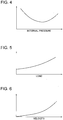
- the wear amount estimation device 10 changes the internal pressure of the aircraft tires on the basis of the wear energy E FR during the state of the free rolling run, and acquires wear energy E P which depends on the internal pressure.
- the wear energy Ep is represented by a quadratic function.
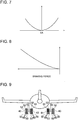
- a relationship between ribs formed on the aircraft tires and the wear energy E FR is described below with reference to Fig. 9 . While the following explanation is made with regard to the aircraft tires for a main gear illustrated in Fig. 9 , the same is also applied to the aircraft tires for a nose gear.
- the respective aircraft tires 40 to 43 are provided with a plurality of circumferential grooves 60 (three in Fig. 9 ) extending in the tire circumferential direction on the tread track, and are provided with a plurality of ribs (four in Fig. 9 ) 50 to 53 defined by the respective circumferential grooves 60.
- the ribs 50, 51, 52, and 53 are arranged in this order from the central side to the outer side of the body.
- the wear energy E FR varies depending on the positions of the ribs.
- the wear amount estimation device 10 then acquires the wear energy E FR of the respective ribs 50 to 53 of one aircraft tire.
- the wear amount estimation device 10 may acquire, as the wear energy E FR , an average value of the wear energy E FR regarding the rib 50 closest to the central side and the wear energy E FR regarding the rib 53 on the outermost side.
- the wear energy E P which depends on the internal pressure of the aircraft tires, also varies depending on the positions of the ribs shown in Fig. 9 .
- the wear amount estimation device 10 also changes the load applied to the aircraft tires on the basis of the wear energy E FR during the state of the free rolling run, and acquires wear energy E L which depends on the load.
- the wear energy E L is represented by a quadratic function.
- the wear energy E L also varies depending on the positions of the ribs shown in Fig. 9 , as in the case of the wear energy E P .
- the wear energy E L is given by the following formula A4: [Math.
- the wear amount estimation device 10 also changes the velocity of the aircraft on the basis of the wear energy E FR during the state of the free rolling run, and acquires wear energy Ev which depends on the velocity.
- the wear energy Ev is represented by a quadratic function.
- the wear energy Ev also varies depending on the positions of the ribs shown in Fig. 9 , as in the case of the wear energy Ep.
- the wear amount estimation device 10 also changes the slip angle (SA) of the aircraft tires, and acquires wear energy Es depending on the SA as a difference from the wear energy E FR in the state of the free rolling run.
- SA slip angle
- the wear energy Es is represented by a quadratic function.
- the wear energy Es also varies depending on the positions of the ribs shown in Fig. 9 , as in the case of the wear energy Ep.
- the wear energy Es is given by the following formula A6: [Math.
- the wear amount estimation device 10 also changes the braking force of the aircraft, and acquires wear energy E B depending on the breaking force as a difference from the wear energy E FR in the state of the free rolling run.
- the wear energy E B is represented by a quadratic function.
- the wear energy E B also varies depending on the positions of the ribs shown in Fig. 9 , as in the case of the wear energy E P .
- the wear energy E B is given by the following formula A7: [Math.
- the estimating process of the wear amount estimation device 10 includes six steps (step S201 to step S206).
- the wear amount estimation device 10 acquires pieces of information on the aircraft from the airline 30.
- the wear amount estimation device 10 acquires the velocity of the aircraft, the acceleration of the aircraft, the current position of the aircraft, the direction of the nose of the aircraft, the total weight of the aircraft, the internal pressure and the positions of the ribs of the respective aircraft tires mounted on the aircraft, the brake pressure of the aircraft, the circling angle of the body, the circling radius of the body, and the steering angle of the steering wheel, for example.
- the wear amount estimation device 10 also acquires the time when the respective pieces of the information are acquired.
- step S202 the wear amount estimation device 10 calculates a wheel load (a load) of the aircraft tires.
- the wheel load of the aircraft tires is obtained from a static load and a dynamic load.
- the wear amount estimation device 10 first calculates the position of the center of gravity of the body when calculating the wheel load of the aircraft tires.
- the position of the center of gravity of the body varies depending on the seating positions of passengers or baggage.
- a method is known that confirms the weight and the position of the center of gravity in accordance with the provisions of the law (the aviation law).
- the position of the center of gravity during flight can be measured relative to a mean aerodynamic chord (MAC), so as to calculate the position of the center of gravity in association with the positional information of the MAC.
- MAC mean aerodynamic chord
- the position of the center of gravity of the body can be calculated according to the mathematical expression of L1 + L2 ⁇ %MAC, where L1 is a distance from the nose gear to the front edge of the MAC position, and L2 is a MAC length of the body. L1 and L2 can be typically obtained from the body specifications. In addition, %MAC is available as the information prescribed in the aviation law.
- the static load of the aircraft tires is described below with reference to Fig. 11 .
- the static load is calculated in accordance with a balance of a moment about the center of gravity acting on the body.
- the wheel load of the respective aircraft tires mounted on the nose gear is obtained by dividing the total weight W N by the number of the tires mounted on the nose gear.
- the wheel load of the respective aircraft tires mounted on the main gear is obtained by dividing the total weight W M by the number of the tires mounted on the main gear.
- the acceleration in the vertical direction measured in the body of the aircraft when taking off gradually decreases as the aircraft accelerates.
- a relationship between the acceleration of the body in the vertical direction and the square of the velocity is preliminarily obtained, so as to calculate the total weight W that the aircraft tires bear during takeoff.
- j is the mounted position of each aircraft tire
- N is the total number of the aircraft tries mounted on the main gear
- Zg is the distance from the ground to the position of the center of gravity
- Fx is the moment due to the acceleration in the front-rear direction of the body.
- the wear amount estimation device 10 can calculate the load variation at the position of the corresponding aircraft tire caused by the acceleration in the front-rear direction of the body.
- j is the mounted position of each aircraft tire
- N is the total number of the aircraft tries mounted on the main gear
- Zg is the distance from the ground to the position of the center of gravity
- Fy is the moment due to the acceleration in the right-left direction of the body.
- the wear amount estimation device 10 can calculate the load variation at the position of the corresponding aircraft tire caused by the acceleration in the right-left direction of the body.
- the wheel load acting on the respective aircraft tires of the main gear is represented by the following formula A24: [Math. 24]
- W M S is the wheel load with no acceleration in the front-rear direction or no acceleration in the right-left direction.
- step S203 shown in Fig. 10 the wear amount estimation device 10 acquires the brake pressure of the aircraft to calculate the braking force.
- the method of calculating the braking force can be the same as described in step S102 shown in Fig. 2 .
- step S204 the wear amount estimation device 10 acquires the circling angle and the circling radius of the body, and the steering angle of the steering wheel so as to calculate the SA of the aircraft tires.
- the method of calculating the SA of the aircraft tires can be the same as a calculation method for a SA of automobile tires, and the specific explanations are not made below.
- the process proceeds to step S205, and the wear amount estimation device 10 calculates instant wear energy dE w .
- the formula A27 can be approximated by the following formula A28 when the sampling period is represented by ⁇ T: [Math. 28]
- E w i ⁇ 0 T dE w i ⁇ ⁇ E P i P ⁇ E L i L ⁇ E V i V ⁇ E FR i + ⁇ E S i S + ⁇ E B i B ⁇ V ⁇ t 2 ⁇ r
- the wear amount estimation device 10 calculates an instant wear amount dwear i of the aircraft tires based on the calculated instant wear energy dE w .
- the wear amount estimation device 10 can calculate the instant wear amount of the aircraft tires by use of the instant wear energy dE w and a wear resistance R.
- the wear amount estimation device 10 repeatedly executes the process from step S202 to step S206 per quite short period of time dt, so as to calculate the wear amount wear i of the aircraft tires.
- the wear amount estimation device 10 estimates the wear amount of the aircraft tires mounted on the aircraft in accordance with the internal pressure of the aircraft tires actually used, the load acting on the aircraft tires, the velocity of the aircraft, the slip angle caused in the aircraft tires, and the braking force of the aircraft tires.
- the wear amount estimation device 10 thus can estimate the wear amount of the aircraft tires with a high accuracy in the situation in which the aircraft tires are actually used.
- the information acquired from the airline 30 is information without RF tags attached to the aircraft tires.
- the wear amount estimation device 10 thus can accurately estimate the wear amount of the aircraft tires without RF tags attached to the aircraft tires.
- the wear amount estimation device 10 calculates the wear energy E p , the wear energy E L , the wear energy Ev, the wear energy ⁇ E S , and the wear energy ⁇ E B in accordance with the positions of the ribs of the aircraft tires in the state in which the aircraft tires are mounted on the aircraft. Each of the wear energy varies depending on the positions of the ribs.
- the wear amount estimation device 10 according to the present embodiment calculates each of the wear energy in accordance with the positions of the ribs, so as to accurately estimate the wear amount of the aircraft tires per position of each rib.
- the wear amount estimation device 10 has been illustrated with the case of acquiring the information on the aircraft from the airline 30, but is not limited to this case.
- the wear amount estimation device 10 may acquire the information on the aircraft from any element other than the aircraft 30.
Landscapes
- Physics & Mathematics (AREA)
- General Physics & Mathematics (AREA)
- Engineering & Computer Science (AREA)
- Mechanical Engineering (AREA)
- Health & Medical Sciences (AREA)
- Life Sciences & Earth Sciences (AREA)
- Chemical & Material Sciences (AREA)
- Analytical Chemistry (AREA)
- Biochemistry (AREA)
- General Health & Medical Sciences (AREA)
- Immunology (AREA)
- Pathology (AREA)
- Aviation & Aerospace Engineering (AREA)
- Tires In General (AREA)
- Force Measurement Appropriate To Specific Purposes (AREA)
Abstract
Description
- The present invention relates to a wear amount estimation method, a wear amount estimation device, and a wear amount estimation program.
- A technique is known that estimates a wear amount of aircraft tires (for example, Patent Literature 1). The method disclosed in Patent Literature 1 acquires plural kinds of wear energy corresponding to plural running states (such as a touching down state, a deceleration state after touching down, and a taxiing state) classified depending on the conditions of use, and estimates the wear amount of the respective aircraft tires based on the acquired wear energy. The method disclosed in Patent Literature 1 uses measurement data of a test device disclosed in Patent Literature 2, for example, when estimating the wear amount of the aircraft tires.
-
- Patent Literature 1: Japanese Unexamined Patent Application Publication No.
2013-113724 - Patent Literature 2: Japanese Patent No.
4198610 - The method disclosed in Patent Literature 1 still may not be able to accurately estimate the wear amount of the respective aircraft tires in the situation in which the aircraft tires are actually used. The reason for this is that, in the situation in which the aircraft tires are actually used, the wear amount of the aircraft tires typically greatly varies depending on the state of the ground surface in each airport, a distance necessary for taxiing, a frequency of circling, a total weight of an aircraft body, and the position of the center of gravity of the aircraft body which changes due to seating positions of passengers or baggage, for example. The method disclosed in Patent Literature 1 thus cannot accurately estimate the wear amount of the respective aircraft tires in the situation in which the aircraft tires are actually used if the measurement data does not include these pieces of information.
- To solve the conventional problem described above, the present invention provides a wear amount estimation method, a wear amount estimation device, and a wear amount estimation program capable of accurately estimating a wear amount of aircraft tires in a situation in which the aircraft tires are actually used.
- A wear amount estimation method according to the present invention calculates wear energy EP, which depends on an internal pressure of the aircraft tires, in accordance with the internal pressure and wear energy EFR of the aircraft tires in a state of a free rolling run. The wear amount estimation method calculates wear energy EL, which depends on a load acting on the aircraft tires, in accordance with the load and the wear energy EFR. The wear amount estimation method calculates wear energy Ev, which depends on a velocity of the aircraft, in accordance with the velocity and the wear energy EFR. The wear amount estimation method calculates wear energy ΔES, which depends on a slip angle caused in the aircraft tires, in accordance with the slip angle and the wear energy EFR. The wear amount estimation method calculates wear energy ΔEB, which depends on a braking force of the aircraft, in accordance with the braking force and the wear energy EFR. The wear amount estimation method estimates the wear amount wear of the aircraft tires in accordance with the wear energy EP, the wear energy EL, the wear energy Ev, the wear energy ΔES, the wear energy ΔEB, and a wear resistance R indicating a relationship between predetermined wear energy and a predetermined wear amount.
- The present invention can accurately estimate the wear amount of the aircraft tires in a situation in which the aircraft tires are actually used.
-
- [
Fig. 1A] Fig. 1A is a schematic view showing a relation between a wear amount estimation device, a network, and an airline. - [
Fig. 1B] Fig. 1B is a schematic configuration diagram of the wear amount estimation device according to the present embodiment of the present invention. - [
Fig. 2] Fig. 2 is a flowchart for illustrating an operation of the wear amount estimation device according to the present embodiment of the present invention. - [
Fig. 3] Fig. 3 is a graph showing a relationship between braking G and a brake pressure. - [
Fig. 4] Fig. 4 is a graph showing a relationship between an internal pressure of an aircraft tire and wear energy. - [
Fig. 5] Fig. 5 is a graph showing a relationship between a load acting on the aircraft tire and the wear energy. - [
Fig. 6] Fig. 6 is a graph showing a relationship between a velocity of the aircraft and the wear energy. - [
Fig. 7] Fig. 7 is a graph showing a relationship between a slip angle caused in the aircraft tire and the wear energy. - [
Fig. 8] Fig. 8 is a graph showing a relationship between a braking force of the aircraft and the wear energy. - [
Fig. 9] Fig. 9 is a back view illustrating circumferential grooves and ribs provided on the aircraft tires. - [
Fig. 10] Fig. 10 is a flowchart for illustrating an operation of the wear amount estimation device according to the present embodiment of the present invention. - [
Fig. 11] Fig. 11 is a side view for illustrating a static load of the aircraft. - [
Fig. 12] Fig. 12 is a side view for illustrating a dynamic load of the aircraft. - [
Fig. 13] Fig. 13 is a back view for illustrating the dynamic load of the aircraft. - Hereinafter, an embodiment according to the present invention will be described with reference to the drawings. The same elements illustrated in the drawings are indicated by the same reference numerals, and overlapping explanations are not made below.
- As illustrated in
Fig. 1A , a wearamount estimation device 10 is a general-purpose computer, for example, including a processor including a CPU and a memory such as a read-only memory (ROM) and a random-access memory (RAM). The CPU reads out a program stored in the ROM to the RAM and executes the program. The wearamount estimation device 10 may be either a built-in terminal device or a mobile terminal device easy to carry (such as a smartphone). The wearamount estimation device 10 includes acommunication unit 11, acalculation unit 12, and anestimation unit 13, as illustrated in Fig. IB. Thecommunication unit 11 is an interface connected to anetwork 20 to transfer/receive pieces of data to communicate with anairline 30. Thecalculation unit 12 calculates wear energy. Theestimation unit 13 estimates the wear amount of aircraft tires. Thecommunication unit 11, thecalculation unit 12, and theestimation unit 13 can be fabricated in single or plural processing circuits. The respective processing circuits include a programmed processing device, such as a processing device including an electric circuit. The respective processing circuits include an application-specific integrated circuit (ASIC) configured to execute the functions described above or a device including circuit components. - The wear
amount estimation device 10 mutually communicates with theairline 30 via thenetwork 20. The wearamount estimation device 10 acquires pieces of information from theairline 30 via thenetwork 20 to estimate the wear amount of the aircraft tires mounted on an aircraft. The information that the wearamount estimation device 10 acquires from theairline 30 will be described below. As used herein, the aircraft may be simply referred to as a "body". Thenetwork 20 is a communications network capable of communicating various kinds of information. For example, the network is implemented by various types of communication lines, such as dedicated lines installed by telecommunications carriers, public switched telephone networks, satellite communication lines, and mobile communication lines. - An example of operation of the wear
amount estimation device 10 is described below with reference toFig. 2 . - In step S101, the wear
amount estimation device 10 acquires wear energy EFR of the aircraft tires during taxiing. - The term "taxiing" refers to a state in which the aircraft runs on the ground (mainly a runway) under the power of the aircraft. The state of taxiing includes a state of a free rolling run, a state of a decelerating run, and a state of a circling run. The state of the free rolling run refers to a state in which the aircraft runs straight by rolling without braking force acting on the aircraft tires. The state of the decelerating run refers to a running state when the braking force is applied to the aircraft tires. The state of the circling run refers to a running state when a slip angle is applied to the aircraft tires.
- The wear energy EFR is energy per unit area produced at a particular point on the surface of the corresponding aircraft tire when the aircraft tire passes through a road surface once, and its unit is J/m2. The wear energy EFR is particularly wear energy during the state of the free rolling run. The wear
amount estimation device 10 may acquire the wear energy EFR through laboratory testing, or may acquire the wear energy EFR by a finite element method (FEM). - The process proceeds to step S102, and the wear
amount estimation device 10 acquires information on braking G acting on the body of the aircraft. In particular, the wearamount estimation device 10 acquires information about the braking G acting on the body and a brake signal. The brake signal refers to a brake pressure regarding a hydraulic brake. The braking force of the body is not achieved only with the aircraft tires, which is different from typical automobiles. The braking G of the body does not correspond to the braking G acting on the aircraft tires. The wearamount estimation device 10 thus obtains the braking G applied to the aircraft tires so as to estimate the wear amount of the aircraft tires. As shown inFig. 3 , a predetermined value A is a point at which the braking force of a brake and a propulsive force of an engine are balanced, while the braking G is not led to any negative number when the brake pressure is the predetermined value A or smaller. The braking G does not change when the brake pressure of a predetermined value B or greater is applied. This braking force of the brake is given by the following function represented by the formula A1:
[Math. 1]
- The braking force of the brake is given by the following function represented by the formula A2 when subjected to a linear approximation as shown in
Fig. 3 :
[Math. 2]
- The wear
amount estimation device 10 can calculate the braking G acting on the aircraft tires according to the above formula A2 at a predetermined timing. While the above process has been illustrated with the hydraulic brake, the aircraft is not limited to the hydraulic brake to be equipped. The aircraft may be equipped with an electric brake. The wearamount estimation device 10 can also calculate the braking G when the aircraft tire is equipped with an electric brake in the same manner as described above. - The wear
amount estimation device 10 according to the present embodiment changes the internal pressure of the aircraft tires on the basis of the wear energy EFR during the state of the free rolling run, and acquires wear energy EP which depends on the internal pressure. As shown inFig. 4 , the wear energy Ep is represented by a quadratic function. A relationship between ribs formed on the aircraft tires and the wear energy EFR is described below with reference toFig. 9 . While the following explanation is made with regard to the aircraft tires for a main gear illustrated inFig. 9 , the same is also applied to the aircraft tires for a nose gear. - As illustrated in
Fig. 9 , therespective aircraft tires 40 to 43 are provided with a plurality of circumferential grooves 60 (three inFig. 9 ) extending in the tire circumferential direction on the tread track, and are provided with a plurality of ribs (four inFig. 9 ) 50 to 53 defined by the respectivecircumferential grooves 60. Theribs amount estimation device 10 then acquires the wear energy EFR of therespective ribs 50 to 53 of one aircraft tire. The wearamount estimation device 10 may acquire, as the wear energy EFR, an average value of the wear energy EFR regarding therib 50 closest to the central side and the wear energy EFR regarding therib 53 on the outermost side. - The wear energy EP, which depends on the internal pressure of the aircraft tires, also varies depending on the positions of the ribs shown in
Fig. 9 . When the positions of the ribs of the aircraft tires are represented by use of a variable i in the state in which the aircraft tires are mounted on the aircraft, the wear energy Ep is given by the following formula A3:
[Math. 3]
- The wear
amount estimation device 10 also changes the load applied to the aircraft tires on the basis of the wear energy EFR during the state of the free rolling run, and acquires wear energy EL which depends on the load. As shown inFig. 5 , the wear energy EL is represented by a quadratic function. The wear energy EL also varies depending on the positions of the ribs shown inFig. 9 , as in the case of the wear energy EP. When the positions of the ribs of the aircraft tires are represented by use of the variable i in the state in which the aircraft tires are mounted on the aircraft, the wear energy EL is given by the following formula A4:
[Math. 4]
- The wear
amount estimation device 10 also changes the velocity of the aircraft on the basis of the wear energy EFR during the state of the free rolling run, and acquires wear energy Ev which depends on the velocity. As shown inFig. 6 , the wear energy Ev is represented by a quadratic function. The wear energy Ev also varies depending on the positions of the ribs shown inFig. 9 , as in the case of the wear energy Ep. When the positions of the ribs of the aircraft tires are represented by use of the variable i in the state in which the aircraft tires are mounted on the aircraft, the wear energy EL is given by the following formula A5:
[Math. 5]
- The wear
amount estimation device 10 also changes the slip angle (SA) of the aircraft tires, and acquires wear energy Es depending on the SA as a difference from the wear energy EFR in the state of the free rolling run. As shown inFig. 7 , the wear energy Es is represented by a quadratic function. The wear energy Es also varies depending on the positions of the ribs shown inFig. 9 , as in the case of the wear energy Ep. When the positions of the ribs of the aircraft tires are represented by use of the variable i in the state in which the aircraft tires are mounted on the aircraft, the wear energy Es is given by the following formula A6:
[Math. 6]
- The wear
amount estimation device 10 also changes the braking force of the aircraft, and acquires wear energy EB depending on the breaking force as a difference from the wear energy EFR in the state of the free rolling run. As shown inFig. 8 , the wear energy EB is represented by a quadratic function. The wear energy EB also varies depending on the positions of the ribs shown inFig. 9 , as in the case of the wear energy EP. When the positions of the ribs of the aircraft tires are represented by use of the variable i in the state in which the aircraft tires are mounted on the aircraft, the wear energy EB is given by the following formula A7:
[Math. 7]
- Next, an example of an estimating process of the wear
amount estimation device 10 is described below with reference toFig. 10 . The estimating process of the wearamount estimation device 10 includes six steps (step S201 to step S206). - In step S201, the wear
amount estimation device 10 acquires pieces of information on the aircraft from theairline 30. In particular, the wearamount estimation device 10 acquires the velocity of the aircraft, the acceleration of the aircraft, the current position of the aircraft, the direction of the nose of the aircraft, the total weight of the aircraft, the internal pressure and the positions of the ribs of the respective aircraft tires mounted on the aircraft, the brake pressure of the aircraft, the circling angle of the body, the circling radius of the body, and the steering angle of the steering wheel, for example. The wearamount estimation device 10 also acquires the time when the respective pieces of the information are acquired. - The process proceeds to step S202, and the wear
amount estimation device 10 calculates a wheel load (a load) of the aircraft tires. The wheel load of the aircraft tires is obtained from a static load and a dynamic load. - The wear
amount estimation device 10 first calculates the position of the center of gravity of the body when calculating the wheel load of the aircraft tires. The position of the center of gravity of the body varies depending on the seating positions of passengers or baggage. In the technical field of aircrafts, a method is known that confirms the weight and the position of the center of gravity in accordance with the provisions of the law (the aviation law). The position of the center of gravity during flight can be measured relative to a mean aerodynamic chord (MAC), so as to calculate the position of the center of gravity in association with the positional information of the MAC. For example, when the position of the center of gravity is calculated with a coordinate system based on the nose gear, the position of the center of gravity of the body can be calculated according to the mathematical expression of L1 + L2 × %MAC, where L1 is a distance from the nose gear to the front edge of the MAC position, and L2 is a MAC length of the body. L1 and L2 can be typically obtained from the body specifications. In addition, %MAC is available as the information prescribed in the aviation law. - The static load of the aircraft tires is described below with reference to
Fig. 11 . When the influence of the velocity of the aircraft is small, such as the state of taxiing, namely, when the influence of a lifting force can be ignored, the static load is calculated in accordance with a balance of a moment about the center of gravity acting on the body. As illustrated inFig. 11 , the total weight WN of the nose gear is represented by the following formula A8:
[Math. 8]
- Similarly, as illustrated in
Fig. 11 , the total weight WM of the main gear is represented by the following formula A9:
[Math. 9]
- When the load applied to the aircraft tires is presumed to be distributed evenly, the wheel load of the respective aircraft tires mounted on the nose gear is obtained by dividing the total weight WN by the number of the tires mounted on the nose gear. In addition, the wheel load of the respective aircraft tires mounted on the main gear is obtained by dividing the total weight WM by the number of the tires mounted on the main gear. When there is measurement data on the wheel load, the distribution is preferably made according to the data.
- The lifting force Glift is generated depending on the velocity when the aircraft takes off, which is represented by the following formula A10:
[Math. 10]
- The acceleration in the vertical direction measured in the body of the aircraft when taking off gradually decreases as the aircraft accelerates. As in the case of the braking G described in step S102 shown in
Fig. 2 , a relationship between the acceleration of the body in the vertical direction and the square of the velocity is preliminarily obtained, so as to calculate the total weight W that the aircraft tires bear during takeoff. The total weight W that the aircraft tires bear during takeoff is represented by the following formula A11:
[Math. 11]
- The dynamic load of the aircraft tires is described below with reference to
Fig. 12 and Fig. 13 . A load shift due to the acceleration in the front-rear direction acting on the center of gravity of the body is first described below with reference toFig. 12 . - As illustrated in
Fig. 12 , when a load change of the respective aircraft tires is represented by ΔFZ j (j: the mounted position of each aircraft tire), the following formula A12 and formula A13 need to be fulfilled in view of the balance of the acceleration in the front-rear direction of the body with the moment, and the total weight of the body which is constant:
[Math. 12]
[Math. 13]
- When the load shift is presumed to be proportional to the position in the front-rear direction, the load change ΔFZ j is represented by the following formula A14:
[Math. 14]
- Since the total weight of the aircraft is constant, the following formula A15 and formula A16 are fulfilled:
[Math. 15]
[Math. 16]
- The following formula A17 and formula A18 are fulfilled due to the balance of the moment:
[Math. 17]
[Math. 18]
- As described above, the wear
amount estimation device 10 can calculate the load variation at the position of the corresponding aircraft tire caused by the acceleration in the front-rear direction of the body. - A load shift due to the acceleration in the right-left direction (the lateral direction) acting on the center of gravity of the body is then described below with reference to
Fig. 13 . - As illustrated in
Fig. 13 , when the load change of the respective aircraft tires is represented by AFZ j (j: the mounted position of each aircraft tire), the following formula A19 and formula A20 need to be fulfilled in view of the balance of the acceleration in the right-left direction of the body with the moment, and the total weight of the body which is constant:
[Math. 19]
[Math. 20]
- When the load shift is presumed to be proportional to the position in the right-left direction, the condition in which the total weight of the body is constant is fulfilled as long as the aircraft tires are symmetrically mounted, so as to fulfill the following formula A21:
[Math. 21]
- The following formula A22 is fulfilled due to the balance of the moment:
[Math. 22]
- As described above, the wear
amount estimation device 10 can calculate the load variation at the position of the corresponding aircraft tire caused by the acceleration in the right-left direction of the body. - The dynamic load (the change) caused due to the acceleration of the body is represented by the following formula A23 when using the load shift as described with reference to
Fig. 12 and Fig. 13 :
[Math. 23]
- For example, the wheel load acting on the respective aircraft tires of the main gear is represented by the following formula A24:
[Math. 24]
- WM S is given by the following formula A25:
[Math. 25]
- The process proceeds to step S203 shown in
Fig. 10 , and the wearamount estimation device 10 acquires the brake pressure of the aircraft to calculate the braking force. The method of calculating the braking force can be the same as described in step S102 shown inFig. 2 . - The process proceeds to step S204, and the wear
amount estimation device 10 acquires the circling angle and the circling radius of the body, and the steering angle of the steering wheel so as to calculate the SA of the aircraft tires. The method of calculating the SA of the aircraft tires can be the same as a calculation method for a SA of automobile tires, and the specific explanations are not made below. - The process proceeds to step S205, and the wear
amount estimation device 10 calculates instant wear energy dEw. The instant wear energy dEw refers to wear energy generated during a quite short period of time dt, and is represented by the following formula A26 by use of the above formulas A3 to A7:
[Math. 26]
- The wear energy Ew generated during taxiing is obtained by integrating the formula A26 with the time T (a predetermined time) during which the aircraft is taxiing, and is represented by the following formula A27:
[Math. 27]
- The formula A27 can be approximated by the following formula A28 when the sampling period is represented by ΔT:
[Math. 28]
- The process proceeds to step S206, and the wear
amount estimation device 10 calculates an instant wear amount dweari of the aircraft tires based on the calculated instant wear energy dEw. For example, the wearamount estimation device 10 can calculate the instant wear amount of the aircraft tires by use of the instant wear energy dEw and a wear resistance R. The wear resistance R is represented by the following formula A29 by use of wear energy E' per flight and the wear amount w' per flight calculated from the behavior of the body during an average flight (between an airport and an airport), for example. Namely, the wear resistance R indicates the relationship between predetermined wear energy and a predetermined wear amount.
[Math. 29]
- The instant wear amount dweari of the aircraft tires is represented by the following formula A30:
[Math. 30]
- The wear
amount estimation device 10 repeatedly executes the process from step S202 to step S206 per quite short period of time dt, so as to calculate the wear amount weari of the aircraft tires. The wear amount weari of the aircraft tires during the time T in which the aircraft is taxiing is represented by the following formula A31:
[Math. 31]
- As described above, the wear
amount estimation device 10 estimates the wear amount of the aircraft tires mounted on the aircraft in accordance with the internal pressure of the aircraft tires actually used, the load acting on the aircraft tires, the velocity of the aircraft, the slip angle caused in the aircraft tires, and the braking force of the aircraft tires. The wearamount estimation device 10 thus can estimate the wear amount of the aircraft tires with a high accuracy in the situation in which the aircraft tires are actually used. The information acquired from theairline 30 is information without RF tags attached to the aircraft tires. The wearamount estimation device 10 thus can accurately estimate the wear amount of the aircraft tires without RF tags attached to the aircraft tires. - The wear
amount estimation device 10 calculates the wear energy Ep, the wear energy EL, the wear energy Ev, the wear energy ΔES, and the wear energy ΔEB in accordance with the positions of the ribs of the aircraft tires in the state in which the aircraft tires are mounted on the aircraft. Each of the wear energy varies depending on the positions of the ribs. The wearamount estimation device 10 according to the present embodiment calculates each of the wear energy in accordance with the positions of the ribs, so as to accurately estimate the wear amount of the aircraft tires per position of each rib. - While the present invention has been described above by reference to the embodiment, it should be understood that the present invention is not intended to be limited to the descriptions and the drawings composing part of this disclosure. Various alternative embodiments, examples, and technical applications will be apparent to those skilled in the art according to this disclosure.
- For example, the wear
amount estimation device 10 has been illustrated with the case of acquiring the information on the aircraft from theairline 30, but is not limited to this case. The wearamount estimation device 10 may acquire the information on the aircraft from any element other than theaircraft 30. - This application is based upon and claims the benefit of priority from Japanese Patent Application No.
2017-239708, filed on December 14, 2017 -
- 10
- WEAR AMOUNT ESTIMATION DEVICE
- 11
- COMMUNICATION UNIT
- 12
- CALCULATION UNIT
- 13
- ESTIMATION UNIT
- 20
- NETWORK
- 30
- AIRLINE
- 40 to 43
- AIRCRAFT TIRE
- 50 to 53
- RIB
- 60
- CIRCUMFERENTIAL GROOVE
Claims (7)
- A wear amount estimation method for estimating a wear amount of aircraft tires in a state of taxiing indicating a state in which an aircraft runs on a ground under a power of the aircraft, the state of taxiing including a state of a free rolling run indicating a state in which the aircraft runs straight by rolling without braking force acting on the aircraft tires, the method comprising:calculating wear energy EP, which depends on an internal pressure of the aircraft tires, in accordance with the internal pressure and wear energy EFR of the aircraft tires in the state of the free rolling run;calculating wear energy EL, which depends on a load acting on the aircraft tires, in accordance with the load and the wear energy EFR;calculating wear energy Ev, which depends on a velocity of the aircraft, in accordance with the velocity and the wear energy EFR;calculating wear energy ΔES, which depends on a slip angle caused in the aircraft tires, in accordance with the slip angle and the wear energy EFR;calculating wear energy ΔEB, which depends on a braking force of the aircraft, in accordance with the braking force and the wear energy EFR; andestimating the wear amount wear of the aircraft tires in accordance with the wear energy EP, the wear energy EL, the wear energy EV, the wear energy ΔES, the wear energy ΔEB, and a wear resistance R indicating a relationship between predetermined wear energy and a predetermined wear amount.
- The wear amount estimation method according to claim 1, further comprising:calculating wear energy Ew of the aircraft tires generated during a predetermined period of time in accordance with the wear energy Ep, the wear energy EL, the wear energy Ev, the wear energy ΔES, and the wear energy ΔEB; andestimating the wear amount wear of the aircraft tires such that the wear energy Ew is divided by the wear resistance R.
- The wear amount estimation method according to claim 1 or 2, further comprising calculating the wear energy EP, the wear energy EL, the wear energy EV, the wear energy ΔES, and the wear energy ΔEB in accordance with a position of each rib of the respective aircraft tires in a state in which the aircraft tires are mounted on the aircraft.
- The wear amount estimation method according to claim 3, wherein, when the position of each rib of the respective aircraft tires is represented by use of a variable i,
the wear energy EP is calculated according to the following formula 1:
[Math. 1]
[Math. 2]
the wear energy Ev is calculated according to the following formula 3:
[Math. 3]
the wear energy ΔES is calculated according to the following formula 4:
[Math. 4]
[Math. 5]
[Math. 6]
the wear amount weari of the aircraft tires is estimated according to the following formula 7:
[Math. 7]
- The wear amount estimation method according to any one of claims 1 to 4, wherein the internal pressure and the velocity are acquired from an airline.
- A wear amount estimation device for estimating a wear amount of aircraft tires in a state of taxiing indicating a state in which an aircraft runs on a ground under a power of the aircraft, the state of taxiing including a state of a free rolling run indicating a state in which the aircraft runs straight by rolling without braking force acting on the aircraft tires, the device comprising:a calculation unit configured to calculate wear energy EP, which depends on an internal pressure of the aircraft tires, in accordance with the internal pressure and wear energy EFR of the aircraft tires in the state of the free rolling run; andan estimation unit configured to estimate the wear mount wear of the aircraft tires,the calculation unit being configured to:calculate wear energy EL, which depends on a load acting on the aircraft tires, in accordance with the load and the wear energy EFR;calculate wear energy Ev, which depends on a velocity of the aircraft, in accordance with the velocity and the wear energy EFR;calculate wear energy ΔES, which depends on a slip angle caused in the aircraft tires, in accordance with the slip angle and the wear energy EFR; andcalculate wear energy ΔEB, which depends on a braking force of the aircraft, in accordance with the braking force and the wear energy EFR,the estimation unit being configured to estimate the wear amount wear of the aircraft tires in accordance with the wear energy EP, the wear energy EL, the wear energy Ev, the wear energy ΔES, the wear energy ΔEB, and a wear resistance R indicating a relationship between predetermined wear energy and a predetermined wear amount.
- A non-transitory computer-readable storage medium storing a wear amount estimation program for estimating a wear amount of aircraft tires in a state of taxiing indicating a state in which an aircraft runs on a ground under a power of the aircraft, the state of taxiing including a state of a free rolling run indicating a state in which the aircraft runs straight by rolling without braking force acting on the aircraft tires, the program causing a computer of a terminal device to execute the steps of:calculating wear energy Ep, which depends on an internal pressure of the aircraft tires, in accordance with the internal pressure and wear energy EFR of the aircraft tires in the state of the free rolling run;calculating wear energy EL, which depends on a load acting on the aircraft tires, in accordance with the load and the wear energy EFR;calculating wear energy Ev, which depends on a velocity of the aircraft, in accordance with the velocity and the wear energy EFR;calculating wear energy ΔES, which depends on a slip angle caused in the aircraft tires, in accordance with the slip angle and the wear energy EFR;calculating wear energy ΔEB, which depends on a braking force of the aircraft, in accordance with the braking force and the wear energy EFR; andestimating the wear amount wear of the aircraft tires in accordance with the wear energy EP, the wear energy EL, the wear energy Ev, the wear energy ΔES, the wear energy ΔEB, and a wear resistance R indicating a relationship between predetermined wear energy and a predetermined wear amount.
Applications Claiming Priority (2)
| Application Number | Priority Date | Filing Date | Title |
|---|---|---|---|
| JP2017239708A JP6976833B2 (en) | 2017-12-14 | 2017-12-14 | Wear amount prediction method, wear amount prediction device, and wear amount prediction program |
| PCT/JP2018/045802 WO2019117232A1 (en) | 2017-12-14 | 2018-12-13 | Wear-amount prediction method, wear-amount prediction device, and wear-amount prediction program |
Publications (3)
| Publication Number | Publication Date |
|---|---|
| EP3726195A1 true EP3726195A1 (en) | 2020-10-21 |
| EP3726195A4 EP3726195A4 (en) | 2021-08-25 |
| EP3726195B1 EP3726195B1 (en) | 2025-04-02 |
Family
ID=66819012
Family Applications (1)
| Application Number | Title | Priority Date | Filing Date |
|---|---|---|---|
| EP18888527.1A Active EP3726195B1 (en) | 2017-12-14 | 2018-12-13 | Wear-amount prediction method, wear-amount prediction device, and wear-amount prediction program |
Country Status (5)
| Country | Link |
|---|---|
| US (1) | US11519824B2 (en) |
| EP (1) | EP3726195B1 (en) |
| JP (1) | JP6976833B2 (en) |
| CN (1) | CN111480061B (en) |
| WO (1) | WO2019117232A1 (en) |
Cited By (1)
| Publication number | Priority date | Publication date | Assignee | Title |
|---|---|---|---|---|
| WO2022207375A1 (en) * | 2021-03-31 | 2022-10-06 | Compagnie Generale Des Etablissements Michelin | Method for forecasting the current wear state of an identified tyre installed on an identified aeroplane |
Families Citing this family (5)
| Publication number | Priority date | Publication date | Assignee | Title |
|---|---|---|---|---|
| JP7299239B2 (en) * | 2018-11-19 | 2023-06-27 | 株式会社ブリヂストン | Wear amount prediction method, wear amount prediction device, and wear amount prediction program |
| JP7306943B2 (en) * | 2019-09-30 | 2023-07-11 | Toyo Tire株式会社 | VEHICLE RUNNING CONDITION EVALUATION METHOD AND SYSTEM |
| JP7440295B2 (en) * | 2020-02-28 | 2024-02-28 | 株式会社ブリヂストン | Wear state prediction method, wear state prediction device, and wear state prediction program |
| JP7675596B2 (en) | 2021-08-23 | 2025-05-13 | 株式会社ブリヂストン | TIRE MANAGEMENT DEVICE, TIRE MANAGEMENT PROGRAM, AND TIRE MANAGEMENT METHOD |
| CN114676501B (en) * | 2022-03-18 | 2024-05-14 | 成都飞机工业(集团)有限责任公司 | Aircraft stable hover performance limit correction method based on pilot flight data |
Family Cites Families (15)
| Publication number | Priority date | Publication date | Assignee | Title |
|---|---|---|---|---|
| JP3320653B2 (en) * | 1998-05-08 | 2002-09-03 | 株式会社ブリヂストン | Tire wear life prediction method |
| JP3631394B2 (en) * | 1999-06-23 | 2005-03-23 | 住友ゴム工業株式会社 | Tire wear prediction method |
| FR2816402B1 (en) * | 2000-11-09 | 2004-10-01 | Continental Teves Ag & Co Ohg | METHOD AND DEVICE FOR DETECTING OR EVALUATING WEAR OF TIRES |
| FR2856343B1 (en) * | 2003-06-18 | 2007-04-13 | Michelin Soc Tech | METHOD FOR PREDICTING WEAR OF A TIRE AND SYSTEM FOR ITS IMPLEMENTATION |
| JP4198610B2 (en) | 2004-01-30 | 2008-12-17 | 株式会社ブリヂストン | Tire tread contact unit measuring apparatus and tire tread contact unit measuring method |
| JP5261321B2 (en) | 2009-08-25 | 2013-08-14 | 株式会社ブリヂストン | Tire index calculation method, apparatus, and program |
| JP5778560B2 (en) * | 2011-11-29 | 2015-09-16 | 株式会社ブリヂストン | Tire wear prediction method and tire wear prediction apparatus |
| JP6112870B2 (en) * | 2013-01-11 | 2017-04-12 | 株式会社ブリヂストン | Tire wear prediction method and tire wear prediction program |
| US9156451B2 (en) * | 2013-07-03 | 2015-10-13 | Goodrich Corporation | Brake control system comprising tire/runway friction property estimation mapping |
| JP6291366B2 (en) * | 2014-06-25 | 2018-03-14 | 住友ゴム工業株式会社 | Tire simulation method and simulation apparatus |
| CN104062424A (en) * | 2014-06-30 | 2014-09-24 | 哈尔滨工业大学 | Aircraft tire internal defect online detection and reliability evaluation method |
| JP5763818B1 (en) * | 2014-08-26 | 2015-08-12 | 大東プレス工業株式会社 | Aircraft tire |
| US9873293B2 (en) * | 2015-10-21 | 2018-01-23 | The Goodyear Tire & Rubber Company | Indirect tire wear state prediction system and method |
| JP6551207B2 (en) * | 2015-12-15 | 2019-07-31 | 住友ゴム工業株式会社 | Tire wear performance prediction method and tire simulation method |
| JP2017156295A (en) * | 2016-03-04 | 2017-09-07 | 三菱重工業株式会社 | Tire wear life estimation system |
-
2017
- 2017-12-14 JP JP2017239708A patent/JP6976833B2/en active Active
-
2018
- 2018-12-13 US US16/771,487 patent/US11519824B2/en active Active
- 2018-12-13 CN CN201880080620.7A patent/CN111480061B/en active Active
- 2018-12-13 EP EP18888527.1A patent/EP3726195B1/en active Active
- 2018-12-13 WO PCT/JP2018/045802 patent/WO2019117232A1/en not_active Ceased
Cited By (3)
| Publication number | Priority date | Publication date | Assignee | Title |
|---|---|---|---|---|
| WO2022207375A1 (en) * | 2021-03-31 | 2022-10-06 | Compagnie Generale Des Etablissements Michelin | Method for forecasting the current wear state of an identified tyre installed on an identified aeroplane |
| GB2619830A (en) * | 2021-03-31 | 2023-12-20 | Michelin & Cie | Method for forecasting the current wear state of an identified tyre installed on an identified aeroplane |
| GB2619830B (en) * | 2021-03-31 | 2024-07-03 | Michelin & Cie | Method for forecasting the current wear state of an identified tyre installed on an identified aeroplane |
Also Published As
| Publication number | Publication date |
|---|---|
| US20210080354A1 (en) | 2021-03-18 |
| JP2019105600A (en) | 2019-06-27 |
| US11519824B2 (en) | 2022-12-06 |
| CN111480061B (en) | 2022-03-18 |
| WO2019117232A1 (en) | 2019-06-20 |
| JP6976833B2 (en) | 2021-12-08 |
| EP3726195B1 (en) | 2025-04-02 |
| CN111480061A (en) | 2020-07-31 |
| EP3726195A4 (en) | 2021-08-25 |
Similar Documents
| Publication | Publication Date | Title |
|---|---|---|
| US11519824B2 (en) | Wear amount estimation method, wear amount estimation device, and wear amount estimation program | |
| EP3726194A1 (en) | Tire groove residual quantity management system | |
| CN107406077B (en) | Method of controlling the gap between vehicles in a fleet | |
| EP3683560B1 (en) | Tire load estimation method and tire load estimation device | |
| EP3367076B1 (en) | Systems and methods for aircraft mass determination | |
| US10328878B2 (en) | Vehicle rollover sensing system using driving information for optimization | |
| EP2876012B1 (en) | Methods to monitor components of an aircraft landing system | |
| US20180134103A1 (en) | Tire Provided With An Electronic Device | |
| CN105764714A (en) | Method and system for determining a pressure deviation between a target tire pressure and a current tire pressure for a tire of a vehicle and for determining a wheel load | |
| EP3556619B1 (en) | Energy-based antiskid brake control system | |
| EP4016406A1 (en) | Tire management device, tire management method, and tire management program | |
| EP3885166B1 (en) | Wear-amount predicting method, wear-amount predicting device, and wear-amount predicting program | |
| CN105555555A (en) | Method and system for determining a pressure ratio between a target tire pressure and a current tire pressure for a tire of a vehicle | |
| US9333962B2 (en) | Method for detecting malfunction of brake system using yaw rate | |
| US9159239B2 (en) | Method for dynamically determining the position of the stop point of an aircraft on a terrain, and associated system | |
| CN116101509A (en) | Landing adaptability analysis method under unmanned aerial vehicle brake energy limit | |
| JP6811025B2 (en) | Aircraft tire management method and aircraft tire management device | |
| CN115743180A (en) | Control method and device for automatic driving vehicle and automatic driving vehicle | |
| Fancher et al. | Representing truck tire characteristics in simulations of braking and braking-in-a-turn maneuvers | |
| CN107145646B (en) | A method for calculating the reaction force of an aircraft tail pry | |
| EP4151436A1 (en) | Counter-deflection load estimation system and method | |
| JP5686363B2 (en) | Road friction coefficient estimation device | |
| US20250347615A1 (en) | ESTIMATING A COEFFICIENT OF FRICTION (µ) OF RUNWAYS AND/OR TAXIWAYS |
Legal Events
| Date | Code | Title | Description |
|---|---|---|---|
| STAA | Information on the status of an ep patent application or granted ep patent |
Free format text: STATUS: THE INTERNATIONAL PUBLICATION HAS BEEN MADE |
|
| PUAI | Public reference made under article 153(3) epc to a published international application that has entered the european phase |
Free format text: ORIGINAL CODE: 0009012 |
|
| STAA | Information on the status of an ep patent application or granted ep patent |
Free format text: STATUS: REQUEST FOR EXAMINATION WAS MADE |
|
| 17P | Request for examination filed |
Effective date: 20200612 |
|
| AK | Designated contracting states |
Kind code of ref document: A1 Designated state(s): AL AT BE BG CH CY CZ DE DK EE ES FI FR GB GR HR HU IE IS IT LI LT LU LV MC MK MT NL NO PL PT RO RS SE SI SK SM TR |
|
| AX | Request for extension of the european patent |
Extension state: BA ME |
|
| DAV | Request for validation of the european patent (deleted) | ||
| DAX | Request for extension of the european patent (deleted) | ||
| A4 | Supplementary search report drawn up and despatched |
Effective date: 20210723 |
|
| RIC1 | Information provided on ipc code assigned before grant |
Ipc: G01M 17/02 20060101AFI20210719BHEP Ipc: B60C 19/00 20060101ALI20210719BHEP Ipc: G01N 3/56 20060101ALI20210719BHEP Ipc: B60C 11/24 20060101ALI20210719BHEP |
|
| STAA | Information on the status of an ep patent application or granted ep patent |
Free format text: STATUS: EXAMINATION IS IN PROGRESS |
|
| 17Q | First examination report despatched |
Effective date: 20221202 |
|
| GRAP | Despatch of communication of intention to grant a patent |
Free format text: ORIGINAL CODE: EPIDOSNIGR1 |
|
| STAA | Information on the status of an ep patent application or granted ep patent |
Free format text: STATUS: GRANT OF PATENT IS INTENDED |
|
| INTG | Intention to grant announced |
Effective date: 20241031 |
|
| P01 | Opt-out of the competence of the unified patent court (upc) registered |
Free format text: CASE NUMBER: APP_64694/2024 Effective date: 20241206 |
|
| GRAS | Grant fee paid |
Free format text: ORIGINAL CODE: EPIDOSNIGR3 |
|
| GRAA | (expected) grant |
Free format text: ORIGINAL CODE: 0009210 |
|
| STAA | Information on the status of an ep patent application or granted ep patent |
Free format text: STATUS: THE PATENT HAS BEEN GRANTED |
|
| AK | Designated contracting states |
Kind code of ref document: B1 Designated state(s): AL AT BE BG CH CY CZ DE DK EE ES FI FR GB GR HR HU IE IS IT LI LT LU LV MC MK MT NL NO PL PT RO RS SE SI SK SM TR |
|
| REG | Reference to a national code |
Ref country code: GB Ref legal event code: FG4D |
|
| REG | Reference to a national code |
Ref country code: CH Ref legal event code: EP |
|
| REG | Reference to a national code |
Ref country code: DE Ref legal event code: R096 Ref document number: 602018080821 Country of ref document: DE |
|
| REG | Reference to a national code |
Ref country code: IE Ref legal event code: FG4D |
|
| REG | Reference to a national code |
Ref country code: NL Ref legal event code: MP Effective date: 20250402 |
|
| PG25 | Lapsed in a contracting state [announced via postgrant information from national office to epo] |
Ref country code: NL Free format text: LAPSE BECAUSE OF FAILURE TO SUBMIT A TRANSLATION OF THE DESCRIPTION OR TO PAY THE FEE WITHIN THE PRESCRIBED TIME-LIMIT Effective date: 20250402 |
|
| REG | Reference to a national code |
Ref country code: AT Ref legal event code: MK05 Ref document number: 1781703 Country of ref document: AT Kind code of ref document: T Effective date: 20250402 |
|
| PG25 | Lapsed in a contracting state [announced via postgrant information from national office to epo] |
Ref country code: PT Free format text: LAPSE BECAUSE OF FAILURE TO SUBMIT A TRANSLATION OF THE DESCRIPTION OR TO PAY THE FEE WITHIN THE PRESCRIBED TIME-LIMIT Effective date: 20250804 Ref country code: ES Free format text: LAPSE BECAUSE OF FAILURE TO SUBMIT A TRANSLATION OF THE DESCRIPTION OR TO PAY THE FEE WITHIN THE PRESCRIBED TIME-LIMIT Effective date: 20250402 Ref country code: FI Free format text: LAPSE BECAUSE OF FAILURE TO SUBMIT A TRANSLATION OF THE DESCRIPTION OR TO PAY THE FEE WITHIN THE PRESCRIBED TIME-LIMIT Effective date: 20250402 |
|
| REG | Reference to a national code |
Ref country code: LT Ref legal event code: MG9D |
|
| PG25 | Lapsed in a contracting state [announced via postgrant information from national office to epo] |
Ref country code: GR Free format text: LAPSE BECAUSE OF FAILURE TO SUBMIT A TRANSLATION OF THE DESCRIPTION OR TO PAY THE FEE WITHIN THE PRESCRIBED TIME-LIMIT Effective date: 20250703 Ref country code: NO Free format text: LAPSE BECAUSE OF FAILURE TO SUBMIT A TRANSLATION OF THE DESCRIPTION OR TO PAY THE FEE WITHIN THE PRESCRIBED TIME-LIMIT Effective date: 20250702 |
|
| PG25 | Lapsed in a contracting state [announced via postgrant information from national office to epo] |
Ref country code: PL Free format text: LAPSE BECAUSE OF FAILURE TO SUBMIT A TRANSLATION OF THE DESCRIPTION OR TO PAY THE FEE WITHIN THE PRESCRIBED TIME-LIMIT Effective date: 20250402 |
|
| PG25 | Lapsed in a contracting state [announced via postgrant information from national office to epo] |
Ref country code: BG Free format text: LAPSE BECAUSE OF FAILURE TO SUBMIT A TRANSLATION OF THE DESCRIPTION OR TO PAY THE FEE WITHIN THE PRESCRIBED TIME-LIMIT Effective date: 20250402 |
|
| PG25 | Lapsed in a contracting state [announced via postgrant information from national office to epo] |
Ref country code: HR Free format text: LAPSE BECAUSE OF FAILURE TO SUBMIT A TRANSLATION OF THE DESCRIPTION OR TO PAY THE FEE WITHIN THE PRESCRIBED TIME-LIMIT Effective date: 20250402 |
|
| PG25 | Lapsed in a contracting state [announced via postgrant information from national office to epo] |
Ref country code: AT Free format text: LAPSE BECAUSE OF FAILURE TO SUBMIT A TRANSLATION OF THE DESCRIPTION OR TO PAY THE FEE WITHIN THE PRESCRIBED TIME-LIMIT Effective date: 20250402 |
|
| PG25 | Lapsed in a contracting state [announced via postgrant information from national office to epo] |
Ref country code: RS Free format text: LAPSE BECAUSE OF FAILURE TO SUBMIT A TRANSLATION OF THE DESCRIPTION OR TO PAY THE FEE WITHIN THE PRESCRIBED TIME-LIMIT Effective date: 20250702 |
|
| PG25 | Lapsed in a contracting state [announced via postgrant information from national office to epo] |
Ref country code: IS Free format text: LAPSE BECAUSE OF FAILURE TO SUBMIT A TRANSLATION OF THE DESCRIPTION OR TO PAY THE FEE WITHIN THE PRESCRIBED TIME-LIMIT Effective date: 20250802 |
|
| PG25 | Lapsed in a contracting state [announced via postgrant information from national office to epo] |
Ref country code: LV Free format text: LAPSE BECAUSE OF FAILURE TO SUBMIT A TRANSLATION OF THE DESCRIPTION OR TO PAY THE FEE WITHIN THE PRESCRIBED TIME-LIMIT Effective date: 20250402 |
|
| REG | Reference to a national code |
Ref country code: DE Ref legal event code: R097 Ref document number: 602018080821 Country of ref document: DE |
|
| PGFP | Annual fee paid to national office [announced via postgrant information from national office to epo] |
Ref country code: DE Payment date: 20251211 Year of fee payment: 8 |
|
| PG25 | Lapsed in a contracting state [announced via postgrant information from national office to epo] |
Ref country code: DK Free format text: LAPSE BECAUSE OF FAILURE TO SUBMIT A TRANSLATION OF THE DESCRIPTION OR TO PAY THE FEE WITHIN THE PRESCRIBED TIME-LIMIT Effective date: 20250402 Ref country code: SM Free format text: LAPSE BECAUSE OF FAILURE TO SUBMIT A TRANSLATION OF THE DESCRIPTION OR TO PAY THE FEE WITHIN THE PRESCRIBED TIME-LIMIT Effective date: 20250402 |
|
| PGFP | Annual fee paid to national office [announced via postgrant information from national office to epo] |
Ref country code: FR Payment date: 20251229 Year of fee payment: 8 |
|
| PG25 | Lapsed in a contracting state [announced via postgrant information from national office to epo] |
Ref country code: CZ Free format text: LAPSE BECAUSE OF FAILURE TO SUBMIT A TRANSLATION OF THE DESCRIPTION OR TO PAY THE FEE WITHIN THE PRESCRIBED TIME-LIMIT Effective date: 20250402 |
|
| PG25 | Lapsed in a contracting state [announced via postgrant information from national office to epo] |
Ref country code: EE Free format text: LAPSE BECAUSE OF FAILURE TO SUBMIT A TRANSLATION OF THE DESCRIPTION OR TO PAY THE FEE WITHIN THE PRESCRIBED TIME-LIMIT Effective date: 20250402 |
|
| PG25 | Lapsed in a contracting state [announced via postgrant information from national office to epo] |
Ref country code: RO Free format text: LAPSE BECAUSE OF FAILURE TO SUBMIT A TRANSLATION OF THE DESCRIPTION OR TO PAY THE FEE WITHIN THE PRESCRIBED TIME-LIMIT Effective date: 20250402 Ref country code: SK Free format text: LAPSE BECAUSE OF FAILURE TO SUBMIT A TRANSLATION OF THE DESCRIPTION OR TO PAY THE FEE WITHIN THE PRESCRIBED TIME-LIMIT Effective date: 20250402 |
|
| PG25 | Lapsed in a contracting state [announced via postgrant information from national office to epo] |
Ref country code: IT Free format text: LAPSE BECAUSE OF FAILURE TO SUBMIT A TRANSLATION OF THE DESCRIPTION OR TO PAY THE FEE WITHIN THE PRESCRIBED TIME-LIMIT Effective date: 20250402 |
|
| PLBE | No opposition filed within time limit |
Free format text: ORIGINAL CODE: 0009261 |
|
| STAA | Information on the status of an ep patent application or granted ep patent |
Free format text: STATUS: NO OPPOSITION FILED WITHIN TIME LIMIT |
|
| REG | Reference to a national code |
Ref country code: CH Ref legal event code: L10 Free format text: ST27 STATUS EVENT CODE: U-0-0-L10-L00 (AS PROVIDED BY THE NATIONAL OFFICE) Effective date: 20260211 |
|
| 26N | No opposition filed |
Effective date: 20260105 |
|
| PG25 | Lapsed in a contracting state [announced via postgrant information from national office to epo] |
Ref country code: LT Free format text: LAPSE BECAUSE OF FAILURE TO SUBMIT A TRANSLATION OF THE DESCRIPTION OR TO PAY THE FEE WITHIN THE PRESCRIBED TIME-LIMIT Effective date: 20250402 |
|
| PG25 | Lapsed in a contracting state [announced via postgrant information from national office to epo] |
Ref country code: MC Free format text: LAPSE BECAUSE OF FAILURE TO SUBMIT A TRANSLATION OF THE DESCRIPTION OR TO PAY THE FEE WITHIN THE PRESCRIBED TIME-LIMIT Effective date: 20250402 |
|
| REG | Reference to a national code |
Ref country code: CH Ref legal event code: H13 Free format text: ST27 STATUS EVENT CODE: U-0-0-H10-H13 (AS PROVIDED BY THE NATIONAL OFFICE) Effective date: 20260723 |
|
| PG25 | Lapsed in a contracting state [announced via postgrant information from national office to epo] |
Ref country code: SE Free format text: LAPSE BECAUSE OF FAILURE TO SUBMIT A TRANSLATION OF THE DESCRIPTION OR TO PAY THE FEE WITHIN THE PRESCRIBED TIME-LIMIT Effective date: 20250402 |