EP3725640A1 - A method for determining the location of a mobile unit located in a train carriage - Google Patents
A method for determining the location of a mobile unit located in a train carriage Download PDFInfo
- Publication number
- EP3725640A1 EP3725640A1 EP19169636.8A EP19169636A EP3725640A1 EP 3725640 A1 EP3725640 A1 EP 3725640A1 EP 19169636 A EP19169636 A EP 19169636A EP 3725640 A1 EP3725640 A1 EP 3725640A1
- Authority
- EP
- European Patent Office
- Prior art keywords
- mobile unit
- beacon
- power factor
- computer
- location
- Prior art date
- Legal status (The legal status is an assumption and is not a legal conclusion. Google has not performed a legal analysis and makes no representation as to the accuracy of the status listed.)
- Withdrawn
Links
- 238000000034 method Methods 0.000 title claims abstract description 27
- 238000013500 data storage Methods 0.000 claims description 4
- 238000004590 computer program Methods 0.000 claims description 2
- 238000004891 communication Methods 0.000 description 4
- 230000010365 information processing Effects 0.000 description 2
- 238000005259 measurement Methods 0.000 description 2
- 230000005540 biological transmission Effects 0.000 description 1
- 239000011449 brick Substances 0.000 description 1
- 230000015556 catabolic process Effects 0.000 description 1
- 238000006731 degradation reaction Methods 0.000 description 1
- 238000010586 diagram Methods 0.000 description 1
- 238000005516 engineering process Methods 0.000 description 1
- 238000010295 mobile communication Methods 0.000 description 1
Images

Classifications
-
- B—PERFORMING OPERATIONS; TRANSPORTING
- B61—RAILWAYS
- B61L—GUIDING RAILWAY TRAFFIC; ENSURING THE SAFETY OF RAILWAY TRAFFIC
- B61L15/00—Indicators provided on the vehicle or train for signalling purposes
- B61L15/0018—Communication with or on the vehicle or train
- B61L15/0027—Radio-based, e.g. using GSM-R
-
- B—PERFORMING OPERATIONS; TRANSPORTING
- B61—RAILWAYS
- B61L—GUIDING RAILWAY TRAFFIC; ENSURING THE SAFETY OF RAILWAY TRAFFIC
- B61L25/00—Recording or indicating positions or identities of vehicles or trains or setting of track apparatus
- B61L25/02—Indicating or recording positions or identities of vehicles or trains
- B61L25/025—Absolute localisation, e.g. providing geodetic coordinates
-
- G—PHYSICS
- G01—MEASURING; TESTING
- G01S—RADIO DIRECTION-FINDING; RADIO NAVIGATION; DETERMINING DISTANCE OR VELOCITY BY USE OF RADIO WAVES; LOCATING OR PRESENCE-DETECTING BY USE OF THE REFLECTION OR RERADIATION OF RADIO WAVES; ANALOGOUS ARRANGEMENTS USING OTHER WAVES
- G01S5/00—Position-fixing by co-ordinating two or more direction or position line determinations; Position-fixing by co-ordinating two or more distance determinations
- G01S5/0009—Transmission of position information to remote stations
- G01S5/0018—Transmission from mobile station to base station
- G01S5/0036—Transmission from mobile station to base station of measured values, i.e. measurement on mobile and position calculation on base station
-
- G—PHYSICS
- G01—MEASURING; TESTING
- G01S—RADIO DIRECTION-FINDING; RADIO NAVIGATION; DETERMINING DISTANCE OR VELOCITY BY USE OF RADIO WAVES; LOCATING OR PRESENCE-DETECTING BY USE OF THE REFLECTION OR RERADIATION OF RADIO WAVES; ANALOGOUS ARRANGEMENTS USING OTHER WAVES
- G01S5/00—Position-fixing by co-ordinating two or more direction or position line determinations; Position-fixing by co-ordinating two or more distance determinations
- G01S5/02—Position-fixing by co-ordinating two or more direction or position line determinations; Position-fixing by co-ordinating two or more distance determinations using radio waves
- G01S5/0205—Details
- G01S5/0236—Assistance data, e.g. base station almanac
-
- G—PHYSICS
- G01—MEASURING; TESTING
- G01S—RADIO DIRECTION-FINDING; RADIO NAVIGATION; DETERMINING DISTANCE OR VELOCITY BY USE OF RADIO WAVES; LOCATING OR PRESENCE-DETECTING BY USE OF THE REFLECTION OR RERADIATION OF RADIO WAVES; ANALOGOUS ARRANGEMENTS USING OTHER WAVES
- G01S5/00—Position-fixing by co-ordinating two or more direction or position line determinations; Position-fixing by co-ordinating two or more distance determinations
- G01S5/02—Position-fixing by co-ordinating two or more direction or position line determinations; Position-fixing by co-ordinating two or more distance determinations using radio waves
- G01S5/0252—Radio frequency fingerprinting
- G01S5/02529—Radio frequency fingerprinting not involving signal parameters, i.e. only involving identifiers
-
- H—ELECTRICITY
- H04—ELECTRIC COMMUNICATION TECHNIQUE
- H04W—WIRELESS COMMUNICATION NETWORKS
- H04W4/00—Services specially adapted for wireless communication networks; Facilities therefor
- H04W4/80—Services using short range communication, e.g. near-field communication [NFC], radio-frequency identification [RFID] or low energy communication
Definitions
- the present invention pertains to the field of methods and systems for locating mobile units held by passengers within public transportation vehicles such as buses, trains, aircrafts or vessels.
- the invention concerns especially a method for determining the location of a mobile unit located in a train carriage provided with at least one first beacon and at least one second beacon, both beacons being configured to communicate with the mobile unit by means of radiofrequency signals generated in accordance with one of the Bluetooth standard protocols.
- DE102106217331 discloses a system and a method for determining the presence of at least one passenger in a train carriage by means of cameras arranged in the carriage and held by the controllers.
- cameras to be used in public environments must be specifically designed to ensure a decent level of robustness in order to provide protection against degradations that may occur.
- cameras would have to be deployed all over a fleet of transportation vehicles. The cost related to the deployment of the cameras would thus be significant. Therefore, despite the progress made so far in the field of cameras, the solution disclosed by this document is still too costly to be feasible.
- the goal of the invention is to remedy these disadvantages.
- the goal of the invention is to provide a process and a system for accurately determining the location of passengers located in a train carriage that does not rely on the use of cameras.
- a first object of the invention which concerns a method for determining the location of a mobile unit located in a train carriage, said train carriage being provided with at least one first beacon and at least one second beacon, both beacons being configured to communicate with said mobile unit by means of radiofrequency signals generated in accordance with one of the Bluetooth standard protocols, said method comprising the steps of:
- a mobile unit interacts with several beacons located in a train carriage to determine power factors that allow identification data of a closest beacon to be determined.
- the identification data is then transmitted to a remote computer which is able to determine a location of a beacon that corresponds to identification data that has been received. In doing so, the method allows the location of the mobile unit to be determined without relying on the use of cameras.
- said step of analyzing said first power factor and said second power factor may include a step of determining the highest power factor. Accordingly, establishing of the closest beacon may thus be limited to a step of comparing the power factors between themselves, thereby improving the speed at which the method according to the invention may be performed.
- the method may include a step of transmitting, by said mobile unit, to said computer, a fourth signal that includes identification data of a close beacon. Accordingly, the location of the mobile unit may be more accurately determined by making use more than two beacons.
- the method may include a step of receiving, by said mobile unit, a fifth signal that includes useful data selected by said computer. Accordingly, data that is relevant to the location of the mobile unit and that may thus be useful to the user in accordance to where it is located in the train may advantageously be transmitted by the remote computer and received by the mobile unit.
- Another object of the invention concerns a system for determining the location of a mobile unit located in a train carriage, said train carriage being provided with at least one first beacon and at least one second beacon, both beacons being configured to communicate with said mobile unit by means of radiofrequency signals generated in accordance with one of the Bluetooth standard protocols, said system comprising means for carrying out the steps of a method as described above.
- the system may comprise at least one computer and a data storage medium, in which at least one program for carrying out steps of the method carried out by the system is stored.
- Another object of the invention concerns a computer program comprising instructions for carrying out the steps of a method as described above.
- Another object of the invention concerns a medium which can be used in a computer and on which a program as described above is recorded.
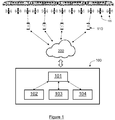
- the system 100 for determining the location of a mobile unit 110 located in a train carriage comprises an information processing unit 101, comprising one or more processors, a data storage medium 102, input and output means 103 and, optionally, display means 104.
- the system 100 comprises one or more computers, one or more servers, one or more supercomputers and/or any combination comprising one of these computer systems.
- the information processing unit 101 consists of a computer or a server provided with one or more communication interfaces and one or more pieces of software specifically designed and configured for carrying out the tasks and the steps described below.
- the system 100 interacts, via a communication channel 200 that preferably includes a mobile communication network (e.g. GSM, 3G, 4G, 5G), with mobile units 110, for instance smartphones, located in a train.
- a mobile communication network e.g. GSM, 3G, 4G, 5G
- the system 100 is thus able to send data to the mobile units 110 and to receive data from them.
- some additional elements of the system 100 consist of components that perform certain steps of the method according to the invention and that are stored and executed by the mobile units 110 themselves. Those additional elements are preferably bundled in an application that is hosted in each mobile unit 110 and executed by the mobile unit 110, either punctually or continuously.
- the mobile units 110 interact with one or more beacons 120 arranged in the train carriages by means of radiofrequency signals generated according to one of the Bluetooth standard protocols.
- all beacons 120 are also compatible with the Bluetooth technology, that is they are all adapted for generating radiofrequency signals in accordance with one of the Bluetooth standard protocols.
- the mobile unit 110 broadcasts a pairing signal.
- the pairing signal is configured by the mobile unit 110 so that, upon receipt by a beacon 120, it triggers transmission by the beacon 120 of an authentication signal that contains identification data.
- each beacon 120 stores its own unique identification data and it transmits an authentication signal that includes its own identification data, or at least part of it, whenever it receives a pairing signal transmitted by the mobile unit 110.
- the mobile unit 110 determines a first power factor of a first signal transmitted by a first beacon 120 and a second power factor of a second signal transmitted by a second beacon 120. To this end, when a signal transmitted by a beacon 120 is received, the mobile unit 110 proceeds by performing measurements of the power present in the received signal. Based on these measurements, the mobile unit 110 determines a received signal strength indicator (RSSI), which is stored as a power factor in relation to the received signal. Likewise, when several beacons 120 are near the mobile unit 110, each one transmits independently an authentication signal when a pairing signal transmitted by the mobile unit 110 is received. Accordingly, the mobile unit 110 analyzes all authentication signals that are received in order to determine power factors for all beacons around.
- RSSI received signal strength indicator
- the mobile unit 110 analyzes the power factors that have been determined in order to determine a closest beacon. To this end, the mobile unit 110 browses all power factors that have been previously determined and it selects the highest power factor. Then, the mobile unit 110 retrieves the identification data of the beacon 120 that corresponds to the highest power factor. However, alternatively or cumulatively, the mobile unit 110 may select, instead of only the highest power factor, a set of power factors, for instance those that are beyond a certain predefined threshold. In this case, the mobile unit 110 will also retrieve identification data of several close beacons 120 that correspond to the power factors contained in the selected set.
- the mobile unit 110 transmits, via the communication channel 200, the identification data previously determined to the system 100.
- the identification data transmitted by the mobile unit 110 preferably relates to the beacon 120 which corresponds to the highest power factor.
- the identification data relates to a set of several close beacons 120.
- the system 100 retrieves location data that corresponds to said identification data of said closest beacon.
- the system 100 conveniently stores in the data storage medium 102 a listing of all beacons, each one identified by its own identification data in relation to its location.
- the listing defines a location as a specific spot within a specific carriage of a specific train.
- the system 100 browses the listing of beacons to determine the beacon 120 that corresponds to the identification data that has been received.
- the system 100 retrieves the location of the closest beacon, or, respectively, of a set of close beacons. Accordingly, the system 100 determines the location of the mobile unit 110 in the train.
- the system 100 performs an additional step during which it selects useful information on the basis of the location of the mobile unit 110. Ultimately, useful data selected by the system 100 is transmitted to the mobile unit 110 via the communication channel 200.
- the functional bricks are made available for providing functionalities allowing locations of passengers in a train carriage to be precisely determined without using any camera.
Landscapes
- Engineering & Computer Science (AREA)
- Physics & Mathematics (AREA)
- General Physics & Mathematics (AREA)
- Radar, Positioning & Navigation (AREA)
- Remote Sensing (AREA)
- Mechanical Engineering (AREA)
- Computer Networks & Wireless Communication (AREA)
- Signal Processing (AREA)
- Electric Propulsion And Braking For Vehicles (AREA)
- Train Traffic Observation, Control, And Security (AREA)
Abstract
A method for determining by a computer system the location of a mobile unit (110) located in a train carriage, the train carriage being provided with at least one first beacon (120) and at least one second beacon (130), both beacons being configured to communicate with said mobile unit by means of radiofrequency signals generated in accordance with one of the Bluetooth standard protocols.
Description
- The present invention pertains to the field of methods and systems for locating mobile units held by passengers within public transportation vehicles such as buses, trains, aircrafts or vessels. The invention concerns especially a method for determining the location of a mobile unit located in a train carriage provided with at least one first beacon and at least one second beacon, both beacons being configured to communicate with the mobile unit by means of radiofrequency signals generated in accordance with one of the Bluetooth standard protocols.
-
DE102106217331 discloses a system and a method for determining the presence of at least one passenger in a train carriage by means of cameras arranged in the carriage and held by the controllers. However, cameras to be used in public environments must be specifically designed to ensure a decent level of robustness in order to provide protection against degradations that may occur. Of course, this implies that the cost of such devices is not negligible, and, in the context of the prior art document, this aspect about costs is of crucial importance. Indeed, according to the prior art document, if one wants to determine not more than the presence of passengers, not even their locations, cameras would have to be deployed all over a fleet of transportation vehicles. The cost related to the deployment of the cameras would thus be significant. Therefore, despite the progress made so far in the field of cameras, the solution disclosed by this document is still too costly to be feasible. - Accordingly, the goal of the invention is to remedy these disadvantages. Specifically, the goal of the invention is to provide a process and a system for accurately determining the location of passengers located in a train carriage that does not rely on the use of cameras.
- These goals are achieved by a first object of the invention which concerns a method for determining the location of a mobile unit located in a train carriage, said train carriage being provided with at least one first beacon and at least one second beacon, both beacons being configured to communicate with said mobile unit by means of radiofrequency signals generated in accordance with one of the Bluetooth standard protocols, said method comprising the steps of:
- broadcasting, by said mobile unit, a pairing signal configured to trigger, upon receipt by said first and/or said second beacon, transmitting by said first and/or second beacon of an authentication signal that includes identification data of said first and/or, respectively, said second beacon,
- determining, by said mobile unit, a first power factor of a first signal transmitted by said first beacon and a second power factor of a second signal transmitted by said second beacon,
- analyzing, by said mobile unit, said first power factor and said second power factor in order to determine a closest beacon,
- transmitting, by said mobile unit, a third signal that includes identification data of said closest beacon, and
- retrieving, by a computer (101) which is remote from said mobile unit, location data that corresponds to said identification data of said closest beacon.
- Thus, a mobile unit interacts with several beacons located in a train carriage to determine power factors that allow identification data of a closest beacon to be determined. The identification data is then transmitted to a remote computer which is able to determine a location of a beacon that corresponds to identification data that has been received. In doing so, the method allows the location of the mobile unit to be determined without relying on the use of cameras.
- According to specific embodiments of the invention, said step of analyzing said first power factor and said second power factor may include a step of determining the highest power factor. Accordingly, establishing of the closest beacon may thus be limited to a step of comparing the power factors between themselves, thereby improving the speed at which the method according to the invention may be performed.
- According to specific embodiments of the invention, the method may include a step of transmitting, by said mobile unit, to said computer, a fourth signal that includes identification data of a close beacon. Accordingly, the location of the mobile unit may be more accurately determined by making use more than two beacons.
- According to specific embodiments of the invention, the method may include a step of receiving, by said mobile unit, a fifth signal that includes useful data selected by said computer. Accordingly, data that is relevant to the location of the mobile unit and that may thus be useful to the user in accordance to where it is located in the train may advantageously be transmitted by the remote computer and received by the mobile unit.
- Another object of the invention concerns a system for determining the location of a mobile unit located in a train carriage, said train carriage being provided with at least one first beacon and at least one second beacon, both beacons being configured to communicate with said mobile unit by means of radiofrequency signals generated in accordance with one of the Bluetooth standard protocols, said system comprising means for carrying out the steps of a method as described above.
- According to specific embodiments of the invention, the system may comprise at least one computer and a data storage medium, in which at least one program for carrying out steps of the method carried out by the system is stored.
- Another object of the invention concerns a computer program comprising instructions for carrying out the steps of a method as described above.
- Another object of the invention concerns a medium which can be used in a computer and on which a program as described above is recorded.
- Practicable embodiments of the invention are described in further detail below by way of example only with reference to the accompanying drawings, which show:
-
figure 1 , a schematic view illustrating the main components of a system according to the invention; and -
figure 2 , a block diagram showing some steps of a method according to the invention. - As illustrated in
Figure 1 , thesystem 100 for determining the location of amobile unit 110 located in a train carriage according to the invention comprises aninformation processing unit 101, comprising one or more processors, adata storage medium 102, input and output means 103 and, optionally, display means 104. According to some embodiments, thesystem 100 comprises one or more computers, one or more servers, one or more supercomputers and/or any combination comprising one of these computer systems. Preferably, theinformation processing unit 101 consists of a computer or a server provided with one or more communication interfaces and one or more pieces of software specifically designed and configured for carrying out the tasks and the steps described below. - For some tasks, the
system 100 interacts, via acommunication channel 200 that preferably includes a mobile communication network (e.g. GSM, 3G, 4G, 5G), withmobile units 110, for instance smartphones, located in a train. Thesystem 100 is thus able to send data to themobile units 110 and to receive data from them. This is particularly advantageous because some additional elements of the system 100 (not represented) consist of components that perform certain steps of the method according to the invention and that are stored and executed by themobile units 110 themselves. Those additional elements are preferably bundled in an application that is hosted in eachmobile unit 110 and executed by themobile unit 110, either punctually or continuously. Accordingly, when performing certain steps in accordance with these additional elements, themobile units 110 interact with one ormore beacons 120 arranged in the train carriages by means of radiofrequency signals generated according to one of the Bluetooth standard protocols. Likewise, allbeacons 120 are also compatible with the Bluetooth technology, that is they are all adapted for generating radiofrequency signals in accordance with one of the Bluetooth standard protocols. - All the elements described above contribute to enable the
system 100 to implement the method for determining the location of amobile unit 110 located in a train carriage, as described below in relation tofigure 2 . - In a
step 201, themobile unit 110 broadcasts a pairing signal. The pairing signal is configured by themobile unit 110 so that, upon receipt by abeacon 120, it triggers transmission by thebeacon 120 of an authentication signal that contains identification data. Conveniently, eachbeacon 120 stores its own unique identification data and it transmits an authentication signal that includes its own identification data, or at least part of it, whenever it receives a pairing signal transmitted by themobile unit 110. - In a
step 202, themobile unit 110 determines a first power factor of a first signal transmitted by afirst beacon 120 and a second power factor of a second signal transmitted by asecond beacon 120. To this end, when a signal transmitted by abeacon 120 is received, themobile unit 110 proceeds by performing measurements of the power present in the received signal. Based on these measurements, themobile unit 110 determines a received signal strength indicator (RSSI), which is stored as a power factor in relation to the received signal. Likewise, whenseveral beacons 120 are near themobile unit 110, each one transmits independently an authentication signal when a pairing signal transmitted by themobile unit 110 is received. Accordingly, themobile unit 110 analyzes all authentication signals that are received in order to determine power factors for all beacons around. - In a
step 203, themobile unit 110 analyzes the power factors that have been determined in order to determine a closest beacon. To this end, themobile unit 110 browses all power factors that have been previously determined and it selects the highest power factor. Then, themobile unit 110 retrieves the identification data of thebeacon 120 that corresponds to the highest power factor. However, alternatively or cumulatively, themobile unit 110 may select, instead of only the highest power factor, a set of power factors, for instance those that are beyond a certain predefined threshold. In this case, themobile unit 110 will also retrieve identification data of severalclose beacons 120 that correspond to the power factors contained in the selected set. - In a
step 204, themobile unit 110 transmits, via thecommunication channel 200, the identification data previously determined to thesystem 100. Thus, the identification data transmitted by themobile unit 110 preferably relates to thebeacon 120 which corresponds to the highest power factor. Alternatively, or cumulatively, the identification data relates to a set of severalclose beacons 120. - In a
step 205, thesystem 100 retrieves location data that corresponds to said identification data of said closest beacon. To this end, thesystem 100 conveniently stores in the data storage medium 102 a listing of all beacons, each one identified by its own identification data in relation to its location. Advantageously, for each beacon, the listing defines a location as a specific spot within a specific carriage of a specific train. Thus, thesystem 100 browses the listing of beacons to determine thebeacon 120 that corresponds to the identification data that has been received. Then, thesystem 100 retrieves the location of the closest beacon, or, respectively, of a set of close beacons. Accordingly, thesystem 100 determines the location of themobile unit 110 in the train. - In a particular embodiment, the
system 100 performs an additional step during which it selects useful information on the basis of the location of themobile unit 110. Ultimately, useful data selected by thesystem 100 is transmitted to themobile unit 110 via thecommunication channel 200. - Thus, according to the system and the method according to the present invention described above, the functional bricks are made available for providing functionalities allowing locations of passengers in a train carriage to be precisely determined without using any camera.
Claims (8)
- A method for determining by a computer system the location of a mobile unit (110) located in a train carriage, said train carriage being provided with at least one first beacon (120) and at least one second beacon (120), both beacons being configured to communicate with said mobile unit by means of radiofrequency signals generated in accordance with one of the Bluetooth standard protocols, characterized in that the method comprises the steps of:- broadcasting, by said mobile unit, a pairing signal configured to trigger, upon receipt by said first and/or said second beacon, transmitting by said first and/or second beacon of an authentication signal that includes identification data of said first and/or, respectively, said second beacon,- determining, by said mobile unit, a first power factor of a first signal transmitted by said first beacon and a second power factor of a second signal transmitted by said second beacon,- analyzing, by said mobile unit, said first power factor and said second power factor in order to determine a closest beacon,- transmitting, by said mobile unit, a third signal that includes identification data of said closest beacon, and- retrieving, by a computer (101) which is remote from said mobile unit, location data that corresponds to said identification data of said closest beacon.
- The method according to claim 1, characterized in that said step of analyzing said first power factor and said second power factor includes a step of determining the highest power factor.
- The method according to one of the preceding claims, characterized in that it includes a step of transmitting, by said mobile unit, to said computer, a fourth signal that includes identification data of a close beacon.
- The method according to one of the preceding claims, characterized in that it includes a step of receiving, by said mobile unit, a fifth signal that includes useful data selected by said computer.
- A system (100) for determining the location of a mobile unit located in a train carriage, said train carriage being provided with at least one first beacon (120) and at least one second beacon (120), both beacons being configured to communicate with said mobile unit by means of radiofrequency signals generated in accordance with one of the Bluetooth standard protocols, characterized in that it comprises means (101, 102, 103, 104) for carrying out the steps of a method according to one of the preceding claims.
- System according to claim 5, characterized in that it comprises at least one computer (101) and a data storage medium (102), in which at least one program for carrying out steps of the method carried out by the system is stored.
- Computer program comprising instructions for carrying out the steps of a method according to claims 1 to 4.
- Medium which can be used in a computer and on which a program according to claim 7 is recorded.
Priority Applications (1)
| Application Number | Priority Date | Filing Date | Title |
|---|---|---|---|
| EP19169636.8A EP3725640A1 (en) | 2019-04-16 | 2019-04-16 | A method for determining the location of a mobile unit located in a train carriage |
Applications Claiming Priority (1)
| Application Number | Priority Date | Filing Date | Title |
|---|---|---|---|
| EP19169636.8A EP3725640A1 (en) | 2019-04-16 | 2019-04-16 | A method for determining the location of a mobile unit located in a train carriage |
Publications (1)
| Publication Number | Publication Date |
|---|---|
| EP3725640A1 true EP3725640A1 (en) | 2020-10-21 |
Family
ID=66217831
Family Applications (1)
| Application Number | Title | Priority Date | Filing Date |
|---|---|---|---|
| EP19169636.8A Withdrawn EP3725640A1 (en) | 2019-04-16 | 2019-04-16 | A method for determining the location of a mobile unit located in a train carriage |
Country Status (1)
| Country | Link |
|---|---|
| EP (1) | EP3725640A1 (en) |
Cited By (2)
| Publication number | Priority date | Publication date | Assignee | Title |
|---|---|---|---|---|
| CN120423331A (en) * | 2025-06-13 | 2025-08-05 | 三一海洋重工有限公司 | Train carriage positioning method, device, controller and field bridge |
| FR3164823A1 (en) * | 2024-07-18 | 2026-01-23 | Speedinnov | Locating a passenger within a railway vehicle |
Citations (6)
| Publication number | Priority date | Publication date | Assignee | Title |
|---|---|---|---|---|
| WO2013054144A1 (en) * | 2011-10-13 | 2013-04-18 | Sensewhere Limited | Method of estimating the position of a user device using radio beacons and radio beacons adapted to facilitate the methods of the invention |
| DE102014209554A1 (en) * | 2014-05-20 | 2015-11-26 | Siemens Aktiengesellschaft | Management of passengers |
| US20170041759A1 (en) * | 2015-08-03 | 2017-02-09 | Jpmorgan Chase Bank, N.A. | Systems and methods for leveraging micro-location devices for improved travel awareness |
| WO2017203246A1 (en) * | 2016-05-24 | 2017-11-30 | Xingjie Shen | A communication system and method |
| WO2018041662A1 (en) * | 2016-09-02 | 2018-03-08 | Siemens Aktiengesellschaft | Information method and information system for outputting at least one exit-related information in a rail vehicle |
| DE102016217331A1 (en) | 2016-09-12 | 2018-03-15 | Siemens Aktiengesellschaft | Method and device for determining the presence of at least one passenger in a vehicle |
-
2019
- 2019-04-16 EP EP19169636.8A patent/EP3725640A1/en not_active Withdrawn
Patent Citations (6)
| Publication number | Priority date | Publication date | Assignee | Title |
|---|---|---|---|---|
| WO2013054144A1 (en) * | 2011-10-13 | 2013-04-18 | Sensewhere Limited | Method of estimating the position of a user device using radio beacons and radio beacons adapted to facilitate the methods of the invention |
| DE102014209554A1 (en) * | 2014-05-20 | 2015-11-26 | Siemens Aktiengesellschaft | Management of passengers |
| US20170041759A1 (en) * | 2015-08-03 | 2017-02-09 | Jpmorgan Chase Bank, N.A. | Systems and methods for leveraging micro-location devices for improved travel awareness |
| WO2017203246A1 (en) * | 2016-05-24 | 2017-11-30 | Xingjie Shen | A communication system and method |
| WO2018041662A1 (en) * | 2016-09-02 | 2018-03-08 | Siemens Aktiengesellschaft | Information method and information system for outputting at least one exit-related information in a rail vehicle |
| DE102016217331A1 (en) | 2016-09-12 | 2018-03-15 | Siemens Aktiengesellschaft | Method and device for determining the presence of at least one passenger in a vehicle |
Cited By (2)
| Publication number | Priority date | Publication date | Assignee | Title |
|---|---|---|---|---|
| FR3164823A1 (en) * | 2024-07-18 | 2026-01-23 | Speedinnov | Locating a passenger within a railway vehicle |
| CN120423331A (en) * | 2025-06-13 | 2025-08-05 | 三一海洋重工有限公司 | Train carriage positioning method, device, controller and field bridge |
Similar Documents
| Publication | Publication Date | Title |
|---|---|---|
| US8467725B2 (en) | Initiating wireless communication between a vehicle and an access point | |
| US20150248640A1 (en) | 3d model and beacon for automatic delivery of goods | |
| EP3264385A1 (en) | System and method for installing, commissioning, testing, and maintaining a fire alarm control panel via a mobile device | |
| JP6073951B2 (en) | Drive recording system having communication module and drive recording method | |
| EP3290949B1 (en) | Local positioning with communication tags | |
| JP2010081423A5 (en) | ||
| US20240034272A1 (en) | User-to-vehicle interaction | |
| US20220398927A1 (en) | Method and apparatuses for preventing safety-critical traffic situations between vehicles | |
| CN104754769B (en) | Electronic device and wireless device confirmation method | |
| JP2005303669A (en) | Radio lan system, transmission power control method, position managing method and transmission power control program | |
| JP2019028663A (en) | Vehicle allocation system and in-vehicle device | |
| KR20240113493A (en) | Sharing of externally captured content in communications | |
| US20100156715A1 (en) | Method and displaying accompanying vehicle position information and apparatus thereof | |
| US20100048202A1 (en) | Method of communicating with an avionics box via text messaging | |
| CN114143907A (en) | Wireless connection establishing method and device, electronic equipment and storage medium | |
| JP2006300861A (en) | Relative position calculation device, relative position calculation method, program therefor, and recording medium | |
| US9097550B2 (en) | Navigation device, server, navigation method and program | |
| JP2017068361A (en) | Portable terminal device and maintenance system | |
| GB2524838A (en) | Content delivery architecture | |
| KR20130037997A (en) | System and method for wireless communication using directive communication | |
| JP2014194342A (en) | On-vehicle navigation apparatus, portable terminal apparatus and navigation system | |
| JP2007255908A (en) | Information terminal device, and information communication method and program | |
| WO2016121254A1 (en) | Display device for radio communication, radio communication method, and radio communication system | |
| EP3726189B1 (en) | A method for determining loading data in connection with a load supported by a transportation vehicle | |
| KR20160041204A (en) | Method and System for Providing Bus Information |
Legal Events
| Date | Code | Title | Description |
|---|---|---|---|
| PUAI | Public reference made under article 153(3) epc to a published international application that has entered the european phase |
Free format text: ORIGINAL CODE: 0009012 |
|
| STAA | Information on the status of an ep patent application or granted ep patent |
Free format text: STATUS: THE APPLICATION HAS BEEN PUBLISHED |
|
| AK | Designated contracting states |
Kind code of ref document: A1 Designated state(s): AL AT BE BG CH CY CZ DE DK EE ES FI FR GB GR HR HU IE IS IT LI LT LU LV MC MK MT NL NO PL PT RO RS SE SI SK SM TR |
|
| AX | Request for extension of the european patent |
Extension state: BA ME |
|
| STAA | Information on the status of an ep patent application or granted ep patent |
Free format text: STATUS: THE APPLICATION IS DEEMED TO BE WITHDRAWN |
|
| 18D | Application deemed to be withdrawn |
Effective date: 20210422 |