EP3724306B1 - Bestimmung der gesamtbasiszahl in schmiermitteln - Google Patents
Bestimmung der gesamtbasiszahl in schmiermitteln Download PDFInfo
- Publication number
- EP3724306B1 EP3724306B1 EP18829621.4A EP18829621A EP3724306B1 EP 3724306 B1 EP3724306 B1 EP 3724306B1 EP 18829621 A EP18829621 A EP 18829621A EP 3724306 B1 EP3724306 B1 EP 3724306B1
- Authority
- EP
- European Patent Office
- Prior art keywords
- oil
- base number
- total base
- cylinder
- fresh
- Prior art date
- Legal status (The legal status is an assumption and is not a legal conclusion. Google has not performed a legal analysis and makes no representation as to the accuracy of the status listed.)
- Active
Links
Images











Classifications
-
- G—PHYSICS
- G01—MEASURING; TESTING
- G01N—INVESTIGATING OR ANALYSING MATERIALS BY DETERMINING THEIR CHEMICAL OR PHYSICAL PROPERTIES
- G01N33/00—Investigating or analysing materials by specific methods not covered by groups G01N1/00 - G01N31/00
- G01N33/26—Oils; Viscous liquids; Paints; Inks
- G01N33/28—Oils, i.e. hydrocarbon liquids
- G01N33/2835—Specific substances contained in the oils or fuels
- G01N33/287—Sulfur content
-
- C—CHEMISTRY; METALLURGY
- C10—PETROLEUM, GAS OR COKE INDUSTRIES; TECHNICAL GASES CONTAINING CARBON MONOXIDE; FUELS; LUBRICANTS; PEAT
- C10M—LUBRICATING COMPOSITIONS; USE OF CHEMICAL SUBSTANCES EITHER ALONE OR AS LUBRICATING INGREDIENTS IN A LUBRICATING COMPOSITION
- C10M175/00—Working-up used lubricants to recover useful products ; Cleaning
- C10M175/0091—Treatment of oils in a continuous lubricating circuit (e.g. motor oil system)
-
- G—PHYSICS
- G01—MEASURING; TESTING
- G01N—INVESTIGATING OR ANALYSING MATERIALS BY DETERMINING THEIR CHEMICAL OR PHYSICAL PROPERTIES
- G01N33/00—Investigating or analysing materials by specific methods not covered by groups G01N1/00 - G01N31/00
- G01N33/26—Oils; Viscous liquids; Paints; Inks
- G01N33/28—Oils, i.e. hydrocarbon liquids
- G01N33/2835—Specific substances contained in the oils or fuels
- G01N33/2876—Total acid number
-
- G—PHYSICS
- G01—MEASURING; TESTING
- G01N—INVESTIGATING OR ANALYSING MATERIALS BY DETERMINING THEIR CHEMICAL OR PHYSICAL PROPERTIES
- G01N33/00—Investigating or analysing materials by specific methods not covered by groups G01N1/00 - G01N31/00
- G01N33/26—Oils; Viscous liquids; Paints; Inks
- G01N33/28—Oils, i.e. hydrocarbon liquids
- G01N33/2888—Lubricating oil characteristics, e.g. deterioration
-
- C—CHEMISTRY; METALLURGY
- C10—PETROLEUM, GAS OR COKE INDUSTRIES; TECHNICAL GASES CONTAINING CARBON MONOXIDE; FUELS; LUBRICANTS; PEAT
- C10N—INDEXING SCHEME ASSOCIATED WITH SUBCLASS C10M RELATING TO LUBRICATING COMPOSITIONS
- C10N2010/00—Metal present as such or in compounds
- C10N2010/04—Groups 2 or 12
-
- C—CHEMISTRY; METALLURGY
- C10—PETROLEUM, GAS OR COKE INDUSTRIES; TECHNICAL GASES CONTAINING CARBON MONOXIDE; FUELS; LUBRICANTS; PEAT
- C10N—INDEXING SCHEME ASSOCIATED WITH SUBCLASS C10M RELATING TO LUBRICATING COMPOSITIONS
- C10N2030/00—Specified physical or chemical properties which is improved by the additive characterising the lubricating composition, e.g. multifunctional additives
- C10N2030/52—Base number [TBN]
-
- C—CHEMISTRY; METALLURGY
- C10—PETROLEUM, GAS OR COKE INDUSTRIES; TECHNICAL GASES CONTAINING CARBON MONOXIDE; FUELS; LUBRICANTS; PEAT
- C10N—INDEXING SCHEME ASSOCIATED WITH SUBCLASS C10M RELATING TO LUBRICATING COMPOSITIONS
- C10N2040/00—Specified use or application for which the lubricating composition is intended
- C10N2040/25—Internal-combustion engines
- C10N2040/252—Diesel engines
-
- C—CHEMISTRY; METALLURGY
- C10—PETROLEUM, GAS OR COKE INDUSTRIES; TECHNICAL GASES CONTAINING CARBON MONOXIDE; FUELS; LUBRICANTS; PEAT
- C10N—INDEXING SCHEME ASSOCIATED WITH SUBCLASS C10M RELATING TO LUBRICATING COMPOSITIONS
- C10N2070/00—Specific manufacturing methods for lubricant compositions
-
- F—MECHANICAL ENGINEERING; LIGHTING; HEATING; WEAPONS; BLASTING
- F01—MACHINES OR ENGINES IN GENERAL; ENGINE PLANTS IN GENERAL; STEAM ENGINES
- F01M—LUBRICATING OF MACHINES OR ENGINES IN GENERAL; LUBRICATING INTERNAL COMBUSTION ENGINES; CRANKCASE VENTILATING
- F01M11/00—Component parts, details or accessories, not provided for in, or of interest apart from, groups F01M1/00 - F01M9/00
- F01M11/10—Indicating devices; Other safety devices
- F01M2011/14—Indicating devices; Other safety devices for indicating the necessity to change the oil
- F01M2011/1493—Indicating devices; Other safety devices for indicating the necessity to change the oil by considering total base number [TBN]
Definitions
- the disclosure relates to characterization of lubricants to determine a total base number for a used lubricant.
- U.S. Patent 7,741,122 describes a method for estimating the total base number of marine scrape-down oil by determining the sulfur content of the scrape-down oil using X-ray fluorescence.
- calcium in the scrape-down oil can also be determined, with the measured value being used to normalize the sulfur values between samples.
- a method for determining a total base number for a used lubricating oil such as a scrape down oil, is provided.
- the method includes determining (such as measuring) a first sulfur content for a marine lubricating oil prior to introduction into a cylinder in an engine.
- a first element content for an element in the marine lubricating oil can also be determined prior to introduction into the cylinder in the engine.
- a second sulfur content and a second element content for oil that has passed through the cylinder during fuel combustion can be measured.
- a total base number can be calculated for the oil that has passed through the cylinder during fuel combustion.
- the calculation of the total base number can be further based on a total base number for the marine lubricating oil prior to introduction into the cylinder.
- the first element content can correspond to a content of Ca, Mg, or a combination thereof. In other aspects, the first element content can correspond to a metal content. In still other aspects, the first element content can correspond to a content for an element different from carbon, hydrogen, and sulfur, or an element different from carbon, hydrogen, sulfur, nitrogen, and oxygen.
- the method can further include estimating a total base number for the marine lubricating oil prior to introduction into the cylinder based on either the first element content or a third element content (i.e., an element or elements different from the element for the first element content).
- This estimated total base number for the marine lubricating oil prior to introduction into the cylinder can then be used for the calculation of the total base number for the oil that has passed through the cylinder during fuel combustion.
- the estimated total base number for the marine lubricating base oil prior to introduction into the cylinder can be estimated based on a first polynomial relationship with the first element content or the third element content.
- the first element content and/or the third element content can correspond to a combined element content of a plurality of elements, such as a combined metal content of a plurality of metals.
- the total base number for the oil that has passed through the cylinder during fuel combustion can be calculated based on a second polynomial relationship between the total base number for the oil that has passed through the cylinder during fuel combustion and the first sulfur content, the second sulfur content, the first element content, and the second element content.
- TBN used is the total base number for the oil that has passed through the cylinder during fuel combustion
- TBN fresh is the total base number for the marine lubricating oil prior to introduction into the cylinder
- M fresh is the first element content
- M used is the second element content
- S fresh is the first sulfur content
- S used is the second sulfur content.
- ⁇ can be determined based on an amount of a strong base required to neutralize a fixed amount of sulfuric acid, such as an amount of NaOH or KOH.
- first element content and the second element content can be determined using the same analysis method and/or using the same analyzer.
- first sulfur content and the second sulfur content can be determined using the same analysis method and/or using the same analyzer.
- the method can further include determining that the calculated total base number of the oil that has passed through the cylinder is less than a first threshold value or greater than a second threshold value.
- the first threshold value and/or the second threshold value can be determined by any convenient method, such as based on a percentage of the total base number of the marine lubricating oil prior to entering the cylinder.
- a corrective action can be performed, such as increasing or decreasing the rate of marine lubricating oil introduction into the cylinder, and/or modifying the total base number of the marine lubricating oil prior to introduction into the cylinder.
- a method for determining a total base number for a used lubricating oil comprises: determining a first sulfur content for a lubricating oil prior to introduction into a cylinder in an engine; measuring a second sulfur content for oil that has passed through the cylinder during fuel combustion; determining a first element content for an element in the lubricating oil prior to introduction into the cylinder; measuring a second element content for the element in the oil that has passed through the cylinder during fuel combustion; and calculating a total base number for the oil that has passed through the cylinder during fuel combustion based on the first sulfur content, the second sulfur content, the first element content, and the second element content.
- minor amount or “minor component” as it relates to components included within the lubricating oils of the specification and the claims means less than 50 wt.%, or less than or equal to 40 wt.%, or less than or equal to 30 wt.%, or greater than or equal to 20 wt.%, or less than or equal to 10 wt.%, or less than or equal to 5 wt.%, or less than or equal to 2 wt.%, or less than or equal to 1 wt.%, based on the total weight of the lubricating oil.
- essentially free as it relates to components included within the lubricating oils of the specification and the claims means that the particular component is at 0 weight % within the lubricating oil, or alternatively is at impurity type levels within the lubricating oil (less than 100 ppm, or less than 20 ppm, or less than 10 ppm, or less than 1 ppm).
- other lubricating oil additives as used in the specification and the claims means other lubricating oil additives that are not specifically recited in the particular section of the specification or the claims.
- lubricating oil additives may include, but are not limited to, antioxidants, detergents, dispersants, antiwear additives, corrosion inhibitors, viscosity modifiers, metal passivators, pour point depressants, seal compatibility agents, antifoam agents, extreme pressure agents, friction modifiers and combinations thereof.
- Diesel engines may generally be classified as slow-speed, medium-speed or highspeed engines, with the slow-speed variety being used for the largest, deep draft marine vessels and in industrial applications.
- Slow-speed diesel engines are typically direct coupled, direct reversing, two-stroke cycle engines operating in the range of about 57 to 250 rpm and usually run on residual fuels. These engines are of crosshead construction with a diaphragm and stuffing boxes separating the power cylinders from the crankcase to prevent combustion products from entering the crankcase and mixing with the crankcase oil.
- Medium-speed engines typically operate in the range of 250 to about 1100 rpm and may operate on the 2-stroke or 4-stroke cycle.
- These engines are trunk piston design, and many operate on residual fuel as well. They may also operate on distillate fuel containing little or no residuals. On deep-sea vessels these engines may be used for propulsion, ancillary applications or both.
- Slow speed and medium speed marine diesel engines are also extensively used in power plant operations and the methods disclosed herein are also applicable in these applications.
- Each type of diesel engine employs lubricating oils to minimize component wear, remove heat, neutralize and disperse combustion products, prevent rust and corrosion and prevent sludge formation or deposits.
- lubricating oils For some lubricant applications, such as in lubricating cylinders in low-speed, crosshead diesel engines that employ all-loss lubrication systems and combust heavy fuel oil with widely varying sulfur contents, the primary cause of engine wear is in acid induced corrosive wear.
- Lubricants for these fuels are formulated to have a high total base number (TBN) to neutralize the acids formed by combusting these fuels so as to minimize corrosive wear of these engines. TBN of the used oil is therefore a very important parameter to monitor to ensure adequate protection against corrosive wear.
- systems and methods are provided for estimating the total base number of used oil in a marine engine.
- the systems and methods can involve characterizing the sulfur content and at least one other element content (such as at least one metal content) of the oil both before introduction into the engine and after passing through an engine cylinder during combustion.
- a total base number of the oil prior to use can also be measured, or the total base number before use can be estimated based on the at least one element content.
- Total base number is an indicator of the capacity for a lubricant (or other hydrocarbon fluid) to neutralize additional acid.
- total base number is a measure of reserve alkalinity.
- measured values for total base number are determined according to ASTM D2896. The units of total base number correspond to mg KOH per gram of lubricant.
- U.S. Patent 7,741,122 describes a method for estimating the total base number of a used marine lubricating oil, such as a scrape-down oil, based on measuring the sulfur content of the used oil.
- the method can further include using the sulfur content of the oil prior to use and the total base number of the oil prior to use.
- the method is described as optionally further characterizing a metal content in the used oil, as a method of normalizing the sulfur content in the used oil.
- U.S. Patent 7,741,122 describes measuring a metal content in the used oil, the method described therein does not contemplate also measuring a metal content in the fresh oil.
- an element content (such as a metal content) for an element can be determined in both fresh lubricating oil and used lubricating oil.
- the element content can be used to account for any change in the oil.
- the content of various elements (such as various metals) within the lubricating oil would be relatively constant both before and after passing through an engine cylinder.
- the concentration of elements other than carbon, hydrogen, and sulfur in a lubricating oil can change for a variety of reasons. For example, a marine lubricating oil that includes lighter components may have substantial volatility under the engine operating conditions.
- any loss of oil due to vaporization prior to combustion can result in an increase in concentration of metals / other elements in the oil.
- oil can be lost due to combustion of the oil.
- Such losses can correspond to a loss of hydrocarbon content while not losing other elements so that the element concentration can change due the hydrocarbon loss.
- uncombusted fuel can also be incorporated into the used oil, which could result in a gain in oil (hydrocarbon) volume. Determining both the fresh and used element content of the oil for at least one element can be used to account for such losses (or gains) in oil volume that could lead to a change in concentration of sulfur.
- losses (or gains) in oil volume can also lead to a corresponding change in total base number.
- the at least one element that is characterized in the fresh lubricating oil and the used lubricating oil is an element different from carbon, hydrogen, and sulfur. It is expected that one or more of the factors noted above could lead to a change in carbon and/or hydrogen content between fresh oil and used oil. Since the sulfur content is already being measured, the at least one element can also be different from sulfur. The at least one element can be different from carbon, hydrogen, sulfur, nitrogen, and oxygen. Depending on the nature of the fuel being combusted and/or the lubricating oil, nitrogen and/or oxygen could also be present within the hydrocarbon chains in the fuel and/or lubricant, and therefore nitrogen and oxygen are potentially less suitable for use as an element for "normalizing" values between the fresh and used oil.
- Any convenient element (or combination of elements) that is not volatile within the lubricating oil environment can be used as an element for characterizing the change in oil volume.
- One convenient choice can be to use a metal (or other element) that serves as a counter-ion for the base added to the lubricant. Due to the formation of sulfuric acid during combustion of a sulfur-containing fuel, marine lubricants can be "over-based" with a base such as calcium carbonate or magnesium carbonate. Using the counter-ion for the base in the lubricant can be beneficial, as the concentration of this counter-ion can be relatively high, which can reduce the impact of inherent measurement uncertainty.
- the concentration of the counter-ion for the base in fresh oil can have a typical relationship to the total base number of the fresh oil.
- measurement of the counter-ion for the base in the fresh oil can be beneficial for determining both the fresh oil total base number and for estimating the oil gain/loss, both of which can be used for calculating a total base number for a used oil.
- any metal or other element that is expected to be constant with the amount of lubricant oil injected into the engine i.e., will not volatilize with light components and/or will not be added as a contaminant with fuel during combustion
- a used lubricating oil can refer to a lubricating oil after it has passed through an engine cylinder while performing a combustion reaction to operate the engine.
- a scrape-down oil is an example of a used marine lubricating oil.
- the total base number for a used lubricating oil can be calculated by determining a sulfur content and at least one metal content for both the fresh oil (before passing through the cylinder) and the used oil.
- calculation of a total base number for a used lubricating oil can be further based on a measured value for the total base number of the fresh oil.
- TBN used is the total base number for the oil that has passed through the cylinder during fuel combustion
- TBN fresh is the total base number for the marine lubricating oil prior to introduction into the cylinder
- ⁇ is a constant
- M fresh is metal content of the fresh oil
- M used is the corresponding metal content of the used oil
- S fresh is the sulfur content of the fresh oil
- S used is the corresponding sulfur content of the used oil.
- the value of ⁇ can be related to values for converting acidic sulfur to units related to total base number.
- the value of ⁇ can be 35, which is a constant value related to converting from units of sulfur concentration to a total base number having units of mg KOH / g. If total base number were expressed with respect to a different base (such as NaOH), the value of ⁇ would correspondingly change.
- Equation (1) is a relationship that can be applied across various types of lubricating oils and/or across various marine vessels without requiring re-fitting. As shown in the examples below, by measuring sulfur and at least one other element for both fresh oil and used oil, any errors that might occur due to variations in lubricating oil type and/or due to variations between marine vessels can be reduced or minimized.
- the total base number for the fresh lubricating oil can be estimated based on a measured element content in the fresh oil. Estimating the total base number of the fresh oil can simplify the process of determining the total base number for the used oil, but with the potential loss of some accuracy in the final determined value.
- Equation (2) TBN used is the total base number for the oil that has passed through the cylinder during fuel combustion, A, B, and ⁇ are constants, M fresh is the content of a first element in the fresh oil, Mused is the corresponding element content of the used oil, X fresh is the content of the element used for estimating the total base number of the fresh oil, S fresh is the sulfur content of the fresh oil, and S used is the corresponding sulfur content of the used oil. Similar to Equation (1), the relationship in Equation (2) can be used across various lubricating oils and/or across various marine vessels. It is noted that it will often be convenient to have X fresh correspond to the same element as M fresh , but X fresh and M fresh can also correspond to different elements.
- the low value can indicate a likelihood of the presence of sulfuric acid within the combustion cylinder environment. This can cause undesirable corrosion of the cylinder walls.
- the high value can indicate that too much oil is being delivererd to the cylinders and/or that too much base is present in the lubricating oil.
- the resulting value can be used to perform one or more corrective actions.
- the corrective action can correspond to adjusting the oil flow rate to the cylinder(s).
- the flow rate of lubricant to the cylinder(s) can be increased. Although the total base number of the fresh oil is not changed, the higher flow rate means that more base is delivered to the cylinder. Similarly, if the estimated total base number is too high, such as greater than a second threshold (or upper threshold), the flow rate of lubricant to the cylinder(s) can be decreased. This can save on operating costs for the vessel and reduce the volume of waste used oil produced.
- the first threshold and/or the second threshold for a used base oil can be selected based on the total base number for the corresponding fresh oil.
- One example of selecting a threshold value based on the total base number for the corresponding fresh oil can be to select a threshold value based on a percentage of the total base number for the corresponding fresh oil (i.e., multiplying the total base number for the fresh oil by a scaling factor).
- the first threshold value can be 20 mg KOH / g or less, or 15 mg KOH / g or less, or 10 mg KOH / g or less, such as down to roughly 0 mg KOH / g.
- additional base or detergent such as CaCO 3
- CaCO 3 additional base or detergent
- additional base or detergent can be added to the fresh oil to increase the total base number of the fresh oil by 5 mg KOH / g or more, or 10 mg KOH / g, or 15 mg KOH / g or more, such as up to 25 mg KOH / g or still higher.
- calculation of the total base number for a used marine lubricating oil can allow for adjustment of the amount of base and/or detergent added to the fresh oil without requiring collection of a sample of the used oil to perform a measurement of total base number.
- the amount of base added to the fresh oil such as CaCO 3
- the adjustment of the amount of base can be performed by having an additional on-board tank of engine oil with a higher total base number, so that oil from the additional tank can be added to the fresh oil when the estimated total base number is too low.
- Still another option can be to select a fresh lubricating oil with a higher (or lower) total base number the next time the vessel is refueled.
- a measured value for the total base number of the fresh lubricant is desired, it may be feasible to perform such a measurement at a single point, such as when a lubricant reservoir is filled.
- the methods described herein can then allow for calculation of total base number of the used lubricant at various convenient times, such as periodically. This can allow for monitoring of the combustion reaction in the engine cylinders to verify that the environment is not becoming too acidic.
- the methods described herein can involve determining a content of sulfur for both fresh lubricant oil and used lubricant oil.
- the content of at least one other element can also be determined for both the fresh lubricant oil and the used lubricant oil.
- determining the sulfur content and the additional element content can preferably correspond to measuring the sulfur content and the additional element content. This can correspond to, for example, measuring the sulfur content and/or element content using equipment present on the marine vessel.
- the sulfur content and the additional element content may be provided based on a prior measurement.
- the determined values for the sulfur content and/or the additional element content of the fresh lubricant oil may correspond to previously determined values.
- the sulfur content and/or additional element content of the fresh lubricant oil can also be measured on the marine vessel. It can be beneficial to measure the sulfur content and/or the additional element content of the fresh oil using the same measurement technique used for measurements performed on the used oil. Using the same measurement technique is defined herein as using the same type of methodology and/or the same type of device, but a different piece or pieces of equipment. Additionally or alternately, it can be beneficial to measure the sulfur content and/or the additional element content of the fresh oil using the same measurement device or system (i.e., the same equipment) as the used oil.
- the sulfur conent of the fresh oil and/or used oil can be measured by any convenient method.
- the measurement can be as an in-line measurement, or a sample can be withdrawn from a suitable location and a measurement can be performed on the withdrawn sample.
- One example of a suitable measurement technique can be to use X-ray fluorescence (XRF).
- XRF X-ray fluorescence
- sulfur can be measured according to the methodology in ASTM D4294.
- X-ray fluorescence can also be suitable for measurement of the content of calcium, magnesium, or certain other metals, such as according to the method in ASTM D6443.
- ASTM D6443 is traditionally used for determination of elemental quantities in fresh lubricating oils, but in some aspects it can also be used for determination of an element content in a used lubricating oil, so that the same method is used for determination of element content (and/or optionally sulfur content) in both a fresh lubricant oil and the corresponding used lubricant oil. While XRF and/or the above ASTM methods are suitable for determination of sulfur and other element contents, it is understood that the methods for calculation of total base number described herein can be used with any other convenient measurement techniques for measurement of sulfur and/or metal content.
- TBN fresh is the total base number for the marine lubricating oil prior to introduction into the cylinder (i.e., fresh oil)
- X fresh is the determined calcium content (or other element content) in the fresh oil
- a and B are constants.
- Table 1 shows representative measured values for total base number, sulfur content, and calcium content for fresh lubricating oils A - F.
- Table 1 - Characterization of Fresh Lubricating Oils Oil Typical Fresh TBN (mg KOH/g) Typical Fresh S (wt%) Typical Fresh Ca (wt%) A 100 1.1 3.8 B 70 1.0 2.6 C 85 1.0 3.2 D 60 1.0 2.2 E 35 0.8 1.4 F 25 0.7 0.9
- Equation (1) a variety of methods of calculating total base number based on other measured values were used.
- ⁇ was equal to 35.0.
- Equation (1) was used in conjuction with the estimates of fresh oil values shown in Table 1.
- Equation (2) Another method corresponded to using Equation (2).
- A was equal to 26.8 while B was equal to 0.
- B was equal to 0.
- A could be set to 25.9 while B could be set to 1.2.
- measured values for the total base number of the used lubricating oils are also provided to allow for a comparison of the accuracy of each of the calculation methods.
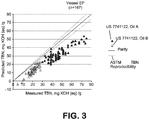
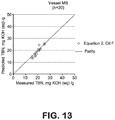
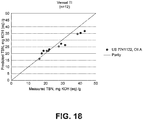
- a solid line corresponding to the measured total base number is provided, along with dashed lines showing error bars based on the reproducibility of the method for total base number measurement as provided in ASTM D2896.
- FIG. 1 shows a comparison of measured total base number values for the used oil with calculated values based on Equation (1) above.
- FIG. 2 shows a similar comparison based on Equation (2) above.
- FIG. 3 shows a similar comparison based on the Equation used in FIG. 4 of U.S. Patent 7,741,122 .
- FIG. 1 , FIG. 2 , and FIG. 3 also show a parity line, representing the line where the calculated values would equal the measured values.
- FIG. 1 , FIG. 2 , and FIG. 3 further show dotted lines corresponding to the reproducibility of the ASTM D2896 method, which was used for measurement of the total base number.
- Equation 1 The predicted values shown in FIG. 1 (corresponding to Equation 1) clearly have better agreement with the measurements than the method from U.S. 7,741,122 , as shown in FIG. 3 .
- the predicted values in FIG. 2 actually provide the best prediction of total base number for oil B, but also provide the least accurate prediction for oil A.
- Performance of the three alternative methods for all of the results for both oils is Equation (1) > Equation (2) > U.S. Patent 7,741,122 , as seen in the overall Root Mean Square Error (RMSE) in Table 2.
- Table 2 RMSE for each equation for 167 data points for oil A and B in vessel EP. Equation Oil A Oil B Total Figure 4 US 7,741,122 15.3 8.7 12.7 Equation (1) 8.5 3.7 6.7 Equation (2) 16.3 2.7 12.0
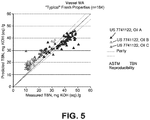
- Equation (1) shows a comparison of the predicted results using Equation (1) with the measured values for total base number of the used oil
- FIG. 5 provides a similar comparison for predictions based on the method used in U.S. Patent 7,741,122 .
- Equation (1) provides improved accuracy for the calculated total base number of the used oil for oils B and C, while the method used in U.S. Patent 7,741,122 is better for oil A.
- Equation (1) provided a marginal improvement in prediction accuracy.
- Table 3 shows the root mean square error for the results in FIGS. 4 and 5 .
- oils A and B were run for an extended period in vessel TU; fresh oil and used oil samples had their S, TBN, and Ca measured. A total of 190 fresh/used oil paired samples were collected and analyzed.
- FIG. 6 shows a comparison of the measured total base number values for the used oils with the calculated values based on Equation (1).
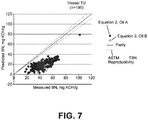
- FIG. 7 provides a similar comparison for the calculated values based on Equation (2), while FIG. 8 provides a similar comparison for calculated values based on U.S. Patent 7,741,122 ( FIG. 4 ).
- Equation (1) provides the best agreement with the total base number values for the used oil.
- the calculated values based on Equation 2 are better than the values calculated based on U.S. Patent 7,741,122 .
- the Root Mean Square Error (RMSE) for each oil is listed in Table 4. Table 4: RMSE for each equation for 190 data points for oil A and B in vessel TU. Equation Oil A Oil B Figure 4 US 7,741,122 37.3 41.1 Equation (1) 12.6 5.7 Equation (2) 26.1 15.3
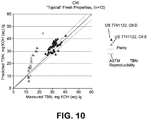
- FIG. 9 shows a comparison of the predicted results using Equation (1) with the measured values for total base number of the used oil
- FIG. 10 provides a similar comparison for predictions based on the method used in U.S. Patent 7,741,122 .
- the predicted total base number values based on Equation (1) provided better accuracy relative to the measured total base number of the used oil, as compared to the values shown in FIG. 10 based on U.S. Patent 7,741,122 .
- Table 5 shows the root mean square error for the results in FIGS. 9 and 10 .
- Table 5 RMSE for each equation for 72 data points for oil D and E in vessel EP. Equation Oil D Oil E Figure 4 US 7,741,122 7.0 9.4 Equation (1) 6.3 4.3
- FIG. 11 shows measured total base number values versus calculated values based on Equation (1).
- FIG. 12 shows a similar comparison, but instead of using the measured values for the total base number of the fresh oil in Equation (1), the typical values shown in Table 1 were used.
- FIG. 13 shows a comparison similar to FIG. 11 , but with calculated values based on Equation (2).
- FIG. 14 shows a comparison similar to FIG. 11 , but with calculated values based on U.S. Patent 7,741,122 .
- Equation (1) with actual measured fresh oil properties performs almost identically to Equation (2) ( FIG. 13 ). Both are superior to the equation from U.S. Patent 7,741,122 (as shown in FIG. 14 ). With regard to the difference between FIG. 11 and FIG. 12 , using Equation (1) with measured fresh oil properties showed improvement over using Equation (1) with typical fresh oil properties. The data in FIG. 12 , however, was still an improvement over the predictions based on U.S. Patent 7,741,122 , as shown in FIG. 14 .
- the Root Mean Square Error (RMSE) for each method is shown in Table 6. Table 6: RMSE for each equation for 20 data points for oil F in vessel MS. Equation Oil F U.S. Patent 7,741,122 19.5 Equation (1) (Measured Fresh) 5.0 Equation (1) (Typical Fresh) 10.6 Equation (2) 5.0
- Equation (1) and Equation (2) as applied to Examples 1 to 5 the concentration of Ca in the fresh and used oil corresponded to the additional metal.
- the ratio of Caused to Ca fresh was found to vary between the different vessels described above as well as between oil samples on the same vessel.
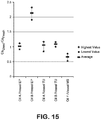
- FIG. 15 shows the average ratio of Caused to Ca fresh for several of the combinations of oil samples and vessels described in the Examples above. Additionally, error bars are shown for each of the average ratio values to show the variation in the ratio within individual samples. This variation both between vessels and between samples for a single vessel provides an additional demonstration of why the methods described herein provided superior estimates of total base number for used oil relative to the method used in U.S. Patent 7,741,122 . In U.S.
- Patent 7,741,122 the measured value of Ca in the used oil was used as a normalizing factor for the sulfur content of the used oil, without regard to the Ca content of the fresh oil. Such normalization based on only the Ca content in used oil cannot capture the variation in concentration due to volatility changes. By contrast, FIG. 15 shows that volatility and/or other factors related to loss or gain of lubricant oil amount were significant for many of the oil samples.
- an estimated used oil TBN either above an upper threshold value, or, below a lower threshold value should produce an action by the vessel operator to change in the amount of base supplied to the cylinder, either by changing the oil feed rate with the same oil, or, changing the TBN of the oil being fed to the cylinder.
- the two threshold values triggering action could be established by the equipment manufacturer, or, by the equipment operator.
- two threshold values based on a percentage of the initial oil TBN have been arbitrarily chosen to illustrate the action required, and are:
- the first row of each table corresponds to the percentage of used oil TBN values, based on a measurement according to ASTM D2896, that resulted in a trigger for an actionable event based on either the upper threshold (45% of initial oil TBN) or the lower threshold (20% of initial oil TBN).
- These trigger percentages based on the measured used oil TBN values can be used as a baseline for evaluating the estimates provided by Equation (1), Equation (2), and the method used in U.S. Patent 7,741,122 .
- the trigger percentages based on the used oil TBN estimates determined according to Equation (1) provided the closest overlap with the trigger percentages based on the measured values. This can be seen from both a qualitative and a quantitative standpoint.
- Equation (1) also provided trigger percentages with greater similarity to the trigger percentages based on the measured used oil TBN values. From a quantitative standpoint, this can be determined based on the number of instances in Tables 7 to 11 where there is a difference of more than 20% between i) the trigger percentage based on the measured values and ii) the trigger percentage based on an estimated TBN. Under this quantitative standard, the trigger percentages based on estimates provided by Equation (1) again provided the closest match with the trigger percentages based on the measured values. In Tables 7 to 11, the trigger percentages based on the used oil TBN estimate determined according to Equation (1) had only three instances of a quantitative variation in trigger percentages greater than 20% (relative to the trigger percentages based on measured used oil TBN values).
- Equation (2) data was not available for Equation (2) in either Table 8 or Table 10. However, for the instances where a comparison could be made between Equation (2) and the method from U.S. Patent 7,741,122 , Equation (2) also performed better from a quantitative viewpoint. In the smaller sample size of Tables 7, 9, and 11, the used oil TBN estimates based on Equation (2) resulted in three qualitative variations and five quantitative variations. By contrast, the method from U.S. Patent 7,741,122 resulted in three qualitative variations and seven quantitative variations. It is noted that the trigger percentage values based on the estimates of used oil TBN from Equation (2) generally had a closer magnitude to the trigger percentages based on the measured values, as compare with the method from U.S. Patent 7,741,122 .
- FIG. 16 shows measured total base number values versus calculated values based on Equation (1).
- FIG. 17 shows a comparison similar to FIG. 16 , but with calculated values based on Equation (2).
- FIG. 18 shows a comparison similar to FIG. 16 , but with calculated values based on U.S. Patent 7,741,122 .
- Equation (1) For this combination of vessel and oil, Equation (1) with actual measured fresh oil properties ( FIG. 16 ) performs almost identically to Equation (2) ( FIG. 17 ). Both are superior to the equation from U.S. Patent 7,741,122 (as shown in FIG. 18 ).
- the Root Mean Square Error (RMSE) for each method is shown in Table 12.
- Table 12 RMSE for each equation for 12 data points for oil A in vessel TI. Equation Oil A U.S. Patent 7,741,122 3.5 Equation (1) (Measured Fresh) 1.6 Equation (2) 1.8
Landscapes
- Chemical & Material Sciences (AREA)
- Engineering & Computer Science (AREA)
- Health & Medical Sciences (AREA)
- Life Sciences & Earth Sciences (AREA)
- Chemical Kinetics & Catalysis (AREA)
- General Chemical & Material Sciences (AREA)
- Oil, Petroleum & Natural Gas (AREA)
- Medicinal Chemistry (AREA)
- Food Science & Technology (AREA)
- Physics & Mathematics (AREA)
- Analytical Chemistry (AREA)
- Biochemistry (AREA)
- General Health & Medical Sciences (AREA)
- General Physics & Mathematics (AREA)
- Immunology (AREA)
- Pathology (AREA)
- Combustion & Propulsion (AREA)
- Organic Chemistry (AREA)
- Lubrication Details And Ventilation Of Internal Combustion Engines (AREA)
Claims (15)
- Verfahren zum Bestimmen einer Gesamtbasenzahl für ein gebrauchtes Schmieröl, bei dem:ein erster Schwefelgehalt eines Schiffsschmieröls vor der Einbringung in einen Zylinder in einem Motor bestimmt wird,ein zweiter Schwefelgehalt für Öl gemessen wird, welches während der Verbrennung von Treibstoff den Zylinder durchlaufen hat,ein erster Elementgehalt für ein Element in dem Schiffsschmieröl vor der Einbringung in den Zylinder bestimmt wird,ein zweiter Elementgehalt für das Element in dem Öl gemessen wird, welches während der Verbrennung von Treibstoff den Zylinder durchlaufen hat, undeine Gesamtbasenzahl für das Öl, welches während der Verbrennung von Treibstoff den Zylinder durchlaufen hat, basierend auf dem ersten Schwefelgehalt, dem zweiten Schwefelgehalt, dem ersten Elementgehalt und dem zweiten Elementgehalt berechnet wird,wobei sich das Element von Kohlenstoff, Wasserstoff, Schwefel, Stickstoff und Sauerstoff unterscheidet, und wobei das Element innerhalb der Schmierölumgebung nicht volatil ist.
- Verfahren nach Anspruch 1, bei dem Berechnen der Gesamtbasenzahl für das Öl, welches während der Verbrennung von Treibstoff den Zylinder durchlaufen hat, des Weiteren auf einer Gesamtbasenzahl des Schiffsschmieröls vor Einbringung in den Zylinder basiert, wobei in dem Verfahren gegebenenfalls des Weiteren die Gesamtbasenzahl des Schiffsschmieröls vor Einbringung in den Zylinder gemessen wird.
- Verfahren nach einem der vorhergehenden Ansprüche, bei dem Bestimmen eines ersten Schwefelgehalts eines Schiffsschmieröls vor Einbringung in einen Zylinder umfasst, dass ein Schwefelgehalt einer Probe des Schiffsschmieröls gemessen wird.
- Verfahren nach einem der vorhergehenden Ansprüche, bei dem der erste Elementgehalt einen Gehalt an Ca, Mg oder einer Kombination davon umfasst.
- Verfahren nach einem der vorhergehenden Ansprüche, bei dem das Element ein Metall oder anderes Element ist, das als Gegenion für die dem Schmierstoff zugefügte Base dient.
- Verfahren nach einem der vorhergehenden Ansprüche, das des Weiteren Schätzen einer Gesamtbasenzahl für das Schiffsschmieröl vor Einbringung in den Zylinder basierend auf dem ersten Elementgehalt umfasst, wobei Berechnen der Gesamtbasenzahl für das Öl, welches während der Verbrennung von Treibstoff den Zylinder durchlaufen hat, des Weiteren auf einer Gesamtbasenzahl des Schiffsschmieröls vor Einbringung in den Zylinder basiert.
- Verfahren nach Anspruch 6, bei dem Schätzen der Gesamtbasenzahl des Schiffsschmieröls vor Einbringung in den Zylinder basierend auf dem ersten Elementgehalt Schätzen der Gesamtbasenzahl des Schiffsschmieröls vor Einbringung in den Zylinder basierend auf einer ersten Polynombeziehung mit dem ersten Elementgehalt umfasst, wobei die erste Polynombeziehung gegebenenfalls eine Funktionsform umfasst, die TBNfrisch = A*Xfrisch + B entspricht, wobei TBNfrisch die Gesamtbasenzahl des Schiffsschmieröls vor Einbringung in den Zylinder ist, Xfrisch der erste Elementgehalt ist, und A und B Konstanten sind.
- Verfahren nach einem der Ansprüche 1 bis 5, das des Weiteren Schätzen einer Gesamtbasenzahl für das Schiffsschmieröl vor Einbringung in den Zylinder basierend auf einem dritten Elementgehalt des Schiffsschmieröls vor Einbringung in den Zylinder umfasst, wobei der dritte Elementgehalt einem Element entspricht, das sich von dem Element unterscheidet, das einem bestimmten ersten Elementgehalt entspricht, wobei Berechnen der Gesamtbasenzahl des Öls, welches während der Verbrennung von Treibstoff den Zylinder durchlaufen hat, des Weiteren auf einer Gesamtbasenzahl des Schiffsschmieröls vor Einbringung in den Zylinder basiert.
- Verfahren nach Anspruch 8, bei dem Schätzen der Gesamtbasenzahl des Schiffsschmieröls vor Einbringung in den Zylinder basierend auf dem dritten Elementgehalt Schätzen der Gesamtbasenzahl des Schiffsschmieröls vor Einbringung in den Zylinder basierend auf einer ersten Polynombeziehung mit dem dritten Elementgehalt umfasst, wobei die erste Polynombeziehung gegebenenfalls eine Funktionsform umfasst, die TBNfrisch = A*Xfrisch + B entspricht, wobei TBNfrisch die Gesamtbasenzahl des Schiffsschmieröls vor Einbringung in den Zylinder ist, Xfrisch der dritte Elementgehalt ist, und A und B Konstanten sind.
- Verfahren nach Anspruch 8 oder 9, bei dem der dritte Elementgehalt einen kombinierten Elementgehalt von einer Vielzahl von Elementen umfasst, oder wobei der dritte Elementgehalt einen kombinierten Metallgehalt von einer Vielzahl von Metallen umfasst.
- Verfahren nach einem der vorhergehenden Ansprüche, bei dem die Gesamtbasenzahl des Öls, das während der Verbrennung von Treibstoff den Zylinder durchlaufen hat, basierend auf einer zweiten Polynombeziehung zwischen der Gesamtbasenzahl des Öls, das während der Verbrennung von Treibstoff den Zylinder durchlaufen hat, und dem ersten Schwefelgehalt, dem zweiten Schwefelgehalt, dem ersten Elementgehalt und dem zweiten Elementgehalt berechnet wird, wobei die zweite Polynombeziehung gegebenenfalls eine Funktionsform umfasst, die TBNgebraucht = (TBNfrisch + α*Sfrisch)*(Mgebraucht/Mfrisch) - α*Sgebraucht entspricht, wobei TBNgebraucht die Gesamtbasenzahl des Öls ist, das während der Verbrennung von Treibstoff den Zylinder durchlaufen hat, TBNfrisch die Gesamtbasenzahl des Schiffsschmieröls vor Einbringung in den Zylinder ist, α eine Konstante ist, Mfrisch der erste Elementgehalt ist, Mgebraucht der zweite Elementgehalt ist, Sfrisch der erste Schwefelgehalt ist und Sgebraucht der zweite Schwefelgehalt ist, und wobei α gegebenenfalls basierend auf einer Menge einer starken Base bestimmt wird, die erforderlich ist, um eine feste Menge an Schwefelsäure zu neutralisieren.
- Verfahren nach einem der vorhergehenden Ansprüche, bei dem das Öl, welches während der Verbrennung von Treibstoff den Zylinder durchlaufen hat, ein Scrape-Down-Öl umfasst.
- Verfahren nach einem der vorhergehenden Ansprüche, bei dem der erste Elementgehalt und der zweite Elementgehalt unter Verwendung des gleichen Analyseverfahrens unter Verwendung des gleichen Analysators oder einer Kombination davon bestimmt werden, oder wobei der erste Schwefelgehalt und der zweite Schwefelgehalt unter Verwendung des gleichen Analyseverfahrens, unter Verwendung des gleichen Analysators oder einer Kombination davon bestimmt werden.
- Verfahren nach einem der vorhergehenden Ansprüche,a) das des Weiteren Bestimmen, dass die berechnete Gesamtbasenzahl des Öls, welches den Zylinder durchlaufen hat, kleiner als ein erster Schwellenwert ist, und Erhöhen einer Rate der Einbringung des Schiffsschmieröls in den Zylinder umfasst,b) das des Weiteren Bestimmen, dass die berechnete Gesamtbasenzahl des Öls, welches den Zylinder durchlaufen hat, größer als ein zweiter Schwellenwert ist, und Herabsetzen einer Rate der Einbringung des Schiffsschmieröls in den Zylinder umfasst,c) das des Weiteren Bestimmen, dass die berechnete Gesamtbasenzahl des Öls, welches den Zylinder durchlaufen hat, kleiner als ein erster Schwellenwert ist, und Modifizieren einer Menge an Base umfasst, die dem Schiffsschmieröl vor Einbringung in den Zylinder zugegeben wird,d) das des Weiteren Bestimmen, dass die berechnete Gesamtbasenzahl des Öls, welches den Zylinder durchlaufen hat, größer als ein zweiter Schwellenwert ist, und Modifizieren einer Menge an Base umfasst, die dem Schiffsschmieröl vor Einbringung in den Zylinder zugegeben wird, odere) eine Kombination von zwei oder mehr von a), b), c) und d) umfasst.
- Verfahren nach Anspruch 14, bei dem der erste Schwellenwert und/oder der zweite Schwellenwert einen Schwellenwert umfassen, der basierend auf der Gesamtbasenzahl des Schiffsschmieröls vor Einbringung in den Zylinder bestimmt wird, wobei der erste Schwellenwert und/oder der zweite Schwellenwert gegebenenfalls basierend auf einem Prozentsatz der Gesamtbasenzahl des Schiffsschmieröls vor Einbringung in den Zylinder bestimmt werden.
Applications Claiming Priority (3)
| Application Number | Priority Date | Filing Date | Title |
|---|---|---|---|
| US201762599160P | 2017-12-15 | 2017-12-15 | |
| US16/212,117 US10845356B2 (en) | 2017-12-15 | 2018-12-06 | Determination of total base number in lubricants |
| PCT/US2018/064388 WO2019118284A1 (en) | 2017-12-15 | 2018-12-07 | Determination of total base number in lubricants |
Publications (2)
| Publication Number | Publication Date |
|---|---|
| EP3724306A1 EP3724306A1 (de) | 2020-10-21 |
| EP3724306B1 true EP3724306B1 (de) | 2021-09-01 |
Family
ID=66814354
Family Applications (1)
| Application Number | Title | Priority Date | Filing Date |
|---|---|---|---|
| EP18829621.4A Active EP3724306B1 (de) | 2017-12-15 | 2018-12-07 | Bestimmung der gesamtbasiszahl in schmiermitteln |
Country Status (4)
| Country | Link |
|---|---|
| US (1) | US10845356B2 (de) |
| EP (1) | EP3724306B1 (de) |
| SG (1) | SG11202005267YA (de) |
| WO (1) | WO2019118284A1 (de) |
Families Citing this family (1)
| Publication number | Priority date | Publication date | Assignee | Title |
|---|---|---|---|---|
| WO2024081125A1 (en) * | 2022-10-12 | 2024-04-18 | ExxonMobil Technology and Engineering Company | Lubricating oil analysis |
Family Cites Families (24)
| Publication number | Priority date | Publication date | Assignee | Title |
|---|---|---|---|---|
| US3193356A (en) * | 1962-03-28 | 1965-07-06 | Socony Mobil Oil Co Inc | Method for determining the presence of strong acids in oils |
| US3510260A (en) * | 1965-07-06 | 1970-05-05 | Henry Valve Co | Method for determining acid content of oil sample |
| US3653838A (en) * | 1970-02-09 | 1972-04-04 | Mobil Oil Corp | Method for determining basicity of used oils |
| US4269604A (en) * | 1976-09-01 | 1981-05-26 | Snowden Jr James E | Method for the on-site determination of the presence of corrosive material in lubricating oil |
| US4741204A (en) * | 1987-04-16 | 1988-05-03 | Thermo King Corporation | Measurement of the depletion of basic additives in lubricating oil |
| US4780224A (en) * | 1987-12-07 | 1988-10-25 | Texaco Inc. | Method of preparing overbased calcium sulfonates |
| US5067455A (en) * | 1989-11-04 | 1991-11-26 | Nippondenso Co., Ltd. | Method and apparatus for adding additives to lubricating oil |
| US5366898A (en) * | 1992-03-27 | 1994-11-22 | Dexsil Corporation | Method for quantitative determination of total base or acid number of oil |
| US5537336A (en) * | 1994-03-30 | 1996-07-16 | On-Site Analysis, Inc. | On-site oil analyzer |
| US5800782A (en) * | 1994-11-18 | 1998-09-01 | Dexsil Corporation | Apparatus for quantitative determination of total base or acid number of oil |
| US5569842A (en) * | 1995-03-28 | 1996-10-29 | Man-Gill Chemical Company | Automated system for identifying and analyzing different types of used lubricants |
| US5987976A (en) * | 1998-03-12 | 1999-11-23 | Caterpillar Inc. | Method for determining the condition of engine oil based on TBN modeling |
| US6577112B2 (en) * | 2001-03-09 | 2003-06-10 | The Lubrizol Corporation | Method and apparatus for on-line monitoring of quality and/or condition of highly resistive fluids |
| US6874459B2 (en) * | 2002-02-26 | 2005-04-05 | Exxonmobil Research And Engineering Company | Modification of lubricant properties in an operating all loss lubricating system |
| US20030164451A1 (en) * | 2002-02-26 | 2003-09-04 | Reischman Paul Thomas | Method for the analysis of lubricant basicity |
| US6920779B2 (en) * | 2002-11-15 | 2005-07-26 | International Truck Intellectual Property Company, Llc | Method of estimating engine lubricant condition |
| US7124728B2 (en) * | 2003-01-24 | 2006-10-24 | Exxonmobil Research And Engineering Company | Modification of lubricant properties in an operating all loss lubricating system |
| KR100655774B1 (ko) | 2004-10-14 | 2006-12-11 | 삼성전자주식회사 | 식각 저지 구조물, 이의 제조 방법, 이를 포함하는 반도체장치 및 그 제조 방법 |
| US7299682B2 (en) * | 2005-10-14 | 2007-11-27 | The Lubrizol Corporation | Method and apparatus for estimating basicity of a used, all-loss cylinder lubricant |
| US7741122B2 (en) * | 2006-02-10 | 2010-06-22 | Exxonmobil Research And Engineering Company | Determination of total base number in marine engine lubricants by elements |
| US7442936B2 (en) * | 2006-03-31 | 2008-10-28 | Exxonmobil Research And Engineering Company | Infrared spectroscopy method for measuring the base number of overbased lubricants |
| US8977421B2 (en) * | 2012-02-01 | 2015-03-10 | Afton Chemical Corporation | System and method for determining a lubricant discard interval |
| US9354221B2 (en) * | 2013-04-29 | 2016-05-31 | General Electric Company | Turbomachine lubricating oil analyzer system, computer program product and related methods |
| US9714931B2 (en) * | 2014-09-03 | 2017-07-25 | General Electric Company | System and method for estimating engine oil health |
-
2018
- 2018-12-06 US US16/212,117 patent/US10845356B2/en active Active
- 2018-12-07 EP EP18829621.4A patent/EP3724306B1/de active Active
- 2018-12-07 WO PCT/US2018/064388 patent/WO2019118284A1/en not_active Ceased
- 2018-12-07 SG SG11202005267YA patent/SG11202005267YA/en unknown
Also Published As
| Publication number | Publication date |
|---|---|
| US10845356B2 (en) | 2020-11-24 |
| WO2019118284A1 (en) | 2019-06-20 |
| SG11202005267YA (en) | 2020-07-29 |
| EP3724306A1 (de) | 2020-10-21 |
| US20190187119A1 (en) | 2019-06-20 |
Similar Documents
| Publication | Publication Date | Title |
|---|---|---|
| US6779505B2 (en) | Method of employing instrumentation to efficiently modify a lubricant's flow rate or properties in an operating all-loss lubricating system | |
| Naegeli et al. | Surface corrosion in ethanol fuel pumps | |
| Kauffman | Rapid, portable voltammetric techniques for performing antioxidant, total acid number (TAN) and total base number (TBN) measurements | |
| US20030159672A1 (en) | Modification of lubricant properties in an operating all loss lubricating system | |
| US10845356B2 (en) | Determination of total base number in lubricants | |
| US20240133859A1 (en) | Lubricating oil analysis | |
| US20140134743A1 (en) | Method for identifying layers providing corrosion protection in crude oil fractions | |
| Dubov et al. | Study of corrosion characteristics of motor oils used in gas-diesel engines of BelAZ mining dump trucks | |
| Macián et al. | Findings from a fleet test on the performance of two engine oil formulations in automotive CNG engines | |
| Asseff | Used Engine Oil Analyses-Review | |
| Famakinwa | The environmental effect on condition based monitoring of cylinder liners by machine learning & oil analysis | |
| Krakowski | Research on the effect of the effective microorganisms, silver solution and colloidal nanosilver addition on the engine oil acid number (TAN) | |
| Hakan et al. | Determination of oil drain period in naval ship diesel engine | |
| Cempirkova et al. | Impact of E100 fuel on bearing materials selection and lubricating oil properties | |
| Kamal et al. | Analysis of the Use of Fine Filters on Lubricating Oil Content With Contaminant Tests in Diesel Engines | |
| Miroslav et al. | Analysis of marine fuel oil purifier efficiency, chemical elements and compounds found in them | |
| SIMION et al. | PRELIMINARY PHYSICAL–CHEMICAL ANALYSES USED IN THE EVALUATION OF “IN SERVICE” MARINE DIESEL ENGINE LUBRICATING | |
| Burk et al. | Are the traditional methods for determining depletion of total base number providing adequate engine protection? | |
| Korneev et al. | Water contamination and colloidal stability of motor oils | |
| Lunt | Marine Diesel Engine Oil Condition Monitoring | |
| Heine | Oxidation Index–Determining the Ageing of Industrial Lubricants | |
| Olsson | Lubrication Failure: An analysis of lubrication failure insurance claims on main and auxiliary engines | |
| Malinowska | Assessment of the degree of deterioration of trunk piston engine oil used in the engine 6AL20/24 | |
| Hildreth et al. | Preventive Maintenance Criteria | |
| ADAMKIEWICZ et al. | OPERATIONAL PROBLEMS IN SLOW SPEED DIESEL ENGINES CAUSED BY USE OF POOR QUALITY FUELS WITH HIGH CAT-FINES CONTENT |
Legal Events
| Date | Code | Title | Description |
|---|---|---|---|
| STAA | Information on the status of an ep patent application or granted ep patent |
Free format text: STATUS: UNKNOWN |
|
| STAA | Information on the status of an ep patent application or granted ep patent |
Free format text: STATUS: THE INTERNATIONAL PUBLICATION HAS BEEN MADE |
|
| PUAI | Public reference made under article 153(3) epc to a published international application that has entered the european phase |
Free format text: ORIGINAL CODE: 0009012 |
|
| STAA | Information on the status of an ep patent application or granted ep patent |
Free format text: STATUS: REQUEST FOR EXAMINATION WAS MADE |
|
| 17P | Request for examination filed |
Effective date: 20200605 |
|
| AK | Designated contracting states |
Kind code of ref document: A1 Designated state(s): AL AT BE BG CH CY CZ DE DK EE ES FI FR GB GR HR HU IE IS IT LI LT LU LV MC MK MT NL NO PL PT RO RS SE SI SK SM TR |
|
| AX | Request for extension of the european patent |
Extension state: BA ME |
|
| DAV | Request for validation of the european patent (deleted) | ||
| DAX | Request for extension of the european patent (deleted) | ||
| GRAP | Despatch of communication of intention to grant a patent |
Free format text: ORIGINAL CODE: EPIDOSNIGR1 |
|
| STAA | Information on the status of an ep patent application or granted ep patent |
Free format text: STATUS: GRANT OF PATENT IS INTENDED |
|
| RIC1 | Information provided on ipc code assigned before grant |
Ipc: C10N 30/00 20060101ALN20210326BHEP Ipc: C10N 70/00 20060101ALI20210326BHEP Ipc: C10N 40/25 20060101ALI20210326BHEP Ipc: C10N 10/04 20060101ALI20210326BHEP Ipc: G01N 33/28 20060101ALI20210326BHEP Ipc: C10M 175/00 20060101AFI20210326BHEP |
|
| INTG | Intention to grant announced |
Effective date: 20210416 |
|
| RIN1 | Information on inventor provided before grant (corrected) |
Inventor name: SATTERFIELD, ANDREW, D. Inventor name: CROUTHAMEL, KEVIN, L. Inventor name: GIVENS, WILLIE, A., JR. Inventor name: BRABEZ, NABILA Inventor name: CHRISTENSEN, GARY |
|
| GRAS | Grant fee paid |
Free format text: ORIGINAL CODE: EPIDOSNIGR3 |
|
| GRAA | (expected) grant |
Free format text: ORIGINAL CODE: 0009210 |
|
| STAA | Information on the status of an ep patent application or granted ep patent |
Free format text: STATUS: THE PATENT HAS BEEN GRANTED |
|
| AK | Designated contracting states |
Kind code of ref document: B1 Designated state(s): AL AT BE BG CH CY CZ DE DK EE ES FI FR GB GR HR HU IE IS IT LI LT LU LV MC MK MT NL NO PL PT RO RS SE SI SK SM TR |
|
| REG | Reference to a national code |
Ref country code: GB Ref legal event code: FG4D |
|
| REG | Reference to a national code |
Ref country code: CH Ref legal event code: EP Ref country code: AT Ref legal event code: REF Ref document number: 1426275 Country of ref document: AT Kind code of ref document: T Effective date: 20210915 |
|
| REG | Reference to a national code |
Ref country code: DE Ref legal event code: R096 Ref document number: 602018023039 Country of ref document: DE |
|
| REG | Reference to a national code |
Ref country code: IE Ref legal event code: FG4D |
|
| REG | Reference to a national code |
Ref country code: NL Ref legal event code: FP |
|
| REG | Reference to a national code |
Ref country code: LT Ref legal event code: MG9D |
|
| PG25 | Lapsed in a contracting state [announced via postgrant information from national office to epo] |
Ref country code: SE Free format text: LAPSE BECAUSE OF FAILURE TO SUBMIT A TRANSLATION OF THE DESCRIPTION OR TO PAY THE FEE WITHIN THE PRESCRIBED TIME-LIMIT Effective date: 20210901 Ref country code: RS Free format text: LAPSE BECAUSE OF FAILURE TO SUBMIT A TRANSLATION OF THE DESCRIPTION OR TO PAY THE FEE WITHIN THE PRESCRIBED TIME-LIMIT Effective date: 20210901 Ref country code: ES Free format text: LAPSE BECAUSE OF FAILURE TO SUBMIT A TRANSLATION OF THE DESCRIPTION OR TO PAY THE FEE WITHIN THE PRESCRIBED TIME-LIMIT Effective date: 20210901 Ref country code: FI Free format text: LAPSE BECAUSE OF FAILURE TO SUBMIT A TRANSLATION OF THE DESCRIPTION OR TO PAY THE FEE WITHIN THE PRESCRIBED TIME-LIMIT Effective date: 20210901 Ref country code: BG Free format text: LAPSE BECAUSE OF FAILURE TO SUBMIT A TRANSLATION OF THE DESCRIPTION OR TO PAY THE FEE WITHIN THE PRESCRIBED TIME-LIMIT Effective date: 20211201 Ref country code: LT Free format text: LAPSE BECAUSE OF FAILURE TO SUBMIT A TRANSLATION OF THE DESCRIPTION OR TO PAY THE FEE WITHIN THE PRESCRIBED TIME-LIMIT Effective date: 20210901 Ref country code: NO Free format text: LAPSE BECAUSE OF FAILURE TO SUBMIT A TRANSLATION OF THE DESCRIPTION OR TO PAY THE FEE WITHIN THE PRESCRIBED TIME-LIMIT Effective date: 20211201 Ref country code: HR Free format text: LAPSE BECAUSE OF FAILURE TO SUBMIT A TRANSLATION OF THE DESCRIPTION OR TO PAY THE FEE WITHIN THE PRESCRIBED TIME-LIMIT Effective date: 20210901 |
|
| REG | Reference to a national code |
Ref country code: AT Ref legal event code: MK05 Ref document number: 1426275 Country of ref document: AT Kind code of ref document: T Effective date: 20210901 |
|
| PG25 | Lapsed in a contracting state [announced via postgrant information from national office to epo] |
Ref country code: PL Free format text: LAPSE BECAUSE OF FAILURE TO SUBMIT A TRANSLATION OF THE DESCRIPTION OR TO PAY THE FEE WITHIN THE PRESCRIBED TIME-LIMIT Effective date: 20210901 Ref country code: LV Free format text: LAPSE BECAUSE OF FAILURE TO SUBMIT A TRANSLATION OF THE DESCRIPTION OR TO PAY THE FEE WITHIN THE PRESCRIBED TIME-LIMIT Effective date: 20210901 Ref country code: GR Free format text: LAPSE BECAUSE OF FAILURE TO SUBMIT A TRANSLATION OF THE DESCRIPTION OR TO PAY THE FEE WITHIN THE PRESCRIBED TIME-LIMIT Effective date: 20211202 |
|
| PG25 | Lapsed in a contracting state [announced via postgrant information from national office to epo] |
Ref country code: AT Free format text: LAPSE BECAUSE OF FAILURE TO SUBMIT A TRANSLATION OF THE DESCRIPTION OR TO PAY THE FEE WITHIN THE PRESCRIBED TIME-LIMIT Effective date: 20210901 |
|
| PG25 | Lapsed in a contracting state [announced via postgrant information from national office to epo] |
Ref country code: IS Free format text: LAPSE BECAUSE OF FAILURE TO SUBMIT A TRANSLATION OF THE DESCRIPTION OR TO PAY THE FEE WITHIN THE PRESCRIBED TIME-LIMIT Effective date: 20220101 Ref country code: SM Free format text: LAPSE BECAUSE OF FAILURE TO SUBMIT A TRANSLATION OF THE DESCRIPTION OR TO PAY THE FEE WITHIN THE PRESCRIBED TIME-LIMIT Effective date: 20210901 Ref country code: SK Free format text: LAPSE BECAUSE OF FAILURE TO SUBMIT A TRANSLATION OF THE DESCRIPTION OR TO PAY THE FEE WITHIN THE PRESCRIBED TIME-LIMIT Effective date: 20210901 Ref country code: RO Free format text: LAPSE BECAUSE OF FAILURE TO SUBMIT A TRANSLATION OF THE DESCRIPTION OR TO PAY THE FEE WITHIN THE PRESCRIBED TIME-LIMIT Effective date: 20210901 Ref country code: PT Free format text: LAPSE BECAUSE OF FAILURE TO SUBMIT A TRANSLATION OF THE DESCRIPTION OR TO PAY THE FEE WITHIN THE PRESCRIBED TIME-LIMIT Effective date: 20220103 Ref country code: EE Free format text: LAPSE BECAUSE OF FAILURE TO SUBMIT A TRANSLATION OF THE DESCRIPTION OR TO PAY THE FEE WITHIN THE PRESCRIBED TIME-LIMIT Effective date: 20210901 Ref country code: CZ Free format text: LAPSE BECAUSE OF FAILURE TO SUBMIT A TRANSLATION OF THE DESCRIPTION OR TO PAY THE FEE WITHIN THE PRESCRIBED TIME-LIMIT Effective date: 20210901 Ref country code: AL Free format text: LAPSE BECAUSE OF FAILURE TO SUBMIT A TRANSLATION OF THE DESCRIPTION OR TO PAY THE FEE WITHIN THE PRESCRIBED TIME-LIMIT Effective date: 20210901 |
|
| REG | Reference to a national code |
Ref country code: DE Ref legal event code: R097 Ref document number: 602018023039 Country of ref document: DE |
|
| REG | Reference to a national code |
Ref country code: DE Ref legal event code: R119 Ref document number: 602018023039 Country of ref document: DE |
|
| RAP4 | Party data changed (patent owner data changed or rights of a patent transferred) |
Owner name: EXXONMOBIL TECHNOLOGY AND ENGINEERING COMPANY |
|
| PLBE | No opposition filed within time limit |
Free format text: ORIGINAL CODE: 0009261 |
|
| STAA | Information on the status of an ep patent application or granted ep patent |
Free format text: STATUS: NO OPPOSITION FILED WITHIN TIME LIMIT |
|
| PG25 | Lapsed in a contracting state [announced via postgrant information from national office to epo] |
Ref country code: MC Free format text: LAPSE BECAUSE OF FAILURE TO SUBMIT A TRANSLATION OF THE DESCRIPTION OR TO PAY THE FEE WITHIN THE PRESCRIBED TIME-LIMIT Effective date: 20210901 Ref country code: IT Free format text: LAPSE BECAUSE OF FAILURE TO SUBMIT A TRANSLATION OF THE DESCRIPTION OR TO PAY THE FEE WITHIN THE PRESCRIBED TIME-LIMIT Effective date: 20210901 Ref country code: DK Free format text: LAPSE BECAUSE OF FAILURE TO SUBMIT A TRANSLATION OF THE DESCRIPTION OR TO PAY THE FEE WITHIN THE PRESCRIBED TIME-LIMIT Effective date: 20210901 |
|
| REG | Reference to a national code |
Ref country code: CH Ref legal event code: PL |
|
| 26N | No opposition filed |
Effective date: 20220602 |
|
| PG25 | Lapsed in a contracting state [announced via postgrant information from national office to epo] |
Ref country code: SI Free format text: LAPSE BECAUSE OF FAILURE TO SUBMIT A TRANSLATION OF THE DESCRIPTION OR TO PAY THE FEE WITHIN THE PRESCRIBED TIME-LIMIT Effective date: 20210901 |
|
| REG | Reference to a national code |
Ref country code: BE Ref legal event code: MM Effective date: 20211231 |
|
| PG25 | Lapsed in a contracting state [announced via postgrant information from national office to epo] |
Ref country code: LU Free format text: LAPSE BECAUSE OF NON-PAYMENT OF DUE FEES Effective date: 20211207 Ref country code: IE Free format text: LAPSE BECAUSE OF NON-PAYMENT OF DUE FEES Effective date: 20211207 Ref country code: DE Free format text: LAPSE BECAUSE OF NON-PAYMENT OF DUE FEES Effective date: 20220701 |
|
| PG25 | Lapsed in a contracting state [announced via postgrant information from national office to epo] |
Ref country code: BE Free format text: LAPSE BECAUSE OF NON-PAYMENT OF DUE FEES Effective date: 20211231 |
|
| PG25 | Lapsed in a contracting state [announced via postgrant information from national office to epo] |
Ref country code: LI Free format text: LAPSE BECAUSE OF NON-PAYMENT OF DUE FEES Effective date: 20211231 Ref country code: CH Free format text: LAPSE BECAUSE OF NON-PAYMENT OF DUE FEES Effective date: 20211231 |
|
| P01 | Opt-out of the competence of the unified patent court (upc) registered |
Effective date: 20230518 |
|
| PG25 | Lapsed in a contracting state [announced via postgrant information from national office to epo] |
Ref country code: CY Free format text: LAPSE BECAUSE OF FAILURE TO SUBMIT A TRANSLATION OF THE DESCRIPTION OR TO PAY THE FEE WITHIN THE PRESCRIBED TIME-LIMIT Effective date: 20210901 |
|
| PG25 | Lapsed in a contracting state [announced via postgrant information from national office to epo] |
Ref country code: HU Free format text: LAPSE BECAUSE OF FAILURE TO SUBMIT A TRANSLATION OF THE DESCRIPTION OR TO PAY THE FEE WITHIN THE PRESCRIBED TIME-LIMIT; INVALID AB INITIO Effective date: 20181207 |
|
| PG25 | Lapsed in a contracting state [announced via postgrant information from national office to epo] |
Ref country code: MK Free format text: LAPSE BECAUSE OF FAILURE TO SUBMIT A TRANSLATION OF THE DESCRIPTION OR TO PAY THE FEE WITHIN THE PRESCRIBED TIME-LIMIT Effective date: 20210901 |
|
| PG25 | Lapsed in a contracting state [announced via postgrant information from national office to epo] |
Ref country code: MT Free format text: LAPSE BECAUSE OF FAILURE TO SUBMIT A TRANSLATION OF THE DESCRIPTION OR TO PAY THE FEE WITHIN THE PRESCRIBED TIME-LIMIT Effective date: 20210901 |
|
| PGFP | Annual fee paid to national office [announced via postgrant information from national office to epo] |
Ref country code: NL Payment date: 20241224 Year of fee payment: 7 |
|
| PGFP | Annual fee paid to national office [announced via postgrant information from national office to epo] |
Ref country code: FR Payment date: 20241227 Year of fee payment: 7 |
|
| PG25 | Lapsed in a contracting state [announced via postgrant information from national office to epo] |
Ref country code: TR Free format text: LAPSE BECAUSE OF FAILURE TO SUBMIT A TRANSLATION OF THE DESCRIPTION OR TO PAY THE FEE WITHIN THE PRESCRIBED TIME-LIMIT Effective date: 20210901 |
|
| PGFP | Annual fee paid to national office [announced via postgrant information from national office to epo] |
Ref country code: GB Payment date: 20251223 Year of fee payment: 8 |