EP3722965B1 - Verfahren, vorrichtung und computerprogramm zum synchronisieren von daten zwischen einem ersten speicher und einem zweiten speicher - Google Patents
Verfahren, vorrichtung und computerprogramm zum synchronisieren von daten zwischen einem ersten speicher und einem zweiten speicher Download PDFInfo
- Publication number
- EP3722965B1 EP3722965B1 EP19175450.6A EP19175450A EP3722965B1 EP 3722965 B1 EP3722965 B1 EP 3722965B1 EP 19175450 A EP19175450 A EP 19175450A EP 3722965 B1 EP3722965 B1 EP 3722965B1
- Authority
- EP
- European Patent Office
- Prior art keywords
- file system
- operations
- repository
- file
- conflicts
- Prior art date
- Legal status (The legal status is an assumption and is not a legal conclusion. Google has not performed a legal analysis and makes no representation as to the accuracy of the status listed.)
- Active
Links
Images

Classifications
-
- G—PHYSICS
- G06—COMPUTING OR CALCULATING; COUNTING
- G06F—ELECTRIC DIGITAL DATA PROCESSING
- G06F16/00—Information retrieval; Database structures therefor; File system structures therefor
- G06F16/10—File systems; File servers
- G06F16/17—Details of further file system functions
- G06F16/178—Techniques for file synchronisation in file systems
-
- G—PHYSICS
- G06—COMPUTING OR CALCULATING; COUNTING
- G06F—ELECTRIC DIGITAL DATA PROCESSING
- G06F16/00—Information retrieval; Database structures therefor; File system structures therefor
- G06F16/10—File systems; File servers
- G06F16/18—File system types
- G06F16/182—Distributed file systems
- G06F16/184—Distributed file systems implemented as replicated file system
Definitions
- Examples relate to a method, apparatus and computer program for synchronizing data between a first repository and a second repository.
- Bi-directional data synchronization is the process of equalizing two data replicas (where each replica is a copy of a pool of structured data). The process first determines the changes in each replica at specific points of time (since the last synchronization), and then applies these detected changes to the respective other replica.
- the synchronization includes the detection and resolution of conflicts.
- One instance of data are hierarchically structured file systems stored on hardware.
- File synchronizers are programs that perform file system synchronization.
- a state-based synchronizer detects changes since the last synchronization by computing the difference between (a) the persisted state of the last synchronization, and (b) the current state of each replica.
- operation-based file synchronizers use a log of operations instead.
- each object is either of type file or directory, each with a unique ID, and a name.
- Files can have arbitrary binary bit sequences as contents.
- the content of a directory is the list of immediate child objects. No two sibling objects may have the same name, and every object is reachable from a well-known root object.
- the unique ID of each object may be vital, as it allows for unambiguous and efficient detection of create, edit, delete and move operations in the replicas.
- An algorithm designer of a bi-directional, state-based file synchronizer which is applied to file system replicas with above definition, may face many challenges.
- US patent application US 2006/0242444 A1 relates to a concept for constraint-based conflict handling for file synchronization.
- a concept is used that is based on a selection of "winning” and “losing” operations.
- the concept supports the detection of cycles, and uses temporary renaming of files to break the cycles.
- US 7165248 B2 titled "File tree conflict processor” discusses a method for resolving conflicts between parallel changes made by users to two synchronized sets of folders and files. In one approach, these conflicts are presented to the user through an interface, where the user must indicate the winner of each conflict. Another approach involves combining certain conflicts that cannot be resolved independently and presenting them as a single conflict to the user. Once the user has indicated the winners of the conflicts, the winning operations are implemented on the file tree that is in conflict with them.
- Embodiments are based on the finding that, in order to synchronize a first and a second repository, a number of steps may be executed to resolve conflicts between the repositories.
- First, the changes between current versions of the repositories compared to a previous version of the repositories are tracked, to calculate a first and a second plurality of file system operations that explain the differences between the previous and current versions.
- Afterwards, conflicts between the two pluralities of file system operations are detected and resolved, e.g. using an iterative approach that is based on selecting a winning and a losing operation, in which the losing operation is modified.
- the remaining operations form a third plurality of file system operations, which is reordered based on operation order dependencies between the operations, thereby detecting and resolving cycles.
- the operations may be used to synchronize the repositories.
- Embodiments thereby address the challenge of how to resolve conflicts such that the conflict resolution cannot fail, handling conflict combinations gracefully and improve the intention of both users who were involved in the conflict(s).
- embodiments determine a compatible order of transmitting and applying detected operations to the respective other replica/repository. This may be challenging because state-based inference of these operations does not indicate the order in which they happened, forcing the file synchronization algorithm to find an order that works.
- the present disclosure also describes how to deal with cyclic dependencies, where a set of operations all must/may have come before the other dependency, which can only be applied to the other replica if the synchronizer injects additional operations which were not originally detected, to break the cyclic dependency.
- Embodiments thus provide a method for synchronizing data between a first repository and a second repository, and a computer program having a program code for performing the method.
- the first repository and second repository are based on an identifier-based file system that supports move operations.
- the method comprises obtaining information related to a first plurality of file system operations that account for changes of a current state of the first repository vis-à-vis a previous state of the first repository.
- the method comprises obtaining information related to a second plurality of file system operations that account for changes of a current state of the second repository vis-à-vis a previous state of the second repository.
- the method comprises determining one or more conflicts between file system operations of the first plurality of file system operations and of the second plurality of file system operations.
- Each of the one or more conflicts occur between a first file system operation of the first plurality of file system operations and a second file system operation of the second plurality of file system operations.
- the method comprises resolving the one or more conflicts to obtain a third plurality of file system operations comprising conflict-resolved versions of the first and second plurality of file system operations.
- Resolving of the one or more conflicts comprises determining a winning operation and a losing operation among the first and second file system operation based on a selection criterion.
- Resolving the one or more conflicts comprises changing the losing operation to resolve the conflict, with the winning operation remaining unchanged.
- the method comprises reordering the third plurality of file system operations based on operation order dependencies between the file system operations of the third plurality of file system operations.
- the reordering of the third plurality of file system operations comprises detecting of cycles in the reordering of the third plurality of file system operations, and resolving the detected cycles.
- Each cycle comprises two or more operations of the third plurality of file system operations.
- the two or more operations comprise a first file system operation that makes a file name available so the file name can be used by a second file system operation.
- Resolving of the respective cycle comprises inserting an additional renaming operation to make the file name available.
- the method comprises executing the reordered third plurality of file system operations to synchronize the first repository and the second repository. This method may be used to synchronize the first and second repository even in cases, in which the actual file operations that have occurred are not easily deductible.
- Each of the one or more conflicts occurs between a first file system operation of the first plurality of file system operations and a second file system operation of the second plurality of file system operations.
- a first file system operation of the first plurality of file system operations may be in conflict with a second file system operation of the second plurality of file system operations.
- the resolving of the one or more conflicts comprises determining a winning operation and a losing operation among the first and second file system operation based on a selection criterion.
- the selection criterion may be based on one of an estimated effort of a user for performing the respective operations, a logical location of the repositories the respective operations were performed on, and a user group of a user that has performed the respective operations.
- the resolving of the one or more conflicts comprises changing the losing operation. By only dealing with one side of the conflict, an impact of the conflict may be reduced while still resolving the conflict.
- the resolving of the one or more conflicts comprises sorting the one or more conflicts based on a conflict sorting rule to identify a single conflict to be resolved, resolving the single identified conflict, and resolving the one or more conflicts that remain after the single identified conflict has been resolved. For example, the determining of the one or more conflicts and the resolving of the one or more conflicts may be repeated after resolving the single identified conflict. By resolving one conflict at a time, and then repeating the entire procedure, other conflicts may disappear before they are dealt with.
- the method may further comprise detecting one or more pseudo-conflicts between file system operations of the first plurality of file system operations and of the second plurality of file system operations.
- the one or more pseudo-conflicts may each occur between operations that conflict syntactically while having the same effect. To deal with pseudo-operations, they may be included in the previous states of the repositories.
- the method may further comprise resolving the one or more pseudo-conflicts by modifying the previous states of the first repository or of the second repository based on detected pseudo-conflicts.
- the operation order dependencies are based on a ruleset of operation order dependencies.
- the ruleset of operation order dependencies may define operations that logically have to occur in a specific order. This ruleset may define a limited number of operation order dependencies that may be used to determine the order of the third plurality of file system operations.
- Each combination of operation order dependencies that can lead to a cyclic dependency may be associated with a specific approach to break up the cycle, enabling an automatic resolving of cycles.
- the ruleset of order dependencies may comprise one or more operation order dependencies that each define a logical order between a first file system operation and a second file system operation.
- An operation order dependency may be defined between two operations, and may indicate the interdependency between the two operations.
- the one or more operation order dependencies may comprise one or more of the following operation order dependencies: a) an operation order dependency between the first file system operation and the second file system operation where the first file system operation makes a file name available so the file name can be used by the second file system operation.
- the one or more operation order dependencies may further comprise b) an operation order dependency between the first file system operation and the second file system operation where the file system operation results in a file or folder being present so that the file or folder can be used by the second file system operation.
- the one or more operation order dependencies may further comprise c) an operation order dependency where the first file system operation moves a file or folder outside a folder that is deleted by the second file system operation, and/or d) an operation order dependency where the first and second file system operations are move operations affecting a first and second directory respectively, the first and second directories being in a parent-child relationship, both file system operations resulting in the first and second directory having a flipped parent-child relationship.
- the operations of the third plurality of file system operations may be swapped in a pair-wise manner in the reordering of the third plurality of file system operations based on the operation order dependencies.
- the operations that are swapped in the reordering of the third plurality of file system operations may form a subset of operations of the third plurality of file system operations.
- the cycles may be detected in the reordering of the third plurality of file system operations by attempting to form cycles among the subset of operations of the third plurality of file system operations.
- the pairwise swaps may identify the operations that are involved in cyclic dependencies.
- Embodiments further provide the computer program having the program code for performing the method, when the computer program is executed on a computer, a processor, or a programmable hardware component.
- an apparatus comprising a processing device, wherein the processing device is configured to execute the method for synchronizing data between a first repository and a second repository.
- the processing device may be implemented using one or more processing units, any means for processing, such as a processor, a computer or a programmable hardware component being operable with accordingly adapted software.
- the described function of the processing device may as well be implemented in software, which is then executed on one or more programmable hardware components.
- Such hardware components may comprise a general purpose processor, a Digital Signal Processor (DSP), a micro-controller, etc.
- the apparatus may further comprise one or more interface for exchanging information.
- the apparatus may further comprise computer memory for storing the information related to the first plurality of file system operations, the information related to the first plurality of file system operations, the third plurality of file system operations, the first repository and/or the second repository, and its previous versions.
- the method comprises determining a first operation and a second operation (e.g. of the first plurality of file system operations) that had been performed on the file system of the first replica (e.g. the first repository).
- the method comprises determining an allowable execution order for the first operation and the second operation (e.g. in the reordering of the third plurality of file system operations, the third plurality of file system operations comprising the first and second operation).
- the method comprises performing the first operation and the second operation to the filesystem of the second replica in the determined execution order (e.g. in the execution of the reordered and cycle-free third plurality of file system operations).
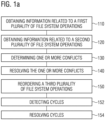
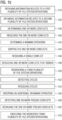
- Figs. 1a and 1b show flow charts of embodiments of a method (i.e. a computer-implemented method) for synchronizing data between a first repository and a second repository.
- the first repository and second repository are based on an identifier-based file system that supports move operations.
- the method comprises obtaining 110 information related to a first plurality of file system operations that account for changes of a current state of the first repository vis-à-vis a previous state of the first repository.
- the method comprises obtaining 120 information related to a second plurality of file system operations that account for changes of a current state of the second repository vis-à-vis a previous state of the second repository.
- the method comprises determining 130 one or more conflicts between file system operations of the first plurality of file system operations and of the second plurality of file system operations.
- the method comprises resolving 140 the one or more conflicts to obtain a third plurality of file system operations comprising conflict-resolved versions of the first and second plurality of file system operations.
- the method comprises reordering 150 the third plurality of file system operations based on operation order dependencies between the file system operations of the third plurality of file system operations.
- the reordering of the third plurality of file system operations comprises detecting 152 of cycles in the reordering of the third plurality of file system operations, and resolving 154 the detected cycles.
- Embodiments relate to a method, apparatus and computer program for synchronizing data between a first repository and a second repository.
- the first repository and the second repository may be instances (i.e. copies) of a shared folder (i.e. of the same shared folder).
- a "shared folder" is a folder that is used by multiple devices, but not necessarily multiple users.
- the first repository may correspond to a local copy of the shared folder
- the second repository may correspond to a remote copy of the shared folder, e.g. a server copy of the shared folder or a copy of the shared folder stored on another computer (or vice versa).
- the previous state i.e. a state the first/second repository at a time of a previous synchronization between the first and second repositories
- the current state of the repositories In between the previous state and the current state, (different) file system operations may have been applied to the first and second repositories.
- the previous state of the first repository and the previous state of the second repository may be equal (or equal except few exceptions), and the current state of the first repository may diverge from the current state of the second repository.
- the first repository and second repository are based on an identifier-based file system.
- an identifier-based file system each file and folder has a unique identifier that is retained (even if the file/folder is renamed, moved or changed). Based on the unique identifier, each file/folder can be tracked between the previous and the current version of the respective repository. For example, if a file is moved, changed and renamed, it still carries the same unique identifier, which can be found in the other repository. Based on these identifiers, a tracking of files that have been moved is enabled.
- the identifier-based file system further supports move operations, so that a file or folder retains its identifier (even) if it is moved.
- the method comprises obtaining 110 (i.e. calculating, determining or receiving) the information related to the first plurality of file system operations that account for changes of the current state of the first repository vis-à-vis (i.e. opposite or versus) the previous state of the first repository and obtaining 120 (i.e. calculating, determining or receiving) the information related to the second plurality of file system operations that account for changes of the current state of the second repository vis-à-vis (i.e. opposite or versus) the previous state of the second repository.
- the information related to the first plurality of file system operations and the information related to the first plurality of file system operations may be obtained, e.g. calculated or determined, by the same computer or by different computers.
- both the information related to the first plurality of file system operations and the information related to the first plurality of file system operations may be determined/calculated by the same computer, e.g. a computer executing the method.
- the information related to the first plurality of file system operations may be determined/calculated by the computer executing the method (i.e. a computer hosting the first repository), and the information related to the second plurality of file system operations may be determined/calculated by a computer hosting the second repository, and received by the computer executing the method (or vice versa).
- the term computer is not limited to personal computers, but may also comprise mobile phones, wearable devices, mobile devices, smartphones, servers, virtual servers, Internet of Things devices etc.
- the determining/calculating of the information related to the first/second plurality of file system operations may comprise comparing the current state of the respective repository to the previous state of the respective repository.
- the first and second repository may each comprise a plurality of files and folders of the shared folder, and a data structure that represents information on the previous state of the respective repository).
- the data structure may comprise information on a previous content of files (i.e. as hash values) and/or of previous locations of files and/or folders in the previous state of the respective repository.
- the first or second plurality of file system operations may be or comprise the file system operations that have actually led to the current state of the respective repository, albeit additional file system operations may have happened that are not shown in the first/second plurality of file system operations, e.g. if files/folders were moved twice, if files were edited and subsequently deleted, or if file system operations were undone (so-called operation consolidation).
- the unique identifiers of the files/folders of the first and second repository are used. For example, if a file is moved or renamed, its unique identifier remains the same, so a move/rename file system operation may be easily tracked.
- the method comprises determining 130 one or more conflicts between file system operations of the first plurality of file system operations and of the second plurality of file system operations. For example, each of the one or more conflicts may occur between a first file system operation of the first plurality of file system operations and a second file system operation of the second plurality of file system operations.
- Each file system operation may have one or more preconditions that are to be met so the file system operation can be executed. For example, to delete a file from a folder, the folder has to be the ancestor of the file and the file has to be a file. To move a folder, both the source and destination folder have to exist and the folder to be moved cannot be an ancestor of the destination folder.
- the first file system operation and the second file system operation may be conflicting if a precondition of the first file system operation is not met after executing the second file system operation (and vice versa).
- the first file system operation is conflicting with the second file system operation, if, after executing the second file system operation, the first file system operation cannot be executed anymore (and vice versa).
- the method may comprise determining for each file system operation of the first plurality of file system operations whether the preconditions of the file system operations are still met after executing each of the file system operations of the second plurality of file system operations (and vice versa).
- not only "real" conflicts may be determined (i.e. operations that conflict syntactically and in effect), but also pseudo-conflicts. Pseudo-conflicts occur between operations that conflict syntactically while having the same effect. For example, if the same file is deleted in the first repository and in the second repository, the operations are conflicting (as the file cannot be deleted twice), but the effect is the same, leading to a pseudo-conflict. Consequently, the method may further comprise detecting 160 one or more pseudo-conflicts between file system operations of the first plurality of file system operations and of the second plurality of file system operations.
- the method may further comprise resolving 162 the one or more pseudo-conflicts by modifying the previous states of the first repository or of the second repository based on detected pseudo-conflicts, e.g. by pretending one of the pseudo-conflicting file system operations didn't happened.
- the method further comprises resolving 140 the one or more conflicts to obtain a third plurality of file system operations comprising conflict-resolved versions of the first and second plurality of file system operations.
- the one or more conflicts are resolved by selecting a winning operation (that shall remain unchanged) and a losing operation (that shall be changed to remove the conflict).
- the resolving 140 of the one or more conflicts comprises determining 142 a winning operation and a losing operation among the first and second file system operation based on a selection criterion.
- the winning operation remains unchanged, and the losing operation is changed in the resolving 140 of the one or more conflicts.
- a simple change may suffice to resolve the conflict.
- the losing operation may be changed by undoing the losing operation (if possible).
- the selection criterion may be based on one of an estimated effort of a user for performing the respective operations, a logical location of the repositories the respective operations were performed on, and a user group of a user that has performed the respective operations.
- the first conflict may be resolved, the one or more conflicts that remain may be re-determined (as some conflicts may disappear after solving the first conflict), sorted, and the next "first" conflict may be resolved, until all of the conflicts are resolved.
- the resolving 140 of the one or more conflicts may comprise sorting 144 the one or more conflicts based on a conflict sorting rule to identify a single conflict to be resolved, (subsequently) resolving 146 the single identified conflict, and (subsequently) resolving 148 the one or more conflicts that remain after the single identified conflict has been resolved.
- the one or more conflicts that remain after the single identified conflict has been resolved may be resolved by repeating the process, i.e.
- the determining 130 of the one or more conflicts and the resolving 140 of the one or more conflicts may be repeated after re-solving the single identified conflict.
- Exemplary approaches for resolving the different conflict types are illustrated in connection with the specific embodiment below. They may also be used and/or adapted to be used in a more general manner.
- the method comprises reordering 150 the third plurality of file system operations based on the operation order dependencies between the file system operations of the third plurality of file system operations.
- Operation order dependencies define the logical order of file system operations: If, for example, a create operation is used to create a folder, and a move operation is used to move a file into the newly created file or folder, the move operation depends on the create operation, such that the create operation has to occur before the move operation.
- the operation order dependencies define a logical order that the file system operations of the third plurality of system operations have to adhere to so the preconditions of (all of) the file system operations are met.
- these operation order dependencies may be based on a ruleset of operation order dependencies.
- the ruleset of operation order dependencies may define operations that logically have to occur in a specific order (such as e.g. create before move if a file is to be moved into the newly created folder).
- the ruleset of order dependencies may comprise one or more order operation order dependencies that each define a logical order between a first file system operation and a second file system operation.
- operation order dependencies where the first file system operation makes a file name available so the file name can be used by the second file system operation, such as an operation order dependency (denoted 1 in the more specific embodiment described in a later part of the present disclosure) in which a file or folder is deleted before another file or folder is moved to occupy the file name previously used by the deleted file or folder, or an operation order dependency (denoted 2) in which a file or folder is moved before another file or folder is created to occupy the file name previously used by the moved file or folder, or an operation order dependency (denoted 5) in which a file or folder is deleted before another file or folder is created to occupy the file name previously used by the deleted file or folder, or an operation order dependency (denoted 6) in which a file or folder is moved before another file or folder is moved to occupy the file name previously used by the previously moved file or folder.
- an operation order dependency (denoted 1 in the more specific embodiment described in a later part of the present disclosure) in which a file or folder is deleted before another file or
- the one or more operation order dependencies may comprise an operation order dependency (denoted 4) in which a folder is created before a file is moved into the folder, or an operation order dependency (denoted 7) in which a folder is created before a file or another folder is created within the previously created folder.
- the one or more operation order dependencies may further comprise an operation order dependency (denoted 3) where the first file system operation moves a file or folder outside a folder that is deleted by the second file system operation, and/or the one or more operation order dependencies further comprises an operation order dependency (denoted 8) where a combination of the first file system operation order and the second file system operation order result in a first directory and a second directory having flipped their parent-child relationship.
- the reordering of the third plurality of file system operations comprises the detecting 152 of the cycles in the reordering of the third plurality of file system operations, and the resolving 154 the detected cycles.
- Each cycle comprises two or more operations of the third plurality of file system operations, e.g. a file system operation a), a file system operation b), and zero or more additional file system operations that logically occur between a) and b), such that a) at least transitively depends on b) (so its preconditions are met) and b) at least transitively depends on a) (so its preconditions are met).
- the transitive dependency may be caused by the zero or more additional file system operations that logically occur between a) and b)).
- the cycles are based on the one or more operation order dependencies, e.g. such that each cycle is based on an operation order dependency where the first file system operation makes a file name available so the file name can be used by the second file system operation.
- the two or more operations comprise a first file system operation that makes a file name available so the file name can be used by a second file system operation (e.g. by deleting or moving a file/folder.
- the resolving 154 of the respective cycle may comprise inserting 156 an additional renaming operation to make the file name available. For example, a file or folder previously occupying the file name may be renamed/moved to now comprise an additional suffix (e.g. before the file extension), e.g. so a user of the computer system can deal with the conflict while avoiding a loss of data.
- the method may comprise determining (all of) the operations of the third plurality of file system operations that have operation order dependencies with other operations of the third plurality of file system operations. If pair-wise swapping is used in the reordering of the third plurality of file system operations, (all of) the operations can be determined that are involved in a swap. In other words, the operations of the third plurality of file system operations may be swapped in a pair-wise manner in the reordering 150 of the third plurality of file system operations based on the operation order dependencies.
- the method or computer program may comprise one or more additional optional features corresponding to one or more aspects of the proposed concept or one or more examples described above or below.
- the file system F may be used in embodiments.
- a directory is abbreviated as dir.
- I is the set of unique IDs
- L is the set of all valid lastmodified meta-datum values (e.g.
- predicate ancestor i j ⁇ true if j ⁇ list i true if ⁇ k ⁇ list i : ancestor k j false otherwise to express whether the object with ID i is an ancestor of the object with ID j.
- An object may be of type file or directory.
- the file system operations with their pre- and postconditions may be defined in the subsequent table.
- Function id ( i , n ) returns the ID of the object with parent i and name n, or error if no such object exists.
- pre- and post-conditions createdir ( i,p, n ) Creates new dir (i.e. directory) with ID i and name n in parent dir with ID p.
- Precondition see createdir ( i , p , n )
- Postcondition: i ⁇ list ( p ) ⁇ type ( i ) file ⁇ lastmodified ( i ) ⁇ error move ( i , u , v , n ) Moves a file or dir node with ID i from parent dir with ID u to parent dir with ID v , and/or change the object's name to n.
- ancestor ( i root , i ) ⁇ type ( i ) file
- Postcondition: i ⁇ list ( p ) ⁇ ancestor ( i root , i ) ⁇ lastmodified ( i ) error deletedir ( i , p ) Removes the empty dir with ID i from parent dir with ID p .
- Embodiments may use a state-based update detection (e.g. to determine the information related to the first plurality of file system operations and the information related to the second plurality of file system operation).
- Update detection often is the first step done by a state-based file synchronizer to synchronize two replica.
- the goal of state-based update detection is to detect how users updated the replica (i.e. the current state of the respective repository), by determining the file system operations (e.g. the first/second plurality of file system operations).
- the file system operations e.g. the first/second plurality of file system operations.
- no complete log of operations is available, operations are detected/computed by a pairwise difference between the (a) the current state (of the first repository) and the persisted state (e.g. the previous state of the first repository) of the local replica, and (b) the current and the persisted state of the remote replica (e.g. the current and previous state of the second repository).
- Embodiments may be based on an operation detection procedure. Detecting operations from computing the difference of two states is a well-known concept. Since F uses IDs, an algorithm similar to the one proposed in Q. Li, L. Zhu, S. Zeng, and W. Q. Shang: "An Improved File System Synchronous Algorithm" may be used. However, contrary to that disclosure, in F, rename and move operations might not be differentiated.
- the detected operations depend on the data model and there might be slight differences between the detected operations and those defined in the file system model. For F it may be detected:
- edited directories whose lastmodified meta-datum changed may be ignored, because users don't actually edit directories, just files.
- the creation, moving or deletion of a directory's children are already explicitly represented as operations - thus their implicit effect may be ignored, which is the modification of the parent directory's lastmodified meta-datum.
- Embodiments may further handle side-effects of operation detection.
- the computed list of operations may suffer from two side effects:
- file synchronizer As a program that performs a pair-wise synchronization of two file system replicas upon the user's request, breaking synchronization down to a 3-stage process.
- update detection the local and remote replicas are scanned to detect their current state.
- the list of changes (updates) is computed by comparing the current state to a locally persisted state from the point of the last synchronization.
- reconciliation is given the updates of both replicas and simulates how the final, reconciled file system should look like, such that it contains the updates of both replicas.
- the updates are examined for conflicts for which the user is asked to choose a suitable resolution.
- the output of this stage is the list of operations for the user to review in a graphical interface.
- the final stage, propagation, performs the actual file system modifications on each replica and updates the locally persisted state.
- file synchronizer developers take the liberty of defining their own file system model for internal processing.
- One important categorization is whether the file system model is ID- and path-based. Path-based models are easier to implement than ID-based ones, but are inferior in performance and in the ability to detect all operations unambiguously. None of the previously known work discusses the previously noted side-effects, nor do they deal with them. In practice, previous implementations cannot possibly work when encountering such situations.
- Embodiments may deal with conflicts and their resolution.
- Conflicts are combinations of operations that are discovered to be incompatible with each other by the file synchronizer during synchronization, even though they were successfully applied to each replica in isolation.
- an operation o X undetected in replica X e.g. the first repository
- operation o Y detected in replica Y e.g. the second repository, and thus cannot be applied to Y by the synchronizer
- o X no longer hold for Y' s state because of the modifications already applied to Y by o Y .
- a typical example is when the content of a file is updated in replica X while that file is deleted in replica Y.
- the generic approach is introduced, independent of a concrete data model, such as F. It comprises or consists of two phases.
- the preparation phase is done offline before implementing the software, whereas the execution phase applies the findings of the preparation phase, online at run-time of the synchronizer.
- An analysis of the operation preconditions may reveal two classes of issues: first, two concurrent operations (each applied to a different replica) can cause conflicts that a synchronizer may handle. Second, state-based update detection might not detect the actual operations (and their order) applied by the user, but only an equivalent, unordered set (e.g. the first and second plurality of file system operations). A precondition analysis may extract order dependencies (and even identify cycles), otherwise the synchronization of operations may fail. The following sections describe the individual steps according to an embodiment.
- Step 2 Analysis of conflicting operations: An operation o X (of the first plurality of file system operations) detected in replica X is conflicting with operation o Y (of the second plurality of file system operations) detected in replica Y (and thus cannot be applied to Y by the synchronizer) if the preconditions of o X no longer hold for new state of Y due to the modifications already applied to Yby o Y .
- An initially equal state for replicas X (e.g. the first repository) and Y (e.g. the second repository) may be the starting point.
- operations o X (oftype t A and of the first plurality of file system operations) and o Y (oftype t B and of the second plurality of file system operations) may be instantiated, o X may be applied to X (which yields X' ) and o Y may be applied to Y (yields Y' ).
- the operation parameters (e.g. i , p , u , v , n for F) may be chosen such that either applying o Y to X', or o X to Y ' fails, due to violated preconditions.
- Finding conflicts can be done manually or in an automated approach.
- the manual, pragmatic approach may examine each individual precondition of each operation type t A and finds a t B , o Y and o X that produces a conflict. It is recommended to identify pseudo conflicts, where two operations do conflict syntactically, but should not, because both operations have the same effect. In this case, the synchronizer might not need to change the replicas, because the effect of both operations is the same anyway.
- An example for a pseudo-conflict is if o X , o Y both are a deletefile(i,p) operation that affects the same object i .
- Step 3 Resolving conflicts:
- the general rule of conflict resolution may be that the effect of operations o X and o Y are preserved as much as possible.
- Embodiments may use option 1. Even though it is challenging to decide which of the two operations should take precedence in case of automatic resolution (this is not a problem if the conflict resolution is delegated to the user), the advantage is that at least one operation is fully preserved, and only the user who executed the loser operation may be informed.
- the general approach for resolving conflicts may be to perform the simplest possible resolution step, focusing on manipulating the loser operation instead of the winner operation. Sometimes the loser operation only has to be changed slightly, in other cases it has to be undone completely. Consider an example where o X oxdeletes a directory which was renamed by o Y , and the strategy is to prefer delete over move operations.
- conflict resolution it may be ensured that if the preconfigured resolution was inappropriate for the user, the costs of subsequent, manual repair of the file system is manageable.
- automatic resolutions may be changed by the user by a simple click, either before (via configuration) or after the fact.
- the synchronizer developer may examine each conflict found in step 2 and determine suitable resolution options.
- the operation(s) the synchronizer generates to resolve a conflict may be designed such that their execution cannot fail (due to violated preconditions), even if other conflicts exist.
- any two types t A , t B from OT the respective operations o A , o B may be instantiated, as they would have been detected on one specific replica, e.g. X.
- the parameters e.g. i,p,u,v,n for F
- the parameters may be chosen such that applying the sequence ( o A , o B ) to the other, unchanged replica is feasible, but applying ( o B , o A ) would fail, because a precondition of one of the two operations is violated.
- the order cannot be flipped.
- the subsequent step Find Conflicts 220 analyzes every operation pair of O X , O Y and generates (1) a list of conflicts C 222 where each c ⁇ C is a tuple of two conflicting operations, and (2) a list of pseudo-conflicts P 224, where each p ⁇ P summarizes two pseudo-conflicting operations.
- Function find_and_fix_order_violations() may perform an in-place sorting of operations. It may check the following operation pairs for order violations as determined in step 4 of phase 1: (1) ( o Xi , o Xj ), (2) ( o Yi , o Yj ), (3) ( p i , p j ), (4) ( o Xi , p j ), (5) ( o Yi , p j ).
- the algorithm achieves convergence for both replicas, by iterating over each o in operations and executing the detected operation on the corresponding other replica (thereby propagating the operations 260), followed by updating the persisted state. If o ⁇ P then only the persisted state is updated, because the effect of o is already reflected in X and Y. Subsequently the algorithm is finished 270.
- Step 1 File system model formalization, the definition of F presented earlier in the present disclosure may be used.
- Step 2 Conflict detection (e.g. determining the one or more conflicts), by examining the preconditions of the operations from the above table, the conflicts and pseudo-conflicts presented in the following two lists may be found.
- the ⁇ symbol may be used for two conflicting operations.
- the following list shows various types of conflicts (and pseudo-conflicts).
- Name occupation conflicts The Create-Create, Move-Create and Move-Move (Dest) conflicts all have in common that a specific name in a specific directory is being occupied by a create or move operation in each replica.
- a simple resolution approach is to modify (i.e. change) the loser operation (i.e. the losing operation), by renaming the object on the corresponding replica, appending unique suffix to the name.
- File extensions may be considered (and always be placed last) when appending the suffix. Exemplary, if a new file report.docx is created in both replicas (local and remote, e.g.
- the file may be renamed to report-conflict-2019-01-10-Peter.docx.
- a name indicates to the user that the file is involved in a conflict and includes the date of the conflict resolution and the name of the user who lost the conflict.
- Edit-Edit When a specific file is edited on both replicas, undoing or modifying (i.e. changing) may not be possible because a replica may not store previous versions of a file. Resolving this conflict can either be achieved by renaming the loser file (and synchronizing it to the other replica, or keep it only on the loser replica), or backing up the loser file and overwriting it with the file of the winner replica, together with updating the lastmodified timestamp in the persisted state.
- Delete conflicts Both Edit-Delete and Move-Delete are conflicts where one operation changed the object, while the other one deleted it. Thus the resolution approach should be similar for both.
- a Move-Delete conflict can be resolved by undoing the move, but since the edit operation of an Edit-Delete conflict cannot be undone, the only solution is to delete the file from the loser replica and persisted state, to avoid the redetection of the conflict.
- the resolution favors the move or edit operation the following approach is proposed:
- Move-Move (Source) It is proposed to resolve this conflict type by undoing the loser move operation. It may be noted that undoing a move operation may not always be possible: the source parent directory s might already be deleted, or the original name of the moved object might already be occupied in s, or the user could have moved s such that it is now a child of the affected object. In case of such issues it is proposed to move the affected object to the root of the synchronized directory, with a random suffix added to its name.
- Indirect conflicts Two operations indirectly conflict with each other if they do not target the same but different objects, which are always in a hierarchical parent-child relationship.
- the Move-Move (Cycle) conflict, Move-ParentDelete and Create-ParentDelete belong to this category.
- a pseudo conflict may be resolved by updating the entries of the affected objects in the persisted state, such that the two operations are no longer detected in the next iteration:
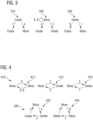
- Fig. 3 shows an overview of the eight order dependencies that were found for the operation types in OT. The arrows are denoted with a dependency number explained below:
- Fig. 3 310 shows the order dependencies in which the first file system operation is create operation (4, 7)
- Fig. 3 320 shows the order dependencies in which the first file system operation is a move operation (2, 3, 6, 8)
- Fig. 3 330 shows the order dependencies in which the first file system operation is a delete operation (1, 5).
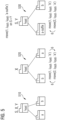
- Fig. 4 shows a schematic diagram of cycles.
- Fig. 4 shows minimal cycles (with the smallest possible number of operations) in the first row 410, and two examples of more elaborate cycles in the second row 420.
- two move operations may lead to a cycle 412 based on operation order dependencies 6 and 6 or 8
- a move and a create operation may lead to a cycle 414 based on operation order dependencies 2 and 4
- a move and a delete operation may lead to a cycle 416 based on operation order dependencies 1 and 3.
- a move operation, a delete operation and a create operation may lead to a cycle 422 based on operation order dependencies 3, 5 and 4, respectively, and a first move operation, a second move operation and a delete operation may lead to a cycle 424 based on operation order dependencies 8, 3 and 1.
- each cycle comprises at least one of operation order dependencies 1, 2, 5 and 6. It is noted that it is impossible to build cycles of only delete and create operations. It is also easy to prove that cycles that exclusively consist of move operations connected only by rule 8 are impossible (Intuitively, a proof by contradiction shows that the existence of a rule 8 cycle of n objects would require that those n objects also formed a cyclic parent-child relationship (before and after synchronization), but cycles are not allowed in F).
- Cycles always include at least one move operation. It is possible to find multiple cycles, but the length of each cycle (as well as the total number of cycles) may be limited, because cycles are based on detected operations, whose number is also limited.
- o' X may either be a move (situations 6+2) or a delete (situation 1+5) operation.
- r Y renames i by appending a unique suffix to its name.
- Fig. 5 illustrates how to break a cyclic order dependency.
- the first (left) sub-figure 510 shows the states of the two replicas (X, Y) and the persisted state ( S ), which are initially equal. Each object is shown with its name (e.g. a) and ID (e.g. 1).
- the next sub-figure 520 depicts the state on replica X after the two objects were swapped using the three move operations as listed above which are detected as two move operations with a cyclic dependency.
- the third sub-figure 530 depicts the state of Y , S.
- the two move operations are still detected, but the cycle has now become a chain.
- all states reach convergence.
- the primary advantage of at least some embodiments is that the synchronization, specifically its reconciliation phase, completes without causing side effects. Proofs were omitted for brevity. Each individual step is designed to execute successfully (as in: cannot possibly fail) and solves a specific problem (resolve conflict, break cycle, build ordered list of operations), without introducing new problems. Thus the algorithm cannot get caught in an infinite loop.
- This advantage is most noticeable if users performed a large number of operations on one replica (e.g. the local disk) during an extended offline period, and the synchronizer then has to merge these changes with concurrent operations that happened on the other replica (e.g. the server). In this scenario most other approaches fail, sometimes even silently, which means that users are not aware of the failure until it is too late.
- the side effects of failure are diverse, including:
- an approach may be used that is not state-based at all, e.g. based on a log of operations.
- the same state-based update detection approach may be used, but with different file system model that does not support the move operation. In this case a file system model can be built where cycles are impossible.
- the disadvantages are that ignoring move operations makes synchronization much less efficient.
- the chosen approach is to analyze operation order dependencies and use that knowledge to sort operations.
- a different approach (that completely ignores order dependencies) is to build a difference graph D(S,C) between the persisted state S and the current state C of each replica separately, iterating over the nodes to build in increasing depth order to build a valid operation sequence.
- Embodiments may be used by file synchronizers that run on any kind of computing device that has any kind of connection to two file systems which may be synchronized by synchronizer software.
- the device types include (but are not limited to) mobile devices, servers or desktop machines.
- the file system may be connected to the device physically (e.g. a local disk) or via any means (e.g. cloud storage over the Internet, or local area network share).
- Embodiments may further be used by data replication systems (e.g. between databases run on servers) that use state-based update detection
- the approach or algorithm may comprise one or more additional optional features corresponding to one or more aspects of the proposed concept or one or more examples described above or below.
- Examples may further be or relate to a computer program having a program code for performing one or more of the above methods, when the computer program is executed on a computer or processor. Steps, operations or processes of various above-described methods may be performed by programmed computers or processors. Examples may also cover program storage devices such as digital data storage media, which are machine, processor or computer readable and encode machine-executable, processor-executable or computer-executable programs of instructions. The instructions perform or cause performing some or all of the acts of the above-described methods.
- the program storage devices may comprise or be, for instance, digital memories, magnetic storage media such as magnetic disks and magnetic tapes, hard drives, or optically readable digital data storage media.
- FIG. 1 may also cover computers, processors or control units programmed to perform the acts of the above-described methods or (field) programmable logic arrays ((F)PLAs) or (field) programmable gate arrays ((F)PGAs), programmed to perform the acts of the above-described methods.
- a functional block denoted as "means for " performing a certain function may refer to a circuit that is configured to perform a certain function.
- a "means for s.th.” may be implemented as a "means configured to or suited for s.th.”, such as a device or a circuit configured to or suited for the respective task.
- Functions of various elements shown in the figures may be implemented in the form of dedicated hardware, such as “a signal provider”, “a signal processing unit”, “a processor”, “a controller”, etc. as well as hardware capable of executing software in association with appropriate software.
- a processor the functions may be provided by a single dedicated processor, by a single shared processor, or by a plurality of individual processors, some of which or all of which may be shared.
- processor or “controller” is by far not limited to hardware exclusively capable of executing software, but may include digital signal processor (DSP) hardware, network processor, application specific integrated circuit (ASIC), field programmable gate array (FPGA), read only memory (ROM) for storing software, random access memory (RAM), and nonvolatile storage.
- DSP digital signal processor
- ASIC application specific integrated circuit
- FPGA field programmable gate array
- ROM read only memory
- RAM random access memory
- nonvolatile storage Other hardware, conventional and/or custom, may also be included.
- a block diagram may, for instance, illustrate a high-level circuit diagram implementing the principles of the disclosure.
- a flow chart, a flow diagram, a state transition diagram, a pseudo code, and the like may represent various processes, operations or steps, which may, for instance, be substantially represented in computer readable medium and so executed by a computer or processor, whether or not such computer or processor is explicitly shown.
- Methods disclosed in the specification or in the claims may be implemented by a device having means for performing each of the respective acts of these methods.
Landscapes
- Engineering & Computer Science (AREA)
- Theoretical Computer Science (AREA)
- Data Mining & Analysis (AREA)
- Databases & Information Systems (AREA)
- Physics & Mathematics (AREA)
- General Engineering & Computer Science (AREA)
- General Physics & Mathematics (AREA)
- Information Retrieval, Db Structures And Fs Structures Therefor (AREA)
Claims (11)
- Ein Computerprogramm mit einem Programmcode zum Durchführen eines Verfahrens zum Synchronisieren von Daten zwischen einem ersten Repository und einem zweiten Repository, wenn das Computerprogramm auf einem Computer, einem Prozessor oder einer programmierbaren Hardwarekomponente ausgeführt wird, wobei das erste Repository und das zweite Repository auf einem identifiziererbasierten Dateisystem basieren, das Verschiebeoperationen unterstützt, das Verfahren umfassend:Erhalten (110) von Informationen in Bezug auf eine erste Vielzahl von Dateisystemoperationen, die Änderungen eines aktuellen Zustands des ersten Repositorys gegenüber einem vorherigen Zustand des ersten Repositorys berücksichtigen;Erhalten (120) von Informationen in Bezug auf eine zweite Vielzahl von Dateisystemoperationen, die Änderungen eines aktuellen Zustands des zweiten Repositorys gegenüber einem vorherigen Zustand des zweiten Repositorys berücksichtigen;Bestimmen (130) eines oder mehrerer Konflikte zwischen Dateisystemoperationen der ersten Vielzahl von Dateisystemoperationen und der zweiten Vielzahl von Dateisystemoperationen, wobei jeder von dem einen oder den mehreren Konflikten zwischen einer ersten Dateisystemoperation der ersten Vielzahl von Dateisystemoperationen und einer zweiten Dateisystemoperation der zweiten Vielzahl von Dateisystemoperationen auftritt;Lösen (140) des einen oder der mehreren Konflikte, um eine dritte Vielzahl von Dateisystemoperationen zu erhalten, die konfliktaufgelöste Versionen der ersten und zweiten Vielzahl von Dateisystemoperationen umfassen, wobei das Lösen des einen oder der mehreren Konflikte ein Bestimmen (142) einer gewinnenden Operation und einer verlierenden Operation unter der ersten und zweiten Dateisystemoperation basierend auf einem Auswahlkriterium umfasst, wobei das Lösen (140) des einen oder der mehreren Konflikte ein Ändern der verlierenden Operation umfasst, um den Konflikt zu lösen, wobei die gewinnende Operation unverändert bleibt;Neuordnen (150) der dritten Vielzahl von Dateisystemoperationen basierend auf Operationsreihenfolgeabhängigkeiten zwischen den Dateisystemoperationen der dritten Vielzahl von Dateisystemoperationen, wobei das Neuordnen der dritten Vielzahl von Dateisystemoperationen ein Detektieren (152) von Zyklen in der Neuordnung der dritten Vielzahl von Dateisystemoperationen und ein Auflösen (154) der detektierten Zyklen umfasst, wobei jeder Zyklus zwei oder mehr Operationen der dritten Vielzahl von Dateisystemoperationen umfasst, wobei die zwei oder mehr Operationen eine erste Dateisystemoperation umfassen, die einen Dateinamen verfügbar macht, sodass der Dateiname durch eine zweite Dateisystemoperation verwendet werden kann, wobei das Auflösen (154) des jeweiligen Zyklus ein Einfügen (156) einer zusätzlichen Umbenennungsoperation umfasst, um den Dateinamen verfügbar zu machen; undAusführen (170) der neu geordneten dritten Vielzahl von Dateisystemoperationen, um das erste Repository und das zweite Repository zu synchronisieren.
- Das Computerprogramm gemäß Anspruch 1, wobei das Lösen (140) des einen oder der mehreren Konflikte ein Sortieren (144) des einen oder der mehreren Konflikte basierend auf einer Konfliktsortierregel, um einen einzelnen zu lösenden Konflikt zu identifizieren, ein Lösen (146) des einzelnen identifizierten Konflikts und ein Lösen (148) des einen oder der mehreren Konflikte, die verbleiben, nachdem der einzelne identifizierte Konflikt gelöst wurde, umfasst.
- Das Computerprogramm gemäß Anspruch 2, wobei das Bestimmen (130) des einen oder der mehreren Konflikte und das Lösen (140) des einen oder der mehreren Konflikte nach dem Lösen des einzelnen identifizierten Konflikts wiederholt werden.
- Das Computerprogramm gemäß einem der Ansprüche 1 bis 3, wobei das Auswahlkriterium auf einem von einem geschätzten Aufwand eines Benutzers für das Durchführen der jeweiligen Operationen, einem logischen Ort der Repositorys, an denen die jeweiligen Operationen durchgeführt wurden, und einer Benutzergruppe eines Benutzers, der die jeweiligen Operationen durchgeführt hat, basiert.
- Das Computerprogramm gemäß einem der Ansprüche 1 bis 4, wobei das Verfahren ferner ein Detektieren (160) eines oder mehrerer Pseudokonflikte zwischen Dateisystemoperationen der ersten Vielzahl von Dateisystemoperationen und der zweiten Vielzahl von Dateisystemoperationen umfasst, wobei der eine oder die mehreren Pseudokonflikte jeweils zwischen Operationen auftreten, die syntaktisch in Konflikt stehen, während sie den gleichen Effekt haben.
- Das Computerprogramm gemäß Anspruch 5, wobei das Verfahren ferner ein Lösen (162) des einen oder der mehreren Pseudokonflikte durch Modifizieren der vorherigen Zustände des ersten Repositorys oder des zweiten Repositorys basierend auf detektierten Pseudokonflikten umfasst.
- Das Computerprogramm gemäß einem der Ansprüche 1 bis 6, wobei die Operationsreihenfolgeabhängigkeiten auf einem Regelsatz von Operationsreihenfolgeabhängigkeiten basieren, wobei der Regelsatz von Operationsreihenfolgeabhängigkeiten Operationen definiert, die logisch in einer spezifischen Reihenfolge auftreten müssen.
- Das Computerprogramm gemäß Anspruch 7, wobei der Regelsatz von Reihenfolgeabhängigkeiten eine oder mehrere Operationsreihenfolgeabhängigkeiten umfasst, die jeweils eine logische Reihenfolge zwischen einer ersten Dateisystemoperation und einer zweiten Dateisystemoperation definieren, wobei die eine oder die mehreren Operationsreihenfolgeabhängigkeiten eine oder mehrere der folgenden Operationsreihenfolgeabhängigkeiten umfassen:a) eine Operationsreihenfolgeabhängigkeit zwischen der ersten Dateisystemoperation und der zweiten Dateisystemoperation, wobei die erste Dateisystemoperation einen Dateinamen verfügbar macht, sodass der Dateiname durch die zweite Dateisystemoperation verwendet werden kann,b) eine Operationsreihenfolgeabhängigkeit zwischen der ersten Dateisystemoperation und der zweiten Dateisystemoperation, wobei die erste Dateisystemoperation dazu führt, dass eine Datei oder ein Ordner vorhanden ist, sodass die Datei oder der Ordner durch die zweite Dateisystemoperation verwendet werden kann,c) eine Operationsreihenfolgeabhängigkeit, wobei die erste Dateisystemoperation eine Datei oder einen Ordner außerhalb eines Ordners verschiebt, der durch die zweite Dateisystemoperation gelöscht wird,d) eine Operationsreihenfolgeabhängigkeit, wobei die erste und die zweite Dateisystemoperation Verschiebeoperationen sind, die jeweils ein erstes und ein zweites Verzeichnis beeinflussen, wobei das erste und das zweite Verzeichnis in einer Eltern-Kind-Beziehung stehen, wobei beide Dateisystemoperationen dazu führen, dass das erste und das zweite Verzeichnis eine umgekehrte Eltern-Kind-Beziehung aufweisen.
- Das Computerprogramm gemäß einem der Ansprüche 1 bis 8, wobei die Operationen der dritten Vielzahl von Dateisystemoperationen bei der Neuordnung (150) der dritten Vielzahl von Dateisystemoperationen basierend auf den Operationsreihenfolgeabhängigkeiten paarweise vertauscht werden.
- Das Computerprogramm gemäß Anspruch 9, wobei die Operationen, die bei der Neuordnung (150) der dritten Vielzahl von Dateisystemoperationen vertauscht werden, eine Teilmenge von Operationen der dritten Vielzahl von Dateisystemoperationen bilden, wobei die Zyklen in der Neuordnung der dritten Vielzahl von Dateisystemoperationen durch den Versuch, Zyklen unter der Teilmenge von Operationen der dritten Vielzahl von Dateisystemoperationen zu bilden, detektiert werden.
- Ein Verfahren zum Synchronisieren von Daten zwischen einem ersten Repository und einem zweiten Repository, wobei das erste Repository und das zweite Repository auf einem identifiziererbasierten Dateisystem basieren, das Verschiebeoperationen unterstützt, das Verfahren umfassend:Erhalten (110) von Informationen in Bezug auf eine erste Vielzahl von Dateisystemoperationen, die Änderungen eines aktuellen Zustands des ersten Repositorys gegenüber einem vorherigen Zustand des ersten Repositorys berücksichtigen;Erhalten (120) von Informationen in Bezug auf eine zweite Vielzahl von Dateisystemoperationen, die Änderungen eines aktuellen Zustands des zweiten Repositorys gegenüber einem vorherigen Zustand des zweiten Repositorys berücksichtigen;Bestimmen (130) eines oder mehrerer Konflikte zwischen Dateisystemoperationen der ersten Vielzahl von Dateisystemoperationen und der zweiten Vielzahl von Dateisystemoperationen, wobei jeder von dem einen oder den mehreren Konflikten zwischen einer ersten Dateisystemoperation der ersten Vielzahl von Dateisystemoperationen und einer zweiten Dateisystemoperation der zweiten Vielzahl von Dateisystemoperationen auftritt;Lösen (140) des einen oder der mehreren Konflikte, um eine dritte Vielzahl von Dateisystemoperationen zu erhalten, die konfliktaufgelöste Versionen der ersten und zweiten Vielzahl von Dateisystemoperationen umfassen, wobei das Lösen des einen oder der mehreren Konflikte ein Bestimmen (142) einer gewinnenden Operation und einer verlierenden Operation unter der ersten und zweiten Dateisystemoperation basierend auf einem Auswahlkriterium umfasst, wobei das Lösen (140) des einen oder der mehreren Konflikte ein Ändern der verlierenden Operation umfasst, um den Konflikt zu lösen, wobei die gewinnende Operation unverändert bleibt; undNeuordnen (150) der dritten Vielzahl von Dateisystemoperationen basierend auf Operationsreihenfolgeabhängigkeiten zwischen den Dateisystemoperationen der dritten Vielzahl von Dateisystemoperationen, wobei das Neuordnen der dritten Vielzahl von Dateisystemoperationen ein Detektieren (152) von Zyklen in der Neuordnung der dritten Vielzahl von Dateisystemoperationen und ein Auflösen (154) der detektierten Zyklen umfasst, wobei jeder Zyklus zwei oder mehr Operationen der dritten Vielzahl von Dateisystemoperationen umfasst, wobei die zwei oder mehr Operationen eine erste Dateisystemoperation umfassen, die einen Dateinamen verfügbar macht, sodass der Dateiname durch eine zweite Dateisystemoperation verwendet werden kann, wobei das Auflösen (154) des jeweiligen Zyklus ein Einfügen (156) einer zusätzlichen Umbenennungsoperation umfasst, um den Dateinamen verfügbar zu machen; undAusführen (170) der neu geordneten dritten Vielzahl von Dateisystemoperationen, um das erste Repository und das zweite Repository zu synchronisieren.
Applications Claiming Priority (1)
| Application Number | Priority Date | Filing Date | Title |
|---|---|---|---|
| EP19168186 | 2019-04-09 |
Publications (3)
| Publication Number | Publication Date |
|---|---|
| EP3722965A1 EP3722965A1 (de) | 2020-10-14 |
| EP3722965C0 EP3722965C0 (de) | 2024-06-12 |
| EP3722965B1 true EP3722965B1 (de) | 2024-06-12 |
Family
ID=66334165
Family Applications (1)
| Application Number | Title | Priority Date | Filing Date |
|---|---|---|---|
| EP19175450.6A Active EP3722965B1 (de) | 2019-04-09 | 2019-05-20 | Verfahren, vorrichtung und computerprogramm zum synchronisieren von daten zwischen einem ersten speicher und einem zweiten speicher |
Country Status (1)
| Country | Link |
|---|---|
| EP (1) | EP3722965B1 (de) |
Families Citing this family (4)
| Publication number | Priority date | Publication date | Assignee | Title |
|---|---|---|---|---|
| CN116932793B (zh) * | 2022-04-08 | 2025-09-30 | 鸿海精密工业股份有限公司 | 用于视觉检测的数据删除方法、装置、设备及存储介质 |
| US12306800B2 (en) | 2022-12-22 | 2025-05-20 | Dropbox, Inc. | Multi-root content management system |
| US12530369B2 (en) | 2022-12-22 | 2026-01-20 | Dropbox, Inc. | Resume backup of external storage device using multi-root system |
| US12242427B2 (en) * | 2022-12-22 | 2025-03-04 | Dropbox, Inc. | Implementing different synchronization processes using a multi-root system |
Citations (1)
| Publication number | Priority date | Publication date | Assignee | Title |
|---|---|---|---|---|
| US7165248B2 (en) * | 2001-06-04 | 2007-01-16 | Sun Microsystems, Inc. | File tree conflict processor |
Family Cites Families (2)
| Publication number | Priority date | Publication date | Assignee | Title |
|---|---|---|---|---|
| US7778963B2 (en) * | 2005-04-26 | 2010-08-17 | Microsoft Corporation | Constraint-based conflict handling for synchronization |
| US7941410B2 (en) * | 2008-09-30 | 2011-05-10 | Microsoft Corporation | Method and system of managing conflicts for a set of synchronized folders |
-
2019
- 2019-05-20 EP EP19175450.6A patent/EP3722965B1/de active Active
Patent Citations (1)
| Publication number | Priority date | Publication date | Assignee | Title |
|---|---|---|---|---|
| US7165248B2 (en) * | 2001-06-04 | 2007-01-16 | Sun Microsystems, Inc. | File tree conflict processor |
Also Published As
| Publication number | Publication date |
|---|---|
| EP3722965C0 (de) | 2024-06-12 |
| EP3722965A1 (de) | 2020-10-14 |
Similar Documents
| Publication | Publication Date | Title |
|---|---|---|
| EP3722965B1 (de) | Verfahren, vorrichtung und computerprogramm zum synchronisieren von daten zwischen einem ersten speicher und einem zweiten speicher | |
| Woos et al. | Planning for change in a formal verification of the raft consensus protocol | |
| Shapiro et al. | Convergent and commutative replicated data types | |
| EP4189914B1 (de) | Verwendung mehrerer blockchains zur anwendung von transaktionen auf eine reihe von persistenten datenobjekten in persistenten speichersystemen | |
| JPH11143755A (ja) | 階層構成情報のコピーおよび共有方法 | |
| US20120330890A1 (en) | Propagating tables while preserving cyclic foreign key relationships | |
| CN101765831A (zh) | 数据库不一致的处理方法 | |
| WO2023064413A1 (en) | Clone-aware approach for space and time efficient replication | |
| JP4951137B2 (ja) | データベースの管理方法 | |
| Chajed et al. | Argosy: Verifying layered storage systems with recovery refinement | |
| US20210326252A1 (en) | In-array linked list identifier pool scheme | |
| CN107209707B (zh) | 基于云的分级系统保存 | |
| Dathathri et al. | Phoenix: A substrate for resilient distributed graph analytics | |
| JP2011522337A (ja) | サーバクラスタに配信されるコンピュータシステムのソフトウェアモジュールの同期化方法、同期化システムおよびデータストレージへの適用 | |
| WO2013132628A1 (ja) | データベースの管理方法 | |
| Pietron et al. | Collaboration and versioning framework–a systematic top-down approach | |
| CN108369549A (zh) | 使用重启时期的版本化记录管理 | |
| CN118535526A (zh) | 一种超大规模的大数据平台数据迁移的方法及装置 | |
| CN112473145B (zh) | 一种基于游戏引擎的数据处理方法和装置 | |
| CN112148354B (zh) | 游戏的启动方法及装置 | |
| Davisson et al. | Transparent migration from Datastore to Firestore | |
| Csirmaz | Algebraic file synchronization: Adequacy and completeness | |
| CN114722125A (zh) | 数据库事务处理的方法、装置、设备和计算机可读介质 | |
| JP2016184432A (ja) | データベースの管理方法 | |
| CN115398415A (zh) | 分布式数据系统中用于写入器预选的方法、装置及系统 |
Legal Events
| Date | Code | Title | Description |
|---|---|---|---|
| PUAI | Public reference made under article 153(3) epc to a published international application that has entered the european phase |
Free format text: ORIGINAL CODE: 0009012 |
|
| STAA | Information on the status of an ep patent application or granted ep patent |
Free format text: STATUS: THE APPLICATION HAS BEEN PUBLISHED |
|
| AK | Designated contracting states |
Kind code of ref document: A1 Designated state(s): AL AT BE BG CH CY CZ DE DK EE ES FI FR GB GR HR HU IE IS IT LI LT LU LV MC MK MT NL NO PL PT RO RS SE SI SK SM TR |
|
| AX | Request for extension of the european patent |
Extension state: BA ME |
|
| STAA | Information on the status of an ep patent application or granted ep patent |
Free format text: STATUS: REQUEST FOR EXAMINATION WAS MADE |
|
| 17P | Request for examination filed |
Effective date: 20210414 |
|
| RBV | Designated contracting states (corrected) |
Designated state(s): AL AT BE BG CH CY CZ DE DK EE ES FI FR GB GR HR HU IE IS IT LI LT LU LV MC MK MT NL NO PL PT RO RS SE SI SK SM TR |
|
| STAA | Information on the status of an ep patent application or granted ep patent |
Free format text: STATUS: EXAMINATION IS IN PROGRESS |
|
| 17Q | First examination report despatched |
Effective date: 20220225 |
|
| RAP3 | Party data changed (applicant data changed or rights of an application transferred) |
Owner name: FRAUNHOFER-GESELLSCHAFT ZUR FOERDERUNG DER ANGEWANDTEN FORSCHUNG E.V. |
|
| GRAP | Despatch of communication of intention to grant a patent |
Free format text: ORIGINAL CODE: EPIDOSNIGR1 |
|
| STAA | Information on the status of an ep patent application or granted ep patent |
Free format text: STATUS: GRANT OF PATENT IS INTENDED |
|
| INTG | Intention to grant announced |
Effective date: 20231220 |
|
| GRAS | Grant fee paid |
Free format text: ORIGINAL CODE: EPIDOSNIGR3 |
|
| GRAA | (expected) grant |
Free format text: ORIGINAL CODE: 0009210 |
|
| STAA | Information on the status of an ep patent application or granted ep patent |
Free format text: STATUS: THE PATENT HAS BEEN GRANTED |
|
| AK | Designated contracting states |
Kind code of ref document: B1 Designated state(s): AL AT BE BG CH CY CZ DE DK EE ES FI FR GB GR HR HU IE IS IT LI LT LU LV MC MK MT NL NO PL PT RO RS SE SI SK SM TR |
|
| REG | Reference to a national code |
Ref country code: GB Ref legal event code: FG4D |
|
| REG | Reference to a national code |
Ref country code: CH Ref legal event code: EP |
|
| REG | Reference to a national code |
Ref country code: IE Ref legal event code: FG4D |
|
| REG | Reference to a national code |
Ref country code: DE Ref legal event code: R096 Ref document number: 602019053458 Country of ref document: DE |
|
| REG | Reference to a national code |
Ref country code: CH Ref legal event code: PK Free format text: BERICHTIGUNGEN |
|
| U01 | Request for unitary effect filed |
Effective date: 20240711 |
|
| RIN2 | Information on inventor provided after grant (corrected) |
Inventor name: PPERMANN, LEIF Inventor name: SHEKOW, MARIUS |
|
| RIN2 | Information on inventor provided after grant (corrected) |
Inventor name: OPPERMANN, LEIF Inventor name: SHEKOW, MARIUS |
|
| U07 | Unitary effect registered |
Designated state(s): AT BE BG DE DK EE FI FR IT LT LU LV MT NL PT RO SE SI Effective date: 20240904 |
|
| PG25 | Lapsed in a contracting state [announced via postgrant information from national office to epo] |
Ref country code: HR Free format text: LAPSE BECAUSE OF FAILURE TO SUBMIT A TRANSLATION OF THE DESCRIPTION OR TO PAY THE FEE WITHIN THE PRESCRIBED TIME-LIMIT Effective date: 20240612 |
|
| PG25 | Lapsed in a contracting state [announced via postgrant information from national office to epo] |
Ref country code: GR Free format text: LAPSE BECAUSE OF FAILURE TO SUBMIT A TRANSLATION OF THE DESCRIPTION OR TO PAY THE FEE WITHIN THE PRESCRIBED TIME-LIMIT Effective date: 20240913 |
|
| PG25 | Lapsed in a contracting state [announced via postgrant information from national office to epo] |
Ref country code: ES Free format text: LAPSE BECAUSE OF FAILURE TO SUBMIT A TRANSLATION OF THE DESCRIPTION OR TO PAY THE FEE WITHIN THE PRESCRIBED TIME-LIMIT Effective date: 20240612 |
|
| PG25 | Lapsed in a contracting state [announced via postgrant information from national office to epo] |
Ref country code: NO Free format text: LAPSE BECAUSE OF FAILURE TO SUBMIT A TRANSLATION OF THE DESCRIPTION OR TO PAY THE FEE WITHIN THE PRESCRIBED TIME-LIMIT Effective date: 20240912 Ref country code: HR Free format text: LAPSE BECAUSE OF FAILURE TO SUBMIT A TRANSLATION OF THE DESCRIPTION OR TO PAY THE FEE WITHIN THE PRESCRIBED TIME-LIMIT Effective date: 20240612 Ref country code: GR Free format text: LAPSE BECAUSE OF FAILURE TO SUBMIT A TRANSLATION OF THE DESCRIPTION OR TO PAY THE FEE WITHIN THE PRESCRIBED TIME-LIMIT Effective date: 20240913 Ref country code: ES Free format text: LAPSE BECAUSE OF FAILURE TO SUBMIT A TRANSLATION OF THE DESCRIPTION OR TO PAY THE FEE WITHIN THE PRESCRIBED TIME-LIMIT Effective date: 20240612 Ref country code: RS Free format text: LAPSE BECAUSE OF FAILURE TO SUBMIT A TRANSLATION OF THE DESCRIPTION OR TO PAY THE FEE WITHIN THE PRESCRIBED TIME-LIMIT Effective date: 20240912 |
|
| PG25 | Lapsed in a contracting state [announced via postgrant information from national office to epo] |
Ref country code: PL Free format text: LAPSE BECAUSE OF FAILURE TO SUBMIT A TRANSLATION OF THE DESCRIPTION OR TO PAY THE FEE WITHIN THE PRESCRIBED TIME-LIMIT Effective date: 20240612 |
|
| PG25 | Lapsed in a contracting state [announced via postgrant information from national office to epo] |
Ref country code: IS Free format text: LAPSE BECAUSE OF FAILURE TO SUBMIT A TRANSLATION OF THE DESCRIPTION OR TO PAY THE FEE WITHIN THE PRESCRIBED TIME-LIMIT Effective date: 20241012 |
|
| PG25 | Lapsed in a contracting state [announced via postgrant information from national office to epo] |
Ref country code: CZ Free format text: LAPSE BECAUSE OF FAILURE TO SUBMIT A TRANSLATION OF THE DESCRIPTION OR TO PAY THE FEE WITHIN THE PRESCRIBED TIME-LIMIT Effective date: 20240612 |
|
| PG25 | Lapsed in a contracting state [announced via postgrant information from national office to epo] |
Ref country code: SK Free format text: LAPSE BECAUSE OF FAILURE TO SUBMIT A TRANSLATION OF THE DESCRIPTION OR TO PAY THE FEE WITHIN THE PRESCRIBED TIME-LIMIT Effective date: 20240612 |
|
| PG25 | Lapsed in a contracting state [announced via postgrant information from national office to epo] |
Ref country code: SM Free format text: LAPSE BECAUSE OF FAILURE TO SUBMIT A TRANSLATION OF THE DESCRIPTION OR TO PAY THE FEE WITHIN THE PRESCRIBED TIME-LIMIT Effective date: 20240612 |
|
| PG25 | Lapsed in a contracting state [announced via postgrant information from national office to epo] |
Ref country code: SM Free format text: LAPSE BECAUSE OF FAILURE TO SUBMIT A TRANSLATION OF THE DESCRIPTION OR TO PAY THE FEE WITHIN THE PRESCRIBED TIME-LIMIT Effective date: 20240612 Ref country code: SK Free format text: LAPSE BECAUSE OF FAILURE TO SUBMIT A TRANSLATION OF THE DESCRIPTION OR TO PAY THE FEE WITHIN THE PRESCRIBED TIME-LIMIT Effective date: 20240612 Ref country code: PL Free format text: LAPSE BECAUSE OF FAILURE TO SUBMIT A TRANSLATION OF THE DESCRIPTION OR TO PAY THE FEE WITHIN THE PRESCRIBED TIME-LIMIT Effective date: 20240612 Ref country code: IS Free format text: LAPSE BECAUSE OF FAILURE TO SUBMIT A TRANSLATION OF THE DESCRIPTION OR TO PAY THE FEE WITHIN THE PRESCRIBED TIME-LIMIT Effective date: 20241012 Ref country code: CZ Free format text: LAPSE BECAUSE OF FAILURE TO SUBMIT A TRANSLATION OF THE DESCRIPTION OR TO PAY THE FEE WITHIN THE PRESCRIBED TIME-LIMIT Effective date: 20240612 |
|
| PLBE | No opposition filed within time limit |
Free format text: ORIGINAL CODE: 0009261 |
|
| STAA | Information on the status of an ep patent application or granted ep patent |
Free format text: STATUS: NO OPPOSITION FILED WITHIN TIME LIMIT |
|
| 26N | No opposition filed |
Effective date: 20250313 |
|
| U20 | Renewal fee for the european patent with unitary effect paid |
Year of fee payment: 7 Effective date: 20250516 |
|
| PGFP | Annual fee paid to national office [announced via postgrant information from national office to epo] |
Ref country code: GB Payment date: 20250522 Year of fee payment: 7 |
|
| PGFP | Annual fee paid to national office [announced via postgrant information from national office to epo] |
Ref country code: CH Payment date: 20250601 Year of fee payment: 7 |
|
| PG25 | Lapsed in a contracting state [announced via postgrant information from national office to epo] |
Ref country code: MC Free format text: LAPSE BECAUSE OF FAILURE TO SUBMIT A TRANSLATION OF THE DESCRIPTION OR TO PAY THE FEE WITHIN THE PRESCRIBED TIME-LIMIT Effective date: 20240612 |