EP3721833A1 - Floating carotid filter - Google Patents
Floating carotid filter Download PDFInfo
- Publication number
- EP3721833A1 EP3721833A1 EP20169419.7A EP20169419A EP3721833A1 EP 3721833 A1 EP3721833 A1 EP 3721833A1 EP 20169419 A EP20169419 A EP 20169419A EP 3721833 A1 EP3721833 A1 EP 3721833A1
- Authority
- EP
- European Patent Office
- Prior art keywords
- filter
- carotid
- catheter
- vascular filter
- patient
- Prior art date
- Legal status (The legal status is an assumption and is not a legal conclusion. Google has not performed a legal analysis and makes no representation as to the accuracy of the status listed.)
- Withdrawn
Links
- 238000007667 floating Methods 0.000 title description 21
- 238000013151 thrombectomy Methods 0.000 claims abstract description 29
- 210000001715 carotid artery Anatomy 0.000 claims description 28
- 208000007536 Thrombosis Diseases 0.000 claims description 27
- 230000002792 vascular Effects 0.000 claims description 15
- 210000005166 vasculature Anatomy 0.000 claims description 10
- 238000007373 indentation Methods 0.000 claims description 4
- 230000006641 stabilisation Effects 0.000 claims description 3
- 238000011105 stabilization Methods 0.000 claims description 3
- 230000003902 lesion Effects 0.000 abstract description 38
- 238000000034 method Methods 0.000 abstract description 29
- 238000013176 antiplatelet therapy Methods 0.000 abstract description 7
- 208000032382 Ischaemic stroke Diseases 0.000 abstract description 4
- 210000001105 femoral artery Anatomy 0.000 abstract description 2
- 238000011084 recovery Methods 0.000 abstract description 2
- 210000004004 carotid artery internal Anatomy 0.000 description 16
- 206010053648 Vascular occlusion Diseases 0.000 description 12
- 238000011282 treatment Methods 0.000 description 8
- 239000011148 porous material Substances 0.000 description 6
- 208000006011 Stroke Diseases 0.000 description 5
- 210000004556 brain Anatomy 0.000 description 5
- 230000017531 blood circulation Effects 0.000 description 4
- 238000000605 extraction Methods 0.000 description 4
- 239000008280 blood Substances 0.000 description 3
- 210000004369 blood Anatomy 0.000 description 3
- 210000000275 circle of willis Anatomy 0.000 description 3
- 230000003073 embolic effect Effects 0.000 description 3
- 210000003657 middle cerebral artery Anatomy 0.000 description 3
- 206010014498 Embolic stroke Diseases 0.000 description 2
- 210000001168 carotid artery common Anatomy 0.000 description 2
- 210000000269 carotid artery external Anatomy 0.000 description 2
- 238000010586 diagram Methods 0.000 description 2
- 239000000463 material Substances 0.000 description 2
- 238000012986 modification Methods 0.000 description 2
- 230000004048 modification Effects 0.000 description 2
- 208000014882 Carotid artery disease Diseases 0.000 description 1
- 208000032843 Hemorrhage Diseases 0.000 description 1
- 208000012902 Nervous system disease Diseases 0.000 description 1
- 238000004873 anchoring Methods 0.000 description 1
- 210000002551 anterior cerebral artery Anatomy 0.000 description 1
- 210000001367 artery Anatomy 0.000 description 1
- 230000036770 blood supply Effects 0.000 description 1
- 210000004204 blood vessel Anatomy 0.000 description 1
- 238000010276 construction Methods 0.000 description 1
- 208000037265 diseases, disorders, signs and symptoms Diseases 0.000 description 1
- 230000001747 exhibiting effect Effects 0.000 description 1
- 230000002008 hemorrhagic effect Effects 0.000 description 1
- 230000001771 impaired effect Effects 0.000 description 1
- 239000003550 marker Substances 0.000 description 1
- 238000002360 preparation method Methods 0.000 description 1
- 230000009424 thromboembolic effect Effects 0.000 description 1
- 238000011144 upstream manufacturing Methods 0.000 description 1
- 208000021331 vascular occlusion disease Diseases 0.000 description 1
Images


Classifications
-
- A—HUMAN NECESSITIES
- A61—MEDICAL OR VETERINARY SCIENCE; HYGIENE
- A61F—FILTERS IMPLANTABLE INTO BLOOD VESSELS; PROSTHESES; DEVICES PROVIDING PATENCY TO, OR PREVENTING COLLAPSING OF, TUBULAR STRUCTURES OF THE BODY, e.g. STENTS; ORTHOPAEDIC, NURSING OR CONTRACEPTIVE DEVICES; FOMENTATION; TREATMENT OR PROTECTION OF EYES OR EARS; BANDAGES, DRESSINGS OR ABSORBENT PADS; FIRST-AID KITS
- A61F2/00—Filters implantable into blood vessels; Prostheses, i.e. artificial substitutes or replacements for parts of the body; Appliances for connecting them with the body; Devices providing patency to, or preventing collapsing of, tubular structures of the body, e.g. stents
- A61F2/01—Filters implantable into blood vessels
-
- A—HUMAN NECESSITIES
- A61—MEDICAL OR VETERINARY SCIENCE; HYGIENE
- A61F—FILTERS IMPLANTABLE INTO BLOOD VESSELS; PROSTHESES; DEVICES PROVIDING PATENCY TO, OR PREVENTING COLLAPSING OF, TUBULAR STRUCTURES OF THE BODY, e.g. STENTS; ORTHOPAEDIC, NURSING OR CONTRACEPTIVE DEVICES; FOMENTATION; TREATMENT OR PROTECTION OF EYES OR EARS; BANDAGES, DRESSINGS OR ABSORBENT PADS; FIRST-AID KITS
- A61F2/00—Filters implantable into blood vessels; Prostheses, i.e. artificial substitutes or replacements for parts of the body; Appliances for connecting them with the body; Devices providing patency to, or preventing collapsing of, tubular structures of the body, e.g. stents
- A61F2/01—Filters implantable into blood vessels
- A61F2/0105—Open ended, i.e. legs gathered only at one side
-
- A—HUMAN NECESSITIES
- A61—MEDICAL OR VETERINARY SCIENCE; HYGIENE
- A61B—DIAGNOSIS; SURGERY; IDENTIFICATION
- A61B17/00—Surgical instruments, devices or methods
- A61B17/22—Implements for squeezing-off ulcers or the like on inner organs of the body; Implements for scraping-out cavities of body organs, e.g. bones; for invasive removal or destruction of calculus using mechanical vibrations; for removing obstructions in blood vessels, not otherwise provided for
- A61B17/221—Gripping devices in the form of loops or baskets for gripping calculi or similar types of obstructions
-
- A—HUMAN NECESSITIES
- A61—MEDICAL OR VETERINARY SCIENCE; HYGIENE
- A61B—DIAGNOSIS; SURGERY; IDENTIFICATION
- A61B17/00—Surgical instruments, devices or methods
- A61B17/32—Surgical cutting instruments
- A61B17/3205—Excision instruments
- A61B17/3207—Atherectomy devices working by cutting or abrading; Similar devices specially adapted for non-vascular obstructions
-
- A—HUMAN NECESSITIES
- A61—MEDICAL OR VETERINARY SCIENCE; HYGIENE
- A61F—FILTERS IMPLANTABLE INTO BLOOD VESSELS; PROSTHESES; DEVICES PROVIDING PATENCY TO, OR PREVENTING COLLAPSING OF, TUBULAR STRUCTURES OF THE BODY, e.g. STENTS; ORTHOPAEDIC, NURSING OR CONTRACEPTIVE DEVICES; FOMENTATION; TREATMENT OR PROTECTION OF EYES OR EARS; BANDAGES, DRESSINGS OR ABSORBENT PADS; FIRST-AID KITS
- A61F2/00—Filters implantable into blood vessels; Prostheses, i.e. artificial substitutes or replacements for parts of the body; Appliances for connecting them with the body; Devices providing patency to, or preventing collapsing of, tubular structures of the body, e.g. stents
- A61F2/01—Filters implantable into blood vessels
- A61F2/0108—Both ends closed, i.e. legs gathered at both ends
-
- A—HUMAN NECESSITIES
- A61—MEDICAL OR VETERINARY SCIENCE; HYGIENE
- A61F—FILTERS IMPLANTABLE INTO BLOOD VESSELS; PROSTHESES; DEVICES PROVIDING PATENCY TO, OR PREVENTING COLLAPSING OF, TUBULAR STRUCTURES OF THE BODY, e.g. STENTS; ORTHOPAEDIC, NURSING OR CONTRACEPTIVE DEVICES; FOMENTATION; TREATMENT OR PROTECTION OF EYES OR EARS; BANDAGES, DRESSINGS OR ABSORBENT PADS; FIRST-AID KITS
- A61F2/00—Filters implantable into blood vessels; Prostheses, i.e. artificial substitutes or replacements for parts of the body; Appliances for connecting them with the body; Devices providing patency to, or preventing collapsing of, tubular structures of the body, e.g. stents
- A61F2/01—Filters implantable into blood vessels
- A61F2/011—Instruments for their placement or removal
-
- A—HUMAN NECESSITIES
- A61—MEDICAL OR VETERINARY SCIENCE; HYGIENE
- A61F—FILTERS IMPLANTABLE INTO BLOOD VESSELS; PROSTHESES; DEVICES PROVIDING PATENCY TO, OR PREVENTING COLLAPSING OF, TUBULAR STRUCTURES OF THE BODY, e.g. STENTS; ORTHOPAEDIC, NURSING OR CONTRACEPTIVE DEVICES; FOMENTATION; TREATMENT OR PROTECTION OF EYES OR EARS; BANDAGES, DRESSINGS OR ABSORBENT PADS; FIRST-AID KITS
- A61F2/00—Filters implantable into blood vessels; Prostheses, i.e. artificial substitutes or replacements for parts of the body; Appliances for connecting them with the body; Devices providing patency to, or preventing collapsing of, tubular structures of the body, e.g. stents
- A61F2/01—Filters implantable into blood vessels
- A61F2/013—Distal protection devices, i.e. devices placed distally in combination with another endovascular procedure, e.g. angioplasty or stenting
-
- A—HUMAN NECESSITIES
- A61—MEDICAL OR VETERINARY SCIENCE; HYGIENE
- A61F—FILTERS IMPLANTABLE INTO BLOOD VESSELS; PROSTHESES; DEVICES PROVIDING PATENCY TO, OR PREVENTING COLLAPSING OF, TUBULAR STRUCTURES OF THE BODY, e.g. STENTS; ORTHOPAEDIC, NURSING OR CONTRACEPTIVE DEVICES; FOMENTATION; TREATMENT OR PROTECTION OF EYES OR EARS; BANDAGES, DRESSINGS OR ABSORBENT PADS; FIRST-AID KITS
- A61F2/00—Filters implantable into blood vessels; Prostheses, i.e. artificial substitutes or replacements for parts of the body; Appliances for connecting them with the body; Devices providing patency to, or preventing collapsing of, tubular structures of the body, e.g. stents
- A61F2/95—Instruments specially adapted for placement or removal of stents or stent-grafts
-
- A—HUMAN NECESSITIES
- A61—MEDICAL OR VETERINARY SCIENCE; HYGIENE
- A61B—DIAGNOSIS; SURGERY; IDENTIFICATION
- A61B17/00—Surgical instruments, devices or methods
- A61B17/22—Implements for squeezing-off ulcers or the like on inner organs of the body; Implements for scraping-out cavities of body organs, e.g. bones; for invasive removal or destruction of calculus using mechanical vibrations; for removing obstructions in blood vessels, not otherwise provided for
- A61B2017/22001—Angioplasty, e.g. PCTA
-
- A—HUMAN NECESSITIES
- A61—MEDICAL OR VETERINARY SCIENCE; HYGIENE
- A61B—DIAGNOSIS; SURGERY; IDENTIFICATION
- A61B17/00—Surgical instruments, devices or methods
- A61B17/32—Surgical cutting instruments
- A61B17/3205—Excision instruments
- A61B17/3207—Atherectomy devices working by cutting or abrading; Similar devices specially adapted for non-vascular obstructions
- A61B2017/320716—Atherectomy devices working by cutting or abrading; Similar devices specially adapted for non-vascular obstructions comprising means for preventing embolism by dislodged material
Definitions
- the present invention generally relates to medical devices and procedures for vascular intervention, and more particularly, to devices and treatments for thromboembolic disorders and for removal of foreign bodies in the vascular system.
- stroke is used to describe a medical event whereby blood supply to the brain or specific areas of the brain is restricted or blocked to the extent that the supply is inadequate to provide the required flow of oxygenated blood to maintain function.
- the brain will be impaired either temporarily or permanently, with the patient experiencing a loss of function such as sight, speech or control of limbs.
- hemorrhagic and embolic There are two distinct types of stroke, hemorrhagic and embolic. This invention addresses embolic stroke.
- Carotid Artery disease occurs when fatty deposits (plaques) clog blood vessels that deliver blood to the brain and head (Carotid Arteries).
- plaque a fatty deposit originating from a carotid lesion in the region of the Internal/External Carotid Artery bifurcation
- flow distally and block blood flow to specific areas of the brain, thereby leading to stroke and neurological impairment.
- Stoke patients can thereafter present tandem occlusions with a blockage present in the Internal Carotid Artery and a blockage in the neurovascular such as the Middle Cerebral Artery (MCA).
- MCA Middle Cerebral Artery
- the priority of the physician treating patients exhibiting tandem occlusions is to restore blood flow in the neurovasculature, which is typically done by performing a thrombectomy to remove the clot.
- Treatment of the carotid lesion in the same procedure is not desirable as this usually requires implanting a stent which requires the patient to be given antiplatelet therapy to reduce the risk of thrombosis; however antiplatelet therapy can increase the risk of hemorrhaging in patients who have suffered an acute stroke.
- An object of the present invention is to provide devices and methods for reducing the risk of embolic stroke following a thrombectomy in a patient diagnosed with tandem occlusions.
- a temporary carotid filter can be deployed downstream of an occlusion not treated by the thrombectomy (e.g. a carotid lesion having plaque buildup), and the temporary carotid filter can remain in place during the patient's recovery period following the ischemic stroke and until a procedure to treat the remaining occlusion is completed.
- the temporary carotid filter can anchor in place while deployed with or without being tethered to a wire extending through the patient's Femoral Artery.
- An example method for treating tandem vascular occlusions can include a sub-combination or all the following steps presented in no particular order. The method can also include steps not listed here.
- a thrombectomy can be performed to remove an occlusive clot in neurovasculature of a patient.
- a temporary carotid filter apparatus can be provided. The temporary carotid filter apparatus can be deployed into the Interior Carotid Artery of the patient following the thrombectomy.
- the temporary carotid filter apparatus can include a distal portion having a porosity smaller than a porosity of a proximal portion of the temporary carotid filter. While deploying the temporary carotid filter apparatus, the proximal portion can be positioned proximal the distal portion in the Interior Carotid Artery.
- a deployment system can be provided.
- the provided temporary carotid filter apparatus can include a retrieval feature.
- the retrieval feature can be detachably attached to the deployment system prior to deployment of the temporary carotid filter apparatus.
- a portion of the temporary carotid filter apparatus can be expanded to engage the Interior Carotid Artery, and the deployment system can be detached from the retrieval feature.
- the temporary carotid filter apparatus can include a connection point positioned at a proximal end of the temporary carotid filter apparatus and a pull wire extending proximally from the connection point.
- a proximal end of the pull wire can be positioned outside the patient or be otherwise positioned to exit the patient.
- the temporary carotid filter apparatus can be maintained in the Interior Carotid Artery while the patient stabilizes following the ischemic stroke and thrombectomy.
- a stent can be deployed at a carotid lesion while the deployed temporary carotid filter apparatus is maintained in the Interior Carotid Artery. If the deployed carotid filter apparatus is connected to the pull wire, the stent can be guided through the patient over the pull wire.
- An embolic mass can be allowed to pass through the proximal portion of the deployed temporary carotid filter apparatus and can be captured by the distal portion of the deployed temporary carotid filter apparatus.
- the temporary carotid filter apparatus can be removed from the patient following the deployment of the stent.
- a retrieval system and a retrieval catheter can be provided for retrieving the temporary carotid filter apparatus.
- the deployment system can be attached to the retrieval feature, the retrieval system and the temporary carotid filter apparatus can be pulled proximally into the retrieval catheter, and the temporary carotid filter apparatus, retrieval system, and retrieval catheter can be withdrawn from the patient.
- An example method for treating a patient having a neurovascular occlusion and a carotid lesion include a sub-combination or all the following steps presented in no particular order. The method can also include steps not listed here.
- the neurovascular occlusion can be removed from one of the patient's Middle Cerebral Artery, Anterior Cerebral Artery, distal Internal Carotid Artery or posterior neurovasculature.
- a temporary carotid filter can be deployed into the Interior Carotid Artery distal the carotid lesion following the removal of the neurovascular occlusion.
- the temporary carotid filter can be deployed upstream, or proximal to the patient's Circle of Willis.
- the temporary carotid filter can have a retrieval feature.
- a deployment system can be provided.
- the deployment system can be detachably attached to the retrieval feature.
- the temporary carotid filter can be pushed out of a catheter and into the Interior Carotid Artery, the temporary carotid filter can be expanded to engage the Interior Carotid Artery, and the deployment system can be detached from the retrieval feature of the temporary carotid filter.
- the temporary carotid filter can have an expandable filter portion and a pull wire extending proximally from the expandable filter portion.
- the expandable filter portion can be expanded in the Interior Carotid Artery, and a proximal end of the pull wire can be positioned outside the patient or otherwise positioned to exit the patient.
- the temporary carotid filter can be maintained in the Interior Carotid Artery at least until the patient stabilizes following the removal of the neurovascular occlusion.
- the temporary carotid filter can be maintained in the Interior Carotid Artery approximately 24 hours.
- An embolic mass can be captured within the temporary carotid filter while the deployed temporary carotid filter is maintained in the Interior Carotid Artery.
- a stent can be deployed across the carotid lesion while the deployed temporary carotid filter is maintained in the Interior Carotid Artery. If the temporary carotid filter has a pull wire, the stent can be guided through the patient over the pull wire while the deployed temporary carotid filter is maintained in the Interior Carotid Artery.
- the temporary carotid filter can be removed from the patient following the deployment of the stent.
- a retrieval system can be provided, the retrieval system can be attached to the retrieval feature of the temporary carotid filter, and the retrieval system can be pulled proximally to remove the temporary carotid filter from the patient.
- An example method for using a temporary carotid filter can include a sub-combination or all the following steps presented in no particular order. The method can also include steps not listed here.
- a thrombectomy can be performed on a patient. Following the thrombectomy and before the patient stabilizes to safely receive antiplatelet therapy, the temporary carotid filter can be deployed in a distal carotid artery of the patient. After the temporary carotid filter is deployed and at least until the patient stabilizes to safely receive antiplatelet therapy, the temporary carotid filter can be maintained in the distal Carotid Artery. While the temporary carotid filter is in the distal Carotid Artery, a carotid lesion in the patient can be treated. Once the carotid lesion is treated, the temporary carotid filter can be extracted from the patient.
- Examples described herein generally include a temporary carotid filter which can be deployed in the Interior Carotid Artery to catch any thrombus which may be liberated from a carotid lesion in the period between a thrombectomy procedure and stenting of the carotid lesion.
- the filter can be introduced and deployed at the end of the thrombectomy procedure, and the filter can catch thrombus in the blood from in the carotid artery.
- the carotid filter When deployed, the carotid filter can be detached and left floating in the vessel, or the carotid filter can be tethered to a proximal shaft.
- the carotid filter can be left in position in the vascular for a period of time while the patient recovers from the thrombectomy.
- the filter gets blocked, this need not cause a significant issue as the flow is already reduced due to significant narrowing of the Interior Carotid Artery and collateral flow is available through the Circle of Willis.
- the wire can be used as a guidewire to introduce a stent delivery system.
- the stent can be delivered over the guidewire according to methods currently practiced with current carotid filters.
- the filter can be captured by a retrieval catheter and removed together with thrombus it has captured.
- the floating version of the filter can include a proximal feature to engage with the retrieval catheter or a retrieval system for ease of removal.
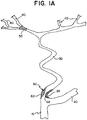
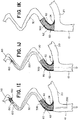
- FIGs. 1A through 1K are illustrations of example steps for treating tandem occlusions with an exemplary floating temporary carotid filter 100.
- FIG. 1A illustrates vasculature of a patient having tandem occlusions including an occlusive clot 50 in a neurovasculature 40 vessel and plaque 62 forming a second occlusion at a carotid lesion 60.
- the carotid lesion 60 can be positioned at a bifurcation 24 of a Common Carotid Artery 10 to an Internal Carotid Artery 30 and an External Carotid Artery 20.
- the carotid lesion 60 can be positioned in the Internal Carotid Artery 30 or Common Carotid Artery 10.
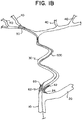
- FIG. 1B illustrates a catheter 600 inserted in the patient's vasculature and positioned to extract the occlusive clot 50 in the neurovasculature 40.
- a thrombectomy procedure can be performed using a stent retriever if required, and the clot 50 can be pulled into the catheter 600 for extraction.
- the catheter 600 can be extracted or repositioned.
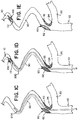
- FIG. 1C illustrates a catheter 200 positioned to deliver a temporary carotid filter within the Internal Carotid Artery 30.
- the microcatheter or intermediate catheter 200 can be positioned and the temporary carotid filter can be delivered shortly after the occlusive clot 50 is extracted, or at the end of the thrombectomy procedure.
- the catheter 200 can be a catheter used during the thrombectomy procedure (such as catheter 600 illustrated in FIG. 1B ), and/or the catheter 200 can be introduced through an access catheter used during the thrombectomy procedure.
- FIG. 1D illustrates a temporary carotid filter apparatus 100 deployed from the filter delivery catheter 200 into the Internal Carotid Artery 30 downstream of the carotid lesion 60.
- the carotid filter apparatus 100 can be a floating filter that maintains its position in the Internal Carotid Artery 30 by anchoring to sidewalls of the Internal Carotid Artery 30.
- the floating filter apparatus 100 can be detachably attached to a delivery system during delivery and detached from the delivery system once it is anchored within the Internal Carotid Artery 30.
- FIG. IE illustrates the floating filter apparatus 100 maintaining its position in the Internal Carotid Artery 30 after extraction of the filter delivery catheter 200.
- the floating filter apparatus 100 can be left in place, maintaining its position while the patient recovers from the thrombectomy.
- the floating filter can be left in place at least until the patient is recovered to safely receive a carotid stent and antiplatelet therapy.
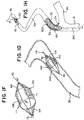
- FIG. IF illustrates the floating filter apparatus 100 in an expanded condition sized to anchor within vasculature of the patient.
- the apparatus 100 can include a radiopaque marker 110, a porous distal portion 106 having a porosity 102 (see FIGs. 2B and 2C ) small enough to capture liberated thrombus 70 and large enough to allow sufficient blood flow, an expandable portion 108 that can extend to anchor the apparatus 100, a proximal portion 104 with a porosity large enough to allow liberated thrombus to pass through, struts 114 forming a body frame, and a retrieval feature 112 for detachably attaching to a delivery system and/or a retrieval system.
- Pores in the distal portion 106 and the proximal portion can be spaces between a mesh material, openings in a laser cut apparatus, a spacing between struts, etc.
- FIG. 1G illustrates the floating filter apparatus 100 capturing liberated thrombus 70 while maintaining its position in the vasculature.
- the floating filter 100 can capture the liberated thrombus 70 within its body.
- the collected thrombus 70 can be contained by the floating filter 100 while the filter 100 maintains its position and when the filter 100 is extracted from the patient.
- filter If filter accumulates a significant amount of thrombus 70, the filter can become blocked. However, given the patient already suffers an occlusion at the carotid lesion 60, blood flow is already reduced, and blockage of the filter need not present a blockage issue that is more significant than the blockage at the carotid lesion 60. Further, collateral flow is available through the Circle of Willis so a blockage in the Carotid Artery is typically less harmful to the patient than the thrombus migrating to the neurovasculature and causing a second ischemic stroke.
- the retrieval feature 112 can be positioned at the proximal portion 104, near the filter's proximal end.
- the retrieval feature 112 can serve as a connection point for detaching from a delivery system and/or attaching to a retrieval system.
- the carotid lesion can be treated.
- FIG. 1H illustrates the carotid lesion 60 treated by stenting.
- a stent 300 can be delivered by a stent deploy catheter 320 and placed across the carotid lesion 60.
- plaque 62 can become dislodged and flow downstream. The dislodged plaque can be captured by the floating carotid filter 100.
- FIG. 1I illustrates a filter retrieval catheter 220 positioned to retrieve the carotid filter apparatus 100 following the stenting of the carotid lesion 60.
- the retrieval catheter 220 can be a catheter used during stenting of the carotid lesion 60.
- a retrieval system can be provided and delivered through the retrieval catheter 220 to the floating carotid filter 100. The retrieval system can engage the engagement feature 112 of the floating carotid filter 100 in preparation for extraction of the carotid filter apparatus 100.
- FIG. 1J illustrates the temporary carotid filter apparatus 100 being pulled proximally into the retrieval catheter 220.
- the retrieval system can engage the carotid filter 100, and the filter 100 can be pulled proximally by pulling the retrieval system proximally.
- Thrombus in the temporary carotid filter apparatus can be pulled into the retrieval catheter 220 as the temporary carotid filter apparatus 100 is pulled proximally into the retrieval catheter 220.
- the filter 100, captured thrombus, retrieval system, and catheter 220 can be extracted from the patient.
- FIG. 1K illustrates the stented carotid lesion 60 following treatment of the tandem occlusions.
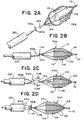
- FIGs. 2A through 2D are illustrations of exemplary floating temporary carotid filters 100a, 100b having an engagement feature 112a, 112b and exemplary retrieval and/or deployment systems 400a, 400b.
- FIGs. 2A and 2B illustrate a floating temporary carotid filter 100a having an engagement / retrieval feature 112a that can be engaged to a looped wire 412a.
- the engagement feature 112a be a bump or a protrusion at a proximal end of the filter 100a, and the looped wire 412a can encircle the engagement feature 112a.
- the looped wire 412a can be lassoed around the protrusion.
- the looped wire 412a once lassoed, can engage a notch. Additionally, or alternatively, the looped wire 412a, once lassoed, can be tightened by retracting the wire into a tube so that the protrusion 112a prevents the looped wire 412a from sliding proximally off of the engagement feature 112a. To release the engagement feature 112a, the looped wire 412a can disengage the protrusion and the loop 412a can be slid proximally off of the engagement feature 112a.
- FIGs. 2C and 2D illustrate a floating temporary carotid filter 100b having an engagement / retrieval feature 112b that can be grabbed by two or more arms 412b.
- the engagement feature 112b can be held between indentations 414b in the arms 412b.
- the arms 412b can be forced to stay together due to the dimensions of the catheter 220 as the system 400b is delivered through the retrieval catheter 220.
- the arms 412b can spread apart, releasing the engagement feature 112b.
- the arms 412b can be positioned out of the catheter and spread apart around the engagement feature 112b.
- the catheter 220 can be pushed distally, or the arms 412b can be pull proximally to cause the arms 412b to approach each other and grab the engagement feature 112b with the indentations 414b. Then, the retrieval system 400b and filter 100b can be pulled proximally into the catheter 220, or, if catheter 220 is too small to accommodate the filter 100b, the catheter 220, retrieval system 400b, and filter 100b can be pulled proximally into a larger catheter.
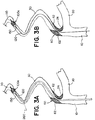
- FIGs. 3A through 3G are illustrations of example steps for treating tandem occlusions with an exemplary tethered temporary carotid filter 100e.
- a patient having tandem occlusions such as illustrated in FIG. 1A can be treated to remove the clot 50 in the neurovasculature 40, and, as illustrated in FIG. 3A , while the patient is recovering from the thrombectomy, the temporary carotid filter 100e can be implanted in the Internal Carotid Artery 30 through a catheter 200.
- FIG. 3B illustrates the tethered filter apparatus 100e maintaining its position in the Internal Carotid Artery 30 downstream of the carotid lesion 60 after extraction of the filter delivery catheter 200.
- the tethered filter apparatus 100e can be left in place, maintaining its position while the patient recovers from the thrombectomy.
- the tethered filter 100e can be left in place at least until the patient is recovered to safely receive a carotid stent and antiplatelet therapy.
- a wire 120 can serve to maintain the position of the filter 100e in the Internal Carotid Artery 30 and/or provide a means for extracting the filter 100e from the Internal Carotid Artery 30.
- the temporary carotid filter 100e can additionally or alternatively anchor to the sidewalls of the Internal Carotid Artery 30 to maintain its position.
- the wire 120 can be tethered to a proximal shaft.
- FIG. 3C illustrates the tethered filter apparatus 100e capturing liberated thrombus 70 while maintaining its position in the vasculature.
- the tethered filter apparatus 100e can have pores. The pores can be spaces between a mesh material, openings in a laser cut apparatus, spaces between struts 114, etc.
- the tethered filter apparatus 100e can have a distal portion 106 with pores 102 (see FIGs. 2B and 2C ) sized small enough to capture the liberated thrombus 70, and the tethered filter apparatus 100e can have a proximal portion 104 with pores sized large enough to allow the liberated thrombus 70 to pass therethrough.
- the filter 100e can capture the liberated thrombus 70 within its body.
- the collected thrombus 70 can be contained by the filter 100e while the filter 100e maintains its position and when the filter 100e is extracted from the patient.
- the tethered filter apparatus 100e can have a connection point 150 positioned at the proximal portion 104, near the filter's proximal end.
- the connection point 150 can be attached to the wire 120.
- the carotid lesion can be treated.
- FIG. 3D illustrates the carotid lesion 60 being treated by stenting.
- a stent 300 can be delivered by a stent deploy catheter 320 and placed across the carotid lesion 60.
- the wire 120 can serve as a guide wire for delivery of the stent 300 to the site of the carotid lesion 60.
- plaque 62 can become dislodged and flow downstream. The dislodged plaque can be captured by the temporary carotid filter 100e.
- FIG. 3E illustrates a filter retrieval catheter 220 positioned to retrieve the carotid filter apparatus 100e following the stenting of the carotid lesion 60.
- the retrieval catheter 220 can be a catheter used during stenting of the carotid lesion 60.
- FIG. 3F illustrates the temporary carotid filter apparatus 100e being pulled proximally into the retrieval catheter 220.
- the temporary carotid filter 100e can be pulled proximally by pulling the pull wire 120 proximally.
- Thrombus in the temporary carotid filter apparatus 100e can be pulled into the retrieval catheter 220 as the temporary carotid filter apparatus 100e is pulled proximally into the retrieval catheter 220.
- the filter 100e, captured thrombus, and catheter 220 can be extracted from the patient.
- FIG. 3G illustrates the stented carotid lesion 60 following treatment of the tandem occlusions.
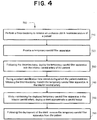
- FIG. 4 is a flow diagram outlining example method steps for using a temporary carotid filter.
- the method steps can be implemented by combinations of example devices presented herein or by other means as would be known to one of ordinary skill in the art.
- a thrombectomy can be performed to remove an occlusive clot in neurovasculature of a patient.
- a temporary carotid filter apparatus can be provided.
- the temporary carotid filter apparatus can be deployed into the Interior Carotid Artery of the patient.
- the temporary carotid filter apparatus can be maintained in the Interior Carotid Artery.
- a stent in step 750, while maintaining the deployed temporary carotid filter apparatus in the Interior Carotid Artery, a stent can be deployed across a carotid lesion.
- the temporary carotid filter apparatus can be removed from the patient.
Landscapes
- Health & Medical Sciences (AREA)
- Life Sciences & Earth Sciences (AREA)
- Biomedical Technology (AREA)
- Engineering & Computer Science (AREA)
- Animal Behavior & Ethology (AREA)
- Vascular Medicine (AREA)
- Veterinary Medicine (AREA)
- Heart & Thoracic Surgery (AREA)
- Public Health (AREA)
- General Health & Medical Sciences (AREA)
- Cardiology (AREA)
- Oral & Maxillofacial Surgery (AREA)
- Transplantation (AREA)
- Surgery (AREA)
- Molecular Biology (AREA)
- Medical Informatics (AREA)
- Nuclear Medicine, Radiotherapy & Molecular Imaging (AREA)
- Orthopedic Medicine & Surgery (AREA)
- Surgical Instruments (AREA)
- Media Introduction/Drainage Providing Device (AREA)
Abstract
Shortly after completing a thrombectomy procedure, a temporary carotid filter can be deployed downstream of an occlusion not treated by the thrombectomy (e.g. a carotid lesion having plaque buildup), and the temporary carotid filter can remain in place during the patient's recovery period following the ischemic stroke until a procedure to treat the remaining occlusion is completed and antiplatelet therapy is administered. The temporary carotid filter can anchor in place while deployed with or without being tethered to a wire extending through the patient's Femoral Artery.
Description
- The present invention generally relates to medical devices and procedures for vascular intervention, and more particularly, to devices and treatments for thromboembolic disorders and for removal of foreign bodies in the vascular system.
- The term "stroke" is used to describe a medical event whereby blood supply to the brain or specific areas of the brain is restricted or blocked to the extent that the supply is inadequate to provide the required flow of oxygenated blood to maintain function. The brain will be impaired either temporarily or permanently, with the patient experiencing a loss of function such as sight, speech or control of limbs. There are two distinct types of stroke, hemorrhagic and embolic. This invention addresses embolic stroke.
- Carotid Artery disease occurs when fatty deposits (plaques) clog blood vessels that deliver blood to the brain and head (Carotid Arteries). The nature of the plaque varies considerably, but in many cases, thrombus can form in the artery or pieces of the plaque can break away from a Carotid Artery (for example from a fatty deposit originating from a carotid lesion in the region of the Internal/External Carotid Artery bifurcation), flow distally, and block blood flow to specific areas of the brain, thereby leading to stroke and neurological impairment. Stoke patients can thereafter present tandem occlusions with a blockage present in the Internal Carotid Artery and a blockage in the neurovascular such as the Middle Cerebral Artery (MCA). The priority of the physician treating patients exhibiting tandem occlusions is to restore blood flow in the neurovasculature, which is typically done by performing a thrombectomy to remove the clot. Treatment of the carotid lesion in the same procedure is not desirable as this usually requires implanting a stent which requires the patient to be given antiplatelet therapy to reduce the risk of thrombosis; however antiplatelet therapy can increase the risk of hemorrhaging in patients who have suffered an acute stroke. To reduce risk of hemorrhage, physicians will often perform a thrombectomy procedure and then wait 24 hours for the patient to stabilize before performing a second procedure to stent the carotid lesion. During the interim between the first and second procedures, the patient is at risk of suffering another stroke from additional plaque dislodging or thrombus forming at the carotid lesion and flowing into the neurovascular.
- An object of the present invention is to provide devices and methods for reducing the risk of embolic stroke following a thrombectomy in a patient diagnosed with tandem occlusions. According to examples presented herein, shortly after completing a thrombectomy procedure, a temporary carotid filter can be deployed downstream of an occlusion not treated by the thrombectomy (e.g. a carotid lesion having plaque buildup), and the temporary carotid filter can remain in place during the patient's recovery period following the ischemic stroke and until a procedure to treat the remaining occlusion is completed. The temporary carotid filter can anchor in place while deployed with or without being tethered to a wire extending through the patient's Femoral Artery.
- An example method for treating tandem vascular occlusions can include a sub-combination or all the following steps presented in no particular order. The method can also include steps not listed here. A thrombectomy can be performed to remove an occlusive clot in neurovasculature of a patient. A temporary carotid filter apparatus can be provided. The temporary carotid filter apparatus can be deployed into the Interior Carotid Artery of the patient following the thrombectomy. The temporary carotid filter apparatus can include a distal portion having a porosity smaller than a porosity of a proximal portion of the temporary carotid filter. While deploying the temporary carotid filter apparatus, the proximal portion can be positioned proximal the distal portion in the Interior Carotid Artery.
- A deployment system can be provided. The provided temporary carotid filter apparatus can include a retrieval feature. The retrieval feature can be detachably attached to the deployment system prior to deployment of the temporary carotid filter apparatus. To deploy the temporary carotid filter apparatus, a portion of the temporary carotid filter apparatus can be expanded to engage the Interior Carotid Artery, and the deployment system can be detached from the retrieval feature.
- Additionally, or alternatively to utilizing the deployment system to deploy the carotid filter apparatus, the temporary carotid filter apparatus can include a connection point positioned at a proximal end of the temporary carotid filter apparatus and a pull wire extending proximally from the connection point. A proximal end of the pull wire can be positioned outside the patient or be otherwise positioned to exit the patient.
- During a patient stabilization time period, the temporary carotid filter apparatus can be maintained in the Interior Carotid Artery while the patient stabilizes following the ischemic stroke and thrombectomy. A stent can be deployed at a carotid lesion while the deployed temporary carotid filter apparatus is maintained in the Interior Carotid Artery. If the deployed carotid filter apparatus is connected to the pull wire, the stent can be guided through the patient over the pull wire. An embolic mass can be allowed to pass through the proximal portion of the deployed temporary carotid filter apparatus and can be captured by the distal portion of the deployed temporary carotid filter apparatus.
- The temporary carotid filter apparatus can be removed from the patient following the deployment of the stent. A retrieval system and a retrieval catheter can be provided for retrieving the temporary carotid filter apparatus. To remove the temporary carotid filter apparatus, the deployment system can be attached to the retrieval feature, the retrieval system and the temporary carotid filter apparatus can be pulled proximally into the retrieval catheter, and the temporary carotid filter apparatus, retrieval system, and retrieval catheter can be withdrawn from the patient.
- An example method for treating a patient having a neurovascular occlusion and a carotid lesion include a sub-combination or all the following steps presented in no particular order. The method can also include steps not listed here.
- The neurovascular occlusion can be removed from one of the patient's Middle Cerebral Artery, Anterior Cerebral Artery, distal Internal Carotid Artery or posterior neurovasculature.
- A temporary carotid filter can be deployed into the Interior Carotid Artery distal the carotid lesion following the removal of the neurovascular occlusion. The temporary carotid filter can be deployed upstream, or proximal to the patient's Circle of Willis.
- The temporary carotid filter can have a retrieval feature. A deployment system can be provided. The deployment system can be detachably attached to the retrieval feature. To deploy the temporary carotid filter, the temporary carotid filter can be pushed out of a catheter and into the Interior Carotid Artery, the temporary carotid filter can be expanded to engage the Interior Carotid Artery, and the deployment system can be detached from the retrieval feature of the temporary carotid filter.
- Additionally, or alternatively to utilizing a retrieval feature to deploy the temporary carotid filter, the temporary carotid filter can have an expandable filter portion and a pull wire extending proximally from the expandable filter portion. To deploy the temporary carotid filter, the expandable filter portion can be expanded in the Interior Carotid Artery, and a proximal end of the pull wire can be positioned outside the patient or otherwise positioned to exit the patient.
- The temporary carotid filter can be maintained in the Interior Carotid Artery at least until the patient stabilizes following the removal of the neurovascular occlusion. The temporary carotid filter can be maintained in the Interior Carotid Artery approximately 24 hours. An embolic mass can be captured within the temporary carotid filter while the deployed temporary carotid filter is maintained in the Interior Carotid Artery. A stent can be deployed across the carotid lesion while the deployed temporary carotid filter is maintained in the Interior Carotid Artery. If the temporary carotid filter has a pull wire, the stent can be guided through the patient over the pull wire while the deployed temporary carotid filter is maintained in the Interior Carotid Artery. After the removal of the neurovascular occlusion and before the patient stabilizes from the removal of the neurovascular occlusion, thrombus liberated from the carotid lesion can be captured with the expandable filter portion.
- The temporary carotid filter can be removed from the patient following the deployment of the stent.
- If the temporary carotid filter has a retrieval feature, to remove the temporary carotid filter from the patient, a retrieval system can be provided, the retrieval system can be attached to the retrieval feature of the temporary carotid filter, and the retrieval system can be pulled proximally to remove the temporary carotid filter from the patient.
- An example method for using a temporary carotid filter can include a sub-combination or all the following steps presented in no particular order. The method can also include steps not listed here. A thrombectomy can be performed on a patient. Following the thrombectomy and before the patient stabilizes to safely receive antiplatelet therapy, the temporary carotid filter can be deployed in a distal carotid artery of the patient. After the temporary carotid filter is deployed and at least until the patient stabilizes to safely receive antiplatelet therapy, the temporary carotid filter can be maintained in the distal Carotid Artery. While the temporary carotid filter is in the distal Carotid Artery, a carotid lesion in the patient can be treated. Once the carotid lesion is treated, the temporary carotid filter can be extracted from the patient.
- The above and further aspects of this invention are further discussed with reference to the following description in conjunction with the accompanying drawings, in which like numerals indicate like structural elements and features in various figures. The drawings are not necessarily to scale, emphasis instead being placed upon illustrating principles of the invention. The figures depict one or more implementations of the inventive devices, by way of example only, not by way of limitation.
-
FIGs. 1A through 1K are illustrations of example steps for treating tandem occlusions with an exemplary floating temporary carotid filter according to aspects of the present invention; -
FIGs. 2A through 2D are illustrations of exemplary floating temporary carotid filters having an engagement feature and exemplary retrieval and/or deployment systems according to aspects of the present invention; -
FIGs. 3A through 3G are illustrations of example steps for treating tandem occlusions with an exemplary tethered temporary carotid filter according to aspects of the present invention; and -
FIG. 4 is a flow diagram listing example method steps for using a temporary carotid filter according to aspects of the present invention. - Examples described herein generally include a temporary carotid filter which can be deployed in the Interior Carotid Artery to catch any thrombus which may be liberated from a carotid lesion in the period between a thrombectomy procedure and stenting of the carotid lesion. The filter can be introduced and deployed at the end of the thrombectomy procedure, and the filter can catch thrombus in the blood from in the carotid artery. When deployed, the carotid filter can be detached and left floating in the vessel, or the carotid filter can be tethered to a proximal shaft. The carotid filter can be left in position in the vascular for a period of time while the patient recovers from the thrombectomy. If the filter gets blocked, this need not cause a significant issue as the flow is already reduced due to significant narrowing of the Interior Carotid Artery and collateral flow is available through the Circle of Willis. If the filter is attached with a wire to a proximal shaft, the wire can be used as a guidewire to introduce a stent delivery system. The stent can be delivered over the guidewire according to methods currently practiced with current carotid filters. After the stenting procedure, the filter can be captured by a retrieval catheter and removed together with thrombus it has captured. The floating version of the filter can include a proximal feature to engage with the retrieval catheter or a retrieval system for ease of removal.
-
FIGs. 1A through 1K are illustrations of example steps for treating tandem occlusions with an exemplary floating temporarycarotid filter 100.FIG. 1A illustrates vasculature of a patient having tandem occlusions including anocclusive clot 50 in aneurovasculature 40 vessel andplaque 62 forming a second occlusion at acarotid lesion 60. Thecarotid lesion 60 can be positioned at abifurcation 24 of aCommon Carotid Artery 10 to anInternal Carotid Artery 30 and anExternal Carotid Artery 20. Thecarotid lesion 60 can be positioned in theInternal Carotid Artery 30 orCommon Carotid Artery 10. -
FIG. 1B illustrates acatheter 600 inserted in the patient's vasculature and positioned to extract theocclusive clot 50 in theneurovasculature 40. A thrombectomy procedure can be performed using a stent retriever if required, and theclot 50 can be pulled into thecatheter 600 for extraction. Thecatheter 600 can be extracted or repositioned. -
FIG. 1C illustrates acatheter 200 positioned to deliver a temporary carotid filter within theInternal Carotid Artery 30. The microcatheter orintermediate catheter 200 can be positioned and the temporary carotid filter can be delivered shortly after theocclusive clot 50 is extracted, or at the end of the thrombectomy procedure. Thecatheter 200 can be a catheter used during the thrombectomy procedure (such ascatheter 600 illustrated inFIG. 1B ), and/or thecatheter 200 can be introduced through an access catheter used during the thrombectomy procedure. -
FIG. 1D illustrates a temporarycarotid filter apparatus 100 deployed from thefilter delivery catheter 200 into theInternal Carotid Artery 30 downstream of thecarotid lesion 60. Thecarotid filter apparatus 100 can be a floating filter that maintains its position in theInternal Carotid Artery 30 by anchoring to sidewalls of theInternal Carotid Artery 30. The floatingfilter apparatus 100 can be detachably attached to a delivery system during delivery and detached from the delivery system once it is anchored within theInternal Carotid Artery 30. - FIG. IE illustrates the floating
filter apparatus 100 maintaining its position in theInternal Carotid Artery 30 after extraction of thefilter delivery catheter 200. The floatingfilter apparatus 100 can be left in place, maintaining its position while the patient recovers from the thrombectomy. The floating filter can be left in place at least until the patient is recovered to safely receive a carotid stent and antiplatelet therapy. - FIG. IF illustrates the floating
filter apparatus 100 in an expanded condition sized to anchor within vasculature of the patient. Theapparatus 100 can include aradiopaque marker 110, a porousdistal portion 106 having a porosity 102 (seeFIGs. 2B and 2C ) small enough to capture liberatedthrombus 70 and large enough to allow sufficient blood flow, anexpandable portion 108 that can extend to anchor theapparatus 100, aproximal portion 104 with a porosity large enough to allow liberated thrombus to pass through, struts 114 forming a body frame, and aretrieval feature 112 for detachably attaching to a delivery system and/or a retrieval system. Pores in thedistal portion 106 and the proximal portion can be spaces between a mesh material, openings in a laser cut apparatus, a spacing between struts, etc. -
FIG. 1G illustrates the floatingfilter apparatus 100 capturing liberatedthrombus 70 while maintaining its position in the vasculature. By allowing thethrombus 70 to travel through theproximal portion 104 and be blocked by thedistal portion 106, the floatingfilter 100 can capture the liberatedthrombus 70 within its body. The collectedthrombus 70 can be contained by the floatingfilter 100 while thefilter 100 maintains its position and when thefilter 100 is extracted from the patient. - If filter accumulates a significant amount of
thrombus 70, the filter can become blocked. However, given the patient already suffers an occlusion at thecarotid lesion 60, blood flow is already reduced, and blockage of the filter need not present a blockage issue that is more significant than the blockage at thecarotid lesion 60. Further, collateral flow is available through the Circle of Willis so a blockage in the Carotid Artery is typically less harmful to the patient than the thrombus migrating to the neurovasculature and causing a second ischemic stroke. - The
retrieval feature 112 can be positioned at theproximal portion 104, near the filter's proximal end. Theretrieval feature 112 can serve as a connection point for detaching from a delivery system and/or attaching to a retrieval system. - Once the patient has recovered from the thrombectomy and is stabilized to receive treatment of the
carotid lesion 60, the carotid lesion can be treated. -
FIG. 1H illustrates thecarotid lesion 60 treated by stenting. During the treatment, astent 300 can be delivered by a stent deploycatheter 320 and placed across thecarotid lesion 60. During stenting,plaque 62 can become dislodged and flow downstream. The dislodged plaque can be captured by the floatingcarotid filter 100. -
FIG. 1I illustrates afilter retrieval catheter 220 positioned to retrieve thecarotid filter apparatus 100 following the stenting of thecarotid lesion 60. Theretrieval catheter 220 can be a catheter used during stenting of thecarotid lesion 60. A retrieval system can be provided and delivered through theretrieval catheter 220 to the floatingcarotid filter 100. The retrieval system can engage theengagement feature 112 of the floatingcarotid filter 100 in preparation for extraction of thecarotid filter apparatus 100. -
FIG. 1J illustrates the temporarycarotid filter apparatus 100 being pulled proximally into theretrieval catheter 220. The retrieval system can engage thecarotid filter 100, and thefilter 100 can be pulled proximally by pulling the retrieval system proximally. Thrombus in the temporary carotid filter apparatus can be pulled into theretrieval catheter 220 as the temporarycarotid filter apparatus 100 is pulled proximally into theretrieval catheter 220. Thefilter 100, captured thrombus, retrieval system, andcatheter 220 can be extracted from the patient. -
FIG. 1K illustrates the stentedcarotid lesion 60 following treatment of the tandem occlusions. -
FIGs. 2A through 2D are illustrations of exemplary floating temporarycarotid filters engagement feature deployment systems FIGs. 2A and 2B illustrate a floating temporarycarotid filter 100a having an engagement /retrieval feature 112a that can be engaged to a loopedwire 412a. Theengagement feature 112a be a bump or a protrusion at a proximal end of thefilter 100a, and the loopedwire 412a can encircle theengagement feature 112a. To engage the loopedwire 412a to theengagement feature 112a, the loopedwire 412a can be lassoed around the protrusion. The loopedwire 412a, once lassoed, can engage a notch. Additionally, or alternatively, the loopedwire 412a, once lassoed, can be tightened by retracting the wire into a tube so that theprotrusion 112a prevents the loopedwire 412a from sliding proximally off of theengagement feature 112a. To release theengagement feature 112a, the loopedwire 412a can disengage the protrusion and theloop 412a can be slid proximally off of theengagement feature 112a. -
FIGs. 2C and 2D illustrate a floating temporarycarotid filter 100b having an engagement /retrieval feature 112b that can be grabbed by two ormore arms 412b. During delivery, theengagement feature 112b can be held betweenindentations 414b in thearms 412b. Thearms 412b can be forced to stay together due to the dimensions of thecatheter 220 as thesystem 400b is delivered through theretrieval catheter 220. As the arms exit a distal end of thecatheter 220, thearms 412b can spread apart, releasing theengagement feature 112b. During retrieval, thearms 412b can be positioned out of the catheter and spread apart around theengagement feature 112b. Thecatheter 220 can be pushed distally, or thearms 412b can be pull proximally to cause thearms 412b to approach each other and grab theengagement feature 112b with theindentations 414b. Then, theretrieval system 400b andfilter 100b can be pulled proximally into thecatheter 220, or, ifcatheter 220 is too small to accommodate thefilter 100b, thecatheter 220,retrieval system 400b, andfilter 100b can be pulled proximally into a larger catheter. -
FIGs. 3A through 3G are illustrations of example steps for treating tandem occlusions with an exemplary tethered temporarycarotid filter 100e. A patient having tandem occlusions such as illustrated inFIG. 1A can be treated to remove theclot 50 in theneurovasculature 40, and, as illustrated inFIG. 3A , while the patient is recovering from the thrombectomy, the temporarycarotid filter 100e can be implanted in theInternal Carotid Artery 30 through acatheter 200. -
FIG. 3B illustrates the tetheredfilter apparatus 100e maintaining its position in theInternal Carotid Artery 30 downstream of thecarotid lesion 60 after extraction of thefilter delivery catheter 200. Thetethered filter apparatus 100e can be left in place, maintaining its position while the patient recovers from the thrombectomy. Thetethered filter 100e can be left in place at least until the patient is recovered to safely receive a carotid stent and antiplatelet therapy. Awire 120 can serve to maintain the position of thefilter 100e in theInternal Carotid Artery 30 and/or provide a means for extracting thefilter 100e from theInternal Carotid Artery 30. The temporarycarotid filter 100e can additionally or alternatively anchor to the sidewalls of theInternal Carotid Artery 30 to maintain its position. Thewire 120 can be tethered to a proximal shaft. -
FIG. 3C illustrates the tetheredfilter apparatus 100e capturing liberatedthrombus 70 while maintaining its position in the vasculature. Thetethered filter apparatus 100e can have pores. The pores can be spaces between a mesh material, openings in a laser cut apparatus, spaces betweenstruts 114, etc. Thetethered filter apparatus 100e can have adistal portion 106 with pores 102 (seeFIGs. 2B and 2C ) sized small enough to capture the liberatedthrombus 70, and thetethered filter apparatus 100e can have aproximal portion 104 with pores sized large enough to allow the liberatedthrombus 70 to pass therethrough. By allowing thethrombus 70 to travel through theproximal portion 104 and be blocked by thedistal portion 106, thefilter 100e can capture the liberatedthrombus 70 within its body. The collectedthrombus 70 can be contained by thefilter 100e while thefilter 100e maintains its position and when thefilter 100e is extracted from the patient. - The
tethered filter apparatus 100e can have aconnection point 150 positioned at theproximal portion 104, near the filter's proximal end. Theconnection point 150 can be attached to thewire 120. - Once the patient has recovered from the thrombectomy and is stabilized to receive treatment of the
carotid lesion 60, the carotid lesion can be treated. -
FIG. 3D illustrates thecarotid lesion 60 being treated by stenting. During the treatment, astent 300 can be delivered by a stent deploycatheter 320 and placed across thecarotid lesion 60. Thewire 120 can serve as a guide wire for delivery of thestent 300 to the site of thecarotid lesion 60. During stenting,plaque 62 can become dislodged and flow downstream. The dislodged plaque can be captured by the temporarycarotid filter 100e. -
FIG. 3E illustrates afilter retrieval catheter 220 positioned to retrieve thecarotid filter apparatus 100e following the stenting of thecarotid lesion 60. Theretrieval catheter 220 can be a catheter used during stenting of thecarotid lesion 60. -
FIG. 3F illustrates the temporarycarotid filter apparatus 100e being pulled proximally into theretrieval catheter 220. The temporarycarotid filter 100e can be pulled proximally by pulling thepull wire 120 proximally. Thrombus in the temporarycarotid filter apparatus 100e can be pulled into theretrieval catheter 220 as the temporarycarotid filter apparatus 100e is pulled proximally into theretrieval catheter 220. Thefilter 100e, captured thrombus, andcatheter 220 can be extracted from the patient. -
FIG. 3G illustrates the stentedcarotid lesion 60 following treatment of the tandem occlusions. -
FIG. 4 is a flow diagram outlining example method steps for using a temporary carotid filter. The method steps can be implemented by combinations of example devices presented herein or by other means as would be known to one of ordinary skill in the art. - Referring to
method 700 outlined inFIG. 4 , instep 710, a thrombectomy can be performed to remove an occlusive clot in neurovasculature of a patient. Instep 720, a temporary carotid filter apparatus can be provided. Instep 730, following the thrombectomy, the temporary carotid filter apparatus can be deployed into the Interior Carotid Artery of the patient. In step 740, during a patient stabilization time period during which the patient stabilizes following the thrombectomy, the temporary carotid filter apparatus can be maintained in the Interior Carotid Artery. Instep 750, while maintaining the deployed temporary carotid filter apparatus in the Interior Carotid Artery, a stent can be deployed across a carotid lesion. Instep 760, following the deployment of the stent, the temporary carotid filter apparatus can be removed from the patient. - The descriptions contained herein are examples of embodiments of the invention and are not intended in any way to limit the scope of the invention. As described herein, the invention contemplates variations and modifications of a temporary carotid filter and methods for using the same, including alternative carotid filter frames, structures, filter pore material and construction, alternative means for deploying, maintaining, and extracting the carotid filter, etc. These modifications would be apparent to those having ordinary skill in the art to which this invention relates and are intended to be within the scope of the claims which follow.
Claims (13)
- A system comprising:a vascular filter (100, 100a-b) comprising porous distal portion (106), a porous proximal portion (104) comprising a porosity larger than the porous distal portion (106), an expandable frame (114) configured to anchor within vasculature, and a retrieval feature (112, 112a-b) disposed approximate a proximal end of the vascular filter (100, 100a-b);a deployment system (400, 400a-b) configured to engage the retrieval feature (112, 112a-b) as the vascular filter (100, 100a-b) is delivered intravascularly and disengage the retrieval feature when the expandable frame (114) is anchored within vasculature; andan engagement system (400, 400a-b) configured to engage the retrieval feature when the expandable frame (114) is anchored within the vasculature and retract the vascular filter.
- The system of claim 1, wherein the expandable frame (114) comprises a plurality of struts extending longitudinally from approximate the proximal end of the vasculature filter (100a-b) to approximate a distal end of the vascular filter (100a-b) and configured to move from a collapsed configuration sized to traverse a catheter (220) to an expanded configuration configured to extend radially upon exiting the catheter (220).
- The system of claim 2, wherein
the porosity of the porous proximal portion is defined by spacing between the plurality of struts when the expandable frame (114) is in the expanded configuration,
the vascular filter (100a-b) comprises a mesh affixed to the expandable frame (114), and
the porosity of the distal portion (106) is defined by the porosity of the mesh. - The system of claim 2, wherein the retrieval feature comprises protrusion (112a-b) extending radially approximate the proximal end of the vascular filter.
- The system of claim 4, wherein one or both of the deployment system and the engagement system comprises a looped wire (412a) configured to lasso around the protrusion (112a) of the retrieval feature.
- The system of claim 4, wherein
one or both of the deployment system and the engagement system comprises a catheter 220 and two or more arms (412b) comprising indentations (414b) thereon,
the two or more arms (412b) movable between a collapsed configuration sized to at least partially reside within the catheter 220 and an expanded configuration when moved from inside the catheter 220,
the indentations (414b) are sized to collapse over the protrusion (112b), thereby engaging the arms (412b) to the protrusion (112b), when the arms (412b) are in the collapsed configuration, and
the arms (412b) are configured to disengage the protrusion (112b) when in the expanded configuration. - The system of any one of claims 1 through 6, wherein the engagement system (400, 400a-b) is further configured to at least partially collapse the vascular filter (100, 100a-b).
- The system of any preceding claim, wherein the engagement system (400, 400a-b) is pushable to move the vascular filter (100, 100a-b) through a catheter (220).
- The system of any preceding claim, wherein the deployment system (400, 400a-b) is pullable to move at least a portion of the vascular filter (100, 100a-b) into the catheter (220).
- The system of any preceding claim, wherein the deployment system and the engagement system are substantially similar systems.
- The system of any preceding claim, wherein
the porosity of the distal portion (106) is sized to capture liberated thrombus (70) when the expandable frame (114) is anchored within vasculature, and
the porosity of the proximal portion (104) is sized to allow the liberated thrombus (70) to pass therethrough. - The system of any preceding claim, wherein
the expandable frame is configured to anchor the vascular filter within the Interior Carotid Artery, and
the vascular filter (100, 100a-b) is configured to remain anchored in the Interior Carotid Artery (30) during a patient stabilization time period during which the patient stabilizes following the thrombectomy. - The system of any preceding claim, further comprising:a thrombectomy device; anda stent.
Applications Claiming Priority (1)
| Application Number | Priority Date | Filing Date | Title |
|---|---|---|---|
| US16/381,449 US11051928B2 (en) | 2019-04-11 | 2019-04-11 | Floating carotid filter |
Publications (1)
| Publication Number | Publication Date |
|---|---|
| EP3721833A1 true EP3721833A1 (en) | 2020-10-14 |
Family
ID=70289568
Family Applications (1)
| Application Number | Title | Priority Date | Filing Date |
|---|---|---|---|
| EP20169419.7A Withdrawn EP3721833A1 (en) | 2019-04-11 | 2020-04-14 | Floating carotid filter |
Country Status (5)
| Country | Link |
|---|---|
| US (2) | US11051928B2 (en) |
| EP (1) | EP3721833A1 (en) |
| JP (1) | JP2020171696A (en) |
| KR (1) | KR20200120874A (en) |
| CN (1) | CN111803237A (en) |
Families Citing this family (18)
| Publication number | Priority date | Publication date | Assignee | Title |
|---|---|---|---|---|
| US11589880B2 (en) | 2007-12-20 | 2023-02-28 | Angiodynamics, Inc. | System and methods for removing undesirable material within a circulatory system utilizing during a surgical procedure |
| US10517617B2 (en) | 2007-12-20 | 2019-12-31 | Angiodynamics, Inc. | Systems and methods for removing undesirable material within a circulatory system utilizing a balloon catheter |
| US20170136158A1 (en) | 2015-10-16 | 2017-05-18 | Angiodynamics, Inc. | Systems and Methods for Removing Undesirable Material Within a Circulatory System |
| US9055964B2 (en) | 2011-03-15 | 2015-06-16 | Angio Dynamics, Inc. | Device and method for removing material from a hollow anatomical structure |
| US12245788B2 (en) | 2011-03-15 | 2025-03-11 | Angiodynamics, Inc. | Device and method for removing material from a hollow anatomical structure |
| US12285182B2 (en) | 2018-10-10 | 2025-04-29 | Innova Vascular, Inc. | Devices and methods for removing an embolus |
| US11439403B2 (en) | 2019-09-17 | 2022-09-13 | DePuy Synthes Products, Inc. | Embolic coil proximal connecting element and stretch resistant fiber |
| US12376859B2 (en) | 2019-09-17 | 2025-08-05 | DePuy Synthes Products, Inc. | Embolic coil proximal connecting element and stretch resistant fiber |
| US11648020B2 (en) | 2020-02-07 | 2023-05-16 | Angiodynamics, Inc. | Device and method for manual aspiration and removal of an undesirable material |
| CN117119991A (en) * | 2021-01-12 | 2023-11-24 | 清流科技有限公司 | Embolization system for promoting blood clot formation |
| US11197684B1 (en) | 2021-03-04 | 2021-12-14 | Nventric Corporation | Thrombectomy device and method |
| US11478262B2 (en) | 2021-03-04 | 2022-10-25 | Nventric Corporation | Thrombectomy device and method |
| US11998213B2 (en) | 2021-07-14 | 2024-06-04 | DePuy Synthes Products, Inc. | Implant delivery with modified detachment feature and pull wire engagement |
| EP4468973A1 (en) | 2022-01-27 | 2024-12-04 | Contego Medical, Inc. | Thrombectomy and aspiration system and methods of use |
| KR102900410B1 (en) * | 2022-06-21 | 2025-12-16 | 주식회사 바스노바 | Carotid filter wire and carotid filter system |
| US12446888B2 (en) | 2022-08-26 | 2025-10-21 | Depuy Synthes Products, Inc | Twister implant detachment mechanism |
| US12396730B2 (en) | 2022-09-28 | 2025-08-26 | DePuy Synthes Products, Inc. | Braided implant with detachment mechanism |
| US12114880B1 (en) | 2023-08-03 | 2024-10-15 | Nventric Corporation | Thrombectomy device having open frame cell ring |
Citations (3)
| Publication number | Priority date | Publication date | Assignee | Title |
|---|---|---|---|---|
| US20030130680A1 (en) * | 2002-01-07 | 2003-07-10 | Scott Russell | Releasable and retrievable vascular filter system |
| US20070244504A1 (en) * | 2002-03-05 | 2007-10-18 | Salviac Limited | Embolic protection system |
| US20130172977A1 (en) * | 2000-10-18 | 2013-07-04 | W.L. Gore & Associates, Inc. | Over-the-wire interlock attachment/detachment mechanism |
Family Cites Families (126)
| Publication number | Priority date | Publication date | Assignee | Title |
|---|---|---|---|---|
| US7306618B2 (en) * | 1999-07-30 | 2007-12-11 | Incept Llc | Vascular device for emboli and thrombi removal and methods of use |
| US7229462B2 (en) | 1999-07-30 | 2007-06-12 | Angioguard, Inc. | Vascular filter system for carotid endarterectomy |
| US6544279B1 (en) | 2000-08-09 | 2003-04-08 | Incept, Llc | Vascular device for emboli, thrombus and foreign body removal and methods of use |
| US20040167567A1 (en) | 2001-03-23 | 2004-08-26 | Cano Gerald G. | Method and apparatus for capturing objects beyond an operative site in medical procedures |
| US6951570B2 (en) * | 2001-07-02 | 2005-10-04 | Rubicon Medical, Inc. | Methods, systems, and devices for deploying a filter from a filter device |
| US8252040B2 (en) | 2001-07-20 | 2012-08-28 | Microvention, Inc. | Aneurysm treatment device and method of use |
| US8715312B2 (en) | 2001-07-20 | 2014-05-06 | Microvention, Inc. | Aneurysm treatment device and method of use |
| US6616682B2 (en) | 2001-09-19 | 2003-09-09 | Jomed Gmbh | Methods and apparatus for distal protection during a medical procedure |
| US6887257B2 (en) | 2001-10-19 | 2005-05-03 | Incept Llc | Vascular embolic filter exchange devices and methods of use thereof |
| US20030187495A1 (en) | 2002-04-01 | 2003-10-02 | Cully Edward H. | Endoluminal devices, embolic filters, methods of manufacture and use |
| US7371228B2 (en) | 2003-09-19 | 2008-05-13 | Medtronic Vascular, Inc. | Delivery of therapeutics to treat aneurysms |
| AU2005235301B2 (en) * | 2004-04-16 | 2010-07-22 | Cook, Inc. | Removable vena cava filter for reduced trauma in collapsed configuration |
| US9308382B2 (en) | 2004-06-10 | 2016-04-12 | Medtronic Urinary Solutions, Inc. | Implantable pulse generator systems and methods for providing functional and/or therapeutic stimulation of muscles and/or nerves and/or central nervous system tissue |
| US9655633B2 (en) | 2004-09-10 | 2017-05-23 | Penumbra, Inc. | System and method for treating ischemic stroke |
| US20060089637A1 (en) | 2004-10-14 | 2006-04-27 | Werneth Randell L | Ablation catheter |
| US8562672B2 (en) | 2004-11-19 | 2013-10-22 | Medtronic, Inc. | Apparatus for treatment of cardiac valves and method of its manufacture |
| US9636115B2 (en) | 2005-06-14 | 2017-05-02 | Stryker Corporation | Vaso-occlusive delivery device with kink resistant, flexible distal end |
| EP1895927A4 (en) | 2005-06-20 | 2011-03-09 | Medtronic Ablation Frontiers | Ablation catheter |
| US8066036B2 (en) | 2005-11-17 | 2011-11-29 | Microvention, Inc. | Three-dimensional complex coil |
| US9757260B2 (en) | 2006-03-30 | 2017-09-12 | Medtronic Vascular, Inc. | Prosthesis with guide lumen |
| US9615832B2 (en) | 2006-04-07 | 2017-04-11 | Penumbra, Inc. | Aneurysm occlusion system and method |
| CA2655026C (en) | 2006-06-15 | 2016-08-02 | Microvention, Inc. | Embolization device constructed from expansible polymer |
| EP2083902B1 (en) * | 2006-10-18 | 2017-08-30 | Inspiremd Ltd. | Filter assemblies |
| US20160220265A1 (en) | 2007-10-12 | 2016-08-04 | NexGen Medical Systems Incorporated, | Thrombus removal system and process |
| US9220522B2 (en) | 2007-10-17 | 2015-12-29 | Covidien Lp | Embolus removal systems with baskets |
| WO2009086208A2 (en) | 2007-12-21 | 2009-07-09 | Microvention, Inc. | Hydrogel filaments for biomedical uses |
| US8029461B2 (en) * | 2008-01-11 | 2011-10-04 | Joseph Michael Thielen | Closable loop access guide catheter |
| US8974518B2 (en) | 2008-03-25 | 2015-03-10 | Medtronic Vascular, Inc. | Eversible branch stent-graft and deployment method |
| WO2009135075A1 (en) | 2008-04-30 | 2009-11-05 | Medtronic, Inc. | Techniques for placing medical leads for electrical stimulation of nerve tissue |
| US8206412B2 (en) | 2008-06-23 | 2012-06-26 | Lumen Biomedical, Inc. | Embolic protection during percutaneous heart valve replacement and similar procedures |
| US8070694B2 (en) | 2008-07-14 | 2011-12-06 | Medtronic Vascular, Inc. | Fiber based medical devices and aspiration catheters |
| US8333796B2 (en) | 2008-07-15 | 2012-12-18 | Penumbra, Inc. | Embolic coil implant system and implantation method |
| US8721714B2 (en) | 2008-09-17 | 2014-05-13 | Medtronic Corevalve Llc | Delivery system for deployment of medical devices |
| EP2387427B1 (en) | 2009-01-16 | 2014-08-27 | Claret Medical, Inc. | Intravascular blood filter |
| JP5608731B2 (en) | 2009-04-15 | 2014-10-15 | マイクロベンション インコーポレイテッド | Implant delivery system |
| WO2011038017A1 (en) | 2009-09-22 | 2011-03-31 | Penumbra, Inc. | Manual actuation system for deployment of implant |
| CA2795740C (en) | 2010-04-14 | 2018-03-13 | Microvention, Inc. | Implant delivery device |
| US8764811B2 (en) | 2010-04-20 | 2014-07-01 | Medtronic Vascular, Inc. | Controlled tip release stent graft delivery system and method |
| US8876878B2 (en) | 2010-07-23 | 2014-11-04 | Medtronic, Inc. | Attachment mechanism for stent release |
| US8616040B2 (en) | 2010-09-17 | 2013-12-31 | Medtronic Vascular, Inc. | Method of forming a drug-eluting medical device |
| WO2012088162A1 (en) | 2010-12-20 | 2012-06-28 | Microvention, Inc. | Polymer stents and methods of manufacture |
| WO2012092377A1 (en) | 2010-12-30 | 2012-07-05 | Claret Medical, Inc. | Intravascular blood filters and methods of use |
| US9486604B2 (en) | 2011-05-12 | 2016-11-08 | Medtronic, Inc. | Packaging and preparation tray for a delivery system |
| WO2012158668A1 (en) | 2011-05-17 | 2012-11-22 | Stryker Corporation | Method of fabricating an implantable medical device that includes one or more thin film polymer support layers |
| WO2012166467A1 (en) | 2011-05-27 | 2012-12-06 | Stryker Corporation | Assembly for percutaneously inserting an implantable medical device, steering the device to a target location and deploying the device |
| EP2739217B1 (en) * | 2011-08-05 | 2022-07-20 | Route 92 Medical, Inc. | Systems for treatment of acute ischemic stroke |
| US9750565B2 (en) | 2011-09-30 | 2017-09-05 | Medtronic Advanced Energy Llc | Electrosurgical balloons |
| CA2867181C (en) | 2012-03-16 | 2020-08-11 | Microvention, Inc. | Stent and stent delivery device |
| US9717421B2 (en) | 2012-03-26 | 2017-08-01 | Medtronic, Inc. | Implantable medical device delivery catheter with tether |
| US9833625B2 (en) | 2012-03-26 | 2017-12-05 | Medtronic, Inc. | Implantable medical device delivery with inner and outer sheaths |
| US9242290B2 (en) | 2012-04-03 | 2016-01-26 | Medtronic Vascular, Inc. | Method and apparatus for creating formed elements used to make wound stents |
| US9700399B2 (en) | 2012-04-26 | 2017-07-11 | Medtronic Vascular, Inc. | Stopper to prevent graft material slippage in a closed web stent-graft |
| US9549832B2 (en) | 2012-04-26 | 2017-01-24 | Medtronic Vascular, Inc. | Apparatus and methods for filling a drug eluting medical device via capillary action |
| US9149190B2 (en) | 2012-07-17 | 2015-10-06 | Stryker Corporation | Notification system of deviation from predefined conditions |
| US9770251B2 (en) | 2012-08-13 | 2017-09-26 | Microvention, Inc. | Shaped removal device |
| US9504476B2 (en) | 2012-10-01 | 2016-11-29 | Microvention, Inc. | Catheter markers |
| BR112015008245B1 (en) | 2012-10-15 | 2022-09-27 | Microvention, Inc | POLYMERIC TREATMENT COMPOSITIONS |
| US9539022B2 (en) | 2012-11-28 | 2017-01-10 | Microvention, Inc. | Matter conveyance system |
| WO2014089392A1 (en) | 2012-12-07 | 2014-06-12 | Medtronic, Inc. | Minimally invasive implantable neurostimulation system |
| US10307240B2 (en) | 2012-12-11 | 2019-06-04 | Alan Zajarias | Methods and apparatus for capturing embolic debris during endovascular procedures |
| US20140236213A1 (en) | 2013-02-15 | 2014-08-21 | BiO2 Medical, Inc. | Temporary filter retrieval apparatus and method |
| US9539382B2 (en) | 2013-03-12 | 2017-01-10 | Medtronic, Inc. | Stepped catheters with flow restrictors and infusion systems using the same |
| US9539011B2 (en) | 2013-03-14 | 2017-01-10 | Stryker Corporation | Vaso-occlusive device delivery system |
| EP2967572B1 (en) | 2013-03-14 | 2019-04-24 | Stryker Corporation | Vaso-occlusive device delivery system |
| EP3009084B1 (en) | 2013-03-14 | 2017-09-13 | Stryker Corporation | Vaso-occlusive device delivery system |
| US9398966B2 (en) | 2013-03-15 | 2016-07-26 | Medtronic Vascular, Inc. | Welded stent and stent delivery system |
| US9833252B2 (en) | 2013-03-15 | 2017-12-05 | Microvention, Inc. | Multi-component obstruction removal system and method |
| JP6636908B2 (en) | 2013-03-15 | 2020-01-29 | テルモ株式会社 | Embolism prevention device |
| WO2014174437A1 (en) | 2013-04-22 | 2014-10-30 | Sandvik Intellectual Property Ab | Method for drug loading hydroxyapatite coated implant surfaces |
| US9445928B2 (en) | 2013-05-30 | 2016-09-20 | Medtronic Vascular, Inc. | Delivery system having a single handed deployment handle for a retractable outer sheath |
| US9675782B2 (en) | 2013-10-10 | 2017-06-13 | Medtronic Vascular, Inc. | Catheter pull wire actuation mechanism |
| US9955978B2 (en) | 2013-10-25 | 2018-05-01 | Medtronic Vascular, Inc. | Tissue compression device with multi-chamber bladder |
| CA2934555C (en) | 2013-12-20 | 2020-07-07 | Microvention, Inc. | Device delivery system |
| US9833604B2 (en) | 2013-12-20 | 2017-12-05 | Microvention, Inc. | Delivery adapter |
| EP3128962B1 (en) | 2014-04-08 | 2018-05-23 | Stryker Corporation | Implant delivery system |
| WO2015167997A1 (en) | 2014-04-30 | 2015-11-05 | Stryker Corporation | Implant delivery system and method of use |
| US9060777B1 (en) | 2014-05-28 | 2015-06-23 | Tw Medical Technologies, Llc | Vaso-occlusive devices and methods of use |
| US9668898B2 (en) | 2014-07-24 | 2017-06-06 | Medtronic Vascular, Inc. | Stent delivery system having dynamic deployment and methods of manufacturing same |
| US9770577B2 (en) | 2014-09-15 | 2017-09-26 | Medtronic Xomed, Inc. | Pressure relief for a catheter balloon device |
| US9579484B2 (en) | 2014-09-19 | 2017-02-28 | Medtronic Vascular, Inc. | Sterile molded dispenser |
| US10022251B2 (en) * | 2014-12-05 | 2018-07-17 | George P. Teitelbaum | Flow diversion device |
| US9692557B2 (en) | 2015-02-04 | 2017-06-27 | Stryker European Holdings I, Llc | Apparatus and methods for administering treatment within a bodily duct of a patient |
| US10154905B2 (en) | 2015-08-07 | 2018-12-18 | Medtronic Vascular, Inc. | System and method for deflecting a delivery catheter |
| US10307168B2 (en) | 2015-08-07 | 2019-06-04 | Terumo Corporation | Complex coil and manufacturing techniques |
| EP3334354B1 (en) | 2015-08-11 | 2021-03-03 | Terumo Corporation | System for implant delivery |
| JP6816127B2 (en) | 2015-09-18 | 2021-01-20 | テルモ株式会社 | Vascular prosthesis |
| CN108156803B (en) | 2015-09-18 | 2021-05-04 | 泰尔茂株式会社 | Pushable Implant Delivery System |
| JP6816126B2 (en) | 2015-09-18 | 2021-01-20 | マイクロベンション インコーポレイテッドMicrovention, Inc. | Releasable delivery system |
| EP3349689B1 (en) | 2015-09-18 | 2023-12-27 | Microvention, Inc. | Implant retention, detachment, and delivery system |
| CN108024821B (en) | 2015-09-21 | 2020-10-30 | 斯瑞克公司 | embolectomy device |
| ES2788738T3 (en) | 2015-09-21 | 2020-10-22 | Stryker Corp | Embolectomy devices |
| US10172632B2 (en) | 2015-09-22 | 2019-01-08 | Medtronic Vascular, Inc. | Occlusion bypassing apparatus with a re-entry needle and a stabilization tube |
| WO2017062383A1 (en) | 2015-10-07 | 2017-04-13 | Stryker Corporation | Multiple barrel clot removal devices |
| US10327791B2 (en) | 2015-10-07 | 2019-06-25 | Medtronic Vascular, Inc. | Occlusion bypassing apparatus with a re-entry needle and a distal stabilization balloon |
| US10786302B2 (en) | 2015-10-09 | 2020-09-29 | Medtronic, Inc. | Method for closure and ablation of atrial appendage |
| US10271873B2 (en) | 2015-10-26 | 2019-04-30 | Medtronic Vascular, Inc. | Sheathless guide catheter assembly |
| US20170147765A1 (en) | 2015-11-19 | 2017-05-25 | Penumbra, Inc. | Systems and methods for treatment of stroke |
| US10631946B2 (en) | 2015-11-30 | 2020-04-28 | Penumbra, Inc. | System for endoscopic intracranial procedures |
| WO2017100472A1 (en) | 2015-12-09 | 2017-06-15 | Medtronic Vascular Inc. | Catheter with a lumen shaped as an identification symbol |
| US10159568B2 (en) | 2015-12-14 | 2018-12-25 | Medtronic, Inc. | Delivery system having retractable wires as a coupling mechanism and a deployment mechanism for a self-expanding prosthesis |
| US10500046B2 (en) | 2015-12-14 | 2019-12-10 | Medtronic, Inc. | Delivery system having retractable wires as a coupling mechanism and a deployment mechanism for a self-expanding prosthesis |
| US10743883B2 (en) | 2015-12-30 | 2020-08-18 | Stryker European Holdings I, Llc | Embolic devices and methods of manufacturing same |
| US20170189033A1 (en) | 2016-01-06 | 2017-07-06 | Microvention, Inc. | Occlusive Embolic Coil |
| US10070950B2 (en) | 2016-02-09 | 2018-09-11 | Medtronic Vascular, Inc. | Endoluminal prosthetic assemblies, and associated systems and methods for percutaneous repair of a vascular tissue defect |
| AU2017217879B9 (en) | 2016-02-10 | 2021-08-19 | Microvention, Inc. | Intravascular treatment site access |
| AU2017218115B2 (en) | 2016-02-10 | 2020-03-05 | Microvention, Inc. | Devices for vascular occlusion |
| US10188500B2 (en) | 2016-02-12 | 2019-01-29 | Medtronic Vascular, Inc. | Stent graft with external scaffolding and method |
| US20170281331A1 (en) | 2016-03-31 | 2017-10-05 | Medtronic Vascular, Inc. | Endoluminal prosthetic devices having fluid-absorbable compositions for repair of a vascular tissue defect |
| EP4112111A1 (en) | 2016-03-31 | 2023-01-04 | Medtronic Vascular Inc. | Expandable introducer sheath |
| US10695542B2 (en) | 2016-04-04 | 2020-06-30 | Medtronic Vascular, Inc. | Drug coated balloon |
| US10252024B2 (en) | 2016-04-05 | 2019-04-09 | Stryker Corporation | Medical devices and methods of manufacturing same |
| US10441407B2 (en) | 2016-04-12 | 2019-10-15 | Medtronic Vascular, Inc. | Gutter filling stent-graft and method |
| US9987122B2 (en) | 2016-04-13 | 2018-06-05 | Medtronic Vascular, Inc. | Iliac branch device and method |
| US10010403B2 (en) | 2016-04-18 | 2018-07-03 | Medtronic Vascular, Inc. | Stent-graft prosthesis and method of manufacture |
| US20170304097A1 (en) | 2016-04-21 | 2017-10-26 | Medtronic Vascular, Inc. | Stent-graft delivery system having an inner shaft component with a loading pad or covering on a distal segment thereof for stent retention |
| JP6924256B2 (en) | 2016-04-25 | 2021-08-25 | ストライカー コーポレイションStryker Corporation | Pre-installed reversing tractor thrombectomy device and method |
| US10940294B2 (en) | 2016-04-25 | 2021-03-09 | Medtronic Vascular, Inc. | Balloon catheter including a drug delivery sheath |
| US10517711B2 (en) | 2016-04-25 | 2019-12-31 | Medtronic Vascular, Inc. | Dissection prosthesis system and method |
| JP6934935B2 (en) | 2016-04-25 | 2021-09-15 | ストライカー コーポレイションStryker Corporation | Inverted mechanical thrombectomy and intravascular use |
| ES2859656T3 (en) | 2016-04-25 | 2021-10-04 | Stryker Corp | Anti-jam and macerant thrombectomy appliances |
| US11147952B2 (en) | 2016-04-28 | 2021-10-19 | Medtronic Vascular, Inc. | Drug coated inflatable balloon having a thermal dependent release layer |
| US10406011B2 (en) | 2016-04-28 | 2019-09-10 | Medtronic Vascular, Inc. | Implantable medical device delivery system |
| US10191615B2 (en) | 2016-04-28 | 2019-01-29 | Medtronic Navigation, Inc. | Method and apparatus for image-based navigation |
| US10292844B2 (en) | 2016-05-17 | 2019-05-21 | Medtronic Vascular, Inc. | Method for compressing a stented prosthesis |
| CN113648518B (en) | 2016-06-01 | 2023-10-20 | 微仙美国有限公司 | Improved reinforced balloon catheter |
| JP6980703B2 (en) | 2016-06-03 | 2021-12-15 | ストライカー コーポレイションStryker Corporation | Inverting thrombectomy device |
-
2019
- 2019-04-11 US US16/381,449 patent/US11051928B2/en active Active
-
2020
- 2020-04-09 KR KR1020200043181A patent/KR20200120874A/en not_active Withdrawn
- 2020-04-09 CN CN202010273789.3A patent/CN111803237A/en active Pending
- 2020-04-10 JP JP2020070817A patent/JP2020171696A/en not_active Abandoned
- 2020-04-14 EP EP20169419.7A patent/EP3721833A1/en not_active Withdrawn
-
2021
- 2021-06-14 US US17/346,905 patent/US20210298889A1/en not_active Abandoned
Patent Citations (3)
| Publication number | Priority date | Publication date | Assignee | Title |
|---|---|---|---|---|
| US20130172977A1 (en) * | 2000-10-18 | 2013-07-04 | W.L. Gore & Associates, Inc. | Over-the-wire interlock attachment/detachment mechanism |
| US20030130680A1 (en) * | 2002-01-07 | 2003-07-10 | Scott Russell | Releasable and retrievable vascular filter system |
| US20070244504A1 (en) * | 2002-03-05 | 2007-10-18 | Salviac Limited | Embolic protection system |
Also Published As
| Publication number | Publication date |
|---|---|
| CN111803237A (en) | 2020-10-23 |
| JP2020171696A (en) | 2020-10-22 |
| US20200323615A1 (en) | 2020-10-15 |
| KR20200120874A (en) | 2020-10-22 |
| US11051928B2 (en) | 2021-07-06 |
| US20210298889A1 (en) | 2021-09-30 |
Similar Documents
| Publication | Publication Date | Title |
|---|---|---|
| US11051928B2 (en) | Floating carotid filter | |
| AU2023278023B2 (en) | Intravascular treatment of vascular occlusion and associated devices, systems, and methods | |
| US8568465B2 (en) | Device for rechanneling a cavity, organ path or vessel | |
| US10524811B2 (en) | Intravascular treatment of vascular occlusion and associated devices, systems, and methods | |
| JP4417011B2 (en) | Blood vessel filter system | |
| JP4336579B2 (en) | Vessel embolic filter device | |
| US20190321071A1 (en) | Intravascular treatment of vascular occlusion and associated devices, systems, and methods | |
| US6712834B2 (en) | Implantable blood filtering device | |
| US6530939B1 (en) | Vascular device having articulation region and methods of use | |
| US20110196414A1 (en) | Multimode occlusion and stenosis treatment apparatus and method of use | |
| US20100191272A1 (en) | Distal access embolic protection system and methods of using the same | |
| JP2003505215A (en) | Vascular filter with joint area and method of use in ascending aorta | |
| JP2002539858A (en) | Free standing filter | |
| CN106061434A (en) | Introducer sheath with embolic protection | |
| CN116942255B (en) | Thrombus removing device | |
| US10285797B2 (en) | Protecting against cerebral embolism |
Legal Events
| Date | Code | Title | Description |
|---|---|---|---|
| PUAI | Public reference made under article 153(3) epc to a published international application that has entered the european phase |
Free format text: ORIGINAL CODE: 0009012 |
|
| STAA | Information on the status of an ep patent application or granted ep patent |
Free format text: STATUS: THE APPLICATION HAS BEEN PUBLISHED |
|
| AK | Designated contracting states |
Kind code of ref document: A1 Designated state(s): AL AT BE BG CH CY CZ DE DK EE ES FI FR GB GR HR HU IE IS IT LI LT LU LV MC MK MT NL NO PL PT RO RS SE SI SK SM TR |
|
| AX | Request for extension of the european patent |
Extension state: BA ME |
|
| STAA | Information on the status of an ep patent application or granted ep patent |
Free format text: STATUS: THE APPLICATION IS DEEMED TO BE WITHDRAWN |
|
| 18D | Application deemed to be withdrawn |
Effective date: 20210415 |