EP3719044A1 - Cyclic-olefin-based copolymer, cyclic-olefin-based copolymer composition, molded body, and medical container - Google Patents
Cyclic-olefin-based copolymer, cyclic-olefin-based copolymer composition, molded body, and medical container Download PDFInfo
- Publication number
- EP3719044A1 EP3719044A1 EP18882581.4A EP18882581A EP3719044A1 EP 3719044 A1 EP3719044 A1 EP 3719044A1 EP 18882581 A EP18882581 A EP 18882581A EP 3719044 A1 EP3719044 A1 EP 3719044A1
- Authority
- EP
- European Patent Office
- Prior art keywords
- cyclic olefin
- based copolymer
- ring
- constitutional unit
- equal
- Prior art date
- Legal status (The legal status is an assumption and is not a legal conclusion. Google has not performed a legal analysis and makes no representation as to the accuracy of the status listed.)
- Pending
Links
- 229920001577 copolymer Polymers 0.000 title claims abstract description 262
- 239000000203 mixture Substances 0.000 title claims description 68
- -1 cyclic olefin Chemical class 0.000 claims abstract description 368
- JRZJOMJEPLMPRA-UHFFFAOYSA-N olefin Natural products CCCCCCCC=C JRZJOMJEPLMPRA-UHFFFAOYSA-N 0.000 claims abstract description 321
- 125000003118 aryl group Chemical group 0.000 claims abstract description 106
- 125000004432 carbon atom Chemical group C* 0.000 claims abstract description 69
- 239000004711 α-olefin Substances 0.000 claims abstract description 27
- 150000001875 compounds Chemical class 0.000 claims description 103
- 125000002950 monocyclic group Chemical group 0.000 claims description 100
- 125000003367 polycyclic group Chemical group 0.000 claims description 98
- 125000005843 halogen group Chemical group 0.000 claims description 61
- 229910052731 fluorine Inorganic materials 0.000 claims description 47
- 125000001153 fluoro group Chemical group F* 0.000 claims description 47
- 125000004435 hydrogen atom Chemical group [H]* 0.000 claims description 44
- 150000002430 hydrocarbons Chemical group 0.000 claims description 42
- 238000001746 injection moulding Methods 0.000 claims description 34
- 230000003287 optical effect Effects 0.000 claims description 33
- 230000009477 glass transition Effects 0.000 claims description 25
- YBYIRNPNPLQARY-UHFFFAOYSA-N 1H-indene Chemical compound C1=CC=C2CC=CC2=C1 YBYIRNPNPLQARY-UHFFFAOYSA-N 0.000 claims description 24
- 239000003381 stabilizer Substances 0.000 claims description 19
- NNBZCPXTIHJBJL-UHFFFAOYSA-N decalin Chemical compound C1CCCC2CCCCC21 NNBZCPXTIHJBJL-UHFFFAOYSA-N 0.000 claims description 18
- 239000007788 liquid Substances 0.000 claims description 16
- 239000003814 drug Substances 0.000 claims description 14
- 125000003944 tolyl group Chemical group 0.000 claims description 13
- IEGYXSAHRKJELM-UHFFFAOYSA-N 1,4-dihydro-1,4-methanonaphthalene Chemical compound C12=CC=CC=C2C2CC1C=C2 IEGYXSAHRKJELM-UHFFFAOYSA-N 0.000 claims description 11
- JFNLZVQOOSMTJK-KNVOCYPGSA-N norbornene Chemical compound C1[C@@H]2CC[C@H]1C=C2 JFNLZVQOOSMTJK-KNVOCYPGSA-N 0.000 claims description 11
- PXXNTAGJWPJAGM-UHFFFAOYSA-N vertaline Natural products C1C2C=3C=C(OC)C(OC)=CC=3OC(C=C3)=CC=C3CCC(=O)OC1CC1N2CCCC1 PXXNTAGJWPJAGM-UHFFFAOYSA-N 0.000 claims description 9
- 125000001118 alkylidene group Chemical group 0.000 claims description 7
- 238000003860 storage Methods 0.000 claims description 7
- 235000014113 dietary fatty acids Nutrition 0.000 description 44
- 239000000194 fatty acid Substances 0.000 description 44
- 229930195729 fatty acid Natural products 0.000 description 44
- 238000000034 method Methods 0.000 description 39
- 238000000465 moulding Methods 0.000 description 29
- 239000011342 resin composition Substances 0.000 description 29
- 229940105990 diglycerin Drugs 0.000 description 26
- 238000012360 testing method Methods 0.000 description 23
- VGGSQFUCUMXWEO-UHFFFAOYSA-N Ethene Chemical compound C=C VGGSQFUCUMXWEO-UHFFFAOYSA-N 0.000 description 22
- 239000005977 Ethylene Substances 0.000 description 22
- 229920005989 resin Polymers 0.000 description 22
- 239000011347 resin Substances 0.000 description 22
- 238000010894 electron beam technology Methods 0.000 description 18
- 230000005251 gamma ray Effects 0.000 description 18
- GPLRAVKSCUXZTP-UHFFFAOYSA-N diglycerol Chemical compound OCC(O)COCC(O)CO GPLRAVKSCUXZTP-UHFFFAOYSA-N 0.000 description 17
- 239000002904 solvent Substances 0.000 description 15
- 230000000052 comparative effect Effects 0.000 description 14
- 150000004665 fatty acids Chemical class 0.000 description 13
- VEXZGXHMUGYJMC-UHFFFAOYSA-N Hydrochloric acid Chemical compound Cl VEXZGXHMUGYJMC-UHFFFAOYSA-N 0.000 description 12
- 125000000217 alkyl group Chemical group 0.000 description 12
- 238000004519 manufacturing process Methods 0.000 description 12
- 239000000243 solution Substances 0.000 description 12
- XBFJAVXCNXDMBH-UHFFFAOYSA-N tetracyclo[6.2.1.1(3,6).0(2,7)]dodec-4-ene Chemical compound C1C(C23)C=CC1C3C1CC2CC1 XBFJAVXCNXDMBH-UHFFFAOYSA-N 0.000 description 12
- 238000002834 transmittance Methods 0.000 description 11
- IJGRMHOSHXDMSA-UHFFFAOYSA-N Atomic nitrogen Chemical compound N#N IJGRMHOSHXDMSA-UHFFFAOYSA-N 0.000 description 10
- WVDDGKGOMKODPV-UHFFFAOYSA-N Benzyl alcohol Chemical compound OCC1=CC=CC=C1 WVDDGKGOMKODPV-UHFFFAOYSA-N 0.000 description 9
- 238000006243 chemical reaction Methods 0.000 description 9
- 239000000463 material Substances 0.000 description 9
- 229920000642 polymer Polymers 0.000 description 9
- 150000001412 amines Chemical class 0.000 description 8
- 150000002148 esters Chemical class 0.000 description 8
- 238000005259 measurement Methods 0.000 description 8
- 238000005160 1H NMR spectroscopy Methods 0.000 description 7
- OAICVXFJPJFONN-UHFFFAOYSA-N Phosphorus Chemical compound [P] OAICVXFJPJFONN-UHFFFAOYSA-N 0.000 description 7
- 125000003710 aryl alkyl group Chemical group 0.000 description 7
- 125000000753 cycloalkyl group Chemical group 0.000 description 7
- 125000001033 ether group Chemical group 0.000 description 7
- 229910052698 phosphorus Inorganic materials 0.000 description 7
- 239000011574 phosphorus Substances 0.000 description 7
- 239000000126 substance Substances 0.000 description 7
- 238000001644 13C nuclear magnetic resonance spectroscopy Methods 0.000 description 6
- 239000003963 antioxidant agent Substances 0.000 description 6
- 125000002029 aromatic hydrocarbon group Chemical group 0.000 description 6
- 238000011156 evaluation Methods 0.000 description 6
- 238000010438 heat treatment Methods 0.000 description 6
- 238000006116 polymerization reaction Methods 0.000 description 6
- 239000000843 powder Substances 0.000 description 6
- 229940071643 prefilled syringe Drugs 0.000 description 6
- 150000005846 sugar alcohols Polymers 0.000 description 6
- 235000021122 unsaturated fatty acids Nutrition 0.000 description 6
- 125000002947 alkylene group Chemical group 0.000 description 5
- 125000004122 cyclic group Chemical group 0.000 description 5
- 150000005690 diesters Chemical class 0.000 description 5
- 238000002845 discoloration Methods 0.000 description 5
- 238000003384 imaging method Methods 0.000 description 5
- JFNLZVQOOSMTJK-UHFFFAOYSA-N norbornene Chemical compound C1C2CCC1C=C2 JFNLZVQOOSMTJK-UHFFFAOYSA-N 0.000 description 5
- AFFLGGQVNFXPEV-UHFFFAOYSA-N 1-decene Chemical compound CCCCCCCCC=C AFFLGGQVNFXPEV-UHFFFAOYSA-N 0.000 description 4
- CRSBERNSMYQZNG-UHFFFAOYSA-N 1-dodecene Chemical compound CCCCCCCCCCC=C CRSBERNSMYQZNG-UHFFFAOYSA-N 0.000 description 4
- GQEZCXVZFLOKMC-UHFFFAOYSA-N 1-hexadecene Chemical compound CCCCCCCCCCCCCCC=C GQEZCXVZFLOKMC-UHFFFAOYSA-N 0.000 description 4
- LIKMAJRDDDTEIG-UHFFFAOYSA-N 1-hexene Chemical compound CCCCC=C LIKMAJRDDDTEIG-UHFFFAOYSA-N 0.000 description 4
- KWKAKUADMBZCLK-UHFFFAOYSA-N 1-octene Chemical compound CCCCCCC=C KWKAKUADMBZCLK-UHFFFAOYSA-N 0.000 description 4
- HFDVRLIODXPAHB-UHFFFAOYSA-N 1-tetradecene Chemical compound CCCCCCCCCCCCC=C HFDVRLIODXPAHB-UHFFFAOYSA-N 0.000 description 4
- WSSSPWUEQFSQQG-UHFFFAOYSA-N 4-methyl-1-pentene Chemical compound CC(C)CC=C WSSSPWUEQFSQQG-UHFFFAOYSA-N 0.000 description 4
- CSCPPACGZOOCGX-UHFFFAOYSA-N Acetone Chemical compound CC(C)=O CSCPPACGZOOCGX-UHFFFAOYSA-N 0.000 description 4
- 229940079593 drug Drugs 0.000 description 4
- 230000007613 environmental effect Effects 0.000 description 4
- 239000011521 glass Substances 0.000 description 4
- ZXEKIIBDNHEJCQ-UHFFFAOYSA-N isobutanol Chemical compound CC(C)CO ZXEKIIBDNHEJCQ-UHFFFAOYSA-N 0.000 description 4
- 125000005647 linker group Chemical group 0.000 description 4
- VAMFXQBUQXONLZ-UHFFFAOYSA-N n-alpha-eicosene Natural products CCCCCCCCCCCCCCCCCCC=C VAMFXQBUQXONLZ-UHFFFAOYSA-N 0.000 description 4
- 125000001624 naphthyl group Chemical group 0.000 description 4
- 229910052757 nitrogen Inorganic materials 0.000 description 4
- CCCMONHAUSKTEQ-UHFFFAOYSA-N octadec-1-ene Chemical compound CCCCCCCCCCCCCCCCC=C CCCMONHAUSKTEQ-UHFFFAOYSA-N 0.000 description 4
- YWAKXRMUMFPDSH-UHFFFAOYSA-N pentene Chemical compound CCCC=C YWAKXRMUMFPDSH-UHFFFAOYSA-N 0.000 description 4
- 125000001997 phenyl group Chemical group [H]C1=C([H])C([H])=C(*)C([H])=C1[H] 0.000 description 4
- OJMIONKXNSYLSR-UHFFFAOYSA-N phosphorous acid Chemical compound OP(O)O OJMIONKXNSYLSR-UHFFFAOYSA-N 0.000 description 4
- 229920005604 random copolymer Polymers 0.000 description 4
- 150000004671 saturated fatty acids Chemical class 0.000 description 4
- 238000003756 stirring Methods 0.000 description 4
- 229920002554 vinyl polymer Polymers 0.000 description 4
- JLZIIHMTTRXXIN-UHFFFAOYSA-N 2-(2-hydroxy-4-methoxybenzoyl)benzoic acid Chemical compound OC1=CC(OC)=CC=C1C(=O)C1=CC=CC=C1C(O)=O JLZIIHMTTRXXIN-UHFFFAOYSA-N 0.000 description 3
- LQJBNNIYVWPHFW-UHFFFAOYSA-N 20:1omega9c fatty acid Natural products CCCCCCCCCCC=CCCCCCCCC(O)=O LQJBNNIYVWPHFW-UHFFFAOYSA-N 0.000 description 3
- WWZKQHOCKIZLMA-UHFFFAOYSA-N Caprylic acid Natural products CCCCCCCC(O)=O WWZKQHOCKIZLMA-UHFFFAOYSA-N 0.000 description 3
- 238000004435 EPR spectroscopy Methods 0.000 description 3
- 238000010521 absorption reaction Methods 0.000 description 3
- 239000000654 additive Substances 0.000 description 3
- 230000003078 antioxidant effect Effects 0.000 description 3
- 235000019445 benzyl alcohol Nutrition 0.000 description 3
- 125000001797 benzyl group Chemical group [H]C1=C([H])C([H])=C(C([H])=C1[H])C([H])([H])* 0.000 description 3
- 239000003795 chemical substances by application Substances 0.000 description 3
- 125000000113 cyclohexyl group Chemical group [H]C1([H])C([H])([H])C([H])([H])C([H])(*)C([H])([H])C1([H])[H] 0.000 description 3
- 125000002704 decyl group Chemical group [H]C([H])([H])C([H])([H])C([H])([H])C([H])([H])C([H])([H])C([H])([H])C([H])([H])C([H])([H])C([H])([H])C([H])([H])* 0.000 description 3
- 125000003438 dodecyl group Chemical group [H]C([H])([H])C([H])([H])C([H])([H])C([H])([H])C([H])([H])C([H])([H])C([H])([H])C([H])([H])C([H])([H])C([H])([H])C([H])([H])C([H])([H])* 0.000 description 3
- 238000001362 electron spin resonance spectrum Methods 0.000 description 3
- 125000001495 ethyl group Chemical group [H]C([H])([H])C([H])([H])* 0.000 description 3
- 125000004051 hexyl group Chemical group [H]C([H])([H])C([H])([H])C([H])([H])C([H])([H])C([H])([H])C([H])([H])* 0.000 description 3
- 125000002887 hydroxy group Chemical group [H]O* 0.000 description 3
- 238000002347 injection Methods 0.000 description 3
- 239000007924 injection Substances 0.000 description 3
- 125000001449 isopropyl group Chemical group [H]C([H])([H])C([H])(*)C([H])([H])[H] 0.000 description 3
- 238000004898 kneading Methods 0.000 description 3
- 125000002496 methyl group Chemical group [H]C([H])([H])* 0.000 description 3
- 238000012986 modification Methods 0.000 description 3
- 230000004048 modification Effects 0.000 description 3
- 125000000740 n-pentyl group Chemical group [H]C([H])([H])C([H])([H])C([H])([H])C([H])([H])C([H])([H])* 0.000 description 3
- 125000002347 octyl group Chemical group [H]C([*])([H])C([H])([H])C([H])([H])C([H])([H])C([H])([H])C([H])([H])C([H])([H])C([H])([H])[H] 0.000 description 3
- ZQPPMHVWECSIRJ-KTKRTIGZSA-N oleic acid Chemical compound CCCCCCCC\C=C/CCCCCCCC(O)=O ZQPPMHVWECSIRJ-KTKRTIGZSA-N 0.000 description 3
- 125000000286 phenylethyl group Chemical group [H]C1=C([H])C([H])=C(C([H])=C1[H])C([H])([H])C([H])([H])* 0.000 description 3
- 230000000704 physical effect Effects 0.000 description 3
- 238000002360 preparation method Methods 0.000 description 3
- 239000000047 product Substances 0.000 description 3
- 125000001436 propyl group Chemical group [H]C([*])([H])C([H])([H])C([H])([H])[H] 0.000 description 3
- 230000005855 radiation Effects 0.000 description 3
- 150000003839 salts Chemical class 0.000 description 3
- 229920006395 saturated elastomer Polymers 0.000 description 3
- 238000001228 spectrum Methods 0.000 description 3
- 125000004079 stearyl group Chemical group [H]C([*])([H])C([H])([H])C([H])([H])C([H])([H])C([H])([H])C([H])([H])C([H])([H])C([H])([H])C([H])([H])C([H])([H])C([H])([H])C([H])([H])C([H])([H])C([H])([H])C([H])([H])C([H])([H])C([H])([H])C([H])([H])[H] 0.000 description 3
- 150000005691 triesters Chemical class 0.000 description 3
- 150000004670 unsaturated fatty acids Chemical class 0.000 description 3
- YWWVWXASSLXJHU-AATRIKPKSA-N (9E)-tetradecenoic acid Chemical compound CCCC\C=C\CCCCCCCC(O)=O YWWVWXASSLXJHU-AATRIKPKSA-N 0.000 description 2
- QVLAWKAXOMEXPM-UHFFFAOYSA-N 1,1,1,2-tetrachloroethane Chemical class ClCC(Cl)(Cl)Cl QVLAWKAXOMEXPM-UHFFFAOYSA-N 0.000 description 2
- 229940106006 1-eicosene Drugs 0.000 description 2
- FIKTURVKRGQNQD-UHFFFAOYSA-N 1-eicosene Natural products CCCCCCCCCCCCCCCCCC=CC(O)=O FIKTURVKRGQNQD-UHFFFAOYSA-N 0.000 description 2
- RNFJDJUURJAICM-UHFFFAOYSA-N 2,2,4,4,6,6-hexaphenoxy-1,3,5-triaza-2$l^{5},4$l^{5},6$l^{5}-triphosphacyclohexa-1,3,5-triene Chemical compound N=1P(OC=2C=CC=CC=2)(OC=2C=CC=CC=2)=NP(OC=2C=CC=CC=2)(OC=2C=CC=CC=2)=NP=1(OC=1C=CC=CC=1)OC1=CC=CC=C1 RNFJDJUURJAICM-UHFFFAOYSA-N 0.000 description 2
- WZUNUACWCJJERC-UHFFFAOYSA-N 2,2-bis(hydroxymethyl)butyl octadecanoate Chemical compound CCCCCCCCCCCCCCCCCC(=O)OCC(CC)(CO)CO WZUNUACWCJJERC-UHFFFAOYSA-N 0.000 description 2
- OLGHJTHQWQKJQQ-UHFFFAOYSA-N 3-ethylhex-1-ene Chemical compound CCCC(CC)C=C OLGHJTHQWQKJQQ-UHFFFAOYSA-N 0.000 description 2
- YPVPQMCSLFDIKA-UHFFFAOYSA-N 3-ethylpent-1-ene Chemical compound CCC(CC)C=C YPVPQMCSLFDIKA-UHFFFAOYSA-N 0.000 description 2
- YHQXBTXEYZIYOV-UHFFFAOYSA-N 3-methylbut-1-ene Chemical compound CC(C)C=C YHQXBTXEYZIYOV-UHFFFAOYSA-N 0.000 description 2
- LDTAOIUHUHHCMU-UHFFFAOYSA-N 3-methylpent-1-ene Chemical compound CCC(C)C=C LDTAOIUHUHHCMU-UHFFFAOYSA-N 0.000 description 2
- SUJVAMIXNUAJEY-UHFFFAOYSA-N 4,4-dimethylhex-1-ene Chemical compound CCC(C)(C)CC=C SUJVAMIXNUAJEY-UHFFFAOYSA-N 0.000 description 2
- KLCNJIQZXOQYTE-UHFFFAOYSA-N 4,4-dimethylpent-1-ene Chemical compound CC(C)(C)CC=C KLCNJIQZXOQYTE-UHFFFAOYSA-N 0.000 description 2
- OPMUAJRVOWSBTP-UHFFFAOYSA-N 4-ethyl-1-hexene Chemical compound CCC(CC)CC=C OPMUAJRVOWSBTP-UHFFFAOYSA-N 0.000 description 2
- SUWJESCICIOQHO-UHFFFAOYSA-N 4-methylhex-1-ene Chemical compound CCC(C)CC=C SUWJESCICIOQHO-UHFFFAOYSA-N 0.000 description 2
- FERIUCNNQQJTOY-UHFFFAOYSA-N Butyric acid Chemical compound CCCC(O)=O FERIUCNNQQJTOY-UHFFFAOYSA-N 0.000 description 2
- XDTMQSROBMDMFD-UHFFFAOYSA-N Cyclohexane Chemical compound C1CCCCC1 XDTMQSROBMDMFD-UHFFFAOYSA-N 0.000 description 2
- UFHFLCQGNIYNRP-UHFFFAOYSA-N Hydrogen Chemical compound [H][H] UFHFLCQGNIYNRP-UHFFFAOYSA-N 0.000 description 2
- 238000005481 NMR spectroscopy Methods 0.000 description 2
- ZQPPMHVWECSIRJ-UHFFFAOYSA-N Oleic acid Natural products CCCCCCCCC=CCCCCCCCC(O)=O ZQPPMHVWECSIRJ-UHFFFAOYSA-N 0.000 description 2
- 239000006096 absorbing agent Substances 0.000 description 2
- 239000002216 antistatic agent Substances 0.000 description 2
- YZXBAPSDXZZRGB-DOFZRALJSA-N arachidonic acid Chemical compound CCCCC\C=C/C\C=C/C\C=C/C\C=C/CCCC(O)=O YZXBAPSDXZZRGB-DOFZRALJSA-N 0.000 description 2
- 229920001400 block copolymer Polymers 0.000 description 2
- 238000000071 blow moulding Methods 0.000 description 2
- 238000001460 carbon-13 nuclear magnetic resonance spectrum Methods 0.000 description 2
- 239000003054 catalyst Substances 0.000 description 2
- 238000001816 cooling Methods 0.000 description 2
- 238000007334 copolymerization reaction Methods 0.000 description 2
- GHVNFZFCNZKVNT-UHFFFAOYSA-N decanoic acid Chemical compound CCCCCCCCCC(O)=O GHVNFZFCNZKVNT-UHFFFAOYSA-N 0.000 description 2
- POULHZVOKOAJMA-UHFFFAOYSA-N dodecanoic acid Chemical compound CCCCCCCCCCCC(O)=O POULHZVOKOAJMA-UHFFFAOYSA-N 0.000 description 2
- 229940069096 dodecene Drugs 0.000 description 2
- 230000000694 effects Effects 0.000 description 2
- ZQPPMHVWECSIRJ-MDZDMXLPSA-N elaidic acid Chemical compound CCCCCCCC\C=C\CCCCCCCC(O)=O ZQPPMHVWECSIRJ-MDZDMXLPSA-N 0.000 description 2
- 238000001125 extrusion Methods 0.000 description 2
- 238000010101 extrusion blow moulding Methods 0.000 description 2
- 239000000706 filtrate Substances 0.000 description 2
- 238000001914 filtration Methods 0.000 description 2
- 239000003063 flame retardant Substances 0.000 description 2
- 239000007789 gas Substances 0.000 description 2
- IPCSVZSSVZVIGE-UHFFFAOYSA-N hexadecanoic acid Chemical compound CCCCCCCCCCCCCCCC(O)=O IPCSVZSSVZVIGE-UHFFFAOYSA-N 0.000 description 2
- 229910052739 hydrogen Inorganic materials 0.000 description 2
- 239000001257 hydrogen Substances 0.000 description 2
- 239000011261 inert gas Substances 0.000 description 2
- 238000001802 infusion Methods 0.000 description 2
- 238000010102 injection blow moulding Methods 0.000 description 2
- 230000010354 integration Effects 0.000 description 2
- 230000001678 irradiating effect Effects 0.000 description 2
- 229940035429 isobutyl alcohol Drugs 0.000 description 2
- QXJSBBXBKPUZAA-UHFFFAOYSA-N isooleic acid Natural products CCCCCCCC=CCCCCCCCCC(O)=O QXJSBBXBKPUZAA-UHFFFAOYSA-N 0.000 description 2
- 239000004611 light stabiliser Substances 0.000 description 2
- 239000000314 lubricant Substances 0.000 description 2
- 239000006078 metal deactivator Substances 0.000 description 2
- TVMXDCGIABBOFY-UHFFFAOYSA-N n-Octanol Natural products CCCCCCCC TVMXDCGIABBOFY-UHFFFAOYSA-N 0.000 description 2
- FBUKVWPVBMHYJY-UHFFFAOYSA-N nonanoic acid Chemical compound CCCCCCCCC(O)=O FBUKVWPVBMHYJY-UHFFFAOYSA-N 0.000 description 2
- 125000000962 organic group Chemical group 0.000 description 2
- SECPZKHBENQXJG-FPLPWBNLSA-N palmitoleic acid Chemical compound CCCCCC\C=C/CCCCCCCC(O)=O SECPZKHBENQXJG-FPLPWBNLSA-N 0.000 description 2
- 239000012748 slip agent Substances 0.000 description 2
- HVLLSGMXQDNUAL-UHFFFAOYSA-N triphenyl phosphite Chemical compound C=1C=CC=CC=1OP(OC=1C=CC=CC=1)OC1=CC=CC=C1 HVLLSGMXQDNUAL-UHFFFAOYSA-N 0.000 description 2
- NQPDZGIKBAWPEJ-UHFFFAOYSA-N valeric acid Chemical compound CCCCC(O)=O NQPDZGIKBAWPEJ-UHFFFAOYSA-N 0.000 description 2
- 229940088594 vitamin Drugs 0.000 description 2
- 229930003231 vitamin Natural products 0.000 description 2
- BITHHVVYSMSWAG-KTKRTIGZSA-N (11Z)-icos-11-enoic acid Chemical compound CCCCCCCC\C=C/CCCCCCCCCC(O)=O BITHHVVYSMSWAG-KTKRTIGZSA-N 0.000 description 1
- XSXIVVZCUAHUJO-AVQMFFATSA-N (11e,14e)-icosa-11,14-dienoic acid Chemical compound CCCCC\C=C\C\C=C\CCCCCCCCCC(O)=O XSXIVVZCUAHUJO-AVQMFFATSA-N 0.000 description 1
- JNYAEWCLZODPBN-JGWLITMVSA-N (2r,3r,4s)-2-[(1r)-1,2-dihydroxyethyl]oxolane-3,4-diol Chemical compound OC[C@@H](O)[C@H]1OC[C@H](O)[C@H]1O JNYAEWCLZODPBN-JGWLITMVSA-N 0.000 description 1
- HXQHFNIKBKZGRP-URPRIDOGSA-N (5Z,9Z,12Z)-octadecatrienoic acid Chemical compound CCCCC\C=C/C\C=C/CC\C=C/CCCC(O)=O HXQHFNIKBKZGRP-URPRIDOGSA-N 0.000 description 1
- CUXYLFPMQMFGPL-UHFFFAOYSA-N (9Z,11E,13E)-9,11,13-Octadecatrienoic acid Natural products CCCCC=CC=CC=CCCCCCCCC(O)=O CUXYLFPMQMFGPL-UHFFFAOYSA-N 0.000 description 1
- OYHQOLUKZRVURQ-NTGFUMLPSA-N (9Z,12Z)-9,10,12,13-tetratritiooctadeca-9,12-dienoic acid Chemical compound C(CCCCCCC\C(=C(/C\C(=C(/CCCCC)\[3H])\[3H])\[3H])\[3H])(=O)O OYHQOLUKZRVURQ-NTGFUMLPSA-N 0.000 description 1
- WRIDQFICGBMAFQ-UHFFFAOYSA-N (E)-8-Octadecenoic acid Natural products CCCCCCCCCC=CCCCCCCC(O)=O WRIDQFICGBMAFQ-UHFFFAOYSA-N 0.000 description 1
- HVGRZDASOHMCSK-UHFFFAOYSA-N (Z,Z)-13,16-docosadienoic acid Natural products CCCCCC=CCC=CCCCCCCCCCCCC(O)=O HVGRZDASOHMCSK-UHFFFAOYSA-N 0.000 description 1
- BSYJHYLAMMJNRC-UHFFFAOYSA-N 2,4,4-trimethylpentan-2-ol Chemical compound CC(C)(C)CC(C)(C)O BSYJHYLAMMJNRC-UHFFFAOYSA-N 0.000 description 1
- WSOMHEOIWBKOPF-UHFFFAOYSA-N 2,6-ditert-butyl-4-[(6-oxobenzo[c][2,1]benzoxaphosphinin-6-yl)methyl]phenol Chemical compound CC(C)(C)C1=C(O)C(C(C)(C)C)=CC(CP2(=O)C3=CC=CC=C3C3=CC=CC=C3O2)=C1 WSOMHEOIWBKOPF-UHFFFAOYSA-N 0.000 description 1
- IKQLOUCRHGTJFA-UHFFFAOYSA-N 2,8-dihydroxy-5,5-dimethyl-2,8-di(nonyl)-2,8-diphenyl-1,3,7,9-tetraoxa-2lambda5,8lambda5-diphosphaspiro[3.5]nonane Chemical compound CCCCCCCCCP1(OCC(C2(O1)OP(O2)(CCCCCCCCC)(C3=CC=CC=C3)O)(C)C)(C4=CC=CC=C4)O IKQLOUCRHGTJFA-UHFFFAOYSA-N 0.000 description 1
- DUUKZBGYNMHUHO-UHFFFAOYSA-N 253MC0P0YV Chemical compound CCCCCCCCCCCCCCCCCC(=O)OCC(O)COCC(O)CO DUUKZBGYNMHUHO-UHFFFAOYSA-N 0.000 description 1
- SWZOQAGVRGQLDV-UHFFFAOYSA-N 4-[2-(4-hydroxy-2,2,6,6-tetramethylpiperidin-1-yl)ethoxy]-4-oxobutanoic acid Chemical compound CC1(C)CC(O)CC(C)(C)N1CCOC(=O)CCC(O)=O SWZOQAGVRGQLDV-UHFFFAOYSA-N 0.000 description 1
- YXHRTMJUSBVGMX-UHFFFAOYSA-N 4-n-butyl-2-n,4-n-bis(2,2,6,6-tetramethylpiperidin-4-yl)-2-n-[6-[(2,2,6,6-tetramethylpiperidin-4-yl)amino]hexyl]-1,3,5-triazine-2,4-diamine Chemical compound N=1C=NC(N(CCCCCCNC2CC(C)(C)NC(C)(C)C2)C2CC(C)(C)NC(C)(C)C2)=NC=1N(CCCC)C1CC(C)(C)NC(C)(C)C1 YXHRTMJUSBVGMX-UHFFFAOYSA-N 0.000 description 1
- AWQSAIIDOMEEOD-UHFFFAOYSA-N 5,5-Dimethyl-4-(3-oxobutyl)dihydro-2(3H)-furanone Chemical compound CC(=O)CCC1CC(=O)OC1(C)C AWQSAIIDOMEEOD-UHFFFAOYSA-N 0.000 description 1
- WEFMTVNJCFTOFQ-UHFFFAOYSA-N 6-decoxybenzo[c][2,1]benzoxaphosphinine Chemical compound C1=CC=C2P(OCCCCCCCCCC)OC3=CC=CC=C3C2=C1 WEFMTVNJCFTOFQ-UHFFFAOYSA-N 0.000 description 1
- ADRNSOYXKABLGT-UHFFFAOYSA-N 8-methylnonyl diphenyl phosphite Chemical compound C=1C=CC=CC=1OP(OCCCCCCCC(C)C)OC1=CC=CC=C1 ADRNSOYXKABLGT-UHFFFAOYSA-N 0.000 description 1
- QSBYPNXLFMSGKH-UHFFFAOYSA-N 9-Heptadecensaeure Natural products CCCCCCCC=CCCCCCCCC(O)=O QSBYPNXLFMSGKH-UHFFFAOYSA-N 0.000 description 1
- YWWVWXASSLXJHU-UHFFFAOYSA-N 9E-tetradecenoic acid Natural products CCCCC=CCCCCCCCC(O)=O YWWVWXASSLXJHU-UHFFFAOYSA-N 0.000 description 1
- KTNSLDMZEBEXRH-UHFFFAOYSA-N CC(C)(C)C(C=C1C(C)(C)C)=CC=C1P(O)(O1)OC11OP(C2=CC=C(C(C)(C)C)C=C2C(C)(C)C)(O)OCC1(C)C Chemical compound CC(C)(C)C(C=C1C(C)(C)C)=CC=C1P(O)(O1)OC11OP(C2=CC=C(C(C)(C)C)C=C2C(C)(C)C)(O)OCC1(C)C KTNSLDMZEBEXRH-UHFFFAOYSA-N 0.000 description 1
- COXUVQWXDDAZQB-UHFFFAOYSA-N CC(C)(C)C1=CC=CC(C(C)(C)C)=C1P(O)(O1)OC11OP(C2=C(C(C)(C)C)C=CC=C2C(C)(C)C)(O)OCC1(C)C Chemical compound CC(C)(C)C1=CC=CC(C(C)(C)C)=C1P(O)(O1)OC11OP(C2=C(C(C)(C)C)C=CC=C2C(C)(C)C)(O)OCC1(C)C COXUVQWXDDAZQB-UHFFFAOYSA-N 0.000 description 1
- OTQKSYKLDIVGOY-UHFFFAOYSA-N CC(C)CCCCCCCP(O)(O1)OC11OP(CCCCCCCC(C)C)(O)OCC1(C)C Chemical compound CC(C)CCCCCCCP(O)(O1)OC11OP(CCCCCCCC(C)C)(O)OCC1(C)C OTQKSYKLDIVGOY-UHFFFAOYSA-N 0.000 description 1
- IDEXFDWKZRPVEA-UHFFFAOYSA-N CC1(C)C2(OP(C3=C(C)C=C(C)C=C3)(O)O2)OP(C2=C(C)C=C(C)C=C2)(O)OC1 Chemical compound CC1(C)C2(OP(C3=C(C)C=C(C)C=C3)(O)O2)OP(C2=C(C)C=C(C)C=C2)(O)OC1 IDEXFDWKZRPVEA-UHFFFAOYSA-N 0.000 description 1
- GGCDQHOMAXJOTJ-UHFFFAOYSA-N CCCCCCCCCCCCCC(=O)OCC(O)COCC(O)CO Chemical compound CCCCCCCCCCCCCC(=O)OCC(O)COCC(O)CO GGCDQHOMAXJOTJ-UHFFFAOYSA-N 0.000 description 1
- CFLUVFXTJIEQTE-UHFFFAOYSA-N CCCCCCCCCCCCCCCCCC(=O)OCC(O)COCC(O)COC(=O)CCCCCCCCCCCCCCCCC Chemical compound CCCCCCCCCCCCCCCCCC(=O)OCC(O)COCC(O)COC(=O)CCCCCCCCCCCCCCCCC CFLUVFXTJIEQTE-UHFFFAOYSA-N 0.000 description 1
- 239000005632 Capric acid (CAS 334-48-5) Substances 0.000 description 1
- 235000021297 Eicosadienoic acid Nutrition 0.000 description 1
- OPGOLNDOMSBSCW-CLNHMMGSSA-N Fursultiamine hydrochloride Chemical compound Cl.C1CCOC1CSSC(\CCO)=C(/C)N(C=O)CC1=CN=C(C)N=C1N OPGOLNDOMSBSCW-CLNHMMGSSA-N 0.000 description 1
- HTTJABKRGRZYRN-UHFFFAOYSA-N Heparin Chemical compound OC1C(NC(=O)C)C(O)OC(COS(O)(=O)=O)C1OC1C(OS(O)(=O)=O)C(O)C(OC2C(C(OS(O)(=O)=O)C(OC3C(C(O)C(O)C(O3)C(O)=O)OS(O)(=O)=O)C(CO)O2)NS(O)(=O)=O)C(C(O)=O)O1 HTTJABKRGRZYRN-UHFFFAOYSA-N 0.000 description 1
- 239000005639 Lauric acid Substances 0.000 description 1
- 239000005642 Oleic acid Substances 0.000 description 1
- 229910004843 P(OH)3 Inorganic materials 0.000 description 1
- 235000021314 Palmitic acid Nutrition 0.000 description 1
- 235000021319 Palmitoleic acid Nutrition 0.000 description 1
- ISWSIDIOOBJBQZ-UHFFFAOYSA-N Phenol Chemical compound OC1=CC=CC=C1 ISWSIDIOOBJBQZ-UHFFFAOYSA-N 0.000 description 1
- JKIJEFPNVSHHEI-UHFFFAOYSA-N Phenol, 2,4-bis(1,1-dimethylethyl)-, phosphite (3:1) Chemical compound CC(C)(C)C1=CC(C(C)(C)C)=CC=C1OP(OC=1C(=CC(=CC=1)C(C)(C)C)C(C)(C)C)OC1=CC=C(C(C)(C)C)C=C1C(C)(C)C JKIJEFPNVSHHEI-UHFFFAOYSA-N 0.000 description 1
- HXQHFNIKBKZGRP-UHFFFAOYSA-N Ranuncelin-saeure-methylester Natural products CCCCCC=CCC=CCCC=CCCCC(O)=O HXQHFNIKBKZGRP-UHFFFAOYSA-N 0.000 description 1
- 235000021355 Stearic acid Nutrition 0.000 description 1
- 239000007983 Tris buffer Substances 0.000 description 1
- FSEJJKIPRNUIFL-UHFFFAOYSA-N [2,2-bis(hydroxymethyl)-3-octadecanoyloxypropyl] octadecanoate Chemical compound CCCCCCCCCCCCCCCCCC(=O)OCC(CO)(CO)COC(=O)CCCCCCCCCCCCCCCCC FSEJJKIPRNUIFL-UHFFFAOYSA-N 0.000 description 1
- FWCDLNRNBHJDQB-UHFFFAOYSA-N [2-(hydroxymethyl)-3-octadecanoyloxy-2-(octadecanoyloxymethyl)propyl] octadecanoate Chemical compound CCCCCCCCCCCCCCCCCC(=O)OCC(CO)(COC(=O)CCCCCCCCCCCCCCCCC)COC(=O)CCCCCCCCCCCCCCCCC FWCDLNRNBHJDQB-UHFFFAOYSA-N 0.000 description 1
- AZPFEYANVWPOHJ-CLFAGFIQSA-N [2-hydroxy-3-[2-hydroxy-3-[(Z)-octadec-9-enoyl]oxypropoxy]propyl] (Z)-octadec-9-enoate Chemical compound CCCCCCCC\C=C/CCCCCCCC(=O)OCC(O)COCC(O)COC(=O)CCCCCCC\C=C/CCCCCCCC AZPFEYANVWPOHJ-CLFAGFIQSA-N 0.000 description 1
- WOGWRXSITPCETK-UHFFFAOYSA-N [3-(2,3-dihydroxypropoxy)-2-hydroxypropyl] hexadecanoate Chemical compound CCCCCCCCCCCCCCCC(=O)OCC(O)COCC(O)CO WOGWRXSITPCETK-UHFFFAOYSA-N 0.000 description 1
- SJLAFUFWXUJDDR-KTKRTIGZSA-N [3-[3-(2,3-dihydroxypropoxy)-2-hydroxypropoxy]-2-hydroxypropyl] (z)-octadec-9-enoate Chemical compound CCCCCCCC\C=C/CCCCCCCC(=O)OCC(O)COCC(O)COCC(O)CO SJLAFUFWXUJDDR-KTKRTIGZSA-N 0.000 description 1
- JHSNLCCMZMGXLK-UHFFFAOYSA-N [3-[3-(2,3-dihydroxypropoxy)-2-hydroxypropoxy]-2-hydroxypropyl] octadecanoate Chemical compound CCCCCCCCCCCCCCCCCC(=O)OCC(O)COCC(O)COCC(O)CO JHSNLCCMZMGXLK-UHFFFAOYSA-N 0.000 description 1
- AHANXAKGNAKFSK-PDBXOOCHSA-N all-cis-icosa-11,14,17-trienoic acid Chemical compound CC\C=C/C\C=C/C\C=C/CCCCCCCCCC(O)=O AHANXAKGNAKFSK-PDBXOOCHSA-N 0.000 description 1
- CUXYLFPMQMFGPL-SUTYWZMXSA-N all-trans-octadeca-9,11,13-trienoic acid Chemical compound CCCC\C=C\C=C\C=C\CCCCCCCC(O)=O CUXYLFPMQMFGPL-SUTYWZMXSA-N 0.000 description 1
- OBETXYAYXDNJHR-UHFFFAOYSA-N alpha-ethylcaproic acid Natural products CCCCC(CC)C(O)=O OBETXYAYXDNJHR-UHFFFAOYSA-N 0.000 description 1
- DTOSIQBPPRVQHS-PDBXOOCHSA-N alpha-linolenic acid Chemical compound CC\C=C/C\C=C/C\C=C/CCCCCCCC(O)=O DTOSIQBPPRVQHS-PDBXOOCHSA-N 0.000 description 1
- 235000020661 alpha-linolenic acid Nutrition 0.000 description 1
- 230000003321 amplification Effects 0.000 description 1
- 239000002246 antineoplastic agent Substances 0.000 description 1
- 229940041181 antineoplastic drug Drugs 0.000 description 1
- 229940114079 arachidonic acid Drugs 0.000 description 1
- 235000021342 arachidonic acid Nutrition 0.000 description 1
- 125000000732 arylene group Chemical group 0.000 description 1
- GONOPSZTUGRENK-UHFFFAOYSA-N benzyl(trichloro)silane Chemical compound Cl[Si](Cl)(Cl)CC1=CC=CC=C1 GONOPSZTUGRENK-UHFFFAOYSA-N 0.000 description 1
- 230000015572 biosynthetic process Effects 0.000 description 1
- XITRBUPOXXBIJN-UHFFFAOYSA-N bis(2,2,6,6-tetramethylpiperidin-4-yl) decanedioate Chemical compound C1C(C)(C)NC(C)(C)CC1OC(=O)CCCCCCCCC(=O)OC1CC(C)(C)NC(C)(C)C1 XITRBUPOXXBIJN-UHFFFAOYSA-N 0.000 description 1
- SXXILWLQSQDLDL-UHFFFAOYSA-N bis(8-methylnonyl) phenyl phosphite Chemical compound CC(C)CCCCCCCOP(OCCCCCCCC(C)C)OC1=CC=CC=C1 SXXILWLQSQDLDL-UHFFFAOYSA-N 0.000 description 1
- 239000008280 blood Substances 0.000 description 1
- 210000004369 blood Anatomy 0.000 description 1
- 238000009534 blood test Methods 0.000 description 1
- 150000001732 carboxylic acid derivatives Chemical class 0.000 description 1
- SECPZKHBENQXJG-UHFFFAOYSA-N cis-palmitoleic acid Natural products CCCCCCC=CCCCCCCCC(O)=O SECPZKHBENQXJG-UHFFFAOYSA-N 0.000 description 1
- 238000000748 compression moulding Methods 0.000 description 1
- LDHQCZJRKDOVOX-NSCUHMNNSA-N crotonic acid Chemical compound C\C=C\C(O)=O LDHQCZJRKDOVOX-NSCUHMNNSA-N 0.000 description 1
- 125000002993 cycloalkylene group Chemical group 0.000 description 1
- 230000006866 deterioration Effects 0.000 description 1
- ZJIPHXXDPROMEF-UHFFFAOYSA-N dihydroxyphosphanyl dihydrogen phosphite Chemical compound OP(O)OP(O)O ZJIPHXXDPROMEF-UHFFFAOYSA-N 0.000 description 1
- 150000002009 diols Chemical class 0.000 description 1
- CVCXSNONTRFSEH-UHFFFAOYSA-N docosa-2,4-dienoic acid Chemical compound CCCCCCCCCCCCCCCCCC=CC=CC(O)=O CVCXSNONTRFSEH-UHFFFAOYSA-N 0.000 description 1
- 239000006196 drop Substances 0.000 description 1
- IQLUYYHUNSSHIY-HZUMYPAESA-N eicosatetraenoic acid Chemical compound CCCCCCCCCCC\C=C\C=C\C=C\C=C\C(O)=O IQLUYYHUNSSHIY-HZUMYPAESA-N 0.000 description 1
- PRHHYVQTPBEDFE-UHFFFAOYSA-N eicosatrienoic acid Natural products CCCCCC=CCC=CCCCCC=CCCCC(O)=O PRHHYVQTPBEDFE-UHFFFAOYSA-N 0.000 description 1
- 229940108623 eicosenoic acid Drugs 0.000 description 1
- BITHHVVYSMSWAG-UHFFFAOYSA-N eicosenoic acid Natural products CCCCCCCCC=CCCCCCCCCCC(O)=O BITHHVVYSMSWAG-UHFFFAOYSA-N 0.000 description 1
- 238000005516 engineering process Methods 0.000 description 1
- 125000004185 ester group Chemical group 0.000 description 1
- 238000001704 evaporation Methods 0.000 description 1
- 239000003889 eye drop Substances 0.000 description 1
- 229940012356 eye drops Drugs 0.000 description 1
- 239000000835 fiber Substances 0.000 description 1
- LQJBNNIYVWPHFW-QXMHVHEDSA-N gadoleic acid Chemical compound CCCCCCCCCC\C=C/CCCCCCCC(O)=O LQJBNNIYVWPHFW-QXMHVHEDSA-N 0.000 description 1
- 229960002897 heparin Drugs 0.000 description 1
- 229920000669 heparin Polymers 0.000 description 1
- 230000001771 impaired effect Effects 0.000 description 1
- 239000011256 inorganic filler Substances 0.000 description 1
- 229910003475 inorganic filler Inorganic materials 0.000 description 1
- 229960004488 linolenic acid Drugs 0.000 description 1
- KQQKGWQCNNTQJW-UHFFFAOYSA-N linolenic acid Natural products CC=CCCC=CCC=CCCCCCCCC(O)=O KQQKGWQCNNTQJW-UHFFFAOYSA-N 0.000 description 1
- 239000000395 magnesium oxide Substances 0.000 description 1
- CPLXHLVBOLITMK-UHFFFAOYSA-N magnesium oxide Inorganic materials [Mg]=O CPLXHLVBOLITMK-UHFFFAOYSA-N 0.000 description 1
- AXZKOIWUVFPNLO-UHFFFAOYSA-N magnesium;oxygen(2-) Chemical compound [O-2].[Mg+2] AXZKOIWUVFPNLO-UHFFFAOYSA-N 0.000 description 1
- 238000002483 medication Methods 0.000 description 1
- 238000002844 melting Methods 0.000 description 1
- 230000008018 melting Effects 0.000 description 1
- 229910052751 metal Inorganic materials 0.000 description 1
- 239000002184 metal Substances 0.000 description 1
- CPOFMOWDMVWCLF-UHFFFAOYSA-N methyl(oxo)alumane Chemical class C[Al]=O CPOFMOWDMVWCLF-UHFFFAOYSA-N 0.000 description 1
- 125000001570 methylene group Chemical group [H]C([H])([*:1])[*:2] 0.000 description 1
- 238000002156 mixing Methods 0.000 description 1
- 235000021281 monounsaturated fatty acids Nutrition 0.000 description 1
- ORECYURYFJYPKY-UHFFFAOYSA-N n,n'-bis(2,2,6,6-tetramethylpiperidin-4-yl)hexane-1,6-diamine;2,4,6-trichloro-1,3,5-triazine;2,4,4-trimethylpentan-2-amine Chemical compound CC(C)(C)CC(C)(C)N.ClC1=NC(Cl)=NC(Cl)=N1.C1C(C)(C)NC(C)(C)CC1NCCCCCCNC1CC(C)(C)NC(C)(C)C1 ORECYURYFJYPKY-UHFFFAOYSA-N 0.000 description 1
- WQEPLUUGTLDZJY-UHFFFAOYSA-N n-Pentadecanoic acid Natural products CCCCCCCCCCCCCCC(O)=O WQEPLUUGTLDZJY-UHFFFAOYSA-N 0.000 description 1
- FUZZWVXGSFPDMH-UHFFFAOYSA-N n-hexanoic acid Natural products CCCCCC(O)=O FUZZWVXGSFPDMH-UHFFFAOYSA-N 0.000 description 1
- 239000002667 nucleating agent Substances 0.000 description 1
- 238000003199 nucleic acid amplification method Methods 0.000 description 1
- QUAMTGJKVDWJEQ-UHFFFAOYSA-N octabenzone Chemical compound OC1=CC(OCCCCCCCC)=CC=C1C(=O)C1=CC=CC=C1 QUAMTGJKVDWJEQ-UHFFFAOYSA-N 0.000 description 1
- QIQXTHQIDYTFRH-UHFFFAOYSA-N octadecanoic acid Chemical compound CCCCCCCCCCCCCCCCCC(O)=O QIQXTHQIDYTFRH-UHFFFAOYSA-N 0.000 description 1
- OQCDKBAXFALNLD-UHFFFAOYSA-N octadecanoic acid Natural products CCCCCCCC(C)CCCCCCCCC(O)=O OQCDKBAXFALNLD-UHFFFAOYSA-N 0.000 description 1
- 229940049964 oleate Drugs 0.000 description 1
- 210000000056 organ Anatomy 0.000 description 1
- 239000012766 organic filler Substances 0.000 description 1
- 150000002903 organophosphorus compounds Chemical class 0.000 description 1
- NFHFRUOZVGFOOS-UHFFFAOYSA-N palladium;triphenylphosphane Chemical compound [Pd].C1=CC=CC=C1P(C=1C=CC=CC=1)C1=CC=CC=C1.C1=CC=CC=C1P(C=1C=CC=CC=1)C1=CC=CC=C1.C1=CC=CC=C1P(C=1C=CC=CC=1)C1=CC=CC=C1.C1=CC=CC=C1P(C=1C=CC=CC=1)C1=CC=CC=C1 NFHFRUOZVGFOOS-UHFFFAOYSA-N 0.000 description 1
- 239000008188 pellet Substances 0.000 description 1
- 150000003053 piperidines Chemical class 0.000 description 1
- 239000004014 plasticizer Substances 0.000 description 1
- 229920000768 polyamine Polymers 0.000 description 1
- 229920005668 polycarbonate resin Polymers 0.000 description 1
- 239000004431 polycarbonate resin Substances 0.000 description 1
- 238000006068 polycondensation reaction Methods 0.000 description 1
- 229920001225 polyester resin Polymers 0.000 description 1
- 239000004645 polyester resin Substances 0.000 description 1
- 238000001556 precipitation Methods 0.000 description 1
- 239000010453 quartz Substances 0.000 description 1
- 238000005070 sampling Methods 0.000 description 1
- NNNVXFKZMRGJPM-KHPPLWFESA-N sapienic acid Chemical compound CCCCCCCCC\C=C/CCCCC(O)=O NNNVXFKZMRGJPM-KHPPLWFESA-N 0.000 description 1
- VYPSYNLAJGMNEJ-UHFFFAOYSA-N silicon dioxide Inorganic materials O=[Si]=O VYPSYNLAJGMNEJ-UHFFFAOYSA-N 0.000 description 1
- 239000007787 solid Substances 0.000 description 1
- 230000003595 spectral effect Effects 0.000 description 1
- 239000008117 stearic acid Substances 0.000 description 1
- JIWBIWFOSCKQMA-UHFFFAOYSA-N stearidonic acid Natural products CCC=CCC=CCC=CCC=CCCCCC(O)=O JIWBIWFOSCKQMA-UHFFFAOYSA-N 0.000 description 1
- 230000001954 sterilising effect Effects 0.000 description 1
- 238000004659 sterilization and disinfection Methods 0.000 description 1
- 125000001424 substituent group Chemical group 0.000 description 1
- ISIJQEHRDSCQIU-UHFFFAOYSA-N tert-butyl 2,7-diazaspiro[4.5]decane-7-carboxylate Chemical compound C1N(C(=O)OC(C)(C)C)CCCC11CNCC1 ISIJQEHRDSCQIU-UHFFFAOYSA-N 0.000 description 1
- 125000000999 tert-butyl group Chemical group [H]C([H])([H])C(*)(C([H])([H])[H])C([H])([H])[H] 0.000 description 1
- TUNFSRHWOTWDNC-HKGQFRNVSA-N tetradecanoic acid Chemical compound CCCCCCCCCCCCC[14C](O)=O TUNFSRHWOTWDNC-HKGQFRNVSA-N 0.000 description 1
- LDHQCZJRKDOVOX-UHFFFAOYSA-N trans-crotonic acid Natural products CC=CC(O)=O LDHQCZJRKDOVOX-UHFFFAOYSA-N 0.000 description 1
- PVNIQBQSYATKKL-UHFFFAOYSA-N tripalmitin Chemical compound CCCCCCCCCCCCCCCC(=O)OCC(OC(=O)CCCCCCCCCCCCCCC)COC(=O)CCCCCCCCCCCCCCC PVNIQBQSYATKKL-UHFFFAOYSA-N 0.000 description 1
- XUHUMYVYHLHMCD-UHFFFAOYSA-N tris(2-cyclohexylphenyl) phosphite Chemical compound C1CCCCC1C1=CC=CC=C1OP(OC=1C(=CC=CC=1)C1CCCCC1)OC1=CC=CC=C1C1CCCCC1 XUHUMYVYHLHMCD-UHFFFAOYSA-N 0.000 description 1
- WGKLOLBTFWFKOD-UHFFFAOYSA-N tris(2-nonylphenyl) phosphite Chemical compound CCCCCCCCCC1=CC=CC=C1OP(OC=1C(=CC=CC=1)CCCCCCCCC)OC1=CC=CC=C1CCCCCCCCC WGKLOLBTFWFKOD-UHFFFAOYSA-N 0.000 description 1
- HBYRZSMDBQVSHO-UHFFFAOYSA-N tris(2-tert-butyl-4-methylphenyl) phosphite Chemical compound CC(C)(C)C1=CC(C)=CC=C1OP(OC=1C(=CC(C)=CC=1)C(C)(C)C)OC1=CC=C(C)C=C1C(C)(C)C HBYRZSMDBQVSHO-UHFFFAOYSA-N 0.000 description 1
- WRSPWQHUHVRNFV-UHFFFAOYSA-N tris[3,5-di(nonyl)phenyl] phosphite Chemical compound CCCCCCCCCC1=CC(CCCCCCCCC)=CC(OP(OC=2C=C(CCCCCCCCC)C=C(CCCCCCCCC)C=2)OC=2C=C(CCCCCCCCC)C=C(CCCCCCCCC)C=2)=C1 WRSPWQHUHVRNFV-UHFFFAOYSA-N 0.000 description 1
- 239000006097 ultraviolet radiation absorber Substances 0.000 description 1
- 229960005486 vaccine Drugs 0.000 description 1
Classifications
-
- C—CHEMISTRY; METALLURGY
- C08—ORGANIC MACROMOLECULAR COMPOUNDS; THEIR PREPARATION OR CHEMICAL WORKING-UP; COMPOSITIONS BASED THEREON
- C08L—COMPOSITIONS OF MACROMOLECULAR COMPOUNDS
- C08L23/00—Compositions of homopolymers or copolymers of unsaturated aliphatic hydrocarbons having only one carbon-to-carbon double bond; Compositions of derivatives of such polymers
- C08L23/02—Compositions of homopolymers or copolymers of unsaturated aliphatic hydrocarbons having only one carbon-to-carbon double bond; Compositions of derivatives of such polymers not modified by chemical after-treatment
- C08L23/04—Homopolymers or copolymers of ethene
- C08L23/08—Copolymers of ethene
- C08L23/0807—Copolymers of ethene with unsaturated hydrocarbons only containing four or more carbon atoms
- C08L23/0838—Copolymers of ethene with unsaturated hydrocarbons only containing four or more carbon atoms with monomers including an aromatic carbocyclic ring
-
- C—CHEMISTRY; METALLURGY
- C08—ORGANIC MACROMOLECULAR COMPOUNDS; THEIR PREPARATION OR CHEMICAL WORKING-UP; COMPOSITIONS BASED THEREON
- C08F—MACROMOLECULAR COMPOUNDS OBTAINED BY REACTIONS ONLY INVOLVING CARBON-TO-CARBON UNSATURATED BONDS
- C08F232/00—Copolymers of cyclic compounds containing no unsaturated aliphatic radicals in a side chain, and having one or more carbon-to-carbon double bonds in a carbocyclic ring system
-
- A—HUMAN NECESSITIES
- A61—MEDICAL OR VETERINARY SCIENCE; HYGIENE
- A61J—CONTAINERS SPECIALLY ADAPTED FOR MEDICAL OR PHARMACEUTICAL PURPOSES; DEVICES OR METHODS SPECIALLY ADAPTED FOR BRINGING PHARMACEUTICAL PRODUCTS INTO PARTICULAR PHYSICAL OR ADMINISTERING FORMS; DEVICES FOR ADMINISTERING FOOD OR MEDICINES ORALLY; BABY COMFORTERS; DEVICES FOR RECEIVING SPITTLE
- A61J1/00—Containers specially adapted for medical or pharmaceutical purposes
- A61J1/05—Containers specially adapted for medical or pharmaceutical purposes for collecting, storing or administering blood, plasma or medical fluids ; Infusion or perfusion containers
-
- A—HUMAN NECESSITIES
- A61—MEDICAL OR VETERINARY SCIENCE; HYGIENE
- A61J—CONTAINERS SPECIALLY ADAPTED FOR MEDICAL OR PHARMACEUTICAL PURPOSES; DEVICES OR METHODS SPECIALLY ADAPTED FOR BRINGING PHARMACEUTICAL PRODUCTS INTO PARTICULAR PHYSICAL OR ADMINISTERING FORMS; DEVICES FOR ADMINISTERING FOOD OR MEDICINES ORALLY; BABY COMFORTERS; DEVICES FOR RECEIVING SPITTLE
- A61J7/00—Devices for administering medicines orally, e.g. spoons; Pill counting devices; Arrangements for time indication or reminder for taking medicine
- A61J7/0015—Devices specially adapted for taking medicines
- A61J7/0053—Syringes, pipettes or oral dispensers
-
- B—PERFORMING OPERATIONS; TRANSPORTING
- B65—CONVEYING; PACKING; STORING; HANDLING THIN OR FILAMENTARY MATERIAL
- B65D—CONTAINERS FOR STORAGE OR TRANSPORT OF ARTICLES OR MATERIALS, e.g. BAGS, BARRELS, BOTTLES, BOXES, CANS, CARTONS, CRATES, DRUMS, JARS, TANKS, HOPPERS, FORWARDING CONTAINERS; ACCESSORIES, CLOSURES, OR FITTINGS THEREFOR; PACKAGING ELEMENTS; PACKAGES
- B65D65/00—Wrappers or flexible covers; Packaging materials of special type or form
- B65D65/38—Packaging materials of special type or form
-
- B—PERFORMING OPERATIONS; TRANSPORTING
- B65—CONVEYING; PACKING; STORING; HANDLING THIN OR FILAMENTARY MATERIAL
- B65D—CONTAINERS FOR STORAGE OR TRANSPORT OF ARTICLES OR MATERIALS, e.g. BAGS, BARRELS, BOTTLES, BOXES, CANS, CARTONS, CRATES, DRUMS, JARS, TANKS, HOPPERS, FORWARDING CONTAINERS; ACCESSORIES, CLOSURES, OR FITTINGS THEREFOR; PACKAGING ELEMENTS; PACKAGES
- B65D85/00—Containers, packaging elements or packages, specially adapted for particular articles or materials
- B65D85/70—Containers, packaging elements or packages, specially adapted for particular articles or materials for materials not otherwise provided for
-
- C—CHEMISTRY; METALLURGY
- C08—ORGANIC MACROMOLECULAR COMPOUNDS; THEIR PREPARATION OR CHEMICAL WORKING-UP; COMPOSITIONS BASED THEREON
- C08F—MACROMOLECULAR COMPOUNDS OBTAINED BY REACTIONS ONLY INVOLVING CARBON-TO-CARBON UNSATURATED BONDS
- C08F210/00—Copolymers of unsaturated aliphatic hydrocarbons having only one carbon-to-carbon double bond
- C08F210/02—Ethene
-
- C—CHEMISTRY; METALLURGY
- C08—ORGANIC MACROMOLECULAR COMPOUNDS; THEIR PREPARATION OR CHEMICAL WORKING-UP; COMPOSITIONS BASED THEREON
- C08L—COMPOSITIONS OF MACROMOLECULAR COMPOUNDS
- C08L23/00—Compositions of homopolymers or copolymers of unsaturated aliphatic hydrocarbons having only one carbon-to-carbon double bond; Compositions of derivatives of such polymers
- C08L23/02—Compositions of homopolymers or copolymers of unsaturated aliphatic hydrocarbons having only one carbon-to-carbon double bond; Compositions of derivatives of such polymers not modified by chemical after-treatment
- C08L23/04—Homopolymers or copolymers of ethene
- C08L23/08—Copolymers of ethene
- C08L23/0807—Copolymers of ethene with unsaturated hydrocarbons only containing four or more carbon atoms
- C08L23/0823—Copolymers of ethene with unsaturated hydrocarbons only containing four or more carbon atoms with aliphatic cyclic olefins
-
- G—PHYSICS
- G02—OPTICS
- G02B—OPTICAL ELEMENTS, SYSTEMS OR APPARATUS
- G02B1/00—Optical elements characterised by the material of which they are made; Optical coatings for optical elements
- G02B1/04—Optical elements characterised by the material of which they are made; Optical coatings for optical elements made of organic materials, e.g. plastics
- G02B1/041—Lenses
-
- A—HUMAN NECESSITIES
- A61—MEDICAL OR VETERINARY SCIENCE; HYGIENE
- A61J—CONTAINERS SPECIALLY ADAPTED FOR MEDICAL OR PHARMACEUTICAL PURPOSES; DEVICES OR METHODS SPECIALLY ADAPTED FOR BRINGING PHARMACEUTICAL PRODUCTS INTO PARTICULAR PHYSICAL OR ADMINISTERING FORMS; DEVICES FOR ADMINISTERING FOOD OR MEDICINES ORALLY; BABY COMFORTERS; DEVICES FOR RECEIVING SPITTLE
- A61J1/00—Containers specially adapted for medical or pharmaceutical purposes
- A61J1/05—Containers specially adapted for medical or pharmaceutical purposes for collecting, storing or administering blood, plasma or medical fluids ; Infusion or perfusion containers
- A61J1/06—Ampoules or carpules
-
- A—HUMAN NECESSITIES
- A61—MEDICAL OR VETERINARY SCIENCE; HYGIENE
- A61J—CONTAINERS SPECIALLY ADAPTED FOR MEDICAL OR PHARMACEUTICAL PURPOSES; DEVICES OR METHODS SPECIALLY ADAPTED FOR BRINGING PHARMACEUTICAL PRODUCTS INTO PARTICULAR PHYSICAL OR ADMINISTERING FORMS; DEVICES FOR ADMINISTERING FOOD OR MEDICINES ORALLY; BABY COMFORTERS; DEVICES FOR RECEIVING SPITTLE
- A61J1/00—Containers specially adapted for medical or pharmaceutical purposes
- A61J1/05—Containers specially adapted for medical or pharmaceutical purposes for collecting, storing or administering blood, plasma or medical fluids ; Infusion or perfusion containers
- A61J1/10—Bag-type containers
-
- C—CHEMISTRY; METALLURGY
- C08—ORGANIC MACROMOLECULAR COMPOUNDS; THEIR PREPARATION OR CHEMICAL WORKING-UP; COMPOSITIONS BASED THEREON
- C08F—MACROMOLECULAR COMPOUNDS OBTAINED BY REACTIONS ONLY INVOLVING CARBON-TO-CARBON UNSATURATED BONDS
- C08F232/00—Copolymers of cyclic compounds containing no unsaturated aliphatic radicals in a side chain, and having one or more carbon-to-carbon double bonds in a carbocyclic ring system
- C08F232/08—Copolymers of cyclic compounds containing no unsaturated aliphatic radicals in a side chain, and having one or more carbon-to-carbon double bonds in a carbocyclic ring system having condensed rings
-
- C—CHEMISTRY; METALLURGY
- C08—ORGANIC MACROMOLECULAR COMPOUNDS; THEIR PREPARATION OR CHEMICAL WORKING-UP; COMPOSITIONS BASED THEREON
- C08F—MACROMOLECULAR COMPOUNDS OBTAINED BY REACTIONS ONLY INVOLVING CARBON-TO-CARBON UNSATURATED BONDS
- C08F2800/00—Copolymer characterised by the proportions of the comonomers expressed
- C08F2800/10—Copolymer characterised by the proportions of the comonomers expressed as molar percentages
Definitions
- the present invention relates to a cyclic olefin-based copolymer, a cyclic olefin-based copolymer composition, a molded article, and a medical container.
- a cyclic olefin-based polymer In optical lenses such as an imaging lens, an f ⁇ lens, and a pickup lens, a cyclic olefin-based polymer is used.
- the cyclic olefin-based polymer used in molded articles such as the optical lenses is required to have characteristics such as high transparency, excellent dimensional stability, and excellent heat resistance.
- the imaging lens used for example, in smartphones, digital cameras, and the like is required to have a further improved refractive index while maintaining a low birefringence value.
- Patent Document 1 Japanese Unexamined Patent Publication No. 10-287713
- Patent Document 2 Japanese Unexamined Patent Publication No. 2010-235719
- Patent Document 1 describes a cyclic olefin-based copolymer obtained from (A) linear or branched ⁇ -olefin having 2 to 20 carbon atoms, (B) cyclic olefin represented by a predetermined chemical formula, and (C) aromatic vinyl compound, in which an intrinsic viscosity [ ⁇ ] of the copolymer is within a range of 0.1 to 10 dl/g, and a content ratio of a constitutional unit derived from (B) cyclic olefin and a content ratio of a constitutional unit derived from (C) aromatic vinyl compound satisfy a specific relationship.
- Patent Document 2 describes a cyclic olefin-based polymer containing a constitutional unit (A), which is derived from ethylene or an ⁇ -olefin having 3 to 20 carbon atoms, at 30 to 70 mol%, a constitutional unit (B), which is derived from a cyclic olefin represented by a predetermined chemical formula, at 20 to 50 mol%, and a constitutional unit (C), which is derived from an aromatic vinyl compound, at 0.1 to 20 mol%, in which an intrinsic viscosity [ ⁇ ], 1 H-NMR, and a glass transition temperature of the polymer meet a predetermined condition.
- A constitutional unit
- B which is derived from a cyclic olefin represented by a predetermined chemical formula
- C which is derived from an aromatic vinyl compound, at 0.1 to 20 mol%, in which an intrinsic viscosity [ ⁇ ], 1 H-NMR, and a glass transition temperature of the polymer meet a predetermined condition.
- a cyclic olefin-based resin performances such as transparency and chemical resistance are excellently balanced. Accordingly, the use of the cyclic olefin-based resin as a material forming molded articles such as medical containers is under examination. Examples of techniques relating to a resin composition containing the cyclic olefin-based resin include those described in Patent Document 3 or Patent Document 4.
- Patent Document 3 describes a cyclic olefin-based resin composition containing two kinds of specific cyclic olefin-based resins, and a method for obtaining a molded article having improved slip characteristics, transparency, excellent surface gloss, and excellently hygienic by using the composition.
- Patent Document 4 describes a cyclic olefin-based resin composition including 60 to 90 parts by mass of a cyclic olefin-based resin and 10 to 40 parts by mass of an aromatic vinyl conjugated diene copolymer having a number-average molecular weight of 75,000 to 500,000 and/or a hydrogenated substance thereof. Patent Document 4 also described a method for obtaining a molded article having excellent impact resistance and excellent damp proofness by using the composition.
- a first invention of the present application has been made in consideration of the circumstances described above, and an object thereof is to provide a cyclic olefin-based copolymer which has a high refractive index and of which the Abbe number can be adjusted to a value lower than the Abbe number of the conventional resin materials.
- medical containers such as a syringe and a liquid medicine storage container are filled with contents after being sterilized.
- the containers are irradiated with electron beams or ⁇ -rays.
- a second invention of the present application has been made in consideration of the circumstances described above. That is, an object of the second invention of the present application is to provide a medical container which is hardly discolored even though being irradiated with electron beams or ⁇ -rays and has excellent transparency.
- the inventors of the present invention conducted an intensive examination. As a result, the inventors have found that in a case where a cyclic olefin-based copolymer is used which has a constitutional unit derived from an ethylene, a constitutional unit derived from at least one kind of compound selected from bicyclo[2.2.1]-2-heptene and tetracyclo[4.4.0.1 2,5 .1 7,10 ]-3-dodecene, and a constitutional unit derived from a cyclic olefin having an aromatic ring, it is possible to adjust the Abbe number of the copolymer to a value lower than the Abbe number of conventional resin materials while maintaining a high refractive index. Based on this finding, the inventors have accomplished the first invention of the present application.
- a cyclic olefin-based copolymer a cyclic olefin-based copolymer composition, and a molded article described below.
- the first invention of the present application it is possible to provide a cyclic olefin-based copolymer which has a high refractive index and of which the Abbe number can be adjusted to a value lower than the Abbe number of the conventional resin materials.
- the second invention of the present application it is possible to provide a medical container which is hardly discolored even though being irradiated with electron beams or ⁇ -rays and has excellent transparency.
- the cyclic olefin-based copolymer (P) has a constitutional unit (A) derived from an ⁇ -olefin having 2 to 20 carbon atoms, a constitutional unit (B) derived from a cyclic olefin without an aromatic ring, and a constitutional unit (C) derived from a cyclic olefin having an aromatic ring.
- the cyclic olefin-based copolymer (P) has the constitutional unit (A) derived from an ⁇ -olefin having 2 to 20 carbon atoms, the constitutional unit (B) derived from a cyclic olefin without an aromatic ring, and the constitutional unit (C) derived from a cyclic olefin having an aromatic ring. Therefore, the copolymer (P) satisfies a high refractive index required to optical lenses and the like, and the Abbe number of the copolymer can be adjusted to a low value.
- the constitutional unit (A) according to the present embodiment is a constitutional unit derived from an ⁇ -olefin having 2 to 20 carbon atoms.
- the ⁇ -olefin having 2 to 20 carbon atoms may be linear or branched, and examples thereof include a linear ⁇ -olefin having 2 to 20 carbon atoms such as ethylene, propylene, 1-butene, 1-pentene, 1-hexene, 1-octene, 1-decene, 1-dodecene, 1-tetradecene, 1-hexadecene, 1-octadecene, or 1-eicosene; a branched ⁇ -olefin having 4 to 20 carbon atoms such as 3-methyl-1-butene, 3-methyl-1-pentene, 3-ethyl-1-pentene, 4-methyl-1-pentene, 4-methyl-1-hexene, 4,4-dimethyl-1-hexene, 4,4-dimethyl-1-pentene, 4-ethyl-1-hexene, or 3-ethyl-1-hexene; and the like.
- a linear ⁇ -olefin having 2 to 4 carbon atoms is preferable, and ethylene is particularly preferable.
- One kind of each of these linear or branched ⁇ -olefins may be used singly, or two or more kinds of these linear or branched ⁇ -olefins may be used in combination.
- the content of the constitutional unit (A) in the cyclic olefin-based copolymer (P) according to the present embodiment is preferably equal to or greater than 10 mol% and equal to or smaller than 80 mol%, more preferably equal to or greater than 30 mol% and equal to or smaller than 75 mol%, and even more preferably equal to or greater than 40 mol% and equal to or smaller than 70 mol%.
- the content of the constitutional unit (A) is equal to or greater than the lower limit described above, the heat resistance or the dimensional stability of the obtained molded article can be improved. Furthermore, in a case where the content of the constitutional unit (A) is equal to or smaller than the upper limit described above, the transparency of the obtained molded article and the like can be improved.
- the content of the constitutional unit (A) can be measured, for example, by 1 H-NMR or 13 C-NMR.
- the constitutional unit (B) according to the present embodiment is a constitutional unit derived from a cyclic olefin without an aromatic ring. From the viewpoint of further improving the refractive index of the obtained molded article, it is preferable that the constitutional unit (B) according to the present embodiment contains a constitutional unit derived from a compound represented by the following Formula (B-1).
- R 1 to R 18 , R a , and R b each independently represent a hydrogen atom, a halogen atom, or a hydrocarbon group which may be substituted with a halogen atom
- R 15 to R 18 may form a monocyclic ring or a polycyclic ring by being bonded to each other, the monocyclic ring or the polycyclic ring may have a double bond
- R 15 and R 16 or R 17 and R 18 may form an alkylidene group
- the compound represented by Formula [B-1] does not have an aromatic ring.
- the constitutional unit (B) preferably contains at least one kind of constitutional unit selected from a constitutional unit derived from bicyclo[2.2.1]-2-heptene, a constitutional unit derived from tetracyclo[4.4.0.1 2,5 .1 7,10 ]-3-dodecene, a constitutional unit derived from hexacyclo [6, 6,1,13, 6, 1 10,13 , 0 2,7, 0 9,14 ] heptadecene-4, and the like, more preferably contains at least one kind of constitutional unit selected from bicyclo[2.2.1]-2-heptene and a constitutional unit derived from tetracyclo [4.4.0.1 2,5 .1 7,10 ] -3-dodecene, and particularly preferably contains a constitutional unit derived from tetracyclo [4.4.0.1 2,5 .1 7,10 ] -3-dodecene.
- the constitutional unit (C) according to the present embodiment is a constitutional unit derived from a cyclic olefin having an aromatic ring.
- Examples of the cyclic olefin having an aromatic ring according to the present embodiment include a compound represented by the following Formula (C-1), a compound represented by the following Formula (C-2), a compound represented by the following Formula (C-3), and the like.
- One kind of each of these cyclic olefins having an aromatic ring may be used singly, or two or more kinds of these cyclic olefins having an aromatic ring may be used in combination.
- n and q each independently represent 0, 1, or 2 .
- n preferably represents 0 or 1, and more preferably represents 0.
- q preferably represents 0 or 1, and more preferably represents 0.
- R 1 to R 17 each independently represent a hydrogen atom, a halogen atom except for a fluorine atom, or a hydrocarbon group having 1 to 20 carbon atoms that may be substituted with a halogen atom except for a fluorine atom.
- One of R 10 to R 17 is a bond, and it is preferable that R 15 is a bond.
- R 1 to R 17 preferably each independently represent a hydrogen atom or a hydrocarbon group having 1 to 20 carbon atoms, and more preferably each independently represent a hydrogen atom.
- R 10 and R 11 , R 11 and R 12 , R 12 and R 13 , R 13 and R 14 , R 14 and R 15 , or R 15 and R 10 may form a monocyclic ring or a polycyclic ring by being bonded to each other.
- R 10 and R 11 , R 11 and R 17 , R 17 and R 17 , R 17 and R 12 , R 12 and R 13 , R 13 and R 14 , R 14 and R 15 , R 15 and R 16 , R 16 and R 16 , or R 16 and R 10 may form a monocyclic ring or a polycyclic ring by being bonded to each other.
- the monocyclic ring or the polycyclic ring may have a double bond, and the monocyclic ring or the polycyclic ring may be an aromatic ring.
- the Formula (C-1) is particularly preferably a compound represented by the following Formula (C-1A).
- n and m each independently represent 0, 1, or 2, q represents 1, 2, or 3.
- m preferably represents 0 or 1, and more preferably represents 1.
- n preferably represents 0 or 1, and more preferably represents 0.
- q preferably represents 1 or 2, and more preferably represents 1.
- R 18 to R 31 each independently represent a hydrogen atom, a halogen atom except for a fluorine atom, or a hydrocarbon group having 1 to 20 carbon atoms that may be substituted with a halogen atom except for a fluorine atom.
- R 18 to R 31 preferably each independently represent a hydrogen atom or a hydrocarbon group having 1 to 20 carbon atoms, and more preferably each independently represent a hydrogen atom.
- R 28 and R 29 , R 29 and R 30 , or R 30 and R 31 may form a monocyclic ring or a polycyclic ring by being bonded to each other.
- R 28 and R 28 , R 28 and R 29 , R 29 and R 30 , R 30 and R 31 , or R 31 and R 31 may form a monocyclic ring or a polycyclic ring by being bonded to each other.
- the monocyclic ring or the polycyclic ring may have a double bond, and the monocyclic ring or the polycyclic ring may be an aromatic ring.
- q represents 1, 2, or 3. q preferably represents 1 or 2, and more preferably represents 1.
- R 32 to R 39 each independently represent a hydrogen atom, a halogen atom except for a fluorine atom, or a hydrocarbon group having 1 to 20 carbon atoms that may be substituted with a halogen atom except for a fluorine atom.
- R 32 to R 39 preferably each independently represent a hydrogen atom or a hydrocarbon group having 1 to 20 carbon atoms, and more preferably each independently represent a hydrogen atom.
- R 36 and R 37 , R 37 and R 38 , or R 38 and R 39 may form a monocyclic ring or a polycyclic ring by being bonded to each other.
- R 36 and R 36 , R 36 and R 37 , R 37 and R 38 , R 38 and R 39 , or R 39 and R 39 may form a monocyclic ring or a polycyclic ring by being bonded to each other.
- the monocyclic ring or the polycyclic ring may have a double bond, and the monocyclic ring or the polycyclic ring may be an aromatic ring.
- Examples of the hydrocarbon group having 1 to 20 carbon atoms include an alkyl group having 1 to 20 carbon atoms, a cycloalkyl group having 3 to 15 carbon atoms, an aromatic hydrocarbon group, and the like. More specifically, examples of the alkyl group include a methyl group, an ethyl group, a propyl group, an isopropyl group, an amyl group, a hexyl group, an octyl group, a decyl group, a dodecyl group, an octadecyl group, and the like. Examples of the cycloalkyl group include a cyclohexyl group and the like.
- aromatic hydrocarbon group examples include an aryl group and an aralkyl group such as a phenyl group, a tolyl group, a naphthyl group, a benzyl group, and a phenyl ethyl group. These hydrocarbon groups may be substituted with a halogen atom except for a fluorine atom.
- cyclic olefin having an aromatic ring As the cyclic olefin having an aromatic ring according to the present embodiment, a cyclic olefin having one aromatic ring is preferable.
- at least one kind of cyclic olefin selected from benzonorbornadiene, indene norbornene, and methyl phenyl norbornene is preferable.
- Examples of the cyclic olefin having an aromatic ring according to the present embodiment also include a compound represented by the following Formula (C-1'), a compound represented by the following Formula (C-2'), a compound represented by the following Formula (C-3'), and the like.
- One kind of each of these cyclic olefins having an aromatic ring may be used singly, or two or more kinds of these cyclic olefins having an aromatic ring may be used in combination.
- R 1 to R 36 each independently represent a hydrogen atom, a halogen atom except for a fluorine atom, or a hydrocarbon group having 1 to 20 carbon atoms that may be substituted with a halogen atom except for a fluorine atom.
- R 10 and R 11 , R 11 and R 12 , R 12 and R 13 , R 13 and R 14 , R 25 and R 26 , R 26 and R 27 , R 27 and R 28 , R 33 and R 34 , R 34 and R 35 , or R 35 and R 36 may form a monocyclic ring by being bonded to each other.
- the monocyclic ring may have a double bond.
- m preferably represents 0 or 1, and more preferably represents 1.
- n preferably represents 0 or 1, and more preferably represents 0.
- R 1 to R 36 preferably each represent a hydrogen atom or a hydrocarbon group having 1 to 20 carbon atoms, and more preferably each represent a hydrogen atom.
- Examples of the hydrocarbon group having 1 to 20 carbon atoms include an alkyl group having 1 to 20 carbon atoms, a cycloalkyl group having 3 to 15 carbon atoms, an aromatic hydrocarbon group, and the like. More specifically, examples of the alkyl group include a methyl group, an ethyl group, a propyl group, an isopropyl group, an amyl group, a hexyl group, an octyl group, a decyl group, a dodecyl group, an octadecyl group, and the like. Examples of the cycloalkyl group include a cyclohexyl group.
- aromatic hydrocarbon group examples include an aryl group and an aralkyl group such as a phenyl group, a tolyl group, a naphthyl group, a benzyl group, and a phenyl ethyl group. These hydrocarbon groups may be substituted with a halogen atom except for a fluorine atom.
- cyclic olefin having an aromatic ring As the cyclic olefin having an aromatic ring according to the present embodiment, a cyclic olefin having one aromatic ring is preferable.
- at least one kind of cyclic olefin selected from benzonorbornadiene, indene norbornene, and methyl phenyl norbornene is preferable.
- the content of the constitutional unit (C) in the cyclic olefin-based copolymer (P) according to the present embodiment is preferably equal to or greater than 5 mol% and equal to or smaller than 95 mol%, more preferably equal to or greater than 10 mol% and equal to or smaller than 90 mol%, even more preferably equal to or greater than 20 mol% and equal to or smaller than 80 mol%, still more preferably equal to or greater than 30 mol% and equal to or smaller than 80 mol%, and yet more preferably equal to or greater than 40 mol% and equal to or smaller than 78 mol%.
- the refractive index can be kept high while the Abbe number can be further reduced. Furthermore, in a case where the content of the constitutional unit (C) is equal to or smaller than the upper limit described above, the balance between the refractive index and the Abbe number in the obtained molded article can be further improved.
- the content of the constitutional unit (B) and the constitutional unit (C) can be measured, for example, by 1 H-NMR or 13 C-NMR.
- the copolymerization type of the cyclic olefin-based copolymer (P) according to the present embodiment is not particularly limited, and examples thereof include a random copolymer, a block copolymer, and the like.
- a random copolymer is preferable as the cyclic olefin-based copolymer (P) according to the present embodiment.
- the cyclic olefin-based copolymer (P) according to the present embodiment can be manufactured, for example, by appropriately selecting conditions according to the methods described in Japanese Unexamined Patent Publication No. 60-168708 , Japanese Unexamined Patent Publication No. 61-120816 , Japanese Unexamined Patent Publication No. 61-115912 , Japanese Unexamined Patent Publication No. 61-115916 , Japanese Unexamined Patent Publication No. 61-271308 , Japanese Unexamined Patent Publication No. 61-272216 , Japanese Unexamined Patent Publication No. 62-252406 , Japanese Unexamined Patent Publication No. 62-252407 , Japanese Unexamined Patent Publication No. 2007-314806 , Japanese Unexamined Patent Publication No. 2010-241932 , and the like.
- a refractive index (nd) of the injection molding sheet measured based on ASTM D542 at a wavelength of 589 nm is preferably equal to or higher than 1.545, preferably equal to or higher than 1.550, and more preferably equal to or higher than 1.555.
- the upper limit of the refractive index (nd) is not particularly limited, but is equal to or lower than 1.580 for example.
- the refractive index is within the above range, it is possible to further reduce the thickness of the molded article, which is obtained using the cyclic olefin-based copolymer (P) according to the present embodiment, while maintaining excellent optical characteristics of the molded article.
- a haze of the injection molding sheet measured based on JIS K7136 is preferably less than 5%.
- the Abbe number (v) of the injection molding sheet is preferably equal to or greater than 35 and equal to or smaller than 55, more preferably equal to or greater than 40 and equal to or smaller than 50, and even more preferably equal to or greater than 43 and equal to or smaller than 47.
- the Abbe number (v) of the injection molding sheet can be calculated from refractive indices of the injection molding sheet measured at 23°C at wavelengths of 486 nm, 589 nm, and 656 nm by using the following equation.
- ⁇ nD ⁇ 1 / nF ⁇ nC
- the birefringence of the injection molding sheet is preferably equal to or higher than 1 nm and equal to or lower than 200 nm.
- the birefringence of the injection molding sheet is an average of phase differences of 20 to 35 mm from a gate direction that are measured at a measurement wavelength of 650 nm by using KOBRA CCD manufactured by Oj i Scientific Instruments .
- a glass transition temperature (Tg) of the cyclic olefin-based copolymer (P) according to the present embodiment that is measured using a differential scanning calorimeter (DSC) is preferably equal to or higher than 120°C and equal to or lower than 180°C, more preferably equal to or higher than 130°C and equal to or lower than 170°C, and even more preferably equal to or higher than 140°C and equal to or lower than 160°C.
- An intrinsic viscosity [ ⁇ ] (in decalin at 135°C) of the cyclic olefin-based copolymer (P) according to the present embodiment is, for example, 0.05 to 5.0 dl/g.
- the intrinsic viscosity [ ⁇ ] of the copolymer (P) is preferably 0.2 to 4.0 dl/g, more preferably 0.3 to 2.0 dl/g, and particularly preferably 0.4 to 1.0 dl/g.
- the cyclic olefin-based copolymer composition according to the present embodiment contains the cyclic olefin-based copolymer (P) according to the present embodiment. If necessary, the composition may contain other components in addition to the cyclic olefin-based copolymer (P). In the present embodiment, in a case where the cyclic olefin-based copolymer composition according to the present embodiment contains only the cyclic olefin-based copolymer (P), the composition is also called cyclic olefin-based copolymer composition.
- the cyclic olefin-based copolymer composition according to the present embodiment may further contain a hydrophilic stabilizer. It is more preferable that the composition contains the hydrophilic stabilizer, because then the deterioration of optical performance under high-temperature and high-humidity conditions can be inhibited.
- hydrophilic stabilizer a fatty acid ester of a fatty acid and a polyhydric alcohol is preferable, and a fatty acid ester of a fatty acid and a polyhydric alcohol having one or more ether groups is more preferable.
- fatty acid ester examples include a monoglycerin fatty acid ester, a diglycerin fatty acid ester, a triglycerin fatty acid ester, pentaerythritol monostearate, pentaerythritol distearate, pentaerythritol tristearate, and the like.
- the fatty acid ester of a fatty acid and a polyhydric alcohol having one or more ether groups is an ester of a fatty acid and a polyhydric alcohol having one or more ether groups .
- the ether groups in the polyhydric alcohol do not include an ether group in an ester group.
- polyhydric alcohol having one or more ether groups examples include monoglycerin, diglycerin, triglycerin, tetraglycerin, sorbitan, and the like.
- the fatty acid ester preferably contains a monoglycerin fatty acid ester, a diglycerin fatty acid ester, and a triglycerin fatty acid ester.
- the diglycerin fatty acid ester is a compound formed in a case where at least one of four hydroxy groups contained in diglycerin is esterified with a fatty acid.
- fatty acid examples include a saturated fatty acid such as butanoic acid, pentanoic acid, hexanoic acid, heptanoic acid, octanoic acid, nonanoic acid, capric acid, lauric acid, myristic acid, palmitic acid, or stearic acid; a monounsaturated fatty acid such as crotonic acid, myristoleic acid, palmitoleic acid, sapienic acid, oleic acid, elaidic acid, gadoleic acid, or eicosenoic acid; a diunsaturated fatty acid such as linoleic acid, eicosadienoic acid, or docosadienoic acid; a triunsaturated fatty acid such as linolenic acid, pinolenic acid, eleostearic acid, or eicosatrienoic acid; a tetraunsaturated fatty acid such as stearid
- Examples of the diglycerin fatty acid ester include a diglycerin saturated fatty acid ester such as diglycerin monocaprylate, diglycerin dicaprylate, diglycerin monocaprate, diglycerin dicaprate, diglycerin monolaurate, diglycerin dilaurate, diglycerin monomyristate, diglycerin dimyristate, diglycerin monopalmitate, diglycerin dipalmitate, diglycerin monostearate, diglycerin distearate, diglycerin monobehenate, or diglycerin dibehenate; a diglycerin unsaturated fatty acid ester such as diglycerin monooleate or diglycerin dioleate; and the like.
- a diglycerin saturated fatty acid ester such as diglycerin monocaprylate, diglycerin dicaprylate, diglycerin monocaprate, diglycerin dicaprate, diglycerin monolaurate, digly
- the diglycerin fatty acid ester is more preferably an ester of diglycerin and a saturated or unsaturated fatty acid having 12 to 18 carbon atoms selected from the above compounds.
- the cyclic olefin-based copolymer composition contains a diglycerin unsaturated fatty acid ester as a main component.
- the composition contains diglycerin monooleate as a main component.
- the diglycerin skeleton is hydrophilic, and the fatty acid improves the compatibility with a resin. Therefore, the transparency is maintained, and the moist-heat resistance becomes excellent.
- the cyclic olefin-based copolymer composition according to the present embodiment can contain at least one kind of diglycerin fatty acid ester.
- Examples of preferred aspects of the at least one kind of diglycerin fatty acid ester include a monoester used singly and a combination of a monoester and a diester.
- the triglycerin fatty acid ester is an ester of a fatty acid and triglycerin.
- the triglycerin fatty acid ester according to the present embodiment is a compound obtained in a case where at least one of five hydroxy groups contained in triglycerin is esterified with a fatty acid.
- triglycerin fatty acid ester examples include a triglycerin saturated fatty acid ester such as triglycerin monocaprylate, triglycerin dicaprylate, triglycerin tricaprylate triglycerin monocaprate, triglycerin dicaprate, triglycerin tricaprate, triglycerin monolaurate, triglycerin dilaurate, triglycerin trilaurate, triglycerin monomyristate, triglycerin dimyristate, triglycerin trimyristate, triglycerin monopalmitate, triglycerin dipalmitate, triglycerin tripalmitate, triglycerin monostearate, triglycerin distearate, triglycerin tristearate triglycerin monobehenate, triglycerin dibehenate, or triglycerin
- the triglycerin fatty acid ester according to the present embodiment preferably contains an ester of triglycerin and a saturated or unsaturated fatty acid having 8 to 24 carbon atoms, and more preferably contains an ester of triglycerin and a saturated or unsaturated fatty acid having 12 to 18 carbon atoms.
- Examples of the triglycerin fatty acid ester according to the present embodiment include a monoester used singly, a mixture of a monoester and a diester, a mixture of a monoester, a diester, and a triester, and the like.
- triglycerin fatty acid ester for example, it is possible to use the compounds described in Japanese Unexamined Patent Publication No. 2006-232714 , Japanese Unexamined Patent Publication No. 2002-275308 , Japanese Unexamined Patent Publication No. 10-165152 , and the like.
- Examples of commercial products of the hydrophilic stabilizer according to the present embodiment include RIKEMAL DO-100 (manufactured by RIKEN VITAMIN Co., Ltd.), EXCEPARL PE-MS (manufactured by Kao Corporation), and the like.
- the lower limit of the content of the hydrophilic stabilizer with respect to 100 parts by mass of the cyclic olefin-based copolymer (P) is preferably equal to or greater than 0.05 parts by mass, and more preferably equal to or greater than 0.4 parts by mass.
- the upper limit of the content of the hydrophilic stabilizer with respect to 100 parts by mass of the cyclic olefin-based copolymer (P) is preferably equal to or smaller than 3.0 parts by mass, more preferably equal to or smaller than 2.5 parts by mass, and even more preferably equal to or smaller than 1.2 parts by mass.
- the molded article according to the present embodiment is a molded article containing the cyclic olefin-based copolymer (P) or the cyclic olefin-based copolymer composition according to the present embodiment.
- the molded article according to the present embodiment contains the cyclic olefin-based copolymer (P) according to the present embodiment. Therefore, in the molded article, heat resistance, transparency, haze, birefringence, chemical resistance, low hygroscopicity, and the like are excellently balanced. Furthermore, the molded article has a higher refractive index and an Abbe number lower than the Abbe number of the conventional resin materials. Accordingly, the molded article is suited for being used as an optical lens.
- the molded article according to the present embodiment has excellent optical characteristics. Therefore, the molded article can be suitably used as an optical lens such as a spectacle lens, an f ⁇ lens, a pickup lens, an imaging lens, a sensor lens, a prism, a light guide plate, or an in-vehicle camera lens. Especially, because the molded article has a high refractive index and an Abbe number lower than the Abbe number of the conventional resin materials, the molded article can be particularly suitably used as an imaging lens.
- an optical lens such as a spectacle lens, an f ⁇ lens, a pickup lens, an imaging lens, a sensor lens, a prism, a light guide plate, or an in-vehicle camera lens.
- a unit of imaging lenses is constituted with a plurality of lenses having different Abbe numbers and different refractive indices.
- a plurality of sheets of lenses having a large Abbe number and a small Abbe number are combined in the unit.
- the molded article according to the present embodiment can be suitably used as a lens corresponding to a region between a large Abbe number and a small Abbe number. Therefore, the molded article can improve a degree of freedom in designing a lens unit.
- the content of the cyclic olefin-based copolymer (P) in the molded article according to the present embodiment is preferably equal to or greater than 50% by mass and equal to or smaller than 100% by mass, more preferably equal to or greater than 70% by mass and equal to or smaller than 100% by mass, even more preferably equal to or greater than 80% by mass and equal to or smaller than 100% by mass, and particularly preferably equal to or greater than 90% by mass and equal to or smaller than 100% by mass.
- the molded article according to the present embodiment can be obtained by molding a resin composition containing the cyclic olefin-based copolymer (P) in a predetermined shape.
- a resin composition containing the cyclic olefin-based copolymer (P) known methods can be used without particular limitation.
- the method varies with the use and the shape of the molded article, for example, it is possible to use extrusion molding, injection molding, compression molding, inflation molding, blow molding, extrusion blow molding, injection blow molding, press molding, vacuum molding, powder slush molding, calendar molding, expansion molding, and the like. Among these, from the viewpoint of molding properties and productivity, an injection molding method is preferable.
- the molding conditions are appropriately selected according to the purpose of use and the molding method.
- the temperature of a resin is appropriately selected within a range of 150°C to 400°C, preferably within a range of 200°C to 350°C, and more preferably within a range of 230°C to 330°C.
- the molded article according to the present embodiment can be used in various forms such as the shapes of a lens, a sphere, a rod, a plate, a cylinder, a barrel, a tube, fiber, a film, and a sheet.
- additives can be incorporated into the molded article or the cyclic olefin-based copolymer composition according to the present embodiment.
- the additives for example, a phenol-based stabilizer, a higher fatty acid metal salt, an antioxidant, an ultraviolet absorber, a hindered amine-based light stabilizer, a hydrochloric acid absorber, a metal deactivator, an antistatic agent, an antifogging agent, a lubricant, a slip agent, a nucleating agent, a plasticizer, a flame retardant, a phosphorus-based stabilizer, and the like can be appropriately mixed with the molded article or the cyclic olefin-based copolymer composition to such a degree that does not impair the objects of the present invention.
- the proportion of the additives to be mixed may be appropriately set.
- the optical lens according to the present embodiment may be made into an optical lens system by being combined with an optical lens different from the optical lens described above.
- the optical lens system according to the present embodiment includes a first optical lens, which is constituted with the molded article containing the cyclic olefin-based copolymer (P) according to the present embodiment, and a second optical lens different from the first optical lens.
- the second optical lens is not particularly limited.
- the second optical lens it is possible to use an optical lens constituted with at least one kind of resin selected from a polycarbonate resin and a polyester resin.
- the embodiment of the first invention has been described.
- the embodiment is merely an example of the first invention, and various constitutions other than the above embodiment can also be adopted.
- the first invention is not limited to the embodiment, and as long as the object of the first invention can be achieved, modification, amelioration, and the like are also included in the first invention.
- the cyclic olefin-based copolymer (P) has a constitutional unit (A) derived from an ⁇ -olefin having 2 to 20 carbon atoms, a constitutional unit (B) derived from a cyclic olefin without an aromatic ring, and a constitutional unit (C) derived from a cyclic olefin having an aromatic ring.
- the cyclic olefin-based copolymer (P) contains the constitutional unit (A) derived from an ⁇ -olefin having 2 to 20 carbon atoms, the constitutional unit (B) derived from a cyclic olefin without an aromatic ring, and the constitutional unit (C) derived from a cyclic olefin having an aromatic ring. Therefore, the cyclic olefin-based copolymer (P) can improve the radiation resistance of a medical container while maintaining excellent transparency.
- the cyclic olefin-based copolymer (P) according to the present embodiment is used, it is possible to obtain a medical container which is hardly discolored even though being irradiated with electron beams or ⁇ -rays and has excellent transparency.
- the constitutional unit (A) according to the present embodiment is a constitutional unit derived from an ⁇ -olefin having 2 to 20 carbon atoms.
- the ⁇ -olefin having 2 to 20 carbon atoms may be linear or branched, and examples thereof include a linear ⁇ -olefin having 2 to 20 carbon atoms such as ethylene, propylene, 1-butene, 1-pentene, 1-hexene, 1-octene, 1-decene, 1-dodecene, 1-tetradecene, 1-hexadecene, 1-octadecene, or 1-eicosene; a branched ⁇ -olefin having 4 to 20 carbon atoms such as 3-methyl-1-butene, 3-methyl-1-pentene, 3-ethyl-1-pentene, 4-methyl-1-pentene, 4-methyl-1-hexene, 4,4-dimethyl-1-hexene, 4,4-dimethyl-1-pentene, 4-ethyl-1-hexene, or 3-ethyl-1-hexene; and the like.
- a linear ⁇ -olefin having 2 to 4 carbon atoms is preferable, and ethylene is particularly preferable.
- One kind of each of these linear or branched ⁇ -olefins may be used singly, or two or more kinds of these linear or branched ⁇ -olefins may be used in combination.
- the content of the constitutional unit (A) in the cyclic olefin-based copolymer (P) according to the present embodiment is preferably equal to or greater than 10 mol% and equal to or smaller than 80 mol%, more preferably equal to or greater than 30 mol% and equal to or smaller than 75 mol%, and even more preferably equal to or greater than 40 mol% and equal to or smaller than 70 mol%.
- the content of the constitutional unit (A) is equal to or greater than the lower limit described above, the heat resistance or the dimensional stability of the medical container can be improved. Furthermore, in a case where the content of the constitutional unit (A) is equal to or smaller than the upper limit described above, the molding properties of the obtained medical container and the like can be improved.
- the content of the constitutional unit (A) can be measured, for example, by 1 H-NMR or 13 C-NMR.
- the constitutional unit (B) according to the present embodiment is a constitutional unit derived from a cyclic olefin without an aromatic ring. From the viewpoint of further improving the refractive index of the medical container, it is preferable that the constitutional unit (B) according to the present embodiment contains a constitutional unit derived from a compound represented by the following Formula (B-1).
- R 1 to R 18 , R a , and R b each independently represent a hydrogen atom, a halogen atom, or a hydrocarbon group which may be substituted with a halogen atom
- R 15 to R 18 may form a monocyclic ring or a polycyclic ring by being bonded to each other, the monocyclic ring or the polycyclic ring may have a double bond
- R 15 and R 16 or R 17 and R 18 may form an alkylidene group
- the compound represented by Formula [B-1] does not have an aromatic ring.
- the constitutional unit (B) preferably contains at least one kind of constitutional unit selected from a constitutional unit derived from bicyclo[2.2.1]-2-heptene, a constitutional unit derived from tetracyclo[4.4.0.1 2,5 .1 7,10 ]-3-dodecene, a constitutional unit derived from hexacyclo [6, 6, 1, 1 3,6 , 1 10,13 , 0 2,7, 0 9,14 ] heptadecene-4, and the like, more preferably contains at least one kind of constitutional unit selected from bicyclo[2.2.1]-2-heptene and a constitutional unit derived from tetracyclo [4.4.0.1 2,5 .1 7,10 ] -3-dodecene, and particularly preferably contains a constitutional unit derived from tetracyclo [4.4.0.1 2,5 .1 7,10 ]-3-dodecene.
- the content of the constitutional unit (B) in the cyclic olefin-based copolymer (P) is preferably equal to or greater than 5 mol% and equal to or smaller than 60 mol%, more preferably equal to or greater than 10 mol% and equal to or smaller than 55 mol%, and even more preferably equal to or greater than 15 mol% and equal to or smaller than 45 mol%.
- the content of the constitutional unit (B) can be measured, for example, by 1 H-NMR or 13 C-NMR.
- the constitutional unit (C) according to the present embodiment is a constitutional unit derived from a cyclic olefin having an aromatic ring.
- Examples of the cyclic olefin having an aromatic ring according to the present embodiment include a compound represented by the following Formula (C-1), a compound represented by the following Formula (C-2), a compound represented by the following Formula (C-3), and the like.
- One kind of each of these cyclic olefins having an aromatic ring may be used singly, or two or more kinds of these cyclic olefins having an aromatic ring may be used in combination.
- n and q each independently represent 0, 1, or 2.
- n preferably represents 0 or 1, and more preferably represents 0.
- q preferably represents 0 or 1, and more preferably represents 0.
- R 1 to R 17 each independently represent a hydrogen atom, a halogen atom except for a fluorine atom, or a hydrocarbon group having 1 to 20 carbon atoms that may be substituted with a halogen atom except for a fluorine atom.
- One of R 10 to R 17 is a bond, and it is preferable that R 15 is a bond.
- R 1 to R 17 preferably each independently represent a hydrogen atom or a hydrocarbon group having 1 to 20 carbon atoms, and more preferably each independently represent a hydrogen atom.
- R 10 and R 11 , R 11 and R 12 , R 12 and R 13 , R 13 and R 14 , R 14 and R 15 , or R 15 and R 10 may form a monocyclic ring or a polycyclic ring by being bonded to each other.
- R 10 and R 11 , R 11 and R 17 , R 17 and R 17 , R 17 and R 12 , R 12 and R 13 , R 13 and R 14 , R 14 and R 15 , R 15 and R 16 , R 16 and R 16 , or R 16 and R 10 may form a monocyclic ring or a polycyclic ring by being bonded to each other.
- the monocyclic ring or the polycyclic ring may have a double bond, and the monocyclic ring or the polycyclic ring may be an aromatic ring.
- the Formula (C-1) is particularly preferably a compound represented by the following Formula (C-1A).
- n and m each independently represent 0, 1, or 2, q represents 1, 2, or 3.
- m preferably represents 0 or 1, and more preferably represents 1.
- n preferably represents 0 or 1, and more preferably represents 0.
- q preferably represents 1 or 2, and more preferably represents 1.
- R 18 to R 31 each independently represent a hydrogen atom, a halogen atom except for a fluorine atom, or a hydrocarbon group having 1 to 20 carbon atoms that may be substituted with a halogen atom except for a fluorine atom.
- R 18 to R 31 preferably each independently represent a hydrogen atom or a hydrocarbon group having 1 to 20 carbon atoms, and more preferably each independently represent a hydrogen atom.
- R 28 and R 29 , R 29 and R 30 , or R 30 and R 31 may form a monocyclic ring or a polycyclic ring by being bonded to each other.
- R 28 and R 28 , R 28 and R 29 , R 29 and R 30 , R 30 and R 31 , or R 31 and R 31 may form a monocyclic ring or a polycyclic ring by being bonded to each other.
- the monocyclic ring or the polycyclic ring may have a double bond, and the monocyclic ring or the polycyclic ring may be an aromatic ring.
- q represents 1, 2, or 3. q preferably represents 1 or 2, and more preferably represents 1.
- R 32 to R 39 each independently represent a hydrogen atom, a halogen atom except for a fluorine atom, or a hydrocarbon group having 1 to 20 carbon atoms that may be substituted with a halogen atom except for a fluorine atom.
- R 32 to R 39 preferably each independently represent a hydrogen atom or a hydrocarbon group having 1 to 20 carbon atoms, and more preferably each independently represent a hydrogen atom.
- R 36 and R 37 , R 37 and R 38 , or R 38 and R 39 may form a monocyclic ring or a polycyclic ring by being bonded to each other.
- R 36 and R 36 , R 36 and R 37 , R 37 and R 38 , R 38 and R 39 , or R 39 and R 39 may form a monocyclic ring or a polycyclic ring by being bonded to each other.
- the monocyclic ring or the polycyclic ring may have a double bond, and the monocyclic ring or the polycyclic ring may be an aromatic ring.
- Examples of the hydrocarbon group having 1 to 20 carbon atoms include an alkyl group having 1 to 20 carbon atoms, a cycloalkyl group having 3 to 15 carbon atoms, an aromatic hydrocarbon group, and the like. More specifically, examples of the alkyl group include a methyl group, an ethyl group, a propyl group, an isopropyl group, an amyl group, a hexyl group, an octyl group, a decyl group, a dodecyl group, an octadecyl group, and the like. Examples of the cycloalkyl group include a cyclohexyl group and the like.
- aromatic hydrocarbon group examples include an aryl group and an aralkyl group such as a phenyl group, a tolyl group, a naphthyl group, a benzyl group, and a phenyl ethyl group. These hydrocarbon groups may be substituted with a halogen atom except for a fluorine atom.
- cyclic olefin having an aromatic ring for example, at least one kind of cyclic olefin selected from benzonorbornadiene, indene norbornene, and methyl phenyl norbornene is preferable.
- the content of the constitutional unit (C) in the cyclic olefin-based copolymer (P) is preferably equal to or greater than 0.1 mol% to equal to or smaller than 50 mol%, more preferably equal to or greater than 1 mol%, and even more preferably equal to or greater than 3 mol%.
- the content of the constitutional unit (C) in the cyclic olefin-based copolymer (P) is more preferably equal to or smaller than 40 mol%, even more preferably equal to or smaller than 30 mol%, still more preferably equal to or smaller than 25 mol%, and particularly preferably equal to or smaller than 20 mol%.
- the content of the constitutional unit (C) can be measured, for example, by 1 H-NMR or 13 C-NMR.
- the content of the constitutional unit (C) in the cyclic olefin-based copolymer (P) according to the present embodiment is preferably equal to or greater than 5 mol% and equal to or smaller than 95 mol%, more preferably equal to or greater than 5 mol% and equal to or smaller than 70 mol%, and even more preferably equal to or greater than 5 mol% and equal to or smaller than 50 mol%.
- the content of the constitutional unit (B) and the constitutional unit (C) can be measured, for example, by 1 H-NMR or 13 C-NMR.
- the copolymerization type of the cyclic olefin-based copolymer (P) according to the present embodiment is not particularly limited, and examples thereof include a random copolymer, a block copolymer, and the like.
- a random copolymer is preferable as the cyclic olefin-based copolymer (P) according to the present embodiment.
- the cyclic olefin-based copolymer (P) according to the present embodiment can be manufactured, for example, by appropriately selecting conditions according to the methods described in Japanese Unexamined Patent Publication No. 60-168708 , Japanese Unexamined Patent Publication No. 61-120816 , Japanese Unexamined Patent Publication No. 61-115912 , Japanese Unexamined Patent Publication No. 61-115916 , Japanese Unexamined Patent Publication No. 61-271308 , Japanese Unexamined Patent Publication No. 61-272216 , Japanese Unexamined Patent Publication No. 62-252406 , Japanese Unexamined Patent Publication No. 62-252407 , Japanese Unexamined Patent Publication No. 2007-314806 , Japanese Unexamined Patent Publication No. 2010-241932 , and the like.
- a glass transition temperature (Tg) of the cyclic olefin-based copolymer (P) according to the present embodiment measured using a differential scanning calorimeter (DSC) is preferably equal to or higher than 120°C and equal to or lower than 180°C, more preferably equal to or higher than 125°C and equal to or lower than 170°C, and even more preferably equal to or higher than 130°C and equal to or lower than 165°C.
- An intrinsic viscosity [ ⁇ ] (in decalin at 135°C) of the cyclic olefin-based copolymer (P) according to the present embodiment is 0.05 to 5.0 dl/g for example.
- the intrinsic viscosity [ ⁇ ] is preferably 0.2 to 4.0 dl/g, more preferably 0.3 to 2.0 dl/g, and particularly preferably 0.4 to 1.0 dl/g.
- the mechanical strength of the medical container can be improved.
- the intrinsic viscosity [ ⁇ ] is equal to or lower than the upper limit described above, molding properties can be improved.
- the cyclic olefin-based copolymer composition according to the present embodiment is a cyclic olefin-based copolymer composition for forming a medical container, and contains the cyclic olefin-based copolymer (P) according to the present embodiment. If necessary, the composition may contain other components in addition to the cyclic olefin-based copolymer (P). In the present embodiment, in a case where the cyclic olefin-based copolymer composition according to the present embodiment contains only the cyclic olefin-based copolymer (P), the composition is also called cyclic olefin-based copolymer composition.
- the content of the cyclic olefin-based copolymer (P) in the cyclic olefin-based copolymer composition according to the present embodiment is preferably equal to or greater than 50% by mass and equal to or smaller than 100% by mass, more preferably equal to or greater than 70% by mass and equal to or smaller than 100% by mass, even more preferably equal to or greater than 80% by mass and equal to or smaller than 100% by mass, and particularly preferably equal to or greater than 90% by mass and equal to or smaller than 100% by mass.
- the obtained medical container satisfies excellent transparency that is required to medical containers, and the ⁇ -ray resistance or the electron beam resistance of the obtained medical container can be further improved.
- a weatherproof stabilizer a heat-resistant stabilizer, an antioxidant, a metal deactivator, a hydrochloric acid absorber, an antistatic agent, a flame retardant, a slip agent, an antiblocking agent, an antifogging agent, a lubricant, natural oil, synthetic oil, wax, an organic or inorganic filler, and the like can be mixed with the cyclic olefin-based copolymer composition according to the present embodiment to such a degree that does not impair the object of the present invention.
- the proportion of these components to be mixed may be appropriately set.
- the cyclic olefin-based copolymer composition according to the present embodiment may contain a hindered amine-based compound [D].
- hindered amine-based compound [D] As the hindered amine-based compound [D] (hereinafter, simply described as compound [D] or [D]), it is possible to appropriately use a compound having one hindered amine structure (specifically, a partial structure represented by the following Formula (b1)) or two or more hindered amine structures.
- HALS Hindered Amine Light Stabilizers
- Examples of the compound [D] include the hindered amine-based compound described in paragraphs "0058” to “0082” in International Publication No. WO2006/112434 , the hindered amine-based compound described in paragraphs "0124” TO “0186” in International Publication No. WO2008/047468 , the piperidine derivative or a salt thereof described in paragraphs "0187” to "0226” in International Publication No. WO2008/047468 , the polyamine derivative or a salt thereof described in Japanese Unexamined Patent Publication No. 2006-321793 , and the like.
- the compound [D] is preferably a compound having a structural unit represented by the following General Formula (b2).
- this compound is a polymer or an oligomer.
- the compatibility with the cyclic olefin-based copolymer (P) may be improved, and a more uniform composition could be made.
- the compound [D] may hardly change to a structure having characteristic absorption even being subjected to irradiation.
- the discoloration caused by the irradiation with electron beams or ⁇ -rays could be further inhibited, and the generation of radicals by the irradiation with electron beams or ⁇ -rays could be further suppressed.
- X1 and X2 each independently represent a divalent linking group.
- Examples of the divalent linking group represented by X1 and X2 include an alkylene group, a cycloalkylene group, an arylene group, a group constituted with these groups linked to each other, and the like.
- an alkylene group is preferable, an alkylene group having 1 to 6 carbon atoms is more preferable, and an alkylene group having 1 to 4 carbon atoms is even more preferable.
- the compound having the structural unit represented by General Formula (b2) commercial products may also be used.
- the compound may be obtained by performing polycondensation of corresponding diol and carboxylic acid.
- One kind of compound [D] may be used singly, or two or more kinds of compounds [D] may be used.
- the content of the compound [D] in the composition is 0.01 to 2.0 parts by mass for example.
- the content of the compound [D] is preferably 0.05 to 1.5 parts by mass, and more preferably 0.10 to 1.0 part by mass.
- the content of the compound [D] is within the above range, it is possible to effectively suppress the discoloration caused by the irradiation with electron beams or ⁇ -rays, the generation of radicals, and the like while maintaining other performances (for example, molding properties, mechanical strength, and the like).
- the cyclic olefin-based copolymer composition according to the present embodiment may contain a phosphorus-based compound [E].
- phosphorus-based antioxidants conventionally known phosphorus-based antioxidants (for example, a phosphite-based antioxidant) can be used without particular limitation.
- examples thereof include a monophosphite-based compound such as triphenyl phosphite, diphenyl isodecyl phosphite, phenyl diisodecyl phosphite, tris(nonylphenyl)phosphite, tris(dinonylphenyl)phosphite, tris(2,4-di-t-butylphenyl)phosphite, tris(2-t-butyl-4-methylphenyl)phosphite, tris(cyclohexylphenyl)phosphite, 2,2-methylenebis(4,6-di-t-butylphenyl)octylphosphite, 9,10-dihydro-9-oxa-10-phosphaphenanthrene-10-oxide, 10-(3,5-di-t-butyl-4-hydroxybenzyl)-9,10-dihydro-9-oxa
- the compound [E] a tetravalent organic phosphorus compound is preferably used. More specifically, the compound [E] is a compound having a structure established in a case where three hydrogen atoms in phosphorous acid (P(OH) 3 ) are substituted with the same organic group or different organic groups.
- R 1 's each independently represent an alkyl group; in a case where there is a plurality of R 2 's, R 2 's each independently represent an aromatic group; R 3 represents an alkyl group, a cycloalkyl group, an aryl group, or an aralkyl group; and X represents a single bond or a divalent linking group.
- the alkyl group represented by R 1 preferably has 1 to 10 carbon atoms.
- the alkyl group is more preferably a t-butyl group.
- Examples of the aromatic group represented by R 2 include a phenyl group, a naphthyl group, a group obtained by substituting these groups with an alkyl group, and the like.
- the number of carbon atoms in R 3 is preferably 1 to 30, more preferably 3 to 20, and even more preferably 6 to 18.
- R 3 is preferably an aryl group or an aralkyl group, and more preferably an aralkyl group.
- the aryl group or the aralkyl group may be further substituted with a substituent (for example, an alkyl group having 1 to 6 carbon atoms, a hydroxy group, or the like).
- X represents a divalent linking group
- specific examples thereof include an alkylene group (a methylene group or the like), an ether group (-O-), and the like.
- X is preferably a single bond.
- One kind of compound [E] may be used singly, or two or more kinds of compounds [E] may be used.
- the content of the compound [E] in the composition is 0.01 to 1.5 parts by mass for example.
- the content of the compound [E] is preferably 0.02 to 1.0 part by mass, and more preferably 0.05 to 0.5 parts by mass.
- the content of the compound [E] is within the above range, it is possible to effectively suppress the discoloration caused by the irradiation with electron beams or ⁇ -rays, the generation of radicals, and the like while maintaining other performances (for example, molding properties, mechanical strength, and the like).
- the content of the phosphorus-based compound [E] is preferably less than 0.05 parts by mass, more preferably equal to or smaller than 0.03 parts by mass, and even more preferably equal to or smaller than 0.02 parts by mass.
- the cyclic olefin-based copolymer composition according to the present embodiment can be obtained by methods such as a method of melting and kneading the cyclic olefin-based copolymer (P) and other components by using an extruder and a known kneading device such as the Banbury mixer; a method of dissolving the cyclic olefin-based copolymer (P) and other components in the same solvent and then evaporating the solvent; and a method of adding the cyclic olefin-based copolymer (P) and other components to a poor solvent such that precipitation occurs.
- the medical container according to the present embodiment contains the cyclic olefin-based copolymer (P) or the cyclic olefin-based copolymer composition according to the present embodiment.
- the medical container according to the present embodiment contains the cyclic olefin-based copolymer (P). Therefore, in the medical container, the balance between the performances such as transparency and ⁇ -ray resistance or electron beam resistance is excellent. This medical container is hardly discolored even though being irradiated with electron beams or ⁇ -rays.
- the conventional medical containers generate radicals by electron beam irradiation or ⁇ -ray irradiation. It is apprehended that the medical containers may have a risk of degenerating contents after being filled with the contents.
- the medical container according to the present embodiment can reduce the amount of radicals generated by electron beam irradiation or ⁇ -ray irradiation. Therefore, in a case where the medical container according to the present embodiment is used, the risk of degenerating the contents can be reduced.
- the content of the cyclic olefin-based copolymer (P) in the medical container according to the present embodiment is preferably equal to or greater than 50% by mass and equal to or smaller than 100% by mass, more preferably equal to or greater than 70% by mass and equal to or smaller than 100% by mass, even more preferably equal to or greater than 80% by mass and equal to or smaller than 100% by mass, and particularly preferably equal to or greater than 90% by mass and equal to or smaller than 100% by mass.
- the method for obtaining the medical container by molding the cyclic olefin-based copolymer (P) according to the present embodiment or the cyclic olefin-based copolymer composition according to the present embodiment known methods can be used without particular limitation.
- the method varies with the use and the shape of the medical container, for example, it is possible to use extrusion molding, injection molding, inflation molding, blow molding, extrusion blow molding, injection blow molding, press molding, vacuum molding, powder slush molding, calendar molding, expansion molding, and the like.
- an injection molding method is preferable.
- the molding conditions are appropriately selected according to the purpose of use and the molding method.
- the temperature of a resin is appropriately selected within a range of 150°C to 400°C, preferably within a range of 200°C to 350°C, and more preferably within a range of 230°C to 330°C.
- the medical container manufactured as above with ⁇ -rays or electron beams
- a container prepared by irradiating the medical container with ⁇ -rays or electron beams (medical container irradiated with ⁇ -rays or electron beams) .
- Such a medical container is clean because it has been sterilized by the irradiation.
- the occurrence of discoloration or radicals is inhibited.
- the radiation dose is not particularly limited, but is 5 to 100 kilogray (kGy) in general, and preferably 10 to 80 kilogray.
- Examples of the medical container include an outer cylinder of an injector (hereinafter, referred to as syringe), a syringe used in a cylinder filled with a liquid medicine or a medication (hereinafter, referred to as prefilled syringe as well), a storage container used by being filled with a liquid medicine or a medication (hereinafter, referred to as liquid medicine storage container as well), and the like.
- syringe an outer cylinder of an injector
- prefilled syringe a syringe used in a cylinder filled with a liquid medicine or a medication
- prefilled syringe a storage container used by being filled with a liquid medicine or a medication
- the prefilled syringe is a preparation in the form of a syringe that has been filled with a liquid medicine or a medication, and includes a single chamber type filled with one kind of liquid and a double chamber type filled with two kinds of medications. Most of the prefilled syringes are the single chamber type.
- the double chamber type includes a liquid -powder-type preparation consisting of powder and a liquid for dissolving the powder, and a liquid liquid-type preparation consisting of two kinds of liquids. Examples of liquids contained in the single chamber type include a heparin solution and the like.
- Examples of syringes used in the syringe and the prefilled syringe include a prefillable syringe, a prefilled syringe for vaccines, a prefilled syringe for anticancer drugs, a needleless syringe, and the like.
- liquid medicine storage container examples include a wide mouth bottle, a narrow mouth bottle, a medicine bottle, a vial, an infusion bottle, a bulk container, a petri dish, a test tube, an analytical cell, and the like. More specifically, examples thereof include a container for liquid, powder, and solid chemicals such as an ample, a press through package, an infusion bag, a container for medicinal drops, or a container for eye drops; a sample container such as a test tube for sampling for blood test, a blood collection tube, or a specimen container; an analytical container such as an ultraviolet test cell; a sterilized container of medical instruments such as a scalpel, forceps, gauze, and a contact lens; a medical instrument such as a disposable syringe or prefilled syringe; laboratory equipment such as a beaker, a vial, an ample, or a test tube flask; a housing of artificial organs, and the like.
- a container for liquid, powder, and solid chemicals such as an ample,
- the medical container according to the present embodiment has excellent transparency.
- the transparency is evaluated based on inner haze.
- the medical container has an excellent light transmittance.
- the light transmittance is determined as a spectral transmittance or a total light transmittance according to the use.
- the medical container In a case where the medical container is assumed to be used in wavelength bands of all types of light or in a plurality of wavelength bands, the medical container needs to have an excellent total light transmittance.
- the total light transmittance of the medical container whose surface is not provided with an antireflection film is equal to or higher than 85%, and preferably 88% to 93%. As long as the total light transmittance is equal to or higher than 85%, the medical container can secure the required quantity of light.
- the total light transmittance can be measured by known methods, and the measurement device and the like are not limited.
- Examples of the methods include a method of molding the cyclic olefin-based copolymer composition according to the present embodiment into a sheet having a thickness of 3 mm based on ASTM D1003, and measuring the total light transmittance of the sheet obtained by molding the cyclic olefin-based copolymer composition according to the present embodiment by using a haze meter, and the like.
- the medical container according to the present embodiment has an excellent light transmittance for light having a wavelength of 450 nm to 800 nm.
- the light transmittance can be further improved.
- the embodiment of the second invention has been described.
- the embodiment is merely an example of the second invention, and various constitutions other than the embodiment can also be adopted.
- the second invention is not limited to the embodiment, and as long as the object of the second invention can be achieved, modification, amelioration, and the like are also included in the second invention.
- present inventions are not limited to the embodiments, and as long as the objects of the present inventions can be achieved, modification, amelioration, and the like are also included in the inventions.
- a reaction container which included a stirring device, had a volume of 500 ml, and was made of glass, for 30 minutes at a flow rate of 100 Nl/hr. Then, cyclohexane, tetracyclo[4.4.0.1 2,5 .1 7,10 ]-3-dodecene (40 mmol, hereinafter, referred to as tetracyclododecene as well) and benzonorbornadiene (88 mmol, hereinafter, referred to as BNBD as well) were added to the container.
- tetracyclo[4.4.0.1 2,5 .1 7,10 ]-3-dodecene 40 mmol, hereinafter, referred to as tetracyclododecene as well
- BNBD benzonorbornadiene
- the polymerization solvent was stirred at a rotation speed of 600 rpm, and in this state, the solvent temperature was increased to 50°C. After the solvent temperature reached a predetermined temperature, the gas flowing in the reaction container was changed to ethylene from nitrogen. Ethylene and hydrogen were allowed to flow in the reaction container at supply rates of 50 Nl/hr and 2.0 Nl/hr respectively. After 10 minutes, PMAO (1.8 mmol) and the catalyst (0.0030 mmol) prepared by the method described in paragraph "0112" in Japanese Unexamined Patent Publication No. 2010-241932 were added to the reaction container made of glass such that polymerization was initiated.
- the polymerized solution having undergone deliming was added to a beaker containing acetone that was about three times the volume of the polymerized solution, such that the copolymer was precipitated.
- the precipitated copolymer was separated from the filtrate by filtration.
- the obtained polymer containing the solvent was dried under reduced pressure for 10 hours at 130°C, thereby obtaining 4.58 g of a white powder-like ethylene•tetracyclododecene•BNBD copolymer.
- Cyclic olefin-based copolymers (P-2) to (P-11) described in Table 1 were obtained by performing the same operation as that in Manufacturing Example 1, except that the content of each of the constitutional units constituting the cyclic olefin-based copolymers was adjusted to the value described in Table 1.
- a cyclic olefin-based copolymer (P-12) was prepared by mixing the cyclic olefin-based copolymer (P-10) with the cyclic olefin-based copolymer (P-11) at a mass ratio of 1:1 (Manufacturing Example 12).
- BNBD means benzonorbornadiene represented by the following Formula (1)
- IndNB means indene norbornene represented by the following Formula (2)
- MePhNB means methyl phenyl norbornene represented by the following Formula (3).
- Constitutional unit (B) (derived from tetracyclododecene) (mol%) 21.0 28.1 8.0 25.3 21.3 11.5 26.7 20.0 10.4 35.0 0.0 Constitutional unit (C)
- the content of ethylene, tetracyclo [4.4.0.1 2,5 .1 7,10 ]-3-dodecene, and the cyclic olefin having an aromatic ring was measured under the following conditions by using a nuclear magnetic resonance spectrometer "ECA 500" manufactured by JEOL Ltd.
- a glass transition temperature Tg of the cyclic olefin-based copolymer was measured in a nitrogen (N2) atmosphere.
- the cyclic olefin-based copolymer was heated to 200°C from room temperature at a heating rate of 10°C/min and then kept as it was for 5 minutes. Thereafter, the copolymer was cooled to -20°C at a cooling rate of 10°C/min and then kept as it was for 5 minutes. From a heat absorption curve formed at the time of heating the copolymer to 200°C at a heating rate of 10°C/min, the glass transition temperature (Tg) of the cyclic olefin-based copolymer was determined.
- the cyclic olefin-based copolymers of Manufacturing Examples 1 to 10 and 12 were kneaded for 5 minutes at a kneading temperature of 280°C and 50 rpm. Then, by using an injection molding machine manufactured by Xplore Instruments BV, the copolymers were subjected to injection molding under the conditions of a cylinder temperature of 280°C, an injection pressure of 12 to 15 bar, and a mold temperature of 135°C, thereby preparing injection molding sheets having a thickness of 1.0 mm.
- the inner haze of each of the 30 mm x 30 mm x 1.0 mm (thickness) injection molding sheets formed using the micro-compounder was measured by using benzyl alcohol. Then, the inner haze was evaluated based on the following standards.
- a refractive index (nd) at a wavelength of 589 nm was measured based on ASTM D542.
- a triglycerin fatty acid ester (triglycerin oleate as an ester of triglycerin and oleaic acid (a mixture of a monoester, a diester, and a triester, proportion of ester: 41% for the monoester, 49% for the diester, and 10% for the triester)) was heated for 4 hours at 100°C such that the stabilizer was melted.
- the molten stabilizer was directly put into an extruder in an amount of 0.6 parts by mass with respect to 100 parts by mass of the cyclic olefin-based copolymer (P-1), thereby obtaining a resin composition containing the cyclic olefin-based copolymer (P-1) and a distillate of an ester of triglycerin and oleaic acid.
- a resin composition was prepared in the same manner as in Example 10, except that triglycerin fatty acid ester was used in an amount of 0.8 parts by mass with respect to 100 parts by mass of the cyclic olefin-based copolymer (P-1) s described in Table 3.
- a resin composition was prepared in the same manner as in Example 10, except that triglycerin fatty acid ester was used in an amount of 1.0 parts by mass with respect to 100 parts by mass of the cyclic olefin-based copolymer (P-1) as described in Table 3.
- a resin composition was prepared in the same manner as in Example 10, except that as a hydrophilic stabilizer, instead of the triglycerin fatty acid ester, RIKEMAL DO-100 (manufactured by RIKEN VITAMIN Co., Ltd., containing diglycerin monooleate as a main component) was used in an amount of 0.6 parts by mass with respect to 100 parts by mass of the cyclic olefin-based copolymer (P-1) as described in Table 3.
- RIKEMAL DO-100 manufactured by RIKEN VITAMIN Co., Ltd., containing diglycerin monooleate as a main component
- a resin composition was prepared in the same manner as in Example 10, except that as a hydrophilic stabilizer, instead of the triglycerin fatty acid ester, RIKEMAL DO-100 was used in an amount of 1.0 part by mass with respect to 100 parts by mass of the cyclic olefin-based copolymer (P-1) as described in Table 3.
- a resin composition was prepared in the same manner as in Example 10, except that as a hydrophilic stabilizer, instead of the triglycerin fatty acid ester, EXCEPARL PE-MS (manufactured by Kao Corporation, containing pentaerythritol monostearate as a main component) was used in an amount of 1.8 parts by mass with respect to 100 parts by mass of the cyclic olefin-based copolymer (P-1) as described in Table 3.
- EXCEPARL PE-MS manufactured by Kao Corporation, containing pentaerythritol monostearate as a main component
- a resin composition was prepared in the same manner as in Example 10, except that as a hydrophilic stabilizer, instead of the triglycerin fatty acid ester, EXCEPARL PE-MS was used in an amount of 2.4 parts by mass with respect to 100 parts by mass of the cyclic olefin-based copolymer (P-1) as described in Table 3.
- a resin composition was prepared in the same manner as in Example 10, except that instead of the cyclic olefin-based copolymer (P-1) , the cyclic olefin-based copolymer (P-5) was used as described in Table 3.
- a resin composition was prepared in the same manner as in Example 12, except that instead of the cyclic olefin-based copolymer (P-1), the cyclic olefin-based copolymer (P-5) was used as described in Table 3.
- a resin composition was prepared in the same manner as in Example 10, except that instead of the cyclic olefin-based copolymer (P-1), the cyclic olefin-based copolymer (P-8) was used as described in Table 3.
- a resin composition was prepared in the same manner as in Example 12, except that instead of the cyclic olefin-based copolymer (P-1), the cyclic olefin-based copolymer (P-8) was used as described in Table 3.
- the resin composition was subjected to injection molding at a cylinder temperature of 320°C, thereby preparing 25 mm x 25 mm x 2 mmt (thickness) molded articles (test pieces) .
- the mold temperature was set to be 135°C.
- the molded 25 mm x 25 mm x 2 mmt (thickness) test pieces were left to stand for 48 hours in an atmosphere of a temperature of 85°C and a relative humidity of 85%. Thereafter, the test pieces were taken out and then left to stand for 48 hours in an atmosphere with a temperature of 23°C and a relative humidity of 50%, and then haze thereof was measured. The results are shown in Table 2.
- ⁇ haze The change (hereinafter, described as ⁇ haze), which was obtained by subtracting the haze before the environmental testing from the haze after the environmental testing, was evaluated based on the following standards.
- the optical lenses obtained in the examples had a high refractive index and an Abbe number which was lower than the Abbe number of the optical lens obtained in Comparative Example 1. That is, the optical lenses obtained in the examples satisfied various characteristics required to optical lenses and had a high refractive index and a low Abbe number.
- the optical lens of Comparative Example 1 in which the cyclic olefin-based copolymer that did not contain the constitutional unit (C) derived from the cyclic olefin having an aromatic ring was used, had a high Abbe number.
- the intended optical lens was not obtained.
- the optical lens of Comparative Example 2 had poor inner haze and poor optical characteristics.
- the second invention of the present application will be specifically described based on examples.
- the second invention of the present application is not limited to the examples.
- reaction container As an inert gas, nitrogen was allowed to flow in a reaction container, which included a stirring device, had a volume of 500 ml, and was made of glass, for 30 minutes at a flow rate of 100 Nl/hr. Then, cyclohexane, tetracyclo[4.4.0.1 2,5 .1 7,10 ]-3-dodecene (19mmol, hereinafter, referred to as tetracyclododecene as well) and indene norbornene (8.0 mmol, hereinafter, referred to as IndNB as well) were added to the reaction container.
- tetracyclo[4.4.0.1 2,5 .1 7,10 ]-3-dodecene (19mmol, hereinafter, referred to as tetracyclododecene as well)
- IndNB indene norbornene
- the polymerization solvent was stirred at a rotation speed of 600 rpm, and in this state, the solvent temperature was increased to 50°C. After the solvent temperature reached a predetermined temperature, the gas flowing in the reaction container was changed to ethylene from nitrogen. Ethylene and hydrogen were allowed to flow in the reaction container at supply rates of 50 Nl/hr and 0.5 Nl/hr respectively. After 10 minutes, Modified Methyl Aluminoxane (MMAO) (0.9 mmol) and the catalyst (0.0030 mmol) prepared by the method described in paragraph "0112" in Japanese Unexamined Patent Publication No. 2010-241932 were added to the reaction container made of glass such that polymerization was initiated.
- MMAO Modified Methyl Aluminoxane
- the polymerized solution having undergone deliming was added to a beaker containing acetone that was about three times the volume of the polymerized solution, such that the copolymer was precipitated.
- the precipitated copolymer was separated from the filtrate by filtration.
- the obtained polymer containing the solvent was dried under reduced pressure for 10 hours at 130°C, thereby obtaining 0.58 g of a white powder-like ethylene•tetracyclododecene•indene norbornene copolymer.
- Cyclic olefin-based copolymers (P-14) to (P-21) described in Table 4 were obtained by performing the same operation as that in Manufacturing Example 13, except that the content of each of the constitutional units constituting the cyclic olefin-based copolymers was adjusted to the value described in Table 4.
- BNBD means benzonorbornadiene represented by the following Formula (1)
- IndNB means indene norbornene represented by the following Formula (2)
- MePhNB means methyl phenyl norbornene represented by the following Formula (3).
- the content of ethylene, tetracyclo [4.4.0.1 2,5 .1 7,10 ]-3-dodecene, and the cyclic olefin having an aromatic ring was measured under the following conditions by using a nuclear magnetic resonance spectrometer "ECA 500" manufactured by JEOL Ltd.
- a glass transition temperature Tg of the cyclic olefin-based copolymer was measured in a nitrogen (N2) atmosphere.
- the cyclic olefin-based copolymer was heated to 200°C from room temperature at a heating rate of 10°C/min and then kept as it was for 5 minutes. Thereafter, the copolymer was cooled to -20°C at a cooling rate of 10°C/min and then kept as it was for 5 minutes. From a heat absorption curve formed at the time of heating the copolymer to 200°C at a heating rate of 10°C/min, the glass transition temperature (Tg) of the cyclic olefin-based copolymer was determined.
- the powder obtained in Manufacturing Examples 13 to 21 was subjected to press molding under the condition of 250°C by using a hand press machine manufactured by Toyo Seiki Seisaku-sho, Ltd., thereby preparing square plate-like test pieces having a thickness of 2 mm.
- the square plate-like test pieces having a thickness of 2 mm obtained as above were irradiated with ⁇ -rays at 20 kGy or 50 kGy.
- the inner haze was measured, and the transparency thereof was evaluated based on the following standards.
- the inner haze was measured in benzyl alcohol by using a haze meter (NDH-20D manufactured by NIPPON DENSHOKU INDUSTRIES Co., LTD).
- test pieces just finished with the ⁇ -ray irradiation were stacked on white paper until the thickness thereof became 20 mm. At this time, the color and brightness thereof were visually evaluated.
- the color was based on the Munsell color system.
- the evaluation standards are as below.
- ESR Electron Spin Resonance
- the baseline of the ESR spectrum was corrected based on Mn2+ (second signal).
- Mn2+ third signal
- the molded articles (sheets) constituted with the cyclic olefin-based copolymer compositions obtained in Examples 21 to 28 were excellent in the balance between performances such as transparency and ⁇ -ray resistance.
- Comparative Example 3 in which a cyclic olefin-based copolymer that did not contain the constitutional unit (C) derived from a cyclic olefin having an aromatic ring was used, was poor in the balance between performances such as transparency and ⁇ -ray resistance.
Landscapes
- Health & Medical Sciences (AREA)
- Chemical & Material Sciences (AREA)
- Physics & Mathematics (AREA)
- Polymers & Plastics (AREA)
- Organic Chemistry (AREA)
- Chemical Kinetics & Catalysis (AREA)
- Medicinal Chemistry (AREA)
- General Health & Medical Sciences (AREA)
- Veterinary Medicine (AREA)
- Public Health (AREA)
- Animal Behavior & Ethology (AREA)
- Life Sciences & Earth Sciences (AREA)
- General Physics & Mathematics (AREA)
- Optics & Photonics (AREA)
- Mechanical Engineering (AREA)
- Engineering & Computer Science (AREA)
- Pharmacology & Pharmacy (AREA)
- Hematology (AREA)
- Compositions Of Macromolecular Compounds (AREA)
- Medical Preparation Storing Or Oral Administration Devices (AREA)
- Addition Polymer Or Copolymer, Post-Treatments, Or Chemical Modifications (AREA)
Abstract
Description
- The present invention relates to a cyclic olefin-based copolymer, a cyclic olefin-based copolymer composition, a molded article, and a medical container.
- In optical lenses such as an imaging lens, an fθ lens, and a pickup lens, a cyclic olefin-based polymer is used. The cyclic olefin-based polymer used in molded articles such as the optical lenses is required to have characteristics such as high transparency, excellent dimensional stability, and excellent heat resistance.
- Furthermore, for miniaturization and thinning, the imaging lens used, for example, in smartphones, digital cameras, and the like is required to have a further improved refractive index while maintaining a low birefringence value.
- Examples of techniques relating to the cyclic olefin-based polymer used in the optical lenses include those described in Patent Document 1 (Japanese Unexamined Patent Publication No.
10-287713 2010-235719 - Patent Document 1 describes a cyclic olefin-based copolymer obtained from (A) linear or branched α-olefin having 2 to 20 carbon atoms, (B) cyclic olefin represented by a predetermined chemical formula, and (C) aromatic vinyl compound, in which an intrinsic viscosity [η] of the copolymer is within a range of 0.1 to 10 dl/g, and a content ratio of a constitutional unit derived from (B) cyclic olefin and a content ratio of a constitutional unit derived from (C) aromatic vinyl compound satisfy a specific relationship.
- Patent Document 2 describes a cyclic olefin-based polymer containing a constitutional unit (A), which is derived from ethylene or an α-olefin having 3 to 20 carbon atoms, at 30 to 70 mol%, a constitutional unit (B), which is derived from a cyclic olefin represented by a predetermined chemical formula, at 20 to 50 mol%, and a constitutional unit (C), which is derived from an aromatic vinyl compound, at 0.1 to 20 mol%, in which an intrinsic viscosity [η], 1H-NMR, and a glass transition temperature of the polymer meet a predetermined condition.
- In a cyclic olefin-based resin, performances such as transparency and chemical resistance are excellently balanced. Accordingly, the use of the cyclic olefin-based resin as a material forming molded articles such as medical containers is under examination. Examples of techniques relating to a resin composition containing the cyclic olefin-based resin include those described in Patent Document 3 or Patent Document 4.
- Patent Document 3 describes a cyclic olefin-based resin composition containing two kinds of specific cyclic olefin-based resins, and a method for obtaining a molded article having improved slip characteristics, transparency, excellent surface gloss, and excellently hygienic by using the composition.
- Patent Document 4 describes a cyclic olefin-based resin composition including 60 to 90 parts by mass of a cyclic olefin-based resin and 10 to 40 parts by mass of an aromatic vinyl conjugated diene copolymer having a number-average molecular weight of 75,000 to 500,000 and/or a hydrogenated substance thereof. Patent Document 4 also described a method for obtaining a molded article having excellent impact resistance and excellent damp proofness by using the composition.
-
- [Patent Document 1] Japanese Unexamined Patent Publication No.
10-287713 - [Patent Document 2] Japanese Unexamined Patent Publication No.
2010-235719 - [Patent Document 3] Japanese Unexamined Patent Publication No.
2001-26693 - [Patent Document 4] Japanese Unexamined Patent Publication No.
8-277353 - According to the examination conducted by the inventors of the present invention, it has been revealed that for the uses such as optical lenses, in order to improve image quality and improve a degree of freedom in designing the optical lenses, a resin material of which the Abbe number can be adjusted to a value lower than the Abbe number of the conventional resin materials is required.
- A first invention of the present application has been made in consideration of the circumstances described above, and an object thereof is to provide a cyclic olefin-based copolymer which has a high refractive index and of which the Abbe number can be adjusted to a value lower than the Abbe number of the conventional resin materials.
- Generally, medical containers such as a syringe and a liquid medicine storage container are filled with contents after being sterilized. During the sterilization, sometimes the containers are irradiated with electron beams or γ-rays.
- According to the examination conducted by the inventors of the present invention, it has been revealed that in a case where the medical containers, in which the conventional cyclic olefin-based resin is used, are irradiated with electron beams or γ-rays, sometimes the containers are discolored.
- A second invention of the present application has been made in consideration of the circumstances described above. That is, an object of the second invention of the present application is to provide a medical container which is hardly discolored even though being irradiated with electron beams or γ-rays and has excellent transparency.
- In order to achieve the object of the first invention of the present application, the inventors of the present invention conducted an intensive examination. As a result, the inventors have found that in a case where a cyclic olefin-based copolymer is used which has a constitutional unit derived from an ethylene, a constitutional unit derived from at least one kind of compound selected from bicyclo[2.2.1]-2-heptene and tetracyclo[4.4.0.12,5.17,10]-3-dodecene, and a constitutional unit derived from a cyclic olefin having an aromatic ring, it is possible to adjust the Abbe number of the copolymer to a value lower than the Abbe number of conventional resin materials while maintaining a high refractive index. Based on this finding, the inventors have accomplished the first invention of the present application.
- That is, according to the first invention of the present application, there is provided a cyclic olefin-based copolymer, a cyclic olefin-based copolymer composition, and a molded article described below.
- [1] A cyclic olefin-based copolymer having a constitutional unit (A) derived from an α-olefin having 2 to 20 carbon atoms, a constitutional unit (B) derived from a cyclic olefin without an aromatic ring, and a constitutional unit (C) derived from a cyclic olefin having an aromatic ring.
- [2] The cyclic olefin-based copolymer described in [1], in which in a case where a total content of the constitutional unit (A), the constitutional unit (B), and the constitutional unit (C) in the cyclic olefin-based copolymer is 100 mol%, a content of the constitutional unit (A) in the cyclic olefin-based copolymer is equal to or greater than 10 mol% and equal to or smaller than 80 mol%.
- [3] The cyclic olefin-based copolymer described in [1] or [2], in which in a case where a total content of the constitutional unit (B) and the constitutional unit (C) in the cyclic olefin-based copolymer is 100 mol%, a content of the constitutional unit (C) in the cyclic olefin-based copolymer is equal to or greater than 5 mol% and equal to or smaller than 95 mol%.
- [4] The cyclic olefin-based copolymer described in any one of [1] to [3], in which the cyclic olefin without an aromatic ring is a compound represented by the following Formula (B-1).

(In Formula (B-1), n is 0 or 1, m is 0 or a positive integer, q is 0 or 1, R1 to R18, Ra, and Rb each independently represent a hydrogen atom, a halogen atom, or a hydrocarbon group which may be substituted with a halogen atom, R15 to R18 may form a monocyclic ring or a polycyclic ring by being bonded to each other, the monocyclic ring or the polycyclic ring may have a double bond, R15 and R16 or R17 and R18 may form an alkylidene group, and the compound represented by Formula [B-1] does not have an aromatic ring.) - [5] The cyclic olefin-based copolymer described in any one of [1] to [4], in which the cyclic olefin having an aromatic ring contains one kind of compound or two or more kinds of compounds selected from the group consisting of a compound represented by the following Formula (C-1), a compound represented by the following Formula (C-2), and a compound represented by the following Formula (C-3) .

(In Formula (C-1), n and q each independently represent 0, 1, or 2, R1 to R17 each independently represent a hydrogen atom, a halogen atom except for a fluorine atom, or a hydrocarbon group having 1 to 20 carbon atoms that may be substituted with a halogen atom except for a fluorine atom, one of R10 to R17 is a bond, in a case where q = 0, R10 and R11, R11 and R12, R12 and R13, R13 and R14, R14 and R15, or R15 and R10 may form a monocyclic ring or a polycyclic ring by being bonded to each other, in a case where q =1 or 2, R10 and R11, R11 and R17, R17 and R17, R17 and R12, R12 and R13, R13 and R14, R14 and R15, R15 and R16, R16 and R16, or R16 and R10 may form a monocyclic ring or a polycyclic ring by being bonded to each other, the monocyclic ring or the polycyclic ring may have a double bond, and the monocyclic ring or the polycyclic ring may be an aromatic ring.)
(In Formula (C-2), n and m each independently represent 0, 1, or 2, q represents 1, 2, or 3, R18 to R31 each independently represent a hydrogen atom, a halogen atom except for a fluorine atom, or a hydrocarbon group having 1 to 20 carbon atoms that may be substituted with a halogen atom except for a fluorine atom, in a case where q = 1, R28 and R29, R29 and R30, or R30 and R31 may form a monocyclic ring or a polycyclic ring by being bonded to each other, in a case where q = 2 or 3, R28 and R28, R28 and R29, R29 and R30, R30 and R31, or R31 and R31 may form a monocyclic ring or a polycyclic ring, the monocyclic ring or the polycyclic ring may have a double bond, and the monocyclic ring or the polycyclic ring may be an aromatic ring.)
(In Formula (C-3), q represents 1, 2, or 3, R32 to R39 each independently represent a hydrogen atom, a halogen atom except for a fluorine atom, or a hydrocarbon group having 1 to 20 carbon atoms that may be substituted with a halogen atom except for a fluorine atom, in a case where q = 1, R36 and R37, R37 and R38, or R38 and R39 may form a monocyclic ring or a polycyclic ring by being bonded to each other, in a case where q = 2 or 3, R36 and R36, R36 and R37, R37 and R38, R38 and R39, or R39 and R39 may form a monocyclic ring or a polycyclic ring by being bonded to each other, the monocyclic ring or the polycyclic ring may have a double bond, and the monocyclic ring or the polycyclic ring may be an aromatic ring.) - [6] The cyclic olefin-based copolymer described in any one of [1] to [5], in which in a case where an injection molding sheet having a thickness of 1.0 mm is prepared using the cyclic olefin-based copolymer, an Abbe number (v) of the injection molding sheet is equal to or greater than 35 and equal to or smaller than 55.
- [7] The cyclic olefin-based copolymer described in any one of [1] to [6], in which a glass transition temperature (Tg) of the cyclic olefin-based copolymer measured using a differential scanning calorimeter (DSC) is equal to or higher than 120°C and equal to or lower than 180°C
- [8] The cyclic olefin-based copolymer described in any one of [1] to [7], in which an intrinsic viscosity [η] of the copolymer measured in decalin at 135°C is equal to or higher than 0.05 dl/g and equal to or lower than 5.0 dl/g.
- [9] The cyclic olefin-based copolymer described in any one of [1] to [8], in which in a case where an injection molding sheet having a thickness of 1.0 mm is prepared using the cyclic olefin-based copolymer, a birefringence of the injection molding sheet is equal to or higher than 1 nm and equal to or lower than 200 nm.
- [10] The cyclic olefin-based copolymer described in any one of [1] to [9], in which the cyclic olefin having an aromatic ring contains at least one kind of compound selected from benzonorbornadiene, indene norbornene, and methyl phenyl norbornene.
- [11] A cyclic olefin-based copolymer composition containing the cyclic olefin-based copolymer described in any one of [1] to [10] .
- [12] The cyclic olefin-based copolymer composition described in [11], further containing a hydrophilic stabilizer.
- [13] A molded article containing the cyclic olefin-based copolymer described in any one of [1] to [10] or the cyclic olefin-based copolymer composition described in [11] or [12].
- [14] The molded article described in [13] that is an optical lens.
Furthermore, in order to achieve the object relating to the second invention of the present application, the inventors of the present invention conducted an intensive examination. As a result, the inventors have found that in a case where a cyclic olefin-based copolymer, which contains a constitutional unit derived from an α-olefin, a constitutional unit derived from a cyclic olefin without an aromatic ring, and a constitutional unit derived from a cyclic olefin having an aromatic ring, is used as a resin constituting a medical container, the object can be achieved. Based on the finding, the inventors have accomplished the second invention of the present application described below.
That is, according to the second invention of the present application, there are provided a medical container and a cyclic olefin-based copolymer composition for a medical container described below. - [15] A medical container containing a cyclic olefin-based copolymer that has a constitutional unit (A) derived from an α-olefin having 2 to 20 carbon atoms, a constitutional unit (B) derived from a cyclic olefin without an aromatic ring, and a constitutional unit (C) derived from a cyclic olefin having an aromatic ring.
- [16] The medical container described in [15], in which in a case where a total content of the constitutional unit (A), the constitutional unit (B), and the constitutional unit (C) in the cyclic olefin-based copolymer is 100 mol%, a content of the constitutional unit (C) in the cyclic olefin-based copolymer is equal to or greater than 0.1 mol% and equal to or smaller than 50 mol%.
- [17] The medical container described in [15] or [16], in which in a case where a total content of the constitutional unit (B) and the constitutional unit (C) in the cyclic olefin-based copolymer is 100 mol%, a content of the constitutional unit (C) in the cyclic olefin-based copolymer is equal to or greater than 5 mol% and equal to or smaller than 95 mol%.
- [18] The medical container described in any one of [15] to [17], in which in a case where a total content of the constitutional unit (A), the constitutional unit (B), and the constitutional unit (C) in the cyclic olefin-based copolymer is 100 mol%, a content of the constitutional unit (A) in the cyclic olefin-based copolymer is equal to or greater than 10 mol% and equal to or smaller than 80 mol%.
- [19] The medical container described in any one of [15] to [18], in which the cyclic olefin without an aromatic ring is a compound represented by the following Formula (B-1).

(In Formula [B-1], n is 0 or 1, m is 0 or a positive integer, q is 0 or 1, R1 to R18, Ra, and Rb each independently represent a hydrogen atom, a halogen atom, or a hydrocarbon group which may be substituted with a halogen atom, R15 to R18 may form a monocyclic ring or a polycyclic ring by being bonded to each other, the monocyclic ring or the polycyclic ring may have a double bond, R15 and R16 or R17 and R18 may form an alkylidene group, and the compound represented by Formula [B-1] does not have an aromatic ring.) - [20] The medical container described in any one of [15] to [19], in which the cyclic olefin having an aromatic ring contains one kind of compound or two or more kinds of compounds selected from the group consisting of a compound represented by the following Formula (C-1), a compound represented by the following Formula (C-2), and a compound represented by the following Formula (C-3).

(In Formula (C-1), n and q each independently represent 0, 1, or 2, R1 to R17 each independently represent a hydrogen atom, a halogen atom except for a fluorine atom, or a hydrocarbon group having 1 to 20 carbon atoms that may be substituted with a halogen atom except for a fluorine atom, one of R10 to R17 is a bond, in a case where q = 0, R10 and R11, R11 and R12, R12 and R13, R13 and R14, R14 and R15, or R15 and R10 may form a monocyclic ring or a polycyclic ring by being bonded to each other, in a case where q =1 or 2, R10 and R11, R11 and R17, R17 and R17, R17 and R12, R12 and R13, R13 and R14, R14 and R15, R15 and R16, R16 and R16, or R16 and R10 may form a monocyclic ring or a polycyclic ring by being bonded to each other, the monocyclic ring or the polycyclic ring may have a double bond, and the monocyclic ring or the polycyclic ring may be an aromatic ring.)
(In Formula (C-2), n and m each independently represent 0, 1, or 2, q represents 1, 2, or 3, R18 to R31 each independently represent a hydrogen atom, a halogen atom except for a fluorine atom, or a hydrocarbon group having 1 to 20 carbon atoms that may be substituted with a halogen atom except for a fluorine atom, in a case where q = 1, R28 and R29, R29 and R30, or R30 and R31 may form a monocyclic ring or a polycyclic ring by being bonded to each other, in a case where q = 2 or 3, R28 and R28, R28 and R29, R29 and R30, R30 and R31, or R31 and R31 may form a monocyclic ring or a polycyclic ring by being bonded to each other, the monocyclic ring or the polycyclic ring may have a double bond, and the monocyclic ring or the polycyclic ring may be an aromatic ring.)
(In Formula (C-3), q represents 1, 2, or 3, R32 to R39 each independently represent a hydrogen atom, a halogen atom except for a fluorine atom, or a hydrocarbon group having 1 to 20 carbon atoms that may be substituted with a halogen atom except for a fluorine atom, in a case where q = 1, R36 and R37, R37 and R38, or R38 and R39 may form a monocyclic ring or a polycyclic ring by being bonded to each other, in a case where q = 2 or 3, R36 and R36, R36 and R37, R37 and R38, R38 and R39, or R39 and R39 may form a monocyclic ring or a polycyclic ring by being bonded to each other, the monocyclic ring or the polycyclic ring may have a double bond, and the monocyclic ring or the polycyclic ring may be an aromatic ring.) - [21] The medical container described in any one of [15] to [20], in which a glass transition temperature (Tg) of the cyclic olefin-based copolymer measured using a differential scanning calorimeter (DSC) is equal to or higher than 120°C and equal to or lower than 180°C.
- [22] The medical container described in any one of [15] to [21], in which an intrinsic viscosity [η] of the cyclic olefin-based copolymer measured in decalin at 135°C is equal to or higher than 0.05 dl/g and equal to or lower than 5.0 dl/g.
- [23] The medical container described in any one of [15] to [22], in which the cyclic olefin having an aromatic ring contains at least one kind of compound selected from benzonorbornadiene, indene norbornene, and methyl phenyl norbornene.
- [24] The medical container described in any one of [15] to [23] that is a syringe or a liquid medicine storage container.
- [25] A cyclic olefin-based copolymer composition for a medical container that is used for forming a medical container, containing a cyclic olefin-based copolymer that has a constitutional unit (A) derived from an α-olefin having 2 to 20 carbon atoms, a constitutional unit (B) derived from a cyclic olefin without an aromatic ring, and a constitutional unit (C) derived from a cyclic olefin having an aromatic ring.
- [26] The cyclic olefin-based copolymer composition for a medical container described in [25], in which in a case where a total content of the constitutional unit (A), the constitutional unit (B), and the constitutional unit (C) in the cyclic olefin-based copolymer is 100 mol%, a content of the constitutional unit (C) in the cyclic olefin-based copolymer is equal to or greater than 0.1 mol% and equal to or smaller than 50 mol%.
- [27] The cyclic olefin-based copolymer composition for a medical container described in [25] or [26], in which in a case where a total content of the constitutional unit (A), the constitutional unit (B), and the constitutional unit (C) in the cyclic olefin-based copolymer is 100 mol%, a content of the constitutional unit (A) in the cyclic olefin-based copolymer is equal to or greater than 10 mol% and equal to or smaller than 80 mol%.
- [28] The cyclic olefin-based copolymer composition for a medical container described in any one of [25] to [27], in which the cyclic olefin without an aromatic ring is a compound represented by the following Formula (B-1).

(In Formula [B-1], n is 0 or 1, m is 0 or a positive integer, q is 0 or 1, R1 to R18, Ra, and Rb each independently represent a hydrogen atom, a halogen atom, or a hydrocarbon group which may be substituted with a halogen atom, R15 to R18 may form a monocyclic ring or a polycyclic ring by being bonded to each other, the monocyclic ring or the polycyclic ring may have a double bond, R15 and R16 or R17 and R18 may form an alkylidene group, and the compound represented by Formula [B-1] does not have an aromatic ring.) - [29] The cyclic olefin-based copolymer composition for a medical container described in any one of [25] to [28], in which the cyclic olefin having an aromatic ring contains one kind of compound or two or more kinds of compounds selected from the group consisting of a compound represented by the following Formula (C-1), a compound represented by the following Formula (C-2), and a compound represented by the following Formula (C-3).

(In Formula (C-1), n and q each independently represent 0, 1, or 2, R1 to R17 each independently represent a hydrogen atom, a halogen atom except for a fluorine atom, or a hydrocarbon group having 1 to 20 carbon atoms that may be substituted with a halogen atom except for a fluorine atom, one of R10 to R17 is a bond, in a case where q = 0, R10 and R11, R11 and R12, R12 and R13, R13 and R14, R14 and R15, or R15 and R10 may form a monocyclic ring or a polycyclic ring by being bonded to each other, in a case where q =1 or 2, R10 and R11, R11 and R17, R17 and R17, R17 and R12, R12 and R13, R13 and R14, R14 and R15, R15 and R16, R16 and R16, or R16 and R10 may form a monocyclic ring or a polycyclic ring by being bonded to each other, the monocyclic ring or the polycyclic ring may have a double bond, and the monocyclic ring or the polycyclic ring may be an aromatic ring.)
(In Formula (C-2), n and m each independently represent 0, 1, or 2, q represents 1, 2, or 3, R18 to R31 each independently represent a hydrogen atom, a halogen atom except for a fluorine atom, or a hydrocarbon group having 1 to 20 carbon atoms that may be substituted with a halogen atom except for a fluorine atom, in a case where q = 1, R28 and R29, R29 and R30, or R30 and R31 may form a monocyclic ring or a polycyclic ring by being bonded to each other, in a case where q = 2 or 3, R28 and R28, R28 and R29, R29 and R30, R30 and R31, or R31 and R31 may form a monocyclic ring or a polycyclic ring by being bonded to each other, the monocyclic ring or the polycyclic ring may have a double bond, and the monocyclic ring or the polycyclic ring may be an aromatic ring.)
(In Formula (C-3), q represents 1, 2, or 3, R32 to R39 each independently represent a hydrogen atom, a halogen atom except for a fluorine atom, or a hydrocarbon group having 1 to 20 carbon atoms that may be substituted with a halogen atom except for a fluorine atom, in a case where q = 1, R36 and R37, R37 and R38, or R38 and R39 may form a monocyclic ring or a polycyclic ring by being bonded to each other, in a case where q = 2 or 3, R36 and R36, R36 and R37, R37 and R38, R38 and R39, or R39 and R39 may form a monocyclic ring or a polycyclic ring by being bonded to each other, the monocyclic ring or the polycyclic ring may have a double bond, and the monocyclic ring or the polycyclic ring may be an aromatic ring.) - [30] The cyclic olefin-based copolymer composition for a medical container described in any one of [25] to [29], in which a glass transition temperature (Tg) of the cyclic olefin-based copolymer measured using a differential scanning calorimeter (DSC) is equal to or higher than 120°C and equal to or lower than 180°C
- [31] The cyclic olefin-based copolymer composition for a medical container described in any one of [25] to [30], in which an intrinsic viscosity [η] of the cyclic olefin-based copolymer measured in decalin at 135°C is equal to or higher than 0.05 dl/g and equal to or lower than 5.0 dl/g.
- [32] The cyclic olefin-based copolymer composition for a medical container described in any one of [25] to [31], in which the cyclic olefin having an aromatic ring contains at least one kind of compound selected from benzonorbornadiene, indene norbornene, and methyl phenyl norbornene.
- [33] The cyclic olefin-based copolymer composition for a medical container described in any one of [25] to [32], in which the container is a syringe or a liquid medicine storage container.
- According to the first invention of the present application, it is possible to provide a cyclic olefin-based copolymer which has a high refractive index and of which the Abbe number can be adjusted to a value lower than the Abbe number of the conventional resin materials.
- According to the second invention of the present application, it is possible to provide a medical container which is hardly discolored even though being irradiated with electron beams or γ-rays and has excellent transparency.
- Hereinafter, the present invention will be described based on embodiments. In the present embodiments, unless otherwise specified, "A to B" that indicates a range of numerical values represents "equal to or greater than A and equal to or smaller than B".
- First, a cyclic olefin-based copolymer (P) of an embodiment according to the first invention will be described.
- The cyclic olefin-based copolymer (P) according to the present embodiment has a constitutional unit (A) derived from an α-olefin having 2 to 20 carbon atoms, a constitutional unit (B) derived from a cyclic olefin without an aromatic ring, and a constitutional unit (C) derived from a cyclic olefin having an aromatic ring.
- The cyclic olefin-based copolymer (P) according to the present embodiment has the constitutional unit (A) derived from an α-olefin having 2 to 20 carbon atoms, the constitutional unit (B) derived from a cyclic olefin without an aromatic ring, and the constitutional unit (C) derived from a cyclic olefin having an aromatic ring. Therefore, the copolymer (P) satisfies a high refractive index required to optical lenses and the like, and the Abbe number of the copolymer can be adjusted to a low value.
- Therefore, in a case where the cyclic olefin-based copolymer (P) according to the present embodiment is used, it is possible to obtain a molded article which has a high refractive index and an Abbe number lower than the Abbe number of the conventional resin materials.
- The constitutional unit (A) according to the present embodiment is a constitutional unit derived from an α-olefin having 2 to 20 carbon atoms.
- The α-olefin having 2 to 20 carbon atoms may be linear or branched, and examples thereof include a linear α-olefin having 2 to 20 carbon atoms such as ethylene, propylene, 1-butene, 1-pentene, 1-hexene, 1-octene, 1-decene, 1-dodecene, 1-tetradecene, 1-hexadecene, 1-octadecene, or 1-eicosene; a branched α-olefin having 4 to 20 carbon atoms such as 3-methyl-1-butene, 3-methyl-1-pentene, 3-ethyl-1-pentene, 4-methyl-1-pentene, 4-methyl-1-hexene, 4,4-dimethyl-1-hexene, 4,4-dimethyl-1-pentene, 4-ethyl-1-hexene, or 3-ethyl-1-hexene; and the like. Among these, a linear α-olefin having 2 to 4 carbon atoms is preferable, and ethylene is particularly preferable. One kind of each of these linear or branched α-olefins may be used singly, or two or more kinds of these linear or branched α-olefins may be used in combination.
- In a case where the total content of the constitutional unit (A), the constitutional unit (B), and the constitutional unit (C) in the cyclic olefin-based copolymer (P) according to the present embodiment is 100 mol%, the content of the constitutional unit (A) in the cyclic olefin-based copolymer (P) according to the present embodiment is preferably equal to or greater than 10 mol% and equal to or smaller than 80 mol%, more preferably equal to or greater than 30 mol% and equal to or smaller than 75 mol%, and even more preferably equal to or greater than 40 mol% and equal to or smaller than 70 mol%.
- In a case where the content of the constitutional unit (A) is equal to or greater than the lower limit described above, the heat resistance or the dimensional stability of the obtained molded article can be improved. Furthermore, in a case where the content of the constitutional unit (A) is equal to or smaller than the upper limit described above, the transparency of the obtained molded article and the like can be improved.
- In the present embodiment, the content of the constitutional unit (A) can be measured, for example, by 1H-NMR or 13C-NMR.
- The constitutional unit (B) according to the present embodiment is a constitutional unit derived from a cyclic olefin without an aromatic ring. From the viewpoint of further improving the refractive index of the obtained molded article, it is preferable that the constitutional unit (B) according to the present embodiment contains a constitutional unit derived from a compound represented by the following Formula (B-1).

- (In Formula [B-1], n is 0 or 1, m is 0 or a positive integer, q is 0 or 1, R1 to R18, Ra, and Rb each independently represent a hydrogen atom, a halogen atom, or a hydrocarbon group which may be substituted with a halogen atom, R15 to R18 may form a monocyclic ring or a polycyclic ring by being bonded to each other, the monocyclic ring or the polycyclic ring may have a double bond, R15 and R16 or R17 and R18 may form an alkylidene group, and the compound represented by Formula [B-1] does not have an aromatic ring.)
- The constitutional unit (B) according to the present embodiment preferably contains at least one kind of constitutional unit selected from a constitutional unit derived from bicyclo[2.2.1]-2-heptene, a constitutional unit derived from tetracyclo[4.4.0.12,5.17,10]-3-dodecene, a constitutional unit derived from hexacyclo [6, 6,1,13, 6, 110,13, 02,7,09,14] heptadecene-4, and the like, more preferably contains at least one kind of constitutional unit selected from bicyclo[2.2.1]-2-heptene and a constitutional unit derived from tetracyclo [4.4.0.12,5.17,10] -3-dodecene, and particularly preferably contains a constitutional unit derived from tetracyclo [4.4.0.12,5.17,10] -3-dodecene.
- The constitutional unit (C) according to the present embodiment is a constitutional unit derived from a cyclic olefin having an aromatic ring.
- Examples of the cyclic olefin having an aromatic ring according to the present embodiment include a compound represented by the following Formula (C-1), a compound represented by the following Formula (C-2), a compound represented by the following Formula (C-3), and the like. One kind of each of these cyclic olefins having an aromatic ring may be used singly, or two or more kinds of these cyclic olefins having an aromatic ring may be used in combination.

- In Formula (C-1), n and q each independently represent 0, 1, or 2 . n preferably represents 0 or 1, and more preferably represents 0. q preferably represents 0 or 1, and more preferably represents 0.
- R1 to R17 each independently represent a hydrogen atom, a halogen atom except for a fluorine atom, or a hydrocarbon group having 1 to 20 carbon atoms that may be substituted with a halogen atom except for a fluorine atom. One of R10 to R17 is a bond, and it is preferable that R15 is a bond.
- R1 to R17 preferably each independently represent a hydrogen atom or a hydrocarbon group having 1 to 20 carbon atoms, and more preferably each independently represent a hydrogen atom.
- In a case where q = 0, R10 and R11, R11 and R12, R12 and R13, R13 and R14, R14 and R15, or R15 and R10 may form a monocyclic ring or a polycyclic ring by being bonded to each other. In a case where q = 1 or 2, R10 and R11, R11 and R17, R17 and R17, R17 and R12, R12 and R13, R13 and R14, R14 and R15, R15 and R16, R16 and R16, or R16 and R10 may form a monocyclic ring or a polycyclic ring by being bonded to each other. The monocyclic ring or the polycyclic ring may have a double bond, and the monocyclic ring or the polycyclic ring may be an aromatic ring.
- The Formula (C-1) is particularly preferably a compound represented by the following Formula (C-1A).


- In Formula (C-2), n and m each independently represent 0, 1, or 2, q represents 1, 2, or 3. m preferably represents 0 or 1, and more preferably represents 1. n preferably represents 0 or 1, and more preferably represents 0. q preferably represents 1 or 2, and more preferably represents 1.
- R18 to R31 each independently represent a hydrogen atom, a halogen atom except for a fluorine atom, or a hydrocarbon group having 1 to 20 carbon atoms that may be substituted with a halogen atom except for a fluorine atom.
- R18 to R31 preferably each independently represent a hydrogen atom or a hydrocarbon group having 1 to 20 carbon atoms, and more preferably each independently represent a hydrogen atom.
- In a case where q = 1, R28 and R29, R29 and R30, or R30 and R31 may form a monocyclic ring or a polycyclic ring by being bonded to each other. In a case where q = 2 or 3, R28 and R28, R28 and R29, R29 and R30, R30 and R31, or R31 and R31 may form a monocyclic ring or a polycyclic ring by being bonded to each other. The monocyclic ring or the polycyclic ring may have a double bond, and the monocyclic ring or the polycyclic ring may be an aromatic ring.

- In Formula (C-3), q represents 1, 2, or 3. q preferably represents 1 or 2, and more preferably represents 1.
- R32 to R39 each independently represent a hydrogen atom, a halogen atom except for a fluorine atom, or a hydrocarbon group having 1 to 20 carbon atoms that may be substituted with a halogen atom except for a fluorine atom.
- R32 to R39 preferably each independently represent a hydrogen atom or a hydrocarbon group having 1 to 20 carbon atoms, and more preferably each independently represent a hydrogen atom.
- In a case where q = 1, R36 and R37, R37 and R38, or R38 and R39 may form a monocyclic ring or a polycyclic ring by being bonded to each other. In a case where q = 2 or 3, R36 and R36, R36 and R37, R37 and R38, R38 and R39, or R39 and R39 may form a monocyclic ring or a polycyclic ring by being bonded to each other. The monocyclic ring or the polycyclic ring may have a double bond, and the monocyclic ring or the polycyclic ring may be an aromatic ring.
- Examples of the hydrocarbon group having 1 to 20 carbon atoms include an alkyl group having 1 to 20 carbon atoms, a cycloalkyl group having 3 to 15 carbon atoms, an aromatic hydrocarbon group, and the like. More specifically, examples of the alkyl group include a methyl group, an ethyl group, a propyl group, an isopropyl group, an amyl group, a hexyl group, an octyl group, a decyl group, a dodecyl group, an octadecyl group, and the like. Examples of the cycloalkyl group include a cyclohexyl group and the like. Examples of the aromatic hydrocarbon group include an aryl group and an aralkyl group such as a phenyl group, a tolyl group, a naphthyl group, a benzyl group, and a phenyl ethyl group. These hydrocarbon groups may be substituted with a halogen atom except for a fluorine atom.
- Among these, as the cyclic olefin having an aromatic ring according to the present embodiment, a cyclic olefin having one aromatic ring is preferable. For example, at least one kind of cyclic olefin selected from benzonorbornadiene, indene norbornene, and methyl phenyl norbornene is preferable.
- Examples of the cyclic olefin having an aromatic ring according to the present embodiment also include a compound represented by the following Formula (C-1'), a compound represented by the following Formula (C-2'), a compound represented by the following Formula (C-3'), and the like. One kind of each of these cyclic olefins having an aromatic ring may be used singly, or two or more kinds of these cyclic olefins having an aromatic ring may be used in combination.


- In Formula (C-1'), Formula (C-2'), and Formula (C-3'), m and n each represent 0, 1, or 2. R1 to R36 each independently represent a hydrogen atom, a halogen atom except for a fluorine atom, or a hydrocarbon group having 1 to 20 carbon atoms that may be substituted with a halogen atom except for a fluorine atom. R10 and R11, R11 and R12, R12 and R13, R13 and R14, R25 and R26, R26 and R27, R27 and R28, R33 and R34, R34 and R35, or R35 and R36 may form a monocyclic ring by being bonded to each other. The monocyclic ring may have a double bond.
- In Formula (C-1'), Formula (C-2'), and Formula (C-3'), m preferably represents 0 or 1, and more preferably represents 1. n preferably represents 0 or 1, and more preferably represents 0. R1 to R36 preferably each represent a hydrogen atom or a hydrocarbon group having 1 to 20 carbon atoms, and more preferably each represent a hydrogen atom.
- Examples of the hydrocarbon group having 1 to 20 carbon atoms include an alkyl group having 1 to 20 carbon atoms, a cycloalkyl group having 3 to 15 carbon atoms, an aromatic hydrocarbon group, and the like. More specifically, examples of the alkyl group include a methyl group, an ethyl group, a propyl group, an isopropyl group, an amyl group, a hexyl group, an octyl group, a decyl group, a dodecyl group, an octadecyl group, and the like. Examples of the cycloalkyl group include a cyclohexyl group. Examples of the aromatic hydrocarbon group include an aryl group and an aralkyl group such as a phenyl group, a tolyl group, a naphthyl group, a benzyl group, and a phenyl ethyl group. These hydrocarbon groups may be substituted with a halogen atom except for a fluorine atom.
- Among these, as the cyclic olefin having an aromatic ring according to the present embodiment, a cyclic olefin having one aromatic ring is preferable. For example, at least one kind of cyclic olefin selected from benzonorbornadiene, indene norbornene, and methyl phenyl norbornene is preferable.
- In a case where the total content of the constitutional unit (B) and the constitutional unit (C) in the cyclic olefin-based copolymer (P) according to the present embodiment is 100 mol%, the content of the constitutional unit (C) in the cyclic olefin-based copolymer (P) according to the present embodiment is preferably equal to or greater than 5 mol% and equal to or smaller than 95 mol%, more preferably equal to or greater than 10 mol% and equal to or smaller than 90 mol%, even more preferably equal to or greater than 20 mol% and equal to or smaller than 80 mol%, still more preferably equal to or greater than 30 mol% and equal to or smaller than 80 mol%, and yet more preferably equal to or greater than 40 mol% and equal to or smaller than 78 mol%.
- In a case where the content of the constitutional unit (C) is equal to or greater than the lower limit described above, in the obtained molded article, the refractive index can be kept high while the Abbe number can be further reduced. Furthermore, in a case where the content of the constitutional unit (C) is equal to or smaller than the upper limit described above, the balance between the refractive index and the Abbe number in the obtained molded article can be further improved.
- In the present embodiment, the content of the constitutional unit (B) and the constitutional unit (C) can be measured, for example, by 1H-NMR or 13C-NMR.
- The copolymerization type of the cyclic olefin-based copolymer (P) according to the present embodiment is not particularly limited, and examples thereof include a random copolymer, a block copolymer, and the like. In the present embodiment, from the viewpoint of making it possible to obtain a molded article excellent in optical properties such as transparency, Abbe number, refractive index, and birefringence, as the cyclic olefin-based copolymer (P) according to the present embodiment, a random copolymer is preferable.
- The cyclic olefin-based copolymer (P) according to the present embodiment can be manufactured, for example, by appropriately selecting conditions according to the methods described in Japanese Unexamined Patent Publication No.
60-168708 61-120816 61-115912 61-115916 61-271308 61-272216 62-252406 62-252407 2007-314806 2010-241932 - In a case where an injection molding sheet having a thickness of 1.0 mm is prepared using the cyclic olefin-based copolymer (P) according to the present embodiment, a refractive index (nd) of the injection molding sheet measured based on ASTM D542 at a wavelength of 589 nm is preferably equal to or higher than 1.545, preferably equal to or higher than 1.550, and more preferably equal to or higher than 1.555. The upper limit of the refractive index (nd) is not particularly limited, but is equal to or lower than 1.580 for example.
- In a case where the refractive index is within the above range, it is possible to further reduce the thickness of the molded article, which is obtained using the cyclic olefin-based copolymer (P) according to the present embodiment, while maintaining excellent optical characteristics of the molded article.
- From the viewpoint of further improving the transparency of the molded article obtained using the cyclic olefin-based copolymer (P) according to the present embodiment, in a case where an injection molding sheet which is formed of the cyclic olefin-based copolymer (P) and has a thickness of 1.0 mm is prepared, a haze of the injection molding sheet measured based on JIS K7136 is preferably less than 5%.
- From the viewpoint of adjusting an Abbe number (v) of a molded article, which is obtained using the cyclic olefin-based copolymer (P) according to the present embodiment, to a more suitable range, in a case where an injection molding sheet which is formed of the cyclic olefin-based copolymer (P) and has a thickness of 1.0 mm is prepared, the Abbe number (v) of the injection molding sheet is preferably equal to or greater than 35 and equal to or smaller than 55, more preferably equal to or greater than 40 and equal to or smaller than 50, and even more preferably equal to or greater than 43 and equal to or smaller than 47.
- The Abbe number (v) of the injection molding sheet can be calculated from refractive indices of the injection molding sheet measured at 23°C at wavelengths of 486 nm, 589 nm, and 656 nm by using the following equation.

- nD: refractive index at wavelength of 589 nm
- nC: refractive index at wavelength of 656 nm
- nF: refractive index at wavelength of 486 nm
- From the viewpoint of adjusting a birefringence of a molded article, which is obtained using the cyclic olefin-based copolymer (P) according to the present embodiment, to a more suitable range, in a case where an injection molding sheet which is formed of the cyclic olefin-based copolymer (P) and has a thickness of 1.0 mm is prepared, the birefringence of the injection molding sheet is preferably equal to or higher than 1 nm and equal to or lower than 200 nm.
- In the present embodiment, the birefringence of the injection molding sheet is an average of phase differences of 20 to 35 mm from a gate direction that are measured at a measurement wavelength of 650 nm by using KOBRA CCD manufactured by Oj i Scientific Instruments .
- From the viewpoint of further improving the heat resistance of the obtained molded article while excellently maintaining the transparency, the haze, the Abbe number, the birefringence, and the refractive index of the molded article, a glass transition temperature (Tg) of the cyclic olefin-based copolymer (P) according to the present embodiment that is measured using a differential scanning calorimeter (DSC) is preferably equal to or higher than 120°C and equal to or lower than 180°C, more preferably equal to or higher than 130°C and equal to or lower than 170°C, and even more preferably equal to or higher than 140°C and equal to or lower than 160°C.
- An intrinsic viscosity [η] (in decalin at 135°C) of the cyclic olefin-based copolymer (P) according to the present embodiment is, for example, 0.05 to 5.0 dl/g. The intrinsic viscosity [η] of the copolymer (P) is preferably 0.2 to 4.0 dl/g, more preferably 0.3 to 2.0 dl/g, and particularly preferably 0.4 to 1.0 dl/g.
- The cyclic olefin-based copolymer composition according to the present embodiment contains the cyclic olefin-based copolymer (P) according to the present embodiment. If necessary, the composition may contain other components in addition to the cyclic olefin-based copolymer (P). In the present embodiment, in a case where the cyclic olefin-based copolymer composition according to the present embodiment contains only the cyclic olefin-based copolymer (P), the composition is also called cyclic olefin-based copolymer composition.
- The cyclic olefin-based copolymer composition according to the present embodiment may further contain a hydrophilic stabilizer. It is more preferable that the composition contains the hydrophilic stabilizer, because then the deterioration of optical performance under high-temperature and high-humidity conditions can be inhibited.
- As the hydrophilic stabilizer, a fatty acid ester of a fatty acid and a polyhydric alcohol is preferable, and a fatty acid ester of a fatty acid and a polyhydric alcohol having one or more ether groups is more preferable.
- Examples of the fatty acid ester include a monoglycerin fatty acid ester, a diglycerin fatty acid ester, a triglycerin fatty acid ester, pentaerythritol monostearate, pentaerythritol distearate, pentaerythritol tristearate, and the like.
- The fatty acid ester of a fatty acid and a polyhydric alcohol having one or more ether groups is an ester of a fatty acid and a polyhydric alcohol having one or more ether groups . The ether groups in the polyhydric alcohol do not include an ether group in an ester group.
- Examples of the polyhydric alcohol having one or more ether groups include monoglycerin, diglycerin, triglycerin, tetraglycerin, sorbitan, and the like.
- In the present embodiment, the fatty acid ester preferably contains a monoglycerin fatty acid ester, a diglycerin fatty acid ester, and a triglycerin fatty acid ester. The diglycerin fatty acid ester is a compound formed in a case where at least one of four hydroxy groups contained in diglycerin is esterified with a fatty acid.
- Examples of the fatty acid include a saturated fatty acid such as butanoic acid, pentanoic acid, hexanoic acid, heptanoic acid, octanoic acid, nonanoic acid, capric acid, lauric acid, myristic acid, palmitic acid, or stearic acid; a monounsaturated fatty acid such as crotonic acid, myristoleic acid, palmitoleic acid, sapienic acid, oleic acid, elaidic acid, gadoleic acid, or eicosenoic acid; a diunsaturated fatty acid such as linoleic acid, eicosadienoic acid, or docosadienoic acid; a triunsaturated fatty acid such as linolenic acid, pinolenic acid, eleostearic acid, or eicosatrienoic acid; a tetraunsaturated fatty acid such as stearidonic acid, arachidonic acid, or eicosatetraenoic acid; and the like.
- Examples of the diglycerin fatty acid ester include a diglycerin saturated fatty acid ester such as diglycerin monocaprylate, diglycerin dicaprylate, diglycerin monocaprate, diglycerin dicaprate, diglycerin monolaurate, diglycerin dilaurate, diglycerin monomyristate, diglycerin dimyristate, diglycerin monopalmitate, diglycerin dipalmitate, diglycerin monostearate, diglycerin distearate, diglycerin monobehenate, or diglycerin dibehenate; a diglycerin unsaturated fatty acid ester such as diglycerin monooleate or diglycerin dioleate; and the like. One kind of compound selected from these may be used singly, or two or more kinds of compounds selected from these may be used in combination.
- In the present embodiment, the diglycerin fatty acid ester is more preferably an ester of diglycerin and a saturated or unsaturated fatty acid having 12 to 18 carbon atoms selected from the above compounds.
- From the viewpoint of the effects of the present embodiment, it is preferable that the cyclic olefin-based copolymer composition contains a diglycerin unsaturated fatty acid ester as a main component. Particularly, it is preferable that the composition contains diglycerin monooleate as a main component. The diglycerin skeleton is hydrophilic, and the fatty acid improves the compatibility with a resin. Therefore, the transparency is maintained, and the moist-heat resistance becomes excellent.
- The cyclic olefin-based copolymer composition according to the present embodiment can contain at least one kind of diglycerin fatty acid ester. Examples of preferred aspects of the at least one kind of diglycerin fatty acid ester include a monoester used singly and a combination of a monoester and a diester.
- The triglycerin fatty acid ester is an ester of a fatty acid and triglycerin.
- The triglycerin fatty acid ester according to the present embodiment is a compound obtained in a case where at least one of five hydroxy groups contained in triglycerin is esterified with a fatty acid.
- Examples of the triglycerin fatty acid ester include a triglycerin saturated fatty acid ester such as triglycerin monocaprylate, triglycerin dicaprylate, triglycerin tricaprylate triglycerin monocaprate, triglycerin dicaprate, triglycerin tricaprate, triglycerin monolaurate, triglycerin dilaurate, triglycerin trilaurate, triglycerin monomyristate, triglycerin dimyristate, triglycerin trimyristate, triglycerin monopalmitate, triglycerin dipalmitate, triglycerin tripalmitate, triglycerin monostearate, triglycerin distearate, triglycerin tristearate triglycerin monobehenate, triglycerin dibehenate, or triglycerin tribehenate; a triglycerin unsaturated fatty acid ester such as triglycerin monooleate, triglycerin dioleate, or triglycerin trioleate; and the like. One kind of compound selected from these may be used singly, or two or more kinds of compounds selected from these may be used in combination.
- The triglycerin fatty acid ester according to the present embodiment preferably contains an ester of triglycerin and a saturated or unsaturated fatty acid having 8 to 24 carbon atoms, and more preferably contains an ester of triglycerin and a saturated or unsaturated fatty acid having 12 to 18 carbon atoms.
- Examples of the triglycerin fatty acid ester according to the present embodiment include a monoester used singly, a mixture of a monoester and a diester, a mixture of a monoester, a diester, and a triester, and the like.
- As the triglycerin fatty acid ester, for example, it is possible to use the compounds described in Japanese Unexamined Patent Publication No.
2006-232714 2002-275308 10-165152 - Examples of commercial products of the hydrophilic stabilizer according to the present embodiment include RIKEMAL DO-100 (manufactured by RIKEN VITAMIN Co., Ltd.), EXCEPARL PE-MS (manufactured by Kao Corporation), and the like.
- In the cyclic olefin-based copolymer composition according to the present embodiment, the lower limit of the content of the hydrophilic stabilizer with respect to 100 parts by mass of the cyclic olefin-based copolymer (P) is preferably equal to or greater than 0.05 parts by mass, and more preferably equal to or greater than 0.4 parts by mass. The upper limit of the content of the hydrophilic stabilizer with respect to 100 parts by mass of the cyclic olefin-based copolymer (P) is preferably equal to or smaller than 3.0 parts by mass, more preferably equal to or smaller than 2.5 parts by mass, and even more preferably equal to or smaller than 1.2 parts by mass.
- The molded article according to the present embodiment is a molded article containing the cyclic olefin-based copolymer (P) or the cyclic olefin-based copolymer composition according to the present embodiment.
- The molded article according to the present embodiment contains the cyclic olefin-based copolymer (P) according to the present embodiment. Therefore, in the molded article, heat resistance, transparency, haze, birefringence, chemical resistance, low hygroscopicity, and the like are excellently balanced. Furthermore, the molded article has a higher refractive index and an Abbe number lower than the Abbe number of the conventional resin materials. Accordingly, the molded article is suited for being used as an optical lens.
- The molded article according to the present embodiment has excellent optical characteristics. Therefore, the molded article can be suitably used as an optical lens such as a spectacle lens, an fθ lens, a pickup lens, an imaging lens, a sensor lens, a prism, a light guide plate, or an in-vehicle camera lens. Especially, because the molded article has a high refractive index and an Abbe number lower than the Abbe number of the conventional resin materials, the molded article can be particularly suitably used as an imaging lens.
- A unit of imaging lenses is constituted with a plurality of lenses having different Abbe numbers and different refractive indices. Generally, a plurality of sheets of lenses having a large Abbe number and a small Abbe number are combined in the unit. The molded article according to the present embodiment can be suitably used as a lens corresponding to a region between a large Abbe number and a small Abbe number. Therefore, the molded article can improve a degree of freedom in designing a lens unit.
- In a case where the total amount of the molded article is 100% by mass, from the viewpoint of further improving the balance among the performances such as transparency, haze, birefringence, Abbe number, and refractive index, the content of the cyclic olefin-based copolymer (P) in the molded article according to the present embodiment is preferably equal to or greater than 50% by mass and equal to or smaller than 100% by mass, more preferably equal to or greater than 70% by mass and equal to or smaller than 100% by mass, even more preferably equal to or greater than 80% by mass and equal to or smaller than 100% by mass, and particularly preferably equal to or greater than 90% by mass and equal to or smaller than 100% by mass.
- The molded article according to the present embodiment can be obtained by molding a resin composition containing the cyclic olefin-based copolymer (P) in a predetermined shape. As the method for obtaining the molded article by molding the resin composition containing the cyclic olefin-based copolymer (P), known methods can be used without particular limitation. Although the method varies with the use and the shape of the molded article, for example, it is possible to use extrusion molding, injection molding, compression molding, inflation molding, blow molding, extrusion blow molding, injection blow molding, press molding, vacuum molding, powder slush molding, calendar molding, expansion molding, and the like. Among these, from the viewpoint of molding properties and productivity, an injection molding method is preferable. The molding conditions are appropriately selected according to the purpose of use and the molding method. For example, for injection molding, generally, the temperature of a resin is appropriately selected within a range of 150°C to 400°C, preferably within a range of 200°C to 350°C, and more preferably within a range of 230°C to 330°C.
- The molded article according to the present embodiment can be used in various forms such as the shapes of a lens, a sphere, a rod, a plate, a cylinder, a barrel, a tube, fiber, a film, and a sheet.
- If necessary, as long as the excellent physical properties of the molded article according to the present embodiment are not impaired, as optional components, various additives can be incorporated into the molded article or the cyclic olefin-based copolymer composition according to the present embodiment. As the additives, for example, a phenol-based stabilizer, a higher fatty acid metal salt, an antioxidant, an ultraviolet absorber, a hindered amine-based light stabilizer, a hydrochloric acid absorber, a metal deactivator, an antistatic agent, an antifogging agent, a lubricant, a slip agent, a nucleating agent, a plasticizer, a flame retardant, a phosphorus-based stabilizer, and the like can be appropriately mixed with the molded article or the cyclic olefin-based copolymer composition to such a degree that does not impair the objects of the present invention. The proportion of the additives to be mixed may be appropriately set.
- The optical lens according to the present embodiment may be made into an optical lens system by being combined with an optical lens different from the optical lens described above.
- That is, the optical lens system according to the present embodiment includes a first optical lens, which is constituted with the molded article containing the cyclic olefin-based copolymer (P) according to the present embodiment, and a second optical lens different from the first optical lens.
- The second optical lens is not particularly limited. For example, as the second optical lens, it is possible to use an optical lens constituted with at least one kind of resin selected from a polycarbonate resin and a polyester resin.
- Hitherto, the embodiment of the first invention has been described. However, the embodiment is merely an example of the first invention, and various constitutions other than the above embodiment can also be adopted.
- Furthermore, the first invention is not limited to the embodiment, and as long as the object of the first invention can be achieved, modification, amelioration, and the like are also included in the first invention.
- First, a cyclic olefin-based copolymer (P) of an embodiment according to the second invention will be described.
- The cyclic olefin-based copolymer (P) according to the present embodiment has a constitutional unit (A) derived from an α-olefin having 2 to 20 carbon atoms, a constitutional unit (B) derived from a cyclic olefin without an aromatic ring, and a constitutional unit (C) derived from a cyclic olefin having an aromatic ring.
- The cyclic olefin-based copolymer (P) according to the present embodiment contains the constitutional unit (A) derived from an α-olefin having 2 to 20 carbon atoms, the constitutional unit (B) derived from a cyclic olefin without an aromatic ring, and the constitutional unit (C) derived from a cyclic olefin having an aromatic ring. Therefore, the cyclic olefin-based copolymer (P) can improve the radiation resistance of a medical container while maintaining excellent transparency.
- Accordingly, in a case where the cyclic olefin-based copolymer (P) according to the present embodiment is used, it is possible to obtain a medical container which is hardly discolored even though being irradiated with electron beams or γ-rays and has excellent transparency.
- The constitutional unit (A) according to the present embodiment is a constitutional unit derived from an α-olefin having 2 to 20 carbon atoms.
- The α-olefin having 2 to 20 carbon atoms may be linear or branched, and examples thereof include a linear α-olefin having 2 to 20 carbon atoms such as ethylene, propylene, 1-butene, 1-pentene, 1-hexene, 1-octene, 1-decene, 1-dodecene, 1-tetradecene, 1-hexadecene, 1-octadecene, or 1-eicosene; a branched α-olefin having 4 to 20 carbon atoms such as 3-methyl-1-butene, 3-methyl-1-pentene, 3-ethyl-1-pentene, 4-methyl-1-pentene, 4-methyl-1-hexene, 4,4-dimethyl-1-hexene, 4,4-dimethyl-1-pentene, 4-ethyl-1-hexene, or 3-ethyl-1-hexene; and the like. Among these, a linear α-olefin having 2 to 4 carbon atoms is preferable, and ethylene is particularly preferable. One kind of each of these linear or branched α-olefins may be used singly, or two or more kinds of these linear or branched α-olefins may be used in combination.
- In a case where the total content of the constitutional unit (A), the constitutional unit (B), and the constitutional unit (C) in the cyclic olefin-based copolymer (P) according to the present embodiment is 100 mol%, the content of the constitutional unit (A) in the cyclic olefin-based copolymer (P) according to the present embodiment is preferably equal to or greater than 10 mol% and equal to or smaller than 80 mol%, more preferably equal to or greater than 30 mol% and equal to or smaller than 75 mol%, and even more preferably equal to or greater than 40 mol% and equal to or smaller than 70 mol%.
- In a case where the content of the constitutional unit (A) is equal to or greater than the lower limit described above, the heat resistance or the dimensional stability of the medical container can be improved. Furthermore, in a case where the content of the constitutional unit (A) is equal to or smaller than the upper limit described above, the molding properties of the obtained medical container and the like can be improved.
- In the present embodiment, the content of the constitutional unit (A) can be measured, for example, by 1H-NMR or 13C-NMR.
- The constitutional unit (B) according to the present embodiment is a constitutional unit derived from a cyclic olefin without an aromatic ring. From the viewpoint of further improving the refractive index of the medical container, it is preferable that the constitutional unit (B) according to the present embodiment contains a constitutional unit derived from a compound represented by the following Formula (B-1).

- (In Formula [B-1], n is 0 or 1, m is 0 or a positive integer, q is 0 or 1, R1 to R18, Ra, and Rb each independently represent a hydrogen atom, a halogen atom, or a hydrocarbon group which may be substituted with a halogen atom, R15 to R18 may form a monocyclic ring or a polycyclic ring by being bonded to each other, the monocyclic ring or the polycyclic ring may have a double bond, R15 and R16 or R17 and R18 may form an alkylidene group, and the compound represented by Formula [B-1] does not have an aromatic ring.)
- The constitutional unit (B) according to the present embodiment preferably contains at least one kind of constitutional unit selected from a constitutional unit derived from bicyclo[2.2.1]-2-heptene, a constitutional unit derived from tetracyclo[4.4.0.12,5.17,10]-3-dodecene, a constitutional unit derived from hexacyclo [6, 6, 1, 13,6, 110,13, 02,7,09,14] heptadecene-4, and the like, more preferably contains at least one kind of constitutional unit selected from bicyclo[2.2.1]-2-heptene and a constitutional unit derived from tetracyclo [4.4.0.12,5.17,10] -3-dodecene, and particularly preferably contains a constitutional unit derived from tetracyclo [4.4.0.12,5.17,10]-3-dodecene.
- In a case where the total content of the constitutional unit (A), the constitutional unit (B), and the constitutional unit (C) in the cyclic olefin-based copolymer (P) according to the present embodiment is 100 mol%, the content of the constitutional unit (B) in the cyclic olefin-based copolymer (P) is preferably equal to or greater than 5 mol% and equal to or smaller than 60 mol%, more preferably equal to or greater than 10 mol% and equal to or smaller than 55 mol%, and even more preferably equal to or greater than 15 mol% and equal to or smaller than 45 mol%.
- In the present embodiment, the content of the constitutional unit (B) can be measured, for example, by 1H-NMR or 13C-NMR.
- The constitutional unit (C) according to the present embodiment is a constitutional unit derived from a cyclic olefin having an aromatic ring.
- Examples of the cyclic olefin having an aromatic ring according to the present embodiment include a compound represented by the following Formula (C-1), a compound represented by the following Formula (C-2), a compound represented by the following Formula (C-3), and the like. One kind of each of these cyclic olefins having an aromatic ring may be used singly, or two or more kinds of these cyclic olefins having an aromatic ring may be used in combination.
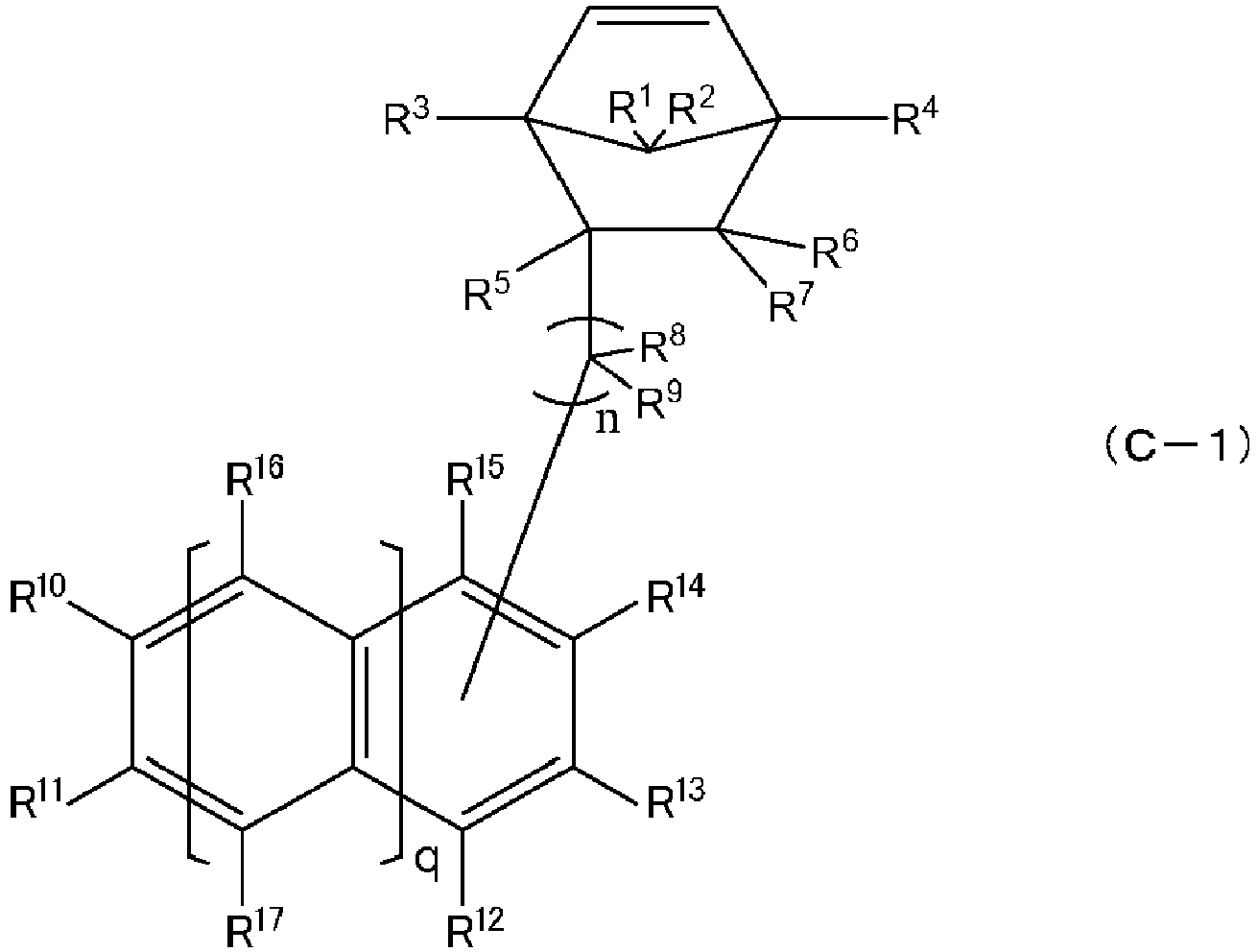
- In Formula (C-1), n and q each independently represent 0, 1, or 2. n preferably represents 0 or 1, and more preferably represents 0. q preferably represents 0 or 1, and more preferably represents 0.
- R1 to R17 each independently represent a hydrogen atom, a halogen atom except for a fluorine atom, or a hydrocarbon group having 1 to 20 carbon atoms that may be substituted with a halogen atom except for a fluorine atom. One of R10 to R17 is a bond, and it is preferable that R15 is a bond.
- R1 to R17 preferably each independently represent a hydrogen atom or a hydrocarbon group having 1 to 20 carbon atoms, and more preferably each independently represent a hydrogen atom.
- In a case where q = 0, R10 and R11, R11 and R12, R12 and R13, R13 and R14, R14 and R15, or R15 and R10 may form a monocyclic ring or a polycyclic ring by being bonded to each other. In a case where q = 1 or 2, R10 and R11, R11 and R17, R17 and R17, R17 and R12, R12 and R13, R13 and R14, R14 and R15, R15 and R16, R16 and R16, or R16 and R10 may form a monocyclic ring or a polycyclic ring by being bonded to each other. The monocyclic ring or the polycyclic ring may have a double bond, and the monocyclic ring or the polycyclic ring may be an aromatic ring.
- The Formula (C-1) is particularly preferably a compound represented by the following Formula (C-1A).


- In Formula (C-2), n and m each independently represent 0, 1, or 2, q represents 1, 2, or 3. m preferably represents 0 or 1, and more preferably represents 1. n preferably represents 0 or 1, and more preferably represents 0. q preferably represents 1 or 2, and more preferably represents 1.
- R18 to R31 each independently represent a hydrogen atom, a halogen atom except for a fluorine atom, or a hydrocarbon group having 1 to 20 carbon atoms that may be substituted with a halogen atom except for a fluorine atom.
- R18 to R31 preferably each independently represent a hydrogen atom or a hydrocarbon group having 1 to 20 carbon atoms, and more preferably each independently represent a hydrogen atom.
- In a case where q = 1, R28 and R29, R29 and R30, or R30 and R31 may form a monocyclic ring or a polycyclic ring by being bonded to each other. In a case where q = 2 or 3, R28 and R28, R28 and R29, R29 and R30, R30 and R31, or R31 and R31 may form a monocyclic ring or a polycyclic ring by being bonded to each other. The monocyclic ring or the polycyclic ring may have a double bond, and the monocyclic ring or the polycyclic ring may be an aromatic ring.

- In Formula (C-3), q represents 1, 2, or 3. q preferably represents 1 or 2, and more preferably represents 1.
- R32 to R39 each independently represent a hydrogen atom, a halogen atom except for a fluorine atom, or a hydrocarbon group having 1 to 20 carbon atoms that may be substituted with a halogen atom except for a fluorine atom.
- R32 to R39 preferably each independently represent a hydrogen atom or a hydrocarbon group having 1 to 20 carbon atoms, and more preferably each independently represent a hydrogen atom.
- In a case where q = 1, R36 and R37, R37 and R38, or R38 and R39 may form a monocyclic ring or a polycyclic ring by being bonded to each other. In a case where q = 2 or 3, R36 and R36, R36 and R37, R37 and R38, R38 and R39, or R39 and R39 may form a monocyclic ring or a polycyclic ring by being bonded to each other. The monocyclic ring or the polycyclic ring may have a double bond, and the monocyclic ring or the polycyclic ring may be an aromatic ring.
- Examples of the hydrocarbon group having 1 to 20 carbon atoms include an alkyl group having 1 to 20 carbon atoms, a cycloalkyl group having 3 to 15 carbon atoms, an aromatic hydrocarbon group, and the like. More specifically, examples of the alkyl group include a methyl group, an ethyl group, a propyl group, an isopropyl group, an amyl group, a hexyl group, an octyl group, a decyl group, a dodecyl group, an octadecyl group, and the like. Examples of the cycloalkyl group include a cyclohexyl group and the like. Examples of the aromatic hydrocarbon group include an aryl group and an aralkyl group such as a phenyl group, a tolyl group, a naphthyl group, a benzyl group, and a phenyl ethyl group. These hydrocarbon groups may be substituted with a halogen atom except for a fluorine atom.
- Among these, as the cyclic olefin having an aromatic ring according to the present embodiment, for example, at least one kind of cyclic olefin selected from benzonorbornadiene, indene norbornene, and methyl phenyl norbornene is preferable.
- In a case where the total content of the constitutional unit (A), the constitutional unit (B), and the constitutional unit (C) in the cyclic olefin-based copolymer (P) according to the present embodiment is 100 mol%, the content of the constitutional unit (C) in the cyclic olefin-based copolymer (P) is preferably equal to or greater than 0.1 mol% to equal to or smaller than 50 mol%, more preferably equal to or greater than 1 mol%, and even more preferably equal to or greater than 3 mol%. Furthermore, the content of the constitutional unit (C) in the cyclic olefin-based copolymer (P) is more preferably equal to or smaller than 40 mol%, even more preferably equal to or smaller than 30 mol%, still more preferably equal to or smaller than 25 mol%, and particularly preferably equal to or smaller than 20 mol%.
- In the present embodiment, the content of the constitutional unit (C) can be measured, for example, by 1H-NMR or 13C-NMR.
- In a case where the total content of the constitutional unit (B) and the constitutional unit (C) in the cyclic olefin-based copolymer (P) according to the present embodiment is 100 mol%, the content of the constitutional unit (C) in the cyclic olefin-based copolymer (P) according to the present embodiment is preferably equal to or greater than 5 mol% and equal to or smaller than 95 mol%, more preferably equal to or greater than 5 mol% and equal to or smaller than 70 mol%, and even more preferably equal to or greater than 5 mol% and equal to or smaller than 50 mol%.
- In the present embodiment, the content of the constitutional unit (B) and the constitutional unit (C) can be measured, for example, by 1H-NMR or 13C-NMR.
- The copolymerization type of the cyclic olefin-based copolymer (P) according to the present embodiment is not particularly limited, and examples thereof include a random copolymer, a block copolymer, and the like. In the present embodiment, from the viewpoint of making it possible to obtain a medical container excellent in transparency and heat resistance, as the cyclic olefin-based copolymer (P) according to the present embodiment, a random copolymer is preferable.
- The cyclic olefin-based copolymer (P) according to the present embodiment can be manufactured, for example, by appropriately selecting conditions according to the methods described in Japanese Unexamined Patent Publication No.
60-168708 61-120816 61-115912 61-115916 61-271308 61-272216 62-252406 62-252407 2007-314806 2010-241932 - From the viewpoint of further improving the heat resistance of the obtained medical container while excellently maintaining the transparency thereof, a glass transition temperature (Tg) of the cyclic olefin-based copolymer (P) according to the present embodiment measured using a differential scanning calorimeter (DSC) is preferably equal to or higher than 120°C and equal to or lower than 180°C, more preferably equal to or higher than 125°C and equal to or lower than 170°C, and even more preferably equal to or higher than 130°C and equal to or lower than 165°C.
- An intrinsic viscosity [η] (in decalin at 135°C) of the cyclic olefin-based copolymer (P) according to the present embodiment is 0.05 to 5.0 dl/g for example. The intrinsic viscosity [η] is preferably 0.2 to 4.0 dl/g, more preferably 0.3 to 2.0 dl/g, and particularly preferably 0.4 to 1.0 dl/g.
- In a case where the intrinsic viscosity [η] is equal to or higher than the lower limit described above, the mechanical strength of the medical container can be improved. In a case where the intrinsic viscosity [η] is equal to or lower than the upper limit described above, molding properties can be improved.
- The cyclic olefin-based copolymer composition according to the present embodiment is a cyclic olefin-based copolymer composition for forming a medical container, and contains the cyclic olefin-based copolymer (P) according to the present embodiment. If necessary, the composition may contain other components in addition to the cyclic olefin-based copolymer (P). In the present embodiment, in a case where the cyclic olefin-based copolymer composition according to the present embodiment contains only the cyclic olefin-based copolymer (P), the composition is also called cyclic olefin-based copolymer composition.
- In a case where the total amount of the cyclic olefin-based copolymer composition is 100% by mass, from the viewpoint of further improving the balance among the performances such as transparency, γ-ray resistance, and electron beam resistance of the obtained medical container, the content of the cyclic olefin-based copolymer (P) in the cyclic olefin-based copolymer composition according to the present embodiment is preferably equal to or greater than 50% by mass and equal to or smaller than 100% by mass, more preferably equal to or greater than 70% by mass and equal to or smaller than 100% by mass, even more preferably equal to or greater than 80% by mass and equal to or smaller than 100% by mass, and particularly preferably equal to or greater than 90% by mass and equal to or smaller than 100% by mass.
- In a case where the proportion of the cyclic olefin-based copolymer (P) contained in the cyclic olefin-based copolymer composition according to the present embodiment is as described above, the obtained medical container satisfies excellent transparency that is required to medical containers, and the γ-ray resistance or the electron beam resistance of the obtained medical container can be further improved.
- If necessary, a weatherproof stabilizer, a heat-resistant stabilizer, an antioxidant, a metal deactivator, a hydrochloric acid absorber, an antistatic agent, a flame retardant, a slip agent, an antiblocking agent, an antifogging agent, a lubricant, natural oil, synthetic oil, wax, an organic or inorganic filler, and the like can be mixed with the cyclic olefin-based copolymer composition according to the present embodiment to such a degree that does not impair the object of the present invention. The proportion of these components to be mixed may be appropriately set.
- If necessary, the cyclic olefin-based copolymer composition according to the present embodiment may contain a hindered amine-based compound [D].
- As the hindered amine-based compound [D] (hereinafter, simply described as compound [D] or [D]), it is possible to appropriately use a compound having one hindered amine structure (specifically, a partial structure represented by the following Formula (b1)) or two or more hindered amine structures.
- In Formula (b1), * represents a bond with another chemical structure.

- Specifically, as the compound [D], it is possible to use compounds known as Hindered Amine Light Stabilizers (abbreviation: HALS) and the like.
- Examples of the compound [D] include the hindered amine-based compound described in paragraphs "0058" to "0082" in International Publication No.
WO2006/112434 , the hindered amine-based compound described in paragraphs "0124" TO "0186" in International Publication No.WO2008/047468 , the piperidine derivative or a salt thereof described in paragraphs "0187" to "0226" in International Publication No.WO2008/047468 , the polyamine derivative or a salt thereof described in Japanese Unexamined Patent Publication No.2006-321793 - Furthermore, it is possible to use commercial products such as Chimassorb 2020, Chimassorb 944, Tinuvin 622, Tinuvin PA144, Tinuvin 765, Tinuvin 770 (manufactured by BASF SE), Cyasorb UV-3853, Cyasorb uv-3529, Cyasorb UV-3346, Cyasorb UV-531 (manufactured by Cytec Technology Corp.), ADEKASTAB LA-52, ADEKASTAB LA-57, ADEKASTAB LA-63P, ADEKASTAB LA-68, ADEKASTAB LA-72, ADEKASTAB LA-77Y, ADEKASTAB LA-81, ADEKASTAB LA-82, and ADEKASTAB LA-87 (manufactured by ADEKA CORPORATION).
- In the present embodiment, the compound [D] is preferably a compound having a structural unit represented by the following General Formula (b2).
- Typically, this compound is a polymer or an oligomer. Presumably, in a case where the compound [D], which is a polymer or an oligomer just as the compound, is used, the compatibility with the cyclic olefin-based copolymer (P) may be improved, and a more uniform composition could be made. Furthermore, presumably, the compound [D] may hardly change to a structure having characteristic absorption even being subjected to irradiation. Presumably, as a result, the discoloration caused by the irradiation with electron beams or γ-rays could be further inhibited, and the generation of radicals by the irradiation with electron beams or γ-rays could be further suppressed.
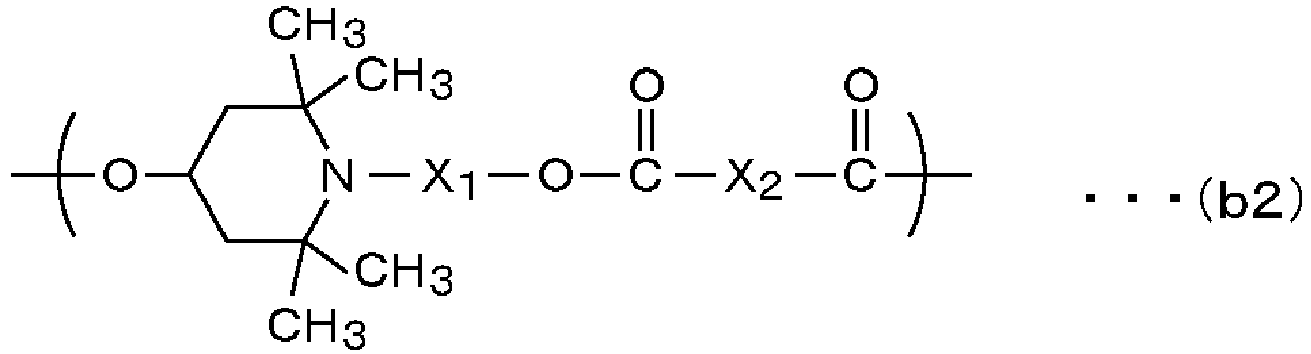
- In General Formula (b2), X1 and X2 each independently represent a divalent linking group.
- Examples of the divalent linking group represented by X1 and X2 include an alkylene group, a cycloalkylene group, an arylene group, a group constituted with these groups linked to each other, and the like. Among these, an alkylene group is preferable, an alkylene group having 1 to 6 carbon atoms is more preferable, and an alkylene group having 1 to 4 carbon atoms is even more preferable.
- As the compound having the structural unit represented by General Formula (b2), commercial products may also be used. Alternatively, the compound may be obtained by performing polycondensation of corresponding diol and carboxylic acid.
- One kind of compound [D] may be used singly, or two or more kinds of compounds [D] may be used.
- In a case where the content of the cyclic olefin-based copolymer (P) is 100 parts by mass, the content of the compound [D] in the composition is 0.01 to 2.0 parts by mass for example. The content of the compound [D] is preferably 0.05 to 1.5 parts by mass, and more preferably 0.10 to 1.0 part by mass. In a case where the content of the compound [D] is within the above range, it is possible to effectively suppress the discoloration caused by the irradiation with electron beams or γ-rays, the generation of radicals, and the like while maintaining other performances (for example, molding properties, mechanical strength, and the like).
- If necessary, the cyclic olefin-based copolymer composition according to the present embodiment may contain a phosphorus-based compound [E].
- There is no particular limitation on the usable phosphorus-based compound [E] (hereinafter, simply described as compound [E] or [E]). For example, as the compound [E], known phosphorus-based antioxidants can be used.
- As the phosphorus-based antioxidants, conventionally known phosphorus-based antioxidants (for example, a phosphite-based antioxidant) can be used without particular limitation.
- Specifically, examples thereof include a monophosphite-based compound such as triphenyl phosphite, diphenyl isodecyl phosphite, phenyl diisodecyl phosphite, tris(nonylphenyl)phosphite, tris(dinonylphenyl)phosphite, tris(2,4-di-t-butylphenyl)phosphite, tris(2-t-butyl-4-methylphenyl)phosphite, tris(cyclohexylphenyl)phosphite, 2,2-methylenebis(4,6-di-t-butylphenyl)octylphosphite, 9,10-dihydro-9-oxa-10-phosphaphenanthrene-10-oxide, 10-(3,5-di-t-butyl-4-hydroxybenzyl)-9,10-dihydro-9-oxa-10-phosp haphenanthrene-10-oxide, or 10-decyloxy-9,10-dihydro-9-oxa-10-phosphaphenanthrene; a diphosphite-based compound such as 4,4'-butylidene-bis(3-methyl-6-t-butylphenyl-di-tridecylphosphi te), 4,4'-isopropylidene-bis(phenyl-di-alkyl(C12 to C15)phosphite), 4,4'-isopropylidene-bis(diphenylmonoalkyl(C12 to C15)phosphite), 1,1,3-tris(2-methyl-4-di-tridecylphosphite-5-t-butylphenyl)buta ne, tetrakis(2,4-di-t-butylphenyl)-4,4'-biphenylene diphosphite, cyclic neopentane tetrayl bis(isodecylphosphite), cyclic neopentane tetrayl bis(nonylphenylphosphite), cyclic neopentane tetrayl bis(2,4-di-t-butylphenylphosphite), cyclic neopentane tetrayl bis(2,4-dimethylphenylphosphite), or cyclic neopentane tetrayl bis(2,6-di-t-butylphenylphosphite); and the like.
- As the compound [E], a tetravalent organic phosphorus compound is preferably used. More specifically, the compound [E] is a compound having a structure established in a case where three hydrogen atoms in phosphorous acid (P(OH)3) are substituted with the same organic group or different organic groups.
- More specifically, as the compound [E], a compound represented by the following General Formula (c1), (c2), or (c3) is preferable.


- In General Formulae (c1), (c2), and (c3), in a case where there is a plurality of R1's, R1's each independently represent an alkyl group; in a case where there is a plurality of R2's, R2's each independently represent an aromatic group; R3 represents an alkyl group, a cycloalkyl group, an aryl group, or an aralkyl group; and X represents a single bond or a divalent linking group.
- The alkyl group represented by R1 preferably has 1 to 10 carbon atoms. The alkyl group is more preferably a t-butyl group.
- Examples of the aromatic group represented by R2 include a phenyl group, a naphthyl group, a group obtained by substituting these groups with an alkyl group, and the like.
- The number of carbon atoms in R3 is preferably 1 to 30, more preferably 3 to 20, and even more preferably 6 to 18.
- R3 is preferably an aryl group or an aralkyl group, and more preferably an aralkyl group. The aryl group or the aralkyl group may be further substituted with a substituent (for example, an alkyl group having 1 to 6 carbon atoms, a hydroxy group, or the like).
- In a case where X represents a divalent linking group, specific examples thereof include an alkylene group (a methylene group or the like), an ether group (-O-), and the like. X is preferably a single bond.
- One kind of compound [E] may be used singly, or two or more kinds of compounds [E] may be used.
- In a case where the amount of the cyclic olefin-based copolymer (P) is 100 parts by mass, the content of the compound [E] in the composition is 0.01 to 1.5 parts by mass for example. The content of the compound [E] is preferably 0.02 to 1.0 part by mass, and more preferably 0.05 to 0.5 parts by mass. In a case where the content of the compound [E] is within the above range, it is possible to effectively suppress the discoloration caused by the irradiation with electron beams or γ-rays, the generation of radicals, and the like while maintaining other performances (for example, molding properties, mechanical strength, and the like).
- Furthermore, in another aspect, in a case where the amount of the cyclic olefin-based copolymer (P) is 100 parts by mass, the content of the phosphorus-based compound [E] is preferably less than 0.05 parts by mass, more preferably equal to or smaller than 0.03 parts by mass, and even more preferably equal to or smaller than 0.02 parts by mass.
- The cyclic olefin-based copolymer composition according to the present embodiment can be obtained by methods such as a method of melting and kneading the cyclic olefin-based copolymer (P) and other components by using an extruder and a known kneading device such as the Banbury mixer; a method of dissolving the cyclic olefin-based copolymer (P) and other components in the same solvent and then evaporating the solvent; and a method of adding the cyclic olefin-based copolymer (P) and other components to a poor solvent such that precipitation occurs.
- Next, the medical container of an embodiment according to the present invention will be described.
- The medical container according to the present embodiment contains the cyclic olefin-based copolymer (P) or the cyclic olefin-based copolymer composition according to the present embodiment.
- The medical container according to the present embodiment contains the cyclic olefin-based copolymer (P). Therefore, in the medical container, the balance between the performances such as transparency and γ-ray resistance or electron beam resistance is excellent. This medical container is hardly discolored even though being irradiated with electron beams or γ-rays.
- According to another examination conducted by the inventors of the present invention, it has been revealed that sometimes the conventional medical containers generate radicals by electron beam irradiation or γ-ray irradiation. It is apprehended that the medical containers may have a risk of degenerating contents after being filled with the contents.
- In contrast, the medical container according to the present embodiment can reduce the amount of radicals generated by electron beam irradiation or γ-ray irradiation. Therefore, in a case where the medical container according to the present embodiment is used, the risk of degenerating the contents can be reduced.
- From the viewpoint of further improving the balance between the performances such as radiation resistance and transparency, in a case where the total amount of the medical container is 100% by mass, the content of the cyclic olefin-based copolymer (P) in the medical container according to the present embodiment is preferably equal to or greater than 50% by mass and equal to or smaller than 100% by mass, more preferably equal to or greater than 70% by mass and equal to or smaller than 100% by mass, even more preferably equal to or greater than 80% by mass and equal to or smaller than 100% by mass, and particularly preferably equal to or greater than 90% by mass and equal to or smaller than 100% by mass.
- As the method for obtaining the medical container by molding the cyclic olefin-based copolymer (P) according to the present embodiment or the cyclic olefin-based copolymer composition according to the present embodiment, known methods can be used without particular limitation. Although the method varies with the use and the shape of the medical container, for example, it is possible to use extrusion molding, injection molding, inflation molding, blow molding, extrusion blow molding, injection blow molding, press molding, vacuum molding, powder slush molding, calendar molding, expansion molding, and the like. Among these, from the viewpoint of molding properties and productivity, an injection molding method is preferable. The molding conditions are appropriately selected according to the purpose of use and the molding method. For example, for injection molding, generally, the temperature of a resin is appropriately selected within a range of 150°C to 400°C, preferably within a range of 200°C to 350°C, and more preferably within a range of 230°C to 330°C.
- Furthermore, for example, by irradiating the medical container manufactured as above with γ-rays or electron beams, it is possible to obtain a container prepared by irradiating the medical container with γ-rays or electron beams (medical container irradiated with γ-rays or electron beams) . Such a medical container is clean because it has been sterilized by the irradiation. Furthermore, in the medical container, the occurrence of discoloration or radicals is inhibited. The radiation dose is not particularly limited, but is 5 to 100 kilogray (kGy) in general, and preferably 10 to 80 kilogray.
- Examples of the medical container include an outer cylinder of an injector (hereinafter, referred to as syringe), a syringe used in a cylinder filled with a liquid medicine or a medication (hereinafter, referred to as prefilled syringe as well), a storage container used by being filled with a liquid medicine or a medication (hereinafter, referred to as liquid medicine storage container as well), and the like.
- The prefilled syringe is a preparation in the form of a syringe that has been filled with a liquid medicine or a medication, and includes a single chamber type filled with one kind of liquid and a double chamber type filled with two kinds of medications. Most of the prefilled syringes are the single chamber type. The double chamber type includes a liquid -powder-type preparation consisting of powder and a liquid for dissolving the powder, and a liquid liquid-type preparation consisting of two kinds of liquids. Examples of liquids contained in the single chamber type include a heparin solution and the like. Examples of syringes used in the syringe and the prefilled syringe include a prefillable syringe, a prefilled syringe for vaccines, a prefilled syringe for anticancer drugs, a needleless syringe, and the like.
- Examples of the liquid medicine storage container include a wide mouth bottle, a narrow mouth bottle, a medicine bottle, a vial, an infusion bottle, a bulk container, a petri dish, a test tube, an analytical cell, and the like. More specifically, examples thereof include a container for liquid, powder, and solid chemicals such as an ample, a press through package, an infusion bag, a container for medicinal drops, or a container for eye drops; a sample container such as a test tube for sampling for blood test, a blood collection tube, or a specimen container; an analytical container such as an ultraviolet test cell; a sterilized container of medical instruments such as a scalpel, forceps, gauze, and a contact lens; a medical instrument such as a disposable syringe or prefilled syringe; laboratory equipment such as a beaker, a vial, an ample, or a test tube flask; a housing of artificial organs, and the like.
- The medical container according to the present embodiment has excellent transparency. The transparency is evaluated based on inner haze.
- It is preferable that the medical container has an excellent light transmittance. The light transmittance is determined as a spectral transmittance or a total light transmittance according to the use.
- In a case where the medical container is assumed to be used in wavelength bands of all types of light or in a plurality of wavelength bands, the medical container needs to have an excellent total light transmittance. The total light transmittance of the medical container whose surface is not provided with an antireflection film is equal to or higher than 85%, and preferably 88% to 93%. As long as the total light transmittance is equal to or higher than 85%, the medical container can secure the required quantity of light. The total light transmittance can be measured by known methods, and the measurement device and the like are not limited. Examples of the methods include a method of molding the cyclic olefin-based copolymer composition according to the present embodiment into a sheet having a thickness of 3 mm based on ASTM D1003, and measuring the total light transmittance of the sheet obtained by molding the cyclic olefin-based copolymer composition according to the present embodiment by using a haze meter, and the like.
- The medical container according to the present embodiment has an excellent light transmittance for light having a wavelength of 450 nm to 800 nm.
- In a case where a known antireflection film is provided on the surface of the medical container, the light transmittance can be further improved.
- Hitherto, the embodiment of the second invention has been described. However, the embodiment is merely an example of the second invention, and various constitutions other than the embodiment can also be adopted.
- Furthermore, the second invention is not limited to the embodiment, and as long as the object of the second invention can be achieved, modification, amelioration, and the like are also included in the second invention.
- Hitherto, the embodiments of the inventions of the present application have been described. However, the embodiments are merely examples of the present inventions, and various constitutions other than the embodiments can also be adopted.
- Furthermore, the present inventions are not limited to the embodiments, and as long as the objects of the present inventions can be achieved, modification, amelioration, and the like are also included in the inventions.
- It goes without saying that the inventions of the present application can be combined as long as what are included in the inventions do not conflict with each other.
- Hereinafter, the first invention of the present application will be specifically described based on examples. However, the first invention of the present application is not limited to the examples.
- As an inert gas, nitrogen was allowed to flow in a reaction container, which included a stirring device, had a volume of 500 ml, and was made of glass, for 30 minutes at a flow rate of 100 Nl/hr. Then, cyclohexane, tetracyclo[4.4.0.12,5.17,10]-3-dodecene (40 mmol, hereinafter, referred to as tetracyclododecene as well) and benzonorbornadiene (88 mmol, hereinafter, referred to as BNBD as well) were added to the container. Thereafter, the polymerization solvent was stirred at a rotation speed of 600 rpm, and in this state, the solvent temperature was increased to 50°C. After the solvent temperature reached a predetermined temperature, the gas flowing in the reaction container was changed to ethylene from nitrogen. Ethylene and hydrogen were allowed to flow in the reaction container at supply rates of 50 Nl/hr and 2.0 Nl/hr respectively. After 10 minutes, PMAO (1.8 mmol) and the catalyst (0.0030 mmol) prepared by the method described in paragraph "0112" in Japanese Unexamined Patent Publication No.
2010-241932 - After 10 minutes, 5 ml of isobutyl alcohol was added thereto so as to stop the polymerization, thereby obtaining a polymerized solution containing a copolymer of ethylene, tetracyclododecene, and BNBD. Subsequently, the polymerized solution was moved to a beaker having a volume of 2 L that was additionally prepared, 5 ml of concentrated hydrochloric acid and a stirrer were added thereto, and a deliming operation was performed by bringing the copolymer into contact with the hydrochloric acid for 2 hours in a state of strongly stirring the solution. In a state of being stirred, the polymerized solution having undergone deliming was added to a beaker containing acetone that was about three times the volume of the polymerized solution, such that the copolymer was precipitated. The precipitated copolymer was separated from the filtrate by filtration. The obtained polymer containing the solvent was dried under reduced pressure for 10 hours at 130°C, thereby obtaining 4.58 g of a white powder-like ethylene•tetracyclododecene•BNBD copolymer.
- In this way, a cyclic olefin-based copolymer (P-1) was obtained.
- Cyclic olefin-based copolymers (P-2) to (P-11) described in Table 1 were obtained by performing the same operation as that in Manufacturing Example 1, except that the content of each of the constitutional units constituting the cyclic olefin-based copolymers was adjusted to the value described in Table 1.
- Furthermore, a cyclic olefin-based copolymer (P-12) was prepared by mixing the cyclic olefin-based copolymer (P-10) with the cyclic olefin-based copolymer (P-11) at a mass ratio of 1:1 (Manufacturing Example 12).
- In Table 1, BNBD means benzonorbornadiene represented by the following Formula (1), and IndNB means indene norbornene represented by the following Formula (2). MePhNB means methyl phenyl norbornene represented by the following Formula (3).


[Table 1] Cyclic olefin-based copolymer P-1 P-2 P-3 P-4 P-5 P-6 P-7 P-8 P-9 P-10 P-11 Cyclic olefin having aromatic ring from which constitutional unit (C) is derived BNBD BNBD BNBD IndNB IndNB IndNB MePhNB MePhNB MePhNB N/A BNBD Composition Constitutional unit (A) (derived from ethylene) (mol%) 63.0 64.1 61.0 64.4 63.3 66.4 63.4 60.0 55.1 65.0 62.0 Constitutional unit (B) (derived from tetracyclododecene) (mol%) 21.0 28.1 8.0 25.3 21.3 11.5 26.7 20.0 10.4 35.0 0.0 Constitutional unit (C) (mol%) 16.0 7.8 31.0 10.3 15.4 22.1 9.9 20.0 34.5 0.0 38.0 [Table 2] Example 1 Example 2 Example 3 Example 4 Example 5 Example 6 Example 7 Example 8 Example 9 Comparative Example 1 Comparative Example 2 Cyclic olefin-based copolymer P-1 P-2 P-3 P-4 P-5 P-6 P-7 P-8 P-9 P-10 P-12 Cyclic olefin having aromatic ring from which constitutional unit (C) is derived BNBD BNBD BNBD IndNB IndNB IndNB MePhNB MePhNB MePhNB N/A Composition Constitutional unit (A) (derived from ethylene) (mol%) 63.0 64.1 61.0 64.4 63.3 66.4 63.4 60.0 55.1 65.0 Constitutional unit (B) (derived from tetracyclododecene) (mol%) 21.0 28.1 8.0 25.3 21.3 11.5 26.7 20.0 10.4 35.0 Constitutional unit (C) (mol%) 16.0 7.8 31.0 10.3 15.4 22.1 9.9 20.0 34.5 0.0 Tg (°C) 147 140 148 152 154 143 143 152 165 150 130, 150 [η] (dl/g) 0.47 0.45 0.78 0.50 0.44 0.41 0.45 0.45 0.45 0.45 0.51 Refractive index (nd) 1.56 1.55 1.57 1.55 1.56 1.56 1.55 1.55 1.56 1.54 - Abbe number 46 51 39 49 47 43 51 47 43 56 - Inner haze ○ ○ ○ ○ ○ ○ ○ ○ ○ ○ X Birefringence B A B A B B A B B A - - In each of the examples and the comparative examples, various physical properties were measured or evaluated by the following method. The obtained results are shown in Table 2.
- The content of ethylene,
tetracyclo [4.4.0.12,5.17,10]-3-dodecene, and the cyclic olefin having an aromatic ring was measured under the following conditions by using a nuclear magnetic resonance spectrometer "ECA 500" manufactured by JEOL Ltd. - Solvent: deuterated tetrachloroethane
- Sample concentration: 50 to 100 g/l-solvent
- Pulse repetition time: 5.5 seconds
- Number of times of integration: 6,000 to 16,000
- Measurement temperature: 120°C
- From a 13C-NMR spectrum measured under the above conditions, the composition of each of the ethylene, the tetracyclododecene, and the cyclic olefin having an aromatic ring was quantified.
- By using DSC-6220 manufactured by Shimadzu Corporation, a glass transition temperature Tg of the cyclic olefin-based copolymer was measured in a nitrogen (N2) atmosphere. The cyclic olefin-based copolymer was heated to 200°C from room temperature at a heating rate of 10°C/min and then kept as it was for 5 minutes. Thereafter, the copolymer was cooled to -20°C at a cooling rate of 10°C/min and then kept as it was for 5 minutes. From a heat absorption curve formed at the time of heating the copolymer to 200°C at a heating rate of 10°C/min, the glass transition temperature (Tg) of the cyclic olefin-based copolymer was determined.
- By using a mobile viscometer (manufactured by RIGOSHA & Co., Ltd., type: VNR053U), 0.25 to 0.30 g of the cyclic olefin-based copolymer was dissolved in 25 ml of decalin, thereby obtaining a sample. Based on ASTM J1601, the specific viscosity of the cyclic olefin-based copolymer was measured at 135°C, a ratio between the specific viscosity and the concentration was extrapolated to 0, thereby determining an intrinsic viscosity [η] of the cyclic olefin-based copolymer.
- By using a compact kneader manufactured by Xplore Instruments BV, the cyclic olefin-based copolymers of Manufacturing Examples 1 to 10 and 12 were kneaded for 5 minutes at a kneading temperature of 280°C and 50 rpm. Then, by using an injection molding machine manufactured by Xplore Instruments BV, the copolymers were subjected to injection molding under the conditions of a cylinder temperature of 280°C, an injection pressure of 12 to 15 bar, and a mold temperature of 135°C, thereby preparing injection molding sheets having a thickness of 1.0 mm.
- Based on JIS K7136, the inner haze of each of the 30 mm x 30 mm x 1.0 mm (thickness) injection molding sheets formed using the micro-compounder was measured by using benzyl alcohol. Then, the inner haze was evaluated based on the following standards.
- ○: less than 5%
- X: equal to or higher than 5%.
- For each of the 30 mm x 30 mm x 1.0 mm (thickness) injection molding sheets formed using the micro-compounder, by using KOBRA CCD manufactured by Oji Scientific Instruments, an average of phase differences of 20 to 35 mm from a gate direction at a measurement wavelength of 650 nm was determined.
- Then, the birefringence was evaluated based on the following standards.
- A: the average of phase differences was less than 30 nm.
- B: the average of phase differences was equal to or greater than 30 nm and less than 40 nm.
- C: the average of phase differences was equal to or greater than 40 nm.
- By using a refractometer (KPR200 manufactured by Shimadzu Corporation), for each of the 30 mm x 30 mm x 1.0 mm (thickness) injection molding sheets formed using the micro-compounder, a refractive index (nd) at a wavelength of 589 nm was measured based on ASTM D542.
- For each of the 30 mm x 30 mm x 1.0 mm (thickness) injection molding sheets formed using the micro-compounder, the refractive index was measured using the Abbe refractometer at wavelengths of 486 nm, 589 nm, and 656 nm at 23°C. Furthermore, by using the following equation, an Abbe number (ν) was calculated.

- nD: refractive index at wavelength of 589 nm
- nC: refractive index at wavelength of 656 nm
- nF: refractive index at wavelength of 486 nm
- As a hydrophilic stabilizer, a triglycerin fatty acid ester (triglycerin oleate as an ester of triglycerin and oleaic acid (a mixture of a monoester, a diester, and a triester, proportion of ester: 41% for the monoester, 49% for the diester, and 10% for the triester)) was heated for 4 hours at 100°C such that the stabilizer was melted. The molten stabilizer was directly put into an extruder in an amount of 0.6 parts by mass with respect to 100 parts by mass of the cyclic olefin-based copolymer (P-1), thereby obtaining a resin composition containing the cyclic olefin-based copolymer (P-1) and a distillate of an ester of triglycerin and oleaic acid.
- Specifically, the cyclic olefin-based copolymer (P-1) was put into a twin screw extruder, which had screws rotating in the same direction and each having a diameter of 12 mmϕ and had a vent hole at a position of L/D = 34 from a resin injection portion, from the resin injection portion. Thereafter, the triglycerin fatty acid ester heated and melted at a temperature of 80°C to 120°C was put into the extruder from the vent hole, and melted and kneaded under the conditions of a screw rotation speed of 150 rpm and motor power of 2.2 kW, thereby obtaining a resin composition.
- For the obtained resin composition, the glass transition temperature and the intrinsic viscosity [η] were measured by the same method as that in Example 1. The results are shown in Table 3.
- A resin composition was prepared in the same manner as in Example 10, except that triglycerin fatty acid ester was used in an amount of 0.8 parts by mass with respect to 100 parts by mass of the cyclic olefin-based copolymer (P-1) s described in Table 3.
- For the obtained resin composition, the glass transition temperature and the intrinsic viscosity [η] were measured by the same method as that in Example 1. The results are shown in Table 3.
- A resin composition was prepared in the same manner as in Example 10, except that triglycerin fatty acid ester was used in an amount of 1.0 parts by mass with respect to 100 parts by mass of the cyclic olefin-based copolymer (P-1) as described in Table 3.
- For the obtained resin composition, the glass transition temperature and the intrinsic viscosity [η] were measured by the same method as that in Example 1. The results are shown in Table 3.
- A resin composition was prepared in the same manner as in Example 10, except that as a hydrophilic stabilizer, instead of the triglycerin fatty acid ester, RIKEMAL DO-100 (manufactured by RIKEN VITAMIN Co., Ltd., containing diglycerin monooleate as a main component) was used in an amount of 0.6 parts by mass with respect to 100 parts by mass of the cyclic olefin-based copolymer (P-1) as described in Table 3.
- For the obtained resin composition, the glass transition temperature and the intrinsic viscosity [η] were measured by the same method as that in Example 1. The results are shown in Table 3.
- A resin composition was prepared in the same manner as in Example 10, except that as a hydrophilic stabilizer, instead of the triglycerin fatty acid ester, RIKEMAL DO-100 was used in an amount of 1.0 part by mass with respect to 100 parts by mass of the cyclic olefin-based copolymer (P-1) as described in Table 3.
- For the obtained resin composition, the glass transition temperature and the intrinsic viscosity [η] were measured by the same method as that in Example 1. The results are shown in Table 3.
- A resin composition was prepared in the same manner as in Example 10, except that as a hydrophilic stabilizer, instead of the triglycerin fatty acid ester, EXCEPARL PE-MS (manufactured by Kao Corporation, containing pentaerythritol monostearate as a main component) was used in an amount of 1.8 parts by mass with respect to 100 parts by mass of the cyclic olefin-based copolymer (P-1) as described in Table 3.
- For the obtained resin composition, the glass transition temperature and the intrinsic viscosity [η] were measured by the same method as that in Example 1. The results are shown in Table 3.
- A resin composition was prepared in the same manner as in Example 10, except that as a hydrophilic stabilizer, instead of the triglycerin fatty acid ester, EXCEPARL PE-MS was used in an amount of 2.4 parts by mass with respect to 100 parts by mass of the cyclic olefin-based copolymer (P-1) as described in Table 3.
- For the obtained resin composition, the glass transition temperature and the intrinsic viscosity [η] were measured by the same method as that in Example 1. The results are shown in Table 3.
- A resin composition was prepared in the same manner as in Example 10, except that instead of the cyclic olefin-based copolymer (P-1) , the cyclic olefin-based copolymer (P-5) was used as described in Table 3.
- For the obtained resin composition, the glass transition temperature and the intrinsic viscosity [η] were measured by the same method as that in Example 1. The results are shown in Table 3.
- A resin composition was prepared in the same manner as in Example 12, except that instead of the cyclic olefin-based copolymer (P-1), the cyclic olefin-based copolymer (P-5) was used as described in Table 3.
- For the obtained resin composition, the glass transition temperature and the intrinsic viscosity [η] were measured by the same method as that in Example 1. The results are shown in Table 3.
- A resin composition was prepared in the same manner as in Example 10, except that instead of the cyclic olefin-based copolymer (P-1), the cyclic olefin-based copolymer (P-8) was used as described in Table 3.
- For the obtained resin composition, the glass transition temperature and the intrinsic viscosity [η] were measured by the same method as that in Example 1. The results are shown in Table 3.
- A resin composition was prepared in the same manner as in Example 12, except that instead of the cyclic olefin-based copolymer (P-1), the cyclic olefin-based copolymer (P-8) was used as described in Table 3.
- For the obtained resin composition, the glass transition temperature and the intrinsic viscosity [η] were measured by the same method as that in Example 1. The results are shown in Table 3.
- By using an injection molding machine (Micro-2 manufactured by MEIHO CO., LTD.), the resin composition was subjected to injection molding at a cylinder temperature of 320°C, thereby preparing 25 mm x 25 mm x 2 mmt (thickness) molded articles (test pieces) . The mold temperature was set to be 135°C.
- By using a refractometer (KPR3000 manufactured by Shimadzu Corporation), for each of the 25 mm x 25 mm x 2 mmt (thickness) molded test pieces, a refractive index (nd) at wavelengths of 486 nm, 589 nm, and 656 nm was measured based on ASTM D542. Furthermore, by using the following equation, an Abbe number (v) was calculated. The results are shown in Table 2.

- nD: refractive index at wavelength of 589 nm
- nC: refractive index at wavelength of 656 nm
- nF: refractive index at wavelength of 486 nm
- Based on JIS K-7136, the inner haze of each of the molded articles was measured by using benzyl alcohol. Then, the inner haze was evaluated based on the following standards. The results are shown in Table 2.
- ○: less than 5%
- X: equal to or higher than 5%.
- For each of the molded 25 mm x 25 mm x 2 mmt (thickness) test pieces, by using KOBRA CCD manufactured by Oji Scientific Instruments, an average of phase differences of 20 to 35 mm from a gate direction at a measurement wavelength of 650 nm was determined. The results are shown in Table 2.
- Then, the birefringence was evaluated based on the following standards.
- A: the average of phase difference was less than 10 nm.
- B: the average of phase difference was equal to or greater than 10 nm and less than 20 nm.
- C: the average of phase difference was equal to or greater than 20 nm.
- The molded 25 mm x 25 mm x 2 mmt (thickness) test pieces were left to stand for 48 hours in an atmosphere of a temperature of 85°C and a relative humidity of 85%. Thereafter, the test pieces were taken out and then left to stand for 48 hours in an atmosphere with a temperature of 23°C and a relative humidity of 50%, and then haze thereof was measured. The results are shown in Table 2.
- The change (hereinafter, described as Δ haze), which was obtained by subtracting the haze before the environmental testing from the haze after the environmental testing, was evaluated based on the following standards.
- A: less than 5%
- B: equal to or higher than 5%
- As shown in the above tables, the optical lenses obtained in the examples had a high refractive index and an Abbe number which was lower than the Abbe number of the optical lens obtained in Comparative Example 1. That is, the optical lenses obtained in the examples satisfied various characteristics required to optical lenses and had a high refractive index and a low Abbe number. In contrast, the optical lens of Comparative Example 1, in which the cyclic olefin-based copolymer that did not contain the constitutional unit (C) derived from the cyclic olefin having an aromatic ring was used, had a high Abbe number. In Comparative Example 1, the intended optical lens was not obtained. The optical lens of Comparative Example 2 had poor inner haze and poor optical characteristics.
- Hereinafter, the second invention of the present application will be specifically described based on examples. However, the second invention of the present application is not limited to the examples.
- As an inert gas, nitrogen was allowed to flow in a reaction container, which included a stirring device, had a volume of 500 ml, and was made of glass, for 30 minutes at a flow rate of 100 Nl/hr. Then, cyclohexane, tetracyclo[4.4.0.12,5.17,10]-3-dodecene (19mmol, hereinafter, referred to as tetracyclododecene as well) and indene norbornene (8.0 mmol, hereinafter, referred to as IndNB as well) were added to the reaction container. Thereafter, the polymerization solvent was stirred at a rotation speed of 600 rpm, and in this state, the solvent temperature was increased to 50°C. After the solvent temperature reached a predetermined temperature, the gas flowing in the reaction container was changed to ethylene from nitrogen. Ethylene and hydrogen were allowed to flow in the reaction container at supply rates of 50 Nl/hr and 0.5 Nl/hr respectively. After 10 minutes, Modified Methyl Aluminoxane (MMAO) (0.9 mmol) and the catalyst (0.0030 mmol) prepared by the method described in paragraph "0112" in Japanese Unexamined Patent Publication No.
2010-241932 - After 10 minutes, 5 ml of isobutyl alcohol was added thereto so as to stop the polymerization, thereby obtaining a polymerized solution containing a copolymer of ethylene, tetracyclododecene, and IndNB. Subsequently, the polymerized solution was moved to a beaker having a volume of 2 L that was additionally prepared, 5 ml of concentrated hydrochloric acid and a stirrer were added thereto, and a deliming operation was performed by bringing the copolymer into contact with the hydrochloric acid for 2 hours in a state of strongly stirring the solution. In a state of being stirred, the polymerized solution having undergone deliming was added to a beaker containing acetone that was about three times the volume of the polymerized solution, such that the copolymer was precipitated. The precipitated copolymer was separated from the filtrate by filtration. The obtained polymer containing the solvent was dried under reduced pressure for 10 hours at 130°C, thereby obtaining 0.58 g of a white powder-like ethylene•tetracyclododecene•indene norbornene copolymer.
- In this way, a cyclic olefin-based copolymer (P-13) was obtained.
- Cyclic olefin-based copolymers (P-14) to (P-21) described in Table 4 were obtained by performing the same operation as that in Manufacturing Example 13, except that the content of each of the constitutional units constituting the cyclic olefin-based copolymers was adjusted to the value described in Table 4.
- In Table 4, BNBD means benzonorbornadiene represented by the following Formula (1), and IndNB means indene norbornene represented by the following Formula (2). MePhNB means methyl phenyl norbornene represented by the following Formula (3).


- In each of the examples and the comparative examples, various physical properties were measured or evaluated by the following method. The obtained results are shown in Table 4.
- The content of ethylene,
tetracyclo [4.4.0.12,5.17,10]-3-dodecene, and the cyclic olefin having an aromatic ring was measured under the following conditions by using a nuclear magnetic resonance spectrometer "ECA 500" manufactured by JEOL Ltd. - Solvent: deuterated tetrachloroethane
- Sample concentration: 50 to 100 g/l-solvent
- Pulse repetition time: 5.5 seconds
- Number of times of integration: 6,000 to 16,000
- Measurement temperature: 120°C
- From a 13C-NMR spectrum measured under the above conditions, the composition of each of the ethylene, the tetracyclododecene, and the cyclic olefin having an aromatic ring was quantified.
- By using DSC-6220 manufactured by Shimadzu Corporation, a glass transition temperature Tg of the cyclic olefin-based copolymer was measured in a nitrogen (N2) atmosphere. The cyclic olefin-based copolymer was heated to 200°C from room temperature at a heating rate of 10°C/min and then kept as it was for 5 minutes. Thereafter, the copolymer was cooled to -20°C at a cooling rate of 10°C/min and then kept as it was for 5 minutes. From a heat absorption curve formed at the time of heating the copolymer to 200°C at a heating rate of 10°C/min, the glass transition temperature (Tg) of the cyclic olefin-based copolymer was determined.
- By using a mobile viscometer (manufactured by RIGOSHA & Co., Ltd., type: VNR053U), 0.25 to 0.30 g of the cyclic olefin-based copolymer was dissolved in 25 ml of decalin, thereby obtaining a sample. Based on ASTM J1601, the specific viscosity of the cyclic olefin-based copolymer was measured at 135°C, a ratio between the specific viscosity and the concentration was extrapolated to 0, thereby determining an intrinsic viscosity [η] of the cyclic olefin-based copolymer.
- The powder obtained in Manufacturing Examples 13 to 21 was subjected to press molding under the condition of 250°C by using a hand press machine manufactured by Toyo Seiki Seisaku-sho, Ltd., thereby preparing square plate-like test pieces having a thickness of 2 mm.
- The square plate-like test pieces having a thickness of 2 mm obtained as above were irradiated with γ-rays at 20 kGy or 50 kGy.
- For each of the obtained square plate-like test pieces having a thickness of 2 mm and the test pieces just finished with the γ-ray irradiation, the inner haze was measured, and the transparency thereof was evaluated based on the following standards.
- The inner haze was measured in benzyl alcohol by using a haze meter (NDH-20D manufactured by NIPPON DENSHOKU INDUSTRIES Co., LTD).
- ○: the inner haze was less than 6.0%.
- X: the test piece appeared turbid, or the inner haze was equal to or higher than 6.0%.
- The test pieces just finished with the γ-ray irradiation were stacked on white paper until the thickness thereof became 20 mm. At this time, the color and brightness thereof were visually evaluated.
- The color was based on the Munsell color system. The evaluation standards are as below.
- A (excellent) : the brightness was 7 to 9.5, and the color was between 5.0 GY and 10 GY
- B (normal): the brightness was 5 to 9.5, and the color was between 5 Y and 5 GY; here, a case corresponding to A (excellent) was ruled out.
- C (bad) : the brightness was equal to or higher than 0 and less than 5 and/or the color was between 2.5 Y and 5 Y; here, a case corresponding to B (normal) was ruled out.
- The evaluation standards will be more specifically described.
- It has been revealed that the higher the brightness, the closer the sample to white, and the discoloration is further inhibited.
- Regarding the color, assuming that the composition is used particularly as a medical container, it is apprehended that yellow may give an impression of being dirty to patients. Therefore, green was regarded as being more preferable than yellow.
- The amount of radicals in a sample 5 days and 1 month after the γ-ray irradiation was measured by Electron Spin Resonance (ESR) .
- Specifically, 5 days and 1 month after the irradiation with γ-rays at a doses of 20 kGy and 50 kGy, about 6 mg of a sample was cut from each of the test pieces, put into a test tube (see the following description for more detail), and an ESR spectrum thereof was measured under the following conditions.
- Device: electron spin resonance spectrometer JES-TE200 manufactured by JEOL Ltd.
- Resonant frequency: 9.2 GHz
- Microwave input: 1 mW
- Central field: 326.5 mT
- Sweep range: ±15 mT
- Modulation frequency: 100 kHz
- Sweep time: 8 min
- Time constant: 0.1 sec
- Amplification degree: 25
- Test tube: test tube with quartz tip for X band
- External standard: Mn2+ standard sample supported on magnesium oxide
- External standard memory: 0,700
- Measurement temperature: room temperature
- Measurement atmosphere: the atmosphere
- For the relative comparison of the amount of generated radicals, a normalized value expressed as the following equation was used.
- Amount of generated radicals (normalized value) = area of portion corresponding to organic radicals in spectrum/area of portion (second signal) corresponding to Mn2+ in spectrum x amount of pellets
- The baseline of the ESR spectrum was corrected based on Mn2+ (second signal).
- Generally, in the relative comparison of amount of radicals, for the area of the signal derived fromMn2+ as a standard, Mn2+ (third signal) is used. However, because the spectrum of the signal derived from organic radicals overlapped Mn2+ (third signal), only Mn2+ (second signal) was used in ESR performed in the present example (external standard memory = 700).
- Furthermore, in a case where the signal derived from organic radicals overlapped Mn2+ (third signal), the amount of generated radicals was calculated using an ESR spectrum of an external standard memory = 0.
[Table 4] Resin Example 21 Example 22 Example 23 Example 24 Example 25 Example 26 Example 27 Example 28 Comparative Example 3 Cyclic olefin-based copolymer P-13 P-14 P-15 P-16 P-17 P-18 P-19 P-20 P-21 Cyclic olefin having aromatic ring from which constitutional unit (C) is derived IndNB IndNB IndNB BNBD BNBD IndNB MePhNB MePhNB N/A Constitutional unit (A) (derived from ethylene) (mol%) 60.7 64.3 64.1 65.0 63.0 65.2 63.0 65.6 65.9 Constitutional unit (B) (derived from tetracyclododecene) (mol%) 29.6 29.2 31.8 31.0 21.0 32.6 27.0 31.2 34.1 Constitutional unit (C) (mol%) 9.7 6.5 4.1 4.0 16.0 2.2 10.0 3.2 0.0 Content of constitutional unit (C) with respect to total content of 100 mol% of (A), (B), and (C) (mol%) 9.7 6.5 4.1 4.0 16.0 2.2 10.0 3.2 0.0 Content of constitutional unit (C) with respect to total content of 100 mol % of (B) and (C) (mol%) 24.7 18.2 11.4 11.4 43.2 6.3 27.0 9.3 0.0 [η] (dl/g) 0.54 0.65 0.69 0.45 0.47 0.78 0.45 0.45 0.51 Tg (°C) 161 150 150 144 147 147 143 136 145 Transparency ○ ○ ○ ○ ○ ○ ○ ○ ○ Color after γ-ray (20 kGy) irradiation A A A A A A A A C Color after γ-ray (50 kGy) irradiation A A A A A A A A C Amount of radicals 5 days after γ-ray (20 kGy)irradiation 0.4 0.4 0.3 0.4 0.3 0.4 0.4 0.3 60 Amount of radicals 5 days after γ-ray (50 kGy)irradiation 0.3 0.4 0.4 0.4 0.3 47 0.3 0.3 120 Amount of radicals 1 month after γ-ray (50 kGy)irradiation 0.2 0.3 0.2 0.3 0.2 0.1 0.2 0.2 1.2 - As shown in the above table, the molded articles (sheets) constituted with the cyclic olefin-based copolymer compositions obtained in Examples 21 to 28 were excellent in the balance between performances such as transparency and γ-ray resistance. In contrast, Comparative Example 3, in which a cyclic olefin-based copolymer that did not contain the constitutional unit (C) derived from a cyclic olefin having an aromatic ring was used, was poor in the balance between performances such as transparency and γ-ray resistance.
- The present application claims priorities based on Japanese Patent Application No.
2017-228675 filed on November 29, 2017 2018-138691 filed on July 24, 2018
| .Example 1 | Example 10 | Example 11 | Example 12 | Example 13 | Example 14 | Example 15 | Example 16 | Example 5 | Example 17 | Example 18 | Example 8 | Example 19 | Example 20 | ||
| Cyclic olefin-based copolymer | P-1 | P-1 | P-1 | P-1 | P-1 | P-1 | P-1 | P-1 | P-5 | P-5 | P-5 | P-8 | P-8 | P-8 | |
| Cyclic olefin having aromatic ring from which constitutional unit (C) is derived | BNBD | BNBD | BNBD | BNBD | BNBD | BNBD | BNBD | BNBD | IndNB | IndNB | IndNB | MePhNB | MePhNB | MePhNB | |
| Composition | Constitutional unit (A) (derived from ethylene) (mol%) | 63.0 | 63.0 | 63.0 | 63.0 | 63.0 | 63.0 | 63.0 | 63.0 | 63.3 | 63.3 | 63.3 | 60.0 | 60.0 | 60.0 |
| Constitutional unit (B) (derived from tetracyclododecene) (mol%) | 21.0 | 21.0 | 21.0 | 21.0 | 21.0 | 21.0 | 21.0 | 21.0 | 21.3 | 21.3 | 21.3 | 20.0 | 20.0 | 20.0 | |
| Constitutional unit (C) (mol%) | 16.0 | 16.0 | 16.0 | 16.0 | 16.0 | 16.0 | 16.0 | 16.0 | 15.4 | 15.4 | 15.4 | 20.0 | 20.0 | 20.0 | |
| Triglycerin fatty acid ester (part by mass) | 0.0 | 0.6 | 0.8 | 1.0 | 0.0 | 0.0 | 0.0 | 0.0 | 0.0 | 0.6 | 1.0 | 0.0 | 0.6 | 1.0 | |
| RIKEMAL DO-100 (part by mass) | 0.0 | 0.0 | 0.0 | 0.0 | 0.6 | 1.0 | 0.0 | 0.0 | 0.0 | 0.0 | 0.0 | 0.0 | 0.0 | 0.0 | |
| EXCEPARL PE-MS (part by mass) | 0.0 | 0.0 | 0.0 | 0.0 | 0.0 | 0.0 | 1.8 | 2.4 | 0.0 | 0.0 | 0.0 | 0.0 | 0.0 | 0.0 | |
| Tg(°C) | 147 | 144 | 142 | 140 | 144 | 140 | 134 | 130 | 154 | 151 | 147 | 152 | 149 | 145 | |
| [η] (dl/g) | 0.47 | 0.47 | 0.47 | 0.47 | 0.47 | 0.47 | 0.47 | 0.47 | 0.44 | 0.44 | 0.44 | 0.45 | 0.45 | 0.45 | |
| Refractive index (nd) | 1.56 | 1.56 | 1.56 | 1.56 | 1.56 | 1.56 | 1.56 | 1.56 | 1.56 | 1.56 | 1.56 | 1.55 | 1.55 | 1.55 | |
| Abbe number | 46 | 46 | 46 | 46 | 46 | 46 | 46 | 46 | 47 | 47 | 47 | 47 | 47 | 47 | |
| Inner haze | ○ | ○ | ○ | ○ | ○ | ○ | ○ | ○ | ○ | ○ | ○ | ○ | ○ | ○ | |
| Birefringence | B | B | B | B | B | B | B | B | B | B | B | B | B | B | |
| Appearance after environmental testing | B | A | A | A | A | A | A | A | B | A | A | B | A | A | |
Claims (24)
- A cyclic olefin-based copolymer comprising:a constitutional unit (A) derived from an α-olefin having 2 to 20 carbon atoms;a constitutional unit (B) derived from a cyclic olefin without an aromatic ring; anda constitutional unit (C) derived from a cyclic olefin having an aromatic ring.
- The cyclic olefin-based copolymer according to claim 1,
wherein in a case where a total content of the constitutional unit (A), the constitutional unit (B), and the constitutional unit (C) in the cyclic olefin-based copolymer is 100 mol%, a content of the constitutional unit (A) in the cyclic olefin-based copolymer is equal to or greater than 10 mol% and equal to or smaller than 80 mol%. - The cyclic olefin-based copolymer according to claim 1 or 2,
wherein in a case where a total content of the constitutional unit (B) and the constitutional unit (C) in the cyclic olefin-based copolymer is 100 mol%, a content of the constitutional unit (C) in the cyclic olefin-based copolymer is equal to or greater than 5 mol% and equal to or smaller than 95 mol%. - The cyclic olefin-based copolymer according to any one of claims 1 to 3,
wherein the cyclic olefin without an aromatic ring contains a compound represented by the following Formula (B-1),
- The cyclic olefin-based copolymer according to any one of claims 1 to 4,
wherein the cyclic olefin having an aromatic ring contains one kind of compound or two or more kinds of compounds selected from the group consisting of a compound represented by the following Formula (C-1), a compound represented by the following Formula (C-2), and a compound represented by the following Formula (C-3),


- The cyclic olefin-based copolymer according to any one of claims 1 to 5,
wherein in a case where an injection molding sheet having a thickness of 1.0 mm is prepared using the cyclic olefin-based copolymer, an Abbe number (ν) of the injection molding sheet is equal to or greater than 35 and equal to or smaller than 55. - The cyclic olefin-based copolymer according to any one of claims 1 to 6,
wherein a glass transition temperature (Tg) of the cyclic olefin-based copolymer measured using a differential scanning calorimeter (DSC) is equal to or higher than 120°C and equal to or lower than 180°C. - The cyclic olefin-based copolymer according to any one of claims 1 to 7,
wherein an intrinsic viscosity [η] of the copolymer measured in decalin at 135°C is equal to or higher than 0.05 dl/g and equal to or lower than 5.0 dl/g. - The cyclic olefin-based copolymer according to any one of claims 1 to 8,
wherein in a case where an injection molding sheet having a thickness of 1.0 mm is prepared using the cyclic olefin-based copolymer, a birefringence of the injection molding sheet is equal to or higher than 1 nm and equal to or lower than 200 nm. - The cyclic olefin-based copolymer according to any one of claims 1 to 9,
wherein the cyclic olefin having an aromatic ring contains at least one kind of compound selected from benzonorbornadiene, indene norbornene, and methyl phenyl norbornene. - A cyclic olefin-based copolymer composition comprising:
the cyclic olefin-based copolymer according to any one of claims 1 to 10. - The cyclic olefin-based copolymer composition according to claim 11, further comprising:
a hydrophilic stabilizer. - A molded article comprising:the cyclic olefin-based copolymer according to any one of claims 1 to 10; orthe cyclic olefin-based copolymer composition according to claim 11 or 12.
- The molded article according to claim 13 that is an optical lens.
- A medical container comprising:
a cyclic olefin-based copolymer having a constitutional unit (A) derived from an α-olefin having 2 to 20 carbon atoms, a constitutional unit (B) derived from a cyclic olefin without an aromatic ring, and a constitutional unit (C) derived from a cyclic olefin having an aromatic ring. - The medical container according to claim 15,
wherein in a case where a total content of the constitutional unit (A), the constitutional unit (B), and the constitutional unit (C) in the cyclic olefin-based copolymer is 100 mol%, a content of the constitutional unit (C) in the cyclic olefin-based copolymer is equal to or greater than 0.1 mol% and equal to or smaller than 50 mol%. - The medical container according to claim 15 or 16,
wherein in a case where a total content of the constitutional unit (B) and the constitutional unit (C) in the cyclic olefin-based copolymer is 100 mol%, a content of the constitutional unit (C) in the cyclic olefin-based copolymer is equal to or greater than 5 mol% and equal to or smaller than 95 mol%. - The medical container according to any one of claims 15 to 17,
wherein in a case where a total content of the constitutional unit (A), the constitutional unit (B), and the constitutional unit (C) in the cyclic olefin-based copolymer is 100 mol%, a content of the constitutional unit (A) in the cyclic olefin-based copolymer is equal to or greater than 10 mol% and equal to or smaller than 80 mol%. - The medical container according to any one of claims 15 to 18,
wherein the cyclic olefin without an aromatic ring contains a compound represented by the following Formula (B-1),
- The medical container according to any one of claims 15 to 19,
wherein the cyclic olefin that has an aromatic ring contains one kind of compound or two or more kinds of compounds selected from the group consisting of a compound represented by the following Formula (C-1), a compound represented by the following Formula (C-2), and a compound represented by the following Formula (C-3),


- The medical container according to any one of claims 15 to 20,
wherein a glass transition temperature (Tg) of the cyclic olefin-based copolymer measured using a differential scanning calorimeter(DSC) is equal to or higher than 120°C and equal to or lower than 180°C. - The medical container according to any one of claims 15 to 21,
wherein an intrinsic viscosity [η] of the cyclic olefin-based copolymer measured in decalin at 135°C is equal to or higher than 0.05 dl/g and equal to or lower than 5.0 dl/g. - The medical container according to any one of claims 15 to 22,
wherein the cyclic olefin having an aromatic ring contains at least one kind of compound selected from benzonorbornadiene, indene norbornene, and methyl phenyl norbornene. - The medical container according to any one of claims 15 to 23 that is a syringe or a liquid medicine storage container.
Applications Claiming Priority (3)
| Application Number | Priority Date | Filing Date | Title |
|---|---|---|---|
| JP2017228675 | 2017-11-29 | ||
| JP2018138691 | 2018-07-24 | ||
| PCT/JP2018/043621 WO2019107363A1 (en) | 2017-11-29 | 2018-11-27 | Cyclic-olefin-based copolymer, cyclic-olefin-based copolymer composition, molded body, and medical container |
Publications (2)
| Publication Number | Publication Date |
|---|---|
| EP3719044A1 true EP3719044A1 (en) | 2020-10-07 |
| EP3719044A4 EP3719044A4 (en) | 2022-01-05 |
Family
ID=66664019
Family Applications (1)
| Application Number | Title | Priority Date | Filing Date |
|---|---|---|---|
| EP18882581.4A Pending EP3719044A4 (en) | 2017-11-29 | 2018-11-27 | CYCLIC OLEFIN-BASED COPOLYMER, CYCLIC OLEFIN-BASED COPOLYMER COMPOSITION, MOLDED BODY AND MEDICAL CONTAINER |
Country Status (8)
| Country | Link |
|---|---|
| US (2) | US11732075B2 (en) |
| EP (1) | EP3719044A4 (en) |
| JP (1) | JP6812574B2 (en) |
| KR (2) | KR20200070404A (en) |
| CN (1) | CN111406079B (en) |
| AU (1) | AU2018377771C1 (en) |
| TW (1) | TWI875685B (en) |
| WO (1) | WO2019107363A1 (en) |
Families Citing this family (18)
| Publication number | Priority date | Publication date | Assignee | Title |
|---|---|---|---|---|
| EP3904418A4 (en) * | 2018-12-27 | 2022-09-14 | Mitsui Chemicals, Inc. | CYCLOOLEFIN COPOLYMER FOR MEDICAL DEVICES, CYCLOOLEFIN COPOLYMER COMPOSITION FOR MEDICAL DEVICES AND MOLDINGS |
| WO2020137709A1 (en) * | 2018-12-27 | 2020-07-02 | 三井化学株式会社 | Cyclic olefin copolymer for optical member, cyclic olefin copolymer composition for optical member, and molded article |
| JP2021054905A (en) * | 2019-09-27 | 2021-04-08 | 三井化学株式会社 | Cyclic olefin copolymer composition and molded article |
| US12319783B2 (en) | 2019-11-29 | 2025-06-03 | Zeon Corporation | Cycloolefin polymer, method for producing same, and optical element |
| CN114930199B (en) * | 2020-01-22 | 2025-09-19 | 三井化学株式会社 | Optical component |
| US20230059817A1 (en) * | 2020-01-24 | 2023-02-23 | Mitsui Chemicals, Inc. | Cyclic olefin copolymer, cyclic olefin-based resin composition, cross-linked product, and formed article |
| JP7509549B2 (en) * | 2020-02-20 | 2024-07-02 | 三井化学株式会社 | Cyclic olefin copolymer composition for medical device and molded article |
| JP2022054983A (en) * | 2020-09-28 | 2022-04-07 | 三井化学株式会社 | Cyclic olefin resin composition, molding and applications thereof |
| EP4299646A4 (en) | 2021-02-26 | 2025-01-22 | Zeon Corporation | CYCLIC OLEFIN COPOLYMER AND HYDROGENATED PRODUCT THEREOF AND OPTICAL ELEMENT |
| JP7642062B2 (en) * | 2021-03-23 | 2025-03-07 | 三井化学株式会社 | Cyclic olefin resin composition and molded body |
| JP2022155527A (en) * | 2021-03-30 | 2022-10-13 | 三井化学株式会社 | Method for producing olefin copolymer and transition metal compound |
| JP2022154223A (en) * | 2021-03-30 | 2022-10-13 | 三井化学株式会社 | Method for producing olefin copolymer and transition metal compound |
| CN115819656B (en) * | 2021-09-16 | 2025-02-25 | 华为技术有限公司 | Cyclic olefin copolymer and its preparation method and application |
| EP4502051A1 (en) | 2022-03-28 | 2025-02-05 | Mitsui Chemicals, Inc. | Recycled cyclic olefin resin composition, molded body, optical component, and method for manufacturing recycled cyclic olefin resin composition |
| WO2024203631A1 (en) * | 2023-03-29 | 2024-10-03 | 三井化学株式会社 | Preparation in container, and packaging |
| WO2025070288A1 (en) * | 2023-09-26 | 2025-04-03 | 三井化学株式会社 | Resin composition, molded body, and optical component |
| WO2025169955A1 (en) * | 2024-02-09 | 2025-08-14 | 三井化学株式会社 | Lens unit, imaging unit, and electronic device |
| CN118496584B (en) * | 2024-07-18 | 2025-02-18 | 拓烯科技(衢州)有限公司 | A modified cycloolefin copolymer and its preparation method and application |
Family Cites Families (37)
| Publication number | Priority date | Publication date | Assignee | Title |
|---|---|---|---|---|
| JPS5310845A (en) | 1976-07-16 | 1978-01-31 | Mitsubishi Electric Corp | Digital protective relay system |
| JPS61115912A (en) | 1984-11-12 | 1986-06-03 | Mitsui Petrochem Ind Ltd | Novel random multicomponent copolymer |
| JPS60168708A (en) | 1984-02-03 | 1985-09-02 | Mitsui Petrochem Ind Ltd | Novel random copolymer and its production |
| JPS61115916A (en) | 1984-11-12 | 1986-06-03 | Mitsui Petrochem Ind Ltd | Novel polymer |
| JPS61120816A (en) | 1984-11-19 | 1986-06-07 | Mitsui Petrochem Ind Ltd | Novel polymer |
| JPH0723411B2 (en) | 1986-04-26 | 1995-03-15 | 三井石油化学工業株式会社 | Cyclic olefin-based random copolymer |
| JPH062786B2 (en) | 1985-05-28 | 1994-01-12 | 三井石油化学工業株式会社 | Preparation of cyclic olefin random copolymer |
| JPH07643B2 (en) | 1985-05-24 | 1995-01-11 | 三井石油化学工業株式会社 | Process for producing amorphous cyclic olefin random copolymer |
| JPH0780973B2 (en) | 1986-04-26 | 1995-08-30 | 三井石油化学工業株式会社 | Cyclic olefin-based random copolymer |
| US5003019A (en) | 1987-03-02 | 1991-03-26 | Mitsui Petrochemical Industries, Ltd. | Cyclo-olefinic random copolymer, olefinic random copolymer, and process for producing cyclo-olefinic random copolymers |
| JPH0751609B2 (en) * | 1988-01-20 | 1995-06-05 | 日本石油株式会社 | Random copolymer and method for producing the same |
| JP3237072B2 (en) * | 1992-05-11 | 2001-12-10 | 三井化学株式会社 | Cyclic olefin-based random multi-component copolymer and method for producing the same |
| JP2007314806A (en) | 1994-04-22 | 2007-12-06 | Mitsui Chemicals Inc | Production method of cycloolefin copolymer and copolymer produced thereby |
| JPH0857051A (en) * | 1994-08-19 | 1996-03-05 | Nissho Corp | Plastic syringe |
| CA2168927A1 (en) | 1995-02-07 | 1996-08-08 | Toshiyuki Hirose | Cycloolefin resin composition |
| JPH08277353A (en) | 1995-02-07 | 1996-10-22 | Mitsui Petrochem Ind Ltd | Cyclic olefin resin composition |
| JP3900320B2 (en) | 1996-08-28 | 2007-04-04 | 日本ゼオン株式会社 | Crosslinkable polymer composition |
| JP3506576B2 (en) | 1996-12-11 | 2004-03-15 | 理研ビタミン株式会社 | Milk-containing beverage and its emulsifier |
| JP3817015B2 (en) | 1997-04-14 | 2006-08-30 | 三井化学株式会社 | Cyclic olefin copolymer and use thereof |
| JP2001026693A (en) | 1999-05-10 | 2001-01-30 | Mitsui Chemicals Inc | Cyclic olefin resin composition and molded item thereof |
| JP4413444B2 (en) | 2001-03-19 | 2010-02-10 | 理研ビタミン株式会社 | Method for imparting both low temperature antifogging property and high temperature antifogging property to a thermoplastic resin composition for food packaging |
| US7015293B2 (en) * | 2002-05-29 | 2006-03-21 | Jsr Corporation | Cycloolefin addition copolymer and optical transparent material |
| JP4587679B2 (en) * | 2004-02-27 | 2010-11-24 | 丸善石油化学株式会社 | Process for producing aromatic-containing cyclic olefin copolymer |
| JP2006232714A (en) | 2005-02-24 | 2006-09-07 | Riken Vitamin Co Ltd | Method for producing high-purity triglycerin monofatty acid ester |
| JP4728869B2 (en) | 2005-04-18 | 2011-07-20 | 三井化学株式会社 | Polyamine derivatives |
| JP4881306B2 (en) | 2005-04-18 | 2012-02-22 | 三井化学株式会社 | Resin composition and optical component |
| DE112007002467B4 (en) | 2006-10-17 | 2021-09-23 | Mitsui Chemicals, Inc. | Resin composition, its use, molded product obtained by molding the resin composition, and its use |
| JP5220616B2 (en) | 2006-12-05 | 2013-06-26 | 三井化学株式会社 | Cyclic olefin polymer composition and use thereof |
| JP5346438B2 (en) | 2007-01-24 | 2013-11-20 | 富士フイルム株式会社 | Norbornene polymer, film, polarizing plate and liquid crystal display device using norbornene polymer |
| JP2009046614A (en) * | 2007-08-21 | 2009-03-05 | Fujifilm Corp | Cycloolefin copolymers and films |
| JP5594712B2 (en) | 2009-03-30 | 2014-09-24 | 三井化学株式会社 | Polymer and optical material using the same |
| JP5227237B2 (en) | 2009-04-03 | 2013-07-03 | 三井化学株式会社 | α-Olefin / Cyclic Olefin Copolymer, Process for Producing the Same, and Molded Body Containing α-Olefin / Cyclic Olefin Copolymer |
| JP5530136B2 (en) | 2009-09-03 | 2014-06-25 | 三井化学株式会社 | POLYMER COMPOSITION AND MOLDED BODY OBTAINED FROM THE COMPOSITION |
| JP5551263B2 (en) * | 2010-10-06 | 2014-07-16 | 三井化学株式会社 | Cyclic olefin copolymer and cross-linked product thereof |
| JP2014224169A (en) * | 2013-05-15 | 2014-12-04 | 富士フイルム株式会社 | Cyclic olefin copolymer and cyclic olefin copolymer film |
| JP2017228675A (en) | 2016-06-23 | 2017-12-28 | 株式会社日経ビーピー | Vehicle illumination device |
| US10801106B2 (en) | 2016-12-15 | 2020-10-13 | Asm Ip Holding B.V. | Shower plate structure for exhausting deposition inhibiting gas |
-
2018
- 2018-11-27 WO PCT/JP2018/043621 patent/WO2019107363A1/en not_active Ceased
- 2018-11-27 KR KR1020207015771A patent/KR20200070404A/en not_active Ceased
- 2018-11-27 AU AU2018377771A patent/AU2018377771C1/en active Active
- 2018-11-27 EP EP18882581.4A patent/EP3719044A4/en active Pending
- 2018-11-27 CN CN201880076814.XA patent/CN111406079B/en active Active
- 2018-11-27 KR KR1020237008010A patent/KR102564103B1/en active Active
- 2018-11-27 US US16/766,838 patent/US11732075B2/en active Active
- 2018-11-27 JP JP2019557243A patent/JP6812574B2/en active Active
- 2018-11-28 TW TW107142531A patent/TWI875685B/en active
-
2023
- 2023-01-23 US US18/157,892 patent/US12240930B2/en active Active
Also Published As
| Publication number | Publication date |
|---|---|
| CN111406079B (en) | 2023-04-04 |
| US20230159684A1 (en) | 2023-05-25 |
| TWI875685B (en) | 2025-03-11 |
| WO2019107363A1 (en) | 2019-06-06 |
| AU2018377771A1 (en) | 2020-06-11 |
| AU2018377771C1 (en) | 2022-12-08 |
| EP3719044A4 (en) | 2022-01-05 |
| US11732075B2 (en) | 2023-08-22 |
| KR102564103B1 (en) | 2023-08-04 |
| JP6812574B2 (en) | 2021-01-13 |
| US12240930B2 (en) | 2025-03-04 |
| AU2018377771B2 (en) | 2022-08-11 |
| KR20230037702A (en) | 2023-03-16 |
| JPWO2019107363A1 (en) | 2020-04-02 |
| CN111406079A (en) | 2020-07-10 |
| KR20200070404A (en) | 2020-06-17 |
| TW201934108A (en) | 2019-09-01 |
| US20200369812A1 (en) | 2020-11-26 |
Similar Documents
| Publication | Publication Date | Title |
|---|---|---|
| US12240930B2 (en) | Cyclic olefin-based copolymer, cyclic olefin-based copolymer composition, molded article, and medical container | |
| EP2789640B1 (en) | Polycarbonate resins, polycarbonate resin compositions, optical film, and polycarbonate resin molded articles | |
| KR101875597B1 (en) | Olyester-carbonate copolymer and method for preparing same | |
| EP3904442A1 (en) | Resin composition, molded body, optical lens, and optical lens unit | |
| US20210395445A1 (en) | Heat and Aging Resistant Polyglycolide Copolymer and Composition Thereof | |
| US20090280310A1 (en) | Melt-Extrusion Film and Stretched Film | |
| JP2021054905A (en) | Cyclic olefin copolymer composition and molded article | |
| JP7080351B2 (en) | Cyclic olefin copolymer composition for medical equipment and molded article | |
| JP7133997B2 (en) | Medical container and cyclic olefin resin composition for medical container | |
| KR102884323B1 (en) | Cyclic olefin resin composition and molded article | |
| JP7074517B2 (en) | Cyclic olefin resin composition for gamma ray or electron beam irradiation, molded body and gamma ray or electron beam irradiated product of the molded body | |
| JP7309461B2 (en) | Molded articles and medical containers | |
| JP2023005379A (en) | Method for producing cyclic olefin-based copolymer composition, cyclic olefin-based copolymer composition, molded body, method for producing molded body, and optical lens | |
| JP2020105323A (en) | Cyclic olefin copolymer, cyclic olefin copolymer composition, and molding | |
| JP2020036711A (en) | Medical container and cyclic olefin copolymer composition for medical container | |
| US20240409712A1 (en) | Resin composition and optical element | |
| EP4606860A1 (en) | Blend resin composition and blend film comprising same | |
| WO2025205903A1 (en) | Resin composition and molded body comprising same | |
| KR20250018086A (en) | Blend resin compositino and blend film including the same | |
| EP4570859A1 (en) | Polycarbonate resin composition | |
| KR20150068035A (en) | Cellulose acylate resin composition and article comprising the same |
Legal Events
| Date | Code | Title | Description |
|---|---|---|---|
| STAA | Information on the status of an ep patent application or granted ep patent |
Free format text: STATUS: THE INTERNATIONAL PUBLICATION HAS BEEN MADE |
|
| PUAI | Public reference made under article 153(3) epc to a published international application that has entered the european phase |
Free format text: ORIGINAL CODE: 0009012 |
|
| STAA | Information on the status of an ep patent application or granted ep patent |
Free format text: STATUS: REQUEST FOR EXAMINATION WAS MADE |
|
| 17P | Request for examination filed |
Effective date: 20200617 |
|
| AK | Designated contracting states |
Kind code of ref document: A1 Designated state(s): AL AT BE BG CH CY CZ DE DK EE ES FI FR GB GR HR HU IE IS IT LI LT LU LV MC MK MT NL NO PL PT RO RS SE SI SK SM TR |
|
| AX | Request for extension of the european patent |
Extension state: BA ME |
|
| DAV | Request for validation of the european patent (deleted) | ||
| DAX | Request for extension of the european patent (deleted) | ||
| RIC1 | Information provided on ipc code assigned before grant |
Ipc: C08L 23/08 20060101ALI20210820BHEP Ipc: C08F 210/02 20060101ALI20210820BHEP Ipc: G02B 1/04 20060101ALI20210820BHEP Ipc: C08F 232/00 20060101ALI20210820BHEP Ipc: A61J 1/10 20060101ALI20210820BHEP Ipc: C08F 212/00 20060101AFI20210820BHEP |
|
| A4 | Supplementary search report drawn up and despatched |
Effective date: 20211202 |
|
| RIC1 | Information provided on ipc code assigned before grant |
Ipc: C08L 23/08 20060101ALI20211126BHEP Ipc: C08F 210/02 20060101ALI20211126BHEP Ipc: G02B 1/04 20060101ALI20211126BHEP Ipc: C08F 232/00 20060101ALI20211126BHEP Ipc: A61J 1/10 20060101ALI20211126BHEP Ipc: C08F 212/00 20060101AFI20211126BHEP |
|
| RAP3 | Party data changed (applicant data changed or rights of an application transferred) |
Owner name: MITSUI CHEMICALS, INC. |
|
| STAA | Information on the status of an ep patent application or granted ep patent |
Free format text: STATUS: EXAMINATION IS IN PROGRESS |
|
| 17Q | First examination report despatched |
Effective date: 20240426 |