EP3718940A1 - Elevator calling device and elevator system - Google Patents
Elevator calling device and elevator system Download PDFInfo
- Publication number
- EP3718940A1 EP3718940A1 EP19218595.7A EP19218595A EP3718940A1 EP 3718940 A1 EP3718940 A1 EP 3718940A1 EP 19218595 A EP19218595 A EP 19218595A EP 3718940 A1 EP3718940 A1 EP 3718940A1
- Authority
- EP
- European Patent Office
- Prior art keywords
- elevator
- rotatable button
- calling device
- button
- rotatable
- Prior art date
- Legal status (The legal status is an assumption and is not a legal conclusion. Google has not performed a legal analysis and makes no representation as to the accuracy of the status listed.)
- Granted
Links
Images


Classifications
-
- B—PERFORMING OPERATIONS; TRANSPORTING
- B66—HOISTING; LIFTING; HAULING
- B66B—ELEVATORS; ESCALATORS OR MOVING WALKWAYS
- B66B1/00—Control systems of elevators in general
- B66B1/34—Details, e.g. call counting devices, data transmission from car to control system, devices giving information to the control system
- B66B1/46—Adaptations of switches or switchgear
- B66B1/461—Adaptations of switches or switchgear characterised by their shape or profile
-
- B—PERFORMING OPERATIONS; TRANSPORTING
- B66—HOISTING; LIFTING; HAULING
- B66B—ELEVATORS; ESCALATORS OR MOVING WALKWAYS
- B66B1/00—Control systems of elevators in general
- B66B1/34—Details, e.g. call counting devices, data transmission from car to control system, devices giving information to the control system
- B66B1/46—Adaptations of switches or switchgear
- B66B1/468—Call registering systems
-
- B—PERFORMING OPERATIONS; TRANSPORTING
- B66—HOISTING; LIFTING; HAULING
- B66B—ELEVATORS; ESCALATORS OR MOVING WALKWAYS
- B66B1/00—Control systems of elevators in general
- B66B1/02—Control systems without regulation, i.e. without retroactive action
- B66B1/06—Control systems without regulation, i.e. without retroactive action electric
- B66B1/14—Control systems without regulation, i.e. without retroactive action electric with devices, e.g. push-buttons, for indirect control of movements
-
- B—PERFORMING OPERATIONS; TRANSPORTING
- B66—HOISTING; LIFTING; HAULING
- B66B—ELEVATORS; ESCALATORS OR MOVING WALKWAYS
- B66B1/00—Control systems of elevators in general
- B66B1/24—Control systems with regulation, i.e. with retroactive action, for influencing travelling speed, acceleration, or deceleration
- B66B1/2408—Control systems with regulation, i.e. with retroactive action, for influencing travelling speed, acceleration, or deceleration where the allocation of a call to an elevator car is of importance, i.e. by means of a supervisory or group controller
-
- B—PERFORMING OPERATIONS; TRANSPORTING
- B66—HOISTING; LIFTING; HAULING
- B66B—ELEVATORS; ESCALATORS OR MOVING WALKWAYS
- B66B1/00—Control systems of elevators in general
- B66B1/34—Details, e.g. call counting devices, data transmission from car to control system, devices giving information to the control system
- B66B1/46—Adaptations of switches or switchgear
-
- B—PERFORMING OPERATIONS; TRANSPORTING
- B66—HOISTING; LIFTING; HAULING
- B66B—ELEVATORS; ESCALATORS OR MOVING WALKWAYS
- B66B1/00—Control systems of elevators in general
- B66B1/34—Details, e.g. call counting devices, data transmission from car to control system, devices giving information to the control system
- B66B1/46—Adaptations of switches or switchgear
- B66B1/461—Adaptations of switches or switchgear characterised by their shape or profile
- B66B1/462—Mechanical or piezoelectric input devices
-
- B—PERFORMING OPERATIONS; TRANSPORTING
- B66—HOISTING; LIFTING; HAULING
- B66B—ELEVATORS; ESCALATORS OR MOVING WALKWAYS
- B66B3/00—Applications of devices for indicating or signalling operating conditions of elevators
- B66B3/002—Indicators
- B66B3/004—Mechanical devices that can be illuminated
-
- G—PHYSICS
- G06—COMPUTING OR CALCULATING; COUNTING
- G06F—ELECTRIC DIGITAL DATA PROCESSING
- G06F3/00—Input arrangements for transferring data to be processed into a form capable of being handled by the computer; Output arrangements for transferring data from processing unit to output unit, e.g. interface arrangements
- G06F3/01—Input arrangements or combined input and output arrangements for interaction between user and computer
- G06F3/016—Input arrangements with force or tactile feedback as computer generated output to the user
-
- B—PERFORMING OPERATIONS; TRANSPORTING
- B66—HOISTING; LIFTING; HAULING
- B66B—ELEVATORS; ESCALATORS OR MOVING WALKWAYS
- B66B2201/00—Aspects of control systems of elevators
- B66B2201/40—Details of the change of control mode
- B66B2201/46—Switches or switchgear
- B66B2201/4607—Call registering systems
- B66B2201/4615—Wherein the destination is registered before boarding
-
- B—PERFORMING OPERATIONS; TRANSPORTING
- B66—HOISTING; LIFTING; HAULING
- B66B—ELEVATORS; ESCALATORS OR MOVING WALKWAYS
- B66B2201/00—Aspects of control systems of elevators
- B66B2201/40—Details of the change of control mode
- B66B2201/46—Switches or switchgear
- B66B2201/4607—Call registering systems
- B66B2201/463—Wherein the call is registered through physical contact with the elevator system
-
- B—PERFORMING OPERATIONS; TRANSPORTING
- B66—HOISTING; LIFTING; HAULING
- B66B—ELEVATORS; ESCALATORS OR MOVING WALKWAYS
- B66B2201/00—Aspects of control systems of elevators
- B66B2201/40—Details of the change of control mode
- B66B2201/46—Switches or switchgear
- B66B2201/4607—Call registering systems
- B66B2201/4661—Call registering systems for priority users
Definitions
- the present disclosure relates to the field of elevators, and more particularly, the present disclosure relates to an elevator-calling device and an elevator system having the elevator-calling device.
- a common elevator-calling device is an elevator-calling device having a go-up button and a go-down button, and an elevator car is provided with a panel for setting floors so that a desired destination floor may be set.
- An elevator-calling device which is capable of setting a target floor.
- a main controller of the elevator directly dispatches the elevator to complete the task of transporting passengers based on the target floor.
- Such an elevator-calling device is typically provided with a single button arranged for the disabled.
- a passenger uses the button arranged for the disabled to set the target floor, such as the 9th floor, he/she needs to press the button for one time under the guidance of an assistant sound so as to enter an assistant setting mode, then presses the button for nine times, and after the assistant sound gives a prompt, the passenger presses the button again for confirmation.
- the button needs to be pressed for eleven times during the entire process, and when a wrong floor is set due to excessive pressing, the entire process needs to be repeated.
- An object of the present disclosure is to solve or at least alleviate the problems existing in the related art.
- an elevator-calling device which includes:
- the processor is configured to enter the assistant elevator-calling mode when the rotatable button is pressed and/or rotated at the zero scale.
- the rotatable button is configured with a scale tactile sensation when rotating.
- the processor is configured to, when entering the assistant elevator-calling mode, take the floor on which the elevator-calling device is located or the 1 st floor as an initial preset target floor, wherein each time the rotatable button rotates by one scale in the first direction, the preset target floor is increased by one, and each time the rotatable button rotates by one scale in the second direction, the preset target floor is decreased by one.
- the assistant sound generating unit broadcasts a prompt of operation mode when entering the elevator-calling mode.
- the assistant sound generating unit broadcasts the preset target floor and prompts the user to confirm, when the rotatable button stays at a non-zero scale for more than a preset time t.
- the rotatable button is provided with a reset mechanism configured to automatically reset the rotatable button to a position of the zero scale after the operation of the rotatable button is completed.
- a surface of the rotatable button has a Braille and/or a symbol of the disabled.
- the display device displays the preset target floor in the assistant elevator-calling mode.
- the rotatable button is a rotary encoder.
- the display device is touchable for inputting the preset target floor in a normal elevator-calling mode.
- an elevator system which includes:
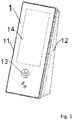
- an elevator-calling device 1 includes a front panel 11 and a back casing 12.
- the front panel 11 may include a display screen 14 and a rotatable button 13.
- a circuit board and a processor 16 and an assistant sound generating unit 15 and other components arranged on the circuit board may be disposed in a cavity between the front panel 11 and the back casing 12.
- the elevator-calling device 1 further includes the processor 16 and the assistant sound generating unit 15.
- the processor 16 is configured to receive an input instruction and send an elevator-calling signal and a preset target floor signal to a main controller 2 of the elevator system.
- the assistant sound generating unit 15 is used for voice broadcasting.
- the processor 16 is connected to the display device 14, the rotatable button 13, and the assistant sound generating unit 15, respectively, e.g., through an interface, a wire, or a circuit board.
- the display device 14 may be, for example, a touchable display device for inputting a preset target floor instruction in a conventional elevator-calling mode.
- a preset target floor For example, an ordinary person may set a preset target floor through the touchable display device 14.
- the processor 16 After receiving the input information of the preset target floor, the processor 16 sends an elevator-calling signal and a preset target floor signal to the main controller 2, which then dispatches the elevator to perform this task and transport ordinary passengers to a desired floor.
- the rotatable button 13 may be used dedicatedly for the disabled, such as blind or deaf or dumb person.
- the rotatable button 13 is connected to the processor 16 and is pressable and rotatable in a first direction (such as clockwise) and a second direction (such as counterclockwise) opposite to the first direction.
- the rotatable button 13 has an initial zero scale, that is, the rotatable button 13 is located at the zero scale when not operated.
- the processor 16 is configured to have an assistant elevator-calling mode to serve the disabled.
- the assistant elevator-calling mode may be entered by pressing the rotatable button at the zero scale and/or by rotating the rotatable button; in other words, in different systems, the processor 16 may be configured to enter the assistant elevator-calling mode when the rotatable button is pressed, or enter the assistant elevator-calling mode when the rotatable button is rotated, or enter the assistant elevator-calling mode by using any of the above methods. In some embodiments, the assistant elevator-calling mode may also be entered by means of sound acquisition and the like.
- the preset target floor is increased when the rotatable button rotates in the first direction, the preset target floor is decreased when the rotatable button rotates in the second direction, and the preset target floor is confirmed when the rotatable button is pressed again at a non-zero scale. Since the embodiment of the present disclosure uses a pressable and rotatable button in place of the design of a single button, it is friendly to the disabled such as the blind person, and the elevator-calling and the setting of the preset floor can be realized by for example merely pressing the button for two times and rotating the button for one time during the entire elevator-calling process. In addition, even in case of mis-operation in which the button is rotated to a wrong floor, it is only required to continue to rotate the button for example in the opposite direction so that the correct floor can be selected again, and there is no need to reselect.
- the rotatable button 3 may include a cover portion and a button body.
- the cover portion may have a Braille 132 and/or a symbol 131 of the disabled and a symbol 133 of the zero scale.
- the symbol 133 of the zero scale may face upward, and the Braille 132 and/or the symbol 131 of the disabled may be well oriented.
- the rotatable button 13 may be provided with a reset mechanism such as a reset spring, which is configured to automatically reset the rotatable button 13 to a position of the zero scale after the operation of the rotatable button 13 is completed.
- the body 134 of the rotatable button 13 may be a rotary encoder having a connection port 135 for connecting to, for example, a circuit board.
- the rotary encoder may send a specific combination of different signals when rotating by each scale in a forward or reverse direction. For example, when the rotatable button 13 rotates by one scale clockwise, the encoder outputs signals "01", “00", “10” and “11” in sequence; when the rotatable button 13 rotates by one scale counterclockwise, the encoder outputs signals "10", "00", "01” and “11” in sequence; and the processor 16 increases or decreases the preset target floor based on the combination of signals.
- the rotatable button 13 is configured with a scale tactile sensation when rotating, that is, a tactile sensation is fed back to the user each time the rotatable button 13 rotates by a scale, so that a blind person can sense the number of adjusted scales by touching and the corresponding adjustment amount of the preset target floor.
- the processor 16 is configured to take the floor of the elevator-calling device as the initial preset target floor when entering the assistant elevator-calling mode, wherein each time the rotatable button rotates by a tactile scale in the first direction, the preset target floor is increased by one, and each time the rotatable button rotates by a tactile scale in the second direction, the preset target floor is decreased by one.
- the 1 st floor may also be used as the initial preset target floor.
- the assistant sound generating unit 15 sends a prompt of operation mode when entering the assistant elevator-calling mode, for example, it broadcasts an operation guidance to inform the operator how to operate. For example, it may broadcast "Please set a preset floor by rotating the button, the floor will be increased by clockwise rotation, and will be decreased by counterclockwise rotation".
- the assistant sound generating unit broadcasts the preset target floor and prompts the user to confirm, when the rotatable button 3 stays at a non-zero scale for more than a preset time t.
- the assistant elevator-calling mode if the user rotates the rotatable button 3 and holds it for t seconds, such as 1 second, 1.5 seconds, etc., then the assistant sound generating unit may ask, for example, "Do you want to go to the L th floor, please press the button to confirm", etc.
- the user deems that the floor is not the floor he/she wants to go to, he/she may continue to rotate the rotatable button 13 until the floor he/she wants to go to is found.
- the display device 14 displays the preset target floor in the assistant elevator-calling mode, so that a non-blind person or other person may confirm the preset target floor.
- An application scenario of the elevator-calling device may be assumed as follows. If a disabled person, such as a blind person, wants to go from the A floor such as the 5 th floor to the B floor such as the 2 nd floor, then he/she presses the rotatable button 13 to enter the assistant elevator-calling mode. At this point, the display device 14 displays that the initial preset target floor is the 5 th floor, and the assistant sound generating unit 15 broadcasts the operation guidance. Subsequently, the blind person may rotate the rotatable button 13 counterclockwise so that it passes by three scales. Since the scale provides a tactile sensation, the blind person can sense the number of scales rotated by.
- the assistant sound generating unit 15 broadcasts "Do you want to go to the 2 nd floor, please press the button to confirm", and then the blind person presses the button.
- the processor 16 receives the input instruction, and sends the elevator-calling signal and the preset target floor signal to the main controller 2.
- the main controller 2 dispatches the elevator to perform the current task and transport the blind person to the 2 nd floor. Even if one excessive scale is rotated by when the blind person rotates the rotatable button 13, the assistant sound generating unit 15 still broadcasts "Do you want to go to the 1 st floor, please confirm".
- the blind person may further rotate the rotatable button 13 clockwise by one scale, and then press the button without reselecting. It can be seen that the elevator-calling device according to the embodiment of the present disclosure is simple to operate and is friendly to the disabled.
- an elevator system which includes: one or more elevators; a main controller configured to control the one or more elevators; and the elevator-calling device according to the embodiments of the present disclosure disposed at one or more floors.
Landscapes
- Engineering & Computer Science (AREA)
- Automation & Control Theory (AREA)
- Computer Networks & Wireless Communication (AREA)
- General Engineering & Computer Science (AREA)
- Theoretical Computer Science (AREA)
- Mechanical Engineering (AREA)
- Human Computer Interaction (AREA)
- Physics & Mathematics (AREA)
- General Physics & Mathematics (AREA)
- Elevator Control (AREA)
Abstract
Description
- The present disclosure relates to the field of elevators, and more particularly, the present disclosure relates to an elevator-calling device and an elevator system having the elevator-calling device.
- Existing elevator systems often include elevator-calling devices arranged at individual floors. A common elevator-calling device is an elevator-calling device having a go-up button and a go-down button, and an elevator car is provided with a panel for setting floors so that a desired destination floor may be set.
- Another type of elevator-calling device is an elevator-calling device which is capable of setting a target floor. A main controller of the elevator directly dispatches the elevator to complete the task of transporting passengers based on the target floor. Such an elevator-calling device is typically provided with a single button arranged for the disabled. When a passenger uses the button arranged for the disabled to set the target floor, such as the 9th floor, he/she needs to press the button for one time under the guidance of an assistant sound so as to enter an assistant setting mode, then presses the button for nine times, and after the assistant sound gives a prompt, the passenger presses the button again for confirmation. The button needs to be pressed for eleven times during the entire process, and when a wrong floor is set due to excessive pressing, the entire process needs to be repeated.
- An object of the present disclosure is to solve or at least alleviate the problems existing in the related art.
- In one aspect, an elevator-calling device is provided, which includes:
- a processor, which is configured to receive an input instruction and send a signal to a main controller of an elevator system;
- a display device connected to the processor;
- a rotatable button, wherein the rotatable button is connected to the processor, and the rotatable button is pressable and rotatable in a first direction and a second direction opposite to the first direction, and wherein the rotatable button has an initial zero scale; and
- an assistant sound generating unit connected to the processor;
- wherein the processor is configured to have an assistant elevator-calling mode, in which a preset target floor is increased when the rotatable button rotates in the first direction, the preset target floor is decreased when the rotatable button rotates in the second direction, and the preset target floor is confirmed when the rotatable button is pressed at a non-zero scale.
- According to some embodiments of the elevator-calling device, the processor is configured to enter the assistant elevator-calling mode when the rotatable button is pressed and/or rotated at the zero scale.
- According to some embodiments of the elevator-calling device, the rotatable button is configured with a scale tactile sensation when rotating.
- According to some embodiments of the elevator-calling device, the processor is configured to, when entering the assistant elevator-calling mode, take the floor on which the elevator-calling device is located or the 1st floor as an initial preset target floor, wherein each time the rotatable button rotates by one scale in the first direction, the preset target floor is increased by one, and each time the rotatable button rotates by one scale in the second direction, the preset target floor is decreased by one.
- According to some embodiments of the elevator-calling device, the assistant sound generating unit broadcasts a prompt of operation mode when entering the elevator-calling mode.
- According to some embodiments of the elevator-calling device, the assistant sound generating unit broadcasts the preset target floor and prompts the user to confirm, when the rotatable button stays at a non-zero scale for more than a preset time t.
- According to some embodiments of the elevator-calling device, the rotatable button is provided with a reset mechanism configured to automatically reset the rotatable button to a position of the zero scale after the operation of the rotatable button is completed.
- According to some embodiments of the elevator-calling device, a surface of the rotatable button has a Braille and/or a symbol of the disabled.
- According to some embodiments of the elevator-calling device, the display device displays the preset target floor in the assistant elevator-calling mode.
- According to some embodiments of the elevator-calling device, the rotatable button is a rotary encoder.
- According to some embodiments of the elevator-calling device, the display device is touchable for inputting the preset target floor in a normal elevator-calling mode.
- In another aspect, an elevator system is provided, which includes:
- an elevator;
- a main controller configured to control the elevator; and
- the elevator-calling device according to the embodiments of the present disclosure disposed at one or more floors.
- Hereinafter, embodiments according to the present disclosure will be explained in connection with the accompanying drawings. With reference to the accompanying drawings, the disclosure of the present application will become easier to understand.
-
FIG. 1 shows a perspective view of an elevator-calling device according to an embodiment of the present disclosure; -
FIG. 2 shows a perspective view of a rotatable button of an elevator-calling device according to an embodiment of the present disclosure; and -
FIG. 3 shows a schematic structural view of an elevator system according to an embodiment of the present disclosure. - An elevator-calling device according to an embodiment of the present disclosure will be described with reference to
FIGS. 1 to 3 . As shown inFIG. 1 , an elevator-calling device 1 includes afront panel 11 and aback casing 12. Thefront panel 11 may include adisplay screen 14 and arotatable button 13. A circuit board and aprocessor 16 and an assistantsound generating unit 15 and other components arranged on the circuit board may be disposed in a cavity between thefront panel 11 and theback casing 12. Specifically, as shown inFIG. 3 , the elevator-calling device 1 further includes theprocessor 16 and the assistantsound generating unit 15. Theprocessor 16 is configured to receive an input instruction and send an elevator-calling signal and a preset target floor signal to amain controller 2 of the elevator system. The assistantsound generating unit 15 is used for voice broadcasting. Theprocessor 16 is connected to thedisplay device 14, therotatable button 13, and the assistantsound generating unit 15, respectively, e.g., through an interface, a wire, or a circuit board. In some embodiments, thedisplay device 14 may be, for example, a touchable display device for inputting a preset target floor instruction in a conventional elevator-calling mode. For example, an ordinary person may set a preset target floor through thetouchable display device 14. After receiving the input information of the preset target floor, theprocessor 16 sends an elevator-calling signal and a preset target floor signal to themain controller 2, which then dispatches the elevator to perform this task and transport ordinary passengers to a desired floor. - The
rotatable button 13 may be used dedicatedly for the disabled, such as blind or deaf or dumb person. Therotatable button 13 is connected to theprocessor 16 and is pressable and rotatable in a first direction (such as clockwise) and a second direction (such as counterclockwise) opposite to the first direction. Therotatable button 13 has an initial zero scale, that is, therotatable button 13 is located at the zero scale when not operated. Theprocessor 16 is configured to have an assistant elevator-calling mode to serve the disabled. In some embodiments, the assistant elevator-calling mode may be entered by pressing the rotatable button at the zero scale and/or by rotating the rotatable button; in other words, in different systems, theprocessor 16 may be configured to enter the assistant elevator-calling mode when the rotatable button is pressed, or enter the assistant elevator-calling mode when the rotatable button is rotated, or enter the assistant elevator-calling mode by using any of the above methods. In some embodiments, the assistant elevator-calling mode may also be entered by means of sound acquisition and the like. In the assistant elevator-calling mode, the preset target floor is increased when the rotatable button rotates in the first direction, the preset target floor is decreased when the rotatable button rotates in the second direction, and the preset target floor is confirmed when the rotatable button is pressed again at a non-zero scale. Since the embodiment of the present disclosure uses a pressable and rotatable button in place of the design of a single button, it is friendly to the disabled such as the blind person, and the elevator-calling and the setting of the preset floor can be realized by for example merely pressing the button for two times and rotating the button for one time during the entire elevator-calling process. In addition, even in case of mis-operation in which the button is rotated to a wrong floor, it is only required to continue to rotate the button for example in the opposite direction so that the correct floor can be selected again, and there is no need to reselect. - With continued reference to
FIG. 2 , in some embodiments of the present disclosure, the rotatable button 3 may include a cover portion and a button body. The cover portion may have aBraille 132 and/or asymbol 131 of the disabled and asymbol 133 of the zero scale. When the rotatable button 3 is not rotating, thesymbol 133 of the zero scale may face upward, and the Braille 132 and/or thesymbol 131 of the disabled may be well oriented. In some embodiments, therotatable button 13 may be provided with a reset mechanism such as a reset spring, which is configured to automatically reset therotatable button 13 to a position of the zero scale after the operation of therotatable button 13 is completed. - In some embodiments, the
body 134 of therotatable button 13 may be a rotary encoder having aconnection port 135 for connecting to, for example, a circuit board. The rotary encoder may send a specific combination of different signals when rotating by each scale in a forward or reverse direction. For example, when therotatable button 13 rotates by one scale clockwise, the encoder outputs signals "01", "00", "10" and "11" in sequence; when therotatable button 13 rotates by one scale counterclockwise, the encoder outputs signals "10", "00", "01" and "11" in sequence; and theprocessor 16 increases or decreases the preset target floor based on the combination of signals. In some embodiments, therotatable button 13 is configured with a scale tactile sensation when rotating, that is, a tactile sensation is fed back to the user each time therotatable button 13 rotates by a scale, so that a blind person can sense the number of adjusted scales by touching and the corresponding adjustment amount of the preset target floor. In some embodiments, theprocessor 16 is configured to take the floor of the elevator-calling device as the initial preset target floor when entering the assistant elevator-calling mode, wherein each time the rotatable button rotates by a tactile scale in the first direction, the preset target floor is increased by one, and each time the rotatable button rotates by a tactile scale in the second direction, the preset target floor is decreased by one. Alternatively, the 1st floor may also be used as the initial preset target floor. In some embodiments, the assistantsound generating unit 15 sends a prompt of operation mode when entering the assistant elevator-calling mode, for example, it broadcasts an operation guidance to inform the operator how to operate. For example, it may broadcast "Please set a preset floor by rotating the button, the floor will be increased by clockwise rotation, and will be decreased by counterclockwise rotation". In some embodiments, the assistant sound generating unit broadcasts the preset target floor and prompts the user to confirm, when the rotatable button 3 stays at a non-zero scale for more than a preset time t. For example, in the assistant elevator-calling mode, if the user rotates the rotatable button 3 and holds it for t seconds, such as 1 second, 1.5 seconds, etc., then the assistant sound generating unit may ask, for example, "Do you want to go to the Lth floor, please press the button to confirm", etc. At this point, if the user deems that the floor is not the floor he/she wants to go to, he/she may continue to rotate therotatable button 13 until the floor he/she wants to go to is found. In some embodiments, thedisplay device 14 displays the preset target floor in the assistant elevator-calling mode, so that a non-blind person or other person may confirm the preset target floor. - An application scenario of the elevator-calling device according to some embodiments of the present disclosure may be assumed as follows. If a disabled person, such as a blind person, wants to go from the A floor such as the 5th floor to the B floor such as the 2nd floor, then he/she presses the
rotatable button 13 to enter the assistant elevator-calling mode. At this point, thedisplay device 14 displays that the initial preset target floor is the 5th floor, and the assistantsound generating unit 15 broadcasts the operation guidance. Subsequently, the blind person may rotate therotatable button 13 counterclockwise so that it passes by three scales. Since the scale provides a tactile sensation, the blind person can sense the number of scales rotated by. When therotatable button 13 rotates to the scale and pauses for 1 second, the assistantsound generating unit 15 broadcasts "Do you want to go to the 2nd floor, please press the button to confirm", and then the blind person presses the button. Theprocessor 16 receives the input instruction, and sends the elevator-calling signal and the preset target floor signal to themain controller 2. Themain controller 2 dispatches the elevator to perform the current task and transport the blind person to the 2nd floor. Even if one excessive scale is rotated by when the blind person rotates therotatable button 13, the assistantsound generating unit 15 still broadcasts "Do you want to go to the 1st floor, please confirm". In this case, the blind person may further rotate therotatable button 13 clockwise by one scale, and then press the button without reselecting. It can be seen that the elevator-calling device according to the embodiment of the present disclosure is simple to operate and is friendly to the disabled. - In another aspect, an elevator system is further provided, which includes: one or more elevators; a main controller configured to control the one or more elevators; and the elevator-calling device according to the embodiments of the present disclosure disposed at one or more floors.
- The specific embodiments described above are merely for describing the principle of the present disclosure more clearly, and various components are clearly illustrated or depicted to make it easier to understand the principle of the present disclosure. Those skilled in the art can readily make various modifications or changes to the present disclosure without departing from the scope of the present disclosure. It should be understood that these modifications or changes should be included within the scope of protection of the present disclosure.
Claims (11)
- An elevator-calling device, comprising:a processor, which is configured to receive an input instruction and send a signal to a main controller of an elevator system;a display device connected to the processor;a rotatable button, wherein the rotatable button is connected to the processor, and the rotatable button is pressable and rotatable in a first direction and a second direction opposite to the first direction, and wherein the rotatable button has an initial zero scale; andan assistant sound generating unit connected to the processor;wherein the processor is configured to have an assistant elevator-calling mode, in which a preset target floor is increased when the rotatable button rotates in the first direction, the preset target floor is decreased when the rotatable button rotates in the second direction, and the preset target floor is confirmed when the rotatable button is pressed at a non-zero scale.
- The elevator-calling device according to claim 1, wherein the processor is configured to enter the assistant elevator-calling mode when the rotatable button at the zero scale is pressed and/or rotated.
- The elevator-calling device according to claim 1 or 2, wherein the rotatable button is configured with a scale tactile sensation when rotating.
- The elevator-calling device according to any preceding claim, wherein the processor is configured to, when entering the assistant elevator-calling mode, take the floor on which the elevator-calling device is located or the 1st floor as an initial preset target floor, and wherein each time the rotatable button rotates by one scale in the first direction, the preset target floor is increased by one, and each time the rotatable button rotates by one scale in the second direction, the preset target floor is decreased by one.
- The elevator-calling device according to any preceding claim, wherein the assistant sound generating unit broadcasts a prompt of operation mode when entering the elevator-calling mode.
- The elevator-calling device according to any preceding claim, wherein the assistant sound generating unit broadcasts the preset target floor and prompts the user to confirm, when the rotatable button stays at a non-zero scale for more than a preset time t.
- The elevator-calling device according to any preceding claim, wherein the rotatable button is provided with a reset mechanism configured to automatically reset the rotatable button to a position of the zero scale after the operation of the rotatable button is completed.
- The elevator-calling device according to any preceding claim, wherein a surface of the rotatable button has a Braille and/or a symbol of the disabled.
- The elevator-calling device according to any preceding claim, wherein the display device displays the preset target floor in the assistant elevator-calling mode.
- The elevator-calling device according to any preceding claim, wherein the rotatable button is a rotary encoder.
- An elevator system, comprising:an elevator;a main controller configured to control the elevator; andthe elevator-calling device according to any one of claims 1 to 10 disposed at one or more floors.
Applications Claiming Priority (1)
| Application Number | Priority Date | Filing Date | Title |
|---|---|---|---|
| CN201910265456.3A CN111776897A (en) | 2019-04-03 | 2019-04-03 | Call device and elevator system |
Publications (2)
| Publication Number | Publication Date |
|---|---|
| EP3718940A1 true EP3718940A1 (en) | 2020-10-07 |
| EP3718940B1 EP3718940B1 (en) | 2024-07-10 |
Family
ID=69411123
Family Applications (1)
| Application Number | Title | Priority Date | Filing Date |
|---|---|---|---|
| EP19218595.7A Active EP3718940B1 (en) | 2019-04-03 | 2019-12-20 | Elevator calling device and elevator system |
Country Status (3)
| Country | Link |
|---|---|
| US (1) | US12240733B2 (en) |
| EP (1) | EP3718940B1 (en) |
| CN (1) | CN111776897A (en) |
Cited By (1)
| Publication number | Priority date | Publication date | Assignee | Title |
|---|---|---|---|---|
| US20200317469A1 (en) * | 2019-04-03 | 2020-10-08 | Otis Elevator Company | Elevator calling device and elevator system |
Families Citing this family (1)
| Publication number | Priority date | Publication date | Assignee | Title |
|---|---|---|---|---|
| CN115385199A (en) * | 2022-08-03 | 2022-11-25 | 上海三菱电梯有限公司 | Method for identifying visually impaired passengers and elevator destination floor registration method |
Citations (4)
| Publication number | Priority date | Publication date | Assignee | Title |
|---|---|---|---|---|
| US5679933A (en) * | 1994-10-06 | 1997-10-21 | Weber Steuerungstechnik Gmbh | Control panels for elevators |
| WO2005121003A2 (en) * | 2004-06-09 | 2005-12-22 | Kone Corporation | Elevator arrangement |
| JP2016145087A (en) * | 2015-02-06 | 2016-08-12 | 三菱電機株式会社 | Elevator hall control panel |
| US20180127234A1 (en) * | 2015-05-20 | 2018-05-10 | Kone Corporation | Control panel with accessibility wheel |
Family Cites Families (3)
| Publication number | Priority date | Publication date | Assignee | Title |
|---|---|---|---|---|
| US5678933A (en) | 1995-01-20 | 1997-10-21 | Nsk Ltd. | Speed sensing rolling bearing unit |
| CN111776897A (en) * | 2019-04-03 | 2020-10-16 | 奥的斯电梯公司 | Call device and elevator system |
| WO2021214189A1 (en) * | 2020-04-23 | 2021-10-28 | Inventio Ag | Elevator operating device having two call input devices disposed separate from each other with respect to passengers |
-
2019
- 2019-04-03 CN CN201910265456.3A patent/CN111776897A/en active Pending
- 2019-12-20 EP EP19218595.7A patent/EP3718940B1/en active Active
- 2019-12-20 US US16/723,256 patent/US12240733B2/en active Active
Patent Citations (4)
| Publication number | Priority date | Publication date | Assignee | Title |
|---|---|---|---|---|
| US5679933A (en) * | 1994-10-06 | 1997-10-21 | Weber Steuerungstechnik Gmbh | Control panels for elevators |
| WO2005121003A2 (en) * | 2004-06-09 | 2005-12-22 | Kone Corporation | Elevator arrangement |
| JP2016145087A (en) * | 2015-02-06 | 2016-08-12 | 三菱電機株式会社 | Elevator hall control panel |
| US20180127234A1 (en) * | 2015-05-20 | 2018-05-10 | Kone Corporation | Control panel with accessibility wheel |
Cited By (2)
| Publication number | Priority date | Publication date | Assignee | Title |
|---|---|---|---|---|
| US20200317469A1 (en) * | 2019-04-03 | 2020-10-08 | Otis Elevator Company | Elevator calling device and elevator system |
| US12240733B2 (en) * | 2019-04-03 | 2025-03-04 | Otis Elevator Company | Elevator calling device and elevator system |
Also Published As
| Publication number | Publication date |
|---|---|
| CN111776897A (en) | 2020-10-16 |
| EP3718940B1 (en) | 2024-07-10 |
| US12240733B2 (en) | 2025-03-04 |
| US20200317469A1 (en) | 2020-10-08 |
Similar Documents
| Publication | Publication Date | Title |
|---|---|---|
| US7040458B2 (en) | Elevator destination protocol control with flexible user interface | |
| EP2768756B1 (en) | Elevator passenger interface including special assistance features | |
| US12240733B2 (en) | Elevator calling device and elevator system | |
| US10494225B2 (en) | Control panel with accessibility wheel | |
| CN116323454B (en) | Elevator and elevator control method | |
| CN104640800A (en) | A method for giving destination calls in an elevator system and an elevator system | |
| WO2005077803A1 (en) | Call registration device for elevator | |
| JP4292161B2 (en) | Elevator call button with tactile feedback | |
| JPH11278764A (en) | Car operating board for elevator | |
| CN116056996B (en) | Elevator installation with an elevator operating device for passengers with restricted movement | |
| JP6513775B1 (en) | Elevator system | |
| JP6173256B2 (en) | Group management elevator equipment | |
| US12612284B2 (en) | Call input device with display and call input detection method for calling an elevator car | |
| KR102222203B1 (en) | Hybrid key panel module | |
| JP2009501686A (en) | Communication of operation interruption information in the group elevator system | |
| US20190177117A1 (en) | Elevator operating panel | |
| JP2758276B2 (en) | Elevator car call registration device | |
| JP2006127170A (en) | Information terminal input system | |
| JP2017186121A (en) | Operation board for elevator | |
| JP6658649B2 (en) | Destination floor registration device, elevator system | |
| JP7549818B1 (en) | Elevator System | |
| CN204917497U (en) | Destination floor setting system | |
| HK40083390A (en) | Elevator system having elevator operating devices for passengers with limited mobility | |
| KR20260032675A (en) | Variable tactile keypad | |
| JPS6174010A (en) | Operator console |
Legal Events
| Date | Code | Title | Description |
|---|---|---|---|
| PUAI | Public reference made under article 153(3) epc to a published international application that has entered the european phase |
Free format text: ORIGINAL CODE: 0009012 |
|
| STAA | Information on the status of an ep patent application or granted ep patent |
Free format text: STATUS: THE APPLICATION HAS BEEN PUBLISHED |
|
| AK | Designated contracting states |
Kind code of ref document: A1 Designated state(s): AL AT BE BG CH CY CZ DE DK EE ES FI FR GB GR HR HU IE IS IT LI LT LU LV MC MK MT NL NO PL PT RO RS SE SI SK SM TR |
|
| AX | Request for extension of the european patent |
Extension state: BA ME |
|
| STAA | Information on the status of an ep patent application or granted ep patent |
Free format text: STATUS: REQUEST FOR EXAMINATION WAS MADE |
|
| 17P | Request for examination filed |
Effective date: 20210406 |
|
| RBV | Designated contracting states (corrected) |
Designated state(s): AL AT BE BG CH CY CZ DE DK EE ES FI FR GB GR HR HU IE IS IT LI LT LU LV MC MK MT NL NO PL PT RO RS SE SI SK SM TR |
|
| STAA | Information on the status of an ep patent application or granted ep patent |
Free format text: STATUS: EXAMINATION IS IN PROGRESS |
|
| 17Q | First examination report despatched |
Effective date: 20221017 |
|
| RIC1 | Information provided on ipc code assigned before grant |
Ipc: B66B 1/24 20060101ALI20231220BHEP Ipc: B66B 1/46 20060101AFI20231220BHEP |
|
| GRAP | Despatch of communication of intention to grant a patent |
Free format text: ORIGINAL CODE: EPIDOSNIGR1 |
|
| STAA | Information on the status of an ep patent application or granted ep patent |
Free format text: STATUS: GRANT OF PATENT IS INTENDED |
|
| INTG | Intention to grant announced |
Effective date: 20240205 |
|
| GRAS | Grant fee paid |
Free format text: ORIGINAL CODE: EPIDOSNIGR3 |
|
| GRAA | (expected) grant |
Free format text: ORIGINAL CODE: 0009210 |
|
| STAA | Information on the status of an ep patent application or granted ep patent |
Free format text: STATUS: THE PATENT HAS BEEN GRANTED |
|
| AK | Designated contracting states |
Kind code of ref document: B1 Designated state(s): AL AT BE BG CH CY CZ DE DK EE ES FI FR GB GR HR HU IE IS IT LI LT LU LV MC MK MT NL NO PL PT RO RS SE SI SK SM TR |
|
| REG | Reference to a national code |
Ref country code: CH Ref legal event code: EP |
|
| REG | Reference to a national code |
Ref country code: DE Ref legal event code: R096 Ref document number: 602019054916 Country of ref document: DE |
|
| REG | Reference to a national code |
Ref country code: LT Ref legal event code: MG9D |
|
| REG | Reference to a national code |
Ref country code: NL Ref legal event code: MP Effective date: 20240710 |
|
| PG25 | Lapsed in a contracting state [announced via postgrant information from national office to epo] |
Ref country code: PT Free format text: LAPSE BECAUSE OF FAILURE TO SUBMIT A TRANSLATION OF THE DESCRIPTION OR TO PAY THE FEE WITHIN THE PRESCRIBED TIME-LIMIT Effective date: 20241111 |
|
| REG | Reference to a national code |
Ref country code: AT Ref legal event code: MK05 Ref document number: 1701909 Country of ref document: AT Kind code of ref document: T Effective date: 20240710 |
|
| PG25 | Lapsed in a contracting state [announced via postgrant information from national office to epo] |
Ref country code: NL Free format text: LAPSE BECAUSE OF FAILURE TO SUBMIT A TRANSLATION OF THE DESCRIPTION OR TO PAY THE FEE WITHIN THE PRESCRIBED TIME-LIMIT Effective date: 20240710 |
|
| PG25 | Lapsed in a contracting state [announced via postgrant information from national office to epo] |
Ref country code: PT Free format text: LAPSE BECAUSE OF FAILURE TO SUBMIT A TRANSLATION OF THE DESCRIPTION OR TO PAY THE FEE WITHIN THE PRESCRIBED TIME-LIMIT Effective date: 20241111 Ref country code: NL Free format text: LAPSE BECAUSE OF FAILURE TO SUBMIT A TRANSLATION OF THE DESCRIPTION OR TO PAY THE FEE WITHIN THE PRESCRIBED TIME-LIMIT Effective date: 20240710 |
|
| PG25 | Lapsed in a contracting state [announced via postgrant information from national office to epo] |
Ref country code: NO Free format text: LAPSE BECAUSE OF FAILURE TO SUBMIT A TRANSLATION OF THE DESCRIPTION OR TO PAY THE FEE WITHIN THE PRESCRIBED TIME-LIMIT Effective date: 20241010 |
|
| PG25 | Lapsed in a contracting state [announced via postgrant information from national office to epo] |
Ref country code: PL Free format text: LAPSE BECAUSE OF FAILURE TO SUBMIT A TRANSLATION OF THE DESCRIPTION OR TO PAY THE FEE WITHIN THE PRESCRIBED TIME-LIMIT Effective date: 20240710 Ref country code: FI Free format text: LAPSE BECAUSE OF FAILURE TO SUBMIT A TRANSLATION OF THE DESCRIPTION OR TO PAY THE FEE WITHIN THE PRESCRIBED TIME-LIMIT Effective date: 20240710 Ref country code: GR Free format text: LAPSE BECAUSE OF FAILURE TO SUBMIT A TRANSLATION OF THE DESCRIPTION OR TO PAY THE FEE WITHIN THE PRESCRIBED TIME-LIMIT Effective date: 20241011 |
|
| PG25 | Lapsed in a contracting state [announced via postgrant information from national office to epo] |
Ref country code: BG Free format text: LAPSE BECAUSE OF FAILURE TO SUBMIT A TRANSLATION OF THE DESCRIPTION OR TO PAY THE FEE WITHIN THE PRESCRIBED TIME-LIMIT Effective date: 20240710 |
|
| PG25 | Lapsed in a contracting state [announced via postgrant information from national office to epo] |
Ref country code: LV Free format text: LAPSE BECAUSE OF FAILURE TO SUBMIT A TRANSLATION OF THE DESCRIPTION OR TO PAY THE FEE WITHIN THE PRESCRIBED TIME-LIMIT Effective date: 20240710 |
|
| PG25 | Lapsed in a contracting state [announced via postgrant information from national office to epo] |
Ref country code: AT Free format text: LAPSE BECAUSE OF FAILURE TO SUBMIT A TRANSLATION OF THE DESCRIPTION OR TO PAY THE FEE WITHIN THE PRESCRIBED TIME-LIMIT Effective date: 20240710 Ref country code: IS Free format text: LAPSE BECAUSE OF FAILURE TO SUBMIT A TRANSLATION OF THE DESCRIPTION OR TO PAY THE FEE WITHIN THE PRESCRIBED TIME-LIMIT Effective date: 20241110 |
|
| PG25 | Lapsed in a contracting state [announced via postgrant information from national office to epo] |
Ref country code: HR Free format text: LAPSE BECAUSE OF FAILURE TO SUBMIT A TRANSLATION OF THE DESCRIPTION OR TO PAY THE FEE WITHIN THE PRESCRIBED TIME-LIMIT Effective date: 20240710 |
|
| PG25 | Lapsed in a contracting state [announced via postgrant information from national office to epo] |
Ref country code: ES Free format text: LAPSE BECAUSE OF FAILURE TO SUBMIT A TRANSLATION OF THE DESCRIPTION OR TO PAY THE FEE WITHIN THE PRESCRIBED TIME-LIMIT Effective date: 20240710 Ref country code: RS Free format text: LAPSE BECAUSE OF FAILURE TO SUBMIT A TRANSLATION OF THE DESCRIPTION OR TO PAY THE FEE WITHIN THE PRESCRIBED TIME-LIMIT Effective date: 20241010 |
|
| PG25 | Lapsed in a contracting state [announced via postgrant information from national office to epo] |
Ref country code: RS Free format text: LAPSE BECAUSE OF FAILURE TO SUBMIT A TRANSLATION OF THE DESCRIPTION OR TO PAY THE FEE WITHIN THE PRESCRIBED TIME-LIMIT Effective date: 20241010 Ref country code: PL Free format text: LAPSE BECAUSE OF FAILURE TO SUBMIT A TRANSLATION OF THE DESCRIPTION OR TO PAY THE FEE WITHIN THE PRESCRIBED TIME-LIMIT Effective date: 20240710 Ref country code: NO Free format text: LAPSE BECAUSE OF FAILURE TO SUBMIT A TRANSLATION OF THE DESCRIPTION OR TO PAY THE FEE WITHIN THE PRESCRIBED TIME-LIMIT Effective date: 20241010 Ref country code: LV Free format text: LAPSE BECAUSE OF FAILURE TO SUBMIT A TRANSLATION OF THE DESCRIPTION OR TO PAY THE FEE WITHIN THE PRESCRIBED TIME-LIMIT Effective date: 20240710 Ref country code: IS Free format text: LAPSE BECAUSE OF FAILURE TO SUBMIT A TRANSLATION OF THE DESCRIPTION OR TO PAY THE FEE WITHIN THE PRESCRIBED TIME-LIMIT Effective date: 20241110 Ref country code: HR Free format text: LAPSE BECAUSE OF FAILURE TO SUBMIT A TRANSLATION OF THE DESCRIPTION OR TO PAY THE FEE WITHIN THE PRESCRIBED TIME-LIMIT Effective date: 20240710 Ref country code: GR Free format text: LAPSE BECAUSE OF FAILURE TO SUBMIT A TRANSLATION OF THE DESCRIPTION OR TO PAY THE FEE WITHIN THE PRESCRIBED TIME-LIMIT Effective date: 20241011 Ref country code: FI Free format text: LAPSE BECAUSE OF FAILURE TO SUBMIT A TRANSLATION OF THE DESCRIPTION OR TO PAY THE FEE WITHIN THE PRESCRIBED TIME-LIMIT Effective date: 20240710 Ref country code: ES Free format text: LAPSE BECAUSE OF FAILURE TO SUBMIT A TRANSLATION OF THE DESCRIPTION OR TO PAY THE FEE WITHIN THE PRESCRIBED TIME-LIMIT Effective date: 20240710 Ref country code: BG Free format text: LAPSE BECAUSE OF FAILURE TO SUBMIT A TRANSLATION OF THE DESCRIPTION OR TO PAY THE FEE WITHIN THE PRESCRIBED TIME-LIMIT Effective date: 20240710 Ref country code: AT Free format text: LAPSE BECAUSE OF FAILURE TO SUBMIT A TRANSLATION OF THE DESCRIPTION OR TO PAY THE FEE WITHIN THE PRESCRIBED TIME-LIMIT Effective date: 20240710 |
|
| REG | Reference to a national code |
Ref country code: DE Ref legal event code: R097 Ref document number: 602019054916 Country of ref document: DE |
|
| PG25 | Lapsed in a contracting state [announced via postgrant information from national office to epo] |
Ref country code: DK Free format text: LAPSE BECAUSE OF FAILURE TO SUBMIT A TRANSLATION OF THE DESCRIPTION OR TO PAY THE FEE WITHIN THE PRESCRIBED TIME-LIMIT Effective date: 20240710 Ref country code: SM Free format text: LAPSE BECAUSE OF FAILURE TO SUBMIT A TRANSLATION OF THE DESCRIPTION OR TO PAY THE FEE WITHIN THE PRESCRIBED TIME-LIMIT Effective date: 20240710 Ref country code: RO Free format text: LAPSE BECAUSE OF FAILURE TO SUBMIT A TRANSLATION OF THE DESCRIPTION OR TO PAY THE FEE WITHIN THE PRESCRIBED TIME-LIMIT Effective date: 20240710 |
|
| PG25 | Lapsed in a contracting state [announced via postgrant information from national office to epo] |
Ref country code: EE Free format text: LAPSE BECAUSE OF FAILURE TO SUBMIT A TRANSLATION OF THE DESCRIPTION OR TO PAY THE FEE WITHIN THE PRESCRIBED TIME-LIMIT Effective date: 20240710 |
|
| PG25 | Lapsed in a contracting state [announced via postgrant information from national office to epo] |
Ref country code: CZ Free format text: LAPSE BECAUSE OF FAILURE TO SUBMIT A TRANSLATION OF THE DESCRIPTION OR TO PAY THE FEE WITHIN THE PRESCRIBED TIME-LIMIT Effective date: 20240710 |
|
| PG25 | Lapsed in a contracting state [announced via postgrant information from national office to epo] |
Ref country code: SK Free format text: LAPSE BECAUSE OF FAILURE TO SUBMIT A TRANSLATION OF THE DESCRIPTION OR TO PAY THE FEE WITHIN THE PRESCRIBED TIME-LIMIT Effective date: 20240710 Ref country code: IT Free format text: LAPSE BECAUSE OF FAILURE TO SUBMIT A TRANSLATION OF THE DESCRIPTION OR TO PAY THE FEE WITHIN THE PRESCRIBED TIME-LIMIT Effective date: 20240710 |
|
| PLBE | No opposition filed within time limit |
Free format text: ORIGINAL CODE: 0009261 |
|
| STAA | Information on the status of an ep patent application or granted ep patent |
Free format text: STATUS: NO OPPOSITION FILED WITHIN TIME LIMIT |
|
| 26N | No opposition filed |
Effective date: 20250411 |
|
| PG25 | Lapsed in a contracting state [announced via postgrant information from national office to epo] |
Ref country code: MC Free format text: LAPSE BECAUSE OF FAILURE TO SUBMIT A TRANSLATION OF THE DESCRIPTION OR TO PAY THE FEE WITHIN THE PRESCRIBED TIME-LIMIT Effective date: 20240710 |
|
| REG | Reference to a national code |
Ref country code: CH Ref legal event code: PL |
|
| PG25 | Lapsed in a contracting state [announced via postgrant information from national office to epo] |
Ref country code: LU Free format text: LAPSE BECAUSE OF NON-PAYMENT OF DUE FEES Effective date: 20241220 |
|
| GBPC | Gb: european patent ceased through non-payment of renewal fee |
Effective date: 20241220 |
|
| PG25 | Lapsed in a contracting state [announced via postgrant information from national office to epo] |
Ref country code: SE Free format text: LAPSE BECAUSE OF FAILURE TO SUBMIT A TRANSLATION OF THE DESCRIPTION OR TO PAY THE FEE WITHIN THE PRESCRIBED TIME-LIMIT Effective date: 20240710 |
|
| REG | Reference to a national code |
Ref country code: BE Ref legal event code: MM Effective date: 20241231 |
|
| PG25 | Lapsed in a contracting state [announced via postgrant information from national office to epo] |
Ref country code: GB Free format text: LAPSE BECAUSE OF NON-PAYMENT OF DUE FEES Effective date: 20241220 Ref country code: BE Free format text: LAPSE BECAUSE OF NON-PAYMENT OF DUE FEES Effective date: 20241231 |
|
| PG25 | Lapsed in a contracting state [announced via postgrant information from national office to epo] |
Ref country code: CH Free format text: LAPSE BECAUSE OF NON-PAYMENT OF DUE FEES Effective date: 20241231 |
|
| PG25 | Lapsed in a contracting state [announced via postgrant information from national office to epo] |
Ref country code: IE Free format text: LAPSE BECAUSE OF NON-PAYMENT OF DUE FEES Effective date: 20241220 |
|
| PGFP | Annual fee paid to national office [announced via postgrant information from national office to epo] |
Ref country code: DE Payment date: 20251126 Year of fee payment: 7 |
|
| PGFP | Annual fee paid to national office [announced via postgrant information from national office to epo] |
Ref country code: FR Payment date: 20251120 Year of fee payment: 7 |
|
| PG25 | Lapsed in a contracting state [announced via postgrant information from national office to epo] |
Ref country code: CY Free format text: LAPSE BECAUSE OF FAILURE TO SUBMIT A TRANSLATION OF THE DESCRIPTION OR TO PAY THE FEE WITHIN THE PRESCRIBED TIME-LIMIT Effective date: 20240710 |