EP3717841B1 - Anordnung und verfahren zur optimalen energiespeicherung und zur rückgewinnung von thermischen bohrungen - Google Patents
Anordnung und verfahren zur optimalen energiespeicherung und zur rückgewinnung von thermischen bohrungen Download PDFInfo
- Publication number
- EP3717841B1 EP3717841B1 EP18883526.8A EP18883526A EP3717841B1 EP 3717841 B1 EP3717841 B1 EP 3717841B1 EP 18883526 A EP18883526 A EP 18883526A EP 3717841 B1 EP3717841 B1 EP 3717841B1
- Authority
- EP
- European Patent Office
- Prior art keywords
- storage
- bore
- heat
- heat transfer
- transfer fluid
- Prior art date
- Legal status (The legal status is an assumption and is not a legal conclusion. Google has not performed a legal analysis and makes no representation as to the accuracy of the status listed.)
- Active
Links
Images


Classifications
-
- F—MECHANICAL ENGINEERING; LIGHTING; HEATING; WEAPONS; BLASTING
- F24—HEATING; RANGES; VENTILATING
- F24T—GEOTHERMAL COLLECTORS; GEOTHERMAL SYSTEMS
- F24T10/00—Geothermal collectors
- F24T10/10—Geothermal collectors with circulation of working fluids through underground channels, the working fluids not coming into direct contact with the ground
- F24T10/13—Geothermal collectors with circulation of working fluids through underground channels, the working fluids not coming into direct contact with the ground using tube assemblies suitable for insertion into boreholes in the ground, e.g. geothermal probes
- F24T10/15—Geothermal collectors with circulation of working fluids through underground channels, the working fluids not coming into direct contact with the ground using tube assemblies suitable for insertion into boreholes in the ground, e.g. geothermal probes using bent tubes; using tubes assembled with connectors or with return headers
-
- F—MECHANICAL ENGINEERING; LIGHTING; HEATING; WEAPONS; BLASTING
- F24—HEATING; RANGES; VENTILATING
- F24T—GEOTHERMAL COLLECTORS; GEOTHERMAL SYSTEMS
- F24T10/00—Geothermal collectors
- F24T10/30—Geothermal collectors using underground reservoirs for accumulating working fluids or intermediate fluids
-
- F—MECHANICAL ENGINEERING; LIGHTING; HEATING; WEAPONS; BLASTING
- F28—HEAT EXCHANGE IN GENERAL
- F28D—HEAT-EXCHANGE APPARATUS, NOT PROVIDED FOR IN ANOTHER SUBCLASS, IN WHICH THE HEAT-EXCHANGE MEDIA DO NOT COME INTO DIRECT CONTACT
- F28D20/00—Heat storage plants or apparatus in general; Regenerative heat-exchange apparatus not covered by groups F28D17/00 or F28D19/00
- F28D20/0034—Heat storage plants or apparatus in general; Regenerative heat-exchange apparatus not covered by groups F28D17/00 or F28D19/00 using liquid heat storage material
- F28D20/0043—Heat storage plants or apparatus in general; Regenerative heat-exchange apparatus not covered by groups F28D17/00 or F28D19/00 using liquid heat storage material specially adapted for long-term heat storage; Underground tanks; Floating reservoirs; Pools; Ponds
-
- F—MECHANICAL ENGINEERING; LIGHTING; HEATING; WEAPONS; BLASTING
- F28—HEAT EXCHANGE IN GENERAL
- F28D—HEAT-EXCHANGE APPARATUS, NOT PROVIDED FOR IN ANOTHER SUBCLASS, IN WHICH THE HEAT-EXCHANGE MEDIA DO NOT COME INTO DIRECT CONTACT
- F28D20/00—Heat storage plants or apparatus in general; Regenerative heat-exchange apparatus not covered by groups F28D17/00 or F28D19/00
- F28D20/0052—Heat storage plants or apparatus in general; Regenerative heat-exchange apparatus not covered by groups F28D17/00 or F28D19/00 using the ground body or aquifers as heat storage medium
-
- F—MECHANICAL ENGINEERING; LIGHTING; HEATING; WEAPONS; BLASTING
- F24—HEATING; RANGES; VENTILATING
- F24T—GEOTHERMAL COLLECTORS; GEOTHERMAL SYSTEMS
- F24T10/00—Geothermal collectors
- F24T2010/50—Component parts, details or accessories
- F24T2010/56—Control arrangements
-
- F—MECHANICAL ENGINEERING; LIGHTING; HEATING; WEAPONS; BLASTING
- F24—HEATING; RANGES; VENTILATING
- F24T—GEOTHERMAL COLLECTORS; GEOTHERMAL SYSTEMS
- F24T50/00—Geothermal systems
-
- Y—GENERAL TAGGING OF NEW TECHNOLOGICAL DEVELOPMENTS; GENERAL TAGGING OF CROSS-SECTIONAL TECHNOLOGIES SPANNING OVER SEVERAL SECTIONS OF THE IPC; TECHNICAL SUBJECTS COVERED BY FORMER USPC CROSS-REFERENCE ART COLLECTIONS [XRACs] AND DIGESTS
- Y02—TECHNOLOGIES OR APPLICATIONS FOR MITIGATION OR ADAPTATION AGAINST CLIMATE CHANGE
- Y02E—REDUCTION OF GREENHOUSE GAS [GHG] EMISSIONS, RELATED TO ENERGY GENERATION, TRANSMISSION OR DISTRIBUTION
- Y02E10/00—Energy generation through renewable energy sources
- Y02E10/10—Geothermal energy
-
- Y—GENERAL TAGGING OF NEW TECHNOLOGICAL DEVELOPMENTS; GENERAL TAGGING OF CROSS-SECTIONAL TECHNOLOGIES SPANNING OVER SEVERAL SECTIONS OF THE IPC; TECHNICAL SUBJECTS COVERED BY FORMER USPC CROSS-REFERENCE ART COLLECTIONS [XRACs] AND DIGESTS
- Y02—TECHNOLOGIES OR APPLICATIONS FOR MITIGATION OR ADAPTATION AGAINST CLIMATE CHANGE
- Y02E—REDUCTION OF GREENHOUSE GAS [GHG] EMISSIONS, RELATED TO ENERGY GENERATION, TRANSMISSION OR DISTRIBUTION
- Y02E60/00—Enabling technologies; Technologies with a potential or indirect contribution to GHG emissions mitigation
- Y02E60/14—Thermal energy storage
Definitions
- the invention relates to an arrangement according to claim 1, by which underground thermal wells used as heat storages may be replenished and harvested with optimal thermo-economic results.
- the invention also relates to a method as claimed in the preamble of claim 4, by means of which such optimal storing and recapturing may be implemented.
- the bedrock surrounding the bore well cools down by approximately 3 degrees in the long run when it is normally loaded.
- surplus heat created in the heating system it is possible to reduce the amount of energy harvested from the thermal energy naturally present in the bedrock, whereby the temperature of the bedrock may be maintained or even raised. This way, the so-called COP values of thermal recovery may be improved.
- BTES Borehole thermal energy storages
- the depth of the bore wells used in the systems in such bedrock storages is usually approximately 100 to 150 metres. In soil layers, the depth of the bore wells is largely dependant on the quality of the soil layer. Bore wells thermal energy storages may be so called “open” or “closed” ones.
- heat transfer fluid circulates in a closed circuit (Ground Heat Exchanger - GHX), in which heat is transferred to the soil layer or bedrock by conduction through the walls of pipes installed in it.
- a major problem with the prior art solutions is that heating a bore well storage takes up a lot of time. For example, at said Drake Landing site, the temperature of the storage became stable only after three years from the start of the storing.
- a second major problem is that the heat loss of a heat storage is very large. It is estimated that 40 % of the energy directed into the storage is lost as leaks to the structural layer of the soil or bedrock. If the flow of groundwater taking place in the storage is notable, the heat loss is significantly more than this.
- An object of the invention is thus to develop an arrangement and a method for utilizing such an arrangement to enable the aforementioned problems to be for the most part solved.
- the object of the invention is thus achieved by a method and system, which are characterized by what is disclosed in the characterizing parts of independent claims 1 to 4. Preferred embodiments of the invention are disclosed in the dependent claims.
- the basic idea of the invention is that by monitoring the temperature in different parts of the bore well storage, the parts of the storage may primarily be heated where the temperature has decreased below a separately definable threshold value.
- the system according to the invention allows, for example, the utilization of thermal energy without a specific heat exchanger. Because the temperature in each part of the heat storage is well known, the circulating fluid of a heating system connected to it may be led to the exact area of the storage from where the targeted amount of energy may be harvested.
- the system of the invention continuously monitors the temperature in different parts of the storage and the parts of the storage are primarily heated where the temperature has decreased below a separately definable threshold value, storing of energy is furthermore efficient.
- the thermal energy directed into the system always reaches such a part of the storage, which is able to receive the transferred thermal energy.
- the quantity of piping that the system requires may be substantially decreased at the same time as the flow pressure of the carrier fluid is evened out in the pipelines and collectors in the bore wells.
- Such an arrangement also allows the heat distribution system to be simplified, and better targeting of heat storage and recapturing.
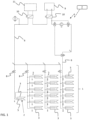
- the first embodiment of the arrangement according to Figures 1 and 2 comprises a thermal storage 1 having a centre storage 2 surrounded by bore wells 3 arranged circularly.
- the circles in this embodiment are advantageously arranged to be substantially concentric whereby there are two or more circles 4.
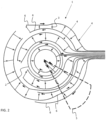
- Figure 1 shows by way of example three circles, and Figure 2 two circles surrounding the centre storage.
- Figure 1 shows by way of example three circles, and Figure 2 two circles surrounding the centre storage.
- Figure 1 shows by way of example three circles, and Figure 2 two circles surrounding the centre storage.
- Figure 1 shows by way of example three circles, and Figure 2 two circles surrounding the centre storage.
- In the middle of the field there is, as shown in Figure 1 , one bore well forming the centre storage, and this is surrounded by a circle that has six bore wells, the next circle 12 bore wells, and the outermost circle 18 bore wells, only part of which are shown in the Figure.
- Figure 2 on the other hand, there are seven bore wells in the middle of the field, which form the centre storage, surrounded by circles
- a circle may have more wells, and there may be only two circles or more than three circles, as needed.
- a circle furthermore need not be a round circle according to the figure, but shapes that are more organic are also an option.
- the number of circles primarily depends on the amount of energy that can be transmitted to the system from solar collectors or other appropriate sources of heat connected to it.
- the aforementioned bore wells It is advantageous to bore the aforementioned bore wells to no more than 60 metres deep, at least in the Finnish bedrock. The reason is that the flow of water in the bedrock become significantly stronger deeper than this. For the above reason, heat emission taking place uncontrollably from the bore well to its surroundings becomes so high at greater depths that the thermal energy directed to the bore well would for the most part be lost.
- the geothermal characteristics at each location must be examined to ensure an advantageous boring depth.
- the bore well has been drilled by using a rather common drill bit size in Finland, that is, with the diameter of 140 mm on the soil layer above rock, and in the bedrock with the diameter of 115 mm.
- the diameter of the hole of the bore well is essentially affected by the structure of collectors on the market, to be installed in the bore well, so other hole sizes may be successfully used.
- the collectors 5 installed in the bore wells are arranged to be in flow communication with each other by means of a pipeline 6 to form a closed flow circuit.
- the path of such a flow may be primarily controlled by valves 8 adapted in each circle and adjusted by a control unit 7.
- each bore well 3 may also be equipped with its own valve, whereby the flow may be adjusted at the accuracy of both the circle 4 and a single bore well 3.
- the carrier fluid mentioned above is referred to as heat transfer fluid, whereby its purpose is to heat the heat storage 1 surrounding the bore well.
- the bore wells 2, 3 according to the present embodiment and solar collectors or other heat sources 9 connected to the system may even utilize a common flow system. Therefore, the entire system may use the same heat transfer fluid, such as propylene glycol. This way it is possible to avoid one or more heat exchangers 10 otherwise installed between the bore wells and heat source.
- the arrangement of Figures 1 and 2 works so that from the solar collectors or another heat source 9 of the system, suitable for the purpose, such as industrial waste heat, thermal energy is stored in a known manner to the heat transfer fluid.
- This thermal energy is primarily utilized for heating a real estate 11, or similar, which is connected to the system and/or producing hot domestic water.
- the thermal energy left in the heat transfer fluid is led to the heat storage 1 according to the present embodiment.
- Thermal energy is in this case transferred to the centre storage 2 and bore wells 3 arranged to surround it.
- the centre storage comprises one bore well whereas in the embodiment of Figure 2 the centre storage comprises a plurality of bore wells.
- the further transfer of thermal energy begins one well and/or sector and/or circle at a time, starting with the bore well on the innermost circle and proceeding to the bore wells along the outermost circle.
- the flow of the heat transfer fluid is controlled by means of the control unit 7 with conventional shutter and three-way valves 8, which open up a flow path to a circle, sector, or even a single bore well, one after the other.
- the centre storage 2 of the heat storage 1 which thus obtains the highest temperature value.
- the temperature values of the bore wells 3 are allowed to decrease little by little. Therefore, the temperature values measured in the most peripheral bore wells are in the arrangement being discussed clearly lower than the values measured in the centre storage.
- a heat distribution according to a Gaussian curve of sorts in the heat storage 1 guarantees that the centre storage can always be kept adequately warm. At the same time, the maintaining of the temperature of the centre storage is achieved with as few heat transfers as possible.
- the arrangement begins to maintain the thermal energy storage formed by the centre storage 2 and the bore wells 3 of the circles 4 surrounding it.
- the control unit 7 continuously compares the temperature of the heat transfer fluid from the heat source with the temperature of the bore well, circle or part of the circle in question.
- the valve 8 opens, and the arriving heat transfer fluid is first led to this part of the heat storage. Therefore, the part of the heat storage, i.e. bore well or group of bore wells, radially outward from the centre of the storage, is heated whose own temperature is below the temperature of the arriving heat transfer fluid.
- the heat distribution maintained in the heat storage 1 is determined by the bedrock or soil layer geothermal characteristics, and together with the amount of thermal energy from one or more heat sources 9 it forms the temperature profile of the heat storage in a particular embodiment of the present arrangement.
- a temperature profile forms the basic setting set for the control unit 7.
- the control unit shifts the flow of the heat transfer fluid, in accordance with the temperature profile, to the most optimal bore well 3 or bore well group from the point of view of storing.
- this carrier fluid is led to the bore wells radially outward from the centre storage of the heat storage.
- the carrier fluid is led to this part of the heat storage to increase its temperature to match the set temperature profile.
- the arrangement begins to maintain the thermal energy storage formed by the centre storage 2 and the bore wells 3 of the circles 4 surrounding it.
- the control unit 7 continuously compares the temperature of the heat transfer fluid arriving from the heat source with the target temperature of the bore well, circle or part of the circle in question.
- the valve 8 opens, and the arriving heat transfer fluid is first led to this part of the heat storage.
- the storage is also heated radially outward from the centre by leading the heat transfer fluid to that part of the heat storage, i.e. bore well or group of bore wells whose own temperature is below the temperature of the arriving heat transfer fluid. After this, the transfer of the thermal energy contained in the heat transfer fluid continues radially outward a circle or part of a circle at a time.
- Figure 2 describes a second preferred embodiment of this arrangement.
- the pipelines 6 are not adapted to surround the bore wells 3 circularly, only, but the circles are divided into a plurality of sectors, the sectors being served by a dedicated pair of pipelines.
- the distribution of the heat transfer fluid may be controlled to the desired bore well faster and more precisely.
- One of such sectors is schematically shown in Figure 2 with reference S.
- the size of the sector may vary, having a central angle of approximately 15 to 180 degrees, advantageously 45 to 60 degrees.
- the storage field is heated radially outwards from the centre of the storage, starting with the first part of the circle of the heat storage 1 whose temperature is below the temperature of the arriving heat transfer fluid. After this, the transfer of the thermal energy to the storage continues in the sector radially outward a circle or part of a circle at a time. When the outermost circle sector has reached its target temperature, the heating of the next adjacent sector begins. Based on the research, it is possible this way to reach an even better heat transfer efficiency than in the alternative where the heat transfer fluid is simultaneously led to all the bore wells along the same circle.
- the control unit 7 of the present arrangement may also be made adaptive.
- the goal is to increase the temperature of each bore well, circle or part of a circle to match as well as possible the predefined target temperature indicated by the basic settings of the control unit 7.
- Adaptivity in this case means that the control unit 7 of the arrangement continuously monitors the amount of energy received by the heat storage 1, the entire heat storage or part of it.
- the task of the control unit is to keep the amount of energy received by the heat storage as large as possible at all times. This results in that when, for example, the temperature difference between the heat transfer fluid supplied to a sector of the heat storage and one returning from there is below a preset threshold value, the flow of the heat transfer fluid is directed to the next sector.
- the goal is that the switch from one sector to the next takes place so that the received amount of energy is kept as high as possible at all times.
- the heating and production of warm water of the real estate 11 conventionally connected to the system may be implemented by utilizing the aforementioned solar collector or other heat sources 9 connected to the system.
- the amount of thermal energy produced by solar collectors, particularly is often too small and a source of additional heat is needed.
- thermal energy may be retrieved from the heat storage 1 devised as described in the above. So, instead of leading heat transfer fluid containing surplus heat into the heat storage, the heating of the coldish heat transfer fluid circulated in it is commenced.
- the process is performed in the opposite order in relation to the previous, that is, the heat transfer fluid is led in the arrangement first to the coldest bore well or bore well group as regards its heat content, from which the process continues radially towards the centre of the heat storage advantageously a circle 4, a part of a circle, or bore well 2, 3 at a time.
- the sector-shaped control is mainly implemented with well-specific valves.
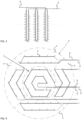
- a simpler second preferred embodiment of the arrangement is achieved by the implementation according to Figure 4 .
- the bore wells 3 are connected by pipelines 6 into separate groups. These separately controlled groups form sectors S circularly surrounding the centre storage 2.
- the size of the sector formed by the bore well group implemented may vary, having a central angle of approximately 15 to 180 degrees.
- the central angle of a sector is 90 degrees.
- the storage field is heated radially outwards from the centre of the storage, starting with the first part of the circle of the heat storage 1 whose temperature is below the temperature of the arriving heat transfer fluid. After this, the transfer of the thermal energy to the storage continues radially outward a sector and a circle at a time.
- a fourth preferred embodiment according to Figures 5a, 5b and 6 , an arrangement has been set up where the centre storage 2 is formed by a closed and advantageously underground tank 12.
- the tank is surrounded in a substantially concentric and circular manner by the bore wells 3, there being two or more circles 4.
- the location of the bore wells may, of course, differ from what is disclosed without any major drawback to the operation.
- the tank which in this embodiment replaces the innermost bore well as explained, or the centre storage formed by the innermost bore wells of Figures 2 or 4 , has a volume the size of which may vary from a few cubic metres to tens or even hundreds of cubic metres.
- Figures 5d and 6 show by way of example three circles 4 surrounding said tank 12, the innermost circle having six bore wells 3, the centre circle 12 bore wells, and the outermost circle 18 bore wells.
- a circle may have more wells, and there may be only two circles or, on the other hand, more than three circles, as needed.
- the number of circles as well as the size of the centre well primarily depend on the amount of energy that can be transmitted to the system from solar collectors or other source of heat connected to it.
- the bore wells 3 are arranged to be in flow communication with each other by means of a pipeline 6.
- the collectors 5 installed in the bore wells are arranged to be in flow communication with each other by means of the pipeline 6 to form a closed flow circuit.
- Cf. also Figure 3 .
- the route of such a flow may be primarily controlled by valves 8 adapted in each circle and adjusted by a control unit 7.
- valves 8 adapted in each circle and adjusted by a control unit 7.
- there are two parallel pipelines in each circle one having the collector input flow connected to it, and the other with the collector output flow connected to it. This way the bore wells along the same circle are connected to each other in parallel.
- the route of the flow may be primarily controlled by shutter and three-way valves adapted in each circle.
- each bore well may also be equipped with its own valve, whereby the flow may be adjusted at the accuracy of both the circle, part of a circle, and a single bore well 3.
- the system operates so that the carrier fluid in the tank 12, in this embodiment referred to as storage fluid, which may be ordinary (ground) water, is heated by thermal energy obtained from an external source of heat, as described in the above.
- storage fluid which may be ordinary (ground) water
- thermal energy obtained from an external source of heat, as described in the above.
- a first heat exchanger coil 13 with its pump 14 have been adapted in it. If the storage fluid in the tank is heated by means of a plurality of heat sources 9 producing thermal energy, a dedicated heat exchanger need to be arranged in the tank for each heat source.
- thermal energy originating from the heat source 9 is led to a bore well or bore well group along the next circle.
- thermal energy produced by solar collectors for example, is started to be transferred from the tank by a pump 15, for example, by means of the storage fluid along the pipe line 6 to the circularly arranged bore wells one circle 4 at a time, starting with the innermost circle and proceeding to the outermost circle, continuously maintaining, however, the temperature of the storage already heated.
- the system starts to maintain the thermal energy storage 1 formed by the tank 12 and bore wells 3.
- the temperature of the storage fluid in the tank is in such a case continuously compared with the prevailing temperature in each bore well or bore well group. The comparison is always carried out one well or group at a time, proceeding in the storage field radially outward from the centre.
- the valve 8 opens and consequently storage fluid is led to this part of the heat storage. After this, the transfer of the thermal energy to the bore well continues radially outward a bore well or circle at a time.
- the part of the heat storage radially outward from the centre of the storage, is always heated whose own temperature is below the temperature of the storage fluid in the tank. This establishes as even as possible a heat distribution in which the storage fluid of the tank at the centre is always the warmest, with the temperature evenly decreasing towards the outer edge of the storage. This even heat distribution guarantees the most extensive possible storing of thermal energy.
- the heat transfer fluid is led to the bore well a circle and its sector at a time.
- the size of the sector may vary, having a central angle of approximately 15 to 180 degrees, advantageously 45 to 60 degrees.
- the storage field is thus heated radially outwards from the centre of the storage, starting with the part of the circle of the heat storage whose temperature is below the temperature of the storage fluid in the tank. After this, the transfer of the thermal energy to the storage continues in the sector radially outward a circle or part of a circle at a time. When the outermost circle sector has reached its target temperature, the heating of the next adjacent sector begins.
- the heating of the real estate 11 and production of warm water may be implemented by utilizing the aforementioned solar collectors.
- the amount of thermal energy produced by solar collectors is too small and a source of additional heat is needed.
- thermal energy may be recaptured from the heat storage 1, whose temperature is notably higher than the heat sources 9 otherwise utilized to heat the real estate 11 and to produce hot water, which substantially improves the efficiency of the heat exchanger 10 of the real estate.
- the transfer of thermal energy takes place so that as the temperature of the storage fluid in the tank 12 decreases below a specific set value, a flow between the tank 12 and bore wells 3, controlled by the pump 15, starts, by which thermal energy is transferred from the heat storage by the storage fluid back to the tank from the circularly arranged bore wells or bore well group one at a time.
- the temperature of the storage fluid in the tank 12 may be raised by a heat pump 16 connected to the tank.
- the same heat pump is advantageously used in the manner referred to in the above for heating the real estate and producing hot water.
Landscapes
- Engineering & Computer Science (AREA)
- General Engineering & Computer Science (AREA)
- Mechanical Engineering (AREA)
- Life Sciences & Earth Sciences (AREA)
- Sustainable Development (AREA)
- Thermal Sciences (AREA)
- Physics & Mathematics (AREA)
- Sustainable Energy (AREA)
- Chemical & Material Sciences (AREA)
- Combustion & Propulsion (AREA)
- General Life Sciences & Earth Sciences (AREA)
- Heat-Pump Type And Storage Water Heaters (AREA)
- Central Heating Systems (AREA)
Claims (9)
- Anordnung zur optimalen Energiespeicherung in und - rückgewinnung von Wärmeschächten,
wobei eine solche Anordnung einen Wärmespeicher (1) umfasst, der aufweist:ein Wärmeübertragungsfluid,einen unterirdischen Zentralspeicher (2, 12),Bohrschächte (3), die den Zentralspeicher (2, 12) auf eine im Wesentlichen konzentrische Weise umgeben, wobei zwei oder mehr Kreise (4) vorhanden sind, wodurchder Zentralspeicher (2, 12) und die Bohrschächte (3) eingerichtet sind, um miteinander und mit einer oder mehreren Wärmequellen (9) verbunden zu sein, die mittels einer Rohrleitung (6) Wärmeenergie zu dem System führen,wobei der Wärmespeicher (1) mit Ventilen (8) versehen ist, die von einer Regeleinheit (7) geregelt werden, um den Umlauf des Wärmeübertragungsfluids zu regeln,dadurch gekennzeichnet, dassdie Regeleinheit (7) eingerichtet ist, um die Temperatur des Wärmeübertragungsfluids, das von der Wärmequelle (9) eintrifft, kontinuierlich mit der Zieltemperatur eines angetroffenen Bohrschachts (3) zu vergleichen,wobei die Bohrschächte (3) in Bezug aufeinander parallel verbunden sind, wodurch es möglich ist, warmes Trägerfluid getrennt entlang der Rohrleitungen zu jedem Bohrschacht zu führen, unddie Bohrschächte (3) in jedem Kreis durch Rohrleitungen (6) in getrennte Gruppen verbunden sind, deren Strömungen getrennt durch die Ventile (8) geregelt werden, wodurchdiese Gruppen eingerichtet sind, um Sektoren (S) zu bilden, die den Zentralspeicher (2) kreisförmig umgeben,wobei jeder Sektor eingerichtet ist, um Wärmeenergie derart getrennt zu empfangen, dassdas Speicherfeld dazu ausgestaltet ist, von der Mitte des Speichers radial nach außen, beginnend mit dem ersten Teil des Kreises des Wärmespeichers, dessen Temperatur unter der Temperatur des eintreffenden Wärmeübertragungsfluids liegt, und jeweils fortgesetzt in dem Sektor radial von einem Kreis oder Teil eines Kreises nach außen erwärmt zu werden und, wenn der äußerste Kreissektor seine Zieltemperatur erreicht hat, das Erwärmen des nächsten benachbarten Sektors zu beginnen. - Anordnung nach Anspruch 1, dadurch gekennzeichnet, dass der Zentralspeicher (2) einen geschlossenen und vorteilhafterweise unterirdischen Tank (12) umfasst.
- Anordnung nach Anspruch 2, dadurch gekennzeichnet, dass der Tank (12) durch isolierende Materialien von seiner Umgebung isoliert ist.
- Verfahren zur optimalen Speicherung in und Rückgewinnung von Wärmeschächten, wodurchWärmeenergie in Wärmeübertragungsfluid von einer oder mehreren Wärmequellen (9) gesammelt wird,die Wärmeenergie durch ein Wärmeübertragungsfluid zu einem unterirdischen Zentralspeicher (2, 12) und weiter zu Bohrschächten (3) geführt wird,die Wärmequellen (9), der unterirdische Zentralspeicher (2, 12) und die Bohrschächte (3) über Rohrleitungen (6) miteinander verbunden sind, wodurchdie Bohrschächte (3) im Wesentlich kreisförmig um den unterirdischen Zentralspeicher (2, 12) angeordnet sind, derart dassdie Wärmeenergie zu den Bohrschachtkreisen jeweils um einen Bohrschacht (3) und einem Kreis (4), beginnend mit dem Zentralspeicher (2, 12) und nach außen fortgesetzt, übertragen wird,gekennzeichnet durchTeilen der Bohrschachtkreise (4) in Gruppen, die eine Vielzahl von benachbarten Sektoren (S) bilden,wobei die Bohrschächte (3) in Bezug aufeinander parallel verbunden sind, wodurch es möglich ist, warmes Trägerfluid getrennt entlang der Rohrleitungen (6) zu jedem Bohrschacht zu führen, unddie Strömung der Wärmeenergie in den Bohrschächten (3) durch Ventile (8) geregelt wird,Führen des Wärmeübertragungsfluids zuerst und in erster Linie zum Zentralspeicher (2, 12) und von dort jeweils Führen des Wärmeübertragungsfluids radial nach außen zu Bohrschächten (3) in einem Sektor (S), fortgesetzt zu den Bohrschächten entlang des radial äußersten Kreises,kontinuierliches Vergleichen der Temperatur des Wärmeübertragungsfluids, das von der Wärmequelle (9) eintrifft, mit der vorherrschenden Temperatur in jedem der begegneten Bohrschächte mittels einer Regeleinheit (7), undwenn die Temperatur des Wärmeübertragungsfluids die vorherrschende Temperatur des begegneten Bohrschachts (3) überschreitet, Führen des Wärmeübertragungsfluids zu dem Bohrschacht und somit Ausgleichen der Temperaturdifferenz zwischen dem Wärmeübertragungsfluid und dem begegneten Bohrschacht, jeweils Fortsetzen der Übertragung des Wärmeübertragungsfluids in dem Sektor radial außerhalb eines Kreises oder Teils eines Kreises, undwenn der äußerste Teil eines Sektors seine Zieltemperatur gemäß einem eingestellten Temperaturprofil erreicht hat, Beginnen eines Erwärmens eines benachbarten Sektors (S).
- Verfahren nach Anspruch 4, gekennzeichnet durch das Nutzen eines Fluids, das in einem Wärmetauscher (10) umläuft, der mit einer Wärmequelle verbunden ist, als das Wärmeübertragungsfluid, Übertragen von in den Wärmequellen (9) gesammelter Wärmeenergie zu dem unterirdischen Zentralspeicher (2, 12) und weiter zu den Bohrschächten (3).
- Verfahren nach Anspruch 4, gekennzeichnet durch das Nutzen eines Speicherfluids in dem Zentralspeicher (2, 12) als das Wärmeübertragungsfluid, das Wärmeenergie, die in den Wärmequellen (9) gesammelt wird, zu dem unterirdischen Zentralspeicher (2, 12) und weiter zu den Bohrschächten (3) überträgt.
- Verfahren nach einem der Ansprüche 4 bis 6, dadurch gekennzeichnet, dass der Zentriwinkel des Sektors (S) eingestellt werden kann, um von 15 bis 90 Grad zu betragen.
- Verfahren nach Anspruch 7, dadurch gekennzeichnet, dass der Zentriwinkel des Sektors (S) am vorteilhaftesten eingestellt werden kann, um von 45 bis 60 Grad zu betragen.
- Verfahren nach einem der Ansprüche 4 bis 8, dadurch gekennzeichnet, dass die Wärmeenergie von dem Wärmespeicher (1) durch Führen des Wärmeübertragungsfluids rückgewonnen wird, indem das Wärmeübertragungsfluid vor allem zu dem Bohrschachtkreis mit dem kältesten Wärmegehalt geführt wird.
Applications Claiming Priority (2)
| Application Number | Priority Date | Filing Date | Title |
|---|---|---|---|
| FI20176080 | 2017-11-30 | ||
| PCT/FI2018/050860 WO2019106235A1 (en) | 2017-11-30 | 2018-11-28 | Arrangement and method for optimal energy storage and recapturing of thermal wells |
Publications (4)
| Publication Number | Publication Date |
|---|---|
| EP3717841A1 EP3717841A1 (de) | 2020-10-07 |
| EP3717841A4 EP3717841A4 (de) | 2021-09-08 |
| EP3717841C0 EP3717841C0 (de) | 2025-05-28 |
| EP3717841B1 true EP3717841B1 (de) | 2025-05-28 |
Family
ID=66664646
Family Applications (1)
| Application Number | Title | Priority Date | Filing Date |
|---|---|---|---|
| EP18883526.8A Active EP3717841B1 (de) | 2017-11-30 | 2018-11-28 | Anordnung und verfahren zur optimalen energiespeicherung und zur rückgewinnung von thermischen bohrungen |
Country Status (3)
| Country | Link |
|---|---|
| EP (1) | EP3717841B1 (de) |
| CN (1) | CN111868457A (de) |
| WO (1) | WO2019106235A1 (de) |
Families Citing this family (4)
| Publication number | Priority date | Publication date | Assignee | Title |
|---|---|---|---|---|
| SE2050997A1 (en) * | 2020-08-28 | 2022-03-01 | Hydroc Energy Storage Ab | Thermal energy storage and method for constructing such a thermal energy storage |
| SE544793C2 (en) * | 2021-05-12 | 2022-11-15 | Jakob Isaksson | An arrangement and a method for storing thermal energy in the ground |
| CA3252405A1 (en) * | 2022-06-02 | 2023-12-07 | Innovia Geo Corp. | APPARATUS AND METHOD FOR CLOSING WITH A CAP FOR BURIED HEAT EXCHANGERS |
| PL442590A1 (pl) * | 2022-10-20 | 2024-04-22 | Wispp Skręt, Maj, Jakóbczak Spółka Jawna | Gruntowy, wielowarstwowy zbiornik ciepła o zwiększonej sprawności cieplnej z gradientowym rozkładem temperatury na jego brzegach |
Family Cites Families (10)
| Publication number | Priority date | Publication date | Assignee | Title |
|---|---|---|---|---|
| SE408087B (sv) * | 1977-09-26 | 1979-05-14 | Platell Ove Bertil | Sett att i en markkropp lagra termisk energi |
| SE530722C2 (sv) * | 2006-02-24 | 2008-08-26 | Scandinavian Energy Efficiency | Förfarande jämte anordning för uppvärmning respektive nedkylning |
| SE0801107L (sv) * | 2008-05-15 | 2009-11-10 | Scandinavian Energy Efficiency | Förfarande samt anordning för uppvärmning och kylning av flera småhus |
| WO2010143161A2 (en) * | 2009-06-12 | 2010-12-16 | Esae S.R.L. | System for storage and transfer of heat energy |
| CN102012058B (zh) * | 2009-09-08 | 2012-12-19 | 赵明辉 | 太阳能热泵供暖供热水系统井蓄热法及系统 |
| CN103644682B (zh) * | 2013-12-04 | 2016-06-29 | 华中科技大学 | 一种相变蓄热型地埋管换热器 |
| SK7401Y1 (sk) * | 2015-07-15 | 2016-04-01 | Univ Zilina | Zemný akumulátor tepla |
| NO343262B1 (en) * | 2016-07-22 | 2019-01-14 | Norges Miljoe Og Biovitenskapelige Univ Nmbu | Solar thermal collecting and storage |
| CN206291514U (zh) * | 2016-11-14 | 2017-06-30 | 北京四季沐歌太阳能技术集团有限公司 | 一种家用太阳能跨季节土壤蓄热布井埋管的换热运行系统 |
| KR20180058578A (ko) * | 2016-11-24 | 2018-06-01 | 한국에너지기술연구원 | 복합 축열 장치 및 그 제어 방법 |
-
2018
- 2018-11-28 EP EP18883526.8A patent/EP3717841B1/de active Active
- 2018-11-28 WO PCT/FI2018/050860 patent/WO2019106235A1/en not_active Ceased
- 2018-11-28 CN CN201880088071.8A patent/CN111868457A/zh active Pending
Also Published As
| Publication number | Publication date |
|---|---|
| EP3717841C0 (de) | 2025-05-28 |
| EP3717841A1 (de) | 2020-10-07 |
| CN111868457A (zh) | 2020-10-30 |
| WO2019106235A1 (en) | 2019-06-06 |
| EP3717841A4 (de) | 2021-09-08 |
Similar Documents
| Publication | Publication Date | Title |
|---|---|---|
| EP3717841B1 (de) | Anordnung und verfahren zur optimalen energiespeicherung und zur rückgewinnung von thermischen bohrungen | |
| CN101821503B (zh) | 地热能系统和操作方法 | |
| EP2179174B1 (de) | System für geothermische energie und betriebsverfahren | |
| CN101629485B (zh) | 地下热能源钻井连通井开采方法 | |
| RS66174B1 (sr) | Metoda za kontrolu toplotnog profila i rekuperaciju energije u geotermalnim bunarima | |
| NO142762B (no) | Fremgangsmaate ved marklagring av varme, f.eks. solvarme | |
| US20100243201A1 (en) | Earth heat transfer loop apparatus | |
| JP2011524967A (ja) | 熱エネルギーシステム及びその動作方法 | |
| CN109798091A (zh) | 闭式循环井及干热岩的开发方法 | |
| CN104695926A (zh) | 一种低温地热能开采技术方法 | |
| KR20150126188A (ko) | 지하대수층의 깊이 차이를 이용한 축열 냉난방 시스템 | |
| CA2890130C (en) | Energy storage having inner and outer helix tunnels | |
| US20240240875A1 (en) | Thermal Energy Storage And Method For Controlling A Thermal Energy Storage | |
| JP2015190715A (ja) | 地中熱交換器用本体、地中熱交換器、地中熱交換システム及び施工方法 | |
| CN110307658A (zh) | 封闭式深层地热能高效采集系统 | |
| CN110485969A (zh) | 一种开采干热岩地热资源的装置及其钻孔成孔方法 | |
| US20150354903A1 (en) | Thermal energy storage comprising an expansion space | |
| GB2482436A (en) | Geothermal energy system and method of operation | |
| CN119713946B (zh) | 自然能跨季度存取系统及泥浆围墙制作设备 | |
| CN115060013B (zh) | 一种取热与取冷一体的中深层三层套管同轴地热利用装置 | |
| WO2013115656A1 (en) | Energy stave | |
| KR101193213B1 (ko) | 다중 관정형 지열 시스템의 시공방법 | |
| Shtym et al. | Ground heat exchangers of geothermal heat pumps and analysis of their constructive features and types | |
| CN101126562A (zh) | 地源热泵空调系统地下换热装置 | |
| CN120650876A (zh) | 一种分层渐变螺旋地埋管换热器和使用方法 |
Legal Events
| Date | Code | Title | Description |
|---|---|---|---|
| STAA | Information on the status of an ep patent application or granted ep patent |
Free format text: STATUS: THE INTERNATIONAL PUBLICATION HAS BEEN MADE |
|
| PUAI | Public reference made under article 153(3) epc to a published international application that has entered the european phase |
Free format text: ORIGINAL CODE: 0009012 |
|
| STAA | Information on the status of an ep patent application or granted ep patent |
Free format text: STATUS: REQUEST FOR EXAMINATION WAS MADE |
|
| 17P | Request for examination filed |
Effective date: 20200625 |
|
| AK | Designated contracting states |
Kind code of ref document: A1 Designated state(s): AL AT BE BG CH CY CZ DE DK EE ES FI FR GB GR HR HU IE IS IT LI LT LU LV MC MK MT NL NO PL PT RO RS SE SI SK SM TR |
|
| AX | Request for extension of the european patent |
Extension state: BA ME |
|
| DAV | Request for validation of the european patent (deleted) | ||
| DAX | Request for extension of the european patent (deleted) | ||
| A4 | Supplementary search report drawn up and despatched |
Effective date: 20210805 |
|
| RIC1 | Information provided on ipc code assigned before grant |
Ipc: F24T 10/30 20180101ALI20210730BHEP Ipc: F28D 20/00 20060101ALI20210730BHEP Ipc: F24T 10/13 20180101AFI20210730BHEP |
|
| GRAP | Despatch of communication of intention to grant a patent |
Free format text: ORIGINAL CODE: EPIDOSNIGR1 |
|
| STAA | Information on the status of an ep patent application or granted ep patent |
Free format text: STATUS: GRANT OF PATENT IS INTENDED |
|
| GRAJ | Information related to disapproval of communication of intention to grant by the applicant or resumption of examination proceedings by the epo deleted |
Free format text: ORIGINAL CODE: EPIDOSDIGR1 |
|
| STAA | Information on the status of an ep patent application or granted ep patent |
Free format text: STATUS: REQUEST FOR EXAMINATION WAS MADE |
|
| INTG | Intention to grant announced |
Effective date: 20250217 |
|
| INTC | Intention to grant announced (deleted) | ||
| GRAP | Despatch of communication of intention to grant a patent |
Free format text: ORIGINAL CODE: EPIDOSNIGR1 |
|
| STAA | Information on the status of an ep patent application or granted ep patent |
Free format text: STATUS: GRANT OF PATENT IS INTENDED |
|
| GRAS | Grant fee paid |
Free format text: ORIGINAL CODE: EPIDOSNIGR3 |
|
| GRAA | (expected) grant |
Free format text: ORIGINAL CODE: 0009210 |
|
| STAA | Information on the status of an ep patent application or granted ep patent |
Free format text: STATUS: THE PATENT HAS BEEN GRANTED |
|
| INTG | Intention to grant announced |
Effective date: 20250402 |
|
| AK | Designated contracting states |
Kind code of ref document: B1 Designated state(s): AL AT BE BG CH CY CZ DE DK EE ES FI FR GB GR HR HU IE IS IT LI LT LU LV MC MK MT NL NO PL PT RO RS SE SI SK SM TR |
|
| REG | Reference to a national code |
Ref country code: GB Ref legal event code: FG4D |
|
| REG | Reference to a national code |
Ref country code: CH Ref legal event code: EP |
|
| REG | Reference to a national code |
Ref country code: DE Ref legal event code: R096 Ref document number: 602018082315 Country of ref document: DE |
|
| REG | Reference to a national code |
Ref country code: IE Ref legal event code: FG4D |
|
| U01 | Request for unitary effect filed |
Effective date: 20250619 |
|
| U07 | Unitary effect registered |
Designated state(s): AT BE BG DE DK EE FI FR IT LT LU LV MT NL PT RO SE SI Effective date: 20250630 |
|
| PG25 | Lapsed in a contracting state [announced via postgrant information from national office to epo] |
Ref country code: ES Free format text: LAPSE BECAUSE OF FAILURE TO SUBMIT A TRANSLATION OF THE DESCRIPTION OR TO PAY THE FEE WITHIN THE PRESCRIBED TIME-LIMIT Effective date: 20250528 |
|
| PG25 | Lapsed in a contracting state [announced via postgrant information from national office to epo] |
Ref country code: NO Free format text: LAPSE BECAUSE OF FAILURE TO SUBMIT A TRANSLATION OF THE DESCRIPTION OR TO PAY THE FEE WITHIN THE PRESCRIBED TIME-LIMIT Effective date: 20250828 Ref country code: GR Free format text: LAPSE BECAUSE OF FAILURE TO SUBMIT A TRANSLATION OF THE DESCRIPTION OR TO PAY THE FEE WITHIN THE PRESCRIBED TIME-LIMIT Effective date: 20250829 |
|
| PG25 | Lapsed in a contracting state [announced via postgrant information from national office to epo] |
Ref country code: PL Free format text: LAPSE BECAUSE OF FAILURE TO SUBMIT A TRANSLATION OF THE DESCRIPTION OR TO PAY THE FEE WITHIN THE PRESCRIBED TIME-LIMIT Effective date: 20250528 |
|
| PG25 | Lapsed in a contracting state [announced via postgrant information from national office to epo] |
Ref country code: HR Free format text: LAPSE BECAUSE OF FAILURE TO SUBMIT A TRANSLATION OF THE DESCRIPTION OR TO PAY THE FEE WITHIN THE PRESCRIBED TIME-LIMIT Effective date: 20250528 |
|
| PG25 | Lapsed in a contracting state [announced via postgrant information from national office to epo] |
Ref country code: RS Free format text: LAPSE BECAUSE OF FAILURE TO SUBMIT A TRANSLATION OF THE DESCRIPTION OR TO PAY THE FEE WITHIN THE PRESCRIBED TIME-LIMIT Effective date: 20250828 |
|
| PG25 | Lapsed in a contracting state [announced via postgrant information from national office to epo] |
Ref country code: IS Free format text: LAPSE BECAUSE OF FAILURE TO SUBMIT A TRANSLATION OF THE DESCRIPTION OR TO PAY THE FEE WITHIN THE PRESCRIBED TIME-LIMIT Effective date: 20250928 |
|
| U20 | Renewal fee for the european patent with unitary effect paid |
Year of fee payment: 8 Effective date: 20251117 |
|
| PG25 | Lapsed in a contracting state [announced via postgrant information from national office to epo] |
Ref country code: SM Free format text: LAPSE BECAUSE OF FAILURE TO SUBMIT A TRANSLATION OF THE DESCRIPTION OR TO PAY THE FEE WITHIN THE PRESCRIBED TIME-LIMIT Effective date: 20250528 |
|
| PG25 | Lapsed in a contracting state [announced via postgrant information from national office to epo] |
Ref country code: CZ Free format text: LAPSE BECAUSE OF FAILURE TO SUBMIT A TRANSLATION OF THE DESCRIPTION OR TO PAY THE FEE WITHIN THE PRESCRIBED TIME-LIMIT Effective date: 20250528 |
|
| PG25 | Lapsed in a contracting state [announced via postgrant information from national office to epo] |
Ref country code: SK Free format text: LAPSE BECAUSE OF FAILURE TO SUBMIT A TRANSLATION OF THE DESCRIPTION OR TO PAY THE FEE WITHIN THE PRESCRIBED TIME-LIMIT Effective date: 20250528 |
|
| PLBE | No opposition filed within time limit |
Free format text: ORIGINAL CODE: 0009261 |
|
| STAA | Information on the status of an ep patent application or granted ep patent |
Free format text: STATUS: NO OPPOSITION FILED WITHIN TIME LIMIT |
|
| REG | Reference to a national code |
Ref country code: CH Ref legal event code: L10 Free format text: ST27 STATUS EVENT CODE: U-0-0-L10-L00 (AS PROVIDED BY THE NATIONAL OFFICE) Effective date: 20260409 |