EP3717543B1 - Polyaspartics with long pot life and fast curing - Google Patents
Polyaspartics with long pot life and fast curing Download PDFInfo
- Publication number
- EP3717543B1 EP3717543B1 EP18807343.1A EP18807343A EP3717543B1 EP 3717543 B1 EP3717543 B1 EP 3717543B1 EP 18807343 A EP18807343 A EP 18807343A EP 3717543 B1 EP3717543 B1 EP 3717543B1
- Authority
- EP
- European Patent Office
- Prior art keywords
- component
- polyurea composition
- polyisocyanate
- salt hydrate
- composition according
- Prior art date
- Legal status (The legal status is an assumption and is not a legal conclusion. Google has not performed a legal analysis and makes no representation as to the accuracy of the status listed.)
- Not-in-force
Links
- 229920000608 Polyaspartic Polymers 0.000 title description 12
- XLYOFNOQVPJJNP-UHFFFAOYSA-N water Substances O XLYOFNOQVPJJNP-UHFFFAOYSA-N 0.000 claims description 116
- 239000000203 mixture Substances 0.000 claims description 97
- 150000003839 salts Chemical class 0.000 claims description 85
- 239000005056 polyisocyanate Substances 0.000 claims description 60
- 229920001228 polyisocyanate Polymers 0.000 claims description 60
- 229920002396 Polyurea Polymers 0.000 claims description 51
- 239000004848 polyfunctional curative Substances 0.000 claims description 43
- -1 salt ion Chemical class 0.000 claims description 29
- 238000000354 decomposition reaction Methods 0.000 claims description 23
- 150000001875 compounds Chemical class 0.000 claims description 19
- 238000000034 method Methods 0.000 claims description 19
- IQPQWNKOIGAROB-UHFFFAOYSA-N isocyanate group Chemical group [N-]=C=O IQPQWNKOIGAROB-UHFFFAOYSA-N 0.000 claims description 16
- 238000000576 coating method Methods 0.000 claims description 13
- 238000002156 mixing Methods 0.000 claims description 13
- CDBYLPFSWZWCQE-UHFFFAOYSA-L Sodium Carbonate Chemical compound [Na+].[Na+].[O-]C([O-])=O CDBYLPFSWZWCQE-UHFFFAOYSA-L 0.000 claims description 12
- 125000001931 aliphatic group Chemical group 0.000 claims description 12
- 239000005057 Hexamethylene diisocyanate Substances 0.000 claims description 11
- KWYUFKZDYYNOTN-UHFFFAOYSA-M potassium hydroxide Substances [OH-].[K+] KWYUFKZDYYNOTN-UHFFFAOYSA-M 0.000 claims description 11
- 239000011248 coating agent Substances 0.000 claims description 10
- 239000002245 particle Substances 0.000 claims description 10
- 238000010438 heat treatment Methods 0.000 claims description 9
- CSNNHWWHGAXBCP-UHFFFAOYSA-L Magnesium sulfate Chemical compound [Mg+2].[O-][S+2]([O-])([O-])[O-] CSNNHWWHGAXBCP-UHFFFAOYSA-L 0.000 claims description 8
- 125000005442 diisocyanate group Chemical group 0.000 claims description 8
- NWONKYPBYAMBJT-UHFFFAOYSA-L zinc sulfate Chemical compound [Zn+2].[O-]S([O-])(=O)=O NWONKYPBYAMBJT-UHFFFAOYSA-L 0.000 claims description 7
- 229910000368 zinc sulfate Inorganic materials 0.000 claims description 7
- 239000011686 zinc sulphate Substances 0.000 claims description 7
- RRAMGCGOFNQTLD-UHFFFAOYSA-N hexamethylene diisocyanate Chemical compound O=C=NCCCCCCN=C=O RRAMGCGOFNQTLD-UHFFFAOYSA-N 0.000 claims description 6
- 229910000029 sodium carbonate Inorganic materials 0.000 claims description 6
- 150000001412 amines Chemical class 0.000 claims description 5
- 229910052751 metal Inorganic materials 0.000 claims description 5
- 239000002184 metal Substances 0.000 claims description 5
- 239000000758 substrate Substances 0.000 claims description 5
- 229940008841 1,6-hexamethylene diisocyanate Drugs 0.000 claims description 4
- 239000007832 Na2SO4 Substances 0.000 claims description 4
- PMZURENOXWZQFD-UHFFFAOYSA-L Sodium Sulfate Chemical compound [Na+].[Na+].[O-]S([O-])(=O)=O PMZURENOXWZQFD-UHFFFAOYSA-L 0.000 claims description 4
- 238000005266 casting Methods 0.000 claims description 4
- 229910052943 magnesium sulfate Inorganic materials 0.000 claims description 4
- 229910052938 sodium sulfate Inorganic materials 0.000 claims description 4
- PCHXZXKMYCGVFA-UHFFFAOYSA-N 1,3-diazetidine-2,4-dione Chemical compound O=C1NC(=O)N1 PCHXZXKMYCGVFA-UHFFFAOYSA-N 0.000 claims description 3
- OHJMTUPIZMNBFR-UHFFFAOYSA-N biuret Chemical compound NC(=O)NC(N)=O OHJMTUPIZMNBFR-UHFFFAOYSA-N 0.000 claims description 3
- FUFJGUQYACFECW-UHFFFAOYSA-L calcium hydrogenphosphate Chemical compound [Ca+2].OP([O-])([O-])=O FUFJGUQYACFECW-UHFFFAOYSA-L 0.000 claims description 3
- MHJAJDCZWVHCPF-UHFFFAOYSA-L dimagnesium phosphate Chemical compound [Mg+2].OP([O-])([O-])=O MHJAJDCZWVHCPF-UHFFFAOYSA-L 0.000 claims description 3
- ZFSLODLOARCGLH-UHFFFAOYSA-N isocyanuric acid Chemical compound OC1=NC(O)=NC(O)=N1 ZFSLODLOARCGLH-UHFFFAOYSA-N 0.000 claims description 3
- 229910010951 LiH2 Inorganic materials 0.000 claims description 2
- 150000001449 anionic compounds Chemical class 0.000 claims description 2
- 229910001412 inorganic anion Inorganic materials 0.000 claims description 2
- 150000002891 organic anions Chemical class 0.000 claims description 2
- 238000001723 curing Methods 0.000 description 28
- 229920005862 polyol Polymers 0.000 description 28
- 150000003077 polyols Chemical class 0.000 description 28
- 239000003054 catalyst Substances 0.000 description 18
- 239000004814 polyurethane Substances 0.000 description 14
- 229920000642 polymer Polymers 0.000 description 13
- 229920002635 polyurethane Polymers 0.000 description 13
- 238000002474 experimental method Methods 0.000 description 12
- 239000000126 substance Substances 0.000 description 12
- 238000006243 chemical reaction Methods 0.000 description 10
- NIMLQBUJDJZYEJ-UHFFFAOYSA-N isophorone diisocyanate Chemical compound CC1(C)CC(N=C=O)CC(C)(CN=C=O)C1 NIMLQBUJDJZYEJ-UHFFFAOYSA-N 0.000 description 8
- 238000003860 storage Methods 0.000 description 8
- UPMLOUAZCHDJJD-UHFFFAOYSA-N 4,4'-Diphenylmethane Diisocyanate Chemical compound C1=CC(N=C=O)=CC=C1CC1=CC=C(N=C=O)C=C1 UPMLOUAZCHDJJD-UHFFFAOYSA-N 0.000 description 7
- 150000002148 esters Chemical class 0.000 description 7
- 230000036571 hydration Effects 0.000 description 7
- 238000006703 hydration reaction Methods 0.000 description 7
- PEDCQBHIVMGVHV-UHFFFAOYSA-N Glycerine Chemical compound OCC(O)CO PEDCQBHIVMGVHV-UHFFFAOYSA-N 0.000 description 6
- 239000005058 Isophorone diisocyanate Substances 0.000 description 6
- 239000004721 Polyphenylene oxide Substances 0.000 description 6
- 125000003118 aryl group Chemical group 0.000 description 6
- MTHSVFCYNBDYFN-UHFFFAOYSA-N diethylene glycol Chemical compound OCCOCCO MTHSVFCYNBDYFN-UHFFFAOYSA-N 0.000 description 6
- 150000002009 diols Chemical class 0.000 description 6
- 125000000524 functional group Chemical group 0.000 description 6
- 125000002887 hydroxy group Chemical group [H]O* 0.000 description 6
- 229920000570 polyether Polymers 0.000 description 6
- 229920001451 polypropylene glycol Polymers 0.000 description 6
- 229920005989 resin Polymers 0.000 description 6
- 239000011347 resin Substances 0.000 description 6
- 150000004072 triols Chemical class 0.000 description 6
- KAKZBPTYRLMSJV-UHFFFAOYSA-N Butadiene Chemical compound C=CC=C KAKZBPTYRLMSJV-UHFFFAOYSA-N 0.000 description 5
- 239000000654 additive Substances 0.000 description 5
- 239000004615 ingredient Substances 0.000 description 5
- 230000008569 process Effects 0.000 description 5
- 239000007787 solid Substances 0.000 description 5
- SBJCUZQNHOLYMD-UHFFFAOYSA-N 1,5-Naphthalene diisocyanate Chemical compound C1=CC=C2C(N=C=O)=CC=CC2=C1N=C=O SBJCUZQNHOLYMD-UHFFFAOYSA-N 0.000 description 4
- QZWKEPYTBWZJJA-UHFFFAOYSA-N 3,3'-Dimethoxybenzidine-4,4'-diisocyanate Chemical compound C1=C(N=C=O)C(OC)=CC(C=2C=C(OC)C(N=C=O)=CC=2)=C1 QZWKEPYTBWZJJA-UHFFFAOYSA-N 0.000 description 4
- 229920001577 copolymer Polymers 0.000 description 4
- 239000013078 crystal Substances 0.000 description 4
- 229920002521 macromolecule Polymers 0.000 description 4
- 239000000463 material Substances 0.000 description 4
- 238000006116 polymerization reaction Methods 0.000 description 4
- 238000002360 preparation method Methods 0.000 description 4
- 239000002904 solvent Substances 0.000 description 4
- 239000004094 surface-active agent Substances 0.000 description 4
- ICLCCFKUSALICQ-UHFFFAOYSA-N 1-isocyanato-4-(4-isocyanato-3-methylphenyl)-2-methylbenzene Chemical group C1=C(N=C=O)C(C)=CC(C=2C=C(C)C(N=C=O)=CC=2)=C1 ICLCCFKUSALICQ-UHFFFAOYSA-N 0.000 description 3
- PJMDLNIAGSYXLA-UHFFFAOYSA-N 6-iminooxadiazine-4,5-dione Chemical group N=C1ON=NC(=O)C1=O PJMDLNIAGSYXLA-UHFFFAOYSA-N 0.000 description 3
- NLHHRLWOUZZQLW-UHFFFAOYSA-N Acrylonitrile Chemical compound C=CC#N NLHHRLWOUZZQLW-UHFFFAOYSA-N 0.000 description 3
- QGZKDVFQNNGYKY-UHFFFAOYSA-N Ammonia Chemical compound N QGZKDVFQNNGYKY-UHFFFAOYSA-N 0.000 description 3
- KDXKERNSBIXSRK-UHFFFAOYSA-N Lysine Natural products NCCCCC(N)C(O)=O KDXKERNSBIXSRK-UHFFFAOYSA-N 0.000 description 3
- 239000004472 Lysine Substances 0.000 description 3
- 229920003171 Poly (ethylene oxide) Polymers 0.000 description 3
- HEMHJVSKTPXQMS-UHFFFAOYSA-M Sodium hydroxide Chemical compound [OH-].[Na+] HEMHJVSKTPXQMS-UHFFFAOYSA-M 0.000 description 3
- WYURNTSHIVDZCO-UHFFFAOYSA-N Tetrahydrofuran Chemical compound C1CCOC1 WYURNTSHIVDZCO-UHFFFAOYSA-N 0.000 description 3
- 230000001133 acceleration Effects 0.000 description 3
- 239000002318 adhesion promoter Substances 0.000 description 3
- 150000001298 alcohols Chemical class 0.000 description 3
- 238000013459 approach Methods 0.000 description 3
- 239000011324 bead Substances 0.000 description 3
- 230000008901 benefit Effects 0.000 description 3
- IISBACLAFKSPIT-UHFFFAOYSA-N bisphenol A Chemical compound C=1C=C(O)C=CC=1C(C)(C)C1=CC=C(O)C=C1 IISBACLAFKSPIT-UHFFFAOYSA-N 0.000 description 3
- 239000012948 isocyanate Substances 0.000 description 3
- 150000002894 organic compounds Chemical class 0.000 description 3
- 229920000515 polycarbonate Polymers 0.000 description 3
- 239000004417 polycarbonate Substances 0.000 description 3
- 229920005906 polyester polyol Polymers 0.000 description 3
- 229920006295 polythiol Polymers 0.000 description 3
- 238000012360 testing method Methods 0.000 description 3
- MHYXPAGFFCSTCJ-UHFFFAOYSA-N 1,2-bis(2-isocyanatopropan-2-yl)naphthalene Chemical compound C1=CC=CC2=C(C(C)(C)N=C=O)C(C(C)(N=C=O)C)=CC=C21 MHYXPAGFFCSTCJ-UHFFFAOYSA-N 0.000 description 2
- HUFIHLDYTVSJID-UHFFFAOYSA-N 1,3,5-tris(isocyanatomethyl)benzene Chemical compound O=C=NCC1=CC(CN=C=O)=CC(CN=C=O)=C1 HUFIHLDYTVSJID-UHFFFAOYSA-N 0.000 description 2
- RTTZISZSHSCFRH-UHFFFAOYSA-N 1,3-bis(isocyanatomethyl)benzene Chemical compound O=C=NCC1=CC=CC(CN=C=O)=C1 RTTZISZSHSCFRH-UHFFFAOYSA-N 0.000 description 2
- OHLKMGYGBHFODF-UHFFFAOYSA-N 1,4-bis(isocyanatomethyl)benzene Chemical compound O=C=NCC1=CC=C(CN=C=O)C=C1 OHLKMGYGBHFODF-UHFFFAOYSA-N 0.000 description 2
- LGLNTUFPPXPHKF-UHFFFAOYSA-N 1,4-diisocyanato-2,3,5,6-tetramethylbenzene Chemical compound CC1=C(C)C(N=C=O)=C(C)C(C)=C1N=C=O LGLNTUFPPXPHKF-UHFFFAOYSA-N 0.000 description 2
- ALQLPWJFHRMHIU-UHFFFAOYSA-N 1,4-diisocyanatobenzene Chemical compound O=C=NC1=CC=C(N=C=O)C=C1 ALQLPWJFHRMHIU-UHFFFAOYSA-N 0.000 description 2
- LTIKIBFTASQKMM-UHFFFAOYSA-N 1-[bis(4-isocyanatophenyl)methyl]-4-isocyanatobenzene Chemical compound C1=CC(N=C=O)=CC=C1C(C=1C=CC(=CC=1)N=C=O)C1=CC=C(N=C=O)C=C1 LTIKIBFTASQKMM-UHFFFAOYSA-N 0.000 description 2
- MZEGJNMYXWIQFF-UHFFFAOYSA-N 2,5-diisocyanato-1,1,3-trimethylcyclohexane Chemical compound CC1CC(N=C=O)CC(C)(C)C1N=C=O MZEGJNMYXWIQFF-UHFFFAOYSA-N 0.000 description 2
- MBVGJZDLUQNERS-UHFFFAOYSA-N 2-(trifluoromethyl)-1h-imidazole-4,5-dicarbonitrile Chemical compound FC(F)(F)C1=NC(C#N)=C(C#N)N1 MBVGJZDLUQNERS-UHFFFAOYSA-N 0.000 description 2
- AMUBKBXGFDIMDJ-UHFFFAOYSA-N 3-heptyl-1,2-bis(9-isocyanatononyl)-4-pentylcyclohexane Chemical compound CCCCCCCC1C(CCCCC)CCC(CCCCCCCCCN=C=O)C1CCCCCCCCCN=C=O AMUBKBXGFDIMDJ-UHFFFAOYSA-N 0.000 description 2
- WJIOHMVWGVGWJW-UHFFFAOYSA-N 3-methyl-n-[4-[(3-methylpyrazole-1-carbonyl)amino]butyl]pyrazole-1-carboxamide Chemical compound N1=C(C)C=CN1C(=O)NCCCCNC(=O)N1N=C(C)C=C1 WJIOHMVWGVGWJW-UHFFFAOYSA-N 0.000 description 2
- PAYRUJLWNCNPSJ-UHFFFAOYSA-N Aniline Chemical compound NC1=CC=CC=C1 PAYRUJLWNCNPSJ-UHFFFAOYSA-N 0.000 description 2
- XDTMQSROBMDMFD-UHFFFAOYSA-N Cyclohexane Chemical compound C1CCCCC1 XDTMQSROBMDMFD-UHFFFAOYSA-N 0.000 description 2
- VGGSQFUCUMXWEO-UHFFFAOYSA-N Ethene Chemical compound C=C VGGSQFUCUMXWEO-UHFFFAOYSA-N 0.000 description 2
- 239000005977 Ethylene Substances 0.000 description 2
- LYCAIKOWRPUZTN-UHFFFAOYSA-N Ethylene glycol Chemical compound OCCO LYCAIKOWRPUZTN-UHFFFAOYSA-N 0.000 description 2
- IAYPIBMASNFSPL-UHFFFAOYSA-N Ethylene oxide Chemical compound C1CO1 IAYPIBMASNFSPL-UHFFFAOYSA-N 0.000 description 2
- VZCYOOQTPOCHFL-OWOJBTEDSA-N Fumaric acid Chemical compound OC(=O)\C=C\C(O)=O VZCYOOQTPOCHFL-OWOJBTEDSA-N 0.000 description 2
- 239000004594 Masterbatch (MB) Substances 0.000 description 2
- 229910005581 NiC2 Inorganic materials 0.000 description 2
- PPBRXRYQALVLMV-UHFFFAOYSA-N Styrene Chemical compound C=CC1=CC=CC=C1 PPBRXRYQALVLMV-UHFFFAOYSA-N 0.000 description 2
- KKEYFWRCBNTPAC-UHFFFAOYSA-N Terephthalic acid Chemical compound OC(=O)C1=CC=C(C(O)=O)C=C1 KKEYFWRCBNTPAC-UHFFFAOYSA-N 0.000 description 2
- ZJCCRDAZUWHFQH-UHFFFAOYSA-N Trimethylolpropane Chemical compound CCC(CO)(CO)CO ZJCCRDAZUWHFQH-UHFFFAOYSA-N 0.000 description 2
- 238000007792 addition Methods 0.000 description 2
- 230000000996 additive effect Effects 0.000 description 2
- WNLRTRBMVRJNCN-UHFFFAOYSA-N adipic acid Chemical compound OC(=O)CCCCC(O)=O WNLRTRBMVRJNCN-UHFFFAOYSA-N 0.000 description 2
- 125000000217 alkyl group Chemical group 0.000 description 2
- XXROGKLTLUQVRX-UHFFFAOYSA-N allyl alcohol Chemical compound OCC=C XXROGKLTLUQVRX-UHFFFAOYSA-N 0.000 description 2
- PNEYBMLMFCGWSK-UHFFFAOYSA-N aluminium oxide Inorganic materials [O-2].[O-2].[O-2].[Al+3].[Al+3] PNEYBMLMFCGWSK-UHFFFAOYSA-N 0.000 description 2
- 229910000329 aluminium sulfate Inorganic materials 0.000 description 2
- DIZPMCHEQGEION-UHFFFAOYSA-H aluminium sulfate (anhydrous) Chemical compound [Al+3].[Al+3].[O-]S([O-])(=O)=O.[O-]S([O-])(=O)=O.[O-]S([O-])(=O)=O DIZPMCHEQGEION-UHFFFAOYSA-H 0.000 description 2
- WERYXYBDKMZEQL-UHFFFAOYSA-N butane-1,4-diol Chemical compound OCCCCO WERYXYBDKMZEQL-UHFFFAOYSA-N 0.000 description 2
- HUCVOHYBFXVBRW-UHFFFAOYSA-M caesium hydroxide Chemical compound [OH-].[Cs+] HUCVOHYBFXVBRW-UHFFFAOYSA-M 0.000 description 2
- ZCCIPPOKBCJFDN-UHFFFAOYSA-N calcium nitrate Chemical compound [Ca+2].[O-][N+]([O-])=O.[O-][N+]([O-])=O ZCCIPPOKBCJFDN-UHFFFAOYSA-N 0.000 description 2
- 239000003795 chemical substances by application Substances 0.000 description 2
- 238000005345 coagulation Methods 0.000 description 2
- 230000015271 coagulation Effects 0.000 description 2
- UFMZWBIQTDUYBN-UHFFFAOYSA-N cobalt dinitrate Chemical compound [Co+2].[O-][N+]([O-])=O.[O-][N+]([O-])=O UFMZWBIQTDUYBN-UHFFFAOYSA-N 0.000 description 2
- 239000000470 constituent Substances 0.000 description 2
- 229910052593 corundum Inorganic materials 0.000 description 2
- 150000001993 dienes Chemical class 0.000 description 2
- 235000014113 dietary fatty acids Nutrition 0.000 description 2
- 239000000539 dimer Substances 0.000 description 2
- 239000006185 dispersion Substances 0.000 description 2
- 239000000194 fatty acid Substances 0.000 description 2
- 229930195729 fatty acid Natural products 0.000 description 2
- 238000009408 flooring Methods 0.000 description 2
- 235000013305 food Nutrition 0.000 description 2
- 238000005227 gel permeation chromatography Methods 0.000 description 2
- 238000000227 grinding Methods 0.000 description 2
- QQVIHTHCMHWDBS-UHFFFAOYSA-N isophthalic acid Chemical compound OC(=O)C1=CC=CC(C(O)=O)=C1 QQVIHTHCMHWDBS-UHFFFAOYSA-N 0.000 description 2
- 239000007788 liquid Substances 0.000 description 2
- AMXOYNBUYSYVKV-UHFFFAOYSA-M lithium bromide Chemical compound [Li+].[Br-] AMXOYNBUYSYVKV-UHFFFAOYSA-M 0.000 description 2
- INHCSSUBVCNVSK-UHFFFAOYSA-L lithium sulfate Chemical compound [Li+].[Li+].[O-]S([O-])(=O)=O INHCSSUBVCNVSK-UHFFFAOYSA-L 0.000 description 2
- 238000005259 measurement Methods 0.000 description 2
- JKQOBWVOAYFWKG-UHFFFAOYSA-N molybdenum trioxide Chemical compound O=[Mo](=O)=O JKQOBWVOAYFWKG-UHFFFAOYSA-N 0.000 description 2
- SLCVBVWXLSEKPL-UHFFFAOYSA-N neopentyl glycol Chemical compound OCC(C)(C)CO SLCVBVWXLSEKPL-UHFFFAOYSA-N 0.000 description 2
- 229940117969 neopentyl glycol Drugs 0.000 description 2
- XNGIFLGASWRNHJ-UHFFFAOYSA-N phthalic acid Chemical compound OC(=O)C1=CC=CC=C1C(O)=O XNGIFLGASWRNHJ-UHFFFAOYSA-N 0.000 description 2
- 229920000058 polyacrylate Polymers 0.000 description 2
- 229920000728 polyester Polymers 0.000 description 2
- BWHMMNNQKKPAPP-UHFFFAOYSA-L potassium carbonate Chemical compound [K+].[K+].[O-]C([O-])=O BWHMMNNQKKPAPP-UHFFFAOYSA-L 0.000 description 2
- 230000009257 reactivity Effects 0.000 description 2
- CXMXRPHRNRROMY-UHFFFAOYSA-N sebacic acid Chemical compound OC(=O)CCCCCCCCC(O)=O CXMXRPHRNRROMY-UHFFFAOYSA-N 0.000 description 2
- 150000003335 secondary amines Chemical class 0.000 description 2
- 150000004756 silanes Chemical class 0.000 description 2
- 238000005245 sintering Methods 0.000 description 2
- JHJLBTNAGRQEKS-UHFFFAOYSA-M sodium bromide Chemical compound [Na+].[Br-] JHJLBTNAGRQEKS-UHFFFAOYSA-M 0.000 description 2
- 239000000243 solution Substances 0.000 description 2
- TYFQFVWCELRYAO-UHFFFAOYSA-N suberic acid Chemical compound OC(=O)CCCCCCC(O)=O TYFQFVWCELRYAO-UHFFFAOYSA-N 0.000 description 2
- 150000003512 tertiary amines Chemical class 0.000 description 2
- 229920001169 thermoplastic Polymers 0.000 description 2
- 239000004416 thermosoftening plastic Substances 0.000 description 2
- XOLBLPGZBRYERU-UHFFFAOYSA-N tin dioxide Chemical compound O=[Sn]=O XOLBLPGZBRYERU-UHFFFAOYSA-N 0.000 description 2
- RUELTTOHQODFPA-UHFFFAOYSA-N toluene 2,6-diisocyanate Chemical compound CC1=C(N=C=O)C=CC=C1N=C=O RUELTTOHQODFPA-UHFFFAOYSA-N 0.000 description 2
- 231100000331 toxic Toxicity 0.000 description 2
- 230000002588 toxic effect Effects 0.000 description 2
- VZCYOOQTPOCHFL-UHFFFAOYSA-N trans-butenedioic acid Natural products OC(=O)C=CC(O)=O VZCYOOQTPOCHFL-UHFFFAOYSA-N 0.000 description 2
- 239000013638 trimer Substances 0.000 description 2
- KGLSETWPYVUTQX-UHFFFAOYSA-N tris(4-isocyanatophenoxy)-sulfanylidene-$l^{5}-phosphane Chemical compound C1=CC(N=C=O)=CC=C1OP(=S)(OC=1C=CC(=CC=1)N=C=O)OC1=CC=C(N=C=O)C=C1 KGLSETWPYVUTQX-UHFFFAOYSA-N 0.000 description 2
- JOYRKODLDBILNP-UHFFFAOYSA-N urethane group Chemical group NC(=O)OCC JOYRKODLDBILNP-UHFFFAOYSA-N 0.000 description 2
- 229910001845 yogo sapphire Inorganic materials 0.000 description 2
- DNIAPMSPPWPWGF-VKHMYHEASA-N (+)-propylene glycol Chemical compound C[C@H](O)CO DNIAPMSPPWPWGF-VKHMYHEASA-N 0.000 description 1
- DNIAPMSPPWPWGF-GSVOUGTGSA-N (R)-(-)-Propylene glycol Chemical compound C[C@@H](O)CO DNIAPMSPPWPWGF-GSVOUGTGSA-N 0.000 description 1
- CHRJZRDFSQHIFI-UHFFFAOYSA-N 1,2-bis(ethenyl)benzene;styrene Chemical compound C=CC1=CC=CC=C1.C=CC1=CC=CC=C1C=C CHRJZRDFSQHIFI-UHFFFAOYSA-N 0.000 description 1
- GNQKHBSIBXSFFD-UHFFFAOYSA-N 1,3-diisocyanatocyclohexane Chemical compound O=C=NC1CCCC(N=C=O)C1 GNQKHBSIBXSFFD-UHFFFAOYSA-N 0.000 description 1
- YPFDHNVEDLHUCE-UHFFFAOYSA-N 1,3-propanediol Substances OCCCO YPFDHNVEDLHUCE-UHFFFAOYSA-N 0.000 description 1
- ROHUXHMNZLHBSF-UHFFFAOYSA-N 1,4-bis(isocyanatomethyl)cyclohexane Chemical compound O=C=NCC1CCC(CN=C=O)CC1 ROHUXHMNZLHBSF-UHFFFAOYSA-N 0.000 description 1
- YXRKNIZYMIXSAD-UHFFFAOYSA-N 1,6-diisocyanatohexane Chemical compound O=C=NCCCCCCN=C=O.O=C=NCCCCCCN=C=O.O=C=NCCCCCCN=C=O YXRKNIZYMIXSAD-UHFFFAOYSA-N 0.000 description 1
- RTBFRGCFXZNCOE-UHFFFAOYSA-N 1-methylsulfonylpiperidin-4-one Chemical compound CS(=O)(=O)N1CCC(=O)CC1 RTBFRGCFXZNCOE-UHFFFAOYSA-N 0.000 description 1
- DHWAZVWOKCGKID-UHFFFAOYSA-N 2,3-bis(hept-1-enyl)-1,4-bis(9-isocyanatononyl)cyclohexane Chemical compound CCCCCC=CC1C(CCCCCCCCCN=C=O)CCC(CCCCCCCCCN=C=O)C1C=CCCCCC DHWAZVWOKCGKID-UHFFFAOYSA-N 0.000 description 1
- PQXKWPLDPFFDJP-UHFFFAOYSA-N 2,3-dimethyloxirane Chemical compound CC1OC1C PQXKWPLDPFFDJP-UHFFFAOYSA-N 0.000 description 1
- LCZVSXRMYJUNFX-UHFFFAOYSA-N 2-[2-(2-hydroxypropoxy)propoxy]propan-1-ol Chemical class CC(O)COC(C)COC(C)CO LCZVSXRMYJUNFX-UHFFFAOYSA-N 0.000 description 1
- WMRCTEPOPAZMMN-UHFFFAOYSA-N 2-undecylpropanedioic acid Chemical compound CCCCCCCCCCCC(C(O)=O)C(O)=O WMRCTEPOPAZMMN-UHFFFAOYSA-N 0.000 description 1
- QXUHBZADGFKYEF-UHFFFAOYSA-N 4,5-bis(hept-1-enyl)-3,6-bis(9-isocyanatononyl)cyclohexene Chemical compound CCCCCC=CC1C(CCCCCCCCCN=C=O)C=CC(CCCCCCCCCN=C=O)C1C=CCCCCC QXUHBZADGFKYEF-UHFFFAOYSA-N 0.000 description 1
- VLJQDHDVZJXNQL-UHFFFAOYSA-N 4-methyl-n-(oxomethylidene)benzenesulfonamide Chemical compound CC1=CC=C(S(=O)(=O)N=C=O)C=C1 VLJQDHDVZJXNQL-UHFFFAOYSA-N 0.000 description 1
- 241000579895 Chlorostilbon Species 0.000 description 1
- 229910021592 Copper(II) chloride Inorganic materials 0.000 description 1
- XFXPMWWXUTWYJX-UHFFFAOYSA-N Cyanide Chemical compound N#[C-] XFXPMWWXUTWYJX-UHFFFAOYSA-N 0.000 description 1
- PMMYEEVYMWASQN-DMTCNVIQSA-N Hydroxyproline Chemical compound O[C@H]1CN[C@H](C(O)=O)C1 PMMYEEVYMWASQN-DMTCNVIQSA-N 0.000 description 1
- 229910021577 Iron(II) chloride Inorganic materials 0.000 description 1
- 229910021578 Iron(III) chloride Inorganic materials 0.000 description 1
- VQTUBCCKSQIDNK-UHFFFAOYSA-N Isobutene Chemical group CC(C)=C VQTUBCCKSQIDNK-UHFFFAOYSA-N 0.000 description 1
- 229920002633 Kraton (polymer) Polymers 0.000 description 1
- 229910004835 Na2B4O7 Inorganic materials 0.000 description 1
- ALQSHHUCVQOPAS-UHFFFAOYSA-N Pentane-1,5-diol Chemical compound OCCCCCO ALQSHHUCVQOPAS-UHFFFAOYSA-N 0.000 description 1
- YGYAWVDWMABLBF-UHFFFAOYSA-N Phosgene Chemical compound ClC(Cl)=O YGYAWVDWMABLBF-UHFFFAOYSA-N 0.000 description 1
- 229920000538 Poly[(phenyl isocyanate)-co-formaldehyde] Polymers 0.000 description 1
- 239000005062 Polybutadiene Substances 0.000 description 1
- DUFKCOQISQKSAV-UHFFFAOYSA-N Polypropylene glycol (m w 1,200-3,000) Chemical class CC(O)COC(C)CO DUFKCOQISQKSAV-UHFFFAOYSA-N 0.000 description 1
- 239000004793 Polystyrene Substances 0.000 description 1
- OFOBLEOULBTSOW-UHFFFAOYSA-N Propanedioic acid Natural products OC(=O)CC(O)=O OFOBLEOULBTSOW-UHFFFAOYSA-N 0.000 description 1
- GOOHAUXETOMSMM-UHFFFAOYSA-N Propylene oxide Chemical compound CC1CO1 GOOHAUXETOMSMM-UHFFFAOYSA-N 0.000 description 1
- BLRPTPMANUNPDV-UHFFFAOYSA-N Silane Chemical group [SiH4] BLRPTPMANUNPDV-UHFFFAOYSA-N 0.000 description 1
- KDYFGRWQOYBRFD-UHFFFAOYSA-N Succinic acid Natural products OC(=O)CCC(O)=O KDYFGRWQOYBRFD-UHFFFAOYSA-N 0.000 description 1
- BOTDANWDWHJENH-UHFFFAOYSA-N Tetraethyl orthosilicate Chemical compound CCO[Si](OCC)(OCC)OCC BOTDANWDWHJENH-UHFFFAOYSA-N 0.000 description 1
- YIMQCDZDWXUDCA-UHFFFAOYSA-N [4-(hydroxymethyl)cyclohexyl]methanol Chemical compound OCC1CCC(CO)CC1 YIMQCDZDWXUDCA-UHFFFAOYSA-N 0.000 description 1
- 239000002253 acid Substances 0.000 description 1
- 150000007513 acids Chemical class 0.000 description 1
- 239000013543 active substance Substances 0.000 description 1
- 238000012644 addition polymerization Methods 0.000 description 1
- 239000001361 adipic acid Substances 0.000 description 1
- 235000011037 adipic acid Nutrition 0.000 description 1
- 239000003619 algicide Substances 0.000 description 1
- 229910052783 alkali metal Inorganic materials 0.000 description 1
- 150000001343 alkyl silanes Chemical class 0.000 description 1
- 150000001414 amino alcohols Chemical class 0.000 description 1
- 125000003277 amino group Chemical group 0.000 description 1
- 229910021529 ammonia Inorganic materials 0.000 description 1
- 150000008064 anhydrides Chemical class 0.000 description 1
- 229910052925 anhydrite Inorganic materials 0.000 description 1
- JFCQEDHGNNZCLN-UHFFFAOYSA-N anhydrous glutaric acid Natural products OC(=O)CCCC(O)=O JFCQEDHGNNZCLN-UHFFFAOYSA-N 0.000 description 1
- 239000011952 anionic catalyst Substances 0.000 description 1
- WDIHJSXYQDMJHN-UHFFFAOYSA-L barium chloride Chemical compound [Cl-].[Cl-].[Ba+2] WDIHJSXYQDMJHN-UHFFFAOYSA-L 0.000 description 1
- 229910001626 barium chloride Inorganic materials 0.000 description 1
- RQPZNWPYLFFXCP-UHFFFAOYSA-L barium dihydroxide Chemical compound [OH-].[OH-].[Ba+2] RQPZNWPYLFFXCP-UHFFFAOYSA-L 0.000 description 1
- 239000002585 base Substances 0.000 description 1
- 239000003139 biocide Substances 0.000 description 1
- 229920001400 block copolymer Polymers 0.000 description 1
- 230000001680 brushing effect Effects 0.000 description 1
- CDQSJQSWAWPGKG-UHFFFAOYSA-N butane-1,1-diol Chemical class CCCC(O)O CDQSJQSWAWPGKG-UHFFFAOYSA-N 0.000 description 1
- KDYFGRWQOYBRFD-NUQCWPJISA-N butanedioic acid Chemical compound O[14C](=O)CC[14C](O)=O KDYFGRWQOYBRFD-NUQCWPJISA-N 0.000 description 1
- OSGAYBCDTDRGGQ-UHFFFAOYSA-L calcium sulfate Chemical compound [Ca+2].[O-]S([O-])(=O)=O OSGAYBCDTDRGGQ-UHFFFAOYSA-L 0.000 description 1
- VPKDCDLSJZCGKE-UHFFFAOYSA-N carbodiimide group Chemical group N=C=N VPKDCDLSJZCGKE-UHFFFAOYSA-N 0.000 description 1
- 125000004432 carbon atom Chemical group C* 0.000 description 1
- 150000004649 carbonic acid derivatives Chemical class 0.000 description 1
- 238000001311 chemical methods and process Methods 0.000 description 1
- 238000004140 cleaning Methods 0.000 description 1
- 239000008199 coating composition Substances 0.000 description 1
- 238000010276 construction Methods 0.000 description 1
- 238000007796 conventional method Methods 0.000 description 1
- 238000001816 cooling Methods 0.000 description 1
- 238000007334 copolymerization reaction Methods 0.000 description 1
- ORTQZVOHEJQUHG-UHFFFAOYSA-L copper(II) chloride Chemical compound Cl[Cu]Cl ORTQZVOHEJQUHG-UHFFFAOYSA-L 0.000 description 1
- ARUVKPQLZAKDPS-UHFFFAOYSA-L copper(II) sulfate Chemical compound [Cu+2].[O-][S+2]([O-])([O-])[O-] ARUVKPQLZAKDPS-UHFFFAOYSA-L 0.000 description 1
- 229910000366 copper(II) sulfate Inorganic materials 0.000 description 1
- 238000004132 cross linking Methods 0.000 description 1
- 238000002425 crystallisation Methods 0.000 description 1
- 230000008025 crystallization Effects 0.000 description 1
- QSAWQNUELGIYBC-UHFFFAOYSA-N cyclohexane-1,2-dicarboxylic acid Chemical compound OC(=O)C1CCCCC1C(O)=O QSAWQNUELGIYBC-UHFFFAOYSA-N 0.000 description 1
- 230000006378 damage Effects 0.000 description 1
- 230000009849 deactivation Effects 0.000 description 1
- 230000007547 defect Effects 0.000 description 1
- 230000001419 dependent effect Effects 0.000 description 1
- 150000001991 dicarboxylic acids Chemical class 0.000 description 1
- SZXQTJUDPRGNJN-UHFFFAOYSA-N dipropylene glycol Chemical compound OCCCOCCCO SZXQTJUDPRGNJN-UHFFFAOYSA-N 0.000 description 1
- UQGFMSUEHSUPRD-UHFFFAOYSA-N disodium;3,7-dioxido-2,4,6,8,9-pentaoxa-1,3,5,7-tetraborabicyclo[3.3.1]nonane Chemical compound [Na+].[Na+].O1B([O-])OB2OB([O-])OB1O2 UQGFMSUEHSUPRD-UHFFFAOYSA-N 0.000 description 1
- 230000000694 effects Effects 0.000 description 1
- 229910052876 emerald Inorganic materials 0.000 description 1
- 239000010976 emerald Substances 0.000 description 1
- 238000005538 encapsulation Methods 0.000 description 1
- 238000005265 energy consumption Methods 0.000 description 1
- NKSJNEHGWDZZQF-UHFFFAOYSA-N ethenyl(trimethoxy)silane Chemical compound CO[Si](OC)(OC)C=C NKSJNEHGWDZZQF-UHFFFAOYSA-N 0.000 description 1
- 239000010419 fine particle Substances 0.000 description 1
- 239000003063 flame retardant Substances 0.000 description 1
- 239000001530 fumaric acid Substances 0.000 description 1
- 230000002538 fungal effect Effects 0.000 description 1
- 239000000417 fungicide Substances 0.000 description 1
- 230000005484 gravity Effects 0.000 description 1
- 239000003966 growth inhibitor Substances 0.000 description 1
- 230000036541 health Effects 0.000 description 1
- 238000013007 heat curing Methods 0.000 description 1
- 230000020169 heat generation Effects 0.000 description 1
- MHIBEGOZTWERHF-UHFFFAOYSA-N heptane-1,1-diol Chemical class CCCCCCC(O)O MHIBEGOZTWERHF-UHFFFAOYSA-N 0.000 description 1
- ACCCMOQWYVYDOT-UHFFFAOYSA-N hexane-1,1-diol Chemical class CCCCCC(O)O ACCCMOQWYVYDOT-UHFFFAOYSA-N 0.000 description 1
- XXMIOPMDWAUFGU-UHFFFAOYSA-N hexane-1,6-diol Chemical compound OCCCCCCO XXMIOPMDWAUFGU-UHFFFAOYSA-N 0.000 description 1
- 239000008240 homogeneous mixture Substances 0.000 description 1
- 229910052739 hydrogen Inorganic materials 0.000 description 1
- 239000001257 hydrogen Substances 0.000 description 1
- 125000004435 hydrogen atom Chemical group [H]* 0.000 description 1
- 150000002484 inorganic compounds Chemical class 0.000 description 1
- 229910010272 inorganic material Inorganic materials 0.000 description 1
- 150000002500 ions Chemical class 0.000 description 1
- NMCUIPGRVMDVDB-UHFFFAOYSA-L iron dichloride Chemical compound Cl[Fe]Cl NMCUIPGRVMDVDB-UHFFFAOYSA-L 0.000 description 1
- RBTARNINKXHZNM-UHFFFAOYSA-K iron trichloride Chemical compound Cl[Fe](Cl)Cl RBTARNINKXHZNM-UHFFFAOYSA-K 0.000 description 1
- BAUYGSIQEAFULO-UHFFFAOYSA-L iron(2+) sulfate (anhydrous) Chemical compound [Fe+2].[O-]S([O-])(=O)=O BAUYGSIQEAFULO-UHFFFAOYSA-L 0.000 description 1
- 229910000359 iron(II) sulfate Inorganic materials 0.000 description 1
- 150000002513 isocyanates Chemical class 0.000 description 1
- BUZRAOJSFRKWPD-UHFFFAOYSA-N isocyanatosilane Chemical class [SiH3]N=C=O BUZRAOJSFRKWPD-UHFFFAOYSA-N 0.000 description 1
- 238000002372 labelling Methods 0.000 description 1
- 150000002596 lactones Chemical class 0.000 description 1
- 239000004849 latent hardener Substances 0.000 description 1
- 239000001095 magnesium carbonate Substances 0.000 description 1
- ZLNQQNXFFQJAID-UHFFFAOYSA-L magnesium carbonate Chemical compound [Mg+2].[O-]C([O-])=O ZLNQQNXFFQJAID-UHFFFAOYSA-L 0.000 description 1
- 229910000021 magnesium carbonate Inorganic materials 0.000 description 1
- VZCYOOQTPOCHFL-UPHRSURJSA-N maleic acid Chemical compound OC(=O)\C=C/C(O)=O VZCYOOQTPOCHFL-UPHRSURJSA-N 0.000 description 1
- 239000011976 maleic acid Substances 0.000 description 1
- 238000004519 manufacturing process Methods 0.000 description 1
- 239000006224 matting agent Substances 0.000 description 1
- 230000007246 mechanism Effects 0.000 description 1
- AYLRODJJLADBOB-QMMMGPOBSA-N methyl (2s)-2,6-diisocyanatohexanoate Chemical compound COC(=O)[C@@H](N=C=O)CCCCN=C=O AYLRODJJLADBOB-QMMMGPOBSA-N 0.000 description 1
- 125000002496 methyl group Chemical group [H]C([H])([H])* 0.000 description 1
- 238000003801 milling Methods 0.000 description 1
- 239000000178 monomer Substances 0.000 description 1
- DNIAPMSPPWPWGF-UHFFFAOYSA-N monopropylene glycol Natural products CC(O)CO DNIAPMSPPWPWGF-UHFFFAOYSA-N 0.000 description 1
- LGQLOGILCSXPEA-UHFFFAOYSA-L nickel sulfate Chemical compound [Ni+2].[O-]S([O-])(=O)=O LGQLOGILCSXPEA-UHFFFAOYSA-L 0.000 description 1
- 229910000363 nickel(II) sulfate Inorganic materials 0.000 description 1
- 238000006384 oligomerization reaction Methods 0.000 description 1
- 239000003960 organic solvent Substances 0.000 description 1
- HXSACZWWBYWLIS-UHFFFAOYSA-N oxadiazine-4,5,6-trione Chemical group O=C1ON=NC(=O)C1=O HXSACZWWBYWLIS-UHFFFAOYSA-N 0.000 description 1
- AHHWIHXENZJRFG-UHFFFAOYSA-N oxetane Chemical compound C1COC1 AHHWIHXENZJRFG-UHFFFAOYSA-N 0.000 description 1
- 150000002924 oxiranes Chemical class 0.000 description 1
- UWJJYHHHVWZFEP-UHFFFAOYSA-N pentane-1,1-diol Chemical class CCCCC(O)O UWJJYHHHVWZFEP-UHFFFAOYSA-N 0.000 description 1
- 239000013500 performance material Substances 0.000 description 1
- 230000000704 physical effect Effects 0.000 description 1
- 239000004014 plasticizer Substances 0.000 description 1
- 229920002857 polybutadiene Polymers 0.000 description 1
- 238000006068 polycondensation reaction Methods 0.000 description 1
- 229920000582 polyisocyanurate Polymers 0.000 description 1
- 229920000193 polymethacrylate Polymers 0.000 description 1
- 229920002223 polystyrene Polymers 0.000 description 1
- 229920000166 polytrimethylene carbonate Polymers 0.000 description 1
- 229920003226 polyurethane urea Polymers 0.000 description 1
- GRLPQNLYRHEGIJ-UHFFFAOYSA-J potassium aluminium sulfate Chemical compound [Al+3].[K+].[O-]S([O-])(=O)=O.[O-]S([O-])(=O)=O GRLPQNLYRHEGIJ-UHFFFAOYSA-J 0.000 description 1
- 229910000027 potassium carbonate Inorganic materials 0.000 description 1
- 230000002028 premature Effects 0.000 description 1
- 238000002203 pretreatment Methods 0.000 description 1
- 238000012545 processing Methods 0.000 description 1
- 230000002035 prolonged effect Effects 0.000 description 1
- SCUZVMOVTVSBLE-UHFFFAOYSA-N prop-2-enenitrile;styrene Chemical compound C=CC#N.C=CC1=CC=CC=C1 SCUZVMOVTVSBLE-UHFFFAOYSA-N 0.000 description 1
- 230000001902 propagating effect Effects 0.000 description 1
- 235000013772 propylene glycol Nutrition 0.000 description 1
- 230000005855 radiation Effects 0.000 description 1
- 238000010526 radical polymerization reaction Methods 0.000 description 1
- 238000005488 sandblasting Methods 0.000 description 1
- 229910052911 sodium silicate Inorganic materials 0.000 description 1
- GEHJYWRUCIMESM-UHFFFAOYSA-L sodium sulfite Chemical compound [Na+].[Na+].[O-]S([O-])=O GEHJYWRUCIMESM-UHFFFAOYSA-L 0.000 description 1
- AKHNMLFCWUSKQB-UHFFFAOYSA-L sodium thiosulfate Chemical compound [Na+].[Na+].[O-]S([O-])(=O)=S AKHNMLFCWUSKQB-UHFFFAOYSA-L 0.000 description 1
- 238000007711 solidification Methods 0.000 description 1
- 230000008023 solidification Effects 0.000 description 1
- 230000002269 spontaneous effect Effects 0.000 description 1
- 238000003892 spreading Methods 0.000 description 1
- 230000007480 spreading Effects 0.000 description 1
- 239000003381 stabilizer Substances 0.000 description 1
- 239000007858 starting material Substances 0.000 description 1
- 229920000638 styrene acrylonitrile Polymers 0.000 description 1
- 125000001424 substituent group Chemical group 0.000 description 1
- 238000006467 substitution reaction Methods 0.000 description 1
- ZZIZZTHXZRDOFM-XFULWGLBSA-N tamsulosin hydrochloride Chemical compound [H+].[Cl-].CCOC1=CC=CC=C1OCCN[C@H](C)CC1=CC=C(OC)C(S(N)(=O)=O)=C1 ZZIZZTHXZRDOFM-XFULWGLBSA-N 0.000 description 1
- YLQBMQCUIZJEEH-UHFFFAOYSA-N tetrahydrofuran Natural products C=1C=COC=1 YLQBMQCUIZJEEH-UHFFFAOYSA-N 0.000 description 1
- 239000013008 thixotropic agent Substances 0.000 description 1
- ZIBGPFATKBEMQZ-UHFFFAOYSA-N triethylene glycol Chemical compound OCCOCCOCCO ZIBGPFATKBEMQZ-UHFFFAOYSA-N 0.000 description 1
- QXJQHYBHAIHNGG-UHFFFAOYSA-N trimethylolethane Chemical compound OCC(C)(CO)CO QXJQHYBHAIHNGG-UHFFFAOYSA-N 0.000 description 1
- RYFMWSXOAZQYPI-UHFFFAOYSA-K trisodium phosphate Chemical compound [Na+].[Na+].[Na+].[O-]P([O-])([O-])=O RYFMWSXOAZQYPI-UHFFFAOYSA-K 0.000 description 1
- 229910000406 trisodium phosphate Inorganic materials 0.000 description 1
- GRXOWOKLKIZFNP-UHFFFAOYSA-N undecane-1,1-diol Chemical class CCCCCCCCCCC(O)O GRXOWOKLKIZFNP-UHFFFAOYSA-N 0.000 description 1
- AVWRKZWQTYIKIY-UHFFFAOYSA-M urea-1-carboxylate Chemical group NC(=O)NC([O-])=O AVWRKZWQTYIKIY-UHFFFAOYSA-M 0.000 description 1
- 125000000391 vinyl group Chemical group [H]C([*])=C([H])[H] 0.000 description 1
- 229920002554 vinyl polymer Polymers 0.000 description 1
- UKRDPEFKFJNXQM-UHFFFAOYSA-N vinylsilane Chemical class [SiH3]C=C UKRDPEFKFJNXQM-UHFFFAOYSA-N 0.000 description 1
- 230000003313 weakening effect Effects 0.000 description 1
- 239000000080 wetting agent Substances 0.000 description 1
- 229910000165 zinc phosphate Inorganic materials 0.000 description 1
- PAPBSGBWRJIAAV-UHFFFAOYSA-N ε-Caprolactone Chemical compound O=C1CCCCCO1 PAPBSGBWRJIAAV-UHFFFAOYSA-N 0.000 description 1
Classifications
-
- C—CHEMISTRY; METALLURGY
- C08—ORGANIC MACROMOLECULAR COMPOUNDS; THEIR PREPARATION OR CHEMICAL WORKING-UP; COMPOSITIONS BASED THEREON
- C08G—MACROMOLECULAR COMPOUNDS OBTAINED OTHERWISE THAN BY REACTIONS ONLY INVOLVING UNSATURATED CARBON-TO-CARBON BONDS
- C08G18/00—Polymeric products of isocyanates or isothiocyanates
- C08G18/06—Polymeric products of isocyanates or isothiocyanates with compounds having active hydrogen
- C08G18/28—Polymeric products of isocyanates or isothiocyanates with compounds having active hydrogen characterised by the compounds used containing active hydrogen
- C08G18/30—Low-molecular-weight compounds
- C08G18/38—Low-molecular-weight compounds having heteroatoms other than oxygen
- C08G18/3819—Low-molecular-weight compounds having heteroatoms other than oxygen having nitrogen
- C08G18/3821—Carboxylic acids; Esters thereof with monohydroxyl compounds
-
- C—CHEMISTRY; METALLURGY
- C08—ORGANIC MACROMOLECULAR COMPOUNDS; THEIR PREPARATION OR CHEMICAL WORKING-UP; COMPOSITIONS BASED THEREON
- C08G—MACROMOLECULAR COMPOUNDS OBTAINED OTHERWISE THAN BY REACTIONS ONLY INVOLVING UNSATURATED CARBON-TO-CARBON BONDS
- C08G18/00—Polymeric products of isocyanates or isothiocyanates
- C08G18/06—Polymeric products of isocyanates or isothiocyanates with compounds having active hydrogen
- C08G18/70—Polymeric products of isocyanates or isothiocyanates with compounds having active hydrogen characterised by the isocyanates or isothiocyanates used
- C08G18/72—Polyisocyanates or polyisothiocyanates
- C08G18/77—Polyisocyanates or polyisothiocyanates having heteroatoms in addition to the isocyanate or isothiocyanate nitrogen and oxygen or sulfur
- C08G18/78—Nitrogen
- C08G18/79—Nitrogen characterised by the polyisocyanates used, these having groups formed by oligomerisation of isocyanates or isothiocyanates
- C08G18/791—Nitrogen characterised by the polyisocyanates used, these having groups formed by oligomerisation of isocyanates or isothiocyanates containing isocyanurate groups
- C08G18/792—Nitrogen characterised by the polyisocyanates used, these having groups formed by oligomerisation of isocyanates or isothiocyanates containing isocyanurate groups formed by oligomerisation of aliphatic and/or cycloaliphatic isocyanates or isothiocyanates
-
- C—CHEMISTRY; METALLURGY
- C08—ORGANIC MACROMOLECULAR COMPOUNDS; THEIR PREPARATION OR CHEMICAL WORKING-UP; COMPOSITIONS BASED THEREON
- C08K—Use of inorganic or non-macromolecular organic substances as compounding ingredients
- C08K3/00—Use of inorganic substances as compounding ingredients
- C08K3/18—Oxygen-containing compounds, e.g. metal carbonyls
- C08K3/24—Acids; Salts thereof
- C08K3/26—Carbonates; Bicarbonates
-
- C—CHEMISTRY; METALLURGY
- C08—ORGANIC MACROMOLECULAR COMPOUNDS; THEIR PREPARATION OR CHEMICAL WORKING-UP; COMPOSITIONS BASED THEREON
- C08K—Use of inorganic or non-macromolecular organic substances as compounding ingredients
- C08K3/00—Use of inorganic substances as compounding ingredients
- C08K3/32—Phosphorus-containing compounds
-
- C—CHEMISTRY; METALLURGY
- C08—ORGANIC MACROMOLECULAR COMPOUNDS; THEIR PREPARATION OR CHEMICAL WORKING-UP; COMPOSITIONS BASED THEREON
- C08L—COMPOSITIONS OF MACROMOLECULAR COMPOUNDS
- C08L75/00—Compositions of polyureas or polyurethanes; Compositions of derivatives of such polymers
- C08L75/02—Polyureas
-
- C—CHEMISTRY; METALLURGY
- C09—DYES; PAINTS; POLISHES; NATURAL RESINS; ADHESIVES; COMPOSITIONS NOT OTHERWISE PROVIDED FOR; APPLICATIONS OF MATERIALS NOT OTHERWISE PROVIDED FOR
- C09D—COATING COMPOSITIONS, e.g. PAINTS, VARNISHES OR LACQUERS; FILLING PASTES; CHEMICAL PAINT OR INK REMOVERS; INKS; CORRECTING FLUIDS; WOODSTAINS; PASTES OR SOLIDS FOR COLOURING OR PRINTING; USE OF MATERIALS THEREFOR
- C09D175/00—Coating compositions based on polyureas or polyurethanes; Coating compositions based on derivatives of such polymers
- C09D175/02—Polyureas
-
- C—CHEMISTRY; METALLURGY
- C08—ORGANIC MACROMOLECULAR COMPOUNDS; THEIR PREPARATION OR CHEMICAL WORKING-UP; COMPOSITIONS BASED THEREON
- C08K—Use of inorganic or non-macromolecular organic substances as compounding ingredients
- C08K3/00—Use of inorganic substances as compounding ingredients
- C08K3/18—Oxygen-containing compounds, e.g. metal carbonyls
- C08K3/24—Acids; Salts thereof
- C08K3/26—Carbonates; Bicarbonates
- C08K2003/262—Alkali metal carbonates
-
- C—CHEMISTRY; METALLURGY
- C08—ORGANIC MACROMOLECULAR COMPOUNDS; THEIR PREPARATION OR CHEMICAL WORKING-UP; COMPOSITIONS BASED THEREON
- C08K—Use of inorganic or non-macromolecular organic substances as compounding ingredients
- C08K3/00—Use of inorganic substances as compounding ingredients
- C08K3/30—Sulfur-, selenium- or tellurium-containing compounds
- C08K2003/3045—Sulfates
-
- C—CHEMISTRY; METALLURGY
- C08—ORGANIC MACROMOLECULAR COMPOUNDS; THEIR PREPARATION OR CHEMICAL WORKING-UP; COMPOSITIONS BASED THEREON
- C08K—Use of inorganic or non-macromolecular organic substances as compounding ingredients
- C08K3/00—Use of inorganic substances as compounding ingredients
- C08K3/30—Sulfur-, selenium- or tellurium-containing compounds
- C08K2003/3045—Sulfates
- C08K2003/3063—Magnesium sulfate
-
- C—CHEMISTRY; METALLURGY
- C08—ORGANIC MACROMOLECULAR COMPOUNDS; THEIR PREPARATION OR CHEMICAL WORKING-UP; COMPOSITIONS BASED THEREON
- C08K—Use of inorganic or non-macromolecular organic substances as compounding ingredients
- C08K3/00—Use of inorganic substances as compounding ingredients
- C08K3/32—Phosphorus-containing compounds
- C08K2003/321—Phosphates
-
- C—CHEMISTRY; METALLURGY
- C08—ORGANIC MACROMOLECULAR COMPOUNDS; THEIR PREPARATION OR CHEMICAL WORKING-UP; COMPOSITIONS BASED THEREON
- C08K—Use of inorganic or non-macromolecular organic substances as compounding ingredients
- C08K3/00—Use of inorganic substances as compounding ingredients
- C08K3/32—Phosphorus-containing compounds
- C08K2003/321—Phosphates
- C08K2003/325—Calcium, strontium or barium phosphate
-
- C—CHEMISTRY; METALLURGY
- C08—ORGANIC MACROMOLECULAR COMPOUNDS; THEIR PREPARATION OR CHEMICAL WORKING-UP; COMPOSITIONS BASED THEREON
- C08K—Use of inorganic or non-macromolecular organic substances as compounding ingredients
- C08K3/00—Use of inorganic substances as compounding ingredients
- C08K3/32—Phosphorus-containing compounds
- C08K2003/321—Phosphates
- C08K2003/326—Magnesium phosphate
Definitions
- the invention relates to the field of two-component polyurea compositions containing polyaspartic ester hardeners.
- Two-component polyurea compositions have been known for a long time and are broadly used, for example for the preparation of coating and flooring products or cast resins.
- so-called polyaspartic resins possess unique properties and application fields, since they contain as hardener components special sterically hindered secondary amines, known as polyaspartic esters.
- These two-component aspartic compositions have the advantages of low viscosity, ultra-high solids content, high reactivity and excellent chemical, physical, and weathering resistance.
- WO 2006/030029 discloses a polyurethane composition comprising a polyisocyanate, a polythiol and a latent base catalyst. Due to toxic ingredients, however, such a system is disadvantageous in view of safety and environment hazards. Furthermore, polythiols tend to smell unpleasantly.
- US 5,736,604 discloses an aqueous polyurethane composition which is used for the preparation of coatings.
- the aqueous coating composition has a 20 to 96% solids content and the large amount of water is used as a non-organic solvent leading to improved application characteristics and fast cure.
- this system shows a fast cure these compositions are limited to small area applications.
- the comparably low solids content and the requirement of water to evaporate limits the applicability further.
- WO 2012/069623 discloses a three-component polyaspartic composition, using as third component a substance with weakly bound or absorbed water, which is brought in contact with the mixed two-component composition of a polyisocyanate and a polyaspartic ester. This solution is somewhat cumbersome to apply with an additional process step and also mostly brings water to the surface of an already applied mixed composition, and thus is not very suitable for cast or thick layer applications.
- WO 2014/151307 discloses a special polyaspartics composition including a polyetheraspartic ester in the hardener component.
- This composition seems to have increased pot life but still fast curing, possibly due to its higher hydrophilicity, but requires the use of a not so common polyetheraspartic ester that is commercially not readily available and somewhat limits the chemical and physical properties of the product compared to traditional polyaspartics since polyether segments are inevitably incorporated in the cured composition. Furthermore, it is also not very suitable for cast or thick layer applications.
- a two-component polyaspartics polyurea composition with long pot life but fast curing which is not limited by low solids content or specific incorporated polymer segments, and which can be used also for cast or thick layer applications, remains therefore desirable.
- the problem to be solved by the present invention is to offer a polyurea composition able to be applied to a large area and/or thick layers or in cast applications and showing long pot life and fast curing without limitations regarding the polymeric network or the solids content and without being problematic or toxic to health and environment.
- a polyisocyanate component C1 and a hardener component C2 are reactive after mixing and their curing is accelerated by a salt hydrate comprised in the hardener component C2.
- Said salt hydrate decomposes into free water and a salt with a lower degree of hydration when the mixture is heated above the decomposition temperature of the salt hydrate.
- the free water then acts as efficient catalyst or accelerator for the curing mechanism of the polyurea composition.
- This allows a formulated system comprising a polyisocyanate component C1 and a hardener component C2 that cures rapidly when heated and thus represents a polyurea system having a sufficiently long open time for a large area or large volume application without premature cure.
- curing takes place in a controlled and rapid fashion, which significantly reduces the waiting time until curing is completed.
- the salt hydrate can be easily selected so that the ecotoxic impact is minimal. Furthermore, due to the individual decomposition temperature of each salt hydrate, the heat treatment and curing temperature can be adapted to any desired process by choosing a salt hydrate with a suitable decomposition temperature and degree of hydration. Additionally, the extent of acceleration and thus the curing rate can also be fine-tuned by the amount of salt hydrate incorporated. With finely dispersed salt hydrate within the mixture, a homogeneous acceleration through the whole layer or volume can be achieved.
- composition of the invention is extremely well suited for their application as coating, flooring, or cast material and is in particular suitable for thick layer coating or large volume cast applications.
- the present invention relates to a two-component polyurea composition which consists of a polyisocyanate component C1 and a hardener component C2;
- the polyisocyanate component C1 comprises at least a polyisocyanate PI ;
- the hardener component C2 comprises at least a compound of formula (I), wherein
- polyisocyanate in the present document encompasses compounds having two or more isocyanate groups, independently of whether they are monomeric diisocyanates, oligomeric polyisocyanates, or polymers containing isocyanate groups and having a relatively high molecular weight (typically larger than 1000 g/mol).
- polymer in the present document encompasses on the one hand a collective of macromolecules which, while being chemically uniform, nevertheless differ in respect of degree of polymerization, molar mass, and chain length, and have been prepared by a polymerization reaction (chain-growth addition polymerization, polyaddition, polycondensation, radical polymerization).
- the term also, moreover, encompasses derivatives of such a collective of macromolecules from polymerization reactions, in other words compounds which have been obtained by means of reactions, such as additions or substitutions, for example, of functional groups on existing macromolecules, and which may be chemically uniform or chemically nonuniform.
- the term also encompasses, furthermore, what are known as prepolymers, by which are meant reactive oligomeric pre-adducts whose functional groups take part in the construction of macromolecules.
- the term "functionality" in connection with a molecule describes in this document the number of chemical functional groups per molecule.
- the term "polyfunctional” describes a molecule with more than 1 functional groups of a given type. For example, a polyfunctional amine with a functionality of 3 describes a molecule with 3 amino groups.
- the term "average functionality" is used if a mixture of molecules is present that differ slightly in individual functionality, but in average exhibit a given functionality, as it is sometimes the case with technical grade chemicals.
- substance names beginning with "poly”, such as polyisocyanate or polyol or polythiol denote substances which, in a formal sense, contain two or more of the functional groups which occur in their name per molecule.
- the compound can be a monomeric, oligomeric or polymeric compound.
- a polyol is a compound having two or more hydroxy groups
- a polyisocyanate is a compound having two or more isocyanate groups.
- wt.-% means percentage by weight, based on the weight of the respective total composition, if not otherwise specified.
- weight and “mass” are used interchangeably throughout this document.
- the average molecular weight of a polymer is understood to mean the number average molecular weight, as determined using conventional methods, preferably by gel permeation-chromatography (GPC) using polystyrene as standard, styrene-divinylbenzene gel with porosity of 100 Angstrom, 1000 Angstrom and 10000 Angstrom as the column and tetrahydrofurane as a solvent, at 35°C.
- GPC gel permeation-chromatography
- Root temperature means in the present document a temperature of 23°C.
- the term "pot life” describes the period of time for which the curing and/or solidification of a mixture of two mutually reactive components has not yet progressed to an extent that it cannot be applied anymore. In other words, it is the maximal time in which the composition may be applied at the application temperature.
- the application temperature is typically a temperature between 0°C and 60°C, typically about 23°C.
- the polyisocyanate component C1 comprises at least a polyisocyanate.
- the polyisocyanate PI is a monomeric polyisocyanate, particularly a monomeric diisocyanate or triisocyanate.
- Said monomeric polyisocyanate may be an aromatic or an aliphatic polyisocyanate.
- Preferred monomeric polyisocyanate are aliphatic polyiso-cyananates.
- Aromatic polyisocyanate identifies an organic compound which contains exclusively aromatic isocyanate groups. "Aromatic” identifies an isocyanate group which is attached to an aromatic or heteroaromatic radical. "Aliphatic polyisocyanate” identifies an organic compound which contains aliphatic isocyanate groups. “Aliphatic” identifies an isocyanate group which is attached to an aliphatic, cycloaliphatic or arylaliphatic radical.
- suitable aromatic monomeric polyisocyanates include polyisocyanates such as 2,4- and 2,6-tolylene diisocyanate and any desired mixtures of these isomers (TDI), 4,4'-, 2,4'- and 2,2'-diphenylmethane diisocyanate and any desired mixtures of these isomers (MDI), 1,3- and 1,4-phenylene diisocyanate, 2,3,5,6-tetramethyl-1,4-diisocyanatobenzene, naphthalene-1,5-diisocyanate (NDI), 3,3'-dimethyl-4,4'-diisocyanatobiphenyl (TODI), dianisidine diisocyanate (DADI), 1,3,5-tris(isocyanatomethyl)benzene, tris(4-isocyanatophenyl)methane and tris-(4-isocyanatophenyl) thiophosphate.
- TDI 2,4- and 2,6
- polyisocyanate PI is an oligomeric polyisocyanate of the above mentioned monomeric polyisocyanates.
- Suitable oligomers of a monomeric diisocyanate include more particularly the oligomers of HDI, IPDI and TDI.
- such oligomers usually constitute mixtures of substances having different degrees of oligomerization and/or chemical structures. They preferably have an average NCO functionality of 2.1 to 4.0 and contain, more particularly isocyanurate groups, iminooxa-diazinedione groups, uretdione groups, urethane groups, biuret groups, allophanate groups, carbodiimide groups, uretonimine groups or oxadiazinetrione groups. They preferably have a low monomeric diisocyanate content.
- HDI biurets for example Desmodur ® N 100 and Desmodur ® N 3200 (from Bayer), Tolonate ® HDB and Tolonate ® HDB-LV (from Perstorp) and also Duranate ® 24A-100 (from Asahi Kasei); HDI isocyanurates, examples being Desmodur ® N 3300, Desmodur ® N 3600 and Desmodur ® N 3790 BA (from Bayer), Desmodur ® N 3390 BA (from Bayer), Tolonate ® HDT, Tolonate ® HDT-LV and Tolonate ® HDT-LV2 (from Perstorp), (Duranate ® TPA-100 and Duranate ® THA-100 (from Asahi Kasei) and also Coronate ® HX (from Nippon Polyurethane); HDI uretdiones, an example being Desmodur ® N 3400 (from Bayer); HDI
- polyisocyanate PI is a polyurethane polymer containing isocyanate groups.
- polyurethane polymer encompasses all polymers which are prepared by the process known as the diisocyanate polyaddition process. This also includes those polymers which are entirely or virtually free from urethane groups. Examples of polyurethane polymers are polyether-polyurethanes, polyester-polyurethanes, polyether-polyureas, polyureas, polyester-polyureas, polyisocyanurates and polycarbodiimides.
- One suitable polyurethane polymer is obtainable more particularly from the reaction of at least one polyol with at least one polyisocyanate, particularly with a monomeric polyisocyanates and/or an oligomeric polyisocyanate being both mentioned above.
- This reaction may involve the polyol and the polyisocyanate being reacted by customary methods, at temperatures, for example of 50°C to 100°C, optionally with accompanying use of suitable catalysts, the amount of the polyisocyanate being such that its isocyanate groups are present in a stoichiometric excess in relation to the hydroxyl groups of the polyol.
- the amount of the polyisocyanate is advantageous such that an NCO/OH ratio of 1.3 to 5, more particularly of 1.5 to 3, is observed.
- the "NCO/OH ratio” means the ratio of the number of isocyanate groups used to the number of hydroxyl groups used.
- polyols which can be used for preparing a polyurethane polymer include, for example, the following commercially customary polyols or mixtures thereof:
- These stated polyols preferably have an average molecular weight of 250 - 30 000 g/mol, more particularly of 400 - 20 000 g/mol, and preferably have an average OH functionality in the range from 1.6 to 3.
- Preferred polyols are polyether, polyester, polycarbonate and polyacrylate polyols, preferably diols and triols. Particularly preferred are polyether polyols, more particularly polyoxypropylene polyols and polyoxypropylene-polyoxyethylene polyols.
- the polyisocyanate PI is preferably diisocyanate or triisocyanate or a oligomer thereof.
- the oligomers of the di- or triisocyanates are preferably isocyanurates, iminooxadiazinediones, uretdiones, biurets or allophanates of the di- or triisocyanates mentioned in the previous paragraph.
- the polyisocyanate PI is preferably an aliphatic or cycloaliphatic diisocyanate or triisocyanate or an oligomer thereof.
- polyisocyanate PI is a biuret or an uretdione or an isocyanurate of 1,6-hexamethylene diisocyanate (HDI).
- the hardener component C2 comprises at least a compound of formula (I).
- R 1 represents a n-valent organic radical. Particularly, R 1 is n-valent aliphatic or cycloaliphatic or aromatic radical. Preferably, R 1 is a n-valent cycloaliphatic radical. In a particularly preferred embodiment R 1 represents formula (II) or (III) or (IV), particularly of formula (IIa) or (IIIa) or (IVa).
- R 2 and R 3 are identical. Particularly R 2 and R 3 are alkyl groups, more preferably an alkyl group with 1 to 6, particularly 1 to 4, carbon atoms. Most preferred R 2 and R 3 both stand for methyl groups.
- n represents a value of 2.
- the compound of formula (I) has an amine value of 150 - 230 mg KOH/g, particularly of 185 - 205 mg KOH/g.
- the compound of formula (I) has at 25°C a viscosity of between 700 and 3000 mPas, particularly between 750 and 2500 mPas, measured according to DIN 53 019.
- the compound of formula (I) is liquid at room temperature. More preferred the compound of formula (I) has a viscosity of less than 2500 mPas measured at 25°C according to DIN 56 019.
- compound of formula (I) are those being commercially available under the tradename Desmophen ® NH from Covestro.
- the hardener component C2 comprises at least one salt hydrate SH.
- the salt hydrate SH comprised in the hardener component C2 acts as a latent catalyst or accelerator for the curing of the polyurea composition.
- salt hydrate SH reaches its decomposition temperature, it releases the water molecules bound in its crystal lattice and said water molecules act as actual catalyst or accelerator for the curing of the polyurea composition. It is this necessary that the salt hydrate SH is able to decompose in the defined temperature range by releasing its water, and it is furthermore necessary that the polyurea composition has not yet cured significantly when the water is released in order for the invention to work.
- salt hydrate means a salt, i.e. an organic or inorganic compound consisting of ions, containing water molecules combined in a definite ratio as an integral part of the crystal structure of the salt. These water molecules are weakly bound by hydrogen bonding within the crystal lattice and normally dissociate from the crystal structure when exposed to a specific heat.
- the decomposition of a salt hydrate to a free water molecule and a salt hydrate of lesser degree of hydration (or, eventually, a water-free salt) is temperature-controlled and the heat required for decomposition is unique for each salt hydrate and each bound water molecule in that salt hydrate.
- the "degree of hydration” describes the number of water molecules in a given salt formula.
- Al 2 O 3 ⁇ H 2 O has a degree of hydration of 1 (containing one water molecule per salt unit), while Al 2 (SO 4 ) 3 ⁇ 18 H 2 O has a degree of hydration of 18 (containing 18 water molecules per salt unit).
- Salt hydrates are also called “hydrated salts” or “salts containing water of crystallization”.
- the decomposition temperature is unique for each salt hydrate and thus the salt hydrate SH should possess a suitable decomposition temperature for the intended application process.
- the decomposition temperature of the salt hydrate SH should be in the range of between 30°C and 150°C. Below 30°C the storage stability of component C2 is significantly shortened since significant amounts of free water will be comprised therein after a short time, in particular in hot climates. Furthermore, the production of composition C2 is difficult since in mixing and milling processes heat is generated. A decomposition temperature above 150°C is equally not suitable, since this requires considerable heat generation with high energy consumption, but offers no advantage. Furthermore, applying such high temperatures to the curing materials may lead to weakening or partial destruction of the resin material.
- a preferred range for the decomposition temperature of the salt hydrate SH is between 45°C and 80°C, preferably between 50°C and 75°C.
- Preferred salt hydrates are metal salt hydrates. Among those, preferred are selected from the group consisting of Al 2 O 3 ⁇ H 2 O, Al 2 (SO 4 ) 3 ⁇ 18 H 2 O, Al 2 (C 2 O 4 ) 3 ⁇ 4 H 2 O, AlNa(SO 4 ) 2 ⁇ 12 H 2 O, AlK(SO 4 ) 2 ⁇ 12 H 2 O, BaCl 2 ⁇ 2 H 2 O, Ba(OH)2 ⁇ 8 H 2 O, CaSO 4 ⁇ 2 H 2 O, CaS 2 O 3 ⁇ 6 H 2 O, Ca(NO 3 ) 2 ⁇ 4 H 2 O, CaHPO 4 ⁇ 2 H 2 O, Ca(C 2 O 4 ) ⁇ H 2 O, Ca(CH 3 -CH(OH)-COO) 2 ⁇ 5 H 2 O, Co(NO 3 ) 2 ⁇ 6 H 2 O, Co(CH 3 COO) 2 x4 H 2 O, CuCl 2 ⁇ 2 H 2 O, CuSO 4 ⁇ 5 H 2 O
- the salt hydrate SH is a metal salt hydrate with an organic or inorganic anion and at least 2, preferably at least 4, bound water molecules per salt ion pair.
- the salt hydrate SH is preferably present in the hardener component C2 in the form of finely ground, dispersed particles, where the salt hydrate SH preferably has a particle size of below 100 ⁇ m.
- Grinding of the salt hydrate SH can be achieved by using a ball mill, pebble mill, rod mill, or any other industrial mill equipment. It is advantageous to introduce the hardener component C2 into the mill when grinding the salt hydrate SH, which leads to a fine dispersion of the salt hydrate particles in the hardener component C2.
- tensides or surfactants may be used to create a mono- or multilayer shell around the salt hydrate particles or to form thermoplastic shells around the particles by a suitable method known to the skilled person in the field of micro-encapsulation.
- This approach may increase the stability of the particles, in particular heat stability in case of low decomposition temperatures.
- sintering or coagulation of finely ground particles is not a problem when ground or milled in the presence of the hardener component C2. Otherwise, tensides or surfactants may improve the stability of the finely ground particles against coagulation or sintering, which is also the case when thermoplastic shells are used.
- the total amount of water in the composition stemming from the hydrated salt SH structure is 0.2 - 4 % by weight, in particular 0.3 - 2% by weight, more preferably 0.5 - 1 % by weight, relative to the weight sum of polyisocyanate PI and the compound of formula (I).
- the ratio of polyisocyanate component C1 to hardener component C2 is preferably selected so that the ratio of number of isocyanate groups in the polyisocyanate component C1 to the number of NCO-reactive groups in the hardener component C2 is preferably between 0.8 and 1.2, particularly between 0.9 and 1.1, preferably about 1.
- the polyisocyanate component C1 and/or the hardener component C2 may comprise further ingredients which are typically known to the person skilled in the art of polyurethanes.
- the polyisocyanate component C1 and the hardener component C2 are stored separately particularly in recipients such as tanks, barrels, canisters, pails or cartridges. Particularly preferred they are stored in vessels which are transportable. In a preferred embodiment components C1 and C2 are individually stored in a dual-chamber package which allows that the two components are stored and transported together assuring the accessibility of the individual components in case of application.
- the polyisocyanate component C1 is stored in an air and water tight containment.
- the polyisocyanate component C1, and the hardener component C2 are storage stable at room temperature for at least 3 month, particularly for at least 6 months, preferably for at least 9 months during which their reactivity and viscosity are not altered by a significant amount. This means that after storage they can still be mixed and applied with the normal application tools and result in a cured product.
- the invention relates to a method of catalyzing or accelerating the curing of a polyurea composition comprising the steps of
- the heating in step ii) is to a temperature of between 40 and 80°C.
- the invention relates to a method of preparing a coating, floor, or cast, comprising the steps of:
- the substrate to which surface the mixed polyurea composition is applied in step ii) of the method of preparing a coating, floor, or cast is typically a concrete or a resin based floor or coating or the body of a vehicle or a casting mold. It is further preferred that said substrate, except the casting mold, is mechanically and or chemically pretreated. Such pretreatments encompass, more particularly, physical and/or chemical cleaning methods, examples being abrading, sandblasting, brushing, or treatment with cleaners or solvents, or the application of an adhesion promoter, an adhesion promoter solution or a primer.
- the mixed polyurea composition is self levelling.
- the mixed polyurea composition may be poured onto the surface and levels and is sufficiently fluent to flow and spread on the surface of the substrate mainly due to gravity.
- the self levelling may be supported by manual spreading.
- the composition yields a coating, floor, or cast having preferably an integrity surface aspect.
- a coating, floor, or cast may be formed having no defect on the surface and is suited for high quality coatings, floors, and casts.
- the floor may be a park deck floor, an industrial floor used in food processing plants, chemical storage areas, warehouses, washrooms, laboratories, food preparation areas and chemical process plants.
- the invention relates to the use of a salt hydrate SH with a decomposition temperature of between 30 °C and 80 °C to catalyze or accelerate the curing of a two-component polyurea composition as described further above. All preferred embodiments for the polyurea composition and/or the salt hydrate SH as described above are also valid for this aspect of the invention.
- Desmodur ® N 3300 (HDI trimer with NCO content of 21.8 ⁇ 0.3%), available from Covestro, was used as polyisocyanate component C1-1 and was mixed with Desmophen ® NH 1420 (polyaspartic secondary amine with amine value of 199-203), available from Covestro, being hardener component C2-1, in a weight ratio C1-1 : C2-1 of 100 : 70.
- the hardener component C2-1 comprised an amount of water or of a salt hydrate or catalyst, respective of the experiment detailed in Table 1.
- the salt hydrate (or water or catalyst) was introduced into the hardener of the individual sample by first mixing 250 g hardener resin with the given amount of salt hydrate (or water, or catalyst) during 5 min, then adding the mixture to a bead mill wherein furthermore 50 vol.-% of ZrO beads (2mm diameter) with respect to the volume of the resin were added. The mixture with the beads was milled during 30 min until a homogeneous mixture was obtained. Care was taken, by employing cooling and/or intermittently pausing the mixing procedure, that the decomposition temperature of the respective salt hydrate or catalyst was not exceeded during mixing.
- the thus obtained mixture was immediately applied to a viscometer of the manufacturer Anton Paar employed with a plate-plate measuring setup for an amplitude controlled oscillating test.
- the upper plate had a diameter of 25 mm, the gap between the plates was 0.5 mm, frequency omega was 10 rad s -1 , and amplitude gamma 0.1%. Viscosity measurements were performed at 20°C, 50°C, and 80°C, respectively. Curing of the samples took place in the viscometer setup and was monitored by viscosity measurements.
- the gel-point was defined as the time, when tan( ⁇ ) ("tan delta"; ratio of loss modulus to storage modulus) reached the value of 1.
- Table 1 The results are shown in Table 1.
- the wt.-% refer to the amount of accelerating additive in each experiment, with respect to the total weight of the two-component composition.
- the amount of salt hydrate in each experiment was adjusted according to the amount of water molecules bound by hydration contained therein.
- Experiments 1-3 show non-accelerated reference experiments, and experiments 4-6 and 7-9 show non-inventive reference experiments comprising free water that was mixed into component C2-1 using the mixing method detailed above.
- Experiments 16-18 show reference experiments using a heat-activated traditional polyurethane/polyurea catalyst based on a blocked tertiary amine.
Landscapes
- Chemical & Material Sciences (AREA)
- Organic Chemistry (AREA)
- Health & Medical Sciences (AREA)
- Chemical Kinetics & Catalysis (AREA)
- Medicinal Chemistry (AREA)
- Polymers & Plastics (AREA)
- Life Sciences & Earth Sciences (AREA)
- Engineering & Computer Science (AREA)
- Materials Engineering (AREA)
- Wood Science & Technology (AREA)
- Polyurethanes Or Polyureas (AREA)
Description
- The invention relates to the field of two-component polyurea compositions containing polyaspartic ester hardeners.
- Two-component polyurea compositions have been known for a long time and are broadly used, for example for the preparation of coating and flooring products or cast resins. Among those, so-called polyaspartic resins possess unique properties and application fields, since they contain as hardener components special sterically hindered secondary amines, known as polyaspartic esters. These two-component aspartic compositions have the advantages of low viscosity, ultra-high solids content, high reactivity and excellent chemical, physical, and weathering resistance.
- However, based on their curing chemistry, they suffer from an intrinsic problem: They can either be formulated to show fast curing after application, which is desirable for an efficient and economically feasible process, but then their pot life is commonly very short which makes large-area application difficult. On the other hand they can be formulated to possess a long pot life more suitable for application of large volumes, but then require a considerable curing and thus waiting time until the curing is completed.
- Classical polyurethane catalysts are not always readily suitable for this system, probably due to the sterically hindered amine hardener.
- An approach to solve this problem is the use of a latent hardener or catalyst. For example
WO 2006/030029 discloses a polyurethane composition comprising a polyisocyanate, a polythiol and a latent base catalyst. Due to toxic ingredients, however, such a system is disadvantageous in view of safety and environment hazards. Furthermore, polythiols tend to smell unpleasantly. - One efficient catalyst or accelerator for polyaspartics is water. However, it is difficult to use water in a controlled way. It is possible to simply add water to the hardener component, which leads to significantly accelerated curing, but at the same time drastically reduces the pot life. Also, simply increasing the humidity of the surrounding air does not sufficiently solve the problem, since acceleration only takes place near the surface and thus it is only feasible for very thin layers or coatings and much less for cast applications.
-
US 5,736,604 discloses an aqueous polyurethane composition which is used for the preparation of coatings. The aqueous coating composition has a 20 to 96% solids content and the large amount of water is used as a non-organic solvent leading to improved application characteristics and fast cure. However, despite the fact that this system shows a fast cure these compositions are limited to small area applications. Furthermore, the comparably low solids content and the requirement of water to evaporate limits the applicability further. -
WO 2012/069623 discloses a three-component polyaspartic composition, using as third component a substance with weakly bound or absorbed water, which is brought in contact with the mixed two-component composition of a polyisocyanate and a polyaspartic ester. This solution is somewhat cumbersome to apply with an additional process step and also mostly brings water to the surface of an already applied mixed composition, and thus is not very suitable for cast or thick layer applications. -
WO 2014/151307 discloses a special polyaspartics composition including a polyetheraspartic ester in the hardener component. This composition seems to have increased pot life but still fast curing, possibly due to its higher hydrophilicity, but requires the use of a not so common polyetheraspartic ester that is commercially not readily available and somewhat limits the chemical and physical properties of the product compared to traditional polyaspartics since polyether segments are inevitably incorporated in the cured composition. Furthermore, it is also not very suitable for cast or thick layer applications. - A two-component polyaspartics polyurea composition with long pot life but fast curing, which is not limited by low solids content or specific incorporated polymer segments, and which can be used also for cast or thick layer applications, remains therefore desirable.
- Therefore, the problem to be solved by the present invention is to offer a polyurea composition able to be applied to a large area and/or thick layers or in cast applications and showing long pot life and fast curing without limitations regarding the polymeric network or the solids content and without being problematic or toxic to health and environment.
- Unexpectedly and very surprisingly, this problem was solved by two-component polyurea composition according to claim 1 of this invention.
- A polyisocyanate component C1 and a hardener component C2 are reactive after mixing and their curing is accelerated by a salt hydrate comprised in the hardener component C2. Said salt hydrate decomposes into free water and a salt with a lower degree of hydration when the mixture is heated above the decomposition temperature of the salt hydrate. The free water then acts as efficient catalyst or accelerator for the curing mechanism of the polyurea composition. This allows a formulated system comprising a polyisocyanate component C1 and a hardener component C2 that cures rapidly when heated and thus represents a polyurea system having a sufficiently long open time for a large area or large volume application without premature cure. At the same time, however, when heat is applied to the mixture after application, curing takes place in a controlled and rapid fashion, which significantly reduces the waiting time until curing is completed.
- Due to the broad variety of possible salt hydrate materials to which the water is bound, the salt hydrate can be easily selected so that the ecotoxic impact is minimal. Furthermore, due to the individual decomposition temperature of each salt hydrate, the heat treatment and curing temperature can be adapted to any desired process by choosing a salt hydrate with a suitable decomposition temperature and degree of hydration. Additionally, the extent of acceleration and thus the curing rate can also be fine-tuned by the amount of salt hydrate incorporated. With finely dispersed salt hydrate within the mixture, a homogeneous acceleration through the whole layer or volume can be achieved. This is also based on the fact that the exothermic reaction of the polyurea hardening creates heat which leads to the decomposition of the salt hydrate also in inner parts of a cast. This, in turn, will lead to a release of water which will then catalyze the reaction further, propagating through the whole volume.
- The composition of the invention is extremely well suited for their application as coating, flooring, or cast material and is in particular suitable for thick layer coating or large volume cast applications.
- Particularly preferred embodiments of the invention are the subject matter of the dependent claims.
- The present invention relates to a two-component polyurea composition which consists of a polyisocyanate component C1 and a hardener component C2;
- The polyisocyanate component C1 comprises at least a polyisocyanate PI;
- The hardener component C2 comprises at least a compound of formula (I),

- R1 represents a n-valent organic radical
- R2 and R3 represent independently of one another an aliphatic or cycloaliphatic or aromatic radical.
- n is a value of 2 to 6, particularly 2 or 3.
- The term "polyisocyanate" in the present document encompasses compounds having two or more isocyanate groups, independently of whether they are monomeric diisocyanates, oligomeric polyisocyanates, or polymers containing isocyanate groups and having a relatively high molecular weight (typically larger than 1000 g/mol).
- The term "polymer" in the present document encompasses on the one hand a collective of macromolecules which, while being chemically uniform, nevertheless differ in respect of degree of polymerization, molar mass, and chain length, and have been prepared by a polymerization reaction (chain-growth addition polymerization, polyaddition, polycondensation, radical polymerization). The term also, moreover, encompasses derivatives of such a collective of macromolecules from polymerization reactions, in other words compounds which have been obtained by means of reactions, such as additions or substitutions, for example, of functional groups on existing macromolecules, and which may be chemically uniform or chemically nonuniform. The term also encompasses, furthermore, what are known as prepolymers, by which are meant reactive oligomeric pre-adducts whose functional groups take part in the construction of macromolecules.
- The term "functionality" in connection with a molecule describes in this document the number of chemical functional groups per molecule. The term "polyfunctional" describes a molecule with more than 1 functional groups of a given type. For example, a polyfunctional amine with a functionality of 3 describes a molecule with 3 amino groups. The term "average functionality" is used if a mixture of molecules is present that differ slightly in individual functionality, but in average exhibit a given functionality, as it is sometimes the case with technical grade chemicals.
- In the present document, substance names beginning with "poly", such as polyisocyanate or polyol or polythiol denote substances which, in a formal sense, contain two or more of the functional groups which occur in their name per molecule. The compound can be a monomeric, oligomeric or polymeric compound. For instance, a polyol is a compound having two or more hydroxy groups; a polyisocyanate is a compound having two or more isocyanate groups.
- The unit term "wt.-%" means percentage by weight, based on the weight of the respective total composition, if not otherwise specified. The terms "weight" and "mass" are used interchangeably throughout this document.
- The average molecular weight of a polymer is understood to mean the number average molecular weight, as determined using conventional methods, preferably by gel permeation-chromatography (GPC) using polystyrene as standard, styrene-divinylbenzene gel with porosity of 100 Angstrom, 1000 Angstrom and 10000 Angstrom as the column and tetrahydrofurane as a solvent, at 35°C.
- All industrial norms mentioned in this document are referring to the respective current versions at the time of filing.
- "Room temperature" means in the present document a temperature of 23°C.
- The person skilled in the art in this field uses frequently the term "two-part" instead of the term "two-component" mentioned before. In any of these cases a chemically reactive system is meant which comprises of individual reactive ingredients which are stored in two separate compartments, respectively packs, in order to avoid the spontaneous reaction between said reactive ingredients.
- The term "pot life" describes the period of time for which the curing and/or solidification of a mixture of two mutually reactive components has not yet progressed to an extent that it cannot be applied anymore. In other words, it is the maximal time in which the composition may be applied at the application temperature. The application temperature is typically a temperature between 0°C and 60°C, typically about 23°C.
- In the present document, the bold-labelling of references such as C1, C2, PI, SH is used only for better reading comprehension and identification.
- The polyisocyanate component C1 comprises at least a polyisocyanate.
- In one embodiment the polyisocyanate PI is a monomeric polyisocyanate, particularly a monomeric diisocyanate or triisocyanate.
- Said monomeric polyisocyanate may be an aromatic or an aliphatic polyisocyanate. Preferred monomeric polyisocyanate are aliphatic polyiso-cyananates.
- "Aromatic polyisocyanate" identifies an organic compound which contains exclusively aromatic isocyanate groups. "Aromatic" identifies an isocyanate group which is attached to an aromatic or heteroaromatic radical. "Aliphatic polyisocyanate" identifies an organic compound which contains aliphatic isocyanate groups. "Aliphatic" identifies an isocyanate group which is attached to an aliphatic, cycloaliphatic or arylaliphatic radical.
- Examples of suitable aromatic monomeric polyisocyanates include polyisocyanates such as 2,4- and 2,6-tolylene diisocyanate and any desired mixtures of these isomers (TDI), 4,4'-, 2,4'- and 2,2'-diphenylmethane diisocyanate and any desired mixtures of these isomers (MDI), 1,3- and 1,4-phenylene diisocyanate, 2,3,5,6-tetramethyl-1,4-diisocyanatobenzene, naphthalene-1,5-diisocyanate (NDI), 3,3'-dimethyl-4,4'-diisocyanatobiphenyl (TODI), dianisidine diisocyanate (DADI), 1,3,5-tris(isocyanatomethyl)benzene, tris(4-isocyanatophenyl)methane and tris-(4-isocyanatophenyl) thiophosphate.
- Examples of suitable aliphatic monomeric polyisocyanates include polyisocyanates such as 1,4-tetramethylene diisocyanate, 2-methylpentamethylene 1,5-diisocyanate, 1,6-hexamethylene diisocyanate (HDI), 2,2,4- and 2,4,4-trimethyl-1,6-hexamethylene diisocyanate (TMDI), 1,10-decamethylene diisocyanate, 1,12-dodecamethylene diisocyanate, lysine diisocyanate and lysine ester diisocyanate, cyclohexane-1,3- and 1,4-diisocyanate, 1-methyl-2,4- and 2,6-diisocyanatocyclohexane and any desired mixtures of these isomers (HTDI or H6TDI), 1-isocyanato-3,3,5-trimethyl-5-isocyanatomethylcyclohexane (= isophorone diisocyanate or IPDI), perhydro-2,4'- and 4,4'-diphenylmethane diisocyanate (HMDI or H12MDI), 1,4- diisocyanato-2,2,6-trimethylcyclohexane (TMCDI), 1,3- and 1,4-bis(isocyanatemethyl)cyclohexane, m- and p-xylylene diisocyanate (m- and p-XDI), m- and p-tetramethyl-1,3- xylylene diisocyanate and -1,4-xylylene diisocyanate (m- and p-TMXDI), bis(1-isocyanato-1-methylethyl)naphthalene, dimer and trimer fatty acid isocyanates such as 3,6-bis(9-isocyanatononyl)-4,5-di-(1-heptenyl)cyclohexane (dimeryl diisocyanate) and α,α,α',α',α",α"-hexamethyl-1,3,5-mesitylene triisocyanate.
- In a further embodiment the polyisocyanate PI is an oligomeric polyisocyanate of the above mentioned monomeric polyisocyanates.
- Suitable oligomers of a monomeric diisocyanate include more particularly the oligomers of HDI, IPDI and TDI. In practice, such oligomers usually constitute mixtures of substances having different degrees of oligomerization and/or chemical structures. They preferably have an average NCO functionality of 2.1 to 4.0 and contain, more particularly isocyanurate groups, iminooxa-diazinedione groups, uretdione groups, urethane groups, biuret groups, allophanate groups, carbodiimide groups, uretonimine groups or oxadiazinetrione groups. They preferably have a low monomeric diisocyanate content. Commercially available products are, more particularly, HDI biurets, for example Desmodur® N 100 and Desmodur® N 3200 (from Bayer), Tolonate® HDB and Tolonate® HDB-LV (from Perstorp) and also Duranate® 24A-100 (from Asahi Kasei); HDI isocyanurates, examples being Desmodur® N 3300, Desmodur® N 3600 and Desmodur® N 3790 BA (from Bayer), Desmodur® N 3390 BA (from Bayer), Tolonate® HDT, Tolonate® HDT-LV and Tolonate® HDT-LV2 (from Perstorp), (Duranate® TPA-100 and Duranate® THA-100 (from Asahi Kasei) and also Coronate® HX (from Nippon Polyurethane); HDI uretdiones, an example being Desmodur® N 3400 (from Bayer); HDI iminooxadiazinediones, an example being Desmodur® N 3900 (from Bayer); HDI allophanates, an example being Desmodur® VP LS 2102 (from Bayer); IPDI isocyanurates, examples being Desmodur® Z 4470 (from Bayer) and Vestanat® T1890/100 (from Evonik); TDI oligomers, an example being Desmodur® IL (from Bayer); and also mixed isocyanurates based on TDI/HDI, as for example Desmodur® HL (from Bayer).
- In a further embodiment the polyisocyanate PI is a polyurethane polymer containing isocyanate groups.
- The term "polyurethane polymer" encompasses all polymers which are prepared by the process known as the diisocyanate polyaddition process. This also includes those polymers which are entirely or virtually free from urethane groups. Examples of polyurethane polymers are polyether-polyurethanes, polyester-polyurethanes, polyether-polyureas, polyureas, polyester-polyureas, polyisocyanurates and polycarbodiimides.
- One suitable polyurethane polymer is obtainable more particularly from the reaction of at least one polyol with at least one polyisocyanate, particularly with a monomeric polyisocyanates and/or an oligomeric polyisocyanate being both mentioned above.
- This reaction may involve the polyol and the polyisocyanate being reacted by customary methods, at temperatures, for example of 50°C to 100°C, optionally with accompanying use of suitable catalysts, the amount of the polyisocyanate being such that its isocyanate groups are present in a stoichiometric excess in relation to the hydroxyl groups of the polyol. The amount of the polyisocyanate is advantageous such that an NCO/OH ratio of 1.3 to 5, more particularly of 1.5 to 3, is observed. The "NCO/OH ratio" means the ratio of the number of isocyanate groups used to the number of hydroxyl groups used. After the reaction of all of the hydroxyl groups of the polyol, the polyurethane polymer preferably retains a free isocyanate group content of 0.5 to 15% by weight, more preferably of 0.5 to 10% by weight.
- The polyols which can be used for preparing a polyurethane polymer include, for example, the following commercially customary polyols or mixtures thereof:
- polyoxyalkylene polyols, also called polyether polyols or oligoetherols, which are polymerization products of ethylene oxide, 1,2-propylene oxide, 1,2- or 2,3-butylene oxide, oxetane, tetrahydrofuran or mixtures thereof, optionally polymerized by means of a starter molecule having two or more active hydrogen atoms, such as, for example, water, ammonia or compounds having two or more OH or NH groups, such as, for example, 1,2-ethanediol, 1,2- and 1,3-propanediol, neopentylglycol, diethylene glycol, triethylene glycol, the isomeric dipropylene glycols and tripropylene glycols, the isomeric butanediols, pentanediols, hexanediols, heptanediols, octanediols, nonanediols, decanediols, undecanediols, 1,3- and 1,4-cyclohexanedimethanol, bisphenol A, hydrogenated bisphenol A, 1,1,1-trimethylolethane, 1,1,1-trimethylolpropane, glycerol, aniline, and also mixtures of the aforementioned compounds. Use may be made not only of polyoxyalkylene polyols which have a low degree of unsaturation (measured in accordance with ASTM D-2849-69 and expressed in milliequivalents of unsaturation per gram of polyol (meq/g)), prepared, for example, by means of what are called double metal cyanide complex catalysts (DMC catalysts), but also of polyoxyalkylene polyols having a higher degree of unsaturation, prepared, for example, by means of anionic catalysts such as NaOH, KOH, CsOH or alkali metal alkoxides.
Particularly suitable are polyoxyalkylene diols or polyoxyalkylene triols, more particularly polyoxyethylene and polyoxypropylene diols and triols. Especially suitable are polyoxyalkylene diols and triols having a degree of unsaturation of less than 0.02 meq/g and having a molecular weight in the range of 1000 - 30 000 g/mol, and also polyoxypropylene diols and triols having a molecular weight of 400 - 8000 g/mol.
Likewise particularly suitable are what are called ethylene oxide-terminated ("EO-end capped", ethylene oxide-end capped) polyoxypropylene polyols. The latter are special polyoxypropylene-polyoxyethylene polyols which are obtained, for example, by further alkoxylating pure polyoxypropylene polyols, more particularly polyoxypropylene diols and triols, with ethylene oxide after the end of the polypropoxylation reaction, and as a result contain primary hydroxyl groups. - Styrene-acrylonitrile or acrylonitrile-methyl methacrylate-grafted polyether polyols.
- Polyester polyols, also called oligoesterols, prepared for example from dihydric to trihydric alcohols such as, for example, 1,2-ethanediol, diethylene glycol, 1,2-propanediol, dipropylene glycol, 1,4-butanediol, 1,5-pentanediol, 1,6-hexanediol, neopentylglycol, glycerol, 1,1,1-trimethylolpropane or mixtures of the aforementioned alcohols with organic dicarboxylic acids or their anhydrides or esters such as, for example, succinic acid, glutaric acid, adipic acid, suberic acid, sebacic acid, dodecanedicarboxylic acid, maleic acid, fumaric acid, phthalic acid, isophthalic acid, terephthalic acid and hexahydrophthalic acid or mixtures of the aforementioned acids, and also polyester polyols from lactones such as ε-caprolactone, for example.
- Polycarbonate polyols, of the kind obtainable by reaction, for example, of the abovementioned alcohols - those used to construct the polyester polyols - with dialkyl carbonates, diaryl carbonates or phosgene.
- Block copolymers which carry at least two hydroxyl groups and which contain at least two different blocks with polyether, polyester and/or polycarbonate structure of the type described above.
- Polyacrylate polyols and polymethacrylate polyols.
- Polyhydrocarbon polyols, also called oligohydrocarbonols, such as, for example, polyhydroxy-functional ethylene-propylene, ethylene-butylene or ethylene-propylene-diene copolymers, of the kind produced, for example, by the company Kraton Polymers, or polyhydroxy-functional copolymers of dienes such as 1,3-butanediene or diene mixtures and vinyl monomers such as styrene, acrylonitrile or isobutylene, or polyhydroxy-functional polybutadiene polyols, such as, for example, those which are prepared by copolymerization of 1,3-butadiene and allyl alcohol and which may also have been hydrogenated.
- Polyhydroxy-functional acrylonitrile/butadiene copolymers, of the kind preparable, for example, from epoxides or amino alcohols and carboxyl-terminated acrylonitrile/butadiene copolymers (available commercially under the name Hypro® CTBN from Emerald Performance Materials).
- These stated polyols preferably have an average molecular weight of 250 - 30 000 g/mol, more particularly of 400 - 20 000 g/mol, and preferably have an average OH functionality in the range from 1.6 to 3.
- Preferred polyols are polyether, polyester, polycarbonate and polyacrylate polyols, preferably diols and triols. Particularly preferred are polyether polyols, more particularly polyoxypropylene polyols and polyoxypropylene-polyoxyethylene polyols.
- The polyisocyanate PI is preferably diisocyanate or triisocyanate or a oligomer thereof.
- Suitable di- or triisocyanates are, for example, as follows: 1,4-tetramethylene diisocyanate, 2-methylpentamethylene 1,5-diisocyanate, 1,6-hexamethylene diisocyanate (HDI), 2,2,4- and 2,4,4-trimethyl-1,6-hexamethylene diisocyanate (TMDI), 1,10-decamethylene diisocyanate, 1,12-dodecamethylene diisocyanate, lysine and lysine ester diisocyanate, cyclohexane 1,3- and 1,4-diisocyanate, 1-methyl-2,4- and -2,6-diisocyanatocyclohexane and any mixtures of these isomers (HTDI or H6TDI), 1-isocyanato-3,3,5-trimethyl-5-isocyanatomethylcyclohexane (=isophorone diisocyanate or IPDI), perhydro-2,4'- and -4,4'-diphenylmethane diisocyanate (HMDI or H12MDI), 1,4-diisocyanato-2,2,6-trimethylcyclohexane (TMCDI), 1,3- and 1,4-bis(isocyanatomethyl)cyclohexane, m- and p-xylylene diisocyanate (m- and p-XDI), m- and p-tetramethyl-1,3- and -1,4-xylylene diisocyanate (m- and p-TMXDI), bis(1-isocyanato-1-methylethyl)naphthalene, dimer and trimer fatty acid isocyanates such as 3,6-bis(9-isocyanatononyl)-4,5-di(1-heptenyl)cyclohexene (dimeryl diisocyanate), α,α,α',α',α",α"-hexamethyl-1,3,5-mesitylene triisocyanate, 2,4- and 2,6-tolylene diisocyanate and any mixtures of these isomers (TDI), 4,4'-, 2,4'- and 2,2'-diphenylmethane diisocyanate and any mixtures of these isomers (MDI), mixtures of MDI and MDI homologues (polymeric MDI or PMDI), 1,3- and 1,4-phenylene diisocyanate, 2,3,5,6-tetramethyl-1,4-diisocyanatobenzene, naphthalene 1,5-diisocyanate (NDI), 3,3'-dimethyl-4,4'-diisocyanatodiphenyl (TODI), dianisidine diisocyanate (DADI), 1,3,5-tris(isocyanatomethyl)benzene, tris(4-isocyanatophenyl)methane and tris(4-isocyanatophenyl) thiophosphate.
- The oligomers of the di- or triisocyanates are preferably isocyanurates, iminooxadiazinediones, uretdiones, biurets or allophanates of the di- or triisocyanates mentioned in the previous paragraph.
- The polyisocyanate PI is preferably an aliphatic or cycloaliphatic diisocyanate or triisocyanate or an oligomer thereof.
- More preferably the polyisocyanate PI is a biuret or an uretdione or an isocyanurate of 1,6-hexamethylene diisocyanate (HDI).
- The hardener component C2 comprises at least a compound of formula (I).

- R1 represents a n-valent organic radical. Particularly, R1 is n-valent aliphatic or cycloaliphatic or aromatic radical. Preferably, R1 is a n-valent cycloaliphatic radical. In a particularly preferred embodiment R1 represents formula (II) or (III) or (IV), particularly of formula (IIa) or (IIIa) or (IVa).

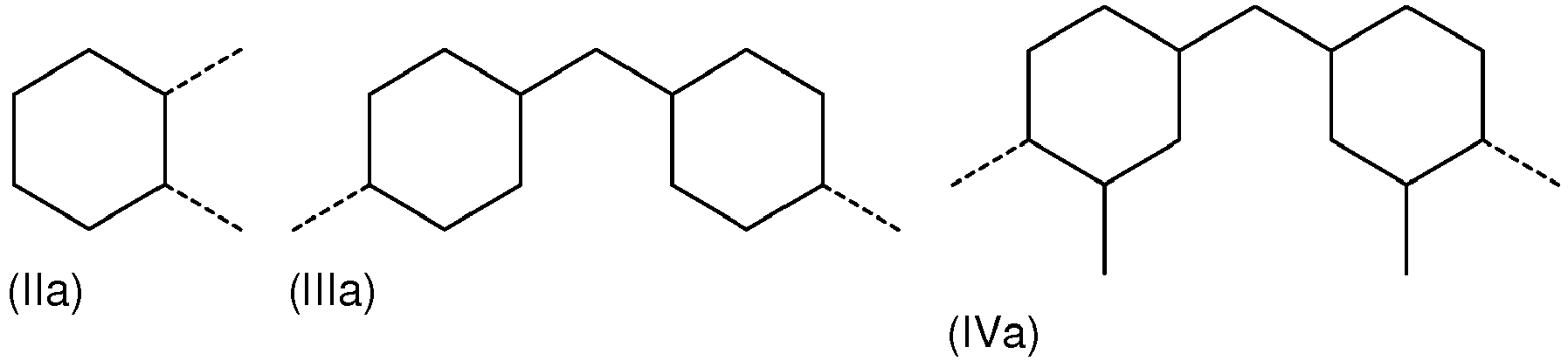
- The dotted lines indicate the binding site to the other substituents in the formula (I).
- Preferred R2 and R3 are identical. Particularly R2 and R3 are alkyl groups, more preferably an alkyl group with 1 to 6, particularly 1 to 4, carbon atoms. Most preferred R2 and R3 both stand for methyl groups.
- Most preferably, n represents a value of 2.
- In a preferred embodiment the compound of formula (I) has an amine value of 150 - 230 mg KOH/g, particularly of 185 - 205 mg KOH/g.
- Further preferred is that the compound of formula (I) has at 25°C a viscosity of between 700 and 3000 mPas, particularly between 750 and 2500 mPas, measured according to DIN 53 019.
- It is preferred that the compound of formula (I) is liquid at room temperature. More preferred the compound of formula (I) has a viscosity of less than 2500 mPas measured at 25°C according to DIN 56 019.
- In a preferred embodiment compound of formula (I) are those being commercially available under the tradename Desmophen® NH from Covestro.
- The hardener component C2 comprises at least one salt hydrate SH. The salt hydrate SH comprised in the hardener component C2 acts as a latent catalyst or accelerator for the curing of the polyurea composition. When salt hydrate SH reaches its decomposition temperature, it releases the water molecules bound in its crystal lattice and said water molecules act as actual catalyst or accelerator for the curing of the polyurea composition. It is this necessary that the salt hydrate SH is able to decompose in the defined temperature range by releasing its water, and it is furthermore necessary that the polyurea composition has not yet cured significantly when the water is released in order for the invention to work.
- The term "salt hydrate" means a salt, i.e. an organic or inorganic compound consisting of ions, containing water molecules combined in a definite ratio as an integral part of the crystal structure of the salt. These water molecules are weakly bound by hydrogen bonding within the crystal lattice and normally dissociate from the crystal structure when exposed to a specific heat. The decomposition of a salt hydrate to a free water molecule and a salt hydrate of lesser degree of hydration (or, eventually, a water-free salt) is temperature-controlled and the heat required for decomposition is unique for each salt hydrate and each bound water molecule in that salt hydrate. The "degree of hydration" describes the number of water molecules in a given salt formula. For example, Al2O3 × H2O has a degree of hydration of 1 (containing one water molecule per salt unit), while Al2(SO4)3 × 18 H2O has a degree of hydration of 18 (containing 18 water molecules per salt unit).
- Salt hydrates are also called "hydrated salts" or "salts containing water of crystallization".
- It is important that the salt hydrate SH is carefully selected according to the required use of the composition, in particular regarding the intended heat treatment. As mentioned before, the decomposition temperature is unique for each salt hydrate and thus the salt hydrate SH should possess a suitable decomposition temperature for the intended application process. For polyaspartics in general, the decomposition temperature of the salt hydrate SH should be in the range of between 30°C and 150°C. Below 30°C the storage stability of component C2 is significantly shortened since significant amounts of free water will be comprised therein after a short time, in particular in hot climates. Furthermore, the production of composition C2 is difficult since in mixing and milling processes heat is generated. A decomposition temperature above 150°C is equally not suitable, since this requires considerable heat generation with high energy consumption, but offers no advantage. Furthermore, applying such high temperatures to the curing materials may lead to weakening or partial destruction of the resin material.
- A preferred range for the decomposition temperature of the salt hydrate SH is between 45°C and 80°C, preferably between 50°C and 75°C.
- Preferred salt hydrates are metal salt hydrates. Among those, preferred are selected from the group consisting of Al2O3 × H2O, Al2(SO4)3 × 18 H2O, Al2(C2O4)3 × 4 H2O, AlNa(SO4)2 × 12 H2O, AlK(SO4)2 × 12 H2O, BaCl2 × 2 H2O, Ba(OH)2 × 8 H2O, CaSO4 × 2 H2O, CaS2O3 × 6 H2O, Ca(NO3)2 × 4 H2O, CaHPO4 × 2 H2O, Ca(C2O4) × H2O, Ca(CH3-CH(OH)-COO)2 × 5 H2O, Co(NO3)2 × 6 H2O, Co(CH3COO)2 x4 H2O, CuCl2 × 2 H2O, CuSO4 × 5 H2O, Cu(CH3COO)2 × 2 H2O, FeCl2 × 4 H2O, FeCl3 × 6 H2O, FeSO4 × 7 H2O, Fe(NH4)(SO4)2 × 12 H2O, K2CO3 × 15 H2O, KNaCO3 × 6 H2O, LiBr × 2 H2O, Li2SO4 × H2O, MgSO4 × H2O, MgSO4 × 7 H2O, MgHPO4 × 7 H2O, Mg3(PO4)2 × 8 H2O, MgCO3 × 3 H2O, Mg4(CO3)3(OH)2 × 3 H2O, MoO3 × 2 H2O, NaBr × 2 H2O, Na2SO3 × 7 H2O, Na2SO4 × 10 H2O, Na2S2O3 × 5 H2O, Na2S2O6 × 2 H2O, Na2B4O7 × 10 H2O, NaHPO4 × 5 H2O, Na3PO4 × 12 H2O, Na2CO3 × H2O, Na2CO3 × 7 H2O, Na2CO3 × 10 H2O, Na(CH3COO) × 3 H2O, NaHC2O4 × H2O, K/NaC4H4O6 × 4 H2O, Na2SiO3 × 9 H2O, NiSO4 × 6 H2O, NiC2O4 × 2 H2O, SnO2 × n H2O, NiC2O4 × 2 H2O, Sn(SO4)2 × 2 H2O, ZnSO3 × 2 H2O, ZnSO4 × 7 H2O, Zn3(PO4)2 × 4 H2O and Zn(CH3COO)2 × 2 H2O or mixtures thereof. Particular preference is given to CaHPO4 × 2 H2O, NaHPO4 × 2 H2O, LiH2PO4, MgSO4 × 6 H2O, MgHPO4 × 3 H2O, Na2SO4 × 10 H2O, Na2CO3 × 10 H2O, ZnSO4 × 7 H2O, and K/NaC4H4O6 × 4 H2O, in particular Na2SO4 × 10 H2O, Na2CO3 × 10 H2O, ZnSO4 × 7 H2O, K/NaC4H4O6 × 4 H2O. Most preferred are ZnSO4 × 7 H2O and K/NaC4H4O6 × 4 H2O.
- Preferably, the salt hydrate SH is a metal salt hydrate with an organic or inorganic anion and at least 2, preferably at least 4, bound water molecules per salt ion pair.
- The salt hydrate SH is preferably present in the hardener component C2 in the form of finely ground, dispersed particles, where the salt hydrate SH preferably has a particle size of below 100 µm.
- Grinding of the salt hydrate SH can be achieved by using a ball mill, pebble mill, rod mill, or any other industrial mill equipment. It is advantageous to introduce the hardener component C2 into the mill when grinding the salt hydrate SH, which leads to a fine dispersion of the salt hydrate particles in the hardener component C2.
- It is also possible to use tensides or surfactants to create a mono- or multilayer shell around the salt hydrate particles or to form thermoplastic shells around the particles by a suitable method known to the skilled person in the field of micro-encapsulation. This approach may increase the stability of the particles, in particular heat stability in case of low decomposition temperatures. Generally, sintering or coagulation of finely ground particles is not a problem when ground or milled in the presence of the hardener component C2. Otherwise, tensides or surfactants may improve the stability of the finely ground particles against coagulation or sintering, which is also the case when thermoplastic shells are used.
- It is furthermore possible to produce a dispersion of such fine particles of salt hydrate SH in a non-aqueous liquid carrier or solvent, or to produce a highly concentrated master batch of dispersed particles of salt hydrate SH in hardener component C2, which is then added in defined amounts to hardener C2 not containing salt hydrate SH. The master batch approach has the advantage that salt hydrate SH can be introduced into large amounts of hardener component C2 by normal mixing, without the requirement of a mill or grinder on-site.
- Preferably, the total amount of water in the composition stemming from the hydrated salt SH structure is 0.2 - 4 % by weight, in particular 0.3 - 2% by weight, more preferably 0.5 - 1 % by weight, relative to the weight sum of polyisocyanate PI and the compound of formula (I).
- The ratio of polyisocyanate component C1 to hardener component C2 is preferably selected so that the ratio of number of isocyanate groups in the polyisocyanate component C1 to the number of NCO-reactive groups in the hardener component C2 is preferably between 0.8 and 1.2, particularly between 0.9 and 1.1, preferably about 1.
- The polyisocyanate component C1 and/or the hardener component C2 may comprise further ingredients which are typically known to the person skilled in the art of polyurethanes.
- Particularly suited as such ingredients are
- dryers, such as, for example, high-reactivity isocyanates such as p-tosyl isocyanate, orthoformic esters, alkoxysilanes such as tetraethoxysilane, organoalkoxysilanes such as vinyltrimethoxysilane, and organoalkoxysilanes which have a functional group in the position α to the silane group;
- adhesion promoters, more particularly organoalkoxysilanes ("silanes") such as, for example, epoxysilanes, vinylsilanes, (meth)acrylosilanes, isocyanatosilanes, carbamatosilanes, alkylsilanes, S-(alkylcarbonyl)mercaptosilanes and aldiminosilanes, and also oligomeric forms of these silanes;
- stabilizers against heat, light and UV radiation;
- thixotropic agents;
- flow improving additives;
- solvents or plasticizer;
- matting agents;
- soft touch additives;
- flame retardants;
- surface-active substances such as, for example, wetting agents, flow control agents, deaerating agents or defoamers;
- biocides such as, for example algicides, fungicides or fungal growth inhibitors.
- If using such further constituents it is advantageous to ensure that they do not significantly affect the storage stability of the components in which they are used. This means that these constituents must not to any significant extent trigger the reactions that lead to cross-linking and/or deactivation during storage.
- The polyisocyanate component C1 and the hardener component C2 are stored separately particularly in recipients such as tanks, barrels, canisters, pails or cartridges. Particularly preferred they are stored in vessels which are transportable. In a preferred embodiment components C1 and C2 are individually stored in a dual-chamber package which allows that the two components are stored and transported together assuring the accessibility of the individual components in case of application.
- Furthermore preferred they are packed in tight and sealed containment. Particularly the polyisocyanate component C1 is stored in an air and water tight containment.
- It is preferred that the polyisocyanate component C1, and the hardener component C2 are storage stable at room temperature for at least 3 month, particularly for at least 6 months, preferably for at least 9 months during which their reactivity and viscosity are not altered by a significant amount. This means that after storage they can still be mixed and applied with the normal application tools and result in a cured product.
- In a further aspect the invention relates to a method of catalyzing or accelerating the curing of a polyurea composition comprising the steps of
- i) mixing the polyisocyanate component C1 and a hardener component C2 of a two-component polyurea composition according to any of claims 1 to 10 in such a way that the ratio of numbers of isocyanate groups of the polyisocyanate component to the number of NCO-reactive groups of the hardener component is between 0.8 and 1.2 and forming a mixed polyurea composition;
- ii) heating said mixed polyurea composition above the decomposition temperature of the salt hydrate contained therein, preferably within the range of 30°C and 150°C.
- It is preferred that that the heating in step ii) is to a temperature of between 40 and 80°C.
- In a further aspect the invention relates to a method of preparing a coating, floor, or cast, comprising the steps of:
- i) mixing the polyisocyanate component C1 and a hardener component C2 of a two-component polyurea composition according to any of claims 1 to 10 in such a way that the ratio of numbers of isocyanate groups of the polyisocyanate component to the number of groups being NCO-reactive of the hardener component is between 0.8 and 1.2 and forming a mixed polyurea composition;
- ii) applying, particularly casting, said mixed polyurea composition onto a surface of a substrate or into the cavity of a mold;
- iii) heating said mixed polyurea composition above the decomposition temperature of the salt hydrate contained therein, preferably within the range of 30°C and 150°C, until the polyurea composition is at least partially cured.
- The substrate to which surface the mixed polyurea composition is applied in step ii) of the method of preparing a coating, floor, or cast, is typically a concrete or a resin based floor or coating or the body of a vehicle or a casting mold. It is further preferred that said substrate, except the casting mold, is mechanically and or chemically pretreated. Such pretreatments encompass, more particularly, physical and/or chemical cleaning methods, examples being abrading, sandblasting, brushing, or treatment with cleaners or solvents, or the application of an adhesion promoter, an adhesion promoter solution or a primer.
- The preferred embodiment is that the mixed polyurea composition is self levelling. In other words the mixed polyurea composition may be poured onto the surface and levels and is sufficiently fluent to flow and spread on the surface of the substrate mainly due to gravity. The self levelling may be supported by manual spreading.
- Due to mixing of the two components C1 and C2 and thereafter heating of the mixed composition the composition cures fast.
- The composition yields a coating, floor, or cast having preferably an impeccable surface aspect. In other words a coating, floor, or cast may be formed having no defect on the surface and is suited for high quality coatings, floors, and casts. The floor may be a park deck floor, an industrial floor used in food processing plants, chemical storage areas, warehouses, washrooms, laboratories, food preparation areas and chemical process plants.
- In a further aspect the invention relates to the use of a salt hydrate SH with a decomposition temperature of between 30 °C and 80 °C to catalyze or accelerate the curing of a two-component polyurea composition as described further above. All preferred embodiments for the polyurea composition and/or the salt hydrate SH as described above are also valid for this aspect of the invention.
- The invention is further explained in the following experimental part which, however, shall not be construed as limiting the scope of the invention.
-
- Salt hydrates: ZnSO4 × 7 H2O, K/NaC4H4O6 × 4 H2O (VWR Chemicals)
- Catalyst: Polycat® SA-1/10 (Air Products)
- Desmodur® N 3300 (HDI trimer with NCO content of 21.8 ± 0.3%), available from Covestro, was used as polyisocyanate component C1-1 and was mixed with Desmophen® NH 1420 (polyaspartic secondary amine with amine value of 199-203), available from Covestro, being hardener component C2-1, in a weight ratio C1-1 : C2-1 of 100 : 70.
- The hardener component C2-1 comprised an amount of water or of a salt hydrate or catalyst, respective of the experiment detailed in Table 1. The salt hydrate (or water or catalyst) was introduced into the hardener of the individual sample by first mixing 250 g hardener resin with the given amount of salt hydrate (or water, or catalyst) during 5 min, then adding the mixture to a bead mill wherein furthermore 50 vol.-% of ZrO beads (2mm diameter) with respect to the volume of the resin were added. The mixture with the beads was milled during 30 min until a homogeneous mixture was obtained. Care was taken, by employing cooling and/or intermittently pausing the mixing procedure, that the decomposition temperature of the respective salt hydrate or catalyst was not exceeded during mixing.
- After mixing of the polyisocyanate component C1-1 and the hardener component C2-1 comprising water or the respective metal salt or catalyst, the thus obtained mixture was immediately applied to a viscometer of the manufacturer Anton Paar employed with a plate-plate measuring setup for an amplitude controlled oscillating test. The upper plate had a diameter of 25 mm, the gap between the plates was 0.5 mm, frequency omega was 10 rad s-1, and amplitude gamma 0.1%. Viscosity measurements were performed at 20°C, 50°C, and 80°C, respectively. Curing of the samples took place in the viscometer setup and was monitored by viscosity measurements.
- To assess the pot life of the mixture, the time was recorded in each experiment until the gel-point was reached. The gel-point was defined as the time, when tan(δ) ("tan delta"; ratio of loss modulus to storage modulus) reached the value of 1.
- To assess the curing rate, the time was recorded in each experiment until curing had so significantly proceeded that the mixture was practically cured. This was defined as the time, when tan(δ) ("tan delta"; ratio of loss modulus to storage modulus) reached the value of 0.1.
- The results are shown in Table 1. In Table 1, the wt.-% refer to the amount of accelerating additive in each experiment, with respect to the total weight of the two-component composition. The amount of salt hydrate in each experiment was adjusted according to the amount of water molecules bound by hydration contained therein. Experiments 1-3 show non-accelerated reference experiments, and experiments 4-6 and 7-9 show non-inventive reference experiments comprising free water that was mixed into component C2-1 using the mixing method detailed above. Experiments 16-18 show reference experiments using a heat-activated traditional polyurethane/polyurea catalyst based on a blocked tertiary amine.
- Best results are considered those of compositions with a long pot life at application temperature (20°C) but fast curing at slightly elevated temperature (50°C). The most relevant data is highlighted in bold print.
- The results in Table 1 show that the addition of salt hydrates according to the present invention leads to a significantly prolonged pot life compared to free water-accelerated mixtures, but when slightly heated, fast curing takes place which clearly exceeds the curing speed of non-accelerated mixtures. Interestingly, using a traditional heat-activated catalyst based on a blocked tertiary amine has a strong delaying effect on the curing, regardless of the temperature. Compositions according to the present invention thus have usefully long pot-lives, but can be led to a fast curing after application of the mixture by applying moderate heat.
Table 1: Experiments and results. "n/m" means not measureable (> 3h). Exp. Additive wt.-% T [°C] Time to gel-point (tan δ = 1) [min] Curing time (tan δ = 0.1) [min] 1 - 0.00 20 94.0 156.0 2 50 75.7 112.0 3 80 18.4 120.0 4 H2O 0.50 20 26.9 40.8 5 50 19.2 30.2 6 80 6.8 76.6 7 H2O 1.00 20 16.1 24.9 8 50 11.4 18.4 9 80 3.8 70.0 10 ZnSO4 × 7 H2O 2.28 20 62.8 102.1 11 50 19.8 56.2 12 80 1.8 102.3 13 K/NaC4H4O6 × 4 H2O 3.92 20 121.0 174.0 14 50 21.4 55.6 15 80 6.5 n/m 16 Polycat SA-1/10 1.00 20 n/m n/m 17 50 n/m n/m 18 80 44.9 n/m
the hardener component C2 comprises at least one salt hydrate SH with a decomposition temperature of between 30 °C and 80 °C.
Claims (16)
- Two-component polyurea composition, comprising a polyisocyanate component C1 and a hardener component C2,
wherein
the polyisocyanate component C1 comprises at least a polyisocyanate PI; the hardener component C2 comprises at least a compound of formula (I) R1 represents a n-valent organic radical;R2 and R3 represent independently of one another an aliphatic or cycloaliphatic or aromatic radical;n is an integer with a value of 2 to 6, particularly 2 or 3;characterized in that
the hardener component C2 comprises at least one salt hydrate SH with a decomposition temperature of between 30 °C and 80 °C. - Two-component polyurea composition according to claim 1, characterized in that the compound of formula (I) has an amine value of 150 - 230 mg KOH/g, particularly of 185 - 205 mg KOH/g.
- Two-component polyurea composition according to claim 1 or 2, characterized in that the compound of formula (I) has at 25°C a viscosity of between 700 and 3000 mPas, particularly between 750 and 2500 mPas, measured according to DIN 53 019.
- Two-component polyurea composition according to any of the preceding claims, characterized in that the polyisocyanate PI is an aliphatic or cycloaliphatic diisocyanate or triisocyanate or an oligomer thereof.
- Two-component polyurea composition according to any of the preceding claims, characterized in that the polyisocyanate PI is a biuret or an uretdione or an isocyanurate of 1,6-hexamethylene diisocyanate (HDI).
- Two-component polyurea composition according to any of the preceding claims, characterized in that said salt hydrate SH is a metal salt hydrate with an organic or inorganic anion and at least 2, preferably at least 4, bound water molecules per salt ion pair.
- Two-component polyurea composition according to anyone of the preceding claims, characterized in that said salt hydrate SH has a decomposition temperature of between 45°C and 80°C, preferably between 50°C and 75°C.
- Two-component polyurea composition according to anyone of the preceding claims, characterized in that said salt hydrate SH is selected from the group consisting CaHPO4 × 2 H2O, NaHPO4 × 2 H2O, LiH2PO4, MgSO4 × 6 H2O, MgHPO4 × 3 H2O, Na2SO4 × 10 H2O, Na2CO3 × 10 H2O, ZnSO4 × 7 H2O, and K/NaC4H4O6 × 4 H2O, or mixtures thereof.
- Two-component polyurea composition according to anyone of the preceding claims, characterized in that said salt hydrate SH is present in the hardener component C2 in the form of finely ground, dispersed particles.
- Two-component polyurea composition according to any of the preceding claims, characterized in that the total amount of water in the composition stemming from the hydrated salt structure is 0.2 - 4% by weight, relative to the weight sum of polyisocyanate PI and the compound of formula (I).
- Method of catalyzing or accelerating the curing of a polyurea composition, comprising the steps ofi) mixing the polyisocyanate component C1 and a hardener component C2 of a two-component polyurea composition according to any of claims 1 to 10 in such a way that the ratio of numbers of isocyanate groups of the polyisocyanate component to the number of NCO-reactive groups of the hardener component is between 0.8 and 1.2 and forming a mixed polyurea composition;ii) heating said mixed polyurea composition above the decomposition temperature of the salt hydrate contained therein, preferably within the range of 30°C and 150°C.
- Method according to claim 11, characterized in that the heating in step ii) is to a temperature of between 40°C and 80°C.
- Method of preparing a coating, floor, or cast, comprising the steps ofi) mixing the polyisocyanate component C1 and a hardener component C2 of a two-component polyurea composition according to any of claims 1 to 10 in such a way that the ratio of numbers of isocyanate groups of the polyisocyanate component to the number of groups being NCO-reactive of the hardener component is between 0.8 and 1.2 and forming a mixed polyurea composition;ii) applying, particularly casting, said mixed polyurea composition onto a surface of a substrate or into the cavity of a mold;iii) heating said mixed polyurea composition above the decomposition temperature of the salt hydrate contained therein, preferably within the range of 30°C and 150°C, until the polyurea composition is at least partially cured.
- Method according to claim 13, characterized in that said mixed polyurea composition is self-levelling.
- Coating, floor, or cast obtained by a method according to claim 13.
- Use of a salt hydrate SH with a decomposition temperature of between 30°C and 80°C to catalyze or accelerate the curing of a two-component polyurea composition according to any of claim 1 to 10.
Applications Claiming Priority (2)
| Application Number | Priority Date | Filing Date | Title |
|---|---|---|---|
| EP17204894 | 2017-12-01 | ||
| PCT/EP2018/082731 WO2019105947A1 (en) | 2017-12-01 | 2018-11-27 | Polyaspartics with long pot life and fast curing |
Publications (2)
| Publication Number | Publication Date |
|---|---|
| EP3717543A1 EP3717543A1 (en) | 2020-10-07 |
| EP3717543B1 true EP3717543B1 (en) | 2022-08-24 |
Family
ID=60543450
Family Applications (1)
| Application Number | Title | Priority Date | Filing Date |
|---|---|---|---|
| EP18807343.1A Not-in-force EP3717543B1 (en) | 2017-12-01 | 2018-11-27 | Polyaspartics with long pot life and fast curing |
Country Status (4)
| Country | Link |
|---|---|
| US (1) | US11512163B2 (en) |
| EP (1) | EP3717543B1 (en) |
| CN (1) | CN111655751B (en) |
| WO (1) | WO2019105947A1 (en) |
Families Citing this family (1)
| Publication number | Priority date | Publication date | Assignee | Title |
|---|---|---|---|---|
| CN116063911B (en) * | 2022-11-18 | 2024-03-22 | 李泽月 | Environment-friendly fast-curing single-component polyurea material and preparation method thereof |
Citations (1)
| Publication number | Priority date | Publication date | Assignee | Title |
|---|---|---|---|---|
| EP0054267A1 (en) * | 1980-12-11 | 1982-06-23 | Dr. Hans Heubach GmbH & Co. KG | Aluminium zinc phosphate hydrates, e.g. basic aluminium zinc phosphate hydrates, their preparation and their application as coating agents |
Family Cites Families (8)
| Publication number | Priority date | Publication date | Assignee | Title |
|---|---|---|---|---|
| US5736604A (en) | 1996-12-17 | 1998-04-07 | Bayer Corporation | Aqueous, two-component polyurea coating compositions |
| CN101044179B (en) | 2004-09-17 | 2011-07-06 | 阿克佐诺贝尔国际涂料股份有限公司 | Coating composition based on thiol-NCO curing |
| CN102311700A (en) * | 2010-06-29 | 2012-01-11 | 拜耳材料科技(中国)有限公司 | Aliphatic Polyurea paint, preparation method and application thereof |
| EP2457937A1 (en) | 2010-11-25 | 2012-05-30 | Sika Technology AG | Curing on demand polyurethane composition suitable for the preparation of coatings or floorings |
| US9944821B2 (en) * | 2013-03-15 | 2018-04-17 | Covestro Llc | Polyaspartic coating compositions |
| EP3029128A1 (en) * | 2014-12-05 | 2016-06-08 | HILTI Aktiengesellschaft | Fire-resistant compound and its utilisation |
| WO2016210237A1 (en) * | 2015-06-26 | 2016-12-29 | Covestro Llc | Polyaspartic ester based coatings for metal surfaces |
| CN106905911A (en) * | 2015-12-22 | 2017-06-30 | 北京奥托米特电子有限公司 | Polyurea adhesive composition and preparation method thereof |
-
2018
- 2018-11-27 US US16/768,764 patent/US11512163B2/en active Active
- 2018-11-27 WO PCT/EP2018/082731 patent/WO2019105947A1/en not_active Ceased
- 2018-11-27 EP EP18807343.1A patent/EP3717543B1/en not_active Not-in-force
- 2018-11-27 CN CN201880088007.XA patent/CN111655751B/en not_active Expired - Fee Related
Patent Citations (1)
| Publication number | Priority date | Publication date | Assignee | Title |
|---|---|---|---|---|
| EP0054267A1 (en) * | 1980-12-11 | 1982-06-23 | Dr. Hans Heubach GmbH & Co. KG | Aluminium zinc phosphate hydrates, e.g. basic aluminium zinc phosphate hydrates, their preparation and their application as coating agents |
Also Published As
| Publication number | Publication date |
|---|---|
| US11512163B2 (en) | 2022-11-29 |
| US20210171702A1 (en) | 2021-06-10 |
| CN111655751B (en) | 2022-05-10 |
| WO2019105947A1 (en) | 2019-06-06 |
| CN111655751A (en) | 2020-09-11 |
| EP3717543A1 (en) | 2020-10-07 |
Similar Documents
| Publication | Publication Date | Title |
|---|---|---|
| CN110809589B (en) | Two-component polyurethane compositions with adjustable pot life | |
| CN101687775B (en) | Aldimines and compositions comprising aldamine | |
| KR950005736B1 (en) | Polyurethane foam prepared using a highly functional bubble opener and a method of manufacturing the same | |
| EP1934172B1 (en) | Compounds containing aldimine | |
| KR102796529B1 (en) | High molecular weight hydrophobic polyol | |
| US20090176944A1 (en) | Aldimines Comprising Reactive Groups Containing Active Hydrogen, and Use Thereof | |
| RU2719440C2 (en) | Hydrophobic polyols | |
| BR112015004214B1 (en) | structural polyurethane adhesive, bonding method and article | |
| JPH07228831A (en) | Polyurea coating composition having improved pot life | |
| JP2011503143A (en) | Aromatic aldimine and polyurethane composition containing aldimine | |
| CA2655235A1 (en) | Voc-free or voc-poor polyurethane coating | |
| US5567763A (en) | Polyurethane spray systems having improved flame-retardant properties | |
| CN105829373B (en) | Adhesive containing high solids copolymer polyol polyurethane prepolymer | |
| BR112014016972B1 (en) | adhesive formulation of amino resin, composition, use of a formulation, lignocellulosic body, and method for preparing a composition | |
| EP2457937A1 (en) | Curing on demand polyurethane composition suitable for the preparation of coatings or floorings | |
| US11512163B2 (en) | Polyaspartics with long pot life and fast curing | |
| US20050066697A1 (en) | Slow-release polyurethane(urea) encapsulated fertilizer | |
| ES3029732T3 (en) | Two-component coating compositions | |
| US8519062B2 (en) | Elastomeric materials having a high hardblock content and process for preparing them | |
| EP3372651B1 (en) | Water-swellable moisture curing one-component polyurethane sealant | |
| JPS5867713A (en) | Foamed material |
Legal Events
| Date | Code | Title | Description |
|---|---|---|---|
| STAA | Information on the status of an ep patent application or granted ep patent |
Free format text: STATUS: UNKNOWN |
|
| STAA | Information on the status of an ep patent application or granted ep patent |
Free format text: STATUS: THE INTERNATIONAL PUBLICATION HAS BEEN MADE |
|
| PUAI | Public reference made under article 153(3) epc to a published international application that has entered the european phase |
Free format text: ORIGINAL CODE: 0009012 |
|
| STAA | Information on the status of an ep patent application or granted ep patent |
Free format text: STATUS: REQUEST FOR EXAMINATION WAS MADE |
|
| 17P | Request for examination filed |
Effective date: 20200701 |
|
| AK | Designated contracting states |
Kind code of ref document: A1 Designated state(s): AL AT BE BG CH CY CZ DE DK EE ES FI FR GB GR HR HU IE IS IT LI LT LU LV MC MK MT NL NO PL PT RO RS SE SI SK SM TR |
|
| AX | Request for extension of the european patent |
Extension state: BA ME |
|
| DAV | Request for validation of the european patent (deleted) | ||
| DAX | Request for extension of the european patent (deleted) | ||
| STAA | Information on the status of an ep patent application or granted ep patent |
Free format text: STATUS: EXAMINATION IS IN PROGRESS |
|
| 17Q | First examination report despatched |
Effective date: 20210809 |
|
| GRAP | Despatch of communication of intention to grant a patent |
Free format text: ORIGINAL CODE: EPIDOSNIGR1 |
|
| STAA | Information on the status of an ep patent application or granted ep patent |
Free format text: STATUS: GRANT OF PATENT IS INTENDED |
|
| INTG | Intention to grant announced |
Effective date: 20220404 |
|
| GRAS | Grant fee paid |
Free format text: ORIGINAL CODE: EPIDOSNIGR3 |
|
| GRAA | (expected) grant |
Free format text: ORIGINAL CODE: 0009210 |
|
| STAA | Information on the status of an ep patent application or granted ep patent |
Free format text: STATUS: THE PATENT HAS BEEN GRANTED |
|
| AK | Designated contracting states |
Kind code of ref document: B1 Designated state(s): AL AT BE BG CH CY CZ DE DK EE ES FI FR GB GR HR HU IE IS IT LI LT LU LV MC MK MT NL NO PL PT RO RS SE SI SK SM TR |
|
| REG | Reference to a national code |
Ref country code: CH Ref legal event code: EP |
|
| REG | Reference to a national code |
Ref country code: DE Ref legal event code: R096 Ref document number: 602018039793 Country of ref document: DE |
|
| REG | Reference to a national code |
Ref country code: IE Ref legal event code: FG4D |
|
| REG | Reference to a national code |
Ref country code: AT Ref legal event code: REF Ref document number: 1513622 Country of ref document: AT Kind code of ref document: T Effective date: 20220915 |
|
| REG | Reference to a national code |
Ref country code: LT Ref legal event code: MG9D |
|
| REG | Reference to a national code |
Ref country code: NL Ref legal event code: MP Effective date: 20220824 |
|
| PGFP | Annual fee paid to national office [announced via postgrant information from national office to epo] |
Ref country code: FR Payment date: 20221021 Year of fee payment: 5 |
|
| PG25 | Lapsed in a contracting state [announced via postgrant information from national office to epo] |
Ref country code: SE Free format text: LAPSE BECAUSE OF FAILURE TO SUBMIT A TRANSLATION OF THE DESCRIPTION OR TO PAY THE FEE WITHIN THE PRESCRIBED TIME-LIMIT Effective date: 20220824 Ref country code: RS Free format text: LAPSE BECAUSE OF FAILURE TO SUBMIT A TRANSLATION OF THE DESCRIPTION OR TO PAY THE FEE WITHIN THE PRESCRIBED TIME-LIMIT Effective date: 20220824 Ref country code: PT Free format text: LAPSE BECAUSE OF FAILURE TO SUBMIT A TRANSLATION OF THE DESCRIPTION OR TO PAY THE FEE WITHIN THE PRESCRIBED TIME-LIMIT Effective date: 20221226 Ref country code: NO Free format text: LAPSE BECAUSE OF FAILURE TO SUBMIT A TRANSLATION OF THE DESCRIPTION OR TO PAY THE FEE WITHIN THE PRESCRIBED TIME-LIMIT Effective date: 20221124 Ref country code: NL Free format text: LAPSE BECAUSE OF FAILURE TO SUBMIT A TRANSLATION OF THE DESCRIPTION OR TO PAY THE FEE WITHIN THE PRESCRIBED TIME-LIMIT Effective date: 20220824 Ref country code: LV Free format text: LAPSE BECAUSE OF FAILURE TO SUBMIT A TRANSLATION OF THE DESCRIPTION OR TO PAY THE FEE WITHIN THE PRESCRIBED TIME-LIMIT Effective date: 20220824 Ref country code: LT Free format text: LAPSE BECAUSE OF FAILURE TO SUBMIT A TRANSLATION OF THE DESCRIPTION OR TO PAY THE FEE WITHIN THE PRESCRIBED TIME-LIMIT Effective date: 20220824 Ref country code: FI Free format text: LAPSE BECAUSE OF FAILURE TO SUBMIT A TRANSLATION OF THE DESCRIPTION OR TO PAY THE FEE WITHIN THE PRESCRIBED TIME-LIMIT Effective date: 20220824 |
|
| PGFP | Annual fee paid to national office [announced via postgrant information from national office to epo] |
Ref country code: DE Payment date: 20221020 Year of fee payment: 5 |
|
| REG | Reference to a national code |
Ref country code: AT Ref legal event code: MK05 Ref document number: 1513622 Country of ref document: AT Kind code of ref document: T Effective date: 20220824 |
|
| PG25 | Lapsed in a contracting state [announced via postgrant information from national office to epo] |
Ref country code: PL Free format text: LAPSE BECAUSE OF FAILURE TO SUBMIT A TRANSLATION OF THE DESCRIPTION OR TO PAY THE FEE WITHIN THE PRESCRIBED TIME-LIMIT Effective date: 20220824 Ref country code: IS Free format text: LAPSE BECAUSE OF FAILURE TO SUBMIT A TRANSLATION OF THE DESCRIPTION OR TO PAY THE FEE WITHIN THE PRESCRIBED TIME-LIMIT Effective date: 20221224 Ref country code: HR Free format text: LAPSE BECAUSE OF FAILURE TO SUBMIT A TRANSLATION OF THE DESCRIPTION OR TO PAY THE FEE WITHIN THE PRESCRIBED TIME-LIMIT Effective date: 20220824 Ref country code: GR Free format text: LAPSE BECAUSE OF FAILURE TO SUBMIT A TRANSLATION OF THE DESCRIPTION OR TO PAY THE FEE WITHIN THE PRESCRIBED TIME-LIMIT Effective date: 20221125 |
|
| PG25 | Lapsed in a contracting state [announced via postgrant information from national office to epo] |
Ref country code: SM Free format text: LAPSE BECAUSE OF FAILURE TO SUBMIT A TRANSLATION OF THE DESCRIPTION OR TO PAY THE FEE WITHIN THE PRESCRIBED TIME-LIMIT Effective date: 20220824 Ref country code: RO Free format text: LAPSE BECAUSE OF FAILURE TO SUBMIT A TRANSLATION OF THE DESCRIPTION OR TO PAY THE FEE WITHIN THE PRESCRIBED TIME-LIMIT Effective date: 20220824 Ref country code: ES Free format text: LAPSE BECAUSE OF FAILURE TO SUBMIT A TRANSLATION OF THE DESCRIPTION OR TO PAY THE FEE WITHIN THE PRESCRIBED TIME-LIMIT Effective date: 20220824 Ref country code: DK Free format text: LAPSE BECAUSE OF FAILURE TO SUBMIT A TRANSLATION OF THE DESCRIPTION OR TO PAY THE FEE WITHIN THE PRESCRIBED TIME-LIMIT Effective date: 20220824 Ref country code: CZ Free format text: LAPSE BECAUSE OF FAILURE TO SUBMIT A TRANSLATION OF THE DESCRIPTION OR TO PAY THE FEE WITHIN THE PRESCRIBED TIME-LIMIT Effective date: 20220824 Ref country code: AT Free format text: LAPSE BECAUSE OF FAILURE TO SUBMIT A TRANSLATION OF THE DESCRIPTION OR TO PAY THE FEE WITHIN THE PRESCRIBED TIME-LIMIT Effective date: 20220824 |
|
| REG | Reference to a national code |
Ref country code: DE Ref legal event code: R097 Ref document number: 602018039793 Country of ref document: DE |
|
| PG25 | Lapsed in a contracting state [announced via postgrant information from national office to epo] |
Ref country code: SK Free format text: LAPSE BECAUSE OF FAILURE TO SUBMIT A TRANSLATION OF THE DESCRIPTION OR TO PAY THE FEE WITHIN THE PRESCRIBED TIME-LIMIT Effective date: 20220824 Ref country code: EE Free format text: LAPSE BECAUSE OF FAILURE TO SUBMIT A TRANSLATION OF THE DESCRIPTION OR TO PAY THE FEE WITHIN THE PRESCRIBED TIME-LIMIT Effective date: 20220824 |
|
| PG25 | Lapsed in a contracting state [announced via postgrant information from national office to epo] |
Ref country code: MC Free format text: LAPSE BECAUSE OF FAILURE TO SUBMIT A TRANSLATION OF THE DESCRIPTION OR TO PAY THE FEE WITHIN THE PRESCRIBED TIME-LIMIT Effective date: 20220824 Ref country code: AL Free format text: LAPSE BECAUSE OF FAILURE TO SUBMIT A TRANSLATION OF THE DESCRIPTION OR TO PAY THE FEE WITHIN THE PRESCRIBED TIME-LIMIT Effective date: 20220824 |
|
| PLBE | No opposition filed within time limit |
Free format text: ORIGINAL CODE: 0009261 |
|
| REG | Reference to a national code |
Ref country code: CH Ref legal event code: PL |
|
| STAA | Information on the status of an ep patent application or granted ep patent |
Free format text: STATUS: NO OPPOSITION FILED WITHIN TIME LIMIT |
|
| GBPC | Gb: european patent ceased through non-payment of renewal fee |
Effective date: 20221127 |
|
| REG | Reference to a national code |
Ref country code: BE Ref legal event code: MM Effective date: 20221130 |
|
| PG25 | Lapsed in a contracting state [announced via postgrant information from national office to epo] |
Ref country code: LI Free format text: LAPSE BECAUSE OF NON-PAYMENT OF DUE FEES Effective date: 20221130 Ref country code: CH Free format text: LAPSE BECAUSE OF NON-PAYMENT OF DUE FEES Effective date: 20221130 |
|
| 26N | No opposition filed |
Effective date: 20230525 |
|
| PG25 | Lapsed in a contracting state [announced via postgrant information from national office to epo] |
Ref country code: SI Free format text: LAPSE BECAUSE OF FAILURE TO SUBMIT A TRANSLATION OF THE DESCRIPTION OR TO PAY THE FEE WITHIN THE PRESCRIBED TIME-LIMIT Effective date: 20220824 Ref country code: LU Free format text: LAPSE BECAUSE OF NON-PAYMENT OF DUE FEES Effective date: 20221127 |
|
| PG25 | Lapsed in a contracting state [announced via postgrant information from national office to epo] |
Ref country code: IE Free format text: LAPSE BECAUSE OF NON-PAYMENT OF DUE FEES Effective date: 20221127 Ref country code: GB Free format text: LAPSE BECAUSE OF NON-PAYMENT OF DUE FEES Effective date: 20221127 |
|
| PG25 | Lapsed in a contracting state [announced via postgrant information from national office to epo] |
Ref country code: BE Free format text: LAPSE BECAUSE OF NON-PAYMENT OF DUE FEES Effective date: 20221130 |
|
| PG25 | Lapsed in a contracting state [announced via postgrant information from national office to epo] |
Ref country code: CY Free format text: LAPSE BECAUSE OF FAILURE TO SUBMIT A TRANSLATION OF THE DESCRIPTION OR TO PAY THE FEE WITHIN THE PRESCRIBED TIME-LIMIT Effective date: 20220824 |
|
| PG25 | Lapsed in a contracting state [announced via postgrant information from national office to epo] |
Ref country code: MK Free format text: LAPSE BECAUSE OF FAILURE TO SUBMIT A TRANSLATION OF THE DESCRIPTION OR TO PAY THE FEE WITHIN THE PRESCRIBED TIME-LIMIT Effective date: 20220824 Ref country code: IT Free format text: LAPSE BECAUSE OF FAILURE TO SUBMIT A TRANSLATION OF THE DESCRIPTION OR TO PAY THE FEE WITHIN THE PRESCRIBED TIME-LIMIT Effective date: 20220824 Ref country code: HU Free format text: LAPSE BECAUSE OF FAILURE TO SUBMIT A TRANSLATION OF THE DESCRIPTION OR TO PAY THE FEE WITHIN THE PRESCRIBED TIME-LIMIT; INVALID AB INITIO Effective date: 20181127 |
|
| REG | Reference to a national code |
Ref country code: DE Ref legal event code: R119 Ref document number: 602018039793 Country of ref document: DE |
|
| PG25 | Lapsed in a contracting state [announced via postgrant information from national office to epo] |
Ref country code: TR Free format text: LAPSE BECAUSE OF FAILURE TO SUBMIT A TRANSLATION OF THE DESCRIPTION OR TO PAY THE FEE WITHIN THE PRESCRIBED TIME-LIMIT Effective date: 20220824 |
|
| PG25 | Lapsed in a contracting state [announced via postgrant information from national office to epo] |
Ref country code: BG Free format text: LAPSE BECAUSE OF FAILURE TO SUBMIT A TRANSLATION OF THE DESCRIPTION OR TO PAY THE FEE WITHIN THE PRESCRIBED TIME-LIMIT Effective date: 20220824 |
|
| PG25 | Lapsed in a contracting state [announced via postgrant information from national office to epo] |
Ref country code: MT Free format text: LAPSE BECAUSE OF FAILURE TO SUBMIT A TRANSLATION OF THE DESCRIPTION OR TO PAY THE FEE WITHIN THE PRESCRIBED TIME-LIMIT Effective date: 20220824 |
|
| PG25 | Lapsed in a contracting state [announced via postgrant information from national office to epo] |
Ref country code: DE Free format text: LAPSE BECAUSE OF NON-PAYMENT OF DUE FEES Effective date: 20240601 |
|
| PG25 | Lapsed in a contracting state [announced via postgrant information from national office to epo] |
Ref country code: FR Free format text: LAPSE BECAUSE OF NON-PAYMENT OF DUE FEES Effective date: 20231130 |
|
| PG25 | Lapsed in a contracting state [announced via postgrant information from national office to epo] |
Ref country code: FR Free format text: LAPSE BECAUSE OF NON-PAYMENT OF DUE FEES Effective date: 20231130 Ref country code: DE Free format text: LAPSE BECAUSE OF NON-PAYMENT OF DUE FEES Effective date: 20240601 |