EP3716377B1 - Electrode protective layer polymer and secondary battery to which same is applied - Google Patents
Electrode protective layer polymer and secondary battery to which same is applied Download PDFInfo
- Publication number
- EP3716377B1 EP3716377B1 EP19840537.5A EP19840537A EP3716377B1 EP 3716377 B1 EP3716377 B1 EP 3716377B1 EP 19840537 A EP19840537 A EP 19840537A EP 3716377 B1 EP3716377 B1 EP 3716377B1
- Authority
- EP
- European Patent Office
- Prior art keywords
- polymer
- protective layer
- fluorine
- poly
- electrode protective
- Prior art date
- Legal status (The legal status is an assumption and is not a legal conclusion. Google has not performed a legal analysis and makes no representation as to the accuracy of the status listed.)
- Active
Links
Classifications
-
- H—ELECTRICITY
- H01—ELECTRIC ELEMENTS
- H01M—PROCESSES OR MEANS, e.g. BATTERIES, FOR THE DIRECT CONVERSION OF CHEMICAL ENERGY INTO ELECTRICAL ENERGY
- H01M4/00—Electrodes
- H01M4/02—Electrodes composed of, or comprising, active material
- H01M4/13—Electrodes for accumulators with non-aqueous electrolyte, e.g. for lithium-accumulators; Processes of manufacture thereof
- H01M4/134—Electrodes based on metals, Si or alloys
-
- C—CHEMISTRY; METALLURGY
- C08—ORGANIC MACROMOLECULAR COMPOUNDS; THEIR PREPARATION OR CHEMICAL WORKING-UP; COMPOSITIONS BASED THEREON
- C08F—MACROMOLECULAR COMPOUNDS OBTAINED BY REACTIONS ONLY INVOLVING CARBON-TO-CARBON UNSATURATED BONDS
- C08F214/00—Copolymers of compounds having one or more unsaturated aliphatic radicals, each having only one carbon-to-carbon double bond, and at least one being terminated by a halogen
- C08F214/18—Monomers containing fluorine
- C08F214/22—Vinylidene fluoride
-
- C—CHEMISTRY; METALLURGY
- C08—ORGANIC MACROMOLECULAR COMPOUNDS; THEIR PREPARATION OR CHEMICAL WORKING-UP; COMPOSITIONS BASED THEREON
- C08F—MACROMOLECULAR COMPOUNDS OBTAINED BY REACTIONS ONLY INVOLVING CARBON-TO-CARBON UNSATURATED BONDS
- C08F259/00—Macromolecular compounds obtained by polymerising monomers on to polymers of halogen containing monomers as defined in group C08F14/00
- C08F259/08—Macromolecular compounds obtained by polymerising monomers on to polymers of halogen containing monomers as defined in group C08F14/00 on to polymers containing fluorine
-
- C—CHEMISTRY; METALLURGY
- C09—DYES; PAINTS; POLISHES; NATURAL RESINS; ADHESIVES; COMPOSITIONS NOT OTHERWISE PROVIDED FOR; APPLICATIONS OF MATERIALS NOT OTHERWISE PROVIDED FOR
- C09D—COATING COMPOSITIONS, e.g. PAINTS, VARNISHES OR LACQUERS; FILLING PASTES; CHEMICAL PAINT OR INK REMOVERS; INKS; CORRECTING FLUIDS; WOODSTAINS; PASTES OR SOLIDS FOR COLOURING OR PRINTING; USE OF MATERIALS THEREFOR
- C09D127/00—Coating compositions based on homopolymers or copolymers of compounds having one or more unsaturated aliphatic radicals, each having only one carbon-to-carbon double bond, and at least one being terminated by a halogen; Coating compositions based on derivatives of such polymers
- C09D127/02—Coating compositions based on homopolymers or copolymers of compounds having one or more unsaturated aliphatic radicals, each having only one carbon-to-carbon double bond, and at least one being terminated by a halogen; Coating compositions based on derivatives of such polymers not modified by chemical after-treatment
- C09D127/12—Coating compositions based on homopolymers or copolymers of compounds having one or more unsaturated aliphatic radicals, each having only one carbon-to-carbon double bond, and at least one being terminated by a halogen; Coating compositions based on derivatives of such polymers not modified by chemical after-treatment containing fluorine atoms
- C09D127/16—Homopolymers or copolymers of vinylidene fluoride
-
- C—CHEMISTRY; METALLURGY
- C09—DYES; PAINTS; POLISHES; NATURAL RESINS; ADHESIVES; COMPOSITIONS NOT OTHERWISE PROVIDED FOR; APPLICATIONS OF MATERIALS NOT OTHERWISE PROVIDED FOR
- C09D—COATING COMPOSITIONS, e.g. PAINTS, VARNISHES OR LACQUERS; FILLING PASTES; CHEMICAL PAINT OR INK REMOVERS; INKS; CORRECTING FLUIDS; WOODSTAINS; PASTES OR SOLIDS FOR COLOURING OR PRINTING; USE OF MATERIALS THEREFOR
- C09D151/00—Coating compositions based on graft polymers in which the grafted component is obtained by reactions only involving carbon-to-carbon unsaturated bonds; Coating compositions based on derivatives of such polymers
- C09D151/003—Coating compositions based on graft polymers in which the grafted component is obtained by reactions only involving carbon-to-carbon unsaturated bonds; Coating compositions based on derivatives of such polymers grafted on to macromolecular compounds obtained by reactions only involving unsaturated carbon-to-carbon bonds
-
- H—ELECTRICITY
- H01—ELECTRIC ELEMENTS
- H01M—PROCESSES OR MEANS, e.g. BATTERIES, FOR THE DIRECT CONVERSION OF CHEMICAL ENERGY INTO ELECTRICAL ENERGY
- H01M10/00—Secondary cells; Manufacture thereof
- H01M10/05—Accumulators with non-aqueous electrolyte
- H01M10/052—Li-accumulators
-
- H—ELECTRICITY
- H01—ELECTRIC ELEMENTS
- H01M—PROCESSES OR MEANS, e.g. BATTERIES, FOR THE DIRECT CONVERSION OF CHEMICAL ENERGY INTO ELECTRICAL ENERGY
- H01M4/00—Electrodes
- H01M4/02—Electrodes composed of, or comprising, active material
- H01M4/04—Processes of manufacture in general
- H01M4/0402—Methods of deposition of the material
- H01M4/0404—Methods of deposition of the material by coating on electrode collectors
-
- H—ELECTRICITY
- H01—ELECTRIC ELEMENTS
- H01M—PROCESSES OR MEANS, e.g. BATTERIES, FOR THE DIRECT CONVERSION OF CHEMICAL ENERGY INTO ELECTRICAL ENERGY
- H01M4/00—Electrodes
- H01M4/02—Electrodes composed of, or comprising, active material
- H01M4/64—Carriers or collectors
- H01M4/66—Selection of materials
- H01M4/665—Composites
- H01M4/667—Composites in the form of layers, e.g. coatings
-
- C—CHEMISTRY; METALLURGY
- C08—ORGANIC MACROMOLECULAR COMPOUNDS; THEIR PREPARATION OR CHEMICAL WORKING-UP; COMPOSITIONS BASED THEREON
- C08F—MACROMOLECULAR COMPOUNDS OBTAINED BY REACTIONS ONLY INVOLVING CARBON-TO-CARBON UNSATURATED BONDS
- C08F2438/00—Living radical polymerisation
- C08F2438/01—Atom Transfer Radical Polymerization [ATRP] or reverse ATRP
-
- H—ELECTRICITY
- H01—ELECTRIC ELEMENTS
- H01M—PROCESSES OR MEANS, e.g. BATTERIES, FOR THE DIRECT CONVERSION OF CHEMICAL ENERGY INTO ELECTRICAL ENERGY
- H01M4/00—Electrodes
- H01M4/02—Electrodes composed of, or comprising, active material
- H01M2004/026—Electrodes composed of, or comprising, active material characterised by the polarity
- H01M2004/028—Positive electrodes
-
- H—ELECTRICITY
- H01—ELECTRIC ELEMENTS
- H01M—PROCESSES OR MEANS, e.g. BATTERIES, FOR THE DIRECT CONVERSION OF CHEMICAL ENERGY INTO ELECTRICAL ENERGY
- H01M4/00—Electrodes
- H01M4/02—Electrodes composed of, or comprising, active material
- H01M4/13—Electrodes for accumulators with non-aqueous electrolyte, e.g. for lithium-accumulators; Processes of manufacture thereof
-
- H—ELECTRICITY
- H01—ELECTRIC ELEMENTS
- H01M—PROCESSES OR MEANS, e.g. BATTERIES, FOR THE DIRECT CONVERSION OF CHEMICAL ENERGY INTO ELECTRICAL ENERGY
- H01M4/00—Electrodes
- H01M4/02—Electrodes composed of, or comprising, active material
- H01M4/13—Electrodes for accumulators with non-aqueous electrolyte, e.g. for lithium-accumulators; Processes of manufacture thereof
- H01M4/139—Processes of manufacture
- H01M4/1395—Processes of manufacture of electrodes based on metals, Si or alloys
-
- H—ELECTRICITY
- H01—ELECTRIC ELEMENTS
- H01M—PROCESSES OR MEANS, e.g. BATTERIES, FOR THE DIRECT CONVERSION OF CHEMICAL ENERGY INTO ELECTRICAL ENERGY
- H01M4/00—Electrodes
- H01M4/02—Electrodes composed of, or comprising, active material
- H01M4/36—Selection of substances as active materials, active masses, active liquids
- H01M4/362—Composites
- H01M4/366—Composites as layered products
-
- H—ELECTRICITY
- H01—ELECTRIC ELEMENTS
- H01M—PROCESSES OR MEANS, e.g. BATTERIES, FOR THE DIRECT CONVERSION OF CHEMICAL ENERGY INTO ELECTRICAL ENERGY
- H01M4/00—Electrodes
- H01M4/02—Electrodes composed of, or comprising, active material
- H01M4/62—Selection of inactive substances as ingredients for active masses, e.g. binders, fillers
-
- H—ELECTRICITY
- H01—ELECTRIC ELEMENTS
- H01M—PROCESSES OR MEANS, e.g. BATTERIES, FOR THE DIRECT CONVERSION OF CHEMICAL ENERGY INTO ELECTRICAL ENERGY
- H01M4/00—Electrodes
- H01M4/02—Electrodes composed of, or comprising, active material
- H01M4/62—Selection of inactive substances as ingredients for active masses, e.g. binders, fillers
- H01M4/621—Binders
- H01M4/622—Binders being polymers
- H01M4/623—Binders being polymers fluorinated polymers
-
- H—ELECTRICITY
- H01—ELECTRIC ELEMENTS
- H01M—PROCESSES OR MEANS, e.g. BATTERIES, FOR THE DIRECT CONVERSION OF CHEMICAL ENERGY INTO ELECTRICAL ENERGY
- H01M50/00—Constructional details or processes of manufacture of the non-active parts of electrochemical cells other than fuel cells, e.g. hybrid cells
- H01M50/40—Separators; Membranes; Diaphragms; Spacing elements inside cells
- H01M50/46—Separators, membranes or diaphragms characterised by their combination with electrodes
- H01M50/461—Separators, membranes or diaphragms characterised by their combination with electrodes with adhesive layers between electrodes and separators
-
- Y—GENERAL TAGGING OF NEW TECHNOLOGICAL DEVELOPMENTS; GENERAL TAGGING OF CROSS-SECTIONAL TECHNOLOGIES SPANNING OVER SEVERAL SECTIONS OF THE IPC; TECHNICAL SUBJECTS COVERED BY FORMER USPC CROSS-REFERENCE ART COLLECTIONS [XRACs] AND DIGESTS
- Y02—TECHNOLOGIES OR APPLICATIONS FOR MITIGATION OR ADAPTATION AGAINST CLIMATE CHANGE
- Y02E—REDUCTION OF GREENHOUSE GAS [GHG] EMISSIONS, RELATED TO ENERGY GENERATION, TRANSMISSION OR DISTRIBUTION
- Y02E60/00—Enabling technologies; Technologies with a potential or indirect contribution to GHG emissions mitigation
- Y02E60/10—Energy storage using batteries
Definitions
- the present invention relates to a polymer for an electrode protective layer, and a secondary battery using the polymer, and more particularly, to a protective layer capable of enhancing electrochemical stability by suppressing side reactions on an active material surface caused by an electrolyte liquid without inhibiting lithium ion transfer on the active material of a secondary battery electrode, and a secondary battery using the same.
- a secondary battery that is representatively known among electrochemical devices refers to a device storing external electrical energy after converting to a form of chemical energy, and generating electricity when needed.
- a term “rechargeable battery” is also used in that the battery is able to be charged many times.
- Commonly used secondary batteries may include a lead storage battery, a nickelcadmium (Ni-Cd) battery, a nickel hydrogen (NiMH) storage battery, a lithium ion (Li-ion) battery, and a lithium ion polymer (Li-ion polymer) battery.
- Secondary batteries offer both economic and environmental advantages over one-time-use primary batteries.
- High energy density lithium secondary batteries mainly used in laptops and smart phones currently include a positive electrode formed with lithium oxide, a carbon-based negative electrode, a separator, and a liquid-state or solid-state electrolyte.
- a positive electrode formed with lithium oxide As application areas for lithium secondary batteries expand to electric vehicles (EV) or energy storage systems (ESS), environments for the battery use become severe such that the driving voltage increases to 4.5 V or higher, and metal lithium is used as a negative electrode.
- a metal lithium negative electrode has received much attention with very high theoretical specific capacity of 3860 mAh/g and lowest electrochemical potential of -3.04 V (vs. standard hydrogen electrode), however, commercialization thereof has been delayed due to problems such as side reactions with an electrolyte liquid or non-uniform deposition/elution of lithium.
- SEI solid electrolyte interface
- the SEI layer continues to undergo destruction and regeneration while a charge and discharge cycle of a battery is repeated, and a newly exposed lithium metal surface reacts again with an electrolyte liquid to induce a decrease in the Coulombic efficiency and a short-circuit through lithium dendrite growth in the battery, which delays commercialization of a secondary battery using a metal lithium electrode.
- Patent Document 2 discloses a separator for a battery, a battery, and a method of preparing a graft copolymer for a binder, the separator including a porous substrate; a coating layer on at least one surface of the porous substrate, the coating layer including an inorganic oxide; and a binder between the porous substrate and the inorganic oxide or between adjacent particles of the inorganic oxide, the binder including a graft copolymer, wherein the graft copolymer has a backbone of a polyvinylidene fluoride-based polymer or a polyvinylidene fluoride-based copolymer, and a pendant chain grafted to the backbone, the pendant chain including a hydrophilic repeating unit, and fluorine atoms in the backbone of the graft copolymer are partially substituted with at least one of chlorine, bromine, or iodine.
- Patent Document 3 pertains to a process for the manufacture of a dense film, said process comprising, preferably consisting of the following steps: a) providing a solid composition comprising, preferably consisting of: at least one vinylidene fluoride (VDF) fluoropolymer comprising one or more carboxylic acid functional end groups, at least one poly(alkylene oxide) (PAO), and optionally, at least one inorganic filler; and b) processing said composition in molten phase thereby providing a dense film having a thickness of from 5 ⁇ m to 30 ⁇ m. It also pertains to the dense film provided by said process and to use of said dense film as dense separator in electrochemical devices.
- VDF vinylidene fluoride
- PAO poly(alkylene oxide)
- Patent Document 4 discloses a lithium secondary battery solid electrolyte composition in which an alkylene oxide and a monomer containing a cross-linking functional group are grafted on a fluorine-based polymer; and a secondary battery solid electrolyte formed by thermosetting the composition.
- a polymer for an electrode protective layer including a polymer(A) in which a monomer including poly(alkylene oxide) and a monomer including a photocurable functional group are grafted on a fluorine-based polymer, wherein the polymer (A) is defined in the claims.
- a polymer for an electrode protective layer according to the present invention includes a polymer(A) prepared by grafting a monomer including poly(alkylene oxide) and a monomer including a photocurable functional group on a fluorine-based polymer having a high dielectric constant, and when preparing an electrode by coating an electrode active material layer using the same and thermally curing or photocuring the result, excellent lithium ion conductivity is obtained since lithium ion flow is not inhibited, chemical resistance for an electrolyte liquid is high, and voltage stability of a secondary battery can be enhanced by suppressing side reactions with the electrolyte liquid occurring on an electrode active material surface due to properties of a uniform and flexible protective layer.
- a fluorine-based polymer has a very high degree of lithium ion dissociation with a dielectric constant of approximately 9 to 40, and, when used in a lithium secondary battery, has an advantage of having electrochemical stability even at a high voltage (5.0 V), but has a disadvantage of having very low ion conductivity at room temperature due to high crystallinity.
- the present invention is defined in the claims and introduces a monomer including poly(alkylene oxide) having a lithium ion chelating property on a fluorine-based polymer having a high dielectric constant through a grafting reaction.
- a polymer for an electrode protective layer including a polymer(A) formed by, in addition to the monomer including poly(alkylene oxide), further graft copolymerizing a monomer including a photocurable functional group is provided for forming a stable protective layer that is not dissolved by an electrolyte liquid or does not cause side reactions.
- the fluorine-based polymer may be a polymer including a poly(chlorotrifluoroethylene) (PCTFE) polymerization unit, and the fluorine-based polymer may be a compound represented by the following Chemical Formula 1.
- PCTFE poly(chlorotrifluoroethylene)
- p, q, and r are each independently 0 ⁇ p ⁇ 20,000, 1 ⁇ q ⁇ 22,000, and 0 ⁇ r ⁇ 15,000.
- the fluorine-based polymer may include a dimer of vinylidene fluoride (VdF) and chlorotrifluoroethylene (CTFE), or a trimer of VDF, CTFE, and trifluoroethylene (TrFE), and the polymer may be required to include CTFE.
- VdF vinylidene fluoride
- CTFE chlorotrifluoroethylene
- TrFE trimer of VDF, CTFE, and trifluoroethylene
- a monomer including poly(alkylene oxide) and a monomer including a photocurable functional group may be graft copolymerized, and one embodiment according to the present invention may be graft copolymerization using atomic transfer radical polymerization (hereinafter, ATRP).
- ATRP atomic transfer radical polymerization
- the polymer of the invention includes polymer(A) defined in the claims.
- Fluorine-based polymers according to the present invention are polymers to which a branched chain can be grafted by the atomic transfer radical polymerization reaction, and any polymer may be used as long as it is such a polymer including a fluorine atom, however, polyvinylidene fluoride (PVdF), polyvinyl fluoride (PVF), polychlorotrifluoroethylene (PCTFE), polytetrafluoroethylene (PTFE), polytrifluoroethylene (PTrFE), poly-1,2-difluoroethylene, or a copolymer including two or more thereof is preferably used.
- PVdF polyvinylidene fluoride
- PVF polyvinyl fluoride
- PCTFE polychlorotrifluoroethylene
- PTFE polytetrafluoroethylene
- PTrFE polytrifluoroethylene
- poly-1,2-difluoroethylene or
- PCTFE polychlorotrifluoroethylene
- P(VDF-CTFE) poly(vinylidene fluoride-chlorotrifluoroethylene)
- P(VDF-CTFE-TrFE) poly(vinylidene fluoride-chlorotrifluoroethylene-trifluoroethylene)
- One embodiment of the present invention is capable of lowering crystallinity of a fluorine-based polymer electrolyte by introducing a chain including poly(alkylene oxide) having ion conductivity to a chlorine (Cl) group on the CTFE through atomic transfer radical polymerization, and accordingly, has an advantage of enhancing fluidity of the polymer chain. Moreover, by using a fluorine-based polymer having a high dielectric constant, more lithium ions are dissociated, and as a result, higher ion conductivity and electrochemical stability may be obtained compared to existing poly(alkylene oxide)-based polymers.
- the present invention provides a polymer having a monomer including a photocurable functional group further grafted in the polymer.
- the photocurable functional group may enhance the properties by itself or by being photocured with proper multifunctional vinyl-based functional groups under the presence of a photoinitiator.
- a structure copolymerizing the monomer including poly(alkylene oxide), and the monomer including a photocurable functional group on the fluorine-based polymer includes a structure of the following Chemical Formula 2.
- the polymer(A) may include a structure of Chemical Formula 6.
- the monomer including poly(alkylene oxide) is a material capable of enhancing ion conductivity of a fluorine-based polymer, and the poly(alkylene oxide) is poly(ethylene oxide) or poly(propylene oxide), and may preferably be poly(ethylene oxide).
- the monomer including poly(alkylene oxide) include poly(alkylene oxide) (meth)acrylate, poly(alkylene oxide) monoalkyl ether (meth)acrylate, poly(alkylene oxide) monophenyl ether (meth) acrylate.
- the polymer of the invention includes polymer(A) having a curable group as defined in the claims.
- the monomer including a photocurable functional group according to one embodiment of the present invention includes an unsaturated vinyl group, and nonlimiting examples thereof may include vinyl group-containing (meth)acrylates such as vinyl (meth) acrylate, allyl (meth)acrylate, or 2-(vinyloxy)ethyl methacrylate.
- the polymer of the invention includes polymer(A) having a curable group as defined in the claims.
- the polymerization unit including the photocurable functional group may be secondarily induced from (meth)acrylate that does not contain a vinyl group through a polymer reaction (post-polymerization reaction).
- a hydroxyl group-containing (meth)acrylate is copolymerized with the poly(alkylene oxide) group-containing monomer, and then condensed with 2-isocyanatoethyl (meth)acrylate to introduce a (meth)acrylate group on the side chain, and on the contrary, a (meth)acrylate including an isocyanate group is copolymerized with the poly(alkylene oxide) group-containing monomer, and then condensed with a hydroxyl group-containing (meth)acrylate.
- Types of the polymer reaction used for introducing a vinyl group on the side chain are not limited, and examples thereof may include an urethane-forming reaction of hydroxyl group-isocyanate group, and ester group-forming reaction of epoxy group-carboxylic acid group, an S N 2 reaction of amine group-halogen group, and the like.
- the monomer including the poly(alkylene oxide) and the monomer including a photocurable functional group may have a molar ratio of 99.9:0.1 to 70:30, and specifically, a molar ratio of 99:1 to 90:10.
- a crosslinking reaction between the polymers is not sufficient, and physical, chemical, and electrochemical strength and stability of the electrode protective layer are not sufficient, and the content being greater than the above-mentioned range may significantly decrease ion conductivity due to a small alkylene oxide content and too high polymer network density, and therefore, the content is properly controlled in the above-mentioned range.
- the polymer of the invention includes polymer(A) including the structure defined in the claims.
- the fluorine-based graft polymer(A) may further introduce a unit derived from a third monomer to the graft chain with the purpose of enhancing interfacial adhesion properties and mechanical properties of the electrode active material.
- Examples of the third monomer may include methyl (meth)acrylate, ethyl (meth) acrylate, n-propyl (meth)acrylate, isopropyl (meth) acrylate, n-butyl (meth)acrylate, t-butyl (meth)acrylate, pentyl (meth)acrylate, 2-ethylbutyl (meth)acrylate, 2-ethylhexyl (meth)acrylate, n-octyl
- (meth)acrylate isooctyl (meth)acrylate, isononyl (meth) acrylate, lauryl (meth)acrylate, styrene, ⁇ -methylstyrene, p-methylstyrene, p-methoxystyrene, (meth)acrylonitrile and the like, but are not limited thereto.
- the third monomer according to one embodiment of the present invention may be included in 1 part by weight to 20 parts by weight with respect to a total 100 parts by weight of the fluorine-based graft polymer(A). Improvements in target properties may be insignificant under 1 part by weight, and ion conductivity may become too low when including in greater than 20 parts by weight.
- the fluorine-based polymer according to Chemical Formula 1 may be included in 5 parts by weight to 50 parts by weight, and preferably in 5 parts by weight to 40 parts by weight with respect to 100 parts by weight of the fluorine-based graft polymer(A).
- the fluorine-based polymer content is greater than the above-mentioned range, mechanical strength and electrochemical stability of the electrode protective layer may increase, however, crystallinity of the fluorine-based polymer may not be suppressed and the alkylene oxide content excessively decreases reducing ion conductivity.
- the fluorine-based polymer content is less than the above-mentioned range, properties of high electrochemical stability and high lithium ion dissociation of the fluorine-based polymer may not be obtained, and therefore, the content is properly selected in the above-mentioned range.
- the following polymer compositions are not specified in the claims but are covered by them.
- the present disclosure provides a polymer composition for an electrode protective layer including the polymer composition for an electrode protective layer and further including a multifunctional vinyl-based crosslinking agent having a functional group capable of reacting with the photocurable functional group included in the fluorine-based graft polymer (A).
- the fluorine-based graft polymer(A) may be photocured by a vinyl group introduced on the side chain under the presence of a photoinitiator, but may be a polymer composition for photocuring further including a multifunctional vinyl-based crosslinking agent.
- the multifunctional vinyl-based crosslinking agent may further react with an unsaturated vinyl functional group included in the graft polymer of Chemical Formula 2 to form a crosslinked structure between the polymers.
- the electrode protective layer formed in a crosslinked structure has high chemical and electrochemical stability, and protects an electrode active material surface from side reactions with an electrolyte liquid, and thereby may overcome problems such as deterioration in the cycle properties and decrease in the Coulombic efficiency of a secondary battery.
- the multifunctional vinyl-based crosslinking agent is an organic compound having two or more vinyl groups in one molecule, and examples thereof may include one or more types of ethylene glycol di(meth)acrylate, 1,6-hexanediol di(meth)acrylate, tri(propylene glycol) di(meth)acrylate, tris(2-(meth)acryloethyl) isocyanate, trimethylolpropane tri(meth)acrylate, trimethylolpropane ethoxylate tri(meth)acrylate, pentaerythritol di(meth)acrylate, pentaerythritol tri(meth)acrylate, pentaerythritol tetra(meth)acrylate, dipentaerythritol di(meth)acrylate, dipentaerythritol tri(meth)acrylate, dipentaerythritol tetra(meth)acrylate, dipentaerythritol
- the multifunctional vinyl-based crosslinking agent may be included in a ratio of 0.1 parts by weight to 50 parts by weight, and preferably 0.5 parts by weight to 10 parts by weight with respect to 100 parts by weight of the fluorine-based graft polymer(A).
- properties of an electrolyte may be properly obtained at a target level.
- photoinitiator general initiators capable of initiating photopolymerization by generating radicals through irradiating ultraviolet rays or the like such as acetophenone-based compounds, biimidazole-based compounds, triazine-based compounds, oxime-based compounds, benzoin-based compounds, hydroxyketone-based compounds, aminoketone-based compounds, or phosphine oxide-based compounds may be used without limit.
- the acetophenone-based compound usable as the photoinitiator is selected from the group consisting of 2-hydroxy-2-methyl-1-phenylpropan-1-one, 1-(4-isopropylphenyl)-2-hydroxy-2-methylpropan-1-one, 4-(2-hydroxyethoxy)-phenyl-(2-hydroxy-2-propyl) ketone, 1-hydroxycyclohexylphenylketone, benzoin methyl ether, benzoin ethyl ether, benzoin isobutyl ether, benzoin butyl ether, 2,2-dimethoxy-2-phenylacetophenone, 2-methyl-(4-methylthio)phenyl-2-morpholino-1-propan-1-one, 2-benzyl-2-dimethylamino-1-(4-morpholinophenyl)-butan-1-one, 2-(4-bromo-benzyl-2-dimethylamino-1-(4-morpholinophenyl)-butan-1-
- ⁇ -hydroxyketone-based compounds (ex. IRGACURE 184, IRGACURE 500, IRGACURE 2959, DAROCUR 1173; manufactured by Ciba Specialty Chemicals); phenyl glyoxylate-based compounds (ex. IRGACURE 754, DAROCUR MBF; manufactured by Ciba Specialty Chemicals); benzyl dimethyl ketal-based compounds (ex. IRGACURE 651; manufactured by Ciba Specialty Chemicals); ⁇ -aminoketone-based compounds (ex. IRGACURE 369, IRGACURE 907, IRGACURE 1300; manufactured by Ciba Specialty Chemicals); monoacylphosphine-based compounds (MAPO) (ex.
- MAPO monoacylphosphine-based compounds
- DAROCUR TPO manufactured by Ciba Specialty Chemicals
- BAPO bisacylphosphine-based compounds
- IRGACURE 819, IRGACURE 819DW manufactured by Ciba Specialty Chemicals
- phosphine oxide-based compounds ex. IRGACURE 2100; manufactured by Ciba Specialty Chemicals
- metallocene-based compounds ex. IRGACURE 784; manufactured by Ciba Specialty Chemicals
- iodonium salts ex. IRGACURE 250; manufactured by Ciba Specialty Chemicals
- a mixture of two or more thereof may be included as an example, however, the photoinitiator is not limited thereto.
- the photoinitiator content may be from 0.01 parts by weight to 5 parts by weight and preferably from 0.1 parts by weight to 1 part by weight with respect to 100 parts by weight of the fluorine-based graft polymer(A), but is not limited thereto.
- the photoinitiator content is 0.01 or less, curing may not be sufficiently obtained, and an electrode protective layer having target properties may not be obtained, and therefore, the content is properly controlled in the above-mentioned range.
- a method for preparing a polymer for an electrode protective layer according to the present invention may include mixing, polymerizing, and, selectively, polymer reacting.
- the mixing may be forming a mixture by mixing a raw material for preparing a polymer in which a monomer including poly(alkylene oxide) and a monomer including a photocurable functional group or a monomer including a functional group capable of introducing a photocurable functional group in the polymer reacting are grafted, and the mixing, which is one example, may be mixing a fluorine-based polymer, the monomer to polymerize, and a solvent. After that, mixing a catalyst and a ligand with the solvent may be further included.
- the fluorine-based polymer is a part becoming a main chain of the grafted polymer(A), and specific examples thereof may be the same as described above, and, as one embodiment according to the present invention, may include poly(vinylidene-co-chlorotrifluoroethylene) (hereinafter, P(VDF-co-CTFE)).
- the monomer including poly(alkylene oxide), and the monomer having a photocurable functional group may be poly(ethylene glycol) monomethyl ether methacrylate (hereinafter, mPEGMA) and 2-hydroxyethyl methacrylate (hereinafter, HEMA).
- NMP N-methyl-2-pyrrolidone
- GBL gamma-butyrolactone
- DMF dimethylformamide
- DMSO dimethyl sulfoxide
- DMAc dimethylacetamide
- AcCN acetonitrile
- THF tetrahydrofuran
- a catalyst and a ligand may be further mixed with the solvent.
- Examples of the catalyst may include Cu(I)Cl, Cu(II)Cl 2 , Cu(I)Br, Cu(II)Br 2 , Fe(II)Cl 2 , Fe(III)Cl 3 or mixtures thereof, and preferably, Cu(I) Cl, Cu(II)Cl 2 , Cu(I)Br, Cu(II)Br 2 or mixtures thereof may be included as an example.
- the catalyst content may be from 0.0001 parts by weight to 1 part by weight, 0.0005 parts by weight to 0.5 parts by weight, or 0.001 parts by weight to 0.1 parts by weight with respect to 100 parts by weight of the monomer mixture.
- the catalyst content is less than 0.0001 parts by weight, the reaction rate is very delayed, and when greater than 1 part by weight, problems such as gelation before producing the polymerized graft polymer or very difficult catalyst removal occur, and therefore, the content is properly selected in the above-mentioned range.
- the ligand is not particularly limited as long as it is usable in a polymerization reaction by bonding to the catalyst.
- the ligand may include ligands having one or more nitrogen, oxygen, phosphorous, and sulfur atoms that may coordinate to the catalyst through ⁇ -bonds or ligands having two or more carbon atoms that may coordinate to the catalyst through n-bonds, but is not limited thereto.
- PMDETA N,N,N',N"",N""-pentamethyldiethylenetriamine
- bpy 2,2'-bipyridine
- dNbpy 4,4'-di-5-nonyl-2,2'-bipyridine
- TPMA tris(2-pyridylmethyl)amine
- Me6TREN tris(2-dimethylaminoethyl)amine
- the ligand content may be from 50 parts by weight to 2000 parts by weight, 100 parts by weight to 1000 parts by weight, or 200 parts by weight to 500 parts by weight with respect to 100 parts by weight of the catalyst.
- the ligand content is less than 50 parts by weight, metal complex formation obtained by bonding with the catalyst is too little resulting in very slow or no reaction, and the ligand content being greater than 2000 parts by weight may increase manufacturing costs and cause concern of side reactions caused by an excessive ligand use.
- the ATRP reaction may use a catalyst reducing agent as necessary.
- the reducing agent may include an organic reducing agent, an inorganic reducing agent, a radical generator and the like, but are not limited thereto.
- the ATRP reaction occurs, and a grafted polymer may be obtained.
- the polymer reacting is a step required when using a monomer including a functional group capable of introducing a photocurable functional group in the mixing, and may be included when the photocurable vinyl-based monomer has a high risk of producing a gelation reaction in the polymerizing.
- a proper condensation reaction condition may be selected depending on the grafted polymer prepared in the ATRP reacting and the types of the functional group as a condensation reaction of the monomer compound.
- the monomer used in the mixing is an alcohol group-containing monomer such as 2-hydroxyethyl methacrylate
- a (meth)acrylate group may be introduced in the polymer reacting through condensation with an isocyanate-containing (meth)acrylate compound.
- the reaction temperature may be selected in a range of 40°C to 100°C, and selectively, the reaction may be facilitated using a catalyst such as dibutyltin dilaurate.
- the polymer according to one embodiment of the present invention may be PVDF-co-(PCTFE-g-(mPEGMA-co-HEMA-AOI)), a compound obtained by preparing PVDF-co-(PCTFE-g- (mPEGMA-co-HEMA)) using the ATRP method, and then introducing a (meth)acrylate group on the side chain through a polymer reaction between the graft polymer and 2-isocyanatoethyl acrylate or 2-(acryloyloxy)ethyl isocyanate (AOI) .
- PVDF-co-(PCTFE-g-(mPEGMA-co-HEMA-AOI) a compound obtained by preparing PVDF-co-(PCTFE-g- (mPEGMA-co-HEMA)) using the ATRP method, and then introducing a (meth)acrylate group on the side chain through a polymer reaction between the graft polymer and 2-isocyanatoethyl acrylate or
- the grafting polymerization reaction After the grafting polymerization reaction, removing the unreacted monomer by precipitating the produced polymer in a proper nonsolvent may be further included. After that, the polymer is dried under a vacuum condition to obtain the fluorine-based graft polymer(A) according to the present invention.
- the electrode protective layer according to the present disclosure specifically means an electrode protective layer for resolving the above-described problems by being coated on at least one surface of an electrode active material or metal lithium
- the forming method of the electrode protective layer may include the following steps: introducing a multifunctional crosslinking agent to the fluorine-based graft polymer (A) or the fluorine-based graft polymer (A) -dissolved solution in a ratio of 0.1 parts by weight to 10 parts by weight or 0.1 parts by weight to 6 parts by weight with respect to 100 parts by weight of the whole fluorine-based graft polymer(A), properly diluting the result in a solvent, and stirring the result for 1 hour to 6 hours.
- the solution is mixed with an active material to coat to prepare a paste or coated on a foil-type electrode surface, heat treated for 1 minute to 12 hours at 50°C to 150°C, and then cured and dried to be prepared.
- a vacuum drying process or a heating process may be further conducted to remove the residual solvent.
- the forming method of the electrode protective layer may include the following steps: introducing a multifunctional vinyl-based crosslinking agent to the fluorine-based graft polymer(A) or the fluorine-based graft polymer (A) -dissolved solution in a ratio of 0.1 parts by weight to 50 parts by weight with respect to 100 parts by weight of the whole fluorine-based graft polymer(A), introducing a photoinitiator in a ratio of 0.01 parts by weight to 5 parts by weight with respect to a total 100 parts by weight of the fluorine-based graft polymer(A) and the multifunctional vinyl-based crosslinking agent, properly diluting the result in a solvent, and stirring the result for 1 hour to 6 hours.
- the solution is mixed with an active material to coat to prepare a paste or coated on a foil-type electrode surface, photocured by irradiating ultraviolet (UV) rays thereon, and then a vacuum drying process or a heating process may be further conducted to remove the residual solvent.
- UV ultraviolet
- the protective layer-formed electrode may include an electrode active material, and the electrode active material may be any one selected from the group consisting of metal lithium, a positive electrode active material, and a negative electrode active material.
- Preparation Examples 1-1 to 1-3 and Comparative Preparation Example 1-1 are shown in the following Table 1.
- Table 1 Polymer Molar Ratio of mPEG(M)A:Thermocu rable Monomer Fluorine-Based chain Content in Polymer Thermocurable Functional Group Type Mw (PDI)
- B1-1 90:10 0% Hydroxy 1.7 ⁇ 10 5 (2.9)
- (PDI: Polydispersity Index) * (these examples do not form part of the invention and are provided for information purposes only)
- reaction material was cooled to room temperature, and air was bubbled into the reaction vessel for 2 hours.
- BHT 2,6-bis(1,1-dimethylethyl)-4-methylphenol
- AOI 2-isocyanatoethyl acrylate
- DBTDL dibutyltin dilaurate
- reaction material was cooled to room temperature, and air was bubbled into the reaction vessel for 2 hours.
- BHT 2,6-bis(1,1-dimethylethyl)-4-methylphenol
- AOI 2-isocyanatoethyl acrylate
- DBTDL dibutyltin dilaurate
- reaction material was cooled to room temperature, and air was bubbled into the reaction vessel for 2 hours.
- BHT 2,6-bis(1,1-dimethylethyl)-4-methylphenol
- AOI 2-isocyanatoethyl acrylate
- DBTDL dibutyltin dilaurate
- Preparation Examples 2-1 to 2-3 and Comparative Preparation Examples 2-1 and 2-2 are shown in the following Table 2.
- thermocurable polymer solution was mixed in a weight ratio (pt) as written in Table 3, and stirred for 6 hours to prepare a thermocurable polymer solution.
- the solution was coated on a 2 cm 2 ⁇ 0.1 cm circular SUS substrate in a dry room, heated for 5 hours at a temperature of 60°C for drying, and further thermally cured for 2 hours at 120°C. After that, the result was vacuum dried for 48 hours at 60°C to prepare a completely dried polymer electrode protective layer. The amount of the coated polymer solution was adjusted so that a thickness of the final electrode protective layer becomes approximately 100 ⁇ m.
- the polymer prepared in Comparative Preparation Example 1-1 and a P(VDF-CTFE) copolymer was mixed in a composition as in Table 3, and stirred for 6 hours to prepare a homogeneous solution. After that, the same cured film preparation method as the example was used to prepare a polymer cured film.
- Each of the fluorine-based graft polymers prepared in Preparation Examples 2-1 to 2-3 was mixed in a weight ratio (pt) as in Table 4, and stirred for 6 hours to prepare a photocurable polymer solution.
- the solution was coated on a 2 cm 2 ⁇ 0.1 cm circular SUS substrate in a dry room, and then exposed to a metal halide lamp for 3 minutes. After that, the result was vacuum dried for 48 hours at 60°C to prepare a completely dried polymer electrode protective layer. The amount of the coated polymer solution was adjusted so that a thickness of the final electrode protective layer becomes approximately 100 ⁇ m.
- Each of the polymers prepared in Comparative Preparation Examples 2-1 and 2-2 was mixed in a composition as in Table 4, and stirred for 6 hours to prepare a homogeneous solution. After that, the same cured film preparation method as the example was used to prepare a polymer cured film.
- Examples 2-1 to 2-5 and Comparative Examples 2-1 to 2-3 are shown in the following Table 4.
- Table 4 Polymer (pt) LiTFSI Content (pt) Curing Agent (pt) Photoinitiator Example 2-1 A2-1 (100) 40 0 1 Example 2-2 A2-2 (100) 40 0 1 Example 2-3 A2-3 (100) 40 0 1 Example 2-4 A2-1 (100) 40 5 1 Example 2-5 A2-3 (100) 40 5 1 Comparative Example 2-1 B2-1 (100) 40 0 1 Comparative Example 2-2 B2-1 (100) 40 5 1 Comparative Example 2-3 B2-2 (100) 40 5 1 * LiTFSI: lithium bis(trifluoromethanesulfonyl)imidate * Curing agent: pentaerythritol triacrylate (PETA) * Photoinitiator: Irgacure 819
- a cell having a lithium-salt containing polymer electrode protective layer sandwiched between SUS and lithium metal was manufactured in the same manner as in the experimental example.
- a cyclic voltammetry (IVIUM Technologies) was performed by applying a voltage of 0.0 V to 5.0 V at a rate of 1 mV/sec at 60°C to evaluate oxidation potential stability by an off-set voltage. The results are shown in Table 5.
- Each of the polymer electrode protective layers, the electrode protective layer prepared in each of Examples 1-1 to 1-5 (these examples do not form part of the invention and are provided for information purposes only), Examples 2-1 to 2-5, Comparative Examples 1-1 to 1-3 and Comparative Examples 2-1 to 2-3, was coated on a SUS (stainless steel) substrate, and the result was dipped in a 10 mL diethyl carbonate solution including 1 M LiPF 6 . After that, the result was deposited for 48 hours at room temperature, and the film shape was visually observed. The results are shown in Table 5.
- the electrode protective layer without introducing a fluorine-based polymer had inferior electrochemical stability and electrolyte liquid resistance despite excellent ion conductivity, and the graft polymer without introducing a monomer including poly(ethylene oxide) had very low ion conductivity.
- the graft polymer without introducing a photocurable functional group on the side chain had insufficient electrolyte liquid resistance even after photocuring, which makes it impossible to be used as an electrode protective layer.
Landscapes
- Chemical & Material Sciences (AREA)
- Chemical Kinetics & Catalysis (AREA)
- Engineering & Computer Science (AREA)
- Organic Chemistry (AREA)
- Materials Engineering (AREA)
- Electrochemistry (AREA)
- General Chemical & Material Sciences (AREA)
- Health & Medical Sciences (AREA)
- Medicinal Chemistry (AREA)
- Polymers & Plastics (AREA)
- Wood Science & Technology (AREA)
- Life Sciences & Earth Sciences (AREA)
- Manufacturing & Machinery (AREA)
- Composite Materials (AREA)
- Battery Electrode And Active Subsutance (AREA)
- Graft Or Block Polymers (AREA)
- Addition Polymer Or Copolymer, Post-Treatments, Or Chemical Modifications (AREA)
- Secondary Cells (AREA)
Description
- This application claims the benefits of priority based on
Korean Patent Application No. 10-2018-0087897, filed on July 27, 2018 Korean Patent Application No. 10-2018-0087904 - The present invention relates to a polymer for an electrode protective layer, and a secondary battery using the polymer, and more particularly, to a protective layer capable of enhancing electrochemical stability by suppressing side reactions on an active material surface caused by an electrolyte liquid without inhibiting lithium ion transfer on the active material of a secondary battery electrode, and a secondary battery using the same.
- A secondary battery that is representatively known among electrochemical devices refers to a device storing external electrical energy after converting to a form of chemical energy, and generating electricity when needed. A term "rechargeable battery" is also used in that the battery is able to be charged many times. Commonly used secondary batteries may include a lead storage battery, a nickelcadmium (Ni-Cd) battery, a nickel hydrogen (NiMH) storage battery, a lithium ion (Li-ion) battery, and a lithium ion polymer (Li-ion polymer) battery. Secondary batteries offer both economic and environmental advantages over one-time-use primary batteries.
- With recent gradual development of wireless communication technologies, weight lightening of portable devices or automobile accessories has been required, and demands for secondary batteries used as an energy source for these devices have increased.
- High energy density lithium secondary batteries mainly used in laptops and smart phones currently include a positive electrode formed with lithium oxide, a carbon-based negative electrode, a separator, and a liquid-state or solid-state electrolyte. As application areas for lithium secondary batteries expand to electric vehicles (EV) or energy storage systems (ESS), environments for the battery use become severe such that the driving voltage increases to 4.5 V or higher, and metal lithium is used as a negative electrode. A metal lithium negative electrode has received much attention with very high theoretical specific capacity of 3860 mAh/g and lowest electrochemical potential of -3.04 V (vs. standard hydrogen electrode), however, commercialization thereof has been delayed due to problems such as side reactions with an electrolyte liquid or non-uniform deposition/elution of lithium.
- Metal lithium continuously forms a solid electrolyte interface (SEI) through a reaction with an organic electrolyte liquid and a lithium salt dissolved therein. The SEI layer continues to undergo destruction and regeneration while a charge and discharge cycle of a battery is repeated, and a newly exposed lithium metal surface reacts again with an electrolyte liquid to induce a decrease in the Coulombic efficiency and a short-circuit through lithium dendrite growth in the battery, which delays commercialization of a secondary battery using a metal lithium electrode.
- As a solution to such a problem, attempts to coat a stable artificial SEI layer on an electrode active material surface such as lithium metal, and improve cycle properties therethrough have been made. For example, studies on improving cycle properties through suppressing lithium dendrite formation or side reactions by applying and coating polyacetylene, tetraethoxysilane, lithium phosphorous oxynitride, alumina particles, an ultra-thin alumina film or the like on a lithium film have been actively progressed. However, a phenomenon of reduced electrode protective effect was still observed after continuous battery driving, and this has been analyzed to be due to low lithium ion conductivity of an electrode, low flexibility, and crack occurrences caused by a non-uniform coating film.
- Patent Document 2 discloses a separator for a battery, a battery, and a method of preparing a graft copolymer for a binder, the separator including a porous substrate; a coating layer on at least one surface of the porous substrate, the coating layer including an inorganic oxide; and a binder between the porous substrate and the inorganic oxide or between adjacent particles of the inorganic oxide, the binder including a graft copolymer, wherein the graft copolymer has a backbone of a polyvinylidene fluoride-based polymer or a polyvinylidene fluoride-based copolymer, and a pendant chain grafted to the backbone, the pendant chain including a hydrophilic repeating unit, and fluorine atoms in the backbone of the graft copolymer are partially substituted with at least one of chlorine, bromine, or iodine.
- Patent Document 3 pertains to a process for the manufacture of a dense film, said process comprising, preferably consisting of the following steps: a) providing a solid composition comprising, preferably consisting of: at least one vinylidene fluoride (VDF) fluoropolymer comprising one or more carboxylic acid functional end groups, at least one poly(alkylene oxide) (PAO), and optionally, at least one inorganic filler; and b) processing said composition in molten phase thereby providing a dense film having a thickness of from 5 µm to 30 µm. It also pertains to the dense film provided by said process and to use of said dense film as dense separator in electrochemical devices.
- Patent Document 4 discloses a lithium secondary battery solid electrolyte composition in which an alkylene oxide and a monomer containing a cross-linking functional group are grafted on a fluorine-based polymer; and a secondary battery solid electrolyte formed by thermosetting the composition.
-
- (Patent Document 1)
Korean Patent Application Laid-Open Publication No. 2016-0058274 (2016.05.25 - (Patent Document 2)
US2015155539A1 - (Patent Document 3)
US2015349309A1 - (Patent Document 4)
WO2019054622A1 - As a result of extensive studies in view of the above, the inventors of the present invention have found out that, when preparing a polymer for an electrode protective layer by graft copolymerizing a monomer including poly(alkylene oxide) having ion conductivity and a monomer including a photocurable functional group on a fluorine-based polymer having a high dielectric constant, and using the same in a secondary battery to protect a lithium metal surface or an active material surface, chemical resistance for an electrolyte liquid is high while having excellent lithium ion conductivity since lithium ion flow is not inhibited in the electrolyte liquid by lithium ion conductivity, and voltage stability of a secondary battery is enhanced by suppressing side reactions with the electrolyte liquid occurring on an electrode active material surface due to properties of a uniform and flexible protective layer, and have completed the present invention.
- According to the present invention, there is provided a polymer for an electrode protective layer including a polymer(A) in which a monomer including poly(alkylene oxide) and a monomer including a photocurable functional group are grafted on a fluorine-based polymer, wherein the polymer (A) is defined in the claims.
- A polymer for an electrode protective layer according to the present invention is defined in the claims and includes a polymer(A) prepared by grafting a monomer including poly(alkylene oxide) and a monomer including a photocurable functional group on a fluorine-based polymer having a high dielectric constant, and when preparing an electrode by coating an electrode active material layer using the same and thermally curing or photocuring the result, excellent lithium ion conductivity is obtained since lithium ion flow is not inhibited, chemical resistance for an electrolyte liquid is high, and voltage stability of a secondary battery can be enhanced by suppressing side reactions with the electrolyte liquid occurring on an electrode active material surface due to properties of a uniform and flexible protective layer.
- Hereinafter, the present invention will be described in more detail.
- Terms or words used in the present specification and the claims are not to be interpreted limitedly to common or dictionary meanings, and shall be interpreted as meanings and concepts corresponding to technological ideas of the present disclosure based on a principle in which the inventors may suitably define the concepts of terms in order to describe the invention in the best possible way.
- Terms used in the present invention are for describing specific embodiments only and do not intend to limit the present invention. Singular forms used herein include plural forms as well, unless the context clearly indicates otherwise. In the present invention, terms such as "include" or "have" are to specify the presence of features, numbers, steps, operations, constituents, components, or combinations thereof described in the present specification, and need to be construed as not excluding in advance the possibility of presence or addition of one or more of other features, numbers, steps, operations, constituents, components, or combinations thereof.
- A fluorine-based polymer has a very high degree of lithium ion dissociation with a dielectric constant of approximately 9 to 40, and, when used in a lithium secondary battery, has an advantage of having electrochemical stability even at a high voltage (5.0 V), but has a disadvantage of having very low ion conductivity at room temperature due to high crystallinity.
- Accordingly, in order to overcome the disadvantage of a fluorine-based polymer, the present invention is defined in the claims and introduces a monomer including poly(alkylene oxide) having a lithium ion chelating property on a fluorine-based polymer having a high dielectric constant through a grafting reaction. In addition, for forming a stable protective layer that is not dissolved by an electrolyte liquid or does not cause side reactions, a polymer for an electrode protective layer including a polymer(A) formed by, in addition to the monomer including poly(alkylene oxide), further graft copolymerizing a monomer including a photocurable functional group is provided.
- In the present invention, the fluorine-based polymer may be a polymer including a poly(chlorotrifluoroethylene) (PCTFE) polymerization unit, and the fluorine-based polymer may be a compound represented by the following Chemical Formula 1.

- In Chemical Formula 1,
p, q, and r are each independently 0≤p≤20,000, 1≤q≤22,000, and 0≤r≤15,000. - The fluorine-based polymer according to one embodiment may include a dimer of vinylidene fluoride (VdF) and chlorotrifluoroethylene (CTFE), or a trimer of VDF, CTFE, and trifluoroethylene (TrFE), and the polymer may be required to include CTFE.
- In order to enhance ion conductivity and electrochemical stability of the fluorine-based polymer, a monomer including poly(alkylene oxide) and a monomer including a photocurable functional group may be graft copolymerized, and one embodiment according to the present invention may be graft copolymerization using atomic transfer radical polymerization (hereinafter, ATRP).
- The polymer of the invention includes polymer(A) defined in the claims. Fluorine-based polymers according to the present invention are polymers to which a branched chain can be grafted by the atomic transfer radical polymerization reaction, and any polymer may be used as long as it is such a polymer including a fluorine atom, however, polyvinylidene fluoride (PVdF), polyvinyl fluoride (PVF), polychlorotrifluoroethylene (PCTFE), polytetrafluoroethylene (PTFE), polytrifluoroethylene (PTrFE), poly-1,2-difluoroethylene, or a copolymer including two or more thereof is preferably used. Preferably, polychlorotrifluoroethylene (PCTFE), and more preferably, poly(vinylidene fluoride-chlorotrifluoroethylene) (hereinafter, P(VDF-CTFE)), or poly(vinylidene fluoride-chlorotrifluoroethylene-trifluoroethylene) (hereinafter, P(VDF-CTFE-TrFE)) may be used.
- One embodiment of the present invention is capable of lowering crystallinity of a fluorine-based polymer electrolyte by introducing a chain including poly(alkylene oxide) having ion conductivity to a chlorine (Cl) group on the CTFE through atomic transfer radical polymerization, and accordingly, has an advantage of enhancing fluidity of the polymer chain. Moreover, by using a fluorine-based polymer having a high dielectric constant, more lithium ions are dissociated, and as a result, higher ion conductivity and electrochemical stability may be obtained compared to existing poly(alkylene oxide)-based polymers.
- In addition, in order to secure physical, chemical and electrochemical strength, and stability of an electrode protective layer, the present invention provides a polymer having a monomer including a photocurable functional group further grafted in the polymer. The photocurable functional group may enhance the properties by itself or by being photocured with proper multifunctional vinyl-based functional groups under the presence of a photoinitiator.
- In the present invention, a structure copolymerizing the monomer including poly(alkylene oxide), and the monomer including a photocurable functional group on the fluorine-based polymer includes a structure of the following Chemical Formula 2.
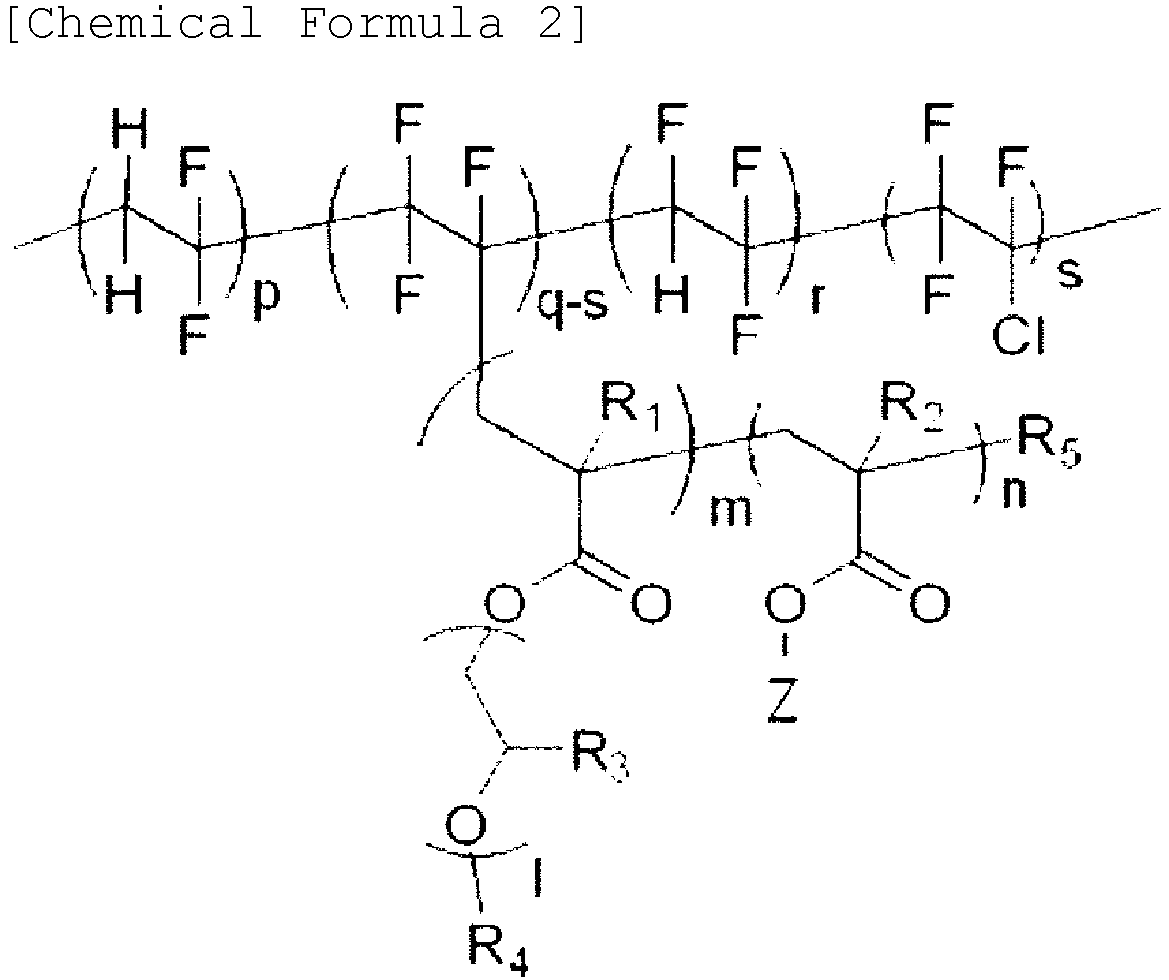
- In Chemical Formula 2,
- p, q, r, and s are each independently 0≤p≤20,000, 0<q≤22,000, 0≤r≤15,000, and 0≤s<22,000,
- R1, R2, and R3 are each independently hydrogen or methyl,
- R4 is any one selected from among hydrogen, an alkyl group having 1 to 12 carbon atoms, and a phenyl group unsubstituted or substituted with an alkyl group having 1 to 12 carbon atoms,
- Z is a curable functional group represented by the following Chemical Formula 4,
- l, m, and n are each independently 2≤1≤230, 1≤m≤200, and 2≤n≤50, and
- R5 is any one selected from among hydrogen, chlorine, or bromine.

- In Chemical Formula 4,
- X is a single bond, or any one selected from among alkylene having 1 to 12 carbon atoms, alkyleneoxycarbonyl having 1 to 12 carbon atoms (.

- * represents a bonding site directly bonding to O in Chemical Formula 2.
- In addition, in one specific embodiment of the present invention, the polymer(A) may include a structure of Chemical Formula 6.


- In Chemical Formula 6,
- p, q, r, and s are each independently 0≤p≤20,000, 0<q≤22,000, 0≤r≤15,000, and 0≤s<22,000,
- R1, R2, R3, and R6 are each independently hydrogen or methyl,
- R4 is any one selected from among hydrogen, an alkyl group having 1 to 12 carbon atoms, and a phenyl group unsubstituted or substituted with an alkyl group having 1 to 12 carbon atoms,
- X is a single bond, or any one selected from among alkylene having 1 to 12 carbon atoms, alkyleneoxycarbonyl having 1 to 12 carbon atoms (.

- l, m, and n are each independently 2≤1≤230, 1≤m≤200 and 2≤n≤50, and
- R5 is any one selected from among hydrogen, chlorine, or bromine.
- The monomer including poly(alkylene oxide) according to one embodiment of the present invention is a material capable of enhancing ion conductivity of a fluorine-based polymer, and the poly(alkylene oxide) is poly(ethylene oxide) or poly(propylene oxide), and may preferably be poly(ethylene oxide). Examples of the monomer including poly(alkylene oxide) include poly(alkylene oxide) (meth)acrylate, poly(alkylene oxide) monoalkyl ether (meth)acrylate, poly(alkylene oxide) monophenyl ether (meth) acrylate.
- The polymer of the invention includes polymer(A) having a curable group as defined in the claims. The monomer including a photocurable functional group according to one embodiment of the present invention includes an unsaturated vinyl group, and nonlimiting examples thereof may include vinyl group-containing (meth)acrylates such as vinyl (meth) acrylate, allyl (meth)acrylate, or 2-(vinyloxy)ethyl methacrylate.
- The polymer of the invention includes polymer(A) having a curable group as defined in the claims. The polymerization unit including the photocurable functional group may be secondarily induced from (meth)acrylate that does not contain a vinyl group through a polymer reaction (post-polymerization reaction). For example, a hydroxyl group-containing (meth)acrylate is copolymerized with the poly(alkylene oxide) group-containing monomer, and then condensed with 2-isocyanatoethyl (meth)acrylate to introduce a (meth)acrylate group on the side chain, and on the contrary, a (meth)acrylate including an isocyanate group is copolymerized with the poly(alkylene oxide) group-containing monomer, and then condensed with a hydroxyl group-containing (meth)acrylate. Types of the polymer reaction used for introducing a vinyl group on the side chain are not limited, and examples thereof may include an urethane-forming reaction of hydroxyl group-isocyanate group, and ester group-forming reaction of epoxy group-carboxylic acid group, an SN2 reaction of amine group-halogen group, and the like.
- The monomer including the poly(alkylene oxide) and the monomer including a photocurable functional group may have a molar ratio of 99.9:0.1 to 70:30, and specifically, a molar ratio of 99:1 to 90:10. When the monomer including a photocurable functional group is included in less than the above-mentioned range, a crosslinking reaction between the polymers is not sufficient, and physical, chemical, and electrochemical strength and stability of the electrode protective layer are not sufficient, and the content being greater than the above-mentioned range may significantly decrease ion conductivity due to a small alkylene oxide content and too high polymer network density, and therefore, the content is properly controlled in the above-mentioned range.
- The polymer of the invention includes polymer(A) including the structure defined in the claims. In one embodiment of the present invention, the fluorine-based graft polymer(A) may further introduce a unit derived from a third monomer to the graft chain with the purpose of enhancing interfacial adhesion properties and mechanical properties of the electrode active material. Examples of the third monomer may include methyl (meth)acrylate, ethyl (meth) acrylate, n-propyl (meth)acrylate, isopropyl (meth) acrylate, n-butyl (meth)acrylate, t-butyl (meth)acrylate, pentyl (meth)acrylate, 2-ethylbutyl (meth)acrylate, 2-ethylhexyl (meth)acrylate, n-octyl
- (meth)acrylate, isooctyl (meth)acrylate, isononyl (meth) acrylate, lauryl (meth)acrylate, styrene, α-methylstyrene, p-methylstyrene, p-methoxystyrene, (meth)acrylonitrile and the like, but are not limited thereto.
- The third monomer according to one embodiment of the present invention may be included in 1 part by weight to 20 parts by weight with respect to a total 100 parts by weight of the fluorine-based graft polymer(A). Improvements in target properties may be insignificant under 1 part by weight, and ion conductivity may become too low when including in greater than 20 parts by weight.
- The fluorine-based polymer according to Chemical Formula 1 according to one embodiment of the present invention may be included in 5 parts by weight to 50 parts by weight, and preferably in 5 parts by weight to 40 parts by weight with respect to 100 parts by weight of the fluorine-based graft polymer(A). When the fluorine-based polymer content is greater than the above-mentioned range, mechanical strength and electrochemical stability of the electrode protective layer may increase, however, crystallinity of the fluorine-based polymer may not be suppressed and the alkylene oxide content excessively decreases reducing ion conductivity. When the fluorine-based polymer content is less than the above-mentioned range, properties of high electrochemical stability and high lithium ion dissociation of the fluorine-based polymer may not be obtained, and therefore, the content is properly selected in the above-mentioned range.
- The following polymer compositions are not specified in the claims but are covered by them. The present disclosure provides a polymer composition for an electrode protective layer including the polymer composition for an electrode protective layer and further including a multifunctional vinyl-based crosslinking agent having a functional group capable of reacting with the photocurable functional group included in the fluorine-based graft polymer (A). The fluorine-based graft polymer(A) may be photocured by a vinyl group introduced on the side chain under the presence of a photoinitiator, but may be a polymer composition for photocuring further including a multifunctional vinyl-based crosslinking agent.
- The multifunctional vinyl-based crosslinking agent may further react with an unsaturated vinyl functional group included in the graft polymer of Chemical Formula 2 to form a crosslinked structure between the polymers. The electrode protective layer formed in a crosslinked structure has high chemical and electrochemical stability, and protects an electrode active material surface from side reactions with an electrolyte liquid, and thereby may overcome problems such as deterioration in the cycle properties and decrease in the Coulombic efficiency of a secondary battery.
- In one embodiment of the present disclosure, the multifunctional vinyl-based crosslinking agent is an organic compound having two or more vinyl groups in one molecule, and examples thereof may include one or more types of ethylene glycol di(meth)acrylate, 1,6-hexanediol di(meth)acrylate, tri(propylene glycol) di(meth)acrylate, tris(2-(meth)acryloethyl) isocyanate, trimethylolpropane tri(meth)acrylate, trimethylolpropane ethoxylate tri(meth)acrylate, pentaerythritol di(meth)acrylate, pentaerythritol tri(meth)acrylate, pentaerythritol tetra(meth)acrylate, dipentaerythritol di(meth)acrylate, dipentaerythritol tri(meth)acrylate, dipentaerythritol tetra(meth)acrylate, dipentaerythritol penta(meth)acrylate, dipentaerythritol hexa(meth)acrylate and the like, but are not limited thereto.
- The multifunctional vinyl-based crosslinking agent may be included in a ratio of 0.1 parts by weight to 50 parts by weight, and preferably 0.5 parts by weight to 10 parts by weight with respect to 100 parts by weight of the fluorine-based graft polymer(A). By controlling the crosslinking agent content in the above-described range, properties of an electrolyte may be properly obtained at a target level.
- In one embodiment of the present disclosure, as the photoinitiator, general initiators capable of initiating photopolymerization by generating radicals through irradiating ultraviolet rays or the like such as acetophenone-based compounds, biimidazole-based compounds, triazine-based compounds, oxime-based compounds, benzoin-based compounds, hydroxyketone-based compounds, aminoketone-based compounds, or phosphine oxide-based compounds may be used without limit.
- The acetophenone-based compound usable as the photoinitiator is selected from the group consisting of 2-hydroxy-2-methyl-1-phenylpropan-1-one, 1-(4-isopropylphenyl)-2-hydroxy-2-methylpropan-1-one, 4-(2-hydroxyethoxy)-phenyl-(2-hydroxy-2-propyl) ketone, 1-hydroxycyclohexylphenylketone, benzoin methyl ether, benzoin ethyl ether, benzoin isobutyl ether, benzoin butyl ether, 2,2-dimethoxy-2-phenylacetophenone, 2-methyl-(4-methylthio)phenyl-2-morpholino-1-propan-1-one, 2-benzyl-2-dimethylamino-1-(4-morpholinophenyl)-butan-1-one, 2-(4-bromo-benzyl-2-dimethylamino-1-(4-morpholinophenyl)-butan-1-one, and 2-methyl-1-[4-(methylthio)phenyl]-2-morpholinopropan-1-one, the biimidazole-based compound is selected from the group consisting of 2,2-bis(2-chlorophenyl)-4,4',5,5'-tetraphenyl biimidazole, 2,2'-bis(o-chlorophenyl)-4,4',5,5'-tetrakis(3,4,5-trimethoxyphenyl)-1,2'-biimidazole, 2,2'-bis(2,3-dichlorophenyl)-4,4',5,5'-tetraphenyl biimidazole, and 2,2'-bis(o-chlorophenyl)-4,4,5,5'-tetraphenyl-1,2'-biimidazole, the triazine-based compound is selected from the group consisting of 3-{4-[2,4-bis(trichloromethyl)-s-triazin-6-yl]phenylthio}propionic acid, 1,1,1,3,3,3-hexafluoroisopropyl-3-{4-[2,4-bis(trichloromethyl)-s-triazin-6-yl]phenylthio}propionate, ethyl-2-{4-[2,4-bis(trichloromethyl)-s-triazin-6-yl]phenylthio}acetate, 2-epoxyethyl-2-{4-[2,4-bis(trichloromethyl)-s-triazin-6-yl]phenylthio}acetate, cyclohexyl-2-{4-[2,4-bis(trichloromethyl)-s-triazin-6-yl]phenylthio}acetate, benzyl-2-{4-[2,4-bis(trichloromethyl)-s-triazin-6-yl]phenylthio}acetate, 3-{chloro-4-[2,4-bis(trichloromethyl)-s-triazin-6-yl]phenylthio}propionic acid, 3-{4-[2,4-bis(trichloromethyl)-s-triazin-6-yl]phenylthio}propionamide, 2,4-bis(trichloromethyl)-6-p-methoxystyryl-s-triazine, 2,4-bis(trichloromethyl)-6-(1-p-dimethylaminophenyl)-1,3,-butadienyl-s-triazine, and 2-trichloromethyl-4-amino-6-p-methoxystyryl-s-triazine, and examples of the oxime-based compound may include 1,2-octadione-1-(4-phenylthio)phenyl-2-(o-benzoyloxime) (Ciba Geigy Ltd., CGI 124), and ethanone-1-(9-ethyl)-6-(2-methylbenzoyl-3-yl)-1-(o-acetyloxime) (CGI 242), oxime OX-03 (Ciba Geigy Ltd.), NCI-831 (Adeka Corporation), PI-102 (LG Chem.), PBG 304, PBG 305, PBG 3057 (Tronly) and the like.
- In addition, α-hydroxyketone-based compounds (ex. IRGACURE 184, IRGACURE 500, IRGACURE 2959, DAROCUR 1173; manufactured by Ciba Specialty Chemicals); phenyl glyoxylate-based compounds (ex. IRGACURE 754, DAROCUR MBF; manufactured by Ciba Specialty Chemicals); benzyl dimethyl ketal-based compounds (ex. IRGACURE 651; manufactured by Ciba Specialty Chemicals); α-aminoketone-based compounds (ex. IRGACURE 369, IRGACURE 907, IRGACURE 1300; manufactured by Ciba Specialty Chemicals); monoacylphosphine-based compounds (MAPO) (ex. DAROCUR TPO; manufactured by Ciba Specialty Chemicals); bisacylphosphine-based compounds (BAPO) (ex. IRGACURE 819, IRGACURE 819DW; manufactured by Ciba Specialty Chemicals); phosphine oxide-based compounds (ex. IRGACURE 2100; manufactured by Ciba Specialty Chemicals); metallocene-based compounds (ex. IRGACURE 784; manufactured by Ciba Specialty Chemicals); iodonium salts (ex. IRGACURE 250; manufactured by Ciba Specialty Chemicals); and a mixture of two or more thereof may be included as an example, however, the photoinitiator is not limited thereto.
- The photoinitiator content may be from 0.01 parts by weight to 5 parts by weight and preferably from 0.1 parts by weight to 1 part by weight with respect to 100 parts by weight of the fluorine-based graft polymer(A), but is not limited thereto. When the photoinitiator content is 0.01 or less, curing may not be sufficiently obtained, and an electrode protective layer having target properties may not be obtained, and therefore, the content is properly controlled in the above-mentioned range.
- A method for preparing a polymer for an electrode protective layer according to the present invention may include mixing, polymerizing, and, selectively, polymer reacting.
- In the method, the mixing may be forming a mixture by mixing a raw material for preparing a polymer in which a monomer including poly(alkylene oxide) and a monomer including a photocurable functional group or a monomer including a functional group capable of introducing a photocurable functional group in the polymer reacting are grafted, and the mixing, which is one example, may be mixing a fluorine-based polymer, the monomer to polymerize, and a solvent. After that, mixing a catalyst and a ligand with the solvent may be further included.
- The fluorine-based polymer is a part becoming a main chain of the grafted polymer(A), and specific examples thereof may be the same as described above, and, as one embodiment according to the present invention, may include poly(vinylidene-co-chlorotrifluoroethylene) (hereinafter, P(VDF-co-CTFE)). In one embodiment of the present invention, the monomer including poly(alkylene oxide), and the monomer having a photocurable functional group may be poly(ethylene glycol) monomethyl ether methacrylate (hereinafter, mPEGMA) and 2-hydroxyethyl methacrylate (hereinafter, HEMA).
- As the solvent, various solvents known in the art may be used, and for example, N-methyl-2-pyrrolidone (NMP), gamma-butyrolactone (GBL), dimethylformamide (DMF), dimethyl sulfoxide (DMSO), dimethylacetamide (DMAc), acetonitrile (AcCN), tetrahydrofuran (THF) or the like may be used, however, the solvent is not limited thereto.
- To the mixture solution, a catalyst and a ligand may be further mixed with the solvent.
- Examples of the catalyst may include Cu(I)Cl, Cu(II)Cl2, Cu(I)Br, Cu(II)Br2, Fe(II)Cl2, Fe(III)Cl3 or mixtures thereof, and preferably, Cu(I) Cl, Cu(II)Cl2, Cu(I)Br, Cu(II)Br2 or mixtures thereof may be included as an example.
- In addition, the catalyst content may be from 0.0001 parts by weight to 1 part by weight, 0.0005 parts by weight to 0.5 parts by weight, or 0.001 parts by weight to 0.1 parts by weight with respect to 100 parts by weight of the monomer mixture. When the catalyst content is less than 0.0001 parts by weight, the reaction rate is very delayed, and when greater than 1 part by weight, problems such as gelation before producing the polymerized graft polymer or very difficult catalyst removal occur, and therefore, the content is properly selected in the above-mentioned range.
- The ligand is not particularly limited as long as it is usable in a polymerization reaction by bonding to the catalyst.
- As one example, the ligand may include ligands having one or more nitrogen, oxygen, phosphorous, and sulfur atoms that may coordinate to the catalyst through σ-bonds or ligands having two or more carbon atoms that may coordinate to the catalyst through n-bonds, but is not limited thereto. Specifically, one or more types selected from the group consisting of N,N,N',N"",N""-pentamethyldiethylenetriamine (PMDETA), 2,2'-bipyridine (bpy), 4,4'-di-5-nonyl-2,2'-bipyridine (dNbpy), tris(2-pyridylmethyl)amine (TPMA), and tris(2-dimethylaminoethyl)amine (Me6TREN) may be used, however, the ligand is not limited thereto.
- The ligand content may be from 50 parts by weight to 2000 parts by weight, 100 parts by weight to 1000 parts by weight, or 200 parts by weight to 500 parts by weight with respect to 100 parts by weight of the catalyst. When the ligand content is less than 50 parts by weight, metal complex formation obtained by bonding with the catalyst is too little resulting in very slow or no reaction, and the ligand content being greater than 2000 parts by weight may increase manufacturing costs and cause concern of side reactions caused by an excessive ligand use.
- The ATRP reaction may use a catalyst reducing agent as necessary. Examples of the reducing agent may include an organic reducing agent, an inorganic reducing agent, a radical generator and the like, but are not limited thereto.
- When the catalyst, the ligand, and, as necessary, the catalyst reducing agent of the ATRP reaction are mixed and stirred at 30°C to 100°C, the ATRP reaction occurs, and a grafted polymer may be obtained.
- The polymer reacting is a step required when using a monomer including a functional group capable of introducing a photocurable functional group in the mixing, and may be included when the photocurable vinyl-based monomer has a high risk of producing a gelation reaction in the polymerizing. In the polymer reacting, a proper condensation reaction condition may be selected depending on the grafted polymer prepared in the ATRP reacting and the types of the functional group as a condensation reaction of the monomer compound. As a specific example, when the monomer used in the mixing is an alcohol group-containing monomer such as 2-hydroxyethyl methacrylate, a (meth)acrylate group may be introduced in the polymer reacting through condensation with an isocyanate-containing (meth)acrylate compound. Herein, the reaction temperature may be selected in a range of 40°C to 100°C, and selectively, the reaction may be facilitated using a catalyst such as dibutyltin dilaurate.
- In addition, the polymer according to one embodiment of the present invention may be PVDF-co-(PCTFE-g-(mPEGMA-co-HEMA-AOI)), a compound obtained by preparing PVDF-co-(PCTFE-g- (mPEGMA-co-HEMA)) using the ATRP method, and then introducing a (meth)acrylate group on the side chain through a polymer reaction between the graft polymer and 2-isocyanatoethyl acrylate or 2-(acryloyloxy)ethyl isocyanate (AOI) .
- After the grafting polymerization reaction, removing the unreacted monomer by precipitating the produced polymer in a proper nonsolvent may be further included. After that, the polymer is dried under a vacuum condition to obtain the fluorine-based graft polymer(A) according to the present invention.
- This method is not specified in the claims but is covered by them when the method uses the polymer defined in the claims. The electrode protective layer according to the present disclosure specifically means an electrode protective layer for resolving the above-described problems by being coated on at least one surface of an electrode active material or metal lithium, and the forming method of the electrode protective layer may include the following steps: introducing a multifunctional crosslinking agent to the fluorine-based graft polymer (A) or the fluorine-based graft polymer (A) -dissolved solution in a ratio of 0.1 parts by weight to 10 parts by weight or 0.1 parts by weight to 6 parts by weight with respect to 100 parts by weight of the whole fluorine-based graft polymer(A), properly diluting the result in a solvent, and stirring the result for 1 hour to 6 hours. After that, the solution is mixed with an active material to coat to prepare a paste or coated on a foil-type electrode surface, heat treated for 1 minute to 12 hours at 50°C to 150°C, and then cured and dried to be prepared. On the coating film-formed active material, a vacuum drying process or a heating process may be further conducted to remove the residual solvent.
- Alternatively, the forming method of the electrode protective layer may include the following steps: introducing a multifunctional vinyl-based crosslinking agent to the fluorine-based graft polymer(A) or the fluorine-based graft polymer (A) -dissolved solution in a ratio of 0.1 parts by weight to 50 parts by weight with respect to 100 parts by weight of the whole fluorine-based graft polymer(A), introducing a photoinitiator in a ratio of 0.01 parts by weight to 5 parts by weight with respect to a total 100 parts by weight of the fluorine-based graft polymer(A) and the multifunctional vinyl-based crosslinking agent, properly diluting the result in a solvent, and stirring the result for 1 hour to 6 hours. After that, the solution is mixed with an active material to coat to prepare a paste or coated on a foil-type electrode surface, photocured by irradiating ultraviolet (UV) rays thereon, and then a vacuum drying process or a heating process may be further conducted to remove the residual solvent.
- According to one embodiment of the present disclosure, the protective layer-formed electrode may include an electrode active material, and the electrode active material may be any one selected from the group consisting of metal lithium, a positive electrode active material, and a negative electrode active material.
- Hereinafter, the present invention will be described in detail with reference to examples. However, the examples according to the present invention may be modified to various other forms, and the scope of the present invention is not to be construed as being limited to the examples described below. Examples of the present invention are provided in order to more fully describe the present invention to those having average knowledge in the art.
- In a 1000 ml flask, 10 g of P(VDF-co-CTFE) having a weight average molecular weight (hereinafter, Mw) of 600,000 as a fluorine-based polymer, and 116 g of poly(ethylene glycol) monomethyl ether methacrylate (mPEGMA, ethylene oxide repeating number=9), and 3.35 g of 2-hydroxyethyl methacrylate (HEMA), as monomers to polymerize, were introduced to 450 ml of a dimethyl sulfoxide (DMSO) solvent, and were stirred for 1 hour under the nitrogen condition.
- After that, 0.003 g of CuCl2 as an ATRP reaction catalyst, 0.014 g of TPMA as a ligand, and 0.25 g of tin(II) 2-ethylhexanoate (Sn(EH)2) as a reducing agent were introduced to the flask, and the ATRP reaction was proceeded for 30 hours at 60°C under the nitrogen condition with stirring. Herein, the monomer conversion was 65%.
- After the reaction was completed, a produced polymer was reprecipitated in a diethyl ether solvent to remove the unreacted monomers. The finally obtained polymer was dried for 24 hours under the vacuum condition to obtain a PVDF-co-(PCTFE-g-(mPEGMA-co-HEMA)) polymer (A1-1) having a fluorine-based chain content of 11%.
- In a 1000 ml flask, 20 g of P(VDF-co-CTFE) having a weight average molecular weight (hereinafter, Mw) of 600,000 as a fluorine-based polymer, and 112 g of poly(ethylene glycol)monomethyl ether acrylate (mPEGA, ethylene oxide repeating number=9), and 3.65 g of 4-hydroxybutyl acrylate (HBA), as monomers to polymerize, were introduced to 480 ml of a DMSO solvent, and were stirred for 1 hour under the nitrogen condition.
- After that, 0.003 g of CuCl2 as an ATRP reaction catalyst, 0.014 g of TPMA as a ligand, and 0.04 g of azobisisobutyronitrile (AIBN) as a reducing agent were introduced to the flask, and the ATRP reaction was proceeded for 30 hours at 60°C under the nitrogen conditionwith stirring. Herein, the monomer conversion was 80%.
- After the reaction was completed, a produced polymer was reprecipitated in an ether solvent to remove the unreacted monomers. The finally obtained polymer was vacuum dried for 24 hours at room temperature to obtain a PVDF-co-(PCTFE-g-(mPEGA-co-HBA) )-polymer (A1-2) having a fluorine-based chain content of 17%.
- In a 1000 ml flask, 10 g of P(VDF-co-CTFE-co-TrFE) having a weight average molecular weight (Mw) of 560,000 as a fluorine-based polymer, and 108 g of mPEGMA (ethylene oxide repeating number=9), and 0.54 g of 3-(trimethoxysilyl)propyl methacrylate (TMSPMA), as monomers to polymerize, were introduced to 350 ml of a dimethylformamide (DMF) solvent, and were stirred for 1 hour under the nitrogen condition.
- After that, 0.003 g of CuCl2 as an ATRP reaction catalyst, 0.014 g of TPMA as a ligand, and 0.3 g of tin(II) 2-ethylhexanoate (Sn(EH)2) as a reducing agent were introduced to the flask, and the ATRP reaction was proceeded for 30 hours at 60°C under the nitrogen condition with stirring. Herein, the monomer conversion was 74%.
- After the reaction was completed, a produced polymer was reprecipitated in a diethyl ether solvent to remove the unreacted monomers. The finally obtained polymer was vacuum dried for 24 hours at room temperature to obtain a PVDF-co-(PCTFE-g-(mPEGMA-co-TMSPMA))-co-PTrFE polymer (A1-3) having a fluorine-based chain content of 11%.
- In a 1000 ml flask, 116 g of mPEGMA (ethylene oxide repeating number=9) and 3.35 g of HEMA were introduced to 350 ml of a DMSO solvent, and were stirred for 1 hour under the nitrogen condition. 0.10 g of AIBN was introduced thereto as a radical initiator, and the polymerization reaction was proceeded for 20 hours at 60°C under the nitrogen atmospherewith stirring.
- After the reaction was completed, a produced polymer was reprecipitated in a diethyl ether solvent to remove the unreacted monomers. The finally obtained polymer was vacuum dried for 24 hours at room temperature to obtain a P(mPEGMA-co-HEMA) polymer (B1-1) that does not contain a fluorine-based chain.
- Preparation Examples 1-1 to 1-3 and Comparative Preparation Example 1-1 are shown in the following Table 1.
[Table 1] Polymer Molar Ratio of mPEG(M)A:Thermocu rable Monomer Fluorine-Based chain Content in Polymer Thermocurable Functional Group Type Mw (PDI) A1-1* 90:10 11% Hydroxy 1.7 ×10⁶ (6.2) A1-2* 90:10 17% Hydroxy 1.15 ×10⁶ (4.5) A1-3* 99:1 11% Trimethoxysilyl 1.06 ×10⁶ (3.4) B1-1 90:10 0% Hydroxy 1.7 × 10⁵ (2.9) (PDI: Polydispersity Index)
* (these examples do not form part of the invention and are provided for information purposes only) - In a 1000 ml flask, 15 g of P(VDF-co-CTFE) having a weight average molecular weight (hereinafter, Mw) of 600,000 as a fluorine-based polymer, and 116 g of poly(ethylene glycol) monomethyl ether methacrylate (mPEGMA, ethylene oxide repeating number=9), and 3.35 g of 2-hydroxyethyl methacrylate (HEMA), as monomers to polymerize, were introduced to 450 ml of a dimethyl sulfoxide (DMSO) solvent, and were stirred for 1 hour under the nitrogen condition.
- After that, 0.003 g of CuCl2 as an ATRP reaction catalyst, 0.014 g of TPMA as a ligand, and 0.04 g of azobisisobutyronitrile (AIBN) as a reducing agent were introduced to the flask, and the ATRP reaction was proceeded for 30 hours at 60°C under the nitrogen conditionwith stirring. Herein, the monomer conversion rate was 82%.
- After the polymerization was completed, the reaction material was cooled to room temperature, and air was bubbled into the reaction vessel for 2 hours. 0.002 g of 2,6-bis(1,1-dimethylethyl)-4-methylphenol (BHT) was introduced thereto as a thermal polymerization inhibitor, and after heating the reaction material to 50°C, 4.36 g of 2-isocyanatoethyl acrylate (AOI), and 0.16 g of dibutyltin dilaurate (DBTDL) as a condensation catalyst were introduced thereto. The result was reacted for 24 hours under the presence of oxygen, and then the reaction was terminated. Using the above-described method, a mixture solution of a PVDF-co- (PCTFE-g-(mPEGMA-co-(HEMA-AOI))) polymer having a fluorine-based chain content of 11% and the monomers was obtained. The unreacted residual monomer was included in a polymer network in a photopolymerization process afterward.
- In a 1000 ml flask, 20 g of P(VDF-co-CTFE) having a weight average molecular weight (hereinafter, Mw) of 600,000 as a fluorine-based polymer, and 112 g of polyethylene glycol monomethyl ether acrylate (mPEGA, ethylene oxide repeating number=9), and 3.65 g of 4-hydroxybutyl acrylate (HBA), as monomers to polymerize, were introduced to 480 ml of a DMSO solvent, and were stirred for 1 hour under the nitrogen condition.
- After that, 0.003 g of CuCl2 as an ATRP reaction catalyst, 0.014 g of TPMA as a ligand, and 0.04 g of AIBN as a reducing agent were introduced to the flask, and the ATRP reaction was proceeded for 30 hours at 60°C under the nitrogen conditionwith stirring. Herein, the monomer conversion rate was 80%.
- After the polymerization was completed, the reaction material was cooled to room temperature, and air was bubbled into the reaction vessel for 2 hours. 0.002 g of 2,6-bis(1,1-dimethylethyl)-4-methylphenol (BHT) was introduced thereto as a thermal polymerization inhibitor, and after heating the reaction material to 50°C, 4.35 g of 2-isocyanatoethyl acrylate (AOI), and 0.16 g of dibutyltin dilaurate (DBTDL) as a condensation catalyst were introduced thereto. The result was reacted for 24 hours under the presence of oxygen, and then the reaction was terminated. Using the above-described method, a mixture solution of a PVDF-co-(PCTFE-g-(mPEGA-co-(HBA-AOI))) polymer having a fluorine-based chain content of 15% and the monomers was obtained. The unreacted residual monomer was included in a polymer network in a photopolymerization process afterward.
- In a 1000 ml flask, 15 g of P(VDF-co-CTFE-co-TrFE) having a weight average molecular weight (Mw) of 560,000 as a fluorine-based polymer, and 116 g of mPEGMA (ethylene oxide repeating number=9), and 0.70 g of HEMA, as monomers to polymerize, were introduced to 350 ml of a dimethylformamide (DMF) solvent, and were stirred for 1 hour under the nitrogen condition.
- After that, 0.003 g of CuCl2 as an ATRP reaction catalyst, 0.014 g of TPMA as a ligand, and 0.04 g of AIBN as a reducing agent were introduced to the flask, and the ATRP reaction was proceeded for 30 hours at 60°C under the nitrogen conditionwith stirring. Herein, the monomer conversion rate was 80%.
- After the polymerization was completed, the reaction material was cooled to room temperature, and air was bubbled into the reaction vessel for 2 hours. 0.0004 g of 2,6-bis(1,1-dimethylethyl)-4-methylphenol (BHT) was introduced thereto as a thermal polymerization inhibitor, and after heating the reaction material to 50°C, 0.84 g of 2-isocyanatoethyl acrylate (AOI), and 0.031 g of dibutyltin dilaurate (DBTDL) as a condensation catalyst were introduced thereto. The result was reacted for 24 hours under the presence of oxygen, and then the reaction was terminated. Using the above-described method, a mixture solution of a PVDF-co-(PCTFE-g-(mPEGMA-co-(HHEMA-AOI)))-co-PTrFE polymer having a fluorine-based chain content of 11% and the monomers was obtained. The unreacted residual monomer was included in a polymer network in a photopolymerization process afterward.
- In a 1000 ml flask, 116 g of mPEGMA (ethylene oxide repeating number=9) and 3.35 g of HEMA were introduced to 350 ml of a DMSO solvent, and were stirred for 1 hour under the nitrogen condition. 0.10 g of AIBN was introduced thereto as a radical initiator, and the polymerization reaction was proceeded for 20 hours at 60°C under the nitrogen atmospherewith stirring. After that, the process was conducted in the same manner as in Preparation Example 1 to obtain a mixture solution of a P(mPEGMA-co-(HEMA-AOI))) polymer and the monomers (B2-1).
- A graft polymerization was conducted in the same manner as in Preparation Example 1 using 15 g of P(VDF-co-CTFE) having a weight average molecular weight (hereinafter, Mw) of 600,000 as a fluorine-based polymer, and 116 g of mPEGMA (ethylene oxide repeating number=9) and 3.35 g of HEMA, as monomers to polymerize, with 450 ml of a DMSO solvent, and, without a polymer reaction introducing a vinyl group on the side chain, a mixture solution of a PCTFE-g-P(mPEGMA-co-HEMA) and the unreacted monomers (B2-2) was obtained.
- Preparation Examples 2-1 to 2-3 and Comparative Preparation Examples 2-1 and 2-2 are shown in the following Table 2.
[Table 2] Polymer Poly(alkylene oxide):Vinyl-Based Side Chain1 Fluorine-Based Polymer Content2 Mw (PDI3) A2-1 90:10 11% 1.6×10⁶ (5.9) A2-2 90:10 15% 1.15×10⁶ (4.5) A2-3 98:2 11% 1.55×10⁶ (5.5) B2-1 90:10 0% 1.7×10⁵ (2.9) B2-2 90:04 11% 1.6×10⁶ (5.9) *1: molar ratio of poly(alkylene oxide)-containing polymerization unit: photocurable vinyl-based side chain-containing polymerization unit
*2: content of fluorine-based main chain with respect to a sum of graft polymer and residual monomer
*3: polydispersity index, Mw/Mn
*4: molar ratio of poly(alkylene oxide)-containing polymerization unit:hydroxy-containing polymerization unit=90:10 - Each of the fluorine-based graft polymers prepared in Preparation Examples 1-1 to 1-3 (these examples do not form part of the invention and are provided for information purposes only) was mixed in a weight ratio (pt) as written in Table 3, and stirred for 6 hours to prepare a thermocurable polymer solution. The solution was coated on a 2 cm2 × 0.1 cm circular SUS substrate in a dry room, heated for 5 hours at a temperature of 60°C for drying, and further thermally cured for 2 hours at 120°C. After that, the result was vacuum dried for 48 hours at 60°C to prepare a completely dried polymer electrode protective layer. The amount of the coated polymer solution was adjusted so that a thickness of the final electrode protective layer becomes approximately 100 µm.
- The polymer prepared in Comparative Preparation Example 1-1 and a P(VDF-CTFE) copolymer was mixed in a composition as in Table 3, and stirred for 6 hours to prepare a homogeneous solution. After that, the same cured film preparation method as the example was used to prepare a polymer cured film.
- Examples 1-1 to 1-5 (these examples do not form part of the invention and are provided for information purposes only) and Comparative Examples 1-1 to 1-3 are shown in the following Table 3.
[Table 3] Polymer (pt) LiTFSI Content (pt) Curing Agent (pt) Solvent (pt) Example 1-1# A1-1 (100) 45 0.5 ACN (217) Example 1-2# A1-2 (100) 45 0.5 ACN (217) Example 1-3# A1-3 (100) 45 - ACN (217) Example 1-4# A1-1 (100) 45 0.1 ACN (217) Example 1-5# A1-2 (100) 45 0.1 ACN (217) Comparative Example 1-1 B1-1 (100) 45 0.5 ACN (217) Comparative Example 1-2 B1-1 (100) 45 0.1 ACN (217) Comparative Example 1-3 P (VDF-CTFE) (100) 45 - Acetone: DMSO 1:1(v/v) (900) #(these examples do not form part of the invention and are provided for information purposes only)
* LiTFSI: lithium bis(trifluoromethanesulfonyl)imidate
* Curing agent: TDI-TMP (adduct of tolyldiisocyanate-trimethylolpropane)
* P(VDF-CTFE): poly(vinylidene difluoride-cochlorotrifluoroethylene), Mw=600,000
* ACN: acetonitrile
* DMSO: dimethyl sulfoxide - Each of the fluorine-based graft polymers prepared in Preparation Examples 2-1 to 2-3 was mixed in a weight ratio (pt) as in Table 4, and stirred for 6 hours to prepare a photocurable polymer solution. The solution was coated on a 2 cm2×0.1 cm circular SUS substrate in a dry room, and then exposed to a metal halide lamp for 3 minutes. After that, the result was vacuum dried for 48 hours at 60°C to prepare a completely dried polymer electrode protective layer. The amount of the coated polymer solution was adjusted so that a thickness of the final electrode protective layer becomes approximately 100 µm.
- Each of the polymers prepared in Comparative Preparation Examples 2-1 and 2-2 was mixed in a composition as in Table 4, and stirred for 6 hours to prepare a homogeneous solution. After that, the same cured film preparation method as the example was used to prepare a polymer cured film.
- Examples 2-1 to 2-5 and Comparative Examples 2-1 to 2-3 are shown in the following Table 4.
[Table 4] Polymer (pt) LiTFSI Content (pt) Curing Agent (pt) Photoinitiator Example 2-1 A2-1 (100) 40 0 1 Example 2-2 A2-2 (100) 40 0 1 Example 2-3 A2-3 (100) 40 0 1 Example 2-4 A2-1 (100) 40 5 1 Example 2-5 A2-3 (100) 40 5 1 Comparative Example 2-1 B2-1 (100) 40 0 1 Comparative Example 2-2 B2-1 (100) 40 5 1 Comparative Example 2-3 B2-2 (100) 40 5 1 * LiTFSI: lithium bis(trifluoromethanesulfonyl)imidate
* Curing agent: pentaerythritol triacrylate (PETA)
* Photoinitiator: Irgacure 819 - Ion conductivity of each of the electrode protective layers prepared in Examples 1-1 to 1-5 (these examples do not form part of the invention and are provided for information purposes only), Examples 2-1 to 2-5, Comparative Examples 1-1 to 1-3 and Comparative Examples 2-1 to 2-3 was obtained using the following Mathematical Formula 1 after measuring the impedance.
- After bringing a lithium salt-containing electrode protective layer coated on a circular SUS (stainless steel) substrate into contact with a lithium metal electrode having the same surface area, an alternating current voltage was applied through electrodes on both surfaces of the sample at room temperature. Herein, an amplitude range of a measuring frequency of 0.01 Hz to 1 MHz was set as the applied condition, and impedance was measured using VMP3 manufactured by Bio-Logic. Resistance of the bulk electrolyte was obtained from an intersection (Rb) where a semicircle or straight line of the measured impedance trajectory meets the real-number axis, and ion conductivity of the polymer electrode protective layer was calculated from the width and the thickness of the sample, and the results are shown in the following Table 5.

- σ: ion conductivity
- Rb: intersection of impedance trajectory and real-number axis
- A: sample area
- t: sample thickness
- A cell having a lithium-salt containing polymer electrode protective layer sandwiched between SUS and lithium metal was manufactured in the same manner as in the experimental example. A cyclic voltammetry (IVIUM Technologies) was performed by applying a voltage of 0.0 V to 5.0 V at a rate of 1 mV/sec at 60°C to evaluate oxidation potential stability by an off-set voltage. The results are shown in Table 5.
- Each of the polymer electrode protective layers, the electrode protective layer prepared in each of Examples 1-1 to 1-5 (these examples do not form part of the invention and are provided for information purposes only), Examples 2-1 to 2-5, Comparative Examples 1-1 to 1-3 and Comparative Examples 2-1 to 2-3, was coated on a SUS (stainless steel) substrate, and the result was dipped in a 10 mL diethyl carbonate solution including 1 M LiPF6. After that, the result was deposited for 48 hours at room temperature, and the film shape was visually observed. The results are shown in Table 5.
[Table 5] Ion Conductivity (S/cm) OFF-Set Voltage (V) Cured Film Shape Example 1-1* 2.3 × 10-7 4.2 O Example 1-2* 1.5 × 10-7 4.3 O Example 1-3* 1.8 × 10-6 4.2 O Example 1-4* 1.0 × 10-6 4.1 O Example 1-5* 8.3 × 10-7 4.2 O Comparative Example 1-1 3.9 × 10⁻⁷ 3.7 × Comparative Example 1-2 1.1 × 10⁻⁶ 3.7 × Comparative Example 1-3 1.0 × 10⁻⁹ 4.8 O Example 2-1 5.1 × 10⁻⁷ 4.3 O Example 2-2 3.3 × 10⁻⁷ 4.5 O Example 2-3 4.5 × 10⁻⁶ 4.2 O Example 2-4 1.0 × 10⁻⁷ 4.5 O Example 2-5 9.7 × 10⁻⁷ 4.4 O Comparative Example 2-1 4.6 × 10⁻⁷ 3.7 × Comparative Example 2-2 1.1 × 10⁻⁷ 3.7 × Comparative Example 2-3 1.5 × 10⁻⁶ 4.1 Δ * (these examples do not form part of the invention and are provided for information purposes only)
(o: film remained on SUS while maintaining a film shape; △: film remained on SUS while maintaining a film shape, but pin holes were observed everywhere; ×: portions where SUS was completely exposed were observed) - As shown in Table 5, results of improving electrochemical stability while having excellent ion conductivity were obtained when identifying ion conductivity and electrochemical stability after bringing the electrode protective layer according to the present invention into contact with lithium metal, and it was identified that the electrode protective layer according to the present invention may be excellently used as a protective layer of a lithium metal electrode. In addition, it was identified that damages on the electrode protective layer caused by side reactions with an electrolyte liquid were unlikely due to high resistance for the electrolyte liquid. In comparison, it was seen that the electrode protective layer without introducing a fluorine-based polymer had inferior electrochemical stability and electrolyte liquid resistance despite excellent ion conductivity, and the graft polymer without introducing a monomer including poly(ethylene oxide) had very low ion conductivity. The graft polymer without introducing a photocurable functional group on the side chain had insufficient electrolyte liquid resistance even after photocuring, which makes it impossible to be used as an electrode protective layer.
Claims (4)
- A polymer for an electrode protective layer comprising a polymer(A) in which a monomer including poly(alkylene oxide) and a monomer including a curable functional group are grafted on a fluorine-based polymer, wherein the polymer(A) includes a structure of the following Chemical Formula 2:
 p, q, r, and s are each independently 0≤p≤20,000, 0<q≤22,000, 0≤r≤15,000 and 0≤s<22,000;R1, R2, and R3 are each independently hydrogen or methyl;R4 is any one selected from among hydrogen, an alkyl group having 1 to 12 carbon atoms, and a phenyl group unsubstituted or substituted with an alkyl group having 1 to 12 carbon atoms;Z is a curable functional group represented by the following Chemical Formula 4;l, m and n are each independently 2≤1≤230, 1≤m≤200 and 2≤n≤50; andR5 is any one selected from among hydrogen, chlorine or bromine,
 X is a single bond, or any one selected from among alkylene having 1 to 12 carbon atoms, alkyleneoxycarbonyl having 1 to 12 carbon atoms (.
 * represents a bonding site directly bonding to O in Chemical Formula 2.
 - The polymer for an electrode protective layer of Claim 1, wherein the fluorine-based polymer includes a structure of the following Chemical Formula 1:


p, q, and r are each independently 0≤p≤20,000, 1≤q≤22,000 and 0≤r≤15,000. - The polymer for an electrode protective layer of Claim 1, wherein the poly(alkylene oxide) is poly(ethylene oxide) or poly(propylene oxide).
- The polymer for an electrode protective layer of Claim 1, wherein the monomer including poly(alkylene oxide) and the monomer including a curable functional group have a molar ratio of 99.9:0.1 to 70:30.
Applications Claiming Priority (3)
| Application Number | Priority Date | Filing Date | Title |
|---|---|---|---|
| KR1020180087904A KR102439830B1 (en) | 2018-07-27 | 2018-07-27 | Polymer for electrode protective layer and secondary battery to which it is applied |
| KR1020180087897A KR102244913B1 (en) | 2018-07-27 | 2018-07-27 | Polymeric passivation layer for secondary battery electrode and secondary battery comprising the same |
| PCT/KR2019/005445 WO2020022620A1 (en) | 2018-07-27 | 2019-05-08 | Electrode protective layer polymer and secondary battery to which same is applied |
Publications (3)
| Publication Number | Publication Date |
|---|---|
| EP3716377A1 EP3716377A1 (en) | 2020-09-30 |
| EP3716377A4 EP3716377A4 (en) | 2021-05-05 |
| EP3716377B1 true EP3716377B1 (en) | 2025-05-07 |
Family
ID=69180905
Family Applications (1)
| Application Number | Title | Priority Date | Filing Date |
|---|---|---|---|
| EP19840537.5A Active EP3716377B1 (en) | 2018-07-27 | 2019-05-08 | Electrode protective layer polymer and secondary battery to which same is applied |
Country Status (8)
| Country | Link |
|---|---|
| US (1) | US11518836B2 (en) |
| EP (1) | EP3716377B1 (en) |
| JP (1) | JP7044883B2 (en) |
| CN (1) | CN111587503B (en) |
| ES (1) | ES3031134T3 (en) |
| HU (1) | HUE071314T2 (en) |
| PL (1) | PL3716377T3 (en) |
| WO (1) | WO2020022620A1 (en) |
Families Citing this family (9)
| Publication number | Priority date | Publication date | Assignee | Title |
|---|---|---|---|---|
| WO2018063866A1 (en) * | 2016-09-28 | 2018-04-05 | Dow Global Technologies Llc | Moisture curable polyolefin compositions |
| EP3965203A4 (en) * | 2019-08-08 | 2022-06-29 | LG Energy Solution, Ltd. | Copolymer for polymer electrolyte, gel polymer electrolyte comprising same, and lithium secondary battery |
| CN112442147B (en) * | 2020-11-26 | 2023-08-29 | 南京玖泰新材料科技有限公司 | Low-viscosity 3D fluororesin and preparation method and application thereof |
| CN113113671B (en) * | 2021-04-12 | 2022-11-22 | 清华大学深圳国际研究生院 | Polyvinylidene fluoride-based solid electrolyte, preparation method thereof and lithium ion battery |
| JP7839277B2 (en) * | 2021-12-13 | 2026-04-01 | ユミコア | A negative electrode including a metal substrate and a protective layer |
| CN119072795A (en) * | 2022-08-08 | 2024-12-03 | 宁德时代新能源科技股份有限公司 | Polymer modified lithium material, negative electrode sheet, secondary battery, power device, method and application |
| CN118867147B (en) * | 2023-04-28 | 2025-10-10 | 宁德时代新能源科技股份有限公司 | Lithium metal negative electrode material, negative electrode sheet, lithium metal secondary battery, power device, preparation method and application |
| US12351498B2 (en) * | 2023-07-14 | 2025-07-08 | Claros Technologies Inc. | Methods and systems of PFAS destruction using UV irradiation at 222 nanometers |
| KR102903039B1 (en) * | 2023-08-07 | 2025-12-22 | (주) 딥스마텍 | Negative electrode material for secondary battery including polymer protective layer and manufacturing method thereof |
Family Cites Families (27)
| Publication number | Priority date | Publication date | Assignee | Title |
|---|---|---|---|---|
| KR100378348B1 (en) | 1996-12-13 | 2003-06-12 | 삼성전자주식회사 | Mesh-like polymer, preparation method thereof and polymer solid electrolyte containing same |
| JP4534265B2 (en) | 1998-12-02 | 2010-09-01 | パナソニック株式会社 | Nonaqueous electrolyte secondary battery |
| JP2004509192A (en) * | 2000-09-11 | 2004-03-25 | マサチューセッツ・インスティチュート・オブ・テクノロジー | Graft copolymers, methods for grafting hydrophilic chains onto hydrophobic polymers, and articles thereof |
| JP4412840B2 (en) | 2000-10-11 | 2010-02-10 | パナソニック株式会社 | Lithium polymer battery and manufacturing method thereof |
| AU2003268729A1 (en) | 2002-10-03 | 2004-05-04 | Daikin Industries, Ltd. | Fluorine-containing polymer solid electrolyte having fluorine-containing ether chain |
| JP4374980B2 (en) * | 2002-12-25 | 2009-12-02 | ダイキン工業株式会社 | Solid electrolyte comprising a fluorine-containing polymer containing a fluorine-containing ether chain |
| KR100497251B1 (en) | 2003-08-20 | 2005-06-23 | 삼성에스디아이 주식회사 | Protective composition for negative electrode of lithium sulfur battery and lithium sulfur battery fabricated by using same |
| KR100588475B1 (en) | 2004-06-07 | 2006-06-09 | 한국화학연구원 | Solid polymer electrolyte composition containing polysiloxane compound |
| US20070244262A1 (en) * | 2006-04-05 | 2007-10-18 | Mingfu Zhang | Graft copolymers and related methods of preparation |
| US8632698B2 (en) * | 2007-07-26 | 2014-01-21 | Lg Chem, Ltd. | Electrode active material having core-shell structure |
| JP4661843B2 (en) | 2007-08-28 | 2011-03-30 | ソニー株式会社 | Nonaqueous electrolyte secondary battery |
| EP2415793B1 (en) * | 2009-03-30 | 2015-01-14 | Piotrek Co., Ltd. | Method of producing fluorinated polymer |
| KR101598250B1 (en) | 2012-06-01 | 2016-02-26 | 주식회사 엘지화학 | Polymers, preparation thereof, compositions and films comprising the same |
| CN105073839B (en) | 2012-12-21 | 2018-12-11 | 索尔维特殊聚合物意大利有限公司 | Fine and close fluoropolymer film |
| KR101785263B1 (en) * | 2013-12-02 | 2017-10-16 | 삼성에스디아이 주식회사 | Binder composition, separator including a binder formed thereby, lithium battery including the separator, and method of preparing the binder composition |
| KR101738769B1 (en) | 2014-09-18 | 2017-05-23 | 주식회사 엘지화학 | Anode, lithium secondary battery comprising the same, battery module having the lithium secondary battery and method for manufacturing the anode |
| KR101687588B1 (en) | 2014-11-14 | 2016-12-21 | 한국화학연구원 | Binder comprising polymer formed by branching of block copolymer comprising poly(propylene oxide) block and poly(ethylene oxide) block |
| EP3295502B1 (en) | 2015-05-12 | 2021-06-23 | Seeo, Inc | Copolymers of peo and fluorinated polymers as electrolytes for lithium batteries |
| KR102475886B1 (en) | 2015-06-25 | 2022-12-08 | 삼성전자주식회사 | Negative electrode for lithium metal battery and lithium metal battery including the same |
| KR101990609B1 (en) | 2015-09-24 | 2019-06-18 | 주식회사 엘지화학 | Lithium electrode and lithium secondary battery employing thereof |
| DE102015224373A1 (en) * | 2015-12-04 | 2017-06-08 | Robert Bosch Gmbh | Silicon particles with artificial SEI |
| CN107534128B (en) * | 2015-12-17 | 2020-10-20 | 株式会社Lg化学 | Negative electrode for lithium secondary battery and lithium secondary battery comprising same |
| US20180151887A1 (en) | 2016-11-29 | 2018-05-31 | GM Global Technology Operations LLC | Coated lithium metal negative electrode |
| KR20180087897A (en) | 2017-01-25 | 2018-08-03 | 한양대학교 에리카산학협력단 | Condition transmission method for infant |
| KR20180087904A (en) | 2017-01-25 | 2018-08-03 | 목포대학교산학협력단 | sleep assist system with application |
| KR102183663B1 (en) * | 2017-09-14 | 2020-11-26 | 주식회사 엘지화학 | Solid electrolyte composition for secondary battery and solid electrolyte |
| WO2019054622A1 (en) * | 2017-09-14 | 2019-03-21 | 주식회사 엘지화학 | Secondary battery solid electrolyte composition and solid electrolyte prepared therefrom |
-
2019
- 2019-05-08 ES ES19840537T patent/ES3031134T3/en active Active
- 2019-05-08 PL PL19840537.5T patent/PL3716377T3/en unknown
- 2019-05-08 EP EP19840537.5A patent/EP3716377B1/en active Active
- 2019-05-08 JP JP2020532997A patent/JP7044883B2/en active Active
- 2019-05-08 US US16/954,016 patent/US11518836B2/en active Active
- 2019-05-08 WO PCT/KR2019/005445 patent/WO2020022620A1/en not_active Ceased
- 2019-05-08 CN CN201980008210.6A patent/CN111587503B/en active Active
- 2019-05-08 HU HUE19840537A patent/HUE071314T2/en unknown
Also Published As
| Publication number | Publication date |
|---|---|
| JP7044883B2 (en) | 2022-03-30 |
| EP3716377A1 (en) | 2020-09-30 |
| US20210087317A1 (en) | 2021-03-25 |
| EP3716377A4 (en) | 2021-05-05 |
| PL3716377T3 (en) | 2025-07-14 |
| US11518836B2 (en) | 2022-12-06 |
| CN111587503B (en) | 2023-02-28 |
| CN111587503A (en) | 2020-08-25 |
| WO2020022620A1 (en) | 2020-01-30 |
| ES3031134T3 (en) | 2025-07-04 |
| JP2021507464A (en) | 2021-02-22 |
| HUE071314T2 (en) | 2025-08-28 |
Similar Documents
| Publication | Publication Date | Title |
|---|---|---|
| ES3031134T3 (en) | Electrode protective layer polymer and secondary battery to which same is applied | |
| EP1912275B1 (en) | Gel-typed polymer electrolyte containing diacryl amide-based polymeric material and electrochemical device comprising the same | |
| CN103429628B (en) | Modifier for polyvinylidene fluoride, binder resin composition for batteries, secondary cell electrode, and battery | |
| EP3386016B1 (en) | Composition for non-aqueous secondary battery adhesive layer, non-aqueous secondary battery adhesive layer, and non-aqueous secondary battery | |
| KR101240834B1 (en) | Positive electrode for nonaqueous electrolyte battery and nonaqueous electrolyte battery | |
| CN113993920B (en) | Copolymer for polymer electrolyte, gel polymer electrolyte including the same, and lithium secondary battery | |
| JP6976422B2 (en) | Solid electrolyte composition for secondary batteries and solid electrolyte produced from it | |
| CN113906065B (en) | Copolymer for polymer electrolyte, gel polymer electrolyte and lithium secondary battery including the copolymer | |
| CN113166425B (en) | Polymer for gel polymer electrolyte, gel polymer electrolyte comprising same, and lithium secondary battery | |
| KR102439830B1 (en) | Polymer for electrode protective layer and secondary battery to which it is applied | |
| EP4407718B1 (en) | Lithium secondary battery and manufacturing method thereof | |
| KR101634107B1 (en) | Allyl phosphazene based cross linker and semi-IPN type all-solid-state polymer electrolyte composition comprising the same | |
| CN113490711B (en) | Composition for electrode mixture, electrode mixture, electrode, non-aqueous electrolyte secondary battery, and method for manufacturing electrode | |
| KR20200012512A (en) | Polymeric passivation layer for secondary battery electrode and secondary battery comprising the same | |
| KR20200006270A (en) | Solid electrolyte composition for secondary battery and solid electrolyte | |
| EP4449533A1 (en) | A battery comprising a high-concentrated electrolyte and a negative electrode having a metal substrate and a protective layer |
Legal Events
| Date | Code | Title | Description |
|---|---|---|---|
| STAA | Information on the status of an ep patent application or granted ep patent |
Free format text: STATUS: THE INTERNATIONAL PUBLICATION HAS BEEN MADE |
|
| PUAI | Public reference made under article 153(3) epc to a published international application that has entered the european phase |
Free format text: ORIGINAL CODE: 0009012 |
|
| STAA | Information on the status of an ep patent application or granted ep patent |
Free format text: STATUS: REQUEST FOR EXAMINATION WAS MADE |
|
| 17P | Request for examination filed |
Effective date: 20200624 |
|
| AK | Designated contracting states |
Kind code of ref document: A1 Designated state(s): AL AT BE BG CH CY CZ DE DK EE ES FI FR GB GR HR HU IE IS IT LI LT LU LV MC MK MT NL NO PL PT RO RS SE SI SK SM TR |
|
| AX | Request for extension of the european patent |
Extension state: BA ME |
|
| A4 | Supplementary search report drawn up and despatched |
Effective date: 20210406 |
|
| RIC1 | Information provided on ipc code assigned before grant |
Ipc: H01M 4/62 20060101AFI20210329BHEP Ipc: H01M 4/1395 20100101ALI20210329BHEP Ipc: H01M 4/134 20100101ALI20210329BHEP Ipc: H01M 10/052 20100101ALI20210329BHEP Ipc: C08F 259/08 20060101ALI20210329BHEP Ipc: C08F 214/24 20060101ALI20210329BHEP Ipc: H01M 4/36 20060101ALI20210329BHEP Ipc: H01M 50/46 20210101ALI20210329BHEP |
|
| DAV | Request for validation of the european patent (deleted) | ||
| DAX | Request for extension of the european patent (deleted) | ||
| RAP1 | Party data changed (applicant data changed or rights of an application transferred) |
Owner name: LG ENERGY SOLUTION LTD. |
|
| RAP3 | Party data changed (applicant data changed or rights of an application transferred) |
Owner name: LG ENERGY SOLUTION, LTD. |
|
| STAA | Information on the status of an ep patent application or granted ep patent |
Free format text: STATUS: EXAMINATION IS IN PROGRESS |
|
| 17Q | First examination report despatched |
Effective date: 20231025 |
|
| GRAP | Despatch of communication of intention to grant a patent |
Free format text: ORIGINAL CODE: EPIDOSNIGR1 |
|
| STAA | Information on the status of an ep patent application or granted ep patent |
Free format text: STATUS: GRANT OF PATENT IS INTENDED |
|
| RIC1 | Information provided on ipc code assigned before grant |
Ipc: C09D 151/00 20060101ALI20250203BHEP Ipc: C08F 214/22 20060101ALI20250203BHEP Ipc: H01M 50/46 20210101ALI20250203BHEP Ipc: H01M 4/36 20060101ALI20250203BHEP Ipc: C08F 214/24 20060101ALI20250203BHEP Ipc: C08F 259/08 20060101ALI20250203BHEP Ipc: H01M 10/052 20100101ALI20250203BHEP Ipc: H01M 4/134 20100101ALI20250203BHEP Ipc: H01M 4/1395 20100101ALI20250203BHEP Ipc: H01M 4/62 20060101AFI20250203BHEP |
|
| INTG | Intention to grant announced |
Effective date: 20250213 |
|
| GRAS | Grant fee paid |
Free format text: ORIGINAL CODE: EPIDOSNIGR3 |
|
| GRAA | (expected) grant |
Free format text: ORIGINAL CODE: 0009210 |
|
| STAA | Information on the status of an ep patent application or granted ep patent |
Free format text: STATUS: THE PATENT HAS BEEN GRANTED |
|
| P01 | Opt-out of the competence of the unified patent court (upc) registered |
Free format text: CASE NUMBER: APP_13376/2025 Effective date: 20250318 |
|
| AK | Designated contracting states |
Kind code of ref document: B1 Designated state(s): AL AT BE BG CH CY CZ DE DK EE ES FI FR GB GR HR HU IE IS IT LI LT LU LV MC MK MT NL NO PL PT RO RS SE SI SK SM TR |
|
| REG | Reference to a national code |
Ref country code: GB Ref legal event code: FG4D |
|
| REG | Reference to a national code |
Ref country code: CH Ref legal event code: EP |
|
| REG | Reference to a national code |
Ref country code: DE Ref legal event code: R096 Ref document number: 602019069743 Country of ref document: DE |
|
| REG | Reference to a national code |
Ref country code: IE Ref legal event code: FG4D |
|
| REG | Reference to a national code |
Ref country code: SE Ref legal event code: TRGR |
|
| REG | Reference to a national code |
Ref country code: ES Ref legal event code: FG2A Ref document number: 3031134 Country of ref document: ES Kind code of ref document: T3 Effective date: 20250704 |
|
| PGFP | Annual fee paid to national office [announced via postgrant information from national office to epo] |
Ref country code: DE Payment date: 20250520 Year of fee payment: 7 |
|
| PGFP | Annual fee paid to national office [announced via postgrant information from national office to epo] |
Ref country code: ES Payment date: 20250613 Year of fee payment: 7 |
|
| PGFP | Annual fee paid to national office [announced via postgrant information from national office to epo] |
Ref country code: BE Payment date: 20250520 Year of fee payment: 7 |
|
| PGFP | Annual fee paid to national office [announced via postgrant information from national office to epo] |
Ref country code: FR Payment date: 20250521 Year of fee payment: 7 |
|
| PGFP | Annual fee paid to national office [announced via postgrant information from national office to epo] |
Ref country code: SE Payment date: 20250523 Year of fee payment: 7 |
|
| PGFP | Annual fee paid to national office [announced via postgrant information from national office to epo] |
Ref country code: HU Payment date: 20250721 Year of fee payment: 7 |
|
| REG | Reference to a national code |
Ref country code: HU Ref legal event code: AG4A Ref document number: E071314 Country of ref document: HU |
|
| REG | Reference to a national code |
Ref country code: NL Ref legal event code: MP Effective date: 20250507 |
|
| PG25 | Lapsed in a contracting state [announced via postgrant information from national office to epo] |
Ref country code: PT Free format text: LAPSE BECAUSE OF FAILURE TO SUBMIT A TRANSLATION OF THE DESCRIPTION OR TO PAY THE FEE WITHIN THE PRESCRIBED TIME-LIMIT Effective date: 20250908 Ref country code: FI Free format text: LAPSE BECAUSE OF FAILURE TO SUBMIT A TRANSLATION OF THE DESCRIPTION OR TO PAY THE FEE WITHIN THE PRESCRIBED TIME-LIMIT Effective date: 20250507 |
|
| REG | Reference to a national code |
Ref country code: LT Ref legal event code: MG9D |
|
| PG25 | Lapsed in a contracting state [announced via postgrant information from national office to epo] |
Ref country code: NO Free format text: LAPSE BECAUSE OF FAILURE TO SUBMIT A TRANSLATION OF THE DESCRIPTION OR TO PAY THE FEE WITHIN THE PRESCRIBED TIME-LIMIT Effective date: 20250807 Ref country code: GR Free format text: LAPSE BECAUSE OF FAILURE TO SUBMIT A TRANSLATION OF THE DESCRIPTION OR TO PAY THE FEE WITHIN THE PRESCRIBED TIME-LIMIT Effective date: 20250808 |
|
| PG25 | Lapsed in a contracting state [announced via postgrant information from national office to epo] |
Ref country code: NL Free format text: LAPSE BECAUSE OF FAILURE TO SUBMIT A TRANSLATION OF THE DESCRIPTION OR TO PAY THE FEE WITHIN THE PRESCRIBED TIME-LIMIT Effective date: 20250507 |
|
| PGFP | Annual fee paid to national office [announced via postgrant information from national office to epo] |
Ref country code: PL Payment date: 20250512 Year of fee payment: 7 |
|
| REG | Reference to a national code |
Ref country code: AT Ref legal event code: MK05 Ref document number: 1793504 Country of ref document: AT Kind code of ref document: T Effective date: 20250507 |
|
| PG25 | Lapsed in a contracting state [announced via postgrant information from national office to epo] |
Ref country code: BG Free format text: LAPSE BECAUSE OF FAILURE TO SUBMIT A TRANSLATION OF THE DESCRIPTION OR TO PAY THE FEE WITHIN THE PRESCRIBED TIME-LIMIT Effective date: 20250507 |
|
| PG25 | Lapsed in a contracting state [announced via postgrant information from national office to epo] |
Ref country code: HR Free format text: LAPSE BECAUSE OF FAILURE TO SUBMIT A TRANSLATION OF THE DESCRIPTION OR TO PAY THE FEE WITHIN THE PRESCRIBED TIME-LIMIT Effective date: 20250507 |
|
| PG25 | Lapsed in a contracting state [announced via postgrant information from national office to epo] |
Ref country code: AT Free format text: LAPSE BECAUSE OF FAILURE TO SUBMIT A TRANSLATION OF THE DESCRIPTION OR TO PAY THE FEE WITHIN THE PRESCRIBED TIME-LIMIT Effective date: 20250507 |
|
| PG25 | Lapsed in a contracting state [announced via postgrant information from national office to epo] |
Ref country code: RS Free format text: LAPSE BECAUSE OF FAILURE TO SUBMIT A TRANSLATION OF THE DESCRIPTION OR TO PAY THE FEE WITHIN THE PRESCRIBED TIME-LIMIT Effective date: 20250807 |
|
| PG25 | Lapsed in a contracting state [announced via postgrant information from national office to epo] |
Ref country code: IS Free format text: LAPSE BECAUSE OF FAILURE TO SUBMIT A TRANSLATION OF THE DESCRIPTION OR TO PAY THE FEE WITHIN THE PRESCRIBED TIME-LIMIT Effective date: 20250907 |
|
| PG25 | Lapsed in a contracting state [announced via postgrant information from national office to epo] |
Ref country code: LV Free format text: LAPSE BECAUSE OF FAILURE TO SUBMIT A TRANSLATION OF THE DESCRIPTION OR TO PAY THE FEE WITHIN THE PRESCRIBED TIME-LIMIT Effective date: 20250507 |
|
| REG | Reference to a national code |
Ref country code: CH Ref legal event code: H13 Free format text: ST27 STATUS EVENT CODE: U-0-0-H10-H13 (AS PROVIDED BY THE NATIONAL OFFICE) Effective date: 20251223 |
|
| PG25 | Lapsed in a contracting state [announced via postgrant information from national office to epo] |
Ref country code: SM Free format text: LAPSE BECAUSE OF FAILURE TO SUBMIT A TRANSLATION OF THE DESCRIPTION OR TO PAY THE FEE WITHIN THE PRESCRIBED TIME-LIMIT Effective date: 20250507 Ref country code: DK Free format text: LAPSE BECAUSE OF FAILURE TO SUBMIT A TRANSLATION OF THE DESCRIPTION OR TO PAY THE FEE WITHIN THE PRESCRIBED TIME-LIMIT Effective date: 20250507 |
|
| PG25 | Lapsed in a contracting state [announced via postgrant information from national office to epo] |
Ref country code: LU Free format text: LAPSE BECAUSE OF NON-PAYMENT OF DUE FEES Effective date: 20250508 |
|
| PG25 | Lapsed in a contracting state [announced via postgrant information from national office to epo] |
Ref country code: CH Free format text: LAPSE BECAUSE OF NON-PAYMENT OF DUE FEES Effective date: 20250531 |
|
| PG25 | Lapsed in a contracting state [announced via postgrant information from national office to epo] |
Ref country code: CZ Free format text: LAPSE BECAUSE OF FAILURE TO SUBMIT A TRANSLATION OF THE DESCRIPTION OR TO PAY THE FEE WITHIN THE PRESCRIBED TIME-LIMIT Effective date: 20250507 |
|
| PG25 | Lapsed in a contracting state [announced via postgrant information from national office to epo] |
Ref country code: EE Free format text: LAPSE BECAUSE OF FAILURE TO SUBMIT A TRANSLATION OF THE DESCRIPTION OR TO PAY THE FEE WITHIN THE PRESCRIBED TIME-LIMIT Effective date: 20250507 |
|
| PG25 | Lapsed in a contracting state [announced via postgrant information from national office to epo] |
Ref country code: SK Free format text: LAPSE BECAUSE OF FAILURE TO SUBMIT A TRANSLATION OF THE DESCRIPTION OR TO PAY THE FEE WITHIN THE PRESCRIBED TIME-LIMIT Effective date: 20250507 Ref country code: RO Free format text: LAPSE BECAUSE OF FAILURE TO SUBMIT A TRANSLATION OF THE DESCRIPTION OR TO PAY THE FEE WITHIN THE PRESCRIBED TIME-LIMIT Effective date: 20250507 |
|
| PG25 | Lapsed in a contracting state [announced via postgrant information from national office to epo] |
Ref country code: IT Free format text: LAPSE BECAUSE OF FAILURE TO SUBMIT A TRANSLATION OF THE DESCRIPTION OR TO PAY THE FEE WITHIN THE PRESCRIBED TIME-LIMIT Effective date: 20250507 |
|
| REG | Reference to a national code |
Ref country code: DE Ref legal event code: R097 Ref document number: 602019069743 Country of ref document: DE |
|
| PG25 | Lapsed in a contracting state [announced via postgrant information from national office to epo] |
Ref country code: MC Free format text: LAPSE BECAUSE OF FAILURE TO SUBMIT A TRANSLATION OF THE DESCRIPTION OR TO PAY THE FEE WITHIN THE PRESCRIBED TIME-LIMIT Effective date: 20250507 |
|
| PLBE | No opposition filed within time limit |
Free format text: ORIGINAL CODE: 0009261 |
|
| STAA | Information on the status of an ep patent application or granted ep patent |
Free format text: STATUS: NO OPPOSITION FILED WITHIN TIME LIMIT |
|
| REG | Reference to a national code |
Ref country code: CH Ref legal event code: L10 Free format text: ST27 STATUS EVENT CODE: U-0-0-L10-L00 (AS PROVIDED BY THE NATIONAL OFFICE) Effective date: 20260318 |
|
| PGFP | Annual fee paid to national office [announced via postgrant information from national office to epo] |
Ref country code: GB Payment date: 20260324 Year of fee payment: 8 |
|
| PG25 | Lapsed in a contracting state [announced via postgrant information from national office to epo] |
Ref country code: IE Free format text: LAPSE BECAUSE OF NON-PAYMENT OF DUE FEES Effective date: 20250508 |
|
| 26N | No opposition filed |
Effective date: 20260210 |