EP3716151B1 - Spannungsüberwachung und verfahren zur spannungsüberwachung - Google Patents
Spannungsüberwachung und verfahren zur spannungsüberwachung Download PDFInfo
- Publication number
- EP3716151B1 EP3716151B1 EP19164972.2A EP19164972A EP3716151B1 EP 3716151 B1 EP3716151 B1 EP 3716151B1 EP 19164972 A EP19164972 A EP 19164972A EP 3716151 B1 EP3716151 B1 EP 3716151B1
- Authority
- EP
- European Patent Office
- Prior art keywords
- data
- stressor
- stress level
- stress
- neural network
- Prior art date
- Legal status (The legal status is an assumption and is not a legal conclusion. Google has not performed a legal analysis and makes no representation as to the accuracy of the status listed.)
- Active
Links
Images


Classifications
-
- G—PHYSICS
- G06—COMPUTING OR CALCULATING; COUNTING
- G06N—COMPUTING ARRANGEMENTS BASED ON SPECIFIC COMPUTATIONAL MODELS
- G06N3/00—Computing arrangements based on biological models
- G06N3/02—Neural networks
- G06N3/08—Learning methods
-
- A—HUMAN NECESSITIES
- A61—MEDICAL OR VETERINARY SCIENCE; HYGIENE
- A61B—DIAGNOSIS; SURGERY; IDENTIFICATION
- A61B5/00—Measuring for diagnostic purposes; Identification of persons
- A61B5/48—Other medical applications
- A61B5/4884—Other medical applications inducing physiological or psychological stress, e.g. applications for stress testing
-
- A—HUMAN NECESSITIES
- A61—MEDICAL OR VETERINARY SCIENCE; HYGIENE
- A61B—DIAGNOSIS; SURGERY; IDENTIFICATION
- A61B5/00—Measuring for diagnostic purposes; Identification of persons
- A61B5/72—Signal processing specially adapted for physiological signals or for diagnostic purposes
- A61B5/7235—Details of waveform analysis
- A61B5/7264—Classification of physiological signals or data, e.g. using neural networks, statistical classifiers, expert systems or fuzzy systems
-
- A—HUMAN NECESSITIES
- A61—MEDICAL OR VETERINARY SCIENCE; HYGIENE
- A61B—DIAGNOSIS; SURGERY; IDENTIFICATION
- A61B5/00—Measuring for diagnostic purposes; Identification of persons
- A61B5/74—Details of notification to user or communication with user or patient; User input means
- A61B5/7475—User input or interface means, e.g. keyboard, pointing device, joystick
- A61B5/749—Voice-controlled interfaces
-
- G—PHYSICS
- G06—COMPUTING OR CALCULATING; COUNTING
- G06N—COMPUTING ARRANGEMENTS BASED ON SPECIFIC COMPUTATIONAL MODELS
- G06N3/00—Computing arrangements based on biological models
- G06N3/02—Neural networks
- G06N3/04—Architecture, e.g. interconnection topology
- G06N3/044—Recurrent networks, e.g. Hopfield networks
-
- G—PHYSICS
- G06—COMPUTING OR CALCULATING; COUNTING
- G06N—COMPUTING ARRANGEMENTS BASED ON SPECIFIC COMPUTATIONAL MODELS
- G06N3/00—Computing arrangements based on biological models
- G06N3/02—Neural networks
- G06N3/04—Architecture, e.g. interconnection topology
- G06N3/044—Recurrent networks, e.g. Hopfield networks
- G06N3/0442—Recurrent networks, e.g. Hopfield networks characterised by memory or gating, e.g. long short-term memory [LSTM] or gated recurrent units [GRU]
-
- G—PHYSICS
- G06—COMPUTING OR CALCULATING; COUNTING
- G06N—COMPUTING ARRANGEMENTS BASED ON SPECIFIC COMPUTATIONAL MODELS
- G06N3/00—Computing arrangements based on biological models
- G06N3/02—Neural networks
- G06N3/04—Architecture, e.g. interconnection topology
- G06N3/045—Combinations of networks
- G06N3/0455—Auto-encoder networks; Encoder-decoder networks
-
- G—PHYSICS
- G06—COMPUTING OR CALCULATING; COUNTING
- G06N—COMPUTING ARRANGEMENTS BASED ON SPECIFIC COMPUTATIONAL MODELS
- G06N3/00—Computing arrangements based on biological models
- G06N3/02—Neural networks
- G06N3/04—Architecture, e.g. interconnection topology
- G06N3/0464—Convolutional networks [CNN, ConvNet]
-
- G—PHYSICS
- G06—COMPUTING OR CALCULATING; COUNTING
- G06N—COMPUTING ARRANGEMENTS BASED ON SPECIFIC COMPUTATIONAL MODELS
- G06N3/00—Computing arrangements based on biological models
- G06N3/02—Neural networks
- G06N3/08—Learning methods
- G06N3/09—Supervised learning
-
- A—HUMAN NECESSITIES
- A61—MEDICAL OR VETERINARY SCIENCE; HYGIENE
- A61B—DIAGNOSIS; SURGERY; IDENTIFICATION
- A61B2560/00—Constructional details of operational features of apparatus; Accessories for medical measuring apparatus
- A61B2560/04—Constructional details of apparatus
- A61B2560/0431—Portable apparatus, e.g. comprising a handle or case
-
- A—HUMAN NECESSITIES
- A61—MEDICAL OR VETERINARY SCIENCE; HYGIENE
- A61B—DIAGNOSIS; SURGERY; IDENTIFICATION
- A61B2562/00—Details of sensors; Constructional details of sensor housings or probes; Accessories for sensors
- A61B2562/02—Details of sensors specially adapted for in-vivo measurements
-
- G—PHYSICS
- G06—COMPUTING OR CALCULATING; COUNTING
- G06N—COMPUTING ARRANGEMENTS BASED ON SPECIFIC COMPUTATIONAL MODELS
- G06N3/00—Computing arrangements based on biological models
- G06N3/02—Neural networks
- G06N3/04—Architecture, e.g. interconnection topology
- G06N3/045—Combinations of networks
Definitions
- the present invention is related to devices for monitoring and analyzing a stress level of a person over time using a novel computer-implemented artificial neural network (ANN). Furthermore, the present invention is related to measures for providing an indicator of a stress level.
- ANN artificial neural network
- Stressors Human stress are generally considered to represent a physiologic, biochemical or neuroendocrine response to an external or internal stimulus or expectation. Factors which causes stress or an increase of stress are commonly referred to as stressors. Depending on the origin of the stressor it is distinguished between external stressors and internal stressors.
- Burn-out syndrome substantially affects a person's life and his ability to perform tasks and take over responsibilities in job and private life.
- stress substantially affect creativity and the person's ability to think innovatively, which is also reflected in the sustainability of higher-level teams, organizations and companies.
- a stress monitoring method which includes the steps of acquiring a plurality of individual readings of at least one physiologic data parameter over a period of time, storing the plurality of individual readings, determining the average of at least a portion of the plurality of individual readings, and comparing at least one individual reading to the average to identify any differences between the average and the at least one individual reading.
- a method includes accessing data streams from a mood sensor and one or more of a heart-rate monitors, a blood-pressure monitor, a pulse oximeter, or an accelerometer monitoring a person, analyzing data sets collected from the person when the person is stressed and unstressed, analyzing the data sets, and determining a current stress index of the person based on the analysis.
- US 2009/0069641 A1 it is disclosed a method and system for analyzing stress and managing stress by using a mobile electronic apparatus and a data management server.
- the method includes: generating bio-signal pattern information upon periodically receiving a bio-signal from a bio-signal measuring device connected to each of a plurality of unspecified individuals, and forming reference information for stress analysis based on received answers to each of a plurality of questions for checking a stress level; receiving bio-signal pattern information from a bio-signal measuring device connected to a specified user; and determining a stress level corresponding to the bio-signal pattern information of the specified user based on the reference information.
- Document WO2018/069789 A1 discloses a system configured to alert about stress, comprising head-mounted thermal cameras to take thermal measurements of regions on the periorbital areas of the right and left eyes of the user; and a user interface configured to provide an alert about a stress level reaching a threshold; wherein the stress level is determined based on the thermal measurements.
- the difference between the thermal measurements is analysed by a predictor that predicts occurrences of the physiological response.
- the predictor may be based on a machine-learning model.
- One idea of the present invention is to provide a stress-monitoring method which allows to analyze various data about stressors to which a person is exposed without the need for completeness of data. This has been achieved by the stress-monitoring method using an input unit providing a variety of actual stressor data from various sources, external input or the like. Furthermore, an artificial neural network unit is used which has been trained by available data of various persons who have developed a burnout syndrome.
- the development of a burnout syndrome can relate on various factors.
- the dominant factors for the development of the burnout case may vary from case to case so that an evaluation what amount of which stressor(s) may definitely lead to a burnout, cannot be clearly made.
- the use of an artificial neural network to provide an appropriate model for this multi-input has the benefit that a normalization of the assessment of the stress level can be made with the reference being the accumulated stressor exposure which have led to a burnout syndrome. This basically allows to define a stress level scale with a clearly defined maximum value. This solves the general problem to find a clear reference for a stress level.
- stress level shall express herein an assessed restoration of a physical and/or psychic reaction of a person caused by exposure to external factors/stressors.
- the stress level may be numerically indicated and serves to express the degree of a person's physical and/or psychic reactions to ongoing impact of stressors.
- the output of the artificial neural network is a stress level indicator for the long-termed stress level of the person which allows to apply anti-stress measures or stress-reducing measures to reduce the person's risk to develop a burnout syndrome.
- Above method has the advantage that various data about persons having developed a burnout syndrome can be accumulated and considered in a common stress level evaluating model using artificial intelligence. As the available stressor data for each of the recorded burnout cases are of a different kind and of different quality, the artificial neural network unit can also be trained when data is missing.
- a stress-monitoring system 1 is described in detail which allows to signalize a long-termed stress level of a person based on individual stressor data.
- the system 1 performs a method for evaluating and indicating a stress level of a person which is illustrated in the flowchart of Figure 2 .
- the stress-monitoring system 1 is schematically shown in Figure 1 .
- the stress-monitoring system 1 includes a stressor data input unit 2 which is configured to receive, to detect or to provide stressor data related to a person's physiological condition, data, behavior, symptoms and exposure to external influences.
- the obtained stressor data is provided to an analyzing unit 3 which analyzes the stressor data and calculates stress level data which indicates the long-termed stress level of the person.
- the long-termed stress level is signalized to an output unit 4, which provides interaction with the person or any other person or entity depending on the signalized stress level data.
- the stress-monitoring system 1 may be implemented as software executed in any kind of computing device which can be a cloud computing device, a personal desktop computer or the like. Also, the stress-monitoring system 1 can be executed in a mobile device via App such as a smartphone, smartwatch or the like.
- the stressor data input unit 2 is shown in detail in the block diagram of Figure 1 .
- the stressor data input unit 2 is configured to collect any kind of stressor data to provide them to the artificial neural network unit 3.
- the stressor data input unit 2 may be implemented by one or more devices which may include a personal desktop computer, a mobile device, a wearable, sensors or the like to acquire data related to symptoms and/or physiological data and the like.
- the stressor data input unit 2 may include one or more sensors for automatically detecting and generating and receiving signals representing stressor data.
- the acquisition of stressor data is performed in step S1.
- the stressor data input unit 2 includes:
- the stressor data input unit 2 may further include stressor data acquiring units 21 such as:
- step S2 all so obtained data may be classified and/or normalized in a data classifier 22 to classify inputs in categories or into predefined value ranges. Moreover, each of the so obtained classified stressor data is provided with a time stamp associated to the point of time which the input of occurrence of the stressor was made.
- a time frame such as 6 hours, 12 hours, a day, a few days, a week, or the like is predetermined in which stressor data is supplied to the analyzing unit 3.
- Other time bases can be selected as well.
- the time frame defines a time base by which the data is analyzed so that the stress level may be adapted with respect to the time basis.
- the time frame indicates the time instance when an evaluation is carried out.
- Each of the stressor data items may be acquired and collected once, automatically at predetermined time instances, or automatically regularly in continuous time frames. So, the stressor data items reflect the current situation at different times and in different frequencies. If the acquisition frequency of any newly acquired stressor data item is higher than that of the time frame, a plurality of time variable stressor data values is available within the time frame and the data classifier 22 may be further configured to condense data to provide a relevant stressor data item for forwarding to the analyzing unit 3. Condensing data may be made by providing the maximum, the minimum or the average or the stressor data values of the respective stressor data item within/over the time duration of the preceding time frame or a number of preceding time frames to obtain a condensed stressor data value. The condensed stressor data value is then used for evaluation at the current time instance.
- the acquisition frequency of any newly acquired stressor data item is lower than the given time frame, for each time frame the last acquired stressor data value can be used.
- the maximum, the minimum or the average or the stressor data values of the respective stressor data item within/over the time duration of a number of preceding time frames is used for evaluation.
- the personality type data item is used for each time frame once input is made.
- the stressor data provided to the analyzing unit 3 may comprise all of the above stressor data items or only a part of the stressor data items, if some stressor data is not available.
- the analyzing unit 3 comprises a missing data imputation unit 31 and an artificial neural network 32.
- the missing data imputation unit 31 is performed in step S3 and allows to add stressor data values for stressor data items which has not been made available by the stressor data input unit 2 or which is temporarily not available at the actual time instant.
- a step S4 of analyzing stressor data in the artificial neural network 32 is performed.
- the artificial neural network 32 is configured to provide a stress level which can be a value in the range of 0 to 100 % (0% low stress to 100% high stress) or in any other predefined fixed scale. For instance, the stress level can also be indicated as 0% for a high stress level to 100% for a low stress level.
- the missing data imputation unit 31 is provided so that an incomplete set of stressor data values (no stressor data values are available for one or more stressor data items) will be completed by estimating stressor data values for unavailable stressor data items using available stressor data provided by the stressor data input unit 2. So, it may be possible to complete the set of stressor data which is required for processing within the artificial neural network 32.
- missing stressor data may be given a predetermined or average value of previously acquired stressor data of the same kind.
- missing stressor data can be estimated by means of a data imputation method which derives missing data from a set of known stressor data by means of e.g. an autoencoder or the like. Data imputation methods are well-known in the art and are not further described herein.
- relevant stressor data is selected from the set of stressor data which have a high correlation (e.g. > between 0,8 and 0,5, or > 0,75) with the missing data so that a high-quality prediction of the missing stressor data can be obtained.
- the artificial neural network 32 is trained to provide a stress level output based on all stressors provided as stressor data items with respect to the given time frame. As the process of building up a stress level relevant for developing a burnout syndrome also depends on the actual situation and the actual stress level of the person, when the person is exposed to a new stressor or repeatedly exposed to a stressor, the stress level output of the artificial neural network 32 is fed back to at least one of its inputs so that depending on the actual considered stressor data the stress level is adapted, i.e. increased or decreased. This allows to consider the accumulating effect of stressors to which the person is exposed.
- the so obtained long term stress level may be signaled in step S5 to a local or remote output device 4 which signalizes the stress level of a person to the person or any other entity such as a medical institution.
- the stress level can be displayed with a graphical representation on a portable output device such as the smartphone of the person or can be automatically transmitted to the medical entity for monitoring the stress level of the person externally.
- the stress level can be directly indicated as a value or on a scale. In another embodiment the stress level can be indicated reversely so that 100 % indicates no stress and 0% at or close to burnout. This may be represented in the form of a fuel indicator which can be intuitively understood by the user. Moreover, the stress levels can be graphically shown in combination with colors red, yellow, green.
- an alarm can be output such as an acoustic alarm or a visual alarm notifying the person that the stress level has reached a critical value and that stress-reducing measures should be taken immediately to avoid a serious risk of developing a burnout syndrome.
- the stressor data characteristics of the available stressor data items can be extrapolated. This may be done by linear extrapolation or by keeping the last obtained stressor data value of one or more stressor data items constant.
- the artificial neural network 32 can be used recursively to evaluate stress level development for future time frames. Due to the non-linear model behavior implemented in the artificial neural network 32 the stress level at the future time instances has to be calculated beginning with the current time instance.
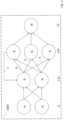
- the artificial neural network may be formed as a recurrent artificial neural network ANN which is exemplarily shown in Figure 3 . It is schematically shown an ANN with one input layer L1, a number of succeeding intermediate layers L2a, L2b and an output layer L3 each comprising one or more neurons N as it is known in the art.
- the neurons N of the different layers are feed-forward coupled by axons A.
- the axons A are associated with weighs which represent the training of the ANN.
- One or more of the outputs of one of the intermediate layers L2a are associated with weights which represent the training of the ANN.
- L2b or of the output layer L3 (generated indication of the previous stress state) is considered via a feedback path F to the input layer L1 or to one of the preceding intermediate layers L2a, L2b of the recurrent artificial neural network.
- Such a configuration allows to consider the actual stress level for evaluation of a succeeding stress level of a next time frame.
- the artificial neural network may be implemented with a LSTM neural network (LSTM Long-Short Term Memory) so that the time variable stressor data can be processed to a corresponding actual stress level.
- LSTM neural network LSTM Long-Short Term Memory
- the stressor data acquiring units 21, the data imputation unit 31 and the artificial neural network 32 may each be implemented by hardware and/or software in one or more data processing systems.
- the data acquiring units 21 and the analyzing unit 3 can be implemented in a distributed system, wherein the analyzing unit 3 can particularly be provided as a cloud service.
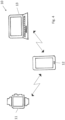
- the stress monitoring system 1 can be implemented as a distributed system 10 as shown in Figure 4 .
- the distributed system 10 may include a number of stressor data acquiring units 21 which may be formed as a wearable 11, such as a smart watch, a mobile device 12, such as a smart phone, and the like. These are interconnected with a processing device 13 which can be located at the position of the person or in a network or network cloud.
- the processing device 13 may comprise the data imputation unit 31 and the artificial neural network 32 so as to perform the data collection and processing of the corresponding functions.
- the processing device 13 may include a communication unit as a receiving means to allow wireless data communication with the wearable 11 and/or the mobile device 12 and/or other devices for acquiring stressor data.
- the current stress level is communicated via the communication unit to one of the person's personal devices such as the wearable 11 or the mobile device 12 for presentation of the stress level in above mentioned manner.
- Any of the functions disclosed herein may be implemented using means for performing those functions. Such means include, but are not limited to, any of the components disclosed herein, such as the computer-related components described below.
- the techniques described above may be implemented, for example, in hardware, one or more computer programs tangibly stored on one or more computer-readable media, firmware, or any combination thereof.
- the techniques described above may be implemented in one or more computer programs executing on (or executable by) a programmable computer including any combination of any number of the following: a processor, a storage medium readable and/or writable by the processor (including, for example, volatile and non-volatile memory and/or storage elements), an input device, and an output device.
- Program code may be applied to input entered using the input device to perform the functions described and to generate output using the output device.
- Embodiments of the present invention include features which are only possible and/or feasible to implement with the use of one or more computers, computer processors, and/or other elements of a computer system. Such features are either impossible or impractical to implement mentally and/or manually.
- embodiments of the present invention allow continuously or regularly collecting of stressor data from various sources which are operated further.
- missing data imputation and artificial neural networks are complex processes which are inherently computer-implemented and which could practically not be performed manually or mentally by a human.
- any claims herein which affirmatively require a computer, a processor, a memory, or similar computer-related elements, are intended to require such elements, and should not be interpreted as if such elements are not present in or required by such claims. Such claims are not intended, and should not be interpreted, to cover methods and/or systems which lack the recited computer-related elements.
- any method claim herein which recites that the claimed method is performed by a computer, a processor, a memory, and/or similar computer-related element is intended to, and should only be interpreted to, encompass methods which are performed by the recited computer-related element(s).
- Such a method claim should not be interpreted, for example, to encompass a method that is performed mentally or by hand (e.g., using pencil and paper).
- any product claim herein which recites that the claimed product includes a computer, a processor, a memory, and/or similar computer-related element is intended to, and should only be interpreted to, encompass products which include the recited computer-related element(s). Such a product claim should not be interpreted, for example, to encompass a product that does not include the recited computer-related element(s).
- Each computer program within the scope of the claims below may be implemented in any programming language, such as assembly language, machine language, a high-level procedural programming language, or an object-oriented programming language.
- the programming language may, for example, be a compiled or interpreted programming language.
- Each such computer program may be implemented in a computer program product tangibly embodied in a machine-readable storage device for execution by a computer processor.
- Method steps of the invention may be performed by one or more computer processors executing a program tangibly embodied on a computer-readable medium to perform functions of the invention by operating on input and generating output.
- Suitable processors include, by way of example, both general and special purpose microprocessors.
- the processor receives (reads) instructions and data from a memory (such as a read-only memory and/or a random access memory) and writes (stores) instructions and data to the memory.
- Storage devices suitable for tangibly embodying computer program instructions and data include, for example, all forms of non-volatile memory, such as semiconductor memory devices, including EPROM, EEPROM, and flash memory devices; magnetic disks such as internal hard disks and removable disks; magneto-optical disks; and CD-ROMs. Any of the foregoing may be supplemented by, or incorporated in, specially-designed ASICs (application-specific integrated circuits) or FPGAs (Field-Programmable Gate Arrays).
- a computer can generally also receive (read) programs and data from, and write (store) programs and data to, a non-transitory computer-readable storage medium such as an internal disk (not shown) or a removable disk.
- Any data disclosed herein may be implemented, for example, in one or more data structures tangibly stored on a non-transitory computer-readable medium. Embodiments of the invention may store such data in such data structure(s) and read such data from such data structure(s).
Landscapes
- Engineering & Computer Science (AREA)
- Health & Medical Sciences (AREA)
- Life Sciences & Earth Sciences (AREA)
- Physics & Mathematics (AREA)
- Theoretical Computer Science (AREA)
- Biomedical Technology (AREA)
- Biophysics (AREA)
- General Health & Medical Sciences (AREA)
- Molecular Biology (AREA)
- Artificial Intelligence (AREA)
- Mathematical Physics (AREA)
- Evolutionary Computation (AREA)
- Data Mining & Analysis (AREA)
- General Engineering & Computer Science (AREA)
- General Physics & Mathematics (AREA)
- Computing Systems (AREA)
- Software Systems (AREA)
- Computational Linguistics (AREA)
- Animal Behavior & Ethology (AREA)
- Public Health (AREA)
- Veterinary Medicine (AREA)
- Pathology (AREA)
- Heart & Thoracic Surgery (AREA)
- Medical Informatics (AREA)
- Surgery (AREA)
- Physiology (AREA)
- Psychiatry (AREA)
- Fuzzy Systems (AREA)
- Computer Vision & Pattern Recognition (AREA)
- Signal Processing (AREA)
- Child & Adolescent Psychology (AREA)
- Developmental Disabilities (AREA)
- Hospice & Palliative Care (AREA)
- Psychology (AREA)
- Social Psychology (AREA)
- Measurement Of The Respiration, Hearing Ability, Form, And Blood Characteristics Of Living Organisms (AREA)
Claims (14)
- Computerimplementiertes Verfahren zum Anzeigen eines langfristigen Stresslevels einer Person mittels einer Datenverarbeitungseinheit, das die folgenden Schritte umfasst:- Erfassen (S1) von Stressor-Daten mit einem Satz von Stressor-Datenelementen, wobei die Stressor-Daten durch eine Stressor-Dateneingabeeinheit (2) erfasst werden, die durch eine oder mehrere Vorrichtungen implementiert ist, die einen persönlichen Desktop-Computer, eine mobile Vorrichtung, ein tragbares Gerät und Sensoren umfassen, wobei die Stressor-Daten physiologische Daten umfassen, wobei die physiologischen Daten die Herzfrequenz, den Blutdruck, die Herzfrequenzvariabilität oder die Konzentration von stressauslösenden Hormonen in Körperflüssigkeiten umfassen;- Analysieren (S4) von Stressor-Datenwerten der Stressor-Datenelemente mittels eines künstlichen neuronalen Netzwerks (32), um einen Stresslevel-Indikator zu erzeugen, der einen Stresslevel für den langfristigen Stresslevel der Person darstellt, wobei der Stresslevel ein angenommenes Niveau einer physischen und/oder psychischen Reaktion einer Person ist, die durch die Exposition gegenüber Stressoren verursacht wird, wobei das künstliche neuronale Netzwerk (ANN) darauf trainiert wird, basierend auf den Datenwerten der Stressoren und einer Angabe des vorherigen Stresszustands eine Ausgabe bereitzustellen, die den Stresslevel darstellt, wobei das künstliche neuronale Netzwerk durch verfügbare Daten verschiedener Personen, die ein Burnout-Syndrom entwickelt haben, trainiert ist, sodass eine Normalisierung der Bewertung des Stresslevels mit einer Referenz, die die akkumulierte Stressor-Exposition ist, die zu einem Burnout-Syndrom geführt hat, erfolgt; wobei verschiedene Daten über Stressoren, denen eine Person ausgesetzt ist, und über Personen, die ein Burnout-Syndrom entwickelt haben, akkumuliert und in dem künstlichen neuronalen Netzwerk als ein gemeinsames Modell zur Bewertung des Stresslevels betrachtet werden; und- Signalisieren (S5) des Stresslevels, wobei der Stresslevel an ein lokales oder entferntes Ausgabegerät (4) signalisiert wird, das das Stresslevel einer Person durch Angabe als Wert oder auf einer Skala signalisiert.
- Verfahren nach Anspruch 1, wobei das künstliche neuronale Netz als rekurrentes neuronales Netz ausgebildet ist, wobei die Angabe des vorherigen Stresszustands über einen Rückkopplungspfad zu einem Eingang oder zu einer Zwischenschicht des rekurrenten künstlichen neuronalen Netzes berücksichtigt wird, wobei insbesondere das künstliche neuronale Netz mit einem LSTM-Neuronalen Netz implementiert ist.
- Verfahren nach Anspruch 1 oder 2, wobei eine Auswertung während Zeitpunkten gemäß einem gegebenen Zeitrahmen, wie beispielsweise 3 Stunden und 48 Stunden, vorzugsweise 24 Stunden, durchgeführt wird.
- Verfahren gemäß einem der Ansprüche 1 bis 3, wobei fehlende Werte eines oder mehrerer Stressor-Datenelemente zum Zeitpunkt der Auswertung durch eine gegebene Schätzung, ein Maximum, ein Minimum oder einen Durchschnitt vorheriger Werte des jeweiligen Stressor-Datenelements über den aktuellen Zeitrahmen oder einen oder mehrere vorhergehende Zeitrahmen erzeugt werden.
- Verfahren gemäß einem der Ansprüche 1 bis 4, wobei fehlende Werte eines oder mehrerer Stressor-Datenelemente mittels eines Datenimputationsverfahrens, insbesondere unter Verwendung eines Autoencoders, erzeugt werden.
- Verfahren gemäß einem der Ansprüche 1 bis 5, wobei fehlende Werte eines oder mehrerer bestimmter Stressor-Daten durch Auswahl relevanter Stressor-Daten aus der Menge von Stressor-Daten erzeugt werden, die eine positive Korrelation mit den fehlenden Daten oberhalb eines vorgegebenen Korrelationsschwellenwerts aufweisen, so dass eine qualitativ hochwertige Vorhersage der fehlenden Stressor-Daten erhalten werden kann.
- Verfahren gemäß einem der Ansprüche 1 bis 6, wobei zukünftige Stresslevel durch Extrapolieren von Stressor-Datenwerten eines beliebigen Stressor-Datenelements und durch wiederholte Bewertung des Stresslevels für nachfolgende Zeitpunkte beginnend mit dem aktuellen Zeitpunkt basierend auf den extrapolierten Stressor-Datenwerten für die entsprechenden Zeitpunkte vorhergesagt werden.
- Verfahren nach Anspruch 7, wobei das Extrapolieren eine lineare Extrapolation oder die Annahme eines konstanten Stressor-Datenwerts für einen oder mehrere der Stressor-Datenelemente umfasst.
- Verfahren nach einem der Ansprüche 1 bis 8, wobei ein oder mehrere Stressor-Datenelemente klassifiziert oder normalisiert werden, bevor sie in dem künstlichen neuronalen Netzwerk analysiert werden.
- Verfahren gemäß einem der Ansprüche 1 bis 9, wobei das künstliche neuronale Netz mindestens eines von einem tiefen künstlichen neuronalen Netz, einem faltenden neuronalen Netz, einem Langzeit-Kurzzeitgedächtnis und Klassifikationsmodellen umfasst.
- Verfahren gemäß einem der Ansprüche 1 bis 10, wobei die Stressor-Daten mindestens teilweise automatisch unter Verwendung eines oder mehrerer Sensoren erfasst werden.
- Verfahren gemäß einem der Ansprüche 1 bis 11, wobei die Stressor-Daten zumindest teilweise durch Abrufen von Eingaben eines Benutzers erfasst werden.
- Verarbeitungsvorrichtung zum Anzeigen eines langfristigen Stresslevels einer Person mittels einer Datenverarbeitungseinheit, wobei der Stresslevel ein angenommenes Niveau einer physischen und/oder psychischen Reaktion einer Person ist, die durch die Exposition gegenüber Stressoren verursacht wird, umfassend:- Empfangsmittel zum Empfangen von Stressor-Daten mit einem Satz von Stressor-Datenelementen, wobei die Stressor-Daten durch eine Stressor-Dateneingabeeinheit (2) erfasst werden, die durch eine oder mehrere Vorrichtungen implementiert ist, die einen persönlichen Desktop-Computer, eine mobile Vorrichtung, ein tragbares Gerät und Sensoren umfassen, wobei die Stressor-Daten physiologische Daten umfassen, wobei die physiologischen Daten die Herzfrequenz, den Blutdruck, die Herzfrequenzvariabilität oder die Konzentration von Stress-induzierenden Hormonen in Körperflüssigkeiten umfassen;- ein künstliches neuronales Netzwerk zur Erzeugung eines Stresslevel-Indikators, der ein Stresslevel für das langfristige Stresslevel der Person darstellt, wobei das künstliche neuronale Netzwerk auf der Grundlage der Stressor-Datenwerte und einer Angabe des vorherigen Stresszustands trainiert wird, wobei Stressor-Datenwerte der Stressor-Datenelemente analysiert werden, um ein Stresslevel zu erhalten, wobei das künstliche neuronale Netzwerk durch verfügbare Daten von verschiedener Personen, die ein Burnout-Syndrom entwickelt haben, trainiert wird, so dass eine Normalisierung der Bewertung des Stresslevels mit einer Referenz, die die akkumulierte Stressbelastung ist, die zu einem Burnout-Syndrom geführt hat, vorgenommen wird; wobei verschiedene Daten über Stressoren, denen eine Person ausgesetzt ist, und über Personen, die ein Burnout-Syndrom entwickelt haben, akkumuliert und in dem künstlichen neuronalen Netzwerk als ein gemeinsames Modell zur Bewertung des Stresslevels betrachtet werden; und- eine Ausgabeeinheit oder eine Kommunikationseinheit, die so konfiguriert ist, dass sie den Stresslevel signalisiert, wobei der Stresslevel an eine lokale oder entfernte Ausgabeeinheit (4) signalisiert wird, die den Stresslevel einer Person durch Angabe als Wert oder auf einer Skala signalisiert.
- System, das eine Verarbeitungseinrichtung gemäß Anspruch 13 und eine tragbare Ausgabeeinrichtung umfasst, wobei die Kommunikationseinheit so konfiguriert ist, dass sie eine Angabe über den Stresslevel an die tragbare Ausgabeeinrichtung überträgt, so dass die tragbare Ausgabeeinrichtung eine Darstellung des Stresslevels ausgibt.
Priority Applications (2)
| Application Number | Priority Date | Filing Date | Title |
|---|---|---|---|
| EP19164972.2A EP3716151B1 (de) | 2019-03-25 | 2019-03-25 | Spannungsüberwachung und verfahren zur spannungsüberwachung |
| US16/829,130 US11717217B2 (en) | 2019-03-25 | 2020-03-25 | Stress monitor and stress-monitoring method |
Applications Claiming Priority (1)
| Application Number | Priority Date | Filing Date | Title |
|---|---|---|---|
| EP19164972.2A EP3716151B1 (de) | 2019-03-25 | 2019-03-25 | Spannungsüberwachung und verfahren zur spannungsüberwachung |
Publications (3)
| Publication Number | Publication Date |
|---|---|
| EP3716151A1 EP3716151A1 (de) | 2020-09-30 |
| EP3716151C0 EP3716151C0 (de) | 2025-01-15 |
| EP3716151B1 true EP3716151B1 (de) | 2025-01-15 |
Family
ID=65955117
Family Applications (1)
| Application Number | Title | Priority Date | Filing Date |
|---|---|---|---|
| EP19164972.2A Active EP3716151B1 (de) | 2019-03-25 | 2019-03-25 | Spannungsüberwachung und verfahren zur spannungsüberwachung |
Country Status (2)
| Country | Link |
|---|---|
| US (1) | US11717217B2 (de) |
| EP (1) | EP3716151B1 (de) |
Families Citing this family (3)
| Publication number | Priority date | Publication date | Assignee | Title |
|---|---|---|---|---|
| JP7416216B2 (ja) * | 2020-03-31 | 2024-01-17 | 日本電気株式会社 | ストレス許容量算出装置、ストレス許容量算出方法、及びプログラム |
| US12236167B2 (en) | 2020-06-26 | 2025-02-25 | Gresham Smith | System and method of embodied stress analysis |
| US11501501B1 (en) | 2020-06-26 | 2022-11-15 | Gresham Smith | Biometric feedback system |
Family Cites Families (8)
| Publication number | Priority date | Publication date | Assignee | Title |
|---|---|---|---|---|
| KR101435680B1 (ko) | 2007-09-11 | 2014-09-02 | 삼성전자주식회사 | 다중 측정된 생체신호를 기반으로한 스트레스 분석방법 |
| US20120065480A1 (en) | 2009-03-18 | 2012-03-15 | Badilini Fabio F | Stress monitor system and method |
| US8617067B2 (en) | 2011-05-13 | 2013-12-31 | Fujitsu Limited | Continuous monitoring of stress using environmental data |
| DE102012214697A1 (de) * | 2012-08-01 | 2014-02-06 | Soma Analytics Ug (Haftungsbeschränkt) | Vorrichtung, Verfahren und Applikation zur Ermittlung eines aktuellenBelastungsniveaus |
| US20140236025A1 (en) * | 2013-02-15 | 2014-08-21 | Michael L. Sheldon | Personal Health Monitoring System |
| US10159411B2 (en) * | 2015-06-14 | 2018-12-25 | Facense Ltd. | Detecting irregular physiological responses during exposure to sensitive data |
| GB2570247B (en) * | 2016-10-14 | 2021-12-01 | Facense Ltd | Detecting physiological responses based on facial skin color changes |
| US11593660B2 (en) * | 2018-09-18 | 2023-02-28 | Insilico Medicine Ip Limited | Subset conditioning using variational autoencoder with a learnable tensor train induced prior |
-
2019
- 2019-03-25 EP EP19164972.2A patent/EP3716151B1/de active Active
-
2020
- 2020-03-25 US US16/829,130 patent/US11717217B2/en active Active
Also Published As
| Publication number | Publication date |
|---|---|
| US11717217B2 (en) | 2023-08-08 |
| EP3716151A1 (de) | 2020-09-30 |
| EP3716151C0 (de) | 2025-01-15 |
| US20200305791A1 (en) | 2020-10-01 |
Similar Documents
| Publication | Publication Date | Title |
|---|---|---|
| US11481573B2 (en) | Method and system of modelling a mental/emotional state of a user | |
| US12572894B2 (en) | Method to increase efficiency, coverage, and quality of direct primary care | |
| US20190117143A1 (en) | Methods and Apparatus for Assessing Depression | |
| US11324449B2 (en) | Method and system for transdermal alcohol monitoring | |
| US20190365332A1 (en) | Determining wellness using activity data | |
| US12176109B2 (en) | Machine learning framework for detection of chronic health conditions | |
| US12059268B1 (en) | Managing meal excursions in blood glucose data | |
| US10104509B2 (en) | Method and system for identifying exceptions of people behavior | |
| US20250149172A1 (en) | System for forecasting a mental state of a subject and method | |
| EP3879539A1 (de) | System und verfahren zur bestimmung von personalisierten wellness-massnahmen in verbindung mit mehreren dimensionen | |
| US11717217B2 (en) | Stress monitor and stress-monitoring method | |
| US20210407667A1 (en) | Systems and methods for prediction of unnecessary emergency room visits | |
| Wiernik et al. | Using mobile sensors to study personality dynamics | |
| Xu et al. | Using a complexity science approach to evaluate the effectiveness of just-in-time adaptive interventions: A meta-analysis | |
| Jin et al. | Predicting stress in teens from wearable device data using machine learning methods | |
| Mohsen et al. | Mental Health Monitoring and Detection Based on Machine Learning and IoT Data | |
| Stival et al. | A Bayesian approach to model local and temporal heterogeneity in repeated cross-sectional health surveys | |
| US20220206745A1 (en) | Relationship analysis utilizing biofeedback information | |
| KR102506646B1 (ko) | 라이프스타일 인식을 위한 서사 생성 장치 및 그 방법 | |
| Jain et al. | Quantitative and qualitative comparison of periodic sensor data | |
| KR102939340B1 (ko) | 감정노동자의 사고 발생 위험을 예측하는 전자 장치 및 이의 동작 방법 | |
| US20250046466A1 (en) | Predicting analyte levels based on intermittent sensor data | |
| US10079074B1 (en) | System for monitoring disease progression | |
| US20240306987A1 (en) | Exacerbation prediction device, computer program, exacerbation prediction method, prediction model generation method, and prediction model generation device | |
| WO2025034456A1 (en) | Predicting analyte levels based on intermittent sensor data |
Legal Events
| Date | Code | Title | Description |
|---|---|---|---|
| PUAI | Public reference made under article 153(3) epc to a published international application that has entered the european phase |
Free format text: ORIGINAL CODE: 0009012 |
|
| STAA | Information on the status of an ep patent application or granted ep patent |
Free format text: STATUS: THE APPLICATION HAS BEEN PUBLISHED |
|
| AK | Designated contracting states |
Kind code of ref document: A1 Designated state(s): AL AT BE BG CH CY CZ DE DK EE ES FI FR GB GR HR HU IE IS IT LI LT LU LV MC MK MT NL NO PL PT RO RS SE SI SK SM TR |
|
| AX | Request for extension of the european patent |
Extension state: BA ME |
|
| STAA | Information on the status of an ep patent application or granted ep patent |
Free format text: STATUS: REQUEST FOR EXAMINATION WAS MADE |
|
| 17P | Request for examination filed |
Effective date: 20210329 |
|
| RBV | Designated contracting states (corrected) |
Designated state(s): AL AT BE BG CH CY CZ DE DK EE ES FI FR GB GR HR HU IE IS IT LI LT LU LV MC MK MT NL NO PL PT RO RS SE SI SK SM TR |
|
| STAA | Information on the status of an ep patent application or granted ep patent |
Free format text: STATUS: EXAMINATION IS IN PROGRESS |
|
| 17Q | First examination report despatched |
Effective date: 20230112 |
|
| REG | Reference to a national code |
Ref country code: DE Ref legal event code: R079 Free format text: PREVIOUS MAIN CLASS: G06N0003040000 Ipc: G06N0003044000 Ref country code: DE Ref legal event code: R079 Ref document number: 602019064796 Country of ref document: DE Free format text: PREVIOUS MAIN CLASS: G06N0003040000 Ipc: G06N0003044000 |
|
| GRAP | Despatch of communication of intention to grant a patent |
Free format text: ORIGINAL CODE: EPIDOSNIGR1 |
|
| STAA | Information on the status of an ep patent application or granted ep patent |
Free format text: STATUS: GRANT OF PATENT IS INTENDED |
|
| RIC1 | Information provided on ipc code assigned before grant |
Ipc: G06N 3/045 20230101ALI20240716BHEP Ipc: G06N 3/08 20060101ALI20240716BHEP Ipc: G06N 3/044 20230101AFI20240716BHEP |
|
| INTG | Intention to grant announced |
Effective date: 20240809 |
|
| GRAS | Grant fee paid |
Free format text: ORIGINAL CODE: EPIDOSNIGR3 |
|
| GRAA | (expected) grant |
Free format text: ORIGINAL CODE: 0009210 |
|
| STAA | Information on the status of an ep patent application or granted ep patent |
Free format text: STATUS: THE PATENT HAS BEEN GRANTED |
|
| AK | Designated contracting states |
Kind code of ref document: B1 Designated state(s): AL AT BE BG CH CY CZ DE DK EE ES FI FR GB GR HR HU IE IS IT LI LT LU LV MC MK MT NL NO PL PT RO RS SE SI SK SM TR |
|
| REG | Reference to a national code |
Ref country code: CH Ref legal event code: EP Ref country code: GB Ref legal event code: FG4D |
|
| REG | Reference to a national code |
Ref country code: DE Ref legal event code: R096 Ref document number: 602019064796 Country of ref document: DE |
|
| REG | Reference to a national code |
Ref country code: IE Ref legal event code: FG4D |
|
| RAP4 | Party data changed (patent owner data changed or rights of a patent transferred) |
Owner name: WIRTH, STEFFEN |
|
| U01 | Request for unitary effect filed |
Effective date: 20250129 |
|
| U07 | Unitary effect registered |
Designated state(s): AT BE BG DE DK EE FI FR IT LT LU LV MT NL PT RO SE SI Effective date: 20250207 |
|
| U20 | Renewal fee for the european patent with unitary effect paid |
Year of fee payment: 7 Effective date: 20250331 |
|
| PG25 | Lapsed in a contracting state [announced via postgrant information from national office to epo] |
Ref country code: RS Free format text: LAPSE BECAUSE OF FAILURE TO SUBMIT A TRANSLATION OF THE DESCRIPTION OR TO PAY THE FEE WITHIN THE PRESCRIBED TIME-LIMIT Effective date: 20250415 |
|
| PG25 | Lapsed in a contracting state [announced via postgrant information from national office to epo] |
Ref country code: PL Free format text: LAPSE BECAUSE OF FAILURE TO SUBMIT A TRANSLATION OF THE DESCRIPTION OR TO PAY THE FEE WITHIN THE PRESCRIBED TIME-LIMIT Effective date: 20250115 |
|
| PG25 | Lapsed in a contracting state [announced via postgrant information from national office to epo] |
Ref country code: ES Free format text: LAPSE BECAUSE OF FAILURE TO SUBMIT A TRANSLATION OF THE DESCRIPTION OR TO PAY THE FEE WITHIN THE PRESCRIBED TIME-LIMIT Effective date: 20250115 |
|
| PG25 | Lapsed in a contracting state [announced via postgrant information from national office to epo] |
Ref country code: IS Free format text: LAPSE BECAUSE OF FAILURE TO SUBMIT A TRANSLATION OF THE DESCRIPTION OR TO PAY THE FEE WITHIN THE PRESCRIBED TIME-LIMIT Effective date: 20250515 Ref country code: NO Free format text: LAPSE BECAUSE OF FAILURE TO SUBMIT A TRANSLATION OF THE DESCRIPTION OR TO PAY THE FEE WITHIN THE PRESCRIBED TIME-LIMIT Effective date: 20250415 |
|
| PG25 | Lapsed in a contracting state [announced via postgrant information from national office to epo] |
Ref country code: HR Free format text: LAPSE BECAUSE OF FAILURE TO SUBMIT A TRANSLATION OF THE DESCRIPTION OR TO PAY THE FEE WITHIN THE PRESCRIBED TIME-LIMIT Effective date: 20250115 |
|
| PG25 | Lapsed in a contracting state [announced via postgrant information from national office to epo] |
Ref country code: GR Free format text: LAPSE BECAUSE OF FAILURE TO SUBMIT A TRANSLATION OF THE DESCRIPTION OR TO PAY THE FEE WITHIN THE PRESCRIBED TIME-LIMIT Effective date: 20250416 |
|
| PG25 | Lapsed in a contracting state [announced via postgrant information from national office to epo] |
Ref country code: SM Free format text: LAPSE BECAUSE OF FAILURE TO SUBMIT A TRANSLATION OF THE DESCRIPTION OR TO PAY THE FEE WITHIN THE PRESCRIBED TIME-LIMIT Effective date: 20250115 |
|
| PG25 | Lapsed in a contracting state [announced via postgrant information from national office to epo] |
Ref country code: MC Free format text: LAPSE BECAUSE OF FAILURE TO SUBMIT A TRANSLATION OF THE DESCRIPTION OR TO PAY THE FEE WITHIN THE PRESCRIBED TIME-LIMIT Effective date: 20250115 |
|
| PG25 | Lapsed in a contracting state [announced via postgrant information from national office to epo] |
Ref country code: CZ Free format text: LAPSE BECAUSE OF FAILURE TO SUBMIT A TRANSLATION OF THE DESCRIPTION OR TO PAY THE FEE WITHIN THE PRESCRIBED TIME-LIMIT Effective date: 20250115 |
|
| REG | Reference to a national code |
Ref country code: CH Ref legal event code: H13 Free format text: ST27 STATUS EVENT CODE: U-0-0-H10-H13 (AS PROVIDED BY THE NATIONAL OFFICE) Effective date: 20251023 |
|
| PG25 | Lapsed in a contracting state [announced via postgrant information from national office to epo] |
Ref country code: SK Free format text: LAPSE BECAUSE OF FAILURE TO SUBMIT A TRANSLATION OF THE DESCRIPTION OR TO PAY THE FEE WITHIN THE PRESCRIBED TIME-LIMIT Effective date: 20250115 |
|
| PLBE | No opposition filed within time limit |
Free format text: ORIGINAL CODE: 0009261 |
|
| STAA | Information on the status of an ep patent application or granted ep patent |
Free format text: STATUS: NO OPPOSITION FILED WITHIN TIME LIMIT |
|
| 26N | No opposition filed |
Effective date: 20251016 |
|
| GBPC | Gb: european patent ceased through non-payment of renewal fee |
Effective date: 20250415 |
|
| PG25 | Lapsed in a contracting state [announced via postgrant information from national office to epo] |
Ref country code: GB Free format text: LAPSE BECAUSE OF NON-PAYMENT OF DUE FEES Effective date: 20250415 |
|
| PG25 | Lapsed in a contracting state [announced via postgrant information from national office to epo] |
Ref country code: CH Free format text: LAPSE BECAUSE OF NON-PAYMENT OF DUE FEES Effective date: 20250331 |
|
| PG25 | Lapsed in a contracting state [announced via postgrant information from national office to epo] |
Ref country code: IE Free format text: LAPSE BECAUSE OF NON-PAYMENT OF DUE FEES Effective date: 20250325 |