EP3715489A1 - Aluminum alloy for vehicles and vehicle part - Google Patents
Aluminum alloy for vehicles and vehicle part Download PDFInfo
- Publication number
- EP3715489A1 EP3715489A1 EP20159808.3A EP20159808A EP3715489A1 EP 3715489 A1 EP3715489 A1 EP 3715489A1 EP 20159808 A EP20159808 A EP 20159808A EP 3715489 A1 EP3715489 A1 EP 3715489A1
- Authority
- EP
- European Patent Office
- Prior art keywords
- aluminum alloy
- vehicles
- intermetallic compound
- amount
- toughness
- Prior art date
- Legal status (The legal status is an assumption and is not a legal conclusion. Google has not performed a legal analysis and makes no representation as to the accuracy of the status listed.)
- Withdrawn
Links
- 229910000838 Al alloy Inorganic materials 0.000 title claims abstract description 69
- 229910000765 intermetallic Inorganic materials 0.000 claims abstract description 67
- 229910052742 iron Inorganic materials 0.000 claims abstract description 31
- 229910052748 manganese Inorganic materials 0.000 claims abstract description 31
- 229910052710 silicon Inorganic materials 0.000 claims abstract description 18
- 229910052749 magnesium Inorganic materials 0.000 claims abstract description 16
- 229910052802 copper Inorganic materials 0.000 claims abstract description 12
- 238000004512 die casting Methods 0.000 claims description 11
- 229910052782 aluminium Inorganic materials 0.000 description 13
- XAGFODPZIPBFFR-UHFFFAOYSA-N aluminium Chemical group [Al] XAGFODPZIPBFFR-UHFFFAOYSA-N 0.000 description 13
- 238000005266 casting Methods 0.000 description 12
- 239000000463 material Substances 0.000 description 10
- 230000007423 decrease Effects 0.000 description 9
- 239000012535 impurity Substances 0.000 description 6
- 229910052751 metal Inorganic materials 0.000 description 6
- 239000002184 metal Substances 0.000 description 6
- 239000000203 mixture Substances 0.000 description 5
- 230000000694 effects Effects 0.000 description 4
- 230000005496 eutectics Effects 0.000 description 4
- 239000013078 crystal Substances 0.000 description 3
- 229910021364 Al-Si alloy Inorganic materials 0.000 description 2
- 229910018619 Si-Fe Inorganic materials 0.000 description 2
- 229910008289 Si—Fe Inorganic materials 0.000 description 2
- 230000008018 melting Effects 0.000 description 2
- 238000002844 melting Methods 0.000 description 2
- 238000000034 method Methods 0.000 description 2
- 238000010587 phase diagram Methods 0.000 description 2
- 229910018191 Al—Fe—Si Inorganic materials 0.000 description 1
- 229910017518 Cu Zn Inorganic materials 0.000 description 1
- 229910018643 Mn—Si Inorganic materials 0.000 description 1
- 229910008302 Si—Fe—Mn Inorganic materials 0.000 description 1
- 230000004075 alteration Effects 0.000 description 1
- 238000005260 corrosion Methods 0.000 description 1
- 230000007797 corrosion Effects 0.000 description 1
- 230000003247 decreasing effect Effects 0.000 description 1
- 238000010348 incorporation Methods 0.000 description 1
- 238000004519 manufacturing process Methods 0.000 description 1
- 229910052725 zinc Inorganic materials 0.000 description 1
Images



Classifications
-
- C—CHEMISTRY; METALLURGY
- C22—METALLURGY; FERROUS OR NON-FERROUS ALLOYS; TREATMENT OF ALLOYS OR NON-FERROUS METALS
- C22C—ALLOYS
- C22C21/00—Alloys based on aluminium
- C22C21/02—Alloys based on aluminium with silicon as the next major constituent
-
- B—PERFORMING OPERATIONS; TRANSPORTING
- B60—VEHICLES IN GENERAL
- B60B—VEHICLE WHEELS; CASTORS; AXLES FOR WHEELS OR CASTORS; INCREASING WHEEL ADHESION
- B60B3/00—Disc wheels, i.e. wheels with load-supporting disc body
- B60B3/06—Disc wheels, i.e. wheels with load-supporting disc body formed by casting
-
- C—CHEMISTRY; METALLURGY
- C22—METALLURGY; FERROUS OR NON-FERROUS ALLOYS; TREATMENT OF ALLOYS OR NON-FERROUS METALS
- C22C—ALLOYS
- C22C21/00—Alloys based on aluminium
- C22C21/02—Alloys based on aluminium with silicon as the next major constituent
- C22C21/04—Modified aluminium-silicon alloys
-
- C—CHEMISTRY; METALLURGY
- C22—METALLURGY; FERROUS OR NON-FERROUS ALLOYS; TREATMENT OF ALLOYS OR NON-FERROUS METALS
- C22F—CHANGING THE PHYSICAL STRUCTURE OF NON-FERROUS METALS AND NON-FERROUS ALLOYS
- C22F1/00—Changing the physical structure of non-ferrous metals or alloys by heat treatment or by hot or cold working
- C22F1/04—Changing the physical structure of non-ferrous metals or alloys by heat treatment or by hot or cold working of aluminium or alloys based thereon
- C22F1/043—Changing the physical structure of non-ferrous metals or alloys by heat treatment or by hot or cold working of aluminium or alloys based thereon of alloys with silicon as the next major constituent
-
- B—PERFORMING OPERATIONS; TRANSPORTING
- B60—VEHICLES IN GENERAL
- B60B—VEHICLE WHEELS; CASTORS; AXLES FOR WHEELS OR CASTORS; INCREASING WHEEL ADHESION
- B60B2310/00—Manufacturing methods
- B60B2310/20—Shaping
- B60B2310/202—Shaping by casting
-
- B—PERFORMING OPERATIONS; TRANSPORTING
- B60—VEHICLES IN GENERAL
- B60B—VEHICLE WHEELS; CASTORS; AXLES FOR WHEELS OR CASTORS; INCREASING WHEEL ADHESION
- B60B2360/00—Materials; Physical forms thereof
- B60B2360/10—Metallic materials
- B60B2360/104—Aluminum
-
- Y—GENERAL TAGGING OF NEW TECHNOLOGICAL DEVELOPMENTS; GENERAL TAGGING OF CROSS-SECTIONAL TECHNOLOGIES SPANNING OVER SEVERAL SECTIONS OF THE IPC; TECHNICAL SUBJECTS COVERED BY FORMER USPC CROSS-REFERENCE ART COLLECTIONS [XRACs] AND DIGESTS
- Y02—TECHNOLOGIES OR APPLICATIONS FOR MITIGATION OR ADAPTATION AGAINST CLIMATE CHANGE
- Y02T—CLIMATE CHANGE MITIGATION TECHNOLOGIES RELATED TO TRANSPORTATION
- Y02T10/00—Road transport of goods or passengers
- Y02T10/80—Technologies aiming to reduce greenhouse gasses emissions common to all road transportation technologies
- Y02T10/86—Optimisation of rolling resistance, e.g. weight reduction
Definitions
- the present invention relates to an aluminum alloy for vehicles as well as to a vehicle part.
- an aluminum alloy for vehicles is known, the aluminum alloy containing 0.2 to 1.0% Fe by weight, 0.01 to 0.7% Mn by weight, Si, and Cu, with the balance being made up of Al and unavoidable impurities (see, for example, International Publication No. WO2014/061329 ) .
- An object of the present invention is to provide an aluminum alloy for vehicles as well as to provide a vehicle part, where the aluminum alloy and vehicle part can improve toughness and offset yield strength while using secondary ingots.
- An aluminum alloy for vehicles contains 0.6 to 1.2 wt% Mg, 0.4 to 1.0 wt% Fe, 0.2 to 0.5 wt% Mn, Si, and Cu, with size of an intermetallic compound being 30 ⁇ m or less.
- the aluminum alloy for vehicles may contain 0.8 to 1.0 wt% Mg, 0.4 to 0.8 wt% Fe, and 0.25 to 0.35 wt% Mn, with the size of the intermetallic compound being 15 ⁇ m or less.
- a ratio by weight (wt%) of the Mn to the Fe may be 30 to 70%.
- the aluminum alloy for vehicles may contain 8.0 to 12 wt% Si and 1.0 wt% or less Cu, with the size of the intermetallic compound being 10 ⁇ m or less.
- the aluminum alloy for vehicles may be formed by die-casting.
- a vehicle part is formed of an aluminum alloy for vehicles, the aluminum alloy containing 0.6 to 1.2 wt% Mg, 0.4 to 1.0 wt% Fe, 0.2 to 0.5 wt% Mn, Si, and Cu, with size of an intermetallic compound being 30 ⁇ m or less.
- the vehicle part may contain 0.8 to 1.0 wt% Mg, 0.4 to 0.8 wt% Fe, and 0.25 to 0.35 wt% Mn, with the size of the intermetallic compound being 15 ⁇ m or less.
- a ratio by weight (wt%) of the Mn to the Fe may be 30 to 70%.
- the vehicle part may contain 8.0 to 12 wt% Si and 1.0 wt% or less Cu, with the size of the intermetallic compound being 10 ⁇ m or less.
- vehicle part may be formed by die-casting.
- the vehicle part may be a motorcycle wheel (10) .
- the aluminum alloy for vehicles contain 0.6 to 1.2 wt% Mg, 0.4 to 1.0 wt% Fe, 0.2 to 0.5 wt% Mn, Si, and Cu, with size of an intermetallic compound being 30 ⁇ m or less, by increasing Mg compared to before, it is possible to improve offset yield strength of the aluminum alloy for vehicles and reduce wall thickness of products and thereby reduce weight. Also, a weight ratio between Fe and Mn can be set to an appropriate value, improving toughness and making it possible to obtain such an aluminum alloy for vehicles that has toughness suitable for vehicle parts.
- the ratio by weight (wt%) of the Mn to the Fe is 30 to 70%, the size of the intermetallic compound can be reduced when Fe and Mn are combined, increasing elongation of the aluminum alloy and thereby improving toughness.
- the aluminum alloy for vehicles is formed by die-casting, which makes it possible to obtain such an aluminum alloy for vehicles that has offset yield strength and toughness suitable for vehicle parts.
- the vehicle part is a motorcycle wheel, it is possible to provide a motorcycle wheel having suitable offset yield strength and toughness.
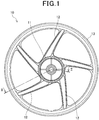
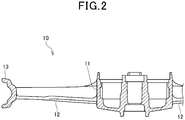
- FIG. 1 is a front view showing a motorcycle wheel 10 that uses an aluminum alloy according to an embodiment of the present invention and FIG. 2 is a sectional view taken along line II-II in FIG. 1 .
- the motorcycle wheel 10 is made of an aluminum alloy, and includes a hub 11 rotatably supported on an axle (not shown), plural spokes 12 radially extending from the hub 11, and an annular rim 13 connected with tips of the plural spokes 12.
- a tire (not shown) is mounted on the rim 13.
- the motorcycle wheel 10 is die-cast in one piece.
- the motorcycle wheel 10 is 17 inches or less in rim diameter and 3.5 inches or less in rim width and that the wheel 10 is not limited to motorcycles and may be used for straddle vehicles including motorcycles.
- Offset yield strength and elongation (toughness) are required of aluminum alloys used for vehicle parts such as the motorcycle wheel 10.
- the intermetallic compounds are Al-Fe-Si eutectics and Al-Fe-Mn-Si eutectics contained in eutectics solidifying after the primary crystals and are produced at higher temperatures than the ⁇ -Si eutectics.
- the intermetallic compounds assume various forms depending on the composition of the aluminum alloy, and in particular, on the amounts of Fe and Mn, and occur in needle, plate, or massive form.
- the inventors have clarified that the toughness of castings decreases with increases in the sizes of the intermetallic compounds containing Fe.
- the sizes of the intermetallic compounds as referred to herein mean maximum lengths in any one direction rather than areas or volumes. Thus, after growing into needle or plate form, intermetallic compounds tend to increase in size.
- intermetallic compounds are affected by the composition of the aluminum alloy.
- a secondary aluminum ingot is used as feedstock, there is the influence of Fe, Mn, Cu, and other elements incorporated as impurities.
- expanded scrap and casting scrap are known, where the expanded scrap is made mostly from aluminum sashes (extruded material) and expanded aluminum out of nonferrous metal scrap and the casting scrap includes cast scrap and shredded materials.
- Table 1 shows the composition of examples of secondary aluminum ingots distributed in large quantities.
- Type Composition (weight%) Si Mg Mn Cu Zn Fe Al Expanded scrap Sash (extruded material) 1.0 0.4 0.1 or less 0.2 or less 0.4 0.6-0.8 Balance Expanded material 1.0 0.3-0.5 0.3 or less 0.7-1.0 1.5 0.9-1.1 ⁇ Casting scrap Cast scrap 7.0 0.3-0.4 0.2 or less 2.0-2.5 1.2-1.5 0.9-1.1 ⁇ Shredded material 6.0-7.0 0.2-0.4 0.2 1.5-2.0 1.2-1.5 0.8-1.0 ⁇
- the aluminum material contains Si, Fe, Mg, Mn, Cu, Zn, and other elements. While these secondary aluminum ingots can be used as an aluminum material by being mixed with a virgin aluminum ingot, incorporation of impurities is unavoidable also in that case.
- Fe reduces toughness in Al-Si alloy castings.
- an amount of Fe is large, needle-shaped Al-Si-Fe intermetallic compounds are produced in large quantities, resulting in reduced toughness.
- Fe has the effect of preventing die castings from seizing to the die.
- Mn When added to an Al-Si alloy casting containing Fe, Mn produces massive Al-Si-Fe-Mn intermetallic compounds and has the effect of preventing production of the needle-shaped or plate-shaped Al-Si-Fe intermetallic compounds described above. On the other hand, however, when an amount of Mn is large, the intermetallic compounds increase in size, resulting in reduced toughness of castings.
- Cu is considered to be an impurity that reduces the toughness of castings and impairs corrosion resistance.
- Mg has the effect of improving tensile strength and offset yield strength, but toughness is reduced with increases in an amount of Mg.
- Si has the effect of improving fluidity of molten metal during casting of aluminum alloys.
- the inventors have conducted various studies on composition and intermetallic compound size of aluminum alloys for vehicles, the aluminum alloys being made of secondary aluminum ingots, and have found that an aluminum alloy for vehicles containing 0.6 to 1.2 wt% Mg, 0.4 to 1.0 wt% Fe, 0.2 to 0.5 wt% Mn, Si, and Cu, with size of an intermetallic compound being 30 ⁇ m or less, provides aluminum die castings having offset yield strength and toughness suitable for vehicle parts.
- an aluminum alloy for vehicles contain impurities such as Fe, Mn, Si, and Cu stemming from secondary aluminum ingots and the like, by increasing Mg compared to before, it is possible to improve offset yield strength of the aluminum alloy for vehicles and reduce wall thickness of products and thereby reduce weight. Also, a weight ratio between Fe and Mn can be set to an appropriate value, improving toughness and making it possible to obtain such an aluminum alloy for vehicles that has toughness suitable for vehicle parts.
- the weight ratio between Fe and Mn can be set to an appropriate value, improving toughness and making it possible to obtain such an aluminum alloy for vehicles that has toughness suitable for vehicle parts.
- This provides an aluminum die casting having an elongation of 4% or more.
- the ratio by weight (wt%) of Mn to Fe is 30 to 70%, the size of the intermetallic compound can be reduced when Fe and Mn are combined, increasing elongation of the aluminum alloy and thereby improving toughness.
- the aluminum alloy for vehicles is formed by die-casting, which makes it possible to obtain such an aluminum alloy for vehicles that has offset yield strength and toughness suitable for vehicle parts.
- the vehicle part is a motorcycle wheel 10
- FIG. 3 is a graph showing a relationship between an amount of Mg and hardness, where the ordinate of the graph represents hardness (based on HRB) and the abscissa represents the amount of Mg (in wt%).
- the hardness increases gradually with increases in the amount of Mg. That is, the offset yield strength of the aluminum alloy for vehicles increases.
- the offset yield strength is 0.2% offset yield strength.
- the amount of Mg is set to (1) 0.6 to 1.2 wt%, and preferably to (2) 0.8 to 1.0 wt%.
- the amount of Mg is increased greatly compared to the Mg amount of 0.1 to 0.2 wt% according to a conventional casting method.
- An allowable range of hardness is 40 or more.
- the amount of Mg is in the above-mentioned range of (2) 0.8 to 1.0 wt%, the hardness is within the allowable range.
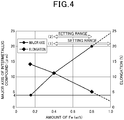
- FIG. 4 is a graph showing relationships of an Fe amount to a major axis of an intermetallic compound and to elongation.
- the ordinate on the left side of the graph represents the major axis (in ⁇ m) of the intermetallic compound, the ordinate on the right side represents elongation (in %), and the abscissa represents the amount of Fe (in wt%).
- the amount of Fe is set to (1) 0.4 to 1.0 wt% and preferably to (2) 0.4 to 0.8 wt%.
- An allowable range of elongation is 4% and when the amount of Fe is in the above-mentioned range of (2) 0.4 to 0.8 wt%, the elongation is within the allowable range.
- FIG. 5 is a graph showing relationships of an Mn amount to a major axis of an intermetallic compound and to elongation.
- the ordinate on the left side of the graph represents the major axis (in ⁇ m) of the intermetallic compound, the ordinate on the right side represents elongation (in %), and the abscissa represents the amount of Mn (in wt%).
- the major axis of the intermetallic compound decreases gradually as the amount of Mn increases from a value close to 0 (zero), but then increases gradually when the amount of Mn exceeds approximately 0.3 wt%.
- the elongation increases as the amount of Mn increases from a value close to 0 (zero), but then decreases gradually when the amount of Mn exceeds approximately 0.3 wt%.
- the amount of Mn is set to (1) 0.2 to 0.5 wt% and preferably to (2) 0.25 to 0.35 wt% by sandwiching the Mn amount of approximately 0.3 wt% which maximizes the elongation such that the major axis of the intermetallic compound will be minimized.
- the allowable range of elongation is 4% and when the amount of Mn is in the above-mentioned range of (1) 0.2 to 0.5 wt% or the amount of Fe is in the above-mentioned range of (2) 0.4 to 1.0 wt%, the elongation is within the allowable range.
- FIG. 6 is a phase diagram of the aluminum alloy according to the embodiment.
- the ordinate of the graph represents temperature (in degrees C) and the abscissa represents the amount of Si (in wt%).
- the temperature falls as the amount of Si increases from 0 (zero) to approximately 12 wt%. That is, the melting point of the aluminum alloy falls gradually.
- the amount of Si is set to a range of 8.0 to 12.0 in which the melting point falls.
- FIG. 7 is a graph showing a relationship between the amount of Cu and the major axis of an intermetallic compound.
- the ordinate of the graph represents the major axis (in ⁇ m) of the intermetallic compound and the abscissa represents the amount of Cu (in wt%).
- the major axis of the intermetallic compound increases with increases in the amount of Cu.
- an excessive amount of Cu results in reduced toughness.
- the major axis of the intermetallic compound corresponding to the Cu amount of 0.6 to 1.0 wt% is extrapolated from the values corresponding to the Cu amount of up to 0.6 wt% as indicated by broken lines.
- the amount of Cu is set to 1.0 wt% or less such that the major axis of the intermetallic compound will be 15 ⁇ m or less (within the allowable range), and (2) preferably the amount of Cu is set to 0.7 wt% or less such that the major axis of the intermetallic compound will be 10 ⁇ m or less (within the allowable range).
- FIG. 8 is a graph showing a relationship between elongation and the major axis of an intermetallic compound.
- the ordinate of the graph represents elongation (in %) and the abscissa represents the major axis (in ⁇ m) of the intermetallic compound.
- the abscissa is graduated logarithmically.
- the major axis of the intermetallic compound is set to (1) 30 ⁇ m or less. Also, the major axis of the intermetallic compound is (2) preferably 15 ⁇ m or less, and (3) more preferably 10 ⁇ m or less.
- the ratio by weight (wt%) of Mn to Fe is 30 to 70%.
- the size of the intermetallic compound can be reduced when Fe and Mn are combined, increasing elongation of the aluminum alloy and thereby improving toughness.
- the aluminum alloy for vehicles is formed by die-casting.
- This configuration makes it possible to obtain by die-casting such an aluminum alloy for vehicles that has offset yield strength and toughness suitable for vehicle parts.
- the vehicle part is a motorcycle wheel 10.
- This configuration makes it possible to provide a motorcycle wheel 10 having suitable offset yield strength and toughness.
- the present invention provides an aluminum alloy for vehicles, where the aluminum alloy can improve toughness and offset yield strength while using secondary ingots.
- An aluminum alloy for vehicles contains 0.6 to 1.2 wt% Mg, 0.4 to 1.0 wt% Fe, 0.2 to 0.5 wt% Mn, Si, and Cu, with size of an intermetallic compound being 30 ⁇ m or less.
Landscapes
- Chemical & Material Sciences (AREA)
- Engineering & Computer Science (AREA)
- Mechanical Engineering (AREA)
- Materials Engineering (AREA)
- Metallurgy (AREA)
- Organic Chemistry (AREA)
- Physics & Mathematics (AREA)
- Thermal Sciences (AREA)
- Crystallography & Structural Chemistry (AREA)
- Body Structure For Vehicles (AREA)
Abstract
Description
- The present invention relates to an aluminum alloy for vehicles as well as to a vehicle part.
- Conventionally, an aluminum alloy for vehicles is known, the aluminum alloy containing 0.2 to 1.0% Fe by weight, 0.01 to 0.7% Mn by weight, Si, and Cu, with the balance being made up of Al and unavoidable impurities (see, for example, International Publication No.
WO2014/061329 ) . - In International Publication No.
WO2014/061329 , when a secondary ingot is used to reduce costs, because offset yield strength decreases compared to when a virgin ingot is used, it is necessary to take measures such as increasing the thickness of a processed product, which increases weight compared to when a virgin ingot is used. Therefore, in using secondary ingots, there is demand to increase the offset yield strength while holding down increases in weight. - As a technique for increasing the offset yield strength of secondary ingots, it is conceivable to add Mg, but the simple addition of Mg will result in reduced toughness, and thus it is desired to improve both offset yield strength and toughness.
- An object of the present invention is to provide an aluminum alloy for vehicles as well as to provide a vehicle part, where the aluminum alloy and vehicle part can improve toughness and offset yield strength while using secondary ingots.
- An aluminum alloy for vehicles contains 0.6 to 1.2 wt% Mg, 0.4 to 1.0 wt% Fe, 0.2 to 0.5 wt% Mn, Si, and Cu, with size of an intermetallic compound being 30 µm or less.
- The aluminum alloy for vehicles may contain 0.8 to 1.0 wt% Mg, 0.4 to 0.8 wt% Fe, and 0.25 to 0.35 wt% Mn, with the size of the intermetallic compound being 15 µm or less.
- Also, in the aluminum alloy for vehicles, a ratio by weight (wt%) of the Mn to the Fe may be 30 to 70%.
- Also, the aluminum alloy for vehicles may contain 8.0 to 12 wt% Si and 1.0 wt% or less Cu, with the size of the intermetallic compound being 10 µm or less.
- Also, the aluminum alloy for vehicles may be formed by die-casting.
- A vehicle part is formed of an aluminum alloy for vehicles, the aluminum alloy containing 0.6 to 1.2 wt% Mg, 0.4 to 1.0 wt% Fe, 0.2 to 0.5 wt% Mn, Si, and Cu, with size of an intermetallic compound being 30 µm or less.
- The vehicle part may contain 0.8 to 1.0 wt% Mg, 0.4 to 0.8 wt% Fe, and 0.25 to 0.35 wt% Mn, with the size of the intermetallic compound being 15 µm or less.
- Also, in the vehicle part, a ratio by weight (wt%) of the Mn to the Fe may be 30 to 70%.
- Also, the vehicle part may contain 8.0 to 12 wt% Si and 1.0 wt% or less Cu, with the size of the intermetallic compound being 10 µm or less.
- Also, the vehicle part may be formed by die-casting.
- Also, the vehicle part may be a motorcycle wheel (10) .
- Since the aluminum alloy for vehicles contain 0.6 to 1.2 wt% Mg, 0.4 to 1.0 wt% Fe, 0.2 to 0.5 wt% Mn, Si, and Cu, with size of an intermetallic compound being 30 µm or less, by increasing Mg compared to before, it is possible to improve offset yield strength of the aluminum alloy for vehicles and reduce wall thickness of products and thereby reduce weight. Also, a weight ratio between Fe and Mn can be set to an appropriate value, improving toughness and making it possible to obtain such an aluminum alloy for vehicles that has toughness suitable for vehicle parts.
- In the above configuration, since 0.8 to 1.0 wt% Mg, 0.4 to 0.8 wt% Fe, and 0.25 to 0.35 wt% Mn are contained, with the size of the intermetallic compound being 15 µm or less, by increasing Mg compared to before, it is possible to improve offset yield strength of the aluminum alloy for vehicles and reduce wall thickness of products and thereby reduce weight. Also, a weight ratio between Fe and Mn can be set to an appropriate value, improving toughness and making it possible to obtain such an aluminum alloy for vehicles that has toughness suitable for vehicle parts.
- Also, in the above configuration, since the ratio by weight (wt%) of the Mn to the Fe is 30 to 70%, the size of the intermetallic compound can be reduced when Fe and Mn are combined, increasing elongation of the aluminum alloy and thereby improving toughness.
- Also, in the above configuration, since 8.0 to 12 wt% Si and 1.0 wt% or less Cu are contained, with the size of the intermetallic compound being 10 µm or less, by setting the amount of Si to 8.0 to 12 wt%, it is possible to improve flowability of molten metal and ensure predetermined toughness. Also, if a large amount of Cu is mixed or the size of the intermetallic compound is large, toughness is reduced. Therefore, the toughness can be improved if the amount of Cu and the size of the intermetallic compound are reduced.
- Also, in the above configuration, the aluminum alloy for vehicles is formed by die-casting, which makes it possible to obtain such an aluminum alloy for vehicles that has offset yield strength and toughness suitable for vehicle parts.
- Also, in the above configuration, since the vehicle part is a motorcycle wheel, it is possible to provide a motorcycle wheel having suitable offset yield strength and toughness.
-
-
FIG. 1 is a front view showing a motorcycle wheel that uses an aluminum alloy according to an embodiment of the present invention; -
FIG. 2 is a sectional view taken along line II-II inFIG. 1 ; -
FIG. 3 is a graph showing a relationship between an amount of Mg and hardness; -
FIG. 4 is a graph showing relationships of an Fe amount to a major axis of an intermetallic compound and to elongation; -
FIG. 5 is a graph showing relationships of an Mn amount to a major axis of an intermetallic compound and to elongation; -
FIG. 6 is a phase diagram of the aluminum alloy according to the embodiment; -
FIG. 7 is a graph showing a relationship between an amount of Cu and a major axis of an intermetallic compound; and -
FIG. 8 is a graph showing a relationship between a major axis of an intermetallic compound and elongation. - An embodiment of the present invention will be described below with reference to the drawings.
-
FIG. 1 is a front view showing amotorcycle wheel 10 that uses an aluminum alloy according to an embodiment of the present invention andFIG. 2 is a sectional view taken along line II-II inFIG. 1 . - As shown in
FIGS. 1 and2 , themotorcycle wheel 10 is made of an aluminum alloy, and includes ahub 11 rotatably supported on an axle (not shown),plural spokes 12 radially extending from thehub 11, and anannular rim 13 connected with tips of theplural spokes 12. - A tire (not shown) is mounted on the
rim 13. Themotorcycle wheel 10 is die-cast in one piece. - Note that the
motorcycle wheel 10 is 17 inches or less in rim diameter and 3.5 inches or less in rim width and that thewheel 10 is not limited to motorcycles and may be used for straddle vehicles including motorcycles. - Offset yield strength and elongation (toughness) are required of aluminum alloys used for vehicle parts such as the
motorcycle wheel 10. - It is known that generally toughness decreases with increases in the content of Fe contained as an impurity in the aluminum alloy, and the inventors found that the decrease in toughness is attributable to the influence of intermetallic compounds formed between primary crystals α and Al crystals.
- The intermetallic compounds are Al-Fe-Si eutectics and Al-Fe-Mn-Si eutectics contained in eutectics solidifying after the primary crystals and are produced at higher temperatures than the α-Si eutectics. The intermetallic compounds assume various forms depending on the composition of the aluminum alloy, and in particular, on the amounts of Fe and Mn, and occur in needle, plate, or massive form.
- The inventors have clarified that the toughness of castings decreases with increases in the sizes of the intermetallic compounds containing Fe. The sizes of the intermetallic compounds as referred to herein mean maximum lengths in any one direction rather than areas or volumes. Thus, after growing into needle or plate form, intermetallic compounds tend to increase in size.
- As described above, the shapes and sizes of intermetallic compounds are affected by the composition of the aluminum alloy. When a secondary aluminum ingot is used as feedstock, there is the influence of Fe, Mn, Cu, and other elements incorporated as impurities.
- As secondary aluminum ingots, expanded scrap and casting scrap are known, where the expanded scrap is made mostly from aluminum sashes (extruded material) and expanded aluminum out of nonferrous metal scrap and the casting scrap includes cast scrap and shredded materials.
- Table 1 shows the composition of examples of secondary aluminum ingots distributed in large quantities.
[Table 1] Type Composition (weight%) Si Mg Mn Cu Zn Fe Al Expanded scrap Sash (extruded material) 1.0 0.4 0.1 or less 0.2 or less 0.4 0.6-0.8 Balance Expanded material 1.0 0.3-0.5 0.3 or less 0.7-1.0 1.5 0.9-1.1 ↑ Casting scrap Cast scrap 7.0 0.3-0.4 0.2 or less 2.0-2.5 1.2-1.5 0.9-1.1 ↑ Shredded material 6.0-7.0 0.2-0.4 0.2 1.5-2.0 1.2-1.5 0.8-1.0 ↑ - When any of expanded scrap materials and casting scrap materials such as illustrated by example in Table 1 are selected or mixed, and used as materials of an aluminum alloy for vehicles, the aluminum material contains Si, Fe, Mg, Mn, Cu, Zn, and other elements. While these secondary aluminum ingots can be used as an aluminum material by being mixed with a virgin aluminum ingot, incorporation of impurities is unavoidable also in that case.
- Fe reduces toughness in Al-Si alloy castings. When an amount of Fe is large, needle-shaped Al-Si-Fe intermetallic compounds are produced in large quantities, resulting in reduced toughness. On the other hand, Fe has the effect of preventing die castings from seizing to the die.
- When added to an Al-Si alloy casting containing Fe, Mn produces massive Al-Si-Fe-Mn intermetallic compounds and has the effect of preventing production of the needle-shaped or plate-shaped Al-Si-Fe intermetallic compounds described above. On the other hand, however, when an amount of Mn is large, the intermetallic compounds increase in size, resulting in reduced toughness of castings.
- Cu is considered to be an impurity that reduces the toughness of castings and impairs corrosion resistance.
- Mg has the effect of improving tensile strength and offset yield strength, but toughness is reduced with increases in an amount of Mg.
- Si has the effect of improving fluidity of molten metal during casting of aluminum alloys.
- The inventors have conducted various studies on composition and intermetallic compound size of aluminum alloys for vehicles, the aluminum alloys being made of secondary aluminum ingots, and have found that an aluminum alloy for vehicles containing 0.6 to 1.2 wt% Mg, 0.4 to 1.0 wt% Fe, 0.2 to 0.5 wt% Mn, Si, and Cu, with size of an intermetallic compound being 30 µm or less, provides aluminum die castings having offset yield strength and toughness suitable for vehicle parts.
- Consequently, even if an aluminum alloy for vehicles contain impurities such as Fe, Mn, Si, and Cu stemming from secondary aluminum ingots and the like, by increasing Mg compared to before, it is possible to improve offset yield strength of the aluminum alloy for vehicles and reduce wall thickness of products and thereby reduce weight. Also, a weight ratio between Fe and Mn can be set to an appropriate value, improving toughness and making it possible to obtain such an aluminum alloy for vehicles that has toughness suitable for vehicle parts.
- Also, if 0.8 to 1.0 wt% Mg, 0.4 to 0.8 wt% Fe, and 0.25 to 0.35 wt% Mn are contained, with the size of the intermetallic compound being 15 µm or less, by increasing Mg compared to before, it is possible to improve offset yield strength of the aluminum alloy for vehicles and reduce wall thickness of products and thereby reduce weight. Also, the weight ratio between Fe and Mn can be set to an appropriate value, improving toughness and making it possible to obtain such an aluminum alloy for vehicles that has toughness suitable for vehicle parts.
- This provides an aluminum die casting having an elongation of 4% or more.
- Also, since the ratio by weight (wt%) of Mn to Fe is 30 to 70%, the size of the intermetallic compound can be reduced when Fe and Mn are combined, increasing elongation of the aluminum alloy and thereby improving toughness.
- Also, since 8.0 to 12 wt% Si and 1.0 wt% or less Cu are contained, with the size of the intermetallic compound being 10 µm or less, by setting the amount of Si to 8.0 to 12 wt%, it is possible to improve flowability of molten metal and ensure predetermined toughness. Also, if a large amount of Cu is mixed or the size of the intermetallic compound is large, toughness is reduced. Therefore, the toughness can be improved if the amount of Cu and the size of the intermetallic compound are reduced.
- Also, the aluminum alloy for vehicles is formed by die-casting, which makes it possible to obtain such an aluminum alloy for vehicles that has offset yield strength and toughness suitable for vehicle parts.
- Also, since the vehicle part is a
motorcycle wheel 10, it is possible to provide amotorcycle wheel 10 having suitable offset yield strength and toughness. - Characteristics of the aluminum alloy for vehicles will be described in detail below with reference to
FIGS. 3 to 8 . Note that the present invention should not be interpreted restrictively based on the following description. -
FIG. 3 is a graph showing a relationship between an amount of Mg and hardness, where the ordinate of the graph represents hardness (based on HRB) and the abscissa represents the amount of Mg (in wt%). - The hardness increases gradually with increases in the amount of Mg. That is, the offset yield strength of the aluminum alloy for vehicles increases. The offset yield strength is 0.2% offset yield strength.
- When the amount of Mg is too large, the toughness of the aluminum alloy for vehicles decreases, and thus according to the present embodiment, the amount of Mg is set to (1) 0.6 to 1.2 wt%, and preferably to (2) 0.8 to 1.0 wt%. The amount of Mg is increased greatly compared to the Mg amount of 0.1 to 0.2 wt% according to a conventional casting method.
- An allowable range of hardness is 40 or more. When the amount of Mg is in the above-mentioned range of (2) 0.8 to 1.0 wt%, the hardness is within the allowable range.
-
FIG. 4 is a graph showing relationships of an Fe amount to a major axis of an intermetallic compound and to elongation. - The ordinate on the left side of the graph represents the major axis (in µm) of the intermetallic compound, the ordinate on the right side represents elongation (in %), and the abscissa represents the amount of Fe (in wt%).
- The major axis of the intermetallic compound increases with increases in the amount of Fe. On the other hand, the elongation decreases with increases in the amount of Fe. In this way, when the amount of Fe increases, the intermetallic compound grows into needle or plate form, resulting in decreased toughness. Consequently, according to the present embodiment, the amount of Fe is set to (1) 0.4 to 1.0 wt% and preferably to (2) 0.4 to 0.8 wt%.
- Note that the major axis of the intermetallic compound and the elongation at the Fe amount of 1.0 wt% are extrapolated from the values at the Fe amounts of 0.4 wt% and 0.8 wt% as indicated by broken lines.
- An allowable range of elongation is 4% and when the amount of Fe is in the above-mentioned range of (2) 0.4 to 0.8 wt%, the elongation is within the allowable range.
-
FIG. 5 is a graph showing relationships of an Mn amount to a major axis of an intermetallic compound and to elongation. The ordinate on the left side of the graph represents the major axis (in µm) of the intermetallic compound, the ordinate on the right side represents elongation (in %), and the abscissa represents the amount of Mn (in wt%). - The major axis of the intermetallic compound decreases gradually as the amount of Mn increases from a value close to 0 (zero), but then increases gradually when the amount of Mn exceeds approximately 0.3 wt%.
- On the other hand, the elongation increases as the amount of Mn increases from a value close to 0 (zero), but then decreases gradually when the amount of Mn exceeds approximately 0.3 wt%.
- According to the present embodiment, the amount of Mn is set to (1) 0.2 to 0.5 wt% and preferably to (2) 0.25 to 0.35 wt% by sandwiching the Mn amount of approximately 0.3 wt% which maximizes the elongation such that the major axis of the intermetallic compound will be minimized.
- The allowable range of elongation is 4% and when the amount of Mn is in the above-mentioned range of (1) 0.2 to 0.5 wt% or the amount of Fe is in the above-mentioned range of (2) 0.4 to 1.0 wt%, the elongation is within the allowable range.
-
FIG. 6 is a phase diagram of the aluminum alloy according to the embodiment. - The ordinate of the graph represents temperature (in degrees C) and the abscissa represents the amount of Si (in wt%).
- On a liquidus line A, the temperature falls as the amount of Si increases from 0 (zero) to approximately 12 wt%. That is, the melting point of the aluminum alloy falls gradually. To ensure fluidity of molten metal during casting, the amount of Si is set to a range of 8.0 to 12.0 in which the melting point falls.
-
FIG. 7 is a graph showing a relationship between the amount of Cu and the major axis of an intermetallic compound. The ordinate of the graph represents the major axis (in µm) of the intermetallic compound and the abscissa represents the amount of Cu (in wt%). - The major axis of the intermetallic compound increases with increases in the amount of Cu. Thus, an excessive amount of Cu results in reduced toughness.
- Note that the major axis of the intermetallic compound corresponding to the Cu amount of 0.6 to 1.0 wt% is extrapolated from the values corresponding to the Cu amount of up to 0.6 wt% as indicated by broken lines.
- According to the present embodiment, (1) the amount of Cu is set to 1.0 wt% or less such that the major axis of the intermetallic compound will be 15 µm or less (within the allowable range), and (2) preferably the amount of Cu is set to 0.7 wt% or less such that the major axis of the intermetallic compound will be 10 µm or less (within the allowable range).
-
FIG. 8 is a graph showing a relationship between elongation and the major axis of an intermetallic compound. - The ordinate of the graph represents elongation (in %) and the abscissa represents the major axis (in µm) of the intermetallic compound. In the graph of
FIG. 8 , the abscissa is graduated logarithmically. - The elongation decreases gradually with increases in the major axis of the intermetallic compound. To ensure an elongation of at least 4% (within the allowable range), the major axis of the intermetallic compound is set to (1) 30 µm or less. Also, the major axis of the intermetallic compound is (2) preferably 15 µm or less, and (3) more preferably 10 µm or less.
- As shown in
FIGS. 3 to 5 and8 , (A) 0.6 to 1.2 wt% Mg, 0.4 to 1.0 wt% Fe, 0.2 to 0.5 wt% Mn, Si, and Cu are contained, with the size of an intermetallic compound being 30 µm or less. - Also, (B) 0.8 to 1.0 wt% Mg, 0.4 to 0.8 wt% Fe, and 0.25 to 0.35 wt% Mn are contained, with the size of the intermetallic compound being 15 µm or less.
- With the above configurations (A) and (B), by increasing Mg compared to before, it is possible to improve offset yield strength of the aluminum alloy for vehicles and reduce wall thickness of products and thereby reduce weight. Also, the weight ratio between Fe and Mn can be set to an appropriate value, improving toughness and making it possible to obtain such an aluminum alloy for vehicles that has toughness suitable for vehicle parts.
- Also, as shown in
FIGS. 4 and5 , the ratio by weight (wt%) of Mn to Fe is 30 to 70%. - With this configuration, the size of the intermetallic compound can be reduced when Fe and Mn are combined, increasing elongation of the aluminum alloy and thereby improving toughness.
- Also, as shown in
FIGS. 6 and7 , 8.0 to 12 wt% Si and 1.0 wt% or less Cu are contained, with the size of the intermetallic compound being 10 µm or less. - With this configuration, by setting the amount of Si to 8.0 to 12 wt%, it is possible to improve flowability of molten metal and ensure predetermined toughness. Also, if a large amount of Cu is mixed or the size of the intermetallic compound is large, toughness is reduced. Therefore, the toughness can be improved if the amount of Cu and the size of the intermetallic compound are reduced.
- Also, the aluminum alloy for vehicles is formed by die-casting.
- This configuration makes it possible to obtain by die-casting such an aluminum alloy for vehicles that has offset yield strength and toughness suitable for vehicle parts.
- Also, as shown in
FIGS. 1 and2 , the vehicle part is amotorcycle wheel 10. This configuration makes it possible to provide amotorcycle wheel 10 having suitable offset yield strength and toughness. - The embodiment described above merely shows one form of the present invention, and desired alterations and applications are possible without departing from the spirit of the invention.
- The present invention provides an aluminum alloy for vehicles, where the aluminum alloy can improve toughness and offset yield strength while using secondary ingots. An aluminum alloy for vehicles contains 0.6 to 1.2 wt% Mg, 0.4 to 1.0 wt% Fe, 0.2 to 0.5 wt% Mn, Si, and Cu, with size of an intermetallic compound being 30 □m or less. By increasing Mg compared to before, offset yield strength of the aluminum alloy for vehicles is improved and wall thickness of products is reduced, thereby reducing weight. Also, toughness is improved by setting a weight ratio between Fe and Mn to an appropriate value.
-
- 10
- Motorcycle wheel (vehicle part)
Claims (11)
- An aluminum alloy for vehicles characterized by containing 0.6 to 1.2 wt% Mg, 0.4 to 1.0 wt% Fe, 0.2 to 0.5 wt% Mn, Si, and Cu, with size of an intermetallic compound being 30 µm or less.
- The aluminum alloy for vehicles according to claim 1, wherein the aluminum alloy contains 0.8 to 1.0 wt% Mg, 0.4 to 0.8 wt% Fe, and 0.25 to 0.35 wt% Mn, with the size of the intermetallic compound being 15 µm or less.
- The aluminum alloy for vehicles according to claim 1 or 2, wherein a ratio by weight (wt%) of the Mn to the Fe is 30 to 70%.
- The aluminum alloy for vehicles according to claim 3, wherein the aluminum alloy contains 8.0 to 12 wt% Si and 1.0 wt% or less Cu, with the size of the intermetallic compound being 10 µm or less.
- The aluminum alloy for vehicles according to any one of claims 1 to 4, wherein the aluminum alloy is formed by die-casting.
- A vehicle part characterized by comprising the aluminum alloy for vehicles according to claim 1.
- The vehicle part according to claim 6, wherein the vehicle part contains 0.8 to 1.0 wt% Mg, 0.4 to 0.8 wt% Fe, and 0.25 to 0.35 wt% Mn, with the size of the intermetallic compound being 15 µm or less.
- The vehicle part according to claim 6 or 7, wherein a ratio by weight (wt%) of the Mn to the Fe is 30 to 70%.
- The vehicle part according to claim 8, wherein the vehicle part contains 8.0 to 12 wt% Si and 1.0 wt% or less Cu, with the size of the intermetallic compound being 10 µm or less.
- The vehicle part according to any one of claims 6 to 9, wherein the vehicle part is formed by die-casting.
- The vehicle part according to any one of claims 6 to 10, wherein the vehicle part is a motorcycle wheel (10).
Applications Claiming Priority (1)
| Application Number | Priority Date | Filing Date | Title |
|---|---|---|---|
| JP2019056181A JP2020158789A (en) | 2019-03-25 | 2019-03-25 | Aluminum alloy for vehicle and parts for vehicle |
Publications (1)
| Publication Number | Publication Date |
|---|---|
| EP3715489A1 true EP3715489A1 (en) | 2020-09-30 |
Family
ID=69742777
Family Applications (1)
| Application Number | Title | Priority Date | Filing Date |
|---|---|---|---|
| EP20159808.3A Withdrawn EP3715489A1 (en) | 2019-03-25 | 2020-02-27 | Aluminum alloy for vehicles and vehicle part |
Country Status (2)
| Country | Link |
|---|---|
| EP (1) | EP3715489A1 (en) |
| JP (1) | JP2020158789A (en) |
Families Citing this family (3)
| Publication number | Priority date | Publication date | Assignee | Title |
|---|---|---|---|---|
| JP7666281B2 (en) * | 2021-10-04 | 2025-04-22 | トヨタ自動車株式会社 | Aluminum alloy material and its manufacturing method |
| JP7845143B2 (en) * | 2022-10-28 | 2026-04-14 | トヨタ自動車株式会社 | Manufacturing method for aluminum alloys |
| KR102902931B1 (en) * | 2022-11-30 | 2025-12-23 | 한국생산기술연구원 | Manufacturing method of die casting Al alloy |
Citations (10)
| Publication number | Priority date | Publication date | Assignee | Title |
|---|---|---|---|---|
| JPH02232331A (en) * | 1989-03-03 | 1990-09-14 | Nippon Light Metal Co Ltd | Aluminum alloy for mold casting with excellent thread corrosion resistance |
| JP2002339030A (en) * | 2001-05-17 | 2002-11-27 | Yamaha Motor Co Ltd | Aluminum alloy for die casting |
| US20050199318A1 (en) * | 2003-06-24 | 2005-09-15 | Doty Herbert W. | Castable aluminum alloy |
| JP2011208253A (en) * | 2010-03-30 | 2011-10-20 | Honda Motor Co Ltd | Aluminum die-cast alloy for vehicle material |
| US20120000578A1 (en) * | 2010-06-30 | 2012-01-05 | Gm Global Technology Operations, Inc. | Cast aluminum alloys |
| US20120073796A1 (en) * | 2004-12-28 | 2012-03-29 | Denso Corporation | Aluminum alloy for die castings and production process of aluminum alloy castings |
| EP2475794A1 (en) * | 2009-09-10 | 2012-07-18 | Nissan Motor Co., Ltd. | Aluminum alloy casting and production method thereof |
| DE102011120988A1 (en) * | 2011-12-13 | 2013-06-13 | Daimler Ag | Planar semifinished product of aluminum alloy matrix composite having boron carbide-particles, useful for manufacturing a plate, comprises boron carbide particles-containing layers, and a matrix-forming aluminum alloy comprising silicon |
| WO2014061329A1 (en) | 2012-10-17 | 2014-04-24 | 本田技研工業株式会社 | Vehicular aluminum alloy and vehicular component |
| EP2952598A1 (en) * | 2014-06-06 | 2015-12-09 | Huawei Technologies Co., Ltd. | Die casting aluminum alloy and production method thereof, and communications product |
Family Cites Families (4)
| Publication number | Priority date | Publication date | Assignee | Title |
|---|---|---|---|---|
| JPH07252573A (en) * | 1994-03-17 | 1995-10-03 | Kobe Steel Ltd | Al-zn-mg-cu alloy excellent in toughness and its production |
| JP3448990B2 (en) * | 1994-11-02 | 2003-09-22 | 日本軽金属株式会社 | Die-cast products with excellent high-temperature strength and toughness |
| JP5344527B2 (en) * | 2007-03-30 | 2013-11-20 | 株式会社豊田中央研究所 | Aluminum alloy for casting, aluminum alloy casting and method for producing the same |
| JP6420553B2 (en) * | 2014-03-03 | 2018-11-07 | 住友電気工業株式会社 | Aluminum alloy, aluminum alloy wire, aluminum alloy wire manufacturing method, aluminum alloy member manufacturing method, and aluminum alloy member |
-
2019
- 2019-03-25 JP JP2019056181A patent/JP2020158789A/en active Pending
-
2020
- 2020-02-27 EP EP20159808.3A patent/EP3715489A1/en not_active Withdrawn
Patent Citations (10)
| Publication number | Priority date | Publication date | Assignee | Title |
|---|---|---|---|---|
| JPH02232331A (en) * | 1989-03-03 | 1990-09-14 | Nippon Light Metal Co Ltd | Aluminum alloy for mold casting with excellent thread corrosion resistance |
| JP2002339030A (en) * | 2001-05-17 | 2002-11-27 | Yamaha Motor Co Ltd | Aluminum alloy for die casting |
| US20050199318A1 (en) * | 2003-06-24 | 2005-09-15 | Doty Herbert W. | Castable aluminum alloy |
| US20120073796A1 (en) * | 2004-12-28 | 2012-03-29 | Denso Corporation | Aluminum alloy for die castings and production process of aluminum alloy castings |
| EP2475794A1 (en) * | 2009-09-10 | 2012-07-18 | Nissan Motor Co., Ltd. | Aluminum alloy casting and production method thereof |
| JP2011208253A (en) * | 2010-03-30 | 2011-10-20 | Honda Motor Co Ltd | Aluminum die-cast alloy for vehicle material |
| US20120000578A1 (en) * | 2010-06-30 | 2012-01-05 | Gm Global Technology Operations, Inc. | Cast aluminum alloys |
| DE102011120988A1 (en) * | 2011-12-13 | 2013-06-13 | Daimler Ag | Planar semifinished product of aluminum alloy matrix composite having boron carbide-particles, useful for manufacturing a plate, comprises boron carbide particles-containing layers, and a matrix-forming aluminum alloy comprising silicon |
| WO2014061329A1 (en) | 2012-10-17 | 2014-04-24 | 本田技研工業株式会社 | Vehicular aluminum alloy and vehicular component |
| EP2952598A1 (en) * | 2014-06-06 | 2015-12-09 | Huawei Technologies Co., Ltd. | Die casting aluminum alloy and production method thereof, and communications product |
Also Published As
| Publication number | Publication date |
|---|---|
| JP2020158789A (en) | 2020-10-01 |
Similar Documents
| Publication | Publication Date | Title |
|---|---|---|
| JP5894289B2 (en) | Die-cast products and vehicle parts | |
| JP2697400B2 (en) | Aluminum alloy for forging | |
| EP2664687B1 (en) | Improved free-machining wrought aluminium alloy product and manufacturing process thereof | |
| JP3301919B2 (en) | Aluminum alloy extruded material with excellent chip breaking performance | |
| US20110116966A1 (en) | Aluminum alloy, method of casting aluminum alloy, and method of producing aluminum alloy product | |
| EP3715489A1 (en) | Aluminum alloy for vehicles and vehicle part | |
| CN111532080B (en) | Aluminum alloy forged wheel, manufacturing method thereof, and casting blank for forming forged wheel | |
| US20220090234A1 (en) | Foundry Alloys for High-Pressure Vacuum Die Casting | |
| JP4511156B2 (en) | Aluminum alloy manufacturing method and aluminum alloy, rod-shaped material, sliding part, forged molded product and machined molded product manufactured thereby | |
| EP4124668A1 (en) | Cast alloy | |
| JP3346186B2 (en) | Aluminum alloy material for casting and forging with excellent wear resistance, castability and forgeability, and its manufacturing method | |
| JPH09143605A (en) | High-pressure cast aluminum alloy excellent in strength and toughness and method for producing the same | |
| JP2003170263A (en) | Method for casting vehicle wheel under low pressure | |
| JPH07145440A (en) | Aluminum alloy forging stock | |
| JPH09249949A (en) | Aluminum Extruded Forged Product Manufacturing Method | |
| JP4145454B2 (en) | Wear-resistant aluminum alloy elongated body and method for producing the same | |
| JPH07150312A (en) | Manufacture of aluminum alloy forged base stock | |
| EP3589766B1 (en) | Al-mg-si-mn-fe casting alloys | |
| JP3037926B2 (en) | Aluminum alloy for aluminum wheel casting | |
| JPH09296245A (en) | Aluminum alloy for casting | |
| KR102572624B1 (en) | High elongation die casting alloy composition for non-heat treatment | |
| JP3687505B2 (en) | Aluminum alloy for casting forging and method for producing casting forging | |
| JP2848368B2 (en) | Manufacturing method of aluminum alloy for compressor parts with excellent wear resistance and toughness | |
| JP3929850B2 (en) | Structural aluminum alloy forging with excellent corrosion resistance and method for producing the same | |
| JPH0941064A (en) | Production of aluminum alloy for casting and aluminum alloy casting material |
Legal Events
| Date | Code | Title | Description |
|---|---|---|---|
| PUAI | Public reference made under article 153(3) epc to a published international application that has entered the european phase |
Free format text: ORIGINAL CODE: 0009012 |
|
| STAA | Information on the status of an ep patent application or granted ep patent |
Free format text: STATUS: REQUEST FOR EXAMINATION WAS MADE |
|
| 17P | Request for examination filed |
Effective date: 20200227 |
|
| AK | Designated contracting states |
Kind code of ref document: A1 Designated state(s): AL AT BE BG CH CY CZ DE DK EE ES FI FR GB GR HR HU IE IS IT LI LT LU LV MC MK MT NL NO PL PT RO RS SE SI SK SM TR |
|
| AX | Request for extension of the european patent |
Extension state: BA ME |
|
| STAA | Information on the status of an ep patent application or granted ep patent |
Free format text: STATUS: EXAMINATION IS IN PROGRESS |
|
| 17Q | First examination report despatched |
Effective date: 20210212 |
|
| STAA | Information on the status of an ep patent application or granted ep patent |
Free format text: STATUS: THE APPLICATION IS DEEMED TO BE WITHDRAWN |
|
| 18D | Application deemed to be withdrawn |
Effective date: 20210623 |