EP3713005A1 - Reference electrode and method for preparing lithium ion battery having reference electrode - Google Patents
Reference electrode and method for preparing lithium ion battery having reference electrode Download PDFInfo
- Publication number
- EP3713005A1 EP3713005A1 EP18878895.4A EP18878895A EP3713005A1 EP 3713005 A1 EP3713005 A1 EP 3713005A1 EP 18878895 A EP18878895 A EP 18878895A EP 3713005 A1 EP3713005 A1 EP 3713005A1
- Authority
- EP
- European Patent Office
- Prior art keywords
- reference electrode
- current collecting
- metal sheet
- lithium
- ion battery
- Prior art date
- Legal status (The legal status is an assumption and is not a legal conclusion. Google has not performed a legal analysis and makes no representation as to the accuracy of the status listed.)
- Withdrawn
Links
Images






Classifications
-
- G—PHYSICS
- G01—MEASURING; TESTING
- G01N—INVESTIGATING OR ANALYSING MATERIALS BY DETERMINING THEIR CHEMICAL OR PHYSICAL PROPERTIES
- G01N27/00—Investigating or analysing materials by the use of electric, electrochemical, or magnetic means
- G01N27/26—Investigating or analysing materials by the use of electric, electrochemical, or magnetic means by investigating electrochemical variables; by using electrolysis or electrophoresis
- G01N27/28—Electrolytic cell components
- G01N27/30—Electrodes, e.g. test electrodes; Half-cells
- G01N27/301—Reference electrodes
-
- H—ELECTRICITY
- H01—ELECTRIC ELEMENTS
- H01M—PROCESSES OR MEANS, e.g. BATTERIES, FOR THE DIRECT CONVERSION OF CHEMICAL ENERGY INTO ELECTRICAL ENERGY
- H01M10/00—Secondary cells; Manufacture thereof
- H01M10/05—Accumulators with non-aqueous electrolyte
- H01M10/058—Construction or manufacture
-
- H—ELECTRICITY
- H01—ELECTRIC ELEMENTS
- H01M—PROCESSES OR MEANS, e.g. BATTERIES, FOR THE DIRECT CONVERSION OF CHEMICAL ENERGY INTO ELECTRICAL ENERGY
- H01M4/00—Electrodes
- H01M4/02—Electrodes composed of, or comprising, active material
- H01M4/04—Processes of manufacture in general
- H01M4/0402—Methods of deposition of the material
-
- H—ELECTRICITY
- H01—ELECTRIC ELEMENTS
- H01M—PROCESSES OR MEANS, e.g. BATTERIES, FOR THE DIRECT CONVERSION OF CHEMICAL ENERGY INTO ELECTRICAL ENERGY
- H01M4/00—Electrodes
- H01M4/02—Electrodes composed of, or comprising, active material
- H01M4/04—Processes of manufacture in general
- H01M4/0402—Methods of deposition of the material
- H01M4/0404—Methods of deposition of the material by coating on electrode collectors
-
- H—ELECTRICITY
- H01—ELECTRIC ELEMENTS
- H01M—PROCESSES OR MEANS, e.g. BATTERIES, FOR THE DIRECT CONVERSION OF CHEMICAL ENERGY INTO ELECTRICAL ENERGY
- H01M4/00—Electrodes
- H01M4/02—Electrodes composed of, or comprising, active material
- H01M4/13—Electrodes for accumulators with non-aqueous electrolyte, e.g. for lithium-accumulators; Processes of manufacture thereof
- H01M4/139—Processes of manufacture
- H01M4/1395—Processes of manufacture of electrodes based on metals, Si or alloys
-
- H—ELECTRICITY
- H01—ELECTRIC ELEMENTS
- H01M—PROCESSES OR MEANS, e.g. BATTERIES, FOR THE DIRECT CONVERSION OF CHEMICAL ENERGY INTO ELECTRICAL ENERGY
- H01M4/00—Electrodes
- H01M4/02—Electrodes composed of, or comprising, active material
- H01M4/36—Selection of substances as active materials, active masses, active liquids
- H01M4/38—Selection of substances as active materials, active masses, active liquids of elements or alloys
- H01M4/381—Alkaline or alkaline earth metals elements
- H01M4/382—Lithium
-
- H—ELECTRICITY
- H01—ELECTRIC ELEMENTS
- H01M—PROCESSES OR MEANS, e.g. BATTERIES, FOR THE DIRECT CONVERSION OF CHEMICAL ENERGY INTO ELECTRICAL ENERGY
- H01M4/00—Electrodes
- H01M4/02—Electrodes composed of, or comprising, active material
- H01M4/64—Carriers or collectors
- H01M4/66—Selection of materials
- H01M4/661—Metal or alloys, e.g. alloy coatings
-
- H—ELECTRICITY
- H01—ELECTRIC ELEMENTS
- H01M—PROCESSES OR MEANS, e.g. BATTERIES, FOR THE DIRECT CONVERSION OF CHEMICAL ENERGY INTO ELECTRICAL ENERGY
- H01M4/00—Electrodes
- H01M4/02—Electrodes composed of, or comprising, active material
- H01M4/64—Carriers or collectors
- H01M4/70—Carriers or collectors characterised by shape or form
- H01M4/72—Grids
- H01M4/74—Meshes or woven material; Expanded metal
-
- H—ELECTRICITY
- H01—ELECTRIC ELEMENTS
- H01M—PROCESSES OR MEANS, e.g. BATTERIES, FOR THE DIRECT CONVERSION OF CHEMICAL ENERGY INTO ELECTRICAL ENERGY
- H01M50/00—Constructional details or processes of manufacture of the non-active parts of electrochemical cells other than fuel cells, e.g. hybrid cells
- H01M50/10—Primary casings; Jackets or wrappings
- H01M50/116—Primary casings; Jackets or wrappings characterised by the material
- H01M50/124—Primary casings; Jackets or wrappings characterised by the material having a layered structure
-
- H—ELECTRICITY
- H01—ELECTRIC ELEMENTS
- H01M—PROCESSES OR MEANS, e.g. BATTERIES, FOR THE DIRECT CONVERSION OF CHEMICAL ENERGY INTO ELECTRICAL ENERGY
- H01M50/00—Constructional details or processes of manufacture of the non-active parts of electrochemical cells other than fuel cells, e.g. hybrid cells
- H01M50/40—Separators; Membranes; Diaphragms; Spacing elements inside cells
- H01M50/409—Separators, membranes or diaphragms characterised by the material
- H01M50/411—Organic material
- H01M50/414—Synthetic resins, e.g. thermoplastics or thermosetting resins
- H01M50/417—Polyolefins
-
- H—ELECTRICITY
- H01—ELECTRIC ELEMENTS
- H01M—PROCESSES OR MEANS, e.g. BATTERIES, FOR THE DIRECT CONVERSION OF CHEMICAL ENERGY INTO ELECTRICAL ENERGY
- H01M50/00—Constructional details or processes of manufacture of the non-active parts of electrochemical cells other than fuel cells, e.g. hybrid cells
- H01M50/40—Separators; Membranes; Diaphragms; Spacing elements inside cells
- H01M50/409—Separators, membranes or diaphragms characterised by the material
- H01M50/446—Composite material consisting of a mixture of organic and inorganic materials
-
- H—ELECTRICITY
- H01—ELECTRIC ELEMENTS
- H01M—PROCESSES OR MEANS, e.g. BATTERIES, FOR THE DIRECT CONVERSION OF CHEMICAL ENERGY INTO ELECTRICAL ENERGY
- H01M50/00—Constructional details or processes of manufacture of the non-active parts of electrochemical cells other than fuel cells, e.g. hybrid cells
- H01M50/50—Current conducting connections for cells or batteries
- H01M50/528—Fixed electrical connections, i.e. not intended for disconnection
-
- H—ELECTRICITY
- H01—ELECTRIC ELEMENTS
- H01M—PROCESSES OR MEANS, e.g. BATTERIES, FOR THE DIRECT CONVERSION OF CHEMICAL ENERGY INTO ELECTRICAL ENERGY
- H01M50/00—Constructional details or processes of manufacture of the non-active parts of electrochemical cells other than fuel cells, e.g. hybrid cells
- H01M50/50—Current conducting connections for cells or batteries
- H01M50/569—Constructional details of current conducting connections for detecting conditions inside cells or batteries, e.g. details of voltage sensing terminals
-
- H—ELECTRICITY
- H01—ELECTRIC ELEMENTS
- H01M—PROCESSES OR MEANS, e.g. BATTERIES, FOR THE DIRECT CONVERSION OF CHEMICAL ENERGY INTO ELECTRICAL ENERGY
- H01M10/00—Secondary cells; Manufacture thereof
- H01M10/05—Accumulators with non-aqueous electrolyte
- H01M10/052—Li-accumulators
- H01M10/0525—Rocking-chair batteries, i.e. batteries with lithium insertion or intercalation in both electrodes; Lithium-ion batteries
-
- H—ELECTRICITY
- H01—ELECTRIC ELEMENTS
- H01M—PROCESSES OR MEANS, e.g. BATTERIES, FOR THE DIRECT CONVERSION OF CHEMICAL ENERGY INTO ELECTRICAL ENERGY
- H01M10/00—Secondary cells; Manufacture thereof
- H01M10/42—Methods or arrangements for servicing or maintenance of secondary cells or secondary half-cells
- H01M10/4285—Testing apparatus
-
- H—ELECTRICITY
- H01—ELECTRIC ELEMENTS
- H01M—PROCESSES OR MEANS, e.g. BATTERIES, FOR THE DIRECT CONVERSION OF CHEMICAL ENERGY INTO ELECTRICAL ENERGY
- H01M4/00—Electrodes
- H01M4/02—Electrodes composed of, or comprising, active material
- H01M2004/021—Physical characteristics, e.g. porosity, surface area
Definitions
- the present disclosure relates to methods for making reference electrode and lithium ion battery having the same, and belongs to the technical fields of measurement of an electrode potential and manufacture of an electrode.
- the electrode potential is one of the most important parameters in researches of electrochemistry and battery.
- the open-circuit potential is an electrode potential in a thermodynamic equilibrium state.
- a voltage vs. SOC curve of the battery obtained during a charge-discharge process at a low current can be regarded as an open-circuit voltage curve. If there is a current flowing through an electrode, the electrode would be polarized and a potential of the electrode would be deviated due to an occurrence of overpotential.
- the detailed information of a reaction occurring inside the electrode can be obtained by measuring a potential varying curve of the electrode.
- the lithium ion battery with graphite anode Taken the lithium ion battery with graphite anode as an example, overcharging or low-temperature charging may result in a Li plating at the graphite anode, characterized in that anode potential is below to equilibrium potential for the lithium-plating. Therefore, the Li plating side reaction can be detected by measuring the electrode potential.
- a battery includes two electrodes, the polarization of the individual electrode cannot be detected directly because the overpotential we gauged is composed the polarized potential of positive and negative electrodes, respectively. More specifically, one or more reference electrodes are interposed between the cathode and the anode to measure the voltage difference between the electrode and the reference electrode.
- the reference electrode in the related art is mainly made of electrochemical deposition , lithium foil, lithium alloy, lithium-containing metal oxide, or lithium-containing phosphate, and so on.
- Another method involves inserting a lithium foil directly into a battery.
- the lithium metal is connected to a current collector by a physical pressing method.
- a current collector for example, a copper mesh.
- the copper mesh has a relatively large pore diameter which is at the millimeter-scale.
- the connection reliability of the lithium and the copper mesh cannot be ensured by this physical connection method. A poor contact can lead to an extremely large ohmic resistance of the reference electrode influencing the use thereof.
- the difficulties in the development of the reference electrode can be contributed to the lithium amount in the electrode.
- the size of the reference electrode should be as small as possible to decrease the blocking effect on lithium ions in the electrolyte. However, this will reduce the lithium amount in the material, and thus weaken the signal. In addition, an electrode material loss or a potential drift tends to occur because of the micro-currents in the measurement.
- An object of the present disclosure is to provide a method for making a reference electrode and a method for making a lithium ion battery having the reference electrode, to solve the unstable problem of the measurement using the reference electrode and improve the service life of the reference electrode, thereby achieving a long term multi-cycle potential measurement of the individual electrode and increasing the accuracy of the measuring result.
- the method for making the reference electrode in the present disclosure includes:
- the method for making the lithium ion battery having the reference electrode in the present disclosure includes:
- Another method for making the lithium ion battery having the reference electrode in the present disclosure includes:
- the lithium metal can be formed on the surface of the substrate material, while the porous property of the substrate material can be maintained, so that small molecules in the liquid electrolyte can pass through the pores, and the normal operation of the battery will not be influenced.
- the thickness of the lithium metal layer formed on the substrate can be controlled by regulating parameters in the making process to ensure that the porous property of the substrate material can be retained while sufficient lithium can be loaded on the substrate to meet measurement requirements. Therefore, the reference electrode made by the method according to the present disclosure can have sufficient micro-structures as well as long service life.
- the manufacturing process is simple and can meet the industrial production requirements, making the industrial production and the application of the lithium-ion battery with the reference electrode possible.
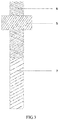
- lithium ion battery 1 reference electrode 2; cathode 3; anode 4, tab binder 5, current collecting metal sheet 6, reference electrode substrate 7, welding spot 8, lithium metal layer 9, cathode plate 10, separator 11 between the cathode plate and the anode plate of the lithium ion battery
- the method for making the reference electrode includes:
- a porous copper foam, a porous nickel foam, a copper mesh, or a mesh is adopted as the reference electrode substrate 7.
- the reference electrode substrate 7 is washed with acetone or deionized water and then dried for later use.
- the material of the reference electrode substrate 7 can have a pore size of 50 ⁇ m to 500 ⁇ m, and a thickness of the reference electrode substrate 7 can be 0.1 mm to 1 mm.
- the reference electrode substrate 7 is welded to the lower portion of the current collecting metal sheet 6 whose upper portion is adhered with the tab binder 5, to allow an upper portion of the reference electrode substrate 7 to be overlapped with the lower portion of the current collecting metal sheet 6.
- An area of the current collecting metal sheet 6 is smaller than an area of the reference electrode substrate 7.
- the reference electrode 2 welded with the current collecting metal sheet 6 is vacuum dried at 60 °C to 90 °C under the water-free and oxygen-free condition for 4 to 7 hours, cooled, and then transferred into and preserved in a water-free and oxygen-free environment.
- the current collecting metal sheet 6 is used for collecting an electric current.
- a material of the current collecting metal sheet 6 is nickel or aluminum.
- a thickness of the current collecting metal sheet 6 can be 0.1 mm to 1 mm.
- a length of the current collecting metal sheet 6 can depend on a location of the reference electrode 2 disposed with respect to the battery, and can be 10 mm to 30 mm.
- the lithium metal in the step S13, is melted into the liquid state and is continuously heated to 200 °C to 500 °C to remove the impurity on the surface of the liquid state lithium metal under the water-free and oxygen-free condition.
- the lower portion of the reference electrode substrate 7 whose upper portion is welded with the current collecting metal sheet 6 is immersed into the liquid lithium and rested for 1 minute (min) to 5 min to coat the lithium metal layer 9 on the lower portion of the reference electrode substrate 7.
- the portion without any welding spot 8 of the substrate can be entirely immersed into the liquid lithium, and the lower portion of the reference electrode substrate 7 can be fully wetted with the lithium metal to allow the lithium metal layer 9 to be formed on the lower portion of the reference electrode substrate 7.
- the lithium metal layer 9 can have a thickness of 10 ⁇ m to 100 ⁇ m.
- the reference electrode 2 welded with the current collecting metal sheet 6 is taken out from the liquid lithium and cooled.
- the portion below the tab binder 5 of the reference electrode 2 is wrapped with the separator by the winding method.
- the separator can be wrapped tightly and entirely around the current collecting metal sheet 6 and the reference electrode substrate 7, thereby obtaining the reference electrode 2 wrapped with the separator.
- a material of the separator is porous polypropylene, porous polyethylene, porous polypropylene coated with ceramic, porous polyethylene coated with ceramic, or non-woven fabric.
- the method for making the lithium ion battery having the reference electrode includes making two parts: a reference electrode and a lithium ion battery.
- the method includes:
- the method further includes making the lithium ion battery 1 having the reference electrode 2, which includes:
- a porous copper foam, a porous nickel foam, a copper mesh, or a mesh is adopted as the reference electrode substrate 7.
- An area of the reference electrode substrate 7 is 1% to 10% of an area of an electrode plate of the lithium ion battery 1.
- the reference electrode substrate 7 is washed with acetone or deionized water and then dried for later use.
- the material of the reference electrode substrate 7 can have a pore size of 50 ⁇ m to 500 ⁇ m, and a thickness of the reference electrode substrate 7 can be 0.1 mm to 1 mm.
- the reference electrode substrate 7 is welded to the lower portion of the current collecting metal sheet 6 whose upper portion is adhered with the tab binder 5, to allow an upper portion of the reference electrode substrate 7 to be overlapped with the lower portion of the current collecting metal sheet 6.
- An area of the current collecting metal sheet 6 is smaller than an area of the reference electrode substrate 7.
- the reference electrode 2 welded with the current collecting metal sheet 6 is vacuum dried at 60 °C to 90 °C under the water-free and oxygen-free condition for 4 to 7 hours, cooled, and then transferred into and preserved in a water-free and oxygen-free environment.
- the current collecting metal sheet 6 is used for collecting an electric current.
- a material of the current collecting metal sheet 6 is nickel or aluminum.
- a thickness of the current collecting metal sheet 6 can be 0.1 mm to 1 mm.
- a length of the current collecting metal sheet 6 can depend on a location of the reference electrode 2 disposed with respect to the battery, and can be 10 mm to 30 mm.
- the lithium metal in the step S13, is melted into the liquid state and is continuously heated to 200 °C to 500 °C to remove the impurity on the surface of the liquid state lithium metal under the water-free and oxygen-free condition.
- the lower portion of the reference electrode substrate 7 whose upper portion is welded with the current collecting metal sheet 6 is immersed into the liquid lithium and rested for 1 min to 5 min to coat the lithium metal layer 9 on the lower portion of the reference electrode substrate 7.
- the portion without any welding spot 8 of the substrate can be entirely immersed into the liquid lithium, and the lower portion of the reference electrode substrate 7 can be fully wetted with the lithium metal to allow the lithium metal layer 9 to be formed on the lower portion of the reference electrode substrate 7.
- the lithium metal layer 9 can have a thickness of 10 ⁇ m to 100 ⁇ m.
- the reference electrode 2 welded with the current collecting metal sheet 6 is taken out from the liquid lithium and cooled.
- the portion below the tab binder 5 of the reference electrode 2 is wrapped with the separator by the winding method.
- the separator can be wrapped tightly and entirely around the current collecting metal sheet 6 and the reference electrode substrate 7, thereby obtaining the reference electrode 2 wrapped with the separator.
- a material of the separator is porous polypropylene, porous polyethylene, porous polypropylene coated with ceramic, porous polyethylene coated with ceramic, or non-woven fabric.
- the reference electrode 2 is interposed between the separator 11 and the anode plate of the cell of the lithium ion battery 1.
- the upper end of the reference electrode 2 is protruded out from the cell of the lithium ion battery 1 for 1 mm to 2 mm under the water-free and oxygen-free condition.
- the lithium ion battery 1 implanted with the reference electrode 2 is packaged with an aluminum plastic film under the water-free and oxygen-free condition, thereby obtaining the lithium ion battery 1 having the reference electrode 2.
- a method for making a lithium ion battery having a reference electrode including the following steps:
- a porous copper foam is provided as a reference electrode substrate 7.
- a material of the reference electrode substrate 7 has a pore size of 50 ⁇ m.
- a thickness of the reference electrode substrate 7 is 0.2mm.
- An area of the reference electrode substrate 7 is 2 % of an area of an electrode plate of a lithium ion battery 1.
- the reference electrode substrate 7 is a rectangle sheet with a length of 10 mm and a width of 5 mm.
- the reference electrode substrate 7 is washed with acetone or deionized water and then dried for use.
- the reference electrode substrate 7 obtained from the step S110 is welded to a lower portion of a current collecting metal sheet 6 to allow an upper portion of the reference electrode substrate 7 to be overlapped with the lower portion of the current collecting metal sheet 6.
- An upper portion of the current collecting metal sheet 6 is adhered with a tab binder 5.
- the current collecting nickel sheet 6 having a same width as the reference electrode substrate 7 and a length of 20 mm, provided with the tab binder 5, is used for welding.
- the reference electrode substrate 7 is vacuum dried at 80 °C under the water-free and oxygen-free condition for 5 hours, cooled, and transferred into and preserved in a water-free and oxygen-free environment.
- lithium metal is melted into liquid state and continued to heat to 400 °C to remove an impurity on a surface of the liquid state lithium metal under the water-free and oxygen-free condition.
- the lower portion of the reference electrode substrate 7 whose upper portion is welded with the current collecting metal sheet 6 obtained from the step S120 is immersed into the liquid lithium and stood for 3 min. The portion without any welding spot 8 of the substrate is entirely immersed into the liquid lithium.
- the lower portion of the reference electrode substrate 7 is fully wetted by the lithium metal, so as to allow a lithium metal layer to coat on the lower portion of the reference electrode substrate 7.
- the reference electrode 2 is taken out from the liquid lithium, a surface of the reference electrode 2 is immediately blew with hot air at 400 °C to remove the lithium filled in pores to expose the pores.
- a thickness of the lithium metal layer 9 grown is about 10 ⁇ m.
- a portion below the tab binder 5 of the reference electrode 2 is wrapped with a separator by a winding method.
- the current collecting metal sheet 6 and the entire reference electrode substrate 7 are wrapped tightly, thereby obtaining the reference electrode 2 wrapped with the separator.
- a material of the separator is porous polypropylene.
- the separator can prevent the reference electrode 2 from directly contacting with a cathode 3 and an anode 4 of the lithium ion battery 1 and can allow lithium ions to pass therethrough; S200, the reference electrode 2 obtained from the step S100 is interposed between a separator 11 and an anode plate of a cell of the lithium ion battery 1 under the water-free and oxygen-free condition.
- a soft package battery is an object to be tested.
- the nude cell of the battery is placed into the water-free and oxygen-free environment.
- the reference electrode 2 is interposed between a cathode plate 10 and an anode plate of the nude cell, more specifically, located at an interface between a separator 11 and the anode plate.
- the reference electrode 2 can be interposed between any two plates except the outermost electrode plate.
- the reference electrode 2 can be located at anywhere on the plate, including but not limited to a center, a corner, and an edge of the plate according to needs.
- the reference electrode 2 is interposed from a central area of an edge, while an upper end of the reference electrode 2 is protruded out from the cell of the lithium ion battery for 2 mm.
- the lithium ion battery 1 provided with the reference electrode 2 obtained from the step S200 is packaged by an aluminum plastic film under the water-free and oxygen-free condition, thereby obtaining the lithium ion battery 1 having the reference electrode 2.
- a porous nickel foam is provided as a reference electrode substrate 7.
- a material of the reference electrode substrate 7 has a pore size of 100 ⁇ m.
- a thickness of the reference electrode substrate 7 is 0.2mm.
- An area of the reference electrode substrate 7 is 5% of an area of an electrode plate of a lithium ion battery 1.
- the reference electrode substrate 7 is sized to a rectangle sheet with a length of 12 mm and a width of 7 mm.
- the reference electrode substrate 7 is washed with acetone or deionized water and then dried for use.
- the reference electrode substrate 7 obtained from the step S110 is welded to a lower portion of a current collecting metal sheet 6 to allow an upper portion of the reference electrode substrate 7 to be overlapped with the lower portion of the current collecting metal sheet 6.
- An upper portion of the current collecting metal sheet 6 is adhered with a tab binder 5.
- the current collecting nickel sheet 6 having a same width as the reference electrode substrate 7 and a length of 20 mm and provided with the tab binder 5 is used for welding.
- the reference electrode substrate 7 is vacuum dried at 90°C under the water-free and oxygen-free condition for 5 hours, cooled, and transferred into and preserved in a water-free and oxygen-free environment; S130, lithium metal is melted into liquid state and continued to heat to 400 °C to remove an impurity on a surface of the liquid state lithium metal under the water-free and oxygen-free condition.
- the lower portion of the reference electrode substrate 7 whose the upper portion is welded with the current collecting metal sheet 6 obtained from the step S120 is immersed into the liquid lithium and stood for 4 min. The portion without any welding spot 8 of the substrate is entirely immersed into the liquid lithium.
- the lower portion of the reference electrode substrate 7 is fully wetted by the lithium metal, so as to allow a lithium metal layer to coat on the lower portion of the reference electrode substrate 7.
- the reference electrode 2 is taken out from the liquid lithium, a surface of the reference electrode 2 is immediately blew with hot air at 400 °C to remove the lithium filled in pores to expose the pores.
- a thickness of the lithium metal layer 9 grown is about 30 ⁇ m.
- a portion, below the tab binder 5 of the reference electrode 2 is wrapped with a separator by a winding method.
- the current collecting metal sheet 6 and the entire reference electrode substrate 7 are wrapped tightly, thereby obtaining the reference electrode 2 wrapped with the separator.
- a material of the separator is porous polypropylene. The separator can prevent the reference electrode 2 from directly contacting with a cathode 3 and an anode 4 of the lithium ion battery 1 and can allow lithium ions to pass therethrough.
- the reference electrode 2 obtained from the step S100 is interposed between a separator 11 and an anode plate of a cell of the lithium ion battery 1 under the water-free and oxygen-free condition.
- a soft package battery is an object to be tested.
- the nude cell of the battery is placed into the water-free and oxygen-free environment.
- the reference electrode 2 is interposed between a cathode plate 10 and an anode plate of the nude cell, more specifically, disposed at an interface between a separator 11 and the anode plate.
- the reference electrode 2 can be interposed between any two plates except the outermost electrode plate.
- the reference electrode 2 can be located at anywhere on the plate, including but not limited to a center, a corner, and an edge of the plate according to needs. In this embodiment, the reference electrode 2 is interposed from a central area of an edge, while an upper end of the reference electrode 2 is protruded out from the cell of the lithium ion battery for 2 mm.
- the lithium ion battery 1 provided with the reference electrode 2 obtained from the step S200 is packaged by an aluminum plastic film under the water-free and oxygen-free condition, thereby obtaining the lithium ion battery 1 having the reference electrode 2.
- a porous copper mesh is provided as a reference electrode substrate 7.
- a material of the reference electrode substrate 7 has a pore size of 300 ⁇ m.
- a thickness of the reference electrode substrate 7 is 0.2mm.
- An area of the reference electrode substrate 7 is 2% of an area of an electrode plate of a lithium ion battery 1.
- the reference electrode substrate 7 is a rectangle sheet with a length of 20 mm and a width of 10 mm.
- the reference electrode substrate 7 is washed with acetone or deionized water and then dried for use.
- the reference electrode substrate 7 obtained from the step S110 is welded to a lower portion of a current collecting metal sheet 6 to allow an upper portion of the reference electrode substrate 7 to be overlapped with the lower portion of the current collecting metal sheet 6.
- An upper portion of the current collecting metal sheet 6 is adhered with a tab binder 5.
- the current collecting nickel sheet 6 having a same width as the reference electrode substrate 7 and a length of 20 mm and provided with the tab binder 5 is used for welding.
- the reference electrode substrate 7 is vacuum dried at 80°C under the water-free and oxygen-free condition for 5 hours, cooled, and transferred into and preserved in a water-free and oxygen-free environment; S130, a lithium metal is melted into liquid state and continued to heat to 400 °C to remove an impurity on a surface of the liquid state lithium metal under the water free and oxygen-free condition.
- the lower portion of the reference electrode substrate 7 whose upper portion is welded with the current collecting metal sheet 6 obtained from the step S120 is immersed into the liquid lithium and stood for 3 min. The portion without any welding spot 8 of the substrate is entirely immersed into the liquid lithium.
- the lower portion of the reference electrode substrate 7 is fully wetted by the lithium metal, so as to allow a lithium metal layer to coat on the lower portion of the reference electrode substrate 7.
- the reference electrode 2 is taken out from the liquid lithium, and a surface of the reference electrode 2 is immediately blew with hot air at 400 °C to remove the lithium filled in pores to expose the pores.
- a thickness of the lithium metal layer 9 grown is about 100 ⁇ m.
- a portion below the tab binder 5 of the reference electrode 2 is wrapped with a separator by a winding method.
- the current collecting metal sheet 6 and the entire reference electrode substrate 7 are wrapped tightly, thereby obtaining the reference electrode 2 wrapped with the separator.
- a material of the separator is porous polypropylene. The separator can prevent the reference electrode 2 from directly contacting with a cathode 3 and an anode 4 of the lithium ion battery 1 and can allow lithium ions to pass therethrough.
- the reference electrode 2 obtained from the step S100 is interposed between a separator 11 and an anode plate of a cell of the lithium ion battery 1 under the water-free and oxygen-free condition.
- a soft package battery is an object to be tested.
- the nude cell of the battery is placed into the water-free and oxygen-free environment.
- the reference electrode 2 is interposed between a cathode plate 10 and an anode plate of the nude cell, more specifically, disposed at an interface between a separator 11 and the anode plate.
- the reference electrode 2 can be interposed between any two plates except the outermost electrode plate.
- the reference electrode 2 can be located at anywhere on the plate, including but not limited to a center, a corner, and an edge according to needs. In this embodiment, the reference electrode 2 is interposed from a central area of an edge, while an upper end of the reference electrode 2 is protruded out from the cell of the lithium ion battery for 2 mm.
- the lithium ion battery 1 provided with the reference electrode 2 obtained from the step S200 is packaged by an aluminum plastic film under the water-free and oxygen-free condition, thereby obtaining the lithium ion battery 1 having the reference electrode 2.
- a porous nickel mesh is provided as a reference electrode substrate 7.
- a material of the reference electrode substrate 7 has a pore size of 500 ⁇ m.
- a thickness of the reference electrode substrate 7 is 0.2mm.
- An area of the reference electrode substrate 7 is 1% of an area of an electrode plate of a lithium ion battery 1.
- the reference electrode substrate 7 is a rectangle sheet with a length of 20 mm and a width of 8 mm.
- the reference electrode substrate 7 is washed with acetone or deionized water and then dried for use.
- the reference electrode substrate 7 obtained from the step S110 is welded to a lower portion of a current collecting metal sheet 6 to allow an upper portion of the reference electrode substrate 7 to be overlapped with the lower portion of the current collecting metal sheet 6.
- An upper portion of the current collecting metal sheet 6 is adhered with a tab binder 5.
- a current collecting nickel sheet 6 having a same width as the reference electrode substrate 7 and a length of 20 mm and provided with the tab binder 5 is used for welding.
- the reference electrode substrate 7 is vacuum dried at 80°C under the water-free and oxygen-free condition for 5 hours, cooled, and transferred into and preserved in a water-free and oxygen-free environment.
- lithium metal is melted into liquid state and continued to heat to 400 °C to remove an impurity on a surface of the liquid state lithium metal under the water-free and oxygen-free condition.
- the lower portion of the reference electrode substrate 7 whose upper portion is welded with the current collecting metal sheet 6 obtained from the step S120 is immersed into the liquid lithium and stood for 3 min.
- the portion without any welding spot 8 of the substrate is entirely immersed into the liquid lithium, and the lower portion of the reference electrode substrate 7 is fully wetted by the lithium metal, so as to allow a lithium metal layer to coat on the lower portion of the reference electrode substrate 7.
- a reference electrode 2 is taken out from the liquid lithium and a surface of the reference electrode 2 is immediately blew with hot air at 400 °C to remove the lithium filled in pores to expose the pores.
- a thickness of the lithium metal layer 9 grown is about 100 ⁇ m.
- a portion below the tab binder 5 of the reference electrode 2 is wrapped with a separator by a winding method.
- the current collecting metal sheet 6 and the entire reference electrode substrate 7 are wrapped tightly, thereby obtaining the reference electrode 2 wrapped with the separator.
- a material of the separator is porous polypropylene. The separator can prevent the reference electrode 2 from directly contacting with a cathode 3 and an anode 4 of the lithium ion battery 1 and can allow lithium ions to pass therethrough.
- the reference electrode 2 obtained from the step S100 is interposed between a separator 11 and an anode plate of a cell of the lithium ion battery 1 under the water-free and oxygen-free condition.
- a soft package battery is an object to be tested.
- the nude cell of the battery is placed into the water-free and oxygen-free environment.
- the reference electrode 2 is interposed between a cathode plate 10 and an anode plate of the nude cell, more specifically, disposed at an interface between a separator 11 and the anode plate.
- the reference electrode 2 can be interposed between any two plates except the outermost electrode plate.
- the reference electrode 2 can be located at anywhere on the plate, including but not limited to a center, a corner, and an edge according to needs. In this embodiment, the reference electrode 2 is interposed from a central area of an edge, while an upper end of the reference electrode 2 is protruded out from the cell of the lithium ion battery for 2 mm.
- the lithium ion battery 1 provided with the reference electrode 2 obtained from the step S200 is packaged by an aluminum plastic film under the water-free and oxygen-free condition, thereby obtaining the lithium ion battery 1 having the reference electrode 2.
- a charge-discharge test is performed by connecting the cathode 3 and the anode 4 of the lithium ion battery 1 having the reference electrode 2 to an instrument such as a charge-discharge tester or other power supply.
- the performance of assembled lithium ion battery 1 having the reference electrode 2 is measured by the measuring instrument.
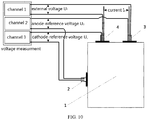
- FIG. 10 which is a schematic measuring circuit diagram, a high input impedance voltage synchronous acquisition equipment having three testing channels is used, an external voltage U1 of the lithium ion battery 1 having the reference electrode 2 is measured and acquired via the channel 1, an anode-reference voltage U2 is measured and acquired via the channel 2, and a cathode-reference voltage U3 is measured and acquired via the channel 3.
- FIG. 11 is a diagram showing results of a charge-discharge rate performance test for the battery having the reference electrode 2, in which a horizontal axis denotes a time during the test and a vertical axis denotes a tested voltage. External voltage is shown by the solid line. Voltage of the individual electrode, which is the anode 4, with respect to the reference electrode 2 is shown by the dotted line.
- the charge-discharge current rate is gradually increased from 0.5 C to 1.5 C. More specifically, the battery is charged and discharged at 0.5 C in the first charge-discharge cycle, charged and discharged at 1 C in the second charge-discharge cycle, and charged and discharged at 1.5 C in the third charge-discharge cycle, as is shown in the FIG. 11 .
- FIG. 12 is a diagram showing results of a capacity test for the battery having the reference electrode 2, in which a horizontal axis denotes a time during the test and a vertical axis denotes a tested voltage. External voltage of the battery is shown by the solid line. Voltage of the individual electrode, which is the anode 4, with respect to the reference electrode 2 of the battery is shown by the dotted line. During the test, the charge-discharge current rate is kept at 1C.
Landscapes
- Chemical & Material Sciences (AREA)
- Chemical Kinetics & Catalysis (AREA)
- Electrochemistry (AREA)
- General Chemical & Material Sciences (AREA)
- Engineering & Computer Science (AREA)
- Manufacturing & Machinery (AREA)
- Materials Engineering (AREA)
- Health & Medical Sciences (AREA)
- Life Sciences & Earth Sciences (AREA)
- Physics & Mathematics (AREA)
- Pathology (AREA)
- Analytical Chemistry (AREA)
- Biochemistry (AREA)
- General Health & Medical Sciences (AREA)
- General Physics & Mathematics (AREA)
- Immunology (AREA)
- Molecular Biology (AREA)
- Composite Materials (AREA)
- Inorganic Chemistry (AREA)
- Battery Electrode And Active Subsutance (AREA)
- Cell Electrode Carriers And Collectors (AREA)
- Secondary Cells (AREA)
- Connection Of Batteries Or Terminals (AREA)
Abstract
Description
- This application claims the benefits of priority of China Patent Application No.
201711143955.2, filed on November 17, 2017 - The present disclosure relates to methods for making reference electrode and lithium ion battery having the same, and belongs to the technical fields of measurement of an electrode potential and manufacture of an electrode.
- The electrode potential is one of the most important parameters in researches of electrochemistry and battery. The open-circuit potential is an electrode potential in a thermodynamic equilibrium state. In practice, a voltage vs. SOC curve of the battery obtained during a charge-discharge process at a low current can be regarded as an open-circuit voltage curve. If there is a current flowing through an electrode, the electrode would be polarized and a potential of the electrode would be deviated due to an occurrence of overpotential. The detailed information of a reaction occurring inside the electrode can be obtained by measuring a potential varying curve of the electrode. Taken the lithium ion battery with graphite anode as an example, overcharging or low-temperature charging may result in a Li plating at the graphite anode, characterized in that anode potential is below to equilibrium potential for the lithium-plating. Therefore, the Li plating side reaction can be detected by measuring the electrode potential. However, a battery includes two electrodes, the polarization of the individual electrode cannot be detected directly because the overpotential we gauged is composed the polarized potential of positive and negative electrodes, respectively. More specifically, one or more reference electrodes are interposed between the cathode and the anode to measure the voltage difference between the electrode and the reference electrode. The reference electrode in the related art is mainly made of electrochemical deposition , lithium foil, lithium alloy, lithium-containing metal oxide, or lithium-containing phosphate, and so on.
- The research article Development of reliable lithium micro-reference electrodes for long-term in-situ studies of lithium-based battery systems, Journal of The Electrochemical Society, 2004(DOI:10.6100/IR624713 ) discloses lithium reference electrodes made by electrochemical deposition on two surfaces of a micron sized copper wire positioned in the battery. The method can minimize the blocking to the lithium ion flow. However, since the reference electrode is too small, the amount of lithium loaded on the reference electrode is small, and the deposition layer is easy to be uneven. Consequently, a potential drift may occur after a long-time measurement, which makes it difficult to be applied in durability studies, and has a high requirement of input impedance of the measuring instrument.
- Another method involves inserting a lithium foil directly into a battery. The lithium metal is connected to a current collector by a physical pressing method. In the research article Self-Discharge of LiMn2O4/C Li-Ion Cells in Their Discharged State, J. Electrochem.Soc., Vol. 145, No. 1, 1998, lithium is physically connected to, i.e., pressed against, a current collector (for example, a copper mesh). In this method, the copper mesh has a relatively large pore diameter which is at the millimeter-scale. However, the connection reliability of the lithium and the copper mesh cannot be ensured by this physical connection method. A poor contact can lead to an extremely large ohmic resistance of the reference electrode influencing the use thereof.
- In view of the above, the difficulties in the development of the reference electrode can be contributed to the lithium amount in the electrode. The size of the reference electrode should be as small as possible to decrease the blocking effect on lithium ions in the electrolyte. However, this will reduce the lithium amount in the material, and thus weaken the signal. In addition, an electrode material loss or a potential drift tends to occur because of the micro-currents in the measurement.
- An object of the present disclosure is to provide a method for making a reference electrode and a method for making a lithium ion battery having the reference electrode, to solve the unstable problem of the measurement using the reference electrode and improve the service life of the reference electrode, thereby achieving a long term multi-cycle potential measurement of the individual electrode and increasing the accuracy of the measuring result.
- The method for making the reference electrode in the present disclosure includes:
- S11, washing and then drying a reference electrode substrate;
- S12, welding the reference electrode substrate to a lower portion of a current collecting metal sheet, an upper portion of which is adhered with a tab binder;
- S13, melting lithium metal to liquid state and continuing heating to remove an impurity on a surface of the liquid state lithium metal under a water-free and oxygen-free condition;
- S14, immersing a lower portion of the reference electrode substrate welded with the current collecting metal sheet into the liquid lithium and standing to coat a lithium metal layer on the lower portion of the reference electrode substrate;
- S15, taking out a reference electrode welded with the current collecting metal sheet from the liquid lithium, cooling, and warping a portion below the tab binder of the reference electrode with a separator by a winding method, thereby obtaining the reference electrode wrapped with the separator.
- The method for making the lithium ion battery having the reference electrode in the present disclosure includes:
- S10, making a reference electrode, which comprises:
- S11, washing and then drying a reference electrode substrate;
- S12, welding the reference electrode substrate to a lower portion of a current collecting metal sheet, an upper portion of which is adhered with a tab binder;
- S13, melting lithium metal to liquid state and continuing heating to remove an impurity on a surface of the liquid state lithium metal under a water-free and oxygen-free condition;
- S14, immersing a lower portion of the reference electrode substrate welded with the current collecting metal sheet into the liquid lithium and standing to coat a lithium metal layer on the lower portion of the reference electrode substrate;
- S15, taking out a reference electrode welded with the current collecting metal sheet from the liquid lithium, cooling, and warping a portion below the tab binder of the reference electrode with a separator by a winding method, thereby obtaining the reference electrode wrapped with the separator;
- S20, interposing the reference electrode between a separator and an anode plate of a cell of the lithium ion battery and protrude an upper end of the reference electrode out from the cell of the lithium ion battery under the water-free and oxygen-free condition; and
- S30, packaging the lithium ion battery implanted with the reference electrode under the water-free and oxygen-free condition, thereby obtaining the lithium ion battery having the reference electrode.
- Another method for making the lithium ion battery having the reference electrode in the present disclosure includes:
- S100, making a reference electrode, which comprises:
- S110, providing a porous copper foam, a porous nickel foam, a copper mesh, or a mesh as a reference electrode substrate; and washing the reference electrode substrate with acetone or deionized water and then drying for later use, wherein a material of the reference electrode substrate has a pore size of 50 µm to 500 µm, a thickness of the reference electrode substrate is 0.1mm to 1 mm, and an area of the reference electrode substrate is 1% to 10% of an area of an electrode plate of the lithium ion battery;
- S120, welding the reference electrode substrate obtained from the step S110 to a lower portion of a current collecting metal sheet of which an upper portion is adhered with a tab binder, to allow an upper portion of the reference electrode substrate to be overlapped with the lower portion of the current collecting metal sheet, wherein an area of the current collecting metal sheet is smaller than the area of the reference electrode substrate; and vacuum drying at 60 °C to 90 °C under the water-free and oxygen-free condition for 4 to 7 hours, cooing, and then transferring into and preserving in a water-free and oxygen-free environment, wherein the current collecting metal sheet is configured for collecting an electric current, a material of the current collecting metal sheet is nickel or aluminum, a thickness of the current collecting metal sheet is 0.1 mm to 1 mm, and a length of the current collecting metal sheet is 10 mm to 30 mm; and
- S130, melting lithium metal to liquid state and continuing heating to 200 °C to 500 °C to remove an impurity on a surface of the liquid state lithium metal under the water-free and oxygen-free condition; immersing the lower portion of the reference electrode substrate whose upper portion is welded with the current collecting metal sheet obtained from the step S120 into the liquid lithium and standing for 1 min to 5 min to allow a lithium metal layer having a thickness of 10 µm to 100µm to coat on the lower portion of the reference electrode substrate; and taking out, cooling, and wrapping a portion below the tab binder with a separator by a winding method to allow the separator to be wrapped tightly and entirely around the current collecting metal sheet and the reference electrode substrate, thereby obtaining the reference electrode wrapped with the separator, wherein a material of the separator is porous polypropylene, porous polyethylene, porous polypropylene coated with ceramic, porous polyethylene coated with ceramic, or non-woven fabric;
- S200, interposing the reference electrode obtained from the step S100 between a separator and an anode plate of a cell of the lithium ion battery under the water-free and oxygen-free condition, and protruding an upper end of the reference electrode out from the cell of the lithium ion battery for 1 mm to 2 mm;
- S300, packaging the lithium ion battery implanted with the reference electrode with an aluminum plastic film under the water-free and oxygen-free condition, thereby obtaining the lithium ion battery having the reference electrode.
- In the method for making the reference electrode and the method for making the lithium ion battery having the reference electrode according to the present disclosure, the lithium metal can be formed on the surface of the substrate material, while the porous property of the substrate material can be maintained, so that small molecules in the liquid electrolyte can pass through the pores, and the normal operation of the battery will not be influenced. Moreover, the thickness of the lithium metal layer formed on the substrate can be controlled by regulating parameters in the making process to ensure that the porous property of the substrate material can be retained while sufficient lithium can be loaded on the substrate to meet measurement requirements. Therefore, the reference electrode made by the method according to the present disclosure can have sufficient micro-structures as well as long service life. In addition, the manufacturing process is simple and can meet the industrial production requirements, making the industrial production and the application of the lithium-ion battery with the reference electrode possible.
- To describe the technical solutions of the embodiments of the present disclosure or the related technology more clearly, the following briefly introduces the accompanying drawings for describing the embodiments or the related technology. Obviously, the accompanying drawings in the following description are only embodiments of the present disclosure, and a person of ordinary skill in the art may still derive other drawings from the accompanying drawings of the present disclosure without creative effort.
-
FIG. 1 is a flowchart of a method for making a reference electrode according to an embodiment of the present disclosure. -
FIG. 2 is a schematic structural view of a lithium ion battery having the reference electrode according to an embodiment of the present disclosure. -
FIG. 3 is a front view of the reference electrode according to an embodiment of the present disclosure. -
FIG. 4 is a flowchart of another method for making the reference electrode according to an embodiment of the present disclosure. -
FIG. 5 is a side view of the reference electrode shown in theFIG. 3 according to an embodiment of the present disclosure. -
FIG. 6 is a flowchart of a method for making a lithium ion battery having the reference electrode according to an embodiment of the present disclosure. -
FIG. 7 is a schematic view of the lithium ion battery implanted with the reference electrode according to an embodiment of the present disclosure. -
FIG. 8 is a flowchart of another method for making the lithium ion battery having the reference electrode according to an embodiment of the present disclosure. -
FIG. 9 is a flowchart of yet another method for making the lithium ion battery having the reference electrode according to an embodiment of the present disclosure. -
FIG. 10 is a schematic diagram showing a measuring circuit connecting the lithium ion battery having the reference electrode according to an embodiment of the present disclosure. -
FIG. 11 is a diagram showing results of rate performance test for the lithium ion battery having the reference electrode according to an embodiment of the present disclosure. -
FIG. 12 is a diagram showing results of capacity test for the lithium ion battery having the reference electrode according to an embodiment of the present disclosure. -
lithium ion battery 1;reference electrode 2;cathode 3;anode 4,tab binder 5, current collectingmetal sheet 6,reference electrode substrate 7, welding spot 8,lithium metal layer 9,cathode plate 10,separator 11 between the cathode plate and the anode plate of the lithium ion battery - Referring to
FIGs. 1 to 3 , a method for making a reference electrode is provided in the present disclosure. The method for making the reference electrode includes: - S11, washing and then drying a reference electrode substrate;
- S12, welding the
reference electrode substrate 7 to a lower portion of a currentcollecting metal sheet 6, an upper portion of which is adhered with atab binder 5; - S13, melting lithium metal to liquid state and continuing heating to remove an impurity on a surface of the liquid state lithium metal under a water-free and oxygen-free condition;
- S14, immersing a lower portion of the
reference electrode substrate 7 welded with the current collectingmetal sheet 6 into the liquid lithium and standing to coat a lithium metal layer on the lower portion of thereference electrode substrate 7; - S15, taking out the
reference electrode 2 welded with the current collectingmetal sheet 6 from the liquid lithium, cooling, and warping a portion below thetab binder 5 of thereference electrode 2 with a separator by a winding method, thereby obtaining areference electrode 2 wrapped with the separator. - Referring to
FIG. 4 , in an embodiment, prior to the step S11, S011, a porous copper foam, a porous nickel foam, a copper mesh, or a mesh is adopted as thereference electrode substrate 7. In the step S11, thereference electrode substrate 7 is washed with acetone or deionized water and then dried for later use. In this embodiment, the material of thereference electrode substrate 7 can have a pore size of 50 µm to 500 µm, and a thickness of thereference electrode substrate 7 can be 0.1 mm to 1 mm. - In an embodiment, in the step S12, the
reference electrode substrate 7 is welded to the lower portion of the current collectingmetal sheet 6 whose upper portion is adhered with thetab binder 5, to allow an upper portion of thereference electrode substrate 7 to be overlapped with the lower portion of the current collectingmetal sheet 6. An area of the current collectingmetal sheet 6 is smaller than an area of thereference electrode substrate 7. After the step S12, S012, thereference electrode 2 welded with the current collectingmetal sheet 6 is vacuum dried at 60 °C to 90 °C under the water-free and oxygen-free condition for 4 to 7 hours, cooled, and then transferred into and preserved in a water-free and oxygen-free environment. The currentcollecting metal sheet 6 is used for collecting an electric current. A material of the current collectingmetal sheet 6 is nickel or aluminum. In this embodiment, a thickness of the current collectingmetal sheet 6 can be 0.1 mm to 1 mm. A length of the current collectingmetal sheet 6 can depend on a location of thereference electrode 2 disposed with respect to the battery, and can be 10 mm to 30 mm. - In an embodiment, in the step S13, the lithium metal is melted into the liquid state and is continuously heated to 200 °C to 500 °C to remove the impurity on the surface of the liquid state lithium metal under the water-free and oxygen-free condition.
- Referring to
FIG.5 , in an embodiment, in the step S14, the lower portion of thereference electrode substrate 7 whose upper portion is welded with the current collectingmetal sheet 6 is immersed into the liquid lithium and rested for 1 minute (min) to 5 min to coat thelithium metal layer 9 on the lower portion of thereference electrode substrate 7. In this embodiment, the portion without any welding spot 8 of the substrate can be entirely immersed into the liquid lithium, and the lower portion of thereference electrode substrate 7 can be fully wetted with the lithium metal to allow thelithium metal layer 9 to be formed on the lower portion of thereference electrode substrate 7. Thelithium metal layer 9 can have a thickness of 10 µm to 100 µm. - In an embodiment, in the step S15, the
reference electrode 2 welded with the current collectingmetal sheet 6 is taken out from the liquid lithium and cooled. The portion below thetab binder 5 of thereference electrode 2 is wrapped with the separator by the winding method. The separator can be wrapped tightly and entirely around the current collectingmetal sheet 6 and thereference electrode substrate 7, thereby obtaining thereference electrode 2 wrapped with the separator. A material of the separator is porous polypropylene, porous polyethylene, porous polypropylene coated with ceramic, porous polyethylene coated with ceramic, or non-woven fabric. - Referring to
FIGs. 6 to 7 , a method for making a lithium ion battery having a reference electrode is provided in the present disclosure. The method for making the lithium ion battery having the reference electrode includes making two parts: a reference electrode and a lithium ion battery. The method includes: - S10, making a
reference electrode 2, which includes: - S11, washing and then drying a
reference electrode substrate 7; - S12, welding the
reference electrode substrate 7 to a lower portion of a currentcollecting metal sheet 6, an upper portion of which is adhered with atab binder 5; - S13, melting a lithium metal to liquid state and continuing heating to remove an impurity on a surface of the liquid state lithium metal under a water-free and oxygen-free condition;
- S14, immersing a lower portion of the
reference electrode substrate 7 welded with the current collectingmetal sheet 6 into the liquid lithium and standing to coat a lithium metal layer on the lower portion of thereference electrode substrate 7; and - S15, taking out the
reference electrode 2 welded with the current collectingmetal sheet 6 from the liquid lithium, cooling, and warping a portion below thetab binder 5 of thereference electrode 2 with a separator by a winding method, thereby obtaining thereference electrode 2 wrapped with the separator; - The method further includes making the
lithium ion battery 1 having thereference electrode 2, which includes: - S20, interposing the
reference electrode 2 between aseparator 11 and an anode plate of a cell of thelithium ion battery 1 and protruding an upper end of thereference electrode 2 out from the cell of thelithium ion battery 1 under the water-free and oxygen-free condition; and - S30, packaging the
lithium ion battery 1 implanted with thereference electrode 2 under the water-free and oxygen-free condition, thereby obtaining thelithium ion battery 1 having thereference electrode 2. - Referring to
FIG. 8 , in an embodiment, prior to the step S11, S011, a porous copper foam, a porous nickel foam, a copper mesh, or a mesh is adopted as thereference electrode substrate 7. An area of thereference electrode substrate 7 is 1% to 10% of an area of an electrode plate of thelithium ion battery 1. In the step S11, thereference electrode substrate 7 is washed with acetone or deionized water and then dried for later use. In this embodiment, the material of thereference electrode substrate 7 can have a pore size of 50 µm to 500 µm, and a thickness of thereference electrode substrate 7 can be 0.1 mm to 1 mm. - In an embodiment, in the step S12, the
reference electrode substrate 7 is welded to the lower portion of the current collectingmetal sheet 6 whose upper portion is adhered with thetab binder 5, to allow an upper portion of thereference electrode substrate 7 to be overlapped with the lower portion of the current collectingmetal sheet 6. An area of the current collectingmetal sheet 6 is smaller than an area of thereference electrode substrate 7. After the step S12, S012, thereference electrode 2 welded with the current collectingmetal sheet 6 is vacuum dried at 60 °C to 90 °C under the water-free and oxygen-free condition for 4 to 7 hours, cooled, and then transferred into and preserved in a water-free and oxygen-free environment. The currentcollecting metal sheet 6 is used for collecting an electric current. A material of the current collectingmetal sheet 6 is nickel or aluminum. In this embodiment, a thickness of the current collectingmetal sheet 6 can be 0.1 mm to 1 mm. A length of the current collectingmetal sheet 6 can depend on a location of thereference electrode 2 disposed with respect to the battery, and can be 10 mm to 30 mm. - In an embodiment, in the step S13, the lithium metal is melted into the liquid state and is continuously heated to 200 °C to 500 °C to remove the impurity on the surface of the liquid state lithium metal under the water-free and oxygen-free condition.
- In an embodiment, in the step S14, the lower portion of the
reference electrode substrate 7 whose upper portion is welded with the current collectingmetal sheet 6 is immersed into the liquid lithium and rested for 1 min to 5 min to coat thelithium metal layer 9 on the lower portion of thereference electrode substrate 7. In this embodiment, the portion without any welding spot 8 of the substrate can be entirely immersed into the liquid lithium, and the lower portion of thereference electrode substrate 7 can be fully wetted with the lithium metal to allow thelithium metal layer 9 to be formed on the lower portion of thereference electrode substrate 7. Thelithium metal layer 9 can have a thickness of 10µm to 100µm. - In an embodiment, in the step S15, the
reference electrode 2 welded with the current collectingmetal sheet 6 is taken out from the liquid lithium and cooled. The portion below thetab binder 5 of thereference electrode 2 is wrapped with the separator by the winding method. The separator can be wrapped tightly and entirely around the current collectingmetal sheet 6 and thereference electrode substrate 7, thereby obtaining thereference electrode 2 wrapped with the separator. A material of the separator is porous polypropylene, porous polyethylene, porous polypropylene coated with ceramic, porous polyethylene coated with ceramic, or non-woven fabric. - In an embodiment, in the
step 20, thereference electrode 2 is interposed between theseparator 11 and the anode plate of the cell of thelithium ion battery 1. The upper end of thereference electrode 2 is protruded out from the cell of thelithium ion battery 1 for 1 mm to 2 mm under the water-free and oxygen-free condition. - In an embodiment, in the step S30, the
lithium ion battery 1 implanted with thereference electrode 2 is packaged with an aluminum plastic film under the water-free and oxygen-free condition, thereby obtaining thelithium ion battery 1 having thereference electrode 2. - Referring to
FIG.9 , a method for making a lithium ion battery having a reference electrode is provided in the present disclosure. The method including the following steps: - S100, a
reference electrode 2 is made as follows: - S110, a porous copper foam, a porous nickel foam, a copper mesh, or a mesh is adopted as the
reference electrode substrate 7. Thereference electrode substrate 7 is washed with acetone or deionized water and then dried for later use. The material of thereference electrode substrate 7 has a pore size of 50 µm to 500 µm. A thickness of thereference electrode substrate 7 is 0.1 mm to 1 mm. An area of thereference electrode substrate 7 is 1% to 10% of an area of an electrode plate of thelithium ion battery 1. - S120, the
reference electrode substrate 7 obtained from the step S110 is welded to a lower portion of a currentcollecting metal sheet 6, an upper portion of which is adhered with atab binder 5, to allow an upper portion of thereference electrode substrate 7 to be overlapped with the lower portion of the current collectingmetal sheet 6, vacuum dried at 60 °C to 90 °C under a water-free and oxygen-free condition for 4 to 7 hours, cooled, and then transferred into and preserved in a water-free and oxygen-free environment. The currentcollecting metal sheet 6 is used for collecting an electric current. A material of the current collectingmetal sheet 6 is nickel or aluminum. A thickness of the current collectingmetal sheet 6 is 0.1 mm to 1 mm. A length of the current collectingmetal sheet 6 depends on a location of thereference electrode 2 disposed with respect to the battery and can be 10 mm to 30 mm. Thetab binder 5 disposed on the upper portion of the current collectingmetal sheet 6 is configured to fix thereference electrode 2 relative to the cell of thelithium ion battery 1 when thereference electrode 2 is inserted into the cell, as shown inFIGs. 3 and5 . - S130, lithium metal is melted to liquid state and continued to heat to 200 °C to 500 °C to remove an impurity on a surface of the liquid state lithium metal under the water-free and oxygen-free condition. The lower portion of the
reference electrode substrate 7 whose upper portion is welded with the current collectingmetal sheet 6 obtained from the step S120 is immersed into the liquid lithium and stood for 1 min to 5 min. The portion without any welding spot 8 of the substrate should be entirely immersed into the liquid lithium. The lower portion of thereference electrode substrate 7 is fully wetted by the lithium metal, so as to allow alithium metal layer 9 having a thickness of 10 µm to 100 µm to be formed on the lower portion of thereference electrode substrate 7. The electrode is taken out, cooled, and a portion below thetab binder 5 is wrapped with a separator by a winding method to allow the separator to be wrapped tightly and entirely around the current collectingmetal sheet 6 and thereference electrode substrate 7, thereby obtaining areference electrode 2 wrapped with the separator. A material of the separator is porous polypropylene, porous polyethylene, porous polypropylene coated with ceramic, porous polyethylene coated with ceramic, or non-woven fabric. The separator can prevent thereference electrode 2 from directly contacting with acathode 3 and ananode 4 of thelithium ion battery 1 and can allow lithium ions to pass therethrough. - S200, the
reference electrode 2 obtained from the step S100 is interposed between aseparator 11 and an anode plate of a cell of thelithium ion battery 1 under the water-free and oxygen-free condition, as shown inFIG. 7 . An upper end of thereference electrode 2 is protruded out from the cell of thelithium ion battery 1 for 1 mm to 2 mm. In order to show the location of thereference electrode 2 disposed with respect to the cell of thelithium ion battery 1, only thecathode plate 10 in the cell of thelithium ion battery 1 is shown while the anode plate of thelithium ion battery 1 is not shown. - S300, the
lithium ion battery 1 implanted with thereference electrode 2 is packed with an aluminum plastic film under the water-free and oxygen-free condition, thereby obtaining thelithium ion battery 1 having thereference electrode 2. - Two examples of making the
lithium ion battery 1 having thereference electrode 2 according to the present disclosure are described as below. - S100, a
reference electrode 2 is made, and a specific process is as below. - S110, a porous copper foam is provided as a
reference electrode substrate 7. A material of thereference electrode substrate 7 has a pore size of 50 µm. A thickness of thereference electrode substrate 7 is 0.2mm. An area of thereference electrode substrate 7 is 2 % of an area of an electrode plate of alithium ion battery 1. Thereference electrode substrate 7 is a rectangle sheet with a length of 10 mm and a width of 5 mm. Thereference electrode substrate 7 is washed with acetone or deionized water and then dried for use. - S120, the
reference electrode substrate 7 obtained from the step S110 is welded to a lower portion of a currentcollecting metal sheet 6 to allow an upper portion of thereference electrode substrate 7 to be overlapped with the lower portion of the current collectingmetal sheet 6. An upper portion of the current collectingmetal sheet 6 is adhered with atab binder 5. In this embodiment, preferably, the current collectingnickel sheet 6 having a same width as thereference electrode substrate 7 and a length of 20 mm, provided with thetab binder 5, is used for welding. Thereference electrode substrate 7 is vacuum dried at 80 °C under the water-free and oxygen-free condition for 5 hours, cooled, and transferred into and preserved in a water-free and oxygen-free environment. - S130, lithium metal is melted into liquid state and continued to heat to 400 °C to remove an impurity on a surface of the liquid state lithium metal under the water-free and oxygen-free condition. The lower portion of the
reference electrode substrate 7 whose upper portion is welded with the current collectingmetal sheet 6 obtained from the step S120 is immersed into the liquid lithium and stood for 3 min. The portion without any welding spot 8 of the substrate is entirely immersed into the liquid lithium. The lower portion of thereference electrode substrate 7 is fully wetted by the lithium metal, so as to allow a lithium metal layer to coat on the lower portion of thereference electrode substrate 7. Thereference electrode 2 is taken out from the liquid lithium, a surface of thereference electrode 2 is immediately blew with hot air at 400 °C to remove the lithium filled in pores to expose the pores. In this embodiment, a thickness of thelithium metal layer 9 grown is about 10 µm. After being cooled, a portion below thetab binder 5 of thereference electrode 2 is wrapped with a separator by a winding method. The currentcollecting metal sheet 6 and the entirereference electrode substrate 7 are wrapped tightly, thereby obtaining thereference electrode 2 wrapped with the separator. A material of the separator is porous polypropylene. The separator can prevent thereference electrode 2 from directly contacting with acathode 3 and ananode 4 of thelithium ion battery 1 and can allow lithium ions to pass therethrough;
S200, thereference electrode 2 obtained from the step S100 is interposed between aseparator 11 and an anode plate of a cell of thelithium ion battery 1 under the water-free and oxygen-free condition. In this embodiment, preferably, a soft package battery is an object to be tested. The nude cell of the battery is placed into the water-free and oxygen-free environment. Thereference electrode 2 is interposed between acathode plate 10 and an anode plate of the nude cell, more specifically, located at an interface between aseparator 11 and the anode plate. Thereference electrode 2 can be interposed between any two plates except the outermost electrode plate. Thereference electrode 2 can be located at anywhere on the plate, including but not limited to a center, a corner, and an edge of the plate according to needs. In this embodiment, thereference electrode 2 is interposed from a central area of an edge, while an upper end of thereference electrode 2 is protruded out from the cell of the lithium ion battery for 2 mm. - S300, the
lithium ion battery 1 provided with thereference electrode 2 obtained from the step S200 is packaged by an aluminum plastic film under the water-free and oxygen-free condition, thereby obtaining thelithium ion battery 1 having thereference electrode 2. - S100, a
reference electrode 2 is made, and a specific process is as below. - S110, a porous nickel foam is provided as a
reference electrode substrate 7. A material of thereference electrode substrate 7 has a pore size of 100 µm. A thickness of thereference electrode substrate 7 is 0.2mm. An area of thereference electrode substrate 7 is 5% of an area of an electrode plate of alithium ion battery 1. Thereference electrode substrate 7 is sized to a rectangle sheet with a length of 12 mm and a width of 7 mm. Thereference electrode substrate 7 is washed with acetone or deionized water and then dried for use. - S120, the
reference electrode substrate 7 obtained from the step S110 is welded to a lower portion of a currentcollecting metal sheet 6 to allow an upper portion of thereference electrode substrate 7 to be overlapped with the lower portion of the current collectingmetal sheet 6. An upper portion of the current collectingmetal sheet 6 is adhered with atab binder 5. In this embodiment, preferably, the current collectingnickel sheet 6 having a same width as thereference electrode substrate 7 and a length of 20 mm and provided with thetab binder 5 is used for welding. Thereference electrode substrate 7 is vacuum dried at 90°C under the water-free and oxygen-free condition for 5 hours, cooled, and transferred into and preserved in a water-free and oxygen-free environment;
S130, lithium metal is melted into liquid state and continued to heat to 400 °C to remove an impurity on a surface of the liquid state lithium metal under the water-free and oxygen-free condition. The lower portion of thereference electrode substrate 7 whose the upper portion is welded with the current collectingmetal sheet 6 obtained from the step S120 is immersed into the liquid lithium and stood for 4 min. The portion without any welding spot 8 of the substrate is entirely immersed into the liquid lithium. The lower portion of thereference electrode substrate 7 is fully wetted by the lithium metal, so as to allow a lithium metal layer to coat on the lower portion of thereference electrode substrate 7. Thereference electrode 2 is taken out from the liquid lithium, a surface of thereference electrode 2 is immediately blew with hot air at 400 °C to remove the lithium filled in pores to expose the pores. In this embodiment, a thickness of thelithium metal layer 9 grown is about 30 µm. After being cooled, a portion, below thetab binder 5 of thereference electrode 2 is wrapped with a separator by a winding method. The currentcollecting metal sheet 6 and the entirereference electrode substrate 7 are wrapped tightly, thereby obtaining thereference electrode 2 wrapped with the separator. A material of the separator is porous polypropylene. The separator can prevent thereference electrode 2 from directly contacting with acathode 3 and ananode 4 of thelithium ion battery 1 and can allow lithium ions to pass therethrough. - S200, the
reference electrode 2 obtained from the step S100 is interposed between aseparator 11 and an anode plate of a cell of thelithium ion battery 1 under the water-free and oxygen-free condition. In this embodiment, preferably, a soft package battery is an object to be tested. The nude cell of the battery is placed into the water-free and oxygen-free environment. Thereference electrode 2 is interposed between acathode plate 10 and an anode plate of the nude cell, more specifically, disposed at an interface between aseparator 11 and the anode plate. Thereference electrode 2 can be interposed between any two plates except the outermost electrode plate. Thereference electrode 2 can be located at anywhere on the plate, including but not limited to a center, a corner, and an edge of the plate according to needs. In this embodiment, thereference electrode 2 is interposed from a central area of an edge, while an upper end of thereference electrode 2 is protruded out from the cell of the lithium ion battery for 2 mm. - S300, the
lithium ion battery 1 provided with thereference electrode 2 obtained from the step S200 is packaged by an aluminum plastic film under the water-free and oxygen-free condition, thereby obtaining thelithium ion battery 1 having thereference electrode 2. - S100, a
reference electrode 2 is made, and a specific process is as below. - S110, a porous copper mesh is provided as a
reference electrode substrate 7. A material of thereference electrode substrate 7 has a pore size of 300 µm. A thickness of thereference electrode substrate 7 is 0.2mm. An area of thereference electrode substrate 7 is 2% of an area of an electrode plate of alithium ion battery 1. Thereference electrode substrate 7 is a rectangle sheet with a length of 20 mm and a width of 10 mm. Thereference electrode substrate 7 is washed with acetone or deionized water and then dried for use. - S120, the
reference electrode substrate 7 obtained from the step S110 is welded to a lower portion of a currentcollecting metal sheet 6 to allow an upper portion of thereference electrode substrate 7 to be overlapped with the lower portion of the current collectingmetal sheet 6. An upper portion of the current collectingmetal sheet 6 is adhered with atab binder 5. In this embodiment, preferably, the current collectingnickel sheet 6 having a same width as thereference electrode substrate 7 and a length of 20 mm and provided with thetab binder 5 is used for welding. Thereference electrode substrate 7 is vacuum dried at 80°C under the water-free and oxygen-free condition for 5 hours, cooled, and transferred into and preserved in a water-free and oxygen-free environment;
S130, a lithium metal is melted into liquid state and continued to heat to 400 °C to remove an impurity on a surface of the liquid state lithium metal under the water free and oxygen-free condition. The lower portion of thereference electrode substrate 7 whose upper portion is welded with the current collectingmetal sheet 6 obtained from the step S120 is immersed into the liquid lithium and stood for 3 min. The portion without any welding spot 8 of the substrate is entirely immersed into the liquid lithium. The lower portion of thereference electrode substrate 7 is fully wetted by the lithium metal, so as to allow a lithium metal layer to coat on the lower portion of thereference electrode substrate 7. Thereference electrode 2 is taken out from the liquid lithium, and a surface of thereference electrode 2 is immediately blew with hot air at 400 °C to remove the lithium filled in pores to expose the pores. In this embodiment, a thickness of thelithium metal layer 9 grown is about 100 µm. After being cooled, a portion below thetab binder 5 of thereference electrode 2 is wrapped with a separator by a winding method. The currentcollecting metal sheet 6 and the entirereference electrode substrate 7 are wrapped tightly, thereby obtaining thereference electrode 2 wrapped with the separator. A material of the separator is porous polypropylene. The separator can prevent thereference electrode 2 from directly contacting with acathode 3 and ananode 4 of thelithium ion battery 1 and can allow lithium ions to pass therethrough. - S200, the
reference electrode 2 obtained from the step S100 is interposed between aseparator 11 and an anode plate of a cell of thelithium ion battery 1 under the water-free and oxygen-free condition. In this embodiment, preferably, a soft package battery is an object to be tested. The nude cell of the battery is placed into the water-free and oxygen-free environment. Thereference electrode 2 is interposed between acathode plate 10 and an anode plate of the nude cell, more specifically, disposed at an interface between aseparator 11 and the anode plate. Thereference electrode 2 can be interposed between any two plates except the outermost electrode plate. Thereference electrode 2 can be located at anywhere on the plate, including but not limited to a center, a corner, and an edge according to needs. In this embodiment, thereference electrode 2 is interposed from a central area of an edge, while an upper end of thereference electrode 2 is protruded out from the cell of the lithium ion battery for 2 mm. - S300, the
lithium ion battery 1 provided with thereference electrode 2 obtained from the step S200 is packaged by an aluminum plastic film under the water-free and oxygen-free condition, thereby obtaining thelithium ion battery 1 having thereference electrode 2. - S100, a
reference electrode 2 is made, and a specific process is as below. - S110, a porous nickel mesh is provided as a
reference electrode substrate 7. A material of thereference electrode substrate 7 has a pore size of 500 µm. A thickness of thereference electrode substrate 7 is 0.2mm. An area of thereference electrode substrate 7 is 1% of an area of an electrode plate of alithium ion battery 1. Thereference electrode substrate 7 is a rectangle sheet with a length of 20 mm and a width of 8 mm. Thereference electrode substrate 7 is washed with acetone or deionized water and then dried for use. - S120, the
reference electrode substrate 7 obtained from the step S110 is welded to a lower portion of a currentcollecting metal sheet 6 to allow an upper portion of thereference electrode substrate 7 to be overlapped with the lower portion of the current collectingmetal sheet 6. An upper portion of the current collectingmetal sheet 6 is adhered with atab binder 5. In this embodiment, preferably, a currentcollecting nickel sheet 6 having a same width as thereference electrode substrate 7 and a length of 20 mm and provided with thetab binder 5 is used for welding. Thereference electrode substrate 7 is vacuum dried at 80°C under the water-free and oxygen-free condition for 5 hours, cooled, and transferred into and preserved in a water-free and oxygen-free environment. - S130, lithium metal is melted into liquid state and continued to heat to 400 °C to remove an impurity on a surface of the liquid state lithium metal under the water-free and oxygen-free condition. The lower portion of the
reference electrode substrate 7 whose upper portion is welded with the current collectingmetal sheet 6 obtained from the step S120 is immersed into the liquid lithium and stood for 3 min. The portion without any welding spot 8 of the substrate is entirely immersed into the liquid lithium, and the lower portion of thereference electrode substrate 7 is fully wetted by the lithium metal, so as to allow a lithium metal layer to coat on the lower portion of thereference electrode substrate 7. Areference electrode 2 is taken out from the liquid lithium and a surface of thereference electrode 2 is immediately blew with hot air at 400 °C to remove the lithium filled in pores to expose the pores. In this embodiment, a thickness of thelithium metal layer 9 grown is about 100 µm. After being cooled, a portion below thetab binder 5 of thereference electrode 2 is wrapped with a separator by a winding method. The currentcollecting metal sheet 6 and the entirereference electrode substrate 7 are wrapped tightly, thereby obtaining thereference electrode 2 wrapped with the separator. A material of the separator is porous polypropylene. The separator can prevent thereference electrode 2 from directly contacting with acathode 3 and ananode 4 of thelithium ion battery 1 and can allow lithium ions to pass therethrough. - S200, the
reference electrode 2 obtained from the step S100 is interposed between aseparator 11 and an anode plate of a cell of thelithium ion battery 1 under the water-free and oxygen-free condition. In this embodiment, preferably, a soft package battery is an object to be tested. The nude cell of the battery is placed into the water-free and oxygen-free environment. Thereference electrode 2 is interposed between acathode plate 10 and an anode plate of the nude cell, more specifically, disposed at an interface between aseparator 11 and the anode plate. Thereference electrode 2 can be interposed between any two plates except the outermost electrode plate. Thereference electrode 2 can be located at anywhere on the plate, including but not limited to a center, a corner, and an edge according to needs. In this embodiment, thereference electrode 2 is interposed from a central area of an edge, while an upper end of thereference electrode 2 is protruded out from the cell of the lithium ion battery for 2 mm. - S300, the
lithium ion battery 1 provided with thereference electrode 2 obtained from the step S200 is packaged by an aluminum plastic film under the water-free and oxygen-free condition, thereby obtaining thelithium ion battery 1 having thereference electrode 2. - A charge-discharge test is performed by connecting the
cathode 3 and theanode 4 of thelithium ion battery 1 having thereference electrode 2 to an instrument such as a charge-discharge tester or other power supply. The performance of assembledlithium ion battery 1 having thereference electrode 2 is measured by the measuring instrument. As shown inFIG. 10 which is a schematic measuring circuit diagram, a high input impedance voltage synchronous acquisition equipment having three testing channels is used, an external voltage U1 of thelithium ion battery 1 having thereference electrode 2 is measured and acquired via thechannel 1, an anode-reference voltage U2 is measured and acquired via thechannel 2, and a cathode-reference voltage U3 is measured and acquired via thechannel 3. Moreover, different types of charge-discharge cycling tests with a higher cutoff voltage of 4.2 V and a lower cutoff voltage of 2.5 V are performed on thelithium ion battery 1 having thereference electrode 2 via thechannel 1 during which charge and discharge currents are recorded. Result analyses for two types of charge-discharge cycling tests are described as below. -
FIG. 11 is a diagram showing results of a charge-discharge rate performance test for the battery having thereference electrode 2, in which a horizontal axis denotes a time during the test and a vertical axis denotes a tested voltage. External voltage is shown by the solid line. Voltage of the individual electrode, which is theanode 4, with respect to thereference electrode 2 is shown by the dotted line. During the test, the charge-discharge current rate is gradually increased from 0.5 C to 1.5 C. More specifically, the battery is charged and discharged at 0.5 C in the first charge-discharge cycle, charged and discharged at 1 C in the second charge-discharge cycle, and charged and discharged at 1.5 C in the third charge-discharge cycle, as is shown in theFIG. 11 . It can be found upon this test that the variations of the external voltage in the three different charge-discharge cycles using different charge-discharge rates are consistent, while the variations of the voltage of theanode 4 tested with respect to thereference electrode 2 clearly tend to increase with the increase of the charge-discharge rate. Such feature that the voltage of theanode 4 is changed with the change of the charge-discharge rate, cannot be tested by only measuring the external voltage. By using thereference electrode 2, this voltage variation for an individual electrode can be directly and conveniently tested, which demonstrates the superiority of the testing using thereference electrode 2. -
FIG. 12 is a diagram showing results of a capacity test for the battery having thereference electrode 2, in which a horizontal axis denotes a time during the test and a vertical axis denotes a tested voltage. External voltage of the battery is shown by the solid line. Voltage of the individual electrode, which is theanode 4, with respect to thereference electrode 2 of the battery is shown by the dotted line. During the test, the charge-discharge current rate is kept at 1C. It can be seen that the voltage of theanode 4 as the individual electrode with respect to the reference electrode is stable in each charge-discharge cycle, while the voltage of the whole battery is also stable in each charge-discharge cycle, suggesting that thereference electrode 2 has a satisfactory service time and does not interfere with the normal work of the battery.
Claims (19)
- A method for making a reference electrode, characterized by comprising:S11, washing and then drying a reference electrode substrate (7);S12, welding the reference electrode substrate (7) to a lower portion of a current collecting metal sheet (6), an upper portion of which is adhered with a tab binder (5);S13, melting lithium metal to liquid state and continuing heating to remove an impurity on a surface of the liquid state lithium metal under a water-free and oxygen-free condition;S14, immersing a lower portion of the reference electrode substrate (7) welded with the current collecting metal sheet (6) into the liquid lithium and standing to coat a lithium metal layer on the lower portion of the reference electrode substrate (7);S15, taking out a reference electrode (2) welded with the current collecting metal sheet (6) from the liquid lithium, cooling, and warping a portion below the tab binder (5) of the reference electrode (2) with a separator by a winding method, thereby obtaining a reference electrode (2) wrapped with the separator.
- The method for making the reference electrode of claim 1, characterized in that prior to the step S11,
S011, providing a porous copper foam, a porous nickel foam, a copper mesh, or a mesh as the reference electrode substrate (7). - The method for making the reference electrode of claim 1, characterized in that in the step S11, the reference electrode substrate (7) is washed with acetone or deionized water and then dried for later use.
- The method for making the reference electrode of claim 1, characterized in that in the step S12, the reference electrode substrate (7) is welded to the lower portion of the current collecting metal sheet (6) of which the upper portion is adhered with the tab binder(5), to allow an upper portion of the reference electrode substrate (7) to be overlapped with the lower portion of the current collecting metal sheet (6), and an area of the current collecting metal sheet (6) is smaller than an area of the reference electrode substrate (7).
- The method for making the reference electrode of claim 1, characterized in that after the step S12,
vacuum drying the reference electrode (2) welded with the current collecting metal sheet (6) at 60 °C to 90 °C under the water-free and oxygen-free condition for 4 to 7 hours, cooing, and then transferring into and preserving in a water-free and oxygen-free environment, wherein the current collecting metal sheet (6) is configured for collecting an electric current, and a material of the current collecting metal sheet (6) is nickel or aluminum. - The method for making the reference electrode of claim 1, characterized in that in the step S13, the lithium metal is melted into the liquid state and continuously heated to 200 °C to 500 °C to remove the impurity on the surface of the liquid state lithium metal under the water-free and oxygen-free condition.
- The method for making the reference electrode of claim 1, characterized in that in the step S14, the lower portion of the reference electrode substrate (7) of which the upper portion is welded with the current collecting metal sheet (6) is immersed into the liquid lithium and rested for 1 min to 5 min to coat the lithium metal layer (9) on the lower portion of the reference electrode substrate (7).
- The method for making the reference electrode of claim 1, characterized in that in the step S15, the reference electrode (2) welded with the current collecting metal sheet (6) is taken out from the liquid lithium and cooled, and the portion below the tab binder(5) of the reference electrode (2) is wrapped with the separator by the winding method to allow the separator to be wrapped tightly and entirely around the current collecting metal sheet (6) and the reference electrode substrate (7), thereby obtaining the reference electrode (2) wrapped with the separator, and a material of the separator is porous polypropylene, porous polyethylene, porous polypropylene coated with ceramic, porous polyethylene coated with ceramic, or non-woven fabric.
- A method for making a lithium ion battery having a reference electrode, characterized by comprising:S10, making a reference electrode (2), which comprises:S11, washing and then drying a reference electrode substrate (7);S12, welding the reference electrode substrate (7) to a lower portion of a current collecting metal sheet (6), an upper portion of which is adhered with a tab binder (5);S13, melting lithium metal to liquid state and continuing heating to remove an impurity on a surface of the liquid state lithium metal under a water-free and oxygen-free condition;S14, immersing a lower portion of the reference electrode substrate (7) welded with the current collecting metal sheet (6) into the liquid lithium and standing to coat a lithium metal layer on the lower portion of the reference electrode substrate (7); andS15, taking out a reference electrode (2) welded with the current collecting metal sheet (6) from the liquid lithium, cooling, and warping a portion below the tab binder (5) of the reference electrode (2) with a separator by a winding method, thereby obtaining the reference electrode (3) wrapped with the separator;S20, interposing the reference electrode (2) between a separator 11 and an anode plate of a cell of the lithium ion battery (1) and protrude an upper end of the reference electrode (2) out from the cell of the lithium ion battery (1) under the water-free and oxygen-free condition; andS30, packaging the lithium ion battery (1) implanted with the reference electrode (2) under the water-free and oxygen-free condition, thereby obtaining the lithium ion battery (1) having the reference electrode (2).
- The method for making the lithium ion battery having the reference electrode of claim 9, characterized in that prior to the step S11,
step S011, providing a porous copper foam, a porous nickel foam, a copper mesh, or a mesh as the reference electrode substrate (7), wherein an area of the reference electrode substrate (7) is 1% to 10% of an area of an electrode plate of the lithium ion battery (1). - The method for making the lithium ion battery having the reference electrode of claim 9, characterized in that in the step S11, the reference electrode substrate (7) is washed with acetone or deionized water and then dried for later use.
- The method for making the lithium ion battery having the reference electrode of claim 9, characterized in that in the step S12, the reference electrode substrate (7) is welded to the lower portion of the current collecting metal sheet (6) of which the upper portion is adhered with the tab binder(5), to allow an upper portion of the reference electrode substrate (7) to be overlapped with the lower portion of the current collecting metal sheet (6), and an area of the current collecting metal sheet (6) is smaller than an area of the reference electrode substrate (7).
- The method for making the lithium ion battery having the reference electrode of claim 9, characterized in that after the step S12,
vacuum drying the reference electrode (2) welded with the current collecting metal sheet (6) at 60 °C to 90 °C under the water-free and oxygen-free condition for 4 to 7 hours, cooing, and then transferring into and preserving in a water-free and oxygen-free environment, wherein the current collecting metal sheet (6) is configured for collecting an electric current, and a material of the current collecting metal sheet (6) is nickel or aluminum. - The method for making the lithium ion battery having the reference electrode of claim 9, characterized in that in the step S13, the lithium metal is melted into the liquid state and continuously heated to 200 °C to 500 °C to remove the impurity on the surface of the liquid state lithium metal under the water-free and oxygen-free condition.
- The method for making the lithium ion battery having the reference electrode of claim 9, characterized in that in the step S14, the lower portion of the reference electrode substrate (7) of which the upper portion is welded with the current collecting metal sheet (6) is immersed into the liquid lithium and rested for 1 min to 5 min to coat the lithium metal layer (9) on the lower portion of the reference electrode substrate (7).
- The method for making the lithium ion battery having the reference electrode of claim 9, characterized in that in the step S15, the reference electrode (2) welded with the current collecting metal sheet (6) is taken out from the liquid lithium and cooled, and the portion below the tab binder (5) of the reference electrode (2) is wrapped with the separator by the winding method to allow the separator to be wrapped tightly and entirely around the current collecting metal sheet (6) and the reference electrode substrate (7), thereby obtaining the reference electrode (2) wrapped with the separator, and a material of the separator is porous polypropylene, porous polyethylene, porous polypropylene coated with ceramic, porous polyethylene coated with ceramic, or non-woven fabric.
- The method for making the lithium ion battery having the reference electrode of claim 9, characterized in that in the step S20, the reference electrode (2) is interposed between the separator (11) and the anode plate of the cell of the lithium ion battery (1) and the upper end of the reference electrode (2) is protruded out from the cell of the lithium ion battery (1) for 1 mm to 2 mm under the water-free and oxygen-free condition.
- The method for making the lithium ion battery having the reference electrode of claim 9, characterized in that in the step S30, the lithium ion battery (1) implanted with the reference electrode (2) is packaged by an aluminum plastic film under the water-free and oxygen-free condition, thereby obtaining the lithium ion battery (1) having the reference electrode (2).
- A method for making a lithium ion battery having a reference electrode, characterized by comprising:S100, making a reference electrode (2), which comprises:S110, providing a porous copper foam, a porous nickel foam, a copper mesh, or a mesh as a reference electrode substrate (7); and washing the reference electrode substrate (7) with acetone or deionized water and then drying for later use, wherein a material of the reference electrode substrate (7) has a pore size of 50 µm to 500 µm, a thickness of the reference electrode substrate (7) is 0.1mm to 1 mm, and an area of the reference electrode substrate (7) is 1% to 10% of an area of an electrode plate of the lithium ion battery (1);S120, welding the reference electrode substrate (7) obtained from the step S110 to a lower portion of a current collecting metal sheet (6) of which an upper portion is adhered with a tab binder(5), to allow an upper portion of the reference electrode substrate (7) to be overlapped with the lower portion of the current collecting metal sheet (6), wherein an area of the current collecting metal sheet (6) is smaller than the area of the reference electrode substrate (7); and vacuum drying at 60 °C to 90 °C under a water-free and oxygen-free condition for 4 to 7 hours, cooing, and then transferring into and preserving in a water-free and oxygen-free environment, wherein the current collecting metal sheet (6) is configured for collecting an electric current, a material of the current collecting metal sheet (6) is nickel or aluminum, a thickness of the current collecting metal sheet (6) is 0.1 mm to 1 mm, and a length of the current collecting metal sheet (6) is 10 mm to 30 mm; andS130, melting a lithium metal into liquid state and continuing heating to 200 °C to 500 °C to remove an impurity on a surface of the liquid state lithium metal under the water-free and oxygen-free condition; immersing the lower portion of the reference electrode substrate (7) obtained from the step S120 of which the upper portion is welded with the current collecting metal sheet (6) into the liquid lithium and standing for 1 min to 5 min to allow a lithium metal layer (9) having a thickness of 10 µm to 100µm to coat on the lower portion of the reference electrode substrate (7); and taking out, cooling, and wrapping a portion below the tab binder (5) with a separator by a winding method to allow the separator to be wrapped tightly and entirely around the current collecting metal sheet (6) and the reference electrode substrate (7), thereby obtaining the reference electrode (2) wrapped with the separator, wherein a material of the separator is porous polypropylene, porous polyethylene, porous polypropylene coated with ceramic, porous polyethylene coated with ceramic, or non-woven fabric;S200, interposing the reference electrode (2) obtained from the step S100 between a separator (11) and an anode plate of a cell of the lithium ion battery (1) under the water-free and oxygen-free condition, and protruding an upper end of the reference electrode (2) out from the cell of the lithium ion battery (1) for 1 mm to 2 mm;S300, packaging the lithium ion battery (1) implanted with the reference electrode (2) with an aluminum plastic film under the water-free and oxygen-free condition, thereby obtaining the lithium ion battery (1) having the reference electrode (2).
Applications Claiming Priority (2)
| Application Number | Priority Date | Filing Date | Title |
|---|---|---|---|
| CN201711143955.2A CN108107092B (en) | 2017-11-17 | 2017-11-17 | A kind of impregnation preparation method of lithium-ion battery with reference electrode |
| PCT/CN2018/114516 WO2019096053A1 (en) | 2017-11-17 | 2018-11-08 | Reference electrode and method for preparing lithium ion battery having reference electrode |
Publications (2)
| Publication Number | Publication Date |
|---|---|
| EP3713005A1 true EP3713005A1 (en) | 2020-09-23 |
| EP3713005A4 EP3713005A4 (en) | 2021-01-06 |
Family
ID=62206964
Family Applications (1)
| Application Number | Title | Priority Date | Filing Date |
|---|---|---|---|
| EP18878895.4A Withdrawn EP3713005A4 (en) | 2017-11-17 | 2018-11-08 | REFERENCE ELECTRODE AND PROCESS FOR PREPARING A LITHIUM-ION BATTERY HAVING A REFERENCE ELECTRODE |
Country Status (4)
| Country | Link |
|---|---|
| US (2) | US11362323B2 (en) |
| EP (1) | EP3713005A4 (en) |
| CN (1) | CN108107092B (en) |
| WO (1) | WO2019096053A1 (en) |
Cited By (2)
| Publication number | Priority date | Publication date | Assignee | Title |
|---|---|---|---|---|
| FR3115162A1 (en) * | 2020-10-08 | 2022-04-15 | Renault S.A.S. | Electrode for solid battery cell and method of manufacturing a battery cell using such an electrode. |
| FR3128584A1 (en) * | 2021-10-26 | 2023-04-28 | Commissariat A L'energie Atomique Et Aux Energies Alternatives | Current collector of an instrumentation element of an electrochemical system with junction obtained by thermal sealing of a thermofusible polymer to an electrically conductive strip supported by the electrically insulating separator of the system. |
Families Citing this family (23)
| Publication number | Priority date | Publication date | Assignee | Title |
|---|---|---|---|---|
| CN108107092B (en) | 2017-11-17 | 2019-09-27 | 清华大学 | A kind of impregnation preparation method of lithium-ion battery with reference electrode |
| CN108987836A (en) * | 2018-06-15 | 2018-12-11 | 桑顿新能源科技有限公司 | A kind of lithium ion battery three-electrode system and preparation method thereof |
| CN108987659A (en) * | 2018-06-26 | 2018-12-11 | 桑顿新能源科技有限公司 | A kind of four electrode system of lithium ion soft-package battery and preparation method thereof |
| KR102412587B1 (en) * | 2018-11-29 | 2022-06-23 | 주식회사 엘지에너지솔루션 | Cell performance measuring method |
| CN110702751B (en) * | 2019-09-18 | 2021-02-19 | 清华大学 | Lithium-ion battery reference electrode preparation method and lithium-ion battery reference electrode |
| CN110988068B (en) * | 2019-12-19 | 2021-04-06 | 清华大学 | Preparation method of long-acting metal lithium reference electrode for lithium battery |
| CN111600077B (en) * | 2020-05-29 | 2021-07-06 | 重庆金康新能源汽车有限公司 | Battery cell with coated lithium reference electrode and method of providing |
| CN112084627B (en) * | 2020-08-07 | 2022-09-30 | 合肥国轩高科动力能源有限公司 | Method for qualitatively characterizing electrolyte wettability |
| CN112054162B (en) * | 2020-09-16 | 2022-02-25 | 北京理工大学 | A kind of packaging method of metal lithium reference electrode for lithium battery |
| CN114361606B (en) * | 2020-09-28 | 2023-08-08 | 比亚迪股份有限公司 | Pole core, battery and battery module |
| CN114335920A (en) * | 2020-09-30 | 2022-04-12 | 宝武炭材料科技有限公司 | Reference electrode of lithium ion battery, three-electrode battery and preparation method of reference electrode |
| CN112510208B (en) * | 2020-11-27 | 2022-04-19 | 浙江南都电源动力股份有限公司 | Folding graphene current collector, preparation method thereof and lithium ion battery |
| CN112563459A (en) * | 2020-12-18 | 2021-03-26 | 天津力神电池股份有限公司 | Preparation method of lithium metal reference electrode and lithium metal reference electrode |
| CN113514520B (en) * | 2021-04-16 | 2022-11-15 | 清华大学 | Film reference electrode and preparation method thereof |
| CN113178612B (en) * | 2021-04-27 | 2023-12-15 | Oppo广东移动通信有限公司 | Battery components and control methods and electronic devices thereof |
| CN113889599A (en) * | 2021-10-29 | 2022-01-04 | 东莞市创明电池技术有限公司 | Lithium reference electrode, three-electrode lithium ion battery and manufacturing method thereof |
| CN115249794B (en) * | 2022-06-24 | 2026-03-31 | 湖州耀宁固态电池研究院有限公司 | A third electrode for assisting in testing positive/negative electrode potentials, a soft-pack lithium battery, and its applications. |
| CN115241553A (en) * | 2022-07-22 | 2022-10-25 | 苏州时代华景新能源有限公司 | A kind of sodium-ion battery three-electrode structure and manufacturing method thereof |
| CN115360437B (en) * | 2022-08-23 | 2023-04-14 | 楚能新能源股份有限公司 | Pre-lithiation method, method for manufacturing lithium secondary battery, and lithium secondary battery |
| CN118835252A (en) * | 2023-04-23 | 2024-10-25 | 比亚迪股份有限公司 | Reference electrode, battery and preparation method of reference electrode |
| EP4702603A1 (en) | 2023-04-27 | 2026-03-04 | Bedimensional S.p.A | Reference electrode assembly, electrical energy storage device comprising the reference electrode assembly and relative production method |
| IT202300008283A1 (en) | 2023-04-27 | 2024-10-27 | Bedimensional S P A | CONTROL ELECTRODE ASSEMBLY, ELECTRIC ENERGY STORAGE DEVICE COMPRISING THE CONTROL ELECTRODE ASSEMBLY AND RELATED PRODUCTION METHOD |
| CN119481391A (en) * | 2024-10-18 | 2025-02-18 | 比亚迪股份有限公司 | Reference electrode and preparation method thereof and battery |
Family Cites Families (19)
| Publication number | Priority date | Publication date | Assignee | Title |
|---|---|---|---|---|
| FR2581080B1 (en) * | 1985-04-24 | 1987-06-19 | Metaux Speciaux Sa | LITHIUM PURIFICATION PROCESS AND DEVICE |
| AU2003292781A1 (en) * | 2002-12-26 | 2004-07-22 | Fuji Jukogyo Kabushiki Kaisha | Electrical storage device and method for manufacturing electrical storage device |
| US8679677B1 (en) * | 2009-12-21 | 2014-03-25 | Quallion Llc | Incorportation of reference electrode into electrodes of electrochemical device |
| JP5594583B2 (en) | 2010-07-30 | 2014-09-24 | 独立行政法人産業技術総合研究所 | Method for manufacturing reference electrode |
| CN201904414U (en) * | 2010-12-16 | 2011-07-20 | 天津力神电池股份有限公司 | Three-electrode battery |
| JP5955721B2 (en) | 2012-02-14 | 2016-07-20 | 株式会社日本自動車部品総合研究所 | Lithium ion secondary battery and manufacturing method thereof |
| CN203150666U (en) | 2013-02-25 | 2013-08-21 | 东莞新能源科技有限公司 | Reference electrode of novel lithium ion battery |
| US9379418B2 (en) * | 2013-06-20 | 2016-06-28 | Hrl Laboratories, Llc | Battery with reference electrode for voltage monitoring |
| KR101710655B1 (en) | 2013-07-04 | 2017-02-27 | 주식회사 엘지화학 | Battery cell having a reference electrode |
| WO2015085580A1 (en) * | 2013-12-13 | 2015-06-18 | GM Global Technology Operations LLC | Incorporating reference electrodes into battery pouch cells |
| KR101484042B1 (en) * | 2014-07-23 | 2015-01-19 | 국방과학연구소 | Manufacturing method for thin metal foam impregnated with lithium as an anode for thermally activated reserve batteries |
| CN105470577A (en) * | 2015-02-16 | 2016-04-06 | 万向A一二三系统有限公司 | Three-electrode assembly method of soft package lithium ion battery |
| KR101999773B1 (en) * | 2015-08-24 | 2019-07-12 | 주식회사 엘지화학 | Method of Producing Battery Cell Including Reference Electrode for Measuring Relative Electrode Potential and Battery Cell Produced by the Same |
| CN106785068B (en) * | 2017-01-08 | 2019-09-10 | 合肥国轩高科动力能源有限公司 | Three-electrode soft package battery and preparation method thereof |
| CN106784635B (en) * | 2017-01-13 | 2019-04-09 | 北京科技大学 | A kind of preparation method of composite lithium negative electrode for solid-state battery |
| CN107026282A (en) * | 2017-06-02 | 2017-08-08 | 中天储能科技有限公司 | A kind of lithium ion battery three-electrode system and its method of testing |
| CN108107092B (en) * | 2017-11-17 | 2019-09-27 | 清华大学 | A kind of impregnation preparation method of lithium-ion battery with reference electrode |
| CN207530063U (en) | 2017-11-17 | 2018-06-22 | 清华大学 | A kind of lithium ion battery with reference electrode |
| WO2020226241A1 (en) * | 2019-05-07 | 2020-11-12 | 국방과학연구소 | Negative electrode for thermal battery, apparatus for manufacturing negative electrode for thermal battery, and method for manufacturing negative electrode for thermal battery |
-
2017
- 2017-11-17 CN CN201711143955.2A patent/CN108107092B/en active Active
-
2018
- 2018-11-08 US US16/641,952 patent/US11362323B2/en active Active
- 2018-11-08 EP EP18878895.4A patent/EP3713005A4/en not_active Withdrawn
- 2018-11-08 WO PCT/CN2018/114516 patent/WO2019096053A1/en not_active Ceased
-
2020
- 2020-05-15 US US16/875,932 patent/US20200280051A1/en not_active Abandoned
Cited By (3)
| Publication number | Priority date | Publication date | Assignee | Title |
|---|---|---|---|---|
| FR3115162A1 (en) * | 2020-10-08 | 2022-04-15 | Renault S.A.S. | Electrode for solid battery cell and method of manufacturing a battery cell using such an electrode. |
| FR3128584A1 (en) * | 2021-10-26 | 2023-04-28 | Commissariat A L'energie Atomique Et Aux Energies Alternatives | Current collector of an instrumentation element of an electrochemical system with junction obtained by thermal sealing of a thermofusible polymer to an electrically conductive strip supported by the electrically insulating separator of the system. |
| EP4175014A1 (en) * | 2021-10-26 | 2023-05-03 | Commissariat à l'énergie atomique et aux énergies alternatives | Electrochemical system instrumentation current collector with thermally sealed junction of a hot melt polymer to an electrically conductive web supported by the system electrically insulative separator. |
Also Published As
| Publication number | Publication date |
|---|---|
| US20200280051A1 (en) | 2020-09-03 |
| US11362323B2 (en) | 2022-06-14 |
| WO2019096053A1 (en) | 2019-05-23 |
| CN108107092B (en) | 2019-09-27 |
| EP3713005A4 (en) | 2021-01-06 |
| US20210135322A1 (en) | 2021-05-06 |
| CN108107092A (en) | 2018-06-01 |
Similar Documents
| Publication | Publication Date | Title |
|---|---|---|
| EP3713005A1 (en) | Reference electrode and method for preparing lithium ion battery having reference electrode | |
| CN207530063U (en) | A kind of lithium ion battery with reference electrode | |
| CN111009679A (en) | Three-electrode battery cell, three-electrode soft package battery and preparation method thereof | |
| KR101923091B1 (en) | Battery | |
| CN106785068B (en) | Three-electrode soft package battery and preparation method thereof | |
| CN108039514B (en) | A kind of electroplating preparation method of lithium ion battery with reference electrode | |
| CN109560245B (en) | Symmetrical battery and preparation method thereof | |
| CN112557931A (en) | Device and method for detecting health degree of metal lithium battery | |
| CN113078423B (en) | A voltage-temperature coupling measurement method and its device | |
| CN108987659A (en) | A kind of four electrode system of lithium ion soft-package battery and preparation method thereof | |
| CN116207357B (en) | Three-electrode cell structure, three-electrode battery and negative electrode potential monitoring method | |
| CN105355921B (en) | Electrochemical cell and preparation method thereof | |
| CN114982040A (en) | A three-electrode battery and energy storage system | |
| CN115360447A (en) | Three-electrode lithium ion battery and quick charge test method thereof | |
| CN110459808A (en) | A kind of lithium ion battery and its monitoring and maintenance method | |
| KR102899940B1 (en) | A current collector, an electrochemical device including the current collector, and an electronic device | |
| CN111129432A (en) | Novel reference electrode and three-electrode system for nondestructive testing of lithium ion battery industry and method | |
| WO2024160217A1 (en) | Battery assembly and electric device | |
| CN110702751B (en) | Lithium-ion battery reference electrode preparation method and lithium-ion battery reference electrode | |
| JP5289983B2 (en) | Electrochemical cell | |
| CN102520363A (en) | A low-temperature performance evaluation method for lithium-ion batteries | |
| Mörtel et al. | Smart Cells-Battery monitoring via internal sensors | |
| CN117199566A (en) | A method for electrochemical lithium replenishment of lithium-ion batteries | |
| CN208284581U (en) | A kind of coiled type polymer Soft Roll lithium-ion electric core | |
| CN218995056U (en) | A device for testing the wetting performance of electrolyte |
Legal Events
| Date | Code | Title | Description |
|---|---|---|---|
| STAA | Information on the status of an ep patent application or granted ep patent |
Free format text: STATUS: THE INTERNATIONAL PUBLICATION HAS BEEN MADE |
|
| PUAI | Public reference made under article 153(3) epc to a published international application that has entered the european phase |
Free format text: ORIGINAL CODE: 0009012 |
|
| STAA | Information on the status of an ep patent application or granted ep patent |
Free format text: STATUS: REQUEST FOR EXAMINATION WAS MADE |
|
| 17P | Request for examination filed |
Effective date: 20200528 |
|
| AK | Designated contracting states |
Kind code of ref document: A1 Designated state(s): AL AT BE BG CH CY CZ DE DK EE ES FI FR GB GR HR HU IE IS IT LI LT LU LV MC MK MT NL NO PL PT RO RS SE SI SK SM TR |
|
| AX | Request for extension of the european patent |
Extension state: BA ME |
|
| A4 | Supplementary search report drawn up and despatched |
Effective date: 20201208 |
|
| RIC1 | Information provided on ipc code assigned before grant |
Ipc: H01M 2/16 20060101ALI20201202BHEP Ipc: H01M 4/04 20060101ALI20201202BHEP Ipc: H01M 10/058 20100101AFI20201202BHEP Ipc: H01M 10/0525 20100101ALI20201202BHEP Ipc: H01M 10/42 20060101ALI20201202BHEP Ipc: G01N 27/30 20060101ALI20201202BHEP Ipc: H01M 4/1395 20100101ALI20201202BHEP |
|
| DAV | Request for validation of the european patent (deleted) | ||
| DAX | Request for extension of the european patent (deleted) | ||
| STAA | Information on the status of an ep patent application or granted ep patent |
Free format text: STATUS: THE APPLICATION IS DEEMED TO BE WITHDRAWN |
|
| 18D | Application deemed to be withdrawn |
Effective date: 20220601 |