EP3712234A1 - Sliding member and method for manufacturing same - Google Patents
Sliding member and method for manufacturing same Download PDFInfo
- Publication number
- EP3712234A1 EP3712234A1 EP18878631.3A EP18878631A EP3712234A1 EP 3712234 A1 EP3712234 A1 EP 3712234A1 EP 18878631 A EP18878631 A EP 18878631A EP 3712234 A1 EP3712234 A1 EP 3712234A1
- Authority
- EP
- European Patent Office
- Prior art keywords
- sliding
- sliding layer
- equal
- molecular weight
- high molecular
- Prior art date
- Legal status (The legal status is an assumption and is not a legal conclusion. Google has not performed a legal analysis and makes no representation as to the accuracy of the status listed.)
- Granted
Links
Images


Classifications
-
- C—CHEMISTRY; METALLURGY
- C10—PETROLEUM, GAS OR COKE INDUSTRIES; TECHNICAL GASES CONTAINING CARBON MONOXIDE; FUELS; LUBRICANTS; PEAT
- C10M—LUBRICATING COMPOSITIONS; USE OF CHEMICAL SUBSTANCES EITHER ALONE OR AS LUBRICATING INGREDIENTS IN A LUBRICATING COMPOSITION
- C10M107/00—Lubricating compositions characterised by the base-material being a macromolecular compound
- C10M107/02—Hydrocarbon polymers; Hydrocarbon polymers modified by oxidation
- C10M107/04—Polyethylene
-
- C—CHEMISTRY; METALLURGY
- C10—PETROLEUM, GAS OR COKE INDUSTRIES; TECHNICAL GASES CONTAINING CARBON MONOXIDE; FUELS; LUBRICANTS; PEAT
- C10M—LUBRICATING COMPOSITIONS; USE OF CHEMICAL SUBSTANCES EITHER ALONE OR AS LUBRICATING INGREDIENTS IN A LUBRICATING COMPOSITION
- C10M169/00—Lubricating compositions characterised by containing as components a mixture of at least two types of ingredient selected from base-materials, thickeners or additives, covered by the preceding groups, each of these compounds being essential
- C10M169/04—Mixtures of base-materials and additives
- C10M169/041—Mixtures of base-materials and additives the additives being macromolecular compounds only
-
- C—CHEMISTRY; METALLURGY
- C10—PETROLEUM, GAS OR COKE INDUSTRIES; TECHNICAL GASES CONTAINING CARBON MONOXIDE; FUELS; LUBRICANTS; PEAT
- C10M—LUBRICATING COMPOSITIONS; USE OF CHEMICAL SUBSTANCES EITHER ALONE OR AS LUBRICATING INGREDIENTS IN A LUBRICATING COMPOSITION
- C10M103/00—Lubricating compositions characterised by the base-material being an inorganic material
- C10M103/02—Carbon; Graphite
-
- C—CHEMISTRY; METALLURGY
- C10—PETROLEUM, GAS OR COKE INDUSTRIES; TECHNICAL GASES CONTAINING CARBON MONOXIDE; FUELS; LUBRICANTS; PEAT
- C10M—LUBRICATING COMPOSITIONS; USE OF CHEMICAL SUBSTANCES EITHER ALONE OR AS LUBRICATING INGREDIENTS IN A LUBRICATING COMPOSITION
- C10M103/00—Lubricating compositions characterised by the base-material being an inorganic material
- C10M103/06—Metal compounds
-
- C—CHEMISTRY; METALLURGY
- C10—PETROLEUM, GAS OR COKE INDUSTRIES; TECHNICAL GASES CONTAINING CARBON MONOXIDE; FUELS; LUBRICANTS; PEAT
- C10M—LUBRICATING COMPOSITIONS; USE OF CHEMICAL SUBSTANCES EITHER ALONE OR AS LUBRICATING INGREDIENTS IN A LUBRICATING COMPOSITION
- C10M125/00—Lubricating compositions characterised by the additive being an inorganic material
- C10M125/02—Carbon; Graphite
-
- C—CHEMISTRY; METALLURGY
- C10—PETROLEUM, GAS OR COKE INDUSTRIES; TECHNICAL GASES CONTAINING CARBON MONOXIDE; FUELS; LUBRICANTS; PEAT
- C10M—LUBRICATING COMPOSITIONS; USE OF CHEMICAL SUBSTANCES EITHER ALONE OR AS LUBRICATING INGREDIENTS IN A LUBRICATING COMPOSITION
- C10M125/00—Lubricating compositions characterised by the additive being an inorganic material
- C10M125/22—Compounds containing sulfur, selenium or tellurium
-
- C—CHEMISTRY; METALLURGY
- C10—PETROLEUM, GAS OR COKE INDUSTRIES; TECHNICAL GASES CONTAINING CARBON MONOXIDE; FUELS; LUBRICANTS; PEAT
- C10M—LUBRICATING COMPOSITIONS; USE OF CHEMICAL SUBSTANCES EITHER ALONE OR AS LUBRICATING INGREDIENTS IN A LUBRICATING COMPOSITION
- C10M149/00—Lubricating compositions characterised by the additive being a macromolecular compound containing nitrogen
- C10M149/12—Macromolecular compounds obtained otherwise than by reactions only involving carbon-to-carbon unsaturated bonds
- C10M149/14—Macromolecular compounds obtained otherwise than by reactions only involving carbon-to-carbon unsaturated bonds a condensation reaction being involved
- C10M149/18—Polyamides
-
- C—CHEMISTRY; METALLURGY
- C10—PETROLEUM, GAS OR COKE INDUSTRIES; TECHNICAL GASES CONTAINING CARBON MONOXIDE; FUELS; LUBRICANTS; PEAT
- C10M—LUBRICATING COMPOSITIONS; USE OF CHEMICAL SUBSTANCES EITHER ALONE OR AS LUBRICATING INGREDIENTS IN A LUBRICATING COMPOSITION
- C10M177/00—Special methods of preparation of lubricating compositions; Chemical modification by after-treatment of components or of the whole of a lubricating composition, not covered by other classes
-
- C—CHEMISTRY; METALLURGY
- C10—PETROLEUM, GAS OR COKE INDUSTRIES; TECHNICAL GASES CONTAINING CARBON MONOXIDE; FUELS; LUBRICANTS; PEAT
- C10M—LUBRICATING COMPOSITIONS; USE OF CHEMICAL SUBSTANCES EITHER ALONE OR AS LUBRICATING INGREDIENTS IN A LUBRICATING COMPOSITION
- C10M2201/00—Inorganic compounds or elements as ingredients in lubricant compositions
- C10M2201/04—Elements
- C10M2201/041—Carbon; Graphite; Carbon black
-
- C—CHEMISTRY; METALLURGY
- C10—PETROLEUM, GAS OR COKE INDUSTRIES; TECHNICAL GASES CONTAINING CARBON MONOXIDE; FUELS; LUBRICANTS; PEAT
- C10M—LUBRICATING COMPOSITIONS; USE OF CHEMICAL SUBSTANCES EITHER ALONE OR AS LUBRICATING INGREDIENTS IN A LUBRICATING COMPOSITION
- C10M2201/00—Inorganic compounds or elements as ingredients in lubricant compositions
- C10M2201/06—Metal compounds
- C10M2201/065—Sulfides; Selenides; Tellurides
- C10M2201/066—Molybdenum sulfide
-
- C—CHEMISTRY; METALLURGY
- C10—PETROLEUM, GAS OR COKE INDUSTRIES; TECHNICAL GASES CONTAINING CARBON MONOXIDE; FUELS; LUBRICANTS; PEAT
- C10M—LUBRICATING COMPOSITIONS; USE OF CHEMICAL SUBSTANCES EITHER ALONE OR AS LUBRICATING INGREDIENTS IN A LUBRICATING COMPOSITION
- C10M2205/00—Organic macromolecular hydrocarbon compounds or fractions, whether or not modified by oxidation as ingredients in lubricant compositions
- C10M2205/02—Organic macromolecular hydrocarbon compounds or fractions, whether or not modified by oxidation as ingredients in lubricant compositions containing acyclic monomers
- C10M2205/022—Ethene
-
- C—CHEMISTRY; METALLURGY
- C10—PETROLEUM, GAS OR COKE INDUSTRIES; TECHNICAL GASES CONTAINING CARBON MONOXIDE; FUELS; LUBRICANTS; PEAT
- C10M—LUBRICATING COMPOSITIONS; USE OF CHEMICAL SUBSTANCES EITHER ALONE OR AS LUBRICATING INGREDIENTS IN A LUBRICATING COMPOSITION
- C10M2211/00—Organic non-macromolecular compounds containing halogen as ingredients in lubricant compositions
- C10M2211/06—Perfluorinated compounds
-
- C—CHEMISTRY; METALLURGY
- C10—PETROLEUM, GAS OR COKE INDUSTRIES; TECHNICAL GASES CONTAINING CARBON MONOXIDE; FUELS; LUBRICANTS; PEAT
- C10M—LUBRICATING COMPOSITIONS; USE OF CHEMICAL SUBSTANCES EITHER ALONE OR AS LUBRICATING INGREDIENTS IN A LUBRICATING COMPOSITION
- C10M2213/00—Organic macromolecular compounds containing halogen as ingredients in lubricant compositions
- C10M2213/06—Perfluoro polymers
- C10M2213/062—Polytetrafluoroethylene [PTFE]
-
- C—CHEMISTRY; METALLURGY
- C10—PETROLEUM, GAS OR COKE INDUSTRIES; TECHNICAL GASES CONTAINING CARBON MONOXIDE; FUELS; LUBRICANTS; PEAT
- C10M—LUBRICATING COMPOSITIONS; USE OF CHEMICAL SUBSTANCES EITHER ALONE OR AS LUBRICATING INGREDIENTS IN A LUBRICATING COMPOSITION
- C10M2217/00—Organic macromolecular compounds containing nitrogen as ingredients in lubricant compositions
- C10M2217/04—Macromolecular compounds from nitrogen-containing monomers obtained otherwise than by reactions only involving carbon-to-carbon unsaturated bonds
- C10M2217/044—Polyamides
- C10M2217/0443—Polyamides used as base material
-
- C—CHEMISTRY; METALLURGY
- C10—PETROLEUM, GAS OR COKE INDUSTRIES; TECHNICAL GASES CONTAINING CARBON MONOXIDE; FUELS; LUBRICANTS; PEAT
- C10N—INDEXING SCHEME ASSOCIATED WITH SUBCLASS C10M RELATING TO LUBRICATING COMPOSITIONS
- C10N2010/00—Metal present as such or in compounds
- C10N2010/10—Groups 5 or 15
-
- C—CHEMISTRY; METALLURGY
- C10—PETROLEUM, GAS OR COKE INDUSTRIES; TECHNICAL GASES CONTAINING CARBON MONOXIDE; FUELS; LUBRICANTS; PEAT
- C10N—INDEXING SCHEME ASSOCIATED WITH SUBCLASS C10M RELATING TO LUBRICATING COMPOSITIONS
- C10N2020/00—Specified physical or chemical properties or characteristics, i.e. function, of component of lubricating compositions
- C10N2020/01—Physico-chemical properties
- C10N2020/011—Cloud point
-
- C—CHEMISTRY; METALLURGY
- C10—PETROLEUM, GAS OR COKE INDUSTRIES; TECHNICAL GASES CONTAINING CARBON MONOXIDE; FUELS; LUBRICANTS; PEAT
- C10N—INDEXING SCHEME ASSOCIATED WITH SUBCLASS C10M RELATING TO LUBRICATING COMPOSITIONS
- C10N2020/00—Specified physical or chemical properties or characteristics, i.e. function, of component of lubricating compositions
- C10N2020/01—Physico-chemical properties
- C10N2020/04—Molecular weight; Molecular weight distribution
-
- C—CHEMISTRY; METALLURGY
- C10—PETROLEUM, GAS OR COKE INDUSTRIES; TECHNICAL GASES CONTAINING CARBON MONOXIDE; FUELS; LUBRICANTS; PEAT
- C10N—INDEXING SCHEME ASSOCIATED WITH SUBCLASS C10M RELATING TO LUBRICATING COMPOSITIONS
- C10N2020/00—Specified physical or chemical properties or characteristics, i.e. function, of component of lubricating compositions
- C10N2020/01—Physico-chemical properties
- C10N2020/055—Particles related characteristics
- C10N2020/06—Particles of special shape or size
-
- C—CHEMISTRY; METALLURGY
- C10—PETROLEUM, GAS OR COKE INDUSTRIES; TECHNICAL GASES CONTAINING CARBON MONOXIDE; FUELS; LUBRICANTS; PEAT
- C10N—INDEXING SCHEME ASSOCIATED WITH SUBCLASS C10M RELATING TO LUBRICATING COMPOSITIONS
- C10N2030/00—Specified physical or chemical properties which is improved by the additive characterising the lubricating composition, e.g. multifunctional additives
- C10N2030/06—Oiliness; Film-strength; Anti-wear; Resistance to extreme pressure
-
- C—CHEMISTRY; METALLURGY
- C10—PETROLEUM, GAS OR COKE INDUSTRIES; TECHNICAL GASES CONTAINING CARBON MONOXIDE; FUELS; LUBRICANTS; PEAT
- C10N—INDEXING SCHEME ASSOCIATED WITH SUBCLASS C10M RELATING TO LUBRICATING COMPOSITIONS
- C10N2050/00—Form in which the lubricant is applied to the material being lubricated
- C10N2050/023—Multi-layer lubricant coatings
- C10N2050/025—Multi-layer lubricant coatings in the form of films or sheets
-
- C—CHEMISTRY; METALLURGY
- C10—PETROLEUM, GAS OR COKE INDUSTRIES; TECHNICAL GASES CONTAINING CARBON MONOXIDE; FUELS; LUBRICANTS; PEAT
- C10N—INDEXING SCHEME ASSOCIATED WITH SUBCLASS C10M RELATING TO LUBRICATING COMPOSITIONS
- C10N2050/00—Form in which the lubricant is applied to the material being lubricated
- C10N2050/08—Solids
-
- C—CHEMISTRY; METALLURGY
- C10—PETROLEUM, GAS OR COKE INDUSTRIES; TECHNICAL GASES CONTAINING CARBON MONOXIDE; FUELS; LUBRICANTS; PEAT
- C10N—INDEXING SCHEME ASSOCIATED WITH SUBCLASS C10M RELATING TO LUBRICATING COMPOSITIONS
- C10N2050/00—Form in which the lubricant is applied to the material being lubricated
- C10N2050/14—Composite materials or sliding materials in which lubricants are integrally molded
-
- C—CHEMISTRY; METALLURGY
- C10—PETROLEUM, GAS OR COKE INDUSTRIES; TECHNICAL GASES CONTAINING CARBON MONOXIDE; FUELS; LUBRICANTS; PEAT
- C10N—INDEXING SCHEME ASSOCIATED WITH SUBCLASS C10M RELATING TO LUBRICATING COMPOSITIONS
- C10N2070/00—Specific manufacturing methods for lubricant compositions
Definitions
- the present invention relates to a sliding member and a method for manufacturing the same.
- sliding members disclosed in Patent Literatures 1 and 2 are known. These sliding members each include a base material formed of a steel material or an aluminum material, and a sliding layer formed on the base material. An underlayer may be provided between the base material and the sliding layer.
- the sliding layer contains a binder resin and a solid lubricant.
- the binder resin is formed of an epoxy resin or the like.
- the solid lubricant in Patent Literature 1 is formed from particulate molybdenum disulfide (MoS 2 ), particulate polytetrafluoroethylene (PTFE), and particulate polyethylene.
- MoS 2 particulate molybdenum disulfide
- PTFE particulate polytetrafluoroethylene
- Patent Literature 2 includes particulate crosslinked ultra high molecular weight polyethylene.
- sliding members can be adopted in a propeller shaft, a piston and the like in which sliding layers slide with mating material.
- the sliding layer in Patent Literature 1 includes polyethylene that has good affinity for lubricants as a solid lubricant, and therefore realizes a low friction coefficient and high wear resistance.
- the sliding layer in Patent Literature 2 uses a crosslinked ultra high molecular weight polyethylene as a solid lubricant, and realize not only seizure resistance and wear resistance but also high heat resistance.
- the sliding layer cannot always exhibit high heat resistance when the crosslinked ultra high molecular weight polyethylene is simply irradiated with radiation rays even if the crosslinked ultra high molecular weight polyethylene is adopted as a part of the solid lubricant.
- the crosslinked ultra high molecular weight polyethylene becomes brittle, and lubrication characteristics of the sliding layer rather deteriorate.
- the present invention has been made in the light of the above described conventional circumstances, and an object of the present invention is to provide a sliding member in which a sliding layer can exhibit excellent sliding characteristics in terms of seizure resistance, wear resistance and heat resistance.
- a method for manufacturing a sliding member of the present invention is a method for manufacturing a sliding member to manufacture a sliding member sliding with a mating material, and includes a crosslinking step of irradiating particulate ultra high molecular weight polyethylene with radiation rays in a sealed state, and crosslinking the ultra high molecular weight polyethylene, a composition preparing step of preparing a composition for a sliding layer containing a solid lubricant including the ultra high molecular weight polyethylene crosslinked in the crosslinking step, and a binder resin, and a sliding layer forming step of forming a sliding layer sliding with the mating material by providing the composition for a sliding layer on a base material, and obtaining the sliding member.
- the sliding member obtained by the manufacturing method of the present invention excellent seizure resistance and wear resistance can be improved by the ultra high molecular weight polyethylene properly crosslinked. It is presumed the reason of this is that in the manufacturing method of the present invention, the particulate ultra high molecular weight polyethylene is irradiated with radiation rays in the sealed state in the crosslinking step, so that the ultra high molecular weight polyethylene is hardly oxidized and is properly crosslinked. When particulate ultra high molecular weight polyethylene is irradiated with radiation rays in a state open to the atmosphere, the ultra high molecular weight polyethylene is oxidized, and the ultra high molecular weight polyethylene is hardly crosslinked.
- the crosslinking step is preferably performed under a condition that an absorbed dose of electron beams as the radiation rays is more than or equal to 60 kGy and less than 500 kGy.
- the electron beams are convenient to handle.
- the crosslinking step is performed at the absorbed dose of electron beams of less than 60 kGy, crosslinking of the ultra high molecular weight polyethylene becomes insufficient, and wear resistance of the sliding layer is not sufficient.
- the crosslinking step is performed at the absorbed dose of electron beams of 500 kGy or more, the crosslinked ultra high molecular weight polyethylene becomes brittle, and the wear resistance of the sliding layer deteriorates.
- a sliding member of the present invention is a sliding member including a base material, and a sliding layer formed on the base material, and containing a binder resin and a solid lubricant, the sliding layer sliding with a mating material, wherein the solid lubricant includes crosslinked ultra high molecular weight polyethylene that is particulate and has a melting point that is more than 126.4°C and less than or equal to 132.0°C.
- the melting point of ultra high molecular weight polyethylene is within this range, a friction coefficient of the sliding layer is low, the wear amount is small, and the ultra high molecular weight polyethylene is hardly liquated and drops out of the surface of the sliding layer at high temperatures. It is presumed this is because the ultra high molecular weight polyethylene is properly crosslinked. Accordingly, the sliding layer can improve excellent seizure resistance and wear resistance.
- the ultra high molecular weight polyethylene preferably has a gel fraction of more than or equal to 26%.
- the friction coefficient of the sliding layer is low, the wear amount is small, and the ultra high molecular weight polyethylene is hardly liquated from the surface of the sliding layer at high temperatures.
- the ultra high molecular weight polyethylene with the gel fraction in this range is presumed to be properly crosslinked.
- the solid lubricant is preferably more than or equal to 25% by volume and less than or equal to 100% by volume with respect to the binder resin.
- the binder resin can retain the fixed lubricant better.
- the binder resin is preferably polyamide-imide.
- the ultra high molecular weight polyethylene is preferably more than or equal to 5% by volume and less than or equal to 35% by volume with respect to all solid components in the sliding layer. In this case, the sliding layer can further improve the wear resistance under dry environments or under oil environments.
- the solid lubricant preferably further includes molybdenum disulfide. Furthermore, in the sliding layer, molybdenum disulfide is preferably less than or equal to 26% by volume with respect to all solid components in the sliding layer. In this case, the sliding layer can improve the wear resistance under dry environments or under oil environments.
- the ultra high molecular weight polyethylene is preferably more than or equal to 23% by volume and less than or equal to 35% by volume with respect to all solid components in the sliding layer, and the molybdenum disulfide is preferably less than or equal to 15% by volume with respect to all solid components in the sliding layer.
- the sliding layer can further improve the wear resistance under dry environments in particular.
- the solid lubricant preferably further includes graphite. Furthermore, in the sliding layer, the graphite is more than or equal to 5% by volume and less than or equal to 30% by volume with respect to all solid components in the sliding layer. In this case, the sliding layer can further improve the wear resistance under dry environments or under oil environments.
- the sliding member in which the sliding layer can exhibit excellent sliding characteristics in terms of seizure resistance, wear resistance and heat resistance can be manufactured. Furthermore, according to the sliding member of the present invention, the sliding layer can exhibit excellent sliding characteristics in terms of self-lubricity, wear resistance and heat resistance.
- a vacuum method to evacuate a container storing particulate ultra high molecular weight polyethylene to reduce the proportion of existence of air
- a gas purge method to fill a container with inert gas or nitrogen to discharge air, and the like
- An atmosphere may include some oxygen without using a vacuum method or a gas purge method, as long as the atmosphere is sealed.
- An amount of radiation rays is expressed as a dose proportional to energy absorbed in a unit mass.
- a gray (Gy) is a unit that represents an amount of energy absorbed by a certain substance (referred to as an absorbed dose) when the radiation rays strike the substance.
- a binder resin exhibits a retention property for a solid lubricant that makes it difficult to detach the solid lubricant, durability against a shearing force that repeatedly acts under a layered coating film (hardness as a base), wear resistance with which the binder resin is difficult to break, heat resistance and the like.
- a polyimide resin an epoxy resin, a phenol resin and the like can be adopted.
- PAI polyamide-imide
- PAI polyimide
- a solid lubricant is held by the binder resin, and exhibits a low shearing force and a low friction coefficient on an outermost surface.
- fluororesin, molybdenum dioxide, graphite, ultra high molecular weight polyethylene and the like are adoptable. Fluororesin and ultra high molecular weight polyethylene improve slidability by forming a coating film on a sliding surface of a sliding layer, and transferring to a mating material. Molybdenum dioxide and graphite improve slidability by a crystal structure having a low shearing force, and realizes low friction under a high load.
- fluororesin has sliding characteristics such as wear resistance and seizure resistance, but has oil repellency, and has a relatively large lubricating oil contact angle.
- ultra high molecular weight polyethylene has lipophilic properties though it is inferior to fluororesin in sliding characteristics, and has a relatively small lubricating oil contact angle.
- the solid lubricant melamine cyanurate (MCA), calcium fluoride, and soft metals such as copper and tin can be adopted.
- MCA melamine cyanurate
- calcium fluoride calcium fluoride
- soft metals such as copper and tin
- the ultra high molecular weight polyethylene before crosslinked preferably has an average molecular weight of 1,000,000 to 7,000,000. Furthermore, a specific gravity of the ultra high molecular weight polyethylene before crosslinked is preferably 0.92 to 0.96.
- the ultra high molecular weight polyethylene before crosslinked preferably has a particle size less than or equal to 30 ⁇ m, and more preferably has a particle size of less than or equal to 15 ⁇ m, in terms of surface smoothness and wear resistance.
- a sliding layer can have an additive in addition to the binder resin and the solid lubricant.
- additives that increase hardness of the sliding layer can be adopted, such as hard particles of titanium dioxide, tricalcium phosphate, alumina, silica, silicon carbide and silicon nitride.
- the sliding layer can contain a metal compound containing sulfur such as ZnS and Ag 2 S as an extreme pressure agent. Furthermore, the sliding layer can have a surfactant, a coupling agent, a processing stabilizer, an antioxidant and the like.
- a functional group is preferably an epoxy group.
- the silane coupling agent having an epoxy group in the functional group 2-(3, 4-Epoxycyclohexyl) ethyltrimethoxysilane, 3-Glycidoxypropyltrimethoxysilane, 3-Glycidoxypropylmethyldiethoxysilane, and 3-Glycidoxypropyltriethoxysilane are preferable. These silane coupling agents also have excellent storage stability.
- a sliding layer forming step it is possible to perform viscosity adjustment and density adjustment of a solid content by appropriately diluting a composition for a sliding layer with a solvent such as n-methyl-2-pyrrolidone, 1,3-dimethyl-2-imidazolidinone, or xylene, depending on a kind of a coating method such as spray coating and roll coating. It is possible to form a sliding layer by performing drying and burning after coating a base material with a diluent of the composition for a sliding layer.
- a solvent such as n-methyl-2-pyrrolidone, 1,3-dimethyl-2-imidazolidinone, or xylene
- Binder resin polyamide-imide resin (PAI) varnish
- Solid lubricant particulate ultra high molecular weight polyethylene (UHPE particle), particulate fluorine compound (PTFE particle), MoS 2 , graphite
- a plurality of bags formed of vinyl that are capable of being airtight and are of the same size were prepared, a fixed amount of UHPE particles were put into each of these bags, and respective bags were evacuated under the same conditions. Thereafter, each of the bags was put into an electron beam irradiation device, and UHPE particles were irradiated with electron beams as radiation rays at an absorbed dose (kGy) shown in Table 1. In this manner, UHPE particles of crosslinked products No.1 to 4 were obtained. UHPE particles of an uncrosslinked product were not irradiated with electron beams. UHPE particles of an unsealed crosslinked product were irradiated with electron beams in a state open to the atmosphere, that is, without being put into the bag.
- Table 1 shows melting points (°C), gel fractions (%), and average particle sizes ( ⁇ m) of the respective UHPE particles. Furthermore, Table 1 also shows a melting point (°C) and an average particle size ( ⁇ m) of PTFE particles.
- UHPE particle ultra high molecular weight polyethylene
- the gel fractions were measured as follows. First, each powder was pressed at a constant pressure while being heated at 180°C to 230°C, and thereby a sheet having a thickness of 0.3 mm was formed. From each sheet, a small piece of 0.3 g was cut. Each small piece was put into a flask, and 500 milliliters of p-xylene was added into the flask. While heating each flask to 130°C, the mixture in the flask was stirred for four hours to dissolve each small piece. The solution was filtered with a wire mesh having a mesh of 106 ⁇ m while the solution is in a high temperature state of 130°C.
- composition preparing step PAI varnish and each solid lubricant were compounded at a compounding ratio shown in Table 2, and after the compound was stirred well, the compound was passed through three roll mills, whereby compositions for the sliding layers in embodiments 1 to 4 and comparative examples 1 to 3 were prepared.
- the solid lubricant is formed from PTFE particles, UHPE particles, MoS 2 and graphite.
- the UHPE particles are any one of an uncrosslinked product, crosslinked products No. 1 to 4 or an unsealed crosslinked product.
- the following sliding layer forming step was performed. First, the respective compositions for sliding layers were diluted with a solvent to make dilutions, the respective dilutions were coated on the base material formed of a steel material, after which, drying was performed, and burning was performed at 220°C for 1.5 hours. Thereafter, surface grinding was performed to make film thicknesses the same, and sliding layers of the film thickness of 15 ⁇ m were formed. In this manner, the respective sliding members of embodiments 1 to 4 and comparative examples 1 to 3 were obtained.
- the respective sliding members are each formed of the base material and the sliding layer formed on the base material.
- the sliding layer contains the binder resin and the solid lubricant.
- the respective sliding members were provided to tests 1 to 3 as follows.
- each sliding member 10 is placed on a plate 1 in which a top surface can be heated. In this state, in each sliding member 10 has a sliding layer 10a as the top surface.
- a pin 2 made of SUJ2 with a curvature of a tip end of 10R is reciprocated under conditions of a load of 350 gf, a reciprocation distance 20 mm, a speed of 2Hz, and a number of reciprocations of 3500.
- a temperature of a substrate surface is controlled to 80°C, and a lubricant 3 containing hydrocarbon oil is dropped onto the sliding layer 10a.
- the test was performed to the sliding members of embodiments 1 to 4 and comparative examples 1 to 3.
- the test is to evaluate a friction coefficient and seizure under a dry environment in a swash plate type compressor.
- a base material 20 was formed into a shape of a swash plate of a compressor, a sliding layer 20a was formed on each of the base materials 20, and a swash plate was obtained as described above.
- a shoe 5 made of SUJ2 was held by a holding tool 4.
- the swash plate was rotated at a sliding speed of 10 m/second, a load of 1960 N was applied to between the swash plate and the shoe 5, and a time (second) required for the swash plate and the shoe 5 to seize was investigated.
- the test was performed to the sliding members of embodiments 1 to 4 and comparative examples 1 to 3.
- the test is to evaluate seizure at a time of applying a load stepwise under lubrication in oil in a swash plate type compressor.
- the base material 20 was formed into a shape of a swash plate of a compressor, a sliding layer 20a was formed on each of the base materials 20, and a swash plate was obtained as described above. Meanwhile, a shoe 5 made of SUJ2 was held by a holding tool 4.
- the swash plate was rotated at a sliding speed of 7 m/second while refrigerating machine oil was attached to a surface of the swash plate by amount of 6 g/minute, a load of 400 N was applied to between the swash plate and the shoe 5 every five minutes, and a load (N) under which the swash plate and the shoe 5 were seized was investigated.
- the test was performed to the sliding members of embodiments 1 to 4 and comparative examples 1 to 3.
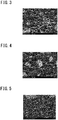
- FIG. 3 shows a 500-power SEM image photograph in the sliding layer of test 1, in the sliding member of embodiment 1.
- FIG. 4 shows a 500-power SEM image photograph in the sliding layer of test 1, in the sliding member of embodiment 2.
- FIG. 5 shows a 500-power SEM image photograph in the sliding layer of test 1, in the sliding member of embodiment 3.
- FIG. 6 shows a 500-power SEM image photograph in the sliding layer of test 1, in the sliding member of embodiment 4.
- FIG. 7 shows a 500-power SEM image photograph in the sliding layer of test 1, in the sliding member of comparative example 2.
- FIG. 3 shows a 500-power SEM image photograph in the sliding layer of test 1, in the sliding member of embodiment 1.
- FIG. 4 shows a 500-power SEM image photograph in the sliding layer of test 1, in the sliding member of embodiment 2.
- FIG. 5 shows a 500-power SEM image photograph in the sliding layer of test 1, in the sliding member of embodiment 3.
- FIG. 6 shows a 500-power SEM image photograph in the sliding layer of test 1,
- the sliding members of embodiments 1 to 4 can exhibit excellent seizure resistance and wear resistance. It is presumed the reason of this is that since the sliding members of embodiments 1 to 4 adopt UHPE particles irradiated with radiation rays in the sealed state, the UHPE particles are hardly oxidized, and are properly crosslinked.
- the sliding layers in the sliding members of embodiments 2 to 4 exhibit excellent seizure resistance and wear resistance. It is presumed this is because the sliding members of embodiments 2 to 4 each adopt crosslinked UHPE particles having a melting point of more than or equal to 128.2°C and less than or equal to 132.0°C, and a gel fraction of more than or equal to 26% by having an absorbed dose of electron beams of more than or equal to 60 kGy and less than or equal to 300 kGy as shown in Table 1, so that the UHPE particles hardly liquate and drop out of the surface of the sliding layer at high temperatures, as shown in FIGS. 4 to 6 .
- the sliding members of comparative examples 2 and 3 each have a low seizure load, and poor seizure resistance. It is presumed this is because the sliding member of comparative example 2 adopts UHPE particles of an uncrosslinked product, and therefore the UHPE particles easily liquate and drop out of the surface of the sliding layer at high temperatures as shown in FIG. 7 . Furthermore, it is presumed this is because the sliding member of comparative example 3 adopts UHPE particles of an unsealed crosslinked product having a gel fraction of 0%, so that the UHPE particles are oxidized and are not properly crosslinked, and the UHPE particles easily liquate and drop out of the surface of the sliding layer at high temperatures as shown in FIG. 8 .
- the sliding layers can exhibit excellent sliding characteristics in terms of self-lubricity, wear resistance and heat resistance. Therefore, it is found that, if these sliding member are adopted in swash plates or the like of compressors, more excellent compressors can be obtained.
- the test is to evaluate wear resistance under a certain level of a dry environment in the sliding layers of the respective sliding members.
- a sliding layer 30a of each of the sliding members is formed on a top surface of a base material 30 formed of S45C.
- a film thickness of the sliding layer 30a is approximately 20 ⁇ m.
- a ring 6 is placed on a top surface of the sliding layer 30a of each of the sliding members.
- the ring 6 made of S45C is rotated under conditions of a contact pressure of 5.4 MPa, a sliding speed of 0.9 m/second, and a sliding distance of 500 m.
- a specific wear amount ( ⁇ 10 -6 mm 3 /N ⁇ m) of the sliding layer 30a during this while was measured.
- the test was performed to the sliding members of embodiments 1 to 18 and comparative examples 1, 2 and 4 to 8.
- the test is to evaluate wear resistance under a certain level of an oil environment in the sliding layers of the respective sliding members.
- a sliding layer 40a of each of the sliding members is formed on a top surface of a base material 40 formed of S45C.
- a film thickness of the sliding layer 40a is approximately 15 ⁇ m.
- a pin 7 is placed on a top surface of the sliding layer 40a of each of the sliding members.
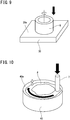
- the pin 7 made of SUJ2 in which a curvature of a tip end is 10R is rotated under conditions of a load of 20N, a sliding speed of 0.25 m/second, and a sliding distance of 22.6 m.
- 5 mg of a refrigerator oil 8 was dropped onto the sliding layer 40a, and a wear depth of the sliding layer 40a during this while was measured.
- the test was performed to the sliding members of embodiments 1 to 18 and comparative examples 1, 2 and 4 to 8.
- Table 7 shows results of test 4 and test 5 in the sliding members of embodiments 1 to 4 and comparative examples 1 and 2.
- Tables 8 to 10 show results of test 4 and test 5 in the sliding members of embodiments 5 to 18 and comparative examples 4 to 8.
- Test 4 Specific wear amount ⁇ 10 ⁇ -6[mm 3 /N ⁇ m] 2.4 2.8 2.2 5.6 5.7 3.6 Test 5 Wear depth [ ⁇ m] 2.9 2.2 4.1 2.7 20.1 9.1
- wear resistance of the sliding member of comparative example 2 was used as a criteria. The reason of this is that while the UHPE particles are properly crosslinked in the sliding members of embodiments 1 to 18, the UHPE particles are not crosslinked in the sliding member of comparative example 2 as can be seen from Tables 2 and 4 to 6, and therefore presence or absence of crosslinking of the UHPE particles was adopted as the criteria.
- the specific wear amounts are less than 3.6 ( ⁇ 10 -6 mm 3 /N ⁇ m), or wear depths are less than 9.1 ( ⁇ m) when the results of tests 4 and 5 in the sliding member of comparative example 2 are the standards.
- the sliding members of embodiments 1 to 18 can exhibit excellent wear resistance under the dry environment or under the oil environment. It is presumed the reason of this is that since the sliding members of embodiments 1 to 18 adopt the UHPE particles irradiated with radiation rays in the sealed state, the UHPE particles are hardly oxidized, and are properly crosslinked.
- the sliding layers exhibit excellent wear resistance under the dry environment and under the oil environment.
- the sliding members of embodiments 1 to 18 adopt the crosslinked UHPE particles having the melting points of more than 126.4°C and less than or equal to 132.0°C, and gel fractions of more than or equal to 26% by having the absorbed doses of electron beams of more than or equal to 60 kGy and less than 500 kGy as shown in Table 1, the UHPE particles hardly liquate and drop out of the surfaces of the sliding layers at high temperatures.
- the sliding members of comparative examples 1, 2, 4 and 5 have the specific wear amounts of more than or equal to 3.6 ( ⁇ 10 -6 mm 3 /N ⁇ m), and wear depths of more than or equal to 9.1 ( ⁇ m), in the results of tests 4 and 5. Accordingly, the sliding members of comparative examples 1, 2, 4 and 5 have poor wear resistance under either the dry environment or the oil environment as compared with the sliding members of embodiments 1 to 18. It is presumed that the sliding member of comparative example 1 adopts a fluorine compound (PTFE particles) instead of the UHPE particles which are properly crosslinked, and therefore has poor wear resistance.
- PTFE particles fluorine compound
- the sliding member of comparative example 2 adopts the uncrosslinked UHPE particles with a melting point of 134.6°C, and therefore the UHPE particles easily liquate and drop out of the surface of the sliding layer at high temperatures. Furthermore, it is presumed that since in the sliding members of comparative examples 4 and 5, the absorbed doses of electron beams are more than or equal to 500 kGy, the crosslinked UHPE particles are brittle, and wear resistance of the sliding members rather deteriorate.
- the sliding layers can exhibit excellent wear resistance under the dry environment or under the oil environment.
- the sliding layers can exhibit excellent wear resistance under the dry environment or under the oil environment.
- the solid lubricant is preferably more than or equal to 25% by volume and is less than or equal to 100% by volume with respect to the binder resin
- the ultra high molecular weight polyethylene is preferably more than or equal to 5% by volume and is less than or equal to 35% by volume with respect to all solid components in the sliding layer.
- the sliding members of embodiments 1 to 18 can exhibit excellent wear resistance under the dry environment or under the oil environment to the sliding members of comparative examples 6 to 8.
- the specific wear amounts are more than 3.6 ( ⁇ 10 -6 mm 3 /N ⁇ m), and the wear depths are more than 9.1 ( ⁇ m) in the results of tests 4 and 5.
- molybdenum disulfide is preferably less than or equal to 26% by volume with respect to all solid components in the sliding layer. In this case, in the sliding layer, the wear resistance can be more improved under the dry environment or under the oil environment. Furthermore, as in the sliding members of embodiments 7 and 12, molybdenum disulfide does not have to be included in the solid lubricant.
- the ultra high molecular weight polyethylene is preferably more than or equal to 23% by volume and less than or equal to 35% by volume with respect to all solid components in the sliding layer, and molybdenum disulfide is preferably less than or equal to 15% by volume with respect to all solid components in the sliding layer.
- the sliding layer can further improve the wear resistance under the dry environment in particular. More specifically, the sliding members of embodiments 5 to 8 can exhibit excellent wear resistance under the dry environment. In the siding members of embodiments 5 to 8, the specific wear amounts are within a range of 0.5 to 1.3 ( ⁇ 10 -6 mm 3 /N ⁇ m), and show remarkable effects as compared with the other embodiments in test 4.
- graphite is preferably more than or equal to 5% by volume and less than or equal to 30% by volume with respect to all solid components in the sliding layer.
- the sliding layer can further improve the wear resistance under the dry environment or under the oil environment.
- graphite does not have to be included in the solid lubricant as in the sliding members of embodiments 16 and 18.
- the present invention it is possible to perform a degreasing step of contacting alkali or the like to the base material to enhance adhesion of the base material and the sliding layer. Furthermore, it is also possible to form an underlayer formed from phosphate such as zinc phosphate, and manganese phosphate after the degreasing step to further enhance adhesion of the base material and the sliding layer.
- phosphate such as zinc phosphate, and manganese phosphate
- the present invention is applicable to various sliding members.
Landscapes
- Chemical & Material Sciences (AREA)
- Chemical Kinetics & Catalysis (AREA)
- General Chemical & Material Sciences (AREA)
- Oil, Petroleum & Natural Gas (AREA)
- Organic Chemistry (AREA)
- Inorganic Chemistry (AREA)
- Lubricants (AREA)
- Sliding-Contact Bearings (AREA)
Abstract
Description
- The present invention relates to a sliding member and a method for manufacturing the same.
- Conventionally, sliding members disclosed in
Patent Literatures 1 and 2 are known. These sliding members each include a base material formed of a steel material or an aluminum material, and a sliding layer formed on the base material. An underlayer may be provided between the base material and the sliding layer. The sliding layer contains a binder resin and a solid lubricant. The binder resin is formed of an epoxy resin or the like. The solid lubricant in Patent Literature 1 is formed from particulate molybdenum disulfide (MoS2), particulate polytetrafluoroethylene (PTFE), and particulate polyethylene. In recent years, an ultra high molecular weight polyethylene has been studied because of characteristics of self-lubricity and wear resistance, and the solid lubricant inPatent Literature 2 includes particulate crosslinked ultra high molecular weight polyethylene. - These sliding members can be adopted in a propeller shaft, a piston and the like in which sliding layers slide with mating material. In particular, the sliding layer in Patent Literature 1 includes polyethylene that has good affinity for lubricants as a solid lubricant, and therefore realizes a low friction coefficient and high wear resistance. Furthermore, the sliding layer in
Patent Literature 2 uses a crosslinked ultra high molecular weight polyethylene as a solid lubricant, and realize not only seizure resistance and wear resistance but also high heat resistance. -
- Patent Literature 1: Japanese Patent Laid-Open No.
2013-189569 - Patent Literature 2: Japanese Patent Laid-Open No.
2016-69508 - However, for the sliding members, further improvement in the sliding characteristics is desired to ensure reliability. In this regard, according to the test result by the inventors, the sliding layer cannot always exhibit high heat resistance when the crosslinked ultra high molecular weight polyethylene is simply irradiated with radiation rays even if the crosslinked ultra high molecular weight polyethylene is adopted as a part of the solid lubricant. In some cases, the crosslinked ultra high molecular weight polyethylene becomes brittle, and lubrication characteristics of the sliding layer rather deteriorate.
- The present invention has been made in the light of the above described conventional circumstances, and an object of the present invention is to provide a sliding member in which a sliding layer can exhibit excellent sliding characteristics in terms of seizure resistance, wear resistance and heat resistance.
- A method for manufacturing a sliding member of the present invention is a method for manufacturing a sliding member to manufacture a sliding member sliding with a mating material, and includes
a crosslinking step of irradiating particulate ultra high molecular weight polyethylene with radiation rays in a sealed state, and crosslinking the ultra high molecular weight polyethylene,
a composition preparing step of preparing a composition for a sliding layer containing a solid lubricant including the ultra high molecular weight polyethylene crosslinked in the crosslinking step, and a binder resin, and
a sliding layer forming step of forming a sliding layer sliding with the mating material by providing the composition for a sliding layer on a base material, and obtaining the sliding member. - According to test results of the inventors, in the sliding member obtained by the manufacturing method of the present invention, excellent seizure resistance and wear resistance can be improved by the ultra high molecular weight polyethylene properly crosslinked. It is presumed the reason of this is that in the manufacturing method of the present invention, the particulate ultra high molecular weight polyethylene is irradiated with radiation rays in the sealed state in the crosslinking step, so that the ultra high molecular weight polyethylene is hardly oxidized and is properly crosslinked. When particulate ultra high molecular weight polyethylene is irradiated with radiation rays in a state open to the atmosphere, the ultra high molecular weight polyethylene is oxidized, and the ultra high molecular weight polyethylene is hardly crosslinked.
- According to the test results of the inventors, the crosslinking step is preferably performed under a condition that an absorbed dose of electron beams as the radiation rays is more than or equal to 60 kGy and less than 500 kGy. The electron beams are convenient to handle. When the electron beams are irradiated at the absorbed dose in this range, ultra high molecular weight polyethylene is properly crosslinked, and the sliding layer exhibits excellent heat resistance and wear resistance. When the crosslinking step is performed at the absorbed dose of electron beams of less than 60 kGy, crosslinking of the ultra high molecular weight polyethylene becomes insufficient, and wear resistance of the sliding layer is not sufficient. When the crosslinking step is performed at the absorbed dose of electron beams of 500 kGy or more, the crosslinked ultra high molecular weight polyethylene becomes brittle, and the wear resistance of the sliding layer deteriorates.
- A sliding member of the present invention is a sliding member including a base material, and a sliding layer formed on the base material, and containing a binder resin and a solid lubricant, the sliding layer sliding with a mating material,
wherein the solid lubricant includes crosslinked ultra high molecular weight polyethylene that is particulate and has a melting point that is more than 126.4°C and less than or equal to 132.0°C. - According to the test results of the inventors, when the melting point of ultra high molecular weight polyethylene is within this range, a friction coefficient of the sliding layer is low, the wear amount is small, and the ultra high molecular weight polyethylene is hardly liquated and drops out of the surface of the sliding layer at high temperatures. It is presumed this is because the ultra high molecular weight polyethylene is properly crosslinked. Accordingly, the sliding layer can improve excellent seizure resistance and wear resistance.
- According to the test result of the inventors, the ultra high molecular weight polyethylene preferably has a gel fraction of more than or equal to 26%. In this case, the friction coefficient of the sliding layer is low, the wear amount is small, and the ultra high molecular weight polyethylene is hardly liquated from the surface of the sliding layer at high temperatures. The ultra high molecular weight polyethylene with the gel fraction in this range is presumed to be properly crosslinked.
- According to the test results of the inventors, in the sliding layer, the solid lubricant is preferably more than or equal to 25% by volume and less than or equal to 100% by volume with respect to the binder resin. In this case, the binder resin can retain the fixed lubricant better. Furthermore, in the sliding layer, the binder resin is preferably polyamide-imide. Furthermore, the ultra high molecular weight polyethylene is preferably more than or equal to 5% by volume and less than or equal to 35% by volume with respect to all solid components in the sliding layer. In this case, the sliding layer can further improve the wear resistance under dry environments or under oil environments.
- According to the test results of the inventors, the solid lubricant preferably further includes molybdenum disulfide. Furthermore, in the sliding layer, molybdenum disulfide is preferably less than or equal to 26% by volume with respect to all solid components in the sliding layer. In this case, the sliding layer can improve the wear resistance under dry environments or under oil environments.
- According to the test results of the inventors, in the sliding layer, the ultra high molecular weight polyethylene is preferably more than or equal to 23% by volume and less than or equal to 35% by volume with respect to all solid components in the sliding layer, and the molybdenum disulfide is preferably less than or equal to 15% by volume with respect to all solid components in the sliding layer. In this case, the sliding layer can further improve the wear resistance under dry environments in particular.
- According to the test results of the inventors, the solid lubricant preferably further includes graphite. Furthermore, in the sliding layer, the graphite is more than or equal to 5% by volume and less than or equal to 30% by volume with respect to all solid components in the sliding layer. In this case, the sliding layer can further improve the wear resistance under dry environments or under oil environments.
- According to the manufacturing method of the present invention, the sliding member in which the sliding layer can exhibit excellent sliding characteristics in terms of seizure resistance, wear resistance and heat resistance can be manufactured. Furthermore, according to the sliding member of the present invention, the sliding layer can exhibit excellent sliding characteristics in terms of self-lubricity, wear resistance and heat resistance.
-
- [
FIG. 1] FIG. 1 is a schematic perspective view showing a state of a pin-on-disk reciprocating test in test 1. - [
FIG. 2] FIG. 2 is a sectional view showing a state of a swash plate-shoe test intest 2. - [
FIG. 3] FIG. 3 is a 500-power SEM image photograph in a sliding layer of test 1, in a sliding member of embodiment 1. - [
FIG. 4] FIG. 4 is a 500-power SEM image photograph in a sliding layer in test 1, in a sliding member ofembodiment 2. - [
FIG. 5] FIG. 5 is a 500-power SEM image photograph in a sliding layer in test 1, in a sliding member ofembodiment 3. - [
FIG. 6] FIG. 6 is a 500-power SEM image photograph in a sliding layer in test 1, in a sliding member ofembodiment 4. - [
FIG. 7] FIG. 7 is a 500-power SEM image photograph in a sliding layer in test 1, in a sliding member of comparative example 2. - [
FIG. 8] FIG. 8 is a 500-power SEM image photograph in a sliding layer in test 1, in a sliding member of comparative example 3. - [
FIG. 9] FIG. 9 is a schematic perspective view showing a state of a ring-on-disk friction and wear test intest 4. - [
FIG. 10] FIG. 10 is a schematic perspective view showing a state of a pin-on-disk friction and wear test intest 5. - As means for irradiating particulate ultra high molecular weight polyethylene with radiant rays in a sealed state, (1) a vacuum method to evacuate a container storing particulate ultra high molecular weight polyethylene to reduce the proportion of existence of air, (2) a gas purge method to fill a container with inert gas or nitrogen to discharge air, and the like can be adopted. An atmosphere may include some oxygen without using a vacuum method or a gas purge method, as long as the atmosphere is sealed.
- As the radiation rays, X-rays, electron beams, and ion beams can be adopted in addition to α-rays, β-rays, and γ-rays. An amount of radiation rays is expressed as a dose proportional to energy absorbed in a unit mass. A gray (Gy) is a unit that represents an amount of energy absorbed by a certain substance (referred to as an absorbed dose) when the radiation rays strike the substance.
- A binder resin exhibits a retention property for a solid lubricant that makes it difficult to detach the solid lubricant, durability against a shearing force that repeatedly acts under a layered coating film (hardness as a base), wear resistance with which the binder resin is difficult to break, heat resistance and the like. As the binder resin, a polyimide resin, an epoxy resin, a phenol resin and the like can be adopted. As the polyimide resin, polyamide-imide (PAI), polyimide and the like can be adopted. Considering cost and characteristics, it is optimal to use PAI as the binder resin
- A solid lubricant is held by the binder resin, and exhibits a low shearing force and a low friction coefficient on an outermost surface. As the solid lubricant, fluororesin, molybdenum dioxide, graphite, ultra high molecular weight polyethylene and the like are adoptable. Fluororesin and ultra high molecular weight polyethylene improve slidability by forming a coating film on a sliding surface of a sliding layer, and transferring to a mating material. Molybdenum dioxide and graphite improve slidability by a crystal structure having a low shearing force, and realizes low friction under a high load. According to test results by the inventors, fluororesin has sliding characteristics such as wear resistance and seizure resistance, but has oil repellency, and has a relatively large lubricating oil contact angle. On the other hand, ultra high molecular weight polyethylene has lipophilic properties though it is inferior to fluororesin in sliding characteristics, and has a relatively small lubricating oil contact angle. Furthermore, as the solid lubricant, melamine cyanurate (MCA), calcium fluoride, and soft metals such as copper and tin can be adopted. In particular, ultra high molecular weight polyethylene that is properly crosslinked hardly liquates from a surface of a sliding layer at high temperatures, and can improve excellent seizure resistance and wear resistance.
- The ultra high molecular weight polyethylene before crosslinked preferably has an average molecular weight of 1,000,000 to 7,000,000. Furthermore, a specific gravity of the ultra high molecular weight polyethylene before crosslinked is preferably 0.92 to 0.96. The ultra high molecular weight polyethylene before crosslinked preferably has a particle size less than or equal to 30 µm, and more preferably has a particle size of less than or equal to 15 µm, in terms of surface smoothness and wear resistance.
- A sliding layer can have an additive in addition to the binder resin and the solid lubricant. As the additive, additives that increase hardness of the sliding layer can be adopted, such as hard particles of titanium dioxide, tricalcium phosphate, alumina, silica, silicon carbide and silicon nitride.
- The sliding layer can contain a metal compound containing sulfur such as ZnS and Ag2S as an extreme pressure agent. Furthermore, the sliding layer can have a surfactant, a coupling agent, a processing stabilizer, an antioxidant and the like.
- As a silane coupling agent used for silane coupling treatment, a functional group is preferably an epoxy group. As the silane coupling agent having an epoxy group in the functional group, 2-(3, 4-Epoxycyclohexyl) ethyltrimethoxysilane, 3-Glycidoxypropyltrimethoxysilane, 3-Glycidoxypropylmethyldiethoxysilane, and 3-Glycidoxypropyltriethoxysilane are preferable. These silane coupling agents also have excellent storage stability.
- As a sliding layer forming step, it is possible to perform viscosity adjustment and density adjustment of a solid content by appropriately diluting a composition for a sliding layer with a solvent such as n-methyl-2-pyrrolidone, 1,3-dimethyl-2-imidazolidinone, or xylene, depending on a kind of a coating method such as spray coating and roll coating. It is possible to form a sliding layer by performing drying and burning after coating a base material with a diluent of the composition for a sliding layer.
- Hereinafter, embodiments 1 to 4 that embody the present invention, and comparative examples 1 to 3 will be described. First, the following materials were prepared.
- Solid lubricant: particulate ultra high molecular weight polyethylene (UHPE particle), particulate fluorine compound (PTFE particle), MoS2, graphite
- A plurality of bags formed of vinyl that are capable of being airtight and are of the same size were prepared, a fixed amount of UHPE particles were put into each of these bags, and respective bags were evacuated under the same conditions. Thereafter, each of the bags was put into an electron beam irradiation device, and UHPE particles were irradiated with electron beams as radiation rays at an absorbed dose (kGy) shown in Table 1. In this manner, UHPE particles of crosslinked products No.1 to 4 were obtained. UHPE particles of an uncrosslinked product were not irradiated with electron beams. UHPE particles of an unsealed crosslinked product were irradiated with electron beams in a state open to the atmosphere, that is, without being put into the bag.
- Table 1 shows melting points (°C), gel fractions (%), and average particle sizes (µm) of the respective UHPE particles. Furthermore, Table 1 also shows a melting point (°C) and an average particle size (µm) of PTFE particles.
[Table 1] Fluorine compound Particulate ultra high molecular weight polyethylene (UHPE particle) PTFE particle Uncrosslinked product Crosslinked product No. 1 Crosslinked product No. 2 Crosslinked product No. 3 Crosslinked product No. 4 Crosslinked product No. 5 Crosslinked product No. 6 Unsealed crosslinked product Electron beam irradiation atmosphere - - Sealed Sealed Sealed Sealed Sealed Sealed Open to atmosphere Electron beam absorbed dose [kGy] 0 0 60 80 100 300 500 1000 100 Melting point [°C] 323.8 134.6 132.0 131.6 131.2 128.2 126.4 123.0 133.2 Gel fraction [weight%] - 0 26 69 66 69 68 71 0 Average particle size [µm] 5 10 10 10 10 10 10 10 10 - Here, measurement conditions of the melting point are as follows.
- Analysis equipment: DSC Q2000 (TA instrument)
- Heating rate: 5°C/minute (After a temperature was raised to 210°C, the temperature was cooled to 30°C at -20°C/minute, and measurement was performed again.)
- Atmosphere: N2
- Sample weight: 5 mg±0.1 mg each
- Melting point reading conditions: a melting peak temperature when measuring again
- The gel fractions were measured as follows. First, each powder was pressed at a constant pressure while being heated at 180°C to 230°C, and thereby a sheet having a thickness of 0.3 mm was formed. From each sheet, a small piece of 0.3 g was cut. Each small piece was put into a flask, and 500 milliliters of p-xylene was added into the flask. While heating each flask to 130°C, the mixture in the flask was stirred for four hours to dissolve each small piece. The solution was filtered with a wire mesh having a mesh of 106 µm while the solution is in a high temperature state of 130°C. Insoluble matters on the wire mesh were dried under vacuum at 140°C for three hours, and a weight (g) of the insoluble matters after the room temperature was measured. Subsequently, the gel fraction was obtained by a formula of gel fraction (%) = insoluble matter weight (g)×100/0.3 (g) .
- As the composition preparing step, PAI varnish and each solid lubricant were compounded at a compounding ratio shown in Table 2, and after the compound was stirred well, the compound was passed through three roll mills, whereby compositions for the sliding layers in embodiments 1 to 4 and comparative examples 1 to 3 were prepared. The solid lubricant is formed from PTFE particles, UHPE particles, MoS2 and graphite. The UHPE particles are any one of an uncrosslinked product, crosslinked products No. 1 to 4 or an unsealed crosslinked product.
[Table 2] Volume% Embodiment 1 Embodiment 2Embodiment 3Embodiment 4Comparative example 1 Comparative example 2 Comparative example 3 PAI varnish 50 50 50 50 50 50 50 Solid lubricant PTFE particle - - - - 18 - - UHPE particle Uncrosslinked product - - - - - 18 - Crosslinked product No.1 18 - - - - - - No.2 - 18 - - - - - No.3 - - 18 - - - - No.4 - - - 18 - - - Unsealed - - - - - - 18 Molybdenum disulfide 18 18 18 18 18 18 18 Graphite 14 14 14 14 14 14 14 Volume% of solid lubricant per 100% by volume of PAI resin 100 100 100 100 100 100 100 - The following sliding layer forming step was performed. First, the respective compositions for sliding layers were diluted with a solvent to make dilutions, the respective dilutions were coated on the base material formed of a steel material, after which, drying was performed, and burning was performed at 220°C for 1.5 hours. Thereafter, surface grinding was performed to make film thicknesses the same, and sliding layers of the film thickness of 15 µm were formed. In this manner, the respective sliding members of embodiments 1 to 4 and comparative examples 1 to 3 were obtained.
- The respective sliding members are each formed of the base material and the sliding layer formed on the base material. The sliding layer contains the binder resin and the solid lubricant. The respective sliding members were provided to tests 1 to 3 as follows.
- The test is to confirm a liquation (residual) state of the UHPE particles in the sliding layer of each of the sliding members. In other words, as shown in
FIG. 1 , each slidingmember 10 is placed on a plate 1 in which a top surface can be heated. In this state, in each slidingmember 10 has a slidinglayer 10a as the top surface. On the slidinglayer 10a, apin 2 made of SUJ2 with a curvature of a tip end of 10R is reciprocated under conditions of a load of 350 gf, a reciprocation distance 20 mm, a speed of 2Hz, and a number of reciprocations of 3500. At this time, a temperature of a substrate surface is controlled to 80°C, and alubricant 3 containing hydrocarbon oil is dropped onto the slidinglayer 10a. The test was performed to the sliding members of embodiments 1 to 4 and comparative examples 1 to 3. - The test is to evaluate a friction coefficient and seizure under a dry environment in a swash plate type compressor. In other words, as shown in
FIG. 2 , a base material 20 was formed into a shape of a swash plate of a compressor, a slidinglayer 20a was formed on each of the base materials 20, and a swash plate was obtained as described above. Meanwhile, ashoe 5 made of SUJ2 was held by a holdingtool 4. Subsequently, the swash plate was rotated at a sliding speed of 10 m/second, a load of 1960 N was applied to between the swash plate and theshoe 5, and a time (second) required for the swash plate and theshoe 5 to seize was investigated. The test was performed to the sliding members of embodiments 1 to 4 and comparative examples 1 to 3. - The test is to evaluate seizure at a time of applying a load stepwise under lubrication in oil in a swash plate type compressor. In other words, as shown in
FIG. 2 , the base material 20 was formed into a shape of a swash plate of a compressor, a slidinglayer 20a was formed on each of the base materials 20, and a swash plate was obtained as described above. Meanwhile, ashoe 5 made of SUJ2 was held by a holdingtool 4. Subsequently, the swash plate was rotated at a sliding speed of 7 m/second while refrigerating machine oil was attached to a surface of the swash plate by amount of 6 g/minute, a load of 400 N was applied to between the swash plate and theshoe 5 every five minutes, and a load (N) under which the swash plate and theshoe 5 were seized was investigated. The test was performed to the sliding members of embodiments 1 to 4 and comparative examples 1 to 3. - Table 3 shows results of the tests. Furthermore, remaining states of UHPE particles in the sliding layers of the respective sliding members of embodiments 1 to 4 and comparative examples 2 and 3 after test 1 were confirmed by SEM images.
FIG. 3 shows a 500-power SEM image photograph in the sliding layer of test 1, in the sliding member of embodiment 1.FIG. 4 shows a 500-power SEM image photograph in the sliding layer of test 1, in the sliding member ofembodiment 2.FIG. 5 shows a 500-power SEM image photograph in the sliding layer of test 1, in the sliding member ofembodiment 3.FIG. 6 shows a 500-power SEM image photograph in the sliding layer of test 1, in the sliding member ofembodiment 4.FIG. 7 shows a 500-power SEM image photograph in the sliding layer of test 1, in the sliding member of comparative example 2.FIG. 8 shows a 500-power SEM image photograph in the sliding layer of test 1, in the sliding member of comparative example 3.[Table 3] Test 2Test 3Friction coefficient Seizure time [second] Seizure load [N] Embodiment 1 0.033 510 4000 Embodiment 20.033 479 5600 Embodiment 30.032 524 5600 Embodiment 40.033 451 4800 Comparative example 1 0.033 465 3600 Comparative example 2 0.038 235 4000 Comparative example 3 0.036 293 3600 - As can be seen from Table 3, the sliding members of embodiments 1 to 4 can exhibit excellent seizure resistance and wear resistance. It is presumed the reason of this is that since the sliding members of embodiments 1 to 4 adopt UHPE particles irradiated with radiation rays in the sealed state, the UHPE particles are hardly oxidized, and are properly crosslinked.
- In particular, the sliding layers in the sliding members of
embodiments 2 to 4 exhibit excellent seizure resistance and wear resistance. It is presumed this is because the sliding members ofembodiments 2 to 4 each adopt crosslinked UHPE particles having a melting point of more than or equal to 128.2°C and less than or equal to 132.0°C, and a gel fraction of more than or equal to 26% by having an absorbed dose of electron beams of more than or equal to 60 kGy and less than or equal to 300 kGy as shown in Table 1, so that the UHPE particles hardly liquate and drop out of the surface of the sliding layer at high temperatures, as shown inFIGS. 4 to 6 . - On the other hand, as can be seen from Table 3, the sliding members of comparative examples 2 and 3 each have a low seizure load, and poor seizure resistance. It is presumed this is because the sliding member of comparative example 2 adopts UHPE particles of an uncrosslinked product, and therefore the UHPE particles easily liquate and drop out of the surface of the sliding layer at high temperatures as shown in
FIG. 7 . Furthermore, it is presumed this is because the sliding member of comparative example 3 adopts UHPE particles of an unsealed crosslinked product having a gel fraction of 0%, so that the UHPE particles are oxidized and are not properly crosslinked, and the UHPE particles easily liquate and drop out of the surface of the sliding layer at high temperatures as shown inFIG. 8 . - Accordingly, it is found that in the sliding members of embodiments 1 to 4, in particular, the sliding members of
embodiments 2 to 4, the sliding layers can exhibit excellent sliding characteristics in terms of self-lubricity, wear resistance and heat resistance. Therefore, it is found that, if these sliding member are adopted in swash plates or the like of compressors, more excellent compressors can be obtained. - Next,
embodiments 5 to 18 that embody the present invention, and comparative examples 4 to 8 will be described. First, as in the first experiment, as a composition preparing step, PAI varnish and each solid lubricant were compounded at a compounding ratio shown in Tables 4 to 6, and after the compound was stirred well, the compound was passed through three roll mills, whereby compositions for the sliding layers inembodiments 5 to 18 and comparative examples 4 to 8 were prepared. Subsequently, as in the first experiment, a sliding layer forming step was performed. In this manner, respective sliding members ofembodiments 5 to 18 and comparative examples 4 to 8 were obtained.[Table 4] Volume% Embodiment 5 Embodiment 6 Embodiment 7 Embodiment 8 Embodiment 9 Embodiment 10 Embodiment 11 PAI varnish 50 50 50 50 50 50 50 Solid lubricant PTFE particle - - - - - - - UHPE particle Uncrosslinked product - - - - - - - Crosslinked product No.1 - - - - - - - No.2 - - - - - - - No.3 25 35 28 23 22.5 15 10 No.4 - - - - - - - No.5 - - - - - - - No.6 - - - - - - - Molybdenum disulfide 15 9 0 8 22.5 15 10 Graphite 10 6 22 19 5 20 30 Volume% of solid lubricant per 100% by volume of PAI resin 100 100 100 100 100 100 100 [Table 5] Volume% Embodiment 12 Embodiment 13 Embodiment 14 Embodiment 15 Embodiment 16 Embodiment 17 Embodiment 18 PAI varnish 80 50 50 50 50 80 80 Solid lubricant PTFE particle - - - - - - - UHPE particle Uncrosslinked product - - - - - - - Crosslinked product No.1 - - - - - - - No.2 - - - - - - - No.3 10 5 10 15 25 7.5 10 No.4 - - - - - - - No.5 - - - - - - - No.6 - - - - - - - Molybdenum disulfide 0 26 23 25 25 7.5 10 Graphite 10 19 17 10 0 5 0 Volume% of solid lubricant per 100% by volume of PAI resin 25 100 100 100 100 25 25 [Table 6] Volume% Comparative example 4 Comparative example 5 Comparative example 6 Comparative example 7 Comparative example 8 PAI varnish 50 50 40 40 40 Solid lubricant PTFE particle - - - - - UHPE particle Uncrosslinked product - - - - - Crosslinked product No.1 - - - - - No.2 - - - - - No.3 - - 22.5 30 30 No.4 - - - - No.5 18 - - - - No.6 - 18 - - - Molybdenum disulfide 18 18 22.5 30 0 Graphite 14 14 15 0 30 Volume% of solid lubricant per 100% by volume of PAI resin 100 100 150 150 150 - The respective sliding members of embodiments 1 to 4 and comparative examples 1 and 2 obtained by the first experiment, and the respective sliding members of
embodiments 5 to 18 and comparative examples 4 to 8 obtained by the second experiment were provided totests - The test is to evaluate wear resistance under a certain level of a dry environment in the sliding layers of the respective sliding members. In other words, as shown in
FIG. 9 , a slidinglayer 30a of each of the sliding members is formed on a top surface of abase material 30 formed of S45C. A film thickness of the slidinglayer 30a is approximately 20 µm. In this state, aring 6 is placed on a top surface of the slidinglayer 30a of each of the sliding members. Thering 6 made of S45C is rotated under conditions of a contact pressure of 5.4 MPa, a sliding speed of 0.9 m/second, and a sliding distance of 500 m. A specific wear amount (×10-6mm3/N·m) of the slidinglayer 30a during this while was measured. The test was performed to the sliding members of embodiments 1 to 18 and comparative examples 1, 2 and 4 to 8. - The test is to evaluate wear resistance under a certain level of an oil environment in the sliding layers of the respective sliding members. In other words, as shown in
FIG. 10 , a slidinglayer 40a of each of the sliding members is formed on a top surface of abase material 40 formed of S45C. A film thickness of the slidinglayer 40a is approximately 15 µm. In this state, apin 7 is placed on a top surface of the slidinglayer 40a of each of the sliding members. Thepin 7 made of SUJ2 in which a curvature of a tip end is 10R is rotated under conditions of a load of 20N, a sliding speed of 0.25 m/second, and a sliding distance of 22.6 m. At this time, 5 mg of arefrigerator oil 8 was dropped onto the slidinglayer 40a, and a wear depth of the slidinglayer 40a during this while was measured. The test was performed to the sliding members of embodiments 1 to 18 and comparative examples 1, 2 and 4 to 8. - Table 7 shows results of
test 4 andtest 5 in the sliding members of embodiments 1 to 4 and comparative examples 1 and 2. Tables 8 to 10 show results oftest 4 andtest 5 in the sliding members ofembodiments 5 to 18 and comparative examples 4 to 8.[Table 7] Embodiment 1 Embodiment 2Embodiment 3Embodiment 4Comparative example 1 Comparative example 2 Test 4Specific wear amount ×10^-6[mm3/N·m] 2.4 2.8 2.2 5.6 5.7 3.6 Test 5Wear depth [µm] 2.9 2.2 4.1 2.7 20.1 9.1 [Table 8] Embodiment 5Embodiment 6Embodiment 7Embodiment 8Embodiment 9 Embodiment 10Embodiment 11 Test 4Specific wear amount ×10^-6[mm3/N·m] 1.3 0.7 0.7 0.5 2.9 3.2 1.6 Test 5Wear depth [µm] 4.7 2.6 4.3 4.2 4.4 3.4 2.4 [Table 9] Embodiment 12Embodiment 13 Embodiment 14 Embodiment 15 Embodiment 16 Embodiment 17 Embodiment 18 Test 4Specific wear amount ×10^-6[mm3/N·m] 2.3 1.5 3.4 2.8 2.2 7.8 5.1 Test 5Wear depth [µm] 1.0 11.3 17.5 17.3 15.0 1.0 1.0 [Table 10] Comparative example 4 Comparative example 5 Comparative example 6 Comparative example 7 Comparative example 8 Test 4Specific wear amount ×10^-6[mm3/N·m] 9.7 7.7 4.4 4.9 6.3 Test 5Wear depth [µm] 11.5 11.0 14.5 12.6 14.1 - In evaluating the wear resistance of the sliding members of embodiments 1 to 18, wear resistance of the sliding member of comparative example 2 was used as a criteria. The reason of this is that while the UHPE particles are properly crosslinked in the sliding members of embodiments 1 to 18, the UHPE particles are not crosslinked in the sliding member of comparative example 2 as can be seen from Tables 2 and 4 to 6, and therefore presence or absence of crosslinking of the UHPE particles was adopted as the criteria.
- As can be seen from Tables 7 to 10, in the respective sliding members of embodiments 1 to 18, the specific wear amounts are less than 3.6 (×10-6mm3/N·m), or wear depths are less than 9.1 (µm) when the results of
tests - Furthermore, it is presumed that since the sliding members of embodiments 1 to 18 adopt the crosslinked UHPE particles having the melting points of more than 126.4°C and less than or equal to 132.0°C, and gel fractions of more than or equal to 26% by having the absorbed doses of electron beams of more than or equal to 60 kGy and less than 500 kGy as shown in Table 1, the UHPE particles hardly liquate and drop out of the surfaces of the sliding layers at high temperatures.
- On the other hand, as can be seen from Tables 7 to 10, the sliding members of comparative examples 1, 2, 4 and 5 have the specific wear amounts of more than or equal to 3.6 (×10-6mm3/N·m), and wear depths of more than or equal to 9.1 (µm), in the results of
tests - Accordingly, it is found that in the sliding members of embodiments 1 to 18, the sliding layers can exhibit excellent wear resistance under the dry environment or under the oil environment. In particular, in the sliding members of embodiments 1 to 3 and 5 to 12, the sliding layers can exhibit excellent wear resistance under the dry environment or under the oil environment.
- In the sliding layer, the solid lubricant is preferably more than or equal to 25% by volume and is less than or equal to 100% by volume with respect to the binder resin, and the ultra high molecular weight polyethylene is preferably more than or equal to 5% by volume and is less than or equal to 35% by volume with respect to all solid components in the sliding layer. More specifically, the sliding members of embodiments 1 to 18 can exhibit excellent wear resistance under the dry environment or under the oil environment to the sliding members of comparative examples 6 to 8. In other words, in the siding members of comparative examples 6 to 8, the specific wear amounts are more than 3.6 (×10-6mm3/N·m), and the wear depths are more than 9.1 (µm) in the results of
tests - In the sliding layer, molybdenum disulfide is preferably less than or equal to 26% by volume with respect to all solid components in the sliding layer. In this case, in the sliding layer, the wear resistance can be more improved under the dry environment or under the oil environment. Furthermore, as in the sliding members of
embodiments - In the sliding layer, the ultra high molecular weight polyethylene is preferably more than or equal to 23% by volume and less than or equal to 35% by volume with respect to all solid components in the sliding layer, and molybdenum disulfide is preferably less than or equal to 15% by volume with respect to all solid components in the sliding layer. In this case, the sliding layer can further improve the wear resistance under the dry environment in particular. More specifically, the sliding members of
embodiments 5 to 8 can exhibit excellent wear resistance under the dry environment. In the siding members ofembodiments 5 to 8, the specific wear amounts are within a range of 0.5 to 1.3 (×10-6mm3/N·m), and show remarkable effects as compared with the other embodiments intest 4. - In the sliding layer, graphite is preferably more than or equal to 5% by volume and less than or equal to 30% by volume with respect to all solid components in the sliding layer. In this case, the sliding layer can further improve the wear resistance under the dry environment or under the oil environment. Furthermore, graphite does not have to be included in the solid lubricant as in the sliding members of embodiments 16 and 18.
- Although the present invention has been described above in line with embodiments 1 to 18, it is needless to say that the invention is not limited to the above-described embodiments 1 to 18, but may be appropriately modified in application without departing from the gist of the invention.
- For example, in the present invention, it is possible to perform a degreasing step of contacting alkali or the like to the base material to enhance adhesion of the base material and the sliding layer. Furthermore, it is also possible to form an underlayer formed from phosphate such as zinc phosphate, and manganese phosphate after the degreasing step to further enhance adhesion of the base material and the sliding layer.
- The present invention is applicable to various sliding members.
-
- 2, 5, 6, 7
- Mating material (2, 7...Pin, 5...Shoe, 6...Ring)
- 10
- Sliding member
- 20, 30, 40
- Base material
- 10a, 30a,
- 40aSliding layer
Claims (8)
- A method for manufacturing a sliding member to manufacture a sliding member sliding with a mating material, comprising:a crosslinking step of irradiating particulate ultra high molecular weight polyethylene with radiation rays in a sealed state, and crosslinking the ultra high molecular weight polyethylene;a composition preparing step of preparing a composition for a sliding layer containing a solid lubricant including the ultra high molecular weight polyethylene crosslinked in the crosslinking step, and a binder resin; anda sliding layer forming step of forming a sliding layer sliding with the mating material by providing the composition for a sliding layer on a base material, and obtaining the sliding member.
- The method for manufacturing a sliding member according to claim 1, wherein the crosslinking step is performed under a condition that an absorbed dose of electron beams as the radiation rays is more than or equal to 60 kGy and less than 500 kGy.
- A sliding member comprising a base material, and a sliding layer formed on the base material, and containing a binder resin and a solid lubricant, the sliding layer sliding with a mating material,
wherein the solid lubricant includes ultra high molecular weight polyethylene that is particulate, and has a melting point that is more than 126.4°C and less than or equal to 132.0°C. - The sliding member according to claim 3, wherein the ultra high molecular weight polyethylene has a gel fraction of more than or equal to 26%.
- The sliding member according to claim 3 or 4,
wherein in the sliding layer, the solid lubricant is more than or equal to 25% by volume and less than or equal to 100% by volume with respect to the binder resin,
in the sliding layer, the binder resin is polyamide-imide, and
the ultra high molecular weight polyethylene is more than or equal to 5% by volume and less than or equal to 35% by volume with respect to all solid components in the sliding layer. - The sliding member according to claim 5,
wherein the solid lubricant further includes molybdenum disulfide, and
in the sliding layer, the molybdenum disulfide is less than or equal to 26% by volume with respect to all solid components in the sliding layer. - The sliding member according to claim 6, wherein in the sliding layer, the ultra high molecular weight polyethylene is more than or equal to 23% by volume and less than or equal to 35% by volume with respect to all solid components in the sliding layer, and the molybdenum disulfide is less than or equal to 15% by volume with respect to all solid components in the sliding layer.
- The sliding member according to claims 5 to 7,
wherein the solid lubricant further includes graphite, and
in the sliding layer, the graphite is more than or equal to 5% by volume and less than or equal to 30% by volume with respect to all solid components in the sliding layer.
Applications Claiming Priority (3)
| Application Number | Priority Date | Filing Date | Title |
|---|---|---|---|
| JP2017218843 | 2017-11-14 | ||
| JP2018080500A JP7010127B2 (en) | 2017-11-14 | 2018-04-19 | Sliding member and its manufacturing method |
| PCT/JP2018/030740 WO2019097791A1 (en) | 2017-11-14 | 2018-08-21 | Sliding member and method for manufacturing same |
Publications (3)
| Publication Number | Publication Date |
|---|---|
| EP3712234A1 true EP3712234A1 (en) | 2020-09-23 |
| EP3712234A4 EP3712234A4 (en) | 2021-01-27 |
| EP3712234B1 EP3712234B1 (en) | 2022-10-05 |
Family
ID=66835959
Family Applications (1)
| Application Number | Title | Priority Date | Filing Date |
|---|---|---|---|
| EP18878631.3A Active EP3712234B1 (en) | 2017-11-14 | 2018-08-21 | Sliding member and method for manufacturing same |
Country Status (4)
| Country | Link |
|---|---|
| US (1) | US20210317379A1 (en) |
| EP (1) | EP3712234B1 (en) |
| JP (1) | JP7010127B2 (en) |
| BR (1) | BR112020009350A2 (en) |
Families Citing this family (2)
| Publication number | Priority date | Publication date | Assignee | Title |
|---|---|---|---|---|
| EP4665801A1 (en) * | 2023-02-14 | 2025-12-24 | Actnano, Inc. | Compositions for reducing friction or stiction of a surface, methods and articles comprising the same |
| WO2024201585A1 (en) * | 2023-03-24 | 2024-10-03 | 三菱電機株式会社 | Compressor and refrigeration cycle device |
Family Cites Families (5)
| Publication number | Priority date | Publication date | Assignee | Title |
|---|---|---|---|---|
| DE68928883T2 (en) * | 1988-09-28 | 1999-08-26 | Dai Nippon Insatsu K.K. | Injection molding device |
| DE69922435T2 (en) * | 1998-06-10 | 2005-12-08 | Depuy Products, Inc., Warsaw | Method for producing crosslinked, molded plastic bearings |
| US6143232A (en) * | 1999-07-29 | 2000-11-07 | Bristol-Meyers Squibb Company | Method of manufacturing an articulating bearing surface for an orthopaedic implant |
| JP2008025727A (en) * | 2006-07-21 | 2008-02-07 | Nsk Ltd | Plastic molded product and rolling device |
| JP2016069508A (en) * | 2014-09-30 | 2016-05-09 | トヨタ自動車株式会社 | Sliding member, piston ad coated composition |
-
2018
- 2018-04-19 JP JP2018080500A patent/JP7010127B2/en active Active
- 2018-08-21 BR BR112020009350-5A patent/BR112020009350A2/en not_active Application Discontinuation
- 2018-08-21 US US16/763,383 patent/US20210317379A1/en not_active Abandoned
- 2018-08-21 EP EP18878631.3A patent/EP3712234B1/en active Active
Also Published As
| Publication number | Publication date |
|---|---|
| JP7010127B2 (en) | 2022-03-04 |
| US20210317379A1 (en) | 2021-10-14 |
| JP2019089994A (en) | 2019-06-13 |
| BR112020009350A2 (en) | 2020-10-27 |
| EP3712234B1 (en) | 2022-10-05 |
| EP3712234A4 (en) | 2021-01-27 |
Similar Documents
| Publication | Publication Date | Title |
|---|---|---|
| CN103797256B (en) | sliding component and sliding material composition | |
| CN103827274A (en) | Sliding member and sliding material composition | |
| CN102918286B (en) | Slide member | |
| US10472586B2 (en) | Lubricating coating composition and compressor including the same | |
| EP3712234B1 (en) | Sliding member and method for manufacturing same | |
| US20080269084A1 (en) | Heat dissipating silicone grease compositions | |
| US11926803B2 (en) | Solid lubricant and method of making the same | |
| JP6298132B1 (en) | Sliding member | |
| US11214651B2 (en) | Thermally conductive silicone composition | |
| CN111356753B (en) | Sliding member and method of manufacturing the same | |
| JP6863176B2 (en) | Manufacturing method of sliding member | |
| KR20160034625A (en) | Coating Material For Solid Lubrication | |
| JP7010128B2 (en) | Sliding member and its manufacturing method | |
| JP2005146366A (en) | Sliding member | |
| EP3722391A1 (en) | Thermally conductive composition | |
| JP5748009B2 (en) | Solid particles, solid lubricants and metal parts | |
| US20110195879A1 (en) | Inert wear resistant fluoropolymer-based solid lubricants, methods of making and methods of use | |
| JP2004331814A (en) | Modified fluororesin composition and modified fluororesin molding | |
| JP5546485B2 (en) | Sliding resin composition | |
| KR20180004599A (en) | A solid lubricant for bush | |
| JP4852415B2 (en) | Water-based paint for sliding member and sliding member | |
| Lee et al. | Metal nitride coatings by physical vapor deposition (PVD) for a wear resistant aluminum extrusion die | |
| JP2025096902A (en) | Coated bearings and sliding coating agents used therein | |
| JP6318463B2 (en) | Solid particles, solid lubricants and metal parts |
Legal Events
| Date | Code | Title | Description |
|---|---|---|---|
| STAA | Information on the status of an ep patent application or granted ep patent |
Free format text: STATUS: THE INTERNATIONAL PUBLICATION HAS BEEN MADE |
|
| PUAI | Public reference made under article 153(3) epc to a published international application that has entered the european phase |
Free format text: ORIGINAL CODE: 0009012 |
|
| STAA | Information on the status of an ep patent application or granted ep patent |
Free format text: STATUS: REQUEST FOR EXAMINATION WAS MADE |
|
| 17P | Request for examination filed |
Effective date: 20200612 |
|
| AK | Designated contracting states |
Kind code of ref document: A1 Designated state(s): AL AT BE BG CH CY CZ DE DK EE ES FI FR GB GR HR HU IE IS IT LI LT LU LV MC MK MT NL NO PL PT RO RS SE SI SK SM TR |
|
| AX | Request for extension of the european patent |
Extension state: BA ME |
|
| A4 | Supplementary search report drawn up and despatched |
Effective date: 20210112 |
|
| RIC1 | Information provided on ipc code assigned before grant |
Ipc: C10N 20/02 20060101ALI20201221BHEP Ipc: C10N 40/02 20060101ALI20201221BHEP Ipc: C10N 20/06 20060101ALN20201221BHEP Ipc: C10N 30/06 20060101ALI20201221BHEP Ipc: C10M 169/04 20060101ALI20201221BHEP Ipc: C10N 20/00 20060101ALI20201221BHEP Ipc: C10N 50/02 20060101ALI20201221BHEP Ipc: C10N 70/00 20060101ALI20201221BHEP Ipc: C10N 10/12 20060101AFI20201221BHEP Ipc: C10N 20/04 20060101ALN20201221BHEP Ipc: C10N 50/00 20060101ALN20201221BHEP |
|
| DAV | Request for validation of the european patent (deleted) | ||
| DAX | Request for extension of the european patent (deleted) | ||
| STAA | Information on the status of an ep patent application or granted ep patent |
Free format text: STATUS: EXAMINATION IS IN PROGRESS |
|
| 17Q | First examination report despatched |
Effective date: 20210915 |
|
| REG | Reference to a national code |
Ref country code: DE Ref legal event code: R079 Ref document number: 602018041547 Country of ref document: DE Free format text: PREVIOUS MAIN CLASS: C10M0107040000 Ipc: C10N0010120000 |
|
| RIC1 | Information provided on ipc code assigned before grant |
Ipc: C10N 20/06 20060101ALN20220510BHEP Ipc: C10N 20/04 20060101ALN20220510BHEP Ipc: C10N 50/00 20060101ALN20220510BHEP Ipc: C10M 169/04 20060101ALI20220510BHEP Ipc: C10N 70/00 20060101ALI20220510BHEP Ipc: C10N 50/02 20060101ALI20220510BHEP Ipc: C10N 40/02 20060101ALI20220510BHEP Ipc: C10N 30/06 20060101ALI20220510BHEP Ipc: C10N 20/02 20060101ALI20220510BHEP Ipc: C10N 20/00 20060101ALI20220510BHEP Ipc: C10N 10/12 20060101AFI20220510BHEP |
|
| GRAP | Despatch of communication of intention to grant a patent |
Free format text: ORIGINAL CODE: EPIDOSNIGR1 |
|
| STAA | Information on the status of an ep patent application or granted ep patent |
Free format text: STATUS: GRANT OF PATENT IS INTENDED |
|
| INTG | Intention to grant announced |
Effective date: 20220617 |
|
| GRAS | Grant fee paid |
Free format text: ORIGINAL CODE: EPIDOSNIGR3 |
|
| GRAA | (expected) grant |
Free format text: ORIGINAL CODE: 0009210 |
|
| STAA | Information on the status of an ep patent application or granted ep patent |
Free format text: STATUS: THE PATENT HAS BEEN GRANTED |
|
| AK | Designated contracting states |
Kind code of ref document: B1 Designated state(s): AL AT BE BG CH CY CZ DE DK EE ES FI FR GB GR HR HU IE IS IT LI LT LU LV MC MK MT NL NO PL PT RO RS SE SI SK SM TR |
|
| REG | Reference to a national code |
Ref country code: GB Ref legal event code: FG4D |
|
| REG | Reference to a national code |
Ref country code: CH Ref legal event code: EP |
|
| REG | Reference to a national code |
Ref country code: AT Ref legal event code: REF Ref document number: 1522765 Country of ref document: AT Kind code of ref document: T Effective date: 20221015 |
|
| REG | Reference to a national code |
Ref country code: IE Ref legal event code: FG4D |
|
| REG | Reference to a national code |
Ref country code: DE Ref legal event code: R096 Ref document number: 602018041547 Country of ref document: DE |
|
| REG | Reference to a national code |
Ref country code: LT Ref legal event code: MG9D |
|
| REG | Reference to a national code |
Ref country code: NL Ref legal event code: MP Effective date: 20221005 |
|
| REG | Reference to a national code |
Ref country code: AT Ref legal event code: MK05 Ref document number: 1522765 Country of ref document: AT Kind code of ref document: T Effective date: 20221005 |
|
| PG25 | Lapsed in a contracting state [announced via postgrant information from national office to epo] |
Ref country code: NL Free format text: LAPSE BECAUSE OF FAILURE TO SUBMIT A TRANSLATION OF THE DESCRIPTION OR TO PAY THE FEE WITHIN THE PRESCRIBED TIME-LIMIT Effective date: 20221005 |
|
| PG25 | Lapsed in a contracting state [announced via postgrant information from national office to epo] |
Ref country code: SE Free format text: LAPSE BECAUSE OF FAILURE TO SUBMIT A TRANSLATION OF THE DESCRIPTION OR TO PAY THE FEE WITHIN THE PRESCRIBED TIME-LIMIT Effective date: 20221005 Ref country code: PT Free format text: LAPSE BECAUSE OF FAILURE TO SUBMIT A TRANSLATION OF THE DESCRIPTION OR TO PAY THE FEE WITHIN THE PRESCRIBED TIME-LIMIT Effective date: 20230206 Ref country code: NO Free format text: LAPSE BECAUSE OF FAILURE TO SUBMIT A TRANSLATION OF THE DESCRIPTION OR TO PAY THE FEE WITHIN THE PRESCRIBED TIME-LIMIT Effective date: 20230105 Ref country code: LT Free format text: LAPSE BECAUSE OF FAILURE TO SUBMIT A TRANSLATION OF THE DESCRIPTION OR TO PAY THE FEE WITHIN THE PRESCRIBED TIME-LIMIT Effective date: 20221005 Ref country code: FI Free format text: LAPSE BECAUSE OF FAILURE TO SUBMIT A TRANSLATION OF THE DESCRIPTION OR TO PAY THE FEE WITHIN THE PRESCRIBED TIME-LIMIT Effective date: 20221005 Ref country code: ES Free format text: LAPSE BECAUSE OF FAILURE TO SUBMIT A TRANSLATION OF THE DESCRIPTION OR TO PAY THE FEE WITHIN THE PRESCRIBED TIME-LIMIT Effective date: 20221005 Ref country code: AT Free format text: LAPSE BECAUSE OF FAILURE TO SUBMIT A TRANSLATION OF THE DESCRIPTION OR TO PAY THE FEE WITHIN THE PRESCRIBED TIME-LIMIT Effective date: 20221005 |
|
| PG25 | Lapsed in a contracting state [announced via postgrant information from national office to epo] |
Ref country code: RS Free format text: LAPSE BECAUSE OF FAILURE TO SUBMIT A TRANSLATION OF THE DESCRIPTION OR TO PAY THE FEE WITHIN THE PRESCRIBED TIME-LIMIT Effective date: 20221005 Ref country code: PL Free format text: LAPSE BECAUSE OF FAILURE TO SUBMIT A TRANSLATION OF THE DESCRIPTION OR TO PAY THE FEE WITHIN THE PRESCRIBED TIME-LIMIT Effective date: 20221005 Ref country code: LV Free format text: LAPSE BECAUSE OF FAILURE TO SUBMIT A TRANSLATION OF THE DESCRIPTION OR TO PAY THE FEE WITHIN THE PRESCRIBED TIME-LIMIT Effective date: 20221005 Ref country code: IS Free format text: LAPSE BECAUSE OF FAILURE TO SUBMIT A TRANSLATION OF THE DESCRIPTION OR TO PAY THE FEE WITHIN THE PRESCRIBED TIME-LIMIT Effective date: 20230205 Ref country code: HR Free format text: LAPSE BECAUSE OF FAILURE TO SUBMIT A TRANSLATION OF THE DESCRIPTION OR TO PAY THE FEE WITHIN THE PRESCRIBED TIME-LIMIT Effective date: 20221005 Ref country code: GR Free format text: LAPSE BECAUSE OF FAILURE TO SUBMIT A TRANSLATION OF THE DESCRIPTION OR TO PAY THE FEE WITHIN THE PRESCRIBED TIME-LIMIT Effective date: 20230106 |
|
| P01 | Opt-out of the competence of the unified patent court (upc) registered |
Effective date: 20230519 |
|
| REG | Reference to a national code |
Ref country code: DE Ref legal event code: R097 Ref document number: 602018041547 Country of ref document: DE |
|
| PG25 | Lapsed in a contracting state [announced via postgrant information from national office to epo] |
Ref country code: SM Free format text: LAPSE BECAUSE OF FAILURE TO SUBMIT A TRANSLATION OF THE DESCRIPTION OR TO PAY THE FEE WITHIN THE PRESCRIBED TIME-LIMIT Effective date: 20221005 Ref country code: RO Free format text: LAPSE BECAUSE OF FAILURE TO SUBMIT A TRANSLATION OF THE DESCRIPTION OR TO PAY THE FEE WITHIN THE PRESCRIBED TIME-LIMIT Effective date: 20221005 Ref country code: EE Free format text: LAPSE BECAUSE OF FAILURE TO SUBMIT A TRANSLATION OF THE DESCRIPTION OR TO PAY THE FEE WITHIN THE PRESCRIBED TIME-LIMIT Effective date: 20221005 Ref country code: DK Free format text: LAPSE BECAUSE OF FAILURE TO SUBMIT A TRANSLATION OF THE DESCRIPTION OR TO PAY THE FEE WITHIN THE PRESCRIBED TIME-LIMIT Effective date: 20221005 Ref country code: CZ Free format text: LAPSE BECAUSE OF FAILURE TO SUBMIT A TRANSLATION OF THE DESCRIPTION OR TO PAY THE FEE WITHIN THE PRESCRIBED TIME-LIMIT Effective date: 20221005 |
|
| PLBE | No opposition filed within time limit |
Free format text: ORIGINAL CODE: 0009261 |
|
| STAA | Information on the status of an ep patent application or granted ep patent |
Free format text: STATUS: NO OPPOSITION FILED WITHIN TIME LIMIT |
|
| PG25 | Lapsed in a contracting state [announced via postgrant information from national office to epo] |
Ref country code: SK Free format text: LAPSE BECAUSE OF FAILURE TO SUBMIT A TRANSLATION OF THE DESCRIPTION OR TO PAY THE FEE WITHIN THE PRESCRIBED TIME-LIMIT Effective date: 20221005 Ref country code: AL Free format text: LAPSE BECAUSE OF FAILURE TO SUBMIT A TRANSLATION OF THE DESCRIPTION OR TO PAY THE FEE WITHIN THE PRESCRIBED TIME-LIMIT Effective date: 20221005 |
|
| 26N | No opposition filed |
Effective date: 20230706 |
|
| PG25 | Lapsed in a contracting state [announced via postgrant information from national office to epo] |
Ref country code: SI Free format text: LAPSE BECAUSE OF FAILURE TO SUBMIT A TRANSLATION OF THE DESCRIPTION OR TO PAY THE FEE WITHIN THE PRESCRIBED TIME-LIMIT Effective date: 20221005 |
|
| PG25 | Lapsed in a contracting state [announced via postgrant information from national office to epo] |
Ref country code: MC Free format text: LAPSE BECAUSE OF FAILURE TO SUBMIT A TRANSLATION OF THE DESCRIPTION OR TO PAY THE FEE WITHIN THE PRESCRIBED TIME-LIMIT Effective date: 20221005 |
|
| REG | Reference to a national code |
Ref country code: CH Ref legal event code: PL |
|
| PG25 | Lapsed in a contracting state [announced via postgrant information from national office to epo] |
Ref country code: MC Free format text: LAPSE BECAUSE OF FAILURE TO SUBMIT A TRANSLATION OF THE DESCRIPTION OR TO PAY THE FEE WITHIN THE PRESCRIBED TIME-LIMIT Effective date: 20221005 |
|
| PG25 | Lapsed in a contracting state [announced via postgrant information from national office to epo] |
Ref country code: LU Free format text: LAPSE BECAUSE OF NON-PAYMENT OF DUE FEES Effective date: 20230821 |
|
| GBPC | Gb: european patent ceased through non-payment of renewal fee |
Effective date: 20230821 |
|
| PG25 | Lapsed in a contracting state [announced via postgrant information from national office to epo] |
Ref country code: LU Free format text: LAPSE BECAUSE OF NON-PAYMENT OF DUE FEES Effective date: 20230821 Ref country code: CH Free format text: LAPSE BECAUSE OF NON-PAYMENT OF DUE FEES Effective date: 20230831 |
|
| REG | Reference to a national code |
Ref country code: BE Ref legal event code: MM Effective date: 20230831 |
|
| REG | Reference to a national code |
Ref country code: IE Ref legal event code: MM4A |
|
| PG25 | Lapsed in a contracting state [announced via postgrant information from national office to epo] |
Ref country code: IT Free format text: LAPSE BECAUSE OF FAILURE TO SUBMIT A TRANSLATION OF THE DESCRIPTION OR TO PAY THE FEE WITHIN THE PRESCRIBED TIME-LIMIT Effective date: 20221005 |
|
| PG25 | Lapsed in a contracting state [announced via postgrant information from national office to epo] |
Ref country code: IE Free format text: LAPSE BECAUSE OF NON-PAYMENT OF DUE FEES Effective date: 20230821 |
|
| PG25 | Lapsed in a contracting state [announced via postgrant information from national office to epo] |
Ref country code: GB Free format text: LAPSE BECAUSE OF NON-PAYMENT OF DUE FEES Effective date: 20230821 |
|
| PG25 | Lapsed in a contracting state [announced via postgrant information from national office to epo] |
Ref country code: IE Free format text: LAPSE BECAUSE OF NON-PAYMENT OF DUE FEES Effective date: 20230821 Ref country code: GB Free format text: LAPSE BECAUSE OF NON-PAYMENT OF DUE FEES Effective date: 20230821 Ref country code: FR Free format text: LAPSE BECAUSE OF NON-PAYMENT OF DUE FEES Effective date: 20230831 |
|
| PG25 | Lapsed in a contracting state [announced via postgrant information from national office to epo] |
Ref country code: BE Free format text: LAPSE BECAUSE OF NON-PAYMENT OF DUE FEES Effective date: 20230831 |
|
| PG25 | Lapsed in a contracting state [announced via postgrant information from national office to epo] |
Ref country code: BG Free format text: LAPSE BECAUSE OF FAILURE TO SUBMIT A TRANSLATION OF THE DESCRIPTION OR TO PAY THE FEE WITHIN THE PRESCRIBED TIME-LIMIT Effective date: 20221005 |
|
| PG25 | Lapsed in a contracting state [announced via postgrant information from national office to epo] |
Ref country code: BG Free format text: LAPSE BECAUSE OF FAILURE TO SUBMIT A TRANSLATION OF THE DESCRIPTION OR TO PAY THE FEE WITHIN THE PRESCRIBED TIME-LIMIT Effective date: 20221005 |
|
| PG25 | Lapsed in a contracting state [announced via postgrant information from national office to epo] |
Ref country code: CY Free format text: LAPSE BECAUSE OF FAILURE TO SUBMIT A TRANSLATION OF THE DESCRIPTION OR TO PAY THE FEE WITHIN THE PRESCRIBED TIME-LIMIT; INVALID AB INITIO Effective date: 20180821 |
|
| PG25 | Lapsed in a contracting state [announced via postgrant information from national office to epo] |
Ref country code: HU Free format text: LAPSE BECAUSE OF FAILURE TO SUBMIT A TRANSLATION OF THE DESCRIPTION OR TO PAY THE FEE WITHIN THE PRESCRIBED TIME-LIMIT; INVALID AB INITIO Effective date: 20180821 |
|
| PGFP | Annual fee paid to national office [announced via postgrant information from national office to epo] |
Ref country code: DE Payment date: 20250702 Year of fee payment: 8 |
|
| PG25 | Lapsed in a contracting state [announced via postgrant information from national office to epo] |
Ref country code: TR Free format text: LAPSE BECAUSE OF FAILURE TO SUBMIT A TRANSLATION OF THE DESCRIPTION OR TO PAY THE FEE WITHIN THE PRESCRIBED TIME-LIMIT Effective date: 20221005 |