EP3709524A1 - Antenna device and associated apparatus - Google Patents
Antenna device and associated apparatus Download PDFInfo
- Publication number
- EP3709524A1 EP3709524A1 EP19162763.7A EP19162763A EP3709524A1 EP 3709524 A1 EP3709524 A1 EP 3709524A1 EP 19162763 A EP19162763 A EP 19162763A EP 3709524 A1 EP3709524 A1 EP 3709524A1
- Authority
- EP
- European Patent Office
- Prior art keywords
- loops
- antenna
- nfc
- wireless power
- antenna device
- Prior art date
- Legal status (The legal status is an assumption and is not a legal conclusion. Google has not performed a legal analysis and makes no representation as to the accuracy of the status listed.)
- Withdrawn
Links
Images


Classifications
-
- H—ELECTRICITY
- H04—ELECTRIC COMMUNICATION TECHNIQUE
- H04B—TRANSMISSION
- H04B5/00—Near-field transmission systems, e.g. inductive or capacitive transmission systems
- H04B5/70—Near-field transmission systems, e.g. inductive or capacitive transmission systems specially adapted for specific purposes
- H04B5/79—Near-field transmission systems, e.g. inductive or capacitive transmission systems specially adapted for specific purposes for data transfer in combination with power transfer
-
- H—ELECTRICITY
- H01—ELECTRIC ELEMENTS
- H01Q—ANTENNAS, i.e. RADIO AERIALS
- H01Q1/00—Details of, or arrangements associated with, antennas
- H01Q1/50—Structural association of antennas with earthing switches, lead-in devices or lightning protectors
-
- H—ELECTRICITY
- H04—ELECTRIC COMMUNICATION TECHNIQUE
- H04B—TRANSMISSION
- H04B5/00—Near-field transmission systems, e.g. inductive or capacitive transmission systems
- H04B5/20—Near-field transmission systems, e.g. inductive or capacitive transmission systems characterised by the transmission technique; characterised by the transmission medium
- H04B5/24—Inductive coupling
- H04B5/26—Inductive coupling using coils
- H04B5/263—Multiple coils at either side
-
- H—ELECTRICITY
- H01—ELECTRIC ELEMENTS
- H01Q—ANTENNAS, i.e. RADIO AERIALS
- H01Q1/00—Details of, or arrangements associated with, antennas
- H01Q1/12—Supports; Mounting means
- H01Q1/22—Supports; Mounting means by structural association with other equipment or articles
-
- H—ELECTRICITY
- H01—ELECTRIC ELEMENTS
- H01Q—ANTENNAS, i.e. RADIO AERIALS
- H01Q1/00—Details of, or arrangements associated with, antennas
- H01Q1/12—Supports; Mounting means
- H01Q1/22—Supports; Mounting means by structural association with other equipment or articles
- H01Q1/2208—Supports; Mounting means by structural association with other equipment or articles associated with components used in interrogation type services, i.e. in systems for information exchange between an interrogator/reader and a tag/transponder, e.g. in Radio Frequency Identification [RFID] systems
- H01Q1/2225—Supports; Mounting means by structural association with other equipment or articles associated with components used in interrogation type services, i.e. in systems for information exchange between an interrogator/reader and a tag/transponder, e.g. in Radio Frequency Identification [RFID] systems used in active tags, i.e. provided with its own power source or in passive tags, i.e. deriving power from RF signal
-
- H—ELECTRICITY
- H01—ELECTRIC ELEMENTS
- H01Q—ANTENNAS, i.e. RADIO AERIALS
- H01Q1/00—Details of, or arrangements associated with, antennas
- H01Q1/36—Structural form of radiating elements, e.g. cone, spiral, umbrella; Particular materials used therewith
-
- H—ELECTRICITY
- H01—ELECTRIC ELEMENTS
- H01Q—ANTENNAS, i.e. RADIO AERIALS
- H01Q1/00—Details of, or arrangements associated with, antennas
- H01Q1/48—Earthing means; Earth screens; Counterpoises
-
- H—ELECTRICITY
- H01—ELECTRIC ELEMENTS
- H01Q—ANTENNAS, i.e. RADIO AERIALS
- H01Q21/00—Antenna arrays or systems
- H01Q21/0006—Particular feeding systems
-
- H—ELECTRICITY
- H01—ELECTRIC ELEMENTS
- H01Q—ANTENNAS, i.e. RADIO AERIALS
- H01Q21/00—Antenna arrays or systems
- H01Q21/30—Combinations of separate antenna units operating in different wavebands and connected to a common feeder system
-
- H—ELECTRICITY
- H01—ELECTRIC ELEMENTS
- H01Q—ANTENNAS, i.e. RADIO AERIALS
- H01Q7/00—Loop antennas with a substantially uniform current distribution around the loop and having a directional radiation pattern in a plane perpendicular to the plane of the loop
-
- H—ELECTRICITY
- H02—GENERATION; CONVERSION OR DISTRIBUTION OF ELECTRIC POWER
- H02J—ELECTRIC POWER NETWORKS; CIRCUIT ARRANGEMENTS OR SYSTEMS FOR SUPPLYING OR DISTRIBUTING ELECTRIC POWER; SYSTEMS FOR STORING ELECTRIC ENERGY
- H02J50/00—Circuit arrangements or systems for wireless supply or distribution of electric power
- H02J50/10—Circuit arrangements or systems for wireless supply or distribution of electric power using inductive coupling
-
- H—ELECTRICITY
- H02—GENERATION; CONVERSION OR DISTRIBUTION OF ELECTRIC POWER
- H02J—ELECTRIC POWER NETWORKS; CIRCUIT ARRANGEMENTS OR SYSTEMS FOR SUPPLYING OR DISTRIBUTING ELECTRIC POWER; SYSTEMS FOR STORING ELECTRIC ENERGY
- H02J50/00—Circuit arrangements or systems for wireless supply or distribution of electric power
- H02J50/20—Circuit arrangements or systems for wireless supply or distribution of electric power using microwaves or radio frequency waves
-
- H—ELECTRICITY
- H02—GENERATION; CONVERSION OR DISTRIBUTION OF ELECTRIC POWER
- H02J—ELECTRIC POWER NETWORKS; CIRCUIT ARRANGEMENTS OR SYSTEMS FOR SUPPLYING OR DISTRIBUTING ELECTRIC POWER; SYSTEMS FOR STORING ELECTRIC ENERGY
- H02J50/00—Circuit arrangements or systems for wireless supply or distribution of electric power
- H02J50/80—Circuit arrangements or systems for wireless supply or distribution of electric power involving the exchange of data, concerning supply or distribution of electric power, between transmitting devices and receiving devices
-
- H—ELECTRICITY
- H02—GENERATION; CONVERSION OR DISTRIBUTION OF ELECTRIC POWER
- H02J—ELECTRIC POWER NETWORKS; CIRCUIT ARRANGEMENTS OR SYSTEMS FOR SUPPLYING OR DISTRIBUTING ELECTRIC POWER; SYSTEMS FOR STORING ELECTRIC ENERGY
- H02J7/00—Circuit arrangements for charging or discharging batteries or for supplying loads from batteries
- H02J7/02—Circuit arrangements for charging or discharging batteries or for supplying loads from batteries for charging batteries from AC mains by converters
-
- H—ELECTRICITY
- H04—ELECTRIC COMMUNICATION TECHNIQUE
- H04B—TRANSMISSION
- H04B5/00—Near-field transmission systems, e.g. inductive or capacitive transmission systems
- H04B5/20—Near-field transmission systems, e.g. inductive or capacitive transmission systems characterised by the transmission technique; characterised by the transmission medium
- H04B5/24—Inductive coupling
- H04B5/26—Inductive coupling using coils
-
- H—ELECTRICITY
- H04—ELECTRIC COMMUNICATION TECHNIQUE
- H04B—TRANSMISSION
- H04B5/00—Near-field transmission systems, e.g. inductive or capacitive transmission systems
- H04B5/40—Near-field transmission systems, e.g. inductive or capacitive transmission systems characterised by components specially adapted for near-field transmission
- H04B5/43—Antennas
-
- H—ELECTRICITY
- H04—ELECTRIC COMMUNICATION TECHNIQUE
- H04M—TELEPHONIC COMMUNICATION
- H04M1/00—Substation equipment, e.g. for use by subscribers
- H04M1/02—Constructional features of telephone sets
- H04M1/0202—Portable telephone sets, e.g. cordless phones, mobile phones or bar type handsets
Definitions
- antennas for communications apparatus in particular antennas for near-field communications (NFC ("Near Field Communication”)) and Wireless Power Transfer, for example the one meeting the requirements of the Qi standard.
- NFC Near Field Communication
- Wireless Power Transfer for example the one meeting the requirements of the Qi standard.
- NFC Near Field Communication
- NFC technology is a technology standardized by the NFC Forum consortium.
- NFC technology is particularly suitable for connecting any type of user device and allows for quick and easy communications.
- NFC technology is an open standard technology platform defined in ISO / IEC 18092 and ISO / IEC 21481 but incorporates many existing standards such as the Type A and Type B protocols defined in ISO-14443 which can be communication protocols that can be used in NFC technology.
- the reader When transmitting information between a reader and an electronic device transponder, the reader generates a magnetic field via its antenna which is generally in the standards conventionally used, a sine wave (the carrier) at 13.56 MHz.
- Wireless Power transfer technology enables contactless transfer of energy from a power source (eg a charger) to a load or receiver, for example a wireless communication device, such as a telephone cellular mobile, through the air gap separating the charger and the receiver, for example to recharge a battery thereof.
- a power source eg a charger
- a load or receiver for example a wireless communication device, such as a telephone cellular mobile
- the non-contact energy is transferred from a base station or transmitter to a receiver magnetically coupled to the transmitter via, for example, coils.
- the energy transfer is based on a magnetic field generated by the transmitter and captured by the receiver via a resonant inductive coupling.
- the Qi standard allows different techniques (topologies) to generate the magnetic field on the transmitter side. But, this magnetic field is always an oscillating field and the frequency range of the signal generated by the charger to transfer energy is between 80 KHz and 300 KHz.
- This signal which is used to transfer the energy to the receiver, is also called the carrier signal because it can be also used, via modulation, for the exchange, between the transmitter and the receiver, of information relating in particular to the level of transmission of energy required by the receiver.
- the receiver converts this magnetic field into an electrical potential used to charge the batteries or power a device.
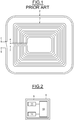
- devices of the prior art such as mobile phones may implement a first antenna for NFC and a second antenna for wireless charging such as illustrated on figure 1 .
- the first antenna 2 configured for NFC surrounds the second antenna 3 configured for Qi non contact power transfer.
- Both antennas 2, 3 comprise coils and two terminals 4, 5, 6 and 7.
- NFC devices use magnetic loop antennas for transferring information and Qi devices use magnetic loop antennas for transferring power from a power transmitter to a power receiver
- concurrent NFC and Qi operations are not possible in the prior art devices because the high voltage on the Qi antenna device interferes and degrades the performance of the NFC antenna device.
- the document EP3211805 discloses a first antenna collecting energy from a radio frequency signal receiver, and a second antenna dedicated to NFC communications signals.
- the first antenna has a first set of loops and the second antenna has a second set of loops. Both set of loops have a common part, reducing the implantation surface of the antennas.
- the first antenna is configured to operate according to the A4WP standard developed by the Alliance for Wireless Power.
- Various A4WP embodiments operate at 6.78 MHz, which is relatively close to frequencies used in NFC communications, typically 13.56 MHz.
- the power transfer signal corrupts thus the NFC signal and concurrent NFC and power transfer operations are not possible due to the close operating frequencies.
- the first antenna operates only as a receiving antenna.
- the Qi signal would corrupt the NFC communication if the first and second antennas operate concurrently NFC and Qi operations.
- an antenna device comprising two set of loops capable of operating concurrently to achieve NFC and wireless power transfer operations, in particular Qi operations.
- an antenna device for wireless power charging and/or near-field communication comprising two sets of electrically conductive loops, a first set of loops being configured to form a NFC antenna and the first and second sets of loops being configured to form together a wireless power charging antenna.
- the antenna device operating NFC and Qi operations saves space compared with the prior art.
- Said NFC antenna and said wireless power charging antenna are configured to be capable to operate concurrently.
- the antenna device can advantageously operate concurrently wireless power charging operations and NFC operations without corrupting the NFC signal.
- the second set of loops is surrounded by the first set of loops, the two sets of loops being connected together.
- the first and second sets of loops are configured to create a virtual ground.
- Such a virtual ground permits advantageously to avoid high voltage conditions.
- the virtual ground may be obtained for example by a symmetrical topology of the antenna device.
- the symmetrical topology of the antenna device creates a virtual ground avoiding high voltage conditions so that the NFC signal is not corrupted.
- the antenna device has a symmetrical topology.
- the second set of loops comprises a first part and second part and the first set of loops is connected between the said first and second parts.
- both sets of loops form a rectangle.
- Each end of both set of loops comprises a connecting point.
- the connecting points of the first set of loops are connected to loops of the second set of loops so that the loops of both sets of loops are connected in series.
- the connecting points of both set of loops are disposed symmetrically in relation to a center axis parallel to the larger dimension of the rectangle.
- the connecting points of the second set of loops are configured to be connected with terminals of a wireless power charging driver circuit and the connecting points of the first set of loops being configured to be connected with terminals of a NFC driver circuit.
- the first and second sets of loops are configured to share a same ground connection in order to form a voltage divider.
- the voltage difference at the output of the NFC antenna and the wireless power charging antenna is thus reduced so that the NFC antenna can operate in proximity of the wireless power charging antenna.
- both set of loops are connected in series and form an Archimedean spiral.
- Each end of the Archimedean spiral comprises a connecting point.
- the connecting point inside the Archimedean spiral is configured to be connected with a wireless power charging driver circuit
- the connecting point of both set of loops is configured to be connected with a NFC driver circuit
- the connecting point outside the Archimedean spiral is configured to be connected with a common ground of the driver circuits.
- the common ground connection reduces the high voltage on the Qi antenna connecting points so that the NFC signal is not corrupted.
- the NFC antenna is configured to communicate with a NFC circuit at a first frequency.
- the wireless power charging antenna is configured to communicate with a wireless power charging circuit at a second frequency.
- the second frequency is for example lower than the first frequency.
- the first frequency is for example equal to 13.56 MHz and the second frequency is for example in the range of 80 KHz to 300 KHz.
- the wireless power charging antenna is configured to operate according to the Qi standard.
- an apparatus comprising at least one antenna device as defined above, a wireless power charging driver circuit and a NFC driver circuit, the at least one antenna device being connected to the wireless power charging driver circuit and to the NFC driver circuit.
- the apparatus may operate as a power receiving device or as a power transmitter device.
- the apparatus may further comprise at least one conventional wireless power charging antenna connected to the wireless power charging driver circuit.
- Multiple antennas may be used to establish the best NFC and/or power transfer connection between reader and/or charging device and mobile device.
- a mobile phone is proposed, incorporating an apparatus as defined above.
- FIG 2 represents a mobile phone 8 incorporating an example of an apparatus 9 comprising an antenna device for wireless power charging and/or near-field communication "NFC" 10 connected to a wireless power charging driver circuit 11 and a NFC driver circuit 12.
- NFC near-field communication
- the apparatus 9 is incorporated in a mobile phone, the apparatus can be incorporated in any mobile device operating wireless power charging and/or near-field communication "NFC".
- NFC near-field communication
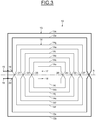
- FIGS 3 and 4 illustrate a first embodiment of the antenna device for wireless power charging and/or near-field communication "NFC" 10.
- the antenna device 10 comprises two sets of electrically conductive loops 13 and 14, a first set of loops 13 being configured to form a NFC antenna and the first 13 and second 14 sets of loops being configured to form together a wireless power charging antenna.
- the second set of loops 14 is surrounded by the first set of loops 13.
- the two sets of loops are connected together.
- the first and second sets of loops 13 and 14 form a rectangle.
- the first 13 and second 14 sets of loops comprise at each end a connecting point 15, 16, 17 and 18.
- the connecting points 17 and 18 of the second set of loops 14 are localized in the center of the second set of loops.
- the connecting points 15 and 16 of the first set of loops 13 are connected with terminals of a NFC driver circuit 12 and the connecting points 17 and 18 are connected with terminals of a wireless power charging driver circuit 11.
- the second set of loops 14 comprises a first part comprising three loops comprising half-loops 14a to 14f extending around the center of the antenna device 10 in a clockwise direction starting from the connecting point 17 to a connecting point 19, and a second part comprising half-loops 14g to 141 extending around the center of the antenna device 10 in a clockwise direction starting from a connecting point 20 at the free end of the half-loop 14g to the connecting point 17.
- the connecting points 19 and 20 are connected to the connecting points 15 and 16.
- the half-loop 14g cross over the half-loop 14f at point 21, the half-loop 14h cross under the half-loop 14e at point 22, the half-loop 14i cross over the half-loop 14d at point 23, the half-loop 14j cross under the half-loop 14c at point 24, the half-loop 14k cross over the half-loop 14b at point 25 and the half-loop 141 cross under the half-loop 14a at point 26.
- the first set of loops 13 comprises two loops comprising four half-loops 13a, 13b, 13c and 13d extending around the second set of loops 14 in a clockwise direction starting from the connecting point 19 to the connecting point 20.
- the half-loop 13c cross under the half-loop 13a at point 27.
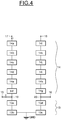
- the first set of loops 13 is connected between the first and second parts of the second set of loops 14.
- the connecting points 15 and 16 of the first set of loops are connected to loops 14f and 14g of the second set of loops 14 so that the loops of both sets of loops are connected in series.
- the connecting points 19 and 20 of both set of loops are disposed symmetrically in relation to a center axis A parallel to the larger dimension of the rectangle.
- the half-loops 14a and 141, 14b and 14k, 14c and 14j, 14d and 14i, 14e and 14h, 14f and 14g, 13a and 13d, 13b and 13c have the same length and are symmetrical with respect to the axis A.
- a current I flows in a current path from connecting point 17 to connecting point 18 via the half-loops 14a to 14f, 13a to 13d and 14g to 141 and a current I flows in a current path from connecting point 15 to connecting pint 16 via half-loops 13a to 13d.
- the half-loops 14a to 14f, 13a and 13b generate a magnetic field which is countered by a magnetic field generated by the half-loops 13c, 13d and 14g to 141.
- a virtual ground GND is created between the half-loops 13b and 13c avoiding high voltage conditions.
- the symmetrical topology of the antenna device creates a virtual ground avoiding high voltage conditions so that the NFC signal is not corrupted.
- the NFC antenna is configured to communicate with a NFC circuit at a first frequency and the wireless power charging antenna is configured to communicate with a wireless power charging circuit at a second frequency.
- the wireless power charging antenna can operate in a receiving or emitting mode.
- the first frequency is equal to 13.56 MHz and the second frequency is in the range of 80 KHz to 300 KHz.
- the NFC antenna and the wireless power charging antenna are capable to operate concurrently.
- the antenna device 10 can also operates as an NFC antenna or as a wireless power charging antenna.
- the first embodiment of the antenna device 10 is included in a square having a side equal to 53.5 mm and both antennas are made of a wire having a thickness of 2 mm.
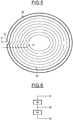
- FIGS 5 and 6 illustrate a second embodiment of the antenna device for wireless power charging and/or near-field communication "NFC" 10.
- the antenna device 10 comprises two sets of electrically conductive loops 28 and 29.
- a first set of loops 28 is configured to form a NFC antenna and the first 28 and second 29 sets of loops being configured to form together a wireless power charging antenna.
- the second set of loops 29 is surrounded by the first set of loops 28.
- the first set of loops 28 comprises at each end a connecting point 30 and 31, and the second set of loops is connected in series with the first set of loops 28 at the connecting point 30.
- the second set of loops 28 comprises a connecting point 32 at its free end.
- the first and second sets of loops form an Archimedean spiral, the connecting point 32 being inside the Archimedean spiral.
- the connecting point 32 inside the Archimedean spiral is connected with the wireless power charging driver circuit 11, the connecting point 30 of both set of loops is connected with a NFC driver circuit and the connecting point 31 outside the Archimedean spiral is connected with a common ground of the driver circuits 11 and 12.
- the wireless power charging antenna and the NFC antenna are sharing the same ground connection connected at point 31.
- the Archimedean spiral is acting as a voltage divider, the first part of the voltage divider being the first set of loops 28 and the second part of the voltage divider being the second set of loops 29.
- the NFC antenna is configured to communicate with a NFC circuit at the first frequency and the wireless power charging antenna is configured to communicate with a wireless power charging circuit at the second frequency.
- the wireless power charging antenna can operate in a receiving or emitting mode.
- the NFC antenna and the wireless power charging antenna are capable to operate concurrently.
- the antenna device 10 can also operates as an NFC antenna or as a wireless power charging antenna.
- the second embodiment of the antenna device 10 is included in a square having a side equal to 53.5 mm and both antennas are made of a wire having a thickness of 2 mm.
- the inductance value of the first set of loops 13, 28 is in the range 500 nH to 1.5 ⁇ H with a resistance in the range 0.2 ⁇ to 3 ⁇ , and the number of loops is preferably in the range 1 to 6.
- the inductance value of the second set of loops 14, 29 is in the range 6 ⁇ H to 24 ⁇ H with a resistance in the range 0.01 ⁇ to 0.2 ⁇ , and the number of loops is preferably in the range 12 to 24 according to the value of power to be transferred or received.
- the first embodiment of the antenna device 10 illustrated on figures 3 and 4 permits to transfer more power than the second embodiment of the antenna device illustrated on figures 5 and 6 .
- the mobile phone can comprise an antenna device 10 comprising at least one antenna device according to the first and/or second embodiment illustrated on figures 3 to 6 , and at least one NFC antenna device and/or Qi antenna device illustrated on figure 1 .
- Embodiments of the antenna device 10 comprising the first and second sets of loops 13, 14, 28 and 29 and the Qi antenna device 3 illustrated on figure 1 are described in what follows.
- a third embodiment of the antenna device 10 for wireless power charging and/or near-field communication "NFC" combining the first and second set of loops 28, 29 as illustrated on figures 5 and 6 with the second antenna 3 configured for Qi non contact power transfer is illustrated on figure 7 .
- the first and second sets of loops 28 and 29 form the Archimedean.
- the antenna device 10 further comprises three terminals 33, 34 and 35.
- the first terminal 33 is connected with the second terminal 7 of the second antenna 3, with the connecting point 31 outside the Archimedean spiral and with the common ground of the driver circuits 11 and 12.
- the second terminal 34 is connected with the wireless power charging driver circuit 11, with the connecting point 32 inside the Archimedean spiral and with the first terminal 6 of the second antenna 3.
- the third terminal 35 is connected with the NFC driver circuit 12.
- Figure 8 illustrates a fourth embodiment of the antenna device 10 for wireless power charging and/or near-field communication "NFC”.
- the antenna device 10 comprises the second antenna 3 configured for Qi non contact power transfer and the first and second sets of loops 13 and 14 forming a rectangle.
- the antenna device 10 further comprises two terminals 36 and 37.
- the first terminal 36 is connected with the second terminal 7 of the second antenna 3, with the connecting point 18 of the second set of loops 14 and with the wireless power charging driver circuit 11.
- the second terminal 37 is connected with the wireless power charging driver circuit 11, with the connecting point 17 of the second set of loops 14 and with the first terminal 6 of the second antenna 3.
- the connecting points 15 and 16 of the first set of loops are connected with the NFC driver circuit 12.
- the antenna device 10 comprises the first antenna 2 and/or the second antenna 3 and at least the first and second sets of loops in a rectangular form or forming an Archimedean.
- Conventional antennas could be combined with at least one antenna device for wireless power charging and/or near-field communication "NFC" to interoperate with various mobile device antennas.
- NFC near-field communication
- Multiple antennas could be used to establish the best NFC connection between a reader and the mobile device 8 due to different NFC antennas location in the mobile device 8.
- the antenna device for wireless power charging and/or near-field communication "NFC” can be used on power transmitter and power receiver devices.
Landscapes
- Engineering & Computer Science (AREA)
- Computer Networks & Wireless Communication (AREA)
- Signal Processing (AREA)
- Power Engineering (AREA)
- Charge And Discharge Circuits For Batteries Or The Like (AREA)
- Near-Field Transmission Systems (AREA)
Abstract
The antenna device (10) for wireless power charging and/or near-field communication "NFC" comprises two sets (13, 14) of electrically conductive loops, a first set (13) of loops being configured to form a NFC antenna and the first and second (14) sets of loops being configured to form together a wireless power charging antenna.
Description
- Various embodiments of the invention relate to antennas for communications apparatus, in particular antennas for near-field communications (NFC ("Near Field Communication")) and Wireless Power Transfer, for example the one meeting the requirements of the Qi standard.
- Near field communication, better known to those skilled in the art under the name NFC (Near Field Communication), is a wireless connectivity technology that allows communication over a short distance, for example 10 cm, between electronic devices, such as contactless smart cards or tags, and readers.
- More generally, NFC technology is a technology standardized by the NFC Forum consortium.
- NFC technology is particularly suitable for connecting any type of user device and allows for quick and easy communications.
- NFC technology is an open standard technology platform defined in ISO / IEC 18092 and ISO / IEC 21481 but incorporates many existing standards such as the Type A and Type B protocols defined in ISO-14443 which can be communication protocols that can be used in NFC technology.
- When transmitting information between a reader and an electronic device transponder, the reader generates a magnetic field via its antenna which is generally in the standards conventionally used, a sine wave (the carrier) at 13.56 MHz.
- Wireless Power transfer technology enables contactless transfer of energy from a power source (eg a charger) to a load or receiver, for example a wireless communication device, such as a telephone cellular mobile, through the air gap separating the charger and the receiver, for example to recharge a battery thereof.
- Among the various non-contact charging standards that exist, mention may be made of the Qi standard developed by the "Wireless Power Consortium" (WPC), well known to those skilled in the art, and in particular the low power version ("low power") currently deliver power up to 15W.
- For all intents and purposes, those skilled in the art may refer to the WPC document entitled "The Qi Wireless Power Transfer System Power Class 0 Specification" parts1-4, Version 1.2.4, February 2018.
- In short, the non-contact energy is transferred from a base station or transmitter to a receiver magnetically coupled to the transmitter via, for example, coils.
- The energy transfer is based on a magnetic field generated by the transmitter and captured by the receiver via a resonant inductive coupling.
- The Qi standard allows different techniques (topologies) to generate the magnetic field on the transmitter side. But, this magnetic field is always an oscillating field and the frequency range of the signal generated by the charger to transfer energy is between 80 KHz and 300 KHz. This signal, which is used to transfer the energy to the receiver, is also called the carrier signal because it can be also used, via modulation, for the exchange, between the transmitter and the receiver, of information relating in particular to the level of transmission of energy required by the receiver.
- The receiver converts this magnetic field into an electrical potential used to charge the batteries or power a device.
- In general, devices of the prior art such as mobile phones may implement a first antenna for NFC and a second antenna for wireless charging such as illustrated on
figure 1 . - The
first antenna 2 configured for NFC surrounds thesecond antenna 3 configured for Qi non contact power transfer. - Both
antennas terminals - However, the location of two dedicated antennas for NFC and Qi in a mobile device such a mobile phone needs a large surface which is not always available or leads to compromises which can degrade the mobile phone performances.
- Further although NFC devices use magnetic loop antennas for transferring information and Qi devices use magnetic loop antennas for transferring power from a power transmitter to a power receiver, concurrent NFC and Qi operations are not possible in the prior art devices because the high voltage on the Qi antenna device interferes and degrades the performance of the NFC antenna device.
- Moreover, in case of a small NFC antenna on the receiver side, the performance of NFC is degraded.
- The document
EP3211805 discloses a first antenna collecting energy from a radio frequency signal receiver, and a second antenna dedicated to NFC communications signals. - The first antenna has a first set of loops and the second antenna has a second set of loops. Both set of loops have a common part, reducing the implantation surface of the antennas.
- The first antenna is configured to operate according to the A4WP standard developed by the Alliance for Wireless Power.
- Various A4WP embodiments operate at 6.78 MHz, which is relatively close to frequencies used in NFC communications, typically 13.56 MHz. The power transfer signal corrupts thus the NFC signal and concurrent NFC and power transfer operations are not possible due to the close operating frequencies.
- Moreover, the first antenna operates only as a receiving antenna.
- In addition, due to high voltage, the Qi signal would corrupt the NFC communication if the first and second antennas operate concurrently NFC and Qi operations.
- There is a need for an antenna device able to concurrently operate NFC and wireless power transfer operations in particular Qi operations without corrupting the NFC signal and being used for transmitter and receiver apparatus.
- According to implementations and embodiments, it is advantageously proposed an antenna device comprising two set of loops capable of operating concurrently to achieve NFC and wireless power transfer operations, in particular Qi operations.
- According to an aspect, an antenna device for wireless power charging and/or near-field communication "NFC" is proposed, comprising two sets of electrically conductive loops, a first set of loops being configured to form a NFC antenna and the first and second sets of loops being configured to form together a wireless power charging antenna.
- Contrary to the prior art in which the antennas share only some loops, all the loops of the NFC antenna are used to form with the second set of loops the said wireless power charging antenna.
- The antenna device operating NFC and Qi operations saves space compared with the prior art.
- Said NFC antenna and said wireless power charging antenna are configured to be capable to operate concurrently.
- The antenna device can advantageously operate concurrently wireless power charging operations and NFC operations without corrupting the NFC signal.
- According to an embodiment, the second set of loops is surrounded by the first set of loops, the two sets of loops being connected together.
- According to a variant, the first and second sets of loops are configured to create a virtual ground.
- Such a virtual ground permits advantageously to avoid high voltage conditions.
- Thus the NFC signal is not corrupted with wireless power transfer operations.
- The virtual ground may be obtained for example by a symmetrical topology of the antenna device.
- In other words, the symmetrical topology of the antenna device creates a virtual ground avoiding high voltage conditions so that the NFC signal is not corrupted.
- According to an embodiment, the antenna device has a symmetrical topology.
- According to an embodiment, the second set of loops comprises a first part and second part and the first set of loops is connected between the said first and second parts.
- According to an embodiment, both sets of loops form a rectangle.
- Each end of both set of loops comprises a connecting point.
- The connecting points of the first set of loops are connected to loops of the second set of loops so that the loops of both sets of loops are connected in series.
- The connecting points of both set of loops are disposed symmetrically in relation to a center axis parallel to the larger dimension of the rectangle.
- The connecting points of the second set of loops are configured to be connected with terminals of a wireless power charging driver circuit and the connecting points of the first set of loops being configured to be connected with terminals of a NFC driver circuit.
- According to another variant, the first and second sets of loops are configured to share a same ground connection in order to form a voltage divider.
- The voltage difference at the output of the NFC antenna and the wireless power charging antenna is thus reduced so that the NFC antenna can operate in proximity of the wireless power charging antenna.
- According to an embodiment, both set of loops are connected in series and form an Archimedean spiral.
- Each end of the Archimedean spiral comprises a connecting point.
- The connecting point inside the Archimedean spiral is configured to be connected with a wireless power charging driver circuit, the connecting point of both set of loops is configured to be connected with a NFC driver circuit and the connecting point outside the Archimedean spiral is configured to be connected with a common ground of the driver circuits.
- The common ground connection reduces the high voltage on the Qi antenna connecting points so that the NFC signal is not corrupted.
- According to an embodiment, the NFC antenna is configured to communicate with a NFC circuit at a first frequency.
- According to an embodiment, the wireless power charging antenna is configured to communicate with a wireless power charging circuit at a second frequency.
- The second frequency is for example lower than the first frequency.
- The first frequency is for example equal to 13.56 MHz and the second frequency is for example in the range of 80 KHz to 300 KHz.
- In other words, the wireless power charging antenna is configured to operate according to the Qi standard.
- The fact that the first and second frequencies are far enough apart from each other, contribute to the fact that the NFC antenna and the Qi antenna are capable to operate concurrently.
- According to another aspect, an apparatus is proposed, comprising at least one antenna device as defined above, a wireless power charging driver circuit and a NFC driver circuit, the at least one antenna device being connected to the wireless power charging driver circuit and to the NFC driver circuit.
- The apparatus may operate as a power receiving device or as a power transmitter device.
- The apparatus may further comprise at least one conventional wireless power charging antenna connected to the wireless power charging driver circuit.
- Multiple antennas may be used to establish the best NFC and/or power transfer connection between reader and/or charging device and mobile device.
- According to another aspect, a mobile phone is proposed, incorporating an apparatus as defined above.
- Other advantages and features of the invention will appear on examination of the detailed description of embodiments, in no way restrictive, and the appended drawings in which:
-
Figure 1 , previously described, illustrates an NFC and Qi antenna devices cording to the prior art; and -
Figures 2 to 8 illustrate particular embodiments of the invention. - Reference is made to
figure 2 which represents amobile phone 8 incorporating an example of anapparatus 9 comprising an antenna device for wireless power charging and/or near-field communication "NFC" 10 connected to a wireless power chargingdriver circuit 11 and aNFC driver circuit 12. - Although the
apparatus 9 is incorporated in a mobile phone, the apparatus can be incorporated in any mobile device operating wireless power charging and/or near-field communication "NFC". -
Figures 3 and4 illustrate a first embodiment of the antenna device for wireless power charging and/or near-field communication "NFC" 10. - The
antenna device 10 comprises two sets of electricallyconductive loops loops 13 being configured to form a NFC antenna and the first 13 and second 14 sets of loops being configured to form together a wireless power charging antenna. - The second set of
loops 14 is surrounded by the first set ofloops 13. The two sets of loops are connected together. - The first and second sets of
loops - The first 13 and second 14 sets of loops comprise at each end a connecting
point - The connecting points 17 and 18 of the second set of
loops 14 are localized in the center of the second set of loops. - The connecting points 15 and 16 of the first set of
loops 13 are connected with terminals of aNFC driver circuit 12 and the connectingpoints driver circuit 11. - The second set of
loops 14 comprises a first part comprising three loops comprising half-loops 14a to 14f extending around the center of theantenna device 10 in a clockwise direction starting from the connectingpoint 17 to a connectingpoint 19, and a second part comprising half-loops 14g to 141 extending around the center of theantenna device 10 in a clockwise direction starting from a connectingpoint 20 at the free end of the half-loop 14g to the connectingpoint 17. - The connecting points 19 and 20 are connected to the connecting
points - The half-
loop 14g cross over the half-loop 14f at point 21, the half-loop 14h cross under the half-loop 14e atpoint 22, the half-loop 14i cross over the half-loop 14d atpoint 23, the half-loop 14j cross under the half-loop 14c atpoint 24, the half-loop 14k cross over the half-loop 14b atpoint 25 and the half-loop 141 cross under the half-loop 14a atpoint 26. - The first set of
loops 13 comprises two loops comprising four half-loops loops 14 in a clockwise direction starting from the connectingpoint 19 to the connectingpoint 20. - The half-
loop 13c cross under the half-loop 13a atpoint 27. - As illustrated on
figure 4 , the first set ofloops 13 is connected between the first and second parts of the second set ofloops 14. - The connecting points 15 and 16 of the first set of loops are connected to
loops loops 14 so that the loops of both sets of loops are connected in series. - The connecting points 19 and 20 of both set of loops are disposed symmetrically in relation to a center axis A parallel to the larger dimension of the rectangle.
- The half-
loops - During NFC and Qi operations, a current I flows in a current path from connecting
point 17 to connectingpoint 18 via the half-loops 14a to 14f, 13a to 13d and 14g to 141 and a current I flows in a current path from connectingpoint 15 to connectingpint 16 via half-loops 13a to 13d. - The half-
loops 14a to 14f, 13a and 13b generate a magnetic field which is countered by a magnetic field generated by the half-loops - A virtual ground GND is created between the half-
loops - The symmetrical topology of the antenna device creates a virtual ground avoiding high voltage conditions so that the NFC signal is not corrupted.
- The NFC antenna is configured to communicate with a NFC circuit at a first frequency and the wireless power charging antenna is configured to communicate with a wireless power charging circuit at a second frequency.
- The wireless power charging antenna can operate in a receiving or emitting mode.
- The first frequency is equal to 13.56 MHz and the second frequency is in the range of 80 KHz to 300 KHz.
- Due to
symmetrical antenna device 10 topology and as the first and second frequencies are far enough apart from each other, the NFC antenna and the wireless power charging antenna are capable to operate concurrently. - The
antenna device 10 can also operates as an NFC antenna or as a wireless power charging antenna. - For example, the first embodiment of the
antenna device 10 is included in a square having a side equal to 53.5 mm and both antennas are made of a wire having a thickness of 2 mm. -
Figures 5 and 6 illustrate a second embodiment of the antenna device for wireless power charging and/or near-field communication "NFC" 10. - The
antenna device 10 comprises two sets of electricallyconductive loops loops 28 is configured to form a NFC antenna and the first 28 and second 29 sets of loops being configured to form together a wireless power charging antenna. - The second set of
loops 29 is surrounded by the first set ofloops 28. - The first set of
loops 28 comprises at each end a connectingpoint loops 28 at the connectingpoint 30. - The second set of
loops 28 comprises a connectingpoint 32 at its free end. - The first and second sets of loops form an Archimedean spiral, the connecting
point 32 being inside the Archimedean spiral. - The connecting
point 32 inside the Archimedean spiral is connected with the wireless power chargingdriver circuit 11, the connectingpoint 30 of both set of loops is connected with a NFC driver circuit and the connectingpoint 31 outside the Archimedean spiral is connected with a common ground of thedriver circuits - The wireless power charging antenna and the NFC antenna are sharing the same ground connection connected at
point 31. - The Archimedean spiral is acting as a voltage divider, the first part of the voltage divider being the first set of
loops 28 and the second part of the voltage divider being the second set ofloops 29. - Thus the voltage difference at the output of the NFC antenna and the wireless power charging antenna is reduced so that the NFC antenna can operate in proximity of the wireless power charging antenna.
- The NFC antenna is configured to communicate with a NFC circuit at the first frequency and the wireless power charging antenna is configured to communicate with a wireless power charging circuit at the second frequency.
- The wireless power charging antenna can operate in a receiving or emitting mode.
- Due to the same ground connection of both antennas and as the first and second frequencies are far enough apart from each other, the NFC antenna and the wireless power charging antenna are capable to operate concurrently.
- The
antenna device 10 can also operates as an NFC antenna or as a wireless power charging antenna. - For example the second embodiment of the
antenna device 10 is included in a square having a side equal to 53.5 mm and both antennas are made of a wire having a thickness of 2 mm. - The inductance value of the first set of
loops - The inductance value of the second set of
loops range 6 µH to 24 µH with a resistance in the range 0.01 Ω to 0.2 Ω, and the number of loops is preferably in therange 12 to 24 according to the value of power to be transferred or received. - The first embodiment of the
antenna device 10 illustrated onfigures 3 and4 permits to transfer more power than the second embodiment of the antenna device illustrated onfigures 5 and 6 . - In other embodiments, the mobile phone can comprise an
antenna device 10 comprising at least one antenna device according to the first and/or second embodiment illustrated onfigures 3 to 6 , and at least one NFC antenna device and/or Qi antenna device illustrated onfigure 1 . - Embodiments of the
antenna device 10 comprising the first and second sets ofloops Qi antenna device 3 illustrated onfigure 1 are described in what follows. - A third embodiment of the
antenna device 10 for wireless power charging and/or near-field communication "NFC" combining the first and second set ofloops figures 5 and 6 with thesecond antenna 3 configured for Qi non contact power transfer is illustrated onfigure 7 . - The first and second sets of
loops - The
antenna device 10 further comprises threeterminals - The
first terminal 33 is connected with thesecond terminal 7 of thesecond antenna 3, with the connectingpoint 31 outside the Archimedean spiral and with the common ground of thedriver circuits - The
second terminal 34 is connected with the wireless power chargingdriver circuit 11, with the connectingpoint 32 inside the Archimedean spiral and with thefirst terminal 6 of thesecond antenna 3. - The
third terminal 35 is connected with theNFC driver circuit 12. -
Figure 8 illustrates a fourth embodiment of theantenna device 10 for wireless power charging and/or near-field communication "NFC". - The
antenna device 10 comprises thesecond antenna 3 configured for Qi non contact power transfer and the first and second sets ofloops - The
antenna device 10 further comprises twoterminals - The
first terminal 36 is connected with thesecond terminal 7 of thesecond antenna 3, with the connectingpoint 18 of the second set ofloops 14 and with the wireless power chargingdriver circuit 11. - The
second terminal 37 is connected with the wireless power chargingdriver circuit 11, with the connectingpoint 17 of the second set ofloops 14 and with thefirst terminal 6 of thesecond antenna 3. - The connecting points 15 and 16 of the first set of loops are connected with the
NFC driver circuit 12. - In another embodiment, the
antenna device 10 comprises thefirst antenna 2 and/or thesecond antenna 3 and at least the first and second sets of loops in a rectangular form or forming an Archimedean. - Conventional antennas could be combined with at least one antenna device for wireless power charging and/or near-field communication "NFC" to interoperate with various mobile device antennas.
- Multiple antennas could be used to establish the best NFC connection between a reader and the
mobile device 8 due to different NFC antennas location in themobile device 8. - Advantageously, the antenna device for wireless power charging and/or near-field communication "NFC" can be used on power transmitter and power receiver devices.
Claims (16)
- Antenna device (10) for wireless power charging and/or near-field communication "NFC" comprising two sets (13, 14, 28, 29) of electrically conductive loops, a first set (13, 28) of loops being configured to form a NFC antenna and the first and second (14, 29) sets of loops being configured to form together a wireless power charging antenna.
- Antenna device according to claim 1, wherein said NFC antenna and said wireless power charging antenna are configured to be capable to operate concurrently.
- Antenna device according to claim 1 or 2, wherein the second set (14, 29) of loops is surrounded by the first set (13, 28) of loops, the two sets of loops being connected together.
- Antenna device according to claim 3, wherein the first and second sets (13, 14) of loops are configured to create a virtual ground (GND).
- Antenna device according to claim 4, having a symmetrical topology.
- Antenna device according to anyone of claims 3 to 5, wherein the second set (14) of loops comprises a first part (14a, 14b, 14c, 14d, 14e, 14f) and second part (14g, 14h, 14i, 14j, 14k, 141), and the first set (13) of loops is connected between the said first and second parts.
- Antenna device according to claim 6, in which both set (13, 14) of loops form a rectangle, each end of both set of loops comprising a connecting point (15, 16, 17, 18), the connecting points (15, 16) of the first set (13) of loops being connected to loops of the second set (14) of loops so that the loops of both sets of loops are connected in series, the connecting points (19, 20) of both set of loops being disposed symmetrically in relation to a center axis (A) parallel to the larger dimension of the rectangle, the connecting points (17, 18) of the second set of loops being configured to be connected with terminals of a wireless power charging driver circuit (11) and the connecting points (of the first set of loops being configured to be connected with terminals of a NFC driver circuit.
- Antenna device according to claim 3, wherein the first and second sets of loops are configured to share a same ground connection in order to form a voltage divider.
- Antenna device according to claim 8, in which both set (28, 29) of loops are connected in series and form an Archimedean spiral, each end of the Archimedean spiral comprising a connecting point (30, 31), the connecting point (31) inside the Archimedean spiral being configured to be connected with a wireless power charging driver circuit (11), the connecting point (29) of both set of loops being configured to be connected with a NFC driver circuit (12) and the connecting point (30) outside the Archimedean spiral being configured to be connected with a common ground of the driver circuits.
- Antenna device according to any one of the preceding claims, wherein the NFC antenna is configured to communicate with a NFC circuit (12) at a first frequency.
- Antenna device according to any one of the preceding claims, wherein the wireless power charging antenna is configured to communicate with a wireless power charging circuit (11) at a second frequency.
- Antenna device according to claims 10 and 11, wherein the second frequency is lower than the first frequency.
- Antenna device according to claim 12, wherein the first frequency is equal to 13.56 MHz and the second frequency is in the range of 80 KHz to 300 KHz.
- Apparatus (9) comprising at least one antenna device (10) according to any one of the preceding claims, a wireless power charging driver circuit (11) and a NFC driver circuit (12), the at least one antenna device being connected to the wireless power charging driver circuit and to the NFC driver circuit.
- Apparatus according to claim 14, further comprising at least one conventional wireless power charging antenna (3) connected to the wireless power charging driver circuit (11).
- Mobile phone incorporating an apparatus according to any one of claims 14 and 15.
Priority Applications (5)
| Application Number | Priority Date | Filing Date | Title |
|---|---|---|---|
| EP19162763.7A EP3709524A1 (en) | 2019-03-14 | 2019-03-14 | Antenna device and associated apparatus |
| US16/809,757 US20200295804A1 (en) | 2019-03-14 | 2020-03-05 | Antenna device and associated apparatus |
| CN202010176906.4A CN111697316A (en) | 2019-03-14 | 2020-03-13 | Antenna apparatus and associated devices |
| CN202020314121.4U CN212011275U (en) | 2019-03-14 | 2020-03-13 | Antenna devices for wireless power charging and near field communication |
| US17/585,005 US20220149895A1 (en) | 2019-03-14 | 2022-01-26 | Antenna device and associated apparatus |
Applications Claiming Priority (1)
| Application Number | Priority Date | Filing Date | Title |
|---|---|---|---|
| EP19162763.7A EP3709524A1 (en) | 2019-03-14 | 2019-03-14 | Antenna device and associated apparatus |
Publications (1)
| Publication Number | Publication Date |
|---|---|
| EP3709524A1 true EP3709524A1 (en) | 2020-09-16 |
Family
ID=65812168
Family Applications (1)
| Application Number | Title | Priority Date | Filing Date |
|---|---|---|---|
| EP19162763.7A Withdrawn EP3709524A1 (en) | 2019-03-14 | 2019-03-14 | Antenna device and associated apparatus |
Country Status (3)
| Country | Link |
|---|---|
| US (2) | US20200295804A1 (en) |
| EP (1) | EP3709524A1 (en) |
| CN (2) | CN212011275U (en) |
Citations (3)
| Publication number | Priority date | Publication date | Assignee | Title |
|---|---|---|---|---|
| CN103199333A (en) * | 2013-03-27 | 2013-07-10 | 上海安费诺永亿通讯电子有限公司 | Antenna module supporting near field communication (NFC) and wireless power consortium (WPC) multiplexing |
| US20150091502A1 (en) * | 2013-10-01 | 2015-04-02 | Texas Instruments Incorporated | Shared antenna solution for wireless charging and near field communication |
| EP3211805A1 (en) | 2016-02-25 | 2017-08-30 | Nxp B.V. | Antenna apparatusses and approaches therefor |
Family Cites Families (7)
| Publication number | Priority date | Publication date | Assignee | Title |
|---|---|---|---|---|
| TW201316643A (en) * | 2011-10-12 | 2013-04-16 | Tdk Taiwan Corp | Sharing induction module of near field communication and cordless charging |
| KR101532052B1 (en) * | 2013-08-29 | 2015-06-29 | 주식회사 이랜텍 | Antenna patch comprising common terminals for wireless charging and nfc communication |
| KR20170005670A (en) * | 2015-07-06 | 2017-01-16 | 엘지이노텍 주식회사 | Wiress antenna for wireless charging and nfc communication, and wireless device having the same |
| CN205609738U (en) * | 2016-04-29 | 2016-09-28 | 青岛海信移动通信技术股份有限公司 | Antenna and wearable equipment of wrist strap formula |
| KR102649484B1 (en) * | 2017-01-18 | 2024-03-20 | 주식회사 위츠 | Double loop antenna |
| EP3447929A1 (en) * | 2017-08-23 | 2019-02-27 | Continental Automotive GmbH | 3-d nfc antenna integration in wireless charger |
| CN208240876U (en) * | 2018-05-23 | 2018-12-14 | 深圳市海德门电子有限公司 | NFC and wireless charging two-in-one antenna device and module |
-
2019
- 2019-03-14 EP EP19162763.7A patent/EP3709524A1/en not_active Withdrawn
-
2020
- 2020-03-05 US US16/809,757 patent/US20200295804A1/en not_active Abandoned
- 2020-03-13 CN CN202020314121.4U patent/CN212011275U/en active Active
- 2020-03-13 CN CN202010176906.4A patent/CN111697316A/en active Pending
-
2022
- 2022-01-26 US US17/585,005 patent/US20220149895A1/en not_active Abandoned
Patent Citations (3)
| Publication number | Priority date | Publication date | Assignee | Title |
|---|---|---|---|---|
| CN103199333A (en) * | 2013-03-27 | 2013-07-10 | 上海安费诺永亿通讯电子有限公司 | Antenna module supporting near field communication (NFC) and wireless power consortium (WPC) multiplexing |
| US20150091502A1 (en) * | 2013-10-01 | 2015-04-02 | Texas Instruments Incorporated | Shared antenna solution for wireless charging and near field communication |
| EP3211805A1 (en) | 2016-02-25 | 2017-08-30 | Nxp B.V. | Antenna apparatusses and approaches therefor |
Non-Patent Citations (1)
| Title |
|---|
| THE QI WIRELESS POWER TRANSFER SYSTEM POWER CLASS 0 SPECIFICATION, February 2018 (2018-02-01) |
Also Published As
| Publication number | Publication date |
|---|---|
| US20200295804A1 (en) | 2020-09-17 |
| US20220149895A1 (en) | 2022-05-12 |
| CN212011275U (en) | 2020-11-24 |
| CN111697316A (en) | 2020-09-22 |
Similar Documents
| Publication | Publication Date | Title |
|---|---|---|
| EP3007364B1 (en) | Nfc communicators | |
| EP2213011B1 (en) | Transceiving circuit for contactless communication | |
| US9124121B2 (en) | Combined antenna and inductive power receiver | |
| US9755460B2 (en) | Power reception device, power transmission device and wireless power transmission system | |
| CN106299677B (en) | Near field communication antenna and near field communication device having the same | |
| US20110018358A1 (en) | Contactless power supplying communication apparatus, contactless power receiving communication apparatus, power supplying communication controlling method and power receiving communication controlling method | |
| EP1966852B1 (en) | Radio receiver, radio transmitter, and hearing aid | |
| CN101719558B (en) | Battery pack and information processing apparatus | |
| CN110350311B (en) | NFC Antennas in Mobile Devices | |
| KR20120103501A (en) | Power-receiving device, wireless power-feeding system including power-receiving device, and wireless communication system including power-receiving device | |
| KR101505456B1 (en) | Structure of switched dual mode NFC/WPT antenna | |
| CN104604077A (en) | Non-contact charging device and non-contact power supply system using the non-contact charging device | |
| KR101968615B1 (en) | Apparatus and method for useing near field communication and wireless power transmission | |
| US12040850B2 (en) | Near-field communication device | |
| CN109980759B (en) | Method for managing contactless communication and contactless charging within a system and corresponding system | |
| US20130260803A1 (en) | Wireless communication system | |
| CN106910986B (en) | Multi-resonance ultra-wideband NFC antenna system | |
| CN110247684B (en) | Wireless device | |
| US10903562B2 (en) | Batteries as antenna for device | |
| CN208589547U (en) | Antenna devices and electronic equipment | |
| US20220149895A1 (en) | Antenna device and associated apparatus | |
| CN203104423U (en) | Multi-band antenna circuit and mobile terminal | |
| CN104124990A (en) | Terminal equipment with near field communication and wireless charging functions | |
| CN201490334U (en) | Near field communication antenna device | |
| US20260039330A1 (en) | Vehicle communication device with passive selection circuit |
Legal Events
| Date | Code | Title | Description |
|---|---|---|---|
| PUAI | Public reference made under article 153(3) epc to a published international application that has entered the european phase |
Free format text: ORIGINAL CODE: 0009012 |
|
| STAA | Information on the status of an ep patent application or granted ep patent |
Free format text: STATUS: THE APPLICATION HAS BEEN PUBLISHED |
|
| AK | Designated contracting states |
Kind code of ref document: A1 Designated state(s): AL AT BE BG CH CY CZ DE DK EE ES FI FR GB GR HR HU IE IS IT LI LT LU LV MC MK MT NL NO PL PT RO RS SE SI SK SM TR |
|
| AX | Request for extension of the european patent |
Extension state: BA ME |
|
| STAA | Information on the status of an ep patent application or granted ep patent |
Free format text: STATUS: THE APPLICATION IS DEEMED TO BE WITHDRAWN |
|
| 18D | Application deemed to be withdrawn |
Effective date: 20210317 |