EP3708628B1 - Verwendung eines klebebands zum befestigen von leitungen insbesondere auf untergründen wie die innenraum dekorteile eines pkws, insbesondere dachhimmel, türseitenteil, kofferraumdeckel - Google Patents
Verwendung eines klebebands zum befestigen von leitungen insbesondere auf untergründen wie die innenraum dekorteile eines pkws, insbesondere dachhimmel, türseitenteil, kofferraumdeckel Download PDFInfo
- Publication number
- EP3708628B1 EP3708628B1 EP20162571.2A EP20162571A EP3708628B1 EP 3708628 B1 EP3708628 B1 EP 3708628B1 EP 20162571 A EP20162571 A EP 20162571A EP 3708628 B1 EP3708628 B1 EP 3708628B1
- Authority
- EP
- European Patent Office
- Prior art keywords
- adhesive
- component
- resins
- weight
- crosslinkers
- Prior art date
- Legal status (The legal status is an assumption and is not a legal conclusion. Google has not performed a legal analysis and makes no representation as to the accuracy of the status listed.)
- Active
Links
Images
Classifications
-
- C—CHEMISTRY; METALLURGY
- C09—DYES; PAINTS; POLISHES; NATURAL RESINS; ADHESIVES; COMPOSITIONS NOT OTHERWISE PROVIDED FOR; APPLICATIONS OF MATERIALS NOT OTHERWISE PROVIDED FOR
- C09J—ADHESIVES; NON-MECHANICAL ASPECTS OF ADHESIVE PROCESSES IN GENERAL; ADHESIVE PROCESSES NOT PROVIDED FOR ELSEWHERE; USE OF MATERIALS AS ADHESIVES
- C09J7/00—Adhesives in the form of films or foils
- C09J7/20—Adhesives in the form of films or foils characterised by their carriers
- C09J7/21—Paper; Textile fabrics
-
- C—CHEMISTRY; METALLURGY
- C09—DYES; PAINTS; POLISHES; NATURAL RESINS; ADHESIVES; COMPOSITIONS NOT OTHERWISE PROVIDED FOR; APPLICATIONS OF MATERIALS NOT OTHERWISE PROVIDED FOR
- C09J—ADHESIVES; NON-MECHANICAL ASPECTS OF ADHESIVE PROCESSES IN GENERAL; ADHESIVE PROCESSES NOT PROVIDED FOR ELSEWHERE; USE OF MATERIALS AS ADHESIVES
- C09J7/00—Adhesives in the form of films or foils
- C09J7/30—Adhesives in the form of films or foils characterised by the adhesive composition
- C09J7/38—Pressure-sensitive adhesives [PSA]
- C09J7/381—Pressure-sensitive adhesives [PSA] based on macromolecular compounds obtained by reactions involving only carbon-to-carbon unsaturated bonds
- C09J7/385—Acrylic polymers
-
- C—CHEMISTRY; METALLURGY
- C09—DYES; PAINTS; POLISHES; NATURAL RESINS; ADHESIVES; COMPOSITIONS NOT OTHERWISE PROVIDED FOR; APPLICATIONS OF MATERIALS NOT OTHERWISE PROVIDED FOR
- C09J—ADHESIVES; NON-MECHANICAL ASPECTS OF ADHESIVE PROCESSES IN GENERAL; ADHESIVE PROCESSES NOT PROVIDED FOR ELSEWHERE; USE OF MATERIALS AS ADHESIVES
- C09J2433/00—Presence of (meth)acrylic polymer
Definitions
- the invention relates to the use of an adhesive tape for attaching cables, in particular to surfaces such as the interior decorative parts of a car, in particular the headliner, door side panel, trunk lid.
- round and flat cables are used to transmit electronic impulses or to supply consumers.
- the flat cables are predominantly either copper strips laminated together with foil (FFC) or conductor tracks in the form of thin, flexible printed circuits (FPC). Due to the increasing number of electrical and electronic components, the number of cables required is also constantly increasing.
- a technically simple solution is the use of adhesive tapes with adhesive on one or both sides, which are cut to length and applied over the cables or cable harnesses to be fixed and which thus fix the cables to the respective surface, for example the roof lining.
- Headlinings usually have a rough surface. Therefore, a high initial adhesion and surface wetting is necessary, for which a suitable and optimized adhesive must be selected.
- the wearer can support attachment as the Pressure must be passed on well by the carrier to the surface in order to achieve good wetting.
- the application requirements must also be met. This mainly involves static loads. In order to withstand these loads, relatively high fleece weights are required in order to be able to absorb and distribute the loads well. It is also important that the adhesive has repulsion resistance in order to be able to provide support here.
- Nonwovens that have a relatively high grammage have proven to be advantageous as carriers. They are then able to absorb and dissipate the loads that occur well.
- an adhesive is required that has good initial, good final and lasting adhesion.
- Shear-resistant, resin-mixed or water-based acrylate adhesives have already proven their worth in order to ensure secure, permanent attachment of cables in the headliner of a car even under difficult conditions, i.e. for the life of the car under the influence of temperature and humidity.
- processability is crucial.
- the application to the substrate is important, as is the ability to dispense it with a dispenser.
- simple dispensers are used, among other things, in which the adhesive tape is torn manually over a blade.
- Adhesive tapes with non-woven backings with high surface weights do not produce a clean and straight tear-off edge; the tear-off edge frays, which is not acceptable to the user. In such cases, complex, automatic or semi-automatic dispensers are necessary.
- An adhesive tape that is used to fix cables to the roof lining is the tesa ® 50118 adhesive tape. This consists of a needle felt made of PET that is coated with an acrylate adhesive.
- adhesive tapes with very thin spunbond backings are offered, which have a basis weight of, for example, 25 g/m 2 . However, these do not provide sufficient dampening.
- Adhesive tapes with a spunbond as a carrier are generally known. These are used, for example, for bandaging cable harnesses. That's how it describes DE 195 23 494 A1 a self-adhesive tape for bandaging cable harnesses with a band-shaped textile carrier made of spunbond.
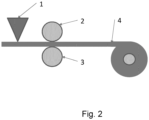
- the fleece used according to the invention is a spunbond made of polypropylene, which is thermally consolidated and embossed using a calender, the embossing roller having an embossing area of 10% to 30%, preferably 19%.
- the adhesive tape shows good hand tearing properties and good rolling properties due to its special design.
- Spunbonds are textile fabrics that consist of directly extruded or jet-spun chemical threads, the filaments of which are stretched, opened, tangled and mechanically, thermally or chemically solidified into a fleece in the same operation.
- Continuous filaments are produced from a polymer melt through a spinneret using a stream of hot air, which are placed on a conveyor belt.
- the swirling of the endless filaments creates a fleece when deposited.
- To solidify the fleece it is then thermally solidified, preferably using a heated calender.
- Different embossing geometries can be used, for example diamond or rice grain patterns.
- the solidification after the continuous filaments have been deposited can also be carried out using air or water jets.
- a “textile character” can be achieved much better Fleece can be produced than by calendering, since the water jets do not result in strong melting of the fibers, but rather an intermeshing of the same, in particular an at least partially vertical alignment of the filament fibers.
- the resulting textile is referred to as hydroentangled spunbond.
- the spunbond is preferably a spunbond made of polypropylene.
- the spunbond is a spunbond made of polyester, in particular made of polyester and co-polyester fibers, which can further preferably be solidified and/or embossed flat using a calender.
- the proportion of polyester fibers in the carrier is more than 70% by weight, preferably more than 80% by weight, and of co-polyester fibers is less than 30% by weight, preferably less than 20% by weight .-%.
- the carrier is formed by a spunbond made of polyamide or polyethylene, which can also be thermally consolidated and embossed using a calender.
- the fleece advantageously has the following combination of properties: • Fleece weight: 30 to 160 g/m 2 , preferably 40 to 150 g/m 2 , more preferably 50 to 130 g/m 2 , even more preferably 70 to 80 g/m 2 • Thickness: 0.13 to 0.6 mm, preferably 0.19 to 0.53 mm, more preferably 0.24 to 0.48 mm, even more preferably 0.39 mm • Tearing force in longitudinal direction: 70 to 400 N/50mm, preferably 98 to 370 N/50mm, more preferably 135 to 320N/50mm, even more preferably 150 N/50mm • Tearing force in the transverse direction: 35 to 270 N/50mm, preferably 45 to 220 N/50mm, more preferably 62 to 200N/50mm, even more preferably 145 N/50mm
- the flexural rigidity of the spunbond is preferably below 66 mN cm, more preferably below 50 mN cm.
- the bending stiffness is measured according to the im Book “Nonwovens: raw materials, production, application, properties, testing", Wiley-VCH, edition 2000, page 671 .
- the yarn fineness, yarn strength or titer of a yarn, fiber or filament is measured in mass per unit length.
- the yarn count says nothing about the strength of the yarn or the volume.
- a high yarn count means a smaller ratio
- a high denier means a larger mass/length ratio
- Yarn fineness is measured internationally in tex (tex) (1 tex corresponds to 1 gram per km).
- the fineness of the fibers is 1 to 4.5 dtex, preferably 1.5 to 2.5 dtex.
- a two-roll calender which consists of at least one smooth roll and/or one gravure roll, is preferably used as the calender for embossing the spunbond.
- the engraving roller preferably has an embossing area of 10 to 50%, preferably 30%.
- the engraving roller can have a cross vault.
- the temperature of the gravure roller is preferably in the range from 150 °C to 200 °C.
- the trough depth in the embossing of the carrier according to the invention resulting from calendering depends on several factors during the calendering process.
- the temperature of the embossing roller, the pressure exerted on the spunbond in the gap between the rollers and the speed at which the spunbond passes through the roller gap play a decisive role.
- the carrier can have a surface that is ground smooth on one or both sides, preferably a surface that is ground smooth over the entire surface.
- the smooth ground surface may be chintzed, as is the case, for example EP 1 448 744 A1 is explained in detail.
- the carrier can be calendered for compaction in a rolling mill.
- the two rollers run in opposite directions and at the same peripheral speed, so that the carrier is pressed and compacted.
- the carrier is also ground smooth.
- the adhesive used in particular is as described in detail in WO 2017/140459 A1 is revealed.
- a crosslinked adhesive preferably pressure-sensitive adhesive
- a base polymer comprising a base polymer and at least one covalent and at least one coordination crosslinker.
- the crosslinked adhesives are particularly advantageous: acrylate adhesives, in particular acrylate pressure-sensitive adhesives.
- at least one coordinative crosslinker and at least one covalent crosslinker are used together.
- PSA Pressure-sensitive adhesives
- suitable additives with other components such as adhesive resins - are permanently sticky and adhesive at the application temperature (unless otherwise defined, at room temperature) and adhere to a variety of surfaces upon contact, in particular adhere immediately (have a so-called "tack"). They are able to sufficiently wet a substrate to be bonded at the application temperature without activation by solvents or by heat - but usually through the influence of a more or less high pressure - so that there is a bond between the mass and the substrate form sufficient interactions can. Key influencing parameters for this include pressure and contact time.
- the special properties of PSAs are due, among other things, to their viscoelastic properties.
- weakly or strongly adhering adhesives can be produced; furthermore, those that can only be bonded once and permanently, so that the bond cannot be released without destroying the adhesive and / or the substrates, or those that can be easily removed and, if necessary, bonded multiple times.
- pressure-sensitive adhesives can be produced based on polymers of different chemical nature.
- the pressure-sensitive adhesive properties are influenced, among other things, by the type and proportions of the monomers used in the polymerization of the polymers on which the pressure-sensitive adhesive is based, their average molecular weight and molecular weight distribution, as well as by the type and amount of additives in the pressure-sensitive adhesive, such as adhesive resins, plasticizers and the like.
- the monomers on which the polymers underlying the PSA are based, as well as any other components of the PSA that may be present are selected in particular in such a way that the PSA has a glass transition temperature (according to DIN 53765) below the application temperature (i.e. usually below room temperature ) exhibit.
- the temperature range in which a polymer mass has pressure-sensitive adhesive properties can be increased and/or shifted.
- the area of application of the pressure-sensitive adhesives can thus be optimized by adjusting the flowability and cohesion of the mass.
- the PSA is generally cross-linked, that is, the individual macromolecules are linked to one another by bridge bonds.
- Crosslinking can take place in different ways, there are physical, chemical or thermal crosslinking methods.
- Crosslinking of polymers is a reaction in which many initially linear or branched macromolecules are linked to form a more or less branched network by forming bridges between the individual macromolecules.
- the bridging takes place in particular by using suitable chemical Molecules - so-called crosslinkers or crosslinking substances - react with the macromolecules, for example with certain functional groups of the macromolecules that are particularly vulnerable to the respective crosslinker molecule.
- the sites of the crosslinker molecule that attack the macromolecules are usually referred to as “reactive centers.”
- Crosslinker molecules can link two macromolecules together - in that one and the same crosslinker molecule reacts with two different macromolecules, i.e.
- crosslinker molecules in particular has at least two reactive centers -, or crosslinker molecules can also have more than two reactive centers, so that a single crosslinker molecule then also has three or more macromolecules can be linked together.
- side reaction intramolecular reactions can occur when one and the same crosslinking molecule attacks one and the same macromolecule with at least two of its reactive centers. In terms of effective crosslinking of the polymer, such side reactions are generally undesirable.
- Suitable polymers for the base polymer component (a1) are, in particular, those polymers and polymer mixtures that can be crosslinked by both covalent and coordination crosslinkers. These are in particular polymers that have free acid groups for crosslinking.
- Acrylate copolymers can be used as preferred base polymers, in particular those polymers (copolymers, polymer mixtures) which contain at least 50% by weight of acrylic monomers.
- the comonomers chosen for introducing the crosslinkable groups are copolymerizable monomers containing free acid groups; acrylic acid is particularly preferably used.
- Monomers containing acid groups, such as acrylic acid have the property of influencing the pressure-sensitive adhesive properties of the pressure-sensitive adhesive. If acrylic acid is used, it is preferably used in a proportion of up to a maximum of 12.5% by weight, based on the total monomers of the base polymer component.
- at least enough acrylic acid is preferably polymerized so that there are enough acid groups are present that an essentially complete implementation of the networkers can occur.
- An advantageous PSA comprises as base component (a) - also referred to below as the polyacrylate component for the advantageous PSA - 60 to 100% by weight, preferably 65% by weight to 80% by weight, of optionally mixed acrylate copolymers (im In the sense of components (a1) and (a2)) and optionally as second component (b) - also referred to below as elastomer component for the advantageous PSA - 0 to 40% by weight, preferably 15% by weight to 30% by weight .-%, elastomers that are essentially not homogeneously miscible with the acrylate copolymers, but may in turn be mixed (in the sense of the further polymer components (b1) and (b2)), the elastomers being chosen in particular in the form of one or more synthetic rubbers.
- the information on the composition refers to the sum of components (a) and (b).
- homogeneous mixtures are substances mixed at the molecular level, homogeneous systems are therefore single-phase systems.
- the underlying substances are referred to synonymously as “homogeneously miscible”, “compatible” and “compatible”. Accordingly, two or more components are synonymous with “not homogeneously miscible”, “incompatible” and “incompatible” if, after intimate mixing, they do not form a homogeneous system but at least two phases.
- partially homogeneously miscible As synonymous “partially homogeneously miscible”, “partially compatible”, “partially compatible” and “partially compatible” are considered components that, when intimately mixed with one another (for example by shearing, in the melt or in solution and subsequent elimination of the solvent), at least two Form phases which are each rich in one of the components, but one or both of the phases can each have a more or less large proportion of the other components mixed in homogeneously.
- the polyacrylate component (a) of the advantageous pressure-sensitive adhesive preferably represents a homogeneous phase.
- the elastomer component (b) can be homogeneous in itself, or can be multi-phase in itself, as is known from microphase-separating block copolymers.
- the polyacrylate and elastomer components are chosen so that - after intimate mixing - they essentially do not react at 23 ° C (i.e. the usual application temperature for adhesives). are miscible.
- “Substantially immiscible” means that the components are either not homogeneously miscible with one another, so that none of the phases has a proportion of the second component homogeneously mixed in, or that the components are only partially compatible - that is, that one or both components only can homogeneously absorb such a small proportion of the other component - that the partial compatibility is insignificant for the invention, i.e. the teaching is not harmful.
- the corresponding components are then considered to be “substantially free” from the other component.
- the advantageous adhesive is accordingly present at least at room temperature (23 ° C), in at least two-phase morphology.
- the polyacrylate component and the elastomer component are essentially not homogeneously miscible in a temperature range from 0 ° C to 50 ° C, even more preferably from -30 ° C to 80 ° C.
- components are defined as “essentially immiscible with one another” in particular if the formation of at least two stable phases can be physically and/or chemically demonstrated, one phase being rich in one component - the polyacrylate component - and the second phase is rich in the other component - the elastomer component.
- a suitable analysis system for phase separation is, for example, scanning electron microscopy.
- phase separation can also be recognized, for example, by the fact that the different phases have two independent glass transition temperatures in dynamic differential calometry (DDK). Phase separation occurs when it can be clearly demonstrated by at least one of the analytical methods.
- phase separation can in particular be realized in such a way that there are discrete areas (“domains”) rich in one component (formed essentially from one of the components and free of the other component) in a continuous matrix rich in the other Component is (essentially formed from the other component and free from the first component), there.
- the phase separation for the adhesives used according to the invention takes place in particular in such a way that the elastomer component is present dispersed in a continuous matrix of the polyacrylate component.
- the areas (domains) formed by the elastomer component are preferably essentially spherical.
- the areas (domains) formed by the elastomer component can also deviate from the spherical shape, in particular distorted, for example in Coating direction elongated and oriented.
- the size of the elastomer domains at their greatest extent is typically - but not necessarily - between 0.5 ⁇ m and 20 ⁇ m, in particular between 1 ⁇ m and 10 ⁇ m.
- Other domain shapes are also possible, for example layer-shaped or rod-shaped, although these can also deviate in shape from ideal structures and can, for example, be curved or distorted.
- the polyacrylate component and/or the elastomer component can each be present as 100% systems, that is to say based exclusively on their respective polymer component ((a1) or (b1)) and without any further admixture of resins, additives or the like .
- one or both of these two components are admixed with other components in addition to the base polymer component, such as resins.
- the polyacrylate component and the elastomer component are composed exclusively of their respective polymer component ((a1) or (b1)), so that no further polymeric components are present, in particular no resins are present.
- the entire adhesive does not contain any other components apart from the two polymer components (a1) and (b1).
- the advantageous adhesives can, in particular, be resin-free, since the polyacrylate component itself often already typically has pressure-sensitive tack and the pressure-sensitive adhesive character is retained even when the elastomer component is present. Nevertheless, it may be of interest to further improve the adhesive properties or to optimize them for specific applications; therefore, in an advantageous further development of the invention, adhesive resins can be added to the adhesives.
- resins are added to the advantageous adhesive.
- oligo- and polymeric compounds with a number-average molecular weight M n (GPC, test F) of typically not more than 5,000 g/mol are considered resins or adhesive resins.
- Resin mixtures can also be used.
- the majority of the resins based on the part by weight of the total amount of resin, preferably all resins have a softening point (ring-ball method analogous to DIN EN 1427:2007) of at least 80 ° C and at most 150 ° C.
- one or more adhesive resins are added to the advantageous adhesive, which are mixed either only with the polyacrylate base polymer (a1), or only with the elastomer polymer (b1), or in both polymer components ((a1) and ( b1)) can be mixed in, i.e. compatible or partially compatible with both polymer components. If at least two resins are used, some of the resins (i.e. at least one of the resins) can be selected so that they are easily miscible (compatible) with the polyacrylate base polymer (a1), but poorly mixed with the elastomer polymer component (b1). are immiscible (essentially incompatible), and a second part of the resins (i.e. at least a second resin) such that they are easily miscible (compatible) with the elastomer polymer component (b1), but poorly miscible with the polyacrylate base polymer (a1). are miscible or immiscible (essentially incompatible).
- the polymer/resin compatibility depends, among other things, on the molecular weight of the polymers and resins. Tolerability is generally better when the molecular weight(s) are lower. For a given polymer, it may be possible that the low molecular weight components of the resin molecular weight distribution are compatible with the polymer, but the higher molecular weight components are not. For example, partial compatibility can result from such a situation.
- the adhesive comprising the polyacrylate component and the elastomer component contains one or more resins, in particular adhesive resins, which are compatible with the polyacrylate base polymer (a1), i.e. which can be easily mixed with the polyacrylate base polymer (a1). contains (hereinafter referred to as polyacrylate-compatible (adhesive) resins).
- the polyacrylate-compatible (adhesive) resins can be chosen so that they are not compatible with the elastomer polymer component (b1), or so that they are partially compatible with it; In the case of several polyacrylate-compatible (adhesive) resins, the representatives can be selected exclusively from one of these two categories or from both categories.
- Polyacrylate-compatible (adhesive) resins are particularly preferably used in such an amount that the ratio of the polyacrylate base polymer (a1) to polyacrylate-compatible resins is in the range from 100:0 (limit range 100:0 means the absence of polyacrylate-compatible resins) to 50:50 , more preferably in the range of 80:20 to 60:40.
- a further advantageous embodiment of the advantageous adhesive is characterized in that the adhesive comprising the polyacrylate component (a) and the elastomer component (b) contains one or more with the elastomer polymer component (b1). contains compatible resins, in particular adhesive resins, that are easily miscible with the elastomer polymer component (b1) (hereinafter referred to as elastomer-compatible (adhesive) resins).
- elastomer-compatible (adhesive) resins can be chosen so that they are not compatible with the polyacrylate base polymer (a1), or so that they are partially compatible with it.
- the representatives can be selected exclusively from one of these two categories or from both categories. It is very preferred to proceed in such a way that the elastomer-compatible adhesive resins are essentially incompatible with the polyacrylate base polymer (a1).
- Elastomer-compatible (adhesive) resins are particularly preferably used in an amount that the ratio of elastomer polymer component (a1) to elastomer-compatible (adhesive) resins is in the range from 100:0 (limit range 100:0 means the absence of elastomer-compatible resins) to 50 : 50, preferably 70: 30.
- the polyacrylate component (a) of the advantageous adhesive comprises in particular one or more polyacrylate-based polymers, which represent the base polymer component (a1).
- Polyacrylate-based polymers are in particular those polymers which are at least predominantly - in particular more than 60% by weight - based on acrylic acid esters and/or methacrylic acid, and optionally their free acids, as monomers (hereinafter referred to as "acrylic monomers").
- Polyacrylates are preferably available through free radical polymerization. Polyacrylates can optionally contain further building blocks based on other non-acrylic copolymerizable monomers.
- the polyacrylates can be homopolymers and/or in particular copolymers.
- copolymer includes both those copolymers in which the comonomers used in the polymerization are incorporated purely randomly, as well as those in which gradients in the comonomer composition and/or local enrichments of individual comonomer types as well as entire blocks of a monomer are present occur in the polymer chains. Alternating comonomer sequences are also conceivable.
- the polyacrylates can, for example, be of linear, branched, star-shaped or grafted structure and can be homopolymers or copolymers.
- composition of the polyacrylate component is particularly preferably chosen such that the polyacrylate component has a glass transition temperature (DDK, see below) of not more than 0 ° C, preferably not more than - 20 ° C, very preferably not more than - 40 °C.
- DK glass transition temperature
- Glass transition temperatures of homopolymers can be up to a certain upper limit molar mass depend on the molecular weight of the homopolymer;
- the reference to glass transition temperatures of homopolymers in this document is made in relation to those polymers whose molar masses are above this limit molar mass, i.e. in the glass transition temperature constant range.
- the T G is determined after removal of the solvent in the uncrosslinked state (in the absence of crosslinkers).
- At least one type of polymer of the polyacrylate component is advantageously based on unfunctionalized ⁇ , ⁇ -unsaturated esters. If these are used for the at least one polymer in the polyacrylate component with copolymer character, the monomers used in the production of this at least one type of polymer can in principle be all compounds known to those skilled in the art that are suitable for the synthesis of (meth)acrylate (co)polymers .
- At least one type of monomers for the polyacrylates of the polyacrylate component of the advantageous adhesive are those whose homopolymer has a glass transition temperature T G of not more than 0 ° C, very preferably at most - 20 ° C. These are in particular esters of acrylic acid with linear alcohols with up to 10 carbon atoms or branched alcohols with at least 4 carbon atoms and esters of methacrylic acid with linear alcohols with 8 to 10 carbon atoms or branched alcohols with at least 10 carbon atoms. Furthermore, monomers whose homopolymer has a glass transition temperature T G of more than 0 °C can also be used. As specific examples, one or more members are preferably selected from the group
- monomers with a tendency to form partially crystalline regions in the polymer can be selected. This behavior is observed for acrylic acid esters and methacrylic acid esters with a linear alkyl radical with at least 12 carbon atoms in the alcohol radical, preferably at least 14 carbon atoms in the alcohol radical. Stearyl acrylate and/or stearyl methacrylate, for example, can be used particularly advantageously here. Further monomers that can be used advantageously are monofunctional acrylates and/or methacrylates of bridged cycloalkyl alcohols with at least 6 carbon atoms in the cycloalkyl alcohol residue.
- the cycloalkyl alcohols can also be substituted, for example by C 1 to C 6 alkyl groups, halogen atoms or cyano groups.
- Specific examples include cyclohexyl methacrylates, isobornyl acrylate, isobornyl methacrylate and 3,5-dimethyladamantyl acrylate.
- comonomers whose homopolymers have a high static glass transition temperature can also be used to produce the polyacrylates.
- Suitable components are aromatic vinyl compounds, such as styrene, whereby the aromatic cores preferably comprise C 4 to C 18 building blocks and can also contain heteroatoms.
- Particularly preferred examples are 4-vinylpyridine, N-vinylphthalimide, methylstyrene, 3,4-dimethoxystyrene, 4-vinylbenzoic acid, benzyl acrylate, benzyl methacrylate, phenyl acrylate, phenyl methacrylate, t-butylphenyl acrylate, t-butylphenyl methacrylate, 4-biphenyl acrylate and methacrylate, 2-naphthyl acrylate and methacrylate as well as mixtures of those monomers, although this list is not exhaustive.
- comonomers can in principle be any compound with copolymerizable double bonds that is compatible with the acrylates, such as vinyl compounds.
- vinyl compounds can be selected in whole or in part from the group comprising vinyl esters, vinyl ethers, vinyl halides, vinylidene halides, vinyl compounds with aromatic cycles and heterocycles, in particular in the ⁇ -position to the double bond.
- Particularly preferred comonomers are, for example, vinyl acetate, vinyl formamide, vinyl pyridine, ethyl vinyl ether, vinyl chloride, vinylidene chloride, acrylonitrile.
- the polyacrylates have functional groups with which the crosslinkers used can react.
- monomers for polyacrylates are acrylic acid, methacrylic acid, itaconic acid, maleic acid, fumaric acid, crotonic acid, aconitic acid, Dimethylacrylic acid, ⁇ -acryloyloxypropionic acid, trichloroacrylic acid, vinylacetic acid, vinylphosphonic acid, maleic anhydride.
- one or more polyacrylate-compatible adhesive resins that are essentially compatible with the polyacrylate are added to the polyacrylate component.
- adhesive resins known to be suitable for this purpose can be used.
- Terpene phenolic resins are particularly preferably used.
- rosin derivatives, in particular rosin esters can also be used.
- the polyacrylate-compatible resins preferably have a DACP value of less than 0 ° C, very preferably at most -20 ° C, and / or preferably an MMAP value of less than 40 ° C, very preferably at most 20 ° C.
- MMAP and DACP values refer to C. Donker, PSTC Annual Technical Seminar, Proceedings, pp. 149-164, May 2001 referred.
- the elastomer component (b) of the advantageous adhesive which is essentially incompatible with the polyacrylate component, preferably comprises one or several synthetic rubbers selected independently of one another, and optionally resins and/or other additives.
- Suitable vinyl aromatic block copolymers include one or more rubbery blocks B or B' (soft blocks, elastomeric blocks) and one or more glassy blocks A or A'.
- the block copolymer comprises at least one glassy block. In some further embodiments, the block copolymer comprises between one and five glassy blocks.
- a block copolymer in addition to structures II, Illa and/or Illb or exclusively, a block copolymer is used, which is a multiarm block copolymer. This is done by the general formula (IV) Q m -Y described, where Q represents an arm of the multiarm block copolymer and m in turn represents the number of arms, where m is an integer of at least 3. Y is the residue of a multifunctional coupling reagent, which comes, for example, from a coupling reagent or a multifunctional initiator.
- each arm Q independently has the formula A*-B*, where A* and B* are each chosen independently of the other arms according to the above definitions for A or A ⁇ and B or B ⁇ , respectively, so that analogous to the structures II, Illa and Illb each represents A* a glassy block and B* a soft block.
- A* and B* are each chosen independently of the other arms according to the above definitions for A or A ⁇ and B or B ⁇ , respectively, so that analogous to the structures II, Illa and Illb each represents A* a glassy block and B* a soft block.
- A* and B* are each chosen independently of the other arms according to the above definitions for A or A ⁇ and B or B ⁇ , respectively, so that analogous to the structures II, Illa and Illb each represents A* a glassy block and B* a soft block.
- the blocks A, A ⁇ and A* are hereinafter collectively referred to as A blocks.
- the blocks B, B ⁇ and B* are collectively referred to below as B blocks.
- a blocks are generally glass-like blocks, each with a glass transition temperature (DDK, see below) that is above room temperature (room temperature is understood to be 23 ° C in the context of this invention).
- the Tg of the glass-like block is at least 40 °C, preferably at least 60 °C, even more preferably at least 80 °C or very preferably at least 100 °C.
- the vinyl aromatic block copolymer further generally has one or more rubbery B blocks or [soft blocks or elastomeric blocks] with a Tg of less than room temperature.
- the Tg of the soft block is less than -30°C or even less than -60°C.
- further advantageous embodiments include a polymerized conjugated diene, a hydrogenated derivative of a polymerized conjugated diene or a combination thereof.
- the conjugated dienes comprise 4 to 18 carbon atoms.
- further advantageous conjugated dienes for the rubber-like B blocks include ethyl butadiene, phenylbutadiene, piperylene, pentadiene, hexadiene, ethylhexadiene and dimethylbutadiene, whereby the polymerized conjugated dienes can be present as a homopolymer or as a copolymer.
- the proportion of A blocks based on the total block copolymers is on average preferably 10 to 40% by weight, more preferably 15 to 33% by weight.
- Polystyrene is the preferred polymer for A blocks.
- Polybutadiene, polyisoprene, polyfarnesene and their partially or fully hydrogenated derivatives such as polyethylene butylene, polyethylene propylene, polyethylene ethylene propylene or polybutylene butadiene or polyisobutylene are preferred as polymers for B blocks.
- Polybutadiene is very preferred.
- Triblock copolymers ABA and/or diblock copolymers AB are preferably used.
- Block copolymers can be linear, radial or star-shaped (multiarm), also independent of structures II and III.
- Hydrocarbon resins can be used particularly advantageously as elastomer-compatible resins.
- Suitable adhesive resins for this resin class include preferably hydrogenated polymers of dicyclopentadiene, non-hydrogenated, partially, selectively or completely hydrogenated hydrocarbon resins based on C5, C5/C9 or C9 monomer streams, or particularly preferably polyterpene resins based on ⁇ -pinene and/or or ⁇ -pinene and/or ⁇ -limonene.
- the aforementioned adhesive resins can be used both alone and in a mixture. Ideally, it is essentially incompatible with the acrylate polymers. The aromatic proportion should therefore not be too high.
- Suitable adhesive resins of this resin class are particularly compatible with the soft block or blocks of the elastomer component.
- the hydrocarbon resins of the PSA that are compatible with the synthetic rubbers preferably have a DACP value of at least 0 °C, very preferably at least 20 °C, and/or preferably an MMAP value of at least 40 °C, very preferably at least 60 °C C, on.
- MMAP and DACP values refer to C. Donker, PSTC Annual Technical Seminar, Proceedings, pp. 149-164, May 2001 , referred.
- the optionally usable hydrocarbon resins in the sense of this document are also oligo- and polymeric compounds with a number-average molar mass Mn of typically not more than 5,000 g/mol. Hydrocarbon resin mixtures can also be used. In particular, the majority of the hydrocarbon resins (based on the part by weight of the total amount of hydrocarbon resin), preferably all hydrocarbon resins have a softening point of at least 80 ° C and at most 150 ° C (ring-ball method analogous to DIN EN 1427:2007).
- the adhesive formulation can also contain adhesive resins that are liquid at room temperature, i.e. have a resin softening point below 80 °C or even below 25 °C.
- aromatic hydrocarbon resins that are compatible with the A blocks.
- adhesive resins 2 can also be (partially) compatible with the polyacrylate component.
- one or more adhesive resins are used which are compatible with both components or which are compatible with one component and with the other components are partially compatible.
- one or more polyacrylate-compatible adhesive resins can be used that are at least partially compatible with the elastomer component or are completely miscible. If thermoplastic block copolymers are used as the elastomer component, as described above, the polyacrylate-compatible adhesive resins used can be at least partially compatible with the A blocks and/or the B blocks of the elastomer component or be completely miscible. For example, one or more adhesive resins can also be used that are compatible with the elastomer component and at least partially compatible with the polyacrylate component. If thermoplastic block copolymers are used as the elastomer component, as described above, the polyacrylate-compatible adhesive resins used can be miscible with the A blocks and/or the B blocks of the elastomer component.
- the crosslinkers of component (c) can be mixed homogeneously into the base component, if necessary after prior dissolution in suitable solvents.
- glycidylamines are used as covalent crosslinkers (component (c1)) for the present invention.
- covalent crosslinkers component (c1)
- particularly preferred representatives are N,N,N',N'-tetrakis(2,3-epoxypropyl)cyclohexane-1,3-dimethylamine and N,N,N',N'-tetrakis(2,3-epoxypropyl) -m-xylene-a,a'-diamine.
- Multifunctional epoxides in particular epoxycyclohexyl carboxylates, can also advantageously be used as covalent crosslinkers.
- 2,2-bis(hydroxymethyl)-1,3-propanediol or (3,4-epoxycyclohexane)methyl-3,4-epoxycyclohexylcarboxylate are mentioned here as examples.
- Multifunctional azeridines can also be used. Trimethylolpropane tris(2-methyl-1-aziridinepropionate) may be mentioned here, for example.
- isocyanates are used as covalent crosslinkers, in particular multifunctional isocyanate compounds.
- multifunctional isocyanate compounds that can be used are tolylene diisocyanate (TDI), 2,4-tolylene diisocyanate dimer, naphthylene 1,5-diisocyanate (NDI), o-tolylene diisocyanate (TODI), diphenylmethane diisocyanate (MDI), triphenylmethane triisocyanate, tris-(p-isocyanatephenyl)thiophos- phit, polymethylene polyphenyl isocyanate can be used. They can be used alone or in a combination of two or more types thereof.
- At least one covalent crosslinker is used, but two or more covalent crosslinkers can also be used, for example the two aforementioned diamine compounds in combination with one another.
- Suitable coordination crosslinkers (component (c2)) for the present invention are, in particular, chelate compounds, in particular polyvalent metal chelate compounds.
- chelate compounds in particular polyvalent metal chelate compounds.
- polyvalent metal chelate compound is understood to mean those compounds in which a polyvalent metal is coordinately bound to one or more organic compounds.
- Al(III), Zr(IV), Co(II), Cu(I), Cu(II), Fe(II), Fe(III), Ni(II), V(II), V can be used as polyvalent metal atoms (III), V(IV), V(V), Zn(II), In(III), Ca(II), Mg(II), Mn(II), Y(III), Ce(II), Ce (IV), St(II), Ba(II), Mo(II), Mo(IV), Mo(VI), La(III), Sn(II) Sn(IV), Ti(IV) and the like can be used.
- Al(III), Zr(IV) and Ti(IV) are preferred.
- ligands can be used as ligands of the coordination crosslinkers.
- the atoms used for the coordinate bonding of the organic compound can in particular be atoms that have free electron pairs, such as oxygen atoms, sulfur atoms, nitrogen atoms and the like.
- alkyl esters, alcohol compounds, carboxylic acid compounds, ether compounds, ketone compounds and the like can be used as organic compounds.
- titanium chelate compounds such as titanium dipropoxide bis (acetylacetonate), titanium dibutoxide bis (octylene glycolate), titanium dipropoxide bis (ethyl acetoacetate), titanium dipropoxide bis (lactate), titanium dipropoxide bis (triethanol aminate), titanium di-n-butoxide bis (triethanol aminate), titanium tri-n-butoxide monostearate, butyl titanate dimer, poly (titanium acetylacetonate) and the same;
- Aluminum chelate compounds such as aluminum diisopropoxide monoethyl acetate, aluminum di-n-butoxide monomethyl acetoacetate, aluminum di-i-butoxide monomethyl acetoacetate, aluminum di-n-butoxide monoethyl acetoacetate, aluminum disec-butoxide monoethyl acetoacetate, aluminum triacetyl acetonate, aluminum triethyl acetoacetonate, aluminum monoace
- Covalent crosslinkers are preferably used in a total amount of 0.015 to 0.04, preferably 0.02 to 0.035 parts by weight, based on 100 parts by weight of the base polymer component (a1), very preferably in an amount of 0.03% by weight.
- Coordinative crosslinkers are preferably used in an amount of 0.03 to 0.15, preferably 0.04 to 0.1 parts by weight, based on 100 parts by weight of the base polymer component (a1).
- covalent crosslinkers and coordination crosslinkers are used in such a way that the coordination crosslinkers are present in a molar excess, based on the covalent crosslinkers.
- the crosslinkers are preferably used in the amounts mentioned above, in such a way that the molar ratio of covalent crosslinkers to coordination crosslinkers - i.e. the ratio of the amount of substance used n kov of the covalent crosslinkers to the amount of substance used n koord of the coordination crosslinkers - is in the range of 1: 1.3 to 1: 4.5, correspondingly 1.3 ⁇ n koord /n kov ⁇ 4.5.
- a molar ratio of covalent crosslinkers to coordination crosslinkers of 1:2 to 1:4 is very preferred.
- the adhesive in particular pressure-sensitive adhesive, can be limited to the aforementioned components (base polymer and crosslinker), but in addition to the base polymer and the crosslinker, it can also contain other components, in particular the admixtures that are generally known to those skilled in the art. In this way, desired properties of the resulting adhesive, in particular pressure-sensitive adhesive, can be specifically influenced and adjusted. Further components and/or additives can be added to the adhesive alone or in combination with one, two or more other additives or components.
- resins such as adhesive resins and/or thermoplastic resins
- the maximum amount of resin that can be added is limited by the miscibility with the polymers - optionally mixed with other starting materials; A homogeneous mixture should preferably form between the resin and polymers.
- the adhesive resins that are generally known to those skilled in the art can be used as tackifying resins. Mention may be made, for example, of pinene, indene and rosin resins, their disproportionated, hydrogenated, polymerized, esterified derivatives and salts, the aliphatic and aromatic hydrocarbon resins, terpene resins and terpene phenolic resins as well as C 5 -, C 9 - and other hydrocarbon resins, each alone or in combination each other.
- All resins that are compatible with the polymer mass (soluble in it) can be used particularly advantageously, in particular reference should be made to all aliphatic, aromatic, alkylaromatic hydrocarbon resins, hydrocarbon resins based on pure monomers, hydrogenated hydrocarbon resins, functional hydrocarbon resins and natural resins.
- the polymers are produced in particular by free radical polymerization, preferably in solution. After the polymerization, the preferred procedure is to remove the solvent from the polymerization product.
- the crosslinkers and/or the other additives can be added before or after the solvent has been removed; this is preferably done in the solution phase.
- the residual solvent content should be reduced to a proportion of not more than 5% by weight, in particular not more than 2% by weight, especially not more than 0.5% by weight, based on the mixture remaining after the solvent has been removed become.
- a solvent-free system is preferred.
- the removed solvent is preferably fed into a recycling process.
- the solvent used to produce the reaction solution can be completely or partially removed from a recycling process.
- the solvent is circulated in whole or in part, that is to say the solvent removed after a polymerization is used in whole or in part to produce a reaction solution for a further polymerization.
- a crosslinked pressure-sensitive adhesive obtainable by crosslinking a crosslinkable adhesive, as described above.
- the crosslinking preferably takes place on a pressure-sensitive adhesive formed into a layer or film.
- the crosslinking reaction can proceed in particular as follows: In an advantageous procedure, the two substances are added as a pure substance or pre-dissolved in a suitable solvent to the polymer present in solution, then the polymer is mixed well with the crosslinkers, coated on a temporary or permanent support using the usual coating methods and then dried under suitable conditions (the solvent is removed), whereby crosslinking takes place.
- one of the crosslinkers is first added to the polymer solution in pure form or pre-dissolved.
- the second crosslinker is added shortly before coating, for example via inline metering with a downstream active or static mixer and subsequent coating and drying.
- the pot life (processing time) of the coordination crosslinkers can be increased by adding the previously described ligands to the polymer crosslinker solution. The excess ligand is then removed during drying; Only from then on are the coordinative networkers (fully) reactive.
- the drying conditions are very preferably chosen so that not only the solvent is removed, but also the crosslinking is largely completed, so that a stable level of crosslinking - especially at higher temperatures - is achieved.
- the adhesive is completely crosslinked.
- complete crosslinking of an adhesive is understood to mean that its maximum shear distance "max" in the microshear path test (method D; see experimental part of this document) under the conditions mentioned there with repeated (for example daily) microshear path measurements within a period of 48 hours only changes within the scope of the accuracy of the measurement method (approximately up to a maximum of 5%) if the adhesive is stored at room temperature (23 °C) under otherwise standard conditions.
- the proof of complete crosslinking can also be carried out for other temperatures (for example 40 ° C, in particular temperatures that correspond to the respective application temperatures).
- the invention further relates to adhesive tapes and adhesive films, comprising at least one layer of the PSA described above, in particular a crosslinked PSA.
- Suitable adhesive tapes are single-sided adhesive tapes, in which the layer of PSA is provided in particular on one side of the carrier layer (with direct contact or indirectly), as well as double-sided adhesive tapes, in which the two sides of the carrier layer are in direct contact or indirectly a layer of a pressure-sensitive adhesive is provided.
- At least one of the adhesive layers of a double-sided adhesive tape is then the pressure-sensitive adhesive described; both adhesive layers of the double-sided adhesive tape can also be said adhesives, which in turn can be identical or different, for example in their thickness or specific chemical composition.
- Single- or double-sided adhesive tapes can have additional layers, as is generally known from the prior art.
- adheresive tape includes all flat structures such as sections extended in two dimensions, tapes with an extended length and limited width, tape sections and the like, ultimately also die-cuts or labels.
- the adhesive tape therefore has a longitudinal dimension and a width dimension.
- the adhesive tape also has a thickness that is perpendicular to both dimensions, with the width and longitudinal dimensions being many times greater than the thickness.
- the thickness is as equal as possible, preferably exactly the same, over the entire surface area of the adhesive tape determined by length and width.
- the adhesive tape is in particular in sheet form.
- a web is understood to mean an object whose length is many times larger than the width and the width is approximately preferably exactly the same along the entire length.
- the adhesive tape can be made in the form of a roll, i.e. rolled up on itself in the form of an Archimedean spiral.
- a backing varnish can be applied to the back of the carrier layer in order to favorably influence the rolling properties of the adhesive tape wound into an Archimedean spiral.
- This back varnish can be used with silicone or fluorosilicone compounds as well as with polyvinyl stearyl carbamate, polyethyleneimine stearyl carbamide or organofluorine compounds as abhesive substances.
- the adhesive tape can have a covering material with which one or two layers of adhesive are covered until use. All of the materials listed in detail above are also suitable as covering materials.
- a non-linting material is preferably used, such as a plastic film or well-glued, long-fiber paper.
- flame retardancy of the adhesive tape described can be achieved by adding flame retardants to the carrier and/or the adhesive.
- flame retardants can be organobromine compounds, if necessary with synergists such as antimony trioxide, although in view of the halogen-free nature of the adhesive tape, red phosphorus, organophosphorus, mineral or intumescent compounds such as ammonium polyphosphate are preferably used alone or in conjunction with synergists.
- the adhesive application is preferably between 40 and 140 g/m 2 , preferably between 60 and 130 g/m 2 , more preferably between 80 and 100 g/m 2 .
- the adhesive tape according to the invention can be used particularly advantageously for fastening cables, particularly on surfaces such as the interior decorative parts of a car, in particular the roof lining, door side panel, trunk lid.
- the adhesive tape is cut to the desired length and usually stuck across the cable section to be fixed, for example on the headliner.
- the adhesive tape according to the invention is described below in a preferred embodiment, without wishing to subject the invention to any restrictions. Furthermore, comparative examples are listed in which unsuitable adhesive tapes are shown.
- Dertophene T Terpene phenolic resin, softening point approx. 95 °C; Mw ⁇ 500 - 800 g/mol; Hydroxyl value 20 - 50 mg KOH/g from DRT
- Dertophene T 110 Terpene phenolic resin, softening point approx. 110 °C; Mw ⁇ 500 - 800 g/mol; Hydroxyl value 40 - 60 mg KOH/g from DRT
- Amounts of the composition of the adhesive from the polyacrylate component, the rubber component that may be present and/or the resins that may be present are based on 100% by weight of the total adhesive composed of these components.
- Quantities of the crosslinker are given in parts by weight (GT), based on 100 parts by weight of the pure polyacrylate component.
- a 300 L reactor conventional for radical polymerizations was filled with 2.0 kg of acrylic acid, 30.0 kg of isobornyl acrylate (BA), 68.0 kg of 2-ethylhexyl acrylate (EHA) and 72.4 kg of gasoline/acetone (70:30). . After passing through nitrogen gas for 45 minutes with stirring, the reactor was heated to 58 ° C and 50 g of Vazo ® 67 (2,2'-azobis(2-methylbutyronitrile) were added. The jacket temperature was then heated to 75 ° C and the reaction remained constant at this Outside temperature was carried out. After a reaction time of 1 hour, 50 g of Vazo® 67 were added again.
- the crosslinking solution (3% by weight in acetone) was added and coated on a siliconized release paper using a doctor blade on a laboratory spreader table. The coatings were then dried at 120 °C for 15 min.
- the adhesive layers with a layer thickness of 80 g/m 2 were laminated onto the respective spunbond backing of the examples, resulting in a one-sided adhesive tape pattern.
- the measurements are carried out in a test climate of 23 ⁇ 1 °C and 50 ⁇ 5% rel. Humidity carried out.
- the properties of the spunbond carrier are measured in accordance with DIN-EN 29073-3.
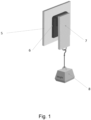
- a cardboard card 30 mm wide and 50 mm long is glued to one end of the cut strip so that the adhesive tape is attached to 25 mm on the cardboard card.
- the cardboard card has a grammage of 200 g/m 2 .
- the cardboard card has a hole punched in the middle on the other half.
- the strip is pressed onto the test substrate, here the roof lining, with light finger pressure.
- the strip is then rolled onto the substrate in a defined manner using a roller. Different rolling weights can be used for this. In this example, a 4 kg roller is used and the tape is rolled over a total of 4 times, 2 times back and forth.
- the experiment is carried out as a triplicate determination.
- a defined time is set for winding up the product. During an initial measurement, the examination starts immediately. Alternatively, as done here, a wind-up time of 15 minutes can be used.
- the test specimen is attached vertically to a suspension so that the end of the adhesive strip with the cardboard card points upwards.
- the cardboard card is then guided downwards by 180° and a test weight is attached.
- This test weight is usually 20 g and is intended to simulate a light connector, which in real applications will put strain on the bond during transport.
- the starting point of the measurement is marked as the point at which the bonding comes into contact with the headliner substrate immediately after the test weight has been attached. The contact point is now marked at different measurement times. In this case, the measurement is ended and evaluated after 72 hours. The value given is the distance that the adhesive tape was peeled off from the test weight over the test time.
- a peeled section of ⁇ 10 mm is recommended, at best ⁇ 5 mm after 72 hours.
- the adhesive tape is pulled upwards over the cutting knife by hand. Three factors are then assessed.
- Counterexample 1 tesa 50118 PV2 (PET needle felt with 80 g/m 2 acrylic-based adhesive)
- Counterexample 2 Lohmann Duplocoll 2100FL (PET spunbond with 60 g/m 2 acrylic-based adhesive)
- Counterexample 3 Coroplast 875X (PET spunbond with an acrylic-based adhesive)
- Counterexample 4 Polypropylene spunbond with 150 g/m 2 ; Diamond embossing Counterexample 5: Polypropylene spunbond with 25 g/m 2 ; Diamond embossing Counter e.g. 1 Counter e.g. 2 Counter e.g. 3 example 1 Example 2 Example 3 Counter e.g. 4 Counter e.g. 5 Peeling after [mm] 1 Hour 1 25 5 1 3 1 1 4 72 hours 1 >150 48 2 5 2 7
- the spunbonds according to the invention have a positive effect on cuttability to such an extent that even nonwoven grammages of 50 to 150 g/m 2 can be cut manually using a tear-off dispenser. They also offer stability to the sections and a clean and clear tear-off edge.
Landscapes
- Chemical & Material Sciences (AREA)
- Organic Chemistry (AREA)
- Chemical Kinetics & Catalysis (AREA)
- Adhesives Or Adhesive Processes (AREA)
- Adhesive Tapes (AREA)
Applications Claiming Priority (1)
| Application Number | Priority Date | Filing Date | Title |
|---|---|---|---|
| DE102019203489.6A DE102019203489B3 (de) | 2019-03-14 | 2019-03-14 | Verwendung eines Klebebands zum Befestigen von Leitungen insbesondere auf Untergründen wie die Innenraum-Dekorteile eines Pkws, insbesondere Dachhimmel, Türseitenteil, Kofferraumdeckel |
Publications (2)
| Publication Number | Publication Date |
|---|---|
| EP3708628A1 EP3708628A1 (de) | 2020-09-16 |
| EP3708628B1 true EP3708628B1 (de) | 2023-12-27 |
Family
ID=69804760
Family Applications (1)
| Application Number | Title | Priority Date | Filing Date |
|---|---|---|---|
| EP20162571.2A Active EP3708628B1 (de) | 2019-03-14 | 2020-03-12 | Verwendung eines klebebands zum befestigen von leitungen insbesondere auf untergründen wie die innenraum dekorteile eines pkws, insbesondere dachhimmel, türseitenteil, kofferraumdeckel |
Country Status (4)
| Country | Link |
|---|---|
| EP (1) | EP3708628B1 (pl) |
| DE (1) | DE102019203489B3 (pl) |
| ES (1) | ES2971316T3 (pl) |
| PL (1) | PL3708628T3 (pl) |
Citations (6)
| Publication number | Priority date | Publication date | Assignee | Title |
|---|---|---|---|---|
| DE19523494A1 (de) | 1995-06-28 | 1997-01-02 | Beiersdorf Ag | Verwendung eines Klebebandes auf Spinnvliesbasis zur Bandagierung von Kabelbäumen |
| DE29804431U1 (de) | 1998-03-12 | 1998-07-23 | Certoplast Vorwerk & Sohn GmbH, 42285 Wuppertal | Klebeband |
| DE10329994A1 (de) | 2003-07-02 | 2005-01-20 | Tesa Ag | Verfahren zur Ummantelung von langgestrecktem Gut, wie insbesondere Kabelsätzen, mit einem Klebeband |
| DE10349107A1 (de) | 2003-10-17 | 2005-05-19 | Tesa Ag | Verfahren zum Verkleben von Kabelbäumen auf Untergründen wie die Innenraum-Dekorteile eines PKWs, insbesondere Dachhimmel, Türseitenteil, Kofferraumdeckel |
| EP2128212A2 (de) | 2008-05-23 | 2009-12-02 | tesa SE | Klebeband mit textilem Träger für die Kabelbandagierung |
| WO2017140459A1 (de) | 2016-02-16 | 2017-08-24 | Tesa Se | Klebemasse insbesondere für gekrümmte oberflächen |
Family Cites Families (2)
| Publication number | Priority date | Publication date | Assignee | Title |
|---|---|---|---|---|
| DE50205308D1 (de) | 2001-10-16 | 2006-01-19 | Certoplast Vorwerk & Sohn Gmbh | Klebeband mit glattgeschliffener trägeroberfläche |
| DE102018200957A1 (de) * | 2017-10-17 | 2019-04-18 | Tesa Se | Haftklebestreifen mit teilgeschäumter Selbstklebemasse |
-
2019
- 2019-03-14 DE DE102019203489.6A patent/DE102019203489B3/de not_active Revoked
-
2020
- 2020-03-12 EP EP20162571.2A patent/EP3708628B1/de active Active
- 2020-03-12 PL PL20162571.2T patent/PL3708628T3/pl unknown
- 2020-03-12 ES ES20162571T patent/ES2971316T3/es active Active
Patent Citations (6)
| Publication number | Priority date | Publication date | Assignee | Title |
|---|---|---|---|---|
| DE19523494A1 (de) | 1995-06-28 | 1997-01-02 | Beiersdorf Ag | Verwendung eines Klebebandes auf Spinnvliesbasis zur Bandagierung von Kabelbäumen |
| DE29804431U1 (de) | 1998-03-12 | 1998-07-23 | Certoplast Vorwerk & Sohn GmbH, 42285 Wuppertal | Klebeband |
| DE10329994A1 (de) | 2003-07-02 | 2005-01-20 | Tesa Ag | Verfahren zur Ummantelung von langgestrecktem Gut, wie insbesondere Kabelsätzen, mit einem Klebeband |
| DE10349107A1 (de) | 2003-10-17 | 2005-05-19 | Tesa Ag | Verfahren zum Verkleben von Kabelbäumen auf Untergründen wie die Innenraum-Dekorteile eines PKWs, insbesondere Dachhimmel, Türseitenteil, Kofferraumdeckel |
| EP2128212A2 (de) | 2008-05-23 | 2009-12-02 | tesa SE | Klebeband mit textilem Träger für die Kabelbandagierung |
| WO2017140459A1 (de) | 2016-02-16 | 2017-08-24 | Tesa Se | Klebemasse insbesondere für gekrümmte oberflächen |
Non-Patent Citations (3)
| Title |
|---|
| 1 January 2001, TEXTILES IN AUTOMOTIVE ENGINEERING, article FUNG WALTER, MIKE HARDCASTLE: "1.2.5 Textiles in other areas of the car", pages: 15 - 21, XP055893612 |
| ANONYMOUS: "DuploCOLL ® 2100 FL", LOHMANN, XP093261993, Retrieved from the Internet <URL:https://www.lohmann-tapes.com/files_db/1427098763_62__7.pdf> |
| ANONYMOUS: "Lösungen zur Kabelbefestigung im Fahrzeuginnenraum", TESA.COM, TESA, DE, 30 April 2018 (2018-04-30), DE, pages 1 - 4, XP009545984 |
Also Published As
| Publication number | Publication date |
|---|---|
| ES2971316T3 (es) | 2024-06-04 |
| EP3708628A1 (de) | 2020-09-16 |
| DE102019203489B3 (de) | 2020-08-13 |
| PL3708628T3 (pl) | 2024-03-25 |
Similar Documents
| Publication | Publication Date | Title |
|---|---|---|
| EP3433330B1 (de) | Klebeband zum ummanteln von langgestrecktem gut wie insbesondere kabelsätzen und verfahren zur ummantelung | |
| EP2520629B1 (de) | Verfahren zur Herstellung eines Klebebandes zum Umwickeln von Kabeln aus einem offenen textilen Träger und einer darauf einseitig beschichteten Haftklebemasse | |
| EP2520628B1 (de) | Verwendung eines Klebebandes zum Ummanteln von langgestrecktem Gut wie insbesondere Kabelsätzen und langgestrecktes Gut umantelt mit dem Klebeband | |
| EP2522705B1 (de) | Verwendung eines Klebebandes zum Ummanteln von langgestrecktem Gut wie insbesondere Kabelsätzen und langestrecktes Gut ummantelt mit einem Klebeband | |
| EP3540024B1 (de) | Klebeband zum ummanteln von langgestrecktem gut wie insbesondere kabelsätzen und verfahren zur ummantelung | |
| EP2128212B1 (de) | Klebeband mit textilem Träger für die Kabelbandagierung | |
| EP2520627B1 (de) | Verwendung eines Klebebandes zum Ummanteln von langgestrecktem Gut wie insbesondere Kabelsätzen und langgestrecktes Gut umantelt mit dem Klebeband | |
| EP3221411B1 (de) | Modifizierte schichtsilikate zur steuerung der abrollkraft von haftklebemassen und verbesserung der barriereeigenschaften von klebebändern | |
| EP2011845B1 (de) | Klebeband und Verwendung des Klebebandes als Bandagierungsband für Kabel | |
| EP3613819B1 (de) | Klebeband zum ummanteln von langgestrecktem gut wie insbesondere kabelsätzen und verfahren zur ummantelung | |
| EP4092092B1 (de) | Klebeband zum ummanteln von langgestrecktem gut wie insbesondere kabelsätzen und verfahren zur ummantelung | |
| EP3481908A1 (de) | Gewebeklebeband | |
| EP3708628B1 (de) | Verwendung eines klebebands zum befestigen von leitungen insbesondere auf untergründen wie die innenraum dekorteile eines pkws, insbesondere dachhimmel, türseitenteil, kofferraumdeckel | |
| DE102019211874B4 (de) | Klebeband zum Umwickeln von Kabeln und Verwendung | |
| EP4424496A1 (de) | Verfahren zum konfektionieren von textilen klebebändern | |
| EP1418214A1 (de) | Selbstklebender Schutzartikel für mechanisch stark beanspruchte lackierte Automobilteile | |
| DE102008021739A1 (de) | Klebeband und Verwendung als Bandagierungsband für Kabelbäume | |
| DE102020208549B4 (de) | Verfahren zur Herstellung von Klebebandtellerrollen, Klebebandtellerrollen und deren Verwendung | |
| DE102020212233B4 (de) | Klebeband zum Ummanteln von langgestrecktem Gut wie insbesondere Kabelsätzen und Verwendung des Klebebands zur Ummantelung | |
| EP4389841A1 (de) | Haftklebeelement für die kabelumwickelung | |
| DE102017223666A1 (de) | Abriebfestes Gewebeklebeband | |
| EP4688991A2 (de) | Klebeband zum ummanteln von langgestrecktem gut wie insbesondere kabelsätzen und verfahren zur ummantelung |
Legal Events
| Date | Code | Title | Description |
|---|---|---|---|
| PUAI | Public reference made under article 153(3) epc to a published international application that has entered the european phase |
Free format text: ORIGINAL CODE: 0009012 |
|
| STAA | Information on the status of an ep patent application or granted ep patent |
Free format text: STATUS: THE APPLICATION HAS BEEN PUBLISHED |
|
| AK | Designated contracting states |
Kind code of ref document: A1 Designated state(s): AL AT BE BG CH CY CZ DE DK EE ES FI FR GB GR HR HU IE IS IT LI LT LU LV MC MK MT NL NO PL PT RO RS SE SI SK SM TR |
|
| AX | Request for extension of the european patent |
Extension state: BA ME |
|
| STAA | Information on the status of an ep patent application or granted ep patent |
Free format text: STATUS: REQUEST FOR EXAMINATION WAS MADE |
|
| TPAC | Observations filed by third parties |
Free format text: ORIGINAL CODE: EPIDOSNTIPA |
|
| 17P | Request for examination filed |
Effective date: 20210316 |
|
| RBV | Designated contracting states (corrected) |
Designated state(s): AL AT BE BG CH CY CZ DE DK EE ES FI FR GB GR HR HU IE IS IT LI LT LU LV MC MK MT NL NO PL PT RO RS SE SI SK SM TR |
|
| GRAP | Despatch of communication of intention to grant a patent |
Free format text: ORIGINAL CODE: EPIDOSNIGR1 |
|
| STAA | Information on the status of an ep patent application or granted ep patent |
Free format text: STATUS: GRANT OF PATENT IS INTENDED |
|
| INTG | Intention to grant announced |
Effective date: 20210721 |
|
| GRAJ | Information related to disapproval of communication of intention to grant by the applicant or resumption of examination proceedings by the epo deleted |
Free format text: ORIGINAL CODE: EPIDOSDIGR1 |
|
| STAA | Information on the status of an ep patent application or granted ep patent |
Free format text: STATUS: REQUEST FOR EXAMINATION WAS MADE |
|
| INTC | Intention to grant announced (deleted) | ||
| STAA | Information on the status of an ep patent application or granted ep patent |
Free format text: STATUS: EXAMINATION IS IN PROGRESS |
|
| TPAC | Observations filed by third parties |
Free format text: ORIGINAL CODE: EPIDOSNTIPA |
|
| 17Q | First examination report despatched |
Effective date: 20220118 |
|
| TPAC | Observations filed by third parties |
Free format text: ORIGINAL CODE: EPIDOSNTIPA |
|
| GRAP | Despatch of communication of intention to grant a patent |
Free format text: ORIGINAL CODE: EPIDOSNIGR1 |
|
| STAA | Information on the status of an ep patent application or granted ep patent |
Free format text: STATUS: GRANT OF PATENT IS INTENDED |
|
| INTG | Intention to grant announced |
Effective date: 20230907 |
|
| GRAS | Grant fee paid |
Free format text: ORIGINAL CODE: EPIDOSNIGR3 |
|
| GRAA | (expected) grant |
Free format text: ORIGINAL CODE: 0009210 |
|
| STAA | Information on the status of an ep patent application or granted ep patent |
Free format text: STATUS: THE PATENT HAS BEEN GRANTED |
|
| AK | Designated contracting states |
Kind code of ref document: B1 Designated state(s): AL AT BE BG CH CY CZ DE DK EE ES FI FR GB GR HR HU IE IS IT LI LT LU LV MC MK MT NL NO PL PT RO RS SE SI SK SM TR |
|
| REG | Reference to a national code |
Ref country code: GB Ref legal event code: FG4D Free format text: NOT ENGLISH |
|
| REG | Reference to a national code |
Ref country code: CH Ref legal event code: EP |
|
| REG | Reference to a national code |
Ref country code: DE Ref legal event code: R096 Ref document number: 502020006484 Country of ref document: DE |
|
| REG | Reference to a national code |
Ref country code: IE Ref legal event code: FG4D Free format text: LANGUAGE OF EP DOCUMENT: GERMAN |
|
| PG25 | Lapsed in a contracting state [announced via postgrant information from national office to epo] |
Ref country code: GR Free format text: LAPSE BECAUSE OF FAILURE TO SUBMIT A TRANSLATION OF THE DESCRIPTION OR TO PAY THE FEE WITHIN THE PRESCRIBED TIME-LIMIT Effective date: 20240328 |
|
| REG | Reference to a national code |
Ref country code: LT Ref legal event code: MG9D |
|
| PG25 | Lapsed in a contracting state [announced via postgrant information from national office to epo] |
Ref country code: LT Free format text: LAPSE BECAUSE OF FAILURE TO SUBMIT A TRANSLATION OF THE DESCRIPTION OR TO PAY THE FEE WITHIN THE PRESCRIBED TIME-LIMIT Effective date: 20231227 |
|
| PG25 | Lapsed in a contracting state [announced via postgrant information from national office to epo] |
Ref country code: LT Free format text: LAPSE BECAUSE OF FAILURE TO SUBMIT A TRANSLATION OF THE DESCRIPTION OR TO PAY THE FEE WITHIN THE PRESCRIBED TIME-LIMIT Effective date: 20231227 Ref country code: GR Free format text: LAPSE BECAUSE OF FAILURE TO SUBMIT A TRANSLATION OF THE DESCRIPTION OR TO PAY THE FEE WITHIN THE PRESCRIBED TIME-LIMIT Effective date: 20240328 Ref country code: FI Free format text: LAPSE BECAUSE OF FAILURE TO SUBMIT A TRANSLATION OF THE DESCRIPTION OR TO PAY THE FEE WITHIN THE PRESCRIBED TIME-LIMIT Effective date: 20231227 Ref country code: BG Free format text: LAPSE BECAUSE OF FAILURE TO SUBMIT A TRANSLATION OF THE DESCRIPTION OR TO PAY THE FEE WITHIN THE PRESCRIBED TIME-LIMIT Effective date: 20240327 |
|
| REG | Reference to a national code |
Ref country code: NL Ref legal event code: MP Effective date: 20231227 |
|
| REG | Reference to a national code |
Ref country code: SK Ref legal event code: T3 Ref document number: E 43734 Country of ref document: SK |
|
| PG25 | Lapsed in a contracting state [announced via postgrant information from national office to epo] |
Ref country code: NL Free format text: LAPSE BECAUSE OF FAILURE TO SUBMIT A TRANSLATION OF THE DESCRIPTION OR TO PAY THE FEE WITHIN THE PRESCRIBED TIME-LIMIT Effective date: 20231227 |
|
| PG25 | Lapsed in a contracting state [announced via postgrant information from national office to epo] |
Ref country code: SE Free format text: LAPSE BECAUSE OF FAILURE TO SUBMIT A TRANSLATION OF THE DESCRIPTION OR TO PAY THE FEE WITHIN THE PRESCRIBED TIME-LIMIT Effective date: 20231227 Ref country code: RS Free format text: LAPSE BECAUSE OF FAILURE TO SUBMIT A TRANSLATION OF THE DESCRIPTION OR TO PAY THE FEE WITHIN THE PRESCRIBED TIME-LIMIT Effective date: 20231227 Ref country code: NO Free format text: LAPSE BECAUSE OF FAILURE TO SUBMIT A TRANSLATION OF THE DESCRIPTION OR TO PAY THE FEE WITHIN THE PRESCRIBED TIME-LIMIT Effective date: 20240327 Ref country code: NL Free format text: LAPSE BECAUSE OF FAILURE TO SUBMIT A TRANSLATION OF THE DESCRIPTION OR TO PAY THE FEE WITHIN THE PRESCRIBED TIME-LIMIT Effective date: 20231227 Ref country code: LV Free format text: LAPSE BECAUSE OF FAILURE TO SUBMIT A TRANSLATION OF THE DESCRIPTION OR TO PAY THE FEE WITHIN THE PRESCRIBED TIME-LIMIT Effective date: 20231227 Ref country code: HR Free format text: LAPSE BECAUSE OF FAILURE TO SUBMIT A TRANSLATION OF THE DESCRIPTION OR TO PAY THE FEE WITHIN THE PRESCRIBED TIME-LIMIT Effective date: 20231227 |
|
| REG | Reference to a national code |
Ref country code: ES Ref legal event code: FG2A Ref document number: 2971316 Country of ref document: ES Kind code of ref document: T3 Effective date: 20240604 |
|
| PG25 | Lapsed in a contracting state [announced via postgrant information from national office to epo] |
Ref country code: IS Free format text: LAPSE BECAUSE OF FAILURE TO SUBMIT A TRANSLATION OF THE DESCRIPTION OR TO PAY THE FEE WITHIN THE PRESCRIBED TIME-LIMIT Effective date: 20240427 |
|
| PG25 | Lapsed in a contracting state [announced via postgrant information from national office to epo] |
Ref country code: SM Free format text: LAPSE BECAUSE OF FAILURE TO SUBMIT A TRANSLATION OF THE DESCRIPTION OR TO PAY THE FEE WITHIN THE PRESCRIBED TIME-LIMIT Effective date: 20231227 Ref country code: RO Free format text: LAPSE BECAUSE OF FAILURE TO SUBMIT A TRANSLATION OF THE DESCRIPTION OR TO PAY THE FEE WITHIN THE PRESCRIBED TIME-LIMIT Effective date: 20231227 Ref country code: IT Free format text: LAPSE BECAUSE OF FAILURE TO SUBMIT A TRANSLATION OF THE DESCRIPTION OR TO PAY THE FEE WITHIN THE PRESCRIBED TIME-LIMIT Effective date: 20231227 Ref country code: IS Free format text: LAPSE BECAUSE OF FAILURE TO SUBMIT A TRANSLATION OF THE DESCRIPTION OR TO PAY THE FEE WITHIN THE PRESCRIBED TIME-LIMIT Effective date: 20240427 Ref country code: EE Free format text: LAPSE BECAUSE OF FAILURE TO SUBMIT A TRANSLATION OF THE DESCRIPTION OR TO PAY THE FEE WITHIN THE PRESCRIBED TIME-LIMIT Effective date: 20231227 |
|
| PG25 | Lapsed in a contracting state [announced via postgrant information from national office to epo] |
Ref country code: PT Free format text: LAPSE BECAUSE OF FAILURE TO SUBMIT A TRANSLATION OF THE DESCRIPTION OR TO PAY THE FEE WITHIN THE PRESCRIBED TIME-LIMIT Effective date: 20240429 |
|
| PG25 | Lapsed in a contracting state [announced via postgrant information from national office to epo] |
Ref country code: PT Free format text: LAPSE BECAUSE OF FAILURE TO SUBMIT A TRANSLATION OF THE DESCRIPTION OR TO PAY THE FEE WITHIN THE PRESCRIBED TIME-LIMIT Effective date: 20240429 |
|
| REG | Reference to a national code |
Ref country code: DE Ref legal event code: R026 Ref document number: 502020006484 Country of ref document: DE |
|
| PLBI | Opposition filed |
Free format text: ORIGINAL CODE: 0009260 |
|
| PG25 | Lapsed in a contracting state [announced via postgrant information from national office to epo] |
Ref country code: DK Free format text: LAPSE BECAUSE OF FAILURE TO SUBMIT A TRANSLATION OF THE DESCRIPTION OR TO PAY THE FEE WITHIN THE PRESCRIBED TIME-LIMIT Effective date: 20231227 |
|
| PLAX | Notice of opposition and request to file observation + time limit sent |
Free format text: ORIGINAL CODE: EPIDOSNOBS2 |
|
| 26 | Opposition filed |
Opponent name: CERTOPLAST TECHNISCHE KLEBEBAENDER GMBH Effective date: 20240910 |
|
| PLBB | Reply of patent proprietor to notice(s) of opposition received |
Free format text: ORIGINAL CODE: EPIDOSNOBS3 |
|
| PG25 | Lapsed in a contracting state [announced via postgrant information from national office to epo] |
Ref country code: DK Free format text: LAPSE BECAUSE OF FAILURE TO SUBMIT A TRANSLATION OF THE DESCRIPTION OR TO PAY THE FEE WITHIN THE PRESCRIBED TIME-LIMIT Effective date: 20231227 |
|
| REG | Reference to a national code |
Ref country code: CH Ref legal event code: PL |
|
| PG25 | Lapsed in a contracting state [announced via postgrant information from national office to epo] |
Ref country code: LU Free format text: LAPSE BECAUSE OF NON-PAYMENT OF DUE FEES Effective date: 20240312 |
|
| PG25 | Lapsed in a contracting state [announced via postgrant information from national office to epo] |
Ref country code: MC Free format text: LAPSE BECAUSE OF FAILURE TO SUBMIT A TRANSLATION OF THE DESCRIPTION OR TO PAY THE FEE WITHIN THE PRESCRIBED TIME-LIMIT Effective date: 20231227 |
|
| GBPC | Gb: european patent ceased through non-payment of renewal fee |
Effective date: 20240327 |
|
| PG25 | Lapsed in a contracting state [announced via postgrant information from national office to epo] |
Ref country code: MC Free format text: LAPSE BECAUSE OF FAILURE TO SUBMIT A TRANSLATION OF THE DESCRIPTION OR TO PAY THE FEE WITHIN THE PRESCRIBED TIME-LIMIT Effective date: 20231227 Ref country code: LU Free format text: LAPSE BECAUSE OF NON-PAYMENT OF DUE FEES Effective date: 20240312 |
|
| REG | Reference to a national code |
Ref country code: BE Ref legal event code: MM Effective date: 20240331 |
|
| PG25 | Lapsed in a contracting state [announced via postgrant information from national office to epo] |
Ref country code: BE Free format text: LAPSE BECAUSE OF NON-PAYMENT OF DUE FEES Effective date: 20240331 |
|
| PG25 | Lapsed in a contracting state [announced via postgrant information from national office to epo] |
Ref country code: GB Free format text: LAPSE BECAUSE OF NON-PAYMENT OF DUE FEES Effective date: 20240327 |
|
| PG25 | Lapsed in a contracting state [announced via postgrant information from national office to epo] |
Ref country code: IE Free format text: LAPSE BECAUSE OF NON-PAYMENT OF DUE FEES Effective date: 20240312 |
|
| PG25 | Lapsed in a contracting state [announced via postgrant information from national office to epo] |
Ref country code: IE Free format text: LAPSE BECAUSE OF NON-PAYMENT OF DUE FEES Effective date: 20240312 Ref country code: GB Free format text: LAPSE BECAUSE OF NON-PAYMENT OF DUE FEES Effective date: 20240327 Ref country code: BE Free format text: LAPSE BECAUSE OF NON-PAYMENT OF DUE FEES Effective date: 20240331 Ref country code: CH Free format text: LAPSE BECAUSE OF NON-PAYMENT OF DUE FEES Effective date: 20240331 |
|
| PG25 | Lapsed in a contracting state [announced via postgrant information from national office to epo] |
Ref country code: SI Free format text: LAPSE BECAUSE OF FAILURE TO SUBMIT A TRANSLATION OF THE DESCRIPTION OR TO PAY THE FEE WITHIN THE PRESCRIBED TIME-LIMIT Effective date: 20231227 |
|
| PGFP | Annual fee paid to national office [announced via postgrant information from national office to epo] |
Ref country code: AT Payment date: 20250417 Year of fee payment: 5 |
|
| PGFP | Annual fee paid to national office [announced via postgrant information from national office to epo] |
Ref country code: PL Payment date: 20250227 Year of fee payment: 6 Ref country code: CZ Payment date: 20250306 Year of fee payment: 6 |
|
| PGFP | Annual fee paid to national office [announced via postgrant information from national office to epo] |
Ref country code: SK Payment date: 20250304 Year of fee payment: 6 |
|
| PGFP | Annual fee paid to national office [announced via postgrant information from national office to epo] |
Ref country code: ES Payment date: 20250429 Year of fee payment: 6 |
|
| PG25 | Lapsed in a contracting state [announced via postgrant information from national office to epo] |
Ref country code: CY Free format text: LAPSE BECAUSE OF FAILURE TO SUBMIT A TRANSLATION OF THE DESCRIPTION OR TO PAY THE FEE WITHIN THE PRESCRIBED TIME-LIMIT; INVALID AB INITIO Effective date: 20200312 |
|
| PG25 | Lapsed in a contracting state [announced via postgrant information from national office to epo] |
Ref country code: HU Free format text: LAPSE BECAUSE OF FAILURE TO SUBMIT A TRANSLATION OF THE DESCRIPTION OR TO PAY THE FEE WITHIN THE PRESCRIBED TIME-LIMIT; INVALID AB INITIO Effective date: 20200312 |
|
| REG | Reference to a national code |
Ref country code: DE Ref legal event code: R100 Ref document number: 502020006484 Country of ref document: DE |
|
| PLCK | Communication despatched that opposition was rejected |
Free format text: ORIGINAL CODE: EPIDOSNREJ1 |
|
| PG25 | Lapsed in a contracting state [announced via postgrant information from national office to epo] |
Ref country code: TR Free format text: LAPSE BECAUSE OF FAILURE TO SUBMIT A TRANSLATION OF THE DESCRIPTION OR TO PAY THE FEE WITHIN THE PRESCRIBED TIME-LIMIT Effective date: 20231227 |
|
| REG | Reference to a national code |
Ref country code: DE Ref legal event code: R008 Ref document number: 502020006484 Country of ref document: DE Ref country code: DE Ref legal event code: R039 Ref document number: 502020006484 Country of ref document: DE |
|
| PLBN | Opposition rejected |
Free format text: ORIGINAL CODE: 0009273 |
|
| STAA | Information on the status of an ep patent application or granted ep patent |
Free format text: STATUS: OPPOSITION REJECTED |
|
| REG | Reference to a national code |
Ref country code: CH Ref legal event code: L18 Free format text: ST27 STATUS EVENT CODE: U-0-0-L10-L18 (AS PROVIDED BY THE NATIONAL OFFICE) Effective date: 20260318 |
|
| PGFP | Annual fee paid to national office [announced via postgrant information from national office to epo] |
Ref country code: DE Payment date: 20260319 Year of fee payment: 7 |
|
| 27O | Opposition rejected |
Effective date: 20251121 |
|
| PGFP | Annual fee paid to national office [announced via postgrant information from national office to epo] |
Ref country code: FR Payment date: 20260320 Year of fee payment: 7 |