EP3708333A1 - Embossing plate, method, and system for embossing a thermoplastic textile - Google Patents
Embossing plate, method, and system for embossing a thermoplastic textile Download PDFInfo
- Publication number
- EP3708333A1 EP3708333A1 EP20162390.7A EP20162390A EP3708333A1 EP 3708333 A1 EP3708333 A1 EP 3708333A1 EP 20162390 A EP20162390 A EP 20162390A EP 3708333 A1 EP3708333 A1 EP 3708333A1
- Authority
- EP
- European Patent Office
- Prior art keywords
- mold
- subunit
- equal
- thermoplastic textile
- reconfigurable
- Prior art date
- Legal status (The legal status is an assumption and is not a legal conclusion. Google has not performed a legal analysis and makes no representation as to the accuracy of the status listed.)
- Granted
Links
Images



Classifications
-
- B—PERFORMING OPERATIONS; TRANSPORTING
- B29—WORKING OF PLASTICS; WORKING OF SUBSTANCES IN A PLASTIC STATE IN GENERAL
- B29C—SHAPING OR JOINING OF PLASTICS; SHAPING OF MATERIAL IN A PLASTIC STATE, NOT OTHERWISE PROVIDED FOR; AFTER-TREATMENT OF THE SHAPED PRODUCTS, e.g. REPAIRING
- B29C43/00—Compression moulding, i.e. applying external pressure to flow the moulding material; Apparatus therefor
- B29C43/32—Component parts, details or accessories; Auxiliary operations
- B29C43/36—Moulds for making articles of definite length, i.e. discrete articles
-
- B—PERFORMING OPERATIONS; TRANSPORTING
- B29—WORKING OF PLASTICS; WORKING OF SUBSTANCES IN A PLASTIC STATE IN GENERAL
- B29C—SHAPING OR JOINING OF PLASTICS; SHAPING OF MATERIAL IN A PLASTIC STATE, NOT OTHERWISE PROVIDED FOR; AFTER-TREATMENT OF THE SHAPED PRODUCTS, e.g. REPAIRING
- B29C33/00—Moulds or cores; Details thereof or accessories therefor
- B29C33/42—Moulds or cores; Details thereof or accessories therefor characterised by the shape of the moulding surface, e.g. ribs or grooves
-
- A—HUMAN NECESSITIES
- A43—FOOTWEAR
- A43B—CHARACTERISTIC FEATURES OF FOOTWEAR; PARTS OF FOOTWEAR
- A43B23/00—Uppers; Boot legs; Stiffeners; Other single parts of footwear
- A43B23/02—Uppers; Boot legs
- A43B23/0205—Uppers; Boot legs characterised by the material
- A43B23/0215—Plastics or artificial leather
-
- B—PERFORMING OPERATIONS; TRANSPORTING
- B29—WORKING OF PLASTICS; WORKING OF SUBSTANCES IN A PLASTIC STATE IN GENERAL
- B29C—SHAPING OR JOINING OF PLASTICS; SHAPING OF MATERIAL IN A PLASTIC STATE, NOT OTHERWISE PROVIDED FOR; AFTER-TREATMENT OF THE SHAPED PRODUCTS, e.g. REPAIRING
- B29C43/00—Compression moulding, i.e. applying external pressure to flow the moulding material; Apparatus therefor
- B29C43/02—Compression moulding, i.e. applying external pressure to flow the moulding material; Apparatus therefor of articles of definite length, i.e. discrete articles
- B29C43/20—Making multilayered or multicoloured articles
- B29C43/203—Making multilayered articles
-
- B—PERFORMING OPERATIONS; TRANSPORTING
- B29—WORKING OF PLASTICS; WORKING OF SUBSTANCES IN A PLASTIC STATE IN GENERAL
- B29C—SHAPING OR JOINING OF PLASTICS; SHAPING OF MATERIAL IN A PLASTIC STATE, NOT OTHERWISE PROVIDED FOR; AFTER-TREATMENT OF THE SHAPED PRODUCTS, e.g. REPAIRING
- B29C59/00—Surface shaping of articles, e.g. embossing; Apparatus therefor
- B29C59/02—Surface shaping of articles, e.g. embossing; Apparatus therefor by mechanical means, e.g. pressing
-
- B—PERFORMING OPERATIONS; TRANSPORTING
- B29—WORKING OF PLASTICS; WORKING OF SUBSTANCES IN A PLASTIC STATE IN GENERAL
- B29D—PRODUCING PARTICULAR ARTICLES FROM PLASTICS OR FROM SUBSTANCES IN A PLASTIC STATE
- B29D35/00—Producing footwear
- B29D35/0054—Producing footwear by compression moulding, vulcanising or the like; Apparatus therefor
- B29D35/0063—Moulds
-
- B—PERFORMING OPERATIONS; TRANSPORTING
- B29—WORKING OF PLASTICS; WORKING OF SUBSTANCES IN A PLASTIC STATE IN GENERAL
- B29D—PRODUCING PARTICULAR ARTICLES FROM PLASTICS OR FROM SUBSTANCES IN A PLASTIC STATE
- B29D35/00—Producing footwear
- B29D35/12—Producing parts thereof, e.g. soles, heels, uppers, by a moulding technique
- B29D35/126—Uppers
-
- B—PERFORMING OPERATIONS; TRANSPORTING
- B29—WORKING OF PLASTICS; WORKING OF SUBSTANCES IN A PLASTIC STATE IN GENERAL
- B29D—PRODUCING PARTICULAR ARTICLES FROM PLASTICS OR FROM SUBSTANCES IN A PLASTIC STATE
- B29D35/00—Producing footwear
- B29D35/12—Producing parts thereof, e.g. soles, heels, uppers, by a moulding technique
- B29D35/128—Moulds or apparatus therefor
-
- B—PERFORMING OPERATIONS; TRANSPORTING
- B29—WORKING OF PLASTICS; WORKING OF SUBSTANCES IN A PLASTIC STATE IN GENERAL
- B29D—PRODUCING PARTICULAR ARTICLES FROM PLASTICS OR FROM SUBSTANCES IN A PLASTIC STATE
- B29D35/00—Producing footwear
- B29D35/12—Producing parts thereof, e.g. soles, heels, uppers, by a moulding technique
- B29D35/14—Multilayered parts
- B29D35/148—Moulds or apparatus therefor
-
- B—PERFORMING OPERATIONS; TRANSPORTING
- B44—DECORATIVE ARTS
- B44B—MACHINES, APPARATUS OR TOOLS FOR ARTISTIC WORK, e.g. FOR SCULPTURING, GUILLOCHING, CARVING, BRANDING, INLAYING
- B44B5/00—Machines or apparatus for embossing decorations or marks, e.g. embossing coins
- B44B5/02—Dies; Accessories
- B44B5/028—Heated dies
-
- B—PERFORMING OPERATIONS; TRANSPORTING
- B44—DECORATIVE ARTS
- B44C—PRODUCING DECORATIVE EFFECTS; MOSAICS; TARSIA WORK; PAPERHANGING
- B44C1/00—Processes, not specifically provided for elsewhere, for producing decorative surface effects
- B44C1/24—Pressing or stamping ornamental designs on surfaces
-
- B—PERFORMING OPERATIONS; TRANSPORTING
- B29—WORKING OF PLASTICS; WORKING OF SUBSTANCES IN A PLASTIC STATE IN GENERAL
- B29C—SHAPING OR JOINING OF PLASTICS; SHAPING OF MATERIAL IN A PLASTIC STATE, NOT OTHERWISE PROVIDED FOR; AFTER-TREATMENT OF THE SHAPED PRODUCTS, e.g. REPAIRING
- B29C43/00—Compression moulding, i.e. applying external pressure to flow the moulding material; Apparatus therefor
- B29C43/32—Component parts, details or accessories; Auxiliary operations
- B29C43/36—Moulds for making articles of definite length, i.e. discrete articles
- B29C43/42—Moulds for making articles of definite length, i.e. discrete articles for undercut articles
- B29C2043/425—Moulds for making articles of definite length, i.e. discrete articles for undercut articles mould parts or sliders being movable independently from the mould halves for making undercut portions
-
- B—PERFORMING OPERATIONS; TRANSPORTING
- B29—WORKING OF PLASTICS; WORKING OF SUBSTANCES IN A PLASTIC STATE IN GENERAL
- B29K—INDEXING SCHEME ASSOCIATED WITH SUBCLASSES B29B, B29C OR B29D, RELATING TO MOULDING MATERIALS OR TO MATERIALS FOR MOULDS, REINFORCEMENTS, FILLERS OR PREFORMED PARTS, e.g. INSERTS
- B29K2105/00—Condition, form or state of moulded material or of the material to be shaped
- B29K2105/06—Condition, form or state of moulded material or of the material to be shaped containing reinforcements, fillers or inserts
- B29K2105/08—Condition, form or state of moulded material or of the material to be shaped containing reinforcements, fillers or inserts of continuous length, e.g. cords, rovings, mats, fabrics, strands or yarns
- B29K2105/0809—Fabrics
-
- B—PERFORMING OPERATIONS; TRANSPORTING
- B29—WORKING OF PLASTICS; WORKING OF SUBSTANCES IN A PLASTIC STATE IN GENERAL
- B29K—INDEXING SCHEME ASSOCIATED WITH SUBCLASSES B29B, B29C OR B29D, RELATING TO MOULDING MATERIALS OR TO MATERIALS FOR MOULDS, REINFORCEMENTS, FILLERS OR PREFORMED PARTS, e.g. INSERTS
- B29K2105/00—Condition, form or state of moulded material or of the material to be shaped
- B29K2105/06—Condition, form or state of moulded material or of the material to be shaped containing reinforcements, fillers or inserts
- B29K2105/08—Condition, form or state of moulded material or of the material to be shaped containing reinforcements, fillers or inserts of continuous length, e.g. cords, rovings, mats, fabrics, strands or yarns
- B29K2105/0854—Condition, form or state of moulded material or of the material to be shaped containing reinforcements, fillers or inserts of continuous length, e.g. cords, rovings, mats, fabrics, strands or yarns in the form of a non-woven mat
-
- B—PERFORMING OPERATIONS; TRANSPORTING
- B29—WORKING OF PLASTICS; WORKING OF SUBSTANCES IN A PLASTIC STATE IN GENERAL
- B29K—INDEXING SCHEME ASSOCIATED WITH SUBCLASSES B29B, B29C OR B29D, RELATING TO MOULDING MATERIALS OR TO MATERIALS FOR MOULDS, REINFORCEMENTS, FILLERS OR PREFORMED PARTS, e.g. INSERTS
- B29K2713/00—Use of textile products or fabrics for preformed parts, e.g. for inserts
-
- B—PERFORMING OPERATIONS; TRANSPORTING
- B29—WORKING OF PLASTICS; WORKING OF SUBSTANCES IN A PLASTIC STATE IN GENERAL
- B29K—INDEXING SCHEME ASSOCIATED WITH SUBCLASSES B29B, B29C OR B29D, RELATING TO MOULDING MATERIALS OR TO MATERIALS FOR MOULDS, REINFORCEMENTS, FILLERS OR PREFORMED PARTS, e.g. INSERTS
- B29K2913/00—Use of textile products or fabrics as mould materials
-
- B—PERFORMING OPERATIONS; TRANSPORTING
- B29—WORKING OF PLASTICS; WORKING OF SUBSTANCES IN A PLASTIC STATE IN GENERAL
- B29L—INDEXING SCHEME ASSOCIATED WITH SUBCLASS B29C, RELATING TO PARTICULAR ARTICLES
- B29L2031/00—Other particular articles
- B29L2031/48—Wearing apparel
-
- B—PERFORMING OPERATIONS; TRANSPORTING
- B29—WORKING OF PLASTICS; WORKING OF SUBSTANCES IN A PLASTIC STATE IN GENERAL
- B29L—INDEXING SCHEME ASSOCIATED WITH SUBCLASS B29C, RELATING TO PARTICULAR ARTICLES
- B29L2031/00—Other particular articles
- B29L2031/48—Wearing apparel
- B29L2031/50—Footwear, e.g. shoes or parts thereof
- B29L2031/505—Uppers
-
- B—PERFORMING OPERATIONS; TRANSPORTING
- B29—WORKING OF PLASTICS; WORKING OF SUBSTANCES IN A PLASTIC STATE IN GENERAL
- B29L—INDEXING SCHEME ASSOCIATED WITH SUBCLASS B29C, RELATING TO PARTICULAR ARTICLES
- B29L2031/00—Other particular articles
- B29L2031/726—Fabrics
Definitions
- the present invention relates to a reconfigurable mold for processing a thermoplastic textile as well as to a method and system using such a mold.
- EP 2 397 320 B1 discloses several aspects of molding and / or fusing non-woven fabrics used in the apparel and / or shoe industry. Specifically, EP 2 397 320 B1 provides a method for texturing a thermoplastic non-woven fabric in a heat press mold (e.g. c.f. Fig. 45A - 45C and paragraph [0116]).
- thermoplastic textiles with fused, embossed and / or debossed patterns in order to obtain an improved stretch resistance, improved water resistance and / or improved aesthetics.
- fusing can be done with heat presses or with lasers. Heat presses are better for large batches, allow for 3D-effects and are cheaper in production.
- the molding techniques and / or the molds known from the prior art have various disadvantages.
- the conventional molds used in the prior art are bulky and inflexible.
- they lack the capabilities to be quickly adapted for processing of new kinds of textiles and / or for providing the processed textiles with new and / or variable structural and / or aesthetic properties.
- a new mold must be designed and manufactured before a new type of textile can be molded.
- this process is slow, expensive and / or wasteful.
- the present invention provides a mold for generating a pattern of indentations in a surface of a thermoplastic textile, preferably a non-woven fabric, the mold comprising at least one exchangeable and / or reconfigurable subunit adapted to create at least one subpattern of the pattern.
- the claimed invention therefore provides a mold that can easily be reconfigured such that the generated indentation pattern can easily be adjusted to dynamically changing manufacturing requirements, for instance, in a manufacturing plant and / or process that is adapted for manufacturing of customized apparel.
- the mold provided by the present invention may be used for manufacturing shoe uppers that are being customized to individual customer preferences on a batch-by-batch basis or even on a piece-by-piece basis.
- the at least one subunit may comprise a footprint that is configured to form a tessellation, e.g. a tessellating pattern.
- a mold may comprise a plurality of subunits each comprising essentially the same, preferably polygonal, footprint.
- the spatial arrangement of the at least one subunit is reconfigurable within the mold.
- the at least one subunit of the mold can easily be rearranged with respect to other fixed or flexible portions of the mold, resulting in processed textiles featuring locally different properties as different areas might be provided with a different indentation pattern depending on a type and a location of the subunit within the mold.
- the provided mold may be further adapted to fuse at least one indentation of the pattern of indentations into the thermoplastic textile by applying heat and / or pressure.
- the at least one indentation may even be fused to such degree as to be essentially transparent.
- the at least one fused indentation may comprise a plurality of regularly arranged indentations.
- fuse is to be understood broadly, e.g. such that it also encompasses "emboss” and / or "deboss”.
- the at least one subunit may be adapted to provide the at least one subpattern with different mechanical and / or optical properties than a different portion of the pattern.
- the mold may be adapted to provide at least one indentation of the pattern of indentations with a minimal area of larger than or equal to 2 mm 2 and smaller than or equal to 30 cm 2 , preferably larger than or equal to 8 mm 2 and smaller than or equal to 20 cm 2 , more preferably larger than or equal to 10 mm 2 and smaller than or equal to 5 cm 2 and most preferably larger than or equal to 10 mm 2 and smaller than or equal to 1 cm 2 .
- the at least one subunit may comprise at least one connection element configured to connect the at least one subunit to another subunit adapted to create another subpattern of the pattern.
- the provided mold may further comprise means for heating the thermoplastic textile and / or a surface of the mold and / or a surface of the at least one subunit.
- the provided mold may be further adapted to provide the at least one fused indentation with a fused outer edge region exhibiting a smoothly decreasing density, smoothly decreasing degree of fusing and / or a smoothly decreasing degree of compression.
- the present invention provides a method for generating a pattern of indentations in a surface of a thermoplastic textile, comprising the step of processing the thermoplastic textile with a mold according to any of the preceding embodiments described above.
- such a method may comprise at least one of the following steps: exchanging and / or reconfiguring at least one subunit of the mold, producing and / or modifying the at least one subunit with a rapid prototyping device prior to processing the thermoplastic textile, providing a separator material between the thermoplastic textile and a surface of the mold and / or the at least one subunit, providing a release agent to a surface of the mold and / or the at least one subunit.
- Such methods may allow to produce customized pieces of apparel in a fast and cost-efficient manner without the need to design custom molds every time the molding pattern is adjusted to customer requirements and / or changing manufacturing requirements and / or new specifications.
- the method may involve a processing temperature of a portion of the mold that is larger than or equal to 70 °C and smaller than or equal to 220 °C and / or an ambient temperature that is larger than or equal to 170 °C and smaller than or equal to 190 °C and / or a processing time that is larger than or equal to 3 s and smaller than or equal to 150 s and / or a processing pressure that is larger than or equal to 0.2 bar and smaller than or equal to 5 bar.
- the present invention provides a method for producing a piece of apparel, in particular a shoe, comprising the step of producing the piece of apparel using a thermoplastic textile processed according to any of the previously described methods.
- the present invention provides a piece of apparel, in particular a shoe, comprising a thermoplastic textile processed via the method described above.
- such a piece of apparel may comprise a thermoplastic textile that comprises a non-woven fabric or a pre-joined composite material comprising at least one layer of melt-blown fiber non-woven fabric and at least one layer of a reinforcement textile.
- the present invention provides various functional sports apparel and in particular high-performance athletic shoes that exhibit superior material, functional, haptic and /or aesthetic properties and / or an improved wearing comfort.
- such a piece of apparel may comprise at least one fused indentation, preferably a plurality of regularly arranged indentations, wherein the at least one indentation may further comprise an outer edge region exhibiting a smoothly decreasing density, smoothly decreasing degree of fusing and / or a smoothly decreasing degree of compression.
- the present invention provides a system for processing a thermoplastic textile, comprising: a mold according to any of the above embodiments and means for exchanging and / or reconfiguring the at least one exchangeable and / or reconfigurable subunit.
- the means for exchanging and / or reconfiguring the at least one subunit may be implemented by a robotic actuator configured to grip and translate the at least one exchangeable and / or reconfigurable subunit.
- the complete reconfiguration process of the mold and / or the at least one subunit may be partially or even fully automated leading to faster cycle times and / or an increased reliability for manufacturing of customized apparel such as customized athletic shoes.
- such a system for processing a thermoplastic textile may further comprise at least one of: means for automatically providing the thermoplastic textile to be processed, means for heating the mold, the at least one exchangeable and / or reconfigurable subunit and / or the thermoplastic textile being processed, means for storing a plurality of exchangeable and / or reconfigurable subunits, rapid prototyping means for producing and / or modifying the at least one exchangeable and / or reconfigurable subunit on demand during system operation, means for providing a separator material between the thermoplastic textile and the mold and / or between the thermoplastic textile and the at least one exchangeable and / or reconfigurable subunit and means for providing a release agent to a surface of the mold and / or a surface of the at least one exchangeable and / or reconfigurable subunit.
- the provided system thereby allows for fully automated and thus fast and low-cost manufacturing of customized apparel and shoes.
- thermoplastic materials such as films, foams or various other materials used in footwear and / or apparel manufacturing.
- thermoplastic textiles While the present invention is illustrated in the following with respect to molds, methods and systems that are adapted to provide indentation into a thermoplastic textile, it should be appreciated that the same molds, methods and systems can also be used to provide perforations into such textiles and / or other thermoplastic materials used in apparel and sports goods manufacturing such as films and / foams.
- Figure 1 depicts a mold 100 for processing of thermoplastic textiles, preferably of thermoplastic non-woven fabrics, according to an embodiment of the present invention.
- the mold 100 may comprise a plurality of fixed molding features 110 that may be configured to provide indentations to a textile processed with the mold 100.
- the mold 100 may be configured to comprise at least one exchangeable and / or reconfigurable subunit 120.
- the subunit 120 may be adapted to be reconfigurable, exchangeable and / or movable with respect to the mold 100 and / or one or more of the fixed molding features 110.
- the mold 100 may comprise one or more preconfigured reception positions for the at least one reconfigurable subunit 120.
- the mold 100 may comprise an at least partially heat-resistant material such as a polymer, a metal, etc.
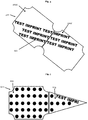
- Figure 2 depicts an illustration of a reconfigurable subunit 200.
- a subunit 200 of this sort may be used alone to imprint a single localized pattern on a textile.
- a subunit 200 of this sort may be combined with additional identical or similar subunits to imprint a repeating pattern on a textile covering a larger area than possible with a single subunit in a single step.
- the advantage of this arrangement is that the coverage of a repeating pattern can be adapted depending on the size of the textile. This is especially useful in the manufacture of garments and apparel where multiple sizes of the same product have to be made in order to suit different wearers.
- a subunit 200 of this sort may be combined with additional alternative subunits - i.e.
- a subunit 200 of this type may be used together with the mold 100 of Fig. 1 .
- the illustration on the left of Fig. 2 depicts a top view on the subunit 200 while the illustration on the right depict a cut through the subunit along the dashed line in the illustration on the left of Fig. 2 .
- the subunit 200 may comprise a plurality of molding features 210 that may be configured to generate a pattern or subpattern of indentations in a thermoplastic textile that is being processed, e.g. molded, by a mold comprising the subunit 200 or a mold comprising a plurality of identical or similar subunits as discussed in more detail below.
- the subunit 200 may be arranged in a reconfigurable manner on the surface simply using gravity to keep the subunit 200 in place. Alternatively, when there is no mold or other external frame to hold the subunit 200 in place it may be necessary to provide an attachment means between the subunit 200 and the surface to prevent the subunit moving during use or between repeated uses.
- the subunit 200 may be attached to the surface using, for example, a clamp, or a screw mechanism or a clip mechanism or a magnetic fastening mechanism.
- different subunits 200 having different patterns of molding features 210 may be used together with the mold 100. For the present embodiment, the molding features 210 are illustrated as a regular pattern of protrusions. However, in other embodiments the subunit 200 may also comprise recesses or both.
- the subunit 200 may be constructed from the same heat-resistant material as the mold 100 or may comprise a different material that is adapted to provide a textile being processed with a pattern of indentations.
- the subunit 200 may be manufactured on demand by a rapid prototyping device such as a 3D printer, a laser sintering device or a multi-jet-fusion device.
- a rapid prototyping device such as a 3D printer, a laser sintering device or a multi-jet-fusion device.
- the molding pattern of the mold 100 may easily be reconfigured, either by changing the position of the subunit 200 with respect to the surface or the mold and / or by replacing the subunit 200 by a different one, for instance, being produced on demand by a 3D printer according to individual customer preferences.
- the mold 100 of Fig. 1 and / or the subunit 200 may comprise heating means such as an electric heating element or channels for providing a heating medium.
- the molding features 110 and 210 can be heated to a temperature that is sufficient to provide a thermoplastic textile, e.g. a non-woven fabric, with heat-fused indentations when being processed via the mold and / or the subunit 200.
- the heat required for heat-fusing the textiles being processed by the mold 100 and / or the subunit 200 may also be supplied via external heating means that are not incorporated in the mold 100 or the subunit 200.
- the subunit 200 may also comprise a heat conductive material in order to apply heat and pressure at the same time to the thermoplastic textile being processed. Alternatively or additionally, the textile could be heated.
- the first option gives the advantage that it does not require heating a larger region/volume so that the whole molding arrangement is heated together.
- the second option gives faster cycle times of the process since the subunit 200 does not have to be heated after having cooled down.
- Figure 3 depicts an exemplary illustration of a molding station or heat press 300 for processing a textile according to an embodiment of the present invention.
- a heat press / molding station 300 may also be used for carrying out any of the methods provided by the present invention.
- the molding station 300 may comprise an upper portion 302 and a lower portion 304 that may be heated, e.g. via integrated heating means, to elevated temperatures required for processing a thermoplastic textile 310.
- the lower portion 302 of the molding station / heat press 300 may be equipped with a reconfigurable mold 100, comprising one or a plurality of reconfigurable subunits 200 as depicted in Fig. 2 and discussed above.
- thermoplastic textile In general, heat and pressure do not have to be applied at the same time. For example, it is also possible to first heat the thermoplastic textile above a threshold temperature that allows the thermoplastic textile to be plastically deformed and afterwards pressure is applied via a mold 100 and / or a molding station 300 to cause such a desired deformation (e.g. fusing) of the thermoplastic textile.
- the textile being processed by the mold 100 is a three-layer sandwich textile comprising an upper layer 312 and a lower layer 314 of melt-blown fiber non-woven fabric that may be directly deposited, e.g. melt-blown, onto a middle layer of reinforcement textile 310.
- both layers of melt-blown fiber non-woven fabrics 312, 314 may comprise a thermoplastic polymer such as thermoplastic polyurethane (TPU).
- TPU thermoplastic polyurethane
- suitable thermoplastic polymers include thermoplastic polyamides, polyethylene terephthalate, thermoplastic copolyester, polyether block amide, and other thermoplastic elastomers. In this way, the different properties offered by these materials can be optimally utilized for tuning the properties of the non-woven fabric layers 312, 314.
- thermoplastic textile 310 is not directly brought in contact with the molding features of the mold 100.
- a separator material 330 such as a thin layer of polytetrafluoroethylene and / or silicone may be used to facilitate an easy removal of the textile 310 after molding.
- a chemical or a physical removal agent may be employed to facilitate removing the molded textile 310 after molding.
- Figure 4 depicts a mold 400 for processing a thermoplastic textile with a process and / or molding station as depicted in Fig. 3 .
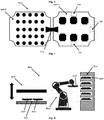
- the mold 400 is formed by a regular arrangement of four reconfigurable / exchangeable subunits 200A - 200D that comprise an identical footprint but different patterns of molding features. In this way, mold having complex molding patterns can be assembled from a plurality of simple subunits 200.
- the footprint of the subunits 200 is configured to tessellate, i.e. form a mosaic-like arrangement.
- the footprint of the subunits 200 may comprise a polygonal shape such as a hexagon.
- a portion of a mold such as the mold 100 of Fig. 1 and Fig. 3 can be covered, essentially without leaving non-covered spaces, via assembling a tessellation, i.e. a tessellating pattern comprising many subunits 200 having the same footprint.
- Figure 5 depicts another embodiment of the present invention, wherein the molding features of at least two subunits 200E and 200F are not identical but configured to form a mold 500 having a common pattern 505 of molding features.
- the subunits 200 can be arranged such that the textile being processed by the mold 500 may be provided with a common and coherent pattern of indentations corresponding to the common pattern 505 of molding features.
- Figure 6 depicts an embodiment of the present invention, wherein at least two subunits 200 and 605 of different footprint can be combined to create a mold 600 comprising a coherent common pattern of molding features.
- This embodiment may be particularly relevant for processing thermoplastic textiles with an asymmetric shape such as a shoe upper.
- connection elements 705 that may be configured to fit into corresponding connection recesses 710 arranged at the edges of the subunits 200 of the mold 700.
- Alternative connection elements and / or connection means such as magnetic connection means are evidently also possible.
- connection mechanism provided by the connection elements 705 may be reversible or irreversibly.
- Figure 8 depicts an exemplary system 800 for processing a thermoplastic textile 310 according to an embodiment of the present invention.
- the system 800 may comprise storage means 810 for storing a plurality of subunits 200 as described above.
- the system 800 may further comprise a robotic actuator 820 configured for retrieving the subunits 200 from the storage means 810 and for assembling a mold 100 from several of the reconfigurable subunits 200.
- the assembled mold 100 can then be used in a molding station 300 for processing the thermoplastic textile 310 as described above with reference to Fig. 3 .
- the system may further comprise means for automatically providing and retrieving the thermoplastic textile 310 as well as a rapid prototyping facility (both not shown) for repairing, modifying and / or producing customized subunits 200 on demand.
- Figure 9 depicts another exemplary system 900 according to an embodiment of the present invention. Similar to the embodiment of Fig. 8 above, the system 900 comprises storage means 810 for storing a plurality of subunits 200 as well as a robotic actuator 910 and a molding station 920.
- the robotic actuator 910 is adapted to retrieve one or several subunits 200 from the storage means 810, for instance via a special actuator head comprising a plurality of reception elements for a plurality of subunits 200.
- the robotic actuator 910 may be further adapted to directly mold the thermoplastic textile 310, e.g. via applying a downward pressure onto the textile 310.
- the heat required for providing the thermoplastic textile 310 with heat-fused indentations may be provided by heating means integrated into the subunits 200, into the head of the robotic actuator 910 and / or into a counter plate 930 that is used for molding the textile 310.
- the mold 100 may be assembled from a plurality of subunits 200 at a different location (not shown). The robotic actuator 910 may then retrieves the assembled mold 100 and use it for processing the textile 310. In this manner, a new mold for a new textile can already be assembled by the system while the preceding textile is being processed by the preceding mold 100.
- the storage means 810 of Fig. 8 and Fig. 9 may be configured to operate as a heater and / or as an oven for the plurality of subunits 200.
- a molding subunit such as the subunit 200 of Fig. 2 can be translated and rotated in space (e.g. by a robotic actuator similar to the robotic actuator 820 of Fig. 8 and / or the robotic actuator 910 of Fig. 9 ) such that it can be applied (e.g. pressed onto) in various orientations to different areas of a thermoplastic textile and / or similar thermoplastic material for the purpose of compacting and / or fusing the respective area the subunit is applied to.
- the possibility of rotating the subunit with respect to the thermoplastic textile / material provides an additional degree of freedom that allows to generate indentation patterns with an even larger degree of variation.
- thermoplastic textile / thermoplastic material may be an upper of a shoe and the subunit may be translated and rotated such that different areas on the upper are compacted and / or fused when the subunit is pressed onto the respective area of the upper.
- the subunit may comprise a variety of different shapes and /or molding patterns that, for example, may be generated on demand by an additive manufacturing device and / or computer-controlled laser cutter.
Landscapes
- Engineering & Computer Science (AREA)
- Mechanical Engineering (AREA)
- Chemical & Material Sciences (AREA)
- Materials Engineering (AREA)
- Casting Or Compression Moulding Of Plastics Or The Like (AREA)
- Moulds For Moulding Plastics Or The Like (AREA)
- Treatment Of Fiber Materials (AREA)
Abstract
Description
- The present invention relates to a reconfigurable mold for processing a thermoplastic textile as well as to a method and system using such a mold.
- Modern molding techniques for thermoplastic textiles and in particular non-woven fabrics have successfully been applied to many different aspects of apparel and / or sporting goods manufacturing. For instance, prior art document
EP 2 397 320 B1 discloses several aspects of molding and / or fusing non-woven fabrics used in the apparel and / or shoe industry. Specifically,EP 2 397 320 B1 provides a method for texturing a thermoplastic non-woven fabric in a heat press mold (e.g. c.f. Fig. 45A - 45C and paragraph [0116]). - Additional prior art relevant for the technical background of the present invention is provided by
EP 0 121 299 A2 andUS 5,164,255 A . - Such conventional techniques allow to provide thermoplastic textiles with fused, embossed and / or debossed patterns in order to obtain an improved stretch resistance, improved water resistance and / or improved aesthetics. Such fusing can be done with heat presses or with lasers. Heat presses are better for large batches, allow for 3D-effects and are cheaper in production.
- However, the molding techniques and / or the molds known from the prior art have various disadvantages. For instance, the conventional molds used in the prior art are bulky and inflexible. In particular, they lack the capabilities to be quickly adapted for processing of new kinds of textiles and / or for providing the processed textiles with new and / or variable structural and / or aesthetic properties. In other words, conventionally, a new mold must be designed and manufactured before a new type of textile can be molded. Evidently, this process is slow, expensive and / or wasteful.
- It is therefore the problem underlying the present invention to improve the conventional molding techniques, molds and systems for processing thermoplastic textiles so that the above outlined disadvantages of the prior art are at least partly overcome.
- Further prior art is mentioned in
DE 1957727 ,US 6 093 665 A ,WO 2019/ 115 875 A1 ,US 2005/0 101 215 A1 ,WO 2018/112 144 A1 andWO 03/082550 A2 - The above-mentioned problem is at least partly solved by the subject matter of the independent claims of the present application. Exemplary embodiments of the invention are described in the depended claims.
- In one embodiment, the present invention provides a mold for generating a pattern of indentations in a surface of a thermoplastic textile, preferably a non-woven fabric, the mold comprising at least one exchangeable and / or reconfigurable subunit adapted to create at least one subpattern of the pattern.
- In essence, the claimed invention therefore provides a mold that can easily be reconfigured such that the generated indentation pattern can easily be adjusted to dynamically changing manufacturing requirements, for instance, in a manufacturing plant and / or process that is adapted for manufacturing of customized apparel. For example, the mold provided by the present invention may be used for manufacturing shoe uppers that are being customized to individual customer preferences on a batch-by-batch basis or even on a piece-by-piece basis.
- In some embodiments, the at least one subunit may comprise a footprint that is configured to form a tessellation, e.g. a tessellating pattern. For instance, such a mold may comprise a plurality of subunits each comprising essentially the same, preferably polygonal, footprint.
- In this manner, complex molding patterns can be assembled from a set of simple building blocks. In this way, the variability of the indentation patterns that can be produced by such a mold is enlarged significantly without the need to provide and store a large number of custom molds for each indentation pattern. Similar to a letterpress, a large portion of the mold can easily be adapted, changed or partly recycled. In addition, damaged subunits can easily be replaced without having to exchange a large portion or even the complete mold.
- Further, in some embodiments, the spatial arrangement of the at least one subunit is reconfigurable within the mold.
- Thus, the at least one subunit of the mold can easily be rearranged with respect to other fixed or flexible portions of the mold, resulting in processed textiles featuring locally different properties as different areas might be provided with a different indentation pattern depending on a type and a location of the subunit within the mold.
- In some embodiments of the present invention the provided mold may be further adapted to fuse at least one indentation of the pattern of indentations into the thermoplastic textile by applying heat and / or pressure. For instance, the at least one indentation may even be fused to such degree as to be essentially transparent. Moreover, the at least one fused indentation may comprise a plurality of regularly arranged indentations. In this context and for the remainder of the present application, the term "fuse" is to be understood broadly, e.g. such that it also encompasses "emboss" and / or "deboss".
- For instance, in some embodiments of the present invention, the at least one subunit may be adapted to provide the at least one subpattern with different mechanical and / or optical properties than a different portion of the pattern.
- Further, the mold may be adapted to provide at least one indentation of the pattern of indentations with a minimal area of larger than or equal to 2 mm2 and smaller than or equal to 30 cm2, preferably larger than or equal to 8 mm2 and smaller than or equal to 20 cm2, more preferably larger than or equal to 10 mm2 and smaller than or equal to 5 cm2 and most preferably larger than or equal to 10 mm2 and smaller than or equal to 1 cm2.
- Moreover, the at least one subunit may comprise at least one connection element configured to connect the at least one subunit to another subunit adapted to create another subpattern of the pattern.
- In this manner, different subunits of the mold can easily be joined together to form a larger portion of the mold that may be recurrently adapted and or rearranged for generating even more complex and variable patterns of indentations.
- Further, in some embodiments of the present invention the provided mold may further comprise means for heating the thermoplastic textile and / or a surface of the mold and / or a surface of the at least one subunit.
- By integrating heating means into the mold the footprint of a molding station comprising such a mold and / or the molding cycle time can be reduced.
- In some embodiments of the present invention the provided mold may be further adapted to provide the at least one fused indentation with a fused outer edge region exhibiting a smoothly decreasing density, smoothly decreasing degree of fusing and / or a smoothly decreasing degree of compression.
- In this manner, undesired damage that may occur at the edge of such indentations, for instance caused by a discontinuous change in material properties, can be avoided.
- In another embodiment, the present invention provides a method for generating a pattern of indentations in a surface of a thermoplastic textile, comprising the step of processing the thermoplastic textile with a mold according to any of the preceding embodiments described above.
- For instance such a method may comprise at least one of the following steps: exchanging and / or reconfiguring at least one subunit of the mold, producing and / or modifying the at least one subunit with a rapid prototyping device prior to processing the thermoplastic textile, providing a separator material between the thermoplastic textile and a surface of the mold and / or the at least one subunit, providing a release agent to a surface of the mold and / or the at least one subunit.
- Such methods may allow to produce customized pieces of apparel in a fast and cost-efficient manner without the need to design custom molds every time the molding pattern is adjusted to customer requirements and / or changing manufacturing requirements and / or new specifications.
- For instance, the method may involve a processing temperature of a portion of the mold that is larger than or equal to 70 °C and smaller than or equal to 220 °C and / or an ambient temperature that is larger than or equal to 170 °C and smaller than or equal to 190 °C and / or a processing time that is larger than or equal to 3 s and smaller than or equal to 150 s and / or a processing pressure that is larger than or equal to 0.2 bar and smaller than or equal to 5 bar.
- In another embodiment, the present invention provides a method for producing a piece of apparel, in particular a shoe, comprising the step of producing the piece of apparel using a thermoplastic textile processed according to any of the previously described methods.
- In this manner the variability and flexible reconfigurability of the molds and methods described above can be fully leveraged for apparel and in particular shoe manufacturing.
- Accordingly, in another embodiment, the present invention provides a piece of apparel, in particular a shoe, comprising a thermoplastic textile processed via the method described above.
- For instance, in some embodiments, such a piece of apparel may comprise a thermoplastic textile that comprises a non-woven fabric or a pre-joined composite material comprising at least one layer of melt-blown fiber non-woven fabric and at least one layer of a reinforcement textile.
- Accordingly, the present invention provides various functional sports apparel and in particular high-performance athletic shoes that exhibit superior material, functional, haptic and /or aesthetic properties and / or an improved wearing comfort.
- For instance, such a piece of apparel may comprise at least one fused indentation, preferably a plurality of regularly arranged indentations, wherein the at least one indentation may further comprise an outer edge region exhibiting a smoothly decreasing density, smoothly decreasing degree of fusing and / or a smoothly decreasing degree of compression.
- In this manner, undesired damaged, wear and / or material degradation that may occur at the edge of such indentation, for instance caused by a discontinuous change in material properties, can be avoided.
- In another embodiment, the present invention provides a system for processing a thermoplastic textile, comprising: a mold according to any of the above embodiments and means for exchanging and / or reconfiguring the at least one exchangeable and / or reconfigurable subunit.
- For instance, in such systems the means for exchanging and / or reconfiguring the at least one subunit may be implemented by a robotic actuator configured to grip and translate the at least one exchangeable and / or reconfigurable subunit.
- In this manner, the complete reconfiguration process of the mold and / or the at least one subunit may be partially or even fully automated leading to faster cycle times and / or an increased reliability for manufacturing of customized apparel such as customized athletic shoes.
- In various embodiments of the present invention such a system for processing a thermoplastic textile may further comprise at least one of: means for automatically providing the thermoplastic textile to be processed, means for heating the mold, the at least one exchangeable and / or reconfigurable subunit and / or the thermoplastic textile being processed, means for storing a plurality of exchangeable and / or reconfigurable subunits, rapid prototyping means for producing and / or modifying the at least one exchangeable and / or reconfigurable subunit on demand during system operation, means for providing a separator material between the thermoplastic textile and the mold and / or between the thermoplastic textile and the at least one exchangeable and / or reconfigurable subunit and means for providing a release agent to a surface of the mold and / or a surface of the at least one exchangeable and / or reconfigurable subunit.
- Depending on the specific implementation of the provided system various aspects of manufacturing of customized apparel can further be enhanced and / or further automated. In essence, the provided system thereby allows for fully automated and thus fast and low-cost manufacturing of customized apparel and shoes.
- The various embodiments of the present invention can also be used with and / or applied on other types of thermoplastic materials such as films, foams or various other materials used in footwear and / or apparel manufacturing.
- Aspects of the present invention are described in more detail in the following by reference to the accompanying figures. These figures show:
- Fig. 1
- a diagram illustrating a reconfigurable mold according to an embodiment of the present invention;
- Fig. 2
- a diagram illustrating a reconfigurable subunit of a reconfigurable mold according to an embodiment of the of the present invention;
- Fig. 3
- a diagram illustrating a molding station for processing a thermoplastic textile using a reconfigurable mold according to an embodiment of the present invention;
- Fig. 4
- a diagram illustrating a molding arrangement formed by a plurality of reconfigurable mold subunits according to an embodiment of the present invention;
- Fig. 5
- a diagram illustrating another molding arrangement formed by a plurality of reconfigurable mold subunits according to an embodiment of the present invention;
- Fig. 6
- a diagram illustrating another molding arrangement formed by a plurality of reconfigurable mold subunits according to an embodiment of the present invention;
- Fig. 7
- a diagram illustrating a connection technique for a molding arrangement formed by a plurality of reconfigurable mold subunits according to an embodiment of the present invention;
- Fig. 8
- a system for processing a thermoplastic textile according to an embodiment of the present invention;
- Fig. 9
- a system for processing a thermoplastic textile according to an embodiment of the present invention;
- In the following, exemplary embodiments of the present invention are described in more detail, with reference to a mold for processing thermoplastic textiles. While specific feature combinations are described in the following with respect to the exemplary embodiments of the present invention, it is to be understood that the disclosure is not limited to such embodiments. In particular, not all features have to be present for realizing the invention, and the embodiments may be modified by combining certain features of one embodiment with one or more features of another embodiment.
- While the present invention is illustrated in the following with respect to molds, methods and systems that are adapted to provide indentation into a thermoplastic textile, it should be appreciated that the same molds, methods and systems can also be used to provide perforations into such textiles and / or other thermoplastic materials used in apparel and sports goods manufacturing such as films and / foams.
-
Figure 1 depicts amold 100 for processing of thermoplastic textiles, preferably of thermoplastic non-woven fabrics, according to an embodiment of the present invention. Themold 100 may comprise a plurality of fixed molding features 110 that may be configured to provide indentations to a textile processed with themold 100. In addition, themold 100 may be configured to comprise at least one exchangeable and / orreconfigurable subunit 120. Thesubunit 120 may be adapted to be reconfigurable, exchangeable and / or movable with respect to themold 100 and / or one or more of the fixed molding features 110. In some embodiments, themold 100 may comprise one or more preconfigured reception positions for the at least onereconfigurable subunit 120. For instance, themold 100 may comprise an at least partially heat-resistant material such as a polymer, a metal, etc. -
Figure 2 depicts an illustration of areconfigurable subunit 200. Asubunit 200 of this sort may be used alone to imprint a single localized pattern on a textile. Alternatively, asubunit 200 of this sort may be combined with additional identical or similar subunits to imprint a repeating pattern on a textile covering a larger area than possible with a single subunit in a single step. The advantage of this arrangement is that the coverage of a repeating pattern can be adapted depending on the size of the textile. This is especially useful in the manufacture of garments and apparel where multiple sizes of the same product have to be made in order to suit different wearers. Alternatively, asubunit 200 of this sort may be combined with additional alternative subunits - i.e. subunits having a different size, a different shape, and/or a different pattern. The advantage of this arrangement is that larger complex patterns can be built up in a modular manner from small individual pieces. This allows increased design freedom without overly extending the resources available from a manufacturing point of view. Alternatively, or in combination with any of the assembly options above, asubunit 200 of this type may be used together with themold 100 ofFig. 1 . The illustration on the left ofFig. 2 depicts a top view on thesubunit 200 while the illustration on the right depict a cut through the subunit along the dashed line in the illustration on the left ofFig. 2 . Thesubunit 200 may comprise a plurality of molding features 210 that may be configured to generate a pattern or subpattern of indentations in a thermoplastic textile that is being processed, e.g. molded, by a mold comprising thesubunit 200 or a mold comprising a plurality of identical or similar subunits as discussed in more detail below. - The
subunit 200 may be arranged in a reconfigurable manner on the surface simply using gravity to keep thesubunit 200 in place. Alternatively, when there is no mold or other external frame to hold thesubunit 200 in place it may be necessary to provide an attachment means between thesubunit 200 and the surface to prevent the subunit moving during use or between repeated uses. Thesubunit 200 may be attached to the surface using, for example, a clamp, or a screw mechanism or a clip mechanism or a magnetic fastening mechanism. Moreover,different subunits 200 having different patterns of molding features 210 may be used together with themold 100. For the present embodiment, the molding features 210 are illustrated as a regular pattern of protrusions. However, in other embodiments thesubunit 200 may also comprise recesses or both. - Further, the
subunit 200 may be constructed from the same heat-resistant material as themold 100 or may comprise a different material that is adapted to provide a textile being processed with a pattern of indentations. For example, thesubunit 200 may be manufactured on demand by a rapid prototyping device such as a 3D printer, a laser sintering device or a multi-jet-fusion device. In this manner, the molding pattern of themold 100 may easily be reconfigured, either by changing the position of thesubunit 200 with respect to the surface or the mold and / or by replacing thesubunit 200 by a different one, for instance, being produced on demand by a 3D printer according to individual customer preferences. - Further, the
mold 100 ofFig. 1 and / or thesubunit 200 may comprise heating means such as an electric heating element or channels for providing a heating medium. In this manner, the molding features 110 and 210 can be heated to a temperature that is sufficient to provide a thermoplastic textile, e.g. a non-woven fabric, with heat-fused indentations when being processed via the mold and / or thesubunit 200. In other embodiments, the heat required for heat-fusing the textiles being processed by themold 100 and / or thesubunit 200 may also be supplied via external heating means that are not incorporated in themold 100 or thesubunit 200. - The
subunit 200 may also comprise a heat conductive material in order to apply heat and pressure at the same time to the thermoplastic textile being processed. Alternatively or additionally, the textile could be heated. The first option gives the advantage that it does not require heating a larger region/volume so that the whole molding arrangement is heated together. The second option gives faster cycle times of the process since thesubunit 200 does not have to be heated after having cooled down. -
Figure 3 depicts an exemplary illustration of a molding station orheat press 300 for processing a textile according to an embodiment of the present invention. Such a heat press /molding station 300 may also be used for carrying out any of the methods provided by the present invention. As depicted inFig. 3 themolding station 300 may comprise anupper portion 302 and alower portion 304 that may be heated, e.g. via integrated heating means, to elevated temperatures required for processing athermoplastic textile 310. Thelower portion 302 of the molding station /heat press 300 may be equipped with areconfigurable mold 100, comprising one or a plurality ofreconfigurable subunits 200 as depicted inFig. 2 and discussed above. - In general, heat and pressure do not have to be applied at the same time. For example, it is also possible to first heat the thermoplastic textile above a threshold temperature that allows the thermoplastic textile to be plastically deformed and afterwards pressure is applied via a
mold 100 and / or amolding station 300 to cause such a desired deformation (e.g. fusing) of the thermoplastic textile. - In the depicted example the textile being processed by the
mold 100 is a three-layer sandwich textile comprising anupper layer 312 and alower layer 314 of melt-blown fiber non-woven fabric that may be directly deposited, e.g. melt-blown, onto a middle layer ofreinforcement textile 310. For instance, both layers of melt-blownfiber non-woven fabrics - In some embodiments of the present invention, the
thermoplastic textile 310 is not directly brought in contact with the molding features of themold 100. Instead, aseparator material 330 such as a thin layer of polytetrafluoroethylene and / or silicone may be used to facilitate an easy removal of thetextile 310 after molding. Alternatively or additionally, a chemical or a physical removal agent may be employed to facilitate removing the moldedtextile 310 after molding. -
Figure 4 depicts amold 400 for processing a thermoplastic textile with a process and / or molding station as depicted inFig. 3 . Themold 400 is formed by a regular arrangement of four reconfigurable /exchangeable subunits 200A - 200D that comprise an identical footprint but different patterns of molding features. In this way, mold having complex molding patterns can be assembled from a plurality ofsimple subunits 200. In some embodiments, the footprint of thesubunits 200 is configured to tessellate, i.e. form a mosaic-like arrangement. For instance, the footprint of thesubunits 200 may comprise a polygonal shape such as a hexagon. In this case, a portion of a mold such as themold 100 ofFig. 1 andFig. 3 can be covered, essentially without leaving non-covered spaces, via assembling a tessellation, i.e. a tessellating pattern comprisingmany subunits 200 having the same footprint. -
Figure 5 depicts another embodiment of the present invention, wherein the molding features of at least twosubunits mold 500 having acommon pattern 505 of molding features. In this way, thesubunits 200 can be arranged such that the textile being processed by themold 500 may be provided with a common and coherent pattern of indentations corresponding to thecommon pattern 505 of molding features. -
Figure 6 depicts an embodiment of the present invention, wherein at least twosubunits mold 600 comprising a coherent common pattern of molding features. This embodiment may be particularly relevant for processing thermoplastic textiles with an asymmetric shape such as a shoe upper. - The embodiment of
Figure 7 shows how thesubunits 200 of amold 700 can be provided withconnection elements 705 that may be configured to fit into corresponding connection recesses 710 arranged at the edges of thesubunits 200 of themold 700. Alternative connection elements and / or connection means such as magnetic connection means are evidently also possible. Depending on the application the connection mechanism provided by theconnection elements 705 may be reversible or irreversibly. -
Figure 8 depicts anexemplary system 800 for processing athermoplastic textile 310 according to an embodiment of the present invention. Thesystem 800 may comprise storage means 810 for storing a plurality ofsubunits 200 as described above. Thesystem 800 may further comprise arobotic actuator 820 configured for retrieving thesubunits 200 from the storage means 810 and for assembling amold 100 from several of thereconfigurable subunits 200. The assembledmold 100 can then be used in amolding station 300 for processing thethermoplastic textile 310 as described above with reference toFig. 3 . In addition, the system may further comprise means for automatically providing and retrieving thethermoplastic textile 310 as well as a rapid prototyping facility (both not shown) for repairing, modifying and / or producing customizedsubunits 200 on demand. -
Figure 9 depicts anotherexemplary system 900 according to an embodiment of the present invention. Similar to the embodiment ofFig. 8 above, thesystem 900 comprises storage means 810 for storing a plurality ofsubunits 200 as well as arobotic actuator 910 and amolding station 920. In this embodiment therobotic actuator 910 is adapted to retrieve one orseveral subunits 200 from the storage means 810, for instance via a special actuator head comprising a plurality of reception elements for a plurality ofsubunits 200. In addition, therobotic actuator 910 may be further adapted to directly mold thethermoplastic textile 310, e.g. via applying a downward pressure onto thetextile 310. In some embodiments, the heat required for providing thethermoplastic textile 310 with heat-fused indentations may be provided by heating means integrated into thesubunits 200, into the head of therobotic actuator 910 and / or into acounter plate 930 that is used for molding thetextile 310. In some embodiments, themold 100 may be assembled from a plurality ofsubunits 200 at a different location (not shown). Therobotic actuator 910 may then retrieves the assembledmold 100 and use it for processing thetextile 310. In this manner, a new mold for a new textile can already be assembled by the system while the preceding textile is being processed by the precedingmold 100. - In some embodiments of the present invention the storage means 810 of
Fig. 8 andFig. 9 may be configured to operate as a heater and / or as an oven for the plurality ofsubunits 200. - In a further embodiment of the present invention a molding subunit such as the
subunit 200 ofFig. 2 can be translated and rotated in space (e.g. by a robotic actuator similar to therobotic actuator 820 ofFig. 8 and / or therobotic actuator 910 ofFig. 9 ) such that it can be applied (e.g. pressed onto) in various orientations to different areas of a thermoplastic textile and / or similar thermoplastic material for the purpose of compacting and / or fusing the respective area the subunit is applied to. The possibility of rotating the subunit with respect to the thermoplastic textile / material provides an additional degree of freedom that allows to generate indentation patterns with an even larger degree of variation. - For instance, the thermoplastic textile / thermoplastic material may be an upper of a shoe and the subunit may be translated and rotated such that different areas on the upper are compacted and / or fused when the subunit is pressed onto the respective area of the upper. For this purpose, the subunit may comprise a variety of different shapes and /or molding patterns that, for example, may be generated on demand by an additive manufacturing device and / or computer-controlled laser cutter.
- In the following, further embodiments are described to facilitate understanding the invention:
- 1. Mold (100, 400, 500, 600, 700) for generating a pattern of indentations in a surface of a thermoplastic textile (310), preferably comprising a non-woven fabric, comprising at least one exchangeable and / or reconfigurable subunit (200) adapted to create at least one subpattern of the pattern.
- 2. Mold (100, 400, 500, 600, 700) according to the preceding embodiment, wherein the at least one subunit (200) comprises a footprint that is configured to form a tessellation.
- 3. Mold (100, 400, 500, 600, 700) according to any of the preceding embodiments, comprising a plurality of subunits (200) each comprising essentially the same, preferably polygonal, footprint.
- 4. Mold (100, 400, 500, 600, 700) according to any of the preceding embodiments, wherein the spatial arrangement of the at least one subunit (200) is reconfigurable within the mold (100, 400, 500, 600, 700).
- 5. Mold (100, 400, 500, 600, 700) according to any of the preceding embodiments, further adapted to fuse at least one indentation of the pattern of indentations into the thermoplastic textile (310) by applying heat and / or pressure.
- 6. Mold (100, 400, 500, 600, 700) according to the preceding embodiment, wherein the at least one fused indentation comprises a plurality of regularly arranged indentations.
- 7. Mold (100, 400, 500, 600, 700) according to any of the preceding embodiments, wherein the at least one indentation is essentially transparent.
- 8. Mold (100, 400, 500, 600, 700) according to any of the preceding embodiments, further adapted to provide at least one indentation of the pattern of indentations with a minimal area of larger than or equal to 2 mm2 and smaller than or equal to 30 cm2, preferably larger than or equal to 8 mm2 and smaller than or equal to 20 cm2, more preferably larger than or equal to 10 mm2 and smaller than or equal to 5 cm2 and most preferably larger than or equal to 10 mm2 and smaller than or equal to 1 cm2.
- 9. Mold (100, 400, 500, 600, 700) according to any of the preceding embodiments, wherein the at least one subunit (200, 200G) comprises at least one connection element (700) configured to connect the at least one subunit (200G) to another subunit (200H) adapted to create another subpattern of the pattern.
- 10. Mold (100, 400, 500, 600, 700) according to any of the preceding embodiments, wherein the at least one subunit (200) is adapted to provide the at least one subpattern with different mechanical and / or optical properties than a different portion of the pattern.
- 11. Mold (100, 400, 500, 600, 700) according to any of the preceding embodiments, further comprising means for heating the thermoplastic textile (310) and / or a surface of the mold (100, 400, 500, 600, 700) and / or a surface of the at least one subunit (200).
- 12. Mold (100, 400, 500, 600, 700) according to any of the preceding embodiments 5-11, configured to provide the at least one fused indentation with a fused outer edge region exhibit a smoothly decreasing density, smoothly decreasing degree of fusing and / or a smoothly decreasing degree of compression.
- 13. Method for generating a pattern of indentations in a surface of a thermoplastic textile (310), comprising the step of processing the thermoplastic textile (310) with a mold (100, 400, 500, 600, 700) according to any of the preceding claims.
- 14. Method according to the preceding embodiment, further comprising at least one of the following steps:
- a. exchanging and / or reconfiguring at least one subunit (200) of the mold (100, 400, 500, 600, 700);
- b. producing and / or modifying the at least one subunit (200) with a rapid prototyping device prior to processing the thermoplastic textile (310);
- c. providing a separator material (330) between the thermoplastic textile (310) and a surface of the mold (100, 400, 500, 600, 700) and / or the at least one subunit (200); and
- d. providing a release agent to a surface of the mold (100, 400, 500, 600, 700) and / or the at least one subunit (200).
- 15. Method according to any of the preceding embodiments 13 or 14: wherein
- a. a processing temperature of a portion of the mold (100, 400, 500, 600, 700) is larger than or equal to 70 °C and smaller than or equal to 220 °C; and / or
- b. an ambient temperature is larger than or equal to 170 °C and smaller than or equal to 190 °C; and / or
- c. a processing time is larger than or equal to 3 s and smaller than or equal to 150 s; and / or
- d. a processing pressure is larger than or equal to 0,2 bar and smaller than or equal to 5 bar.
- 16. Method for producing a piece of apparel, in particular a shoe, comprising the step of: producing the piece of apparel using a thermoplastic textile (310) processed according to the method of any of the preceding embodiments 13 - 15.
- 17. Piece of apparel, in particular a shoe, comprising a thermoplastic textile (310) processed via the method of any of the preceding claims 13 - 16.
- 18. Piece of apparel according to the preceding embodiment, wherein the thermoplastic textile (310) comprises a non-woven fabric or a pre-joined composite material comprising at least one layer (312, 314) of melt blown non-woven fabric and at least one layer of a reinforcement textile (316).
- 19. Piece of apparel according to any of the preceding embodiments 17 or 18, comprising at least one fused indentation, preferably a plurality of regularly arranged indentations.
- 20. Piece of apparel according to any of the preceding embodiments 17 - 19, wherein the at least one indentation comprises an outer edge region exhibit a smoothly decreasing density, smoothly decreasing degree of fusing and / or a smoothly decreasing degree of compression.
- 21. System (800, 900) for processing a thermoplastic textile (310), comprising:
- a. a mold (100, 400, 500, 600, 700) according to any of the preceding claims 1 - 12; and
- b. means (820, 910) for exchanging and / or reconfiguring the at least one exchangeable and / or reconfigurable subunit (200).
- 22. System (800, 900) for processing a thermoplastic textile (310) according to the preceding embodiment, wherein the means (820, 910) for exchanging and / or reconfiguring the at least one subunit (200) comprise a robotic actuator configured to grip and translate the at least one exchangeable and / or reconfigurable subunit (200).
- 23. System (800, 900) for processing a thermoplastic textile (310) according to any of the preceding embodiments 21 or 22, further comprising at least one of:
- a. means for automatically providing the thermoplastic textile (310) to be processed;
- b. means for heating the mold (100, 400, 500, 600, 700), the at least one exchangeable and / or reconfigurable subunit (200) and / or the thermoplastic textile (310) being processed;
- c. means for storing (810) a plurality of exchangeable and / or reconfigurable subunits (200);
- d. rapid prototyping means for producing and / or modifying the at least one exchangeable and / or reconfigurable subunit (200) on demand prior / or during system operation;
- e. means for providing a separator material (330) between the thermoplastic textile (310) and a surface of the mold (100, 400, 500, 600, 700) and / or between the thermoplastic textile (310) and a surface of the at least one exchangeable and / or reconfigurable subunit (200); and
- f. means for providing a release agent to a surface of the mold (100, 400, 500, 600, 700) and / or a surface of the at least one exchangeable and / or reconfigurable subunit (200).
Claims (15)
- Mold (100, 400, 500, 600, 700) for generating a pattern of indentations in a surface of a thermoplastic textile (310), preferably comprising a non-woven fabric, comprising at least one exchangeable and / or reconfigurable subunit (200) adapted to create at least one subpattern of the pattern.
- Mold (100, 400, 500, 600, 700) according to the preceding claim, wherein the at least one subunit (200) comprises a footprint that is configured to form a tessellation.
- Mold (100, 400, 500, 600, 700) according to any of the preceding claims, further adapted to fuse at least one indentation of the pattern of indentations into the thermoplastic textile (310) by applying heat and / or pressure.
- Mold (100, 400, 500, 600, 700) according to any of the preceding claims, further adapted to provide at least one indentation of the pattern of indentations with a minimal area of larger than or equal to 2 mm2 and smaller than or equal to 30 cm2, preferably larger than or equal to 8 mm2 and smaller than or equal to 20 cm2, more preferably larger than or equal to 10 mm2 and smaller than or equal to 5 cm2 and most preferably larger than or equal to 10 mm2 and smaller than or equal to 1 cm2.
- Mold (100, 400, 500, 600, 700) according to any of the preceding claims, wherein the at least one subunit (200, 200G) comprises at least one connection element (700) configured to connect the at least one subunit (200G) to another subunit (200H) adapted to create another subpattern of the pattern.
- Mold (100, 400, 500, 600, 700) according to any of the preceding claims, wherein the at least one subunit (200) is adapted to provide the at least one subpattern with different mechanical and / or optical properties than a different portion of the pattern.
- Mold (100, 400, 500, 600, 700) according to any of the preceding claims, further comprising means for heating the thermoplastic textile (310) and / or a surface of the mold (100, 400, 500, 600, 700) and / or a surface of the at least one subunit (200).
- Mold (100, 400, 500, 600, 700) according to any of the preceding claims 3 - 7, configured to provide the at least one fused indentation with a fused outer edge region exhibit a smoothly decreasing density, smoothly decreasing degree of fusing and / or a smoothly decreasing degree of compression.
- Method for generating a pattern of indentations in a surface of a thermoplastic textile (310), comprising the step of processing the thermoplastic textile (310) with a mold (100, 400, 500, 600, 700) according to any of the preceding claims.
- Method according to the preceding claim, further comprising at least one of the following steps:a. exchanging and / or reconfiguring at least one subunit (200) of the mold (100, 400, 500, 600, 700);b. producing and / or modifying the at least one subunit (200) with a rapid prototyping device prior to processing the thermoplastic textile (310);c. providing a separator material (330) between the thermoplastic textile (310) and a surface of the mold (100, 400, 500, 600, 700) and / or the at least one subunit (200); andd. providing a release agent to a surface of the mold (100, 400, 500, 600, 700) and / or the at least one subunit (200).
- Method according to any of the preceding claims 9 or 10: whereina. a processing temperature of a portion of the mold (100, 400, 500, 600, 700) is larger than or equal to 70 °C and smaller than or equal to 220 °C; and / orb. an ambient temperature is larger than or equal to 170 °C and smaller than or equal to 190 °C; and / orc. a processing time is larger than or equal to 3 s and smaller than or equal to 150 s; and / ord. a processing pressure is larger than or equal to 0,2 bar and smaller than or equal to 5 bar.
- Piece of apparel, in particular a shoe, comprising a thermoplastic textile (310) processed via the method of any of the preceding claims 9 - 11.
- System (800, 900) for processing a thermoplastic textile (310), comprising:a. a mold (100, 400, 500, 600, 700) according to any of the preceding claims 1 - 8; andb. means (820, 910) for exchanging and / or reconfiguring the at least one exchangeable and / or reconfigurable subunit (200).
- System (800, 900) for processing a thermoplastic textile (310) according to the preceding claim, wherein the means (820, 910) for exchanging and / or reconfiguring the at least one subunit (200) comprise a robotic actuator configured to grip and translate the at least one exchangeable and / or reconfigurable subunit (200).
- System (800, 900) for processing a thermoplastic textile (310) according to any of the preceding claims 13 or 14, further comprising at least one of:a. means for automatically providing the thermoplastic textile (310) to be processed;b. means for heating the mold (100, 400, 500, 600, 700), the at least one exchangeable and / or reconfigurable subunit (200) and / or the thermoplastic textile (310) being processed;c. means for storing (810) a plurality of exchangeable and / or reconfigurable subunits (200);d. rapid prototyping means for producing and / or modifying the at least one exchangeable and / or reconfigurable subunit (200) on demand prior / or during system operation;e. means for providing a separator material (330) between the thermoplastic textile (310) and a surface of the mold (100, 400, 500, 600, 700) and / or between the thermoplastic textile (310) and a surface of the at least one exchangeable and / or reconfigurable subunit (200); andf. means for providing a release agent to a surface of the mold (100, 400, 500, 600, 700) and / or a surface of the at least one exchangeable and / or reconfigurable subunit (200).
Applications Claiming Priority (1)
| Application Number | Priority Date | Filing Date | Title |
|---|---|---|---|
| DE102019203267.2A DE102019203267A1 (en) | 2019-03-11 | 2019-03-11 | Form, method and system for processing a thermoplastic textile |
Publications (2)
| Publication Number | Publication Date |
|---|---|
| EP3708333A1 true EP3708333A1 (en) | 2020-09-16 |
| EP3708333B1 EP3708333B1 (en) | 2025-11-05 |
Family
ID=70189646
Family Applications (1)
| Application Number | Title | Priority Date | Filing Date |
|---|---|---|---|
| EP20162390.7A Active EP3708333B1 (en) | 2019-03-11 | 2020-03-11 | Embossing plate, method, and system for embossing a thermoplastic textile |
Country Status (4)
| Country | Link |
|---|---|
| US (1) | US11992978B2 (en) |
| EP (1) | EP3708333B1 (en) |
| CN (1) | CN111673958A (en) |
| DE (1) | DE102019203267A1 (en) |
Families Citing this family (1)
| Publication number | Priority date | Publication date | Assignee | Title |
|---|---|---|---|---|
| FR3094912B1 (en) * | 2019-04-12 | 2021-03-05 | Arkema France | POLYAMIDE TEXTURING PROCESS |
Citations (17)
| Publication number | Priority date | Publication date | Assignee | Title |
|---|---|---|---|---|
| US2047373A (en) * | 1932-04-04 | 1936-07-14 | Lewis A Kingsley | Stamping machine |
| US3443281A (en) * | 1967-07-24 | 1969-05-13 | Rupert Mfg Co | Molding pin,matrix,and molding assembly for manufacture of reflective devices |
| DE1957727A1 (en) | 1968-11-21 | 1970-06-04 | Union Carbide Corp | Method and apparatus for making a non-woven fiber pad |
| US3946195A (en) * | 1974-07-01 | 1976-03-23 | Lyons Dianne D | Device for branding indicia on a tennis ball |
| EP0121299A2 (en) | 1983-02-01 | 1984-10-10 | Minnesota Mining And Manufacturing Company | Molded nonwoven shaped articles |
| EP0300435A2 (en) * | 1987-07-23 | 1989-01-25 | Karl Dörr Kartonagen-Hinterkappen | Method for producing a flat moulded thermoplastic article, and apparatus for carrying out this method |
| US5164255A (en) | 1989-08-31 | 1992-11-17 | E. I. Du Pont De Nemours And Company | Nonwoven preform sheets of fiber reinforced resin chips |
| US6093665A (en) | 1993-09-30 | 2000-07-25 | Kimberly-Clark Worldwide, Inc. | Pattern bonded nonwoven fabrics |
| WO2003082550A2 (en) | 2002-03-28 | 2003-10-09 | Materialise, Naamloze Vennootschap | Method and device for manufacturing fabric material |
| US20050101215A1 (en) | 2003-11-06 | 2005-05-12 | N.R. Spuntech Industries Ltd. | Method for producing abrasive non-woven cloth |
| EP2488685A1 (en) * | 2009-10-15 | 2012-08-22 | Nike International Ltd. | Textured thermoplastic non-woven elements |
| EP2952318A1 (en) * | 2013-01-29 | 2015-12-09 | Daicel Corporation | Sheet-shaped mold, production method therefor, and application therefor |
| EP3129159A1 (en) * | 2014-04-09 | 2017-02-15 | KUKA Systems GmbH | Applicator and application method |
| EP2397320B1 (en) | 2009-02-06 | 2017-05-03 | NIKE Innovate C.V. | Thermoplastic non-woven textile elements |
| US20180154555A1 (en) * | 2016-12-05 | 2018-06-07 | Ohio State Innovation Foundation | Agile tooling |
| WO2018112144A1 (en) | 2016-12-15 | 2018-06-21 | The Procter & Gamble Company | Shaped nonwoven |
| WO2019115875A1 (en) | 2017-12-11 | 2019-06-20 | Suominen Corporation | A nonwoven material having encoded information, a method for encoding information on a nonwoven material and a system for using same |
Family Cites Families (14)
| Publication number | Priority date | Publication date | Assignee | Title |
|---|---|---|---|---|
| US2815306A (en) * | 1953-10-29 | 1957-12-03 | Vorwerk & Sohn | Components for use in producing footwear and the production of such components |
| US4078124A (en) * | 1969-10-09 | 1978-03-07 | Exxon Research & Engineering Co. | Laminated non-woven sheet |
| DE3700609A1 (en) * | 1987-01-10 | 1988-07-21 | Corovin Gmbh | METHOD AND DEVICE FOR STRENGTHENING A FIBER FIBER |
| AU5104899A (en) * | 1998-12-22 | 2000-07-12 | Reebok International Ltd. | An article of footwear and method for making the same |
| KR101432849B1 (en) * | 2006-10-31 | 2014-08-26 | 오와이 모디네스 리미티드 | Method and arrangement for manufacturing optical products with complex three-dimensional forms |
| DE102009009256B4 (en) * | 2009-02-17 | 2012-06-14 | Jürgen Amrhein | Method and device for producing an acoustically effective plate with textile, embossed lamination |
| EP2453038A1 (en) | 2010-11-16 | 2012-05-16 | The Swatch Group Research and Development Ltd. | Method for coating micromechanical parts with dual diamond coating |
| US8701733B2 (en) * | 2011-01-07 | 2014-04-22 | Nike, Inc. | Shoe customization system having interchangeable platens |
| US20130220570A1 (en) * | 2012-02-29 | 2013-08-29 | Ford Motor Company | Additive fabrication technologies for creating molds for die components |
| US10907286B2 (en) * | 2017-02-01 | 2021-02-02 | Sun-Yin Usa Inc. | Method for applying a pattern to a plush synthetic fabric using a hot press technique |
| DE102017003411A1 (en) * | 2017-04-07 | 2018-10-11 | Carl Freudenberg Kg | Thermally embossed nonwoven fabric and process for its production |
| WO2020021158A1 (en) * | 2018-07-25 | 2020-01-30 | Suominen Corporation | 3d printed sleeve |
| US20200063311A1 (en) * | 2018-08-21 | 2020-02-27 | Yang-Xun Hong | Woven cloth and method able to integrally form a three-dimensional pattern on the woven cloth and its finished product |
| DE102019000320A1 (en) * | 2018-12-21 | 2020-06-25 | Tönnjes Isi Patent Holding Gmbh | Method and device for embossing license plates, in particular motor vehicle license plates |
-
2019
- 2019-03-11 DE DE102019203267.2A patent/DE102019203267A1/en active Pending
-
2020
- 2020-03-05 CN CN202010146017.3A patent/CN111673958A/en active Pending
- 2020-03-11 EP EP20162390.7A patent/EP3708333B1/en active Active
- 2020-03-11 US US16/815,652 patent/US11992978B2/en active Active
Patent Citations (17)
| Publication number | Priority date | Publication date | Assignee | Title |
|---|---|---|---|---|
| US2047373A (en) * | 1932-04-04 | 1936-07-14 | Lewis A Kingsley | Stamping machine |
| US3443281A (en) * | 1967-07-24 | 1969-05-13 | Rupert Mfg Co | Molding pin,matrix,and molding assembly for manufacture of reflective devices |
| DE1957727A1 (en) | 1968-11-21 | 1970-06-04 | Union Carbide Corp | Method and apparatus for making a non-woven fiber pad |
| US3946195A (en) * | 1974-07-01 | 1976-03-23 | Lyons Dianne D | Device for branding indicia on a tennis ball |
| EP0121299A2 (en) | 1983-02-01 | 1984-10-10 | Minnesota Mining And Manufacturing Company | Molded nonwoven shaped articles |
| EP0300435A2 (en) * | 1987-07-23 | 1989-01-25 | Karl Dörr Kartonagen-Hinterkappen | Method for producing a flat moulded thermoplastic article, and apparatus for carrying out this method |
| US5164255A (en) | 1989-08-31 | 1992-11-17 | E. I. Du Pont De Nemours And Company | Nonwoven preform sheets of fiber reinforced resin chips |
| US6093665A (en) | 1993-09-30 | 2000-07-25 | Kimberly-Clark Worldwide, Inc. | Pattern bonded nonwoven fabrics |
| WO2003082550A2 (en) | 2002-03-28 | 2003-10-09 | Materialise, Naamloze Vennootschap | Method and device for manufacturing fabric material |
| US20050101215A1 (en) | 2003-11-06 | 2005-05-12 | N.R. Spuntech Industries Ltd. | Method for producing abrasive non-woven cloth |
| EP2397320B1 (en) | 2009-02-06 | 2017-05-03 | NIKE Innovate C.V. | Thermoplastic non-woven textile elements |
| EP2488685A1 (en) * | 2009-10-15 | 2012-08-22 | Nike International Ltd. | Textured thermoplastic non-woven elements |
| EP2952318A1 (en) * | 2013-01-29 | 2015-12-09 | Daicel Corporation | Sheet-shaped mold, production method therefor, and application therefor |
| EP3129159A1 (en) * | 2014-04-09 | 2017-02-15 | KUKA Systems GmbH | Applicator and application method |
| US20180154555A1 (en) * | 2016-12-05 | 2018-06-07 | Ohio State Innovation Foundation | Agile tooling |
| WO2018112144A1 (en) | 2016-12-15 | 2018-06-21 | The Procter & Gamble Company | Shaped nonwoven |
| WO2019115875A1 (en) | 2017-12-11 | 2019-06-20 | Suominen Corporation | A nonwoven material having encoded information, a method for encoding information on a nonwoven material and a system for using same |
Also Published As
| Publication number | Publication date |
|---|---|
| EP3708333B1 (en) | 2025-11-05 |
| DE102019203267A1 (en) | 2020-09-17 |
| US20200290244A1 (en) | 2020-09-17 |
| US11992978B2 (en) | 2024-05-28 |
| CN111673958A (en) | 2020-09-18 |
Similar Documents
| Publication | Publication Date | Title |
|---|---|---|
| CN107415098B (en) | Sole mould for manufacturing soles | |
| EP2684665B1 (en) | Method for manufacturing a mold and mold | |
| EP3628181B1 (en) | Apparatus and method for manufacturing a sole | |
| EP3326774B1 (en) | Methods for producing sporting goods and sporting good | |
| EP3708333B1 (en) | Embossing plate, method, and system for embossing a thermoplastic textile | |
| JP6084069B2 (en) | Fiber-reinforced resin molded product and molding method thereof | |
| EP3598915A1 (en) | Method and system for manufacturing a shoe | |
| JP2003305719A (en) | Method and apparatus for producing FRP preform | |
| CN111712153A (en) | Method for manufacturing flexible impact-resistant cushion | |
| JP6676447B2 (en) | Manufacturing method of molded body | |
| US10040267B2 (en) | Composite material having three-dimensional texture and method for making the same | |
| CN109514930A (en) | Method for manufacturing three-dimensional shoe upper | |
| Spahiu et al. | Footwear products and the role of industry 4.0 for sustainable production | |
| EP4574379A2 (en) | Recycling of waste yarns | |
| US11225001B2 (en) | Mold and device for marking work pieces | |
| KR100201198B1 (en) | Manufacturing method of conductive mat having smoothness | |
| JP2004049526A (en) | Manufacture method of shoe inner sole and sock, and shoe last | |
| CN201597379U (en) | A handicraft with a relief effect | |
| US20190099970A1 (en) | 3d shoe upper fabrication method | |
| KR20140102621A (en) | A method for manufacturing an insole by pressure molding or vacuum molding using a thermoplastic resin hard film. | |
| AU4285997A (en) | Method for making surfboard |
Legal Events
| Date | Code | Title | Description |
|---|---|---|---|
| PUAI | Public reference made under article 153(3) epc to a published international application that has entered the european phase |
Free format text: ORIGINAL CODE: 0009012 |
|
| STAA | Information on the status of an ep patent application or granted ep patent |
Free format text: STATUS: REQUEST FOR EXAMINATION WAS MADE |
|
| 17P | Request for examination filed |
Effective date: 20200311 |
|
| AK | Designated contracting states |
Kind code of ref document: A1 Designated state(s): AL AT BE BG CH CY CZ DE DK EE ES FI FR GB GR HR HU IE IS IT LI LT LU LV MC MK MT NL NO PL PT RO RS SE SI SK SM TR |
|
| AX | Request for extension of the european patent |
Extension state: BA ME |
|
| STAA | Information on the status of an ep patent application or granted ep patent |
Free format text: STATUS: EXAMINATION IS IN PROGRESS |
|
| 17Q | First examination report despatched |
Effective date: 20211008 |
|
| GRAP | Despatch of communication of intention to grant a patent |
Free format text: ORIGINAL CODE: EPIDOSNIGR1 |
|
| STAA | Information on the status of an ep patent application or granted ep patent |
Free format text: STATUS: GRANT OF PATENT IS INTENDED |
|
| RIC1 | Information provided on ipc code assigned before grant |
Ipc: B29C 33/42 20060101ALN20250519BHEP Ipc: B29L 31/00 20060101ALN20250519BHEP Ipc: B29L 31/50 20060101ALN20250519BHEP Ipc: B29K 105/08 20060101ALN20250519BHEP Ipc: B29D 35/14 20100101ALI20250519BHEP Ipc: B29D 35/12 20100101ALI20250519BHEP Ipc: B29D 35/00 20100101ALI20250519BHEP Ipc: A43B 23/02 20060101ALI20250519BHEP Ipc: B44C 3/08 20060101ALI20250519BHEP Ipc: B44C 1/24 20060101ALI20250519BHEP Ipc: B44B 5/02 20060101ALI20250519BHEP Ipc: B29C 33/30 20060101ALI20250519BHEP Ipc: B29C 59/02 20060101AFI20250519BHEP |
|
| INTG | Intention to grant announced |
Effective date: 20250530 |
|
| GRAS | Grant fee paid |
Free format text: ORIGINAL CODE: EPIDOSNIGR3 |
|
| GRAA | (expected) grant |
Free format text: ORIGINAL CODE: 0009210 |
|
| STAA | Information on the status of an ep patent application or granted ep patent |
Free format text: STATUS: THE PATENT HAS BEEN GRANTED |
|
| AK | Designated contracting states |
Kind code of ref document: B1 Designated state(s): AL AT BE BG CH CY CZ DE DK EE ES FI FR GB GR HR HU IE IS IT LI LT LU LV MC MK MT NL NO PL PT RO RS SE SI SK SM TR |
|
| REG | Reference to a national code |
Ref country code: CH Ref legal event code: F10 Free format text: ST27 STATUS EVENT CODE: U-0-0-F10-F00 (AS PROVIDED BY THE NATIONAL OFFICE) Effective date: 20251105 Ref country code: GB Ref legal event code: FG4D |
|
| REG | Reference to a national code |
Ref country code: DE Ref legal event code: R096 Ref document number: 602020061532 Country of ref document: DE |
|
| REG | Reference to a national code |
Ref country code: IE Ref legal event code: FG4D |
|
| REG | Reference to a national code |
Ref country code: NL Ref legal event code: MP Effective date: 20251105 |
|
| PGFP | Annual fee paid to national office [announced via postgrant information from national office to epo] |
Ref country code: GB Payment date: 20260219 Year of fee payment: 7 |
|
| PG25 | Lapsed in a contracting state [announced via postgrant information from national office to epo] |
Ref country code: ES Free format text: LAPSE BECAUSE OF FAILURE TO SUBMIT A TRANSLATION OF THE DESCRIPTION OR TO PAY THE FEE WITHIN THE PRESCRIBED TIME-LIMIT Effective date: 20251105 |
|
| REG | Reference to a national code |
Ref country code: LT Ref legal event code: MG9D |
|
| PG25 | Lapsed in a contracting state [announced via postgrant information from national office to epo] |
Ref country code: NO Free format text: LAPSE BECAUSE OF FAILURE TO SUBMIT A TRANSLATION OF THE DESCRIPTION OR TO PAY THE FEE WITHIN THE PRESCRIBED TIME-LIMIT Effective date: 20260205 |
|
| PGFP | Annual fee paid to national office [announced via postgrant information from national office to epo] |
Ref country code: DE Payment date: 20260219 Year of fee payment: 7 |
|
| PG25 | Lapsed in a contracting state [announced via postgrant information from national office to epo] |
Ref country code: FI Free format text: LAPSE BECAUSE OF FAILURE TO SUBMIT A TRANSLATION OF THE DESCRIPTION OR TO PAY THE FEE WITHIN THE PRESCRIBED TIME-LIMIT Effective date: 20251105 Ref country code: AT Free format text: LAPSE BECAUSE OF FAILURE TO SUBMIT A TRANSLATION OF THE DESCRIPTION OR TO PAY THE FEE WITHIN THE PRESCRIBED TIME-LIMIT Effective date: 20251105 Ref country code: HR Free format text: LAPSE BECAUSE OF FAILURE TO SUBMIT A TRANSLATION OF THE DESCRIPTION OR TO PAY THE FEE WITHIN THE PRESCRIBED TIME-LIMIT Effective date: 20251105 |
|
| REG | Reference to a national code |
Ref country code: AT Ref legal event code: MK05 Ref document number: 1853910 Country of ref document: AT Kind code of ref document: T Effective date: 20251105 |
|
| PG25 | Lapsed in a contracting state [announced via postgrant information from national office to epo] |
Ref country code: NL Free format text: LAPSE BECAUSE OF FAILURE TO SUBMIT A TRANSLATION OF THE DESCRIPTION OR TO PAY THE FEE WITHIN THE PRESCRIBED TIME-LIMIT Effective date: 20251105 |
|
| PG25 | Lapsed in a contracting state [announced via postgrant information from national office to epo] |
Ref country code: RS Free format text: LAPSE BECAUSE OF FAILURE TO SUBMIT A TRANSLATION OF THE DESCRIPTION OR TO PAY THE FEE WITHIN THE PRESCRIBED TIME-LIMIT Effective date: 20260205 |
|
| PG25 | Lapsed in a contracting state [announced via postgrant information from national office to epo] |
Ref country code: IS Free format text: LAPSE BECAUSE OF FAILURE TO SUBMIT A TRANSLATION OF THE DESCRIPTION OR TO PAY THE FEE WITHIN THE PRESCRIBED TIME-LIMIT Effective date: 20260305 |
|
| PGFP | Annual fee paid to national office [announced via postgrant information from national office to epo] |
Ref country code: FR Payment date: 20260219 Year of fee payment: 7 |
|
| PG25 | Lapsed in a contracting state [announced via postgrant information from national office to epo] |
Ref country code: PT Free format text: LAPSE BECAUSE OF FAILURE TO SUBMIT A TRANSLATION OF THE DESCRIPTION OR TO PAY THE FEE WITHIN THE PRESCRIBED TIME-LIMIT Effective date: 20260305 |
|
| PG25 | Lapsed in a contracting state [announced via postgrant information from national office to epo] |
Ref country code: PL Free format text: LAPSE BECAUSE OF FAILURE TO SUBMIT A TRANSLATION OF THE DESCRIPTION OR TO PAY THE FEE WITHIN THE PRESCRIBED TIME-LIMIT Effective date: 20251105 |
|
| PG25 | Lapsed in a contracting state [announced via postgrant information from national office to epo] |
Ref country code: LV Free format text: LAPSE BECAUSE OF FAILURE TO SUBMIT A TRANSLATION OF THE DESCRIPTION OR TO PAY THE FEE WITHIN THE PRESCRIBED TIME-LIMIT Effective date: 20251105 |
|
| PG25 | Lapsed in a contracting state [announced via postgrant information from national office to epo] |
Ref country code: BG Free format text: LAPSE BECAUSE OF FAILURE TO SUBMIT A TRANSLATION OF THE DESCRIPTION OR TO PAY THE FEE WITHIN THE PRESCRIBED TIME-LIMIT Effective date: 20251105 |