EP3706527A1 - Electromagnetic wave shielding molded article - Google Patents
Electromagnetic wave shielding molded article Download PDFInfo
- Publication number
- EP3706527A1 EP3706527A1 EP18874925.3A EP18874925A EP3706527A1 EP 3706527 A1 EP3706527 A1 EP 3706527A1 EP 18874925 A EP18874925 A EP 18874925A EP 3706527 A1 EP3706527 A1 EP 3706527A1
- Authority
- EP
- European Patent Office
- Prior art keywords
- molded article
- ghz
- electromagnetic wave
- wave shielding
- carbon fibers
- Prior art date
- Legal status (The legal status is an assumption and is not a legal conclusion. Google has not performed a legal analysis and makes no representation as to the accuracy of the status listed.)
- Pending
Links
- 229920000049 Carbon (fiber) Polymers 0.000 claims abstract description 105
- 239000004917 carbon fiber Substances 0.000 claims abstract description 105
- 239000000835 fiber Substances 0.000 claims abstract description 60
- 229920005992 thermoplastic resin Polymers 0.000 claims abstract description 37
- 239000011342 resin composition Substances 0.000 claims abstract description 16
- 239000004743 Polypropylene Substances 0.000 claims description 29
- -1 polypropylene Polymers 0.000 claims description 20
- 229920001155 polypropylene Polymers 0.000 claims description 16
- 125000002915 carbonyl group Chemical group [*:2]C([*:1])=O 0.000 claims description 13
- 125000003178 carboxy group Chemical group [H]OC(*)=O 0.000 claims description 13
- 229920005989 resin Polymers 0.000 claims description 12
- 239000011347 resin Substances 0.000 claims description 12
- 229920001577 copolymer Polymers 0.000 claims description 7
- PPBRXRYQALVLMV-UHFFFAOYSA-N Styrene Chemical compound C=CC1=CC=CC=C1 PPBRXRYQALVLMV-UHFFFAOYSA-N 0.000 claims description 6
- 230000001681 protective effect Effects 0.000 claims description 4
- 125000004805 propylene group Chemical group [H]C([H])([H])C([H])([*:1])C([H])([H])[*:2] 0.000 claims description 3
- 239000004952 Polyamide Substances 0.000 claims description 2
- 239000004734 Polyphenylene sulfide Substances 0.000 claims description 2
- 229920002647 polyamide Polymers 0.000 claims description 2
- 229920001707 polybutylene terephthalate Polymers 0.000 claims description 2
- 239000004417 polycarbonate Substances 0.000 claims description 2
- 229920000515 polycarbonate Polymers 0.000 claims description 2
- 229920000139 polyethylene terephthalate Polymers 0.000 claims description 2
- 229920000069 polyphenylene sulfide Polymers 0.000 claims description 2
- 238000004519 manufacturing process Methods 0.000 description 18
- 239000008188 pellet Substances 0.000 description 16
- 239000000203 mixture Substances 0.000 description 11
- 239000003381 stabilizer Substances 0.000 description 9
- 230000005684 electric field Effects 0.000 description 8
- 230000000052 comparative effect Effects 0.000 description 7
- VNWKTOKETHGBQD-UHFFFAOYSA-N methane Chemical compound C VNWKTOKETHGBQD-UHFFFAOYSA-N 0.000 description 7
- 238000000034 method Methods 0.000 description 6
- 239000003795 chemical substances by application Substances 0.000 description 5
- 239000003365 glass fiber Substances 0.000 description 5
- 238000010438 heat treatment Methods 0.000 description 4
- 239000000314 lubricant Substances 0.000 description 4
- 238000005259 measurement Methods 0.000 description 4
- 238000000465 moulding Methods 0.000 description 4
- 238000004513 sizing Methods 0.000 description 4
- 239000000654 additive Substances 0.000 description 3
- 238000001746 injection moulding Methods 0.000 description 3
- 239000000463 material Substances 0.000 description 3
- 238000004891 communication Methods 0.000 description 2
- 230000005764 inhibitory process Effects 0.000 description 2
- 239000011256 inorganic filler Substances 0.000 description 2
- 230000035515 penetration Effects 0.000 description 2
- 229920000642 polymer Polymers 0.000 description 2
- 238000007670 refining Methods 0.000 description 2
- 238000007493 shaping process Methods 0.000 description 2
- 238000002834 transmittance Methods 0.000 description 2
- 239000004593 Epoxy Substances 0.000 description 1
- ISWSIDIOOBJBQZ-UHFFFAOYSA-N Phenol Chemical compound OC1=CC=CC=C1 ISWSIDIOOBJBQZ-UHFFFAOYSA-N 0.000 description 1
- 239000004793 Polystyrene Substances 0.000 description 1
- OFOBLEOULBTSOW-UHFFFAOYSA-N Propanedioic acid Natural products OC(=O)CC(O)=O OFOBLEOULBTSOW-UHFFFAOYSA-N 0.000 description 1
- 229910000831 Steel Inorganic materials 0.000 description 1
- NINIDFKCEFEMDL-UHFFFAOYSA-N Sulfur Chemical compound [S] NINIDFKCEFEMDL-UHFFFAOYSA-N 0.000 description 1
- 229920002877 acrylic styrene acrylonitrile Polymers 0.000 description 1
- 229920000122 acrylonitrile butadiene styrene Polymers 0.000 description 1
- 230000000996 additive effect Effects 0.000 description 1
- 239000003963 antioxidant agent Substances 0.000 description 1
- 239000002216 antistatic agent Substances 0.000 description 1
- 230000005540 biological transmission Effects 0.000 description 1
- CJZGTCYPCWQAJB-UHFFFAOYSA-L calcium stearate Chemical compound [Ca+2].CCCCCCCCCCCCCCCCCC([O-])=O.CCCCCCCCCCCCCCCCCC([O-])=O CJZGTCYPCWQAJB-UHFFFAOYSA-L 0.000 description 1
- 239000008116 calcium stearate Substances 0.000 description 1
- 235000013539 calcium stearate Nutrition 0.000 description 1
- 238000004040 coloring Methods 0.000 description 1
- 238000001514 detection method Methods 0.000 description 1
- 238000010586 diagram Methods 0.000 description 1
- 239000002270 dispersing agent Substances 0.000 description 1
- 230000000694 effects Effects 0.000 description 1
- 230000002349 favourable effect Effects 0.000 description 1
- 239000003063 flame retardant Substances 0.000 description 1
- 229910003475 inorganic filler Inorganic materials 0.000 description 1
- VZCYOOQTPOCHFL-UPHRSURJSA-N maleic acid Chemical compound OC(=O)\C=C/C(O)=O VZCYOOQTPOCHFL-UPHRSURJSA-N 0.000 description 1
- 239000011976 maleic acid Substances 0.000 description 1
- FPYJFEHAWHCUMM-UHFFFAOYSA-N maleic anhydride Chemical compound O=C1OC(=O)C=C1 FPYJFEHAWHCUMM-UHFFFAOYSA-N 0.000 description 1
- 238000012986 modification Methods 0.000 description 1
- 230000004048 modification Effects 0.000 description 1
- 239000002667 nucleating agent Substances 0.000 description 1
- 230000003287 optical effect Effects 0.000 description 1
- 239000012766 organic filler Substances 0.000 description 1
- 239000004014 plasticizer Substances 0.000 description 1
- 229920005629 polypropylene homopolymer Polymers 0.000 description 1
- 229920002223 polystyrene Polymers 0.000 description 1
- 238000002310 reflectometry Methods 0.000 description 1
- 239000012321 sodium triacetoxyborohydride Substances 0.000 description 1
- 239000010959 steel Substances 0.000 description 1
- 125000003011 styrenyl group Chemical group [H]\C(*)=C(/[H])C1=C([H])C([H])=C([H])C([H])=C1[H] 0.000 description 1
- 239000000126 substance Substances 0.000 description 1
- 229910052717 sulfur Inorganic materials 0.000 description 1
- 239000011593 sulfur Substances 0.000 description 1
- 239000000454 talc Substances 0.000 description 1
- 229910052623 talc Inorganic materials 0.000 description 1
- VZCYOOQTPOCHFL-UHFFFAOYSA-N trans-butenedioic acid Natural products OC(=O)C=CC(O)=O VZCYOOQTPOCHFL-UHFFFAOYSA-N 0.000 description 1
- 239000013585 weight reducing agent Substances 0.000 description 1
Images
Classifications
-
- C—CHEMISTRY; METALLURGY
- C08—ORGANIC MACROMOLECULAR COMPOUNDS; THEIR PREPARATION OR CHEMICAL WORKING-UP; COMPOSITIONS BASED THEREON
- C08K—Use of inorganic or non-macromolecular organic substances as compounding ingredients
- C08K7/00—Use of ingredients characterised by shape
- C08K7/02—Fibres or whiskers
- C08K7/04—Fibres or whiskers inorganic
- C08K7/06—Elements
-
- C—CHEMISTRY; METALLURGY
- C08—ORGANIC MACROMOLECULAR COMPOUNDS; THEIR PREPARATION OR CHEMICAL WORKING-UP; COMPOSITIONS BASED THEREON
- C08F—MACROMOLECULAR COMPOUNDS OBTAINED BY REACTIONS ONLY INVOLVING CARBON-TO-CARBON UNSATURATED BONDS
- C08F110/00—Homopolymers of unsaturated aliphatic hydrocarbons having only one carbon-to-carbon double bond
- C08F110/04—Monomers containing three or four carbon atoms
- C08F110/06—Propene
-
- C—CHEMISTRY; METALLURGY
- C08—ORGANIC MACROMOLECULAR COMPOUNDS; THEIR PREPARATION OR CHEMICAL WORKING-UP; COMPOSITIONS BASED THEREON
- C08K—Use of inorganic or non-macromolecular organic substances as compounding ingredients
- C08K3/00—Use of inorganic substances as compounding ingredients
- C08K3/02—Elements
- C08K3/04—Carbon
-
- C—CHEMISTRY; METALLURGY
- C08—ORGANIC MACROMOLECULAR COMPOUNDS; THEIR PREPARATION OR CHEMICAL WORKING-UP; COMPOSITIONS BASED THEREON
- C08K—Use of inorganic or non-macromolecular organic substances as compounding ingredients
- C08K9/00—Use of pretreated ingredients
- C08K9/08—Ingredients agglomerated by treatment with a binding agent
-
- C—CHEMISTRY; METALLURGY
- C08—ORGANIC MACROMOLECULAR COMPOUNDS; THEIR PREPARATION OR CHEMICAL WORKING-UP; COMPOSITIONS BASED THEREON
- C08L—COMPOSITIONS OF MACROMOLECULAR COMPOUNDS
- C08L23/00—Compositions of homopolymers or copolymers of unsaturated aliphatic hydrocarbons having only one carbon-to-carbon double bond; Compositions of derivatives of such polymers
- C08L23/02—Compositions of homopolymers or copolymers of unsaturated aliphatic hydrocarbons having only one carbon-to-carbon double bond; Compositions of derivatives of such polymers not modified by chemical after-treatment
- C08L23/10—Homopolymers or copolymers of propene
- C08L23/12—Polypropene
-
- H—ELECTRICITY
- H01—ELECTRIC ELEMENTS
- H01Q—ANTENNAS, i.e. RADIO AERIALS
- H01Q17/00—Devices for absorbing waves radiated from an antenna; Combinations of such devices with active antenna elements or systems
-
- H—ELECTRICITY
- H05—ELECTRIC TECHNIQUES NOT OTHERWISE PROVIDED FOR
- H05K—PRINTED CIRCUITS; CASINGS OR CONSTRUCTIONAL DETAILS OF ELECTRIC APPARATUS; MANUFACTURE OF ASSEMBLAGES OF ELECTRICAL COMPONENTS
- H05K9/00—Screening of apparatus or components against electric or magnetic fields
- H05K9/0073—Shielding materials
- H05K9/0081—Electromagnetic shielding materials, e.g. EMI, RFI shielding
-
- C—CHEMISTRY; METALLURGY
- C08—ORGANIC MACROMOLECULAR COMPOUNDS; THEIR PREPARATION OR CHEMICAL WORKING-UP; COMPOSITIONS BASED THEREON
- C08K—Use of inorganic or non-macromolecular organic substances as compounding ingredients
- C08K2201/00—Specific properties of additives
- C08K2201/002—Physical properties
- C08K2201/004—Additives being defined by their length
-
- C—CHEMISTRY; METALLURGY
- C08—ORGANIC MACROMOLECULAR COMPOUNDS; THEIR PREPARATION OR CHEMICAL WORKING-UP; COMPOSITIONS BASED THEREON
- C08L—COMPOSITIONS OF MACROMOLECULAR COMPOUNDS
- C08L2205/00—Polymer mixtures characterised by other features
- C08L2205/02—Polymer mixtures characterised by other features containing two or more polymers of the same C08L -group
- C08L2205/025—Polymer mixtures characterised by other features containing two or more polymers of the same C08L -group containing two or more polymers of the same hierarchy C08L, and differing only in parameters such as density, comonomer content, molecular weight, structure
-
- H—ELECTRICITY
- H01—ELECTRIC ELEMENTS
- H01Q—ANTENNAS, i.e. RADIO AERIALS
- H01Q1/00—Details of, or arrangements associated with, antennas
- H01Q1/27—Adaptation for use in or on movable bodies
- H01Q1/32—Adaptation for use in or on road or rail vehicles
- H01Q1/3208—Adaptation for use in or on road or rail vehicles characterised by the application wherein the antenna is used
- H01Q1/3233—Adaptation for use in or on road or rail vehicles characterised by the application wherein the antenna is used particular used as part of a sensor or in a security system, e.g. for automotive radar, navigation systems
Definitions
- the present invention relates to an electromagnetic wave shielding and absorbing molded article having an advanced capability of shielding and absorbing electromagnetic waves having a specific wavelength.
- a millimeter wave radar device used for the purpose of enabling automated driving and preventing collisions of automobiles is known.
- a millimeter wave radar device is mounted to various locations such as the front center, both sides, and both rear sides of a vehicle, and is provided with: a high frequency module with an antenna for transmitting and receiving radio waves installed, a control circuit for controlling the radio waves, a housing that houses the antenna and the control circuit, and a radome covering the transmission and reception of radio waves for the antenna ( JP 2007-74662 A ).
- a millimeter wave radar device thus constituted transmits and receives millimeter waves using the antenna, and can thereby detect relative distances and relative velocities with respect to an obstacle.
- the antenna may also receive radio waves reflected from a road surface or other objects besides a target obstacle, and thus there is a risk that the detection accuracy of the device may be reduced.
- the millimeter wave radar device according to JP 2007-74662 A is provided with a shielding member that shields radio waves between the antenna and the control circuit.
- thermoplastic resin composition containing long carbon fibers with a fiber length of from 3 to 30 mm, and a molded article that is obtained therefrom and exhibits performance of shielding millimeter waves are proposed ( JP 2015-7216 A ).
- an invention has been proposed with favorable electromagnetic wave shielding properties of a thermoplastic resin molded article containing carbon fibers having an average length of from 0.5 to 15 mm ( JP 6123502 B ).
- An object of the present invention is to provide an electromagnetic wave shielding and absorbing molded article excelling in a shielding property and an absorbency for electromagnetic waves having a specific frequency.
- the present invention provides an electromagnetic wave shielding and absorbing molded article including a thermoplastic resin composition that contains a thermoplastic resin and carbon fibers, the carbon fibers having a weighted average fiber length in the molded article in a range from 0.05 to 8.0 mm, and a content ratio of the carbon fibers in the molded article being from 0.05 to 45 mass%, where the electromagnetic wave shielding and absorbing molded article has a thickness from 0.01 mm to 5 mm, and a shielding property of 10 dB or greater and an absorbency of 5% or greater for electromagnetic waves having any frequency in a frequency domain from 59 GHz to 100 GHz.
- the present invention also provides an electromagnetic wave shielding and absorbing molded article including a thermoplastic resin composition that contains a thermoplastic resin and carbon fibers, the carbon fibers having a weighted average fiber length in the molded article in a range from 0.05 to less than 1.05 mm, and a content ratio of the carbon fibers in the molded article being from 0.1 to 20 mass%, where the electromagnetic wave shielding and absorbing molded article has a thickness of from 0.01 mm to 5 mm, and a shielding property of 10 dB or greater and an absorbency of 25% or greater for electromagnetic waves having any frequency in a frequency domain from 59 GHz to 100 GHz.
- the present invention also provides an electromagnetic wave shielding and absorbing molded article including a thermoplastic resin composition that contains a thermoplastic resin and carbon fibers, the carbon fibers having a weighted average fiber length in the molded article in a range from 1.05 to 8.0 mm, and a content ratio of the carbon fibers in the molded article being from 0.05 to 45 mass%, where the electromagnetic wave shielding and absorbing molded article has a thickness from 0.1 mm to 5 mm, and a shielding property of 30 dB or greater and an absorbency of 5% or greater for electromagnetic waves having any frequency in a frequency domain from 59 GHz to 100 GHz.
- the electromagnetic wave shielding property according to the present invention exhibits a combined performance for both absorbency and reflectivity with respect to electromagnetic waves.
- the electromagnetic wave shielding and absorbing molded article according to the present invention uses carbon fibers, which can increase both the shielding property and the absorbency for electromagnetic waves having a specific frequency. Furthermore, by using short carbon fibers and long carbon fibers, the electromagnetic wave shielding and absorbing molded article according to the present invention can increase both the shielding property and the absorbency for any electromagnetic waves having the frequency domain from 59 GHz to 100 GHz.
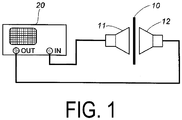
- FIG. 1 is a schematic diagram of device that was used in the examples to measure the electromagnetic wave shielding property.
- thermoplastic resin composition according to an embodiment of the present invention contains a predetermined amount of a combination of a thermoplastic resin and carbon fibers, and preferably uses a predetermined amount of short fibers or a predetermined amount of long fibers as the carbon fibers in order to obtain the combined performance of both a shielding property and an absorbency for electromagnetic waves.
- thermoplastic resins selected from polypropylenes, propylene unit-containing copolymers and modified products of the copolymers (acid-modified products having a carboxyl group or a carbonyl group), styrene-based resins, polyphenylene sulfides, polyamides, polyethylene terephthalates, polybutylene terephthalates, and polycarbonates can be used, and the thermoplastic resin is preferably one or more selected from polypropylenes, and propylene unit-containing copolymers and modified products of the copolymers (acid-modified products having a carboxyl group or a carbonyl group), and is more preferably a polypropylene.
- thermoplastic resin except for an acid-modified product having a carboxyl group or a carbonyl group
- an acid-modified product having a carboxyl group or a carbonyl group such as maleic acid-modified polypropylene
- the adhesion between the thermoplastic resin and the carbon fibers (short fibers or long fibers) in the molded article is improved, and thus such combined use is preferable.
- the thermoplastic resin composition may be configured not containing an acid-modified product having a carboxyl group or a carbonyl group (such as maleic acid-modified polypropylene).
- styrene-based resin a polystyrene or a copolymer containing a styrene unit (such as AS resin, ABS resin, ASA resin, AES resin, and MAS resin) can be used.
- the weighted average fiber length in the electromagnetic wave shielding and absorbing molded article preferably ranges from 0.05 mm to less than 1.05 mm, and preferably ranges from 0.05 to 1.0 mm, and more preferably from 0.1 to 0.7 mm.
- a content ratio of carbon fibers (short fibers) in the composition (the electromagnetic wave shielding and absorbing molded article) is from 0.1 to 20 mass%, and is preferably from 0.1 to 15 mass%.
- the content ratio of carbon fibers (short fibers) in the composition (the electromagnetic wave shielding and absorbing molded article) is from 0.1 to 10 mass%, and preferably when the content ratio is from 0.1 to 5 mass%, the shielding property and the absorbency can be increased even when a thermoplastic resin (except for an acid-modified product having a carboxyl group or a carbonyl group) and an acid-modified product (such as a maleic acid-modified polypropylene) having a carboxyl group or a carbonyl group are not used in combination.
- the ratio of carbon fibers having a fiber length of 0.5 mm or greater in the electromagnetic wave shielding and absorbing molded article is preferably 70 mass% or less.
- a thermoplastic resin excluding an acid-modified product having a carboxyl group or a carbonyl group
- an acid-modified product having a carboxyl group or a carbonyl group are not used in combination
- the ratio of carbon fibers having a fiber length of 0.5 mm or longer in the electromagnetic wave shielding and absorbing molded article can also include a ratio exceeding 70 mass%.
- the weighted average fiber length in the electromagnetic wave shielding and absorbing molded article preferably ranges from 1.05 to 8.0 mm, more preferably from 1.05 to 6.0 mm, even more preferably from 1.05 to 5.0 mm, and yet even more preferably from 1.05 to 4.0 mm.
- Carbon fibers can be used in the form of long fiber pellets of resin-impregnated fiber bundles in which a thermoplastic resin is used.
- a product obtained by impregnating and integrating a molten thermoplastic resin into carbon fibers in a bundled state with the carbon fibers aligned in the lengthwise direction can be cut to a length ranging from 2 to 30 mm, and preferably from 3 to 15 mm, and then used.
- the method for producing the long fiber pellets of resin-impregnated fiber bundles in which a thermoplastic resin is used is a well-known method, and for example, those long fiber pellets can be produced using the methods described in JP 2013-107979 A (production of resin-impregnated long glass fiber bundles of Production Example 1), JP 2013-121988 A (production of resin-impregnated long glass fiber bundles of Production Example 1), JP 2012-52093 A (Examples 1 to 9), JP 2012-131104 A (production of resin-impregnated long glass fiber bundles of Production Example 1, production of long fiber bundles of resin-impregnated carbon fibers of Production Example 2), JP 2012-131918 A (production of resin-impregnated carbon fiber bundles of Production Example 1, production of resin-impregnated glass fiber bundles of Production Example 2), JP 2011-162905 A (Example 1), and JP 2004-14990 A (Examples 1 to 7).
- the content ratio of carbon fibers (long fibers) in the composition (the electromagnetic wave shielding and absorbing molded article) is preferably from 0.05 to 45 mass%, more preferably from 0.1 to 45 mass%, even more preferably from 0.1 to 10 mass%, and yet even more preferably from 0.5 to 5 mass%.
- an inorganic filler such as glass fibers or talc.
- the content ratio of carbon fibers (long fibers) in the composition is from 0.1 to 10 mass%, and preferably when the content ratio is from 0.5 to 5 mass%, the shielding property and the absorbency can be increased even when a thermoplastic resin (except for an acid-modified product having a carboxyl group or a carbonyl group) and an acid-modified product (such as a maleic acid-modified polypropylene) having a carboxyl group or a carbonyl group are not used in combination.
- the thermoplastic resin composition to be used in the present invention can contain a known resin additive within a range at which the problem of the present invention can be solved.
- known resin additives include stabilizers against heat, light, UV light, and the like, lubricants, nucleating agents, plasticizers, known inorganic and organic fillers (excluding carbon fibers), antistatic agents, release agents, flame retardants, softeners, dispersants, antioxidants, and coloring materials.
- the total content ratio of the abovementioned known resin additives in the composition (the electromagnetic wave shielding and absorbing molded article) is preferably 5 mass% or less, more preferably 3 mass% or less, even more preferably 1 mass% or less, and yet even more preferably 0.5 mass% or less.
- the electromagnetic wave shielding and absorbing molded article according to an embodiment of the present invention is obtained by molding the thermoplastic resin composition described above through application of a known resin molding method such as injection molding.
- the size and shape of the electromagnetic wave shielding and absorbing molded article according to an embodiment of the present invention can be appropriately adjusted, according to its application, within a range that satisfies the following thickness requirement.
- the electromagnetic wave shielding and absorbing molded article according to an embodiment of the present invention preferably has a thickness from 0.01 mm to 5 mm, more preferably from 0.05 mm to 5 mm, and even more preferably from 0.1 mm to 4 mm. The thickness is measured by a method described in the examples.
- the electromagnetic wave shielding and absorbing molded article according to an embodiment of the present invention preferably has a thickness from 0.1 mm to 5 mm, more preferably from 0.5 mm to 5 mm, and even more preferably from 0.5 mm to 4 mm. The thickness is measured by the method described in the examples.
- the shielding property is preferably 10 dB or higher and the electromagnetic wave absorbency is preferably 25% or greater for electromagnetic waves having any frequency in a frequency domain from 59 GHz to 100 GHz.
- both the electromagnetic wave shielding property and the electromagnetic wave absorbency for the electromagnetic wave shielding and absorbing molded article according to an embodiment of the present invention preferably satisfy the electromagnetic wave shielding property and the electromagnetic wave absorbency described above for an entire frequency range from 75 GHz to 95 GHz, and more preferably for an entire frequency range from 59 GHz to 100 GHz.
- the electromagnetic wave shielding property and the electromagnetic wave absorbency of the electromagnetic wave shielding and absorbing molded article according to an embodiment of the present invention can be adjusted by adjusting a content ratio (R) and a thickness (T) of the carbon fibers.
- R content ratio
- T thickness
- the weighted average fiber length of the carbon fibers remaining in the molded article preferably ranges from 0.1 to 1.0 mm.
- the electromagnetic wave shielding and absorbing molded article has (R) ranging from 0.5 to 20 mass%, which is a content ratio of carbon fibers in the molded article, (T) ranging from 0.1 mm to 5 mm, which is a thickness of the molded article, and (R ⁇ T) ranging from 1.5 to 35, which is a product of (R) and (T),
- the shielding property can be preferably set to 30 dB or greater and the absorbency can be preferably set to 25% or greater with respect to electromagnetic waves for any frequency in a frequency domain from 59 GHz to 100 GHz, or for an entire frequency domain from 75 GHz to 95 GHz.
- the electromagnetic wave shielding and absorbing molded article has (R) ranging from 0.1 to 20 mass%, which is a content ratio of carbon fibers in the molded article, (T) ranging from 0.01 mm to 5 mm, which is a thickness of the molded article, and (R•T) ranging from 0.1 to 1.0, which is a product of (R) and (T),
- the shielding property can be preferably set to 5 dB to less than 30 dB, and more preferably set to 10 dB to 25 dB and the absorbency can be can be set to preferably 40% or greater, more preferably 50% or greater, and even more preferably 60% or greater for electromagnetic waves having any frequency in the frequency domain from 59 GHz to 100 GHz.
- the shielding property for electromagnetic waves having any frequency in a frequency domain from 59 GHz to 100 GHz can be preferably 30 dB or greater, more preferably to 40 dB or greater, even more preferably to 50 dB or greater, and yet even more preferably to 60 dB or greater.
- the electromagnetic wave absorbency at any frequency in a frequency domain from 59 GHz to 100 GHz can be 5% or greater, preferably 7% or greater, and more preferably 10% or greater.
- both the electromagnetic wave shielding property and the electromagnetic wave absorbency of the electromagnetic wave shielding and absorbing molded article according to an embodiment of the present invention satisfy the electromagnetic wave shielding property and the electromagnetic wave absorbency described above, which is preferably for an entire frequency range from 75 GHz to 82 GHz, and more preferably for an entire frequency range from 70 GHz to 85 GHz.
- the electromagnetic wave shielding property and the electromagnetic wave absorbency of the electromagnetic wave shielding and absorbing molded article according to an embodiment of the present invention can be adjusted by adjusting the content ratio (R) and the thickness (T) of the carbon fibers.
- the weighted average fiber length of the carbon fibers remaining in the molded article preferably ranges from 1.05 to 4.0 mm.
- the electromagnetic wave shielding and absorbing molded article When long fibers are used for the carbon fibers, and the electromagnetic wave shielding and absorbing molded article according to an embodiment of the present invention has a product (R ⁇ T) of the content ratio (R) of carbon fibers in the molded article (composition) and a thickness (T) of the molded article ranging preferably from 0.05 to 16, more preferably from 0.5 to less than 10, and preferably from 1 to 8, the electromagnetic wave shielding property in an entire range of frequencies from 70 GHz to 100 GHz can be 40 dB or greater, and the electromagnetic wave absorbency in the entire range thereof can be 10% or higher, and preferably 20% or higher.
- the electromagnetic wave shielding and absorbing molded article When long fibers are used for the carbon fibers, and the electromagnetic wave shielding and absorbing molded article according to an embodiment of the present invention has a range of a product (R ⁇ T) of the content ratio (R) of carbon fibers in the molded article (composition) and the thickness (T) of the molded article of greater than 16, and preferably from 18 to 100, the electromagnetic wave shielding property in the entire range of frequencies from 70 GHz to 100 GHz can be 70 dB or greater, and the electromagnetic wave absorbency can be 2% or greater.
- the weighted average fiber length was determined from data obtained by measuring some of the extracted carbon fibers (500 fibers) using a LUZEX AP (available from Nireco Corporation). The calculation steps described in paragraphs [0044] and [0045] of JP 2006-274061 A were used to calculate the weighted average fiber length.
- the ratio (quantity ratio) of carbon fibers of 0.5 mm or longer in the molded article was determined from the aforementioned method and is shown in Tables 1 and 2.
- the thickness at a center portion (portion of intersection of diagonal lines) of a flat electromagnetic wave shielding and absorbing molded article (150 ⁇ 150 mm) was measured.
- the tensile nominal strain was measured according to ISO527.
- the measurement device illustrated in FIG. 1 was used.
- a molded article 10 (length of 150 mm, width of 150 mm, thickness indicated in the table) to be measured was held between a pair of horizontally opposing antennas (corrugated horn antennas) 11, 12.
- the spacing between the antenna 12 and the molded article 10 was 0 mm, and the spacing between the molded article 10 and the antenna 11 was 0 mm.
- electromagnetic waves 65 to 110 GHz
- electromagnetic waves transmitted through the molded article 10 to be measured were received by the upper antenna 11
- the electromagnetic wave shielding property (the penetration inhibition of radiated waves) was calculated from equations 1 and 2 below
- the electromagnetic wave absorbency was calculated from the equations 3 to 6 below.
- the electromagnetic wave shielding property when electromagnetic waves (from 1 to 18 GHz) were emitted was also determined as follows using the measuring device illustrated in FIG. 1 .
- the molded article 10 (length of 150 mm, width of 150 mm, thickness of 2 mm) to be measured was held between a pair of vertically facing antennas (wide band antennas; Schwarzbeck Mess-Elektronik, BBHA9120A, from 2 to 18 GHz) 11, 12.
- the spacing between the antenna 12 and the molded article 10 was 85 mm, and the spacing between the molded article 10 and the antenna 11 was 10 mm.
- S 21 represents an S parameter (equation (2)) showing a ratio of a transmitted electric field intensity to an incident electric field intensity, and can be measured using a network analyzer 20.
- the logarithm of the reciprocal of the S parameter was used to express the electromagnetic wave shielding property (dB) as a positive value. With the measurement device of FIG. 1 , a range of from 0 to approximately 100 dB can be measured. Cases in which the electromagnetic wave shielding property exceeded 80 dB are indicated in the table by ">80 (dB)", and cases in which the electromagnetic wave shielding property was less than 10 dB are indicated in the table by "10>(dB)".
- S 11 Reflected Electric Field Intensity / Incident Electric Field Intensity
- Equation 3 S 11 represent an S parameter showing a ratio of the reflected electric field intensity to the incident electric field intensity, and similar to S 21 , can be measured using the network analyzer.
- PP polypropylene homopolymer, trade name "PM900A”, available from SunAllomer Ltd.
- Acid-modified PP maleic anhydride modified polypropylene, trade name "OREVAC CA100", maleic acid 1.0 mass% modification, available from Arkema K.K.
- Prime Polypro S119 available from Prime Polymer Co., Ltd., homo PP
- Carbon fibers trade name "CFU-HC”, available from Nippon Polymer Sangyo Co., Ltd.
- Sizing agent treated carbon fiber roving Pellets PP1 produced in Production Example 1 using Torayca T700SC-12000-50C (available from Toray Industries, Inc., treated with an epoxy sizing agent)
- Stabilizer 1 phenol-based stabilizer, trade name "ADK STAB A0-60", available from ADEKA Corporation
- Stabilizer 2 sulfur-based stabilizer, trade name "TOWREX A0180T", available from TOWREX
- Lubricant calcium stearate, trade name "SC-PG", available from Sakai Chemical Industry Co., Ltd.
- the material was shaped with a shaping nozzle at the outlet of the crosshead die, and the shape was further refined with a shape refining roll, after which the sample was cut to a predetermined length using a pelletizer to obtain pellets (cylindrical molded articles) PP1 (containing 40 mass% of long carbon fibers) with a length of 8 mm.
- the length of the long carbon fibers was the same as the pellet length.
- the long carbon fibers were substantially parallel in the length direction.
- the sizing agent treated carbon fiber roving was subjected to heating at 150°C by a pre-heating device, and passed through a crosshead die. At that time, molten polypropylene (PP3 was used, acid-modified PP was not contained) was supplied to the crosshead die from a twin screw extruder, cylinder temperature: 280°C), and the fiber bundles were impregnated with the polypropylene.
- molten polypropylene PP3 was used, acid-modified PP was not contained
- the material was shaped with a shaping nozzle at the outlet of the crosshead die, and the shape was further refined with a shape refining roll, after which the sample was cut to a predetermined length using a pelletizer to obtain pellets (cylindrical molded articles) PP4 (containing 40 mass% of long carbon fibers) with a length of 8 mm.
- the length of the long carbon fibers was the same as the pellet length.
- the long carbon fibers were substantially parallel in the length direction.
- the components shown in Table 1 and Table 2 were dry blended, after which pellets (thermoplastic resin composition) were produced using an extruder (TEX30 ⁇ , Japan Steel Works, Ltd.). The obtained pellets were then used and molded using an injection molding machine ( ⁇ -150iA, available from Fanuc Corporation) at a molding temperature of 220°C and a mold temperature of 50°C, and flat plate shaped electromagnetic wave shielding and absorbing molded articles (150 ⁇ 150 mm) according to an embodiment of the present invention were obtained. The obtained electromagnetic wave shielding and absorbing molded articles were used, and the various measurements shown in Tables 1 and 2 were performed.
- the weighted average fiber length (weighted average value) of the carbon fibers in the molded article was short at 1 mm or less, but by associating the content ratio (R) and the thickness (T) of the carbon fibers and adjusting to the appropriate range, it was possible to obtain a high electromagnetic wave shielding property and electromagnetic wave absorbency in a wide frequency domain.
- the ratio (quantity ratio) of carbon fibers of 0.5 mm or longer in the molded articles of Examples 7, 9, 11 and 12 was 50% or greater, and the quantity ratio for the other remaining examples was also 50% or greater.
- Example 17 to 19 the content ratio of the carbon fibers was from 0.1 to 5.0 mass%, and an acid-modified PP was not used, but even compared to Examples 13 to 16 in which the same degree of carbon fibers was contained, Examples 17 to 19 exhibited comparable or higher shielding properties and absorbency.
- Comparative Example 1 when the content amount of long carbon fibers was increased, a high electromagnetic wave shielding property was exhibited, but the electromagnetic wave absorbency was inferior to that of the examples. Moreover, Comparative Example 1 used 60-times or more the amount of carbon fibers compared to that of Example 1, and this high content amount is economically disadvantageous, and results in a large density, which is also disadvantageous in terms of weight reduction of the molded article. Comparative Example 2 did not contain carbon fibers, and as a result, did not provide any effect in shielding or absorbency.
- Pellets of PP1 (pellets containing 40 mass% of the long carbon fibers obtained in Production Example 1; also containing acid-modified PP), PP2 (not containing carbon fibers), and PP4 (pellets containing 40 mass% of the long carbon fibers obtained in Production Example 2; not containing acid-modified PP) were dry blended at the ratios shown in Table 3, and molded at a molding temperature of 250°C and a mold temperature of 50°C using an injection molding machine ( ⁇ -150iA; available from Fanuc Corporation), and flat plate shaped electromagnetic wave shielding and absorbing molded articles (150 x 150 mm) were obtained. The obtained electromagnetic wave shielding and absorbing molded articles were used, and the various measurements shown in Table 3 were performed.
- the weighted average fiber length (weighted average value) of the carbon fibers in the molded article was 1.05 mm or longer, and by associating the content ratio (R) and the thickness (T) of the carbon fibers and adjusting to the appropriate range, it was possible to adjust the electromagnetic wave shielding property and the electromagnetic wave absorbency in a wide frequency domain.
- the content ratio of the carbon fibers was from 0.5 to 3 mass%, and an acid-modified PP was not used, but even compared to Examples 20 to 25 in which the same degree of carbon fibers was contained, Examples 32 and 33 exhibited comparable or higher shielding properties and absorbency.
- the electromagnetic wave shielding and absorbing molded article of the present invention can be used for a millimeter wave radar device loaded in a vehicle for the purpose of enabling automated driving of the vehicle and preventing collisions, and for example, can be used in a shielding member (protective member for a transmitting and receiving antenna) that shields radio waves between the shielding member and a transmitting and receiving antenna control circuit for millimeter wave radar, in a housing for a millimeter wave radar device, and in a member for attaching a millimeter wave radar device, and can also be used in a housing for electrical and electronic equipment for a vehicle or for a device other than a vehicle.
- a shielding member protecting member for a transmitting and receiving antenna
- the electromagnetic wave shielding and absorbing molded article of the present invention can be used as a protective member for a wireless LAN or broadband wireless access system, a communication satellite, simple radio communications, an on-board radar, or a position recognition system, and more specifically, can be used as a protective member that shields radio waves of a base station antenna, a remote radio head (RRH; radio transceiver device), a baseband unit (BBU) device, a base GaN power amplifier, an optical transceiver, or the like.
- RRH remote radio head
- BBU baseband unit
Landscapes
- Chemical & Material Sciences (AREA)
- Organic Chemistry (AREA)
- Health & Medical Sciences (AREA)
- Chemical Kinetics & Catalysis (AREA)
- Medicinal Chemistry (AREA)
- Polymers & Plastics (AREA)
- Engineering & Computer Science (AREA)
- Microelectronics & Electronic Packaging (AREA)
- Electromagnetism (AREA)
- Physics & Mathematics (AREA)
- Shielding Devices Or Components To Electric Or Magnetic Fields (AREA)
- Compositions Of Macromolecular Compounds (AREA)
- Reinforced Plastic Materials (AREA)
Abstract
Description
- The present invention relates to an electromagnetic wave shielding and absorbing molded article having an advanced capability of shielding and absorbing electromagnetic waves having a specific wavelength.
- A millimeter wave radar device used for the purpose of enabling automated driving and preventing collisions of automobiles is known. A millimeter wave radar device is mounted to various locations such as the front center, both sides, and both rear sides of a vehicle, and is provided with: a high frequency module with an antenna for transmitting and receiving radio waves installed, a control circuit for controlling the radio waves, a housing that houses the antenna and the control circuit, and a radome covering the transmission and reception of radio waves for the antenna (
JP 2007-74662 A JP 2007-74662 A - As an invention for solving the problems of the invention of
JP 2007-74662 A JP 2015-7216 A JP 6123502 B - An object of the present invention is to provide an electromagnetic wave shielding and absorbing molded article excelling in a shielding property and an absorbency for electromagnetic waves having a specific frequency.
- The present invention provides an electromagnetic wave shielding and absorbing molded article including a thermoplastic resin composition that contains a thermoplastic resin and carbon fibers, the carbon fibers having a weighted average fiber length in the molded article in a range from 0.05 to 8.0 mm, and a content ratio of the carbon fibers in the molded article being from 0.05 to 45 mass%, where the electromagnetic wave shielding and absorbing molded article has a thickness from 0.01 mm to 5 mm, and a shielding property of 10 dB or greater and an absorbency of 5% or greater for electromagnetic waves having any frequency in a frequency domain from 59 GHz to 100 GHz.
- The present invention also provides an electromagnetic wave shielding and absorbing molded article including a thermoplastic resin composition that contains a thermoplastic resin and carbon fibers, the carbon fibers having a weighted average fiber length in the molded article in a range from 0.05 to less than 1.05 mm, and a content ratio of the carbon fibers in the molded article being from 0.1 to 20 mass%, where the electromagnetic wave shielding and absorbing molded article has a thickness of from 0.01 mm to 5 mm, and a shielding property of 10 dB or greater and an absorbency of 25% or greater for electromagnetic waves having any frequency in a frequency domain from 59 GHz to 100 GHz.
- The present invention also provides an electromagnetic wave shielding and absorbing molded article including a thermoplastic resin composition that contains a thermoplastic resin and carbon fibers, the carbon fibers having a weighted average fiber length in the molded article in a range from 1.05 to 8.0 mm, and a content ratio of the carbon fibers in the molded article being from 0.05 to 45 mass%, where the electromagnetic wave shielding and absorbing molded article has a thickness from 0.1 mm to 5 mm, and a shielding property of 30 dB or greater and an absorbency of 5% or greater for electromagnetic waves having any frequency in a frequency domain from 59 GHz to 100 GHz.
- The electromagnetic wave shielding property according to the present invention exhibits a combined performance for both absorbency and reflectivity with respect to electromagnetic waves.
- The electromagnetic wave shielding and absorbing molded article according to the present invention uses carbon fibers, which can increase both the shielding property and the absorbency for electromagnetic waves having a specific frequency. Furthermore, by using short carbon fibers and long carbon fibers, the electromagnetic wave shielding and absorbing molded article according to the present invention can increase both the shielding property and the absorbency for any electromagnetic waves having the frequency domain from 59 GHz to 100 GHz.
-
FIG. 1 is a schematic diagram of device that was used in the examples to measure the electromagnetic wave shielding property. - A thermoplastic resin composition according to an embodiment of the present invention contains a predetermined amount of a combination of a thermoplastic resin and carbon fibers, and preferably uses a predetermined amount of short fibers or a predetermined amount of long fibers as the carbon fibers in order to obtain the combined performance of both a shielding property and an absorbency for electromagnetic waves.
- One or more thermoplastic resins selected from polypropylenes, propylene unit-containing copolymers and modified products of the copolymers (acid-modified products having a carboxyl group or a carbonyl group), styrene-based resins, polyphenylene sulfides, polyamides, polyethylene terephthalates, polybutylene terephthalates, and polycarbonates can be used, and the thermoplastic resin is preferably one or more selected from polypropylenes, and propylene unit-containing copolymers and modified products of the copolymers (acid-modified products having a carboxyl group or a carbonyl group), and is more preferably a polypropylene.
- When a thermoplastic resin (except for an acid-modified product having a carboxyl group or a carbonyl group) and an acid-modified product having a carboxyl group or a carbonyl group (such as maleic acid-modified polypropylene) are used in combination, the adhesion between the thermoplastic resin and the carbon fibers (short fibers or long fibers) in the molded article is improved, and thus such combined use is preferable. However, depending on the content amount of the carbon fibers, the thermoplastic resin composition may be configured not containing an acid-modified product having a carboxyl group or a carbonyl group (such as maleic acid-modified polypropylene).
- As the styrene-based resin, a polystyrene or a copolymer containing a styrene unit (such as AS resin, ABS resin, ASA resin, AES resin, and MAS resin) can be used.
- When short fibers are used for the carbon fibers, the weighted average fiber length in the electromagnetic wave shielding and absorbing molded article preferably ranges from 0.05 mm to less than 1.05 mm, and preferably ranges from 0.05 to 1.0 mm, and more preferably from 0.1 to 0.7 mm.
- A content ratio of carbon fibers (short fibers) in the composition (the electromagnetic wave shielding and absorbing molded article) is from 0.1 to 20 mass%, and is preferably from 0.1 to 15 mass%. When the content ratio of carbon fibers (short fibers) in the composition (the electromagnetic wave shielding and absorbing molded article) is from 0.1 to 10 mass%, and preferably when the content ratio is from 0.1 to 5 mass%, the shielding property and the absorbency can be increased even when a thermoplastic resin (except for an acid-modified product having a carboxyl group or a carbonyl group) and an acid-modified product (such as a maleic acid-modified polypropylene) having a carboxyl group or a carbonyl group are not used in combination.
- When short fibers are used for the carbon fibers, the ratio of carbon fibers having a fiber length of 0.5 mm or greater in the electromagnetic wave shielding and absorbing molded article is preferably 70 mass% or less. However, when a thermoplastic resin (excluding an acid-modified product having a carboxyl group or a carbonyl group) and an acid-modified product having a carboxyl group or a carbonyl group are not used in combination, the ratio of carbon fibers having a fiber length of 0.5 mm or longer in the electromagnetic wave shielding and absorbing molded article can also include a ratio exceeding 70 mass%.
- When long fibers are used for the carbon fibers, the weighted average fiber length in the electromagnetic wave shielding and absorbing molded article preferably ranges from 1.05 to 8.0 mm, more preferably from 1.05 to 6.0 mm, even more preferably from 1.05 to 5.0 mm, and yet even more preferably from 1.05 to 4.0 mm.
- Carbon fibers (long fibers) can be used in the form of long fiber pellets of resin-impregnated fiber bundles in which a thermoplastic resin is used. For the long fiber pellets of resin-impregnated fiber bundles, for example, a product obtained by impregnating and integrating a molten thermoplastic resin into carbon fibers in a bundled state with the carbon fibers aligned in the lengthwise direction, can be cut to a length ranging from 2 to 30 mm, and preferably from 3 to 15 mm, and then used. The method for producing the long fiber pellets of resin-impregnated fiber bundles in which a thermoplastic resin is used is a well-known method, and for example, those long fiber pellets can be produced using the methods described in
JP 2013-107979 A JP 2013-121988 A JP 2012-52093 A JP 2012-131104 A JP 2012-131918 A JP 2011-162905 A JP 2004-14990 A - The content ratio of carbon fibers (long fibers) in the composition (the electromagnetic wave shielding and absorbing molded article) is preferably from 0.05 to 45 mass%, more preferably from 0.1 to 45 mass%, even more preferably from 0.1 to 10 mass%, and yet even more preferably from 0.5 to 5 mass%. When the content amount of carbon fibers (long fibers) is small, the mechanical strength of the electromagnetic wave shielding and absorbing molded article can be increased by containing an inorganic filler (such as glass fibers or talc). Note that when the content ratio of carbon fibers (long fibers) in the composition (the electromagnetic wave shielding and absorbing molded article) is from 0.1 to 10 mass%, and preferably when the content ratio is from 0.5 to 5 mass%, the shielding property and the absorbency can be increased even when a thermoplastic resin (except for an acid-modified product having a carboxyl group or a carbonyl group) and an acid-modified product (such as a maleic acid-modified polypropylene) having a carboxyl group or a carbonyl group are not used in combination.
- The thermoplastic resin composition to be used in the present invention can contain a known resin additive within a range at which the problem of the present invention can be solved. Examples of known resin additives include stabilizers against heat, light, UV light, and the like, lubricants, nucleating agents, plasticizers, known inorganic and organic fillers (excluding carbon fibers), antistatic agents, release agents, flame retardants, softeners, dispersants, antioxidants, and coloring materials. The total content ratio of the abovementioned known resin additives in the composition (the electromagnetic wave shielding and absorbing molded article) is preferably 5 mass% or less, more preferably 3 mass% or less, even more preferably 1 mass% or less, and yet even more preferably 0.5 mass% or less.
- The electromagnetic wave shielding and absorbing molded article according to an embodiment of the present invention is obtained by molding the thermoplastic resin composition described above through application of a known resin molding method such as injection molding. The size and shape of the electromagnetic wave shielding and absorbing molded article according to an embodiment of the present invention can be appropriately adjusted, according to its application, within a range that satisfies the following thickness requirement.
- When short fibers are used for the carbon fibers, the electromagnetic wave shielding and absorbing molded article according to an embodiment of the present invention preferably has a thickness from 0.01 mm to 5 mm, more preferably from 0.05 mm to 5 mm, and even more preferably from 0.1 mm to 4 mm. The thickness is measured by a method described in the examples.
- When long fibers are used for the carbon fibers, the electromagnetic wave shielding and absorbing molded article according to an embodiment of the present invention preferably has a thickness from 0.1 mm to 5 mm, more preferably from 0.5 mm to 5 mm, and even more preferably from 0.5 mm to 4 mm. The thickness is measured by the method described in the examples.
- When short fibers are used for the carbon fibers, with the electromagnetic wave shielding and absorbing molded article according to an embodiment of the present invention, the shielding property is preferably 10 dB or higher and the electromagnetic wave absorbency is preferably 25% or greater for electromagnetic waves having any frequency in a frequency domain from 59 GHz to 100 GHz. When short fibers are used for the carbon fibers, both the electromagnetic wave shielding property and the electromagnetic wave absorbency for the electromagnetic wave shielding and absorbing molded article according to an embodiment of the present invention preferably satisfy the electromagnetic wave shielding property and the electromagnetic wave absorbency described above for an entire frequency range from 75 GHz to 95 GHz, and more preferably for an entire frequency range from 59 GHz to 100 GHz.
- When short fibers are used for the carbon fibers, the electromagnetic wave shielding property and the electromagnetic wave absorbency of the electromagnetic wave shielding and absorbing molded article according to an embodiment of the present invention can be adjusted by adjusting a content ratio (R) and a thickness (T) of the carbon fibers. Note that the weighted average fiber length of the carbon fibers remaining in the molded article preferably ranges from 0.1 to 1.0 mm.
- When short fibers are used for the carbon fibers, and the electromagnetic wave shielding and absorbing molded article according to an embodiment of the present invention has (R) ranging from 0.5 to 20 mass%, which is a content ratio of carbon fibers in the molded article, (T) ranging from 0.1 mm to 5 mm, which is a thickness of the molded article, and (R ▪ T) ranging from 1.5 to 35, which is a product of (R) and (T), the shielding property can be preferably set to 30 dB or greater and the absorbency can be preferably set to 25% or greater with respect to electromagnetic waves for any frequency in a frequency domain from 59 GHz to 100 GHz, or for an entire frequency domain from 75 GHz to 95 GHz.
- When short fibers are used for the carbon fibers, and the electromagnetic wave shielding and absorbing molded article according to an embodiment of the present invention has (R) ranging from 0.1 to 20 mass%, which is a content ratio of carbon fibers in the molded article, (T) ranging from 0.01 mm to 5 mm, which is a thickness of the molded article, and (R•T) ranging from 0.1 to 1.0, which is a product of (R) and (T), the shielding property can be preferably set to 5 dB to less than 30 dB, and more preferably set to 10 dB to 25 dB and the absorbency can be can be set to preferably 40% or greater, more preferably 50% or greater, and even more preferably 60% or greater for electromagnetic waves having any frequency in the frequency domain from 59 GHz to 100 GHz.
- When long fibers are used for the carbon fibers, with the electromagnetic wave shielding and absorbing molded article according to an embodiment of the present invention, the shielding property for electromagnetic waves having any frequency in a frequency domain from 59 GHz to 100 GHz can be preferably 30 dB or greater, more preferably to 40 dB or greater, even more preferably to 50 dB or greater, and yet even more preferably to 60 dB or greater.
- Furthermore, when long fibers are used for the carbon fibers, with the electromagnetic wave shielding and absorbing molded article according to an embodiment of the present invention, the electromagnetic wave absorbency at any frequency in a frequency domain from 59 GHz to 100 GHz can be 5% or greater, preferably 7% or greater, and more preferably 10% or greater.
- When long fibers are used for the carbon fibers, both the electromagnetic wave shielding property and the electromagnetic wave absorbency of the electromagnetic wave shielding and absorbing molded article according to an embodiment of the present invention satisfy the electromagnetic wave shielding property and the electromagnetic wave absorbency described above, which is preferably for an entire frequency range from 75 GHz to 82 GHz, and more preferably for an entire frequency range from 70 GHz to 85 GHz.
- When long fibers are used for the carbon fibers, the electromagnetic wave shielding property and the electromagnetic wave absorbency of the electromagnetic wave shielding and absorbing molded article according to an embodiment of the present invention can be adjusted by adjusting the content ratio (R) and the thickness (T) of the carbon fibers. Note that the weighted average fiber length of the carbon fibers remaining in the molded article preferably ranges from 1.05 to 4.0 mm.
- When long fibers are used for the carbon fibers, and the electromagnetic wave shielding and absorbing molded article according to an embodiment of the present invention has a product (R·T) of the content ratio (R) of carbon fibers in the molded article (composition) and a thickness (T) of the molded article ranging preferably from 0.05 to 16, more preferably from 0.5 to less than 10, and preferably from 1 to 8, the electromagnetic wave shielding property in an entire range of frequencies from 70 GHz to 100 GHz can be 40 dB or greater, and the electromagnetic wave absorbency in the entire range thereof can be 10% or higher, and preferably 20% or higher.
- When long fibers are used for the carbon fibers, and the electromagnetic wave shielding and absorbing molded article according to an embodiment of the present invention has a range of a product (R·T) of the content ratio (R) of carbon fibers in the molded article (composition) and the thickness (T) of the molded article of greater than 16, and preferably from 18 to 100, the electromagnetic wave shielding property in the entire range of frequencies from 70 GHz to 100 GHz can be 70 dB or greater, and the electromagnetic wave absorbency can be 2% or greater.
- Approximately 3 g of a sample was cut out from a molded article, and the resin was fired to extract the carbon fibers. The weighted average fiber length was determined from data obtained by measuring some of the extracted carbon fibers (500 fibers) using a LUZEX AP (available from Nireco Corporation). The calculation steps described in paragraphs [0044] and [0045] of
JP 2006-274061 A - The thickness at a center portion (portion of intersection of diagonal lines) of a flat electromagnetic wave shielding and absorbing molded article (150 × 150 mm) was measured.
- The tensile nominal strain was measured according to ISO527.
- The measurement device illustrated in
FIG. 1 was used. A molded article 10 (length of 150 mm, width of 150 mm, thickness indicated in the table) to be measured was held between a pair of horizontally opposing antennas (corrugated horn antennas) 11, 12. The spacing between theantenna 12 and the moldedarticle 10 was 0 mm, and the spacing between the moldedarticle 10 and theantenna 11 was 0 mm. In this state, electromagnetic waves (65 to 110 GHz) were radiated from thelower antenna 12, electromagnetic waves transmitted through the moldedarticle 10 to be measured were received by theupper antenna 11, the electromagnetic wave shielding property (the penetration inhibition of radiated waves) was calculated from equations 1 and 2 below, and the electromagnetic wave absorbency was calculated from the equations 3 to 6 below. Furthermore, for the molded articles of Examples 2 and 7, the electromagnetic wave shielding property when electromagnetic waves (from 1 to 18 GHz) were emitted was also determined as follows using the measuring device illustrated inFIG. 1 . The molded article 10 (length of 150 mm, width of 150 mm, thickness of 2 mm) to be measured was held between a pair of vertically facing antennas (wide band antennas; Schwarzbeck Mess-Elektronik, BBHA9120A, from 2 to 18 GHz) 11, 12. The spacing between theantenna 12 and the moldedarticle 10 was 85 mm, and the spacing between the moldedarticle 10 and theantenna 11 was 10 mm. In this state, electromagnetic waves (from 1 to 18 GHz) were radiated from thelower antenna 12, electromagnetic waves transmitted through the moldedarticle 10 to be measured were received by theupper antenna 11, and the electromagnetic wave shielding property (the penetration inhibition of radiated waves) was calculated from Equations 1 and 2 below.

- In Equation 1, S21 represents an S parameter (equation (2)) showing a ratio of a transmitted electric field intensity to an incident electric field intensity, and can be measured using a
network analyzer 20. In equation 1, the logarithm of the reciprocal of the S parameter was used to express the electromagnetic wave shielding property (dB) as a positive value. With the measurement device ofFIG. 1 , a range of from 0 to approximately 100 dB can be measured. Cases in which the electromagnetic wave shielding property exceeded 80 dB are indicated in the table by ">80 (dB)", and cases in which the electromagnetic wave shielding property was less than 10 dB are indicated in the table by "10>(dB)".
- In Equation 3, S11 represent an S parameter showing a ratio of the reflected electric field intensity to the incident electric field intensity, and similar to S21, can be measured using the network analyzer. The absorptivity was denoted as a percentage as expressed by the following formula on a basis of power. The absorptivity is shown in the table as electromagnetic wave absorbency.


- PP: polypropylene homopolymer, trade name "PM900A", available from SunAllomer Ltd.
- Acid-modified PP: maleic anhydride modified polypropylene, trade name "OREVAC CA100", maleic acid 1.0 mass% modification, available from Arkema K.K.
- PP2: SunAllomer PMB60A (block PP, available from SunAllomer Ltd.)
- PP3: Prime Polypro S119 (available from Prime Polymer Co., Ltd., homo PP)
- Carbon fibers: trade name "CFU-HC", available from Nippon Polymer Sangyo Co., Ltd.
- Sizing agent treated carbon fiber roving: Pellets PP1 produced in Production Example 1 using Torayca T700SC-12000-50C (available from Toray Industries, Inc., treated with an epoxy sizing agent)
- Stabilizer 1: phenol-based stabilizer, trade name "ADK STAB A0-60", available from ADEKA Corporation
- Stabilizer 2: sulfur-based stabilizer, trade name "TOWREX A0180T", available from TOWREX
- Lubricant: calcium stearate, trade name "SC-PG", available from Sakai Chemical Industry Co., Ltd.
- The sizing agent treated carbon fiber roving was subjected to heating at 150°C by a pre-heating device, and passed through a crosshead die. At that time, molten polypropylene (mixture of PP3: acid-modified PP = 85:15 (mass ratio)) was supplied to the crosshead die from a twin screw extruder (cylinder temperature: 280°C), and the fiber bundles were impregnated with the polypropylene. Next, the material was shaped with a shaping nozzle at the outlet of the crosshead die, and the shape was further refined with a shape refining roll, after which the sample was cut to a predetermined length using a pelletizer to obtain pellets (cylindrical molded articles) PP1 (containing 40 mass% of long carbon fibers) with a length of 8 mm. The length of the long carbon fibers was the same as the pellet length. In the pellets PP1 obtained in this manner, the long carbon fibers were substantially parallel in the length direction.
- The sizing agent treated carbon fiber roving was subjected to heating at 150°C by a pre-heating device, and passed through a crosshead die. At that time, molten polypropylene (PP3 was used, acid-modified PP was not contained) was supplied to the crosshead die from a twin screw extruder, cylinder temperature: 280°C), and the fiber bundles were impregnated with the polypropylene. Next, the material was shaped with a shaping nozzle at the outlet of the crosshead die, and the shape was further refined with a shape refining roll, after which the sample was cut to a predetermined length using a pelletizer to obtain pellets (cylindrical molded articles) PP4 (containing 40 mass% of long carbon fibers) with a length of 8 mm. The length of the long carbon fibers was the same as the pellet length. In the pellets PP4 obtained in this manner, the long carbon fibers were substantially parallel in the length direction.
- The components shown in Table 1 and Table 2 were dry blended, after which pellets (thermoplastic resin composition) were produced using an extruder (TEX30α, Japan Steel Works, Ltd.). The obtained pellets were then used and molded using an injection molding machine (α-150iA, available from Fanuc Corporation) at a molding temperature of 220°C and a mold temperature of 50°C, and flat plate shaped electromagnetic wave shielding and absorbing molded articles (150 × 150 mm) according to an embodiment of the present invention were obtained. The obtained electromagnetic wave shielding and absorbing molded articles were used, and the various measurements shown in Tables 1 and 2 were performed.
[Table 1] Units Examples 1 2 3 4 5 6 7 8 9 10 11 12 Composition PP mass% 96.0 95.5 95.5 94.5 94.5 93.5 93.5 93.5 91.6 91.6 86.8 82.0 Acid-modified PP mass% 3.0 3.0 3.0 3.0 3.0 3.0 3.0 3.0 2.9 2.9 2.7 2.5 Stabilizer 1 mass% 0.2 0.2 0.2 0.2 0.2 0.2 0.2 0.2 0.2 0.2 0.2 0.2 Stabilizer 2 mass% 0.2 0.2 0.2 0.2 0.2 0.2 0.2 0.2 0.2 0.2 0.2 0.2 Lubricant mass% 0.1 0.1 0.1 0.1 0.1 0.1 0.1 0.1 0.1 0.1 0.1 0.1 Carbon fiber ratio (R) mass% 0.5 1 1 2 2 3 3 3 5 5 10 15 Total mass% 100 Molded Article Weighted average fiber length Weighted Average mm 0.7 0.6 0.6 0.7 0.7 0.7 0.7 0.7 0.7 0.7 0.6 0.6 Ratio for 0.5 mm or greater mass% 58 50 50 64 64 68 68 69 69 69 62 50 Thickness (T) mm 4 2 4 2 4 0.5 2 4 2 4 2 2 R•T - 2 2 4 4 8 1.5 6 12 10 20 20 30 Tensile nominal strain (4 mm thickness) % 8.9 7.8 7.8 6.4 6.4 6.1 6.1 6.1 4.8 4.8 1.8 1.0 Shielding property (dB) 2 GHz 10> 17 10 GHz 10> 21 70 GHz 30 51 >80 77 >80 38 >80 >80 >80 >80 >80 >80 76 GHz 31 57 >80 79 >80 39 >80 >80 >80 >80 >80 >80 79 GHz 33 60 >80 80 >80 40 >80 >80 >80 >80 >80 >80 85 GHz 35 66 >80 >80 >80 43 >80 >80 >80 >80 >80 >80 95 GHz 39 >80 >80 >80 >80 48 >80 >80 >80 >80 >80 >80 100 GHz 40 >80 >80 >80 >80 48 >80 >80 >80 >80 >80 >80 Absorbency (%) 70 GHz 87.9 62 62 53 49 37 38 48 35 30 26 26 76 GHz 87.7 61 61 51 47 36 46 45 43 29 32 32 79 GHz 86.0 59 59 49 44 33 50 42 47 26 36 36 85 GHz 86.2 61 62 53 47 38 53 46 49 29 39 39 95 GHz 89.7 69 69 62 57 62 72 56 69 43 56 57 100 GHz 83.9 61 61 52 46 62 69 44 66 31 53 52 [Table 2] Units Examples Comparative Examples 13 14 15 16 17 18 19 1 2 Composition PP mass% 96.4 96.4 93.5 91.6 99.4 98.5 94.5 67.4 96.3 Acid-modified PP mass% 3.0 3.0 3.0 2.9 - - - 2.1 3.0 Stabilizer 1 mass% 0.2 0.2 0.2 0.2 0.2 0.2 0.2 0.2 0.3 Stabilizer 2 mass% 0.2 0.2 0.2 0.2 0.2 0.2 0.2 0.2 0.3 Lubricant mass% 0.1 0.1 0.1 0.1 0.1 0.1 0.1 0.1 0.1 Carbon fiber ratio (R) mass% 0.1 0.1 3 5 0.1 1.0 5.0 30 0 Total mass% 100 100 Molded Article Weighted average fiber length Weighted Average mm 0.6 0.6 0.7 0.7 0.85 0.85 0.80 0.3 - Ratio for 0.5 mm or greater mass% 60 60 68 69 75 73 71 4 - Thickness (T) mm 2 4 0.1 0.1 2 2 2 2 2 R•T - 0.2 0.4 0.3 0.5 0.2 2 10 60 0 Tensile nominal strain (4 mm thickness) % 14.9 14.9 6.1 4.8 18.0 10.0 5.0 0.7 15 Shielding property (dB) 70 GHz 11 12 15 19 16 60 >80 >80 0 76 GHz 12 14 15 18 17 61 >80 >80 0 79 GHz 13 14 15 18 18 63 >80 >80 0 85 GHz 14 16 15 19 19 70 >80 >80 0 95 GHz 16 18 16 20 21 >80 >80 >80 0 100 GHz 16 18 16 20 21 >80 >80 >80 0 Absorbency (%) 70 GHz 86.1 88.6 62 54 83.0 59 33 24 0 76 GHz 88.4 87.0 58 48 85.0 59 41 29 0 79 GHz 88.6 85.9 55 46 87.0 57 45 36 0 85 GHz 90.4 88.9 54 48 88.0 59 46 40 0 95 GHz 93.5 96.1 61 55 91.0 66 66 60 0 100 GHz 90.5 94.9 55 48 90.0 59 65 57 0 - In Examples 1 to 16, the weighted average fiber length (weighted average value) of the carbon fibers in the molded article was short at 1 mm or less, but by associating the content ratio (R) and the thickness (T) of the carbon fibers and adjusting to the appropriate range, it was possible to obtain a high electromagnetic wave shielding property and electromagnetic wave absorbency in a wide frequency domain. Note that the ratio (quantity ratio) of carbon fibers of 0.5 mm or longer in the molded articles of Examples 7, 9, 11 and 12 was 50% or greater, and the quantity ratio for the other remaining examples was also 50% or greater. In Examples 17 to 19, the content ratio of the carbon fibers was from 0.1 to 5.0 mass%, and an acid-modified PP was not used, but even compared to Examples 13 to 16 in which the same degree of carbon fibers was contained, Examples 17 to 19 exhibited comparable or higher shielding properties and absorbency. In Comparative Example 1, when the content amount of long carbon fibers was increased, a high electromagnetic wave shielding property was exhibited, but the electromagnetic wave absorbency was inferior to that of the examples. Moreover, Comparative Example 1 used 60-times or more the amount of carbon fibers compared to that of Example 1, and this high content amount is economically disadvantageous, and results in a large density, which is also disadvantageous in terms of weight reduction of the molded article. Comparative Example 2 did not contain carbon fibers, and as a result, did not provide any effect in shielding or absorbency.
- Pellets of PP1 (pellets containing 40 mass% of the long carbon fibers obtained in Production Example 1; also containing acid-modified PP), PP2 (not containing carbon fibers), and PP4 (pellets containing 40 mass% of the long carbon fibers obtained in Production Example 2; not containing acid-modified PP) were dry blended at the ratios shown in Table 3, and molded at a molding temperature of 250°C and a mold temperature of 50°C using an injection molding machine (α-150iA; available from Fanuc Corporation), and flat plate shaped electromagnetic wave shielding and absorbing molded articles (150 x 150 mm) were obtained. The obtained electromagnetic wave shielding and absorbing molded articles were used, and the various measurements shown in Table 3 were performed.
[Table 3] Units Examples Comparative Example 20 21 22 23 24 25 28 27 28 29 30 31 32 33 3 Composition PP1 mass% 1.3 1.3 2.5 7.5 7.5 7.5 12.5 25.0 50.0 50.0 75.0 100.0 - - - PP2 mass% 98.7 98.7 97.5 92.5 92.5 92.5 87.5 75.0 50.0 50.0 25.0 0 98.7 92.5 100.0 PP4 mass% - - - - - - - - - - - - 1.3 7.5 Total mass% 100.0 100.0 Carbon fiber ratio (R) mass% 0.5 0.5 1 3 3 3 5 10 20 20 30 40 0.5 3 0 Molded Article Thickness (T) mm 2 4 2 0.5 2 4 2 2 0.5 2 2 2 2 0.5 - R•T - 1 2 2 1.5 6 12 10 20 10 40 60 80 1 1.5 Weighted average fiber length (weighted average value) mm 3.14 3.14 2.79 2.63 2.63 2.63 2.42 2.93 2.05 2.35 1.70 1.05 3.30 2.73 - Shielding property (dB) 2 GHz 10> 11 19 23 10> 10 GHz 10> 12 19 26 10> 70 GHz 69 >80 >80 47 >80 >80 >80 >80 >80 >80 >80 >80 72 51 0 76 GHz 70 >80 >80 48 >80 >80 >80 >80 >80 >80 >80 >80 74 52 0 79 GHz 70 >80 >80 48 >80 >80 >80 >80 >80 >80 >80 >80 74 52 0 85 GHz 72 >80 >80 50 >80 >80 >80 >80 >80 >80 >80 >80 75 53 0 95 GHz 75 >80 >80 55 >80 >80 >80 >80 >80 >80 >80 >80 78 58 0 100 GHz 76 >80 >80 55 >80 >80 >80 >80 >80 >80 >80 >80 79 56 0 Absorbency (%) 70 GHz 52 51 43 30 29 27 25 7 19 7 6 6 53 29 0 76 GHz 51 49 41 29 23 21 19 8 14 8 7 8 52 31 0 79 GHz 49 47 38 25 20 17 14 9 10 9 8 9 50 27 0 85 GHz 53 51 43 31 26 23 22 10 18 10 8 10 52 33 0 95 GHz 63 60 55 60 37 34 32 4 21 4 2 4 61 58 0 100 GHz 55 53 43 58 21 15 10 3 35 3 3 4 56 57 0 - In Examples 20 to 31, the weighted average fiber length (weighted average value) of the carbon fibers in the molded article was 1.05 mm or longer, and by associating the content ratio (R) and the thickness (T) of the carbon fibers and adjusting to the appropriate range, it was possible to adjust the electromagnetic wave shielding property and the electromagnetic wave absorbency in a wide frequency domain. In Examples 32 and 33, the content ratio of the carbon fibers was from 0.5 to 3 mass%, and an acid-modified PP was not used, but even compared to Examples 20 to 25 in which the same degree of carbon fibers was contained, Examples 32 and 33 exhibited comparable or higher shielding properties and absorbency.
- The electromagnetic wave shielding and absorbing molded article of the present invention can be used for a millimeter wave radar device loaded in a vehicle for the purpose of enabling automated driving of the vehicle and preventing collisions, and for example, can be used in a shielding member (protective member for a transmitting and receiving antenna) that shields radio waves between the shielding member and a transmitting and receiving antenna control circuit for millimeter wave radar, in a housing for a millimeter wave radar device, and in a member for attaching a millimeter wave radar device, and can also be used in a housing for electrical and electronic equipment for a vehicle or for a device other than a vehicle. Furthermore, the electromagnetic wave shielding and absorbing molded article of the present invention can be used as a protective member for a wireless LAN or broadband wireless access system, a communication satellite, simple radio communications, an on-board radar, or a position recognition system, and more specifically, can be used as a protective member that shields radio waves of a base station antenna, a remote radio head (RRH; radio transceiver device), a baseband unit (BBU) device, a base GaN power amplifier, an optical transceiver, or the like.
Claims (15)
- An electromagnetic wave shielding and absorbing molded article comprising a thermoplastic resin composition that includes a thermoplastic resin and carbon fibers, the carbon fibers having a weighted average fiber length in the molded article in a range from 0.05 to 8.0 mm, and a content ratio of the carbon fibers in the molded article being from 0.05 to 45 mass%, wherein
the electromagnetic wave shielding and absorbing molded article has a thickness from 0.01 mm to 5 mm, and has a shielding property of 10 dB or greater and an absorbency of 5% or greater for electromagnetic waves having any frequency in a frequency domain from 59 GHz to 100 GHz. - An electromagnetic wave shielding and absorbing molded article comprising a thermoplastic resin composition that includes a thermoplastic resin and carbon fibers, the carbon fibers having a weighted average fiber length in the molded article in a range from 0.05 to less than 1.05 mm, and a content ratio of the carbon fibers in the molded article being from 0.1 to 20 mass%, wherein
the electromagnetic wave shielding and absorbing molded article has a thickness from 0.01 mm to 5 mm, and has a shielding property of 10 dB or greater and an absorbency of 25% or greater for electromagnetic waves having any frequency in a frequency domain from 59 GHz to 100 GHz. - The electromagnetic wave shielding and absorbing molded article according to claim 2, wherein the content ratio of the carbon fibers in the molded article is from 0.1 to 5 mass%; and
the thermoplastic resin composition does not contain an acid-modified polypropylene having a carboxyl group or a carbonyl group. - The electromagnetic wave shielding and absorbing molded article according to claim 2, wherein a ratio of the carbon fibers having a fiber length of 0.5 mm or longer in the molded article is 70 mass% or less.
- The electromagnetic wave shielding and absorbing molded article according to any one of claims 2 to 4, wherein (R), which is the content ratio of the carbon fibers in the molded article, ranges from 0.5 to 20 mass%, (T), which is the thickness of the molded article, ranges from 0.1 mm to 5 mm, and (R•T), which is a product of (R) and (T), ranges from 1.5 to 35, and
the shielding property is 30 dB or greater and the absorbency is 25% or greater for electromagnetic waves having any frequency in a frequency domain from 59 GHz to 100 GHz or for an entire frequency domain from 75 GHz to 95 GHz. - The electromagnetic wave shielding and absorbing molded article according to any one of claims 2 to 4, wherein (R), which is the content ratio of the carbon fibers in the molded article, ranges from 0.1 to 20 mass%, (T), which is the thickness of the molded article, ranges from 0.01 mm to 5 mm, and (R•T), which is a product of (R) and (T), ranges from 0.1 to 1.0, and
the shielding property is from 5 dB to less than 30 dB and the absorbency is 40% or greater for electromagnetic waves having any frequency in a frequency domain from 59 GHz to 100 GHz. - The electromagnetic wave shielding and absorbing molded article according to any one of claims 2 to 4, wherein the shielding property and the absorbency of the electromagnetic wave shielding and absorbing molded article are for the electromagnetic waves having an entire frequency domain from 75 GHz to 95 GHz.
- The electromagnetic wave shielding and absorbing molded article according to any one of claims 2 to 4, wherein the shielding property and the absorbency of the electromagnetic wave shielding and absorbing molded article are for the electromagnetic waves having an entire frequency domain from 59 GHz to 100 GHz.
- An electromagnetic wave shielding and absorbing molded article comprising a thermoplastic resin composition that includes a thermoplastic resin and carbon fibers, the carbon fibers having a weighted average fiber length in the molded article in a range from 1.05 to 8.0 mm, and a content ratio of the carbon fibers in the molded article being from 0.05 to 45 mass%, wherein
the electromagnetic wave shielding and absorbing molded article has a thickness from 0.1 mm to 5 mm, and a shielding property of 30 dB or greater and an absorbency of 5% or greater for electromagnetic waves having any frequency in a frequency domain from 59 GHz to 100 GHz. - The electromagnetic wave shielding and absorbing molded article according to claim 9, wherein the content ratio of the carbon fibers in the molded article is from 0.1 to 5 mass%; and
the thermoplastic resin composition does not contain an acid-modified polypropylene having a carboxyl group or a carbonyl group. - The electromagnetic wave shielding and absorbing molded article according to claim 9, wherein (R•T) which is a product of (R), which is the content ratio of the carbon fibers in the molded article, and (T), which is the thickness of the molded article, ranges from 0.05 to 16 or greater than 16.
- The electromagnetic wave shielding and absorbing molded article according to any one of claims 9 to 11, wherein the shielding property and the absorbency are for the electromagnetic waves having a frequency from 75 GHz to 82 GHz.
- The electromagnetic wave shielding and absorbing molded article according to any one of claims 9 to 11, wherein the shielding property and the absorbency are for the electromagnetic waves having a frequency from 70 GHz to 85 GHz.
- The electromagnetic wave shielding and absorbing molded article according to any one of claims 1 to 13, wherein the thermoplastic resin is one or more selected from polypropylenes, propylene unit-containing copolymers and modified products of the copolymers, styrene-based resins, polyphenylene sulfides, polyamides, polyethylene terephthalates, polybutylene terephthalates, and polycarbonates.
- The electromagnetic wave shielding and absorbing molded article according to any one of claims 1 to 14, wherein the electromagnetic shielding and absorbing molded article is a protective member for a transmitting and receiving antenna.
Applications Claiming Priority (6)
| Application Number | Priority Date | Filing Date | Title |
|---|---|---|---|
| JP2017209052 | 2017-10-30 | ||
| JP2017209054 | 2017-10-30 | ||
| JP2018043080 | 2018-03-09 | ||
| JP2018043082 | 2018-03-09 | ||
| JP2018194175A JP7249478B2 (en) | 2017-10-30 | 2018-10-15 | Electromagnetic wave shielding molding |
| PCT/JP2018/040243 WO2019088062A1 (en) | 2017-10-30 | 2018-10-30 | Electromagnetic wave shielding molded article |
Publications (2)
| Publication Number | Publication Date |
|---|---|
| EP3706527A1 true EP3706527A1 (en) | 2020-09-09 |
| EP3706527A4 EP3706527A4 (en) | 2021-08-18 |
Family
ID=67993516
Family Applications (1)
| Application Number | Title | Priority Date | Filing Date |
|---|---|---|---|
| EP18874925.3A Pending EP3706527A4 (en) | 2017-10-30 | 2018-10-30 | Electromagnetic wave shielding molded article |
Country Status (5)
| Country | Link |
|---|---|
| US (1) | US12122900B2 (en) |
| EP (1) | EP3706527A4 (en) |
| JP (1) | JP7249478B2 (en) |
| CN (1) | CN111279808B (en) |
| TW (1) | TWI827558B (en) |
Families Citing this family (10)
| Publication number | Priority date | Publication date | Assignee | Title |
|---|---|---|---|---|
| US11322442B2 (en) | 2018-01-05 | 2022-05-03 | Semiconductor Energy Laboratory Co., Ltd. | Semiconductor device including transistor with oxide semiconductor and method for manufacturing the semiconductor device |
| JP7269788B2 (en) * | 2019-04-26 | 2023-05-09 | 東レプラスチック精工株式会社 | Thermoplastic resin carbon fiber composite material and shielding material for shielding millimeter waves |
| JP7606694B2 (en) * | 2019-10-02 | 2024-12-26 | 三恵技研工業株式会社 | Electromagnetic wave absorbing material and electromagnetic wave absorbing resin molding |
| EP4067426A4 (en) * | 2019-11-25 | 2023-12-13 | Toray Industries, Inc. | FIBER REINFORCED THERMOPLASTIC RESIN MOLDED MATERIAL |
| CN115700024A (en) * | 2020-06-17 | 2023-02-03 | 三菱工程塑料株式会社 | Resin composition and electromagnetic wave absorber |
| WO2021256487A1 (en) * | 2020-06-17 | 2021-12-23 | 三菱エンジニアリングプラスチックス株式会社 | Resin composition, molded body, electromagnetic wave absorber, and method for measuring absorption rate of resin composition |
| EP4023709A1 (en) * | 2020-12-31 | 2022-07-06 | SHPP Global Technologies B.V. | Pbt-carbon fiber composites for microwave shielding |
| US20230250276A1 (en) * | 2021-02-25 | 2023-08-10 | Mitsubishi Engineering-Plastics Corporation | Resin composition, formed article, electromagnetic wave absorber, and, method for producing resin composition |
| JP6927448B1 (en) * | 2021-04-27 | 2021-09-01 | 東洋インキScホールディングス株式会社 | Thermoplastic resin composition and molded product for electromagnetic wave absorber |
| CN119174297A (en) * | 2022-05-12 | 2024-12-20 | 出光兴产株式会社 | Radio wave absorber, radio wave absorbing structure including the same, and composition for radio wave absorber |
Family Cites Families (21)
| Publication number | Priority date | Publication date | Assignee | Title |
|---|---|---|---|---|
| US6202883B1 (en) * | 1998-02-06 | 2001-03-20 | Mitsubishi Engineering-Plastics Corp. | Tray for semiconductor integrated circuit devices |
| JP4231571B2 (en) | 1998-06-23 | 2009-03-04 | 株式会社ジャムコ | gasket |
| JP4529206B2 (en) | 1998-11-30 | 2010-08-25 | 東レ株式会社 | Fiber reinforced resin composition and molded article |
| DE19903701C5 (en) * | 1999-01-30 | 2006-12-14 | Asahi Kasei Kabushiki Kaisha | Process for producing a thermoplastic molded body containing carbon fibers |
| JP4302938B2 (en) | 2002-06-11 | 2009-07-29 | ダイセル化学工業株式会社 | Resin composition for electromagnetic wave shielding |
| US7964666B2 (en) * | 2004-07-15 | 2011-06-21 | Toray Industries, Inc. | Thermoplastic resin composition |
| JP4707431B2 (en) | 2005-03-29 | 2011-06-22 | 株式会社クラレ | Long fiber reinforced semi-aromatic polyamide resin composition |
| JP2007074662A (en) | 2005-09-09 | 2007-03-22 | Hitachi Ltd | Millimeter wave radar equipment |
| JP2011162905A (en) | 2010-02-09 | 2011-08-25 | Daicel Polymer Ltd | Fiber material for reinforcing molding material |
| JP5767850B2 (en) | 2010-08-03 | 2015-08-19 | ダイセルポリマー株式会社 | Thin molded body for electronic device housing |
| JP5635901B2 (en) | 2010-12-21 | 2014-12-03 | ダイセルポリマー株式会社 | Molded body for preventing electric leakage and electric shock |
| JP5922867B2 (en) | 2010-12-22 | 2016-05-24 | ダイセルポリマー株式会社 | Resin composition for wear-resistant molded article |
| JP5526049B2 (en) * | 2011-01-31 | 2014-06-18 | 日本ポリプロ株式会社 | Propylene-based resin composition for electromagnetic wave shielding, method for producing the same, and molded article |
| JP6087052B2 (en) | 2011-05-16 | 2017-03-01 | ダイセルポリマー株式会社 | Flame retardant resin composition |
| JP5959183B2 (en) | 2011-11-21 | 2016-08-02 | ダイセルポリマー株式会社 | Resin composition |
| JP2014062189A (en) * | 2012-09-21 | 2014-04-10 | Mitsubishi Motors Corp | Battery case for vehicle |
| JP6070575B2 (en) * | 2012-11-30 | 2017-02-01 | 三菱レイヨン株式会社 | Pellet mixture, carbon fiber reinforced polypropylene resin composition, molded product, and method for producing pellet mixture |
| JP6467140B2 (en) | 2013-05-30 | 2019-02-06 | ダイセルポリマー株式会社 | Thermoplastic resin composition for molded article having millimeter wave shielding performance |
| JP6056665B2 (en) * | 2013-06-07 | 2017-01-11 | マツダ株式会社 | Thermoplastic resin molded article and method for producing thermoplastic resin molded article |
| JP6123502B2 (en) | 2013-06-07 | 2017-05-10 | マツダ株式会社 | Thermoplastic resin molded article and method for producing thermoplastic resin molded article |
| EP3591010B1 (en) * | 2017-02-28 | 2023-12-20 | Mitsui Chemicals, Inc. | Electroconductive resin composition, method for manufacturing same and molded article obtained therefrom |
-
2018
- 2018-10-15 JP JP2018194175A patent/JP7249478B2/en active Active
- 2018-10-30 CN CN201880070360.5A patent/CN111279808B/en active Active
- 2018-10-30 EP EP18874925.3A patent/EP3706527A4/en active Pending
- 2018-10-30 US US16/760,089 patent/US12122900B2/en active Active
- 2018-10-30 TW TW107138309A patent/TWI827558B/en active
Also Published As
| Publication number | Publication date |
|---|---|
| US12122900B2 (en) | 2024-10-22 |
| TW201925313A (en) | 2019-07-01 |
| EP3706527A4 (en) | 2021-08-18 |
| CN111279808A (en) | 2020-06-12 |
| TWI827558B (en) | 2024-01-01 |
| JP7249478B2 (en) | 2023-03-31 |
| CN111279808B (en) | 2023-03-31 |
| US20210371623A1 (en) | 2021-12-02 |
| JP2019161208A (en) | 2019-09-19 |
Similar Documents
| Publication | Publication Date | Title |
|---|---|---|
| US12122900B2 (en) | Electromagnetic wave shielding molded article | |
| US20250011579A1 (en) | Electromagnetic wave shielding molded article | |
| EP3006510B1 (en) | Use of a thermoplastic resin composition for moulded article exhibiting millimetre-wave shielding ability | |
| CN115413285B (en) | Thermoplastic resins for network applications | |
| JP7306813B2 (en) | Electromagnetic wave shielding molding | |
| EP3706526B1 (en) | Electromagnetic wave shielding/absorbing molded article | |
| CN105246967B (en) | Thermoplastic resin molded article and method for producing thermoplastic resin molded article | |
| TWI783071B (en) | Electromagnetic wave shielding absorbent molded article | |
| JP7249481B2 (en) | Electromagnetic wave shielding and absorbing molded body | |
| JP2018093078A (en) | EMI shielding composition, shielding material and method for producing shielding material | |
| JP6777710B2 (en) | Radar transmit / receive antenna protection | |
| CN113969014A (en) | Ethylene-vinyl acetate foaming wave-absorbing material | |
| EP4174125A1 (en) | Polycarbonate compositions including carbon nanotubes (cnts) as microwave absorbers in automotive radar sensor applications | |
| CN116648477A (en) | Fiber reinforced propylene polymer composition |
Legal Events
| Date | Code | Title | Description |
|---|---|---|---|
| STAA | Information on the status of an ep patent application or granted ep patent |
Free format text: STATUS: THE INTERNATIONAL PUBLICATION HAS BEEN MADE |
|
| PUAI | Public reference made under article 153(3) epc to a published international application that has entered the european phase |
Free format text: ORIGINAL CODE: 0009012 |
|
| STAA | Information on the status of an ep patent application or granted ep patent |
Free format text: STATUS: REQUEST FOR EXAMINATION WAS MADE |
|
| 17P | Request for examination filed |
Effective date: 20200420 |
|
| AK | Designated contracting states |
Kind code of ref document: A1 Designated state(s): AL AT BE BG CH CY CZ DE DK EE ES FI FR GB GR HR HU IE IS IT LI LT LU LV MC MK MT NL NO PL PT RO RS SE SI SK SM TR |
|
| AX | Request for extension of the european patent |
Extension state: BA ME |
|
| DAV | Request for validation of the european patent (deleted) | ||
| DAX | Request for extension of the european patent (deleted) | ||
| A4 | Supplementary search report drawn up and despatched |
Effective date: 20210716 |
|
| RIC1 | Information provided on ipc code assigned before grant |
Ipc: H05K 9/00 20060101AFI20210712BHEP Ipc: C08K 7/06 20060101ALI20210712BHEP Ipc: C08L 101/00 20060101ALI20210712BHEP Ipc: C08K 9/08 20060101ALI20210712BHEP Ipc: H01Q 17/00 20060101ALI20210712BHEP Ipc: C08L 23/12 20060101ALI20210712BHEP Ipc: H01Q 1/32 20060101ALI20210712BHEP |
|
| STAA | Information on the status of an ep patent application or granted ep patent |
Free format text: STATUS: EXAMINATION IS IN PROGRESS |
|
| RAP1 | Party data changed (applicant data changed or rights of an application transferred) |
Owner name: POLYPLASTICS CO., LTD. Owner name: NOVACEL CO., LTD. |
|
| 17Q | First examination report despatched |
Effective date: 20241203 |