EP3706307B1 - Series hybrid architectures using compounded doubly fed machines - Google Patents
Series hybrid architectures using compounded doubly fed machines Download PDFInfo
- Publication number
- EP3706307B1 EP3706307B1 EP19212246.3A EP19212246A EP3706307B1 EP 3706307 B1 EP3706307 B1 EP 3706307B1 EP 19212246 A EP19212246 A EP 19212246A EP 3706307 B1 EP3706307 B1 EP 3706307B1
- Authority
- EP
- European Patent Office
- Prior art keywords
- machine
- power
- electrical power
- rotor
- speed
- Prior art date
- Legal status (The legal status is an assumption and is not a legal conclusion. Google has not performed a legal analysis and makes no representation as to the accuracy of the status listed.)
- Revoked
Links
Images

Classifications
-
- B—PERFORMING OPERATIONS; TRANSPORTING
- B60—VEHICLES IN GENERAL
- B60K—ARRANGEMENT OR MOUNTING OF PROPULSION UNITS OR OF TRANSMISSIONS IN VEHICLES; ARRANGEMENT OR MOUNTING OF PLURAL DIVERSE PRIME-MOVERS IN VEHICLES; AUXILIARY DRIVES FOR VEHICLES; INSTRUMENTATION OR DASHBOARDS FOR VEHICLES; ARRANGEMENTS IN CONNECTION WITH COOLING, AIR INTAKE, GAS EXHAUST OR FUEL SUPPLY OF PROPULSION UNITS IN VEHICLES
- B60K6/00—Arrangement or mounting of plural diverse prime-movers for mutual or common propulsion, e.g. hybrid propulsion systems comprising electric motors and internal combustion engines
- B60K6/20—Arrangement or mounting of plural diverse prime-movers for mutual or common propulsion, e.g. hybrid propulsion systems comprising electric motors and internal combustion engines the prime-movers consisting of electric motors and internal combustion engines, e.g. HEVs
- B60K6/22—Arrangement or mounting of plural diverse prime-movers for mutual or common propulsion, e.g. hybrid propulsion systems comprising electric motors and internal combustion engines the prime-movers consisting of electric motors and internal combustion engines, e.g. HEVs characterised by apparatus, components or means specially adapted for HEVs
- B60K6/26—Arrangement or mounting of plural diverse prime-movers for mutual or common propulsion, e.g. hybrid propulsion systems comprising electric motors and internal combustion engines the prime-movers consisting of electric motors and internal combustion engines, e.g. HEVs characterised by apparatus, components or means specially adapted for HEVs characterised by the motors or the generators
-
- B—PERFORMING OPERATIONS; TRANSPORTING
- B60—VEHICLES IN GENERAL
- B60K—ARRANGEMENT OR MOUNTING OF PROPULSION UNITS OR OF TRANSMISSIONS IN VEHICLES; ARRANGEMENT OR MOUNTING OF PLURAL DIVERSE PRIME-MOVERS IN VEHICLES; AUXILIARY DRIVES FOR VEHICLES; INSTRUMENTATION OR DASHBOARDS FOR VEHICLES; ARRANGEMENTS IN CONNECTION WITH COOLING, AIR INTAKE, GAS EXHAUST OR FUEL SUPPLY OF PROPULSION UNITS IN VEHICLES
- B60K1/00—Arrangement or mounting of electrical propulsion units
- B60K1/02—Arrangement or mounting of electrical propulsion units comprising more than one electric motor
-
- B—PERFORMING OPERATIONS; TRANSPORTING
- B60—VEHICLES IN GENERAL
- B60K—ARRANGEMENT OR MOUNTING OF PROPULSION UNITS OR OF TRANSMISSIONS IN VEHICLES; ARRANGEMENT OR MOUNTING OF PLURAL DIVERSE PRIME-MOVERS IN VEHICLES; AUXILIARY DRIVES FOR VEHICLES; INSTRUMENTATION OR DASHBOARDS FOR VEHICLES; ARRANGEMENTS IN CONNECTION WITH COOLING, AIR INTAKE, GAS EXHAUST OR FUEL SUPPLY OF PROPULSION UNITS IN VEHICLES
- B60K6/00—Arrangement or mounting of plural diverse prime-movers for mutual or common propulsion, e.g. hybrid propulsion systems comprising electric motors and internal combustion engines
- B60K6/20—Arrangement or mounting of plural diverse prime-movers for mutual or common propulsion, e.g. hybrid propulsion systems comprising electric motors and internal combustion engines the prime-movers consisting of electric motors and internal combustion engines, e.g. HEVs
- B60K6/42—Arrangement or mounting of plural diverse prime-movers for mutual or common propulsion, e.g. hybrid propulsion systems comprising electric motors and internal combustion engines the prime-movers consisting of electric motors and internal combustion engines, e.g. HEVs characterised by the architecture of the hybrid electric vehicle
- B60K6/46—Series type
-
- H—ELECTRICITY
- H02—GENERATION; CONVERSION OR DISTRIBUTION OF ELECTRIC POWER
- H02P—CONTROL OR REGULATION OF ELECTRIC MOTORS, ELECTRIC GENERATORS OR DYNAMO-ELECTRIC CONVERTERS; CONTROLLING TRANSFORMERS, REACTORS OR CHOKE COILS
- H02P5/00—Arrangements specially adapted for regulating or controlling the speed or torque of two or more electric motors
- H02P5/68—Arrangements specially adapted for regulating or controlling the speed or torque of two or more electric motors controlling two or more DC dynamo-electric motors
-
- H—ELECTRICITY
- H02—GENERATION; CONVERSION OR DISTRIBUTION OF ELECTRIC POWER
- H02P—CONTROL OR REGULATION OF ELECTRIC MOTORS, ELECTRIC GENERATORS OR DYNAMO-ELECTRIC CONVERTERS; CONTROLLING TRANSFORMERS, REACTORS OR CHOKE COILS
- H02P9/00—Arrangements for controlling electric generators for the purpose of obtaining a desired output
- H02P9/007—Control circuits for doubly fed generators
-
- B—PERFORMING OPERATIONS; TRANSPORTING
- B60—VEHICLES IN GENERAL
- B60W—CONJOINT CONTROL OF VEHICLE SUB-UNITS OF DIFFERENT TYPE OR DIFFERENT FUNCTION; CONTROL SYSTEMS SPECIALLY ADAPTED FOR HYBRID VEHICLES; ROAD VEHICLE DRIVE CONTROL SYSTEMS FOR PURPOSES NOT RELATED TO THE CONTROL OF A PARTICULAR SUB-UNIT
- B60W10/00—Conjoint control of vehicle sub-units of different type or different function
- B60W10/04—Conjoint control of vehicle sub-units of different type or different function including control of propulsion units
- B60W10/06—Conjoint control of vehicle sub-units of different type or different function including control of propulsion units including control of combustion engines
-
- B—PERFORMING OPERATIONS; TRANSPORTING
- B60—VEHICLES IN GENERAL
- B60W—CONJOINT CONTROL OF VEHICLE SUB-UNITS OF DIFFERENT TYPE OR DIFFERENT FUNCTION; CONTROL SYSTEMS SPECIALLY ADAPTED FOR HYBRID VEHICLES; ROAD VEHICLE DRIVE CONTROL SYSTEMS FOR PURPOSES NOT RELATED TO THE CONTROL OF A PARTICULAR SUB-UNIT
- B60W10/00—Conjoint control of vehicle sub-units of different type or different function
- B60W10/04—Conjoint control of vehicle sub-units of different type or different function including control of propulsion units
- B60W10/08—Conjoint control of vehicle sub-units of different type or different function including control of propulsion units including control of electric propulsion units, e.g. motors or generators
Definitions
- the present disclosure relates to power generation systems and more particularly to series hybrid architectures using compounded doubly fed induction machines.
- Power generation systems can be based on various sources including the combustion of fuels including oil, coal, and gas.
- the power generation systems can include engines used to produce a force to rotate turbines that can be coupled to generators to produce electrical power. The electrical power can then be used to power other systems and subsystems. Because the generators are coupled to the engines their electrical power and frequency is proportional to the rotational speed of the turbine. Techniques for improving the operation of the efficiency of power generation are described herein.
- US 4 982 147 relates to a power factor motor control system.
- a system including a series hybrid architecture using compounded doubly fed induction machines includes a controller configured to control the operation of the system, and a power source configured to convert a first form of energy to a second form of energy.
- the system also includes a first machine configured to generate power, wherein the first machine is mechanically coupled to the power source, and a second machine configured to control equipment, wherein the first machine is electrically coupled to the second machine.
- further embodiments include a first machine that is a doubly fed induction generator.
- further embodiments include a second machine that is a doubly fed induction motor.
- further embodiments include independently operating the first machine and the second machine.
- further embodiments include a first power electronics circuit that is configured to detect an output of the first machine and provide a first signal to the first machine to change the output of the first machine.
- further embodiments include a first machine that includes a rotor and a stator, where a first signal is provided to the stator of the first machine.
- further embodiments include a second power electronics circuit that is configured to detect an input to the second machine, and providing a second signal to control an output of the second machine.
- further embodiments include a rotor and a stator of a second machine, where a second signal is provided to the rotor of the second machine.
- further embodiments include a power source that is an engine.
- a method for operating a series hybrid architecture using compounded doubly fed induction machines includes generating electrical power at a first machine, transmitting the electrical power to a second machine to operate the second machine, and selecting a speed of operation for the second machine by controlling the operation of the second machine.
- the method also includes comparing a current speed of operation of the second machine to the selected speed of operation, and providing an excitation signal to the second machine based at least in part on the comparison.
- further embodiments include modifying the electrical output of the first machine, wherein modifying the electrical power of the first machine includes detecting the electrical power at a first power electronics circuit, comparing the electrical power to a value for an electrical output level, providing an excitation signal to the first machine based on the comparison, modifying the electrical power based on the excitation signal, and providing the modified electrical power to the second machine.
- further embodiments include receiving the electrical power at a second power electronics circuit, comparing the received electrical power to a value for a threshold level, and providing the excitation signal to the second machine to control the speed of operation of the second machine.
- further embodiments include a first machine that is a doubly fed induction generator.
- further embodiments include a second machine that is a doubly fed induction motor.
- further embodiments include providing the excitation signal to the first machine is provided to rotor windings of the first machine.
- further embodiments include providing the excitation signal to the second machine is provided to the rotor windings of the second machine.
- further embodiments include a first machine that receives power to rotate the rotor of the first machine.
- further embodiments include electrical power that is received at a stator of the second machine.
- further embodiments include receiving energy at the first machine from an engine.
- further embodiments include independently operating the first machine and the second machine.
- Induction machines include a stator and rotor which operated to generate a magnetic field to generate an output current.
- the induction machines can include generator-type and motor-type machines.
- the rotor of the generator is coupled to a power source that causes the rotor to rotate within the magnetic field of the stator to produce an output.
- a motor is configured to receive an electrical input to cause the rotor of the motor to rotate to drive an output such as a fan, pump, or other equipment.
- Doubly fed induction machines can be operated to receive an excitation input to the stator and rotor to control the output.
- a doubly fed induction generator can receive an excitation current in the rotor windings to change the magnetic field to control the output of the generator. Because the output voltage and current are proportional to the frequency of the rotational speed of the rotor, additional control can be achieved by feeding the rotor windings with an excitation current.
- a motor for example, can receive a three-phase electrical input to cause a rotating magnetic field.
- the excitation current provided to the rotor windings can be controlled to modify the rotational speed output of the motor.
- the stator and the rotor are used to set the output of the motor. That is, two rotating magnetic fields are created and the output is a function of both magnetic fields.
- the rotational speed of the rotor is now dependent on the speed and direction of the input to each of the rotating magnetic fields. By varying the frequency of the rotor inputs, the speed of the motor can be controlled.
- full rating power electronics are used to convert power output from the generator. Additional power electronics are used to convert the received power to a form that is usable to drive other machines and equipment at a desired operating speed.
- the power electronics add significant weight/volume/size to the limited area. Power electronics can include large components such as the capacitors and inductors that can be used in rectifiers, filters, and inverters.
- the techniques described herein provide for implementing an AC series hybrid architecture with compounded doubly fed induction machines.
- the doubly fed induction machines for the motor and generator portions of the series hybrid architecture, the motor and generator speeds can be decoupled, and the power electronics can be sized to only process a fraction of the total power thereby minimizing the size of the power electronics.
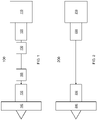
- the system 100 includes an engine 110, which can be coupled to a generator 120.
- a shaft that is coupled to a turbine can cause the rotor of the generator 120 to rotate in the magnetic field of the generator 120 to produce electric power.
- the power from the generator 120 is used to provide power to a motor 130 to drive a fan 140.
- the power from the generator 120 is provided to a power electronics circuit 150 which can convert the AC output of the generator to DC.
- the output of the power electronics circuit 150 can be provided to a power electronics circuit 160 which produces a controlled AC signal to provide to the motor 130.
- FIG. 2 another system 200 is shown.
- the output of the generator 220 is directly coupled to the input of a motor 230 that is used to drive the fan 240.
- the generator 220 outputs an AC signal that is directly proportional to the operation of the engine 210.
- the motor 230 that is used to drive the fan 240 will experience the variation in the operation of the engine 210 which can lead to inefficient operation.
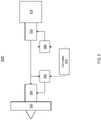
- the engine 310 of FIG. 3 can include several components to convert fuel energy to mechanical energy.
- the engine 310 can be a rotating engine that receives fuel to produce power to rotate a shaft coupled to the generator 320.
- the engine 310 can include a core, a low/high-pressure compressor, and a low/high-pressure turbine (not shown) to convert the fuel energy to rotational energy for the generator 320.
- the first machine 320 is a doubly fed induction generator.
- the rotor of the doubly fed induction generator is controlled by the rotation of the turbine of the engine which causes the rotor to rotate in the magnetic field producing current.
- the doubly fed induction generator can receive an excitation current to rotor windings (not shown) which can modify the electrical power output of the generator.
- the doubly fed induction generator can also receive an excitation current at the stator where the electrical output of the generator is a function of both the magnetic field of the stator and rotor.
- the second machine 330 is a doubly fed induction motor.
- the doubly fed induction motor is configured to receive a first input such as the electrical output from the generator.
- the received input can be a 3-phase AC input and can be provided to the stator to generate a magnetic field in the motor.
- the input is provided to the stator which in turns drives the rotor.
- the doubly fed induction motor can also receive an excitation signal to the rotor to modify the rotational output of the motor. That is, the rotational speed of the shaft of the motor which can be used to drive the fan can be changed and controlled at a desired operational speed using the excitation signal.
- a first power/frequency converter 350 can monitor the output of the generator 320.
- the output of the power/frequency converter 350 can be adjusted to control the output electrical power of the generator 320 as desired. That is, the output of the stator can be modified by the signal from the power/frequency converter 350 provided to the rotor windings to effect the electrical power output the generator 320.
- the converter 350 can detect the AC power and compare it to a threshold level. Based on the comparison the excitation signal can be provided to the rotor of the generator 320 to change the magnetic field which affects the electrical output of the generator 320.
- a second power/frequency converter 360 can monitor an electrical input to the motor 330.
- the converter 360 can compare the input to a threshold level. Based on the comparison the excitation signal can be provided to the rotor of the motor 330 to change the magnetic field which affects the rotational speed of the motor 330.
- a controller 370 can be used to control the operation of the first and second power/frequency converter.
- the power electronics can be sized and reduced.
- the engine 310 can be operated at a reduced optimal speed while providing flexible control an electric motor coupled to a generator.
- the doubly fed induction machines the engine can be operated at a reduced rate or an optimal rate and the fan speed can now be independently controlled.
- the machine 400 includes a stator 410 and a rotor 420 to produce mechanical force when operating as a motor and produce electrical power when operating as a generator.
- the stator 410 is configured to receive excitation signal 430 to energize the stator 410.
- the excitation signal 430 can include an AC or DC signal.
- the rotor 420 can receive an excitation signal 440 to modify the output of the machine 400.
- the electrical output of the machine can be a function of both excitation signals 430, 440.
- the rotational speed of the rotor 440 of the machine 400 can be a function of both excitation signals 430, 440.
- the excitation signals 430, 440 can be provided to windings that are in the rotor 420 or coils in the stator 410.
- the excitation signals 430, 440 can be controlled by system controllers and power/frequency converters such as that shown in FIG. 3 .
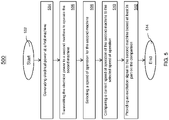
- the method 500 can be implemented in the series hybrid architecture such as that shown in FIG. 3 . It should be understood the method 500 can also be implemented in architectures having a different configuration and is not limited to that shown in FIG. 3 .
- the method 500 begins at block 502 and proceeds to block 504 which provides for generating electrical power at a first machine.
- the electrical power can be generated by a generator such as a doubly fed induction generator.
- the method 500 at block 506 provides for transmitting the electrical power to a second machine to operate the second machine.
- the second machine is a doubly fed induction motor.
- the motor can receive the electrical power at a stator of the motor which causes the rotor to rotate at a speed which can be used to drive equipment such as a fan.
- Block 508 provides for selecting a speed of operation for the second machine.
- the speed can be selected to operate a fan at a desired speed.
- the motor speed is not completely dependent on the electrical power from the generator.
- the method 500 provides for comparing a current speed of operation of the second machine to the selected speed of operation.
- the method 500 includes providing an excitation signal to the second machine based at least in part on the comparison.
- the excitation signal can be an AC excitation signal that is provided to the rotor where the speed of the rotor will be a function of the received AC power from the generator and the received AC excitation signal received at the rotor of the motor.
- the method 500 ends at block 514. It is to be understood that one or more steps can be continuously repeated. In addition, other steps and or a different combination of steps can be used.
- the technical effects and benefits provide an architecture that will use a fraction of the power electronics for minimum weight, volume, and losses while maintaining maximum fan speed control.
- This architecture allows for innovative vehicle architectures and failure mode operation.
- the technical effects and benefits include a reduction in the size of the power electronics. Since the power electronics are now only required to process a fraction of the total power, they can be sized accordingly to reduce its weight, volume, and size.
- the technical effects and benefits allow for the operation of the engine at a reduced speed while maintaining the desired performance at a coupled device such as a motor driving a fan or pump.
Landscapes
- Engineering & Computer Science (AREA)
- Chemical & Material Sciences (AREA)
- Combustion & Propulsion (AREA)
- Transportation (AREA)
- Mechanical Engineering (AREA)
- Power Engineering (AREA)
- Control Of Eletrric Generators (AREA)
Description
- The present disclosure relates to power generation systems and more particularly to series hybrid architectures using compounded doubly fed induction machines.
- Power generation systems can be based on various sources including the combustion of fuels including oil, coal, and gas. The power generation systems can include engines used to produce a force to rotate turbines that can be coupled to generators to produce electrical power. The electrical power can then be used to power other systems and subsystems. Because the generators are coupled to the engines their electrical power and frequency is proportional to the rotational speed of the turbine. Techniques for improving the operation of the efficiency of power generation are described herein.
US 4 982 147 relates to a power factor motor control system. Document BIRUDULA A K ET AL: "Optimization with load prediction in asynchronous generator driven tugboat propulsion system",2017 IEEE TRANSPORTATION ELECTRIFICATION CONFERENCE (ITEC-INDIA), IEEE, 13 December 2017 (2017-12-13), pages 1-6, discloses a system according to the preamble of claim 1 and a method according to the preamble of claim 6. - According to an embodiment, a system including a series hybrid architecture using compounded doubly fed induction machines is provided in claim 1. The system includes a controller configured to control the operation of the system, and a power source configured to convert a first form of energy to a second form of energy. The system also includes a first machine configured to generate power, wherein the first machine is mechanically coupled to the power source, and a second machine configured to control equipment, wherein the first machine is electrically coupled to the second machine.
- In addition to one or more of the features described herein, or as an alternative, further embodiments include a first machine that is a doubly fed induction generator.
- In addition to one or more of the features described herein, or as an alternative, further embodiments include a second machine that is a doubly fed induction motor.
- In addition to one or more of the features described herein, or as an alternative, further embodiments include independently operating the first machine and the second machine.
- In addition to one or more of the features described herein, or as an alternative, further embodiments include a first power electronics circuit that is configured to detect an output of the first machine and provide a first signal to the first machine to change the output of the first machine.
- In addition to one or more of the features described herein, or as an alternative, further embodiments include a first machine that includes a rotor and a stator, where a first signal is provided to the stator of the first machine.
- In addition to one or more of the features described herein, or as an alternative, further embodiments include a second power electronics circuit that is configured to detect an input to the second machine, and providing a second signal to control an output of the second machine.
- In addition to one or more of the features described herein, or as an alternative, further embodiments include a rotor and a stator of a second machine, where a second signal is provided to the rotor of the second machine.
- In addition to one or more of the features described herein, or as an alternative, further embodiments include a power source that is an engine.
- According to another embodiment, a method for operating a series hybrid architecture using compounded doubly fed induction machines is provided in claim 6. The method includes generating electrical power at a first machine, transmitting the electrical power to a second machine to operate the second machine, and selecting a speed of operation for the second machine by controlling the operation of the second machine. The method also includes comparing a current speed of operation of the second machine to the selected speed of operation, and providing an excitation signal to the second machine based at least in part on the comparison.
- In addition to one or more of the features described herein, or as an alternative, further embodiments include modifying the electrical output of the first machine, wherein modifying the electrical power of the first machine includes detecting the electrical power at a first power electronics circuit, comparing the electrical power to a value for an electrical output level, providing an excitation signal to the first machine based on the comparison, modifying the electrical power based on the excitation signal, and providing the modified electrical power to the second machine.
- In addition to one or more of the features described herein, or as an alternative, further embodiments include receiving the electrical power at a second power electronics circuit, comparing the received electrical power to a value for a threshold level, and providing the excitation signal to the second machine to control the speed of operation of the second machine.
- In addition to one or more of the features described herein, or as an alternative, further embodiments include a first machine that is a doubly fed induction generator.
- In addition to one or more of the features described herein, or as an alternative, further embodiments include a second machine that is a doubly fed induction motor.
- In addition to one or more of the features described herein, or as an alternative, further embodiments include providing the excitation signal to the first machine is provided to rotor windings of the first machine.
- In addition to one or more of the features described herein, or as an alternative, further embodiments include providing the excitation signal to the second machine is provided to the rotor windings of the second machine.
- In addition to one or more of the features described herein, or as an alternative, further embodiments include a first machine that receives power to rotate the rotor of the first machine.
- In addition to one or more of the features described herein, or as an alternative, further embodiments include electrical power that is received at a stator of the second machine.
- In addition to one or more of the features described herein, or as an alternative, further embodiments include receiving energy at the first machine from an engine.
- In addition to one or more of the features described herein, or as an alternative, further embodiments include independently operating the first machine and the second machine.
- Technical effects of embodiments of the present disclosure include operating the gas turbine of the power generation unit at an optimal speed while independently operating a fan of a vehicle at various speeds. In addition, the technical effects also allow for minimizing the required power electronics used in the system.
- The foregoing features and elements may be combined in various combinations without exclusivity, unless expressly indicated otherwise. These features and elements as well as the operation thereof will become more apparent in light of the following description and the accompanying drawings. It should be understood, however, that the following description and drawings are intended to be illustrative and explanatory in nature and non-limiting.
- The following descriptions should not be considered limiting in any way. With reference to the accompanying drawings, like elements are numbered alike:
-
FIG. 1 depicts a system for controlling a fan; -
FIG. 2 depicts another system for controlling a fan; -
FIG. 3 depicts a series hybrid architecture using compounded doubly fed induction machine in accordance with one or more embodiments; -
FIG. 4 depicts a rotor and stator used in a doubly fed induction machine in accordance with one or more embodiments; and -
FIG. 5 depicts a flowchart of a method for operating the series hybrid architecture using compounded doubly fed induction machine in accordance with one or more embodiments. - Induction machines include a stator and rotor which operated to generate a magnetic field to generate an output current. The induction machines can include generator-type and motor-type machines. The rotor of the generator is coupled to a power source that causes the rotor to rotate within the magnetic field of the stator to produce an output. A motor is configured to receive an electrical input to cause the rotor of the motor to rotate to drive an output such as a fan, pump, or other equipment.
- Doubly fed induction machines can be operated to receive an excitation input to the stator and rotor to control the output. For example, a doubly fed induction generator can receive an excitation current in the rotor windings to change the magnetic field to control the output of the generator. Because the output voltage and current are proportional to the frequency of the rotational speed of the rotor, additional control can be achieved by feeding the rotor windings with an excitation current.
- A motor, for example, can receive a three-phase electrical input to cause a rotating magnetic field. The excitation current provided to the rotor windings can be controlled to modify the rotational speed output of the motor. In a doubly fed induction motor, the stator and the rotor are used to set the output of the motor. That is, two rotating magnetic fields are created and the output is a function of both magnetic fields. The rotational speed of the rotor is now dependent on the speed and direction of the input to each of the rotating magnetic fields. By varying the frequency of the rotor inputs, the speed of the motor can be controlled.
- In existing series hybrid architectures, full rating power electronics are used to convert power output from the generator. Additional power electronics are used to convert the received power to a form that is usable to drive other machines and equipment at a desired operating speed. However, the power electronics add significant weight/volume/size to the limited area. Power electronics can include large components such as the capacitors and inductors that can be used in rectifiers, filters, and inverters.
- Other existing series hybrid architectures directly link the AC power from the generator to the motor. However, provided in this architecture the speed of the motor is directly dependent on the speed of the generator and the relative generator/motor pole counts. Although this architecture makes use of minimum power electronics, the gas turbine must be able to run at varying speeds for fan speed control where independent fan operation is no longer possible.
- The techniques described herein provide for implementing an AC series hybrid architecture with compounded doubly fed induction machines. By using the doubly fed induction machines for the motor and generator portions of the series hybrid architecture, the motor and generator speeds can be decoupled, and the power electronics can be sized to only process a fraction of the total power thereby minimizing the size of the power electronics.
- Referring to
FIG. 1 , asystem 100 is shown. Thesystem 100 includes anengine 110, which can be coupled to agenerator 120. A shaft that is coupled to a turbine can cause the rotor of thegenerator 120 to rotate in the magnetic field of thegenerator 120 to produce electric power. The power from thegenerator 120 is used to provide power to amotor 130 to drive afan 140. The power from thegenerator 120 is provided to apower electronics circuit 150 which can convert the AC output of the generator to DC. The output of thepower electronics circuit 150 can be provided to apower electronics circuit 160 which produces a controlled AC signal to provide to themotor 130. - However, this particular series configuration requires the full rated
power electronics circuits - Referring now to
FIG. 2 , anothersystem 200 is shown. The output of thegenerator 220 is directly coupled to the input of amotor 230 that is used to drive thefan 240. Thegenerator 220 outputs an AC signal that is directly proportional to the operation of theengine 210. Using this architecture, themotor 230 that is used to drive thefan 240 will experience the variation in the operation of theengine 210 which can lead to inefficient operation. - Now referring to
FIG. 3 , asystem 300 of a series hybrid architecture using compounded doubly fed induction machines is shown. Theengine 310 ofFIG. 3 can include several components to convert fuel energy to mechanical energy. For example, theengine 310 can be a rotating engine that receives fuel to produce power to rotate a shaft coupled to thegenerator 320. Theengine 310 can include a core, a low/high-pressure compressor, and a low/high-pressure turbine (not shown) to convert the fuel energy to rotational energy for thegenerator 320. - In one embodiment, the
first machine 320 is a doubly fed induction generator. The rotor of the doubly fed induction generator is controlled by the rotation of the turbine of the engine which causes the rotor to rotate in the magnetic field producing current. The doubly fed induction generator can receive an excitation current to rotor windings (not shown) which can modify the electrical power output of the generator. The doubly fed induction generator can also receive an excitation current at the stator where the electrical output of the generator is a function of both the magnetic field of the stator and rotor. - In some embodiment, the
second machine 330 is a doubly fed induction motor. The doubly fed induction motor is configured to receive a first input such as the electrical output from the generator. The received input can be a 3-phase AC input and can be provided to the stator to generate a magnetic field in the motor. The input is provided to the stator which in turns drives the rotor. The doubly fed induction motor can also receive an excitation signal to the rotor to modify the rotational output of the motor. That is, the rotational speed of the shaft of the motor which can be used to drive the fan can be changed and controlled at a desired operational speed using the excitation signal. - A first power/
frequency converter 350 can monitor the output of thegenerator 320. The output of the power/frequency converter 350 can be adjusted to control the output electrical power of thegenerator 320 as desired. That is, the output of the stator can be modified by the signal from the power/frequency converter 350 provided to the rotor windings to effect the electrical power output thegenerator 320. For example, theconverter 350 can detect the AC power and compare it to a threshold level. Based on the comparison the excitation signal can be provided to the rotor of thegenerator 320 to change the magnetic field which affects the electrical output of thegenerator 320. - A second power/
frequency converter 360 can monitor an electrical input to themotor 330. Theconverter 360 can compare the input to a threshold level. Based on the comparison the excitation signal can be provided to the rotor of themotor 330 to change the magnetic field which affects the rotational speed of themotor 330. - A
controller 370 can be used to control the operation of the first and second power/frequency converter. By implementing a doubly fed induction generator and doubly fed induction motor in a series hybrid architecture, the power electronics can be sized and reduced. In addition, theengine 310 can be operated at a reduced optimal speed while providing flexible control an electric motor coupled to a generator. By using the doubly fed induction machines the engine can be operated at a reduced rate or an optimal rate and the fan speed can now be independently controlled. - Referring now to
FIG. 4 , a doubly fed induction machine 400 (hereinafter referred to as "machine 400") in accordance with one or more embodiments is shown. Themachine 400 includes astator 410 and arotor 420 to produce mechanical force when operating as a motor and produce electrical power when operating as a generator. In one or more embodiments thestator 410 is configured to receiveexcitation signal 430 to energize thestator 410. Theexcitation signal 430 can include an AC or DC signal. Therotor 420 can receive anexcitation signal 440 to modify the output of themachine 400. When operating as a generator, the electrical output of the machine can be a function of both excitation signals 430, 440. When operating as a motor, the rotational speed of therotor 440 of themachine 400 can be a function of both excitation signals 430, 440. The excitation signals 430, 440 can be provided to windings that are in therotor 420 or coils in thestator 410. In some embodiments, the excitation signals 430, 440 can be controlled by system controllers and power/frequency converters such as that shown inFIG. 3 . - Now referring to
FIG. 5 , amethod 500 for controlling a series hybrid architecture using compounded doubly fed induction machines is shown. Themethod 500 can be implemented in the series hybrid architecture such as that shown inFIG. 3 . It should be understood themethod 500 can also be implemented in architectures having a different configuration and is not limited to that shown inFIG. 3 . Themethod 500 begins atblock 502 and proceeds to block 504 which provides for generating electrical power at a first machine. The electrical power can be generated by a generator such as a doubly fed induction generator. - The
method 500 atblock 506 provides for transmitting the electrical power to a second machine to operate the second machine. In one or more embodiments, the second machine is a doubly fed induction motor. The motor can receive the electrical power at a stator of the motor which causes the rotor to rotate at a speed which can be used to drive equipment such as a fan. -
Block 508 provides for selecting a speed of operation for the second machine. The speed can be selected to operate a fan at a desired speed. The motor speed is not completely dependent on the electrical power from the generator. - At
block 510, themethod 500 provides for comparing a current speed of operation of the second machine to the selected speed of operation. Continuing to block 512 themethod 500 includes providing an excitation signal to the second machine based at least in part on the comparison. The excitation signal can be an AC excitation signal that is provided to the rotor where the speed of the rotor will be a function of the received AC power from the generator and the received AC excitation signal received at the rotor of the motor. Themethod 500 ends atblock 514. It is to be understood that one or more steps can be continuously repeated. In addition, other steps and or a different combination of steps can be used. - The technical effects and benefits provide an architecture that will use a fraction of the power electronics for minimum weight, volume, and losses while maintaining maximum fan speed control. This architecture allows for innovative vehicle architectures and failure mode operation. The technical effects and benefits include a reduction in the size of the power electronics. Since the power electronics are now only required to process a fraction of the total power, they can be sized accordingly to reduce its weight, volume, and size.
- The technical effects and benefits allow for the operation of the engine at a reduced speed while maintaining the desired performance at a coupled device such as a motor driving a fan or pump.
- A detailed description of one or more embodiments of the disclosed apparatus and method are presented herein by way of exemplification and not limitation with reference to the Figures.
- The term "about" is intended to include the degree of error associated with measurement of the particular quantity based upon the equipment available at the time of filing the application.
- The terminology used herein is for the purpose of describing particular embodiments only and is not intended to be limiting of the present disclosure. As used herein, the singular forms "a", "an" and "the" are intended to include the plural forms as well, unless the context clearly indicates otherwise. It will be further understood that the terms "comprises" and/or "comprising," when used in this specification, specify the presence of stated features, integers, steps, operations, elements, and/or components, but do not preclude the presence or addition of one or more other features, integers, steps, operations, element components, and/or groups thereof.
Claims (12)
- A system including series hybrid architecture using compounded doubly fed induction machines, the system comprising:a controller (370) configured to control the operation of the system;a power source configured to convert a first form of energy to a second form of energy;a first machine (320) configured to generate power, wherein the first machine is mechanically coupled to the power source;a second machine (330) configured to control equipment, wherein the first machine is electrically coupled to the second machine;a first power electronics circuit configured to modify electrical power of the first machine, characterised in thatmodifying the electrical power of the first machine comprises:detecting, at the first power electronics circuit, the electrical power;comparing the electrical power to a value for an electrical output level;providing an excitation signal to the first machine based on the comparison;modifying the electrical power based on the excitation signal;transmitting the modified electrical power to a second machine to operate the second machine; anda second power electronics circuit configured to detect an input to the second machine and provide a second signal to control an output of the second machine, wherein providing the second signal comprises:receiving the modified electrical power at the second power electronics circuit;comparing the received modified electrical power to a value for a threshold level;selecting a speed of operation for the second machine by controlling the operation of the second machine;comparing a current speed of operation of the second machine to the selected speed of operation; andproviding an excitation signal to the second machine based at least in part on the comparison to control the speed of operation of the second machine.
- The system of claim 1, wherein the first machine and the second machine are operated independently of each other.
- The system of claim 1, wherein the first machine comprises a rotor and a stator, and wherein the first signal is provided to the stator of the first machine.
- The system of claim 1, wherein the second machine comprises a rotor and a stator, and wherein the second signal is provided to the rotor of the second machine.
- The system of any preceding claim, wherein the power source is an engine.
- A method for operating a series hybrid architecture using compounded doubly fed induction machines, the method comprising:generating electrical power at a first machine (320);modifying the electrical output of the first machine (320), wherein modifying the electrical power of the first machine comprises, and is characterized by:detecting the electrical power at a first power electronics circuit;comparing the electrical power to a value for an electrical output level;providing an excitation signal to the first machine based on the comparison;modifying the electrical power based on the excitation signal;transmitting the modified electrical power to a second machine (330) to operate the second machine (330);receiving the modified electrical power at a second power electronics circuit;comparing the received modified electrical power to a value for a threshold level;selecting a speed of operation for the second machine (330) by controlling the operation of the second machine;comparing a current speed of operation of the second machine (330) to the selected speed of operation; andproviding an excitation signal to the second machine based at least in part on the comparison to control the speed of operation of the second machine (330).
- The method of claim 6, wherein providing the excitation signal to the first machine is provided to rotor windings of the first machine.
- The method of any of claims 6 or 7, wherein providing the excitation signal to the second machine (330) is provided to the rotor windings of the second machine.
- The method of any of claims 6-8, the method further comprising receiving power at the rotor of the first machine (320).
- The method of any of claims 6-9, the method further comprising receiving the electrical power at a stator of the second machine (330).
- The method of any of claims 6-10, the method further comprising receiving energy at the first machine (320) from an engine.
- The method of any of claims 6-11, the method further comprising independently operating the first machine (320) and the second machine (330).
Applications Claiming Priority (1)
| Application Number | Priority Date | Filing Date | Title |
|---|---|---|---|
| US16/293,822 US11312222B2 (en) | 2019-03-06 | 2019-03-06 | Series hybrid architectures using compounded doubly fed machines |
Publications (2)
| Publication Number | Publication Date |
|---|---|
| EP3706307A1 EP3706307A1 (en) | 2020-09-09 |
| EP3706307B1 true EP3706307B1 (en) | 2022-06-29 |
Family
ID=68732726
Family Applications (1)
| Application Number | Title | Priority Date | Filing Date |
|---|---|---|---|
| EP19212246.3A Revoked EP3706307B1 (en) | 2019-03-06 | 2019-11-28 | Series hybrid architectures using compounded doubly fed machines |
Country Status (2)
| Country | Link |
|---|---|
| US (1) | US11312222B2 (en) |
| EP (1) | EP3706307B1 (en) |
Families Citing this family (1)
| Publication number | Priority date | Publication date | Assignee | Title |
|---|---|---|---|---|
| EP3920406A1 (en) * | 2020-06-04 | 2021-12-08 | Siemens Gamesa Renewable Energy Innovation & Technology S.L. | Wind turbine electrical power generating system and method |
Family Cites Families (7)
| Publication number | Priority date | Publication date | Assignee | Title |
|---|---|---|---|---|
| US4982147A (en) | 1989-01-30 | 1991-01-01 | State Of Oregon Acting By And Through The State Board Of Higher Education On Behalf Of Oregon State University | Power factor motor control system |
| US8093739B2 (en) * | 2009-01-09 | 2012-01-10 | General Electric Company | System and method for fixed frequency power generation |
| DE112010003165T5 (en) * | 2009-06-25 | 2012-11-08 | Fisker Automotive, Inc. | DIRECT ELECTRICAL CONNECTION FOR A MULTI-MOTOR SHYBRIDING DRIVE SYSTEM |
| GB201308292D0 (en) | 2013-05-09 | 2013-06-12 | Rolls Royce Plc | Aircraft electrical system |
| CA2932101C (en) * | 2015-06-10 | 2023-10-03 | Rolls-Royce Corporation | Synchronizing motors for an electric propulsion system |
| US10718598B2 (en) * | 2017-06-23 | 2020-07-21 | Hamilton Sundstrand Corporation | Series hybrid architecture for an unmanned underwater vehicle propulsion system |
| EP3444937B1 (en) | 2017-08-18 | 2021-11-03 | GE Energy Power Conversion Technology Limited | System and method for operating a pumped-storage power plant comprising a double fed induction machine |
-
2019
- 2019-03-06 US US16/293,822 patent/US11312222B2/en active Active
- 2019-11-28 EP EP19212246.3A patent/EP3706307B1/en not_active Revoked
Non-Patent Citations (5)
| Title |
|---|
| ANONYMOUS: "Setpoint (control system)", WIKIPEDIA, 4 January 2019 (2019-01-04), pages 1 - 2, XP093148536, Retrieved from the Internet <URL:https://en.wikipedia.org/w/index.php?title=Setpoint_(control_system)&oldid=876838730> [retrieved on 20240405] |
| DAVID J. SADEY, LINDA TAYLOR, RAYMOND BEACH: "Proposal and Development of a High Voltage Variable Frequency Alternating Current Power System for Hybrid Electric Aircraft", 14TH INTERNATIONAL ENERGY CONVERSION ENGINEERING CONFERENCE, 25 July 2016 (2016-07-25), Reston, Virginia , pages 1 - 10, XP055750143, ISBN: 978-1-62410-407-7, DOI: 10.2514/6.2016-4928 |
| FREDERIC POITIERS: "Etude et commande generatrices asynchrones pour l'utilisation de l'energie eolienne", THÈSE DE DOCTORAT, 1 January 2003 (2003-01-01), pages 1 - 156, XP093086358 |
| SADEY DAVID J., BODSON MARC, CSANK JEFFREY, HUNKER KEITH, THEMAN CASEY, TAYLOR LINDA: "Control Demonstration of Multiple Doubly-Fed Induction Motors for Hybrid Electric Propulsion", 53RD AIAA/SAE/ASEE JOINT PROPULSION CONFERENCE, AMERICAN INSTITUTE OF AERONAUTICS AND ASTRONAUTICS, RESTON, VIRGINIA, 10 July 2017 (2017-07-10) - 12 July 2017 (2017-07-12), Reston, Virginia , pages 1 - 13, XP093148546, ISBN: 978-1-62410-511-1, DOI: 10.2514/6.2017-4954 |
| W. BEITZ UND K.-H. KÜTTNER: "Dubbel Taschenbuch der Maschinenbau", 1 January 1990, SPRINGER, DE, ISBN: 3-540-52381-2, article W. BEITZ, K.-H. KÜTTNER: "Section X Regelungstechnik", pages: X1 - X18, XP009553260 |
Also Published As
| Publication number | Publication date |
|---|---|
| US11312222B2 (en) | 2022-04-26 |
| EP3706307A1 (en) | 2020-09-09 |
| US20200282819A1 (en) | 2020-09-10 |
Similar Documents
| Publication | Publication Date | Title |
|---|---|---|
| US9209741B2 (en) | Method and system for controlling synchronous machine as generator/starter | |
| US7514806B2 (en) | Engine start system with quadrature AC excitation | |
| US7915869B2 (en) | Single stage starter/generator with rotor quadrature AC excitation | |
| US9573539B2 (en) | Electric system architecture for more-electric engine accessories | |
| US20100295301A1 (en) | Aircraft engine starting/generating system and method of control | |
| US8097968B2 (en) | Position-controlled start from the AC line using a synchronous machine | |
| CN110015433B (en) | AC power distribution system and AC power distribution method | |
| US12199539B2 (en) | Motor control device, electric vehicle, and motor control method | |
| EP3376663A1 (en) | Generator arrangements and methods of controlling generator arrangements | |
| US11312222B2 (en) | Series hybrid architectures using compounded doubly fed machines | |
| CN108847796B (en) | Reluctance type starting control method and system for three-stage brushless synchronous motor | |
| EP4510431A1 (en) | Transverse flux asynchronous electric machine | |
| EP4401302A1 (en) | Starter/generator arrangements for gas turbine engines | |
| EP4401301A1 (en) | Starter/generator arrangements for gas turbine engines | |
| CN106059446A (en) | Fault-tolerant control method for single-phase open-circuit fault of six-phase permanent-magnet synchronous linear motor | |
| Mecke | Permanent magnet synchronous motor for passenger ship propulsion | |
| US12512743B2 (en) | Motor-alternator-motor (MAM) systems and methods for using same | |
| EP2928069A2 (en) | Systems utilizing a controllable voltage AC generator system | |
| Reshetnikov et al. | Modeling of integrated starter-generator in generator mode | |
| US12428998B2 (en) | Aircraft engine start using multiple common motor controllers | |
| Koczara et al. | Variable speed integrated generating set an emerging technology for distributed power generation | |
| Andrade et al. | Voltage and current control of self-excited Switched Reluctance Generator for variable speed drive | |
| RU2278463C1 (en) | Electro-movement system | |
| CN115443606A (en) | Drive system with harmonic infeed | |
| Ebrahimian et al. | Control & Communication Architecture for a Fault-Tolerant Integrated Modular Motor Drive |
Legal Events
| Date | Code | Title | Description |
|---|---|---|---|
| PUAI | Public reference made under article 153(3) epc to a published international application that has entered the european phase |
Free format text: ORIGINAL CODE: 0009012 |
|
| STAA | Information on the status of an ep patent application or granted ep patent |
Free format text: STATUS: THE APPLICATION HAS BEEN PUBLISHED |
|
| AK | Designated contracting states |
Kind code of ref document: A1 Designated state(s): AL AT BE BG CH CY CZ DE DK EE ES FI FR GB GR HR HU IE IS IT LI LT LU LV MC MK MT NL NO PL PT RO RS SE SI SK SM TR |
|
| AX | Request for extension of the european patent |
Extension state: BA ME |
|
| STAA | Information on the status of an ep patent application or granted ep patent |
Free format text: STATUS: REQUEST FOR EXAMINATION WAS MADE |
|
| 17P | Request for examination filed |
Effective date: 20210308 |
|
| RBV | Designated contracting states (corrected) |
Designated state(s): AL AT BE BG CH CY CZ DE DK EE ES FI FR GB GR HR HU IE IS IT LI LT LU LV MC MK MT NL NO PL PT RO RS SE SI SK SM TR |
|
| RIN1 | Information on inventor provided before grant (corrected) |
Inventor name: SPIERLING, TODD A. |
|
| STAA | Information on the status of an ep patent application or granted ep patent |
Free format text: STATUS: EXAMINATION IS IN PROGRESS |
|
| 17Q | First examination report despatched |
Effective date: 20210510 |
|
| GRAP | Despatch of communication of intention to grant a patent |
Free format text: ORIGINAL CODE: EPIDOSNIGR1 |
|
| STAA | Information on the status of an ep patent application or granted ep patent |
Free format text: STATUS: GRANT OF PATENT IS INTENDED |
|
| INTG | Intention to grant announced |
Effective date: 20220203 |
|
| GRAS | Grant fee paid |
Free format text: ORIGINAL CODE: EPIDOSNIGR3 |
|
| GRAA | (expected) grant |
Free format text: ORIGINAL CODE: 0009210 |
|
| STAA | Information on the status of an ep patent application or granted ep patent |
Free format text: STATUS: THE PATENT HAS BEEN GRANTED |
|
| AK | Designated contracting states |
Kind code of ref document: B1 Designated state(s): AL AT BE BG CH CY CZ DE DK EE ES FI FR GB GR HR HU IE IS IT LI LT LU LV MC MK MT NL NO PL PT RO RS SE SI SK SM TR |
|
| REG | Reference to a national code |
Ref country code: CH Ref legal event code: EP |
|
| REG | Reference to a national code |
Ref country code: DE Ref legal event code: R096 Ref document number: 602019016396 Country of ref document: DE |
|
| REG | Reference to a national code |
Ref country code: AT Ref legal event code: REF Ref document number: 1501995 Country of ref document: AT Kind code of ref document: T Effective date: 20220715 |
|
| REG | Reference to a national code |
Ref country code: IE Ref legal event code: FG4D |
|
| REG | Reference to a national code |
Ref country code: LT Ref legal event code: MG9D |
|
| PG25 | Lapsed in a contracting state [announced via postgrant information from national office to epo] |
Ref country code: SE Free format text: LAPSE BECAUSE OF FAILURE TO SUBMIT A TRANSLATION OF THE DESCRIPTION OR TO PAY THE FEE WITHIN THE PRESCRIBED TIME-LIMIT Effective date: 20220629 Ref country code: NO Free format text: LAPSE BECAUSE OF FAILURE TO SUBMIT A TRANSLATION OF THE DESCRIPTION OR TO PAY THE FEE WITHIN THE PRESCRIBED TIME-LIMIT Effective date: 20220929 Ref country code: LT Free format text: LAPSE BECAUSE OF FAILURE TO SUBMIT A TRANSLATION OF THE DESCRIPTION OR TO PAY THE FEE WITHIN THE PRESCRIBED TIME-LIMIT Effective date: 20220629 Ref country code: HR Free format text: LAPSE BECAUSE OF FAILURE TO SUBMIT A TRANSLATION OF THE DESCRIPTION OR TO PAY THE FEE WITHIN THE PRESCRIBED TIME-LIMIT Effective date: 20220629 Ref country code: GR Free format text: LAPSE BECAUSE OF FAILURE TO SUBMIT A TRANSLATION OF THE DESCRIPTION OR TO PAY THE FEE WITHIN THE PRESCRIBED TIME-LIMIT Effective date: 20220930 Ref country code: FI Free format text: LAPSE BECAUSE OF FAILURE TO SUBMIT A TRANSLATION OF THE DESCRIPTION OR TO PAY THE FEE WITHIN THE PRESCRIBED TIME-LIMIT Effective date: 20220629 Ref country code: BG Free format text: LAPSE BECAUSE OF FAILURE TO SUBMIT A TRANSLATION OF THE DESCRIPTION OR TO PAY THE FEE WITHIN THE PRESCRIBED TIME-LIMIT Effective date: 20220929 |
|
| REG | Reference to a national code |
Ref country code: NL Ref legal event code: MP Effective date: 20220629 |
|
| REG | Reference to a national code |
Ref country code: AT Ref legal event code: MK05 Ref document number: 1501995 Country of ref document: AT Kind code of ref document: T Effective date: 20220629 |
|
| PG25 | Lapsed in a contracting state [announced via postgrant information from national office to epo] |
Ref country code: RS Free format text: LAPSE BECAUSE OF FAILURE TO SUBMIT A TRANSLATION OF THE DESCRIPTION OR TO PAY THE FEE WITHIN THE PRESCRIBED TIME-LIMIT Effective date: 20220629 Ref country code: LV Free format text: LAPSE BECAUSE OF FAILURE TO SUBMIT A TRANSLATION OF THE DESCRIPTION OR TO PAY THE FEE WITHIN THE PRESCRIBED TIME-LIMIT Effective date: 20220629 |
|
| PG25 | Lapsed in a contracting state [announced via postgrant information from national office to epo] |
Ref country code: NL Free format text: LAPSE BECAUSE OF FAILURE TO SUBMIT A TRANSLATION OF THE DESCRIPTION OR TO PAY THE FEE WITHIN THE PRESCRIBED TIME-LIMIT Effective date: 20220629 |
|
| PG25 | Lapsed in a contracting state [announced via postgrant information from national office to epo] |
Ref country code: SM Free format text: LAPSE BECAUSE OF FAILURE TO SUBMIT A TRANSLATION OF THE DESCRIPTION OR TO PAY THE FEE WITHIN THE PRESCRIBED TIME-LIMIT Effective date: 20220629 Ref country code: SK Free format text: LAPSE BECAUSE OF FAILURE TO SUBMIT A TRANSLATION OF THE DESCRIPTION OR TO PAY THE FEE WITHIN THE PRESCRIBED TIME-LIMIT Effective date: 20220629 Ref country code: RO Free format text: LAPSE BECAUSE OF FAILURE TO SUBMIT A TRANSLATION OF THE DESCRIPTION OR TO PAY THE FEE WITHIN THE PRESCRIBED TIME-LIMIT Effective date: 20220629 Ref country code: PT Free format text: LAPSE BECAUSE OF FAILURE TO SUBMIT A TRANSLATION OF THE DESCRIPTION OR TO PAY THE FEE WITHIN THE PRESCRIBED TIME-LIMIT Effective date: 20221031 Ref country code: ES Free format text: LAPSE BECAUSE OF FAILURE TO SUBMIT A TRANSLATION OF THE DESCRIPTION OR TO PAY THE FEE WITHIN THE PRESCRIBED TIME-LIMIT Effective date: 20220629 Ref country code: EE Free format text: LAPSE BECAUSE OF FAILURE TO SUBMIT A TRANSLATION OF THE DESCRIPTION OR TO PAY THE FEE WITHIN THE PRESCRIBED TIME-LIMIT Effective date: 20220629 Ref country code: AT Free format text: LAPSE BECAUSE OF FAILURE TO SUBMIT A TRANSLATION OF THE DESCRIPTION OR TO PAY THE FEE WITHIN THE PRESCRIBED TIME-LIMIT Effective date: 20220629 |
|
| PG25 | Lapsed in a contracting state [announced via postgrant information from national office to epo] |
Ref country code: PL Free format text: LAPSE BECAUSE OF FAILURE TO SUBMIT A TRANSLATION OF THE DESCRIPTION OR TO PAY THE FEE WITHIN THE PRESCRIBED TIME-LIMIT Effective date: 20220629 Ref country code: IS Free format text: LAPSE BECAUSE OF FAILURE TO SUBMIT A TRANSLATION OF THE DESCRIPTION OR TO PAY THE FEE WITHIN THE PRESCRIBED TIME-LIMIT Effective date: 20221029 |
|
| REG | Reference to a national code |
Ref country code: DE Ref legal event code: R026 Ref document number: 602019016396 Country of ref document: DE |
|
| PG25 | Lapsed in a contracting state [announced via postgrant information from national office to epo] |
Ref country code: AL Free format text: LAPSE BECAUSE OF FAILURE TO SUBMIT A TRANSLATION OF THE DESCRIPTION OR TO PAY THE FEE WITHIN THE PRESCRIBED TIME-LIMIT Effective date: 20220629 |
|
| PLBI | Opposition filed |
Free format text: ORIGINAL CODE: 0009260 |
|
| PLAX | Notice of opposition and request to file observation + time limit sent |
Free format text: ORIGINAL CODE: EPIDOSNOBS2 |
|
| PG25 | Lapsed in a contracting state [announced via postgrant information from national office to epo] |
Ref country code: DK Free format text: LAPSE BECAUSE OF FAILURE TO SUBMIT A TRANSLATION OF THE DESCRIPTION OR TO PAY THE FEE WITHIN THE PRESCRIBED TIME-LIMIT Effective date: 20220629 Ref country code: CZ Free format text: LAPSE BECAUSE OF FAILURE TO SUBMIT A TRANSLATION OF THE DESCRIPTION OR TO PAY THE FEE WITHIN THE PRESCRIBED TIME-LIMIT Effective date: 20220629 |
|
| 26 | Opposition filed |
Opponent name: SAFRAN AIRCRAFT ENGINES Effective date: 20230327 |
|
| PG25 | Lapsed in a contracting state [announced via postgrant information from national office to epo] |
Ref country code: MC Free format text: LAPSE BECAUSE OF FAILURE TO SUBMIT A TRANSLATION OF THE DESCRIPTION OR TO PAY THE FEE WITHIN THE PRESCRIBED TIME-LIMIT Effective date: 20220629 |
|
| REG | Reference to a national code |
Ref country code: CH Ref legal event code: PL |
|
| P01 | Opt-out of the competence of the unified patent court (upc) registered |
Effective date: 20230603 |
|
| REG | Reference to a national code |
Ref country code: BE Ref legal event code: MM Effective date: 20221130 |
|
| PG25 | Lapsed in a contracting state [announced via postgrant information from national office to epo] |
Ref country code: LI Free format text: LAPSE BECAUSE OF NON-PAYMENT OF DUE FEES Effective date: 20221130 Ref country code: CH Free format text: LAPSE BECAUSE OF NON-PAYMENT OF DUE FEES Effective date: 20221130 |
|
| PLBB | Reply of patent proprietor to notice(s) of opposition received |
Free format text: ORIGINAL CODE: EPIDOSNOBS3 |
|
| PG25 | Lapsed in a contracting state [announced via postgrant information from national office to epo] |
Ref country code: SI Free format text: LAPSE BECAUSE OF FAILURE TO SUBMIT A TRANSLATION OF THE DESCRIPTION OR TO PAY THE FEE WITHIN THE PRESCRIBED TIME-LIMIT Effective date: 20220629 Ref country code: LU Free format text: LAPSE BECAUSE OF NON-PAYMENT OF DUE FEES Effective date: 20221128 |
|
| PG25 | Lapsed in a contracting state [announced via postgrant information from national office to epo] |
Ref country code: IE Free format text: LAPSE BECAUSE OF NON-PAYMENT OF DUE FEES Effective date: 20221128 |
|
| PG25 | Lapsed in a contracting state [announced via postgrant information from national office to epo] |
Ref country code: BE Free format text: LAPSE BECAUSE OF NON-PAYMENT OF DUE FEES Effective date: 20221130 |
|
| PG25 | Lapsed in a contracting state [announced via postgrant information from national office to epo] |
Ref country code: IT Free format text: LAPSE BECAUSE OF FAILURE TO SUBMIT A TRANSLATION OF THE DESCRIPTION OR TO PAY THE FEE WITHIN THE PRESCRIBED TIME-LIMIT Effective date: 20220629 |
|
| PG25 | Lapsed in a contracting state [announced via postgrant information from national office to epo] |
Ref country code: CY Free format text: LAPSE BECAUSE OF FAILURE TO SUBMIT A TRANSLATION OF THE DESCRIPTION OR TO PAY THE FEE WITHIN THE PRESCRIBED TIME-LIMIT Effective date: 20220629 |
|
| PG25 | Lapsed in a contracting state [announced via postgrant information from national office to epo] |
Ref country code: MK Free format text: LAPSE BECAUSE OF FAILURE TO SUBMIT A TRANSLATION OF THE DESCRIPTION OR TO PAY THE FEE WITHIN THE PRESCRIBED TIME-LIMIT Effective date: 20220629 Ref country code: HU Free format text: LAPSE BECAUSE OF FAILURE TO SUBMIT A TRANSLATION OF THE DESCRIPTION OR TO PAY THE FEE WITHIN THE PRESCRIBED TIME-LIMIT; INVALID AB INITIO Effective date: 20191128 |
|
| PG25 | Lapsed in a contracting state [announced via postgrant information from national office to epo] |
Ref country code: MT Free format text: LAPSE BECAUSE OF FAILURE TO SUBMIT A TRANSLATION OF THE DESCRIPTION OR TO PAY THE FEE WITHIN THE PRESCRIBED TIME-LIMIT Effective date: 20220629 |
|
| PG25 | Lapsed in a contracting state [announced via postgrant information from national office to epo] |
Ref country code: BG Free format text: LAPSE BECAUSE OF FAILURE TO SUBMIT A TRANSLATION OF THE DESCRIPTION OR TO PAY THE FEE WITHIN THE PRESCRIBED TIME-LIMIT Effective date: 20220629 |
|
| PG25 | Lapsed in a contracting state [announced via postgrant information from national office to epo] |
Ref country code: BG Free format text: LAPSE BECAUSE OF FAILURE TO SUBMIT A TRANSLATION OF THE DESCRIPTION OR TO PAY THE FEE WITHIN THE PRESCRIBED TIME-LIMIT Effective date: 20220629 |
|
| PGFP | Annual fee paid to national office [announced via postgrant information from national office to epo] |
Ref country code: DE Payment date: 20241022 Year of fee payment: 6 |
|
| PGFP | Annual fee paid to national office [announced via postgrant information from national office to epo] |
Ref country code: GB Payment date: 20241023 Year of fee payment: 6 |
|
| PGFP | Annual fee paid to national office [announced via postgrant information from national office to epo] |
Ref country code: FR Payment date: 20241022 Year of fee payment: 6 |
|
| RDAF | Communication despatched that patent is revoked |
Free format text: ORIGINAL CODE: EPIDOSNREV1 |
|
| REG | Reference to a national code |
Ref country code: DE Ref legal event code: R064 Ref document number: 602019016396 Country of ref document: DE Ref country code: DE Ref legal event code: R103 Ref document number: 602019016396 Country of ref document: DE |
|
| RDAG | Patent revoked |
Free format text: ORIGINAL CODE: 0009271 |
|
| STAA | Information on the status of an ep patent application or granted ep patent |
Free format text: STATUS: PATENT REVOKED |
|
| REG | Reference to a national code |
Ref country code: CH Ref legal event code: PL |
|
| 27W | Patent revoked |
Effective date: 20250411 |
|
| GBPR | Gb: patent revoked under art. 102 of the ep convention designating the uk as contracting state |
Effective date: 20250411 |
|
| PG25 | Lapsed in a contracting state [announced via postgrant information from national office to epo] |
Ref country code: TR Free format text: LAPSE BECAUSE OF FAILURE TO SUBMIT A TRANSLATION OF THE DESCRIPTION OR TO PAY THE FEE WITHIN THE PRESCRIBED TIME-LIMIT Effective date: 20220629 |