EP3705484B1 - Cluster compound containing mn3sro4 and mn4sro4 core structures, preparation method thereof, and application for same - Google Patents
Cluster compound containing mn3sro4 and mn4sro4 core structures, preparation method thereof, and application for same Download PDFInfo
- Publication number
- EP3705484B1 EP3705484B1 EP17930553.7A EP17930553A EP3705484B1 EP 3705484 B1 EP3705484 B1 EP 3705484B1 EP 17930553 A EP17930553 A EP 17930553A EP 3705484 B1 EP3705484 B1 EP 3705484B1
- Authority
- EP
- European Patent Office
- Prior art keywords
- sro
- acid
- compound
- formula
- complex
- Prior art date
- Legal status (The legal status is an assumption and is not a legal conclusion. Google has not performed a legal analysis and makes no representation as to the accuracy of the status listed.)
- Active
Links
Images


Classifications
-
- B—PERFORMING OPERATIONS; TRANSPORTING
- B01—PHYSICAL OR CHEMICAL PROCESSES OR APPARATUS IN GENERAL
- B01J—CHEMICAL OR PHYSICAL PROCESSES, e.g. CATALYSIS OR COLLOID CHEMISTRY; THEIR RELEVANT APPARATUS
- B01J31/00—Catalysts comprising hydrides, coordination complexes or organic compounds
- B01J31/16—Catalysts comprising hydrides, coordination complexes or organic compounds containing coordination complexes
- B01J31/22—Organic complexes
- B01J31/2204—Organic complexes the ligands containing oxygen or sulfur as complexing atoms
- B01J31/2208—Oxygen, e.g. acetylacetonates
- B01J31/2226—Anionic ligands, i.e. the overall ligand carries at least one formal negative charge
-
- C—CHEMISTRY; METALLURGY
- C07—ORGANIC CHEMISTRY
- C07F—ACYCLIC, CARBOCYCLIC OR HETEROCYCLIC COMPOUNDS CONTAINING ELEMENTS OTHER THAN CARBON, HYDROGEN, HALOGEN, OXYGEN, NITROGEN, SULFUR, SELENIUM OR TELLURIUM
- C07F13/00—Compounds containing elements of Groups 7 or 17 of the Periodic Table
- C07F13/005—Compounds without a metal-carbon linkage
-
- B—PERFORMING OPERATIONS; TRANSPORTING
- B01—PHYSICAL OR CHEMICAL PROCESSES OR APPARATUS IN GENERAL
- B01J—CHEMICAL OR PHYSICAL PROCESSES, e.g. CATALYSIS OR COLLOID CHEMISTRY; THEIR RELEVANT APPARATUS
- B01J31/00—Catalysts comprising hydrides, coordination complexes or organic compounds
- B01J31/16—Catalysts comprising hydrides, coordination complexes or organic compounds containing coordination complexes
- B01J31/22—Organic complexes
-
- B—PERFORMING OPERATIONS; TRANSPORTING
- B01—PHYSICAL OR CHEMICAL PROCESSES OR APPARATUS IN GENERAL
- B01J—CHEMICAL OR PHYSICAL PROCESSES, e.g. CATALYSIS OR COLLOID CHEMISTRY; THEIR RELEVANT APPARATUS
- B01J37/00—Processes, in general, for preparing catalysts; Processes, in general, for activation of catalysts
- B01J37/02—Impregnation, coating or precipitation
- B01J37/03—Precipitation; Co-precipitation
- B01J37/031—Precipitation
-
- B—PERFORMING OPERATIONS; TRANSPORTING
- B01—PHYSICAL OR CHEMICAL PROCESSES OR APPARATUS IN GENERAL
- B01J—CHEMICAL OR PHYSICAL PROCESSES, e.g. CATALYSIS OR COLLOID CHEMISTRY; THEIR RELEVANT APPARATUS
- B01J37/00—Processes, in general, for preparing catalysts; Processes, in general, for activation of catalysts
- B01J37/08—Heat treatment
- B01J37/10—Heat treatment in the presence of water, e.g. steam
-
- B—PERFORMING OPERATIONS; TRANSPORTING
- B01—PHYSICAL OR CHEMICAL PROCESSES OR APPARATUS IN GENERAL
- B01J—CHEMICAL OR PHYSICAL PROCESSES, e.g. CATALYSIS OR COLLOID CHEMISTRY; THEIR RELEVANT APPARATUS
- B01J37/00—Processes, in general, for preparing catalysts; Processes, in general, for activation of catalysts
- B01J37/12—Oxidising
-
- C—CHEMISTRY; METALLURGY
- C01—INORGANIC CHEMISTRY
- C01B—NON-METALLIC ELEMENTS; COMPOUNDS THEREOF; METALLOIDS OR COMPOUNDS THEREOF NOT COVERED BY SUBCLASS C01C
- C01B13/00—Oxygen; Ozone; Oxides or hydroxides in general
- C01B13/02—Preparation of oxygen
-
- C—CHEMISTRY; METALLURGY
- C01—INORGANIC CHEMISTRY
- C01B—NON-METALLIC ELEMENTS; COMPOUNDS THEREOF; METALLOIDS OR COMPOUNDS THEREOF NOT COVERED BY SUBCLASS C01C
- C01B13/00—Oxygen; Ozone; Oxides or hydroxides in general
- C01B13/02—Preparation of oxygen
- C01B13/0229—Purification or separation processes
- C01B13/0233—Chemical processing only
- C01B13/0237—Chemical processing only by oxidation
-
- C—CHEMISTRY; METALLURGY
- C25—ELECTROLYTIC OR ELECTROPHORETIC PROCESSES; APPARATUS THEREFOR
- C25B—ELECTROLYTIC OR ELECTROPHORETIC PROCESSES FOR THE PRODUCTION OF COMPOUNDS OR NON-METALS; APPARATUS THEREFOR
- C25B1/00—Electrolytic production of inorganic compounds or non-metals
- C25B1/01—Products
- C25B1/02—Hydrogen or oxygen
- C25B1/04—Hydrogen or oxygen by electrolysis of water
-
- C—CHEMISTRY; METALLURGY
- C25—ELECTROLYTIC OR ELECTROPHORETIC PROCESSES; APPARATUS THEREFOR
- C25B—ELECTROLYTIC OR ELECTROPHORETIC PROCESSES FOR THE PRODUCTION OF COMPOUNDS OR NON-METALS; APPARATUS THEREFOR
- C25B5/00—Electrogenerative processes, i.e. processes for producing compounds in which electricity is generated simultaneously
-
- B—PERFORMING OPERATIONS; TRANSPORTING
- B01—PHYSICAL OR CHEMICAL PROCESSES OR APPARATUS IN GENERAL
- B01J—CHEMICAL OR PHYSICAL PROCESSES, e.g. CATALYSIS OR COLLOID CHEMISTRY; THEIR RELEVANT APPARATUS
- B01J2531/00—Additional information regarding catalytic systems classified in B01J31/00
- B01J2531/02—Compositional aspects of complexes used, e.g. polynuclearity
- B01J2531/0202—Polynuclearity
- B01J2531/0211—Metal clusters, i.e. complexes comprising 3 to about 1000 metal atoms with metal-metal bonds to provide one or more all-metal (M)n rings, e.g. Rh4(CO)12
-
- B—PERFORMING OPERATIONS; TRANSPORTING
- B01—PHYSICAL OR CHEMICAL PROCESSES OR APPARATUS IN GENERAL
- B01J—CHEMICAL OR PHYSICAL PROCESSES, e.g. CATALYSIS OR COLLOID CHEMISTRY; THEIR RELEVANT APPARATUS
- B01J2531/00—Additional information regarding catalytic systems classified in B01J31/00
- B01J2531/20—Complexes comprising metals of Group II (IIA or IIB) as the central metal
- B01J2531/24—Strontium
-
- B—PERFORMING OPERATIONS; TRANSPORTING
- B01—PHYSICAL OR CHEMICAL PROCESSES OR APPARATUS IN GENERAL
- B01J—CHEMICAL OR PHYSICAL PROCESSES, e.g. CATALYSIS OR COLLOID CHEMISTRY; THEIR RELEVANT APPARATUS
- B01J2531/00—Additional information regarding catalytic systems classified in B01J31/00
- B01J2531/70—Complexes comprising metals of Group VII (VIIB) as the central metal
- B01J2531/72—Manganese
-
- Y—GENERAL TAGGING OF NEW TECHNOLOGICAL DEVELOPMENTS; GENERAL TAGGING OF CROSS-SECTIONAL TECHNOLOGIES SPANNING OVER SEVERAL SECTIONS OF THE IPC; TECHNICAL SUBJECTS COVERED BY FORMER USPC CROSS-REFERENCE ART COLLECTIONS [XRACs] AND DIGESTS
- Y02—TECHNOLOGIES OR APPLICATIONS FOR MITIGATION OR ADAPTATION AGAINST CLIMATE CHANGE
- Y02E—REDUCTION OF GREENHOUSE GAS [GHG] EMISSIONS, RELATED TO ENERGY GENERATION, TRANSMISSION OR DISTRIBUTION
- Y02E60/00—Enabling technologies; Technologies with a potential or indirect contribution to GHG emissions mitigation
- Y02E60/30—Hydrogen technology
- Y02E60/36—Hydrogen production from non-carbon containing sources, e.g. by water electrolysis
Definitions
- the present invention relates to a biomimetic water splitting catalyst containing manganese and strontium cluster compounds. Specifically, the present invention relates to two types of cluster compounds containing [Mn 3 SrO 4 ] and [Mn 4 SrO 4 ] core structures, preparation method and application thereof, wherein the [Mn 4 SrO 4 ] cluster compounds can be directly used as artificial catalysts for catalyzing water splitting and [Mn 3 SrO 4 ] cluster compounds can be used as precursors for the synthesis of biomimetic water splitting catalysts.
- the photosystem II of photosynthetic organisms is the only biological system in the natural world that can utilize inexpensive metal ions (Mn, Ca) efficiently and safely to achieve water splitting, produce electrons and protons, and release oxygen at the same time.
- Mn, Ca metal ions
- the key reason why the photosystem II can split water efficiently and safely is that it has an unique [Mn 4 Ca] cluster compound catalytic center.
- the biological water splitting catalyst has an asymmetric [Mn 4 CaO n ] (n depends on the redox state of the catalyst and may be 4 or 5) heteronuclear metal cluster compound at the center, and six carboxyl groups, one imidazole ring and four water molecules at the periphery as ligands, in which the an asymmetric [Mn 4 CaO n ] heteronuclear metal cluster compound is formed by a [Mn 3 CaO 4 ] cubic alkane and a Mn ion via an O 2- bridge.
- R 1 is selected from the group consisting of H and C 1-8 linear or branched alkyl
- the three ligands L 1 , L 2 and L 3 are the same or different and are each independently selected from the group consisting of carboxylic acid molecules and derivatives thereof, pyridine, imidazole, pyrazine, quinoline, isoquinoline and derivatives thereof, or water molecule, alcohol molecules, ketones, nitriles (such as acetonitrile), esters and other exchangeable neutral small molecules.
- the present inventor obtained a Canada patent for invention CA 2975919 A1 entitled "water splitting catalyst containing Mn4CaO4 core structure, preparation method and application thereof” and filed on February 6, 2015 .
- the patent protects the structural formula as shown below: wherein, R 1 is selected from the group consisting of H and C 1-8 linear or branched alkyl; the three ligands L 1 , L 2 and L 3 are the same or different and are each independently selected from the group consisting of carboxylic acid molecules and derivatives thereof, pyridine, imidazole, pyrazine, quinoline, isoquinoline and derivatives thereof, or water molecule, alcohol molecules, ketones, nitriles (such as acetonitrile), esters and other exchangeable neutral small molecules.
- the sensitivity of [Mn 4 CaO 4 ] cluster compounds to water was significantly reduced. A small amount of water has a greater effect on the spectrum of [Mn 4 CaO 4 ] cluster compounds.
- [Mn 4 Sr] cluster compounds are similar to biological [Mn 4 Ca] cluster compounds in spatial structure and catalytic function but have obviously increased stability in terms of the water splitting catalytic center ( F. H. M. Koua, Y Umena, K. Kawakami and J. R. Shen, Proc. Natl. Acad. Sci. USA, 2013, 110, 3889-3894 ; A. Boussac, F. Rappaport, P. Carrier, J. M. Verbavatz, R. Gobin, D. Kirilovsky, A. W. Rutherford and M.
- the invention provides two new types of cluster compounds [Mn 3 SrO 4 ] and [Mn 4 SrO 4 ] and preparation methods thereof: a one-step synthesis by using inexpensive metal ions (Mn 2+ , Sr 2+ ions), a simple organic carboxylic acid and MnO 4 - (as oxidant) as starting materials, to give a [Mn 3 SrO 4 ] cluster compound containing [Mn 3 SrO 4 ] cubic alkane.
- the [Mn 3 SrO 4 ] cluster compound has six carboxyl anions and three neutral carboxylic acid molecules as ligands at the periphery, and all the three manganese ions have a valence state of +4.
- an asymmetric [Mn 4 SrO 4 ] core structure is formed by a [Mn 3 SrO 4 ] cubic alkane and a Mn ion via an O 2- bridge.
- the [Mn 4 SrO 4 ] has peripheral ligands consisted of eight carboxyl anions and four exchangeable neutral ligands.
- the four manganese ions have valence states of +3, +3, +4 and +4, respectively.
- This new type of cluster compound is not only very similar to the biological [Mn 4 Sr] water splitting catalytic center, but also similar to the [Mn 4 Ca] cluster compounds in structure and performance as synthesized by the inventor in an early stage.
- [Mn 4 SrO 4 ] cluster compounds By Comparing [Mn 4 SrO 4 ] cluster compounds with [Mn 4 CaO 4 ] cluster compounds, the introduction of Sr 2+ ion significantly increases the stability of the cluster compounds, and the three neutral ligands on Sr 2+ ion (only two neutral ligands on Ca 2+ ion) makes the [Mn 4 SrO 4 ] cluster compounds more suitable to be modified into different types of artificial water splitting catalysts and thus more likely to meet the needs of practical applications in the future.
- the [Mn 4 SrO 4 ] cluster compounds can catalyze the splitting reaction of water and release oxygen in the presence of an oxidant.
- Such cluster compounds and the derivatives thereof obtained by structural modification can be used as artificial catalysts for biomimetic water splitting.
- One object of the present invention is to provide a cluster compound containing [Mn 3 SrO 4 ] and [Mn 4 SrO 4 ] core structures, and a preparation method and application thereof.
- Another object of the present invention is to provide a biomimetic water splitting catalyst containing a [Mn 4 SrO 4 ] core structure, and a preparation method and application thereof.
- a third object of the present invention is to provide a complex, and a preparation method and application thereof.
- the carboxylate anion (R 1 CO 2 - ) may be the anion of a carboxylic acid such as formic acid, acetic acid, propionic acid, butyric acid, isobutyric acid, valeric acid, isovaleric acid, pivalic acid and hexanoic acid.
- a carboxylic acid such as formic acid, acetic acid, propionic acid, butyric acid, isobutyric acid, valeric acid, isovaleric acid, pivalic acid and hexanoic acid.
- R 1 may be hydrogen (H), methyl (-CH 3 ), ethyl (-C 2 H 5 ), n-propyl (-CH 2 CH 2 CH 3 ), isopropyl (-CH(CH 3 ) 2 ), n-butyl (-(CH 2 ) 3 CH 3 ), isobutyl (-CH(CH 3 )C 2 H 5 ), tert-butyl (-C(CH 3 ) 3 ), n-pentyl (-(CH 2 ) 4 CH 3 ), isopentyl (-CH 2 CH 2 CH(CH 3 ) 2 ), and the like.
- compound 1 is a single crystal.
- Compound 1 has the structure as shown in the following Formula I-1:
- the carboxylate anion (R 1 CO 2 - ) may be the anion of a carboxylic acid such as formic acid, acetic acid, propionic acid, butyric acid, isobutyric acid, valeric acid, isovaleric acid, pivalic acid and hexanoic acid.
- a carboxylic acid such as formic acid, acetic acid, propionic acid, butyric acid, isobutyric acid, valeric acid, isovaleric acid, pivalic acid and hexanoic acid.
- R 1 may be hydrogen (H), methyl (-CH 3 ), ethyl (-C 2 H 5 ), n-propyl (-CH 2 CH 2 CH 3 ), isopropyl (-CH(CH 3 ) 2 ), n-butyl (-(CH 2 ) 3 CH 3 ), isobutyl (-CH(CH 3 )C 2 H 5 ), tert-butyl (-C(CH 3 ) 3 ), n-pentyl (-(CH 2 ) 4 CH 3 ), isopentyl (-CH 2 CH 2 CH(CH 3 ) 2 ), and the like.
- compound 2 is a single crystal.
- Compound 2 has the structure as shown in the following Formula II-1:
- the invention also provides a complex, characterized in that the complex is formed by the combination of two or more compounds of Formula II: wherein each substituent is defined as shown in Formula II.
- complex 3 is a single crystal.
- complex 4 is a single crystal.
- an acid preferably an organic carboxylic acid
- the reagents used are as follows: the divalent manganese salt, i.e., Mn 2+ salt, may be selected from various carboxylates containing Mn 2+ , wherein the carboxylate anion (R 1 CO 2 - ) is as described above, or may be such as formate, acetate, propionate, butyrate, isobutyrate, valerate, isovalerate, pivalate, hexanoate and other carboxylate radicals as well as derivatives thereof (preferably acetate, pivalate).
- the carboxylate anion R 1 CO 2 -
- the divalent manganese salt may also be Mn(ClO 4 ) 2 , MnCl 2 , MnSO 4 , Mn(NO 3 ) 2 , Mn(CF 3 SO 3 ) 2 or other divalent manganese salts. These salts may be the derivatives containing different numbers of crystal water molecules per formula unit of the carboxylic acid salt (the number of the crystal water n is 0-6, preferably 1-5 or 2 ⁇ 4).
- the Sr 2+ salt may be selected from various carboxylates of strontium, wherein the carboxylate anion (R 1 CO 2 - ) is as described above, or may be such as formate, acetate, propionate, butyrate, isobutyrate, valerate, isovalerate, pivalate, hexanoate and other carboxylate radicals as well as derivatives thereof (preferably acetate, pivalate).
- the Sr 2+ salt may also be Sr(ClO 4 ) 2 , Sr(NO 3 ) 2 , Sr(CF 3 SO 3 ) 2 or other strontium salts. These salts may be the derivatives containing different numbers of crystal water molecules per formula unit of the carboxylic acid salt (the number of crystal water n is0 ⁇ 6, preferably 1-5 or 2 ⁇ 4).
- the oxidant is preferably permanganate anionic oxidant, more preferably tetrabutylammonium permanganate ((C 4 H 9 ) 4 N•MnO 4 ).
- the acid is preferably an organic carboxylic acid, such as formic acid, acetic acid, propionic acid, butyric acid, isobutyric acid, valeric acid, isovaleric acid, pivalic acid, hexanoic acid and other carboxylic acids and derivatives thereof (preferably isobutyric acid, pivalic acid).
- organic carboxylic acid such as formic acid, acetic acid, propionic acid, butyric acid, isobutyric acid, valeric acid, isovaleric acid, pivalic acid, hexanoic acid and other carboxylic acids and derivatives thereof (preferably isobutyric acid, pivalic acid).
- the acetonitrile solvent is used at a volume of about 60-100 mL acetonitrile per mmol strontium salt.
- the inventors have found that the above reaction can only be carried out in acetonitrile solvent, because the target compound cannot be obtained in either alcohol or other organic solvents.
- the reaction temperature is 60 to 90°C, for example, may be 70 to 80°C.
- the reaction time may be 10 to 60 minutes, for example, 20 to 50 minutes.
- the present invention also provides use of the [Mn 3 SrO 4 ](R 1 CO 2 ) 6 (R 1 CO 2 H) 3 compound of Formula I as a precursor for the synthesis of a biomimetic [Mn 4 SrO 4 ] water splitting catalyst.
- the compound of Formula I according to the present invention which is a [Mn 3 SrO 4 ] cluster compound, is converted into a [Mn 4 SrO 4 ] cluster compound in the presence of water in situ.
- the compound of Formula I according to the present invention which is a [Mn 3 SrO 4 ] cluster compound, is converted into a [Mn 4 SrO 4 ] cluster compound in the presence of water in situ, and the [Mn 4 SrO 4 ] cluster compound catalyzes the oxygen-releasing reaction.
- Compound 1 is a single crystal.
- the structure is shown in Formula I.
- the crystal structure is shown in Fig. 1 , and the single crystal parameters are shown in Table 1.
- the product obtained in Step 2 may be subject to further process (for example, recrystallization) with an alkane, a cycloalkane or a halogenated hydrocarbon to give the final product.
- the reagents used are as follows: the divalent manganese salt may be selected from various carboxylates containing Mn 2+ , wherein the carboxylate anion (R 1 CO 2 - ) is as described above, or may be such as formate, acetate, propionate, butyrate, isobutyrate, valerate, isovalerate, pivalate, hexanoate and other carboxylate radicals as well as derivatives thereof (preferably acetate, pivalate).
- the carboxylate anion R 1 CO 2 -
- the divalent manganese salt may also be Mn(ClO 4 ) 2 , MnCl 2 , MnSO 4 , Mn(NO 3 ) 2 , Mn(CF 3 SO 3 ) 2 or other divalent manganese salts. These salts may be the derivatives containing different numbers of crystal water molecules (the number of the crystal water n contains 0 ⁇ 6, preferably 1 ⁇ 5 or 2 ⁇ 4 per formula unit of the carboxylic acid salt).
- Sr 2+ salt may be selected from various carboxylates of strontium, wherein the carboxylate anion (R 1 CO 2 - ) is as described above, or may be such as formate, acetate, propionate, butyrate, isobutyrate, valerate, isovalerate, pivalate, hexanoate and other carboxylate radicals as well as derivatives thereof (preferably acetate, pivalate).
- the strontium salt may also be Sr(ClO 4 ) 2 , Sr(NO 3 ) 2 , Sr(CF 3 SO 3 ) 2 or other strontium salts. These salts may be the derivatives containing different numbers of crystal water molecules per formula unit of the carboxylic acid salt (the number of crystal water n is 0 ⁇ 6, preferably 1 ⁇ 5 or 2 ⁇ 4).
- the oxidant is preferably permanganate anionic oxidant, more preferably tetrabutylammonium permanganate ((C 4 H 9 ) 4 N•MnO 4 ).
- the acid is preferably an organic carboxylic acid, such as formic acid, acetic acid, propionic acid, butyric acid, isobutyric acid, valeric acid, isovaleric acid, pivalic acid, hexanoic acid and other carboxylic acids and derivatives thereof (preferably acetic acid, pivalic acid).
- organic carboxylic acid such as formic acid, acetic acid, propionic acid, butyric acid, isobutyric acid, valeric acid, isovaleric acid, pivalic acid, hexanoic acid and other carboxylic acids and derivatives thereof (preferably acetic acid, pivalic acid).
- the acetonitrile solvent in Step 1 is used at a volume of about 60-100 mL acetonitrile per mmol strontium salt. This reaction can only be carried out in acetonitrile solvent, because the target compound cannot be obtained in either alcohol or other organic solvents.
- the ester organic solvent used in the reaction of Step 2 may be an ester such as ethyl acetate, methyl acetate, or propyl propionate.
- the organic solvent used for the recrystallization of the product may be linear or branched alkanes and halogenated hydrocarbons and derivatives thereof such as n-hexane, isooctane, dichloroethane, and dichloromethane.
- the organic ligands may be the same or different and are each independently selected from the group consisting of carboxylic acid molecules and derivatives thereof, pyridine, imidazole, pyrazine, bipyridine, isoquinoline and derivatives thereof, or water molecule, alcohol molecules, ketones, nitriles (such as acetonitrile), esters and other exchangeable neutral small molecules.
- the reaction temperature is 60 to 90°C, for example, may be 70 to 80°C.
- the reaction time may be 10 to 60 minutes, for example, 20 to 50 minutes.
- the present invention also provides a method for preparing the above-mentioned complex, characterized in that the method comprises the following steps:
- the reagents used are as follows: the divalent manganese salt may be selected from various carboxylates containing Mn 2+ , wherein the carboxylate anion (R 1 CO 2 - ) is as described above, or may be such as formate, acetate, propionate, butyrate, isobutyrate, valerate, isovalerate, pivalate, hexanoate and other carboxylate radicals as well as derivatives thereof (preferably acetate, pivalate).
- the carboxylate anion R 1 CO 2 -
- the divalent manganese salt may also be Mn(ClO 4 ) 2 , MnCl 2 , MnSO 4 , Mn(NO 3 ) 2 , Mn(CF 3 SO 3 ) 2 or other divalent manganese salts. These salts may be the derivatives containing different numbers of crystal water molecules (the number of the crystal water n contains 0-6, preferably 1-5 or 2-4 per formula unit of the carboxylic acid salt).
- the Sr 2+ salt may be selected from various carboxylates of strontium, wherein the carboxylate anion (R 1 CO 2 - ) is as described above, or may be such as formate, acetate, propionate, butyrate, isobutyrate, valerate, isovalerate, pivalate, hexanoate and other carboxylate radicals as well as derivatives thereof (preferably acetate, pivalate).
- the strontium salt may also such as Sr(ClO 4 ) 2 , Sr(NO 3 ) 2 , Sr(CF 3 SO 3 ) 2 or other strontium salts. These salts may be the derivatives containing different numbers of crystal water molecules per formula unit of the carboxylic acid salt). (the number of crystal water n is 0 ⁇ 6, preferably 1 ⁇ 5 or 2 ⁇ 4).
- the oxidant is preferably permanganate anionic oxidant, more preferably tetrabutylammonium permanganate ((C 4 H 9 ) 4 N•MnO 4 ).
- the acid is preferably an organic carboxylic acid, such as formic acid, acetic acid, propionic acid, butyric acid, isobutyric acid, valeric acid, isovaleric acid, pivalic acid, hexanoic acid and other carboxylic acides and derivatives thereof (preferably acetic acid, pivalic acid).
- organic carboxylic acid such as formic acid, acetic acid, propionic acid, butyric acid, isobutyric acid, valeric acid, isovaleric acid, pivalic acid, hexanoic acid and other carboxylic acides and derivatives thereof (preferably acetic acid, pivalic acid).
- the acetonitrile solvent in Step 1 is used at a volume of about 60-100 mL acetonitrile per mmol strontium salt. This reaction can only be carried out in acetonitrile solvent, because the target compound cannot be obtained in either alcohol or other organic solvents.
- the ester organic solvent used in the reaction of Step 2 may be an ester such as ethyl acetate, methyl acetate, or propyl propionate.
- the organic solvent used for the recrystallization of the product may be linear or branched alkanes and halogenated hydrocarbons and derivatives thereof such as n-hexane, isooctane, dichloroethane, and dichloromethane.
- the organic ligands may be the same or different and are each independently selected from the group consisting of carboxylic acid molecules and derivatives thereof, pyridine, imidazole, pyrazine, bipyridine, isoquinoline and derivatives thereof, or water molecule, alcohol molecules, ketones, nitriles (such as acetonitrile), esters and other exchangeable neutral small molecules.
- the reaction temperature is 60 to 90°C, for example, may be 70 to 80°C.
- the reaction time may be 10 to 60 minutes, for example, 20 to 50 minutes.
- the invention also provides use of the compound of Formula II as a biomimetic water splitting catalyst.
- the compound of Formula II is used to drive the catalytic splitting of water in the presence of an oxidant (which may be a stable oxidant or a photoinduced transient oxidant) to release oxygen.
- an oxidant which may be a stable oxidant or a photoinduced transient oxidant
- the invention also provides use of the above complex as a biomimetic water splitting catalyst.
- the complex is used to drive the catalytic splitting of water in the presence of an oxidant (which may be a stable oxidant or a photoinduced transient oxidant) to release oxygen.
- an oxidant which may be a stable oxidant or a photoinduced transient oxidant
- the present invention also provides a water splitting catalyst, characterized in that the catalyst comprises a [Mn 4 SrO 4 ](R 1 CO 2 ) 8 (L 1 )(L 2 )(L 3 )(L 4 ) compound of the present invention as described above, wherein the definition of each substituent is as described above; and/or, the catalyst comprises the above complex, wherein the definition of each substituent is as described above.
- Compound 2 is a single crystal.
- the crystal structure is shown in Fig.2 , and the single crystal parameters are shown in Table 2.
- the crystal structure is shown in Fig.3 , and the single crystal parameters are shown in Table 3.
- Complex 4 is a single crystal.
- the crystal structure is shown in Fig.4 , and the single crystal parameters are shown in Table 4.
- the [Mn 3 SrO 4 ] and [Mn 4 Sr] cluster compounds and the cluster compounds containing [Mn 4 SrO 4 ] core structure must by synthesized in the presence of water, otherwise completely different compounds would be obtained.
- the introduction of Sr 2+ ion significantly increases the stability of the cluster compounds, and the three neutral ligands on Sr 2+ ion (only two neutral ligands on Ca 2+ ion) make the [Mn 4 SrO 4 ] cluster compounds more suitable for modification, and thus more likely to meet the needs of practical applications in the future.
- [Mn 3 SrO 4 ] cluster compounds can be synthesized in a single step from raw materials consisting of simple and inexpensive Mn 2+ , Sr 2+ inorganic compounds and carboxylic acids, by using permanganate anion as oxidant. This step can be followed by the synthesis of asymmetric biomimetic water splitting catalyst [Mn 4 SrO 4 ] cluster compounds in the presence of water.
- the [Mn 4 SrO 4 ] cluster compounds can catalyze the splitting of water in the presence of an oxidant to release oxygen gas.
- the neutral [Mn 3 SrO 4 ](R 1 CO 2 ) 6 (R 1 CO 2 H) 3 cluster compounds obtained in the present invention can serve as precursors for the synthesis of the biomimetic water splitting catalysts, and can be utilized in the synthesis of different types of biomimetic water splitting catalysts.
- [Mn 4 SrO 4 ](R 1 CO 2 ) 8 (L 1 )(L 2 )(L 3 )(L 4 ) cluster compounds can serve as artificial water splitting catalysts, can be utilized on the surface of an electrode or in the catalysed splitting of water driven by an oxidant (which may be a stable oxidant or a photoinduced transient oxidant).
- an oxidant which may be a stable oxidant or a photoinduced transient oxidant.
- Example 1 Compound 1 [Mn 3 SrO 4 ](C 5 H 9 O 2 ) 6 (C 5 H 9 O 2 H) 3
- the preparation method was as follows: To a 100 ml round bottom flask were added tetrabutylammonium permanganate (Bu n 4 N•MnO 4 , 4 mmol), manganese acetate (Mn(CH 3 CO 2 ) 2 , 1 mmol), strontium acetate (Sr(CH 3 CO 2 ) 2 , 1 mmol) and pivalic acid ((CH 3 ) 3 CCO 2 H, 40 mmol). After continuous reaction in acetonitrile at 80 °C for 25 min, the reaction was stopped. The precipitate, which was of a small amount, was removed off by filtration.
- compound 1 has a structural formula of [Mn 3 SrO 4 ](C 5 H 9 O 2 ) 6 (C 5 H 9 O 2 H) 3 and a molecular formula of C 45 H 84 Mn 3 O 22 Sr.
- Theoretical values of elemental analysis are: C, 43.96; H, 6.89; and experimental values are: C, 44.01; H, 6.84.
- Compound 1 has a chemical structure as shown in Formula I-1 below, determined specific single crystal parameters as shown in Table 1, and a crystal space structure as shown in Figure 1 .
- Example 2 Compound 2 [Mn 4 SrO 4 ](C 5 H 9 O 2 ) 8 (C 5 H 9 O 2 H) 3 (C 5 H 5 N)
- the preparation method was as follows: The first step was the synthesis of the precursor of compound 2. To a 100 ml round bottom flask were added tetrabutylammonium permanganate (Bu n 4 N•MnO 4 , 4 mmol), manganese acetate (Mn(CH 3 CO 2 ) 2 , 1 mmol), strontium acetate (Sr(CH 3 CO 2 ) 2 , 1 mmol), pivalic acid ((CH 3 ) 3 CCO 2 H, 40 mmol) and water (H 2 O, 1 mmol). After continuous reaction in acetonitrile at 80 °C for 25 min, the reaction was stopped. The precipitate, which was of a small amount, was removed off by filtration. The resulted brown mother liquor was allowed to stand still at 0°C for 1 ⁇ 2 weeks and brown crystals were precipitated out.
- tetrabutylammonium permanganate Bu n 4 N•MnO 4 , 4 mmol
- the second step was the reaction with pyridine.
- the crystals obtained in the first step were collected and dissolved in ethyl acetate. 2% (volume ratio) of pyridine was added, and after 1 ⁇ 2 weeks, brown crystals were precipitated out. The resulted crystals were collected and dissolved in n-hexane. The undissolved substance, which was of a small amount, was removed off, and the solution was subj ect to recrystallization. After 1 week, brown crystals were precipitated out and dried under vacuum. The yield was -12% (according to the mole numbers of Sr 2+ ions).
- compound 2 has a structural formula of [Mn 4 SrO 4 ](C 5 H 9 O 2 ) 8 (C 5 H 9 O 2 H) 3 (C 5 H 5 N)•(C 6 H 14 ) 1.5 (note: the n-hexane is a solvent molecule), and a molecular formula of C 69 H 128 Mn 4 NO 26 Sr.
- Theoretical values of elemental analysis are: C, 48.89; H, 7.61; N, 0.83; and experimental values are: C, 49.00; H, 7.51; N, 0.70.
- Compound 2 has a chemical structure as shown by Formula II-1 below, determined specific single crystal parameters as shown in Table 2, and a crystal space structure as shown in Figure 2 .
- Example 3 Complex 3 [[Mn 4 SrO 4 ](C 5 H 9 O 2 ) 8 (C 5 H 5 N) 1 (C 5 H 9 O 2 H) 3 ] • [[Mn 4 SrO 4 ] (C 5 H 9 O 2 ) 8 (C 5 H 5 N) 1 (C 5 H 9 O 2 H) 2 (C 2 H 5 O 2 CCH 3 ) 1 ]
- the preparation method was as follows: 0.100 g compound 2 was weighed and dissolved in ethyl acetate. The mixture was allowed to stand still at room temperature for 1 ⁇ 3 weeks and slender brown crystals were precipitated out. The crystals were rinsed with cyclohexane and then vacuum dried. The yield was ⁇ 70% (according to the mole numbers of Sr 2+ ions).
- complex 3 has a structural formula of [[Mn 4 SrO 4 ](C 5 H 9 O 2 ) 8 (C 5 H 5 N) 1 (C 5 H 9 O 2 H) 3 ]• [[Mn 4 SrO 4 ](C 5 H 9 O 2 ) 8 (C 5 H 5 N) 1 (C 5 H 9 O 2 H) 2 (C 2 H 5 O 2 CCH 3 ) 1 ], and a molecular formula of C 119 H 212 Mn 8 N 2 O 52 Sr 2 .
- Theoretical values of elemental analysis are: C, 45.84; H, 6.85; N, 0.90; and experimental values are: C, 45.82; H, 6.81; N, 1.21.
- Complex 3 has a chemical structure of [[Mn 4 SrO 4 ](C 5 H 9 O 2 ) 8 (C 5 H 5 N) 1 (C 5 H 9 O 2 H) 2 (C 2 H 5 O 2 CCH 3 ) 1 ] as shown by Formula II-2 below, determined specific single crystal parameters as shown in Table 3, and a crystal space structure as shown in Figure 3 .
- Example 4 Complex 4 [[Mn 4 SrO 4 ](C 5 H 9 O 2 ) 8 (C 9 H 7 N) 1 (C 5 H 9 O 2 H) 3 ] • [[Mn 4 SrO 4 ](C 5 H 9 O 2 ) 8 (C 9 H 7 N) 1 (C 5 H 9 O 2 H) 2 (C 2 H 5 O 2 CCH 3 ) 1 ]
- the preparation method was as follows: The first step was the synthesis of the precursor of complex 4. To a 100 ml round bottom flask were added tetrabutylammonium permanganate (Bu n 4 N•MnO 4 , 4 mmol), manganese acetate (Mn(CH 3 CO 2 ) 2 , 1 mmol), strontium acetate (Sr(CH 3 CO 2 ) 2 , 1 mmol) and pivalic acid ((CH 3 ) 3 CCO 2 H, 40 mmol). After continuous reaction in acetonitrile at 80 °C for 25 min, the reaction was stopped. The precipitate, which was of a small amount, was removed off by filtration. The resulted brown mother liquor was allowed to stand still at 0°C for 1 ⁇ 2 weeks and brown crystals were precipitated out.
- tetrabutylammonium permanganate Bu n 4 N•MnO 4 , 4 mmol
- manganese acetate Mn(CH
- the second step was the reaction with isoquinoline.
- the crystals obtained in the first step were collected and dissolved in ethyl acetate. 1% (volume ratio) isoquinoline was added for recrystallization. After 1 ⁇ 2 weeks, black crystals were collected, rinsed with cyclohexane and vacuum dried. The yield was ⁇ 40% (according to the mole numbers of Sr 2+ ions).
- complex 4 has a structural formula of [[Mn 4 SrO 4 ](C 5 H 9 O 2 ) 8 (C 9 H 7 N) 1 (C 5 H 9 O 2 H) 3 ] • [[Mn 4 SrO 4 ](C 5 H 9 O 2 ) 8 (C 9 H 7 N) 1 (C 5 H 9 O 2 H) 2 (C 2 H 5 O 2 CCH 3 ) 1 ], and a molecular formula of C 132 H 226 Mn 8 N 2 O 54 Sr 2 .
- Complex 4 has a chemical structure as shown by Formulas II-3-1 and II-3-2 below, determined specific single crystal parameters as shown in Table 4, and a crystal space structure as shown in Figure 4 .
- [Mn 4 SrO 4 ] cluster compounds As compared with [Mn 4 CaO 4 ] cluster compounds, the sensitivity of [Mn 4 SrO 4 ] cluster compounds to water was significantly reduced.
- the absorption peak of [Mn 4 SrO 4 ] cluster compound at 250nm was only reduced by 20% when there existed 1% water, whereas the absorption peak of the corresponding [Mn 4 CaO 4 ] cluster compound at 250nm was reduced by more than 60% when there existed 1% water, indicating that a small amount of water has little effect on the spectrum of [Mn 4 SrO 4 ] but has a greater effect on the spectrum of [Mn 4 CaO 4 ] cluster compounds.
- [Mn 4 CaO 4 ] cluster compounds belongs to water extremely sensitive substances, and the sensitivity leads to reduced stability and therefore limited the application thereof. To the contrary, the [Mn 4 SrO 4 ] cluster compounds newly synthesized and discovered in the present invention were much more stable than [Mn 4 CaO 4 ] cluster compounds and had a wide
- Example 6 Electron paramagnetic resonance of compound 2 for detecting the valence state of Mn ions in the compound
Landscapes
- Chemical & Material Sciences (AREA)
- Organic Chemistry (AREA)
- Chemical Kinetics & Catalysis (AREA)
- Engineering & Computer Science (AREA)
- Materials Engineering (AREA)
- Inorganic Chemistry (AREA)
- Electrochemistry (AREA)
- Metallurgy (AREA)
- Physics & Mathematics (AREA)
- Thermal Sciences (AREA)
- General Chemical & Material Sciences (AREA)
- Analytical Chemistry (AREA)
- Organic Low-Molecular-Weight Compounds And Preparation Thereof (AREA)
Description
- The present invention relates to a biomimetic water splitting catalyst containing manganese and strontium cluster compounds. Specifically, the present invention relates to two types of cluster compounds containing [Mn3SrO4] and [Mn4SrO4] core structures, preparation method and application thereof, wherein the [Mn4SrO4] cluster compounds can be directly used as artificial catalysts for catalyzing water splitting and [Mn3SrO4] cluster compounds can be used as precursors for the synthesis of biomimetic water splitting catalysts.
- Energy crisis and environmental pollution are two key issues that constrain the sustained development of human society in the 21st century. If the inexhaustible solar energy can be used to split the abundant water on the earth, release oxygen, produce electrons and protons, and generate electricity or hydrogen energy, it can fundamentally solve the energy crisis and environmental pollution issues that humankind face. As water is thermodynamically very stable, it requires suitable catalysts to achieve an efficient and safe splitting. Recently, many international research teams have synthesized artificial catalysts having water-splitting function by using precious metals such as Ru and Ir and some complicated ligands. However, the use of precious metals and complicated ligands makes the preparation of these catalysts cost highly and pollute environment easily, rendering the preparation method difficult to be popularized and applied. Therefore, it remains an unsolved scientific problem how to prepare an efficient, inexpensive and environmentally friendly water splitting catalyst.
- The photosystem II of photosynthetic organisms is the only biological system in the natural world that can utilize inexpensive metal ions (Mn, Ca) efficiently and safely to achieve water splitting, produce electrons and protons, and release oxygen at the same time. The key reason why the photosystem II can split water efficiently and safely is that it has an unique [Mn4Ca] cluster compound catalytic center. Recently, the high-resolution three-dimensional crystal structure of the photosystem II has revealed that the biological water splitting catalyst has an asymmetric [Mn4CaOn] (n depends on the redox state of the catalyst and may be 4 or 5) heteronuclear metal cluster compound at the center, and six carboxyl groups, one imidazole ring and four water molecules at the periphery as ligands, in which the an asymmetric [Mn4CaOn] heteronuclear metal cluster compound is formed by a [Mn3CaO4] cubic alkane and a Mn ion via an O2- bridge.
- The present inventor obtained a Chinese patent for invention
CN 104761591B entitled "a water splitting catalyst containing a [Mn4CaO4] core structure, preparation method and application thereof" and filed on February 6, 2015 , which is incorporated herein by reference in its entirety. The patent protects the structural formula as shown below:
- The present inventor obtained a Canada patent for invention
CA 2975919 A1 entitled "water splitting catalyst containing Mn4CaO4 core structure, preparation method and application thereof" and filed on February 6, 2015 . The patent protects the structural formula as shown below:
- At present, how to chemically synthesize and prepare a biological water splitting catalytic center is not only an important scientific frontier but also a very challenging scientific problem. We have successfully prepared an artificial [Mn4Ca] cluster compound which is similar to the biological water splitting catalytic center in structure and performance for the first time in the world. However, the cluster compound is sensitive to the environment, and especially the Ca2+ ion is easily to dissociate, leading to the loss of the catalytic performance of the artificial catalyst.
- Biological studies have revealed that the calcium ions in the biological water splitting catalytic center can be replaced with strontium ions to generate [Mn4Sr] cluster compounds. The [Mn4Sr] cluster compounds are similar to biological [Mn4Ca] cluster compounds in spatial structure and catalytic function but have obviously increased stability in terms of the water splitting catalytic center (F. H. M. Koua, Y Umena, K. Kawakami and J. R. Shen, Proc. Natl. Acad. Sci. USA, 2013, 110, 3889-3894; A. Boussac, F. Rappaport, P. Carrier, J. M. Verbavatz, R. Gobin, D. Kirilovsky, A. W. Rutherford and M. Sugiura, J. Biol. Chem., 2004, 279, 22809-22819). During the water splitting process, the biocatalyst undergoes five different states (S0, S1, S2, S3, S4). Among them, the four manganese ions in the dark steady state (State S1) have valence states of +3, +3, +4 and +4. The revealation of the structure of the photosynthetic biological water splitting catalytic center provids an ideal blueprint for the development of an inexpensive, efficient, and environmentally friendly artificial water splitting catalyst.
- The invention provides two new types of cluster compounds [Mn3SrO4] and [Mn4SrO4] and preparation methods thereof: a one-step synthesis by using inexpensive metal ions (Mn2+, Sr2+ ions), a simple organic carboxylic acid and MnO4 - (as oxidant) as starting materials, to give a [Mn3SrO4] cluster compound containing [Mn3SrO4] cubic alkane. The [Mn3SrO4] cluster compound has six carboxyl anions and three neutral carboxylic acid molecules as ligands at the periphery, and all the three manganese ions have a valence state of +4. Such [Mn3SrO4] cluster compound that completely have carboxylic acids as ligands has not yet been reported, and the synthesis and separation thereof provides an important basis for the preparation of biomimetic [Mn4Sr] catalysts. At the same time, the three +4 manganese ions in the [Mn3SrO4] cluster compound have unpaired electrons in a high spin state, which will endow the cluster compound with important application value in magnetic material.
- Based on the synthesis of [Mn3SrO4] cluster compounds, we have successfully used inexpensive metal ions (Mn2+, Sr2+ ions), simple organic carboxylic acids, and MnO4- as starting materials for the synthesis. Through a large number of experiments, we found that in the presence of water, the new cluster compounds could form a [Mn4SrO4] core in situ, and then reacted with pyridine to give a stable [Mn4SrO4] cluster compound biomimetic water splitting catalyst in two steps. In the new [Mn4SrO4] cluster compounds, an asymmetric [Mn4SrO4] core structure is formed by a [Mn3SrO4] cubic alkane and a Mn ion via an O2- bridge. The [Mn4SrO4] has peripheral ligands consisted of eight carboxyl anions and four exchangeable neutral ligands. The four manganese ions have valence states of +3, +3, +4 and +4, respectively. This new type of cluster compound is not only very similar to the biological [Mn4Sr] water splitting catalytic center, but also similar to the [Mn4Ca] cluster compounds in structure and performance as synthesized by the inventor in an early stage. The previous synthesis of [Mn4Ca] cluster compounds did not require the presence of water, because the addition of water will cause the synthesis reaction to fail. Nevertheless, the synthesis of [Mn4Sr] cluster compounds of the present invention requires the presence of water, and otherwise the reaction will produce completely different compounds (C. Chen, C. Zhang, H. Dong and J. Zhao, Chem. Commun., 2014, 50, 9263-9265). By Comparing [Mn4SrO4] cluster compounds with [Mn4CaO4] cluster compounds, the introduction of Sr2+ ion significantly increases the stability of the cluster compounds, and the three neutral ligands on Sr2+ ion (only two neutral ligands on Ca2+ ion) makes the [Mn4SrO4] cluster compounds more suitable to be modified into different types of artificial water splitting catalysts and thus more likely to meet the needs of practical applications in the future. The [Mn4SrO4] cluster compounds can catalyze the splitting reaction of water and release oxygen in the presence of an oxidant. Such cluster compounds and the derivatives thereof obtained by structural modification can be used as artificial catalysts for biomimetic water splitting.
- One object of the present invention is to provide a cluster compound containing [Mn3SrO4] and [Mn4SrO4] core structures, and a preparation method and application thereof.
- Another object of the present invention is to provide a biomimetic water splitting catalyst containing a [Mn4SrO4] core structure, and a preparation method and application thereof.
- A third object of the present invention is to provide a complex, and a preparation method and application thereof.
- The objects of the invention can be realized through the following technical solutions:
- (1) A [Mn3SrO4](R1CO2)6(R1CO2H)3 compound represented by Formula I, characterized in that the compound comprises three Mn ions and one Sr2+ ion linked via four O2- ions to form a [Mn3SrO4] heteronuclear metal cluster skeleton core;
- the [Mn3SrO4] cluster compound has six carboxylate anions (R1CO2 -) and three neutral carboxylic acid ligands (R1CO2H) as the peripheral ligands; the three Mn ions all have a valence state of +4, and the whole cluster compound is electrically neutral;

- wherein, R1 is selected from the group consisting of H and C1-8 linear or branched alkyl.
- the [Mn3SrO4] cluster compound has six carboxylate anions (R1CO2 -) and three neutral carboxylic acid ligands (R1CO2H) as the peripheral ligands; the three Mn ions all have a valence state of +4, and the whole cluster compound is electrically neutral;
- According to a preferred embodiment of the present invention, the carboxylate anion (R1CO2 -) may be the anion of a carboxylic acid such as formic acid, acetic acid, propionic acid, butyric acid, isobutyric acid, valeric acid, isovaleric acid, pivalic acid and hexanoic acid. That is, R1 may be hydrogen (H), methyl (-CH3), ethyl (-C2H5), n-propyl (-CH2CH2CH3), isopropyl (-CH(CH3)2), n-butyl (-(CH2)3CH3), isobutyl (-CH(CH3)C2H5), tert-butyl (-C(CH3)3), n-pentyl (-(CH2)4CH3), isopentyl (-CH2CH2CH(CH3)2), and the like.
- Particularly preferably, the compound of Formula I is selected from the group consisting of:
compound 1, [Mn3SrO4](R1CO2)6(R1CO2H)3, wherein R1 = tert-butyl. - Preferably, compound 1 is a single crystal. The single crystal is a trigonal system with space group of R-3c, cell parameters of a = 10.6575(15) Å, b = 10.6575(15) Å, c = 87.917(18) Å, α = 90.00 °, β = 90.00 °, and γ = 120.00 °, Z = 6, and volume of 8648(3) Å3. Compound 1 has the structure as shown in the following Formula I-1:

- (2) A [Mn4SrO4](R1CO2)8(L1)(L2)(L3)(L4) compound represented by Formula II, characterized in that the compound comprises four Mn ions and one Sr2+ ion linked via four O2- ions to form an asymmetric [Mn4SrO4] heteronuclear metal cluster skeleton core;
- the [Mn4SrO4] cluster compound has eight carboxylate anions (R1CO2 -) and four neutral ligands (L1, L2, L3, L4) as the peripheral ligands; the four Mn ions have valence states of +3, +3, +4 and +4, respectively, and the whole cluster compound is electrically neutral;


- wherein, R1 is selected from the group consisting of H and C1-8 linear or branched alkyl;
- the four ligands L1, L2, L3 and L4 are the same or different and are each independently selected from the group consisting of carboxylic acid molecules , pyridine, imidazole, pyrazine, quinoline, isoquinoline, bipyridine , or water molecule, alcohol molecules, ketones, nitriles (such as acetonitrile), esters
- According to a preferred embodiment of the present invention, the carboxylate anion (R1CO2 -) may be the anion of a carboxylic acid such as formic acid, acetic acid, propionic acid, butyric acid, isobutyric acid, valeric acid, isovaleric acid, pivalic acid and hexanoic acid. That is, R1 may be hydrogen (H), methyl (-CH3), ethyl (-C2H5), n-propyl (-CH2CH2CH3), isopropyl (-CH(CH3)2), n-butyl (-(CH2)3CH3), isobutyl (-CH(CH3)C2H5), tert-butyl (-C(CH3)3), n-pentyl (-(CH2)4CH3), isopentyl (-CH2CH2CH(CH3)2), and the like.
- Particularly preferably, the compound of Formula II is selected from the group consisting of:
[Mn4SrO4](R1CO2)8(L1)(L2)(L3)(L4), wherein R1 = tert-butyl, L1 = pyridine, and L2 = L3 = L4 = pivalic acid. - Most preferably, the compound of Formula II is selected from the following compounds:
compound 2, [Mn4SrO4](R1CO2)8(L1)(L2)(L3)(L4), wherein R1 = tert-butyl, L1 = pyridine, and L2 = L3 = L4 = pivalic acid (or 2,2-dimethylpropionic acid, or trimethyl acetic acid, corresponding to R1COOH, wherein R1 is tert-butyl). - Preferably,
compound 2 is a single crystal. The single crystal is an orthogonal system with space group of Pna21, cell parameters of a = 19.059(3) Å, b = 23.711(4) Å, c = 19.416(4) Å, α = 90.00°, β = 90.00°, and γ = 90.00°, Z = 4, and volume of 8774(3) Å3.Compound 2 has the structure as shown in the following Formula II-1:
- (3) The invention also provides a complex, characterized in that the complex is formed by the combination of two or more compounds of Formula II:

- Most preferably, the complex is selected from the following ones:
[[Mn4SrO4](R1CO2)8(L1)(L2)(L3)(L4)]•[[Mn4SrO4](R1CO2)8(L1)(L2)(L3)(L4*)], wherein R1 =tert-butyl, L1= pyridine, L2 =L3 = L4 = pivalic acid, and L4 * = ethyl acetate;
[[Mn4SrO4](R1CO2)8(L1)(L2)(L3)(L4)]•[[Mn4SrO4](R1CO2)8(L1)(L2)(L3)(L4*)], wherein R1 =tert-butyl, L1= isoquinoline, L2 =L3 = L4 = pivalic acid, and L4 * = ethyl acetate. - Most preferably, the complex is selected from any of the following ones:
complex 3, [[Mn4SrO4](R1CO2)8(L1)(L2)(L3)(L4)]•[[Mn4SrO4](R1CO2)8(L1)(L2)(L3)(L4*)], wherein R1 = tert-butyl, L1= pyridine, L2 =L3 = L4 = pivalic acid, and L4 * = ethyl acetate. - Preferably, complex 3 is a single crystal. The single crystal is a monoclinic system with space group of
P 1 21/c1, cell parameters of a = 29.9019(5) Å, b = 18.9368(3) Å, c = 30.1980(4) Å, α = 90.00 °, β = 92.6590(10) °, and γ = 90.00 °, Z = 4, and volume of 17081.1(5) Å3. The [[Mn4SrO4](R1CO2)8(L1)(L2)(L3)(L4)] part of the structure of complex 3 is shown in Formula II-1, and the [[Mn4SrO4](R1CO2)8(L1)(L2)(L3)(L4*)] part is shown in the following Formula II-2:
- Preferably, complex 4 is a single crystal. The single crystal is a triclinic system with space group of P-1, cell parameters of a = 14.676(2) Å, b = 25.313(3) Å, c = 25.601(4) Å, α = 76.547(5)°, β = 87.559(6)°, and γ = 73.153(6)°, Z = 2, and volume of 8850(2) Å3. The [[Mn4SrO4](R1CO2)8(L1)(L2)(L3)(L4)] part of the structure of complex 4 is shown in Formula II-3-1, and the [[Mn4SrO4](R1CO2)8(L1)(L2)(L3)(L4*)] part is shown in the following Formula II-3-2:
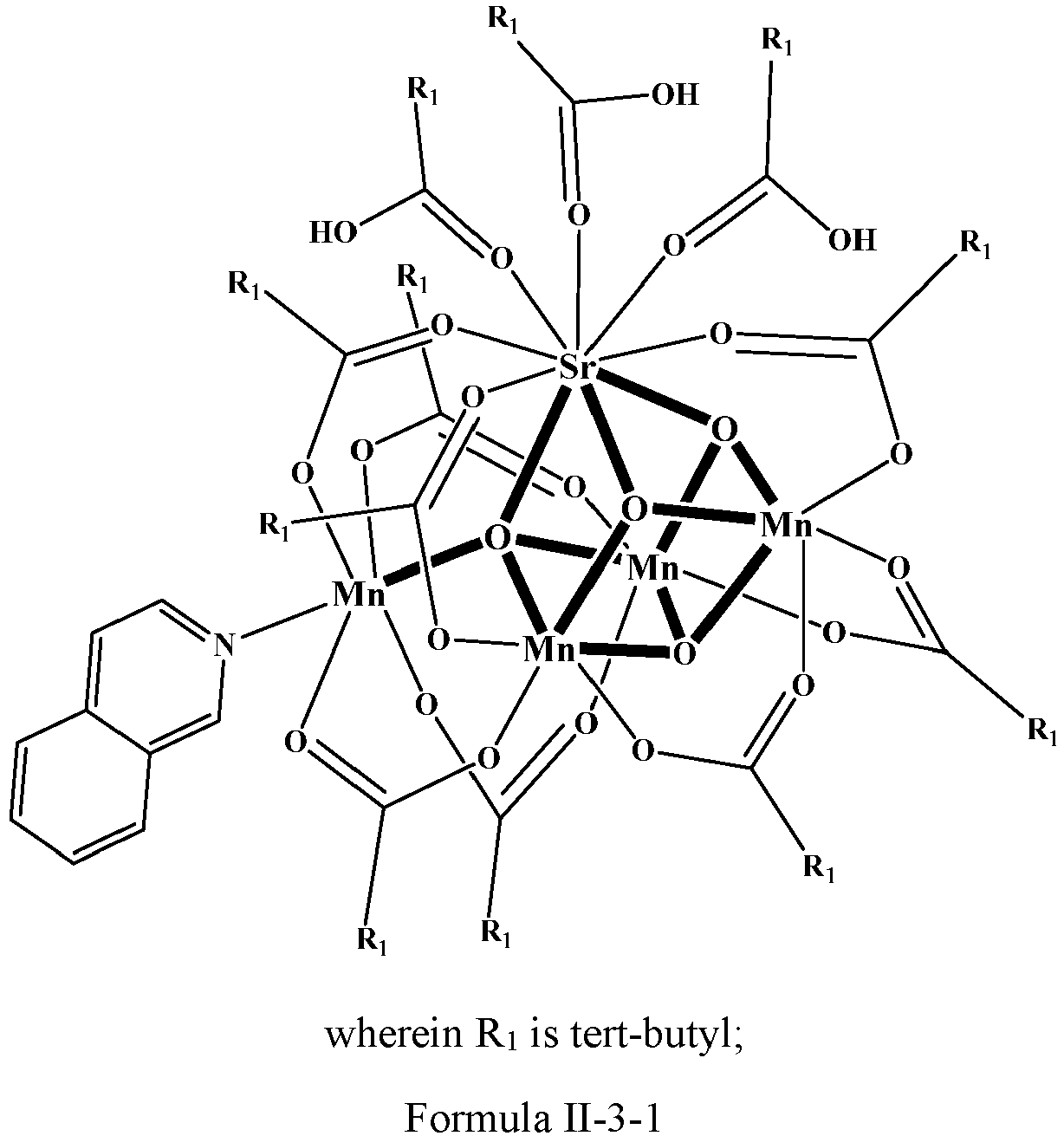


- (4) A method for preparing the [Mn3SrO4](R1CO2)6(R1CO2H)3 compound represented by Formula I, characterized in that the method comprises the following steps:
A solution of an acid (preferably an organic carboxylic acid), an oxidant, Mn2+ salts and a Sr2+ salt in a molar ratio of x:y: 1: 1 (x = 10~120, y = 1~10, preferably x = 20~100, y = 2~8) in acetonitrile, is heated and reacted for 10-60 minutes to give a solution; the precipitate is removed off by filtration; and the filtrate is allowed to stand still for 1 - 6 days to give crystals. - According to the present invention, the reagents used are as follows: the divalent manganese salt, i.e., Mn2+ salt, may be selected from various carboxylates containing Mn2+, wherein the carboxylate anion (R1CO2 -) is as described above, or may be such as formate, acetate, propionate, butyrate, isobutyrate, valerate, isovalerate, pivalate, hexanoate and other carboxylate radicals as well as derivatives thereof (preferably acetate, pivalate). The divalent manganese salt may also be Mn(ClO4)2, MnCl2, MnSO4, Mn(NO3)2, Mn(CF3SO3)2 or other divalent manganese salts. These salts may be the derivatives containing different numbers of crystal water molecules per formula unit of the carboxylic acid salt (the number of the crystal water n is 0-6, preferably 1-5 or 2∼4).
- The Sr2+ salt may be selected from various carboxylates of strontium, wherein the carboxylate anion (R1CO2 -) is as described above, or may be such as formate, acetate, propionate, butyrate, isobutyrate, valerate, isovalerate, pivalate, hexanoate and other carboxylate radicals as well as derivatives thereof (preferably acetate, pivalate). The Sr2+ salt may also be Sr(ClO4)2, Sr(NO3)2, Sr(CF3SO3)2 or other strontium salts. These salts may be the derivatives containing different numbers of crystal water molecules per formula unit of the carboxylic acid salt (the number of crystal water n is0~6, preferably 1-5 or 2∼4).
- The oxidant is preferably permanganate anionic oxidant, more preferably tetrabutylammonium permanganate ((C4H9)4N•MnO4).
- The acid is preferably an organic carboxylic acid, such as formic acid, acetic acid, propionic acid, butyric acid, isobutyric acid, valeric acid, isovaleric acid, pivalic acid, hexanoic acid and other carboxylic acids and derivatives thereof (preferably isobutyric acid, pivalic acid).
- The acetonitrile solvent is used at a volume of about 60-100 mL acetonitrile per mmol strontium salt.
- The inventors have found that the above reaction can only be carried out in acetonitrile solvent, because the target compound cannot be obtained in either alcohol or other organic solvents.
- According to the present invention, the reaction temperature is 60 to 90°C, for example, may be 70 to 80°C.
- According to the present invention, the reaction time may be 10 to 60 minutes, for example, 20 to 50 minutes.
- (5) The present invention also provides use of the [Mn3SrO4](R1CO2)6(R1CO2H)3 compound of Formula I as a precursor for the synthesis of a biomimetic [Mn4SrO4] water splitting catalyst.
- Preferably, the compound of Formula I according to the present invention, which is a [Mn3SrO4] cluster compound, is converted into a [Mn4SrO4] cluster compound in the presence of water in situ.
- Preferably, the compound of Formula I according to the present invention, which is a [Mn3SrO4] cluster compound, is converted into a [Mn4SrO4] cluster compound in the presence of water in situ, and the [Mn4SrO4] cluster compound catalyzes the oxygen-releasing reaction.
- According to a preferred technical solution of the present invention, compound 1 of the present invention has a molecular formula of C45H84Mn3O22Sr, and a structure of [Mn3SrO4](R1CO2)6(R1CO2H)3, wherein R1 = tert-butyl.
- Compound 1 is a single crystal. The single crystal is a trigonal system with space group of R-3c, cell parameters of a = 10.6575(15) Å, b = 10.6575(15) Å, c = 87.917(18) Å, α = 90.00 °, β = 90.00 °, and γ = 120.00 °, Z = 6, and volume of 8648(3) Å3. The structure is shown in Formula I. The crystal structure is shown in
Fig. 1 , and the single crystal parameters are shown in Table 1.Table 1: Single crystal parameters of compound 1 Molecular formula C45H84Mn3O22Sr Molecular weight (g/mol) 1229.56 Temperature (K) 173.15 Wavelength (Å) 0.71073 Crystal system trigonal Space group R-3c Cell parameters a = 10.6575(15) (Å) b = 10.6575(15) (Å) c = 87.917(18) (Å) α = 90.00 (°) β = 90.00 (°) γ = 120.00 (°) Volume V(Å3) 8648(3) Number of molecules in one unit cell 6 Calculated density Dc(g/cm3) 1.417 Absorption coefficient (mm-1) 1.634 Single crystal size 0.780 × 0.390 × 0.055 mm F(000) 3858 range of θ 2.780 -27.476° Number of data collected 17196 Number of independent data 2210 [R(int) = 0.0874] Final R factor [I>2σ(I)] R1= 0.0622 wR2= 0.1559 R factor of all data R1= 0.0636 wR2= 0.1571 Maximum and minimum electron diffraction densities 0.473 and -0.636 e.Å-3 - (6) A method for preparing a [Mn4SrO4](R1CO2)8(L1)(L2)(L3)(L4) compound represented by Formula II, characterized in that the method comprises the following steps:
- Step 1: A solution of an acid (preferably an organic carboxylic acid), an oxidant, Mn2+ salts, a Sr 2+ salt and water in a molar ratio of x:y: 1: 1:z (x = 10~120, y = 1~10, z = 0~20; preferably x = 20~100, y = 2~8, z = 0~10) in acetonitrile is heated and reacted for 10~60 minutes to give a solution; the precipitate is removed off by filtration; and the filtrate is crystallized to give crystals, and is preferably crystallized at 0 °C to give crystals;
- Step 2: the crystals obtained in step 1 are dissolved in an ester solvent, and then organic ligands L1, L2, L3 and L4 are added; and the product is obtained after crystallization.
- According to the above method, the product obtained in
Step 2 may be subject to further process (for example, recrystallization) with an alkane, a cycloalkane or a halogenated hydrocarbon to give the final product. - According to the present invention, the reagents used are as follows: the divalent manganese salt may be selected from various carboxylates containing Mn2+, wherein the carboxylate anion (R1CO2 -) is as described above, or may be such as formate, acetate, propionate, butyrate, isobutyrate, valerate, isovalerate, pivalate, hexanoate and other carboxylate radicals as well as derivatives thereof (preferably acetate, pivalate). The divalent manganese salt may also be Mn(ClO4)2, MnCl2, MnSO4, Mn(NO3)2, Mn(CF3SO3)2 or other divalent manganese salts. These salts may be the derivatives containing different numbers of crystal water molecules (the number of the crystal water n contains 0~6, preferably 1~5 or 2~4 per formula unit of the carboxylic acid salt).
- Sr2+ salt may be selected from various carboxylates of strontium, wherein the carboxylate anion (R1CO2 -) is as described above, or may be such as formate, acetate, propionate, butyrate, isobutyrate, valerate, isovalerate, pivalate, hexanoate and other carboxylate radicals as well as derivatives thereof (preferably acetate, pivalate). The strontium salt may also be Sr(ClO4)2, Sr(NO3)2, Sr(CF3SO3)2 or other strontium salts. These salts may be the derivatives containing different numbers of crystal water molecules per formula unit of the carboxylic acid salt (the number of crystal water n is 0~6, preferably 1~5 or 2~4).
- The oxidant is preferably permanganate anionic oxidant, more preferably tetrabutylammonium permanganate ((C4H9)4N•MnO4).
- The acid is preferably an organic carboxylic acid, such as formic acid, acetic acid, propionic acid, butyric acid, isobutyric acid, valeric acid, isovaleric acid, pivalic acid, hexanoic acid and other carboxylic acids and derivatives thereof (preferably acetic acid, pivalic acid).
- The acetonitrile solvent in Step 1 is used at a volume of about 60-100 mL acetonitrile per mmol strontium salt. This reaction can only be carried out in acetonitrile solvent, because the target compound cannot be obtained in either alcohol or other organic solvents.
- According to the present invention, the ester organic solvent used in the reaction of
Step 2 may be an ester such as ethyl acetate, methyl acetate, or propyl propionate. The organic solvent used for the recrystallization of the product may be linear or branched alkanes and halogenated hydrocarbons and derivatives thereof such as n-hexane, isooctane, dichloroethane, and dichloromethane. - The organic ligands may be the same or different and are each independently selected from the group consisting of carboxylic acid molecules and derivatives thereof, pyridine, imidazole, pyrazine, bipyridine, isoquinoline and derivatives thereof, or water molecule, alcohol molecules, ketones, nitriles (such as acetonitrile), esters and other exchangeable neutral small molecules.
- According to the present invention, the reaction temperature is 60 to 90°C, for example, may be 70 to 80°C.
- According to the present invention, the reaction time may be 10 to 60 minutes, for example, 20 to 50 minutes.
- (7) The present invention also provides a method for preparing the above-mentioned complex, characterized in that the method comprises the following steps:
- Step 1: A solution of an acid (preferably an organic carboxylic acid), an oxidant, Mn2+ salts, a Sr 2+ salt and water in a molar ratio of x:y: 1: 1:z (x = 10~120, y = 1~10, z = 0~20; preferably x = 20~100, y = 2~8, z = 0~10) in acetonitrile is heated and reacted for 10~60 minutes to give a solution; the precipitate is removed off by filtration; and the filtrate is crystallized to give crystals, and is preferably crystallized at 0 °C to give crystals;
- Step 2: the crystals obtained in Step 1 are dissolved in a ester solvent, and organic ligands L1, L2, L3 and L4 are added; and a crude product is obtained after crystallization;
- Step 3: optionally, the product obtained in
Step 2 is subject to further process (such as rinsing or recrystallization with an alkane, a cycloalkane or a halogenated hydrocarbon) to give the final product. Preferably, the product is dissolved in an ester solvent before further processing. - According to the present invention, the reagents used are as follows: the divalent manganese salt may be selected from various carboxylates containing Mn2+, wherein the carboxylate anion (R1CO2 -) is as described above, or may be such as formate, acetate, propionate, butyrate, isobutyrate, valerate, isovalerate, pivalate, hexanoate and other carboxylate radicals as well as derivatives thereof (preferably acetate, pivalate). The divalent manganese salt may also be Mn(ClO4)2, MnCl2, MnSO4, Mn(NO3)2, Mn(CF3SO3)2 or other divalent manganese salts. These salts may be the derivatives containing different numbers of crystal water molecules (the number of the crystal water n contains 0-6, preferably 1-5 or 2-4 per formula unit of the carboxylic acid salt).
- The Sr2+ salt may be selected from various carboxylates of strontium, wherein the carboxylate anion (R1CO2 -) is as described above, or may be such as formate, acetate, propionate, butyrate, isobutyrate, valerate, isovalerate, pivalate, hexanoate and other carboxylate radicals as well as derivatives thereof (preferably acetate, pivalate). The strontium salt may also such as Sr(ClO4)2, Sr(NO3)2, Sr(CF3SO3)2 or other strontium salts. These salts may be the derivatives containing different numbers of crystal water molecules per formula unit of the carboxylic acid salt). (the number of crystal water n is 0~6, preferably 1~5 or 2~4).
- The oxidant is preferably permanganate anionic oxidant, more preferably tetrabutylammonium permanganate ((C4H9)4N•MnO4).
- The acid is preferably an organic carboxylic acid, such as formic acid, acetic acid, propionic acid, butyric acid, isobutyric acid, valeric acid, isovaleric acid, pivalic acid, hexanoic acid and other carboxylic acides and derivatives thereof (preferably acetic acid, pivalic acid).
- The acetonitrile solvent in Step 1 is used at a volume of about 60-100 mL acetonitrile per mmol strontium salt. This reaction can only be carried out in acetonitrile solvent, because the target compound cannot be obtained in either alcohol or other organic solvents.
- According to the present invention, the ester organic solvent used in the reaction of
Step 2 may be an ester such as ethyl acetate, methyl acetate, or propyl propionate. The organic solvent used for the recrystallization of the product may be linear or branched alkanes and halogenated hydrocarbons and derivatives thereof such as n-hexane, isooctane, dichloroethane, and dichloromethane. - The organic ligands may be the same or different and are each independently selected from the group consisting of carboxylic acid molecules and derivatives thereof, pyridine, imidazole, pyrazine, bipyridine, isoquinoline and derivatives thereof, or water molecule, alcohol molecules, ketones, nitriles (such as acetonitrile), esters and other exchangeable neutral small molecules.
- According to the present invention, the reaction temperature is 60 to 90°C, for example, may be 70 to 80°C.
- According to the present invention, the reaction time may be 10 to 60 minutes, for example, 20 to 50 minutes.
- (8) The invention also provides use of the compound of Formula II as a biomimetic water splitting catalyst.
- Preferably, the compound of Formula II is used to drive the catalytic splitting of water in the presence of an oxidant (which may be a stable oxidant or a photoinduced transient oxidant) to release oxygen.
- (9) The invention also provides use of the above complex as a biomimetic water splitting catalyst.
- Preferably, the complex is used to drive the catalytic splitting of water in the presence of an oxidant (which may be a stable oxidant or a photoinduced transient oxidant) to release oxygen.
- (10) The present invention also provides a water splitting catalyst, characterized in that the catalyst comprises a [Mn4SrO4](R1CO2)8(L1)(L2)(L3)(L4) compound of the present invention as described above, wherein the definition of each substituent is as described above; and/or, the catalyst comprises the above complex, wherein the definition of each substituent is as described above.
- According to the present invention,
compound 2 of the present invention has molecular formula of C60H107Mn4NO26Sr, and a structure of [Mn4SrO4](R1CO2)8(L1)(L2)(L3)(L4), wherein R1 = tert-butyl, L1 = pyridine, and L2 = L3 = L4 = pivalic acid. -
Compound 2 is a single crystal. The single crystal is an orthogonal system with space group of Pna21, cell parameters of a = 19.059(3) Å, b = 23.711(4) Å, c = 19.416(4) Å, α = 90.00°, β = 90.00°, and γ = 90.00°, Z = 4, and volume of 8774(3) Å3. The crystal structure is shown inFig.2 , and the single crystal parameters are shown in Table 2.Table 2: Single crystal parameters of compound 2Molecular formula C60H107Mn4NO26Sr Molecular weight (g/mol) 1565.84 Temperature (K) 173.15 Wavelength (Å) 0.71073 Crystal system orthogonal Space group Pna21 Cell parameters a = 19.059(3) (Å) b = 23.711(4) (Å) c = 19.416(4) (Å) α = 90.00 (°) β = 90.00 (°) γ = 90.00 (°) Volume V(Å3) 8774(3) Number of molecules in one unit cell 4 Calculated density Dc(g/cm3) 1.185 Absorption coefficient (mm-1) 1.226 Single crystal size 0.80 × 0.049 × 0.02 mm F(000) 3280 range of θ 1.371 -25.499° Number of data collected 50841 Number of independent data 15969 [R(int) = 0.0886] Final R factor [I>2σ(I)] R1= 0.0891 wR2 = 0.1880 R factor of all data R1= 0.1070 wR2= 0.2040 Maximum and minimum electron diffraction densities 0.461 and -0.666e.Å-3 - Complex 3 of the present invention has a molecular formula of C119H212Mn8N2O52Sr2, and a structure of [[Mn4SrO4](R1CO2)8(L1)(L2)(L3)(L4)] • [[Mn4SrO4](R1CO2)8(L1)(L2)(L3)(L4*)], wherein R1 = tert-butyl, L1= pyridine, L2 =L3 = L4 = pivalic acid, and L4 * = ethyl acetate.
- Complex 3 is a single crystal of monoclinic system with space group of
P 1 21/c1, cell parameters of a = 29.9019(5) Å, b = 18.9368(3) Å, c = 30.1980(4) Å, α = 90.00°, β = 92.6590(10) °, and γ = 90.00 °, Z = 4, and volume of 17081.1(5) Å3. The crystal structure is shown inFig.3 , and the single crystal parameters are shown in Table 3.Table 3: Single crystal parameters of complex 3 Molecular formula C119H212Mn8N2O52Sr2 Molecular weight (g/mol) 3117.65 Temperature (K) 173.15 Wavelength (Å) 0.71073 Crystal system monoclinic Space group P1 21/c1 Cell parameters a = 29.9019(5) (Å) b = 18.9368(3) (Å) c = 30.1980(4) (Å) α = 90.00 (°) β = 92.6590(10) (°) γ = 90.00 (°) Volume V(Å3) 17081.1(5) Number of molecules in one unit cell 4 Calculated density Dc(g/cm3) 1.212 Absorption coefficient (mm-1) 1.260 Single crystal size 0.21 × 0.15 × 0.09 mm F(000) 5788 range of θ 1.833—25.000°. Number of data collected 95295 Number of independent data 30027 [R(int) = 0.0563] Final R factor [I>2α(I)] R1= 0.0547 wR2= 0.1296 R factor of all data R1= 0.0833 wR2= 0.1430 Maximum and minimum electron diffraction densities 1.208 and -0.824e.A-3 - Complex 4 of the present invention has a molecular formula of C132H226Mn8N2O54Sr2, and a structure of [[Mn4SrO4](R1CO2)8(L1)(L2)(L3)(L4)] • [[Mn4SrO4](R1CO2)8 (L1)(L2)(L3)(L4*)], wherein R1 = tert-butyl, L1= isoquinoline, L2 =L3 = L4 = pivalic acid, and L4 * = ethyl acetate.
- Complex 4 is a single crystal. The single crystal is a triclinic system with space group of P-1, cell parameters of a = 14.676(2) Å, b = 25.313(3) Å, c = 25.601(4) Å, α = 76.547(5)°, β = 87.559(6)°, and γ = 73.153(6)°, Z = 2, and volume of 8850(2) Å3. The crystal structure is shown in
Fig.4 , and the single crystal parameters are shown in Table 4.Table 4: Single crystal parameters of complex 4 Molecular formula C132H226Mn8N2O54Sr2 Molecular weight (g/mol) 3319.89 Temperature (K) 173.15 Wavelength (Å) 0.71073 Crystal system triclinic Space group P-1 Cell parameters a = 14.676(2) (Å) b = 25.313(3) (Å) c = 25.601(4) (Å) α = 76.547(5) (°) β = 87.559(6) (°) γ = 73.153(6) (°) Volume V(Å3) 8850(2) Number of molecules in one unit cell 2 Calculated density Dc(g/cm3) 1.246 Absorption coefficient (mm-1) 1.221 Single crystal size 0.56 × 0.28 × 0.061 mm F(000) 3480 range of θ 0.864-25.200° Number of data collected 72166 Number of independent data 31718 [R(int) = 0.0590] Final R factor [I>2σ(I)] R1= 0.1090 wR2= 0.2666 R factor of all data R1= 0.1263 wR2= 0.2776 Maximum and minimum electron diffraction densities 1.243 and -0.549e.Å-3 - In the present invention, in the synthesis method, the [Mn3SrO4] and [Mn4Sr] cluster compounds and the cluster compounds containing [Mn4SrO4] core structure must by synthesized in the presence of water, otherwise completely different compounds would be obtained. By comparing the structure of [Mn4SrO4] cluster compounds with that of [Mn4CaO4] cluster compounds, the introduction of Sr2+ ion significantly increases the stability of the cluster compounds, and the three neutral ligands on Sr2+ ion (only two neutral ligands on Ca2+ ion) make the [Mn4SrO4] cluster compounds more suitable for modification, and thus more likely to meet the needs of practical applications in the future. In addition, as Sr and Ca ions are at the core of the cluster compounds, there is no possibility that they can be interchanged without destroying the overall structure. Therefore, such cluster compounds can only be synthesized from the initial materials. The synthesis of such cluster compounds is extremely sensitive to reaction conditions, and slight changes in the reaction conditions will cause great differences in the structure and properties of the final product.
- Advantageous effects of the present invention:
The present inventors discovered that [Mn3SrO4] cluster compounds can be synthesized in a single step from raw materials consisting of simple and inexpensive Mn2+, Sr2+ inorganic compounds and carboxylic acids, by using permanganate anion as oxidant. This step can be followed by the synthesis of asymmetric biomimetic water splitting catalyst [Mn4SrO4] cluster compounds in the presence of water. The [Mn4SrO4] cluster compounds can catalyze the splitting of water in the presence of an oxidant to release oxygen gas. - The neutral [Mn3SrO4](R1CO2)6(R1CO2H)3 cluster compounds obtained in the present invention can serve as precursors for the synthesis of the biomimetic water splitting catalysts, and can be utilized in the synthesis of different types of biomimetic water splitting catalysts.
- [Mn4SrO4](R1CO2)8(L1)(L2)(L3)(L4) cluster compounds can serve as artificial water splitting catalysts, can be utilized on the surface of an electrode or in the catalysed splitting of water driven by an oxidant (which may be a stable oxidant or a photoinduced transient oxidant). No related literature on such [Mn3SrO4] cluster compounds or [Mn4SrO4] biomimetic water splitting catalysts has been reported so far.
-
-
Figure 1 shows the crystal structure of compound 1 as prepared in Example 1 of the present invention. For the sake of clarity, the hydrogen atom, the methyl of the tert-butyl and solvent molecules are all omitted. -
Figure 2 shows the crystal structure ofcompound 2 as prepared in Example 2 of the present invention. For the sake of clarity, the hydrogen atom, the methyl of the tert-butyl and solvent molecules are all omitted. -
Figure 3 shows the crystal structure of complex 3 as prepared in Example 3 of the present invention. For the sake of clarity, the hydrogen atom, the methyl of the tert-butyl and solvent molecules are all omitted. There are two [Mn4SrO4] cluster compounds in the figure, and they differ in that one neutral pivalic acid molecule on the strontium ion is replaced by one ethyl acetate molecule. -
Figure 4 shows the crystal structure of complex 4 as prepared in Example 4 of the present invention. For the sake of clarity, the hydrogen atom, the methyl of the tert-butyl and solvent molecules are all omitted. There are two [Mn4SrO4] cluster compounds in the figure, and they differ in that one neutral pivalic acid molecule on the strontium ion is replaced by one ethyl acetate molecule. -
Figure 5 shows the trace of the change in UV-Vis absorption spectrum of the interaction betweencompound 2 and water in Example 5 of the present invention. -
Figure 6 shows the electron paramagnetic signal produced after the oxidization ofcompound 2 in Example 6 of the present invention. The data supports that the four Mn ions ofcompound 2 in ground state have valence states of +3, +3, +4 and +4, respectively. -
Figure 7 shows the determination of the oxygen released during the spliting of water catalyzed bycompound 2 in the presence of oxidant in Example 7 of the present invention. - The present invention will be further illustrated with reference to the specific examples below. It should be understood that these examples are only used to illustrate the present invention, but are not intended to limit the scope of the present invention.
- The preparation method was as follows:
To a 100 ml round bottom flask were added tetrabutylammonium permanganate (Bun 4N•MnO4, 4 mmol), manganese acetate (Mn(CH3CO2)2, 1 mmol), strontium acetate (Sr(CH3CO2)2, 1 mmol) and pivalic acid ((CH3)3CCO2H, 40 mmol). After continuous reaction in acetonitrile at 80 °C for 25 min, the reaction was stopped. The precipitate, which was of a small amount, was removed off by filtration. The resulted brown mother liquor was allowed to stand still at 0 °C for 1~6 days and brown crystals were precipitated out. The resulted crystals were collected and dissolved in n-hexane, and dried under vacuum, with the yield of ~ 60% (according to the mole numbers of Sr ions). - Compound 1 has a structural formula of [Mn3SrO4](R1CO2)6(R1CO2H)3, wherein R1 = tert-butyl.
- That is, compound 1 has a structural formula of [Mn3SrO4](C5H9O2)6(C5H9O2H)3 and a molecular formula of C45H84Mn3O22Sr. Theoretical values of elemental analysis are: C, 43.96; H, 6.89; and experimental values are: C, 44.01; H, 6.84. Compound 1 is a single crystal of trigonal system with space group of R-3c, cell parameters of a = 10.6575(15) Å, b = 10.6575(15) Å, c = 87.917(18) Å, α = 90.00 °, β = 90.00 °, and γ = 120.00 °, Z = 6, and volume of 8648(3) Å3.
- Compound 1 has a chemical structure as shown in Formula I-1 below, determined specific single crystal parameters as shown in Table 1, and a crystal space structure as shown in
Figure 1 .
- The preparation method was as follows:
The first step was the synthesis of the precursor ofcompound 2. To a 100 ml round bottom flask were added tetrabutylammonium permanganate (Bun 4N•MnO4, 4 mmol), manganese acetate (Mn(CH3CO2)2, 1 mmol), strontium acetate (Sr(CH3CO2)2, 1 mmol), pivalic acid ((CH3)3CCO2H, 40 mmol) and water (H2O, 1 mmol). After continuous reaction in acetonitrile at 80 °C for 25 min, the reaction was stopped. The precipitate, which was of a small amount, was removed off by filtration. The resulted brown mother liquor was allowed to stand still at 0°C for 1~2 weeks and brown crystals were precipitated out. - The second step was the reaction with pyridine. The crystals obtained in the first step were collected and dissolved in ethyl acetate. 2% (volume ratio) of pyridine was added, and after 1~2 weeks, brown crystals were precipitated out. The resulted crystals were collected and dissolved in n-hexane. The undissolved substance, which was of a small amount, was removed off, and the solution was subj ect to recrystallization. After 1 week, brown crystals were precipitated out and dried under vacuum. The yield was -12% (according to the mole numbers of Sr2+ ions).
-
Compound 2 has a structural formula of [Mn4SrO4](R1CO2)8(L1)(L2)(L3)(L4), wherein R1 = tert-butyl, L1 = pyridine, and L2 = L3 = L4 = pivalic acid. - That is,
compound 2 has a structural formula of [Mn4SrO4](C5H9O2)8(C5H9O2H)3(C5H5N)•(C6H14)1.5 (note: the n-hexane is a solvent molecule), and a molecular formula of C69H128Mn4NO26Sr. Theoretical values of elemental analysis are: C, 48.89; H, 7.61; N, 0.83; and experimental values are: C, 49.00; H, 7.51; N, 0.70.Compound 2 is a single crystal of orthogonal system with space group of Pna21, cell parameters of a = 19.059(3) Å, b = 23.711(4) Å, c = 19.416(4) Å, α = 90.00°, β = 90.00°, and γ = 90.00°, Z = 4, and volume of 8774(3) Å3. -
Compound 2 has a chemical structure as shown by Formula II-1 below, determined specific single crystal parameters as shown in Table 2, and a crystal space structure as shown inFigure 2 .
- The preparation method was as follows:
0.100g compound 2 was weighed and dissolved in ethyl acetate. The mixture was allowed to stand still at room temperature for 1~3 weeks and slender brown crystals were precipitated out. The crystals were rinsed with cyclohexane and then vacuum dried. The yield was ~70% (according to the mole numbers of Sr2+ ions). - Complex 3 has a structural formula of [[Mn4SrO4](R1CO2)8](L1)(L2)(L3)(L4)]•[[Mn4SrO4](R1CO2)8](L1)(L2)(L3)(L4*)], wherein R1 = tert-butyl, L1= pyridine, L2 =L3 = L4 = pivalic acid, and L4 * = ethyl acetate.
- That is, complex 3 has a structural formula of [[Mn4SrO4](C5H9O2)8(C5H5N)1(C5H9O2H)3]• [[Mn4SrO4](C5H9O2)8 (C5H5N)1(C5H9O2H)2(C2H5O2CCH3)1], and a molecular formula of C119H212Mn8N2O52Sr2. Theoretical values of elemental analysis are: C, 45.84; H, 6.85; N, 0.90; and experimental values are: C, 45.82; H, 6.81; N, 1.21. Complex 3 is a single crystal of monoclinic system with space group of
P 1 21/c1, cell parameters of a = 29.9019(5) Å, b = 18.9368(3) Å, c = 30.1980(4) Å, α = 90.00 °, β = 92.6590(10) °, and γ = 90.00 °, Z = 4, and volume of 17081.1(5) Å3. Complex 3 has a chemical structure of [[Mn4SrO4](C5H9O2)8 (C5H5N)1(C5H9O2H)2(C2H5O2CCH3)1] as shown by Formula II-2 below, determined specific single crystal parameters as shown in Table 3, and a crystal space structure as shown inFigure 3 .
- The preparation method was as follows:
The first step was the synthesis of the precursor of complex 4. To a 100 ml round bottom flask were added tetrabutylammonium permanganate (Bun 4N•MnO4, 4 mmol), manganese acetate (Mn(CH3CO2)2, 1 mmol), strontium acetate (Sr(CH3CO2)2, 1 mmol) and pivalic acid ((CH3)3CCO2H, 40 mmol). After continuous reaction in acetonitrile at 80 °C for 25 min, the reaction was stopped. The precipitate, which was of a small amount, was removed off by filtration. The resulted brown mother liquor was allowed to stand still at 0°C for 1~2 weeks and brown crystals were precipitated out. - The second step was the reaction with isoquinoline. The crystals obtained in the first step were collected and dissolved in ethyl acetate. 1% (volume ratio) isoquinoline was added for recrystallization. After 1~2 weeks, black crystals were collected, rinsed with cyclohexane and vacuum dried. The yield was ~40% (according to the mole numbers of Sr2+ ions).
- Complex 4 has a structural formula of [[Mn4SrO4](R1CO2)8(L1)(L2)(L3)(L4)]•[[Mn4SrO4](R1CO2)8 (L1)(L2)(L3)(L4)], wherein R1 = tert-butyl, L1= isoquinoline, L2 =L3 = L4 = pivalic acid, and L4 * = ethyl acetate.
- That is, complex 4 has a structural formula of [[Mn4SrO4](C5H9O2)8(C9H7N)1(C5H9O2H)3] • [[Mn4SrO4](C5H9O2)8 (C9H7N)1(C5H9O2H)2(C2H5O2CCH3)1], and a molecular formula of C132H226Mn8N2O54Sr2. Complex 4 is a single crystal of triclinic system with space group of P-1, cell parameters of a = 14.676(2) Å, b = 25.313(3) Å, c = 25.601(4) Å, α = 76.547(5)°, β = 87.559(6)°, and γ = 73.153(6)°, Z = 2, and volume of 8850(2) Å3.
- Complex 4 has a chemical structure as shown by Formulas II-3-1 and II-3-2 below, determined specific single crystal parameters as shown in Table 4, and a crystal space structure as shown in
Figure 4 .

- To a colorimetric cell was added 1 mL
solution of25µM compound 2 in acetonitrile. Using 1 mL pure acetonitrile as reference, the absorption spectrum was determined in Hitachi U-3900 spectrophotometer type UV-Vis spectrometer (seeFigure 5 ). This compound had the maximum absorption at 250 nm. With the addition of water (0%, 0.15%, 0.35%, 0.55% and 1.05% water was added respectively), the absorption spectrum changed significantly. Specifically, the absorption at 250 nm decreased significantly, while the absorption at 400nm increased, indicating that water molecules interacted withcompound 2. As compared with [Mn4CaO4] cluster compounds, the sensitivity of [Mn4SrO4] cluster compounds to water was significantly reduced. The absorption peak of [Mn4SrO4] cluster compound at 250nm was only reduced by 20% when there existed 1% water, whereas the absorption peak of the corresponding [Mn4CaO4] cluster compound at 250nm was reduced by more than 60% when there existed 1% water, indicating that a small amount of water has little effect on the spectrum of [Mn4SrO4] but has a greater effect on the spectrum of [Mn4CaO4] cluster compounds. [Mn4CaO4] cluster compounds belongs to water extremely sensitive substances, and the sensitivity leads to reduced stability and therefore limited the application thereof. To the contrary, the [Mn4SrO4] cluster compounds newly synthesized and discovered in the present invention were much more stable than [Mn4CaO4] cluster compounds and had a wide application prospect as water splitting catalyst. - Compound 2 (1 mM) was dissolved in dichloroethane, and then 0.5 mM oxidant [Fe(Phen)3](PF6)3 (wherein Phen = phenanthroline) was added. The mixture was then rapidly frozen to 77K and the electron paramagnetic signals were detected with Bruker E500 electron paramagnetic resonance instrument at 7K (see
Figure 6 ). The multiple peak paramagnetic signal at g = 2.0 was clearly seen. The occurrence of this signal indicated that after oxidization of the compound, the valence states of the four manganese ions were +3, +4, +4 and +4, respectively. Thus it could be inferred that the valence states of the four Mn ions in the ground state (i.e., the stable state before oxidation) of the compound were +3, +3, +4 and +4, respectively. - The activity of releasing oxygen during the catalytic water splitting was determined on a Clark-type oxygen electrode (
Figure 7 ). A rapid release of oxygen to saturation was observed with the addition of 500 µM ofcompound 2 to an aqueous solution containing an oxidant (hydrogen peroxide, 0.1 M), whereas no visible release of oxygen was observed with the addition of the reference compound (Mn(ClO4)2). The arrow in the figure showed the loading position of the sample.Figure 7 indicated thatcompound 2 had catalytic activity of catalyzing the splitting of water to release oxygen.
Claims (22)
- A [Mn3SrO4](R1CO2)6(R1CO2H)3 compound represented by Formula I, characterized in that the compound comprises three Mn ions and one Sr2+ ion linked via four O2- ions to form a [Mn3SrO4] heteronuclear metal cluster skeleton core;the [Mn3SrO4] cluster compound has six carboxylate anions (R1CO2 -) and three neutral carboxylic acid ligands (R1CO2H) as the peripheral ligands; the three Mn ions all have a valence state of +4, and the whole cluster compound is electrically neutral;
 wherein, R1 is selected from the group consisting of H and C1-8 linear or branched alkyl.
 - The compound according to claim 1, the carboxylate anion (R1CO2 -) is selected from formic acid, acetic acid, propionic acid, butyric acid, isobutyric acid, valeric acid, isovaleric acid, pivalic acid and hexanoic acid.
- The compound according to claim 1, R1 is selected from hydrogen (H), methyl (-CH3), ethyl (-C2H5), n-propyl (-CH2CH2CH3), isopropyl (-CH(CH3)2), n-butyl (-(CH2)3CH3), isobutyl (-CH(CH3)C2H5), tert-butyl (-C(CH3)3), n-pentyl (-(CH2)4CH3) and isopentyl (-CH2CH2CH(CH3)2).
- The compound according to claim 1, the compound of Formula I is selected from the group consisting of:
compound 1, [Mn3SrO4](R1CO2)6(R1CO2H)3, wherein R1 = tert-butyl. Compound 1 is a single crystal of trigonal system with space group of R-3c, cell parameters of a = 10.6575(15) Å, b = 10.6575(15) Å, c = 87.917(18) Å, α = 90.00 °, β = 90.00 °, and γ = 120.00 °, Z = 6, and volume of 8648(3) A3, has the structure as shown in the following Formula I-1:
- A [Mn4SrO4](R1CO2)8(L1)(L2)(L3)(L4) compound represented by Formula II, characterized in that the compound comprises four Mn ions and one Sr2+ ion via four O2- ions to form an asymmetric [Mn4SrO4] heteronuclear metal cluster skeleton core;the [Mn4SrO4] cluster compound has eight carboxylate anions (R1CO2 -) and four neutral ligands (L1, L2, L3, L4) as the peripheral ligands; the four Mn ions have valence states of +3, +3, +4 and +4, respectively, and the whole cluster compounds is electrically neutral;
 wherein, R1 is selected from the group consisting of H and C1-8 linear or branched alkyl; the four ligands L1, L2, L3 and L4 are the same or different and are each independently selected from the group consisting of carboxylic acid molecules , pyridine, imidazole, pyrazine, quinoline, isoquinoline, bipyridine , or water molecule, alcohol molecules, ketones, nitriles (such as acetonitrile), esters .
 - The compound according to claim 5, the carboxylate anion (R1CO2 -) is selected from formic acid, acetic acid, propionic acid, butyric acid, isobutyric acid, valeric acid, isovaleric acid, pivalic acid and hexanoic acid.
- The compound according to claim 5, R1 is selected from hydrogen (H), methyl (-CH3), ethyl (-C2H5), n-propyl (-CH2CH2CH3), isopropyl (-CH(CH3)2), n-butyl (-(CH2)3CH3), isobutyl (-CH(CH3)C2H5), tert-butyl (-C(CH3)3), n-pentyl (-(CH2)4CH3) and isopentyl (-CH2CH2CH(CH3)2).
- The compound according to claim 5, the compound of Formula II is
[Mn4SrO4](R1CO2)8(L1)(L2)(L3)(L4), wherein R1 = tert-butyl, L1 = pyridine, and L2 = L3 = L4 =pivalic acid. - The compound according to claim 8, the compound of Formula II is
[Mn4SrO4](R1CO2)8(L1)(L2)(L3)(L4), wherein R1 = tert-butyl, L1 = pyridine, L2 = L3 = L4 = 2,2-dimethylpropionic acid or trimethyl acetic acid. - The compound according to claim 8 is a single crystal of orthogonal system with space group of Pna21, cell parameters of a = 19.059(3) Å, b = 23.711(4) Å, c = 19.416(4) Å, α = 90.00°, β = 90.00°, and γ = 90.00°, Z = 4, and volume of 8774(3) Å3; and compound 2 has the structure as shown in the following Formula II-1:

- A complex, characterized in that the complex is formed by the combination of two or more compounds of Formula II:
 wherein, R1 is selected from the group consisting of H and C1-8 linear or branched alkyl;the four ligands L1, L2, L3 and L4 are the same or different and are each independently selected from the group consisting of carboxylic acid molecules , pyridine, imidazole, pyrazine, quinoline, isoquinoline, bipyridine , or water molecule, alcohol molecules, ketones, nitriles (such as acetonitrile), esters
 - The complex according to claim 11, the carboxylate anion (R1CO2 -) is selected from formic acid, acetic acid, propionic acid, butyric acid, isobutyric acid, valeric acid, isovaleric acid, pivalic acid and hexanoic acid.
- The complex according to claim 11, R1 is selected from hydrogen (H), methyl (-CH3), ethyl (-C2H5), n-propyl (-CH2CH2CH3), isopropyl (-CH(CH3)2), n-butyl (-(CH2)3CH3), isobutyl (-CH(CH3)C2H5), tert-butyl (-C(CH3)3), n-pentyl (-(CH2)4CH3) and isopentyl (-CH2CH2CH(CH3)2).
- The complex according to claim 11, which is complex 3 or complex 4,
complex 3 is [[Mn4SrO4](R1CO2)8(L1)(L2)(L3)(L4)]•[[Mn4SrO4](R1CO2)8(L1)(L2)(L3)(L4*)], wherein R1 is tert-butyl, L1 is pyridine or isoquinoline, L2, L3, and L4 are pivalic acid, and L4 * is ethyl acetate, and has a single crystal of monoclinic system with space group of P1 21/c1, cell parameters of a = 29.9019(5) Å, b = 18.9368(3) Å, c = 30.1980(4) Å, α = 90.00 °, β = 92.6590(10) °, and γ = 90.00 °, Z = 4, and volume of 17081.1(5) Å3, and[[Mn4SrO4](R1CO2)8(L1)(L2)(L3)(L4)] in complex 3 is of Formula II-1, and the [[Mn4SrO4](R1CO2)8(L1)(L2)(L3)(L4*)] in complex 3 is of Formula II-2: complex 4 is [[Mn4SrO4](R1CO2)8(L1)(L2)(L3)(L4)]•[[Mn4SrO4](R1CO2)8(L1)(L2)(L3)(L4*)], wherein R1 is tert-butyl, L1 is isoquinoline, L2, L3, and L4 are pivalic acid, and L4 * is ethyl acetate, has a single crystal of triclinic system with space group of P-1, cell parameters of a = 14.676(2) Å, b = 25.313(3) Å, c = 25.601(4) Å, α = 76.547(5)°, β = 87.559(6)°, and γ = 73.153(6)°, Z = 2, and volume of 8850(2) Å3, and[[Mn4SrO4](R1CO2)8(L1)(L2)(L3)(L4)] in complex 4 has a structural formula of Formula II-3-1, and the [[Mn4SrO4](R1CO2)8(L1)(L2)(L3)(L4*)] in complex 4 has a structural formula of Formula II-3-2:

- A method for preparing the [Mn3SrO4](R1CO2)6(R1CO2H)3 compound of claim 1, comprises the following steps:a solution of an acid, an oxidant, Mn2+ salts and a Sr2+ salt in a molar ratio of x:y: 1: 1 in acetonitrile is heated and reacted for 10~60 minutes to give a solution; the precipitate is removed off by filtration; and the filtrate is allowed to stand still for 1 ~ 6 days to give crystals;wherein, x = 10-120, y = 1~10.
- Use of the [Mn3SrO4](R1CO2)6(R1CO2H)3 compound of Formula I according to claim 1 as a precursor for the synthesis of a biomimetic [Mn4SrO4] water splitting catalyst.
- A method for preparing the [Mn4SrO4](R1CO2)8(L1)(L2)(L3)(L4) compound represented by Formula II according to claim 5, characterized in that the method comprises the following steps:Step 1: A solution of an acid, an oxidant, Mn2+ salts, Sr 2+ salt and water in a molar ratio of x:y: 1: 1:z in acetonitrile is heated and reacted for 10~60 minutes to give a solution; the precipitate is removed off by filtration; and the filtrate is crystallized to give crystals, and is crystallized at 0 °C to give crystals; wherein, x = 10-120, y = 1-10, z = 0∼20;Step 2: the crystals obtained in step 1 are dissolved in an ester solvent, and then organic ligands L1, L2, L3 and L4 are added; a crude product is obtained after crystallization; and then the crude product is recrystallized with alkane and halogenated hydrocarbon to give the final product.
- A method for preparing the compound according to claim 17, the product obtained in Step 2 is subject to further recrystallization process with an alkane, a cycloalkane or a halogenated hydrocarbon to give the final product.
- A method for preparing the complex according to claim 3, characterized in that the method comprises the following steps:Step 1: A solution of an acid, an oxidant, Mn2+ salts, Sr 2+ salt and water in a molar ratio of x:y: 1: 1:z in acetonitrile is heated and reacted for 10~60 minutes to give a solution; the precipitate is removed off by filtration; and the filtrate is crystallized to give crystals, and is crystallized at 0 °C to give crystals; wherein, x = 10-120, y = 1-10, z = 0∼20;Step 2: the crystals obtained in Step 1 are dissolved in an ester solvent, and organic ligands L1, L2, L3 and L4 are added; and a crude product is obtained after crystalization;Step 3: optionally, the product obtained in Step 2 is subject to further process to give the final product.
- Use of the compound of Formula II according to claim 5 as a biomimetic water splitting catalyst, the compound of Formula II is used to drive the catalytic splitting of water in the presence of an oxidant to release oxygen.
- Use of the complex according to claim 11 as a biomimetic water splitting catalyst, the complex is used to drive the catalytic splitting of water in the presence of an oxidant to release oxygen.
- A water splitting catalyst, characterized in that the catalyst comprises a [Mn4SrO4](R1CO2)8(L1)(L2)(L3)(L4) compound according to claim 5, wherein the definition of each substituent is as described according to claim 5;
and/or, the catalyst comprises the complex according to claim 11, wherein the definition of each substituent is as described according to claim 11.
Applications Claiming Priority (1)
| Application Number | Priority Date | Filing Date | Title |
|---|---|---|---|
| PCT/CN2017/108928 WO2019084845A1 (en) | 2017-11-01 | 2017-11-01 | Cluster compound containing mn3sro4 and mn4sro4 core structures, preparation method thereof, and application for same |
Publications (3)
| Publication Number | Publication Date |
|---|---|
| EP3705484A1 EP3705484A1 (en) | 2020-09-09 |
| EP3705484A4 EP3705484A4 (en) | 2021-06-02 |
| EP3705484B1 true EP3705484B1 (en) | 2024-05-15 |
Family
ID=66331236
Family Applications (1)
| Application Number | Title | Priority Date | Filing Date |
|---|---|---|---|
| EP17930553.7A Active EP3705484B1 (en) | 2017-11-01 | 2017-11-01 | Cluster compound containing mn3sro4 and mn4sro4 core structures, preparation method thereof, and application for same |
Country Status (3)
| Country | Link |
|---|---|
| US (1) | US11511266B2 (en) |
| EP (1) | EP3705484B1 (en) |
| WO (1) | WO2019084845A1 (en) |
Families Citing this family (3)
| Publication number | Priority date | Publication date | Assignee | Title |
|---|---|---|---|---|
| TWI794836B (en) * | 2021-06-16 | 2023-03-01 | 國立成功大學 | High entropy composite glycerate, methods for preparing thereof and electrocatalysts comprising the same |
| WO2023023898A1 (en) * | 2021-08-23 | 2023-03-02 | 中国科学院化学研究所 | Rare earth ion-containing bionic water cracking catalyst, and preparation method therefor and use thereof |
| CN114736236B (en) * | 2022-03-21 | 2023-09-29 | 中国科学院福建物质结构研究所 | A multinuclear cyclic organotin oxygen-sulfur cluster compound and its preparation method and application |
Family Cites Families (1)
| Publication number | Priority date | Publication date | Assignee | Title |
|---|---|---|---|---|
| CN104761591B (en) * | 2015-02-06 | 2017-07-21 | 中国科学院化学研究所 | One kind contains Mn4CaO4The water-splitting catalyst of core texture, its preparation method and its application |
-
2017
- 2017-11-01 US US16/761,204 patent/US11511266B2/en active Active
- 2017-11-01 WO PCT/CN2017/108928 patent/WO2019084845A1/en not_active Ceased
- 2017-11-01 EP EP17930553.7A patent/EP3705484B1/en active Active
Also Published As
| Publication number | Publication date |
|---|---|
| US20200290031A1 (en) | 2020-09-17 |
| US11511266B2 (en) | 2022-11-29 |
| EP3705484A4 (en) | 2021-06-02 |
| EP3705484A1 (en) | 2020-09-09 |
| WO2019084845A1 (en) | 2019-05-09 |
Similar Documents
| Publication | Publication Date | Title |
|---|---|---|
| Liu et al. | Iron-and cobalt-catalyzed C (sp3)–H bond functionalization reactions and their application in organic synthesis | |
| EP3255053B1 (en) | METHOD OF PREPARING WATER-CRACKING CATALYST HAVING Mn4CaO4 AS CORE STRUCTURE AND APPLICATION THEREOF | |
| Romanowski | Synthesis, characterization and catalytic activity in the oxidation of sulfides and styrene of vanadium (V) complexes with tridentate Schiff base ligands | |
| Harman et al. | Isostructural. eta. 2-dihydrogen complexes [Os (NH3) 5 (H2)] n+ (n= 2, 3) and the hydrogenation of acetone | |
| Lai et al. | Catalytic and asymmetric aziridination of alkenes catalysed by a chiral manganese porphyrin complex | |
| Huang et al. | Metal-free coordination of porphyrin-based porous organic polymers for efficient photocatalytic oxidative coupling of amines under visible light | |
| US11511266B2 (en) | Cluster compounds containing [Mn3SrO4] and [Mn4SrO4] core structures, preparation method and application thereof | |
| WO2011035064A2 (en) | Triazole catalysts and methods of making and using the same | |
| Cordone et al. | Carbon-hydrogen bond activation in novel. eta. 2-bound cationic heterocycle complexes of pentaammineosmium (II) | |
| EP4261216A1 (en) | Pyridine pyrrole ruthenium complex, preparation method therefor and application thereof as catalyst for preparing hydrazine by electrocatalytic ammonia oxidation | |
| Kim et al. | Dual-fixations of europium cations and TEMPO species on metal–organic frameworks for the aerobic oxidation of alcohols | |
| Zhao et al. | A highly active Cp* Ir complex with an anionic N, N-donor chelate ligand catalyzes the robust regeneration of NADH under physiological conditions | |
| CN109748939B (en) | Clusters containing [Mn3SrO4] and [Mn4SrO4] core structures and their preparation methods and applications | |
| Yeung et al. | Supramolecular double helical Cu (I) complexes for asymmetric cyclopropanation | |
| Zhou et al. | Manganese porphyrin immobilized on montmorillonite: a highly efficient and reusable catalyst for the aerobic epoxidation of olefins under ambient conditions | |
| KR20130085635A (en) | Organometal/polymer composite and preparing method of the same, and catalyst for reducing carbon dioxide including the same | |
| WO2023023898A1 (en) | Rare earth ion-containing bionic water cracking catalyst, and preparation method therefor and use thereof | |
| Suh et al. | The highly diastereoselective palladium-catalyzed cyclizations. Stereoselective syntheses of cis and trans-disubstituted hydroxycyclopentanes | |
| CN113333030B (en) | N-heterocyclic carbene-based- [ Fe-Fe ] hydrogenase model compound and preparation method and application thereof | |
| US6008387A (en) | Process for the oxidation of organic compounds in the presence of bis- and tris- (μ-oxo)-dimanganese complex salts as catalyst | |
| KR101536640B1 (en) | Method for regeneration of oxidoreductase cofactor using photo-biosystem and method for selectively enzymatic production of chiral alcohol using the same | |
| Gosiewska et al. | Characterization and alkane oxidation activity of a diastereopure seven-coordinate iron (III) alkylperoxo complex | |
| Comba et al. | Optimization of the efficiency of oxidation catalysts based on iron bispidine complexes | |
| CN122037217A (en) | Silver-based catalyst and preparation method and application thereof | |
| FARZANEH | Investigation of Catalytic Activity of Pillared-layer Ni (II) Metal-Organic Framework Derived NiO Nanoparticles for Aromatization of Hantzsch 1, 4-Dihydropyridines |
Legal Events
| Date | Code | Title | Description |
|---|---|---|---|
| STAA | Information on the status of an ep patent application or granted ep patent |
Free format text: STATUS: THE INTERNATIONAL PUBLICATION HAS BEEN MADE |
|
| PUAI | Public reference made under article 153(3) epc to a published international application that has entered the european phase |
Free format text: ORIGINAL CODE: 0009012 |
|
| STAA | Information on the status of an ep patent application or granted ep patent |
Free format text: STATUS: REQUEST FOR EXAMINATION WAS MADE |
|
| 17P | Request for examination filed |
Effective date: 20200429 |
|
| AK | Designated contracting states |
Kind code of ref document: A1 Designated state(s): AL AT BE BG CH CY CZ DE DK EE ES FI FR GB GR HR HU IE IS IT LI LT LU LV MC MK MT NL NO PL PT RO RS SE SI SK SM TR |
|
| AX | Request for extension of the european patent |
Extension state: BA ME |
|
| DAV | Request for validation of the european patent (deleted) | ||
| DAX | Request for extension of the european patent (deleted) | ||
| REG | Reference to a national code |
Ref country code: DE Free format text: PREVIOUS MAIN CLASS: C07F0019000000 Ref legal event code: R079 Ref document number: 602017082022 Country of ref document: DE Ipc: C07F0013000000 |
|
| A4 | Supplementary search report drawn up and despatched |
Effective date: 20210430 |
|
| RIC1 | Information provided on ipc code assigned before grant |
Ipc: C07F 13/00 20060101AFI20210423BHEP Ipc: B01J 31/22 20060101ALI20210423BHEP Ipc: C01B 13/02 20060101ALI20210423BHEP Ipc: C25B 5/00 20060101ALI20210423BHEP Ipc: C25B 1/04 20210101ALI20210423BHEP |
|
| STAA | Information on the status of an ep patent application or granted ep patent |
Free format text: STATUS: EXAMINATION IS IN PROGRESS |
|
| 17Q | First examination report despatched |
Effective date: 20230314 |
|
| GRAP | Despatch of communication of intention to grant a patent |
Free format text: ORIGINAL CODE: EPIDOSNIGR1 |
|
| STAA | Information on the status of an ep patent application or granted ep patent |
Free format text: STATUS: GRANT OF PATENT IS INTENDED |
|
| INTG | Intention to grant announced |
Effective date: 20231215 |
|
| GRAS | Grant fee paid |
Free format text: ORIGINAL CODE: EPIDOSNIGR3 |
|
| GRAA | (expected) grant |
Free format text: ORIGINAL CODE: 0009210 |
|
| STAA | Information on the status of an ep patent application or granted ep patent |
Free format text: STATUS: THE PATENT HAS BEEN GRANTED |
|
| AK | Designated contracting states |
Kind code of ref document: B1 Designated state(s): AL AT BE BG CH CY CZ DE DK EE ES FI FR GB GR HR HU IE IS IT LI LT LU LV MC MK MT NL NO PL PT RO RS SE SI SK SM TR |
|
| REG | Reference to a national code |
Ref country code: CH Ref legal event code: EP Ref country code: GB Ref legal event code: FG4D |
|
| REG | Reference to a national code |
Ref country code: DE Ref legal event code: R096 Ref document number: 602017082022 Country of ref document: DE |
|
| REG | Reference to a national code |
Ref country code: IE Ref legal event code: FG4D |
|
| REG | Reference to a national code |
Ref country code: LT Ref legal event code: MG9D |
|
| REG | Reference to a national code |
Ref country code: NL Ref legal event code: MP Effective date: 20240515 |
|
| PG25 | Lapsed in a contracting state [announced via postgrant information from national office to epo] |
Ref country code: IS Free format text: LAPSE BECAUSE OF FAILURE TO SUBMIT A TRANSLATION OF THE DESCRIPTION OR TO PAY THE FEE WITHIN THE PRESCRIBED TIME-LIMIT Effective date: 20240915 |
|
| PG25 | Lapsed in a contracting state [announced via postgrant information from national office to epo] |
Ref country code: BG Free format text: LAPSE BECAUSE OF FAILURE TO SUBMIT A TRANSLATION OF THE DESCRIPTION OR TO PAY THE FEE WITHIN THE PRESCRIBED TIME-LIMIT Effective date: 20240515 |
|
| PG25 | Lapsed in a contracting state [announced via postgrant information from national office to epo] |
Ref country code: FI Free format text: LAPSE BECAUSE OF FAILURE TO SUBMIT A TRANSLATION OF THE DESCRIPTION OR TO PAY THE FEE WITHIN THE PRESCRIBED TIME-LIMIT Effective date: 20240515 Ref country code: HR Free format text: LAPSE BECAUSE OF FAILURE TO SUBMIT A TRANSLATION OF THE DESCRIPTION OR TO PAY THE FEE WITHIN THE PRESCRIBED TIME-LIMIT Effective date: 20240515 |
|
| PG25 | Lapsed in a contracting state [announced via postgrant information from national office to epo] |
Ref country code: GR Free format text: LAPSE BECAUSE OF FAILURE TO SUBMIT A TRANSLATION OF THE DESCRIPTION OR TO PAY THE FEE WITHIN THE PRESCRIBED TIME-LIMIT Effective date: 20240816 |
|
| PG25 | Lapsed in a contracting state [announced via postgrant information from national office to epo] |
Ref country code: PT Free format text: LAPSE BECAUSE OF FAILURE TO SUBMIT A TRANSLATION OF THE DESCRIPTION OR TO PAY THE FEE WITHIN THE PRESCRIBED TIME-LIMIT Effective date: 20240916 |
|
| REG | Reference to a national code |
Ref country code: AT Ref legal event code: MK05 Ref document number: 1686857 Country of ref document: AT Kind code of ref document: T Effective date: 20240515 |
|
| PG25 | Lapsed in a contracting state [announced via postgrant information from national office to epo] |
Ref country code: NL Free format text: LAPSE BECAUSE OF FAILURE TO SUBMIT A TRANSLATION OF THE DESCRIPTION OR TO PAY THE FEE WITHIN THE PRESCRIBED TIME-LIMIT Effective date: 20240515 |
|
| PG25 | Lapsed in a contracting state [announced via postgrant information from national office to epo] |
Ref country code: ES Free format text: LAPSE BECAUSE OF FAILURE TO SUBMIT A TRANSLATION OF THE DESCRIPTION OR TO PAY THE FEE WITHIN THE PRESCRIBED TIME-LIMIT Effective date: 20240515 |
|
| PG25 | Lapsed in a contracting state [announced via postgrant information from national office to epo] |
Ref country code: AT Free format text: LAPSE BECAUSE OF FAILURE TO SUBMIT A TRANSLATION OF THE DESCRIPTION OR TO PAY THE FEE WITHIN THE PRESCRIBED TIME-LIMIT Effective date: 20240515 |
|
| PG25 | Lapsed in a contracting state [announced via postgrant information from national office to epo] |
Ref country code: PL Free format text: LAPSE BECAUSE OF FAILURE TO SUBMIT A TRANSLATION OF THE DESCRIPTION OR TO PAY THE FEE WITHIN THE PRESCRIBED TIME-LIMIT Effective date: 20240515 |
|
| PG25 | Lapsed in a contracting state [announced via postgrant information from national office to epo] |
Ref country code: LV Free format text: LAPSE BECAUSE OF FAILURE TO SUBMIT A TRANSLATION OF THE DESCRIPTION OR TO PAY THE FEE WITHIN THE PRESCRIBED TIME-LIMIT Effective date: 20240515 |
|
| PG25 | Lapsed in a contracting state [announced via postgrant information from national office to epo] |
Ref country code: PT Free format text: LAPSE BECAUSE OF FAILURE TO SUBMIT A TRANSLATION OF THE DESCRIPTION OR TO PAY THE FEE WITHIN THE PRESCRIBED TIME-LIMIT Effective date: 20240916 Ref country code: PL Free format text: LAPSE BECAUSE OF FAILURE TO SUBMIT A TRANSLATION OF THE DESCRIPTION OR TO PAY THE FEE WITHIN THE PRESCRIBED TIME-LIMIT Effective date: 20240515 Ref country code: NO Free format text: LAPSE BECAUSE OF FAILURE TO SUBMIT A TRANSLATION OF THE DESCRIPTION OR TO PAY THE FEE WITHIN THE PRESCRIBED TIME-LIMIT Effective date: 20240815 Ref country code: NL Free format text: LAPSE BECAUSE OF FAILURE TO SUBMIT A TRANSLATION OF THE DESCRIPTION OR TO PAY THE FEE WITHIN THE PRESCRIBED TIME-LIMIT Effective date: 20240515 Ref country code: LV Free format text: LAPSE BECAUSE OF FAILURE TO SUBMIT A TRANSLATION OF THE DESCRIPTION OR TO PAY THE FEE WITHIN THE PRESCRIBED TIME-LIMIT Effective date: 20240515 Ref country code: IS Free format text: LAPSE BECAUSE OF FAILURE TO SUBMIT A TRANSLATION OF THE DESCRIPTION OR TO PAY THE FEE WITHIN THE PRESCRIBED TIME-LIMIT Effective date: 20240915 Ref country code: HR Free format text: LAPSE BECAUSE OF FAILURE TO SUBMIT A TRANSLATION OF THE DESCRIPTION OR TO PAY THE FEE WITHIN THE PRESCRIBED TIME-LIMIT Effective date: 20240515 Ref country code: GR Free format text: LAPSE BECAUSE OF FAILURE TO SUBMIT A TRANSLATION OF THE DESCRIPTION OR TO PAY THE FEE WITHIN THE PRESCRIBED TIME-LIMIT Effective date: 20240816 Ref country code: FI Free format text: LAPSE BECAUSE OF FAILURE TO SUBMIT A TRANSLATION OF THE DESCRIPTION OR TO PAY THE FEE WITHIN THE PRESCRIBED TIME-LIMIT Effective date: 20240515 Ref country code: ES Free format text: LAPSE BECAUSE OF FAILURE TO SUBMIT A TRANSLATION OF THE DESCRIPTION OR TO PAY THE FEE WITHIN THE PRESCRIBED TIME-LIMIT Effective date: 20240515 Ref country code: BG Free format text: LAPSE BECAUSE OF FAILURE TO SUBMIT A TRANSLATION OF THE DESCRIPTION OR TO PAY THE FEE WITHIN THE PRESCRIBED TIME-LIMIT Effective date: 20240515 Ref country code: AT Free format text: LAPSE BECAUSE OF FAILURE TO SUBMIT A TRANSLATION OF THE DESCRIPTION OR TO PAY THE FEE WITHIN THE PRESCRIBED TIME-LIMIT Effective date: 20240515 Ref country code: RS Free format text: LAPSE BECAUSE OF FAILURE TO SUBMIT A TRANSLATION OF THE DESCRIPTION OR TO PAY THE FEE WITHIN THE PRESCRIBED TIME-LIMIT Effective date: 20240815 |
|
| PG25 | Lapsed in a contracting state [announced via postgrant information from national office to epo] |
Ref country code: DK Free format text: LAPSE BECAUSE OF FAILURE TO SUBMIT A TRANSLATION OF THE DESCRIPTION OR TO PAY THE FEE WITHIN THE PRESCRIBED TIME-LIMIT Effective date: 20240515 |
|
| PG25 | Lapsed in a contracting state [announced via postgrant information from national office to epo] |
Ref country code: EE Free format text: LAPSE BECAUSE OF FAILURE TO SUBMIT A TRANSLATION OF THE DESCRIPTION OR TO PAY THE FEE WITHIN THE PRESCRIBED TIME-LIMIT Effective date: 20240515 |
|
| PG25 | Lapsed in a contracting state [announced via postgrant information from national office to epo] |
Ref country code: CZ Free format text: LAPSE BECAUSE OF FAILURE TO SUBMIT A TRANSLATION OF THE DESCRIPTION OR TO PAY THE FEE WITHIN THE PRESCRIBED TIME-LIMIT Effective date: 20240515 |
|
| PG25 | Lapsed in a contracting state [announced via postgrant information from national office to epo] |
Ref country code: SK Free format text: LAPSE BECAUSE OF FAILURE TO SUBMIT A TRANSLATION OF THE DESCRIPTION OR TO PAY THE FEE WITHIN THE PRESCRIBED TIME-LIMIT Effective date: 20240515 Ref country code: RO Free format text: LAPSE BECAUSE OF FAILURE TO SUBMIT A TRANSLATION OF THE DESCRIPTION OR TO PAY THE FEE WITHIN THE PRESCRIBED TIME-LIMIT Effective date: 20240515 |
|
| PG25 | Lapsed in a contracting state [announced via postgrant information from national office to epo] |
Ref country code: SM Free format text: LAPSE BECAUSE OF FAILURE TO SUBMIT A TRANSLATION OF THE DESCRIPTION OR TO PAY THE FEE WITHIN THE PRESCRIBED TIME-LIMIT Effective date: 20240515 |
|
| PG25 | Lapsed in a contracting state [announced via postgrant information from national office to epo] |
Ref country code: SM Free format text: LAPSE BECAUSE OF FAILURE TO SUBMIT A TRANSLATION OF THE DESCRIPTION OR TO PAY THE FEE WITHIN THE PRESCRIBED TIME-LIMIT Effective date: 20240515 Ref country code: SK Free format text: LAPSE BECAUSE OF FAILURE TO SUBMIT A TRANSLATION OF THE DESCRIPTION OR TO PAY THE FEE WITHIN THE PRESCRIBED TIME-LIMIT Effective date: 20240515 Ref country code: RO Free format text: LAPSE BECAUSE OF FAILURE TO SUBMIT A TRANSLATION OF THE DESCRIPTION OR TO PAY THE FEE WITHIN THE PRESCRIBED TIME-LIMIT Effective date: 20240515 Ref country code: EE Free format text: LAPSE BECAUSE OF FAILURE TO SUBMIT A TRANSLATION OF THE DESCRIPTION OR TO PAY THE FEE WITHIN THE PRESCRIBED TIME-LIMIT Effective date: 20240515 Ref country code: DK Free format text: LAPSE BECAUSE OF FAILURE TO SUBMIT A TRANSLATION OF THE DESCRIPTION OR TO PAY THE FEE WITHIN THE PRESCRIBED TIME-LIMIT Effective date: 20240515 Ref country code: CZ Free format text: LAPSE BECAUSE OF FAILURE TO SUBMIT A TRANSLATION OF THE DESCRIPTION OR TO PAY THE FEE WITHIN THE PRESCRIBED TIME-LIMIT Effective date: 20240515 |
|
| PG25 | Lapsed in a contracting state [announced via postgrant information from national office to epo] |
Ref country code: IT Free format text: LAPSE BECAUSE OF FAILURE TO SUBMIT A TRANSLATION OF THE DESCRIPTION OR TO PAY THE FEE WITHIN THE PRESCRIBED TIME-LIMIT Effective date: 20240515 |
|
| REG | Reference to a national code |
Ref country code: DE Ref legal event code: R097 Ref document number: 602017082022 Country of ref document: DE |
|
| PLBE | No opposition filed within time limit |
Free format text: ORIGINAL CODE: 0009261 |
|
| STAA | Information on the status of an ep patent application or granted ep patent |
Free format text: STATUS: NO OPPOSITION FILED WITHIN TIME LIMIT |
|
| 26N | No opposition filed |
Effective date: 20250218 |
|
| PG25 | Lapsed in a contracting state [announced via postgrant information from national office to epo] |
Ref country code: SI Free format text: LAPSE BECAUSE OF FAILURE TO SUBMIT A TRANSLATION OF THE DESCRIPTION OR TO PAY THE FEE WITHIN THE PRESCRIBED TIME-LIMIT Effective date: 20240515 |
|
| REG | Reference to a national code |
Ref country code: CH Ref legal event code: PL |
|
| PG25 | Lapsed in a contracting state [announced via postgrant information from national office to epo] |
Ref country code: MC Free format text: LAPSE BECAUSE OF FAILURE TO SUBMIT A TRANSLATION OF THE DESCRIPTION OR TO PAY THE FEE WITHIN THE PRESCRIBED TIME-LIMIT Effective date: 20240515 |
|
| PG25 | Lapsed in a contracting state [announced via postgrant information from national office to epo] |
Ref country code: LU Free format text: LAPSE BECAUSE OF NON-PAYMENT OF DUE FEES Effective date: 20241101 |
|
| REG | Reference to a national code |
Ref country code: CH Ref legal event code: PL |
|
| PG25 | Lapsed in a contracting state [announced via postgrant information from national office to epo] |
Ref country code: CH Free format text: LAPSE BECAUSE OF NON-PAYMENT OF DUE FEES Effective date: 20241130 |
|
| REG | Reference to a national code |
Ref country code: BE Ref legal event code: MM Effective date: 20241130 |
|
| PG25 | Lapsed in a contracting state [announced via postgrant information from national office to epo] |
Ref country code: SE Free format text: LAPSE BECAUSE OF FAILURE TO SUBMIT A TRANSLATION OF THE DESCRIPTION OR TO PAY THE FEE WITHIN THE PRESCRIBED TIME-LIMIT Effective date: 20240515 |
|
| PG25 | Lapsed in a contracting state [announced via postgrant information from national office to epo] |
Ref country code: BE Free format text: LAPSE BECAUSE OF NON-PAYMENT OF DUE FEES Effective date: 20241130 |
|
| PG25 | Lapsed in a contracting state [announced via postgrant information from national office to epo] |
Ref country code: IE Free format text: LAPSE BECAUSE OF NON-PAYMENT OF DUE FEES Effective date: 20241101 |
|
| PGFP | Annual fee paid to national office [announced via postgrant information from national office to epo] |
Ref country code: DE Payment date: 20251117 Year of fee payment: 9 |
|
| PGFP | Annual fee paid to national office [announced via postgrant information from national office to epo] |
Ref country code: GB Payment date: 20251126 Year of fee payment: 9 |
|
| PGFP | Annual fee paid to national office [announced via postgrant information from national office to epo] |
Ref country code: FR Payment date: 20251127 Year of fee payment: 9 |
|
| PG25 | Lapsed in a contracting state [announced via postgrant information from national office to epo] |
Ref country code: HU Free format text: LAPSE BECAUSE OF FAILURE TO SUBMIT A TRANSLATION OF THE DESCRIPTION OR TO PAY THE FEE WITHIN THE PRESCRIBED TIME-LIMIT; INVALID AB INITIO Effective date: 20171101 |
|
| PG25 | Lapsed in a contracting state [announced via postgrant information from national office to epo] |
Ref country code: CY Free format text: LAPSE BECAUSE OF FAILURE TO SUBMIT A TRANSLATION OF THE DESCRIPTION OR TO PAY THE FEE WITHIN THE PRESCRIBED TIME-LIMIT; INVALID AB INITIO Effective date: 20171101 |
|
| PG25 | Lapsed in a contracting state [announced via postgrant information from national office to epo] |
Ref country code: TR Free format text: LAPSE BECAUSE OF FAILURE TO SUBMIT A TRANSLATION OF THE DESCRIPTION OR TO PAY THE FEE WITHIN THE PRESCRIBED TIME-LIMIT Effective date: 20240515 |
|
| PG25 | Lapsed in a contracting state [announced via postgrant information from national office to epo] |
Ref country code: LT Free format text: LAPSE BECAUSE OF FAILURE TO SUBMIT A TRANSLATION OF THE DESCRIPTION OR TO PAY THE FEE WITHIN THE PRESCRIBED TIME-LIMIT Effective date: 20240515 |