EP3703941B1 - Improved moisture control fabrics - Google Patents
Improved moisture control fabrics Download PDFInfo
- Publication number
- EP3703941B1 EP3703941B1 EP18872931.3A EP18872931A EP3703941B1 EP 3703941 B1 EP3703941 B1 EP 3703941B1 EP 18872931 A EP18872931 A EP 18872931A EP 3703941 B1 EP3703941 B1 EP 3703941B1
- Authority
- EP
- European Patent Office
- Prior art keywords
- regions
- fabric
- hydrophobic
- hydrophilic
- garment
- Prior art date
- Legal status (The legal status is an assumption and is not a legal conclusion. Google has not performed a legal analysis and makes no representation as to the accuracy of the status listed.)
- Active
Links
Images








Classifications
-
- D—TEXTILES; PAPER
- D06—TREATMENT OF TEXTILES OR THE LIKE; LAUNDERING; FLEXIBLE MATERIALS NOT OTHERWISE PROVIDED FOR
- D06M—TREATMENT, NOT PROVIDED FOR ELSEWHERE IN CLASS D06, OF FIBRES, THREADS, YARNS, FABRICS, FEATHERS OR FIBROUS GOODS MADE FROM SUCH MATERIALS
- D06M15/00—Treating fibres, threads, yarns, fabrics, or fibrous goods made from such materials, with macromolecular compounds; Such treatment combined with mechanical treatment
- D06M15/19—Treating fibres, threads, yarns, fabrics, or fibrous goods made from such materials, with macromolecular compounds; Such treatment combined with mechanical treatment with synthetic macromolecular compounds
- D06M15/21—Macromolecular compounds obtained by reactions only involving carbon-to-carbon unsaturated bonds
-
- B—PERFORMING OPERATIONS; TRANSPORTING
- B32—LAYERED PRODUCTS
- B32B—LAYERED PRODUCTS, i.e. PRODUCTS BUILT-UP OF STRATA OF FLAT OR NON-FLAT, e.g. CELLULAR OR HONEYCOMB, FORM
- B32B5/00—Layered products characterised by the non- homogeneity or physical structure, i.e. comprising a fibrous, filamentary, particulate or foam layer; Layered products characterised by having a layer differing constitutionally or physically in different parts
- B32B5/22—Layered products characterised by the non- homogeneity or physical structure, i.e. comprising a fibrous, filamentary, particulate or foam layer; Layered products characterised by having a layer differing constitutionally or physically in different parts characterised by the presence of two or more layers which are next to each other and are fibrous, filamentary, formed of particles or foamed
- B32B5/24—Layered products characterised by the non- homogeneity or physical structure, i.e. comprising a fibrous, filamentary, particulate or foam layer; Layered products characterised by having a layer differing constitutionally or physically in different parts characterised by the presence of two or more layers which are next to each other and are fibrous, filamentary, formed of particles or foamed one layer being a fibrous or filamentary layer
- B32B5/245—Layered products characterised by the non- homogeneity or physical structure, i.e. comprising a fibrous, filamentary, particulate or foam layer; Layered products characterised by having a layer differing constitutionally or physically in different parts characterised by the presence of two or more layers which are next to each other and are fibrous, filamentary, formed of particles or foamed one layer being a fibrous or filamentary layer another layer next to it being a foam layer
-
- A—HUMAN NECESSITIES
- A41—WEARING APPAREL
- A41B—SHIRTS; UNDERWEAR; BABY LINEN; HANDKERCHIEFS
- A41B17/00—Selection of special materials for underwear
-
- A—HUMAN NECESSITIES
- A41—WEARING APPAREL
- A41D—OUTERWEAR; PROTECTIVE GARMENTS; ACCESSORIES
- A41D31/00—Materials specially adapted for outerwear
- A41D31/02—Layered materials
-
- B—PERFORMING OPERATIONS; TRANSPORTING
- B32—LAYERED PRODUCTS
- B32B—LAYERED PRODUCTS, i.e. PRODUCTS BUILT-UP OF STRATA OF FLAT OR NON-FLAT, e.g. CELLULAR OR HONEYCOMB, FORM
- B32B15/00—Layered products comprising a layer of metal
- B32B15/02—Layer formed of wires, e.g. mesh
-
- B—PERFORMING OPERATIONS; TRANSPORTING
- B32—LAYERED PRODUCTS
- B32B—LAYERED PRODUCTS, i.e. PRODUCTS BUILT-UP OF STRATA OF FLAT OR NON-FLAT, e.g. CELLULAR OR HONEYCOMB, FORM
- B32B15/00—Layered products comprising a layer of metal
- B32B15/14—Layered products comprising a layer of metal next to a fibrous or filamentary layer
-
- B—PERFORMING OPERATIONS; TRANSPORTING
- B32—LAYERED PRODUCTS
- B32B—LAYERED PRODUCTS, i.e. PRODUCTS BUILT-UP OF STRATA OF FLAT OR NON-FLAT, e.g. CELLULAR OR HONEYCOMB, FORM
- B32B27/00—Layered products comprising a layer of synthetic resin
- B32B27/12—Layered products comprising a layer of synthetic resin next to a fibrous or filamentary layer
-
- B—PERFORMING OPERATIONS; TRANSPORTING
- B32—LAYERED PRODUCTS
- B32B—LAYERED PRODUCTS, i.e. PRODUCTS BUILT-UP OF STRATA OF FLAT OR NON-FLAT, e.g. CELLULAR OR HONEYCOMB, FORM
- B32B3/00—Layered products comprising a layer with external or internal discontinuities or unevennesses, or a layer of non-planar shape; Layered products comprising a layer having particular features of form
- B32B3/10—Layered products comprising a layer with external or internal discontinuities or unevennesses, or a layer of non-planar shape; Layered products comprising a layer having particular features of form characterised by a discontinuous layer, i.e. formed of separate pieces of material
- B32B3/18—Layered products comprising a layer with external or internal discontinuities or unevennesses, or a layer of non-planar shape; Layered products comprising a layer having particular features of form characterised by a discontinuous layer, i.e. formed of separate pieces of material characterised by an internal layer formed of separate pieces of material which are juxtaposed side-by-side
- B32B3/20—Layered products comprising a layer with external or internal discontinuities or unevennesses, or a layer of non-planar shape; Layered products comprising a layer having particular features of form characterised by a discontinuous layer, i.e. formed of separate pieces of material characterised by an internal layer formed of separate pieces of material which are juxtaposed side-by-side of hollow pieces, e.g. tubes; of pieces with channels or cavities
-
- B—PERFORMING OPERATIONS; TRANSPORTING
- B32—LAYERED PRODUCTS
- B32B—LAYERED PRODUCTS, i.e. PRODUCTS BUILT-UP OF STRATA OF FLAT OR NON-FLAT, e.g. CELLULAR OR HONEYCOMB, FORM
- B32B5/00—Layered products characterised by the non- homogeneity or physical structure, i.e. comprising a fibrous, filamentary, particulate or foam layer; Layered products characterised by having a layer differing constitutionally or physically in different parts
- B32B5/02—Layered products characterised by the non- homogeneity or physical structure, i.e. comprising a fibrous, filamentary, particulate or foam layer; Layered products characterised by having a layer differing constitutionally or physically in different parts characterised by structural features of a fibrous or filamentary layer
-
- B—PERFORMING OPERATIONS; TRANSPORTING
- B32—LAYERED PRODUCTS
- B32B—LAYERED PRODUCTS, i.e. PRODUCTS BUILT-UP OF STRATA OF FLAT OR NON-FLAT, e.g. CELLULAR OR HONEYCOMB, FORM
- B32B5/00—Layered products characterised by the non- homogeneity or physical structure, i.e. comprising a fibrous, filamentary, particulate or foam layer; Layered products characterised by having a layer differing constitutionally or physically in different parts
- B32B5/02—Layered products characterised by the non- homogeneity or physical structure, i.e. comprising a fibrous, filamentary, particulate or foam layer; Layered products characterised by having a layer differing constitutionally or physically in different parts characterised by structural features of a fibrous or filamentary layer
- B32B5/022—Non-woven fabric
-
- B—PERFORMING OPERATIONS; TRANSPORTING
- B32—LAYERED PRODUCTS
- B32B—LAYERED PRODUCTS, i.e. PRODUCTS BUILT-UP OF STRATA OF FLAT OR NON-FLAT, e.g. CELLULAR OR HONEYCOMB, FORM
- B32B5/00—Layered products characterised by the non- homogeneity or physical structure, i.e. comprising a fibrous, filamentary, particulate or foam layer; Layered products characterised by having a layer differing constitutionally or physically in different parts
- B32B5/02—Layered products characterised by the non- homogeneity or physical structure, i.e. comprising a fibrous, filamentary, particulate or foam layer; Layered products characterised by having a layer differing constitutionally or physically in different parts characterised by structural features of a fibrous or filamentary layer
- B32B5/024—Woven fabric
-
- B—PERFORMING OPERATIONS; TRANSPORTING
- B32—LAYERED PRODUCTS
- B32B—LAYERED PRODUCTS, i.e. PRODUCTS BUILT-UP OF STRATA OF FLAT OR NON-FLAT, e.g. CELLULAR OR HONEYCOMB, FORM
- B32B5/00—Layered products characterised by the non- homogeneity or physical structure, i.e. comprising a fibrous, filamentary, particulate or foam layer; Layered products characterised by having a layer differing constitutionally or physically in different parts
- B32B5/02—Layered products characterised by the non- homogeneity or physical structure, i.e. comprising a fibrous, filamentary, particulate or foam layer; Layered products characterised by having a layer differing constitutionally or physically in different parts characterised by structural features of a fibrous or filamentary layer
- B32B5/026—Knitted fabric
-
- B—PERFORMING OPERATIONS; TRANSPORTING
- B32—LAYERED PRODUCTS
- B32B—LAYERED PRODUCTS, i.e. PRODUCTS BUILT-UP OF STRATA OF FLAT OR NON-FLAT, e.g. CELLULAR OR HONEYCOMB, FORM
- B32B5/00—Layered products characterised by the non- homogeneity or physical structure, i.e. comprising a fibrous, filamentary, particulate or foam layer; Layered products characterised by having a layer differing constitutionally or physically in different parts
- B32B5/02—Layered products characterised by the non- homogeneity or physical structure, i.e. comprising a fibrous, filamentary, particulate or foam layer; Layered products characterised by having a layer differing constitutionally or physically in different parts characterised by structural features of a fibrous or filamentary layer
- B32B5/028—Net structure, e.g. spaced apart filaments bonded at the crossing points
-
- B—PERFORMING OPERATIONS; TRANSPORTING
- B32—LAYERED PRODUCTS
- B32B—LAYERED PRODUCTS, i.e. PRODUCTS BUILT-UP OF STRATA OF FLAT OR NON-FLAT, e.g. CELLULAR OR HONEYCOMB, FORM
- B32B5/00—Layered products characterised by the non- homogeneity or physical structure, i.e. comprising a fibrous, filamentary, particulate or foam layer; Layered products characterised by having a layer differing constitutionally or physically in different parts
- B32B5/02—Layered products characterised by the non- homogeneity or physical structure, i.e. comprising a fibrous, filamentary, particulate or foam layer; Layered products characterised by having a layer differing constitutionally or physically in different parts characterised by structural features of a fibrous or filamentary layer
- B32B5/04—Layered products characterised by the non- homogeneity or physical structure, i.e. comprising a fibrous, filamentary, particulate or foam layer; Layered products characterised by having a layer differing constitutionally or physically in different parts characterised by structural features of a fibrous or filamentary layer characterised by a layer being specifically extensible by reason of its structure or arrangement, e.g. by reason of the chemical nature of the fibres or filaments
-
- B—PERFORMING OPERATIONS; TRANSPORTING
- B32—LAYERED PRODUCTS
- B32B—LAYERED PRODUCTS, i.e. PRODUCTS BUILT-UP OF STRATA OF FLAT OR NON-FLAT, e.g. CELLULAR OR HONEYCOMB, FORM
- B32B5/00—Layered products characterised by the non- homogeneity or physical structure, i.e. comprising a fibrous, filamentary, particulate or foam layer; Layered products characterised by having a layer differing constitutionally or physically in different parts
- B32B5/02—Layered products characterised by the non- homogeneity or physical structure, i.e. comprising a fibrous, filamentary, particulate or foam layer; Layered products characterised by having a layer differing constitutionally or physically in different parts characterised by structural features of a fibrous or filamentary layer
- B32B5/08—Layered products characterised by the non- homogeneity or physical structure, i.e. comprising a fibrous, filamentary, particulate or foam layer; Layered products characterised by having a layer differing constitutionally or physically in different parts characterised by structural features of a fibrous or filamentary layer the fibres or filaments of a layer being of different substances, e.g. conjugate fibres, mixture of different fibres
-
- B—PERFORMING OPERATIONS; TRANSPORTING
- B32—LAYERED PRODUCTS
- B32B—LAYERED PRODUCTS, i.e. PRODUCTS BUILT-UP OF STRATA OF FLAT OR NON-FLAT, e.g. CELLULAR OR HONEYCOMB, FORM
- B32B5/00—Layered products characterised by the non- homogeneity or physical structure, i.e. comprising a fibrous, filamentary, particulate or foam layer; Layered products characterised by having a layer differing constitutionally or physically in different parts
- B32B5/18—Layered products characterised by the non- homogeneity or physical structure, i.e. comprising a fibrous, filamentary, particulate or foam layer; Layered products characterised by having a layer differing constitutionally or physically in different parts characterised by features of a layer of foamed material
-
- B—PERFORMING OPERATIONS; TRANSPORTING
- B32—LAYERED PRODUCTS
- B32B—LAYERED PRODUCTS, i.e. PRODUCTS BUILT-UP OF STRATA OF FLAT OR NON-FLAT, e.g. CELLULAR OR HONEYCOMB, FORM
- B32B5/00—Layered products characterised by the non- homogeneity or physical structure, i.e. comprising a fibrous, filamentary, particulate or foam layer; Layered products characterised by having a layer differing constitutionally or physically in different parts
- B32B5/22—Layered products characterised by the non- homogeneity or physical structure, i.e. comprising a fibrous, filamentary, particulate or foam layer; Layered products characterised by having a layer differing constitutionally or physically in different parts characterised by the presence of two or more layers which are next to each other and are fibrous, filamentary, formed of particles or foamed
- B32B5/24—Layered products characterised by the non- homogeneity or physical structure, i.e. comprising a fibrous, filamentary, particulate or foam layer; Layered products characterised by having a layer differing constitutionally or physically in different parts characterised by the presence of two or more layers which are next to each other and are fibrous, filamentary, formed of particles or foamed one layer being a fibrous or filamentary layer
- B32B5/26—Layered products characterised by the non- homogeneity or physical structure, i.e. comprising a fibrous, filamentary, particulate or foam layer; Layered products characterised by having a layer differing constitutionally or physically in different parts characterised by the presence of two or more layers which are next to each other and are fibrous, filamentary, formed of particles or foamed one layer being a fibrous or filamentary layer another layer next to it also being fibrous or filamentary
-
- B—PERFORMING OPERATIONS; TRANSPORTING
- B32—LAYERED PRODUCTS
- B32B—LAYERED PRODUCTS, i.e. PRODUCTS BUILT-UP OF STRATA OF FLAT OR NON-FLAT, e.g. CELLULAR OR HONEYCOMB, FORM
- B32B7/00—Layered products characterised by the relation between layers; Layered products characterised by the relative orientation of features between layers, or by the relative values of a measurable parameter between layers, i.e. products comprising layers having different physical, chemical or physicochemical properties; Layered products characterised by the interconnection of layers
- B32B7/02—Physical, chemical or physicochemical properties
- B32B7/022—Mechanical properties
-
- B—PERFORMING OPERATIONS; TRANSPORTING
- B32—LAYERED PRODUCTS
- B32B—LAYERED PRODUCTS, i.e. PRODUCTS BUILT-UP OF STRATA OF FLAT OR NON-FLAT, e.g. CELLULAR OR HONEYCOMB, FORM
- B32B7/00—Layered products characterised by the relation between layers; Layered products characterised by the relative orientation of features between layers, or by the relative values of a measurable parameter between layers, i.e. products comprising layers having different physical, chemical or physicochemical properties; Layered products characterised by the interconnection of layers
- B32B7/04—Interconnection of layers
- B32B7/08—Interconnection of layers by mechanical means
-
- B—PERFORMING OPERATIONS; TRANSPORTING
- B32—LAYERED PRODUCTS
- B32B—LAYERED PRODUCTS, i.e. PRODUCTS BUILT-UP OF STRATA OF FLAT OR NON-FLAT, e.g. CELLULAR OR HONEYCOMB, FORM
- B32B7/00—Layered products characterised by the relation between layers; Layered products characterised by the relative orientation of features between layers, or by the relative values of a measurable parameter between layers, i.e. products comprising layers having different physical, chemical or physicochemical properties; Layered products characterised by the interconnection of layers
- B32B7/04—Interconnection of layers
- B32B7/08—Interconnection of layers by mechanical means
- B32B7/09—Interconnection of layers by mechanical means by stitching, needling or sewing
-
- B—PERFORMING OPERATIONS; TRANSPORTING
- B32—LAYERED PRODUCTS
- B32B—LAYERED PRODUCTS, i.e. PRODUCTS BUILT-UP OF STRATA OF FLAT OR NON-FLAT, e.g. CELLULAR OR HONEYCOMB, FORM
- B32B7/00—Layered products characterised by the relation between layers; Layered products characterised by the relative orientation of features between layers, or by the relative values of a measurable parameter between layers, i.e. products comprising layers having different physical, chemical or physicochemical properties; Layered products characterised by the interconnection of layers
- B32B7/04—Interconnection of layers
- B32B7/12—Interconnection of layers using interposed adhesives or interposed materials with bonding properties
-
- D—TEXTILES; PAPER
- D03—WEAVING
- D03D—WOVEN FABRICS; METHODS OF WEAVING; LOOMS
- D03D25/00—Woven fabrics not otherwise provided for
-
- D—TEXTILES; PAPER
- D06—TREATMENT OF TEXTILES OR THE LIKE; LAUNDERING; FLEXIBLE MATERIALS NOT OTHERWISE PROVIDED FOR
- D06M—TREATMENT, NOT PROVIDED FOR ELSEWHERE IN CLASS D06, OF FIBRES, THREADS, YARNS, FABRICS, FEATHERS OR FIBROUS GOODS MADE FROM SUCH MATERIALS
- D06M23/00—Treatment of fibres, threads, yarns, fabrics or fibrous goods made from such materials, characterised by the process
- D06M23/16—Processes for the non-uniform application of treating agents, e.g. one-sided treatment; Differential treatment
-
- A—HUMAN NECESSITIES
- A41—WEARING APPAREL
- A41B—SHIRTS; UNDERWEAR; BABY LINEN; HANDKERCHIEFS
- A41B11/00—Hosiery; Panti-hose
-
- A—HUMAN NECESSITIES
- A41—WEARING APPAREL
- A41B—SHIRTS; UNDERWEAR; BABY LINEN; HANDKERCHIEFS
- A41B2400/00—Functions or special features of shirts, underwear, baby linen or handkerchiefs not provided for in other groups of this subclass
- A41B2400/60—Moisture handling or wicking function
- A41B2400/62—Moisture handling or wicking function through several layers
-
- A—HUMAN NECESSITIES
- A41—WEARING APPAREL
- A41B—SHIRTS; UNDERWEAR; BABY LINEN; HANDKERCHIEFS
- A41B2500/00—Materials for shirts, underwear, baby linen or handkerchiefs not provided for in other groups of this subclass
- A41B2500/20—Woven
-
- A—HUMAN NECESSITIES
- A41—WEARING APPAREL
- A41B—SHIRTS; UNDERWEAR; BABY LINEN; HANDKERCHIEFS
- A41B9/00—Undergarments
- A41B9/06—Undershirts; Chemises
-
- A—HUMAN NECESSITIES
- A41—WEARING APPAREL
- A41C—CORSETS; BRASSIERES
- A41C3/00—Brassieres
-
- A—HUMAN NECESSITIES
- A41—WEARING APPAREL
- A41D—OUTERWEAR; PROTECTIVE GARMENTS; ACCESSORIES
- A41D1/00—Garments
- A41D1/06—Trousers
-
- A—HUMAN NECESSITIES
- A41—WEARING APPAREL
- A41D—OUTERWEAR; PROTECTIVE GARMENTS; ACCESSORIES
- A41D1/00—Garments
- A41D1/14—Skirts
-
- A—HUMAN NECESSITIES
- A41—WEARING APPAREL
- A41D—OUTERWEAR; PROTECTIVE GARMENTS; ACCESSORIES
- A41D1/00—Garments
- A41D1/22—Clothing specially adapted for women, not otherwise provided for
-
- A—HUMAN NECESSITIES
- A41—WEARING APPAREL
- A41D—OUTERWEAR; PROTECTIVE GARMENTS; ACCESSORIES
- A41D2500/00—Materials for garments
- A41D2500/20—Woven
-
- A—HUMAN NECESSITIES
- A41—WEARING APPAREL
- A41D—OUTERWEAR; PROTECTIVE GARMENTS; ACCESSORIES
- A41D3/00—Overgarments
- A41D3/02—Overcoats
-
- A—HUMAN NECESSITIES
- A41—WEARING APPAREL
- A41D—OUTERWEAR; PROTECTIVE GARMENTS; ACCESSORIES
- A41D31/00—Materials specially adapted for outerwear
- A41D31/04—Materials specially adapted for outerwear characterised by special function or use
- A41D31/12—Hygroscopic; Water retaining
- A41D31/125—Moisture handling or wicking function through layered materials
-
- B—PERFORMING OPERATIONS; TRANSPORTING
- B32—LAYERED PRODUCTS
- B32B—LAYERED PRODUCTS, i.e. PRODUCTS BUILT-UP OF STRATA OF FLAT OR NON-FLAT, e.g. CELLULAR OR HONEYCOMB, FORM
- B32B2250/00—Layers arrangement
- B32B2250/02—2 layers
-
- B—PERFORMING OPERATIONS; TRANSPORTING
- B32—LAYERED PRODUCTS
- B32B—LAYERED PRODUCTS, i.e. PRODUCTS BUILT-UP OF STRATA OF FLAT OR NON-FLAT, e.g. CELLULAR OR HONEYCOMB, FORM
- B32B2250/00—Layers arrangement
- B32B2250/03—3 layers
-
- B—PERFORMING OPERATIONS; TRANSPORTING
- B32—LAYERED PRODUCTS
- B32B—LAYERED PRODUCTS, i.e. PRODUCTS BUILT-UP OF STRATA OF FLAT OR NON-FLAT, e.g. CELLULAR OR HONEYCOMB, FORM
- B32B2250/00—Layers arrangement
- B32B2250/20—All layers being fibrous or filamentary
-
- B—PERFORMING OPERATIONS; TRANSPORTING
- B32—LAYERED PRODUCTS
- B32B—LAYERED PRODUCTS, i.e. PRODUCTS BUILT-UP OF STRATA OF FLAT OR NON-FLAT, e.g. CELLULAR OR HONEYCOMB, FORM
- B32B2255/00—Coating on the layer surface
- B32B2255/02—Coating on the layer surface on fibrous or filamentary layer
-
- B—PERFORMING OPERATIONS; TRANSPORTING
- B32—LAYERED PRODUCTS
- B32B—LAYERED PRODUCTS, i.e. PRODUCTS BUILT-UP OF STRATA OF FLAT OR NON-FLAT, e.g. CELLULAR OR HONEYCOMB, FORM
- B32B2255/00—Coating on the layer surface
- B32B2255/10—Coating on the layer surface on synthetic resin layer or on natural or synthetic rubber layer
-
- B—PERFORMING OPERATIONS; TRANSPORTING
- B32—LAYERED PRODUCTS
- B32B—LAYERED PRODUCTS, i.e. PRODUCTS BUILT-UP OF STRATA OF FLAT OR NON-FLAT, e.g. CELLULAR OR HONEYCOMB, FORM
- B32B2255/00—Coating on the layer surface
- B32B2255/26—Polymeric coating
-
- B—PERFORMING OPERATIONS; TRANSPORTING
- B32—LAYERED PRODUCTS
- B32B—LAYERED PRODUCTS, i.e. PRODUCTS BUILT-UP OF STRATA OF FLAT OR NON-FLAT, e.g. CELLULAR OR HONEYCOMB, FORM
- B32B2262/00—Composition or structural features of fibres which form a fibrous or filamentary layer or are present as additives
- B32B2262/02—Synthetic macromolecular fibres
-
- B—PERFORMING OPERATIONS; TRANSPORTING
- B32—LAYERED PRODUCTS
- B32B—LAYERED PRODUCTS, i.e. PRODUCTS BUILT-UP OF STRATA OF FLAT OR NON-FLAT, e.g. CELLULAR OR HONEYCOMB, FORM
- B32B2262/00—Composition or structural features of fibres which form a fibrous or filamentary layer or are present as additives
- B32B2262/02—Synthetic macromolecular fibres
- B32B2262/0223—Vinyl resin fibres
- B32B2262/0238—Vinyl halide, e.g. PVC, PVDC, PVF, PVDF
-
- B—PERFORMING OPERATIONS; TRANSPORTING
- B32—LAYERED PRODUCTS
- B32B—LAYERED PRODUCTS, i.e. PRODUCTS BUILT-UP OF STRATA OF FLAT OR NON-FLAT, e.g. CELLULAR OR HONEYCOMB, FORM
- B32B2262/00—Composition or structural features of fibres which form a fibrous or filamentary layer or are present as additives
- B32B2262/02—Synthetic macromolecular fibres
- B32B2262/0253—Polyolefin fibres
-
- B—PERFORMING OPERATIONS; TRANSPORTING
- B32—LAYERED PRODUCTS
- B32B—LAYERED PRODUCTS, i.e. PRODUCTS BUILT-UP OF STRATA OF FLAT OR NON-FLAT, e.g. CELLULAR OR HONEYCOMB, FORM
- B32B2262/00—Composition or structural features of fibres which form a fibrous or filamentary layer or are present as additives
- B32B2262/02—Synthetic macromolecular fibres
- B32B2262/0261—Polyamide fibres
-
- B—PERFORMING OPERATIONS; TRANSPORTING
- B32—LAYERED PRODUCTS
- B32B—LAYERED PRODUCTS, i.e. PRODUCTS BUILT-UP OF STRATA OF FLAT OR NON-FLAT, e.g. CELLULAR OR HONEYCOMB, FORM
- B32B2262/00—Composition or structural features of fibres which form a fibrous or filamentary layer or are present as additives
- B32B2262/02—Synthetic macromolecular fibres
- B32B2262/0276—Polyester fibres
-
- B—PERFORMING OPERATIONS; TRANSPORTING
- B32—LAYERED PRODUCTS
- B32B—LAYERED PRODUCTS, i.e. PRODUCTS BUILT-UP OF STRATA OF FLAT OR NON-FLAT, e.g. CELLULAR OR HONEYCOMB, FORM
- B32B2262/00—Composition or structural features of fibres which form a fibrous or filamentary layer or are present as additives
- B32B2262/02—Synthetic macromolecular fibres
- B32B2262/0292—Polyurethane fibres
-
- B—PERFORMING OPERATIONS; TRANSPORTING
- B32—LAYERED PRODUCTS
- B32B—LAYERED PRODUCTS, i.e. PRODUCTS BUILT-UP OF STRATA OF FLAT OR NON-FLAT, e.g. CELLULAR OR HONEYCOMB, FORM
- B32B2262/00—Composition or structural features of fibres which form a fibrous or filamentary layer or are present as additives
- B32B2262/04—Cellulosic plastic fibres, e.g. rayon
-
- B—PERFORMING OPERATIONS; TRANSPORTING
- B32—LAYERED PRODUCTS
- B32B—LAYERED PRODUCTS, i.e. PRODUCTS BUILT-UP OF STRATA OF FLAT OR NON-FLAT, e.g. CELLULAR OR HONEYCOMB, FORM
- B32B2262/00—Composition or structural features of fibres which form a fibrous or filamentary layer or are present as additives
- B32B2262/06—Vegetal fibres
- B32B2262/062—Cellulose fibres, e.g. cotton
-
- B—PERFORMING OPERATIONS; TRANSPORTING
- B32—LAYERED PRODUCTS
- B32B—LAYERED PRODUCTS, i.e. PRODUCTS BUILT-UP OF STRATA OF FLAT OR NON-FLAT, e.g. CELLULAR OR HONEYCOMB, FORM
- B32B2262/00—Composition or structural features of fibres which form a fibrous or filamentary layer or are present as additives
- B32B2262/06—Vegetal fibres
- B32B2262/062—Cellulose fibres, e.g. cotton
- B32B2262/065—Lignocellulosic fibres, e.g. jute, sisal, hemp, flax, bamboo
-
- B—PERFORMING OPERATIONS; TRANSPORTING
- B32—LAYERED PRODUCTS
- B32B—LAYERED PRODUCTS, i.e. PRODUCTS BUILT-UP OF STRATA OF FLAT OR NON-FLAT, e.g. CELLULAR OR HONEYCOMB, FORM
- B32B2262/00—Composition or structural features of fibres which form a fibrous or filamentary layer or are present as additives
- B32B2262/08—Animal fibres, e.g. hair, wool, silk
-
- B—PERFORMING OPERATIONS; TRANSPORTING
- B32—LAYERED PRODUCTS
- B32B—LAYERED PRODUCTS, i.e. PRODUCTS BUILT-UP OF STRATA OF FLAT OR NON-FLAT, e.g. CELLULAR OR HONEYCOMB, FORM
- B32B2262/00—Composition or structural features of fibres which form a fibrous or filamentary layer or are present as additives
- B32B2262/10—Inorganic fibres
-
- B—PERFORMING OPERATIONS; TRANSPORTING
- B32—LAYERED PRODUCTS
- B32B—LAYERED PRODUCTS, i.e. PRODUCTS BUILT-UP OF STRATA OF FLAT OR NON-FLAT, e.g. CELLULAR OR HONEYCOMB, FORM
- B32B2262/00—Composition or structural features of fibres which form a fibrous or filamentary layer or are present as additives
- B32B2262/10—Inorganic fibres
- B32B2262/101—Glass fibres
-
- B—PERFORMING OPERATIONS; TRANSPORTING
- B32—LAYERED PRODUCTS
- B32B—LAYERED PRODUCTS, i.e. PRODUCTS BUILT-UP OF STRATA OF FLAT OR NON-FLAT, e.g. CELLULAR OR HONEYCOMB, FORM
- B32B2262/00—Composition or structural features of fibres which form a fibrous or filamentary layer or are present as additives
- B32B2262/14—Mixture of at least two fibres made of different materials
-
- B—PERFORMING OPERATIONS; TRANSPORTING
- B32—LAYERED PRODUCTS
- B32B—LAYERED PRODUCTS, i.e. PRODUCTS BUILT-UP OF STRATA OF FLAT OR NON-FLAT, e.g. CELLULAR OR HONEYCOMB, FORM
- B32B2307/00—Properties of the layers or laminate
- B32B2307/50—Properties of the layers or laminate having particular mechanical properties
-
- B—PERFORMING OPERATIONS; TRANSPORTING
- B32—LAYERED PRODUCTS
- B32B—LAYERED PRODUCTS, i.e. PRODUCTS BUILT-UP OF STRATA OF FLAT OR NON-FLAT, e.g. CELLULAR OR HONEYCOMB, FORM
- B32B2307/00—Properties of the layers or laminate
- B32B2307/70—Other properties
- B32B2307/728—Hydrophilic
-
- B—PERFORMING OPERATIONS; TRANSPORTING
- B32—LAYERED PRODUCTS
- B32B—LAYERED PRODUCTS, i.e. PRODUCTS BUILT-UP OF STRATA OF FLAT OR NON-FLAT, e.g. CELLULAR OR HONEYCOMB, FORM
- B32B2307/00—Properties of the layers or laminate
- B32B2307/70—Other properties
- B32B2307/73—Hydrophobic
-
- B—PERFORMING OPERATIONS; TRANSPORTING
- B32—LAYERED PRODUCTS
- B32B—LAYERED PRODUCTS, i.e. PRODUCTS BUILT-UP OF STRATA OF FLAT OR NON-FLAT, e.g. CELLULAR OR HONEYCOMB, FORM
- B32B2307/00—Properties of the layers or laminate
- B32B2307/70—Other properties
- B32B2307/732—Dimensional properties
-
- B—PERFORMING OPERATIONS; TRANSPORTING
- B32—LAYERED PRODUCTS
- B32B—LAYERED PRODUCTS, i.e. PRODUCTS BUILT-UP OF STRATA OF FLAT OR NON-FLAT, e.g. CELLULAR OR HONEYCOMB, FORM
- B32B2437/00—Clothing
-
- B—PERFORMING OPERATIONS; TRANSPORTING
- B32—LAYERED PRODUCTS
- B32B—LAYERED PRODUCTS, i.e. PRODUCTS BUILT-UP OF STRATA OF FLAT OR NON-FLAT, e.g. CELLULAR OR HONEYCOMB, FORM
- B32B2437/00—Clothing
- B32B2437/02—Gloves, shoes
-
- B—PERFORMING OPERATIONS; TRANSPORTING
- B32—LAYERED PRODUCTS
- B32B—LAYERED PRODUCTS, i.e. PRODUCTS BUILT-UP OF STRATA OF FLAT OR NON-FLAT, e.g. CELLULAR OR HONEYCOMB, FORM
- B32B2555/00—Personal care
- B32B2555/02—Diapers or napkins
-
- B—PERFORMING OPERATIONS; TRANSPORTING
- B32—LAYERED PRODUCTS
- B32B—LAYERED PRODUCTS, i.e. PRODUCTS BUILT-UP OF STRATA OF FLAT OR NON-FLAT, e.g. CELLULAR OR HONEYCOMB, FORM
- B32B2571/00—Protective equipment
-
- B—PERFORMING OPERATIONS; TRANSPORTING
- B32—LAYERED PRODUCTS
- B32B—LAYERED PRODUCTS, i.e. PRODUCTS BUILT-UP OF STRATA OF FLAT OR NON-FLAT, e.g. CELLULAR OR HONEYCOMB, FORM
- B32B2601/00—Upholstery
-
- D—TEXTILES; PAPER
- D06—TREATMENT OF TEXTILES OR THE LIKE; LAUNDERING; FLEXIBLE MATERIALS NOT OTHERWISE PROVIDED FOR
- D06M—TREATMENT, NOT PROVIDED FOR ELSEWHERE IN CLASS D06, OF FIBRES, THREADS, YARNS, FABRICS, FEATHERS OR FIBROUS GOODS MADE FROM SUCH MATERIALS
- D06M2200/00—Functionality of the treatment composition and/or properties imparted to the textile material
- D06M2200/10—Repellency against liquids
- D06M2200/12—Hydrophobic properties
-
- D—TEXTILES; PAPER
- D10—INDEXING SCHEME ASSOCIATED WITH SUBLASSES OF SECTION D, RELATING TO TEXTILES
- D10B—INDEXING SCHEME ASSOCIATED WITH SUBLASSES OF SECTION D, RELATING TO TEXTILES
- D10B2401/00—Physical properties
- D10B2401/02—Moisture-responsive characteristics
- D10B2401/021—Moisture-responsive characteristics hydrophobic
-
- D—TEXTILES; PAPER
- D10—INDEXING SCHEME ASSOCIATED WITH SUBLASSES OF SECTION D, RELATING TO TEXTILES
- D10B—INDEXING SCHEME ASSOCIATED WITH SUBLASSES OF SECTION D, RELATING TO TEXTILES
- D10B2401/00—Physical properties
- D10B2401/02—Moisture-responsive characteristics
- D10B2401/022—Moisture-responsive characteristics hydrophylic
-
- D—TEXTILES; PAPER
- D10—INDEXING SCHEME ASSOCIATED WITH SUBLASSES OF SECTION D, RELATING TO TEXTILES
- D10B—INDEXING SCHEME ASSOCIATED WITH SUBLASSES OF SECTION D, RELATING TO TEXTILES
- D10B2501/00—Wearing apparel
Definitions
- the present disclosure relates to articles of manufacture with improved moisture control, as well as methods related thereto.
- Perspiration is the primary means of thermoregulation for the human body, during which sweat (mainly composed of water) is secreted through the skin and evaporation of the fluid removes the heat from the surface underneath. During intensive activity, accumulated sweat can drastically increase the humidity level surrounding the skin, which can result in a very uncomfortable feeling unless sweat is efficiently removed.
- Moisture control fabrics can confine the moisture distribution in the fabric structure for various applications. Among them, one application is sweat-proof material that controls and prevents the moisture from showing on the external surface.
- 3xDRY Schoeller Textile, see WO2002075038A3
- 3xDRY Schoeller Textile, see WO2002075038A3
- the outside coating allows perspiration or other liquids from the inside surface to partially absorb through the thickness of the fabric but not become visible on the outside of the garment.
- the inside of this fabric can reach full saturation and the garment can cling to the wearer and cause discomfort.
- Incorporating inherently hydrophobic materials into the overall structure is another method to create sweat-proof materials.
- the fabric is completely non-absorbent (e.g ., hydrophobic) and prevents liquid from passing through the fabric.
- this technology leads to wearer discomfort due to perspiration remaining on the skin surface.
- Document CN 103 009 763 B discloses a fabric which has a hydrophobic surface, an opposite surface having some hydrophilic and hydrophobic areas, and an intermediate layer being hydrophilic, which aims at storing sweat emitted by a wearer and diffusing through the hydrophilic regions of said opposite surface.
- a fabric structure with sweat-proof function that can prevent full saturation, reduce garment cling and achieve quick drying properties would be ideal and largely improve wearer comfort.
- Such articles would be able to control the movement of moisture (e.g ., a bodily fluid, such as sweat) from the inside to the outside to keep the outside dry while removing the moisture from the surface of the skin and keeping the wearer comfortable.
- moisture e.g ., a bodily fluid, such as sweat
- the present disclosure provides garments comprising a fabric with improved moisture control capacity, as well as methods of making related thereto.
- These fabrics have unique structures that control the movement of moisture, allowing the inner surface to remove moisture and keeping the moisture from accumulating on the outer surface.
- These properties provide fabrics that resist staining, reduce clinging to the body, and lessen drying times, as compared with existing materials.
- the present disclosure provides a garment comprising a fabric, comprising: (a) an outer layer defining an outer surface comprising a single region comprising a hydrophobic material; and (b) an inner layer defining an inner surface of the gament and configured to face the skin of a wearer of the garment, comprising: (i) one or more first regions, comprising a hydrophobic material, and (ii) one or more second regions consisting of a hydrophilic material, wherein the one or more first regions and the one or more second regions are different, wherein the hydrophobic material of the first regions is in contact with the hydrophobic material of the outer layer.
- at least one of the one or more second regions is surrounded by at least one of the one or more first regions.
- each of the one or more second regions is surrounded by one or more of the one or more first regions. In some embodiments, the one or more second regions are adjacent to the one or more first regions. In some embodiments, the one or more second regions are patterned in a geometric pattern or logo. In some embodiments, the one or more second regions form a plurality of repeated shapes surrounded by the one or more first regions. In some embodiments, the one or more second regions form a lattice. In some embodiments, at least one of the one or more first regions is surrounded by at least one of the one or more second regions. In some embodiments, each of the one or more first regions is surrounded by the one or more of the one or more second regions.
- the one or more first regions are adjacent to the one or more second regions. In some embodiments, the one or more first regions are patterned in a geometric pattern or logo. In some embodiments, the one or more first regions are a plurality of repeated shapes surrounded by the one or more second regions. In some embodiments, the one or more first regions form a lattice. In some embodiments, the outer surface does not comprise the hydrophilic material of the one or more second regions. In some embodiments, a collective surface area of the one or more first regions and a collective surface area of the one or more second regions are substantially equivalent. In some embodiments, the proportion of the collective surface area of the one or more second regions to the surface area of the entire fabric is about 40% to about 95%.
- the inner surface is interconnected with or affixed to the outer surface. In some embodiments, the inner surface is affixed to the outer surface by stitching, bonding, adhesion, lamination, or a combination thereof.
- the hydrophilic material of the second region comprises 5% to 95% of the total thickness of the fabric. In some embodiments, the one or more second regions comprise 15% to 85% of the inner surface ( e.g., by surface area).
- the hydrophobic material of the outer surface resists a hydrostatic pressure of about 150pa to about 3kpa. In some embodiments, the hydrophobic material of the one or more first regions resists a hydrostatic pressure of about 150pa to about 3kpa.
- the hydrophobic materials of the outer surface and the one or more first regions are different. In some embodiments, the hydrophobic materials of the outer surface and the one or more first regions are the same. In some embodiments, the hydrophobic material of the outer surface, the hydrophobic material of the one or more first regions, or both comprises a hydrophobic textile. In some embodiments, the hydrophobic textile is natural fiber, a synthetic fiber, or a blend thereof. In some embodiments, the hydrophobic textile is selected from the group consisting of polypropylene, polydimethylsiloxane, a fluoropolymer, olefin, or a blend thereof.
- the hydrophobic material of the outer surface, the hydrophobic material of the one or more first regions, or both comprises a porous material with a hydrophobic coating.
- the hydrophobic coating comprises fluoropolymer, silicone, hydrosilicone, fluoroacrylate, or wax.
- the porous material is a textile, foam, polymer, or mesh.
- the textile is a natural fiber, a synthetic fiber, or a blend thereof.
- the textile is selected from the group consisting of cotton, hemp, rayon, coconut fiber, cellulose, wool, silk, bamboo, polyurethane, polypropylene, polyethylene, glass, acetate, polyester, nylon, lyocell, modal, poly-paraphenylene terephthalamide, elastin fiber, and any blend thereof.
- the hydrophilic material of the one or more second regions comprises a hydrophilic textile.
- the hydrophilic textile is a natural fiber, a synthetic fiber, or a blend thereof.
- the hydrophilic textile is selected from the group consisting of cotton, rayon, coconut fiber, cellulose, silk, bamboo, and any blend thereof.
- the hydrophilic material of the one or more second regions comprises a porous material with a hydrophilic coating.
- the hydrophilic coating comprises hydrophilic silicone.
- the porous material is a textile.
- the textile is a natural fiber, a synthetic fiber, or a blend thereof.
- the textile is selected from the group consisting of cotton, hemp, rayon, coconut fiber, cellulose, wool, silk, bamboo, polyurethane, polypropylene, polyethylene, glass, acetate, polyester, nylon, lyocell, modal, poly-paraphenylene terephthalamide, elastin fiber, and any blend thereof.
- the fabric is a component of bedding, footwear, seat cover, outdoor gear, upholstery, or an accessory.
- the garment is a coat, a dress, a skirt, a sports bra, undergarment, pant, short, or sock.
- the garment is a shirt.
- the fabric is localized to one or more of an underarm area, a mid-back area, a lower-back area, a front chest area, a stomach area, and a shoulder area of the garment.
- the one or more second regions form an interconnected lattice.
- the one or more first regions form an interconnected lattice.
- the fabric is localized to the mid-back area and/or to the lower-back area of the garment.
- the fabric is surrounded by a hydrophobic material of the garment.
- the present disclosure provides a method of making a garment, wherein the method is as disclosed in present claim 12.
- the hydrophobic textile is selected from the group consisting of polypropylene, polydimethylsiloxane, a fluoropolymer, olefin, or a blend thereof.
- the hydrophobic material of the outer surface, the hydrophobic material of the one or more first regions, or both comprises a porous material with a hydrophobic coating.
- the hydrophobic coating comprises fluoropolymer, silicone, hydrosilicone, fluoroacrylate, or wax.
- the porous material is a textile, foam, polymer, or mesh.
- the textile is a natural fiber, a synthetic fiber, or a blend thereof.
- the textile is selected from the group consisting of cotton, hemp, rayon, coconut fiber, cellulose, wool, silk, bamboo, polyurethane, polypropylene, polyethylene, glass, acetate, polyester, nylon, lyocell, modal, poly-paraphenylene terephthalamide, elastin fiber, and any blend thereof.
- the hydrophilic material of the one or more second regions comprises a hydrophilic textile.
- the hydrophilic textile is a natural fiber, a synthetic fiber, or a blend thereof.
- the hydrophilic textile is selected from the group consisting of cotton, rayon, coconut fiber, cellulose, silk, bamboo, and any blend thereof.
- the hydrophilic material of the one or more second regions comprises a porous material with a hydrophilic coating.
- the hydrophilic coating comprises hydrophilic silicone.
- the porous material is a textile.
- the textile is a natural fiber, a synthetic fiber, or a blend thereof.
- the textile is selected from the group consisting of cotton, hemp, rayon, coconut fiber, cellulose, wool, silk, bamboo, polyurethane, polypropylene, polyethylene, glass, acetate, polyester, nylon, lyocell, modal, poly-paraphenylene terephthalamide, elastin fiber, and any blend thereof.
- the fabric is a component of bedding, footwear, a seat cover, outdoor gear, upholstery, or accessory.
- an article of the present disclosure comprises a fabric with an outer hydrophobic surface and an inner surface with hydrophobic and hydrophilic regions.
- the hydrophilic regions can form a connected pattern, allowing moisture to collect and move through the pattern, while the hydrophobic regions prevent the whole inner surface from becoming moist, and the outer hydrophobic region does not show moisture.
- This structure is thought to mitigate and/or eliminate problems with existing materials that rely upon external hydrophobic barriers and internal non-patterned hydrophilic surfaces or entirely hydrophobic materials (e.g ., to prevent the appearance of moisture on the outer surface of a garment), such as accumulation of wetness throughout inner hydrophilic layers and on the wearer's skin.
- the fabrics of the present disclosure can reduce cling to the wearer's body when used in a garment as well as facilitate quicker drying of a garment.
- it is also thought that such a structure can resist staining (e.g., from beverages or condiments) because the outside of the fabric has a continuous and completely hydrophobic surface that repels and resists liquid absorption by the fabric.
- the articles of the present disclosure comprise fabrics with an outer surface comprising a hydrophobic material; and an inner surface comprising: one or more first regions comprising a hydrophobic material, and one or more second regions comprising a hydrophilic material.
- the one or more first regions and the one or more second regions are different.
- the terms "outer” and “inner” as used herein refer to an outer surface facing an external environment (e.g ., rain or sun) and an inner surface facing an element or area to be shielded by the article from the external environment, such as a wearer's skin, interior space, or dry material.
- the outer direction faces the external environment and the inner direction faces the skin of the wearer.
- the outer direction faces the external environment and the inner direction faces the user while the gear is in use.
- At least one of the one or more second regions is surrounded by at least one of the one or more first regions (e.g., comprising a hydrophobic material).
- each of the one or more second regions is surrounded by one or more of the one or more first regions.
- the one or more second regions are adjacent to the one or more first regions. This concept is illustrated in FIG. 1A .
- FIG. 1A The inner surface of exemplary fabric 100 with a pattern of discrete ( i.e. not connected) shapes is shown in FIG. 1A .
- Fabric 100 includes a pattern on the inner surface with regions 102 and 104.
- the inner surface pattern comprises hydrophobic region 102 surrounding multiple hydrophilic regions 104.
- the regions 104 are individual diamonds that are distributed at regular intervals over the inner surface of fabric 100.
- Each of the hydrophilic regions 104 is surrounded by the hydrophobic region 102.
- each of the hydrophilic regions 104 is adjacent to the hydrophobic region 102.
- moisture in contact with one or more of the hydrophilic region(s) 104 will be absorbed into the structure, while moisture in contact with the hydrophobic region 102 will either roll off of the material or migrate to one or more of the hydrophilic region(s) 104.
- At least one of the one or more first regions is surrounded by at least one of the one or more second regions (e.g ., comprising a hydrophilic material).
- each of the one or more first regions is surrounded by the one or more second regions.
- the one or more first regions are adjacent to the one or more second regions.
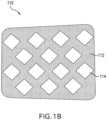
- FIG. 1B illustrates that the connected hydrophilic second regions form a fluidic flow network.
- This network utilizes capillary forces of water, surface tension gradients, and downward gravitational forces, and can be patterned such that liquid can be moved away from source points. Further, the larger hydrophilic area creates a greater surface area of evaporation per same amount of perspiration, while the interspersed hydrophobic areas also reduce dry time.
- Fabric 110 includes a pattern on the inner surface with regions 112 and 114.
- the inner surface pattern comprises one hydrophilic region 112 surrounding multiple hydrophobic regions 114.
- the regions 114 are individual diamonds that are distributed at intervals over the inner surface of fabric 110.
- Each of the hydrophobic regions 114 is surrounded by the hydrophilic region 112.
- each of the hydrophobic regions 114 is adjacent to the hydrophilic region 112.
- the connected hydrophilic region 112 will direct liquid movement, and the adjacent hydrophobic regions 114 will facilitate quicker drying times.
- At least a portion of the one or more hydrophobic regions is in contact with at least a portion of the hydrophobic material of the outer surface.
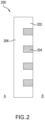
- the outer surface excludes or does not comprise the hydrophilic material of the one or more second regions of the inner surface. This concept is illustrated in FIG. 2 .
- FIG. 2 shows a cross-section of exemplary fabric 200, including an inner B surface with regions 202 and 204, and an outer A surface with region 206.
- Region 202 comprises a hydrophobic material of the present disclosure
- region 204 comprises a hydrophilic material of the present disclosure.
- the hydrophobic regions 202 of the inner B surface are in contact with portions of the hydrophobic 206 outer A surface.
- the hydrophilic regions 204 of the inner surface are also in contact with outer surface 206, the 204 regions do not completely penetrate fabric 200, and therefore are not included in the outer surface 206.
- the hydrophilic regions 204 comprise about 50% of the total thickness of the fabric
- the hydrophobic outer surface 206 comprises the remaining about 50% of the total thickness of the fabric.
- the inner surface of the fabric is interconnected with or affixed to the outer surface of the fabric.
- the fabric is composed of two layers, wherein the first layer (e.g., an outer surface) faces the external environment and the second layer (e.g ., an inner surface) faces the skin of the wearer.
- the inner and outer surface are affixed across their entire surfaces.
- the inner and outer surfaces are affixed around the edges, allowing some separation and movement in the areas where the surfaces are not affixed.
- the inner and outer surfaces are affixed at one or more points, which can be regularly spaced, irregularly spaced, spaced close together, spaced far apart, etc.
- the inner surface or layer is affixed to the outer surface or layer by stitching, bonding, adhesion, lamination, or a combination thereof. Both affixing around the edges and affixing at discrete points allows some separation of the surfaces and movement in the areas where the surfaces are not affixed. Without wishing to be bound by theory, it is thought that fabrics composed of separate layers provide enhanced moisture control performance.
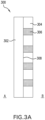
- FIG. 3A shows a cross-section of exemplary fabric 300 with two layers.
- Layer 302 is hydrophobic, making the outer A surface of the fabric hydrophobic.
- the second layer has both hydrophobic regions 304 and hydrophilic regions 306 on the inner B surface. Both regions 304 and 306 penetrate the second layer and are in contact with the hydrophobic first layer 302.
- the two layers are affixed across their entire surfaces at affixture 308.
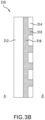
- FIG. 3B Another exemplary fabric 310 is illustrated in FIG. 3B .
- the first layer 312 is hydrophobic, making the outer A surface of the fabric hydrophobic.
- the second, inner B layer has hydrophobic regions 314, hydrophilic regions 316, and hydrophilic region 318.
- the two layers are affixed across their entire surfaces.
- the regions 314 and 316 are present on the inner surface of the second layer, and penetrate partially through the thickness of the fabric.
- Region 318 is on the entirety of the outer surface of the second layer, and also penetrates partially through the thickness of the fabric. Neither of the materials of 316 and 318 are included in hydrophobic layer 312.
- the regions 316 form an interconnected area with the region 318 that results in patterned channels of hydrophilic areas in the second layer.
- these channels spread moisture away from the source point, allow movement of moisture throughout the fabric to prevent areas of high moisture density, and facilitate quicker drying times.
- the hydrophobic regions 314 are also in contact with the region 318, and the first hydrophobic layer 312 is only in contact with the region 318 of the second layer.
- the first layer 312 of the fabric is hydrophobic (optionally, entirely hydrophobic).
- the second layer of the fabric has patterned hydrophilic regions comprising regions 316 on the inner surface of the second layer connected to region 318 on the outer surface of the second layer.
- the partial absorption on the inner surface of the second layer allows moisture to spread away from the source point and toward the hydrophilic outer surface of the second layer. Without wishing to be bound by theory, it is thought that this movement of moisture through the second layer and along connected channels both prevents areas of high moisture density on the second layer and helps facilitate quicker drying times.
- FIG. 3C shows a cross-section of exemplary fabric 320 with two layers affixed around the edges at locations 324a and 324b, but free to move ( i.e. separate) everywhere else.
- the first layer 322 comprises a hydrophobic material, making the outer A surface of the fabric hydrophobic.
- the second layer includes both hydrophobic regions 326 and hydrophilic regions 328 on the inner B surface. Both regions 326 and 328 penetrate the second layer only partially, e.g., about halfway.
- the regions 326 connect to the outer surface of the second layer to form a larger hydrophobic region.
- the outer surface of the second layer is hydrophobic (optionally, entirely hydrophobic), and this outer surface is in contact with the inner surface of the first layer.
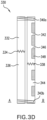
- FIG. 3D shows a cross-section of exemplary fabric 330 with two layers where each layer is composed of more than one piece of fabric.
- the two layers are affixed around the edges at locations 340a and 340b such that the seam 334 (where the hydrophobic first piece of the layer 332 is joined to the hydrophobic second piece of the layer 336) is not aligned to the seam 338 (where the first piece of the layer 342 is joined to the second piece of the layer 344).
- the two pieces 342 and 344 of the second layer have both hydrophobic regions 346 and hydrophilic regions 348 on the inner B surface. Both regions 346 and 348 penetrate the second layer only partially, e.g., about halfway.
- the regions 346 connect to the outer A surface of the second layer (e.g., 332 and 336) to form a larger hydrophobic region.
- the outer surface of the second layer is hydrophobic (optionally, entirely hydrophobic), and this outer surface is in contact with the inner surface of the first layer.
- the fabric further comprises an intermediate layer between the outer surface and the inner surface.
- the intermediate layer is affixed to one or both of the outer surface and the inner surface.
- the intermediate layer comprises a hydrophobic material of the present disclosure.
- the intermediate layer comprises a hydrophilic material of the present disclosure.
- the intermediate layer can also be used to achieve desired feel and/or loft of the fabric.
- one or more second hydrophilic regions of the present disclosure form a plurality of repeated shapes.
- one or more second hydrophilic regions of the present disclosure e.g., a hydrophilic portion of an inner surface of the present disclosure
- An exemplary configuration using this concept is illustrated in FIG. 4A.
- FIG. 4A shows a pattern in which hydrophilic regions (e.g ., hydrophilic portions of an inner surface of the present disclosure) form a pattern of repeated circles. In some embodiments, each circle is surrounded by the hydrophobic region.
- the one or more hydrophilic second regions form a lattice.
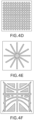
- a "lattice” refers to any interconnected combination of shapes wherein the shapes and the connections comprise the same material (e.g. , a hydrophilic material of the present disclosure). Exemplary configurations using this concept are illustrated in FIGS. 4B & 4D .
- FIG. 4B shows a pattern in which the hydrophilic regions form a lattice with angled connections, wherein the spaces within the lattice are parallelograms, and in which the spaces within the lattice are filled by the hydrophobic regions.
- FIG. 4D shows a pattern in which the hydrophilic regions form a lattice with perpendicular connections, wherein the spaces within the lattice are squares, and in which the spaces within the lattice are filled by the hydrophobic regions.
- the lattice is also surrounded by a further hydrophobic region.
- These exemplary lattice patterns are one way in which hydrophilic second regions can be patterned to form a fluidic flow network, which moves liquid away from source points, creates a greater surface area of evaporation per same amount of perspiration, and thus reduces dry time.
- the one or more first hydrophobic regions form a plurality of repeated shapes.
- the one or more first hydrophobic regions are surrounded by the one or more second hydrophilic regions (e.g ., a hydrophilic portion of an inner surface of the present disclosure).
- the one or more hydrophobic first regions form a lattice.
- An exemplary pattern using this concept is illustrated in FIG. 4C.
- FIG. 4C shows a pattern in which the hydrophobic regions form a lattice with angled connections, wherein the spaces within the lattice are parallelograms, and in which the spaces within the lattice are filled by the hydrophilic regions.
- the lattice is also surrounded by a further hydrophilic region.
- the one or more first hydrophobic regions of the inner surface of the fabric are patterned in a geometric pattern or logo.
- a variety of patterns can suitably be used to pattern the materials described above, including, without limitation, patterns with multiple shapes, widths, angles, connective channels with uniform or non-uniform thicknesses, and/or multiple widths, radii, angles, or curvatures.
- a material of the present disclosure has hydrophilic connective channels with uniform or non-uniform thicknesses, and/or multiple widths, radii, angles, or curvatures.
- the one or more second hydrophilic regions of the inner surface of the fabric are patterned in a geometric pattern, logo, text, or other design. Exemplary configurations using this concept are illustrated by FIGS. 4E & 4F.
- FIG. 4E shows a radially symmetric pattern of hydrophilic channels that are connected at the center, and surrounded by the hydrophobic region. Without wishing to be bound by theory, it is thought that this type of pattern can facilitate moisture movement away from an area of dense perspiration to dryer areas.
- FIG. 4F shows a laterally symmetric pattern of hydrophilic regions using both connected channels and discrete shapes. The spaces between the hydrophilic regions are filled by the hydrophobic regions, and the pattern is surrounded by a further hydrophobic region.
- hydrophobic materials can suitably be used as described above, e.g ., in any of the materials described as "hydrophobic” herein, such as the outer surface or one or more regions of the inner surface of a fabric of the present disclosure.
- a hydrophobic material of the present disclosure comprises polypropylene, polydimethylsiloxane (PDMS), fluoro-polymer (including without limitation a polymer made from tetrafluoroethylene-, vinyl fluoride-, perfluoroether-, vinylidene fluoride-, or chlorotrifluoroethylene-based monomers, such as polytetrafluoroethylene or PTFE), olefin, or a blend thereof.
- PDMS polydimethylsiloxane
- fluoro-polymer including without limitation a polymer made from tetrafluoroethylene-, vinyl fluoride-, perfluoroether-, vinylidene fluoride-, or chlorotrifluoroethylene-based mono
- hydrophobicity of the hydrophobic material can be achieved through a hydrophobic and/or liquid-repellent coating (e.g., a fluoropolymer, silicone, hydrosilicone, fluoroacrylate, or wax) or using inherent hydrophobic fibers, including polypropylene, PDMS, PTFE, etc.
- a hydrophobic material of the present disclosure can comprise a porous material of the present disclosure with a hydrophobic coating (e.g ., on an outer surface and/or hydrophobic portion of an inner surface).
- Such porous materials can include, without limitation, a mesh, a foam, a polymer, or a textile of the present disclosure.
- the textile includes without limitation a natural fiber, a synthetic fiber, or a blend thereof.
- a textile of the present disclosure can include without limitation cotton, hemp, linen, rayon, coconut fiber, cellulose, wool, silk, bamboo, polyurethane, polypropylene, polyethylene, glass, acetate, polyester, nylon, lyocell, modal, poly-paraphenylene, terephthalamide, elastin fiber, and/or any blend thereof.
- hydrophilic materials can suitably be used as described above, e.g ., in any of the materials described as "hydrophilic” herein, such as one or more regions of the inner surface of a fabric of the present disclosure.
- a hydrophilic material of the present disclosure is a textile.
- the textile includes without limitation a natural fiber, a synthetic fiber, or a blend thereof.
- a textile of the present disclosure can include without limitation cotton, rayon, coconut fiber, cellulose, silk, bamboo, and/or any blend thereof.
- hydrophilicity of the hydrophilic material can be achieved through a hydrophilic and/or liquid-absorbent coating (e.g., hydrophilic silicone).
- a hydrophilic material of the present disclosure can comprise a porous material of the present disclosure with a hydrophilic coating on at least one region of the inner surface, e.g., as described above.
- Such porous materials can include, without limitation, a textile of the present disclosure.
- the textile includes without limitation a natural fiber, a synthetic fiber, or a blend thereof.
- a textile of the present disclosure can include without limitation cotton, hemp, linen, rayon, coconut fiber, cellulose, wool, silk, bamboo, polyurethane, polypropylene, polyethylene, glass, acetate, polyester, nylon, lyocell, modal, poly-paraphenylene, terephthalamide, elastin fiber, and/or any blend thereof.
- a hydrophobic material of the present disclosure includes a hydrophobic yarn.
- Materials that can be used for hydrophobic yarns include without limitation inherently hydrophobic fibers (e.g ., contact angle of material is higher than 90 degrees), including polypropylene, polydimethylsiloxane and fluoropolymer. Suitable materials can also include yarns or textiles modified by water/oil repellent coatings (e.g. fluoropolymer, silicone, wax), including treated natural and synthetic yarns, and blends.
- the textile is selected from the group consisting of cotton, hemp, rayon, coconut fiber, cellulose, wool, silk, bamboo, polyurethane, polypropylene, polyethylene, glass, acetate, polyester, nylon, elastin fiber, and any blend thereof.
- a hydrophilic material of the present disclosure includes a hydrophilic yarn.
- Materials that can be used for hydrophilic yarns include without limitation inherently hydrophilic fibers, including cotton, cellulose, rayon, coconut fiber, silk, bamboo. Suitable materials can also include hydrophilic treated natural and synthetic yarns, including natural and synthetic yarns and blends.
- the textile is selected from the group consisting of wool, silk, bamboo, polyurethane, polypropylene, polyethylene, glass, acetate, polyester, elastin fiber, and any blend thereof.
- a fabric of the present disclosure can comprise an outer hydrophobic surface, and an inner surface with one or more first hydrophobic regions and one or more second hydrophilic regions.
- a hydrophilic material of the one or more second regions will not resist a hydrostatic pressure (equal to 0pa).
- a hydrophobic material of the present disclosure is able to resist a hydrostatic pressure of greater than 0pa.
- hydrophobicity can refer to the hydrostatic pressure able to be resisted by the material.
- a hydrophobic material of the present disclosure (e.g., on an outer surface and/or hydrophobic portion of an inner surface) resists a hydrostatic pressure of greater than or equal to about 150pa, greater than or equal to about 200pa, greater than or equal to about 250pa, greater than or equal to about 300pa, greater than or equal to about 350pa, greater than or equal to about 400pa, greater than or equal to about 450pa, greater than or equal to about 500pa, greater than or equal to about 600pa, greater than or equal to about 700pa, greater than or equal to about 800pa, greater than or equal to about 900pa, greater than or equal to about 1kpa, greater than or equal to about 1.5 kpa, greater than or equal to about 2 kpa, greater than or equal to about 2.5 kpa, or greater than or equal to about 3 kpa.
- a hydrophobic material of the present disclosure resists a hydrostatic pressure of less than or equal to about 3kpa, less than or equal to about 2.5kpa, less than or equal to about 2kpa, less than or equal to about 1.5kpa, less than or equal to about 1kpa, less than or equal to about 900pa, less than or equal to about 800pa, less than or equal to about 700pa, less than or equal to about 600pa, less than or equal to about 500pa, less than or equal to about 450pa, less than or equal to about 400pa, less than or equal to about 350pa, less than or equal to about 300pa, less than or equal to about 250pa, less than or equal to about 200pa, or less than or equal to about 150pa.
- a hydrophobic material of the present disclosure resists a hydrostatic pressure less than about any of the following hydrostatic pressures (in pa): 3000, 2500, 2000, 1500, 1000, 900, 800, 700, 600, 500, 400, 300, 250, 200, or 150.
- a hydrophobic material of the present disclosure resists a hydrostatic pressure greater than about any of the following hydrostatic pressures (in pa): 125, 150, 200, 250, 300, 400, 500, 600, 700, 800, 900, 1000, 1500, 2000, or 2500. That is, the hydrophobic material of the present disclosure (e.g.
- a hydrophobic material of the present disclosure e.g ., on an outer surface and/or hydrophobic portion of an inner surface
- a hydrostatic pressure of between about 500pa and about 3000pa resists a hydrostatic pressure of between about 500pa and about 3000pa.
- hydrostatic head tester Techniques for measuring hydrostatic pressure resistance are known in the art. For example, a standard technique is the use of a hydrostatic head tester. The device applies an increasing value of water pressure on a fabric sample, and the maximum hydrostatic pressure is recorded when water penetrates through the sample and leakage happens.
- the hydrophilic material of a second region of the present disclosure comprises 5% to 95% of the total thickness of the fabric.
- a hydrophilic material of the present disclosure comprises a percentage of the total thickness of the fabric greater than or equal to about 5%, greater than or equal to about 10%, greater than or equal to about 15%, greater than or equal to about 20%, greater than or equal to about 25%, greater than or equal to about 30%, greater than or equal to about 35%, greater than or equal to about 40%, greater than or equal to about 45%, greater than or equal to about 50%, greater than or equal to about 55%, greater than or equal to about 60%, greater than or equal to about 65%, greater than or equal to about 70%, greater than or equal to about 75%, greater than or equal to about 80%, greater than or equal to about 85%, greater than or equal to about 90%, or greater than or equal to about 95%.
- a hydrophilic material of the present disclosure comprises a percentage of the total thickness of the fabric less than or equal to about 95%, less than or equal to about 90%, less than or equal to about 85%, less than or equal to about 80%, less than or equal to about 75%, less than or equal to about 70%, less than or equal to about 65%, less than or equal to about 60%, less than or equal to about 55%, less than or equal to about 50%, less than or equal to about 45%, less than or equal to about 40%, less than or equal to about 35%, less than or equal to about 30%, less than or equal to about 25%, less than or equal to about 20%, less than or equal to about 15%, less than or equal to about 10%, or less than or equal to about 5%.
- a hydrophilic material of the present disclosure comprises a percentage of the total thickness of the fabric less than about any of the following percentages: 95%, 85%, 75%, 65%, 55%, 45%, 35%, 25%, 15%, or 10%. In some embodiments, a hydrophilic material of the present disclosure comprises a percentage of the total thickness of the fabric less than about any of the following percentages: 5%, 10%, 15%, 25%, 35%, 45%, 55%, 65%, 75%, 85%, or 90%.
- the hydrophilic material of the present disclosure comprises the total thickness of the fabric of any of a range of percentages having an upper limit of 95%, 85%, 75%, 65%, 55%, 45%, 35%, 25%, 15%, or 10% and an independently selected lower limit of 5%, 10%, 15%, 25%, 35%, 45%, 55%, 65%, 75%, 85%, or 90%, wherein the lower limit is less than the upper limit.
- the hydrophobic material of the outer surface is the same as the hydrophobic material of the one or more first regions of the inner surface. In some embodiments, the hydrophobic material of the outer surface is different from the hydrophobic material of the one or more first regions of the inner surface.
- the collective area of the hydrophilic second region(s) of the inner surface comprises less than about 85%, less than about 75%, less than about 65%, less than about 55%, less than about 45%, less than about 35%, less than about 25%, or less than about 15% of the surface area of the inner surface. In some embodiments, the collective area of the hydrophilic second region(s) of the inner surface comprises greater than about 15%, greater than about 25%, greater than about 35%, greater than about 45%, greater than about 55%, greater than about 65%, greater than about 75%, or greater than about 85% of the surface area of the inner surface.
- the collective area of the hydrophilic second region(s) of the inner surface comprises less than: 85%, 75%, 65%, 55%, 45%, 35%, 25%, or 20% of the surface area of the inner surface. In some embodiments, the collective area of the hydrophilic second region(s) of the inner surface comprises greater than: 15%, 25%, 35%, 45%, 55%, 65%, 75%, or 80% of the surface area of the inner surface.
- the collective area of the hydrophilic second region(s) of the inner surface comprises any of a range of percentages having an upper limit of 85%, 75%, 65%, 55%, 45%, 35%, 25%, or 20% and an independently selected lower limit of 15%, 25%, 35%, 45%, 55%, 65%, 75%, or 80%, wherein the lower limit is less than the upper limit.
- the collective area of the hydrophilic second region(s) of the inner surface comprises a percentage between about 15% and about 85% of the surface area of the inner surface.
- the collective area of the hydrophobic first region(s) of the inner surface comprises less than about 85%, less than about 75%, less than about 65%, less than about 55%, less than about 45%, less than about 35%, less than about 25%, or less than about 15% of the surface area of the inner surface. In some embodiments, the collective area of the hydrophobic first region(s) of the inner surface comprises greater than about 15%, greater than about 25%, greater than about 35%, greater than about 45%, greater than about 55%, greater than about 65%, greater than about 75%, or greater than about 85% of the surface area of the inner surface.
- the collective area of the hydrophobic first region(s) of the inner surface comprises less than: 85%, 75%, 65%, 55%, 45%, 35%, 25%, or 20% of the surface area of the inner surface. In some embodiments, the collective area of the hydrophobic first region(s) of the inner surface comprises greater than: 15%, 25%, 35%, 45%, 55%, 65%, 75%, or 80% of the surface area of the inner surface.
- the collective area of the hydrophobic first region(s) of the inner surface comprises any of a range of percentages having an upper limit of 85%, 75%, 65%, 55%, 45%, 35%, 25%, or 20% and an independently selected lower limit of 15%, 25%, 35%, 45%, 55%, 65%, 75%, or 80%, wherein the lower limit is less than the upper limit.
- the collective area of the hydrophobic first region(s) of the inner surface comprises a percentage between about 15% and about 85% of the surface area of the inner surface.
- the collective surface area of the hydrophilic regions and the collective surface of the hydrophobic regions of the inner surface of a fabric of the present disclosure are substantially equivalent, i.e. each region comprises about 50% of the surface area of the inner surface of the fabric.
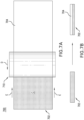
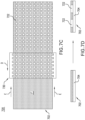
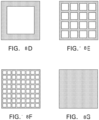
- Exemplary patterns using this concept are illustrated in the patterns shown in FIGS. 8A-8F , each of which contains substantially similar hydrophobic and hydrophilic surface areas despite their multiple different patterns.
- the proportion of the collective area of the one or more hydrophilic regions (e.g ., the one or more second regions of the inner surface) to the surface area of the inner and outer surfaces of the fabric (i.e. the total surface area of the fabric) comprises a percentage between about 40% and about 95% of the surface area of the inner surface.
- the proportion of the collective area of the one or more hydrophilic regions to the total surface area of the fabric is less than about 95%, less than about 90%, less than about 85%, less than about 80%, less than about 75%, less than about 70%, less than about 65%, less than about 60%, less than about 55%, less than about 50%, less than about 45%, or less than about 40%.
- the proportion of the collective area of the one or more hydrophilic regions to the total surface area of the fabric is greater than about 40%, greater than about 45%, greater than about 55%, greater than about 65%, greater than about 75%, greater than about 85%, or greater than about 95%.
- the proportion of the collective area of the one or more hydrophilic regions to the total surface area of the fabric comprises less than: 95%, 85%, 75%, 65%, 55%, or 45%.
- the proportion of the collective area of the one or more hydrophilic regions to the total surface area of the fabric comprises greater than: 40%, 45%, 55%, 65%, 75%, 85%, or 90%.
- the proportion of the collective area of the one or more hydrophilic regions to the total surface area of the fabric comprises any of a range of percentages having an upper limit of 95%, 85%, 75%, 65%, 55%, or 45% and an independently selected lower limit of 40%, 45%, 55%, 65%, 75%, 85%, or 90%, wherein the lower limit is less than the upper limit.
- the surface area of each of the hydrophilic regions is added together to provide a total of the collective area, and this total is then divided by the surface area of the inner surface of the fabric to provide a percentage of the collective area of the one or more hydrophilic regions (e.g ., the one or more second regions of the inner surface).
- a fabric of the present disclosure can be a component of bedding, footwear, seat covers, outdoor gear, upholstery, or an accessory.
- garments comprising any of the fabrics of the present disclosure.
- the fabric described herein is used in a garment, and the inner surface of the fabric faces the skin of the wearer of the garment.
- the entire inner surface of the garment is patterned with hydrophilic patterns for partial absorption, and the entire outer surface of the garment is hydrophobic, thereby preventing the appearance of perspiration on the outside of the garment.
- the garment includes at least a portion of the following items, without limitation: a coat, a dress, a skirt, a sports bra, an undergarment, a pant, a short, or a sock.
- the garment is a shirt.
- the fabric is used in the shirt at one or more of an underarm area, a mid-back area, a lower-back area, a front chest area, a stomach area, and a shoulder area.
- a fabric described herein is used for localized treatment of a shirt in the mid-back area and/or the lower-back area. In some embodiments, the treatment is localized to areas of higher sweat production.
- FIGS. 5A & 5B Exemplary treatments of a shirt 500 are illustrated in FIGS. 5A & 5B.
- FIG. 5A illustrates the front view of a shirt 500 with a fabric of the present disclosure (e.g., as illustrated in FIGS. 1A-4F or otherwise described herein) in the left front region 502 and in the right front region 504.
- FIG. 5B illustrates the back view of a shirt with a fabric of the present disclosure (e.g., as illustrated in FIGS. 1-4F or otherwise described herein) in the mid-back region 506.
- these treatments provide moisture control in areas of high accumulation of perspiration.
- a fabric described herein is used for localized treatment of a shirt such that the fabric is surrounded by a hydrophobic boundary or barrier to prevent liquid from spreading beyond the treated area.
- the fabric used in the garment is patterned so the one or more hydrophobic first regions form an interconnected lattice.
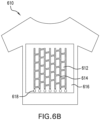
- FIG. 6A One exemplary treatment of a shirt 600 in accordance with this embodiment is illustrated in FIG. 6A .
- the shirt 600 is locally treated with a fabric that is surrounded ( e.g ., entirely) by the hydrophobic boundary 602.
- the fabric is patterned with a hydrophobic lattice 604 that contains hydrophilic regions 606, and is also entirely surrounded by hydrophilic region 606.
- moisture that accumulates in hydrophilic regions 606 is contained by hydrophobic boundary 602.
- the fabric used in the garment is patterned so the one or more hydrophilic second regions form an interconnected lattice.
- the hydrophobic boundary can facilitate different types of moisture spreading control. In a low moisture setting, moisture can remain absorbed inside the hydrophobic boundary until it evaporates, whereas in a high moisture setting, moisture can accumulate at the hydrophobic barrier and eventually drip off of the material. This process is illustrated in FIG. 6B .
- the shirt 610 is treated with a fabric that is patterned with a hydrophilic lattice 614.
- the hydrophilic lattice contains hydrophobic regions 612, and is also surrounded by a hydrophobic boundary 616. When a sufficient amount of moisture is absorbed by hydrophilic lattice 614, the moisture will accumulate at hydrophobic boundary 616, and form moisture droplets 618 that will drip off of the material. For example, in a high perspiration setting, perspiration accumulates at the hydrophobic boundary and then drips off the material.
- Certain aspects of the present disclosure relate to methods of making an article or fabric having improved moisture management. Exemplary methods of making these articles are set forth below, but the skilled artisan will appreciate that various fabrication methods and materials known in the art can be used to manufacture the articles of the present disclosure, depending upon the specific configuration of the article, without departing from the scope of the present disclosure. Any of the materials, patterns, and affixtures described supra can find use in the methods of the present disclosure.
- a method of making a fabric includes: (a) providing a hydrophilic material comprising an outer and an inner surface, the inner surface comprising one or more first regions and one or more second regions; (b) screen printing a first hydrophobic material to the first side surface such that the first hydrophobic material penetrates the hydrophilic fabric in order to define a first layer with a single region that is hydrophobic; and (c) screen printing a second hydrophobic material to a plurality of selected portions of the second side surface such that the second hydrophobic material penetrates the hydrophilic fabric in order to define a second layer having a plurality of hydrophobic first regions corresponding to the selected portions of the second side surface, and a plurality of hydrophilic second regions corresponding to unselected portions of the second side surface that do not receive the second hydrophobic material, wherein said first regions of the second layer of said fabric are in direct contact with said single region of the first layer of said fabric, and said second regions of the second layer of said fabric are in direct contact with said single region of
- the fabric includes an outer surface comprising a hydrophobic material and an inner surface comprising one or more first regions comprising the first hydrophobic materials and one or more second regions comprising the hydrophilic material, wherein the one or more first regions and the one or more second regions are different. Any of the patterns, outer surfaces, inner surfaces and regions thereof, and materials described supra can be used.
- FIGS. 7A-7D Exemplary process 700 for making a fabric of the present disclosure is illustrated in FIGS. 7A-7D .
- process 700 starts with hydrophilic material 702.
- Material 702 can be any of the exemplary hydrophilic materials described herein or otherwise known in the art.
- material 702 is laid flat such that one surface (designated as "C" in FIG. 7A ) moves in direction E and is facing the roller 710 which has the rolling direction D.
- Screen roller 710 is then used to put down enough hydrophobic material to penetrate material 702.
- the hydrophobic material can be any of the exemplary materials described herein.
- the mesh size of the screen, viscosity of ink, and/or pressure is used such that the hydrophobic material penetrates halfway through the thickness of the hydrophilic material 702, as shown in FIG. 7B .
- one or more these factors can be varied to increase or decrease penetration.
- lower mesh size, lower ink viscosity, and/or higher pressure can result in greater penetration of the material into the fabric.
- roller 710 does not have a pattern, so it completely covers the material surface with a controlled layer of hydrophobic material 704. A close-up, cross-sectional view of process 700 is provided in FIG. 7B .
- process 720 for making a fabric of the present disclosure is illustrated in FIGS. 7C & 7D .
- process 720 is conducted using the material 702 after process 700 is completed (e.g ., a drying step follows process 700, and then the material 702 is turned over so that the opposite surface faces the roller, here designated as "F").
- a screen roller 730 is used to apply a hydrophobic material to the back surface "F" in such a way that a pattern is formed.
- the pattern is a hydrophilic lattice comprising the hydrophilic material, wherein the spaces of the lattice are filled with regions 722 of the applied hydrophobic material.
- the hydrophobic material of process 720 is the same as that of process 700. In other embodiments, the hydrophobic material of process 720 is a different hydrophobic material.
- FIG. 7D shows a cross-sectional view of process 720. In this example, a mesh size of screen, viscosity of ink, and/or pressure is used such that the hydrophobic material penetrates over halfway through the thickness of the hydrophilic material 702 such that regions 722 (deposited by roller 730 in process 720) overlap with region 704 (deposited by roller 710 in process 700). In this example, the overlap of regions 722 and 704 ensures that hydrophilic regions remain isolated on the inner surface.
- a material is generated having an outer hydrophobic surface (e.g ., 704), and an inner surface with one or more hydrophilic regions remaining from the original hydrophilic material 702 and one or more applied hydrophobic regions (e.g ., 722).
- region 704 comprises about 50% of the total thickness of the finished material
- region 722 comprises about 70% of the total thickness of the finished material.
- a method of making a fabric includes: (a) providing a hydrophilic material comprising an outer and an inner surface, the outer surface comprising one or more first regions and one or more second regions; (b) screen printing a first hydrophobic material onto one or more first regions of the outer surface of the hydrophilic material such that the first hydrophobic material penetrates through the hydrophilic material to generate an inner surface comprising one or more first regions comprising the first hydrophobic material and one or more second regions comprising the hydrophilic material; and (c) screen printing a second hydrophobic material onto the outer surface of the hydrophilic material such that the second hydrophobic material penetrates through the hydrophilic material to generate an outer surface comprising the second hydrophobic material.
- the fabric includes an outer surface comprising a hydrophobic material and an inner surface comprising one or more first regions comprising the first hydrophobic materials and one or more second regions comprising the hydrophilic material, wherein the one or more first regions and the one or more second regions are different.
- the one or more hydrophobic first regions of the inner surface are in contact with at least a portion of the hydrophobic material of the outer surface.
- the first and the second hydrophobic materials are the same. In other embodiments, the first and the second hydrophobic materials are different. Any of the patterns, outer surfaces, inner surfaces and regions thereof, and materials described supra can be used.
- FIGS. 7E & 7F Exemplary process 740 for making a fabric of the present disclosure is illustrated in FIGS. 7E & 7F .
- process 740 starts with hydrophilic material 742.
- Material 742 can be any of the exemplary hydrophilic materials described herein or otherwise known in the art.
- material 742 is laid flat such that one surface (designated as "G" in FIG. 7E ) is facing the roller and moves in direction E.
- Screen roller 750 (in the roller direction D) is used to apply a hydrophobic material to the front "G" surface of fabric 742 in such a way that a pattern is formed.
- the pattern is a hydrophilic lattice comprising the hydrophilic material, wherein the spaces of the lattice are filled with regions 744 of the applied hydrophobic material.
- a mesh size of screen, viscosity of ink, and/or pressure is used such that the hydrophobic material penetrates entirely through the thickness of the hydrophilic material 742.
- screen roller 760 (in the roller direction D) is then used to apply a hydrophobic material to the front "G" surface of fabric 742.
- roller 760 is patterned such that the pattern fills in the hydrophilic lattice left by roller 750.
- roller 760 Unlike for roller 750, however, for roller 760, a mesh size of screen, viscosity of ink, and/or pressure is used such that the hydrophobic material penetrates halfway through the thickness of the hydrophilic material 742. This creates a surface that includes region 746 comprising the hydrophobic material deposited through roller 760.
- the hydrophobic material can be any of the exemplary materials described herein.
- the hydrophobic material deposited by roller 750 is the same as the hydrophobic material deposited by roller 760.
- the hydrophobic material deposited by roller 760 is a different material.
- a close-up, cross-sectional view of process 740 is provided in FIG. 7F .
- a material is generated having an outer hydrophobic surface (e.g ., 746), and an inner surface with one or more hydrophilic regions remaining from the original hydrophilic material 742 and one or more applied hydrophobic regions ( e.g ., 744).
- Some printing methods use various thickeners to keep the ink from migrating and to maintain a clear or well-defined print.
- Some variables can be controlled by one of ordinary skill in the art.
- Some variables such as print paste viscosity, amount of print paste applied, roller/wiper pressure, speeds, mesh size of the screen, etc., can be used to control the depth of penetration of the print paste.
- One way to control depth of ink penetration is to adjust the printing parameters so that the print paste can penetrate through the fabric without merging together.
- the outer surface comprises about 50% of the total thickness of the fabric
- the inner surface comprises about 50% of the total thickness of the fabric.
- the ratio of the thickness of the outer surface to the thickness of the inner surface is between about 0.1 to about 10. Any of the patterns, outer surfaces, inner surfaces and regions thereof, and materials described supra can be used.
- Any hydrophilic material of the present disclosure including but not limited to cotton, treated polyester, nylon, silk, bamboo fibers in woven, knitted or non-woven structure, can be used as the material substrate or hydrophilic material (e.g ., 702, 742).
- Any of the hydrophobic coatings described herein, such as fluorochemicals, silicones, waxes or other similar materials, can be used to create hydrophobic regions ( e.g ., 704, 722, 744, 746).
- a method of making a fabric of the present disclosure includes: (a) providing a hydrophobic material comprising an outer and an inner surface, the inner surface comprising one or more first regions and one or more second regions; and (b) screen printing a hydrophilic material onto one or more first regions of the inner surface.
- the fabric includes an outer surface comprising the hydrophobic material and an inner surface comprising one or more first regions comprising the hydrophobic material and one or more second regions comprising the printed hydrophilic material, wherein the one or more first regions and the one or more second regions are different.
- the outer surface comprises about 50% of the total thickness of the fabric
- the inner surface comprises about 50% of the total thickness of the fabric.
- the ratio of the thickness of the outer surface to the thickness of the inner surface is between about 0.1 to about 10. Any of the patterns, outer surfaces, inner surfaces and regions thereof, and materials described supra can be used.
- FIGS. 8A-8G Various patterns were examined for their moisture control properties, as shown in FIGS. 8A-8G .
- All six patterned samples (for experimental patterns, see FIGS. 8A-8F ) had partially hydrophobic inner surfaces, completely hydrophobic outer surfaces, and identical hydrophilic surface areas (samples were 10 cm by 10 cm cut from 100% polyester interlock, machine screen-printed with a high viscosity hydrophobic ink using an 160 mesh size screen on the inner and outer surfaces to pattern a 50 cm 2 inner surface area).
- Three patterns ( FIGS. 8A-8C ) were designed to have isolated hydrophilic areas, while the other three patterns ( FIGS. 8D-8F ) were designed to have connected hydrophilic areas that allowed moisture to move over the whole hydrophilic surface area of the pattern.
- the control pattern sample had a completely hydrophilic inner surface and a completely hydrophobic outer surface (see, e.g., Schoeller 3XDry ® technology; sample was 10 cm by 10 cm cut from 100% polyester interlock, machine screen-printed with a high viscosity hydrophobic ink using an 160 mesh size screen on the outer surface to pattern a 100cm 2 inner surface area).
- Some patterns FIGS. 8D-8F ) showed improved moisture control properties as compared to other patterns (FIGS. 10A-10C) or a control pattern ( FIG. 8G ), as demonstrated below.
- the samples were evaluated using two dry time testing protocols: 1) maximum saturation, and 2) under-saturation with a fixed volume.
- the samples were attached to a wire mesh frame and placed vertically to simulate the vertical drying environment of a garment on a body. Samples were initially weighed dry, and then weighed after water exposure. These two measurements were used to calculate wet pick up (WPU), which is the ratio of the weight of the water picked up to the initial weight of the dry fabric. Periodic measurements were taken as the samples dried until the samples reached their initial dry weight, and these measurements were used to calculate total dry time. Initial WPU and total dry time were measured and calculated for each sample.
- WPU wet pick up
- FIGS. 9 & 10 demonstrate the improved moisture control behavior of some exemplary patterns on the inner surface of an exemplary fabric as disclosed herein.
- the results from the maximum saturation protocol showed that hydrophobic regions on the inner surface tend to reduce the dry time of the fabric, and that pattern type affects the dry time of the fabric.
- FIG. 9 shows the Maximum Saturation Test Results where the average drying times K in minutes for the patterned samples L (for patterns, see FIGS. 8A-8F , Control C) ranged from 68.7 ⁇ 10.5 minutes (sample pattern shown in FIG. 8F ) to 111.0 ⁇ 12.3 minutes (sample pattern shown in FIG. 8C ) and most patterned samples dried faster than the control pattern sample (control pattern shown in FIG.
- sample pattern 8C was the only one of the six patterned samples to have a longer dry time (9.38% longer dry time, 27.1% lower initial WPU) than the control pattern sample (control pattern shown in FIG. 8G ).
- Those samples with patterns designed to have connected hydrophilic areas showed lower initial WPU and faster dry times K than the samples with patterns designed to have isolated hydrophilic areas (sample patterns shown in FIGS. 8A-8C ).
- the sample with pattern 8F (sample pattern shown in FIG. 8F ) dried the fastest; it was 14.8% faster to dry than the sample with pattern 8D (sample pattern shown in FIG. 8D ) with only 2.5% less initial WPU.
- the sample with pattern 8F dried 32.8 minutes (32.3%) faster.
- the results from the under-saturation protocol showed that at low saturation levels, an increased number of connected hydrophilic areas made the drying rate faster (see FIG. 12 ).
- the average drying times K (in minutes) for the patterned samples ranged from 26.1 ⁇ 1.3 minutes (sample pattern shown in FIG. 8F ) to 34.4 ⁇ 2.6 minutes (sample pattern shown in FIG. 8D ). and all patterned samples dried faster than the control pattern sample (control pattern shown in FIG. 8G ), which took an average of 35.0 ⁇ 2.3 minutes to dry.
- the sample with pattern 8F (sample pattern shown in FIG. 8F ) dried the fastest of the three patterned samples, and 25.4% faster than the control pattern sample (control pattern shown in FIG. 8G ).
- the results showed that patterning inner surfaces with connected hydrophilic areas is advantageous in reducing drying time K.
- FIGS. 11A-11F The drying process of the sample with pattern 8F as compared to the drying process of the control pattern sample during the under-saturation protocol was imaged over the course of 40 minutes and is shown in FIGS. 11A-11F .
- the initial image FIG. 11A shows the restricted area of moisture on the sample with pattern 8F (sample pattern shown in FIG. 8F ) just after droplet application, as well as the spot on the control pattern sample (control pattern shown in FIG. 8G ) that resulted from droplet application for one (1) minute.
- FIG. 11B shows the restricted area of moisture on the sample with pattern 8F (sample pattern shown in FIG. 8F ) just after droplet application, as well as the spot on the control pattern sample (control pattern shown in FIG. 8G ) that resulted from droplet application for one (1) minute.
- FIG. 11B shows the restricted area of moisture on the sample with pattern 8F (sample pattern shown in FIG. 8F ) just after droplet application, as well as the spot on the control pattern sample
- FIG. 11E (results after five (5) minutes), FIG. 11F (results after forty (40) minutes), the spread of the moisture through the connected hydrophilic areas can be seen on the sample with pattern 8F (sample pattern shown in FIG. 8F ), whereas the control pattern (control pattern shown in FIG . 8G ) sample spot remains the same size.
- the sample with pattern 8F (sample pattern shown in FIG. 8F ) appears dry, while the control pattern sample (control pattern shown in FIG. 8G ) remains wet.
- the results demonstrate the unique properties of the improved moisture control behavior of some exemplary patterns on the inner surface of an exemplary fabric disclosed herein, as compared to existing fabrics.
- Most of the samples patterned with the exemplary patterns disclosed herein were able to pick up less moisture initially and were able to dry faster in the maximum saturation test than the control pattern sample.
- the samples patterned with the exemplary patterns disclosed herein were able to dry faster than the control pattern sample when the same amount of moisture was initially applied in the under-saturation test.
- a wear trial was conducted by a male athlete wearing a prototype shirt 1400 (100% cotton, single jersey knit fabric, fabric weight 150g/m 2 ) that was treated with the improved moisture control fabric of the present disclosure on the inside of a shirt on one side 1410.
- the prototype shirt was constructed using a cotton t-shirt.
- Second, the outer surface of the right sleeve and the right side of the shirt were covered by a completely hydrophobic coating to about 50% penetration.
- the coated t-shirt and sleeve were sent through an oven to dry the coating.
- the t-shirt and the sleeve were turned inside out and printed with a hydrophobic pattern (similar to the one depicted in FIG.
- a second wear trial was conducted by a male athlete wearing a prototype shirt (100% cotton, single jersey knit, fabric weight 150g/m 2 ) as an undershirt under a woven cotton dress shirt 1450.
- one armpit of the undershirt is composed of a two-layer structure of the improved moisture control fabric 1410 (as shown in FIG. 12C ).
- the other armpit of the undershirt was composed of the same two-layer structure made of the same fabrics, but without the improved moisture control treatment.
- the athlete In order to test the undershirt, the athlete first ran on a treadmill for 10 minutes, then walked quickly on the treadmill for 25 minutes. At the end of the test, pictures were taken to compare the wetness at the armpits of the dress shirt. In the treated region 1460, the armpit remained dry, whereas in the untreated region 1470, the armpit became wet and this resulted in a clear dark mark in the armpit region of the dress shirt.
Landscapes
- Engineering & Computer Science (AREA)
- Textile Engineering (AREA)
- Mechanical Engineering (AREA)
- Chemical & Material Sciences (AREA)
- Chemical Kinetics & Catalysis (AREA)
- Materials Engineering (AREA)
- Laminated Bodies (AREA)
- Treatments For Attaching Organic Compounds To Fibrous Goods (AREA)
Description
- This application claims the priority benefit of
U.S. Provisional Patent Application Serial No. 62/580,345, filed on November 1, 2017 - The present disclosure relates to articles of manufacture with improved moisture control, as well as methods related thereto.
- Perspiration is the primary means of thermoregulation for the human body, during which sweat (mainly composed of water) is secreted through the skin and evaporation of the fluid removes the heat from the surface underneath. During intensive activity, accumulated sweat can drastically increase the humidity level surrounding the skin, which can result in a very uncomfortable feeling unless sweat is efficiently removed. Moisture control fabrics can confine the moisture distribution in the fabric structure for various applications. Among them, one application is sweat-proof material that controls and prevents the moisture from showing on the external surface.
- There are many methods currently utilized to sweat-proof materials. Common methods include the incorporation of a thin plastic film to prevent water movement across layers (e.g. Thompson Tee, www.thompsontee.com), but thin plastic films tend to inhibit the air flow through the materials and increase the rigidity of the fabric, which can cause wearer discomfort. An alternative method to using plastic materials is the use of hydrophobic coatings (i.e., fluoropolymer, silicone, and wax) to prevent liquid movement through the material. Coatings and fabric finishes provide a more breathable and comfortable alternative to plastic films. Technology such as 3xDRY (Schoeller Textile, see
WO2002075038A3 ) implements hydrophobic treatments only on the outside surface of the material to prevent liquids from penetrating through the thickness of the fabric. The outside coating allows perspiration or other liquids from the inside surface to partially absorb through the thickness of the fabric but not become visible on the outside of the garment. However, the inside of this fabric can reach full saturation and the garment can cling to the wearer and cause discomfort. - Incorporating inherently hydrophobic materials into the overall structure is another method to create sweat-proof materials. In some fabric products, like Silic™ and ThreadSmith™, the fabric is completely non-absorbent (e.g., hydrophobic) and prevents liquid from passing through the fabric. However, this technology leads to wearer discomfort due to perspiration remaining on the skin surface.
- Document
CN 103 009 763 B discloses a fabric which has a hydrophobic surface, an opposite surface having some hydrophilic and hydrophobic areas, and an intermediate layer being hydrophilic, which aims at storing sweat emitted by a wearer and diffusing through the hydrophilic regions of said opposite surface. - Therefore, a need exists for articles with improved moisture control capacity. A fabric structure with sweat-proof function that can prevent full saturation, reduce garment cling and achieve quick drying properties would be ideal and largely improve wearer comfort. Such articles would be able to control the movement of moisture (e.g., a bodily fluid, such as sweat) from the inside to the outside to keep the outside dry while removing the moisture from the surface of the skin and keeping the wearer comfortable. These articles can find use, e.g., in fabrics for garments, sheets, and other accessories.
- To meet these and other demands, the present disclosure provides garments comprising a fabric with improved moisture control capacity, as well as methods of making related thereto. These fabrics have unique structures that control the movement of moisture, allowing the inner surface to remove moisture and keeping the moisture from accumulating on the outer surface. These properties provide fabrics that resist staining, reduce clinging to the body, and lessen drying times, as compared with existing materials.
- In certain aspects, the present disclosure provides a garment comprising a fabric, comprising: (a) an outer layer defining an outer surface comprising a single region comprising a hydrophobic material; and (b) an inner layer defining an inner surface of the gament and configured to face the skin of a wearer of the garment, comprising: (i) one or more first regions, comprising a hydrophobic material, and (ii) one or more second regions consisting of a hydrophilic material, wherein the one or more first regions and the one or more second regions are different, wherein the hydrophobic material of the first regions is in contact with the hydrophobic material of the outer layer. In some embodiments, at least one of the one or more second regions is surrounded by at least one of the one or more first regions. In some embodiments, each of the one or more second regions is surrounded by one or more of the one or more first regions. In some embodiments, the one or more second regions are adjacent to the one or more first regions. In some embodiments, the one or more second regions are patterned in a geometric pattern or logo. In some embodiments, the one or more second regions form a plurality of repeated shapes surrounded by the one or more first regions. In some embodiments, the one or more second regions form a lattice. In some embodiments, at least one of the one or more first regions is surrounded by at least one of the one or more second regions. In some embodiments, each of the one or more first regions is surrounded by the one or more of the one or more second regions. In some embodiments, the one or more first regions are adjacent to the one or more second regions. In some embodiments, the one or more first regions are patterned in a geometric pattern or logo. In some embodiments, the one or more first regions are a plurality of repeated shapes surrounded by the one or more second regions. In some embodiments, the one or more first regions form a lattice. In some embodiments, the outer surface does not comprise the hydrophilic material of the one or more second regions. In some embodiments, a collective surface area of the one or more first regions and a collective surface area of the one or more second regions are substantially equivalent. In some embodiments, the proportion of the collective surface area of the one or more second regions to the surface area of the entire fabric is about 40% to about 95%. In some embodiments, the inner surface is interconnected with or affixed to the outer surface. In some embodiments, the inner surface is affixed to the outer surface by stitching, bonding, adhesion, lamination, or a combination thereof. In some embodiments, the hydrophilic material of the second region comprises 5% to 95% of the total thickness of the fabric. In some embodiments, the one or more second regions comprise 15% to 85% of the inner surface (e.g., by surface area). In some embodiments, the hydrophobic material of the outer surface resists a hydrostatic pressure of about 150pa to about 3kpa. In some embodiments, the hydrophobic material of the one or more first regions resists a hydrostatic pressure of about 150pa to about 3kpa. In some embodiments, the hydrophobic materials of the outer surface and the one or more first regions are different. In some embodiments, the hydrophobic materials of the outer surface and the one or more first regions are the same. In some embodiments, the hydrophobic material of the outer surface, the hydrophobic material of the one or more first regions, or both comprises a hydrophobic textile. In some embodiments, the hydrophobic textile is natural fiber, a synthetic fiber, or a blend thereof. In some embodiments, the hydrophobic textile is selected from the group consisting of polypropylene, polydimethylsiloxane, a fluoropolymer, olefin, or a blend thereof. In some embodiments, the hydrophobic material of the outer surface, the hydrophobic material of the one or more first regions, or both comprises a porous material with a hydrophobic coating. In some embodiments, the hydrophobic coating comprises fluoropolymer, silicone, hydrosilicone, fluoroacrylate, or wax. In some embodiments, the porous material is a textile, foam, polymer, or mesh. In some embodiments, the textile is a natural fiber, a synthetic fiber, or a blend thereof. In some embodiments, the textile is selected from the group consisting of cotton, hemp, rayon, coconut fiber, cellulose, wool, silk, bamboo, polyurethane, polypropylene, polyethylene, glass, acetate, polyester, nylon, lyocell, modal, poly-paraphenylene terephthalamide, elastin fiber, and any blend thereof. In some embodiments, the hydrophilic material of the one or more second regions comprises a hydrophilic textile. In some embodiments, the hydrophilic textile is a natural fiber, a synthetic fiber, or a blend thereof. In some embodiments, the hydrophilic textile is selected from the group consisting of cotton, rayon, coconut fiber, cellulose, silk, bamboo, and any blend thereof. In some embodiments, the hydrophilic material of the one or more second regions comprises a porous material with a hydrophilic coating. In some embodiments, the hydrophilic coating comprises hydrophilic silicone. In some embodiments, the porous material is a textile. In some embodiments, the textile is a natural fiber, a synthetic fiber, or a blend thereof. In some embodiments, the textile is selected from the group consisting of cotton, hemp, rayon, coconut fiber, cellulose, wool, silk, bamboo, polyurethane, polypropylene, polyethylene, glass, acetate, polyester, nylon, lyocell, modal, poly-paraphenylene terephthalamide, elastin fiber, and any blend thereof. In some embodiments, the fabric is a component of bedding, footwear, seat cover, outdoor gear, upholstery, or an accessory.
- In some embodiments, the garment is a coat, a dress, a skirt, a sports bra, undergarment, pant, short, or sock. In some embodiments, the garment is a shirt. In some embodiments, the fabric is localized to one or more of an underarm area, a mid-back area, a lower-back area, a front chest area, a stomach area, and a shoulder area of the garment. In some embodiments, the one or more second regions form an interconnected lattice. In some embodiments, the one or more first regions form an interconnected lattice. In some embodiments, the fabric is localized to the mid-back area and/or to the lower-back area of the garment. In some embodiments, the fabric is surrounded by a hydrophobic material of the garment.
- In certain aspects, the present disclosure provides a method of making a garment, wherein the method is as disclosed in
present claim 12. - In some embodiments of any of the above embodiments, the hydrophobic textile is selected from the group consisting of polypropylene, polydimethylsiloxane, a fluoropolymer, olefin, or a blend thereof. In some embodiments, the hydrophobic material of the outer surface, the hydrophobic material of the one or more first regions, or both comprises a porous material with a hydrophobic coating. In some embodiments, the hydrophobic coating comprises fluoropolymer, silicone, hydrosilicone, fluoroacrylate, or wax. In some embodiments, the porous material is a textile, foam, polymer, or mesh. In some embodiments, the textile is a natural fiber, a synthetic fiber, or a blend thereof. In some embodiments, the textile is selected from the group consisting of cotton, hemp, rayon, coconut fiber, cellulose, wool, silk, bamboo, polyurethane, polypropylene, polyethylene, glass, acetate, polyester, nylon, lyocell, modal, poly-paraphenylene terephthalamide, elastin fiber, and any blend thereof.
- In some embodiments of any of the above embodiments, the hydrophilic material of the one or more second regions comprises a hydrophilic textile. In some embodiments, the hydrophilic textile is a natural fiber, a synthetic fiber, or a blend thereof. In some embodiments, the hydrophilic textile is selected from the group consisting of cotton, rayon, coconut fiber, cellulose, silk, bamboo, and any blend thereof. In some embodiments, the hydrophilic material of the one or more second regions comprises a porous material with a hydrophilic coating. In some embodiments, the hydrophilic coating comprises hydrophilic silicone. In some embodiments, the porous material is a textile. In some embodiments, the textile is a natural fiber, a synthetic fiber, or a blend thereof. In some embodiments, the textile is selected from the group consisting of cotton, hemp, rayon, coconut fiber, cellulose, wool, silk, bamboo, polyurethane, polypropylene, polyethylene, glass, acetate, polyester, nylon, lyocell, modal, poly-paraphenylene terephthalamide, elastin fiber, and any blend thereof.
- In some embodiments of any of the above embodiments, the fabric is a component of bedding, footwear, a seat cover, outdoor gear, upholstery, or accessory.
-
-
FIGS. 1A &1B show inner surfaces of fabrics with improved moisture control, in accordance with some embodiments. -
FIG. 2 shows a cross-sectional view of a fabric with improved moisture control, in accordance with some embodiments. -
FIGS. 3A-3D show cross-sectional views of a multi-layered fabric with improved moisture control, in accordance with some embodiments. -
FIGS. 4A-4F show patterns on the inside of a fabric with improved moisture control, in accordance with some embodiments. -
FIG. 5A shows the front of a garment with improved moisture control, in accordance with some embodiments.FIG. 5B shows the back of the garment. -
FIG. 6A shows a garment with a hydrophobic barrier surrounding a pattern, in accordance with some embodiments.FIG. 6B shows droplet formation at the hydrophobic barrier. -
FIGS.7A-7F illustrate two exemplary processes for producing fabrics with improved moisture management by printing, in accordance with some embodiments.FIGS. 7A & 7B show top (FIG. 7A ) and cross-sectional views (FIG. 7B ) ofstep 700 in the first process.FIGS. 7C & 7D show top (FIG. 7C ) and cross-sectional views (FIG. 7D ) ofstep 720 in the first process.FIGS. 7E & 7F show top (FIG. 7E ) and cross-sectional views (FIG. 7F ) ofstep 740 in the second process. -
FIGS. 8A-8F illustrate exemplary patterns in which the shaded areas indicate hydrophilic regions and the white areas indicate hydrophobic regions. -
FIG. 8G illustrates a control pattern in which the shaded area indicates a hydrophilic region. -
FIG. 9 demonstrates the maximum saturation test results of exemplary patterns of the present disclosure (FIGS. 8A-8F ), in accordance with some of the embodiments, as compared to a control pattern (FIG. 8G ). 10A refers to the pattern shown inFIG. 8A, 8B refers to the pattern shown inFIG. 8B , C refers to the pattern shown inFIG. 8C ,8D refers to the pattern shown inFIG. 8D , E refers to the pattern shown inFIG. 8E , F refers to the pattern shown inFIG. 8F , and M refers to the pattern shown inFIG. 8G . 10G. -
FIG. 10 demonstrates the under saturation dry time test results of exemplary patterns of the present disclosure (FIGS. 8D-8F ), in accordance with some of the embodiments, as compared to a control pattern (FIG. 8G ) 10D refers to the pattern shown inFIG. 8D , 10E refers to the pattern shown inFIG. 8E , 10F refers to the pattern shown inFIG. 8F , and M refers to the pattern shown inFIG. 8G . -
FIGS. 11A-11F demonstrate the improved moisture control of an exemplary pattern of the present disclosure (FIG. 8F ), in accordance with some of the embodiments, as compared to a control pattern (FIG. 8G ). Design 8F refers to the pattern shown inFIG. 8F and M refers to the pattern shown inFIG. 8G . -
FIGS. 12A-12C illustrate exemplary evaluations of a fabric with improved moisture control, in accordance with some embodiments. - Certain aspects of the present disclosure relate to articles of manufacture with improved moisture control. In some embodiments, an article of the present disclosure comprises a fabric with an outer hydrophobic surface and an inner surface with hydrophobic and hydrophilic regions. For example, the hydrophilic regions can form a connected pattern, allowing moisture to collect and move through the pattern, while the hydrophobic regions prevent the whole inner surface from becoming moist, and the outer hydrophobic region does not show moisture. Without wishing to be bound to theory, it is thought that such a structure allows for fabrics and other materials to conduct a fluid (e.g., sweat or another bodily fluid) along regions on the inside of the fabric while keeping some regions on the inside of the fabric dry, as well as keeping the entirety of the outside of the fabric completely dry, no matter how much fluid is absorbed or removed by the fabric internally. By using an inner surface patterned with hydrophobic and hydrophilic regions, the fabrics of the present disclosure are further thought to provide a means of absorbing perspiration without full saturation on the internal surface of the fabric. This structure is thought to mitigate and/or eliminate problems with existing materials that rely upon external hydrophobic barriers and internal non-patterned hydrophilic surfaces or entirely hydrophobic materials (e.g., to prevent the appearance of moisture on the outer surface of a garment), such as accumulation of wetness throughout inner hydrophilic layers and on the wearer's skin. For example, the fabrics of the present disclosure can reduce cling to the wearer's body when used in a garment as well as facilitate quicker drying of a garment. Without wishing to be bound by theory, it is also thought that such a structure can resist staining (e.g., from beverages or condiments) because the outside of the fabric has a continuous and completely hydrophobic surface that repels and resists liquid absorption by the fabric.
- In some embodiments, the articles of the present disclosure comprise fabrics with an outer surface comprising a hydrophobic material; and an inner surface comprising: one or more first regions comprising a hydrophobic material, and one or more second regions comprising a hydrophilic material. In some embodiments, the one or more first regions and the one or more second regions are different. The terms "outer" and "inner" as used herein refer to an outer surface facing an external environment (e.g., rain or sun) and an inner surface facing an element or area to be shielded by the article from the external environment, such as a wearer's skin, interior space, or dry material. For example, if the article is part of a garment diaper, pad, wound dressing, bed sheet, or the like, the outer direction faces the external environment and the inner direction faces the skin of the wearer. If the article is part of a piece of outdoor gear, the outer direction faces the external environment and the inner direction faces the user while the gear is in use.
- In some embodiments, at least one of the one or more second regions (e.g., comprising a hydrophilic material) is surrounded by at least one of the one or more first regions (e.g., comprising a hydrophobic material). In other embodiments, each of the one or more second regions is surrounded by one or more of the one or more first regions. In further embodiments, the one or more second regions are adjacent to the one or more first regions. This concept is illustrated in
FIG. 1A . - The inner surface of
exemplary fabric 100 with a pattern of discrete (i.e. not connected) shapes is shown inFIG. 1A .Fabric 100 includes a pattern on the inner surface withregions hydrophobic region 102 surrounding multiplehydrophilic regions 104. Theregions 104 are individual diamonds that are distributed at regular intervals over the inner surface offabric 100. Each of thehydrophilic regions 104 is surrounded by thehydrophobic region 102. In addition, each of thehydrophilic regions 104 is adjacent to thehydrophobic region 102. In this example, moisture in contact with one or more of the hydrophilic region(s) 104 will be absorbed into the structure, while moisture in contact with thehydrophobic region 102 will either roll off of the material or migrate to one or more of the hydrophilic region(s) 104. - In some embodiments, at least one of the one or more first regions (e.g., comprising a hydrophobic material) is surrounded by at least one of the one or more second regions (e.g., comprising a hydrophilic material). In other embodiments, each of the one or more first regions is surrounded by the one or more second regions. In further embodiments, the one or more first regions are adjacent to the one or more second regions. This concept is illustrated in
FIG. 1B , wherein the connected hydrophilic second regions form a fluidic flow network. This network utilizes capillary forces of water, surface tension gradients, and downward gravitational forces, and can be patterned such that liquid can be moved away from source points. Further, the larger hydrophilic area creates a greater surface area of evaporation per same amount of perspiration, while the interspersed hydrophobic areas also reduce dry time. - The inner surface of
exemplary fabric 110 is shown inFIG. 1B .Fabric 110 includes a pattern on the inner surface withregions hydrophilic region 112 surrounding multiplehydrophobic regions 114. Theregions 114 are individual diamonds that are distributed at intervals over the inner surface offabric 110. Each of thehydrophobic regions 114 is surrounded by thehydrophilic region 112. In addition, each of thehydrophobic regions 114 is adjacent to thehydrophilic region 112. In this example, the connectedhydrophilic region 112 will direct liquid movement, and the adjacenthydrophobic regions 114 will facilitate quicker drying times. - In some embodiments, at least a portion of the one or more hydrophobic regions is in contact with at least a portion of the hydrophobic material of the outer surface. In other embodiments, the outer surface excludes or does not comprise the hydrophilic material of the one or more second regions of the inner surface. This concept is illustrated in
FIG. 2 . -
FIG. 2 shows a cross-section ofexemplary fabric 200, including an inner B surface withregions region 206.Region 202 comprises a hydrophobic material of the present disclosure, andregion 204 comprises a hydrophilic material of the present disclosure. Thehydrophobic regions 202 of the inner B surface are in contact with portions of the hydrophobic 206 outer A surface. Although thehydrophilic regions 204 of the inner surface are also in contact withouter surface 206, the 204 regions do not completely penetratefabric 200, and therefore are not included in theouter surface 206. In thisexemplary fabric 200, thehydrophilic regions 204 comprise about 50% of the total thickness of the fabric, and the hydrophobicouter surface 206 comprises the remaining about 50% of the total thickness of the fabric. - In some embodiments, the inner surface of the fabric is interconnected with or affixed to the outer surface of the fabric. In some embodiments, the fabric is composed of two layers, wherein the first layer (e.g., an outer surface) faces the external environment and the second layer (e.g., an inner surface) faces the skin of the wearer. In some embodiments the inner and outer surface are affixed across their entire surfaces. In other embodiments, the inner and outer surfaces are affixed around the edges, allowing some separation and movement in the areas where the surfaces are not affixed. In further embodiments the inner and outer surfaces are affixed at one or more points, which can be regularly spaced, irregularly spaced, spaced close together, spaced far apart, etc. Any suitable means for affixing known in the art can be used. In some embodiments, the inner surface or layer is affixed to the outer surface or layer by stitching, bonding, adhesion, lamination, or a combination thereof. Both affixing around the edges and affixing at discrete points allows some separation of the surfaces and movement in the areas where the surfaces are not affixed. Without wishing to be bound by theory, it is thought that fabrics composed of separate layers provide enhanced moisture control performance.
-
FIG. 3A shows a cross-section ofexemplary fabric 300 with two layers.Layer 302 is hydrophobic, making the outer A surface of the fabric hydrophobic. The second layer has bothhydrophobic regions 304 andhydrophilic regions 306 on the inner B surface. Bothregions first layer 302. In this example, the two layers are affixed across their entire surfaces ataffixture 308. - Another
exemplary fabric 310 is illustrated inFIG. 3B . Thefirst layer 312 is hydrophobic, making the outer A surface of the fabric hydrophobic. The second, inner B layer hashydrophobic regions 314,hydrophilic regions 316, andhydrophilic region 318. In this example, the two layers are affixed across their entire surfaces. Theregions Region 318 is on the entirety of the outer surface of the second layer, and also penetrates partially through the thickness of the fabric. Neither of the materials of 316 and 318 are included inhydrophobic layer 312. Theregions 316 form an interconnected area with theregion 318 that results in patterned channels of hydrophilic areas in the second layer. In this example, these channels spread moisture away from the source point, allow movement of moisture throughout the fabric to prevent areas of high moisture density, and facilitate quicker drying times. Thehydrophobic regions 314 are also in contact with theregion 318, and the firsthydrophobic layer 312 is only in contact with theregion 318 of the second layer. In some embodiments, thefirst layer 312 of the fabric is hydrophobic (optionally, entirely hydrophobic). In some embodiments, the second layer of the fabric has patterned hydrophilicregions comprising regions 316 on the inner surface of the second layer connected toregion 318 on the outer surface of the second layer. In some embodiments, the partial absorption on the inner surface of the second layer allows moisture to spread away from the source point and toward the hydrophilic outer surface of the second layer. Without wishing to be bound by theory, it is thought that this movement of moisture through the second layer and along connected channels both prevents areas of high moisture density on the second layer and helps facilitate quicker drying times. -
FIG. 3C shows a cross-section ofexemplary fabric 320 with two layers affixed around the edges atlocations first layer 322 comprises a hydrophobic material, making the outer A surface of the fabric hydrophobic. The second layer includes bothhydrophobic regions 326 andhydrophilic regions 328 on the inner B surface. Bothregions regions 326 connect to the outer surface of the second layer to form a larger hydrophobic region. The outer surface of the second layer is hydrophobic (optionally, entirely hydrophobic), and this outer surface is in contact with the inner surface of the first layer. -
FIG. 3D shows a cross-section ofexemplary fabric 330 with two layers where each layer is composed of more than one piece of fabric. The two layers are affixed around the edges atlocations layer 332 is joined to the hydrophobic second piece of the layer 336) is not aligned to the seam 338 (where the first piece of thelayer 342 is joined to the second piece of the layer 344). The twopieces hydrophobic regions 346 andhydrophilic regions 348 on the inner B surface. Bothregions regions 346 connect to the outer A surface of the second layer (e.g., 332 and 336) to form a larger hydrophobic region. The outer surface of the second layer is hydrophobic (optionally, entirely hydrophobic), and this outer surface is in contact with the inner surface of the first layer. - In some embodiments, the fabric further comprises an intermediate layer between the outer surface and the inner surface. In other embodiments, the intermediate layer is affixed to one or both of the outer surface and the inner surface. In further embodiments, the intermediate layer comprises a hydrophobic material of the present disclosure. In some embodiments, the intermediate layer comprises a hydrophilic material of the present disclosure. In these embodiments, the intermediate layer can also be used to achieve desired feel and/or loft of the fabric.
- In some embodiments, one or more second hydrophilic regions of the present disclosure (e.g., a hydrophilic portion of an inner surface of the present disclosure) form a plurality of repeated shapes. In some embodiments, one or more second hydrophilic regions of the present disclosure (e.g., a hydrophilic portion of an inner surface of the present disclosure) are surrounded by the one or more first hydrophobic regions (e.g., hydrophobic portions of an inner surface of the present disclosure). An exemplary configuration using this concept is illustrated in
FIG. 4A. FIG. 4A shows a pattern in which hydrophilic regions (e.g., hydrophilic portions of an inner surface of the present disclosure) form a pattern of repeated circles. In some embodiments, each circle is surrounded by the hydrophobic region. - In some embodiments, the one or more hydrophilic second regions (e.g., hydrophilic portions of an inner surface of the present disclosure) form a lattice. As used herein, a "lattice" refers to any interconnected combination of shapes wherein the shapes and the connections comprise the same material (e.g., a hydrophilic material of the present disclosure). Exemplary configurations using this concept are illustrated in
FIGS. 4B &4D .FIG. 4B shows a pattern in which the hydrophilic regions form a lattice with angled connections, wherein the spaces within the lattice are parallelograms, and in which the spaces within the lattice are filled by the hydrophobic regions. The lattice is also surrounded by a further hydrophobic region.FIG. 4D shows a pattern in which the hydrophilic regions form a lattice with perpendicular connections, wherein the spaces within the lattice are squares, and in which the spaces within the lattice are filled by the hydrophobic regions. The lattice is also surrounded by a further hydrophobic region. These exemplary lattice patterns are one way in which hydrophilic second regions can be patterned to form a fluidic flow network, which moves liquid away from source points, creates a greater surface area of evaporation per same amount of perspiration, and thus reduces dry time. - In other embodiments, the one or more first hydrophobic regions (e.g., hydrophobic portions of an inner surface of the present disclosure) form a plurality of repeated shapes. In some embodiments, the one or more first hydrophobic regions (e.g., hydrophobic portions of an inner surface of the present disclosure) are surrounded by the one or more second hydrophilic regions (e.g., a hydrophilic portion of an inner surface of the present disclosure).
- In some embodiments, the one or more hydrophobic first regions (e.g., hydrophobic portions of an inner surface of the present disclosure) form a lattice. An exemplary pattern using this concept is illustrated in
FIG. 4C. FIG. 4C shows a pattern in which the hydrophobic regions form a lattice with angled connections, wherein the spaces within the lattice are parallelograms, and in which the spaces within the lattice are filled by the hydrophilic regions. The lattice is also surrounded by a further hydrophilic region. In some embodiments, the one or more first hydrophobic regions of the inner surface of the fabric are patterned in a geometric pattern or logo. A variety of patterns can suitably be used to pattern the materials described above, including, without limitation, patterns with multiple shapes, widths, angles, connective channels with uniform or non-uniform thicknesses, and/or multiple widths, radii, angles, or curvatures. For example, in some embodiments, a material of the present disclosure has hydrophilic connective channels with uniform or non-uniform thicknesses, and/or multiple widths, radii, angles, or curvatures. - In some embodiments, the one or more second hydrophilic regions of the inner surface of the fabric are patterned in a geometric pattern, logo, text, or other design. Exemplary configurations using this concept are illustrated by
FIGS. 4E & 4F. FIG. 4E shows a radially symmetric pattern of hydrophilic channels that are connected at the center, and surrounded by the hydrophobic region. Without wishing to be bound by theory, it is thought that this type of pattern can facilitate moisture movement away from an area of dense perspiration to dryer areas.FIG. 4F shows a laterally symmetric pattern of hydrophilic regions using both connected channels and discrete shapes. The spaces between the hydrophilic regions are filled by the hydrophobic regions, and the pattern is surrounded by a further hydrophobic region. - A variety of hydrophobic materials can suitably be used as described above, e.g., in any of the materials described as "hydrophobic" herein, such as the outer surface or one or more regions of the inner surface of a fabric of the present disclosure. In some embodiments, a hydrophobic material of the present disclosure comprises polypropylene, polydimethylsiloxane (PDMS), fluoro-polymer (including without limitation a polymer made from tetrafluoroethylene-, vinyl fluoride-, perfluoroether-, vinylidene fluoride-, or chlorotrifluoroethylene-based monomers, such as polytetrafluoroethylene or PTFE), olefin, or a blend thereof. In some embodiments, hydrophobicity of the hydrophobic material can be achieved through a hydrophobic and/or liquid-repellent coating (e.g., a fluoropolymer, silicone, hydrosilicone, fluoroacrylate, or wax) or using inherent hydrophobic fibers, including polypropylene, PDMS, PTFE, etc. For example, a hydrophobic material of the present disclosure can comprise a porous material of the present disclosure with a hydrophobic coating (e.g., on an outer surface and/or hydrophobic portion of an inner surface). Such porous materials can include, without limitation, a mesh, a foam, a polymer, or a textile of the present disclosure. In some embodiments, the textile includes without limitation a natural fiber, a synthetic fiber, or a blend thereof. For example, in some embodiments, a textile of the present disclosure can include without limitation cotton, hemp, linen, rayon, coconut fiber, cellulose, wool, silk, bamboo, polyurethane, polypropylene, polyethylene, glass, acetate, polyester, nylon, lyocell, modal, poly-paraphenylene, terephthalamide, elastin fiber, and/or any blend thereof.
- A variety of hydrophilic materials can suitably be used as described above, e.g., in any of the materials described as "hydrophilic" herein, such as one or more regions of the inner surface of a fabric of the present disclosure. In some embodiments, a hydrophilic material of the present disclosure is a textile. In some embodiments, the textile includes without limitation a natural fiber, a synthetic fiber, or a blend thereof. For example, in some embodiments, a textile of the present disclosure can include without limitation cotton, rayon, coconut fiber, cellulose, silk, bamboo, and/or any blend thereof. In some embodiments, hydrophilicity of the hydrophilic material can be achieved through a hydrophilic and/or liquid-absorbent coating (e.g., hydrophilic silicone). For example, a hydrophilic material of the present disclosure can comprise a porous material of the present disclosure with a hydrophilic coating on at least one region of the inner surface, e.g., as described above. Such porous materials can include, without limitation, a textile of the present disclosure. In some embodiments, the textile includes without limitation a natural fiber, a synthetic fiber, or a blend thereof. For example, in some embodiments, a textile of the present disclosure can include without limitation cotton, hemp, linen, rayon, coconut fiber, cellulose, wool, silk, bamboo, polyurethane, polypropylene, polyethylene, glass, acetate, polyester, nylon, lyocell, modal, poly-paraphenylene, terephthalamide, elastin fiber, and/or any blend thereof.
- In some embodiments, and as described in greater detail in section II below, a hydrophobic material of the present disclosure includes a hydrophobic yarn. Materials that can be used for hydrophobic yarns include without limitation inherently hydrophobic fibers (e.g., contact angle of material is higher than 90 degrees), including polypropylene, polydimethylsiloxane and fluoropolymer. Suitable materials can also include yarns or textiles modified by water/oil repellent coatings (e.g. fluoropolymer, silicone, wax), including treated natural and synthetic yarns, and blends. In some embodiments, the textile is selected from the group consisting of cotton, hemp, rayon, coconut fiber, cellulose, wool, silk, bamboo, polyurethane, polypropylene, polyethylene, glass, acetate, polyester, nylon, elastin fiber, and any blend thereof.
- In some embodiments, and as described in greater detail in section II below, a hydrophilic material of the present disclosure includes a hydrophilic yarn. Materials that can be used for hydrophilic yarns include without limitation inherently hydrophilic fibers, including cotton, cellulose, rayon, coconut fiber, silk, bamboo. Suitable materials can also include hydrophilic treated natural and synthetic yarns, including natural and synthetic yarns and blends. In some embodiments, the textile is selected from the group consisting of wool, silk, bamboo, polyurethane, polypropylene, polyethylene, glass, acetate, polyester, elastin fiber, and any blend thereof.
- As described above, in some embodiments, a fabric of the present disclosure can comprise an outer hydrophobic surface, and an inner surface with one or more first hydrophobic regions and one or more second hydrophilic regions. In some embodiments, a hydrophilic material of the one or more second regions will not resist a hydrostatic pressure (equal to 0pa). In some embodiments, a hydrophobic material of the present disclosure is able to resist a hydrostatic pressure of greater than 0pa.
- In some embodiments, hydrophobicity can refer to the hydrostatic pressure able to be resisted by the material. In some embodiments, a hydrophobic material of the present disclosure (e.g., on an outer surface and/or hydrophobic portion of an inner surface) resists a hydrostatic pressure of greater than or equal to about 150pa, greater than or equal to about 200pa, greater than or equal to about 250pa, greater than or equal to about 300pa, greater than or equal to about 350pa, greater than or equal to about 400pa, greater than or equal to about 450pa, greater than or equal to about 500pa, greater than or equal to about 600pa, greater than or equal to about 700pa, greater than or equal to about 800pa, greater than or equal to about 900pa, greater than or equal to about 1kpa, greater than or equal to about 1.5 kpa, greater than or equal to about 2 kpa, greater than or equal to about 2.5 kpa, or greater than or equal to about 3 kpa. In some embodiments, a hydrophobic material of the present disclosure (e.g., on an outer surface and/or hydrophobic portion of an inner surface) resists a hydrostatic pressure of less than or equal to about 3kpa, less than or equal to about 2.5kpa, less than or equal to about 2kpa, less than or equal to about 1.5kpa, less than or equal to about 1kpa, less than or equal to about 900pa, less than or equal to about 800pa, less than or equal to about 700pa, less than or equal to about 600pa, less than or equal to about 500pa, less than or equal to about 450pa, less than or equal to about 400pa, less than or equal to about 350pa, less than or equal to about 300pa, less than or equal to about 250pa, less than or equal to about 200pa, or less than or equal to about 150pa. For example, in some embodiments, a hydrophobic material of the present disclosure (e.g., on an outer surface and/or hydrophobic portion of an inner surface) resists a hydrostatic pressure less than about any of the following hydrostatic pressures (in pa): 3000, 2500, 2000, 1500, 1000, 900, 800, 700, 600, 500, 400, 300, 250, 200, or 150. In some embodiments, a hydrophobic material of the present disclosure (e.g., on an outer surface and/or hydrophobic portion of an inner surface) resists a hydrostatic pressure greater than about any of the following hydrostatic pressures (in pa): 125, 150, 200, 250, 300, 400, 500, 600, 700, 800, 900, 1000, 1500, 2000, or 2500. That is, the hydrophobic material of the present disclosure (e.g., on an outer surface and/or hydrophobic portion of an inner surface) can resist a hydrostatic pressure of any of a range of hydrostatic pressures having an upper limit of 3000, 2500, 2000, 1500, 1000, 900, 800, 700, 600, 500, 400, 300, 250, 200, or 150 pa and an independently selected lower limit of 125, 150, 200, 250, 300, 400, 500, 600, 700, 800, 900, 1000, 1500, 2000, or 2500pa, wherein the lower limit is less than the upper limit. For example, in some embodiments, a hydrophobic material of the present disclosure (e.g., on an outer surface and/or hydrophobic portion of an inner surface) resists a hydrostatic pressure of between about 500pa and about 3000pa. Techniques for measuring hydrostatic pressure resistance are known in the art. For example, a standard technique is the use of a hydrostatic head tester. The device applies an increasing value of water pressure on a fabric sample, and the maximum hydrostatic pressure is recorded when water penetrates through the sample and leakage happens.
- In some embodiments, the hydrophilic material of a second region of the present disclosure (e.g., a hydrophilic portion of an inner surface of the present disclosure, such as
regions - In some embodiments, the hydrophobic material of the outer surface is the same as the hydrophobic material of the one or more first regions of the inner surface. In some embodiments, the hydrophobic material of the outer surface is different from the hydrophobic material of the one or more first regions of the inner surface.
- In some embodiments, the collective area of the hydrophilic second region(s) of the inner surface comprises less than about 85%, less than about 75%, less than about 65%, less than about 55%, less than about 45%, less than about 35%, less than about 25%, or less than about 15% of the surface area of the inner surface. In some embodiments, the collective area of the hydrophilic second region(s) of the inner surface comprises greater than about 15%, greater than about 25%, greater than about 35%, greater than about 45%, greater than about 55%, greater than about 65%, greater than about 75%, or greater than about 85% of the surface area of the inner surface. For example, in some embodiments, the collective area of the hydrophilic second region(s) of the inner surface comprises less than: 85%, 75%, 65%, 55%, 45%, 35%, 25%, or 20% of the surface area of the inner surface. In some embodiments, the collective area of the hydrophilic second region(s) of the inner surface comprises greater than: 15%, 25%, 35%, 45%, 55%, 65%, 75%, or 80% of the surface area of the inner surface. That is, the collective area of the hydrophilic second region(s) of the inner surface comprises any of a range of percentages having an upper limit of 85%, 75%, 65%, 55%, 45%, 35%, 25%, or 20% and an independently selected lower limit of 15%, 25%, 35%, 45%, 55%, 65%, 75%, or 80%, wherein the lower limit is less than the upper limit. For example, in some embodiments, the collective area of the hydrophilic second region(s) of the inner surface comprises a percentage between about 15% and about 85% of the surface area of the inner surface.
- In some embodiments, the collective area of the hydrophobic first region(s) of the inner surface comprises less than about 85%, less than about 75%, less than about 65%, less than about 55%, less than about 45%, less than about 35%, less than about 25%, or less than about 15% of the surface area of the inner surface. In some embodiments, the collective area of the hydrophobic first region(s) of the inner surface comprises greater than about 15%, greater than about 25%, greater than about 35%, greater than about 45%, greater than about 55%, greater than about 65%, greater than about 75%, or greater than about 85% of the surface area of the inner surface. For example, in some embodiments, the collective area of the hydrophobic first region(s) of the inner surface comprises less than: 85%, 75%, 65%, 55%, 45%, 35%, 25%, or 20% of the surface area of the inner surface. In some embodiments, the collective area of the hydrophobic first region(s) of the inner surface comprises greater than: 15%, 25%, 35%, 45%, 55%, 65%, 75%, or 80% of the surface area of the inner surface. That is, the collective area of the hydrophobic first region(s) of the inner surface comprises any of a range of percentages having an upper limit of 85%, 75%, 65%, 55%, 45%, 35%, 25%, or 20% and an independently selected lower limit of 15%, 25%, 35%, 45%, 55%, 65%, 75%, or 80%, wherein the lower limit is less than the upper limit. For example, in some embodiments, the collective area of the hydrophobic first region(s) of the inner surface comprises a percentage between about 15% and about 85% of the surface area of the inner surface.
- In some embodiments, the collective surface area of the hydrophilic regions and the collective surface of the hydrophobic regions of the inner surface of a fabric of the present disclosure are substantially equivalent, i.e. each region comprises about 50% of the surface area of the inner surface of the fabric. Exemplary patterns using this concept are illustrated in the patterns shown in
FIGS. 8A-8F , each of which contains substantially similar hydrophobic and hydrophilic surface areas despite their multiple different patterns. - In some embodiments, the proportion of the collective area of the one or more hydrophilic regions (e.g., the one or more second regions of the inner surface) to the surface area of the inner and outer surfaces of the fabric (i.e. the total surface area of the fabric) comprises a percentage between about 40% and about 95% of the surface area of the inner surface. In some embodiments, the proportion of the collective area of the one or more hydrophilic regions to the total surface area of the fabric is less than about 95%, less than about 90%, less than about 85%, less than about 80%, less than about 75%, less than about 70%, less than about 65%, less than about 60%, less than about 55%, less than about 50%, less than about 45%, or less than about 40%. In some embodiments, the proportion of the collective area of the one or more hydrophilic regions to the total surface area of the fabric is greater than about 40%, greater than about 45%, greater than about 55%, greater than about 65%, greater than about 75%, greater than about 85%, or greater than about 95%. For example, in some embodiments, the proportion of the collective area of the one or more hydrophilic regions to the total surface area of the fabric comprises less than: 95%, 85%, 75%, 65%, 55%, or 45%. In some embodiments, the proportion of the collective area of the one or more hydrophilic regions to the total surface area of the fabric comprises greater than: 40%, 45%, 55%, 65%, 75%, 85%, or 90%. That is, the proportion of the collective area of the one or more hydrophilic regions to the total surface area of the fabric comprises any of a range of percentages having an upper limit of 95%, 85%, 75%, 65%, 55%, or 45% and an independently selected lower limit of 40%, 45%, 55%, 65%, 75%, 85%, or 90%, wherein the lower limit is less than the upper limit. In some embodiments, the surface area of each of the hydrophilic regions is added together to provide a total of the collective area, and this total is then divided by the surface area of the inner surface of the fabric to provide a percentage of the collective area of the one or more hydrophilic regions (e.g., the one or more second regions of the inner surface).
- The fabrics described herein can find use in a variety of applications, either as the entire material for an item, or as a subset thereof. In some embodiments, a fabric of the present disclosure can be a component of bedding, footwear, seat covers, outdoor gear, upholstery, or an accessory. Further provided herein are garments comprising any of the fabrics of the present disclosure. In some embodiments, the fabric described herein is used in a garment, and the inner surface of the fabric faces the skin of the wearer of the garment. In some embodiments, the entire inner surface of the garment is patterned with hydrophilic patterns for partial absorption, and the entire outer surface of the garment is hydrophobic, thereby preventing the appearance of perspiration on the outside of the garment. In some embodiments, the garment includes at least a portion of the following items, without limitation: a coat, a dress, a skirt, a sports bra, an undergarment, a pant, a short, or a sock. In some embodiments, the garment is a shirt. In some embodiments, the fabric is used in the shirt at one or more of an underarm area, a mid-back area, a lower-back area, a front chest area, a stomach area, and a shoulder area.
- In some embodiments, a fabric described herein is used for localized treatment of a shirt in the mid-back area and/or the lower-back area. In some embodiments, the treatment is localized to areas of higher sweat production.
- Exemplary treatments of a
shirt 500 are illustrated inFIGS. 5A & 5B. FIG. 5A illustrates the front view of ashirt 500 with a fabric of the present disclosure (e.g., as illustrated inFIGS. 1A-4F or otherwise described herein) in the leftfront region 502 and in the rightfront region 504.FIG. 5B illustrates the back view of a shirt with a fabric of the present disclosure (e.g., as illustrated inFIGS. 1-4F or otherwise described herein) in themid-back region 506. Advantageously, these treatments provide moisture control in areas of high accumulation of perspiration. - In some embodiments, a fabric described herein is used for localized treatment of a shirt such that the fabric is surrounded by a hydrophobic boundary or barrier to prevent liquid from spreading beyond the treated area. In some embodiments, the fabric used in the garment is patterned so the one or more hydrophobic first regions form an interconnected lattice.
- One exemplary treatment of a
shirt 600 in accordance with this embodiment is illustrated inFIG. 6A . Theshirt 600 is locally treated with a fabric that is surrounded (e.g., entirely) by thehydrophobic boundary 602. The fabric is patterned with ahydrophobic lattice 604 that containshydrophilic regions 606, and is also entirely surrounded byhydrophilic region 606. In this example, moisture that accumulates inhydrophilic regions 606 is contained byhydrophobic boundary 602. In some embodiments, the fabric used in the garment is patterned so the one or more hydrophilic second regions form an interconnected lattice. - The hydrophobic boundary can facilitate different types of moisture spreading control. In a low moisture setting, moisture can remain absorbed inside the hydrophobic boundary until it evaporates, whereas in a high moisture setting, moisture can accumulate at the hydrophobic barrier and eventually drip off of the material. This process is illustrated in
FIG. 6B . Theshirt 610 is treated with a fabric that is patterned with ahydrophilic lattice 614. The hydrophilic lattice containshydrophobic regions 612, and is also surrounded by ahydrophobic boundary 616. When a sufficient amount of moisture is absorbed byhydrophilic lattice 614, the moisture will accumulate athydrophobic boundary 616, and formmoisture droplets 618 that will drip off of the material. For example, in a high perspiration setting, perspiration accumulates at the hydrophobic boundary and then drips off the material. - Certain aspects of the present disclosure relate to methods of making an article or fabric having improved moisture management. Exemplary methods of making these articles are set forth below, but the skilled artisan will appreciate that various fabrication methods and materials known in the art can be used to manufacture the articles of the present disclosure, depending upon the specific configuration of the article, without departing from the scope of the present disclosure. Any of the materials, patterns, and affixtures described supra can find use in the methods of the present disclosure.
- In some embodiments, a method of making a fabric includes: (a) providing a hydrophilic material comprising an outer and an inner surface, the inner surface comprising one or more first regions and one or more second regions; (b) screen printing a first hydrophobic material to the first side surface such that the first hydrophobic material penetrates the hydrophilic fabric in order to define a first layer with a single region that is hydrophobic; and (c) screen printing a second hydrophobic material to a plurality of selected portions of the second side surface such that the second hydrophobic material penetrates the hydrophilic fabric in order to define a second layer having a plurality of hydrophobic first regions corresponding to the selected portions of the second side surface, and a plurality of hydrophilic second regions corresponding to unselected portions of the second side surface that do not receive the second hydrophobic material, wherein said first regions of the second layer of said fabric are in direct contact with said single region of the first layer of said fabric, and said second regions of the second layer of said fabric are in direct contact with said single region of the first layer of said fabric; and incorporating the fabric into a garment such that an inner surface of the garment, which is configured to face a wearer's body when the garment is worn, corresponds to the second side surface of the fabric, and a outer surface of the garment, which is configured to face away from the wearer's body, corresponds to the single region of the first layer of the fabric, and wherein said method produces said garment with said fabric having a structure which keeps moisture from accumulating along said single region of the first layer, thereby preventing perspiration from being seen from outside of said garment. Thus, the fabric includes an outer surface comprising a hydrophobic material and an inner surface comprising one or more first regions comprising the first hydrophobic materials and one or more second regions comprising the hydrophilic material, wherein the one or more first regions and the one or more second regions are different. Any of the patterns, outer surfaces, inner surfaces and regions thereof, and materials described supra can be used.
-
Exemplary process 700 for making a fabric of the present disclosure is illustrated inFIGS. 7A-7D . As shown inFIG. 7A ,process 700 starts withhydrophilic material 702.Material 702 can be any of the exemplary hydrophilic materials described herein or otherwise known in the art. To beginprocess 700,material 702 is laid flat such that one surface (designated as "C" inFIG. 7A ) moves in direction E and is facing theroller 710 which has the rolling directionD. Screen roller 710 is then used to put down enough hydrophobic material to penetratematerial 702. The hydrophobic material can be any of the exemplary materials described herein. In this example, the mesh size of the screen, viscosity of ink, and/or pressure is used such that the hydrophobic material penetrates halfway through the thickness of thehydrophilic material 702, as shown inFIG. 7B . In some embodiments, one or more these factors can be varied to increase or decrease penetration. For example, in some embodiments, lower mesh size, lower ink viscosity, and/or higher pressure can result in greater penetration of the material into the fabric. In this example,roller 710 does not have a pattern, so it completely covers the material surface with a controlled layer ofhydrophobic material 704. A close-up, cross-sectional view ofprocess 700 is provided inFIG. 7B . -
Exemplary process 720 for making a fabric of the present disclosure is illustrated inFIGS. 7C & 7D . As shown inFIG. 7C , in some embodiments,process 720 is conducted using thematerial 702 afterprocess 700 is completed (e.g., a drying step followsprocess 700, and then thematerial 702 is turned over so that the opposite surface faces the roller, here designated as "F"). Inprocess 720, ascreen roller 730 is used to apply a hydrophobic material to the back surface "F" in such a way that a pattern is formed. In this example, the pattern is a hydrophilic lattice comprising the hydrophilic material, wherein the spaces of the lattice are filled withregions 722 of the applied hydrophobic material. In some embodiments, the hydrophobic material ofprocess 720 is the same as that ofprocess 700. In other embodiments, the hydrophobic material ofprocess 720 is a different hydrophobic material.FIG. 7D shows a cross-sectional view ofprocess 720. In this example, a mesh size of screen, viscosity of ink, and/or pressure is used such that the hydrophobic material penetrates over halfway through the thickness of thehydrophilic material 702 such that regions 722 (deposited byroller 730 in process 720) overlap with region 704 (deposited byroller 710 in process 700). In this example, the overlap ofregions processes hydrophilic material 702 and one or more applied hydrophobic regions (e.g., 722). In some embodiments,region 704 comprises about 50% of the total thickness of the finished material, andregion 722 comprises about 70% of the total thickness of the finished material. - In some embodiments, a method of making a fabric includes: (a) providing a hydrophilic material comprising an outer and an inner surface, the outer surface comprising one or more first regions and one or more second regions; (b) screen printing a first hydrophobic material onto one or more first regions of the outer surface of the hydrophilic material such that the first hydrophobic material penetrates through the hydrophilic material to generate an inner surface comprising one or more first regions comprising the first hydrophobic material and one or more second regions comprising the hydrophilic material; and (c) screen printing a second hydrophobic material onto the outer surface of the hydrophilic material such that the second hydrophobic material penetrates through the hydrophilic material to generate an outer surface comprising the second hydrophobic material. Thus, the fabric includes an outer surface comprising a hydrophobic material and an inner surface comprising one or more first regions comprising the first hydrophobic materials and one or more second regions comprising the hydrophilic material, wherein the one or more first regions and the one or more second regions are different. In some embodiments, the one or more hydrophobic first regions of the inner surface are in contact with at least a portion of the hydrophobic material of the outer surface. In some embodiments, the first and the second hydrophobic materials are the same. In other embodiments, the first and the second hydrophobic materials are different. Any of the patterns, outer surfaces, inner surfaces and regions thereof, and materials described supra can be used.
-
Exemplary process 740 for making a fabric of the present disclosure is illustrated inFIGS. 7E & 7F . As shown inFIG. 7E ,process 740 starts withhydrophilic material 742.Material 742 can be any of the exemplary hydrophilic materials described herein or otherwise known in the art. To beginprocess 740,material 742 is laid flat such that one surface (designated as "G" inFIG. 7E ) is facing the roller and moves in direction E. Screen roller 750 (in the roller direction D) is used to apply a hydrophobic material to the front "G" surface offabric 742 in such a way that a pattern is formed. In this example, the pattern is a hydrophilic lattice comprising the hydrophilic material, wherein the spaces of the lattice are filled withregions 744 of the applied hydrophobic material. In this example, a mesh size of screen, viscosity of ink, and/or pressure is used such that the hydrophobic material penetrates entirely through the thickness of thehydrophilic material 742. To continueprocess 740, screen roller 760 (in the roller direction D) is then used to apply a hydrophobic material to the front "G" surface offabric 742. In this example,roller 760 is patterned such that the pattern fills in the hydrophilic lattice left byroller 750. Unlike forroller 750, however, forroller 760, a mesh size of screen, viscosity of ink, and/or pressure is used such that the hydrophobic material penetrates halfway through the thickness of thehydrophilic material 742. This creates a surface that includesregion 746 comprising the hydrophobic material deposited throughroller 760. The hydrophobic material can be any of the exemplary materials described herein. In some embodiments, the hydrophobic material deposited byroller 750 is the same as the hydrophobic material deposited byroller 760. In other embodiments, the hydrophobic material deposited byroller 760 is a different material. A close-up, cross-sectional view ofprocess 740 is provided inFIG. 7F . Thus, afterprocess 740, a material is generated having an outer hydrophobic surface (e.g., 746), and an inner surface with one or more hydrophilic regions remaining from the originalhydrophilic material 742 and one or more applied hydrophobic regions (e.g., 744). - Some printing methods use various thickeners to keep the ink from migrating and to maintain a clear or well-defined print. In printing in general, there are a number of variables which can be controlled by one of ordinary skill in the art. Some variables such as print paste viscosity, amount of print paste applied, roller/wiper pressure, speeds, mesh size of the screen, etc., can be used to control the depth of penetration of the print paste. One way to control depth of ink penetration is to adjust the printing parameters so that the print paste can penetrate through the fabric without merging together.
- In some embodiments, the outer surface comprises about 50% of the total thickness of the fabric, and the inner surface comprises about 50% of the total thickness of the fabric. In some embodiments, the ratio of the thickness of the outer surface to the thickness of the inner surface is between about 0.1 to about 10. Any of the patterns, outer surfaces, inner surfaces and regions thereof, and materials described supra can be used.
- There are currently several many methods of textile printing available, including without limitation flatbed printing, rotary printing, inkjet printing, and so forth. Any hydrophilic material of the present disclosure, including but not limited to cotton, treated polyester, nylon, silk, bamboo fibers in woven, knitted or non-woven structure, can be used as the material substrate or hydrophilic material (e.g., 702, 742). Any of the hydrophobic coatings described herein, such as fluorochemicals, silicones, waxes or other similar materials, can be used to create hydrophobic regions (e.g., 704, 722, 744, 746).
- In some embodiments, a method of making a fabric of the present disclosure includes: (a) providing a hydrophobic material comprising an outer and an inner surface, the inner surface comprising one or more first regions and one or more second regions; and (b) screen printing a hydrophilic material onto one or more first regions of the inner surface. Thus, the fabric includes an outer surface comprising the hydrophobic material and an inner surface comprising one or more first regions comprising the hydrophobic material and one or more second regions comprising the printed hydrophilic material, wherein the one or more first regions and the one or more second regions are different. In some embodiments, the outer surface comprises about 50% of the total thickness of the fabric, and the inner surface comprises about 50% of the total thickness of the fabric. In some embodiments, the ratio of the thickness of the outer surface to the thickness of the inner surface is between about 0.1 to about 10. Any of the patterns, outer surfaces, inner surfaces and regions thereof, and materials described supra can be used.
- The present disclosure will be more fully understood by reference to the following example. It should not, however, be construed as limiting the scope of the present disclosure. It is understood that the examples and embodiments described herein are for illustrative purposes only and that various modifications or changes in light thereof will be suggested to persons skilled in the art and are to be included within the scope of the appended claims.
- Various patterns were examined for their moisture control properties, as shown in
FIGS. 8A-8G . All six patterned samples (for experimental patterns, seeFIGS. 8A-8F ) had partially hydrophobic inner surfaces, completely hydrophobic outer surfaces, and identical hydrophilic surface areas (samples were 10 cm by 10 cm cut from 100% polyester interlock, machine screen-printed with a high viscosity hydrophobic ink using an 160 mesh size screen on the inner and outer surfaces to pattern a 50 cm2 inner surface area). Three patterns (FIGS. 8A-8C ) were designed to have isolated hydrophilic areas, while the other three patterns (FIGS. 8D-8F ) were designed to have connected hydrophilic areas that allowed moisture to move over the whole hydrophilic surface area of the pattern. The control pattern sample (seeFIG. 8G ) had a completely hydrophilic inner surface and a completely hydrophobic outer surface (see, e.g., Schoeller 3XDry® technology; sample was 10 cm by 10 cm cut from 100% polyester interlock, machine screen-printed with a high viscosity hydrophobic ink using an 160 mesh size screen on the outer surface to pattern a 100cm2 inner surface area). Some patterns (FIGS. 8D-8F ) showed improved moisture control properties as compared to other patterns (FIGS. 10A-10C) or a control pattern (FIG. 8G ), as demonstrated below. - The samples were evaluated using two dry time testing protocols: 1) maximum saturation, and 2) under-saturation with a fixed volume. For both protocols, the samples were attached to a wire mesh frame and placed vertically to simulate the vertical drying environment of a garment on a body. Samples were initially weighed dry, and then weighed after water exposure. These two measurements were used to calculate wet pick up (WPU), which is the ratio of the weight of the water picked up to the initial weight of the dry fabric. Periodic measurements were taken as the samples dried until the samples reached their initial dry weight, and these measurements were used to calculate total dry time. Initial WPU and total dry time were measured and calculated for each sample.
- For the maximum saturation protocol, all samples were submerged in distilled water for 5 minutes to achieve complete saturation. Then the samples were removed from the water and hung vertically for 1 minute to allow excess water to drain. At 1 minute, the weight of each sample was recorded, and this measurement was used to calculate initial WPU. Further weight measurements were taken as the samples dried in an average environment of 45% relative humidity and 21.8°C, and these measurements were used in recording and calculating total dry time.
-
FIGS. 9 &10 demonstrate the improved moisture control behavior of some exemplary patterns on the inner surface of an exemplary fabric as disclosed herein. The results from the maximum saturation protocol showed that hydrophobic regions on the inner surface tend to reduce the dry time of the fabric, and that pattern type affects the dry time of the fabric.FIG. 9 shows the Maximum Saturation Test Results where the average drying times K in minutes for the patterned samples L (for patterns, seeFIGS. 8A-8F , Control C) ranged from 68.7±10.5 minutes (sample pattern shown inFIG. 8F ) to 111.0±12.3 minutes (sample pattern shown inFIG. 8C ) and most patterned samples dried faster than the control pattern sample (control pattern shown inFIG. 8G ) which took an average of 101.5±9.0 minutes to dry. Those samples with patterns designed to have isolated hydrophilic areas (sample patterns shown inFIGS.8A-8C ) showed a correlation between the pattern design and initial wet pick up WPU, which affected the dry time K. For example, the average WPU of the sample with pattern A, which had large isolated hydrophilic areas (sample pattern shown inFIG. 8A ), was 61.5%, whereas the average WPU of the sample with pattern C, which had small isolated hydrophilic areas (sample pattern shown inFIG. 8C ), was 81.5%. This higher average WPU correlated with a longer drying time K, and the sample with pattern 8C (sample pattern shown inFIG. 8C ) was the only one of the six patterned samples to have a longer dry time (9.38% longer dry time, 27.1% lower initial WPU) than the control pattern sample (control pattern shown inFIG. 8G ). Those samples with patterns designed to have connected hydrophilic areas (sample patterns shown inFIGS. 8D-8F ) showed lower initial WPU and faster dry times K than the samples with patterns designed to have isolated hydrophilic areas (sample patterns shown inFIGS. 8A-8C ). The sample with pattern 8F (sample pattern shown inFIG. 8F ) dried the fastest; it was 14.8% faster to dry than the sample with pattern 8D (sample pattern shown inFIG. 8D ) with only 2.5% less initial WPU. In comparison to the control pattern sample (sample pattern shown inFIG. 8G ), the sample with pattern 8F (sample pattern shown inFIG. 8F ) dried 32.8 minutes (32.3%) faster. - These results suggest that isolated hydrophilic areas are able to reduce drying times when they are larger, as in patterns 8A and 8B (shown in
FIGS. 8A & 8B ), but are not effective in reducing drying time when isolated hydrophilic areas are small, as in pattern 8C (shown inFIG. 8C ). These results also indicate that connected hydrophilic areas (shown inFIGS. 8D-8F ) help to reduce the dry times of the fabrics at the same wet pick up. Overall, the results show that patterning inner surfaces with hydrophilic areas is advantageous in reducing drying time. - For the under-saturation protocol the Under Saturation Dry Time Results are shown in
FIG 10 ,7 droplets (0.23 mL) of water were placed on the center of the inner surface of samples with patterns 8D-8F (sample patterns shown inFIGS. 8D-8F ) and the control pattern sample M (control pattern shown inFIG. 8G ) by pipet. The samples were left horizontal for 1 minute, after which they were weighed, and this measurement was used to calculate initial WPU. Then the samples were hung vertically, measurements were taken periodically from 1 minute until the samples returned to their initial dry weight, and these measurements were used in recording and calculating total dry time. - The results from the under-saturation protocol showed that at low saturation levels, an increased number of connected hydrophilic areas made the drying rate faster (see
FIG. 12 ). The average drying times K (in minutes) for the patterned samples (sample patterns shown inFIGS. 8D-8F ). ranged from 26.1±1.3 minutes (sample pattern shown inFIG. 8F ) to 34.4±2.6 minutes (sample pattern shown inFIG. 8D ). and all patterned samples dried faster than the control pattern sample (control pattern shown inFIG. 8G ), which took an average of 35.0±2.3 minutes to dry. The sample with pattern 8F (sample pattern shown inFIG. 8F ) dried the fastest of the three patterned samples, and 25.4% faster than the control pattern sample (control pattern shown inFIG. 8G ). Overall, the results showed that patterning inner surfaces with connected hydrophilic areas is advantageous in reducing drying time K. - The drying process of the sample with pattern 8F as compared to the drying process of the control pattern sample during the under-saturation protocol was imaged over the course of 40 minutes and is shown in
FIGS. 11A-11F . The initial imageFIG. 11A shows the restricted area of moisture on the sample with pattern 8F (sample pattern shown inFIG. 8F ) just after droplet application, as well as the spot on the control pattern sample (control pattern shown inFIG. 8G ) that resulted from droplet application for one (1) minute. In the following images (FIG. 11B (results after two (2) minutes),FIG. 11C (results after three (3) minutes),FIG. 11D (results after four (4) minutes),FIG. 11E (results after five (5) minutes),FIG. 11F (results after forty (40) minutes), the spread of the moisture through the connected hydrophilic areas can be seen on the sample with pattern 8F (sample pattern shown inFIG. 8F ), whereas the control pattern (control pattern shown inFIG. 8G ) sample spot remains the same size. In the final image (FIG. 11F ), the sample with pattern 8F (sample pattern shown inFIG. 8F ) appears dry, while the control pattern sample (control pattern shown inFIG. 8G ) remains wet. These results demonstrate that moisture spreads further away from the source point and dries faster when a fabric is patterned with connected hydrophilic areas. - In summary, the results demonstrate the unique properties of the improved moisture control behavior of some exemplary patterns on the inner surface of an exemplary fabric disclosed herein, as compared to existing fabrics. Most of the samples patterned with the exemplary patterns disclosed herein were able to pick up less moisture initially and were able to dry faster in the maximum saturation test than the control pattern sample. Furthermore, the samples patterned with the exemplary patterns disclosed herein were able to dry faster than the control pattern sample when the same amount of moisture was initially applied in the under-saturation test. These results indicate that the application of patterned hydrophilic areas interspersed with patterned hydrophobic areas on the inner surface of a material, in particular when applied in a pattern wherein the hydrophilic areas are connected, results in faster drying times and therefore improved moisture control.
- A wear trial was conducted by a male athlete wearing a prototype shirt 1400 (100% cotton, single jersey knit fabric, fabric weight 150g/m2) that was treated with the improved moisture control fabric of the present disclosure on the inside of a shirt on one
side 1410. The prototype shirt was constructed using a cotton t-shirt. First, the right sleeve of the t-shirt was removed. Second, the outer surface of the right sleeve and the right side of the shirt were covered by a completely hydrophobic coating to about 50% penetration. Third, the coated t-shirt and sleeve were sent through an oven to dry the coating. Fourth, the t-shirt and the sleeve were turned inside out and printed with a hydrophobic pattern (similar to the one depicted inFIG. 4B ) surrounded by a hydrophobic barrier (similar to hydrophobic barriers/boundaries FIGS.6A &6B ). Fifth, the printed t-shirt and sleeve were sent through an oven to completely cure the coatings. Finally, the sleeve was sewn back onto the t-shirt, and the t-shirt was turned right-side out again. - In order to test the shirt, the athlete played an outdoor game of competitive basketball for approximately 1 hour. Pictures were taken during and after the test. During the test, the fabric performed well, maintaining a dry outer surface in the treated area 1410 (
FIG. 12A ) while the surface of thenon-treated fabric region 1420 became wet. After the test, the shirt was removed and turned inside out. In the treatedregion 1410, only the patternedhydrophilic regions 1415 were found to be wet, while the surrounding area remained dry (FIG. 12B ). In theuntreated region 1420, the inside of the shirt was as wet as the outside of the shirt (FIG. 12B ). These results validate the improved moisture control properties of the fabrics disclosed herein under actual use conditions. - A second wear trial was conducted by a male athlete wearing a prototype shirt (100% cotton, single jersey knit, fabric weight 150g/m2) as an undershirt under a woven
cotton dress shirt 1450. As in the first wear trial, one armpit of the undershirt is composed of a two-layer structure of the improved moisture control fabric 1410 (as shown inFIG. 12C ). The other armpit of the undershirt was composed of the same two-layer structure made of the same fabrics, but without the improved moisture control treatment. In order to test the undershirt, the athlete first ran on a treadmill for 10 minutes, then walked quickly on the treadmill for 25 minutes. At the end of the test, pictures were taken to compare the wetness at the armpits of the dress shirt. In the treatedregion 1460, the armpit remained dry, whereas in theuntreated region 1470, the armpit became wet and this resulted in a clear dark mark in the armpit region of the dress shirt. - Although the foregoing descriptions and examples have been described in some detail by way of illustration and example for purposes of clarity of understanding, the descriptions and examples should not be construed as limiting the scope of the present disclosure.
Claims (15)
- A garment comprising a fabric, the fabric including:an inner layer defining an inner surface of the garment and configured to face the skin of a wearer of the garment; andan outer layer defining an outer surface opposite the inner surface,the outer layer comprising a single region comprising a hydrophobic material,the inner layer comprising:(i) one or more first regions comprising a hydrophobic material, and(ii) one or more second regions consisting of a hydrophilic material,wherein the one or more first regions and the one or more second regions are different,
andwherein the hydrophobic material of the first regions is in contact with the hydrophobic material of the outer layer. - The garment of claim 1, wherein the garment is a shirt, a coat, a dress, a skirt, a sports bra, a sock, an undergarment, pants, or shorts.
- The garment of claim 1, wherein at least one of the one or more second regions is surrounded by at least one of the one or more first regions.
- The garment of claim 1, wherein at least one of the one or more first regions is surrounded by at least one of the one or more second regions.
- The garment of claim 1, wherein either the one or more first regions form a lattice, or the one or more second regions form a lattice.
- The garment of claim 1, wherein a proportion of a collective surface area of the one or more second regions to a surface area of the entire fabric is about 40% to about 95%.
- The garment of claim 1, wherein the hydrophilic material of the one or more second regions comprises 5% to 95% of a total thickness of the fabric.
- The garment of claim 1, wherein the one or more second regions comprise 15% to 85% of an area of the inner surface of the garment.
- The garment of claim 1, wherein the hydrophobic material of the outer layer resists a hydrostatic pressure of about 150pa to about 3kpa, or the hydrophobic material of the one or more first regions resists a hydrostatic pressure of about 150pa to about 3kpa.
- The garment of claim 1, wherein the hydrophobic material of the outer layer is different from the hydrophobic material of the one or more first regions of the inner layer.
- The garment of claim 1, wherein the hydrophobic material of the outer layer is the same as the hydrophobic material of the one or more first regions of the inner layer.
- A method of making a garment, the method comprising:providing a hydrophilic fabric having a first side surface and a second side surface opposite to the first side surface ;screen printing a first hydrophobic material to the first side surface such that the first hydrophobic material penetrates the hydrophilic fabric in order to define a first layer with a single region that is hydrophobic;screen printing a second hydrophobic material to a plurality of selected portions of the second side surface such that the second hydrophobic material penetrates the hydrophilic fabric in order to define a second layer having a plurality of hydrophobic first regions corresponding to the selected portions of the second side surface, and a plurality of hydrophilic second regions corresponding to unselected portions of the second side surface that do not receive the second hydrophobic material,wherein said first regions of the second layer of said fabric are in direct contact with said single region of the first layer of said fabric, and said second regions of the second layer of said fabric are in direct contact with said single region of the first layer of said fabric; andincorporating the fabric into a garment such that an inner surface of the garment, which is configured to face a wearer's body when the garment is worn, corresponds to the second side surface of the fabric, and an outer surface of the garment, which is configured to face away from the wearer's body, corresponds to the single region of the first layer of the fabric, and wherein said method produces said garment with said fabric having a structure which keeps moisture from accumulating along said single region of the first layer, thereby preventing perspiration from being seen from outside of said garment.
- The method of claim 12, wherein the first hydrophobic material is a fluoropolymer, silicone, hydrosilicone, fluoroacrylate, or wax.
- The method of claim 12, wherein the second hydrophobic material is a fluoropolymer, silicone, hydrosilicone, fluoroacrylate, or wax.
- The method of claim 12, wherein the first hydrophobic material is applied to the entire first side surface.
Applications Claiming Priority (2)
| Application Number | Priority Date | Filing Date | Title |
|---|---|---|---|
| US201762580345P | 2017-11-01 | 2017-11-01 | |
| PCT/US2018/058462 WO2019089758A1 (en) | 2017-11-01 | 2018-10-31 | Improved moisture control fabrics |
Publications (3)
| Publication Number | Publication Date |
|---|---|
| EP3703941A1 EP3703941A1 (en) | 2020-09-09 |
| EP3703941A4 EP3703941A4 (en) | 2021-12-29 |
| EP3703941B1 true EP3703941B1 (en) | 2024-12-04 |
Family
ID=66333626
Family Applications (1)
| Application Number | Title | Priority Date | Filing Date |
|---|---|---|---|
| EP18872931.3A Active EP3703941B1 (en) | 2017-11-01 | 2018-10-31 | Improved moisture control fabrics |
Country Status (6)
| Country | Link |
|---|---|
| US (2) | US10640915B2 (en) |
| EP (1) | EP3703941B1 (en) |
| CN (1) | CN111712379A (en) |
| AU (1) | AU2018359422B2 (en) |
| CA (1) | CA3078784A1 (en) |
| WO (1) | WO2019089758A1 (en) |
Families Citing this family (15)
| Publication number | Priority date | Publication date | Assignee | Title |
|---|---|---|---|---|
| US10569109B2 (en) * | 2016-01-13 | 2020-02-25 | L&C Protec, Inc. | Respiratory filtering fabric and garment made therefrom |
| WO2017143256A1 (en) | 2016-02-19 | 2017-08-24 | Bha Altair, Llc | Stretchable laminated filter material and protective article |
| US10993484B2 (en) | 2017-10-18 | 2021-05-04 | Nike, Inc. | Wetness indicator garment |
| WO2019089758A1 (en) | 2017-11-01 | 2019-05-09 | Dryco, Inc. | Improved moisture control fabrics |
| US12324469B2 (en) * | 2017-11-07 | 2025-06-10 | Nike, Inc. | Wetness indicator article |
| US10863795B2 (en) * | 2018-05-30 | 2020-12-15 | Nike, Inc. | Articles of footwear with printed material deposited thereon |
| CN108816702B (en) * | 2018-06-28 | 2020-03-31 | 清华大学 | Self-driven water collection surface with super-hydrophobic-super-hydrophilic structure and preparation method |
| WO2021070179A1 (en) | 2019-10-07 | 2021-04-15 | Kornit Digital Ltd. | Preservation of moisture evaporation and body temperature regulation properties on garments post printing |
| US20210274856A1 (en) * | 2020-03-09 | 2021-09-09 | Drymax Technologies, Inc. | Elastic band construct |
| CN114075712B (en) * | 2020-08-10 | 2026-02-27 | 东丽纤维研究所(中国)有限公司 | A type of knitted fabric |
| US12290427B2 (en) | 2020-10-07 | 2025-05-06 | Cherie Hoeger | Multilayered textile material for containing liquids and associated systems and methods |
| US20220162797A1 (en) * | 2020-11-23 | 2022-05-26 | Taiwan Textile Research Institute | Moisture-sensed deforming fabric and moisture-proof and heat-insulating fabric |
| KR102346897B1 (en) * | 2021-04-08 | 2022-01-03 | 손규보 | Functional Clothing |
| CA3214968A1 (en) * | 2021-04-09 | 2022-10-13 | Lululemon Athletica Canada Inc. | No sweat marks fabric with moisture management function |
| US20250325058A1 (en) * | 2022-04-12 | 2025-10-23 | Lululemon Athletica Canada Inc. | Article of apparel having multiple thermal regulatory zones |
Family Cites Families (28)
| Publication number | Priority date | Publication date | Assignee | Title |
|---|---|---|---|---|
| US5364678A (en) * | 1989-10-17 | 1994-11-15 | Malden Mills Industries, Inc. | Windproof and water resistant composite fabric with barrier layer |
| US5735145A (en) * | 1996-05-20 | 1998-04-07 | Monarch Knitting Machinery Corporation | Weft knit wicking fabric and method of making same |
| US5787503A (en) * | 1996-09-04 | 1998-08-04 | Murphy, Iii; Edward J. | Multi-layer sweater |
| DE10003008A1 (en) * | 2000-01-26 | 2001-08-09 | Vaude Sport Gmbh & Co Kg | Textile fabrics |
| AU2001294888A1 (en) | 2000-09-29 | 2002-04-08 | Cotton Incorporated | Cellulosic substrates with reduced absorbent capacity having the capability to wick liquids |
| DE10105234A1 (en) | 2001-02-02 | 2002-08-29 | Schoeller Textil Ag Sevelen | Textile surface |
| CN1259480C (en) * | 2004-05-21 | 2006-06-14 | 广东溢达纺织有限公司 | Production method of specially finished double-sided heterosexual pure cotton quick-drying fabric |
| US7381299B2 (en) | 2004-06-10 | 2008-06-03 | Kimberly-Clark Worldwide, Inc. | Apertured tissue products |
| CN1985036B (en) * | 2005-05-06 | 2010-05-05 | 香港理工大学 | Woven fabric with moisture management properties |
| GB2430443A (en) | 2005-09-23 | 2007-03-28 | Lenzing Fibers Ltd | Wicking fabric |
| CN101277726B (en) * | 2005-10-05 | 2012-05-30 | Sca卫生用品公司 | Absorbent article comprising hydrophilic and hydrophobic regions |
| WO2007059590A1 (en) | 2005-11-25 | 2007-05-31 | Commonwealth Scientific And Industrial Research Organisation | A wicking fabric and a method for manufacturing the same |
| US20070204375A1 (en) | 2006-02-21 | 2007-09-06 | Issel Cynthia A | Wearable protective changing garment |
| FR2901100B1 (en) * | 2006-05-16 | 2012-11-23 | Promiles | CLOTHING IN PARTICULAR FOR THE PRACTICE OF A SPORT |
| FR2932959B1 (en) | 2008-06-25 | 2010-08-13 | Anne Laure Courvoisier | PROTECTIVE PIECE AGAINST THE TRANSFER OF BODILY SECRETIONS. |
| TW201114974A (en) * | 2009-10-29 | 2011-05-01 | Formosa Taffeta Co Ltd | Unidirectional moisture-conducting quick-drying comfortable cloth |
| US8898812B2 (en) | 2011-01-27 | 2014-12-02 | 3 Pak Holdings, Llc | Garment having integrated perspiration barriers |
| US8806663B2 (en) * | 2012-10-19 | 2014-08-19 | Under Armour, Inc. | Fabric having improved diffusion moisture capability and garments made therefrom |
| CN103009763B (en) * | 2012-12-13 | 2015-06-10 | 广东溢达纺织有限公司 | Single-hydrophily single-prevention moisture absorption quickly dried fabric and production method thereof |
| US20140352073A1 (en) | 2013-06-04 | 2014-12-04 | Welspun India Limited | Semi-absorbent, semi-resistant, breathable fabric |
| CN103821000B (en) * | 2014-03-04 | 2015-12-09 | 汕头市鼎泰丰实业有限公司 | Garment material of a kind of outer surface waterproof one-way wet-guide and preparation method thereof |
| US20160090669A1 (en) | 2014-09-30 | 2016-03-31 | Shei Chung Hsin Ind. Co., Ltd. | Quick drying textile |
| US11008699B2 (en) * | 2015-07-21 | 2021-05-18 | Sanko Tekstil Isletmeleri San. Ve Tic. A.S. | Fabric having moisture management features |
| CN108289519B (en) * | 2015-09-03 | 2020-10-20 | 长胜纺织科技发展(上海)有限公司 | One-way wicking substrate |
| WO2017117432A1 (en) * | 2015-12-31 | 2017-07-06 | Atacama, Inc. | Liquid impact proof structures |
| US20190313720A1 (en) | 2016-06-29 | 2019-10-17 | Mmi-Ipco, Llc | Synthetic radiator fabric |
| US9828705B1 (en) * | 2016-09-28 | 2017-11-28 | Shei Chung Hsin Ind. Co., Ltd. | Multiple-layer knitted fabric for dissipating sweat in dual phases |
| WO2019089758A1 (en) | 2017-11-01 | 2019-05-09 | Dryco, Inc. | Improved moisture control fabrics |
-
2018
- 2018-10-31 WO PCT/US2018/058462 patent/WO2019089758A1/en not_active Ceased
- 2018-10-31 EP EP18872931.3A patent/EP3703941B1/en active Active
- 2018-10-31 CA CA3078784A patent/CA3078784A1/en not_active Abandoned
- 2018-10-31 AU AU2018359422A patent/AU2018359422B2/en active Active
- 2018-10-31 CN CN201880085002.1A patent/CN111712379A/en active Pending
-
2019
- 2019-04-09 US US16/378,752 patent/US10640915B2/en active Active
-
2020
- 2020-04-17 US US16/851,270 patent/US11384478B2/en active Active
Also Published As
| Publication number | Publication date |
|---|---|
| WO2019089758A1 (en) | 2019-05-09 |
| WO2019089758A4 (en) | 2019-07-04 |
| EP3703941A4 (en) | 2021-12-29 |
| US20190234013A1 (en) | 2019-08-01 |
| US20200248400A1 (en) | 2020-08-06 |
| US11384478B2 (en) | 2022-07-12 |
| CN111712379A (en) | 2020-09-25 |
| CA3078784A1 (en) | 2019-05-09 |
| AU2018359422B2 (en) | 2020-07-30 |
| US10640915B2 (en) | 2020-05-05 |
| AU2018359422A1 (en) | 2020-06-18 |
| EP3703941A1 (en) | 2020-09-09 |
Similar Documents
| Publication | Publication Date | Title |
|---|---|---|
| US11384478B2 (en) | Moisture control fabrics | |
| WO2018144318A1 (en) | Fabrics with improved moisture management | |
| EP1645201A2 (en) | Multi-layer composite fabric garment | |
| US20090260126A1 (en) | Multi-layer composite fabric garment | |
| US20170071268A1 (en) | Integrated fluidic flow network for fluid management | |
| EP4338951B1 (en) | Asymmetric faced composite nonwoven textile and methods of manufacturing the same | |
| JP2011511887A (en) | Composite cloth | |
| US11136697B2 (en) | Fabrics containing conformable low density fluoropolymer fiber blends | |
| JPH09137380A (en) | Multi-layer knitted fabric | |
| US20230240400A1 (en) | No Sweat Marks Fabric with Moisture Management Function | |
| JP5462619B2 (en) | Woven knitted fabric and clothing using the same | |
| US20200061953A1 (en) | Liquid impact proof structures | |
| JP6751559B2 (en) | Knitted and garment products | |
| JP2025169192A (en) | Moisture Management Upper Torso Garment | |
| JP6522413B2 (en) | Drainable knitted fabrics and clothing products with drainage function | |
| US20250179703A1 (en) | Nonwoven Material with Three-Dimensional Active Wicking and Evaporation | |
| KR102214885B1 (en) | Water-repellent knitted fabric, method for producing water-repellent knitted fabric, clothing made of water-repellent knitted fabric, and layering including clothing | |
| JP6549890B2 (en) | Garment products with drainage function | |
| CN111093411A (en) | Humidity indicating garment | |
| CN112176733A (en) | Single-side diffusion moisture-conducting quick-drying textile | |
| TH54923B (en) | Textiles, especially for clothing and footwear items |
Legal Events
| Date | Code | Title | Description |
|---|---|---|---|
| STAA | Information on the status of an ep patent application or granted ep patent |
Free format text: STATUS: THE INTERNATIONAL PUBLICATION HAS BEEN MADE |
|
| PUAI | Public reference made under article 153(3) epc to a published international application that has entered the european phase |
Free format text: ORIGINAL CODE: 0009012 |
|
| STAA | Information on the status of an ep patent application or granted ep patent |
Free format text: STATUS: REQUEST FOR EXAMINATION WAS MADE |
|
| 17P | Request for examination filed |
Effective date: 20200526 |
|
| AK | Designated contracting states |
Kind code of ref document: A1 Designated state(s): AL AT BE BG CH CY CZ DE DK EE ES FI FR GB GR HR HU IE IS IT LI LT LU LV MC MK MT NL NO PL PT RO RS SE SI SK SM TR |
|
| AX | Request for extension of the european patent |
Extension state: BA ME |
|
| DAV | Request for validation of the european patent (deleted) | ||
| DAX | Request for extension of the european patent (deleted) | ||
| A4 | Supplementary search report drawn up and despatched |
Effective date: 20211126 |
|
| RIC1 | Information provided on ipc code assigned before grant |
Ipc: A41D 31/12 20190101ALI20211122BHEP Ipc: D06M 23/16 20060101ALI20211122BHEP Ipc: B32B 37/12 20060101ALI20211122BHEP Ipc: B32B 37/00 20060101ALI20211122BHEP Ipc: B32B 15/14 20060101ALI20211122BHEP Ipc: B32B 15/02 20060101ALI20211122BHEP Ipc: B32B 7/12 20060101ALI20211122BHEP Ipc: B32B 7/08 20190101ALI20211122BHEP Ipc: B32B 5/26 20060101ALI20211122BHEP Ipc: B32B 5/08 20060101ALI20211122BHEP Ipc: B32B 5/04 20060101ALI20211122BHEP Ipc: B32B 5/02 20060101AFI20211122BHEP |
|
| STAA | Information on the status of an ep patent application or granted ep patent |
Free format text: STATUS: EXAMINATION IS IN PROGRESS |
|
| 17Q | First examination report despatched |
Effective date: 20230301 |
|
| P01 | Opt-out of the competence of the unified patent court (upc) registered |
Effective date: 20230414 |
|
| RAP3 | Party data changed (applicant data changed or rights of an application transferred) |
Owner name: DRYCO, INC. |
|
| GRAP | Despatch of communication of intention to grant a patent |
Free format text: ORIGINAL CODE: EPIDOSNIGR1 |
|
| STAA | Information on the status of an ep patent application or granted ep patent |
Free format text: STATUS: GRANT OF PATENT IS INTENDED |
|
| INTG | Intention to grant announced |
Effective date: 20240531 |
|
| GRAS | Grant fee paid |
Free format text: ORIGINAL CODE: EPIDOSNIGR3 |
|
| GRAA | (expected) grant |
Free format text: ORIGINAL CODE: 0009210 |
|
| STAA | Information on the status of an ep patent application or granted ep patent |
Free format text: STATUS: THE PATENT HAS BEEN GRANTED |
|
| AK | Designated contracting states |
Kind code of ref document: B1 Designated state(s): AL AT BE BG CH CY CZ DE DK EE ES FI FR GB GR HR HU IE IS IT LI LT LU LV MC MK MT NL NO PL PT RO RS SE SI SK SM TR |
|
| REG | Reference to a national code |
Ref country code: GB Ref legal event code: FG4D |
|
| REG | Reference to a national code |
Ref country code: CH Ref legal event code: EP |
|
| REG | Reference to a national code |
Ref country code: DE Ref legal event code: R096 Ref document number: 602018077373 Country of ref document: DE |
|
| REG | Reference to a national code |
Ref country code: IE Ref legal event code: FG4D |
|
| REG | Reference to a national code |
Ref country code: LT Ref legal event code: MG9D |
|
| REG | Reference to a national code |
Ref country code: NL Ref legal event code: MP Effective date: 20241204 |
|
| PG25 | Lapsed in a contracting state [announced via postgrant information from national office to epo] |
Ref country code: HR Free format text: LAPSE BECAUSE OF FAILURE TO SUBMIT A TRANSLATION OF THE DESCRIPTION OR TO PAY THE FEE WITHIN THE PRESCRIBED TIME-LIMIT Effective date: 20241204 |
|
| PG25 | Lapsed in a contracting state [announced via postgrant information from national office to epo] |
Ref country code: FI Free format text: LAPSE BECAUSE OF FAILURE TO SUBMIT A TRANSLATION OF THE DESCRIPTION OR TO PAY THE FEE WITHIN THE PRESCRIBED TIME-LIMIT Effective date: 20241204 |
|
| PG25 | Lapsed in a contracting state [announced via postgrant information from national office to epo] |
Ref country code: BG Free format text: LAPSE BECAUSE OF FAILURE TO SUBMIT A TRANSLATION OF THE DESCRIPTION OR TO PAY THE FEE WITHIN THE PRESCRIBED TIME-LIMIT Effective date: 20241204 |
|
| PG25 | Lapsed in a contracting state [announced via postgrant information from national office to epo] |
Ref country code: ES Free format text: LAPSE BECAUSE OF FAILURE TO SUBMIT A TRANSLATION OF THE DESCRIPTION OR TO PAY THE FEE WITHIN THE PRESCRIBED TIME-LIMIT Effective date: 20241204 |
|
| PG25 | Lapsed in a contracting state [announced via postgrant information from national office to epo] |
Ref country code: NO Free format text: LAPSE BECAUSE OF FAILURE TO SUBMIT A TRANSLATION OF THE DESCRIPTION OR TO PAY THE FEE WITHIN THE PRESCRIBED TIME-LIMIT Effective date: 20250304 |
|
| PG25 | Lapsed in a contracting state [announced via postgrant information from national office to epo] |
Ref country code: GR Free format text: LAPSE BECAUSE OF FAILURE TO SUBMIT A TRANSLATION OF THE DESCRIPTION OR TO PAY THE FEE WITHIN THE PRESCRIBED TIME-LIMIT Effective date: 20250305 Ref country code: LV Free format text: LAPSE BECAUSE OF FAILURE TO SUBMIT A TRANSLATION OF THE DESCRIPTION OR TO PAY THE FEE WITHIN THE PRESCRIBED TIME-LIMIT Effective date: 20241204 |
|
| PG25 | Lapsed in a contracting state [announced via postgrant information from national office to epo] |
Ref country code: RS Free format text: LAPSE BECAUSE OF FAILURE TO SUBMIT A TRANSLATION OF THE DESCRIPTION OR TO PAY THE FEE WITHIN THE PRESCRIBED TIME-LIMIT Effective date: 20250304 |
|
| PG25 | Lapsed in a contracting state [announced via postgrant information from national office to epo] |
Ref country code: NL Free format text: LAPSE BECAUSE OF FAILURE TO SUBMIT A TRANSLATION OF THE DESCRIPTION OR TO PAY THE FEE WITHIN THE PRESCRIBED TIME-LIMIT Effective date: 20241204 |
|
| REG | Reference to a national code |
Ref country code: AT Ref legal event code: MK05 Ref document number: 1747752 Country of ref document: AT Kind code of ref document: T Effective date: 20241204 |
|
| PG25 | Lapsed in a contracting state [announced via postgrant information from national office to epo] |
Ref country code: SM Free format text: LAPSE BECAUSE OF FAILURE TO SUBMIT A TRANSLATION OF THE DESCRIPTION OR TO PAY THE FEE WITHIN THE PRESCRIBED TIME-LIMIT Effective date: 20241204 |
|
| PG25 | Lapsed in a contracting state [announced via postgrant information from national office to epo] |
Ref country code: PL Free format text: LAPSE BECAUSE OF FAILURE TO SUBMIT A TRANSLATION OF THE DESCRIPTION OR TO PAY THE FEE WITHIN THE PRESCRIBED TIME-LIMIT Effective date: 20241204 |
|
| PG25 | Lapsed in a contracting state [announced via postgrant information from national office to epo] |
Ref country code: IS Free format text: LAPSE BECAUSE OF FAILURE TO SUBMIT A TRANSLATION OF THE DESCRIPTION OR TO PAY THE FEE WITHIN THE PRESCRIBED TIME-LIMIT Effective date: 20250404 |
|
| PG25 | Lapsed in a contracting state [announced via postgrant information from national office to epo] |
Ref country code: PT Free format text: LAPSE BECAUSE OF FAILURE TO SUBMIT A TRANSLATION OF THE DESCRIPTION OR TO PAY THE FEE WITHIN THE PRESCRIBED TIME-LIMIT Effective date: 20250404 |
|
| PG25 | Lapsed in a contracting state [announced via postgrant information from national office to epo] |
Ref country code: EE Free format text: LAPSE BECAUSE OF FAILURE TO SUBMIT A TRANSLATION OF THE DESCRIPTION OR TO PAY THE FEE WITHIN THE PRESCRIBED TIME-LIMIT Effective date: 20241204 |
|
| PG25 | Lapsed in a contracting state [announced via postgrant information from national office to epo] |
Ref country code: AT Free format text: LAPSE BECAUSE OF FAILURE TO SUBMIT A TRANSLATION OF THE DESCRIPTION OR TO PAY THE FEE WITHIN THE PRESCRIBED TIME-LIMIT Effective date: 20241204 Ref country code: RO Free format text: LAPSE BECAUSE OF FAILURE TO SUBMIT A TRANSLATION OF THE DESCRIPTION OR TO PAY THE FEE WITHIN THE PRESCRIBED TIME-LIMIT Effective date: 20241204 |
|
| PG25 | Lapsed in a contracting state [announced via postgrant information from national office to epo] |
Ref country code: SK Free format text: LAPSE BECAUSE OF FAILURE TO SUBMIT A TRANSLATION OF THE DESCRIPTION OR TO PAY THE FEE WITHIN THE PRESCRIBED TIME-LIMIT Effective date: 20241204 |
|
| PG25 | Lapsed in a contracting state [announced via postgrant information from national office to epo] |
Ref country code: CZ Free format text: LAPSE BECAUSE OF FAILURE TO SUBMIT A TRANSLATION OF THE DESCRIPTION OR TO PAY THE FEE WITHIN THE PRESCRIBED TIME-LIMIT Effective date: 20241204 |
|
| PG25 | Lapsed in a contracting state [announced via postgrant information from national office to epo] |
Ref country code: IT Free format text: LAPSE BECAUSE OF FAILURE TO SUBMIT A TRANSLATION OF THE DESCRIPTION OR TO PAY THE FEE WITHIN THE PRESCRIBED TIME-LIMIT Effective date: 20241204 |
|
| REG | Reference to a national code |
Ref country code: DE Ref legal event code: R097 Ref document number: 602018077373 Country of ref document: DE |
|
| PG25 | Lapsed in a contracting state [announced via postgrant information from national office to epo] |
Ref country code: SE Free format text: LAPSE BECAUSE OF FAILURE TO SUBMIT A TRANSLATION OF THE DESCRIPTION OR TO PAY THE FEE WITHIN THE PRESCRIBED TIME-LIMIT Effective date: 20241204 |
|
| PG25 | Lapsed in a contracting state [announced via postgrant information from national office to epo] |
Ref country code: DK Free format text: LAPSE BECAUSE OF FAILURE TO SUBMIT A TRANSLATION OF THE DESCRIPTION OR TO PAY THE FEE WITHIN THE PRESCRIBED TIME-LIMIT Effective date: 20241204 |
|
| PLBE | No opposition filed within time limit |
Free format text: ORIGINAL CODE: 0009261 |
|
| STAA | Information on the status of an ep patent application or granted ep patent |
Free format text: STATUS: NO OPPOSITION FILED WITHIN TIME LIMIT |
|
| 26N | No opposition filed |
Effective date: 20250905 |
|
| PGFP | Annual fee paid to national office [announced via postgrant information from national office to epo] |
Ref country code: DE Payment date: 20251028 Year of fee payment: 8 |
|
| PGFP | Annual fee paid to national office [announced via postgrant information from national office to epo] |
Ref country code: GB Payment date: 20251023 Year of fee payment: 8 |
|
| PGFP | Annual fee paid to national office [announced via postgrant information from national office to epo] |
Ref country code: FR Payment date: 20251027 Year of fee payment: 8 |