EP3703053B1 - Verfahren und vorrichtung zur mikrofonarraybasierten zielspracherfassung - Google Patents
Verfahren und vorrichtung zur mikrofonarraybasierten zielspracherfassung Download PDFInfo
- Publication number
- EP3703053B1 EP3703053B1 EP18870140.3A EP18870140A EP3703053B1 EP 3703053 B1 EP3703053 B1 EP 3703053B1 EP 18870140 A EP18870140 A EP 18870140A EP 3703053 B1 EP3703053 B1 EP 3703053B1
- Authority
- EP
- European Patent Office
- Prior art keywords
- target voice
- signal
- voice signal
- weak
- strong
- Prior art date
- Legal status (The legal status is an assumption and is not a legal conclusion. Google has not performed a legal analysis and makes no representation as to the accuracy of the status listed.)
- Active
Links
Images


Classifications
-
- G—PHYSICS
- G10—MUSICAL INSTRUMENTS; ACOUSTICS
- G10L—SPEECH ANALYSIS TECHNIQUES OR SPEECH SYNTHESIS; SPEECH RECOGNITION; SPEECH OR VOICE PROCESSING TECHNIQUES; SPEECH OR AUDIO CODING OR DECODING
- G10L21/00—Speech or voice signal processing techniques to produce another audible or non-audible signal, e.g. visual or tactile, in order to modify its quality or its intelligibility
- G10L21/02—Speech enhancement, e.g. noise reduction or echo cancellation
- G10L21/0208—Noise filtering
- G10L21/0216—Noise filtering characterised by the method used for estimating noise
-
- G—PHYSICS
- G10—MUSICAL INSTRUMENTS; ACOUSTICS
- G10L—SPEECH ANALYSIS TECHNIQUES OR SPEECH SYNTHESIS; SPEECH RECOGNITION; SPEECH OR VOICE PROCESSING TECHNIQUES; SPEECH OR AUDIO CODING OR DECODING
- G10L25/00—Speech or voice analysis techniques not restricted to a single one of groups G10L15/00 - G10L21/00
- G10L25/78—Detection of presence or absence of voice signals
-
- G—PHYSICS
- G10—MUSICAL INSTRUMENTS; ACOUSTICS
- G10L—SPEECH ANALYSIS TECHNIQUES OR SPEECH SYNTHESIS; SPEECH RECOGNITION; SPEECH OR VOICE PROCESSING TECHNIQUES; SPEECH OR AUDIO CODING OR DECODING
- G10L21/00—Speech or voice signal processing techniques to produce another audible or non-audible signal, e.g. visual or tactile, in order to modify its quality or its intelligibility
- G10L21/02—Speech enhancement, e.g. noise reduction or echo cancellation
- G10L21/0208—Noise filtering
-
- G—PHYSICS
- G10—MUSICAL INSTRUMENTS; ACOUSTICS
- G10L—SPEECH ANALYSIS TECHNIQUES OR SPEECH SYNTHESIS; SPEECH RECOGNITION; SPEECH OR VOICE PROCESSING TECHNIQUES; SPEECH OR AUDIO CODING OR DECODING
- G10L15/00—Speech recognition
- G10L15/04—Segmentation; Word boundary detection
-
- H—ELECTRICITY
- H04—ELECTRIC COMMUNICATION TECHNIQUE
- H04R—LOUDSPEAKERS, MICROPHONES, GRAMOPHONE PICK-UPS OR LIKE ACOUSTIC ELECTROMECHANICAL TRANSDUCERS; DEAF-AID SETS; PUBLIC ADDRESS SYSTEMS
- H04R3/00—Circuits for transducers, loudspeakers or microphones
- H04R3/005—Circuits for transducers, loudspeakers or microphones for combining the signals of two or more microphones
-
- G—PHYSICS
- G10—MUSICAL INSTRUMENTS; ACOUSTICS
- G10L—SPEECH ANALYSIS TECHNIQUES OR SPEECH SYNTHESIS; SPEECH RECOGNITION; SPEECH OR VOICE PROCESSING TECHNIQUES; SPEECH OR AUDIO CODING OR DECODING
- G10L17/00—Speaker identification or verification techniques
-
- G—PHYSICS
- G10—MUSICAL INSTRUMENTS; ACOUSTICS
- G10L—SPEECH ANALYSIS TECHNIQUES OR SPEECH SYNTHESIS; SPEECH RECOGNITION; SPEECH OR VOICE PROCESSING TECHNIQUES; SPEECH OR AUDIO CODING OR DECODING
- G10L21/00—Speech or voice signal processing techniques to produce another audible or non-audible signal, e.g. visual or tactile, in order to modify its quality or its intelligibility
- G10L21/02—Speech enhancement, e.g. noise reduction or echo cancellation
- G10L21/0208—Noise filtering
- G10L21/0216—Noise filtering characterised by the method used for estimating noise
- G10L2021/02161—Number of inputs available containing the signal or the noise to be suppressed
- G10L2021/02166—Microphone arrays; Beamforming
-
- Y—GENERAL TAGGING OF NEW TECHNOLOGICAL DEVELOPMENTS; GENERAL TAGGING OF CROSS-SECTIONAL TECHNOLOGIES SPANNING OVER SEVERAL SECTIONS OF THE IPC; TECHNICAL SUBJECTS COVERED BY FORMER USPC CROSS-REFERENCE ART COLLECTIONS [XRACs] AND DIGESTS
- Y02—TECHNOLOGIES OR APPLICATIONS FOR MITIGATION OR ADAPTATION AGAINST CLIMATE CHANGE
- Y02D—CLIMATE CHANGE MITIGATION TECHNOLOGIES IN INFORMATION AND COMMUNICATION TECHNOLOGIES [ICT], I.E. INFORMATION AND COMMUNICATION TECHNOLOGIES AIMING AT THE REDUCTION OF THEIR OWN ENERGY USE
- Y02D30/00—Reducing energy consumption in communication networks
- Y02D30/70—Reducing energy consumption in communication networks in wireless communication networks
Definitions
- the present disclosure relates to the field of voice signal processing, and in particular, to a microphone array-based method and for obtaining a target voice and a device thereof.
- the mainstream noise reduction method for target voice is a noise reduction method based on a microphone array, which uses multiple microphones to obtain spatial information of the voice signal, performs voice enhancement on a target signal in a target direction, and suppresses noise in a non-target direction.
- An exemplary approach for speech signal processing using a microphone array is disclosed in US 2017/0125037 A1 .
- the embodiments of the present disclosure provide a method and a device for obtaining a target voice based on a microphone array, so as to obtain an accurate and reliable target voice signal, thereby preventing the target voice quality from adversely affecting subsequent target voice processing.
- a method for obtaining a target voice based on a microphone array includes:
- determining the pre-selected target voice signal and the direction of the pre-selected target voice signal includes: determining the pre-selected target voice signal and the direction of the pre-selected target voice signal through sound source localization.
- determining the pre-selected target voice signal and the direction of the pre-selected target voice signal includes:
- the pickup zone angle of the strong directional gain is smaller than an angle of a main lobe of the pre-selected target voice signal.
- performing the strong directional gaining processing and weak directional gaining processing on the pre-selected target voice signal to respectively obtain the strong gained signal and the weak gained signal further includes:
- determining the gain adjustment coefficient based on the smooth energy ratio ⁇ , the preset high energy ratio threshold and the low energy ratio threshold includes:
- the method further includes:
- a device for obtaining a target voice based on a microphone array includes: a signal receiving module, a pre-selection module, a gaining processing module, an endpoint detection module, and a target voice extraction module;
- the pre-selection module is configured to determine the preselected target voice signal and the direction of the pre-selected target voice signal through sound source localization.
- the pre-selection module includes:
- the pickup zone angle of the strong directional gain is smaller than an angle of a main lobe of the pre-selected target voice signal.
- the gaining processing module further includes:
- the pre-selection module further includes:
- a computer-readable storage medium includes computer program codes, where the computer program codes are executed by a computer unit to cause the computer unit to perform the steps in the method for obtaining a target voice based on a microphone array described above.
- a device for obtaining a target voice based on a microphone array includes a processor, a memory, and a system bus,
- a computer program product when running on a terminal device, causes the terminal device to perform the steps in the method for obtaining a target voice based on a microphone array described above.
- the method and device for obtaining a target voice based on a microphone array are provided in the embodiments of the present disclosure.
- a voice signal collected based on the microphone array is received, a pre-selected target voice signal and a direction of the pre-selected target voice signal are determined, and then strong directional gaining processing and weak directional gaining processing are performed on the pre-selected target voice signal, to respectively obtain a strong gained signal and a weak gained signal. Since there is less noise signal remaining in the voice signal after being strongly gained, an accurate endpoint detection result can be obtained based on the strong gained signal.
- the distortion of the target voice is very small in the voice signal after being weakly gained; therefore, a target voice signal with higher credibility can be obtained by performing endpoint processing on the weak gained signal according to the endpoint detection result.
- Voice enhancement aims to reduce or even eliminate the noise existing in the received signal without damaging the target voice structure, thereby improving voice intelligibility.
- the embodiments of the present disclosure provide a method and a device for obtaining a target voice based on a microphone array, a pre-selected target voice signal and a direction of the pre-selected target voice signal are determined based on a voice signal that is received by the microphone array, strong directional gaining processing and weak directional gaining processing are performed on the pre-selected target voice signal, to respectively obtain a strong gained signal and a weak gained signal, an endpoint detection is performed based on the strong gained signal to obtain an endpoint detection result, and endpoint processing is performed on the weak gained signal according to the endpoint detection result to obtain a final target voice signal.
- Figure 1 is a flowchart of a method for obtaining a target voice based on a microphone array according to an embodiment of the present disclosure. The method includes the following steps.
- step 101 a voice signal collected based on the microphone array is received.
- the voice signal is required to be pre-processed after being received.
- step 102 a pre-selected target voice signal and a direction of the preselected target voice signal are determined.
- the pre-selected target voice signal may be a specific command word voice signal and/or a specific target human voice signal, an effective voice signal and the like. No matter what the voice signal is, the pre-selected target voice signal and the direction of the pre-selected target voice signal can be determined by means of sound source localization. The specific process of the sound source localization is the same as that in the conventional technology, which will not be repeated herein.
- noise reduction processing may also be performed on the voice signal. Specifically, some noise reduction methods in the conventional technology may be adopted, which is not limited in the embodiment of the present disclosure.
- beamforming processing may be performed on the voice signal to obtain beams in different directions; then, a beam that satisfies a preset condition is selected from the beams in different directions, and the target voice signal and its direction are determined according to the selected beam.
- the beamforming may specifically adopt an existing technology, such as a self-adaptive algorithm based on direction estimation, a beamforming method based on a signal structure and the like, which is not limited in the embodiment of the present disclosure.
- the fixed beamforming process by the microphone is described as follows.
- fix k l w H k l x k l .
- the above-mentioned fixed beamforming coefficients may be calculated based on the principle that the desired direction signal has no distortion and the output signal power in other directions is sufficiently small.
- self-adaptive filtering and noise reduction processing may be performed on the beams.
- the self-adaptive filtering and noise reduction processing includes processing such as multi-channel de-reverberation, generalized sidelobe cancellation and other existing noise reduction methods, which is not limited thereto.
- the following description uses generalized sidelobe cancellation as an example.
- a noise signal is then filtered from the fixed beam signal.
- the noise signal in the fixed beam signal may be obtained by multiplying the noise reference signal by a coefficient.
- LMS linear minimum mean square error
- the preselected target voice signal may be a specific command word voice signal and/or a specific target human voice signal.
- a specific command word and/or voiceprint recognition may be performed on each beam, after identifying a specific command word and/or a specific target human, a beam of which a recognition result satisfies a preset condition, for example, a beam with the highest recognition score, is selected as the pre-selected target voice signal, and accordingly, the direction of the selected beam is the direction of the pre-selected target voice signal.
- the preselected target voice may be selected from the beams based on a set criterion and its direction may be determined.
- the set criterion may be any one or a combination of the following: maximum energy and highest signal-to-noise ratio.
- the steps of multi-channel de-reverberation and generalized sidelobe cancellation in the self-adaptive filtering and noise reduction processing of the above-mentioned voice signal may also be performed after the direction of the target voice is determined, if it is allowed by the accuracy of location determination, that is, self-adaptive filtering and noise reduction processing is performed on the pre-selected target voice signal, which is not limited in the embodiment of the present disclosure.
- step 103 strong directional gaining and weak directional gaining are performed on the pre-selected target voice signal, to respectively obtain a strong gained signal and a weak gained signal.
- GSC Generalized Sidelobe Canceller
- a voice signal subjected to strong directional gaining processing i.e., a strong gained signal
- a voice signal subjected to weak directional gaining processing i.e., a weak gained signal
- the strong gained signal obtained after the processing has less residual noise signals, but the target voice signal has relatively large distortion, while the weak gain signal has an opposite property.
- the method further includes the following steps between the above steps 2) and 3): adjusting the strong directional gain and the weak directional gain that are based on the azimuth angle of the sound source. Accordingly, in step 3), the strong gained signal and the weak gained signal need to be obtained according to the adjusted strong directional gain and weak directional gain.
- g i ( ⁇ , l ) represents a gain designed based on the azimuth angle ⁇ of the sound source; as shown in Figure 2 , ⁇ is the azimuth angle of the sound source, that is, the azimuth angle of the pre-selected target voice signal;
- the region from -T1 to T1 represents the pickup zone, the region from T1 to T2 and the region from -T2 to -T1 represent the transition zone, and the region where ⁇ is greater than T2 and less than -T2 represents a non-pickup zone.
- the value of T1 is small (generally smaller than the angle of the main lobe of the target beam, which may be determined according to the actual application).
- the value of T2 is as close to T1 as possible, so that the transition zone is as narrow as possible to ensure the gain of the non-pickup zone is as small as possible and close to zero.
- the pickup zone is small and the transition zone is designed to be narrow, it is easy to cause distortion of the target voice, but as the strong gained signal obtained after the strong directional gaining processing is mainly used for subsequent detection of start and end points of the target voice, the distortion does not make an impact.
- the value of T1 is larger than that in the case of the strong directional gain.
- the value of T1 may be slightly less than or equal to the angle of the main lobe of the target beam (which may be determined according to the actual application), and the value of T2 may be designed as large as possible, to ensure that the target voice component is not excessively suppressed when the sound source estimation is wrong.
- the strong directional gain and the weak directional gain that are based on the azimuth angle of the sound source may also be adjusted.
- the process of adjusting the gain is described as follows.
- a smooth energy ratio ⁇ of the pre-selected target signal to an interference signal is calculated, and a gain adjustment coefficient is determined based on the smooth energy ratio ⁇ , a preset high energy ratio threshold and a low energy ratio threshold, so that different smooth energy ratios correspond to different gain adjustment coefficients; and then the strong directional gain and the weak directional gain are adjusted according to the gain adjustment coefficient.
- Y t arg et ( k , l ) represents the pre-selected target signal
- Y int erfere ( k , l ) represents the interference signal.
- the gain adjustment coefficient When the smooth energy ratio ⁇ is greater than the high energy ratio threshold, the gain adjustment coefficient is set to 1; when the smooth energy ratio ⁇ is less than the low energy ratio threshold, the gain adjustment coefficient is set to K 0 ; when the smooth energy ratio ⁇ is greater than or equal to the low energy ratio threshold and less than or equal to the high energy ratio threshold, the gain adjustment coefficient is set to K 1 , where K 1 > K 0 .
- G i k l ⁇ g i ⁇ l , ⁇ k l > ⁇ high g i K 1 ⁇ l , ⁇ low ⁇ ⁇ k l ⁇ ⁇ high k 0 g i ⁇ l , ⁇ k l ⁇ low
- ⁇ ( k , l ) represents the smooth energy ratio of the pre-selected target signal in an l th frame with the frequency k to the interference signal.
- the interference signal may be a beam with the highest energy among the other beams; and ⁇ high and ⁇ low represent the high energy ratio threshold and the low energy ratio threshold respectively, and their values may be determined based on an actual application, for example, 4 and 0.4, respectively.
- K 0 is a correction coefficient mainly used to correct the gain under double-talk circumstances in a case of the weak directional gain, and generally has a small value, for example, 0.2.
- Y ( k , l ) represents the pre-selected target voice signal
- Y 1 ( k , l ) and Y 2 ( k , l ) are the strong gained signal and the weak gained signal, respectively.
- step 104 an endpoint detection is performed based on the strong gained signal, to obtain an endpoint detection result.
- Endpoint detection is to accurately determine start and end points of a voice from a piece of signal containing the voice, thereby determining both voice signal and non-voice signal. Effective endpoint detection not only reduces the amount of data collected in applications such as voice recognition and processing, but also eliminates the interference of silent and noisy segments, to obtain effective voice signals. Specific endpoint detection may use existing technologies, such as endpoint detection based on short-term energy and short-term average zero-crossing rate, endpoint detection based on cepstrum features, and endpoint detection based on entropy.
- step 105 endpoint processing is performed on the weak gained signal according to the endpoint detection result, to obtain a final target voice signal.
- the final target voice signal is obtained from the weak gained signal.
- the method for obtaining a target voice based on a microphone array is provided in the embodiment of the present disclosure.
- a voice signal collected based on the microphone array is received, a pre-selected target voice signal and a direction thereof are determined, strong directional gaining processing and weak directional gaining processing are performed on the pre-selected target voice signal, to respectively obtain a strong gained signal and a weak gained signal.
- an accurate endpoint detection result can be obtained by endpoint detection based on the strong gained signal; as the distortion of the target voice is small in the weak gained signal, a target voice signal with higher credibility can be obtained by performing endpoint processing on the weak gained signal according to the endpoint detection result.
- an embodiment of the present disclosure further provides a computer-readable storage medium including computer program codes, where the computer program codes are executed by a computer unit, so that the computer unit performs the steps in the method for obtaining a target voice based on a microphone array according to the embodiments of the present disclosure.
- a device for obtaining a target voice based on a microphone array includes a processor, a memory, and a system bus;
- an embodiment of the present disclosure further provides a computer program product, where the computer program product, when running on a terminal device, causes the terminal device to perform the steps in the method for obtaining a target voice based on a microphone array according to the embodiments of the present disclosure.
- an embodiment of the present disclosure further provides a device for obtaining a target voice based on a microphone array.
- the device includes: a signal receiving module 301, a pre-selection module 302, and a gaining processing module 303, an endpoint detection module 304, a target voice extraction module 305.
- the signal receiving module 301 receives a voice signal collected based on the microphone array, and outputs the voice signal to the pre-selection module 302.
- the pre-selection module 302 is configured to determine a pre-selected target voice signal and a direction thereof based on the voice signal.
- the gaining processing module 303 performs strong directional gaining and weak directional gaining on the pre-selected target voice signal, to respectively obtain a strong gained signal and a weak gained signal, outputs the strong gained signal to the endpoint detection module 304, and outputs the weak gained signal to the target voice extraction module 305.
- the endpoint detection module 304 performs an endpoint detection based on the strong gained signal, and outputs an endpoint detection result to the target voice extraction module 305.
- the target voice extraction module 305 performs endpoint processing on the weak gained signal according to the endpoint detection result, to obtain a final target voice signal.
- the signal receiving module 301 also needs to pre-process the received voice signal.
- Pre-processing the voice signal mainly refers to transforming the received voice signal from the time domain to the frequency domain, to obtain a frequency-domain voice signal.
- the pre-selection module 302 may determine the pre-selected target voice signal and its direction through sound source localization.
- the pre-selection module 302 may first perform beamforming processing on the voice signal to obtain beams in different directions, then select a beam that meets a preset condition, and determine the target voice signal and its direction based on the selected beam. Accordingly, in this embodiment, the pre-selection module 302 may include the following two units:
- the pre-selected target voice signal may be a specific command word voice signal and/or a specific target human voice signal.
- the determining unit may perform a specific command word and/or voiceprint recognition on the beams. After identifying a specific command word and/or a specific target human, a beam of which a recognition result satisfies the preset condition, for example, a beam with the highest recognition score, is selected as the pre-selected target voice signal, and accordingly, the direction of the selected beam is the direction of the pre-selected target voice signal.
- the pre-selected target voice signal is an effective voice signal.
- the determining unit may select the pre-selected target voice from the beams based on a set criterion and determine its direction.
- the set criterion may be any one or a combination of the following: maximum energy and highest signal-to-noise ratio.
- a noise reduction unit may be further provided between the beamforming unit and the determining unit, and is configured to perform self-adaptive filtering and noise reduction processing on the beams obtained by the beamforming unit.
- the self-adaptive filtering and noise reduction processing includes any one or more of the following: multi-channel de-reverberation, and generalized sidelobe cancellation.
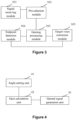
- Figure 4 is a schematic structural diagram of a gaining processing module according to a device embodiment of the present disclosure.
- the gaining processing module includes:
- Figure 5 is another schematic structural diagram of a gaining processing module according to a device embodiment of the present disclosure.
- the gaining processing module further includes:
- the gained signal generation unit 43 needs to obtain the strong gained signal and the weak gained signal according to the strong directional gain and the weak directional gain adjusted by the gain correction unit 54.
- angle setting unit 41 and the energy ratio threshold setting unit 51 described above may be independent from each other or integrated into one piece, which is not limited in the embodiment of the present disclosure.
- Figure 6 is another structural block diagram of the device.
- the device further includes: a noise reduction module 306 disposed between the pre-selection module 302 and the gaining processing module 303, and configured to perform self-adaptive filtering and noise reduction processing on the pre-selected target voice signal determined by the pre-selection module 302, such as multi-channel de-reverberation, generalized sidelobe cancellation and other noise reduction processes in the conventional technology, which is not limited in this embodiment of the present disclosure.
- a noise reduction module 306 disposed between the pre-selection module 302 and the gaining processing module 303, and configured to perform self-adaptive filtering and noise reduction processing on the pre-selected target voice signal determined by the pre-selection module 302, such as multi-channel de-reverberation, generalized sidelobe cancellation and other noise reduction processes in the conventional technology, which is not limited in this embodiment of the present disclosure.
- the device for obtaining a target voice based on a microphone array is provided in the embodiments of the present disclosure.
- a voice signal collected based on the microphone array is received, a pre-selected target voice signal and a direction of the pre-selected target voice signal are determined, and then strong directional gaining processing and weak directional gaining processing are performed on the pre-selected target voice signal, to respectively obtain a strong gained signal and a weak gained signal. Since there is less noise signal remaining in the voice signal after being strongly gained, an accurate endpoint detection result can be obtained based on the strong gained signal.
- the distortion of the target voice is very small in the voice signal after being weakly gained; therefore, a target voice signal with higher credibility can be obtained by performing endpoint processing on the weak gained signal according to the endpoint detection result.
Landscapes
- Engineering & Computer Science (AREA)
- Health & Medical Sciences (AREA)
- Acoustics & Sound (AREA)
- Physics & Mathematics (AREA)
- Multimedia (AREA)
- Audiology, Speech & Language Pathology (AREA)
- Human Computer Interaction (AREA)
- Computational Linguistics (AREA)
- Signal Processing (AREA)
- Quality & Reliability (AREA)
- General Health & Medical Sciences (AREA)
- Otolaryngology (AREA)
- Circuit For Audible Band Transducer (AREA)
- Measurement Of Velocity Or Position Using Acoustic Or Ultrasonic Waves (AREA)
Claims (16)
- Verfahren zur Gewinnung einer Zielsprache auf der Grundlage einer Mikrofonanordnung, wobei das Verfahren Folgendes umfasst:Empfangen (101) eines auf der Grundlage der Mikrofonanordnung erfassten Sprachsignals;Bestimmen (102) eines vorgewählten Zielsprachsignals und einer Richtung des vorgewählten Zielsprachsignals beruhend auf dem empfangenen Sprachsignal;Durchführen (103) einer Verarbeitung einer starken Richtungsverstärkung und einer Verarbeitung einer schwachen Richtungsverstärkung an dem vorgewählten Zielsprachsignal zur Gewinnung eines stark verstärkten Signals bzw. eines schwach verstärkten Signals;Durchführen (104) einer Endpunkterkennung beruhend auf dem stark verstärkten Signal, um ein Endpunkterkennungsergebnis zu erhalten, wobei die Endpunkterkennung Start- und Endpunkte einer Stimme in dem stark verstärkten Signal bestimmt; undDurchführen (105) einer Endpunktverarbeitung an dem schwach verstärkten Signal entsprechend dem Endpunkterkennungsergebnis zur Gewinnung eines endgültigen Zielsprachsignals,wobei das Durchführen der Verarbeitung der starken Richtungsverstärkung und der Verarbeitung der schwachen Richtungsverstärkung an dem vorgewählten Zielsprachsignal zur Gewinnung des stark verstärkten Signals bzw. des schwach verstärkten Signals Folgendes umfasst:Einstellen eines Aufnahmebereichswinkels und eines Übergangsbereichswinkels eines starken Richtungsmaßes sowie eines Aufnahmebereichswinkels und eines Übergangsbereichswinkels eines schwachen Richtungsmaßes, wobei der Aufnahmebereichswinkel des starken Richtungsmaßes kleiner als der Aufnahmebereichswinkel des schwachen Richtungsmaßes ist und der Übergangsbereichswinkel des starken Richtungsmaßes kleiner als der Übergangsbereichswinkel des schwachen Richtungsmaßes ist;Bestimmen des starken Richtungsmaßes, das auf einem Azimutwinkel einer Schallquelle beruht, auf der Grundlage des Aufnahmebereichswinkels und des Übergangsbereichswinkels des starken Richtungsmaßes, und Bestimmen des schwachen Richtungsmaßes, das auf dem Azimutwinkel der Schallquelle beruht, auf der Grundlage des Aufnahmebereichswinkels und des Übergangsbereichswinkels des schwachen Richtungsmaßes, wobei sich der Azimutwinkel der Schallquelle auf einen Azimutwinkel des vorgewählten Zielsprachsignals bezieht; undGewinnen des stark verstärkten Signals und des schwach verstärkten Signals entsprechend dem starken Richtungsmaß bzw. dem schwachen Richtungsmaß, die auf dem Azimutwinkel der Schallquelle beruhen.
- Verfahren nach Anspruch 1, wobei das Bestimmen des vorgewählten Zielsprachsignals und der Richtung des vorgewählten Zielsprachsignals Folgendes umfasst:
Bestimmen des vorgewählten Zielsprachsignals und der Richtung des vorgewählten Zielsprachsignals mittels Schallquellenlokalisierung. - Verfahren nach Anspruch 1, wobei das Bestimmen des vorgewählten Zielsprachsignals und der Richtung des vorgewählten Zielsprachsignals Folgendes umfasst:Durchführen einer Strahlformungsverarbeitung an dem Sprachsignal zur Gewinnung von Strahlen in unterschiedlichen Richtungen;Auswählen eines Strahls aus den Strahlen in unterschiedlichen Richtungen, der eine vorgegebene Bedingung erfüllt, und Bestimmen des Zielsprachsignals und der Richtung des Zielsprachsignals auf der Grundlage des ausgewählten Strahls.
- Verfahren nach Anspruch 1, wobei der Aufnahmebereichswinkel des starken Richtungsmaßes kleiner als ein Winkel einer Hauptkeule des vorgewählten Zielsprachsignals ist.
- Verfahren nach Anspruch 1, wobei das Durchführen der Verarbeitung der starken Richtungsverstärkung und der Verarbeitung der schwachen Richtungsverstärkung an dem vorgewählten Zielsprachsignal zur Gewinnung des stark verstärkten Signals bzw. des schwach verstärkten Signals ferner Folgendes umfasst:Berechnen eines glatten Energieverhältnisses γ des vorgewählten Zielsignals zu einem Störsignal;Bestimmen eines Verstärkungseinstellungskoeffizienten beruhend auf dem glatten Energieverhältnis γ, einem vorgegebenen hohen Energieverhältnisschwellenwert und einem niedrigen Energieverhältnisschwellenwert; undEinstellen des starken Richtungsmaßes und des schwachen Richtungsmaßes entsprechend dem Verstärkungseinstellungskoeffizienten.
- Verfahren nach Anspruch 5, wobei das Bestimmen des Verstärkungseinstellungskoeffizienten beruhend auf dem glatten Energieverhältnis γ, dem vorgegebenen hohen Energieverhältnisschwellenwert und dem niedrigen Energieverhältnisschwellenwert Folgendes umfasst:Einstellen des Verstärkungseinstellungskoeffizienten auf 1 in einem Fall, in dem das glatte Energieverhältnis γ größer als der hohe Energieverhältnisschwellenwert ist;Einstellen des Verstärkungseinstellungskoeffizienten auf K 0 in einem Fall, in dem das glatte Energieverhältnis γ kleiner als der niedrige Energieverhältnisschwellenwert ist; undEinstellen des Verstärkungseinstellungskoeffizienten auf K 1 in einem Fall, in dem das glatte Energieverhältnis γ größer oder gleich dem niedrigen Energieverhältnisschwellenwert und kleiner oder gleich dem hohen Energieverhältnisschwellenwert ist, wobei K 1 > K 0 ist.
- Verfahren nach Anspruch 3, das ferner Folgendes umfasst:Durchführen einer selbstanpassenden Filterung und Rauschminderungsverarbeitung an jedem Strahl, bevor das vorgewählte Zielsprachsignal und die Richtung des vorgewählten Zielsprachsignals auf der Grundlage des Strahls, der die vorgegebene Bedingung erfüllt, bestimmt werden; oderDurchführen einer selbstanpassenden Filterung und Rauschminderungsverarbeitung an dem vorgewählten Zielsprachsignal, nachdem das vorgewählte Zielsprachsignal und die Richtung des vorgewählten Zielsprachsignals bestimmt werden.
- Vorrichtung zur Gewinnung einer Zielsprache auf der Grundlage einer Mikrofonanordnung, wobei die Vorrichtung Folgendes umfasst: ein Signalempfangsmodul (301), ein Vorauswahlmodul (302), ein Verstärkungsverarbeitungsmodul (303), ein Endpunkterkennungsmodul (304) und ein Zielsprachextraktionsmodul (305), wobei:das Signalempfangsmodul (301) dazu eingerichtet ist, ein auf der Grundlage der Mikrofonanordnung erfasstes Sprachsignal zu empfangen und das Sprachsignal an das Vorauswahlmodul (302) auszugeben;das Vorauswahlmodul (302) dazu eingerichtet ist, ein vorgewähltes Zielsprachsignal und eine Richtung des vorgewählten Zielsprachsignals beruhend auf dem empfangenen Sprachsignal zu bestimmen;das Verstärkungsverarbeitungsmodul (303) dazu eingerichtet ist, eine Verarbeitung einer starken Richtungsverstärkung und eine Verarbeitung einer schwachen Richtungsverstärkung an dem vorgewählten Zielsprachsignal durchzuführen, um ein stark verstärktes Signal bzw. ein schwach verstärktes Signal zu gewinnen, das stark verstärkte Signal an das Endpunkterkennungsmodul (304) auszugeben und das schwach verstärkte Signal an das Zielsprachextraktionsmodul (305) auszugeben;das Endpunkterkennungsmodul (304) dazu eingerichtet ist, eine Endpunkterkennung beruhend auf dem stark verstärkten Signal durchzuführen und ein Endpunkterkennungsergebnis an das Zielsprachextraktionsmodul (305) auszugeben, wobei die Endpunkterkennung Start- und Endpunkte einer Stimme in dem stark verstärkten Signal bestimmt; unddas Zielsprachextraktionsmodul (305) dazu eingerichtet ist, eine Endpunktverarbeitung an dem schwach verstärkten Signal entsprechend dem Endpunkterkennungsergebnis durchzuführen, um ein endgültiges Zielsprachsignal zu gewinnen,wobei das Verstärkungsverarbeitungsmodul (303) Folgendes umfasst:eine Winkeleinstelleinheit (41), die dazu eingerichtet ist, einen Aufnahmebereichswinkel und einen Übergangsbereichswinkel eines starken Richtungsmaßes sowie einen Aufnahmebereichswinkel und einen Übergangsbereichswinkel eines schwachen Richtungsmaßes einzustellen, wobei der Aufnahmebereichswinkel des starken Richtungsmaßes kleiner als der Aufnahmebereichswinkel des schwachen Richtungsmaßes ist und der Übergangsbereichswinkel des starken Richtungsmaßes kleiner als der Übergangsbereichswinkel des schwachen Richtungsmaßes ist;eine Verstärkungsberechnungseinheit (42), die dazu eingerichtet ist, auf der Grundlage des Aufnahmebereichswinkels und des Übergangsbereichswinkels des starken Richtungsmaßes das starke Richtungsmaß zu bestimmen, das auf einem Azimutwinkel einer Schallquelle beruht, und auf der Grundlage des Aufnahmebereichswinkels und des Übergangsbereichswinkels des schwachen Richtungsmaßes das schwache Richtungsmaß zu bestimmen, das auf dem Azimutwinkel der Schallquelle beruht, wobei sich der Azimutwinkel der Schallquelle auf einen Azimutwinkel des vorgewählten Zielsprachsignals bezieht; undeine Einheit (43) zur Erzeugung des verstärkten Signals, die dazu eingerichtet ist, das stark verstärkte Signal und das schwach verstärkte Signal entsprechend dem starken Richtungsmaß bzw. dem schwachen Richtungsmaß zu gewinnen, die auf dem Azimutwinkel der Schallquelle beruhen.
- Vorrichtung nach Anspruch 8, wobei das Vorauswahlmodul (302) dazu eingerichtet ist, das vorgewählte Zielsprachsignal und die Richtung des vorgewählten Zielsprachsignals mittels Schallquellenlokalisierung zu bestimmen.
- Vorrichtung nach Anspruch 8, wobei das Vorauswahlmodul (302) Folgendes aufweist:eine Strahlformungseinheit, die dazu eingerichtet ist, eine Strahlformungsverarbeitung an dem Sprachsignal durchzuführen, um Strahlen in unterschiedlichen Richtungen zu gewinnen; undeine Bestimmungseinheit, die dazu eingerichtet ist, aus den von der Strahlformungseinheit gewonnenen Strahlen in unterschiedlichen Richtungen einen Strahl auszuwählen, der eine vorgegebene Bedingung erfüllt, und das vorgewählte Zielsprachsignal und die Richtung des vorgewählten Zielsprachsignals auf der Grundlage des ausgewählten Strahls zu bestimmen.
- Vorrichtung nach Anspruch 8, wobei der Aufnahmebereichswinkel des starken Richtungsmaßes kleiner als ein Winkel einer Hauptkeule des vorgewählten Zielsprachsignals ist.
- Vorrichtung nach Anspruch 11, wobei das Verstärkungsverarbeitungsmodul (303) ferner Folgendes umfasst:eine Energieverhältnisschwellenwerteinstelleinheit (51), die dazu eingerichtet ist, einen hohen Energieverhältnisschwellenwert und einen niedrigen Energieverhältnisschwellenwert einzustellen;eine Energieverhältnisberechnungseinheit (52), die dazu eingerichtet ist, ein glattes Energieverhältnis γ des vorgewählten Zielsignals zu einem Störsignal zu berechnen;eine Verstärkungseinstellungskoeffizientenbestimmungseinheit (53), die dazu eingerichtet ist, einen Verstärkungseinstellungskoeffizienten beruhend auf dem glatten Energieverhältnis γ, dem hohen Energieverhältnisschwellenwert und dem niedrigen Energieverhältnisschwellenwert zu bestimmen; undeine Verstärkungskorrektureinheit (54), die dazu eingerichtet ist, das starke Richtungsmaß und das schwache Richtungsmaß, die von der Verstärkungsberechnungseinheit gewonnen werden, entsprechend dem Verstärkungseinstellungskoeffizienten einzustellen.
- Vorrichtung nach Anspruch 8, wobei das Vorauswahlmodul (302) ferner Folgendes umfasst:eine Rauschminderungseinheit, die zwischen der Strahlformungseinheit und der Bestimmungseinheit angeordnet und dazu eingerichtet ist, eine selbstanpassende Filterung und Rauschminderungsverarbeitung an jedem von der Strahlformungseinheit gewonnenen Strahl durchzuführen;oder die Vorrichtung ferner Folgendes umfasst:
ein Rauschminderungsmodul (306), das zwischen dem Vorauswahlmodul (302) und dem Verstärkungsverarbeitungsmodul (303) angeordnet und dazu eingerichtet ist, eine selbstanpassende Filterung und Rauschminderungsverarbeitung an dem von dem Vorauswahlmodul (302) bestimmten vorgewählten Zielsprachsignal durchzuführen. - Computerlesbares Speichermedium, das Computerprogrammcodes umfasst, wobei die Computerprogrammcodes dann, wenn sie von einer Rechnereinheit ausgeführt werden, bewirken, dass die Rechnereinheit die Schritte in dem Verfahren zur Gewinnung einer Zielsprache auf der Grundlage einer Mikrofonanordnung nach einem der Ansprüche 1 bis 7 durchführt.
- Vorrichtung zur Gewinnung einer Zielsprache auf der Grundlage einer Mikrofonanordnung, wobei die Vorrichtung einen Prozessor, einen Speicher und einen Systembus umfasst, wobei:der Prozessor und der Speicher über den Systembus miteinander verbunden sind undder Speicher dazu eingerichtet ist, ein oder mehrere Programme zu speichern, und das eine oder die mehreren Programme Befehle umfassen, die bei Ausführung durch den Prozessor bewirken, dass der Prozessor die Schritte in dem Verfahren zur Gewinnung einer Zielsprache auf der Grundlage einer Mikrofonanordnung nach einem der Ansprüche 1 bis 7 durchführt.
- Computerprogrammprodukt, das dann, wenn es auf einem Endgerät läuft, bewirkt, dass das Endgerät die Schritte in dem Verfahren zur Gewinnung der Zielsprache auf der Grundlage einer Mikrofonanordnung nach einem der Ansprüche 1 bis 7 durchführt.
Applications Claiming Priority (2)
| Application Number | Priority Date | Filing Date | Title |
|---|---|---|---|
| CN201710994211.5A CN107742522B (zh) | 2017-10-23 | 2017-10-23 | 基于麦克风阵列的目标语音获取方法及装置 |
| PCT/CN2018/095765 WO2019080553A1 (zh) | 2017-10-23 | 2018-07-16 | 基于麦克风阵列的目标语音获取方法及装置 |
Publications (4)
| Publication Number | Publication Date |
|---|---|
| EP3703053A1 EP3703053A1 (de) | 2020-09-02 |
| EP3703053A4 EP3703053A4 (de) | 2021-07-21 |
| EP3703053B1 true EP3703053B1 (de) | 2023-10-18 |
| EP3703053C0 EP3703053C0 (de) | 2023-10-18 |
Family
ID=61238104
Family Applications (1)
| Application Number | Title | Priority Date | Filing Date |
|---|---|---|---|
| EP18870140.3A Active EP3703053B1 (de) | 2017-10-23 | 2018-07-16 | Verfahren und vorrichtung zur mikrofonarraybasierten zielspracherfassung |
Country Status (9)
| Country | Link |
|---|---|
| US (1) | US11081123B2 (de) |
| EP (1) | EP3703053B1 (de) |
| JP (1) | JP7011075B2 (de) |
| KR (1) | KR102469516B1 (de) |
| CN (1) | CN107742522B (de) |
| ES (1) | ES2967132T3 (de) |
| HU (1) | HUE065302T2 (de) |
| PL (1) | PL3703053T3 (de) |
| WO (1) | WO2019080553A1 (de) |
Families Citing this family (35)
| Publication number | Priority date | Publication date | Assignee | Title |
|---|---|---|---|---|
| CN107742522B (zh) | 2017-10-23 | 2022-01-14 | 科大讯飞股份有限公司 | 基于麦克风阵列的目标语音获取方法及装置 |
| CN108735227B (zh) * | 2018-06-22 | 2020-05-19 | 北京三听科技有限公司 | 对麦克风阵列拾取的语音信号进行声源分离的方法及系统 |
| CN108962226B (zh) * | 2018-07-18 | 2019-12-20 | 百度在线网络技术(北京)有限公司 | 用于检测语音的端点的方法和装置 |
| CN110875056B (zh) * | 2018-08-30 | 2024-04-02 | 阿里巴巴集团控股有限公司 | 语音转录设备、系统、方法、及电子设备 |
| CN109243457B (zh) * | 2018-11-06 | 2023-01-17 | 北京如布科技有限公司 | 基于语音的控制方法、装置、设备及存储介质 |
| CN109545242A (zh) * | 2018-12-07 | 2019-03-29 | 广州势必可赢网络科技有限公司 | 一种音频数据处理方法、系统、装置及可读存储介质 |
| CN111627425B (zh) | 2019-02-12 | 2023-11-28 | 阿里巴巴集团控股有限公司 | 一种语音识别方法及系统 |
| CN110310625A (zh) * | 2019-07-05 | 2019-10-08 | 四川长虹电器股份有限公司 | 语音断句方法及系统 |
| CN112216298B (zh) * | 2019-07-12 | 2024-04-26 | 大众问问(北京)信息科技有限公司 | 双麦克风阵列声源定向方法、装置及设备 |
| CN110517677B (zh) * | 2019-08-27 | 2022-02-08 | 腾讯科技(深圳)有限公司 | 语音处理系统、方法、设备、语音识别系统及存储介质 |
| CN110415718B (zh) * | 2019-09-05 | 2020-11-03 | 腾讯科技(深圳)有限公司 | 信号生成的方法、基于人工智能的语音识别方法及装置 |
| CN110517702B (zh) * | 2019-09-06 | 2022-10-04 | 腾讯科技(深圳)有限公司 | 信号生成的方法、基于人工智能的语音识别方法及装置 |
| CN110619895A (zh) * | 2019-09-06 | 2019-12-27 | Oppo广东移动通信有限公司 | 定向发声控制方法及装置、发声设备、介质和电子设备 |
| CN111243615B (zh) * | 2020-01-08 | 2023-02-10 | 环鸿电子(昆山)有限公司 | 麦克风阵列信号处理方法及手持式装置 |
| CN113141285B (zh) * | 2020-01-19 | 2022-04-29 | 海信集团有限公司 | 一种沉浸式语音交互方法及系统 |
| CN111161748B (zh) * | 2020-02-20 | 2022-09-23 | 百度在线网络技术(北京)有限公司 | 一种双讲状态检测方法、装置以及电子设备 |
| CN113393856B (zh) * | 2020-03-11 | 2024-01-16 | 华为技术有限公司 | 拾音方法、装置和电子设备 |
| CN111429905B (zh) * | 2020-03-23 | 2024-06-07 | 北京声智科技有限公司 | 语音信号处理方法、装置、语音智能电梯、介质和设备 |
| CN113496708B (zh) * | 2020-04-08 | 2024-03-26 | 华为技术有限公司 | 拾音方法、装置和电子设备 |
| CN111627456B (zh) * | 2020-05-13 | 2023-07-21 | 广州国音智能科技有限公司 | 噪音排除方法、装置、设备及可读存储介质 |
| USD958435S1 (en) * | 2020-07-17 | 2022-07-19 | Aiping GUO | Motion sensor ceiling light |
| CN112151036B (zh) * | 2020-09-16 | 2021-07-30 | 科大讯飞(苏州)科技有限公司 | 基于多拾音场景的防串音方法、装置以及设备 |
| CN112185406A (zh) * | 2020-09-18 | 2021-01-05 | 北京大米科技有限公司 | 声音处理方法、装置、电子设备和可读存储介质 |
| CN112333602B (zh) * | 2020-11-11 | 2022-08-26 | 支付宝(杭州)信息技术有限公司 | 信号处理方法、信号处理设备、计算机可读存储介质及室内用播放系统 |
| CN112562681B (zh) * | 2020-12-02 | 2021-11-19 | 腾讯科技(深圳)有限公司 | 语音识别方法和装置、存储介质 |
| CN112735461B (zh) * | 2020-12-29 | 2024-06-07 | 西安讯飞超脑信息科技有限公司 | 拾音方法以及相关装置、设备 |
| CN112908310A (zh) * | 2021-01-20 | 2021-06-04 | 宁波方太厨具有限公司 | 一种智能电器中的语音指令识别方法及识别系统 |
| CN113053406B (zh) * | 2021-05-08 | 2024-06-18 | 北京小米移动软件有限公司 | 声音信号识别方法及装置 |
| CN115966214A (zh) * | 2021-10-12 | 2023-04-14 | 腾讯科技(深圳)有限公司 | 音频处理方法、装置、电子设备和计算机可读存储介质 |
| EP4404196A4 (de) * | 2021-11-09 | 2025-01-22 | Samsung Electronics Co., Ltd. | Elektronische vorrichtung zur steuerung der strahlformung und betriebsverfahren dafür |
| CN114245266B (zh) * | 2021-12-15 | 2022-12-23 | 苏州蛙声科技有限公司 | 小型麦克风阵列设备的区域拾音方法及系统 |
| US12335697B2 (en) | 2022-01-07 | 2025-06-17 | Shure Acquisition Holdings, Inc. | System and method for automatic setup of audio coverage area |
| CN116168719A (zh) * | 2022-12-26 | 2023-05-26 | 杭州爱听科技有限公司 | 一种基于语境分析的声音增益调节方法及系统 |
| CN118918906B (zh) * | 2024-09-04 | 2025-03-21 | 美的集团(上海)有限公司 | 语音处理方法及装置、电子设备和可读存储介质 |
| CN120032661B (zh) * | 2025-04-17 | 2025-08-22 | 清枫(北京)科技有限公司 | 基于多通道信号处理的游戏组队语音降噪方法及装置 |
Family Cites Families (33)
| Publication number | Priority date | Publication date | Assignee | Title |
|---|---|---|---|---|
| EP1483591A2 (de) | 2002-03-05 | 2004-12-08 | Aliphcom | Sprachaktivitätsdetektion-vorrichtung und verfahren zur verwendung mit einem rauschunterdrückungssystem |
| US7415117B2 (en) * | 2004-03-02 | 2008-08-19 | Microsoft Corporation | System and method for beamforming using a microphone array |
| EP1923866B1 (de) * | 2005-08-11 | 2014-01-01 | Asahi Kasei Kabushiki Kaisha | Schallquellen-Trenneinrichtung, Spracherkennungseinrichtung, tragbares Telefon, Schallquellen-Trennverfahren und Programm |
| JP2007086554A (ja) * | 2005-09-26 | 2007-04-05 | Toshiba Tec Corp | 音声認識装置及び音声認識処理用プログラム |
| JP4096104B2 (ja) * | 2005-11-24 | 2008-06-04 | 国立大学法人北陸先端科学技術大学院大学 | 雑音低減システム及び雑音低減方法 |
| KR20090037845A (ko) * | 2008-12-18 | 2009-04-16 | 삼성전자주식회사 | 혼합 신호로부터 목표 음원 신호를 추출하는 방법 및 장치 |
| KR101041039B1 (ko) | 2009-02-27 | 2011-06-14 | 고려대학교 산학협력단 | 오디오 및 비디오 정보를 이용한 시공간 음성 구간 검출 방법 및 장치 |
| CN101510426B (zh) * | 2009-03-23 | 2013-03-27 | 北京中星微电子有限公司 | 一种噪声消除方法及系统 |
| CN102196109B (zh) * | 2010-03-01 | 2013-07-31 | 联芯科技有限公司 | 一种残留回声检测方法和系统 |
| JP5672770B2 (ja) | 2010-05-19 | 2015-02-18 | 富士通株式会社 | マイクロホンアレイ装置及び前記マイクロホンアレイ装置が実行するプログラム |
| JP2011257627A (ja) * | 2010-06-10 | 2011-12-22 | Murata Mach Ltd | 音声認識装置と認識方法 |
| JP2012150237A (ja) | 2011-01-18 | 2012-08-09 | Sony Corp | 音信号処理装置、および音信号処理方法、並びにプログラム |
| US9100735B1 (en) * | 2011-02-10 | 2015-08-04 | Dolby Laboratories Licensing Corporation | Vector noise cancellation |
| US9354310B2 (en) | 2011-03-03 | 2016-05-31 | Qualcomm Incorporated | Systems, methods, apparatus, and computer-readable media for source localization using audible sound and ultrasound |
| CN103248992B (zh) | 2012-02-08 | 2016-01-20 | 中国科学院声学研究所 | 一种基于双麦克风的目标方向语音活动检测方法及系统 |
| KR20130101943A (ko) * | 2012-03-06 | 2013-09-16 | 삼성전자주식회사 | 음원 끝점 검출 장치 및 그 방법 |
| CN102800325A (zh) * | 2012-08-31 | 2012-11-28 | 厦门大学 | 一种超声波辅助麦克风阵列语音增强装置 |
| CN102969002B (zh) * | 2012-11-28 | 2014-09-03 | 厦门大学 | 一种可抑制移动噪声的麦克风阵列语音增强装置 |
| JP6107151B2 (ja) * | 2013-01-15 | 2017-04-05 | 富士通株式会社 | 雑音抑圧装置、方法、及びプログラム |
| US10229697B2 (en) * | 2013-03-12 | 2019-03-12 | Google Technology Holdings LLC | Apparatus and method for beamforming to obtain voice and noise signals |
| CN104103277B (zh) * | 2013-04-15 | 2017-04-05 | 北京大学深圳研究生院 | 一种基于时频掩膜的单声学矢量传感器目标语音增强方法 |
| CN103426440A (zh) * | 2013-08-22 | 2013-12-04 | 厦门大学 | 利用能量谱熵空间信息的语音端点检测装置及其检测方法 |
| CN103544959A (zh) * | 2013-10-25 | 2014-01-29 | 华南理工大学 | 一种基于无线定位麦克风阵列语音增强的通话系统及方法 |
| CN104091593B (zh) * | 2014-04-29 | 2017-02-15 | 苏州大学 | 采用感知语谱结构边界参数的语音端点检测算法 |
| CN104038880B (zh) * | 2014-06-26 | 2017-06-23 | 南京工程学院 | 一种双耳助听器语音增强方法 |
| CN105489224B (zh) * | 2014-09-15 | 2019-10-18 | 讯飞智元信息科技有限公司 | 一种基于麦克风阵列的语音降噪方法及系统 |
| JP7074285B2 (ja) * | 2014-11-10 | 2022-05-24 | 日本電気株式会社 | 信号処理装置、信号処理方法および信号処理プログラム |
| CN104936091B (zh) * | 2015-05-14 | 2018-06-15 | 讯飞智元信息科技有限公司 | 基于圆形麦克风阵列的智能交互方法及系统 |
| KR102444061B1 (ko) * | 2015-11-02 | 2022-09-16 | 삼성전자주식회사 | 음성 인식이 가능한 전자 장치 및 방법 |
| CN106255026A (zh) * | 2016-08-08 | 2016-12-21 | 浙江大学 | 基于语音模式识别和振动反馈的助残装置及交互方法 |
| CN106952653B (zh) * | 2017-03-15 | 2021-05-04 | 科大讯飞股份有限公司 | 噪声去除方法、装置和终端设备 |
| CN107146614B (zh) * | 2017-04-10 | 2020-11-06 | 北京猎户星空科技有限公司 | 一种语音信号处理方法、装置及电子设备 |
| CN107742522B (zh) | 2017-10-23 | 2022-01-14 | 科大讯飞股份有限公司 | 基于麦克风阵列的目标语音获取方法及装置 |
-
2017
- 2017-10-23 CN CN201710994211.5A patent/CN107742522B/zh active Active
-
2018
- 2018-07-16 ES ES18870140T patent/ES2967132T3/es active Active
- 2018-07-16 US US16/757,905 patent/US11081123B2/en active Active
- 2018-07-16 KR KR1020207014257A patent/KR102469516B1/ko active Active
- 2018-07-16 HU HUE18870140A patent/HUE065302T2/hu unknown
- 2018-07-16 EP EP18870140.3A patent/EP3703053B1/de active Active
- 2018-07-16 WO PCT/CN2018/095765 patent/WO2019080553A1/zh not_active Ceased
- 2018-07-16 PL PL18870140.3T patent/PL3703053T3/pl unknown
- 2018-07-16 JP JP2020542484A patent/JP7011075B2/ja active Active
Also Published As
| Publication number | Publication date |
|---|---|
| CN107742522B (zh) | 2022-01-14 |
| US20200342887A1 (en) | 2020-10-29 |
| US11081123B2 (en) | 2021-08-03 |
| KR20200066366A (ko) | 2020-06-09 |
| HUE065302T2 (hu) | 2024-05-28 |
| EP3703053A1 (de) | 2020-09-02 |
| ES2967132T3 (es) | 2024-04-26 |
| EP3703053A4 (de) | 2021-07-21 |
| KR102469516B1 (ko) | 2022-11-21 |
| CN107742522A (zh) | 2018-02-27 |
| JP2021500634A (ja) | 2021-01-07 |
| PL3703053T3 (pl) | 2024-03-11 |
| EP3703053C0 (de) | 2023-10-18 |
| WO2019080553A1 (zh) | 2019-05-02 |
| JP7011075B2 (ja) | 2022-01-26 |
Similar Documents
| Publication | Publication Date | Title |
|---|---|---|
| EP3703053B1 (de) | Verfahren und vorrichtung zur mikrofonarraybasierten zielspracherfassung | |
| US11817112B2 (en) | Method, device, computer readable storage medium and electronic apparatus for speech signal processing | |
| US11056130B2 (en) | Speech enhancement method and apparatus, device and storage medium | |
| CN108831495B (zh) | 一种应用于噪声环境下语音识别的语音增强方法 | |
| US9357298B2 (en) | Sound signal processing apparatus, sound signal processing method, and program | |
| US9280985B2 (en) | Noise suppression apparatus and control method thereof | |
| CN102938254B (zh) | 一种语音信号增强系统和方法 | |
| US8363850B2 (en) | Audio signal processing method and apparatus for the same | |
| US9159335B2 (en) | Apparatus and method for noise estimation, and noise reduction apparatus employing the same | |
| CN110085247B (zh) | 一种针对复杂噪声环境的双麦克风降噪方法 | |
| US9048942B2 (en) | Method and system for reducing interference and noise in speech signals | |
| US20200342890A1 (en) | Target voice detection method and apparatus | |
| Kumatani et al. | Microphone array processing for distant speech recognition: Towards real-world deployment | |
| US11594239B1 (en) | Detection and removal of wind noise | |
| US20110228951A1 (en) | Sound processing apparatus, sound processing method, and program | |
| CN105244036A (zh) | 一种麦克风语音增强方法及装置 | |
| CN108538306B (zh) | 提高语音设备doa估计的方法及装置 | |
| CN111081267A (zh) | 一种多通道远场语音增强方法 | |
| CN114242104B (zh) | 语音降噪的方法、装置、设备及存储介质 | |
| CN113689870B (zh) | 一种多通道语音增强方法及其装置、终端、可读存储介质 | |
| CN115249485A (zh) | 语音增强方法、装置、电子设备及存储介质 | |
| CN113132519B (zh) | 电子设备、电子设备的语音识别方法及存储介质 | |
| CN111048096B (zh) | 一种语音信号处理方法、装置及终端 | |
| CN114999521B (en) | Voice enhancement method and device and electronic equipment | |
| Aprilyanti et al. | Suppression of noise and late reverberation based on blind signal extraction and Wiener filtering |
Legal Events
| Date | Code | Title | Description |
|---|---|---|---|
| STAA | Information on the status of an ep patent application or granted ep patent |
Free format text: STATUS: THE INTERNATIONAL PUBLICATION HAS BEEN MADE |
|
| PUAI | Public reference made under article 153(3) epc to a published international application that has entered the european phase |
Free format text: ORIGINAL CODE: 0009012 |
|
| STAA | Information on the status of an ep patent application or granted ep patent |
Free format text: STATUS: REQUEST FOR EXAMINATION WAS MADE |
|
| 17P | Request for examination filed |
Effective date: 20200428 |
|
| AK | Designated contracting states |
Kind code of ref document: A1 Designated state(s): AL AT BE BG CH CY CZ DE DK EE ES FI FR GB GR HR HU IE IS IT LI LT LU LV MC MK MT NL NO PL PT RO RS SE SI SK SM TR |
|
| AX | Request for extension of the european patent |
Extension state: BA ME |
|
| DAV | Request for validation of the european patent (deleted) | ||
| DAX | Request for extension of the european patent (deleted) | ||
| REG | Reference to a national code |
Ref country code: DE Ref legal event code: R079 Free format text: PREVIOUS MAIN CLASS: G10L0021020800 Ipc: G10L0025780000 Ref country code: DE Ref legal event code: R079 Ref document number: 602018059729 Country of ref document: DE Free format text: PREVIOUS MAIN CLASS: G10L0021020800 Ipc: G10L0025780000 |
|
| A4 | Supplementary search report drawn up and despatched |
Effective date: 20210618 |
|
| RIC1 | Information provided on ipc code assigned before grant |
Ipc: G10L 25/78 20130101AFI20210614BHEP Ipc: G10L 21/0216 20130101ALI20210614BHEP Ipc: G10L 21/0208 20130101ALI20210614BHEP Ipc: G10L 15/04 20130101ALI20210614BHEP |
|
| GRAP | Despatch of communication of intention to grant a patent |
Free format text: ORIGINAL CODE: EPIDOSNIGR1 |
|
| STAA | Information on the status of an ep patent application or granted ep patent |
Free format text: STATUS: GRANT OF PATENT IS INTENDED |
|
| INTG | Intention to grant announced |
Effective date: 20230502 |
|
| GRAS | Grant fee paid |
Free format text: ORIGINAL CODE: EPIDOSNIGR3 |
|
| GRAA | (expected) grant |
Free format text: ORIGINAL CODE: 0009210 |
|
| STAA | Information on the status of an ep patent application or granted ep patent |
Free format text: STATUS: THE PATENT HAS BEEN GRANTED |
|
| AK | Designated contracting states |
Kind code of ref document: B1 Designated state(s): AL AT BE BG CH CY CZ DE DK EE ES FI FR GB GR HR HU IE IS IT LI LT LU LV MC MK MT NL NO PL PT RO RS SE SI SK SM TR |
|
| REG | Reference to a national code |
Ref country code: GB Ref legal event code: FG4D |
|
| REG | Reference to a national code |
Ref country code: CH Ref legal event code: EP |
|
| REG | Reference to a national code |
Ref country code: DE Ref legal event code: R096 Ref document number: 602018059729 Country of ref document: DE |
|
| REG | Reference to a national code |
Ref country code: IE Ref legal event code: FG4D |
|
| U01 | Request for unitary effect filed |
Effective date: 20231115 |
|
| U07 | Unitary effect registered |
Designated state(s): AT BE BG DE DK EE FI FR IT LT LU LV MT NL PT SE SI Effective date: 20231122 |
|
| PG25 | Lapsed in a contracting state [announced via postgrant information from national office to epo] |
Ref country code: GR Free format text: LAPSE BECAUSE OF FAILURE TO SUBMIT A TRANSLATION OF THE DESCRIPTION OR TO PAY THE FEE WITHIN THE PRESCRIBED TIME-LIMIT Effective date: 20240119 |
|
| PG25 | Lapsed in a contracting state [announced via postgrant information from national office to epo] |
Ref country code: IS Free format text: LAPSE BECAUSE OF FAILURE TO SUBMIT A TRANSLATION OF THE DESCRIPTION OR TO PAY THE FEE WITHIN THE PRESCRIBED TIME-LIMIT Effective date: 20240218 |
|
| REG | Reference to a national code |
Ref country code: ES Ref legal event code: FG2A Ref document number: 2967132 Country of ref document: ES Kind code of ref document: T3 Effective date: 20240426 |
|
| PG25 | Lapsed in a contracting state [announced via postgrant information from national office to epo] |
Ref country code: IS Free format text: LAPSE BECAUSE OF FAILURE TO SUBMIT A TRANSLATION OF THE DESCRIPTION OR TO PAY THE FEE WITHIN THE PRESCRIBED TIME-LIMIT Effective date: 20240218 Ref country code: GR Free format text: LAPSE BECAUSE OF FAILURE TO SUBMIT A TRANSLATION OF THE DESCRIPTION OR TO PAY THE FEE WITHIN THE PRESCRIBED TIME-LIMIT Effective date: 20240119 |
|
| REG | Reference to a national code |
Ref country code: HU Ref legal event code: AG4A Ref document number: E065302 Country of ref document: HU |
|
| PG25 | Lapsed in a contracting state [announced via postgrant information from national office to epo] |
Ref country code: RS Free format text: LAPSE BECAUSE OF FAILURE TO SUBMIT A TRANSLATION OF THE DESCRIPTION OR TO PAY THE FEE WITHIN THE PRESCRIBED TIME-LIMIT Effective date: 20231018 Ref country code: NO Free format text: LAPSE BECAUSE OF FAILURE TO SUBMIT A TRANSLATION OF THE DESCRIPTION OR TO PAY THE FEE WITHIN THE PRESCRIBED TIME-LIMIT Effective date: 20240118 Ref country code: HR Free format text: LAPSE BECAUSE OF FAILURE TO SUBMIT A TRANSLATION OF THE DESCRIPTION OR TO PAY THE FEE WITHIN THE PRESCRIBED TIME-LIMIT Effective date: 20231018 |
|
| REG | Reference to a national code |
Ref country code: DE Ref legal event code: R097 Ref document number: 602018059729 Country of ref document: DE |
|
| PG25 | Lapsed in a contracting state [announced via postgrant information from national office to epo] |
Ref country code: SK Free format text: LAPSE BECAUSE OF FAILURE TO SUBMIT A TRANSLATION OF THE DESCRIPTION OR TO PAY THE FEE WITHIN THE PRESCRIBED TIME-LIMIT Effective date: 20231018 |
|
| PG25 | Lapsed in a contracting state [announced via postgrant information from national office to epo] |
Ref country code: SM Free format text: LAPSE BECAUSE OF FAILURE TO SUBMIT A TRANSLATION OF THE DESCRIPTION OR TO PAY THE FEE WITHIN THE PRESCRIBED TIME-LIMIT Effective date: 20231018 Ref country code: SK Free format text: LAPSE BECAUSE OF FAILURE TO SUBMIT A TRANSLATION OF THE DESCRIPTION OR TO PAY THE FEE WITHIN THE PRESCRIBED TIME-LIMIT Effective date: 20231018 Ref country code: RO Free format text: LAPSE BECAUSE OF FAILURE TO SUBMIT A TRANSLATION OF THE DESCRIPTION OR TO PAY THE FEE WITHIN THE PRESCRIBED TIME-LIMIT Effective date: 20231018 |
|
| U20 | Renewal fee for the european patent with unitary effect paid |
Year of fee payment: 7 Effective date: 20240717 |
|
| PLBE | No opposition filed within time limit |
Free format text: ORIGINAL CODE: 0009261 |
|
| STAA | Information on the status of an ep patent application or granted ep patent |
Free format text: STATUS: NO OPPOSITION FILED WITHIN TIME LIMIT |
|
| 26N | No opposition filed |
Effective date: 20240719 |
|
| PG25 | Lapsed in a contracting state [announced via postgrant information from national office to epo] |
Ref country code: MC Free format text: LAPSE BECAUSE OF FAILURE TO SUBMIT A TRANSLATION OF THE DESCRIPTION OR TO PAY THE FEE WITHIN THE PRESCRIBED TIME-LIMIT Effective date: 20231018 |
|
| PG25 | Lapsed in a contracting state [announced via postgrant information from national office to epo] |
Ref country code: IE Free format text: LAPSE BECAUSE OF NON-PAYMENT OF DUE FEES Effective date: 20240716 |
|
| PGFP | Annual fee paid to national office [announced via postgrant information from national office to epo] |
Ref country code: HU Payment date: 20250723 Year of fee payment: 8 |
|
| U20 | Renewal fee for the european patent with unitary effect paid |
Year of fee payment: 8 Effective date: 20250704 |
|
| PGFP | Annual fee paid to national office [announced via postgrant information from national office to epo] |
Ref country code: ES Payment date: 20250801 Year of fee payment: 8 |
|
| PGFP | Annual fee paid to national office [announced via postgrant information from national office to epo] |
Ref country code: PL Payment date: 20250707 Year of fee payment: 8 Ref country code: TR Payment date: 20250716 Year of fee payment: 8 |
|
| PGFP | Annual fee paid to national office [announced via postgrant information from national office to epo] |
Ref country code: GB Payment date: 20250718 Year of fee payment: 8 |
|
| PGFP | Annual fee paid to national office [announced via postgrant information from national office to epo] |
Ref country code: CH Payment date: 20250801 Year of fee payment: 8 |
|
| PGFP | Annual fee paid to national office [announced via postgrant information from national office to epo] |
Ref country code: CZ Payment date: 20250703 Year of fee payment: 8 |
|
| PG25 | Lapsed in a contracting state [announced via postgrant information from national office to epo] |
Ref country code: CY Free format text: LAPSE BECAUSE OF FAILURE TO SUBMIT A TRANSLATION OF THE DESCRIPTION OR TO PAY THE FEE WITHIN THE PRESCRIBED TIME-LIMIT; INVALID AB INITIO Effective date: 20180716 |