EP3702976A1 - Detektionsschema - Google Patents
Detektionsschema Download PDFInfo
- Publication number
- EP3702976A1 EP3702976A1 EP20159165.8A EP20159165A EP3702976A1 EP 3702976 A1 EP3702976 A1 EP 3702976A1 EP 20159165 A EP20159165 A EP 20159165A EP 3702976 A1 EP3702976 A1 EP 3702976A1
- Authority
- EP
- European Patent Office
- Prior art keywords
- state
- ion
- laser
- dark
- applying
- Prior art date
- Legal status (The legal status is an assumption and is not a legal conclusion. Google has not performed a legal analysis and makes no representation as to the accuracy of the status listed.)
- Granted
Links
Images



Classifications
-
- G—PHYSICS
- G06—COMPUTING OR CALCULATING; COUNTING
- G06N—COMPUTING ARRANGEMENTS BASED ON SPECIFIC COMPUTATIONAL MODELS
- G06N10/00—Quantum computing, i.e. information processing based on quantum-mechanical phenomena
- G06N10/40—Physical realisations or architectures of quantum processors or components for manipulating qubits, e.g. qubit coupling or qubit control
-
- H—ELECTRICITY
- H10—SEMICONDUCTOR DEVICES; ELECTRIC SOLID-STATE DEVICES NOT OTHERWISE PROVIDED FOR
- H10N—ELECTRIC SOLID-STATE DEVICES NOT OTHERWISE PROVIDED FOR
- H10N60/00—Superconducting devices
- H10N60/80—Constructional details
- H10N60/84—Switching means for devices switchable between superconducting and normal states
-
- H—ELECTRICITY
- H10—SEMICONDUCTOR DEVICES; ELECTRIC SOLID-STATE DEVICES NOT OTHERWISE PROVIDED FOR
- H10N—ELECTRIC SOLID-STATE DEVICES NOT OTHERWISE PROVIDED FOR
- H10N60/00—Superconducting devices
- H10N60/80—Constructional details
- H10N60/85—Superconducting active materials
- H10N60/855—Ceramic superconductors
Definitions
- Embodiments described herein generally relate to quantum computing.
- Quantum computing may be used to perform advanced computational processing. Quantum computing may leverage physical properties of quantum bits (e.g., qubits), such as quantum superposition and quantum entanglement. For example, in contrast with conventional digital processing in which data is encoded into binary states (e.g., 1 or 0), quantum superposition enables the qubits used in quantum computing to be in both states simultaneously. In contrast with the independent nature of individual bits in conventional digital processing, quantum entanglement enables a linking between or among qubits so each qubit may provide information about related qubits. However, the fidelity of data encoded into the qubits is subject to errors, such as a spontaneous state change of qubits. What is needed in an improved solution to improve qubit fidelity.
- quantum bits e.g., qubits
- quantum superposition enables the qubits used in quantum computing to be in both states simultaneously.
- quantum entanglement enables a linking between or among qubits so each qubit may provide information about related qubits.
- qubit readout refers includes determining which logical state the qubit was in following execution of a particular computation.
- ytterbium-171 i.e., 171Yb+
- qubit readout is achieved by identifying a qubit state that emits many photons as "bright” and a qubit state that emits few or no photons as "dark.” By collecting photons from the qubit, the state of the qubit can be determined.
- the readout fidelity of 171Yb+ qubits is reduced by mixing of the bright and dark states, which creates ambiguity when determining the state of the qubit.
- improving readout fidelity of 171Yb+ qubits may improve fidelity by an order of magnitude, such as by improving readout fidelity from 99.9% to 99.99%. This improvement in detection fidelity may substantially increase the computational power of a quantum computer.
- this includes transferring the qubit population that is in the dark quantum state to an auxiliary third state.
- the auxiliary third state remains dark and reduces the mixing between the logical bright and dark states.
- This process uses multiple laser pulses to ensure high fidelity population transfer, thus preserving the dark nature of the dark state during readout.
- This transfer to an auxiliary third state may be referred to as "shelving.”
- 171Yb+ qubits offer various advantages described herein, the atomic structure of 171Yb+ qubits may be considered unfavorable for shelving. However, using the controlled state transitions described herein, shelving 171Yb+ qubits may provide improved readout fidelity.
- FIG. 1 is a first 171Yb+ state transition diagram 100, according to an embodiment.
- Diagram 100 shows various 171Yb+ states and state transitions. As shown in diagram 100, straight lines indicate transitions at least partially driven by lasers, wavy lines indicate decay transitions, transition line thickness indicates transition strength, dashed lines indicate undesired transitions that are detrimental to detection, and solid lines are desirable or inconsequential transitions in state detection.
- Laser transition 110 may include a laser applied to transition states from a dark S-state 135 to a P-state 140, which may be detrimental to detection.
- Laser transition 115 may include a laser applied to transition states from a bright S-state 130 to the P-state 140, which may be beneficial in state detection.
- Decay transition 120 may include a spontaneous 171Yb+ state decay from P-state 140 to bright S-state 130, which may be beneficial in state detection.
- Decay transition 125 may include a spontaneous 171Yb+ state decay from P-state 140 to dark S-state 135, which may be detrimental in state detection.
- Light is collected from the decay transition 120.
- the decay transition 125 is undesirable, and may typically occur after approximately 3 ms.
- the laser transition 110 is also undesirable, and may typically occur after approximately 52 ms.
- Decay transition 150 may include a spontaneous 171Yb+ state decay from P-state 140 to bright D-state 160, which may be inconsequential in state detection.
- Decay transition 155 may include a spontaneous 171Yb+ state decay from P-state 140 to dark D-state 165, which may be inconsequential in state detection.
- Laser transition 170 may include a laser applied to transition states from a bright D-state 165 (e.g., through an unshown intermediary state such as 2 [3/2] 1/2 ) to bright S-state 130, which may be beneficial in state detection.
- Laser transition 175 may include a laser applied to transition states from bright D-state 160 (e.g., through an unshown intermediary state such as 2 [3/2] 1/2 ) to bright S-state 130, which may be beneficial in state detection. Both decay transition 150 and decay transition 155 are both returned to bright S-state 130, and may be considered inconsequential for state detection.
- FIG. 2 is a second 171Yb+ state transition diagram 200, according to an embodiment.
- This second 171Yb+ state transition diagram 200 is similar to diagram 100 with a few notable differences.
- laser transitions 205 between S-state 235 and D-state 260 are used before collecting light (e.g., detecting bright or dark state) to transfer any 171Yb+ ions from S-state 235 to dark D-state 260.
- Light is collected from decay transitions 220 and 225 from P-state 240 to dark S-states 230 and 235.
- laser transition 210 is used to transition the ions back from dark S-state 235 to P-state 240.
- the decay transition 275 from dark D-state 260 to bright S-state 230 is undesirable and may occur after approximately 53 ms.
- the decay transition 250 from P-state 240 to dark D-state 260 is undesirable and may occur after approximately 100 ms.
- both of these undesirable state transitions are substantially slower than the 3 ms decay transition 125 in diagram 100.
- the laser and decay transitions shown in diagram 200 thus increases bright state lifetime by allowing 14.7 GHz sidebands and provides fast and efficient repump with no additional laser overhead.
- FIG. 3 is a 171Yb+ state transition method 300, according to an embodiment.
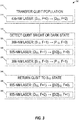
- Method 300 includes transferring 310 qubit population, where a 435-nm laser is used to transfer 315 qubit population in the
- S 1/2 , F 0 ⁇ state to the
- D 3/2 , F 2 ⁇ manifold of states.
- transfer 315 is carried out via two consecutive laser pulses that are tuned to selectively populate the
- the application of the second laser pulse increases the efficiency of transfer 315 approximately an order of magnitude, whereas a third pulse would not substantially increase the efficiency of transfer 315 beyond the use of two pulses.
- Method 300 includes detecting 320 qubit bright or dark state, where three lasers are used to check if the qubit is in the bright or the dark state.
- First detection laser 325 includes a 369-nm laser connecting
- S 1/2 , F 1 ⁇ to
- P 1/2 , F 0 ⁇ .
- Second detection laser 330 includes a 935-nm laser connecting
- D 3/2 , F 1 ⁇ to
- [3/2] 1/2 , F 0 ⁇ .
- Third detection laser 335 includes a 369-nm laser connecting
- S 1/2 , F 0 ⁇ to
- P 1/2 , F 1 ⁇ .
- Method 300 includes returning 340 any 171Yb+ qubit in the D 3/2 state to the S 1/2 state.
- First return laser 345 includes a 935-nm laser connecting
- D 3/2 , F 1 ⁇ to
- [3/2] 1/2 , F 0 ⁇ .
- Second return laser 350 includes a 935-nm laser connecting
- D 3/2 , F 2 ⁇ to
- [3/2] 1/2 , F 1 ⁇ .
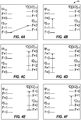
- FIGs. 4A-4F are 171Yb+ states 400, according to an embodiment.
- 171Yb+ states 400 result from particular steps within method 300.
- FIG. 4A depicts transferring 310 qubit population, where the 435-nm laser is used to transfer 315 qubit population from the
- S 1/2 , F 0 ⁇ state to the
- D 3/2 , F 2 ⁇ manifold of states.
- transfer 315 shown in FIG 4A is carried out via two consecutive laser pulses that are tuned to selectively populate the
- FIGs. 4B-4D show detecting 320 qubit bright or dark state.
- FIG. 4B shows first detection laser 325 that connects
- S 1/2 , F 1 ⁇ to
- P 1/2 , F 0 ⁇ .
- FIG. 4C shows second detection laser 330 that connects
- D 3/2 , F 1 ⁇ to
- [3/2] 1/2 , F 0 ⁇ .
- FIG. 4D shows third detection laser 335 that connects
- S 1/2 , F 0 ⁇ to
- P 1/2 , F 1 ⁇ .
- FIGs. 4E-4F show returning 340 any 171Yb+ qubit in the D 3/2 state to the S 1/2 state.
- FIG. 4E shows first return laser 345 connecting
- D 3/2 , F 1 ⁇ to
- [3/2] 1/2 , F 0 ⁇ .
- FIG. 4F shows second return laser 350 connecting
- D 3/2 , F 2 ⁇ to
- [3/2] 1/2 , F 1 ⁇ .
- FIG. 5 is a block schematic diagram of a computer system 500 to implement ytterbium shelving detection, according to an example embodiment.
- the computer system 500 may utilize fewer components than shown in FIG. 5 in some embodiments to perform the methods described.
- One example computing device in the form of a computer 500 may include a processing unit 502, memory 503, removable storage 510, and non-removable storage 512.
- Memory 503 may include volatile memory 514 and non-volatile memory 508.
- Computer 500 may include - or have access to a computing environment that includes - a variety of computer-readable media, such as volatile memory 514 and non-volatile memory 508, removable storage 510 and non-removable storage 512.
- Computer storage includes random access memory (RAM), read only memory (ROM), erasable programmable read-only memory (EPROM) & electrically erasable programmable read-only memory (EEPROM), flash memory or other memory technologies, compact disc read-only memory (CD ROM), Digital Versatile Disks (DVD) or other optical disk storage, magnetic cassettes, magnetic tape, magnetic disk storage or other magnetic storage devices, or any other medium capable of storing computer-readable instructions.
- Computer 500 may include or have access to a computing environment that includes input 506, output 504, and a communication connection 516.
- the computer may operate in a networked environment using a communication connection to connect to one or more remote computers, such as database servers.
- the remote computer may include a personal computer (PC), server, router, network PC, a peer device or other common network node, or the like.
- the communication connection may include a Local Area Network (LAN), a Wide Area Network (WAN) or other networks.
- LAN Local Area Network
- WAN Wide Area Network
- Computer-readable instructions stored on a computer-readable medium are executable by the processing unit 502 of the computer 500.
- a hard drive, CD-ROM, and RAM are some examples of articles including a non-transitory computer-readable medium.
- a computer program 518 capable of providing a generic technique to perform access control check for data access and/or for doing an operation on one of the servers in a component object model (COM) based system may be included on a CD-ROM and loaded from the CD-ROM to a hard drive.
- the computer-readable instructions allow computer 500 to provide generic access controls in a COM based computer network system having multiple users and servers.
- Example 1 is a quantum computing state detection system comprising: a shelving laser to transfer an ytterbium-171 ion from an initial state to a shelved state; a plurality of detection lasers to detect a present state of the ion; and a plurality of return lasers to return the ion to an initialized state.
- Example 2 the subject matter of Example 1 optionally includes application of a 435-nm laser to transfer the ion from a
- S 1/2 , F 0 ⁇ state to a
- D 3/2 , F 2 ⁇ manifold state.
- Example 3 the subject matter of any one or more of Examples 1-2 optionally include wherein the shelving laser transfer of the ion from the initial state to the shelved state includes application of two 435-nm laser pulses.
- Example 4 the subject matter of any one or more of Examples 1-3 optionally include wherein the shelving laser further transfers an ion population from the initial state to the shelved state.
- Example 5 the subject matter of Example 4 optionally includes wherein the ion population includes a plurality of ytterbium-171 ions.
- Example 6 the subject matter of any one or more of Examples 1-5 optionally include wherein the detection of the present state includes: application of a 369-nm laser pulse connecting a
- S 1/2 , F 1 ⁇ state to a
- P 1/2 , F 0 ⁇ state; application of a 935-nm laser connecting a
- D 3/2 , F 1 ⁇ state to a
- [3/2] 1/2 , F 0 ⁇ state; and application of a 369-nm laser connecting a
- S 1/2 , F 0 ⁇ state to a
- P 1/2 , F 1 ⁇ state.
- Example 7 the subject matter of any one or more of Examples 1-6 optionally include wherein the return of the ion to the initialized state includes: application of a 935-nm laser connecting a
- D 3/2 , F 1 ⁇ to a
- [3/2] 1/2, F 0 ⁇ state; and application of a 935-nm laser connecting a
- D 3/2 , F 2 ⁇ state to a
- [3/2] 1/2, F 1 ⁇ state.
- Example 8 is a quantum computing state detection method comprising: transferring an ytterbium-171 ion from an initial state to a shelved state; detecting a present state of the ion; and returning the ion to the initialized state.
- Example 9 the subject matter of Example 8 optionally includes wherein transferring the ion includes applying a 435-nm laser to transfer the ion from a
- S 1/2 , F 0 ⁇ state to a
- D 3/2 , F 2 ⁇ manifold state.
- Example 10 the subject matter of any one or more of Examples 8-9 optionally include wherein transferring the ion from the initial state to the shelved state includes applying two 435-nm laser pulses.
- Example 11 the subject matter of any one or more of Examples 8-10 optionally include wherein transferring the ion includes transferring an ion population from the initial state to the shelved state.
- Example 12 the subject matter of Example 11 optionally includes wherein the ion population includes a plurality of ytterbium-171 ions.
- Example 13 the subject matter of any one or more of Examples 8-12 optionally include wherein detecting the present state includes: applying a 369-nm laser pulse connecting a
- S 1/2 , F 1 ⁇ state to a
- P 1/2 , F 0 ⁇ state; applying a 935-nm laser connecting a
- D 3/2 , F 1 ⁇ state to a
- [3/2] 1/2 , F 0 ⁇ state; and applying a 369-nm laser connecting a
- S 1/2 , F 0 ⁇ state to a
- P 1/2 , F 1 ⁇ state.
- Example 14 the subject matter of any one or more of Examples 8-13 optionally include wherein returning the ion includes: applying a 935-nm laser connecting a
- D 3/2 , F 1 ⁇ to a
- [3/2] 1/2 , F 0 ⁇ state; and applying a 935-nm laser connecting a
- D 3/2 , F 2 ⁇ state to a
- [3/2] 1/2 , F 1 ⁇ state.
- Example 15 is one or more machine-readable medium including instructions, which when executed by a computing system, cause the computing system to perform any of the methods of Examples 8-14.
- Example 16 is an apparatus comprising means for performing any of the methods of Examples 8-14.
- Example 17 is a machine-readable storage medium comprising a plurality of instructions that, when executed with a processor of a device, cause the device to: transfer an ytterbium-171 ion from an initial state to a shelved state; detect a present state of the ion; and return the ion to the initialized state.
- Example 18 the subject matter of Example 17 optionally includes wherein transferring the ion includes applying a 435-nm laser to transfer the ion from a
- S 1/2 , F 0 ⁇ state to a
- D 3/2 , F 2 ⁇ manifold state.
- Example 19 the subject matter of any one or more of Examples 17-18 optionally include wherein transferring the ion from the initial state to the shelved state includes applying two 435-nm laser pulses.
- Example 20 the subject matter of any one or more of Examples 17-19 optionally include wherein transferring the ion includes transferring an ion population from the initial state to the shelved state, the ion population including a plurality of ytterbium-171 ions.
- Example 21 the subject matter of any one or more of Examples 17-20 optionally include wherein detecting the present state includes: applying a 369-nm laser pulse connecting a
- S 1/2 , F 1 ⁇ state to a
- P 1/2 , F 0 ⁇ state; applying a 935-nm laser connecting a
- D 3/2 , F 1 ⁇ state to a
- [3/2] 1/2 , F 0 ⁇ state; and applying a 369-nm laser connecting a
- S 1/2 , F 0 ⁇ state to a
- P 1/2 , F 1 ⁇ state.
- Example 22 the subject matter of any one or more of Examples 17-21 optionally include wherein returning the ion includes: applying a 935-nm laser connecting a
- D 3/2 , F 1 ⁇ to a
- [3/2] 1/2 , F 0 ⁇ state; and applying a 935-nm laser connecting a
- D 3/2 , F 2 ⁇ state to a
- [3/2] 1/2 , F 1 ⁇ state.
- Example 23 is a quantum computing state detection apparatus comprising: means for transferring an ytterbium-171 ion from an initial state to a shelved state; means for detecting a present state of the ion; and means for returning the ion to the initialized state.
- Example 24 the subject matter of Example 23 optionally includes wherein transferring the ion includes means for applying a 435-nm laser to transfer the ion from a
- S 1/2 , F 0 ⁇ state to a
- D 3/2 , F 2 ⁇ manifold state.
- Example 25 the subject matter of any one or more of Examples 23-24 optionally include wherein means for transferring the ion from the initial state to the shelved state includes means for applying two 435-nm laser pulses.
- Example 26 the subject matter of any one or more of Examples 23-25 optionally include wherein means for transferring the ion includes means for transferring an ion population from the initial state to the shelved state.
- Example 27 the subject matter of Example 26 optionally includes wherein the ion population including a plurality of ytterbium-171 ions.
- Example 28 the subject matter of any one or more of Examples 23-27 optionally include wherein means for detecting the present state includes: means for applying a 369-nm laser pulse connecting a
- S 1/2 , F 1 ⁇ state to a
- P 1/2 , F 0 ⁇ state; means for applying a 935-nm laser connecting a
- D 3/2 , F 1 ⁇ state to a
- [3/2] 1/2 , F 0 ⁇ state; and means for applying a 369-nm laser connecting a
- S 1/2 , F 0 ⁇ state to a
- P 1/2 , F 1 ⁇ state.
- Example 29 the subject matter of any one or more of Examples 23-28 optionally include wherein means for returning the ion includes: means for applying a 935-nm laser connecting a
- D 3/2 , F 1 ⁇ to a
- [3/2] 1/2 , F 0 ⁇ state; and means for applying a 935-nm laser connecting a
- D 3/2 , F 2 ⁇ state to a
- [3/2] 1/2 , F 1 ⁇ state.
- Example 30 is one or more machine-readable medium including instructions, which when executed by a machine, cause the machine to perform operations of any of the operations of Examples 1-29.
- Example 31 is an apparatus comprising means for performing any of the operations of Examples 1-29.
- Example 32 is a system to perform the operations of any of the Examples 1-29.
- Example 33 is a method to perform the operations of any of the Examples 1-29.
Landscapes
- Engineering & Computer Science (AREA)
- General Physics & Mathematics (AREA)
- Theoretical Computer Science (AREA)
- Physics & Mathematics (AREA)
- Mathematical Analysis (AREA)
- Computing Systems (AREA)
- Evolutionary Computation (AREA)
- Condensed Matter Physics & Semiconductors (AREA)
- Computational Mathematics (AREA)
- Mathematical Optimization (AREA)
- Pure & Applied Mathematics (AREA)
- Data Mining & Analysis (AREA)
- General Engineering & Computer Science (AREA)
- Mathematical Physics (AREA)
- Software Systems (AREA)
- Artificial Intelligence (AREA)
- Chemical & Material Sciences (AREA)
- Ceramic Engineering (AREA)
- Investigating, Analyzing Materials By Fluorescence Or Luminescence (AREA)
Applications Claiming Priority (2)
| Application Number | Priority Date | Filing Date | Title |
|---|---|---|---|
| US201962811322P | 2019-02-27 | 2019-02-27 | |
| US16/735,438 US11615335B2 (en) | 2019-02-27 | 2020-01-06 | Detection scheme |
Publications (3)
| Publication Number | Publication Date |
|---|---|
| EP3702976A1 true EP3702976A1 (de) | 2020-09-02 |
| EP3702976C0 EP3702976C0 (de) | 2025-04-23 |
| EP3702976B1 EP3702976B1 (de) | 2025-04-23 |
Family
ID=69810574
Family Applications (1)
| Application Number | Title | Priority Date | Filing Date |
|---|---|---|---|
| EP20159165.8A Active EP3702976B1 (de) | 2019-02-27 | 2020-02-24 | Detektionsschema |
Country Status (2)
| Country | Link |
|---|---|
| US (1) | US11615335B2 (de) |
| EP (1) | EP3702976B1 (de) |
Family Cites Families (5)
| Publication number | Priority date | Publication date | Assignee | Title |
|---|---|---|---|---|
| US11004009B2 (en) * | 2018-01-04 | 2021-05-11 | University Of Maryland, College Park | Optical control of atomic quantum bits for phase control of operation |
| US11010517B2 (en) * | 2018-12-07 | 2021-05-18 | IonQ, Inc. | Methods and apparatuses for two-qubit gate reduction in quantum circuits |
| US10733524B1 (en) * | 2019-05-09 | 2020-08-04 | Honeywell International Inc. | Quantum D-state AC-Stark shift gate |
| US11150609B1 (en) * | 2019-09-25 | 2021-10-19 | National Technology & Engineering Solutions Of Sandia, Llc | Trapped ion platform with optical input and output |
| US10997522B1 (en) * | 2019-12-10 | 2021-05-04 | Honeywell International Inc. | Suppressing/transforming leakage errors in hyperfine qubits |
-
2020
- 2020-01-06 US US16/735,438 patent/US11615335B2/en active Active
- 2020-02-24 EP EP20159165.8A patent/EP3702976B1/de active Active
Non-Patent Citations (5)
| Title |
|---|
| ANNA KESELMAN ET AL: "High-fidelity state detection and tomography of a single ion Zeeman qubit", ARXIV.ORG, CORNELL UNIVERSITY LIBRARY, 201 OLIN LIBRARY CORNELL UNIVERSITY ITHACA, NY 14853, 27 March 2011 (2011-03-27), XP080546292, DOI: 10.1088/1367-2630/13/7/073027 * |
| GILL P ET AL: "Trapped ion optical frequency standards; Trapped ion optical frequency standards", MEASUREMENT SCIENCE AND TECHNOLOGY, IOP, BRISTOL, GB, vol. 14, no. 8, 1 August 2003 (2003-08-01), pages 1174 - 1186, XP020063851, ISSN: 0957-0233, DOI: 10.1088/0957-0233/14/8/302 * |
| JOHN WRIGHT ET AL: "Scalable Quantum Computing Architecture with Mixed Species Ion Chains", 30 September 2014 (2014-09-30), pages 1 - 7, XP055554040, Retrieved from the Internet <URL:https://arxiv.org/pdf/1410.0037.pdf> [retrieved on 20190208] * |
| M. SCHACHT ET AL: "171Yb+ System Stability, 5D3/2 Hyperfine State Detection Efficiency and F=2 Lifetime", 9 October 2013 (2013-10-09), XP055714209, Retrieved from the Internet <URL:https://arxiv.org/pdf/1310.2530.pdf> [retrieved on 20200713] * |
| TOBIAS SCHNEIDER: "Optical Frequency Standard with a Single 171Yb+ Ion", 1 January 2005 (2005-01-01), XP055714122, Retrieved from the Internet <URL:https://d-nb.info/977243176/34> [retrieved on 20200713] * |
Also Published As
| Publication number | Publication date |
|---|---|
| EP3702976C0 (de) | 2025-04-23 |
| EP3702976B1 (de) | 2025-04-23 |
| US11615335B2 (en) | 2023-03-28 |
| US20200272931A1 (en) | 2020-08-27 |
Similar Documents
| Publication | Publication Date | Title |
|---|---|---|
| Monz et al. | Realization of universal ion-trap quantum computation with decoherence-free qubits | |
| Passarelli et al. | Many-body dynamics in monitored atomic gases without postselection barrier | |
| DE112018003087B4 (de) | On-chip-rauschunterdrückung oder -minderung der versorgungsspannung unter verwendung von lokalen detektionsschleifen in einem prozessorkern | |
| DE102016204792B4 (de) | Gleichzeitig ablaufende Fehlererkennung in einer ternären inhaltsadressierbaren Speicher- (TCAM-) Einheit | |
| EP1164473A3 (de) | Zustandsverwaltung von Server-Steuerobjekten | |
| Erickson et al. | High-fidelity indirect readout of trapped-ion hyperfine qubits | |
| CN106708653A (zh) | 一种基于纠删码与多副本的混合税务大数据安全保护方法 | |
| DE102012223167A1 (de) | Gemeinsame Nutzung von Artefakten zwischen kollaborativen Systemen | |
| EP3702976A1 (de) | Detektionsschema | |
| Karmakar et al. | Strong monogamy conjecture in a four-qubit system | |
| CN116192154B (zh) | 数据压缩及数据解压方法、装置、电子设备、芯片 | |
| Mohseni et al. | Fault-tolerant quantum computation via exchange interactions | |
| CN102195887A (zh) | 报文处理方法、装置和网络安全设备 | |
| CN113886175B (zh) | 基于Hystrix的分布式系统集群熔断方法及分布式系统 | |
| US7612710B2 (en) | Processing virtual and live tracks to form a virtual-over-live environment | |
| US7836139B1 (en) | Method for grouping exchange 2007 journal messages | |
| CN117251112A (zh) | 一种业务数据存储方法、装置、设备及存储介质 | |
| CN117370454A (zh) | 数据处理方法 | |
| Skidanov et al. | Nightshade: Near protocol sharding design 2.0 | |
| CN111522510B (zh) | 命令处理方法及装置 | |
| McConnell et al. | Heisenberg scaling of imaging resolution by coherent enhancement | |
| CN101770632A (zh) | 分笔成交的高效处理方法及系统 | |
| US20050137902A1 (en) | Methods and systems for managing successful completion of a network of processes | |
| US20180268040A1 (en) | Online Data Compression and Decompression | |
| Singh et al. | Modified classes of regression type exponential estimators of population mean |
Legal Events
| Date | Code | Title | Description |
|---|---|---|---|
| PUAI | Public reference made under article 153(3) epc to a published international application that has entered the european phase |
Free format text: ORIGINAL CODE: 0009012 |
|
| STAA | Information on the status of an ep patent application or granted ep patent |
Free format text: STATUS: REQUEST FOR EXAMINATION WAS MADE |
|
| 17P | Request for examination filed |
Effective date: 20200224 |
|
| AK | Designated contracting states |
Kind code of ref document: A1 Designated state(s): AL AT BE BG CH CY CZ DE DK EE ES FI FR GB GR HR HU IE IS IT LI LT LU LV MC MK MT NL NO PL PT RO RS SE SI SK SM TR |
|
| AX | Request for extension of the european patent |
Extension state: BA ME |
|
| P01 | Opt-out of the competence of the unified patent court (upc) registered |
Effective date: 20230526 |
|
| STAA | Information on the status of an ep patent application or granted ep patent |
Free format text: STATUS: EXAMINATION IS IN PROGRESS |
|
| 17Q | First examination report despatched |
Effective date: 20231129 |
|
| RAP1 | Party data changed (applicant data changed or rights of an application transferred) |
Owner name: QUANTINUUM LLC |
|
| REG | Reference to a national code |
Ref country code: DE Ref legal event code: R079 Free format text: PREVIOUS MAIN CLASS: G06N0010000000 Ipc: G06N0010400000 Ref document number: 602020049804 Country of ref document: DE |
|
| GRAP | Despatch of communication of intention to grant a patent |
Free format text: ORIGINAL CODE: EPIDOSNIGR1 |
|
| STAA | Information on the status of an ep patent application or granted ep patent |
Free format text: STATUS: GRANT OF PATENT IS INTENDED |
|
| RIC1 | Information provided on ipc code assigned before grant |
Ipc: G06N 10/40 20220101AFI20241228BHEP |
|
| INTG | Intention to grant announced |
Effective date: 20250110 |
|
| GRAS | Grant fee paid |
Free format text: ORIGINAL CODE: EPIDOSNIGR3 |
|
| GRAA | (expected) grant |
Free format text: ORIGINAL CODE: 0009210 |
|
| STAA | Information on the status of an ep patent application or granted ep patent |
Free format text: STATUS: THE PATENT HAS BEEN GRANTED |
|
| AK | Designated contracting states |
Kind code of ref document: B1 Designated state(s): AL AT BE BG CH CY CZ DE DK EE ES FI FR GB GR HR HU IE IS IT LI LT LU LV MC MK MT NL NO PL PT RO RS SE SI SK SM TR |
|
| REG | Reference to a national code |
Ref country code: GB Ref legal event code: FG4D |
|
| REG | Reference to a national code |
Ref country code: CH Ref legal event code: EP |
|
| REG | Reference to a national code |
Ref country code: DE Ref legal event code: R096 Ref document number: 602020049804 Country of ref document: DE |
|
| REG | Reference to a national code |
Ref country code: IE Ref legal event code: FG4D |
|
| P04 | Withdrawal of opt-out of the competence of the unified patent court (upc) registered |
Free format text: CASE NUMBER: APP_24166/2025 Effective date: 20250521 |
|
| U01 | Request for unitary effect filed |
Effective date: 20250519 |
|
| U07 | Unitary effect registered |
Designated state(s): AT BE BG DE DK EE FI FR IT LT LU LV MT NL PT RO SE SI Effective date: 20250523 |
|
| PG25 | Lapsed in a contracting state [announced via postgrant information from national office to epo] |
Ref country code: ES Free format text: LAPSE BECAUSE OF FAILURE TO SUBMIT A TRANSLATION OF THE DESCRIPTION OR TO PAY THE FEE WITHIN THE PRESCRIBED TIME-LIMIT Effective date: 20250423 |
|
| PG25 | Lapsed in a contracting state [announced via postgrant information from national office to epo] |
Ref country code: GR Free format text: LAPSE BECAUSE OF FAILURE TO SUBMIT A TRANSLATION OF THE DESCRIPTION OR TO PAY THE FEE WITHIN THE PRESCRIBED TIME-LIMIT Effective date: 20250724 Ref country code: NO Free format text: LAPSE BECAUSE OF FAILURE TO SUBMIT A TRANSLATION OF THE DESCRIPTION OR TO PAY THE FEE WITHIN THE PRESCRIBED TIME-LIMIT Effective date: 20250723 |
|
| PG25 | Lapsed in a contracting state [announced via postgrant information from national office to epo] |
Ref country code: PL Free format text: LAPSE BECAUSE OF FAILURE TO SUBMIT A TRANSLATION OF THE DESCRIPTION OR TO PAY THE FEE WITHIN THE PRESCRIBED TIME-LIMIT Effective date: 20250423 |
|
| PG25 | Lapsed in a contracting state [announced via postgrant information from national office to epo] |
Ref country code: HR Free format text: LAPSE BECAUSE OF FAILURE TO SUBMIT A TRANSLATION OF THE DESCRIPTION OR TO PAY THE FEE WITHIN THE PRESCRIBED TIME-LIMIT Effective date: 20250423 |
|
| PG25 | Lapsed in a contracting state [announced via postgrant information from national office to epo] |
Ref country code: RS Free format text: LAPSE BECAUSE OF FAILURE TO SUBMIT A TRANSLATION OF THE DESCRIPTION OR TO PAY THE FEE WITHIN THE PRESCRIBED TIME-LIMIT Effective date: 20250723 |
|
| PG25 | Lapsed in a contracting state [announced via postgrant information from national office to epo] |
Ref country code: IS Free format text: LAPSE BECAUSE OF FAILURE TO SUBMIT A TRANSLATION OF THE DESCRIPTION OR TO PAY THE FEE WITHIN THE PRESCRIBED TIME-LIMIT Effective date: 20250823 |
|
| PG25 | Lapsed in a contracting state [announced via postgrant information from national office to epo] |
Ref country code: SM Free format text: LAPSE BECAUSE OF FAILURE TO SUBMIT A TRANSLATION OF THE DESCRIPTION OR TO PAY THE FEE WITHIN THE PRESCRIBED TIME-LIMIT Effective date: 20250423 |
|
| PG25 | Lapsed in a contracting state [announced via postgrant information from national office to epo] |
Ref country code: CZ Free format text: LAPSE BECAUSE OF FAILURE TO SUBMIT A TRANSLATION OF THE DESCRIPTION OR TO PAY THE FEE WITHIN THE PRESCRIBED TIME-LIMIT Effective date: 20250423 |
|
| PG25 | Lapsed in a contracting state [announced via postgrant information from national office to epo] |
Ref country code: SK Free format text: LAPSE BECAUSE OF FAILURE TO SUBMIT A TRANSLATION OF THE DESCRIPTION OR TO PAY THE FEE WITHIN THE PRESCRIBED TIME-LIMIT Effective date: 20250423 |