EP3702973A1 - Data processing apparatus configured to execute hierarchical calculation processing and method thereof - Google Patents
Data processing apparatus configured to execute hierarchical calculation processing and method thereof Download PDFInfo
- Publication number
- EP3702973A1 EP3702973A1 EP20159080.9A EP20159080A EP3702973A1 EP 3702973 A1 EP3702973 A1 EP 3702973A1 EP 20159080 A EP20159080 A EP 20159080A EP 3702973 A1 EP3702973 A1 EP 3702973A1
- Authority
- EP
- European Patent Office
- Prior art keywords
- processing
- data
- calculation
- unit
- processing apparatus
- Prior art date
- Legal status (The legal status is an assumption and is not a legal conclusion. Google has not performed a legal analysis and makes no representation as to the accuracy of the status listed.)
- Pending
Links
Images





Classifications
-
- G—PHYSICS
- G06—COMPUTING OR CALCULATING; COUNTING
- G06T—IMAGE DATA PROCESSING OR GENERATION, IN GENERAL
- G06T1/00—General purpose image data processing
- G06T1/20—Processor architectures; Processor configuration, e.g. pipelining
-
- G—PHYSICS
- G06—COMPUTING OR CALCULATING; COUNTING
- G06N—COMPUTING ARRANGEMENTS BASED ON SPECIFIC COMPUTATIONAL MODELS
- G06N3/00—Computing arrangements based on biological models
- G06N3/02—Neural networks
- G06N3/08—Learning methods
-
- G—PHYSICS
- G06—COMPUTING OR CALCULATING; COUNTING
- G06N—COMPUTING ARRANGEMENTS BASED ON SPECIFIC COMPUTATIONAL MODELS
- G06N3/00—Computing arrangements based on biological models
- G06N3/02—Neural networks
- G06N3/06—Physical realisation, i.e. hardware implementation of neural networks, neurons or parts of neurons
- G06N3/063—Physical realisation, i.e. hardware implementation of neural networks, neurons or parts of neurons using electronic means
-
- G—PHYSICS
- G06—COMPUTING OR CALCULATING; COUNTING
- G06N—COMPUTING ARRANGEMENTS BASED ON SPECIFIC COMPUTATIONAL MODELS
- G06N3/00—Computing arrangements based on biological models
- G06N3/02—Neural networks
- G06N3/04—Architecture, e.g. interconnection topology
- G06N3/045—Combinations of networks
-
- G—PHYSICS
- G06—COMPUTING OR CALCULATING; COUNTING
- G06N—COMPUTING ARRANGEMENTS BASED ON SPECIFIC COMPUTATIONAL MODELS
- G06N3/00—Computing arrangements based on biological models
- G06N3/02—Neural networks
- G06N3/04—Architecture, e.g. interconnection topology
- G06N3/0464—Convolutional networks [CNN, ConvNet]
Definitions
- the present invention relates to a data processing apparatus configured to execute hierarchical calculation processing corresponding to a neural network and a method thereof.
- CNN convolutional neural networks
- Fig. 9 is a network configuration diagram illustrating an example of a simple CNN.
- an input layer 901 inputs the image data of predetermined size.
- a first hierarchy 908 includes feature surfaces 903a to 903d.
- a second hierarchy 909 includes feature surfaces 905a to 905d.
- a third hierarchy 910 includes a feature surface 907.
- feature surface refers to a data surface that corresponds to a result of a predetermined feature extraction calculation (convolution calculation and non-linear processing) processing.
- a feature surface corresponds to a result of feature extraction for recognizing a predetermined target in a higher hierarchy and is a result of processing on image data, so that a processing result is also expressed as a surface.
- the feature surfaces 903a to 903d are generated by convolution calculation and non-linear processing on the input layer 901. For example, the feature surface 903a is calculated by a calculation using a two-dimensional convolution kernel (weight coefficient) 9021a, which is schematically illustrated, and a non-linear conversion of the calculation result.
- the multiply-accumulate operation is repeated while a plurality of convolution kernels is used to scan image data in pixel units, and a final multiply-accumulate operation result is non-linearly converted to thereby calculate a feature surface.
- the number of convolution kernels is one.
- Convolution kernels 9021b, 9021c, and 9021d are used in calculating the feature surfaces 903b, 903c, and 903d, respectively.
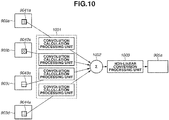
- Fig. 10 illustrates an example of a case of calculating the feature surface 905a.
- the feature surface 905a is connected with the four feature surfaces 903a to 903d of the previous hierarchy 908.
- a filter operation is performed on the feature surface 903a using a kernel (weight coefficient) 9041a, which is schematically illustrated, and a filter operation result is stored in an accumulation adder 1002.
- a convolution calculation processing unit 1001 performs a convolution calculation on the feature surfaces 903b, 903c, and 904c using kernels 9042a, 9043a, and 9044a, respectively, and a convolution calculation result is stored in the accumulation adder 1002.
- a non-linear conversion processing unit 1003 performs non-linear conversion processing using a logistic function or a hyperbolic tangent function (tanh function).
- the above-described processing is performed on the entire image while scanning pixel by pixel to thereby calculate the feature surface 905a.
- the feature surface 905b is calculated by performing a convolution calculation on the feature surfaces 903a to 903d of the previous hierarchy 908 using four convolution kernels 9041b, 9042b, 9043b, and 9044b.
- the feature surface 907 is calculated by performing a convolution calculation on the feature surfaces 905a to 905d of the previous hierarchy 909 using four convolution kernels 9061, 9062, 9063, and 9064.
- Each kernel coefficient is predetermined by learning using a generally-used method, such as perceptron learning or back propagation learning.
- the number of data surfaces to be referenced in generating one feature surface is increased, i.e., the number of connections is increased. Consequently, the number of weight coefficients necessary for calculation is increased. Further, the number of hierarchies is increased, and the operation parameter size of each hierarchy is also increased in order to increase recognition accuracy.
- CNN processing hardware configured to perform CNN calculation is implemented in an embedded system and network processing is performed
- the CNN processing hardware performs calculation of input data and a weight coefficient for each hierarchy. Then, the calculation result is used as input data of the next hierarchy, and calculation of the input data and a weight coefficient of the next hierarchy is performed. This is repeated to thereby obtain a final pattern recognition result.
- Japanese Unexamined Patent Application Publication (Translation of PCT Application) No. 2018-521374 discusses a method in which a weight coefficient of each hierarchy that is necessary for CNN processing and information about each hierarchy are transferred to an internal memory, and calculation is performed while the weight coefficient and the information are efficiently transferred from the internal memory to a calculation unit.
- the CNN processing hardware is implemented in the embedded system, from the point of view of cost, it is undesirable to store all the weight coefficients and operation parameters necessary for processing all the hierarchies in an internal large-capacity memory and use the stored weight coefficients and the operation parameters in calculation.
- the weight coefficients and the operation parameters of all the hierarchies are stored in an inexpensive external memory, such as a read-only memory (ROM) or a dynamic random access memory (DRAM), and only the weight coefficients and the operation parameters used in processing of one hierarchy are stored in the internal memory and an internal register and used.
- ROM read-only memory
- DRAM dynamic random access memory
- each hierarchy is started after the weight coefficients and the operation parameters, which are large in data amount, are transferred from the external memory to the CNN processing hardware.
- an external memory and an internal bus also share and use a functional block other than the CNN processing hardware, so that memory latency from when the CNN processing hardware makes a data read request to when read data arrives increases. Thus, it takes time to prepare for processing at the time of switching the hierarchy.
- a data processing apparatus as specified in claims 1 to 19.
- a data processing method as specified in claim 20.
- Fig. 6 illustrates an example of a configuration of an image processing system that uses a pattern recognition apparatus according to the present embodiment.
- the system has a function of detecting an area of a specific object from image data.
- an image input unit 600 includes an optical system and a photoelectric conversion device such as a charge-coupled device (CCD) sensor or a complementary metal oxide semiconductor (CMOS) sensor.
- the image input unit 600 further includes a driver circuit that controls the sensor, an analog-digital converter, a signal processing circuit that performs various types of image correction, and a frame buffer.
- CCD charge-coupled device
- CMOS complementary metal oxide semiconductor
- a convolutional neural network (CNN) calculation processing unit 601 includes a calculation apparatus according to the present embodiment.
- a direct memory access controller (DMAC) 605 is a data transfer unit that performs data transfer between a processing unit on an image bus 602 and a central processing unit (CPU) bus 609.
- a bridge 603 provides a bridge function to bridge the image bus 602 and the CPU bus 609.
- a preprocessing unit 604 performs various types of preprocessing for effective execution of pattern recognition processing. More specifically, the preprocessing unit 604 performs image data conversion processing such as color conversion processing and contrast correction processing by hardware.
- a CPU 606 controls operation of the entire image processing system.
- a read-only memory (ROM) 607 is a data storage unit configured to store a command and operation parameter data that specify operation of the CPU 606 and a control data set for causing the CNN calculation processing unit 601 to operate.
- the control data set (hereinafter, also referred to simply as data set) includes a weight coefficient and an operation parameter for a neural network to be processed.
- the data set is input to a pattern recognition processing unit via the DMAC 605.
- a random access memory (RAM) 608 is used in operation of the CPU 606.
- Image data input from the image input unit 600 is processed by the preprocessing unit 604, and the processed image data is temporarily stored on the RAM 608. Then, the stored image data is input from the RAM 608 to the CNN calculation processing unit 601 via the DMAC 605. Based on the data set, the CNN calculation processing unit 601 performs predetermined determination processing in pixel units of the input preprocessed image data, and determines an area of a predetermined object in the input image. A result of the determination is stored in the RAM 608 via the DMAC 605.
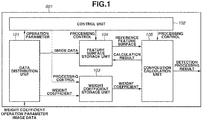
- Fig. 1 is a block diagram illustrating the CNN calculation processing unit 601. A function of each block will be described below.
- a data distribution unit 101 receives data transmitted from the DMAC 605, refers to a destination indicator and a transfer length that are added to a header of the data, and transmits the data to a corresponding internal block. The data transmission and reception is performed using a standard two-line handshake protocol (Valid/Ready).
- Fig. 2 illustrates a data format that is received by the data distribution unit 101, and operation of the data distribution unit 101 will be described below.
- An incoming data width is 32 bits.
- the data contains a header 201 and a data body 202.
- a DST field of the lower eight bits of the header 201 specifies a destination, whereas a LENGTH field of the upper 24 bits specifies a transfer length (the number of bytes) of the data body 202.
- a unique identifier (ID) is added in advance to each internal block, and the data body 202 corresponding to the LENGTH is transmitted to the block of the ID that matches the value of the DST field. For example, in a case where the data illustrated in Fig.
- the ID that specifies a destination can be an address.
- a control unit 102 controls the entire CNN calculation processing unit 601 and includes operation setting registers.
- the operation setting registers include a plurality of operation setting register sets, and information for generating one feature surface is stored in each of the operation setting register sets.
- the operation setting registers of the control unit 102 include eight operation setting register sets.
- a value to be set is stored as an operation parameter in the ROM 607.
- the control unit 102 receives the value via the DMAC 605 and the data distribution unit 101 and sets the received value to the internal operation setting register set.
- the ID of the control unit 102 is 0.
- the set register value is distributed as a processing control signal to a weight coefficient storage unit 103, a feature surface storage unit 104, and a convolution calculation unit 105.
- the processing control signal contains a processing start instruction signal in addition to the register value, and an instruction to start processing is issued when one or more operation setting register sets are set.
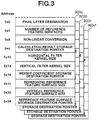
- Fig. 3 illustrates operation setting register sets.
- a "final layer designation” register is a register that designates whether a feature surface to be generated by the operation setting register set is a final layer. In a case where the final layer designation register is 1, a detection processing result is externally output when the processing of generating the feature surface is ended.
- a “number of reference feature surfaces” register is a register that designates the number of feature surfaces of a previous hierarchy that are to be connected with the generated feature surface. For example, in a case where feature surfaces 905a to 905d in Fig. 9 are calculated, 4 is set.
- a “non-linear conversion” register is a register that designates whether to perform non-linear conversion. In a case where 1 is set, non-linear conversion processing is performed, whereas in a case where 0 is set, non-linear conversion processing is not performed.
- a “calculation result storage destination pointer” register is a register that designates an address that specifies a head pointer of the feature surface storage unit 104, which stores a calculation result of a generated feature surface as described below. The calculation result is stored in the order of raster scan using a value of the pointer as the head pointer.
- a “horizontal filter kernel size” register and a “vertical filter kernel size” register are registers that designate the size of a filter kernel to be used in calculation of the generated feature surface.
- a "weight coefficient storage destination pointer" register is a register that specifies a storage destination address of the weight coefficient storage unit 103 as a storage destination of a weight coefficient to be used in calculation of the generated feature surface.
- weight coefficient data contains the same number of combinations of coefficients as the "number of reference feature surfaces" register, and weight coefficients are stored in the order of raster scan from the address designated by the "weight coefficient storage destination pointer" register. More specifically, the number of combinations of coefficient data stored in the weight coefficient storage unit 103 is the same as “horizontal filter kernel size” ⁇ "vertical filter kernel size” ⁇ "number of reference feature surfaces".
- a “horizontal reference feature surface size” register and a “vertical reference feature surface size” register are registers that respectively specify the number of horizontal pixels of the reference feature surface and the number of vertical lines of the reference feature surface.
- a “reference feature surface storage destination pointer” register is a register that designates the address that specifies the head pointer of the feature surface storage unit 104, which stores the reference feature surfaces. The reference feature surfaces are stored in the order of raster scan using a value of the pointer as the head pointer. More specifically, the number of pieces of feature surface data stored in the feature surface storage unit 104 is the same as “horizontal reference feature surface size" ⁇ "vertical reference feature surface size” ⁇ "number of reference feature surfaces”.
- the plurality of registers described above is provided in feature surface units.
- the content of the "reference feature surface storage destination pointer" register of the generated feature surface is the "calculation result storage destination pointer" of a feature surface of a previous hierarchy that is to be connected
- the feature surface of the previous hierarchy and the generated feature surface are connected.
- a desired hierarchical connection relationship can be configured in feature surface units.
- Each operation parameter in the ROM 607 has a data configuration containing a series of the above-described register sets corresponding to the number of generated feature surfaces.
- the control unit 102 sequentially sets the operation parameter to eight operation setting register sets.
- control unit 102 sets the operation parameter to all the eight sets, a two-line handshake signal Ready is negated, and subsequent operation parameter data is not received. If the processing on a previously-set operation setting register set is completed, the processed operation setting register set is released, and next operation parameter data is received and the setting is performed.
- the weight coefficient storage unit 103 includes a memory configured to store weight coefficient data and a memory control unit.
- the weight coefficient storage unit 103 includes a read pointer and a write pointer.
- the read pointer specifies a read address of the memory
- the write pointer specifies a write address.
- the memory is used as a ring buffer. In a case of a normal ring buffer, a free space in the memory is managed by the write pointer and the read pointer, but according to a flowchart in Fig. 4 described below, the same weight coefficient is read a plurality of times and used. When the last reading is finished, a memory area of the weight coefficient is released, and the free space of the memory is managed based on a difference from the write pointer. In a case where there is no free space in the memory, a two-line handshake signal Ready is negated, and data is not received.
- the ID of the weight coefficient storage unit 103 is 1.
- the weight coefficient storage unit 103 receives a processing start instruction from the control unit 102, the weight coefficient storage unit 103 refers to the values of the "weight coefficient storage destination pointer", “horizontal filter kernel size”, “vertical filter kernel size”, and the “number of reference feature surfaces” registers.
- the weight coefficient storage unit 103 updates the read pointer with the value of the "weight coefficient storage destination pointer” register, reads the weight coefficient of "horizontal filter kernel size” ⁇ "vertical filter kernel size” ⁇ "number of reference feature surfaces", and transmits the read weight coefficient to the convolution calculation unit 105 described below. Further, the write pointer is updated with the head address of the memory at the time of initialization.
- the weight coefficient storage unit 103 If the weight coefficient storage unit 103 receives the weight coefficient from the data distribution unit 101, the weight coefficient storage unit 103 stores the data to the address specified by the write pointer and increments the write pointer. If the write pointer reaches the final address of the memory, the write pointer is returned to the head address of the memory.
- the feature surface storage unit 104 stores feature surface data and includes a memory and a memory control unit.
- the feature surface storage unit 104 includes a read pointer and a write pointer.
- the read pointer specifies a read address of the memory
- the write pointer specifies a write address.
- the ID of the feature surface storage unit 104 is 2.
- the feature surface storage unit 104 receives a processing start instruction from the control unit 102. Then, the feature surface storage unit 104 refers to the values of the "reference feature surface storage destination pointer", “horizontal reference feature surface size”, “vertical reference feature surface size”, “number of reference feature surfaces”, “horizontal filter kernel size”, and “vertical filter kernel size” registers. Then, the feature surface storage unit 104 reads the reference pixel value expressed by Formula (1) and transmits the read reference pixel value to the convolution calculation unit 105 described below. More specifically, the feature surface storage unit 104 updates the read pointer with the value of the "reference feature surface storage destination pointer" register.
- each reference feature surface is horizontally shifted by one pixel, and an equal number of the reference pixel values ((1 - columnSize)/2, -rowSize/2) to ((1 + columnSize)/2, rowSize/2) at the reference feature surface coordinates (1, 0) to the "number of reference feature surfaces" are similarly transmitted.
- the reference feature surfaces shifted horizontally by the "horizontal reference feature surface size” are transmitted.
- the reference pixel values (-columnSize/2, (1 - rowSize)/2) to (columnSize/2, (1 + rowSize)/2) at the reference feature surface coordinates (0, 1) shifted vertically by one line are similarly transmitted.
- the processing is completed.
- the feature surface storage unit 104 If the feature surface storage unit 104 receives a processing start instruction from the control unit 102, the feature surface storage unit 104 reads the reference feature surfaces and transmits the read reference feature surfaces while receiving a generated feature surface that is a calculation result from the convolution calculation unit 105 described below and writes the received generated feature surface to the memory.
- This processing refers to the values of the "final layer designation", “calculation result storage destination pointer", “horizontal reference feature surface size”, and “vertical reference feature surface size” registers. More specifically, the write pointer is updated with the value of the "calculation result storage destination pointer" register. In a case where the value of the "final layer designation" register is 0, a generated feature surface is received, and the data is stored in the address of the write pointer.
- the write pointer is incremented. After a calculation result of "horizontal reference feature surface size” ⁇ "vertical reference feature surface size” is received, the processing is completed. In a case where the value of the "final layer designation" register is 1, no generated feature surface is received.
- the write pointer is updated with the head address of the memory at the time of initialization. If image data is received from the data distribution unit 101, the data is stored at the address specified by the write pointer, and the write pointer is incremented. Image data is received only during input layer processing.
- the convolution calculation unit 105 receives a processing start instruction from the control unit 102, the convolution calculation unit 105 receives the weight coefficient and data from the weight coefficient storage unit 103 and the feature surface storage unit 104 and performs convolution calculation. If the convolution calculation unit 105 receives the weight coefficient of "horizontal filter kernel size” ⁇ "vertical filter kernel size” and the reference pixel values, the convolution calculation unit 105 performs convolution calculation. The convolution calculation unit 105 stores the calculation result in an internal accumulation adder and accumulates the calculation result.
- the convolution calculation unit 105 performs non-linear conversion processing on a result of accumulation addition of an equal number of calculation results to the "number of reference feature surfaces” and transmits the calculation result to the feature surface storage unit 104.
- the non-linear conversion processing is not performed, and the calculation result is transmitted to the feature surface storage unit 104.
- the calculation result is externally transmitted and stored in the RAM 608 via the DMAC 605.
- Fig. 4 is a flowchart illustrating a process of generating a feature surface by the CNN calculation processing unit 601.
- the CNN calculation processing unit 601 starts the process illustrated in the flowchart in Fig. 4 if one or more register sets are set among the operation setting registers of the control unit 102.
- the control unit 102 issues a processing start instruction to the weight coefficient storage unit 103, the feature surface storage unit 104, and the convolution calculation unit 105.
- Step S402 is a "vertical reference feature surface size" loop, which is the outermost loop
- Step S403 is a "horizontal reference feature surface size” loop. More specifically, the reference feature surfaces are scanned in raster order, and feature surfaces are generated in the raster order.
- step S404 is a "number of reference feature surfaces" loop
- step S405 is a "vertical filter kernel size” loop
- step S406 is a "horizontal filter kernel size” loop. More specifically, the reference pixel values in a reference pixel range are processed in the raster order for each reference feature surface.
- Step S407 is the step of reading the weight coefficient of each reference feature surface by the weight coefficient storage unit 103, and the coordinates of the weight coefficient to be read are determined based on loop variables of steps S404 and S405.
- step S408 is the step of reading the pixel value of each reference feature surface by the feature surface storage unit 104, and the coordinates of the pixel value to be read are determined based on loop variables of steps S402, S403, S405, and S406.
- step S409 the convolution calculation unit 105 performs convolution calculation on the pixel value and the weight coefficient that are read in steps S407 and S408, and the convolution calculation result is accumulated. If the loop of step S404 is ended, then in step S410, the convolution calculation unit 105 refers to the "non-linear conversion" register. In a case where the register value is 1 (YES in step S410), the processing proceeds to step S411, and the non-linear conversion processing is performed. In a case where the register value is 0 (NO in step S410), step S411 is skipped. In step S412, the convolution calculation unit 105 refers to the "final layer designation" register.
- step S412 In a case where the register value is 1 (YES in step S412), the processing proceeds to step S413, and the detection processing result is externally transmitted. In a case where the register value is 0 (NO in step S412), the processing proceeds to step S414, and the calculation result is transmitted to the feature surface storage unit 104.
- the feature surface storage unit 104 stores the calculation result based on the write pointer.
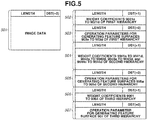
- Fig. 5 illustrates an example of processing target image data that is stored in the RAM 608 and processed by the preprocessing unit 604 and an example of a data set that is stored in the ROM 607 and is used to cause the CNN calculation processing unit 601 to operate.
- the data set is used to process a network configuration illustrated in Fig. 7 .
- Feature surfaces 903a to 903d of a first hierarchy 908 are sequentially generated using the image data as input, and then the feature surfaces 905a to 905d of a second hierarchy 909 are sequentially generated using the generated feature surfaces 903a to 903d of the first hierarchy 908 as input.
- a feature surface 907 of a third hierarchy 910 is generated using the feature surfaces 905a to 905d of the second hierarchy 909 as input.
- the data set is used to perform the series of processing described above.
- Data 501 is image data that is stored in the RAM 608, and data 502 to data 507 are a data set that is stored in the ROM 607.
- the DMAC 605 sequentially transmits the data 501 to the data 507 in this order to the CNN calculation processing unit 601.
- the data 501 is the processing target image data.
- the operation parameter is a value that is set to the operation setting register sets to generate the feature surfaces 903a to 903d of the first hierarchy 908 illustrated in Fig. 3 .
- the setting value of the "horizontal reference feature surface size" register is the horizontal size of the input layer 901.
- the setting value of the "vertical reference feature surface size” register is the vertical size of the input layer 901.
- the setting value of the "reference feature surface storage destination pointer" register is the head address of the memory of the feature surface storage unit 104.
- the operation parameters are arranged in order of processing, which is the order of the feature surfaces 903a to 903d in the present embodiment.
- the data 504 and the data 505 are weight coefficients 9041a to 9041d, 9042a to 9042d, 9043a to 9043d, and 9044a to 9044d for the second hierarchy 909 and operation parameters for generating the feature surfaces 905a to 905d of the second hierarchy 909.
- the weight coefficients 9041a to 9041d, 9042a to 9042d, 9043a to 9043d, and 9044a to 9044d are arranged in order of use in calculation, i.e., the weight coefficients 9041a to 9044a, 9041b to 9044b, 9041c to 9044c, and 9041d to 9044d are arranged in this order.
- the setting values of the "horizontal reference feature surface size” and the “vertical reference feature surface size” registers contained in the operation parameters are the horizontal and vertical sizes of the feature surfaces 903a to 903d of the first hierarchy 908. Further, the setting value of the "reference feature surface storage destination pointer" register is an address of a calculation result storage destination pointer designated in the data 503.
- the data 506 and the data 507 are weight coefficients 9061 to 9064 of the third hierarchy 910 and an operation parameter for generating the feature surface 907 of the third hierarchy 910.
- the setting value of the "final layer designation" register contained in the operation parameters is 1.
- the setting values of the "horizontal reference feature surface size” register and the “vertical reference feature surface size” register are the horizontal and vertical sizes of the feature surfaces 905a to 905d of the second hierarchy 909, and the setting value of the "reference feature surface storage destination pointer" register is an address of a calculation result storage destination pointer designated in the data 505.
- the control unit 102 sets the values of the operation parameters of the data 503, the data 505, and the data 507 to the register sets in the present embodiment, the control unit 102 can calculate a value from the operation parameters and set the calculated value to the register sets.
- the data set for causing the CNN calculation processing unit 601 to operate includes a pair of a weight coefficient and an operation parameter (setting values of a register set to be generated) of a processing unit.
- the processing unit is determined based on processing target network information and the hardware configuration illustrated in Fig. 1 .
- the hardware configuration that acts on the determination of the processing unit is specifically the memory size of the weight coefficient storage unit 103 and the memory size of the feature surface storage unit 104.
- the processing unit is determined so that an amount of memory of the weight coefficient that is necessary for processing per unit does not exceed the memory size of the weight coefficient storage unit 103.
- the processing unit is determined so that an amount of memory of the feature surface that is necessary for processing per unit does not exceed the memory size of the feature surface storage unit 104.
- the processing unit is determined so that a processing target is processible by hardware.
- W l W x 1 f f ⁇ ⁇ W y 1 f f ⁇ ⁇ F l ⁇ F l ⁇ 1
- S l I X ⁇ I Y ⁇ F l + F l ⁇ 1
- the amount of memory that is necessary for processing the network illustrated in Fig. 9 in hierarchical units is specified by a configuration 701 in Fig. 7 .
- the input image size of the network in Fig. 9 is 32 ⁇ 32.
- the number of reference feature surfaces of the first hierarchy 908 is 1, and the number of generated feature surfaces of the first hierarchy 908 is 4.
- the kernel filter size is 3 ⁇ 3
- the kernel filter size of the second hierarchy 909 is 5 ⁇ 5
- the size of the weight coefficients 9041a to 9041d, 9042a to 9042d, 9043a to 9043d, and 9044a to 9044d used in generating four feature surfaces is similarly calculated to be 400 bytes. Further, the data amount of the feature surfaces is 8192 bytes.
- the kernel filter size of the third hierarchy 910 is 7 ⁇ 7
- the size of the weight coefficients 9061 to 9064 used in generating four feature surfaces is similarly calculated to be 196 bytes
- the amount of data of the feature surfaces is 5120 bytes.
- the memory size of the weight coefficient storage unit 103 is 436 bytes, and the memory size of the feature surface storage unit 104 is 16 kilobytes.
- the amount of memory of the weight coefficients that is necessary for processing each hierarchy is less than or equal to the memory size of the weight coefficient storage unit 103, and the amount of memory of the feature surfaces that is necessary is less than or equal to the memory size of the feature surface storage unit 104, so that a hierarchical unit is determined as the processing unit, and the data set illustrated in Fig. 5 is employed. Another example of how the processing unit is determined will be described below. In a case where the number of feature surfaces of the second hierarchy 909 of the network illustrated in Fig.
- the memory amount that is necessary for processing in hierarchical units is as specified in a configuration 702.
- the data amount of the weight coefficients of the second hierarchy 909 is 800 bytes
- the data amount of the feature surfaces is 12288 bytes. Since the data amount exceeds the memory size of the weight coefficient storage unit 103, the processing cannot be performed in hierarchical units, so that each hierarchy is processed over a plurality of times of processing.
- the processing of the second hierarchy 909 is divided into two so that storage in the weight coefficient storage unit 103 becomes possible, and there are consequently the processing 1 to the processing 4. There are four data sets.
- the feature surface storage unit 104 is hardware with a memory size of 8 kilobytes and processes a network specified by the configuration 702 will be described below as another example.
- the data amount of the feature surfaces of the second hierarchy 909 is 12288 bytes, which exceeds the memory size of the feature surface storage unit 104.
- an input image is divided and processed a plurality of times.
- a 32-by-32 block is divided into two 32-by-16 blocks so that the processing units are storable in the feature surface storage unit 104.
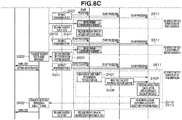
- FIG. 8A , 8B , and 8C illustrate operations performed by the CPU 606, the DMAC 605, the control unit 102, the weight coefficient storage unit 103, the feature surface storage unit 104, and the convolution calculation unit 105 and interactions therebetween in chronological order.
- the preprocessing unit 604 processes the received image data and stores the processed image data in the RAM 608.
- step S801 if the processing of the image data of one page is completed, the CPU 606 is notified of the completion of the processing.
- the CPU 606 instructs the CNN calculation processing unit 601 to perform initialization, and in step S802, the weight coefficient storage unit 103 and the feature surface storage unit 104 respectively update the write pointers of the weight coefficient storage unit 103 and the feature surface storage unit 104 with the head addresses of the memories.
- the head address of the image data 501 is set as a data transfer source of the DMAC 605, the CNN calculation processing unit 601 is set as a data transfer destination, and the size of the image data 501 is set as a transfer length, and if the DMAC 605 is activated, then in step S804, the DMAC 605 transfers the image data 501 from the RAM 608 to the CNN calculation processing unit 601.
- the data distribution unit 101 since the DST of the header is 2, transfers the image data 501 to the feature surface storage unit 104, and the feature surface storage unit 104 stores the image data 501 from the head address of the memory that is specified by the write pointer.
- the DMAC 605 notifies the CPU 606 of the completion of the transfer.
- the CPU 606 sets the head address of the data 502 as the data transfer source of the DMAC 605, the CNN calculation processing unit 601 as the transfer destination, and the total size of the data 502 to the data 507 as the transfer length. Then, in step S806, if activated, the DMAC 605 transfers the data 502 from the ROM 607 to the CNN calculation processing unit 601. Since the DST of the header is 1, the data distribution unit 101 transfers the data 502 to the weight coefficient storage unit 103. In step S807, if the memory has a free space, the weight coefficient storage unit 103 receives the data 502 and stores the weight coefficients from the head address of the memory that is specified by the write pointer of the memory.
- step S808 after the transfer of the data 502 is completed, the DMAC 605 transfers the data 503.
- step S809 since the DST of the header is 0, the data distribution unit 101 transmits the data 503 to the control unit 102, and the control unit 102 sets the four register sets of the feature surface 903a to 903d of the first hierarchy 908 to the operation setting register.
- step S401 the control unit 102 issues a processing start instruction to the weight coefficient storage unit 103, the feature surface storage unit 104, and the convolution calculation unit 105.
- the weight coefficient storage unit 103, the feature surface storage unit 104, and the convolution calculation unit 105 refer to each register value of the register set for the feature surface 903a.
- steps S407 to S409 are repeatedly executed the number of times that is equal to the "horizontal filter kernel size” ⁇ "vertical filter kernel size” ⁇ "number of reference feature surfaces".
- step S811 each register value of the register set of the feature surface 903a is referred to, and steps S810, S410, and S414 are repeatedly executed the number of times that is equal to the "horizontal reference feature surface size" ⁇ "vertical reference feature surface size", and the generation of the feature surface 903a of the first hierarchy 908 is completed.
- the memory area storing the processed weight coefficient and the register set are released.
- step S812 after the transfer of the data 503 is completed, the DMAC 605 transfers the data 504 in parallel with the process of generating the feature surface 903a of the first hierarchy 908 in step S811.
- the data distribution unit 101 transmits the data 504 to the weight coefficient storage unit 103.
- the weight coefficient storage unit 103 stores the data 502 containing the weight coefficients 9021a to 9021d of the first hierarchy 908, and the memory still has a free area, so that in step S813, the weight coefficient storage unit 103 receives the data 504 and stores the data 504 in the memory.
- the DMAC 605 transfers the data 505. Since the DST of the header is 0, the data distribution unit 101 transmits the data 505 to the control unit 102.
- step S815 the four register sets of the first hierarchy 908 are set, and there is still a free area for the register sets, so that the control unit 102 receives the data 505 and sets the four register sets of the feature surfaces 905a to 905d of the second hierarchy 909 to the operation setting register.
- step S816 after the transfer of the data 505 is completed, the DMAC 605 transfers the data 506. Since the DST of the header is 1, the data distribution unit 101 transmits the data 506 to the weight coefficient storage unit 103.
- the weight coefficient storage unit 103 stores the data 502 containing the weight coefficients 9021a to 9021d of the first hierarchy 908 and the data 504 containing the weight coefficients 9041a to 9041d, 9042a to 9042d, 9043a to 9043d, and 9044a to 9044d of the second hierarchy 909, and the memory has no free area, so that in step S817, a two-line handshake signal is controlled, and the data 506 is not received.
- step S818 after the generation of the feature surface 903a of the first hierarchy 908 is completed and the memory area storing the processed weight coefficient 9021a is released, the data 506 is stored in the weight coefficient storage unit 103.
- step S819 the control unit 102 immediately issues a processing start instruction to start generating the feature surface 905a of the second hierarchy 909.
- step S820 after the transfer of the data 506 is completed, the DMAC 605 transfers the data 507. Since the DST of the header is 0, the data distribution unit 101 transmits the data 507 to the control unit 102. At this time, the four register sets of the first hierarchy 908 of the control unit 102 are released whereas the four register sets of the second hierarchy 909 are set. In step S821, since there is a free space for the register set, the control unit 102 receives the data 507 and sets one register set of the feature surface 907 of the third hierarchy 910 to the operation setting register. After the transfer of all the data 502 to the data 507 is completed, the DMAC 605 notifies the CPU 606 of the completion of the transfer.
- the CPU 606 sets the CNN calculation processing unit 601 as the data transfer source of the DMAC 605, the RAM 608 as the transfer destination, and the size of a detection processing result as the transfer length and activates the DMAC 605.
- the CNN calculation processing unit 601 continues to generate a feature surface, and in the generation of the feature surface 907 of the third hierarchy 910, since the value of the "final layer designation" register is 1, the convolution calculation unit 105 externally outputs the detection processing result.
- the DMAC 605 transfers the output detection processing result to the RAM 608.
- the weight coefficients necessary for processing the next hierarchy are already stored in the weight coefficient storage unit 103 and, furthermore, at least one register set of the next hierarchy is set to the operation setting register. This reduces the time needed for data preparation at the time of switching the hierarchy, and calculation processing can be started immediately, so that the processing performance of the pattern recognition apparatus is increased.
- a processing unit that is executable by a hardware processing apparatus is determined as in the configurations 703 and 704, and operation is performed using the corresponding data set.
- control procedure is no different from that illustrated in Figs. 8A , 8B , and 8C , except that the transfer length of the data set that is set to the DMAC 605 by the CPU 606 is different.
- the processing apparatus When the processing target neural network is to be changed, the processing apparatus according to the present embodiment operates based on a data set divided into processing units that are executable by the hardware processing apparatus. This makes it possible to change the neural network without changing the processing control of a control processor for the neural network.
- CNN calculation processing is described as feature extraction processing in the above-described embodiment, the present invention is not limited to that described above and is also applicable to various other types of hierarchical processing such as perceptron.
- the present invention is not limited to that described above.
- the present invention is also applicable to a configuration in which the processing is entirely executed by software using an all-purpose processor.
- the weight coefficients and the operation parameters that are necessary for CNN processing of a next hierarchy are transferred, so that the time for data transfer at the time of switching the layer is reduced and the processing performance of hierarchical calculation processing is increased.
- a data set of an operation parameter and a weight coefficient divided into processing units is generated, and the generated data set is read and executed so that the neural network can be changed without changing the processing control of the control processor for the neural network.
- Embodiment(s) of the present invention can also be realized by a computer of a system or apparatus that reads out and executes computer executable instructions (e.g., one or more programs) recorded on a storage medium (which may also be referred to more fully as a 'non-transitory computer-readable storage medium') to perform the functions of one or more of the above-described embodiment(s) and/or that includes one or more circuits (e.g., application specific integrated circuit (ASIC)) for performing the functions of one or more of the above-described embodiment(s), and by a method performed by the computer of the system or apparatus by, for example, reading out and executing the computer executable instructions from the storage medium to perform the functions of one or more of the above-described embodiment(s) and/or controlling the one or more circuits to perform the functions of one or more of the above-described embodiment(s).
- computer executable instructions e.g., one or more programs
- a storage medium which may also be referred to more fully as
- the computer may comprise one or more processors (e.g., central processing unit (CPU), micro processing unit (MPU)) and may include a network of separate computers or separate processors to read out and execute the computer executable instructions.
- the computer executable instructions may be provided to the computer, for example, from a network or the storage medium.
- the storage medium may include, for example, one or more of a hard disk, a random-access memory (RAM), a read only memory (ROM), a storage of distributed computing systems, an optical disk (such as a compact disc (CD), digital versatile disc (DVD), or Blu-ray Disc (BD)TM), a flash memory device, a memory card, and the like.
Landscapes
- Engineering & Computer Science (AREA)
- Physics & Mathematics (AREA)
- Theoretical Computer Science (AREA)
- Health & Medical Sciences (AREA)
- Life Sciences & Earth Sciences (AREA)
- Biomedical Technology (AREA)
- Biophysics (AREA)
- General Physics & Mathematics (AREA)
- Computing Systems (AREA)
- Software Systems (AREA)
- General Health & Medical Sciences (AREA)
- Computational Linguistics (AREA)
- Molecular Biology (AREA)
- Evolutionary Computation (AREA)
- General Engineering & Computer Science (AREA)
- Artificial Intelligence (AREA)
- Mathematical Physics (AREA)
- Data Mining & Analysis (AREA)
- Neurology (AREA)
- Image Analysis (AREA)
- Image Processing (AREA)
Abstract
Description
- The present invention relates to a data processing apparatus configured to execute hierarchical calculation processing corresponding to a neural network and a method thereof.
- A hierarchical calculation method such as convolutional neural networks (hereinafter, abbreviated as CNN) have drawn attention as a method that enables robust pattern recognition with respect to a change in a recognition target. For example, Yann LeCun, Koray Kavukvuoglu, and Clement Farabet, "Convolutional Networks and Applications in Vision," Proc. International Symposium on Circuits and Systems (ISCAS' 10), IEEE, 2010. discusses various application examples and implementation examples.
-
Fig. 9 is a network configuration diagram illustrating an example of a simple CNN. In a case where CNN processing is to be performed on image data, aninput layer 901 inputs the image data of predetermined size. Afirst hierarchy 908 includesfeature surfaces 903a to 903d. Asecond hierarchy 909 includesfeature surfaces 905a to 905d. Athird hierarchy 910 includes afeature surface 907. - The term "feature surface" refers to a data surface that corresponds to a result of a predetermined feature extraction calculation (convolution calculation and non-linear processing) processing. A feature surface corresponds to a result of feature extraction for recognizing a predetermined target in a higher hierarchy and is a result of processing on image data, so that a processing result is also expressed as a surface. The
feature surfaces 903a to 903d are generated by convolution calculation and non-linear processing on theinput layer 901. For example, thefeature surface 903a is calculated by a calculation using a two-dimensional convolution kernel (weight coefficient) 9021a, which is schematically illustrated, and a non-linear conversion of the calculation result. - For example, a two-dimensional convolution calculation using a kernel (coefficient matrix) having a size that is columnSize × rowSize is processed by a multiply-accumulate operation expressed by Formula (1):

- In CNN processing, the multiply-accumulate operation is repeated while a plurality of convolution kernels is used to scan image data in pixel units, and a final multiply-accumulate operation result is non-linearly converted to thereby calculate a feature surface. In the case of calculating the
feature surface 903a, since the number of connections with a previous hierarchy is one, the number of convolution kernels is one.Convolution kernels feature surfaces -
Fig. 10 illustrates an example of a case of calculating thefeature surface 905a. Thefeature surface 905a is connected with the fourfeature surfaces 903a to 903d of theprevious hierarchy 908. In a case of calculating data of thefeature surface 905a, a filter operation is performed on thefeature surface 903a using a kernel (weight coefficient) 9041a, which is schematically illustrated, and a filter operation result is stored in anaccumulation adder 1002. - Similarly, a convolution
calculation processing unit 1001 performs a convolution calculation on thefeature surfaces 904c using kernels accumulation adder 1002. After four types of convolution calculation are finished, a non-linearconversion processing unit 1003 performs non-linear conversion processing using a logistic function or a hyperbolic tangent function (tanh function). - The above-described processing is performed on the entire image while scanning pixel by pixel to thereby calculate the
feature surface 905a. Similarly, thefeature surface 905b is calculated by performing a convolution calculation on thefeature surfaces 903a to 903d of theprevious hierarchy 908 using four convolution kernels 9041b, 9042b, 9043b, and 9044b. Further, thefeature surface 907 is calculated by performing a convolution calculation on thefeature surfaces 905a to 905d of theprevious hierarchy 909 using fourconvolution kernels - In a recent large-scale network called deep network, the number of data surfaces to be referenced in generating one feature surface is increased, i.e., the number of connections is increased. Consequently, the number of weight coefficients necessary for calculation is increased. Further, the number of hierarchies is increased, and the operation parameter size of each hierarchy is also increased in order to increase recognition accuracy.
- In a case where CNN processing hardware configured to perform CNN calculation is implemented in an embedded system and network processing is performed, the CNN processing hardware performs calculation of input data and a weight coefficient for each hierarchy. Then, the calculation result is used as input data of the next hierarchy, and calculation of the input data and a weight coefficient of the next hierarchy is performed. This is repeated to thereby obtain a final pattern recognition result.
- For example, Japanese Unexamined Patent Application Publication (Translation of PCT Application) No.
2018-521374 - In the case where the CNN processing hardware is implemented in the embedded system, from the point of view of cost, it is undesirable to store all the weight coefficients and operation parameters necessary for processing all the hierarchies in an internal large-capacity memory and use the stored weight coefficients and the operation parameters in calculation. Thus, the weight coefficients and the operation parameters of all the hierarchies are stored in an inexpensive external memory, such as a read-only memory (ROM) or a dynamic random access memory (DRAM), and only the weight coefficients and the operation parameters used in processing of one hierarchy are stored in the internal memory and an internal register and used.
- At this time, the processing of each hierarchy is started after the weight coefficients and the operation parameters, which are large in data amount, are transferred from the external memory to the CNN processing hardware. In the embedded system, in general, an external memory and an internal bus also share and use a functional block other than the CNN processing hardware, so that memory latency from when the CNN processing hardware makes a data read request to when read data arrives increases. Thus, it takes time to prepare for processing at the time of switching the hierarchy.
- Meanwhile, there are demands for processing various neural networks at high speed, so that a high-speed, flexible processing control is needed. In a case where a control processor that controls the CNN processing hardware performs processing control based on the neural network, if a processing target neural network is changed, firmware also needs to be changed. This increases development cost of the firmware.
- According to a first aspect of the present invention, there is provided a data processing apparatus as specified in
claims 1 to 19. According to a second aspect of the present invention, there is provided a data processing method as specified in claim 20. - Further features of the present invention will become apparent from the following description of embodiments with reference to the attached drawings.
-
-
Fig. 1 is a block diagram illustrating a convolutional neural network (CNN) calculation processing unit according to an embodiment. -
Fig. 2 is a diagram illustrating a data format received by a data distribution unit. -
Fig. 3 is a diagram illustrating operation setting registers. -
Fig. 4 is a flowchart illustrating a process of generating a feature surface by the CNN calculation processing unit. -
Fig. 5 is a diagram illustrating a data set for causing the CNN calculation processing unit to operate. -
Fig. 6 is a block diagram illustrating an example of a configuration of an image processing system that uses a pattern recognition apparatus. -
Fig. 7 is a diagram illustrating an amount of memory necessary for processing a network and a processing unit. -
Figs. 8A ,8B , and8C are sequence diagrams illustrating an image processing system. -
Fig. 9 is a diagram illustrating a network configuration of an example of CNN. -
Fig. 10 is a diagram illustrating an example of a case of calculating a feature surface. - An embodiment of the present invention will be described below with reference to the drawings.
- A first embodiment of the present invention will be described below with reference to
Figs. 1 to 8 . -
Fig. 6 illustrates an example of a configuration of an image processing system that uses a pattern recognition apparatus according to the present embodiment. The system has a function of detecting an area of a specific object from image data. InFig. 6 , animage input unit 600 includes an optical system and a photoelectric conversion device such as a charge-coupled device (CCD) sensor or a complementary metal oxide semiconductor (CMOS) sensor. Theimage input unit 600 further includes a driver circuit that controls the sensor, an analog-digital converter, a signal processing circuit that performs various types of image correction, and a frame buffer. - A convolutional neural network (CNN)
calculation processing unit 601 includes a calculation apparatus according to the present embodiment. A direct memory access controller (DMAC) 605 is a data transfer unit that performs data transfer between a processing unit on animage bus 602 and a central processing unit (CPU)bus 609. Abridge 603 provides a bridge function to bridge theimage bus 602 and theCPU bus 609. Apreprocessing unit 604 performs various types of preprocessing for effective execution of pattern recognition processing. More specifically, thepreprocessing unit 604 performs image data conversion processing such as color conversion processing and contrast correction processing by hardware. ACPU 606 controls operation of the entire image processing system. - A read-only memory (ROM) 607 is a data storage unit configured to store a command and operation parameter data that specify operation of the
CPU 606 and a control data set for causing the CNNcalculation processing unit 601 to operate. The control data set (hereinafter, also referred to simply as data set) includes a weight coefficient and an operation parameter for a neural network to be processed. The data set is input to a pattern recognition processing unit via theDMAC 605. A random access memory (RAM) 608 is used in operation of theCPU 606. - Image data input from the
image input unit 600 is processed by thepreprocessing unit 604, and the processed image data is temporarily stored on theRAM 608. Then, the stored image data is input from theRAM 608 to the CNNcalculation processing unit 601 via theDMAC 605. Based on the data set, the CNNcalculation processing unit 601 performs predetermined determination processing in pixel units of the input preprocessed image data, and determines an area of a predetermined object in the input image. A result of the determination is stored in theRAM 608 via theDMAC 605. -
Fig. 1 is a block diagram illustrating the CNNcalculation processing unit 601. A function of each block will be described below. Adata distribution unit 101 receives data transmitted from theDMAC 605, refers to a destination indicator and a transfer length that are added to a header of the data, and transmits the data to a corresponding internal block. The data transmission and reception is performed using a standard two-line handshake protocol (Valid/Ready). -
Fig. 2 illustrates a data format that is received by thedata distribution unit 101, and operation of thedata distribution unit 101 will be described below. An incoming data width is 32 bits. The data contains aheader 201 and adata body 202. A DST field of the lower eight bits of theheader 201 specifies a destination, whereas a LENGTH field of the upper 24 bits specifies a transfer length (the number of bytes) of thedata body 202. A unique identifier (ID) is added in advance to each internal block, and thedata body 202 corresponding to the LENGTH is transmitted to the block of the ID that matches the value of the DST field. For example, in a case where the data illustrated inFig. 2 is received, theheader 201 of the first data contains DST = 0 and LENGTH = N, so that thedata body 202 of N bytes is transmitted to the internal block of the ID that is 0. Theheader 201 of the next data contains DST = 1 and LENGTH = M, so that thedata body 202 of M bytes is transmitted to the internal block of the ID that is 1. The ID that specifies a destination can be an address. - A
control unit 102 controls the entire CNNcalculation processing unit 601 and includes operation setting registers. The operation setting registers include a plurality of operation setting register sets, and information for generating one feature surface is stored in each of the operation setting register sets. The operation setting registers of thecontrol unit 102 include eight operation setting register sets. A value to be set is stored as an operation parameter in theROM 607. Thecontrol unit 102 receives the value via theDMAC 605 and thedata distribution unit 101 and sets the received value to the internal operation setting register set. The ID of thecontrol unit 102 is 0. - The set register value is distributed as a processing control signal to a weight
coefficient storage unit 103, a featuresurface storage unit 104, and aconvolution calculation unit 105. The processing control signal contains a processing start instruction signal in addition to the register value, and an instruction to start processing is issued when one or more operation setting register sets are set. -
Fig. 3 illustrates operation setting register sets. A "final layer designation" register is a register that designates whether a feature surface to be generated by the operation setting register set is a final layer. In a case where the final layer designation register is 1, a detection processing result is externally output when the processing of generating the feature surface is ended. A "number of reference feature surfaces" register is a register that designates the number of feature surfaces of a previous hierarchy that are to be connected with the generated feature surface. For example, in a case wherefeature surfaces 905a to 905d inFig. 9 are calculated, 4 is set. A "non-linear conversion" register is a register that designates whether to perform non-linear conversion. In a case where 1 is set, non-linear conversion processing is performed, whereas in a case where 0 is set, non-linear conversion processing is not performed. - A "calculation result storage destination pointer" register is a register that designates an address that specifies a head pointer of the feature
surface storage unit 104, which stores a calculation result of a generated feature surface as described below. The calculation result is stored in the order of raster scan using a value of the pointer as the head pointer. A "horizontal filter kernel size" register and a "vertical filter kernel size" register are registers that designate the size of a filter kernel to be used in calculation of the generated feature surface. - A "weight coefficient storage destination pointer" register is a register that specifies a storage destination address of the weight
coefficient storage unit 103 as a storage destination of a weight coefficient to be used in calculation of the generated feature surface. For example, weight coefficient data contains the same number of combinations of coefficients as the "number of reference feature surfaces" register, and weight coefficients are stored in the order of raster scan from the address designated by the "weight coefficient storage destination pointer" register. More specifically, the number of combinations of coefficient data stored in the weightcoefficient storage unit 103 is the same as "horizontal filter kernel size" × "vertical filter kernel size" × "number of reference feature surfaces". - A "horizontal reference feature surface size" register and a "vertical reference feature surface size" register are registers that respectively specify the number of horizontal pixels of the reference feature surface and the number of vertical lines of the reference feature surface. A "reference feature surface storage destination pointer" register is a register that designates the address that specifies the head pointer of the feature
surface storage unit 104, which stores the reference feature surfaces. The reference feature surfaces are stored in the order of raster scan using a value of the pointer as the head pointer. More specifically, the number of pieces of feature surface data stored in the featuresurface storage unit 104 is the same as "horizontal reference feature surface size" × "vertical reference feature surface size" × "number of reference feature surfaces". - The plurality of registers described above is provided in feature surface units. In a case where the content of the "reference feature surface storage destination pointer" register of the generated feature surface is the "calculation result storage destination pointer" of a feature surface of a previous hierarchy that is to be connected, the feature surface of the previous hierarchy and the generated feature surface are connected. Thus, with the register setting alone, a desired hierarchical connection relationship can be configured in feature surface units. Each operation parameter in the
ROM 607 has a data configuration containing a series of the above-described register sets corresponding to the number of generated feature surfaces. Thecontrol unit 102 sequentially sets the operation parameter to eight operation setting register sets. When thecontrol unit 102 sets the operation parameter to all the eight sets, a two-line handshake signal Ready is negated, and subsequent operation parameter data is not received. If the processing on a previously-set operation setting register set is completed, the processed operation setting register set is released, and next operation parameter data is received and the setting is performed. - The weight
coefficient storage unit 103 includes a memory configured to store weight coefficient data and a memory control unit. The weightcoefficient storage unit 103 includes a read pointer and a write pointer. The read pointer specifies a read address of the memory, and the write pointer specifies a write address. The memory is used as a ring buffer. In a case of a normal ring buffer, a free space in the memory is managed by the write pointer and the read pointer, but according to a flowchart inFig. 4 described below, the same weight coefficient is read a plurality of times and used. When the last reading is finished, a memory area of the weight coefficient is released, and the free space of the memory is managed based on a difference from the write pointer. In a case where there is no free space in the memory, a two-line handshake signal Ready is negated, and data is not received. The ID of the weightcoefficient storage unit 103 is 1. - If the weight
coefficient storage unit 103 receives a processing start instruction from thecontrol unit 102, the weightcoefficient storage unit 103 refers to the values of the "weight coefficient storage destination pointer", "horizontal filter kernel size", "vertical filter kernel size", and the "number of reference feature surfaces" registers. The weightcoefficient storage unit 103 updates the read pointer with the value of the "weight coefficient storage destination pointer" register, reads the weight coefficient of "horizontal filter kernel size" × "vertical filter kernel size" × "number of reference feature surfaces", and transmits the read weight coefficient to theconvolution calculation unit 105 described below. Further, the write pointer is updated with the head address of the memory at the time of initialization. If the weightcoefficient storage unit 103 receives the weight coefficient from thedata distribution unit 101, the weightcoefficient storage unit 103 stores the data to the address specified by the write pointer and increments the write pointer. If the write pointer reaches the final address of the memory, the write pointer is returned to the head address of the memory. - The feature
surface storage unit 104 stores feature surface data and includes a memory and a memory control unit. The featuresurface storage unit 104 includes a read pointer and a write pointer. The read pointer specifies a read address of the memory, and the write pointer specifies a write address. The ID of the featuresurface storage unit 104 is 2. - The feature
surface storage unit 104 receives a processing start instruction from thecontrol unit 102. Then, the featuresurface storage unit 104 refers to the values of the "reference feature surface storage destination pointer", "horizontal reference feature surface size", "vertical reference feature surface size", "number of reference feature surfaces", "horizontal filter kernel size", and "vertical filter kernel size" registers. Then, the featuresurface storage unit 104 reads the reference pixel value expressed by Formula (1) and transmits the read reference pixel value to theconvolution calculation unit 105 described below. More specifically, the featuresurface storage unit 104 updates the read pointer with the value of the "reference feature surface storage destination pointer" register. The featuresurface storage unit 104 determines the first reference feature surface coordinates (0, 0) based on the "horizontal filter kernel size" (= columnSize) and the "vertical filter kernel size" (= rowSize). Then, the featuresurface storage unit 104 reads reference pixel values (-columnSize/2, -rowSize/2) to (columnSize/2, rowSize/2) at the determined coordinates and transmits the read values. Next, the reference pixel value at the second reference feature surface coordinates (0, 0), the reference pixel value at the third reference feature surface coordinates (0, 0), etc., and the reference pixel value at the nth reference feature surface coordinates (0, 0) are read in this order, where n is the "number of reference feature surfaces", and the read reference pixel values are transmitted. Then, each reference feature surface is horizontally shifted by one pixel, and an equal number of the reference pixel values ((1 - columnSize)/2, -rowSize/2) to ((1 + columnSize)/2, rowSize/2) at the reference feature surface coordinates (1, 0) to the "number of reference feature surfaces" are similarly transmitted. In this way, the reference feature surfaces shifted horizontally by the "horizontal reference feature surface size" are transmitted. Next, the reference pixel values (-columnSize/2, (1 - rowSize)/2) to (columnSize/2, (1 + rowSize)/2) at the reference feature surface coordinates (0, 1) shifted vertically by one line are similarly transmitted. After the reference feature surfaces shifted by the "vertical reference feature surface size" in a line direction are transmitted, the processing is completed. - If the feature
surface storage unit 104 receives a processing start instruction from thecontrol unit 102, the featuresurface storage unit 104 reads the reference feature surfaces and transmits the read reference feature surfaces while receiving a generated feature surface that is a calculation result from theconvolution calculation unit 105 described below and writes the received generated feature surface to the memory. This processing refers to the values of the "final layer designation", "calculation result storage destination pointer", "horizontal reference feature surface size", and "vertical reference feature surface size" registers. More specifically, the write pointer is updated with the value of the "calculation result storage destination pointer" register. In a case where the value of the "final layer designation" register is 0, a generated feature surface is received, and the data is stored in the address of the write pointer. The write pointer is incremented. After a calculation result of "horizontal reference feature surface size" × "vertical reference feature surface size" is received, the processing is completed. In a case where the value of the "final layer designation" register is 1, no generated feature surface is received. - The write pointer is updated with the head address of the memory at the time of initialization. If image data is received from the
data distribution unit 101, the data is stored at the address specified by the write pointer, and the write pointer is incremented. Image data is received only during input layer processing. - If the
convolution calculation unit 105 receives a processing start instruction from thecontrol unit 102, theconvolution calculation unit 105 receives the weight coefficient and data from the weightcoefficient storage unit 103 and the featuresurface storage unit 104 and performs convolution calculation. If theconvolution calculation unit 105 receives the weight coefficient of "horizontal filter kernel size" × "vertical filter kernel size" and the reference pixel values, theconvolution calculation unit 105 performs convolution calculation. Theconvolution calculation unit 105 stores the calculation result in an internal accumulation adder and accumulates the calculation result. In a case where the value of the "non-linear conversion" register is 1, theconvolution calculation unit 105 performs non-linear conversion processing on a result of accumulation addition of an equal number of calculation results to the "number of reference feature surfaces" and transmits the calculation result to the featuresurface storage unit 104. In a case where the value of the "non-linear conversion" register is 0, the non-linear conversion processing is not performed, and the calculation result is transmitted to the featuresurface storage unit 104. Further, in a case where the value of the "final layer designation" register is 1, the calculation result is externally transmitted and stored in theRAM 608 via theDMAC 605. -
Fig. 4 is a flowchart illustrating a process of generating a feature surface by the CNNcalculation processing unit 601. The CNNcalculation processing unit 601 starts the process illustrated in the flowchart inFig. 4 if one or more register sets are set among the operation setting registers of thecontrol unit 102. In step S401, thecontrol unit 102 issues a processing start instruction to the weightcoefficient storage unit 103, the featuresurface storage unit 104, and theconvolution calculation unit 105. Step S402 is a "vertical reference feature surface size" loop, which is the outermost loop Step S403 is a "horizontal reference feature surface size" loop. More specifically, the reference feature surfaces are scanned in raster order, and feature surfaces are generated in the raster order. - Next, step S404 is a "number of reference feature surfaces" loop, step S405 is a "vertical filter kernel size" loop, and step S406 is a "horizontal filter kernel size" loop. More specifically, the reference pixel values in a reference pixel range are processed in the raster order for each reference feature surface. Step S407 is the step of reading the weight coefficient of each reference feature surface by the weight
coefficient storage unit 103, and the coordinates of the weight coefficient to be read are determined based on loop variables of steps S404 and S405. Step S408 is the step of reading the pixel value of each reference feature surface by the featuresurface storage unit 104, and the coordinates of the pixel value to be read are determined based on loop variables of steps S402, S403, S405, and S406. - In step S409, the
convolution calculation unit 105 performs convolution calculation on the pixel value and the weight coefficient that are read in steps S407 and S408, and the convolution calculation result is accumulated. If the loop of step S404 is ended, then in step S410, theconvolution calculation unit 105 refers to the "non-linear conversion" register. In a case where the register value is 1 (YES in step S410), the processing proceeds to step S411, and the non-linear conversion processing is performed. In a case where the register value is 0 (NO in step S410), step S411 is skipped. In step S412, theconvolution calculation unit 105 refers to the "final layer designation" register. In a case where the register value is 1 (YES in step S412), the processing proceeds to step S413, and the detection processing result is externally transmitted. In a case where the register value is 0 (NO in step S412), the processing proceeds to step S414, and the calculation result is transmitted to the featuresurface storage unit 104. The featuresurface storage unit 104 stores the calculation result based on the write pointer. - If the processing of generating one feature surface is completed, the process illustrated in the flowchart is completed. The memory area storing the processed weight coefficient and the register set are released.
-
Fig. 5 illustrates an example of processing target image data that is stored in theRAM 608 and processed by thepreprocessing unit 604 and an example of a data set that is stored in theROM 607 and is used to cause the CNNcalculation processing unit 601 to operate. The data set is used to process a network configuration illustrated inFig. 7 .Feature surfaces 903a to 903d of afirst hierarchy 908 are sequentially generated using the image data as input, and then thefeature surfaces 905a to 905d of asecond hierarchy 909 are sequentially generated using the generatedfeature surfaces 903a to 903d of thefirst hierarchy 908 as input. Then, afeature surface 907 of athird hierarchy 910 is generated using thefeature surfaces 905a to 905d of thesecond hierarchy 909 as input. The data set is used to perform the series of processing described above. -
Data 501 is image data that is stored in theRAM 608, anddata 502 todata 507 are a data set that is stored in theROM 607. TheDMAC 605 sequentially transmits thedata 501 to thedata 507 in this order to the CNNcalculation processing unit 601. Thedata 501 is the processing target image data. The header of thedata 501 contains an indicator DST = 2, which specifies the destination, and a transfer length LENGTH = image data. More specifically, a data portion (data body) of thedata 501 is transmitted to the featuresurface storage unit 104 via thedata distribution unit 101. - The
data 502 isweight coefficients 9021a to 9021d of thefirst hierarchy 908, and the header of thedata 502 contains an indicator DST = 1, which specifies the destination, and a transfer length LENGTH = weight coefficient. More specifically, a data portion of thedata 502 is transmitted to the weightcoefficient storage unit 103 via thedata distribution unit 101. The data portion contains theweight coefficients 9021a to 9021d. Theweight coefficients 9021a to 9021d are arranged in order of use in calculation. - The
data 503 is operation parameters for generating thefeature surfaces 903a to 903d of thefirst hierarchy 908, and the header of thedata 503 contains an indicator DST = 0, which specifies the destination, and a transfer length LENGTH = register set. More specifically, a data portion (operation parameter) of thedata 503 is transmitted to thecontrol unit 102 via thedata distribution unit 101. The operation parameter is a value that is set to the operation setting register sets to generate thefeature surfaces 903a to 903d of thefirst hierarchy 908 illustrated inFig. 3 . The setting value of the "horizontal reference feature surface size" register is the horizontal size of theinput layer 901. The setting value of the "vertical reference feature surface size" register is the vertical size of theinput layer 901. The setting value of the "reference feature surface storage destination pointer" register is the head address of the memory of the featuresurface storage unit 104. The operation parameters are arranged in order of processing, which is the order of thefeature surfaces 903a to 903d in the present embodiment. - The
data 504 and thedata 505 areweight coefficients 9041a to 9041d, 9042a to 9042d, 9043a to 9043d, and 9044a to 9044d for thesecond hierarchy 909 and operation parameters for generating thefeature surfaces 905a to 905d of thesecond hierarchy 909. Theweight coefficients 9041a to 9041d, 9042a to 9042d, 9043a to 9043d, and 9044a to 9044d are arranged in order of use in calculation, i.e., theweight coefficients 9041a to 9044a, 9041b to 9044b, 9041c to 9044c, and 9041d to 9044d are arranged in this order. The setting values of the "horizontal reference feature surface size" and the "vertical reference feature surface size" registers contained in the operation parameters are the horizontal and vertical sizes of thefeature surfaces 903a to 903d of thefirst hierarchy 908. Further, the setting value of the "reference feature surface storage destination pointer" register is an address of a calculation result storage destination pointer designated in thedata 503. - The
data 506 and thedata 507 areweight coefficients 9061 to 9064 of thethird hierarchy 910 and an operation parameter for generating thefeature surface 907 of thethird hierarchy 910. The setting value of the "final layer designation" register contained in the operation parameters is 1. The setting values of the "horizontal reference feature surface size" register and the "vertical reference feature surface size" register are the horizontal and vertical sizes of thefeature surfaces 905a to 905d of thesecond hierarchy 909, and the setting value of the "reference feature surface storage destination pointer" register is an address of a calculation result storage destination pointer designated in thedata 505. While thecontrol unit 102 sets the values of the operation parameters of thedata 503, thedata 505, and thedata 507 to the register sets in the present embodiment, thecontrol unit 102 can calculate a value from the operation parameters and set the calculated value to the register sets. - As illustrated in
Fig. 5 , the data set for causing the CNNcalculation processing unit 601 to operate includes a pair of a weight coefficient and an operation parameter (setting values of a register set to be generated) of a processing unit. The processing unit is determined based on processing target network information and the hardware configuration illustrated inFig. 1 . The hardware configuration that acts on the determination of the processing unit is specifically the memory size of the weightcoefficient storage unit 103 and the memory size of the featuresurface storage unit 104. The processing unit is determined so that an amount of memory of the weight coefficient that is necessary for processing per unit does not exceed the memory size of the weightcoefficient storage unit 103. Furthermore, the processing unit is determined so that an amount of memory of the feature surface that is necessary for processing per unit does not exceed the memory size of the featuresurface storage unit 104. In other words, the processing unit is determined so that a processing target is processible by hardware. - An amount of memory Wl that is necessary for storing weight coefficients necessary for processing a hierarchy and an amount of memory Sl that is necessary for storing feature surfaces are expressed as:


- l: a generation target hierarchy number (1, 2, ...),
- f: a generated feature surface number,
- f: a reference feature surface number,
- Wx(l, f, f): the horizontal kernel size,
- Wy(l, f, f'): the vertical kernel size,
- Ft: the number of generated feature surfaces,
- Ft-1: the number of reference feature surfaces, and
- IX, IY: the input image size (horizontal direction, vertical direction).
- The amount of memory that is necessary for processing the network illustrated in
Fig. 9 in hierarchical units is specified by aconfiguration 701 inFig. 7 . The input image size of the network inFig. 9 is 32 × 32. The number of reference feature surfaces of thefirst hierarchy 908 is 1, and the number of generated feature surfaces of thefirst hierarchy 908 is 4. In a case where the kernel filter size is 3 × 3, the size of theweight coefficients 9021a to 9021d used in generating the four feature surfaces is 3 × 3 × 4 = 36 bytes when the data per element of a coefficient matrix is 1 byte. The amount of data of the feature surfaces is 32 × 32 × 5 = 5120 bytes. - In a case where the kernel filter size of the
second hierarchy 909 is 5 × 5, the size of theweight coefficients 9041a to 9041d, 9042a to 9042d, 9043a to 9043d, and 9044a to 9044d used in generating four feature surfaces is similarly calculated to be 400 bytes. Further, the data amount of the feature surfaces is 8192 bytes. In a case where the kernel filter size of thethird hierarchy 910 is 7 × 7, the size of theweight coefficients 9061 to 9064 used in generating four feature surfaces is similarly calculated to be 196 bytes, and the amount of data of the feature surfaces is 5120 bytes. - In the present embodiment, the memory size of the weight
coefficient storage unit 103 is 436 bytes, and the memory size of the featuresurface storage unit 104 is 16 kilobytes. The amount of memory of the weight coefficients that is necessary for processing each hierarchy is less than or equal to the memory size of the weightcoefficient storage unit 103, and the amount of memory of the feature surfaces that is necessary is less than or equal to the memory size of the featuresurface storage unit 104, so that a hierarchical unit is determined as the processing unit, and the data set illustrated inFig. 5 is employed. Another example of how the processing unit is determined will be described below. In a case where the number of feature surfaces of thesecond hierarchy 909 of the network illustrated inFig. 9 is eight, the memory amount that is necessary for processing in hierarchical units is as specified in aconfiguration 702. Specifically, the data amount of the weight coefficients of thesecond hierarchy 909 is 800 bytes, and the data amount of the feature surfaces is 12288 bytes. Since the data amount exceeds the memory size of the weightcoefficient storage unit 103, the processing cannot be performed in hierarchical units, so that each hierarchy is processed over a plurality of times of processing. As specified in aconfiguration 703, the processing of thesecond hierarchy 909 is divided into two so that storage in the weightcoefficient storage unit 103 becomes possible, and there are consequently theprocessing 1 to theprocessing 4. There are four data sets. - A case where the feature
surface storage unit 104 is hardware with a memory size of 8 kilobytes and processes a network specified by theconfiguration 702 will be described below as another example. The data amount of the feature surfaces of thesecond hierarchy 909 is 12288 bytes, which exceeds the memory size of the featuresurface storage unit 104. In this case, an input image is divided and processed a plurality of times. In aconfiguration 704, a 32-by-32 block is divided into two 32-by-16 blocks so that the processing units are storable in the featuresurface storage unit 104. There are six data sets. Alternatively, there can be three data sets, and each data set can be used twice. Further, if the weight coefficients of all the hierarchies are storable, the weight coefficients do not have to be transferred in the second time. If the operation parameters of all the hierarchies are storable, the operation parameters do not have to be transferred in the second time. - Operation performed by the image processing system illustrated in
Fig. 6 to process image data of one page using the data set illustrated inFig. 5 will be described below with reference to a sequence diagram illustrated inFigs. 8A ,8B , and8C .Figs. 8A ,8B , and8C illustrate operations performed by theCPU 606, theDMAC 605, thecontrol unit 102, the weightcoefficient storage unit 103, the featuresurface storage unit 104, and theconvolution calculation unit 105 and interactions therebetween in chronological order. - If the
image input unit 600 receives image data, thepreprocessing unit 604 processes the received image data and stores the processed image data in theRAM 608. In step S801, if the processing of the image data of one page is completed, theCPU 606 is notified of the completion of the processing. TheCPU 606 instructs the CNNcalculation processing unit 601 to perform initialization, and in step S802, the weightcoefficient storage unit 103 and the featuresurface storage unit 104 respectively update the write pointers of the weightcoefficient storage unit 103 and the featuresurface storage unit 104 with the head addresses of the memories. In step S803, theCPU 606 adds LENGTH and DST (= 2) of theimage data 501 to the previous address of the image data area of theRAM 608. - Thereafter, the head address of the
image data 501 is set as a data transfer source of theDMAC 605, the CNNcalculation processing unit 601 is set as a data transfer destination, and the size of theimage data 501 is set as a transfer length, and if theDMAC 605 is activated, then in step S804, theDMAC 605 transfers theimage data 501 from theRAM 608 to the CNNcalculation processing unit 601. In step S805, since the DST of the header is 2, thedata distribution unit 101, which is not illustrated inFigs. 8A ,8B , and8C , transfers theimage data 501 to the featuresurface storage unit 104, and the featuresurface storage unit 104 stores theimage data 501 from the head address of the memory that is specified by the write pointer. After the transfer of all the data is completed, theDMAC 605 notifies theCPU 606 of the completion of the transfer. - If the
CPU 606 receives the notification of the completion of the transfer, theCPU 606 sets the head address of thedata 502 as the data transfer source of theDMAC 605, the CNNcalculation processing unit 601 as the transfer destination, and the total size of thedata 502 to thedata 507 as the transfer length. Then, in step S806, if activated, theDMAC 605 transfers thedata 502 from theROM 607 to the CNNcalculation processing unit 601. Since the DST of the header is 1, thedata distribution unit 101 transfers thedata 502 to the weightcoefficient storage unit 103. In step S807, if the memory has a free space, the weightcoefficient storage unit 103 receives thedata 502 and stores the weight coefficients from the head address of the memory that is specified by the write pointer of the memory. In step S808, after the transfer of thedata 502 is completed, theDMAC 605 transfers thedata 503. In step S809, since the DST of the header is 0, thedata distribution unit 101 transmits thedata 503 to thecontrol unit 102, and thecontrol unit 102 sets the four register sets of thefeature surface 903a to 903d of thefirst hierarchy 908 to the operation setting register. - Since a value is set to one or more operation setting register sets, the process of generating a feature surface is started according to the flowchart illustrated in
Fig. 4 . First, the register set for generating thefeature surface 903a of thefirst hierarchy 908 is processed. In step S401, thecontrol unit 102 issues a processing start instruction to the weightcoefficient storage unit 103, the featuresurface storage unit 104, and theconvolution calculation unit 105. The weightcoefficient storage unit 103, the featuresurface storage unit 104, and theconvolution calculation unit 105 refer to each register value of the register set for thefeature surface 903a. In this way, in step S810, steps S407 to S409 are repeatedly executed the number of times that is equal to the "horizontal filter kernel size" × "vertical filter kernel size" × "number of reference feature surfaces". - In step S811, each register value of the register set of the
feature surface 903a is referred to, and steps S810, S410, and S414 are repeatedly executed the number of times that is equal to the "horizontal reference feature surface size" × "vertical reference feature surface size", and the generation of thefeature surface 903a of thefirst hierarchy 908 is completed. At the time of the completion, the memory area storing the processed weight coefficient and the register set are released. In step S812, after the transfer of thedata 503 is completed, theDMAC 605 transfers thedata 504 in parallel with the process of generating thefeature surface 903a of thefirst hierarchy 908 in step S811. - Since the DST of the header is 1, the
data distribution unit 101 transmits thedata 504 to the weightcoefficient storage unit 103. The weightcoefficient storage unit 103 stores thedata 502 containing theweight coefficients 9021a to 9021d of thefirst hierarchy 908, and the memory still has a free area, so that in step S813, the weightcoefficient storage unit 103 receives thedata 504 and stores thedata 504 in the memory. In step S814, after the transfer of thedata 504 is completed, theDMAC 605 transfers thedata 505. Since the DST of the header is 0, thedata distribution unit 101 transmits thedata 505 to thecontrol unit 102. In step S815, the four register sets of thefirst hierarchy 908 are set, and there is still a free area for the register sets, so that thecontrol unit 102 receives thedata 505 and sets the four register sets of thefeature surfaces 905a to 905d of thesecond hierarchy 909 to the operation setting register. - In step S816, after the transfer of the
data 505 is completed, theDMAC 605 transfers thedata 506. Since the DST of the header is 1, thedata distribution unit 101 transmits thedata 506 to the weightcoefficient storage unit 103. The weightcoefficient storage unit 103 stores thedata 502 containing theweight coefficients 9021a to 9021d of thefirst hierarchy 908 and thedata 504 containing theweight coefficients 9041a to 9041d, 9042a to 9042d, 9043a to 9043d, and 9044a to 9044d of thesecond hierarchy 909, and the memory has no free area, so that in step S817, a two-line handshake signal is controlled, and thedata 506 is not received. In step S818, after the generation of thefeature surface 903a of thefirst hierarchy 908 is completed and the memory area storing the processedweight coefficient 9021a is released, thedata 506 is stored in the weightcoefficient storage unit 103. - After the generation of the
feature surface 903a of thefirst hierarchy 908 is completed, the register set of thefeature surface 903a is released. Four register sets are set in step S809, and the register sets of thefeature surface 903b to 903d are similarly processed. By the time the generation of thefeature surface 903d, which is the last feature surface of thefirst hierarchy 908, is completed, theweight coefficients 9041a to 9041d, 9042a to 9042d, 9043a to 9043d, and 9044a to 9044d of thesecond hierarchy 909 are already stored in step S813. Furthermore, the operation setting registers of thesecond hierarchy 909 are already stored in step S815. Thus, in step S819, thecontrol unit 102 immediately issues a processing start instruction to start generating thefeature surface 905a of thesecond hierarchy 909. - In step S820, after the transfer of the
data 506 is completed, theDMAC 605 transfers thedata 507. Since the DST of the header is 0, thedata distribution unit 101 transmits thedata 507 to thecontrol unit 102. At this time, the four register sets of thefirst hierarchy 908 of thecontrol unit 102 are released whereas the four register sets of thesecond hierarchy 909 are set. In step S821, since there is a free space for the register set, thecontrol unit 102 receives thedata 507 and sets one register set of thefeature surface 907 of thethird hierarchy 910 to the operation setting register. After the transfer of all thedata 502 to thedata 507 is completed, theDMAC 605 notifies theCPU 606 of the completion of the transfer. If theCPU 606 receives the notification of the completion of the transfer, theCPU 606 sets the CNNcalculation processing unit 601 as the data transfer source of theDMAC 605, theRAM 608 as the transfer destination, and the size of a detection processing result as the transfer length and activates theDMAC 605. - Meanwhile, the CNN
calculation processing unit 601 continues to generate a feature surface, and in the generation of thefeature surface 907 of thethird hierarchy 910, since the value of the "final layer designation" register is 1, theconvolution calculation unit 105 externally outputs the detection processing result. In step S822, theDMAC 605 transfers the output detection processing result to theRAM 608. - As described above, with the processing apparatus according to the present embodiment, by the time the generation of the feature surface(s) of a hierarchy is completed, the weight coefficients necessary for processing the next hierarchy are already stored in the weight
coefficient storage unit 103 and, furthermore, at least one register set of the next hierarchy is set to the operation setting register. This reduces the time needed for data preparation at the time of switching the hierarchy, and calculation processing can be started immediately, so that the processing performance of the pattern recognition apparatus is increased. - In a case where a processing target neural network is to be changed, a processing unit that is executable by a hardware processing apparatus is determined as in the
configurations - At this time, the control procedure is no different from that illustrated in
Figs. 8A ,8B , and8C , except that the transfer length of the data set that is set to theDMAC 605 by theCPU 606 is different. - When the processing target neural network is to be changed, the processing apparatus according to the present embodiment operates based on a data set divided into processing units that are executable by the hardware processing apparatus. This makes it possible to change the neural network without changing the processing control of a control processor for the neural network.
- While the CNN calculation processing is described as feature extraction processing in the above-described embodiment, the present invention is not limited to that described above and is also applicable to various other types of hierarchical processing such as perceptron.
- While the configuration in which the convolution calculation is executed by hardware is described in the above-described embodiment, the present invention is not limited to that described above. The present invention is also applicable to a configuration in which the processing is entirely executed by software using an all-purpose processor.
- According to the above-described embodiment, while CNN processing is performed on one layer, the weight coefficients and the operation parameters that are necessary for CNN processing of a next hierarchy are transferred, so that the time for data transfer at the time of switching the layer is reduced and the processing performance of hierarchical calculation processing is increased.
- Furthermore, when the processing target neural network is to be changed, a data set of an operation parameter and a weight coefficient divided into processing units is generated, and the generated data set is read and executed so that the neural network can be changed without changing the processing control of the control processor for the neural network.
- Embodiment(s) of the present invention can also be realized by a computer of a system or apparatus that reads out and executes computer executable instructions (e.g., one or more programs) recorded on a storage medium (which may also be referred to more fully as a 'non-transitory computer-readable storage medium') to perform the functions of one or more of the above-described embodiment(s) and/or that includes one or more circuits (e.g., application specific integrated circuit (ASIC)) for performing the functions of one or more of the above-described embodiment(s), and by a method performed by the computer of the system or apparatus by, for example, reading out and executing the computer executable instructions from the storage medium to perform the functions of one or more of the above-described embodiment(s) and/or controlling the one or more circuits to perform the functions of one or more of the above-described embodiment(s). The computer may comprise one or more processors (e.g., central processing unit (CPU), micro processing unit (MPU)) and may include a network of separate computers or separate processors to read out and execute the computer executable instructions. The computer executable instructions may be provided to the computer, for example, from a network or the storage medium. The storage medium may include, for example, one or more of a hard disk, a random-access memory (RAM), a read only memory (ROM), a storage of distributed computing systems, an optical disk (such as a compact disc (CD), digital versatile disc (DVD), or Blu-ray Disc (BD)™), a flash memory device, a memory card, and the like.
- While the present invention has been described with reference to embodiments, it is to be understood that the invention is not limited to the disclosed embodiments. It will of course be understood that this invention has been described above by way of example only, and that modifications of detail can be made within the scope of this invention.
Claims (20)
- A data processing apparatus configured to execute hierarchical calculation processing corresponding to a neural network on input data, the data processing apparatus comprising:storage means for storing a plurality of sets of control data each for use for one of a plurality of processing units into which the hierarchical calculation processing corresponding to the neural network is divided;transfer means for sequentially transferring the plurality of sets of control data from the storage means; andcalculation processing means for performing calculation processing of the processing unit corresponding to one set of control data transferred by the transfer means using the one set of control data.
- The data processing apparatus according to claim 1, wherein the transfer means is configured to transfer, while the calculation processing means performs calculation processing of one processing unit, the set of control data that is for use in calculation processing of the next processing unit.
- The data processing apparatus according to claim 1 or claim 2, wherein the processing unit is a hierarchical unit of the neural network.
- The data processing apparatus according to any preceding claim, wherein the processing unit is a feature surface unit of the neural network.
- The data processing apparatus according to any preceding claim, wherein the control data contains a weight coefficient of the calculation processing.
- The data processing apparatus according to claim 5, wherein a memory to which the calculation processing means refers includes a weight coefficient storage area configured to store the weight coefficient.
- The data processing apparatus according to claim 6, wherein the processing unit is determined so that an amount of memory for the weight coefficient necessary for processing of the processing unit does not exceed a memory size of the weight coefficient storage area.
- The data processing apparatus according to claim 6 or claim 7, wherein the calculation processing means is configured to store the weight coefficient for use in calculation processing of one processing unit in parallel with execution of calculation processing of the previous processing unit.
- The data processing apparatus according to claim 4, wherein the calculation processing means is configured to perform convolution calculation on the input data using the weight coefficient.
- The data processing apparatus according to any preceding claim, wherein the control data contains an operation parameter of the calculation processing.
- The data processing apparatus according to claim 10, further comprising control means including a register and for controlling the calculation processing means,
wherein the control means is configured to set the operation parameter to the register. - The data processing apparatus according to claim 11, wherein the control means is configured to set an operation parameter that is for use in calculation processing of the next processing unit to the register in parallel with execution of calculation processing of the current processing unit by the calculation processing means.
- The data processing apparatus according to any one of claims 10 to 12, wherein the operation parameter contains a number of feature surfaces to be referenced in processing of the processing unit.
- The data processing apparatus according to any one of claims 10 to 13, wherein the operation parameter contains a position and a size of a feature surface to be referenced in processing of the processing unit.
- The data processing apparatus according to any one of claims 10 to 14, wherein the operation parameter contains a size of a kernel for use in processing of the processing unit.
- The data processing apparatus according to any one of claims 10 to 15,
wherein the operation parameter specifies whether processing of the processing unit is processing of a final layer in the neural network, and
wherein, in a case where the operation parameter specifies that the processing is the processing of the final layer, the calculation processing means is configured to externally output a processing result. - The data processing apparatus according to any preceding claim, wherein the processing unit is determined so that an amount of memory for storing a feature surface necessary for the processing of the processing unit does not exceed a memory size of a feature surface storage area in a memory to which the calculation processing unit refers.
- The data processing apparatus according to any preceding claim, wherein the transfer means is configured to transfer a plurality of data sets.
- The data processing apparatus according to any preceding claim, wherein the transfer means is configured to transfer data based on a destination and a transfer length that are contained in a header of the data.
- A data processing method of executing hierarchical calculation processing corresponding to a neural network on input data, the method comprising:storing, in storage means, a plurality of sets of control data each for use for one of a plurality of processing units into which the hierarchical calculation processing corresponding to the neural network is divided;sequentially transferring the plurality of sets of control data from the storage means; andperforming calculation processing of the processing unit corresponding to one set of transferred control data using the one set of transferred control data.
Applications Claiming Priority (1)
| Application Number | Priority Date | Filing Date | Title |
|---|---|---|---|
| JP2019036705A JP7297468B2 (en) | 2019-02-28 | 2019-02-28 | Data processing device and method |
Publications (1)
| Publication Number | Publication Date |
|---|---|
| EP3702973A1 true EP3702973A1 (en) | 2020-09-02 |
Family
ID=69779770
Family Applications (1)
| Application Number | Title | Priority Date | Filing Date |
|---|---|---|---|
| EP20159080.9A Pending EP3702973A1 (en) | 2019-02-28 | 2020-02-24 | Data processing apparatus configured to execute hierarchical calculation processing and method thereof |
Country Status (4)
| Country | Link |
|---|---|
| US (1) | US11790225B2 (en) |
| EP (1) | EP3702973A1 (en) |
| JP (1) | JP7297468B2 (en) |
| CN (1) | CN111626914B (en) |
Families Citing this family (3)
| Publication number | Priority date | Publication date | Assignee | Title |
|---|---|---|---|---|
| EP4191477A4 (en) * | 2020-10-15 | 2024-01-24 | Samsung Electronics Co., Ltd. | ELECTRONIC DEVICE AND CONTROL METHOD FOR ELECTRONIC DEVICE |
| TWI894386B (en) * | 2020-11-10 | 2025-08-21 | 日商東京威力科創股份有限公司 | Model management system, model management method and model management program |
| CN116508052A (en) * | 2020-11-16 | 2023-07-28 | 日立安斯泰莫株式会社 | DNN reduction device and on-board computing device |
Family Cites Families (9)
| Publication number | Priority date | Publication date | Assignee | Title |
|---|---|---|---|---|
| JPH06195322A (en) | 1992-10-29 | 1994-07-15 | Hitachi Ltd | Information processing device used as a general-purpose neurocomputer |
| JP5171118B2 (en) | 2007-06-13 | 2013-03-27 | キヤノン株式会社 | Arithmetic processing apparatus and control method thereof |
| JP5368687B2 (en) * | 2007-09-26 | 2013-12-18 | キヤノン株式会社 | Arithmetic processing apparatus and method |
| US10049322B2 (en) | 2015-05-21 | 2018-08-14 | Google Llc | Prefetching weights for use in a neural network processor |
| JP5816771B1 (en) * | 2015-06-08 | 2015-11-18 | 株式会社Preferred Networks | Learning device unit |
| JP6945986B2 (en) * | 2016-10-28 | 2021-10-06 | キヤノン株式会社 | Arithmetic circuit, its control method and program |
| JP6936592B2 (en) * | 2017-03-03 | 2021-09-15 | キヤノン株式会社 | Arithmetic processing unit and its control method |
| US10402995B2 (en) * | 2017-07-27 | 2019-09-03 | Here Global B.V. | Method, apparatus, and system for real-time object detection using a cursor recurrent neural network |
| EP4009183B1 (en) * | 2018-10-18 | 2026-05-06 | Shanghai Cambricon Information Technology Co., Ltd | Network-on-chip data processing method and device |
-
2019
- 2019-02-28 JP JP2019036705A patent/JP7297468B2/en active Active
-
2020
- 2020-02-20 US US16/796,442 patent/US11790225B2/en active Active
- 2020-02-24 EP EP20159080.9A patent/EP3702973A1/en active Pending
- 2020-02-28 CN CN202010127920.5A patent/CN111626914B/en active Active
Non-Patent Citations (4)
| Title |
|---|
| ALESSANDRO AIMAR ET AL: "NullHop: A Flexible Convolutional Neural Network Accelerator Based on Sparse Representations of Feature Maps", IEEE TRANSACTIONS ON NEURAL NETWORKS AND LEARNING SYSTEMS, 6 March 2018 (2018-03-06), pages 1 - 13, XP055604038, Retrieved from the Internet <URL:https://arxiv.org/pdf/1706.01406.pdf> [retrieved on 20190710], DOI: 10.1109/TNNLS.2018.2852335 * |
| GUO KAIYUAN ET AL: "RRAM Based Buffer Design for Energy Efficient CNN Accelerator", 2018 IEEE COMPUTER SOCIETY ANNUAL SYMPOSIUM ON VLSI (ISVLSI), IEEE, 8 July 2018 (2018-07-08), pages 435 - 440, XP033382428, DOI: 10.1109/ISVLSI.2018.00085 * |
| MAURICE PEEMEN ET AL: "Memory-centric accelerator design for Convolutional Neural Networks", 2013 IEEE 31ST INTERNATIONAL CONFERENCE ON COMPUTER DESIGN (ICCD), 1 October 2013 (2013-10-01), pages 13 - 19, XP055572859, ISBN: 978-1-4799-2987-0, DOI: 10.1109/ICCD.2013.6657019 * |
| YANN LECUNKORAY KAVUKVUOGLUCLEMENT FARABET: "Proc. International Symposium on Circuits and Systems (ISCAS' 10", 2010, IEEE, article "Convolutional Networks and Applications in Vision" |
Also Published As
| Publication number | Publication date |
|---|---|
| CN111626914A (en) | 2020-09-04 |
| CN111626914B (en) | 2023-10-31 |
| US20200279168A1 (en) | 2020-09-03 |
| JP2020140546A (en) | 2020-09-03 |
| US11790225B2 (en) | 2023-10-17 |
| JP7297468B2 (en) | 2023-06-26 |
Similar Documents
| Publication | Publication Date | Title |
|---|---|---|
| US11699067B2 (en) | Arithmetic processing apparatus and control method therefor | |
| EP3702973A1 (en) | Data processing apparatus configured to execute hierarchical calculation processing and method thereof | |
| JP2001101396A (en) | Image distortion correction processing apparatus and method, and medium storing program for performing image distortion correction processing | |
| US11775809B2 (en) | Image processing apparatus, imaging apparatus, image processing method, non-transitory computer-readable storage medium | |
| US11347430B2 (en) | Operation processing apparatus that executes hierarchical calculation, operation processing method, and non-transitory computer-readable storage medium | |
| US11704546B2 (en) | Operation processing apparatus that calculates addresses of feature planes in layers of a neutral network and operation processing method | |
| KR20200141338A (en) | Image signal processor, method of operating the image signal processor, and image processing system including the image signal processor | |
| JP7574346B2 (en) | Information processing device and memory control method | |
| JP5327482B2 (en) | Image processing apparatus and image processing method | |
| US20220392207A1 (en) | Information processing apparatus, information processing method, and non-transitory computer-readable storage medium | |
| US20210182656A1 (en) | Arithmetic processing device | |
| US10244179B2 (en) | Image processing apparatus, image capturing apparatus, control method, and recording medium | |
| US9978424B2 (en) | Image processing apparatus | |
| JP7159555B2 (en) | Image processing device, image processing method and program | |
| US12494039B2 (en) | Image processing apparatus, image processing method, and non-transitory computer-readable storage medium | |
| US20240177475A1 (en) | Data processing apparatus and data processing method | |
| CN114895964B (en) | Data processing device, method, chip, board, electronic device and storage medium | |
| US20240202925A1 (en) | Image processing device and image processing method | |
| JP4835872B2 (en) | Image processing device | |
| JP2026068784A (en) | Image processing device, image processing method, and program | |
| CN119338725A (en) | Image processing method, device, storage medium and electronic device | |
| CN113923340A (en) | Video processing method, terminal and storage medium | |
| CN111583147A (en) | Image processing method, device, equipment and computer readable storage medium | |
| JPH04292075A (en) | Picture processor |
Legal Events
| Date | Code | Title | Description |
|---|---|---|---|
| PUAI | Public reference made under article 153(3) epc to a published international application that has entered the european phase |
Free format text: ORIGINAL CODE: 0009012 |
|
| STAA | Information on the status of an ep patent application or granted ep patent |
Free format text: STATUS: THE APPLICATION HAS BEEN PUBLISHED |
|
| AK | Designated contracting states |
Kind code of ref document: A1 Designated state(s): AL AT BE BG CH CY CZ DE DK EE ES FI FR GB GR HR HU IE IS IT LI LT LU LV MC MK MT NL NO PL PT RO RS SE SI SK SM TR |
|
| AX | Request for extension of the european patent |
Extension state: BA ME |
|
| STAA | Information on the status of an ep patent application or granted ep patent |
Free format text: STATUS: REQUEST FOR EXAMINATION WAS MADE |
|
| 17P | Request for examination filed |
Effective date: 20210302 |
|
| RBV | Designated contracting states (corrected) |
Designated state(s): AL AT BE BG CH CY CZ DE DK EE ES FI FR GB GR HR HU IE IS IT LI LT LU LV MC MK MT NL NO PL PT RO RS SE SI SK SM TR |
|
| STAA | Information on the status of an ep patent application or granted ep patent |
Free format text: STATUS: EXAMINATION IS IN PROGRESS |
|
| 17Q | First examination report despatched |
Effective date: 20221220 |