EP3702604A1 - Gas-liquid separator - Google Patents
Gas-liquid separator Download PDFInfo
- Publication number
- EP3702604A1 EP3702604A1 EP18869652.0A EP18869652A EP3702604A1 EP 3702604 A1 EP3702604 A1 EP 3702604A1 EP 18869652 A EP18869652 A EP 18869652A EP 3702604 A1 EP3702604 A1 EP 3702604A1
- Authority
- EP
- European Patent Office
- Prior art keywords
- gas
- liquid
- pipe
- inlet pipe
- fluid
- Prior art date
- Legal status (The legal status is an assumption and is not a legal conclusion. Google has not performed a legal analysis and makes no representation as to the accuracy of the status listed.)
- Granted
Links
Images






Classifications
-
- F—MECHANICAL ENGINEERING; LIGHTING; HEATING; WEAPONS; BLASTING
- F02—COMBUSTION ENGINES; HOT-GAS OR COMBUSTION-PRODUCT ENGINE PLANTS
- F02M—SUPPLYING COMBUSTION ENGINES IN GENERAL WITH COMBUSTIBLE MIXTURES OR CONSTITUENTS THEREOF
- F02M26/00—Engine-pertinent apparatus for adding exhaust gases to combustion-air, main fuel or fuel-air mixture, e.g. by exhaust gas recirculation [EGR] systems
- F02M26/13—Arrangement or layout of EGR passages, e.g. in relation to specific engine parts or for incorporation of accessories
- F02M26/35—Arrangement or layout of EGR passages, e.g. in relation to specific engine parts or for incorporation of accessories with means for cleaning or treating the recirculated gases, e.g. catalysts, condensate traps, particle filters or heaters
-
- F—MECHANICAL ENGINEERING; LIGHTING; HEATING; WEAPONS; BLASTING
- F02—COMBUSTION ENGINES; HOT-GAS OR COMBUSTION-PRODUCT ENGINE PLANTS
- F02B—INTERNAL-COMBUSTION PISTON ENGINES; COMBUSTION ENGINES IN GENERAL
- F02B29/00—Engines characterised by provision for charging or scavenging not provided for in groups F02B25/00, F02B27/00 or F02B33/00 - F02B39/00; Details thereof
- F02B29/04—Cooling of air intake supply
- F02B29/045—Constructional details of the heat exchangers, e.g. pipes, plates, ribs, insulation, materials, or manufacturing and assembly
- F02B29/0468—Water separation or drainage means
-
- B—PERFORMING OPERATIONS; TRANSPORTING
- B01—PHYSICAL OR CHEMICAL PROCESSES OR APPARATUS IN GENERAL
- B01D—SEPARATION
- B01D45/00—Separating dispersed particles from gases or vapours by gravity, inertia, or centrifugal forces
- B01D45/12—Separating dispersed particles from gases or vapours by gravity, inertia, or centrifugal forces by centrifugal forces
- B01D45/16—Separating dispersed particles from gases or vapours by gravity, inertia, or centrifugal forces by centrifugal forces generated by the winding course of the gas stream, the centrifugal forces being generated solely or partly by mechanical means, e.g. fixed swirl vanes
-
- F—MECHANICAL ENGINEERING; LIGHTING; HEATING; WEAPONS; BLASTING
- F02—COMBUSTION ENGINES; HOT-GAS OR COMBUSTION-PRODUCT ENGINE PLANTS
- F02M—SUPPLYING COMBUSTION ENGINES IN GENERAL WITH COMBUSTIBLE MIXTURES OR CONSTITUENTS THEREOF
- F02M26/00—Engine-pertinent apparatus for adding exhaust gases to combustion-air, main fuel or fuel-air mixture, e.g. by exhaust gas recirculation [EGR] systems
- F02M26/13—Arrangement or layout of EGR passages, e.g. in relation to specific engine parts or for incorporation of accessories
- F02M26/17—Arrangement or layout of EGR passages, e.g. in relation to specific engine parts or for incorporation of accessories in relation to the intake system
- F02M26/19—Means for improving the mixing of air and recirculated exhaust gases, e.g. venturis or multiple openings to the intake system
-
- F—MECHANICAL ENGINEERING; LIGHTING; HEATING; WEAPONS; BLASTING
- F02—COMBUSTION ENGINES; HOT-GAS OR COMBUSTION-PRODUCT ENGINE PLANTS
- F02M—SUPPLYING COMBUSTION ENGINES IN GENERAL WITH COMBUSTIBLE MIXTURES OR CONSTITUENTS THEREOF
- F02M35/00—Combustion-air cleaners, air intakes, intake silencers, or induction systems specially adapted for, or arranged on, internal-combustion engines
- F02M35/10—Air intakes; Induction systems
-
- F—MECHANICAL ENGINEERING; LIGHTING; HEATING; WEAPONS; BLASTING
- F02—COMBUSTION ENGINES; HOT-GAS OR COMBUSTION-PRODUCT ENGINE PLANTS
- F02M—SUPPLYING COMBUSTION ENGINES IN GENERAL WITH COMBUSTIBLE MIXTURES OR CONSTITUENTS THEREOF
- F02M35/00—Combustion-air cleaners, air intakes, intake silencers, or induction systems specially adapted for, or arranged on, internal-combustion engines
- F02M35/10—Air intakes; Induction systems
- F02M35/10242—Devices or means connected to or integrated into air intakes; Air intakes combined with other engine or vehicle parts
- F02M35/10262—Flow guides, obstructions, deflectors or the like
-
- F—MECHANICAL ENGINEERING; LIGHTING; HEATING; WEAPONS; BLASTING
- F02—COMBUSTION ENGINES; HOT-GAS OR COMBUSTION-PRODUCT ENGINE PLANTS
- F02M—SUPPLYING COMBUSTION ENGINES IN GENERAL WITH COMBUSTIBLE MIXTURES OR CONSTITUENTS THEREOF
- F02M26/00—Engine-pertinent apparatus for adding exhaust gases to combustion-air, main fuel or fuel-air mixture, e.g. by exhaust gas recirculation [EGR] systems
- F02M26/02—EGR systems specially adapted for supercharged engines
- F02M26/04—EGR systems specially adapted for supercharged engines with a single turbocharger
- F02M26/05—High pressure loops, i.e. wherein recirculated exhaust gas is taken out from the exhaust system upstream of the turbine and reintroduced into the intake system downstream of the compressor
-
- F—MECHANICAL ENGINEERING; LIGHTING; HEATING; WEAPONS; BLASTING
- F02—COMBUSTION ENGINES; HOT-GAS OR COMBUSTION-PRODUCT ENGINE PLANTS
- F02M—SUPPLYING COMBUSTION ENGINES IN GENERAL WITH COMBUSTIBLE MIXTURES OR CONSTITUENTS THEREOF
- F02M26/00—Engine-pertinent apparatus for adding exhaust gases to combustion-air, main fuel or fuel-air mixture, e.g. by exhaust gas recirculation [EGR] systems
- F02M26/02—EGR systems specially adapted for supercharged engines
- F02M26/04—EGR systems specially adapted for supercharged engines with a single turbocharger
- F02M26/06—Low pressure loops, i.e. wherein recirculated exhaust gas is taken out from the exhaust downstream of the turbocharger turbine and reintroduced into the intake system upstream of the compressor
-
- Y—GENERAL TAGGING OF NEW TECHNOLOGICAL DEVELOPMENTS; GENERAL TAGGING OF CROSS-SECTIONAL TECHNOLOGIES SPANNING OVER SEVERAL SECTIONS OF THE IPC; TECHNICAL SUBJECTS COVERED BY FORMER USPC CROSS-REFERENCE ART COLLECTIONS [XRACs] AND DIGESTS
- Y02—TECHNOLOGIES OR APPLICATIONS FOR MITIGATION OR ADAPTATION AGAINST CLIMATE CHANGE
- Y02T—CLIMATE CHANGE MITIGATION TECHNOLOGIES RELATED TO TRANSPORTATION
- Y02T10/00—Road transport of goods or passengers
- Y02T10/10—Internal combustion engine [ICE] based vehicles
- Y02T10/12—Improving ICE efficiencies
Definitions
- the present disclosure relates to a gas-liquid separator that separates a gas-liquid two-phase fluid into a gas and a liquid.
- a gas-liquid separator including a swirling flow generating member that swirls fluid flowing through pipes is known in the art (see Patent Literature 1, for example).
- a swirling flow generating member includes a cylindrical vane supporting portion and a plurality of stator vanes that spirally surround an outer circumferential surface of the vane supporting portion.
- a swirling flow generating member including a vane supporting portion with a bullet shape and a plurality of stator vanes that spirally surround an outer circumferential surface of the vane supporting portion is known in the art (see Patent Literature 2, for example).
- the shape of the vane supporting portion in which the stator vanes are provided is cylindrical or bullet shape. Accordingly, the outer circumferential surface of the vane supporting portion extends substantially parallel to an inner circumferential surface of the pipe at least in a fluid exiting side end. This may strict the fluid flowing along the outer circumferential surface of the vane supporting portion from flowing toward the inner circumferential surface of the pipe. Consequently, the centrifugal force may not sufficiently be applied to the fluid.
- the present disclosure is made considering the above issue, and an object of the present disclosure is to provide a gas-liquid separator that improves the centrifugal force applied to the gas-liquid two-phase fluid flowing through pipes to improve liquid separation performance.
- the present disclosure provides a gas-liquid separator for separating a liquid and a gas from a gas-liquid two-phase fluid.
- the gas-liquid separator includes a swirling flow generating member configured to swirl the gas-liquid two-phase fluid, an inlet pipe in which the swirling flow generating member is disposed, and an inner pipe.
- the inlet pipe includes an inner circumferential surface to which the separated liquid is guided, and a drain port through which the liquid exits the inlet pipe.
- the drain port is located in a fluid exiting side of the gas-liquid two-phase fluid from the swirling flow generating member.
- the inner pipe includes an end inserted into an end of the inlet pipe and an opening formed in the end of the inner pipe.
- the swirling flow generating member extends along an axis line of the inlet pipe.
- the swirling flow generating member includes a vane supporting portion having a conical shape and a stator vane provided on an outer circumferential surface of the vane supporting portion.
- the diameter of the vane supporting portion gradually increases from a fluid entering side to the fluid exiting side of the gas-liquid two-phase fluid.
- the stator vane surrounds the outer circumferential surface with inclined relative to the axis line of the inlet pipe.
- the gas-liquid two-phase fluid flowing around the axial center of the inlet pipe flows along the outer circumferential surface of the conical vane supporting portion to the inner circumferential surface of the inlet pipe. Accordingly, the gas-liquid two-phase fluid can be suppressed from flowing around the axial center of the inlet pipe.
- the stator vanes provided on the outer circumferential surface of the vane supporting portion direct the flow direction of the gas-liquid two-phase fluid to lean relative to the axial line of the inlet pipe so that the flow of the gas-liquid two-phase fluid becomes the swirling flow.
- the gas-liquid two-phase fluid flowing through the inlet pipe swirls while flowing toward the inner circumferential surface of the inlet pipe. Consequently, the centrifugal force applied to the gas-liquid two-phase fluid and the separation of the liquid can be improved.
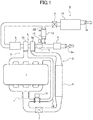
- FIG. 1 is a view entirely illustrating an exhaust gas recirculation system of an internal combustion engine to which a gas-liquid separator according to the first embodiment is applied.
- a gas-liquid separator according to the first embodiment is applied.
- an overall configuration of the system according to the first embodiment will be described with reference to Fig. 1 .
- the gas-liquid separator 20 is applied to an exhaust gas recirculation system S of an internal combustion engine 1 shown in Fig. 1 .
- the internal combustion engine 1 shown in Fig. 1 is a diesel engine mounted in a vehicle as a driving source for traveling and includes four cylinders (not shown). The cylinders are connected to an intake passage 2 and an exhaust passage 3.
- the intake passage 2 includes an intake port 2a at an end.
- the intake passage 2 is provided with an air cleaner 4 for filtering an intake air, a compressor 5a of a turbocharger 5, an intercooler 6 for cooling the intake air, and a throttle valve 7 for regulating an amount of the intake air.
- the exhaust passage 3 is provided with a turbine 5b of the turbocharger 5, an exhaust purification catalyst 8 for purifying exhaust gas, and an exhaust throttle valve 9 for regulating an amount of the exhaust gas.
- a muffler 10 is disposed downstream of the exhaust throttle valve 9, and an exhaust port 3a is disposed downstream of the muffler 10.
- the intake passage 2 is connected to the exhaust passage 3 via a low-pressure EGR passage 11 and a high-pressure EGR passage 12.
- EGR exhaust Gas Recirculation
- EGR exhaust Gas Recirculation
- the low-pressure EGR passage 11 connects a portion of the intake passage 2 located upstream of the compressor 5a and a portion of the exhaust passage 3 located downstream of the exhaust purification catalyst 8.
- the high-pressure EGR passage 12 connects a portion of the intake passage 2 located downstream of the compressor 5a and a portion of the exhaust passage 3 located upstream of the turbine 5b.
- the low-pressure EGR passage 11 returns the exhaust gas passing through the turbine 5b to the intake air before the compressor 5a.
- the high-pressure EGR passage 12 returns the exhaust gas before flowing into the turbine 5b to the intake air passing through the compressor 5a.
- the low-pressure EGR passage 11 includes an EGR cooler 13 for cooling the exhaust gas returning to the intake passage 2 and a low-pressure EGR valve 14 for regulating an amount of the exhaust gas returning to the intake passage 2 via the low-pressure EGR passage 11.
- the high-pressure EGR passage 12 includes a high-pressure EGR valve 15 for regulating an amount of the exhaust gas returning to the intake passage 2 via the high-pressure EGR passage 12.
- the low-pressure EGR passage 11 can return the exhaust gas without reducing the amount of the exhaust gas passing through the turbocharger 5 and can effectively reduce NOx.
- the cooling in the EGR cooler 13 brings an issue of concern to generate condensed water. Therefore, in the first embodiment, the gas-liquid separator 20 (see Fig. 2 ) is provided downstream of the low-pressure EGR valve 14 and upstream of the compressor 5a of the turbocharger 5 (i.e. at a location surrounded by a dashed line X in Fig. 1 ) to collect and drain the condensed water.
- FIG. 2 is cross-sectional views illustrating the gas-liquid separator according to the first embodiment.
- the configuration of the gas-liquid separator according to the first embodiment will be described in detail with reference to Fig. 2 .
- the gas-liquid separator 20 includes an inlet pipe 21, an inner pipe 22, a first drain pipe 23, a second drain pipe 24, a reservoir tank 25, a bypass pipe 26, a swirling flow generating member 30, and a pipe cooling structure 40.
- the inlet pipe 21 includes an end which is located upstream in a flow direction of the gas-liquid two-phase fluid (on the right side in Fig. 2 ; hereinafter referred to as "fluid entering side”).
- the upstream end of inlet pipe 21 is in connection with the intake port 2a and the low-pressure EGR valve 14.
- the inlet pipe 21 receives an exhaust gas in the mixture of a gas and a particulate liquid (condensed water) (hereinafter, referred to as "the gas-liquid two-phase fluid").
- the swirling flow generating member 30 is disposed within the inlet pipe 21.
- the swirling flow generating member 30 is configured to swirl the gas-liquid two-phase fluid along an inner circumferential surface 21a of the inlet pipe 21.
- the inlet pipe 21 includes a first drain port 21c (a drain port) and a second drain port 21d (an upstream drain port).
- the first drain port 21c is formed in at an end portion 21b downstream in the flow direction of the gas-liquid two-phase fluid (on the left side in Fig. 2 ; hereinafter referred to as "the fluid exiting side") from the swirling flow generating member 30.
- the second drain port 21d is formed in the fluid entering side of the swirling flow generating member 30.
- the first drain port 21c is an opening through which the liquid separated from the gas-liquid two-phase fluid exits.
- the first drain port 21c opens in the radial direction of the inlet pipe 21 and downward in the direction of gravity.
- the second drain port 21d is an opening through which the liquid contained in the gas-liquid two-phase fluid before swirling exits.
- the second drain port 21d also opens in the radial direction of the inlet pipe 21 and downward in the direction of gravity. It should be noted that "the direction of gravity” is a direction the gravity acts and the downward direction in Fig. 2 .
- the inner circumferential surface 21a of the inlet pipe 21 includes a tapered surface 21e.
- the tapered surface 21e is located in the fluid exiting side of the swirling flow generating member 30.
- the tapered surface 21e is configured to gradually increase the inner diameter of the inlet pipe 21 toward the fluid exiting side.
- the inlet pipe 21 includes a first area 27A located in the fluid entering side of the tapered surface 21e, a second area 27B in which the tapered surface 21e is formed, and a third area 27C located in the fluid exiting side of the tapered surface 21e. Accordingly, the inner diameter of the inlet pipe 21 is the smallest in the first area 27A and the largest in the third area 27C, and gradually increases in the second area 27B.
- the fluid entering side end of the second area 27B is located close to the fluid exiting side end of the swirling flow generating member 30.
- the fluid exiting side end of the swirling flow generating member 30 is set to be positioned in the vicinity of the fluid entering side end of the second area 27B.
- the first area 27A includes the second drain port 21d and the swirling flow generating member 30 while the third area 27C includes the first drain port 21c.
- the inner pipe 22 is a straight pipe member which has an outer diameter smaller than the inner diameter of the inlet pipe 21 in the third area 27C. An end 22a of the inner pipe 22 is inserted into the end portion 21b at the fluid exiting side of the inlet pipe 21 so that the inner pipe 22 is disposed coaxially with the inlet pipe 21.
- a gap or clearance ⁇ is formed between the inlet pipe 21 and the inner pipe 22, and a spacer 28 is disposed therewithin.
- the spacer 28 has a cylindrical shape to surround the entire circumference of the inner pipe 22.
- An outer circumferential surface of the spacer 28 contacts an inner circumferential surface 21a of the inlet pipe 21 in an airtight state.
- an inner circumferential surface of the spacer 28 contacts an outer circumferential surface 22f of the inner pipe 22 in an airtight state.
- the spacer 28 includes an axial end 28a within the inlet pipe 21.
- the axial position of the axial end 28a is coincident with that of a most-downstream portion of a circumferential edge of the first drain port 21c.
- the spacer 28 is provided not to overlap the opening area of the first drain port 21c and not to leave any gap or clearance in the axial direction between the spacer 28 and the opening area of the first drain port 21c.
- the inner pipe 22 includes an opening 22b in the end 22a inserted into the inlet pipe 21.
- the opening 22b is located in the fluid exiting side of the swirling flow generating member 30 and opens in the axial direction of the inner pipe 22.
- the end of the inner pipe 22 in the fluid exiting side i.e. the left side in Fig. 2
- the inlet pipe 21, the inner pipe 22 and the opening 22b are arranged coaxially relative to each other.
- the inner pipe 22 includes a vent hole 22c at a portion extending from the inlet pipe 21.
- the vent hole 22c radially extends through the circumferential surface of the inner pipe 22.
- a second end 26b of the bypass pipe 26 is connected to the vent hole 22c.
- the inner pipe 22 further includes a plurality of circular grooves 22e (two in this embodiment) formed on an inner circumferential surface 22d.
- the inner pipe 22 includes a protrusion 22g on the outer circumferential surface 22f of a portion of the inner pipe 22 inserted into the inlet pipe 21.
- An electrical heating sheet 22h (heating structure) is provided along the outer circumferential surface 22f of the portion of the inner pipe 22 extending from the inlet pipe 21.
- the circular grooves 22e formed in the inner pipe 22 are circular recesses circumferentially extending along the inner pipe 22.
- the circular grooves 22e are disposed axially inward of the inner pipe 22, i.e. at positions closer to the fluid exiting side than the swirling flow generating member 30.
- one of the two circular grooves 22e is disposed on the inner circumferential surface of the portion of the inner pipe 22 inserted into the inlet pipe 21.
- This circular groove 22e is formed inside the protrusion 22g so that the axial position of this circular groove 22e is coincident with that of the protrusion 22g.
- the other of the circular grooves 22e is disposed on the inner circumferential surface of the portion of the inner pipe 22 extending from the inlet pipe 21.
- each of the circular grooves 22e includes a first step surface 51, a second step surface 52 and a bottom surface 53.
- the first step surface 51 is one of the surfaces defining the circular groove 22e and located in the fluid entering side.
- the first step surface 51 increases the inner diameter of the inner pipe 22 in a step-wise manner toward the fluid exiting side. Specifically, an inner diameter dimension D2 of the inner pipe 22 defined within the circular groove 22e is larger than an inner diameter dimension D1 of the inner pipe 22 in the fluid entering side of the circular groove 22e.
- the first step surface 51 and an inner circumferential surface 221d of the inner pipe 22 which is located in the fluid entering side of the first step surface 51 define an angle ⁇ 1 . In this embodiment, the angle ⁇ 1 is set to 90 degrees.
- the second step surface 52 is another surface defining the circular groove 22e and located in the fluid exiting side.
- the second step surface 52 decreases the inner diameter of the inner pipe 22 in a step-wise manner toward the fluid exiting side.
- the inner diameter dimension D2 of the inner pipe 22 defined within the circular groove 22e is larger than an inner diameter dimension D3 of the inner pipe 22 in the fluid exiting side of the circular groove 22e.
- the second step surface 52 and an inner circumferential surface 222d of the inner pipe 22 which is located in the fluid exiting side of the second step surface 52 define an angle ⁇ 2 .
- the angle ⁇ 2 is set to 90 degrees.
- a height H2 of the second step surface 52 has the same height as a height H1 of the first step surface 51.
- the bottom surface 53 of the circular groove 22e is located between the first step surface 51 and the second step surface 52.
- the bottom surface 53 extends in the circumferential direction of the inner pipe 22.
- the protrusion 22g radially and circumferentially extends from the outer circumferential surface 22f of the inner pipe 22 to entirely surround the outer circumferential surface 22f.
- the protrusion 22g is formed above the first drain port 21c of the inlet pipe 21 in the direction of gravity.
- the protrusion 22g has a height H3.
- the clearance between the inner circumferential surface 21a of the inlet pipe 21 and the outer circumferential surface 22f of the inner pipe 22 has a height H4.
- the height H3 of the protrusion 22g is set to be smaller than the height H4 of the clearance. Thereby, a gap or clearance is formed between a tip surface of the protrusion 22g and the inner circumferential surface 21a of the inlet pipe 21.
- the electrical heating sheet 22h is a flexible sheet including heating wires which generate heat when a switch (not shown) is turned on.
- the electrical heating sheet 22h is wound around the outer circumferential surface 22f of the inner pipe 22.
- the inner pipe 22 is heated when the heating wires of the electrical heating sheet 22h generates heat.
- the electrical heating sheet 22h surrounds the portion of the inner pipe 22 extending from the inlet pipe 21 where the other circular groove 22e is provided. Accordingly, the electrical heating sheet 22h heats the portion of the outer circumferential surface 22f where the other circular groove 22e (i.e. the first step surface 51) is provided.
- the first drain pipe 23 is a T-shaped pipe including a first pipe member 23a and a second pipe member 23b.
- the second pipe member 23b is connected to an axial center portion of the first pipe member 23a and perpendicular to the first pipe member 23a.
- the end portion 21b of the inlet pipe 21 in the fluid exiting side extends into the first pipe member 23a and is fixed thereto.
- a connection opening 23c is formed at a connection portion between the first pipe member 23a and the second pipe member 23b to face the first drain port 21c.
- the inlet pipe 21 is in communication with the second pipe member 23b of the first drain pipe 23 via the drain port 21c and the connection opening 23c.
- the inner diameter of the first drain port 21c formed in the inlet pipe 21 has the substantially same size as that of the connection opening 23c of the first drain pipe 23.
- the second pipe member 23b extends downward in the direction of gravity with respect to the axial direction of the inlet pipe 21.
- the second pipe member 23b includes a tapered diameter portion 23d in the middle thereof. The diameter of the tapered diameter portion 23d becomes gradually smaller in the liquid flow direction. Accordingly, the inner diameter of a tip opening 23e is smaller than the inner diameters of the connection opening 23c and the first drain port 21c.
- the second drain pipe 24 is a T-shaped pipe including a first pipe member 24a and a second pipe member 24b.
- the second pipe member 24b is connected to an axial center portion of the first pipe member 24a and perpendicular to the first pipe member 24a.
- the inlet pipe 21 extends through the first pipe member 24a.
- a connection opening 24c is formed at a connection portion between the first pipe member 24a and the second pipe member 24b to face the second drain port 21d. Thereby, the inlet pipe 21 is in communication with the second pipe member 24b of the second drain pipe 24 via the second drain port 21d and the connection opening 24c.
- the inner diameter of the second drain port 21d formed in the inlet pipe 21 has the substantially same size as that of the connection opening 24c of the second drain pipe 24.
- the second pipe member 24b extends downward in the direction of gravity with respect to the axial direction of the inlet pipe 21.
- the second pipe member 24b includes a tapered diameter portion 24d in the middle thereof. The diameter of the tapered diameter portion 24d becomes gradually smaller in the liquid flow direction. Accordingly, the inner diameter of a tip opening 24e is smaller than the inner diameters of the connection opening 24c and the second drain port 21d.
- the reservoir tank 25 includes a tank body 25a disposed below the first drain pipe 23 and the second drain pipe 24 in the direction of gravity.
- the tank body 25a includes a first connection opening 25b and a second connection opening 25c which are formed at an upper portion of the tank body 25a.
- the first connection opening 25b is connected to a tip portion 23f of the second pipe member 23b of the first drain pipe 23.
- the second connection opening 25c is connected to a tip portion 24f of the second pipe member 24b of the second drain pipe 24.
- the second pipe member 23b includes in the tip portion 23f the tip opening 23e which is in communication with the first connection opening 25b.
- the second pipe member 24b includes in the tip portion 24f the tip opening 24e which is in communication with the second connection opening 25c.
- the tank body 25a includes a vent hole 25d to which a first end 26a of the bypass pipe 26 is connected.
- the vent hole 25d is formed at an upper portion of a side wall of the tank body 25a in the direction of gravity.
- the tank body 25a includes a drain opening (not shown) formed at a lower portion thereof in the direction of gravity.
- the drain opening is configured to open and close. The liquid may be discharged from the tank body 25a via the drain opening when the liquid in the tank body 25a reaches a predetermined amount.
- the bypass pipe 26 is a pipe member for connecting the inner pipe 22 and the reservoir tank 25.
- the bypass pipe 26 includes the first end 26a and the second end 26b which are opening ends.
- the first end 26a is connected to the vent hole 25d of the tank body 25a while the second end 26b is connected to the vent hole 22c of the inner pipe 22. Accordingly, the bypass pipe 26 communicates an inside of the tank body 25a with an inside of the inner pipe 22.
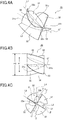
- FIGs. 4A to 4C are views illustrating the swirling flow generating member according to the first embodiment.
- the configuration of the swirling flow generating member according to the first embodiment will be described in detail with reference to Figs. 4A to 4C .
- the swirling flow generating member 30 is disposed in the first area 27A of the inlet pipe 21 to regulate the flow direction of the gas-liquid two-phase fluid flowing through the inlet pipe 21 and generate the swirling flow.
- the swirling flow generating member 30 includes a vane supporting portion 31 and a plurality (four in this embodiment) of stator vanes 32.
- the stator vanes 32 are provided on an outer circumferential surface 31a of the vane supporting portion 31.
- the vane supporting portion 31 extends along an axis line O of the inlet pipe 21.
- the vane supporting portion 31 has a conical shape whose outer diameter gradually increases from the fluid entering side to the fluid exiting side of the gas-liquid two-phase fluid.
- a maximum outer diameter dimension R1 of the vane supporting portion 31 is set to be smaller than an inner diameter dimension D4 of the inlet pipe 21 in the first area 27A.
- the vane supporting portion 31 includes a leading end 31b which has a round surface.
- the stator vanes 32 spirally surround the outer circumferential surface 31a of the vane supporting portion 31.
- the extending direction of each stator vane 32 inclines relative to the axis line O of the inlet pipe 21.
- a straight line L1 extending through an end position 32a in the side of the leading end 31b of the vane supporting portion 31 and an end position 32b in the side of a tailing end 31c of the vane supporting portion 31 in the stator vane 32 inclines relative to an axis line O' of the vane supporting portion 31.
- a contact line L2 between the vane supporting portion 31 and the stator vane 32 is spirally curved.
- the "leading end 31b" is an end in the fluid entering side of the vane supporting portion 31
- the "tailing end 31c" is an end in the fluid exiting side of the vane supporting portion 31.
- the plurality (four) of stator vanes 32 are arranged at regular intervals in the circumferential direction of the vane supporting portion 31.
- the opposing surfaces of each stator vane 32 are parallel to each other.
- a surrounding angle ⁇ 3 of the stator vane 32 with respect to the vane supporting portion 31 is set approximately 60 degrees.
- the term the "surrounding angle" is an angle defined by a first straight line L3 radially extending from the axis line O' along the end position 32a and a second straight line L4 radially extending from the axis line O' along the end position 32b when the swirling flow generating member 30 is seen in the axial direction thereof as shown in Fig. 4C .
- a clearance ⁇ is defined between the adjacent stator vanes 32 in the circumferential direction of the vane supporting portion 31 when the swirling flow generating member 30 is seen in the axial direction thereof.
- a maximum outer diameter dimension R2 of the swirling flow generating member 30 is set to have the substantially same size as the inner diameter dimension D4 of the inlet pipe 21 in the first area 27A. Accordingly, the swirling flow generating member 30 is arranged coaxially with the inlet pipe 21 and the radial tips of the stator vanes 32 contact the inner circumferential surface 21a of the inlet pipe 21.
- the pipe cooling structure 40 is configured to surround the inlet pipe 21 to cool a portion of the inlet pipe 21 where the swirling flow generating member 30 is disposed.
- the pipe cooling structure 40 includes a cooling water circulation pipe 41, a first cooling water pipe 42, and a second cooling water pipe 43.
- the cooling water circulation pipe 41 is a hollow cylindrical pipe having an inner diameter larger than the outer diameter of the inlet pipe 21.
- the inlet pipe 21 partially has a double pipe structure in which the inlet pipe 21 extends through the cooling water circulation pipe 41 to be surrounded by the cooling water circulation pipe 41. Thereby, a cooling water circulation space 41a is formed between the inlet pipe 21 and the cooling water circulation pipe 41.
- the cooling water circulation space 41a is a space surrounding the outer circumferential surface of the inlet pipe 21.
- the cooling water circulation pipe 41 surrounds a portion of the inlet pipe 21 between the first drain port 21c and the second drain port 21d.
- the surrounded portion of the inlet pipe 21 includes an area in which the swirling flow generating member 30 is disposed.
- the first cooling water pipe 42 is a pipe through which cooling water (refrigerant) flows to the pipe cooling water circulation space 41a.
- One end 42a of the first cooling water pipe 42 is connected to a first opening 41b formed in the cooling water circulation pipe 41 while the other end (not shown) of the first cooling water pipe 42 is connected between an evaporator and an expansion valve of a refrigerating cycle of a vehicle air conditioner (not shown).
- the first opening 41b is an opening which radially opens to the cooling water circulation space 41a.
- the first opening 41b is formed by making a circular hole on the circumferential surface of the cooling water circulation pipe 41. As shown in Fig. 2 , the first opening 41b is formed in the fluid entering side of the swirling flow generating member 30 and above the swirling flow generating member 30 in the direction of gravity.
- the second cooling water pipe 43 is a pipe through which the cooling water (refrigerant) discharged from the cooling water circulation space 41a flows.
- One end 43a of the second cooling water pipe 43 is connected to a second opening 41c formed in the cooling water circulation pipe 41 while the other end (not shown) of the second cooling water pipe 43 is connected between the compressor and the evaporator of the refrigerating cycle of the vehicle air conditioner (not shown).
- the second opening 41c is an opening which radially opens to the cooling water circulation space 41a.
- the second opening 41c is formed by making a circular hole on the circumferential surface of the cooling water circulation pipe 41.
- the second opening 41c is formed in the fluid exiting side of the swirling flow generating member 30 and below the swirling flow generating member 30 in the direction of gravity.
- first and second opening 41c are not limited to the ones shown in Fig. 2 but the first and second openings 41b, 41c may be formed in any locations.
- first opening 41b may be formed in the fluid exiting side of the swirling flow generating member 30 while the second opening 41c may be formed in the fluid entering side of the swirling flow generating member 30.
- the opening directions of the first and second openings 41b, 41c are not necessarily in the direction of gravity since the cooling water circulates under the water pressure.
- FIG. 5 is explanatory views illustrating the flow of the gas-liquid two-phase fluid as well as the flows of the separated gas and liquid through the gas-liquid separator according to the first embodiment.
- the gas-liquid separation in the first embodiment will be described with reference to Fig 5 .
- an outside air taken from the intake port 2a and the exhaust gas taken from the exhaust passage 3 via the low-pressure EGR passage 11 flow into the compressor 5a of the turbocharger 5 at a flow rate of 1 m/s to 100 m/s.
- the outside air and the exhaust gas contain moisture.
- These gases are cooled in the EGR cooler 13 so that the moisture is condensed into the particulate liquid as condensed water, and the liquid is mixed with the gas such as air to form the gas-liquid two-phase fluid.
- the gas-liquid two-phase fluid flown into the inlet pipe 21 swirls when flowing through the first area 27A where the swirling flow generating member 30 is disposed and flowing along the swirling flow generating member 30.
- the gas-liquid two-phase fluid becomes a swirling flow.
- the swirling flow generates the centrifugal force, which guides the liquid with the relatively large weight to flow toward the inner circumferential surface 21a of the inlet pipe 21.
- the liquid guided toward the inner circumferential surface 21a of the inlet pipe 21 coheres to become droplets and is separated from the gas.
- the liquid separated from the gas flows from the second area 27B to the third area 27C by the swirling flow while attached to the inner circumferential surface 21a.
- the liquid flown to the third area 27C flows into the second pipe member 23b through the first drain port 21c in the third area 27C and the connection opening 23c of the first drain pipe 23 and falls down through the second pipe member 23b. Subsequently, the liquid flows out of the second pipe member 23b through the tip opening 23e and flows into the tank body 25a to be retained therein.
- the first drain port 21c opens downward in the direction of gravity, and the second pipe member 23b of the first drain pipe 23 extends in the direction of gravity. Accordingly, the liquid flown to the third area 27C falls down toward the second pipe member 23b through the first drain port 21c by its own weight.
- the outer diameter of the inner pipe 22 is smaller than the inner diameter of the inlet pipe 21 in the third area 27C. Thereby, the liquid attached to the inner circumferential surface 21a of the inlet pipe 21 can be prevented from flowing into the inner pipe 22.
- the liquid flown to the third area 27C flows into the clearance or space between the inlet pipe 21 and the inner pipe 22 so that the liquid is prevented from flowing into the inner pipe 22.
- the inner pipe 22 is inserted into the inlet pipe 21 so that it is unnecessary to enlarge the diameter of the pipes and accordingly an installation space required for the gas-liquid separator 20 can be reduced.
- the inner pipe 22 is in communication with the reservoir tank 25 via the bypass pipe 26. Accordingly, the flow of the gas through the inner pipe 22 generates a negative pressure in the reservoir tank 25 so that the liquid can smoothly flow through the first drain pipe 23.
- the gas flowing through the inlet pipe 21 flows into the inner pipe 22 from the opening 22b which axially opens.
- the farther the liquid flows downstream in the flow direction of the gas-liquid two-phase fluid the more the liquid is separated from the gas.
- the gas flows to the compressor 5a of the turbocharger 5 via the inner pipe 22.
- the spacer 28 is disposed in the end portion 21b of the inlet pipe 21 in the fluid exiting side to fill the clearance ⁇ between the inlet pipe 21 and the inner pipe 22.
- the spacer 28 prevents the gas from leaking through the clearance between the inlet pipe 21 and the inner pipe 22. Consequently, the gas separated from the gas-liquid two-phase fluid can smoothly flow into the inner pipe 22.
- the swirling flow generating member 30 includes the vane supporting portion 31 provided coaxially with the inlet pipe 21.
- the vane supporting portion 31 extends along the axis line O of the inlet pipe 21 and has a conical shape whose diameter gradually increases from the fluid entering side to the fluid exiting side of the gas-liquid two-phase fluid.
- the gas-liquid two-phase fluid flowing around the axis center of the inlet pipe 21 flows along the outer circumferential surface 31a of the vane supporting portion 31 to be forced to flow toward the inner circumferential surface 21a of the inlet pipe 21. Consequently, the gas-liquid two-phase fluid is suppressed from flowing around the axis center of the inlet pipe 21. Further, even if the flow rate of the gas-liquid two-phase fluid flowing through the inlet pipe 21 is relatively row, the liquid contained in the gas-liquid two-phase fluid coheres, which facilitates the formation of droplets.
- stator vanes 32 of the swirling flow generating member 30 surround the outer circumferential surface 31a with inclined relative to the axis line O of the inlet pipe 21 to set a preterminal angle with respect to the flow direction of the gas-liquid two-phase fluid.
- the flow direction of the gas-liquid two-phase fluid leans relative to the axis line O of the inlet pipe 21 so that the swirling flow can be generated.
- the liquid contained in the gas-liquid two-phase fluid collides with the stator vanes 32 and coheres so that the formation of droplets can be facilitated.
- the swirling flow generating member 30 is configured to have the stator vanes 32 on the outer circumferential surface 31a of the conical vane supporting portion 31. Accordingly, the axial dimension of the swirling flow generating member 30 can be reduced compared to a swirling flow generating ribbon which is formed by spirally twisting a plate member, for example. Thereby, the length of the first area 27A where the swirling flow generating member 30 is disposed can be reduced and accordingly the gas-liquid separator 20 can be downsized.
- the flow resistance and the swirling amount of the gas-liquid two-phase fluid may be set as desired by adjusting the shape of the outer circumferential surface 31a of the vane supporting portion 31, the number of the stator vanes 32, the surrounding angle ⁇ 3 of each stator vane 32 relative to the vane supporting portion 31, or the like. Specifically, in the case where the surrounding angle ⁇ 3 is relatively large, a collision area of each stator vane 32 for the gas-liquid two-phase fluid increases and the flow path of the gas-liquid two-phase fluid is more curved. Thereby, the swirling amount of the gas-liquid two-phase fluid can be increased.
- the straight line L1 extending along the end positions 32a, 32b of each stator vane 32 becomes closer to parallel to the axis line O.
- the flow resistance is suppressed so that the gas-liquid two-phase fluid can smoothly flow.
- the flow resistance and the swirling amount of the gas-liquid two-phase fluid may vary in accordance with the shape of the outer circumferential surface 31a of the vane supporting portion 31 (e.g. flat or curved). Accordingly, the flow resistance and the swirling amount of the gas-liquid two-phase fluid flowing through the inlet pipe 21 can be easily and properly controlled by adjusting the shape of the swirling flow generating member 30.
- the plurality of stator vanes 32 are arranged at regular intervals in the circumferential direction of the vane supporting portion 31. Accordingly, the flow resistance and the swirling amount of the gas-liquid two-phase fluid flowing through the inlet pipe 21 can also be easily and properly controlled.
- the inlet pipe 21 includes the second area 27B where the tapered surface 21e is provided on the inner circumferential surface 21a.
- the inner diameter of the tapered surface 21e gradually increases in the flow direction of the gas-liquid two-phase fluid.
- the fluid entering side end of the second area 27B is located in the vicinity of the fluid exiting side end of the swirling flow generating member 30. Accordingly, the liquid flown to the tailing end 31c of the vane supporting portion 31 of the swirling flow generating member 30 immediately flows to the tapered surface 21e. Consequently, the liquid guided along the outer circumferential surface 31a of the vane supporting portion 31 and the stator vanes 32 toward the inner circumferential surface 21a can smoothly flow to the first drain port 21c, further facilitating the guide and the separation of the liquid.
- the inlet pipe 21 includes, in addition to the first drain port 21c, the second drain port 21d formed in the fluid entering side of the swirling flow generating member 30.
- the liquid which has already been the droplet with a certain size enough to fall down in the direction of gravity by its own weight can be discharged from the inlet pipe 21 through the second drain port 21d by its own weight before flowing along the swirling flow generating member 30. Then, the droplet falls down through the second drain pipe 24 connected to the second drain port 21d into the reservoir tank 25 to be retained therein.
- the liquid contained in the gas-liquid two-phase fluid which can fall down in the direction of gravity by its own weight without swirling the gas-liquid two-phase fluid can be collected in advance before swirling the gas-liquid two-phase fluid. Consequently, the liquid separation rate can be improved by reducing the contained amount of the liquid when swirling the gas-liquid two-phase fluid.
- the liquid to become the droplets while flowing along the inner circumferential surface 21a of the inlet pipe 21 by the swirling flow flows to the third area 27C and then falls down through the first drain pipe 23 from the first drain port 21c by its own weight. Then, the liquid flows through the first drain pipe 23 into the reservoir tank 25 to be retained therein.
- smaller droplets which cannot fall down by their own weight may stay within the inlet pipe 21 with attaching to the outer circumferential surface 22f of the inner pipe 22.
- the circumferentially extending protrusion 22g is provided on the portion of the outer circumferential surface 22f of the inner pipe 22 inserted into the inlet pipe 21 at a location facing the first drain port 21c.
- the gas which collides with the spacer 28 flows toward the opening 22b along the outer circumferential surface 22f of the inner pipe 22 to move the droplets W toward the opening 22b along the outer circumferential surface 22f.
- the protrusion 22g blocks the flow of the droplets W toward the opening 22b as shown in Fig. 6 . Then, the droplets W blocked by the protrusion 22g are gathered and the gathered droplet falls down by its own weight into the first drain pipe 23 through the first drain port 21c when the weight of the gathered droplet becomes heavy enough to fall down.
- the gas-liquid separator 20 includes the pipe cooling structure 40.
- the inlet pipe 21 extends through the cooling water circulation pipe 41, and the cooling water circulation space 41a is formed between the inlet pipe 21 and the cooling water circulation pipe 41.
- the first cooling water pipe 42 and the second cooling water pipe 43 are connected to the cooling water circulation space 41a.
- the first cooling water pipe 42 and the second cooling water pipe 43 are connected to the refrigerating cycle of the vehicle air conditioner (not shown).
- cooling water circulation space 41a a portion of the cooling water discharged from the expansion valve in the form of mist with low temperature and low pressure flows into the cooling water circulation space 41a through the first cooling water pipe 42.
- the cooling water entered the cooling water circulation space 41a flows in the axial direction of the inlet pipe 21 and then flows out through the second opening 41c to return to the refrigerating cycle via the second cooling water pipe 43.
- the cooling water in the form of mist with the low temperature and the low pressure absorbs ambient heat and vaporizes while flowing through the cooling water circulation space 41a. Thereby, the inlet pipe 21 and the cooling water circulation pipe 41 are cooled.
- the gas-liquid two-phase fluid flows through the inlet pipe 21.
- the heat of the gas-liquid two-phase fluid is transferred to the inlet pipe 21 and absorbed so that the gas-liquid two-phase fluid is cooled.
- the temperature of the gas-liquid two-phase fluid is decreased to facilitate the liquid contained in the gas-liquid two-phase fluid to be droplets.
- the weight of each droplet becomes heavier so that the droplets (liquid) can be guided to the inner circumferential surface 21a of the inlet pipe 21 even if the centrifugal force caused by the swirling flow is relatively weak. Consequently, the liquid separation rate from the gas-liquid two-phase fluid can be improved.
- the gas separated from the liquid flows into the inner pipe 22 while keeping swirling and then flows to the turbocharger 5 (not shown). However, if the liquid which is not separated from the gas exists, such non-separated liquid may flow into the inner pipe 22 with the gas.
- the liquid flowing downstream may collide with rotor blades of the compressor 5a of the turbocharger 5 to give an impact thereto.
- the inner circumferential surface 22d of the inner pipe 22 includes a plurality of the circular grooves 22e (two in this embodiment) each including the first step surface 51, the second step surface 52, and the bottom surface 53.
- the liquid flown into the inner pipe 22 is guided to the inner circumferential surface 22d by the swirling gas flowing through the inner pipe 22 and the liquid coheres to be droplets.
- the liquid in the form of the droplets flows along the inner circumferential surface 22d and then flows into the circular grooves 22e.
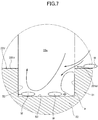
- the gas flowing into the circular groove 22e generates a turbulent flow within the circular groove 22e, which generates a negative pressure region F along the first step surface 51 located upstream in the flow direction of the gas-liquid two-phase fluid. Accordingly, the droplets W flown into the circular grooves 22e together with the gas are pulled by the negative pressure toward the first step surface 51. Thereby, the droplets W remain within the circular groove 22e, specifically in the vicinity of the first step surface 51.
- the bottom surface 53 of the circular groove 22e extends in the circumferential direction of the inner pipe 22. Accordingly, the swirling gas circumferentially flows along the bottom surface 53 within the circular groove 22e. In addition, the droplets W remained within the circular groove 22e also flows along the bottom surface 53 within the circular groove 22e together with the swirling gas. In other words, the gas and the droplets W swirl along the bottom surface 53. Then, the droplets W keep swirling along the bottom surface 53 and then evaporate.
- the droplets W flown into the inner pipe 22 swirl within the circular groove 22e while pulled to the first step surface 51 and then evaporate. Thereby, it is possible to prevent the droplets W from flowing downward through the inner pipe 22 together with the gas.
- the liquid (the droplets W) separated from the gas swirls within the circular groove 22e while pulled to the first step surface 51 and then evaporates. Thereby, it is possible to prevent the droplets W from flowing toward the fluid exiting side beyond the circular groove 22e.
- the inner circumferential surface 22d of the inner pipe 22 includes a plurality of the circular grooves 22e (two in this embodiment). Accordingly, there is a plurality of chances (twice in this embodiment) to keep the droplets W remained within the circular grooves 22e to evaporate the droplets W. Consequently, more liquid can be vaporized and accordingly the vaporization rate of the droplets can be improved.
- the electrical heating sheet 22h surrounds the portion of the outer circumferential surface 22f of the inner pipe 22 extending from the inlet pipe 21 as shown in Fig. 5 . Therefore, the electrical heating sheet 22h can heat the outer circumferential surface 22f of the inner pipe 22 when turned on to generate heat.
- the circular groove 22e including the first step surface 51 is formed on the portion of the inner circumferential surface 22d of the inner pipe 22 extending from the inlet pipe 21 and surrounded by the electrical heating sheet 22h. Therefore, the portion of the outer circumferential surface 22f including the circular groove 22e can be heated by the electrical heating sheet 22h.
- each of the circular grooves 22e formed on the inner pipe 22 includes the second step surface 52.
- the second step surface 52 is provided closer to the fluid exiting side than the first step surface 51.
- the second step surface 52 decreases the inner diameter of the inner pipe 22 in a step-wise manner toward the fluid exiting side.
- the second step surface 52 can prevent the movement of the droplets W and keep the droplets remained within the circular groove 22e.
- the second step surface 52 can prevent the droplets W from flowing downstream of the circular groove 22e. Consequently, the droplets W is kept remained within the circular groove 22e to be evaporated and accordingly the liquid in the form of the droplets W can be suppressed from flowing downward.
- gas-liquid separator of the present disclosure has been described with reference to the first embodiment, the specific configuration of the gas-liquid separator is not limited to the embodiment, and modifications of the configuration and/or additions to the above configuration may be made without departing from the gist of the inventions recited in the claims.
- the number of the stator vanes 32 provided in the swirling flow generating member 30 is four.
- the number of the stator vanes 32 is not limited to four and the swirling flow generating member 30 may have one or more stator vanes 32.
- the surrounding angle ⁇ 3 of each stator vane 32 relative to the vane supporting portion 31 may be set as desired.
- the surrounding angle ⁇ 3 may be set to an angle to leave no clearance between the stator vanes 32 in the circumferential direction of the vane supporting portion 31 when the swirling flow generating member 30 is seen in the axial direction thereof as shown in Fig. 8 .
- the axial dimension L of the outer circumferential surface 31a of the vane supporting portion 31, the maximum outer diameter dimension R1, the curvature of the leading end 31b, and the like may also be set as desired.
- the shape of the outer circumferential surface 31a is not limited to the one in the first embodiment.
- the outer circumferential surface 31a may be a flat surface (see Fig. 9A ), a convex curved surface (see Fig. 9B ), a concave curved surface (see Fig. 9C ), or the like.
- the cross-sectional shape of the stator vane 32 may be set as desired.
- the cross-sectional shape of the stator vane 32 may be rectangular, teardrop-shaped, or the like.
- the inlet pipe 21 includes the first drain port 21c and the second drain port 21d.
- the inlet pipe 21 is not limited to the one in the first embodiment.
- an end portion 21f of the inlet pipe 21 in the fluid entering side may be inserted into an end portion 50a of a fluid inflow pipe 50 in the fluid exiting side whose inner diameter is larger than the outer diameter of the inlet pipe 21.
- the inlet pipe 21 includes in the end portion 21f an opening 21g which opens along the axis line O.
- the end portion 50a of the fluid inflow pipe 50 includes an enlarged inner diameter portion 50b and a drain port 50c.
- the enlarged inner diameter portion 50b is an area whose inner diameter is larger than that of a general or primary portion of the fluid inflow pipe 50.
- the drain port 50c is an opening which is formed on the circumferential surface of the enlarged inner diameter portion 50b and opens in the radial direction of the fluid inflow pipe 50 and downward in the direction of gravity.
- a tapered surface 50d is formed in a boundary between the enlarged inner diameter portion 50b and the primary portion of the fluid inflow pipe 50. The tapered surface 50d gradually increases the inner diameter of the fluid inflow pipe 50.
- the second drain pipe 24 is attached to the drain port 50c which is in communication with the reservoir tank 25. The end portion 21f of the inlet pipe 21 is inserted into the enlarged inner diameter portion 50b and extends above the drain port 50c.
- the gas-liquid two-phase fluid enters the gas-liquid separator 20A from the fluid inflow pipe 50 and turns to the swirling flow in the inlet pipe 21.
- the liquid contained in the gas-liquid two-phase fluid which can fall down in the direction of gravity by its own weight flows out of the fluid inflow pipe 50 through the drain port 50c by its own weight before entering the inlet pipe 21. Consequently, the liquid contained in the gas-liquid two-phase fluid swirling within the inlet pipe 21 can be reduced and accordingly the liquid separation rate can be increased.
- an inner diameter dimension D5 of the fluid inflow pipe 50 is set to be larger than the inner diameter dimension D4 of the inlet pipe 21. Accordingly, the flow rate of the gas-liquid two-phase fluid is higher in the inlet pipe 21 rather than that in the fluid inflow pipe 50. Consequently, the swirling force of the gas-liquid two-phase fluid within the inlet pipe 21 can be increased.
- the tapered surface 50d is formed in the boundary between the enlarged inner diameter portion 50b and the primary portion of the fluid inflow pipe 50.
- the tapered surface 21e is formed on the inner circumferential surface 21a of the inlet pipe 21.
- the tapered surface 21e may not be formed. Even in this case, the liquid separated from the gas-liquid two-phase fluid can flow into the drain port 21c by the swirling flow.
- the first drain pipe 23, which is connected to the first drain port 21c, and the second drain pipe 24, which is connected to the second drain port 21d (the upstream drain port), are connected to the reservoir tank 25.
- the first drain pipe 23, the second drain pipe 24, and the reservoir tank 25 are connected to the reservoir tank 25.
- the liquid from the inlet pipe 21 may be directly discharged without retained in the reservoir tank.
- the number of the reservoir tank is not limited to one and may be provided for each of the drain pipes.
- one of the drain pipes may be connected to the reservoir tank. In other words, the reservoir tank may be provided as desired.
- the spacer 28 is separately formed from the inlet pipe 21 and the inner pipe 22.
- the spacer 28 may be integrally formed with the inner circumferential surface 21a of the inlet pipe 21 or the outer circumferential surface 22f of the inner pipe 22.
- the pipe cooling structure 40 uses the refrigerant of the vehicle air conditioner as the cooling water but may use an engine coolant (LLC: Long Life Coolant), for example.
- LLC Long Life Coolant
- the flow direction of the cooling water may be opposite to the direction in the first embodiment.
- the circular grooves 22e are formed on the inner circumferential surface 22d of the inner pipe 22, and each of the circular grooves 22e includes the first step surface 51 and the second step surface 52.
- the inner circumferential surface 22d of the inner pipe 22 may include only the first step surface 51 which increases the inner diameter of the inner pipe 22 in a stepwise manner toward the fluid exiting side.
- the negative pressure region can also be generated along the first step surface 51 so that the liquid in the form of the droplets can remain in the vicinity of the first step surface 51 and circumferentially swirl to evaporate.
- a plurality of first step surfaces may be provided along the flow direction of the gas-liquid two-phase fluid.
- the inner diameter of the inner pipe 22 may intermittently increase in a stepwise manner at a plurality of locations. In this case, it is possible to evaporate the droplets a plurality of times and to improve the vaporization rate of the droplets since the liquid may remain in the vicinity of the first step surfaces at the plurality of locations to evaporate.
- the angle ⁇ 1 is defined by the first step surface 51 formed in the inner pipe 22 and the inner circumferential surface 221d of the inner pipe located in the fluid entering side of the first step surface 51, and the angle ⁇ 1 is set to 90 degrees.
- the angle ⁇ 1 may be set to any angle as long as generating the negative pressure region F along the first step surface 51.
- the angle ⁇ 1 may be an acute angle set to be equal to or lower than 90 degrees.
- the angle ⁇ 2 is defined by the second step surface 52 formed in the inner pipe 22 and the inner circumferential surface 222d of the inner pipe located in the fluid exiting side of the second step surface 52, and the angle ⁇ 2 is set to 90 degrees.
- the angle ⁇ 2 may be set to any angle as long as the angle can prevent the droplets in the circular groove 22e from flowing downstream along the second step surface 52.
- the angle ⁇ 2 may be an acute angle set to be equal to or lower than 90 degrees.
- the axial position of one of the circular grooves 22e formed on the inner circumferential surface 22d of the inner pipe 22 is coincident with the axial position of the protrusion 22g formed on the outer circumferential surface 22f of the inner pipe 22. Accordingly, it is possible to simultaneously form the circular groove 22e and the protrusion 22g by protruding a portion of the inner pipe 22 in which the inner circumferential surface 22d is recessed. Consequently, it is possible to prevent the reduction of the wall thickness of the inner pipe 22 due to the formation of the circular groove 22e.
- the axial positions of the circular grooves 22e and the protrusion 22g are not limited to the above, and the axial position of the circular grooves 22e may deviate from the axial position of the protrusion 22g along the axis line O.
- the flexible electrical heating sheet 22h is used as the heating structure for heating the outer circumferential surface 22f of the inner pipe 22, but the heating structure is not limited to the above.
- the inner pipe may be formed in a double pipe structure having two pipe walls to circulate high-temperature exhaust gas between the two pipe walls to heat the inner pipe as long as the portion of the inner pipe 22 extending from the inlet pipe 21 can be heated.
- the circulation structure for the exhaust gas may be used as a heating structure.
- the gas-liquid separator 20 is disposed at the location downstream of the low-pressure EGR valve 14 and upstream of the compressor 5a of the turbocharger 5 (i.e. at the location surrounded with a dashed line X in Fig. 1 ) in the exhaust gas recirculation system S.
- the location of the gas-liquid separator 20 is not limited to the above.
- the gas-liquid separator 20 may be disposed at a location where condensed water is produced in the exhaust gas recirculation system S. Accordingly, the gas-liquid separator 20 may be disposed at a location downstream of the intercooler 6 and upstream of the cylinder intake ports of the internal combustion engine 1 (i.e. at the location surrounded with a dashed line Y in Fig. 1 ).
- the gas-liquid separator 20 is horizontally installed so that the flow direction of the gas-liquid two-phase fluid is horizontal with respect to the direction of gravity.
- the installation direction of the gas-liquid separator 20 in the present disclosure is not limited to the one in the first embodiment.
- the installation direction of the gas-liquid separator 20 may be properly selected in accordance with factors such as the layout in the exhaust gas recirculation system S.
- the internal combustion engine 1 is the diesel engine mounted in the vehicle.
- the internal combustion engine 1 is not limited to the diesel engine and may be a gasoline engine.
- the gas-liquid separator 20 is applied to the exhaust gas recirculation system S of the internal combustion engine 1.
- the gas-liquid separator is not limited to the above and may be applied to a refrigeration cycle device, for example, to separate a gaseous refrigerant and a liquid refrigerant.
- the gas-liquid separator of the present disclosure may be applied to devices which separate the liquid and the gas from the gas-liquid two-phase fluid.
- each pipe the inlet pipe, etc.
- the like are not limited to ones in the first embodiment and may be selected as desired.
Landscapes
- Engineering & Computer Science (AREA)
- Chemical & Material Sciences (AREA)
- Combustion & Propulsion (AREA)
- Mechanical Engineering (AREA)
- General Engineering & Computer Science (AREA)
- Chemical Kinetics & Catalysis (AREA)
- Physics & Mathematics (AREA)
- Thermal Sciences (AREA)
- Cyclones (AREA)
- Separating Particles In Gases By Inertia (AREA)
- Exhaust-Gas Circulating Devices (AREA)
Abstract
Description
- The present disclosure relates to a gas-liquid separator that separates a gas-liquid two-phase fluid into a gas and a liquid.
- Conventionally, a gas-liquid separator including a swirling flow generating member that swirls fluid flowing through pipes is known in the art (see
Patent Literature 1, for example). Such a swirling flow generating member includes a cylindrical vane supporting portion and a plurality of stator vanes that spirally surround an outer circumferential surface of the vane supporting portion. Also, a swirling flow generating member including a vane supporting portion with a bullet shape and a plurality of stator vanes that spirally surround an outer circumferential surface of the vane supporting portion is known in the art (seePatent Literature 2, for example). -
- Patent Literature 1: JPH01-83459U
- Patent Literature 2: JPH11-83151A
- In the conventional swirling flow generating member, the shape of the vane supporting portion in which the stator vanes are provided is cylindrical or bullet shape. Accordingly, the outer circumferential surface of the vane supporting portion extends substantially parallel to an inner circumferential surface of the pipe at least in a fluid exiting side end. This may strict the fluid flowing along the outer circumferential surface of the vane supporting portion from flowing toward the inner circumferential surface of the pipe. Consequently, the centrifugal force may not sufficiently be applied to the fluid.
- The present disclosure is made considering the above issue, and an object of the present disclosure is to provide a gas-liquid separator that improves the centrifugal force applied to the gas-liquid two-phase fluid flowing through pipes to improve liquid separation performance.
- To achieve the above object, the present disclosure provides a gas-liquid separator for separating a liquid and a gas from a gas-liquid two-phase fluid. The gas-liquid separator includes a swirling flow generating member configured to swirl the gas-liquid two-phase fluid, an inlet pipe in which the swirling flow generating member is disposed, and an inner pipe. The inlet pipe includes an inner circumferential surface to which the separated liquid is guided, and a drain port through which the liquid exits the inlet pipe. The drain port is located in a fluid exiting side of the gas-liquid two-phase fluid from the swirling flow generating member. The inner pipe includes an end inserted into an end of the inlet pipe and an opening formed in the end of the inner pipe. The swirling flow generating member extends along an axis line of the inlet pipe. The swirling flow generating member includes a vane supporting portion having a conical shape and a stator vane provided on an outer circumferential surface of the vane supporting portion. The diameter of the vane supporting portion gradually increases from a fluid entering side to the fluid exiting side of the gas-liquid two-phase fluid. The stator vane surrounds the outer circumferential surface with inclined relative to the axis line of the inlet pipe.
- According to the present disclosure, the gas-liquid two-phase fluid flowing around the axial center of the inlet pipe flows along the outer circumferential surface of the conical vane supporting portion to the inner circumferential surface of the inlet pipe. Accordingly, the gas-liquid two-phase fluid can be suppressed from flowing around the axial center of the inlet pipe. In addition, the stator vanes provided on the outer circumferential surface of the vane supporting portion direct the flow direction of the gas-liquid two-phase fluid to lean relative to the axial line of the inlet pipe so that the flow of the gas-liquid two-phase fluid becomes the swirling flow. Thereby, the gas-liquid two-phase fluid flowing through the inlet pipe swirls while flowing toward the inner circumferential surface of the inlet pipe. Consequently, the centrifugal force applied to the gas-liquid two-phase fluid and the separation of the liquid can be improved.
-
- [
Fig. 1] Fig. 1 is a view entirely illustrating an exhaust gas recirculation system of an internal combustion engine to which a gas-liquid separator according to a first embodiment is applied. - [
Fig. 2] Fig. 2 is a cross-sectional view illustrating the gas-liquid separator according to the first embodiment. - [
Fig. 3] Fig. 3 is an enlarged view of a portion A shown inFig. 2 . - [
Fig. 4A] Fig. 4A is a perspective view illustrating a swirling flow generating member according to the first embodiment. - [
Fig. 4B] Fig. 4B is a side view illustrating the swirling flow generating member according to the first embodiment. - [
Fig. 4C] Fig. 4C is a front view illustrating the swirling flow generating member according to the first embodiment. - [
Fig. 5] Fig. 5 is an overall explanatory view illustrating the flow of the gas-liquid two-phase fluid as well as the flows of the separated gas and liquid in the gas-liquid separator according to the first embodiment. - [
Fig. 6] Fig. 6 is an enlarged view illustrating the flow of the liquid in the gas-liquid separator according to the first embodiment. - [
Fig. 7] Fig. 7 is an enlarged view of a portion B shown inFig. 5 . - [
Fig. 8] Fig. 8 is a front view illustrating a vane supporting portion according to a modification of the first embodiment. - [
Fig. 9A] Fig. 9A is a side view illustrating a vane supporting portion according to a first modified example. - [
Fig. 9B] Fig. 9B is a side view illustrating a vane supporting portion according to a second modified example. - [
Fig. 9C] Fig. 9C is a side view illustrating a vane supporting portion according to a third modified example. - [
Fig. 10] Fig. 10 is a cross-sectional view illustrating a gas-liquid separate according to a modification of the first embodiment. - Hereinafter, an embodiment of a gas-liquid separator according to the present disclosure will be described in accordance with a first embodiment illustrated in the accompanying drawings.
- The configuration of a gas-liquid separator according to the first embodiment will be separately described under headings "Overall Configuration of System", "Configuration of Gas-Liquid Separator", "Configuration of Swirling flow generating member", and "Configuration of Pipe Cooling Structure".
- (Overall Configuration of System)
Fig. 1 is a view entirely illustrating an exhaust gas recirculation system of an internal combustion engine to which a gas-liquid separator according to the first embodiment is applied. Hereinafter, an overall configuration of the system according to the first embodiment will be described with reference toFig. 1 . - The gas-
liquid separator 20 according to the first embodiment is applied to an exhaust gas recirculation system S of aninternal combustion engine 1 shown inFig. 1 . Theinternal combustion engine 1 shown inFig. 1 is a diesel engine mounted in a vehicle as a driving source for traveling and includes four cylinders (not shown). The cylinders are connected to anintake passage 2 and anexhaust passage 3. - The
intake passage 2 includes anintake port 2a at an end. In order from theintake port 2a to theinternal combustion engine 1, theintake passage 2 is provided with an air cleaner 4 for filtering an intake air, acompressor 5a of aturbocharger 5, anintercooler 6 for cooling the intake air, and athrottle valve 7 for regulating an amount of the intake air. In order from theinternal combustion engine 1, theexhaust passage 3 is provided with aturbine 5b of theturbocharger 5, anexhaust purification catalyst 8 for purifying exhaust gas, and anexhaust throttle valve 9 for regulating an amount of the exhaust gas. Amuffler 10 is disposed downstream of theexhaust throttle valve 9, and anexhaust port 3a is disposed downstream of themuffler 10. - The
intake passage 2 is connected to theexhaust passage 3 via a low-pressure EGR passage 11 and a high-pressure EGR passage 12. Here, "EGR (Exhaust Gas Recirculation)" is a technology for recirculating a portion of the exhaust gas after combustion in theinternal combustion engine 1 back to the intake passage. "EGR" is also referred to as exhaust gas recirculation. - The low-
pressure EGR passage 11 connects a portion of theintake passage 2 located upstream of thecompressor 5a and a portion of theexhaust passage 3 located downstream of theexhaust purification catalyst 8. On the other hand, the high-pressure EGR passage 12 connects a portion of theintake passage 2 located downstream of thecompressor 5a and a portion of theexhaust passage 3 located upstream of theturbine 5b. Thereby, the low-pressure EGR passage 11 returns the exhaust gas passing through theturbine 5b to the intake air before thecompressor 5a. In addition, the high-pressure EGR passage 12 returns the exhaust gas before flowing into theturbine 5b to the intake air passing through thecompressor 5a. - The low-
pressure EGR passage 11 includes anEGR cooler 13 for cooling the exhaust gas returning to theintake passage 2 and a low-pressure EGR valve 14 for regulating an amount of the exhaust gas returning to theintake passage 2 via the low-pressure EGR passage 11. The high-pressure EGR passage 12 includes a high-pressure EGR valve 15 for regulating an amount of the exhaust gas returning to theintake passage 2 via the high-pressure EGR passage 12. - The low-
pressure EGR passage 11 can return the exhaust gas without reducing the amount of the exhaust gas passing through theturbocharger 5 and can effectively reduce NOx. However, the cooling in theEGR cooler 13 brings an issue of concern to generate condensed water. Therefore, in the first embodiment, the gas-liquid separator 20 (seeFig. 2 ) is provided downstream of the low-pressure EGR valve 14 and upstream of thecompressor 5a of the turbocharger 5 (i.e. at a location surrounded by a dashed line X inFig. 1 ) to collect and drain the condensed water. - (Configuration of Gas-Liquid Separator)
Fig. 2 is cross-sectional views illustrating the gas-liquid separator according to the first embodiment. Hereinafter, the configuration of the gas-liquid separator according to the first embodiment will be described in detail with reference toFig. 2 . - As shown in
Fig. 2 , the gas-liquid separator 20 according to the first embodiment includes aninlet pipe 21, aninner pipe 22, afirst drain pipe 23, asecond drain pipe 24, areservoir tank 25, abypass pipe 26, a swirlingflow generating member 30, and apipe cooling structure 40. - The
inlet pipe 21 includes an end which is located upstream in a flow direction of the gas-liquid two-phase fluid (on the right side inFig. 2 ; hereinafter referred to as "fluid entering side"). The upstream end ofinlet pipe 21 is in connection with theintake port 2a and the low-pressure EGR valve 14. Theinlet pipe 21 receives an exhaust gas in the mixture of a gas and a particulate liquid (condensed water) (hereinafter, referred to as "the gas-liquid two-phase fluid"). The swirlingflow generating member 30 is disposed within theinlet pipe 21. The swirlingflow generating member 30 is configured to swirl the gas-liquid two-phase fluid along an innercircumferential surface 21a of theinlet pipe 21. Theinlet pipe 21 includes afirst drain port 21c (a drain port) and asecond drain port 21d (an upstream drain port). Thefirst drain port 21c is formed in at anend portion 21b downstream in the flow direction of the gas-liquid two-phase fluid (on the left side inFig. 2 ; hereinafter referred to as "the fluid exiting side") from the swirlingflow generating member 30. Thesecond drain port 21d is formed in the fluid entering side of the swirlingflow generating member 30. - The
first drain port 21c is an opening through which the liquid separated from the gas-liquid two-phase fluid exits. Thefirst drain port 21c opens in the radial direction of theinlet pipe 21 and downward in the direction of gravity. Thesecond drain port 21d is an opening through which the liquid contained in the gas-liquid two-phase fluid before swirling exits. Thesecond drain port 21d also opens in the radial direction of theinlet pipe 21 and downward in the direction of gravity. It should be noted that "the direction of gravity" is a direction the gravity acts and the downward direction inFig. 2 . - Further, the inner
circumferential surface 21a of theinlet pipe 21 includes atapered surface 21e. Thetapered surface 21e is located in the fluid exiting side of the swirlingflow generating member 30. Thetapered surface 21e is configured to gradually increase the inner diameter of theinlet pipe 21 toward the fluid exiting side. Theinlet pipe 21 includes afirst area 27A located in the fluid entering side of the taperedsurface 21e, asecond area 27B in which the taperedsurface 21e is formed, and athird area 27C located in the fluid exiting side of the taperedsurface 21e. Accordingly, the inner diameter of theinlet pipe 21 is the smallest in thefirst area 27A and the largest in thethird area 27C, and gradually increases in thesecond area 27B. In addition, the fluid entering side end of thesecond area 27B is located close to the fluid exiting side end of the swirlingflow generating member 30. In other words, the fluid exiting side end of the swirlingflow generating member 30 is set to be positioned in the vicinity of the fluid entering side end of thesecond area 27B. - The
first area 27A includes thesecond drain port 21d and the swirlingflow generating member 30 while thethird area 27C includes thefirst drain port 21c. - The
inner pipe 22 is a straight pipe member which has an outer diameter smaller than the inner diameter of theinlet pipe 21 in thethird area 27C. Anend 22a of theinner pipe 22 is inserted into theend portion 21b at the fluid exiting side of theinlet pipe 21 so that theinner pipe 22 is disposed coaxially with theinlet pipe 21. - A gap or clearance α is formed between the
inlet pipe 21 and theinner pipe 22, and aspacer 28 is disposed therewithin. Thespacer 28 has a cylindrical shape to surround the entire circumference of theinner pipe 22. An outer circumferential surface of thespacer 28 contacts an innercircumferential surface 21a of theinlet pipe 21 in an airtight state. On the other hand, an inner circumferential surface of thespacer 28 contacts an outercircumferential surface 22f of theinner pipe 22 in an airtight state. Thespacer 28 includes anaxial end 28a within theinlet pipe 21. The axial position of theaxial end 28a is coincident with that of a most-downstream portion of a circumferential edge of thefirst drain port 21c. Specifically, thespacer 28 is provided not to overlap the opening area of thefirst drain port 21c and not to leave any gap or clearance in the axial direction between thespacer 28 and the opening area of thefirst drain port 21c. - The
inner pipe 22 includes anopening 22b in theend 22a inserted into theinlet pipe 21. Theopening 22b is located in the fluid exiting side of the swirlingflow generating member 30 and opens in the axial direction of theinner pipe 22. The end of theinner pipe 22 in the fluid exiting side (i.e. the left side inFig. 2 ) is in communication with thecompressor 5a of theturbocharger 5. Theinlet pipe 21, theinner pipe 22 and theopening 22b are arranged coaxially relative to each other. - In addition, the
inner pipe 22 includes avent hole 22c at a portion extending from theinlet pipe 21. Thevent hole 22c radially extends through the circumferential surface of theinner pipe 22. To thevent hole 22c, asecond end 26b of thebypass pipe 26 is connected. Theinner pipe 22 further includes a plurality ofcircular grooves 22e (two in this embodiment) formed on an innercircumferential surface 22d. Also, theinner pipe 22 includes aprotrusion 22g on the outercircumferential surface 22f of a portion of theinner pipe 22 inserted into theinlet pipe 21. Anelectrical heating sheet 22h (heating structure) is provided along the outercircumferential surface 22f of the portion of theinner pipe 22 extending from theinlet pipe 21. - The
circular grooves 22e formed in theinner pipe 22 are circular recesses circumferentially extending along theinner pipe 22. Thecircular grooves 22e are disposed axially inward of theinner pipe 22, i.e. at positions closer to the fluid exiting side than the swirlingflow generating member 30. In this embodiment, one of the twocircular grooves 22e is disposed on the inner circumferential surface of the portion of theinner pipe 22 inserted into theinlet pipe 21. Thiscircular groove 22e is formed inside theprotrusion 22g so that the axial position of thiscircular groove 22e is coincident with that of theprotrusion 22g. The other of thecircular grooves 22e is disposed on the inner circumferential surface of the portion of theinner pipe 22 extending from theinlet pipe 21. As shown in the enlarged view ofFig. 3 , each of thecircular grooves 22e includes afirst step surface 51, asecond step surface 52 and abottom surface 53. - The
first step surface 51 is one of the surfaces defining thecircular groove 22e and located in the fluid entering side. Thefirst step surface 51 increases the inner diameter of theinner pipe 22 in a step-wise manner toward the fluid exiting side. Specifically, an inner diameter dimension D2 of theinner pipe 22 defined within thecircular groove 22e is larger than an inner diameter dimension D1 of theinner pipe 22 in the fluid entering side of thecircular groove 22e. Thefirst step surface 51 and an innercircumferential surface 221d of theinner pipe 22 which is located in the fluid entering side of thefirst step surface 51 define an angle θ1. In this embodiment, the angle θ1 is set to 90 degrees. - The
second step surface 52 is another surface defining thecircular groove 22e and located in the fluid exiting side. Thesecond step surface 52 decreases the inner diameter of theinner pipe 22 in a step-wise manner toward the fluid exiting side. Specifically, the inner diameter dimension D2 of theinner pipe 22 defined within thecircular groove 22e is larger than an inner diameter dimension D3 of theinner pipe 22 in the fluid exiting side of thecircular groove 22e. Thesecond step surface 52 and an innercircumferential surface 222d of theinner pipe 22 which is located in the fluid exiting side of thesecond step surface 52 define an angle θ2. In this embodiment, the angle θ2 is set to 90 degrees. In addition, a height H2 of thesecond step surface 52 has the same height as a height H1 of thefirst step surface 51. - The
bottom surface 53 of thecircular groove 22e is located between thefirst step surface 51 and thesecond step surface 52. Thebottom surface 53 extends in the circumferential direction of theinner pipe 22. - The
protrusion 22g radially and circumferentially extends from the outercircumferential surface 22f of theinner pipe 22 to entirely surround the outercircumferential surface 22f. Theprotrusion 22g is formed above thefirst drain port 21c of theinlet pipe 21 in the direction of gravity. Theprotrusion 22g has a height H3. The clearance between the innercircumferential surface 21a of theinlet pipe 21 and the outercircumferential surface 22f of theinner pipe 22 has a height H4. The height H3 of theprotrusion 22g is set to be smaller than the height H4 of the clearance. Thereby, a gap or clearance is formed between a tip surface of theprotrusion 22g and the innercircumferential surface 21a of theinlet pipe 21. - The
electrical heating sheet 22h is a flexible sheet including heating wires which generate heat when a switch (not shown) is turned on. Theelectrical heating sheet 22h is wound around the outercircumferential surface 22f of theinner pipe 22. Theinner pipe 22 is heated when the heating wires of theelectrical heating sheet 22h generates heat. In this embodiment, theelectrical heating sheet 22h surrounds the portion of theinner pipe 22 extending from theinlet pipe 21 where the othercircular groove 22e is provided. Accordingly, theelectrical heating sheet 22h heats the portion of the outercircumferential surface 22f where the othercircular groove 22e (i.e. the first step surface 51) is provided. - The
first drain pipe 23 is a T-shaped pipe including afirst pipe member 23a and asecond pipe member 23b. Thesecond pipe member 23b is connected to an axial center portion of thefirst pipe member 23a and perpendicular to thefirst pipe member 23a. Theend portion 21b of theinlet pipe 21 in the fluid exiting side extends into thefirst pipe member 23a and is fixed thereto. Aconnection opening 23c is formed at a connection portion between thefirst pipe member 23a and thesecond pipe member 23b to face thefirst drain port 21c. Thereby, theinlet pipe 21 is in communication with thesecond pipe member 23b of thefirst drain pipe 23 via thedrain port 21c and theconnection opening 23c. - The inner diameter of the
first drain port 21c formed in theinlet pipe 21 has the substantially same size as that of theconnection opening 23c of thefirst drain pipe 23. Thesecond pipe member 23b extends downward in the direction of gravity with respect to the axial direction of theinlet pipe 21. Thesecond pipe member 23b includes a tapereddiameter portion 23d in the middle thereof. The diameter of the tapereddiameter portion 23d becomes gradually smaller in the liquid flow direction. Accordingly, the inner diameter of atip opening 23e is smaller than the inner diameters of theconnection opening 23c and thefirst drain port 21c. - The
second drain pipe 24 is a T-shaped pipe including afirst pipe member 24a and asecond pipe member 24b. Thesecond pipe member 24b is connected to an axial center portion of thefirst pipe member 24a and perpendicular to thefirst pipe member 24a. Theinlet pipe 21 extends through thefirst pipe member 24a. Aconnection opening 24c is formed at a connection portion between thefirst pipe member 24a and thesecond pipe member 24b to face thesecond drain port 21d. Thereby, theinlet pipe 21 is in communication with thesecond pipe member 24b of thesecond drain pipe 24 via thesecond drain port 21d and theconnection opening 24c. - The inner diameter of the
second drain port 21d formed in theinlet pipe 21 has the substantially same size as that of theconnection opening 24c of thesecond drain pipe 24. Thesecond pipe member 24b extends downward in the direction of gravity with respect to the axial direction of theinlet pipe 21. Thesecond pipe member 24b includes a tapereddiameter portion 24d in the middle thereof. The diameter of the tapereddiameter portion 24d becomes gradually smaller in the liquid flow direction. Accordingly, the inner diameter of atip opening 24e is smaller than the inner diameters of theconnection opening 24c and thesecond drain port 21d. - The
reservoir tank 25 includes atank body 25a disposed below thefirst drain pipe 23 and thesecond drain pipe 24 in the direction of gravity. Thetank body 25a includes afirst connection opening 25b and a second connection opening 25c which are formed at an upper portion of thetank body 25a. Thefirst connection opening 25b is connected to atip portion 23f of thesecond pipe member 23b of thefirst drain pipe 23. The second connection opening 25c is connected to atip portion 24f of thesecond pipe member 24b of thesecond drain pipe 24. Thesecond pipe member 23b includes in thetip portion 23f thetip opening 23e which is in communication with thefirst connection opening 25b. Thesecond pipe member 24b includes in thetip portion 24f thetip opening 24e which is in communication with the second connection opening 25c. Thetank body 25a includes avent hole 25d to which afirst end 26a of thebypass pipe 26 is connected. Thevent hole 25d is formed at an upper portion of a side wall of thetank body 25a in the direction of gravity. Thetank body 25a includes a drain opening (not shown) formed at a lower portion thereof in the direction of gravity. The drain opening is configured to open and close. The liquid may be discharged from thetank body 25a via the drain opening when the liquid in thetank body 25a reaches a predetermined amount. - The
bypass pipe 26 is a pipe member for connecting theinner pipe 22 and thereservoir tank 25. Thebypass pipe 26 includes thefirst end 26a and thesecond end 26b which are opening ends. Thefirst end 26a is connected to thevent hole 25d of thetank body 25a while thesecond end 26b is connected to thevent hole 22c of theinner pipe 22. Accordingly, thebypass pipe 26 communicates an inside of thetank body 25a with an inside of theinner pipe 22. - (Configuration of Swirling Flow Generating Member)
Figs. 4A to 4C are views illustrating the swirling flow generating member according to the first embodiment. Hereinafter, the configuration of the swirling flow generating member according to the first embodiment will be described in detail with reference toFigs. 4A to 4C . - The swirling
flow generating member 30 is disposed in thefirst area 27A of theinlet pipe 21 to regulate the flow direction of the gas-liquid two-phase fluid flowing through theinlet pipe 21 and generate the swirling flow. The swirlingflow generating member 30 includes avane supporting portion 31 and a plurality (four in this embodiment) ofstator vanes 32. The stator vanes 32 are provided on an outercircumferential surface 31a of thevane supporting portion 31. - The
vane supporting portion 31 extends along an axis line O of theinlet pipe 21. Thevane supporting portion 31 has a conical shape whose outer diameter gradually increases from the fluid entering side to the fluid exiting side of the gas-liquid two-phase fluid. A maximum outer diameter dimension R1 of thevane supporting portion 31 is set to be smaller than an inner diameter dimension D4 of theinlet pipe 21 in thefirst area 27A. In the first embodiment, thevane supporting portion 31 includes aleading end 31b which has a round surface. - The stator vanes 32 spirally surround the outer
circumferential surface 31a of thevane supporting portion 31. The extending direction of eachstator vane 32 inclines relative to the axis line O of theinlet pipe 21. Specifically, a straight line L1 extending through anend position 32a in the side of theleading end 31b of thevane supporting portion 31 and anend position 32b in the side of a tailingend 31c of thevane supporting portion 31 in thestator vane 32 inclines relative to an axis line O' of thevane supporting portion 31. Further, in thestator vane 32, a contact line L2 between thevane supporting portion 31 and thestator vane 32 is spirally curved. It should be noted that the "leading end 31b" is an end in the fluid entering side of thevane supporting portion 31 and the "tailingend 31c" is an end in the fluid exiting side of thevane supporting portion 31. - The plurality (four) of
stator vanes 32 are arranged at regular intervals in the circumferential direction of thevane supporting portion 31. The opposing surfaces of eachstator vane 32 are parallel to each other. - Further, in the first embodiment, a surrounding angle θ3 of the
stator vane 32 with respect to thevane supporting portion 31 is set approximately 60 degrees. The term the "surrounding angle" is an angle defined by a first straight line L3 radially extending from the axis line O' along theend position 32a and a second straight line L4 radially extending from the axis line O' along theend position 32b when the swirlingflow generating member 30 is seen in the axial direction thereof as shown inFig. 4C . Thereby, a clearance β is defined between theadjacent stator vanes 32 in the circumferential direction of thevane supporting portion 31 when the swirlingflow generating member 30 is seen in the axial direction thereof. - A maximum outer diameter dimension R2 of the swirling
flow generating member 30 is set to have the substantially same size as the inner diameter dimension D4 of theinlet pipe 21 in thefirst area 27A. Accordingly, the swirlingflow generating member 30 is arranged coaxially with theinlet pipe 21 and the radial tips of thestator vanes 32 contact the innercircumferential surface 21a of theinlet pipe 21. - (Configuration of Pipe Cooling Structure) As shown in
Fig. 2 , thepipe cooling structure 40 is configured to surround theinlet pipe 21 to cool a portion of theinlet pipe 21 where the swirlingflow generating member 30 is disposed. Thepipe cooling structure 40 includes a coolingwater circulation pipe 41, a firstcooling water pipe 42, and a secondcooling water pipe 43. - The cooling
water circulation pipe 41 is a hollow cylindrical pipe having an inner diameter larger than the outer diameter of theinlet pipe 21. Theinlet pipe 21 partially has a double pipe structure in which theinlet pipe 21 extends through the coolingwater circulation pipe 41 to be surrounded by the coolingwater circulation pipe 41. Thereby, a coolingwater circulation space 41a is formed between theinlet pipe 21 and the coolingwater circulation pipe 41. The coolingwater circulation space 41a is a space surrounding the outer circumferential surface of theinlet pipe 21. The coolingwater circulation pipe 41 surrounds a portion of theinlet pipe 21 between thefirst drain port 21c and thesecond drain port 21d. The surrounded portion of theinlet pipe 21 includes an area in which the swirlingflow generating member 30 is disposed. - The first
cooling water pipe 42 is a pipe through which cooling water (refrigerant) flows to the pipe coolingwater circulation space 41a. Oneend 42a of the firstcooling water pipe 42 is connected to afirst opening 41b formed in the coolingwater circulation pipe 41 while the other end (not shown) of the firstcooling water pipe 42 is connected between an evaporator and an expansion valve of a refrigerating cycle of a vehicle air conditioner (not shown). Thefirst opening 41b is an opening which radially opens to the coolingwater circulation space 41a. Specifically, thefirst opening 41b is formed by making a circular hole on the circumferential surface of the coolingwater circulation pipe 41. As shown inFig. 2 , thefirst opening 41b is formed in the fluid entering side of the swirlingflow generating member 30 and above the swirlingflow generating member 30 in the direction of gravity. - The second
cooling water pipe 43 is a pipe through which the cooling water (refrigerant) discharged from the coolingwater circulation space 41a flows. Oneend 43a of the secondcooling water pipe 43 is connected to asecond opening 41c formed in the coolingwater circulation pipe 41 while the other end (not shown) of the secondcooling water pipe 43 is connected between the compressor and the evaporator of the refrigerating cycle of the vehicle air conditioner (not shown). Thesecond opening 41c is an opening which radially opens to the coolingwater circulation space 41a. Specifically, thesecond opening 41c is formed by making a circular hole on the circumferential surface of the coolingwater circulation pipe 41. As shown inFig. 2 , thesecond opening 41c is formed in the fluid exiting side of the swirlingflow generating member 30 and below the swirlingflow generating member 30 in the direction of gravity. - It should be noted that the locations of the
first opening 41b and thesecond opening 41c are not limited to the ones shown inFig. 2 but the first andsecond openings first opening 41b may be formed in the fluid exiting side of the swirlingflow generating member 30 while thesecond opening 41c may be formed in the fluid entering side of the swirlingflow generating member 30. In addition, the opening directions of the first andsecond openings - Next, the operation of the gas-
liquid separator 20 according to the first embodiment will be separately described under headings "Gas-Liquid Separation", "Liquid Collection", "Acceleration of Liquid Aggregation", "Acceleration of Liquid Evaporation", and "Maintain of Droplets by Second Step Surface". - (Gas-Liquid Separation)
Fig. 5 is explanatory views illustrating the flow of the gas-liquid two-phase fluid as well as the flows of the separated gas and liquid through the gas-liquid separator according to the first embodiment. Hereinafter, the gas-liquid separation in the first embodiment will be described with reference toFig 5 . - In the exhaust gas recirculation system S shown in
Fig. 1 , an outside air taken from theintake port 2a and the exhaust gas taken from theexhaust passage 3 via the low-pressure EGR passage 11 flow into thecompressor 5a of theturbocharger 5 at a flow rate of 1 m/s to 100 m/s. At this time, the outside air and the exhaust gas contain moisture. These gases are cooled in theEGR cooler 13 so that the moisture is condensed into the particulate liquid as condensed water, and the liquid is mixed with the gas such as air to form the gas-liquid two-phase fluid. - As shown in
Fig. 5 , in the gas-liquid separator 20 according to the first embodiment, the gas-liquid two-phase fluid flown into theinlet pipe 21 swirls when flowing through thefirst area 27A where the swirlingflow generating member 30 is disposed and flowing along the swirlingflow generating member 30. Thereby, the gas-liquid two-phase fluid becomes a swirling flow. The swirling flow generates the centrifugal force, which guides the liquid with the relatively large weight to flow toward the innercircumferential surface 21a of theinlet pipe 21. - The liquid guided toward the inner
circumferential surface 21a of theinlet pipe 21 coheres to become droplets and is separated from the gas. The liquid separated from the gas flows from thesecond area 27B to thethird area 27C by the swirling flow while attached to the innercircumferential surface 21a. The liquid flown to thethird area 27C flows into thesecond pipe member 23b through thefirst drain port 21c in thethird area 27C and theconnection opening 23c of thefirst drain pipe 23 and falls down through thesecond pipe member 23b. Subsequently, the liquid flows out of thesecond pipe member 23b through thetip opening 23e and flows into thetank body 25a to be retained therein. - The
first drain port 21c opens downward in the direction of gravity, and thesecond pipe member 23b of thefirst drain pipe 23 extends in the direction of gravity. Accordingly, the liquid flown to thethird area 27C falls down toward thesecond pipe member 23b through thefirst drain port 21c by its own weight. In addition, the outer diameter of theinner pipe 22 is smaller than the inner diameter of theinlet pipe 21 in thethird area 27C. Thereby, the liquid attached to the innercircumferential surface 21a of theinlet pipe 21 can be prevented from flowing into theinner pipe 22. Specifically, the liquid flown to thethird area 27C flows into the clearance or space between theinlet pipe 21 and theinner pipe 22 so that the liquid is prevented from flowing into theinner pipe 22. Moreover, theinner pipe 22 is inserted into theinlet pipe 21 so that it is unnecessary to enlarge the diameter of the pipes and accordingly an installation space required for the gas-liquid separator 20 can be reduced. - In the first embodiment, the
inner pipe 22 is in communication with thereservoir tank 25 via thebypass pipe 26. Accordingly, the flow of the gas through theinner pipe 22 generates a negative pressure in thereservoir tank 25 so that the liquid can smoothly flow through thefirst drain pipe 23. - In addition, the gas flowing through the
inlet pipe 21 flows into theinner pipe 22 from theopening 22b which axially opens. At this time, the farther the liquid flows downstream in the flow direction of the gas-liquid two-phase fluid, the more the liquid is separated from the gas. Subsequently, the gas flows to thecompressor 5a of theturbocharger 5 via theinner pipe 22. Thespacer 28 is disposed in theend portion 21b of theinlet pipe 21 in the fluid exiting side to fill the clearance α between theinlet pipe 21 and theinner pipe 22. Thespacer 28 prevents the gas from leaking through the clearance between theinlet pipe 21 and theinner pipe 22. Consequently, the gas separated from the gas-liquid two-phase fluid can smoothly flow into theinner pipe 22. - In the first embodiment, the swirling
flow generating member 30 includes thevane supporting portion 31 provided coaxially with theinlet pipe 21. Thevane supporting portion 31 extends along the axis line O of theinlet pipe 21 and has a conical shape whose diameter gradually increases from the fluid entering side to the fluid exiting side of the gas-liquid two-phase fluid. - Accordingly, the gas-liquid two-phase fluid flowing around the axis center of the
inlet pipe 21 flows along the outercircumferential surface 31a of thevane supporting portion 31 to be forced to flow toward the innercircumferential surface 21a of theinlet pipe 21. Consequently, the gas-liquid two-phase fluid is suppressed from flowing around the axis center of theinlet pipe 21. Further, even if the flow rate of the gas-liquid two-phase fluid flowing through theinlet pipe 21 is relatively row, the liquid contained in the gas-liquid two-phase fluid coheres, which facilitates the formation of droplets. - In addition, the
stator vanes 32 of the swirlingflow generating member 30 surround the outercircumferential surface 31a with inclined relative to the axis line O of theinlet pipe 21 to set a preterminal angle with respect to the flow direction of the gas-liquid two-phase fluid. Thereby, the flow direction of the gas-liquid two-phase fluid leans relative to the axis line O of theinlet pipe 21 so that the swirling flow can be generated. In addition, the liquid contained in the gas-liquid two-phase fluid collides with thestator vanes 32 and coheres so that the formation of droplets can be facilitated. - Further, the swirling
flow generating member 30 is configured to have thestator vanes 32 on the outercircumferential surface 31a of the conicalvane supporting portion 31. Accordingly, the axial dimension of the swirlingflow generating member 30 can be reduced compared to a swirling flow generating ribbon which is formed by spirally twisting a plate member, for example. Thereby, the length of thefirst area 27A where the swirlingflow generating member 30 is disposed can be reduced and accordingly the gas-liquid separator 20 can be downsized. - In addition, the flow resistance and the swirling amount of the gas-liquid two-phase fluid may be set as desired by adjusting the shape of the outer
circumferential surface 31a of thevane supporting portion 31, the number of thestator vanes 32, the surrounding angle θ3 of eachstator vane 32 relative to thevane supporting portion 31, or the like. Specifically, in the case where the surrounding angle θ3 is relatively large, a collision area of eachstator vane 32 for the gas-liquid two-phase fluid increases and the flow path of the gas-liquid two-phase fluid is more curved. Thereby, the swirling amount of the gas-liquid two-phase fluid can be increased. On the other hand, in the case where the surrounding angle θ3 is relatively small, the straight line L1 extending along theend positions stator vane 32 becomes closer to parallel to the axis line O. Thereby, the flow resistance is suppressed so that the gas-liquid two-phase fluid can smoothly flow. Further, the flow resistance and the swirling amount of the gas-liquid two-phase fluid may vary in accordance with the shape of the outercircumferential surface 31a of the vane supporting portion 31 (e.g. flat or curved). Accordingly, the flow resistance and the swirling amount of the gas-liquid two-phase fluid flowing through theinlet pipe 21 can be easily and properly controlled by adjusting the shape of the swirlingflow generating member 30. - Moreover, in the first embodiment, the plurality of
stator vanes 32 are arranged at regular intervals in the circumferential direction of thevane supporting portion 31. Accordingly, the flow resistance and the swirling amount of the gas-liquid two-phase fluid flowing through theinlet pipe 21 can also be easily and properly controlled. - Also, in the first embodiment, the
inlet pipe 21 includes thesecond area 27B where the taperedsurface 21e is provided on the innercircumferential surface 21a. The inner diameter of the taperedsurface 21e gradually increases in the flow direction of the gas-liquid two-phase fluid. In addition, the fluid entering side end of thesecond area 27B is located in the vicinity of the fluid exiting side end of the swirlingflow generating member 30. Accordingly, the liquid flown to the tailingend 31c of thevane supporting portion 31 of the swirlingflow generating member 30 immediately flows to the taperedsurface 21e. Consequently, the liquid guided along the outercircumferential surface 31a of thevane supporting portion 31 and thestator vanes 32 toward the innercircumferential surface 21a can smoothly flow to thefirst drain port 21c, further facilitating the guide and the separation of the liquid. - (Liquid Collection Operation) In the gas-
liquid separator 20 according to the first embodiment, theinlet pipe 21 includes, in addition to thefirst drain port 21c, thesecond drain port 21d formed in the fluid entering side of the swirlingflow generating member 30. - Therefore, even if the contained amount of the liquid in the gas-liquid two-phase fluid is relatively large and the liquid is not separated from the gas by swirling the gas-liquid two-phase fluid, the liquid which has already been the droplet with a certain size enough to fall down in the direction of gravity by its own weight can be discharged from the
inlet pipe 21 through thesecond drain port 21d by its own weight before flowing along the swirlingflow generating member 30. Then, the droplet falls down through thesecond drain pipe 24 connected to thesecond drain port 21d into thereservoir tank 25 to be retained therein. - In other words, in the gas-
liquid separator 20 according to the first embodiment, the liquid contained in the gas-liquid two-phase fluid which can fall down in the direction of gravity by its own weight without swirling the gas-liquid two-phase fluid can be collected in advance before swirling the gas-liquid two-phase fluid. Consequently, the liquid separation rate can be improved by reducing the contained amount of the liquid when swirling the gas-liquid two-phase fluid. - In addition, the liquid to become the droplets while flowing along the inner
circumferential surface 21a of theinlet pipe 21 by the swirling flow flows to thethird area 27C and then falls down through thefirst drain pipe 23 from thefirst drain port 21c by its own weight. Then, the liquid flows through thefirst drain pipe 23 into thereservoir tank 25 to be retained therein. However, smaller droplets which cannot fall down by their own weight may stay within theinlet pipe 21 with attaching to the outercircumferential surface 22f of theinner pipe 22. - On the other hand, a portion of the gas contained in the gas-liquid two-phase fluid does not flow into the
inner pipe 22 but flows into the clearance or space between theinlet pipe 21 and theinner pipe 22. However, the gas flown between theinlet pipe 21 and theinner pipe 22 is blocked by thespacer 28. Accordingly, the swirling flow of the gas along the innercircumferential surface 21a of theinlet pipe 21 collides with thespacer 28 and then flows backward along the outercircumferential surface 22f of theinner pipe 22 toward theopening 22b of theinner pipe 22. - Thereby, a portion of the droplets which cannot fall down by its own weight and is attached to the outer
circumferential surface 22f of theinner pipe 22 may flow toward theopening 22b of theinner pipe 22 with the gas flowing toward theopening 22b. - In the gas-
liquid separator 20 according to the first embodiment, on the other hand, thecircumferentially extending protrusion 22g is provided on the portion of the outercircumferential surface 22f of theinner pipe 22 inserted into theinlet pipe 21 at a location facing thefirst drain port 21c. - The gas which collides with the
spacer 28 flows toward theopening 22b along the outercircumferential surface 22f of theinner pipe 22 to move the droplets W toward theopening 22b along the outercircumferential surface 22f. Theprotrusion 22g blocks the flow of the droplets W toward theopening 22b as shown inFig. 6 . Then, the droplets W blocked by theprotrusion 22g are gathered and the gathered droplet falls down by its own weight into thefirst drain pipe 23 through thefirst drain port 21c when the weight of the gathered droplet becomes heavy enough to fall down. - Thereby, it is possible to prevent a portion of the droplets (liquid) from flowing into the
inner pipe 22 and to appropriately collect the droplets even if the portion of the droplets attached to the outercircumferential surface 22f of theinner pipe 22 flows toward theopening 22b of theinner pipe 22 with the gas. Therefore, it is possible to prevent the liquid in the form of the droplets from being mixed with the gas flowing through theinner pipe 22. - (Acceleration of Liquid Aggregation) The flow of the gas-liquid two-phase fluid flowing through the
inlet pipe 21 turns to the swirling flow when flowing along the swirlingflow generating member 30 at a certain flow rate. However, the low flow rate of the gas-liquid two-phase fluid lowers the flow rate of the swirling flow, which weakens centrifugal force to be generated. This makes it difficult to guide the liquid to the innercircumferential surface 21a of theinlet pipe 21 so that the aggregation of the liquid is deteriorated and the liquid may not be separated sufficiently from the gas as desired. - On the other hand, in the gas-
liquid separator 20 according to the first embodiment includes thepipe cooling structure 40. Theinlet pipe 21 extends through the coolingwater circulation pipe 41, and the coolingwater circulation space 41a is formed between theinlet pipe 21 and the coolingwater circulation pipe 41. The firstcooling water pipe 42 and the secondcooling water pipe 43 are connected to the coolingwater circulation space 41a. Also, the firstcooling water pipe 42 and the secondcooling water pipe 43 are connected to the refrigerating cycle of the vehicle air conditioner (not shown). - Accordingly, when the cooling water circulates in the refrigerating cycle, a portion of the cooling water discharged from the expansion valve in the form of mist with low temperature and low pressure flows into the cooling
water circulation space 41a through the firstcooling water pipe 42. The cooling water entered the coolingwater circulation space 41a flows in the axial direction of theinlet pipe 21 and then flows out through thesecond opening 41c to return to the refrigerating cycle via the secondcooling water pipe 43. - The cooling water in the form of mist with the low temperature and the low pressure absorbs ambient heat and vaporizes while flowing through the cooling
water circulation space 41a. Thereby, theinlet pipe 21 and the coolingwater circulation pipe 41 are cooled. - The gas-liquid two-phase fluid flows through the
inlet pipe 21. When the gas-liquid two-phase fluid contacts the innercircumferential surface 21a of theinlet pipe 21, the heat of the gas-liquid two-phase fluid is transferred to theinlet pipe 21 and absorbed so that the gas-liquid two-phase fluid is cooled. Accordingly, the temperature of the gas-liquid two-phase fluid is decreased to facilitate the liquid contained in the gas-liquid two-phase fluid to be droplets. In addition, by facilitating the formation of the droplets, the weight of each droplet becomes heavier so that the droplets (liquid) can be guided to the innercircumferential surface 21a of theinlet pipe 21 even if the centrifugal force caused by the swirling flow is relatively weak. Consequently, the liquid separation rate from the gas-liquid two-phase fluid can be improved. - (Acceleration of Liquid Evaporation) In the gas-
liquid separator 20 according to the first embodiment, the gas separated from the liquid flows into theinner pipe 22 while keeping swirling and then flows to the turbocharger 5 (not shown). However, if the liquid which is not separated from the gas exists, such non-separated liquid may flow into theinner pipe 22 with the gas. - In the case where the liquid flown into the
inner pipe 22 with the gas has turned to droplets having a certain weight, the liquid flowing downstream may collide with rotor blades of thecompressor 5a of theturbocharger 5 to give an impact thereto. - In the gas-
liquid separator 20 according to the first embodiment, the innercircumferential surface 22d of theinner pipe 22 includes a plurality of thecircular grooves 22e (two in this embodiment) each including thefirst step surface 51, thesecond step surface 52, and thebottom surface 53. - The liquid flown into the
inner pipe 22 is guided to the innercircumferential surface 22d by the swirling gas flowing through theinner pipe 22 and the liquid coheres to be droplets. The liquid in the form of the droplets flows along the innercircumferential surface 22d and then flows into thecircular grooves 22e. - At this time, as shown in
Fig. 7 , the gas flowing into thecircular groove 22e generates a turbulent flow within thecircular groove 22e, which generates a negative pressure region F along thefirst step surface 51 located upstream in the flow direction of the gas-liquid two-phase fluid. Accordingly, the droplets W flown into thecircular grooves 22e together with the gas are pulled by the negative pressure toward thefirst step surface 51. Thereby, the droplets W remain within thecircular groove 22e, specifically in the vicinity of thefirst step surface 51. - The
bottom surface 53 of thecircular groove 22e extends in the circumferential direction of theinner pipe 22. Accordingly, the swirling gas circumferentially flows along thebottom surface 53 within thecircular groove 22e. In addition, the droplets W remained within thecircular groove 22e also flows along thebottom surface 53 within thecircular groove 22e together with the swirling gas. In other words, the gas and the droplets W swirl along thebottom surface 53. Then, the droplets W keep swirling along thebottom surface 53 and then evaporate. - The droplets W flown into the
inner pipe 22 swirl within thecircular groove 22e while pulled to thefirst step surface 51 and then evaporate. Thereby, it is possible to prevent the droplets W from flowing downward through theinner pipe 22 together with the gas. - As explained above, the liquid (the droplets W) separated from the gas swirls within the
circular groove 22e while pulled to thefirst step surface 51 and then evaporates. Thereby, it is possible to prevent the droplets W from flowing toward the fluid exiting side beyond thecircular groove 22e. - Particularly, in the first embodiment, the inner
circumferential surface 22d of theinner pipe 22 includes a plurality of thecircular grooves 22e (two in this embodiment). Accordingly, there is a plurality of chances (twice in this embodiment) to keep the droplets W remained within thecircular grooves 22e to evaporate the droplets W. Consequently, more liquid can be vaporized and accordingly the vaporization rate of the droplets can be improved. - Further, in the gas-
liquid separator 20 according to the first embodiment, theelectrical heating sheet 22h surrounds the portion of the outercircumferential surface 22f of theinner pipe 22 extending from theinlet pipe 21 as shown inFig. 5 . Therefore, theelectrical heating sheet 22h can heat the outercircumferential surface 22f of theinner pipe 22 when turned on to generate heat. - Thereby, it is possible to increase the temperature in the portion of the
inner pipe 22 extending from theinlet pipe 21 and to facilitate the liquid flown into theinner pipe 22 together with the gas to evaporate. Accordingly, it is possible to evaporate and vaporize the droplets flown into theinner pipe 22 and to prevent the liquid in the form of the droplets from flowing downstream together with the gas. Consequently, the vaporization rate of the droplets can be improved. - In the first embodiment, the
circular groove 22e including thefirst step surface 51 is formed on the portion of the innercircumferential surface 22d of theinner pipe 22 extending from theinlet pipe 21 and surrounded by theelectrical heating sheet 22h. Therefore, the portion of the outercircumferential surface 22f including thecircular groove 22e can be heated by theelectrical heating sheet 22h. - Therefore, it is possible to facilitate the evaporation of the droplets in the vicinity of the
first step surface 51 of thecircular groove 22e and to effectively evaporate the droplets flown into theinner pipe 22. - (Maintain of Droplets by Second Step Surface) In the first embodiment, each of the
circular grooves 22e formed on theinner pipe 22 includes thesecond step surface 52. Thesecond step surface 52 is provided closer to the fluid exiting side than thefirst step surface 51. Thesecond step surface 52 decreases the inner diameter of theinner pipe 22 in a step-wise manner toward the fluid exiting side. - Therefore, as shown in
Fig. 7 , even if the droplets W flown into thecircular groove 22e move away from thefirst step surface 51 toward the fluid exiting side by the swirling flow, thesecond step surface 52 can prevent the movement of the droplets W and keep the droplets remained within thecircular groove 22e. In other words, thesecond step surface 52 can prevent the droplets W from flowing downstream of thecircular groove 22e. Consequently, the droplets W is kept remained within thecircular groove 22e to be evaporated and accordingly the liquid in the form of the droplets W can be suppressed from flowing downward. - Although the gas-liquid separator of the present disclosure has been described with reference to the first embodiment, the specific configuration of the gas-liquid separator is not limited to the embodiment, and modifications of the configuration and/or additions to the above configuration may be made without departing from the gist of the inventions recited in the claims.
- In the first embodiment, the number of the
stator vanes 32 provided in the swirlingflow generating member 30 is four. However, the number of thestator vanes 32 is not limited to four and the swirlingflow generating member 30 may have one ormore stator vanes 32. The surrounding angle θ3 of eachstator vane 32 relative to thevane supporting portion 31 may be set as desired. For example, the surrounding angle θ3 may be set to an angle to leave no clearance between thestator vanes 32 in the circumferential direction of thevane supporting portion 31 when the swirlingflow generating member 30 is seen in the axial direction thereof as shown inFig. 8 . - In addition, the axial dimension L of the outer
circumferential surface 31a of thevane supporting portion 31, the maximum outer diameter dimension R1, the curvature of theleading end 31b, and the like may also be set as desired. Also, the shape of the outercircumferential surface 31a is not limited to the one in the first embodiment. For example, the outercircumferential surface 31a may be a flat surface (seeFig. 9A ), a convex curved surface (seeFig. 9B ), a concave curved surface (seeFig. 9C ), or the like. Moreover, the cross-sectional shape of thestator vane 32 may be set as desired. For example, the cross-sectional shape of thestator vane 32 may be rectangular, teardrop-shaped, or the like. - Further, in the first embodiment, the
inlet pipe 21 includes thefirst drain port 21c and thesecond drain port 21d. Theinlet pipe 21 is not limited to the one in the first embodiment. For example, in a gas-liquid separator 20A shown inFig. 10 , anend portion 21f of theinlet pipe 21 in the fluid entering side may be inserted into an end portion 50a of afluid inflow pipe 50 in the fluid exiting side whose inner diameter is larger than the outer diameter of theinlet pipe 21. - In this example, the
inlet pipe 21 includes in theend portion 21f anopening 21g which opens along the axis line O. - The end portion 50a of the
fluid inflow pipe 50 includes an enlargedinner diameter portion 50b and adrain port 50c. The enlargedinner diameter portion 50b is an area whose inner diameter is larger than that of a general or primary portion of thefluid inflow pipe 50. Thedrain port 50c is an opening which is formed on the circumferential surface of the enlargedinner diameter portion 50b and opens in the radial direction of thefluid inflow pipe 50 and downward in the direction of gravity. In addition, atapered surface 50d is formed in a boundary between the enlargedinner diameter portion 50b and the primary portion of thefluid inflow pipe 50. The taperedsurface 50d gradually increases the inner diameter of thefluid inflow pipe 50. Further, thesecond drain pipe 24 is attached to thedrain port 50c which is in communication with thereservoir tank 25. Theend portion 21f of theinlet pipe 21 is inserted into the enlargedinner diameter portion 50b and extends above thedrain port 50c. - As shown in
Fig. 10 , the gas-liquid two-phase fluid enters the gas-liquid separator 20A from thefluid inflow pipe 50 and turns to the swirling flow in theinlet pipe 21. At this time, the liquid contained in the gas-liquid two-phase fluid which can fall down in the direction of gravity by its own weight flows out of thefluid inflow pipe 50 through thedrain port 50c by its own weight before entering theinlet pipe 21. Consequently, the liquid contained in the gas-liquid two-phase fluid swirling within theinlet pipe 21 can be reduced and accordingly the liquid separation rate can be increased. - Further, in the gas-
liquid separator 20A, an inner diameter dimension D5 of thefluid inflow pipe 50 is set to be larger than the inner diameter dimension D4 of theinlet pipe 21. Accordingly, the flow rate of the gas-liquid two-phase fluid is higher in theinlet pipe 21 rather than that in thefluid inflow pipe 50. Consequently, the swirling force of the gas-liquid two-phase fluid within theinlet pipe 21 can be increased. - In addition, the tapered
surface 50d is formed in the boundary between the enlargedinner diameter portion 50b and the primary portion of thefluid inflow pipe 50. Thereby, the droplets flowing along the inner circumferential surface of thefluid inflow pipe 50 flow outwardly from the center of the pipe. Consequently, the droplets are suppressed from entering theinlet pipe 21 which is inserted into thefluid inflow pipe 50. - Moreover, in the first embodiment, the
tapered surface 21e is formed on the innercircumferential surface 21a of theinlet pipe 21. However, thetapered surface 21e may not be formed. Even in this case, the liquid separated from the gas-liquid two-phase fluid can flow into thedrain port 21c by the swirling flow. - Also, in the first embodiment, the
first drain pipe 23, which is connected to thefirst drain port 21c, and thesecond drain pipe 24, which is connected to thesecond drain port 21d (the upstream drain port), are connected to thereservoir tank 25. However, it is not necessary to dispose thefirst drain pipe 23, thesecond drain pipe 24, and thereservoir tank 25. Specifically, the liquid from theinlet pipe 21 may be directly discharged without retained in the reservoir tank. Further, the number of the reservoir tank is not limited to one and may be provided for each of the drain pipes. Alternatively, one of the drain pipes may be connected to the reservoir tank. In other words, the reservoir tank may be provided as desired. In addition, it is not necessary to dispose thesecond drain port 21d and thebypass pipe 26. - Further, in the first embodiment, the
spacer 28 is separately formed from theinlet pipe 21 and theinner pipe 22. However, thespacer 28 may be integrally formed with the innercircumferential surface 21a of theinlet pipe 21 or the outercircumferential surface 22f of theinner pipe 22. - In the gas-
liquid separator 20 according to the first embodiment, thepipe cooling structure 40 uses the refrigerant of the vehicle air conditioner as the cooling water but may use an engine coolant (LLC: Long Life Coolant), for example. In addition, the flow direction of the cooling water may be opposite to the direction in the first embodiment. - Moreover, in the gas-
liquid separator 20 according to the first embodiment, thecircular grooves 22e are formed on the innercircumferential surface 22d of theinner pipe 22, and each of thecircular grooves 22e includes thefirst step surface 51 and thesecond step surface 52. However, the innercircumferential surface 22d of theinner pipe 22 may include only thefirst step surface 51 which increases the inner diameter of theinner pipe 22 in a stepwise manner toward the fluid exiting side. In this case, the negative pressure region can also be generated along thefirst step surface 51 so that the liquid in the form of the droplets can remain in the vicinity of thefirst step surface 51 and circumferentially swirl to evaporate. - Further, in the case that only the first step surface is provided, a plurality of first step surfaces may be provided along the flow direction of the gas-liquid two-phase fluid. Specifically, the inner diameter of the
inner pipe 22 may intermittently increase in a stepwise manner at a plurality of locations. In this case, it is possible to evaporate the droplets a plurality of times and to improve the vaporization rate of the droplets since the liquid may remain in the vicinity of the first step surfaces at the plurality of locations to evaporate. - Moreover, in the first embodiment, the angle θ1 is defined by the
first step surface 51 formed in theinner pipe 22 and the innercircumferential surface 221d of the inner pipe located in the fluid entering side of thefirst step surface 51, and the angle θ1 is set to 90 degrees. However, the angle θ1 may be set to any angle as long as generating the negative pressure region F along thefirst step surface 51. Specifically, the angle θ1 may be an acute angle set to be equal to or lower than 90 degrees. - Further, in the gas-
liquid separator 20 according to the first embodiment, the angle θ2 is defined by thesecond step surface 52 formed in theinner pipe 22 and the innercircumferential surface 222d of the inner pipe located in the fluid exiting side of thesecond step surface 52, and the angle θ2 is set to 90 degrees. However, the angle θ2 may be set to any angle as long as the angle can prevent the droplets in thecircular groove 22e from flowing downstream along thesecond step surface 52. Specifically, the angle θ2 may be an acute angle set to be equal to or lower than 90 degrees. - Moreover, in the first embodiment, the axial position of one of the
circular grooves 22e formed on the innercircumferential surface 22d of theinner pipe 22 is coincident with the axial position of theprotrusion 22g formed on the outercircumferential surface 22f of theinner pipe 22. Accordingly, it is possible to simultaneously form thecircular groove 22e and theprotrusion 22g by protruding a portion of theinner pipe 22 in which the innercircumferential surface 22d is recessed. Consequently, it is possible to prevent the reduction of the wall thickness of theinner pipe 22 due to the formation of thecircular groove 22e. However, the axial positions of thecircular grooves 22e and theprotrusion 22g are not limited to the above, and the axial position of thecircular grooves 22e may deviate from the axial position of theprotrusion 22g along the axis line O. - Further, in the first embodiment, the flexible
electrical heating sheet 22h is used as the heating structure for heating the outercircumferential surface 22f of theinner pipe 22, but the heating structure is not limited to the above. For example, the inner pipe may be formed in a double pipe structure having two pipe walls to circulate high-temperature exhaust gas between the two pipe walls to heat the inner pipe as long as the portion of theinner pipe 22 extending from theinlet pipe 21 can be heated. In other words, the circulation structure for the exhaust gas may be used as a heating structure. - In addition, the gas-
liquid separator 20 according to the first embodiment is disposed at the location downstream of the low-pressure EGR valve 14 and upstream of thecompressor 5a of the turbocharger 5 (i.e. at the location surrounded with a dashed line X inFig. 1 ) in the exhaust gas recirculation system S. However, the location of the gas-liquid separator 20 is not limited to the above. The gas-liquid separator 20 may be disposed at a location where condensed water is produced in the exhaust gas recirculation system S. Accordingly, the gas-liquid separator 20 may be disposed at a location downstream of theintercooler 6 and upstream of the cylinder intake ports of the internal combustion engine 1 (i.e. at the location surrounded with a dashed line Y inFig. 1 ). - Further, in the first embodiment, the gas-
liquid separator 20 is horizontally installed so that the flow direction of the gas-liquid two-phase fluid is horizontal with respect to the direction of gravity. However, the installation direction of the gas-liquid separator 20 in the present disclosure is not limited to the one in the first embodiment. The installation direction of the gas-liquid separator 20 may be properly selected in accordance with factors such as the layout in the exhaust gas recirculation system S. - Moreover, in the first embodiment, the
internal combustion engine 1 is the diesel engine mounted in the vehicle. However, theinternal combustion engine 1 is not limited to the diesel engine and may be a gasoline engine. - Furthermore, in the first embodiment, the gas-
liquid separator 20 is applied to the exhaust gas recirculation system S of theinternal combustion engine 1. However, the gas-liquid separator is not limited to the above and may be applied to a refrigeration cycle device, for example, to separate a gaseous refrigerant and a liquid refrigerant. In other words, the gas-liquid separator of the present disclosure may be applied to devices which separate the liquid and the gas from the gas-liquid two-phase fluid. - In addition, the positions of the connection, the shape and the diameter of each pipe (the inlet pipe, etc.), and the like are not limited to ones in the first embodiment and may be selected as desired.
- This application is based upon and claims the benefit of priority from Japanese Patent Application No.
2017-206576 filed on October 25, 2017
Claims (9)
- A gas-liquid separator for separating a liquid and a gas from a gas-liquid two-phase fluid, the gas-liquid separator comprising:a swirling flow generating member configured to swirl the gas-liquid two-phase fluid;an inlet pipe in which the swirling flow generating member is disposed; andan inner pipe, an end of which being inserted into an end of the inlet pipe and formed with an opening,wherein the inlet pipe comprises:an inner circumferential surface to which the separated liquid is guided; anda drain port through which the liquid exits the inlet pipe, the drain port located in a fluid exiting side of the gas-liquid two-phase fluid from the swirling flow generating member,wherein the swirling flow generating member extends along an axis line of the inlet pipe, andwherein the swirling flow generating member comprises:a vane supporting portion having a conical shape whose diameter gradually increases from a fluid entering side to the fluid exiting side of the gas-liquid two-phase fluid; anda stator vane provided on an outer circumferential surface of the vane supporting portion, the stator vane surrounding the outer circumferential surface with inclined relative to the axis line of the inlet pipe.
- The gas-liquid separator according to claim 1,
wherein the inner circumferential surface of the inlet pipe comprises a tapered surface that gradually increases an inner diameter of the inlet pipe in the flow direction of the gas-liquid two-phase fluid, and
wherein the swirling flow generating member comprises an end in the fluid exiting side of the gas-liquid two-phase fluid, and an area of the inlet pipe where the tapered surface is provided comprises an end in the fluid entering side of the gas-liquid two-phase fluid, and
wherein the end of the swirling flow generating member is located in a vicinity of the end of the area. - The gas-liquid separator according to claim 1 or 2, further comprises:a drain pipe connected to the drain port of the inlet pipe;a reservoir tank connected to a tip portion of the drain pipe; anda bypass pipe connected to the inner pipe and the reservoir tank.
- The gas-liquid separator according to any one of claims 1 to 3,
wherein the inlet pipe comprises an upstream drain port through which the liquid exits, and the upstream drain port is provided in the fluid entering side of the gas-liquid two-phase fluid from the swirling flow generating member. - The gas-liquid separator according to any one of claims 1 to 4,
wherein the inlet pipe comprises a pipe cooling structure configured to cool at least a portion of the inlet pipe where the swirling flow generating member is disposed. - The gas-liquid separator according to any one of claims 1 to 4,
wherein the inner pipe comprises a first step surface on an inner circumferential surface thereof, and
wherein the first step surface is configured to increase an inner diameter of the inner pipe in a step-wise manner toward the fluid exiting side of the gas-liquid two-phase fluid. - The gas-liquid separator according to claim 6,
wherein the inner pipe further comprises a second step surface on the inner circumferential surface in the fluid exiting side of the gas-liquid two-phase fluid from the first step surface, and
wherein the second step surface is configured to decrease the inner diameter of the inner pipe in a step-wise manner toward the fluid exiting side of the gas-liquid two-phase fluid. - The gas-liquid separator according to any one of claims 1 to 7,
wherein the inner pipe comprises a protrusion on an outer circumferential surface of a portion of the inner pipe inserted into the inlet pipe, and the protrusion extends in a circumferential direction of the inner pipe. - The gas-liquid separator according to any one of claims 1 to 8,
wherein the inner pipe comprises a heating structure configured to heat a portion of the inner pipe extending from the inlet pipe.
Applications Claiming Priority (2)
| Application Number | Priority Date | Filing Date | Title |
|---|---|---|---|
| JP2017206576A JP7094091B2 (en) | 2017-10-25 | 2017-10-25 | Gas-liquid separator |
| PCT/JP2018/038732 WO2019082772A1 (en) | 2017-10-25 | 2018-10-17 | Gas-liquid separator |
Publications (4)
| Publication Number | Publication Date |
|---|---|
| EP3702604A1 true EP3702604A1 (en) | 2020-09-02 |
| EP3702604A4 EP3702604A4 (en) | 2021-06-02 |
| EP3702604B1 EP3702604B1 (en) | 2025-08-06 |
| EP3702604C0 EP3702604C0 (en) | 2025-08-06 |
Family
ID=66246480
Family Applications (1)
| Application Number | Title | Priority Date | Filing Date |
|---|---|---|---|
| EP18869652.0A Active EP3702604B1 (en) | 2017-10-25 | 2018-10-17 | Gas-liquid separator |
Country Status (6)
| Country | Link |
|---|---|
| US (1) | US11313330B2 (en) |
| EP (1) | EP3702604B1 (en) |
| JP (1) | JP7094091B2 (en) |
| KR (1) | KR102668503B1 (en) |
| CN (1) | CN111247326B (en) |
| WO (1) | WO2019082772A1 (en) |
Cited By (1)
| Publication number | Priority date | Publication date | Assignee | Title |
|---|---|---|---|---|
| CN112796909A (en) * | 2021-01-19 | 2021-05-14 | 中国第一汽车股份有限公司 | Engine assembly and vehicle with low pressure EGR system |
Families Citing this family (7)
| Publication number | Priority date | Publication date | Assignee | Title |
|---|---|---|---|---|
| US11802736B2 (en) | 2020-07-29 | 2023-10-31 | Hamilton Sundstrand Corporation | Annular heat exchanger |
| EP3944888B1 (en) | 2020-07-29 | 2026-04-08 | Hamilton Sundstrand Corporation | High-pressure annular water collector with axial swirl vanes for an air cycle environmental control system |
| JP7690283B2 (en) * | 2020-12-28 | 2025-06-10 | 臼井国際産業株式会社 | Gas-liquid separator |
| JP7834658B2 (en) * | 2020-12-28 | 2026-03-24 | 臼井国際産業株式会社 | Gas-liquid separator |
| CN115634517B (en) * | 2021-07-20 | 2024-11-26 | 中国石油天然气股份有限公司 | Multiphase separation device |
| KR20230146904A (en) * | 2022-04-13 | 2023-10-20 | 현대자동차주식회사 | gas-liquid separation device |
| EP4327912B1 (en) * | 2022-08-22 | 2025-07-30 | FISCHER Fuel Cell Compressor AG | Water separator and energy conversion installation comprising a fuel cell and a water separator |
Family Cites Families (67)
| Publication number | Priority date | Publication date | Assignee | Title |
|---|---|---|---|---|
| US1735298A (en) * | 1927-02-09 | 1929-11-12 | American Blower Corp | Apparatus for collecting dust particles |
| US1959907A (en) * | 1933-08-07 | 1934-05-22 | Harvey G Ebert | Universal type carburetor |
| GB487399A (en) * | 1935-09-26 | 1938-06-16 | Refining Inc | Improvements in or relating to a process for producing soap |
| US2538195A (en) * | 1945-04-10 | 1951-01-16 | Comb Eng Superheater Inc | Fluid separator |
| US3433361A (en) * | 1967-05-31 | 1969-03-18 | Sundstrand Corp | Coolant filter combination |
| FR94566E (en) * | 1967-07-06 | 1969-09-12 | Thuillier Jean Louis Edouard | Gas dust collector. |
| US3517821A (en) * | 1968-11-29 | 1970-06-30 | Donaldson Co Inc | Deflecting element for centrifugal separators |
| US3713279A (en) * | 1970-06-17 | 1973-01-30 | L Moore | Gas-liquid separator |
| US3885934A (en) | 1971-09-02 | 1975-05-27 | Heat Fluid Engineering Corp | Centrifugal tuyere for gas separator |
| US3884658A (en) * | 1972-04-18 | 1975-05-20 | Pall Corp | Air cleaner for supercharged engines |
| US3813854A (en) * | 1972-07-07 | 1974-06-04 | N Hortman | Centrifugal separator having axial-flow vortex generator |
| US4008059A (en) * | 1975-05-06 | 1977-02-15 | The United States Of America As Represented By The Secretary Of The Army | Centrifugal separator |
| US4187089A (en) * | 1977-01-24 | 1980-02-05 | Maloney-Crawford Tank Corporation | Horizontal vapor-liquid separator |
| US4162906A (en) * | 1977-05-05 | 1979-07-31 | Donaldson Company, Inc. | Side outlet tube |
| US4180391A (en) * | 1977-06-13 | 1979-12-25 | Perry Equipment Co. | Gas particulate separator with scavenging gas separation device |
| US4311494A (en) * | 1977-09-26 | 1982-01-19 | Facet Enterprises, Inc. | Axial flow gas cleaning device |
| DE2918765A1 (en) * | 1979-05-10 | 1980-11-13 | Kloeckner Humboldt Deutz Ag | Centrifugal dust separator system with several stages |
| JPS58191371A (en) | 1982-04-30 | 1983-11-08 | Toyoda Gosei Co Ltd | Bellows diaphragm and its manufacture |
| JPS58191371U (en) * | 1982-06-15 | 1983-12-19 | トヨタ自動車株式会社 | Engine intake system piping structure |
| US4588423A (en) * | 1982-06-30 | 1986-05-13 | Donaldson Company, Inc. | Electrostatic separator |
| JPS6053524U (en) | 1983-09-21 | 1985-04-15 | 日精樹脂工業株式会社 | Molding machine mold clamping plate position control device |
| JP2666271B2 (en) * | 1987-02-04 | 1997-10-22 | 株式会社デンソー | Centrifugal pre-cleaner |
| JPS6483459A (en) | 1987-09-25 | 1989-03-29 | Koyo Seiko Co | Power steering device |
| JPH0183459U (en) | 1987-11-16 | 1989-06-02 | ||
| DE68920912T2 (en) * | 1988-06-02 | 1995-05-24 | Cyclofil Pty Ltd | Vortex tube separator. |
| FR2632215B1 (en) * | 1988-06-02 | 1992-07-03 | Cyclofil Pty Ltd | SEPARATION DEVICE WITH SWIRL TUBE |
| JP2507606Y2 (en) * | 1990-07-06 | 1996-08-14 | 株式会社小松製作所 | Air cleaner for cooling system of drive system of large dump truck |
| ZA931264B (en) * | 1992-02-27 | 1993-09-17 | Atomic Energy South Africa | Filtration. |
| US5294410A (en) * | 1992-06-01 | 1994-03-15 | Solar Turbine Incorporated | Gas purification and conditioning system |
| JP3445108B2 (en) | 1997-08-29 | 2003-09-08 | アマノ株式会社 | Swirling flow guide vanes |
| AUPP624298A0 (en) * | 1998-09-30 | 1998-10-22 | Alcos Technologies Pty Ltd | Cyclonic evaporator |
| AU755360B2 (en) * | 1998-12-31 | 2002-12-12 | Shell Internationale Research Maatschappij B.V. | Method for removing condensables from a natural gas stream, at a wellhead, downstream of the wellhead choke |
| US6524368B2 (en) * | 1998-12-31 | 2003-02-25 | Shell Oil Company | Supersonic separator apparatus and method |
| DE10029498A1 (en) * | 2000-06-21 | 2002-01-03 | Mann & Hummel Filter | intake system |
| US6540917B1 (en) * | 2000-11-10 | 2003-04-01 | Purolator Facet Inc. | Cyclonic inertial fluid cleaning apparatus |
| NO318709B1 (en) * | 2000-12-22 | 2005-05-02 | Statoil Asa | Device for separating a liquid from a multiphase fluid stream |
| DE10129198B4 (en) * | 2001-06-19 | 2004-07-22 | Balcke-Dürr GmbH | Centrifugal separator for separating water |
| NO321170B1 (en) * | 2002-06-21 | 2006-03-27 | Statoil Asa | Assembly to separate liquid from a multiphase stream |
| DE10330296A1 (en) * | 2003-07-04 | 2005-02-03 | Mann + Hummel Gmbh | separating |
| WO2005049176A1 (en) | 2003-11-12 | 2005-06-02 | Mecaplast S.A.M. | Oil separating device |
| WO2005085606A1 (en) * | 2004-03-08 | 2005-09-15 | Reinz-Dichtungs-Gmbh | Cylinder head cover with oil separator |
| JP4422691B2 (en) * | 2006-02-28 | 2010-02-24 | 日立Geニュークリア・エナジー株式会社 | Steam separator, boiling water reactor and swirler assembly |
| CA2671497C (en) * | 2006-12-11 | 2015-08-11 | Shell Internationale Research Maatschappij B.V. | Apparatus and method for superheated vapor contacting and vaporization of feedstocks containing high boiling point and unvaporizable foulants in an olefins furnace |
| US7691185B2 (en) * | 2006-12-14 | 2010-04-06 | Honeywell International Inc. | Recirculating Coanda water extractor |
| EP1974790A1 (en) * | 2007-03-26 | 2008-10-01 | Twister B.V. | Cyclonic fluid separator |
| DE202007005986U1 (en) | 2007-04-24 | 2008-09-04 | Mann+Hummel Gmbh | Combustion air and exhaust gas arrangement of an internal combustion engine |
| WO2009097869A1 (en) * | 2008-02-06 | 2009-08-13 | Statoilhydro Asa | Gas-liquid separator |
| US8043394B2 (en) * | 2008-03-21 | 2011-10-25 | GM Global Technology Operations LLC | Particulate matter filter assembly with a flow device |
| JP5564778B2 (en) | 2008-10-30 | 2014-08-06 | 株式会社島津製作所 | Water separator |
| JP5711758B2 (en) * | 2009-12-15 | 2015-05-07 | ビーエーエスエフ ソシエタス・ヨーロピアBasf Se | Device for separating droplets from a feed gas stream containing droplets, with a liquid volume in excess of 10 liquid l / feed gas m3 |
| KR101103843B1 (en) | 2010-01-13 | 2012-01-06 | 주식회사 포스코티엠씨 | Metal strip punching device with change punch |
| US8425641B2 (en) * | 2010-06-30 | 2013-04-23 | General Electric Company | Inlet air filtration system |
| CN102383983A (en) | 2011-03-17 | 2012-03-21 | 一汽通用红塔云南汽车制造有限公司 | Whirlwind device in air inlet pipeline of combustion engine |
| US9764265B2 (en) * | 2011-09-30 | 2017-09-19 | Mueller Environmental Designs, Inc. | Swirl helical elements for a viscous impingement particle collection and hydraulic removal system |
| BR112014015017B8 (en) * | 2011-12-22 | 2021-07-06 | Statoil Petroleum As | method and system for fluid separation with an integrated control system |
| DE102011122322A1 (en) * | 2011-12-23 | 2013-06-27 | Mann + Hummel Gmbh | Centrifugal separator and filter arrangement |
| US20140116255A1 (en) * | 2012-10-31 | 2014-05-01 | Intevep, S.A. | Axial gas-liquid cyclone separator |
| US9504947B2 (en) * | 2012-11-13 | 2016-11-29 | Cummins Filtration Ip, Inc. | Air filter assemblies and carrier frames having vortex-generating flow guide |
| CN104075766B (en) * | 2014-06-19 | 2017-03-29 | 西安交通大学 | The high void fraction gas-liquid two-phase fluid flow measurement device of phase cellular-type and method in pipe |
| RU2579079C1 (en) * | 2014-10-03 | 2016-03-27 | Открытое акционерное общество "Генерация Финанс" | Direct-flow centrifugal gas-liquid separator |
| US9675920B2 (en) * | 2014-12-19 | 2017-06-13 | Caterpillar Inc. | Apparatus for air precleaner and precleaner |
| NO341179B1 (en) * | 2015-08-28 | 2017-09-04 | Fjords Proc As | Axial flow demister |
| KR101819630B1 (en) * | 2015-09-06 | 2018-01-17 | 하비 인더스트리스 씨오., 엘티디. | An intelligent control system including a dust separation device and a corresponding device |
| US20170152860A1 (en) * | 2015-11-30 | 2017-06-01 | Borgwarner Inc. | Compressor inlet guide vanes |
| WO2017104184A1 (en) | 2015-12-17 | 2017-06-22 | 臼井国際産業株式会社 | Gas-liquid separation device |
| WO2018027314A1 (en) * | 2016-08-09 | 2018-02-15 | Rodney Allan Bratton | In-line swirl vortex separator |
| US10710013B2 (en) * | 2017-03-12 | 2020-07-14 | Mueller Environmental Designs, Inc. | Compact axial flow separator |
-
2017
- 2017-10-25 JP JP2017206576A patent/JP7094091B2/en active Active
-
2018
- 2018-10-17 CN CN201880068361.6A patent/CN111247326B/en active Active
- 2018-10-17 EP EP18869652.0A patent/EP3702604B1/en active Active
- 2018-10-17 KR KR1020207012778A patent/KR102668503B1/en active Active
- 2018-10-17 US US16/759,183 patent/US11313330B2/en active Active
- 2018-10-17 WO PCT/JP2018/038732 patent/WO2019082772A1/en not_active Ceased
Cited By (1)
| Publication number | Priority date | Publication date | Assignee | Title |
|---|---|---|---|---|
| CN112796909A (en) * | 2021-01-19 | 2021-05-14 | 中国第一汽车股份有限公司 | Engine assembly and vehicle with low pressure EGR system |
Also Published As
| Publication number | Publication date |
|---|---|
| US11313330B2 (en) | 2022-04-26 |
| EP3702604A4 (en) | 2021-06-02 |
| EP3702604B1 (en) | 2025-08-06 |
| JP7094091B2 (en) | 2022-07-01 |
| CN111247326B (en) | 2022-08-09 |
| US20200277919A1 (en) | 2020-09-03 |
| WO2019082772A1 (en) | 2019-05-02 |
| JP2019078234A (en) | 2019-05-23 |
| CN111247326A (en) | 2020-06-05 |
| KR102668503B1 (en) | 2024-05-23 |
| KR20200066663A (en) | 2020-06-10 |
| EP3702604C0 (en) | 2025-08-06 |
Similar Documents
| Publication | Publication Date | Title |
|---|---|---|
| EP3702604B1 (en) | Gas-liquid separator | |
| EP3391952B1 (en) | Gas-liquid separation device | |
| EP3391953B1 (en) | Swirling flow generator for gas-liquid separation | |
| EP3552685B1 (en) | Gas-liquid separation device | |
| EP3702605B1 (en) | Gas-liquid separator | |
| US20240293767A1 (en) | Gas-liquid separator |
Legal Events
| Date | Code | Title | Description |
|---|---|---|---|
| STAA | Information on the status of an ep patent application or granted ep patent |
Free format text: STATUS: THE INTERNATIONAL PUBLICATION HAS BEEN MADE |
|
| PUAI | Public reference made under article 153(3) epc to a published international application that has entered the european phase |
Free format text: ORIGINAL CODE: 0009012 |
|
| STAA | Information on the status of an ep patent application or granted ep patent |
Free format text: STATUS: REQUEST FOR EXAMINATION WAS MADE |
|
| 17P | Request for examination filed |
Effective date: 20200420 |
|
| AK | Designated contracting states |
Kind code of ref document: A1 Designated state(s): AL AT BE BG CH CY CZ DE DK EE ES FI FR GB GR HR HU IE IS IT LI LT LU LV MC MK MT NL NO PL PT RO RS SE SI SK SM TR |
|
| AX | Request for extension of the european patent |
Extension state: BA ME |
|
| DAV | Request for validation of the european patent (deleted) | ||
| DAX | Request for extension of the european patent (deleted) | ||
| A4 | Supplementary search report drawn up and despatched |
Effective date: 20210430 |
|
| RIC1 | Information provided on ipc code assigned before grant |
Ipc: F02M 35/10 20060101AFI20210423BHEP Ipc: F02M 26/05 20160101ALI20210423BHEP Ipc: F02M 26/06 20160101ALI20210423BHEP Ipc: F02M 26/19 20160101ALI20210423BHEP Ipc: F02M 26/35 20160101ALI20210423BHEP Ipc: B01D 45/16 20060101ALI20210423BHEP Ipc: F02B 29/04 20060101ALI20210423BHEP |
|
| STAA | Information on the status of an ep patent application or granted ep patent |
Free format text: STATUS: EXAMINATION IS IN PROGRESS |
|
| 17Q | First examination report despatched |
Effective date: 20231106 |
|
| GRAP | Despatch of communication of intention to grant a patent |
Free format text: ORIGINAL CODE: EPIDOSNIGR1 |
|
| STAA | Information on the status of an ep patent application or granted ep patent |
Free format text: STATUS: GRANT OF PATENT IS INTENDED |
|
| INTG | Intention to grant announced |
Effective date: 20250502 |
|
| GRAS | Grant fee paid |
Free format text: ORIGINAL CODE: EPIDOSNIGR3 |
|
| GRAA | (expected) grant |
Free format text: ORIGINAL CODE: 0009210 |
|
| STAA | Information on the status of an ep patent application or granted ep patent |
Free format text: STATUS: THE PATENT HAS BEEN GRANTED |
|
| AK | Designated contracting states |
Kind code of ref document: B1 Designated state(s): AL AT BE BG CH CY CZ DE DK EE ES FI FR GB GR HR HU IE IS IT LI LT LU LV MC MK MT NL NO PL PT RO RS SE SI SK SM TR |
|
| REG | Reference to a national code |
Ref country code: GB Ref legal event code: FG4D |
|
| REG | Reference to a national code |
Ref country code: CH Ref legal event code: EP |
|
| REG | Reference to a national code |
Ref country code: DE Ref legal event code: R096 Ref document number: 602018084407 Country of ref document: DE |
|
| REG | Reference to a national code |
Ref country code: IE Ref legal event code: FG4D |
|
| U01 | Request for unitary effect filed |
Effective date: 20250820 |
|
| U07 | Unitary effect registered |
Designated state(s): AT BE BG DE DK EE FI FR IT LT LU LV MT NL PT RO SE SI Effective date: 20250827 |
|
| U20 | Renewal fee for the european patent with unitary effect paid |
Year of fee payment: 8 Effective date: 20251030 |
|
| PG25 | Lapsed in a contracting state [announced via postgrant information from national office to epo] |
Ref country code: IS Free format text: LAPSE BECAUSE OF FAILURE TO SUBMIT A TRANSLATION OF THE DESCRIPTION OR TO PAY THE FEE WITHIN THE PRESCRIBED TIME-LIMIT Effective date: 20251206 |
|
| PGFP | Annual fee paid to national office [announced via postgrant information from national office to epo] |
Ref country code: GB Payment date: 20251024 Year of fee payment: 8 |
|
| PG25 | Lapsed in a contracting state [announced via postgrant information from national office to epo] |
Ref country code: NO Free format text: LAPSE BECAUSE OF FAILURE TO SUBMIT A TRANSLATION OF THE DESCRIPTION OR TO PAY THE FEE WITHIN THE PRESCRIBED TIME-LIMIT Effective date: 20251106 |
|
| PG25 | Lapsed in a contracting state [announced via postgrant information from national office to epo] |
Ref country code: HR Free format text: LAPSE BECAUSE OF FAILURE TO SUBMIT A TRANSLATION OF THE DESCRIPTION OR TO PAY THE FEE WITHIN THE PRESCRIBED TIME-LIMIT Effective date: 20250806 |
|
| PG25 | Lapsed in a contracting state [announced via postgrant information from national office to epo] |
Ref country code: GR Free format text: LAPSE BECAUSE OF FAILURE TO SUBMIT A TRANSLATION OF THE DESCRIPTION OR TO PAY THE FEE WITHIN THE PRESCRIBED TIME-LIMIT Effective date: 20251107 |
|
| PG25 | Lapsed in a contracting state [announced via postgrant information from national office to epo] |
Ref country code: PL Free format text: LAPSE BECAUSE OF FAILURE TO SUBMIT A TRANSLATION OF THE DESCRIPTION OR TO PAY THE FEE WITHIN THE PRESCRIBED TIME-LIMIT Effective date: 20250806 |
|
| PG25 | Lapsed in a contracting state [announced via postgrant information from national office to epo] |
Ref country code: RS Free format text: LAPSE BECAUSE OF FAILURE TO SUBMIT A TRANSLATION OF THE DESCRIPTION OR TO PAY THE FEE WITHIN THE PRESCRIBED TIME-LIMIT Effective date: 20251106 |
|
| PG25 | Lapsed in a contracting state [announced via postgrant information from national office to epo] |
Ref country code: ES Free format text: LAPSE BECAUSE OF FAILURE TO SUBMIT A TRANSLATION OF THE DESCRIPTION OR TO PAY THE FEE WITHIN THE PRESCRIBED TIME-LIMIT Effective date: 20250806 |
|
| PG25 | Lapsed in a contracting state [announced via postgrant information from national office to epo] |
Ref country code: SM Free format text: LAPSE BECAUSE OF FAILURE TO SUBMIT A TRANSLATION OF THE DESCRIPTION OR TO PAY THE FEE WITHIN THE PRESCRIBED TIME-LIMIT Effective date: 20250806 |
|
| PG25 | Lapsed in a contracting state [announced via postgrant information from national office to epo] |
Ref country code: CZ Free format text: LAPSE BECAUSE OF FAILURE TO SUBMIT A TRANSLATION OF THE DESCRIPTION OR TO PAY THE FEE WITHIN THE PRESCRIBED TIME-LIMIT Effective date: 20250806 |
|
| PG25 | Lapsed in a contracting state [announced via postgrant information from national office to epo] |
Ref country code: SK Free format text: LAPSE BECAUSE OF FAILURE TO SUBMIT A TRANSLATION OF THE DESCRIPTION OR TO PAY THE FEE WITHIN THE PRESCRIBED TIME-LIMIT Effective date: 20250806 |