EP3702376A1 - Method of making polymers - Google Patents
Method of making polymers Download PDFInfo
- Publication number
- EP3702376A1 EP3702376A1 EP19196239.8A EP19196239A EP3702376A1 EP 3702376 A1 EP3702376 A1 EP 3702376A1 EP 19196239 A EP19196239 A EP 19196239A EP 3702376 A1 EP3702376 A1 EP 3702376A1
- Authority
- EP
- European Patent Office
- Prior art keywords
- halo
- alkyl group
- hydrogen
- methyl
- polymer
- Prior art date
- Legal status (The legal status is an assumption and is not a legal conclusion. Google has not performed a legal analysis and makes no representation as to the accuracy of the status listed.)
- Granted
Links
Classifications
-
- C—CHEMISTRY; METALLURGY
- C08—ORGANIC MACROMOLECULAR COMPOUNDS; THEIR PREPARATION OR CHEMICAL WORKING-UP; COMPOSITIONS BASED THEREON
- C08F—MACROMOLECULAR COMPOUNDS OBTAINED BY REACTIONS ONLY INVOLVING CARBON-TO-CARBON UNSATURATED BONDS
- C08F293/00—Macromolecular compounds obtained by polymerisation on to a macromolecule having groups capable of inducing the formation of new polymer chains bound exclusively at one or both ends of the starting macromolecule
-
- C—CHEMISTRY; METALLURGY
- C08—ORGANIC MACROMOLECULAR COMPOUNDS; THEIR PREPARATION OR CHEMICAL WORKING-UP; COMPOSITIONS BASED THEREON
- C08F—MACROMOLECULAR COMPOUNDS OBTAINED BY REACTIONS ONLY INVOLVING CARBON-TO-CARBON UNSATURATED BONDS
- C08F293/00—Macromolecular compounds obtained by polymerisation on to a macromolecule having groups capable of inducing the formation of new polymer chains bound exclusively at one or both ends of the starting macromolecule
- C08F293/005—Macromolecular compounds obtained by polymerisation on to a macromolecule having groups capable of inducing the formation of new polymer chains bound exclusively at one or both ends of the starting macromolecule using free radical "living" or "controlled" polymerisation, e.g. using a complexing agent
-
- C—CHEMISTRY; METALLURGY
- C08—ORGANIC MACROMOLECULAR COMPOUNDS; THEIR PREPARATION OR CHEMICAL WORKING-UP; COMPOSITIONS BASED THEREON
- C08G—MACROMOLECULAR COMPOUNDS OBTAINED OTHERWISE THAN BY REACTIONS ONLY INVOLVING UNSATURATED CARBON-TO-CARBON BONDS
- C08G81/00—Macromolecular compounds obtained by interreacting polymers in the absence of monomers, e.g. block polymers
- C08G81/02—Macromolecular compounds obtained by interreacting polymers in the absence of monomers, e.g. block polymers at least one of the polymers being obtained by reactions involving only carbon-to-carbon unsaturated bonds
- C08G81/021—Block or graft polymers containing only sequences of polymers of C08C or C08F
-
- C—CHEMISTRY; METALLURGY
- C08—ORGANIC MACROMOLECULAR COMPOUNDS; THEIR PREPARATION OR CHEMICAL WORKING-UP; COMPOSITIONS BASED THEREON
- C08F—MACROMOLECULAR COMPOUNDS OBTAINED BY REACTIONS ONLY INVOLVING CARBON-TO-CARBON UNSATURATED BONDS
- C08F2/00—Processes of polymerisation
- C08F2/38—Polymerisation using regulators, e.g. chain terminating agents, e.g. telomerisation
-
- C—CHEMISTRY; METALLURGY
- C08—ORGANIC MACROMOLECULAR COMPOUNDS; THEIR PREPARATION OR CHEMICAL WORKING-UP; COMPOSITIONS BASED THEREON
- C08F—MACROMOLECULAR COMPOUNDS OBTAINED BY REACTIONS ONLY INVOLVING CARBON-TO-CARBON UNSATURATED BONDS
- C08F8/00—Chemical modification by after-treatment
- C08F8/34—Introducing sulfur atoms or sulfur-containing groups
-
- C—CHEMISTRY; METALLURGY
- C08—ORGANIC MACROMOLECULAR COMPOUNDS; THEIR PREPARATION OR CHEMICAL WORKING-UP; COMPOSITIONS BASED THEREON
- C08G—MACROMOLECULAR COMPOUNDS OBTAINED OTHERWISE THAN BY REACTIONS ONLY INVOLVING UNSATURATED CARBON-TO-CARBON BONDS
- C08G75/00—Macromolecular compounds obtained by reactions forming a linkage containing sulfur with or without nitrogen, oxygen, or carbon in the main chain of the macromolecule
- C08G75/14—Polysulfides
-
- C—CHEMISTRY; METALLURGY
- C10—PETROLEUM, GAS OR COKE INDUSTRIES; TECHNICAL GASES CONTAINING CARBON MONOXIDE; FUELS; LUBRICANTS; PEAT
- C10M—LUBRICATING COMPOSITIONS; USE OF CHEMICAL SUBSTANCES EITHER ALONE OR AS LUBRICATING INGREDIENTS IN A LUBRICATING COMPOSITION
- C10M145/00—Lubricating compositions characterised by the additive being a macromolecular compound containing oxygen
- C10M145/02—Macromolecular compounds obtained by reactions only involving carbon-to-carbon unsaturated bonds
- C10M145/10—Macromolecular compounds obtained by reactions only involving carbon-to-carbon unsaturated bonds containing monomers having an unsaturated radical bound to a carboxyl radical, e.g. acrylate
- C10M145/12—Macromolecular compounds obtained by reactions only involving carbon-to-carbon unsaturated bonds containing monomers having an unsaturated radical bound to a carboxyl radical, e.g. acrylate monocarboxylic
- C10M145/14—Acrylate; Methacrylate
-
- C—CHEMISTRY; METALLURGY
- C10—PETROLEUM, GAS OR COKE INDUSTRIES; TECHNICAL GASES CONTAINING CARBON MONOXIDE; FUELS; LUBRICANTS; PEAT
- C10M—LUBRICATING COMPOSITIONS; USE OF CHEMICAL SUBSTANCES EITHER ALONE OR AS LUBRICATING INGREDIENTS IN A LUBRICATING COMPOSITION
- C10M151/00—Lubricating compositions characterised by the additive being a macromolecular compound containing sulfur, selenium or tellurium
- C10M151/02—Macromolecular compounds obtained by reactions involving only carbon-to-carbon unsaturated bonds
-
- C—CHEMISTRY; METALLURGY
- C08—ORGANIC MACROMOLECULAR COMPOUNDS; THEIR PREPARATION OR CHEMICAL WORKING-UP; COMPOSITIONS BASED THEREON
- C08F—MACROMOLECULAR COMPOUNDS OBTAINED BY REACTIONS ONLY INVOLVING CARBON-TO-CARBON UNSATURATED BONDS
- C08F2438/00—Living radical polymerisation
- C08F2438/01—Atom Transfer Radical Polymerization [ATRP] or reverse ATRP
-
- C—CHEMISTRY; METALLURGY
- C08—ORGANIC MACROMOLECULAR COMPOUNDS; THEIR PREPARATION OR CHEMICAL WORKING-UP; COMPOSITIONS BASED THEREON
- C08F—MACROMOLECULAR COMPOUNDS OBTAINED BY REACTIONS ONLY INVOLVING CARBON-TO-CARBON UNSATURATED BONDS
- C08F2810/00—Chemical modification of a polymer
- C08F2810/40—Chemical modification of a polymer taking place solely at one end or both ends of the polymer backbone, i.e. not in the side or lateral chains
-
- C—CHEMISTRY; METALLURGY
- C10—PETROLEUM, GAS OR COKE INDUSTRIES; TECHNICAL GASES CONTAINING CARBON MONOXIDE; FUELS; LUBRICANTS; PEAT
- C10M—LUBRICATING COMPOSITIONS; USE OF CHEMICAL SUBSTANCES EITHER ALONE OR AS LUBRICATING INGREDIENTS IN A LUBRICATING COMPOSITION
- C10M2209/00—Organic macromolecular compounds containing oxygen as ingredients in lubricant compositions
- C10M2209/02—Macromolecular compounds obtained by reactions only involving carbon-to-carbon unsaturated bonds
- C10M2209/08—Macromolecular compounds obtained by reactions only involving carbon-to-carbon unsaturated bonds containing monomers having an unsaturated radical bound to a carboxyl radical, e.g. acrylate type
- C10M2209/084—Acrylate; Methacrylate
-
- C—CHEMISTRY; METALLURGY
- C10—PETROLEUM, GAS OR COKE INDUSTRIES; TECHNICAL GASES CONTAINING CARBON MONOXIDE; FUELS; LUBRICANTS; PEAT
- C10N—INDEXING SCHEME ASSOCIATED WITH SUBCLASS C10M RELATING TO LUBRICATING COMPOSITIONS
- C10N2040/00—Specified use or application for which the lubricating composition is intended
- C10N2040/25—Internal-combustion engines
Definitions
- This invention relates to a method of making polymers and in particular to, making amphiphilic block polymers.
- the polymers may be useful as additives for lubricants such as lubricating oil compositions used to lubricate the crankcase of spark-ignited and compression-ignited internal combustion engines.
- the invention provides a method of making a polymer having the structure (I): wherein L is a linking group, R is a hydrocarbon group or a substituted-hydrocarbon group, and x is 2 or more, preferably from 2 to 100, more preferably from 2 to 50; and wherein each ⁇ Q ⁇ contains a plurality of polymer blocks, such that the moiety ⁇ Q ⁇ -L- ⁇ Q ⁇ has the structure ⁇ P n ??P 2 P 1 ⁇ -L- ⁇ P 1 P 2 ; n ⁇ where each P n is an individual polymer block, the number of polymer blocks n in each ⁇ Q ⁇ being the same; wherein for each value of n the polymer blocks are identical; and wherein n is an integer of 2 or more, preferably from 2 to 100, more preferably from 2 to 50; the method comprising:
- step (iii) is conducted in the presence of a base.
- reaction of the di-halo moieties with the dithiol compound will proceed in the absence of a base in step (iii), conversion to the final polymer will be more efficient if a base is present.
- the number of polymer blocks in each ⁇ Q ⁇ present in the polymers is at least 2 and may for example be from 2 to 50, such as from 2 to 10.
- polymers made according to embodiment (b) have 2, 3, 4 or 5 copolymer blocks in each ⁇ Q ⁇ , more preferably 2 or 3.
- Each polymer block in ⁇ Q ⁇ is formed from at least 3 monomers of structure (II) but otherwise may be of any suitable size, but each are the same size in each instance of ⁇ Q ⁇ .
- Polymer blocks are comprised of repeat monomer units and there may be for example from 3 to 100 repeat monomer units in a block, preferably 3 to 50, more preferably 5 to 30, for example 5 to 20. Polymer blocks containing more than 100 repeat monomer units are also possible.
- the polymer blocks may be formed from only one type of monomer, that is where only one monomer of structure (II) is used in step (i). Such polymer blocks will be homo-polymer blocks.
- polymer blocks may be formed from more than one type of monomer, that is where a mixture of two or more monomers of structure (II) are used in step (i).
- Such polymer blocks will be co-polymer blocks.
- each polymer block in ⁇ Q ⁇ is a homo-polymer block.
- Each polymer block is preferably a homo-polymer block although structures where each polymer block is a co-polymer block, or where one or more polymer blocks are homo-polymer blocks and one or more polymer blocks are co-polymer blocks are also possible.
- Adjacent blocks in each ⁇ Q ⁇ are different and are arranged in a symmetrical fashion around linking group L.
- examples of moiety ⁇ Q ⁇ -L- ⁇ Q ⁇ include AB-L-BA, BA-L-AB, ABA-L-ABA, BAB-L-BAB, and the like.
- moiety ⁇ Q ⁇ -L- ⁇ Q ⁇ may for example be ABC-L-CBA, CBA-L-ABC, ABCA-L-ACBA, ABCABC-L-CBACBA, and the like. It will be understood that fourth, fifth, and further polymer blocks (D, E.7) maybe included following the same pattern.
- Arrangements such as AAB-L-BAA, ABB-L-BBA, and the like have adjacent polymer blocks which are identical so are simply equivalent to examples of moiety ⁇ Q ⁇ -L- ⁇ Q ⁇ containing a larger polymer block of a particular type.
- AAB-L-BAA is equivalent to AB-L-BA as the repeated block of monomer A is equivalent to a larger polymer block of type A.
- ⁇ Q ⁇ -L- ⁇ Q ⁇ are arrangements such as AB-L-AB, ABC-L-ABC, and the like as the polymer blocks in these moieties are not arranged in a symmetrical fashion around linking group L.
- Each polymer block in ⁇ Q ⁇ has the structure (III): wherein m is an integer of at least 3; where R 1 and X are as defined hereinabove; and wherein in each block having structure (III), each R 1 , each X and each m may be the same or different.
- polymer blocks may be a homo-polymer blocks in which case, each R 1 and each X will be the same for each value of m.
- polymer blocks are co-polymer blocks formed from two or more monomers of structure (II), R 1 , X or both will vary for different values of m.
- polymer blocks of structure (III) are homo-polymer blocks.
- Hydrocarbon groups are groups which contain hydrogen and carbon only. These include aliphatic, alicyclic, polycyclic, aromatic, polyaromatic, aliphatic- and alicyclic-substituted aromatic and polyaromatic, and aromatic-substituted aliphatic and alicyclic and polycyclic groups.
- Examples include straight-chain or branched alkyl groups and straight-chain or branched alkenyl groups; cycloalkyl and cycloakenyl groups, alkylcycloalkyl groups, alkenylcycloalkyl groups, alkylcycloalkenyl groups and alkenylcycloalkenyl groups; aryl groups such as phenyl and naphthyl, alkylaryl and alkenylaryl groups such as alkylphenyl and alkenylphenyl; arylalkyl and arylalkenyl groups such as benzyl and phenylalkyl where the alkyl (or alkenyl) groups may be straight-chain or branched.
- Substituted-hydrocarbon groups include all the types of groups defined above as hydrocarbon groups which also contain one or more hetero-atoms.
- the hetero-atoms may be present as functional groups such as hydroxy, alkoxy, acyl, nitro, cyano and thiol or atoms such as oxygen, nitrogen and sulphur may be present in a carbon chain or ring otherwise composed of carbon atoms, for example, pyridines, pyrrolidine, piperidine, piperazine, pyridazine, pyrazine, pyrrole, pyrazole, pyrimidine, azepane, azepine, imidazole, tetrazole, quinoline, indole, benzotriazole, benzoimidazole, furan, benzofuran, oxazoline, oxazole, isoxazole, benzoxazole, morpholine, oxazolidine, isoxazolidine, pyrroli
- Hydrocarbon and substituted-hydrocarbon groups also include those derived from mixtures of compounds where molecules having different numbers of carbon atoms are present.
- hydrocarbon groups derived from natural sources such as mineral oils or natural oils or fats are typically mixtures of molecules with a range of carbon chain-lengths. It will be understood that reference to the number of carbon atoms when used in this specification also includes such mixtures in which cases, the number of carbon atoms refers to the average number of carbon atoms in the mixture. For example, a mixture containing equal amounts molecules with 10 carbon atoms and molecules with 14 carbon atoms will have an average carbon number of 12.
- polyalkylene glycol groups and ether groups may be mixtures containing a range of molecules with differing numbers of repeat units. For example, for polyethylene glycol groups having the formula [(CH 2 CH 2 O] z OH, z represents the average number of [(CH 2 CH 2 O] moieties present in the mixture.
- Each ⁇ Q ⁇ in the polymer is composed of a plurality of polymer blocks of structure (III), the moiety ⁇ Q ⁇ -L- ⁇ Q ⁇ has the structure (IV): wherein each m 1 , m 2 Vietnamese crystals, or the like. X 1 , X 2 Vietnamese crystals, or the like. X 1 , X 2 Vietnamese crystals, or the like. X 1 , X 2 Vietnamese crystals, or Y n are independently as defined as X hereinabove.
- each m 1 , m 2 Acrossm n is independently an integer from 3 to 100, more preferably 3 to 50, even more preferably 5 to 30, for example 5 to 20.
- the number of polymer blocks in structure (IV), that is the value of n in m 1 , m 2 ,m n , is at least 2 and may for example be from 2 to 50, such as from 2 to 10.
- structure (IV) contains 2, 3, 4 or 5 polymer blocks, more preferably 2 or 3.
- X 1 , X 2 ??X n are COOR 2 where in each instance n, R 2 is a straight-chain or branched alkyl group.
- R 1 when each R 1 is hydrogen, each polymer block is a polyacrylate, and when each R 1 is methyl, each polymer block is a polymethacrylate.
- Polymers containing both polyacrylate blocks and polymethacrylate blocks are possible when in at least one instance n, R 1 is hydrogen and in at least another instance n, R 1 is methyl.
- each R 1 is hydrogen.
- X 1 , X 2 ??X n are COOR 2 where in each instance n, R 2 is a polyalkylene glycol residue of the formula -[(CR 5 H) y O] z OR 6 where y is an integer from 2 to 4, preferably 2, z is the average number of [(CR 5 H) y O] moieties and is from 2 to 100, preferably 2 to 20, for example from 2 to 10, and R 5 is hydrogen or an alkyl group such as methyl or ethyl.
- R 5 is hydrogen.
- R 6 is hydrogen, an alkyl group such as methyl or ethyl or an aryl group such as phenyl.
- R 6 is methyl.
- each polymer block when each R 1 is hydrogen, each polymer block is a polyalkyleneglycol acrylate, and when each R 1 is methyl, each polymer block is a polyalkyleneglycol methacrylate.
- y is 2 such that the polymer blocks are either polyethyleneglycol acrylates or polyethyleneglycol methacrylates.
- y is 2 and z is 2 such that the polymer blocks are either diethyleneglycol acrylates or diethyleneglycol methacrylates.
- y is 2 and z is an average value of 7 to 8 such that the polymer blocks are either oligoethyleneglycol acrylates or oligoethyleneglycol methacrylates.
- Polymers containing both polyalkyleneglycol acrylate blocks and polalkyleneglycol methacrylate blocks are possible when in at least one instance n, R 1 is hydrogen and in at least another instance n, R 1 is methyl.
- R 1 is hydrogen.
- R 6 is methyl.
- X 1 , X 2 ??X n are CONR 2 R 3 where in each instance n, R 2 and R 3 are hydrogen.
- each polymer block when each R 1 is hydrogen, each polymer block is a polyacrylamide, and when each R 1 is methyl, each polymer block is a polymethacrylamide.
- Polymers containing both polyacrylamide blocks and polymethacrylamide blocks are possible when in at least one instance n, R 1 is hydrogen and in at least another instance n, R 1 is methyl.
- each R 1 is hydrogen.
- one or both of R 2 and R 3 may be hydrocarbon groups or substituted-hydrocarbon groups as defined hereinabove.
- X 1 , X 2 ??X n are COSR 2 where in each instance n, R 2 is a straight-chain or branched alkyl group.
- each polymer block when each R 1 is hydrogen, each polymer block is a polythioacrylate, and when each R 1 is methyl, each polymer block is a polythiomethacrylate.
- Polymers containing both polythioacrylate blocks and polythiomethacrylate blocks are possible when in at least one instance n, R 1 is hydrogen and in at least another instance n, R 1 is methyl.
- each R 1 is hydrogen.
- X 1 , X 2 ??X n are COOR 2 and n is at least 2.
- R 2 is a straight-chain or branched alkyl group, and in at least one other instance n, R 2 is a polyalkylene glycol residue of the formula -[(CR 5 H) y O] z OR 6 where y, z, R 5 and R 6 are as described hereinabove.
- R 5 is hydrogen.
- R 6 is methyl.
- each R 1 is hydrogen, X 1 , X 2 ??X n are COOR 2 and n is 2.
- R 2 is a branched alkyl group and in the other instance n, R 2 is a polyalkylene glycol residue of the formula -[(CR 5 H) y O] z OR 6 where y, z, R 5 and R 6 are as described hereinabove.
- R 5 is hydrogen.
- R 6 is methyl.
- the branched alkyl group is preferably 2-ethylhexyl.
- the polyalkylene glycol residue is preferably a polyethylene glycol residue (where y is 2) and is preferably a diethylene glycol residue (where y is 2 and z is 2) or an oligoethylene glycol residue (where y is 2 and z is an average of 7 to 8).
- each R 1 is hydrogen
- X 1 , X 2 ??X n are COOR 2 and n is 2; in one instance n, R 2 is 2-ethylhexyl; and in the other instance n, R 2 is a polyalkylene glycol residue of the formula -[(CR 5 H) y O] z OMe where y is 2, z is 2.
- each R 1 is hydrogen, X 1 , X 2 ?? X n are COOR 2 and n is 2; in one instance n, R 2 is 2-ethylhexyl; and in the other instance n, R 2 is a polyalkylene glycol residue of the formula -[(CR 5 H) y O] z OMe where y is 2, z is an average of 7 to 8.
- each R 1 is hydrogen, X 1 , X 2 ??X n are COOR 2 and n is 3.
- R 2 is a branched alkyl group and in the other two instances n, R 2 is a polyalkylene glycol residue of the formula -[(CR 5 H) y O] z OR 6 where y, z, R 5 and R 6 are as described hereinabove.
- R 5 is hydrogen.
- R 6 is methyl.
- each polyalkylene glycol residue R 2 is the same.
- the branched alkyl group is preferably 2-ethylhexyl.
- the polyalkylene glycol residues are preferably polyethylene glycol residues (where y is 2) and are preferably diethylene glycol residues (where y is 2 and z is 2) or oligoethylene glycol residues (where y is 2 and z is an average of 7 to 8).
- each R 1 is hydrogen
- X 1 , X 2 ??X n are COOR 2 and n is 3; in one instance n, R 2 is 2-ethylhexyl; and in the other two instances n, each R 2 is a polyalkylene glycol residue of the formula -[(CH 2 ) y O] z OMe where y is 2, z is 2.
- each R 1 is hydrogen, X 1 , X 2 ??X n are COOR 2 and n is 3; in one instance n, R 2 is 2-ethylhexyl; and in the other two instances n, each R 2 is a polyalkylene glycol residue of the formula -[(CH 2 ) y O] z OMe where y is 2, z is an average of 7 to 8.
- R 2 is a branched alkyl group and in one instance, R 2 is a polyalkylene glycol residue, both as defined above.
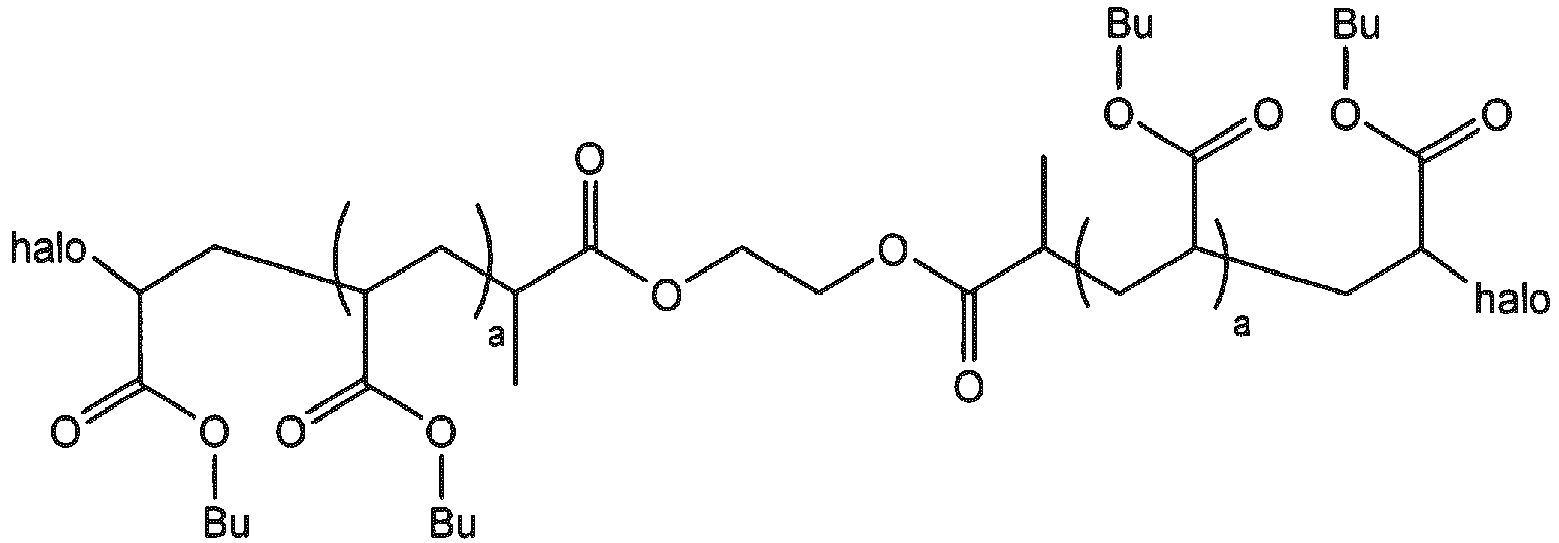
- the di-halo initiator of the structure halo-L-halo is effective to initiate polymerisation of the monomers used to form the polymer blocks but otherwise the choice of initiator is not critical. Suitable are compounds such as di-halo terminated hydrocarbon groups and substituted-hydrocarbon groups defined hereinabove. Such di-halo initiator molecules are well known in the art. Di-bromo compounds are preferred. Examples of di-halo initiators of the structure halo-L-halo suitable for use in the present invention include: where halo is Br, Cl or I, preferably Br, and where a is an integer from 1 to 100, preferably from 1 to 30, for example, from 1 to 10.
- dithiol compound of the structure HS-R-SH is also not critical. Suitable are compounds which are di-thiol-terminated hydrocarbon groups and substituted-hydrocarbon groups defined hereinabove. Examples of hydrocarbon groups are straight-chain and branched alkyl groups, alkenyl groups, cycloalkyl groups, cycloalkenyl groups, alkylcycloalkyl groups, alkenylcycloalkyl groups, alkylcycloalkenyl groups, alkenylcycloalkenyl groups, aryl groups, alkylaryl groups, alkenylaryl groups where the alkyl or alkenyl substituent(s) may be straight-chain or branched.
- substituted-hydrocarbon groups are the groups defined above containing one or more hetero-atoms. These hetero-atoms may be present as functional groups such as hydroxy, alkoxy, acyl, nitro, cyano and thiol or atoms such as oxygen, nitrogen and sulphur may be present in a carbon chain or ring otherwise composed of carbon atoms, or as a connecting atom between two or more hydrocarbon or substituted-hydrocarbon groups.
- each moiety ⁇ Q ⁇ -L- ⁇ Q ⁇ is linked together by a bisthiol residue -S-R-S- to form repeating units in the polymer.
- the critical factor is the presence of the bisthiol residue and not the particular nature of the group R.
- the catalyst used in steps (i) and (ii) is a transition metal-ligand complex.
- the choice of transition metal is not critical provided that it can exist in two stable oxidation states separated by one electron. Suitable transition metals thus include copper, iron, nickel, titanium, cobalt, molybdenum, ruthenium and rhodium.
- the transition metal-ligand complex is a copper-ligand complex.
- the ligand used to form the transition metal-ligand complex solubilises the transition metal species in the reaction medium and alters the redox potential of the metal complex.
- the mechanism of the reaction in steps (i) and (ii) involves halogen exchange between the di-halo moiety and the transition metal-ligand complex and the ligand acts to control the kinetics of this exchange.
- Suitable ligands include, but are not limited to, nitrogen-based ligands such as amines and imines; phosphines and dithiocarbamates.
- the ligand used to form the transition metal-ligand complex is a nitrogen-containing ligand, more preferably a multidentate nitrogen-containing ligand.
- Non-limiting examples include tris(2-dimethylaminoethyl)amine (Me 6 TREN), propyl(2-pyridyl)methanimine (PrPMI), 2,2'-bipyridine (bpy), 1,1,4,7,10,10-hexamethyltriethylenetetramine (HMTETA), 4,4'-di-5-nonyl-2,2'-bipyridine (dNbpy), N,N,N',N',N"-pentamethyldiethylenetriamine (PMDETA), tris[(2-pyridyl)methyl]amine (TPMA), 4,11-dimethyl-1,4,8,11-tetraazabicyclo-[6.6.2]hexadecane (DMCBCy) and tris((4-methoxy-3,5-dimethylpyridin-2-yl)-methyl)amine (TMDPMA).
- Me 6 TREN tris(2-dimethylaminoethyl)amine
- the ligand used to form the transition metal-ligand complex is tris(2-dimethylaminoethyl)amine (Me 6 TREN).
- the catalyst used in steps (i) and (ii) is a copper complex of Me 6 TREN.
- a base when used in step (iii) it may be any suitable organic or inorganic base.
- organic bases include alkylamines such as triethylamine, and cyclic amines such as 7-methyl-1,5,7-triazabicyclodec-5-ene and 1,8-diazabicyclo[5.4.0]undec-7-ene.
- inorganic bases include potassium carbonate, alkali metal hydrides and lithium diisopropyl amide.
- Other bases, both organic and inorganic will be known to those skilled in the art.
- the base when used in step (iii), is an organic base. More preferably, the base, when used in step (iii) is an alkylamine, most preferably triethylamine.
- the catalyst used in steps (i) and (ii) is a copper complex of Me 6 TREN and step (iii) is conducted in the presence of triethylamine.
- the transition metal-ligand complex used as the catalyst may be pre-formed and added to the reaction mixture comprising the di-halo moiety and the monomer of structure (II) in steps (i) and (ii) but it is preferable that the catalyst is formed in-situ. This can be achieved by adding one or more transition metals or transition metal compounds together with the ligand to the reaction mixture comprising the di-halo moiety and the monomer of structure (II) in steps (i) and (ii).
- the preferred catalyst of a copper complex of Me 6 TREN may be generated in-situ by adding Me 6 TREN to the reaction mixture together with copper metal or a copper(I) halide (e.g. CuBr) or a copper(II) halide (e.g. CuBr 2 ), or any combination of these or equivalent copper compounds.
- an acrylate monomer is first polymerised by initiating polymerisation using a di-bromo initiator of the structure Br-L-Br, where L is the linking group described hereinabove, in the presence of a transition metal-ligand complex. Equivalent di-chloro or di-iodo initiators could also be used.
- the resulting moiety has the structure Br- ⁇ P 1 ⁇ -L- ⁇ P 1 ⁇ -Br, where each ⁇ P 1 ⁇ is an identical polyacrylate copolymer block.
- the moiety Br- ⁇ P 2 P 1 ⁇ -L- ⁇ P 1 P 2 ⁇ -Br is treated with a bisthiol compound SH-R-SH, optionally in the presence of a base, to initiate a "thiobromo click" reaction whereby moieties Br- ⁇ P 2 P 1 ⁇ -L- ⁇ P 1 P 2 ⁇ -Br are joined together by S-R-S moieties, with the elimination of HBr.
- analogous polymers where each ⁇ Q ⁇ has multiple copolymer blocks ⁇ P n ....P 2 P 1 ⁇ can be produced by simply repeating the first stage using a further or different monomer and each time utilising the moiety Br- ⁇ P n ... P 2 P 1 ⁇ -L- ⁇ P 1 P 2 ...P n ⁇ -Br as the di-bromo initiator.
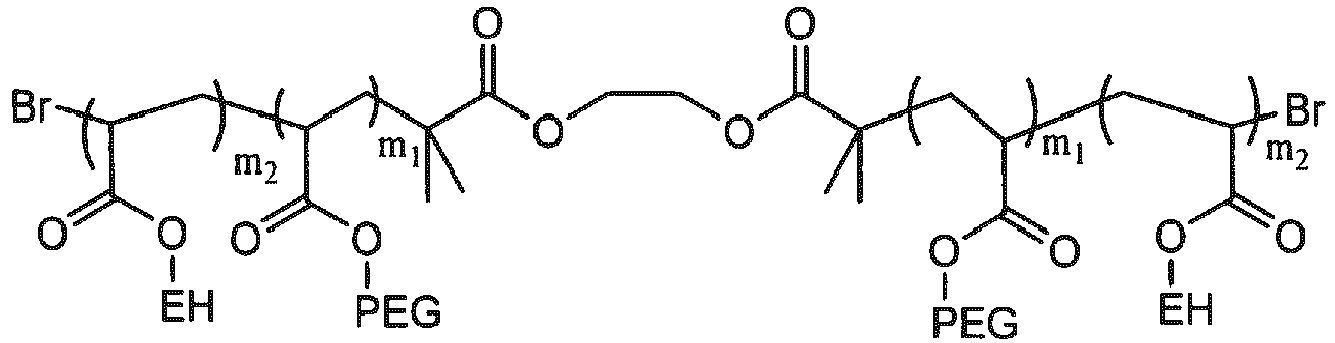
- a non-limiting example of a polymer made according to the method of the present invention has the following structure, where 'EH' is a 2-ethylhexyl group, 'PEG' is a polyethylene glycol group, for example a diethylene glycol group or an oligoethylene glycol group, m 1 , m 2 and m 3 are independently from 3 to 100, for example 5 to 20, and x is from 2 to 100, for example 2 to 15: made by reacting in a first step, in the presence of a transition metal-ligand complex, a di-bromo initiator of the structure: with polyethylene glycol acrylate to form: Which is then utilised as a di-bromo initiator and reacted, in the presence of a transition metal-ligand complex, with 2-ethylhexyl acrylate to form: which is then reacted in a further step, in the presence of an organic base, with 4, 4'-thiobenzenethiol: To form the final polymer via
- the ethylene glycol derived bisinitiator was the following compound: Monomer 1 Monomer 2 bisthiol Mn(g/mol) ⁇ Polymer 1 PEG EH 4,4'-thiodibenzenethiol 55900 2.42 Polymer 2 PEG EH 4,4'-thiodibenzenethiol 74800 2.57
Landscapes
- Chemical & Material Sciences (AREA)
- Chemical Kinetics & Catalysis (AREA)
- Organic Chemistry (AREA)
- Health & Medical Sciences (AREA)
- Medicinal Chemistry (AREA)
- Polymers & Plastics (AREA)
- General Chemical & Material Sciences (AREA)
- Oil, Petroleum & Natural Gas (AREA)
- Polyethers (AREA)
- Graft Or Block Polymers (AREA)
- Polymerization Catalysts (AREA)
Abstract
Description
- This invention relates to a method of making polymers and in particular to, making amphiphilic block polymers. Among other uses, the polymers may be useful as additives for lubricants such as lubricating oil compositions used to lubricate the crankcase of spark-ignited and compression-ignited internal combustion engines.
- There is much interest in methods to synthesise block polymers with controlled polymer architectures. Significant efforts are being made to develop new synthetic methods in order to obtain sequence-controlled, sequence-defined and multiblock copolymer architectures.
- In a first aspect, the invention provides a method of making a polymer having the structure (I):

the method comprising: - (i) reacting, in the presence of a catalyst comprising a transition metal-ligand complex, a di-halo initiator of the structure halo-L-halo, where halo is Br, Cl, or I, preferably Br, with a monomer of structure (II), or a mixture of two or more different monomers of structure (II):

- (ii) repeating step (i), between 1 and n times, each time n, reacting, in the presence of a catalyst as described in step (i), the di-halo moiety formed in the previous step with a further monomer of structure (II) and different from the monomer of structure (II) used in the previous step, or a mixture of two or more different monomers of structure (II) and different from the mixture of two or more different monomers of structure (II) used in the previous step, to form a di-halo moiety with the structure halo- {Pn.....P2P1}-L-{P1P2.....Pn}-halo, where each Pn is a polymer block formed from at least 3 monomers of structure (II), and n is an integer of 2 or more, preferably from 2 to 100, more preferably from 2 to 50; and
- (iii) reacting the di-halo moiety formed in step (ii), with a dithiol compound of the structure HS-R-SH.
- Preferably, step (iii) is conducted in the presence of a base. Although reaction of the di-halo moieties with the dithiol compound will proceed in the absence of a base in step (iii), conversion to the final polymer will be more efficient if a base is present.
- The number of polymer blocks in each {Q} present in the polymers, that is, the value of n in Pn.....P2P1, is at least 2 and may for example be from 2 to 50, such as from 2 to 10. In preferred embodiments, polymers made according to embodiment (b) have 2, 3, 4 or 5 copolymer blocks in each {Q}, more preferably 2 or 3.
- Each polymer block in {Q} is formed from at least 3 monomers of structure (II) but otherwise may be of any suitable size, but each are the same size in each instance of {Q}. Polymer blocks are comprised of repeat monomer units and there may be for example from 3 to 100 repeat monomer units in a block, preferably 3 to 50, more preferably 5 to 30, for example 5 to 20. Polymer blocks containing more than 100 repeat monomer units are also possible. The polymer blocks may be formed from only one type of monomer, that is where only one monomer of structure (II) is used in step (i). Such polymer blocks will be homo-polymer blocks. Alternatively, polymer blocks may be formed from more than one type of monomer, that is where a mixture of two or more monomers of structure (II) are used in step (i). Such polymer blocks will be co-polymer blocks. Preferably, each polymer block in {Q} is a homo-polymer block. Each polymer block is preferably a homo-polymer block although structures where each polymer block is a co-polymer block, or where one or more polymer blocks are homo-polymer blocks and one or more polymer blocks are co-polymer blocks are also possible. Adjacent blocks in each {Q} are different and are arranged in a symmetrical fashion around linking group L. So for example, if one polymer block is designated A and a second polymer block is designated B, then examples of moiety {Q}-L-{Q} include AB-L-BA, BA-L-AB, ABA-L-ABA, BAB-L-BAB, and the like. And if a third polymer block C is used then moiety{Q}-L-{Q} may for example be ABC-L-CBA, CBA-L-ABC, ABCA-L-ACBA, ABCABC-L-CBACBA, and the like. It will be understood that fourth, fifth, and further polymer blocks (D, E....) maybe included following the same pattern. Arrangements such as AAB-L-BAA, ABB-L-BBA, and the like have adjacent polymer blocks which are identical so are simply equivalent to examples of moiety {Q}-L-{Q} containing a larger polymer block of a particular type. For example, AAB-L-BAA is equivalent to AB-L-BA as the repeated block of monomer A is equivalent to a larger polymer block of type A. Not included as examples of moiety {Q}-L-{Q} are arrangements such as AB-L-AB, ABC-L-ABC, and the like as the polymer blocks in these moieties are not arranged in a symmetrical fashion around linking group L.
- Each polymer block in {Q} has the structure (III):

- Hydrocarbon groups are groups which contain hydrogen and carbon only. These include aliphatic, alicyclic, polycyclic, aromatic, polyaromatic, aliphatic- and alicyclic-substituted aromatic and polyaromatic, and aromatic-substituted aliphatic and alicyclic and polycyclic groups. Examples include straight-chain or branched alkyl groups and straight-chain or branched alkenyl groups; cycloalkyl and cycloakenyl groups, alkylcycloalkyl groups, alkenylcycloalkyl groups, alkylcycloalkenyl groups and alkenylcycloalkenyl groups; aryl groups such as phenyl and naphthyl, alkylaryl and alkenylaryl groups such as alkylphenyl and alkenylphenyl; arylalkyl and arylalkenyl groups such as benzyl and phenylalkyl where the alkyl (or alkenyl) groups may be straight-chain or branched.
- Substituted-hydrocarbon groups include all the types of groups defined above as hydrocarbon groups which also contain one or more hetero-atoms. The hetero-atoms may be present as functional groups such as hydroxy, alkoxy, acyl, nitro, cyano and thiol or atoms such as oxygen, nitrogen and sulphur may be present in a carbon chain or ring otherwise composed of carbon atoms, for example, pyridines, pyrrolidine, piperidine, piperazine, pyridazine, pyrazine, pyrrole, pyrazole, pyrimidine, azepane, azepine, imidazole, tetrazole, quinoline, indole, benzotriazole, benzoimidazole, furan, benzofuran, oxazoline, oxazole, isoxazole, benzoxazole, morpholine, oxazolidine, isoxazolidine, pyrrolidone, piperidinone, benzothiazole, thiophene and benzothiophene. Polyalkylene glycol groups and ether groups are examples of substituted-hydrocarbon groups.
- Hydrocarbon and substituted-hydrocarbon groups also include those derived from mixtures of compounds where molecules having different numbers of carbon atoms are present. For example, hydrocarbon groups derived from natural sources such as mineral oils or natural oils or fats are typically mixtures of molecules with a range of carbon chain-lengths. It will be understood that reference to the number of carbon atoms when used in this specification also includes such mixtures in which cases, the number of carbon atoms refers to the average number of carbon atoms in the mixture. For example, a mixture containing equal amounts molecules with 10 carbon atoms and molecules with 14 carbon atoms will have an average carbon number of 12. Similar, polyalkylene glycol groups and ether groups may be mixtures containing a range of molecules with differing numbers of repeat units. For example, for polyethylene glycol groups having the formula [(CH2CH2O]zOH, z represents the average number of [(CH2CH2O] moieties present in the mixture.
- Each {Q} in the polymer is composed of a plurality of polymer blocks of structure (III), the moiety {Q}-L-{Q} has the structure (IV):

- The number of polymer blocks in structure (IV), that is the value of n in m1, m2.....mn, is at least 2 and may for example be from 2 to 50, such as from 2 to 10. In preferred embodiments, structure (IV) contains 2, 3, 4 or 5 polymer blocks, more preferably 2 or 3.
- In an embodiment, X1, X2......Xn are COOR2 where in each instance n, R2 is a straight-chain or branched alkyl group. In this embodiment, when each R1 is hydrogen, each polymer block is a polyacrylate, and when each R1 is methyl, each polymer block is a polymethacrylate. Polymers containing both polyacrylate blocks and polymethacrylate blocks are possible when in at least one instance n, R1 is hydrogen and in at least another instance n, R1 is methyl. Preferably each R1 is hydrogen.
- In another embodiment, X1, X2......Xn are COOR2 where in each instance n, R2 is a polyalkylene glycol residue of the formula -[(CR5H)yO]zOR6 where y is an integer from 2 to 4, preferably 2, z is the average number of [(CR5H)yO] moieties and is from 2 to 100, preferably 2 to 20, for example from 2 to 10, and R5 is hydrogen or an alkyl group such as methyl or ethyl. Preferably R5 is hydrogen. R6 is hydrogen, an alkyl group such as methyl or ethyl or an aryl group such as phenyl. Preferably R6 is methyl. In this embodiment, when each R1 is hydrogen, each polymer block is a polyalkyleneglycol acrylate, and when each R1 is methyl, each polymer block is a polyalkyleneglycol methacrylate. Preferably, y is 2 such that the polymer blocks are either polyethyleneglycol acrylates or polyethyleneglycol methacrylates. In preferred embodiments, y is 2 and z is 2 such that the polymer blocks are either diethyleneglycol acrylates or diethyleneglycol methacrylates. In other preferred embodiments, y is 2 and z is an average value of 7 to 8 such that the polymer blocks are either oligoethyleneglycol acrylates or oligoethyleneglycol methacrylates. Polymers containing both polyalkyleneglycol acrylate blocks and polalkyleneglycol methacrylate blocks are possible when in at least one instance n, R1 is hydrogen and in at least another instance n, R1 is methyl. Preferably each R1 is hydrogen. Preferably each R6 is methyl.
- In another embodiment, X1, X2......Xn are CONR2R3 where in each instance n, R2 and R3 are hydrogen. In this embodiment, when each R1 is hydrogen, each polymer block is a polyacrylamide, and when each R1 is methyl, each polymer block is a polymethacrylamide. Polymers containing both polyacrylamide blocks and polymethacrylamide blocks are possible when in at least one instance n, R1 is hydrogen and in at least another instance n, R1 is methyl. Preferably each R1 is hydrogen. In an analogous fashion, one or both of R2 and R3 may be hydrocarbon groups or substituted-hydrocarbon groups as defined hereinabove.
- In another embodiment, X1, X2......Xn are COSR2 where in each instance n, R2 is a straight-chain or branched alkyl group. In this embodiment, when each R1 is hydrogen, each polymer block is a polythioacrylate, and when each R1 is methyl, each polymer block is a polythiomethacrylate. Polymers containing both polythioacrylate blocks and polythiomethacrylate blocks are possible when in at least one instance n, R1 is hydrogen and in at least another instance n, R1 is methyl. Preferably each R1 is hydrogen.
- In preferred embodiment, X1, X2......Xn are COOR2 and n is at least 2. In this embodiment in at least one instance n, R2 is a straight-chain or branched alkyl group, and in at least one other instance n, R2 is a polyalkylene glycol residue of the formula -[(CR5H)yO]zOR6 where y, z, R5 and R6 are as described hereinabove. Preferably R5 is hydrogen. Preferably R6 is methyl.
- In a preferred embodiment of structure (IV), each R1 is hydrogen, X1, X2......Xn are COOR2 and n is 2. In one instance n, R2 is a branched alkyl group and in the other instance n, R2 is a polyalkylene glycol residue of the formula -[(CR5H)yO]zOR6 where y, z, R5 and R6 are as described hereinabove. Preferably R5 is hydrogen. Preferably R6 is methyl. In this embodiment, the branched alkyl group is preferably 2-ethylhexyl. The polyalkylene glycol residue is preferably a polyethylene glycol residue (where y is 2) and is preferably a diethylene glycol residue (where y is 2 and z is 2) or an oligoethylene glycol residue (where y is 2 and z is an average of 7 to 8). In a particularly preferred embodiment of structure (IV), each R1 is hydrogen, X1, X2......Xn are COOR2 and n is 2; in one instance n, R2 is 2-ethylhexyl; and in the other instance n, R2 is a polyalkylene glycol residue of the formula -[(CR5H)yO]zOMe where y is 2, z is 2. In another particularly preferred embodiment of structure (IV), each R1 is hydrogen, X1, X2...... Xn are COOR2 and n is 2; in one instance n, R2 is 2-ethylhexyl; and in the other instance n, R2 is a polyalkylene glycol residue of the formula -[(CR5H)yO]zOMe where y is 2, z is an average of 7 to 8.
- In another preferred embodiment of structure (IV), each R1 is hydrogen, X1, X2......Xn are COOR2 and n is 3. In one instance n, R2 is a branched alkyl group and in the other two instances n, R2 is a polyalkylene glycol residue of the formula -[(CR5H)yO]zOR6 where y, z, R5 and R6 are as described hereinabove. Preferably R5 is hydrogen. Preferably R6 is methyl. Preferably in each of these two instances n, each polyalkylene glycol residue R2 is the same. In this embodiment, the branched alkyl group is preferably 2-ethylhexyl. The polyalkylene glycol residues are preferably polyethylene glycol residues (where y is 2) and are preferably diethylene glycol residues (where y is 2 and z is 2) or oligoethylene glycol residues (where y is 2 and z is an average of 7 to 8). In a particularly preferred embodiment of structure (IV), each R1 is hydrogen, X1, X2......Xn are COOR2 and n is 3; in one instance n, R2 is 2-ethylhexyl; and in the other two instances n, each R2 is a polyalkylene glycol residue of the formula -[(CH2)yO]zOMe where y is 2, z is 2. In another particularly preferred embodiment of structure (IV), each R1 is hydrogen, X1, X2......Xn are COOR2 and n is 3; in one instance n, R2 is 2-ethylhexyl; and in the other two instances n, each R2 is a polyalkylene glycol residue of the formula -[(CH2)yO]zOMe where y is 2, z is an average of 7 to 8. In an alternative embodiment, in two instances, R2 is a branched alkyl group and in one instance, R2 is a polyalkylene glycol residue, both as defined above.
- The di-halo initiator of the structure halo-L-halo is effective to initiate polymerisation of the monomers used to form the polymer blocks but otherwise the choice of initiator is not critical. Suitable are compounds such as di-halo terminated hydrocarbon groups and substituted-hydrocarbon groups defined hereinabove. Such di-halo initiator molecules are well known in the art. Di-bromo compounds are preferred. Examples of di-halo initiators of the structure halo-L-halo suitable for use in the present invention include:



- The choice of dithiol compound of the structure HS-R-SH is also not critical. Suitable are compounds which are di-thiol-terminated hydrocarbon groups and substituted-hydrocarbon groups defined hereinabove. Examples of hydrocarbon groups are straight-chain and branched alkyl groups, alkenyl groups, cycloalkyl groups, cycloalkenyl groups, alkylcycloalkyl groups, alkenylcycloalkyl groups, alkylcycloalkenyl groups, alkenylcycloalkenyl groups, aryl groups, alkylaryl groups, alkenylaryl groups where the alkyl or alkenyl substituent(s) may be straight-chain or branched. Examples of substituted-hydrocarbon groups are the groups defined above containing one or more hetero-atoms. These hetero-atoms may be present as functional groups such as hydroxy, alkoxy, acyl, nitro, cyano and thiol or atoms such as oxygen, nitrogen and sulphur may be present in a carbon chain or ring otherwise composed of carbon atoms, or as a connecting atom between two or more hydrocarbon or substituted-hydrocarbon groups.
- Specific examples of dithiol compounds of the structure HS-R-SH useful in the present invention include:
- HS-CH2-CH2-SH
- HS-CH2-CH2-CH2-SH
- HS-CH2-CH2-CH2-CH2-SH etc.
- HS-CH2-Z-CH2-SH
- HS-CH2-CH2-Z-CH2-CH2-SH etc. Z = S, O, NH


- It will be understood that numerous other compounds HS-R-SH will also be suitable. With reference to structure (I) above, each moiety {Q}-L-{Q} is linked together by a bisthiol residue -S-R-S- to form repeating units in the polymer. Those skilled in the art will recognise that the critical factor is the presence of the bisthiol residue and not the particular nature of the group R.
- The catalyst used in steps (i) and (ii) is a transition metal-ligand complex. The choice of transition metal is not critical provided that it can exist in two stable oxidation states separated by one electron. Suitable transition metals thus include copper, iron, nickel, titanium, cobalt, molybdenum, ruthenium and rhodium. Preferably, the transition metal-ligand complex is a copper-ligand complex.
- The ligand used to form the transition metal-ligand complex solubilises the transition metal species in the reaction medium and alters the redox potential of the metal complex. The mechanism of the reaction in steps (i) and (ii) involves halogen exchange between the di-halo moiety and the transition metal-ligand complex and the ligand acts to control the kinetics of this exchange. Suitable ligands include, but are not limited to, nitrogen-based ligands such as amines and imines; phosphines and dithiocarbamates. Preferably, the ligand used to form the transition metal-ligand complex is a nitrogen-containing ligand, more preferably a multidentate nitrogen-containing ligand. Such ligands co-ordinate to the transition metal via nitrogen atoms and are known in the art. Non-limiting examples include tris(2-dimethylaminoethyl)amine (Me6TREN), propyl(2-pyridyl)methanimine (PrPMI), 2,2'-bipyridine (bpy), 1,1,4,7,10,10-hexamethyltriethylenetetramine (HMTETA), 4,4'-di-5-nonyl-2,2'-bipyridine (dNbpy), N,N,N',N',N"-pentamethyldiethylenetriamine (PMDETA), tris[(2-pyridyl)methyl]amine (TPMA), 4,11-dimethyl-1,4,8,11-tetraazabicyclo-[6.6.2]hexadecane (DMCBCy) and tris((4-methoxy-3,5-dimethylpyridin-2-yl)-methyl)amine (TMDPMA). Other suitable ligands can be found in figure 4 of Macromolecules 2012, 45, pp.4015- 4039 . Preferably, the ligand used to form the transition metal-ligand complex is tris(2-dimethylaminoethyl)amine (Me6TREN).
- In a preferred embodiment the catalyst used in steps (i) and (ii) is a copper complex of Me6TREN.
- When a base is used in step (iii) it may be any suitable organic or inorganic base. Examples of organic bases include alkylamines such as triethylamine, and cyclic amines such as 7-methyl-1,5,7-triazabicyclodec-5-ene and 1,8-diazabicyclo[5.4.0]undec-7-ene. Examples of inorganic bases include potassium carbonate, alkali metal hydrides and lithium diisopropyl amide. Other bases, both organic and inorganic, will be known to those skilled in the art. Preferably, the base, when used in step (iii), is an organic base. More preferably, the base, when used in step (iii) is an alkylamine, most preferably triethylamine.
- In a particularly preferred embodiment, the catalyst used in steps (i) and (ii) is a copper complex of Me6TREN and step (iii) is conducted in the presence of triethylamine.
- The transition metal-ligand complex used as the catalyst may be pre-formed and added to the reaction mixture comprising the di-halo moiety and the monomer of structure (II) in steps (i) and (ii) but it is preferable that the catalyst is formed in-situ. This can be achieved by adding one or more transition metals or transition metal compounds together with the ligand to the reaction mixture comprising the di-halo moiety and the monomer of structure (II) in steps (i) and (ii). For example, the preferred catalyst of a copper complex of Me6TREN may be generated in-situ by adding Me6TREN to the reaction mixture together with copper metal or a copper(I) halide (e.g. CuBr) or a copper(II) halide (e.g. CuBr2), or any combination of these or equivalent copper compounds.
- Examples of the method of the present invention will be described with reference to polymers comprised of acrylate polymer blocks, or of acrylate polymer blocks and ethyleneglycol acrylate polymer blocks, however those skilled in the art will recognise that the synthesis is equally applicable to polymers comprised of the other types of polymer block described hereinabove.
- To produce a polymer wherein each {Q} in structure (I) contains two copolymer blocks P1 and P2, an acrylate monomer is first polymerised by initiating polymerisation using a di-bromo initiator of the structure Br-L-Br, where L is the linking group described hereinabove, in the presence of a transition metal-ligand complex. Equivalent di-chloro or di-iodo initiators could also be used. The resulting moiety has the structure Br-{P1}-L-{P1}-Br, where each {P1} is an identical polyacrylate copolymer block. An ethyleneglycol acrylate monomer is then polymerised in the same fashion, the moiety Br-{P1}-L-{P1}-Br acting as a the di-bromo initiator. This results in a moiety having the structure Br-{P2P1}-L-{P1P2}-Br where each P2 is an identical polyethyleneglycol acrylate copolymer block.
- In a subsequent stage, the moiety Br-{P2P1}-L-{P1P2}-Br is treated with a bisthiol compound SH-R-SH, optionally in the presence of a base, to initiate a "thiobromo click" reaction whereby moieties Br-{P2P1}-L-{P1P2}-Br are joined together by S-R-S moieties, with the elimination of HBr.
- It will be readily apparent that analogous polymers where each {Q} has multiple copolymer blocks {Pn....P2P1} can be produced by simply repeating the first stage using a further or different monomer and each time utilising the moiety Br-{Pn... P2P1}-L-{P1P2...Pn}-Br as the di-bromo initiator.
- A non-limiting example of a polymer made according to the method of the present invention has the following structure, where 'EH' is a 2-ethylhexyl group, 'PEG' is a polyethylene glycol group, for example a diethylene glycol group or an oligoethylene glycol group, m1, m2 and m3 are independently from 3 to 100, for example 5 to 20, and x is from 2 to 100, for example 2 to 15:



- The Table below details polymers made according to the method of the present invention. All were made using the reactants listed in the Table.
- Monomer 1, ethylene glycol-derived bisinitiator [see below *] (1.00 equiv.), tris(2-dimethylaminoethyl)amine (Me6TREN) (0.36 equiv.), CuBr2 (0.10 equiv.) and DMSO (50% v/v) were charged to a Schlenk tube and sealed with a rubber septum. After degassing the reaction mixture for 30 minutes, a stirring bar wrapped with preactivated copper wire (5 cm) was added to the reaction mixture in a counter-current of nitrogen. As described above, the copper species and the Me6TREN form a copper-ligand complex in situ. The tube was sealed again and the reaction mixture stirred at 25°C until full conversion was observed (between 4 and 12 hours). Conversion was measured by 1H NMR spectroscopy and SEC analysis was carried out with samples diluted in THF which were filtered over basic alumina prior to analysis to remove residual copper species.
- Monomer 2 in DMSO (50% v/v) and another portion of Me6TREN (0.36 equiv.) and CuBr2 (0.10 equiv.) were added into a glass vial and degassed for 30 minutes before transferring to the reaction mixture from Stage 1. The tube was sealed again and the reaction mixture stirred at 25°C until full conversion was observed.
- After full monomer conversion, a solution of bisthiol (1.00 equiv.) and triethylamine in DMF was added at ambient temperature to the reaction mixture. The mixture was then stirred overnight at room temperature before SEC analysis was carried out. The crude product was purified by filtration over basic alumina followed by precipitation from cold methanol to provide the pure polymer as a yellowish oil. The polymer obtained was characterised by 1H NMR and GPC with RI and UV detectors.
- The structures of the polymers obtained are given below the Table.
* In each case, the ethylene glycol derived bisinitiator was the following compound:
Monomer 1 Monomer 2 bisthiol Mn(g/mol) Ð Polymer 1 PEG EH 4,4'-thiodibenzenethiol 55900 2.42 Polymer 2 PEG EH 4,4'-thiodibenzenethiol 74800 2.57 - PEG:
- polyethylene glycol acrylate (Mn of polyethylene glycol group = 480 g/mol)
- EH:
- 2-ethylhexyl acrylate
-

-

Claims (15)
- A method of making a polymer having the structure (I):

the method comprising:(i) reacting, in the presence of a catalyst comprising a transition metal-ligand complex, a di-halo initiator of the structure halo-L-halo, where halo is Br, CI, or I, preferably Br, with a monomer of structure (II), or a mixture of two or more different monomers of structure (II): (ii) repeating step (i), between 1 and n times, each time n, reacting, in the presence of a catalyst as described in step (i), the di-halo moiety formed in the previous step with a further monomer of structure (II) and different from the monomer of structure (II) used in the previous step, or a mixture of two or more different monomers of structure (II) and different from the mixture of two or more different monomers of structure (II) used in the previous step, to form a di-halo moiety with the structure halo-{Pn.....P2P1}-L-{P1P2.....Pn}-halo, where each Pn is a polymer block formed from at least 3 monomers of structure (II), and n is an integer of 2 or more, preferably from 2 to 100, more preferably from 2 to 50; and(iii) reacting the di-halo moiety formed in step (i) or if step (ii) is used, the moiety formed in step (ii), with a dithiol compound of the structure HS-R-SH.
 - A method according to claim 1, wherein each X is COOR2, wherein in at least one instance, R2 is a straight-chain or branched alkyl group, and wherein in at a least one other instance, R2 is a polyalkylene glycol residue of the formula -[(CR5H)yO]zOR6 where y is an integer from 2 to 4, preferably 2, and z is the average number of [(CR5H)yO] moieties and is from 2 to 100, preferably 2 to 20, R5 is hydrogen or an alkyl group such as methyl or ethyl and R6 is hydrogen, an alkyl group such as methyl or ethyl or an aryl group such as phenyl.
- A method according to claim 1, wherein step (ii) is repeated once and each X is COOR2, wherein in one instance, R2 is a branched alkyl group, and wherein in the other instance, R2 is a polyalkylene glycol residue of the formula -[(CR5H)yO]zOR6 where y is an integer from 2 to 4, preferably 2, and z is the average number of [(CR5H)yO] moieties and is from 2 to 100, preferably 2 to 20, R5 is hydrogen or an alkyl group such as methyl or ethyl and R6 is hydrogen, an alkyl group such as methyl or ethyl or an aryl group such as phenyl.
- A method according to claim 3, wherein the branched alkyl group is 2-ethylhexyl, and the polyalkylene glycol residue is of the formula -[(CH2)yO]zOMe where y is 2 and z is z, or where y is 2 and z is an average value of 7 to 8.
- A method according to claim 1, wherein step (ii) is repeated twice; wherein in one instance, R2 is a branched alkyl group and in the other two instances, R2 is a polyalkylene glycol residue of the formula-[(CR5H)yO]zOR6 where y is an integer from 2 to 4, preferably 2, and z is the average number of [(CR5H)yO] moieties and is from 2 to 100, preferably 2 to 20, R5 is hydrogen or an alkyl group such as methyl or ethyl and R6 is hydrogen, an alkyl group such as methyl or ethyl or an aryl group such as phenyl.
- A method according to claim 5, wherein the branched alkyl group is 2-ethylhexyl, and each polyalkylene glycol residue is the same and of the formula -[(CH2)yO]zOMe where y is 2 and z is z, or where y is 2 and z is an average value of 7 to 8.
- A method according to any preceding claim, wherein the di-halo initiator of the structure halo-L-halo is:

- A method according to any preceding claim, wherein the dithiol compound of the structure HS-R-SH is:

- A method according to any preceding claim, wherein the transition metal-ligand complex is a copper-ligand complex.
- A method according to any preceding claim, wherein the ligand used to form the transition metal-ligand complex is a nitrogen-containing ligand, more preferably a multidentate nitrogen-containing ligand.
- A method according to claim 10, wherein the ligand used to form the transition metal-ligand complex is tris(2-dimethylaminoethyl)amine (Me6TREN).
- A method according to any preceding claim, wherein the catalyst used in steps (i) and (ii) is a copper complex of tris(2-dimethylaminoethyl)amine (Me6TREN).
- A method according to any preceding claim, wherein step (iii) is conducted in the presence of a base.
- A method according to claim 13, wherein the base used in step (iii) is an alkylamine, preferably triethylamine.
- A method according to any preceding claim, wherein the catalyst used in steps (i) and (ii) is a copper complex of tris(2-dimethylaminoethyl)amine (Me6TREN) and step (iii) is conducted in the presence of triethylamine.
Applications Claiming Priority (1)
| Application Number | Priority Date | Filing Date | Title |
|---|---|---|---|
| EP18196371 | 2018-09-24 |
Publications (2)
| Publication Number | Publication Date |
|---|---|
| EP3702376A1 true EP3702376A1 (en) | 2020-09-02 |
| EP3702376B1 EP3702376B1 (en) | 2020-12-23 |
Family
ID=63798788
Family Applications (1)
| Application Number | Title | Priority Date | Filing Date |
|---|---|---|---|
| EP19196239.8A Active EP3702376B1 (en) | 2018-09-24 | 2019-09-09 | Method of making polymers |
Country Status (7)
| Country | Link |
|---|---|
| US (1) | US11136429B2 (en) |
| EP (1) | EP3702376B1 (en) |
| JP (1) | JP7425570B2 (en) |
| KR (1) | KR102795867B1 (en) |
| CN (1) | CN110938178A (en) |
| CA (1) | CA3056568A1 (en) |
| SG (1) | SG10201908792QA (en) |
Citations (2)
| Publication number | Priority date | Publication date | Assignee | Title |
|---|---|---|---|---|
| US20100010178A1 (en) * | 2007-02-02 | 2010-01-14 | Evonik Roehm Gmbh | Method for the production of telechelic polymers |
| WO2016111743A1 (en) * | 2015-01-08 | 2016-07-14 | Henkel IP & Holding GmbH | Process for preparing high molecular weight polyacrylates having narrow polydispersity indices |
Family Cites Families (11)
| Publication number | Priority date | Publication date | Assignee | Title |
|---|---|---|---|---|
| JP4027768B2 (en) * | 2002-10-08 | 2007-12-26 | 日東電工株式会社 | Polymer modifier and method for producing the same |
| DE102006037350A1 (en) * | 2006-08-09 | 2008-02-14 | Evonik Röhm Gmbh | Process for the preparation of halogen-free ATRP products |
| JP5536383B2 (en) * | 2009-07-09 | 2014-07-02 | 株式会社カネカ | Method for producing (meth) acrylic polymer having reactive functional group at terminal |
| JP5488160B2 (en) * | 2010-04-22 | 2014-05-14 | 学校法人神奈川大学 | Process for producing polybenzamide-polystyrene block copolymer |
| JP2015112812A (en) * | 2013-12-12 | 2015-06-22 | 旭化成ケミカルズ株式会社 | Laminated body |
| JP6630736B2 (en) * | 2015-10-27 | 2020-01-15 | 東亞合成株式会社 | Block copolymer, method for producing the same, and use thereof |
| EP3401377A4 (en) * | 2016-01-07 | 2019-09-11 | National Institute of Advanced Industrial Science and Technology | PHOTOREVERSIBLE ADHESIVE AGENT |
| KR102097817B1 (en) * | 2016-09-08 | 2020-04-07 | 주식회사 엘지화학 | Polymer composition |
| JP2018062539A (en) * | 2016-10-11 | 2018-04-19 | 株式会社日本触媒 | Block copolymer, resin composition and molded article made of the same |
| CN107880229B (en) * | 2017-12-08 | 2020-12-15 | 万华化学集团股份有限公司 | A kind of preparation method of end-group-modified polyacrylate block copolymer and polyacrylate block copolymer obtained therefrom |
| EP3770235B1 (en) * | 2018-09-24 | 2022-06-29 | Infineum International Limited | Polymers and lubricating compositions containing polymers |
-
2019
- 2019-09-09 EP EP19196239.8A patent/EP3702376B1/en active Active
- 2019-09-19 US US16/575,968 patent/US11136429B2/en active Active
- 2019-09-20 KR KR1020190116181A patent/KR102795867B1/en active Active
- 2019-09-23 CN CN201910897042.2A patent/CN110938178A/en active Pending
- 2019-09-23 SG SG10201908792QA patent/SG10201908792QA/en unknown
- 2019-09-24 JP JP2019172665A patent/JP7425570B2/en active Active
- 2019-09-24 CA CA3056568A patent/CA3056568A1/en active Pending
Patent Citations (2)
| Publication number | Priority date | Publication date | Assignee | Title |
|---|---|---|---|---|
| US20100010178A1 (en) * | 2007-02-02 | 2010-01-14 | Evonik Roehm Gmbh | Method for the production of telechelic polymers |
| WO2016111743A1 (en) * | 2015-01-08 | 2016-07-14 | Henkel IP & Holding GmbH | Process for preparing high molecular weight polyacrylates having narrow polydispersity indices |
Non-Patent Citations (2)
| Title |
|---|
| "Macromolecules", vol. 45, 2012, pages: 4015 - 4039 |
| VALENTIN P. BEYER ET AL: "Fast track access to multi-block copolymers via thiol-bromo click reaction of telechelic dibromo polymers", POLYMER CHEMISTRY, vol. 10, no. 31, 26 June 2019 (2019-06-26), pages 4259 - 4270, XP055668199, ISSN: 1759-9954, DOI: 10.1039/C9PY00775J * |
Also Published As
| Publication number | Publication date |
|---|---|
| KR102795867B1 (en) | 2025-04-17 |
| JP2020059845A (en) | 2020-04-16 |
| EP3702376B1 (en) | 2020-12-23 |
| US11136429B2 (en) | 2021-10-05 |
| SG10201908792QA (en) | 2020-04-29 |
| KR20200034934A (en) | 2020-04-01 |
| JP7425570B2 (en) | 2024-01-31 |
| CN110938178A (en) | 2020-03-31 |
| CA3056568A1 (en) | 2020-03-24 |
| US20200095362A1 (en) | 2020-03-26 |
Similar Documents
| Publication | Publication Date | Title |
|---|---|---|
| CN1280314C (en) | Method for controlling polymer molecular weight and structure | |
| US6657043B1 (en) | Polyalcoxyamines obtained from β-substituted nitroxides | |
| JPH06306130A (en) | Comb polymer, polymer for production thereof and oil additive comprising it | |
| EP1527079A2 (en) | Alkoxyamines originating from beta-phosphorylated nitroxides and use thereof in radical polymerisation | |
| KR930007690B1 (en) | Polymers Containing Thiuram Disulfide Groups and Their Preparation | |
| JP2002537304A (en) | Alkoxyamines obtained from β-phosphorous nitroxide | |
| JP2006508657A5 (en) | ||
| JP2017200882A (en) | Organic tellurium compound, method for producing the same, living radical polymerization initiator, and method for producing vinyl polymer using the same | |
| EP3702376B1 (en) | Method of making polymers | |
| CA2462923A1 (en) | Alkoxyamines prepared from beta-phosphorylated nitroxides and their use in the preparation of polymerized or unpolymerized mono- or polyalkoxyamines | |
| KR20020063195A (en) | Method for producing a composition that contains polymer ester compounds with long-chain alkyl groups, and use of such a composition | |
| EP0647223A1 (en) | Ion-sensitive bipyridine complexes | |
| Herfurth et al. | Radical addition fragmentation chain transfer (RAFT) polymerization of ferrocenyl (Meth) acrylates | |
| JPH0441513A (en) | Ethylene polymer having modified terminals and its production | |
| AU2665699A (en) | Alpha-methylstyrene dimer derivatives | |
| US11987652B2 (en) | Light as catalytic switch: metal-organic insertion/light initiated radical (MILRad) polymerization | |
| CA2676967A1 (en) | Method for the production of telechelic polymers | |
| EP0356026B1 (en) | Azo amide compounds | |
| Miura et al. | Synthesis and characterization of 6‐and 12‐arm star polymers by nitroxide‐mediated radical polymerization of St and MA from dendritic TIPNO‐based hexafunctional and dodecafunctional macroinitiators | |
| CN103788138A (en) | Binuclear-cobalt-containing carborane derivative and preparation method thereof | |
| CA2432910A1 (en) | A process for the synthesis of alkoxyamines and their use in controlled radical polymerization | |
| KR20140051340A (en) | Method for reducing the halogen content of a polymer | |
| JP6619688B2 (en) | Method for producing vinyl polymer | |
| Hu | STUDIES OF REACTIONS OF IRON-AND TUNGSTEN-CYCLOALKYL AND PLATINUM-ETA ('1)-ALLYL COMPLEXES WITH ELECTROPHILES (PROTONATION, DEPROTONATION, INSERTION, CYCLOADDITION) | |
| Ngulube et al. | Investigating an anisole/Cu (ii)-macroligand-complex pair to broaden solubility scope and catalyst recycling for atom transfer radical polymerization |
Legal Events
| Date | Code | Title | Description |
|---|---|---|---|
| STAA | Information on the status of an ep patent application or granted ep patent |
Free format text: STATUS: EXAMINATION IS IN PROGRESS |
|
| PUAI | Public reference made under article 153(3) epc to a published international application that has entered the european phase |
Free format text: ORIGINAL CODE: 0009012 |
|
| GRAP | Despatch of communication of intention to grant a patent |
Free format text: ORIGINAL CODE: EPIDOSNIGR1 |
|
| STAA | Information on the status of an ep patent application or granted ep patent |
Free format text: STATUS: GRANT OF PATENT IS INTENDED |
|
| 17P | Request for examination filed |
Effective date: 20190909 |
|
| AK | Designated contracting states |
Kind code of ref document: A1 Designated state(s): AL AT BE BG CH CY CZ DE DK EE ES FI FR GB GR HR HU IE IS IT LI LT LU LV MC MK MT NL NO PL PT RO RS SE SI SK SM TR |
|
| AX | Request for extension of the european patent |
Extension state: BA ME |
|
| INTG | Intention to grant announced |
Effective date: 20200827 |
|
| RIN1 | Information on inventor provided before grant (corrected) |
Inventor name: PHILLIPS, DANIEL Inventor name: SCHWARZ, ANDREW Inventor name: BECER, REMZI Inventor name: CATTOZ, BEATRICE Inventor name: BEYER, VALENTIN Inventor name: STRONG, ANTHONY JAMES |
|
| GRAS | Grant fee paid |
Free format text: ORIGINAL CODE: EPIDOSNIGR3 |
|
| GRAA | (expected) grant |
Free format text: ORIGINAL CODE: 0009210 |
|
| STAA | Information on the status of an ep patent application or granted ep patent |
Free format text: STATUS: THE PATENT HAS BEEN GRANTED |
|
| AK | Designated contracting states |
Kind code of ref document: B1 Designated state(s): AL AT BE BG CH CY CZ DE DK EE ES FI FR GB GR HR HU IE IS IT LI LT LU LV MC MK MT NL NO PL PT RO RS SE SI SK SM TR |
|
| REG | Reference to a national code |
Ref country code: GB Ref legal event code: FG4D |
|
| REG | Reference to a national code |
Ref country code: DE Ref legal event code: R096 Ref document number: 602019001881 Country of ref document: DE |
|
| REG | Reference to a national code |
Ref country code: AT Ref legal event code: REF Ref document number: 1347649 Country of ref document: AT Kind code of ref document: T Effective date: 20210115 |
|
| REG | Reference to a national code |
Ref country code: IE Ref legal event code: FG4D Ref country code: NL Ref legal event code: FP |
|
| PG25 | Lapsed in a contracting state [announced via postgrant information from national office to epo] |
Ref country code: FI Free format text: LAPSE BECAUSE OF FAILURE TO SUBMIT A TRANSLATION OF THE DESCRIPTION OR TO PAY THE FEE WITHIN THE PRESCRIBED TIME-LIMIT Effective date: 20201223 Ref country code: RS Free format text: LAPSE BECAUSE OF FAILURE TO SUBMIT A TRANSLATION OF THE DESCRIPTION OR TO PAY THE FEE WITHIN THE PRESCRIBED TIME-LIMIT Effective date: 20201223 Ref country code: NO Free format text: LAPSE BECAUSE OF FAILURE TO SUBMIT A TRANSLATION OF THE DESCRIPTION OR TO PAY THE FEE WITHIN THE PRESCRIBED TIME-LIMIT Effective date: 20210323 Ref country code: GR Free format text: LAPSE BECAUSE OF FAILURE TO SUBMIT A TRANSLATION OF THE DESCRIPTION OR TO PAY THE FEE WITHIN THE PRESCRIBED TIME-LIMIT Effective date: 20210324 |
|
| REG | Reference to a national code |
Ref country code: AT Ref legal event code: MK05 Ref document number: 1347649 Country of ref document: AT Kind code of ref document: T Effective date: 20201223 |
|
| PG25 | Lapsed in a contracting state [announced via postgrant information from national office to epo] |
Ref country code: SE Free format text: LAPSE BECAUSE OF FAILURE TO SUBMIT A TRANSLATION OF THE DESCRIPTION OR TO PAY THE FEE WITHIN THE PRESCRIBED TIME-LIMIT Effective date: 20201223 Ref country code: LV Free format text: LAPSE BECAUSE OF FAILURE TO SUBMIT A TRANSLATION OF THE DESCRIPTION OR TO PAY THE FEE WITHIN THE PRESCRIBED TIME-LIMIT Effective date: 20201223 Ref country code: BG Free format text: LAPSE BECAUSE OF FAILURE TO SUBMIT A TRANSLATION OF THE DESCRIPTION OR TO PAY THE FEE WITHIN THE PRESCRIBED TIME-LIMIT Effective date: 20210323 |
|
| PG25 | Lapsed in a contracting state [announced via postgrant information from national office to epo] |
Ref country code: HR Free format text: LAPSE BECAUSE OF FAILURE TO SUBMIT A TRANSLATION OF THE DESCRIPTION OR TO PAY THE FEE WITHIN THE PRESCRIBED TIME-LIMIT Effective date: 20201223 |
|
| REG | Reference to a national code |
Ref country code: LT Ref legal event code: MG9D |
|
| PG25 | Lapsed in a contracting state [announced via postgrant information from national office to epo] |
Ref country code: SK Free format text: LAPSE BECAUSE OF FAILURE TO SUBMIT A TRANSLATION OF THE DESCRIPTION OR TO PAY THE FEE WITHIN THE PRESCRIBED TIME-LIMIT Effective date: 20201223 Ref country code: SM Free format text: LAPSE BECAUSE OF FAILURE TO SUBMIT A TRANSLATION OF THE DESCRIPTION OR TO PAY THE FEE WITHIN THE PRESCRIBED TIME-LIMIT Effective date: 20201223 Ref country code: EE Free format text: LAPSE BECAUSE OF FAILURE TO SUBMIT A TRANSLATION OF THE DESCRIPTION OR TO PAY THE FEE WITHIN THE PRESCRIBED TIME-LIMIT Effective date: 20201223 Ref country code: CZ Free format text: LAPSE BECAUSE OF FAILURE TO SUBMIT A TRANSLATION OF THE DESCRIPTION OR TO PAY THE FEE WITHIN THE PRESCRIBED TIME-LIMIT Effective date: 20201223 Ref country code: RO Free format text: LAPSE BECAUSE OF FAILURE TO SUBMIT A TRANSLATION OF THE DESCRIPTION OR TO PAY THE FEE WITHIN THE PRESCRIBED TIME-LIMIT Effective date: 20201223 Ref country code: PT Free format text: LAPSE BECAUSE OF FAILURE TO SUBMIT A TRANSLATION OF THE DESCRIPTION OR TO PAY THE FEE WITHIN THE PRESCRIBED TIME-LIMIT Effective date: 20210423 Ref country code: LT Free format text: LAPSE BECAUSE OF FAILURE TO SUBMIT A TRANSLATION OF THE DESCRIPTION OR TO PAY THE FEE WITHIN THE PRESCRIBED TIME-LIMIT Effective date: 20201223 |
|
| PG25 | Lapsed in a contracting state [announced via postgrant information from national office to epo] |
Ref country code: AT Free format text: LAPSE BECAUSE OF FAILURE TO SUBMIT A TRANSLATION OF THE DESCRIPTION OR TO PAY THE FEE WITHIN THE PRESCRIBED TIME-LIMIT Effective date: 20201223 Ref country code: PL Free format text: LAPSE BECAUSE OF FAILURE TO SUBMIT A TRANSLATION OF THE DESCRIPTION OR TO PAY THE FEE WITHIN THE PRESCRIBED TIME-LIMIT Effective date: 20201223 |
|
| REG | Reference to a national code |
Ref country code: DE Ref legal event code: R097 Ref document number: 602019001881 Country of ref document: DE |
|
| PG25 | Lapsed in a contracting state [announced via postgrant information from national office to epo] |
Ref country code: IS Free format text: LAPSE BECAUSE OF FAILURE TO SUBMIT A TRANSLATION OF THE DESCRIPTION OR TO PAY THE FEE WITHIN THE PRESCRIBED TIME-LIMIT Effective date: 20210423 |
|
| PG25 | Lapsed in a contracting state [announced via postgrant information from national office to epo] |
Ref country code: AL Free format text: LAPSE BECAUSE OF FAILURE TO SUBMIT A TRANSLATION OF THE DESCRIPTION OR TO PAY THE FEE WITHIN THE PRESCRIBED TIME-LIMIT Effective date: 20201223 |
|
| PLBE | No opposition filed within time limit |
Free format text: ORIGINAL CODE: 0009261 |
|
| STAA | Information on the status of an ep patent application or granted ep patent |
Free format text: STATUS: NO OPPOSITION FILED WITHIN TIME LIMIT |
|
| PG25 | Lapsed in a contracting state [announced via postgrant information from national office to epo] |
Ref country code: DK Free format text: LAPSE BECAUSE OF FAILURE TO SUBMIT A TRANSLATION OF THE DESCRIPTION OR TO PAY THE FEE WITHIN THE PRESCRIBED TIME-LIMIT Effective date: 20201223 |
|
| 26N | No opposition filed |
Effective date: 20210924 |
|
| PG25 | Lapsed in a contracting state [announced via postgrant information from national office to epo] |
Ref country code: ES Free format text: LAPSE BECAUSE OF FAILURE TO SUBMIT A TRANSLATION OF THE DESCRIPTION OR TO PAY THE FEE WITHIN THE PRESCRIBED TIME-LIMIT Effective date: 20201223 |
|
| PG25 | Lapsed in a contracting state [announced via postgrant information from national office to epo] |
Ref country code: IS Free format text: LAPSE BECAUSE OF FAILURE TO SUBMIT A TRANSLATION OF THE DESCRIPTION OR TO PAY THE FEE WITHIN THE PRESCRIBED TIME-LIMIT Effective date: 20210423 Ref country code: MC Free format text: LAPSE BECAUSE OF FAILURE TO SUBMIT A TRANSLATION OF THE DESCRIPTION OR TO PAY THE FEE WITHIN THE PRESCRIBED TIME-LIMIT Effective date: 20201223 |
|
| PG25 | Lapsed in a contracting state [announced via postgrant information from national office to epo] |
Ref country code: LU Free format text: LAPSE BECAUSE OF NON-PAYMENT OF DUE FEES Effective date: 20210909 Ref country code: IE Free format text: LAPSE BECAUSE OF NON-PAYMENT OF DUE FEES Effective date: 20210909 |
|
| REG | Reference to a national code |
Ref country code: CH Ref legal event code: PL |
|
| PG25 | Lapsed in a contracting state [announced via postgrant information from national office to epo] |
Ref country code: CY Free format text: LAPSE BECAUSE OF FAILURE TO SUBMIT A TRANSLATION OF THE DESCRIPTION OR TO PAY THE FEE WITHIN THE PRESCRIBED TIME-LIMIT Effective date: 20201223 |
|
| PG25 | Lapsed in a contracting state [announced via postgrant information from national office to epo] |
Ref country code: LI Free format text: LAPSE BECAUSE OF NON-PAYMENT OF DUE FEES Effective date: 20220930 Ref country code: HU Free format text: LAPSE BECAUSE OF FAILURE TO SUBMIT A TRANSLATION OF THE DESCRIPTION OR TO PAY THE FEE WITHIN THE PRESCRIBED TIME-LIMIT; INVALID AB INITIO Effective date: 20190909 Ref country code: CH Free format text: LAPSE BECAUSE OF NON-PAYMENT OF DUE FEES Effective date: 20220930 |
|
| PG25 | Lapsed in a contracting state [announced via postgrant information from national office to epo] |
Ref country code: SI Free format text: LAPSE BECAUSE OF FAILURE TO SUBMIT A TRANSLATION OF THE DESCRIPTION OR TO PAY THE FEE WITHIN THE PRESCRIBED TIME-LIMIT Effective date: 20201223 |
|
| PG25 | Lapsed in a contracting state [announced via postgrant information from national office to epo] |
Ref country code: MK Free format text: LAPSE BECAUSE OF FAILURE TO SUBMIT A TRANSLATION OF THE DESCRIPTION OR TO PAY THE FEE WITHIN THE PRESCRIBED TIME-LIMIT Effective date: 20201223 |
|
| PG25 | Lapsed in a contracting state [announced via postgrant information from national office to epo] |
Ref country code: MT Free format text: LAPSE BECAUSE OF FAILURE TO SUBMIT A TRANSLATION OF THE DESCRIPTION OR TO PAY THE FEE WITHIN THE PRESCRIBED TIME-LIMIT Effective date: 20201223 |
|
| PGFP | Annual fee paid to national office [announced via postgrant information from national office to epo] |
Ref country code: NL Payment date: 20250812 Year of fee payment: 7 |
|
| PGFP | Annual fee paid to national office [announced via postgrant information from national office to epo] |
Ref country code: DE Payment date: 20250808 Year of fee payment: 7 |
|
| PGFP | Annual fee paid to national office [announced via postgrant information from national office to epo] |
Ref country code: IT Payment date: 20250909 Year of fee payment: 7 |
|
| PGFP | Annual fee paid to national office [announced via postgrant information from national office to epo] |
Ref country code: BE Payment date: 20250812 Year of fee payment: 7 Ref country code: GB Payment date: 20250814 Year of fee payment: 7 |
|
| PGFP | Annual fee paid to national office [announced via postgrant information from national office to epo] |
Ref country code: FR Payment date: 20250808 Year of fee payment: 7 |
|
| PG25 | Lapsed in a contracting state [announced via postgrant information from national office to epo] |
Ref country code: TR Free format text: LAPSE BECAUSE OF FAILURE TO SUBMIT A TRANSLATION OF THE DESCRIPTION OR TO PAY THE FEE WITHIN THE PRESCRIBED TIME-LIMIT Effective date: 20201223 |