EP3702095A1 - Flux-cored wire for submerged arc welding, and material for submerged arc welding - Google Patents
Flux-cored wire for submerged arc welding, and material for submerged arc welding Download PDFInfo
- Publication number
- EP3702095A1 EP3702095A1 EP18870307.8A EP18870307A EP3702095A1 EP 3702095 A1 EP3702095 A1 EP 3702095A1 EP 18870307 A EP18870307 A EP 18870307A EP 3702095 A1 EP3702095 A1 EP 3702095A1
- Authority
- EP
- European Patent Office
- Prior art keywords
- mass
- wire
- flux
- amount
- less
- Prior art date
- Legal status (The legal status is an assumption and is not a legal conclusion. Google has not performed a legal analysis and makes no representation as to the accuracy of the status listed.)
- Withdrawn
Links
Images
Classifications
-
- B—PERFORMING OPERATIONS; TRANSPORTING
- B23—MACHINE TOOLS; METAL-WORKING NOT OTHERWISE PROVIDED FOR
- B23K—SOLDERING OR UNSOLDERING; WELDING; CLADDING OR PLATING BY SOLDERING OR WELDING; CUTTING BY APPLYING HEAT LOCALLY, e.g. FLAME CUTTING; WORKING BY LASER BEAM
- B23K35/00—Rods, electrodes, materials, or media, for use in soldering, welding, or cutting
- B23K35/02—Rods, electrodes, materials, or media, for use in soldering, welding, or cutting characterised by mechanical features, e.g. shape
- B23K35/0255—Rods, electrodes, materials, or media, for use in soldering, welding, or cutting characterised by mechanical features, e.g. shape for use in welding
- B23K35/0261—Rods, electrodes or wires
- B23K35/0266—Rods, electrodes or wires flux-cored
-
- B—PERFORMING OPERATIONS; TRANSPORTING
- B23—MACHINE TOOLS; METAL-WORKING NOT OTHERWISE PROVIDED FOR
- B23K—SOLDERING OR UNSOLDERING; WELDING; CLADDING OR PLATING BY SOLDERING OR WELDING; CUTTING BY APPLYING HEAT LOCALLY, e.g. FLAME CUTTING; WORKING BY LASER BEAM
- B23K35/00—Rods, electrodes, materials, or media, for use in soldering, welding, or cutting
- B23K35/22—Rods, electrodes, materials, or media, for use in soldering, welding, or cutting characterised by the composition or nature of the material
- B23K35/24—Selection of soldering or welding materials proper
- B23K35/30—Selection of soldering or welding materials proper with the principal constituent melting at less than 1550°C
- B23K35/3026—Mn as the principal constituent
-
- B—PERFORMING OPERATIONS; TRANSPORTING
- B23—MACHINE TOOLS; METAL-WORKING NOT OTHERWISE PROVIDED FOR
- B23K—SOLDERING OR UNSOLDERING; WELDING; CLADDING OR PLATING BY SOLDERING OR WELDING; CUTTING BY APPLYING HEAT LOCALLY, e.g. FLAME CUTTING; WORKING BY LASER BEAM
- B23K35/00—Rods, electrodes, materials, or media, for use in soldering, welding, or cutting
- B23K35/22—Rods, electrodes, materials, or media, for use in soldering, welding, or cutting characterised by the composition or nature of the material
- B23K35/24—Selection of soldering or welding materials proper
- B23K35/30—Selection of soldering or welding materials proper with the principal constituent melting at less than 1550°C
- B23K35/3053—Fe as the principal constituent
-
- B—PERFORMING OPERATIONS; TRANSPORTING
- B23—MACHINE TOOLS; METAL-WORKING NOT OTHERWISE PROVIDED FOR
- B23K—SOLDERING OR UNSOLDERING; WELDING; CLADDING OR PLATING BY SOLDERING OR WELDING; CUTTING BY APPLYING HEAT LOCALLY, e.g. FLAME CUTTING; WORKING BY LASER BEAM
- B23K35/00—Rods, electrodes, materials, or media, for use in soldering, welding, or cutting
- B23K35/22—Rods, electrodes, materials, or media, for use in soldering, welding, or cutting characterised by the composition or nature of the material
- B23K35/24—Selection of soldering or welding materials proper
- B23K35/30—Selection of soldering or welding materials proper with the principal constituent melting at less than 1550°C
- B23K35/3053—Fe as the principal constituent
- B23K35/3066—Fe as the principal constituent with Ni as next major constituent
-
- B—PERFORMING OPERATIONS; TRANSPORTING
- B23—MACHINE TOOLS; METAL-WORKING NOT OTHERWISE PROVIDED FOR
- B23K—SOLDERING OR UNSOLDERING; WELDING; CLADDING OR PLATING BY SOLDERING OR WELDING; CUTTING BY APPLYING HEAT LOCALLY, e.g. FLAME CUTTING; WORKING BY LASER BEAM
- B23K35/00—Rods, electrodes, materials, or media, for use in soldering, welding, or cutting
- B23K35/22—Rods, electrodes, materials, or media, for use in soldering, welding, or cutting characterised by the composition or nature of the material
- B23K35/24—Selection of soldering or welding materials proper
- B23K35/30—Selection of soldering or welding materials proper with the principal constituent melting at less than 1550°C
- B23K35/3053—Fe as the principal constituent
- B23K35/3073—Fe as the principal constituent with Mn as next major constituent
-
- B—PERFORMING OPERATIONS; TRANSPORTING
- B23—MACHINE TOOLS; METAL-WORKING NOT OTHERWISE PROVIDED FOR
- B23K—SOLDERING OR UNSOLDERING; WELDING; CLADDING OR PLATING BY SOLDERING OR WELDING; CUTTING BY APPLYING HEAT LOCALLY, e.g. FLAME CUTTING; WORKING BY LASER BEAM
- B23K35/00—Rods, electrodes, materials, or media, for use in soldering, welding, or cutting
- B23K35/22—Rods, electrodes, materials, or media, for use in soldering, welding, or cutting characterised by the composition or nature of the material
- B23K35/36—Selection of non-metallic compositions, e.g. coatings or fluxes; Selection of soldering or welding materials, conjoint with selection of non-metallic compositions, both selections being of interest
- B23K35/3601—Selection of non-metallic compositions, e.g. coatings or fluxes; Selection of soldering or welding materials, conjoint with selection of non-metallic compositions, both selections being of interest with inorganic compounds as principal constituents
- B23K35/3603—Halide salts
- B23K35/3605—Fluorides
-
- B—PERFORMING OPERATIONS; TRANSPORTING
- B23—MACHINE TOOLS; METAL-WORKING NOT OTHERWISE PROVIDED FOR
- B23K—SOLDERING OR UNSOLDERING; WELDING; CLADDING OR PLATING BY SOLDERING OR WELDING; CUTTING BY APPLYING HEAT LOCALLY, e.g. FLAME CUTTING; WORKING BY LASER BEAM
- B23K35/00—Rods, electrodes, materials, or media, for use in soldering, welding, or cutting
- B23K35/22—Rods, electrodes, materials, or media, for use in soldering, welding, or cutting characterised by the composition or nature of the material
- B23K35/36—Selection of non-metallic compositions, e.g. coatings or fluxes; Selection of soldering or welding materials, conjoint with selection of non-metallic compositions, both selections being of interest
- B23K35/362—Selection of compositions of fluxes
-
- B—PERFORMING OPERATIONS; TRANSPORTING
- B23—MACHINE TOOLS; METAL-WORKING NOT OTHERWISE PROVIDED FOR
- B23K—SOLDERING OR UNSOLDERING; WELDING; CLADDING OR PLATING BY SOLDERING OR WELDING; CUTTING BY APPLYING HEAT LOCALLY, e.g. FLAME CUTTING; WORKING BY LASER BEAM
- B23K35/00—Rods, electrodes, materials, or media, for use in soldering, welding, or cutting
- B23K35/22—Rods, electrodes, materials, or media, for use in soldering, welding, or cutting characterised by the composition or nature of the material
- B23K35/36—Selection of non-metallic compositions, e.g. coatings or fluxes; Selection of soldering or welding materials, conjoint with selection of non-metallic compositions, both selections being of interest
- B23K35/368—Selection of non-metallic compositions of core materials either alone or conjoint with selection of soldering or welding materials
-
- B—PERFORMING OPERATIONS; TRANSPORTING
- B23—MACHINE TOOLS; METAL-WORKING NOT OTHERWISE PROVIDED FOR
- B23K—SOLDERING OR UNSOLDERING; WELDING; CLADDING OR PLATING BY SOLDERING OR WELDING; CUTTING BY APPLYING HEAT LOCALLY, e.g. FLAME CUTTING; WORKING BY LASER BEAM
- B23K35/00—Rods, electrodes, materials, or media, for use in soldering, welding, or cutting
- B23K35/40—Making wire or rods for soldering or welding
- B23K35/406—Filled tubular wire or rods
-
- C—CHEMISTRY; METALLURGY
- C22—METALLURGY; FERROUS OR NON-FERROUS ALLOYS; TREATMENT OF ALLOYS OR NON-FERROUS METALS
- C22C—ALLOYS
- C22C38/00—Ferrous alloys, e.g. steel alloys
- C22C38/04—Ferrous alloys, e.g. steel alloys containing manganese
-
- C—CHEMISTRY; METALLURGY
- C22—METALLURGY; FERROUS OR NON-FERROUS ALLOYS; TREATMENT OF ALLOYS OR NON-FERROUS METALS
- C22C—ALLOYS
- C22C38/00—Ferrous alloys, e.g. steel alloys
- C22C38/08—Ferrous alloys, e.g. steel alloys containing nickel
-
- C—CHEMISTRY; METALLURGY
- C22—METALLURGY; FERROUS OR NON-FERROUS ALLOYS; TREATMENT OF ALLOYS OR NON-FERROUS METALS
- C22C—ALLOYS
- C22C38/00—Ferrous alloys, e.g. steel alloys
Definitions
- the present invention relates to a flux-cored wire for submerged arc welding and a material for submerged arc welding.
- Patent Literature 1 discloses a flux-cored wire in which by optimizing the amounts of metallic Mg or Mg alloy and BaF 2 added in the wire, strength and low-temperature toughness are improved with excellent welding workability.
- low-temperature toughness properties in a very low temperature region may be required in some cases.
- toughness at about -18°C only is evaluated, and the low-temperature toughness in the very low temperature region as described above is unknown. Therefore, it is required to sufficiently secure improvement of toughness even in the very low temperature region.
- the present invention has been made under the circumstances described above. It is an object of the invention to provide a flux-cored wire for submerged arc welding and a material for submerged arc welding, with which it is possible to obtain a weld metal having high strength and excellent low-temperature toughness in a very low temperature region with excellent welding workability and to suppress to a low level the amount of diffusible hydrogen in the weld metal.
- a flux-cored wire for submerged arc welding is a flux-cored wire for submerged arc welding in which a steel sheath is filled with a flux, the flux-cored wire including, relative to a total mass of the wire, C: 0.03 to 0.15% by mass, Si: 0.05 to 0.50% by mass, Mn: 0.80 to 2.00% by mass, Ni: 1.5 to 4.0% by mass, Ti: 0.05 to 0.30% by mass, B: 0.003 to 0.015% by mass, CaF 2 : 0.8 to 2.5% by mass, and Mg: 1.0% by mass or less (including 0% by mass), in which the amount of N and the amount of O in the steel sheath are controlled to N: 0.0050% by mass or less and O: 0.0075% by mass or less, respectively.
- the flux-cored wire for submerged arc welding may further include, relative to the total mass of the wire, at least one selected from the group consisting of Cr: 1.5% by mass or less (including 0% by mass), Mo: 1.5% by mass or less (including 0% by mass), and Cu: 1.5% by mass or less (including 0% by mass).
- a material for submerged arc welding according to another aspect of the present invention includes the flux-cored wire for submerged arc welding and a sintered flux having a basicity of 1.5 to 4.0.
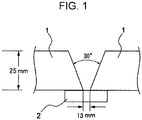
- Fig. 1 is a schematic diagram showing a groove shape of a steel sheet used in tests in Examples.
- a flux-cored wire for submerged arc welding (hereinafter, may be simply referred to as a "flux-cored wire” or “wire”) according to an embodiment of the present invention is a flux-cored wire for submerged arc welding in which a steel sheath is filled with a flux, the flux-cored wire including, relative to a total mass of the wire, C: 0.03 to 0.15% by mass, Si: 0.05 to 0.50% by mass, Mn: 0.80 to 2.00% by mass, Ni: 1.5 to 4.0% by mass, Ti: 0.05 to 0.30% by mass, B: 0.003 to 0.015% by mass, CaF 2 : 0.8 to 2.5% by mass, and Mg: 1.0% by mass or less (including 0% by mass), in which the amount of N and the amount of O in the steel sheath are controlled to N: 0.0050% by mass or less and O: 0.0075% by mass or less, respectively.
- the flux-cored wire according to the embodiment is a metal-based flux-cored
- the flux-cored wire a steel sheath is filled with a flux.
- the flux-cored wire according to the embodiment includes a steel sheath having a tubular shape and a flux filled inside (in the inner side of) the sheath.
- the flux-cored wire may be a seamless type in which the sheath does not have a seam or a seam type in which the sheath has a seam. Furthermore, in the flux-cored wire, a surface of the wire (outer side of the sheath) may be subjected or not subjected to plating or the like.
- the amounts of the components contained in the flux-cored wire are defined as the contents relative to the total mass of the wire (total of the steel sheath and the flux inside the sheath), unless otherwise specified.
- the amount of C in the wire is set to be 0.03% by mass or more, and preferably 0.04% by mass or more.
- the amount of C in the wire is set to be 0.15% by mass or less, and preferably 0.10% by mass or less.
- Si is an element that has effects of enhancing resistance to pockmarks and improving weld bead wettability.
- the amount of Si in the wire is set to be 0.05% by mass or more, and preferably 0.10% by mass or more.
- the amount of Si in the wire is set to be 0.50% by mass or less, and preferably 0.40% by mass or less.
- Mn is an element that greatly affects the hardenability of the weld metal and plays an important role in securing strength and toughness.
- the amount of Mn in the wire is set to be 0.80% by mass or more, and preferably 1.00% by mass or more.
- the amount of Mn in the wire is set to be 2.00% by mass or less, and preferably 1.70% by mass or less.
- Ni is an element that has an effect of toughening the matrix in the weld metal.
- the amount of Ni in the wire is set to be 1.5% by mass or more, and preferably 2.0% by mass or more.
- the amount of Ni in the wire is set to be 4.0% by mass or less, and preferably 3.5% by mass or less.
- Ti has effects of improving the hardenability of the weld metal, refining the structure of the weld metal, and improving toughness.
- the amount of Ti in the wire is set to be 0.05% by mass or more, 0.10% by mass or more.
- the amount of Ti in the wire is set to be 0.30% by mass or less, and preferably 0.25% by mass or less.
- the amount of B in the wire is set to be 0.003% by mass or more, and preferably 0.006% by mass or more.
- the amount of B in the wire is set to be 0.015% by mass or less, and preferably 0.012% by mass or less.
- CaF 2 has effects of promoting deoxidation of the weld metal and improving the toughness of the weld metal.
- the amount of CaF 2 in the wire is set to be 0.8% by mass or more, and preferably 1.2% by mass or more.
- the amount of CaF 2 in the wire is set to be 2.5% by mass or less, and preferably 2.1% by mass or less.
- Mg is an element that has an effect of promoting deoxidation of the weld metal.
- the amount of Mg in the wire is set to be 1.0% by mass or less, and preferably 0.4% by mass or less.
- the lower limit value of the Mg content is not particularly limited, and may be 0% by mass or, for example, 0.1% by mass.
- the flux-cored wire according to the embodiment may further include, in addition to the components described above, a predetermined amount of at least one component selected from Cr, Mo, and Cu described below.
- Cr may be incorporated since it exerts an effect of improving the strength of the weld metal.
- the upper limit of the content thereof is preferably 1.5% by mass.
- the amount of Cr in the wire is more preferably 0.7% by mass or less.
- the lower limit of the content thereof is not particularly limited, and may be 0% by mass or, for example, 0.2% by mass.
- Mo may be incorporated since it exerts an effect of improving the strength of the weld metal.
- the upper limit of the content thereof is preferably 1.5% by mass.
- the amount of Mo in the wire is more preferably 0.7% by mass or less.
- the lower limit of the content thereof is not particularly limited, and may be 0% by mass or, for example, 0.2% by mass.
- Cu may be incorporated since it exerts an effect of improving the strength of the weld metal.
- the upper limit of the content thereof is preferably 1.5% by mass.
- the amount of Cu in the wire is more preferably 0.5% by mass or less.
- the lower limit of the content thereof is not particularly limited, and may be 0% by mass or, for example, 0.2% by mass.
- the wire according to the embodiment may be subjected to Cu plating as desired.
- the amount of Cu is a total amount of Cu contained in the base material of the wire and Cu contained in the Cu plating.
- the balance of the flux-cored wire according to the embodiment includes Fe, unavoidable impurities, and the like.
- Fe as the balance corresponds to Fe constituting the sheath, iron powder added to the flux, and Fe of alloy powder.
- the unavoidable impurities as the balance correspond to components other than the components described above (P: 0.02% by mass or less, S: 0.02% by mass or less, Sn: 0.02% by mass or less, Pb: 0.02% by mass or less, Sb: 0.02% by mass or less, Nb: 0.05% by mass or less, V: 0.05% by mass or less, etc.) and the above-described selectively added components (Cr, Mo, and Cu), etc. which are unavoidably included. Inclusion of the unavoidable impurities is allowed within a range that does not hinder the advantageous effects of the flux-cored wire according to the embodiment.
- the flux-cored wire according to the embodiment is a metal-based flux-cored wire, but may include a slag forming agent and an arc stabilizer within a range that does not hinder the advantageous effects. Note that a slag forming agent and an arc stabilizer are preferably not included.
- the amount of N and the amount of O in the steel sheath are controlled within predetermined ranges. The reasons therefor will be described below.
- the amount of N in the steel sheath is set to be 0.0050% by mass or less, and preferably 0.0040% by mass or less.
- the lower limit of the amount of N is not particularly limited, but is, for example, 0.0020% by mass or more from the practical viewpoint.
- the amount of O in the steel sheath is set to be 0.0075% by mass or less, and preferably 0.0060% by mass or less.
- the lower limit of the amount of O is not particularly limited, but is, for example, 0.0030% by mass or more from the practical viewpoint.
- the amount of N and the amount of O in the sheath are controlled to the above-described specified values or less.
- a steel sheath is filled with a flux.
- the composition and filling ratio of the flux can be appropriately adjusted depending on the composition, thickness, and the like of the sheath so that the composition of the whole wire is within the ranges described above.
- the wire in which the sheath has been filled with the flux is drawn using hole dies or roller dies to reduce the diameter, thus obtaining a flux-cored wire having a predetermined outer diameter.
- the outer diameter of the flux-cored wire according to the embodiment is not particularly limited, but is preferably 1.6 to 4.8 mm, and more preferably 2.4 to 4.0 mm, from the standpoint of wire feed stability.
- the material for submerged arc welding includes a combination of the above-described flux-cored wire for submerged arc welding and a sintered flux (combined sintered flux) having a basicity of 1.5 to 4.0.
- the basicity (BA) of the sintered flux in the material for submerged arc welding is defined by the formula (1) below. Note that the amount of each component in the formula (1) is the amount of the component in percent by mass.
- Basicity BA CaO + MgO + CaF 2 + BaO + 0.5 ⁇ MnO + FeO / SiO 2 + 0.5 ⁇ Al 2 O 3 + TiO 2 + ZrO 2
- the basicity of the sintered flux is 1.5 or more, the amount of oxygen in the weld metal is sufficiently reduced, and excellent toughness is easily secured, which is preferable.
- the basicity of the sintered flux is more preferably 2.0 or more. Furthermore, when the basicity of the sintered flux is 4.0 or less, the arc is stabilized, a good bead shape can be obtained, and good welding workability is easily secured, which is preferable.
- the basicity of the sintered flux is more preferably 3.6 or less.
- Tables 1 and 2 below show chemical compositions (mass%) of flux-cored wires used in the present tests.
- the balance includes Fe and unavoidable impurities.
- the amount of each of the components Mg, Cr, Mo, and Cu indicates that the amount of each component is at a level equal to or lower than the impurity level.
- the amount of each of the components N and O is the content in the steel sheath (relative to the total mass of the steel sheath).
- Table 3 shows chemical compositions (mass%) of sintered fluxes (combined sintered fluxes) used in the present tests.
- the basicity (BA) of the sintered flux is calculated by the formula (1) below.
- the amount of each component in the formula (1) is the amount of the component in percent by mass.
- Basicity BA CaO + MgO + CaF 2 + BaO + 0.5 ⁇ MnO + FeO / SiO 2 + 0.5 ⁇ Al 2 O 3 + TiO 2 + ZrO 2
- a tensile test specimen type A1 of JIS Z 3111: 2005 was taken from each of the obtained weld metals at a position 9.5 mm below the surface of the steel sheet, and the tensile strength (TS) of the weld metal was measured by a tensile test according to the "Methods of tension and impact tests for deposited metal" stipulated in JIS Z 3111: 2005. The results are shown in Tables 6 and 7. Here, when the tensile strength (TS) is 570 MPa or more, the test specimen can be evaluated as having high strength.
- a 2-mm V-notch impact test specimen of JIS Z 3111: 2005 was taken from each of the obtained weld metals at a position 9.5 mm below the surface of the steel sheet, and the absorbed energy at -90°C (vE-90°C) of the weld metal was measured by an impact test according to "Methods of tension and impact tests for deposited metal" stipulated in JIS Z 3111: 2005.
- the results are shown in Tables 6 and 7.
- the absorbed energy at -90°C (vE-90°C) is 75 J or more, the test specimen can be evaluated as having good low-temperature toughness.
- the amount of oxygen in the weld metal was measured in accordance with JIS G 1239: 2014. The results are shown in Tables 6 and 7.
- the amount of diffusible hydrogen in the weld metal was evaluated by a method according to JIS Z 3118: 2007. The results are shown in Tables 6 and 7. Here, an amount of diffusible hydrogen ([H]d) of 5.0 ml/100 g or less was regarded as "pass".
- welding workability was evaluated from the standpoint of the bead wettability, bead shape, arc stability, presence or absence of blowholes, removability of slag, and the like.
Landscapes
- Engineering & Computer Science (AREA)
- Mechanical Engineering (AREA)
- Chemical & Material Sciences (AREA)
- Materials Engineering (AREA)
- Metallurgy (AREA)
- Organic Chemistry (AREA)
- Inorganic Chemistry (AREA)
- Nonmetallic Welding Materials (AREA)
Abstract
Description
- The present invention relates to a flux-cored wire for submerged arc welding and a material for submerged arc welding.
- Existing oil and gas fields have been depleted in recent years and therefore, it is expected that drilling and production bases for oil and gas fields will move in the future to frigid regions, such as the Arctic Circle. In drilling facilities in frigid regions, it is considered to be particularly important to ensure safety against brittle failure.
- In order to improve the low-temperature toughness of a weld metal, for example, it is conceivable to reduce the amount of oxygen in the weld metal. In submerged arc welding, a solid wire is usually used. However, there is a limit in achieving a reduction in the amount of oxygen by adjusting the wire and a flux for submerged arc welding, and there is a problem in that welding workability deteriorates.
- On the other hand, in submerged arc welding, a flux-cored wire is also used. For example, Patent Literature 1 discloses a flux-cored wire in which by optimizing the amounts of metallic Mg or Mg alloy and BaF2 added in the wire, strength and low-temperature toughness are improved with excellent welding workability.
- PTL 1: Japanese Patent No.
5462147 - Regarding the low-temperature toughness, properties in a very low temperature region may be required in some cases. In submerged arc welding with relatively high heat input, it is difficult to ensure good impact performance in a very low temperature region, for example, at -90°C, and thus there are still problems in improving low-temperature toughness. For example, in the technique described in Patent Literature 1, toughness at about -18°C only is evaluated, and the low-temperature toughness in the very low temperature region as described above is unknown. Therefore, it is required to sufficiently secure improvement of toughness even in the very low temperature region.
- The present invention has been made under the circumstances described above. It is an object of the invention to provide a flux-cored wire for submerged arc welding and a material for submerged arc welding, with which it is possible to obtain a weld metal having high strength and excellent low-temperature toughness in a very low temperature region with excellent welding workability and to suppress to a low level the amount of diffusible hydrogen in the weld metal.
- A flux-cored wire for submerged arc welding according to an aspect of the present invention is a flux-cored wire for submerged arc welding in which a steel sheath is filled with a flux, the flux-cored wire including, relative to a total mass of the wire, C: 0.03 to 0.15% by mass, Si: 0.05 to 0.50% by mass, Mn: 0.80 to 2.00% by mass, Ni: 1.5 to 4.0% by mass, Ti: 0.05 to 0.30% by mass, B: 0.003 to 0.015% by mass, CaF2: 0.8 to 2.5% by mass, and Mg: 1.0% by mass or less (including 0% by mass), in which the amount of N and the amount of O in the steel sheath are controlled to N: 0.0050% by mass or less and O: 0.0075% by mass or less, respectively.
- The flux-cored wire for submerged arc welding may further include, relative to the total mass of the wire, at least one selected from the group consisting of Cr: 1.5% by mass or less (including 0% by mass), Mo: 1.5% by mass or less (including 0% by mass), and Cu: 1.5% by mass or less (including 0% by mass).
- A material for submerged arc welding according to another aspect of the present invention includes the flux-cored wire for submerged arc welding and a sintered flux having a basicity of 1.5 to 4.0.
- By using the flux-cored wire for submerged arc welding or the material for submerged arc welding according to the aspect of the present invention, it is possible to obtain a weld metal having high strength and excellent low-temperature toughness in a very low temperature region with excellent welding workability. Furthermore, the amount of diffusible hydrogen in the weld metal can be suppressed to a low level. Brief Description of Drawings
- [
Fig. 1] Fig. 1 is a schematic diagram showing a groove shape of a steel sheet used in tests in Examples. - Embodiments for carrying out the present invention will be described in detail below. However, the present invention is not limited to the embodiments described below, and can be arbitrarily modified and implemented without departing from the gist of the present invention.
- In the present description, "to" indicating a numerical range is used, meaning that the numerical values described before and after that are included as the lower limit value and the upper limit value.
- A flux-cored wire for submerged arc welding (hereinafter, may be simply referred to as a "flux-cored wire" or "wire") according to an embodiment of the present invention is a flux-cored wire for submerged arc welding in which a steel sheath is filled with a flux, the flux-cored wire including, relative to a total mass of the wire, C: 0.03 to 0.15% by mass, Si: 0.05 to 0.50% by mass, Mn: 0.80 to 2.00% by mass, Ni: 1.5 to 4.0% by mass, Ti: 0.05 to 0.30% by mass, B: 0.003 to 0.015% by mass, CaF2: 0.8 to 2.5% by mass, and Mg: 1.0% by mass or less (including 0% by mass), in which the amount of N and the amount of O in the steel sheath are controlled to N: 0.0050% by mass or less and O: 0.0075% by mass or less, respectively. The flux-cored wire according to the embodiment is a metal-based flux-cored wire.
- In the flux-cored wire, a steel sheath is filled with a flux. In detail, the flux-cored wire according to the embodiment includes a steel sheath having a tubular shape and a flux filled inside (in the inner side of) the sheath.
- Note that the flux-cored wire may be a seamless type in which the sheath does not have a seam or a seam type in which the sheath has a seam. Furthermore, in the flux-cored wire, a surface of the wire (outer side of the sheath) may be subjected or not subjected to plating or the like.
- The reasons for numerical limitations on the amounts of the components contained in the flux-cored wire according to the embodiment will be described below. Note that hereinafter, the amounts of the components in the flux-cored wire are defined as the contents relative to the total mass of the wire (total of the steel sheath and the flux inside the sheath), unless otherwise specified.
- C is an element that greatly affects the hardenability of the weld metal and plays an important role in securing strength and toughness. In order to sufficiently obtain such an effect, the amount of C in the wire is set to be 0.03% by mass or more, and preferably 0.04% by mass or more. On the other hand, when C is excessively incorporated, there is a concern that the strength may become excessive and the toughness may be deteriorated. Therefore, the amount of C in the wire is set to be 0.15% by mass or less, and preferably 0.10% by mass or less.
- Si is an element that has effects of enhancing resistance to pockmarks and improving weld bead wettability. In order to sufficiently obtain such effects, the amount of Si in the wire is set to be 0.05% by mass or more, and preferably 0.10% by mass or more. On the other hand, when Si is excessively incorporated, ferrite in the weld metal is coarsened, which may deteriorate toughness. Therefore, the amount of Si in the wire is set to be 0.50% by mass or less, and preferably 0.40% by mass or less.
- Mn is an element that greatly affects the hardenability of the weld metal and plays an important role in securing strength and toughness. In order to sufficiently obtain such an effect, the amount of Mn in the wire is set to be 0.80% by mass or more, and preferably 1.00% by mass or more. On the other hand, when Mn is excessively incorporated, there is a concern that the strength may become excessive and the toughness may be deteriorated. Therefore, the amount of Mn in the wire is set to be 2.00% by mass or less, and preferably 1.70% by mass or less.
- Ni is an element that has an effect of toughening the matrix in the weld metal.
- In order to sufficiently obtain such an effect, the amount of Ni in the wire is set to be 1.5% by mass or more, and preferably 2.0% by mass or more. On the other hand, when the amount of Ni becomes excessive, there is a concern that the strength may become excessive and the toughness may be deteriorated. Therefore, the amount of Ni in the wire is set to be 4.0% by mass or less, and preferably 3.5% by mass or less.
- Ti has effects of improving the hardenability of the weld metal, refining the structure of the weld metal, and improving toughness. In order to sufficiently obtain such effects, the amount of Ti in the wire is set to be 0.05% by mass or more, 0.10% by mass or more. On the other hand, when the amount of Ti becomes excessive, there is a concern that the strength may become excessive and the toughness may be deteriorated. Therefore, the amount of Ti in the wire is set to be 0.30% by mass or less, and preferably 0.25% by mass or less.
- B has effects of refining the structure of the weld metal and improving toughness. In order to sufficiently obtain such effects, the amount of B in the wire is set to be 0.003% by mass or more, and preferably 0.006% by mass or more. On the other hand, when the amount of B becomes excessive, there is a concern that the strength may become excessive and the toughness may be deteriorated. Therefore, the amount of B in the wire is set to be 0.015% by mass or less, and preferably 0.012% by mass or less.
- CaF2 has effects of promoting deoxidation of the weld metal and improving the toughness of the weld metal. In order to sufficiently obtain such effects, the amount of CaF2 in the wire is set to be 0.8% by mass or more, and preferably 1.2% by mass or more. On the other hand, when the amount of CaF2 becomes excessive, there is a concern that the arc may become unstable and the bead shape may be poor. Therefore, the amount of CaF2 in the wire is set to be 2.5% by mass or less, and preferably 2.1% by mass or less.
- Mg is an element that has an effect of promoting deoxidation of the weld metal. However, when the amount of Mg becomes excessive, there is a concern that the amount of diffusible hydrogen in the weld metal may increase and cold cracking susceptibility may be increased. Therefore, the amount of Mg in the wire is set to be 1.0% by mass or less, and preferably 0.4% by mass or less. The lower limit value of the Mg content is not particularly limited, and may be 0% by mass or, for example, 0.1% by mass.
- Furthermore, the flux-cored wire according to the embodiment may further include, in addition to the components described above, a predetermined amount of at least one component selected from Cr, Mo, and Cu described below.
- Although not an essential component, Cr may be incorporated since it exerts an effect of improving the strength of the weld metal. When Cr is added to the wire, the upper limit of the content thereof is preferably 1.5% by mass. The amount of Cr in the wire is more preferably 0.7% by mass or less. When Cr is incorporated, the lower limit of the content thereof is not particularly limited, and may be 0% by mass or, for example, 0.2% by mass.
- Although not an essential component, Mo may be incorporated since it exerts an effect of improving the strength of the weld metal. When Mo is added to the wire, the upper limit of the content thereof is preferably 1.5% by mass. The amount of Mo in the wire is more preferably 0.7% by mass or less. When Mo is incorporated, the lower limit of the content thereof is not particularly limited, and may be 0% by mass or, for example, 0.2% by mass.
- Although not an essential component, Cu may be incorporated since it exerts an effect of improving the strength of the weld metal. When Cu is added to the wire, the upper limit of the content thereof is preferably 1.5% by mass. The amount of Cu in the wire is more preferably 0.5% by mass or less. When Cu is incorporated, the lower limit of the content thereof is not particularly limited, and may be 0% by mass or, for example, 0.2% by mass.
- Furthermore, the wire according to the embodiment may be subjected to Cu plating as desired. Here, in the case where the wire is subjected to Cu plating, the amount of Cu is a total amount of Cu contained in the base material of the wire and Cu contained in the Cu plating.
- The balance of the flux-cored wire according to the embodiment includes Fe, unavoidable impurities, and the like.
- Fe as the balance corresponds to Fe constituting the sheath, iron powder added to the flux, and Fe of alloy powder.
- The unavoidable impurities as the balance correspond to components other than the components described above (P: 0.02% by mass or less, S: 0.02% by mass or less, Sn: 0.02% by mass or less, Pb: 0.02% by mass or less, Sb: 0.02% by mass or less, Nb: 0.05% by mass or less, V: 0.05% by mass or less, etc.) and the above-described selectively added components (Cr, Mo, and Cu), etc. which are unavoidably included. Inclusion of the unavoidable impurities is allowed within a range that does not hinder the advantageous effects of the flux-cored wire according to the embodiment. The flux-cored wire according to the embodiment is a metal-based flux-cored wire, but may include a slag forming agent and an arc stabilizer within a range that does not hinder the advantageous effects. Note that a slag forming agent and an arc stabilizer are preferably not included.
- Furthermore, in the flux-cored wire according to the embodiment, the amount of N and the amount of O in the steel sheath (relative to the total mass of the steel sheath) are controlled within predetermined ranges. The reasons therefor will be described below.
- When the amount of N in the steel sheath exceeds 0.0050% by mass, bubbles are likely to be generated in the weld metal, and there is a concern that the toughness of the weld metal may be deteriorated. Therefore, in the wire according to the embodiment, the amount of N in the steel sheath is set to be 0.0050% by mass or less, and preferably 0.0040% by mass or less. The lower limit of the amount of N is not particularly limited, but is, for example, 0.0020% by mass or more from the practical viewpoint.
- When the amount of O in the steel sheath exceeds 0.0075% by mass, blowholes are likely to be generated in the weld metal, and there is a concern that the amount of oxygen in the weld metal may be increased, resulting in deterioration in the toughness of the weld metal. Therefore, in the wire according to the embodiment, the amount of O in the steel sheath is set to be 0.0075% by mass or less, and preferably 0.0060% by mass or less. The lower limit of the amount of O is not particularly limited, but is, for example, 0.0030% by mass or more from the practical viewpoint.
- In the flux-cored wire according to the embodiment, in order to improve toughness in a very low temperature region, the amount of N and the amount of O in the sheath are controlled to the above-described specified values or less.
- Next, one example of a method of manufacturing a flux-cored wire according to the embodiment will be described. However, the present invention is not limited thereto.
- In one example of a method of manufacturing a flux-cored wire according to the embodiment, first, a steel sheath is filled with a flux. At that time, the composition and filling ratio of the flux can be appropriately adjusted depending on the composition, thickness, and the like of the sheath so that the composition of the whole wire is within the ranges described above.
- Subsequently, the wire in which the sheath has been filled with the flux is drawn using hole dies or roller dies to reduce the diameter, thus obtaining a flux-cored wire having a predetermined outer diameter.
- The outer diameter of the flux-cored wire according to the embodiment is not particularly limited, but is preferably 1.6 to 4.8 mm, and more preferably 2.4 to 4.0 mm, from the standpoint of wire feed stability.
- Next, a material for submerged arc welding according to an embodiment of the present invention will be described.
- The material for submerged arc welding according to the embodiment includes a combination of the above-described flux-cored wire for submerged arc welding and a sintered flux (combined sintered flux) having a basicity of 1.5 to 4.0.
- Here, the basicity (BA) of the sintered flux in the material for submerged arc welding according to the embodiment is defined by the formula (1) below. Note that the amount of each component in the formula (1) is the amount of the component in percent by mass.

- When the basicity of the sintered flux is 1.5 or more, the amount of oxygen in the weld metal is sufficiently reduced, and excellent toughness is easily secured, which is preferable. The basicity of the sintered flux is more preferably 2.0 or more. Furthermore, when the basicity of the sintered flux is 4.0 or less, the arc is stabilized, a good bead shape can be obtained, and good welding workability is easily secured, which is preferable. The basicity of the sintered flux is more preferably 3.6 or less.
- The present invention will be described in detail with reference to examples and comparative examples. However, it is to be understood that the present invention is not limited thereto.
- Tables 1 and 2 below show chemical compositions (mass%) of flux-cored wires used in the present tests. Regarding the chemical composition relative to the total mass of the wire, the balance includes Fe and unavoidable impurities. Furthermore, regarding the amount of each of the components Mg, Cr, Mo, and Cu, "-" indicates that the amount of each component is at a level equal to or lower than the impurity level. Furthermore, the amount of each of the components N and O is the content in the steel sheath (relative to the total mass of the steel sheath).
- Furthermore, Table 3 below shows chemical compositions (mass%) of sintered fluxes (combined sintered fluxes) used in the present tests. Note that the basicity (BA) of the sintered flux is calculated by the formula (1) below. The amount of each component in the formula (1) is the amount of the component in percent by mass.

- In order to test welding workability and mechanical properties of a weld metal, a welding test was carried out under the welding conditions shown in Table 5, in which a steel sheet 1 (thickness: 25 mm) having the chemical composition (the balance being Fe and unavoidable impurities) shown in Table 4 was formed into a groove shape with a groove angle of 30° and a root gap of 13 mm, followed by providing a
backing material 2 thereunder, as shown inFig. 1 , and each of the flux-cored wires and each of the sintered fluxes were combined for use as shown in Tables 6 and 7. - A tensile test specimen type A1 of JIS Z 3111: 2005 was taken from each of the obtained weld metals at a position 9.5 mm below the surface of the steel sheet, and the tensile strength (TS) of the weld metal was measured by a tensile test according to the "Methods of tension and impact tests for deposited metal" stipulated in JIS Z 3111: 2005. The results are shown in Tables 6 and 7. Here, when the tensile strength (TS) is 570 MPa or more, the test specimen can be evaluated as having high strength.
- A 2-mm V-notch impact test specimen of JIS Z 3111: 2005 was taken from each of the obtained weld metals at a position 9.5 mm below the surface of the steel sheet, and the absorbed energy at -90°C (vE-90°C) of the weld metal was measured by an impact test according to "Methods of tension and impact tests for deposited metal" stipulated in JIS Z 3111: 2005. The results are shown in Tables 6 and 7. Here, when the absorbed energy at -90°C (vE-90°C) is 75 J or more, the test specimen can be evaluated as having good low-temperature toughness.
- The amount of oxygen in the weld metal was measured in accordance with JIS G 1239: 2014. The results are shown in Tables 6 and 7.
- The amount of diffusible hydrogen in the weld metal was evaluated by a method according to JIS Z 3118: 2007. The results are shown in Tables 6 and 7. Here, an amount of diffusible hydrogen ([H]d) of 5.0 ml/100 g or less was regarded as "pass".
- Regarding each example, welding workability was evaluated from the standpoint of the bead wettability, bead shape, arc stability, presence or absence of blowholes, removability of slag, and the like.
-
Table 1 Classification Wire symbol Content relative to total mass of wire (mass%) Content in steel sheath (mass%) C Si Mn Ni Ti B CaF2 Mg Cr Mo Cu N O W-1 0.15 0.08 0.89 1.8 0.09 0.006 1.7 - - - - 0.0042 0.0035 W-2 0.04 0.35 1.49 2.5 0.16 0.011 2.1 - - - - 0.0042 0.0035 W-3 0.08 0.49 1.03 2.0 0.09 0.011 1.5 - - - - 0.0042 0.0035 W-4 0.11 0.05 1.21 2.3 0.20 0.010 2.1 - - - - 0.0042 0.0035 W-5 0.05 0.26 1.98 2.0 0.09 0.008 1.5 - - - - 0.0044 0.0043 W-6 0.08 0.25 0.80 3.2 0.15 0.011 2.1 - - - - 0.0044 0.0043 W-7 0.08 0.23 0.94 2.1 0.11 0.009 1.4 - - - - 0.0041 0.0039 W-8 0.08 0.21 1.14 3.9 0.09 0.010 1.7 - - - - 0.0041 0.0039 W-9 0.10 0.41 1.26 1.5 0.15 0.010 2.1 - - - - 0.0041 0.0039 W-10 0.10 0.12 1.19 2.0 0.30 0.013 2.1 - - - - 0.0041 0.0039 Example W-11 0.08 0.12 1.51 3.0 0.05 0.008 2.2 - - - - 0.0041 0.0039 W-12 0.08 0.12 1.28 2.3 0.21 0.015 1.5 - - - - 0.0041 0.0039 W-13 0.09 0.21 1.50 2.4 0.09 0.003 2.1 - - - - 0.0041 0.0039 W-14 0.12 0.10 0.91 2.3 0.20 0.010 2.5 - - - - 0.0044 0.0043 W-15 0.08 0.12 1.52 3.1 0.23 0.012 0.8 - - - - 0.0044 0.0043 W-16 0.09 0.16 1.05 2.3 0.11 0.010 1.2 1.0 - - - 0.0045 0.0054 W-17 0.11 0.23 1.32 2.0 0.11 0.011 2.3 - - - - 0.0050 0.0065 W-18 0.06 0.10 0.94 2.2 0.09 0.010 2.1 - 1.0 - - 0.0042 0.0035 W-19 0.05 0.10 1.10 2.1 0.11 0.012 1.9 - - 1.0 - 0.0042 0.0035 W-20 0.05 0.09 1.13 1.5 0.09 0.010 2.3 - - - 1.0 0.0042 0.0035 -
Table 2 Classification Wire symbol Content relative to total mass of wire (mass%) Content in steel sheath (mass%) C Si Mn Ni Ti B CaF2 Mg Cr Mo Cu N O W-21 0.16 0.08 1.02 1.8 0.09 0.006 1.7 - - - - 0.0045 0.0054 W-22 0.02 0.15 1.35 2.2 0.14 0.010 2.0 - - - - 0.0045 0.0054 W-23 0.10 0.52 1.12 2.3 0.19 0.012 1.8 - - - - 0.0042 0.0038 W-24 0.09 0.04 1.26 2.8 0.22 0.012 1.8 - - - - 0.0045 0.0041 W-25 0.09 0.21 2.01 2.1 0.15 0.010 1.9 - - - - 0.0045 0.0042 W-26 0.08 0.23 0.78 2.1 0.14 0.009 2.1 - - - - 0.0042 0.0047 W-27 0.10 0.19 1.20 4.1 0.25 0.012 1.7 - - - - 0.0042 0.0039 W-28 0.08 0.28 1.18 1.4 0.11 0.012 2.0 - - - - 0.0043 0.0042 Comparative W-29 0.11 0.15 1.26 2.2 0.31 0.012 2.0 - - - - 0.0043 0.0047 Example W-30 0.10 0.15 1.15 2.8 0.04 0.008 1.9 - - - - 0.0042 0.0044 W-31 0.11 0.32 1.33 2.1 0.20 0.016 1.7 - - - - 0.0042 0.0051 W-32 0.08 0.25 1.16 3.1 0.10 0.002 1.1 - - - - 0.0042 0.0037 W-33 0.08 0.20 1.35 3.0 0.21 0.010 2.6 - - - - 0.0043 0.0039 W-34 0.09 0.15 1.29 2.7 0.19 0.011 0.7 - - - - 0.0041 0.0044 W-35 0.10 0.14 1.08 2.3 0.11 0.010 1.2 1.1 - - - 0.0045 0.0054 W-36 0.11 0.21 1.22 2.0 0.11 0.012 2.3 - - - - 0.0067 0.0060 W-37 0.09 0.18 1.08 2.3 0.11 0.01 2.3 - - - - 0.0044 0.0098 -
Table 3 Flux symbol Chemical composition of sintered flux (mass%) Basicity CaO MgO CaF2 BaO MnO FeO S1O2 Al2O3 TiO2 ZrO2 Others F-1 12 27 16 - - - 17 20 - - 8 2.04 F-2 23 32 13 - - - 10 15 - - 7 3.89 F-3 12 22 13 2 1 2 22 15 4 1 6 1.58 -
Table 4 Chemical composition of steel sheet (mass%) C Si Mn P S 0.13 0.34 1.34 0.010 0.003 -
Table 5 Wire diameter (mm) Polarity Welding position Current (A) Voltage (V) Welding speed (cm/min.) Heat input (kJ/cm) Preheating temperature (°C) Interpass temperature (°C) Wire extension (mm) 4.0 AC Flat 550 30 40 24.8 90-110 140-160 30 -
Table 6 Classification Wire symbol Flux symbol Weld metal symbol Room temperature TS (MPa) vE-90°C (J) Amount of oxygen in weld metal (ppm) Amount of diffusible hydrogen in weld metal (ml/100g) Welding workability Comprehensive evaluation W-1 F-1 D-1 672 81 220 2.9 Good ○ W-2 F-2 D-2 575 115 204 3.1 Good ○ W-3 F-1 D-3 627 91 254 3.0 Good ○ W-4 F-2 D-4 651 122 210 2.7 Good ○ W-5 F-3 D-5 614 91 241 3.5 Good ○ W-6 F-2 D-6 620 124 209 2.5 Good ○ W-7 F-2 D-7 581 121 205 3.0 Good ○ W-8 F-2 D-8 651 119 238 2.3 Good ○ W-9 F-2 D-9 660 83 193 2.6 Good ○ W-10 F-3 D-10 623 105 189 3.3 Good ○ Example W-11 F-3 D-11 632 99 198 3.6 Good ○ W-12 F-3 D-12 619 121 217 3.1 Good ○ W-13 F-3 D-13 639 87 188 3.9 Good ○ W-14 F-1 D-14 645 132 179 3.8 Good ○ W-15 F-1 D-15 637 102 250 2.7 Good ○ W-16 F-1 D-16 646 136 172 4.8 Good ○ W-17 F-1 D-17 613 79 195 3.1 Good ○ W-18 F-2 D-18 632 97 206 3.7 Good ○ W-19 F-2 D-19 651 91 211 3.4 Good ○ W-20 F-2 D-20 605 112 208 3.9 Good ○ -
Table 7 Classification Wire symbol Flux symbol Weld metal symbol Room temperature TS (MPa) vE-90°C (J) Amount of oxygen in weld metal (ppm) Amount of diffusible hydrogen in weld metal (ml/100g) Welding workability Comprehensive evaluation W-21 F-1 D-21 701 52 225 2.8 Good × W-22 F-2 D-22 534 77 249 2.9 Good × W-23 F-1 D-23 610 34 236 2.5 Good × W-24 F-2 D-24 - - - - × Deterioration of bead wetting at groove edges × W-25 F-3 D-25 703 70 217 3.2 Good × W-26 F-2 D-26 599 64 261 3.4 Good × W-27 F-2 D-27 710 55 220 2.9 Good × W-28 F-2 D-28 599 48 228 2.9 Good × Comparative W-29 F-3 D-29 699 35 218 3.1 Good × Example W-30 F-3 D-30 650 65 254 3.3 Good × W-31 F-3 D-31 702 40 230 3.4 Good × W-32 F-3 D-32 611 37 227 3.7 Good × W-33 F-1 D-33 - - - - × Unstable arc and poor bead shape × W-34 F-1 D-34 612 69 310 4.0 Good × W-35 F-1 D-35 661 129 161 5.2 Good × W-36 F-1 D-36 664 61 255 3.5 × Generation of bubbles × W-37 F-1 D-37 659 65 298 - Good × - In each of the examples using wires W-1 to W-20, which are Examples, it was possible to obtain a weld metal having high strength with a room temperature tensile strength (TS) of 570 MPa or more and excellent low-temperature toughness with an absorbed energy at -90°C (vE-90°C) of 75 J or more with good welding workability. Furthermore, the amount of diffusible hydrogen in the resulting weld metal was able to be suppressed to 5.0 ml/100 g or less.
- On the other hand, in the example using wire W-21, since the amount of C in the wire was excessively large, the absorbed energy at -90°C (vE-90°C) was low.
- Furthermore, in the example using wire W-22, since the amount of C in the wire was excessively small, the room temperature tensile strength (TS) was low.
- In the example using wire W-23, since the amount of Si in the wire was excessively large, the absorbed energy at -90°C (vE-90°C) was low.
- Furthermore, in the example using wire W-24, since the amount of Si in the wire was excessively small, bead wetting at groove edges deteriorated. In this example, since good welding workability was not obtained, measurement of the room temperature tensile strength (TS), the absorbed energy at -90°C (vE-90°C), and the amount of oxygen and the amount of diffusible hydrogen in the weld metal was not performed.
- In the example using wire W-25, since the amount of Mn in the wire was excessively large, the absorbed energy at -90°C (vE-90°C) was low.
- Furthermore, in the example using wire W-26, since the amount of Mn in the wire was excessively small, the absorbed energy at -90°C (vE-90°C) was low.
- In the example using wire W-27, since the amount of Ni in the wire was excessively large, the absorbed energy at -90°C (vE-90°C) was low.
- Furthermore, in the example using wire W-28, since the amount of Ni in the wire was excessively small, the absorbed energy at -90°C (vE-90°C) was low.
- In the example using wire W-29, since the amount of Ti in the wire was excessively large, the absorbed energy at -90°C (vE-90°C) was low.
- Furthermore, in the example using wire W-30, since the amount of Ti in wire was excessively small, the absorbed energy at -90°C (vE-90°C) was low.
- In the example using wire W-31, since the amount of B in the wire was excessively large, the absorbed energy at -90°C (vE-90°C) was low.
- Furthermore, in the example using wire W-32, since the amount of B in the wire was excessively small, the absorbed energy at -90°C (vE-90°C) was low.
- In the example using wire W-33, since the amount of CaF2 in the wire was excessively large, the arc became unstable and the bead shape was poor. In this example, since good welding workability was not obtained, measurement of the room temperature tensile strength (TS), the absorbed energy at -90°C (vE-90°C), and the amount of oxygen and the amount of diffusible hydrogen in the weld metal was not performed.
- Furthermore, in the example using wire W-34, since the amount of CaF2 in the wire was excessively small, the absorbed energy at -90°C (vE-90°C) was low.
- In the example using wire W-35, since the amount of Mg in the wire was excessively large, the amount of diffusible hydrogen in the weld metal was not able to be suppressed to a low level.
- In the example using wire W-36, since the amount of N in the steel sheath of the wire was excessively large, the absorbed energy at -90°C (vE-90°C) was low, and bubbles were generated in the weld metal, thus deteriorating welding workability.
- In the example using wire W-37, since the amount of O in the steel sheath of the wire was excessively large, the absorbed energy at -90°C (vE-90°C) was low. In this example, the amount of diffusible hydrogen in the weld metal was not measured.
- The present invention has been described in detail based on the specific examples. However, the present invention is not limited to the specific examples, and various modifications and changes are possible without departing from the category of the present invention.
- While the present invention has been described in detail with reference to the specific embodiments, it will be apparent to one skilled in the art that various changes and alterations can be made therein without departing from the spirit and scope of the present invention. The present application is based on Japanese Patent Application (No.
2017-206521) filed on October 25, 2017 -
- 1
- steel sheet
- 2
- backing material
Claims (3)
- A flux-cored wire for submerged arc welding in which a steel sheath is filled with a flux, the flux-cored wire comprising, relative to a total mass of the wire:C: 0.03 to 0.15% by mass;Si: 0.05 to 0.50% by mass;Mn: 0.80 to 2.00% by mass;Ni: 1.5 to 4.0% by mass;Ti: 0.05 to 0.30% by mass;B: 0.003 to 0.015% by mass;CaF2: 0.8 to 2.5% by mass; andMg: 1.0% by mass or less (including 0% by mass),wherein the amount of N and the amount of O in the steel sheath are controlled to N: 0.0050% by mass or less and O: 0.0075% by mass or less, respectively.
- The flux-cored wire for submerged arc welding according to Claim 1, further comprising, relative to the total mass of the wire, at least one selected from the group consisting of Cr: 1.5% by mass or less (including 0% by mass), Mo: 1.5% by mass or less (including 0% by mass), and Cu: 1.5% by mass or less (including 0% by mass).
- A material for submerged arc welding comprising:the flux-cored wire for submerged arc welding according to Claim 1 or 2; anda sintered flux having a basicity of 1.5 to 4.0.
Applications Claiming Priority (2)
| Application Number | Priority Date | Filing Date | Title |
|---|---|---|---|
| JP2017206521A JP6832830B2 (en) | 2017-10-25 | 2017-10-25 | Flux-filled wire for submerged arc welding and materials for submerged arc welding |
| PCT/JP2018/039568 WO2019082945A1 (en) | 2017-10-25 | 2018-10-24 | Flux-cored wire for submerged arc welding, and material for submerged arc welding |
Publications (2)
| Publication Number | Publication Date |
|---|---|
| EP3702095A1 true EP3702095A1 (en) | 2020-09-02 |
| EP3702095A4 EP3702095A4 (en) | 2021-03-10 |
Family
ID=66247242
Family Applications (1)
| Application Number | Title | Priority Date | Filing Date |
|---|---|---|---|
| EP18870307.8A Withdrawn EP3702095A4 (en) | 2017-10-25 | 2018-10-24 | Flux-cored wire for submerged arc welding, and material for submerged arc welding |
Country Status (5)
| Country | Link |
|---|---|
| EP (1) | EP3702095A4 (en) |
| JP (1) | JP6832830B2 (en) |
| KR (1) | KR102276525B1 (en) |
| CN (1) | CN111278599A (en) |
| WO (1) | WO2019082945A1 (en) |
Families Citing this family (2)
| Publication number | Priority date | Publication date | Assignee | Title |
|---|---|---|---|---|
| CN112475669B (en) * | 2020-11-20 | 2022-04-19 | 济南市金材焊接材料有限公司 | Silicon-calcium type sintered flux and preparation method thereof |
| CN115846938A (en) * | 2022-12-08 | 2023-03-28 | 天津大桥焊材科技有限公司 | Submerged arc welding flux for low-temperature high-toughness fire-resistant weather-resistant steel |
Family Cites Families (11)
| Publication number | Priority date | Publication date | Assignee | Title |
|---|---|---|---|---|
| JPS5138288B2 (en) * | 1973-02-08 | 1976-10-21 | ||
| JP5005309B2 (en) * | 2006-10-02 | 2012-08-22 | 株式会社神戸製鋼所 | Gas shielded arc welding flux cored wire for high strength steel |
| US20080093351A1 (en) * | 2006-10-19 | 2008-04-24 | Kabushiki Kaisha Kobe Seiko Sho (Kobe Steel, Ltd.) | Flux-cored wire for gas shielded arc welding for creep-resisting steels |
| JP4722811B2 (en) * | 2006-10-23 | 2011-07-13 | 日鐵住金溶接工業株式会社 | Flux-cored wire for submerged arc welding for high-strength steel. |
| JP2008105039A (en) | 2006-10-24 | 2008-05-08 | Daihen Corp | Method for controlling pulse waveform in plasma mig welding |
| JP4828488B2 (en) * | 2007-08-23 | 2011-11-30 | 新日本製鐵株式会社 | Submerged arc welding method |
| JP4558780B2 (en) * | 2007-11-30 | 2010-10-06 | 日鐵住金溶接工業株式会社 | Flux-cored wire for submerged arc welding of low-temperature steel |
| JP5462147B2 (en) | 2010-12-28 | 2014-04-02 | 株式会社神戸製鋼所 | Flux-cored wire for submerged arc welding |
| MX336131B (en) | 2011-02-22 | 2016-01-07 | Procter & Gamble | Oxidative dyeing compositions comprising an 1-hexyl/heptyl-4,5-di aminopyrazole and a m-aminophenol and derivatives thereof. |
| CN102848103A (en) * | 2012-05-23 | 2013-01-02 | 天津大学 | Ultralow-hydrogen high-toughness submerged arc welding flux core and submerged arc flux-cored wire |
| JP6097087B2 (en) * | 2013-02-04 | 2017-03-15 | 株式会社神戸製鋼所 | Submerged arc welding wire for high strength 2.25Cr-1Mo-V steel and method for producing weld metal |
-
2017
- 2017-10-25 JP JP2017206521A patent/JP6832830B2/en active Active
-
2018
- 2018-10-24 WO PCT/JP2018/039568 patent/WO2019082945A1/en not_active Ceased
- 2018-10-24 EP EP18870307.8A patent/EP3702095A4/en not_active Withdrawn
- 2018-10-24 KR KR1020207011433A patent/KR102276525B1/en not_active Expired - Fee Related
- 2018-10-24 CN CN201880068862.4A patent/CN111278599A/en active Pending
Also Published As
| Publication number | Publication date |
|---|---|
| WO2019082945A1 (en) | 2019-05-02 |
| EP3702095A4 (en) | 2021-03-10 |
| CN111278599A (en) | 2020-06-12 |
| JP6832830B2 (en) | 2021-02-24 |
| JP2019076935A (en) | 2019-05-23 |
| KR102276525B1 (en) | 2021-07-12 |
| KR20200057736A (en) | 2020-05-26 |
Similar Documents
| Publication | Publication Date | Title |
|---|---|---|
| JP5157606B2 (en) | TIG welding method of high strength steel using flux cored wire | |
| EP3427891B1 (en) | Flux-cored wire, weld joint manufacturing method and weld joint | |
| EP3427890B1 (en) | Flux-cored wire, manufacturing method of welded joint, and welded joint | |
| EP2341159B1 (en) | Flux-cored wire for stainless steel arc welding | |
| JP5387168B2 (en) | Welding wire for high strength steel with flux and manufacturing method thereof | |
| JP5387192B2 (en) | Flux-cored wire for gas shield welding | |
| EP3189930B1 (en) | Flux cored wire for gas-shielded arc welding | |
| JP5136466B2 (en) | Flux-cored wire for welding high-strength steel and method for producing the same | |
| JP5310108B2 (en) | Flux-filled ultra-low hydrogen welding wire and manufacturing method thereof | |
| EP3539715A1 (en) | Flux-cored wire, method of manufacturing welded joint, and welded joint | |
| EP2374571B1 (en) | Flux-cored wire for gas-shielding arc welding | |
| JP6953869B2 (en) | Flux-cored wire for gas shielded arc welding and welding joint manufacturing method | |
| EP3511111A1 (en) | Flux cored wire for gas shield arc welding and welding metal | |
| JP6953870B2 (en) | Flux-cored wire for gas shielded arc welding and welding joint manufacturing method | |
| JP6969705B1 (en) | Steel wire for gas shielded arc welding, gas shielded arc welding method, and manufacturing method of gas shielded arc welded joint | |
| EP4253588A1 (en) | Submerged arc welded joint | |
| EP3290148A1 (en) | Flux cored wire for gas-shielded arc welding and welding method | |
| JP6155810B2 (en) | High Ni flux cored wire for gas shielded arc welding | |
| EP3208031B1 (en) | Flux-cored wire for gas shielded arc welding | |
| CN105458465B (en) | Gas-shielded arc welding method | |
| KR102276525B1 (en) | Flux cored wire for submerged arc welding and material for submerged arc welding | |
| EP4275834A1 (en) | Flux-cored wire | |
| EP4365326A1 (en) | Submerged arc welding method | |
| JP2011206828A (en) | Flux-cored welding wire for fine diameter wire multiple electrode submerged arc welding | |
| CN109759744B (en) | Welding wire powder, heat-treatable seamless flux-cored wire and application |
Legal Events
| Date | Code | Title | Description |
|---|---|---|---|
| STAA | Information on the status of an ep patent application or granted ep patent |
Free format text: STATUS: THE INTERNATIONAL PUBLICATION HAS BEEN MADE |
|
| PUAI | Public reference made under article 153(3) epc to a published international application that has entered the european phase |
Free format text: ORIGINAL CODE: 0009012 |
|
| STAA | Information on the status of an ep patent application or granted ep patent |
Free format text: STATUS: REQUEST FOR EXAMINATION WAS MADE |
|
| 17P | Request for examination filed |
Effective date: 20200409 |
|
| AK | Designated contracting states |
Kind code of ref document: A1 Designated state(s): AL AT BE BG CH CY CZ DE DK EE ES FI FR GB GR HR HU IE IS IT LI LT LU LV MC MK MT NL NO PL PT RO RS SE SI SK SM TR |
|
| AX | Request for extension of the european patent |
Extension state: BA ME |
|
| DAV | Request for validation of the european patent (deleted) | ||
| DAX | Request for extension of the european patent (deleted) | ||
| A4 | Supplementary search report drawn up and despatched |
Effective date: 20210204 |
|
| RIC1 | Information provided on ipc code assigned before grant |
Ipc: B23K 35/368 20060101AFI20210129BHEP Ipc: C22C 38/04 20060101ALI20210129BHEP Ipc: B23K 35/40 20060101ALI20210129BHEP Ipc: C22C 38/00 20060101ALI20210129BHEP Ipc: B23K 35/36 20060101ALI20210129BHEP Ipc: B23K 35/362 20060101ALI20210129BHEP Ipc: B23K 35/02 20060101ALI20210129BHEP Ipc: B23K 35/30 20060101ALI20210129BHEP |
|
| STAA | Information on the status of an ep patent application or granted ep patent |
Free format text: STATUS: THE APPLICATION HAS BEEN WITHDRAWN |
|
| 18W | Application withdrawn |
Effective date: 20220114 |