EP3700147B1 - System und verfahren zur klassifizierung von netzwerkverkehr - Google Patents
System und verfahren zur klassifizierung von netzwerkverkehr Download PDFInfo
- Publication number
- EP3700147B1 EP3700147B1 EP20159000.7A EP20159000A EP3700147B1 EP 3700147 B1 EP3700147 B1 EP 3700147B1 EP 20159000 A EP20159000 A EP 20159000A EP 3700147 B1 EP3700147 B1 EP 3700147B1
- Authority
- EP
- European Patent Office
- Prior art keywords
- flow
- traffic
- encrypted
- network traffic
- attributes
- Prior art date
- Legal status (The legal status is an assumption and is not a legal conclusion. Google has not performed a legal analysis and makes no representation as to the accuracy of the status listed.)
- Active
Links
Images




Classifications
-
- H—ELECTRICITY
- H04—ELECTRIC COMMUNICATION TECHNIQUE
- H04L—TRANSMISSION OF DIGITAL INFORMATION, e.g. TELEGRAPHIC COMMUNICATION
- H04L63/00—Network architectures or network communication protocols for network security
- H04L63/04—Network architectures or network communication protocols for network security for providing a confidential data exchange among entities communicating through data packet networks
- H04L63/0428—Network architectures or network communication protocols for network security for providing a confidential data exchange among entities communicating through data packet networks wherein the data content is protected, e.g. by encrypting or encapsulating the payload
-
- G—PHYSICS
- G06—COMPUTING OR CALCULATING; COUNTING
- G06N—COMPUTING ARRANGEMENTS BASED ON SPECIFIC COMPUTATIONAL MODELS
- G06N20/00—Machine learning
-
- H—ELECTRICITY
- H04—ELECTRIC COMMUNICATION TECHNIQUE
- H04L—TRANSMISSION OF DIGITAL INFORMATION, e.g. TELEGRAPHIC COMMUNICATION
- H04L41/00—Arrangements for maintenance, administration or management of data switching networks, e.g. of packet switching networks
- H04L41/16—Arrangements for maintenance, administration or management of data switching networks, e.g. of packet switching networks using machine learning or artificial intelligence
-
- H—ELECTRICITY
- H04—ELECTRIC COMMUNICATION TECHNIQUE
- H04L—TRANSMISSION OF DIGITAL INFORMATION, e.g. TELEGRAPHIC COMMUNICATION
- H04L43/00—Arrangements for monitoring or testing data switching networks
- H04L43/02—Capturing of monitoring data
- H04L43/026—Capturing of monitoring data using flow identification
-
- H—ELECTRICITY
- H04—ELECTRIC COMMUNICATION TECHNIQUE
- H04L—TRANSMISSION OF DIGITAL INFORMATION, e.g. TELEGRAPHIC COMMUNICATION
- H04L47/00—Traffic control in data switching networks
- H04L47/10—Flow control; Congestion control
- H04L47/22—Traffic shaping
-
- H—ELECTRICITY
- H04—ELECTRIC COMMUNICATION TECHNIQUE
- H04L—TRANSMISSION OF DIGITAL INFORMATION, e.g. TELEGRAPHIC COMMUNICATION
- H04L47/00—Traffic control in data switching networks
- H04L47/10—Flow control; Congestion control
- H04L47/24—Traffic characterised by specific attributes, e.g. priority or QoS
- H04L47/2483—Traffic characterised by specific attributes, e.g. priority or QoS involving identification of individual flows
-
- G—PHYSICS
- G06—COMPUTING OR CALCULATING; COUNTING
- G06N—COMPUTING ARRANGEMENTS BASED ON SPECIFIC COMPUTATIONAL MODELS
- G06N3/00—Computing arrangements based on biological models
- G06N3/02—Neural networks
-
- H—ELECTRICITY
- H04—ELECTRIC COMMUNICATION TECHNIQUE
- H04L—TRANSMISSION OF DIGITAL INFORMATION, e.g. TELEGRAPHIC COMMUNICATION
- H04L41/00—Arrangements for maintenance, administration or management of data switching networks, e.g. of packet switching networks
- H04L41/50—Network service management, e.g. ensuring proper service fulfilment according to agreements
- H04L41/5003—Managing SLA; Interaction between SLA and QoS
- H04L41/5019—Ensuring fulfilment of SLA
- H04L41/5022—Ensuring fulfilment of SLA by giving priorities, e.g. assigning classes of service
-
- H—ELECTRICITY
- H04—ELECTRIC COMMUNICATION TECHNIQUE
- H04L—TRANSMISSION OF DIGITAL INFORMATION, e.g. TELEGRAPHIC COMMUNICATION
- H04L47/00—Traffic control in data switching networks
- H04L47/10—Flow control; Congestion control
- H04L47/24—Traffic characterised by specific attributes, e.g. priority or QoS
- H04L47/2441—Traffic characterised by specific attributes, e.g. priority or QoS relying on flow classification, e.g. using integrated services [IntServ]
-
- H—ELECTRICITY
- H04—ELECTRIC COMMUNICATION TECHNIQUE
- H04L—TRANSMISSION OF DIGITAL INFORMATION, e.g. TELEGRAPHIC COMMUNICATION
- H04L63/00—Network architectures or network communication protocols for network security
- H04L63/14—Network architectures or network communication protocols for network security for detecting or protecting against malicious traffic
- H04L63/1408—Network architectures or network communication protocols for network security for detecting or protecting against malicious traffic by monitoring network traffic
Definitions
- the present disclosure relates generally to handling of computer network traffic. More particularly, the present disclosure relates to a system and method for classifying traffic and the handling of encrypted traffic.
- US2010/0250918 discloses a method and a system for identifying an application type from encrypted traffic transported over an IP network.
- the method and system extract at least a portion of IP flow parameters from the encrypted traffic using at least one of specific target encryption types. Then, the method and system transmit the extracted IP flow parameters to a learning-based classification engine.
- the learning-based classification engine has been trained with unencrypted traffic. Then, the method and system infer at least one corresponding application type for the extracted IP flow parameters.
- a system and method for classifying network traffic that includes encrypted data.
- a method for classifying network traffic including: providing a framework of models configured to classify network traffic; determining whether the network traffic flow is encrypted; if the network traffic flow is encrypted: extracting encrypted flow attributes associated with a network traffic flow; deriving further flow attributes based on the extracted encrypted flow attributes; determining at least one model of the framework of models based on the derived flow attributes and extracted encrypted flow attributes; and classifying the traffic flow as a category based on the at least one model; and determining a confidence level of the classification of the traffic flow; and if the network traffic flow is not encrypted: extracting non-encrypted flow attributes associated with a network traffic flow; classifying the traffic flow as a category of traffic based on the non-encrypted flow attributes.
- the classifying the traffic flow may include determining a type of service represented by the traffic flow. In this or other cases, the classifying the traffic flow may include determining at least one feature associated with the traffic flow.
- the method for classifying network traffic may further include: comparing the confidence level with a predetermined threshold; if the confidence level is higher than the predetermined threshold, marking the flow as classified; and if the confidence level is lower than the predetermined threshold, determining whether any further model may be used to classify the traffic.
- the method for classifying network traffic may further include: determining an accuracy level for at least one model of the framework of models; comparing the accuracy level to a predetermined accuracy threshold; if the accuracy level is higher than the accuracy threshold, continuing to use the at least one model of the framework of models; otherwise, updating or removing the model from the framework of models.
- the network traffic flow categories may be selected from a group comprising: Web Browsing; Video Streaming; Bulk Data Transfer; Peer to Peer (P2P) Data Transfer; Virtual Private Networks (VPN); and Voice Over IP (VoIP).
- the method for classifying network traffic may further include: determining whether the category of the network traffic has a classifier or sub-classifier; if there is a classifier or sub-classifier, determining the classifier or sub-classifier based on the derived and extracted flow attributes; otherwise classifying the traffic as the category of network traffic.
- a system for classifying network traffic including: a framework of models configured to classify network traffic; a packet processing engine configured to determine whether the network traffic flow is encrypted; the packet processing engine further configured to extract encrypted flow attributes associated with a network traffic flow and to derive further flow attributes based on the extracted encrypted flow attributes if the network flow is encrypted and configured to extract non-encrypted flow attributes if the traffic flow is not encrypted; a traffic classification engine including: a deep classification engine configured to determine at least one model of the framework of models based on the derived and extracted flow attributes and classify the traffic flow based on the at least one model; and determine a confidence level of the classification of the traffic flow; and a signature classification engine configured to classify the traffic flow as a category of traffic based on the non-encrypted flow attributes.
- the classifying the traffic flow may include determining a type of service represented by the traffic flow. In this or other cases, the classifying the traffic flow may include determining at least one feature associated with the traffic flow.
- the deep classification engine is further configured to: compare the confidence level with a predetermined threshold; if the confidence level is higher than the predetermined threshold, mark the flow as classified; and if the confidence level is lower than the predetermined threshold, determine whether any further model may be used to classify the traffic.
- system for classifying network traffic may further include: a model monitoring module configured to: determine an accuracy level for at least one model of the frameworks of models; compare the accuracy level to a predetermined accuracy threshold; if the accuracy level is higher than the accuracy threshold, continue using the at least one model of the framework of models; otherwise, removing the model from the framework of models.
- a model monitoring module configured to: determine an accuracy level for at least one model of the frameworks of models; compare the accuracy level to a predetermined accuracy threshold; if the accuracy level is higher than the accuracy threshold, continue using the at least one model of the framework of models; otherwise, removing the model from the framework of models.
- the network traffic category may be selected from the group comprising: Web Browsing; Video Streaming; Bulk Data Transfer; Peer to Peer (P2P) Data Transfer; Virtual Private Networks (VPN); and Voice Over IP (VoIP).
- the traffic classification engine may be further configured to: determine whether the category of the network traffic has a classifier or sub-classifier; if there is a classifier or sub-classifier, determine the classifier or sub-classifier based on the derived and extracted flow attributes; otherwise classify the traffic as the category of network traffic.
- Described but not claimed is a method for building a framework of models for classifying network traffic, the method including: for each type of traffic flow to be classified: create a traffic flow with data labels; extract flow attributes associated with the traffic flow; derive flow attributes based on the extracted flow attributes; compare extracted flow attributes and derived flow attributes with the data labels; and determine a model for the traffic flow based on the compared flow attributes and determining a confidence level of the classification of the traffic flow within the model.
- the comparing the extracted flow attributes and derived flow attributes with the data labels may include: normalizing the flow attributes; aggregating the flow attributes; and deriving any additional data points required to perform the comparison.
- the method of building a framework of models may further include: reviewing the flow attributes associated with the model to determine any redundancy; removing redundant flow attributes; and removing highly correlated data points in the model.
- the method of building a framework of models may further include: reviewing each model for each type of traffic flow to be classified; and determining whether the models are relatively proportioned for a plurality of services associated with each type of traffic flow.
- the present disclosure provides a method and system for classifying network traffic that includes encrypted data.
- the system may be initiated via a learning and initialization process.
- the system monitors network traffic.
- the system is intended to extract and derive traffic flow attributes that are intended to allow for the categorization and classification of the network traffic.
- Encryption can be an important tool to help improve data security. Encryption may also maintain data integrity and protects user privacy.
- Secure Socket Layer (SSL) and Transport Layer Security (TLS) are both cryptographic protocols that provide authentication and data encryption between servers, machines, and applications operating over a network. Over the years, new versions of the protocols have been released to address vulnerabilities and support stronger, more secure cipher suites and algorithms.
- the current standard of TLS 1.3 has several changes that improve performance and security. TLS 1.3 speeds up the time it takes to negotiate protocol versions, cipher suites, and authenticate the server. With TLS 1.3, all packets in the handshake after the initial client hello are intended to be encrypted. This includes the server certificates.
- the use of static RSA and Diffie-Hellman key exchange has been replaced with ephemeral mode Diffie-Hellman, thereby providing forward secrecy. The implication of this change is that passive mode decryption using the RSA key exchange may no longer be possible.
- TLS Transport Host Name
- DNS Doman Name System
- INP Quick UDP Internet Connections
- End to end encryption has a severe impact on data traffic visibility for internet service providers and necessitates behavioral analysis as opposed to traditional methods of classification.
- Table 1 below illustrates various scenarios. Table 1: The impact of increased encryption on classification methods Characteristic Un-encrypted or partially encrypted Fully end to end encrypted Header information Layer 7 information and metadata available to classify applications Header information encrypted, not revealing application directly Full Hostname/URL available "Site" signatures and full URL path available for classification. Hostname or SNI not available for site-level classification Net flow/IPfix Logging visibility Traditional packet logging can reveal application or content accessed Packet logging identifies traffic as TLS, HTTPS etc. and does not provide further visibility Behavior analysis required Only for certain applications (encrypted messaging, P2P) For most applications (except CDN identifiable content)
- This problem of limited visibility into encrypted applications and services may be considered a roadblock for the internet service provider to effectively manage their network. It may also prevent service providers them from rolling out flexible and innovative service offerings for their subscribers and providing subscribers with an appropriate level of Quality of Experience (QoE).
- QoE Quality of Experience
- Embodiments of the system and method detailed herein are intended to provide a solution that aims to accurately classify and sub-classify encrypted applications and services. This enables the internet service provider to effectively operate and manage their network while offering a high level of quality of experience and flexible offerings to their subscribers.
- a service provider offers discounted cost for a particular service or category of traffic
- subscribers may attempt to have other traffic spoof or masquerade as this discounted service or category. This behavior may cost the service provider money and does not allow the service provider to provide appropriate quality of service to all of the traffic flow.
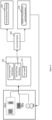
- Figure 1 illustrates a system 100 for classifying encrypted network traffic according to an embodiment.
- the system includes a packet processor engine 105, a traffic classification engine 110, a model monitoring module 130, a processor 135 and memory 140.
- the system may include a plurality of processors, including at least one processor per module or per engine.
- the system may be distributed and may be housed in a plurality of network devices.
- the system may reside in a single network device.
- the memory 140 may be included as an internal component of the system.
- the memory component may be housed externally or in a cloud and may be operatively connected to the system and the components of the system.
- the packet processor engine 105 is intended to receive and review the traffic flow.
- the packet processor engine 105 may include a deep packet inspection module.
- the packet processor engine may extract and derive flow attributes associated with the traffic flow as described in further detail herein.
- the packet processor engine 105 may further determine if the traffic is encrypted or non-encrypted.
- the traffic classification module 110 may include a signature classification engine 115 and a deep classification engine 120.
- the signature classification engine 115 may be configured to categorize and classify non-encrypted traffic.
- the deep classification engine 120 may include a framework of models or may be operatively connected to a framework of models configured to categorize and classify encrypted traffic. The categorization and classification of the traffic is further detailed herein. Having the option to classify non-encrypted traffic via, for example, a signature classification engine 115, is intended to allow the traffic classification module to process traffic more efficiently than having all of the traffic reviewed by the deep classification engine 120.
- the system may further include a model monitoring module 130.
- the model monitoring module 130 is configured to monitor the models used to categorize and classify the network traffic flow. If the models fall below a predetermined threshold, the model may be retrained or updated.
- Embodiments of the system and method are intended to use flow behavioral attributes (both learned from the traffic on the wire, and derived by the system from the learned attributes) for classifying the data traffic - these attributes are not impacted by data encryption.
- a "flow" is defined as a set of packets between two endpoints (as defined by their source and destination attribute values and start and end times), and as bi-directional (the system effectively monitors two sub-flows, one in each direction).
- the flow attributes thus extracted are processed and used to train a network of multi-class and binary classification models that are used by the system to classify and sub-classify encrypted services.
- the system uses the same attributes, which are automatically extracted and processed and used for real-time inference and classification.
- the framework of models includes a variety of models, each with its own distinct task and which may or may not interact with multiple other models in the framework.
- the system offers the operators (internet service providers) the flexibility to configure the network based on their use-cases and dimensioning requirements.
- the embodiments of the system and method detailed herein are intended to be agnostic of the type of traffic and protocol in use. It works for TCP protocols as well as UDP protocols, new and yet to be standardized protocols such as TLS with Encrypted SNI are also supported for classification by the system. Different flavors of QUIC, Encrypted DNS traffic and other known methods of traffic encryption are also supported for classification. It is intended that the system may be updated on release or development of new protocol or encryption standards.
- the system is capable of classifying traffic to a granular classification using the approach described herein a standalone classification system.
- the system can classify, using attributes which are unaffected by known forms of encryption, not just a service such as Facebook, but also the various sub-classes such as Facebook Web Browsing, Facebook Video, Facebook Messaging and the like.
- the framework of models used by the system is intended to address the problem of requiring the individual models to be unrealistically generic in nature while dealing with diverse types of traffic in a constantly evolving internet.
- the framework of models also allows the system to scale and adapt in a manner that is quick and non-impactful to the overall system and network where the system is deployed. Each individual model in the network can be replaced without affecting the performance of the overall network.
- the system is intended to have an extremely low false-positive rates that are comparable to unencrypted classification using traditional techniques.
- the use of true labelled data, robust supervised learning techniques and a high confidence threshold are intended to ensure that the system meets accuracy goals.
- the system includes the traffic classification engine and the framework of classification models. The process of training these models, deploying and maintaining them for continued accuracy are detailed herein.
- Figure 2 illustrates a method 200 to classify traffic according to an embodiment.
- the system is initialized, at 205 through a framework of models that are intended to have learned flow attributes as detailed herein.
- the system receives and reviews network traffic flows, at 210, and determines if the traffic is encrypted.
- Flow attributes are derived and extracted from each network flow, at 215.
- the flow attributes are used by the system to categorize and classify encrypted traffic using the framework of models, at 220.
- the system monitors each model in the framework of models, at 225, in order to determine if a particular model needs to be updated or retrained.
- Embodiments of the system for classifying network traffic, including encrypted flows may include determining and maintaining the accuracy of the framework of models.
- embodiments of the system may leverage the ability of an existing signature classification engine, which may use various methods of classification.
- the classification abilities of an existing signature classification on unencrypted traffic or partially encrypted traffic may be used as a mechanism to generate labelled training data for the framework of models and also used for the validation of the trained models
- the models are intended to be built from labeled data.
- the flow attributes and statistics that form the basis for the data used by the classification models processing techniques are applied on this data and the process of model training through supervised learning is used.
- the result of this process is a plurality of classification models that form the framework of models that are deployed as part of the system and used by the traffic classification engine 110.
- a network traffic flow may be described as having the following properties:
- Embodiments of the system and method disclosed herein use extracted or derived Flow Attributes and a set of derived attributes that are derived from the interrelation of the Flow Attributes to each other as well as to other attributes of the network and other environmental factors.
- the derived attributes (sometimes referred to as computed attributes) offer a way to infer flow properties that are not altered by the time at which the flow measurement was taken (in other words, the derived attributes may not be coupled to the age of the flow) and when used in conjunction with other derived attributes and extracted flow attributes are intended to offer a highly accurate source of data which describes flow behavior in a statistically predictable and repeatable manner.
- the total set of attributes available including the various derived attributes may number in the hundreds.
- Flow attribute measurements are made in both directions for bi-directional traffic flows.
- the extracted attributes can be grouped or categorized into the following categories:
- Labelled data may be collected through an automated system of test devices continuously generating labelled traffic for key applications and services. Further labelled data may be created through targeted manual testing and label generation for applications and services. It is intended that the labelled data is diverse and generic.
- the automatic label generation which may be used in lab environments, is achieved by running system applications on the devices, for example, Android, IOS and Windows devices, that generate meta data based on the Layer 7 (L7) application or service in use and transmit this information as part of the traffic flow for the system to intercept and process.
- L7 Layer 7
- Figure 3 illustrates an embodiment of a system and process used to generate labelled data.
- Known client equipment creates traffic flows.
- the system extracts, at 305, and derives, at 310, flow attributes associated with the traffic flow.
- the true labels, or known attributes are recorded, at 315.
- a learning engine 320 reviews the extracted and derived flow attributes in comparison to the true labels.
- a framework of models 325 is trained based on the different categories and classes of traffic flows and the data derived by the learning engine is further used to determine the interpretation and visualization of the models, at 330.
- the availability of high quality labelled data may be directly linked to the accuracy of the trained models.
- the combination of automated labelled data generation, which may be optimized for volume, and manual data generation, which may be optimized for variability, is intended to help create a large set of high quality data.
- the extracted flow attributes and derived flow attribute values are then cleaned, processed and prepared for use by the learning engine. This may include imputing any missing or invalid attribute values with the appropriate replacements, ensuring the data is balanced, over-sampling or under-sampling as necessary and normalization and discretization as and when required.
- the attributes thus extracted and derived are intended to form the features that will be used by the system to classify encrypted services. Further details of the data processing pipeline, which describe the data preparation and modelling workflow, are illustrated in Figure 4 .
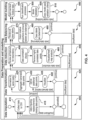
- Figure 4 illustrates an example of data preparation and modelling according to an embodiment.
- Data is imputed, at 405, which may include collecting data from various stored files, at 410 and replacing or removing any missing data points, at 415.
- the data may then be transformed, at 420, for example, the data may be normalized to the same scale, at 425.
- Data may be aggregated or generalized, at 430 in order to add further meaning and additional data points may be derived, at 435.
- Data may also be cleaned, for example by removing unnecessary data points or replacing missing data points with meaningful values. This is intended to allow the models to be visualized, at 440.
- the attributes may be reviewed for redundancy at 450, the correlations may be checked, at 455, and highly correlated data points may be reduced, at 460.
- the data may then be visualized and mapped and the mapping analyzed, at 465.
- the data may be balanced, at 470 where the class labels may be reviewed, at 475.
- the data may be balanced to distort relative proportions and then reviewed to determine whether the class labels are balanced, at 485.
- the models may be built, at 490.
- the data may be trained and tested at 495.
- the data may be reviewed and the classification models may be run, at 500 to verify their accuracy. Once verified and validated, at 505, it may be determined whether the models pass the validation criteria, at 510.
- the models may be deployed.
- the final trained models may be validated on 'hold out' data that the models have not been exposed to during the training process, the validation may also include data from diverse access network types such as fixed-line, satellite and wireless networks and different traffic conditions including shaping or limiting of traffic to certain fixed bandwidth rates.
- the attributes thus extracted and derived are intended to form the features that will be used to train the multi-class and binary classification models that are used by the system to categorize, classify and sub-classify encrypted services.
- the attributes may be extracted and derived in real-time and used by the system for inference and classification.
- the attributes for each individual model are intended to be discovered using feature importance derived through the use of an ensemble of boosted trees or using recursive feature elimination. This may allow for the selection of key attributes and may help keep the models easier to interpret and maintain.
- the method to be used by a particular model may also be discovered through an iterative selection process of a pre-selected shortlist of methods that have been shown to be historically accurate on the type of data that is used by the system.
- This shortlist may be an evolving list and periodically could have newer or more advanced methods or processes added to it in the future.
- Some of the methods which are part of the short list include: Decision Trees; Naive Bayes; Tree Aided Bayesian Networks; Random Forest; eXtreme Gradient Boosting (XGBoost); Light GBM; Ada Boost; Neural Networks; Fuzzy Logic Inference and the like.
- a hyper-parameter is intended to be a configuration parameter that is external to the model and whose value is not able to be estimated or predicted solely based on the data.
- An example of a hyper-parameter may be the learning rate of a neural network.
- Embodiments of the system includes a packet processing engine which is intended to provide for a network inspection or deep packet inspection system or the like which intersects traffic between the client (subscriber network) and server (internet).
- the packet processing engine in addition to packet processing is able to extract the flow attributes mentioned above as well as formulate various different derived attributes.
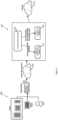
- FIG. 5 illustrates a high level view of an embodiment of the system 100 and its placement in a network.
- Subscribers or clients 600 access a subscriber network 605.
- the system is intended to be located either at the subscriber's network or between the subscriber's network and the internet 610.
- the traffic may be intercepted by the packet processor engine and then categorized and classified by the traffic classification engine. It will be understood that flow from the internet will follow a similar (but backwards) path. It is intended that the system be able to see all of the traffic packets which form a particular flow in both an upstream and downstream location.
- the system contains separate modules for packet processing and traffic classification, every packet that the system sees passes through the packet processor but may not necessarily be sent to the traffic classification engine It is intended that classification occurs at a flow level and that the traffic classification engine may not need to review every packet in a traffic flow in order to make a classification decision.
- the system may perform more efficiently and may be better able to scale if the traffic classification engine does not review each individual packet in a traffic flow. In a specific example, once a traffic flow is classified, the further packets associated with that flow may not be sent to the traffic classification engine.
- the extracted and derived attributes are shared from the packet processor to the traffic classification module.
- the attributes may be sent at fixed intervals. If the use-case of a particular model is one-time classification then the attributes may be transmitted once during the lifetime of a flow, if however, the use-case of a model is to repeatedly observe a flow and see if it changes its behavior then the attributes are repeatedly sent to the traffic classification module throughout the lifetime of the flow.
- the traffic classification engine 110 may include the signature classification engine 115 and the deep classification engine 120. If the traffic is unencrypted or partially encrypted with enough meta data available to classify it using traditional techniques then the signature classification engine may be used.
- the deep classification engine may be invoked when the traffic is end to end encrypted, or when the operator considers it likely that there is spoofing or masquerading going on and would like to verify that the traffic is what it appears to be.
- the framework of models that were previously trained are deployed and interact with the deep classification engine.
- the network is made up multiple layers and can be defined based on their function to consist of categorizers, classifiers and sub-classifiers.
- a categorizer is a model which performs a high level classification or categorization of the traffic based on the traffic behavior.
- the categorizer is not intended to classify the exact service but the class of service in use.
- An example for a categorizer would be a model that categorizes encrypted VPN traffic. In some cases, all encrypted or obfuscated traffic flows that exhibit VPN behavior will be categorized as VPN by this model.
- a classifier is a model that is intended to perform service classification and is invoked as a result of the categorizer's output.
- the classifiers run on a smaller, narrower subset of input data and hence can be more specialized in nature and be configured for greater accuracy at the cost to being less generalizable.
- An example for a classifier would be a model that classifies encrypted Netflix traffic.
- the input to this model may be video streaming traffic, a smaller subset thereof or similar traffic.
- a sub-classifier is a model that performs sub-classification of traffic from a service based on the traffic's behavior. In some cases, a sub-classifier may classify various features of the data. Sub-classifiers can perform a variety of functions such as differentiating different service functions within an application or differentiating based on a dimension of the content being served. Some examples for sub-classifiers could include a model that can sub-classify Facebook traffic into Facebook Web and Facebook Video. Another example would be a model that can sub-classify YouTube video traffic into SD, HD and UHD.
- the framework of models can have a plurality of categorizers, classifiers and sub-classifiers deployed at the same time working in association with each other.
- the output of a categorizer could be fed as input to a classifier, a sub-classifier OR another categorizer depending on the use-case.
- the outputs of a classifier could be fed as input to another classifier or a sub-classifier or multiple sub-classifiers and so on.
- a traffic flow may be categorized as VPN traffic by one categorizer then be sent to a second categorizer to determine whether it is a business or residential VPN or a malicious VPN. It will be understood that there may be various levels of categorizations prior to being classified in a service.
- Figure 6 represents a sample framework of models 700 with 3 categorizers 705, 4 classifiers 710 and 3 sub-classifiers 715 and depicts the possible flow of information between them. It will be understood that this is an example representation, the system may have up to a theoretical 'n' number of each of the layers and the upward scale is only limited by the physical dimensions of the hardware on which the system is deployed (in terms of CPU, processor and memory) as well as the constraints on the use-case which the operator of the system is attempting to execute.
- Figure 7 illustrates an example where there is one categorizer 705a classifying encrypted traffic into five distinct categories.
- a classifier 710a takes the output of one of those categories as input and classifies it further into specific services.
- a sub-classifier 715a takes the output of one of the services and sub-classifies the traffic based on properties of the content or data that is being delivered.
- the extracted and derived flow attributes (Fi) for unclassified encrypted traffic (Ti) is sent to the deep classification engine.
- the flow attributes may be forwarded to various relevant models or sequence of models within the framework of models.
- the relevant models may be based on an operator's configuration or goal for the configuration and/or the type of traffic.
- the operator may configure the system in order for the first model to be run as a general categorizer model for all encrypted traffic that classifies into VPN and Non-VPN traffic.
- a secondary model may be applied afterwards to categorize the non-VPN traffic into further sub-categories.
- Each model generally has an independent mechanism of inference based on the pre-trained flow attributes, the inference when made also includes the confidence (Ci) expressed in percentage that the model has on that particular inference. Where 100% implies the model is completely sure of the inference based on its knowledge and anything lower implying that there are varying degrees of uncertainty.
- Each model can have a predetermined threshold (Ct) which is decided based on the function of a particular model.
- Ci ⁇ Ct the inference is considered unacceptable.
- the deep classification engine may determine if any other model is configured to inspect this particular flow, if yes then the same process is repeated on that particular flow. When no other models are configured to inspect the flow and all the models which have inspected have failed to have their inferences accepted the deep classification engine will mark the flow as unclassified.
- the predetermined threshold may range depending on the number of possible classes or labels there may be in the output. In a binary situation, (for example VPN or Non-VPN), the preferred range for Ct may be between 80% and 95% or some values within that range.
- model binary files contain the tree or network structure which may be generally light weight standalone files which are loaded as plug-ins on to the deep classification engine, these model binary files can also be hot-swapped without much impact to the system or network.
- the monitoring module may exist under lab conditions as well as in network probes to identify if any of the models are dropping in effectiveness or accuracy, a histogram of model confidence may be used as an indicator of overall effectiveness. For example, if the 80 th percentile of the model confidence histogram drops below a certain predetermined threshold then the system may trigger a re-training action for the model.
- the predetermined threshold may depend on the number of classes or labels possible for the output. If the number of classes for the output is binary, the range for this threshold may be between 70 and 75%.
- the learning process may be repeated for that particular model with necessary changes in data collection, data processing, processing selection or training or the like.
- a new model Once a new model is available and validated to be performing as required it may be plugged into the system replacing the older model. This activity is intended to have little impact to the overall framework of models.
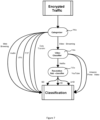
- Figure 8 illustrates a method 800 for classifying traffic according to an embodiment.
- the system 100 determines if there is an encrypted traffic flow, at 805. If the traffic flow is not encrypted it may be reviewed by the signature classification engine 115 using data accessible from the non-encrypted traffic flow. If the flow is encrypted, the deep classification engine 120, may determine flow attributes, at 810. The flow attributes are reviewed by the framework of models, at 815 wherein selected flow attributes may be sent to individual models within the framework, at 820. At 825, an inference regarding the traffic flow is determined. The confidence of the inference is determined and compared to a predetermined threshold, at 830. If the confidence of the inference is above the threshold, the flow is classified based on the inference, at 835.
- the flow may be left unclassified, at 840.
- Each individual model may function similarly but may be potentially dissimilar in design and implementation.
- Each model is built using a potentially different base algorithm and also uses a different set of attributes or features.
- categorizer A1 This particular model, named categorizer A1 for simplicity, is a categorizer model and is used to broadly categorize traffic into discrete categories, lower level classifier models would use the information from this categorizer A1 to classify the traffic into services and applications.
- Categorizer A1 takes as its input unclassified encrypted traffic in the form of flow attributes that have been extracted or derived and classifies individual traffic flows into discrete categories.
- the categorizer A1 may use XGBoost.
- XGBoost or "Extreme Gradient Boosting” is a gradient boosting library used for supervised learning problems.
- Categorizer A1 uses multiple attributes Fi to predict a target variable Yi.
- the learning phase or training of categorizer A1 can be defined as the task of finding the best parameters ⁇ that best fit the training data Fi and labels Yi.
- the training loss measures how predictive categorizer A1 is with respect to the training data.
- the regularization term is intended to control complexity and prevent overfitting.
- Flow attributes that are extracted or derived, in other words engineered features, represent the Fi that are used to predict the output, Yi, which consists of the different categories into which categorizer A1 can classify traffic.
- Fi may include the following attributes or features:
- Yi may include the following categories: Web Browsing; Video Streaming; Bulk Data Transfer; Peer to Peer (P2P) Data Transfer; Virtual Private Networks (VPN); Voice Over IP (VoIP). Other categories may be included depending on the operator's desire and the traffic previously modeled.
- a grid search measured by cross-validation for accuracy and correctness, is conducted for the optimal hyper-parameters to be used.
- a grid search is an approach to hyper-parameter tuning that will methodically build and evaluate a model for each combination specified on the grid. At the end of the search the best combination may be identified.
- the trained categorizer A1 model is then validated on a hold-out dataset (Hi) which contains data that was not used during the earlier training and cross validation phases.
- Cross validation techniques may be used to measure any statistical bias introduced by the model and determine whether the model will perform as expected on previously unseen data points.
- the output may identify key parameters (sometimes referred to as hyper-parameters) that help in reducing model bias and overfitting. It will be understood that grid search is one of multiple techniques to implement cross validation and other techniques may be use.
- the constants may be defined as:
- variables may be defined as:
- the computed variables may be defined as:
- system and method disclosed herein have the ability to classify encrypted services purely based on flow attributes and without the need of any HTTP header information, IP Addresses, port information, SNI or DNS information. Further, the system and method are intended to provide the ability offered by the model network for users to choose level of classification, by defining which models are active at any time based on the use-case the operator wishes to deploy. For example: if the primary use-case is congestion management then it is possible that only the categorizers are required and the remaining models can be turned off to save on performance costs.
- Embodiments of the system and method may also provide the ability to automatically select which classification technique is to be used depending on the kind of traffic that is being seen.
- the service provider may then amend or update the traffic flow path or policy applied to the traffic based on the category or class.
- a service provider may allow for greater bandwidth for an UHD video flow over a SD video flow.
- the service provider may apply rules or policies associated with traffic shaping based on the categorized and classified flow that might not be applicable or appropriate without knowing the type of flow.
- a first level classifier may be used to first categorize the traffic as streaming video. Subsequently the service provider may want to get a more granular level of visibility on the basis of the next level of classification.
- This second level of classification may be with respect to the application name, the resolution of the video or the like, based on which an action may be taken. For example, an action may be to prioritize high resolution video streaming.
- Embodiments of the disclosure or elements thereof may be represented as a computer program product stored in a machine-readable medium (also referred to as a computer-readable medium, a processor-readable medium, or a computer usable medium having a computer-readable program code embodied therein).
- the machine-readable medium can be any suitable tangible, non-transitory medium, including magnetic, optical, or electrical storage medium including a diskette, compact disk read only memory (CD-ROM), memory device (volatile or non-volatile), or similar storage mechanism.
- the machine-readable medium can contain various sets of instructions, code sequences, configuration information, or other data, which, when executed, cause a processor to perform steps in a method according to an embodiment of the disclosure.
Landscapes
- Engineering & Computer Science (AREA)
- Computer Networks & Wireless Communication (AREA)
- Signal Processing (AREA)
- Software Systems (AREA)
- Computer Vision & Pattern Recognition (AREA)
- Evolutionary Computation (AREA)
- Medical Informatics (AREA)
- Artificial Intelligence (AREA)
- Databases & Information Systems (AREA)
- Computing Systems (AREA)
- Computer Security & Cryptography (AREA)
- General Engineering & Computer Science (AREA)
- Theoretical Computer Science (AREA)
- Computer Hardware Design (AREA)
- Data Mining & Analysis (AREA)
- Physics & Mathematics (AREA)
- General Physics & Mathematics (AREA)
- Mathematical Physics (AREA)
- Data Exchanges In Wide-Area Networks (AREA)
Claims (11)
- Ein Verfahren zum Klassifizieren von Netzwerkverkehr (800), das Folgendes beinhaltet:Bereitstellen eines Rahmens von Modellen, die konfiguriert sind, um Netzwerkverkehr zu klassifizieren;Bestimmen, ob der Netzwerkverkehrsfluss verschlüsselt ist (805);wenn der Netzwerkverkehrsfluss verschlüsselt ist:Extrahieren verschlüsselter Flussattribute, die mit einem Netzwerkverkehrsfluss (810) assoziiert sind;Ableiten weiterer Flussattribute basierend auf den extrahierten verschlüsselten Flussattributen;Bestimmen mindestens eines Modells des Rahmens von Modellen basierend auf den abgeleiteten Flussattributen und extrahierten verschlüsselten Flussattributen (820);Klassifizieren des Verkehrsflusses als eine Verkehrskategorie basierend auf dem mindestens einen Modell (825); undBestimmen eines Konfidenzniveaus der Klassifizierung desVerkehrsflusses (830); undwenn der Netzwerkverkehrsfluss nicht verschlüsselt ist:Extrahieren nicht verschlüsselter Flussattribute, die mit einem Netzwerkverkehrsfluss assoziiert sind;Klassifizieren des Verkehrsflusses als eine Verkehrskategorie basierend auf den nicht verschlüsselten Flussattributen.
- Verfahren zum Klassifizieren von Netzwerkverkehr gemäß Anspruch 1, wobei das Klassifizieren des Verkehrsflusses als eine Verkehrskategorie das Bestimmen eines Servicetyps, der durch den Verkehrsfluss repräsentiert wird, oder das Bestimmen mindestens eines Merkmals, das mit dem Verkehrsfluss assoziiert ist, beinhaltet.
- Verfahren zum Klassifizieren von Netzwerkverkehr gemäß Anspruch 1, das weiter Folgendes beinhaltet:
Vergleichen des Konfidenzniveaus mit einem vorbestimmten Schwellenwert (830);wenn das Konfidenzniveau höher als der vorbestimmte Schwellenwert ist, Markieren des Flusses als klassifiziert (835); undwenn das Konfidenzniveau niedriger als der vorbestimmte Schwellenwert ist, Bestimmen, ob ein weiteres Modell verwendet werden kann, um den Verkehr (845) zu klassifizieren. - Verfahren zum Klassifizieren von Netzwerkverkehr gemäß Anspruch 1, das weiter Folgendes beinhaltet:Bestimmen eines Genauigkeitsniveaus für mindestens ein Modell des Rahmens von Modellen;Vergleichen des Genauigkeitsniveaus mit einem vorbestimmten Genauigkeitsschwellenwert;
wenn das Genauigkeitsniveau höher als der Genauigkeitsschwellenwert ist, Weiterbenutzen des mindestens einen Modells des Rahmens von Modellen; andernfalls Aktualisieren oder Entfernen des Modells aus dem Rahmen von Modellen. - Verfahren zum Klassifizieren von Netzwerkverkehr gemäß Anspruch 1, wobei die Netzwerkverkehrsflusskategorien aus einer Gruppe ausgewählt sind, die Folgendes beinhaltet: Webbrowsing; Videostreaming; Datenmengentransfer; Peer-to-Peer(P2P)-Datentransfer; Virtual Private Networks (VPN); und Voice Over IP (VoIP).
- Verfahren zum Klassifizieren von Netzwerkverkehr gemäß Anspruch 1, das weiter Folgendes beinhaltet:
Bestimmen, ob die Kategorie des Netzwerkverkehrs einen Klassierer oder Subklassierer aufweist;wenn es einen Klassierer oder Subklassierer gibt, Bestimmen des Klassierers oder Subklassierers basierend auf den abgeleiteten und extrahierten Flussattribute;andernfalls Klassifizieren des Verkehrs als die Kategorie von Netzwerkverkehr. - Ein System (100) zum Klassifizieren von Netzwerkverkehr, das Folgendes beinhaltet:einen Rahmen von Modellen (325), der konfiguriert ist, um Netzwerkverkehr zu klassifizieren;eine Paketverarbeitungsmaschine (105), die konfiguriert ist, um zu bestimmen, ob der Netzwerkverkehrsfluss verschlüsselt ist;wobei die Paketverarbeitungsmaschine weiter konfiguriert ist, um verschlüsselte Flussattribute zu extrahieren, die mit einem Netzwerkverkehrsfluss assoziiert sind, und weitere Flussattribute basierend auf den extrahierten verschlüsselten Flussattributen abzuleiten, wenn der Netzwerkfluss verschlüsselt ist, und konfiguriert ist, um nicht verschlüsselte Flussattribute zu extrahieren, wenn der Verkehrsfluss nicht verschlüsselt ist;eine Verkehrsklassifizierungsmaschine (110), die Folgendes beinhaltet:eine Deep-Klassifizierungsmaschine (120), die konfiguriert ist, um basierend auf den abgeleiteten und extrahierten Flussattributen mindestens ein Modell des Rahmens von Modellen zu bestimmen, basierend auf dem mindestens einen Modell den Verkehrsfluss zu klassifizieren und ein Konfidenzniveau der Klassifizierung des Verkehrsflusses zu bestimmen; undeine Signaturklassifizierungsmaschine (115), die konfiguriert ist, um den Verkehrsfluss basierend auf den nicht verschlüsselten Flussattributen als eine Verkehrskategorie zu klassifizieren.
- System zum Klassifizieren von Netzwerkverkehr gemäß Anspruch 7, wobei das Klassifizieren des Verkehrsflusses das Bestimmen eines Servicetyps, der durch den Verkehrsfluss repräsentiert wird, oder das Bestimmen mindestens eines Merkmals, das mit dem Verkehrsfluss assoziiert ist, beinhaltet.
- System zum Klassifizieren von Netzwerkverkehr gemäß Anspruch 7, wobei die Deep-Klassifizierungsmaschine (120) weiter für Folgendes konfiguriert ist:
Vergleichen des Konfidenzniveaus mit einem vorbestimmten Schwellenwert;wenn das Konfidenzniveau höher als der vorbestimmte Schwellenwert ist, Markieren des Flusses als klassifiziert; undwenn das Konfidenzniveau niedriger als der vorbestimmte Schwellenwert ist, Bestimmen, ob ein weiteres Modell verwendet werden kann, um den Verkehr zu klassifizieren. - System zum Klassifizieren von Netzwerkverkehr gemäß Anspruch 7, wobei die Netzwerkverkehrskategorie aus der Gruppe ausgewählt ist, die Folgendes beinhaltet: Webbrowsing; Videostreaming; Datenmengentransfer; Peer-to-Peer(P2P)-Datentransfer; Virtual Private Networks (VPN); und Voice Over IP (VoIP).
- System zum Klassifizieren von Netzwerkverkehr gemäß Anspruch 7, wobei die Verkehrsklassifizierungsmaschine (120) weiter für Folgendes konfiguriert ist:
Bestimmen, ob die Kategorie des Netzwerkverkehrs einen Klassierer oder Subklassierer aufweist;wenn es einen Klassierer oder Subklassierer gibt, Bestimmen des Klassierers oder Subklassierers basierend auf den abgeleiteten und extrahierten Flussattributen;andernfalls Klassifizieren des Verkehrs als die Kategorie von Netzwerkverkehr.
Applications Claiming Priority (1)
| Application Number | Priority Date | Filing Date | Title |
|---|---|---|---|
| IN201911007013 | 2019-02-22 |
Publications (3)
| Publication Number | Publication Date |
|---|---|
| EP3700147A1 EP3700147A1 (de) | 2020-08-26 |
| EP3700147B1 true EP3700147B1 (de) | 2024-10-02 |
| EP3700147C0 EP3700147C0 (de) | 2024-10-02 |
Family
ID=69784062
Family Applications (1)
| Application Number | Title | Priority Date | Filing Date |
|---|---|---|---|
| EP20159000.7A Active EP3700147B1 (de) | 2019-02-22 | 2020-02-24 | System und verfahren zur klassifizierung von netzwerkverkehr |
Country Status (3)
| Country | Link |
|---|---|
| US (2) | US11310162B2 (de) |
| EP (1) | EP3700147B1 (de) |
| CA (1) | CA3073263A1 (de) |
Families Citing this family (28)
| Publication number | Priority date | Publication date | Assignee | Title |
|---|---|---|---|---|
| US11329902B2 (en) | 2019-03-12 | 2022-05-10 | The Nielsen Company (Us), Llc | Methods and apparatus to credit streaming activity using domain level bandwidth information |
| CN115428368A (zh) * | 2020-04-07 | 2022-12-02 | 阿西亚Spe有限责任公司 | 用于远程协作的系统和方法 |
| US10924456B1 (en) * | 2020-07-14 | 2021-02-16 | Centripetal Networks, Inc. | Methods and systems for efficient encrypted SNI filtering for cybersecurity applications |
| WO2022026466A1 (en) * | 2020-07-28 | 2022-02-03 | Ipivot, Corp. | Structured data discovery and cryptographic analysis |
| CN112205960B (zh) * | 2020-09-15 | 2023-07-21 | 万达信息股份有限公司 | 一种视力监测方法、系统、管理端和存储介质 |
| CN112134898A (zh) * | 2020-09-28 | 2020-12-25 | 北京嘀嘀无限科技发展有限公司 | 一种网络流量判定方法和系统 |
| US12143530B2 (en) | 2020-09-29 | 2024-11-12 | Sandvine Corporation | System and method for classifying and handling voice over IP traffic |
| US20220150143A1 (en) * | 2020-11-12 | 2022-05-12 | At&T Intellectual Property I, L.P. | Classification of encrypted internet traffic with binary traffic vectors |
| US11784977B2 (en) * | 2020-12-02 | 2023-10-10 | Mcafee, Llc | Methods, apparatus, and systems for an encryption mode via a virtual private network |
| CN112714079B (zh) * | 2020-12-14 | 2022-07-12 | 成都安思科技有限公司 | 一种vpn环境下的目标服务识别方法 |
| CN113518042B (zh) * | 2020-12-16 | 2024-04-09 | 腾讯科技(深圳)有限公司 | 一种数据处理方法、装置、设备及存储介质 |
| US20220210169A1 (en) * | 2020-12-28 | 2022-06-30 | Acronis International Gmbh | Systems and methods for a.i.-based malware analysis on offline endpoints in a network |
| US11765190B2 (en) * | 2021-01-27 | 2023-09-19 | Blackberry Limited | Method for creating a zero trust segmented network perimeter for an endpoint or identity |
| CN112819645B (zh) * | 2021-03-23 | 2024-03-29 | 大连民族大学 | 基于模体度的社交网络虚假信息传播检测方法 |
| IL282353B2 (en) * | 2021-04-14 | 2025-02-01 | Cognyte Tech Israel Ltd | System and method for identifying services with encrypted traffic |
| US11805062B1 (en) * | 2021-06-08 | 2023-10-31 | T-Mobile Usa, Inc. | Systems and methods for traffic classification |
| US12380179B2 (en) * | 2021-09-09 | 2025-08-05 | Verizon Patent And Licensing Inc. | HTTP/3 and QUIC-based device and application characterization |
| US20230114898A1 (en) * | 2021-10-07 | 2023-04-13 | Arista Networks, Inc. | Efficient network flow management using custom filter-based packet sampling |
| EP4199455A1 (de) * | 2021-12-17 | 2023-06-21 | Sandvine Corporation | System und verfahren zur verkehrsdetektion auf zeitscheibenbasis |
| CN114513685B (zh) * | 2022-01-28 | 2022-10-11 | 武汉绿色网络信息服务有限责任公司 | 一种基于流特征识别https加密视频流的方法和装置 |
| CN114866486B (zh) * | 2022-03-18 | 2024-06-18 | 广州大学 | 一种基于数据包的加密流量分类系统 |
| CN115174170B (zh) * | 2022-06-23 | 2023-05-09 | 东北电力大学 | 一种基于集成学习的vpn加密流量识别方法 |
| KR102800307B1 (ko) * | 2022-11-21 | 2025-04-28 | 고려대학교 세종산학협력단 | Cnn 기반 https 트래픽의 서비스 및 응용 단위 다중 레이블 분류 방법 및 시스템 |
| CN120200982A (zh) * | 2022-12-30 | 2025-06-24 | 兴容(上海)信息技术股份有限公司 | 一种基于加密流的应用分析方法和系统 |
| US12414001B2 (en) * | 2023-04-18 | 2025-09-09 | Samsung Electronics Co., Ltd. | Method and apparatus for network traffic management |
| US20250193096A1 (en) * | 2023-12-07 | 2025-06-12 | Avago Technologies International Sales Pte. Limited | Systems and methods for profiling low latency applications using telemetry |
| CN118468139B (zh) * | 2024-07-09 | 2024-09-24 | 山东远桥信息科技有限公司 | 一种基于深度学习的数据处理方法及系统 |
| CN118487873B (zh) * | 2024-07-12 | 2024-10-08 | 国网浙江省电力有限公司丽水供电公司 | 一种基于攻击链视角的加密流量威胁检测方法和系统 |
Family Cites Families (4)
| Publication number | Priority date | Publication date | Assignee | Title |
|---|---|---|---|---|
| US7664048B1 (en) * | 2003-11-24 | 2010-02-16 | Packeteer, Inc. | Heuristic behavior pattern matching of data flows in enhanced network traffic classification |
| US7778194B1 (en) * | 2004-08-13 | 2010-08-17 | Packeteer, Inc. | Examination of connection handshake to enhance classification of encrypted network traffic |
| US8539221B2 (en) | 2009-03-27 | 2013-09-17 | Guavus, Inc. | Method and system for identifying an application type of encrypted traffic |
| US10554614B2 (en) | 2016-06-23 | 2020-02-04 | Cisco Technology, Inc. | Utilizing service tagging for encrypted flow classification |
-
2020
- 2020-02-21 US US16/797,298 patent/US11310162B2/en active Active
- 2020-02-21 CA CA3073263A patent/CA3073263A1/en active Pending
- 2020-02-24 EP EP20159000.7A patent/EP3700147B1/de active Active
-
2022
- 2022-03-23 US US17/701,986 patent/US12206587B2/en active Active
Also Published As
| Publication number | Publication date |
|---|---|
| US20200274815A1 (en) | 2020-08-27 |
| US20220278934A1 (en) | 2022-09-01 |
| EP3700147A1 (de) | 2020-08-26 |
| US11310162B2 (en) | 2022-04-19 |
| US12206587B2 (en) | 2025-01-21 |
| CA3073263A1 (en) | 2020-08-22 |
| EP3700147C0 (de) | 2024-10-02 |
Similar Documents
| Publication | Publication Date | Title |
|---|---|---|
| US12206587B2 (en) | System and method for classifying network traffic | |
| US11936683B2 (en) | Analyzing encrypted traffic behavior using contextual traffic data | |
| Kumar et al. | An integrated rule based intrusion detection system: analysis on UNSW-NB15 data set and the real time online dataset | |
| Valenti et al. | Reviewing traffic classification | |
| Bujlow et al. | A method for classification of network traffic based on C5. 0 Machine Learning Algorithm | |
| Jeya et al. | Efficient classifier for R2L and U2R attacks | |
| Vlăduţu et al. | Internet traffic classification based on flows' statistical properties with machine learning | |
| Sheikh et al. | Procedures, criteria, and machine learning techniques for network traffic classification: a survey | |
| US20200236131A1 (en) | Protecting endpoints with patterns from encrypted traffic analytics | |
| US20200159947A1 (en) | Unstructured data sensitivity inference for file movement tracking in a network | |
| US20190349403A1 (en) | Detecting targeted data exfiltration in encrypted traffic | |
| US20190251259A1 (en) | Identifying and halting unknown ransomware | |
| JP6564799B2 (ja) | 閾値決定装置、閾値決定方法及びプログラム | |
| US11271833B2 (en) | Training a network traffic classifier using training data enriched with contextual bag information | |
| US12395523B2 (en) | Inline detection of encrypted malicious network sessions | |
| US10904271B2 (en) | Active prioritization of investigation targets in network security | |
| Canini et al. | GTVS: Boosting the collection of application traffic ground truth | |
| US11882045B2 (en) | System and method for classifying network devices | |
| Lenkala et al. | Security risk assessment of cloud carrier | |
| Aksoy et al. | Operating system classification performance of tcp/ip protocol headers | |
| Aouini et al. | Early classification of residential networks traffic using C5. 0 machine learning algorithm | |
| CN119051976A (zh) | 网络数据流转测绘方法、装置、计算机设备及存储介质 | |
| Schumacher et al. | One-class models for intrusion detection at ISP customer networks | |
| Areström | Flow Classification of Encrypted Traffic Streams using Multi-fractal Features | |
| Pietrzyk et al. | Revealing the unknown adsl traffic using statistical methods |
Legal Events
| Date | Code | Title | Description |
|---|---|---|---|
| PUAI | Public reference made under article 153(3) epc to a published international application that has entered the european phase |
Free format text: ORIGINAL CODE: 0009012 |
|
| STAA | Information on the status of an ep patent application or granted ep patent |
Free format text: STATUS: THE APPLICATION HAS BEEN PUBLISHED |
|
| AK | Designated contracting states |
Kind code of ref document: A1 Designated state(s): AL AT BE BG CH CY CZ DE DK EE ES FI FR GB GR HR HU IE IS IT LI LT LU LV MC MK MT NL NO PL PT RO RS SE SI SK SM TR |
|
| AX | Request for extension of the european patent |
Extension state: BA ME |
|
| STAA | Information on the status of an ep patent application or granted ep patent |
Free format text: STATUS: REQUEST FOR EXAMINATION WAS MADE |
|
| 17P | Request for examination filed |
Effective date: 20210215 |
|
| RBV | Designated contracting states (corrected) |
Designated state(s): AL AT BE BG CH CY CZ DE DK EE ES FI FR GB GR HR HU IE IS IT LI LT LU LV MC MK MT NL NO PL PT RO RS SE SI SK SM TR |
|
| STAA | Information on the status of an ep patent application or granted ep patent |
Free format text: STATUS: EXAMINATION IS IN PROGRESS |
|
| 17Q | First examination report despatched |
Effective date: 20220131 |
|
| REG | Reference to a national code |
Ref country code: DE Ref legal event code: R079 Free format text: PREVIOUS MAIN CLASS: H04L0012851000 Ipc: H04L0009400000 Ref document number: 602020038561 Country of ref document: DE |
|
| GRAP | Despatch of communication of intention to grant a patent |
Free format text: ORIGINAL CODE: EPIDOSNIGR1 |
|
| STAA | Information on the status of an ep patent application or granted ep patent |
Free format text: STATUS: GRANT OF PATENT IS INTENDED |
|
| RIC1 | Information provided on ipc code assigned before grant |
Ipc: G06N 3/02 20060101ALN20231022BHEP Ipc: H04L 43/026 20220101ALI20231022BHEP Ipc: H04L 47/2483 20220101ALI20231022BHEP Ipc: H04L 47/2441 20220101ALI20231022BHEP Ipc: H04L 47/22 20220101ALI20231022BHEP Ipc: G06N 20/00 20190101ALI20231022BHEP Ipc: H04L 41/16 20220101ALI20231022BHEP Ipc: H04L 9/40 20220101AFI20231022BHEP |
|
| INTG | Intention to grant announced |
Effective date: 20231128 |
|
| GRAJ | Information related to disapproval of communication of intention to grant by the applicant or resumption of examination proceedings by the epo deleted |
Free format text: ORIGINAL CODE: EPIDOSDIGR1 |
|
| STAA | Information on the status of an ep patent application or granted ep patent |
Free format text: STATUS: EXAMINATION IS IN PROGRESS |
|
| GRAP | Despatch of communication of intention to grant a patent |
Free format text: ORIGINAL CODE: EPIDOSNIGR1 |
|
| STAA | Information on the status of an ep patent application or granted ep patent |
Free format text: STATUS: GRANT OF PATENT IS INTENDED |
|
| INTC | Intention to grant announced (deleted) | ||
| RIC1 | Information provided on ipc code assigned before grant |
Ipc: G06N 3/02 20060101ALN20240408BHEP Ipc: H04L 43/026 20220101ALI20240408BHEP Ipc: H04L 47/2483 20220101ALI20240408BHEP Ipc: H04L 47/2441 20220101ALI20240408BHEP Ipc: H04L 47/22 20220101ALI20240408BHEP Ipc: G06N 20/00 20190101ALI20240408BHEP Ipc: H04L 41/16 20220101ALI20240408BHEP Ipc: H04L 9/40 20220101AFI20240408BHEP |
|
| INTG | Intention to grant announced |
Effective date: 20240423 |
|
| GRAS | Grant fee paid |
Free format text: ORIGINAL CODE: EPIDOSNIGR3 |
|
| GRAA | (expected) grant |
Free format text: ORIGINAL CODE: 0009210 |
|
| STAA | Information on the status of an ep patent application or granted ep patent |
Free format text: STATUS: THE PATENT HAS BEEN GRANTED |
|
| AK | Designated contracting states |
Kind code of ref document: B1 Designated state(s): AL AT BE BG CH CY CZ DE DK EE ES FI FR GB GR HR HU IE IS IT LI LT LU LV MC MK MT NL NO PL PT RO RS SE SI SK SM TR |
|
| REG | Reference to a national code |
Ref country code: GB Ref legal event code: FG4D |
|
| REG | Reference to a national code |
Ref country code: CH Ref legal event code: EP |
|
| REG | Reference to a national code |
Ref country code: DE Ref legal event code: R096 Ref document number: 602020038561 Country of ref document: DE |
|
| REG | Reference to a national code |
Ref country code: IE Ref legal event code: FG4D |
|
| U01 | Request for unitary effect filed |
Effective date: 20241014 |
|
| U07 | Unitary effect registered |
Designated state(s): AT BE BG DE DK EE FI FR IT LT LU LV MT NL PT RO SE SI Effective date: 20241030 |
|
| U20 | Renewal fee for the european patent with unitary effect paid |
Year of fee payment: 6 Effective date: 20250227 |
|
| PG25 | Lapsed in a contracting state [announced via postgrant information from national office to epo] |
Ref country code: HR Free format text: LAPSE BECAUSE OF FAILURE TO SUBMIT A TRANSLATION OF THE DESCRIPTION OR TO PAY THE FEE WITHIN THE PRESCRIBED TIME-LIMIT Effective date: 20241002 Ref country code: IS Free format text: LAPSE BECAUSE OF FAILURE TO SUBMIT A TRANSLATION OF THE DESCRIPTION OR TO PAY THE FEE WITHIN THE PRESCRIBED TIME-LIMIT Effective date: 20250202 |
|
| PG25 | Lapsed in a contracting state [announced via postgrant information from national office to epo] |
Ref country code: ES Free format text: LAPSE BECAUSE OF FAILURE TO SUBMIT A TRANSLATION OF THE DESCRIPTION OR TO PAY THE FEE WITHIN THE PRESCRIBED TIME-LIMIT Effective date: 20241002 |
|
| PG25 | Lapsed in a contracting state [announced via postgrant information from national office to epo] |
Ref country code: NO Free format text: LAPSE BECAUSE OF FAILURE TO SUBMIT A TRANSLATION OF THE DESCRIPTION OR TO PAY THE FEE WITHIN THE PRESCRIBED TIME-LIMIT Effective date: 20250102 |
|
| PG25 | Lapsed in a contracting state [announced via postgrant information from national office to epo] |
Ref country code: GR Free format text: LAPSE BECAUSE OF FAILURE TO SUBMIT A TRANSLATION OF THE DESCRIPTION OR TO PAY THE FEE WITHIN THE PRESCRIBED TIME-LIMIT Effective date: 20250103 |
|
| PG25 | Lapsed in a contracting state [announced via postgrant information from national office to epo] |
Ref country code: CZ Free format text: LAPSE BECAUSE OF FAILURE TO SUBMIT A TRANSLATION OF THE DESCRIPTION OR TO PAY THE FEE WITHIN THE PRESCRIBED TIME-LIMIT Effective date: 20241002 Ref country code: PL Free format text: LAPSE BECAUSE OF FAILURE TO SUBMIT A TRANSLATION OF THE DESCRIPTION OR TO PAY THE FEE WITHIN THE PRESCRIBED TIME-LIMIT Effective date: 20241002 |
|
| PGFP | Annual fee paid to national office [announced via postgrant information from national office to epo] |
Ref country code: GB Payment date: 20250227 Year of fee payment: 6 |
|
| PG25 | Lapsed in a contracting state [announced via postgrant information from national office to epo] |
Ref country code: RS Free format text: LAPSE BECAUSE OF FAILURE TO SUBMIT A TRANSLATION OF THE DESCRIPTION OR TO PAY THE FEE WITHIN THE PRESCRIBED TIME-LIMIT Effective date: 20250102 |
|
| PG25 | Lapsed in a contracting state [announced via postgrant information from national office to epo] |
Ref country code: SM Free format text: LAPSE BECAUSE OF FAILURE TO SUBMIT A TRANSLATION OF THE DESCRIPTION OR TO PAY THE FEE WITHIN THE PRESCRIBED TIME-LIMIT Effective date: 20241002 |
|
| PG25 | Lapsed in a contracting state [announced via postgrant information from national office to epo] |
Ref country code: SK Free format text: LAPSE BECAUSE OF FAILURE TO SUBMIT A TRANSLATION OF THE DESCRIPTION OR TO PAY THE FEE WITHIN THE PRESCRIBED TIME-LIMIT Effective date: 20241002 |
|
| PLBE | No opposition filed within time limit |
Free format text: ORIGINAL CODE: 0009261 |
|
| STAA | Information on the status of an ep patent application or granted ep patent |
Free format text: STATUS: NO OPPOSITION FILED WITHIN TIME LIMIT |
|
| 26N | No opposition filed |
Effective date: 20250703 |
|
| PG25 | Lapsed in a contracting state [announced via postgrant information from national office to epo] |
Ref country code: MC Free format text: LAPSE BECAUSE OF FAILURE TO SUBMIT A TRANSLATION OF THE DESCRIPTION OR TO PAY THE FEE WITHIN THE PRESCRIBED TIME-LIMIT Effective date: 20241002 |
|
| REG | Reference to a national code |
Ref country code: CH Ref legal event code: PL |
|
| PG25 | Lapsed in a contracting state [announced via postgrant information from national office to epo] |
Ref country code: CH Free format text: LAPSE BECAUSE OF NON-PAYMENT OF DUE FEES Effective date: 20250228 |