EP3699863A1 - Bildinterpretationsvorrichtung - Google Patents
Bildinterpretationsvorrichtung Download PDFInfo
- Publication number
- EP3699863A1 EP3699863A1 EP17929925.0A EP17929925A EP3699863A1 EP 3699863 A1 EP3699863 A1 EP 3699863A1 EP 17929925 A EP17929925 A EP 17929925A EP 3699863 A1 EP3699863 A1 EP 3699863A1
- Authority
- EP
- European Patent Office
- Prior art keywords
- data
- pixels
- aligned along
- probability
- image
- Prior art date
- Legal status (The legal status is an assumption and is not a legal conclusion. Google has not performed a legal analysis and makes no representation as to the accuracy of the status listed.)
- Granted
Links
Images



Classifications
-
- G—PHYSICS
- G06—COMPUTING OR CALCULATING; COUNTING
- G06T—IMAGE DATA PROCESSING OR GENERATION, IN GENERAL
- G06T7/00—Image analysis
- G06T7/0002—Inspection of images, e.g. flaw detection
- G06T7/0012—Biomedical image inspection
-
- G—PHYSICS
- G01—MEASURING; TESTING
- G01N—INVESTIGATING OR ANALYSING MATERIALS BY DETERMINING THEIR CHEMICAL OR PHYSICAL PROPERTIES
- G01N33/00—Investigating or analysing materials by specific methods not covered by groups G01N1/00 - G01N31/00
- G01N33/48—Biological material, e.g. blood, urine; Haemocytometers
-
- G—PHYSICS
- G06—COMPUTING OR CALCULATING; COUNTING
- G06T—IMAGE DATA PROCESSING OR GENERATION, IN GENERAL
- G06T2207/00—Indexing scheme for image analysis or image enhancement
- G06T2207/10—Image acquisition modality
- G06T2207/10056—Microscopic image
-
- G—PHYSICS
- G06—COMPUTING OR CALCULATING; COUNTING
- G06T—IMAGE DATA PROCESSING OR GENERATION, IN GENERAL
- G06T2207/00—Indexing scheme for image analysis or image enhancement
- G06T2207/20—Special algorithmic details
- G06T2207/20021—Dividing image into blocks, subimages or windows
-
- G—PHYSICS
- G06—COMPUTING OR CALCULATING; COUNTING
- G06T—IMAGE DATA PROCESSING OR GENERATION, IN GENERAL
- G06T2207/00—Indexing scheme for image analysis or image enhancement
- G06T2207/20—Special algorithmic details
- G06T2207/20076—Probabilistic image processing
-
- G—PHYSICS
- G06—COMPUTING OR CALCULATING; COUNTING
- G06T—IMAGE DATA PROCESSING OR GENERATION, IN GENERAL
- G06T2207/00—Indexing scheme for image analysis or image enhancement
- G06T2207/20—Special algorithmic details
- G06T2207/20081—Training; Learning
-
- G—PHYSICS
- G06—COMPUTING OR CALCULATING; COUNTING
- G06T—IMAGE DATA PROCESSING OR GENERATION, IN GENERAL
- G06T2207/00—Indexing scheme for image analysis or image enhancement
- G06T2207/20—Special algorithmic details
- G06T2207/20084—Artificial neural networks [ANN]
-
- G—PHYSICS
- G06—COMPUTING OR CALCULATING; COUNTING
- G06T—IMAGE DATA PROCESSING OR GENERATION, IN GENERAL
- G06T2207/00—Indexing scheme for image analysis or image enhancement
- G06T2207/30—Subject of image; Context of image processing
- G06T2207/30004—Biomedical image processing
- G06T2207/30024—Cell structures in vitro; Tissue sections in vitro
Definitions
- the description herein discloses an image analysis device configured to execute image analysis according to a convolutional neural network.
- image analysis that uses an image analysis device is known (for example, Japanese Patent Application Publication Nos. 2001-59842 , 2010-281636 , 2004-286666 , and 2011-527056 ).
- Japanese Patent Application Publication No. 2011-527056 executes image analysis according to a convolutional neural network.
- a consideration may be given for example to executing the image analysis by generating reduced image data by reducing target image data of an analysis target and executing the image analysis according to the convolutional neural network using the reduced image data.
- the image analysis using the reduced image data may have degraded analysis accuracy.
- An image analysis device disclosed herein may comprise: a memory configured to store first object data representing a first object; an obtaining unit configured to obtain target image data representing a target image which is an analysis target, wherein the target image data includes (M ⁇ N) pixels constituted of M pixels aligned along a first direction and N pixels aligned along a second direction orthogonal to the first direction, the M being an integer of 3 or greater, and the N being an integer of 3 or greater, and wherein each pixel of the (M ⁇ N) pixels indicates K values corresponding to K channels, the K being an integer of 1 or greater; a specifying unit configured to specify (m ⁇ n) partial images sequentially by scanning the target image data, wherein the (m ⁇ n) partial images are constituted of m partial images aligned along the first direction and n partial images aligned along the second direction, the m being an integer of 2 or greater and less than the M, and the n being an integer of 2 or greater and less than the N; a first generating unit configured to generate first probability data by using
- the image analysis device upon execution of the image analysis according to the convolutional neural network, not only uses the reduced image data as the K pieces of channel data corresponding to the K channels but also uses the first probability data as the one piece of channel data corresponding to the one channel. Due to this, the image analysis device can improve analysis accuracy related to the first object in the image analysis using reduced image data.
- the K channels may be three channels of RGB. According to this configuration, the image analysis device can execute the image analysis by using the reduced image data as three pieces of channel data corresponding to the three channels of RGB.
- the memory may be further configured to store second object data representing a second object different from the first object.
- the image analysis device may further comprise: a second generating unit configured to generate second probability data by using the (m ⁇ n) partial images and the second object data in the memory, wherein the second probability data includes (m ⁇ n) pixels constituted of m pixels aligned along the first direction and n pixels aligned along the second direction, and each pixel of the (m ⁇ n) pixels included in the second probability data indicates a value related to a probability that one partial image corresponding to the pixel includes the second object.
- the analysis unit may execute the image analysis by using the reduced image data as the K pieces of channel data, using the first probability data as the one piece of channel data corresponding to the one channel, and using the second probability data as one piece of channel data corresponding to one channel.
- the image analysis device can improve both the analysis accuracy related to the first object and analysis accuracy related to the second object in the image analysis using reduced image data.
- the first object may be a predetermined cell. According to this configuration, the image analysis device can improve the analysis accuracy related to the first object being the predetermined cell.
- the present technology is also applicable to an image analysis method.
- a control method, a computer program and a non-transitory computer-readable medium storing the computer program for implementing the above image analysis device are also novel and useful.
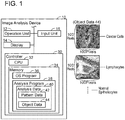
- FIG. 1 shows a configuration of an image analysis device 10 configured to execute image analysis on an image including cell(s).
- the image analysis device 10 comprises an operation unit 12, a display 14, an input unit 16, and a controller 30.
- the respective units 12 to 30 are connected to a bus line (reference sign omitted).
- the operation unit 12 comprises a mouse and a keyboard, for example.
- a user can provide various instructions to the image analysis device 10 by operating the operation unit 12.
- the display 14 is a display configured to display various types of information.
- the input unit 16 is a device configured to input target image data representing a target image being an analysis target to the image analysis device 10.
- the target image data includes a plurality of cell objects corresponding to a plurality of cells.
- the input unit 16 may be a communication interface configured to execute wired or wireless communication, or may be a memory interface to which a USB memory or the like is to be inserted.
- the target image data may be inputted to the image analysis device 10 by the input unit 16 executing wired or wireless communication with a device storing image data captured by a microscope, a Whole Slide Image (virtual slide) captured by a scanner, and the like, as the target image data and receiving the target image data from this device.
- the target image data may be inputted to the image analysis device 10 by the input unit 16 reading the target image data from a memory storing the target image data.
- the controller 30 comprises a CPU 32 and a memory 34.
- the CPU 32 is configured to execute various processes in accordance with programs 36, 38 stored in the memory 34.
- the memory 34 stores an OS program 36 for realizing basic operations of the image analysis device 10 and an analysis program 38 for executing image analysis according to a convolutional neural network (hereinbelow termed "CNN (abbreviation of Convolutional Neural Network)").
- CNN abbreviation of Convolutional Neural Network
- the image analysis according to the CNN is a concept that encompasses image analysis according to a large-scale network including the CNN as a partial structure thereof (such as GoogLeNet (registered trademark) and Residual Network).
- the image analysis device 10 may be realized by installing the analysis program 38 on a general-purpose PC or server.
- the memory 34 stores analysis data 40 for executing the image analysis according to the analysis program 38.
- the analysis data 40 may be data provided from a vendor who sells the analysis program 38 or may be data generated by the user of the image analysis device 10. In the former case, the analysis data 40 is stored in the memory 34 upon installation of the analysis program 38. In the latter case, the analysis data 40 is stored in the memory 34 by the user of the image analysis device 10 after the installation of the analysis program 38.
- the analysis data 40 includes pattern data 42 and object data 44.
- the pattern data 42 is data used in a convolutional layer in the image analysis according to the CNN.
- the object data 44 includes object data representing images including cell objects respectively indicating types of plural cells (such as a cancer cell, a lymphocyte, and a normal epitheliocyte).
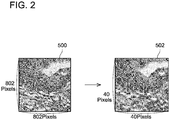
- FIG. 2 shows an example of a target image 500 represented by the target image data.
- the target image data includes (802 ⁇ 802) pixels constituted of 802 pixels aligned along a lateral direction and 802 pixels aligned along a vertical direction.
- target image data may have pixels in numbers different from 802 aligned along the lateral and vertical directions.
- a number of pixels aligned along the lateral direction and a number of pixels aligned along the vertical direction may be different from each other.
- Each of the pixels indicates RGB values in a multilevel gradation (such as 256-level gradation). That is, each pixel indicates three values corresponding to three channels being RGB (that is, the RGB values).
- FIG. 2 shows an example of a reduced image 502 represented by the reduced image data.
- the reduced image data includes (40 ⁇ 40) pixels constituted of 40 pixels aligned along the lateral direction and 40 pixels aligned along the vertical direction.
- pixels in numbers different from 40 may be aligned along the lateral and vertical directions.
- a number of pixels aligned along the lateral direction and a number of pixels aligned along the vertical direction may be different from each other.
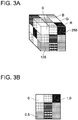
- the image analysis device executes the following processes (1) to (5) by using the reduced image data as three pieces of channel data corresponding to the three channels. As shown in FIG. 3(C) ,
- the image analysis is executed by using the reduced image data in which the target image data is reduced, for purpose of speeding up the image analysis.
- a contour and the like of the object may become unclear in a reduced image 502 as compared to a target image 500, by which analysis accuracy may be degraded.
- the present embodiment executes the following processes in addition to the conventional image analysis.
- the CPU 32 specifies a first partial image 510 from the target image 500 represented by the target image data.
- the first partial image 510 includes (100 ⁇ 100) pixels constituted of 100 pixels aligned along the lateral direction and 100 pixels aligned along the vertical direction.
- the CPU 32 shifts 18 pixels rightward from the first partial image 510 and specifies a second partial image 520.
- the second partial image 520 also includes (100x100) pixels constituted of 100 pixels aligned along the lateral direction and 100 pixels aligned along the vertical direction.
- the CPU 32 scans the target image 500 rightward and sequentially specifies 40 partial images aligned along the lateral direction.
- the CPU 32 shifts 18 pixels downward from the first partial image 510 and specifies a next partial image from the target image 500. Then, similar to the above, the CPU 32 scans rightward from this partial image and sequentially specifies 40 partial images aligned along the lateral direction. By repeating the above, the CPU 32 sequentially specifies (40 ⁇ 40) partial images constituted of 40 partial images aligned along the lateral direction and 40 partial images aligned along the vertical direction.
- a number of the partial images aligned along the lateral direction (that is, 40) and a number of the partial images aligned along the vertical direction (that is, 40) respectively match the number of pixels in the lateral direction and the number of pixels in the vertical direction in the reduced image data (see 502 in FIG. 2 as above).
- these numbers may be any numbers other than "40" so long as the numbers of the partial images and the numbers of the pixels in the reduced image data match.
- the CPU 32 uses the object data 44 representing the cancer cell and calculates a probability that each of the specified partial images includes the cancer cell.
- This probability is represented by a value in a range from “0” to "1", and becomes a value closer to "1" with a higher probability that the partial image includes the cancer cell.
- the probability may be represented by a value in a range from "0%” to "100%”. Further, in another variant, it may become a value closer to "0" with the higher probability that the partial image includes the cancer cell.
- the CPU 32 calculates "0.3" as the probability that the first partial image 510 includes the cancer cell, and describes the probability "0.3” as the value of a pixel 512 corresponding to the first partial image 510.
- the CPU 32 calculates "0.8” as the probability that the second partial image 520 includes the cancer cell, and describes the probability "0.8” as the value of a pixel 522 corresponding to the second partial image 520.
- the CPU 32 calculates probabilities for the other partial images similarly, and generates probability data 504 in which the respectively calculated probabilities are described.
- the probability data 504 includes (40 ⁇ 40) pixels constituted of 40 pixels aligned along the lateral direction and 40 pixels aligned along the vertical direction. In the probability data 504 of FIG.
- values of the respective probabilities are represented by darkness of pixels, and a pixel is whiter with a higher probability (that is, being closer to "1").
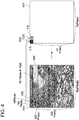
- FIG. 5 shows an example of the probability data 504 corresponding to the cancer cell. In FIG. 5 as well, pixels are whiter with the higher probability.
- the generation process as above is not limited to the CNN, but may be executed according to a support vector machine or a decision tree.
- the CPU 32 further uses the object data 44 representing the lymphocyte and generates probability data 506 (see FIG. 5 ) similar to the above. Further, the CPU 32 further uses object data (not shown) representing the normal epitheliocyte and generates probability data 508 similar to the above.
- the image analysis of the present embodiment differs from the conventional image processing in (1) of FIG. 3 in regard to a process in the first convolutional layer.
- the CPU 32 uses the reduced image data as the three pieces of channel data corresponding to the three channels of RGB as has been the case with the conventional image processing, however, the CPU 32 further executes the convolutional layer process using the probability data 504 as one piece of channel data corresponding to one channel.
- the CPU 32 further executes the convolutional layer process using the probability data 506 as one piece of channel data corresponding to one channel, and also the probability data 508 as one piece of channel data corresponding to one channel.
- the CPU 32 firstly reduces the target image data to generate the reduced image data similar to the conventional image processing, and executes respective processes of (1) to (5) of FIG. 6 .
- the CPU 32 executes the convolutional layer process by using not only the generated reduced image data but also the three pieces of probability data 504, 506, 508 as three pieces of channel data.
- Six-layer pattern data included in the pattern data 42 is used in the convolutional layer hereof.
- FIG. 6(A) shows an example of the six-layer pattern data.
- the six-layer pattern data includes one layer of data corresponding to the R values, one layer of data corresponding to the G values, one layer of data corresponding to the B values, one layer of data corresponding to a probability P1 that the cancer cell is present, one layer of data corresponding to a probability P2 that the lymphocyte is present, and one layer of data corresponding to a probability P3 that the normal epitheliocyte is present.
- Each of the six layers of data includes (3 ⁇ 3) pixels constituted of 3 pixels aligned along the lateral direction and 3 pixels aligned along the vertical direction. That is, the six-layer pattern data is constituted of (3 ⁇ 3 ⁇ 6) pixels.
- the CPU 32 specifies (3 ⁇ 3) pixels included in the reduced image data as a target pixel group and compares (3 ⁇ 3) R values included in this target pixel group with (3 ⁇ 3) R values included in the one layer corresponding to the R values in the three-layer pattern data. Similarly, the CPU 32 executes comparisons for the G values and the B values as well. Further, the CPU 32 specifies (3 ⁇ 3) pixels included in the probability data 504 corresponding to the cancer cell as a target pixel group and compares (3 ⁇ 3) values included in this target pixel group with (3 ⁇ 3) values included in the one layer of data corresponding to the probability P1 in the six-layer pattern data. Similarly, the CPU 32 executes comparisons for the probability data 506, 508 corresponding to the lymphocyte and the normal epitheliocyte as well.
- the CPU 32 uses the respective comparison results to calculate match rates between the target pixel groups and the six-layer pattern data.
- the CPU 32 generates a primary feature map 601 in which respectively specified match rates are described by sequentially specifying the target pixel groups from the reduced image data and the probability data 504, 506, 508 and sequentially specifying the match rates thereof.
- the primary feature map 601 includes (40 ⁇ 40) pixels constituted of 40 pixels aligned along the lateral direction and 40 pixels aligned along the vertical direction, and each pixel indicates the match rate.
- the CPU 32 executes the convolutional layer process for each of the plurality of pieces of six-layer pattern data and generates a plurality of primary feature maps 601 to 604 corresponding to the plurality of pieces of six-layer pattern data.
- the processes of (2) to (5) are same as those of (2) to (5) of FIG. 3 except that the plurality of primary feature maps 601 to 604 is used. That is, (2) the pooling layer process is executed for the plurality of primary feature maps 601 to 604 by which a plurality of reduced primary feature maps 611 to 614 is generated, and (3) the convolutional layer process is executed for the plurality of reduced primary feature maps 611 to 614 by which a plurality of secondary feature maps 621 to 626 is generated. Further, (4) the pooling layer process is executed for the plurality of secondary feature maps 621 to 626 by which a plurality of reduced secondary feature maps 631 to 636 is generated, and (5) a result of the image analysis is outputted.
- an analysis result with high analysis accuracy may be obtained by employing a configuration that uses target image data as three pieces of channel data corresponding to three channels without reducing the target image data.
- the target image data includes (802 ⁇ 802) pixels, and as such, a long period of time is required and a high memory volume is consumed in the convolutional layer process in (1) of FIG. 3(C) .
- each primary feature map generated by the convolutional layer process also includes (802 ⁇ 802) pixels
- each reduced primary feature map generated in the pooling layer in (2) of FIG. 3(C) also includes (401 ⁇ 401) pixels, by which a long period of time is required and a high memory volume is consumed also in the convolutional layer and the pooling layer process which take place thereafter.
- the image analysis device 10 uses the reduced image data as the three pieces of channel data corresponding to the three channels in executing the image analysis according to the CNN, so that the image analysis can be executed promptly.
- the image analysis device 10 uses the probability data 504 as the one piece of channel data corresponding to the one channel in addition to the reduced image data as the three pieces of channel data corresponding to the three channels. Due to this, the image analysis device 10 can improve analysis accuracy related to the image including the cancer cell in the image analysis using the reduced image data.
- the image analysis device 10 further uses the probability data 506 as the one piece of channel data corresponding to the one channel and also the probability data 508 as the one piece of channel data corresponding to the one channel. By doing so, the image analysis device 10 can further improve both analysis accuracy related to the image including the lymphocyte and analysis accuracy related to the image including the normal epitheliocyte in the image analysis using the reduced image data.
- Japanese Patent Application Publication Nos. 2004-286666 and 2010-281636 describe techniques related to image analysis.
- the art disclosed in the present embodiment (which the inventor calls the "component channel CNN (cc-CNN)") completely differs from such conventional techniques, and executes the CNN using the probability data 504 to 508 corresponding to the cancer cell and the like as the channel data. Due to this, prompting of the image analysis, suppression of memory consumption, and high analysis accuracy can be realized.
- the cancer cell and the lymphocyte are respectively an example of a "first object” and a "second object”.
- the lateral direction and the vertical direction are respectively an example of a "first direction” and a "second direction”.
- the (802 ⁇ 802) pixels in the target image data is an example of "(M ⁇ N) pixels" and the three channels of RGB are an example of "K channels”.
- the (40 ⁇ 40) partial images are an example of "(m ⁇ n) partial images”.
- the (40 ⁇ 40) pixels in the probability data are an example of "(m ⁇ n) pixels".
- the probability data 504 and the probability data 506 are respectively an example of "first probability data” and "second probability data”.
- the image analysis device 10 may execute the image analysis on images including other objects (such as a human or a tree).
- the image analysis device 10 stores a piece of object data representing a human and a piece of object data representing a tree as the pieces of object data 44.
- the image analysis device 10 generates a piece of probability data representing a probability that a human is present and a piece of probability data representing a probability that a tree is present based on the target image data.
- the image analysis device 10 executes the CNN using reduced image data obtained by reducing the target image data and the plurality of pieces of probability data that were respectively generated, by which the image analysis related to the human and the tree can be executed promptly and highly accurately. That is, in this variant, any one of the human and the tree is an example of the "first object" and the "first object” may not be a predetermined cell.
- the respective pixels constituting the target image data include the three values corresponding to the three channels of RGB.
- the respective pixels constituting the target image data may include only one value corresponding to one channel such as a luminance value.
- the respective pixels constituting the reduced image data also include only one value corresponding to the one channel.
- four-layer pattern data including one layer of data corresponding to the luminance value, the one layer of data corresponding to the probability P1 that the cancer cell is present, the one layer of data corresponding to the probability P2 that the lymphocyte is present, and the one layer of data corresponding to the probability P3 that the normal epitheliocyte is present is used. That is, in the present variant, the "K" is 1. In another variant, the "K" may be 2, or may be 4 or more.
- the probability data 506, 508 may not be used. That is, at least one probability data may be used. In the present variant, a "second generating unit" may be omitted. Further, in another variant, additional piece of probability data may be generated and the convolutional layer process in (1) of FIG. 6(C) may be executed with this additional piece of probability data being further be used as one piece of channel data. That is, a number of the probability data may be 3 or more.
- FIGS. 4 and 6 are realized by software (that is, the analysis program 38), however, at least one of these processes may be realized by hardware such as a logic circuit.
- 10 image analysis device
- 12 operation unit
- 14 display
- 16 input unit
- 30 controller
- 34 memory
- 36 OS program
- 38 analysis program
- 40 analysis data
- 42 pattern data
- 44 object data
- 101, 102, 103, 104 601, 602, 603, 604: primary feature map, 201, 202, 203, 204, 611, 612, 613, 614: reduced primary feature map, 301, 302, 303, 304, 305, 306, 621, 622, 623, 624, 625, 626: secondary feature map, 401, 402, 403, 404, 405, 406, 631, 632, 633, 634, 635, 636: reduced secondary feature map, 500: target image, 502: reduced image, 510, 520: partial image, 512, 522: pixel, 504, 506, 508: probability data
Landscapes
- Engineering & Computer Science (AREA)
- Health & Medical Sciences (AREA)
- General Health & Medical Sciences (AREA)
- General Physics & Mathematics (AREA)
- Physics & Mathematics (AREA)
- Life Sciences & Earth Sciences (AREA)
- Theoretical Computer Science (AREA)
- Radiology & Medical Imaging (AREA)
- Nuclear Medicine, Radiotherapy & Molecular Imaging (AREA)
- Quality & Reliability (AREA)
- Medical Informatics (AREA)
- Computer Vision & Pattern Recognition (AREA)
- Chemical & Material Sciences (AREA)
- Urology & Nephrology (AREA)
- Biochemistry (AREA)
- Immunology (AREA)
- Pathology (AREA)
- Analytical Chemistry (AREA)
- Medicinal Chemistry (AREA)
- Food Science & Technology (AREA)
- Molecular Biology (AREA)
- Hematology (AREA)
- Biomedical Technology (AREA)
- Image Analysis (AREA)
- Investigating Or Analysing Biological Materials (AREA)
Applications Claiming Priority (1)
| Application Number | Priority Date | Filing Date | Title |
|---|---|---|---|
| PCT/JP2017/038404 WO2019082283A1 (ja) | 2017-10-24 | 2017-10-24 | 画像解析装置 |
Publications (3)
| Publication Number | Publication Date |
|---|---|
| EP3699863A1 true EP3699863A1 (de) | 2020-08-26 |
| EP3699863A4 EP3699863A4 (de) | 2020-10-14 |
| EP3699863B1 EP3699863B1 (de) | 2025-04-30 |
Family
ID=66247350
Family Applications (1)
| Application Number | Title | Priority Date | Filing Date |
|---|---|---|---|
| EP17929925.0A Active EP3699863B1 (de) | 2017-10-24 | 2017-10-24 | Bildinterpretationsvorrichtung |
Country Status (4)
| Country | Link |
|---|---|
| US (1) | US11321832B2 (de) |
| EP (1) | EP3699863B1 (de) |
| JP (1) | JP7106144B2 (de) |
| WO (1) | WO2019082283A1 (de) |
Families Citing this family (1)
| Publication number | Priority date | Publication date | Assignee | Title |
|---|---|---|---|---|
| WO2019082283A1 (ja) | 2017-10-24 | 2019-05-02 | 暢 長坂 | 画像解析装置 |
Family Cites Families (15)
| Publication number | Priority date | Publication date | Assignee | Title |
|---|---|---|---|---|
| JP2001059842A (ja) | 1999-08-25 | 2001-03-06 | Nec Corp | 病理診断装置 |
| JP2004286666A (ja) | 2003-03-24 | 2004-10-14 | Olympus Corp | 病理診断支援装置および病理診断支援プログラム |
| JP2004340738A (ja) * | 2003-05-15 | 2004-12-02 | Sysmex Corp | 細胞分類装置とシステム及び細胞分類方法 |
| US8582860B2 (en) | 2008-07-03 | 2013-11-12 | Nec Laboratories America, Inc. | Signet ring cell detector and related methods |
| JP5387146B2 (ja) | 2009-06-03 | 2014-01-15 | 日本電気株式会社 | 病理組織画像解析装置、病理組織画像解析方法、病理組織画像解析プログラム |
| JP5538967B2 (ja) * | 2009-06-18 | 2014-07-02 | キヤノン株式会社 | 情報処理装置、情報処理方法、プログラム |
| JP2011176748A (ja) * | 2010-02-25 | 2011-09-08 | Sony Corp | 画像処理装置および方法、並びにプログラム |
| GB201015581D0 (en) * | 2010-09-17 | 2010-10-27 | Vib Vzw | Mutations in SPTLC2 gene associated with sensory neuropathy |
| JP2015095042A (ja) * | 2013-11-11 | 2015-05-18 | 独立行政法人科学技術振興機構 | 画像認識装置、画像認識方法、および、プログラム |
| JP2015232869A (ja) * | 2014-05-16 | 2015-12-24 | 株式会社リコー | 画像処理装置、画像処理方法及び画像処理プログラム |
| US10275688B2 (en) * | 2014-12-17 | 2019-04-30 | Nokia Technologies Oy | Object detection with neural network |
| EP3335158B1 (de) * | 2015-08-15 | 2019-07-24 | Salesforce.com, Inc. | Dreidimensionale faltung mit 3d-chargennormalisierung |
| US9760807B2 (en) * | 2016-01-08 | 2017-09-12 | Siemens Healthcare Gmbh | Deep image-to-image network learning for medical image analysis |
| KR102419136B1 (ko) * | 2017-06-15 | 2022-07-08 | 삼성전자주식회사 | 다채널 특징맵을 이용하는 영상 처리 장치 및 방법 |
| WO2019082283A1 (ja) | 2017-10-24 | 2019-05-02 | 暢 長坂 | 画像解析装置 |
-
2017
- 2017-10-24 WO PCT/JP2017/038404 patent/WO2019082283A1/ja not_active Ceased
- 2017-10-24 JP JP2019549725A patent/JP7106144B2/ja active Active
- 2017-10-24 US US16/757,988 patent/US11321832B2/en active Active
- 2017-10-24 EP EP17929925.0A patent/EP3699863B1/de active Active
Also Published As
| Publication number | Publication date |
|---|---|
| JPWO2019082283A1 (ja) | 2020-11-19 |
| JP7106144B2 (ja) | 2022-07-26 |
| US11321832B2 (en) | 2022-05-03 |
| US20200342590A1 (en) | 2020-10-29 |
| EP3699863A4 (de) | 2020-10-14 |
| WO2019082283A1 (ja) | 2019-05-02 |
| EP3699863B1 (de) | 2025-04-30 |
Similar Documents
| Publication | Publication Date | Title |
|---|---|---|
| CN108038897B (zh) | 阴影贴图生成方法及装置 | |
| US9697583B2 (en) | Image processing apparatus, image processing method, and computer-readable recording medium | |
| CN110321788B (zh) | 训练数据处理方法、装置、设备及计算机可读存储介质 | |
| US8340433B2 (en) | Image processing apparatus, electronic medium, and image processing method | |
| US11157749B2 (en) | Crowd state recognition device, learning method, and learning program | |
| EP3214579B1 (de) | Bildverarbeitungsvorrichtung, zeichenerkennungsvorrichtung, bildverarbeitungsverfahren, und programm | |
| CN113989167A (zh) | 基于种子点自生长的轮廓提取方法、装置、设备及介质 | |
| JP2014089626A (ja) | 画像検出装置及び制御プログラム並びに画像検出方法 | |
| US20200193635A1 (en) | Image positioning system and image positioning method based on upsampling | |
| CN111144081B (zh) | 表单生成方法、装置、存储介质及电子设备 | |
| JP2020531931A (ja) | 画像処理方法および装置、記憶媒体、コンピュータ装置 | |
| CN113255664B (zh) | 图像处理方法、相关装置及计算机程序产品 | |
| KR102482874B1 (ko) | 렌더링 장치 및 방법 | |
| US11257212B2 (en) | Image analysis device | |
| CN113763496A (zh) | 图像着色的方法、装置及计算机可读存储介质 | |
| US11321832B2 (en) | Image analysis device | |
| CN119784920B (zh) | 基于yts系统ai算法的渲染方法、装置及存储介质 | |
| CN114693697B (zh) | 图像处理方法、装置、设备及计算机可读存储介质 | |
| US20240320957A1 (en) | Information processing apparatus, information processing method, and non-transitory computer-readable medium | |
| CN118069858A (zh) | 一种知识图谱可视化方法、装置、电子设备及存储介质 | |
| JP2022191790A (ja) | 異常検出装置、異常検出方法、および異常検出プログラム | |
| CN114841906B (zh) | 一种图像合成方法、装置、电子设备和存储介质 | |
| US9942471B2 (en) | Information processing apparatus, information processing system and non-transitory computer readable medium | |
| CN117333502B (zh) | 数据处理方法、装置、设备及可读存储介质 | |
| CN115965674B (zh) | 具有时序平滑性的破碎深度图补正系统 |
Legal Events
| Date | Code | Title | Description |
|---|---|---|---|
| STAA | Information on the status of an ep patent application or granted ep patent |
Free format text: STATUS: THE INTERNATIONAL PUBLICATION HAS BEEN MADE |
|
| PUAI | Public reference made under article 153(3) epc to a published international application that has entered the european phase |
Free format text: ORIGINAL CODE: 0009012 |
|
| STAA | Information on the status of an ep patent application or granted ep patent |
Free format text: STATUS: REQUEST FOR EXAMINATION WAS MADE |
|
| 17P | Request for examination filed |
Effective date: 20200518 |
|
| AK | Designated contracting states |
Kind code of ref document: A1 Designated state(s): AL AT BE BG CH CY CZ DE DK EE ES FI FR GB GR HR HU IE IS IT LI LT LU LV MC MK MT NL NO PL PT RO RS SE SI SK SM TR |
|
| AX | Request for extension of the european patent |
Extension state: BA ME |
|
| A4 | Supplementary search report drawn up and despatched |
Effective date: 20200911 |
|
| RIC1 | Information provided on ipc code assigned before grant |
Ipc: G01N 33/48 20060101ALI20200907BHEP Ipc: G06T 7/00 20170101AFI20200907BHEP |
|
| DAV | Request for validation of the european patent (deleted) | ||
| DAX | Request for extension of the european patent (deleted) | ||
| STAA | Information on the status of an ep patent application or granted ep patent |
Free format text: STATUS: EXAMINATION IS IN PROGRESS |
|
| 17Q | First examination report despatched |
Effective date: 20221201 |
|
| GRAP | Despatch of communication of intention to grant a patent |
Free format text: ORIGINAL CODE: EPIDOSNIGR1 |
|
| STAA | Information on the status of an ep patent application or granted ep patent |
Free format text: STATUS: GRANT OF PATENT IS INTENDED |
|
| INTG | Intention to grant announced |
Effective date: 20250204 |
|
| GRAS | Grant fee paid |
Free format text: ORIGINAL CODE: EPIDOSNIGR3 |
|
| GRAA | (expected) grant |
Free format text: ORIGINAL CODE: 0009210 |
|
| STAA | Information on the status of an ep patent application or granted ep patent |
Free format text: STATUS: THE PATENT HAS BEEN GRANTED |
|
| AK | Designated contracting states |
Kind code of ref document: B1 Designated state(s): AL AT BE BG CH CY CZ DE DK EE ES FI FR GB GR HR HU IE IS IT LI LT LU LV MC MK MT NL NO PL PT RO RS SE SI SK SM TR |
|
| REG | Reference to a national code |
Ref country code: CH Ref legal event code: EP Ref country code: GB Ref legal event code: FG4D |
|
| REG | Reference to a national code |
Ref country code: IE Ref legal event code: FG4D |
|
| REG | Reference to a national code |
Ref country code: DE Ref legal event code: R096 Ref document number: 602017089259 Country of ref document: DE |
|
| REG | Reference to a national code |
Ref country code: NL Ref legal event code: MP Effective date: 20250430 |
|
| REG | Reference to a national code |
Ref country code: AT Ref legal event code: MK05 Ref document number: 1790766 Country of ref document: AT Kind code of ref document: T Effective date: 20250430 |
|
| PG25 | Lapsed in a contracting state [announced via postgrant information from national office to epo] |
Ref country code: FI Free format text: LAPSE BECAUSE OF FAILURE TO SUBMIT A TRANSLATION OF THE DESCRIPTION OR TO PAY THE FEE WITHIN THE PRESCRIBED TIME-LIMIT Effective date: 20250430 Ref country code: PT Free format text: LAPSE BECAUSE OF FAILURE TO SUBMIT A TRANSLATION OF THE DESCRIPTION OR TO PAY THE FEE WITHIN THE PRESCRIBED TIME-LIMIT Effective date: 20250901 Ref country code: ES Free format text: LAPSE BECAUSE OF FAILURE TO SUBMIT A TRANSLATION OF THE DESCRIPTION OR TO PAY THE FEE WITHIN THE PRESCRIBED TIME-LIMIT Effective date: 20250430 |
|
| REG | Reference to a national code |
Ref country code: LT Ref legal event code: MG9D |
|
| PG25 | Lapsed in a contracting state [announced via postgrant information from national office to epo] |
Ref country code: NO Free format text: LAPSE BECAUSE OF FAILURE TO SUBMIT A TRANSLATION OF THE DESCRIPTION OR TO PAY THE FEE WITHIN THE PRESCRIBED TIME-LIMIT Effective date: 20250730 Ref country code: GR Free format text: LAPSE BECAUSE OF FAILURE TO SUBMIT A TRANSLATION OF THE DESCRIPTION OR TO PAY THE FEE WITHIN THE PRESCRIBED TIME-LIMIT Effective date: 20250731 |
|
| PG25 | Lapsed in a contracting state [announced via postgrant information from national office to epo] |
Ref country code: PL Free format text: LAPSE BECAUSE OF FAILURE TO SUBMIT A TRANSLATION OF THE DESCRIPTION OR TO PAY THE FEE WITHIN THE PRESCRIBED TIME-LIMIT Effective date: 20250430 Ref country code: NL Free format text: LAPSE BECAUSE OF FAILURE TO SUBMIT A TRANSLATION OF THE DESCRIPTION OR TO PAY THE FEE WITHIN THE PRESCRIBED TIME-LIMIT Effective date: 20250430 |
|
| PG25 | Lapsed in a contracting state [announced via postgrant information from national office to epo] |
Ref country code: BG Free format text: LAPSE BECAUSE OF FAILURE TO SUBMIT A TRANSLATION OF THE DESCRIPTION OR TO PAY THE FEE WITHIN THE PRESCRIBED TIME-LIMIT Effective date: 20250430 |
|
| PG25 | Lapsed in a contracting state [announced via postgrant information from national office to epo] |
Ref country code: HR Free format text: LAPSE BECAUSE OF FAILURE TO SUBMIT A TRANSLATION OF THE DESCRIPTION OR TO PAY THE FEE WITHIN THE PRESCRIBED TIME-LIMIT Effective date: 20250430 |
|
| PG25 | Lapsed in a contracting state [announced via postgrant information from national office to epo] |
Ref country code: AT Free format text: LAPSE BECAUSE OF FAILURE TO SUBMIT A TRANSLATION OF THE DESCRIPTION OR TO PAY THE FEE WITHIN THE PRESCRIBED TIME-LIMIT Effective date: 20250430 |
|
| PG25 | Lapsed in a contracting state [announced via postgrant information from national office to epo] |
Ref country code: RS Free format text: LAPSE BECAUSE OF FAILURE TO SUBMIT A TRANSLATION OF THE DESCRIPTION OR TO PAY THE FEE WITHIN THE PRESCRIBED TIME-LIMIT Effective date: 20250731 |
|
| PG25 | Lapsed in a contracting state [announced via postgrant information from national office to epo] |
Ref country code: IS Free format text: LAPSE BECAUSE OF FAILURE TO SUBMIT A TRANSLATION OF THE DESCRIPTION OR TO PAY THE FEE WITHIN THE PRESCRIBED TIME-LIMIT Effective date: 20250830 |
|
| PG25 | Lapsed in a contracting state [announced via postgrant information from national office to epo] |
Ref country code: LV Free format text: LAPSE BECAUSE OF FAILURE TO SUBMIT A TRANSLATION OF THE DESCRIPTION OR TO PAY THE FEE WITHIN THE PRESCRIBED TIME-LIMIT Effective date: 20250430 |
|
| PGFP | Annual fee paid to national office [announced via postgrant information from national office to epo] |
Ref country code: DE Payment date: 20251020 Year of fee payment: 9 |
|
| PGFP | Annual fee paid to national office [announced via postgrant information from national office to epo] |
Ref country code: GB Payment date: 20251024 Year of fee payment: 9 |
|
| PG25 | Lapsed in a contracting state [announced via postgrant information from national office to epo] |
Ref country code: DK Free format text: LAPSE BECAUSE OF FAILURE TO SUBMIT A TRANSLATION OF THE DESCRIPTION OR TO PAY THE FEE WITHIN THE PRESCRIBED TIME-LIMIT Effective date: 20250430 Ref country code: SM Free format text: LAPSE BECAUSE OF FAILURE TO SUBMIT A TRANSLATION OF THE DESCRIPTION OR TO PAY THE FEE WITHIN THE PRESCRIBED TIME-LIMIT Effective date: 20250430 |
|
| PG25 | Lapsed in a contracting state [announced via postgrant information from national office to epo] |
Ref country code: CZ Free format text: LAPSE BECAUSE OF FAILURE TO SUBMIT A TRANSLATION OF THE DESCRIPTION OR TO PAY THE FEE WITHIN THE PRESCRIBED TIME-LIMIT Effective date: 20250430 |
|
| PG25 | Lapsed in a contracting state [announced via postgrant information from national office to epo] |
Ref country code: EE Free format text: LAPSE BECAUSE OF FAILURE TO SUBMIT A TRANSLATION OF THE DESCRIPTION OR TO PAY THE FEE WITHIN THE PRESCRIBED TIME-LIMIT Effective date: 20250430 |
|
| PG25 | Lapsed in a contracting state [announced via postgrant information from national office to epo] |
Ref country code: SK Free format text: LAPSE BECAUSE OF FAILURE TO SUBMIT A TRANSLATION OF THE DESCRIPTION OR TO PAY THE FEE WITHIN THE PRESCRIBED TIME-LIMIT Effective date: 20250430 Ref country code: RO Free format text: LAPSE BECAUSE OF FAILURE TO SUBMIT A TRANSLATION OF THE DESCRIPTION OR TO PAY THE FEE WITHIN THE PRESCRIBED TIME-LIMIT Effective date: 20250430 |
|
| PG25 | Lapsed in a contracting state [announced via postgrant information from national office to epo] |
Ref country code: IT Free format text: LAPSE BECAUSE OF FAILURE TO SUBMIT A TRANSLATION OF THE DESCRIPTION OR TO PAY THE FEE WITHIN THE PRESCRIBED TIME-LIMIT Effective date: 20250430 |
|
| REG | Reference to a national code |
Ref country code: DE Ref legal event code: R097 Ref document number: 602017089259 Country of ref document: DE |
|
| PLBE | No opposition filed within time limit |
Free format text: ORIGINAL CODE: 0009261 |
|
| STAA | Information on the status of an ep patent application or granted ep patent |
Free format text: STATUS: NO OPPOSITION FILED WITHIN TIME LIMIT |
|
| REG | Reference to a national code |
Ref country code: CH Ref legal event code: L10 Free format text: ST27 STATUS EVENT CODE: U-0-0-L10-L00 (AS PROVIDED BY THE NATIONAL OFFICE) Effective date: 20260311 |