EP3698867A1 - Feed spacer having three-layered structure, and reverse osmosis membrane filter module including same - Google Patents
Feed spacer having three-layered structure, and reverse osmosis membrane filter module including same Download PDFInfo
- Publication number
- EP3698867A1 EP3698867A1 EP18868326.2A EP18868326A EP3698867A1 EP 3698867 A1 EP3698867 A1 EP 3698867A1 EP 18868326 A EP18868326 A EP 18868326A EP 3698867 A1 EP3698867 A1 EP 3698867A1
- Authority
- EP
- European Patent Office
- Prior art keywords
- reverse osmosis
- feed spacer
- filter module
- spacer
- osmosis membrane
- Prior art date
- Legal status (The legal status is an assumption and is not a legal conclusion. Google has not performed a legal analysis and makes no representation as to the accuracy of the status listed.)
- Withdrawn
Links
- 125000006850 spacer group Chemical group 0.000 title claims abstract description 92
- 238000001223 reverse osmosis Methods 0.000 title claims abstract description 80
- 239000012528 membrane Substances 0.000 title claims abstract description 56
- XLYOFNOQVPJJNP-UHFFFAOYSA-N water Substances O XLYOFNOQVPJJNP-UHFFFAOYSA-N 0.000 claims abstract description 64
- 239000007788 liquid Substances 0.000 claims description 3
- 230000010287 polarization Effects 0.000 abstract description 11
- 230000003247 decreasing effect Effects 0.000 description 20
- 230000000052 comparative effect Effects 0.000 description 7
- 230000000694 effects Effects 0.000 description 6
- 239000000470 constituent Substances 0.000 description 4
- 238000005516 engineering process Methods 0.000 description 3
- 239000012530 fluid Substances 0.000 description 3
- 238000000034 method Methods 0.000 description 3
- 238000003475 lamination Methods 0.000 description 2
- 239000000463 material Substances 0.000 description 2
- -1 polyethylene Polymers 0.000 description 2
- 239000008213 purified water Substances 0.000 description 2
- 239000004698 Polyethylene Substances 0.000 description 1
- 239000004743 Polypropylene Substances 0.000 description 1
- 238000010612 desalination reaction Methods 0.000 description 1
- 238000000502 dialysis Methods 0.000 description 1
- 239000004744 fabric Substances 0.000 description 1
- 230000004907 flux Effects 0.000 description 1
- 238000010030 laminating Methods 0.000 description 1
- 238000004519 manufacturing process Methods 0.000 description 1
- 230000000116 mitigating effect Effects 0.000 description 1
- 230000003204 osmotic effect Effects 0.000 description 1
- 238000007500 overflow downdraw method Methods 0.000 description 1
- 230000000149 penetrating effect Effects 0.000 description 1
- 229920000728 polyester Polymers 0.000 description 1
- 229920000573 polyethylene Polymers 0.000 description 1
- 229920001155 polypropylene Polymers 0.000 description 1
- 229920000915 polyvinyl chloride Polymers 0.000 description 1
- 239000004800 polyvinyl chloride Substances 0.000 description 1
- 238000000746 purification Methods 0.000 description 1
- 238000011084 recovery Methods 0.000 description 1
- 239000013535 sea water Substances 0.000 description 1
- 239000004065 semiconductor Substances 0.000 description 1
- 238000000926 separation method Methods 0.000 description 1
- 239000011800 void material Substances 0.000 description 1
- 238000010792 warming Methods 0.000 description 1
Images


Classifications
-
- B—PERFORMING OPERATIONS; TRANSPORTING
- B01—PHYSICAL OR CHEMICAL PROCESSES OR APPARATUS IN GENERAL
- B01D—SEPARATION
- B01D61/00—Processes of separation using semi-permeable membranes, e.g. dialysis, osmosis or ultrafiltration; Apparatus, accessories or auxiliary operations specially adapted therefor
- B01D61/02—Reverse osmosis; Hyperfiltration ; Nanofiltration
- B01D61/10—Accessories; Auxiliary operations
-
- B—PERFORMING OPERATIONS; TRANSPORTING
- B01—PHYSICAL OR CHEMICAL PROCESSES OR APPARATUS IN GENERAL
- B01D—SEPARATION
- B01D61/00—Processes of separation using semi-permeable membranes, e.g. dialysis, osmosis or ultrafiltration; Apparatus, accessories or auxiliary operations specially adapted therefor
- B01D61/02—Reverse osmosis; Hyperfiltration ; Nanofiltration
- B01D61/025—Reverse osmosis; Hyperfiltration
-
- B—PERFORMING OPERATIONS; TRANSPORTING
- B01—PHYSICAL OR CHEMICAL PROCESSES OR APPARATUS IN GENERAL
- B01D—SEPARATION
- B01D61/00—Processes of separation using semi-permeable membranes, e.g. dialysis, osmosis or ultrafiltration; Apparatus, accessories or auxiliary operations specially adapted therefor
- B01D61/02—Reverse osmosis; Hyperfiltration ; Nanofiltration
- B01D61/08—Apparatus therefor
-
- B—PERFORMING OPERATIONS; TRANSPORTING
- B01—PHYSICAL OR CHEMICAL PROCESSES OR APPARATUS IN GENERAL
- B01D—SEPARATION
- B01D63/00—Apparatus in general for separation processes using semi-permeable membranes
- B01D63/10—Spiral-wound membrane modules
- B01D63/103—Details relating to membrane envelopes
-
- C—CHEMISTRY; METALLURGY
- C02—TREATMENT OF WATER, WASTE WATER, SEWAGE, OR SLUDGE
- C02F—TREATMENT OF WATER, WASTE WATER, SEWAGE, OR SLUDGE
- C02F1/00—Treatment of water, waste water, or sewage
- C02F1/44—Treatment of water, waste water, or sewage by dialysis, osmosis or reverse osmosis
- C02F1/441—Treatment of water, waste water, or sewage by dialysis, osmosis or reverse osmosis by reverse osmosis
-
- B—PERFORMING OPERATIONS; TRANSPORTING
- B01—PHYSICAL OR CHEMICAL PROCESSES OR APPARATUS IN GENERAL
- B01D—SEPARATION
- B01D2313/00—Details relating to membrane modules or apparatus
- B01D2313/14—Specific spacers
- B01D2313/143—Specific spacers on the feed side
-
- C—CHEMISTRY; METALLURGY
- C02—TREATMENT OF WATER, WASTE WATER, SEWAGE, OR SLUDGE
- C02F—TREATMENT OF WATER, WASTE WATER, SEWAGE, OR SLUDGE
- C02F2103/00—Nature of the water, waste water, sewage or sludge to be treated
- C02F2103/08—Seawater, e.g. for desalination
-
- C—CHEMISTRY; METALLURGY
- C02—TREATMENT OF WATER, WASTE WATER, SEWAGE, OR SLUDGE
- C02F—TREATMENT OF WATER, WASTE WATER, SEWAGE, OR SLUDGE
- C02F2201/00—Apparatus for treatment of water, waste water or sewage
- C02F2201/002—Construction details of the apparatus
-
- C—CHEMISTRY; METALLURGY
- C02—TREATMENT OF WATER, WASTE WATER, SEWAGE, OR SLUDGE
- C02F—TREATMENT OF WATER, WASTE WATER, SEWAGE, OR SLUDGE
- C02F2301/00—General aspects of water treatment
- C02F2301/02—Fluid flow conditions
- C02F2301/022—Laminar
-
- Y—GENERAL TAGGING OF NEW TECHNOLOGICAL DEVELOPMENTS; GENERAL TAGGING OF CROSS-SECTIONAL TECHNOLOGIES SPANNING OVER SEVERAL SECTIONS OF THE IPC; TECHNICAL SUBJECTS COVERED BY FORMER USPC CROSS-REFERENCE ART COLLECTIONS [XRACs] AND DIGESTS
- Y02—TECHNOLOGIES OR APPLICATIONS FOR MITIGATION OR ADAPTATION AGAINST CLIMATE CHANGE
- Y02A—TECHNOLOGIES FOR ADAPTATION TO CLIMATE CHANGE
- Y02A20/00—Water conservation; Efficient water supply; Efficient water use
- Y02A20/124—Water desalination
- Y02A20/131—Reverse-osmosis
Definitions
- the present invention relates to a feed spacer, and more particularly, to a feed spacer having a three-layer structure, in which a set forming the feed spacer is formed in a three-layer structure, so that the set, which is in contact with a reverse osmosis membrane, convects raw water to a center of the structure of the feed spacer and a laminar flow velocity gradient is generated at the center to decrease a polarization phenomenon of a reverse osmosis filter module and minimize pressure loss, and a reverse osmosis membrane filter module including the same.
- Water penetrating the reverse osmosis membrane becomes pure water or water close to infinitely pure water and is used in various fields, such as sterilized water for medical use, purified water for artificial dialysis, or water for manufacturing a semiconductor in an electronic industry.
- reverse osmosis separates two solutions having a concentration difference with a semipermeable membrane, and generates a predetermined water level difference while a solution having a lower concentration moves to a solution having a higher concentration after a certain period of time, which is called an osmotic phenomenon.
- the difference of the water level generated during the process refers to a reverse osmosis pressure.
- a device, which makes only water molecules pass the semipermeable membrane by using the principle thereof and purifies water is referred to as reverse osmosis equipment, and the semipermeable membrane included in the reverse osmosis equipment is a reverse osmosis filter module.
- the reverse osmosis filter module includes a center tube, a feed spacer, a reverse osmosis (RO) membrane, a tricot filtered water path, and the like.
- RO reverse osmosis
- the feed spacer serves as a passage, through which raw water is introduced.
- the feed spacer when differential pressure is generated due to flow interruption by the feed spacer, this causes an increase in energy cost, so that as the differential pressure is low, efficiency of the reverse osmosis filter module is increased.
- a concentration polarization phenomenon is essentially generated in the vicinity of the reverse osmosis membrane by water permeation flux, and as the concentration polarization phenomenon is intensified, an osmosis pressure is increased in the vicinity of the reverse osmosis membrane, so that a water permeation ratio is decreased.
- the present invention is conceived to solve the foregoing problems, and an object of the present invention is to provide a feed spacer having a three-layer structure, which is formed of a layer, which is in direct contact with a reverse osmosis membrane, and a layer, which is not in direct contact with a reverse osmosis membrane, so that a thickness of a strand causing pressure loss of a fluid is decreased.
- Another object of the present invention is to provide a feed spacer having a three-layer structure, in which raw water is convected to a center of a structure of the spacer, so that turbulent convection is locally generated only in a layer, which is in direct contact with a reverse osmosis membrane, and a laminar flow velocity gradient is generated at the center of the structure of the spacer to decrease a polarization phenomenon.
- An exemplary embodiment of the present invention provides a feed spacer having a three-layer structure, including: a first set, in which a plurality of strands is positioned in parallel; a second set, which crosses the first set, and is formed of a plurality of parallel strands; and a third set, which is positioned in parallel to a direction of raw water and is formed of a plurality of parallel strands, in which the third set is positioned between the first and second sides or at one side of any one of the first and second sets.
- strand per inch may be 5 to 9.
- a length between cross points of the first and second sets may be 3,800 ⁇ m to 12,000 ⁇ m.
- an angle between the first and second sets may be 50° to 90°.
- the strand may have a diameter of 167 ⁇ m to 300 ⁇ m.
- the feed spacer may have a thickness of 500 ⁇ m to 900 ⁇ m.
- Another exemplary embodiment of the present invention provides a reverse osmosis filter module including the feed spacer having the three-layer structure.
- the reverse osmosis filter module may include: a tube including an opening accommodating a permeating liquid in a longitudinal direction; and one or more reverse osmosis membranes, which are extended from the tube in an outside direction and are wound around a circumference of the tube, and the spacer is in contact with the one or more reverse osmosis membranes and is wound around the circumference of the tube.
- the spacer may be formed of a first to third sets, and the first and second sets may be in contact with the one or more reverse osmosis membranes, and the third set may not be in contact with the one or more reverse osmosis membranes.
- the feed spacer is formed of a layer, which is in direct contact with a reverse osmosis membrane, and a layer, which is not in contact with a reverse osmosis membrane, so that a turbulent flow of raw water is concentrated to a center of the structure of the spacer, thereby achieving an effect in that pressure loss is minimized.
- raw water is convected to the center of the structure of the spacer, so that turbulent convection is locally generated only in the layer, which is in direct contact with the reverse osmosis membrane, and a laminar flow velocity gradient is generated at the center of the structure of the spacer, thereby achieving an effect in that a polarization phenomenon is decreased.
- FIG. 2A is a top plan view of a feed spacer having a three-layer structure according to an exemplary embodiment of the present invention
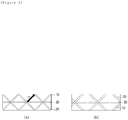
- FIG. 2B is a cross-sectional view of a reverse osmosis filter module, in which reverse osmosis membranes are positioned at one side and the other side of the feed spacer having the three-layer structure according to the exemplary embodiment of the present invention
- FIG. 3 is a cross-sectional view of a feed spacer having a three-layer structure according to another exemplary embodiment of the present invention.
- FIG. 4A is a top plan view of a feed spacer having a three-layer structure, in which strand per inch (SPI) is 9, according to an exemplary embodiment of the present invention
- SPI strand per inch
- FIG. 4B is a top plan view of a feed spacer having a three-layer structure, in which SPI is7, according to an exemplary embodiment of the present invention.
- the feed spacer according to the present invention may include a first set 10, a second set 20, and a third set 30, in which a plurality of strands is positioned in parallel.
- one or more, that is, the plurality of strands may be positioned in parallel, and herein, the strand may be positioned to be inclined to a direction of raw water. Further, the second set 20 may be positioned to cross the first set 10. Further, a direction of inclination of the second set 20 is opposite to the direction of inclination of the first set 10, so that the first set 10 and the second set 20 may be provided in a lattice shape.
- first set 10 may be positioned at an angle a of 10° to 80° to a flow direction of raw water
- the second set 20 may be positioned at an inclination of 100° to 170° to a flow direction of raw water.
- angle a between the first set 10 and the second set 20 may be 50° to 90°.
- the strand of the second set 20 may be positioned while being inclined 110° to 150° with respect to the flow direction of the raw water.
- the strand of the second set 20 may be positioned while being inclined 110° with respect to the flow direction of the raw water.
- the flow path may is formed by the strands forming each set, and may mean a space between reverse osmosis membranes positioned in an upper portion and a lower portion of the feed spacer and each set.
- the third set 30 is positioned in parallel to a flow direction of raw water, and may be positioned between the first set 10 and the second 20 or at the topmost side among the three sets. That is, the third set may be positioned at any one position of one side of the first set 10 and one side of the second set 20. More particularly, when the second set 20 is positioned in an upper portion of the first set 10 according to a set lamination order, the third set 30 may be positioned at one side, that is, an upper portion, of the second set 20. When the first set 10 is positioned in an upper portion of the second set 20 according to a set lamination order, the third set 30 may be positioned in the upper portion of the first set 10.
- the feed spacer when the third set 30 is positioned at one side of the first set 10 and the other side of the second set 20, the feed spacer may be formed of the set, which is in direct contact with the reverse osmosis membrane, and the set, which is not in contact with the reverse osmosis membrane. More particularly, the feed spacer has the structure, in which the third set 30 is not in direct contact with the reverse osmosis membrane, and the first set 10 and the second set 20 are in contact with the reverse osmosis membrane.
- the first set 10 and the second set 20 are in contact with the reverse osmosis membrane to serve to support the structure of the feed spacer, and may periodically convect an interface flow of raw water between the reverse osmosis membranes to the center of the structure of the feed spacer. That is, the feed spacer according to the present invention convects the interface flow of raw water to the third set 30, so that the third set 30 generates a laminar flow velocity gradient of the interface flow to achieve an effect in that a polarization phenomenon is decreased.
- the third set 30 may be provided at a cross point of the first set 10 and the second set 20 or any one position among the 1/5 to 4/5 points between the cross points.
- the feed spacer according to the present invention may be manufactured by a fusion method.
- the feed spacer may be manufactured by a method of extruding the first set 10, the second set 20, and the third set 30 in the state where the first set 10, the second set 20, and the third set 30 are bonded, or extruding the first set 10 and the third set 30 in the state where the first set 10 and the third set 30 are bonded or extruding the second set 20 and the third set 30 in the state where the second set 20 and the third set 30 are bonded, and then laminating and bonding the second set or the first set.
- the third set 30 when the third set 30 is positioned at one side of the second set 20, the third set 30 positioned at the topmost side is parallel to the flow direction of the raw water to serve to separate the flow in half. Accordingly, the first set 10, which is in direct contact with the reverse osmosis membrane, convects the interface flow of the raw water to the second set 20 and the third set 30 separates the raw water in half to convect the raw water to the second set 20, so that the convection phenomenon is periodically generated in the vicinity of the interface of the reverse osmosis membrane, thereby minimizing pressure loss in the feed spacer according to the present invention.
- a gap between the strands forming the first to third sets 10, 20, and 30 according to the present invention may be 4 mm to 12 mm.
- the gap between the strands is less than 4 mm, a cross sectional area of the flow is increased and the gap between the strands of each layer is decreased, so that there is a problem in that a turbulent flow of the raw water is generated more than needs and pressure loss is increased.
- the gap between the strands is more than 12 mm, the gap between the strands is increased and a section, in which a vertical flow of the raw water is not generated, is generated, so that there is a problem in that the laminar flow velocity gradient is not generated.
- a diameter of the strand forming each set may be 167 ⁇ m to 300 ⁇ m, and thus a thickness of the feed spacer may be 500 ⁇ m to 900 ⁇ m.
- the diameter of the strand forming the feed spacer according to the present invention may be provided to be smaller than the diameter of the strand forming the feed spacer in the related art, and when the diameter of the strand is decreased, an area of the strand, which is in contact with the fluid supplied to the feed spacer, is decreased, so that there may be an effect in that pressure loss of the fluid due to friction is decreased.
- the diameter of the strand is less than 167 ⁇ m and the thickness of the feed spacer is less than 500 ⁇ m, there may be a problem in that the structure of the feed spacer cannot be supported. Further, when the diameter of the strand is more than 300 ⁇ m and the thickness of the feed spacer is more than 900 ⁇ m, an area of the strand, which is in contact with the supplied raw water, is increased, so that there may be a problem in that resistance is increased and pressure loss of the feed spacer is increased.
- the diameter of the strand according to the present invention is decreased compared to the diameter of the strand forming the feed spacer in the related art, so that it is possible to secure a void fraction of a channel, in which the raw water may flow, and an effective reverse osmosis membrane area, thereby achieving an effect in that differential pressure is improved and a property of produced water is improved.
- the SPI may be 5 to 9. That is, a length L between the cross points formed by crossing the first set 10 and the second set 20 may be 3,800 ⁇ m to 12,000 ⁇ m.
- the SPI may mean the number of strands corresponding to one side of the flow path per inch. That is, the SPI may mean the number of strands between the cross points formed by crossing the first set 10 and the second set 20 and the third set 30.
- the cross sectional area of the flow path is decreased and the laminar flow velocity gradient is not generated at the center portion of the feed spacer, so that there may be a problem in that the polarization phenomenon is increased, and when the SPI is more than 9 and the length between the cross points is less than 3,800 ⁇ m, the cross sectional area of the flow path is increased and the raw water actively flows in the up and down directions, so that there may be a problem in that pressure loss is increased.
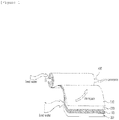
- FIG. 1 is a perspective view of a reverse osmosis filter module according to an exemplary embodiment of the present invention.
- the reverse osmosis filter module is a constituent element of a membrane separation device, which serves to purify actually supplied water by using a reverse osmosis pressure principle.
- the reverse osmosis filter module may include a reverse osmosis membrane 200, a feed spacer 100, a tricot filtered water path 300, and a tube 400 including an opening accommodating a permeating liquid according to a longitudinal direction.
- the reverse osmosis filter module may further include one pair of telescoping preventing devices (not illustrated), but a detailed description of the telescoping preventing device will be omitted.
- One or more reverse osmosis membranes 200 filter foreign materials included in water by using osmosis and serve as a flow path allowing purified water to effectively flow.
- the one or more reverse osmosis membranes are extended to an outside direction from the tube and are wound around a circumference of the tube.
- the feed spacer 100 may be provided. More particularly, the feed spacer 100 may be provided in a three-layer structure, and herein, the three layer refers to a structure, in which three strands forming the feed spacer 100 are laminated, and may mean the form in which the plurality of strands is positioned in parallel to form a set of one layer and the three sets are laminated.
- the feed spacer 100 is provided in the three-layer structure, so that the set, which is in contact with the reverse osmosis membrane 200, is divided from the set, which is not in contact with the reverse osmosis membrane 200.
- the first and second sets may be in contact with one or more reverse osmosis membranes 200, and the third set may not be in contact with one or more reverse osmosis membranes 200.
- the set, which is in contact with the reverse osmosis membrane 200 may convect a flow direction of raw water supplied to the reverse osmosis filter module to the center of the feed spacer 100, that is, the set, which is not in contact with the reverse osmosis membrane 200.
- the laminar flow velocity gradient is generated in the portion, in which the set, which is not in contact with the reverse osmosis membrane 200, is positioned, and the turbulent current is locally generated only in the portion, in which the set, which is in contact with the reverse osmosis membrane 200, is positioned, so that the polarization phenomenon of the feed spacer 100 is decreased and pressure loss is decreased, thereby more improving efficiency of the reverse osmosis filter module.
- the feed spacer 100 forms a passage, through which raw water is introduced from the outside, and serves to maintain a gap between one reverse osmosis membrane 200 and another reverse osmosis membrane 200. To this end, the feed spacer 100 is in contact with one or more reverse osmosis membranes 200 at an upper side and a lower side, and is wound around a circumference of the tube, similar to the one or more reverse osmosis membranes 200.
- a material of the feed spacer 100 is not specially limited, but may include any one of polyethylene, polyvinyl chloride, polyester, and polypropylene.
- the tricot filtered water path 300 has a structure of a general fabric form, and serves as a flow path making a space, through which the water purified through the reverse osmosis membrane 200 may flow out.
- the tube 400 is positioned at a center of the reverse osmosis filter module, and serves as a passage, through which the filtered water is introduced and discharged.
- voids (or openings) having a predetermined size may be formed at an external side of the tube 400 so that the filtered water is introduced.
- the number of voids formed may be one or more so that the filtered water is more effectively introduced.
- the feed spacer in the related art has a two-layer structure and includes only a first set and a second set.
- Comparative Example 1 is a feed spacer having a two-layer structure, in which SPI is 9, a length between the cross points is 3,889 ⁇ m, an angle between a flow direction of a flow path and a first set and a second set is 90°
- Comparative Example 2 is a feed spacer having a two-layer structure, in which SPI is 7, a length between the cross points is 5,000 ⁇ m, an angle between a flow direction of a flow path and a first set and a second set is 90°.
- Examples 1 to 4 are feed spacers having three-layer structures according to the present invention, and in Examples 1 to 3, a third set is positioned at a middle portion between a first set and a second set.
- Examples 1 to 3 are the feed spacers having the three-layer structures, in which angles between flow directions of flow paths and the first sets and the second sets are 50°, 55°, and 90°, and SPIs are 9, 7, and 5, respectively.
- Example 4 has the structure, in which a third set is positioned at the topmost side of the feed spacer.
- Example 4 is the feed spacer, in which SPI is 9 and an angle between a flow direction of a flow path and a first set and a second set is 90°.
- Differential pressure (Pa/pm) per length of the feed spacer of Example 1 is 0.02051, which is decreased by 0.0456 compared to Comparative Example 1, so that total pressure of the feed spacer is decreased by 55% compared to Comparative Example 1. That is, it can be seen that in the three-layer structure, pressure generated between raw water and the feed spacer is decreased compared to the two-layer structure.
Landscapes
- Chemical & Material Sciences (AREA)
- Engineering & Computer Science (AREA)
- Water Supply & Treatment (AREA)
- Chemical Kinetics & Catalysis (AREA)
- Nanotechnology (AREA)
- Life Sciences & Earth Sciences (AREA)
- Hydrology & Water Resources (AREA)
- Environmental & Geological Engineering (AREA)
- Organic Chemistry (AREA)
- Separation Using Semi-Permeable Membranes (AREA)
Abstract
Description
- This application claims priority to and the benefit of Korean Patent Application No.
10-2017-0136495 - The present invention relates to a feed spacer, and more particularly, to a feed spacer having a three-layer structure, in which a set forming the feed spacer is formed in a three-layer structure, so that the set, which is in contact with a reverse osmosis membrane, convects raw water to a center of the structure of the feed spacer and a laminar flow velocity gradient is generated at the center to decrease a polarization phenomenon of a reverse osmosis filter module and minimize pressure loss, and a reverse osmosis membrane filter module including the same.
- As global warming deepens water shortage, a water purification technology, which is an alternative water resource securing technology, is attracting attention.
- Accordingly, it is expected that a water treatment process using a reverse osmosis membrane, which is a core technology of a next-generation water supply business utilizing alternative water resources, such as seawater desalination and reuse of water, leads a water industry market.
- Water penetrating the reverse osmosis membrane becomes pure water or water close to infinitely pure water and is used in various fields, such as sterilized water for medical use, purified water for artificial dialysis, or water for manufacturing a semiconductor in an electronic industry.
- Herein, reverse osmosis separates two solutions having a concentration difference with a semipermeable membrane, and generates a predetermined water level difference while a solution having a lower concentration moves to a solution having a higher concentration after a certain period of time, which is called an osmotic phenomenon. Further, the difference of the water level generated during the process refers to a reverse osmosis pressure. A device, which makes only water molecules pass the semipermeable membrane by using the principle thereof and purifies water, is referred to as reverse osmosis equipment, and the semipermeable membrane included in the reverse osmosis equipment is a reverse osmosis filter module.
- The reverse osmosis filter module includes a center tube, a feed spacer, a reverse osmosis (RO) membrane, a tricot filtered water path, and the like.
- Among them, the feed spacer serves as a passage, through which raw water is introduced. In the case where raw water is introduced through the feed spacer, when differential pressure is generated due to flow interruption by the feed spacer, this causes an increase in energy cost, so that as the differential pressure is low, efficiency of the reverse osmosis filter module is increased.
- In the meantime, a concentration polarization phenomenon is essentially generated in the vicinity of the reverse osmosis membrane by water permeation flux, and as the concentration polarization phenomenon is intensified, an osmosis pressure is increased in the vicinity of the reverse osmosis membrane, so that a water permeation ratio is decreased.
- In relation to this, there is a need for a feed spacer, which is capable of increasing efficiency of a reverse osmosis filter module by mitigating a concentration polarization phenomenon by decreasing the generation of differential pressure.
- The present invention is conceived to solve the foregoing problems, and an object of the present invention is to provide a feed spacer having a three-layer structure, which is formed of a layer, which is in direct contact with a reverse osmosis membrane, and a layer, which is not in direct contact with a reverse osmosis membrane, so that a thickness of a strand causing pressure loss of a fluid is decreased.
- Another object of the present invention is to provide a feed spacer having a three-layer structure, in which raw water is convected to a center of a structure of the spacer, so that turbulent convection is locally generated only in a layer, which is in direct contact with a reverse osmosis membrane, and a laminar flow velocity gradient is generated at the center of the structure of the spacer to decrease a polarization phenomenon.
- An exemplary embodiment of the present invention provides a feed spacer having a three-layer structure, including: a first set, in which a plurality of strands is positioned in parallel; a second set, which crosses the first set, and is formed of a plurality of parallel strands; and a third set, which is positioned in parallel to a direction of raw water and is formed of a plurality of parallel strands, in which the third set is positioned between the first and second sides or at one side of any one of the first and second sets.
- In the exemplary embodiment, strand per inch (SPI) may be 5 to 9.
- In the exemplary embodiment, a length between cross points of the first and second sets may be 3,800 µm to 12,000 µm.
- In the exemplary embodiment, an angle between the first and second sets may be 50° to 90°.
- In the exemplary embodiment, the strand may have a diameter of 167 µm to 300 µm.
- In the exemplary embodiment, the feed spacer may have a thickness of 500 µm to 900 µm.
- Another exemplary embodiment of the present invention provides a reverse osmosis filter module including the feed spacer having the three-layer structure.
- In the exemplary embodiment, the reverse osmosis filter module may include: a tube including an opening accommodating a permeating liquid in a longitudinal direction; and one or more reverse osmosis membranes, which are extended from the tube in an outside direction and are wound around a circumference of the tube, and the spacer is in contact with the one or more reverse osmosis membranes and is wound around the circumference of the tube.
- In the exemplary embodiment, the spacer may be formed of a first to third sets, and the first and second sets may be in contact with the one or more reverse osmosis membranes, and the third set may not be in contact with the one or more reverse osmosis membranes.
- According to the present invention, the feed spacer is formed of a layer, which is in direct contact with a reverse osmosis membrane, and a layer, which is not in contact with a reverse osmosis membrane, so that a turbulent flow of raw water is concentrated to a center of the structure of the spacer, thereby achieving an effect in that pressure loss is minimized.
- Further, according to the present invention, raw water is convected to the center of the structure of the spacer, so that turbulent convection is locally generated only in the layer, which is in direct contact with the reverse osmosis membrane, and a laminar flow velocity gradient is generated at the center of the structure of the spacer, thereby achieving an effect in that a polarization phenomenon is decreased.
-
-
FIG. 1 is a perspective view of a reverse osmosis filter module according to an exemplary embodiment of the present invention. -
FIG. 2A is a top plan view of a feed spacer having a three-layer structure according to an exemplary embodiment of the present invention, andFIG. 2B is a cross-sectional view of a reverse osmosis filter module, in which reverse osmosis membranes are positioned at one side and the other side of the feed spacer having the three-layer structure according to the exemplary embodiment of the present invention. -
FIG. 3 is a cross-sectional view of a feed spacer having a three-layer structure according to another exemplary embodiment of the present invention. -
FIG. 4A is a top plan view of a feed spacer having a three-layer structure, in which strand per inch (SPI) is 9, according to an exemplary embodiment of the present invention, andFIG. 4B is a top plan view of a feed spacer having a three-layer structure, in which SPI is7, according to an exemplary embodiment of the present invention. - The present invention will be described in detail with reference to the accompanying drawings. Herein, repeated description, and a detailed description of a publicly known function and configuration which may unnecessarily make the main point of the present invention be unclear will be omitted. The exemplary embodiments of the present invention are provided for more completely explaining the present invention to those skilled in the art. Accordingly, shapes, sizes, and the like of the elements in the drawings may be exaggerated for clear description.
- In the entire specification, unless explicitly described to the contrary, when it is said that a part "comprises/includes" a constituent element, this means that another constituent element may be further "included/comprised", not that another constituent element is excluded.
- Hereinafter, an exemplary embodiment is presented for helping understanding of the present invention. However, the exemplary embodiment below is simply provided for easier understanding of the present invention, and the contents of the present invention are not limited by the exemplary embodiment.
-
FIG. 2A is a top plan view of a feed spacer having a three-layer structure according to an exemplary embodiment of the present invention, andFIG. 2B is a cross-sectional view of a reverse osmosis filter module, in which reverse osmosis membranes are positioned at one side and the other side of the feed spacer having the three-layer structure according to the exemplary embodiment of the present invention.FIG. 3 is a cross-sectional view of a feed spacer having a three-layer structure according to another exemplary embodiment of the present invention.FIG. 4A is a top plan view of a feed spacer having a three-layer structure, in which strand per inch (SPI) is 9, according to an exemplary embodiment of the present invention, andFIG. 4B is a top plan view of a feed spacer having a three-layer structure, in which SPI is7, according to an exemplary embodiment of the present invention. The feed spacer according to the present invention may include afirst set 10, asecond set 20, and athird set 30, in which a plurality of strands is positioned in parallel. - In the
first set 10, one or more, that is, the plurality of strands may be positioned in parallel, and herein, the strand may be positioned to be inclined to a direction of raw water. Further, thesecond set 20 may be positioned to cross thefirst set 10. Further, a direction of inclination of thesecond set 20 is opposite to the direction of inclination of thefirst set 10, so that thefirst set 10 and thesecond set 20 may be provided in a lattice shape. - Further, the
first set 10 may be positioned at an angle a of 10° to 80° to a flow direction of raw water, and thesecond set 20 may be positioned at an inclination of 100° to 170° to a flow direction of raw water. Further, the angle a between thefirst set 10 and thesecond set 20 may be 50° to 90°. - For example, when the strand of the
first set 10 is inclined 60° with respect to the flow direction of the raw water, the strand of thesecond set 20 may be positioned while being inclined 110° to 150° with respect to the flow direction of the raw water. - That is, when the angle between the
first set 10 and thesecond set 20 is 50°, and the strand of thefirst set 10 is inclined 60° with respect to the flow direction of the raw water, the strand of thesecond set 20 may be positioned while being inclined 110° with respect to the flow direction of the raw water. - In this case, when the angle between the
first set 10 and thesecond set 20 is less than 50°, a gap with thethird set 30, which is to be described below, is decreased, so that a cross sectional area of a flow path formed by the strands is decreased and a laminar flow velocity gradient is not generated at a center portion of the feed spacer, thereby causing a problem in that a polarization phenomenon is increased, and when the angle between thefirst set 10 and thesecond set 20 is larger than 90°, a gap with thethird set 30 is increased, so that the cross sectional area of the flow path is increased and raw water actively flows in up and down directions, thereby causing a problem in that pressure loss is increased. Herein, the flow path may is formed by the strands forming each set, and may mean a space between reverse osmosis membranes positioned in an upper portion and a lower portion of the feed spacer and each set. - The
third set 30 according to the present invention is positioned in parallel to a flow direction of raw water, and may be positioned between thefirst set 10 and the second 20 or at the topmost side among the three sets. That is, the third set may be positioned at any one position of one side of thefirst set 10 and one side of thesecond set 20. More particularly, when thesecond set 20 is positioned in an upper portion of thefirst set 10 according to a set lamination order, thethird set 30 may be positioned at one side, that is, an upper portion, of thesecond set 20. When thefirst set 10 is positioned in an upper portion of thesecond set 20 according to a set lamination order, thethird set 30 may be positioned in the upper portion of thefirst set 10. - First, referring to
FIG. 2B , when thethird set 30 is positioned at one side of thefirst set 10 and the other side of thesecond set 20, the feed spacer may be formed of the set, which is in direct contact with the reverse osmosis membrane, and the set, which is not in contact with the reverse osmosis membrane. More particularly, the feed spacer has the structure, in which thethird set 30 is not in direct contact with the reverse osmosis membrane, and thefirst set 10 and thesecond set 20 are in contact with the reverse osmosis membrane. - The
first set 10 and thesecond set 20 are in contact with the reverse osmosis membrane to serve to support the structure of the feed spacer, and may periodically convect an interface flow of raw water between the reverse osmosis membranes to the center of the structure of the feed spacer. That is, the feed spacer according to the present invention convects the interface flow of raw water to thethird set 30, so that thethird set 30 generates a laminar flow velocity gradient of the interface flow to achieve an effect in that a polarization phenomenon is decreased. - Further, the
third set 30 may be provided at a cross point of thefirst set 10 and thesecond set 20 or any one position among the 1/5 to 4/5 points between the cross points. - The feed spacer according to the present invention may be manufactured by a fusion method. The feed spacer may be manufactured by a method of extruding the
first set 10, thesecond set 20, and thethird set 30 in the state where thefirst set 10, thesecond set 20, and thethird set 30 are bonded, or extruding thefirst set 10 and thethird set 30 in the state where thefirst set 10 and thethird set 30 are bonded or extruding thesecond set 20 and thethird set 30 in the state where thesecond set 20 and thethird set 30 are bonded, and then laminating and bonding the second set or the first set. - Next, referring to
FIG. 3 , when thethird set 30 is positioned at one side of thesecond set 20, thethird set 30 positioned at the topmost side is parallel to the flow direction of the raw water to serve to separate the flow in half. Accordingly, thefirst set 10, which is in direct contact with the reverse osmosis membrane, convects the interface flow of the raw water to thesecond set 20 and thethird set 30 separates the raw water in half to convect the raw water to thesecond set 20, so that the convection phenomenon is periodically generated in the vicinity of the interface of the reverse osmosis membrane, thereby minimizing pressure loss in the feed spacer according to the present invention. - A gap between the strands forming the first to
third sets - In the first to
third sets - When the diameter of the strand is less than 167 µm and the thickness of the feed spacer is less than 500 µm, there may be a problem in that the structure of the feed spacer cannot be supported. Further, when the diameter of the strand is more than 300 µm and the thickness of the feed spacer is more than 900 µm, an area of the strand, which is in contact with the supplied raw water, is increased, so that there may be a problem in that resistance is increased and pressure loss of the feed spacer is increased.
- Further, the diameter of the strand according to the present invention is decreased compared to the diameter of the strand forming the feed spacer in the related art, so that it is possible to secure a void fraction of a channel, in which the raw water may flow, and an effective reverse osmosis membrane area, thereby achieving an effect in that differential pressure is improved and a property of produced water is improved.
- In the feed spacer according to the present invention, the SPI may be 5 to 9. That is, a length L between the cross points formed by crossing the
first set 10 and thesecond set 20 may be 3,800 µm to 12,000 µm. Herein, the SPI may mean the number of strands corresponding to one side of the flow path per inch. That is, the SPI may mean the number of strands between the cross points formed by crossing thefirst set 10 and thesecond set 20 and thethird set 30. - When the SPI is less than 5 and the length between the cross points is more than 12,000 µm, the cross sectional area of the flow path is decreased and the laminar flow velocity gradient is not generated at the center portion of the feed spacer, so that there may be a problem in that the polarization phenomenon is increased, and when the SPI is more than 9 and the length between the cross points is less than 3,800 µm, the cross sectional area of the flow path is increased and the raw water actively flows in the up and down directions, so that there may be a problem in that pressure loss is increased.
-
FIG. 1 is a perspective view of a reverse osmosis filter module according to an exemplary embodiment of the present invention. The reverse osmosis filter module is a constituent element of a membrane separation device, which serves to purify actually supplied water by using a reverse osmosis pressure principle. The reverse osmosis filter module may include areverse osmosis membrane 200, afeed spacer 100, a tricot filteredwater path 300, and atube 400 including an opening accommodating a permeating liquid according to a longitudinal direction. Further, the reverse osmosis filter module may further include one pair of telescoping preventing devices (not illustrated), but a detailed description of the telescoping preventing device will be omitted. - One or more
reverse osmosis membranes 200 filter foreign materials included in water by using osmosis and serve as a flow path allowing purified water to effectively flow. The one or more reverse osmosis membranes are extended to an outside direction from the tube and are wound around a circumference of the tube. - As the
feed spacer 100, thefeed spacer 100 according to the present invention may be provided. More particularly, thefeed spacer 100 may be provided in a three-layer structure, and herein, the three layer refers to a structure, in which three strands forming thefeed spacer 100 are laminated, and may mean the form in which the plurality of strands is positioned in parallel to form a set of one layer and the three sets are laminated. - The
feed spacer 100 is provided in the three-layer structure, so that the set, which is in contact with thereverse osmosis membrane 200, is divided from the set, which is not in contact with thereverse osmosis membrane 200. In the exemplary embodiment, the first and second sets may be in contact with one or morereverse osmosis membranes 200, and the third set may not be in contact with one or morereverse osmosis membranes 200. The set, which is in contact with thereverse osmosis membrane 200, may convect a flow direction of raw water supplied to the reverse osmosis filter module to the center of thefeed spacer 100, that is, the set, which is not in contact with thereverse osmosis membrane 200. Accordingly, the laminar flow velocity gradient is generated in the portion, in which the set, which is not in contact with thereverse osmosis membrane 200, is positioned, and the turbulent current is locally generated only in the portion, in which the set, which is in contact with thereverse osmosis membrane 200, is positioned, so that the polarization phenomenon of thefeed spacer 100 is decreased and pressure loss is decreased, thereby more improving efficiency of the reverse osmosis filter module. - The
feed spacer 100 forms a passage, through which raw water is introduced from the outside, and serves to maintain a gap between onereverse osmosis membrane 200 and anotherreverse osmosis membrane 200. To this end, thefeed spacer 100 is in contact with one or morereverse osmosis membranes 200 at an upper side and a lower side, and is wound around a circumference of the tube, similar to the one or morereverse osmosis membranes 200. - Herein, a material of the
feed spacer 100 is not specially limited, but may include any one of polyethylene, polyvinyl chloride, polyester, and polypropylene. - The tricot filtered
water path 300 has a structure of a general fabric form, and serves as a flow path making a space, through which the water purified through thereverse osmosis membrane 200 may flow out. - The
tube 400 is positioned at a center of the reverse osmosis filter module, and serves as a passage, through which the filtered water is introduced and discharged. - To this end, voids (or openings) having a predetermined size may be formed at an external side of the
tube 400 so that the filtered water is introduced. In this case, it is preferred that the number of voids formed may be one or more so that the filtered water is more effectively introduced. - The feed spacer in the related art has a two-layer structure and includes only a first set and a second set. Comparative Example 1 is a feed spacer having a two-layer structure, in which SPI is 9, a length between the cross points is 3,889 µm, an angle between a flow direction of a flow path and a first set and a second set is 90°, and Comparative Example 2 is a feed spacer having a two-layer structure, in which SPI is 7, a length between the cross points is 5,000 µm, an angle between a flow direction of a flow path and a first set and a second set is 90°.
- Examples 1 to 4 are feed spacers having three-layer structures according to the present invention, and in Examples 1 to 3, a third set is positioned at a middle portion between a first set and a second set. Examples 1 to 3 are the feed spacers having the three-layer structures, in which angles between flow directions of flow paths and the first sets and the second sets are 50°, 55°, and 90°, and SPIs are 9, 7, and 5, respectively. Example 4 has the structure, in which a third set is positioned at the topmost side of the feed spacer. Example 4 is the feed spacer, in which SPI is 9 and an angle between a flow direction of a flow path and a first set and a second set is 90°.
[Table 1] Characteristic ΔP/length (Pa/pm) Recovery length Cross_L (µm) ΔP Structure and SPI Flow direction angle Example 1 9SPI 50 0.01442 7.81.E-05 6507 Decrease by 68% 55 0.0156 7.75.E-05 5955 Decrease by 67% 90 0.02051 7.77.E-05 3889 Decrease by 55% Example 2 7SPI 50 0.01107 7.91.E-05 8366 Decrease by 76% 55 0.01140 7.95.E-05 7657 Decrease by 75% 90 0.01504 7.88.E-05 5000 Decrease by 67% Example 3 5SPI 50 0.00856 8.04.E-05 111712 Decrease by 81% 55 0.00878 8.06.E-05 10720 Decrease by 81% 90 0.0109 8.10.E-05 7000 Decrease by 76% Example 4 9SPI 90 0.0280 7.73.E-05 3889 Decrease by 39% Comparative Example 1 9SPI 90 0.0456 7.90.E-05 3889 Reference Comparative Example 2 7SPI 90 0.0335 7.90.E-05 5000 Decrease by 27% - Differential pressure (Pa/pm) per length of the feed spacer of Example 1 is 0.02051, which is decreased by 0.0456 compared to Comparative Example 1, so that total pressure of the feed spacer is decreased by 55% compared to Comparative Example 1. That is, it can be seen that in the three-layer structure, pressure generated between raw water and the feed spacer is decreased compared to the two-layer structure.
- Further, it can be seen that when the SPI is the same and the flow direction angle is decreased, differential pressure per length is decreased and a decrease in differential pressure in the whole feed spacer is increased.
- In the forgoing, the present invention has been described with reference to the exemplary embodiment of the present invention, but those skilled in the art may appreciate that the present invention may be variously corrected and changed within the range without departing from the spirit and the area of the present invention described in the appending claims.
Claims (9)
- A feed spacer having a three-layer structure, comprising:a first set, in which a plurality of strands is positioned in parallel;a second set, which crosses the first set, and is formed of a plurality of parallel strands; anda third set, which is positioned in parallel to a direction of raw water and is formed of a plurality of parallel strands,wherein the third set is positioned between the first and second sides or at one side of any one of the first and second sets.
- The feed spacer of claim 1, wherein strand per inch (SPI) is 5 to 9.
- The feed spacer of claim 1, wherein a length between cross points of the first and second sets is 3,800 µm to 12,000 µm.
- The feed spacer of claim 1, wherein an angle between the first and second sets is 50° to 90°.
- The feed spacer of claim 1, wherein the strand has a diameter of 167 µm to 300 µm.
- The feed spacer of claim 1, wherein the feed spacer has a thickness of 500 µm to 900 µm.
- A reverse osmosis filter module comprising the feed spacer having the three-layer structure of any one of claims 1 to 6.
- The reverse osmosis filter module of claim 7, wherein
the reverse osmosis filter module includes:a tube including an opening accommodating a permeating liquid in a longitudinal direction; andone or more reverse osmosis membranes, which are extended from the tube in an outside direction and are wound around a circumference of the tube, andthe spacer is in contact with the one or more reverse osmosis membranes and is wound around the circumference of the tube. - The reverse osmosis filter module of claim 8, wherein the spacer is formed of a first to third sets, and the first and second sets are in contact with the one or more reverse osmosis membranes, and the third set is not in contact with the one or more reverse osmosis membranes.
Applications Claiming Priority (2)
| Application Number | Priority Date | Filing Date | Title |
|---|---|---|---|
| KR1020170136495A KR102157928B1 (en) | 2017-10-20 | 2017-10-20 | Three-layered feed spacer and reverse osmosis filter module for water treatment comprising the same |
| PCT/KR2018/012230 WO2019078604A1 (en) | 2017-10-20 | 2018-10-17 | Feed spacer having three-layered structure, and reverse osmosis membrane filter module including same |
Publications (2)
| Publication Number | Publication Date |
|---|---|
| EP3698867A1 true EP3698867A1 (en) | 2020-08-26 |
| EP3698867A4 EP3698867A4 (en) | 2020-12-23 |
Family
ID=66174550
Family Applications (1)
| Application Number | Title | Priority Date | Filing Date |
|---|---|---|---|
| EP18868326.2A Withdrawn EP3698867A4 (en) | 2017-10-20 | 2018-10-17 | Feed spacer having three-layered structure, and reverse osmosis membrane filter module including same |
Country Status (6)
| Country | Link |
|---|---|
| US (1) | US11484841B2 (en) |
| EP (1) | EP3698867A4 (en) |
| JP (1) | JP7298101B2 (en) |
| KR (1) | KR102157928B1 (en) |
| CN (2) | CN116236905A (en) |
| WO (1) | WO2019078604A1 (en) |
Families Citing this family (5)
| Publication number | Priority date | Publication date | Assignee | Title |
|---|---|---|---|---|
| CN110451605A (en) * | 2019-08-24 | 2019-11-15 | 绍兴耐特塑胶有限公司 | A kind of reverse osmosis membrane flow-guiding screen |
| KR102436315B1 (en) * | 2019-10-02 | 2022-08-25 | 주식회사 엘지화학 | Feed spacer and separation membrane element |
| CN112749456A (en) * | 2021-01-20 | 2021-05-04 | 武汉理工大学 | A minimally curved spacer, its manufacturing method, and manufacturing device |
| KR102875412B1 (en) * | 2021-02-16 | 2025-10-22 | 주식회사 엘지화학 | Three-layered feed spacer and reverse osmosis filter module for water treatment comprising the same |
| EP4613363A1 (en) * | 2022-10-31 | 2025-09-10 | Toray Industries, Inc. | Separation membrane element |
Family Cites Families (27)
| Publication number | Priority date | Publication date | Assignee | Title |
|---|---|---|---|---|
| SE430852B (en) | 1977-11-18 | 1983-12-19 | Gambro Lundia Ab | DEVICE FOR SEPARATION BY SEMIPERMEABLA MEMBRAN |
| JPH06312133A (en) | 1993-04-27 | 1994-11-08 | Hayashi Seisakusho:Yugen | Shaped adsorbent |
| JP3690012B2 (en) | 1996-12-03 | 2005-08-31 | 栗田工業株式会社 | Spiral membrane element |
| JPH10309445A (en) | 1997-05-12 | 1998-11-24 | Nitto Denko Corp | Spiral type membrane module |
| JPH11235520A (en) * | 1998-02-23 | 1999-08-31 | Toray Ind Inc | Fluid separation element |
| US6113782A (en) * | 1998-07-28 | 2000-09-05 | Terumo Cardiovascular Systems Corporation | Potting of tubular bundles in housing |
| US6881336B2 (en) | 2002-05-02 | 2005-04-19 | Filmtec Corporation | Spiral wound element with improved feed space |
| JP4688140B2 (en) | 2004-03-26 | 2011-05-25 | 日東電工株式会社 | Spiral type separation membrane element |
| CN101332414A (en) * | 2004-03-26 | 2008-12-31 | 日东电工株式会社 | Spiral separation membrane element |
| KR20070063027A (en) * | 2004-10-11 | 2007-06-18 | 쉘 인터내셔날 리써취 마트샤피지 비.브이. | How to separate color body and / or asphaltene pollutants from hydrocarbon mixtures |
| KR200379549Y1 (en) | 2004-12-31 | 2005-03-18 | 주식회사 효성 | Module of flat membrane for immersion type |
| JP5526471B2 (en) | 2007-09-04 | 2014-06-18 | 三菱レイヨン株式会社 | Water purification cartridge and water purifier |
| JP2009050759A (en) * | 2007-08-23 | 2009-03-12 | Nitto Denko Corp | Spiral type separation membrane element |
| DE102008036098B4 (en) | 2008-08-04 | 2016-04-28 | Mn-Beteiligungs-Gmbh | Filter module with spirally wound flat filters, process for its production and filtration system constructed thereof |
| KR20100129841A (en) * | 2009-06-02 | 2010-12-10 | 주식회사 마이크로필터 | Spiral wound reverse osmosis filter |
| JP5756690B2 (en) | 2011-06-30 | 2015-07-29 | 株式会社タカギ | Method for producing filter molded body |
| ES2674071T3 (en) * | 2012-06-26 | 2018-06-27 | Conwed Plastics Llc | Membrane filtration using a low energy food spacer |
| US9724646B2 (en) | 2012-06-28 | 2017-08-08 | Toray Industries, Inc. | Separation membrane element |
| CN103316590A (en) * | 2013-07-16 | 2013-09-25 | 北京倍杰特国际环境技术有限公司 | Raw water separator for spiral membrane module, membrane module containing separator and reverse osmosis membrane device |
| US9452383B2 (en) * | 2014-04-30 | 2016-09-27 | Uop Llc | Membrane separation element and process relating thereto |
| JP6599897B2 (en) | 2014-05-14 | 2019-10-30 | ダウ グローバル テクノロジーズ エルエルシー | Spiral winding module with integrated permeate flow controller |
| ES2742704T3 (en) | 2014-06-25 | 2020-02-17 | Emd Millipore Corp | Compact filter elements, modules and systems, spirally wound |
| JP2016022399A (en) | 2014-07-16 | 2016-02-08 | フタムラ化学株式会社 | Water purification filter body |
| CN107406300A (en) | 2015-04-03 | 2017-11-28 | 日本电气硝子株式会社 | Glass |
| KR102096766B1 (en) | 2015-09-30 | 2020-04-03 | 다우 글로벌 테크놀로지스 엘엘씨 | Filter assembly including spiral winding module, brine seal and end cap |
| KR102046685B1 (en) | 2015-09-30 | 2019-12-04 | 주식회사 엘지화학 | Reverse osmosis filter module for water treatment |
| CN206103722U (en) | 2016-09-20 | 2017-04-19 | 佛山市美的清湖净水设备有限公司 | Reverse Osmosis Membrane Elements and Filter Elements |
-
2017
- 2017-10-20 KR KR1020170136495A patent/KR102157928B1/en active Active
-
2018
- 2018-10-17 CN CN202211487554.XA patent/CN116236905A/en active Pending
- 2018-10-17 EP EP18868326.2A patent/EP3698867A4/en not_active Withdrawn
- 2018-10-17 CN CN201880029524.XA patent/CN110603088A/en active Pending
- 2018-10-17 US US16/618,958 patent/US11484841B2/en active Active
- 2018-10-17 JP JP2019561886A patent/JP7298101B2/en active Active
- 2018-10-17 WO PCT/KR2018/012230 patent/WO2019078604A1/en not_active Ceased
Also Published As
| Publication number | Publication date |
|---|---|
| US20200086276A1 (en) | 2020-03-19 |
| JP2020519439A (en) | 2020-07-02 |
| KR20190044270A (en) | 2019-04-30 |
| WO2019078604A1 (en) | 2019-04-25 |
| US11484841B2 (en) | 2022-11-01 |
| KR102157928B1 (en) | 2020-09-18 |
| CN110603088A (en) | 2019-12-20 |
| EP3698867A4 (en) | 2020-12-23 |
| CN116236905A (en) | 2023-06-09 |
| JP7298101B2 (en) | 2023-06-27 |
Similar Documents
| Publication | Publication Date | Title |
|---|---|---|
| EP3698867A1 (en) | Feed spacer having three-layered structure, and reverse osmosis membrane filter module including same | |
| EP3357559B1 (en) | Reverse osmosis filter module | |
| EP3608012B1 (en) | Reverse osmosis filter module with a feedspacer | |
| EP3795239A1 (en) | Channel spacer and spiral membrane element | |
| EP3795240A1 (en) | Channel spacer and spiral membrane element | |
| KR102104160B1 (en) | Four-layered feed spacer | |
| JP6693027B2 (en) | Reverse osmosis filter module | |
| EP4295942A1 (en) | Feed spacer having three-layered structure and reverse osmosis membrane filter module comprising same | |
| KR20170023625A (en) | Reverse osmosis membrane for water treatment, Reverse osmosis filter module for water treatment including the same | |
| JP2022528312A (en) | Reverse osmosis element differential pressure reduction feed spacer and forming nozzle | |
| KR20200112415A (en) | High-recovery reverse osmosis spacer and element |
Legal Events
| Date | Code | Title | Description |
|---|---|---|---|
| STAA | Information on the status of an ep patent application or granted ep patent |
Free format text: STATUS: THE INTERNATIONAL PUBLICATION HAS BEEN MADE |
|
| PUAI | Public reference made under article 153(3) epc to a published international application that has entered the european phase |
Free format text: ORIGINAL CODE: 0009012 |
|
| STAA | Information on the status of an ep patent application or granted ep patent |
Free format text: STATUS: REQUEST FOR EXAMINATION WAS MADE |
|
| 17P | Request for examination filed |
Effective date: 20191025 |
|
| AK | Designated contracting states |
Kind code of ref document: A1 Designated state(s): AL AT BE BG CH CY CZ DE DK EE ES FI FR GB GR HR HU IE IS IT LI LT LU LV MC MK MT NL NO PL PT RO RS SE SI SK SM TR |
|
| AX | Request for extension of the european patent |
Extension state: BA ME |
|
| A4 | Supplementary search report drawn up and despatched |
Effective date: 20201123 |
|
| RIC1 | Information provided on ipc code assigned before grant |
Ipc: B01D 63/10 20060101ALI20201117BHEP Ipc: B01D 61/02 20060101ALI20201117BHEP Ipc: C02F 1/44 20060101ALI20201117BHEP Ipc: B01D 61/10 20060101AFI20201117BHEP |
|
| DAV | Request for validation of the european patent (deleted) | ||
| DAX | Request for extension of the european patent (deleted) | ||
| STAA | Information on the status of an ep patent application or granted ep patent |
Free format text: STATUS: EXAMINATION IS IN PROGRESS |
|
| 17Q | First examination report despatched |
Effective date: 20211026 |
|
| STAA | Information on the status of an ep patent application or granted ep patent |
Free format text: STATUS: THE APPLICATION IS DEEMED TO BE WITHDRAWN |
|
| 18D | Application deemed to be withdrawn |
Effective date: 20220308 |