EP3698750A1 - Dental device for ridge preservation and promotion of jaw bone regeneration in an extraction site - Google Patents
Dental device for ridge preservation and promotion of jaw bone regeneration in an extraction site Download PDFInfo
- Publication number
- EP3698750A1 EP3698750A1 EP19020081.6A EP19020081A EP3698750A1 EP 3698750 A1 EP3698750 A1 EP 3698750A1 EP 19020081 A EP19020081 A EP 19020081A EP 3698750 A1 EP3698750 A1 EP 3698750A1
- Authority
- EP
- European Patent Office
- Prior art keywords
- screw
- dental device
- socket
- hollow
- dental
- Prior art date
- Legal status (The legal status is an assumption and is not a legal conclusion. Google has not performed a legal analysis and makes no representation as to the accuracy of the status listed.)
- Withdrawn
Links
Images

Classifications
-
- A—HUMAN NECESSITIES
- A61—MEDICAL OR VETERINARY SCIENCE; HYGIENE
- A61C—DENTISTRY; APPARATUS OR METHODS FOR ORAL OR DENTAL HYGIENE
- A61C8/00—Means to be fixed to the jaw-bone for consolidating natural teeth or for fixing dental prostheses thereon; Dental implants; Implanting tools
- A61C8/0003—Not used, see subgroups
- A61C8/0004—Consolidating natural teeth
- A61C8/0006—Periodontal tissue or bone regeneration
-
- A—HUMAN NECESSITIES
- A61—MEDICAL OR VETERINARY SCIENCE; HYGIENE
- A61C—DENTISTRY; APPARATUS OR METHODS FOR ORAL OR DENTAL HYGIENE
- A61C8/00—Means to be fixed to the jaw-bone for consolidating natural teeth or for fixing dental prostheses thereon; Dental implants; Implanting tools
- A61C8/0012—Means to be fixed to the jaw-bone for consolidating natural teeth or for fixing dental prostheses thereon; Dental implants; Implanting tools characterised by the material or composition, e.g. ceramics, surface layer, metal alloy
-
- A—HUMAN NECESSITIES
- A61—MEDICAL OR VETERINARY SCIENCE; HYGIENE
- A61C—DENTISTRY; APPARATUS OR METHODS FOR ORAL OR DENTAL HYGIENE
- A61C8/00—Means to be fixed to the jaw-bone for consolidating natural teeth or for fixing dental prostheses thereon; Dental implants; Implanting tools
- A61C8/0012—Means to be fixed to the jaw-bone for consolidating natural teeth or for fixing dental prostheses thereon; Dental implants; Implanting tools characterised by the material or composition, e.g. ceramics, surface layer, metal alloy
- A61C8/0013—Means to be fixed to the jaw-bone for consolidating natural teeth or for fixing dental prostheses thereon; Dental implants; Implanting tools characterised by the material or composition, e.g. ceramics, surface layer, metal alloy with a surface layer, coating
-
- A—HUMAN NECESSITIES
- A61—MEDICAL OR VETERINARY SCIENCE; HYGIENE
- A61C—DENTISTRY; APPARATUS OR METHODS FOR ORAL OR DENTAL HYGIENE
- A61C8/00—Means to be fixed to the jaw-bone for consolidating natural teeth or for fixing dental prostheses thereon; Dental implants; Implanting tools
- A61C8/0012—Means to be fixed to the jaw-bone for consolidating natural teeth or for fixing dental prostheses thereon; Dental implants; Implanting tools characterised by the material or composition, e.g. ceramics, surface layer, metal alloy
- A61C8/0016—Means to be fixed to the jaw-bone for consolidating natural teeth or for fixing dental prostheses thereon; Dental implants; Implanting tools characterised by the material or composition, e.g. ceramics, surface layer, metal alloy polymeric material
-
- A—HUMAN NECESSITIES
- A61—MEDICAL OR VETERINARY SCIENCE; HYGIENE
- A61C—DENTISTRY; APPARATUS OR METHODS FOR ORAL OR DENTAL HYGIENE
- A61C8/00—Means to be fixed to the jaw-bone for consolidating natural teeth or for fixing dental prostheses thereon; Dental implants; Implanting tools
- A61C8/0018—Means to be fixed to the jaw-bone for consolidating natural teeth or for fixing dental prostheses thereon; Dental implants; Implanting tools characterised by the shape
- A61C8/0022—Self-screwing
-
- A—HUMAN NECESSITIES
- A61—MEDICAL OR VETERINARY SCIENCE; HYGIENE
- A61C—DENTISTRY; APPARATUS OR METHODS FOR ORAL OR DENTAL HYGIENE
- A61C8/00—Means to be fixed to the jaw-bone for consolidating natural teeth or for fixing dental prostheses thereon; Dental implants; Implanting tools
- A61C8/0018—Means to be fixed to the jaw-bone for consolidating natural teeth or for fixing dental prostheses thereon; Dental implants; Implanting tools characterised by the shape
- A61C8/0022—Self-screwing
- A61C8/0024—Self-screwing with self-boring cutting edge
-
- A—HUMAN NECESSITIES
- A61—MEDICAL OR VETERINARY SCIENCE; HYGIENE
- A61C—DENTISTRY; APPARATUS OR METHODS FOR ORAL OR DENTAL HYGIENE
- A61C8/00—Means to be fixed to the jaw-bone for consolidating natural teeth or for fixing dental prostheses thereon; Dental implants; Implanting tools
- A61C8/0018—Means to be fixed to the jaw-bone for consolidating natural teeth or for fixing dental prostheses thereon; Dental implants; Implanting tools characterised by the shape
- A61C8/0031—Juxtaosseous implants, i.e. implants lying over the outer surface of the jaw bone
-
- A—HUMAN NECESSITIES
- A61—MEDICAL OR VETERINARY SCIENCE; HYGIENE
- A61C—DENTISTRY; APPARATUS OR METHODS FOR ORAL OR DENTAL HYGIENE
- A61C8/00—Means to be fixed to the jaw-bone for consolidating natural teeth or for fixing dental prostheses thereon; Dental implants; Implanting tools
- A61C8/0018—Means to be fixed to the jaw-bone for consolidating natural teeth or for fixing dental prostheses thereon; Dental implants; Implanting tools characterised by the shape
- A61C8/0037—Details of the shape
- A61C8/0039—Details of the shape in the form of hollow cylinder with an open bottom
-
- A—HUMAN NECESSITIES
- A61—MEDICAL OR VETERINARY SCIENCE; HYGIENE
- A61F—FILTERS IMPLANTABLE INTO BLOOD VESSELS; PROSTHESES; DEVICES PROVIDING PATENCY TO, OR PREVENTING COLLAPSING OF, TUBULAR STRUCTURES OF THE BODY, e.g. STENTS; ORTHOPAEDIC, NURSING OR CONTRACEPTIVE DEVICES; FOMENTATION; TREATMENT OR PROTECTION OF EYES OR EARS; BANDAGES, DRESSINGS OR ABSORBENT PADS; FIRST-AID KITS
- A61F2/00—Filters implantable into blood vessels; Prostheses, i.e. artificial substitutes or replacements for parts of the body; Appliances for connecting them with the body; Devices providing patency to, or preventing collapsing of, tubular structures of the body, e.g. stents
- A61F2/02—Prostheses implantable into the body
- A61F2/28—Bones
-
- A—HUMAN NECESSITIES
- A61—MEDICAL OR VETERINARY SCIENCE; HYGIENE
- A61K—PREPARATIONS FOR MEDICAL, DENTAL OR TOILETRY PURPOSES
- A61K38/00—Medicinal preparations containing peptides
- A61K38/16—Peptides having more than 20 amino acids; Gastrins; Somatostatins; Melanotropins; Derivatives thereof
- A61K38/17—Peptides having more than 20 amino acids; Gastrins; Somatostatins; Melanotropins; Derivatives thereof from animals; from humans
- A61K38/18—Growth factors; Growth regulators
-
- A—HUMAN NECESSITIES
- A61—MEDICAL OR VETERINARY SCIENCE; HYGIENE
- A61L—METHODS OR APPARATUS FOR STERILISING MATERIALS OR OBJECTS IN GENERAL; DISINFECTION, STERILISATION OR DEODORISATION OF AIR; CHEMICAL ASPECTS OF BANDAGES, DRESSINGS, ABSORBENT PADS OR SURGICAL ARTICLES; MATERIALS FOR BANDAGES, DRESSINGS, ABSORBENT PADS OR SURGICAL ARTICLES
- A61L31/00—Materials for other surgical articles, e.g. stents, stent-grafts, shunts, surgical drapes, guide wires, materials for adhesion prevention, occluding devices, surgical gloves, tissue fixation devices
- A61L31/02—Inorganic materials
- A61L31/022—Metals or alloys
-
- A—HUMAN NECESSITIES
- A61—MEDICAL OR VETERINARY SCIENCE; HYGIENE
- A61L—METHODS OR APPARATUS FOR STERILISING MATERIALS OR OBJECTS IN GENERAL; DISINFECTION, STERILISATION OR DEODORISATION OF AIR; CHEMICAL ASPECTS OF BANDAGES, DRESSINGS, ABSORBENT PADS OR SURGICAL ARTICLES; MATERIALS FOR BANDAGES, DRESSINGS, ABSORBENT PADS OR SURGICAL ARTICLES
- A61L31/00—Materials for other surgical articles, e.g. stents, stent-grafts, shunts, surgical drapes, guide wires, materials for adhesion prevention, occluding devices, surgical gloves, tissue fixation devices
- A61L31/14—Materials characterised by their function or physical properties, e.g. injectable or lubricating compositions, shape-memory materials, surface modified materials
- A61L31/146—Porous materials, e.g. foams or sponges
-
- A—HUMAN NECESSITIES
- A61—MEDICAL OR VETERINARY SCIENCE; HYGIENE
- A61L—METHODS OR APPARATUS FOR STERILISING MATERIALS OR OBJECTS IN GENERAL; DISINFECTION, STERILISATION OR DEODORISATION OF AIR; CHEMICAL ASPECTS OF BANDAGES, DRESSINGS, ABSORBENT PADS OR SURGICAL ARTICLES; MATERIALS FOR BANDAGES, DRESSINGS, ABSORBENT PADS OR SURGICAL ARTICLES
- A61L31/00—Materials for other surgical articles, e.g. stents, stent-grafts, shunts, surgical drapes, guide wires, materials for adhesion prevention, occluding devices, surgical gloves, tissue fixation devices
- A61L31/14—Materials characterised by their function or physical properties, e.g. injectable or lubricating compositions, shape-memory materials, surface modified materials
- A61L31/148—Materials at least partially resorbable by the body
-
- A—HUMAN NECESSITIES
- A61—MEDICAL OR VETERINARY SCIENCE; HYGIENE
- A61L—METHODS OR APPARATUS FOR STERILISING MATERIALS OR OBJECTS IN GENERAL; DISINFECTION, STERILISATION OR DEODORISATION OF AIR; CHEMICAL ASPECTS OF BANDAGES, DRESSINGS, ABSORBENT PADS OR SURGICAL ARTICLES; MATERIALS FOR BANDAGES, DRESSINGS, ABSORBENT PADS OR SURGICAL ARTICLES
- A61L31/00—Materials for other surgical articles, e.g. stents, stent-grafts, shunts, surgical drapes, guide wires, materials for adhesion prevention, occluding devices, surgical gloves, tissue fixation devices
- A61L31/14—Materials characterised by their function or physical properties, e.g. injectable or lubricating compositions, shape-memory materials, surface modified materials
- A61L31/16—Biologically active materials, e.g. therapeutic substances
-
- A—HUMAN NECESSITIES
- A61—MEDICAL OR VETERINARY SCIENCE; HYGIENE
- A61F—FILTERS IMPLANTABLE INTO BLOOD VESSELS; PROSTHESES; DEVICES PROVIDING PATENCY TO, OR PREVENTING COLLAPSING OF, TUBULAR STRUCTURES OF THE BODY, e.g. STENTS; ORTHOPAEDIC, NURSING OR CONTRACEPTIVE DEVICES; FOMENTATION; TREATMENT OR PROTECTION OF EYES OR EARS; BANDAGES, DRESSINGS OR ABSORBENT PADS; FIRST-AID KITS
- A61F2/00—Filters implantable into blood vessels; Prostheses, i.e. artificial substitutes or replacements for parts of the body; Appliances for connecting them with the body; Devices providing patency to, or preventing collapsing of, tubular structures of the body, e.g. stents
- A61F2/02—Prostheses implantable into the body
- A61F2/28—Bones
- A61F2002/2817—Bone stimulation by chemical reactions or by osteogenic or biological products for enhancing ossification, e.g. by bone morphogenetic or morphogenic proteins [BMP] or by transforming growth factors [TGF]
-
- A—HUMAN NECESSITIES
- A61—MEDICAL OR VETERINARY SCIENCE; HYGIENE
- A61L—METHODS OR APPARATUS FOR STERILISING MATERIALS OR OBJECTS IN GENERAL; DISINFECTION, STERILISATION OR DEODORISATION OF AIR; CHEMICAL ASPECTS OF BANDAGES, DRESSINGS, ABSORBENT PADS OR SURGICAL ARTICLES; MATERIALS FOR BANDAGES, DRESSINGS, ABSORBENT PADS OR SURGICAL ARTICLES
- A61L2300/00—Biologically active materials used in bandages, wound dressings, absorbent pads or medical devices
- A61L2300/40—Biologically active materials used in bandages, wound dressings, absorbent pads or medical devices characterised by a specific therapeutic activity or mode of action
- A61L2300/404—Biocides, antimicrobial agents, antiseptic agents
- A61L2300/406—Antibiotics
-
- A—HUMAN NECESSITIES
- A61—MEDICAL OR VETERINARY SCIENCE; HYGIENE
- A61L—METHODS OR APPARATUS FOR STERILISING MATERIALS OR OBJECTS IN GENERAL; DISINFECTION, STERILISATION OR DEODORISATION OF AIR; CHEMICAL ASPECTS OF BANDAGES, DRESSINGS, ABSORBENT PADS OR SURGICAL ARTICLES; MATERIALS FOR BANDAGES, DRESSINGS, ABSORBENT PADS OR SURGICAL ARTICLES
- A61L2300/00—Biologically active materials used in bandages, wound dressings, absorbent pads or medical devices
- A61L2300/40—Biologically active materials used in bandages, wound dressings, absorbent pads or medical devices characterised by a specific therapeutic activity or mode of action
- A61L2300/412—Tissue-regenerating or healing or proliferative agents
- A61L2300/414—Growth factors
Definitions
- the present invention relates to dental techniques for ridge preservation and promotion of jaw bone regeneration in extraction sites prior to an implantation.
- the present invention more particularly relates to dental devices for ridge preservation around the socket of an extracted tooth and for promoting the jaw bone regeneration inside the socket of the extracted tooth prior to an implantation.
- WO 2016/134797 discloses a ridge preservation technique wherein a bone defect in the jaw bone is filled with bone graft material and covered with a bioresorbable magnesium membrane, and wherein the bioresorbable membrane is fixed to the jaw bone with pins, nails or screws made from a magnesium alloy.
- a bone defect in the jaw bone is filled with bone graft material and covered with a bioresorbable magnesium membrane, and wherein the bioresorbable membrane is fixed to the jaw bone with pins, nails or screws made from a magnesium alloy.
- non-stabilized graft materials are subject to displacement upon exposure to chewing forces. It is also known that micromovement of the substrate during tissue regeneration favors the growth of soft tissue versus new bone tissue.
- poor nutrient perfusion within bone graft material is especially observed with dense putties.
- the commonly known ridge preservation techniques provide limited blood supply and consequently slow bone growth during the healing phase.
- An objective of the present invention is to overcome the disadvantages of the prior art in an effective way and to provide a dental device for ridge preservation and promotion of jaw bone regeneration in an extraction site.
- the dental device has a screw that is entirely made of a biodegradable material to eliminate the need for a removal surgery.
- the screw is adapted for tight fixation within the jaw bone in the socket to prevent micromovements during bone tissue regeneration.
- the screw has a length such that its top, in the inserted state, is at the same level with the alveolar ridge around the socket to promote full bone regeneration inside the socket.
- the screw has a hollow and pores to allow blood perfusion into the hollow for the formation of blood coagulum to serve as a biological matrix for bone growth inside the socket.
- the dental device of the present invention provides an effective technique for ridge preservation and promotion of jaw bone regeneration in an extraction site. Since the screw is manufactured from a biodegradable material, it achieves a significant advantage over previous experimental approaches with titanium ceramic material that would need to remain in the patient for lifetime and would have caused a bad perception by the costumer and raised the concern of particle generation when drilling through the titanium ceramic material needed for implant placement. Since the dental device can be tightly inserted like a screw into the socket, it provides increased stability to the defect site during tissue regeneration and prevents the growth of soft tissue versus new bone tissue. In this respect, the screw provides an additional advantage in comparison to non-stabilized graft materials which are subject to displacement upon exposure to chewing forces.
- the screw serves as a post to maintain the height of the alveolar ridge, no vertical collapse will occur, the alveolar geometry of the baseline situation is maintained, the loss of bone height is prevented, and the original shape of the jaw can be preserved. This benefit is also of value in comparison with approaches where graft materials are used to underfill the membrane as graft material resorption still leads to a loss of vertical height. Since the screw has a hollow and pores, it allows blood perfusion and intimate connection to the blood clot and subsequent promotion of bone regeneration.
- the screw of the dental device may be provided in different predetermined lengths and diameters to allow adjustment to the individual socket depths and sizes respectively.
- the dentist can apply the dental device in accordance with the need of the patient.
- the dental device may be manufactured from any type of resorbable material offering the appropriate mechanical properties.
- biodegradable metals and/or biodegradable polymers may be used.
- different parts of the screw may be manufactured from biodegradable materials with different composition and density. Thereby the resorption rates throughout the screw can be adjusted to achieve uniform healing inside the socket. Thereby, also the mechanical strength can be adjusted throughout the screw.
- the dental device may be manufactured from magnesium or a magnesium alloy.
- an advantageous effect is achieved as the degradation of the screw leads to deliberation of osteopromotive magnesium ions.
- magnesium triggers molecular pathways for new bone formation and that magnesium can increase the performance of calcium phosphate bone graft materials in vivo.
- the present invention provides the best-known bone formation environment, and a biological stimulus.
- bone formation promoting elements such as strontium may be included into the biodegradable magnesium alloy.
- the screw particularly the surface of the screw may be enriched with antibiotic agents or growth factors which promote bone formation.
- the threads of the screw may be formed into the apical end to allow adjustment of the level of the distal end to match the height of the alveolar ridge during insertion.
- the threads of the screw of the dental device serve for tight fixation within the socket either in a self-tapping or pre-tapping manner.
- a flat surface is formed on the top of the screw to serve as an underlay for a separate dental barrier membrane.
- the flat surface may be formed with a size and shape large enough to cover the socket itself to serve as a barrier.
- the flat surface may have different predetermined sizes and shapes to cover all anatomical cases corresponding to different socket sizes and shapes respectively.
- any dental barrier membrane commonly known to those skilled in the art can be used with the dental device.
- the dental barrier membrane may be further fixed in place through the gingival flaps around the socket.
- the flat surface of the screw can be covered with the gingival flaps around the socket.
- the dental device is an integral piece wherein the flat surface and the screw including the hollow and the pores are formed from one or more biodegradable materials.
- the screw may have a uniform grid like structure or a perforated structure surrounding the hollow to form the pores.
- the size of the pores should be relatively small to improve mechanical strength; however, the pores must also be sufficiently large to allow blood perfusion into the hollow.
- the pores each may have a size of preferably 0.005 to 3 millimeters.
- the screw may have an opening in the apical end to allow blood perfusion from the jaw bone into the hollow whereas the distal end of the screw, particularly the flat surface is preferably closed to prevent intrusion of soft tissue, or impurities and the like into the hollow.
- Fig. 1 shows a dental device (1) for ridge preservation around the socket (2) of an extracted tooth and for promoting jaw bone regeneration inside the socket (2) of the extracted tooth according to an embodiment of the present invention.
- the dental device (1) has a screw (3) which is entirely made of a biodegradable material.
- the screw (3) is adapted for tight fixation within the jaw bone (4) in the socket (2).
- the screw (3) has a length such that its top, in the inserted state, is flush with the alveolar ridge (5) around the socket (2).
- the screw (3) has a hollow (6) and pores (7) to allow blood perfusion into the hollow (6).
- the screws (3) have different predetermined lengths and diameters to cover all anatomical cases corresponding to different socket (2) depths and sizes respectively.
- the biodegradable material is preferably polymer-based and/or metal-based.
- the biodegradable material preferably includes magnesium and/or strontium.
- the biodegradable material may also include growth factors and/or antibiotic agents within or on the surface of the screw (3). Different parts of the screw (3) may be manufactured from biodegradable materials with different composition and/or density.
- the threads (8) of the screw (3) are adapted for pre-tapping.
- the threads (8) of the screw (3) may be adapted for self-tapping.
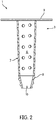
- Fig. 2 shows a cross sectional view of the dental device (1) of Fig. 1 .
- the dental device (1) has a flat surface (9) formed onto the top of the screw (3), which can serve as barrier itself or as a support for a dental barrier membrane.
- the dental barrier membrane is used for covering the socket (2).
- the flat surface (9) has a size and shape adapted to support the dental barrier membrane like an underlay.
- the flat surfaces (9) have different predetermined sizes and shapes to cover all anatomical cases corresponding to different socket (2) sizes and shapes respectively.
- the flat surface (9) and the screw (3) including the hollow (6) and the pores (7) are provided as an integral piece from the biodegradable material(s), preferably from a magnesium alloy.
- the screw (3) has a perforated structure surrounding the hollow (6).
- the perforated structure forms the pores (7) in the screw (3) for blood perfusion.
- the screw (3) has an opening (10) in the apical end to allow blood perfusion from the jaw bone (4) into the hollow (6). And the screw (3) is closed on the distal end to prevent intrusion of soft tissue and the like into the hollow (6).
- the dental device (1) can be used in fresh extractions sites prior to an implantation.
- the dentist determines the depth, size and shape of the socket (2) and selects a dental device (1) with the correctly matching length, diameter, size and shape.
- the screw (3) is inserted into the socket (2) such that the upper end is at the same level with the alveolar ridge (5).
- a dental barrier membrane is optionally placed on the flat surface (9) and fixed in place by the gingival flaps (11) in the surrounding gingiva.
- the dental device (1) is completely resorbed and no removal surgery is necessary.
- an implant can be inserted into the regenerated jaw bone. With the present invention the implant failure rate can be significantly reduced.
Landscapes
- Health & Medical Sciences (AREA)
- Life Sciences & Earth Sciences (AREA)
- Veterinary Medicine (AREA)
- Public Health (AREA)
- General Health & Medical Sciences (AREA)
- Animal Behavior & Ethology (AREA)
- Epidemiology (AREA)
- Orthopedic Medicine & Surgery (AREA)
- Oral & Maxillofacial Surgery (AREA)
- Dentistry (AREA)
- Engineering & Computer Science (AREA)
- Heart & Thoracic Surgery (AREA)
- Vascular Medicine (AREA)
- Biomedical Technology (AREA)
- Surgery (AREA)
- Ceramic Engineering (AREA)
- Chemical & Material Sciences (AREA)
- Developmental Biology & Embryology (AREA)
- Medicinal Chemistry (AREA)
- Pharmacology & Pharmacy (AREA)
- Cardiology (AREA)
- Immunology (AREA)
- Proteomics, Peptides & Aminoacids (AREA)
- Gastroenterology & Hepatology (AREA)
- Zoology (AREA)
- Bioinformatics & Cheminformatics (AREA)
- Transplantation (AREA)
- Dispersion Chemistry (AREA)
- Molecular Biology (AREA)
- Inorganic Chemistry (AREA)
- Dental Prosthetics (AREA)
- Materials For Medical Uses (AREA)
Abstract
Dental device (1) for ridge preservation around the socket (2) of an extracted tooth and for promoting jaw bone regeneration inside the socket (2) of the extracted tooth. The dental device (1) comprises: a screw (3) which is entirely made of a biodegradable material to eliminate the need for a removal surgery, wherein the screw (3) is adapted for tight fixation within the jaw bone (4) in the socket (2) to prevent micromovements during bone-tissue regeneration, wherein the screw (2) has a length such that its top is, in the inserted state, flush with the alveolar ridge (5) around the socket (2) to promote full bone regeneration inside the socket (2), and wherein the screw (3) has a hollow (6) and pores (7) to allow blood perfusion into the hollow (6) for formation of blood coagulum to serve as biological matrix for bone growth inside the socket (2).
Description
- The present invention relates to dental techniques for ridge preservation and promotion of jaw bone regeneration in extraction sites prior to an implantation. The present invention more particularly relates to dental devices for ridge preservation around the socket of an extracted tooth and for promoting the jaw bone regeneration inside the socket of the extracted tooth prior to an implantation.
- The immediate placement of dental implants into fresh extraction sockets is often disadvised as comparatively higher implant failure rates are observed in comparison to a successive socket healing and implantation procedure. An associated problem with this successive procedure is that the alveolar ridge surrounding the extraction socket is massively resorbed during the healing time. In the worst-case scenario, the remaining bone volume is insufficient to place an implant. For this reason, several ridge preservation techniques were proposed and developed to decrease jaw bone resorption. A wide range of ridge preservation techniques, such as socket filling with graft materials, collagen plugs and coverage with various membranes or gingiva punches were shown to be effective, however only to a limited extent. In these ridge preservation techniques, lateral (buccolingual) thinning of 2 to 3 mm and a loss of 1 to 2 mm vertical height cannot be prevented. These techniques all lack the effectiveness to preserve the original shape of the jaw. Thus, the dental clinical research community judges full ridge preservation as impossible.
-
WO 2016/134797 discloses a ridge preservation technique wherein a bone defect in the jaw bone is filled with bone graft material and covered with a bioresorbable magnesium membrane, and wherein the bioresorbable membrane is fixed to the jaw bone with pins, nails or screws made from a magnesium alloy. In such commonly known techniques of merely filling the defect with a particulate or moldable biomaterial and placing a bioresorbable membrane, it is likely that vertical collapses occur. Moreover, non-stabilized graft materials are subject to displacement upon exposure to chewing forces. It is also known that micromovement of the substrate during tissue regeneration favors the growth of soft tissue versus new bone tissue. Furthermore, poor nutrient perfusion within bone graft material is especially observed with dense putties. The commonly known ridge preservation techniques provide limited blood supply and consequently slow bone growth during the healing phase. - An objective of the present invention is to overcome the disadvantages of the prior art in an effective way and to provide a dental device for ridge preservation and promotion of jaw bone regeneration in an extraction site.
- This objective is achieved by the dental device as defined in
claim 1. The dependent claims define further developments which have been achieved through the present invention. - According to the present invention the dental device has a screw that is entirely made of a biodegradable material to eliminate the need for a removal surgery. The screw is adapted for tight fixation within the jaw bone in the socket to prevent micromovements during bone tissue regeneration. The screw has a length such that its top, in the inserted state, is at the same level with the alveolar ridge around the socket to promote full bone regeneration inside the socket. And the screw has a hollow and pores to allow blood perfusion into the hollow for the formation of blood coagulum to serve as a biological matrix for bone growth inside the socket.
- The dental device of the present invention provides an effective technique for ridge preservation and promotion of jaw bone regeneration in an extraction site. Since the screw is manufactured from a biodegradable material, it achieves a significant advantage over previous experimental approaches with titanium ceramic material that would need to remain in the patient for lifetime and would have caused a bad perception by the costumer and raised the concern of particle generation when drilling through the titanium ceramic material needed for implant placement. Since the dental device can be tightly inserted like a screw into the socket, it provides increased stability to the defect site during tissue regeneration and prevents the growth of soft tissue versus new bone tissue. In this respect, the screw provides an additional advantage in comparison to non-stabilized graft materials which are subject to displacement upon exposure to chewing forces. Since the screw serves as a post to maintain the height of the alveolar ridge, no vertical collapse will occur, the alveolar geometry of the baseline situation is maintained, the loss of bone height is prevented, and the original shape of the jaw can be preserved. This benefit is also of value in comparison with approaches where graft materials are used to underfill the membrane as graft material resorption still leads to a loss of vertical height. Since the screw has a hollow and pores, it allows blood perfusion and intimate connection to the blood clot and subsequent promotion of bone regeneration.
- According to the present invention, to cover various anatomical cases corresponding to different socket depths and sizes, the screw of the dental device may be provided in different predetermined lengths and diameters to allow adjustment to the individual socket depths and sizes respectively. Thereby, the dentist can apply the dental device in accordance with the need of the patient.
- According to the present invention, the dental device may be manufactured from any type of resorbable material offering the appropriate mechanical properties. For example, biodegradable metals and/or biodegradable polymers may be used.
- According to the present invention, different parts of the screw may be manufactured from biodegradable materials with different composition and density. Thereby the resorption rates throughout the screw can be adjusted to achieve uniform healing inside the socket. Thereby, also the mechanical strength can be adjusted throughout the screw.
- According to the present invention, the dental device may be manufactured from magnesium or a magnesium alloy. In this respect, an advantageous effect is achieved as the degradation of the screw leads to deliberation of osteopromotive magnesium ions. It is well-known that magnesium triggers molecular pathways for new bone formation and that magnesium can increase the performance of calcium phosphate bone graft materials in vivo. Thus, the present invention provides the best-known bone formation environment, and a biological stimulus.
- According to the present invention, aside from magnesium, other bone formation promoting elements such as strontium may be included into the biodegradable magnesium alloy.
- According to the present invention, the screw, particularly the surface of the screw may be enriched with antibiotic agents or growth factors which promote bone formation.
- According to the present invention, the threads of the screw may be formed into the apical end to allow adjustment of the level of the distal end to match the height of the alveolar ridge during insertion. The threads of the screw of the dental device serve for tight fixation within the socket either in a self-tapping or pre-tapping manner.
- According to the present invention a flat surface is formed on the top of the screw to serve as an underlay for a separate dental barrier membrane. Alternatively, the flat surface may be formed with a size and shape large enough to cover the socket itself to serve as a barrier. The flat surface may have different predetermined sizes and shapes to cover all anatomical cases corresponding to different socket sizes and shapes respectively. Herein any dental barrier membrane commonly known to those skilled in the art can be used with the dental device. The dental barrier membrane may be further fixed in place through the gingival flaps around the socket. Similarly, the flat surface of the screw can be covered with the gingival flaps around the socket.
- According to the present invention, the dental device is an integral piece wherein the flat surface and the screw including the hollow and the pores are formed from one or more biodegradable materials.
- According to the present invention, the screw may have a uniform grid like structure or a perforated structure surrounding the hollow to form the pores. The size of the pores should be relatively small to improve mechanical strength; however, the pores must also be sufficiently large to allow blood perfusion into the hollow. Herein, the pores each may have a size of preferably 0.005 to 3 millimeters.
- According to the present invention, the screw may have an opening in the apical end to allow blood perfusion from the jaw bone into the hollow whereas the distal end of the screw, particularly the flat surface is preferably closed to prevent intrusion of soft tissue, or impurities and the like into the hollow.
- In the subsequent description, the present invention will be described in more detail by using exemplary embodiments and by referring to the drawings, wherein
-
Fig.1 - is a schematic perspective cutaway view of a tooth extraction site into which a dental device according to an embodiment of the present invention has been inserted; -
Fig.2 - is a schematic cross-sectional view of the dental device according to the embodiment of the present invention. - The reference numbers shown in the drawings denote the elements as listed below and will be referred to in the subsequent description of the exemplary embodiments.
- 1. Dental device
- 2. Socket
- 3. Screw
- 4. Jaw bone
- 5. Alveolar ridge
- 6. Hollow
- 7. Pore
- 8. Thread
- 9. Flat surface
- 10. Opening
- 11. Gingival flap
-
Fig. 1 shows a dental device (1) for ridge preservation around the socket (2) of an extracted tooth and for promoting jaw bone regeneration inside the socket (2) of the extracted tooth according to an embodiment of the present invention. The dental device (1) has a screw (3) which is entirely made of a biodegradable material. The screw (3) is adapted for tight fixation within the jaw bone (4) in the socket (2). The screw (3) has a length such that its top, in the inserted state, is flush with the alveolar ridge (5) around the socket (2). The screw (3) has a hollow (6) and pores (7) to allow blood perfusion into the hollow (6). - In alternative versions of this embodiment (not shown), the screws (3) have different predetermined lengths and diameters to cover all anatomical cases corresponding to different socket (2) depths and sizes respectively.
- The biodegradable material is preferably polymer-based and/or metal-based. The biodegradable material preferably includes magnesium and/or strontium. The biodegradable material may also include growth factors and/or antibiotic agents within or on the surface of the screw (3). Different parts of the screw (3) may be manufactured from biodegradable materials with different composition and/or density.
- In this embodiment, the threads (8) of the screw (3) are adapted for pre-tapping. Alternatively, the threads (8) of the screw (3) may be adapted for self-tapping.
-
Fig. 2 shows a cross sectional view of the dental device (1) ofFig. 1 . As shown inFig. 2 the dental device (1) has a flat surface (9) formed onto the top of the screw (3), which can serve as barrier itself or as a support for a dental barrier membrane. The dental barrier membrane is used for covering the socket (2). The flat surface (9) has a size and shape adapted to support the dental barrier membrane like an underlay. - In alternative versions of this embodiment, the flat surfaces (9) have different predetermined sizes and shapes to cover all anatomical cases corresponding to different socket (2) sizes and shapes respectively.
- As shown in
Fig. 2 , the flat surface (9) and the screw (3) including the hollow (6) and the pores (7) are provided as an integral piece from the biodegradable material(s), preferably from a magnesium alloy. - A shown in
Fig. 2 , the screw (3) has a perforated structure surrounding the hollow (6). The perforated structure forms the pores (7) in the screw (3) for blood perfusion. - A shown in
Fig. 2 , the screw (3) has an opening (10) in the apical end to allow blood perfusion from the jaw bone (4) into the hollow (6). And the screw (3) is closed on the distal end to prevent intrusion of soft tissue and the like into the hollow (6). - The dental device (1) can be used in fresh extractions sites prior to an implantation. The dentist determines the depth, size and shape of the socket (2) and selects a dental device (1) with the correctly matching length, diameter, size and shape. Thereafter the screw (3) is inserted into the socket (2) such that the upper end is at the same level with the alveolar ridge (5). Next a dental barrier membrane is optionally placed on the flat surface (9) and fixed in place by the gingival flaps (11) in the surrounding gingiva. When the extraction site is healed, the dental device (1) is completely resorbed and no removal surgery is necessary. Thereafter an implant can be inserted into the regenerated jaw bone. With the present invention the implant failure rate can be significantly reduced.
Claims (15)
- A dental device (1) for ridge preservation around the socket (2) of an extracted tooth and for promoting jaw bone regeneration inside the socket (2) of the extracted tooth, the dental device (1) characterized by comprising:a screw (3) which is entirely made of a biodegradable material to eliminate the need for a removal surgery,wherein the screw (3) is adapted for tight fixation within the jaw bone (4) in the socket (2) to prevent micromovements during bone-tissue regeneration,wherein the screw (2) has a length such that its top is, in the inserted state, at the same level with the alveolar ridge (5) around the socket (2) to promote full bone regeneration inside the socket (2), andwherein the screw (3) has a hollow (6) and pores (7) to allow blood perfusion into the hollow (6) for the formation of blood coagulum to serve as biological matrix for bone growth inside the socket (2).
- The dental device (1) according to claim 1, characterized in that the length and/or diameter of the screw (3) is provided with either one of a plurality of predetermined lengths and/or diameters to cover all anatomical cases corresponding to different socket (2) depths and sizes respectively.
- The dental device (1) according to claim 1 or 2, characterized in that the biodegradable material is polymer-based and/or metal-based.
- The dental device (1) according to claim 3, characterized in that the biodegradable material comprises magnesium.
- The dental device (1) according to claim 3 or 4, characterized in that biodegradable material comprises strontium.
- The dental device (1) according to any one of claims 1 to 5, characterized in that biodegradable material comprises growth factors and/or antibiotic agents.
- The dental device (1) according to claim 6, characterized in that the growth factors and/or antibiotic agents are deposited on the surface of the screw (3).
- The dental device (1) according to any one of claims 1 to 7, characterized in that the threads (8) of the screw (3) are adapted for self-tapping
- The dental device (1) according to any one of claims 1 to 7, characterized in that the threads (8) of the screw (3) are adapted for pre-tapping.
- The dental device (1) according to any one of claims 1 to 9, characterized by further comprising a flat surface (9) formed onto the top of the screw (3).
- The dental device (1) according to claim 10, characterized by further comprising: a dental barrier membrane for covering the socket (2), wherein the flat surface (9) has a size and shape adapted to support the dental barrier membrane.
- The dental device according to claim 10 or 11, characterized in that the flat surface (9) has either one of different predetermined sizes and shapes to cover all anatomical cases corresponding to different socket (2) sizes and shapes respectively.
- The dental device according to any one of claims 10 to 12, characterized in that the flat surface (9) and the screw (3) including the hollow (6) and the pores (7) are provided as an integral piece manufactured from the biodegradable material.
- The dental device (1) according to any one of claims 1 to 13, characterized in that the screw (3) has a grid like or a perforated structure surrounding the hollow (6).
- The dental device (1) according to any one of claims 1 to 14, characterized in that the screw (3) has an opening (10) in the apical end to allow blood perfusion from the jaw bone (4) into the hollow (6), and wherein the screw (3) is closed on the distal end to prevent intrusion of soft-tissue and the like into the hollow (6).
Priority Applications (9)
| Application Number | Priority Date | Filing Date | Title |
|---|---|---|---|
| EP19020081.6A EP3698750A1 (en) | 2019-02-21 | 2019-02-21 | Dental device for ridge preservation and promotion of jaw bone regeneration in an extraction site |
| PCT/EP2020/053914 WO2020169475A1 (en) | 2019-02-21 | 2020-02-14 | Dental device for ridge preservation and promotion of jaw bone regeneration in an extraction site |
| EP20704042.9A EP3927277B1 (en) | 2019-02-21 | 2020-02-14 | Dental device for ridge preservation and promotion of jaw bone regeneration in an extraction site |
| JP2021549326A JP7597721B2 (en) | 2019-02-21 | 2020-02-14 | Dental device for preserving alveolar crests at tooth extraction sites and for promoting jawbone regeneration |
| BR112021015550-3A BR112021015550A2 (en) | 2019-02-21 | 2020-02-14 | DENTAL DEVICE FOR CREST PRESERVATION AND PROMOTION OF BONE REGENERATION OF THE JAW IN AN EXTRACTION FIELD |
| CA3138474A CA3138474A1 (en) | 2019-02-21 | 2020-02-14 | Dental device for ridge preservation and promotion of jaw bone regeneration in an extraction site |
| US17/432,509 US12558196B2 (en) | 2019-02-21 | 2020-02-14 | Dental device for ridge preservation and promotion of jaw bone regeneration in an extraction site |
| KR1020217027995A KR102778865B1 (en) | 2019-02-21 | 2020-02-14 | Dental device for promoting jaw bone regeneration and preserving ridges at extraction sites |
| CN202080015625.9A CN113473943B (en) | 2019-02-21 | 2020-02-14 | Dental device used to preserve the alveolar ridge and promote jaw bone regeneration at tooth extraction sites |
Applications Claiming Priority (1)
| Application Number | Priority Date | Filing Date | Title |
|---|---|---|---|
| EP19020081.6A EP3698750A1 (en) | 2019-02-21 | 2019-02-21 | Dental device for ridge preservation and promotion of jaw bone regeneration in an extraction site |
Publications (1)
| Publication Number | Publication Date |
|---|---|
| EP3698750A1 true EP3698750A1 (en) | 2020-08-26 |
Family
ID=65520038
Family Applications (2)
| Application Number | Title | Priority Date | Filing Date |
|---|---|---|---|
| EP19020081.6A Withdrawn EP3698750A1 (en) | 2019-02-21 | 2019-02-21 | Dental device for ridge preservation and promotion of jaw bone regeneration in an extraction site |
| EP20704042.9A Active EP3927277B1 (en) | 2019-02-21 | 2020-02-14 | Dental device for ridge preservation and promotion of jaw bone regeneration in an extraction site |
Family Applications After (1)
| Application Number | Title | Priority Date | Filing Date |
|---|---|---|---|
| EP20704042.9A Active EP3927277B1 (en) | 2019-02-21 | 2020-02-14 | Dental device for ridge preservation and promotion of jaw bone regeneration in an extraction site |
Country Status (8)
| Country | Link |
|---|---|
| US (1) | US12558196B2 (en) |
| EP (2) | EP3698750A1 (en) |
| JP (1) | JP7597721B2 (en) |
| KR (1) | KR102778865B1 (en) |
| CN (1) | CN113473943B (en) |
| BR (1) | BR112021015550A2 (en) |
| CA (1) | CA3138474A1 (en) |
| WO (1) | WO2020169475A1 (en) |
Cited By (1)
| Publication number | Priority date | Publication date | Assignee | Title |
|---|---|---|---|---|
| US12558196B2 (en) | 2019-02-21 | 2026-02-24 | Dentsply Sirona Inc. | Dental device for ridge preservation and promotion of jaw bone regeneration in an extraction site |
Families Citing this family (4)
| Publication number | Priority date | Publication date | Assignee | Title |
|---|---|---|---|---|
| KR102878237B1 (en) * | 2022-02-15 | 2025-10-29 | 주식회사 바이오템 | Bone Screw for 3D osteoinduction Regeneration |
| CN114948319B (en) * | 2022-06-29 | 2024-10-29 | 徐州市口腔医院 | Filling method of PCL bracket of tooth extraction position |
| US11872105B1 (en) * | 2022-12-01 | 2024-01-16 | Robert Parker | Dental implant device for regeneration of dental pulp and dentin |
| CN116276765A (en) * | 2023-02-10 | 2023-06-23 | 马瑞利汽车零部件(芜湖)有限公司 | Method and device for preventing screws from falling into unintended positions during component assembly |
Citations (5)
| Publication number | Priority date | Publication date | Assignee | Title |
|---|---|---|---|---|
| EP0131831A2 (en) * | 1983-07-08 | 1985-01-23 | W.L. Gore & Associates, Inc. | Dental implant device |
| DE19713305A1 (en) * | 1997-03-29 | 1998-10-01 | Wilfried Prof Dr Med D Engelke | Resorbable obturator for bone regeneration, requiring less preparation than titanium type |
| WO2007086832A2 (en) * | 2006-01-13 | 2007-08-02 | Biodynamics, L.L.C | Surgical fasteners and related implant devices having bioabsorbable components |
| JP2014113592A (en) * | 2008-05-12 | 2014-06-26 | Asahi Kasei Chemicals Corp | Porous molding having high adsorption performance, and method for producing the same |
| WO2016134797A1 (en) | 2015-02-24 | 2016-09-01 | botiss biomaterials GmbH | Implant for covering maxillary bone defects and method for producing the same |
Family Cites Families (18)
| Publication number | Priority date | Publication date | Assignee | Title |
|---|---|---|---|---|
| US5957690A (en) | 1997-11-17 | 1999-09-28 | Bartee; Barry K. | Textured high density PTFE medical barrier |
| CA2235705A1 (en) * | 1998-04-23 | 1999-10-23 | Douglas Alan Schappert | Integral guided tissue regeneration barrier for root-form dental implant |
| US6325627B1 (en) * | 1999-10-20 | 2001-12-04 | Arthur Ashman | Method and apparatus for performing ridge preservation and implant treatment |
| EP1185213A1 (en) * | 2000-02-21 | 2002-03-13 | Sang-Kohn Chang | The method and its materials for alveolar ridge protection |
| IL142933A0 (en) | 2001-05-03 | 2002-04-21 | Dentis Technology Ltd | Polymeric dental implant and method for use thereof |
| US20030232308A1 (en) * | 2002-06-14 | 2003-12-18 | Simmons Earl Wayne | Method and apparatus for dental implants |
| DE102005039382B4 (en) * | 2005-08-19 | 2008-03-13 | Detzer, Fritz, Dr. med. dent. | Hollow body made of biodegradable material, in particular for bone formation in the jawbone of a patient and its use |
| WO2009118725A1 (en) * | 2008-03-23 | 2009-10-01 | Shay Kahana | Tooth socket covering |
| US8231387B2 (en) * | 2008-07-02 | 2012-07-31 | Zimmer, Inc. | Porous implant with non-porous threads |
| US8562348B2 (en) * | 2008-07-02 | 2013-10-22 | Zimmer Dental, Inc. | Modular implant with secured porous portion |
| US20110111359A1 (en) * | 2009-11-09 | 2011-05-12 | Weathers Jr Arthur Kitchings | Dental extracted tooth replacement method |
| TW201121517A (en) * | 2009-12-16 | 2011-07-01 | Xin-Wu Mi | Implant device. |
| EP3391850B1 (en) * | 2011-04-14 | 2020-02-19 | Dentsply IH AB | Fixture element |
| CN203458491U (en) * | 2013-08-28 | 2014-03-05 | 章锦才 | Supporting retention screw assembly of barrier membrane for regenerating alveolar bone |
| WO2015106247A1 (en) * | 2014-01-13 | 2015-07-16 | Westover Brock B | Endosseous dental implant assembly |
| WO2015138657A1 (en) * | 2014-03-11 | 2015-09-17 | Ohio State Innovation Foundation | Methods, devices, and manufacture of the devices for musculoskeletal reconstructive surgery |
| KR101779980B1 (en) * | 2015-12-15 | 2017-09-19 | 서울대학교산학협력단 | One Piece Hybrid Dental Implant |
| EP3698750A1 (en) | 2019-02-21 | 2020-08-26 | DENTSPLY SIRONA Inc. | Dental device for ridge preservation and promotion of jaw bone regeneration in an extraction site |
-
2019
- 2019-02-21 EP EP19020081.6A patent/EP3698750A1/en not_active Withdrawn
-
2020
- 2020-02-14 WO PCT/EP2020/053914 patent/WO2020169475A1/en not_active Ceased
- 2020-02-14 JP JP2021549326A patent/JP7597721B2/en active Active
- 2020-02-14 BR BR112021015550-3A patent/BR112021015550A2/en not_active Application Discontinuation
- 2020-02-14 CA CA3138474A patent/CA3138474A1/en active Pending
- 2020-02-14 US US17/432,509 patent/US12558196B2/en active Active
- 2020-02-14 EP EP20704042.9A patent/EP3927277B1/en active Active
- 2020-02-14 KR KR1020217027995A patent/KR102778865B1/en active Active
- 2020-02-14 CN CN202080015625.9A patent/CN113473943B/en not_active Expired - Fee Related
Patent Citations (5)
| Publication number | Priority date | Publication date | Assignee | Title |
|---|---|---|---|---|
| EP0131831A2 (en) * | 1983-07-08 | 1985-01-23 | W.L. Gore & Associates, Inc. | Dental implant device |
| DE19713305A1 (en) * | 1997-03-29 | 1998-10-01 | Wilfried Prof Dr Med D Engelke | Resorbable obturator for bone regeneration, requiring less preparation than titanium type |
| WO2007086832A2 (en) * | 2006-01-13 | 2007-08-02 | Biodynamics, L.L.C | Surgical fasteners and related implant devices having bioabsorbable components |
| JP2014113592A (en) * | 2008-05-12 | 2014-06-26 | Asahi Kasei Chemicals Corp | Porous molding having high adsorption performance, and method for producing the same |
| WO2016134797A1 (en) | 2015-02-24 | 2016-09-01 | botiss biomaterials GmbH | Implant for covering maxillary bone defects and method for producing the same |
Non-Patent Citations (1)
| Title |
|---|
| COCHRAN D L ET AL: "BONE RESPONSE TO UNLOADED AND LOADED TITANIUM IMPLANTS WITH A SANDBLASTED AND ACID-ETCHED SURFACE: A HISTOMETRIC STUDY IN THE CANINE MANDIBLE", JOURNAL OF BIOMEDICAL MATERIALS RESEARCH, WILEY, NEW YORK, NY, US, vol. 40, 1 January 1998 (1998-01-01), pages 1 - 11, XP001117684, ISSN: 0021-9304, DOI: 10.1002/(SICI)1097-4636(199804)40:1<1::AID-JBM1>3.0.CO;2-Q * |
Cited By (1)
| Publication number | Priority date | Publication date | Assignee | Title |
|---|---|---|---|---|
| US12558196B2 (en) | 2019-02-21 | 2026-02-24 | Dentsply Sirona Inc. | Dental device for ridge preservation and promotion of jaw bone regeneration in an extraction site |
Also Published As
| Publication number | Publication date |
|---|---|
| EP3927277B1 (en) | 2025-10-15 |
| CN113473943A (en) | 2021-10-01 |
| WO2020169475A1 (en) | 2020-08-27 |
| CN113473943B (en) | 2023-09-29 |
| US12558196B2 (en) | 2026-02-24 |
| US20220151740A1 (en) | 2022-05-19 |
| JP7597721B2 (en) | 2024-12-10 |
| EP3927277A1 (en) | 2021-12-29 |
| KR102778865B1 (en) | 2025-03-07 |
| JP2022521304A (en) | 2022-04-06 |
| KR20210128417A (en) | 2021-10-26 |
| BR112021015550A2 (en) | 2021-10-05 |
| CA3138474A1 (en) | 2020-08-27 |
Similar Documents
| Publication | Publication Date | Title |
|---|---|---|
| US12558196B2 (en) | Dental device for ridge preservation and promotion of jaw bone regeneration in an extraction site | |
| US5700479A (en) | Surgical element and method for selective tissue regeneration | |
| Artzi et al. | Bovine‐HA spongiosa blocks and immediate implant placement in sinus augmentation procedures: Histopathological and histomorphometric observations on different histological stainings in 10 consecutive patients | |
| US8128402B2 (en) | Tubular bone anchoring element | |
| JP6450712B2 (en) | Extraction site alveolar cage | |
| US20230210639A1 (en) | Dental support screw | |
| US20100114314A1 (en) | Expandable bone implant | |
| CN109069230B (en) | Integrated hybrid dental implant | |
| EP2523615A1 (en) | Method and apparatus for bone distraction | |
| US20170014209A1 (en) | Periodontal Subperiosteal Tunnel Bone Graft Technique | |
| US20160128834A1 (en) | Scaffold implant system | |
| WO2007081931A2 (en) | Method and device for regenerating bone in preparation for dental implant. | |
| US20240382290A1 (en) | Inner porous screw type implant | |
| WO2009118725A1 (en) | Tooth socket covering | |
| CN213489420U (en) | A Temporary Implant for Oral Implant Bone Augmentation | |
| Benetti et al. | GUIDED TISSUE REGENERATION IN MAXILLOFACIAL SURGERY | |
| Haggag | Is it enough to just increase the height of sub-antral bone during maxillary sinus augmentation or dose its depth matter? | |
| Le et al. | Single‐Stage Implant Placement and Simultaneous Grafting: The “Esthetic Contour Graft” | |
| Gutta | Barrier Membranes For Ridge Augmentation-Is There An Optimal Pore Size? |
Legal Events
| Date | Code | Title | Description |
|---|---|---|---|
| PUAI | Public reference made under article 153(3) epc to a published international application that has entered the european phase |
Free format text: ORIGINAL CODE: 0009012 |
|
| STAA | Information on the status of an ep patent application or granted ep patent |
Free format text: STATUS: THE APPLICATION HAS BEEN PUBLISHED |
|
| AK | Designated contracting states |
Kind code of ref document: A1 Designated state(s): AL AT BE BG CH CY CZ DE DK EE ES FI FR GB GR HR HU IE IS IT LI LT LU LV MC MK MT NL NO PL PT RO RS SE SI SK SM TR |
|
| AX | Request for extension of the european patent |
Extension state: BA ME |
|
| STAA | Information on the status of an ep patent application or granted ep patent |
Free format text: STATUS: THE APPLICATION IS DEEMED TO BE WITHDRAWN |
|
| 18D | Application deemed to be withdrawn |
Effective date: 20210227 |