EP3697410B1 - Benzimidazole derivatives and their uses - Google Patents
Benzimidazole derivatives and their uses Download PDFInfo
- Publication number
- EP3697410B1 EP3697410B1 EP18867844.5A EP18867844A EP3697410B1 EP 3697410 B1 EP3697410 B1 EP 3697410B1 EP 18867844 A EP18867844 A EP 18867844A EP 3697410 B1 EP3697410 B1 EP 3697410B1
- Authority
- EP
- European Patent Office
- Prior art keywords
- benzo
- imidazol
- methyl
- amino
- fluoropiperidin
- Prior art date
- Legal status (The legal status is an assumption and is not a legal conclusion. Google has not performed a legal analysis and makes no representation as to the accuracy of the status listed.)
- Active
Links
Classifications
-
- A—HUMAN NECESSITIES
- A61—MEDICAL OR VETERINARY SCIENCE; HYGIENE
- A61K—PREPARATIONS FOR MEDICAL, DENTAL OR TOILETRY PURPOSES
- A61K31/00—Medicinal preparations containing organic active ingredients
- A61K31/33—Heterocyclic compounds
- A61K31/395—Heterocyclic compounds having nitrogen as a ring hetero atom, e.g. guanethidine or rifamycins
- A61K31/435—Heterocyclic compounds having nitrogen as a ring hetero atom, e.g. guanethidine or rifamycins having six-membered rings with one nitrogen as the only ring hetero atom
- A61K31/4353—Heterocyclic compounds having nitrogen as a ring hetero atom, e.g. guanethidine or rifamycins having six-membered rings with one nitrogen as the only ring hetero atom ortho- or peri-condensed with heterocyclic ring systems
- A61K31/437—Heterocyclic compounds having nitrogen as a ring hetero atom, e.g. guanethidine or rifamycins having six-membered rings with one nitrogen as the only ring hetero atom ortho- or peri-condensed with heterocyclic ring systems the heterocyclic ring system containing a five-membered ring having nitrogen as a ring hetero atom, e.g. indolizine, beta-carboline
-
- A—HUMAN NECESSITIES
- A61—MEDICAL OR VETERINARY SCIENCE; HYGIENE
- A61K—PREPARATIONS FOR MEDICAL, DENTAL OR TOILETRY PURPOSES
- A61K31/00—Medicinal preparations containing organic active ingredients
- A61K31/33—Heterocyclic compounds
- A61K31/395—Heterocyclic compounds having nitrogen as a ring hetero atom, e.g. guanethidine or rifamycins
- A61K31/435—Heterocyclic compounds having nitrogen as a ring hetero atom, e.g. guanethidine or rifamycins having six-membered rings with one nitrogen as the only ring hetero atom
- A61K31/44—Non condensed pyridines; Hydrogenated derivatives thereof
- A61K31/445—Non condensed piperidines, e.g. piperocaine
- A61K31/4523—Non condensed piperidines, e.g. piperocaine containing further heterocyclic ring systems
- A61K31/4545—Non condensed piperidines, e.g. piperocaine containing further heterocyclic ring systems containing a six-membered ring with nitrogen as a ring hetero atom, e.g. pipamperone, anabasine
-
- A—HUMAN NECESSITIES
- A61—MEDICAL OR VETERINARY SCIENCE; HYGIENE
- A61K—PREPARATIONS FOR MEDICAL, DENTAL OR TOILETRY PURPOSES
- A61K31/00—Medicinal preparations containing organic active ingredients
- A61K31/33—Heterocyclic compounds
- A61K31/395—Heterocyclic compounds having nitrogen as a ring hetero atom, e.g. guanethidine or rifamycins
- A61K31/495—Heterocyclic compounds having nitrogen as a ring hetero atom, e.g. guanethidine or rifamycins having six-membered rings with two or more nitrogen atoms as the only ring heteroatoms, e.g. piperazine or tetrazines
- A61K31/505—Pyrimidines; Hydrogenated pyrimidines, e.g. trimethoprim
- A61K31/506—Pyrimidines; Hydrogenated pyrimidines, e.g. trimethoprim not condensed and containing further heterocyclic rings
-
- A—HUMAN NECESSITIES
- A61—MEDICAL OR VETERINARY SCIENCE; HYGIENE
- A61P—SPECIFIC THERAPEUTIC ACTIVITY OF CHEMICAL COMPOUNDS OR MEDICINAL PREPARATIONS
- A61P13/00—Drugs for disorders of the urinary system
- A61P13/12—Drugs for disorders of the urinary system of the kidneys
-
- C—CHEMISTRY; METALLURGY
- C07—ORGANIC CHEMISTRY
- C07D—HETEROCYCLIC COMPOUNDS
- C07D401/00—Heterocyclic compounds containing two or more hetero rings, having nitrogen atoms as the only ring hetero atoms, at least one ring being a six-membered ring with only one nitrogen atom
- C07D401/02—Heterocyclic compounds containing two or more hetero rings, having nitrogen atoms as the only ring hetero atoms, at least one ring being a six-membered ring with only one nitrogen atom containing two hetero rings
- C07D401/04—Heterocyclic compounds containing two or more hetero rings, having nitrogen atoms as the only ring hetero atoms, at least one ring being a six-membered ring with only one nitrogen atom containing two hetero rings directly linked by a ring-member-to-ring-member bond
-
- C—CHEMISTRY; METALLURGY
- C07—ORGANIC CHEMISTRY
- C07D—HETEROCYCLIC COMPOUNDS
- C07D401/00—Heterocyclic compounds containing two or more hetero rings, having nitrogen atoms as the only ring hetero atoms, at least one ring being a six-membered ring with only one nitrogen atom
- C07D401/14—Heterocyclic compounds containing two or more hetero rings, having nitrogen atoms as the only ring hetero atoms, at least one ring being a six-membered ring with only one nitrogen atom containing three or more hetero rings
-
- C—CHEMISTRY; METALLURGY
- C07—ORGANIC CHEMISTRY
- C07D—HETEROCYCLIC COMPOUNDS
- C07D403/00—Heterocyclic compounds containing two or more hetero rings, having nitrogen atoms as the only ring hetero atoms, not provided for by group C07D401/00
- C07D403/02—Heterocyclic compounds containing two or more hetero rings, having nitrogen atoms as the only ring hetero atoms, not provided for by group C07D401/00 containing two hetero rings
- C07D403/04—Heterocyclic compounds containing two or more hetero rings, having nitrogen atoms as the only ring hetero atoms, not provided for by group C07D401/00 containing two hetero rings directly linked by a ring-member-to-ring-member bond
-
- C—CHEMISTRY; METALLURGY
- C07—ORGANIC CHEMISTRY
- C07D—HETEROCYCLIC COMPOUNDS
- C07D405/00—Heterocyclic compounds containing both one or more hetero rings having oxygen atoms as the only ring hetero atoms, and one or more rings having nitrogen as the only ring hetero atom
- C07D405/14—Heterocyclic compounds containing both one or more hetero rings having oxygen atoms as the only ring hetero atoms, and one or more rings having nitrogen as the only ring hetero atom containing three or more hetero rings
-
- C—CHEMISTRY; METALLURGY
- C07—ORGANIC CHEMISTRY
- C07D—HETEROCYCLIC COMPOUNDS
- C07D409/00—Heterocyclic compounds containing two or more hetero rings, at least one ring having sulfur atoms as the only ring hetero atoms
- C07D409/14—Heterocyclic compounds containing two or more hetero rings, at least one ring having sulfur atoms as the only ring hetero atoms containing three or more hetero rings
-
- C—CHEMISTRY; METALLURGY
- C07—ORGANIC CHEMISTRY
- C07D—HETEROCYCLIC COMPOUNDS
- C07D413/00—Heterocyclic compounds containing two or more hetero rings, at least one ring having nitrogen and oxygen atoms as the only ring hetero atoms
- C07D413/14—Heterocyclic compounds containing two or more hetero rings, at least one ring having nitrogen and oxygen atoms as the only ring hetero atoms containing three or more hetero rings
-
- C—CHEMISTRY; METALLURGY
- C07—ORGANIC CHEMISTRY
- C07D—HETEROCYCLIC COMPOUNDS
- C07D417/00—Heterocyclic compounds containing two or more hetero rings, at least one ring having nitrogen and sulfur atoms as the only ring hetero atoms, not provided for by group C07D415/00
- C07D417/14—Heterocyclic compounds containing two or more hetero rings, at least one ring having nitrogen and sulfur atoms as the only ring hetero atoms, not provided for by group C07D415/00 containing three or more hetero rings
-
- C—CHEMISTRY; METALLURGY
- C07—ORGANIC CHEMISTRY
- C07D—HETEROCYCLIC COMPOUNDS
- C07D471/00—Heterocyclic compounds containing nitrogen atoms as the only ring hetero atoms in the condensed system, at least one ring being a six-membered ring with one nitrogen atom, not provided for by groups C07D451/00 - C07D463/00
- C07D471/02—Heterocyclic compounds containing nitrogen atoms as the only ring hetero atoms in the condensed system, at least one ring being a six-membered ring with one nitrogen atom, not provided for by groups C07D451/00 - C07D463/00 in which the condensed system contains two hetero rings
- C07D471/04—Ortho-condensed systems
-
- C—CHEMISTRY; METALLURGY
- C07—ORGANIC CHEMISTRY
- C07D—HETEROCYCLIC COMPOUNDS
- C07D471/00—Heterocyclic compounds containing nitrogen atoms as the only ring hetero atoms in the condensed system, at least one ring being a six-membered ring with one nitrogen atom, not provided for by groups C07D451/00 - C07D463/00
- C07D471/02—Heterocyclic compounds containing nitrogen atoms as the only ring hetero atoms in the condensed system, at least one ring being a six-membered ring with one nitrogen atom, not provided for by groups C07D451/00 - C07D463/00 in which the condensed system contains two hetero rings
- C07D471/10—Spiro-condensed systems
-
- C—CHEMISTRY; METALLURGY
- C07—ORGANIC CHEMISTRY
- C07D—HETEROCYCLIC COMPOUNDS
- C07D487/00—Heterocyclic compounds containing nitrogen atoms as the only ring hetero atoms in the condensed system, not provided for by groups C07D451/00 - C07D477/00
- C07D487/02—Heterocyclic compounds containing nitrogen atoms as the only ring hetero atoms in the condensed system, not provided for by groups C07D451/00 - C07D477/00 in which the condensed system contains two hetero rings
-
- C—CHEMISTRY; METALLURGY
- C07—ORGANIC CHEMISTRY
- C07D—HETEROCYCLIC COMPOUNDS
- C07D487/00—Heterocyclic compounds containing nitrogen atoms as the only ring hetero atoms in the condensed system, not provided for by groups C07D451/00 - C07D477/00
- C07D487/02—Heterocyclic compounds containing nitrogen atoms as the only ring hetero atoms in the condensed system, not provided for by groups C07D451/00 - C07D477/00 in which the condensed system contains two hetero rings
- C07D487/04—Ortho-condensed systems
-
- C—CHEMISTRY; METALLURGY
- C07—ORGANIC CHEMISTRY
- C07D—HETEROCYCLIC COMPOUNDS
- C07D491/00—Heterocyclic compounds containing in the condensed ring system both one or more rings having oxygen atoms as the only ring hetero atoms and one or more rings having nitrogen atoms as the only ring hetero atoms, not provided for by groups C07D451/00 - C07D459/00, C07D463/00, C07D477/00 or C07D489/00
- C07D491/02—Heterocyclic compounds containing in the condensed ring system both one or more rings having oxygen atoms as the only ring hetero atoms and one or more rings having nitrogen atoms as the only ring hetero atoms, not provided for by groups C07D451/00 - C07D459/00, C07D463/00, C07D477/00 or C07D489/00 in which the condensed system contains two hetero rings
- C07D491/04—Ortho-condensed systems
- C07D491/044—Ortho-condensed systems with only one oxygen atom as ring hetero atom in the oxygen-containing ring
- C07D491/052—Ortho-condensed systems with only one oxygen atom as ring hetero atom in the oxygen-containing ring the oxygen-containing ring being six-membered
-
- C—CHEMISTRY; METALLURGY
- C07—ORGANIC CHEMISTRY
- C07D—HETEROCYCLIC COMPOUNDS
- C07D491/00—Heterocyclic compounds containing in the condensed ring system both one or more rings having oxygen atoms as the only ring hetero atoms and one or more rings having nitrogen atoms as the only ring hetero atoms, not provided for by groups C07D451/00 - C07D459/00, C07D463/00, C07D477/00 or C07D489/00
- C07D491/02—Heterocyclic compounds containing in the condensed ring system both one or more rings having oxygen atoms as the only ring hetero atoms and one or more rings having nitrogen atoms as the only ring hetero atoms, not provided for by groups C07D451/00 - C07D459/00, C07D463/00, C07D477/00 or C07D489/00 in which the condensed system contains two hetero rings
- C07D491/08—Bridged systems
-
- C—CHEMISTRY; METALLURGY
- C07—ORGANIC CHEMISTRY
- C07D—HETEROCYCLIC COMPOUNDS
- C07D491/00—Heterocyclic compounds containing in the condensed ring system both one or more rings having oxygen atoms as the only ring hetero atoms and one or more rings having nitrogen atoms as the only ring hetero atoms, not provided for by groups C07D451/00 - C07D459/00, C07D463/00, C07D477/00 or C07D489/00
- C07D491/02—Heterocyclic compounds containing in the condensed ring system both one or more rings having oxygen atoms as the only ring hetero atoms and one or more rings having nitrogen atoms as the only ring hetero atoms, not provided for by groups C07D451/00 - C07D459/00, C07D463/00, C07D477/00 or C07D489/00 in which the condensed system contains two hetero rings
- C07D491/10—Spiro-condensed systems
- C07D491/107—Spiro-condensed systems with only one oxygen atom as ring hetero atom in the oxygen-containing ring
-
- C—CHEMISTRY; METALLURGY
- C07—ORGANIC CHEMISTRY
- C07D—HETEROCYCLIC COMPOUNDS
- C07D495/00—Heterocyclic compounds containing in the condensed system at least one hetero ring having sulfur atoms as the only ring hetero atoms
- C07D495/02—Heterocyclic compounds containing in the condensed system at least one hetero ring having sulfur atoms as the only ring hetero atoms in which the condensed system contains two hetero rings
- C07D495/04—Ortho-condensed systems
-
- C—CHEMISTRY; METALLURGY
- C07—ORGANIC CHEMISTRY
- C07D—HETEROCYCLIC COMPOUNDS
- C07D498/00—Heterocyclic compounds containing in the condensed system at least one hetero ring having nitrogen and oxygen atoms as the only ring hetero atoms
- C07D498/02—Heterocyclic compounds containing in the condensed system at least one hetero ring having nitrogen and oxygen atoms as the only ring hetero atoms in which the condensed system contains two hetero rings
- C07D498/04—Ortho-condensed systems
Definitions
- the present invention relates generally to Transient Receptor Potential Canonical (TRPC) Channel proteins, and more particularly to inhibitors of Transient Receptor Potential Channel 6 (TRPC6) protein activity, pharmaceutical compositions comprising said inhibitors and to methods of using such inhibitors.
- TRPC Transient Receptor Potential Canonical
- TRPC6 Transient Receptor Potential Channel 6
- TRPC6 channel a member of the Transient receptor potential (TRP) family, which is a non-selective cation-permeable channel, is activated by diacylglycerol and the like produced by activation of phospholipase C and exerts physiological and pathophysiological effects.
- TRP Transient receptor potential
- TRPC6 has effects such as cardiac pathological hypertrophy and fibrosis, progression of myocardial damage in muscular dystrophy, acute pulmonary vasoconstriction, pathological progression in chronic hypoxia-induced pulmonary hypertension, allergic airway response, migration of cells such as neutrophils, increased permeability of endothelial cells on inflammation, pathological flattening of podocytes and progression of glomerular injury, and proliferation or infiltration of malignant tumors, and is diversely distributed in the brain, heart, lungs, kidneys, placenta, ovaries, spleen, and the like (see for example J. Clin. Invest. 116:3114-312,6, 2006 ; Dev. Cell. 23:705-715, 2012 ; Circ. Res.
- TRPC6 In familial focal segmental glomerulosclerosis (FSGS), gain-of-function mutants of TRPC6 have been identified, and in steroid resistant nephrotic syndrome or idiopathic pulmonary arterial hypertension patients, a single nucleotide polymorphism in the promoter region that increases mRNA expression of TRPC6 has been identified (see for example: Pediatr Res. 2013 Nov;74(5):511-6 and Circulation. 2009 May 5;119(17):2313-2322 ).
- FGS familial focal segmental glomerulosclerosis
- TRPC6 contributes to pathological progression of nephrotic syndrome, pulmonary hypertension and the like (see for example Science 308:1801-1804, 2005 ; Nat. Genet. 37:739-744, 2005 ; PLoS One 4: e7771, 2009 ; Clin. J. Am. Soc. Nephrol. 6:1139-1148, 2011 ; Mol. Biol. Cell. 22:1824-1835, 2011 ; BMC Nephrol. 14:104, 2013 ; Pediatr. Res. 74:511-516, 2013 ; and Nephrol. Dial. Transplant. 28:1830-1838, 2013 ).
- TRPC6 has been reported in minimal change nephrotic syndrome, membranous nephropathy, and diabetic nephropathy (see, )for example, Circulation 119:2313-2322, 2009 ; J. Am. Soc. Nephrol. 18:29-36, 2007 ; and Nephrol. Dial. Transplant. 27:921-929, 2012 ).
- EP2368876 discloses aminoindanes to treat diseases associated with TRPC6.
- New approaches are needed to modulate TRPC6 activity and more particularly inhibit TRPC6 activity in the prevention and/or treatment of nephrotic syndrome, minimal change disease, focal segmental glomerulosclerosis, collapsing glomerulopathy, membranous nephropathy, membranoproliferative glomerulonephritis, IGA nephropathy, acute renal failure, chronic renal failure, diabetic nephropathy, sepsis, pulmonary hypertension, acute lung disorder, acute respiratory distress syndrome (ARDS) heart failure, stroke, malignant tumor, and muscular dystrophy.
- ARDS acute respiratory distress syndrome
- the present invention provides compounds which inhibit TRPC proteins, and more specifically inhibit TRPC6 proteins.
- the present invention provides, in one aspect, benzimidazole compounds which inhibit TRPC6 activity. Inhibition of TRPC6 activity may be particularly desirable in the treatment or prevention of a variety of diseases including nephrotic syndrome, focal segmental glomerulosclerosis, membranous nephropathy, diabetic nephropathy, heart failure, stroke, acute lung injury, acute respiratory distress syndrome (ARDS) and acute renal failure.
- ARDS acute respiratory distress syndrome
- the invention provides, in one aspect, substituted benzimidazole compounds which modulate the activity of TRPC6.
- the substituted benzimidazole compounds of the invention are TRPC6 inhibitors.
- substituted benzimidazole compounds of the invention are compounds and salts according to Formula (I) ;
- compositions comprising a pharmaceutically acceptable excipient carrier or adjuvant and at least one compound of Formula (1) or subformulae thereof.
- Pharmaceutical compositions provided by the invention are suitable for use in the treatment of disease modulated by TRPC6 activity.
- the pharmaceutical compositions of the invention are suitable for use in the treatment of. e.g., treatment of nephrotic syndrome, minimal change disease, focal segmental glomerulosclerosis, collapsing glomerulopathy, membranous nephropathy.
- membranoprolilerative glomenilonephritis IGA nephropathy, acute renal failure, chronic renal failure, diabetic nephropathy, sepsis, pulmonary hypertension, acute lung disorder, licart failure, stroke, malignant tumor or muscular dystrophy.
- a packaged pharmaceutical composition comprising a pharmaceutical composition comprising a pharmaceutically acceptable excipient, carrier or adjuvant and at least one compound of formula (1) or subformulae thereof, and instructions for using the composition to treat a patient suffering from a disease mediated by TRPC6 activity or more particularly to treat a patient suffering from nephrotic syndrome, minimal change disease, focal segmental glomerulosclerosis, collapsing glomerulopathy, membranous nephropathy, membranoproliferative glomerulonephritis, IGA nephropathy, acute renal failure, chronic renal failure, diabetic nephropathy, sepsis, pulmonary hypertension, acute lung disorder, acute respiratory distress syndrome (ARDS) heart failure, stroke, malignant tumor or muscular dystrophy.
- the patient is suffering from nephrotic syndrome, membranous nephropathy, and acute renal failure.
- Also provided is a method of treating or preventing disease in a mammal which method comprises administering to a mammal in need thereof a therapeutically effective amount of at least one compound of formula (I) or subformulae thereof or a pharmaceutical composition comprising a pharmaceutically acceptable excipient, carrier or adjuvant and at least one compound of formula (I) or subformulae thereof.
- Also provided is a method for modulating TRPC6 activity in a mammal which method comprises administering to the mammal in need thereof a therapeutically effective amount of at least one compound of formula (I) or subformulae thereof or a pharmaceutical composition comprising a pharmaceutically acceptable excipient, carrier or adjuvant and at least one compound of formula (I) or subformulae thereof.
- Another aspect of the invention relates to a method of treating a TRPC6-mediated disease or disorder, the method comprising administering a TRPC'6 inhibitor of the invention to a patient in need of therapy.
- the TRPC6 mediated disease or disorder is selected from nephrotic syndrome, minimal change disease, focal segmental glomerulosclerosis, collapsing glomerulopathy, membranous nephropathy, membranoproliferative glomerulonephritis, IGA nephropathy, acute renal failure, chronic renal failure, diabetic nephropathy, sepsis, pulmonary hypertension, acute lung disorder, acute respiratory distress syndrome (ARDS), heart failure, stroke, malignant tumor or muscular dystrophy.
- the patient is suffering from nephrotic syndrome, membranous nephropathy, and acute renal failure .
- the invention related generally to compounds of Formula 1 and salts and tautomers thereof which inhibit TRPC protein activity and more particularly inhibit TRPC6 protein activity.
- the invention relates to compounds which selectively inhibit TRPC6 protein activity.
- the invention provides a compound or pharmaceutically acceptable salt thereof, according to Formula I: Wherein
- the proviso is presented in the first embodiment to specificially exclude and disclaim the identified compound which is indexed as CAS Number 1014407-24-9.
- compounds of Formula I include compounds of Formula Ia:
- the invention provides compounds of the first or second embodiment in which p is 0; R 1 is hydrogen, C 1 -C 6 alkyl, halogen or hydroxy; R 2 is aminoC 1 -C 4 alkyl; and R 3 and R 4 are hydrogen.
- the invention provides compounds of the first or second embodiment in which p is 0; R 1 and R 3 , taken in combination, form a fused C 3 -C 6 cycloalkyl ring or a fused 4 to 6 member azacycle ring, which cycloalkyl or azacycle is optionally substituted with amino; and R 2 and R 4 are hydrogen.
- the invention provides compounds of the fourth embodiment in which R 1 and R 3 taken in combination, form a fused pyrrolidine; and R 2 and R 4 are hydrogen.
- the invention provides compounds of the first or second embodiment in which p is 1, R 1 is NHR 1a ; R 1a is hydrogen, C 1 -C 4 alkyl, C 3 -C 7 cycloalkyl or 4 to 6 member heterocycloalkyl having one ring heteroatom selected from N, O or S; R 2 is hydrogen or C 1 -C 4 alkyl; R 3 is hydrogen, halogen, C 1 -C4alkyl, C 1 -C 4 alkoxy, or hydroxy; and R 4 is hydrogen, halogen or C 1 -C 4 alkyl.
- the invention provides compounds of the sixth embodiment in which R 1 is NHR 1a ; R 1a is hydrogen, methyl, ethyl, propyl, isopropyl or cyclopropyl; R 2 is hydrogen or methyl; R 3 is hydrogen, halogen, methyl, ethyl, methoxy, ethoxy, or hydroxy; and R 4 is hydrogen, halogen, methyl or ethyl.
- R 1a is hydrogen or methyl
- R 2 is hydrogen
- R 3 is hydrogen, fluorine, methyl or hydroxy
- R 4 is hydrogen, halogen, methyl or eethyl.
- the invention provides compounds of the sixth or seventh embodiment in which R 1 is NH 2 ; R 2 is hydrogen; R 3 is hydrogen, fluorine, methyl, or hydroxy; and R 4 is hydrogen, fluorine or methyl.
- the invention provides compounds of the first or second embodiment in which p is 1; CR 1 R 2 , taken in combination, form a spirocyclic 4 to 6 member heterocycloalkyl; R 3 is hydrogen, halogen or C 1 -C 4 alkyl, C 1 -C 4 alkoxy, hydroxy; and R 4 is hydrogen or halogen.
- the invention provides compounds of the first or second embodiment in which p is 1; R 1 and R 3 , taken in combination, form a fused 4 or 5 member carbocycle substituted with amino; and R 2 and R 4 are hydrogen.
- the invention provides compounds of any one of the first to tenth embodiment in which R 5 represents 1 or 2 substitutents independently selected from hydrogen, halogen, hydroxy, C 1 -C 4 alkyl.
- the invention provides compounds of the eleventh embodiment in which R 5 represent hydrogen.
- the invention provides compounds of any one of the first to twelfth embodiment in which wherein R 6 is -(CR 7 R 8 )-A.
- the invention provides compounds of the thirteenth embodiment in which R 7 is hydrogen, methyl or ethyl; R 8 is hydrogen, or CR 7 R 8 , taken in combination form a cyclopropandiyl group.
- the invention provides compounds of the thirteenth or fourteenth embodiment in which R 7 is hydrogen or methyl; and R 8 is hydrogen.
- the invention provides compounds of any one of the thirteenth to fifteenth embodiment in which A is 5 or 6 member heteroaryl, which heteroaryl comprises one ring heteroatom selected from N, O or S and 0, 1 or 2 additional ring nitrogen atoms, which heteroaryl is optionally substituted with 0, 1, or 2 groups independently selected from halogen, cyano, C 1 -C 6 alkyl, C 2 -C 6 alkenyl, C 2 -C 6 al k ynyl, haloC 1 -C 6 alkyL C 1 -C 6 alkoxy, haloC 1 -C 6 alkoxy, C(O)NH 2 , C(O)NHC 1 -C 6 alkyl, phenyl or 5 or 6 member heteroaryl having one ring heteroatom selected from N, O or S and 0, 1 or 2 additional ring nitrogen atoms, wherein the optional heteroaryl or phenyl substituent is further substituted with 0, 1 or 2 C 1 -C 6 alkyl.
- the invention provides compounds of the sixteenth embodiment in which A is pyridin-2-yl, pyridin-3-yl, pyrimidin-2-yl, or pyrazin-2-yl, each of which is substituted with 1 to 3 groups independently selected from the group consisting of halogen, cyano, C 1 -C 4 alkyl, haloC 1 -C 4 alkyl, C 1 -C 4 alkoxy, haloC 1 -C 4 alkoxy, C(O)NH 2 , C(O)NHC 1 -C 4 alkyl, phenyl or 5 member heteroaryl having one ring heteroatom selected from N, O or S and 0, 1 or 2 additional ring nitrogen atoms, wherein the optional heteroaryl or phenyl substituent is further substituted with 0, 1 or 2 C 1 -C 6 alkyl.
- the invention provides compounds of any one of the thirteenth to fifteenth embodiment in which A is phenyl substituted with 1, 2 or 3 substituents independently selected from halogen, C 1 -C 6 alkyl, haloC 1 -C 6 alkyl, C 1 -C 6 alkoxy, haloC 1 -C 6 alkoxy, hydroxy, cyano, or 5 or 6 member heteroaryl having one ring heteroatom selected from N, O or S and 0, 1 or 2 additional ring nitrogen atoms which heteroaryl is further substituted with 0, 1 or 2 C 1 -C 6 alkyl.
- the invention provides compounds of the eighteenth embodiment in which A is phenyl substituted with one substituent selected from the group consisting of halogen, C 1 -C 4 alkyl, haloC 1 -C 4 alkyl, C 1 -C 4 alkoxy, haloC 1 -C 4 alkoxy, hydroxy, cyano, or 5 member heteroaryl having one ring heteroatom selected from N, O or S and 0, 1 or 2 additional ring nitrogen atoms, and wherein the phenyl group is further optionally substituted with halogen, C 1 -C 4 alkyl, C 1 -C 4 alkoxy, halaC 1 -C 4 alkyl or haloC 1 -C 4 alkoxy.
- A is phenyl substituted with one substituent selected from the group consisting of halogen, C 1 -C 4 alkyl, haloC 1 -C 4 alkyl, C 1 -C 4 alkoxy, haloC 1 -C 4
- the invention provides compounds of the eighteenth or ninteenth embodiment in which A is phenyl substituted with 1 or 2 substituents independently selected from halogen, C 1 -C 6 alkyl, haloC 1 -C 4 alkyl, C 1 -C 4 alkoxy, haloC 1 -C 4 alkoxy, hydroxy or cyano.
- the invention provides compounds of any one of the thirteenth to fifteenth embodiment in which A is C(O)NR 9 R 10 ;
- the invention provides compounds of the twenty first embodiment in which R 9 is hydrogen, methyl or ethyl; and R 10 is C 1 -C 4 alkyl or haloC 1 -C 4 alkyl wherein each alkyl is optionally substituted with cyano, halogen, hydroxy, C 1 -C 6 alkoxy or S(O) q C 1 -C 6 alkyl.
- the invention provides compounds of the twenty first embodiment in which NR 9 R 10 , taken in combination, form a 4 to 6 member monocyclic azacycle or a 7 to 9 member bicyclic azacycle, each of which having one ring nitrogen atom and 0 or 1 additional ring heteroatom selected from N, O or S, which ring sulfur may be optionally oxidized, wherein each azacycle is optionally substituted with 0, 1 or 2 substitutents selected from halogen, oxo, hydroxy, cyano, C 1 -C 6 alkyl, halo C 1 -C 6 alkyl, hydroxyC 1 -C 6 alkyl, C 1 -C 6 alkoxy, S(O) 2 C 1 -C 6 alkyl, CO 2 H, C(O)C 1 -C 6 alkyl, or C(O)NH 2 .
- the invention provides compounds of the twenty third embodiment in which the 4 to 6 member monocyclic azacyle is selected from the group consisting of:
- the invention provides compounds of the twenty third embodiment in which the 7 to 9 member bicyclic azacyle is selected from the group consisting of:
- the invention provides compounds of any one of the first to twelfth embodiment in which R 6 is a 2-oxo-pyrollidin-3-yl or 2-oxo-piperidin-3-yl each of which is substituted at nitrogen with C 1 -C 6 alkyl, C 2 -C 6 al k enyl, C 2 -C 6 alkynyl, haloC 1 -C 6 alkyl, C 1 -C 6 alkoxy, haloC 1 -C 6 alkoxy, hydroxyC 1 -C 6 alkyl, C 1 -C 6 alkoxyC 1 -C 6 alkyl, phenyl or 5 or 6 member heteroaryl having one ring heteroatom selected from N, O or S and 0 or 1 additional ring nitrogen atom, wherein the heteroaryl or phenyl group is optionally substituted with 0, 1 or 2 C 1 -C 6 alkyl or halogen.
- the invention provides compounds of the twenty sixth embodiment in which
- the invention provides compounds of any one of the first to twenty seventh embodiment in which Z 1 is CR 11 ;
- R 14 is hydrogen, fluorine, chlorine, methyl or cyano.
- R 12 and R 13 are each independently selected from the group consisting of hydrogen, fluorine, chlorine, cyano, C 1 -C 4 alkyl, haloC 1 -C 4 alkyl, C 1 -C 4 alkoxy, and haloC 1 -C 4 alkoxy.
- R 11 is hydrogen
- R 14 is hydrogen, fluorine, chlorine, methyl or cyano
- R 12 and R 13 are each independently selected from the group consisting of hydrogen, fluorine, chlorine, cyano, methyl, ethyl, methoxy, ethoxy, fluoromethyl, difluoromethyl, trifluoromethyl, fluoromethoxy, difluoromethoxy, and trifluoromethoxy .
- the invention provides compounds of the first or second embodiment which include compounds of Formula 11: Wherein
- compounds of Formula (II) include compounds of Formula (IIa):
- the invention provides compounds of the twenty ninth embodiment which include compounds of Formula III: Wherein
- compounds of Formula (III) include compounds of Formula (IIIa):
- compounds of Formula (III) include compounds of Formula (IIIb):
- compounds of Formula (IIIb) include compounds of Formula (IIIc):
- the invention provides compounds of the twenty ninth or thirtieth embodiment in which R 2 is hydrogen, R 7 is hydrogen or methyl; and Z 4 is CR 14 .
- the invention provides compounds of the twenty ninth embodiment which include compounds of Formula (IV): Wherein:
- compounds of Formula (IV) include compounds of Formula (IVa):
- the invention provides compounds of the twenty ninth embodiment which include compounds of Formula (V): Wherein:
- compounds of Formula (V) include compounds of Formula (Va):
- the invention provides compounds of the twenty ninth embodiment which include compounds of Formula (VI): Wherein
- compounds of Formula (VI) include compounds of Formula (VIa):
- the invention provides compounds of the twenty ninth embodiment which include compounds of Formula (VII): Wherein
- compounds of Formula (VII) include compounds of Formula (VIla):
- the invention provides compounds of any one of the twenty ninth to thirty fifth embodiment in which R 11 is hydrogen.
- the invention provides compounds of any one of the thirty first to thirty fifth embodiment in which R 13 is hydrogen or methyl; R 3 is hydrogen or fluorine; and R 4 is hydrogen or fluorine.
- the invention provides compounds of the first or second embodiment in which the compound is recited in the below Table A.
- the invention provides compounds of the first embodiment in whi ch the compound is recited in the below Table A-1:
- the invention provides compounds of the first or second embodiment in which the compound is recited in the below Table B:
- the invention provides compounds of the first or second embodiment in which the compound is recited in the below Table C:
- the invention provides compounds of the first or second embodiment in which the compound is recited in the below Table D:
- each of the compounds disclosed herein are provided in the form of a pharmaceutically acceptable salt.
- the invention provides 6-((2-((3R,4S)-3-amino-4-fluoropiperidin-1-yl)-6-chloro-1H-benzo[d]imidazol-1-yl)methyl)nicotinonitrile.
- the invention provides a pharmaceutically acceptable salt of 6-((2-((3R,4S)-3-amino-4-fluoropiperidin-1-yl)-6-chloro-1H-benzo[d]imidazol-1-yl)methyl)nicotinonitrile.
- the invention provides 2-((3R,4R)-3-amino-4-fluoropiperidin-1-yl)-1-((5-chloropyrimidin-2-yl)methyl)-6-fluoro-1H-benzo[d]imidazole-4-carbonitrile.
- the invention provides a pharmaceutically acceptable salt of 2-((3R,4R)-3-amino-4-fluoropiperidin-1-yl)-1-((5-chloropyrimidin-2-yl)methyl)-6-fluoro-1H-benzo[d]imidazole-4-carbonitrile.
- the invention provides (3R,4R)-1-(4,6-difluoro-1-((5-fluoropyrimidin-2-yl)methyl)-1H-benzo[d]imidazol-2-yl)-4-fluoropiperidin-3-amine.
- the invention provides a pharmaceutically acceptable salt of (3R,4R)-1-(4,6-difluoro-1-((5-fluoropyrimidin-2-yl)methyl)-1H-benzo[d]imidazol-2-yl)-4-fluoropiperidin-3-amine.
- the invention provides 6-((2-((3R,4R)-3-amino-4-fluoropiperidin-1-yl)-1H-benzo[d]imidazol-1-yl)methyl)nicotinonitrile.
- the invention provides a pharmaceutically acceptable salt of 6-((2-((3R,4R)-3-amino-4-fluoropiperidin-1-yl)-1H-benzo[d]imidazol-1-yl)methyl)nicotinonitrile.
- the invention provides (R)-6-((2-(3-atnino-4,4-difluoropiperidin-1-yl)-4,6-difluoro-1H-benzo[d]imidazol-1-yl)methyl)nicotinonitrile.
- the invention provides a pharmaceutically acceptable salt of (R)-6-((2-(3-amino-4,4-difluoropiperidin-1-yl)-6-fluoro-1H-benzo[d]imidazol-1-yl)methyl)nicotinonitrile.
- the hydrochloride salt is a particularly preferred aspect of the forty sixth embodiment, e.g., (R)-6-((2-(3-amino-4,4-difluoropiperidin-1-yl)-6-fluoro-1H-benzo[d]imidazol-1-yl)methyl)nicotinonitrile hydrochloride.
- the invention provides (R)-6-((2-(3-amino-4,4-difluoropiperidin-1-yl)-6-fluoro-1H-benzo[d]imidazol-1-yl)methyl)nicotinonitrile.
- the invention provides a pharmaceutically acceptable salt of (R)-6-((2-(3-amino-4,4-difluoropiperidin-1-yl)-6-fluoro-1H-benzo[d]imidazol-1-yl)methyl)nicotinonitrile.
- the invention provides 6-((2-((3R,4R)-3-amino-4-fluoro-1-piperidinyl)-4-methoxy-1H-benzimidazol-1-yl)methyl)-3-pyridinecarbonitrile.
- the invention provides a pharmaceutically acceptable salt of 6-((2-((3R,4R)-3-amino-4-fluoro-1-piperidinyl)-4-methoxy-1H-benzimidazol-1-yl)methyl)-3-pyridinecarbonitrile.
- the invention provides (2-((3R,4R)-3-amino-4-fluoropiperidin-1-yl)-1-((5-chloropyrimidin-2-yl)methyl)-1H-benzo[d]imidazole-6-carbonitrile.
- the invention provides a pharmaceutically acceptable salt of (2-((3R,4R)-3-amino-4-fluoropiperidin-1-yl)-1-((5-chloropyrimidin-2-yl)methyl)-1H-benzo[d]imidazole-6-carbonitrile.
- the invention provides (3R,4R)-4-fluoro-1-(1-((5-fluoropyrimidin-2-yl)methyl)-1H-benzo[d]imidazol-2-yl)piperidin-3-amine.
- the invention provides a pharmaceutically acceptable salt of (3R,4R)-4-fluoro-1-(1-((5-fluoropyrimidin-2-yl)methyl)-1H-benzo[d]imidazol-2-yl)piperidin-3-amine.
- the invention provides (3R,4R)-1-(1-((5-chloropyrimidin-2-yl)methyl)-6-fluoro-IH-benzo[d]imidazol-2-yl)-4-fluoropiperidin-3-amine.
- the invention provides a pharmaceutically acceptable salt of (3R,4R)-1-(1-((5-chloropyrimidin-2-yl)methyl)-6-fluoro-1H-benzo[d]imidazol-2-yl)-4-fluoropiperidin-3-amine.
- each of the compounds and pharmaceutically acceptable salts provided therein may be used in the preparation of a medicament for use in treating a disease mediated by TRPC6 activity.
- the compounds provided in the forty second to fifty first embodiment, or pharmaceutically acceptable salt thereof may be used in the manufacture of a medicament for the treatment of a disease or disorder selected from nephrotic syndrome, minimal change disease, focal segmental glomerulosclerosis, collapsing glomerulopathy, membranous nephropathy, membranoproliferative glomerulonephritis, IGA nephropathy, acute renal failure, chronic renal failure, diabetic nephropathy, sepsis, pulmonary hypertension, acute lung disorder, acute respiratory distress syndrome (ARDS), heart failure, stroke, malignant tumor or muscular dystrophy.
- the compounds of the forty second to fifty first embodiment, or pharmaceutically acceptable salt thereof may be used in the preparation of a medicament for the treatment of n
- a method of treating disease or disorder in a patient in need of therapy comprises the step of administering a pharmaceutically acceptable composition comprising a compound of any one of the forty second to fifty first embodiments, or a pharmaceutically acceptable salt thereof, wherein the disease or disorder is selected from nephrotic syndrome, minimal change disease, focal segmental glomerulosclerosis, collapsing glomerulopathy, membranous nephropathy, membranoproliferative glomerulonephritis, IGA nephropathy, acute renal failure, chronic renal failure, diabetic nephropathy, sepsis, pulmonary hypertension, acute lung disorder, acute respiratory distress syndrome (ARDS), heart failure, stroke, malignant tumor or muscular dystrophy.
- the disease or disorder is selected from nephrotic syndrome, membranous nephropathy and acute renal failure.
- the invention provides methods of making a compound of formula IIIb or a subformulae thereof.
- the basic conditions of step (a) comprise contacting the halogenated benzimidazole with the electrophilic moiety in the presence of a carbonate base, such as potassium carbonate or more preferably cesium carbonate.
- a carbonate base such as potassium carbonate or more preferably cesium carbonate.
- the invention provides methods of making compounds of formula IIIb or a subformulae thereof.
- the invention provides methods of making compounds of formula IIIb or a subformulae thereof.
- the invention provides methods of making compounds of formula IIId or a subformulae thereof.
- the invention provides methods of making compounds of formula VII or a subformulae thereof.
- compositions which comprise one or more pharmaceutically acceptable carriers and a therapeutically effective amount of a compound of any one of formulae I or a subformulae thereof.
- the composition is formulated in a form selected from the group consisting of an injectable fluid, an aerosol, a tablet, a pill, a capsule, a syrup, a cream, a gel and a transdermal patch.
- combinations in particular pharmaceutical combinations, are provided which comprise a therapeutically effective amount of the compound any one of formulae I or a subformulae thereof.
- methods of modulating TRPC protein activity in a subject comprise administering to the subject a therapeutically effective amount of Formula I or a subformulae thereof.
- methods of inhibiting TRPC6 activity in a subject are provided, which methods comprise administering to the subject a therapeutically effective amount of a compound of Formula I or subformulae thereof.
- method of inhibiting TRPC6 activity in a subject are provided, which methods comprise administering to the subject a therapeutically effective amount of a compound of Formula I or subformulae thereof.
- methods of treating a disorder or a disease in a subject mediated by TRPC protein activity are provided, in particular methods of treating a disease or disorder mediated by TRPC6 protein activity are provided.
- the methods comprise administering to the subject a therapeutically effective amount of the compound of Formula I or a subformulae thereof.
- methods of treating or preventing a disease or disorder where the disease or disorder is selected from nephrotic syndrome, minimal change disease, focal segmental glomerulosclerosis, collapsing glomerulopathy, membranous nephropathy, membranoproliferative glomerulonephritis, IGA nephropathy, acute renal failure, chronic renal failure, diabetic nephropathy, sepsis, pulmonary hypertension, acute lung disorder, acute respiratory distress syndrome (ARDS), heart failure, stroke, malignant tumor or muscular dystrophy
- ARDS acute respiratory distress syndrome
- the method comprises treating a disease or disorder selected from nephrotic syndrome, minimal change disease, focal segmental glomerulosclerosis, collapsing glomerulopathy, membranous nephropathy, membranoproliferative glomerulonephritis, IGA nephropathy, acute renal failure, chronic renal failure, diabetic nephropathy, sepsis, pulmonary hypertension, acute lung disorder, acute respiratory distress syndrome (ARDS), heart failure, stroke, malignant tumor or muscular dystrophy.
- the treatment methods and/or the prevention methods are suitable for the treatment and or prevention nephrotic syndrome, membranous nephropathy, and acute renal failure.
- the invention provides for the use of compounds of Formula I or a subformulae thereof for use in the preparation of a medicament or for use in the manufacture of a medicament for the treatment of a disorder or disease in a subject mediated by TRPC protein activity.
- the invention provides for the use of a compound according to formula I or a subformulae thereof in the treatment of nephrotic syndrome, minimal change disease, focal segmental glomerulosclerosis, collapsing glomerulopathy, membranous nephropathy, membranoproliferative glomerulonephritis, IGA nephropathy, acute renal failure, chronic renal failure, diabetic nephropathy, sepsis, pulmonary hypertension, acute lung disorder, acute respiratory distress syndrome (ARDS), heart failure, stroke, malignant tumor or muscular dystrophy.
- ARDS acute respiratory distress syndrome
- the invention provides for the use of compounds of Formula I or a subformulae thereof for use in the preparation of a medicament or for use in the manufacture of a medicament or the treatment of a disease or disdorder in a subject selected from nephrotic syndrome, membranous nephropathy, and acute renal failure.
- alkyl refers to a fully saturated branched or unbranched hydrocarbon moiety having up to 20 carbon atoms. Unless otherwise provided, alkyl refers to hydrocarbon moieties having 1 to 20 carbon atoms, 1 to 16 carbon atoms, 1 to 10 carbon atoms, 1 to 7 carbon atoms, or 1 to 4 carbon atoms.
- alkyl include, but are not limited to, methyl, ethyl, n-propyl, iso-propyl, n-butyl, sec-butyl, iso-butyl, tert-butyl, n-pentyl, isopentyl, neopentyl, n-hexyl, 3-methylhexyl, 2,2-dimethylpentyl, 2,3-dimethylpentyl, n-heptyl, n-octyl, n-nonyl, n-decyl and the like.
- alkylene refers to divalent alkyl group as defined herein above having 1 to 20 carbon atoms. Unless otherwise provided, alkylene refers to moieties having 1 to 20 carbon atoms, 1 to 16 carbon atoms, 1 to 10 carbon atoms, 1 to 7 carbon atoms, or 1 to 4 carbon atoms.
- alkylene examples include, but are not limited to, methylene, ethylene, n-propylene, iso-propylene, n-butylene, sec-butylene, iso-butylene, tert-butylene, n-pentylene, isopentylene, neopentylene, n-hexylene, 3-methylhexylene, 2,2-dimethylpentylene, 2,3-dimethylpentylene, n-heptylene, n-octylene, n-nonylene, n-decylene and the like.
- haloalkyl refers to an alkyl as defined herein, which is substituted with one or more halo groups as defined herein.
- the haloalkyl can be monohaloalkyl, dihaloalkyl or polyhaloalkyl including perhaloalkyl.
- a monohaloalkyl can have one iodo, bromo, chloro or fluoro within the alkyl group.
- Dihaloalky and polyhaloalkyl groups can have two or more of the same halo atoms or a combination of different halo groups within the alkyl.
- the polyhaloalkyl contains up to 12, or 10, or 8, or 6, or 4, or 3, or 2 halo groups.
- Non-limiting examples of haloalkyl include fluoromethyl, difluoromethyl, trifluoromethyl, chloromethyl, dichloromethyl, trichloromethyl, pentafluoroethyl, heptafluoropropyl, difluorochloromethyl, dichlorofluoromethyl, difluoroethyl, difluoropropyl, dichloroethyl and dichloropropyl.
- a perhaloalkyl refers to an alkyl having all hydrogen atoms replaced with halo atoms.
- hydroxy alkyl refers to an alkyl as defined herein which is substituted with one or more hydroxy groups.
- hydroxy cycloalkyl-alkyl refers to an alkyl group that is substituted with a cycloalkyl group, as defined herein, and further substituted with a hydroxy group.
- the hydroxy group can be on the alkyl group, the cycloalkyl group, or on each of the alkyl and cycloalkyl groups.
- aryl refers to an aromatic hydrocarbon group having 6-20 carbon atoms in the ring portion. Typically, aryl is monocyclic, bicyclic or tricyclic aryl having 6-20 carbon atoms. Furthermore, the term “aryl” as used herein, refers to an aromatic substituent which can be a single aromatic ring, or multiple aromatic rings that are fused together.
- Non-limiting examples include phenyl, naphthyl or tetrahydronaphthyl, each of which may optionally be substituted with 1-4 substituents, such as alkyl, trifluoromethyl, cycloalkyl, halogen, hydroxy, alkoxy, acyl, alkyl-C(O)-O-, aryl-O-, heteroaryl-O-, amino, thiol, alkyl-S-, aryl-S- nitro, cyano, carboxy, alkyl-O-C(O)-, carbamoyl, alkyl-S(O)-, sulfonyl, sulfonamido, phenyl, and heterocyclyl.
- substituents such as alkyl, trifluoromethyl, cycloalkyl, halogen, hydroxy, alkoxy, acyl, alkyl-C(O)-O-, aryl-O-, heteroaryl-O
- heterocycle refers to a saturated or unsaturated non-aromatic ring or ring system, e.g., which is a 4-, 5-, 6-, or 7-membered monocyclic, 7-, 8-, 9-, 10-, 11-, or 12-membered bicyclic or 10-, 11-, 12-, 13-, 14- or 15-membered tricyclic ring system and contains at least one heteroatom selected from O, S and N, where the N and S can also optionally be oxidized to various oxidation states.
- the heterocyclic group can be attached at a heteroatom or a carbon atom.
- the heterocyclyl can include fused or bridged rings as well as spirocyclic rings.
- heterocycles include tetrahydrofuran, dihydrofuran, 1, 4-dioxane, morpholine, 1,4-dithiane, piperazine, piperidine, 1,3-dioxolane, imidazolidine, imidazoline, pyrroline, pyrrolidine, tetrahydropyran, dihydropyran, oxathiolane, dithiolane, 1,3-dioxane, 1,3-dithiane, oxathiane, thiomorpholine, azetidine, thiazolidine, morpholine, and the like.
- azacycle refers to a heterocycle which comprises at least one ring nitrogen atoms and which may optionally comprise 0, 1 or 2 additional ring heteroatoms selectd from N, O or S.
- cycloalkyl refers to saturated or partially unsaturated monocyclic, bicyclic or tricyclic hydrocarbon groups of 3-12 carbon atoms.
- cycloalkyl is not intended to include aromatic groups such as naphthylene or phenyl.
- cycloalkyl refers to cyclic hydrocarbon groups having between 3 and 9 ring carbon atoms or between 3 and 7 ring carbon atoms, each of which can be optionally substituted with one, or two, or three, or more substituents independently selected from the group consisting of alkyl, halo, oxo, hydroxy, alkoxy, alkyl-C(O)-, acylamino, carbamoyl, alkyl-NH-, (alkyl) 2 N-, thiol, alkyl-S-, nitro, cyano, carboxy, alkyl-O-C(O)-, sulfonyl, sulfonamido, sulfamoyl, and heterocyclyl.
- Exemplary monocyclic hydrocarbon groups include, but are not limited to, cyclopropyl, cyclobutyl, cyclopentyl, cyclopentenyl, cyclohexyl and cyclohexenyl and the like.
- Exemplary bicyclic hydrocarbon groups include bornyl, indyl, hexahydroindyl, tetrahydronaphthyl, decahydronaphthyl, bicyclo[2.1.1]hexyl, bicyclo[1.1.1]heptyl, bicyclo[2.2.1]heptenyl, 6,6-dimethylbicyclo[3.1.1]heptyl, 2,6,6-trimethylbicyclo[3.1.1]heptyl, bicyclo[2.2.2]octyl and the like.
- Exemplary tricyclic hydrocarbon groups include adamantyl and the like.
- the term "hydroxy cyclcoalkyl" refers specifically to a cycloalkyl group substituted with one or more hydroxy groups.
- alkoxy refers to alkyl-O-, wherein alkyl is defined herein above.
- Representative examples of alkoxy include, but are not limited to, methoxy, ethoxy, propoxy, 2-propoxy, butoxy, tert-butoxy, pentyloxy, hexyloxy, cyclopropyloxy-, cyclohexyloxy- and the like.
- alkoxy groups typically have about 1-7, more preferably about 1-4 carbons.
- cycloalkoxy refers to cycloalkyl-O- and cycloalkyl-alkyl-O, wherein cycloalkyl and alkyl are defined herein above.
- Representative examples of cycloalkoxy include, but are not limited to, cyclopropyloxy, cyclobutyloxy, cyclopentyloxy, 1-methylcyclopropyloxy, cyclopropylmethoxy, 1-methylcyclobutyloxy and the like.
- cycloalkoxy groups have about 3-7, more preferably about 3-6 carbon atoms.
- Divalent substituents are represented with a "diyl" suffix.
- a divalent alkyl linker is referred to as an alkandiyl group and a divalent cycloalkane group is referred to as a cycloalkandiyl (e.g., cyclopropandiyl).
- heteroaryl refers to a 5-14 membered monocyclic- or bicyclic- or tricyclic-aromatic ring system, having 1 to 8 heteroatoms selected from N, O and S.
- the heteroaryl is a 5-10 membered ring system (e.g., 5-7 membered monocycle or an 8-10 membered bicycle) or a 5-7 membered ring system.
- Exemplary monocyclic heteroaryl groups include 2- or 3-thienyl, 2- or 3-furyl, 2- or 3-pyrrolyl, 2-, 4-, or 5-imidazolyl, 3-, 4-, or 5-pyrazolyl, 2-, 4-, or 5-thiazolyl, 3-, 4-, or 5-isothiazolyl, 2-, 4-, or 5-oxazolyl, 3-, 4-, or 5-isoxazolyl, 3- or 5-1,2,4-triazolyl, 4- or 5-1,2,3-triazolyl, tetrazolyl, 2-, 3-, or 4-pyridyl, 3- or 4-pyridazinyl, 3-, 4-, or 5-pyrazinyl, 2-pyrazinyl, and 2-, 4-, and 5-pyrimidinyl.
- Exemplary bicyclic heteroaryl groups include 1-, 3-, 4-, 5-, 6-, 7-, or 8-isoquinolinyl, 2-, 3-, 4-, 5-, 6-, 7-, or 8-quinolinyl, 1-, 3-, 4-, 5-, 6-, 7-, or 8-isoquinolinyl, 1-, 2-, 4-, 5-, 6-, 7-, or 8-benzimidazolyl and 1-, 2-, 3-, 4-, 5-, 6-, 7-, or 8-indolyl.
- heteroaryl also refers to a group in which a heteroaromatic ring is fused to one or more aryl, cycloaliphatic, or heterocyclyl rings, where the radical or point of attachment is on the heteroaromatic ring.
- bicycle and "bicyclyl” refers to a ring sytem having two fused rings each of which rings may be carbocyclic or heterocyclic and each of which rings may be saturated, unsaturated or aromatic.
- halogen refers to fluoro, chloro, bromo, and iodo.
- each optional substituent is independently selected from the group consisting of: alkyl, hydroxy, halogen, oxo, amino, alkylamino, dialkylamino, alkoxy, cycloalkyl, CO 2 H, heterocycloalkyloxy (which denotes a heterocyclic group bonded through an oxygen bridge), -CO 2 alkyl, mercapto, nitro, cyano, sulfamoyl, sulfonamide, aryl, -OC(O)alkyl, -OC(O)aryl, aryl-S-, aryloxy; alkylthio, formyl (i.e., HC(O)
- the term “isomers” refers to different compounds that have the same molecular formula but differ in arrangement and configuration of the atoms.
- an optical isomer or “a stereoisomer” refers to any of the various stereo isomeric configurations which may exist for a given compound of the present invention and includes geometric isomers. It is understood that a substituent may be attached at a chiral center of a carbon atom. Therefore, the invention includes enantiomers, diastereomers or racemates of the compound.
- “Enantiomers” are a pair of stereoisomers that are non-superimposable mirror images of each other. A 1:1 mixture of a pair of enantiomers is a “racemic" mixture.
- Diastereoisomers are stereoisomers that have at least two asymmetric atoms, but which are not mirror-images of each other.
- the absolute stereochemistry is specified according to the Cahn-Ingold-Prelog R-S system. When a compound is a pure enantiomer the stereochemistry at each chiral carbon may be specified by either R or S.
- Resolved compounds whose absolute configuration is unknown can be designated (+) or (-) depending on the direction (dextro- or levorotatory) which they rotate plane polarized light at the wavelength of the sodium D line or retention time on chiral chromatography separation.
- Certain of the compounds described herein contain one or more asymmetric centers or axes and may thus give rise to enantiomers, diastereomers, and other stereoisomeric forms that may be defined, in terms of absolute stereochemistry, as (R)- or (S)-, or with the (+) or (-) sign.
- the present invention is meant to include all such possible isomers, including racemic mixtures, optically pure forms and intermediate mixtures.
- Optically active (R)- and (S)-isomers may be prepared using chiral synthons or chiral reagents, or resolved using conventional techniques. If the compound contains a double bond, the substituent may be E or Z configuration. If the compound contains a disubstituted cycloalkyl, the cycloalkyl substituent may have a cis- or trans-configuration.
- the compound may exist in any stereochemical form, such as a single enantiomer, diastereomer, or tautomer or a mixture of one or more enantiomers, diastereomers, and tautomers in any ratio.
- salt refers to an acid addition or base addition salt of a compound of the invention.
- Salts include in particular “pharmaceutical acceptable salts”.
- pharmaceutically acceptable salts refers to salts that retain the biological effectiveness and properties of the compounds of this invention and, which typically are not biologically or otherwise undesirable.
- the compounds of the present invention are capable of forming acid and/or base salts by virtue of the presence of amino and/or carboxyl groups or groups similar thereto.
- Pharmaceutically acceptable acid addition salts can be formed with inorganic acids and organic acids.
- Inorganic acids from which salts can be derived include, for example, hydrochloric acid, hydrobromic acid, sulfuric acid, nitric acid, phosphoric acid, and the like.
- Organic acids from which salts can be derived include, for example, acetic acid, propionic acid, glycolic acid, oxalic acid, maleic acid, malonic acid, succinic acid, fumaric acid, tartaric acid, citric acid, benzoic acid, mandelic acid, methanesulfonic acid, ethanesulfonic acid, benzenesuflonic acid, toluenesulfonic acid, sulfosalicylic acid, and the like.
- Pharmaceutically acceptable base addition salts can be formed with inorganic and organic bases.
- Inorganic bases from which salts can be derived include, for example, ammonium salts and metals from columns I to XII of the periodic table.
- the salts are derived from sodium, potassium, ammonium, calcium, magnesium, iron, silver, zinc, and copper.
- the salts are selected from ammonium, potassium, sodium, calcium and magnesium salts.
- Organic bases from which salts can be derived include, for example, primary, secondary, and tertiary amines, substituted amines including naturally occurring substituted amines, cyclic amines, basic ion exchange resins, and the like.
- Certain organic amines include isopropylamine, benzathine, cholinate, diethanolamine, diethylamine, lysine, meglumine, piperazine and tromethamine.
- the present invention provides compounds as disclosed herein in acetate, ascorbate, adipate, aspartate, benzoate, besylate, bromide/hydrobromide, bicarbonate/carbonate, bisulfate/sulfate, camphorsulfonate, caprate, chloride/hydrochloride, chlortheophyllonate, citrate, ethandisulfonate, fumarate, gluceptate, gluconate, glucuronate, glutamate, glutarate, glycolate, hippurate, hydroiodide/iodide, isethionate, lactate, lactobionate, laurylsulfate, malate, maleate, malonate, mandelate, mesylate, methylsulphate, mucate, naphthoate, napsylate, nicotinate, nitrate, octadecanoate, oleate, oxalate, palmitate, pamoate
- the present invention provides compounds as disclosed herein in C 1 -C 4 alkyl sufonic acid, benzenesulfonic acid or mono-, di- or tri-C 1 -C 4 alkyl substituted benzene sulfonic acid addition salt form.
- any formula given herein is also intended to represent unlabeled forms as well as isotopically labeled forms of the compounds.
- Isotopically labeled compounds have structures depicted by the formulas given herein except that one or more atoms are replaced by an atom having a selected atomic mass or mass number.
- isotopes that can be incorporated into compounds of the invention include isotopes of hydrogen, carbon, nitrogen, oxygen, phosphorous, fluorine, and chlorine, such as 2 H, 3 H, 11 C, 13 C, 14 C, 15 N, 18 F 31 P, 32 P, 35 S, 36 Cl, 124 I, 125 I respectively.
- the invention includes various isotopically labeled compounds as defined herein, for example those into which radioactive isotopes, such as 3 H, 13 C, and 14 C, are present.
- isotopically labelled compounds are useful in metabolic studies (with 14 C), reaction kinetic studies (with, for example 2 H or 3 H), detection or imaging techniques, such as positron emission tomography (PET) or single-photon emission computed tomography (SPECT) including drug or substrate tissue distribution assays, or in radioactive treatment of patients.
- PET positron emission tomography
- SPECT single-photon emission computed tomography
- an 18 F or labeled compound may be particularly desirable for PET or SPECT studies.
- Isotopically labeled compounds of this invention and salts thereof can generally be prepared by carrying out the procedures disclosed in the schemes or in the examples and preparations described below by substituting a readily available isotopically labeled reagent for a non-isotopically labeled reagent.
- isotopic enrichment factor means the ratio between the isotopic abundance and the natural abundance of a specified isotope.
- a substituent in a compound of this invention is denoted deuterium, such compound has at least 50% deuterium incorporation at each designated deuterium atom, 60% deuterium incorporation, at least 75% deuterium incorporation, at least 90%, deuterium incorporation, at least 95% deuterium incorporation, at least 99% deuterium incorporation, or at least 99.5% deuterium incorporation.
- solvates refers to a molecular complex of a compound of the present invention (including salts thereof) with one or more solvent molecules.
- solvent molecules are those commonly used in the pharmaceutical art, which are known to be innocuous to a recipient, e.g., water, ethanol, dimethylsulfoxide, acetone and other common organic solvents.
- hydrate refers to a molecular complex comprising a compound of the invention and water.
- Pharmaceutically acceptable solvates in accordance with the invention include those wherein the solvent of crystallization may be isotopically substituted, e.g. D 2 O, d 6 -acetone, d 6 -DMSO.
- a therapeutically effective amount of a compound of the present invention refers to an amount of the compound of the present invention that will elicit the biological or medical response of a subject, for example, reduction or inhibition of an enzyme or a protein activity, or ameliorate symptoms, alleviate conditions, slow or delay disease progression, or prevent a disease, etc.
- the term "a therapeutically effective amount” refers to the amount of the compound of the present invention that, when administered to a subject, is effective to (1) at least partially alleviating, inhibiting, preventing and/or ameliorating a condition, or a disorder, or a disease or biological process (i) mediated by TRPC6 activity, or (ii) associated with TRPC6 activity; or (2) inhibiting the activity of TRPC6.
- a therapeutically effective amount refers to the amount of the compound of the present invention that, when administered to a cell, or a tissue, or a noncellular biological material, or a medium, is effective to at least partially inhibit TRPC6 activity.
- the term "subject" refers to an animal. Typically the animal is a mammal. A subject also refers to for example, primates (e.g., humans), cows, sheep, goats, horses, dogs, cats, rabbits, rats, mice, fish, birds and the like. In certain embodiments, the subject is a primate. In yet other embodiments, the subject is a human.
- primates e.g., humans
- the subject is a primate.
- the subject is a human.
- the term “inhibit”, “inhibition” or “inhibiting” refers to the reduction or suppression of a given condition, symptom, or disorder, or disease, or a significant decrease in the baseline activity of a biological activity or process.
- the term “treat”, “treating” or “treatment” of any disease or disorder refers in one embodiment, to ameliorating the disease or disorder (i.e., slowing or arresting or reducing the development of the disease or at least one of the clinical symptoms thereof).
- “treat”, “treating” or “treatment” refers to alleviating or ameliorating at least one physical parameter including those which may not be discernible by the patient.
- “treat”, “treating” or “treatment” refers to modulating the disease or disorder, either physically, (e.g., stabilization of a discernible symptom), physiologically, (e.g., stabilization of a physical parameter), or both.
- prevent refers in one embodiment, to delay or avoidance of onset of the disease or disorder (i.e., slowing of preventing the onset of the disease or disorder in a patient susceptible to development of the disease or disorder).
- a subject is "in need of” a treatment if such subject would benefit biologically, medically or in quality of life from such treatment.
- any asymmetric atom (e.g., carbon of the like) of the compound(s) of the present invention can be present in racemic or enantiomerically enriched.. for example the (R)-, (S)- or (R,S)-configuration.
- each asymmetric atom has at least 50% enantiomeric excess, at least 60% enantiomeric excess, at least 70% enantiomeric excess, at least 80% enantiomeric excess, at least 90% enantiomeric excess, at least 95% enantiomeric excess, or at least 99% enantiomeric excess in the (R)- or (S)-configuration.
- Substituents at atoms with unsaturated bonds may, if possible, be present in cis-(Z)- or trans-(E)-form.
- a compound of the present invention can be in the form of one of the possible geometric isomers, diastereoisomers, optical isomers, rotamers, atropisomers, tautomers or mixtures thereof, for example, as substantially pure geometric (cis or trans) isomers, diastereomers, optical isomers (antipodes), racemates or mixtures thereof.
- Any resulting mixtures of isomers can be separated on the basis of the physicochemical differences of the constituents, into the pure or substantially pure geometric or optical isomers, diastereomers, racemates, for example, by chromatography and/or fractional crystallization,
- any resulting racemates of final products or intermediates can be resolved into the optical antipodes by known methods, e.g.. by separation of the diastereomeric salts thereof, obtained with an optically active acid or base, and liberating the optically active acidic or basic compound.
- a basic moiety may thus be employed to resolve the compounds of the present invention into their optical antipodes, e.g., by fractional crystallization of a salt formed with an optically active acid, e.g.. tartaric acid, dibenzoyl tartaric acid, diacetyl tartaric acid, di-O,O'-p-toluoyl tartaric acid, mandelic acid, malic acid or camphor-10-sulfonic acid.
- Racemic products can also be resolved by chiral chromatography, e.g... high performance liquid chromatography (HPLC) or supercritical fluid chromatography (SFC) using a chiral adsorbent.
- HPLC high performance liquid chromat
- diastereoisomers can be separated in a manner known to those skilled in the art into the individual isomers; diastereoisomers can be separated, for example, by partitioning between polyphasic solvent mixtures, recrystallization and/or chromatographic separation, for example over silica gel or by e.g. medium pressure liquid chromatography over a reversed phase column, and racemates can be separated, for example, by the formation of salts with optically pure salt-forming reagents and separation of the mixture of diastereoisomers so obtainable, for example by means of fractional crystallization, or by chromatography over optically active column materials.
- protecting group a readily removable group that is not a constituent of the particular desired end product of the compounds of the present invention.
- the protection of functional groups by such protecting groups, the protecting groups themselves, and their cleavage reactions are described for example in standard reference works, such as J. F. W. McOmie, "Protective Groups in Organic Chemistry", Plenum Press, London and New York 1973 , in T. W. Greene and P. G. M. Wuts, "Protective Groups in Organic Synthesis", Third edition, Wiley, New York 1999 , in “ The Peptides”; Volume 3 (editors: E. Gross and J.
- Intermediates and final products can be worked up and/or purified according to standard methods, e.g. using chromatographic methods, distribution methods, (re-) crystallization, and the like.
- any process steps disclosed herein can be carried out under reaction conditions that are known to those skilled in the art, including those mentioned specifically, in the absence or, customarily, in the presence of solvents or diluents, including, for example, solvents or diluents that are inert towards the reagents used and dissolve them, in the absence or presence of catalysts, condensation or neutralizing agents, for example ion exchangers, such as cation exchangers, e.g. in the H + form, depending on the nature of the reaction and/or of the reactants at reduced, normal or elevated temperature, for example in a temperature range of from about -100° C. to about 250° C, including, for example, from approximately - 80° C.
- solvents or diluents including, for example, solvents or diluents that are inert towards the reagents used and dissolve them
- condensation or neutralizing agents for example ion exchangers, such as cation exchangers, e.g. in the
- solvents from which those solvents that are suitable for any particular reaction may be selected include those mentioned specifically or, for example, water, esters, such as lower alkyl-lower alkanoates, for example ethyl acetate, ethers, such as aliphatic ethers, for example diethyl ether, or cyclic ethers, for example tetrahydrofuran or dioxane, liquid aromatic hydrocarbons, such as benzene or toluene, alcohols, such as methanol, ethanol or 1- or 2-propanol, nitriles, such as acetonitrile, halogenated hydrocarbons, such as methylene chloride or chloroform, acid amides, such as dimethylformamide or dimethyl acetamide, bases, such as heterocyclic nitrogen bases, for example pyridine or N-methylpyrrolidin-2-one, carboxylic acid anhydrides, such as lower alkanoic acid anhydrides, for example acetic anhydride,
- the present invention provides a pharmaceutical composition
- a pharmaceutical composition comprising a compound of the present invention, or a pharmaceutically acceptable salt thereof, and a pharmaceutically acceptable carrier.
- the composition comprises at least two pharmaceutically acceptable carriers, such as those described herein.
- solvates and hydrates are generally considered compositions.
- pharmaceutically acceptable carriers are sterile.
- the pharmaceutical composition can be formulated for particular routes of administration such as oral administration, parenteral administration, and rectal administration, etc.
- compositions of the present invention can be made up in a solid form (including without limitation capsules, tablets, pills, granules, powders or suppositories), or in a liquid form (including without limitation solutions, suspensions or emulsions).
- the pharmaceutical compositions can be subjected to conventional pharmaceutical operations such as sterilization and/or can contain conventional inert diluents, lubricating agents, or buffering agents, as well as adjuvants, such as preservatives, stabilizers, wetting agents, emulsifiers and buffers, etc.
- the term "pharmaceutically acceptable carrier” includes any and all solvents, dispersion media, coatings, surfactants, antioxidants, preservatives (e.g., antibacterial agents, antifungal agents), isotonic agents, absorption delaying agents, salts, preservatives, drugs, drug stabilizers, binders, excipients, disintegration agents, lubricants, sweetening agents, flavoring agents, dyes, and the like and combinations thereof, as would be known to those skilled in the art (see, for example, Remington's Pharmaceutical Sciences, 18th Ed. Mack Printing Company, 1990, pp. 1289-1329 ). Except insofar as any conventional carrier is incompatible with the active ingredient, its use in the therapeutic or pharmaceutical compositions is contemplated.
- the pharmaceutical compositions are tablets or gelatin capsules comprising the active ingredient together with one or more of: a) diluents, e.g., lactose, dextrose, sucrose, mannitol, sorbitol, cellulose and/or glycine; b) lubricants, e.g., silica, talcum, stearic acid, its magnesium or calcium salt and/or polyethyleneglycol; for tablets also c) binders, e.g., magnesium aluminum silicate, starch paste, gelatin, tragacanth, methylcellulose, sodium carboxymethylcellulose and/or polyvinylpyrrolidone; if desired d) disintegrants, e.g., starches, agar, alginic acid or its sodium salt, or effervescent mixtures; and c) absorbents, colorants, flavors and sweeteners.
- diluents e.g., lactose, dextrose
- Tablets may be either film coated or enteric coated according to methods known in the art.
- suitable compositions for oral administration include an effective amount of a compound of the invention in the form of tablets, lozenges, aqueous or oily suspensions, dispersible powders or granules, emulsion, hard or soft capsules, or syrups or elixirs.
- Compositions intended for oral use are prepared according to any method known in the art for the manufacture of pharmaceutical compositions and such compositions can contain one or more agents selected from the group consisting of sweetening agents, flavoring agents, coloring agents and preserving agents in order to provide pharmaceutically elegant and palatable preparations.
- Tablets may contain the active ingredient in admixture with nontoxic pharmaceutically acceptable excipients which are suitable for the manufacture of tablets.
- excipients are, for example, inert diluents, such as calcium carbonate, sodium carbonate, lactose, calcium phosphate or sodium phosphate; granulating and disintegrating agents, for example, corn starch, or alginic acid; binding agents, for example, starch, gelatin or acacia; and lubricating agents, for example magnesium stearate, stearic acid or talc.
- the tablets are uncoated or coated by known techniques to delay disintegration and absorption in the gastrointestinal tract and thereby provide a sustained action over a longer period.
- a time delay material such as glyceryl monostearate or glyceryl distearate can be employed.
- Formulations for oral use can be presented as hard gelatin capsules wherein the active ingredient is mixed with an inert solid diluent, for example, calcium carbonate, calcium phosphate or kaolin, or as soft gelatin capsules wherein the active ingredient is mixed with water or an oil medium, for example, peanut oil, liquid paraffin or olive oil.
- Certain injectable compositions are aqueous isotonic solutions or suspensions, and suppositories are advantageously prepared from fatty emulsions or suspensions.
- Said compositions may be sterilized and/or contain adjuvants, such as preserving, stabilizing, wetting or emulsifying agents, solution promoters, salts for regulating the osmotic pressure and/or buffers.
- compositions are prepared according to conventional mixing, granulating or coating methods, respectively, and contain about 0.1-75%, or contain about 1-50%, of the active ingredient.
- Suitable compositions for transdermal application include an effective amount of a compound of the invention with a suitable carrier.
- Carriers suitable for transdermal delivery include absorbable pharmacologically acceptable solvents to assist passage through the skin of the host.
- transdermal devices are in the form of a bandage comprising a backing member, a reservoir containing the compound optionally with carriers, optionally a rate controlling barrier to deliver the compound of the skin of the host at a controlled and predetermined rate over a prolonged period of time, and means to secure the device to the skin.
- compositions for topical application include aqueous solutions, suspensions, ointments, creams, gels or sprayable formulations, e.g., for delivery by aerosol or the like.
- topical delivery systems will in particular be appropriate for dermal application, e.g., for the treatment of skin cancer, e.g., for prophylactic use in sun creams, lotions, sprays and the like. They are thus particularly suited for use in topical, including cosmetic, formulations well-known in the art.
- Such may contain solubilizers, stabilizers, tonicity enhancing agents, buffers and preservatives.
- a topical application may also pertain to an inhalation or to an intranasal application. They may be conveniently delivered in the form of a dry powder (either alone, as a mixture, for example a dry blend with lactose, or a mixed component particle, for example with phospholipids) from a dry powder inhaler or an aerosol spray presentation from a pressurized container, pump, spray, atomizer or nebulizer, with or without the use of a suitable propellant.
- a dry powder either alone, as a mixture, for example a dry blend with lactose, or a mixed component particle, for example with phospholipids
- the present invention further provides anhydrous pharmaceutical compositions and dosage forms comprising the compounds of the present invention as active ingredients, since water may facilitate the degradation of certain compounds.
- Anhydrous pharmaceutical compositions and dosage forms of the invention can be prepared using anhydrous or low moisture containing ingredients and low moisture or low humidity conditions.
- An anhydrous pharmaceutical composition may be prepared and stored such that its anhydrous nature is maintained. Accordingly, anhydrous compositions are packaged using materials known to prevent exposure to water such that they can be included in suitable formulary kits. Examples of suitable packaging include, but are not limited to, hermetically sealed foils, plastics, unit dose containers (e.g., vials), blister packs, and strip packs.
- compositions and dosage forms that comprise one or more agents that reduce the rate by which the compound of the present invention as an active ingredient will decompose.
- agents which are referred to herein as “stabilizers,” include, but are not limited to, antioxidants such as ascorbic acid, pH buffers, or salt buffers, etc.
- the compounds disclosed herein in free form or in pharmaceutically acceptable salt form exhibit valuable pharmacological properties, e.g. TRPC protein modulating properties and more particularly inhibition of TRPC6 protein activity, e.g. as indicated in in vitro and in vivo tests as provided in the next sections and are therefore indicated for therapy.
- TRPC protein modulating properties e.g. TRPC6 protein activity
- TRPC6 protein activity e.g. as indicated in in vitro and in vivo tests as provided in the next sections and are therefore indicated for therapy.
- the present invention provides methods of treating a disease or disorder associated with TRPC6 protein activity by administering to a subject in need thereof an effective amount of a compound disclosed herein.
- the disease or disorder suitable for therapy by administration of the compound of the invention include, but are not limited to, nephrotic syndrome, minimal change disease, focal segmental glomerulosclerosis, collapsing glomerulopathy, membranous nephropathy, membranoproliferative glomerulonephritis, IGA nephropathy, acute renal failure, chronic renal failure, diabetic nephropathy, sepsis, pulmonary hypertension, acute lung disorder, acute respiratory distress syndrome (ARDS), heart failure, stroke, malignant tumor or muscular dystrophy.
- the patient is suffering from nephrotic syndrome, membranous nephropathy, and acute renal failure.
- the present invention provides a method of treating or preventing renal disease by administering to a subject in need thereof an effective amount of a compound disclosed herein.
- patients who are currently asymptomatic but are at risk of developing renal disease are suitable for administration with a compound of the invention.
- the methods of treating or preventing renal disease include, but are not limited to, methods of treating or preventing nephrotic syndrome, membranous nephropathy, acute renal failure, sepsis, chronic renal failure and diabetic nephropathy.
- the pharmaceutical composition or combination of the present invention can be in unit dosage of about 1-1000 mg of active ingredient(s) for a subject of about 50-70 kg, or about 1-500 mg or about 1-250 mg or about 1-150 mg or about 0.5-100 mg, or about 1-50 mg of active ingredients.
- the therapeutically effective dosage of a compound, the pharmaceutical composition, or the combinations thereof is dependent on the species of the subject, the body weight, age and individual condition, the disorder or disease or the severity thereof being treated. A physician, clinician or veterinarian of ordinary skill can readily determine the effective amount of each of the active ingredients necessary to prevent, treat or inhibit the progress of the disorder or disease.
- the above-cited dosage properties are demonstrable in vitro and in vivo tests using advantageously mammals, e.g., mice, rats, dogs, monkeys or isolated organs, tissues and preparations thereof.
- the compounds of the present invention can be applied in vitro in the form of solutions, e.g., aqueous solutions, and in vivo either enterally, parenterally, advantageously intravenously, e.g., as a suspension or in aqueous solution.
- the dosage in vitro may range between about 10 -3 molar and 10 -9 molar concentrations.
- a therapeutically effective amount in vivo may range depending on the route of administration, between about 0.1-500 mg/kg, or between about 1-100 mg/kg.
- the activity of a compound according to the present invention can be assessed by in vitro & in vivo methods, such as those described in the examples below.
- the compound of the present invention may be administered either simultaneously with, or before or after, one or more other therapeutic agent.
- the compound of the present invention may be administered separately, by the same or different route of administration, or together in the same pharmaceutical composition as the other agents.
- the invention provides a product comprising a compound disclosed herein and at least one other therapeutic agent as a combined preparation for simultaneous, separate or sequential use in therapy.
- the therapy is the treatment of a disease or condition mediated by TRPC protein activity.
- the therapy is a treatment for nephrotic syndrome, minimal change disease, focal segmental glomerulosclerosis, collapsing glomerulopathy, membranous nephropathy, membranoproliferative glomerulonephritis, IGA nephropathy, acute renal failure, chronic renal failure, diabetic nephropathy, sepsis, pulmonary hypertension, acute lung disorder, acute respiratory distress syndrome (ARDS), heart failure, stroke, malignant tumor, or muscular dystrophy.
- ARDS acute respiratory distress syndrome
- Products provided as a combined preparation include a composition comprising the compound disclosed herein and the other therapeutic agent(s) together in the same pharmaceutical composition, or the compound disclosed herein and the other therapeutic agent(s) in separate form, e.g. in the form of a kit.
- the invention provides a pharmaceutical composition
- a pharmaceutical composition comprising a compound as disclosed herein and another therapeutic agent(s).
- the pharmaceutical composition may comprise a pharmaceutically acceptable carrier, as described above.
- the invention provides a kit comprising two or more separate pharmaceutical compositions, at least one of which contains a compound disclosed herein.
- the kit comprises means for separately retaining said compositions, such as a container, divided bottle, or divided foil packet.
- a container, divided bottle, or divided foil packet An example of such a kit is a blister pack, as typically used for the packaging of tablets, capsules and the like.
- the kit of the invention may be used for administering different dosage forms, for example, oral and parenteral, for administering the separate compositions at different dosage intervals, or for titrating the separate compositions against one another.
- the kit of the invention typically comprises directions for administration.
- the compound of the invention and the other therapeutic agent may be manufactured and/or formulated by the same or different manufacturers. Moreover, the compound of the invention and the other therapeutic may be brought together into a combination therapy: (i) prior to release of the combination product to physicians (e.g. in the case of a kit comprising the compound of the invention and the other therapeutic agent); (ii) by the physician themselves (or under the guidance of the physician) shortly before administration; (iii) in the patient themselves, e.g. during sequential administration of the compound of the invention and the other therapeutic agent.
- the invention provides the use of a compound as disclosed herein for treating a disease or condition mediated by TRPC protein activity wherein the medicament is prepared for administration with another therapeutic agent.
- the invention also provides the use of another therapeutic agent for treating a disease or condition mediated by the TRPC protein activity, wherein the medicament is administered with a compound as disclosed herein.
- the invention provides the use of a compound as disclosed herein for treating a disease or disorder selected from nephrotic syndrome, minimal change disease, focal segmental glomerulosclerosis, collapsing glomerulopathy, membranous nephropathy, membranoproliferative glomerulonephritis, IGA nephropathy, acute renal failure, chronic renal failure, diabetic nephropathy, sepsis, pulmonary hypertension, acute lung disorder, acute respiratory distress syndrome (ARDS), heart failure, stroke, malignant tumor, or muscular dystrophy wherein the medicament is prepared for administration with another therapeutic agent.
- a disease or disorder selected from nephrotic syndrome, minimal change disease, focal segmental glomerulosclerosis, collapsing glomerulopathy, membranous nephropathy, membranoproliferative glomerulonephritis, IGA nephropathy, acute renal failure, chronic renal failure, diabetic nephropathy, sepsis, pulmonary hypertension,
- the invention also provides the use of another therapeutic agent for treating a disease or disorder selected from nephrotic syndrome, minimal change disease, focal segmental glomerulosclerosis, collapsing glomerulopathy, membranous nephropathy, membranoproliferative glomerulonephritis, IGA nephropathy, acute renal failure, chronic renal failure, diabetic nephropathy, sepsis, pulmonary hypertension, acute lung disorder, acute respiratory distress syndrome (ARDS), heart failure, stroke, malignant tumor, or muscular dystrophy, wherein the medicament is administered with a compound as disclosed herein.
- a disease or disorder selected from nephrotic syndrome, minimal change disease, focal segmental glomerulosclerosis, collapsing glomerulopathy, membranous nephropathy, membranoproliferative glomerulonephritis, IGA nephropathy, acute renal failure, chronic renal failure, diabetic nephropathy, sepsis, pulmonary hypertension,
- the invention also provides a compound as disclosed herein for use in a method of treating a disease or condition mediated by TRPC protein activity wherein the compound is prepared for administration with another therapeutic agent.
- the invention also provides another therapeutic agent for use in a method of treating a disease or condition mediated by TRPC protein activity, wherein the other therapeutic agent is prepared for administration with a compound as disclosed herein.
- the invention also provides a compound as disclosed herein for use in a method of treating a disease or condition mediated by TRPC protein activity, wherein the compound is administered with another therapeutic agent.
- the invention also provides another therapeutic agent for use in a method of treating a disease or condition mediated by TRPC protein activity, wherein the other therapeutic agent is administered with a compound as disclosed herein.
- the invention also provides the use of a compound as disclosed herein for treating a disease or condition mediated by TRPC protein activity wherein the patient has previously (e.g. within 24 hours) been treated with another therapeutic agent.
- the invention also provides the use of another therapeutic agent for treating a disease or condition mediated by TRPC protein activity wherein the patient has previously (e.g. within 24 hours) been treated with a compound as disclosed herein.
- compositions can be administered alone or in combination with other molecules known to have a beneficial effect in treatment of kidney disease or more particularly in the treatment of FSGS, nephrotic syndrome, minimal change diseases or diabetic kidney disease.
- a combination therapy regimen may be additive, or it may produce synergistic results (e.g., improvement in kidney function which is more than expected for the combined use of the two agents).
- the present invention provide a combination therapy for preventing and/or treating kidney disease or more particularly FSGS, nephrotic syndrome or minimal change diseases with a compound of the invention and a second therapeutic agent selected from the group consisting of ACE/ARB (such as captopril, llisinopril or losartan), steroid therapy (such as prednisone), immunomodulators (such as mycophenolate mofetil, tacrolimus or cyclosporine A), adrenocorticotropic hormone analogs (such acthar gel), anti-CD20 antibodies (such as rituximab), calcium channel blockers (such as amlodipine), diuretics (such as hydrochlorothiazide), antiplatelet agents (such as dipyridamole), anticoagulants (such as heparin), DPP-4 inhibitors (such as sitagliptin), SGLT2 inhibitors (such as dapagliflozin), anti-hyperlipidemia (such as rosuvastat
- the invention provides a method of inhibiting the activity of a TRPC protein, or more preferably inhibiting the activity of TRPC6 protein, in a subject, wherein the method comprises administering to the subject a therapeutically effective amount of the compound according to the definition of Formula (I).
- the invention further provides methods of inhibiting the activity of a TRPC protein, or more preferably inhibiting the activity of TRPC6 protein in a subject by administering a compound as disclosed herein, wherein the method comprises administering to the subject a therapeutically effective amount of the compound as disclosed herein.
- the invention provides a compound as disclosed herein, for use as a medicament.
- the invention provides the use of a compound as disclosed herein for the treatment of a disorder or disease in a subject characterized by the activity of a TRPC protein, or more preferably the activity of TRPC6 protein.
- the invention provides the use of a compound as disclosed herein for the treatment of a disorder or disease mediated by the activity of a TRPC protein, or more preferably the activity of TRPC6 protein, e.g., nephrotic syndrome, minimal change disease, focal segmental glomerulosclerosis, collapsing glomerulopathy, membranous nephropathy, membranoproliferative glomerulonephritis, IGA nephropathy, acute renal failure, chronic renal failure, diabetic nephropathy, sepsis, pulmonary hypertension, acute lung disorder, acute respiratory distress syndrome (ARDS), zheart failure, stroke, malignant tumor, or muscular dystrophy.
- the invention provides for the use of a compound as disclosed herein for the treatment of
- the invention provides the use of a compound as disclosed herein in the manufacture of a medicament for the treatment of a disorder or disease in a subject characterized by activity of a TRPC protein, or more preferably the activity of TRPC6 protein. More particularly in the manufacture of a medicament for the treatment of a disease or disorder in a subject characterized by activity of a TRPC protein, or more preferably the activity of TRPC6 protein, e.g., nephrotic syndrome, minimal change disease, focal segmental glomerulosclerosis, collapsing glomerulopathy, membranous nephropathy, membranoproliferative glomerulonephritis, IGA nephropathy, acute renal failure, chronic renal failure, diabetic nephropathy, sepsis, pulmonary hypertension, acute lung disorder, acute respiratory distress syndrome (ARDS), heart failure, stroke, malignant tumor, or muscular dystrophy.
- the invention provides the use of a compound as disclosed herein in the manufacture of a medicament
- the invention provides the use of a compound as disclosed herein for the treatment of a disorder or disease in a subject characterized by activity of a TRPC protein, or more preferably the activity of TRPC6 protein. More particularly, the invention provides uses of the compounds provided herein in the treatment of a disease or disorder characterized by activity of a TRPC protein, or more preferably the activity of TRPC6 protein, e.g., nephrotic syndrome, minimal change disease, focal segmental glomerulosclerosis, collapsing glomerulopathy, membranous nephropathy, membranoproliferative glomerulonephritis, IGA nephropathy, acute renal failure, chronic renal failure, diabetic nephropathy, sepsis, pulmonary hypertension, acute lung disorder, acute respiratory distress syndrome (ARDS), heart failure, stroke, malignant tumor, or muscular dystrophy.
- the uses of the compounds provided herein is for the treatment of a disease or disorder is selected from nephrotic syndrome
- the present invention provides use of the compounds of the invention for treating or preventing nephrotic syndrome, membranous nephropathy, acute renal failure, sepsis, chronic renal failure, diabetic nephropathy, pulmonary hypertension, acute lung disorder, acute respiratory distress syndrome (ARDS), heart failure, stroke, malignant tumor or muscular dystrophy.
- nephrotic syndrome membranous nephropathy, acute renal failure, sepsis, chronic renal failure, diabetic nephropathy, pulmonary hypertension, acute lung disorder, acute respiratory distress syndrome (ARDS), heart failure, stroke, malignant tumor or muscular dystrophy.
- ARDS acute respiratory distress syndrome
- patients who are currently asymptomatic but are at risk of developing a symptomatic nephrotic syndrome membranous nephropathy, acute renal failure, sepsis, chronic renal failure, diabetic nephropathy, pulmonary hypertension, acute lung disorder, acute respiratory distress syndrome (ARDS), heart failure, stroke, malignant tumor or muscular dy strophy are suitable for administration with a compound of the invention.
- nephrotic syndrome membranous nephropathy, acute renal failure, sepsis, chronic renal failure, diabetic nephropathy, pulmonary hypertension, acute lung disorder, acute respiratory distress syndrome (ARDS), heart failure, stroke, malignant tumor or muscular dystrophy
- ARDS acute respiratory distress syndrome
- uses in treating or preventing one or more symptoms or aspects of nephrotic syndrome, membranous nephropathy, acute renal failure, sepsis, chronic renal failure, diabetic nephropathy, pulmonary hypertension, acute lung disorder, acute respiratory distress syndrome (ARDS), heart failure, stroke, malignant tumor or muscular dystrophy include, but are not limited to, uses in treating or preventing one or more symptoms or aspects of nephrotic syndrome, membranous nephropathy, acute renal failure, sepsis, chronic renal failure, diabetic nephropathy, pulmonary hypertension, acute lung disorder, acute respiratory distress syndrome (ARDS), heart failure, stroke, malignant tumor or muscular dystrophy.
- the invention further includes any variant of the present processes, in which an intermediate product obtainable at any stage thereof is used as starting material and the remaining steps are carried out, or in which the starting materials are formed in situ under the reaction conditions, or in which the reaction components are used in the form of their salts or optically pure materials.
- the invention relates also to those forms of the process in which a compound obtainable as an intermediate at any stage of the process is used as starting material and the remaining process steps are carried out, or in which a starting material is formed under the reaction conditions or is used in the form of a derivative, for example in a protected form or in the form of a salt, or a compound obtainable by the process according to the invention is produced under the process conditions and processed further in situ.
- 6-(hydroxymethyl)nicotinonitrile (25.0 g, 186.0 mmol, 1.0 equiv) was dissolved in dichloromethane (360.0 mL, 14.4 mL/g) and cooled to 0 °C.
- N,N-diisopropylethylamine 48.8 mL, 280.0 mmol, 1.5 equiv was added, followed by dropwise addition of methanesulfonyl chloride (16.0 g, 205.0 mmol, 1.1 equiv) over 15 minutes.
- the reaction mixture was allowed to warm to room temperature and stirred for 45 min.
- LCMS indicated formation of the product.
- reaction mixture was diluted with water (500 mL) and extracted with DCM (2 ⁇ 250 mL). The combined organic layers were dried over sodium sulfate, filtered and concentrated under reduced pressure to get crude material which was adsorbed into a plug of silica gel (230-400 mesh) and purified by chromatography through a Biotage Isolera-one pre-packed silica gel column, eluting with a gradient of 15% ethyl acetate in hexane to afford 6-(chloromethyl)nicotinonitrile (VI) as yellowish solid.
- the combined organic layers were dried over sodium sulfate, filtered and concentrate under reduced pressure.
- the crude material was adsorbed onto a plug of silica gel (60-120 mesh) and purified by column chromatography, eluting with a gradient of 25% ethyl acetate in hexane to provide 6-((2-chloro-4,6-difluoro-1H-benzo[d]imidazol-1-yl)methyl)nicotinonitrile and 6-((2-chloro-5,7-difluoro-1H-benzo[d]imidazol-1-yl)methyl)nicotinonitrile as a mixture of isomers (light yellow solid).
- the mixture of isomers was carried forward without separation and in others the isomers were separated at this stage.
- n-butanol is a competent substitute for DMSO.
- Difluorinated piperidines required heating to 150 C.
- HCl salt was sometimes converted to a free base form using an aqueous work up or using ion exchange chromatography. Isolation of salt or free base is specified in table.
- HCl salt was sometimes free based using an aqueous work up or using ion exchange chromatography. Isolation of salt or free base is specified in table.
- the filtrate was diluted with water (100 mL) and layers were separated, aqueous layer was washed with ethyl acetate (2 ⁇ 200 mL). The combined organic layers were washed with water (2 ⁇ 200 mL), brine (2 ⁇ 200 mL), dried over sodium sulphate, filtered and concentrate under reduced pressure to provide 4-(((2-amino-5-chlorophenyl)amino)methyl)benzonitrile (7.5 g, 93 % yield ) as light yellow solid which was sufficiently pure to use in the next step.
- reaction mixture was cooled to room temperature, concentrated, and loaded onto a 12 g RediSep ISCO cartridge, eluting with 20-80% ethyl acetate in heptane, to provide tert-butyl ((3R,4R)-1-(6-chloro-1-(4-cyanobenzyl)-1H-benzo[d]imidazol-2-yl)-4-fluoropiperidin-3-yl)carbamate (40 mg, 49.9 % yield) as a white solid.
- Step 1 methyl 2-(2-((3R,4R)-3-((tert-butoxycarbonyl)amino)-4-fluoropiperidin-1-yl)-5,6-difluoro-1H-benzo[d]imidazol-1-yl)acetate
- Reaction mixture was filtered through Celite ® brand filter agent plug and purified by reverse phase HPLC to obtain methyl 2-(2-((3R,4R)-3-((tert-butoxycarbonyl)amino)-4-fluoropiperidin-1-yl)-5,6-difluoro-1H-benzo[d]imidazol-1-yl)acetate.
- Methyl 2-(2-((3R,4R)-3-((tert-butoxycarbonyl)amine)-4-fluoropiperidin-1-)1)-5,6-difuoro-1H-benzo[d]imidazol-1-yl)acetate was saponified using LiOH (0.097 g, 4.05 mmol) in dioxane (1 mL) and water (1 mL). Reaction mixture was stirred at ambient temperature for 1h.
- reaction mixture was purified by reverse phase HPLC to obtain tert-butyl ((3R,4R)-1-(1-(2-(3-cyanoazetidin-1-yl)-2-oxoethyl)-5,6-difluora-1H-benzo[d]imidazol-2-yl)-4-fluoropiperidin-3-yl)carbamate.
- Examples 438-441 6-((R)-1-(4,6-difluoro-2-((3R,4R)-4-fluoro-3-(methylamino)piperidin-1-yl)-1H-benzo[d]imidazol-1-yl)ethyl)nicotinonitrile (Example 596) and 6-((S)-1-(4,6-difluoro-2-((3R,4R)-4-fluoro-3-(methylamino)piperidin-1-yl)-1H-benzo[d]imidazol-1-yl)ethyl)nicotinonitrile (Example 597) and 6-((R)-1-(5,7-difluoro-2-((3R,4R)-4-thioro-3-(methylamino)piperidin-1-yl)-1H-benzo[d]imidazol-1-yl)ethyl)nicotinonitrile (Example
- Step 1 tert-butyl ((3R,4R)-1-(1-(1-(5-cyanopyridin-2-yl)ethyl)-4,6-difluoro-1H-benzo[d]imidazol-2-yl)-4-fluoropiperidin-3-yl)carbamate (1.05 g, 2.098 mmol, mixture of 4 isomers) and methyl iodide (0.144 ml, 2.308 mmol) were dissolved in THF and cooled to 0 C. potassium bis(trimethylsilyl)amide solution, 1m in tetrahydrofuran (2.203 ml, 2.203 mmol) was added slowly and the reaction stirred for 1 hour. Conversion stalled, so the reaction was quenched with ammonium chloride, then extracted with DCM (3X). The organics were combined, dried over Na2SO4, filtered, and concentrated to provide a mixture of methylated and N-H products.
- Step 2 Isomers were separated using chiral SFC: Chiralpak Cel2, 15% MeOH, 0.2% DEA.
- Step 3 Each individual isomer (100 mg, 1 equiv), was dissolved in DCM (5 mL), then TFA (0.5 mL) was added. After 1 hour, the solutions were poured onto pre-wetted SCX columns and flushed with methanol. The products were eluted with methanolic ammonia.
- Example 607 2-(2-((3R,4R)-3-amino-4-fluoropiperidin-1-yl)-5,6-difluoro-1H-benzo[d]imidazol-1-yl)-1-((1R,5S)-3-azabicyclo[3.1.0]hexan-3-yl)ethanone
- TRPC6 Transient receptor potential channel family C6 inhibitors were measured by their inhibition of Calcium influx trigged by OAG (1-Oleoyl-2-acetyl- sn -glycerol, Millipore Sigma,O6754) stimulation on HEK293 cells stablely transfected with human TRPC6 using a FLIPR tetra system.
- DMEM Dulbecco's Modified Eagle's Medium
- IXPSGlu penicillin-streptomycin glutamine
- IX NEAA Non-essential amino acid
- IX Na Pyruvate 200ug/ml Hygromycin
- DMEM Dulbecco's Modified Eagle's Medium
- IXPSGlu penicillin-streptomycin glutamine
- IX NEAA Non-essential amino acid
- IX Na Pyruvate 200ug/ml Hygromycin
- Cells were plated the day before the assay, plating cell density is 1.0-1.5 ⁇ 10 4 /25 ⁇ l/well in poly-D-lysine (PDL) coated 384-well plates using either multichannel pipettes or multidrop. These cells were first incubated with fluorescence dye at room temperature for 90-120 minutes after they were grown on PDL-coated 384-well black plates overnight (Dye loading buffer 10ml example: 9 mL assay buffer, 1 mL, 10X PBX signal enhancer, 10 ⁇ L Calcium indicator). The cells were incubated with a dose of compounds for 25 minutes before being stimulated with TRPC6 agonist OAG.
- PDL poly-D-lysine
- the OAG solution was prepared by adding OAG into assay buffer (Ca ringer solution base: 10mW HEPES (4-(2-hydroxyethyl)-)-piperazineethanesulfonic acid), 4mM MgCh, 120mM NaCl, 5mM KC1, pH-7.2 @25 °C) + 0.1%BSA + 2mM CaCl 2 ) to the concentration of 0.2mW/2% DMSO, which achieves a final on cell concentration of 50uM/0.5% DMSO. 12.5 uL OAG mixture was added and the activation of the TRPC6 channel was measured by the change of intracellular Calcium levels on FLIPR terra system.
- assay buffer Ca ringer solution base: 10mW HEPES (4-(2-hydroxyethyl)-)-piperazineethanesulfonic acid)
- 4mM MgCh 120mM NaCl
- 5mM KC1, pH-7.2 @25 °C pH-7.2 @25 °C
Landscapes
- Chemical & Material Sciences (AREA)
- Organic Chemistry (AREA)
- Health & Medical Sciences (AREA)
- Veterinary Medicine (AREA)
- Animal Behavior & Ethology (AREA)
- Public Health (AREA)
- General Health & Medical Sciences (AREA)
- Life Sciences & Earth Sciences (AREA)
- Medicinal Chemistry (AREA)
- Pharmacology & Pharmacy (AREA)
- Epidemiology (AREA)
- Nuclear Medicine, Radiotherapy & Molecular Imaging (AREA)
- General Chemical & Material Sciences (AREA)
- Bioinformatics & Cheminformatics (AREA)
- Chemical Kinetics & Catalysis (AREA)
- Urology & Nephrology (AREA)
- Engineering & Computer Science (AREA)
- Pharmaceuticals Containing Other Organic And Inorganic Compounds (AREA)
- Plural Heterocyclic Compounds (AREA)
- Nitrogen Condensed Heterocyclic Rings (AREA)
- Heterocyclic Carbon Compounds Containing A Hetero Ring Having Oxygen Or Sulfur (AREA)
- Nitrogen And Oxygen Or Sulfur-Condensed Heterocyclic Ring Systems (AREA)
Description
- The present invention relates generally to Transient Receptor Potential Canonical (TRPC) Channel proteins, and more particularly to inhibitors of Transient Receptor Potential Channel 6 (TRPC6) protein activity, pharmaceutical compositions comprising said inhibitors and to methods of using such inhibitors.
- The TRPC6 channel, a member of the Transient receptor potential (TRP) family, which is a non-selective cation-permeable channel, is activated by diacylglycerol and the like produced by activation of phospholipase C and exerts physiological and pathophysiological effects. TRPC6 has effects such as cardiac pathological hypertrophy and fibrosis, progression of myocardial damage in muscular dystrophy, acute pulmonary vasoconstriction, pathological progression in chronic hypoxia-induced pulmonary hypertension, allergic airway response, migration of cells such as neutrophils, increased permeability of endothelial cells on inflammation, pathological flattening of podocytes and progression of glomerular injury, and proliferation or infiltration of malignant tumors, and is diversely distributed in the brain, heart, lungs, kidneys, placenta, ovaries, spleen, and the like (see for example J. Clin. Invest. 116:3114-312,6, 2006; Dev. Cell. 23:705-715, 2012; Circ. Res. 114:823-832, 2014; Proc. Natl. Acd. Sci. USA 103:19093-19098, 2006; J. Cardiovasc. Pharmacol. 57:140-147, 2011 ; Hypertension 63:173-80, 2014; Clin. Exp. Allergy 38:1548-1558, 2008; Acta. Physiol. 195:3-11, 2009; J. Exp. Med. 209:1953-1968, 2011; Arterioscler. Thromb. Vasc. Biol. 33:2121-2129, 2013; PLoS ONE 5: e12859, 2010; Expert. Opin. Ther. Targets. 14:513-27, 2010; and BMC Cancer 13:116, 2013). In familial focal segmental glomerulosclerosis (FSGS), gain-of-function mutants of TRPC6 have been identified, and in steroid resistant nephrotic syndrome or idiopathic pulmonary arterial hypertension patients, a single nucleotide polymorphism in the promoter region that increases mRNA expression of TRPC6 has been identified (see for example: Pediatr Res. 2013 Nov;74(5):511-6 and Circulation. 2009 May 5;119(17):2313-2322). Thus, it is considered that hyperfunction and increased expression of TRPC6 contribute to pathological progression of nephrotic syndrome, pulmonary hypertension and the like (see for example Science 308:1801-1804, 2005; Nat. Genet. 37:739-744, 2005; PLoS One 4: e7771, 2009; Clin. J. Am. Soc. Nephrol. 6:1139-1148, 2011; Mol. Biol. Cell. 22:1824-1835, 2011; BMC Nephrol. 14:104, 2013; Pediatr. Res. 74:511-516, 2013; and Nephrol. Dial. Transplant. 28:1830-1838, 2013). Furthermore, increased expression of TRPC6 has been reported in minimal change nephrotic syndrome, membranous nephropathy, and diabetic nephropathy (see, )for example, Circulation 119:2313-2322, 2009; J. Am. Soc. Nephrol. 18:29-36, 2007; and Nephrol. Dial. Transplant. 27:921-929, 2012).
EP2368876 discloses aminoindanes to treat diseases associated with TRPC6. - New approaches are needed to modulate TRPC6 activity and more particularly inhibit TRPC6 activity in the prevention and/or treatment of nephrotic syndrome, minimal change disease, focal segmental glomerulosclerosis, collapsing glomerulopathy, membranous nephropathy, membranoproliferative glomerulonephritis, IGA nephropathy, acute renal failure, chronic renal failure, diabetic nephropathy, sepsis, pulmonary hypertension, acute lung disorder, acute respiratory distress syndrome (ARDS) heart failure, stroke, malignant tumor, and muscular dystrophy. There remains a need for agents that exploit different mechanisms of action and may have better outcomes in terms of relief of sy mptoms, safety, and patient mortality, both short-term and long-term.
- The scope of the protection shall not include any method of therapeutic treatment of human or animal body, even if such subject-matter is disclosed or implied herein.
- The present invention provides compounds which inhibit TRPC proteins, and more specifically inhibit TRPC6 proteins. The present invention provides, in one aspect, benzimidazole compounds which inhibit TRPC6 activity. Inhibition of TRPC6 activity may be particularly desirable in the treatment or prevention of a variety of diseases including nephrotic syndrome, focal segmental glomerulosclerosis, membranous nephropathy, diabetic nephropathy, heart failure, stroke, acute lung injury, acute respiratory distress syndrome (ARDS) and acute renal failure.
- The invention provides, in one aspect, substituted benzimidazole compounds which modulate the activity of TRPC6. Preferably, the substituted benzimidazole compounds of the invention are TRPC6 inhibitors.
- The substituted benzimidazole compounds of the invention, are compounds and salts according to Formula (I) ;
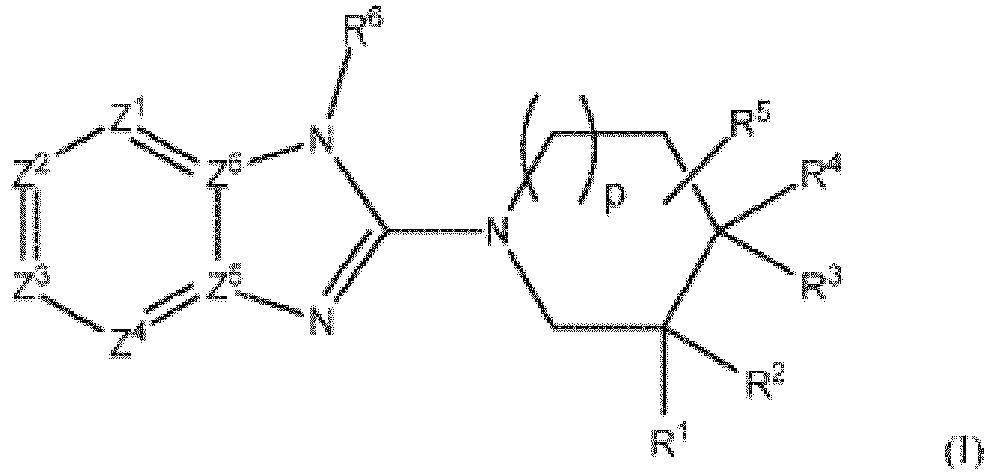
- Also provided is a pharmaceutical composition comprising a pharmaceutically acceptable excipient carrier or adjuvant and at least one compound of Formula (1) or subformulae thereof. Pharmaceutical compositions provided by the invention are suitable for use in the treatment of disease modulated by TRPC6 activity. In certain aspects the pharmaceutical compositions of the invention are suitable for use in the treatment of. e.g., treatment of nephrotic syndrome, minimal change disease, focal segmental glomerulosclerosis, collapsing glomerulopathy, membranous nephropathy. membranoprolilerative glomenilonephritis, IGA nephropathy, acute renal failure, chronic renal failure, diabetic nephropathy, sepsis, pulmonary hypertension, acute lung disorder, licart failure, stroke, malignant tumor or muscular dystrophy.
- Also provided is a packaged pharmaceutical composition, comprising a pharmaceutical composition comprising a pharmaceutically acceptable excipient, carrier or adjuvant and at least one compound of formula (1) or subformulae thereof, and instructions for using the composition to treat a patient suffering from a disease mediated by TRPC6 activity or more particularly to treat a patient suffering from nephrotic syndrome, minimal change disease, focal segmental glomerulosclerosis, collapsing glomerulopathy, membranous nephropathy, membranoproliferative glomerulonephritis, IGA nephropathy, acute renal failure, chronic renal failure, diabetic nephropathy, sepsis, pulmonary hypertension, acute lung disorder, acute respiratory distress syndrome (ARDS) heart failure, stroke, malignant tumor or muscular dystrophy. In certain instances, the patient is suffering from nephrotic syndrome, membranous nephropathy, and acute renal failure.
- Also provided is a method of treating or preventing disease in a mammal which method comprises administering to a mammal in need thereof a therapeutically effective amount of at least one compound of formula (I) or subformulae thereof or a pharmaceutical composition comprising a pharmaceutically acceptable excipient, carrier or adjuvant and at least one compound of formula (I) or subformulae thereof.
- Also provided is a method for modulating TRPC6 activity in a mammal, which method comprises administering to the mammal in need thereof a therapeutically effective amount of at least one compound of formula (I) or subformulae thereof or a pharmaceutical composition comprising a pharmaceutically acceptable excipient, carrier or adjuvant and at least one compound of formula (I) or subformulae thereof. Another aspect of the invention relates to a method of treating a TRPC6-mediated disease or disorder, the method comprising administering a TRPC'6 inhibitor of the invention to a patient in need of therapy. In certain embodiments, the TRPC6 mediated disease or disorder is selected from nephrotic syndrome, minimal change disease, focal segmental glomerulosclerosis, collapsing glomerulopathy, membranous nephropathy, membranoproliferative glomerulonephritis, IGA nephropathy, acute renal failure, chronic renal failure, diabetic nephropathy, sepsis, pulmonary hypertension, acute lung disorder, acute respiratory distress syndrome (ARDS), heart failure, stroke, malignant tumor or muscular dystrophy. In certain instances, the patient is suffering from nephrotic syndrome, membranous nephropathy, and acute renal failure .
- Also provided is the use, in the manufacture of a medicament for treating or preventing disease mediated by TRPC6 activity, of at least one compound of formula I or subformulae thereof.
- Other aspects and embodiments will be apparent to those skilled in the art form the following detailed description.
- The invention related generally to compounds of Formula 1 and salts and tautomers thereof which inhibit TRPC protein activity and more particularly inhibit TRPC6 protein activity. In particular, the invention relates to compounds which selectively inhibit TRPC6 protein activity.
In a first embodiment, the invention provides a compound or pharmaceutically acceptable salt thereof, according to Formula I:
- p is 0 or 1;
- when p is 0, then R1 is hydrogen, C1-C6alkyl, halogen or hydroxy; R2 is amino or aminoC1-C4alkyl; R3 is hydrogen; and R4 is hydrogen, C1-C6alkyl or phenyl; or
- when p is 0, then R1 and R3, taken in combination, form a fused C3-C6cycloalkyl ring or a fused 4 to 6 member heterocycle ring having 1 or 2 ring heteroatoms independently selected from N, O or S, which cycloallyl or heterocycle is optionally substituted with amino; R2 is hydrogen, C1-C6alkyl or aminoC1-C4alkyl; and R4 is hydrogen; or
- when p is 1, then R1 is NHR1a; R1a is hydrogen, C1-Caalkyl, C3-C7cycloalkyl, hydroxyC1-C4alkyl,or 4 to 6 member heterocycloalkyl having one ring heteroatom selected from N, O or S; R2 is hydrogen, C1-C4alkyl, hydroxyC1-C4alkyl or C(O)NH2; R3 is hydrogen, halogen, C1-C4alkyl, C1-C4alkoxy or hydroxy; and R4 is hydrogen, C1-C4alkyl or halogen; or
- when p is 0 or 1, then CR1R2, taken in combination, form a spirocyclic 4 to 6 member heterocycloalkyl; R3 is hydrogen, halogen, C1-C4alkyl, C1-C4alkoxy, or hydroxy; and R4 is hydrogen or halogen; or
- when p is 1, then R1 and R3, taken in combination, form a fused 4 to 6 member heterocycle or a fused 3 to 7 member carbocycle, which heterocycle comprises a ring nitrogen atom and optionally 0 or 1 additional ring heteroatoms selected from N, O and S, and which carbocycle is substituted with amino; and R2 is hydrogen; and R4 is hydrogen, halogen or hydroxy;
- R5 represents 1 or 2 substituents independently selected from hydrogen, halogen, hydroxy, amino, C1-C6alkyl or C1-C6alkoxy;
- R6 is -(CR7R8)-A; or
- R6 is a 4 to 7 member lactam which is optionally substituted with one or two substituents independently selected from the group consisting of hydroxy, C1-C6alkyl, C2-C6alkenyl, C2-C6alkynyl, C3-C6cycloalkyl, haloC1-C6alkyl, C1-C6alkoxy, haloC1-C6alkoxy, hydroxyC1-C6alkyl, C1-C6alkoxyC1-C6alkyl, phenyl, 4 to 7 member heterocycle having 1 ring atoms selected from N, O or S and 0 or 1 additional ring N atoms or 5 or 6 member heteroaryl having one ring heteroatom selected from N, O or S and 0 or 1 additional ring nitrogen atom, wherein the heteroaryl, heterocycle or phenyl group is optionally substituted with 0, 1 or 2 C1-C6alkyl or halogen; or
- R6 is a partially unsaturated 9 or 10 member bicyclic carbocycle, which is optionally substituted with 1 or 2 substituents independently selected from halogen, cyano, C1-C6alkyl, C2-C6alkenyl, C2-C6alkynyl, haloC1-C6alkyl, C1-C6alkoxy, haloC1-C6alkoxy, C(O)NH2 and C(O)NHC1-C6alkyl;
- A is 5 or 6 member heteroaryl, which heteroaryl comprises one ring heteroatom selected from N, O or S and 0, 1 or 2 additional ring nitrogen atoms, which heteroaryl is optionally substituted with 0, 1, 2, 3 or 4 groups independently selected from halogen, cyano, C1-C6alkyl, C2-C6alkenyl, C2-C6alkynyl, C3-C6cycloalkyl, haloC1-C6alkyl, C1-C6alkoxy, haloC1-C6alkoxy, C(O)N(RA)2, S(O)2C1-C6alkyl, phenyl or 5 or 6 member heteroaryl having one ring heteroatom selected from N, O or S and 0, 1 or 2 additional ring nitrogen atoms, wherein the optional heteroaryl or phenyl substituent is further substituted with 0, 1 or 2 C1-C6alkyl; or
- A is phenyl substituted with 1, 2 or 3 substituents independently selected from halogen, C1-C5alkyl, C2-C6alkenyl, C2-C6alkynyl, haloC1-C6alkyl,cyanoC1-C6alkyl. C1-C6alkoxy, haloC1-C6alkoxy , cyanoC1-C6 alkoxy, S(O)qC1-C6alkyl, S(O)2NH2, S(O)2NHC1-C6alkyl, S(O)2N(C1-C6alkyl)2, C(O)NH2, C(O)NHC1-C6alkyl, C(O)N(C1-C6alkyl)2, hydroxy, cyano, or 5 or 6 member heteroaryl having one ring heteroatom selected from N, O or S and 0, 1 or 2 additional ring nitrogen atoms which heteroaryl is further substituted with 0, 1 or 2 C1-C6alkyl; or
- A is C(O)OR9 or C(O)NR9R10; or
- A is optionally substituted 9 or 10 member aromatic or partially unsaturated bicycle having 0, 1 or 2 ring nitrogen atoms and 0 or 1 additional ring heteroatoms selected from N, O or S, which bicycle is substituted with 0, 1 or 2 substituents independently selected from the group consisting of halogen, cyano, C1-C6alkyl, C2-C6alkenyl, C2-C6alkynyl, haloC1-C6alkyl. C1-C6alkoxy, haloC1-C6alkoxy, C(O)NH2, C(O)OH or C(O)NHC1-C6alkyl;
- RA is independently selected at each occurrence from hydrogen or C1-C4alkyl; or
- N(RA)2, taken in combination, forms a 4 to 7 member azacycle which is optionally substituted with 0, 1, or 2 C1-C4alkyl;
- R3 is hydrogen, C1-C4alkyl or amino;
- R8 is hydrogen or C1-C4alkyl; or
- CR7R8, taken in combination form a 3 to 6 member cycloalkandiyl group;
- R9 is hydrogen, C1-C6alkyl, C3-C6cycloalkyl, hydroxyC1-C6alkyl, C1-C4alkoxyC1-C6alkyl, haloC1-C6alkyl, cyano C1-C6alkyl or -(CH2)rR9A wherein r is 0 or 1 and R9A is phenyl, 4 to 7 member heterocycle having one ring heteroatoms selected from N, O or S, which ring sulfur may be optionally oxidized, and 0 or 1 additional ring N atoms or 5 or 6 member heteroaryl having one ring heteroatom selected from N, O or S and 0, 1, or 2 additional ring N atoms, which phenyl, heterocycle or heteroaryl is optionally substituted with 0, 1 or 2 halogen, C1-C4alkyl or C(O)C1-C4alkyl;
- R10 is hydrogen, C1-C6alkyl, Cz-Cealkenyl, C2-C6alkynyl, halo C1-C6alkyl, C3-C7cycloalkyl or saturated, partially unsaturated or aromatic 5 or 6 member heterocycle having 1 or 2 ring heteroatoms independently selected from N, O and S, which sulfur is optionally oxidized, and which heterocycle is optionally substituted with 1 or 2 substituents independently selected from C1-C6alkyl and halogen, which heterocycle has 1 or 2 ring hetero atoms selected from N, O or S, which sulfur may be optionally oxidized, and wherein each alkyl or cycloalkyl is optionally substituted with cyano, halogen, hydroxy, C1-C6alkoxy, S(O)qC1-C6alkyl, 4 to 6 member heterocycle having 1 or 2 ring heteroatoms selected from N, O or S or 5 or 6 member heteroaryl having 1 ring heteroatom selected from N, O or S and 0, 1 or 2 additional ring nitrogen atoms and where each heterocycle or heteroaryl is optionally substituted with 0, 1, or 2 C1-C4alkyl; or
- NR9R10, taken in combination, form a monocyclic or bicyclic 4 to 10 member saturated or partially unsaturated heterocycle having one or two ring nitrogen atoms and 0 or 1 additional ring heteroatom selected from N, O or S, which ring sulfur may be optionally oxidized, which heterocycle is optionally substituted with 0, 1 or 2 substitutents selected from halogen, oxo, hydroxy, cyano, C1-C6alkyl, C3-C6cycloalkyl, haloC1-C6alkyl, hydroxyC1-C6alkyl, cyanoC1-C6alkyl, C1-C6alkoxy, haloC1-C6alkoxy, C1-C6alkoxyC1-C4alkyl, S(O)qC1-C6alkyl, C1-C6alkylS(O)qC1-C6allkyl CO2H, C(O)C1-C6alkyl, C(O)OC1-C6alkyl, C(O)C3-C6cycloalkyl, N(R15)C(O)C1-C6alkyl or C(O)N(R15 )2, phenyl, 4 to 6 member heterocycle having 1 or 2 ring heteroatoms selected from N, O or S or a 5 or 6 member heteroaryl having 1 ring heteroatom selected from N, O or S and 0, 1 or 2 additional ring nitrogen atoms and where each heterocycle or heteroaryl is optionally substituted with 0, 1, or 2 C1-C4alkyl;
- q is 0, 1 or 2;
- Z1 is N or CR11
- Z2 is N or CR12;
- Z3 is N or CR13;
- Z4 is N or CR14,
- Z5 and Z6 are each independently N or C;
- wherein 0, 1 or 2 of Z1, Z2, Z3, Z4, Z5 and Z6 are N;
- each of R11, R12, R13 and R14 is independently selected from the group consisting of hydrogen, halogen, C1-C6alkyl, C2-C6alkenyl, C2-C6alkynyl, C1-C6alkoxy, haloC1-C6alkyl, haloC1-C6alkoxy, C3-C7cycloalkyl, cyano, SO2C1-C6alkyl, phenyl, and saturated, partially unsaturated or aromatic 5 or 6 member heterocycle having 1 or 2 ring heteroatoms independently selected from N, O and S, which heterocycle is optionally substituted with 1 or 2 substituents independently selected from C1-C6alkyl andhalogen; and
- R15 is selected at each occurrence from hydrogen or C1-C4alkyl or N(R15)2 taken in combination form a 4 to 7 member azacycle optionally substituted with 0, 1 or 2 C1-C4alkyl; with the proviso that compounds of Formula 1 do not include 1- [7-fluoro-6-methoxy-1-[[2-(trifluoromethyl)phenyl]methyl]-1H-benzimidazol-2-yl]-3-piperidinamine.
- In a second embodiment of the invention, compounds and salts according to Formula I are provided which are generally represented by the structure:
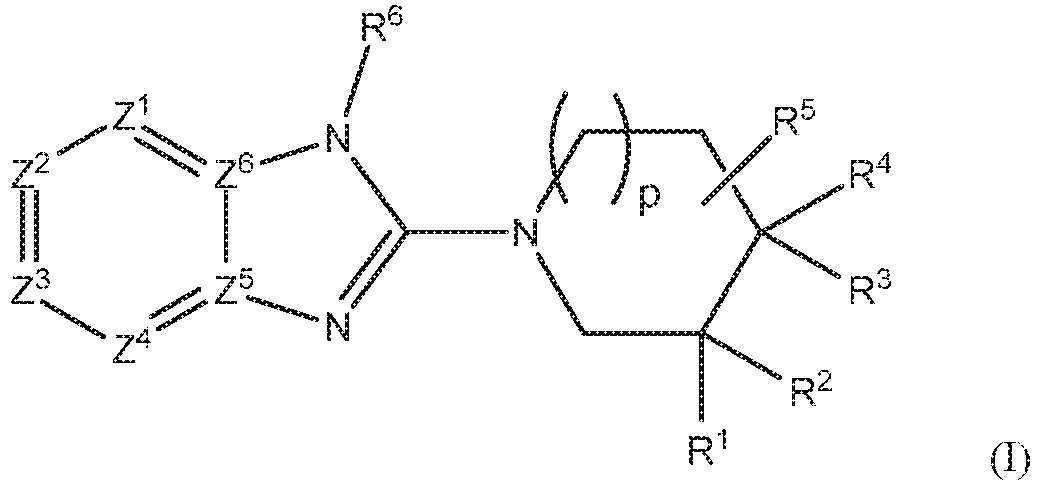
- p is 0 or 1;
- when p is 0, then R1 is hydrogen, C1-C6alkyl, halogen or hydroxy; R2 is amino or aminoC1-C4alkyl; R3 is hydrogen; and R4 is hydrogen, C1-C6alkyl or phenyl; or
- when p is 0, then R1 and R3, taken in combination, form a fused C3-C6cycloalkyl ring or a fused 4 to 6 member heterocycle ring having 1 or 2 ring heteroatoms independently selected from N, O or S, which cycloalkyl or heterocycle is optionally substituted with amino; R2 is hydrogen, C1-C6alkyl or aminoC1-C4alkyl; and R4 is hydrogen; or
- when p is 1, then R1 is NHR1a; R1a is hydrogen, C1-C4alkyl, C3-C7cycloalkyl, hydroxyC1-C4alkyl,or 4 to 6 member heterocycloalkyl having one ring heteroatom selected from N, O or S; R2 is hydrogen, C1-C4alkyl, hydroxyC1-C4alkyl or C(O)NH2; R3 is hydrogen, halogen, C1-C4alkyl, C1-C4alkoxy or hydroxy; and R4 is hydrogen, C1-C4alkyl or halogen; or
- when p is 0 or 1, then C(NHR1a)R2, taken in combination, form a spirocyclic 4 to 6 member heterocycloalkyl; R3 is hydrogen, halogen C1-C4alkyl, C1-C4alkoxy, or hydroxy; and R4 is hydrogen or halogen; or
- when p is 1, then R1 and R3, taken in combination, form a fused 4 to 6 member heterocycle or a fused 3 to 7 member carbocycle, which heterocycle comprises a ring nitrogen atom and optionally 0 or 1 additional ring heteroatoms selected from N, O and S, and which carbocycle is substituted with amino; and R2 is hydrogen; and R4 is hydrogen, halogen or hydroxy;
- R5 represents 1 or 2 substituents independently selected from hydrogen, halogen, hydroxy, amino, C1-C6alkyl or C1-C6alkoxy;
- R6 is -(CR7R8)-A; or
- R6 is a 4 to 7 member lactam which is optionally substituted with one or two substituents independently selected from the group consisting of hydroxy, C1-C6alkyl, C2-C6alkenyl, C2-C6alkynyl, haloC1-C6alkyl, C1-C6alkoxy, haloC1-C6alkoxy, hydroxyC1-C6alkyl, C1-C6alkoxyC1-C6alkyl, phenyl or 5 or 6 member heteroaryl having one ring heteroatom selected from N, O or S and 0 or 1 additional ring nitrogen atom, wherein the heteroaryl or phenyl group is optionally substituted with 0, 1 or 2 C1-C6alkyl or halogen; or
- R6 is a partially unsaturated 9 or 10 member bicyclic carbocycle, which is optionally substituted with 1 or 2 substituents independently selected from halogen, cyano, C1-C6alkyl, C2-C6alkenyl, C2-C6alkynyl, haloC1-C6alkyl, C1-C6alkoxy, haloC1-C6alkoxy, C(O)NH2 and C(O)NHC1-C6alkyl;
- A is 5 or 6 member heteroaryl, which heteroaryl comprises one ring heteroatom selected from N, O or S and 0, 1 or 2 additional ring nitrogen atoms, which heteroaryl is optionally substituted with 0, 1, 2, 3 or 4 groups independently selected from halogen, cyano, C1-C6alkyl, C2-C6alkenyl, C2-C6alkynyl, haloC1-C6alkyl, C1-C6alkoxy, haloC1-C6alkoxy, C(O)NH2, C(O)NHC1-C6alkyl, phenyl or 5 or 6 member heteroaryl having one ring heteroatom selected from N, O or S and 0, 1 or 2 additional ring nitrogen atoms, wherein the optional heteroaryl or phenyl substituent is further substituted with 0, 1 or 2 C1-C6alkyl; or
- A is phenyl substituted with 1, 2 or 3 substituents independently selected from halogen, C r C6alkyl, C2-C6alkenyl, C2-C6alkynyl, haloC1-C6alkyl, cyanoC1-C6alkyl, C1-C6alkoxy, haloC1-C6alkoxy, cyanoC1-C6 alkoxy, S(O)qC1-C6alkyl, S(O)2NH2, S(O)2NHC1-C6alkyl, S(O)2N(C1-C6alkyl)2, C(O)NH2, C(O)NHC1-C6alkyl, C(O)N(C1-C6alkyl)2, hydroxy, cyano, or 5 or 6 member heteroaryl having one ring heteroatom selected from N, O or S and 0, 1 or 2 additional ring nitrogen atoms which heteroaryl is further substituted with 0, 1 or 2 C1-C6alkyl; or
- A is C(O)OR9 or C(O)NR9R10; or
- A is optionally substituted 9 or 10 member aromatic or partially unsaturated bicycle having 0, 1 or 2 ring nitrogen atoms and 0 or 1 additional ring heteroatoms selected from N, O or S, which bicycle is substituted with 0, 1 or 2 substituents independently selected from the group consisting of halogen, cyano, C1-C6alkyl, C2-C6alkenyl, C2-C6alkynyl, haloC1-C6alkyl, C1-C6alkoxy, haloC1-C6alkoxy, C(O)NH2, C(O)OH or C(O)NHC1-C6alkyl;
- R7 is hydrogen, C1-C4alkyl or amino;
- R8 is hydrogen or C1-C4alkyl; or
- CR7R8, taken in combination form a 3 to 6 member cycloalkandiyl group;
- R9 is hydrogen, C1-C6alkyl, hydroxyC1-C6alkyl, haloC1-C6alkyl or cyano C1-C6alkyl;
- R10 is hydrogen, C1-C6alkyl, C2-C6alkenyl, C2-C6alkynyl, halo C1-C6alkyl, C3-C7cycloalkyl or 4 to 7 member heterocycle, which heterocycle has 1 or 2 ring hetero atoms selected from N, O or S, which sulfur may be optionally oxidized, and wherein each alkyl or cycloalkyl is optionally substituted with cyano, halogen, hydroxy, C1-C6alkoxy, S(O)qC1-C6alkyl, 4 to 6 member heterocycle having 1 or 2 ring heteroatoms selected from N, O or S or 5 or 6 member heteroaryl having 1 ring heteroatom selected from N, O or S and 0, 1 or 2 additional ring nitrogen atoms; or
- NR9R10, taken in combination, form a monocyclic or bicyclic 4 to 9 member heterocycle having one ring nitrogen atom and 0 or 1 additional ring heteroatom selected from N, O or S, which ring sulfur may be optionally oxidized, which heterocycle is optionally substituted with 0, 1 or 2 substitutents selected from halogen, oxo, hydroxy, cyano, C1-C6alkyl, halo C1-C6alkyl, hydroxyC1-C6alkyl, C1-C6alkoxy, S(O)qC1-C6alkyl, CO2H, C(O)C1-C6alkyl, or C(O)NH2;
- q is 0, 1 or 2;
- Z1 is Nor CR11;
- Z2 is Nor CR12;
- Z3 is N or CR13;
- Z4 is N or CR14,
- Z5 and Z6 are each independently N or C;
- wherein 0, 1 or 2 of Z1, Z2, Z3, Z4, Z5 and Z6 are N;
- each of R11, R12, R13 and R14 is independently selected from the group consisting of hydrogen, halogen, C1-C6alkyl, C2-C6alkenyl, C2-C6alkynyl, C1-C6alkoxy, haloC1-C6alkyl. haloC1-C6alkoxy, C3-C7cycloalkyl, cyano, SO2C1-C6alkyl, phenyl, and saturated, partially unsaturated or aromatic 5 or 6 member heterocycle having 1 or 2 ring heteroatoms independently selected from N, O and S, which heterocycle is optionally substituted with 1 or 2 substituents independently selected from C1-C6alkyl and halogen; and with the proviso that compounds of Formula I do not include 1- [7-fluoro-6-methoxy-1-[[2-(trifluoromethyl)phenyl]methyl]-1H-benzimidazol-2-yl]-3-piperidinamine.
- The proviso is presented in the first embodiment to specificially exclude and disclaim the identified compound which is indexed as CAS Number 1014407-24-9.
- In certain aspects of the first or second embodiment, compounds of Formula I include compounds of Formula Ia:

- Where variables p, R1, R2, R3, R4, R5, R6, Z1, Z2, Z3, Z4, Z5 and Z6 are as defined in the first or second embodiment.
- In a third embodiment, the invention provides compounds of the first or second embodiment in which p is 0; R1 is hydrogen, C1-C6alkyl, halogen or hydroxy; R2 is aminoC1-C4alkyl; and R3 and R4 are hydrogen.
- In a fourth embodiment, the invention provides compounds of the first or second embodiment in which p is 0; R1 and R3, taken in combination, form a fused C3-C6cycloalkyl ring or a fused 4 to 6 member azacycle ring, which cycloalkyl or azacycle is optionally substituted with amino; and R2 and R4 are hydrogen.
- In a fifth embodiment, the invention provides compounds of the fourth embodiment in which R1 and R3 taken in combination, form a fused pyrrolidine; and R2 and R4 are hydrogen.
- In a sixth embodiment, the invention provides compounds of the first or second embodiment in which p is 1, R1 is NHR1a; R1a is hydrogen, C1-C4alkyl, C3-C7cycloalkyl or 4 to 6 member heterocycloalkyl having one ring heteroatom selected from N, O or S; R2 is hydrogen or C1-C4alkyl; R3 is hydrogen, halogen, C1-C4alkyl, C1-C4alkoxy, or hydroxy; and R4 is hydrogen, halogen or C1-C4alkyl.
- In a seventhembodiment, the invention provides compounds of the sixth embodiment in which R1 is NHR1a; R1a is hydrogen, methyl, ethyl, propyl, isopropyl or cyclopropyl; R2 is hydrogen or methyl; R3 is hydrogen, halogen, methyl, ethyl, methoxy, ethoxy, or hydroxy; and R4 is hydrogen, halogen, methyl or ethyl. In certain aspects of the seventh embodiment, compounds are provided in wich R1a is hydrogen or methyl; R2 is hydrogen, R3 is hydrogen, fluorine, methyl or hydroxy; and R4 is hydrogen, halogen, methyl or eethyl.
- In an eighth embodiment, the invention provides compounds of the sixth or seventh embodiment in which R1 is NH2; R2 is hydrogen; R3 is hydrogen, fluorine, methyl, or hydroxy; and R4 is hydrogen, fluorine or methyl.
- In a ninth embodiment, the invention provides compounds of the first or second embodiment in which p is 1; CR1R2, taken in combination, form a spirocyclic 4 to 6 member heterocycloalkyl; R3 is hydrogen, halogen or C1-C4alkyl, C1-C4alkoxy, hydroxy; and R4 is hydrogen or halogen.
- In a tenth embodiment, the invention provides compounds of the first or second embodiment in which p is 1; R1 and R3, taken in combination, form a fused 4 or 5 member carbocycle substituted with amino; and R2 and R4 are hydrogen.
- In an eleventh embodiment, the invention provides compounds of any one of the first to tenth embodiment in which R5 represents 1 or 2 substitutents independently selected from hydrogen, halogen, hydroxy, C1-C4alkyl.
- In a twelfth embodiment, the invention provides compounds of the eleventh embodiment in which R5 represent hydrogen.
- In a thirteenth embodiment, the invention provides compounds of any one of the first to twelfth embodiment in which wherein R6 is -(CR7R8)-A.
- In a fourteenth embodiment, the invention provides compounds of the thirteenth embodiment in which R7 is hydrogen, methyl or ethyl; R8 is hydrogen, or CR7R8, taken in combination form a cyclopropandiyl group.
- In a fifteenth embodiment, the invention provides compounds of the thirteenth or fourteenth embodiment in which R7 is hydrogen or methyl; and R8 is hydrogen.
- In a sixteenth embodiment, the invention provides compounds of any one of the thirteenth to fifteenth embodiment in which A is 5 or 6 member heteroaryl, which heteroaryl comprises one ring heteroatom selected from N, O or S and 0, 1 or 2 additional ring nitrogen atoms, which heteroaryl is optionally substituted with 0, 1, or 2 groups independently selected from halogen, cyano, C1-C6alkyl, C2-C6alkenyl, C2-C6alkynyl, haloC1-C6alkyL C1-C6alkoxy, haloC1-C6alkoxy, C(O)NH2, C(O)NHC1-C6alkyl, phenyl or 5 or 6 member heteroaryl having one ring heteroatom selected from N, O or S and 0, 1 or 2 additional ring nitrogen atoms, wherein the optional heteroaryl or phenyl substituent is further substituted with 0, 1 or 2 C1-C6alkyl.
- In a seventeenth embodiment, the invention provides compounds of the sixteenth embodiment in which A is pyridin-2-yl, pyridin-3-yl, pyrimidin-2-yl, or pyrazin-2-yl, each of which is substituted with 1 to 3 groups independently selected from the group consisting of halogen, cyano, C1-C4alkyl, haloC1-C4alkyl, C1-C4alkoxy, haloC1-C4alkoxy, C(O)NH2, C(O)NHC1-C4alkyl, phenyl or 5 member heteroaryl having one ring heteroatom selected from N, O or S and 0, 1 or 2 additional ring nitrogen atoms, wherein the optional heteroaryl or phenyl substituent is further substituted with 0, 1 or 2 C1-C6alkyl.
- In an eighteenth embodiment, the invention provides compounds of any one of the thirteenth to fifteenth embodiment in which A is phenyl substituted with 1, 2 or 3 substituents independently selected from halogen, C1-C6alkyl, haloC1-C6alkyl, C1-C6alkoxy, haloC1-C6alkoxy, hydroxy, cyano, or 5 or 6 member heteroaryl having one ring heteroatom selected from N, O or S and 0, 1 or 2 additional ring nitrogen atoms which heteroaryl is further substituted with 0, 1 or 2 C1-C6alkyl.
- In a nineteenth embodiment, the invention provides compounds of the eighteenth embodiment in which A is phenyl substituted with one substituent selected from the group consisting of halogen, C1-C4alkyl, haloC1-C4alkyl, C1-C4alkoxy, haloC1-C4alkoxy, hydroxy, cyano, or 5 member heteroaryl having one ring heteroatom selected from N, O or S and 0, 1 or 2 additional ring nitrogen atoms, and wherein the phenyl group is further optionally substituted with halogen, C1-C4alkyl, C1-C4alkoxy, halaC1-C4alkyl or haloC1-C4alkoxy.
- In a twentieth embodiment, the invention provides compounds of the eighteenth or ninteenth embodiment in which A is phenyl substituted with 1 or 2 substituents independently selected from halogen, C1-C6alkyl, haloC1-C4alkyl, C1-C4alkoxy, haloC1-C4alkoxy, hydroxy or cyano.
- In a twenty-first embodiment, the invention provides compounds of any one of the thirteenth to fifteenth embodiment in which A is C(O)NR9R10;
- R9 is hydrogen, or C1-C4alkyl;
- R10 is C1-C4alkyl, haloC1-C4alkyl, C3-C7cycloalkyl or 4 to 7 member heterocycle, which heterocycle has 1 or 2 ring hetero atoms selected from N, O or S, which sulfur may be optionally oxidized, and wherein each alkyl or cycloalkyl is optionally substituted with cyano, halogen, hydroxy, C1-C6alkoxy, S(O)qC1-C6alkyl; or
- NR3R10, taken in combination, form a monocyclic or bicyclic 4 to 9 member azacycle having one ring nitrogen atom and 0 or 1 additional ring heteroatom selected from N, O or S, which ring sulfur may be optionally oxidized, which azacycle is optionally substituted with 0, 1 or 2 substitutents selected from halogen, oxo, hydroxy, cyano, C1-C6alkyl, halo C1-C6alkyl, hydroxyC1-C6alkyl, C1-C6alkoxy, S(O)2C1-C6alkyl, CO2H, C(O)C1-C6alkyl, or C(O)NH2.
- In a twenty second dembodiment, the invention provides compounds of the twenty first embodiment in which R9 is hydrogen, methyl or ethyl; and
R10 is C1-C4alkyl or haloC1-C4alkyl wherein each alkyl is optionally substituted with cyano, halogen, hydroxy, C1-C6alkoxy or S(O)qC1-C6alkyl. - In a twenty third embodiment, the invention provides compounds of the twenty first embodiment in which NR9R10, taken in combination, form a 4 to 6 member monocyclic azacycle or a 7 to 9 member bicyclic azacycle, each of which having one ring nitrogen atom and 0 or 1 additional ring heteroatom selected from N, O or S, which ring sulfur may be optionally oxidized, wherein each azacycle is optionally substituted with 0, 1 or 2 substitutents selected from halogen, oxo, hydroxy, cyano, C1-C6alkyl, halo C1-C6alkyl, hydroxyC1-C6alkyl, C1-C6alkoxy, S(O)2C1-C6alkyl, CO2H, C(O)C1-C6alkyl, or C(O)NH2.
- In a twenty fourth embodiment, the invention provides compounds of the twenty third embodiment in which the 4 to 6 member monocyclic azacyle is selected from the group consisting of:


- In a twenty fifth embodiment, the invention provides compounds of the twenty third embodiment in which the 7 to 9 member bicyclic azacyle is selected from the group consisting of:

- In a twenty sixth embodiment, the invention provides compounds of any one of the first to twelfth embodiment in which R6 is a 2-oxo-pyrollidin-3-yl or 2-oxo-piperidin-3-yl each of which is substituted at nitrogen with C1-C6alkyl, C2-C6alkenyl, C2-C6alkynyl, haloC1-C6alkyl, C1-C6alkoxy, haloC1-C6alkoxy, hydroxyC1-C6alkyl, C1-C6alkoxyC1-C6alkyl, phenyl or 5 or 6 member heteroaryl having one ring heteroatom selected from N, O or S and 0 or 1 additional ring nitrogen atom, wherein the heteroaryl or phenyl group is optionally substituted with 0, 1 or 2 C1-C6alkyl or halogen.
- In a twenty seventh embodiment, the invention provides compounds of the twenty sixth embodiment in which
- R6 is

- Wherein t is 1 or 2; and
- R19 is C1-C6alkyl, phenyl substituted with 0, 1 or 2 halogen.
- In a twenty eighth embodiment, the invention provides compounds of any one of the first to twenty seventh embodiment in which Z1 is CR11;
- Z2 is CR12;
- Z3 is CR13;
- Z4 is N or CR14,
- Z5 and Z6 are each C;
- R11 is hydrogen, halogen, cyano or C1-C4alkyl;
- R12 and R13 are each independently selected from the group consisting of hydrogen, halogen, cyano, C1-C4alkyl, haloC1-C4alkyl, C1-C4,tlkoxy, haloC1-C4alkoxy, C3-C6cycloalkyl or 5 member saturated, partially unsaturated or aromatic 5 or 6 member heterocycle having 1 or 2 ring heteroatoms independently selected from N, O and S; and
- R14 is hydrogen, halogen, cyano or C1-C4alkyl.
- In certain aspects of the twenty eighth embodiment, compounds are provided in which R11 is hydrogen.
- In certain other aspects of the twenty eighth embodiment, compounds are provided in which R14 is hydrogen, fluorine, chlorine, methyl or cyano. In certain aspects of the twenty eighth embodiment, compounds are provided in which R12 and R 13 are each independently selected from the group consisting of hydrogen, fluorine, chlorine, cyano, C1-C4alkyl, haloC1-C4alkyl, C1-C4alkoxy, and haloC1-C4alkoxy.
- In yet other aspects of the twenty eighth embodiment, compounds are provided in which R11 is hydrogen; R14 is hydrogen, fluorine, chlorine, methyl or cyano; and R12 and R13 are each independently selected from the group consisting of hydrogen, fluorine, chlorine, cyano, methyl, ethyl, methoxy, ethoxy, fluoromethyl, difluoromethyl, trifluoromethyl, fluoromethoxy, difluoromethoxy, and trifluoromethoxy .
- In a twenty ninth embodiment, the invention provides compounds of the first or second embodiment which include compounds of Formula 11:

- R1 is NHR1a;
- R1a is hydrogen, C1-C4alkyl, C3-C7cycloalkyl or 4 to 6 member heterocycloalkyl having one ring heteroatom selected from N, O or S;
- R2 is hydrogen or C1-C4alkyl;
- R3 is hydrogen, halogen, C1-C4alkyl, C1-C4alkoxy, or hydroxy;
- R4 is hydrogen or halogen;
- R7 is hydrogen, methyl or ethyl;
- A is C(O)NR9R10; or
- A is 5 or 6 member heteroaryl, which heteroaryl comprises one ring heteroatom selected from N, O or S and 0, 1 or 2 additional ring nitrogen atoms, which heteroaryl is optionally substituted with 0, 1, or 2 groups independently selected from halogen, cyano, C1-C6alkyl, C2-C6alkenyl, C2-C6alkynyl, haloC1-C6alkyl, C1-C6alkoxy, haloC1-C6alkoxy, C(O)NH2, C(O)NHC1-C6alkyl, phenyl or 5 or 6 member heteroaryl having one ring heteroatom selected from N, O or S and 0, 1 or 2 additional ring nitrogen atoms, wherein the optional heteroaryl or phenyl substituent is further substituted with 0, 1 or 2 C1-C6alkyl; or
- A is phenyl substituted with one substituent selected from the group consisting of halogen, C1-C4alkyl, haloC1-C4alkyl, C1-C4alkoxy, haloC1-C4alkoxy, hydroxy, cyano, or 5 member heteroaryl having one ring heteroatom selected from N, O or S and 0, 1 or 2 additional ring nitrogen atoms, and wherein the phenyl group is further optionally substituted with halogen, C1-C4alkyl, C1-C4alkoxy, haloC1-C4alkyl or haloC1-C4alkoxy.
- R9 is hydrogen, or C1-C4alkyl;
- R10 is C1-C4alkyl, haloC1-C4alkyl, C3-C7-cycloalkyl or 4 to 7 member heterocycle, which heterocycle has 1 or 2 ring hetero atoms selected from N, O or S, which sulfur may be optionally oxidized, and wherein each alkyl or cycloalkyl is optionally substituted with cyano, halogen, hydroxy, C1-C6alkoxy, S(O)qC1-C6alkyl; or
- NR9R10, taken in combination, form a monocyclic or bicyclic 4 to 9 member azacycle having one ring nitrogen atom and 0 or 1 additional ring heteroatom selected from N, O or S, which ring sulfur may be optionally oxidized, which azacycle is optionally substituted with 0, 1 or 2 substitutents selected from halogen, oxo, hydroxy, cyano, C1-C6alkyl, halo C1-C6alkyl, hydroxyC1-C6alkyl, C1-C6alkoxy, S(O)2C1-C6alkyl, CO2H, C(O)C1-C6alkyl, or C(O)NH2;
- Z4 is CR14 or N;
- R11 is hydrogen, halogen, cyano or C1-C4alkyl;
- R12 and R13 are each independently selected from the group consisting of hydrogen, halogen, cyano, C1-C4alkyl, haloC1-C4alkyl, C1-C4alkoxy, haloC1-C4alkoxy, C3-C6cycloalkyl or 5 member saturated, partially unsaturated or aromatic 5 or 6 member heterocycle having 1 or 2 ring heteroatoms independently selected from N, O and S; and
- R14 is hydrogen, halogen, cyano or C1-C4alkyl.
- In certain aspects of the twenty ninth embodiment, compounds of Formula (II) include compounds of Formula (IIa):
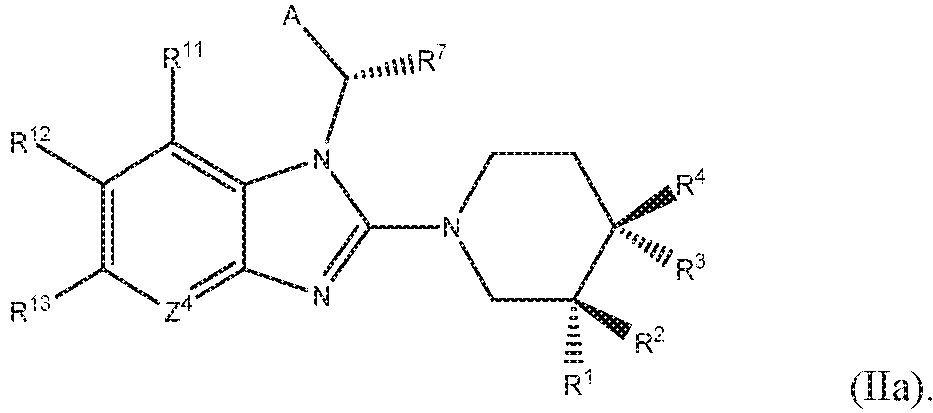
- In a thirtieth embodiment, the invention provides compounds of the twenty ninth embodiment which include compounds of Formula III:

- X1 is CR16 or N;
- X2 is CR17 or N;
- X3 is CR18 or N;
- Z4 is N or CR14;
- R1 is NHR1a;
- R1a is hydrogen or C1-C4alkyl;
- R2 is hydrogen or C1-C4alkyl;
- R3 is hydrogen or halogen;
- R4 is hydrogen or halogen;
- R7 is hydrogen, methyl or ethyl;
- R11 is hydrogen, halogen, cyano or C1-C4alkyl;
- R12 and R13 are each independently selected from the group consisting of hydrogen, halogen, cyano, C1-C4alkyl, haloC1-C4alkyl, C1-C4alkoxy, or haloC1-C4alkoxy;
- R14 is hydrogen, halogen, cyano or C1-C4alkyl;
- R13 is hydrogen, halogen, cyano, C1-C4alkyl, C1-C4alkoxy, haloC1-C4alkyl, haloC1-C4alkoxy,
- C(O)NH2, C(O)NH(C1-C4alkyl) or 5 member heteroaryl having one ring heteroatom selected from N, O or S and 0, 1 or 2 additional ring nitrogen atoms;
- R16 is hydrogen, halogen, cyano, C1-C4alkyl, C1-C4alkoay, haloC1-C4alkyl or haloC1-C4alkoxy;
- R17 is hydrogen or halogen; and
- R18 is hydrogen, halogen, cyano, C1-C4alkyl, C1-C4alkoxy, haloC1-C4alkyl or haloC1-C4alkoxy,
- wherein at least one of R15, R16, R11 or R18 is not hydrogen.
- In certain aspects of the thirtieth embodiment, compounds of Formula (III) include compounds of Formula (IIIa):

- In certain other aspects of the thirtieth embodiment, compounds of Formula (III) include compounds of Formula (IIIb):

- In certain other aspects of the thirtieth embodiment, compounds of Formula (IIIb) include compounds of Formula (IIIc):

- In a thirty first embodiment, the invention provides compounds of the twenty ninth or thirtieth embodiment in which R2 is hydrogen, R7 is hydrogen or methyl; and Z4 is CR14.
- In a thirty second embodiment, the invention provides compounds of the twenty ninth embodiment which include compounds of Formula (IV):

- R1a is hydrogen or C1-C4alkyl;
- R3 is hydrogen or halogen;
- R4 is hydrogen or halogen;
- R7 is hydrogen, methyl or ethyl;
- R11 is hydrogen, halogen, cyano or C1-C4alkyl;
- R12 and R13 are each independently selected from the group consisting of hydrogen, halogen, cyano, C1-C4alkyl, haloC1-C4alkyl, C1-C4alkoxy, or haloC1-C4alkoxy;
- R14 is hydrogen, halogen, cyano or C1-C4alkyl; and
- R15 is hydrogen, halogen, cyano, C1-C4alkyl, C1-C4alkoxy, haloC1-C4alkyl, haloC1-C4alkoxy, C(O)NH2, or C(O)NH(C1-C4alkyl).
- In certain aspects of the thirty second embodiment, compounds of Formula (IV) include compounds of Formula (IVa):

- In a thirty third embodiment, the invention provides compounds of the twenty ninth embodiment which include compounds of Formula (V):

- R1a is hydrogen or C1-C4alkyl;
- R3 is hydrogen or halogen;
- R4 is hydrogen or halogen;
- R7 is hydrogen, methyl or ethyl;
- R11 is hydrogen, halogen, cyano or C1-C4alkyl;
- R12 and R13 are each independently selected from the group consisting of hydrogen, halogen, cyano, C1-C4alkyl, haloC1-C4alkyl, C1-C4alkoxy, or haloC1-C4alkoxy;
- R14 is hydrogen, halogen, cyano or C1-C4alkyl; and
- R15 is hydrogen, halogen, cyano, C1-C4alkyl, C1-C4alkoxy, haloC1-C4alkyl, haloC1-C4alkoxy, C(O)NH2, or C(O)NH(C1-C4alkyl).
- In certain aspects of the thirty third embodiment, compounds of Formula (V) include compounds of Formula (Va):

- In a thirty fourth embodiment, the invention provides compounds of the twenty ninth embodiment which include compounds of Formula (VI):

- R1a is hydrogen or C1-C4alkyl;
- R3 is hydrogen or halogen;
- R4 is hydrogen or halogen;
- R7 is hydrogen, methyl or ethyl;
- R11 is hydrogen, halogen, cyano or C1-C4alkyl;
- R12 and R13 are each independently selected from the group consisting of hydrogen, halogen, cyano, C1-C4alkyl, haloC1-C4alkyl, C1-C4alkoxy, or haloC1-C4alkoxy;
- R14 is hydrogen, halogen, cyano or C1-C4alkyl;
- R15 is hydrogen, halogen, cyano, C1-C4alkyl, C1-C4alkoxy, haloC1-C4alkyl, haloC1-C4alkoxy, C(O)NH2, C(O)NH(C1-C4alkyl) or 5 member heteroaryl having one ring heteroatom selected from N, O or S and 0, 1 or 2, additional ring nitrogen atoms;
- R16 is hydrogen, halogen, cyano, C1-C4alkyl, C1-C4alkoxy, haloC1-C4alkyl or haloC1-C4alkoxy;
- R17 is hydrogen or halogen; and
- R18 is hydrogen, halogen, cyano, C1-C4alkyl, C1-C4alkoxy, haloC1-C4alkyl or haloC1-C4alkoxy, wherein at least one of R15, R16, R17 or R18 is not hydrogen.
- In certain aspects of the thirty fourth embodiment, compounds of Formula (VI) include compounds of Formula (VIa):

- In a thirty fifth embodiment, the invention provides compounds of the twenty ninth embodiment which include compounds of Formula (VII):

- R1a is hydrogen or C1-C4alkyl;
- R3 is hydrogen or halogen;
- R4 is hydrogen or halogen;
- R7 is hydrogen, methyl or ethyl;
- R9 is hydrogen, methyl or ethyl;
- R10 is C1-C4alkyl or haloC1-C4alkyl wherein each alkyl is optionally substituted with cyano, halogen, hydroxy, C1-C6alkoxy or S(O)qC1-C6alkyl; or
- NR9R10, taken in combination, form a 4 to 6 member monocyclic azacycle or a 7 to 9 member bicyclic azacycle, each of which having one ring nitrogen atom and 0 or 1 additional ring heteroatom selected from N, O or S, which ring sulfur may be optionally oxidized, wherein each azacycle is optionally substituted with 0, 1 or 2 substitutents selected from halogen, oxo, hydroxy, cyano, C1-C6alkyl, halo C1-C6alkyl, hydroxyC1-C6alkyl, C1-C6alkoxy, S(O)2C1-C6alkyl, CO2H, C(O)C1-C6alkyl, or C(O)NH2;
- R11 is hydrogen, halogen, cyano or C1-C4alkyl;
- R12 and R13 are each independently selected from the group consisting of hydrogen, halogen, cyano, C1-C4alkyl, haloC1-C4alkyl, C1-C4alkoxy, or haloC1-C4alkoxy; and
- R14 is hydrogen, halogen, cyano or C1-C4alkyl.
- In certain aspects of the thirty fifth embodiment, compounds of Formula (VII) include compounds of Formula (VIla):

- In a thirty seventh embodiment, the invention provides compounds of any one of the thirty first to thirty fifth embodiment in which R13 is hydrogen or methyl; R3 is hydrogen or fluorine; and R4 is hydrogen or fluorine.
- In a thirty eighth embodiment, the invention provides compounds of the first or second embodiment in which the compound is recited in the below Table A.

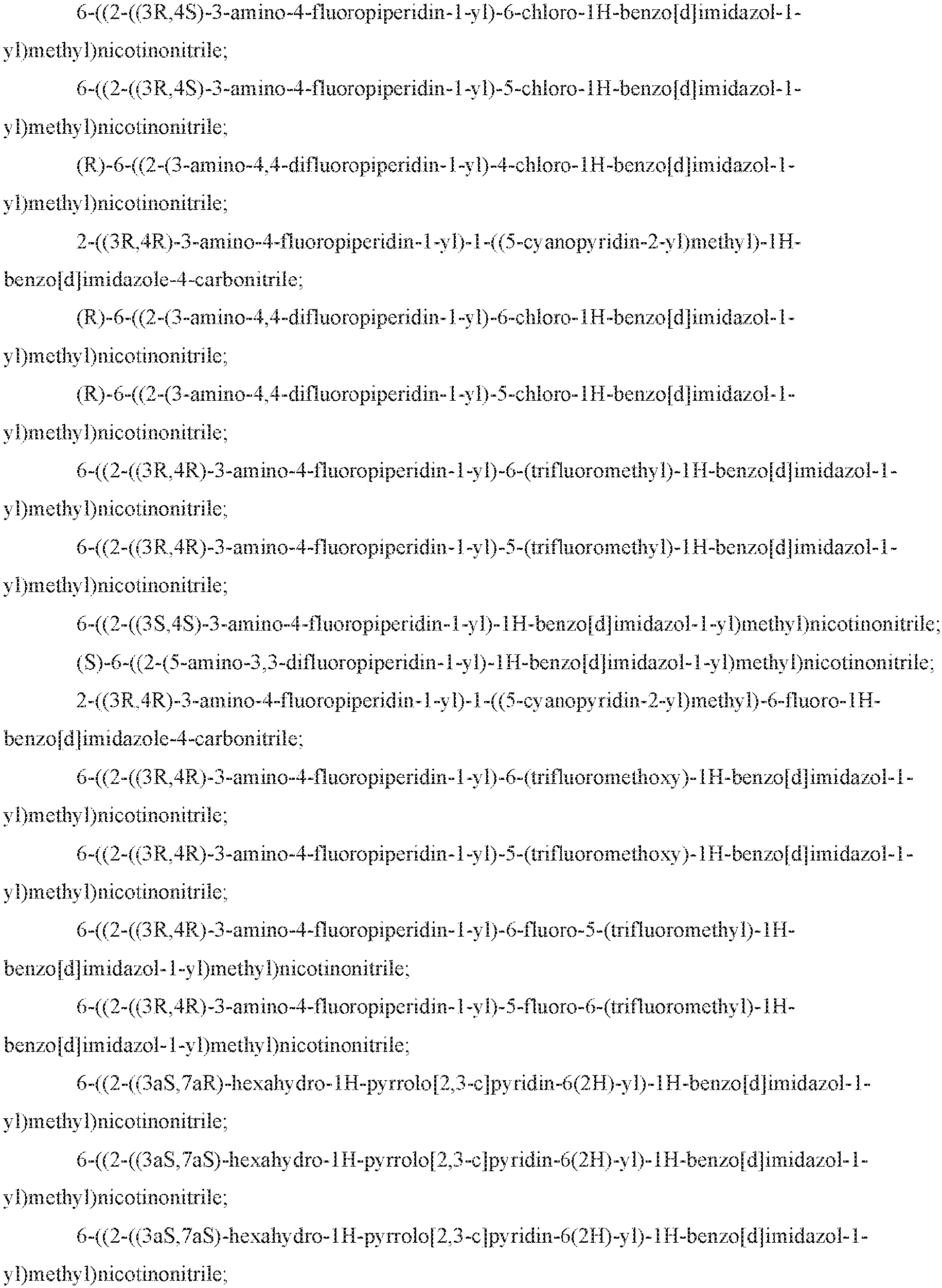


- In another aspect of the thirty eighth embodiment, the invention provides compounds of the first embodiment in which the compound is recited in the below Table A-1:

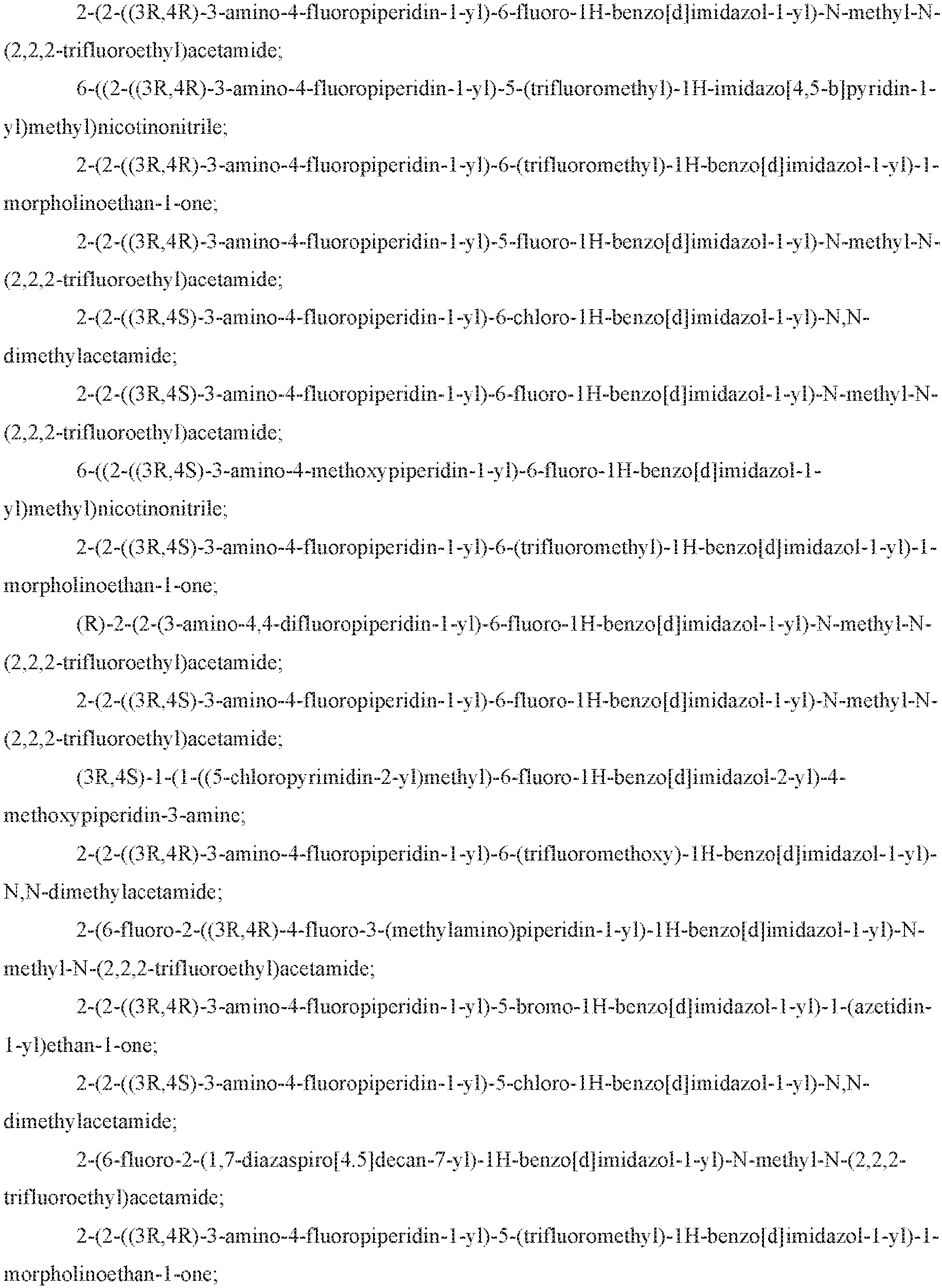


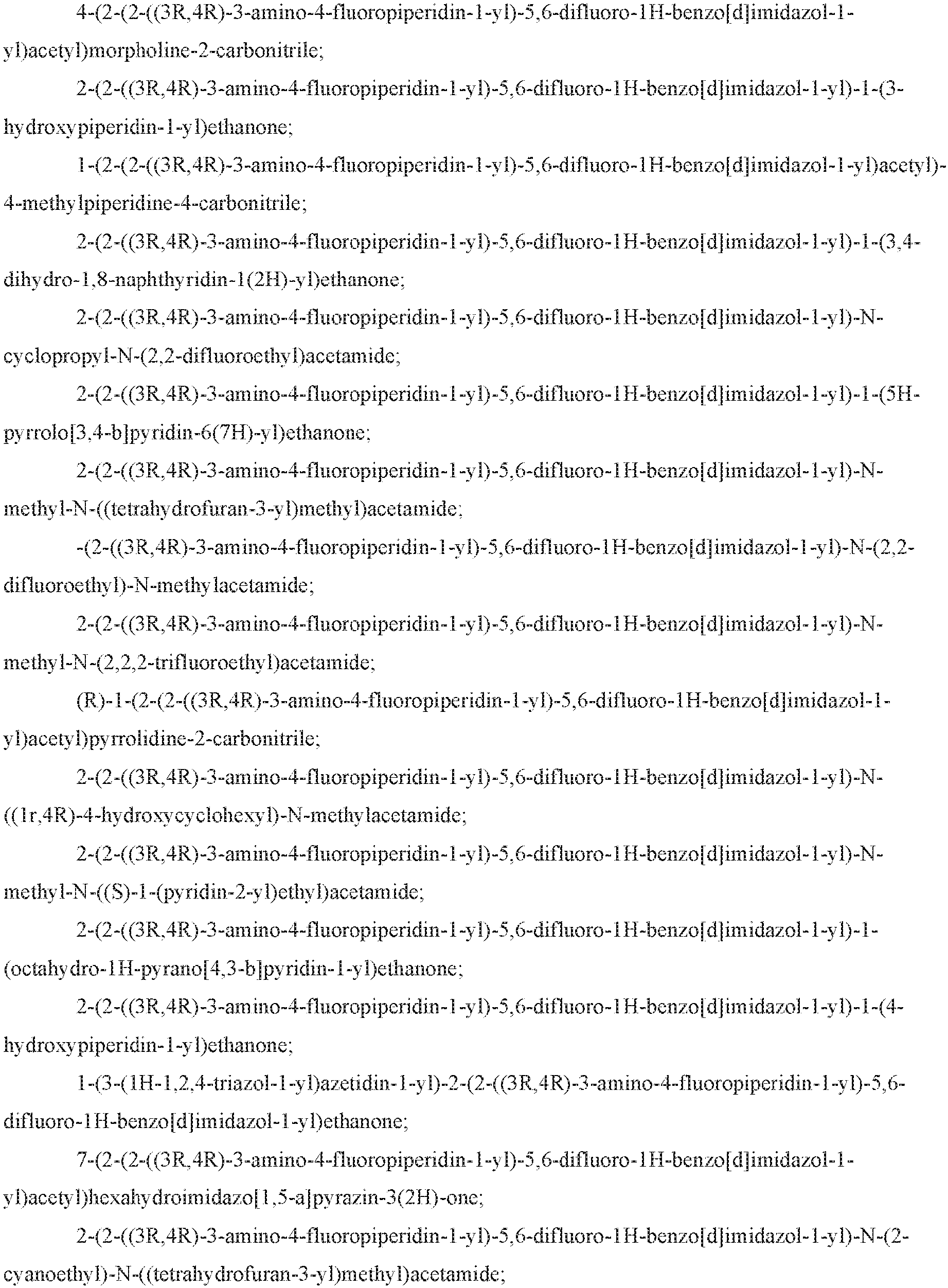


- In a thirty ninth embodiment, the invention provides compounds of the first or second embodiment in which the compound is recited in the below Table B:


- In a fortieth embodiment, the invention provides compounds of the first or second embodiment in which the compound is recited in the below Table C:


- In a forty first embodiment, the invention provides compounds of the first or second embodiment in which the compound is recited in the below Table D:

- In a further embodiment, each of the compounds disclosed herein are provided in the form of a pharmaceutically acceptable salt.
- In a forty second embodiment, the invention provides 6-((2-((3R,4S)-3-amino-4-fluoropiperidin-1-yl)-6-chloro-1H-benzo[d]imidazol-1-yl)methyl)nicotinonitrile. In certain aspects of the forty second embodiment, the invention provides a pharmaceutically acceptable salt of 6-((2-((3R,4S)-3-amino-4-fluoropiperidin-1-yl)-6-chloro-1H-benzo[d]imidazol-1-yl)methyl)nicotinonitrile.
- In a forty third embodiment, the invention provides 2-((3R,4R)-3-amino-4-fluoropiperidin-1-yl)-1-((5-chloropyrimidin-2-yl)methyl)-6-fluoro-1H-benzo[d]imidazole-4-carbonitrile. In certain aspects of the forty third embodiment, the invention provides a pharmaceutically acceptable salt of 2-((3R,4R)-3-amino-4-fluoropiperidin-1-yl)-1-((5-chloropyrimidin-2-yl)methyl)-6-fluoro-1H-benzo[d]imidazole-4-carbonitrile.
- In a forty fourth embodiment, the invention provides (3R,4R)-1-(4,6-difluoro-1-((5-fluoropyrimidin-2-yl)methyl)-1H-benzo[d]imidazol-2-yl)-4-fluoropiperidin-3-amine. In certain aspects of the forty fourth embodiment, the invention provides a pharmaceutically acceptable salt of (3R,4R)-1-(4,6-difluoro-1-((5-fluoropyrimidin-2-yl)methyl)-1H-benzo[d]imidazol-2-yl)-4-fluoropiperidin-3-amine.
- In a forty fifth embodiment, the invention provides 6-((2-((3R,4R)-3-amino-4-fluoropiperidin-1-yl)-1H-benzo[d]imidazol-1-yl)methyl)nicotinonitrile. In certain aspects of the forty fifth embodiment embodiment, the invention provides a pharmaceutically acceptable salt of 6-((2-((3R,4R)-3-amino-4-fluoropiperidin-1-yl)-1H-benzo[d]imidazol-1-yl)methyl)nicotinonitrile.
- In a forty sixth embodiment, the invention provides (R)-6-((2-(3-atnino-4,4-difluoropiperidin-1-yl)-4,6-difluoro-1H-benzo[d]imidazol-1-yl)methyl)nicotinonitrile. In certain aspects of the forty sixth embodiment, the invention provides a pharmaceutically acceptable salt of (R)-6-((2-(3-amino-4,4-difluoropiperidin-1-yl)-6-fluoro-1H-benzo[d]imidazol-1-yl)methyl)nicotinonitrile. The hydrochloride salt is a particularly preferred aspect of the forty sixth embodiment, e.g., (R)-6-((2-(3-amino-4,4-difluoropiperidin-1-yl)-6-fluoro-1H-benzo[d]imidazol-1-yl)methyl)nicotinonitrile hydrochloride.
- In a forty seventh embodiment, the invention provides (R)-6-((2-(3-amino-4,4-difluoropiperidin-1-yl)-6-fluoro-1H-benzo[d]imidazol-1-yl)methyl)nicotinonitrile. In certain aspects of the forty seventh embodiment, the invention provides a pharmaceutically acceptable salt of (R)-6-((2-(3-amino-4,4-difluoropiperidin-1-yl)-6-fluoro-1H-benzo[d]imidazol-1-yl)methyl)nicotinonitrile.
- In a forty eighth embodiment, the invention provides 6-((2-((3R,4R)-3-amino-4-fluoro-1-piperidinyl)-4-methoxy-1H-benzimidazol-1-yl)methyl)-3-pyridinecarbonitrile. In certain aspects of the forty eighth embodiment, the invention provides a pharmaceutically acceptable salt of 6-((2-((3R,4R)-3-amino-4-fluoro-1-piperidinyl)-4-methoxy-1H-benzimidazol-1-yl)methyl)-3-pyridinecarbonitrile.
- In a forty ninth embodiment, the invention provides (2-((3R,4R)-3-amino-4-fluoropiperidin-1-yl)-1-((5-chloropyrimidin-2-yl)methyl)-1H-benzo[d]imidazole-6-carbonitrile. In certain aspects of the forty ninth embodiment, the invention provides a pharmaceutically acceptable salt of (2-((3R,4R)-3-amino-4-fluoropiperidin-1-yl)-1-((5-chloropyrimidin-2-yl)methyl)-1H-benzo[d]imidazole-6-carbonitrile.
- In a fiftieth embodiment, the invention provides (3R,4R)-4-fluoro-1-(1-((5-fluoropyrimidin-2-yl)methyl)-1H-benzo[d]imidazol-2-yl)piperidin-3-amine. In certain aspects of the fiftieth embodiment, the invention provides a pharmaceutically acceptable salt of (3R,4R)-4-fluoro-1-(1-((5-fluoropyrimidin-2-yl)methyl)-1H-benzo[d]imidazol-2-yl)piperidin-3-amine.
- In a fifty first embodiment, the invention provides (3R,4R)-1-(1-((5-chloropyrimidin-2-yl)methyl)-6-fluoro-IH-benzo[d]imidazol-2-yl)-4-fluoropiperidin-3-amine. In certain aspects of the fifty first embodiment, the invention provides a pharmaceutically acceptable salt of (3R,4R)-1-(1-((5-chloropyrimidin-2-yl)methyl)-6-fluoro-1H-benzo[d]imidazol-2-yl)-4-fluoropiperidin-3-amine.
- In a further aspect of each of the forty second to fifty first embodiment, each of the the compounds and pharmaceutically acceptable salts provided therein may be used in the preparation of a medicament for use in treating a disease mediated by TRPC6 activity. In certain aspects, the compounds provided in the forty second to fifty first embodiment, or pharmaceutically acceptable salt thereof, may be used in the manufacture of a medicament for the treatment of a disease or disorder selected from nephrotic syndrome, minimal change disease, focal segmental glomerulosclerosis, collapsing glomerulopathy, membranous nephropathy, membranoproliferative glomerulonephritis, IGA nephropathy, acute renal failure, chronic renal failure, diabetic nephropathy, sepsis, pulmonary hypertension, acute lung disorder, acute respiratory distress syndrome (ARDS), heart failure, stroke, malignant tumor or muscular dystrophy. In still other aspects, the compounds of the forty second to fifty first embodiment, or pharmaceutically acceptable salt thereof may be used in the preparation of a medicament for the treatment of nephrotic syndrome, membranous nephropathy and acute renal failure.
- In a fifty second embodiment, a method of treating disease or disorder in a patient in need of therapy is provided, the method comprises the step of administering a pharmaceutically acceptable composition comprising a compound of any one of the forty second to fifty first embodiments, or a pharmaceutically acceptable salt thereof, wherein the disease or disorder is selected from nephrotic syndrome, minimal change disease, focal segmental glomerulosclerosis, collapsing glomerulopathy, membranous nephropathy, membranoproliferative glomerulonephritis, IGA nephropathy, acute renal failure, chronic renal failure, diabetic nephropathy, sepsis, pulmonary hypertension, acute lung disorder, acute respiratory distress syndrome (ARDS), heart failure, stroke, malignant tumor or muscular dystrophy. In certain aspects of the fifty first embodiment the disease or disorder is selected from nephrotic syndrome, membranous nephropathy and acute renal failure.
- In a further embodiment, the invention provides methods of making a compound of formula IIIb or a subformulae thereof.

- The method comprising the synthetic steps of
- (a) Alkylating a halogenated benzimidazole having the formula:


- (b) Coupling the alkylated halogenated benzimidazole generated in step (a) with a protected piperidine having the formula:
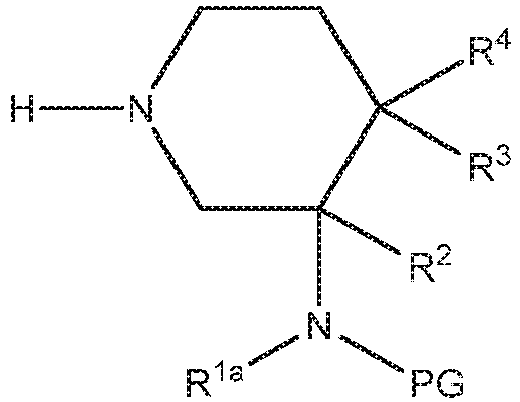

- (c) removing PG from the alkylated 2-(piperidin-1-yl)benzimidazole compound formed in step (b) to generate the compound of Formula (IIIb), wherein variables X1, X2, X3, Z4, R1a, R2, R3, R4, R7, R11, R12, R13 and R15 have the definitions provided in the thirtieth embodiment
- In preferred aspects of the synthetic method, the basic conditions of step (a) comprise contacting the halogenated benzimidazole with the electrophilic moiety in the presence of a carbonate base, such as potassium carbonate or more preferably cesium carbonate.
- In a further embodiment, the invention provides methods of making compounds of formula IIIb or a subformulae thereof.

- The method comprising the synthetic steps of
- (a) Coupling a halogenated benzimidazole having the formula:


- (b) Alkylating the 2-(piperidin-1-yl)benzimidaxole compound generated in step (a) with an electrophilic moiety having the structure


- (c) removing PG from the alkylated 2-(piperidin-1-yl)benzimidazole compound generated in step (b) to generate the compound of Formula (IIIb), wherein variables X1, X2, X3, Z4, R1a, R2, R3, R4, R7, R11, R12, R13 and R15 have the definitions provided in the thirtieth embodiment.
- In a further embodiment, the invention provides methods of making compounds of formula IIIb or a subformulae thereof.

- The method comprising the synthetic steps of
- (a) Coupling a brominated isothiocyanate compound having the formula


- (b) Condensing the N,N'-disubstituted thiourea compound generated in step (a) with an amine compound having the formula
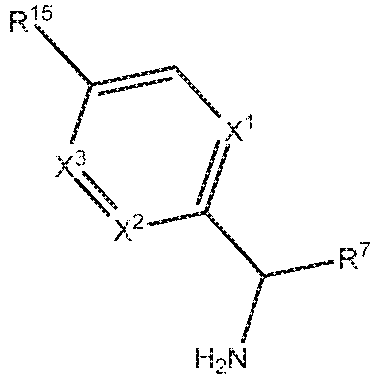

- (c) Intramolecular cyclization of the N,N',N"-trisubstituted guanidine compound generated in step (b) in presence of a transition metal catalyst to form an alkylated 2-(piperidin-1-yl)benzimidazole compound having the formula:

- (d) removing PG from the alkylated 2-(piperidin-1-yl)benzimidazole compound generated in step (c) to provide a compound of Formula (IIIb), wherein variables X1, X2, X3, Z4, R1a, R2, R3, R4, R7, R11, R12, R13 and R15 have the definitions provided in the thirtieth embodiment.
- In a further embodiment, the invention provides methods of making compounds of formula IIId or a subformulae thereof.

- The method comprising the synthetic steps of
- a) coupling an optionally substituted ortho-fluoro nitrobenzene compound having the formula:,


- b) generating an alkylated-2-chlorobenzimidazole compound having the formula:

- c) coupling the alkylated-2-chlorobenzimidazole compound generated in step (b) with a protected piperidine having the formula:


- d) removing the PG from the alkylated 2-(piperidin-1-yl)benzimidazole compound generated in step (c), to generate the compound of Formula (IIId), wherein variables X1, X2, X3, R1a, R2, R3, R4, R7, R11, R12, R13, R14 and R15 have the definitions provided in the thirtieth embodiment.
- In a further embodiment, the invention provides methods of making compounds of formula VII or a subformulae thereof.

- (a) Coupling a halogenated benzimidazole having the formula:
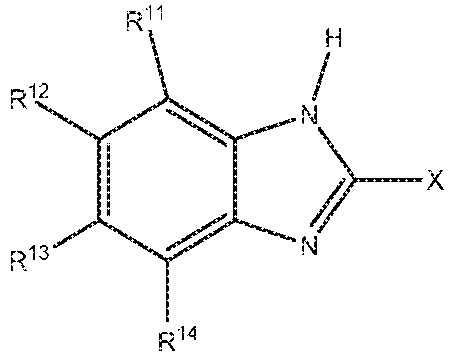

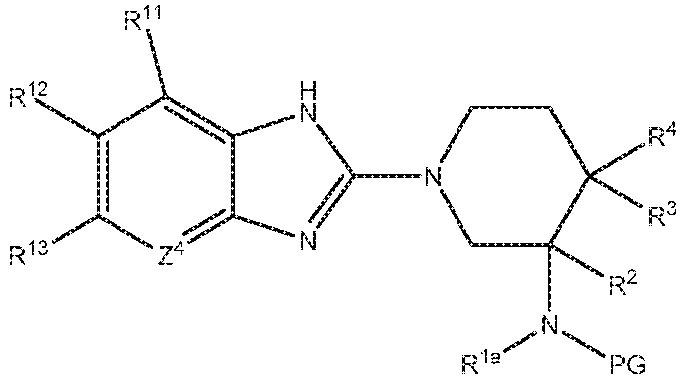
- (b) Alkylating the 2-(piperidin-1-yl)benzimidazole compound generated in step (a) with a halo ester,


- (c) Saponification of the substituted 1-acetyl-2-(piperidin-1-yl)benzimidazole compound generated in step (b) to provide a free acid followed by amination with an amine, HNR9R10, under conditions conducive to amide bond formation to provide a 1-[(2-piperidin-1-yl)benzimidazole)]acetamide compound;
- (d) removing PG from the 1-[(2-piperidin-1-yl)benzimidazole)]acetamide compound generated in step (c) to generate the compound of Formula (VII), wherein variables X1, X2, X3, Z4, R1a, R2, R3, R4, R7, R11, R12, R13 and R15 have the definitions provided in the thirty fourth embodiment.
- In another embodiment, pharmaceutical compositions are provided which comprise one or more pharmaceutically acceptable carriers and a therapeutically effective amount of a compound of any one of formulae I or a subformulae thereof. In some aspects, the composition is formulated in a form selected from the group consisting of an injectable fluid, an aerosol, a tablet, a pill, a capsule, a syrup, a cream, a gel and a transdermal patch.
- In another embodiment, combinations, in particular pharmaceutical combinations, are provided which comprise a therapeutically effective amount of the compound any one of formulae I or a subformulae thereof.
- In another embodiment, methods of modulating TRPC protein activity in a subject are provided which methods comprise administering to the subject a therapeutically effective amount of Formula I or a subformulae thereof. In preferred aspects of the embodiment, methods of inhibiting TRPC6 activity in a subject are provided, which methods comprise administering to the subject a therapeutically effective amount of a compound of Formula I or subformulae thereof. In certain aspects of the embodiment, method of inhibiting TRPC6 activity in a subject are provided, which methods comprise administering to the subject a therapeutically effective amount of a compound of Formula I or subformulae thereof.
- In yet other embodiments, methods of treating a disorder or a disease in a subject mediated by TRPC protein activity are provided, in particular methods of treating a disease or disorder mediated by TRPC6 protein activity are provided. The methods comprise administering to the subject a therapeutically effective amount of the compound of Formula I or a subformulae thereof.
- In another embodiment, methods of treating or preventing a disease or disorder are provided where the disease or disorder is selected from nephrotic syndrome, minimal change disease, focal segmental glomerulosclerosis, collapsing glomerulopathy, membranous nephropathy, membranoproliferative glomerulonephritis, IGA nephropathy, acute renal failure, chronic renal failure, diabetic nephropathy, sepsis, pulmonary hypertension, acute lung disorder, acute respiratory distress syndrome (ARDS), heart failure, stroke, malignant tumor or muscular dystrophy which method comprises the step of administering to a subject in need of therapy a therapeutically effective amount of a compound or salt of Formula I or a subformulae thereof. In certain aspects of this embodiment, the method comprises treating a disease or disorder selected from nephrotic syndrome, minimal change disease, focal segmental glomerulosclerosis, collapsing glomerulopathy, membranous nephropathy, membranoproliferative glomerulonephritis, IGA nephropathy, acute renal failure, chronic renal failure, diabetic nephropathy, sepsis, pulmonary hypertension, acute lung disorder, acute respiratory distress syndrome (ARDS), heart failure, stroke, malignant tumor or muscular dystrophy. In certain instances, the treatment methods and/or the prevention methods are suitable for the treatment and or prevention nephrotic syndrome, membranous nephropathy, and acute renal failure.
- In another aspect, the invention provides for the use of compounds of Formula I or a subformulae thereof for use in the preparation of a medicament or for use in the manufacture of a medicament for the treatment of a disorder or disease in a subject mediated by TRPC protein activity. In certain other aspects, the invention provides for the use of a compound according to formula I or a subformulae thereof in the treatment of nephrotic syndrome, minimal change disease, focal segmental glomerulosclerosis, collapsing glomerulopathy, membranous nephropathy, membranoproliferative glomerulonephritis, IGA nephropathy, acute renal failure, chronic renal failure, diabetic nephropathy, sepsis, pulmonary hypertension, acute lung disorder, acute respiratory distress syndrome (ARDS), heart failure, stroke, malignant tumor or muscular dystrophy. In certain instances, the invention provides for the use of compounds of Formula I or a subformulae thereof for use in the preparation of a medicament or for use in the manufacture of a medicament or the treatment of a disease or disdorder in a subject selected from nephrotic syndrome, membranous nephropathy, and acute renal failure.
- For purposes of interpreting this specification, the following definitions will apply and whenever appropriate, terms used in the singular will also include the plural and vice versa.
- As used herein, the term "alkyl" refers to a fully saturated branched or unbranched hydrocarbon moiety having up to 20 carbon atoms. Unless otherwise provided, alkyl refers to hydrocarbon moieties having 1 to 20 carbon atoms, 1 to 16 carbon atoms, 1 to 10 carbon atoms, 1 to 7 carbon atoms, or 1 to 4 carbon atoms. Representative examples of alkyl include, but are not limited to, methyl, ethyl, n-propyl, iso-propyl, n-butyl, sec-butyl, iso-butyl, tert-butyl, n-pentyl, isopentyl, neopentyl, n-hexyl, 3-methylhexyl, 2,2-dimethylpentyl, 2,3-dimethylpentyl, n-heptyl, n-octyl, n-nonyl, n-decyl and the like.
- As used herein, the term "alkylene" refers to divalent alkyl group as defined herein above having 1 to 20 carbon atoms. Unless otherwise provided, alkylene refers to moieties having 1 to 20 carbon atoms, 1 to 16 carbon atoms, 1 to 10 carbon atoms, 1 to 7 carbon atoms, or 1 to 4 carbon atoms. Representative examples of alkylene include, but are not limited to, methylene, ethylene, n-propylene, iso-propylene, n-butylene, sec-butylene, iso-butylene, tert-butylene, n-pentylene, isopentylene, neopentylene, n-hexylene, 3-methylhexylene, 2,2-dimethylpentylene, 2,3-dimethylpentylene, n-heptylene, n-octylene, n-nonylene, n-decylene and the like.
- As used herein, the term "haloalkyl" refers to an alkyl as defined herein, which is substituted with one or more halo groups as defined herein. The haloalkyl can be monohaloalkyl, dihaloalkyl or polyhaloalkyl including perhaloalkyl. A monohaloalkyl can have one iodo, bromo, chloro or fluoro within the alkyl group. Dihaloalky and polyhaloalkyl groups can have two or more of the same halo atoms or a combination of different halo groups within the alkyl. Typically the polyhaloalkyl contains up to 12, or 10, or 8, or 6, or 4, or 3, or 2 halo groups. Non-limiting examples of haloalkyl include fluoromethyl, difluoromethyl, trifluoromethyl, chloromethyl, dichloromethyl, trichloromethyl, pentafluoroethyl, heptafluoropropyl, difluorochloromethyl, dichlorofluoromethyl, difluoroethyl, difluoropropyl, dichloroethyl and dichloropropyl. A perhaloalkyl refers to an alkyl having all hydrogen atoms replaced with halo atoms.
- As used herein, the term "hydroxy alkyl" refers to an alkyl as defined herein which is substituted with one or more hydroxy groups. The term "hydroxy cycloalkyl-alkyl" refers to an alkyl group that is substituted with a cycloalkyl group, as defined herein, and further substituted with a hydroxy group. The hydroxy group can be on the alkyl group, the cycloalkyl group, or on each of the alkyl and cycloalkyl groups.
- The term "aryl" refers to an aromatic hydrocarbon group having 6-20 carbon atoms in the ring portion. Typically, aryl is monocyclic, bicyclic or tricyclic aryl having 6-20 carbon atoms. Furthermore, the term "aryl" as used herein, refers to an aromatic substituent which can be a single aromatic ring, or multiple aromatic rings that are fused together. Non-limiting examples include phenyl, naphthyl or tetrahydronaphthyl, each of which may optionally be substituted with 1-4 substituents, such as alkyl, trifluoromethyl, cycloalkyl, halogen, hydroxy, alkoxy, acyl, alkyl-C(O)-O-, aryl-O-, heteroaryl-O-, amino, thiol, alkyl-S-, aryl-S- nitro, cyano, carboxy, alkyl-O-C(O)-, carbamoyl, alkyl-S(O)-, sulfonyl, sulfonamido, phenyl, and heterocyclyl.
- As used herein, the term "heterocycle," "heterocyclyl," "heterocycloalkyl" or "heterocyclo" refers to a saturated or unsaturated non-aromatic ring or ring system, e.g., which is a 4-, 5-, 6-, or 7-membered monocyclic, 7-, 8-, 9-, 10-, 11-, or 12-membered bicyclic or 10-, 11-, 12-, 13-, 14- or 15-membered tricyclic ring system and contains at least one heteroatom selected from O, S and N, where the N and S can also optionally be oxidized to various oxidation states. The heterocyclic group can be attached at a heteroatom or a carbon atom. The heterocyclyl can include fused or bridged rings as well as spirocyclic rings. Examples of heterocycles include tetrahydrofuran, dihydrofuran, 1, 4-dioxane, morpholine, 1,4-dithiane, piperazine, piperidine, 1,3-dioxolane, imidazolidine, imidazoline, pyrroline, pyrrolidine, tetrahydropyran, dihydropyran, oxathiolane, dithiolane, 1,3-dioxane, 1,3-dithiane, oxathiane, thiomorpholine, azetidine, thiazolidine, morpholine, and the like.
- As used herein, the term "azacycle" refers to a heterocycle which comprises at least one ring nitrogen atoms and which may optionally comprise 0, 1 or 2 additional ring heteroatoms selectd from N, O or S.
- As used herein, the term "cycloalkyl" refers to saturated or partially unsaturated monocyclic, bicyclic or tricyclic hydrocarbon groups of 3-12 carbon atoms. For the avoidance of doubt, cycloalkyl is not intended to include aromatic groups such as naphthylene or phenyl. Unless otherwise provided, cycloalkyl refers to cyclic hydrocarbon groups having between 3 and 9 ring carbon atoms or between 3 and 7 ring carbon atoms, each of which can be optionally substituted with one, or two, or three, or more substituents independently selected from the group consisting of alkyl, halo, oxo, hydroxy, alkoxy, alkyl-C(O)-, acylamino, carbamoyl, alkyl-NH-, (alkyl)2N-, thiol, alkyl-S-, nitro, cyano, carboxy, alkyl-O-C(O)-, sulfonyl, sulfonamido, sulfamoyl, and heterocyclyl. Exemplary monocyclic hydrocarbon groups include, but are not limited to, cyclopropyl, cyclobutyl, cyclopentyl, cyclopentenyl, cyclohexyl and cyclohexenyl and the like. Exemplary bicyclic hydrocarbon groups include bornyl, indyl, hexahydroindyl, tetrahydronaphthyl, decahydronaphthyl, bicyclo[2.1.1]hexyl, bicyclo[1.1.1]heptyl, bicyclo[2.2.1]heptenyl, 6,6-dimethylbicyclo[3.1.1]heptyl, 2,6,6-trimethylbicyclo[3.1.1]heptyl, bicyclo[2.2.2]octyl and the like. Exemplary tricyclic hydrocarbon groups include adamantyl and the like. The term "hydroxy cyclcoalkyl" refers specifically to a cycloalkyl group substituted with one or more hydroxy groups.
- As used herein, the term "alkoxy" refers to alkyl-O-, wherein alkyl is defined herein above. Representative examples of alkoxy include, but are not limited to, methoxy, ethoxy, propoxy, 2-propoxy, butoxy, tert-butoxy, pentyloxy, hexyloxy, cyclopropyloxy-, cyclohexyloxy- and the like. Typically, alkoxy groups have about 1-7, more preferably about 1-4 carbons.
- As used herein, the term "cycloalkoxy" refers to cycloalkyl-O- and cycloalkyl-alkyl-O, wherein cycloalkyl and alkyl are defined herein above. Representative examples of cycloalkoxy include, but are not limited to, cyclopropyloxy, cyclobutyloxy, cyclopentyloxy, 1-methylcyclopropyloxy, cyclopropylmethoxy, 1-methylcyclobutyloxy and the like. Typically, cycloalkoxy groups have about 3-7, more preferably about 3-6 carbon atoms.
- Divalent substituents are represented with a "diyl" suffix. Thus a divalent alkyl linker is referred to as an alkandiyl group and a divalent cycloalkane group is referred to as a cycloalkandiyl (e.g., cyclopropandiyl).
- As used herein, the term "heteroaryl" refers to a 5-14 membered monocyclic- or bicyclic- or tricyclic-aromatic ring system, having 1 to 8 heteroatoms selected from N, O and S. In certain preferred aspects, the heteroaryl is a 5-10 membered ring system (e.g., 5-7 membered monocycle or an 8-10 membered bicycle) or a 5-7 membered ring system. Exemplary monocyclic heteroaryl groups include 2- or 3-thienyl, 2- or 3-furyl, 2- or 3-pyrrolyl, 2-, 4-, or 5-imidazolyl, 3-, 4-, or 5-pyrazolyl, 2-, 4-, or 5-thiazolyl, 3-, 4-, or 5-isothiazolyl, 2-, 4-, or 5-oxazolyl, 3-, 4-, or 5-isoxazolyl, 3- or 5-1,2,4-triazolyl, 4- or 5-1,2,3-triazolyl, tetrazolyl, 2-, 3-, or 4-pyridyl, 3- or 4-pyridazinyl, 3-, 4-, or 5-pyrazinyl, 2-pyrazinyl, and 2-, 4-, and 5-pyrimidinyl. Exemplary bicyclic heteroaryl groups include 1-, 3-, 4-, 5-, 6-, 7-, or 8-isoquinolinyl, 2-, 3-, 4-, 5-, 6-, 7-, or 8-quinolinyl, 1-, 3-, 4-, 5-, 6-, 7-, or 8-isoquinolinyl, 1-, 2-, 4-, 5-, 6-, 7-, or 8-benzimidazolyl and 1-, 2-, 3-, 4-, 5-, 6-, 7-, or 8-indolyl.
- The term "heteroaryl" also refers to a group in which a heteroaromatic ring is fused to one or more aryl, cycloaliphatic, or heterocyclyl rings, where the radical or point of attachment is on the heteroaromatic ring.
- The terms "bicycle" and "bicyclyl" refers to a ring sytem having two fused rings each of which rings may be carbocyclic or heterocyclic and each of which rings may be saturated, unsaturated or aromatic.
- As used herein, the term "halogen" or "halo" refers to fluoro, chloro, bromo, and iodo.
- As used herein, the term "optionally substituted" unless otherwise specified refers to a group that is unsubstituted or is substituted with one or more, typically 1, 2, 3 or 4, suitable non-hydrogen substituents. If the identity of the "optional substituent" is not clearly defined in context of the optionally substituted group, then each optional substituent is independently selected from the group consisting of: alkyl, hydroxy, halogen, oxo, amino, alkylamino, dialkylamino, alkoxy, cycloalkyl, CO2H, heterocycloalkyloxy (which denotes a heterocyclic group bonded through an oxygen bridge), -CO2alkyl, mercapto, nitro, cyano, sulfamoyl, sulfonamide, aryl, -OC(O)alkyl, -OC(O)aryl, aryl-S-, aryloxy; alkylthio, formyl (i.e., HC(O)-). -C(O)NH2, aralkyl (alkyl substituted with aryl), aryl and aryl substituted with alkyl, cycloalkyl, alkoxy, hydroxy, amino, alkyl-C(O)-NH-, alkylamino, dialkylamino or halogen. It is understood that where a group is indicated to be optionally substituted, the disclosure includes embodiments in which the group is unsubstituted as well as embodiments in which the group is substituted.
- As used herein, the term "isomers" refers to different compounds that have the same molecular formula but differ in arrangement and configuration of the atoms. Also as used herein, the term "an optical isomer" or "a stereoisomer" refers to any of the various stereo isomeric configurations which may exist for a given compound of the present invention and includes geometric isomers. It is understood that a substituent may be attached at a chiral center of a carbon atom. Therefore, the invention includes enantiomers, diastereomers or racemates of the compound. "Enantiomers" are a pair of stereoisomers that are non-superimposable mirror images of each other. A 1:1 mixture of a pair of enantiomers is a "racemic" mixture. The term is used to designate a racemic mixture where appropriate. The use of "rel" indicates that the diastereomeric orientation is known but the absolute stereochemistry is not. In cases where the absolute stereochemistry has not been determined the optical rotation and/or chiral chromatography conditions will indicate which isomer is present.
- "Diastereoisomers" are stereoisomers that have at least two asymmetric atoms, but which are not mirror-images of each other. The absolute stereochemistry is specified according to the Cahn-Ingold-Prelog R-S system. When a compound is a pure enantiomer the stereochemistry at each chiral carbon may be specified by either R or S. Resolved compounds whose absolute configuration is unknown can be designated (+) or (-) depending on the direction (dextro- or levorotatory) which they rotate plane polarized light at the wavelength of the sodium D line or retention time on chiral chromatography separation. Certain of the compounds described herein contain one or more asymmetric centers or axes and may thus give rise to enantiomers, diastereomers, and other stereoisomeric forms that may be defined, in terms of absolute stereochemistry, as (R)- or (S)-, or with the (+) or (-) sign. The present invention is meant to include all such possible isomers, including racemic mixtures, optically pure forms and intermediate mixtures. Optically active (R)- and (S)-isomers may be prepared using chiral synthons or chiral reagents, or resolved using conventional techniques. If the compound contains a double bond, the substituent may be E or Z configuration. If the compound contains a disubstituted cycloalkyl, the cycloalkyl substituent may have a cis- or trans-configuration.
- It is understood that for any compound provided herein, including any compound of Formula (I), or any embodiment thereof, or any compound of Table A, B, or C, or a salt of any of the foregoing, the compound may exist in any stereochemical form, such as a single enantiomer, diastereomer, or tautomer or a mixture of one or more enantiomers, diastereomers, and tautomers in any ratio.
- As used herein, the terms "salt" or "salts" refers to an acid addition or base addition salt of a compound of the invention. "Salts" include in particular "pharmaceutical acceptable salts". The term "pharmaceutically acceptable salts" refers to salts that retain the biological effectiveness and properties of the compounds of this invention and, which typically are not biologically or otherwise undesirable. In many cases, the compounds of the present invention are capable of forming acid and/or base salts by virtue of the presence of amino and/or carboxyl groups or groups similar thereto.
- Pharmaceutically acceptable acid addition salts can be formed with inorganic acids and organic acids.
- Inorganic acids from which salts can be derived include, for example, hydrochloric acid, hydrobromic acid, sulfuric acid, nitric acid, phosphoric acid, and the like.
- Organic acids from which salts can be derived include, for example, acetic acid, propionic acid, glycolic acid, oxalic acid, maleic acid, malonic acid, succinic acid, fumaric acid, tartaric acid, citric acid, benzoic acid, mandelic acid, methanesulfonic acid, ethanesulfonic acid, benzenesuflonic acid, toluenesulfonic acid, sulfosalicylic acid, and the like.
- Pharmaceutically acceptable base addition salts can be formed with inorganic and organic bases.
- Inorganic bases from which salts can be derived include, for example, ammonium salts and metals from columns I to XII of the periodic table. In certain embodiments, the salts are derived from sodium, potassium, ammonium, calcium, magnesium, iron, silver, zinc, and copper. In certain other embodiments, the salts are selected from ammonium, potassium, sodium, calcium and magnesium salts.
- Organic bases from which salts can be derived include, for example, primary, secondary, and tertiary amines, substituted amines including naturally occurring substituted amines, cyclic amines, basic ion exchange resins, and the like. Certain organic amines include isopropylamine, benzathine, cholinate, diethanolamine, diethylamine, lysine, meglumine, piperazine and tromethamine.
- In another aspect, the present invention provides compounds as disclosed herein in acetate, ascorbate, adipate, aspartate, benzoate, besylate, bromide/hydrobromide, bicarbonate/carbonate, bisulfate/sulfate, camphorsulfonate, caprate, chloride/hydrochloride, chlortheophyllonate, citrate, ethandisulfonate, fumarate, gluceptate, gluconate, glucuronate, glutamate, glutarate, glycolate, hippurate, hydroiodide/iodide, isethionate, lactate, lactobionate, laurylsulfate, malate, maleate, malonate, mandelate, mesylate, methylsulphate, mucate, naphthoate, napsylate, nicotinate, nitrate, octadecanoate, oleate, oxalate, palmitate, pamoate, phosphate/hydrogen phosphate/dihydrogen phosphate, polygalacturonate, propionate, sebacate, stearate, succinate, sulfosalicylate, sulfate, tartrate, tosylate trifenatate, trifluoroacetate or xinafoate salt form. In yet another aspect, the present invention provides compounds as disclosed herein in C1-C4alkyl sufonic acid, benzenesulfonic acid or mono-, di- or tri-C1-C4alkyl substituted benzene sulfonic acid addition salt form.
- Any formula given herein is also intended to represent unlabeled forms as well as isotopically labeled forms of the compounds. Isotopically labeled compounds have structures depicted by the formulas given herein except that one or more atoms are replaced by an atom having a selected atomic mass or mass number. Examples of isotopes that can be incorporated into compounds of the invention include isotopes of hydrogen, carbon, nitrogen, oxygen, phosphorous, fluorine, and chlorine, such as 2H, 3H, 11C, 13C, 14C, 15N, 18F 31P, 32P, 35S, 36Cl, 124I, 125I respectively. The invention includes various isotopically labeled compounds as defined herein, for example those into which radioactive isotopes, such as 3H, 13C, and 14C, are present. Such isotopically labelled compounds are useful in metabolic studies (with 14C), reaction kinetic studies (with, for example 2H or 3H), detection or imaging techniques, such as positron emission tomography (PET) or single-photon emission computed tomography (SPECT) including drug or substrate tissue distribution assays, or in radioactive treatment of patients. In particular, an 18F or labeled compound may be particularly desirable for PET or SPECT studies. Isotopically labeled compounds of this invention and salts thereof can generally be prepared by carrying out the procedures disclosed in the schemes or in the examples and preparations described below by substituting a readily available isotopically labeled reagent for a non-isotopically labeled reagent.
- Further, substitution with heavier isotopes, particularly deuterium (i.e., 2H or D) may afford certain therapeutic advantages resulting from greater metabolic stability, for example increased in vivo half-life or reduced dosage requirements or an improvement in therapeutic index. It is understood that deuterium in this context is regarded as a substituent of a compound of the formula (I). The concentration of such a heavier isotope, specifically deuterium, may be defined by the isotopic enrichment factor. The term "isotopic enrichment factor" as used herein means the ratio between the isotopic abundance and the natural abundance of a specified isotope. If a substituent in a compound of this invention is denoted deuterium, such compound has at least 50% deuterium incorporation at each designated deuterium atom, 60% deuterium incorporation, at least 75% deuterium incorporation, at least 90%, deuterium incorporation, at least 95% deuterium incorporation, at least 99% deuterium incorporation, or at least 99.5% deuterium incorporation.
- The compounds of the present invention may inherently or by design form solvates with solvents (including water). Therefore, it is intended that the invention embrace both solvated and unsolvated forms. The term "solvate" refers to a molecular complex of a compound of the present invention (including salts thereof) with one or more solvent molecules. Such solvent molecules are those commonly used in the pharmaceutical art, which are known to be innocuous to a recipient, e.g., water, ethanol, dimethylsulfoxide, acetone and other common organic solvents. The term "hydrate" refers to a molecular complex comprising a compound of the invention and water. Pharmaceutically acceptable solvates in accordance with the invention include those wherein the solvent of crystallization may be isotopically substituted, e.g. D2O, d6-acetone, d6-DMSO.
- The term "a therapeutically effective amount" of a compound of the present invention refers to an amount of the compound of the present invention that will elicit the biological or medical response of a subject, for example, reduction or inhibition of an enzyme or a protein activity, or ameliorate symptoms, alleviate conditions, slow or delay disease progression, or prevent a disease, etc. In one non-limiting embodiment, the term "a therapeutically effective amount" refers to the amount of the compound of the present invention that, when administered to a subject, is effective to (1) at least partially alleviating, inhibiting, preventing and/or ameliorating a condition, or a disorder, or a disease or biological process (i) mediated by TRPC6 activity, or (ii) associated with TRPC6 activity; or (2) inhibiting the activity of TRPC6. In another non-limiting embodiment, the term "a therapeutically effective amount" refers to the amount of the compound of the present invention that, when administered to a cell, or a tissue, or a noncellular biological material, or a medium, is effective to at least partially inhibit TRPC6 activity.
- As used herein, the term "subject" refers to an animal. Typically the animal is a mammal. A subject also refers to for example, primates (e.g., humans), cows, sheep, goats, horses, dogs, cats, rabbits, rats, mice, fish, birds and the like. In certain embodiments, the subject is a primate. In yet other embodiments, the subject is a human.
- As used herein, the term "inhibit", "inhibition" or "inhibiting" refers to the reduction or suppression of a given condition, symptom, or disorder, or disease, or a significant decrease in the baseline activity of a biological activity or process.
- As used herein, the term "treat", "treating" or "treatment" of any disease or disorder refers in one embodiment, to ameliorating the disease or disorder (i.e., slowing or arresting or reducing the development of the disease or at least one of the clinical symptoms thereof). In another embodiment "treat", "treating" or "treatment" refers to alleviating or ameliorating at least one physical parameter including those which may not be discernible by the patient. In yet another embodiment, "treat", "treating" or "treatment" refers to modulating the disease or disorder, either physically, (e.g., stabilization of a discernible symptom), physiologically, (e.g., stabilization of a physical parameter), or both.
- As used herein, the term "prevent," "preventing" or "prevention" of any disease or disorder refers in one embodiment, to delay or avoidance of onset of the disease or disorder (i.e., slowing of preventing the onset of the disease or disorder in a patient susceptible to development of the disease or disorder).
- As used herein, a subject is "in need of" a treatment if such subject would benefit biologically, medically or in quality of life from such treatment.
- As used herein, the term "a," "an," "the" and similar terms used in the context of the present invention (especially in the context of the claims) are to be construed to cover both the singular and plural unless otherwise indicated herein or clearly contradicted by the context.
- Any asymmetric atom (e.g., carbon of the like) of the compound(s) of the present invention can be present in racemic or enantiomerically enriched.. for example the (R)-, (S)- or (R,S)-configuration. In certain embodiments, each asymmetric atom has at least 50% enantiomeric excess, at least 60% enantiomeric excess, at least 70% enantiomeric excess, at least 80% enantiomeric excess, at least 90% enantiomeric excess, at least 95% enantiomeric excess, or at least 99% enantiomeric excess in the (R)- or (S)-configuration. Substituents at atoms with unsaturated bonds may, if possible, be present in cis-(Z)- or trans-(E)-form.
- Accordingly, as used herein a compound of the present invention can be in the form of one of the possible geometric isomers, diastereoisomers, optical isomers, rotamers, atropisomers, tautomers or mixtures thereof, for example, as substantially pure geometric (cis or trans) isomers, diastereomers, optical isomers (antipodes), racemates or mixtures thereof.
- Any resulting mixtures of isomers can be separated on the basis of the physicochemical differences of the constituents, into the pure or substantially pure geometric or optical isomers, diastereomers, racemates, for example, by chromatography and/or fractional crystallization,
- Any resulting racemates of final products or intermediates can be resolved into the optical antipodes by known methods, e.g.. by separation of the diastereomeric salts thereof, obtained with an optically active acid or base, and liberating the optically active acidic or basic compound. In particular, a basic moiety may thus be employed to resolve the compounds of the present invention into their optical antipodes, e.g., by fractional crystallization of a salt formed with an optically active acid, e.g.. tartaric acid, dibenzoyl tartaric acid, diacetyl tartaric acid, di-O,O'-p-toluoyl tartaric acid, mandelic acid, malic acid or camphor-10-sulfonic acid. Racemic products can also be resolved by chiral chromatography, e.g.. high performance liquid chromatography (HPLC) or supercritical fluid chromatography (SFC) using a chiral adsorbent.
- Mixtures of isomers can be separated in a manner known to those skilled in the art into the individual isomers; diastereoisomers can be separated, for example, by partitioning between polyphasic solvent mixtures, recrystallization and/or chromatographic separation, for example over silica gel or by e.g. medium pressure liquid chromatography over a reversed phase column, and racemates can be separated, for example, by the formation of salts with optically pure salt-forming reagents and separation of the mixture of diastereoisomers so obtainable, for example by means of fractional crystallization, or by chromatography over optically active column materials.
- Within the scope of this text, only a readily removable group that is not a constituent of the particular desired end product of the compounds of the present invention is designated a "protecting group", unless the context indicates otherwise. The protection of functional groups by such protecting groups, the protecting groups themselves, and their cleavage reactions are described for example in standard reference works, such as J. F. W. McOmie, "Protective Groups in Organic Chemistry", Plenum Press, London and New York 1973, in T. W. Greene and P. G. M. Wuts, "Protective Groups in Organic Synthesis", Third edition, Wiley, New York 1999, in "The Peptides"; Volume 3 (editors: E. Gross and J. Meienhofer), Academic Press, London and New York 1981, in "Methoden der organischen Chemie" (Methods of Organic Chemistry), Houben Weyl, 4th edition, Volume 15/1, Georg Thieme Verlag, Stuttgart 1974, in H.-D. Jakubke and H. Jeschkeit, "Aminosauren, Peptide, Proteine" (Amino acids, Peptides, Proteins), Verlag Chemie, Weinheim, Deerfield Beach, and Basel 1982, and in Jochen Lehmann, "Chemie der Kohlenhydrate: Monosaccharide and Derivate" (Chemistry of Carbohydrates: Monosaccharides and Derivatives), Georg Thieme Verlag, Stuttgart 1974. A characteristic of protecting groups is that they can be removed readily (i.e. without the occurrence of undesired secondary reactions) for example by solvolysis, reduction, photolysis or alternatively under physiological conditions (e.g. by enzymatic cleavage).
- Intermediates and final products can be worked up and/or purified according to standard methods, e.g. using chromatographic methods, distribution methods, (re-) crystallization, and the like.
- All methods described herein can be performed in any suitable order unless otherwise indicated herein or otherwise clearly contradicted by context. The use of any and all examples, or exemplary language (e.g. "such as") provided herein is intended merely to better illuminate the invention and does not pose a limitation on the scope of the invention otherwise claimed.
- Any process steps disclosed herein can be carried out under reaction conditions that are known to those skilled in the art, including those mentioned specifically, in the absence or, customarily, in the presence of solvents or diluents, including, for example, solvents or diluents that are inert towards the reagents used and dissolve them, in the absence or presence of catalysts, condensation or neutralizing agents, for example ion exchangers, such as cation exchangers, e.g. in the H+ form, depending on the nature of the reaction and/or of the reactants at reduced, normal or elevated temperature, for example in a temperature range of from about -100° C. to about 250° C, including, for example, from approximately - 80° C. to approximately 250° C, for example at from -80 to -60° C, at room temperature, at from -20 to 40° C. or at reflux temperature, under atmospheric pressure or in a closed vessel, where appropriate under pressure, and/or in an inert atmosphere, for example under an argon or nitrogen atmosphere.
- The solvents from which those solvents that are suitable for any particular reaction may be selected include those mentioned specifically or, for example, water, esters, such as lower alkyl-lower alkanoates, for example ethyl acetate, ethers, such as aliphatic ethers, for example diethyl ether, or cyclic ethers, for example tetrahydrofuran or dioxane, liquid aromatic hydrocarbons, such as benzene or toluene, alcohols, such as methanol, ethanol or 1- or 2-propanol, nitriles, such as acetonitrile, halogenated hydrocarbons, such as methylene chloride or chloroform, acid amides, such as dimethylformamide or dimethyl acetamide, bases, such as heterocyclic nitrogen bases, for example pyridine or N-methylpyrrolidin-2-one, carboxylic acid anhydrides, such as lower alkanoic acid anhydrides, for example acetic anhydride, cyclic, linear or branched hydrocarbons, such as cyclohexane, hexane or isopentane, methycyclohexane, or mixtures of those solvents, for example aqueous solutions, unless otherwise indicated in the description of the processes. Such solvent mixtures may also be used in working up, for example by chromatography or partitioning.
- In another aspect, the present invention provides a pharmaceutical composition comprising a compound of the present invention, or a pharmaceutically acceptable salt thereof, and a pharmaceutically acceptable carrier. In a further embodiment, the composition comprises at least two pharmaceutically acceptable carriers, such as those described herein. For purposes of the present invention, unless designated otherwise, solvates and hydrates are generally considered compositions. Preferably, pharmaceutically acceptable carriers are sterile. The pharmaceutical composition can be formulated for particular routes of administration such as oral administration, parenteral administration, and rectal administration, etc. In addition, the pharmaceutical compositions of the present invention can be made up in a solid form (including without limitation capsules, tablets, pills, granules, powders or suppositories), or in a liquid form (including without limitation solutions, suspensions or emulsions). The pharmaceutical compositions can be subjected to conventional pharmaceutical operations such as sterilization and/or can contain conventional inert diluents, lubricating agents, or buffering agents, as well as adjuvants, such as preservatives, stabilizers, wetting agents, emulsifiers and buffers, etc.
- As used herein, the term "pharmaceutically acceptable carrier" includes any and all solvents, dispersion media, coatings, surfactants, antioxidants, preservatives (e.g., antibacterial agents, antifungal agents), isotonic agents, absorption delaying agents, salts, preservatives, drugs, drug stabilizers, binders, excipients, disintegration agents, lubricants, sweetening agents, flavoring agents, dyes, and the like and combinations thereof, as would be known to those skilled in the art (see, for example, Remington's Pharmaceutical Sciences, 18th Ed. Mack Printing Company, 1990, pp. 1289-1329). Except insofar as any conventional carrier is incompatible with the active ingredient, its use in the therapeutic or pharmaceutical compositions is contemplated.
- Typically, the pharmaceutical compositions are tablets or gelatin capsules comprising the active ingredient together with one or more of: a) diluents, e.g., lactose, dextrose, sucrose, mannitol, sorbitol, cellulose and/or glycine; b) lubricants, e.g., silica, talcum, stearic acid, its magnesium or calcium salt and/or polyethyleneglycol; for tablets also c) binders, e.g., magnesium aluminum silicate, starch paste, gelatin, tragacanth, methylcellulose, sodium carboxymethylcellulose and/or polyvinylpyrrolidone; if desired d) disintegrants, e.g., starches, agar, alginic acid or its sodium salt, or effervescent mixtures; and c) absorbents, colorants, flavors and sweeteners. Tablets may be either film coated or enteric coated according to methods known in the art. Suitable compositions for oral administration include an effective amount of a compound of the invention in the form of tablets, lozenges, aqueous or oily suspensions, dispersible powders or granules, emulsion, hard or soft capsules, or syrups or elixirs. Compositions intended for oral use are prepared according to any method known in the art for the manufacture of pharmaceutical compositions and such compositions can contain one or more agents selected from the group consisting of sweetening agents, flavoring agents, coloring agents and preserving agents in order to provide pharmaceutically elegant and palatable preparations. Tablets may contain the active ingredient in admixture with nontoxic pharmaceutically acceptable excipients which are suitable for the manufacture of tablets. These excipients are, for example, inert diluents, such as calcium carbonate, sodium carbonate, lactose, calcium phosphate or sodium phosphate; granulating and disintegrating agents, for example, corn starch, or alginic acid; binding agents, for example, starch, gelatin or acacia; and lubricating agents, for example magnesium stearate, stearic acid or talc. The tablets are uncoated or coated by known techniques to delay disintegration and absorption in the gastrointestinal tract and thereby provide a sustained action over a longer period. For example, a time delay material such as glyceryl monostearate or glyceryl distearate can be employed. Formulations for oral use can be presented as hard gelatin capsules wherein the active ingredient is mixed with an inert solid diluent, for example, calcium carbonate, calcium phosphate or kaolin, or as soft gelatin capsules wherein the active ingredient is mixed with water or an oil medium, for example, peanut oil, liquid paraffin or olive oil. Certain injectable compositions are aqueous isotonic solutions or suspensions, and suppositories are advantageously prepared from fatty emulsions or suspensions. Said compositions may be sterilized and/or contain adjuvants, such as preserving, stabilizing, wetting or emulsifying agents, solution promoters, salts for regulating the osmotic pressure and/or buffers. In addition, they may also contain other therapeutically valuable substances. Said compositions are prepared according to conventional mixing, granulating or coating methods, respectively, and contain about 0.1-75%, or contain about 1-50%, of the active ingredient. Suitable compositions for transdermal application include an effective amount of a compound of the invention with a suitable carrier. Carriers suitable for transdermal delivery include absorbable pharmacologically acceptable solvents to assist passage through the skin of the host. For example, transdermal devices are in the form of a bandage comprising a backing member, a reservoir containing the compound optionally with carriers, optionally a rate controlling barrier to deliver the compound of the skin of the host at a controlled and predetermined rate over a prolonged period of time, and means to secure the device to the skin. Suitable compositions for topical application, e.g., to the skin and eyes, include aqueous solutions, suspensions, ointments, creams, gels or sprayable formulations, e.g., for delivery by aerosol or the like. Such topical delivery systems will in particular be appropriate for dermal application, e.g., for the treatment of skin cancer, e.g., for prophylactic use in sun creams, lotions, sprays and the like. They are thus particularly suited for use in topical, including cosmetic, formulations well-known in the art. Such may contain solubilizers, stabilizers, tonicity enhancing agents, buffers and preservatives. As used herein a topical application may also pertain to an inhalation or to an intranasal application. They may be conveniently delivered in the form of a dry powder (either alone, as a mixture, for example a dry blend with lactose, or a mixed component particle, for example with phospholipids) from a dry powder inhaler or an aerosol spray presentation from a pressurized container, pump, spray, atomizer or nebulizer, with or without the use of a suitable propellant.
- The present invention further provides anhydrous pharmaceutical compositions and dosage forms comprising the compounds of the present invention as active ingredients, since water may facilitate the degradation of certain compounds.
- Anhydrous pharmaceutical compositions and dosage forms of the invention can be prepared using anhydrous or low moisture containing ingredients and low moisture or low humidity conditions. An anhydrous pharmaceutical composition may be prepared and stored such that its anhydrous nature is maintained. Accordingly, anhydrous compositions are packaged using materials known to prevent exposure to water such that they can be included in suitable formulary kits. Examples of suitable packaging include, but are not limited to, hermetically sealed foils, plastics, unit dose containers (e.g., vials), blister packs, and strip packs.
- The invention further provides pharmaceutical compositions and dosage forms that comprise one or more agents that reduce the rate by which the compound of the present invention as an active ingredient will decompose. Such agents, which are referred to herein as "stabilizers," include, but are not limited to, antioxidants such as ascorbic acid, pH buffers, or salt buffers, etc.
- The compounds disclosed herein in free form or in pharmaceutically acceptable salt form, exhibit valuable pharmacological properties, e.g. TRPC protein modulating properties and more particularly inhibition of TRPC6 protein activity, e.g. as indicated in in vitro and in vivo tests as provided in the next sections and are therefore indicated for therapy.
- The present invention provides methods of treating a disease or disorder associated with TRPC6 protein activity by administering to a subject in need thereof an effective amount of a compound disclosed herein. In certain aspects, the disease or disorder suitable for therapy by administration of the compound of the invention include, but are not limited to, nephrotic syndrome, minimal change disease, focal segmental glomerulosclerosis, collapsing glomerulopathy, membranous nephropathy, membranoproliferative glomerulonephritis, IGA nephropathy, acute renal failure, chronic renal failure, diabetic nephropathy, sepsis, pulmonary hypertension, acute lung disorder, acute respiratory distress syndrome (ARDS), heart failure, stroke, malignant tumor or muscular dystrophy. In certain instances, the patient is suffering from nephrotic syndrome, membranous nephropathy, and acute renal failure.
- In a specific embodiment, the present invention provides a method of treating or preventing renal disease by administering to a subject in need thereof an effective amount of a compound disclosed herein. In certain embodiments, patients who are currently asymptomatic but are at risk of developing renal disease are suitable for administration with a compound of the invention. The methods of treating or preventing renal disease include, but are not limited to, methods of treating or preventing nephrotic syndrome, membranous nephropathy, acute renal failure, sepsis, chronic renal failure and diabetic nephropathy.
- The pharmaceutical composition or combination of the present invention can be in unit dosage of about 1-1000 mg of active ingredient(s) for a subject of about 50-70 kg, or about 1-500 mg or about 1-250 mg or about 1-150 mg or about 0.5-100 mg, or about 1-50 mg of active ingredients. The therapeutically effective dosage of a compound, the pharmaceutical composition, or the combinations thereof, is dependent on the species of the subject, the body weight, age and individual condition, the disorder or disease or the severity thereof being treated. A physician, clinician or veterinarian of ordinary skill can readily determine the effective amount of each of the active ingredients necessary to prevent, treat or inhibit the progress of the disorder or disease.
- The above-cited dosage properties are demonstrable in vitro and in vivo tests using advantageously mammals, e.g., mice, rats, dogs, monkeys or isolated organs, tissues and preparations thereof. The compounds of the present invention can be applied in vitro in the form of solutions, e.g., aqueous solutions, and in vivo either enterally, parenterally, advantageously intravenously, e.g., as a suspension or in aqueous solution. The dosage in vitro may range between about 10-3 molar and 10-9 molar concentrations. A therapeutically effective amount in vivo may range depending on the route of administration, between about 0.1-500 mg/kg, or between about 1-100 mg/kg.
- The activity of a compound according to the present invention can be assessed by in vitro & in vivo methods, such as those described in the examples below.
- The compound of the present invention may be administered either simultaneously with, or before or after, one or more other therapeutic agent. The compound of the present invention may be administered separately, by the same or different route of administration, or together in the same pharmaceutical composition as the other agents.
- In one embodiment, the invention provides a product comprising a compound disclosed herein and at least one other therapeutic agent as a combined preparation for simultaneous, separate or sequential use in therapy. In one embodiment, the therapy is the treatment of a disease or condition mediated by TRPC protein activity. In preferred aspects, the therapy is a treatment for nephrotic syndrome, minimal change disease, focal segmental glomerulosclerosis, collapsing glomerulopathy, membranous nephropathy, membranoproliferative glomerulonephritis, IGA nephropathy, acute renal failure, chronic renal failure, diabetic nephropathy, sepsis, pulmonary hypertension, acute lung disorder, acute respiratory distress syndrome (ARDS), heart failure, stroke, malignant tumor, or muscular dystrophy.
- Products provided as a combined preparation include a composition comprising the compound disclosed herein and the other therapeutic agent(s) together in the same pharmaceutical composition, or the compound disclosed herein and the other therapeutic agent(s) in separate form, e.g. in the form of a kit.
- In one embodiment, the invention provides a pharmaceutical composition comprising a compound as disclosed herein and another therapeutic agent(s). Optionally, the pharmaceutical composition may comprise a pharmaceutically acceptable carrier, as described above.
- In one embodiment, the invention provides a kit comprising two or more separate pharmaceutical compositions, at least one of which contains a compound disclosed herein. In one embodiment, the kit comprises means for separately retaining said compositions, such as a container, divided bottle, or divided foil packet. An example of such a kit is a blister pack, as typically used for the packaging of tablets, capsules and the like.
- The kit of the invention may be used for administering different dosage forms, for example, oral and parenteral, for administering the separate compositions at different dosage intervals, or for titrating the separate compositions against one another. To assist compliance, the kit of the invention typically comprises directions for administration.
- In the combination therapies of the invention, the compound of the invention and the other therapeutic agent may be manufactured and/or formulated by the same or different manufacturers. Moreover, the compound of the invention and the other therapeutic may be brought together into a combination therapy: (i) prior to release of the combination product to physicians (e.g. in the case of a kit comprising the compound of the invention and the other therapeutic agent); (ii) by the physician themselves (or under the guidance of the physician) shortly before administration; (iii) in the patient themselves, e.g. during sequential administration of the compound of the invention and the other therapeutic agent.
- Accordingly, the invention provides the use of a compound as disclosed herein for treating a disease or condition mediated by TRPC protein activity wherein the medicament is prepared for administration with another therapeutic agent. The invention also provides the use of another therapeutic agent for treating a disease or condition mediated by the TRPC protein activity, wherein the medicament is administered with a compound as disclosed herein. In another aspect, the invention provides the use of a compound as disclosed herein for treating a disease or disorder selected from nephrotic syndrome, minimal change disease, focal segmental glomerulosclerosis, collapsing glomerulopathy, membranous nephropathy, membranoproliferative glomerulonephritis, IGA nephropathy, acute renal failure, chronic renal failure, diabetic nephropathy, sepsis, pulmonary hypertension, acute lung disorder, acute respiratory distress syndrome (ARDS), heart failure, stroke, malignant tumor, or muscular dystrophy wherein the medicament is prepared for administration with another therapeutic agent. The invention also provides the use of another therapeutic agent for treating a disease or disorder selected from nephrotic syndrome, minimal change disease, focal segmental glomerulosclerosis, collapsing glomerulopathy, membranous nephropathy, membranoproliferative glomerulonephritis, IGA nephropathy, acute renal failure, chronic renal failure, diabetic nephropathy, sepsis, pulmonary hypertension, acute lung disorder, acute respiratory distress syndrome (ARDS), heart failure, stroke, malignant tumor, or muscular dystrophy, wherein the medicament is administered with a compound as disclosed herein.
- The invention also provides a compound as disclosed herein for use in a method of treating a disease or condition mediated by TRPC protein activity wherein the compound is prepared for administration with another therapeutic agent. The invention also provides another therapeutic agent for use in a method of treating a disease or condition mediated by TRPC protein activity, wherein the other therapeutic agent is prepared for administration with a compound as disclosed herein. The invention also provides a compound as disclosed herein for use in a method of treating a disease or condition mediated by TRPC protein activity, wherein the compound is administered with another therapeutic agent. The invention also provides another therapeutic agent for use in a method of treating a disease or condition mediated by TRPC protein activity, wherein the other therapeutic agent is administered with a compound as disclosed herein.
- The invention also provides the use of a compound as disclosed herein for treating a disease or condition mediated by TRPC protein activity wherein the patient has previously (e.g. within 24 hours) been treated with another therapeutic agent. The invention also provides the use of another therapeutic agent for treating a disease or condition mediated by TRPC protein activity wherein the patient has previously (e.g. within 24 hours) been treated with a compound as disclosed herein.
- The pharmaceutical compositions can be administered alone or in combination with other molecules known to have a beneficial effect in treatment of kidney disease or more particularly in the treatment of FSGS, nephrotic syndrome, minimal change diseases or diabetic kidney disease. A combination therapy regimen may be additive, or it may produce synergistic results (e.g., improvement in kidney function which is more than expected for the combined use of the two agents). In some embodiments, the present invention provide a combination therapy for preventing and/or treating kidney disease or more particularly FSGS, nephrotic syndrome or minimal change diseases with a compound of the invention and a second therapeutic agent selected from the group consisting of ACE/ARB (such as captopril, llisinopril or losartan), steroid therapy (such as prednisone), immunomodulators (such as mycophenolate mofetil, tacrolimus or cyclosporine A), adrenocorticotropic hormone analogs (such acthar gel), anti-CD20 antibodies (such as rituximab), calcium channel blockers (such as amlodipine), diuretics (such as hydrochlorothiazide), antiplatelet agents (such as dipyridamole), anticoagulants (such as heparin), DPP-4 inhibitors (such as sitagliptin), SGLT2 inhibitors (such as dapagliflozin), anti-hyperlipidemia (such as rosuvastatin), anemia therapy (darbepoetin alfa), or anti-hyperuricemia (febxostat).
- In one embodiment, the invention provides a method of inhibiting the activity of a TRPC protein, or more preferably inhibiting the activity of TRPC6 protein, in a subject, wherein the method comprises administering to the subject a therapeutically effective amount of the compound according to the definition of Formula (I). The invention further provides methods of inhibiting the activity of a TRPC protein, or more preferably inhibiting the activity of TRPC6 protein in a subject by administering a compound as disclosed herein, wherein the method comprises administering to the subject a therapeutically effective amount of the compound as disclosed herein.
- In one embodiment, the invention provides a compound as disclosed herein, for use as a medicament.
- In one embodiment, the invention provides the use of a compound as disclosed herein for the treatment of a disorder or disease in a subject characterized by the activity of a TRPC protein, or more preferably the activity of TRPC6 protein. In particular, the invention provides the use of a compound as disclosed herein for the treatment of a disorder or disease mediated by the activity of a TRPC protein, or more preferably the activity of TRPC6 protein, e.g., nephrotic syndrome, minimal change disease, focal segmental glomerulosclerosis, collapsing glomerulopathy, membranous nephropathy, membranoproliferative glomerulonephritis, IGA nephropathy, acute renal failure, chronic renal failure, diabetic nephropathy, sepsis, pulmonary hypertension, acute lung disorder, acute respiratory distress syndrome (ARDS), zheart failure, stroke, malignant tumor, or muscular dystrophy. In certain preferred aspects, the invention provides for the use of a compound as disclosed herein for the treatment of a disorder or disease mediated by the activity of TRPC6 protein selected from nephrotic syndrome, membranous nephropathy and acute renal failure.
- In one embodiment, the invention provides the use of a compound as disclosed herein in the manufacture of a medicament for the treatment of a disorder or disease in a subject characterized by activity of a TRPC protein, or more preferably the activity of TRPC6 protein. More particularly in the manufacture of a medicament for the treatment of a disease or disorder in a subject characterized by activity of a TRPC protein, or more preferably the activity of TRPC6 protein, e.g., nephrotic syndrome, minimal change disease, focal segmental glomerulosclerosis, collapsing glomerulopathy, membranous nephropathy, membranoproliferative glomerulonephritis, IGA nephropathy, acute renal failure, chronic renal failure, diabetic nephropathy, sepsis, pulmonary hypertension, acute lung disorder, acute respiratory distress syndrome (ARDS), heart failure, stroke, malignant tumor, or muscular dystrophy. In certain preferred aspects, the invention provides the use of a compound as disclosed herein in the manufacture of a medicament for the treatment of nephrotic syndrome, membranous nephropathy and acute renal failure.
- In one embodiment, the invention provides the use of a compound as disclosed herein for the treatment of a disorder or disease in a subject characterized by activity of a TRPC protein, or more preferably the activity of TRPC6 protein. More particularly, the invention provides uses of the compounds provided herein in the treatment of a disease or disorder characterized by activity of a TRPC protein, or more preferably the activity of TRPC6 protein, e.g., nephrotic syndrome, minimal change disease, focal segmental glomerulosclerosis, collapsing glomerulopathy, membranous nephropathy, membranoproliferative glomerulonephritis, IGA nephropathy, acute renal failure, chronic renal failure, diabetic nephropathy, sepsis, pulmonary hypertension, acute lung disorder, acute respiratory distress syndrome (ARDS), heart failure, stroke, malignant tumor, or muscular dystrophy. In certain embodiments, the uses of the compounds provided herein is for the treatment of a disease or disorder is selected from nephrotic syndrome, membranous nephropathy and acute renal failure.
- In a specific embodiment, the present invention provides use of the compounds of the invention for treating or preventing nephrotic syndrome, membranous nephropathy, acute renal failure, sepsis, chronic renal failure, diabetic nephropathy, pulmonary hypertension, acute lung disorder, acute respiratory distress syndrome (ARDS), heart failure, stroke, malignant tumor or muscular dystrophy. In certain embodiments, patients who are currently asymptomatic but are at risk of developing a symptomatic nephrotic syndrome, membranous nephropathy, acute renal failure, sepsis, chronic renal failure, diabetic nephropathy, pulmonary hypertension, acute lung disorder, acute respiratory distress syndrome (ARDS), heart failure, stroke, malignant tumor or muscular dy strophy are suitable for administration with a compound of the invention. The use in treating or preventing nephrotic syndrome, membranous nephropathy, acute renal failure, sepsis, chronic renal failure, diabetic nephropathy, pulmonary hypertension, acute lung disorder, acute respiratory distress syndrome (ARDS), heart failure, stroke, malignant tumor or muscular dystrophyinclude, but are not limited to, uses in treating or preventing one or more symptoms or aspects of nephrotic syndrome, membranous nephropathy, acute renal failure, sepsis, chronic renal failure, diabetic nephropathy, pulmonary hypertension, acute lung disorder, acute respiratory distress syndrome (ARDS), heart failure, stroke, malignant tumor or muscular dystrophy.
- The invention further includes any variant of the present processes, in which an intermediate product obtainable at any stage thereof is used as starting material and the remaining steps are carried out, or in which the starting materials are formed in situ under the reaction conditions, or in which the reaction components are used in the form of their salts or optically pure materials.
- The following examples are intended to illustrate the invention and are not to be construed as being limitations thereon. Temperatures are given in degrees centigrade (° C.). If not mentioned otherwise, all evaporations are performed under reduced pressure, typically between about 15 mm Hg and 100 mm Hg (=20-133 mbar). The structure of final products, intermediates and starting materials is confirmed by standard analytical methods, e.g., microanalysis and spectroscopic characteristics, e.g., MS, IR, NMR. Abbreviations used are those conventional in the art.
- The invention relates also to those forms of the process in which a compound obtainable as an intermediate at any stage of the process is used as starting material and the remaining process steps are carried out, or in which a starting material is formed under the reaction conditions or is used in the form of a derivative, for example in a protected form or in the form of a salt, or a compound obtainable by the process according to the invention is produced under the process conditions and processed further in situ.
- All starting materials, building blocks, reagents, acids, bases, dehydrating agents, solvents and catalysts utilized to synthesize the compounds of the present invention are either commercially available or can be produced by organic synthesis methods known to one of ordinary skill in the art.
- Unless otherwise noted, all materials were obtained from commercial suppliers and used without further purification. All parts are by weight and temperatures are in degrees centigrade unless otherwise indicated. All microwave assisted reactions were conducted with a Smith Synthesizer from Biotage. Mass spectral data was determined by electrospray ionization technique. All examples were purified to >95% purity as determined by high-performance liquid chromatography. Unless otherwise stated, reactions were run at room temperature.
- Commercially available materials were purchased from Sigma Aldrich, HDH Pharma, Pharmablock, Alfa Aesar, Enovation Chemicals, and Combi-Blocks.
- Compound names, i.e., IUPAC names, for compounds described in the instant application were generated using ChemDraw compound naming software.
- The following abbreviations are used:
- CDI -
- 1,1'-carbonyldiimidazole
- DCM -
- dichloromethane
- DMSO -
- dimethyl sulfoxide
- DMF -
- N,N-dimethylformamide
- THF -
- tetrahydrofuran
- Et2O -
- diethyl ether
- EtOAc -
- ethyl acetate
- EtOH -
- ethyl alcohol
- Ms -
- mesylate
- MeCN -
- acetonitrile
- MeOH -
- methyl alcohol
- SFC -
- supercritical fluid chromatography
- TFA -
- trifluoroacetic acid
- tmp -
- 2,2,6,6-tetramethylpiperidine
- h -
- hour
- min -
- min
- rf -
- room temperature (22-25 °C)
- mL
- milliliters
- µL
- microliters
- g
- grams
- µg
- micrograms
- mg
- milligrams
- µmoL
- micromolars
- The compounds described herein are prepared using techniques known to one skilled in the art through the reaction sequences depicted in schemes 1-6 as well as by other methods. Furthermore, in the following schemes, where specific acids, bases, reagents, coupling agents, solvents, etc. are mentioned, it is understood that other suitable acids, bases, reagents, coupling agents, solvents, etc. may be used and are included within the scope of the present invention.
- Synthesis of selected compounds of the present invention were prepared as described in Scheme 1. CDI coupling of the desired bis-anline provided the corresponding benzimidazolone. Subjection to refluxing POCl3 delievered the chlorobenzimidazole. These intermediates could be alkylated with a variety of electrophiles, then subjected to SnAr conditions to provide the Boc protected penultimate interemdiates. Exposure to a variety of acids effected Boc deprotection to furnish the final products.
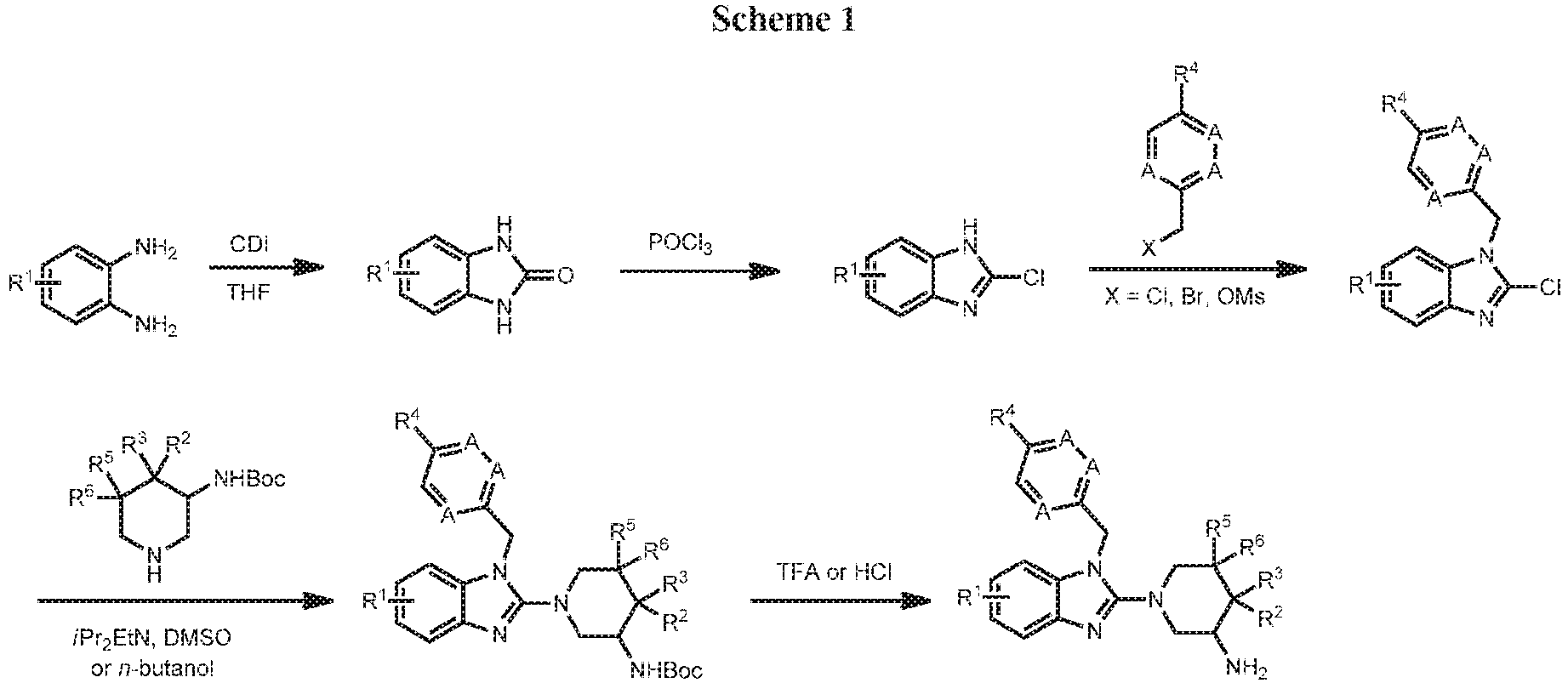


-

- 3,5-difluorobenzene-1,2-diamine (210.0 g, 1.457 mol, 1.0 equiv) and CDI (236.0 g, 1.457 mol, 1.0 equiv) were dissolved in anhydrous THF (2.5 L, 11.9 mL/g) and stirred for 12h at room temperature. LCMS indicated completion of the reaction. Reaction mixture was diluted with water (6.0 L) and extracted with ethyl acetate (2 × 6.0 L). The combined organic layer was dried over sodium sulphate, filtered and concentrated under reduced pressure to provide crude 4,6-difluoro-1H-benzo[d]imidazol-2(3H)-one as black solid which was used for next step without further purification. 1H NMR (400 MHz, DMSO-d 6): δ 11.20 (s, 1H), 11.05 (s, 1H), 6.85 (td, J = 10.7, 2.2 Hz, 1H), 6.69 (dd, J = 8.6, 2.2 Hz, 1H). MS (ESI, pos. ion) m/z: 171.0 [M+1]

- 4,6-difluoro-1H-benzo[d]imidazol-2(3H)-one (180.0 g, 1.058 mol, 1.0 equiv) was suspended in POCl3 (2.0 L) and heated under stirring at 110 °C for 2h, at which time LCMS indicated completion of the reaction. Excess POCl3 was removed via vacuum distillation and the remaining residue was diluted with acetonitrile (1.0 L) and sat. aq. sodium bicarbonate solution (1.0 L), then extracted with ethyl acetate (2 × 4.0 L). The combined organic layer was dried over sodium sulfate, filtered and concentrated under reduced pressure to provide 2-chloro-4,6-difluoro-1H-benzo[d]imidazole as brown solid which was used for next reaction without further purification. 1H NMR (400 MHz, DMSO-d 6): 13.40 (bs, 1H), 7.31 - 7.03 (m, 2H). MS (ESI, pos. ion) m/z: 189.0 [M+1].

- (5-bromopyridin-2-yl)methanol (75.0 g, 399.0 mmol, 1.0 equiv), zinc cyanide (141.0 g, 1.197 mol, 3.0 equiv) and tetrakis(triphenylphosphine)palladium(0) (46.1 g, 39.9 mmol, 0.1 equiv) were dissolved in N,N-dimethylformamide (750.0 mL, 10.0 mL/g) and degassed with nitrogen for 30 minutes. The reaction mixture was heated at 110 °C for 2 h. LCMS indicated formation of the product. After completion of the reaction, the mixture was allowed to cool to room temperature, diluted with water (700 mL) and extracted with ethyl acetate (3 × 700 mL). The combined organic layers were dried over sodium sulfate, filtered and concentrated under reduced pressure. The crude material was adsorbed onto a plug of silica gel (230-400 mesh) and purified through a Biotage Isolera-one pre-packed silica gel column, eluting with a gradient of 40% ethyl acetate in hexane to provide 6-(hydroxymethyl)nicotinonitrile as white solid. 1H NMR (400 MHz, DMSO-d 6) δ 8.93 (dt, J = 1.8, 0.8 Hz, 1H), 8.32 - 8.28 (m, 1H), 7.66 (dt, J = 8.3, 0.9 Hz, 1H), 5.68 (td, J = 5.9, 0.8 Hz, 1H), 4.64 (d, J = 5.8 Hz, 2H). MS (ESI, pos. ion) m/z: 135.0 [M+1]

- 6-(hydroxymethyl)nicotinonitrile (25.0 g, 186.0 mmol, 1.0 equiv) was dissolved in dichloromethane (360.0 mL, 14.4 mL/g) and cooled to 0 °C. N,N-diisopropylethylamine (48.8 mL, 280.0 mmol, 1.5 equiv) was added, followed by dropwise addition of methanesulfonyl chloride (16.0 g, 205.0 mmol, 1.1 equiv) over 15 minutes. The reaction mixture was allowed to warm to room temperature and stirred for 45 min. LCMS indicated formation of the product. The reaction mixture was diluted with water (500 mL) and extracted with DCM (2 × 250 mL). The combined organic layers were dried over sodium sulfate, filtered and concentrated under reduced pressure to get crude material which was adsorbed into a plug of silica gel (230-400 mesh) and purified by chromatography through a Biotage Isolera-one pre-packed silica gel column, eluting with a gradient of 15% ethyl acetate in hexane to afford 6-(chloromethyl)nicotinonitrile (VI) as yellowish solid. 1H NMR (400 MHz, DMSO-d 6) δ 9.03 (dd, J = 2.2, 1.0 Hz, 1H), 8.38 (dd, J = 8.1, 2.2 Hz, 1H), 7.77 (dd, J = 8.1, 0.9 Hz, 1H), 4.88 (s, 2H). Further elution of the column with a gradient of 50% ethyl acetate in hexane provided 5-cyanopyridin-2-yl)methyl methanesulfonate as brown solid. 1H NMR (400 MHz, DMSO-d 6) δ 9.06 (dt, J = 2.1, 1.0 Hz, 1H). 8.41 (dt, J = 8.2, 1.7 Hz, 1H), 7.73 (dd, J = 8.2, 1.0 Hz, 1H), 5.42 (d, J = 1.1 Hz, 2H), 3.34 (s, 3H). MS (ESI, pos. ion) m/z: 213.2 [M+1]. Both compounds were competent electrophiles in the alkylation (step 5).

- 2-chloro-4,6-difluoro-1H-benzo[d]imidazole (50.0 g, 265.0 mmol, 1.0 equiv) and 6-(chloromethyl)nicotinonitrile (40.5 g, 265.0 mmol, 1.0 equiv) was dissolved in acetonitrile (500.0 mL, 10.0 mL/g) at room temperature. Cesium carbonate (138.0 g, 427.0 mmol, 1.6 equiv) was added and the mixture was stirred at room temperature for 12h. The reaction mixture was diluted with water (200 mL) and extracted with ethyl acetate (2 × 200 mL). The combined organic layers were dried over sodium sulfate, filtered and concentrate under reduced pressure. The crude material was adsorbed onto a plug of silica gel (60-120 mesh) and purified by column chromatography, eluting with a gradient of 25% ethyl acetate in hexane to provide 6-((2-chloro-4,6-difluoro-1H-benzo[d]imidazol-1-yl)methyl)nicotinonitrile and 6-((2-chloro-5,7-difluoro-1H-benzo[d]imidazol-1-yl)methyl)nicotinonitrile as a mixture of isomers (light yellow solid). In some instances, the mixture of isomers was carried forward without separation and in others the isomers were separated at this stage.
-

- 1.0 g sample was dissolved in 20 mL Methanol, Column Lux C4 (250 × 50 mm, 5µm), Mobile phase: 70:30 (A : B), A: Liquid CO2, B: Methanol, Flow Rate: 120 mL/min, Wave length: 220nm, Sample load: 100mg/injection, Inlet pressure: 200-210 bar, Cycle time: 3.5, Run time: 10. In total, (51.0 g mixture of isomers) was separated by SFC to get 6-((2-chloro-5,7-difluoro-1H-benzo[d]imidazol-1-yl)methyl)nicotinonitrile (Intermediate 1, peak 1) and 6-((2-chloro-4,6-difluoro-1H-benzo[d]imidazol-1-yl)methyl)nicotinonitrile (Intermediate 2, peak 2) as yellow solids. Peak 1: 1H NMR (400 MHz, DMSO-d 6): δ 8.90 (d, J = 2.0 Hz, 1H), 8.37 (dd, J = 8.2, 2.1 Hz, 1H), 7.70 (d, J = 8.2 Hz, 1H), 7.42 (dd, J = 9.0, 2.2 Hz, 1H), 7.22 (ddd, J = 11.9, 10.3, 2.2 Hz, 1H), 5.79 (s, 2H). MS (ESI, pos. ion) m/z: 304.0 [M+1]. Peak 2: 1H NMR (400 MHz, DMSO-d 6): δ 8.91 (t, J = 3.0 Hz, 1H), 8.37 (ddd, J = 8.2, 4.4, 2.1 Hz, 1H), 7.67 (dd, J = 8.4, 4.2 Hz, 1H), 7.49 (dt, J = 8.7, 3.0 Hz, 1H), 7.20 (tdd, J = 10.7, 4.5, 2.1 Hz, 1H), 5.79 (d, J = 3.8 Hz, 2H). MS (ESI, pos. ion) m/z: 304.0 [M+1].
- The following intermediates were synthesized using a sequence analogous to that used to synthesize Intermediates 1 and 2 and general Scheme 7 above:


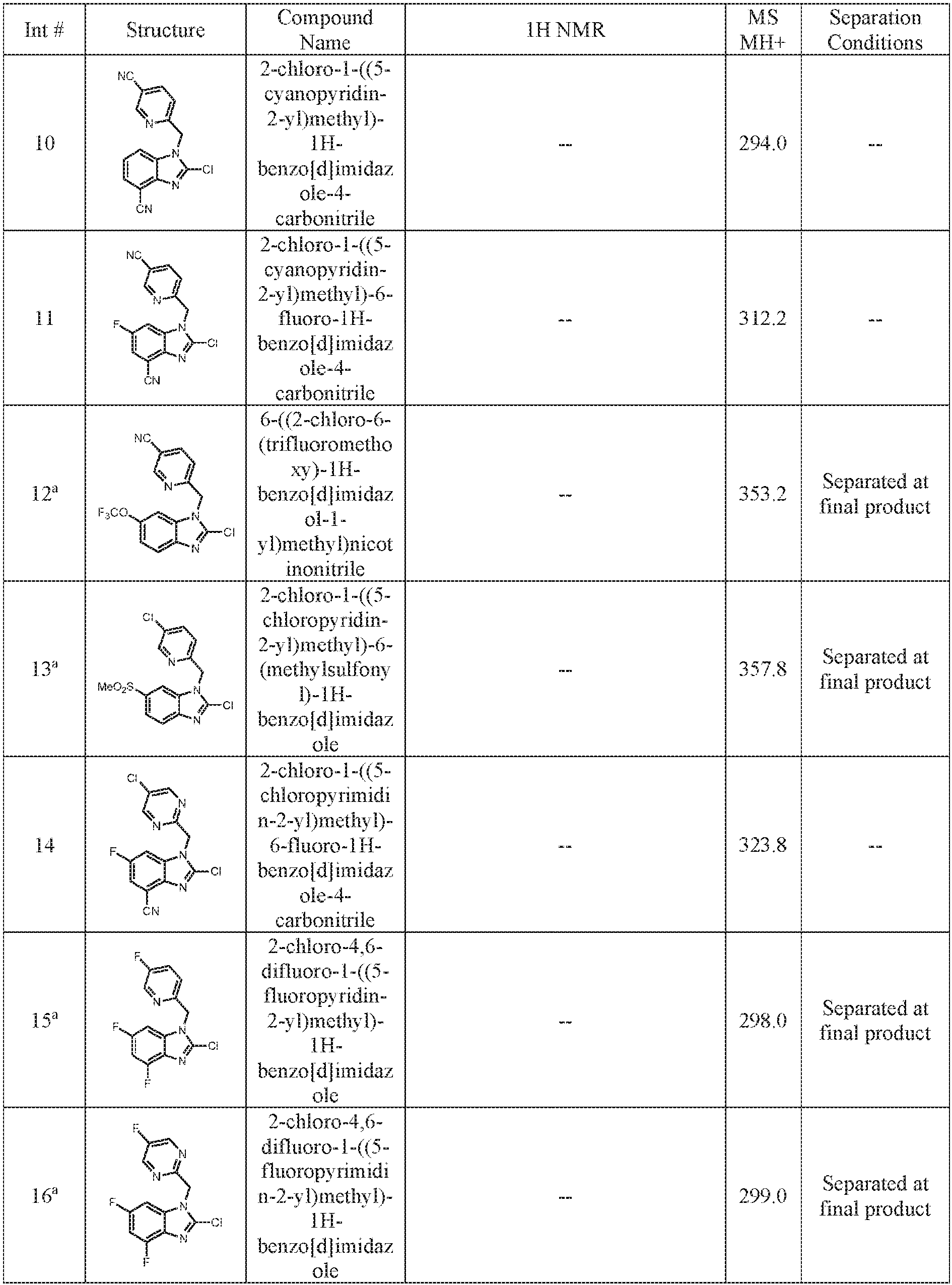


-
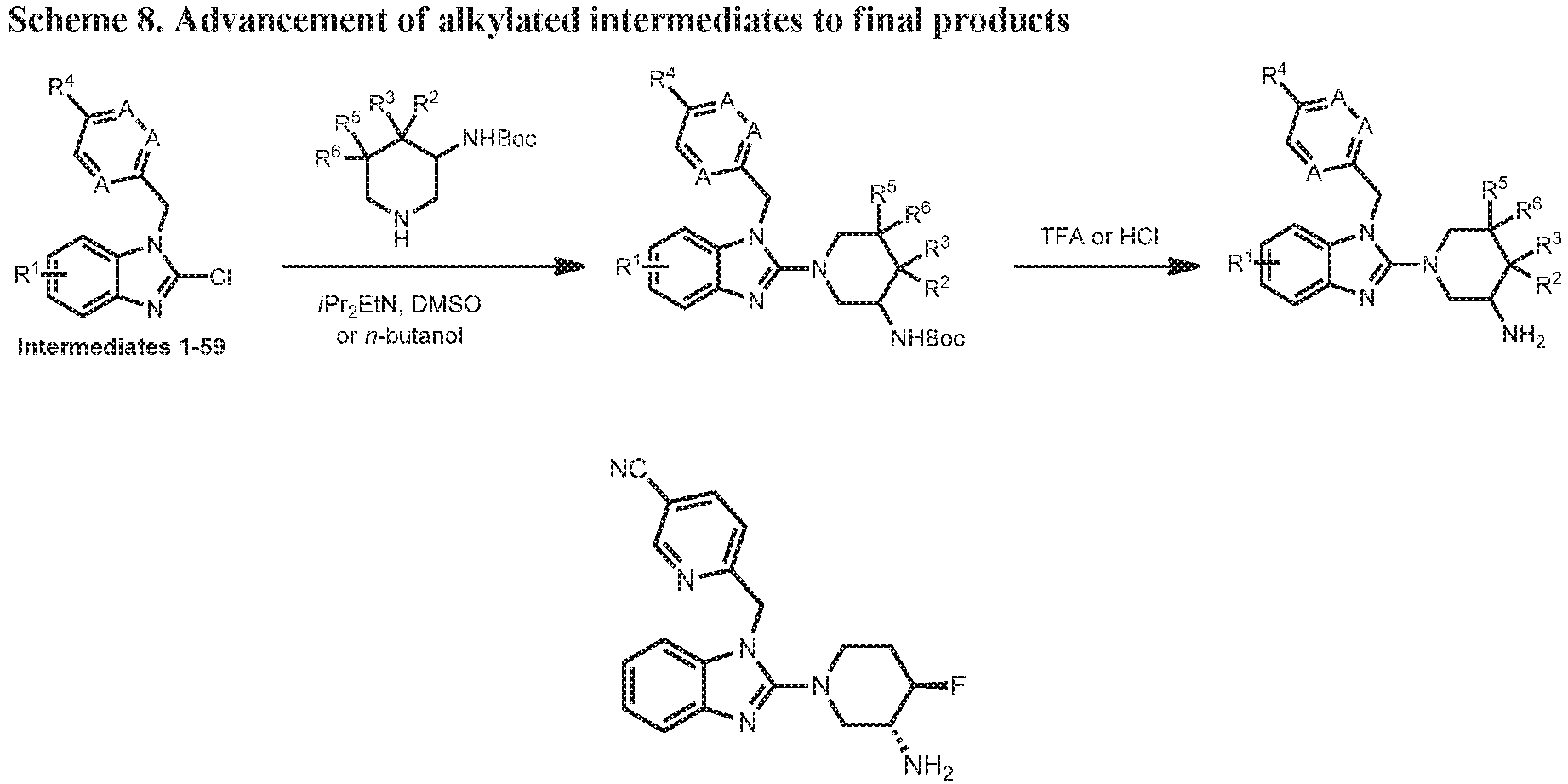
-

- 1,1'-dimethyltriethylamine (1.300 ml, 7.44 mmol), tert-butyl ((3R,4R)-4-fluoropiprridin-3-yl)carbamate (0.975 g, 4.47 mmol), 6-((2-chloro-1H-benzo[d]imidazol-1-yl)methyl)nicotinontrile (Intermediate 7, 1 g, 3.72 mmol), and dimethyl sulfoxide (7.44 ml) were combined in a flask and heated to 130 °C for 36 hours. The mixture was cooled, poured into water, then extracted with EtOAc (3X). The organics were combined, dried over Na2SO4, filtered, and concentrated. The crude material was loaded onto an 80g RediSep ISCO cartridge, eluting with 10-50% EtOAc in heptanes to provide tert-butyl ((3R,4R)-1-(1-((5-cyanopyridin-2-yl)methyl)-1H-benzo[d]imidazol-2-yl)-4-fluoropiperidin-3-yl)carbamate as a light orange foam. MS (ESI, pos. ion) m/z: 451.2 [M+1]
-

- Tert-butyl ((3R,4R)-1-(1-((5-cyanopyridin-2-yl)methyl)-1H-benzo[d]imidazol-2-yl)-4-fluoropiperidin-3-yl)carbamate (1.31 g, 2.91 mmol, 1 equiv) was dissolved in DCM (10 mL) and slowly dripped into a flask of cooled (0 C) TFA (~10 mL). After 1 hour, deprotection was complete. The mixture was poured onto an SCX column (pre-wetted with MeOH), flushed with MeOH, then eluted with methanolic ammonia. The methanolic ammonia was concentrated, and the light orange oil redissolved in MeCN/water, frozen, and lyophilized to provide the title compound as a light yellow solid. 1H NMR (500 MHz, MeOD) δ 8.81-8.92 (m, 1 H), 8.23 (dd, J=8.30, 2.08 Hz, 1 H), 7.49-7.66 (m, 2H), 7.17-7.39 (m, 3H), 5.64 (s, 2H), 4.69-4.86 (m, 1H), 3.92-4.06 (m, 1H), 3.61-3.79 (m, 2H), 3.20-3.32 (m, 2H), 2.24-2.41 (m, 1H), 1.92-2.14 (m, 1H). (ESI, pos. ion) m/z: 351.2 [M+1]

-

- To a suspension of 6-((2-chloro-6-fluoro-1H-benzo[d]imidazol-1-yl)methyl)nicotinonitrile (150 mg, 0.523 mmol) and hunig's base (137 µl, 0.785 mmol) in 1-butanol (2093 µl) was added (S)-tert-butyl piperidin-3-ylcarbamate (115 mg, 0.576 mmol). The reaction was stirred at 130 °C overnight. After 24 hours, the reaction mixture was concentrated and purified by column chromatography, eluting with 20-100% ethyl acetate in heptane, to provide the title compound as an off white solid. (ESI, pos. ion) m/z: 451.2 [M+1]
-

- Step 2. (S)-tert-butyl (1-(1-((5-cyanopyridin-2-yl)methyl)-5-fluoro-1H-benzo[d]imidazol-2-yl)piperidin-3-yl)carbamate (77 mg) was dissolved in dioxane (2 mL), and 4 N HCl in dioxane (585 µL, 2.340 mmol) was added. The reaction was stirred at ambient temperature. After 16 hours, LC/MS analysis showed the reaction was complete. The reaction mixture was concentrated in vacuo to provide the title compound as an off white solid.. 1H NMR (400 MHz, d 6-DMSO) δ 8.94 (s, 1H), 8.48 (br s, 2H), 8.40 (dd, J=2.18, 8.19 Hz, 1H), 7.77 (d, J=8.19 Hz, 1H), 7.40 (dd, J=2.85, 8.66 Hz, 2H), 7.14 (dt, J=2.38, 9.33 Hz, 1H), 5.65-5.84 (m, 2H), 3.89 (br d, J=10.57 Hz, 1H), 3.28-3.52 (m, 3H), 3.18 (br t, J=9.80 Hz, 1H), 1.94-2.02 (m, 1H), 1.81-1.93 (m, 1H), 1.47-1.72 (m, 2H). (ESI, pos. ion) m/z: 351.0 [M+1].
- Note: The HCl salt was sometimes converted to a free base form using an aqueous work up or using ion exchange chromatography. Isolation of salt or free base is specified in table.
- The following compounds were made in a manner analogous to that outlined above:

- 6-((2-((3R,4S)-3-amino-4-fluoropiperidin-1-yl)-6-chloro-1H-benzo[d]imidazol-1-yl)methyl)nicotinonitrile was synthesized on a 1 mmol scale following a procedure analogous to sequence outlined above using the TFA Boc deprotection (procedure B). It was separated at the Boc intermediate: Chiralcel OD-H, 25% IPA, peak 1. 1H NMR (500 MHz, MeOD) δ 8.86 (d, J=1.30 Hz, 1H), 8.14-8.20 (m, 1H), 7.47 (d, J=8.56 Hz, 1H), 7.44 (d, J=8.30 Hz, 1H), 7.23 (d, J=2.08 Hz, 1H), 7.19 (dd, J=1.95, 8.43 Hz, 1H), 5.53 (s, 2H), 4.33-4.50 (m, 1H), 3.53-3.61 (m, 1H), 3.43-3.50 (m, 1H), 3.02-3.20 (m, 2H), 2.95 (dd, J=8.69, 12.33 Hz, 1H), 2.12-2.24 (m, 1H), 1.82-1.94 (m, 1H). (ESI, pos. ion) m/z: 387.2 [M+1].

- (R)-6-((2-(3-amino-4,4-difluoropiperidin-1-yl)-6-fluoro-1H-benzo[d]imidazol-1-yl)methyl)nicotinonitrile was synthesized on a 1.9 mmol scale following a procedure analogous to the sequence outlines above, using the TFA Boc deprotection (procedure B). It was separated at the chlorobenzimidazole intermediate (YMC Amyose SA, Methanol THF (70:30) 40 %; peak 1). 1H NMR (500 MHz, MeOD) δ 8.84 (d, J=1.82 Hz, 1H), 8.15 (dd, J=2.08, 8.30 Hz, 1H), 7.40-7.52 (m, 2H), 6.91-7.00 (m, 2H), 5.47-5.62 (m, 2H), 3.34-3.54 (m, 2H), 3.08-3.28 (m, 3H), 2.21-2.36 (m, 1H), 2.00-2.21 (m, 1H). (ESI, pos. ion) m/z: 351.0 [M+1].
- The examples in Table 2 were synthesized using a sequence analogous to that used to synthesize Examples 38, 45, 8, and 88 and general Scheme 8 above:


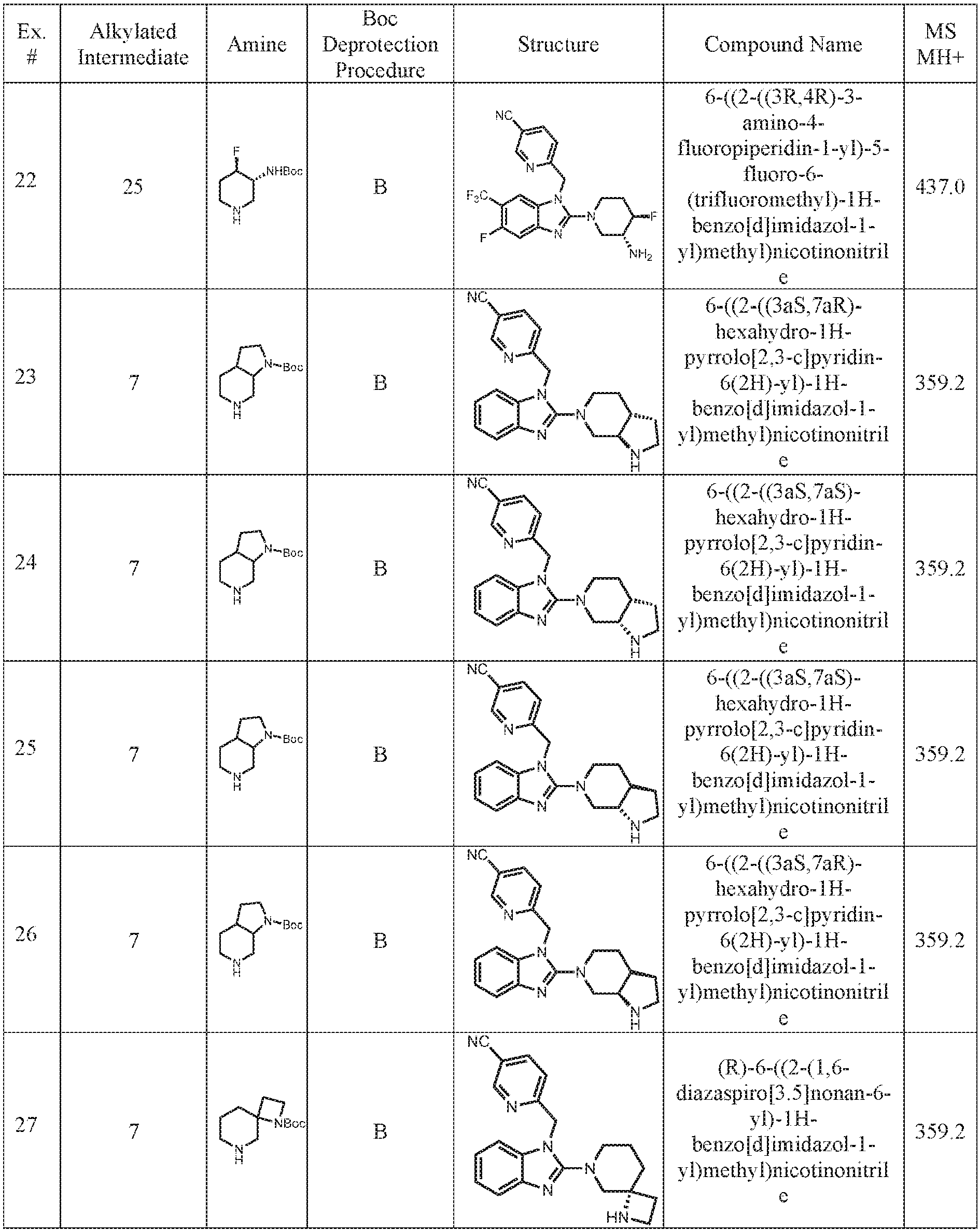


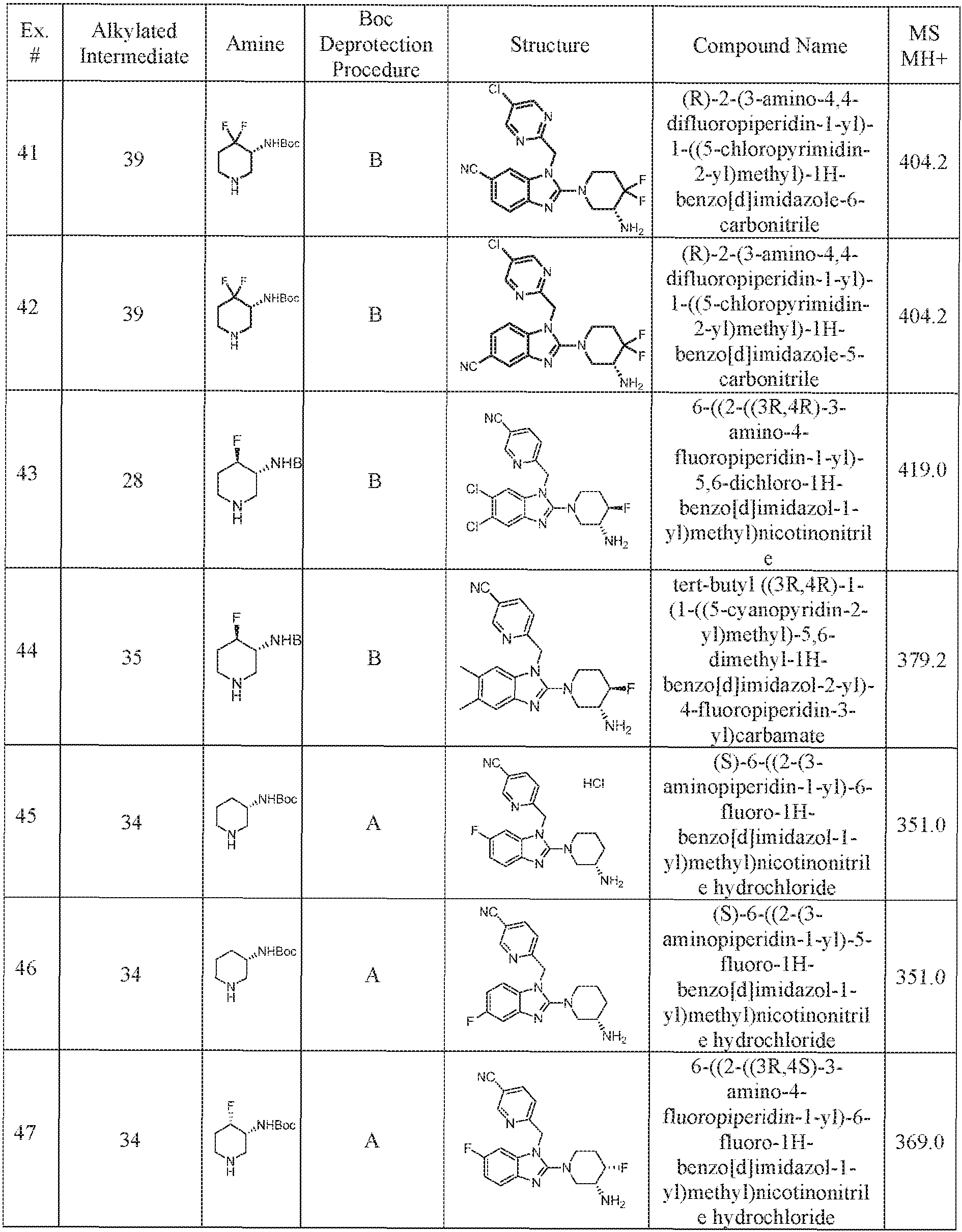


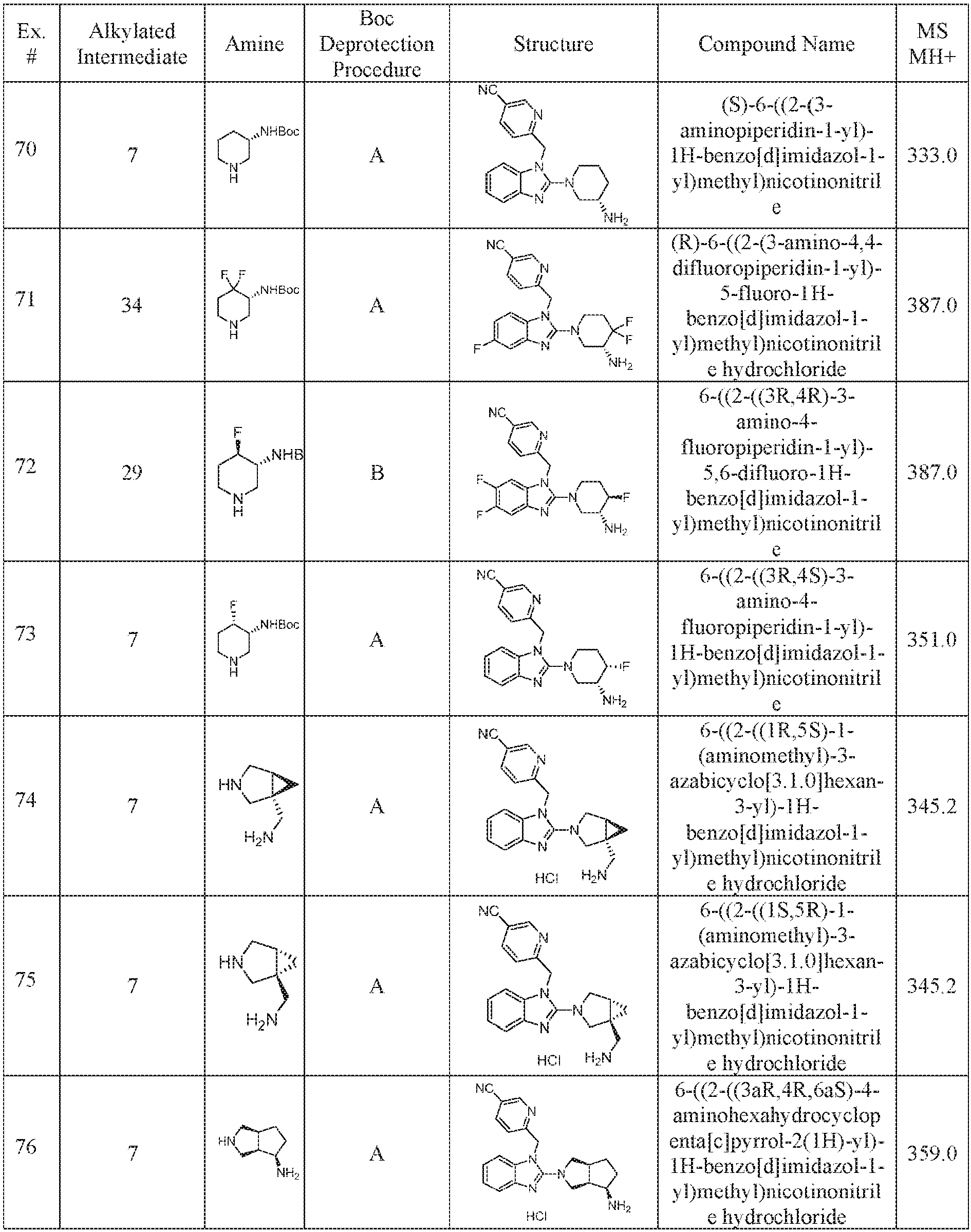


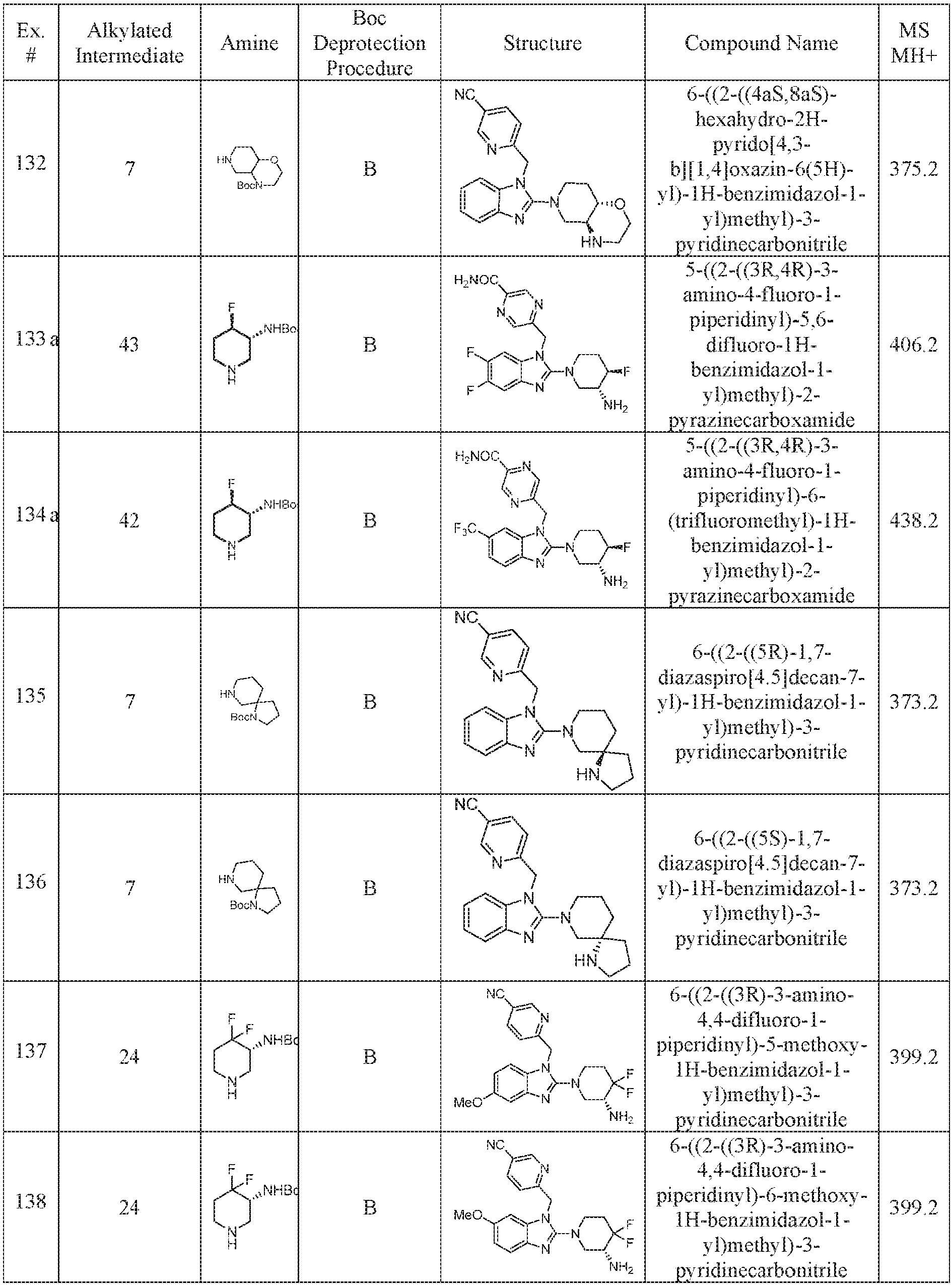


-


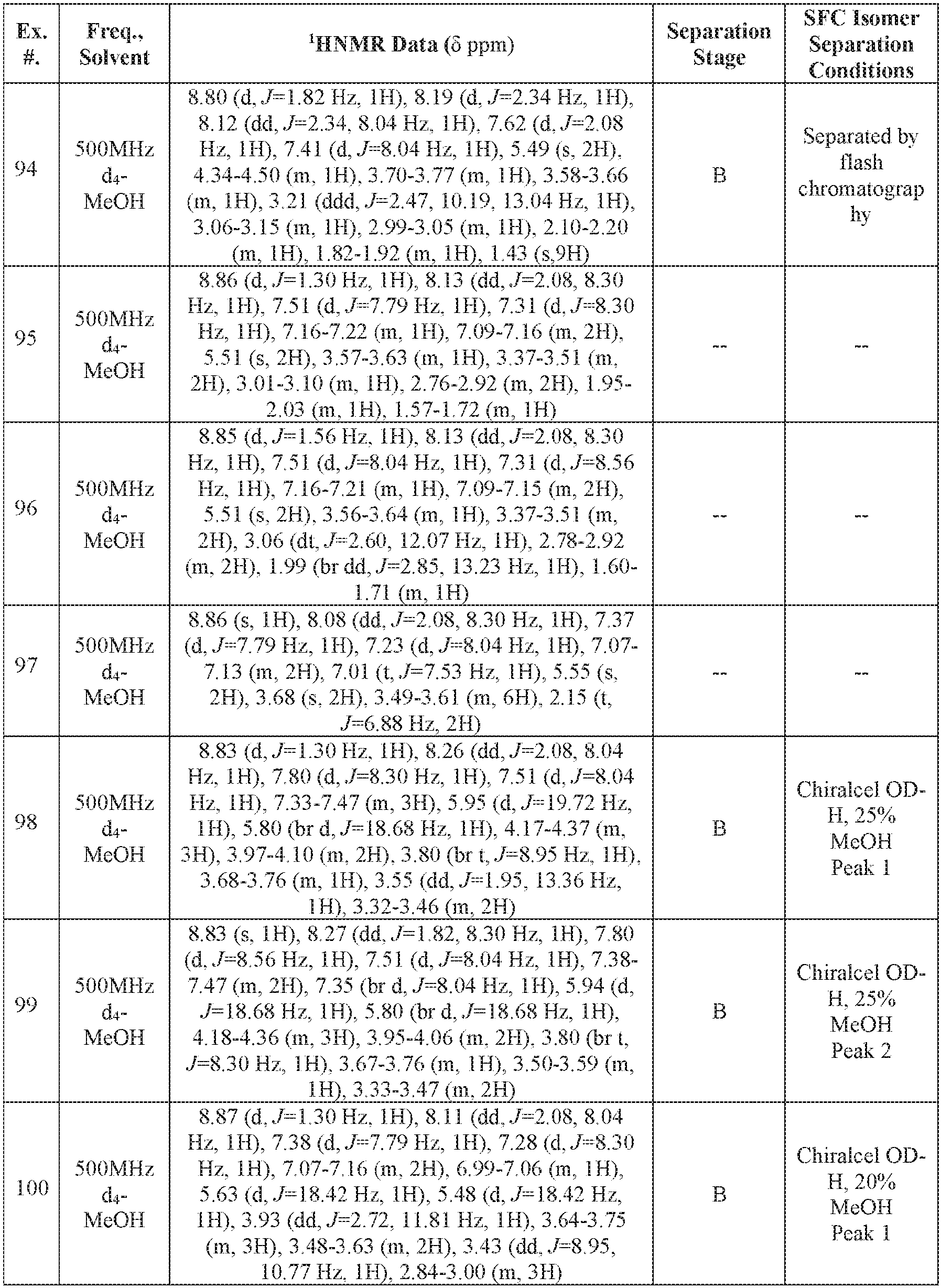


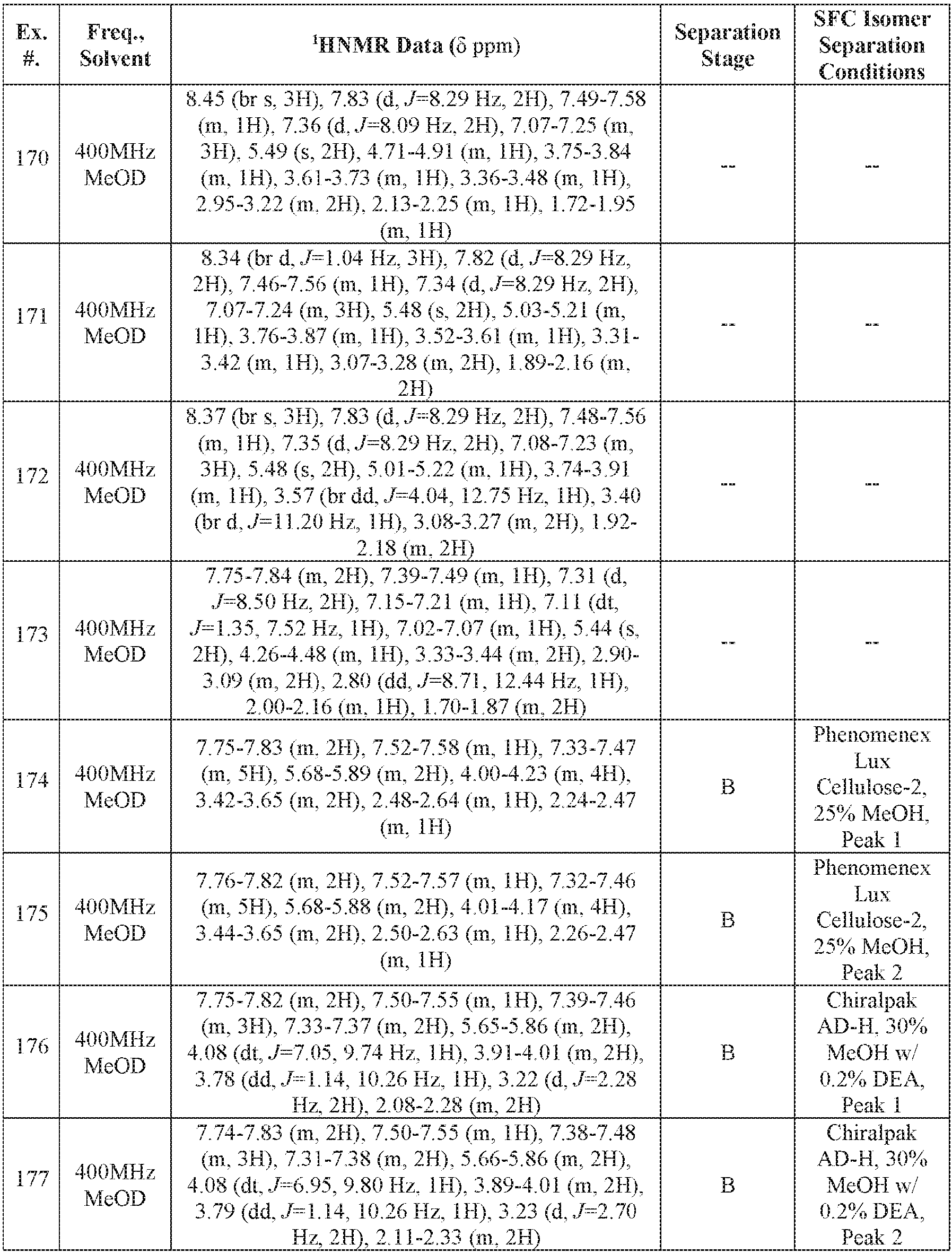


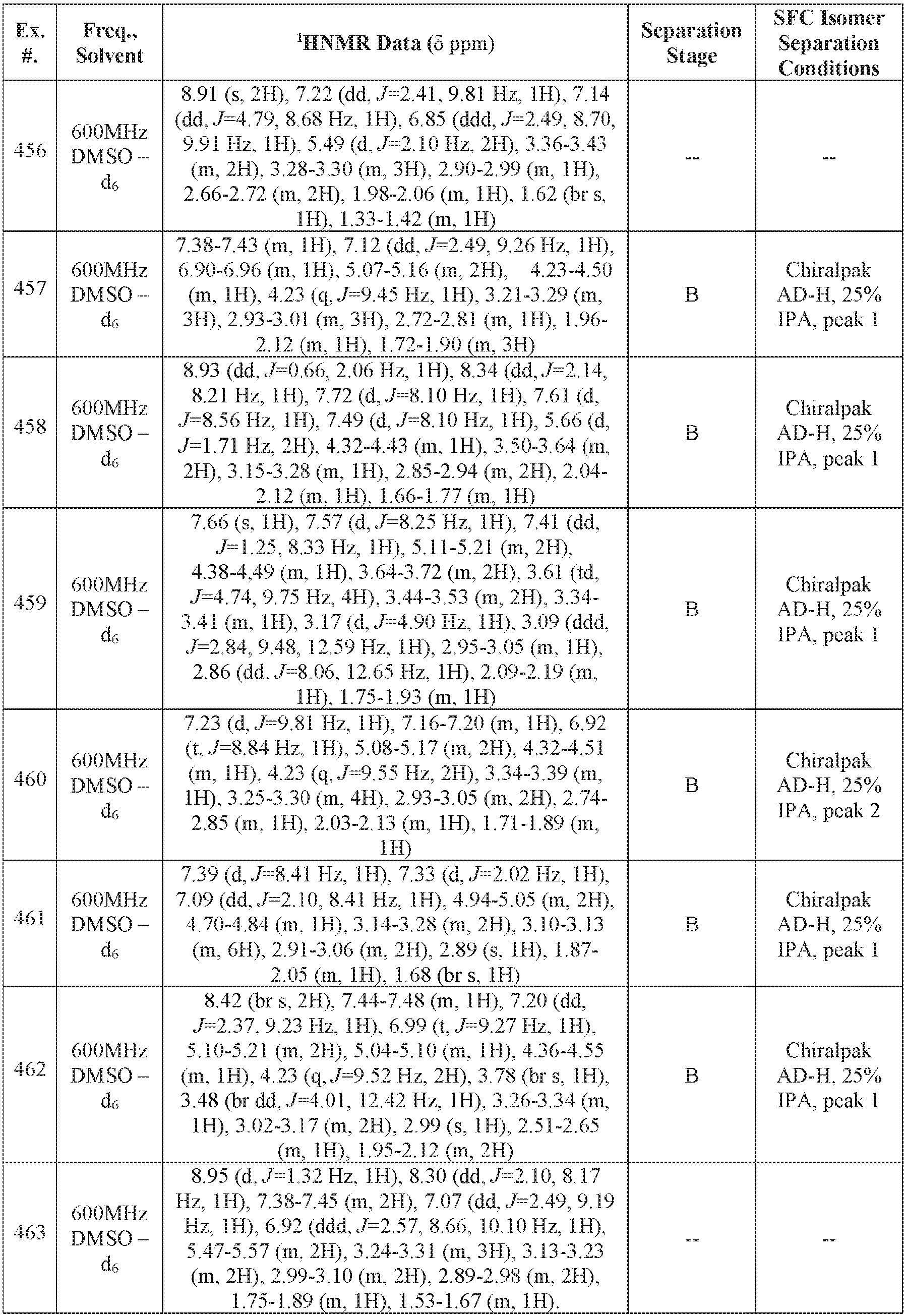


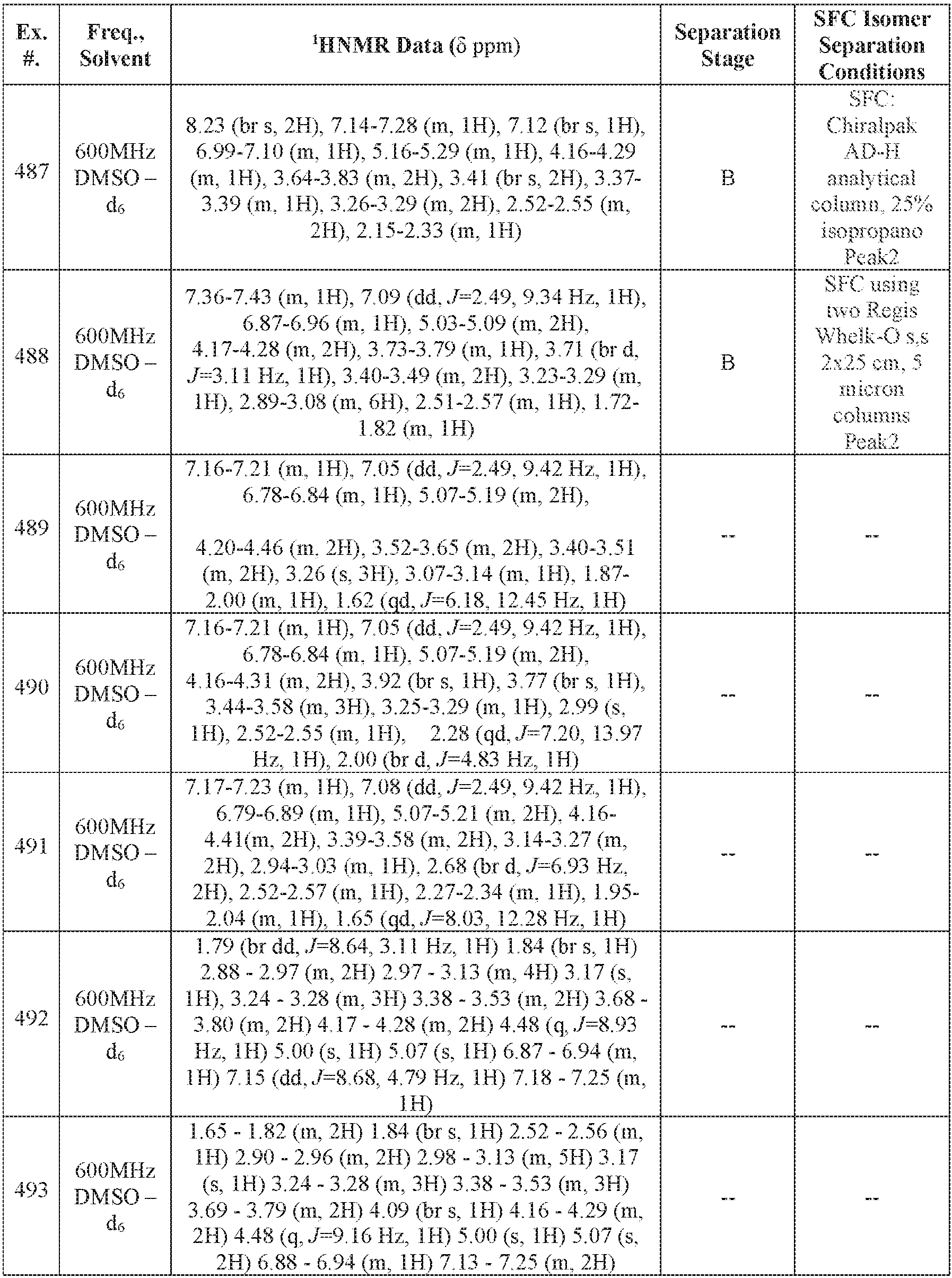


-

- To a solution of 1,2-diamino-4-cyanobenzene (1.00 mL, 7.51 mmol) in tetrahydrofuran (5 mL) was added 1,1'-carbonyldiimidazole (1.22 g, 7.51 mmol). The reaction was stirred at ambient temperature for one hour, concentrated, then triturated with water. The brown precipitate was collected by vacuum filtration to provide 2-oxo-2,3-dihydro-1H-benzo[d]imidazole-5-carbonitrile as a brown powder. MS (ESI, pos. ion) m/z: 160.2 [M+1]

- To a suspension of 2-oxo-2,3-dihydro-1H-benzo|d]imidazole-5-carbonitrile (XVIII, 1.19 g, 7.48 mmol, 1 equiv) in acetonitrile (5 mL) was added phosphorus(v) oxy chloride (1.398 mL, 14.95 mmol). The reaction was stirred at 110 °C for 16 hours, then cooled to room temperature. It was diluted with acetonitrile and then slowly added to a cold, rapidly-stirring beaker of saturated aqueous sodium bicarbonate (50 mL). The mixture was extracted with ethyl acetate; which was dried over anhydrous magnesium sulfate, filtered, and concentrated to provide 2-chloro-1H-benzo[d]imidazole-6-carbonitrile as a tan powder. (ESI, pos. ion) m/z: 178.2 [M+1]

- N,N-diisopropylethylamine (3.93 mL, 22.52 mmol), 2-chloro-1H-benzo[d]imidazole-6-carbonitrile (2 g, 11.26 mmol), tert-butyl ((3R,4R)-4-fluoropiperidin-3-yl)carbamate (2.95 g, 13.51 mmol), and 1-butanol (25 mL) were combined in a flask and heated to 130 C for 48 hours. The mixture was concentrated, then loaded onto a 125g RediSep ISCO cartridge, eluting wiht 0-4% MeOH in DCM to provide the title compound as a light brown foam. (ESI, pos. ion) m/z: 360.2 [M+1]
- The following intermediates were synthesized using a sequence analogous to that described for intermediate 60 and general scheme 9 above:

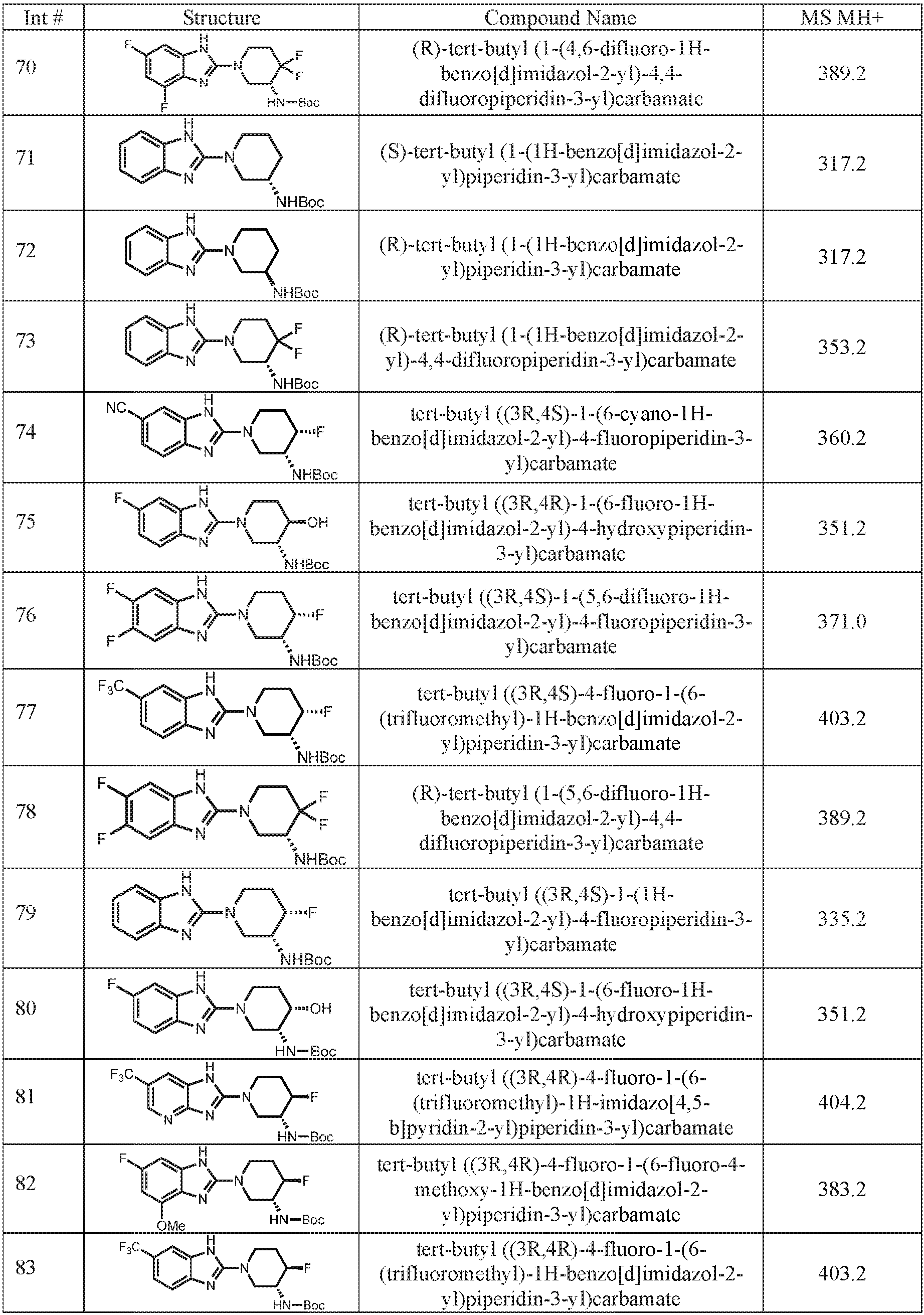


-

- Cesium carbonate (0.707 mg, 2.170 mmol), tert-butyl ((3R,4R)-1-(6-cyano-1H-benzo[d]imidazol-2-yl)-4-fluoropiperidin-3-yl)carbamate (390 mg, 1.085 mmol), (5-chloropyrimidin-2-yl)methyl methanesulfonate (290 mg, 1.302 mmol), and acetonitrile (10 mL) were combined in a vial and stirred overnight. The mixture was poured into water and extracted with DCM (3X). The organics were combined, dried over Na2SO4, filtered, and concentrated. The brown solid was dissolved in DCM, loaded onto a 20g plug of silica and flushed with EtOAc (~4 column volumes). The EtOAc was concentrated to provide tert-butyl ((3R,4R)-1-(1-((5-chloropyrimidin-2-yl)methyl)-6-cyano-1H-benzo[d]imidazol-2-yl)-4-fluoropiperidin-3-yl)carbamate and tert-butyl ((3R,4R)-1-(1-((5-chloropyrimidin-2-yl)methyl)-5-cyano-1H-benzo[d]imidazol-2-yl)-4-fluoropiperidin-3-yl)carbamate as a mixture of isomers. The isomers were separated using chiral SFC (Chiralcel AD, 25% IPA, peak 1 ). (ESI, pos. ion) m/z: 486.2 [M+1]
-

- tert-Butyl ((3R,4R)-1-(1-((5-chloropyrimidin-2-yl)methyl)-6-cyano-1H-benzo[d]imidazol-2-y])-4-fluoropiperidin-3-yl)carbamate (150 mg, 0.309 mmol) was loaded into a vial. DCM (5 mL), then TFA (2 mL) was added. After 1 hour, the mixture was poured onto an SCX column, prewetted with methanol, flushed with methanol, then eluted with methanolic ammonia. The residue was redissolved in MeCN/H20, frozen, and lyophilized to provide the title compound as a white solid. 1H NMR (500 MHz, MeOD) δ 8.80 (s, 2H), 7.65-7.69 (m, 1H), 7.54-7.61 (m, 1H), 7.49 (d, J=8.30 Hz, 1H), 5.57 (s, 2H), 4.42-4.60 (m, 1H), 3.72-3.80 (m, 1H), 3.64 (br d, J=13.23 Hz, 1H), 3.15-3.27 (m, 2H), 3.06 (dd, J=9.21, 12.59 Hz, 1H), 2.13-2.27 (m, 1H), 1.80-1.99 (m, 1H). (ESI, pos. ion) m/z: 386.2 [M+1]
- Note: In some cases, the free base was redissolved in DCM, and HCl was added to crash out the HCl salt. This is noted in the table as a TFA deprotection, but HCl product.
-

- The following compounds were made in a manner analogous to that outlined in Schemes 9 and 10:

- The following Examples were synthesized using a sequence analogous to that described for examples 239-240 and general scheme 9-10 above:


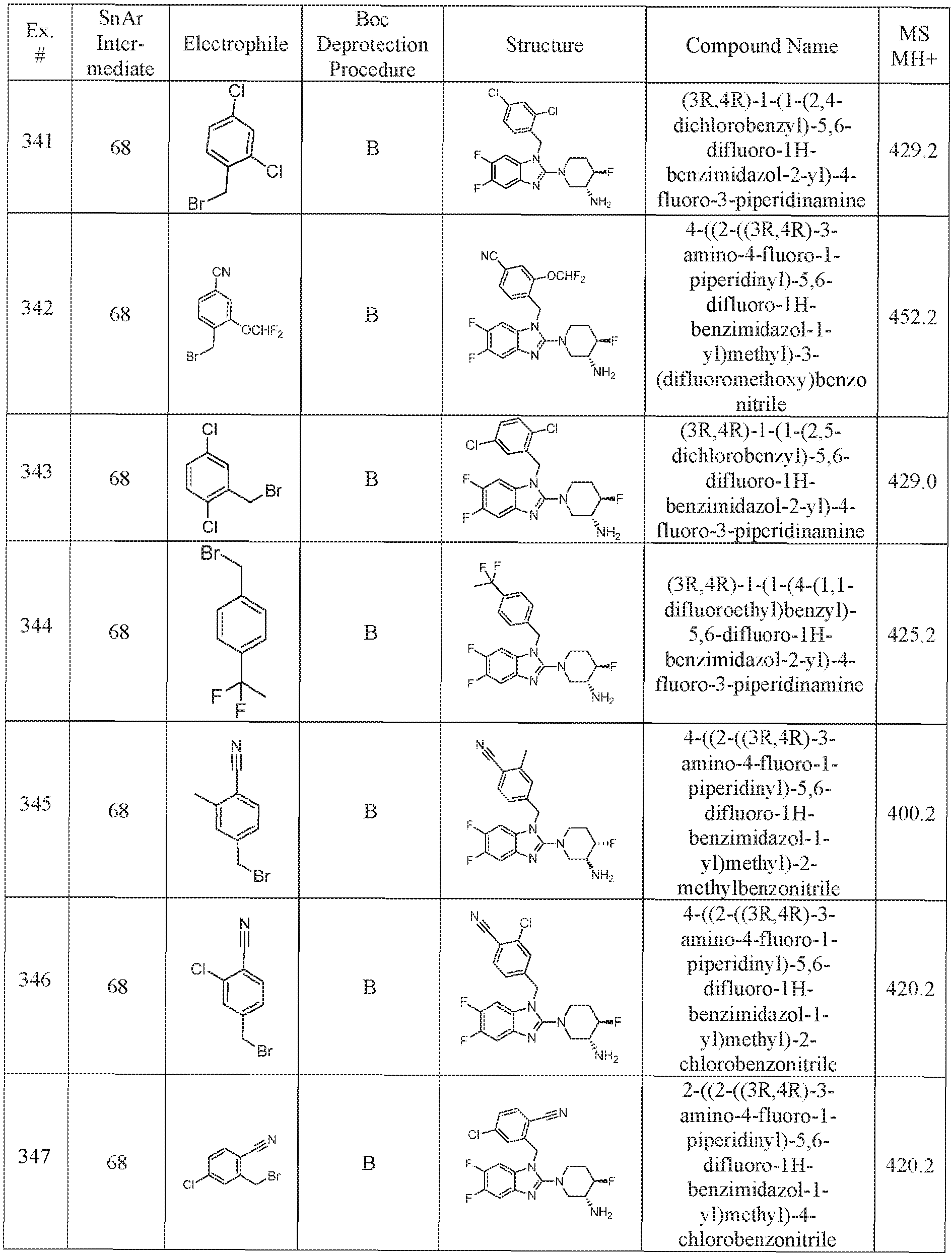


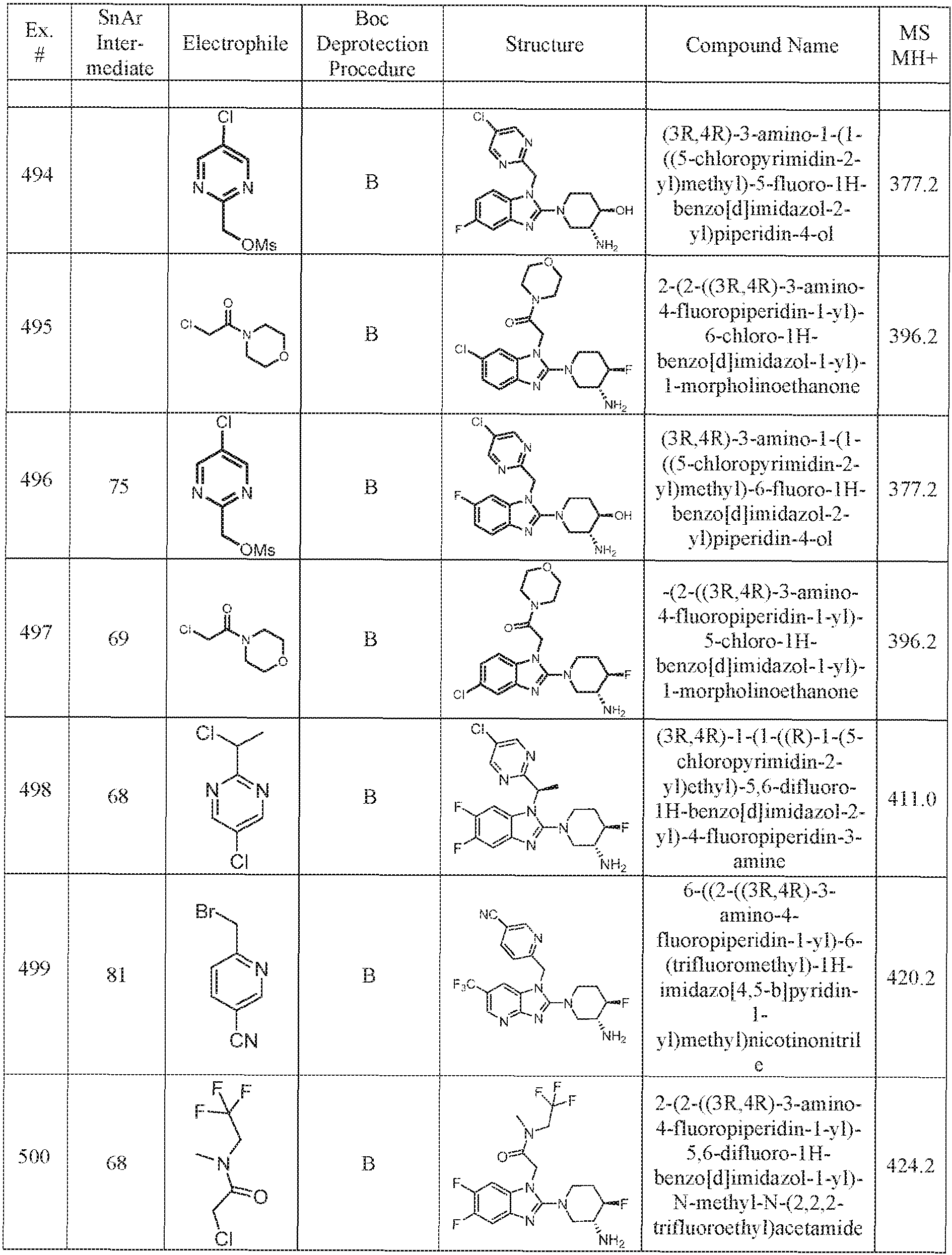


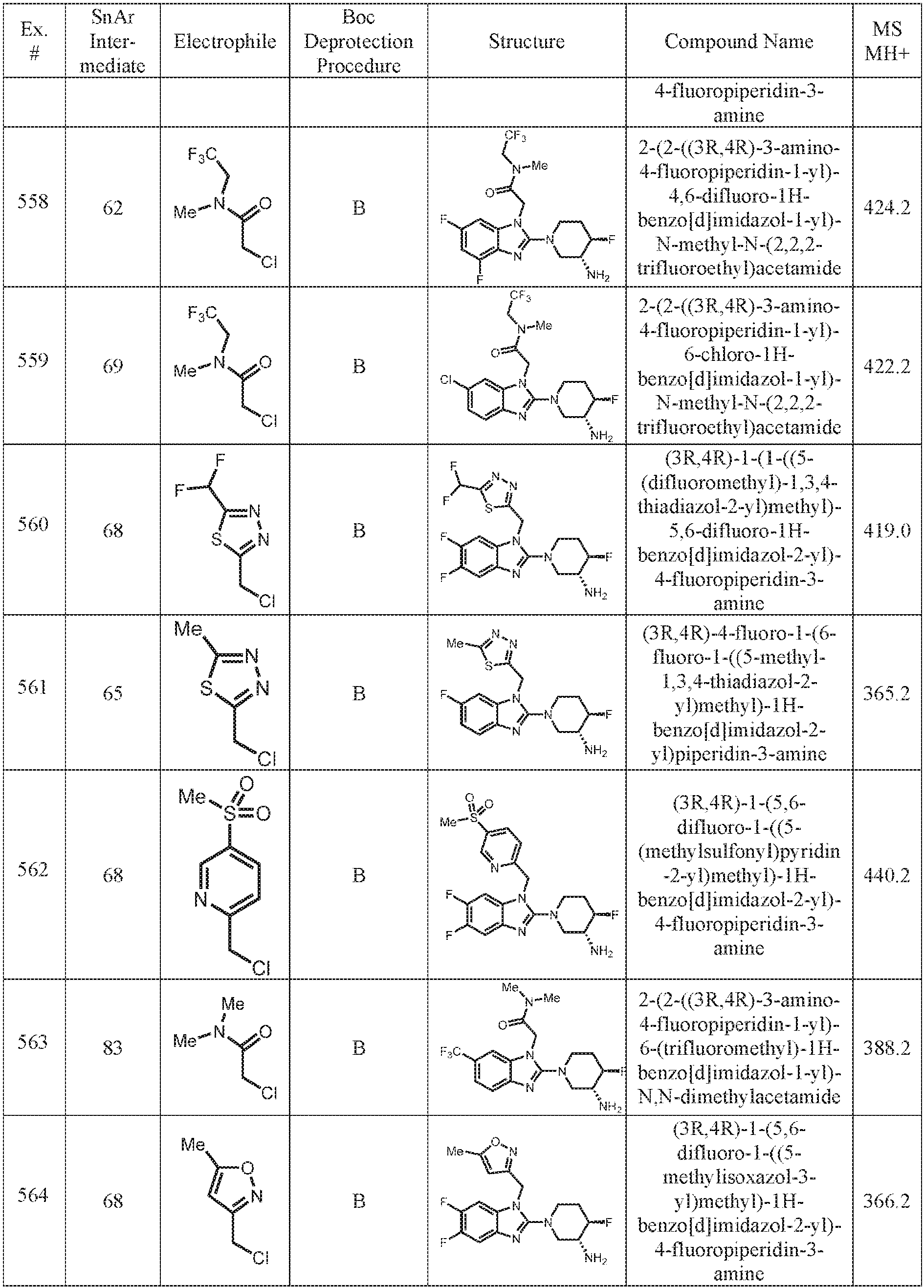

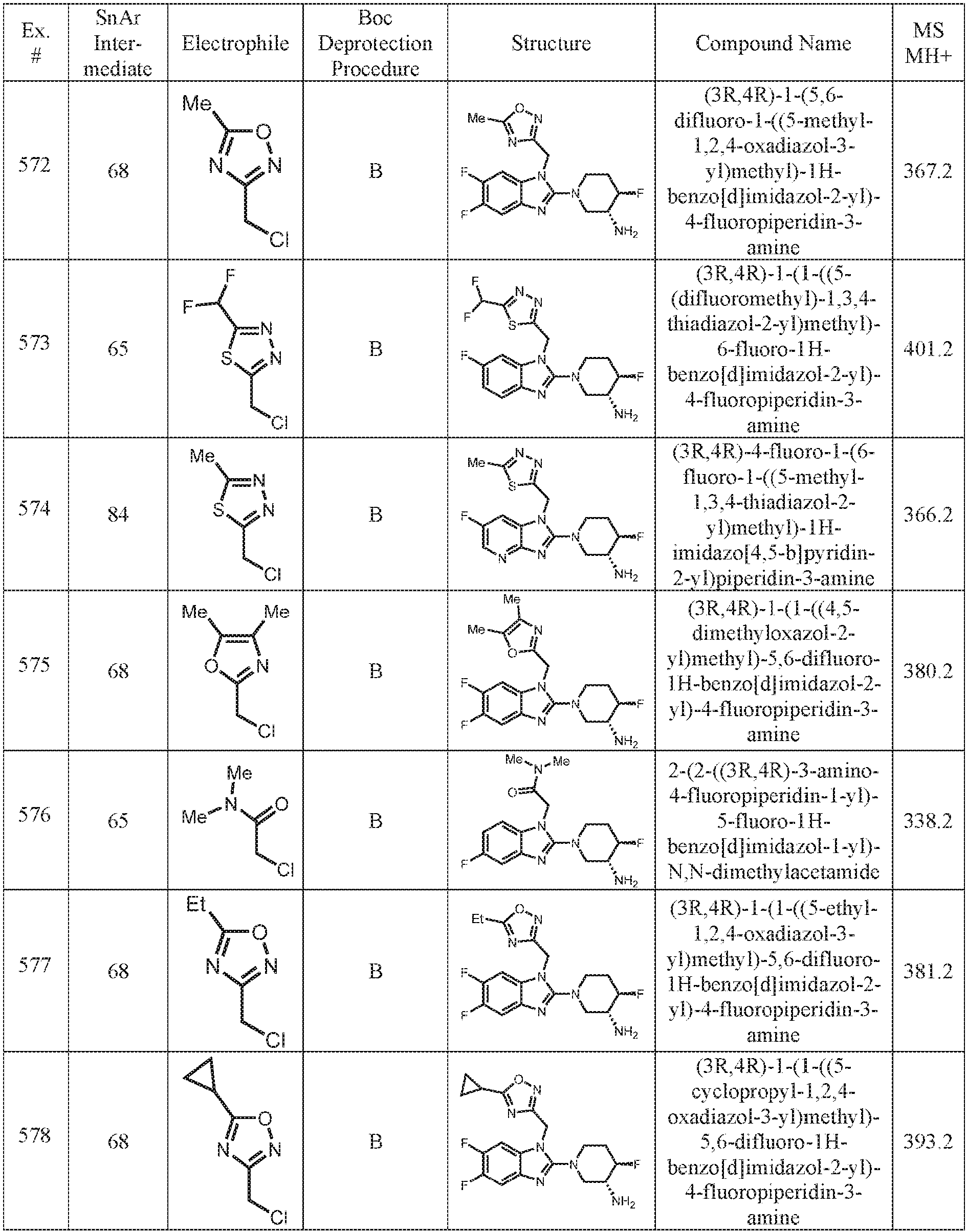


-


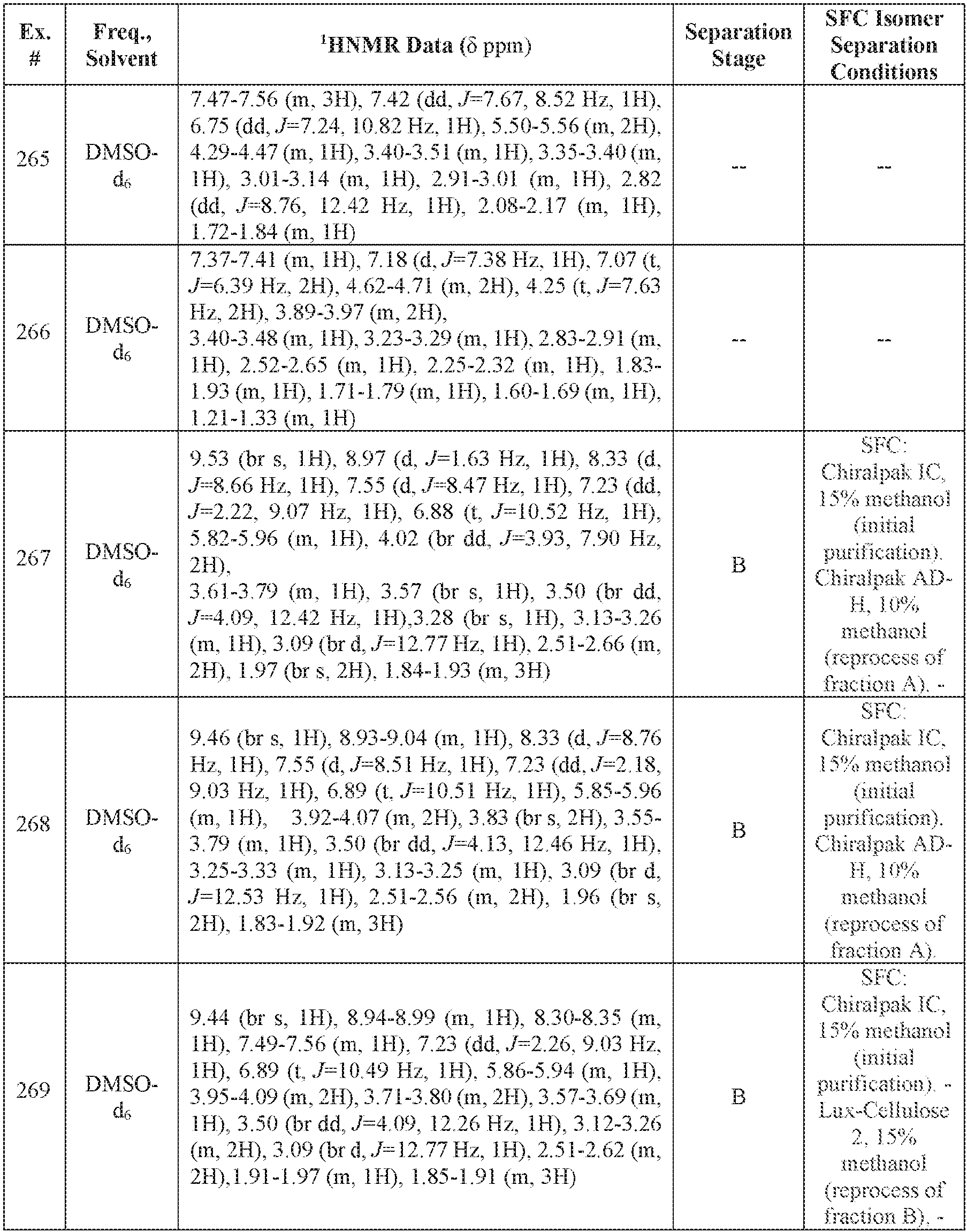


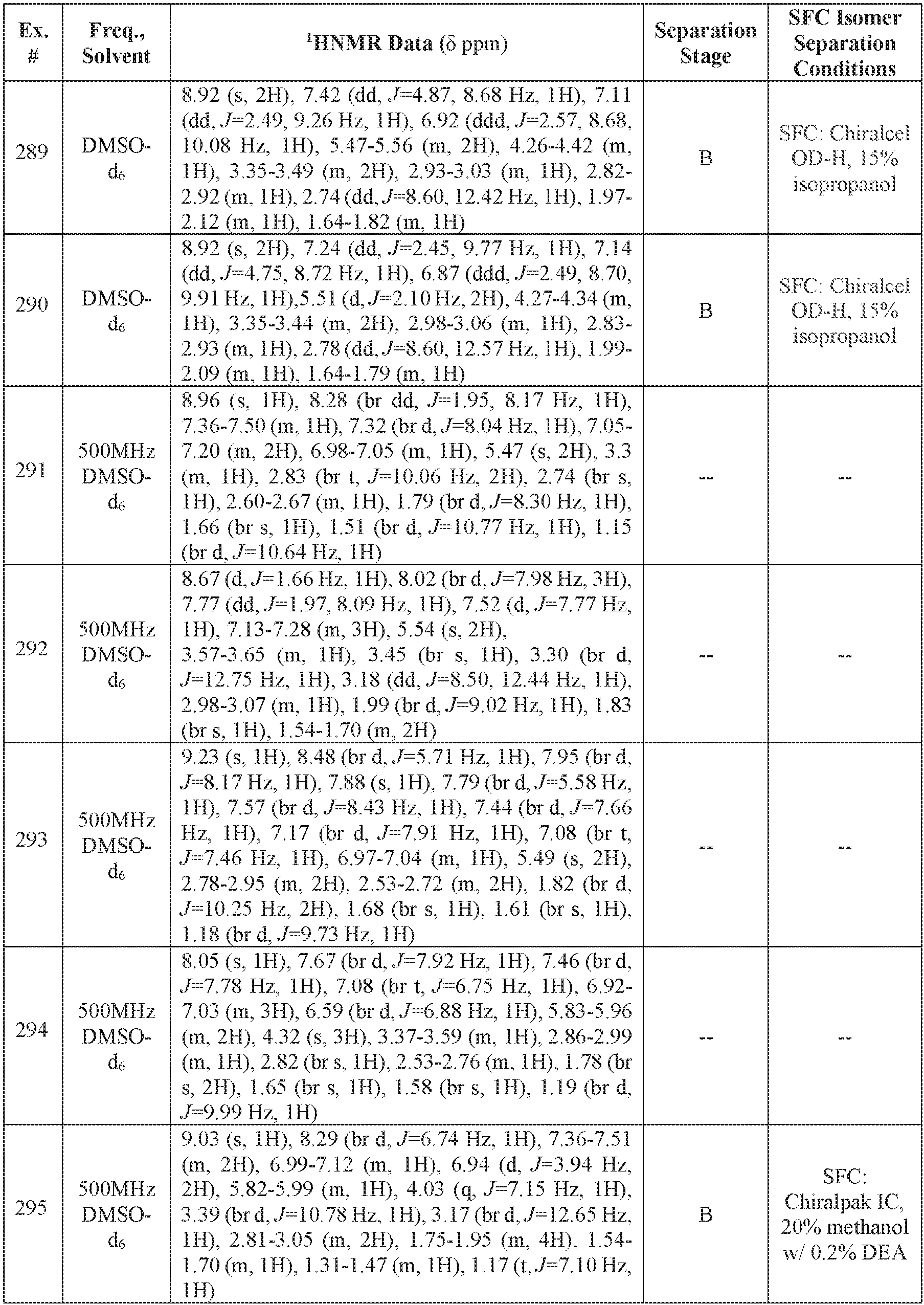


-

- To a stirred solution of 4-chloro-2-fluoro-1 -nitrobenzene (8.0 g, 45.6 mmol, 1 equiv) in ethanol (104.0 mL) and water (80.0 mL) was added 4-(aminomethyl)benzonitrile hydrochloride (8.45 g, 50.1 mmol, 1.1 equiv) followed by addition of potassium carbonate (11.34 g, 82.0 mmol, 1.8 equiv). The reaction mixture was heated to 85 °C for 10 h then stirred for 8 h at ambient temperature. After completion (monitored by TLC), the reaction mixture was diluted with water (100 mL) and solids were filtered. The obtained solid was dried under high vacuum to provide 4-(((5-chloro-2-nitrophenyl)amino)methyl)benzonitrile (9 g, 68.6 % yield) as yellow solid. 1H NMR (400 MHz, DMSO-d6): δ 8.85 (t, J = 6.3 Hz, 1H), 8.08 - 8.13 (m, 1H), 7.86 - 7.79 (m, 2H), 7.56 (d, J = 8.0 Hz, 2H), 6.90 (t, J = 2.4 Hz, 1H), 6.77 - 6.66 (m, 1H), 4.76 (d, J = 6.3 Hz, 2H).

- To a stirred solution of 4-(((5-chloro-2-nitrophenyl)amino)methyl)benzonitrile (9.0 g, 31.3 mmol, 1.0 equiv) in mixture of tetrahydrofuran (90.0 mL), methanol (90.0 mL) and water (60.0 mL) was added iron powder (7.51 g, 135.0 mmol, 4.3 equiv) followed by ammonium chloride (7.53 g, 141.0 mmol, 4.5 equiv). The resulting reaction mixture was heated to 60 °C for 2 h. After completion (monitored by TLC), the reaction mixture was filtered through celite pad and was washed with ethyl acetate (100 mL). The filtrate was diluted with water (100 mL) and layers were separated, aqueous layer was washed with ethyl acetate (2 × 200 mL). The combined organic layers were washed with water (2 × 200 mL), brine (2 × 200 mL), dried over sodium sulphate, filtered and concentrate under reduced pressure to provide 4-(((2-amino-5-chlorophenyl)amino)methyl)benzonitrile (7.5 g, 93 % yield ) as light yellow solid which was sufficiently pure to use in the next step. 1H NMR (400 MHz, DMSO-d6): δ 7.81 (dd, J = 8.3, 2.3 Hz, 2H), 7.65 - 7.45 (m, 2H), 6.53 (dd, J = 8.2, 2.2 Hz, 1H), 6.40 (dt, J = 8.1, 2.4 Hz, 1H), 6.19 (d, J = 2.4 Hz, 1H), 5.58 (t, J = 7.2 Hz, 1H), 4.75 (s, 2H), 4.54 - 4.28 (m, 2H).

- To a stirred solution of 4-(((2-amino-5-chlorophenyl)amino)methyl)benzonitrile (7.5 g, 29.1 mmol, 1.0 equiv) in 1,4-dioxane (120.0 ml.) was added DIPEA (7.62 mL, 43.7 mmol, 1.5 equiv) and CDI (11.80 g, 72.8 mmol, 2.5 equiv) portion wise. The resulting reaction mixture was heated to 100 °C for 1 h. After completion (monitored by TLC), the reaction mixture was cooled to ambient temperature and slowly quenched with ice cold water (100 mL). The reaction mixture was extracted with ethyl acetate (2 × 150 mL). The combined organic layers were washed with water (2 × 150 mL) and brine solution (2 × 100 mL), dried over sodium sulphate, filtered and concentrate under reduced pressure to provide 4-((6-chloro-2-oxo-2,3-dihydro-1H-benzo[d]imidazol-1-yl)methyl)benzonitrile (6 g, 72.7 % yield) as light brown solid which was sufficiently pure to use in next step as such. 1H NMR (400 MHz, DMSO-d6): δ 11.21 (s, 1H), 7.86 - 7.79 (m, 2H), 7.54 - 7.40 (m, 2H), 7.23 (d, J = 1.7 Hz, 1H), 7.06 - 6.97 (m, 2H), 5.12 (s, 2H). MS: (ESI neg. ion) m/z: 282 [M-1]

- To a stirred solution of 4-((6-chloro-2-oxo-2,3-dihydro-1H-benzo[d]imidazol-1H-methyl)benzonitrile (6.0 g, 21.15 mmol, 1.0 equiv) in POCl3 (60.0 mL) was heated to 110 °C for 5 h. After completion (monitored by TLC), the reaction mixture was concentrated under high vacuum pressure. The obtained residue was diluted with DCM and slowly neutralized with 10 % aqueous sodium bicarbonate solution at 0 °C. The layers were separated and aqueous layer was extracted with DCM (2 × 150 mL). The combined organic layers were washed with water (200 mL), brine (200 mL), dried over sodium sulphate, filtered and concentrated under reduced pressure. The obtained crude was purified on silica gel 230-400 mesh using petroleum ether and ethyl acetate as an eluent (15-20 %) to afford 4-((2,6-dichloro-1H-benzo[d]imidazol-1-yl)methyl)benzonitrile ( 2.5 g, 39.1 % yield) as an off white solid. 1H NMR (400 MHz, DMSO-d6): δ 7.91 - 7.79 (m, 3H), 7.68 (d, J = 8.7 Hz, 1H), 7.39 - 7.28 (m, 3H), 5.67 (s, 2H). MS: (ESI pos. ion) m/z: 302.0 [M+1]


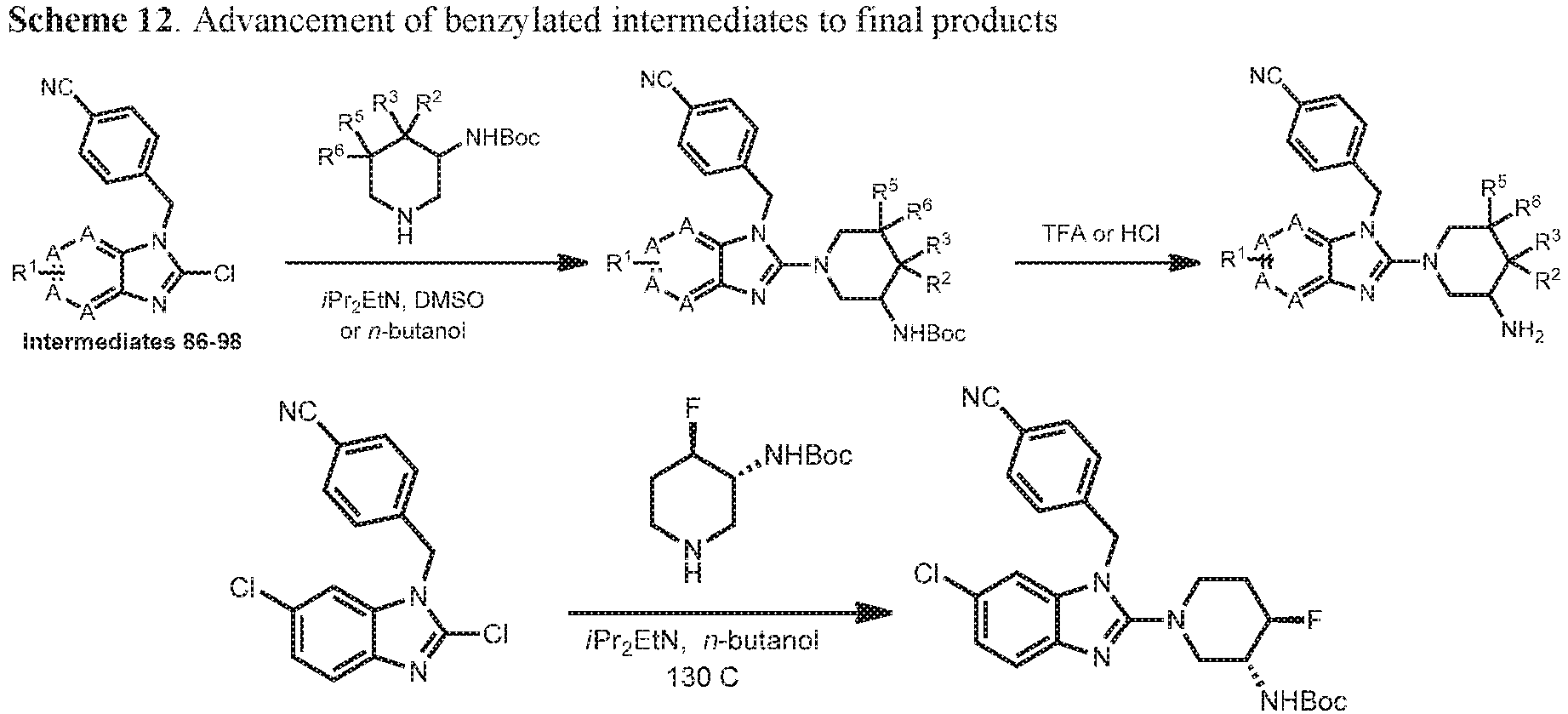
- To a suspension of 4-((2,6-dichloro-1H-benzo[d]imidazol-1-yl)methyl)benzonitrile (50 mg, 0.165 mmol, 1 equiv) and tert-butyl ((3R,4R)-4-fluoropiperidin-3-yl)carbamate (72.2 mg, 0.331 mmol, 2 equiv) in 1-butanol (662 µl. 0.25 M) in a microwave vial was added DIEA (43.4 µl, 0.248 mmol, 1.5 equiv). The vial was heated to 130 °C for 12 hours. The reaction mixture was cooled to room temperature, concentrated, and loaded onto a 12 g RediSep ISCO cartridge, eluting with 20-80% ethyl acetate in heptane, to provide tert-butyl ((3R,4R)-1-(6-chloro-1-(4-cyanobenzyl)-1H-benzo[d]imidazol-2-yl)-4-fluoropiperidin-3-yl)carbamate (40 mg, 49.9 % yield) as a white solid. MS (ESI pos. ion) m/z: 484.0 (M+H).

- To a solution of tert-butyl ((3R,4R)-1-(6-chloro-1-(4-cyanobenzyl)-1H-benzo[d]imidazol-2-yl)-4-fluoropiperidin-3-yl)carbamate (40 mg, 0.083 mmol, 1 equiv) in 1,4-dioxane (1 mL) was added 4 N HCl in dioxane (0.517 mL, 2.066 mmol, 25 equiv). The reaction was stirred at ambient temperature for 6 hours at which time the reaction mixture was concentrated to provide 4-((2-((3R,4R)-3-amino-4-fluoropiperidin-1-yl)-6-chloro-1H-benzo[d]imidazol-1-yl)methyl)benzomitrile hydrochloride as a white solid. NMR (400 MHz, DMSO-d6) 8.78 (br s, 2H), 7.87 - 7.80 (m, 2H), 7.55 (d, J=8.5 Hz, 1H), 7.49 - 7.35 (m, 3H), 7.31 - 7.21 (m, 1H), 5.65 - 5.49 (m, 2H), 5.05 - 4.91 (m, 1H), 3.95 (br d, J=12.3 Hz, 1H), 3.79 - 3.61 (m, 1H), 3.52 - 3.44 (m, 1H), 3.35 - 3.22 (m, 1H), 3.12 (br t, J=11.5 Hz, 1H), 2.32 - 2.15 (m, 1H), 1.99 - 1.79 (m, 1H). MS (ESI pos. ion) m/z: 384.0 (M+H).


-

- tert-Butyl ((3R,4R)-1-(1H-benzo[d]imidazol-2-yl)-4-fluoropiperidin-3-yl)carbamate (Intermediate 54, 156 mg, 0.467 mmol) was dissolved in DCM (2.3 mL). The mixture was treated with methanesulfonyl chloride (100 µl, 0.700 mmol, 2 equiv) and triethylamine, anhydrous (197 µl, 1.400 mmol). The resulting yellow solution was left to stir overnight. The reaction was quenched with NH4Cl (aq), diluted with DCM, extracted into DCM, dried over MgSO4, filtered, concentrated to give the crude as an oil. The oil was purified on column chromatography (25g SiO2, 0-45% ethyl acetate in heptane), to give tert-butyl ((3R,4R)-4-fluoro-1-(1-(methylsulfonyl)-1H-benzo[d]imidazol-2-yl)piperidin-3-yl)carbamate as a colorless solid. (ESI, pos. ion) m/z: 413.2 [M+1].

- A vial was charged with (S)-1-(1-(methylsulfonyl)-1H-benzo[d]imidazol-2-yl)piperidin-3-amine (150 mg, 0.38 mmol), 1-hydroxy-2,3-dihydro-1H-indene-5-carbonitrile (67 mg, 1. 1 equiv), and Cs2CO3 (150 mg, 1.2 equiv). The vial was fitted with a stirring bar, capped, and MeCN (1.3 ml) was added. The mixture was placed into a heating block set at 90°C for 18h. The reaction was diluted with EtOAc and NH4Cl(aq), the mixture was extracted into EtOAc. The combined organic extracts were dried over MgSO4, filtered, and concentrated to give the reaction crude. Crude material was purified on column chromatography (4g SiO2, 0-30% EtOAc in heptane) to afford tert-butyl ((3R,4R)-4-floro-1-(1-((5-methoxypyridin-2-yl)methyl)-1H-benzo[d]imidazol-2-yl)piperidin-3-yl)carbamate as a colorless oil. (ESI, pos. ion) m/z: 456.2 [M+1].

- tert-butyl ((3R,4R)-4-fluoro-1-(1-((5-methoxypyridin-2-yl)methyl)-1H-benzo[d]imidazol-2-yl)piperidin-3-yl)carbamate (32 mg, 1 equiv) was dissolved in DCM (5 mL). HCl in dioxane (10 equiv) was added, and the mixture was allowed to stir overnight. The solution was concentrated, then purified using reverse phase HPLC to provide the title compound. 1H NMR (600 MHz, d6-DMSO) δ 7.79 (s, 1H), 7.50 (t, J=7.53 Hz, 2H), 7.11 (t, J=7.66 Hz, 1H), 6.96 (d, J=7.79 Hz, 1H), 6.88-6.94 (m, 1H), 6.39-6.49 (m, 1H), 6.19 (t, J=8.95 Hz, 1H), 3.54-3.62 (m, 1H), 3.36-3.43 (m, 1H), 3.18-3.24 (m, 3H), 3.00-3.13 (m, 2H), 2.74-2.87 (m, 1H), 2.52-2.63 (m, 1H), 1.91-2.12 (m, 2H), 1.77-1.89 (m, 1H), 1.47-1.56 (m, 1H). (ESI, pos. ion) m/z: 356.2 [M+1].


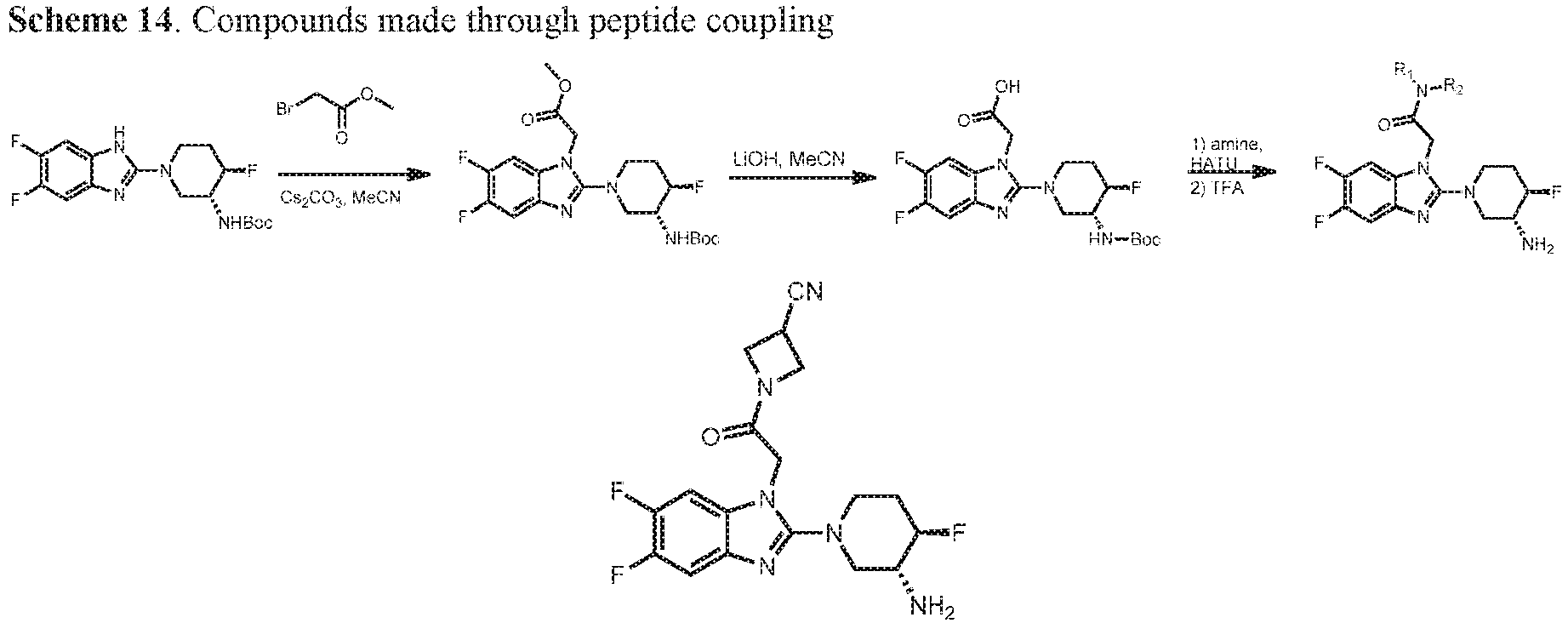
-

- A vial was charged with tert-butyl ((3R,4R)-1-(5,6-difluoro-1H-benzo[d]imidazol-2-yl)-4-fluoropiperidin-3-yl)carbamate (0.3 g, 0.810 mmol) Cs2CO3 (0.792 g, 2.430 mmol) in acetonitrile (2.70 ml), and methyl 2-bromoacetate (0.149 g, 0.972 mmol) and shaken on J-Kem block for 16h. Reaction mixture was filtered through Celite® brand filter agent plug and purified by reverse phase HPLC to obtain methyl 2-(2-((3R,4R)-3-((tert-butoxycarbonyl)amino)-4-fluoropiperidin-1-yl)-5,6-difluoro-1H-benzo[d]imidazol-1-yl)acetate. 1H NMR (600 MHz, DMSO-d6) δ 7.56 (t, J=9.06 Hz, 1H), 7.51 (t, J=8.85 Hz, 1H), 7.19 (br d, J=8.25 Hz, 1H), 4.94-5.03 (m, 2H), 4.51-4.59 (dt, J=4.63, 9.01 Hz, 1H), 3.68-3.77 (m, 3H), 3.35-3.46 (m, 2H), 3.24-3.30 (m, 1H), 2.95 (br t, J=10.63 Hz, 1H), 2.73-2.89 (m, 1H), 2.13-2.21 (m, 1H), 1.79-1.89 (m, 1H), 1.39 (s, 9H). MS: (ESI pos. ion) m/z: 443.2 [M+1].

- Methyl 2-(2-((3R,4R)-3-((tert-butoxycarbonyl)amine)-4-fluoropiperidin-1-)1)-5,6-difuoro-1H-benzo[d]imidazol-1-yl)acetate was saponified using LiOH (0.097 g, 4.05 mmol) in dioxane (1 mL) and water (1 mL). Reaction mixture was stirred at ambient temperature for 1h. Reaction mixture was acidified using acetic acid and the resulting off white precipitate was filtered to obtain 2-(2-((3R,4R)-3-((tert-butoxycarbonyl)amino)-4-fluoropiperidin-1-yl)-5,6-difluoro-1H-benzo[d]imidazol-1-yl)acetic acid. MS: (ESI pos. ion) m/z: 429.2 [M+1].

- A solution of 2-(2-((3R,4R)-3-((tert-butoxycarbonyl)amino)-4-fluoropiperidin-1-yl)-5,6-difluoro-1H-benzo[d]imidazol-1-yl)acetic acid (0.015 g, 0.035 mmol), 3-cyanoazetidine hydrochloride (4.15 mg, 0.035 mmol) and 2-(1h-benzotriazole-1-yl)-1,1,3,3-tetramethyluronium hexaflurophosphate (0.013 g, 0.035 mmol) in dimethyl sulfoxide (0.117 ml) and DIPEA (0.024 ml, 0.140 mmol) was shaken at ambient temperature. The reaction mixture was purified by reverse phase HPLC to obtain tert-butyl ((3R,4R)-1-(1-(2-(3-cyanoazetidin-1-yl)-2-oxoethyl)-5,6-difluora-1H-benzo[d]imidazol-2-yl)-4-fluoropiperidin-3-yl)carbamate. MS: (ESI pos. ion) m/z: 493.2 [M+1].

- tert-Butyl ((3R,4R)-1-(2-(3-cyanoazetidin-1-yl)-2-oxoethyl)-5,6-difluoro-1H-benzo[d]imidazol-2-yl)-4-fluoropiperidin-3-yl)carbamate was treated with TFA(0.5 mL) in DCM (0.5 mL). Mixture was concentrated and purified using reverse phase HPLC to obtain the title compound. 1H NMR (600 MHz, DMSO-d6) δ 7.34-7.60 (m, 2H), 4.73-4.80 (m, 2H), 4.48-4.60 (m, 2H), 4.31-4.48 (m, 1H), 4.17-4.28 (m, 1H), 4.06-4.15 (m, 1H), 3.82-3.94 (m, 1H), 2.96-3.06 (m, 2H), 2.74-2.84 (m, 1H), 2.06-2.17 (m, 1H), 1.64-1.88 (m, 3H). MS: (ESI pos. ion) m/z: 393.2 [M+1].
- The following compounds were made following an analogous procedure to that described for Example 426 and general Scheme 14 above:


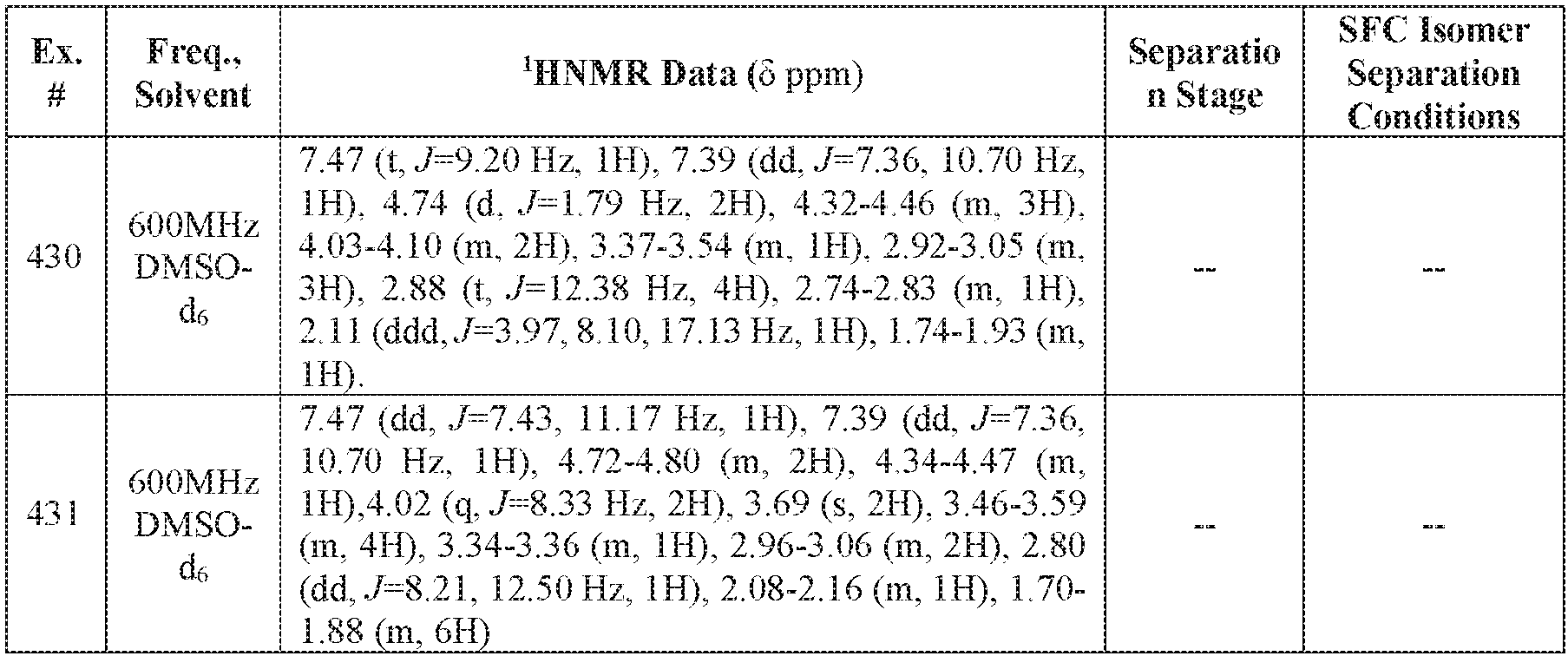

-

- A vial was charged with (R)-6-((2-(3-amino-4,4-difluoropiperidin-1-yl)-6-fluoro-1H-benzo[d]imidazol-1-yl)methyl)nicotinonitrile (100 mg, 0.259 mmol). The vial was fitted with a stirring bar and DMF (1.3 mL) was added. Potassium carbonate (53.7 mg, 0.388 mmol) was added, followed by iodomethane (40.4 mg, 0.285 mmol). The mixture was left to stir at room temperature for 2 hours. Formation of the mono and bismethylated amine was observed by LCMS. The reaction was worked up by diluting with EtOAc and NH4Cl (aq). The mixture was extracted with EtOAc, the organic extracts were combined, dried over MgSO4, filtered and concentrated to give the crude mixture. The crude was purified on HPLC to afford the title compound. MS: (ESI pos. ion) m/z: 401.2 [M+1]; 1H NMR (600 MHz, d6-DMSO) δ 8.95 (dd, J=0.62, 2.18 Hz, 1H), 8.33 (dd, J=2.18, 8.10 Hz, 1H), 7.51 (d, J=8.10 Hz, 1H), 7.46 (dd, J=4.98, 8.72 Hz, 1H), 7.11 (dd, J=2.49, 9.03 Hz, 1H), 6.95 (ddd, J=2.49, 8.72, 9.96 Hz, 1H), 5.54 (s, 2H), 3.35-3.41 (m, 1H), 3.28-3.32 (m, 1H), 3.10-3.16 (m, 1H), 2.91-2.96 (m, 1H), 2.88 (td, J=3.66, 13.23 Hz, 1H), 2.25 (s, 3H), 2.13-2.23 (m, 1H), 2.01-2.13 (m, 1H).

-

- (R)-6-((2-(3-amino-4,4-difluoropiperidin-1-yl)-6-fluoro-1H-benzo[d]imidazol-1-yl)methyl)nicotinonitrile (89.4 mg, 0.231 mmol) was combined with (tert-butyldimethylsilyloxy)acetaldehyde (63.7 µl, 0.301 mmol) in a vial. Tetrahydrofuran (2.3 mL) and sodium cyanoborohydride (24.2 µl, 0.463 mmol) were added. The mixture was allowed to stir at room temperature for 2 hours, at which time starting material was fully consumed. The reaction was quenched with NH4Cl(aq), extracted into EtOAc, washed with brine, dried over MgSO4, filtered and concentrated to give (R)-6-((2-(3-((2-((tert-butyldimethylsilyl)oxy)ethyl)amino)-4,4-difluoropiperidin-1-yl)-6-fluoro-1H-benzo[d]imidazol-1-yl)methyl)nicotionitrile, which was used in the next step without further purification.

- (R)-6-((2-(3-((2-((tert-butyldimethylsilyl)oxy)ethyl)amino)-4,4-difluoropiperidin-1-yl)-6-fluoro-1H-benzo[d]imidazol-1-yl)methyl)nicorinonitrile was dissolved in THF (2.3 mL), and tetrabutylammonium fluoride (1.0 M solution in THF, 301 µl, 0.301 mmol) was added. The mixture was left to stir at rt for 16 h. Clean deprotection was observed by LCMS. The resulting mixture was worked up by diluting with water and EtOAc, extracting into EtOAc, drying over MgSO4, filtering and concentrating. The crude was purified by column chromatography (4g SiO2, 0-70% EtOAc in heptane) to furnish the title compound. MS: (ESI pos. ion) m/z: 431.2 [M+1]. 1H NMR (500 MHz, d4-MeOH) δ 8.82 (br s, 1H), 8.13-8.25 (m, 1H), 7.59 (d, J=8.30 Hz, 1H), 7.55 (dd, J=4.67, 8.30 Hz, 1H), 6.98-7.06 (m, 2H), 5.58 (s, 2H), 4.17 (did, J=4.80, 8.63, 12.98 Hz, 1H), 4.06 (br d, J=13.23 Hz, 1H), 3.84-3.95 (m, 2H), 3.53-3.66 (m, 2H), 3.38-3.47 (m, 1H), 3.32-3.37 (m, 2H), 2.25-2.42 (m, 2H).

-

- A vial was charged with (S)-6-((2-(3-aminopiperidim-1-yl)-1H-benzo[d]imidazol-1-yl)methyl)nicotinonitrile (0.03 g, 0.09 mmol) and 3.99 N aqueous hydrochloric acid (0.075 ml, 0.451 mmol) in 1,4-dioxane (0.301 ml), and shaken at ambient temperature for 1h. The reaction mixture was concentrated and purified by reverse phase HPLC. 1H NMR (600 MHz, DMSO-d6) δ 13.23-13.65 (br s, 1H), 8.98 (d, J=1.40 Hz, 1H), 8.29 (br d, J=6.85 Hz, 1H), 8.12-8.19 (m, 1H), 8.11 (br s, 1H), 7.51 (br d, J=7.71 Hz, 1H), 7.21 (br s, 1H), 7.15 (br s, 1H), 5.57- 5.61 (br s, 2H), 3.58-3.76 (m, 1H), 3.44-3.57 (m, 1H), 3.16-3.29 (m, 2H), 3.06 (br s, 1H), 2.52-2.55 (m, 1H), 1.95 (br s, 1H), 1.83 (br s, 1H), 1.53-1.64 (m, 1H). MS: (ESI pos. ion) m/z: 352.2 [M+1].

-
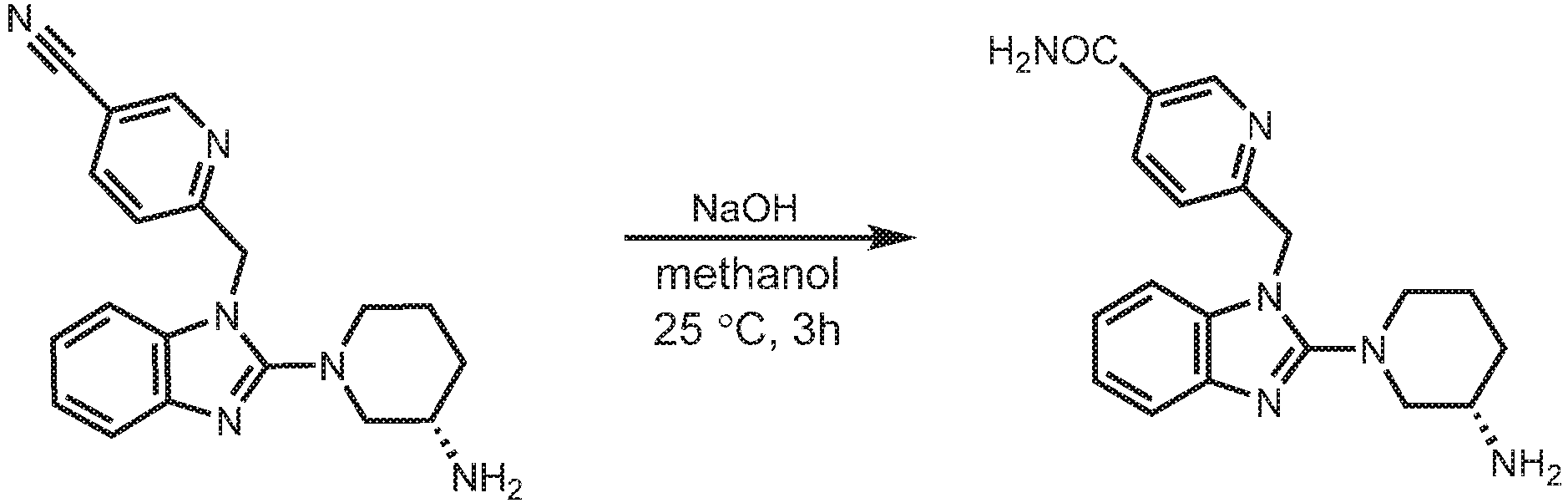
- A vial containing (S)-6-((2-(3-aminopiperidin-1-yl)-1H-benzo[d] imidazol-1-yl)methyl)nicotinonitrile (0.03 g, 0.090 mmol) and NaOH (1 M in water) (0.271 ml, 0.271 mmol) in methanol (0.30 mL) was shaken at rt for 3h. The reaction mixture was diluted with EtOAc, filtered, concentrated, and purified by reverse phase HPLC to afford the title compound. 1H NMR (600 MHz, DMSO-d6) δ 8.94 (s, 1H), 8.16 (dd, J=2.22, 8.14 Hz, 1H), 8.11 (br s, 1H), 7.56 (br s, 1H), 7.43 (d, J=7.79 Hz, 1H), 7.18 (d, J=8.17 Hz, 1H), 6.98-7.11 (m, 3H), 5.38-5.44 (m, 2H), 3.37-3.43 (m, 1H), 2.76-2.89 (m, 2H), 2.57-2.66 (m, 1H), 2.52-2.56 (m, 1H), 1.78-1.84 (m, 1H), 1.65-1.74 (m, 1H), 1.50-1.58 (m, 1H), 1.14-1.28 (m, 1H). MS: (ESI pos. ion) m/z: 351.2 [M+1].

-

- A vial containing 6-((2-((3R,4R)-3-amino-4-fluoropiperidin-1-yl)-1H-benzo[d]imidazol-1-yl)methyl)nicotinonitrile (0.03 g, 0.090 mmol) and NaOH (1 M in water) (0.271 ml, 0.271 mmol) in methanol (0.301 ml) was shaken at ambient temperature for 3h. The reaction mixture was diluted with EtOAc, filtered concentrated and purified by reverse phase HPLC to afford the title compound. 1H NMR (500 MHz, MeOH-d4) δ 8.84-9.04 (m, 1H), 8.08-8.27 (m, 1H), 7.48-7.58 (m, 1H), 7.06-7.34 (m, 4H), 5.51 (br d, J=6.75 Hz, 3H), 4.29-4.50 (m, 1H), 3.61 (br dd, J=3.89, 7.79 Hz, 1H), 3.39-3.50 (m, 1H), 2.87-3.19 (m, 3H), 2.10-2.27 (m, 1H), 1.78-1.97 (m, 1H), 0.79-0.98 (m,1H). MS: (ESI pos. ion) m/z: 369.2 [M+1].

-

- 2-(2-((3R,4R)-3-((tert-butoxycarbonyl)amino)-4-fluoropiperidin-1-yl)-5,6-difluoro-1H-benzo[d]imidazol-1-yl)acetic acid was treated with TFA (0.5 mL) in DCM (1 mL) and stirred at rt for 1h. Reaction mixture was concentrated and purified via reverse phase HPLC to obtain the title compound. 1H NMR (600 MHz, DMSO-d6) δ 7.47-7.60 (m, 2H), 4.82-4.92 (m, 2H), 4.51-4.59 (dt, J=4.63, 9.01 Hz, 1H), 3.35-3.46 (m, 2H), 3.24-3.30 (m, 1H), 2.95 (br t, J=10.63 Hz, 1H), 2.73-2.89 (m, 1H), 2.13-2.21 (m, 1H), 1.79-1.89 (m, 1H). MS: (ESI pos. ion) m/z: 329.0 [M+1].

-

- Step 1. tert-butyl ((3R,4R)-1-(1-(1-(5-cyanopyridin-2-yl)ethyl)-4,6-difluoro-1H-benzo[d]imidazol-2-yl)-4-fluoropiperidin-3-yl)carbamate (1.05 g, 2.098 mmol, mixture of 4 isomers) and methyl iodide (0.144 ml, 2.308 mmol) were dissolved in THF and cooled to 0 C. potassium bis(trimethylsilyl)amide solution, 1m in tetrahydrofuran (2.203 ml, 2.203 mmol) was added slowly and the reaction stirred for 1 hour. Conversion stalled, so the reaction was quenched with ammonium chloride, then extracted with DCM (3X). The organics were combined, dried over Na2SO4, filtered, and concentrated to provide a mixture of methylated and N-H products.
- Step 2. Isomers were separated using chiral SFC: Chiralpak Cel2, 15% MeOH, 0.2% DEA.
- Step 3. Each individual isomer (100 mg, 1 equiv), was dissolved in DCM (5 mL), then TFA (0.5 mL) was added. After 1 hour, the solutions were poured onto pre-wetted SCX columns and flushed with methanol. The products were eluted with methanolic ammonia.
- Peak 1: 6-((R)-1-(4,6-difluoro-2-((3R,4R)-4-fluoro-3-(methylamino)piperidin-1-yl)-1H-benzo[d]imidazol-1-yl)ethyl)nicotinonitrile (Example 438): 1H NMR (500 MHz, METHANOL-d4) δ ppm 1.88 - 2.08 (m, 4 H) 2.22 - 2.33 (m, 1 H) 2.41 - 2.50 (m, 3 H) 2.99 (dd, J=12.72, 9.34 Hz, 1 H) 3.16 - 3.30 (m, 2 H) 3.50 - 3.64 (m, 1 H) 3.77 - 3.95 (m, 1 H) 4.53 - 4.76 (m, 1 H) 5.97 (q, J=7.01 Hz, 1 H) 6.63 - 6.78 (m, 1 H) 7.04 - 7.16 (m, 1 H) 7.62 (d, J=8.30 Hz, 1 H) 8.19 (dd, J=8.30, 2.08 Hz, 1 H) 8.84 (d, J=1.56 Hz, 1 H). MS: (ESI pos. ion) m/z: 415.2 [M+1].
- Peak 2: 6-((S)-1-(4,6-difluoro-2-((3R,4R)-4-fluoro-3-(methylammo)piperidin-1-yl)-1H-benzo[d]imidazol-1-yl)ethyl)nicotinonitrile (Example 597): 1H NMR (500 MHz, METHANOL-d4) δ ppm 1.97 (d, J=7.01 Hz, 3 H) 2.03 - 2.28 (m, 2 H) 2.52 (s, 3 H) 2.99 - 3.21 (m, 3 H) 3.59 (br d, J=12.98 Hz, 1 H) 3.71 - 3.80 (m, 1 H) 4.54 - 4.75 (m, 1 H) 5.97 (q, J=7.01 Hz, 1 H) 6.64 - 6.75 (m, 1 H) 7.10 (dd, J=8.82, 2.08 Hz, 1 H) 7.58 (d, J=8.30 Hz, 1 H) 8.18 (dd, J=8.30, 2.08 Hz, 1 H) 8.76 - 8.87 (m, 1 H). MS: (ESI pos. ion) m/z: 415.2 [M+1].
- Peak 3: 6-((R)-1-(5,7-difluoro-2-((3R,4R)-4-fluoro-3-(methylamino)piperidin-1-yl)-1H-benzo[d]imidazol-1-yl)ethyl)nicotinonitrile (Example 598): 1H NMR (500 MHz, METHANOL-d4) δ ppm 2.01 (d, J=7.27 Hz, 4 H) 2.18 - 2.33 (m, 1 H) 2.49 (s, 3 H) 2.98 (dd, J=12.46, 9.34 Hz, 1 H) 3.14 - 3.28 (in, 2 H) 3.47 (br dd, J=12.85, 1.95 Hz, 1 H) 3.79 (dtd, J=8.40, 4.04, 4.04, 2.47 Hz, 1 H) 4.57 - 4.76 (m, 1 H) 5.91 - 6.04 (m, 1 H) 6.67 - 6.85 (m, 2 H) 7.63 (d, J=8.30 Hz, 1 H) 8.13 - 8.25 (m, 1 H) 8.84 - 8.96 (m, 1 H). MS: (ESI pos. ion) m/z: 415.2 [M+1].
- Peak 4: 6-((S)-1-(5,7-difluoro-2-((3R,4R)-4-fluoro-3-(methylamino)piperidin-1-yl)-1H-benzo[d]imidazol-1-yl)ethyl)nicotinonitrile (Example 599): 1H NMR (500 MHz, METHANOL-d4) δ ppm 2.02 (d, J=7.01 Hz, 3 H) 2.16 - 2.35 (m, 1 H) 2.51 - 2.68 (m, 3 H) 2.98 - 3.20 (m, 3 H) 3.46 - 3.60 (m, 1 H) 3.65 - 3.78 (m, 1 H) 4.54 - 4.78 (m, 1 H) 5.99 (q, J=7.27 Hz, 1 H) 6.64 - 6.85 (m, 2 H) 7.58 (d, J=8.30 Hz, 1 H) 8.19 (dd, J=8.17, 2.21 Hz, 1 H) 8.83 - 8.96 (m, 1 H). MS: (ESI pos. ion) m/z: 415.2 [M+1].

-

- 2-(2-((3R,4R)-3-((tert-butoxyrcarbonyl)amino)-4-fluoropiperidin-1-yl)-5,6-difluoro-1H-benzo[d]imidazol-1-yl)aceric acid (110 mg, 0.257 mmol), 1,1'-dimethyltriethylamine (135 µl, 0.770 mmol), and tetrahydrofuran (1284 µl) were combined in a vial and cooled to 0C. trimethyl acetyl chloride (24.12 µl, 0.282 mmol) was added dropwise and the mixture stirred for 15 minutes. LCMS showed full conversion to mixed anhydride (appears as methyl ester by LCMS from MeOH displacement). 3-azabicyclo[3.1.0]hexane (1.5 equiv) was added and allowed to stir for 1 hour. The mixture was concentrated down, then redissovled in DCM/TFA (1:1) and allowed to stir for 1 hour. The mixture was reconcentrated, then redissolved in 1 mL DMSO, filtered, and purified by reverse phase HPLC to provide the desired product.


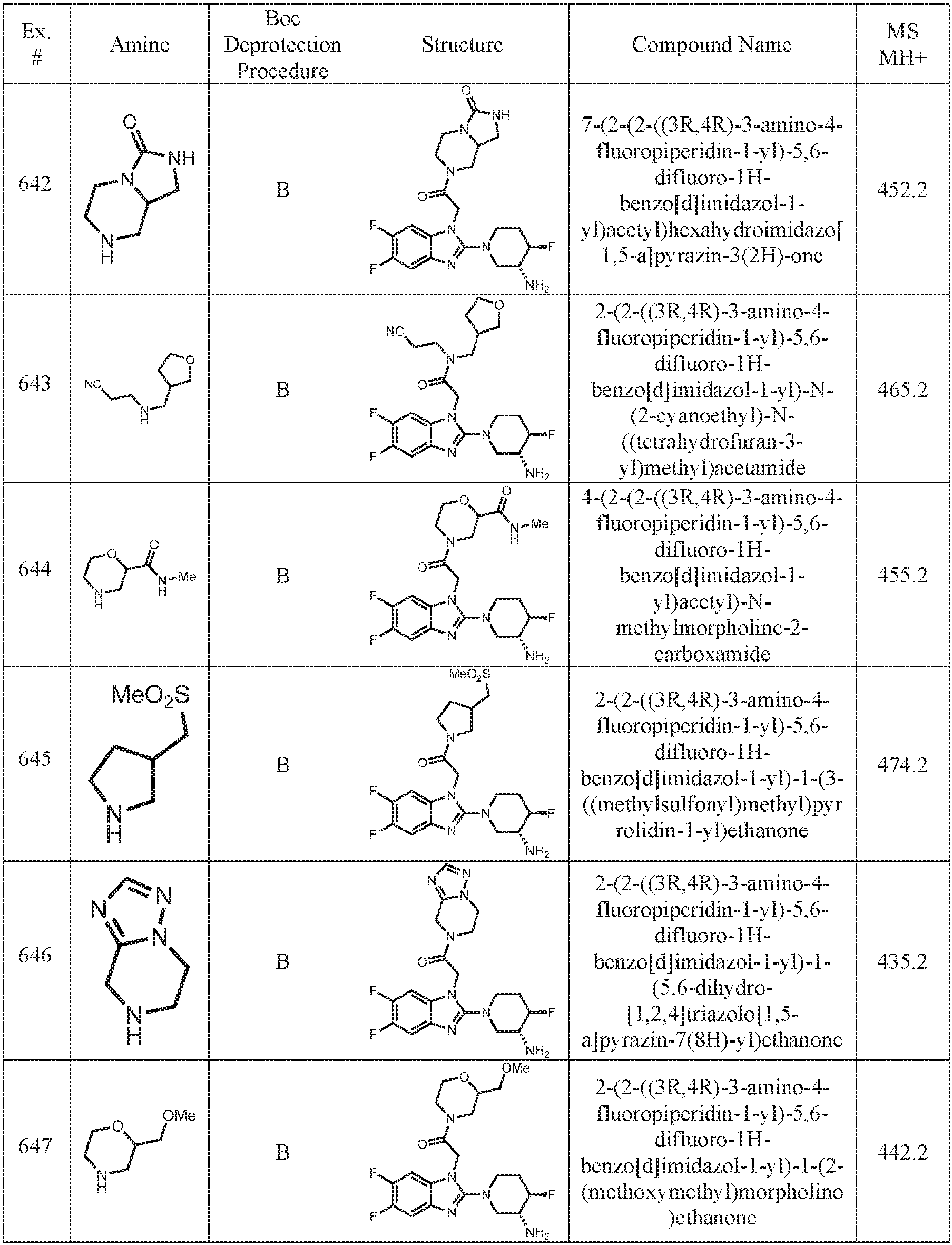


- Potency of TRPC6 (Transient receptor potential channel family C6) inhibitors were measured by their inhibition of Calcium influx trigged by OAG (1-Oleoyl-2-acetyl-sn-glycerol, Millipore Sigma,O6754) stimulation on HEK293 cells stablely transfected with human TRPC6 using a FLIPR tetra system. Cells were grown in a humidified environment at 37°C under 5%, CO2 using the growth medium with the following selective reagents (Dulbecco's Modified Eagle's Medium (DMEM) high glucose, 10% Fetal Bovine Serum, IXPSGlu (penicillin-streptomycin glutamine), IX NEAA (Non-essential amino acid), IX Na Pyruvate and 200ug/ml Hygromycin). For general passage, cells were grown to 70-90% confluency; the media was removed, and the cells were gently washed 2 times with calcium and magnesium free PBS (phosphate-buffered saline). Trypsin (3mL) was applied for 5 minutes at 37°C. The cells were dislodged by rapping flask against base of a hand and 7 mL of growth medium was added to deactivate trypsin and re-suspend cells. The usual splitting schedule was 1:5 every 2-3 days.
- Cells were plated the day before the assay, plating cell density is 1.0-1.5×10⁴/25µl/well in poly-D-lysine (PDL) coated 384-well plates using either multichannel pipettes or multidrop. These cells were first incubated with fluorescence dye at room temperature for 90-120 minutes after they were grown on PDL-coated 384-well black plates overnight (Dye loading buffer 10ml example: 9 mL assay buffer, 1 mL, 10X PBX signal enhancer, 10 µL Calcium indicator). The cells were incubated with a dose of compounds for 25 minutes before being stimulated with TRPC6 agonist OAG. The OAG solution was prepared by adding OAG into assay buffer (Ca ringer solution base: 10mW HEPES (4-(2-hydroxyethyl)-)-piperazineethanesulfonic acid), 4mM MgCh, 120mM NaCl, 5mM KC1, pH-7.2 @25 °C) + 0.1%BSA + 2mM CaCl2) to the concentration of 0.2mW/2% DMSO, which achieves a final on cell concentration of 50uM/0.5% DMSO. 12.5 uL OAG mixture was added and the activation of the TRPC6 channel was measured by the change of intracellular Calcium levels on FLIPR terra system.
- Data was acquired by measuring the fluorescent peak signal subtracted from the background during the 180 second imaging frame. Each data point is further normalized to 100% of OAG triggered signal vs. buffer. Table 16 provides the ICso for each compound, which data is obtained by plotting peak signal over the compound dose.


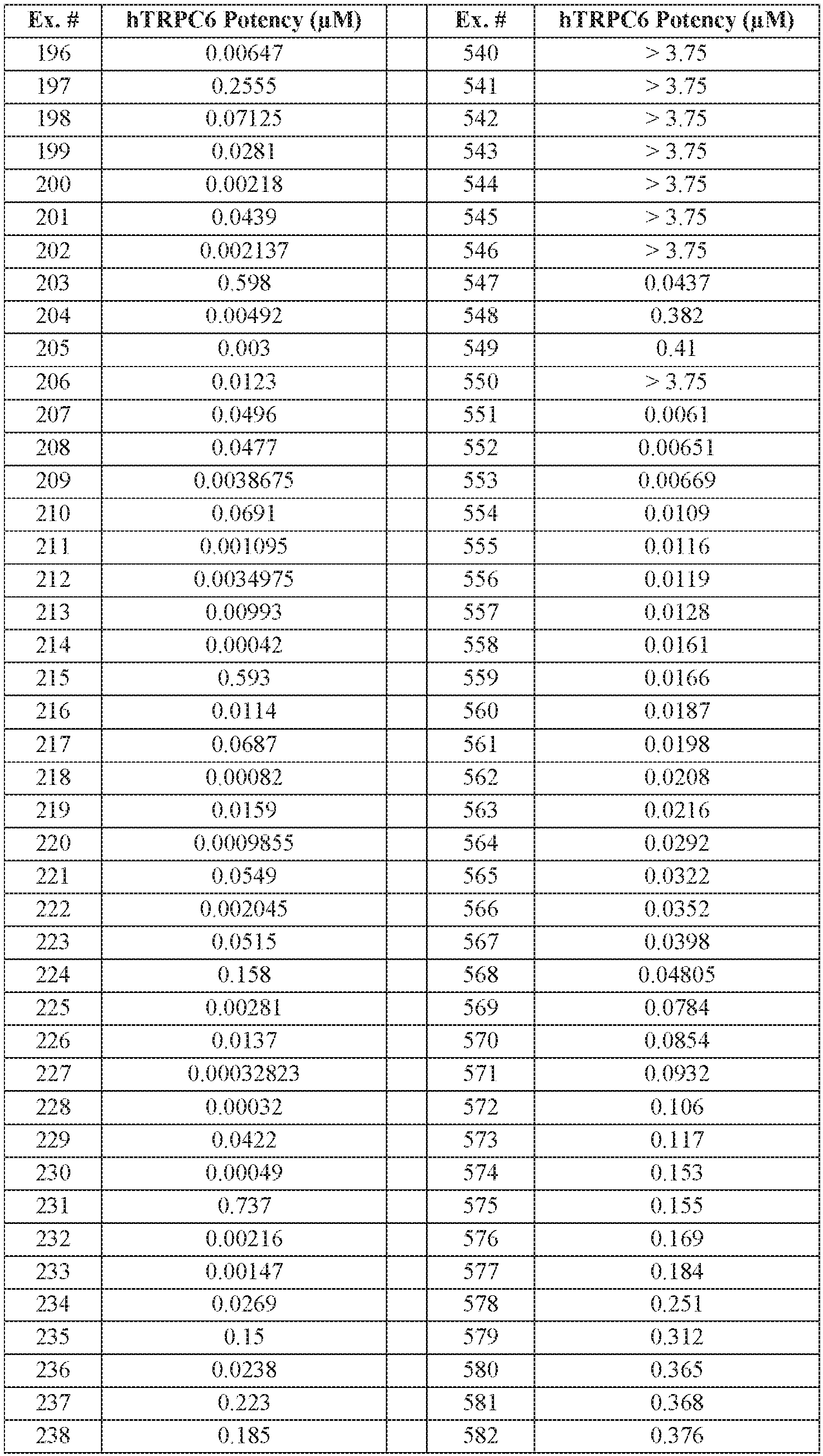


- The foregoing is merely illustrative of the invention and is not intended to limit the invention to the disclosed compounds. Variations and changes which are obvious to one skilled in the art are intended to be within the scope and nature of the invention which are defined in the appended claims.
- From the foregoing description, one skilled in the art can easily ascertain the essential characteristics of this invention, and without departing from the scope thereof, can make various changes and modifications of the invention to adapt it to various usages and conditions.
Claims (16)
- A compound or pharmaceutically acceptable salt thereof, according to Formula I:
 p is 0 or 1;when p is 0, then R1 is hydrogen, C1-C6alkyl, halogen or hydroxy; R2 is amino or aminoC1-C4alkyl; R3 is hydrogen; and R4 is hydrogen, C1-C6alkyl or phenyl; orwhen p is 0, then R1 and R3, taken in combination, form a fused C3-C6cycloalkyl ring or a fused 4 to 6 member heterocycle ring having 1 or 2 ring heteroatoms independently selected from N, O or S, which cycloalkyl or heterocycle is optionally substituted with amino; R2 is hydrogen, C1-C6alkyl or aminoC1-C4alkyl; and R4 is hydrogen; orwhen p is 1, then R1 is NHR1a; R1a is hydrogen, C1-C4alkyl, C3-C7cycloalkyl, hydroxyC1-C4alkyl,or 4 to 6 member heterocycloalkyl having one ring heteroatom selected from N, O or S; R2 is hydrogen, C1-C4alkyl, hydroxyC1-C4alkyl or C(O)NH2; R3 is hydrogen, halogen, C1-C4alkyl, C1-C4alkoxy or hydroxy; and R4 is hydrogen, C1-C4alkyl or halogen; orwhen p is 0 or 1, then CR1R2, taken in combination, form a spirocyclic 4 to 6 member heterocycloalkyl; R3 is hydrogen, halogen, C1-C4alkyl, C1-C4alkoxy, or hydroxy; and R4 is hydrogen or halogen; orwhen p is 1, then R1 and R3, taken in combination, form a fused 4 to 6 member heterocycle or a fused 3 to 7 member carbocycle, which heterocycle comprises a ring nitrogen atom and optionally 0 or 1 additional ring heteroatoms selected from N, O and S, and which carbocycle is substituted with amino; and R2 is hydrogen; and R4 is hydrogen, halogen or hydroxy;R5 represents 1 or 2 substituents independently selected from hydrogen, halogen, hydroxy, amino, C1-C6alkyl or C1-C6alkoxy;R6 is -(CR7R8)-A; orR6 is a 4 to 7 member lactam which is optionally substituted with one or two substituents independently selected from the group consisting of hydroxy, C1-C6alkyl, C2-C6alkenyl, C2-C6alkynyl, C3-C6cycloalkyl, haloC1-C6alkyl, C1-C6alkoxy, haloC1-C6alkoxy, hydroxyC1-C6alkyl, C1-C6alkoxyC1-C6alkyl, phenyl, 4 to 7 member heterocycle having 1 ring atoms selected from N, O or S and 0 or 1 additional ring N atoms or 5 or 6 member heteroaryl having one ring heteroatom selected from N, O or S and 0 or 1 additional ring nitrogen atom, wherein the heteroaryl, heterocycle or phenyl group is optionally substituted with 0, 1 or 2 C1-C6alkyl or halogen; orR6 is a partially unsaturated 9 or 10 member bicyclic carbocycle, which is optionally substituted with 1 or 2 substituents independently selected from halogen, cyano, C1-C6alkyl, C2-C6alkenyl, C2-C6alkynyl, haloC1-C6alkyl, C1-C6alkoxy, haloC1-C6alkoxy, C(O)NH2 and C(O)NHC1-C6alkyl;A is 6 or 5 member heteroaryl, which heteroaryl comprises one ring heteroatom selected from N, O or S and 0, 1 or 2 additional ring nitrogen atoms, which heteroaryl is optionally substituted with 0, 1, 2, 3 or 4 groups independently selected from halogen, cyano, C1-C6alkyl, C2-C6alkenyl, C2-C6alkynyl, C3-C6cycloalkyl, haloC1-C6alkyl, C1-C6alkoxy, haloC1-C6alkoxy, C(O)N(RA)2, S(O)2C1-C6alkyl, phenyl or 5 or 6 member heteroaryl having one ring heteroatom selected from N, O or S and 0, 1 or 2 additional ring nitrogen atoms, wherein the optional heteroaryl or phenyl substituent is further substituted with 0, 1 or 2 C1-C6alkyl; orA is phenyl substituted with 1, 2 or 3 substituents independently selected from halogen, C1-C6alkyl, C2-C6alkenyl, C2-C6alkynyl, haloC1-C6alkyl, cyanoC1-C6alkyl, C1-C6alkoxy, haloC1-C6alkoxy, cyanoC1-C6 alkoxy, S(O)qC1-C6alkyl, S(O)2NH2, S(O)2NHC1-C6alkyl, S(O)2N(C1-C6alkyl)2, C(O)NH2, C(O)NHC1-C6alkyl, C(O)N(C1-C6alkyl)2, hydroxy, cyano, or 5 or 6 member heteroaryl having one ring heteroatom selected from N, O or S and 0, 1 or 2 additional ring nitrogen atoms which heteroaryl is further substituted with 0, 1 or 2 C1-C6alkyl; orA is C(O)OR9 or C(O)NR9R10; orA is optionally substituted 9 or 10 member aromatic or partially unsaturated bicyclyl having 0, 1 or 2 ring nitrogen atoms and 0 or 1 additional ring heteroatoms selected from N, O or S, which bicyclyl is substituted with 0, 1 or 2 substituents independently selected from the group consisting of halogen, cyano, C1-C6alkyl, C2-C6alkenyl, C2-C6alkynyl, haloC1-C6alkyl, C1-C6alkoxy, haloC1-C6alkoxy, C(O)NH2, C(O)OH or C(O)NHC1-C6alkyl;RA is independently selected at each occurrence from hydrogen or C1-C4alkyl; or N(RA)2, taken in combination, forms a 4 to 7 member azacycle which is optionally substituted with 0, 1, or 2 C1-C4alkyl;R7 is hydrogen, C1-C4alkyl or amino;R8 is hydrogen or C1-C4alkyl; orCR7R8, taken in combination form a 3 to 6 member cycloalkandiyl group;R9 is hydrogen, C1-C6alkyl, C3-C6cycloalkyl, hydroxyC1-C6alkyl, C1-C4alkoxyC1-C6alkyl, haloC1-C6alkyl, cyano C1-C6alkyl or -(CH2)rR9A wherein r is 0 or 1 and R9A is phenyl, 4 to 7 member heterocycle having one ring heteroatoms selected from N, O or S, which ring sulfur may be optionally oxidized, and 0 or 1 additional ring N atoms or 5 or 6 member heteroaryl having one ring heteroatom selected from N, O or S and 0, 1, or 2 additional ring N atoms, which phenyl, heterocycle or heteroaryl is optionally substituted with 0, 1 or 2 halogen, C1-C4alkyl or C(O)C1-C4alkyl;R10 is hydrogen, C1-C6alkyl, C2-C6alkenyl, C2-C6alkynyl, halo C1-C6alkyl, C3-C7cycloalkyl or saturated, partially unsaturated or aromatic 5 or 6 member heterocycle having 1 or 2 ring heteroatoms independently selected from N, O and S, which sulfur is optionally oxidized, and which heterocycle is optionally substituted with 1 or 2 substituents independently selected from C1-C6alkyl and halogen, which heterocycle has 1 or 2 ring hetero atoms selected from N, O or S, which sulfur may be optionally oxidized, and wherein each alkyl or cycloalkyl is optionally substituted with cyano, halogen, hydroxy, C1-C6alkoxy, S(O)qC1-C6alkyl, 4 to 6 member heterocycle having 1 or 2 ring heteroatoms selected from N, O or S or 5 or 6 member heteroaryl having 1 ring heteroatom selected from N, O or S and 0, 1 or 2 additional ring nitrogen atoms and where each heterocycle or heteroaryl is optionally substituted with 0, 1, or 2 C1-C4alkyl; orNR9R10, taken in combination, form a monocyclic or bicyclic 4 to 10 member saturated or partially unsaturated heterocycle having one or two ring nitrogen atoms and 0 or 1 additional ring heteroatom selected from N, O or S, which ring sulfur may be optionally oxidized, which heterocycle is optionally substituted with 0, 1 or 2 substitutents selected from halogen, oxo, hydroxy, cyano, C1-C6alkyl, C3-C6cycloalkyl, haloC1-C6alkyl, hydroxyC1-C6alkyl, cyanoC1-C6alkyl, C1-C6alkoxy, haloC1-C6alkoxy, C1-C6alkoxyC1-C4alkyl, S(O)qC1-C6alkyl, C1-C6alkylS(O)qC1-C6alkyl CO2H, C(O)C1-C6alkyl, C(O)OC1-C6alkyl, C(O)C3-C6cycloalkyl, N(R15)C(O)C1-C6alkyl or C(O)N(R15)2, phenyl, 4 to 6 member heterocycle having 1 or 2 ring heteroatoms selected from N, O or S or a 5 or 6 member heteroaryl having 1 ring heteroatom selected from N, O or S and 0, 1 or 2 additional ring nitrogen atoms and where each heterocycle or heteroaryl is optionally substituted with 0, 1, or 2 C1-C4alkyl;q is 0, 1 or 2;Z1 is N or CR11;Z2 is N or CR12;Z3 is N or CR13;Z4 is N or CR14,Z5 and Z6 are each independently N or C;wherein 0, 1 or 2 of Z1, Z2, Z3, Z4, Z5 and Z6 are N;each of R11, R12, R13 and R14 is independently selected from the group consisting of hydrogen, halogen, C1-C6alkyl, C2-C6alkenyl, C2-C6alkynyl, C1-C6alkoxy, haloC1-C6alkyl, haloC1-C6alkoxy, C3-C7cycloalkyl, cyano, SO2C1-C6alkyl, phenyl, and saturated, partially unsaturated or aromatic 5 or 6 member heterocycle having 1 or 2 ring heteroatoms independently selected from N, O and S, which heterocycle is optionally substituted with 1 or 2 substituents independently selected from C1-C6alkyl andhalogen; andR15 is selected at each occurrence from hydrogen or C1-C4alkyl or N(R15)2 taken in combination form a 4 to 7 member azacycle optionally substituted with 0, 1 or 2 C1-C4alkyl; with the proviso that compounds of Formula I do not include 1- [7-fluoro-6-methoxy-1-[[2-(trifluoromethyl)phenyl]methyl]-1/7-benzimidazol-2-yl]-3-piperidinamine.
 - A compound or pharmaceutically acceptable salt thereof, according to
 p is 0 or 1;when p is 0, then R1 is hydrogen, C1-C6alkyl, halogen or hydroxy; R2 is amino or aminoC1-C4alkyl; R3 is hydrogen; and R4 is hydrogen, C1-C6alkyl or phenyl; orwhen p is 0, then R1 and R3, taken in combination, form a fused C3-C6cycloalkyl ring or a fused 4 to 6 member heterocycle ring having 1 or 2 ring heteroatoms independently selected from N, O or S, which cycloalkyl or heterocycle is optionally substituted with amino; R2 is hydrogen, C1-C6alkyl or aminoC1-C4alkyl; and R4 is hydrogen; orwhen p is 1, then R1 is NHR1a; R1a is hydrogen, C1-C4alkyl, C3-C7cycloalkyl, hydroxyC1-C4alkyl,or 4 to 6 member heterocycloalkyl having one ring heteroatom selected from N, O or S; R2 is hydrogen, C1-C4alkyl, hydroxyC1-C4alkyl or C(O)NH2; R3 is hydrogen, halogen, C1-C4alkyl, C1-C4alkoxy or hydroxy; and R4 is hydrogen, C1-C4alkyl or halogen; orwhen p is 0 or 1, then C(NHR1a)R2, taken in combination, form a spirocyclic4 to 6 member heterocycloalkyl; R3 is hydrogen, halogen C1-C4alkyl, C1-C4alkoxy, or hydroxy; and R4 is hydrogen or halogen; orwhen p is 1, then R1 and R3, taken in combination, form a fused 4 to 6 member heterocycle or a fused 3 to 7 member carbocycle, which heterocycle comprises a ring nitrogen atom and optionally 0 or 1 additional ring heteroatoms selected from N, O and S, and which carbocycle is substituted with amino; and R2 is hydrogen; and R4 is hydrogen, halogen or hydroxy;R5 represents 1 or 2 substituents independently selected from hydrogen, halogen, hydroxy, amino, C1-C6alkyl or C1-C6alkoxy;R6 is -(CR7R8)-A; orR6 is a 4 to 7 member lactam which is optionally substituted with one or two substituents independently selected from the group consisting of hydroxy, C1-C6alkyl, C2-C6alkenyl, C2-C6alkynyl, haloC1-C6alkyl, C1-C6alkoxy, haloC1-C6alkoxy, hydroxyC1-C6alkyl, C1-C6alkoxyC1-C6alkyl, phenyl or 5 or 6 member heteroaryl having one ring heteroatom selected from N, O or S and 0 or 1 additional ring nitrogen atom, wherein the heteroaryl or phenyl group is optionally substituted with 0, 1 or 2 C1-C6alkyl or halogen; orR6 is a partially unsaturated 9 or 10 member bicyclic carbocycle, which is optionally substituted with 1 or 2 substituents independently selected from halogen, cyano, C1-C6alkyl, C2-C6alkenyl, C2-C6alkynyl, haloC1-C6alkyl, C1-C6alkoxy, haloC1-C6alkoxy, C(O)NH2 and C(O)NHC1-C6alkyl;A is 6 or 5 member heteroaryl, which heteroaryl comprises one ring heteroatom selected from N, O or S and 0, 1 or 2 additional ring nitrogen atoms, which heteroaryl is optionally substituted with 0, 1, 2, 3 or 4 groups independently selected from halogen, cyano, C1-C6alkyl, C2-C6alkenyl, C2-C6alkynyl, haloC1-C6alkyl, C1-C6alkoxy, haloC1-C6alkoxy, C(O)NH2, C(O)NHC1-C6alkyl, phenyl or 5 or 6 member heteroaryl having one ring heteroatom selected from N, O or S and 0, 1 or 2 additional ring nitrogen atoms, wherein the optional heteroaryl or phenyl substituent is further substituted with 0, 1 or 2 C1-C6alkyl; orA is phenyl substituted with 1, 2 or 3 substituents independently selected from halogen, C1-C6alkyl, C2-C6alkenyl, C2-C6alkynyl, haloC1-C6alkyl, cyanoC1-C6alkyl, C1-C6alkoxy, haloC1-C6alkoxy, cyanoC1-C6 alkoxy, S(O)qC1-C6alkyl, S(O)2NH2, S(O)2NHC1-C6alkyl, S(O)2N(C1-C6alkyl)2, C(O)NH2, C(O)NHC1-C6alkyl, C(O)N(C1-C6alkyl)2, hydroxy, cyano, or 5 or 6 member heteroaryl having one ring heteroatom selected from N, O or S and 0, 1 or 2 additional ring nitrogen atoms which heteroaryl is further substituted with 0, 1 or 2 C1-C6alkyl; orA is C(O)OR9 or C(O)NR9R10; orA is optionally substituted 9 or 10 member aromatic or partially unsaturated bicyclyl having 0, 1 or 2 ring nitrogen atoms and 0 or 1 additional ring heteroatoms selected from N, O or S, which bicyclyl is substituted with 0, 1 or 2 substituents independently selected from the group consisting of halogen, cyano, C1-C6alkyl, C2-C6alkenyl, C2-C6alkynyl, haloC1-C6alkyl, C1-C6alkoxy, haloC1-C6alkoxy, C(O)NH2, C(O)OH or C(O)NHC1-C6alkyl;R7 is hydrogen, C1-C4alkyl or amino;R8 is hydrogen or C1-C4alkyl; orCR7R8, taken in combination form a 3 to 6 member cycloalkandiyl group;R9 is hydrogen, C1-C6alkyl, hydroxyC1-C6alkyl, haloC1-C6alkyl or cyano C1-C6alkyl;R10 is hydrogen, C1-C6alkyl, C2-C6alkenyl, C2-C6alkynyl, halo C1-C6alkyl, C3-C7cycloalkyl or 4 to 7 member heterocycle, which heterocycle has 1 or 2 ring hetero atoms selected from N, O or S, which sulfur may be optionally oxidized, and wherein each alkyl or cycloalkyl is optionally substituted with cyano, halogen, hydroxy, C1-C6alkoxy, S(O)qC1-C6alkyl, 4 to 6 member heterocycle having 1 or 2 ring heteroatoms selected from N, O or S or 5 or 6 member heteroaryl having 1 ring heteroatom selected from N, O or S and 0, 1 or 2 additional ring nitrogen atoms; orNR9R10, taken in combination, form a monocyclic or bicyclic 4 to 9 member heterocycle having one ring nitrogen atom and 0 or 1 additional ring heteroatom selected from N, O or S, which ring sulfur may be optionally oxidized, which heterocycle is optionally substituted with 0, 1 or 2 substitutents selected from halogen, oxo, hydroxy, cyano, C1-C6alkyl, halo C1-C6alkyl, hydroxyC1-C6alkyl, C1-C6alkoxy, S(O)qC1-C6alkyl, CO2H, C(O)C1-C6alkyl, or C(O)NH2;q is 0, 1 or 2;Z1 is N or CR11;Z2 is N or CR12;Z3 is N or CR13;Z4 is N or CR14,Z5 and Z6 are each independently N or C;wherein 0, 1 or 2 of Z1, Z2, Z3, Z4, Z5 and Z6 are N;each of R11, R12, R13 and R14 is independently selected from the group consisting of hydrogen, halogen, C1-C6alkyl, C2-C6alkenyl, C2-C6alkynyl, C1-C6alkoxy, haloC1-C6alkyl, haloC1-C6alkoxy, C3-C7cycloalkyl, cyano, SO2C1-C6alkyl, phenyl, and saturated, partially unsaturated or aromatic 5 or 6 member heterocycle having 1 or 2 ring heteroatoms independently selected from N, O and S, which heterocycle is optionally substituted with 1 or 2 substituents independently selected from C1-C6alkyl and halogen; and with the proviso that compounds of Formula I do not include 1- [7-fluoro-6-methoxy-1-[[2-(trifluoromethyl)phenyl]methyl]-1/7-benzimidazol-2-yl]-3-piperidinamine.
 - The compound or pharmaceutically acceptable salt thereof of claim 1 or claim 2, wherein p is 0; R1 and R3, taken in combination, form a fused C3-C6cycloalkyl ring or a fused 4 to 6 member azacycle ring, which cycloalkyl or azacycle is optionally substituted with amino; and R2 and R4 are hydrogen.
- The compound or pharmaceutically acceptable salt thereof of claim 1 or claim 2, wherein p is 1, R1 is NHR1a; R1a is hydrogen, C1-C4alkyl, C3-C7cycloalkyl or 4 to 6 member heterocycloalkyl having one ring heteroatom selected from N, O or S; R2 is hydrogen or C1-C4alkyl; R3 is hydrogen, halogen, C1-C4alkyl, C1-C4alkoxy, or hydroxy; and R4 is hydrogen, halogen or C1-C4alkyl, wherein preferably R1a is hydrogen, methyl, ethyl, propyl, isopropyl or cyclopropyl; R2 is hydrogen or methyl; R3 is hydrogen, halogen, methyl, ethyl, methoxy, ethoxy, or hydroxy; and R4 is hydrogen, halogen, methyl or ethyl.
- The compound or pharmaceutically acceptable salt thereof of claim 4, wherein R1 is NH2; R2 is hydrogen; R3 is hydrogen, fluorine, methyl, or hydroxy; and R4 is hydrogen, fluorine or methyl.
- The compound or pharmaceutically acceptable salt thereof of any one of claims 1 to 5, wherein R6 is -(CR7R8)-A, wherein preferably R7 is hydrogen or methyl; and R8 is hydrogen.
- The compound or pharmaceutically acceptable salt thereof of claim 6, wherein A is 6 or 5 member heteroaryl, which heteroaryl comprises one ring heteroatom selected from N, O or S and 0, 1 or 2 additional ring nitrogen atoms, which heteroaryl is optionally substituted with 0, 1, or 2 groups independently selected from halogen, cyano, C1-C6alkyl, C2-C6alkenyl, C2-C6alkynyl, haloC1-C6alkyl, C1-C6alkoxy, haloC1-C6alkoxy, C(O)NH2, C(O)NHC1-C6alkyl, phenyl or 5 or 6 member heteroaryl having one ring heteroatom selected from N, O or S and 0, 1 or 2 additional ring nitrogen atoms, wherein the optional heteroaryl or phenyl substituent is further substituted with 0, 1 or 2 C1-C6alkyl, wherein preferably A is pyridin-2-yl, pyridin-3-yl, pyrimidin-2-yl, or pyrazin-2-yl, each of which is substituted with 1 to 3 groups independently selected from the group consisting of halogen, cyano, C1-C4alkyl, haloC1-C4alkyl, C1-C4alkoxy, haloC1-C4alkoxy, C(O)NH2, C(O)NHC1-C4alkyl, phenyl or 5 member heteroaryl having one ring heteroatom selected from N, O or S and 0, 1 or 2 additional ring nitrogen atoms, wherein the optional heteroaryl or phenyl substituent is further substituted with 0, 1 or 2 C1-C6alkyl.
- The compound or pharmaceutically acceptable salt thereof of claim 6,(i) wherein A is phenyl substituted with one substituent selected from the group consisting of halogen, C1-C4alkyl, haloC1-C4alkyl, C1-C4alkoxy, haloC1-C4alkoxy, hydroxy, cyano, or 5 member heteroaryl having one ring heteroatom selected from N, O or S and 0, 1 or 2 additional ring nitrogen atoms, and wherein the phenyl group is further optionally substituted with halogen, C1-C4alkyl, C1-C4alkoxy, haloC1-C4alkyl or haloC1-C4alkoxy or(ii) wherein A is C(O)NR9R10;R9 is hydrogen, or C1-C4alkyl;R10 is C1-C4alkyl, haloC1-C4alkyl, C3-C7cycloalkyl or 4 to 7 member heterocycle, which heterocycle has 1 or 2 ring hetero atoms selected from N, O or S, which sulfur may be optionally oxidized, and wherein each alkyl or cycloalkyl is optionally substituted with cyano, halogen, hydroxy, C1-C6alkoxy, S(O)qC1-C6alkyl; orNR9R10, taken in combination, form a monocyclic or bicyclic 4 to 9 member azacycle having one ring nitrogen atom and 0 or 1 additional ring heteroatom selected from N, O or S, which ring sulfur may be optionally oxidized, which azacycle is optionally substituted with 0, 1 or 2 substitutents selected from halogen, oxo, hydroxy, cyano, C1-C6alkyl, halo C1-C6alkyl, hydroxyC1-C6alkyl, C1-C6alkoxy, S(O)2C1-C6alkyl, CO2H, C(O)C1-C6alkyl, or C(O)NH2,preferably wherein in (ii) R9 is hydrogen, methyl or ethyl; and R10 is C1-C4alkyl or haloC1-C4alkyl wherein each alkyl is optionally substituted with cyano, halogen, hydroxy, C1-C6alkoxy or S(O)qC1-C6alkyl orpreferably wherein in (ii) NR9R10, taken in combination, form a 4 to 6 member monocyclic azacycle or a 7 to 9 member bicyclic azacycle, each of which having one ring nitrogen atom and 0 or 1 additional ring heteroatom selected from N, O or S, which ring sulfur may be optionally oxidized, wherein each azacycle is optionally substituted with 0, 1 or 2 substitutents selected from halogen, oxo, hydroxy, cyano, C1-C6alkyl, halo C1-C6alkyl, hydroxyC1-C6alkyl, C1-C6alkoxy, S(O)2C1-C6alkyl, CO2H, C(O)C1-C6alkyl, or C(O)NH2.
- The compound or pharmaceutically acceptable salt thereof of any one of claims 1 to 8, whereinZ1 is CR11;Z2 is CR12;Z3 is CR13;Z4 is N or CR14,Z5 and Z6 are each C;R11 is hydrogen, halogen, cyano or C1-C4alkyl;R12 and R13 are each independently selected from the group consisting of hydrogen, halogen, cyano, C1-C4alkyl, haloC1-C4alkyl, C1-C4alkoxy, haloC1-C4alkoxy C3-C6cycloalkyl or 5 member saturated, partially unsaturated or aromatic 5 or 6 member heterocycle having 1 or 2 ring heteroatoms independently selected from N, O and S; andR14 is hydrogen, halogen, cyano or C1-C4alkyl.
- The compound or pharmaceutically acceptable salt thereof of claim 1 or claim 2 which is(i) a compound of Formula III:
 X1 is CR16 or N;X2 is CR17 or N;X3 is CR18 or N;Z4 is N or CR14;R1 is NHR1a;R1a is hydrogen or C1-C4alkyl;R2 is hydrogen or C1-C4alkyl;R3 is hydrogen or halogen;R4 is hydrogen or halogen;R7 is hydrogen, methyl or ethyl;R11 is hydrogen, halogen, cyano or C1-C4alkyl;R12 and R13 are each independently selected from the group consisting of hydrogen, halogen, cyano, C1-C4alkyl, haloC1-C4alkyl, C1-C4alkoxy, or haloC1-C4alkoxy;R14 is hydrogen, halogen, cyano or C1-C4alkyl;R15 is hydrogen, halogen, cyano, C1-C4alkyl, C1-C4alkoxy, haloC1-C4alkyl, haloC1-C4alkoxy, C(O)NH2, C(O)NH(C1-C4alkyl) or 5 member heteroaryl having one ring heteroatom selected from N, O or S and 0, 1 or 2 additional ring nitrogen atoms;R16 is hydrogen, halogen, cyano, C1-C4alkyl, C1-C4alkoxy, haloC1-C4alkyl or haloC1-C4alkoxy;R17 is hydrogen or halogen; andR18 is hydrogen, halogen, cyano, C1-C4alkyl, C1-C4alkoxy, haloC1-C4alkyl or haloC1-C4alkoxy, wherein at least one of R15, R16, R17 or R18 is not hydrogen or(ii) a compound of Formula VI:
 R1a is hydrogen or C1-C4alkyl;R3 is hydrogen or halogen;R4 is hydrogen or halogen;R7 is hydrogen, methyl or ethyl;R11 is hydrogen, halogen, cyano or C1-C4alkyl;R12 and R13 are each independently selected from the group consisting of hydrogen, halogen, cyano, C1-C4alkyl, haloC1-C4alkyl, C1-C4alkoxy, or haloC1-C4alkoxy;R14 is hydrogen, halogen, cyano or C1-C4alkyl;R15 is hydrogen, halogen, cyano, C1-C4alkyl, C1-C4alkoxy, haloC1-C4alkyl, haloC1-C4alkoxy, C(O)NH2, C(O)NH(C1-C4alkyl) or 5 member heteroaryl having one ring heteroatom selected from N, O or S and 0, 1 or 2 additional ring nitrogen atoms;R16 is hydrogen, halogen, cyano, C1-C4alkyl, C1-C4alkoxy, haloC1-C4alkyl or haloC1-C4alkoxy;R17 is hydrogen or halogen; andR18 is hydrogen, halogen, cyano, C1-C4alkyl, C1-C4alkoxy, haloC1-C4alkyl or haloC1-C4alkoxy, wherein at least one of R15, R16, R17 or R18 is not hydrogen or(iii) a compound of Formula VII:
 R1a is hydrogen or C1-C4alkyl;R3 is hydrogen or halogen;R4 is hydrogen or halogen;R7 is hydrogen, methyl or ethyl;R9 is hydrogen, methyl or ethyl;R10 is C1-C4alkyl or haloC1-C4alkyl wherein each alkyl is optionally substituted with cyano, halogen, hydroxy, C1-C6alkoxy or S(O)qC1-C6alkyl; orNR9R10, taken in combination, form a 4 to 6 member monocyclic azacycle or a 7 to 9 member bicyclic azacycle, each of which having one ring nitrogen atom and 0 or 1 additional ring heteroatom selected from N, O or S, which ring sulfur may be optionally oxidized, wherein each azacycle is optionally substituted with 0, 1 or 2 substitutents selected from halogen, oxo, hydroxy, cyano, C1-C6alkyl, halo C1-C6alkyl, hydroxyC1-C6alkyl, C1-C6alkoxy, S(O)2C1-C6alkyl, CO2H, C(O)C1-C6alkyl, or C(O)NH2;R11 is hydrogen, halogen, cyano or C1-C4alkyl;R12 and R13 are each independently selected from the group consisting of hydrogen, halogen, cyano, C1-C4alkyl, haloC1-C4alkyl, C1-C4alkoxy, or haloC1-C4alkoxy; andR14 is hydrogen, halogen, cyano or C1-C4alkyl,preferably wherein in any one of (i), (ii), or (iii) R11 is hydrogen.
 - The compound or pharmaceutically acceptable salt thereof of claim 10, wherein R1a is hydrogen or methyl; R3 is hydrogen or fluorine; and R4 is hydrogen or fluorine.
- The compound or pharmaceutically acceptable salt thereof of claim 1, which is selected from the group consisting of:(S)-6-((2-(3-aminopiperidin-1-yl)-6-chloro-1H-benzo[d]imidazol-1-yl)methyl)nicotinonitrile;(S)-6-((2-(3-aminopiperidin-1-yl)-5-chloro-1H-benzo[d]imidazol-1-yl)methyl)nicotinonitrile;(S)-6-((2-(3-aminopiperidin-1-yl)-4-chloro-1H-benzo[d]imidazol-1-yl)methyl)nicotinonitrile;6-((2-((3R,4R)-3-amino-4-fluoropiperidin-1-yl)-4-chloro-1H-benzo[d]imidazol-1-yl)methyl)nicotinonitrile;6-((2-((3R,4S)-3-amino-4-fluoropiperidin-1-yl)-4-chloro-1H-benzo[d]imidazol-1-yl)methyl)nicotinonitrile;6-((2-((3R,4R)-3-amino-4-fluoropiperidin-1-yl)-6-chloro-1H-benzo[d]imidazol-1-yl)methyl)nicotinonitrile;6-((2-((3R,4R)-3-amino-4-fluoropiperidin-1-yl)-5-chloro-1H-benzo[d]imidazol-1-yl)methyl)nicotinonitrile;6-((2-((3R,4S)-3-amino-4-fluoropiperidin-1-yl)-6-chloro-1H-benzo[d]imidazol-1-yl)methyl)nicotinonitrile;6-((2-((3R,4S)-3-amino-4-fluoropiperidin-1-yl)-5-chloro-1H-benzo[d]imidazol-1-yl)methyl)nicotinonitrile;(R)-6-((2-(3-amino-4,4-difluoropiperidin-1-yl)-4-chloro-1H-benzo[d]imidazol-1-yl)methyl)nicotinonitrile;2-((3R,4R)-3-amino-4-fluoropiperidin-1-yl)-1-((5-cyanopyridin-2-yl)methyl)-1H-benzo[d]imidazole-4-carbonitrile;(R)-6-((2-(3-amino-4,4-difluoropiperidin-1-yl)-6-chloro-1H-benzo[d]imidazol-1-yl)methyl)nicotinonitrile;(R)-6-((2-(3-amino-4,4-difluoropiperidin-1-yl)-5-chloro-1H-benzo[d]imidazol-1-yl)methyl)nicotinonitrile;6-((2-((3R,4R)-3-amino-4-fluoropiperidin-1-yl)-6-(trifluoromethyl)-1H-benzo[d]imidazol-1-yl)methyl)nicotinonitrile;6-((2-((3R,4R)-3-amino-4-fluoropiperidin-1-yl)-5-(trifluoromethyl)-1H-benzo[d]imidazol-1-yl)methyl)nicotinonitrile;6-((2-((3S,4S)-3-amino-4-fluoropiperidin-1-yl)-1H-benzo[d]imidazol-1-yl)methyl)nicotinonitrile;(S)-6-((2-(5-amino-3,3-difluoropiperidin-1-yl)-1H-benzo[d]imidazol-1-yl)methyl)nicotinonitrile;2-((3R,4R)-3-amino-4-fluoropiperidin-1-yl)-1-((5-cyanopyridin-2-yl)methyl)-6-fluoro-1H-benzo[d]imidazole-4-carbonitrile;6-((2-((3R,4R)-3-amino-4-fluoropiperidin-1-yl)-6-(trifluoromethoxy)-1H-benzo[d]imidazol-1-yl)methyl)nicotinonitrile;6-((2-((3R,4R)-3-amino-4-fluoropiperidin-1-yl)-5-(trifluoromethoxy)-1H-benzo[d]imidazol-1-yl)methyl)nicotinonitrile;6-((2-((3R,4R)-3-amino-4-fluoropiperidin-1-yl)-6-fluoro-5-(trifluoromethyl)-1H-benzo[d]imidazol-1-yl)methyl)nicotinonitrile;6-((2-((3R,4R)-3-amino-4-fluoropiperidin-1-yl)-5-fluoro-6-(trifluoromethyl)-1H-benzo[d]imidazol-1-yl)methyl)nicotinonitrile;6-((2-((3aR,7aR)-hexahydro-1H-pyrrolo[2,3-c]pyridin-6(2H)-yl)-1H-benzo[d]imidazol-1-yl)methyl)nicotinonitrile;6-((2-((3aR,7aS)-hexahydro-1H-pyrrolo[2,3-c]pyridin-6(2H)-yl)-1H-benzo[d]imidazol-1-yl)methyl)nicotinonitrile;6-((2-((3aS,7aS)-hexahydro-1H-pyrrolo[2,3-c]pyridin-6(2H)-yl)-1H-benzo[d]imidazol-1-yl)methyl)nicotinonitrile;6-((2-((3aS,7aR)-hexahydro-1H-pyrrolo[2,3-c]pyridin-6(2H)-yl)-1H-benzo[d]imidazol-1-yl)methyl)nicotinonitrile;(R) -6-((2-(1,6-diazaspiro[3.5]nonan-6-yl)-1H-benzo[d]imidazol-1-yl)methyl)nicotinonitrile;(S)-6-((2-(1,6-diazaspiro[3.5]nonan-6-yl)-1H-benzo[d]imidazol-1-yl)methyl)nicotinonitrile;(3R,4R)-1-(1-((5-chloropyridin-2-yl)methyl)-6-(methylsulfonyl)-1H-benzo[d]imidazol-2-yl)-4-fluoropiperidin-3-amine;(3R,4R)-1-(1-((5-chloropyridin-2-yl)methyl)-5-(methylsulfonyl)-1H-benzo[d]imidazol-2-yl)-4-fluoropiperidin-3-amine;2-((3R,4R)-3-amino-4-fluoropiperidin-1-yl)-1-((5-chloropyrimidin-2-yl)methyl)-6-fluoro-1H-benzo[d]imidazole-4-carbonitrile;(3R,4R)-1-(5,7-difluoro-1-((5-fluoropyridin-2-yl)methyl)-1H-benzo[d]imidazol-2-yl)-4-fluoropiperidin-3-amine;(3R,4R)-1-(4,6-difluoro-1-((5-fluoropyridin-2-yl)methyl)-1H-benzo[d]imidazol-2-yl)-4-fluoropiperidin-3-amine;(3R,4R)-1-(5,7-difluoro-1-((5-fluoropyrimidin-2-yl)methyl)-1H-benzo[d]imidazol-2-yl)-4-fluoropiperidin-3-amine;(3R,4R)-1-(4,6-difluoro-1-((5-fluoropyrimidin-2-yl)methyl)-1H-benzo[d]imidazol-2-yl)-4-fluoropiperidin-3-amine;2-((3R,4S)-3-amino-4-fluoropiperidin-1-yl)-6-fluoro-1-((5-fluoropyrimidin-2-yl)methyl)-1H-benzo[d]imidazole-4-carbonitrile;2-((3R,4R)-3-amino-4-fluoropiperidin-1-yl)-6-fluoro-1-((5-fluoropyrimidin-2-yl)methyl)-1H-benzo[d]imidazole-4-carbonitrile;6-((2-((3R,4R)-3-amino-4-fluoropiperidin-1-yl)-1H-benzo[d]imidazol-1-yl)methyl)nicotinonitrile;(3R,4S)-1-(1-((5-chloropyrimidin-2-yl)methyl)-6-fluoro-1H-benzo[d]imidazol-2-yl)-4-fluoropiperidin-3-amine;(3R,4S)-1-(1-((5-chloropyrimidin-2-yl)methyl)-5-fluoro-1H-benzo[d]imidazol-2-yl)-4-fluoropiperidin-3-amine;(R)-2-(3-amino-4,4-difluoropiperidin-1-yl)-1-((5-chloropyrimidin-2-yl)methyl)-1H-benzo[d]imidazole-6-carbonitrile;(R)-2-(3-amino-4,4-difluoropiperidin-1-yl)-1-((5-chloropyrimidin-2-yl)methyl)-1H-benzo[d]imidazole-5-carbonitrile;6-((2-((3R,4R)-3-amino-4-fluoropiperidin-1-yl)-5,6-dichloro-1H-benzo[d]imidazol-1-yl)methyl)nicotinonitrile;tert-butyl ((3R,4R)-1-(1-((5-cyanopyridin-2-yl)methyl)-5,6-dimethyl-1H-benzo[d]imidazol-2-yl)-4-fluoropiperidin-3-yl)carbamate;(S) -6-((2-(3-aminopiperidin-1-yl)-6-fluoro-1H-benzo[d]imidazol-1-yl)methyl)nicotinonitrile hydrochloride;(S)-6-((2-(3-aminopiperidin-1-yl)-5-fluoro-1H-benzo[d]imidazol-1-yl)methyl)nicotinonitrile hydrochloride;6-((2-((3R,4S)-3-amino-4-fluoropiperidin-1-yl)-6-fluoro-1H-benzo[d]imidazol-1-yl)methyl)nicotinonitrile hydrochloride;6-((2-((3R,4S)-3-amino-4-fluoropiperidin-1-yl)-5-fluoro-1H-benzo[d]imidazol-1-yl)methyl)nicotinonitrile hydrochloride;6-((2-((3R,4R)-3-amino-4-fluoropiperidin-1-yl)-5-fluoro-1H-benzo[d]imidazol-1-yl)methyl)nicotinonitrile hydrochloride;6-((2-((3R,4R)-3-amino-4-fluoropiperidin-1-yl)-6-fluoro-1H-benzo[d]imidazol-1-yl)methyl)nicotinonitrile hydrochloride;(S)-2-(3-aminopiperidin-1-yl)-1-((5-cyanopyridin-2-yl)methyl)-1H-benzo[d]imidazole-6-carbonitrile;(S)-2-(3-aminopiperidin-1-yl)-1-((5-cyanopyridin-2-yl)methyl)-1H-benzo[d]imidazole-5-carbonitrile;2-((3R,4R)-3-amino-4-fluoropiperidin-1-yl)-1-((5-cyanopyridin-2-yl)methyl)-1H-benzo[d]imidazole-6-carbonitrile;2-((3R,4R)-3-amino-4-fluoropiperidin-1-yl)-1-((5-cyanopyridin-2-yl)methyl)-1H-benzo[d]imidazole-5-carbonitrile;(R)-2-(3-amino-4,4-difluoropiperidin-1-yl)-1-((5-cyanopyridin-2-yl)methyl)-1H-benzo[d]imidazole-6-carbonitrile;(R)-2-(3-amino-4,4-difluoropiperidin-1-yl)-1-((5-cyanopyridin-2-yl)methyl)-1H-benzo[d]imidazole-5-carbonitrile;(S) -6-((2-(3-aminopiperidin-1-yl)-4,6-dichloro-1H-benzo[d]imidazol-1-yl)methyl)nicotinonitrile;6-((2-((3R,4R)-3-amino-4-fluoropiperidin-1-yl)-4,6-dichloro-1H-benzo[d]imidazol-1-yl)methyl)nicotinonitrile;6-((2-((3R,4S)-3-amino-4-fluoropiperidin-1-yl)-4,6-dichloro-1H-benzo[d]imidazol-1-yl)methyl)nicotinonitrile;(R)-6-((2-(3-amino-4,4-difluoropiperidin-1-yl)-4,6-dichloro-1H-benzo[d]imidazol-1-yl)methyl)nicotinonitrile;(S)-6-((2-(3-aminopiperidin-1-yl)-4,6-difluoro-1H-benzo[d]imidazol-1-yl)methyl)nicotinonitrile;(S)-6-((2-(3-aminopiperidin-1-yl)-5,7-difluoro-1H-benzo[d]imidazol-1-yl)methyl)nicotinonitrile;6-((2-((3R,4R)-3-amino-4-fluoropiperidin-1-yl)-4,6-difluoro-1H-benzo[d]imidazol-1-yl)methyl)nicotinonitrile;6-((2-((3R,4R)-3-amino-4-fluoropiperidin-1-yl)-5,7-difluoro-1H-benzo[d]imidazol-1-yl)methyl)nicotinonitrile;6-((2-((3R,4S)-3-amino-4-fluoropiperidin-1-yl)-4,6-difluoro-1H-benzo[d]imidazol-1-yl)methyl)nicotinonitrile;6-((2-((3R,4S)-3-amino-4-fluoropiperidin-1-yl)-5,7-difluoro-1H-benzo[d]imidazol-1-yl)methyl)nicotinonitrile;(R)-6-((2-(3-amino-4,4-difluoropiperidin-1-yl)-5,7-difluoro-1H-benzo[d]imidazol-1-yl)methyl)nicotinonitrile;2-((3R,4S)-3-amino-4-fluoropiperidin-1-yl)-1-((5-cyanopyridin-2-yl)methyl)-1H-benzo[d]imidazole-6-carbonitrile;2-((3R,4S)-3-amino-4-fluoropiperidin-1-yl)-1-((5-cyanopyridin-2-yl)methyl)-1H-benzo[d]imidazole-5-carbonitrile;(S) -6-((2-(3-aminopiperidin-1-yl)-1H-benzo[d]imidazol-1-yl)methyl)nicotinonitrile;(R)-6-((2-(3-amino-4,4-difluoropiperidin-1-yl)-5-fluoro-1H-benzo[d]imidazol-1-yl)methyl)nicotinonitrile hydrochloride;6-((2-((3R,4R)-3-amino-4-fluoropiperidin-1-yl)-5,6-difluoro-1H-benzo[d]imidazol-1-yl)methyl)nicotinonitrile;6-((2-((3R,4S)-3-amino-4-fluoropiperidin-1-yl)-1H-benzo[d]imidazol-1-yl)methyl)nicotinonitrile;6-((2-((1R,5S)-1-(aminomethyl)-3-azabicyclo[3.1.0]hexan-3-yl)-1H-benzo[d]imidazol-1-yl)methyl)nicotinonitrile hydrochloride;6-((2-((1S,5R)-1-(aminomethyl)-3-azabicyclo[3.1.0]hexan-3-yl)-1H-benzo[d]imidazol-1-yl)methyl)nicotinonitrile hydrochloride;6-((2-((3aR,4R,6aS)-4-aminohexahydrocyclopenta[c]pyrrol-2(1H)-yl)-1H-benzo[d]imidazol-1-yl)methyl)nicotinonitrile hydrochloride;6-((2-((3aS,4S,6aR)-4-aminohexahydrocyclopenta[c]pyrrol-2(1H)-yl)-1H-benzo[d]imidazol-1-yl)methyl)nicotinonitrile hydrochloride;6-((2-((3aR,4S,6aS)-4-aminohexahydrocyclopenta[c]pyrrol-2(1H)-yl)-1H-benzo[d]imidazol-1-yl)methyl)nicotinonitrile hydrochloride;6-((2-((3aS,4R,6aR)-4-aminohexahydrocyclopenta[c]pyrrol-2(1H)-yl)-1H-benzo[d]imidazol-1-yl)methyl)nicotinonitrile hydrochloride;(R) -6-((2-(3-(aminomethyl)pyrrolidin-1-yl)-1H-benzo[d]imidazol-1-yl)methyl)nicotinonitrile hydrochloride;(S)-6-((2-(3-(aminomethyl)pyrrolidin-1-yl)-1H-benzo[d]imidazol-1-yl)methyl)nicotinonitrile hydrochloride;6-((2-((3R,4S)-3-amino-4-fluoropiperidin-1-yl)-5,6-dichloro-1H-benzo[d]imidazol-1-yl)methyl)nicotinonitrile hydrochloride;6-((2-((3R,4S)-3-amino-4-fluoropiperidin-1-yl)-5,6-difluoro-1H-benzo[d]imidazol-1-yl)methyl)nicotinonitrile hydrochloride;(R)-6-((2-(3-amino-4,4-difluoropiperidin-1-yl)-5,6-difluoro-1H-benzo[d]imidazol-1-yl)methyl)nicotinonitrile hydrochloride;(R)-1-(1-((5-chloropyridin-2-yl)methyl)-1H-benzo[d]imidazol-2-yl)-4,4-difluoropiperidin-3-amine hydrochloride;(3R,4S)-1-(1-((5-chloropyridin-2-yl)methyl)-1H-benzo[d]imidazol-2-yl)-4-fluoropiperidin-3-amine hydrochloride;(R)-6-((2-(3-amino-4,4-difluoropiperidin-1-yl)-4,6-difluoro-1H-benzo[d]imidazol-1-yl)methyl)nicotinonitrile hydrochloride;(R)-6-((2-(3-amino-4,4-difluoropiperidin-1-yl)-6-fluoro-1H-benzo[d]imidazol-1-yl)methyl)nicotinonitrile;(R)-6-((2-(3-amino-4,4-difluoropiperidin-1-yl)-4-(trifluoromethyl)-1H-benzo[d]imidazol-1-yl)methyl)nicotinonitrile;6-((2-((3R,4R)-3-amino-4-fluoropiperidin-1-yl)-4-(trifluoromethyl)-1H-benzo[d]imidazol-1-yl)methyl)nicotinonitrile;6-((2-((3R,4S)-3-amino-4-fluoropiperidin-1-yl)-4-(trifluoromethyl)-1H-benzo[d]imidazol-1-yl)methyl)nicotinonitrile;6-((2-((3R,4R)-3-amino-4-fluoropiperidin-1-yl)-6-chloro-3H-imidazo[4,5-b]pyridin-3-yl)methyl)nicotinonitrile;6-((2-((3R,4R)-3-amino-4-fluoropiperidin-1-yl)-6-chloro-1H-imidazo[4,5-b]pyridin-1-yl)methyl)nicotinonitrile;6-((2-((3R,4R)-3-amino-4-fluoropiperidin-1-yl)-6-chloro-1H-imidazo[4,5-b]pyridin-1-yl)methyl)-N-(tert-butyl)nicotinamide;6-((2-((3R,4R)-3-amino-4-hydroxypiperidin-1-yl)-1H-benzo[d]imidazol-1-yl)methyl)nicotinonitrile;6-((2-((3S,4S)-3-amino-4-hydroxypiperidin-1-yl)-1H-benzo[d]imidazol-1-yl)methyl)nicotinonitrile;6-((2-(2,6-diazaspiro[3.4]octan-6-yl)-1H-benzo[d]imidazol-1-yl)methyl)nicotinonitrile;6-((2-((4aR,7aS)-hexahydropyrrolo[3,4-b][1,4]oxazin-6(2H)-yl)-1H-benzo[d]imidazol-1-yl)methyl)nicotinonitrile hydrochloride;6-((2-((4aS,7aR)-hexahydropyrrolo[3,4-b][1,4]oxazin-6(2H)-yl)-1H-benzo[d]imidazol-1-yl)methyl)nicotinonitrile hydrochloride;6-((2-((4aR,7aR)-hexahydropyrrolo[3,4-b][1,4]oxazin-6(2H)-yl)-1H-benzo[d]imidazol-1-yl)methyl)nicotinonitrile;6-((2-((4aS,7aS)-hexahydropyrrolo[3,4-b][1,4]oxazin-6(2H)-yl)-1H-benzo[d]imidazol-1-yl)methyl)nicotinonitrile;(S)-3-amino-1-(1-((5-cyanopyridin-2-yl)methyl)-1H-benzo[d]imidazol-2-yl)piperidine-3-carboxamide;(R)-3-amino-1-(1-((5-cyanopyridin-2-yl)methyl)-1H-benzo[d]imidazol-2-yl)piperidine-3-carboxamide;(S)-6-((2-(3-amino-3-(hydroxymethyl)piperidin-1-yl)-1H-benzo[d]imidazol-1-yl)methyl)nicotinonitrile;(R)-6-((2-(3-amino-3-(hydroxymethyl)piperidin-1-yl)-1H-benzo[d]imidazol-1-yl)methyl)nicotinonitrile;6-((2-((3R,4S)-3-amino-4-fluoro-1-piperidinyl)-6-(trifluoromethyl)-1H-benzimidazol-1-yl)methyl)-3-pyridinecarbonitrile;6-((2-((3R,4S)-3-amino-4-fluoro-1-piperidinyl)-5-(trifluoromethyl)-1H-benzimidazol-1-yl)methyl)-3-pyridinecarbonitrile;6-((2-((3R)-3-amino-4,4-difluoro-1-piperidinyl)-6-(trifluoromethyl)-1H-benzimidazol-1-yl)methyl)-3-pyridinecarbonitrile;6-((2-((3R)-3-amino-4,4-difluoro-1-piperidinyl)-5-(trifluoromethyl)-1H-benzimidazol-1-yl)methyl)-3-pyridinecarbonitrile;6-((2-((3R,4R)-3-amino-4-fluoro-1-piperidinyl)-5-methyl-1H-benzimidazol-1-yl)methyl)-3-pyridinecarbonitrile;6-((2-((3R,4R)-3-amino-4-fluoro-1-piperidinyl)-6-methyl-1H-benzimidazol-1-yl)methyl)-3-pyridinecarbonitrile;6-((2-((3R,4R)-3-amino-4-fluoro-1-piperidinyl)-6-chloro-5-methyl-1H-benzimidazol-1-yl)methyl)-3-pyridinecarbonitrile;6-((2-((3R,4R)-3-amino-4-fluoro-1-piperidinyl)-5-chloro-6-methyl-1H-benzimidazol-1-yl)methyl)-3-pyridinecarbonitrile;6-((2-((3R,4R)-3-amino-4-fluoro-1-piperidinyl)-6-fluoro-5-methyl-1H-benzimidazol-1-yl)methyl)-3-pyridinecarbonitrile;6-((2-((3R,4R)-3-amino-4-fluoro-1-piperidinyl)-5-fluoro-6-methyl-1H-benzimidazol-1-yl)methyl)-3-pyridinecarbonitrile;6-((2-((3S)-3-(methylamino)-1-piperidinyl)-1H-benzimidazol-1-yl)methyl)-3-pyridinecarbonitrile;6-((2-((3R)-3-(methylamino)-1-piperidinyl)-1H-benzimidazol-1-yl)methyl)-3-pyridinecarbonitrile;6-((2-((3R,4R)-3-amino-4-fluoro-1-piperidinyl)-6-(difluoromethoxy)-1H-benzimidazol-1-yl)methyl)-3-pyridinecarbonitrile;6-((2-((3R,4R)-3-amino-4-fluoro-1-piperidinyl)-5-(difluoromethoxy)-1H-benzimidazol-1-yl)methyl)-3-pyridinecarbonitrile;6-((2-((3R,4R)-3-amino-4-fluoro-1-piperidinyl)-4-methoxy-1H-benzimidazol-1-yl)methyl)-3-pyridinecarbonitrile;6-((2-((3R,4R)-3-amino-4-fluoro-1-piperidinyl)-4-methyl-1H-benzimidazol-1-yl)methyl)-3-pyridinecarbonitrile;5-((2-((3R,4S)-3-amino-4-fluoro-1-piperidinyl)-6-(trifluoromethyl)-1H-benzimidazol-1-yl)methyl)-2-pyrazinecarboxamide;5-((2-((3R,4S)-3-amino-4-fluoro-1-piperidinyl)-5-(trifluoromethyl)-1H-benzimidazol-1-yl)methyl)-2-pyrazinecarboxamide;6-((2-((3R,4R)-3-amino-4-fluoro-1-piperidinyl)-6-chloro-5-(trifluoromethoxy)-1H-benzimidazol-1-yl)methyl)-3-pyridinecarbonitrile;6-((2-((3R,4R)-3-amino-4-fluoro-1-piperidinyl)-5-chloro-6-(trifluoromethoxy)-1H-benzimidazol-1-yl)methyl)-3-pyridinecarbonitrile;6-((2-((3R,4R)-3-amino-4-fluoro-1-piperidinyl)-6-chloro-5-(trifluoromethyl)-1H-benzimidazol-1-yl)methyl)-3-pyridinecarbonitrile;6-((2-((3R,4R)-3-amino-4-fluoro-1-piperidinyl)-5-chloro-6-(trifluoromethyl)-1H-benzimidazol-1-yl)methyl)-3-pyridinecarbonitrile;6-((2-((5R)-1,7-diazaspiro[4.5]decan-7-yl)-1H-benzimidazol-1-yl)methyl)-3-pyridinecarbonitrile, 6-((2-((5S)-1,7-diazaspiro[4.5]decan-7-yl)-1H-benzimidazol-1-yl)methyl)-3-pyridinecarbonitrile;6-((2-((6R)-1,8-diazaspiro[5.5]undecan-8-yl)-1H-benzimidazol-1-yl)methyl)-3-pyridinecarbonitrile;6-((2-((6S)-1,8-diazaspiro[5.5]undecan-8-yl)-1H-benzimidazol-1-yl)methyl)-3-pyridinecarbonitrile;6-((2-((4aR,8aR)-hexahydro-2H-pyrido[4,3-b][1,4]oxazin-6(5H)-yl)-1H-benzimidazol-1-yl)methyl)-3-pyridinecarbonitrile;6-((2-((4aS,8aS)-hexahydro-2H-pyrido[4,3-b][1,4]oxazin-6(5H)-yl)-1H-benzimidazol-1-yl)methyl)-3-pyridinecarbonitrile;5-((2-((3R,4R)-3-amino-4-fluoro-1-piperidinyl)-5,6-difluoro-1H-benzimidazol-1-yl)methyl)-2-pyrazinecarboxamide;5-((2-((3R,4R)-3-amino-4-fluoro-1-piperidinyl)-6-(trifluoromethyl)-1H-benzimidazol-1-yl)methyl)-2-pyrazinecarboxamide;6-((2-((5R)-1,7-diazaspiro[4.5]decan-7-yl)-1H-benzimidazol-1-yl)methyl)-3-pyridinecarbonitrile;6-((2-((5S)-1,7-diazaspiro[4.5]decan-7-yl)-1H-benzimidazol-1-yl)methyl)-3-pyridinecarbonitrile;6-((2-((3R)-3-amino-4,4-difluoro-1-piperidinyl)-5-methoxy-1H-benzimidazol-1-yl)methyl)-3-pyridinecarbonitrile;6-((2-((3R)-3-amino-4,4-difluoro-1-piperidinyl)-6-methoxy-1H-benzimidazol-1-yl)methyl)-3-pyridinecarbonitrile;6-((2-((3S)-3-(methylamino)-1-piperidinyl)-6-(trifluoromethyl)-1H-benzimidazol-1-yl)methyl)-3-pyridinecarbonitrile;6-((2-((3S)-3-(methylamino)-1-piperidinyl)-5-(trifluoromethyl)-1H-benzimidazol-1-yl)methyl)-3-pyridinecarbonitrile;6-((2-((3S)-3-amino-3-methyl-1-piperidinyl)-1H-benzimidazol-1-yl)methyl)-3-pyridinecarbonitrile;(S)-6-((2-(3-aminopiperidin-1-yl)-6-methoxy-1H-benzo[d]imidazol-1-yl)methyl)nicotinonitrile 2,2,2-trifluoroacetate;(S)-6-((2-(3-aminopiperidin-1-yl)-5-methoxy-1H-benzo[d]imidazol-1-yl)methyl)nicotinonitrile 2,2,2-trifluoroacetate;6-((2-((3R,4R)-3-amino-4-fluoropiperidin-1-yl)-4-chloro-6-fluoro-1H-benzo[d]imidazol-1-yl)methyl)nicotinonitrile 2,2,2-trifluoroacetate;6-((2-((3R,4R)-3-amino-4-fluoropiperidin-1-yl)-5-methoxy-1H-benzo[d]imidazol-1-yl)methyl)nicotinonitrile hydrochloride;6-((2-((3R,4R)-3-amino-4-fluoropiperidin-1-yl)-6-methoxy-1H-benzo[d]imidazol-1-yl)methyl)nicotinonitrile hydrochloride;6-((2-((3R,4S)-3-amino-4-fluoropiperidin-1-yl)-6-methoxy-1H-benzo[d]imidazol-1-yl)methyl)nicotinonitrile hydrochloride;6-((2-((3R,4S)-3-amino-4-fluoropiperidin-1-yl)-5-methoxy-1H-benzo[d]imidazol-1-yl)methyl)nicotinonitrile hydrochloride;2-((3R,4S)-3-amino-4-fluoropiperidin-1-yl)-1-((5-chloropyrimidin-2-yl)methyl)-6-fluoro-1H-benzo[d]imidazole-4-carbonitrile;(R)-2-(3-amino-4,4-difluoropiperidin-1-yl)-1-((5-chloropyrimidin-2-yl)methyl)-5-fluoro-1H-benzo[d]imidazole-7-carbonitrile;(R)-2-(3-amino-4,4-difluoropiperidin-1-yl)-1-((5-chloropyrimidin-2-yl)methyl)-6-fluoro-1H-benzo[d]imidazole-4-carbonitrile;6-((2-((3R,4R)-3-amino-4-hydroxypiperidin-1-yl)-6-chloro-1H-benzo[d]imidazol-1-yl)methyl)nicotinonitrile;6-((2-((3R,4S)-3-amino-4-hydroxypiperidin-1-yl)-6-chloro-1H-benzo[d]imidazol-1-yl)methyl)nicotinonitrile;(R)-4-((2-(3-amino-4,4-difluoropiperidin-1-yl)-1H-benzo[d]imidazol-1-yl)methyl)benzonitrile;4-((2-((3R,4R)-3-amino-4-hydroxypiperidin-1-yl)-1H-benzo[d]imidazol-1-yl)methyl)benzonitrilecompoundwith4-((2-((3S,4S)-3-amino-4-hydroxypiperidin-1-yl)-1H-benzo[d]imidazol-1-yl)methyl)benzonitrile(1:1)dihydrochloride;4-((2-((3R,4R)-3-amino-4-fluoro-1-piperidinyl)-5,7-difluoro-1H-benzimidazol-1-yl)methyl)benzonitrile;4-((2-((3R,4R)-3-amino-4-fluoro-1-piperidinyl)-4,6-difluoro-1H-benzimidazol-1-yl)methyl)benzonitrile;2-((3R,4R)-3-amino-4-fluoro-1-piperidinyl)-1-(4-cyanobenzyl)-1H-benzimidazole-6-carbonitrile;2-((3R,4R)-3-amino-4-fluoro-1-piperidinyl)-1-(4-cyanobenzyl)-1H-benzimidazole-5-carbonitrile;2-((3R)-3-amino-4,4-difluoro-1-piperidinyl)-1-(4-cyanobenzyl)-1H-benzimidazole-6-carbonitrile;2-((3R)-3-amino-4,4-difluoro-1-piperidinyl)-1-(4-cyanobenzyl)-1H-benzimidazole-5-carbonitrile;(R)-4-((2-(3-aminopiperidin-1-yl)-1H-benzo[d]imidazol-1-yl)methyl)benzonitrile;4-((2-((3R,4R)-3-amino-4-methylpiperidin-1-yl)-1H-benzo[d]imidazol-1-yl)methyl)benzonitrile;4-((2-(3-(aminomethyl)-3-methylpyrrolidin-1-yl)-1H-benzo[d]imidazol-1-yl)methyl)benzonitrile;4-((2-((3S,4R)-3-amino-4-phenylpyrrolidin-1-yl)-1H-benzo[d]imidazol-1-yl)methyl)benzonitrile & 4-((2-((3R,4S)-3-amino-4-phenylpyrrolidin-1-yl)-1H-benzo[d]imidazol-1-yl)methyl)benzonitrile;(S)-4-((2-(3-aminopyrrolidin-1-yl)-1H-benzo[d]imidazol-1-yl)methyl)benzonitrile;(S)-4-((2-(3-aminopiperidin-1-yl)-1H-benzo[d]imidazol-1-yl)methyl)benzonitrile;4-((2-(6-amino-2-azaspiro[4.4]nonan-2-yl)-1H-benzo[d]imidazol-1-yl)methyl)benzonitrile;4-((2-(4-aminohexahydrocyclopenta[c]pyrrol-2(1H)-yl)-1H-benzo[d]imidazol-1-yl)methyl)benzonitrile;4-((2-((3S,4S)-3-amino-4-fluoropiperidin-1-yl)-1H-benzo[d]imidazol-1-yl)methyl)benzonitrile;4-((2-((3S,4R)-3-amino-4-fluoropiperidin-1-yl)-1H-benzo[d]imidazol-1-yl)methyl)benzonitrile;4-((2-((3R,4S)-3-amino-4-fluoropiperidin-1-yl)-1H-benzo[d]imidazol-1-yl)methyl)benzonitrile;4-((2-((3R,4R)-3-amino-4-fluoropiperidin-1-yl)-1H-benzo[d]imidazol-1-yl)methyl)benzonitrile;(R)-4-((2-(3-(aminomethyl)-3-fluoropyrrolidin-1-yl)-1H-benzo[d]imidazol-1-yl)methyl)benzonitrile 2,2,2-trifluoroacetate;(S)-4-((2-(3-(aminomethyl)-3-fluoropyrrolidin-1-yl)-1H-benzo[d]imidazol-1-yl)methyl)benzonitrile 2,2,2-trifluoroacetate;(R)-4-((2-(3-(aminomethyl)-3-hydroxypyrrolidin-1-yl)-1H-benzo[d]imidazol-1-yl)methyl)benzonitrile 2,2,2-trifluoroacetate;(S)-4-((2-(3-(aminomethyl)-3-hydroxypyrrolidin-1-yl)-1H-benzo[d]imidazol-1-yl)methyl)benzonitrile 2,2,2-trifluoroacetate;(S)-4-((2-(3-(aminomethyl)pyrrolidin-1-yl)-1H-benzo[d]imidazol-1-yl)methyl)benzonitrile;(R)-4-((2-(3-(aminomethyl)pyrrolidin-1-yl)-1H-benzo[d]imidazol-1-yl)methyl)benzonitrile;4-((2-((3S,4S)-3-amino-4-methylpiperidin-1-yl)-1H-benzo[d]imidazol-1-yl)methyl)benzonitrile 2,2,2-trifluoroacetate;4-((2-((3S,4R)-3-amino-4-methylpiperidin-1-yl)-1H-benzo[d]imidazol-1-yl)methyl)benzonitrile 2,2,2-trifluoroacetate;4-((2-((3R,4S)-3-amino-4-methylpiperidin-1-yl)-1H-benzo[d]imidazol-1-yl)methyl)benzonitrile 2,2,2-trifluoroacetate;4-((2-((1S,5R)-1-(aminomethyl)-3-azabicyclo[3.1.0]hexan-3-yl)-1H-benzo[d]imidazol-1-yl)methyl)benzonitrile;4-((2-((1R,5S)-1-(aminomethyl)-3-azabicyclo[3.1.0]hexan-3-yl)-1H-benzo[d]imidazol-1-yl)methyl)benzonitrile;(R)-4-((2-(3-aminopiperidin-1-yl)-6-methoxy-1H-benzo[d]imidazol-1-yl)methyl)benzonitrile;(R)-4-((2-(3-aminopiperidin-1-yl)-5-methoxy-1H-benzo[d]imidazol-1-yl)methyl)benzonitrile;2-((3R,4R)-3-amino-4-fluoropiperidin-1-yl)-1-((5-chloropyrimidin-2-yl)methyl)-1H-benzo[d]imidazole-6-carbonitrile;(3R,4R)-4-fluoro-1-(1-((5-fluoropyrimidin-2-yl)methyl)-1H-benzo[d]imidazol-2-yl)piperidin-3-amine;(3R,4R)-4-fluoro-1-(1-((5-fluoropyridin-2-yl)methyl)-1H-benzo[d]imidazol-2-yl)piperidin-3-amine;2-((3R,4R)-3-amino-4-fluoropiperidin-1-yl)-1-((5-fluoropyridin-2-yl)methyl)-1H-benzo[d]imidazole-6-carbonitrile;2-((3R,4R)-3-amino-4-fluoropiperidin-1-yl)-1-((5-fluoropyridin-2-yl)methyl)-1H-benzo[d]imidazole-5-carbonitrile;(3R,4R)-1-(1-((5-bromopyrimidin-2-yl)methyl)-1H-benzo[d]imidazol-2-yl)-4-fluoropiperidin-3-amine;(3R,4R)-4-fluoro-1-(1-((5-(trifluoromethyl)pyrimidin-2-yl)methyl)-1H-benzo[d]imidazol-2-yl)piperidin-3-amine;(3R,4R)-4-fluoro-1-(1-((5-methoxypyrimidin-2-yl)methyl)-1H-benzo[d]imidazol-2-yl)piperidin-3-amine;(3R,4R)-1-(1-((5-chloropyrimidin-2-yl)methyl)-1H-benzo[d]imidazol-2-yl)-4-fluoropiperidin-3-amine;2-((3R,4R)-3-amino-4-fluoropiperidin-1-yl)-1-((5-fluoropyrimidin-2-yl)methyl)-1H-benzo[d]imidazole-6-carbonitrile;2-((3R,4R)-3-amino-4-fluoropiperidin-1-yl)-1-((5-fluoropyrimidin-2-yl)methyl)-1H-benzo[d]imidazole-5-carbonitrile;2-((3R,4R)-3-amino-4-fluoropiperidin-1-yl)-1-((5-cyanopyrimidin-2-yl)methyl)-1H-benzo[d]imidazole-5-carbonitrile;2-((3R,4R)-3-amino-4-fluoropiperidin-1-yl)-1-((5-chloropyrimidin-2-yl)methyl)-1H-benzo[d]imidazole-5-carbonitrile;2-((3R,4R)-3-amino-4-fluoropiperidin-1-yl)-1-((5-bromopyrimidin-2-yl)methyl)-1H-benzo[d]imidazole-6-carbonitrile;2-((3R,4R)-3-amino-4-fluoropiperidin-1-yl)-1-((5-bromopyrimidin-2-yl)methyl)-1H-benzo[d]imidazole-5-carbonitrile;5-((2-((3R,4R)-3-amino-4-fluoropiperidin-1-yl)-1H-benzo[d]imidazol-1-yl)methyl)pyrazine-2-carbonitrile;2-((3R,4S)-3-amino-4-fluoropiperidin-1-yl)-1-((5-chloropyrimidin-2-yl)methyl)-1H-benzo[d]imidazole-6-carbonitrile;2-((3R,4S)-3-amino-4-fluoropiperidin-1-yl)-1-((5-chloropyrimidin-2-yl)methyl)-1H-benzo[d]imidazole-5-carbonitrile;(3R,4R)-3-amino-1-(1-((5-chloropyrimidin-2-yl)methyl)-6-fluoro-1H-benzo[d]imidazol-2-yl)piperidin-4-ol;(3R,4R)-3-amino-1-(1-((5-chloropyrimidin-2-yl)methyl)-5-fluoro-1H-benzo[d]imidazol-2-yl)piperidin-4-ol;6- ((2-((3R,4R)-3-amino-4-hydroxypiperidin-1-yl)-6-fluoro-1H-benzo[d]imidazol-1-yl)methyl)nicotinonitrile;6-((2-((3R,4R)-3-amino-4-hydroxypiperidin-1-yl)-5-fluoro-1H-benzo[d]imidazol-1-yl)methyl)nicotinonitrile;(S)-1-(1-((5-chloropyridin-2-yl)methyl)-1H-benzo[d]imidazol-2-yl)piperidin-3-amine;(S)-5-((2-(3-aminopiperidin-1-yl)-1H-benzo[d]imidazol-1-yl)methyl)picolinonitrile;(3R,4R)-1-(1-((5-chloropyridin-2-yl)methyl)-1H-benzo[d]imidazol-2-yl)-4-fluoropiperidin-3-amine hydrochloride;(R)-6-((2-(3-amino-4,4-difluoropiperidin-1-yl)-1H-benzo[d]imidazol-1-yl)methyl)nicotinonitrile hydrochloride;2-((3R,4R)-3-amino-4-fluoropiperidin-1-yl)-1-((5-chloropyridin-2-yl)methyl)-1H-benzo[d]imidazole-6-carbonitrile hydrochloride;2-((3R,4R)-3-amino-4-fluoropiperidin-1-yl)-1-((5-chloropyridin-2-yl)methyl)-1H-benzo[d]imidazole-5-carbonitrile hydrochloride;(3R,4R)-1-(1-((R)-1-(5-chloropyridin-2-yl)ethyl)-1H-benzo[d]imidazol-2-yl)-4-fluoropiperidin-3-amine hydrochloride;(3R,4R)-1-(1-((S)-1-(5-chloropyridin-2-yl)ethyl)-1H-benzo[d]imidazol-2-yl)-4-fluoropiperidin-3-amine hydrochloride;(3R,4R)-1-(1-((R)-1-(5-chloropyridin-2-yl)ethyl)-5,6-difluoro-1H-benzo[d]imidazol-2-yl)-4-fluoropiperidin-3-amine hydrochloride;(3R,4R)-1-(1-((S)-1-(5-chloropyridin-2-yl)ethyl)-5,6-difluoro-1H-benzo[d]imidazol-2-yl)-4-fluoropiperidin-3-amine hydrochloride;(3R,4R)-1-(5-chloro-1-((R)-1-(5-chloropyridin-2-yl)ethyl)-1H-benzo[d]imidazol-2-yl)-4-fluoropiperidin-3-amine hydrochloride;(3R,4R)-1-(5-chloro-1-((S)-1-(5-chloropyridin-2-yl)ethyl)-1H-benzo[d]imidazol-2-yl)-4-fluoropiperidin-3-amine hydrochloride;(3R,4R)-1-(6-chloro-1-((R)-1-(5-chloropyridin-2-yl)ethyl)-1H-benzo[d]imidazol-2-yl)-4-fluoropiperidin-3-amine hydrochloride;(3R,4R)-1-(6-chloro-1-((S)-1-(5-chloropyridin-2-yl)ethyl)-1H-benzo[d]imidazol-2-yl)-4-fluoropiperidin-3-amine hydrochloride;2-((3R,4R)-3-amino-4-fluoropiperidin-1-yl)-1-((R)-1-(5-cyanopyridin-2-yl)ethyl)-1H-benzo[d]imidazole-6-carbonitrile hydrochloride;2-((3R,4R)-3-amino-4-fluoropiperidin-1-yl)-1-((R)-1-(5-cyanopyridin-2-yl)ethyl)-1H-benzo[d]imidazole-5-carbonitrile hydrochloride;2-((3R,4R)-3-amino-4-fluoropiperidin-1-yl)-1-((S)-1-(5-cyanopyridin-2-yl)ethyl)-1H-benzo[d]imidazole-6-carbonitrile hydrochloride;2-((3R,4R)-3-amino-4-fluoropiperidin-1-yl)-1-((S)-1-(5-cyanopyridin-2-yl)ethyl)-1H-benzo[d]imidazole-5-carbonitrile hydrochloride;(3R,4R)-1-(1-((5-chloropyridin-2-yl)methyl)-5,6-difluoro-1H-benzo[d]imidazol-2-yl)-4-fluoropiperidin-3-amine hydrochloride;(3R,4R)-1-(5,6-difluoro-1-((5-fluoropyridin-2-yl)methyl)-1H-benzo[d]imidazol-2-yl)-4-fluoropiperidin-3-amine hydrochloride;(R)-1-(1-((5-chloropyridin-2-yl)methyl)-5,7-difluoro-1H-benzo[d]imidazol-2-yl)-4,4-difluoropiperidin-3-amine hydrochloride;(R)-1-(1-((5-chloropyridin-2-yl)methyl)-4,6-difluoro-1H-benzo[d]imidazol-2-yl)-4,4-difluoropiperidin-3-amine hydrochloride;(R)-1-(2-((3R,4R)-3-amino-4-fluoropiperidin-1-yl)-1H-benzo[d]imidazol-1-yl)-2,3-dihydro-1H-indene-5-carbonitrile hydrochloride;(S)-1-(2-((3R,4R)-3-amino-4-fluoropiperidin-1-yl)-1H-benzo[d]imidazol-1-yl)-2,3-dihydro-1H-indene-5-carbonitrile hydrochloride;(R)-5-((2-(3-amino-4,4-difluoropiperidin-1-yl)-6-chloro-1H-benzo[d]imidazol-1-yl)methyl)pyrazine-2-carbonitrile;(R)-5-((2-(3-amino-4,4-difluoropiperidin-1-yl)-5-chloro-1H-benzo[d]imidazol-1-yl)methyl)pyrazine-2-carbonitrile;2-(2-((3R,4R)-3-amino-4-fluoropiperidin-1-yl)-5,6-difluoro-1H-benzo[d]imidazol-1-yl)-N-isopropylacetamide;2-(2-((3R,4R)-3-amino-4-fluoropiperidin-1-yl)-5,6-difluoro-1H-benzo[d]imidazol-1-yl)-1-(azetidin-1-yl)ethanone;2-(2-((3R,4R)-3-amino-4-fluoropiperidin-1-yl)-5,6-difluoro-1H-benzo[d]imidazol-1-yl)-N-(2-cyanopropyl)-N-ethylacetamide;3-(2-((3R,4R)-3-amino-4-fluoropiperidin-1-yl)-5,6-difluoro-1H-benzo[d]imidazol-1-yl)-1-methylpyrrolidin-2-one;3-(2-((3R,4R)-3-amino-4-fluoropiperidin-1-yl)-5,6-difluoro-1H-benzo[d]imidazol-1-yl)-1-phenylpiperidin-2-one;3-(2-((3R,4R)-3-amino-4-fluoropiperidin-1-yl)-5,6-difluoro-1H-benzo[d]imidazol-1-yl)-1-(4-chlorophenyl)pyrrolidin-2-one;2-((3R,4R)-3-amino-4-fluoropiperidin-1-yl)-1-((5-methoxypyrimidin-2-yl)methyl)-1H-benzo[d]imidazole-5-carbonitrile hydrochloride;2-((3R,4R)-3-amino-4-fluoropiperidin-1-yl)-1-((5-methoxypyrimidin-2-yl)methyl)-1H-benzo[d]imidazole-6-carbonitrile hydrochloride;2-((3R,4R)-3-amino-4-fluoropiperidin-1-yl)-1-((6-(trifluoromethyl)pyridin-3-yl)methyl)-1H-benzo[d]imidazole-6-carbonitrile hydrochloride;2-((3R,4R)-3-amino-4-fluoropiperidin-1-yl)-1-((6-(trifluoromethyl)pyridin-3-yl)methyl)-1H-benzo[d]imidazole-5-carbonitrile hydrochloride;(S) -3-(2-((3R,4R)-3-amino-4-fluoropiperidin-1-yl)-5,6-difluoro-1H-benzo[d]imidazol-1-yl)-1-methylpyrrolidin-2-one;(R)-3-(2-((3R,4R)-3-amino-4-fluoropiperidin-1-yl)-5,6-difluoro-1H-benzo[d]imidazol-1-yl)-1-methylpyrrolidin-2-one;(S) -3-(2-((3R,4R)-3-amino-4-fluoropiperidin-1-yl)-5,6-difluoro-1H-benzo[d]imidazol-1-yl)-1-(4-chlorophenyl)pyrrolidin-2-one;(R)-3-(2-((3R,4R)-3-amino-4-fluoropiperidin-1-yl)-5,6-difluoro-1H-benzo[d]imidazol-1-yl)-1-(4-chlorophenyl)pyrrolidin-2-one;2-((3R,4R)-3-amino-4-fluoro-1-piperidinyl)-1-((5-cyano-2-pyrazinyl)methyl)-1H-benzimidazole-6-carbonitrile;2-((3R,4R)-3-amino-4-fluoro-1-piperidinyl)-1-((5-cyano-2-pyrazinyl)methyl)-1H-benzimidazole-5-carbonitrile;5-((2-((3R,4R)-3-amino-4-fluoro-1-piperidinyl)-4,6-difluoro-1H-benzimidazol-1-yl)methyl)-2-pyrazinecarbonitrile;5-((2-((3R,4R)-3-amino-4-fluoro-1-piperidinyl)-5,7-difluoro-1H-benzimidazol-1-yl)methyl)-2-pyrazinecarbonitrile;(3S)-1-(1-((5-fluoro-2-pyridinyl)methyl)-1H-benzimidazol-2-yl)-N-methyl-3-piperidinamine;(3S)-1-(1-((5-chloro-2-pyridinyl)methyl)-1H-benzimidazol-2-yl)-N-methyl-3-piperidinamine;6-((1R)-1-(2-((3S)-3-(methylamino)-1-piperidinyl)-1H-benzimidazol-1-yl)ethyl)-3-pyridinecarbonitrile;6-((1S)-1-(2-((3S)-3-(methylamino)-1-piperidinyl)-1H-benzimidazol-1-yl)ethyl)-3-pyridinecarbonitrile;(3R,4R)-1-(1-((5-chloro-2-pyrimidinyl)methyl)-5,7-difluoro-1H-benzimidazol-2-yl)-4-fluoro-3-piperidinamine;(3R,4R)-1-(1-((5-chloro-2-pyrimidinyl)methyl)-4,6-difluoro-1H-benzimidazol-2-yl)-4-fluoro-3-piperidinamine;(3R,4R)-1-(5,6-difluoro-1-((1-methyl-1H-indazol-4-yl)methyl)-1H-benzimidazol-2-yl)-4-fluoro-3-piperidinamine;(3R,4R)-1-(5,6-difluoro-1-(5-quinolinylmethyl)-1H-benzimidazol-2-yl)-4-fluoro-3-piperidinamine;(3R,4R)-1-(5,6-difluoro-1-((1R)-1-(8-quinolinyl)ethyl)-1H-benzimidazol-2-yl)-4-fluoro-3-piperidinamine;(3R,4R)-1-(5,6-difluoro-1-((1S)-1-(8-quinolinyl)ethyl)-1H-benzimidazol-2-yl)-4-fluoro-3-piperidinamine;(3R,4R)-1-(1-((3-(3-chlorophenyl)-1,2-oxazol-5-yl)methyl)-5,6-difluoro-1H-benzimidazol-2-yl)-4-fluoro-3-piperidinamine;(3R,4R)-1-(5,6-difluoro-1-((1-methyl-1H-indazol-7-yl)methyl)-1H-benzimidazol-2-yl)-4-fluoro-3-piperidinamine;(3R,4R)-1-(1-(2,6-dichlorobenzyl)-5,6-difluoro-1H-benzimidazol-2-yl)-4-fluoro-3-piperidinamine;1- (1-azetidinyl)-2-(2-((3S)-3-(methylamino)-1-piperidinyl)-1H-benzimidazol-1-yl)ethanone;6-((1R)-1-(4,6-difluoro-2-((4aR,8aR)-hexahydro-2H-pyrido[4,3-b][1,4]oxazin-6(5H)-yl)-1H-benzimidazol-1-yl)ethyl)-3-pyridinecarbonitrile;6-((1R)-1-(4,6-difluoro-2-((4aS,8aS)-hexahydro-2H-pyrido[4,3-b][1,4]oxazin-6(5H)-yl)-1H-benzimidazol-1-yl)ethyl)-3-pyridinecarbonitrile;6-((1S)-1-(4,6-difluoro-2-((4aS,8aS)-hexahydro-2H-pyrido[4,3-b][1,4]oxazin-6(5H)-yl)-1 H-benzimidazol-1-yl)ethyl)-3-pyridinecarbonitrile;6-((1S)-1-(4,6-difluoro-2-((4aR,8aR)-hexahydro-2H-pyrido[4,3-b][1,4]oxazin-6(5H)-yl)-1H-benzimidazol-1-yl)ethyl)-3-pyridinecarbonitrile;6-((1R)-1-(5,7-difluoro-2-((4aR,8aR)-hexahydro-2H-pyrido[4,3-b][1,4]oxazin-6(5H)-yl)-1H-benzimidazol-1-yl)ethyl)-3-pyridinecarbonitrile;6-((1R)-1-(5,7-difluoro-2-((4aS,8aS)-hexahydro-2H-pyrido[4,3-b][1,4]oxazin-6(5H)-yl)-1H-benzimidazol-1-yl)ethyl)-3-pyridinecarbonitrile;6-((1S)-1-(5,7-difluoro-2-((4aS,8aS)-hexahydro-2H-pyrido[4,3-b][1,4]oxazin-6(5H)-yl)-1H-benzimidazol-1-yl)ethyl)-3-pyridinecarbonitrile;6-((1S)-1-(5,7-difluoro-2-((4aR,8aR)-hexahydro-2H-pyrido[4,3-b][1,4]oxazin-6(5H)-yl)-1H-benzimidazol-1-yl)ethyl)-3-pyridinecarbonitrile;2-(2-((3R,4R)-3-amino-4-fluoro-1-piperidinyl)-5,6-difluoro-1H-benzimidazol-1-yl)-N-methylacetamide;2-(2-((3R,4R)-3-amino-4-fluoro-1-piperidinyl)-5,6-difluoro-1H-benzimidazol-1-yl)-1-(4-morpholinyl)ethanone;2-(2-((3R,4R)-3-amino-4-fluoro-1-piperidinyl)-5,6-difluoro-1H-benzimidazol-1-yl)-1-(1-pyrrolidinyl)ethanone;2-(2-((3R,4R)-3-amino-4-fluoro-1-piperidinyl)-5,6-difluoro-1H-benzimidazol-1-yl)-N,N-dimethylacetamide;(2R)-2-(2-((3R,4R)-3-amino-4-fluoro-1-piperidinyl)-5,6-difluoro-1H-benzimidazol-1-yl)-N,N-dimethylpropanamide;(2S)-2-(2-((3R,4R)-3-amino-4-fluoro-1-piperidinyl)-5,6-difluoro-1H-benzimidazol-1-yl)-N,N-dimethylpropanamide;2-(2-((3R,4R)-3-amino-4-fluoro-1-piperidinyl)-5,6-difluoro-1H-benzimidazol-1-yl)-1-(1-piperidinyl)ethanone;2-(2-((3R,4R)-3-amino-4-fluoro-1-piperidinyl)-5,6-difluoro-1H-benzimidazol-1-yl)-N-ethylacetamide;1-((5-chloro-2-pyrimidinyl)methyl)-2-((3R,4R)-4-fluoro-3-(methylamino)-1-piperidinyl)-1H-benzimidazole-6-carbonitrile;1-((5-chloro-2-pyrimidinyl)methyl)-2-((3R,4R)-4-fluoro-3-(methylamino)-1-piperidinyl)-1H-benzimidazole-5-carbonitrile;2-(2-((3R,4R)-3-amino-4-fluoro-1-piperidinyl)-6-chloro-1H-benzimidazol-1-yl)-1-(1-azetidinyl)ethanone;2-(2-((3R,4R)-3-amino-4-fluoro-1-piperidinyl)-5-chloro-1H-benzimidazol-1-yl)-1-(1-azetidinyl)ethanone;2-((3R,4S)-3-amino-4-fluoro-1-piperidinyl)-1-(2-(1-azetidinyl)-2-oxoethyl)-1H-benzimidazole-6-carbonitrile;2-((3R,4S)-3-amino-4-fluoro-1-piperidinyl)-1-(2-(1-azetidinyl)-2-oxoethyl)-1H-benzimidazole-5-carbonitrile;(3R,4R)-1-(1-((5-chloropyrimidin-2-yl)methyl)-6-fluoro-1H-benzo[d]imidazol-2-yl)-4-fluoropiperidin-3-amine;(3R,4R)-1-(1-((5-chloropyrimidin-2-yl)methyl)-5-fluoro-1H-benzo[d]imidazol-2-yl)-4-fluoropiperidin-3-amine;(R)-6-((2-(3-aminopiperidin-1-yl)-1H-benzo[d]imidazol-1-yl)methyl)nicotinonitrile; (R)-5-((2-(3-aminopiperidin-1-yl)-1H-benzo[d]imidazol-1-yl)methyl)picolinonitrile 2,2,2-trifluoroacetate;(R)-1-(1-(isoquinolin-7-ylmethyl)-1H-benzo[d]imidazol-2-yl)piperidin-3-amine; (R)-1-(1-((1-methyl-1H-indazol-7-yl)methyl)-1H-benzo[d]imidazol-2-yl)piperidin-3-amine; 6-((R)-1-(2-((S)-3-aminopiperidin-1-yl)-1H-benzo[d]imidazol-1-yl)ethyl)nicotinonitrile hydrochloride;6-((S)-1-(2-((S)-3-aminopiperidin-1-yl)-1H-benzo[d]imidazol-1-yl)ethyl)nicotinonitrile hydrochloride;6-((R)-1-(2-((3R,4R)-3-amino-4-fluoropiperidin-1-yl)-1H-benzo[d]imidazol-1-yl)ethyl)nicotinonitrile hydrochloride;6-((S)-1-(2-((3R,4R)-3-amino-4-fluoropiperidin-1-yl)-1H-benzo[d]imidazol-1-yl)ethyl)nicotinonitrile hydrochloride;6-((R)-1-(2-((S)-3-aminopiperidin-1-yl)-1H-benzo[d]imidazol-1-yl)propyl)nicotinonitrile hydrochloride;6-((S)-1-(2-((S)-3-aminopiperidin-1-yl)-1H-benzo[d]imidazol-1-yl)propyl)nicotinonitrile hydrochloride;(3R,4R)-1-(5,6-difluoro-1-((5-fluoropyrimidin-2-yl)methyl)-1H-benzo[d]imidazol-2-yl)-4-fluoropiperidin-3-amine;3-(1-(2-((3R,4R)-3-amino-4-fluoropiperidin-1-yl)-5,6-difluoro-1H-benzo[d]imidazol-1-yl)ethyl)benzonitrile;(3R,4R)-1-(5,6-difluoro-1-((5-fluoropyrimidin-2-yl)methyl)-1H-benzo[d]imidazol-2-yl)-4-fluoropiperidin-3-amine;(3R,4S)-1-(5,6-difluoro-1-((5-fluoropyridin-2-yl)methyl)-1H-benzo[d]imidazol-2-yl)-4-fluoropiperidin-3-amine;(3R,4S)-4-fluoro-1-(1-((5-fluoropyrimidin-2-yl)methyl)-6-(trifluoromethyl)-1H-benzo[d]imidazol-2-yl)piperidin-3-amine;(3R,4S)-4-fluoro-1-(1-((5-fluoropyrimidin-2-yl)methyl)-5-(trifluoromethyl)-1H-benzo[d]imidazol-2-yl)piperidin-3-amine;(R)-1-(5,6-difluoro-1-((5-fluoropyridin-2-yl)methyl)-1H-benzo[d]imidazol-2-yl)-4,4-difluoropiperidin-3-amine;2-(2-((3R,4S)-3-amino-4-fluoropiperidin-1-yl)-6-(trifluoromethyl)-1H-benzo[d]imidazol-1-yl)-1-(azetidin-1-yl)ethan-1-one;2-(2-((3R,4S)-3-amino-4-fluoropiperidin-1-yl)-5-(trifluoromethyl)-1H-benzo[d]imidazol-1-yl)-1-(azetidin-1-yl)ethan-1-one;2-(2-((3R,4R)-3-amino-4-fluoropiperidin-1-yl)-5,6-difluoro-1H-benzo[d]imidazol-1-yl)-1-(2,2-dimethylpyrrolidin-1-yl)ethan-1-one;6-((2-((3R,4S)-3-amino-4-hydroxypiperidin-1-yl)-6-fluoro-1H-benzo[d]imidazol-1-yl)methyl)nicotinonitrile;6-((2-((3R,4S)-3-amino-4-hydroxypiperidin-1-yl)-5-fluoro-1H-benzo[d]imidazol-1-yl)methyl)nicotinonitrile;4-((R)-1-(2-((S)-3-aminopiperidin-1-yl)-1H-benzo[d]imidazol-1-yl)ethyl)benzonitrile hydrochloride;4-((S)-1-(2-((S)-3-aminopiperidin-1-yl)-1H-benzo[d]imidazol-1-yl)ethyl)benzonitrile hydrochloride;(S)-4-((2-(3-aminopiperidin-1-yl)-1H-benzo[d]imidazol-1-yl)methyl)-3-fluorobenzonitrile hydrochloride;(S)-1-(1-(4-chlorobenzyl)-1H-benzo[d]imidazol-2-yl)piperidin-3-aminehydrochloride; 4-((R)-1-(2-((3R,4S)-3-amino-4-fluoropiperidin-1-yl)-1H-benzo[d]imidazol-1-yl)ethyl)benzonitrile hydrochloride;4-((S)-1-(2-((3R,4S)-3-amino-4-fluoropiperidin-1-yl)-1H-benzo[d]imidazol-1-yl)ethyl)benzonitrile hydrochloride;4-((R)-1-(2-((3R,4R)-3-amino-4-fluoropiperidin-1-yl)-1H-benzo[d]imidazol-1-yl)ethyl)benzonitrile hydrochloride;4-((S)-1-(2-((3R,4R)-3-amino-4-fluoropiperidin-1-yl)-1H-benzo[d]imidazol-1-yl)ethyl)benzonitrile hydrochloride;(S)-4-((2-(3-aminopiperidin-1-yl)-1H-benzo[d]imidazol-1-yl)methyl)-3-chlorobenzonitrile hydrochloride;(3R,4R)-1-(1-((1R)-1-(2,4-dichlorophenyl)ethyl)-5,6-difluoro-1H-benzimidazol-2-yl)-4-fluoro-3-piperidinamine;(3R,4R)-1-(1-((1S)-1-(2,4-dichlorophenyl)ethyl)-5,6-difluoro-1H-benzimidazol-2-yl)-4-fluoro-3-piperidinamine;(3R,4R)-1-(1-((1R)-1-(2-chlorophenyl)ethyl)-5,6-difluoro-1H-benzimidazol-2-yl)-4-fluoro-3-piperidinamine;(3R,4R)-1-(1-((1S)-1-(2-chlorophenyl)ethyl)-5,6-difluoro-1H-benzimidazol-2-yl)-4-fluoro-3-piperidinamine;(3R,4R)-1-(1-((1R)-1-(3-chlorophenyl)ethyl)-5,6-difluoro-1H-benzimidazol-2-yl)-4-fluoro-3-piperidinamine;(3R,4R)-1-(1-((1S)-1-(3-chlorophenyl)ethyl)-5,6-difluoro-1H-benzimidazol-2-yl)-4-fluoro-3-piperidinamine;(3R,4R)-1-(1-((1R)-1-(2,5-dichlorophenyl)ethyl)-5,6-difluoro-1H-benzimidazol-2-yl)-4-fluoro-3-piperidinamine;(3R,4R)-1-(1-((1S)-1-(2,5-dichlorophenyl)ethyl)-5,6-difluoro-1H-benzimidazol-2-yl)-4-fluoro-3-piperidinamine;(3R,4R)-1-(1-((1R)-1-(2,4-difluorophenyl)ethyl)-5,6-difluoro-1H-benzimidazol-2-yl)-4-fluoro-3-piperidinamine;(3R,4R)-1-(1-((1S)-1-(2,4-difluorophenyl)ethyl)-5,6-difluoro-1H-benzimidazol-2-yl)-4-fluoro-3-piperidinamine;(3R,4R)-1-(1-((1R)-1-(3,4-dichlorophenyl)ethyl)-5,6-difluoro-1H-benzimidazol-2-yl)-4-fluoro-3-piperidinamine;(3R,4R)-1-(1-((1S)-1-(3,4-dichlorophenyl)ethyl)-5,6-difluoro-1H-benzimidazol-2-yl)-4-fluoro-3-piperidinamine;(3R,4R)-1-(1-((1R)-1-(2,5-difluorophenyl)ethyl)-5,6-difluoro-1H-benzimidazol-2-yl)-4-fluoro-3-piperidinamine;(3R,4R)-1-(1-((1S)-1-(2,5-difluorophenyl)ethyl)-5,6-difluoro-1H-benzimidazol-2-yl)-4-fluoro-3-piperidinamine;(3R,4R)-1-(5,6-difluoro-1-((1R)-1-(4-(trifluoromethyl)phenyl)ethyl)-1H-benzimidazol-2-yl)-4-fluoro-3-piperidinamine;(3R,4R)-1-(5,6-difluoro-1-((1R)-1-(4-(trifluoromethoxy)phenyl)ethyl)-1H-benzimidazol-2-yl)-4-fluoro-3-piperidinamine;(3R,4R)-1-(1-(5-chloro-2-(trifluoromethoxy)benzyl)-5,6-difluoro-1H-benzimidazol-2-yl)-4-fluoro-3-piperidinamine;(3R,4R)-1-(5,6-difluoro-1-(4-(1H-1,2,4-triazol-1-yl)benzyl)-1H-benzimidazol-2-yl)-4-fluoro-3-piperidinamine;2-((2-((3R,4R)-3-amino-4-fluoro-1-piperidinyl)-5,6-difluoro-1H-benzimidazol-1-yl)methyl)-5-chlorobenzonitrile;(3R,4R)-1-(1-(2,4-dichlorobenzyl)-5,6-difluoro-1H-benzimidazol-2-yl)-4-fluoro-3-piperidinamine;4-((2-((3R,4R)-3-amino-4-fluoro-1-piperidinyl)-5,6-difluoro-1H-benzimidazol-1-yl)methyl)-3-(difluoromethoxy)benzonitrile;(3R,4R)-1-(1-(2,5-dichlorobenzyl)-5,6-difluoro-1H-benzimidazol-2-yl)-4-fluoro-3-piperidinamine;(3R,4R)-1-(1-(4-(1,1-difluoroethyl)benzyl)-5,6-difluoro-1H-benzimidazol-2-yl)-4-fluoro-3-piperidinamine;4-((2-((3R,4R)-3-amino-4-fluoro-1-piperidinyl)-5,6-difluoro-1H-benzimidazol-1-yl)methyl)-2-methylbenzonitrile;4-((2-((3R,4R)-3-amino-4-fluoro-1-piperidinyl)-5,6-difluoro-1H-benzimidazol-1-yl)methyl)-2-chlorobenzonitrile;2-((2-((3R,4R)-3-amino-4-fluoro-1-piperidinyl)-5,6-difluoro-1H-benzimidazol-1-yl)methyl)-4-chlorobenzonitrile;(3R,4R)-1-(1-(2-(difluoromethoxy)benzyl)-5,6-difluoro-1H-benzimidazol-2-yl)-4-fluoro-3-piperidinamine;(3R,4R)-1-(1-(3-chloro-4-fluorobenzyl)-5,6-difluoro-1H-benzimidazol-2-yl)-4-fluoro-3-piperidinamine;(3R,4R)-1-(1-(4-chloro-2-methoxybenzyl)-5,6-difluoro-1H-benzimidazol-2-yl)-4-fluoro-3-piperidinamine;(3R,4R)-1-(1-(2,4-difluorobenzyl)-5,6-difluoro-1H-benzimidazol-2-yl)-4-fluoro-3-piperidinamine;(3R,4R)-1-(5,6-difluoro-1-(2-(trifluoromethyl)benzyl)-1H-benzimidazol-2-yl)-4-fluoro-3-piperidinamine;2-((2-((3R,4R)-3-amino-4-fluoro-1-piperidinyl)-5,6-difluoro-1H-benzimidazol-1-yl)methyl)benzonitrile;(3R,4R)-1-(1-(2-chlorobenzyl)-5,6-difluoro-1H-benzimidazol-2-yl)-4-fluoro-3-piperidinamine;(3R,4R)-1-(1-(2-chloro-4-fluorobenzyl)-5,6-difluoro-1H-benzimidazol-2-yl)-4-fluoro-3-piperidinamine;(3R,4R)-1-(5,6-difluoro-1-(4-fluoro-2-(trifluoromethyl)benzyl)-1H-benzimidazol-2-yl)-4-fluoro-3-piperidinamine;(3R,4R)-1-(1-(3,4-difluorobenzyl)-5,6-difluoro-1H-benzimidazol-2-yl)-4-fluoro-3-piperidinamine;(3R,4R)-1-(1-(4-chloro-2-fluorobenzyl)-5,6-difluoro-1H-benzimidazol-2-yl)-4-fluoro-3-piperidinamine;(3R,4R)-1-(1-(3,4-dichlorobenzyl)-5,6-difluoro-1H-benzimidazol-2-yl)-4-fluoro-3-piperidinamine;(3R,4R)-1-(1-(4-chloro-3-fluorobenzyl)-5,6-difluoro-1H-benzimidazol-2-yl)-4-fluoro-3-piperidinamine;(3R,4R)-1-(5,6-difluoro-1-(4-(trifluoromethyl)benzyl)-1H-benzimidazol-2-yl)-4-fluoro-3-piperidinamine;(3R,4R)-1-(5,6-difluoro-1-(4-(trifluoromethoxy)benzyl)-1H-benzimidazol-2-yl)-4-fluoro-3-piperidinamine;(3R,4R)-1-(1-(4-(difluoromethyl)benzyl)-5,6-difluoro-1H-benzimidazol-2-yl)-4-fluoro-3-piperidinamine;(3R,4R)-1-(5,6-difluoro-1-(3-(trifluoromethoxy)benzyl)-1H-benzimidazol-2-yl)-4-fluoro-3-piperidinamine;(3R,4R)-1-(5,6-difluoro-1-(3-(trifluoromethyl)benzyl)-1H-benzimidazol-2-yl)-4-fluoro-3-piperidinamine;3-((2-((3R,4R)-3-amino-4-fluoro-1-piperidinyl)-5,6-difluoro-1H-benzimidazol-1-yl)methyl)benzonitrile;(3R,4R)-1-(1-(3-chlorobenzyl)-5,6-difluoro-1H-benzimidazol-2-yl)-4-fluoro-3-piperidinamine;(S)-1-(1-(4-fluorobenzyl)-1H-benzo[d]imidazol-2-yl)piperidin-3-amine;(S)-1-(1-(4-(1,2,4-oxadiazol-3-yl)benzyl)-1H-benzo[d]imidazol-2-yl)piperidin-3-amine;(R)-1-(1-(4-(methylsulfonyl)benzyl)-1H-benzo[d]imidazol-2-yl)piperidin-3-amine;(R)-1-(1-(4-(1H-1,2,4-triazol-1-yl)benzyl)-1H-benzo[d]imidazol-2-yl)piperidin-3-amine;(R)-2-((2-(3-aminopiperidin-1-yl)-1H-benzo[d]imidazol-1-yl)methyl)benzonitrile;(R)-1-(1-(2,6-dichlorobenzyl)-1H-benzo[d]imidazol-2-yl)piperidin-3-amine;(R)-1-(1-(2-chlorobenzyl)-1H-benzo[d]imidazol-2-yl)piperidin-3-amine;(R)-1-(1-(4-(trifluoromethyl)benzyl)-1H-benzo[d]imidazol-2-yl)piperidin-3-amine;(R)-1-(1-(4-(trifluoromethoxy)benzyl)-1H-benzo[d]imidazol-2-yl)piperidin-3-amine;(R)-1-(1-(4-chlorobenzyl)-1H-benzo[d]imidazol-2-yl)piperidin-3-amine;(R)-1-(1-(3-chlorobenzyl)-1H-benzo[d]imidazol-2-yl)piperidin-3-amine;(R)-1-(1-(4-(1,1-difluoroethyl)benzyl)-1H-benzo[d]imidazol-2-yl)piperidin-3-amine;(R)-2-(4-((2-(3-aminopiperidin-1-yl)-1H-benzo[d]imidazol-1-yl)methyl)phenyl)-2-methylpropanenitrile;(R)-1-(1-(4-(difluoromethyl)benzyl)-1H-benzo[d]imidazol-2-yl)piperidin-3-amine;(R)-4-((2-(3-aminopiperidin-1-yl)-1H-benzo[d]imidazol-1-yl)methyl)-N-methylbenzamide;(R)-4-((2-(3-aminopiperidin-1-yl)-1H-benzo[d]imidazol-1-yl)methyl)-3-fluorobenzonitrile;(R)-2-(4-((2-(3-aminopiperidin-1-yl)-1H-benzo[d]imidazol-1-yl)methyl)phenoxy)acetonitrile;(R)-4-((2-(3-aminopiperidin-1-yl)-1H-benzo[d]imidazol-1-yl)methyl)-N,N-dimethylbenzenesulfonamide;(R)-1-(1-(4-methylbenzyl)-1H-benzo[d]imidazol-2-yl)piperidin-3-amine;(R)-1-(1-(4-fluorobenzyl)-1H-benzo[d]imidazol-2-yl)piperidin-3-amine;(R)-1-(1-((1-methyl-1H-indazol-7-yl)methyl)-1H-benzo[d]imidazol-2-yl)piperidin-3-amine;(R)-1-(1-(2,4-difluorobenzyl)-1H-benzo[d]imidazol-2-yl)piperidin-3-amine;(R)-1-(1-(3,4-difluorobenzyl)-1H-benzo[d]imidazol-2-yl)piperidin-3-amine;(R)-1-(1-(4-chloro-3-fluorobenzyl)-1H-benzo[d]imidazol-2-yl)piperidin-3-amine;(R)-1-(1-((3-(3-chlorophenyl)isoxazol-5-yl)methyl)-1H-benzo[d]imidazol-2-yl)piperidin-3-amine;(R)-1-(1-(3-chloro-4-methoxybenzyl)-1H-benzo[d]imidazol-2-yl)piperidin-3-amine;(R)-4-((2-(3-aminopiperidin-1-yl)-1H-benzo[d]imidazol-1-yl)methyl)-3-chlorobenzonitrile;(R)-1-(1-(2,4-dichlorobenzyl)-1H-benzo[d]imidazol-2-yl)piperidin-3-amine;(R)-4-((2-(3-aminopiperidin-1-yl)-1H-benzo[d]imidazol-1-yl)methyl)-3-methoxybenzonitrile;(R)-2-((2-(3-aminopiperidin-1-yl)-1H-benzo[d]imidazol-1-yl)methyl)-5-chlorobenzonitrile;4-((R)-1-(2-((R)-3-aminopiperidin-1-yl)-1H-benzo[d]imidazol-1-yl)ethyl)benzonitrile;4-(1-(2-((S)-3-aminopiperidin-1-yl)-1H-benzo[d]imidazol-1-yl)ethyl)benzonitrile;(R)-3-((2-(3-aminopiperidin-1-yl)-1H-benzo[d]imidazol-1-yl)methyl)benzonitrile;4-((2-((3R,4S)-3-amino-4-fluoropiperidin-1-yl)-6-chloro-1H-benzo[d]imidazol-1-yl)methyl)benzonitrile hydrochloride;(S)-4-((2-(3-aminopiperidin-1-yl)-6-methoxy-1H-benzo[d]imidazol-1-yl)methyl)benzonitrile hydrochloride;4-((2-((3R,4S)-3-amino-4-fluoropiperidin-1-yl)-6-methoxy-1H-benzo[d]imidazol-1-yl)methyl)benzonitrile;(S)-4-((2-(3-aminopiperidin-1-yl)-5-methoxy-3H-imidazo[4,5-b]pyridin-3-yl)methyl)benzonitrile hydrochloride;(R)-4-((2-(3-amino-4,4-difluoropiperidin-1-yl)-6-chloro-1H-benzo[d]imidazol-1-yl)methyl)benzonitrile;(R)-4-((2-(3-amino-4,4-difluoropiperidin-1-yl)-6-methoxy-1H-benzo[d]imidazol-1-yl)methyl)benzonitrile;(R)-4-((2-(3-amino-4,4-difluoropiperidin-1-yl)-4-chloro-1H-benzo[d]imidazol-1-yl)methyl)benzonitrile;4-((2-((3R,4R)-3-amino-4-fluoropiperidin-1-yl)-4-chloro-1H-benzo[d]imidazol-1-yl)methyl)benzonitrile;4-((2-((3R,4S)-3-amino-4-fluoropiperidin-1-yl)-4-chloro-1H-benzo[d]imidazol-1-yl)methyl)benzonitrile;(R)-4-((2-(3-amino-4,4-difluoropiperidin-1-yl)-4-methoxy-1H-benzo[d]imidazol-1-yl)methyl)benzonitrile;4-((2-((3R,4R)-3-amino-4-fluoropiperidin-1-yl)-4-methoxy-1H-benzo[d]imidazol-1-yl)methyl)benzonitrile;4-((2-((3R,4R)-3-amino-4-fluoropiperidin-1-yl)-1H-imidazo[4,5-c]pyridin-1-yl)methyl)benzonitrile;4-((2-((3R,4R)-3-amino-4-fluoropiperidin-1-yl)-3H-imidazo[4,5-c]pyridin-3-yl)methyl)benzonitrile;4-((2-((3R,4R)-3-amino-4-fluoro-1-piperidinyl)-6-ethoxy-1H-benzimidazol-1-yl)methyl)benzonitrile;4-((2-((3R,4S)-3-amino-4-fluoropiperidin-1-yl)-1H-imidazo[4,5-b]pyridin-1-yl)methyl)benzonitrile;4-((2-((3R)-3-amino-4,4-difluoro-1-piperidinyl)-6-fluoro-1H-benzimidazol-1-yl)methyl)benzonitrile;4-((2-((3R,4R)-3-amino-4-fluoropiperidin-1-yl)-1H-imidazo[4,5-b]pyridin-1-yl)methyl)benzonitrile;(S)-4-((2-(3-aminopiperidin-1-yl)-4-chloro-1H-benzo[d]imidazol-1-yl)methyl)benzonitrile 2,2,2-trifluoroacetate;(S)-4-((2-(3-aminopiperidin-1-yl)-3H-imidazo[4,5-b]pyridin-3-yl)methyl)benzonitrile hydrochloride;4-((2-((3R,4R)-3-amino-4-fluoropiperidin-1-yl)-6-chloro-1H-benzo[d]imidazol-1-yl)methyl)benzonitrile hydrochloride;(S)-4-((2-(3-aminopiperidin-1-yl)-6-chloro-1H-benzo[d]imidazol-1-yl)methyl)benzonitrile;(S)-4-((2-(3-aminopiperidin-1-yl)-5-chloro-1H-benzo[d]imidazol-1-yl)methyl)benzonitrile;(R)-1-(2-((S)-3-aminopiperidin-1-yl)-1H-benzo[d]imidazol-1-yl)-2,3-dihydro-1H-indene-5-carbonitrile;(S)-1-(2-((S)-3-aminopiperidin-1-yl)-1H-benzo[d]imidazol-1-yl)-2,3-dihydro-1H-indene-5-carbonitrile;(3R,4R)-4-fluoro-1-(1-((5-methoxypyridin-2-yl)methyl)-1H-benzo[d]imidazol-2-yl)piperidin-3-amine;1-(2-(2-((3R,4R)-3-amino-4-fluoropiperidin-1-yl)-5,6-difluoro-1H-benzo[d]imidazol-1-yl)acetyl)azetidine-3-carbonitrile;2-(2-((3R,4R)-3-amino-4-fluoropiperidin-1-yl)-5,6-difluoro-1H-benzo[d]imidazol-1-yl)-1-(3-(tert-butoxy)azetidin-1-yl)ethan-1-one;2-(2-((3R,4R)-3-amino-4-fluoropiperidin-1-yl)-5,6-difluoro-1H-benzo[d]imidazol-1-yl)-1-(3,3-difluoroazetidin-1-yl)ethanone;2-(2-((3R,4R)-3-amino-4-fluoropiperidin-1-yl)-5,6-difluoro-1H-benzo[d]imidazol-1-yl)-1-(3-isopropylazetidin-1-yl)ethanone;2-(2-((3R,4R)-3-amino-4-fluoropiperidin-1-yl)-5,6-difluoro-1H-benzo[d]imidazol-1-yl)-1-(6,6-difluoro-2-azaspiro[3.3]heptan-2-yl)ethanone;2-(2-((3R,4R)-3-amino-4-fluoropiperidin-1-yl)-5,6-difluoro-1H-benzo[d]imidazol-1-yl)-1-(7-oxa-2-azaspiro[3.5]nonan-2-yl)ethanone;(R)-6-((2-(4,4-difluoro-3-(methylamino)piperidin-1-yl)-6-fluoro-1H-benzo[d]imidazol-1-yl)methyl)nicotinonitrile;(R)-6-((2-(4,4-difluoro-3-((2-hydroxyethyl)amino)piperidin-1-yl)-6-fluoro-1H-benzo[d]imidazol-1-yl)methyl)nicotinonitrile;(S)-6-((2-(3-aminopiperidin-1-yl)-1H-benzo[d]imidazol-1-yl)methyl)nicotinicacid;(S)-6-((2-(3-aminopiperidin-1-yl)-1H-benzo[d]imidazol-1-yl)methyl)nicotinamide;6-((2-((3R,4R)-3-amino-4-fluoropiperidin-1-yl)-1H-benzo[d]imidazol-1-yl)methyl)nicotinamide;2-(2-((3R,4R)-3-amino-4-fluoropiperidin-1-yl)-5,6-difluoro-1H-benzo[d]imidazol-1-yl)acetic acid;6-((R)-1-(4,6-difluoro-2-((3R,4R)-4-fluoro-3-(methylamino)piperidin-1-yl)-1H-benzo[d]imidazol-1-yl)ethyl)nicotinonitrile;6-((S)-1-(4,6-difluoro-2-((3R,4R)-4-fluoro-3-(methylamino)piperidin-1-yl)-1H-benzo[d]imidazol-1-yl)ethyl)nicotinonitrile;6-((R)-1-(5,7-difluoro-2-((3R,4R)-4-fluoro-3-(methylamino)piperidin-1-yl)-1H-benzo[d]imidazol-1-yl)ethyl)nicotinonitrile;6-((S)-1-(5,7-difluoro-2-((3R,4R)-4-fluoro-3-(methylamino)piperidin-1-yl)-1H-benzo[d]imidazol-1-yl)ethyl)nicotinonitrile;2-((2-((3R,4R)-3-amino-4-fluoropiperidin-1-yl)-6-fluoro-1H-benzo[d]imidazol-1-yl)methyl)pyrimidine-5-carbonitrile;2-((2-((3R,4R)-3-amino-4-fluoropiperidin-1-yl)-5-fluoro-1H-benzo[d]imidazol-1-yl)methyl)pyrimidine-5-carbonitrile;(3R,4R)-4-fluoro-1-(6-fluoro-1-((5-methoxypyrimidin-2-yl)methyl)-1H-benzo[d]imidazol-2-yl)piperidin-3-amine;2-(2-((3R,4R)-3-amino-4-fluoropiperidin-1-yl)-6-fluoro-1H-benzo[d]imidazol-1-yl)-N-methyl-N-(2,2,2-trifluoroethyl)acetamide;(3R,4R)-4-fluoro-1-(5-fluoro-1-((5-methoxypyrimidin-2-yl)methyl)-1H-benzo[d]imidazol-2-yl)piperidin-3-amine;2-(2-((3R,4R)-3-amino-4-fluoropiperidin-1-yl)-4-cyano-6-fluoro-1H-benzo[d]imidazol-1-yl)-N-methyl-N-(2,2,2-trifluoroethyl)acetamide;2-(2-((3R,4R)-3-amino-4-fluoropiperidin-1-yl)-6-methoxy-1H-benzo[d]imidazol-1-yl)-N,N-dimethylacetamide;2-(2-((3R,4R)-3-amino-4-fluoropiperidin-1-yl)-5-methoxy-1H-benzo[d]imidazol-1-yl)-N-methyl-N-(2,2,2-trifluoroethyl)acetamide;2-(2-((3R,4R)-3-amino-4-fluoropiperidin-1-yl)-5-methoxy-1H-benzo[d]imidazol-1-yl)-N,N-dimethylacetamide;6-((2-((3R,4R)-3-amino-4-methoxypiperidin-1-yl)-6-fluoro-1H-benzo[d]imidazol-1-yl)methyl)nicotinonitrile;6-((2-((3R,4R)-3-amino-4-fluoropiperidin-1-yl)-6-fluoro-4-methoxy-1H-benzo[d]imidazol-1-yl)methyl)nicotinonitrile;6-((2-((3R,4R)-3-amino-4-fluoropiperidin-1-yl)-5-(trifluoromethyl)-3H-imidazo[4,5-b]pyridin-3-yl)methyl)nicotinonitrile;(3R,4R)-1-(1-((5-chloropyrimidin-2-yl)methyl)-6-fluoro-1H-benzo[d]imidazol-2-yl)-4-methoxypiperidin-3-amine;2-(2-((3R,4R)-3-amino-4-fluoropiperidin-1-yl)-6-bromo-1H-benzo[d]imidazol-1-yl)-1-(azetidin-1-yl)ethan-1-one;(3R,4R)-1-(1-((5-chloropyrimidin-2-yl)methyl)-6-fluoro-1H-benzo[d]imidazol-2-yl)-4-methoxypiperidin-3-amine;2-(2-((3R,4R)-3-amino-4-fluoropiperidin-1-yl)-6-fluoro-1H-benzo[d]imidazol-1-yl)-N-methyl-N-(2,2,2-trifluoroethyl)acetamide;6-((2-((3R,4R)-3-amino-4-fluoropiperidin-1-yl)-5-(trifluoromethyl)-1H-imidazo[4,5-b]pyridin-1-yl)methyl)nicotinonitrile;2-(2-((3R,4R)-3-amino-4-fluoropiperidin-1-yl)-6-(trifluoromethyl)-1H-benzo[d]imidazol-1-yl)-1-morpholinoethan-1-one;2-(2-((3R,4R)-3-amino-4-fluoropiperidin-1-yl)-5-fluoro-1H-benzo[d]imidazol-1-yl)-N-methyl-N-(2,2,2-trifluoroethyl)acetamide;2-(2-((3R,4S)-3-amino-4-fluoropiperidin-1-yl)-6-chloro-1H-benzo[d]imidazol-1-yl)-N,N-dimethylacetamide;2-(2-((3R,4S)-3-amino-4-fluoropiperidin-1-yl)-6-fluoro-1H-benzo[d]imidazol-1-yl)-N-methyl-N-(2,2,2-trifluoroethyl)acetamide;6-((2-((3R,4S)-3-amino-4-methoxypiperidin-1-yl)-6-fluoro-1H-benzo[d]imidazol-1-yl)methyl)nicotinonitrile;2-(2-((3R,4S)-3-amino-4-fluoropiperidin-1-yl)-6-(trifluoromethyl)-1H-benzo[d]imidazol-1-yl)-1-morpholinoethan-1-one;(R)-2-(2-(3-amino-4,4-difluoropiperidin-1-yl)-6-fluoro-1H-benzo[d]imidazol-1-yl)-N-methyl-N-(2,2,2-trifluoroethyl)acetamide;2-(2-((3R,4S)-3-amino-4-fluoropiperidin-1-yl)-6-fluoro-1H-benzo[d]imidazol-1-yl)-N-methyl-N-(2,2,2-trifluoroethyl)acetamide;(3R,4S)-1-(1-((5-chloropyrimidin-2-yl)methyl)-6-fluoro-1H-benzo[d]imidazol-2-yl)-4-methoxypiperidin-3-amine;2-(2-((3R,4R)-3-amino-4-fluoropiperidin-1-yl)-6-(trifluoromethoxy)-1H-benzo[d]imidazol-1-yl)-N,N-dimethylacetamide;2-(6-fluoro-2-((3R,4R)-4-fluoro-3-(methylamino)piperidin-1-yl)-1H-benzo[d]imidazol-1-yl)-N-methyl-N-(2,2,2-trifluoroethyl)acetamide;2-(2-((3R,4R)-3-amino-4-fluoropiperidin-1-yl)-5-bromo-1H-benzo[d]imidazol-1-yl)-1-(azetidin-1-yl)ethan-1-one;2-(2-((3R,4S)-3-amino-4-fluoropiperidin-1-yl)-5-chloro-1H-benzo[d]imidazol-1-yl)-N,N-dimethylacetamide;2-(6-fluoro-2-(1,7-diazaspiro[4.5]decan-7-yl)-1H-benzo[d]imidazol-1-yl)-N-methyl-N-(2,2,2-trifluoroethyl)acetamide;2-(2-((3R,4R)-3-amino-4-fluoropiperidin-1-yl)-5-(trifluoromethyl)-1H-benzo[d]imidazol-1-yl)-1-morpholinoethan-1-one;2-(2-((3R,4R)-3-amino-4-fluoropiperidin-1-yl)-5-(trifluoromethoxy)-1H-benzo[d]imidazol-1-yl)-N,N-dimethylacetamide;2-(2-((3R,4R)-3-amino-4-fluoropiperidin-1-yl)-5-(trifluoromethoxy)-1H-benzo[d]imidazol-1-yl)-1-morpholinoethan-1-one;6-((2-((3R,4R)-3-amino-4-fluoropiperidin-1-yl)-5-fluoro-7-methoxy-1H-benzo[d]imidazol-1-yl)methyl)nicotinonitrile;(3R,4S)-1-(1-((5-chloropyrimidin-2-yl)methyl)-5-fluoro-1H-benzo[d]imidazol-2-yl)-4-methoxypiperidin-3-amine;2-(2-((3R,4S)-3-amino-4-fluoropiperidin-1-yl)-5-(trifluoromethyl)-1H-benzo[d]imidazol-1-yl)-1-morpholinoethan-1-one;2-(5-fluoro-2-((3R,4R)-4-fluoro-3-(methylamino)piperidin-1-yl)-1H-benzo[d]imidazol-1-yl)-N-methyl-N-(2,2,2-trifluoroethyl)acetamide;2-(2-(3-amino-4-methylpyrrolidin-1-yl)-6-fluoro-1H-benzo[d]imidazol-1-yl)-N-methyl-N-(2,2,2-trifluoroethyl)acetamide;2-(2-((3R,4R)-3-amino-4-hydroxypiperidin-1-yl)-6-fluoro-1H-benzo[d]imidazol-1-yl)-N-methyl-N-(2,2,2-trifluoroethyl)acetamide;(R)-2-(2-(3-amino-4,4-difluoropiperidin-1-yl)-5-fluoro-1H-benzo[d]imidazol-1-yl)-N-methyl-N-(2,2,2-trifluoroethyl)acetamide;2-(2-((3R,4R)-3-amino-4-methoxypiperidin-1-yl)-5-fluoro-1H-benzo[d]imidazol-1-yl)-N-methyl-N-(2,2,2-trifluoroethyl)acetamide;2-(2-((3R)-3-amino-4-hydroxypiperidin-1-yl)-5-fluoro-1H-benzo[d]imidazol-1-yl)-N-methyl-N-(2,2,2-trifluoroethyl)acetamide;2-(2-((3R,4R)-3-amino-4-methoxypiperidin-1-yl)-6-fluoro-1H-benzo[d]imidazol-1-yl)-N-methyl-N-(2,2,2-trifluoroethyl)acetamide;2-(2-(3-(aminomethyl)-3-fluoropyrrolidin-1-yl)-6-fluoro-1H-benzo[d]imidazol-1-yl)-N-methyl-N-(2,2,2-trifluoroethyl)acetamide;2-(2-(3-(aminomethyl)-3-fluoropyrrolidin-1-yl)-5-fluoro-1H-benzo[d]imidazol-1-yl)-N-methyl-N-(2,2,2-trifluoroethyl)acetamide;2-(6-fluoro-2-((4aR,8aR)-hexahydro-2H-pyrido[4,3-b][1,4]oxazin-6(5H)-yl)-1H-benzo[d]imidazol-1-yl)-N-methyl-N-(2,2,2-trifluoroethyl)acetamide;(S)-2-(2-(3-aminopyrrolidin-1-yl)-6-fluoro-1H-benzo[d]imidazol-1-yl)-N-methyl-N-(2,2,2-trifluoroethyl)acetamide;(R)-2-(2-(3-aminopyrrolidin-1-yl)-6-fluoro-1H-benzo[d]imidazol-1-yl)-N-methyl-N-(2,2,2-trifluoroethyl)acetamide;(S) -2-(2-(3-(aminomethyl)pyrrolidin-1-yl)-6-fluoro-1H-benzo[d]imidazol-1-yl)-N-methyl-N-(2,2,2-trifluoroethyl)acetamide;2-(6-fluoro-2-((4aR,8aR)-hexahydro-2H-pyrido[4,3-b][1,4]oxazin-6(5H)-yl)-1H-benzo[d]imidazol-1-yl)-N-methyl-N-(2,2,2-trifluoroethyl)acetamide;2-(5-fluoro-2-((4aS,8aS)-hexahydro-2H-pyrido[4,3-b][1,4]oxazin-6(5H)-yl)-1H-benzo[d]imidazol-1-yl)-N-methyl-N-(2,2,2-trifluoroethyl)acetamide;(3R,4R)-3-amino-1-(1-((5-chloropyrimidin-2-yl)methyl)-5-fluoro-1H-benzo[d]imidazol-2-yl)piperidin-4-ol;2-(2-((3R,4R)-3-amino-4-fluoropiperidin-1-yl)-6-chloro-1H-benzo[d]imidazol-1-yl)-1-morpholinoethanone;(3R,4R)-3-amino-1-(1-((5-chloropyrimidin-2-yl)methyl)-6-fluoro-1H-benzo[d]imidazol-2-yl)piperidin-4-ol;(2-((3R,4R)-3-amino-4-fluoropiperidin-1-yl)-5-chloro-1H-benzo[d]imidazol-1-yl)-1-morpholinoethanone;(3R,4R)-1-(1-((R)-1-(5-chloropyrimidin-2-yl)ethyl)-5,6-difluoro-1H-benzo[d]imidazol-2-yl)-4-fluoropiperidin-3-amine;6-((2-((3R,4R)-3-amino-4-fluoropiperidin-1-yl)-6-(trifluoromethyl)-1H-imidazo[4,5-b]pyridin-1-yl)methyl)nicotinonitrile;2-(2-((3R,4R)-3-amino-4-fluoropiperidin-1-yl)-5,6-difluoro-1H-benzo[d]imidazol-1-yl)-N-methyl-N-(2,2,2-trifluoroethyl)acetamide;2-(2-((3R,4R)-3-amino-4-fluoropiperidin-1-yl)-5,6-difluoro-1H-benzo[d]imidazol-1-yl)-N-methyl-N-(thiazol-2-yl)acetamide;2-(2-((3R,4R)-3-amino-4-fluoropiperidin-1-yl)-6-chloro-1H-benzo[d]imidazol-1-yl)-N,N-dimethylacetamide;2-(2-((3R,4R)-3-amino-4-fluoropiperidin-1-yl)-6-fluoro-1H-benzo[d]imidazol-1-yl)-1-(azetidin-1-yl)ethan-1-one;2-(2-((3R,4R)-3-amino-4-fluoropiperidin-1-yl)-5,6-difluoro-1H-benzo[d]imidazol-1-yl)-1-(3-(trifluoromethyl)piperidin-1-yl)ethan-1-one;2-(2-((3R,4R)-3-amino-4-fluoropiperidin-1-yl)-5,6-difluoro-1H-benzo[d]imidazol-1-yl)-1-(6,7-dihydrothieno[3,2-c]pyridin-5(4H)-yl)ethan-1-one;2-(2-((3R,4R)-3-amino-4-fluoropiperidin-1-yl)-5-chloro-1H-benzo[d]imidazol-1-yl)-N,N-dimethylacetamide;2-(2-((3R,4R)-3-amino-4-fluoropiperidin-1-yl)-5,6-difluoro-1H-benzo[d]imidazol-1-yl)-1-(2-methylmorpholino)ethan-1-one;(3R,4R)-1-(1-((R)-1-(5-chloropyrimidin-2-yl)ethyl)-5,6-difluoro-1H-benzo[d]imidazol-2-yl)-4-fluoropiperidin-3-amine;2-(2-((3R,4R)-3-amino-4-fluoropiperidin-1-yl)-5-fluoro-7-methoxy-1H-benzo[d]imidazol-1-yl)-N-methyl-N-(2,2,2-trifluoroethyl)acetamide;2-(2-((3R,4R)-3-amino-4-fluoropiperidin-1-yl)-5,6-difluoro-1H-benzo[d]imidazol-1-yl)-1-(azocan-1-yl)ethan-1-one;2-(2-((3R,4R)-3-amino-4-fluoropiperidin-1-yl)-5,6-difluoro-1H-benzo[d]imidazol-1-yl)-1-(4-(pyrazin-2-yl)piperazin-1-yl)ethan-1-one;methyl 1-(2-(2-((3R,4R)-3-amino-4-fluoropiperidin-1-yl)-5,6-difluoro-1H-benzo[d]imidazol-1-yl)acetyl)piperidine-4-carboxylate;2-(2-((3R,4R)-3-amino-4-fluoropiperidin-1-yl)-5,6-difluoro-1H-benzo[d]imidazol-1-yl)-1-(2-ethylmorpholino)ethan-1-one;2-(2-((3R,4R)-3-amino-4-fluoropiperidin-1-yl)-5-fluoro-1H-benzo[d]imidazol-1-yl)-1-(azetidin-1-yl)ethan-1-one;2-(2-((3R,4R)-3-amino-4-fluoropiperidin-1-yl)-5,6-difluoro-1H-benzo[d]imidazol-1-yl)-N-(1,1-dioxido-2,3-dihydrothiophen-3-yl)-N-phenylacetamide;2-(2-((3R,4R)-3-amino-4-fluoropiperidin-1-yl)-5,6-difluoro-1H-benzo[d]imidazol-1-yl)-1-(4-methylpiperidin-1-yl)ethan-1-one;(3R,4R)-4-fluoro-1-(6-fluoro-1-((4-methoxypyridin-2-yl)methyl)-1H-benzo[d]imidazol-2-yl)piperidin-3-amine;2-(2-((3R,4R)-3-amino-4-fluoropiperidin-1-yl)-5,6-difluoro-1H-benzo[d]imidazol-1-yl)-1-(2-ethylmorpholino)ethan-1-one;6-((2-((3R,4R)-3-amino-4-fluoropiperidin-1-yl)-6-(trifluoromethyl)-3H-imidazo[4,5-b]pyridin-3-yl)methyl)nicotinonitrile;2-(2-((3R,4R)-3-amino-4-fluoropiperidin-1-yl)-1H-benzo[d]imidazol-1-yl)-1-(azetidin-1-yl)ethan-1-one;1-(2-(2-((3R,4R)-3-amino-4-fluoropiperidin-1-yl)-5,6-difluoro-1H-benzo[d]imidazol-1-yl)acetyl)piperidine-2-carboxamide;2-(2-((3R,4R)-3-amino-4-fluoropiperidin-1-yl)-5,6-difluoro-1H-benzo[d]imidazol-1-yl)-N-(1,1-dioxidotetrahydrothiophen-3-yl)-N-(thiophen-2-ylmethyl)acetamide;2-(2-((3R,4R)-3-amino-4-fluoropiperidin-1-yl)-5,6-difluoro-1H-benzo[d]imidazol-1-yl)-1-(octahydroisoquinolin-2(1H)-yl)ethan-1-one;(3R,4R)-4-fluoro-1-(5-fluoro-1-((4-methoxypyridin-2-yl)methyl)-1H-benzo[d]imidazol-2-yl)piperidin-3-amine;2-(2-((3R,4R)-3-amino-4-fluoropiperidin-1-yl)-5,6-difluoro-1H-benzo[d]imidazol-1-yl)-N-(1,1-dioxidotetrahydrothiophen-3-yl)-N-methylacetamide;2-(2-((3R,4R)-3-amino-4-fluoropiperidin-1-yl)-5,6-difluoro-1H-benzo[d]imidazol-1-yl)-N-cyclopropyl-N-(1,1-dioxidotetrahydrothiophen-3-yl)acetamide;2-(2-((3R,4R)-3-amino-4-fluoropiperidin-1-yl)-5,6-difluoro-1H-benzo[d]imidazol-1-yl)-N-(1,1-dioxidotetrahydrothiophen-3-yl)-N-ethylacetamide;4-(2-(2-((3R,4R)-3-amino-4-fluoropiperidin-1-yl)-5,6-difluoro-1H-benzo[d]imidazol-1-yl)acetyl)piperazin-2-one;2-(2-((3R,4R)-3-amino-4-fluoropiperidin-1-yl)-5,6-difluoro-1H-benzo[d]imidazol-1-yl)-1-(4-(pyrrolidine-1-carbonyl)piperidin-1-yl)ethan-1-one;1- (2-(2-((3R,4R)-3-amino-4-fluoropiperidin-1-yl)-5,6-difluoro-1H-benzo[d]imidazol-1-yl)acetyl)piperidine-3-carboxamide;2-(2-((3R,4R)-3-amino-4-fluoropiperidin-1-yl)-5,6-difluoro-1H-benzo[d]imidazol-1-yl)-1-(4-(cyclopropanecarbonyl)piperazin-1-yl)ethan-1-one;1- (2-(2-((3R,4R)-3-amino-4-fluoropiperidin-1-yl)-5,6-difluoro-1H-benzo[d]imidazol-1-yl)acetyl)piperidine-4-carboxamide;2-(2-((3R,4R)-3-amino-4-fluoropiperidin-1-yl)-5,6-difluoro-1H-benzo[d]imidazol-1-yl)-N-(2-cyanopropan-2-yl)-N-methylacetamide;1-(2-(2-((3R,4R)-3-amino-4-fluoropiperidin-1-yl)-5,6-difluoro-1H-benzo[d]imidazol-1-yl)acetyl)-N-methylpiperidine-4-carboxamide;N-(1-(2-(2-((3R,4R)-3-amino-4-fluoropiperidin-1-yl)-5,6-difluoro-1H-benzo[d]imidazol-1-yl)acetyl)piperidin-3-yl)acetamide;2-(2-((3R,4R)-3-amino-4-fluoropiperidin-1-yl)-5,6-difluoro-1H-benzo[d]imidazol-1-yl)-1-(4-(piperidine-1-carbonyl)piperidin-1-yl)ethan-1-one;2-(2-((3R,4R)-3-amino-4-fluoropiperidin-1-yl)-5,6-difluoro-1H-benzo[d]imidazol-1-yl)-1-(4-(azepane-1-carbonyl)piperidin-1-yl)ethan-1-one;2-(2-((3R,4R)-3-amino-4-fluoropiperidin-1-yl)-5,6-difluoro-1H-benzo[d]imidazol-1-yl)-N-(1,1-dioxidotetrahydrothiophen-3-yl)-N-(2-methoxyethyl)acetamide;2-(2-((3R,4R)-3-amino-4-fluoropiperidin-1-yl)-5,6-difluoro-1H-benzo[d]imidazol-1-yl)-1-(4-(3-methylpiperidine-1-carbonyl)piperidin-1-yl)ethan-1-one;1-(4-acetylpiperazin-1-yl)-2-(2-((3R,4R)-3-amino-4-fluoropiperidin-1-yl)-5,6-difluoro-1H-benzo[d]imidazol-1-yl)ethan-1-one;2-(2-((3R,4R)-3-amino-4-fluoropiperidin-1-yl)-5,6-difluoro-1H-benzo[d]imidazol-1-yl)-N-(1,1-dioxidotetrahydrothiophen-3-yl)-N-((tetrahydrofuran-2-yl)methyl)acetamide;1-(2-(2-((3R,4R)-3-amino-4-fluoropiperidin-1-yl)-5,6-difluoro-1H-benzo[d]imidazol-1-yl)acetyl)-N-isopropyl-N-methylpiperidine-4-carboxamide;2-(2-((3R,4R)-3-amino-4-methoxypiperidin-1-yl)-6-fluoro-1H-benzo[d]imidazol-1-yl)-N-methyl-N-(2,2,2-trifluoroethyl)acetamide;2-(2-((3R,4R)-3-amino-4-fluoropiperidin-1-yl)-5-fluoro-7-methoxy-1H-benzo[d]imidazol-1-yl)-N-methyl-N-(2,2,2-trifluoroethyl)acetamide;2-(2-((3R,4R)-3-amino-4-fluoropiperidin-1-yl)-6-fluoro-4-methoxy-1H-benzo[d]imidazol-1-yl)-1-morpholinoethan-1-one;2-(2-((3R,4R)-3-amino-4-fluoropiperidin-1-yl)-5-fluoro-7-methoxy-1H-benzo[d]imidazol-1-yl)-1-morpholinoethan-1-one;(R)-3-(2-((3R,4R)-3-amino-4-fluoropiperidin-1-yl)-5,6-difluoro-1H-benzo[d]imidazol-1-yl)-1-cyclopropylpyrrolidin-2-one;(S) -3-(2-((3R,4R)-3-amino-4-fluoropiperidin-1-yl)-5,6-difluoro-1H-benzo[d]imidazol-1-yl)-1-(tetrahydro-2H-pyran-4-yl)pyrrolidin-2-one;(S)-3-(2-((3R,4R)-3-amino-4-fluoropiperidin-1-yl)-5,6-difluoro-1H-benzo[d]imidazol-1-yl)-1-cyclopropylpyrrolidin-2-one;(R)-3-(2-((3R,4R)-3-amino-4-fluoropiperidin-1-yl)-5,6-difluoro-1H-benzo[d]imidazol-1-yl)-1-(tetrahydro-2H-pyran-4-yl)pyrrolidin-2-one;(3R,4R)-1-(5,6-difluoro-1-((5-methylthiazol-2-yl)methyl)-1H-benzo[d]imidazol-2-yl)-4-fluoropiperidin-3-amine;(3R,4R)-1-(4,6-difluoro-1-((5-methyl-1,3,4-thiadiazol-2-yl)methyl)-1H-benzo[d]imidazol-2-yl)-4-fluoropiperidin-3-amine;(3R,4R)-1-(5,6-difluoro-1-((5-methyl-1,3,4-thiadiazol-2-yl)methyl)-1H-benzo[d]imidazol-2-yl)-4-fluoropiperidin-3-amine;2-(2-((3R,4R)-3-amino-4-fluoropiperidin-1-yl)-6-(trifluoromethyl)-1H-benzo[d]imidazol-1-yl)-N-methyl-N-(2,2,2-trifluoroethyl)acetamide;(3R,4R)-1-(1-((5-chloropyrimidin-2-yl)methyl)-6-fluoro-1H-imidazo[4,5-b]pyridin-2-yl)-4-fluoropiperidin-3-amine;(3R,4R)-1-(4,6-difluoro-1-((5-(methylsulfonyl)pyridin-2-yl)methyl)-1H-benzo[d]imidazol-2-yl)-4-fluoropiperidin-3-amine;(3R,4R)-1-(1-((5-(difluoromethyl)-1,3,4-thiadiazol-2-yl)methyl)-4,6-difluoro-1H-benzo[d]imidazol-2-yl)-4-fluoropiperidin-3-amine;2-(2-((3R,4R)-3-amino-4-fluoropiperidin-1-yl)-4,6-difluoro-1H-benzo[d]imidazol-1-yl)-N-methyl-N-(2,2,2-trifluoroethyl)acetamide;2-(2-((3R,4R)-3-amino-4-fluoropiperidin-1-yl)-6-chloro-1H-benzo[d]imidazol-1-yl)-N-methyl-N-(2,2,2-trifluoroethyl)acetamide;(3R,4R)-1-(1-((5-(difluoromethyl)-1,3,4-thiadiazol-2-yl)methyl)-5,6-difluoro-1H-benzo[d]imidazol-2-yl)-4-fluoropiperidin-3-amine;(3R,4R)-4-fluoro-1-(6-fluoro-1-((5-methyl-1,3,4-thiadiazol-2-yl)methyl)-1H-benzo[d]imidazol-2-yl)piperidin-3-amine;(3R,4R)-1-(5,6-difluoro-1-((5-(methylsulfonyl)pyridin-2-yl)methyl)-1H-benzo[d]imidazol-2-yl)-4-fluoropiperidin-3-amine;2-(2-((3R,4R)-3-amino-4-fluoropiperidin-1-yl)-6-(trifluoromethyl)-1H-benzo[d]imidazol-1-yl)-N,N-dimethylacetamide;(3R,4R)-1-(5,6-difluoro-1-((5-methylisoxazol-3-yl)methyl)-1H-benzo[d]imidazol-2-yl)-4-fluoropiperidin-3-amine;2-(2-((3R,4R)-3-amino-4-fluoropiperidin-1-yl)-4,6-difluoro-1H-benzo[d]imidazol-1-yl)-N,N-dimethylacetamide;2-(2-((3R,4R)-3-amino-4-fluoropiperidin-1-yl)-6-fluoro-1H-benzo[d]imidazol-1-yl)-N,N-dimethylacetamide;(3R,4R)-1-(5,6-difluoro-1-((5-methyloxazol-2-yl)methyl)-1H-benzo[d]imidazol-2-yl)-4-fluoropiperidin-3-amine;(3R,4R)-1-(5,6-difluoro-1-((4-methylthiazol-2-yl)methyl)-1H-benzo[d]imidazol-2-yl)-4-fluoropiperidin-3-amine;(3R,4R)-4-fluoro-1-(6-fluoro-1-((3-(trifluoromethyl)-1,2,4-oxadiazol-5-yl)methyl)-1H-benzo[d]imidazol-2-yl)piperidin-3-amine;2-(2-((3R,4R)-3-amino-4-fluoropiperidin-1-yl)-5-chloro-1H-benzo[d]imidazol-1-yl)-N-methyl-N-(2,2,2-trifluoroethyl)acetamide;(3R,4R)-1-(5,6-difluoro-1-((5-methyl-1,3,4-oxadiazol-2-yl)methyl)-1H-benzo[d]imidazol-2-yl)-4-fluoropiperidin-3-amine;(3R,4R)-1-(5,6-difluoro-1-((5-methyl-1,2,4-oxadiazol-3-yl)methyl)-1H-benzo[d]imidazol-2-yl)-4-fluoropiperidin-3-amine;(3R,4R)-1-(1-((5-(difluoromethyl)-1,3,4-thiadiazol-2-yl)methyl)-6-fluoro-1H-benzo[d]imidazol-2-yl)-4-fluoropiperidin-3-amine;(3R,4R)-4-fluoro-1-(6-fluoro-1-((5-methyl-1,3,4-thiadiazol-2-yl)methyl)-1H-imidazo[4,5-b]pyridin-2-yl)piperidin-3-amine;(3R,4R)-1-(1-((4,5-dimethyloxazol-2-yl)methyl)-5,6-difluoro-1H-benzo[d]imidazol-2-yl)-4-fluoropiperidin-3-amine;2-(2-((3R,4R)-3-amino-4-fluoropiperidin-1-yl)-5-fluoro-1H-benzo[d]imidazol-1-yl)-N,N-dimethylacetamide;(3R,4R)-1-(1-((5-ethyl-1,2,4-oxadiazol-3-yl)methyl)-5,6-difluoro-1H-benzo[d]imidazol-2-yl)-4-fluoropiperidin-3-amine;(3R,4R)-1-(1-((5-cyclopropyl-1,2,4-oxadiazol-3-yl)methyl)-5,6-difluoro-1H-benzo[d]imidazol-2-yl)-4-fluoropiperidin-3-amine;(3R,4R)-1-(5,6-difluoro-1-((3-methylisoxazol-5-yl)methyl)-1H-benzo[d]imidazol-2-yl)-4-fluoropiperidin-3-amine;2-(2-((3R,4R)-3-amino-4-fluoropiperidin-1-yl)-5-(trifluoromethyl)-1H-benzo[d]imidazol-1-yl)-N-methyl-N-(2,2,2-trifluoroethyl)acetamide;(3R,4R)-1-(1-((5-cyclopropyl-1,3,4-oxadiazol-2-yl)methyl)-5,6-difluoro-1H-benzo[d]imidazol-2-yl)-4-fluoropiperidin-3-amine;(3R,4R)-4-fluoro-1-(5-fluoro-1-((5-methyl-1,3,4-thiadiazol-2-yl)methyl)-1H-benzo[d]imidazol-2-yl)piperidin-3-amine;(3R,4R)-1-(3-((5-chloropyrimidin-2-yl)methyl)-6-fluoro-3H-imidazo[4,5-b]pyridin-2-yl)-4-fluoropiperidin-3-amine;(3R,4R)-4-fluoro-1-(5-fluoro-1-((3-(trifluoromethyl)-1,2,4-oxadiazol-5-yl)methyl)-1H-benzo[d]imidazol-2-yl)piperidin-3-amine;(3R,4R)-4-fluoro-1-(6-fluoro-1-((4-methyl-2-phenylthiazol-5-yl)methyl)-1H-benzo[d]imidazol-2-yl)piperidin-3-amine;(3R,4R)-1-(1-((4,5-dimethyl-4H-1,2,4-triazol-3-yl)methyl)-5,6-difluoro-1H-benzo[d]imidazol-2-yl)-4-fluoropiperidin-3-amine;(3R,4R)-1-(1-((5-(difluoromethyl)-1,3,4-thiadiazol-2-yl)methyl)-5-fluoro-1H-benzo[d]imidazol-2-yl)-4-fluoropiperidin-3-amine;(R)-4,4-difluoro-1-(6-fluoro-1-((5-methyl-1,3,4-thiadiazol-2-yl)methyl)-1H-benzo[d]imidazol-2-yl)piperidin-3-amine;(3R,4R)-1-(1-((2,4-dimethylthiazol-5-yl)methyl)-6-fluoro-1H-benzo[d]imidazol-2-yl)-4-fluoropiperidin-3-amine;(3R,4R)-4-fluoro-1-(6-fluoro-3-((5-methyl-1,3,4-thiadiazol-2-yl)methyl)-3H-imidazo[4,5-b]pyridin-2-yl)piperidin-3-amine;2-(2-((3R,4R)-3-amino-4-fluoropiperidin-1-yl)-5,7-difluoro-1H-benzo[d]imidazol-1-yl)-N-methyl-N-(2,2,2-trifluoroethyl)acetamide;2-(2-((3R,4R)-3-amino-4-fluoropiperidin-1-yl)-5-(trifluoromethyl)-1H-benzo[d]imidazol-1-yl)-N,N-dimethylacetamide;(3R,4R)-4-fluoro-1-(5-fluoro-1-((4-methyl-2-phenylthiazol-5-yl)methyl)-1H-benzo[d]imidazol-2-yl)piperidin-3-amine;2-(2-((3R,4R)-3-amino-4-fluoropiperidin-1-yl)-5,7-difluoro-1H-benzo[d]imidazol-1-yl)-N,N-dimethylacetamide;(3R,4R)-1-(5,7-difluoro-1-((5-(methylsulfonyl)pyridin-2-yl)methyl)-1H-benzo[d]imidazol-2-yl)-4-fluoropiperidin-3-amine;(3R,4R)-1-(1-((2,4-dimethylthiazol-5-yl)methyl)-5-fluoro-1H-benzo[d]imidazol-2-yl)-4-fluoropiperidin-3-amine;(R)-4,4-difluoro-1-(5-fluoro-1-((5-methyl-1,3,4-thiadiazol-2-yl)methyl)-1H-benzo[d]imidazol-2-yl)piperidin-3-amine;(3R,4R)-1-(1-((5-(difluoromethyl)-1,3,4-thiadiazol-2-yl)methyl)-5,7-difluoro-1H-benzo[d]imidazol-2-yl)-4-fluoropiperidin-3-amine;(3R,4R)-1-(5,7-difluoro-1-((5-methyl-1,3,4-thiadiazol-2-yl)methyl)-1H-benzo[d]imidazol-2-yl)-4-fluoropiperidin-3-amine;2-(2-((3R,4R)-3-amino-4-fluoropiperidin-1-yl)-5,6-difluoro-1H-benzo[d]imidazol-1-yl)-1-(2-methylazetidin-1-yl)ethanone;2-(2-((3R,4R)-3-amino-4-fluoropiperidin-1-yl)-5,6-difluoro-1H-benzo[d]imidazol-1-yl)-N-(2,2-difluoroethyl)-N-methylacetamide;2-(2-((3R,4R)-3-amino-4-fluoropiperidin-1-yl)-5,6-difluoro-1H-benzo[d]imidazol-1-yl)-N-cyclopropyl-N-methylacetamide;2-(2-((3R,4R)-3-amino-4-fluoropiperidin-1-yl)-5,6-difluoro-1H-benzo[d]imidazol-1-yl)-N-((R)-1-cyanoethyl)-N-methylacetamide;2-(2-((3R,4R)-3-amino-4-fluoropiperidin-1-yl)-5,6-difluoro-1H-benzo[d]imidazol-1-yl)-N-methyl-N-((R)-1-(pyridin-2-yl)ethyl)acetamide;2-(2-((3R,4R)-3-amino-4-fluoropiperidin-1-yl)-5,6-difluoro-1H-benzo[d]imidazol-1-yl)-N-ethyl-N-methylacetamide;2-(2-((3R,4R)-3-amino-4-fluoropiperidin-1-yl)-5,6-difluoro-1H-benzo[d]imidazol-1-yl)-N-(2-fluoroethyl)-N-methylacetamide;2-(2-((3R,4R)-3-amino-4-fluoropiperidin-1-yl)-5,6-difluoro-1H-benzo[d]imidazol-1-yl)-1-((1R,5S)-3-azabicyclo[3.1.0]hexan-3-yl)ethanone;2-(2-((3R,4R)-3-amino-4-fluoropiperidin-1-yl)-5,6-difluoro-1H-benzo[d]imidazol-1-yl)-N-methyl-N-(1-(pyridin-2-yl)ethyl)acetamide;2-(2-((3R,4R)-3-amino-4-fluoropiperidin-1-yl)-5,6-difluoro-1H-benzo[d]imidazol-1-yl)-1-(2-azabicyclo[3.1.0]hexan-2-yl)ethanone;2-(2-((3R,4R)-3-amino-4-fluoropiperidin-1-yl)-5,6-difluoro-1H-benzo[d]imidazol-1-yl)-N-((S)-1-cyanoethyl)-N-methylacetamide;2-(2-((3R,4R)-3-amino-4-fluoropiperidin-1-yl)-5,6-difluoro-1H-benzo[d]imidazol-1-yl)-N-methyl-N-(tetrahydrofuran-3-yl)acetamide;2-(2-((3R,4R)-3-amino-4-fluoropiperidin-1-yl)-5,6-difluoro-1H-benzo[d]imidazol-1-yl)-N-(1-cyanopropan-2-yl)-N-methylacetamide;2-(2-((3R,4R)-3-amino-4-fluoropiperidin-1-yl)-5,6-difluoro-1H-benzo[d]imidazol-1-yl)-N-methyl-N-(1-(pyridin-4-yl)ethyl)acetamide;2-(2-((3R,4R)-3-amino-4-fluoropiperidin-1-yl)-5,6-difluoro-1H-benzo[d]imidazol-1-yl)-N-methyl-N-(1,1,1-trifluoropropan-2-yl)acetamide;2-(2-((3R,4R)-3-amino-4-fluoropiperidin-1-yl)-5,6-difluoro-1H-benzo[d]imidazol-1-yl)-N-(cyanomethyl)-N-methylacetamide;2-(2-((3R,4R)-3-amino-4-fluoropiperidin-1-yl)-5,6-difluoro-1H-benzo[d]imidazol-1-yl)-N-methyl-N-propylacetamide;2-(2-((3R,4R)-3-amino-4-fluoropiperidin-1-yl)-5,6-difluoro-1H-benzo[d]imidazol-1-yl)-N-cyclopropyl-N-(2-hydroxyethyl)acetamide;1-(2-(2-((3R,4R)-3-amino-4-fluoropiperidin-1-yl)-5,6-difluoro-1H-benzo[d]imidazol-1-yl)acetyl)-3-fluoropyrrolidine-3-carbonitrile;2-(2-((3R,4R)-3-amino-4-fluoropiperidin-1-yl)-5,6-difluoro-1H-benzo[d]imidazol-1-yl)-1-(2-oxa-5-azabicyclo[2.2.1]heptan-5-yl)ethanone;2-(2-((3R,4R)-3-amino-4-fluoropiperidin-1-yl)-5,6-difluoro-1H-benzo[d]imidazol-1-yl)-1-(hexahydropyrano[4,3-b][1,4]oxazin-4(7H)-yl)ethanone;2-(2-((3R,4R)-3-amino-4-fluoropiperidin-1-yl)-5,6-difluoro-1H-benzo[d]imidazol-1-yl)-N-(2-cyanopropyl)-N-methylacetamide;-(2-((3R,4R)-3-amino-4-fluoropiperidin-1-yl)-5,6-difluoro-1H-benzo[d]imidazol-1-yl)-N-methyl-N-(3,3,3-trifluoropropyl)acetamide;2-(2-((3R,4R)-3-amino-4-fluoropiperidin-1-yl)-5,6-difluoro-1H-benzo[d]imidazol-1-yl)-1-((1R,5S)-6,6-difluoro-3-azabicyclo[3.1.0]hexan-3-yl)ethanone;2-(2-((3R,4R)-3-amino-4-fluoropiperidin-1-yl)-5,6-difluoro-1H-benzo[d]imidazol-1-yl)-1-(4-(pyrimidin-2-yl)piperazin-1-yl)ethanone;2-(2-((3R,4R)-3-amino-4-fluoropiperidin-1-yl)-5,6-difluoro-1H-benzo[d]imidazol-1-yl)-1-(2-isopropylazetidin-1-yl)ethanone;2-(2-((3R,4R)-3-amino-4-fluoropiperidin-1-yl)-5,6-difluoro-1H-benzo[d]imidazol-1-yl)-1-(3-(difluoromethoxy)pyrrolidin-1-yl)ethanone;4-(2-(2-((3R,4R)-3-amino-4-fluoropiperidin-1-yl)-5,6-difluoro-1H-benzo[d]imidazol-1-yl)acetyl)morpholine-2-carbonitrile;2-(2-((3R,4R)-3-amino-4-fluoropiperidin-1-yl)-5,6-difluoro-1H-benzo[d]imidazol-1-yl)-1-(3-hydroxypiperidin-1-yl)ethanone;1-(2-(2-((3R,4R)-3-amino-4-fluoropiperidin-1-yl)-5,6-difluoro-1H-benzo[d]imidazol-1-yl)acetyl)-4-methylpiperidine-4-carbonitrile;2-(2-((3R,4R)-3-amino-4-fluoropiperidin-1-yl)-5,6-difluoro-1H-benzo[d]imidazol-1-yl)-1-(3,4-dihydro-1,8-naphthyridin-1(2H)-yl)ethanone;2-(2-((3R,4R)-3-amino-4-fluoropiperidin-1-yl)-5,6-difluoro-1H-benzo[d]imidazol-1-yl)-N-cyclopropyl-N-(2,2-difluoroethyl)acetamide;2-(2-((3R,4R)-3-amino-4-fluoropiperidin-1-yl)-5,6-difluoro-1H-benzo[d]imidazol-1-yl)-1-(5H-pyrrolo[3,4-b]pyridin-6(7H)-yl)ethanone;2-(2-((3R,4R)-3-amino-4-fluoropiperidin-1-yl)-5,6-difluoro-1H-benzo[d]imidazol-1-yl)-N-methyl-N-((tetrahydrofuran-3-yl)methyl)acetamide;-(2-((3R,4R)-3-amino-4-fluoropiperidin-1-yl)-5,6-difluoro-1H-benzo[d]imidazol-1-yl)-N-(2,2-difluoroethyl)-N-methylacetamide;2-(2-((3R,4R)-3-amino-4-fluoropiperidin-1-yl)-5,6-difluoro-1H-benzo[d]imidazol-1-yl)-N-methyl-N-(2,2,2-trifluoroethyl)acetamide;(R)-1-(2-(2-((3R,4R)-3-amino-4-fluoropiperidin-1-yl)-5,6-difluoro-1H-benzo[d]imidazol-1-yl)acetyl)pyrrolidine-2-carbonitrile;2-(2-((3R,4R)-3-amino-4-fluoropiperidin-1-yl)-5,6-difluoro-1H-benzo[d]imidazol-1-yl)-N-((1r,4R)-4-hydroxycyclohexyl)-N-methylacetamide;2-(2-((3R,4R)-3-amino-4-fluoropiperidin-1-yl)-5,6-difluoro-1H-benzo[d]imidazol-1-yl)-N-methyl-N-((S)-1-(pyridin-2-yl)ethyl)acetamide;2-(2-((3R,4R)-3-amino-4-fluoropiperidin-1-yl)-5,6-difluoro-1H-benzo[d]imidazol-1-yl)-1-(octahydro-1H-pyrano[4,3-b]pyridin-1-yl)ethanone;2-(2-((3R,4R)-3-amino-4-fluoropiperidin-1-yl)-5,6-difluoro-1H-benzo[d]imidazol-1-yl)-1-(4-hydroxypiperidin-1-yl)ethanone;1-(3-(1H-1,2,4-triazol-1-yl)azetidin-1-yl)-2-(2-((3R,4R)-3-amino-4-fluoropiperidin-1-yl)-5,6-difluoro-1H-benzo[d]imidazol-1-yl)ethanone;7-(2-(2-((3R,4R)-3-amino-4-fluoropiperidin-1-yl)-5,6-difluoro-1H-benzo[d]imidazol-1-yl)acetyl)hexahydroimidazo[1,5-a]pyrazin-3(2H)-one;2-(2-((3R,4R)-3-amino-4-fluoropiperidin-1-yl)-5,6-difluoro-1H-benzo[d]imidazol-1-yl)-N-(2-cyanoethyl)-N-((tetrahydrofuran-3-yl)methyl)acetamide;4-(2-(2-((3R,4R)-3-amino-4-fluoropiperidin-1-yl)-5,6-difluoro-1H-benzo[d]imidazol-1-yl)acetyl)-N-methylmorpholine-2-carboxamide;2-(2-((3R,4R)-3-amino-4-fluoropiperidin-1-yl)-5,6-difluoro-1H-benzo[d]imidazol-1-yl)-1-(3-((methylsulfonyl)methyl)pyrrolidin-1-yl)ethanone;2-(2-((3R,4R)-3-amino-4-fluoropiperidin-1-yl)-5,6-difluoro-1H-benzo[d]imidazol-1-yl)-1-(5,6-dihydro-[1,2,4]triazolo[1,5-a]pyrazin-7(8H)-yl)ethanone;2-(2-((3R,4R)-3-amino-4-fluoropiperidin-1-yl)-5,6-difluoro-1H-benzo[d]imidazol-1-yl)-1-(2-(methoxymethyl)morpholino)ethanone;2-(2-((3R,4R)-3-amino-4-fluoropiperidin-1-yl)-5,6-difluoro-1H-benzo[d]imidazol-1-yl)-1-(3-hydroxy-3-methylpyrrolidin-1-yl)ethanone;2-(2-((3R,4R)-3-amino-4-fluoropiperidin-1-yl)-5,6-difluoro-1H-benzo[d]imidazol-1-yl)-1-(4-(methylsulfonyl)piperazin-1-yl)ethanone;N-((1-acetylpyrrolidin-3-yl)methyl)-2-(2-((3R,4R)-3-amino-4-fluoropiperidin-1-yl)-5,6-difluoro-1H-benzo[d]imidazol-1-yl)-N-ethylacetamide;2-(2-((3R,4R)-3-amino-4-fluoropiperidin-1-yl)-5,6-difluoro-1H-benzo[d]imidazol-1-yl)-N-(1,1-dioxidotetrahydro-2H-thiopyran-4-yl)-N-methylacetamide;2-(2-((3R,4R)-3-amino-4-fluoropiperidin-1-yl)-5,6-difluoro-1H-benzo[d]imidazol-1-yl)-N-((1,1-dioxidotetrahydrothiophen-3-yl)methyl)-N-methylacetamide;2-(1-(2-(2-((3R,4R)-3-amino-4-fluoropiperidin-1-yl)-5,6-difluoro-1H-benzo[d]imidazol-1-yl)acetyl)piperidin-4-yl)-2-methylpropanenitrile;1- (2-(2-((3R,4R)-3-amino-4-fluoropiperidin-1-yl)-5,6-difluoro-1H-benzo[d]imidazol-1-yl)acetyl)-N-methylpiperidine-3-carboxamide;2-(2-((3R,4R)-3-amino-4-fluoropiperidin-1-yl)-5,6-difluoro-1H-benzo[d]imidazol-1-yl)-N-(2-hydroxyethyl)-N-(pyridin-3-ylmethyl)acetamide;2-(2-((3R,4R)-3-amino-4-fluoropiperidin-1-yl)-5,6-difluoro-1H-benzo[d]imidazol-1-yl)-N-(2-cyanoethyl)-N-(tetrahydro-2H-pyran-4-yl)acetamide;1-(2-(2-((3R,4R)-3-amino-4-fluoropiperidin-1-yl)-5,6-difluoro-1H-benzo[d]imidazol-1-yl)acetyl)-N, N-dimethylpiperidine-3-carboxamide;1-(2-(2-((3R,4R)-3-amino-4-fluoropiperidin-1-yl)-5,6-difluoro-1H-benzo[d]imidazol-1-yl)acetyl)-4-(methoxymethyl)piperidine-4-carbonitrile;7-(2-(2-((3R,4R)-3-amino-4-fluoropiperidin-1-yl)-5,6-difluoro-1H-benzo[d]imidazol-1-yl)acetyl)tetrahydro-1H-oxazolo[3,4-a]pyrazin-3(5H)-one;2-(2-((3R,4R)-3-amino-4-fluoropiperidin-1-yl)-6-fluoro-1H-benzo[d]imidazol-1-yl)-N-(thiazol-2-yl)acetamide;2-(2-((3R,4R)-3-amino-4-fluoropiperidin-1-yl)-6-fluoro-1H-benzo[d]imidazol-1-yl)-N-(2,2,2-trifluoroethyl)acetamide;2-(2-((3R,4R)-3-amino-4-fluoropiperidin-1-yl)-6-fluoro-1H-benzo[d]imidazol-1-yl)-N-cyclopropyl-N-(2,2,2-trifluoroethyl)acetamide;2-(2-((3R,4R)-3-amino-4-fluoropiperidin-1-yl)-6-fluoro-1H-benzo[d]imidazol-1-yl)-N-(2-methoxyethyl)-N-methylacetamide;2-(2-((3R,4R)-3-amino-4-fluoropiperidin-1-yl)-6-fluoro-1H-benzo[d]imidazol-1-yl)-N-methyl-N-((S)-tetrahydrofuran-3-yl)acetamide;2-(2-((3R,4R)-3-amino-4-fluoropiperidin-1-yl)-6-fluoro-1H-benzo[d]imidazol-1-yl)-N-methyl-N-((R)-tetrahydrofuran-3-yl)acetamide;2-(2-((3R,4R)-3-amino-4-fluoropiperidin-1-yl)-6-fluoro-1H-benzo[d]imidazol-1-yl)-N-((S)-1-(pyridin-2-yl)ethyl)acetamide;2-(2-((3R,4R)-3-amino-4-fluoropiperidin-1-yl)-6-fluoro-1H-benzo[d]imidazol-1-yl)-N-((S)-tetrahydrofuran-3-yl)-N-(2,2,2-trifluoroethyl)acetamide;2-(2-((3R,4R)-3-amino-4-fluoropiperidin-1-yl)-6-fluoro-1H-benzo[d]imidazol-1-yl)-N-cyclobutylacetamide;2-(2-((3R,4R)-3-amino-4-fluoropiperidin-1-yl)-6-fluoro-1H-benzo[d]imidazol-1-yl)-N-((S)-1-cyanopropan-2-yl)acetamide;2-(2-((3R,4R)-3-amino-4-fluoropiperidin-1-yl)-6-fluoro-1H-benzo[d]imidazol-1-yl)-N-((R)-1-cyanopropan-2-yl)acetamide;2-(2-((3R,4R)-3-amino-4-fluoropiperidin-1-yl)-6-fluoro-1H-benzo[d]imidazol-1-yl)-N-ethyl-N-(2-methoxyethyl)acetamide;2-(2-((3R,4R)-3-amino-4-fluoropiperidin-1-yl)-6-fluoro-1H-benzo[d]imidazol-1-yl)-N-((R)-tetrahydrofuran-3-yl)-N-(2,2,2-trifluoroethyl)acetamide;2-(2-((3R,4R)-3-amino-4-fluoropiperidin-1-yl)-6-fluoro-1H-benzo[d]imidazol-1-yl)-N-(3,3,3-trifluoropropyl)acetamide;2-(2-((3R,4R)-3-amino-4-fluoropiperidin-1-yl)-6-fluoro-1H-benzo[d]imidazol-1-yl)-N-((R)-1-(pyridin-2-yl)ethyl)acetamide;2-(2-((3R,4R)-3-amino-4-fluoropiperidin-1-yl)-6-fluoro-1H-benzo[d]imidazol-1-yl)-N-((S)-tetrahydrofuran-3-yl)acetamide;2-(2-((3R,4R)-3-amino-4-fluoropiperidin-1-yl)-6-fluoro-1H-benzo[d]imidazol-1-yl)-N-((R)-tetrahydrofuran-3-yl)acetamide;2-(2-((3R,4R)-3-amino-4-fluoropiperidin-1-yl)-6-fluoro-1H-benzo[d]imidazol-1-yl)-1-(2-methylazetidin-1-yl)ethan-1-one;2-(2-((3R,4R)-3-amino-4-fluoropiperidin-1-yl)-6-fluoro-1H-benzo[d]imidazol-1-yl)-1-((S)-3-methylmorpholino)ethan-1-one;2-(2-((3R,4R)-3-amino-4-fluoropiperidin-1-yl)-6-fluoro-1H-benzo[d]imidazol-1-yl)-1-((R)-2-methylpyrrolidin-1-yl)ethan-1-one;2-(2-((3R,4R)-3-amino-4-fluoropiperidin-1-yl)-6-fluoro-1H-benzo[d]imidazol-1-yl)-1-((R)-3-(methoxymethyl)morpholino)ethan-1-one;2-(2-((3R,4R)-3-amino-4-fluoropiperidin-1-yl)-6-fluoro-1H-benzo[d]imidazol-1-yl)-1-((R)-3-methylmorpholino)ethan-1-one;2-(2-((3R,4R)-3-amino-4-fluoropiperidin-1-yl)-6-fluoro-1H-benzo[d]imidazol-1-yl)-1-((S)-2-methylpyrrolidin-1-yl)ethan-1-one;2-(2-((3R,4R)-3-amino-4-fluoropiperidin-1-yl)-6-fluoro-1H-benzo[d]imidazol-1-yl)-1-(3,5-dimethylmorpholino)ethan-1-one;2-(2-((3R,4R)-3-amino-4-fluoropiperidin-1-yl)-6-fluoro-1H-benzo[d]imidazol-1-yl)-1-(3-ethylmorpholino)ethan-1-one;2-(2-((3R,4R)-3-amino-4-fluoropiperidin-1-yl)-6-fluoro-1H-benzo[d]imidazol-1-yl)-1-((S)-3-cyclopropylmorpholino)ethan-1-one;2-(2-((3R,4R)-3-amino-4-fluoropiperidin-1-yl)-6-fluoro-1H-benzo[d]imidazol-1-yl)-1-((R)-3-(hydroxymethyl)morpholino)ethan-1-one;2-(2-((3R,4R)-3-amino-4-fluoropiperidin-1-yl)-6-fluoro-1H-benzo[d]imidazol-1-yl)-1-(3,3-dimethylmorpholino)ethan-1-one6-((2-((3R,4S)-3-amino-4-fluoropiperidin-1-yl)-6-chloro-1H-benzo[d]imidazol-1-yl)methyl)nicotinonitrile;2-((3R,4R)-3-amino-4-fluoropiperidin-1-yl)-1-((5-chloropyrimidin-2-yl)methyl)-6-fluoro-1H-benzo[d]imidazole-4-carbonitrile;(3R,4R)-1-(4,6-difluoro-1-((5-fluoropyrimidin-2-yl)methyl)-1H-benzo[d]imidazol-2-yl)-4-fluoropiperidin-3-amine;6-((2-((3R,4R)-3-amino-4-fluoropiperidin-1-yl)-1H-benzo[d]imidazol-1-yl)methyl)nicotinonitrile;(R)-6-((2-(3-amino-4,4-difluoropiperidin-1-yl)-4,6-difluoro-1H-benzo[d]imidazol-1-yl)methyl)nicotinonitrile hydrochloride;(R)-6-((2-(3-amino-4,4-difluoropiperidin-1-yl)-6-fluoro-1H-benzo[d]imidazol-1-yl)methyl)nicotinonitrile;6-((2-((3R,4R)-3-amino-4-fluoro-1-piperidinyl)-4-methoxy-1H-benzimidazol-1-yl)methyl)-3-pyridinecarbonitrile;2-((3R,4R)-3-amino-4-fluoropiperidin-1-yl)-1-((5-chloropyrimidin-2-yl)methyl)-1H-benzo[d]imidazole-6-carbonitrile;(3R,4R)-4-fluoro-1-(1-((5-fluoropyrimidin-2-yl)methyl)-1H-benzo[d]imidazol-2-yl)piperidin-3-amine; and
(3R,4R)-1-(1-((5-chloropyrimidin-2-yl)methyl)-6-fluoro-1H-benzo[d]imidazol-2-yl)-4-fluoropiperidin-3-amine. - A pharmaceutical composition comprising a pharmaceutically acceptable excipient, carrier or adjuvant and at least one compound or pharmaceutically acceptable salt thereof of any one of claims 1 to 12.
- A therapeutically effective amount of at least one compound of any one of claims 1 to 12, or a pharmaceutical salt thereof or a pharmaceutical composition thereof for use in a method of treating a disease or disorder mediated by TRPC6 in a mammal, preferably the disease or disorder mediated by TRPC6 is selected from the group consisting of nephrotic syndrome, minimal change disease, focal segmental glomerulosclerosis, collapsing glomerulopathy, membranous nephropathy, membranoproliferative glomerulonephritis, IGA nephropathy, acute renal failure, chronic renal failure, diabetic nephropathy, sepsis, pulmonary hypertension, acute lung disorder, acute respiratory distress syndrome (ARDS), heart failure, stroke, malignant tumor, and muscular dystrophy.
- An amount of at least one compound of any one of claims 1 to 12 or a pharmaceutical salt thereof or a pharmaceutical composition thereof for use in a method for modulating TRPC6 activity in a mammal.
- A compound of any one of claims 1 to 12 or a pharmaceutical salt thereof or a pharmaceutical composition thereof for use as a medicament.
Priority Applications (1)
| Application Number | Priority Date | Filing Date | Title |
|---|---|---|---|
| HRP20250272TT HRP20250272T1 (en) | 2017-10-19 | 2018-10-18 | DERIVATIVES OF BENZIMIDAZOLE AND THEIR USE |
Applications Claiming Priority (3)
| Application Number | Priority Date | Filing Date | Title |
|---|---|---|---|
| US201762574465P | 2017-10-19 | 2017-10-19 | |
| US201862671090P | 2018-05-14 | 2018-05-14 | |
| PCT/US2018/056484 WO2019079578A1 (en) | 2017-10-19 | 2018-10-18 | Benzimidazole derivatives and their uses |
Publications (4)
| Publication Number | Publication Date |
|---|---|
| EP3697410A1 EP3697410A1 (en) | 2020-08-26 |
| EP3697410A4 EP3697410A4 (en) | 2021-08-11 |
| EP3697410B1 true EP3697410B1 (en) | 2024-12-18 |
| EP3697410C0 EP3697410C0 (en) | 2024-12-18 |
Family
ID=66173507
Family Applications (1)
| Application Number | Title | Priority Date | Filing Date |
|---|---|---|---|
| EP18867844.5A Active EP3697410B1 (en) | 2017-10-19 | 2018-10-18 | Benzimidazole derivatives and their uses |
Country Status (24)
| Country | Link |
|---|---|
| US (1) | US11332459B2 (en) |
| EP (1) | EP3697410B1 (en) |
| JP (1) | JP7450534B2 (en) |
| KR (1) | KR102697255B1 (en) |
| CN (1) | CN111417394B (en) |
| AU (1) | AU2018351059B2 (en) |
| CA (1) | CA3079081A1 (en) |
| CL (1) | CL2020001020A1 (en) |
| CO (1) | CO2020004669A2 (en) |
| ES (1) | ES3004333T3 (en) |
| HR (1) | HRP20250272T1 (en) |
| HU (1) | HUE070649T2 (en) |
| IL (1) | IL273839B (en) |
| MA (1) | MA50413A (en) |
| MX (1) | MX2020003993A (en) |
| NZ (1) | NZ763311A (en) |
| PH (1) | PH12020550265A1 (en) |
| PL (1) | PL3697410T3 (en) |
| SA (1) | SA520411787B1 (en) |
| SG (1) | SG11202003502VA (en) |
| TW (1) | TWI816704B (en) |
| UY (1) | UY37941A (en) |
| WO (1) | WO2019079578A1 (en) |
| ZA (1) | ZA202002762B (en) |
Families Citing this family (8)
| Publication number | Priority date | Publication date | Assignee | Title |
|---|---|---|---|---|
| CN112118845B (en) | 2018-05-14 | 2023-06-13 | 吉利德科学公司 | MCL-1 inhibitors |
| CN114096247B (en) | 2019-04-11 | 2024-04-26 | 帝人制药株式会社 | Benzimidazole derivatives and uses thereof |
| TWI778443B (en) | 2019-11-12 | 2022-09-21 | 美商基利科學股份有限公司 | Mcl1 inhibitors |
| PT4065567T (en) | 2019-11-26 | 2024-11-08 | Gilead Sciences Inc | Processes and intermediates for preparing mcl1 inhibitors |
| AR121846A1 (en) | 2020-04-16 | 2022-07-13 | Teijin Pharma Ltd | DERIVATIVE OF ARYL OR HETEROARYL |
| CN115379841A (en) * | 2020-04-16 | 2022-11-22 | 勃林格殷格翰国际有限公司 | TRPC6 inhibitors for the treatment of respiratory disorders |
| JP7659630B2 (en) | 2020-11-19 | 2025-04-09 | ギリアード サイエンシーズ, インコーポレイテッド | Methods and intermediates for preparing macrocyclic MCL1 inhibitors |
| EP4364739A4 (en) * | 2021-06-29 | 2025-06-25 | Osaka University | PHARMACEUTICAL COMPOSITION FOR THE PREVENTION AND/OR TREATMENT OF KIDNEY INJURY, AND AUTOPHAGY ACTIVATOR |
Family Cites Families (46)
| Publication number | Priority date | Publication date | Assignee | Title |
|---|---|---|---|---|
| FR2618435B1 (en) | 1987-07-23 | 1989-10-27 | Synthelabo | BENZIMIDAZOLE DERIVATIVES, THEIR PREPARATION AND THEIR THERAPEUTIC APPLICATION |
| US5670501A (en) | 1994-09-01 | 1997-09-23 | Discovery Therapeutics, Inc. | N-substituted 9-alkyladenines |
| DK1308439T3 (en) | 2000-08-10 | 2009-01-12 | Mitsubishi Tanabe Pharma Corp | Proline derivatives and their use as drugs |
| ES2278065T3 (en) | 2001-10-15 | 2007-08-01 | Janssen Pharmaceutica N.V. | NEW DERIVATIVES OF 4-PHENYL-4- (1H-IMIDAZOL-2-IL) -PIPERIDINE REPLACED AND ITS USE AS SELECTED AGONISTS OF DELTA OPIOIDS NOT PEPTIDED. |
| AU2002363369B2 (en) | 2001-10-15 | 2008-08-21 | Janssen Pharmaceutica N.V. | Substituted 4-phenyl-4-(1H-imidazol-2-yl)-piperidine derivatives for reducing ischaemic damage |
| WO2004011440A1 (en) | 2002-07-30 | 2004-02-05 | Banyu Pharmaceutical Co., Ltd. | Antagonist of melanin-concentrating hormone receptor comprising benzimidazole derivative as active ingredint |
| AU2003301436A1 (en) * | 2002-10-17 | 2004-05-04 | Amgen Inc. | Benzimidazole derivatives and their use as vanilloid receptor ligands |
| US20070105890A1 (en) * | 2003-11-26 | 2007-05-10 | Dainippon Sumitomo Pharma Co., Ltd | Novel condensed imidazole derivative |
| DE102004017932A1 (en) | 2004-04-14 | 2005-11-03 | Boehringer Ingelheim Pharma Gmbh & Co. Kg | New alkyne compounds having MCH antagonist activity and medicaments containing these compounds |
| WO2006010283A1 (en) | 2004-07-28 | 2006-02-02 | Universität Zürich | Prevention and treatment of thrombus formation |
| US7601745B2 (en) | 2004-09-27 | 2009-10-13 | 4Sc Ag | Heterocyclic NF-kB inhibitors |
| US20100267717A1 (en) | 2005-07-29 | 2010-10-21 | 4Sc Ag | Novel Heterocyclic NF-kB Inhibitors |
| DE102005012875B4 (en) * | 2005-03-19 | 2006-11-16 | Sanofi-Aventis Deutschland Gmbh | Use of amino-substituted 8-N-benzimidazoles |
| DE102005012874A1 (en) | 2005-03-19 | 2006-09-21 | Sanofi-Aventis Deutschland Gmbh | Amide-substituted 8-N-benzimidazoles, process for their preparation and their use as pharmaceuticals |
| ATE520634T1 (en) * | 2005-04-06 | 2011-09-15 | Univ North Carolina State | METHOD FOR PRODUCING DENSE SHAPED OBJECTS FROM A FIREPROOF MATERIAL |
| EP1739078A1 (en) | 2005-05-30 | 2007-01-03 | Jerini AG | Antagonists of C5a-receptor |
| CA2625150A1 (en) | 2005-10-07 | 2007-04-19 | Waratah Pharmaceuticals, Inc. | Combined use of dpp-iv inhibitors and gastrin compounds |
| WO2008003667A2 (en) | 2006-07-03 | 2008-01-10 | Neurosearch A/S | Combinations of monoamine reuptake inhibitors and potassium channel activators |
| MX2009001913A (en) | 2006-08-23 | 2009-03-06 | Pfizer Prod Inc | Pyrimidone compounds as gsk-3 inhibitors. |
| US20080186971A1 (en) | 2007-02-02 | 2008-08-07 | Tarari, Inc. | Systems and methods for processing access control lists (acls) in network switches using regular expression matching logic |
| WO2008100977A2 (en) | 2007-02-14 | 2008-08-21 | N.V. Organon | Carbamates therapeutic release agents as amidase inhibitors |
| WO2008153701A1 (en) | 2007-05-24 | 2008-12-18 | Schering Corporation | Compounds for inhibiting ksp kinesin activity |
| CA2695008A1 (en) | 2007-07-30 | 2009-02-05 | Auspex Pharmaceuticals, Inc. | Substituted indoles |
| WO2009089234A2 (en) | 2008-01-07 | 2009-07-16 | Auspex Pharmaceuticals | Substituted dibenzhydrylpiperazines |
| WO2010104306A2 (en) | 2009-03-07 | 2010-09-16 | 주식회사 메디젠텍 | Pharmaceutical compositions for treating or preventing diseases caused by the translocation of gsk3 from the cell nucleus to the cytoplasm, containing compounds for inhibiting the translocation of gsk3 from the cell nucleus to the cytoplasm |
| CA2765171C (en) | 2009-06-10 | 2018-10-02 | Nono Inc. | Co-administration of an agent linked to an internalization peptide with an anti-inflammatory |
| WO2011023812A1 (en) | 2009-08-27 | 2011-03-03 | Novasaid Ab | Microsomal prostaglandin e synthase-1 (mpges1) inhibitors |
| EP2368876A1 (en) * | 2010-03-01 | 2011-09-28 | Sanofi | Derivatives of aminoindanes, their preparation and their application in therapeutics |
| US20140031547A1 (en) | 2010-12-14 | 2014-01-30 | Electrophoretics Limited | CASEIN KINASE 1delta (CK 1delta) INHIBITORS AND THEIR USE IN THE TREATMENT OF NEURODE-GENERATIVE DISEASES SUCH AS TAUOPATHIES |
| WO2012098281A2 (en) | 2011-01-19 | 2012-07-26 | Universidad Miguel Hernández De Elche | Trp-receptor-modulating peptides and uses thereof |
| EP2681200A4 (en) | 2011-03-03 | 2015-05-27 | Zalicus Pharmaceuticals Ltd | Benzimidazole inhibitors of the sodium channel |
| EP3685839A1 (en) | 2012-05-14 | 2020-07-29 | Boehringer Ingelheim International GmbH | Linagliptin for use in the treatment of albuminuria and kidney related diseases |
| EP2698367A1 (en) | 2012-08-14 | 2014-02-19 | Max-Planck-Gesellschaft zur Förderung der Wissenschaften e.V. | Benzimidazoles for the treatment of cancer |
| GB201223265D0 (en) | 2012-12-21 | 2013-02-06 | Selvita Sa | Novel benzimidazole derivatives as kinase inhibitors |
| EP2956441A4 (en) | 2013-02-18 | 2016-11-02 | Scripps Research Inst | MODULATORS OF VASOPRESSINE RECEPTORS WITH THERAPEUTIC POWERS |
| WO2014160183A1 (en) | 2013-03-13 | 2014-10-02 | The United States Of America,As Represented By The Secretary,Department Of Health And Human Services | Methods for modulating chemotherapeutic cytotoxicity |
| SG11201510409QA (en) | 2013-06-21 | 2016-01-28 | Zenith Epigenetics Corp | Novel bicyclic bromodomain inhibitors |
| US9828348B2 (en) | 2013-11-08 | 2017-11-28 | Purdue Pharma L.P. | Benzimidazole derivatives and use thereof |
| KR102494596B1 (en) | 2014-07-31 | 2023-01-31 | 재단법인 한국파스퇴르연구소 | 2-amino-benzimidazole derivatives and their use as 5-lipoxygenase and/or prostaglandin e synthase inhibitors |
| TW201643138A (en) | 2015-04-17 | 2016-12-16 | 佛瑪治療公司 | 3-spiro-7-hydroxamic acid tetralins as HDAC inhibitors |
| WO2017052394A1 (en) | 2015-09-23 | 2017-03-30 | Uniwersytet Jagielloński | Imidazopyridine compounds and their use as 5-ht6 receptor ligands |
| WO2017060488A1 (en) | 2015-10-09 | 2017-04-13 | Almirall, S.A. | New trpa1 antagonists |
| WO2017064068A1 (en) | 2015-10-14 | 2017-04-20 | Almirall, S.A. | New trpa1 antagonists |
| GB201603311D0 (en) | 2016-02-25 | 2016-04-13 | Jakobsson Per Johan | New uses and methods |
| US11091482B2 (en) | 2016-08-23 | 2021-08-17 | Ardelyx, Inc. | Isoxazolyl-carbonyloxy azabicyclo[3.2.1]octanyl compounds as FXR activators |
| US10501421B1 (en) * | 2017-01-27 | 2019-12-10 | Vanderbilt University | Substituted benzimidazoles as modulators of Ras signaling |
-
2018
- 2018-10-18 HU HUE18867844A patent/HUE070649T2/en unknown
- 2018-10-18 JP JP2020521577A patent/JP7450534B2/en active Active
- 2018-10-18 AU AU2018351059A patent/AU2018351059B2/en active Active
- 2018-10-18 HR HRP20250272TT patent/HRP20250272T1/en unknown
- 2018-10-18 WO PCT/US2018/056484 patent/WO2019079578A1/en not_active Ceased
- 2018-10-18 MA MA050413A patent/MA50413A/en unknown
- 2018-10-18 SG SG11202003502VA patent/SG11202003502VA/en unknown
- 2018-10-18 NZ NZ763311A patent/NZ763311A/en unknown
- 2018-10-18 CN CN201880077655.5A patent/CN111417394B/en active Active
- 2018-10-18 US US16/754,349 patent/US11332459B2/en active Active
- 2018-10-18 MX MX2020003993A patent/MX2020003993A/en unknown
- 2018-10-18 PL PL18867844.5T patent/PL3697410T3/en unknown
- 2018-10-18 ES ES18867844T patent/ES3004333T3/en active Active
- 2018-10-18 EP EP18867844.5A patent/EP3697410B1/en active Active
- 2018-10-18 KR KR1020207013744A patent/KR102697255B1/en active Active
- 2018-10-18 IL IL273839A patent/IL273839B/en unknown
- 2018-10-18 CA CA3079081A patent/CA3079081A1/en active Pending
- 2018-10-19 TW TW107137075A patent/TWI816704B/en active
- 2018-10-19 UY UY0001037941A patent/UY37941A/en not_active Application Discontinuation
-
2020
- 2020-04-14 PH PH12020550265A patent/PH12020550265A1/en unknown
- 2020-04-16 CO CONC2020/0004669A patent/CO2020004669A2/en unknown
- 2020-04-16 CL CL2020001020A patent/CL2020001020A1/en unknown
- 2020-04-17 SA SA520411787A patent/SA520411787B1/en unknown
- 2020-05-14 ZA ZA2020/02762A patent/ZA202002762B/en unknown
Also Published As
Similar Documents
| Publication | Publication Date | Title |
|---|---|---|
| KR102697255B1 (en) | Benzimidazole derivatives and uses thereof | |
| KR102663994B1 (en) | novel compounds | |
| JP2022123095A (en) | 1-cyano-pyrrolidine compound as usp30 inhibitor | |
| JP5558557B2 (en) | Hepatitis C virus inhibitor | |
| CN102971317B (en) | Tetrahydro-pyrido-pyrimidine derivatives | |
| JP5977819B2 (en) | Hepatitis C virus inhibitor | |
| IL213277A (en) | Inhibitors of hcv ns5a | |
| JP2016537384A (en) | Pyrrolopyrrolone derivatives and their use as BET inhibitors | |
| US20220363694A1 (en) | N-cyano-7-azanorbornane derivatives and uses thereof | |
| EP4423068B1 (en) | Rxfp1 agonists | |
| JP2016540811A (en) | N-acyl piperidine ether tropomyosin related kinase inhibitor | |
| EP3676261B1 (en) | Substituted 2-azabicyclo[3.1.1]heptane and 2-azabicyclo[3.2.1]octane derivatives as orexin receptor antagonists | |
| WO2016100349A2 (en) | Bicyclic azaheterocyclic compounds as nr2b nmda receptor antagonists | |
| EP3876928A2 (en) | Inhibitors of histone deacetylase useful for the treatment or prevention of hiv infection | |
| CA3136351C (en) | Benzimidazole derivatives and their uses | |
| JP2025501285A (en) | Carboline compounds and uses thereof | |
| BR112020007589B1 (en) | Transient receptor potential 6 (TRPC6) protein activity inhibitors or their pharmaceutically acceptable salt, their use, and pharmaceutical composition. | |
| WO2016127455A1 (en) | Pyrimidine derivative, cytotoxic agent, pharmaceutical composition and use thereof | |
| HK40032254A (en) | Benzimidazole derivatives and their uses | |
| WO2026055780A1 (en) | Compounds and compositions for treating mc4r related conditions | |
| TW202542138A (en) | Compounds which bind to patatin-like phospholipase domain-containing protein3 im and their use to treat liver disease | |
| TW202532071A (en) | Substituted bicyclic compounds | |
| EA043189B1 (en) | BENZIMIDAZOLE DERIVATIVES AND THEIR USE AS TRPC6 INHIBITORS | |
| JP2024534757A (en) | Compounds as immunomodulators of PD-L1 interactions | |
| BR112020013759A2 (en) | heterocyclylamino-substituted triazoles as modulators of rho-associated protein kinase |
Legal Events
| Date | Code | Title | Description |
|---|---|---|---|
| REG | Reference to a national code |
Ref country code: HR Ref legal event code: TUEP Ref document number: P20250272T Country of ref document: HR |
|
| STAA | Information on the status of an ep patent application or granted ep patent |
Free format text: STATUS: THE INTERNATIONAL PUBLICATION HAS BEEN MADE |
|
| PUAI | Public reference made under article 153(3) epc to a published international application that has entered the european phase |
Free format text: ORIGINAL CODE: 0009012 |
|
| STAA | Information on the status of an ep patent application or granted ep patent |
Free format text: STATUS: REQUEST FOR EXAMINATION WAS MADE |
|
| 17P | Request for examination filed |
Effective date: 20200505 |
|
| AK | Designated contracting states |
Kind code of ref document: A1 Designated state(s): AL AT BE BG CH CY CZ DE DK EE ES FI FR GB GR HR HU IE IS IT LI LT LU LV MC MK MT NL NO PL PT RO RS SE SI SK SM TR |
|
| AX | Request for extension of the european patent |
Extension state: BA ME |
|
| A4 | Supplementary search report drawn up and despatched |
Effective date: 20210713 |
|
| RIC1 | Information provided on ipc code assigned before grant |
Ipc: A61K 31/40 20060101AFI20210707BHEP Ipc: A61K 31/50 20060101ALI20210707BHEP Ipc: A61K 31/5025 20060101ALI20210707BHEP Ipc: C07D 487/00 20060101ALI20210707BHEP Ipc: C07D 487/02 20060101ALI20210707BHEP Ipc: C07D 487/04 20060101ALI20210707BHEP Ipc: A61P 9/00 20060101ALI20210707BHEP Ipc: A61P 11/00 20060101ALI20210707BHEP Ipc: A61P 5/00 20060101ALI20210707BHEP Ipc: A61P 35/00 20060101ALI20210707BHEP |
|
| RAP1 | Party data changed (applicant data changed or rights of an application transferred) |
Owner name: TEIJIN PHARMA LIMITED |
|
| GRAP | Despatch of communication of intention to grant a patent |
Free format text: ORIGINAL CODE: EPIDOSNIGR1 |
|
| STAA | Information on the status of an ep patent application or granted ep patent |
Free format text: STATUS: GRANT OF PATENT IS INTENDED |
|
| INTG | Intention to grant announced |
Effective date: 20230602 |
|
| GRAJ | Information related to disapproval of communication of intention to grant by the applicant or resumption of examination proceedings by the epo deleted |
Free format text: ORIGINAL CODE: EPIDOSDIGR1 |
|
| STAA | Information on the status of an ep patent application or granted ep patent |
Free format text: STATUS: REQUEST FOR EXAMINATION WAS MADE |
|
| GRAP | Despatch of communication of intention to grant a patent |
Free format text: ORIGINAL CODE: EPIDOSNIGR1 |
|
| STAA | Information on the status of an ep patent application or granted ep patent |
Free format text: STATUS: GRANT OF PATENT IS INTENDED |
|
| INTC | Intention to grant announced (deleted) | ||
| INTG | Intention to grant announced |
Effective date: 20231103 |
|
| GRAJ | Information related to disapproval of communication of intention to grant by the applicant or resumption of examination proceedings by the epo deleted |
Free format text: ORIGINAL CODE: EPIDOSDIGR1 |
|
| STAA | Information on the status of an ep patent application or granted ep patent |
Free format text: STATUS: REQUEST FOR EXAMINATION WAS MADE |
|
| GRAP | Despatch of communication of intention to grant a patent |
Free format text: ORIGINAL CODE: EPIDOSNIGR1 |
|
| STAA | Information on the status of an ep patent application or granted ep patent |
Free format text: STATUS: GRANT OF PATENT IS INTENDED |
|
| INTC | Intention to grant announced (deleted) | ||
| INTG | Intention to grant announced |
Effective date: 20240306 |
|
| GRAJ | Information related to disapproval of communication of intention to grant by the applicant or resumption of examination proceedings by the epo deleted |
Free format text: ORIGINAL CODE: EPIDOSDIGR1 |
|
| STAA | Information on the status of an ep patent application or granted ep patent |
Free format text: STATUS: REQUEST FOR EXAMINATION WAS MADE |
|
| GRAP | Despatch of communication of intention to grant a patent |
Free format text: ORIGINAL CODE: EPIDOSNIGR1 |
|
| STAA | Information on the status of an ep patent application or granted ep patent |
Free format text: STATUS: GRANT OF PATENT IS INTENDED |
|
| INTC | Intention to grant announced (deleted) | ||
| INTG | Intention to grant announced |
Effective date: 20240709 |
|
| GRAS | Grant fee paid |
Free format text: ORIGINAL CODE: EPIDOSNIGR3 |
|
| GRAA | (expected) grant |
Free format text: ORIGINAL CODE: 0009210 |
|
| STAA | Information on the status of an ep patent application or granted ep patent |
Free format text: STATUS: THE PATENT HAS BEEN GRANTED |
|
| AK | Designated contracting states |
Kind code of ref document: B1 Designated state(s): AL AT BE BG CH CY CZ DE DK EE ES FI FR GB GR HR HU IE IS IT LI LT LU LV MC MK MT NL NO PL PT RO RS SE SI SK SM TR |
|
| REG | Reference to a national code |
Ref country code: CH Ref legal event code: EP |
|
| REG | Reference to a national code |
Ref country code: DE Ref legal event code: R096 Ref document number: 602018077814 Country of ref document: DE |
|
| REG | Reference to a national code |
Ref country code: IE Ref legal event code: FG4D |
|
| U01 | Request for unitary effect filed |
Effective date: 20250117 |
|
| U07 | Unitary effect registered |
Designated state(s): AT BE BG DE DK EE FI FR IT LT LU LV MT NL PT RO SE SI Effective date: 20250123 |
|
| REG | Reference to a national code |
Ref country code: ES Ref legal event code: FG2A Ref document number: 3004333 Country of ref document: ES Kind code of ref document: T3 Effective date: 20250312 |
|
| REG | Reference to a national code |
Ref country code: GR Ref legal event code: EP Ref document number: 20250400327 Country of ref document: GR Effective date: 20250314 |
|
| REG | Reference to a national code |
Ref country code: SK Ref legal event code: T3 Ref document number: E 46053 Country of ref document: SK |
|
| REG | Reference to a national code |
Ref country code: HR Ref legal event code: T1PR Ref document number: P20250272 Country of ref document: HR |
|
| PG25 | Lapsed in a contracting state [announced via postgrant information from national office to epo] |
Ref country code: RS Free format text: LAPSE BECAUSE OF FAILURE TO SUBMIT A TRANSLATION OF THE DESCRIPTION OR TO PAY THE FEE WITHIN THE PRESCRIBED TIME-LIMIT Effective date: 20250318 |
|
| REG | Reference to a national code |
Ref country code: HU Ref legal event code: AG4A Ref document number: E070649 Country of ref document: HU |
|
| PG25 | Lapsed in a contracting state [announced via postgrant information from national office to epo] |
Ref country code: SM Free format text: LAPSE BECAUSE OF FAILURE TO SUBMIT A TRANSLATION OF THE DESCRIPTION OR TO PAY THE FEE WITHIN THE PRESCRIBED TIME-LIMIT Effective date: 20241218 |
|
| PG25 | Lapsed in a contracting state [announced via postgrant information from national office to epo] |
Ref country code: IS Free format text: LAPSE BECAUSE OF FAILURE TO SUBMIT A TRANSLATION OF THE DESCRIPTION OR TO PAY THE FEE WITHIN THE PRESCRIBED TIME-LIMIT Effective date: 20250418 |
|
| VS25 | Lapsed in a validation state [announced via postgrant information from nat. office to epo] |
Ref country code: MD Free format text: LAPSE BECAUSE OF FAILURE TO SUBMIT A TRANSLATION OF THE DESCRIPTION OR TO PAY THE FEE WITHIN THE PRESCRIBED TIME-LIMIT Effective date: 20241218 |
|
| RAP2 | Party data changed (patent owner data changed or rights of a patent transferred) |
Owner name: TEIJIN LIMITED |
|
| U1K | Transfer of rights of the unitary patent after the registration of the unitary effect |
Owner name: TEIJIN LIMITED; JP |
|
| PLBE | No opposition filed within time limit |
Free format text: ORIGINAL CODE: 0009261 |
|
| STAA | Information on the status of an ep patent application or granted ep patent |
Free format text: STATUS: NO OPPOSITION FILED WITHIN TIME LIMIT |
|
| REG | Reference to a national code |
Ref country code: CH Ref legal event code: L10 Free format text: ST27 STATUS EVENT CODE: U-0-0-L10-L00 (AS PROVIDED BY THE NATIONAL OFFICE) Effective date: 20251029 |
|
| REG | Reference to a national code |
Ref country code: CH Ref legal event code: U11 Free format text: ST27 STATUS EVENT CODE: U-0-0-U10-U11 (AS PROVIDED BY THE NATIONAL OFFICE) Effective date: 20251101 |
|
| REG | Reference to a national code |
Ref country code: HR Ref legal event code: ODRP Ref document number: P20250272 Country of ref document: HR Payment date: 20251009 Year of fee payment: 8 |
|
| REG | Reference to a national code |
Ref country code: CH Ref legal event code: R14 Free format text: ST27 STATUS EVENT CODE: U-0-0-R10-R14 (AS PROVIDED BY THE NATIONAL OFFICE) Effective date: 20251111 |
|
| PGFP | Annual fee paid to national office [announced via postgrant information from national office to epo] |
Ref country code: HU Payment date: 20251027 Year of fee payment: 8 |
|
| 26N | No opposition filed |
Effective date: 20250919 |
|
| U20 | Renewal fee for the european patent with unitary effect paid |
Year of fee payment: 8 Effective date: 20251028 |
|
| REG | Reference to a national code |
Ref country code: SK Ref legal event code: PC4A Ref document number: E 46053 Country of ref document: SK Owner name: TEIJIN LIMITED, OSAKA, JP Free format text: FORMER OWNER: TEIJIN PHARMA LIMITED, TOKYO, JP Effective date: 20251125 |
|
| REG | Reference to a national code |
Ref country code: GB Ref legal event code: 732E Free format text: REGISTERED BETWEEN 20251120 AND 20251126 |
|
| REG | Reference to a national code |
Ref country code: HR Ref legal event code: PPPP Ref document number: P20250272 Country of ref document: HR Owner name: TEIJIN LIMITED, JP |
|
| PGFP | Annual fee paid to national office [announced via postgrant information from national office to epo] |
Ref country code: GB Payment date: 20251022 Year of fee payment: 8 |
|
| PGFP | Annual fee paid to national office [announced via postgrant information from national office to epo] |
Ref country code: NO Payment date: 20251024 Year of fee payment: 8 |
|
| PGFP | Annual fee paid to national office [announced via postgrant information from national office to epo] |
Ref country code: HR Payment date: 20251009 Year of fee payment: 8 |
|
| PGFP | Annual fee paid to national office [announced via postgrant information from national office to epo] |
Ref country code: TR Payment date: 20251013 Year of fee payment: 8 Ref country code: GR Payment date: 20251022 Year of fee payment: 8 |
|
| PGFP | Annual fee paid to national office [announced via postgrant information from national office to epo] |
Ref country code: CH Payment date: 20251101 Year of fee payment: 8 |
|
| PGFP | Annual fee paid to national office [announced via postgrant information from national office to epo] |
Ref country code: CZ Payment date: 20251013 Year of fee payment: 8 Ref country code: IE Payment date: 20251024 Year of fee payment: 8 Ref country code: CY Payment date: 20250919 Year of fee payment: 8 |
|
| PGFP | Annual fee paid to national office [announced via postgrant information from national office to epo] |
Ref country code: PL Payment date: 20250922 Year of fee payment: 8 |
|
| PGFP | Annual fee paid to national office [announced via postgrant information from national office to epo] |
Ref country code: SK Payment date: 20251013 Year of fee payment: 8 |
|
| PGFP | Annual fee paid to national office [announced via postgrant information from national office to epo] |
Ref country code: ES Payment date: 20251216 Year of fee payment: 8 |
|
| VS25 | Lapsed in a validation state [announced via postgrant information from nat. office to epo] |
Ref country code: MA Free format text: LAPSE BECAUSE OF FAILURE TO SUBMIT A TRANSLATION OF THE DESCRIPTION OR TO PAY THE FEE WITHIN THE PRESCRIBED TIME-LIMIT; INVALID AB INITIO Effective date: 20181018 |