EP3696674A1 - Triggered operations for collective communication - Google Patents
Triggered operations for collective communication Download PDFInfo
- Publication number
- EP3696674A1 EP3696674A1 EP20156770.8A EP20156770A EP3696674A1 EP 3696674 A1 EP3696674 A1 EP 3696674A1 EP 20156770 A EP20156770 A EP 20156770A EP 3696674 A1 EP3696674 A1 EP 3696674A1
- Authority
- EP
- European Patent Office
- Prior art keywords
- triggered
- triggered operation
- operations
- free
- counter
- Prior art date
- Legal status (The legal status is an assumption and is not a legal conclusion. Google has not performed a legal analysis and makes no representation as to the accuracy of the status listed.)
- Granted
Links
Images






Classifications
-
- G—PHYSICS
- G06—COMPUTING OR CALCULATING; COUNTING
- G06F—ELECTRIC DIGITAL DATA PROCESSING
- G06F13/00—Interconnection of, or transfer of information or other signals between, memories, input/output devices or central processing units
- G06F13/14—Handling requests for interconnection or transfer
- G06F13/16—Handling requests for interconnection or transfer for access to memory bus
- G06F13/1668—Details of memory controller
-
- G—PHYSICS
- G06—COMPUTING OR CALCULATING; COUNTING
- G06F—ELECTRIC DIGITAL DATA PROCESSING
- G06F12/00—Accessing, addressing or allocating within memory systems or architectures
- G06F12/02—Addressing or allocation; Relocation
- G06F12/08—Addressing or allocation; Relocation in hierarchically structured memory systems, e.g. virtual memory systems
- G06F12/0802—Addressing of a memory level in which the access to the desired data or data block requires associative addressing means, e.g. caches
-
- G—PHYSICS
- G06—COMPUTING OR CALCULATING; COUNTING
- G06F—ELECTRIC DIGITAL DATA PROCESSING
- G06F12/00—Accessing, addressing or allocating within memory systems or architectures
- G06F12/02—Addressing or allocation; Relocation
- G06F12/08—Addressing or allocation; Relocation in hierarchically structured memory systems, e.g. virtual memory systems
- G06F12/0802—Addressing of a memory level in which the access to the desired data or data block requires associative addressing means, e.g. caches
- G06F12/0806—Multiuser, multiprocessor or multiprocessing cache systems
- G06F12/0842—Multiuser, multiprocessor or multiprocessing cache systems for multiprocessing or multitasking
-
- G—PHYSICS
- G06—COMPUTING OR CALCULATING; COUNTING
- G06F—ELECTRIC DIGITAL DATA PROCESSING
- G06F12/00—Accessing, addressing or allocating within memory systems or architectures
- G06F12/02—Addressing or allocation; Relocation
- G06F12/08—Addressing or allocation; Relocation in hierarchically structured memory systems, e.g. virtual memory systems
- G06F12/0802—Addressing of a memory level in which the access to the desired data or data block requires associative addressing means, e.g. caches
- G06F12/0864—Addressing of a memory level in which the access to the desired data or data block requires associative addressing means, e.g. caches using pseudo-associative means, e.g. set-associative or hashing
-
- G—PHYSICS
- G06—COMPUTING OR CALCULATING; COUNTING
- G06F—ELECTRIC DIGITAL DATA PROCESSING
- G06F15/00—Digital computers in general; Data processing equipment in general
- G06F15/16—Combinations of two or more digital computers each having at least an arithmetic unit, a program unit and a register, e.g. for a simultaneous processing of several programs
- G06F15/163—Interprocessor communication
- G06F15/173—Interprocessor communication using an interconnection network, e.g. matrix, shuffle, pyramid, star, snowflake
- G06F15/17306—Intercommunication techniques
- G06F15/17318—Parallel communications techniques, e.g. gather, scatter, reduce, roadcast, multicast, all to all
-
- G—PHYSICS
- G06—COMPUTING OR CALCULATING; COUNTING
- G06F—ELECTRIC DIGITAL DATA PROCESSING
- G06F9/00—Arrangements for program control, e.g. control units
- G06F9/06—Arrangements for program control, e.g. control units using stored programs, i.e. using an internal store of processing equipment to receive or retain programs
- G06F9/46—Multiprogramming arrangements
- G06F9/48—Program initiating; Program switching, e.g. by interrupt
- G06F9/4806—Task transfer initiation or dispatching
- G06F9/4843—Task transfer initiation or dispatching by program, e.g. task dispatcher, supervisor, operating system
- G06F9/4881—Scheduling strategies for dispatcher, e.g. round robin, multi-level priority queues
-
- G—PHYSICS
- G06—COMPUTING OR CALCULATING; COUNTING
- G06F—ELECTRIC DIGITAL DATA PROCESSING
- G06F9/00—Arrangements for program control, e.g. control units
- G06F9/06—Arrangements for program control, e.g. control units using stored programs, i.e. using an internal store of processing equipment to receive or retain programs
- G06F9/46—Multiprogramming arrangements
- G06F9/54—Interprogram communication
- G06F9/546—Message passing systems or structures, e.g. queues
-
- G—PHYSICS
- G06—COMPUTING OR CALCULATING; COUNTING
- G06F—ELECTRIC DIGITAL DATA PROCESSING
- G06F2212/00—Indexing scheme relating to accessing, addressing or allocation within memory systems or architectures
- G06F2212/10—Providing a specific technical effect
- G06F2212/1008—Correctness of operation, e.g. memory ordering
-
- G—PHYSICS
- G06—COMPUTING OR CALCULATING; COUNTING
- G06F—ELECTRIC DIGITAL DATA PROCESSING
- G06F2212/00—Indexing scheme relating to accessing, addressing or allocation within memory systems or architectures
- G06F2212/10—Providing a specific technical effect
- G06F2212/1016—Performance improvement
- G06F2212/1024—Latency reduction
-
- G—PHYSICS
- G06—COMPUTING OR CALCULATING; COUNTING
- G06F—ELECTRIC DIGITAL DATA PROCESSING
- G06F2212/00—Indexing scheme relating to accessing, addressing or allocation within memory systems or architectures
- G06F2212/50—Control mechanisms for virtual memory, cache or TLB
- G06F2212/502—Control mechanisms for virtual memory, cache or TLB using adaptive policy
Definitions
- Examples described herein are generally related to high performance computing (HPC) and more particularly to software management of hardware offload approaches for accelerating collective communication operations.
- HPC high performance computing
- HPC interconnects include hardware offload solutions for accelerating collective communication operations (typically expressed in Message Passing Interface (MPI) or symmetric hierarchical memory (SHMEM) application programming interfaces (APIs)).
- MPI Message Passing Interface
- SHMEM symmetric hierarchical memory
- APIs application programming interfaces
- Collective communication is a method of communication which involves participation of multiple processes in a HPC system.
- MPI Message Passing Interface
- SHMEM symmetric hierarchical memory
- APIs application programming interfaces
- Collective communication is a method of communication which involves participation of multiple processes in a HPC system.
- MPI Message Passing Interface
- SHMEM symmetric hierarchical memory
- APIs application programming interfaces
- Collective communication is a method of communication which involves participation of multiple processes in a HPC system.
- an "allreduce” operation takes a value from each process, performs an arithmetic operation (e.g., sum) on all the values, and returns the result to every process.
- Embodiments of the present invention include a combination of a hardware triggered operation (TO) implementation using a cache paired with a host-based software fabric library to ensure high triggered operation and cache reuse.
- both hardware and software are designed and optimized specifically for MPI-style collective communication operations. Optimizing triggered operation performance results in improved collective communication performance: lower and less varied latency particularly as the number of nodes involved increases.
- Collective communications are an important part of effectively all HPC applications, and performance is a core requirement for customers of HPC network products.
- FIG. 1 illustrates an example computing system 100 supporting HPC.
- computing system 100 includes a computing platform 101 coupled to a network 170 (which may be the Internet, for example, or a network within a data center).
- network 170 which may be the Internet, for example, or a network within a data center.
- computing platform 101 is coupled to network 170 via network communication channel 175 and through at least one network I/O device 110 (e.g., a network interface controller (NIC)) having one or more ports connected or coupled to network communication channel 175.
- network I/O device 110 is an Ethernet NIC.
- Network I/O device 110 transmits data packets from computing platform 101 over network 170 to other destinations and receives data packets from other destinations for forwarding to computing platform 101.
- computing platform 101 includes circuitry 120, primary memory 130, network (NW) I/O device driver 140, operating system (OS) 150, virtual machine manager (VMM) 180 (also known as a hypervisor), at least one application 160, fabric library 162, and one or more storage devices 165.
- OS 150 is LinuxTM.
- OS 150 is Windows® Server.
- application 160 represents one or more application programs executed by circuitry 120.
- Network I/O device driver 140 operates to initialize and manage I/O requests performed by network I/O device 110.
- packets and/or packet metadata transmitted to network I/O device 110 and/or received from network I/O device 110 are stored in one or more of primary memory 130 and/or storage devices 165.
- storage devices 165 may be one or more of hard disk drives (HDDs) and/or solid-state drives (SSDs).
- HDDs hard disk drives
- SSDs solid-state drives
- storage devices 165 may be non-volatile memories (NVMs).
- circuitry 120 may communicatively couple to network I/O device 110 via communications link 155.
- communications link 155 is a Peripheral Component Interface Express (PCIe) bus conforming to revision 4.0 or other versions of the PCIe standard.
- PCIe Peripheral Component Interface Express
- operating system 150, NW I/O device driver 140, application 160, VMM 180, and fabric library 162 are implemented, at least in part, via cooperation between one or more memory devices included in primary memory 130 (e.g., volatile or non-volatile memory devices), storage devices 165, and elements of circuitry 120 such as processing cores 122-1 to 122-m, where "m" is any positive whole integer greater than 2.
- OS 150, NW I/O device driver 140, VMM 180, application 160, and fabric library 162 are executed by one or more processing cores 122-1 to 122-m.
- there are other endpoint devices coupled to communications link 155 e.g., PCIe interconnect).
- computing platform 101 includes but is not limited to a computer server, a HPC server, a server array or server farm, a web server, a network server, an Internet server, a work station, a mini-computer, a main frame computer, a supercomputer, a network appliance, a web appliance, a distributed computing system, multiprocessor systems, processor-based systems, a laptop computer, a tablet computer, a smartphone, or a combination thereof.
- computing platform 101 is a disaggregated server.
- a disaggregated server is a server that breaks up components and resources into subsystems. Disaggregated servers can be adapted to changing storage or compute loads as needed without replacing or disrupting an entire server for an extended period of time.
- a server could, for example, be broken into modular compute, I/O, power and storage modules that can be shared among other nearby servers.
- Circuitry 120 having processing cores 122-1 to 122-m may include various commercially available processors, including without limitation Intel® Atom®, Celeron®, Core (2) Duo®, Core i3, Core i5, Core i7, Itanium®, Pentium®, Xeon® or Xeon Phi® processors, ARM processors, and similar processors. Circuitry 120 may include at least one cache 135 to store data.
- primary memory 130 may be composed of one or more memory devices or dies which may include various types of volatile and/or non-volatile memory.
- Volatile types of memory may include, but are not limited to, dynamic random-access memory (DRAM), static random-access memory (SRAM), thyristor RAM (TRAM) or zero-capacitor RAM (ZRAM).
- Non-volatile types of memory may include byte or block addressable types of non-volatile memory having a 3-dimensional (3-D) cross-point memory structure that includes chalcogenide phase change material (e.g., chalcogenide glass) hereinafter referred to as "3-D cross-point memory".
- chalcogenide phase change material e.g., chalcogenide glass
- Non-volatile types of memory may also include other types of byte or block addressable non-volatile memory such as, but not limited to, multi-threshold level NAND flash memory, NOR flash memory, single or multi-level phase change memory (PCM), resistive memory, nanowire memory, ferroelectric transistor random access memory (FeTRAM), magnetoresistive random-access memory (MRAM) that incorporates memristor technology, spin transfer torque MRAM (STT-MRAM), or a combination of any of the above.
- primary memory 130 may include one or more hard disk drives within and/or accessible by computing platform 101.
- fabric library 162 provides an API for one or more application(s) 160 to interface directly with network I/O device 110.
- Application 160 may call one or more functions provided by fabric library 162 to implement collective communications in computing platform 101.
- Fabric library 162, in at least one embodiment, communicates with network I/O device 110 to manage collective communications operations.
- application 160 uses fabric library to manage storage in application space used for collective communications.
- network I/O device 110 includes a hardware implementation of triggered operations (TOs).
- TOs allow application 160 to queue a data transfer request that is deferred until at least one specified condition is met. A typical use is to send a message only after receiving all input data.
- TOs are a means of expressing an ordered series of communication and atomic operations to network I/O device 110 for asynchronous execution. Noise and jitter from OS 150 or application 160 are bypassed, resulting in faster data propagation than SW-based sending and receiving of the data between processes of computing platform 101.
- This offload of processing to network I/O device hardware 110 is a benefit particularly for non-blocking collectives (e.g., machine learning applications will issue many non-blocking "allreduce" collective operations simultaneously).
- fabric library 162 software is designed to manage and utilize triggers efficiently, particularly with regard to a cache (not shown in FIG. 1 ) included in network I/O device 110 for fast access to triggers.
- Fabric library 162 provides a mechanism for application 160 to allocate storage for collective communications. In some situations, it may be difficult to determine when allocated storage should be deallocated, and how often to communicate deallocation decisions to application 160. If deallocation decisions are communicated to application 160 too frequently, inefficient HPC system processing may result, thereby negatively impacting processing throughput.
- Embodiments of the present invention overcome such difficulties by efficiently managing communications between application 160, fabric library 162 and network I/O device 110.
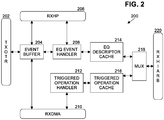
- FIG. 2 illustrates a diagram of an I/O device 200 according to an embodiment.
- I/O device 200 is a portion of network I/O device 110 configured to implement events and triggered operations.
- Receive host interface arbitration (RxHIArb) 220 is an interface that allows event logic (including event buffer 204, event queue (EQ) event handler 208, and EQ descriptor cache 214) to access host memory (e.g., primary memory 130).
- RxHIArb 220 is coupled with EQ descriptor cache 214 and a triggered operation cache 216 with 1K entries via multiplexor (MUX) 218.
- MUX multiplexor
- a purpose of RxHIArb 220 is to load TOs into triggered operations cache 216 on a miss or spill items out of triggered operations cache 216 on a capacity eviction.
- the receive header processing (RxHP) interface 206 connects the event logic to header processing logic (not shown). This enables the header processing logic to provide data about upcoming receive side events to the event logic.
- the transmit outstanding transactions and reliability (TxOTR) interface 202 is the analogous interface for transmit logic.
- the receive direct memory access (RxDMA) interface 210 provides information about message completion to the event logic.
- RxDMA 210 is the block that can determine when a receive side message has actually been written to host memory. RxDMA 210 then retrieves events from the event logic to write to the host and also informs the event logic when counters are incremented.
- Event buffer 204 is related to "full events”. Event buffer 204 stores information that will be written into host memory when a message completes. Full events are not directly related to triggered operations.
- EQ event handler 208 manages pointers in the Event Queue (EQ) (which holds full events).
- EQ descriptor cache 214 holds the pointers (head and tail) for full event queues. EQ descriptor cache 214 also holds information such as the size of those queues and control bits that impact the behavior of those queues.
- Triggered operation handler 212 accepts an updated counter from RxDMA 210 and walks the list of triggered operations from triggered operation cache 216. When a triggered operation has a threshold that is met by the new count, the triggered operation is issued. In one embodiment, issuing that triggered operation means passing the triggered operation back to the RxDMA 210.
- RxDMA 210 has the appropriate interfaces to the transmit logic (not shown) and the receive logic (e.g., RxHP 206) to initiate new operations.
- HFI Host Fabric Interface
- Any suitable hardware-based scheduler technology may be utilized for various embodiments.
- An example of suitable hardware-based scheduler technology may include technology compatible with the PORTALS Network Programming Interface specification (e.g., version 4.2, released November 2018).
- some embodiments may utilize a combination of an online messaging profile-based optimization technology and a hardware scheduler's triggered operations (e.g., exposed via an industry standard interface such as OpenFabrics Interface (OFI) developed by the Open Fabrics Alliance).
- OFI OpenFabrics Interface
- no software agent may be needed, thereby freeing all processors for computation purposes.
- some embodiments may issue messages exactly in the priority order desired, and there is no need to recall any message, thereby decreasing communication latency for applications.
- Triggered communication operations allow the application to specify when the operation should be scheduled to execute based on a condition being met, for example, a threshold counter meeting or exceeding a specified threshold value.
- a threshold counter meeting or exceeding a specified threshold value.
- the operation executes.
- a separate completion counter may be incremented (e.g., if specified by the application).
- Triggered operations may be implemented in the HFI by a hardware-based scheduler. An API to access the triggered operations may be exposed via the OFI.
- Non- limiting examples of triggerable operations include Put (e.g., write), Get (e.g., read), Send, Receive, Atomic, and Counter Increment operations.
- the triggerable counter increment operation may allow incrementing a counter if another counter is incremented. Such linked counter operation may be particularly useful to allow an application to link multiple disjoint chains of triggered operations.
- a triggered operation (e.g., a deferred data transfer request, triggered counter increment), initially stored in application space in primary memory 130 or storage devices 165 on computing platform 101, includes a communication operation, a triggering counter, and a threshold.
- a TO is pushed to network I/O device 110 when fabric library 162 adds the TO to the list of pending triggered operations.
- Network I/O device 110 stores the TO in triggered operation 416 cache and links the TO into an allocated list (described below).
- fabric library 162 could write the TO into primary memory 130 and then tell network I/O device 110 to add the TO to the allocate list without pushing the contents of the TO.
- the push option is used to further the goal of having the TO cache "never miss".
- Counters have a single integer value and are incremented when communication events such as completion of a send operation or a receive operation occur.
- a TO 'fires' when its counter is equal to or greater than its threshold, initiating the communication operation of the TO by network I/O device 110.
- that communication operation upon completion may specify a counter to increment in another TO, which may cause more triggers to fire, and so on, forming a chain (or tree) of hardware-implemented triggered communication operations.
- triggers are managed by network I/O device 110, which checks for their threshold condition and fires them asynchronously without software involvement (e.g., without control by application 160 or fabric library 162).
- FIG. 3 illustrates an example communications operation.
- communications operation 302 includes a "receive" operation with a completion counter (COMP CNTR) '1' that is incremented when the receive operation is complete.
- CNTR completion counter
- trigger 1 304 trigger 2 306, and trigger 3 308 firing because these triggers specify counter '1' and have their thresholds set to 1 (e.g., their counters are equal or greater than their thresholds).
- Each of these triggers performs a "put" operation.
- These three "put" operations specify the same completion counter 2, and trigger 4 310 depends on counter 2 as well.
- trigger 4 310 Since trigger 4 310 has a threshold of 3, trigger 4 310 fires when all three "put" operations from the prior triggers complete. The completion of trigger 4 310 results in counter 3 being incremented, which the application may read to determine that the entire chain of triggers has completed.
- fabric library 162 determines when triggers have fired so that they can be reused. There is no explicit notification back to fabric library 162 that a TO has fired in network I/O device 110. Fabric library 162 must individually inspect the state of each trigger. Furthermore, when a counter is equal to a trigger's threshold, fabric library 162 cannot be sure that the trigger has fired. Waiting for the counter to increment above the threshold cannot be relied upon, as this may never happen even in correct applications.
- a triggered operation has "fired" when:
- network I/O device 110 includes a 1K entry triggered operation (TO) cache where active triggered operations (TOs) are stored for low latency issue when a threshold is reached.
- the TO cache is 4-way set associative.
- the codesigned software approach of embodiments of the present invention provides an optimal result at this 1K entry TO cache size; increasing the size further does not show significant improvement in system efficiency. Limited space in the TO cache can instead be allocated to other features.
- the collective communications that rely most heavily on the latency reduction provided by the TO cache also tends to have smaller payloads (e.g., ⁇ 4KB), meaning that latency incurred by misses in the TO cache will not be hidden by the servicing of a large payload from primary memory 130.
- the TO cache should never (or very rarely) incur a cache miss during execution of a collective communication.
- TOs in the TO cache are referenced by a linked list managed by fabric library 162.
- the overwhelming access pattern to these lists is a single append operation to the tail of the TO linked list, and a single pop from the head of the TO linked list.
- These accesses and their corresponding list pointer updates ensure low temporal and spatial locality.
- multiple reuse of TO linked list entries is not a primary objective of the present design, but rather ensures that a request that is appended to the TO linked list early in a collective communications flow will not be evicted before being accessed again for issuing, even if these two TO linked list accesses are separated by many cache accesses.
- network I/O device 110 ensures this behavior is by implementing a TO cache index hash function that maps TOs into the cache space sequentially. That is, if a series of TOs is written to the TO cache, the TOs will be placed in consecutive sets in the cache. The 1K TO cache can be filled before capacity evictions begin taking place.
- a TO cache index hash function that maps TOs into the cache space sequentially. That is, if a series of TOs is written to the TO cache, the TOs will be placed in consecutive sets in the cache. The 1K TO cache can be filled before capacity evictions begin taking place.
- one motivation for embodiments of the present invention is to ensure that TOs are allocated in as close to a sequential manner as is possible. This will ensure the highest possible performance of the TO cache during HPC workloads that utilize it.
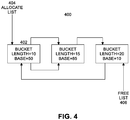
- FIG. 4 illustrates an example list of buckets data structure 400 according to an embodiment.
- Unused triggers are maintained in one or more 'buckets.
- a bucket 402 includes a base trigger slot number and a count of how many contiguous triggers are included in the bucket (e.g., the length of the trigger list).
- the base trigger slot number is a unique integer identifying a specific trigger (e.g., an array index). Due to the hardware cache design as described above, the base trigger slot number also indicates a position in the TO cache. Initially there is one bucket containing all available triggers. Two linked lists are maintained by fabric library 162, with each list referencing the same set of buckets, but the lists are sorted by different criteria.
- the allocate list 404 containing buckets allocated for use, is sorted by the number of triggers in each bucket in ascending order (e.g., smallest first).
- Figure 5 illustrates an example master list of counters and associated lists of triggers according to an embodiment.
- the state of previously armed triggers is inspected to determine which ones (if any) have fired and can be reused.
- This state consists of a master list of counters 500 with active triggers.
- master list 500 is prioritized according to a heuristic that favors counters with more dependent triggers firing.
- a list of active triggers 502, 504 dependent upon that counter is maintained.
- the trigger lists 502, 504 in each counter are ordered by ascending threshold, since this is the order in which they will fire.
- a process looking for fired triggers can stop traversing a counter's active trigger list once a trigger with a threshold greater than the counter's value is observed, because it is not possible that any of the remaining triggers in the ascending list have fired.
- Figure 6 illustrates functions provided by fabric library 162 in one embodiment.
- the set of functions includes: Allocate 602, Free 606, and Recover 604.
- the Allocate function 602 is invoked when application 160 requests one or more triggers. When a trigger is allocated, the trigger is removed from a bucket in allocate list 404 and free list 406, then added to a counter's trigger list 502 or 504. If that counter's trigger list was previously empty, it is added to master counter list 500. If performance of the Allocate function by fabric library 162 does not find any new triggers, the Recover function 604 is invoked by Allocate function 602. The Recover function invokes the Free function 606 on each completed trigger the fabric library recovers.
- the Free function updates allocate list 404 and free list 406 state used by the Allocate function to find triggers.
- the Free function also removes the trigger from its counter's trigger list 502 or 504 and removes the counter from master list 500 if no triggers remain for that counter.
- the Allocate function again attempts to find a set of triggers to implement the application's request.
- fabric library 162 also includes master list 500, trigger lists (e.g., allocate list 502, free list 504), and buckets 400.
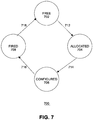
- Figure 7 illustrates trigger state transitions 700 according to an embodiment.
- a trigger is in a free state 702.
- Application 160 invokes the Allocate function 602 of fabric library 162 to obtain triggers.
- the trigger transitions 712 to the allocated state 704.
- Application 160 defines trigger parameters and stores the trigger operation in the TO cache in I/O device 200.
- the trigger transitions 714 to configured state 706.
- I/O device 200 monitors the trigger's conditions and initiates communications when the trigger's conditions are met. Firing of the trigger results in the trigger transitioning 716 to fired state 708. As various counters are incremented by I/O device 200, I/O device 200 checks for triggers that have met the threshold and fires them.
- Fabric library 162 observes that a trigger has fired when the trigger threshold is less than or equal to the counter value, with the help of a 'trigger fence' operation described below. Fabric library 162 invokes the Recover function 604 to analyze the trigger counter and state to reuse the trigger. The trigger then transitions 718 back to free state 702.
- FIG. 8 illustrates a flow diagram 800 of a fabric library according to an embodiment.
- application 160 calls the Allocate function 602 in fabric library 162 to obtain one or more triggers.
- fabric library 162 configures the one or more triggers and stores the one or more triggers in the TO cache for subsequent execution by network I/O device 110.
- I/O device 200 asynchronously completes triggered communication operations for the one or more triggers (e.g., the triggers fire when their conditions are met) stored in the TO cache.
- the Allocate function 602 iterates over the buckets in order from smallest to largest and uses triggers from the first sufficiently large bucket. That now-smaller bucket is then 'bubbled' towards the head of the free list 406 and the allocate list 404 to preserve their sorted order. If there are no free triggers, the Recover function 604 is invoked.
- a trigger fence operation is performed when a counter with potentially fired triggers is encountered.
- the fence ensures that all triggers depending on this counter with a threshold less than or equal to the counter's value have fired.
- the implementation of the trigger_fence operation may vary depending on I/O device 200.
- trigger_fence completes, all triggers depending on that counter with a threshold less than or equal to the given value have completed.
- two triggered operations are executed to ensure both transmit (TX) and receive (RX) triggered operations have completed.
- TX transmit
- RX receive
- a triggered zero-length put operation to self is used.
- RX a triggered counter increment is used.
- the current counter is used as the triggering counter and the current counter's current value as the threshold. Since the threshold is already met, these triggered operations should fire and complete quickly.
- the TX operation is detected complete when the put operation completes, and the RX when the result counter is incremented. Finally, those triggers are freed, returning them to a bucket.
- the Free function 606 iterates over the buckets ordered by trigger index trying to place the free trigger at the right place in the sequence. There are three possibilities: (1) the trigger is immediately after the end of a bucket, so increment that bucket's count, (2) the trigger immediately precedes a bucket, so decrement that bucket's base and increment its count, or (3) the trigger is not adjacent to any buckets, so create a new bucket. Cases (1) and (2) can result in the gap between two buckets disappearing; when that occurs the two buckets are joined into one.
- the trigger fence operation can be split into start and completion phases. Triggered fence can be started for many different counters simultaneously, followed by a single wait for completion of all triggered fences. Then the completed triggered operations can be cleaned up.
- An advantage of this approach is that many triggered fence operations can be overlapped, reducing time spent in garbage collection.
- Other optimization strategies involve reordering or prioritizing the master list 500 to visit counters most likely to have fired triggers first.
- FIG. 9 illustrates an example of a storage medium 900.
- Storage medium 900 may comprise an article of manufacture.
- storage medium 900 may include any non-transitory computer readable medium or machine readable medium, such as an optical, magnetic or semiconductor storage.
- Storage medium 900 may store various types of computer executable instructions, such as instructions 902 to implement logic flows described above.
- Examples of a computer readable or machine-readable storage medium may include any tangible media capable of storing electronic data, including volatile memory or non-volatile memory, removable or non-removable memory, erasable or non-erasable memory, writeable or re-writeable memory, and so forth.
- Examples of computer executable instructions may include any suitable type of code, such as source code, compiled code, interpreted code, executable code, static code, dynamic code, object-oriented code, visual code, and the like. The examples are not limited in this context.
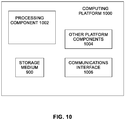
- FIG. 10 illustrates an example computing platform 1000.
- computing platform 1000 may include a processing component 1002, other platform components 1004 and/or a communications interface 1006.
- processing component 1002 may execute processing operations or logic for instructions stored on storage medium 900.
- Processing component 1002 may include various hardware elements, software elements, or a combination of both.
- hardware elements may include devices, logic devices, components, processors, microprocessors, circuits, processor circuits, circuit elements (e.g., transistors, resistors, capacitors, inductors, and so forth), integrated circuits, application specific integrated circuits (ASIC), programmable logic devices (PLD), digital signal processors (DSP), field programmable gate array (FPGA), memory units, logic gates, registers, semiconductor device, chips, microchips, chip sets, and so forth.
- ASIC application specific integrated circuits
- PLD programmable logic devices
- DSP digital signal processors
- FPGA field programmable gate array
- Examples of software elements may include software components, programs, applications, computer programs, application programs, device drivers, system programs, software development programs, machine programs, operating system software, middleware, firmware, software modules, routines, subroutines, functions, methods, procedures, software interfaces, application program interfaces (API), instruction sets, computing code, computer code, code segments, computer code segments, words, values, symbols, or any combination thereof. Determining whether an example is implemented using hardware elements and/or software elements may vary in accordance with any number of factors, such as desired computational rate, power levels, heat tolerances, processing cycle budget, input data rates, output data rates, memory resources, data bus speeds and other design or performance constraints, as desired for a given example.
- other platform components 1004 may include common computing elements, such as one or more processors, multi-core processors, co-processors, memory units, chipsets, controllers, peripherals, interfaces, oscillators, timing devices, video cards, audio cards, multimedia input/output (I/O) components (e.g., digital displays), power supplies, and so forth.
- processors such as one or more processors, multi-core processors, co-processors, memory units, chipsets, controllers, peripherals, interfaces, oscillators, timing devices, video cards, audio cards, multimedia input/output (I/O) components (e.g., digital displays), power supplies, and so forth.
- I/O multimedia input/output
- Examples of memory units may include without limitation various types of computer readable and machine readable storage media in the form of one or more higher speed memory units, such as read-only memory (ROM), random-access memory (RAM), dynamic RAM (DRAM), Double-Data-Rate DRAM (DDRAM), synchronous DRAM (SDRAM), static RAM (SRAM), programmable ROM (PROM), erasable programmable ROM (EPROM), electrically erasable programmable ROM (EEPROM), types of non-volatile memory such as 3-D cross-point memory that may be byte or block addressable.
- ROM read-only memory
- RAM random-access memory
- DRAM dynamic RAM
- DDRAM Double-Data-Rate DRAM
- SDRAM synchronous DRAM
- SRAM static RAM
- PROM programmable ROM
- EPROM erasable programmable ROM
- EEPROM electrically erasable programmable ROM
- Non-volatile types of memory may also include other types of byte or block addressable non-volatile memory such as, but not limited to, multi-threshold level NAND flash memory, NOR flash memory, single or multi-level PCM, resistive memory, nanowire memory, FeTRAM, MRAM that incorporates memristor technology, STT-MRAM, or a combination of any of the above.
- Other types of computer readable and machine-readable storage media may also include magnetic or optical cards, an array of devices such as Redundant Array of Independent Disks (RAID) drives, solid state memory devices (e.g., USB memory), solid state drives (SSD) and any other type of storage media suitable for storing information.
- RAID Redundant Array of Independent Disks
- SSD solid state drives
- communications interface 1006 may include logic and/or features to support a communication interface.
- communications interface 1006 may include one or more communication interfaces that operate according to various communication protocols or standards to communicate over direct or network communication links or channels.
- Direct communications may occur via use of communication protocols or standards described in one or more industry standards (including progenies and variants) such as those associated with the PCIe specification.
- Network communications may occur via use of communication protocols or standards such those described in one or more Ethernet standards promulgated by IEEE.
- one such Ethernet standard may include IEEE 802.3.
- Network communication may also occur according to one or more OpenFlow specifications such as the OpenFlow Switch Specification.
- computing platform 1000 including logic represented by the instructions stored on storage medium 900 may be implemented using any combination of discrete circuitry, ASICs, logic gates and/or single chip architectures. Further, the features of computing platform 1000 may be implemented using microcontrollers, programmable logic arrays and/or microprocessors or any combination of the foregoing where suitably appropriate. It is noted that hardware, firmware and/or software elements may be collectively or individually referred to herein as “logic” or "circuit.”
- the exemplary computing platform 1000 shown in the block diagram of FIG. 10 may represent one functionally descriptive example of many potential implementations. Accordingly, division, omission or inclusion of block functions depicted in the accompanying figures does not infer that the hardware components, circuits, software and/or elements for implementing these functions would necessarily be divided, omitted, or included in embodiments.
- hardware elements may include devices, components, processors, microprocessors, circuits, circuit elements (e.g., transistors, resistors, capacitors, inductors, and so forth), integrated circuits, ASIC, programmable logic devices (PLD), digital signal processors (DSP), FPGA, memory units, logic gates, registers, semiconductor device, chips, microchips, chip sets, and so forth.
- PLD programmable logic devices
- DSP digital signal processors
- FPGA field-programmable gate arrays
- memory units logic gates, registers, semiconductor device, chips, microchips, chip sets, and so forth.
- software elements may include software components, programs, applications, computer programs, application programs, system programs, machine programs, operating system software, middleware, firmware, software modules, routines, subroutines, functions, methods, procedures, software interfaces, application program interfaces (API), instruction sets, computing code, computer code, code segments, computer code segments, words, values, symbols, or any combination thereof. Determining whether an example is implemented using hardware elements and/or software elements may vary in accordance with any number of factors, such as desired computational rate, power levels, heat tolerances, processing cycle budget, input data rates, output data rates, memory resources, data bus speeds and other design or performance constraints, as desired for a given implementation.
- a computer-readable medium may include a non-transitory storage medium to store logic.
- the non-transitory storage medium may include one or more types of computer-readable storage media capable of storing electronic data, including volatile memory or non-volatile memory, removable or non-removable memory, erasable or non-erasable memory, writeable or re-writeable memory, and so forth.
- the logic may include various software elements, such as software components, programs, applications, computer programs, application programs, system programs, machine programs, operating system software, middleware, firmware, software modules, routines, subroutines, functions, methods, procedures, software interfaces, API, instruction sets, computing code, computer code, code segments, computer code segments, words, values, symbols, or any combination thereof.
- a logic flow or scheme may be implemented in software, firmware, and/or hardware.
- a logic flow or scheme may be implemented by computer executable instructions stored on at least one non-transitory computer readable medium or machine readable medium, such as an optical, magnetic or semiconductor storage. The embodiments are not limited in this context.
- Coupled and “connected” along with their derivatives. These terms are not necessarily intended as synonyms for each other. For example, descriptions using the terms “connected” and/or “coupled” may indicate that two or more elements are in direct physical or electrical contact with each other. The term “coupled,” however, may also mean that two or more elements are not in direct contact with each other, but yet still co-operate or interact with each other.
Landscapes
- Engineering & Computer Science (AREA)
- Theoretical Computer Science (AREA)
- Physics & Mathematics (AREA)
- General Engineering & Computer Science (AREA)
- General Physics & Mathematics (AREA)
- Software Systems (AREA)
- Computer Hardware Design (AREA)
- Mathematical Physics (AREA)
- Memory System Of A Hierarchy Structure (AREA)
- Information Retrieval, Db Structures And Fs Structures Therefor (AREA)
- Computer And Data Communications (AREA)
Abstract
Description
- Portions of the disclosure of this patent document may contain material that is subject to copyright protection. The copyright owner has no objection to the reproduction by anyone of the patent document or the patent disclosure as it appears in the Patent and Trademark Office patent file or records, but otherwise reserves all copyright rights whatsoever. The copyright notice applies to all data as described below, and in the accompanying drawings hereto, as well as to any software described below: Copyright © 2019, Intel Corporation, All Rights Reserved.
- Examples described herein are generally related to high performance computing (HPC) and more particularly to software management of hardware offload approaches for accelerating collective communication operations.
- Some HPC interconnects include hardware offload solutions for accelerating collective communication operations (typically expressed in Message Passing Interface (MPI) or symmetric hierarchical memory (SHMEM) application programming interfaces (APIs)). Collective communication is a method of communication which involves participation of multiple processes in a HPC system. In a collective communication operation, many processes work together to move data in a specific communication pattern. For example, an "allreduce" operation takes a value from each process, performs an arithmetic operation (e.g., sum) on all the values, and returns the result to every process. An implementation of "allreduce" or other collectives can be expressed as an ordered series of data transfer and atomic operations executed on each process. Some of these operations may be performed by hardware in the HPC system, such as a network interface controller (NIC) or a switch, for example. To improve HPC system performance, software management of hardware offload solutions is desired.
-
-
Figure 1 illustrates an example computing system. -
Figure 2 illustrates a diagram of an I/O device according to an embodiment. -
Figure 3 illustrates an example communications operation. -
Figure 4 illustrates an example list of buckets data structure according to an embodiment. -
Figure 5 illustrates an example master list of counters and associated lists of triggers according to an embodiment. -
Figure 6 illustrates functions provided by a fabric library in one embodiment. -
Figure 7 illustrates trigger state transitions according to an embodiment. -
Figure 8 illustrates a flow diagram of an example fabric library. -
Figure 9 illustrates an example of a storage medium. -
Figure 10 illustrates another example computing platform. - Embodiments of the present invention include a combination of a hardware triggered operation (TO) implementation using a cache paired with a host-based software fabric library to ensure high triggered operation and cache reuse. In embodiments, both hardware and software are designed and optimized specifically for MPI-style collective communication operations. Optimizing triggered operation performance results in improved collective communication performance: lower and less varied latency particularly as the number of nodes involved increases. Collective communications are an important part of effectively all HPC applications, and performance is a core requirement for customers of HPC network products.
-
Figure 1 illustrates anexample computing system 100 supporting HPC. As shown inFigure 1 ,computing system 100 includes acomputing platform 101 coupled to a network 170 (which may be the Internet, for example, or a network within a data center). In some examples, as shown inFIG. 1 ,computing platform 101 is coupled tonetwork 170 vianetwork communication channel 175 and through at least one network I/O device 110 (e.g., a network interface controller (NIC)) having one or more ports connected or coupled tonetwork communication channel 175. In an embodiment, network I/O device 110 is an Ethernet NIC. Network I/O device 110 transmits data packets fromcomputing platform 101 overnetwork 170 to other destinations and receives data packets from other destinations for forwarding tocomputing platform 101. - According to some examples,
computing platform 101, as shown inFIG. 1 , includescircuitry 120,primary memory 130, network (NW) I/O device driver 140, operating system (OS) 150, virtual machine manager (VMM) 180 (also known as a hypervisor), at least oneapplication 160,fabric library 162, and one ormore storage devices 165. In one embodiment, OS 150 is Linux™. In another embodiment, OS 150 is Windows® Server. In an embodiment,application 160 represents one or more application programs executed bycircuitry 120. Network I/O device driver 140 operates to initialize and manage I/O requests performed by network I/O device 110. In an embodiment, packets and/or packet metadata transmitted to network I/O device 110 and/or received from network I/O device 110 are stored in one or more ofprimary memory 130 and/orstorage devices 165. In at least one embodiment,storage devices 165 may be one or more of hard disk drives (HDDs) and/or solid-state drives (SSDs). In an embodiment,storage devices 165 may be non-volatile memories (NVMs). In some examples, as shown inFIG. 1 ,circuitry 120 may communicatively couple to network I/O device 110 viacommunications link 155. In one embodiment,communications link 155 is a Peripheral Component Interface Express (PCIe) bus conforming to revision 4.0 or other versions of the PCIe standard. In some examples,operating system 150, NW I/O device driver 140,application 160, VMM 180, andfabric library 162 are implemented, at least in part, via cooperation between one or more memory devices included in primary memory 130 (e.g., volatile or non-volatile memory devices),storage devices 165, and elements ofcircuitry 120 such as processing cores 122-1 to 122-m, where "m" is any positive whole integer greater than 2. In an embodiment,OS 150, NW I/O device driver 140, VMM 180,application 160, andfabric library 162 are executed by one or more processing cores 122-1 to 122-m. In other embodiments, there are other endpoint devices coupled to communications link 155 (e.g., PCIe interconnect). - In some examples,
computing platform 101, includes but is not limited to a computer server, a HPC server, a server array or server farm, a web server, a network server, an Internet server, a work station, a mini-computer, a main frame computer, a supercomputer, a network appliance, a web appliance, a distributed computing system, multiprocessor systems, processor-based systems, a laptop computer, a tablet computer, a smartphone, or a combination thereof. In one example,computing platform 101 is a disaggregated server. A disaggregated server is a server that breaks up components and resources into subsystems. Disaggregated servers can be adapted to changing storage or compute loads as needed without replacing or disrupting an entire server for an extended period of time. A server could, for example, be broken into modular compute, I/O, power and storage modules that can be shared among other nearby servers. - Circuitry 120 having processing cores 122-1 to 122-m may include various commercially available processors, including without limitation Intel® Atom®, Celeron®, Core (2) Duo®, Core i3, Core i5, Core i7, Itanium®, Pentium®, Xeon® or Xeon Phi® processors, ARM processors, and similar processors.
Circuitry 120 may include at least onecache 135 to store data. - According to some examples,
primary memory 130 may be composed of one or more memory devices or dies which may include various types of volatile and/or non-volatile memory. Volatile types of memory may include, but are not limited to, dynamic random-access memory (DRAM), static random-access memory (SRAM), thyristor RAM (TRAM) or zero-capacitor RAM (ZRAM). Non-volatile types of memory may include byte or block addressable types of non-volatile memory having a 3-dimensional (3-D) cross-point memory structure that includes chalcogenide phase change material (e.g., chalcogenide glass) hereinafter referred to as "3-D cross-point memory". Non-volatile types of memory may also include other types of byte or block addressable non-volatile memory such as, but not limited to, multi-threshold level NAND flash memory, NOR flash memory, single or multi-level phase change memory (PCM), resistive memory, nanowire memory, ferroelectric transistor random access memory (FeTRAM), magnetoresistive random-access memory (MRAM) that incorporates memristor technology, spin transfer torque MRAM (STT-MRAM), or a combination of any of the above. In another embodiment,primary memory 130 may include one or more hard disk drives within and/or accessible bycomputing platform 101. - In an embodiment,
fabric library 162 provides an API for one or more application(s) 160 to interface directly with network I/O device 110.Application 160 may call one or more functions provided byfabric library 162 to implement collective communications incomputing platform 101.Fabric library 162, in at least one embodiment, communicates with network I/O device 110 to manage collective communications operations. In an embodiment,application 160 uses fabric library to manage storage in application space used for collective communications. - In an embodiment, network I/
O device 110 includes a hardware implementation of triggered operations (TOs). TOs allowapplication 160 to queue a data transfer request that is deferred until at least one specified condition is met. A typical use is to send a message only after receiving all input data. TOs are a means of expressing an ordered series of communication and atomic operations to network I/O device 110 for asynchronous execution. Noise and jitter fromOS 150 orapplication 160 are bypassed, resulting in faster data propagation than SW-based sending and receiving of the data between processes ofcomputing platform 101. This offload of processing to network I/O device hardware 110 is a benefit particularly for non-blocking collectives (e.g., machine learning applications will issue many non-blocking "allreduce" collective operations simultaneously). To achieve good performance,fabric library 162 software is designed to manage and utilize triggers efficiently, particularly with regard to a cache (not shown inFIG. 1 ) included in network I/O device 110 for fast access to triggers.Fabric library 162 provides a mechanism forapplication 160 to allocate storage for collective communications. In some situations, it may be difficult to determine when allocated storage should be deallocated, and how often to communicate deallocation decisions toapplication 160. If deallocation decisions are communicated toapplication 160 too frequently, inefficient HPC system processing may result, thereby negatively impacting processing throughput. - Embodiments of the present invention overcome such difficulties by efficiently managing communications between
application 160,fabric library 162 and network I/O device 110. -
Figure 2 illustrates a diagram of an I/O device 200 according to an embodiment. In an embodiment, I/O device 200 is a portion of network I/O device 110 configured to implement events and triggered operations. Receive host interface arbitration (RxHIArb) 220 is an interface that allows event logic (includingevent buffer 204, event queue (EQ)event handler 208, and EQ descriptor cache 214) to access host memory (e.g., primary memory 130).RxHIArb 220 is coupled withEQ descriptor cache 214 and atriggered operation cache 216 with 1K entries via multiplexor (MUX) 218. From the perspective of triggered operations, a purpose ofRxHIArb 220 is to load TOs into triggeredoperations cache 216 on a miss or spill items out of triggeredoperations cache 216 on a capacity eviction. The receive header processing (RxHP)interface 206 connects the event logic to header processing logic (not shown). This enables the header processing logic to provide data about upcoming receive side events to the event logic. The transmit outstanding transactions and reliability (TxOTR)interface 202 is the analogous interface for transmit logic. The receive direct memory access (RxDMA)interface 210 provides information about message completion to the event logic.RxDMA 210 is the block that can determine when a receive side message has actually been written to host memory.RxDMA 210 then retrieves events from the event logic to write to the host and also informs the event logic when counters are incremented. -
Event buffer 204 is related to "full events".Event buffer 204 stores information that will be written into host memory when a message completes. Full events are not directly related to triggered operations.EQ event handler 208 manages pointers in the Event Queue (EQ) (which holds full events).EQ descriptor cache 214 holds the pointers (head and tail) for full event queues.EQ descriptor cache 214 also holds information such as the size of those queues and control bits that impact the behavior of those queues. -
Triggered operation handler 212 accepts an updated counter fromRxDMA 210 and walks the list of triggered operations from triggeredoperation cache 216. When a triggered operation has a threshold that is met by the new count, the triggered operation is issued. In one embodiment, issuing that triggered operation means passing the triggered operation back to theRxDMA 210.RxDMA 210 has the appropriate interfaces to the transmit logic (not shown) and the receive logic (e.g., RxHP 206) to initiate new operations. - Some embodiments may advantageously utilize a Host Fabric Interface (HFI) hardware-based message scheduler in network I/
O device 110 to improve or optimize collective operations forapplication 160. Any suitable hardware-based scheduler technology may be utilized for various embodiments. An example of suitable hardware-based scheduler technology may include technology compatible with the PORTALS Network Programming Interface specification (e.g., version 4.2, released November 2018). For example, some embodiments may utilize a combination of an online messaging profile-based optimization technology and a hardware scheduler's triggered operations (e.g., exposed via an industry standard interface such as OpenFabrics Interface (OFI) developed by the Open Fabrics Alliance). Advantageously, in some embodiments no software agent may be needed, thereby freeing all processors for computation purposes. Additionally, some embodiments may issue messages exactly in the priority order desired, and there is no need to recall any message, thereby decreasing communication latency for applications. - Generally, communication operations are scheduled to be executed by the HFI immediately upon submission by the application. Triggered communication operations allow the application to specify when the operation should be scheduled to execute based on a condition being met, for example, a threshold counter meeting or exceeding a specified threshold value. In an example of a basic technology for a triggered operation, when the value of a threshold counter reaches the specified threshold value, the operation executes. Upon completion of the operation, a separate completion counter may be incremented (e.g., if specified by the application). Triggered operations may be implemented in the HFI by a hardware-based scheduler. An API to access the triggered operations may be exposed via the OFI. Non- limiting examples of triggerable operations include Put (e.g., write), Get (e.g., read), Send, Receive, Atomic, and Counter Increment operations. The triggerable counter increment operation may allow incrementing a counter if another counter is incremented. Such linked counter operation may be particularly useful to allow an application to link multiple disjoint chains of triggered operations.
- A triggered operation (TO) (e.g., a deferred data transfer request, triggered counter increment), initially stored in application space in
primary memory 130 orstorage devices 165 oncomputing platform 101, includes a communication operation, a triggering counter, and a threshold. A TO is pushed to network I/O device 110 whenfabric library 162 adds the TO to the list of pending triggered operations. Network I/O device 110 stores the TO in triggered operation 416 cache and links the TO into an allocated list (described below). Other approaches are possible. In an embodiment,fabric library 162 could write the TO intoprimary memory 130 and then tell network I/O device 110 to add the TO to the allocate list without pushing the contents of the TO. In an embodiment, the push option is used to further the goal of having the TO cache "never miss". Thus, as long as the TO cache does not run out of capacity, the push approach is better. Unfortunately, multiple user level processes are typically concurrently using the network I/O device in a somewhat uncoordinated way; thus, it is hard for one process to know that another process has already mostly filled the cache (for example). - Counters have a single integer value and are incremented when communication events such as completion of a send operation or a receive operation occur. A TO 'fires' when its counter is equal to or greater than its threshold, initiating the communication operation of the TO by network I/
O device 110. In turn, that communication operation upon completion may specify a counter to increment in another TO, which may cause more triggers to fire, and so on, forming a chain (or tree) of hardware-implemented triggered communication operations. Once initialized, triggers are managed by network I/O device 110, which checks for their threshold condition and fires them asynchronously without software involvement (e.g., without control byapplication 160 or fabric library 162). -
Figure 3 illustrates an example communications operation. In this example,communications operation 302 includes a "receive" operation with a completion counter (COMP CNTR) '1' that is incremented when the receive operation is complete. When counter 1 (CNTR) is incremented by the receive completion, this results intrigger 1 304,trigger 2 306, andtrigger 3 308 firing because these triggers specify counter '1' and have their thresholds set to 1 (e.g., their counters are equal or greater than their thresholds). Each of these triggers performs a "put" operation. These three "put" operations specify thesame completion counter 2, andtrigger 4 310 depends oncounter 2 as well. Sincetrigger 4 310 has a threshold of 3,trigger 4 310 fires when all three "put" operations from the prior triggers complete. The completion oftrigger 4 310 results incounter 3 being incremented, which the application may read to determine that the entire chain of triggers has completed. - When a finite number of TOs are supported,
fabric library 162 determines when triggers have fired so that they can be reused. There is no explicit notification back tofabric library 162 that a TO has fired in network I/O device 110.Fabric library 162 must individually inspect the state of each trigger. Furthermore, when a counter is equal to a trigger's threshold,fabric library 162 cannot be sure that the trigger has fired. Waiting for the counter to increment above the threshold cannot be relied upon, as this may never happen even in correct applications. - A triggered operation has "fired" when:
- 1) Its threshold has been reached;
- 2) Network I/
O device 110 has identified this fact and walked the list of triggered operations to find the triggered operation that is ready to be initiated; and - 3) When initiated, the triggered operation no longer needs a storage structure associated with the triggered operation (e.g., the TO may still need something associated with the operation itself, but the TO does not need the linked list state). In the case of the cache implementation, the storage structure is in the host memory (e.g., primary memory 130) that is stored in the triggered operation cache.
- As noted above, in an embodiment network I/
O device 110 includes a 1K entry triggered operation (TO) cache where active triggered operations (TOs) are stored for low latency issue when a threshold is reached. In an embodiment, the TO cache is 4-way set associative. The codesigned software approach of embodiments of the present invention provides an optimal result at this 1K entry TO cache size; increasing the size further does not show significant improvement in system efficiency. Limited space in the TO cache can instead be allocated to other features. The collective communications that rely most heavily on the latency reduction provided by the TO cache also tends to have smaller payloads (e.g., < 4KB), meaning that latency incurred by misses in the TO cache will not be hidden by the servicing of a large payload fromprimary memory 130. To promote efficient system operations, the TO cache should never (or very rarely) incur a cache miss during execution of a collective communication. - In an embodiment, TOs in the TO cache are referenced by a linked list managed by
fabric library 162. The overwhelming access pattern to these lists is a single append operation to the tail of the TO linked list, and a single pop from the head of the TO linked list. These accesses and their corresponding list pointer updates ensure low temporal and spatial locality. As such, multiple reuse of TO linked list entries is not a primary objective of the present design, but rather ensures that a request that is appended to the TO linked list early in a collective communications flow will not be evicted before being accessed again for issuing, even if these two TO linked list accesses are separated by many cache accesses. - In an embodiment, network I/
O device 110 ensures this behavior is by implementing a TO cache index hash function that maps TOs into the cache space sequentially. That is, if a series of TOs is written to the TO cache, the TOs will be placed in consecutive sets in the cache. The 1K TO cache can be filled before capacity evictions begin taking place. Thus, one motivation for embodiments of the present invention is to ensure that TOs are allocated in as close to a sequential manner as is possible. This will ensure the highest possible performance of the TO cache during HPC workloads that utilize it. -
Figure 4 illustrates an example list ofbuckets data structure 400 according to an embodiment. Unused triggers are maintained in one or more 'buckets.' Abucket 402 includes a base trigger slot number and a count of how many contiguous triggers are included in the bucket (e.g., the length of the trigger list). In software, the base trigger slot number is a unique integer identifying a specific trigger (e.g., an array index). Due to the hardware cache design as described above, the base trigger slot number also indicates a position in the TO cache. Initially there is one bucket containing all available triggers. Two linked lists are maintained byfabric library 162, with each list referencing the same set of buckets, but the lists are sorted by different criteria. The allocatelist 404, containing buckets allocated for use, is sorted by the number of triggers in each bucket in ascending order (e.g., smallest first). Thefree list 406, containing buckets available to be allocated, is sorted by the base trigger slot number (e.g., smallest first). -
Figure 5 illustrates an example master list of counters and associated lists of triggers according to an embodiment. When insufficient free triggers are available, the state of previously armed triggers is inspected to determine which ones (if any) have fired and can be reused. This state consists of a master list ofcounters 500 with active triggers. In an embodiment,master list 500 is prioritized according to a heuristic that favors counters with more dependent triggers firing. For each counter, a list ofactive triggers -
Figure 6 illustrates functions provided byfabric library 162 in one embodiment. The set of functions includes: Allocate 602,Free 606, and Recover 604. The Allocatefunction 602 is invoked whenapplication 160 requests one or more triggers. When a trigger is allocated, the trigger is removed from a bucket in allocatelist 404 andfree list 406, then added to a counter'strigger list master counter list 500. If performance of the Allocate function byfabric library 162 does not find any new triggers, the Recoverfunction 604 is invoked by Allocatefunction 602. The Recover function invokes theFree function 606 on each completed trigger the fabric library recovers. The Free function updates allocatelist 404 andfree list 406 state used by the Allocate function to find triggers. The Free function also removes the trigger from its counter'strigger list master list 500 if no triggers remain for that counter. In an embodiment, when the Recover function completes, the Allocate function again attempts to find a set of triggers to implement the application's request. In an embodiment,fabric library 162 also includesmaster list 500, trigger lists (e.g., allocatelist 502, free list 504), andbuckets 400. -
Figure 7 illustrates trigger state transitions 700 according to an embodiment. Initially, a trigger is in afree state 702.Application 160 invokes the Allocatefunction 602 offabric library 162 to obtain triggers. The trigger transitions 712 to the allocatedstate 704.Application 160 defines trigger parameters and stores the trigger operation in the TO cache in I/O device 200. The trigger transitions 714 to configured state 706. I/O device 200 monitors the trigger's conditions and initiates communications when the trigger's conditions are met. Firing of the trigger results in the trigger transitioning 716 to firedstate 708. As various counters are incremented by I/O device 200, I/O device 200 checks for triggers that have met the threshold and fires them.Fabric library 162 observes that a trigger has fired when the trigger threshold is less than or equal to the counter value, with the help of a 'trigger fence' operation described below.Fabric library 162 invokes the Recoverfunction 604 to analyze the trigger counter and state to reuse the trigger. The trigger then transitions 718 back tofree state 702. -
Figure 8 illustrates a flow diagram 800 of a fabric library according to an embodiment. Atblock 802,application 160 calls the Allocatefunction 602 infabric library 162 to obtain one or more triggers. At block 84,fabric library 162 configures the one or more triggers and stores the one or more triggers in the TO cache for subsequent execution by network I/O device 110. Atblock 806, I/O device 200 asynchronously completes triggered communication operations for the one or more triggers (e.g., the triggers fire when their conditions are met) stored in the TO cache. - Shown below are example pseudocode implementations of the Allocate 602, Recover 604, and
Free 606 functions.
 © 2019 Intel Corporation
 bucket allocate (count, retry)
 for each bucket in allocate_list
    if bucket > count > count
      result = new bucket (bucket -> base, count)
      bucket -> base += count
      bucket -> count -= count
 while bucket -> count < bucket -> prev -> count
    swap buckets (bucket, bucket -> prev, allocate_list)
 while bucket-> base < bucket -> prev -> base
    swap_buckets (bucket, bucket -> prev, free_list)
 return result
 else if bucket -> count == count
    remove_from_lists (bucket)
    return bucket
 if (retry)
    recover ()
    return allocate (count, false)
return NULL // No triggers currently available © 2019 Intel Corporation
void recover (void)
for each counter in master_list
cur_val = counter -> value
if counter -> next_threshold >= cur_val
continue
trigger_fence (counter, cur_val)
for each trigger in counter -> trigger_list
if trigger -> threshold > counter -> value
break
free (trigger)
counter -> active--
if counter->active == 0
remove (master_list, counter)
break © 2019 Intel Corporation
void combine_buckets (bucket)
Next = bucket -> next
if bucket -> base + bucket -> count == next -> base
bucket -> count += next -> count
remove_from_lists (next)
void free (trigger)
for each bucket in free_list
if bucket -> base > trigger -> index
if bucket -> prev -> base + bucket -> prev -> count ==
trigger -> index - 1 bucket -> prev -> count++
combine_buckets (bucket -> prev)
else if bucket -> base == trigger -> index + 1
bucket -> base --
bucket -> count++
combine_buckets (bucket)
else
temp = new_bucket (trigger -> index, 1)
insert_before (temp, bucket, free_list)
insert_head (temp, allocate_list)
return
temp = new bucket (trigger -> index, 1)
insert_tail (temp, free_list)
insert_head (temp, allocate_list) Claims (14)
- A method comprising:receiving a request to allocate a triggered operation;if there is a free triggered operation, allocating the free triggered operation;if there is no free triggered operation, recovering one or more fired triggered operations, freeing one or more of the recovered triggered operations, and allocating one of the freed triggered operations;configuring the allocated triggered operation; andstoring the configured triggered operation in a cache on an input/output (I/O) device for subsequent asynchronous execution of the configured triggered operation.
- The method of claim 1, wherein the triggered operation comprises a data transfer request having execution deferred by the I/O device until at least one condition is met.
- The method of claim 2, wherein the at least one condition comprises a counter of the triggered operation being equal to or greater than a threshold of the triggered operation.
- The method of one of the previous claims, wherein recovering one or more fired triggered operations comprises analyzing the counter and a state of each of the one or more fired trigger operations.
- The method of claim 4, wherein the state comprises free, allocated, configured, or fire.
- The method of one of the previous claims, wherein configuring an allocated triggered operation comprises setting the state of the triggered operation to configured.
- The method of one of the previous claims, wherein freeing the one or more recovered triggered operations comprises setting the state of each of the one or more recovered triggered operations to free, adding the triggered operation to a free list, and removing the triggered operation from an allocated list.
- The method of one of the previous claims, wherein allocating a triggered operation comprises setting the state of the triggered operation to allocated, adding the triggered operation to an allocated list and removing the triggered operation from a free list.
- At least one tangible machine-readable medium comprising a plurality of instructions that in response to being executed by a processor cause the processor to:receive a request to allocate a triggered operation;if there is a free triggered operation, allocate the free triggered operation;if there is no free triggered operation, recover one or more fired triggered operations, free one or more of the recovered triggered operations, and allocate one of the freed triggered operations;configure the allocated triggered operation; andstore the configured triggered operation in a cache on an input/output (I/O) device for subsequent asynchronous execution of the configured triggered operation.
- An apparatus comprising:an input/output (I/O) device including a triggered operation cache;a processing device; anda memory device coupled to the processing device, the memory device having instructions stored thereon that, in response to execution by the processing device, cause the processing device to:receive a request to allocate a triggered operation;if there is a free triggered operation, allocate the free triggered operation;if there is no free triggered operation, recover one or more fired triggered operations, free one or more of the recovered triggered operations, and allocate one of the freed triggered operations;configure the allocated triggered operation; andstore the configured triggered operation in the triggered operation cache on the I/O device;wherein the I/O device is to subsequently execute the configured triggered operation asynchronously with the storage of the configured triggered operation.
- The apparatus of claim 10, wherein the triggered operation comprises a data transfer request having execution deferred by the I/O device until at least one condition is met.
- The apparatus of claim 11, wherein the at least one condition comprises a counter of the triggered operation being equal to or greater than a threshold of the triggered operation.
- The apparatus of claim 10, 11 or 12, wherein instructions to recover one or more fired triggered operations comprise instructions to analyze the counter and a state of each of the one or more fired trigger operations.
- The apparatus of claim 10, 11, 12 or 13, the I/O device to store triggered operations into the cache sequentially.
Applications Claiming Priority (1)
| Application Number | Priority Date | Filing Date | Title |
|---|---|---|---|
| US16/275,625 US11409673B2 (en) | 2019-02-14 | 2019-02-14 | Triggered operations for collective communication |
Publications (2)
| Publication Number | Publication Date |
|---|---|
| EP3696674A1 true EP3696674A1 (en) | 2020-08-19 |
| EP3696674B1 EP3696674B1 (en) | 2023-12-27 |
Family
ID=66696872
Family Applications (1)
| Application Number | Title | Priority Date | Filing Date |
|---|---|---|---|
| EP20156770.8A Active EP3696674B1 (en) | 2019-02-14 | 2020-02-11 | Triggered operations for collective communication |
Country Status (2)
| Country | Link |
|---|---|
| US (1) | US11409673B2 (en) |
| EP (1) | EP3696674B1 (en) |
Families Citing this family (2)
| Publication number | Priority date | Publication date | Assignee | Title |
|---|---|---|---|---|
| US11409673B2 (en) * | 2019-02-14 | 2022-08-09 | Intel Corporation | Triggered operations for collective communication |
| KR20240027356A (en) * | 2022-08-23 | 2024-03-04 | 에스케이하이닉스 주식회사 | Data storage device performing data protection and host device supporting data protection using program context |
Citations (1)
| Publication number | Priority date | Publication date | Assignee | Title |
|---|---|---|---|---|
| US20190042946A1 (en) * | 2018-09-11 | 2019-02-07 | Intel Corporation | Triggered operations to improve allreduce overlap |
Family Cites Families (8)
| Publication number | Priority date | Publication date | Assignee | Title |
|---|---|---|---|---|
| US6157977A (en) * | 1998-11-24 | 2000-12-05 | Hewlett Packard Company | Bus bridge and method for ordering read and write operations in a write posting system |
| US8032726B2 (en) * | 2003-12-03 | 2011-10-04 | Hitachi, Ltd | Remote copy system |
| US7392353B2 (en) * | 2004-12-03 | 2008-06-24 | International Business Machines Corporation | Prioritization of out-of-order data transfers on shared data bus |
| US7360008B2 (en) * | 2004-12-30 | 2008-04-15 | Intel Corporation | Enforcing global ordering through a caching bridge in a multicore multiprocessor system |
| US8335892B1 (en) * | 2009-09-28 | 2012-12-18 | Nvidia Corporation | Cache arbitration between multiple clients |
| WO2013088283A2 (en) * | 2011-12-16 | 2013-06-20 | International Business Machines Corporation | Memory sharing by processors |
| US9235516B1 (en) * | 2013-05-02 | 2016-01-12 | Emc Corporation | Techniques using cacheless read and deferred caching |
| US11409673B2 (en) * | 2019-02-14 | 2022-08-09 | Intel Corporation | Triggered operations for collective communication |
-
2019
- 2019-02-14 US US16/275,625 patent/US11409673B2/en active Active
-
2020
- 2020-02-11 EP EP20156770.8A patent/EP3696674B1/en active Active
Patent Citations (1)
| Publication number | Priority date | Publication date | Assignee | Title |
|---|---|---|---|---|
| US20190042946A1 (en) * | 2018-09-11 | 2019-02-07 | Intel Corporation | Triggered operations to improve allreduce overlap |
Non-Patent Citations (2)
| Title |
|---|
| DI GIROLAMO SALVATORE ET AL: "Exploiting Offload-Enabled Network Interfaces", IEEE MICRO, IEEE SERVICE CENTER, LOS ALAMITOS, CA, US, vol. 36, no. 4, 1 July 2016 (2016-07-01), pages 6 - 17, XP011619628, ISSN: 0272-1732, [retrieved on 20160812], DOI: 10.1109/MM.2016.56 * |
| KEITH D UNDERWOOD ET AL: "Enabling Flexible Collective Communication Offload with Triggered Operations", HIGH PERFORMANCE INTERCONNECTS (HOTI), 2011 IEEE 19TH ANNUAL SYMPOSIUM ON, IEEE, 24 August 2011 (2011-08-24), pages 35 - 42, XP031977142, ISBN: 978-1-4577-1563-1, DOI: 10.1109/HOTI.2011.15 * |
Also Published As
| Publication number | Publication date |
|---|---|
| US11409673B2 (en) | 2022-08-09 |
| EP3696674B1 (en) | 2023-12-27 |
| US20190179779A1 (en) | 2019-06-13 |
Similar Documents
| Publication | Publication Date | Title |
|---|---|---|
| US20260010402A1 (en) | Workload scheduler for memory allocation | |
| EP4158486B1 (en) | Computer memory expansion device and method of operation | |
| CN109582223B (en) | Method and device for memory data migration | |
| US10175891B1 (en) | Minimizing read latency for solid state drives | |
| CN104050091B (en) | Network device and its setting method based on non-uniform memory access system | |
| US10846245B2 (en) | Minimizing usage of hardware counters in triggered operations for collective communication | |
| WO2018076793A1 (en) | Nvme device, and methods for reading and writing nvme data | |
| US20100268882A1 (en) | Load request scheduling in a cache hierarchy | |
| US9842008B2 (en) | Cache affinity and processor utilization technique | |
| KR101915944B1 (en) | A Method for processing client requests in a cluster system, a Method and an Apparatus for processing I/O according to the client requests | |
| US9092275B2 (en) | Store operation with conditional push of a tag value to a queue | |
| US11640305B2 (en) | Wake-up and timer for scheduling of functions with context hints | |
| US10152275B1 (en) | Reverse order submission for pointer rings | |
| US11875198B2 (en) | Synchronization object issue detection using object type queues and associated monitor threads in a storage system | |
| CN115617542A (en) | Memory exchange method, device, computer equipment and storage medium | |
| CN114116155A (en) | Lock-free work-stealing thread scheduler | |
| CN103399824A (en) | Method and device for holding cache miss states of caches in processor of computer | |
| CN117667776A (en) | Memory bandwidth allocation method and device | |
| EP3696674B1 (en) | Triggered operations for collective communication | |
| JP3546694B2 (en) | Multi-thread computer system and multi-thread execution control method | |
| WO2024109068A1 (en) | Program monitoring method and apparatus, and electronic device and storage medium | |
| US10372608B2 (en) | Split head invalidation for consumer batching in pointer rings | |
| CN107480071B (en) | Cache data migration method and device | |
| KR101915945B1 (en) | A Method for processing client requests in a cluster system, a Method and an Apparatus for processing I/O according to the client requests | |
| CN107038021A (en) | Methods, devices and systems for accessing random access memory ram |
Legal Events
| Date | Code | Title | Description |
|---|---|---|---|
| PUAI | Public reference made under article 153(3) epc to a published international application that has entered the european phase |
Free format text: ORIGINAL CODE: 0009012 |
|
| STAA | Information on the status of an ep patent application or granted ep patent |
Free format text: STATUS: THE APPLICATION HAS BEEN PUBLISHED |
|
| AK | Designated contracting states |
Kind code of ref document: A1 Designated state(s): AL AT BE BG CH CY CZ DE DK EE ES FI FR GB GR HR HU IE IS IT LI LT LU LV MC MK MT NL NO PL PT RO RS SE SI SK SM TR |
|
| AX | Request for extension of the european patent |
Extension state: BA ME |
|
| STAA | Information on the status of an ep patent application or granted ep patent |
Free format text: STATUS: REQUEST FOR EXAMINATION WAS MADE |
|
| 17P | Request for examination filed |
Effective date: 20210219 |
|
| RBV | Designated contracting states (corrected) |
Designated state(s): AL AT BE BG CH CY CZ DE DK EE ES FI FR GB GR HR HU IE IS IT LI LT LU LV MC MK MT NL NO PL PT RO RS SE SI SK SM TR |
|
| STAA | Information on the status of an ep patent application or granted ep patent |
Free format text: STATUS: EXAMINATION IS IN PROGRESS |
|
| 17Q | First examination report despatched |
Effective date: 20220520 |
|
| GRAP | Despatch of communication of intention to grant a patent |
Free format text: ORIGINAL CODE: EPIDOSNIGR1 |
|
| STAA | Information on the status of an ep patent application or granted ep patent |
Free format text: STATUS: GRANT OF PATENT IS INTENDED |
|
| INTG | Intention to grant announced |
Effective date: 20230721 |
|
| GRAS | Grant fee paid |
Free format text: ORIGINAL CODE: EPIDOSNIGR3 |
|
| GRAA | (expected) grant |
Free format text: ORIGINAL CODE: 0009210 |
|
| STAA | Information on the status of an ep patent application or granted ep patent |
Free format text: STATUS: THE PATENT HAS BEEN GRANTED |
|
| AK | Designated contracting states |
Kind code of ref document: B1 Designated state(s): AL AT BE BG CH CY CZ DE DK EE ES FI FR GB GR HR HU IE IS IT LI LT LU LV MC MK MT NL NO PL PT RO RS SE SI SK SM TR |
|
| REG | Reference to a national code |
Ref country code: GB Ref legal event code: FG4D |
|
| REG | Reference to a national code |
Ref country code: CH Ref legal event code: EP |
|
| REG | Reference to a national code |
Ref country code: DE Ref legal event code: R096 Ref document number: 602020023244 Country of ref document: DE |
|
| REG | Reference to a national code |
Ref country code: IE Ref legal event code: FG4D |
|
| P01 | Opt-out of the competence of the unified patent court (upc) registered |
Effective date: 20231230 |
|
| PG25 | Lapsed in a contracting state [announced via postgrant information from national office to epo] |
Ref country code: GR Free format text: LAPSE BECAUSE OF FAILURE TO SUBMIT A TRANSLATION OF THE DESCRIPTION OR TO PAY THE FEE WITHIN THE PRESCRIBED TIME-LIMIT Effective date: 20240328 |
|
| REG | Reference to a national code |
Ref country code: LT Ref legal event code: MG9D |
|
| PG25 | Lapsed in a contracting state [announced via postgrant information from national office to epo] |
Ref country code: LT Free format text: LAPSE BECAUSE OF FAILURE TO SUBMIT A TRANSLATION OF THE DESCRIPTION OR TO PAY THE FEE WITHIN THE PRESCRIBED TIME-LIMIT Effective date: 20231227 |
|
| PG25 | Lapsed in a contracting state [announced via postgrant information from national office to epo] |
Ref country code: ES Free format text: LAPSE BECAUSE OF FAILURE TO SUBMIT A TRANSLATION OF THE DESCRIPTION OR TO PAY THE FEE WITHIN THE PRESCRIBED TIME-LIMIT Effective date: 20231227 |
|
| PG25 | Lapsed in a contracting state [announced via postgrant information from national office to epo] |
Ref country code: LT Free format text: LAPSE BECAUSE OF FAILURE TO SUBMIT A TRANSLATION OF THE DESCRIPTION OR TO PAY THE FEE WITHIN THE PRESCRIBED TIME-LIMIT Effective date: 20231227 Ref country code: GR Free format text: LAPSE BECAUSE OF FAILURE TO SUBMIT A TRANSLATION OF THE DESCRIPTION OR TO PAY THE FEE WITHIN THE PRESCRIBED TIME-LIMIT Effective date: 20240328 Ref country code: FI Free format text: LAPSE BECAUSE OF FAILURE TO SUBMIT A TRANSLATION OF THE DESCRIPTION OR TO PAY THE FEE WITHIN THE PRESCRIBED TIME-LIMIT Effective date: 20231227 Ref country code: ES Free format text: LAPSE BECAUSE OF FAILURE TO SUBMIT A TRANSLATION OF THE DESCRIPTION OR TO PAY THE FEE WITHIN THE PRESCRIBED TIME-LIMIT Effective date: 20231227 Ref country code: BG Free format text: LAPSE BECAUSE OF FAILURE TO SUBMIT A TRANSLATION OF THE DESCRIPTION OR TO PAY THE FEE WITHIN THE PRESCRIBED TIME-LIMIT Effective date: 20240327 |
|
| REG | Reference to a national code |
Ref country code: NL Ref legal event code: MP Effective date: 20231227 |
|
| REG | Reference to a national code |
Ref country code: AT Ref legal event code: MK05 Ref document number: 1645183 Country of ref document: AT Kind code of ref document: T Effective date: 20231227 |
|
| PG25 | Lapsed in a contracting state [announced via postgrant information from national office to epo] |
Ref country code: NL Free format text: LAPSE BECAUSE OF FAILURE TO SUBMIT A TRANSLATION OF THE DESCRIPTION OR TO PAY THE FEE WITHIN THE PRESCRIBED TIME-LIMIT Effective date: 20231227 |
|
| PG25 | Lapsed in a contracting state [announced via postgrant information from national office to epo] |
Ref country code: SE Free format text: LAPSE BECAUSE OF FAILURE TO SUBMIT A TRANSLATION OF THE DESCRIPTION OR TO PAY THE FEE WITHIN THE PRESCRIBED TIME-LIMIT Effective date: 20231227 Ref country code: RS Free format text: LAPSE BECAUSE OF FAILURE TO SUBMIT A TRANSLATION OF THE DESCRIPTION OR TO PAY THE FEE WITHIN THE PRESCRIBED TIME-LIMIT Effective date: 20231227 Ref country code: NO Free format text: LAPSE BECAUSE OF FAILURE TO SUBMIT A TRANSLATION OF THE DESCRIPTION OR TO PAY THE FEE WITHIN THE PRESCRIBED TIME-LIMIT Effective date: 20240327 Ref country code: NL Free format text: LAPSE BECAUSE OF FAILURE TO SUBMIT A TRANSLATION OF THE DESCRIPTION OR TO PAY THE FEE WITHIN THE PRESCRIBED TIME-LIMIT Effective date: 20231227 Ref country code: LV Free format text: LAPSE BECAUSE OF FAILURE TO SUBMIT A TRANSLATION OF THE DESCRIPTION OR TO PAY THE FEE WITHIN THE PRESCRIBED TIME-LIMIT Effective date: 20231227 Ref country code: HR Free format text: LAPSE BECAUSE OF FAILURE TO SUBMIT A TRANSLATION OF THE DESCRIPTION OR TO PAY THE FEE WITHIN THE PRESCRIBED TIME-LIMIT Effective date: 20231227 |
|
| PG25 | Lapsed in a contracting state [announced via postgrant information from national office to epo] |
Ref country code: IS Free format text: LAPSE BECAUSE OF FAILURE TO SUBMIT A TRANSLATION OF THE DESCRIPTION OR TO PAY THE FEE WITHIN THE PRESCRIBED TIME-LIMIT Effective date: 20240427 |
|
| PG25 | Lapsed in a contracting state [announced via postgrant information from national office to epo] |
Ref country code: AT Free format text: LAPSE BECAUSE OF FAILURE TO SUBMIT A TRANSLATION OF THE DESCRIPTION OR TO PAY THE FEE WITHIN THE PRESCRIBED TIME-LIMIT Effective date: 20231227 Ref country code: CZ Free format text: LAPSE BECAUSE OF FAILURE TO SUBMIT A TRANSLATION OF THE DESCRIPTION OR TO PAY THE FEE WITHIN THE PRESCRIBED TIME-LIMIT Effective date: 20231227 |
|
| PG25 | Lapsed in a contracting state [announced via postgrant information from national office to epo] |
Ref country code: SK Free format text: LAPSE BECAUSE OF FAILURE TO SUBMIT A TRANSLATION OF THE DESCRIPTION OR TO PAY THE FEE WITHIN THE PRESCRIBED TIME-LIMIT Effective date: 20231227 |
|
| PG25 | Lapsed in a contracting state [announced via postgrant information from national office to epo] |
Ref country code: SM Free format text: LAPSE BECAUSE OF FAILURE TO SUBMIT A TRANSLATION OF THE DESCRIPTION OR TO PAY THE FEE WITHIN THE PRESCRIBED TIME-LIMIT Effective date: 20231227 Ref country code: SK Free format text: LAPSE BECAUSE OF FAILURE TO SUBMIT A TRANSLATION OF THE DESCRIPTION OR TO PAY THE FEE WITHIN THE PRESCRIBED TIME-LIMIT Effective date: 20231227 Ref country code: RO Free format text: LAPSE BECAUSE OF FAILURE TO SUBMIT A TRANSLATION OF THE DESCRIPTION OR TO PAY THE FEE WITHIN THE PRESCRIBED TIME-LIMIT Effective date: 20231227 Ref country code: IT Free format text: LAPSE BECAUSE OF FAILURE TO SUBMIT A TRANSLATION OF THE DESCRIPTION OR TO PAY THE FEE WITHIN THE PRESCRIBED TIME-LIMIT Effective date: 20231227 Ref country code: IS Free format text: LAPSE BECAUSE OF FAILURE TO SUBMIT A TRANSLATION OF THE DESCRIPTION OR TO PAY THE FEE WITHIN THE PRESCRIBED TIME-LIMIT Effective date: 20240427 Ref country code: EE Free format text: LAPSE BECAUSE OF FAILURE TO SUBMIT A TRANSLATION OF THE DESCRIPTION OR TO PAY THE FEE WITHIN THE PRESCRIBED TIME-LIMIT Effective date: 20231227 Ref country code: CZ Free format text: LAPSE BECAUSE OF FAILURE TO SUBMIT A TRANSLATION OF THE DESCRIPTION OR TO PAY THE FEE WITHIN THE PRESCRIBED TIME-LIMIT Effective date: 20231227 Ref country code: AT Free format text: LAPSE BECAUSE OF FAILURE TO SUBMIT A TRANSLATION OF THE DESCRIPTION OR TO PAY THE FEE WITHIN THE PRESCRIBED TIME-LIMIT Effective date: 20231227 |
|
| PG25 | Lapsed in a contracting state [announced via postgrant information from national office to epo] |
Ref country code: PL Free format text: LAPSE BECAUSE OF FAILURE TO SUBMIT A TRANSLATION OF THE DESCRIPTION OR TO PAY THE FEE WITHIN THE PRESCRIBED TIME-LIMIT Effective date: 20231227 Ref country code: PT Free format text: LAPSE BECAUSE OF FAILURE TO SUBMIT A TRANSLATION OF THE DESCRIPTION OR TO PAY THE FEE WITHIN THE PRESCRIBED TIME-LIMIT Effective date: 20240429 |
|
| PG25 | Lapsed in a contracting state [announced via postgrant information from national office to epo] |
Ref country code: PT Free format text: LAPSE BECAUSE OF FAILURE TO SUBMIT A TRANSLATION OF THE DESCRIPTION OR TO PAY THE FEE WITHIN THE PRESCRIBED TIME-LIMIT Effective date: 20240429 Ref country code: PL Free format text: LAPSE BECAUSE OF FAILURE TO SUBMIT A TRANSLATION OF THE DESCRIPTION OR TO PAY THE FEE WITHIN THE PRESCRIBED TIME-LIMIT Effective date: 20231227 |
|
| PG25 | Lapsed in a contracting state [announced via postgrant information from national office to epo] |
Ref country code: MC Free format text: LAPSE BECAUSE OF FAILURE TO SUBMIT A TRANSLATION OF THE DESCRIPTION OR TO PAY THE FEE WITHIN THE PRESCRIBED TIME-LIMIT Effective date: 20231227 |
|
| REG | Reference to a national code |
Ref country code: DE Ref legal event code: R097 Ref document number: 602020023244 Country of ref document: DE Ref country code: CH Ref legal event code: PL |
|
| PG25 | Lapsed in a contracting state [announced via postgrant information from national office to epo] |
Ref country code: DK Free format text: LAPSE BECAUSE OF FAILURE TO SUBMIT A TRANSLATION OF THE DESCRIPTION OR TO PAY THE FEE WITHIN THE PRESCRIBED TIME-LIMIT Effective date: 20231227 |
|
| PG25 | Lapsed in a contracting state [announced via postgrant information from national office to epo] |
Ref country code: LU Free format text: LAPSE BECAUSE OF NON-PAYMENT OF DUE FEES Effective date: 20240211 |
|
| PG25 | Lapsed in a contracting state [announced via postgrant information from national office to epo] |
Ref country code: CH Free format text: LAPSE BECAUSE OF NON-PAYMENT OF DUE FEES Effective date: 20240229 |
|
| PG25 | Lapsed in a contracting state [announced via postgrant information from national office to epo] |
Ref country code: LU Free format text: LAPSE BECAUSE OF NON-PAYMENT OF DUE FEES Effective date: 20240211 Ref country code: DK Free format text: LAPSE BECAUSE OF FAILURE TO SUBMIT A TRANSLATION OF THE DESCRIPTION OR TO PAY THE FEE WITHIN THE PRESCRIBED TIME-LIMIT Effective date: 20231227 Ref country code: CH Free format text: LAPSE BECAUSE OF NON-PAYMENT OF DUE FEES Effective date: 20240229 |
|
| PLBE | No opposition filed within time limit |
Free format text: ORIGINAL CODE: 0009261 |
|
| STAA | Information on the status of an ep patent application or granted ep patent |
Free format text: STATUS: NO OPPOSITION FILED WITHIN TIME LIMIT |
|
| GBPC | Gb: european patent ceased through non-payment of renewal fee |
Effective date: 20240327 |
|
| 26N | No opposition filed |
Effective date: 20240930 |
|
| REG | Reference to a national code |
Ref country code: BE Ref legal event code: MM Effective date: 20240229 |
|
| PG25 | Lapsed in a contracting state [announced via postgrant information from national office to epo] |
Ref country code: BE Free format text: LAPSE BECAUSE OF NON-PAYMENT OF DUE FEES Effective date: 20240229 |
|
| PG25 | Lapsed in a contracting state [announced via postgrant information from national office to epo] |
Ref country code: GB Free format text: LAPSE BECAUSE OF NON-PAYMENT OF DUE FEES Effective date: 20240327 |
|
| PG25 | Lapsed in a contracting state [announced via postgrant information from national office to epo] |
Ref country code: FR Free format text: LAPSE BECAUSE OF NON-PAYMENT OF DUE FEES Effective date: 20240227 |
|
| PG25 | Lapsed in a contracting state [announced via postgrant information from national office to epo] |
Ref country code: IE Free format text: LAPSE BECAUSE OF NON-PAYMENT OF DUE FEES Effective date: 20240211 |
|
| PG25 | Lapsed in a contracting state [announced via postgrant information from national office to epo] |
Ref country code: IE Free format text: LAPSE BECAUSE OF NON-PAYMENT OF DUE FEES Effective date: 20240211 Ref country code: GB Free format text: LAPSE BECAUSE OF NON-PAYMENT OF DUE FEES Effective date: 20240327 Ref country code: FR Free format text: LAPSE BECAUSE OF NON-PAYMENT OF DUE FEES Effective date: 20240227 Ref country code: BE Free format text: LAPSE BECAUSE OF NON-PAYMENT OF DUE FEES Effective date: 20240229 |
|
| PG25 | Lapsed in a contracting state [announced via postgrant information from national office to epo] |
Ref country code: SI Free format text: LAPSE BECAUSE OF FAILURE TO SUBMIT A TRANSLATION OF THE DESCRIPTION OR TO PAY THE FEE WITHIN THE PRESCRIBED TIME-LIMIT Effective date: 20231227 |
|
| PG25 | Lapsed in a contracting state [announced via postgrant information from national office to epo] |
Ref country code: CY Free format text: LAPSE BECAUSE OF FAILURE TO SUBMIT A TRANSLATION OF THE DESCRIPTION OR TO PAY THE FEE WITHIN THE PRESCRIBED TIME-LIMIT; INVALID AB INITIO Effective date: 20200211 |
|
| PG25 | Lapsed in a contracting state [announced via postgrant information from national office to epo] |
Ref country code: HU Free format text: LAPSE BECAUSE OF FAILURE TO SUBMIT A TRANSLATION OF THE DESCRIPTION OR TO PAY THE FEE WITHIN THE PRESCRIBED TIME-LIMIT; INVALID AB INITIO Effective date: 20200211 |
|
| PG25 | Lapsed in a contracting state [announced via postgrant information from national office to epo] |
Ref country code: TR Free format text: LAPSE BECAUSE OF FAILURE TO SUBMIT A TRANSLATION OF THE DESCRIPTION OR TO PAY THE FEE WITHIN THE PRESCRIBED TIME-LIMIT Effective date: 20231227 |
|
| PGFP | Annual fee paid to national office [announced via postgrant information from national office to epo] |
Ref country code: DE Payment date: 20251224 Year of fee payment: 7 |