EP3695741A1 - Member for shoe soles and shoe - Google Patents
Member for shoe soles and shoe Download PDFInfo
- Publication number
- EP3695741A1 EP3695741A1 EP17928751.1A EP17928751A EP3695741A1 EP 3695741 A1 EP3695741 A1 EP 3695741A1 EP 17928751 A EP17928751 A EP 17928751A EP 3695741 A1 EP3695741 A1 EP 3695741A1
- Authority
- EP
- European Patent Office
- Prior art keywords
- resin
- elastic body
- shoe sole
- elastomer
- sole member
- Prior art date
- Legal status (The legal status is an assumption and is not a legal conclusion. Google has not performed a legal analysis and makes no representation as to the accuracy of the status listed.)
- Granted
Links
Images
Classifications
-
- A—HUMAN NECESSITIES
- A43—FOOTWEAR
- A43B—CHARACTERISTIC FEATURES OF FOOTWEAR; PARTS OF FOOTWEAR
- A43B13/00—Soles; Sole-and-heel integral units
- A43B13/14—Soles; Sole-and-heel integral units characterised by the constructive form
- A43B13/18—Resilient soles
- A43B13/187—Resiliency achieved by the features of the material, e.g. foam, non liquid materials
-
- A—HUMAN NECESSITIES
- A43—FOOTWEAR
- A43B—CHARACTERISTIC FEATURES OF FOOTWEAR; PARTS OF FOOTWEAR
- A43B13/00—Soles; Sole-and-heel integral units
- A43B13/02—Soles; Sole-and-heel integral units characterised by the material
- A43B13/026—Composites, e.g. carbon fibre or aramid fibre; the sole, one or more sole layers or sole part being made of a composite
-
- A—HUMAN NECESSITIES
- A43—FOOTWEAR
- A43B—CHARACTERISTIC FEATURES OF FOOTWEAR; PARTS OF FOOTWEAR
- A43B13/00—Soles; Sole-and-heel integral units
- A43B13/02—Soles; Sole-and-heel integral units characterised by the material
- A43B13/04—Plastics, rubber or vulcanised fibre
-
- A—HUMAN NECESSITIES
- A43—FOOTWEAR
- A43B—CHARACTERISTIC FEATURES OF FOOTWEAR; PARTS OF FOOTWEAR
- A43B13/00—Soles; Sole-and-heel integral units
- A43B13/14—Soles; Sole-and-heel integral units characterised by the constructive form
- A43B13/18—Resilient soles
- A43B13/187—Resiliency achieved by the features of the material, e.g. foam, non liquid materials
- A43B13/188—Differential cushioning regions
-
- A—HUMAN NECESSITIES
- A43—FOOTWEAR
- A43B—CHARACTERISTIC FEATURES OF FOOTWEAR; PARTS OF FOOTWEAR
- A43B13/00—Soles; Sole-and-heel integral units
- A43B13/14—Soles; Sole-and-heel integral units characterised by the constructive form
- A43B13/22—Soles made slip-preventing or wear-resisting, e.g. by impregnation or spreading a wear-resisting layer
-
- B—PERFORMING OPERATIONS; TRANSPORTING
- B29—WORKING OF PLASTICS; WORKING OF SUBSTANCES IN A PLASTIC STATE IN GENERAL
- B29D—PRODUCING PARTICULAR ARTICLES FROM PLASTICS OR FROM SUBSTANCES IN A PLASTIC STATE
- B29D35/00—Producing footwear
- B29D35/0054—Producing footwear by compression moulding, vulcanising or the like; Apparatus therefor
-
- B—PERFORMING OPERATIONS; TRANSPORTING
- B29—WORKING OF PLASTICS; WORKING OF SUBSTANCES IN A PLASTIC STATE IN GENERAL
- B29D—PRODUCING PARTICULAR ARTICLES FROM PLASTICS OR FROM SUBSTANCES IN A PLASTIC STATE
- B29D35/00—Producing footwear
- B29D35/12—Producing parts thereof, e.g. soles, heels, uppers, by a moulding technique
- B29D35/122—Soles
-
- C—CHEMISTRY; METALLURGY
- C08—ORGANIC MACROMOLECULAR COMPOUNDS; THEIR PREPARATION OR CHEMICAL WORKING-UP; COMPOSITIONS BASED THEREON
- C08J—WORKING-UP; GENERAL PROCESSES OF COMPOUNDING; AFTER-TREATMENT NOT COVERED BY SUBCLASSES C08B, C08C, C08F, C08G or C08H
- C08J9/00—Working-up of macromolecular substances to porous or cellular articles or materials; After-treatment thereof
- C08J9/32—Working-up of macromolecular substances to porous or cellular articles or materials; After-treatment thereof from compositions containing microballoons, e.g. syntactic foams
Definitions
- the present invention relates to a shoe sole member and a shoe, and more specifically, to a shoe sole member that is partially or entirely formed of a resin composite having a plurality of resin foam particles dispersed therein, and a shoe including the shoe member.
- Shoe sole members are required to have excellent cushioning performance.
- a foam product is used as a material for the shoe sole members that satisfy such requirements.
- Patent Literatures 1 to 3 disclose shoe sole members composed of a foam product formed by welding a plurality of foam particles.
- the cushioning properties of the shoe sole member can be effectively enhanced by increasing the expansion ratio of the foam product. Further, due to the low initial stiffness of the foam product of a high expansion ratio, a shoe including such a foam product as the shoe sole member has soft and comfortable wearing feeling when the foot fits in the shoe.
- Shoes that include a foam product of a high expansion ratio as the shoe sole member as described above are greatly deformed when subjected to a load, and may therefore be excessively deformed when subjected to a high load. In this case, there are problems that the deformation greatly impairs agility and causes a large strain on the foot of a wearer.
- the abovementioned sports shoes are required to include a shoe sole member having a relatively small amount of strain (amount of deformation) when subjected to a high load.
- an elastomer is also used as another material for a shoe sole member having cushioning performance. Since an elastomer has a smaller amount of strain and is more excellent in elastic recovery than a foam product when subjected to a high load, the shoe sole member for which such an elastomer is used is excellent in durability while exhibiting cushioning properties.
- the shoe sole member for which an elastomer is used has lower cushioning properties than the shoe sole member composed of the aforementioned foam product during normal use when not subjected to a high load. Further, since the elastomer has relatively high stiffness, it has a problem of causing hard wearing feeling when the foot fits into the shoe.
- the present inventors have found that the above problems can be solved by using a resin composite in which a plurality of resin foam particles are dispersed in a non-foamed elastic body composed of an elastomer as a matrix.
- the shoe sole member according to the present invention is partially or entirely formed of a resin composite, the resin composite including: a non-foamed elastic body matrix composed of an elastomer; and a plurality of resin foam particles dispersed in the elastic body matrix.
- the elastomer includes a thermoplastic resin.
- the elastomer includes a thermosetting resin.
- the elastomer include a polyolefin-based elastomer or a polystyrene-based elastomer, and that the plurality of foamed resins be constituted by a resin composition including a polyolefin-based resin.
- the elastomer include a polyurethane-based elastomer, and that the plurality of resin foam particles be constituted by a resin composition including a polyurethane-based resin.
- the elastic body matrix have an initial elastic modulus at 23 °C being smaller than an initial elastic modulus at 23 °C of the plurality of resin foam particles.
- the elastic body matrix and the plurality of resin foam particles adhere to each other via a binder.
- a shoe according to the present invention includes the abovementioned resin composition.
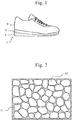
- Fig. 1 shows a shoe 1 provided with a shoe sole member of this embodiment as a midsole.
- the shoe 1 includes an upper member 2 covering an upper side of a foot, and shoe sole members 3 and 4 disposed on a lower side of the upper member 2 to form a shoe sole.
- the shoe 1 includes, as the shoe sole members, an outer sole 4 disposed at a position to engage with the ground, and a midsole 3 disposed between the upper member 2 and the outer sole 4.
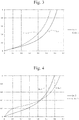
- Fig. 2 is a schematic cross-sectional view of the midsole 3, which is the shoe sole member of this embodiment.
- the midsole 3, which is the shoe sole member of this embodiment is formed of a resin composite including: a non-foamed elastic body matrix 31 composed of an elastomer; and a plurality of resin foam particles 32 dispersed in the elastic body matrix 31.
- the midsole 3 has a relatively small initial stiffness, a relatively large amount of strain during normal use and a relatively small amount of strain at a high load, is sufficiently light in weight as a shoe sole member, and has a relatively high elastic recovery.
- the shoe including the shoe sole member accordingly exhibits soft wearing feeling when the foot fits in the shoe, can suppress excessive deformation while having sufficient lightweight properties, can exhibit high cushioning properties, and is excellent in durability.
- the high-load state of the shoe sole member means the state where it is subjected to stress of approximately 0.6 to 1.0 MPa.
- the state where the plurality of resin foam particles are dispersed in the elastic body matrix refers to the state where substantially all of the plurality of resin foam particles included in the resin composite are independently distributed in the elastic body matrix without being welded to each other (that is, distributed in the elastic body matrix so that less than 10% in the number of the plurality of resin foam particles included in the resin composite are welded to each other). That is, it refers to the state where the substantially all of the plurality of resin foam particles have the surfaces on which the elastic body matrix is present.
- the abovementioned dispersion state in the midsole 3 can be checked as follows. First, the midsole 3 is cut in its thickness direction to observe the cross-sectional surface.
- the percentage of the number of resin foam particles directly welded to an adjacent resin foam particle without matrix resin therebetween is calculated.
- the same cutting, observation, and calculation are carried out at least at three different positions of the midsole 3, and the percentages of the numbers of directly welded resin foam particles respectively calculated for these positions are averaged.
- the average of the percentages of the numbers thus obtained is less than 10%.
- the midsole 3 is formed of the resin composite, but the outer sole 4 instead of the midsole 3 may be formed of the resin composite, or both the midsole 3 and the outer sole 4 may be formed of the resin composite.
- the midsole 3 or the outer sole 4 may be partially formed of the resin composite.
- the resin composite of this embodiment has an elastic body composed of an elastomer as a matrix (an elastic body matrix).
- the elastic body composed of an elastomer generally includes 10% or more (weight ratio) of the resin component relative to the component constituting the elastomer.
- the resin component may be a thermoplastic resin or may be a thermosetting resin.
- the resin component is a thermoplastic resin, it has an advantage of being easily molded.
- the resin component is a thermosetting resin, it has an advantage of being excellent in heat resistance, chemical resistance, and mechanical strength.
- the thermoplastic resin is not particularly limited, but for example a polystyrene-based resin, a polyolefin-based resin, or a thermoplastic polyurethane-based resin may be used.
- the polystyrene-based resin may be, for example, a styrene-ethylene-butylene-styrene block copolymer (SEBS), a styrene-butadiene-butylene-styrene block copolymer (SBBS), a hydrogenated polystyrene-poly(styrene-butadiene)-polystyrene (SSEBS), a styrene-butylene-styrene block copolymer (SBS), a styrene-isoprene block copolymer (SIS), a styrene-ethylene-propylene-sty
- SEBS styrene-ethylene-butylene-s
- the polyolefin-based resin may be, for example, low density polyethylene, medium density polyethylene, ethylene-alpha olefin copolymer, ethylene-propylene rubber, polypropylene, ethylene-vinyl acetate, ethylene-acrylic acid copolymer, or the like, and an elastomer including an ethylene crystal phase as a hard segment is preferable.
- the polyolefin-based resin is preferably an elastomer constituted by polymer chains each of which has an ethylene crystal phase(s) at one end or both ends thereof, or a block copolymer having ethylene crystal phases and ethylene-alpha olefin copolymerized portions arranged alternately.
- the thermoplastic resin is a thermoplastic polyurethane-based resin
- the thermoplastic polyurethane-based resin may be, for example, polyether-based polyurethane, polyester-based polyurethane, or the like, and polyether polyurethane is more preferable.
- thermosetting resin is not particularly limited, but preferably a thermosetting polyurethane-based elastomer, an acrylic elastomer, crosslinked rubber, a silicone-based elastomer, and a fluorine-based elastomer, and a urethane-based elastomer is particularly preferable.
- resin components may be individually used, or two or more of them may be used in combination.
- a polystyrene-based elastomer is preferably selected.
- the initial elastic modulus of the elastomer can be adjusted to an appropriate value by appropriately adjusting the content of the styrene component (styrene content) in the polystyrene-based elastomer.
- the initial stiffness and the amount of strain of the shoe sole member can be adjusted to appropriate values.
- the elastomer may further include a plasticizer.
- the elastomer may be a polymeric gel in which the resin included therein is gelled.
- the plasticizer may be, for example, paraffinic, naphthenic, aromatic, olefinic, or the like, with paraffinic being more preferred.
- the content of the plasticizer included in the elastomeric resin is preferably 10 to 300% by weight of the entire elastomeric resin.
- the elastomer it is preferable to use an elastomer including a resin component that is highly weldable with the plurality of foamed resin particles dispersed in the elastic body matrix.
- the elastic body matrix and the foamed resin particles can firmly adhere to each other without the use of adhesive elements such as binders.
- the elastomer may be a polyolefin-based elastomer or a polystyrene-based elastomer.
- the elastomer may also be a polyurethane-based elastomer.
- the resin component is a thermoplastic resin
- the elastomer have sufficient fluidity at temperatures lower than the melting point (melting peak) of the resin composition constituting the plurality of foamed resin particles.
- the plurality of resin foam particles can be easily dispersed in the elastic body matrix at the time of producing the resin composite.
- the elastomer preferably has a complex viscosity of 0.1 MPa ⁇ s or less at temperatures lower than the melting point of the resin composition constituting the plurality of foamed resin particles.
- thermoplastic resin is a polystyrene-based elastomer
- the complex viscosity of the polystyrene-based elastomer at 100 °C be 0.05 MPa ⁇ s or less.
- the complex viscosity of an elastomer refers to a value obtained by measurement at a frequency of 10 Hz in the measurement mode of the "tensile mode of a sinusoidal strain", based on JIS K 7244-4:1999.
- the complex viscosity of an elastomer can be measured using "Rheogel-E4000", a dynamic viscoelasticity measurement instrument manufactured by UBM as a measurement instrument, under the following conditions:
- the elastomer may include any other component, and may further include chemicals such as pigments, antioxidants, and ultraviolet absorbers.
- the initial elastic modulus of the elastomer is not particularly limited, but the initial elastic modulus at 23 °C may preferably be 0.1 MPa or more and 5 MPa or less, more preferably be 0.2 MPa or more and 3 MPa or less, further preferably be 3 MPa or less. In this case, the initial stiffness and the amount of strain of the resin composite can be set to values more suitable for the shoe sole member.
- the initial elastic modulus of the elastomer at 23 °C is less than 0.1 MPa, the shoe sole member including the elastomer may have insufficient durability and mechanical strength.
- the elastic modulus (Young's modulus) of an elastomer means a compressive elastic modulus at 23°C.
- Measurement of the compressive elastic modulus of an elastomer can be performed, for example, by the method described in the Examples to be described later.
- the value of the elastic modulus of an elastomer the value of storage modulus at 23 °C as measured by the method according to JIS K 7244-4:1999 as abovementioned may also be used.
- the elastic body matrix is a non-foam product.
- the elastic body matrix can have a relatively high density.
- the resin composite can effectively exhibit its characteristics that it has a small amount of strain at a high load.
- use of the non-foamed elastic body matrix also brings an advantage that, at the time of molding the resin composite, which will be described later, deformation of the molded products caused by shrinkage of the resin foam particles, which may occur when a plurality of materials with different degrees of foaming are mixed and hot-pressed, does not occur.
- the resin composite of this embodiment has a plurality of resin foam particles dispersed in the non-foamed elastic body matrix.
- the plurality of resin foam particles may be composed of any resin composition capable of being made into resin foam particles.
- the resin composition may be a polyolefin such as polyethylene (PE) or polypropylene (PP), thermoplastic polyurethane (TPU), polystyrene (PS), ethylene-propylene rubber (EPDM), polyether block amide (PEBA), polyesters (PEs), vinyl ethylene acetate (EVA), or polyamide (PA).
- PE polyethylene
- PP polypropylene
- TPU thermoplastic polyurethane
- PS polystyrene
- EPDM ethylene-propylene rubber
- PEBA polyether block amide
- PET polyethylene-propylene rubber
- EVA vinyl ethylene acetate
- PA polyamide
- the resin composition may be a polyolefin-based resin, a polyurethane-based resin, or a polystyrene-based resin, and for example the aforementioned polyolefin-based resin or polyurethane-based resin, which can be used as a resin component included in the elastomer, can be used.
- These resin compositions may be individually used, or two or more of them may be used in combination.
- the resin composition constituting the plurality of resin foam particles it is preferable to use a resin that is highly weldable to the resin component included in the elastomer constituting the elastic body.
- the elastic body matrix and the foamed resin particles can firmly adhere to each other without the use of adhesive elements such as binders.
- the resin composition constituting the foamed resin particles is preferably a polyolefin-based resin.
- the resin composition constituting the foamed resin particles is also preferably a polyurethane-based resin.
- the melting point of the resin composition constituting the plurality of foamed resin particles be higher than the temperature at which the elastomer is capable of having sufficient fluidity.
- the plurality of resin foam particles can be easily dispersed in the elastic body matrix at the time of producing the resin composite.
- the melting point of the resin composition constituting the plurality of foamed resin particles may be preferably 100°C to 180 °C.
- the elastic modulus of the resin composition is not particularly limited, but for example, the initial elastic modulus at 23 °C may be 10 MPa or more and 400 MPa or less.
- the elastic modulus can be measured in a similar manner to that of the elastic modulus of the elastic body.
- the resin composition may include any other component, and may further include chemicals such as pigments, antioxidants, and ultraviolet absorbers.
- the plurality of resin foam particles can be made from the resin composition using a conventionally known method.
- the foamed resin particles constituting the resin foamed particles may be made by, for example, an impregnation method in which resin particles free from foaming agents are made, followed by impregnation of the resin particles with a foaming agent, or an extrusion method in which a resin composition including a foaming agent is extruded into cooling water for granulation.
- the resin composition is first molded to make resin particles.
- the resin particles, a foaming agent, and an aqueous dispersant are introduced into an autoclave, followed by stirring under heat and pressure, to impregnate the resin particles with the foaming agent.
- the foaming agent with which the resin particles are impregnated is caused to foam to obtain the foamed resin particles.
- the resin composition and a foaming agent are added into an extruder equipped with a die having many small holes at its end, followed by melt-kneading.
- the molten-kneaded product is extruded from the die into the form of strands and thereafter is immediately introduced into cooling water to be cured.
- the thus obtained cured material is cut into a specific length to obtain the foamed resin particles.
- the foaming agent used in the aforementioned methods is not particularly limited and may be, for example, a chemical foaming agent or a physical foaming agent.
- the chemical foaming agent is a foaming agent that generates a gas by chemical reaction or thermal decomposition.
- examples of the chemical foaming agent include inorganic chemical foaming agents such as sodium bicarbonate and ammonium carbonate, and organic chemical foaming agents such as azodicarbonamide.
- the physical foaming agent is, for example, a liquefied gas or a supercritical fluid, and is foamed by pressure reduction or heating.
- Examples of the physical foaming agent include aliphatic hydrocarbons such as butane, alicyclic hydrocarbons such as cyclobutane, and inorganic gases such as carbon dioxide gas, nitrogen, and air.
- an impregnation method using a supercritical fluid for foaming the resin composition is particularly preferably used.
- the resin composition can be dissolved in the supercritical fluid at a comparatively low temperature, and therefore the need for a high temperature for melting the resin composition is eliminated.
- the resin composition includes a resin with a high melting point, such as a polyamide elastomer.
- the method is advantageous also in that generation of toxic gases due to foaming of a chemical foaming agent is suppressed since no chemical foaming agent is used.
- the density and the expansion ratio of the plurality of resin foam particles are not particularly limited.
- the shape and the size of the plurality of resin foam particles are not particularly limited.
- the shape of the resin foam particles is preferably spherical.
- the volume-average particle size D50 (median diameter) of the resin foam particles may be preferably in a diameter range of 1 to 20 mm, more preferably in a diameter range of 2 to 10 mm.
- the particle size of the resin particles means a value obtained by measuring the long diameter of the particles using a microscope.
- the initial elastic modulus of the foamed particles is not particularly limited, but the initial elastic modulus of the foamed particles at 23 °C may preferably be 0.2 MPa or more and 20 MPa or less, more preferably be 0.3 MPa or more and 10 MPa or less.
- the initial stiffness and the amount of strain of the resin composite can be set to values more suitable for the shoe sole member.
- the initial elastic modulus of the foamed particles included in the resin composite can be measured by, for example, the method described in Examples below.
- the resin composite of this embodiment is formed with the plurality of resin foam particles dispersed in the non-foamed elastic body matrix.
- the shoe sole member of this embodiment is advantageous in that it is light in weight but can exhibit soft wearing feeling when the foot fits in the shoe, suppress excessive deformation, and exhibit cushioning properties, and is excellent in durability, as compared with a conventional shoe sole member.
- the resin composite is obtained, for example, by preliminarily kneading the plurality of resin foam particles and the elastic body together using an open roll, mixer, or the like to obtain a preliminarily kneaded resin material in which the plurality of resin foam particles are dispersed in the elastic body matrix, followed by introducing the preliminarily kneaded resin material into a foaming mold, and thereafter hot-pressing the material in the foaming mold using a heat press machine.
- the resin composite in which the plurality of resin foam particles are dispersed in the elastic body matrix can be produced.
- the elastic body can preferably be formed into particles by a conventionally known method, and then mixed with the plurality of resin foam particles.
- the shape and the size of the elastic body formed into particles are not particularly limited.
- the method for mixing the elastic body with the plurality of resin foam particles is not particularly limited, and the elastic body can be mixed with the plurality of resin foam particles by any method.
- the temperature for the hot-pressing is appropriately adjusted depending on the type of the resin composition constituting the plurality of resin foam particles and the type of the resin composition constituting the elastic body.
- the resin foam particles are composed of a polyolefin-based resin and the elastic body is composed of a polyolefin-based elastomer
- the plurality of resin foam particles with which the elastic body is mixed can be hot-pressed appropriately under pressure at a temperature within the range of 80 to 160 °C.
- the resin composite is obtained also by simply mixing together the plurality of resin foam particles and the elastic body both formed as aforementioned without having the elastic body molten, followed by introducing the mixture into a forming mold, and then hot-pressing the mixture in the forming mold using a heat press machine while heating to transfer heat in the entire heat pressing machine.
- a heat pressing machine having the shape of a desired shoe sole member, a shoe sole member formed of the resin composite can be produced in a single step.
- the resin composite may be configured such that a binder is provided on the surfaces of the plurality of resin foam particles, and the elastic body matrix and the plurality of resin foam particles adhere to each other via the binder.
- the plurality of resin foam particles and the elastic body can firmly adhere to each other even in the case of low weldability between the resin composition constituting the plurality of resin foam particles and the resin component included in the elastic body.
- the binder include binders such as surface modifiers, polyolefin, or polyurethane.
- polyolefin and polyurethane may be, for example, a polyolefin resin and a polyurethane resin that can be used as a material of the aforementioned elastic body matrix.
- These binders may be individually used, or two or more of them may be used in combination.
- the binder may be provided on the surfaces of the plurality of resin foam particles by any method, before the plurality of resin foam particles and the elastic body are mixed together.
- the method may include, for example, preliminary kneading of the plurality of resin foam particles and the binder using an open roll, a mixer, or the like.
- various resin composites having a wide range of physical properties can be obtained by appropriately adjusting the mixing ratio between the plurality of resin foam particles and the elastic body both included in the resin composite, depending on the required initial stiffness and amount of strain.
- the amount of the elastic body included in the resin composite may be 5 to 90% (volume ratio) based on the entire resin composite. In this case, the weight of the resin composite can be appropriately reduced and the elastic recovery of the resin composite can be appropriately increased.
- the resin composite may be made by adjusting the mixing ratio between the plurality of resin foam particles and the elastic body depending on the required initial stiffness and amount of strain independently for every given area before dispersing the plurality of resin foam particles in the elastic body matrix, and thereafter dispersing the plurality of resin foam particles in the elastic body.
- the mixing ratio of the elastic body in areas of the shoe sole member that are likely to be subjected to a relatively large load, specifically, areas of a heel portion and a forefoot portion may be higher than the mixing ratio of the resin composition in other areas.
- the heel portion of the shoe sole member having a large mixing ratio of the elastic body can effectively exhibit the shock absorbing effect due to the characteristics of the elastic body even in the case where the heel portion is subjected to a relatively large load when the wearer lands in the motion of various sports.
- the forefoot portion of the shoe sole member having a large mixing ratio of the elastic body suppresses excessive deformation of the shoe sole and thereby enables the wearer to smoothly transfer his or her body weight at the time of the wearer's cutting maneuvers.
- the mixing ratio of the elastic body may be made smaller than the mixing ratio of the resin composition in other areas.
- the midfoot portion of the shoe sole member which is less likely to be subjected to a large load, may have a certain degree of cushioning properties.
- the area of the midfoot portion may have a small mixing ratio of the elastic body, thereby making it possible to reduce the weight of the shoe sole member.
- the mixing ratio between the plurality of resin foam particles and the elastic body is adjusted independently for every given area, so that the resin composite of which the initial stiffness and the amount of strain are different for every given area can be formed.
- the resin composite of this embodiment has a relatively small initial stiffness, a relatively large amount of strain during normal use, and a small amount of strain at a high load.
- the initial stiffness and the amount of strain can be determined from a compressive stress-strain curve based on the method described in Examples below.
- the initial elastic modulus of the resin composite at 23 °C is preferably not more than 10 MPa, more preferably not more than 5 MPa.
- the resin composite of this embodiment includes the non-foamed elastic body composed of an elastomer as a matrix, and thus has a smaller permanent compression set than that of a foamed body used for a conventional shoe sole member. Therefore, the shoe sole member of this embodiment formed of the resin composite has also an advantage of being excellent in elastic recovery.
- shoe sole members of this embodiment, and the shoes including the shoe sole members can be produced in the same manner as conventionally known methods for producing shoes.
- a method for producing shoe sole members including the shoe sole members of this embodiment includes the following steps:
- a preliminarily kneaded material in which the plurality of resin foam particles are dispersed in an elastic body matrix formed of the elastic body is produced by the preliminary kneading in the second step.
- the preliminarily kneaded material is molded into a resin composite having a desired shape in the subsequent third step.
- Another method for producing shoe sole members including the shoe sole members of this embodiment includes the following steps:
- the elastic body in the mixture is molten into a matrix form by heating the heat press machine to transfer heat thoroughly thereinto in the third step, to form a resin composite in which the plurality of resin foam particles are dispersed in the elastic body matrix.
- Each of these production methods may further include a step of providing a binder on the surfaces of the plurality of resin foam particles using an open roll, mixer, or the like, after the first step but before the second step.
- the shoe sole member may be directly molded into a certain shape by hot-pressing using a forming mold.
- shoe sole members that are entirely formed of the resin composite can be directly produced, and therefore the fourth step can be omitted.
- the shoe sole member of this embodiment is partially or entirely formed of a resin composite including a non-foamed elastic body matrix composed of an elastomer, and a plurality of resin foam particles dispersed in the elastic body matrix, and thus has a relatively small initial stiffness, a relatively large amount of strain during normal use, a relatively small amount of strain at a high load, and a relatively high elastic recovery. Therefore, the shoe including the shoe sole member exhibits soft wearing feeling when the foot fits in the shoe, can exhibit high cushioning properties while suppressing excessive deformation, and is excellent in durability. In addition, the shoe of this embodiment, which includes the shoe sole member, exhibits soft wearing feeling when the foot fits in the shoe, and can exhibit high cushioning properties and high durability while suppressing excessive deformation.
- each of the kinds of elastic body matrix materials shown in Table 1 below, resin foam particles, and a polyolefin-based resin including paraffin oil as a binder were prepared so that each of the elastic body matrix materials: resin foam particles: binder is 32:10:58 (volume ratio).
- the resin foam particles and the binder were kneaded together using a commercially available two-roll kneader to obtain resin foam particles having surfaces to which the binder was almost entirely attached.
- the resulting resin foam particles to which the binder was attached and the elastic body matrix material were kneaded together at 110 °C using a commercially available two-roll kneader to allow the elastic body matrix material to melt and form the elastic body matrix, as well as causing the resin foam particles to be dispersed in the elastic body matrix. Thereafter, the kneaded product was cooled to room temperature.
- the kneaded product may be cut off, as appropriate, to allow the cavities to be filled with the kneaded product
- the forming mold was heated for two minutes under pressure by a heat press machine, followed by cooling with cold water for 10 minutes, to obtain a resin composite.
- the obtained resin composite had the resin foam particles dispersed in an elastic body matrix in which the elastic body matrix material was a continuous body as a whole.
- the elastic body matrix or the binder lied between each adjacent resin foam particles as a whole, and few portions at which the resin foam particles were directly welded to each other were present.
- Cavities of a forming mold were filled only with each of the kinds of elastic body matrix shown in Table 1 below, and the forming mold was heated for two minutes under pressure by a heat press machine, followed by cooling with cold water for 10 minutes, to obtain a resin composite composed solely of an elastic body.
- a polymer alloy composed of an olefin resin and EVA (ethylene-vinyl acetate copolymer resin) was crosslinked and foamed by a conventionally known method to obtain a plate-shaped resin molded product composed of a crosslinked foamed product.
- the initial elastic modulus Eo of each of the styrene-based elastomer materials 1 to 3 was calculated, using a stress-strain curve obtained by cutting each of the styrene-based elastomer materials into a cylindrical shape having a diameter of 29 mm and a height of 12 mm and compressing the sample piece using an autograph precision universal tester (product name "AG-50kNIS MS” manufactured by Shimadzu Corporation) at 23 °C and at a strain rate of 0.1 mm/sec.
- the results are shown in Table 1 below.
- the volume-average particle size D50 of each kind of foamed resin particles was measured using a microscope.
- the density of each kind of foamed resin particles was calculated from the test piece weight and test piece volume.
- the results are shown in Table 2 below.
- the initial modulus E 0 of each kind of foamed resin particles at 23°C was measured as follows. Specifically, the above kinds of foamed resin particles were respectively hot-pressed for integration to produce a plurality of plate-shaped molded products having different specific gravities.
- the initial elastic modulus of each of the plurality of plate-shaped molded products was measured by the abovementioned method to make an approximate line between the specific gravity and initial modulus of the plate-shaped molded product.
- the resin composites of Examples 1 to 5 and the resin molded products of Comparative Examples 1 to 3 were cut into a disc shape having a diameter of 29 ⁇ 1 mm and a thickness of 12 ⁇ 1 mm to obtain the respective test pieces.
- the compressive stress-strain curves of the test pieces of Examples 1 to 5 and Comparative Examples 1 to 3 were respectively obtained by cutting the foam products into a cylindrical shape having a diameter of 29 mm and a height of 12 mm, and compressing the sample pieces using an autograph precision universal tester (product name "AG-50kNIS MS” manufactured by Shimadzu Corporation) at 23 °C and at a strain rate of 0.1 mm/sec.
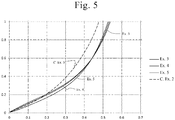
- the compressive stress-strain curves thus measured are shown in Figs. 3 to 5 .
- the resin composites of Examples 1 to 5 each are extremely light in weight as compared with the resin molded products of Comparative Examples 1 and 2 composed solely of an elastic body.
- the resin composite of Example 1 has an equivalent initial stiffness Eo but a small compressive stress ⁇ 0.4 at a strain of 0.4, as compared with the resin molded product of Comparative Example 1 composed solely of an elastic body.
- the resin composites of Examples 3 to 5 each have an equivalent initial stiffness Eo to that of the resin molded product of Comparative Example 2 composed solely of an elastic body, but a smaller compressive stress ⁇ 0.4 at a strain of 0.4 than that of Comparative Example 2.
- the resin composites according to the Examples can each exhibit high cushioning properties as compared with the material solely of an elastic body having an equivalent flexibility.
- the resin composites of Examples 1 to 5 each have an extremely small initial stiffness Eo as compared with the resin molded product of Comparative Example 3 composed only of a crosslinked foam product. That is, it is understood that the resin composites according to the Examples each have a higher flexibility than the simple crosslinked foam product, and thereby exhibit soft wearing feeling when the foot fits into the shoe. In addition, the resin composites of Examples 1 to 5 each have a higher density (specific gravity) than the resin molded product of Comparative Example 3 composed only of the crosslinked foam product, and thereby have a relatively excellent durability.
- the resin composite of Example 2 has an equivalent compressive stress ⁇ 0.4 but a small initial stiffness Eo and a relatively small strain ⁇ 1MPa at a compressive stress of 1 MPa, as compared with the resin molded product of Comparative Example 3 composed only of a crosslinked foam product.
- the resin composites according to the Examples each have a high flexibility and can suppress excessive deformation and resulting decrease in shape restoring force, as compared with the crosslinked foam product having equivalent cushioning properties.
- the shoe provided with the resin composites according to the Examples as a shoe sole member exhibits soft wearing feeling when the foot fits in the shoe, suppresses excessive deformation and resulting decrease in shape restoring force while having sufficient lightweight properties, and exhibits high durability and cushioning properties.
Landscapes
- Chemical & Material Sciences (AREA)
- Engineering & Computer Science (AREA)
- Materials Engineering (AREA)
- Health & Medical Sciences (AREA)
- Chemical Kinetics & Catalysis (AREA)
- Medicinal Chemistry (AREA)
- Polymers & Plastics (AREA)
- Organic Chemistry (AREA)
- Mechanical Engineering (AREA)
- Footwear And Its Accessory, Manufacturing Method And Apparatuses (AREA)
- Manufacture Of Porous Articles, And Recovery And Treatment Of Waste Products (AREA)
Abstract
Description
- The present invention relates to a shoe sole member and a shoe, and more specifically, to a shoe sole member that is partially or entirely formed of a resin composite having a plurality of resin foam particles dispersed therein, and a shoe including the shoe member.
- Shoe sole members are required to have excellent cushioning performance. Generally, a foam product is used as a material for the shoe sole members that satisfy such requirements. For example,
Patent Literatures 1 to 3 disclose shoe sole members composed of a foam product formed by welding a plurality of foam particles. - In the shoe sole member using such a foam product, the cushioning properties of the shoe sole member can be effectively enhanced by increasing the expansion ratio of the foam product. Further, due to the low initial stiffness of the foam product of a high expansion ratio, a shoe including such a foam product as the shoe sole member has soft and comfortable wearing feeling when the foot fits in the shoe.
- However, when the shoe sole member for which such a conventional foam product is used is continuously subjected to high load by use, the shape restoring force of the foam product deformed due to the load is likely to decrease. This causes a problem that cushioning properties and durability of the shoe sole member are likely to decrease. Especially, in sports shoes such as basketball shoes and running shoes, of which the shoe soles are liable to be subjected to a high load, the load tends to concentrate in certain areas of the shoe sole member, in which the restoring force is likely to decrease.
- Shoes that include a foam product of a high expansion ratio as the shoe sole member as described above are greatly deformed when subjected to a load, and may therefore be excessively deformed when subjected to a high load. In this case, there are problems that the deformation greatly impairs agility and causes a large strain on the foot of a wearer. Thus, the abovementioned sports shoes are required to include a shoe sole member having a relatively small amount of strain (amount of deformation) when subjected to a high load.
- On the other hand, as disclosed in
Patent Literature 4, an elastomer is also used as another material for a shoe sole member having cushioning performance. Since an elastomer has a smaller amount of strain and is more excellent in elastic recovery than a foam product when subjected to a high load, the shoe sole member for which such an elastomer is used is excellent in durability while exhibiting cushioning properties. - However, there is a problem that the shoe sole member for which an elastomer is used has lower cushioning properties than the shoe sole member composed of the aforementioned foam product during normal use when not subjected to a high load. Further, since the elastomer has relatively high stiffness, it has a problem of causing hard wearing feeling when the foot fits into the shoe.
-
- Patent Literature 1:
JP 2014-521418 T - Patent Literature 2:
JP 2013-220354 A - Patent Literature 3:
JP 2014-151210 A - Patent Literature 4:
JP H09-206102 A - In view of the abovementioned problems, it is an object of the present invention to provide a shoe sole member that exhibits soft wearing feeling when the foot fits in the shoe provided with the shoe sole member, that can suppress excessive deformation while having sufficient lightweight properties, and that can exhibit high cushioning properties and durability when provided in the shoe, and a shoe including such a shoe sole member.
- The present inventors have found that the above problems can be solved by using a resin composite in which a plurality of resin foam particles are dispersed in a non-foamed elastic body composed of an elastomer as a matrix.
- That is, the shoe sole member according to the present invention is partially or entirely formed of a resin composite, the resin composite including: a non-foamed elastic body matrix composed of an elastomer; and a plurality of resin foam particles dispersed in the elastic body matrix.
- In the shoe sole member according to the present invention, for example, the elastomer includes a thermoplastic resin.
- In the shoe sole member according to the present invention, for example, the elastomer includes a thermosetting resin.
- In the shoe sole member according to the present invention, it is preferable that the elastomer include a polyolefin-based elastomer or a polystyrene-based elastomer, and that the plurality of foamed resins be constituted by a resin composition including a polyolefin-based resin.
- In the shoe sole member according to the present invention, it is preferable that the elastomer include a polyurethane-based elastomer, and that the plurality of resin foam particles be constituted by a resin composition including a polyurethane-based resin.
- In the shoe sole member according to the present invention, it is preferable that the elastic body matrix have an initial elastic modulus at 23 °C being smaller than an initial elastic modulus at 23 °C of the plurality of resin foam particles.
- In the shoe sole member according to the present invention, it is preferable that the elastic body matrix and the plurality of resin foam particles adhere to each other via a binder.
- A shoe according to the present invention includes the abovementioned resin composition.
-
-
Fig. 1 is a schematic view showing a shoe in which a shoe sole member of one embodiment is used. -
Fig. 2 is a schematic cross-sectional view of a shoe sole member (midsole) of the one embodiment. -
Fig. 3 is a graph showing the compressive stress-strain curves of an Example and a Comparative Example. -
Fig. 4 is a graph showing the compressive stress-strain curves of an Example and a Comparative Example. -
Fig. 5 is a graph showing the compressive stress-strain curves of Examples and a Comparative Example. - Hereinafter, an embodiment of a shoe sole member and a shoe of the present invention will be described with reference to the drawings. The following embodiments are shown merely as examples. The present invention is not limited to the following embodiment at all.
-
Fig. 1 shows ashoe 1 provided with a shoe sole member of this embodiment as a midsole. Theshoe 1 includes anupper member 2 covering an upper side of a foot, andshoe sole members upper member 2 to form a shoe sole. Theshoe 1 includes, as the shoe sole members, anouter sole 4 disposed at a position to engage with the ground, and amidsole 3 disposed between theupper member 2 and theouter sole 4. -
Fig. 2 is a schematic cross-sectional view of themidsole 3, which is the shoe sole member of this embodiment. As shown inFig. 2 , themidsole 3, which is the shoe sole member of this embodiment, is formed of a resin composite including: a non-foamedelastic body matrix 31 composed of an elastomer; and a plurality ofresin foam particles 32 dispersed in theelastic body matrix 31. With such a configuration, themidsole 3 has a relatively small initial stiffness, a relatively large amount of strain during normal use and a relatively small amount of strain at a high load, is sufficiently light in weight as a shoe sole member, and has a relatively high elastic recovery. The shoe including the shoe sole member accordingly exhibits soft wearing feeling when the foot fits in the shoe, can suppress excessive deformation while having sufficient lightweight properties, can exhibit high cushioning properties, and is excellent in durability. Here, the high-load state of the shoe sole member means the state where it is subjected to stress of approximately 0.6 to 1.0 MPa. - In the resin composite of the present invention, the state where the plurality of resin foam particles are dispersed in the elastic body matrix refers to the state where substantially all of the plurality of resin foam particles included in the resin composite are independently distributed in the elastic body matrix without being welded to each other (that is, distributed in the elastic body matrix so that less than 10% in the number of the plurality of resin foam particles included in the resin composite are welded to each other). That is, it refers to the state where the substantially all of the plurality of resin foam particles have the surfaces on which the elastic body matrix is present. The abovementioned dispersion state in the
midsole 3 can be checked as follows. First, themidsole 3 is cut in its thickness direction to observe the cross-sectional surface. Among the resin foam particles exposed to the cross-sectional surface, the percentage of the number of resin foam particles directly welded to an adjacent resin foam particle without matrix resin therebetween is calculated. The same cutting, observation, and calculation are carried out at least at three different positions of themidsole 3, and the percentages of the numbers of directly welded resin foam particles respectively calculated for these positions are averaged. In the resin composite of the present invention, the average of the percentages of the numbers thus obtained is less than 10%. - In the
shoe 1 of this embodiment, themidsole 3 is formed of the resin composite, but theouter sole 4 instead of themidsole 3 may be formed of the resin composite, or both themidsole 3 and theouter sole 4 may be formed of the resin composite. Themidsole 3 or theouter sole 4 may be partially formed of the resin composite. - The resin composite of this embodiment has an elastic body composed of an elastomer as a matrix (an elastic body matrix). In this description, the elastic body composed of an elastomer generally includes 10% or more (weight ratio) of the resin component relative to the component constituting the elastomer.
- The resin component may be a thermoplastic resin or may be a thermosetting resin. In the case where the resin component is a thermoplastic resin, it has an advantage of being easily molded. In the case where the resin component is a thermosetting resin, it has an advantage of being excellent in heat resistance, chemical resistance, and mechanical strength.
- The thermoplastic resin is not particularly limited, but for example a polystyrene-based resin, a polyolefin-based resin, or a thermoplastic polyurethane-based resin may be used. In the case where the thermoplastic resin is a polystyrene-based resin, the polystyrene-based resin may be, for example, a styrene-ethylene-butylene-styrene block copolymer (SEBS), a styrene-butadiene-butylene-styrene block copolymer (SBBS), a hydrogenated polystyrene-poly(styrene-butadiene)-polystyrene (SSEBS), a styrene-butylene-styrene block copolymer (SBS), a styrene-isoprene block copolymer (SIS), a styrene-ethylene-propylene-styrene block copolymer (SEPS), or the like, and SEBS, SSEBS, or SIS is more preferable. In the case where the thermoplastic resin is a polyolefin-based resin, the polyolefin-based resin may be, for example, low density polyethylene, medium density polyethylene, ethylene-alpha olefin copolymer, ethylene-propylene rubber, polypropylene, ethylene-vinyl acetate, ethylene-acrylic acid copolymer, or the like, and an elastomer including an ethylene crystal phase as a hard segment is preferable. More specifically, the polyolefin-based resin is preferably an elastomer constituted by polymer chains each of which has an ethylene crystal phase(s) at one end or both ends thereof, or a block copolymer having ethylene crystal phases and ethylene-alpha olefin copolymerized portions arranged alternately. In the case where the thermoplastic resin is a thermoplastic polyurethane-based resin, the thermoplastic polyurethane-based resin may be, for example, polyether-based polyurethane, polyester-based polyurethane, or the like, and polyether polyurethane is more preferable.
- The thermosetting resin is not particularly limited, but preferably a thermosetting polyurethane-based elastomer, an acrylic elastomer, crosslinked rubber, a silicone-based elastomer, and a fluorine-based elastomer, and a urethane-based elastomer is particularly preferable.
- These resin components may be individually used, or two or more of them may be used in combination.
- As the resin component, a polystyrene-based elastomer is preferably selected. In this case, the initial elastic modulus of the elastomer can be adjusted to an appropriate value by appropriately adjusting the content of the styrene component (styrene content) in the polystyrene-based elastomer. Thereby, the initial stiffness and the amount of strain of the shoe sole member can be adjusted to appropriate values.
- The elastomer may further include a plasticizer. In this case, the elastomer may be a polymeric gel in which the resin included therein is gelled. The plasticizer may be, for example, paraffinic, naphthenic, aromatic, olefinic, or the like, with paraffinic being more preferred. In the case where the elastomer includes a plasticizer, the content of the plasticizer included in the elastomeric resin is preferably 10 to 300% by weight of the entire elastomeric resin.
- As the elastomer, it is preferable to use an elastomer including a resin component that is highly weldable with the plurality of foamed resin particles dispersed in the elastic body matrix. In this case, the elastic body matrix and the foamed resin particles can firmly adhere to each other without the use of adhesive elements such as binders.
- For example, in the case where the foamed resin particles are composed of a polyolefin-based resin, the elastomer may be a polyolefin-based elastomer or a polystyrene-based elastomer. In the case where the foamed resin particles are composed of a polyurethane-based resin, the elastomer may also be a polyurethane-based elastomer.
- In the case where the resin component is a thermoplastic resin, it is preferable that the elastomer have sufficient fluidity at temperatures lower than the melting point (melting peak) of the resin composition constituting the plurality of foamed resin particles. In this case, the plurality of resin foam particles can be easily dispersed in the elastic body matrix at the time of producing the resin composite. For example, the elastomer preferably has a complex viscosity of 0.1 MPa·s or less at temperatures lower than the melting point of the resin composition constituting the plurality of foamed resin particles. In the case where the thermoplastic resin is a polystyrene-based elastomer, it is preferable that the complex viscosity of the polystyrene-based elastomer at 100 °C be 0.05 MPa·s or less.
- In this description, the complex viscosity of an elastomer refers to a value obtained by measurement at a frequency of 10 Hz in the measurement mode of the "tensile mode of a sinusoidal strain", based on JIS K 7244-4:1999. For example, the complex viscosity of an elastomer can be measured using "Rheogel-E4000", a dynamic viscoelasticity measurement instrument manufactured by UBM as a measurement instrument, under the following conditions:
- Measurement mode: Tensile mode of a sinusoidal strain
- Frequency :10 Hz
- Distance between chucks: 20 mm
- Load: Automatic static load
- Dynamic strain: 5 pm
- Heating rate: 2 °C/min
- Test piece: Strip shape having a length of 33±3 mm, a width of 5±1 mm, and a thickness of 2±1 mm
- The elastomer may include any other component, and may further include chemicals such as pigments, antioxidants, and ultraviolet absorbers.
- The initial elastic modulus of the elastomer is not particularly limited, but the initial elastic modulus at 23 °C may preferably be 0.1 MPa or more and 5 MPa or less, more preferably be 0.2 MPa or more and 3 MPa or less, further preferably be 3 MPa or less. In this case, the initial stiffness and the amount of strain of the resin composite can be set to values more suitable for the shoe sole member. When the initial elastic modulus of the elastomer at 23 °C is less than 0.1 MPa, the shoe sole member including the elastomer may have insufficient durability and mechanical strength. In this description, the elastic modulus (Young's modulus) of an elastomer means a compressive elastic modulus at 23°C. Measurement of the compressive elastic modulus of an elastomer can be performed, for example, by the method described in the Examples to be described later. As the value of the elastic modulus of an elastomer, the value of storage modulus at 23 °C as measured by the method according to JIS K 7244-4:1999 as abovementioned may also be used.
- The elastic body matrix is a non-foam product. Thus, the elastic body matrix can have a relatively high density. As a result, the resin composite can effectively exhibit its characteristics that it has a small amount of strain at a high load. In addition, use of the non-foamed elastic body matrix also brings an advantage that, at the time of molding the resin composite, which will be described later, deformation of the molded products caused by shrinkage of the resin foam particles, which may occur when a plurality of materials with different degrees of foaming are mixed and hot-pressed, does not occur.
- The resin composite of this embodiment has a plurality of resin foam particles dispersed in the non-foamed elastic body matrix.
- The plurality of resin foam particles may be composed of any resin composition capable of being made into resin foam particles. For example, the resin composition may be a polyolefin such as polyethylene (PE) or polypropylene (PP), thermoplastic polyurethane (TPU), polystyrene (PS), ethylene-propylene rubber (EPDM), polyether block amide (PEBA), polyesters (PEs), vinyl ethylene acetate (EVA), or polyamide (PA). Preferably, the resin composition may be a polyolefin-based resin, a polyurethane-based resin, or a polystyrene-based resin, and for example the aforementioned polyolefin-based resin or polyurethane-based resin, which can be used as a resin component included in the elastomer, can be used. These resin compositions may be individually used, or two or more of them may be used in combination.
- As a resin composition constituting the plurality of resin foam particles, it is preferable to use a resin that is highly weldable to the resin component included in the elastomer constituting the elastic body. In this case, the elastic body matrix and the foamed resin particles can firmly adhere to each other without the use of adhesive elements such as binders. For example, in the case where the resin component included in the elastomer is a polyolefin-based elastomer or a polystyrene-based elastomer, the resin composition constituting the foamed resin particles is preferably a polyolefin-based resin. In the case where the resin component included in the elastomer is a polyurethane-based elastomer, the resin composition constituting the foamed resin particles is also preferably a polyurethane-based resin.
- In the case where the resin component included in the elastomer is a thermoplastic resin, it is preferable that the melting point of the resin composition constituting the plurality of foamed resin particles be higher than the temperature at which the elastomer is capable of having sufficient fluidity. In this case, the plurality of resin foam particles can be easily dispersed in the elastic body matrix at the time of producing the resin composite. The melting point of the resin composition constituting the plurality of foamed resin particles may be preferably 100°C to 180 °C.
- The elastic modulus of the resin composition is not particularly limited, but for example, the initial elastic modulus at 23 °C may be 10 MPa or more and 400 MPa or less. The elastic modulus can be measured in a similar manner to that of the elastic modulus of the elastic body.
- The resin composition may include any other component, and may further include chemicals such as pigments, antioxidants, and ultraviolet absorbers.
- The plurality of resin foam particles can be made from the resin composition using a conventionally known method. Specifically, the foamed resin particles constituting the resin foamed particles may be made by, for example, an impregnation method in which resin particles free from foaming agents are made, followed by impregnation of the resin particles with a foaming agent, or an extrusion method in which a resin composition including a foaming agent is extruded into cooling water for granulation. In the impregnation method, the resin composition is first molded to make resin particles. Next, the resin particles, a foaming agent, and an aqueous dispersant are introduced into an autoclave, followed by stirring under heat and pressure, to impregnate the resin particles with the foaming agent. The foaming agent with which the resin particles are impregnated is caused to foam to obtain the foamed resin particles. In the extrusion method, for example, the resin composition and a foaming agent are added into an extruder equipped with a die having many small holes at its end, followed by melt-kneading. The molten-kneaded product is extruded from the die into the form of strands and thereafter is immediately introduced into cooling water to be cured. The thus obtained cured material is cut into a specific length to obtain the foamed resin particles.
- The foaming agent used in the aforementioned methods is not particularly limited and may be, for example, a chemical foaming agent or a physical foaming agent. The chemical foaming agent is a foaming agent that generates a gas by chemical reaction or thermal decomposition. Examples of the chemical foaming agent include inorganic chemical foaming agents such as sodium bicarbonate and ammonium carbonate, and organic chemical foaming agents such as azodicarbonamide. The physical foaming agent is, for example, a liquefied gas or a supercritical fluid, and is foamed by pressure reduction or heating. Examples of the physical foaming agent include aliphatic hydrocarbons such as butane, alicyclic hydrocarbons such as cyclobutane, and inorganic gases such as carbon dioxide gas, nitrogen, and air.
- In this embodiment, in order to make the foamed resin particles, an impregnation method using a supercritical fluid for foaming the resin composition is particularly preferably used. In this case, the resin composition can be dissolved in the supercritical fluid at a comparatively low temperature, and therefore the need for a high temperature for melting the resin composition is eliminated. This is particularly advantageous when the resin composition includes a resin with a high melting point, such as a polyamide elastomer. Further, the method is advantageous also in that generation of toxic gases due to foaming of a chemical foaming agent is suppressed since no chemical foaming agent is used.
- The density and the expansion ratio of the plurality of resin foam particles are not particularly limited.
- The shape and the size of the plurality of resin foam particles are not particularly limited. The shape of the resin foam particles is preferably spherical. In this case, the volume-average particle size D50 (median diameter) of the resin foam particles may be preferably in a diameter range of 1 to 20 mm, more preferably in a diameter range of 2 to 10 mm. In this description, the particle size of the resin particles means a value obtained by measuring the long diameter of the particles using a microscope.
- The initial elastic modulus of the foamed particles is not particularly limited, but the initial elastic modulus of the foamed particles at 23 °C may preferably be 0.2 MPa or more and 20 MPa or less, more preferably be 0.3 MPa or more and 10 MPa or less. In this case, the initial stiffness and the amount of strain of the resin composite can be set to values more suitable for the shoe sole member. The initial elastic modulus of the foamed particles included in the resin composite can be measured by, for example, the method described in Examples below.
- The resin composite of this embodiment is formed with the plurality of resin foam particles dispersed in the non-foamed elastic body matrix. With this configuration, the shoe sole member of this embodiment is advantageous in that it is light in weight but can exhibit soft wearing feeling when the foot fits in the shoe, suppress excessive deformation, and exhibit cushioning properties, and is excellent in durability, as compared with a conventional shoe sole member.
- The resin composite is obtained, for example, by preliminarily kneading the plurality of resin foam particles and the elastic body together using an open roll, mixer, or the like to obtain a preliminarily kneaded resin material in which the plurality of resin foam particles are dispersed in the elastic body matrix, followed by introducing the preliminarily kneaded resin material into a foaming mold, and thereafter hot-pressing the material in the foaming mold using a heat press machine. By using such a method, the resin composite in which the plurality of resin foam particles are dispersed in the elastic body matrix can be produced.
- The elastic body can preferably be formed into particles by a conventionally known method, and then mixed with the plurality of resin foam particles. The shape and the size of the elastic body formed into particles are not particularly limited. The method for mixing the elastic body with the plurality of resin foam particles is not particularly limited, and the elastic body can be mixed with the plurality of resin foam particles by any method.
- The temperature for the hot-pressing is appropriately adjusted depending on the type of the resin composition constituting the plurality of resin foam particles and the type of the resin composition constituting the elastic body. For example, in the case where the resin foam particles are composed of a polyolefin-based resin and the elastic body is composed of a polyolefin-based elastomer, the plurality of resin foam particles with which the elastic body is mixed can be hot-pressed appropriately under pressure at a temperature within the range of 80 to 160 °C.
- Alternatively, in the case where the resin component included in the elastomer is a thermoplastic resin, the resin composite is obtained also by simply mixing together the plurality of resin foam particles and the elastic body both formed as aforementioned without having the elastic body molten, followed by introducing the mixture into a forming mold, and then hot-pressing the mixture in the forming mold using a heat press machine while heating to transfer heat in the entire heat pressing machine. By using this method, and by using a heat pressing machine having the shape of a desired shoe sole member, a shoe sole member formed of the resin composite can be produced in a single step.
- The resin composite may be configured such that a binder is provided on the surfaces of the plurality of resin foam particles, and the elastic body matrix and the plurality of resin foam particles adhere to each other via the binder. In this case, the plurality of resin foam particles and the elastic body can firmly adhere to each other even in the case of low weldability between the resin composition constituting the plurality of resin foam particles and the resin component included in the elastic body. Examples of the binder include binders such as surface modifiers, polyolefin, or polyurethane. Here, polyolefin and polyurethane may be, for example, a polyolefin resin and a polyurethane resin that can be used as a material of the aforementioned elastic body matrix. These binders may be individually used, or two or more of them may be used in combination.
- Preferably, the binder may be provided on the surfaces of the plurality of resin foam particles by any method, before the plurality of resin foam particles and the elastic body are mixed together. The method may include, for example, preliminary kneading of the plurality of resin foam particles and the binder using an open roll, a mixer, or the like.
- In this embodiment, various resin composites having a wide range of physical properties can be obtained by appropriately adjusting the mixing ratio between the plurality of resin foam particles and the elastic body both included in the resin composite, depending on the required initial stiffness and amount of strain. For example, the amount of the elastic body included in the resin composite may be 5 to 90% (volume ratio) based on the entire resin composite. In this case, the weight of the resin composite can be appropriately reduced and the elastic recovery of the resin composite can be appropriately increased.
- Alternatively, the resin composite may be made by adjusting the mixing ratio between the plurality of resin foam particles and the elastic body depending on the required initial stiffness and amount of strain independently for every given area before dispersing the plurality of resin foam particles in the elastic body matrix, and thereafter dispersing the plurality of resin foam particles in the elastic body. For example, in the case where the method in which the aforementioned mixture of the plurality of resin foam particles and the elastic body is hot-pressed is used, the mixing ratio of the elastic body in areas of the shoe sole member that are likely to be subjected to a relatively large load, specifically, areas of a heel portion and a forefoot portion, may be higher than the mixing ratio of the resin composition in other areas. The heel portion of the shoe sole member having a large mixing ratio of the elastic body can effectively exhibit the shock absorbing effect due to the characteristics of the elastic body even in the case where the heel portion is subjected to a relatively large load when the wearer lands in the motion of various sports. In addition, the forefoot portion of the shoe sole member having a large mixing ratio of the elastic body suppresses excessive deformation of the shoe sole and thereby enables the wearer to smoothly transfer his or her body weight at the time of the wearer's cutting maneuvers. On the other hand, in an area of the shoe sole member that is less likely to be subjected to a relatively large load, the mixing ratio of the elastic body may be made smaller than the mixing ratio of the resin composition in other areas. For example, the midfoot portion of the shoe sole member, which is less likely to be subjected to a large load, may have a certain degree of cushioning properties. Thus, the area of the midfoot portion may have a small mixing ratio of the elastic body, thereby making it possible to reduce the weight of the shoe sole member. As described above, the mixing ratio between the plurality of resin foam particles and the elastic body is adjusted independently for every given area, so that the resin composite of which the initial stiffness and the amount of strain are different for every given area can be formed.
- The resin composite of this embodiment has a relatively small initial stiffness, a relatively large amount of strain during normal use, and a small amount of strain at a high load. The initial stiffness and the amount of strain can be determined from a compressive stress-strain curve based on the method described in Examples below. The initial elastic modulus of the resin composite at 23 °C is preferably not more than 10 MPa, more preferably not more than 5 MPa.
- The resin composite of this embodiment includes the non-foamed elastic body composed of an elastomer as a matrix, and thus has a smaller permanent compression set than that of a foamed body used for a conventional shoe sole member. Therefore, the shoe sole member of this embodiment formed of the resin composite has also an advantage of being excellent in elastic recovery.
- The shoe sole members of this embodiment, and the shoes including the shoe sole members can be produced in the same manner as conventionally known methods for producing shoes.
- For example, a method for producing shoe sole members including the shoe sole members of this embodiment includes the following steps:
- (a) a first step of producing each of the plurality of resin foam particles from the first resin composition by the abovementioned impregnation method, extrusion method, or the like;
- (b) a second step of preliminarily kneading the plurality of resin foam particles obtained in the first step and the elastic body using an open roll, mixer, or the like;
- (c) a third step of introducing the preliminarily kneaded material into a forming mold, followed by hot-pressing the forming mold using a heat press machine, to obtain a resin composite in which the plurality of resin foam particles are dispersed in the elastic body matrix; and
- (d) a fourth step of producing shoe sole members that are partially or entirely formed of the resin composite obtained in the third step.
- In this production method, a preliminarily kneaded material in which the plurality of resin foam particles are dispersed in an elastic body matrix formed of the elastic body is produced by the preliminary kneading in the second step. The preliminarily kneaded material is molded into a resin composite having a desired shape in the subsequent third step.
- Alternatively, another method for producing shoe sole members including the shoe sole members of this embodiment includes the following steps:
- (a) a first step of producing each of the plurality of resin foam particles from the first resin composition by the abovementioned impregnation method, extrusion method, or the like;
- (b) a second step of mixing the elastic body with the plurality of resin foam particles obtained in the first step;
- (c) a third step of introducing the mixture into a forming mold, followed by hot-pressing the forming mold using a heat press machine while heating the heat press machine to transfer heat thoroughly thereinto, to obtain a resin composite in which the plurality of resin foam particles are dispersed in the elastic body matrix; and
- (d) a fourth step of producing shoe sole members that are partially or entirely formed of the resin composite obtained in the third step.
- In this production method, the elastic body in the mixture is molten into a matrix form by heating the heat press machine to transfer heat thoroughly thereinto in the third step, to form a resin composite in which the plurality of resin foam particles are dispersed in the elastic body matrix.
- Each of these production methods may further include a step of providing a binder on the surfaces of the plurality of resin foam particles using an open roll, mixer, or the like, after the first step but before the second step.
- In each of the third steps of these production methods, the shoe sole member may be directly molded into a certain shape by hot-pressing using a forming mold. In this case, shoe sole members that are entirely formed of the resin composite can be directly produced, and therefore the fourth step can be omitted.
- As described above, the shoe sole member of this embodiment is partially or entirely formed of a resin composite including a non-foamed elastic body matrix composed of an elastomer, and a plurality of resin foam particles dispersed in the elastic body matrix, and thus has a relatively small initial stiffness, a relatively large amount of strain during normal use, a relatively small amount of strain at a high load, and a relatively high elastic recovery. Therefore, the shoe including the shoe sole member exhibits soft wearing feeling when the foot fits in the shoe, can exhibit high cushioning properties while suppressing excessive deformation, and is excellent in durability. In addition, the shoe of this embodiment, which includes the shoe sole member, exhibits soft wearing feeling when the foot fits in the shoe, and can exhibit high cushioning properties and high durability while suppressing excessive deformation.
- Although detailed description beyond the above will not be repeated here, conventionally known technical matters on shoe sole members may be optionally employed in the present invention even if the matters are not directly described in the above.
- Hereinafter, the present invention will be elucidated by way of specific examples and comparative examples of the present invention. However, the present invention is not limited to the following examples.
- Various styrene-based resins and paraffin oil (density of 0.88 g/cm3) as a plasticizer were mixed at 120 to 200 °C using a commercially available twin-screw extruding kneader to produce gel-like styrene-based
elastomer materials 1 to 3 (GELs 1 to 3) respectively having different elastic moduli. - Polyolefin-based resins were used as the raw materials of foaming particles, to produce three kinds of
resin foam particles 1 to 3 (foams 1 to 3, D50 = ...... mm) having different degrees of foaming using a conventionally known method. - First, as materials used for in the following production method, each of the kinds of elastic body matrix materials shown in Table 1 below, resin foam particles, and a polyolefin-based resin including paraffin oil as a binder were prepared so that each of the elastic body matrix materials: resin foam particles: binder is 32:10:58 (volume ratio).
- The resin foam particles and the binder were kneaded together using a commercially available two-roll kneader to obtain resin foam particles having surfaces to which the binder was almost entirely attached.
- The resulting resin foam particles to which the binder was attached and the elastic body matrix material were kneaded together at 110 °C using a commercially available two-roll kneader to allow the elastic body matrix material to melt and form the elastic body matrix, as well as causing the resin foam particles to be dispersed in the elastic body matrix. Thereafter, the kneaded product was cooled to room temperature.
- Subsequently, cavities of a foaming mold were filled with the kneaded product (in so doing, the kneaded product may be cut off, as appropriate, to allow the cavities to be filled with the kneaded product), and the forming mold was heated for two minutes under pressure by a heat press machine, followed by cooling with cold water for 10 minutes, to obtain a resin composite. The obtained resin composite had the resin foam particles dispersed in an elastic body matrix in which the elastic body matrix material was a continuous body as a whole. At this time, the elastic body matrix or the binder lied between each adjacent resin foam particles as a whole, and few portions at which the resin foam particles were directly welded to each other were present.
- Cavities of a forming mold were filled only with each of the kinds of elastic body matrix shown in Table 1 below, and the forming mold was heated for two minutes under pressure by a heat press machine, followed by cooling with cold water for 10 minutes, to obtain a resin composite composed solely of an elastic body.
- A polymer alloy composed of an olefin resin and EVA (ethylene-vinyl acetate copolymer resin) was crosslinked and foamed by a conventionally known method to obtain a plate-shaped resin molded product composed of a crosslinked foamed product.
- The initial elastic modulus Eo of each of the styrene-based
elastomer materials 1 to 3 was calculated, using a stress-strain curve obtained by cutting each of the styrene-based elastomer materials into a cylindrical shape having a diameter of 29 mm and a height of 12 mm and compressing the sample piece using an autograph precision universal tester (product name "AG-50kNIS MS" manufactured by Shimadzu Corporation) at 23 °C and at a strain rate of 0.1 mm/sec. The results are shown in Table 1 below.Table 1 Styrene-based elastomer material E0 (MPa) GEL 10.37 GEL 20.56 GEL 30.90 - The volume-average particle size D50 of each kind of foamed resin particles was measured using a microscope. The density of each kind of foamed resin particles was calculated from the test piece weight and test piece volume. The results are shown in Table 2 below. The initial modulus E0 of each kind of foamed resin particles at 23°C was measured as follows. Specifically, the above kinds of foamed resin particles were respectively hot-pressed for integration to produce a plurality of plate-shaped molded products having different specific gravities. The initial elastic modulus of each of the plurality of plate-shaped molded products, was measured by the abovementioned method to make an approximate line between the specific gravity and initial modulus of the plate-shaped molded product. Based on this approximate line, the initial elastic modulus Eo of the foamed resin particles was estimated from the specific gravity of the foamed resin particles. The results are shown in Table 2 below.
Table 2 Foamed particles D50 (mm) Density (g/cm3) E0 (MPa) Foam 14.1 0.165 0.84 Foam 23.9 0.195 0.99 Foam 33.6 0.232 1.18 - The resin composites of Examples 1 to 5 and the resin molded products of Comparative Examples 1 to 3 were cut into a disc shape having a diameter of 29±1 mm and a thickness of 12±1 mm to obtain the respective test pieces.
- The density of each of the test pieces of Examples 1 to 5 and Comparative Examples 1 to 3 was calculated from the test piece weight and the test piece volume. The results are shown in Table 3.
- The compressive stress-strain curves of the test pieces of Examples 1 to 5 and Comparative Examples 1 to 3 were respectively obtained by cutting the foam products into a cylindrical shape having a diameter of 29 mm and a height of 12 mm, and compressing the sample pieces using an autograph precision universal tester (product name "AG-50kNIS MS" manufactured by Shimadzu Corporation) at 23 °C and at a strain rate of 0.1 mm/sec. The compressive stress-strain curves thus measured are shown in
Figs. 3 to 5 . The initial elastic moduli E0 (MPa) at 23 °C, the compressive stresses σ0.4 (MPa) at a strain of 0.4, and the strains ε1MPa at a compressive stress of 1 MPa, of the test pieces of Examples 1 to 5 and Comparative Examples 1 to 3, which are obtained from the compressive stress-strain curves, are shown in Table 3.Table 3 Styrene -based elastomer material Foamed particles Resin composite / foam product Kind Density (g/cm3) Density (g/cm3) E0 (MPa) σ0.4 (MPa) ε1MPa (-) Ex. 1 GEL 1Foam 10.165 0.54 0.50 0.28 0.62 Ex. 2 GEL 1Foam 20.195 0.57 0.70 0.36 0.59 Ex. 3 GEL 1Foam 30.232 0.59 1.00 0.50 0.53 Ex. 4 GEL 2Foam 20.195 0.57 0.95 0.50 0.53 Ex. 5 GEL 3Foam 10.165 0.55 0.83 0.49 0.53 C. Ex. 1 GEL 2 - 0.90 0.56 0.43 0.55 C. Ex. 2 GEL 3 - 0.90 0.90 0.67 0.48 C. Ex. 3 - (Crosslinked foam product) 0.17 2.86 0.38 0.66 - It is understood evidently from Table 1 and
Figs. 3 to 5 that the resin composites of Examples 1 to 5 each are extremely light in weight as compared with the resin molded products of Comparative Examples 1 and 2 composed solely of an elastic body. The resin composite of Example 1 has an equivalent initial stiffness Eo but a small compressive stress σ0.4 at a strain of 0.4, as compared with the resin molded product of Comparative Example 1 composed solely of an elastic body. Similarly, the resin composites of Examples 3 to 5 each have an equivalent initial stiffness Eo to that of the resin molded product of Comparative Example 2 composed solely of an elastic body, but a smaller compressive stress σ0.4 at a strain of 0.4 than that of Comparative Example 2. Thus, it is understood that the resin composites according to the Examples can each exhibit high cushioning properties as compared with the material solely of an elastic body having an equivalent flexibility. - Further, it is understood that the resin composites of Examples 1 to 5 each have an extremely small initial stiffness Eo as compared with the resin molded product of Comparative Example 3 composed only of a crosslinked foam product. That is, it is understood that the resin composites according to the Examples each have a higher flexibility than the simple crosslinked foam product, and thereby exhibit soft wearing feeling when the foot fits into the shoe. In addition, the resin composites of Examples 1 to 5 each have a higher density (specific gravity) than the resin molded product of Comparative Example 3 composed only of the crosslinked foam product, and thereby have a relatively excellent durability. The resin composite of Example 2 has an equivalent compressive stress σ0.4 but a small initial stiffness Eo and a relatively small strain ε1MPa at a compressive stress of 1 MPa, as compared with the resin molded product of Comparative Example 3 composed only of a crosslinked foam product. Thus, it is understood that the resin composites according to the Examples each have a high flexibility and can suppress excessive deformation and resulting decrease in shape restoring force, as compared with the crosslinked foam product having equivalent cushioning properties.
- Accordingly, it is understood that the shoe provided with the resin composites according to the Examples as a shoe sole member exhibits soft wearing feeling when the foot fits in the shoe, suppresses excessive deformation and resulting decrease in shape restoring force while having sufficient lightweight properties, and exhibits high durability and cushioning properties.
-
- 1:
- Shoe
- 3:
- Midsole
- 4:
- Outer sole
- 31:
- Elastic body matrix
- 32:
- Resin foam particle
Claims (8)
- A shoe sole member partially or entirely formed of a resin composite, the resin composite comprising:a non-foamed elastic body matrix composed of an elastomer; anda plurality of resin foam particles dispersed in the elastic body matrix.
- The shoe sole member according to claim 1, wherein the elastomer comprises a thermoplastic resin.
- The shoe sole member according to claim 1 or 2, wherein the elastomer comprises a thermosetting resin.
- The shoe sole member according to claim 1 or 2, wherein the elastomer comprises a polyolefin-based elastomer or a polystyrene-based elastomer, and the plurality of foamed resins are constituted by a resin composition comprising a polyolefin-based resin.
- The shoe sole member according to any one of claims 1 to 3, wherein the elastomer comprises a polyurethane-based elastomer, and the plurality of resin foam particles are constituted by a resin composition comprising a polyurethane-based resin.
- The shoe sole member according to any one of claims 1 to 5, wherein the elastic body matrix has an initial elastic modulus at 23 °C being smaller than an initial elastic modulus at 23 °C of the plurality of resin foam particles.
- The shoe sole member according to any one of claims 1 to 6, wherein the elastic body matrix and the plurality of resin foam particles adhere to each other via a binder.
- A shoe comprising the shoe sole member according to any one of claims 1 to 7.
Applications Claiming Priority (1)
| Application Number | Priority Date | Filing Date | Title |
|---|---|---|---|
| PCT/JP2017/037236 WO2019073607A1 (en) | 2017-10-13 | 2017-10-13 | Member for shoe soles and shoe |
Publications (3)
| Publication Number | Publication Date |
|---|---|
| EP3695741A1 true EP3695741A1 (en) | 2020-08-19 |
| EP3695741A4 EP3695741A4 (en) | 2020-08-19 |
| EP3695741B1 EP3695741B1 (en) | 2021-09-15 |
Family
ID=66100539
Family Applications (1)
| Application Number | Title | Priority Date | Filing Date |
|---|---|---|---|
| EP17928751.1A Active EP3695741B1 (en) | 2017-10-13 | 2017-10-13 | Member for shoe soles and shoe |
Country Status (5)
| Country | Link |
|---|---|
| US (1) | US11445785B2 (en) |
| EP (1) | EP3695741B1 (en) |
| JP (1) | JP6890186B2 (en) |
| CN (1) | CN111182813B (en) |
| WO (1) | WO2019073607A1 (en) |
Cited By (1)
| Publication number | Priority date | Publication date | Assignee | Title |
|---|---|---|---|---|
| EP4248787A4 (en) * | 2020-12-23 | 2023-12-13 | ASICS Corporation | Cushioning member and sole for shoe |
Families Citing this family (21)
| Publication number | Priority date | Publication date | Assignee | Title |
|---|---|---|---|---|
| USD911682S1 (en) | 2017-09-14 | 2021-03-02 | Puma SE | Shoe |
| USD855953S1 (en) | 2017-09-14 | 2019-08-13 | Puma SE | Shoe sole element |
| USD910290S1 (en) | 2017-09-14 | 2021-02-16 | Puma SE | Shoe |
| USD953709S1 (en) | 1985-08-29 | 2022-06-07 | Puma SE | Shoe |
| USD911683S1 (en) | 2017-09-14 | 2021-03-02 | Puma SE | Shoe |
| USD850766S1 (en) | 2017-01-17 | 2019-06-11 | Puma SE | Shoe sole element |
| ES2884263T3 (en) | 2017-08-11 | 2021-12-10 | Puma SE | Procedure for the manufacture of a shoe |
| USD975417S1 (en) | 2017-09-14 | 2023-01-17 | Puma SE | Shoe |
| US11832684B2 (en) | 2018-04-27 | 2023-12-05 | Puma SE | Shoe, in particular a sports shoe |
| CN112135727B (en) | 2018-05-08 | 2023-02-03 | 彪马欧洲股份公司 | Method for producing soles for shoes, especially sports shoes |
| EP3790423B1 (en) | 2018-05-08 | 2021-09-15 | Puma Se | Sole of a shoe, particularly an athletic shoe |
| US12150518B2 (en) * | 2018-05-14 | 2024-11-26 | Twisted X, Inc. | Footbed for footwear |
| US12042001B2 (en) | 2018-12-18 | 2024-07-23 | Puma SE | Shoe, in particular sports shoe, and method for producing same |
| US12478134B2 (en) | 2019-10-21 | 2025-11-25 | Puma SE | Article of footwear |
| CN111234292B (en) * | 2020-03-13 | 2022-06-14 | 广州骆驼家居家纺科技有限公司 | A kind of foamed particle, its preparation method and its application |
| USD944504S1 (en) | 2020-04-27 | 2022-03-01 | Puma SE | Shoe |
| US12109775B2 (en) | 2021-12-22 | 2024-10-08 | Puma SE | Method for producing a sole of a shoe |
| WO2023195167A1 (en) * | 2022-04-08 | 2023-10-12 | 株式会社アシックス | Shoe sole member and shoe |
| CN115785608B (en) * | 2022-12-07 | 2025-10-14 | 宁波格林美孚新材料科技有限公司 | A lightweight, wear-resistant, high-performance micro-foam material and its preparation process |
| JP2026515620A (en) | 2023-03-31 | 2026-05-19 | ビーエーエスエフ ソシエタス・ヨーロピア | Fabrication of moldable thermoplastic particle foams with storage stability, particles and molded objects, and the use of the same. |
| KR102664800B1 (en) * | 2023-11-07 | 2024-05-10 | 주식회사 릿슈코리아 | Outsole with improved fit |
Family Cites Families (20)
| Publication number | Priority date | Publication date | Assignee | Title |
|---|---|---|---|---|
| JPS59223786A (en) | 1983-06-03 | 1984-12-15 | Alps Electric Co Ltd | Dichroic coloring matter for color liquid crystal display element |
| JP3425630B2 (en) * | 1994-07-28 | 2003-07-14 | 株式会社ジェルテック | Buffer element and shoes equipped therewith |
| US5833320A (en) | 1994-11-25 | 1998-11-10 | Yamaha Hatsudoki Kabushiki Kaisha | Vehicle seat and shock-absorbing material |
| JP3505586B2 (en) | 1994-11-25 | 2004-03-08 | ヤマハ発動機株式会社 | Vehicle seats using shock absorbers |
| JPH09206102A (en) | 1996-02-06 | 1997-08-12 | Bridgestone Corp | shoes |
| FR2781591B1 (en) * | 1998-07-22 | 2000-09-22 | Technical Maintenance Corp | AUDIOVISUAL REPRODUCTION SYSTEM |
| JP4154502B2 (en) * | 1999-06-24 | 2008-09-24 | アキレス株式会社 | Composition for injection molded foam soles |
| US7073277B2 (en) * | 2003-06-26 | 2006-07-11 | Taylor Made Golf Company, Inc. | Shoe having an inner sole incorporating microspheres |
| KR200342160Y1 (en) | 2003-11-05 | 2004-02-18 | 오은영 | Shoe sole |
| WO2007072949A1 (en) * | 2005-12-22 | 2007-06-28 | Jsr Corporation | Molded composite material and process for production thereof |
| WO2008087078A1 (en) * | 2007-01-16 | 2008-07-24 | Basf Se | Hybrid systems consisting of foamed thermoplastic elastomers and polyurethanes |
| JP5075050B2 (en) | 2008-08-04 | 2012-11-14 | 株式会社イノアックコーポレーション | Chip form with pattern |
| JP5566851B2 (en) * | 2010-03-04 | 2014-08-06 | 日東電工株式会社 | Thermally foamable resin composition, thermally foamable resin sheet, thermally foamable laminate, foam and production method thereof |
| DE102011108744B4 (en) | 2011-07-28 | 2014-03-13 | Puma SE | Method for producing a sole or a sole part of a shoe |
| DE102012206094B4 (en) | 2012-04-13 | 2019-12-05 | Adidas Ag | Soles for sports footwear, shoes and method of making a shoe sole |
| US9930928B2 (en) * | 2013-02-13 | 2018-04-03 | Adidas Ag | Sole for a shoe |
| US9498927B2 (en) * | 2013-03-15 | 2016-11-22 | Nike, Inc. | Decorative foam and method |
| CN107849286B (en) * | 2015-07-23 | 2021-01-05 | 松本油脂制药株式会社 | Rubber composition for vulcanization molding, method for producing same, and use thereof |
| US20180368515A1 (en) * | 2015-12-02 | 2018-12-27 | Sekisui Plastics Co., Ltd. | Shoe sole member and shoe |
| WO2018157148A1 (en) | 2017-02-27 | 2018-08-30 | Voxel8, Inc. | 3d printing devices including mixing nozzles |
-
2017
- 2017-10-13 WO PCT/JP2017/037236 patent/WO2019073607A1/en not_active Ceased
- 2017-10-13 CN CN201780095681.6A patent/CN111182813B/en active Active
- 2017-10-13 JP JP2019547890A patent/JP6890186B2/en active Active
- 2017-10-13 EP EP17928751.1A patent/EP3695741B1/en active Active
- 2017-10-13 US US16/754,738 patent/US11445785B2/en active Active
Cited By (1)
| Publication number | Priority date | Publication date | Assignee | Title |
|---|---|---|---|---|
| EP4248787A4 (en) * | 2020-12-23 | 2023-12-13 | ASICS Corporation | Cushioning member and sole for shoe |
Also Published As
| Publication number | Publication date |
|---|---|
| JPWO2019073607A1 (en) | 2020-08-06 |
| JP6890186B2 (en) | 2021-06-18 |
| US11445785B2 (en) | 2022-09-20 |
| WO2019073607A1 (en) | 2019-04-18 |
| EP3695741B1 (en) | 2021-09-15 |
| CN111182813B (en) | 2022-05-17 |
| US20200305547A1 (en) | 2020-10-01 |
| EP3695741A4 (en) | 2020-08-19 |
| CN111182813A (en) | 2020-05-19 |
Similar Documents
| Publication | Publication Date | Title |
|---|---|---|
| EP3695741B1 (en) | Member for shoe soles and shoe | |
| EP3747296A1 (en) | Shoe sole member and shoes | |
| EP3578068B1 (en) | Sole member and shoe | |
| EP3384797B1 (en) | Member for shoe soles, and shoe | |
| EP3530429B1 (en) | Method for manufacturing thermoplastic elastomer foaming particle molded body | |
| EP3480243B1 (en) | Thermoplastic polyurethane foam particle molded article and method for producing same, and thermoplastic polyurethane foam particles | |
| EP3747297B1 (en) | Shoe sole member and shoes | |
| EP3753717B1 (en) | Method for producing resin molded body and shoe sole member | |
| EP3594277B1 (en) | Foaming particle molded body | |
| EP3546506A1 (en) | Expanded thermoplastic polyurethane particles and expanded thermoplastic polyurethane particle molded article |
Legal Events
| Date | Code | Title | Description |
|---|---|---|---|
| STAA | Information on the status of an ep patent application or granted ep patent |
Free format text: STATUS: THE INTERNATIONAL PUBLICATION HAS BEEN MADE |
|
| PUAI | Public reference made under article 153(3) epc to a published international application that has entered the european phase |
Free format text: ORIGINAL CODE: 0009012 |
|
| STAA | Information on the status of an ep patent application or granted ep patent |
Free format text: STATUS: REQUEST FOR EXAMINATION WAS MADE |
|
| 17P | Request for examination filed |
Effective date: 20200424 |
|
| A4 | Supplementary search report drawn up and despatched |
Effective date: 20200626 |
|
| AK | Designated contracting states |
Kind code of ref document: A1 Designated state(s): AL AT BE BG CH CY CZ DE DK EE ES FI FR GB GR HR HU IE IS IT LI LT LU LV MC MK MT NL NO PL PT RO RS SE SI SK SM TR |
|
| AX | Request for extension of the european patent |
Extension state: BA ME |
|
| DAV | Request for validation of the european patent (deleted) | ||
| DAX | Request for extension of the european patent (deleted) | ||
| GRAP | Despatch of communication of intention to grant a patent |
Free format text: ORIGINAL CODE: EPIDOSNIGR1 |
|
| STAA | Information on the status of an ep patent application or granted ep patent |
Free format text: STATUS: GRANT OF PATENT IS INTENDED |
|
| INTG | Intention to grant announced |
Effective date: 20210419 |
|
| GRAS | Grant fee paid |
Free format text: ORIGINAL CODE: EPIDOSNIGR3 |
|
| GRAA | (expected) grant |
Free format text: ORIGINAL CODE: 0009210 |
|
| STAA | Information on the status of an ep patent application or granted ep patent |
Free format text: STATUS: THE PATENT HAS BEEN GRANTED |
|
| AK | Designated contracting states |
Kind code of ref document: B1 Designated state(s): AL AT BE BG CH CY CZ DE DK EE ES FI FR GB GR HR HU IE IS IT LI LT LU LV MC MK MT NL NO PL PT RO RS SE SI SK SM TR |
|
| REG | Reference to a national code |
Ref country code: CH Ref legal event code: EP |
|
| REG | Reference to a national code |
Ref country code: DE Ref legal event code: R096 Ref document number: 602017046264 Country of ref document: DE |
|
| REG | Reference to a national code |
Ref country code: IE Ref legal event code: FG4D |
|
| REG | Reference to a national code |
Ref country code: AT Ref legal event code: REF Ref document number: 1429827 Country of ref document: AT Kind code of ref document: T Effective date: 20211015 |
|
| REG | Reference to a national code |
Ref country code: LT Ref legal event code: MG9D |
|
| REG | Reference to a national code |
Ref country code: NL Ref legal event code: MP Effective date: 20210915 |
|
| PG25 | Lapsed in a contracting state [announced via postgrant information from national office to epo] |
Ref country code: NO Free format text: LAPSE BECAUSE OF FAILURE TO SUBMIT A TRANSLATION OF THE DESCRIPTION OR TO PAY THE FEE WITHIN THE PRESCRIBED TIME-LIMIT Effective date: 20211215 Ref country code: BG Free format text: LAPSE BECAUSE OF FAILURE TO SUBMIT A TRANSLATION OF THE DESCRIPTION OR TO PAY THE FEE WITHIN THE PRESCRIBED TIME-LIMIT Effective date: 20211215 Ref country code: LT Free format text: LAPSE BECAUSE OF FAILURE TO SUBMIT A TRANSLATION OF THE DESCRIPTION OR TO PAY THE FEE WITHIN THE PRESCRIBED TIME-LIMIT Effective date: 20210915 Ref country code: FI Free format text: LAPSE BECAUSE OF FAILURE TO SUBMIT A TRANSLATION OF THE DESCRIPTION OR TO PAY THE FEE WITHIN THE PRESCRIBED TIME-LIMIT Effective date: 20210915 Ref country code: HR Free format text: LAPSE BECAUSE OF FAILURE TO SUBMIT A TRANSLATION OF THE DESCRIPTION OR TO PAY THE FEE WITHIN THE PRESCRIBED TIME-LIMIT Effective date: 20210915 Ref country code: RS Free format text: LAPSE BECAUSE OF FAILURE TO SUBMIT A TRANSLATION OF THE DESCRIPTION OR TO PAY THE FEE WITHIN THE PRESCRIBED TIME-LIMIT Effective date: 20210915 Ref country code: SE Free format text: LAPSE BECAUSE OF FAILURE TO SUBMIT A TRANSLATION OF THE DESCRIPTION OR TO PAY THE FEE WITHIN THE PRESCRIBED TIME-LIMIT Effective date: 20210915 |
|
| REG | Reference to a national code |
Ref country code: AT Ref legal event code: MK05 Ref document number: 1429827 Country of ref document: AT Kind code of ref document: T Effective date: 20210915 |
|
| PG25 | Lapsed in a contracting state [announced via postgrant information from national office to epo] |
Ref country code: LV Free format text: LAPSE BECAUSE OF FAILURE TO SUBMIT A TRANSLATION OF THE DESCRIPTION OR TO PAY THE FEE WITHIN THE PRESCRIBED TIME-LIMIT Effective date: 20210915 Ref country code: GR Free format text: LAPSE BECAUSE OF FAILURE TO SUBMIT A TRANSLATION OF THE DESCRIPTION OR TO PAY THE FEE WITHIN THE PRESCRIBED TIME-LIMIT Effective date: 20211216 |
|
| PG25 | Lapsed in a contracting state [announced via postgrant information from national office to epo] |
Ref country code: AT Free format text: LAPSE BECAUSE OF FAILURE TO SUBMIT A TRANSLATION OF THE DESCRIPTION OR TO PAY THE FEE WITHIN THE PRESCRIBED TIME-LIMIT Effective date: 20210915 |
|
| REG | Reference to a national code |
Ref country code: CH Ref legal event code: PL |
|
| PG25 | Lapsed in a contracting state [announced via postgrant information from national office to epo] |
Ref country code: IS Free format text: LAPSE BECAUSE OF FAILURE TO SUBMIT A TRANSLATION OF THE DESCRIPTION OR TO PAY THE FEE WITHIN THE PRESCRIBED TIME-LIMIT Effective date: 20220115 Ref country code: SM Free format text: LAPSE BECAUSE OF FAILURE TO SUBMIT A TRANSLATION OF THE DESCRIPTION OR TO PAY THE FEE WITHIN THE PRESCRIBED TIME-LIMIT Effective date: 20210915 Ref country code: SK Free format text: LAPSE BECAUSE OF FAILURE TO SUBMIT A TRANSLATION OF THE DESCRIPTION OR TO PAY THE FEE WITHIN THE PRESCRIBED TIME-LIMIT Effective date: 20210915 Ref country code: RO Free format text: LAPSE BECAUSE OF FAILURE TO SUBMIT A TRANSLATION OF THE DESCRIPTION OR TO PAY THE FEE WITHIN THE PRESCRIBED TIME-LIMIT Effective date: 20210915 Ref country code: PT Free format text: LAPSE BECAUSE OF FAILURE TO SUBMIT A TRANSLATION OF THE DESCRIPTION OR TO PAY THE FEE WITHIN THE PRESCRIBED TIME-LIMIT Effective date: 20220117 Ref country code: PL Free format text: LAPSE BECAUSE OF FAILURE TO SUBMIT A TRANSLATION OF THE DESCRIPTION OR TO PAY THE FEE WITHIN THE PRESCRIBED TIME-LIMIT Effective date: 20210915 Ref country code: NL Free format text: LAPSE BECAUSE OF FAILURE TO SUBMIT A TRANSLATION OF THE DESCRIPTION OR TO PAY THE FEE WITHIN THE PRESCRIBED TIME-LIMIT Effective date: 20210915 Ref country code: ES Free format text: LAPSE BECAUSE OF FAILURE TO SUBMIT A TRANSLATION OF THE DESCRIPTION OR TO PAY THE FEE WITHIN THE PRESCRIBED TIME-LIMIT Effective date: 20210915 Ref country code: EE Free format text: LAPSE BECAUSE OF FAILURE TO SUBMIT A TRANSLATION OF THE DESCRIPTION OR TO PAY THE FEE WITHIN THE PRESCRIBED TIME-LIMIT Effective date: 20210915 Ref country code: CZ Free format text: LAPSE BECAUSE OF FAILURE TO SUBMIT A TRANSLATION OF THE DESCRIPTION OR TO PAY THE FEE WITHIN THE PRESCRIBED TIME-LIMIT Effective date: 20210915 Ref country code: AL Free format text: LAPSE BECAUSE OF FAILURE TO SUBMIT A TRANSLATION OF THE DESCRIPTION OR TO PAY THE FEE WITHIN THE PRESCRIBED TIME-LIMIT Effective date: 20210915 |
|
| REG | Reference to a national code |
Ref country code: DE Ref legal event code: R097 Ref document number: 602017046264 Country of ref document: DE |
|
| REG | Reference to a national code |
Ref country code: BE Ref legal event code: MM Effective date: 20211031 |
|
| PG25 | Lapsed in a contracting state [announced via postgrant information from national office to epo] |
Ref country code: MC Free format text: LAPSE BECAUSE OF FAILURE TO SUBMIT A TRANSLATION OF THE DESCRIPTION OR TO PAY THE FEE WITHIN THE PRESCRIBED TIME-LIMIT Effective date: 20210915 |
|
| PLBE | No opposition filed within time limit |
Free format text: ORIGINAL CODE: 0009261 |
|
| STAA | Information on the status of an ep patent application or granted ep patent |
Free format text: STATUS: NO OPPOSITION FILED WITHIN TIME LIMIT |
|
| PG25 | Lapsed in a contracting state [announced via postgrant information from national office to epo] |
Ref country code: LU Free format text: LAPSE BECAUSE OF NON-PAYMENT OF DUE FEES Effective date: 20211013 Ref country code: DK Free format text: LAPSE BECAUSE OF FAILURE TO SUBMIT A TRANSLATION OF THE DESCRIPTION OR TO PAY THE FEE WITHIN THE PRESCRIBED TIME-LIMIT Effective date: 20210915 Ref country code: BE Free format text: LAPSE BECAUSE OF NON-PAYMENT OF DUE FEES Effective date: 20211031 |
|
| 26N | No opposition filed |
Effective date: 20220616 |
|
| PG25 | Lapsed in a contracting state [announced via postgrant information from national office to epo] |
Ref country code: SI Free format text: LAPSE BECAUSE OF FAILURE TO SUBMIT A TRANSLATION OF THE DESCRIPTION OR TO PAY THE FEE WITHIN THE PRESCRIBED TIME-LIMIT Effective date: 20210915 Ref country code: LI Free format text: LAPSE BECAUSE OF NON-PAYMENT OF DUE FEES Effective date: 20211031 Ref country code: CH Free format text: LAPSE BECAUSE OF NON-PAYMENT OF DUE FEES Effective date: 20211031 |
|
| PG25 | Lapsed in a contracting state [announced via postgrant information from national office to epo] |
Ref country code: IE Free format text: LAPSE BECAUSE OF NON-PAYMENT OF DUE FEES Effective date: 20211013 |
|
| PG25 | Lapsed in a contracting state [announced via postgrant information from national office to epo] |
Ref country code: IT Free format text: LAPSE BECAUSE OF FAILURE TO SUBMIT A TRANSLATION OF THE DESCRIPTION OR TO PAY THE FEE WITHIN THE PRESCRIBED TIME-LIMIT Effective date: 20210915 |
|
| PG25 | Lapsed in a contracting state [announced via postgrant information from national office to epo] |
Ref country code: CY Free format text: LAPSE BECAUSE OF FAILURE TO SUBMIT A TRANSLATION OF THE DESCRIPTION OR TO PAY THE FEE WITHIN THE PRESCRIBED TIME-LIMIT Effective date: 20210915 |
|
| PG25 | Lapsed in a contracting state [announced via postgrant information from national office to epo] |
Ref country code: HU Free format text: LAPSE BECAUSE OF FAILURE TO SUBMIT A TRANSLATION OF THE DESCRIPTION OR TO PAY THE FEE WITHIN THE PRESCRIBED TIME-LIMIT; INVALID AB INITIO Effective date: 20171013 |
|
| PG25 | Lapsed in a contracting state [announced via postgrant information from national office to epo] |
Ref country code: MK Free format text: LAPSE BECAUSE OF FAILURE TO SUBMIT A TRANSLATION OF THE DESCRIPTION OR TO PAY THE FEE WITHIN THE PRESCRIBED TIME-LIMIT Effective date: 20210915 |
|
| PG25 | Lapsed in a contracting state [announced via postgrant information from national office to epo] |
Ref country code: MT Free format text: LAPSE BECAUSE OF FAILURE TO SUBMIT A TRANSLATION OF THE DESCRIPTION OR TO PAY THE FEE WITHIN THE PRESCRIBED TIME-LIMIT Effective date: 20210915 |
|
| PGFP | Annual fee paid to national office [announced via postgrant information from national office to epo] |
Ref country code: GB Payment date: 20250828 Year of fee payment: 9 |
|
| PGFP | Annual fee paid to national office [announced via postgrant information from national office to epo] |
Ref country code: FR Payment date: 20250908 Year of fee payment: 9 |
|
| PG25 | Lapsed in a contracting state [announced via postgrant information from national office to epo] |
Ref country code: TR Free format text: LAPSE BECAUSE OF FAILURE TO SUBMIT A TRANSLATION OF THE DESCRIPTION OR TO PAY THE FEE WITHIN THE PRESCRIBED TIME-LIMIT Effective date: 20210915 |
|
| PGFP | Annual fee paid to national office [announced via postgrant information from national office to epo] |
Ref country code: DE Payment date: 20250902 Year of fee payment: 9 |