EP3691450B1 - Quaternary ammonium etidronates - Google Patents
Quaternary ammonium etidronates Download PDFInfo
- Publication number
- EP3691450B1 EP3691450B1 EP18864027.0A EP18864027A EP3691450B1 EP 3691450 B1 EP3691450 B1 EP 3691450B1 EP 18864027 A EP18864027 A EP 18864027A EP 3691450 B1 EP3691450 B1 EP 3691450B1
- Authority
- EP
- European Patent Office
- Prior art keywords
- etidronate
- quaternary ammonium
- compound
- water
- ammonium
- Prior art date
- Legal status (The legal status is an assumption and is not a legal conclusion. Google has not performed a legal analysis and makes no representation as to the accuracy of the status listed.)
- Active
Links
Images
Classifications
-
- C—CHEMISTRY; METALLURGY
- C07—ORGANIC CHEMISTRY
- C07F—ACYCLIC, CARBOCYCLIC OR HETEROCYCLIC COMPOUNDS CONTAINING ELEMENTS OTHER THAN CARBON, HYDROGEN, HALOGEN, OXYGEN, NITROGEN, SULFUR, SELENIUM OR TELLURIUM
- C07F9/00—Compounds containing elements of Groups 5 or 15 of the Periodic Table
- C07F9/02—Phosphorus compounds
- C07F9/28—Phosphorus compounds with one or more P—C bonds
- C07F9/54—Quaternary phosphonium compounds
- C07F9/5449—Polyphosphonium compounds
-
- A—HUMAN NECESSITIES
- A01—AGRICULTURE; FORESTRY; ANIMAL HUSBANDRY; HUNTING; TRAPPING; FISHING
- A01N—PRESERVATION OF BODIES OF HUMANS OR ANIMALS OR PLANTS OR PARTS THEREOF; BIOCIDES, e.g. AS DISINFECTANTS, AS PESTICIDES OR AS HERBICIDES; PEST REPELLANTS OR ATTRACTANTS; PLANT GROWTH REGULATORS
- A01N33/00—Biocides, pest repellants or attractants, or plant growth regulators containing organic nitrogen compounds
- A01N33/02—Amines; Quaternary ammonium compounds
- A01N33/12—Quaternary ammonium compounds
-
- A—HUMAN NECESSITIES
- A01—AGRICULTURE; FORESTRY; ANIMAL HUSBANDRY; HUNTING; TRAPPING; FISHING
- A01N—PRESERVATION OF BODIES OF HUMANS OR ANIMALS OR PLANTS OR PARTS THEREOF; BIOCIDES, e.g. AS DISINFECTANTS, AS PESTICIDES OR AS HERBICIDES; PEST REPELLANTS OR ATTRACTANTS; PLANT GROWTH REGULATORS
- A01N57/00—Biocides, pest repellants or attractants, or plant growth regulators containing organic phosphorus compounds
- A01N57/18—Biocides, pest repellants or attractants, or plant growth regulators containing organic phosphorus compounds having phosphorus-to-carbon bonds
- A01N57/20—Biocides, pest repellants or attractants, or plant growth regulators containing organic phosphorus compounds having phosphorus-to-carbon bonds containing acyclic or cycloaliphatic radicals
-
- C—CHEMISTRY; METALLURGY
- C02—TREATMENT OF WATER, WASTE WATER, SEWAGE, OR SLUDGE
- C02F—TREATMENT OF WATER, WASTE WATER, SEWAGE, OR SLUDGE
- C02F1/00—Treatment of water, waste water, or sewage
- C02F1/50—Treatment of water, waste water, or sewage by addition or application of a germicide or by oligodynamic treatment
-
- C—CHEMISTRY; METALLURGY
- C02—TREATMENT OF WATER, WASTE WATER, SEWAGE, OR SLUDGE
- C02F—TREATMENT OF WATER, WASTE WATER, SEWAGE, OR SLUDGE
- C02F1/00—Treatment of water, waste water, or sewage
- C02F1/72—Treatment of water, waste water, or sewage by oxidation
- C02F1/722—Oxidation by peroxides
-
- C—CHEMISTRY; METALLURGY
- C02—TREATMENT OF WATER, WASTE WATER, SEWAGE, OR SLUDGE
- C02F—TREATMENT OF WATER, WASTE WATER, SEWAGE, OR SLUDGE
- C02F1/00—Treatment of water, waste water, or sewage
- C02F1/72—Treatment of water, waste water, or sewage by oxidation
- C02F1/76—Treatment of water, waste water, or sewage by oxidation with halogens or compounds of halogens
-
- C—CHEMISTRY; METALLURGY
- C07—ORGANIC CHEMISTRY
- C07C—ACYCLIC OR CARBOCYCLIC COMPOUNDS
- C07C211/00—Compounds containing amino groups bound to a carbon skeleton
- C07C211/62—Quaternary ammonium compounds
- C07C211/63—Quaternary ammonium compounds having quaternised nitrogen atoms bound to acyclic carbon atoms
-
- C—CHEMISTRY; METALLURGY
- C07—ORGANIC CHEMISTRY
- C07F—ACYCLIC, CARBOCYCLIC OR HETEROCYCLIC COMPOUNDS CONTAINING ELEMENTS OTHER THAN CARBON, HYDROGEN, HALOGEN, OXYGEN, NITROGEN, SULFUR, SELENIUM OR TELLURIUM
- C07F9/00—Compounds containing elements of Groups 5 or 15 of the Periodic Table
- C07F9/02—Phosphorus compounds
- C07F9/28—Phosphorus compounds with one or more P—C bonds
- C07F9/38—Phosphonic acids [RP(=O)(OH)2]; Thiophosphonic acids ; [RP(=X1)(X2H)2(X1, X2 are each independently O, S or Se)]
- C07F9/3804—Phosphonic acids [RP(=O)(OH)2]; Thiophosphonic acids ; [RP(=X1)(X2H)2(X1, X2 are each independently O, S or Se)] not used, see subgroups
- C07F9/3839—Polyphosphonic acids
- C07F9/386—Polyphosphonic acids containing hydroxy substituents in the hydrocarbon radicals
-
- C—CHEMISTRY; METALLURGY
- C02—TREATMENT OF WATER, WASTE WATER, SEWAGE, OR SLUDGE
- C02F—TREATMENT OF WATER, WASTE WATER, SEWAGE, OR SLUDGE
- C02F2101/00—Nature of the contaminant
- C02F2101/30—Organic compounds
- C02F2101/34—Organic compounds containing oxygen
-
- C—CHEMISTRY; METALLURGY
- C02—TREATMENT OF WATER, WASTE WATER, SEWAGE, OR SLUDGE
- C02F—TREATMENT OF WATER, WASTE WATER, SEWAGE, OR SLUDGE
- C02F2103/00—Nature of the water, waste water, sewage or sludge to be treated
- C02F2103/007—Contaminated open waterways, rivers, lakes or ponds
-
- C—CHEMISTRY; METALLURGY
- C02—TREATMENT OF WATER, WASTE WATER, SEWAGE, OR SLUDGE
- C02F—TREATMENT OF WATER, WASTE WATER, SEWAGE, OR SLUDGE
- C02F2103/00—Nature of the water, waste water, sewage or sludge to be treated
- C02F2103/42—Nature of the water, waste water, sewage or sludge to be treated from bathing facilities, e.g. swimming pools
-
- C—CHEMISTRY; METALLURGY
- C02—TREATMENT OF WATER, WASTE WATER, SEWAGE, OR SLUDGE
- C02F—TREATMENT OF WATER, WASTE WATER, SEWAGE, OR SLUDGE
- C02F2303/00—Specific treatment goals
- C02F2303/04—Disinfection
Definitions
- the disclosure relates to quaternary ammonium etidronates (QAE), the method of preparing quaternary ammonium etidronates and methods of using the same.
- QAE quaternary ammonium etidronates
- Quaternary ammonium chlorides have been used in a variety of different products including surfactants, antimicrobial compositions, antiseptic compositions, water treatment compositions, and other biocidal compositions.
- quaternary ammonium chlorides while effective antimicrobial agents, have a drawback in that the dissociation of the chloride ions in solution results in the corrosion of metal surfaces.
- quaternary ammonium carbonates/ bicarbonates Unlike traditional quaternary ammonium chlorides, quaternary ammonium carbonates/bicarbonates provide solutions which exhibit excellent corrosion inhibitory properties on a wide variety of metal substrates.
- quaternary ammonium carbonates/ bicarbonates suffer from one drawback also, whereby in hard water, the carbonate/bicarbonate salts tend to form scale, due to the presence of calcium in the water.
- JP2015123381 relates to water treatment agents and water treatment methods.
- quaternary ammonium etidronates or derivatives thereof may be used in lieu for quaternary ammonium chlorides and quaternary ammonium carbonate/bicarbonate, by eliminating the presence of chloride ions and carbonates/bicarbonate ions, which currently result in the issue of scaling in hard water and metal corrosion.
- the present invention in one embodiment, describes quaternary ammonium etidronate compounds (QAE) having a quaternary ammonium cation, and an etidronate anion. Variable ratios of each reactant, as further described, can be reacted together, resulting in the formation of different quaternary ammonium etidronates. Furthermore, the method of preparation and use of QAE compounds is also described.
- QAE quaternary ammonium etidronate compounds
- R1 and R2 are each a CH 3 .
- R3 and R4 are each a C 6 -C 30 alkyl, aryl, alkylaryl, arylalkyl, cycloalkyl, aromatic heterocyclyl or non-aromatic heterocyclyl, alkenyl, phenyl, alkyl-substituted phenyl, benzyl, naphthylmethyl, or ethylbenzyl group.
- the quaternary ammonium cation comprises a C 8 -C 30 dialkyldimethyl ammonium, C 8 -C 30 dialkylmethylpoly(oxyethyl) ammonium, C 8 -C 30 alkylbenzyldimethyl ammonium, C 8 -C 30 alkyltrimethylammonium, C 8 -C 30 dialkyldihydroxyethyl ammonium, C 8 -C 30 dialkylmethylhydroxy ethyl ammonium, or C 8 -C 30 alkylmethyldihydroxyethyl ammonium or combinations thereof.
- Another aspect provides, a method of preparing such compounds as defined in claim 7.
- the weight ratio of the quaternary ammonium cation to the etidronate anion is from about 1 : 1 to about 4: 1.
- the etidronate anion comprises an ion of 1-hydroxyethane 1, 1-diphosphonic acid (HEDP or etidronic acid), sodium etidronate, disodium etidronate (1-Hydroxyethanediphosphonic acid, sodium salt), dilithium etidronate, dipotassium etidronate, trisodium etidronate, tetrasodium etidronate, tetrapotassium etidronate or combinations thereof.
- HEDP 1-diphosphonic acid
- sodium etidronate sodium etidronate
- disodium etidronate (1-Hydroxyethanediphosphonic acid, sodium salt
- dilithium etidronate dipotassium etidronate
- trisodium etidronate trisodium etidronate
- tetrasodium etidronate t
- reaction takes places in the presence of optional additives comprising antifoaming agents, base, aqueous solvent or combinations thereof.
- the application for such compounds is described for use in various compositions such as water treatment, personal care, cosmetics, wood treatment, paint, coatings, agrochemicals, antimicrobial, disinfectant, hygiene compositions, biocidal compositions or combinations thereof.
- an effective amount of one or more quaternary ammonium etidronate is added, wherein the compound is contacted for an amount of time sufficient to kill microbes present in the water, and wherein the water is a swimming pool, pond, lake, stream, canal.
- Another aspect of the present invention describes a water treatment composition
- a water treatment composition comprising an effective amount of one or more of a quaternary ammonium etidronate compound or derivative thereof, and a water treating biocidal agent.
- the invention provides a water treatment composition
- a water treatment composition comprising (a) an effective amount of one or more of a quaternary ammonium etidronate compound or derivative thereof, according to the present invention, (b) a water treating biocidal agent, (c) a hydrogen peroxide source and (d) water.
- the water treating biocidal agent comprises a halogen releasing agent; a peroxy compound; a hydrogen peroxide source; an isothiazolone, derivataives or a mixture of isothiazolones; an amine, or combinations thereof; wherein the halogen releasing agent comprises a chlorinated isocyanuric acids or salts thereof, halogenated hydantoins, hypochlorous acid, hypochlorite salts, chlorine gas, chlorine dioxide, hypobromite salts, hypobromous acid or a mixture thereof.
- a water treatment, cosmetic, hygiene, personal care, paint, coating, wood treatment, agrochemical, antimicrobial, biocidal or disinfectant composition comprising an effective amount of one or more quaternary ammonium etidronate compounds, useful as a disinfectant, decontaminant, microbial agent, sanitizer or cleaning agent.
- the invention provides quaternary ammonium etidronate compounds, having high anti-corrosive properties, biocidal properties and low scaling properties.
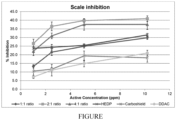
- the Figure shows the scale inhibition (%) of the samples at different concentrations.
- the present invention encompasses quaternary ammonium salts of etidronic acid or salts thereof and a method for the preparation of such quaternary etidronate compounds.
- One unique aspect of the present invention is that the inventive compound does not contain corrosive and scaling counter ions of quaternary ammonium chloride and carbonates/bicarbonates, when used on metal surfaces. The elimination of these by-product formations advantageously provides a greater degree of anti-corrosive and low scaling properties.
- Another embodiment provides the use of such compounds in combination with a hydrogen peroxide source and/or other acids for water treatment applications such as cooling towers and recirculating water systems.
- This embodiment provides a method of disinfecting a surface of microorganisms by contacting the surface with the disinfecting composition for an amount of time effective to kill a majority of the microbes located on the surface, is further described.
- the quaternary ammonium etidronate compounds having the Formula I as defined in claim 1
- the quaternary ammonium cation having the groups R1, R2, R3 and R4 may each independently be a alkyl, aryl, alkylaryl, arylalkyl, cycloalkyl, aromatic heterocyclyl, or non-aromatic heterocyclyl, or alkenyl group.
- at least one of the groups R1 and R2 contains 1-8 carbon atom and R3 and R4 each independently contain from C 6 -C 30 carbon atoms.
- R1 and R2 there are at least 1 and up to 8 carbon atoms for R1 and R2, generally 1 to 6 carbon atoms, typically 1 to 4 carbon atoms; and R3 and R4 each independently contain from C 6 -C 30 , generally C 8 -C 22 .
- R1 and R2 are each independently a C 1 -C 6 substituted or unsubstituted alkyl.
- R1 and R2 may be the same C 1 -C 6 alkyl group.
- each of R1 and R2 group is CH 3 .
- the quaternary ammonium cation shown in Formula I, includes, but is not limited to, one in which R3 and R4 is a C 8 -C 30 alkyl, aryl, alkylaryl, arylalkyl, cycloalkyl, aromatic heterocyclyl, or non-aromatic heterocyclyl, alkenyl, phenyl, alkyl-substituted phenyl, benzyl, naphthylmethyl, or ethylbenzyl group.
- the quaternary ammonium cation comprises a C 8 -C 30 dialkyldimethyl ammonium, C 8 -C 30 dialkylmethylpoly(oxyethyl) ammonium, C 8 -C 30 alkylbenzyldimethyl ammonium, C 8 -C 30 alkyltrimethylammonium, C 8 -C 30 dialkyldihydroxyethyl ammonium, C 8 -C 30 dialkylmethylhydroxyethyl ammonium, C 8 -C 30 alkylmethyldihydroxyethyl ammonium or combinations thereof, and the like.
- quaternary ammonium cations include, but not limited to, [2-[2-(4-diisobutylphenoxy)ethoxy] ethyl] dimethylbenzyl ammonium, N,N-didecyldimethyl ammonium, N,N-dioctyldimethyl ammonium, N,N-octyldecyldimethyl ammonium, octadecyldimethylbenzyl ammonium, N,N-decylisononyldimethyl ammonium, hexadecyltrimethyl ammonium, N,N-didecyl-N-methyl-poly(oxyethyl) ammonium, alkyldimethylbenzyl ammonium, didecylmethylhydroxyethyl ammonium or combinations thereof, and the like.
- the quaternary ammonium cation comprises N,N-dialkyldimethylammonium cation.
- the present invention describes a quaternary ammonium cation, shown in Formula I (as defined in claim 1), whereby the quaternary ammonium compound is generated from a quaternary ammonium compound, having a Y - anion, wherein the anion source includes, but not limited to, a quaternary ammonium carbonates, bicarbonates, halides, phosphates, sulfates, bisulfates, acetates, nitrates, hydroxides, salicylates, bentonites, molybdates, formates, borates, sulfonates, phosphites, hypophosphite, or combinations thereof and the like.
- the anion source includes, but not limited to, a quaternary ammonium carbonates, bicarbonates, halides, phosphates, sulfates, bisulfates, acetates, nitrates, hydroxides, salicylates, bentonites, molybdate
- the quaternary ammonium etidronate compounds are generated from quaternary ammonium carbonates, as shown in Schematic A and B.
- the quaternary ammonium cation having groups R1, R2, R3, or R4 may have suitable substituents groups attached to the selected groups on the R1, R2, R3 and R4 groups.
- the etidronate anion, shown in Formula I, is typically derived from etidronic acid or an etidronate salt, to prepare the quaternary ammonium etidronate (QAE).
- the groups R5 and R6 are each independently PO 3 2- or PO 3 X y ; where y is between 0-2, and where each X is independently a H, M, H , M , HM, or M + ; as described above; and R7 group is independently a H or a C 1 -C 8 alkyl.
- M is lithium, sodium, potassium or any combinations thereof.
- the etidronate anion shown in Formula I is one in which the group R5 is PO 3 2 , PO 3 H 2 , PO 3 M 2 , PO 3 HM, PO 3 H - , or PO 3 M - ; the group R6 is PO 3 2- , PO 3 H 2 , PO 3 M 2 , PO 3 HM, PO 3 H-, or PO 3 M - , and R7 is CH 3 .
- etidronate anion examples include, but are not limited to, 1 -hydroxy ethane 1,1-diphosphonic acid (HEDP or etidronic acid), sodium etidronate, disodium etidronate (1-Hydroxyethanediphosphonic acid, sodium salt), dilithium etidronate, dipotassium etidronate, trisodium etidronate, tetrasodium etidronate, tetrapotassium etidronate or combinations thereof, and the like.
- the etidronate anion is etidronic acid (1 -hydroxy ethane 1,1-diphosphonic acid, HEDP).
- an indirect synthesis method may be used to prepare the quaternary ammonium etidronates compounds of the present invention.
- the starting components used to prepare quaternary etidronate compounds may be prepared by conventional means known to those of ordinary skill in the art, such as those shown in US Patents 6,080,789A , 5,438 , 034A , 5,399,762A , 6,399,827B1 , PCT publication WO2009/038919A1 , and Japanese patent JP09077610 .
- the product yield can be further improved by adjusting the amount of reactants used, as variable ratios of each reactant to form QAE are further described.
- the quaternary etidronate compounds may be prepared by a variety of methods.
- the present invention also provides a method of reacting the quaternary ammonium etidronate compound (QAE) with an etidronate anion, as shown in Schematic A below.
- QAE quaternary ammonium etidronate compound
- the ratio of quaternary ammonium compound and etidronate anion may vary in an amount at variable ratios from about 1 : 1 to about 4: 1 of quaternary ammonium compound and etidronate anion; where m is 1-4 and n is 1; and wherein Y - is an anion; and wherein R1-R7 are as previously described, Schematics for the reaction of a quaternary ammonium compound and etidronate anion to form DDAE.
- the Y - anion includes, but is not limited to, carbonates, bicarboantes, halides, phosphate, sulfates, bisulfate, acetate, nitrates, hydroxides, salicylates, bentonites, molybdates, formate, borates, sulfonates, phosphites, hypophosphite, or combinations thereof.
- the quaternary ammonium compound being a quaternary ammonium carbonate.
- the quaternary ammonium compound is a quaternary ammonium hydroxide formed by initially reacting a metal hydroxide such as NaOH with a quaternary ammonium carbonate, bicarbonate, sulfate or nitrate, and the like.
- the etidronate anion includes, but is not limited, to 1 -hydroxyethane 1,1-diphosphonic acid (HEDP or etidronic acid), sodium etidronate, disodium etidronate (1-Hydroxyethanediphosphonic acid, sodium salt), dilithium etidronate, dipotassium etidronate, trisodium etidronate, tetrasodium etidronate, tetrapotassium etidronate or combinations thereof, and the like.
- the etidronate anion comprises etidronic acid (1 -hydroxy ethane 1,1-diphosphonic acid, HEDP).
- one particular method of preparing the quaternary ammonium compounds (QAE), having the Formula I, as shown in the reaction Scheme B includes reacting a quaternary ammonium carbonate and/or bicarbonate (such as didecyldimethylammonium carbonate, DDAC) with etidronic acid in an aqueous solvent, resulting in the production of various molar ratios of DDAE (Formula A, B, C or D) of about 1 : 1 to about 4: 1; as described in Scheme B.
- the reaction products with Formula A, B, C or D can be further converted into its alkali metal forms of Formula I-V respectively, using alkali metal hydroxide, wherein M is lithium, potassium or sodium, as further described.
- the reaction as shown in Schematic B above, is stirred in the presence of an aqueous solvent, and from about 20 °C, to an elevated temperature up to about 90 °C, and held at that temperature for a period of about 1 hour to about 5 hours, after which, the reaction mixture is then cooled to room temperature.
- the order of addition of reactants or solvent in any individual step does not affect the process.
- Reactants or solvent can be added sequentially or simultaneously in any suitable reaction vessel.
- the method of the present invention is suitable for commercial scale production techniques and equipment, yet convenient for small scale work.
- quaternary ammonium compound such as didecyldimethyl ammonium carbonate with HEDP
- a quaternary ammonium compound such as didecyldimethyl ammonium carbonate with HEDP
- the reaction involves complete neutralization of carbonate or bicarbonate of the quaternary ammonium carbonate with HEDP to produce quaternary ammonium etidronate by releasing carbon dioxide gas (product generated through the reaction process).
- the structure identity of the quaternary ammonium etidronates is determined by the molar ratio of quaternary ammonium carbonate to HEDP and HEDP/base or pH.
- QAE may also be produced through other known methods as shown by WO 2009/038919A1 , US 6,399,827B1 , JP 09077610 and others.
- equivalent amounts of an alkali metal hydroxide and a quaternary ammonium halide, sulfate or nitrate is reacted to generate the quaternary ammonium hydroxide.
- the quaternary hydroxide is filtered, removing alkali metal halides, sulfates or nitrates, after which the filtrate is reacted with etidronic acid to produce the quaternary ammonium etidronate.
- QAE may also be formed through a two-step reaction process; whereby the first step involves the reaction of decyldimethylamine with decyl chloride in an alcohol such as methanol or ethanol, at an elevated temperature, after which a base such as sodium hydroxide is added to the solvent to neutralize acidic solution.
- the second step involves the removal of the resulting sodium chloride via filtration, followed by the addition of etidronic acid to the filtrate containing didecyldimethylammonium hydroxide forming one or more of a QAE compound, having the Formula I.
- the method of forming QAE further comprises the reaction taking place in the presence of one or more of an aqueous solvent, optional anti-foaming agent, optional base or combinations thereof, and the like.
- an aqueous solvent optional anti-foaming agent, optional base or combinations thereof, and the like.
- the addition of one or more of the following are each dependent on the ratio of quaternary ammonium reactant and etidronate reactant used.
- aqueous solvent examples include, but is not limited to, water, aqueous alcohols, ammonia water, acid solutions, salt solutions, water-miscible organic solvents, glycols (i.e. ethylene glycol, propylene glycol), combinations thereof, and the like.
- the solvent used is water or an aqueous alcohol.
- aqueous alcohols include, but are not limited to, methanol, ethanol, propanol, benzyl alcohol, phenoxyethanol, isopropanol, ethylene glycol, propylene glycol or combinations thereof, and the like.
- water-miscible organic solvents include, but not limited to, alkyl and dialkly glycol ethers of ethylene glycol or propylene glycol, such as diethylene glycol propyl ether, ethylene glycol monomethyl ether, ethylene glycol monoethyl ether, ethylene glycol monopropyl ether, ethylene glycol monoisopropyl ether, ethylene glycol monobutyl ether, diethylene glycol monomethyl ether, diethylene glycol monobutyl ether, diethylene glycol monoethyl ether, diethylene glycol mono-n-butyl ether, ethylene glycol dimethyl ether, ethylene glycol diethyl ether, ethylene glycol dibutyl ether, propylene glycol n-butyl ether, tripropylene glycol methyl ether, dipropylene glycol methyl ether, dipropylene glycol butyl ether, or combinations thereof, and the like.
- a base strong or weak
- a strong or weak base includes, but is not limited to, NaOH, KOH, LiOH, NH4OH, ammonia or combinations thereof and the like.
- the base comprises 50% NaOH.
- anti-foaming agents include, but are not limited to, silicon based (polydimethylsiloxane, Oreo Antifoam AFB TM , Andifoam-DF series; Foam Blast or Masil series by Emerald Performance materials; SAF series by Silchem Inc.; Silfar series by Wacker Chemical Corp.; or etc.), alkyl poly acrylates, castor oil, fatty acids, fatty acids esters (saturated or unsaturated C 4 -C 22 atoms; polymerized C 4 -C 22 fatty acid esters;), mineral oils, fatty acids sulfate, fatty alcohols (C 12 -C 30 monohydric to trihydric alcohols C 4 -C 22 monohydric to trihydric alcohols), fatty alcohol esters (dihydric or trihydric alcohols of C12 to C22 atoms; polyoxypropylated or ethoxylated glycerol; saturated or unsatur
- the antifoaming agent is polydimethylsiloxane, (Trade name SAG 710 antifoam).
- SAG 710 antifoam polydimethylsiloxane
- the addition of the anti-foaming agent will be dependent on the ratio of quaternary ammonium cation salt and etidronate anion as shown in the examples to follow.
- the percent yield of quaternary ammonium cation formed is dependent on the quaternary ammonium compound and etidronate used; generally the conversion is quantitative, as shown in Schematic B.
- the percent yield of quaternary ammonium cation formed from the reaction process ranging from about 31 w/w% to about 45 w/w%, is dependent on the molar ratio of quaternary ammonium reactant and etidronic acid used to form the quaternary etidronate compound.
- the present invention describes the need to adjust the pH of the solution, which will also vary depending on the ratio of quaternary ammonium cation to etidronate anion and the addition of NaOH to neutralize the OH" anions at R5 and R6 group, as shown in Formula I.
- didecyldimethylammonium etidronates having Formula II, III, IV, or V are generated from the reaction using various ratios of quaternary ammonium compound such as didecyldimethyl ammonium carbonate and etidronic acid in the presence of water and an optional antifoaming agent (for example a polydimethylsiloxane, Trade name SAG 710 antifoam) using about 1 to about 4 molar ratios of didecyldimethyl ammonium carbonate to etidronic acid, respectively. Consequently, an alkali metal hydroxide is added to afford the corresponding M salts of Formula II, III, IV or V; whereby M is lithium, sodium or potassium salt.
- quaternary ammonium compound such as didecyldimethyl ammonium carbonate and etidronic acid in the presence of water and an optional antifoaming agent (for example a polydimethylsiloxane, Trade name SAG 710
- the ratio of quaternary ammonium cation and etidronate anion can be present at variable ratios from about 1 : 1 to about 4: 1.
- the ratio from about 1 to about 1 of quaternary ammonium carbonate cation and etidronic acid may be used to form the quaternary etidronate compounds, having the Formula I.
- the group R5 may be any one of PO 3 2- , PO 3 M 2 , or PO 3 HM
- the group R6 may be any one of PO 3 H - or PO 3 M - and R7 is CH 3 .
- the QAE compound formed from the 1 : 1 ratio of quaternary ammonium carbonate cation to etidronate anion is one having the Formula II, wherein the group R5 is PO 3 M 2 , the group R6 is PO 3 M - and the group R7 is CH 3 , as shown below, where m and n are independently 1.
- the preparation of QAE using such a ratio includes the mixture of about 1 molar ratio of quaternary ammonium carbonate cation salt, about 1 molar ratio etidronate anion, water, and polydimethylsiloxane antifoam at about 20 °C to about 90 °C, for about 1 to about 5 hr., to form a quaternary etidronate compound, having the Formula I, wherein R5 is PO 3 2- , PO 3 M 2 , or PO 3 HM, R6 is PO 3 H - or PO 3 M - and R7 is CH 3 .
- the ratio of about 2 to about 1 ratio of reacting quaternary ammonium carbonate cation with etidronate anion may be used to form the quaternary etidronate compound, having the Formula I.
- the preparation of QAE involves mixing about 2 molar ratio of quaternary ammonium carbonate cation salt, about 1 molar ratio etidronate acid, water, and polydimethylsiloxane antifoam at about 20 °C to about 90 °C for about 1 to about 5 hr., to form a quaternary etidronate compound, having the Formula II, wherein the group R5 is PO 3 H - , or PO 3 M - , the group R6 is PO 3 H - or PO 3 M - and the group R7 is CH 3 .
- the QAE formed from the 2: 1 ratio of quaternary ammonium carbonate to etidronate anion is one having the Formula III, wherein the group R5 and R6 are each PO 3 M - , R7 is CH 3 , m is 2 and n is 1.
- the ratio of about 3 to about 1 ratio of reacting quaternary ammonium carbonate cation with etidronate anion may be used to form the quaternary etidronate compound, having the Formula I.
- the preparation of QAE involves mixing about 3 molar ratio of quaternary ammonium carbonate cation salt, about 1 molar ratio etidronate acid, water, and polydimethylsiloxane antifoam at about 20°C to about 90 °C, for about 1 to about 5 hr., to form a quaternary etidronate compound, having the Formula I, wherein R5 is PO 3 2- and R6 is PO 3 H - or PO 3 M - .
- the QAE formed from the 3 : 1 ratio of quaternary ammonium carbonate cation to etidronate anion is one having the Formula IV, wherein the group R5 is PO 3 M - , R6 is PO 3 2- , R7 is CH 3 , m is 3 and n is 1.
- the ratio of about 4 to about 1 ratio of reacting quaternary ammonium carbonate cation with etidronate acid may be used to form the quaternary etidronate compound, having the Formula I.
- the preparation of QAE involves mixing about 4 molar ratio of quaternary ammonium carbonate cation salt, about 1 molar ratio etidronate anion, water, and polydimethylsiloxane antifoam at about 20°C to about 90 °C, for about 1 to about 5 hr., to form a quaternary etidronate compound, having the Formula I, wherein the group R5 is PO 3 2- and the group R6 is PO 3 2- .
- the QAE formed from the 4: 1 ratio of quaternary ammonium carbonate cation to etidronate anion is one having the Formula V, wherein the group R5 and R6 group are each PO 3 2- , R7 is CH 3 m is 4 and n is 1.
- the QAE compound provides high anti-corrosive properties, biocidal properties, and low scaling properties in comparison to quaternary ammonium carbonates; as shown in the Figure.
- the QAE compound in the present invention may be used in various applications, in lieu of carbonate quaternary ammonium compounds.
- the present invention may be used in various application areas including, but not limited to, water treatment systems, cosmetic, hygiene, personal care, paint, coating, wood treatment, agrochemical, antimicrobial, biocidal or disinfectant composition, and the like.
- Such application having an effective amount of one or more QAE compounds are useful as a disinfectant, decontaminant, microbial agent, sanitizer, cleaning agent, and the like.
- Such compositions are contacted for an amount of time, effective to kill a majority of the microbes located on the surface or in the formulations.
- the QAE compound formed from the methods described above may be applied, to formulations/compositions where quaternary ammonium carbonate is currently being used, such as, water treatment systems, personal care, cosmetics, wood treatment, and hygiene compositions, biocidal compositions, other water treatment compositions, and the like.
- formulations/compositions where quaternary ammonium carbonate is currently being used such as, water treatment systems, personal care, cosmetics, wood treatment, and hygiene compositions, biocidal compositions, other water treatment compositions, and the like.
- the compositions, as described in this present invention may be used in concentrated or diluted forms depending upon the application.
- the scale inhibition test demonstrates that all DDA etidronates (1 : 1, 2: 1, and 4: 1 ratios) showed 20-25% more scale inhibition in comparison with Carboshield 1000 and DDAC within the tested ranges of concentrations; which both exhibited little to no scale inhibition.
- the 1 : 1 ratio appeared to show a similar % inhibition as HEDP
- the 2: 1 ratio and the 4: 1 ratio DDA etidronate appeared to show better inhibition performance than HEDP.
- the 2: 1 ratio seemed to perform the best for scale inhibition based on total active concentrations.
- a water treatment composition is described using a QAE or derivative thereof, and a water treating biocidal agent.
- the water treatment composition is formed containing an effective amount of a QAE compound or derivative thereof, and a water treating biocidal agent.
- a method of treating as cooling towers and recirculating water systems comprising an effective amount of one or more QAE compounds; wherein the compound(s) is contacted for an amount of time sufficient to kill microbes present in the water.
- the water treating biocidal agent includes, but is not limited to, halogen releasing agent; an amine (such as Bis (3-aminopropyl) dodecylamine); a peroxy acids or salts thereof (such as persulfates, persalts and halide salts); hydrogen peroxide source, an isothiazolinone or a mixture of isothiazolinones; or combinations thereof and the like, or compatible combinations thereof, and the like.
- halogen releasing agent such as Bis (3-aminopropyl) dodecylamine
- a peroxy acids or salts thereof such as persulfates, persalts and halide salts
- hydrogen peroxide source an isothiazolinone or a mixture of isothiazolinones; or combinations thereof and the like, or compatible combinations thereof, and the like.
- exemplary halogen releasing agents include, but are not limited to, chlorinated isocyanuric acids or salts thereof, halogenated hydantoins, hypochlorous acids or salts thereof, chlorine gas, chlorine dioxide, hypobromite salts, hypobromous acid; or compatible combinations thereof, and the like.
- isocyanuric acids or salts thereof include but are not limited to, such as trichloroisocyanuric acid (TCCA), dichloroisocyanuric acid (DCCA), dichloroisocyanurate salts (e.g. sodium dichloroisocyanurate, potassium dichloroisocyanurate), trichloroisocyanurateand (e.g. sodium or potassium trichloroisocyanurate), or combinations thereof, and the like.
- TCCA trichloroisocyanuric acid
- DCCA dichloroisocyanuric acid
- dichloroisocyanurate salts e.g. sodium dichloroisocyanurate, potassium dichloroisocyanurate
- trichloroisocyanurateand e.g. sodium or potassium trichloroisocyanurate
- halogen-containing hydantoins include, but are not limited to, both chlorine-containing hydantoins and bromine-containing hydantoins such as bromochlorodimethylhydantoin (BCDMH), dibromodimethylhydantoin (DBDMH), dichlorodimethylhydantoin (DCDMH), dichloromethylethylhydantoin (DCMEH), or combinations thereof, and the like.
- BCDMH bromochlorodimethylhydantoin
- DBDMH dibromodimethylhydantoin
- DCDMH dichlorodimethylhydantoin
- DCMEH dichloromethylethylhydantoin
- hypochlorous acids or salts thereof include, but are not limited to, lithium hypochlorite, sodium hypochlorite, potassium hypochlorite, magnesium hypochlorite, calcium hypochlorite, or combinations thereof, and the like.
- hydrogen peroxide sources include, but are not limited to, aqueous hydrogen peroxide solution, sodium percarbonate, potassium percarbonate, sodium and potassium perborate, hydrogen peroxide urea, as well as their hydrated forms, or combinations thereof and the like.
- one hydrogen peroxide source comprises a concentrated solution containing about 20 w/w% to about 50 w/w% of a hydrogen peroxide source dissolved in water.
- another composition the hydrogen peroxide source comprises a solid formulation of sodium percarbonate.
- a method of treating water systems comprising the quaternary ammonium etidronate compound or derivative thereof present from about 5 w/w% to about 35 w/w% of the total composition; and the water treating biocidal agent is present from about 0.1 w/w% to 25 w/w% of the total composition.
- a biocidal or water treatment composition comprising a) 5 w/w% to about 35 w/w% of a quaternary ammonium etidronate compound, b) a hydrogen peroxide present in an amount from 0.1 w/w% to about 25 w/w% of a concentrated hydrogen peroxide source ranging from 20 w/w% to 50 w/w%; and c) water sufficient for the total composition to equal 100%.
- a biocidal composition comprising 25% of about a 2 to about a 1 ratio of QAE composition and about 16 w/w% of a 50 w/w% concentrated hydrogen peroxide source dissolved in water.
- water treating systems may further comprise an optional acid, a carboxylic acid or mineral acid; optional stabilizer; second biocidal agent or combinations thereof and the like.
- the total concentration of the acid is present from about 0.1 w/w% to 10 w/w% of the total composition.
- carboxylic acids include but not limited to, a C 1 to C 8 mono, dior tricarboxylic acid, a C 1 to C 8 hydroxyl carboxylic acid, a substituted or unsubstituted aromatic carboxylic acid such as acetic acid, propionic acid, butyric acid, pentanoic acid, hexanoic acid, octanoic acid, succinic acid, citric acid, oxalic acid, tartaric acid, glutaric acid, adipic acid, benzoic acid, phthalic acid, or combinations thereof, and the like.
- mineral acids include, but not limited to, phosphoric acid, sulfuric acid, hydrochloric acid or combinations thereof, and the like.
- the total concentration of the acid is present from about 0.1 w/w% to 10 w/w% of the total composition.
- the second biocidal agent examples include, but are not limited to, isothiazolones or combinations thereof; pyrithiones, halogenated hydantoins, isocyanuric acids or salts thereof; hypochlorous or hypobromous acid and salts thereof; glutaraldehyde, Iodopropynyl butylcarbamate (IPBC), polyhexamethylene biguanide (PHMB), 2-Bromo-2-nitro-1,3-propanediol (bronopol), 2,2-dibromo-3-nitrilopropionamide (DBNPA), or combinations thereof, and the like.
- the second biocide may be present from about 0.1 w/w% to about 25 w/w% of the total composition.
- optional stabilizer examples include, but are not limited to, organic and inorganic sequestering agent such as stannates and phosphates, and/or combinations of organic compounds, organometallic salts and metal chelators with or without stannates or phosphates; combinations thereof, and the like.
- organic and inorganic sequestering agent such as stannates and phosphates
- metal chelators with or without stannates or phosphates; combinations thereof, and the like.
- the addition of a stabilizer(s) serves to prevent the components, in the biocidal composition, from decomposing on the shelf prematurely during storage of the formulations.
- the addition of a stabilizer is used to deactivate impurities that may cause decomposition of hydrogen peroxide source.
- the amount of the stabilizer in the concentrate may be from about 0.01 w/w% to about 5 w/w%.
- the concentration of stabilizer used may be from about 0.05 w/w% to about 2 w/w%; or desirably from about 0.1 w/w% to about 1.0 w/w%.
- biocidal composition of the present disclosure may include corrosion inhibitors, emulsifiers, fragrances, dyes, preservatives, thickening agents, hydrotrope agents, or combinations thereof, and the like.
- the biocidal compositions having a QAE compound and a hydrogen peroxide source may be used in numerous and diverse applications, as previously mentioned.
- the biocidal composition may be used to sanitize or disinfect hard, non-porous surfaces.
- such a composition, as described is well suited for disinfecting or sanitizing flooring materials, countertops, ceramic surfaces, metal surfaces, glass surfaces, stone surfaces, and the like.
- the compositions may be used to clean the surfaces, destroy microorganisms on the surface and/or prevent growth of microorganisms on the surface.
- biocidal composition in the food service industry, to disinfect and sanitize food processing equipment and other food processing surfaces or to wash produce, such as vegetables.
- a composition may also be used in the healthcare industry to disinfect surfaces, facility, equipment and hospital instruments and equipment, and/or disinfect utensils.
- a method of treating recirculating water using an effective amount of the water treatment composition as described wherein the composition is contacted for an amount of time sufficient to kill microbes present in the water.
- water treatment applications include but are not limited to, water sources of industrial process water systems, process water applications, process waters, utility waters, water used in manufacturing, water used in industrial services, aqueous liquid streams, liquid stream, cooling towers, recirculating water systems, recreational water, recycled water, industrial water, and/or any other suitable or desirable fresh or sea water source that is frequently subject to excessive plant growth, including algae, cyanobacteria, fungi, mold, mildew, and the like.
- Suitable examples of such systems include, but are not limited to, swimming pools, spas, ponds, lakes, streams, canals, and any body of water (fresh or salt water source), that is frequently subject to excessive plant growth, including algae, cyanobacteria, and the like.
- a method of treating recirculating water using an effective amount of the water treatment composition is described, wherein the composition is contacted for an amount of time sufficient to kill microbes present in the water; and wherein the water is a swimming pool, pond, lake, stream, canal.
- Another aspect of the invention describes a water treatment composition
- a water treatment composition comprising (a) an effective amount of one or more of a quaternary ammonium etidronate compound or derivative thereof as described, (b) a water treating biocidal agent, (c) a hydrogen peroxide source and (d) water.
- the present invention provides the use of one or more QAE compounds in combination with a hydrogen peroxide source and/or other acids for water treatment applications, comprising cooling towers and recirculating water systems.
- This embodiment provides a method of disinfecting a surface of microorganisms by contacting the surface with the disinfecting composition for an amount of time effective to kill a majority of the microbes located on the surface.
- microorganisms include, but not limited to, gram positive bacteria, gram negative bacteria, viruses, fungi, mildew, mold and combinations thereof
- the disclosure also provides a method of using the composition of QAE or derivative thereof, having the Formula I-V, with a hydrogen peroxide source or other biocidal agent, as another water treatment or biocidal composition.
- a composition having a quaternary ammonium etidronate compound and a hydrogen peroxide source together which may be used to kill or to inhibit the growth of microorganisms such as gram positive or gram negative bacteria, viruses, fungi, mildew, mold or combinations thereof, for water applications.
- compositions have shown improved microbial efficacy against a variety of microorganisms that are potentially harmful or capable of causing disease, such as gram positive and gram negative bacteria, viruses, fungi, mildew, or mold, and the like.
- microorganisms include, but are not limited to, Staphylococcus, Pseudomonas, hepatitis, rotavirus, rhinovirus, or Mycobacterium terrae.
- the compositions has improved microbial efficacy against S. aureus, E. coli, Candida albicans, Aspergillus niger, P. aeruginosa, B. mycoides, A. niger, and C. pyrenoidosa especially Mycobacterium terrae.
- a 2: 1 ratio solution of QAE was formed by reacting about 2 molar ratio of quaternary ammonium cation and about 1 molar ratio of etidronic acid.
- the quaternary ammonium cation used was 81.49g of didecyldimethylammonium carbonate (50% active), 18.5g of etidronic acid (HEDP, 60%), along with the addition of water (12.05 mL), and an antifoaming agent (0.1%, polydimethylsiloxane).
- the reactants were mixed for about 1 to about 5 hr., at a temperature between 25 to about 90 °C; then cooled, at relative room temperature, having a final pH of 4.90.
- the percent yield of quaternary ammonium cation was 31.9%.
- a 1 : 1 ratio of QAE was formed by reacting about 1 molar ratio of quaternary ammonium cation and about 1 molar ratio of etidronic acid.
- the quaternary ammonium cation used was 40.04g of didecyldimethylammonium carbonate (50% active), 18.07g of HEDP (60%), along with water (4 mL), 4.22g of NaOH (50%), and an anti-foaming agent (0.05%, polydimethylsiloxane).
- the reactants were mixed for about 1 to about 5 hr., at a temperature between 25 to about 90 °C; then cooled, at relative room temperature, having a final pH of 3.01.
- the percent yield of quaternary ammonium cation was 27.37%, through the addition of a base (NaOH).
- a 4: 1 ratio of QAE was formed by reacting about 4 molar ratio of quaternary ammonium cation and 1 molar ratio of etidronic acid.
- the quaternary ammonium cation used was 50.02g of didecyldimethylammonium carbonate (50% active), 5.86 g of HEDP (60%), water (4.01 mL), and an anti-foaming agent (0.05% polydimethylsiloxane) were mixed to yield a composition having a pH of 8.34, yielding 38.21% quaternary ammonium cation.
- the reactants were mixed for about 1 to about 5 hr., at a temperature between 25 to about 90 °C then cooled, at relative room temperature.
- a biocidal composition containing a hydrogen peroxide/water mixture and varied concentrations of QAE may be used for the treatment of cooling towers or recirculating water systems.
- the formulation consists of a QAE compound formed as shown in examples 1-3, typically having about 5% to about 35% quaternary ammonium etidronate or derivative thereof, about 0.1 to about 25% of a hydrogen peroxide source (50% active), and water.
- the percentage weight of each active is based on the weight percent of the total composition.
- a water treatment composition containing hydrogen peroxide/water mixture and typically a 2: 1 ratio of QAE may be used for the treatment of cooling towers and recirculating water systems.
- the biocidal composition consists of QAE formed as shown in examples 1, typically having about 25% quaternary ammonium etidronate or derivative thereof, about 15% hydrogen peroxide source/water mixture (50% active), about 0.1% to about 10% weight of a carboxylic acid and water. The percentage weight of each active is based on the weight percent of the total composition.
- composition as described in example 1 was tested biocidal activity against various microorganisms such as Pseudomonas aeruginosa, B. mycoides, A. niger, and C. pyrenoidosa.
- the results showed efficacy against various gram positive and gram negative microorganisms with 7.81 ppm against P. aeruginosa, ⁇ 0.98 against B. mycoides, ppm against A. niger and ⁇ 0.98 ppm against C. pyrenoidosa.
- the test pH for the bacteria was about 7.2, about 5.6 for fungi, and about 7.4 for the algae.
Landscapes
- Chemical & Material Sciences (AREA)
- Life Sciences & Earth Sciences (AREA)
- Organic Chemistry (AREA)
- Engineering & Computer Science (AREA)
- Health & Medical Sciences (AREA)
- General Health & Medical Sciences (AREA)
- Environmental & Geological Engineering (AREA)
- Water Supply & Treatment (AREA)
- Hydrology & Water Resources (AREA)
- Wood Science & Technology (AREA)
- Plant Pathology (AREA)
- Dentistry (AREA)
- Pest Control & Pesticides (AREA)
- Agronomy & Crop Science (AREA)
- Zoology (AREA)
- Environmental Sciences (AREA)
- Biochemistry (AREA)
- Molecular Biology (AREA)
- Agricultural Chemicals And Associated Chemicals (AREA)
- Organic Low-Molecular-Weight Compounds And Preparation Thereof (AREA)
Description
- The disclosure relates to quaternary ammonium etidronates (QAE), the method of preparing quaternary ammonium etidronates and methods of using the same.
- Quaternary ammonium chlorides have been used in a variety of different products including surfactants, antimicrobial compositions, antiseptic compositions, water treatment compositions, and other biocidal compositions. However, quaternary ammonium chlorides, while effective antimicrobial agents, have a drawback in that the dissociation of the chloride ions in solution results in the corrosion of metal surfaces.
- To address this corrosion problem with quaternary ammonium chlorides, other quaternary ammonium compounds have been developed. One class of quaternary ammonium compounds is quaternary ammonium carbonates/ bicarbonates. Unlike traditional quaternary ammonium chlorides, quaternary ammonium carbonates/bicarbonates provide solutions which exhibit excellent corrosion inhibitory properties on a wide variety of metal substrates. However, quaternary ammonium carbonates/ bicarbonates suffer from one drawback also, whereby in hard water, the carbonate/bicarbonate salts tend to form scale, due to the presence of calcium in the water.
JP2015123381 - There is a need in the art to have a quaternary ammonium compound which will provide both low corrosion and low scale in systems which contain metal surfaces. The present disclosure provides an answer to that need of identifying a quaternary ammonium compound with anti-corrosive properties, biocidal activity and low scaling properties.
- It has now been surprisingly found that quaternary ammonium etidronates or derivatives thereof may be used in lieu for quaternary ammonium chlorides and quaternary ammonium carbonate/bicarbonate, by eliminating the presence of chloride ions and carbonates/bicarbonate ions, which currently result in the issue of scaling in hard water and metal corrosion.
- The present invention, in one embodiment, describes quaternary ammonium etidronate compounds (QAE) having a quaternary ammonium cation, and an etidronate anion. Variable ratios of each reactant, as further described, can be reacted together, resulting in the formation of different quaternary ammonium etidronates. Furthermore, the method of preparation and use of QAE compounds is also described.
- In accordance with the present invention, describes the quaternary ammonium etidronate compounds, having the Formula I as defined in
claim 1. - In another embodiment, R1, R2, R3 or R4 when substituted comprises substituent groups selected from one or more of a F, Br, I, CI,-OR',- NR'R",- CF3,- CN,- NO2,- C2R', - SR', - N3, - C(=O)NR'R", - NR'C(O)R", - O(CR'R")rC(=O)R', O(CR'R")rNR'C(O)R', - (CR'R")rNR"SO2R', - OC(O)NR'R", - NR'C(O)OR", - SO2R', - SO2NR'R", - NR'SO2R"; or combinations thereof; wherein R' and R" are individually hydrogen, C1-C8 alkyl, cycloalkyl, heterocyclyl, aryl, or arylalkyl, and R is an integer from 1 to 6, or R' and R" together form a cyclic functionality.
- In one embodiment, R1 and R2 are each a CH3.
- In one embodiment, R3 and R4 are each a C6-C30 alkyl, aryl, alkylaryl, arylalkyl, cycloalkyl, aromatic heterocyclyl or non-aromatic heterocyclyl, alkenyl, phenyl, alkyl-substituted phenyl, benzyl, naphthylmethyl, or ethylbenzyl group.
- The quaternary ammonium cation, comprises a C8-C30 dialkyldimethyl ammonium, C8-C30 dialkylmethylpoly(oxyethyl) ammonium, C8-C30 alkylbenzyldimethyl ammonium, C8-C30 alkyltrimethylammonium, C8-C30 dialkyldihydroxyethyl ammonium, C8-C30 dialkylmethylhydroxy ethyl ammonium, or C8-C30 alkylmethyldihydroxyethyl ammonium or combinations thereof.
- Another aspect provides, a method of preparing such compounds as defined in claim 7.
- In one embodiment, the weight ratio of the quaternary ammonium cation to the etidronate anion is from about 1 : 1 to about 4: 1.
- In one particular embodiment, the etidronate anion comprises an ion of 1-
hydroxyethane 1, 1-diphosphonic acid (HEDP or etidronic acid), sodium etidronate, disodium etidronate (1-Hydroxyethanediphosphonic acid, sodium salt), dilithium etidronate, dipotassium etidronate, trisodium etidronate, tetrasodium etidronate, tetrapotassium etidronate or combinations thereof. - In further embodiments, the reaction, according to the method described, takes places in the presence of optional additives comprising antifoaming agents, base, aqueous solvent or combinations thereof.
- In yet another embodiment, the application for such compounds is described for use in various compositions such as water treatment, personal care, cosmetics, wood treatment, paint, coatings, agrochemicals, antimicrobial, disinfectant, hygiene compositions, biocidal compositions or combinations thereof.
- In one aspect of the present invention, an effective amount of one or more quaternary ammonium etidronate is added, wherein the compound is contacted for an amount of time sufficient to kill microbes present in the water, and wherein the water is a swimming pool, pond, lake, stream, canal.
- Another aspect of the present invention describes a water treatment composition comprising an effective amount of one or more of a quaternary ammonium etidronate compound or derivative thereof, and a water treating biocidal agent.
- In a further aspect, the invention provides a water treatment composition comprising (a) an effective amount of one or more of a quaternary ammonium etidronate compound or derivative thereof, according to the present invention, (b) a water treating biocidal agent, (c) a hydrogen peroxide source and (d) water.
- In one embodiment, the water treating biocidal agent comprises a halogen releasing agent; a peroxy compound; a hydrogen peroxide source; an isothiazolone, derivataives or a mixture of isothiazolones; an amine, or combinations thereof; wherein the halogen releasing agent comprises a chlorinated isocyanuric acids or salts thereof, halogenated hydantoins, hypochlorous acid, hypochlorite salts, chlorine gas, chlorine dioxide, hypobromite salts, hypobromous acid or a mixture thereof.
- In one embodiment, a water treatment, cosmetic, hygiene, personal care, paint, coating, wood treatment, agrochemical, antimicrobial, biocidal or disinfectant composition comprising an effective amount of one or more quaternary ammonium etidronate compounds, useful as a disinfectant, decontaminant, microbial agent, sanitizer or cleaning agent.
- In one aspect, the invention provides quaternary ammonium etidronate compounds, having high anti-corrosive properties, biocidal properties and low scaling properties.
- These and other aspects will become apparent when reading the detailed description of the invention.
- The Figure shows the scale inhibition (%) of the samples at different concentrations.
- The present invention encompasses quaternary ammonium salts of etidronic acid or salts thereof and a method for the preparation of such quaternary etidronate compounds. One unique aspect of the present invention is that the inventive compound does not contain corrosive and scaling counter ions of quaternary ammonium chloride and carbonates/bicarbonates, when used on metal surfaces. The elimination of these by-product formations advantageously provides a greater degree of anti-corrosive and low scaling properties.
- Furthermore, another embodiment provides the use of such compounds in combination with a hydrogen peroxide source and/or other acids for water treatment applications such as cooling towers and recirculating water systems. This embodiment provides a method of disinfecting a surface of microorganisms by contacting the surface with the disinfecting composition for an amount of time effective to kill a majority of the microbes located on the surface, is further described.
- In accordance with the present invention, the quaternary ammonium etidronate compounds, having the Formula I as defined in
claim 1 - Alternately, the quaternary ammonium cation having the groups R1, R2, R3 and R4, may each independently be a alkyl, aryl, alkylaryl, arylalkyl, cycloalkyl, aromatic heterocyclyl, or non-aromatic heterocyclyl, or alkenyl group. In a one aspect of the present invention, at least one of the groups R1 and R2 contains 1-8 carbon atom and R3 and R4 each independently contain from C6-C30 carbon atoms.
- For example, there are at least 1 and up to 8 carbon atoms for R1 and R2, generally 1 to 6 carbon atoms, typically 1 to 4 carbon atoms; and R3 and R4 each independently contain from C6-C30, generally C8-C22.
- In the present invention, one embodiment of the quaternary ammonium cation having the Formula I, where R1 and R2 are each independently a C1-C6 substituted or unsubstituted alkyl. In another embodiment, R1 and R2 may be the same C1-C6 alkyl group. Desirably, each of R1 and R2 group is CH3.
- The quaternary ammonium cation, shown in Formula I, includes, but is not limited to, one in which R3 and R4 is a C8-C30 alkyl, aryl, alkylaryl, arylalkyl, cycloalkyl, aromatic heterocyclyl, or non-aromatic heterocyclyl, alkenyl, phenyl, alkyl-substituted phenyl, benzyl, naphthylmethyl, or ethylbenzyl group. The quaternary ammonium cation comprises a C8-C30 dialkyldimethyl ammonium, C8-C30 dialkylmethylpoly(oxyethyl) ammonium, C8-C30 alkylbenzyldimethyl ammonium, C8-C30 alkyltrimethylammonium, C8-C30 dialkyldihydroxyethyl ammonium, C8-C30 dialkylmethylhydroxyethyl ammonium, C8-C30 alkylmethyldihydroxyethyl ammonium or combinations thereof, and the like.
- Suitable examples of quaternary ammonium cations include, but not limited to, [2-[2-(4-diisobutylphenoxy)ethoxy] ethyl] dimethylbenzyl ammonium, N,N-didecyldimethyl ammonium, N,N-dioctyldimethyl ammonium, N,N-octyldecyldimethyl ammonium, octadecyldimethylbenzyl ammonium, N,N-decylisononyldimethyl ammonium, hexadecyltrimethyl ammonium, N,N-didecyl-N-methyl-poly(oxyethyl) ammonium, alkyldimethylbenzyl ammonium, didecylmethylhydroxyethyl ammonium or combinations thereof, and the like.
- Desirably, the quaternary ammonium cation comprises N,N-dialkyldimethylammonium cation.
- As further described, the present invention describes a quaternary ammonium cation, shown in Formula I (as defined in claim 1), whereby the quaternary ammonium compound is generated from a quaternary ammonium compound, having a Y- anion, wherein the anion source includes, but not limited to, a quaternary ammonium carbonates, bicarbonates, halides, phosphates, sulfates, bisulfates, acetates, nitrates, hydroxides, salicylates, bentonites, molybdates, formates, borates, sulfonates, phosphites, hypophosphite, or combinations thereof and the like.
- Suitably, the quaternary ammonium etidronate compounds are generated from quaternary ammonium carbonates, as shown in Schematic A and B.
- Typically, the quaternary ammonium cation having groups R1, R2, R3, or R4 may have suitable substituents groups attached to the selected groups on the R1, R2, R3 and R4 groups. For example, any one of R1, R2, R3, or R4 when substituted comprises substituent groups selected from one or more of a F, Br, CI, I,-OR',- NR'R",- CF3,- CN,- NO2,- C2R', - SR', - N3, - C(=O)NR'R", - NR'C(O)R", - O(CR'R")rC(=O)R', - O(CR'R")rNR'C(O)R', - (CR'R")rNR"SO2R', - OC(O)NR'R", - NR'C(O)OR", - SO2R', - SO2NR'R", and-NR'SO2R", wherein R' and R" are each individually hydrogen, C1-C8 alkyl, cycloalkyl, heterocyclyl, aryl, or arylalkyl, and r is an integer from 1 to 6, or R' and R" together form a cyclic functionality.
- The etidronate anion, shown in Formula I, is typically derived from etidronic acid or an etidronate salt, to prepare the quaternary ammonium etidronate (QAE). The groups R5 and R6 are each independently PO3 2- or PO3Xy; where y is between 0-2, and where each X is independently a H, M, H , M , HM, or M+; as described above; and R7 group is independently a H or a C1-C8 alkyl. Suitably, M is lithium, sodium, potassium or any combinations thereof.
- Desirably, the etidronate anion shown in Formula I, is one in which the group R5 is PO3 2, PO3H2, PO3M2, PO3HM, PO3H-, or PO3M-; the group R6 is PO3 2-, PO3H2, PO3M2, PO3HM, PO3H-, or PO3M-, and R7 is CH3.
- Examples of etidronate anion include, but are not limited to, 1 -
hydroxy ethane 1,1-diphosphonic acid (HEDP or etidronic acid), sodium etidronate, disodium etidronate (1-Hydroxyethanediphosphonic acid, sodium salt), dilithium etidronate, dipotassium etidronate, trisodium etidronate, tetrasodium etidronate, tetrapotassium etidronate or combinations thereof, and the like. Desirably, the etidronate anion is etidronic acid (1 -hydroxy ethane 1,1-diphosphonic acid, HEDP). - In schematic A below, an indirect synthesis method may be used to prepare the quaternary ammonium etidronates compounds of the present invention. The starting components used to prepare quaternary etidronate compounds may be prepared by conventional means known to those of ordinary skill in the art, such as those shown in
US Patents 6,080,789A ,5,438 ,034A ,5,399,762A ,6,399,827B1 ,PCT publication WO2009/038919A1 , andJapanese patent JP09077610 - The product yield can be further improved by adjusting the amount of reactants used, as variable ratios of each reactant to form QAE are further described.
- As previously mentioned, the quaternary etidronate compounds may be prepared by a variety of methods. The present invention also provides a method of reacting the quaternary ammonium etidronate compound (QAE) with an etidronate anion, as shown in Schematic A below. Suitably, the ratio of quaternary ammonium compound and etidronate anion may vary in an amount at variable ratios from about 1 : 1 to about 4: 1 of quaternary ammonium compound and etidronate anion; where m is 1-4 and n is 1; and wherein Y- is an anion; and wherein R1-R7 are as previously described,

- Typically, the Y- anion, includes, but is not limited to, carbonates, bicarboantes, halides, phosphate, sulfates, bisulfate, acetate, nitrates, hydroxides, salicylates, bentonites, molybdates, formate, borates, sulfonates, phosphites, hypophosphite, or combinations thereof. Suitably, the quaternary ammonium compound being a quaternary ammonium carbonate.
- Alternately, the quaternary ammonium compound is a quaternary ammonium hydroxide formed by initially reacting a metal hydroxide such as NaOH with a quaternary ammonium carbonate, bicarbonate, sulfate or nitrate, and the like.
- Suitably, the etidronate anion includes, but is not limited, to 1 -
hydroxyethane 1,1-diphosphonic acid (HEDP or etidronic acid), sodium etidronate, disodium etidronate (1-Hydroxyethanediphosphonic acid, sodium salt), dilithium etidronate, dipotassium etidronate, trisodium etidronate, tetrasodium etidronate, tetrapotassium etidronate or combinations thereof, and the like. Desirably, the etidronate anion comprises etidronic acid (1 -hydroxy ethane 1,1-diphosphonic acid, HEDP). - For example, one particular method of preparing the quaternary ammonium compounds (QAE), having the Formula I, as shown in the reaction Scheme B includes reacting a quaternary ammonium carbonate and/or bicarbonate (such as didecyldimethylammonium carbonate, DDAC) with etidronic acid in an aqueous solvent, resulting in the production of various molar ratios of DDAE (Formula A, B, C or D) of about 1 : 1 to about 4: 1; as described in Scheme B. The reaction products with Formula A, B, C or D can be further converted into its alkali metal forms of Formula I-V respectively, using alkali metal hydroxide, wherein M is lithium, potassium or sodium, as further described.

- The reaction, as shown in Schematic B above, is stirred in the presence of an aqueous solvent, and from about 20 °C, to an elevated temperature up to about 90 °C, and held at that temperature for a period of about 1 hour to about 5 hours, after which, the reaction mixture is then cooled to room temperature. The order of addition of reactants or solvent in any individual step does not affect the process. Reactants or solvent can be added sequentially or simultaneously in any suitable reaction vessel. Importantly, the method of the present invention is suitable for commercial scale production techniques and equipment, yet convenient for small scale work.
- For example, in the process of reacting a quaternary ammonium compound such as didecyldimethyl ammonium carbonate with HEDP; there is an exchange of carbonate and/or bicarbonate anions of quaternary ammonium carbonate with HEDP. The reaction involves complete neutralization of carbonate or bicarbonate of the quaternary ammonium carbonate with HEDP to produce quaternary ammonium etidronate by releasing carbon dioxide gas (product generated through the reaction process). The structure identity of the quaternary ammonium etidronates is determined by the molar ratio of quaternary ammonium carbonate to HEDP and HEDP/base or pH.
- QAE may also be produced through other known methods as shown by
WO 2009/038919A1 ,US 6,399,827B1 ,JP 09077610 - In another embodiment, for example, QAE may also be formed through a two-step reaction process; whereby the first step involves the reaction of decyldimethylamine with decyl chloride in an alcohol such as methanol or ethanol, at an elevated temperature, after which a base such as sodium hydroxide is added to the solvent to neutralize acidic solution. The second step involves the removal of the resulting sodium chloride via filtration, followed by the addition of etidronic acid to the filtrate containing didecyldimethylammonium hydroxide forming one or more of a QAE compound, having the Formula I.
- The method of forming QAE further comprises the reaction taking place in the presence of one or more of an aqueous solvent, optional anti-foaming agent, optional base or combinations thereof, and the like. The addition of one or more of the following are each dependent on the ratio of quaternary ammonium reactant and etidronate reactant used.
- Examples of aqueous solvent include, but is not limited to, water, aqueous alcohols, ammonia water, acid solutions, salt solutions, water-miscible organic solvents, glycols (i.e. ethylene glycol, propylene glycol), combinations thereof, and the like. Suitably, the solvent used is water or an aqueous alcohol.
- Examples of aqueous alcohols include, but are not limited to, methanol, ethanol, propanol, benzyl alcohol, phenoxyethanol, isopropanol, ethylene glycol, propylene glycol or combinations thereof, and the like.
- Examples of water-miscible organic solvents include, but not limited to, alkyl and dialkly glycol ethers of ethylene glycol or propylene glycol, such as diethylene glycol propyl ether, ethylene glycol monomethyl ether, ethylene glycol monoethyl ether, ethylene glycol monopropyl ether, ethylene glycol monoisopropyl ether, ethylene glycol monobutyl ether, diethylene glycol monomethyl ether, diethylene glycol monobutyl ether, diethylene glycol monoethyl ether, diethylene glycol mono-n-butyl ether, ethylene glycol dimethyl ether, ethylene glycol diethyl ether, ethylene glycol dibutyl ether, propylene glycol n-butyl ether, tripropylene glycol methyl ether, dipropylene glycol methyl ether, dipropylene glycol butyl ether, or combinations thereof, and the like.
- The addition of a base (strong or weak) is needed to neutralize the presence of excess acid group of etidronates in the reaction vessel. Examples of a strong or weak base includes, but is not limited to, NaOH, KOH, LiOH, NH4OH, ammonia or combinations thereof and the like. Suitably, the base comprises 50% NaOH.
- The addition of an anti-foaming agent is optional; examples of anti-foaming agents include, but are not limited to, silicon based (polydimethylsiloxane, Oreo Antifoam AFB™, Andifoam-DF series; Foam Blast or Masil series by Emerald Performance materials; SAF series by Silchem Inc.; Silfar series by Wacker Chemical Corp.; or etc.), alkyl poly acrylates, castor oil, fatty acids, fatty acids esters (saturated or unsaturated C4-C22 atoms; polymerized C4-C22 fatty acid esters;), mineral oils, fatty acids sulfate, fatty alcohols (C12-C30 monohydric to trihydric alcohols C4-C22 monohydric to trihydric alcohols), fatty alcohol esters (dihydric or trihydric alcohols of C12 to C22 atoms; polyoxypropylated or ethoxylated glycerol; saturated or unsaturated C4-C22 atoms;), fatty alcohol sulfate, foot olive oil, mono & diglyceride, paraffin oil, paraffin wax, polypropylene glycol, vegetable oil (cottonseed oil or etc.,), polyols, poly glycerol fatty acid esters of C4-C22 atoms, and the like. In one embodiment of this present invention, the antifoaming agent is polydimethylsiloxane, (Trade name SAG 710 antifoam). As previously mentioned above, the addition of the anti-foaming agent will be dependent on the ratio of quaternary ammonium cation salt and etidronate anion as shown in the examples to follow.
- Furthermore, the percent yield of quaternary ammonium cation formed is dependent on the quaternary ammonium compound and etidronate used; generally the conversion is quantitative, as shown in Schematic B.
- For example, the percent yield of quaternary ammonium cation formed from the reaction process ranging from about 31 w/w% to about 45 w/w%, is dependent on the molar ratio of quaternary ammonium reactant and etidronic acid used to form the quaternary etidronate compound. In addition, the present invention describes the need to adjust the pH of the solution, which will also vary depending on the ratio of quaternary ammonium cation to etidronate anion and the addition of NaOH to neutralize the OH" anions at R5 and R6 group, as shown in Formula I.
- For example, didecyldimethylammonium etidronates having Formula II, III, IV, or V, are generated from the reaction using various ratios of quaternary ammonium compound such as didecyldimethyl ammonium carbonate and etidronic acid in the presence of water and an optional antifoaming agent (for example a polydimethylsiloxane, Trade name SAG 710 antifoam) using about 1 to about 4 molar ratios of didecyldimethyl ammonium carbonate to etidronic acid, respectively. Consequently, an alkali metal hydroxide is added to afford the corresponding M salts of Formula II, III, IV or V; whereby M is lithium, sodium or potassium salt.
- Suitably, the ratio of quaternary ammonium cation and etidronate anion can be present at variable ratios from about 1 : 1 to about 4: 1. For example, typically the ratio from about 1 to about 1 of quaternary ammonium carbonate cation and etidronic acid may be used to form the quaternary etidronate compounds, having the Formula I. In this example the group R5 may be any one of PO3 2-, PO3M2, or PO3HM, the group R6 may be any one of PO3H- or PO3M- and R7 is CH3.
- In one particular embodiment, for example, the QAE compound formed from the 1 : 1 ratio of quaternary ammonium carbonate cation to etidronate anion, is one having the Formula II, wherein the group R5 is PO3M2, the group R6 is PO3M- and the group R7 is CH3, as shown below, where m and n are independently 1.

- For example, the preparation of QAE using such a ratio includes the mixture of about 1 molar ratio of quaternary ammonium carbonate cation salt, about 1 molar ratio etidronate anion, water, and polydimethylsiloxane antifoam at about 20 °C to about 90 °C, for about 1 to about 5 hr., to form a quaternary etidronate compound, having the Formula I, wherein R5 is PO3 2- , PO3M2, or PO3HM, R6 is PO3H- or PO3M- and R7 is CH3.
- Typically the ratio of about 2 to about 1 ratio of reacting quaternary ammonium carbonate cation with etidronate anion may be used to form the quaternary etidronate compound, having the Formula I. For example, the preparation of QAE involves mixing about 2 molar ratio of quaternary ammonium carbonate cation salt, about 1 molar ratio etidronate acid, water, and polydimethylsiloxane antifoam at about 20 °C to about 90 °C for about 1 to about 5 hr., to form a quaternary etidronate compound, having the Formula II, wherein the group R5 is PO3H-, or PO3M-, the group R6 is PO3H- or PO3M- and the group R7 is CH3.
- Additionally, the QAE formed from the 2: 1 ratio of quaternary ammonium carbonate to etidronate anion, is one having the Formula III, wherein the group R5 and R6 are each PO3M-, R7 is CH3, m is 2 and n is 1.

- Typically the ratio of about 3 to about 1 ratio of reacting quaternary ammonium carbonate cation with etidronate anion may be used to form the quaternary etidronate compound, having the Formula I. For example, the preparation of QAE involves mixing about 3 molar ratio of quaternary ammonium carbonate cation salt, about 1 molar ratio etidronate acid, water, and polydimethylsiloxane antifoam at about 20°C to about 90 °C, for about 1 to about 5 hr., to form a quaternary etidronate compound, having the Formula I, wherein R5 is PO3 2- and R6 is PO3H- or PO3M-.
- For example, the QAE formed from the 3 : 1 ratio of quaternary ammonium carbonate cation to etidronate anion, is one having the Formula IV, wherein the group R5 is PO3M-, R6 is PO3 2-, R7 is CH3, m is 3 and n is 1.

- Typically, the ratio of about 4 to about 1 ratio of reacting quaternary ammonium carbonate cation with etidronate acid may be used to form the quaternary etidronate compound, having the Formula I. For example, the preparation of QAE involves mixing about 4 molar ratio of quaternary ammonium carbonate cation salt, about 1 molar ratio etidronate anion, water, and polydimethylsiloxane antifoam at about 20°C to about 90 °C, for about 1 to about 5 hr., to form a quaternary etidronate compound, having the Formula I, wherein the group R5 is PO3 2- and the group R6 is PO3 2-.
- For example, the QAE formed from the 4: 1 ratio of quaternary ammonium carbonate cation to etidronate anion, is one having the Formula V, wherein the group R5 and R6 group are each PO3 2-, R7 is CH3 m is 4 and n is 1.

- In another aspect of the present invention, the QAE compound provides high anti-corrosive properties, biocidal properties, and low scaling properties in comparison to quaternary ammonium carbonates; as shown in the Figure. Furthermore, the QAE compound in the present invention may be used in various applications, in lieu of carbonate quaternary ammonium compounds.
- In one aspect, the present invention may be used in various application areas including, but not limited to, water treatment systems, cosmetic, hygiene, personal care, paint, coating, wood treatment, agrochemical, antimicrobial, biocidal or disinfectant composition, and the like. Such application having an effective amount of one or more QAE compounds are useful as a disinfectant, decontaminant, microbial agent, sanitizer, cleaning agent, and the like. Additionally such compositions are contacted for an amount of time, effective to kill a majority of the microbes located on the surface or in the formulations.
- For example, the QAE compound formed from the methods described above may be applied, to formulations/compositions where quaternary ammonium carbonate is currently being used, such as, water treatment systems, personal care, cosmetics, wood treatment, and hygiene compositions, biocidal compositions, other water treatment compositions, and the like. The compositions, as described in this present invention, may be used in concentrated or diluted forms depending upon the application.
- Additionally, the low scaling properties of the QAE compounds are demonstrated. As shown in the Figure the scale inhibition test demonstrates that all DDA etidronates (1 : 1, 2: 1, and 4: 1 ratios) showed 20-25% more scale inhibition in comparison with Carboshield 1000 and DDAC within the tested ranges of concentrations; which both exhibited little to no scale inhibition. In comparison with HEDP, the 1 : 1 ratio appeared to show a similar % inhibition as HEDP, and the 2: 1 ratio and the 4: 1 ratio DDA etidronate appeared to show better inhibition performance than HEDP. The 2: 1 ratio seemed to perform the best for scale inhibition based on total active concentrations. These results indicate the synergistic effect with the DDAE samples, in particular with the 2: 1 and 4: 1 ratio; while Carboshield and DDAC showed the lowest performance for scale inhibition.
- In one embodiment, a water treatment composition is described using a QAE or derivative thereof, and a water treating biocidal agent. The water treatment composition is formed containing an effective amount of a QAE compound or derivative thereof, and a water treating biocidal agent.
- Desirably, a method of treating as cooling towers and recirculating water systems comprising an effective amount of one or more QAE compounds; wherein the compound(s) is contacted for an amount of time sufficient to kill microbes present in the water.
- The water treating biocidal agent includes, but is not limited to, halogen releasing agent; an amine (such as Bis (3-aminopropyl) dodecylamine); a peroxy acids or salts thereof (such as persulfates, persalts and halide salts); hydrogen peroxide source, an isothiazolinone or a mixture of isothiazolinones; or combinations thereof and the like, or compatible combinations thereof, and the like.
- Examples of exemplary halogen releasing agents include, but are not limited to, chlorinated isocyanuric acids or salts thereof, halogenated hydantoins, hypochlorous acids or salts thereof, chlorine gas, chlorine dioxide, hypobromite salts, hypobromous acid; or compatible combinations thereof, and the like.
- Examples of isocyanuric acids or salts thereof, include but are not limited to, such as trichloroisocyanuric acid (TCCA), dichloroisocyanuric acid (DCCA), dichloroisocyanurate salts (e.g. sodium dichloroisocyanurate, potassium dichloroisocyanurate), trichloroisocyanurateand (e.g. sodium or potassium trichloroisocyanurate), or combinations thereof, and the like.
- Examples of halogen-containing hydantoins include, but are not limited to, both chlorine-containing hydantoins and bromine-containing hydantoins such as bromochlorodimethylhydantoin (BCDMH), dibromodimethylhydantoin (DBDMH), dichlorodimethylhydantoin (DCDMH), dichloromethylethylhydantoin (DCMEH), or combinations thereof, and the like.
- Examples of hypochlorous acids or salts thereof include, but are not limited to, lithium hypochlorite, sodium hypochlorite, potassium hypochlorite, magnesium hypochlorite, calcium hypochlorite, or combinations thereof, and the like.
- Examples of hydrogen peroxide sources include, but are not limited to, aqueous hydrogen peroxide solution, sodium percarbonate, potassium percarbonate, sodium and potassium perborate, hydrogen peroxide urea, as well as their hydrated forms, or combinations thereof and the like. For example, one hydrogen peroxide source comprises a concentrated solution containing about 20 w/w% to about 50 w/w% of a hydrogen peroxide source dissolved in water. For example, another composition the hydrogen peroxide source comprises a solid formulation of sodium percarbonate.
- For example, a method of treating water systems comprising the quaternary ammonium etidronate compound or derivative thereof present from about 5 w/w% to about 35 w/w% of the total composition; and the water treating biocidal agent is present from about 0.1 w/w% to 25 w/w% of the total composition.
- Specifically, a biocidal or water treatment composition comprising a) 5 w/w% to about 35 w/w% of a quaternary ammonium etidronate compound, b) a hydrogen peroxide present in an amount from 0.1 w/w% to about 25 w/w% of a concentrated hydrogen peroxide source ranging from 20 w/w% to 50 w/w%; and c) water sufficient for the total composition to equal 100%.
- Suitably, a biocidal composition is provided comprising 25% of about a 2 to about a 1 ratio of QAE composition and about 16 w/w% of a 50 w/w% concentrated hydrogen peroxide source dissolved in water.
- Furthermore, such water treating systems may further comprise an optional acid, a carboxylic acid or mineral acid; optional stabilizer; second biocidal agent or combinations thereof and the like.
- The total concentration of the acid is present from about 0.1 w/w% to 10 w/w% of the total composition. Examples of carboxylic acids include but not limited to, a C1 to C8 mono, dior tricarboxylic acid, a C1 to C8 hydroxyl carboxylic acid, a substituted or unsubstituted aromatic carboxylic acid such as acetic acid, propionic acid, butyric acid, pentanoic acid, hexanoic acid, octanoic acid, succinic acid, citric acid, oxalic acid, tartaric acid, glutaric acid, adipic acid, benzoic acid, phthalic acid, or combinations thereof, and the like.
- Examples of mineral acids include, but not limited to, phosphoric acid, sulfuric acid, hydrochloric acid or combinations thereof, and the like. The total concentration of the acid is present from about 0.1 w/w% to 10 w/w% of the total composition.
- Examples of the second biocidal agent include, but are not limited to, isothiazolones or combinations thereof; pyrithiones, halogenated hydantoins, isocyanuric acids or salts thereof; hypochlorous or hypobromous acid and salts thereof; glutaraldehyde, Iodopropynyl butylcarbamate (IPBC), polyhexamethylene biguanide (PHMB), 2-Bromo-2-nitro-1,3-propanediol (bronopol), 2,2-dibromo-3-nitrilopropionamide (DBNPA), or combinations thereof, and the like. The second biocide may be present from about 0.1 w/w% to about 25 w/w% of the total composition.
- Examples of optional stabilizer include, but are not limited to, organic and inorganic sequestering agent such as stannates and phosphates, and/or combinations of organic compounds, organometallic salts and metal chelators with or without stannates or phosphates; combinations thereof, and the like. The addition of a stabilizer(s) serves to prevent the components, in the biocidal composition, from decomposing on the shelf prematurely during storage of the formulations.
- For example, the addition of a stabilizer is used to deactivate impurities that may cause decomposition of hydrogen peroxide source. The amount of the stabilizer in the concentrate may be from about 0.01 w/w% to about 5 w/w%.
- Suitably, the concentration of stabilizer used may be from about 0.05 w/w% to about 2 w/w%; or desirably from about 0.1 w/w% to about 1.0 w/w%.
- Other additives may be also added to the biocidal composition of the present disclosure, to provide the composition with suitable properties for end use applications. Typical examples may include corrosion inhibitors, emulsifiers, fragrances, dyes, preservatives, thickening agents, hydrotrope agents, or combinations thereof, and the like.
- The biocidal compositions having a QAE compound and a hydrogen peroxide source, as previously mentioned, may be used in numerous and diverse applications, as previously mentioned. For example, in one embodiment, the biocidal composition may be used to sanitize or disinfect hard, non-porous surfaces. Furthermore, such a composition, as described, is well suited for disinfecting or sanitizing flooring materials, countertops, ceramic surfaces, metal surfaces, glass surfaces, stone surfaces, and the like. For example, the compositions may be used to clean the surfaces, destroy microorganisms on the surface and/or prevent growth of microorganisms on the surface.
- Another example includes the use of such a biocidal composition in the food service industry, to disinfect and sanitize food processing equipment and other food processing surfaces or to wash produce, such as vegetables. Such a composition may also be used in the healthcare industry to disinfect surfaces, facility, equipment and hospital instruments and equipment, and/or disinfect utensils.
- Additionally, a method of treating recirculating water using an effective amount of the water treatment composition, as described wherein the composition is contacted for an amount of time sufficient to kill microbes present in the water.
- Typically water treatment applications, include but are not limited to, water sources of industrial process water systems, process water applications, process waters, utility waters, water used in manufacturing, water used in industrial services, aqueous liquid streams, liquid stream, cooling towers, recirculating water systems, recreational water, recycled water, industrial water, and/or any other suitable or desirable fresh or sea water source that is frequently subject to excessive plant growth, including algae, cyanobacteria, fungi, mold, mildew, and the like.
- Suitable examples of such systems include, but are not limited to, swimming pools, spas, ponds, lakes, streams, canals, and any body of water (fresh or salt water source), that is frequently subject to excessive plant growth, including algae, cyanobacteria, and the like.
- For example, a method of treating recirculating water using an effective amount of the water treatment composition, according to the present invention is described, wherein the composition is contacted for an amount of time sufficient to kill microbes present in the water; and wherein the water is a swimming pool, pond, lake, stream, canal.
- Another aspect of the invention describes a water treatment composition comprising (a) an effective amount of one or more of a quaternary ammonium etidronate compound or derivative thereof as described, (b) a water treating biocidal agent, (c) a hydrogen peroxide source and (d) water.
- The present invention provides the use of one or more QAE compounds in combination with a hydrogen peroxide source and/or other acids for water treatment applications, comprising cooling towers and recirculating water systems. This embodiment provides a method of disinfecting a surface of microorganisms by contacting the surface with the disinfecting composition for an amount of time effective to kill a majority of the microbes located on the surface. Such microorganisms include, but not limited to, gram positive bacteria, gram negative bacteria, viruses, fungi, mildew, mold and combinations thereof
- Additionally the disclosure also provides a method of using the composition of QAE or derivative thereof, having the Formula I-V, with a hydrogen peroxide source or other biocidal agent, as another water treatment or biocidal composition. For example, one embodiment describes a composition having a quaternary ammonium etidronate compound and a hydrogen peroxide source together, which may be used to kill or to inhibit the growth of microorganisms such as gram positive or gram negative bacteria, viruses, fungi, mildew, mold or combinations thereof, for water applications.
- The combination of QAE compound with the hydrogen peroxide source may enhance the biocidal efficacy in comparison to a hydrogen peroxide source used along. Such compositions have shown improved microbial efficacy against a variety of microorganisms that are potentially harmful or capable of causing disease, such as gram positive and gram negative bacteria, viruses, fungi, mildew, or mold, and the like. Examples of such microorganisms include, but are not limited to, Staphylococcus, Pseudomonas, hepatitis, rotavirus, rhinovirus, or Mycobacterium terrae. In an aspect, the compositions has improved microbial efficacy against S. aureus, E. coli, Candida albicans, Aspergillus niger, P. aeruginosa, B. mycoides, A. niger, and C. pyrenoidosa especially Mycobacterium terrae.
- The following examples illustrate the invention without limitation. All parts and percentages are given by weight unless otherwise indicated.
- It will be understood that each of the elements described in the examples below, or two or more together may also find a useful application in other types of methods differing from the type described above. Without further analysis, the foregoing will so fully reveal the gist of the present disclosure that others can, by applying current knowledge, readily adapt it for various applications without omitting features that, from the standpoint of prior art, fairly constitute essential characteristics of the generic or specific aspects of this disclosure set forth in the appended claims. The foregoing embodiments are presented by way of example only; the scope of the present disclosure is to be limited only by the following claims.
- Typically a 2: 1 ratio solution of QAE was formed by reacting about 2 molar ratio of quaternary ammonium cation and about 1 molar ratio of etidronic acid. The quaternary ammonium cation used was 81.49g of didecyldimethylammonium carbonate (50% active), 18.5g of etidronic acid (HEDP, 60%), along with the addition of water (12.05 mL), and an antifoaming agent (0.1%, polydimethylsiloxane). The reactants were mixed for about 1 to about 5 hr., at a temperature between 25 to about 90 °C; then cooled, at relative room temperature, having a final pH of 4.90. The percent yield of quaternary ammonium cation was 31.9%.
- Typically a 1 : 1 ratio of QAE was formed by reacting about 1 molar ratio of quaternary ammonium cation and about 1 molar ratio of etidronic acid. The quaternary ammonium cation used was 40.04g of didecyldimethylammonium carbonate (50% active), 18.07g of HEDP (60%), along with water (4 mL), 4.22g of NaOH (50%), and an anti-foaming agent (0.05%, polydimethylsiloxane). The reactants were mixed for about 1 to about 5 hr., at a temperature between 25 to about 90 °C; then cooled, at relative room temperature, having a final pH of 3.01. The percent yield of quaternary ammonium cation was 27.37%, through the addition of a base (NaOH).
- Typically a 4: 1 ratio of QAE was formed by reacting about 4 molar ratio of quaternary ammonium cation and 1 molar ratio of etidronic acid. The quaternary ammonium cation used was 50.02g of didecyldimethylammonium carbonate (50% active), 5.86 g of HEDP (60%), water (4.01 mL), and an anti-foaming agent (0.05% polydimethylsiloxane) were mixed to yield a composition having a pH of 8.34, yielding 38.21% quaternary ammonium cation. The reactants were mixed for about 1 to about 5 hr., at a temperature between 25 to about 90 °C then cooled, at relative room temperature.
- A biocidal composition containing a hydrogen peroxide/water mixture and varied concentrations of QAE may be used for the treatment of cooling towers or recirculating water systems. The formulation consists of a QAE compound formed as shown in examples 1-3, typically having about 5% to about 35% quaternary ammonium etidronate or derivative thereof, about 0.1 to about 25% of a hydrogen peroxide source (50% active), and water. The percentage weight of each active is based on the weight percent of the total composition.
- A water treatment composition containing hydrogen peroxide/water mixture and typically a 2: 1 ratio of QAE may be used for the treatment of cooling towers and recirculating water systems. The biocidal composition consists of QAE formed as shown in examples 1, typically having about 25% quaternary ammonium etidronate or derivative thereof, about 15% hydrogen peroxide source/water mixture (50% active), about 0.1% to about 10% weight of a carboxylic acid and water. The percentage weight of each active is based on the weight percent of the total composition.
- The composition as described in example 1 was tested biocidal activity against various microorganisms such as Pseudomonas aeruginosa, B. mycoides, A. niger, and C. pyrenoidosa. The results showed efficacy against various gram positive and gram negative microorganisms with 7.81 ppm against P. aeruginosa, <0.98 against B. mycoides, ppm against A. niger and <0.98 ppm against C. pyrenoidosa. The test pH for the bacteria was about 7.2, about 5.6 for fungi, and about 7.4 for the algae.
Claims (15)
- (Currently amended) A quaternary ammonium etidronate compound, comprising a quaternary ammonium cation and an etidronate anion, having the Formula I,
 wherein in the quaternary ammonium cation in the Formula I,R1 or R2, is a H or a Ci-Cs alkyl, aryl, alkylaryl, arylalkyl, cycloalkyl, aromatic heterocyclyl, or non-aromatic heterocyclyl, or alkoxy;R3 or R4 is a C6-C30 alkyl, aryl, alkylaryl, arylalkyl, cycloalkyl, aromatic heterocyclyl, or non-aromatic heterocyclyl, alkenyl, phenyl, alkyl-substituted phenyl, benzyl, naphthylmethyl, or ethylbenzyl group;wherein two or more of R1, R2, R3 and R4 may together with a nitrogen atom form a substituted or unsubstituted heterocyclic ring; and wherein the total number of carbon atoms in the groups R1, R2, R3 and R4 must be at least 12;wherein the quaternary ammonium cation, comprises a C8-C30 dialkyldimethyl ammonium, C8-C30 dialkylmethylpoly(oxyethyl) ammonium, C8-C30 alkylbenzyldimethyl ammonium, C8-C30 alkyltrimethylammonium, C8-C30 dialkyldihydroxyethyl ammonium, C8-C30 dialkylmethylhydroxyethyl ammonium, or C8-C30 alkylmethyldihydroxyethyl ammonium;wherein the etidronate anion, having the Formula I, is an etidrnoic acid or etidronic salt thereof wherein R5 and R6 is PO3 2- or PO3Xy; wherein each X is a H, M, H-, HM, M- or M+; wherein y is 0-2; and M is lithium, sodium, potassium or any combinations thereof, and wherein R7 group is a H or a Ci-Cs alkyl;wherein m is 1-4 and n is 1; andwherein the quaternary ammonium etidronate compound does not comprise a chloride ion.
 - (Previously presented) The compound of claim 1,(i) wherein R1, R2, R3 or R4 when substituted comprises substituent groups selected from one or more of a F, Br, I, Cl, -OR', -NR'R", -CF3, -CN, -NO2, -C2R', -SR', - N3, -C(=O)NR'R", -NR'C(O)R", -O(CR'R")rC(=O)R', O(CR'R")rNR'C(O)R', - (CR'R")rNR"SO2R', -OC(O)NR'R", -NR'C(O)OR", -SO2R', -SO2NR'R", - NR'SO2R"; or combinations thereof, wherein R' and R" are individually hydrogen, C1-C8 alkyl, cycloalkyl, heterocyclyl, aryl, or arylalkyl, and is an integer from 1 to 6, or R' and R" together form a cyclic functionality; or(ii) wherein m is 4; or(iii) wherein Y- is a carbonate anion or a bicarbonate anion.
- (Currently amended) The compound of claim 1, wherein R1 and R2 are each a C1-C8 alkyl, and optionally or preferably, wherein R1 and R2 are each a CH3.
- (Currently amended) The compound of claim 1, wherein R3 and R4 are each a C6-C30 alkyl, aryl, alkylaryl, arylalkyl, aromatic cycloalkyl, non-aromatic cycloalkyl, heterocyclyl, alkenyl, phenyl, alkyl-substituted phenyl, benzyl, naphthylmethyl, or ethylbenzyl group.
- (Previously presented) The compound of claim 1, wherein the quaternary ammonium cation comprises a N,N-didecyldimethyl ammonium, N,N-dioctyldimethyl ammonium, N,N-octyldecyldimethyl ammonium, octadecyldimethylbenzyl ammonium, N,N-decylisononyldimethyl ammonium, hexadecyltrimethyl ammonium, N,N-didecyl-methyl-poly(oxyethyl) ammonium, alkyldimethylbenzyl ammonium, or didecylmethylhydroxyethyl ammonium.
- (Previously presented) The compound of claim 1, wherein the etidronate anion having the group R5 and R6 is a PO32- or PO3Xy; wherein each X is a H, M, HM, H-, M- or M+; wherein y is 0-2; and M is lithium, sodium, potassium or combinations thereof, or wherein the quaternary ammonium etidronate is one having the Formula II, III, IV, V or combinations thereof; and wherein R1 - R4 are as defined according to claim 1.


- (Currently amended) A method for the preparation of a quaternary ammonium etidronate compound, said method comprising reacting a quaternary ammonium compound with an etidronate anion, as shown in Schematic A,
 wherein R1 or R2, is a H or a C1-C8 alkyl, aryl, alkylaryl, arylalkyl, cycloalkyl, aromatic heterocyclyl or non-aromatic heterocyclyl, or alkoxy;R3 or R4 is a C6-C30 alkyl, aryl, alkylaryl, arylalkyl,, cycloalkyl, aromatic heterocyclyl or non-aromatic heterocyclyl, alkenyl, phenyl, alkyl-substituted phenyl, benzyl, naphthylmethyl, or ethylbenzyl group;wherein two or more of R1, R2, R3 or R4 may together with a nitrogen atom form a substituted or unsubstituted heterocyclic ring; and wherein the total number of carbon atoms in the groups R1, R2, R3 or R4 must be at least 12;wherein the etidronate anion, having the Formula I, is an etidronic salt wherein R5 and R6 is PO3 2- or PO3Xy; wherein each X is a H, M, H-, HM, M- or M+; wherein y is 0-2; and M is lithium, sodium, potassium or any combinations thereof, and wherein R7 group is a H or a substituted or unsubstituted straight chain or branched Ci-Cs alkyl;wherein the etidronate anion comprises an ion of 1-hydroxyethane 1,1-diphosphonic acid (HEDP or etidronic acid), sodium etidronate, disodium etidronate, dilithium etidronate, dipotassium etidronate, trisodium etidronate, tetrasodium etidronate, tetrapotassium etidronate or combinations thereof;wherein Y- is an anion,wherein said quaternary ammonium compound reactant or etidronate anion is present at variable ratios; andwherein the quaternary ammonium etidronate compound does not comprise a chloride ion.
 - (Currently amended) The method as defined in claim 7, wherein the weight ratio of the quaternary ammonium cation to the etidronate anion is from 1:1 to 4:1.
- (Currently amended) The method as defined in claim 7, wherein(i) the quaternary ammonium compound reactant is a quaternary salt; wherein a Y- anion comprises carbonates, bicarbonates, halides, phosphates, sulfates, bisulfates, acetates, nitrates, hydroxides, salicylates, bentonites, molybdates, formates, borates, sulfonates, phosphites, hypophosphite, or combinations thereof; or(ii) the quaternary ammonium etidronate is formed by reacting a quaternary ammonium carbonate, bicarbonate or hydroxide with etidronic acid, as shown in Schematic B,wherein said quaternary ammonium compound reactant to etidronic acid is present at variable ratios of 1: 1 to 4:1, and optionally or preferably, wherein the reaction takes places in the presence of an aqueous solvent comprising of water, aqueous alcohols, ammonia water, acid solutions, salt solutions, water-miscible organic solvents, glycols, or combinations thereof.

- (Previously presented) A method of treating recirculating water using one or more compounds according to any one of claims 1-6, wherein the compound is contacted for an amount of time sufficient to kill microbes present in the water.
- (Currently amended) A water treatment composition comprising one or more of a quaternary ammonium etidronate compound or derivative thereof, as defined according to any one of claim 1-8, and a water treating biocidal agent, and optionally or preferably, (i) wherein the quaternary ammonium compound or derivative thereof is present from 5 w/w % to 35 w/w % of the total composition; and the water treating biocidal agent is present from 0.1 w/w % to 25 w/w % of the total composition, or (ii) wherein the water treating biocidal agent comprises a halogen releasing agent; a peroxy compound; a hydrogen peroxide source; an isothiazolone, derivatives, or a mixture of isothiazolones; an amine; or combinations thereof; and wherein the halogen releasing agent comprises a chlorinated isocyanuric acids or salts thereof, halogenated hydantoins, hypochlorous acid, hypochlorite salts or salts thereof, chlorine gas, chlorine dioxide, hypobromite salts, hypobromous acid or combinations thereof.
- (Currently amended) The water treatment composition, as defined in claim 11, further comprising (i) an acid, a carboxylic acid or mineral acid, wherein the total concentration of the acid is from 0.1 w/w % to 10 w/w % of the total composition; or (ii) a stabilizer selected from an organic and inorganic sequestering agent, wherein the stabilizer is present from 0.01 w/w % to 5 w/w % of the total composition; or (iii) a second biocidal agent, wherein the second biocidal agent is present from 0.1 w/w % to 25 w/w % of the total composition.
- (Previously presented) A water treatment composition comprising (a) an effective amount of one or more of a quaternary ammonium etidronate compound or derivative thereof, as defined according to any one of claims 1-6, (b) a water treating biocidal agent, (c) a hydrogen peroxide source and (d) water.
- (Previously presented) A method of treating recirculating water using an effective amount of the water treatment composition, according to any one of claim 11 or 13, wherein the composition is contacted for an amount of time sufficient to kill microbes present in the water; and wherein the water is a swimming pool, pond, lake, stream, canal.
- (Previously presented) A water treatment, cosmetic, hygiene, personal care, paint, coating, wood treatment, agrochemical, antimicrobial, biocidal or disinfectant composition comprising one or more compounds according to claim 1.
Applications Claiming Priority (2)
| Application Number | Priority Date | Filing Date | Title |
|---|---|---|---|
| US201762568595P | 2017-10-05 | 2017-10-05 | |
| PCT/US2018/054515 WO2019071070A1 (en) | 2017-10-05 | 2018-10-05 | Quaternary ammonium etidronates |
Publications (3)
| Publication Number | Publication Date |
|---|---|
| EP3691450A1 EP3691450A1 (en) | 2020-08-12 |
| EP3691450A4 EP3691450A4 (en) | 2021-03-03 |
| EP3691450B1 true EP3691450B1 (en) | 2024-08-21 |
Family
ID=65993841
Family Applications (1)
| Application Number | Title | Priority Date | Filing Date |
|---|---|---|---|
| EP18864027.0A Active EP3691450B1 (en) | 2017-10-05 | 2018-10-05 | Quaternary ammonium etidronates |
Country Status (7)
| Country | Link |
|---|---|
| US (1) | US10793586B2 (en) |
| EP (1) | EP3691450B1 (en) |
| CN (1) | CN111246739B (en) |
| BR (1) | BR112020006741B1 (en) |
| ES (1) | ES2994390T3 (en) |
| WO (1) | WO2019071070A1 (en) |
| ZA (1) | ZA202002269B (en) |
Families Citing this family (1)
| Publication number | Priority date | Publication date | Assignee | Title |
|---|---|---|---|---|
| JP7200552B2 (en) * | 2018-08-31 | 2023-01-10 | 栗田工業株式会社 | Anti-fouling agent for separation membrane and anti-fouling method |
Family Cites Families (15)
| Publication number | Priority date | Publication date | Assignee | Title |
|---|---|---|---|---|
| US5438A (en) | 1848-02-08 | Okgan-piano | ||
| US34A (en) | 1836-09-29 | Improvement in vertical cylindrical steam-boilers | ||
| US5399762A (en) | 1993-06-09 | 1995-03-21 | Lonza, Inc. | Quaternary ammonium hydroxide compositions and preparation thereof |
| JPH0977610A (en) | 1995-09-08 | 1997-03-25 | Sanyo Chem Ind Ltd | Low stimulating antibacterial composition |
| KR100310169B1 (en) | 1997-09-10 | 2001-12-15 | 조민호 | Quaternary Ammonium Phosphate Compounds and Manufacturing Method Thereof |
| JPH11120992A (en) | 1997-10-08 | 1999-04-30 | Ricoh Co Ltd | Non-aqueous electrolyte secondary battery |
| DE10016497A1 (en) | 2000-04-01 | 2001-10-18 | Goldwell Gmbh | Method and composition for the oxidative dyeing of human hair |
| US20020028754A1 (en) * | 2000-07-21 | 2002-03-07 | Novozymes A/S | Antimicrobial compositions |
| WO2009038919A1 (en) | 2007-09-19 | 2009-03-26 | Albemarle Corporation | Methods of exchanging anions of tetraalkylammonium salts |
| ITMI20091075A1 (en) * | 2009-06-17 | 2010-12-17 | Valetudo Srl | PHARMACEUTICAL AND COSMETIC COMPOSITIONS INCLUDING LACTOFERRINA CICLOPIROX ETHYTHRONIC ACID |
| US20120157579A1 (en) * | 2010-12-09 | 2012-06-21 | Parent J Scott | Azolium Ionomer Derivatives of Halogenated Polymers |
| US20130136803A1 (en) | 2011-11-30 | 2013-05-30 | Arch Chemicals, Inc. | Compositions for algae treatment in recirculating and stagnant water systems |
| JP2015123381A (en) * | 2013-12-25 | 2015-07-06 | 旭化成クリーン化学株式会社 | Water treatment agent and water treatment method |
| CN105237668A (en) * | 2014-08-28 | 2016-01-13 | 江苏神涛环保科技有限公司 | Preparation method and application of novel high-molecular quaternary ammonium salt antibacterial finishing agent |
| EP3190883A1 (en) * | 2014-09-09 | 2017-07-19 | Lonza Inc. | Disinfectant composition containing quaternary ammonium compounds |
-
2018
- 2018-10-04 US US16/151,958 patent/US10793586B2/en active Active
- 2018-10-05 EP EP18864027.0A patent/EP3691450B1/en active Active
- 2018-10-05 WO PCT/US2018/054515 patent/WO2019071070A1/en not_active Ceased
- 2018-10-05 BR BR112020006741-5A patent/BR112020006741B1/en active IP Right Grant
- 2018-10-05 CN CN201880064825.6A patent/CN111246739B/en active Active
- 2018-10-05 ES ES18864027T patent/ES2994390T3/en active Active
-
2020
- 2020-05-04 ZA ZA2020/02269A patent/ZA202002269B/en unknown
Also Published As
| Publication number | Publication date |
|---|---|
| EP3691450A4 (en) | 2021-03-03 |
| US10793586B2 (en) | 2020-10-06 |
| ZA202002269B (en) | 2024-10-30 |
| EP3691450A1 (en) | 2020-08-12 |
| BR112020006741B1 (en) | 2022-10-25 |
| ES2994390T3 (en) | 2025-01-23 |
| BR112020006741A2 (en) | 2020-10-06 |
| WO2019071070A1 (en) | 2019-04-11 |
| CN111246739B (en) | 2021-07-27 |
| CN111246739A (en) | 2020-06-05 |
| US20190106445A1 (en) | 2019-04-11 |
Similar Documents
| Publication | Publication Date | Title |
|---|---|---|
| EP0239896B1 (en) | N,n'-dihalo-2-imidazolidinones | |
| US4767542A (en) | Method for disinfecting aqueous medium with N,N'-dihalo-2-imidazolidinones | |
| EP2482649B1 (en) | Synergistic microbicidal compositions comprising 2,2-dibromomalonamide and an oxidizing biocide. | |
| US4976874A (en) | Control of biofouling in aqueous systems by non-polymeric quaternary ammonium polyhalides | |
| US10568321B2 (en) | Quaternary ammonium acid compounds and compositions for disinfection, sanitization, and cleaning | |
| US4935153A (en) | Method for the control of biofouling in recirculating water systems | |
| EP0283509B1 (en) | The control of biofouling in aqueous systems by non-polymeric quaternary ammonium polyhalides | |
| US11844349B2 (en) | Anti-microbial agent to control biomass accumulation in SO2 scrubbers | |
| US10793586B2 (en) | Quaternary ammonium etidronates | |
| AU2013231824A1 (en) | Biocidal compositions and their use in the control of microorganisms in aqueous and water containing systems | |
| CA3240650A1 (en) | Antimicrobial system and method | |
| CN118973393A (en) | Polymeric imidazolium compounds for enhancing the activity of antimicrobial agents | |
| WO2012093608A1 (en) | Algicidal/microbicidal agent and algicidal/microbicidal method | |
| EP3099663A1 (en) | Controlled polyalkoxylation method of fatty amines | |
| PL229879B1 (en) | Disinfecting and washing agent, containing ionic liquids with benzethonium cation, method for obtaining it and application as a bactericidal medium | |
| IT201600109881A1 (en) | ODORLESS MULTI-ACTIVE MIXTURE FOR DISINFECTION AND SANITATION OF SWIMMING POOLS, WASTE WATERS, SURFACES, FABRICS AND WASHING TANKS FOR THE DECONTAMINATION OF BREEDING ANIMALS | |
| KR20030052622A (en) | Sterilization composition using home | |
| JPS6126521B2 (en) |
Legal Events
| Date | Code | Title | Description |
|---|---|---|---|
| STAA | Information on the status of an ep patent application or granted ep patent |
Free format text: STATUS: THE INTERNATIONAL PUBLICATION HAS BEEN MADE |
|
| PUAI | Public reference made under article 153(3) epc to a published international application that has entered the european phase |
Free format text: ORIGINAL CODE: 0009012 |
|
| STAA | Information on the status of an ep patent application or granted ep patent |
Free format text: STATUS: REQUEST FOR EXAMINATION WAS MADE |
|
| 17P | Request for examination filed |
Effective date: 20200330 |
|
| AK | Designated contracting states |
Kind code of ref document: A1 Designated state(s): AL AT BE BG CH CY CZ DE DK EE ES FI FR GB GR HR HU IE IS IT LI LT LU LV MC MK MT NL NO PL PT RO RS SE SI SK SM TR |
|
| AX | Request for extension of the european patent |
Extension state: BA ME |
|
| DAV | Request for validation of the european patent (deleted) | ||
| DAX | Request for extension of the european patent (deleted) | ||
| REG | Reference to a national code |
Ref country code: DE Ref legal event code: R079 Free format text: PREVIOUS MAIN CLASS: A01N0033120000 Ipc: C07F0009380000 Ref document number: 602018073465 Country of ref document: DE |
|
| A4 | Supplementary search report drawn up and despatched |
Effective date: 20210201 |
|
| RIC1 | Information provided on ipc code assigned before grant |
Ipc: A01N 33/12 20060101ALI20210126BHEP Ipc: C02F 1/68 20060101ALI20210126BHEP Ipc: C07F 9/38 20060101AFI20210126BHEP Ipc: C07C 211/62 20060101ALI20210126BHEP |
|
| P01 | Opt-out of the competence of the unified patent court (upc) registered |
Effective date: 20230503 |
|
| STAA | Information on the status of an ep patent application or granted ep patent |
Free format text: STATUS: EXAMINATION IS IN PROGRESS |
|
| 17Q | First examination report despatched |
Effective date: 20231030 |
|
| GRAP | Despatch of communication of intention to grant a patent |
Free format text: ORIGINAL CODE: EPIDOSNIGR1 |
|
| STAA | Information on the status of an ep patent application or granted ep patent |
Free format text: STATUS: GRANT OF PATENT IS INTENDED |
|
| RIC1 | Information provided on ipc code assigned before grant |
Ipc: C07C 211/63 20060101ALI20240208BHEP Ipc: C02F 103/42 20060101ALI20240208BHEP Ipc: C02F 103/00 20060101ALI20240208BHEP Ipc: C02F 101/34 20060101ALI20240208BHEP Ipc: C02F 1/76 20060101ALI20240208BHEP Ipc: C02F 1/72 20060101ALI20240208BHEP Ipc: C02F 1/50 20060101ALI20240208BHEP Ipc: A01N 33/12 20060101ALI20240208BHEP Ipc: C07F 9/38 20060101AFI20240208BHEP |
|
| INTG | Intention to grant announced |
Effective date: 20240312 |
|
| GRAS | Grant fee paid |
Free format text: ORIGINAL CODE: EPIDOSNIGR3 |
|
| GRAA | (expected) grant |
Free format text: ORIGINAL CODE: 0009210 |
|
| STAA | Information on the status of an ep patent application or granted ep patent |
Free format text: STATUS: THE PATENT HAS BEEN GRANTED |
|
| AK | Designated contracting states |
Kind code of ref document: B1 Designated state(s): AL AT BE BG CH CY CZ DE DK EE ES FI FR GB GR HR HU IE IS IT LI LT LU LV MC MK MT NL NO PL PT RO RS SE SI SK SM TR |
|
| REG | Reference to a national code |
Ref country code: GB Ref legal event code: FG4D |
|
| REG | Reference to a national code |
Ref country code: CH Ref legal event code: EP |
|
| REG | Reference to a national code |
Ref country code: IE Ref legal event code: FG4D |
|
| REG | Reference to a national code |
Ref country code: DE Ref legal event code: R096 Ref document number: 602018073465 Country of ref document: DE |
|
| REG | Reference to a national code |
Ref country code: NL Ref legal event code: FP |
|
| PGFP | Annual fee paid to national office [announced via postgrant information from national office to epo] |
Ref country code: NL Payment date: 20241026 Year of fee payment: 7 |
|
| REG | Reference to a national code |
Ref country code: LT Ref legal event code: MG9D |
|
| PGFP | Annual fee paid to national office [announced via postgrant information from national office to epo] |
Ref country code: DE Payment date: 20241029 Year of fee payment: 7 |
|
| PG25 | Lapsed in a contracting state [announced via postgrant information from national office to epo] |
Ref country code: NO Free format text: LAPSE BECAUSE OF FAILURE TO SUBMIT A TRANSLATION OF THE DESCRIPTION OR TO PAY THE FEE WITHIN THE PRESCRIBED TIME-LIMIT Effective date: 20241121 |
|
| REG | Reference to a national code |
Ref country code: AT Ref legal event code: MK05 Ref document number: 1715410 Country of ref document: AT Kind code of ref document: T Effective date: 20240821 |
|
| PG25 | Lapsed in a contracting state [announced via postgrant information from national office to epo] |
Ref country code: GR Free format text: LAPSE BECAUSE OF FAILURE TO SUBMIT A TRANSLATION OF THE DESCRIPTION OR TO PAY THE FEE WITHIN THE PRESCRIBED TIME-LIMIT Effective date: 20241122 Ref country code: PL Free format text: LAPSE BECAUSE OF FAILURE TO SUBMIT A TRANSLATION OF THE DESCRIPTION OR TO PAY THE FEE WITHIN THE PRESCRIBED TIME-LIMIT Effective date: 20240821 Ref country code: FI Free format text: LAPSE BECAUSE OF FAILURE TO SUBMIT A TRANSLATION OF THE DESCRIPTION OR TO PAY THE FEE WITHIN THE PRESCRIBED TIME-LIMIT Effective date: 20240821 Ref country code: PT Free format text: LAPSE BECAUSE OF FAILURE TO SUBMIT A TRANSLATION OF THE DESCRIPTION OR TO PAY THE FEE WITHIN THE PRESCRIBED TIME-LIMIT Effective date: 20241223 |
|
| PGFP | Annual fee paid to national office [announced via postgrant information from national office to epo] |
Ref country code: GB Payment date: 20241028 Year of fee payment: 7 |
|
| PG25 | Lapsed in a contracting state [announced via postgrant information from national office to epo] |
Ref country code: BG Free format text: LAPSE BECAUSE OF FAILURE TO SUBMIT A TRANSLATION OF THE DESCRIPTION OR TO PAY THE FEE WITHIN THE PRESCRIBED TIME-LIMIT Effective date: 20240821 |
|
| PG25 | Lapsed in a contracting state [announced via postgrant information from national office to epo] |
Ref country code: LV Free format text: LAPSE BECAUSE OF FAILURE TO SUBMIT A TRANSLATION OF THE DESCRIPTION OR TO PAY THE FEE WITHIN THE PRESCRIBED TIME-LIMIT Effective date: 20240821 |
|
| PG25 | Lapsed in a contracting state [announced via postgrant information from national office to epo] |
Ref country code: IS Free format text: LAPSE BECAUSE OF FAILURE TO SUBMIT A TRANSLATION OF THE DESCRIPTION OR TO PAY THE FEE WITHIN THE PRESCRIBED TIME-LIMIT Effective date: 20241221 Ref country code: AT Free format text: LAPSE BECAUSE OF FAILURE TO SUBMIT A TRANSLATION OF THE DESCRIPTION OR TO PAY THE FEE WITHIN THE PRESCRIBED TIME-LIMIT Effective date: 20240821 |
|
| REG | Reference to a national code |
Ref country code: ES Ref legal event code: FG2A Ref document number: 2994390 Country of ref document: ES Kind code of ref document: T3 Effective date: 20250123 |
|
| PG25 | Lapsed in a contracting state [announced via postgrant information from national office to epo] |
Ref country code: HR Free format text: LAPSE BECAUSE OF FAILURE TO SUBMIT A TRANSLATION OF THE DESCRIPTION OR TO PAY THE FEE WITHIN THE PRESCRIBED TIME-LIMIT Effective date: 20240821 |
|
| PG25 | Lapsed in a contracting state [announced via postgrant information from national office to epo] |
Ref country code: RS Free format text: LAPSE BECAUSE OF FAILURE TO SUBMIT A TRANSLATION OF THE DESCRIPTION OR TO PAY THE FEE WITHIN THE PRESCRIBED TIME-LIMIT Effective date: 20241121 |
|
| PGFP | Annual fee paid to national office [announced via postgrant information from national office to epo] |
Ref country code: IT Payment date: 20241128 Year of fee payment: 7 Ref country code: ES Payment date: 20241104 Year of fee payment: 7 |
|
| PG25 | Lapsed in a contracting state [announced via postgrant information from national office to epo] |
Ref country code: RS Free format text: LAPSE BECAUSE OF FAILURE TO SUBMIT A TRANSLATION OF THE DESCRIPTION OR TO PAY THE FEE WITHIN THE PRESCRIBED TIME-LIMIT Effective date: 20241121 Ref country code: PT Free format text: LAPSE BECAUSE OF FAILURE TO SUBMIT A TRANSLATION OF THE DESCRIPTION OR TO PAY THE FEE WITHIN THE PRESCRIBED TIME-LIMIT Effective date: 20241223 Ref country code: PL Free format text: LAPSE BECAUSE OF FAILURE TO SUBMIT A TRANSLATION OF THE DESCRIPTION OR TO PAY THE FEE WITHIN THE PRESCRIBED TIME-LIMIT Effective date: 20240821 Ref country code: NO Free format text: LAPSE BECAUSE OF FAILURE TO SUBMIT A TRANSLATION OF THE DESCRIPTION OR TO PAY THE FEE WITHIN THE PRESCRIBED TIME-LIMIT Effective date: 20241121 Ref country code: LV Free format text: LAPSE BECAUSE OF FAILURE TO SUBMIT A TRANSLATION OF THE DESCRIPTION OR TO PAY THE FEE WITHIN THE PRESCRIBED TIME-LIMIT Effective date: 20240821 Ref country code: IS Free format text: LAPSE BECAUSE OF FAILURE TO SUBMIT A TRANSLATION OF THE DESCRIPTION OR TO PAY THE FEE WITHIN THE PRESCRIBED TIME-LIMIT Effective date: 20241221 Ref country code: HR Free format text: LAPSE BECAUSE OF FAILURE TO SUBMIT A TRANSLATION OF THE DESCRIPTION OR TO PAY THE FEE WITHIN THE PRESCRIBED TIME-LIMIT Effective date: 20240821 Ref country code: GR Free format text: LAPSE BECAUSE OF FAILURE TO SUBMIT A TRANSLATION OF THE DESCRIPTION OR TO PAY THE FEE WITHIN THE PRESCRIBED TIME-LIMIT Effective date: 20241122 Ref country code: FI Free format text: LAPSE BECAUSE OF FAILURE TO SUBMIT A TRANSLATION OF THE DESCRIPTION OR TO PAY THE FEE WITHIN THE PRESCRIBED TIME-LIMIT Effective date: 20240821 Ref country code: BG Free format text: LAPSE BECAUSE OF FAILURE TO SUBMIT A TRANSLATION OF THE DESCRIPTION OR TO PAY THE FEE WITHIN THE PRESCRIBED TIME-LIMIT Effective date: 20240821 Ref country code: AT Free format text: LAPSE BECAUSE OF FAILURE TO SUBMIT A TRANSLATION OF THE DESCRIPTION OR TO PAY THE FEE WITHIN THE PRESCRIBED TIME-LIMIT Effective date: 20240821 |
|
| PG25 | Lapsed in a contracting state [announced via postgrant information from national office to epo] |
Ref country code: DK Free format text: LAPSE BECAUSE OF FAILURE TO SUBMIT A TRANSLATION OF THE DESCRIPTION OR TO PAY THE FEE WITHIN THE PRESCRIBED TIME-LIMIT Effective date: 20240821 Ref country code: SM Free format text: LAPSE BECAUSE OF FAILURE TO SUBMIT A TRANSLATION OF THE DESCRIPTION OR TO PAY THE FEE WITHIN THE PRESCRIBED TIME-LIMIT Effective date: 20240821 Ref country code: RO Free format text: LAPSE BECAUSE OF FAILURE TO SUBMIT A TRANSLATION OF THE DESCRIPTION OR TO PAY THE FEE WITHIN THE PRESCRIBED TIME-LIMIT Effective date: 20240821 |
|
| PG25 | Lapsed in a contracting state [announced via postgrant information from national office to epo] |
Ref country code: EE Free format text: LAPSE BECAUSE OF FAILURE TO SUBMIT A TRANSLATION OF THE DESCRIPTION OR TO PAY THE FEE WITHIN THE PRESCRIBED TIME-LIMIT Effective date: 20240821 |
|
| PG25 | Lapsed in a contracting state [announced via postgrant information from national office to epo] |
Ref country code: CZ Free format text: LAPSE BECAUSE OF FAILURE TO SUBMIT A TRANSLATION OF THE DESCRIPTION OR TO PAY THE FEE WITHIN THE PRESCRIBED TIME-LIMIT Effective date: 20240821 |
|
| PG25 | Lapsed in a contracting state [announced via postgrant information from national office to epo] |
Ref country code: SK Free format text: LAPSE BECAUSE OF FAILURE TO SUBMIT A TRANSLATION OF THE DESCRIPTION OR TO PAY THE FEE WITHIN THE PRESCRIBED TIME-LIMIT Effective date: 20240821 |
|
| REG | Reference to a national code |
Ref country code: DE Ref legal event code: R097 Ref document number: 602018073465 Country of ref document: DE |
|
| REG | Reference to a national code |
Ref country code: CH Ref legal event code: PL |
|
| PLBE | No opposition filed within time limit |
Free format text: ORIGINAL CODE: 0009261 |
|
| STAA | Information on the status of an ep patent application or granted ep patent |
Free format text: STATUS: NO OPPOSITION FILED WITHIN TIME LIMIT |
|
| PG25 | Lapsed in a contracting state [announced via postgrant information from national office to epo] |
Ref country code: MC Free format text: LAPSE BECAUSE OF FAILURE TO SUBMIT A TRANSLATION OF THE DESCRIPTION OR TO PAY THE FEE WITHIN THE PRESCRIBED TIME-LIMIT Effective date: 20240821 |
|
| PG25 | Lapsed in a contracting state [announced via postgrant information from national office to epo] |
Ref country code: BE Free format text: LAPSE BECAUSE OF NON-PAYMENT OF DUE FEES Effective date: 20241031 Ref country code: LU Free format text: LAPSE BECAUSE OF NON-PAYMENT OF DUE FEES Effective date: 20241005 |
|
| PG25 | Lapsed in a contracting state [announced via postgrant information from national office to epo] |
Ref country code: CH Free format text: LAPSE BECAUSE OF NON-PAYMENT OF DUE FEES Effective date: 20241031 |
|
| 26N | No opposition filed |
Effective date: 20250522 |
|
| REG | Reference to a national code |
Ref country code: BE Ref legal event code: MM Effective date: 20241031 |
|
| PG25 | Lapsed in a contracting state [announced via postgrant information from national office to epo] |
Ref country code: SE Free format text: LAPSE BECAUSE OF FAILURE TO SUBMIT A TRANSLATION OF THE DESCRIPTION OR TO PAY THE FEE WITHIN THE PRESCRIBED TIME-LIMIT Effective date: 20240821 |
|
| PG25 | Lapsed in a contracting state [announced via postgrant information from national office to epo] |
Ref country code: IE Free format text: LAPSE BECAUSE OF NON-PAYMENT OF DUE FEES Effective date: 20241005 |
|
| PGFP | Annual fee paid to national office [announced via postgrant information from national office to epo] |
Ref country code: FR Payment date: 20251226 Year of fee payment: 8 |
|
| PG25 | Lapsed in a contracting state [announced via postgrant information from national office to epo] |
Ref country code: CY Free format text: LAPSE BECAUSE OF FAILURE TO SUBMIT A TRANSLATION OF THE DESCRIPTION OR TO PAY THE FEE WITHIN THE PRESCRIBED TIME-LIMIT; INVALID AB INITIO Effective date: 20181005 |
|
| PG25 | Lapsed in a contracting state [announced via postgrant information from national office to epo] |
Ref country code: HU Free format text: LAPSE BECAUSE OF FAILURE TO SUBMIT A TRANSLATION OF THE DESCRIPTION OR TO PAY THE FEE WITHIN THE PRESCRIBED TIME-LIMIT; INVALID AB INITIO Effective date: 20181005 |