EP3690731A2 - Verfahren und vorrichtung zur aufmerksamkeitsgetriebenen ressourcenzuweisung unter verwendung von verstärkungslernen und v2x-kommunikation, um dadurch die sicherheit des autonomen fahrens zu erreichen - Google Patents
Verfahren und vorrichtung zur aufmerksamkeitsgetriebenen ressourcenzuweisung unter verwendung von verstärkungslernen und v2x-kommunikation, um dadurch die sicherheit des autonomen fahrens zu erreichen Download PDFInfo
- Publication number
- EP3690731A2 EP3690731A2 EP20153637.2A EP20153637A EP3690731A2 EP 3690731 A2 EP3690731 A2 EP 3690731A2 EP 20153637 A EP20153637 A EP 20153637A EP 3690731 A2 EP3690731 A2 EP 3690731A2
- Authority
- EP
- European Patent Office
- Prior art keywords
- cnn
- confidence
- rpn
- estimated
- information
- Prior art date
- Legal status (The legal status is an assumption and is not a legal conclusion. Google has not performed a legal analysis and makes no representation as to the accuracy of the status listed.)
- Granted
Links
Images


Classifications
-
- G—PHYSICS
- G06—COMPUTING OR CALCULATING; COUNTING
- G06N—COMPUTING ARRANGEMENTS BASED ON SPECIFIC COMPUTATIONAL MODELS
- G06N3/00—Computing arrangements based on biological models
- G06N3/02—Neural networks
- G06N3/08—Learning methods
- G06N3/084—Backpropagation, e.g. using gradient descent
-
- G—PHYSICS
- G06—COMPUTING OR CALCULATING; COUNTING
- G06V—IMAGE OR VIDEO RECOGNITION OR UNDERSTANDING
- G06V20/00—Scenes; Scene-specific elements
- G06V20/50—Context or environment of the image
- G06V20/52—Surveillance or monitoring of activities, e.g. for recognising suspicious objects
- G06V20/54—Surveillance or monitoring of activities, e.g. for recognising suspicious objects of traffic, e.g. cars on the road, trains or boats
-
- G—PHYSICS
- G06—COMPUTING OR CALCULATING; COUNTING
- G06T—IMAGE DATA PROCESSING OR GENERATION, IN GENERAL
- G06T7/00—Image analysis
- G06T7/10—Segmentation; Edge detection
- G06T7/11—Region-based segmentation
-
- B—PERFORMING OPERATIONS; TRANSPORTING
- B60—VEHICLES IN GENERAL
- B60W—CONJOINT CONTROL OF VEHICLE SUB-UNITS OF DIFFERENT TYPE OR DIFFERENT FUNCTION; CONTROL SYSTEMS SPECIALLY ADAPTED FOR HYBRID VEHICLES; ROAD VEHICLE DRIVE CONTROL SYSTEMS FOR PURPOSES NOT RELATED TO THE CONTROL OF A PARTICULAR SUB-UNIT
- B60W40/00—Estimation or calculation of non-directly measurable driving parameters for road vehicle drive control systems not related to the control of a particular sub unit, e.g. by using mathematical models
- B60W40/02—Estimation or calculation of non-directly measurable driving parameters for road vehicle drive control systems not related to the control of a particular sub unit, e.g. by using mathematical models related to ambient conditions
-
- B—PERFORMING OPERATIONS; TRANSPORTING
- B60—VEHICLES IN GENERAL
- B60W—CONJOINT CONTROL OF VEHICLE SUB-UNITS OF DIFFERENT TYPE OR DIFFERENT FUNCTION; CONTROL SYSTEMS SPECIALLY ADAPTED FOR HYBRID VEHICLES; ROAD VEHICLE DRIVE CONTROL SYSTEMS FOR PURPOSES NOT RELATED TO THE CONTROL OF A PARTICULAR SUB-UNIT
- B60W60/00—Drive control systems specially adapted for autonomous road vehicles
- B60W60/001—Planning or execution of driving tasks
- B60W60/0015—Planning or execution of driving tasks specially adapted for safety
-
- G—PHYSICS
- G06—COMPUTING OR CALCULATING; COUNTING
- G06F—ELECTRIC DIGITAL DATA PROCESSING
- G06F18/00—Pattern recognition
- G06F18/20—Analysing
- G06F18/24—Classification techniques
- G06F18/241—Classification techniques relating to the classification model, e.g. parametric or non-parametric approaches
-
- G—PHYSICS
- G06—COMPUTING OR CALCULATING; COUNTING
- G06N—COMPUTING ARRANGEMENTS BASED ON SPECIFIC COMPUTATIONAL MODELS
- G06N3/00—Computing arrangements based on biological models
- G06N3/02—Neural networks
- G06N3/04—Architecture, e.g. interconnection topology
- G06N3/045—Combinations of networks
-
- G—PHYSICS
- G06—COMPUTING OR CALCULATING; COUNTING
- G06N—COMPUTING ARRANGEMENTS BASED ON SPECIFIC COMPUTATIONAL MODELS
- G06N3/00—Computing arrangements based on biological models
- G06N3/02—Neural networks
- G06N3/04—Architecture, e.g. interconnection topology
- G06N3/0464—Convolutional networks [CNN, ConvNet]
-
- G—PHYSICS
- G06—COMPUTING OR CALCULATING; COUNTING
- G06N—COMPUTING ARRANGEMENTS BASED ON SPECIFIC COMPUTATIONAL MODELS
- G06N3/00—Computing arrangements based on biological models
- G06N3/02—Neural networks
- G06N3/08—Learning methods
-
- G—PHYSICS
- G06—COMPUTING OR CALCULATING; COUNTING
- G06N—COMPUTING ARRANGEMENTS BASED ON SPECIFIC COMPUTATIONAL MODELS
- G06N3/00—Computing arrangements based on biological models
- G06N3/02—Neural networks
- G06N3/08—Learning methods
- G06N3/09—Supervised learning
-
- G—PHYSICS
- G06—COMPUTING OR CALCULATING; COUNTING
- G06N—COMPUTING ARRANGEMENTS BASED ON SPECIFIC COMPUTATIONAL MODELS
- G06N3/00—Computing arrangements based on biological models
- G06N3/02—Neural networks
- G06N3/08—Learning methods
- G06N3/092—Reinforcement learning
-
- G—PHYSICS
- G06—COMPUTING OR CALCULATING; COUNTING
- G06V—IMAGE OR VIDEO RECOGNITION OR UNDERSTANDING
- G06V10/00—Arrangements for image or video recognition or understanding
- G06V10/20—Image preprocessing
- G06V10/25—Determination of region of interest [ROI] or a volume of interest [VOI]
-
- G—PHYSICS
- G06—COMPUTING OR CALCULATING; COUNTING
- G06V—IMAGE OR VIDEO RECOGNITION OR UNDERSTANDING
- G06V10/00—Arrangements for image or video recognition or understanding
- G06V10/40—Extraction of image or video features
- G06V10/44—Local feature extraction by analysis of parts of the pattern, e.g. by detecting edges, contours, loops, corners, strokes or intersections; Connectivity analysis, e.g. of connected components
- G06V10/443—Local feature extraction by analysis of parts of the pattern, e.g. by detecting edges, contours, loops, corners, strokes or intersections; Connectivity analysis, e.g. of connected components by matching or filtering
- G06V10/449—Biologically inspired filters, e.g. difference of Gaussians [DoG] or Gabor filters
- G06V10/451—Biologically inspired filters, e.g. difference of Gaussians [DoG] or Gabor filters with interaction between the filter responses, e.g. cortical complex cells
- G06V10/454—Integrating the filters into a hierarchical structure, e.g. convolutional neural networks [CNN]
-
- G—PHYSICS
- G06—COMPUTING OR CALCULATING; COUNTING
- G06V—IMAGE OR VIDEO RECOGNITION OR UNDERSTANDING
- G06V10/00—Arrangements for image or video recognition or understanding
- G06V10/70—Arrangements for image or video recognition or understanding using pattern recognition or machine learning
- G06V10/82—Arrangements for image or video recognition or understanding using pattern recognition or machine learning using neural networks
-
- G—PHYSICS
- G06—COMPUTING OR CALCULATING; COUNTING
- G06V—IMAGE OR VIDEO RECOGNITION OR UNDERSTANDING
- G06V20/00—Scenes; Scene-specific elements
- G06V20/50—Context or environment of the image
- G06V20/56—Context or environment of the image exterior to a vehicle by using sensors mounted on the vehicle
- G06V20/58—Recognition of moving objects or obstacles, e.g. vehicles or pedestrians; Recognition of traffic objects, e.g. traffic signs, traffic lights or roads
-
- G—PHYSICS
- G06—COMPUTING OR CALCULATING; COUNTING
- G06V—IMAGE OR VIDEO RECOGNITION OR UNDERSTANDING
- G06V20/00—Scenes; Scene-specific elements
- G06V20/60—Type of objects
- G06V20/64—Three-dimensional [3D] objects
-
- H—ELECTRICITY
- H04—ELECTRIC COMMUNICATION TECHNIQUE
- H04W—WIRELESS COMMUNICATION NETWORKS
- H04W4/00—Services specially adapted for wireless communication networks; Facilities therefor
- H04W4/30—Services specially adapted for particular environments, situations or purposes
- H04W4/40—Services specially adapted for particular environments, situations or purposes for vehicles, e.g. vehicle-to-pedestrians [V2P]
-
- H—ELECTRICITY
- H04—ELECTRIC COMMUNICATION TECHNIQUE
- H04W—WIRELESS COMMUNICATION NETWORKS
- H04W4/00—Services specially adapted for wireless communication networks; Facilities therefor
- H04W4/30—Services specially adapted for particular environments, situations or purposes
- H04W4/40—Services specially adapted for particular environments, situations or purposes for vehicles, e.g. vehicle-to-pedestrians [V2P]
- H04W4/44—Services specially adapted for particular environments, situations or purposes for vehicles, e.g. vehicle-to-pedestrians [V2P] for communication between vehicles and infrastructures, e.g. vehicle-to-cloud [V2C] or vehicle-to-home [V2H]
-
- B—PERFORMING OPERATIONS; TRANSPORTING
- B60—VEHICLES IN GENERAL
- B60W—CONJOINT CONTROL OF VEHICLE SUB-UNITS OF DIFFERENT TYPE OR DIFFERENT FUNCTION; CONTROL SYSTEMS SPECIALLY ADAPTED FOR HYBRID VEHICLES; ROAD VEHICLE DRIVE CONTROL SYSTEMS FOR PURPOSES NOT RELATED TO THE CONTROL OF A PARTICULAR SUB-UNIT
- B60W2554/00—Input parameters relating to objects
- B60W2554/40—Dynamic objects, e.g. animals, windblown objects
-
- G—PHYSICS
- G06—COMPUTING OR CALCULATING; COUNTING
- G06T—IMAGE DATA PROCESSING OR GENERATION, IN GENERAL
- G06T2207/00—Indexing scheme for image analysis or image enhancement
- G06T2207/20—Special algorithmic details
- G06T2207/20081—Training; Learning
-
- G—PHYSICS
- G06—COMPUTING OR CALCULATING; COUNTING
- G06T—IMAGE DATA PROCESSING OR GENERATION, IN GENERAL
- G06T2207/00—Indexing scheme for image analysis or image enhancement
- G06T2207/20—Special algorithmic details
- G06T2207/20084—Artificial neural networks [ANN]
-
- Y—GENERAL TAGGING OF NEW TECHNOLOGICAL DEVELOPMENTS; GENERAL TAGGING OF CROSS-SECTIONAL TECHNOLOGIES SPANNING OVER SEVERAL SECTIONS OF THE IPC; TECHNICAL SUBJECTS COVERED BY FORMER USPC CROSS-REFERENCE ART COLLECTIONS [XRACs] AND DIGESTS
- Y02—TECHNOLOGIES OR APPLICATIONS FOR MITIGATION OR ADAPTATION AGAINST CLIMATE CHANGE
- Y02D—CLIMATE CHANGE MITIGATION TECHNOLOGIES IN INFORMATION AND COMMUNICATION TECHNOLOGIES [ICT], I.E. INFORMATION AND COMMUNICATION TECHNOLOGIES AIMING AT THE REDUCTION OF THEIR OWN ENERGY USE
- Y02D30/00—Reducing energy consumption in communication networks
- Y02D30/70—Reducing energy consumption in communication networks in wireless communication networks
Definitions
- the present disclosure relates to a method and a device for use with an autonomous vehicle; and more particularly, to the method and the device for an attention-driven resource allocation by using reinforcement learning and V2X communication to thereby achieve safety of autonomous driving.
- a method for achieving better performance in an autonomous driving while saving computing powers by using confidence scores representing a credibility of an object detection, wherein the confidence scores are generated in parallel with an object detection process, including steps of: (a) a computing device acquiring at least one circumstance image on surroundings of a subject vehicle, through at least one image sensor installed on the subject vehicle; (b) the computing device instructing a Convolutional Neural Network(CNN) to apply at least one CNN operation to the circumstance image, to thereby generate initial object information and initial confidence information on the circumstance image; and (c) the computing device generating final object information on the circumstance image by referring to the initial object information and the initial confidence information with a support of a Reinforcement Learning(RL) agent, and through V2X communications with at least part of surrounding objects whose distances from the subject vehicle are smaller than a threshold.
- CNN Convolutional Neural Network
- the computing device instructs the RL agent (i) to select one or more specific surrounding objects, among the surrounding objects, corresponding to one or more specific subject regions on the circumstance image to which a supplemental operation is to be applied, by referring to fundamental meta data of the surrounding objects, sensor information of the image sensor and the initial confidence information, (ii) to acquire supplemental information through the V2X communications with the specific surrounding objects, and (iii) to generate the final object information by adjusting the initial object information using the supplemental information.
- the RL agent selects the one or more specific surrounding objects by using its own parameters, (ii) generates at least one reward by referring to the supplemental information, and (iii) learn at least part of the parameters by referring to the reward.
- the computing device instructs the RL agent to use at least part of (i) relational location information of the surrounding vehicles and scheduled route information included in the fundamental meta data, (ii) Field-Of-View(FOV) information, intrinsic parameter information, extrinsic parameter information and distortion information included in the sensor information, and (iii) the initial confidence information, to thereby determine whether to select the one or more specific surrounding objects or not select any of the specific surrounding objects thus not perform the supplemental operation.
- FOV Field-Of-View
- the computing device adjusts the initial object information by referring to specific meta data of the specific surrounding objects and the supplemental information including at least part of reference object information and reference confidence information generated by the specific surrounding objects, to thereby generate the final object information, wherein the specific surrounding objects performs an object detection on its surrounding objects to generate the reference object information and the reference confidence information.
- the method further includes a step of: (d) the computing device delivering the final object information to an autonomous driving module, to thereby support the autonomous driving module to perform an autonomous driving of the subject vehicle by using the final object information.
- the method further includes steps of: (a1) a learning device, if a training image is acquired, instructing at least one convolutional layer included in the CNN to generate at least one convolutional feature map by applying at least one convolutional operation to the training image; (a2) the learning device, during a process of generating estimated Regions-Of-Interest(ROIs) on the training image by applying at least one anchor operation to the convolutional feature map, instructing at least one anchor layer included in a Region Proposal Network(RPN) to generate each of one or more RPN confidence scores for each of pixels in the convolutional feature map, representing each of one or more probabilities of the estimated ROIs being same as Ground-Truth(GT) ROIs, to thereby generate an RPN confidence map including the RPN confidence scores; (a3) the learning device, if at least one ROI-Pooled feature map is acquired which has been generated by using the convolutional feature map and the estimated ROIs through an ROI pooling layer included in the CNN, instruct
- the learning device instructs the loss layer to generate the RPN loss by using a following formula:
- the learning device instructs a confidence layer to generate an integrated confidence map including information on each of integrated confidence scores for each of pixels in the training image by referring to the RPN confidence map and the CNN confidence map.
- the learning device instructs the confidence layer to perform (i-1) a process of acquiring a Non-Maximum Suppression(NMS) result on the estimated ROIs generated during a process of generating the estimated object detection result, from the CNN, (i-2) a process of generating a resized RPN confidence map by applying at least one resizing operation to the RPN confidence map, and (ii) a process of generating the integrated confidence map by referring to the NMS result and the resized RPN confidence map.
- NMS Non-Maximum Suppression
- the step of (b) further includes steps of: (b1) the computing device, if the circumstance image is acquired, instructing at least one convolutional layer included in the CNN to generate at least one convolutional feature map by applying at least one convolutional operation to the circumstance image; (b2) the computing device, during a process of generating estimated Regions-Of-Interest(ROIs) on the circumstance image by applying at least one anchor operation to the convolutional feature map, instructing at least one anchor layer included in a Region Proposal Network(RPN) to generate each of one or more RPN confidence scores for each of pixels in the convolutional feature map, representing each of one or more probabilities of the estimated ROIs being same as Ground-Truth(GT) ROIs, to thereby generate an RPN confidence map including the RPN confidence scores; (b3) the computing device, if at least one ROI-Pooled feature map is acquired, which has been generated by using the convolutional feature map and the estimated ROIs through an ROI pooling layer included in the CNN, during a process of
- a computing device for achieving better performance in an autonomous driving while saving computing powers, by using confidence scores representing a credibility of an object detection, wherein the confidence scores are generated in parallel with an object detection process, including: at least one memory that stores instructions; and at least one processor configured to execute the instructions to perform processes of: (I) acquiring at least one circumstance image on surroundings of a subject vehicle, through at least one image sensor installed on the subject vehicle; (II) instructing a Convolutional Neural Network(IIINN) to apply at least one CNN operation to the circumstance image, to thereby generate initial object information and initial confidence information on the circumstance image; and (III) generating final object information on the circumstance image by referring to the initial object information and the initial confidence information with a support of a Reinforcement Learning(RL) agent, and through V2X communications with at least part of surrounding objects whose distances from the subject vehicle are smaller than a threshold.
- RL Reinforcement Learning
- the processor instructs the RL agent (i) to select one or more specific surrounding objects, among the surrounding objects, corresponding to one or more specific subject regions on the circumstance image to which a supplemental operation is to be applied, by referring to fundamental meta data of the surrounding objects, sensor information of the image sensor and the initial confidence information, (ii) to acquire supplemental information through the V2X communications with the specific surrounding objects, and (iii) to generate the final object information by adjusting the initial object information.
- the RL agent selects the one or more specific surrounding objects by using its own parameters, (ii) generates at least one reward by referring to the supplemental information, and (iii) learn at least part of the parameters by referring to the reward.
- the processor instructs the RL agent to use at least part of (i) relational location information of the surrounding vehicles and scheduled route information included in the fundamental meta data, (ii) Field-Of-View(FOV) information, intrinsic parameter information, extrinsic parameter information and distortion information included in the sensor information, and (iii) the initial confidence information, to thereby determine whether to select the one or more specific surrounding objects.
- the processor adjusts the initial object information by referring to specific meta data of the specific surrounding objects and the supplemental information including at least part of reference object information and reference confidence information generated by the specific surrounding objects, to thereby generate the final object information, wherein the specific surrounding objects performs an object detection on its surrounding objects to generate the reference object information and the reference confidence information.
- the processor further performs a process of: (d) delivering the final object information to an autonomous driving module, to thereby support the autonomous driving module to perform an autonomous driving of the subject vehicle by using the final object information.
- the CNN is trained by performing processes of: (11) a learning device, if a training image is acquired, instructing at least one convolutional layer included in the CNN to generate at least one convolutional feature map by applying at least one convolutional operation to the training image; (12) the learning device, during a process of generating estimated Regions-Of-Interest(ROIs) on the training image by applying at least one anchor operation to the convolutional feature map, instructing at least one anchor layer included in a Region Proposal Network(RPN) to generate each of one or more RPN confidence scores for each of pixels in the convolutional feature map, representing each of one or more probabilities of the estimated ROIs being same as Ground-Truth(GT) ROIs, to thereby generate an RPN confidence map including the RPN confidence scores; (13) the learning device, if at least one ROI-Pooled feature map is acquired which has been generated by using the convolutional feature map and the estimated ROIs through an ROI pooling layer included in the CNN, instructing
- the learning device instructs the loss layer to generate the RPN loss by using a following formula:
- the learning device instructs a confidence layer to generate an integrated confidence map including information on each of integrated confidence scores for each of pixels in the training image by referring to the RPN confidence map and the CNN confidence map.
- the learning device instructs the confidence layer to perform (i-1) a process of acquiring a Non-Maximum Suppression(NMS) result on the estimated ROIs generated during a process of generating the estimated object detection result, from the CNN, (i-2) a process of generating a resized RPN confidence map by applying at least one resizing operation to the RPN confidence map, and (ii) a process of generating the integrated confidence map by referring to the NMS result and the resized RPN confidence map.
- NMS Non-Maximum Suppression
- the process of (II) further includes processes of: (111) if the circumstance image is acquired, instructing at least one convolutional layer included in the CNN to generate at least one convolutional feature map by applying at least one convolutional operation to the circumstance image; (II2) during a process of generating estimated Regions-Of-Interest(ROIs) on the circumstance image by applying at least one anchor operation to the convolutional feature map, instructing at least one anchor layer included in a Region Proposal Network(RPN) to generate each of one or more RPN confidence scores for each of pixels in the convolutional feature map, representing each of one or more probabilities of the estimated ROIs being same as Ground-Truth(GT) ROIs, to thereby generate an RPN confidence map including the RPN confidence scores; (113) if at least one ROI-Pooled feature map is acquired, which has been generated by using the convolutional feature map and the estimated ROIs through an ROI pooling layer included in the CNN, during a process of generating an estimated object detection result by using the
- recordable media that are readable by a computer for storing a computer program to execute the method of the present disclosure is further provided.
- Any images referred to in the present disclosure may include images related to any roads paved or unpaved, in which case the objects on the roads or near the roads may include vehicles, persons, animals, plants, buildings, flying objects like planes or drones, or any other obstacles which may appear in a road-related scene, but the scope of the present disclosure is not limited thereto.
- said any images referred to in the present disclosure may include images not related to any roads, such as images related to alleyway, land lots, sea, lakes, rivers, mountains, forests, deserts, sky, or any indoor space
- the objects in said any images may include vehicles, persons, animals, plants, buildings, flying objects like planes or drones, ships, amphibious planes or ships, or any other obstacles which may appear in a scene related to alleyway, land lots, sea, lakes, rivers, mountains, forests, deserts, sky, or any indoor space, but the scope of the present disclosure is not limited thereto.
- Fig. 1 is a drawing schematically illustrating a configuration of a computing device performing a method for an attention-driven resource allocation by using Reinforcement Learning and V2X communication, to thereby achieve a safety of an autonomous driving in accordance with one example embodiment of the present disclosure.
- the computing device 100 may include a Convolutional Neural Network(CNN) 130, a Region Proposal Network(RPN) 140, a confidence layer 150 and a Reinforcement Learning(RL) agent 160 to be described later.
- Processes of input/output and computations of the CNN 130, the RPN 140, the confidence layer 150 and the RL agent 160 may be respectively performed by at least one communication part 110 and at least one processor 120.
- detailed communication schematics between the communication part 110 and the processor 120 are omitted in Fig. 1 .
- a memory 115 may have stored various instructions to be described later, and the processor 120 may execute the instructions stored in the memory 115 and may perform processes of the present disclosure by executing the instructions to be disclosed later.
- Such description of the computing device 100 does not exclude an integrated device including any combination of a processor, a memory, a medium, or any other computing components.
- the computing device 100 may interwork with a subject vehicle, and may acquire images photographed by at least one image sensor installed on the subject vehicle.
- image sensor may be built as a camera or a depth sensor, i.e., a radar or a Lidar.
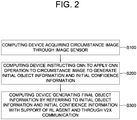
- Fig. 2 is a drawing schematically illustrating a flow of the method for the attention-driven resource allocation by using Reinforcement Learning and V2X communication, to thereby achieve the safety of the autonomous driving in accordance with one example embodiment of the present disclosure.
- the computing device 100 may acquire at least one circumstance image on surroundings of the subject vehicle, through the image sensor installed on the subject vehicle. Thereafter, at a step of S200, the computing device 100 may instruct the CNN 130 to apply at least one CNN operation to the circumstance image, to thereby generate initial object information and initial confidence information on the circumstance image. And, at a step of S300, the computing device may generate final object information on the circumstance image by referring to the initial object information and the initial confidence information, under a support of the RL agent 160 and V2X communication with at least part of surrounding objects whose distances from the subject vehicle is smaller than a threshold.
- the computing device 100 may instruct the CNN 130 to apply the CNN operation to the circumstance image.
- the computing device 100 may instruct a first CNN, which is optimized to a 3-channel image and whose number of input nodes is larger than or same as 3, to apply at least one first CNN operation to the circumstance image, to thereby apply the CNN operation thereto.
- the computing device 100 may instruct a second CNN, which is optimized to a depth image and whose number of input nodes is larger than or same as 1, to apply at least one second CNN operation to the circumstance image, to thereby apply the CNN operation thereto.
- a second CNN which is optimized to a depth image and whose number of input nodes is larger than or same as 1
- notations of the "first CNN” and the "second CNN” were used for distinguishing CNNs which can function as the CNN 130 in specific cases as shown above.
- notations of the "first image sensor” and the “second image sensor” were used for distinguishing image sensors which can function as the image sensor in the specific cases as shown above.
- the computing device 100 may perform a supplemental operation to generate the final object information, to be explained below.
- the computing device 100 may instruct the RL agent 160 to select one or more specific surrounding objects, among the surrounding objects, corresponding to one or more specific subject regions on the circumstance image to which a supplemental operation is to be applied, by referring to fundamental meta data of the surrounding objects, sensor information of the image sensor and the initial confidence information.
- the RL agent 160 may not select any of the specific surrounding objects. Such case may correspond to a case when the RL agent 160 determines that there are no specific subject regions whose confidence score will be improved by performing the supplemental operation.
- the RL agent 160 may be trained as shown below, to perform above functions.
- the RL agent 160 may select the one or more specific surrounding objects by using its own parameters. Then, the RL agent 160 may generate a reward by using the supplemental information acquired accordingly.
- the reward may be proportional to the area of at least one part of the specific subject regions whose corresponding object information is acquired by using the supplemental information. As one example, in case the area is smaller than a prescribed threshold, the reward may be calculated as 0.
- the RL agent 160 may train its own parameters for each iteration of selecting the specific surrounding objects, and may become capable of selecting the specific surrounding objects in its certain iteration more accurately, as time goes by.
- Such RL agent 160 may have a structure similar to a Neural Network commonly used in the field of Reinforcement Learning theory, such as each of multiple layers including multiple virtual neurons.
- the fundamental meta data may include at least part of relational location information of the surrounding vehicles and scheduled route information.
- the relational location information may be acquired by instructing a relatively simpler Neural Network to process the circumstance image, to detect brief locations of the surrounding objects, or acquired by performing V2X communication with the surrounding objects.
- the scheduled route information may also be acquired by using said simpler Neural Network, or by performing the V2X communication with the surrounding objects.
- the sensor information if the image sensor is the camera, may include at least part of Field-Of-View(FOV) information, intrinsic parameter information, extrinsic parameter information and distortion information, and those may have been inputted thereto beforehand.
- FOV Field-Of-View
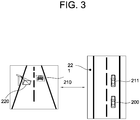
- Fig. 3 is a drawing schematically illustrating an example of acquiring supplemental information from specific surrounding objects, to be used for performing the method for the attention-driven resource allocation by using Reinforcement Learning and V2X communication, to thereby achieve the safety of the autonomous driving in accordance with one example embodiment of the present disclosure.
- the subject vehicle 200 an example vehicle 211 included in a first specific subject region 210 whose confidence scores are relatively low, and a CCTV 221 photographing a second specific subject region 220 can be seen.
- the RL agent 160 when sufficiently trained, may select the example vehicle 211 as a first specific surrounding object, the CCTV 221 as a second specific surrounding object, in order to acquire additional information on the first specific subject region 210 and the second specific subject region 220 through the V2X communication.
- specific meta data to be explained below acquired from the example vehicle 211 may be used, and reference object information and reference confidence information also to be explained below acquired from the CCTV 221 may be used.
- the supplemental information may include the specific meta data, the reference object information and the reference confidence information generated by specific surrounding objects.
- the specific meta data may include information on locations and velocities of the specific surrounding objects themselves.
- the reference object information and the reference confidence information may be generated by the specific surrounding objects which performs an object detection on its surroundings based on images or radar/LIDAR.
- the specific surrounding objects may correspond to the specific subject regions. Specifically, some of the specific surrounding objects may be included in the specific subject regions, or information which those detected, i.e., the reference object information, may include information on objects in the specific subject regions. Therefore, the computing device 100 may supplement its unconfident regions of the circumstance image, i.e., the specific subject regions, by using the supplemental information, to thereby generate the final object information.
- the computing device 100 may deliver it to an autonomous driving module, to thereby support the autonomous driving module to perform an autonomous driving of the subject vehicle by referring to the final object information.
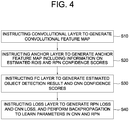
- Fig. 4 is a drawing schematically illustrating a flow of a training process of a Convolutional Neural Network(CNN) to be used for performing the method for the attention-driven resource allocation by using Reinforcement Learning and V2X communication, to thereby achieve the safety of the autonomous driving in accordance with one example embodiment of the present disclosure.
- CNN Convolutional Neural Network
- a learning device may instruct a convolutional layer included in the CNN 130 to apply at least one convolutional operation to the training image, to generate at least one convolutional feature map.
- a geometric size of the training image may be H ⁇ W
- a format of the training image is an RGB format so that a channel size of the training image is 3
- a data size of the training image may be H ⁇ W ⁇ 3.
- h and w denoting the geometric size of the convolutional feature map
- H and W respectively
- c denoting the channel size thereof, may be larger than 3, if the size of the convolutional feature map is h ⁇ w ⁇ c.
- the learning device may instruct an anchor layer in the RPN 140 to output estimated Regions-Of-Interest(ROIs), which are regions expected to include objects in the training image, by applying an anchor operation to values included in the convolutional feature map.
- the RPN 140 may generate an anchor feature map whose data size is h ⁇ w ⁇ (5A + 1), to be used for generating the estimated ROIs on the training image, by applying the anchor operation to the convolutional feature map whose data size is h ⁇ w ⁇ c.
- the data size of the anchor feature map should have been h ⁇ w ⁇ 5A, but, the anchor feature map in accordance with the present disclosure may include one more channel to include RPN confidence scores to be explained later. A more specific explanation on this will be presented below.
- the learning device may instruct the anchor layer of the RPN 140 to generate the anchor feature map whose data size is h ⁇ w ⁇ 5A by applying the anchor operation to the convolutional feature map, where the anchor operation uses sliding-windows each of which corresponds to each set of anchors.
- the anchors may be a sort of grids for selecting values of the convolutional feature map corresponding to the objects, and the above-mentioned A, used for representing the data size of the anchor feature map, may denote the number of the anchors used by the RPN 140.
- the learning device may instruct the RPN 140 to generate each of the RPN confidence scores for each of pixels included in the convolutional feature map, representing each of one or more probabilities of the estimated ROIs being same as Ground-Truth(GT) ROIs.
- the RPN confidence scores are parameters indicating degrees of the credibility of the results, e.g., the estimated ROIs, of the process performed by the RPN 140.
- each of RPN neurons in the RPN 140 may perform its operations and deliver its operated value to its next RPN neuron, to thereby output the anchor feature map from a final layer of the RPN 140.
- the two processes may be performed, dependently affecting each other.
- those two processes may be performed not at the same time. For example, the process of determining the estimated ROIs may be performed first.
- the learning device may deliver values of 5A channels therein, including information on the estimated ROIs, to the CNN 130, and deliver values of remaining one channel therein to the confidence layer 150 to be explained later. First, how the values of the 5A channels delivered to the CNN 130 are processed will be explained below.
- the learning device may instruct an ROI pooling layer in the CNN 130 to apply at least one ROI pooling operation to the convolutional feature map in order to generate an ROI-pooled feature map by referring to the information on the estimated ROIs, and, at a step of S30, may instruct an FC layer included in the CNN 130 to apply at least one FC operation to the ROI-pooled feature map, to thereby generate an initial object detection result and CNN confidence scores.
- the initial object detection result may include each of initial estimated CNN regression results on each of estimated coordinates of each of bounding boxes including each of the objects, and each of initial estimated CNN classification results on each of class scores of each of the objects, representing each of probabilities of each of the objects being included in each of classes.
- the CNN confidence scores may include information on degrees of an estimated object detection result being same as a GT object detection result, to be explained later.
- the estimated object detection result may have been generated by applying Non-Maximum Suppression(NMS) operation to the initial object detection result.
- each of the CNN confidence scores may represent each of one or more probabilities of each of the one or more estimated CNN classification results and each of the one or more estimated CNN regression results included in the estimated object detection result being same as each of one or more GT CNN classification results and each of one or more GT CNN regression results included in the GT object detection result.
- the CNN confidence scores may represent degrees of credibility on results generated by the FC layer of the CNN 130.
- the reason why the CNN confidence scores and the RPN confidence scores are both used is that estimated ROIs initially determined by the RPN 140 are processed by the CNN 130 later, in order to generate the estimated object detection result. Since the two networks both involve in the processes of generating the estimated object detection result, thus the two networks should be evaluated differently.
- the FC layer of the CNN 130 may be able to filter the specific estimated ROI which has been wrongly determined. Or, even in case the specific estimated ROI is determined properly by the RPN 140, the FC layer of the CNN 130 may wrongly determine that the specific estimated ROI does not include any objects. As can be seen in such cases, the RPN 140 and the CNN 130 may perform wrongly or properly, thus such cases should be considered during evaluating the object detection process.
- a CNN confidence map including the CNN confidence scores may be generated.
- the learning device may instruct the CNN 130 to integrate bounding boxes corresponding to overlapped estimated ROIs by applying the NMS to the initial object detection result, to thereby generate the estimated object detection result.
- the overlapped ones are integrated, specific CNN confidence scores corresponding to specific estimated ROIs, which have not been overlapped to other estimated ROIs, may be selected.
- such usage of the NMS is a well-known prior art, thus more specific explanation is omitted.
- the learning device may instruct the confidence layer 150 to acquire values of the one channel in the anchor feature map, which correspond to the RPN confidence map, and generate a resized RPN confidence map whose geometric size is H ⁇ W, same as the training image, by using the RPN confidence map.
- any of resizing operations e.g., Nearest Neighbor Size, Bilinear Resize, Bicubic Resize or Lanczos Resize, may be applied to the RPN confidence map, to pair each of RPN confidence scores with each of pixels in the training image.
- the learning device may instruct the confidence layer 150 to generate an integrated confidence map by referring thereto.
- c xy ⁇ may denote an (X_Y)-th integrated confidence score and c xy may denote an (X_Y)-th resized RPN confidence score corresponding to a coordinate ( x,y ) on the resized RPN confidence map.
- c r i may denote an i-th CNN confidence score for an i-th estimated ROI, denoted as r i , including the coordinate ( x,y ), which has been determined in the NMS result.
- the learning device may instruct the confidence layer 150 to generate the integrated confidence map by using the integrated confidence scores generated as shown above.
- the CNN 130 and the RPN 140 should be trained. Below how the two networks can be trained will be presented.
- the learning device may instruct the loss layer to generate at least one RPN loss and at least one CNN loss by referring to the RPN confidence map, the CNN confidence map, the estimated object detection result and the GT object detection result, and perform backpropagation by using the RPN loss and the CNN loss to learn at least part of parameters in the CNN 130 and the RPN 140.
- the loss layer may instruct the loss layer to generate at least one RPN loss and at least one CNN loss by referring to the RPN confidence map, the CNN confidence map, the estimated object detection result and the GT object detection result, and perform backpropagation by using the RPN loss and the CNN loss to learn at least part of parameters in the CNN 130 and the RPN 140.
- N reg may denote a constant corresponding to a size of the convolutional feature map generated by performing the anchor operation
- N cls may denote a constant corresponding to the training image
- c i may denote an i-th RPN confidence score corresponding to an i-th pixel of the convolutional feature map, among the RPN confidence scores
- p i may denote an i-th estimated RPN classification result corresponding to the i-th pixel
- p i * may denote an i-th GT RPN classification result corresponding to the i-th pixel
- t i may denote an i-th estimated RPN regression result corresponding to the i-th pixel
- t i * may denote an i-th GT RPN regression result corresponding to the i-th pixel.
- the i-th GT RPN classification result and the i-th GT RPN regression result may correspond to the GT object detection result.
- L cis and L reg may be implemented by using any of prior arts for generating losses, e.g., smooth-L1 loss.
- a first term of the formula may denote a classification loss, and a second one may denote a regression loss.
- the regression loss term i.e., the second term
- the classification loss term i.e., the first term will be explained.
- the classification loss term may include three sub-terms in a parenthesis as shown above.
- the RPN 140 has analyzed the i-th pixel "correctly", if the RPN 140 has determined the i-th estimated RPN classification result to be same as the i-th GT RPN classification result with a probability larger than a threshold probability, herein 0.5 for convenience.
- a threshold probability herein 0.5 for convenience.
- (1.1 - c i ) allows the i-th RPN confidence score to be larger when the RPN 140 has analyzed the i-th pixel correctly, since parameters of the RPN 140 are adjusted to make the RPN loss smaller.
- the classification loss term including the first sub-term generated as shown above is referred to, in order to generate gradients for allowing the parameters of the RPN 140 to be adjusted, to thereby allow a future RPN loss to be smaller.
- the RPN 140 may generate larger RPN confidence scores in case the RPN 140 analyzes the values of the convolutional feature map correctly.
- a condition i: p i * ⁇ I p i > 0.5 represents a case that the RPN 140 has analyzed the i-th pixel incorrectly.
- (0.1 + c i ) allows the i-th RPN confidence score to be smaller when the RPN 140 has analyzed the i-th pixel incorrectly.
- a mechanism of such training processes may be same as that of the first sub-term.
- c i log c i allows a distribution of the RPN confidence scores not to be similar to that of a step function. If the classification loss term only includes the first sub-term and the second sub-term, the RPN confidence scores may be overfitted so that those may include only extreme values close to 0 or 1.
- c i log c i is the smallest when c i is 0.5.
- the distribution of the RPN confidence scores in accordance with the present disclosure may be more diverse, including various values between 0 and 1. Since various situations can be dealt with by using the RPN confidence scores including the various values as shown above, this term is necessary.
- N reg and N cls may denote the number of the estimated ROIs
- c i may denote an i-th CNN confidence score, corresponding to an i-th estimated ROI among the estimated ROIs, among the CNN confidence scores.
- p i may denote an i-th estimated CNN classification result corresponding to the i-th estimated ROI
- p i * may denote an i-th GT CNN classification result corresponding to the i-th pixel
- t i may denote an i-th estimated CNN regression result corresponding to the i-th estimated ROI
- t i * may denote an i-th GT CNN regression result corresponding to the i-th pixel.
- the i-th estimated CNN classification result and the i-th estimated CNN regression result may correspond to the estimated object detection result. In this formula, notations may be same as that of the RPN loss, but it may be different as shown above.
- the CNN loss may be similar to the RPN loss, except their conditions of sigma functions.
- Such conditions may represent that p i is related to the i-th estimated CNN classification result on a specific class whose probability of including a specific object in the i-th estimated ROI is the largest.
- a first sub-term of a classification loss term in the CNN loss may represent a case that the CNN 130 has analyzed the i-th estimated ROI correctly, and the second sub-term may represent another case that the CNN 130 has analyzed the i-th estimated ROI incorrectly.
- the CNN loss and the RPN loss are similar to each other, thus further explanation is omitted.
- the learning device may instruct the loss layer to learn at least part of parameters included in the CNN 130 and the RPN 140 by performing backpropagation using the CNN loss and the RPN loss respectively. Thereafter, while the CNN 130 and the RPN 140 perform processes of detecting objects included in an image to be inputted, the CNN 130 and the RPN 140 may more accurately generate CNN confidence scores and RPN confidence scores corresponding to said image to be inputted.
- the learning device may deliver the CNN 130 to the computing device 100.
- the RPN 140 and the confidence layer 150 are subordinate to the CNN 130, thus those will also be delivered to the computing device 100.
- the CNN 130, the RPN 140 and the confidence layer 150 may perform operations similar to those performed during the training process by using fully trained parameters. That is, as the CNN 130 acquires the circumstance image, the CNN 130, the RPN 140 and the confidence layer 150 may generate the initial confidence information in a way same as the way of generating the integrated confidence map during the training process, along with the initial object information.
- Fig. 5 is a drawing schematically illustrating the learning device including the CNN, the RPN, the loss layer and the confidence layer to be used for performing the learning method for switching the modes of the autonomous vehicle based on the on-device standalone prediction to thereby achieve the safety of the autonomous driving in accordance with one example embodiment of the present disclosure.
- the training image is inputted to the convolutional layer 131 in the CNN 130, and the convolutional feature map with a size of h ⁇ w ⁇ c is outputted therefrom.
- the convolutional feature map may be processed by the RPN 140, and the RPN 140 may output a feature map with a size of h ⁇ w ⁇ (5A + 1), in which locations of the ROIs shown as (dx, dy, dw, dh) and their RPN confidence scores are included.
- the ROIs may be delivered to the ROI pooling layer(not illustrated) in the CNN 130, thus the convolutional feature map may be pooled by referring to the ROIs accordingly.
- the FC layer 132 in the CNN 130 may process the ROI-pooled feature map with a size of R ⁇ d to generate the initial object detection result with a size of R ⁇ (5C + 1), in which estimated locations of objects shown as (x1,y1,x2,y2), their probabilities of being included in each of classes, and CNN confidence scores for each of pixels corresponding to the objects are included.
- the CNN may apply the NMS to the initial object detection result to generate the estimated object detection result with a size of R' ⁇ 6, in which the estimated locations of objects shown as (x1,y1,x2,y2), their estimated classes, and their probabilities of being included in said estimated classes are included.
- R' may denote integrated ROIs generated by the NMS.
- the CNN confidence map may be outputted along with the estimated object detection result, and integrated with the resized RPN confidence map generated from the RPN confidence map with a size of h ⁇ w ⁇ 1 to generate the integrated confidence map with a size of H ⁇ W ⁇ 1.
- Such process is in accord with the above-explained learning method.
- the present disclosure has an effect of providing a method for an attention-driven resource allocation by using Reinforcement Learning and V2X communication, to thereby achieve a safety of an autonomous driving.
- the present disclosure has another effect of providing a method for generating confidence scores, which are parameters representing a credibility of an object detection, in parallel with a process of the object detection.
- the present disclosure has still another effect of providing a method for performing more accurate object detection by acquiring additional supplementary information on regions whose confidence scores are smaller than a threshold from other objects.
- the embodiments of the present disclosure as explained above can be implemented in a form of executable program command through a variety of computer means recordable to computer readable media.
- the computer readable media may include solely or in combination, program commands, data files, and data structures.
- the program commands recorded to the media may be components specially designed for the present disclosure or may be usable to a skilled human in a field of computer software.
- Computer readable media include magnetic media such as hard disk, floppy disk, and magnetic tape, optical media such as CD-ROM and DVD, magneto-optical media such as floptical disk and hardware devices such as ROM, RAM, and flash memory specially designed to store and carry out program commands.
- Program commands include not only a machine language code made by a complier but also a high level code that can be used by an interpreter etc., which is executed by a computer.
- the aforementioned hardware device can work as more than a software module to perform the action of the present disclosure and they can do the same in the opposite case.
Landscapes
- Engineering & Computer Science (AREA)
- Theoretical Computer Science (AREA)
- Physics & Mathematics (AREA)
- General Physics & Mathematics (AREA)
- Evolutionary Computation (AREA)
- Artificial Intelligence (AREA)
- Health & Medical Sciences (AREA)
- General Health & Medical Sciences (AREA)
- Life Sciences & Earth Sciences (AREA)
- Software Systems (AREA)
- Data Mining & Analysis (AREA)
- Molecular Biology (AREA)
- Computing Systems (AREA)
- Biomedical Technology (AREA)
- Mathematical Physics (AREA)
- General Engineering & Computer Science (AREA)
- Multimedia (AREA)
- Computational Linguistics (AREA)
- Biophysics (AREA)
- Computer Vision & Pattern Recognition (AREA)
- Automation & Control Theory (AREA)
- Transportation (AREA)
- Mechanical Engineering (AREA)
- Signal Processing (AREA)
- Computer Networks & Wireless Communication (AREA)
- Databases & Information Systems (AREA)
- Medical Informatics (AREA)
- Biodiversity & Conservation Biology (AREA)
- Human Computer Interaction (AREA)
- Evolutionary Biology (AREA)
- Bioinformatics & Computational Biology (AREA)
- Bioinformatics & Cheminformatics (AREA)
- Image Analysis (AREA)
- Traffic Control Systems (AREA)
- Control Of Driving Devices And Active Controlling Of Vehicle (AREA)
Applications Claiming Priority (2)
| Application Number | Priority Date | Filing Date | Title |
|---|---|---|---|
| US201962799332P | 2019-01-31 | 2019-01-31 | |
| US16/738,749 US11010668B2 (en) | 2019-01-31 | 2020-01-09 | Method and device for attention-driven resource allocation by using reinforcement learning and V2X communication to thereby achieve safety of autonomous driving |
Publications (3)
| Publication Number | Publication Date |
|---|---|
| EP3690731A2 true EP3690731A2 (de) | 2020-08-05 |
| EP3690731A3 EP3690731A3 (de) | 2020-10-28 |
| EP3690731B1 EP3690731B1 (de) | 2026-05-20 |
Family
ID=69191989
Family Applications (1)
| Application Number | Title | Priority Date | Filing Date |
|---|---|---|---|
| EP20153637.2A Active EP3690731B1 (de) | 2019-01-31 | 2020-01-24 | Verfahren und vorrichtung zur aufmerksamkeitsgetriebenen ressourcenzuweisung unter verwendung von verstärkungslernen und v2x-kommunikation, um dadurch die sicherheit des autonomen fahrens zu erreichen |
Country Status (5)
| Country | Link |
|---|---|
| US (1) | US11010668B2 (de) |
| EP (1) | EP3690731B1 (de) |
| JP (1) | JP6941386B2 (de) |
| KR (1) | KR102396274B1 (de) |
| CN (1) | CN111507159B (de) |
Families Citing this family (9)
| Publication number | Priority date | Publication date | Assignee | Title |
|---|---|---|---|---|
| EP3805986A1 (de) * | 2019-10-07 | 2021-04-14 | Robert Bosch GmbH | Verfahren zur messung der grenzleistung eines semantischen segmentierungsnetzwerks |
| WO2022039319A1 (ko) * | 2020-08-21 | 2022-02-24 | (주)와토시스 | 개인정보 비식별화 처리 방법, 검증 방법 및 시스템 |
| KR20230066018A (ko) * | 2020-10-06 | 2023-05-12 | 엘지전자 주식회사 | 자율 주행 시스템에서 v2x 통신 장치의 강화 학습 수행 방법 |
| US12001513B2 (en) * | 2020-11-30 | 2024-06-04 | Nec Corporation | Self-optimizing video analytics pipelines |
| CN112616131B (zh) * | 2020-12-11 | 2022-05-13 | 北京邮电大学 | 一种基于视频内容优先级的车联网资源分配方法 |
| KR20240110811A (ko) * | 2021-11-09 | 2024-07-16 | 엘지전자 주식회사 | 무선 통신 시스템에서 제1 장치가 제1 메시지를 전송하는 방법 및 이를 위한 장치 |
| KR102574540B1 (ko) * | 2022-11-22 | 2023-09-07 | (주)와토시스 | 영상 내 개인정보 영역 검출 방법 및 시스템 |
| CN116030438B (zh) * | 2023-03-30 | 2023-06-23 | 斯润天朗(北京)科技有限公司 | 基于时间同步的协作式感知方法及装置 |
| US20250139940A1 (en) * | 2023-10-31 | 2025-05-01 | Zoox, Inc. | Pregeneration of teleoperator view |
Family Cites Families (13)
| Publication number | Priority date | Publication date | Assignee | Title |
|---|---|---|---|---|
| EP2574958B1 (de) * | 2011-09-28 | 2017-02-22 | Honda Research Institute Europe GmbH | Straßenterrain-Erkennungsverfahren und System für Fahrerhilfssysteme |
| US9365213B2 (en) * | 2014-04-30 | 2016-06-14 | Here Global B.V. | Mode transition for an autonomous vehicle |
| US9965719B2 (en) * | 2015-11-04 | 2018-05-08 | Nec Corporation | Subcategory-aware convolutional neural networks for object detection |
| US10479373B2 (en) * | 2016-01-06 | 2019-11-19 | GM Global Technology Operations LLC | Determining driver intention at traffic intersections for automotive crash avoidance |
| US9858496B2 (en) * | 2016-01-20 | 2018-01-02 | Microsoft Technology Licensing, Llc | Object detection and classification in images |
| US20180053102A1 (en) * | 2016-08-16 | 2018-02-22 | Toyota Jidosha Kabushiki Kaisha | Individualized Adaptation of Driver Action Prediction Models |
| US11120353B2 (en) * | 2016-08-16 | 2021-09-14 | Toyota Jidosha Kabushiki Kaisha | Efficient driver action prediction system based on temporal fusion of sensor data using deep (bidirectional) recurrent neural network |
| US10209718B2 (en) * | 2017-03-14 | 2019-02-19 | Starsky Robotics, Inc. | Vehicle sensor system and method of use |
| JP7005933B2 (ja) * | 2017-05-09 | 2022-01-24 | オムロン株式会社 | 運転者監視装置、及び運転者監視方法 |
| CN107730904A (zh) * | 2017-06-13 | 2018-02-23 | 银江股份有限公司 | 基于深度卷积神经网络的多任务车辆逆向行驶视觉检测系统 |
| US9946960B1 (en) * | 2017-10-13 | 2018-04-17 | StradVision, Inc. | Method for acquiring bounding box corresponding to an object in an image by using convolutional neural network including tracking network and computing device using the same |
| CN108830188B (zh) * | 2018-05-30 | 2022-03-04 | 西安理工大学 | 基于深度学习的车辆检测方法 |
| CN109241982B (zh) | 2018-09-06 | 2021-01-29 | 广西师范大学 | 基于深浅层卷积神经网络的目标检测方法 |
-
2020
- 2020-01-09 US US16/738,749 patent/US11010668B2/en active Active
- 2020-01-20 KR KR1020200007639A patent/KR102396274B1/ko active Active
- 2020-01-21 CN CN202010069505.9A patent/CN111507159B/zh active Active
- 2020-01-24 JP JP2020010140A patent/JP6941386B2/ja active Active
- 2020-01-24 EP EP20153637.2A patent/EP3690731B1/de active Active
Also Published As
| Publication number | Publication date |
|---|---|
| JP2020126640A (ja) | 2020-08-20 |
| US11010668B2 (en) | 2021-05-18 |
| CN111507159B (zh) | 2023-12-01 |
| CN111507159A (zh) | 2020-08-07 |
| US20200250526A1 (en) | 2020-08-06 |
| KR20200096132A (ko) | 2020-08-11 |
| EP3690731A3 (de) | 2020-10-28 |
| KR102396274B1 (ko) | 2022-05-11 |
| JP6941386B2 (ja) | 2021-09-29 |
| EP3690731B1 (de) | 2026-05-20 |
Similar Documents
| Publication | Publication Date | Title |
|---|---|---|
| EP3690719B1 (de) | Verfahren und vorrichtung zur aufmerksamkeitsgetriebenen ressourcenzuteilung unter verwendung von avm und verstärkungslernen, um dadurch die sicherheit des autonomen fahrens zu erreichen | |
| US11010668B2 (en) | Method and device for attention-driven resource allocation by using reinforcement learning and V2X communication to thereby achieve safety of autonomous driving | |
| US10776673B2 (en) | Learning method and learning device for sensor fusion to integrate information acquired by radar capable of distance estimation and information acquired by camera to thereby improve neural network for supporting autonomous driving, and testing method and testing device using the same | |
| US10726303B1 (en) | Learning method and learning device for switching modes of autonomous vehicle based on on-device standalone prediction to thereby achieve safety of autonomous driving, and testing method and testing device using the same | |
| US10692002B1 (en) | Learning method and learning device of pedestrian detector for robust surveillance based on image analysis by using GAN and testing method and testing device using the same | |
| EP3690742B1 (de) | Verfahren zur automatischen markierung von trainingsbildern zur verwendung in einem tiefenlernnetzwerk zur analyse von bildern mit hoher präzision und vorrichtung zur automatischen markierung mit verwendung davon | |
| US10373027B1 (en) | Method for acquiring sample images for inspecting label among auto-labeled images to be used for learning of neural network and sample image acquiring device using the same | |
| US10410120B1 (en) | Learning method and testing method of object detector to be used for surveillance based on R-CNN capable of converting modes according to aspect ratios or scales of objects, and learning device and testing device using the same | |
| US10776647B2 (en) | Method and device for attention-driven resource allocation by using AVM to thereby achieve safety of autonomous driving | |
| EP3686837A1 (de) | Lernverfahren und lernvorrichtung zur verringerung der verzerrung, die in einem verzerrten bild auftritt, das bei der stabilisierung eines verzerrten bildes erzeugt wird, durch verwendung eines gan zur verbesserung der fehlertoleranz und der fluktuationsrobustheit in extremen situationen | |
| US10402686B1 (en) | Learning method and learning device for object detector to be used for surveillance based on convolutional neural network capable of converting modes according to scales of objects, and testing method and testing device using the same |
Legal Events
| Date | Code | Title | Description |
|---|---|---|---|
| PUAI | Public reference made under article 153(3) epc to a published international application that has entered the european phase |
Free format text: ORIGINAL CODE: 0009012 |
|
| STAA | Information on the status of an ep patent application or granted ep patent |
Free format text: STATUS: REQUEST FOR EXAMINATION WAS MADE |
|
| 17P | Request for examination filed |
Effective date: 20200124 |
|
| AK | Designated contracting states |
Kind code of ref document: A2 Designated state(s): AL AT BE BG CH CY CZ DE DK EE ES FI FR GB GR HR HU IE IS IT LI LT LU LV MC MK MT NL NO PL PT RO RS SE SI SK SM TR |
|
| AX | Request for extension of the european patent |
Extension state: BA ME |
|
| PUAL | Search report despatched |
Free format text: ORIGINAL CODE: 0009013 |
|
| AK | Designated contracting states |
Kind code of ref document: A3 Designated state(s): AL AT BE BG CH CY CZ DE DK EE ES FI FR GB GR HR HU IE IS IT LI LT LU LV MC MK MT NL NO PL PT RO RS SE SI SK SM TR |
|
| AX | Request for extension of the european patent |
Extension state: BA ME |
|
| RIC1 | Information provided on ipc code assigned before grant |
Ipc: G06N 3/02 20060101ALI20200921BHEP Ipc: H04W 4/40 20180101ALI20200921BHEP Ipc: G06K 9/00 20060101AFI20200921BHEP Ipc: G06K 9/46 20060101ALI20200921BHEP |
|
| RBV | Designated contracting states (corrected) |
Designated state(s): AL AT BE BG CH CY CZ DE DK EE ES FI FR GB GR HR HU IE IS IT LI LT LU LV MC MK MT NL NO PL PT RO RS SE SI SK SM TR |
|
| STAA | Information on the status of an ep patent application or granted ep patent |
Free format text: STATUS: EXAMINATION IS IN PROGRESS |
|
| 17Q | First examination report despatched |
Effective date: 20230327 |
|
| REG | Reference to a national code |
Ref country code: DE Ref legal event code: R079 Free format text: PREVIOUS MAIN CLASS: G06K0009000000 Ipc: G06N0003045000 Ref country code: DE Ref legal event code: R079 Ref document number: 602020072195 Country of ref document: DE Free format text: PREVIOUS MAIN CLASS: G06K0009000000 Ipc: G06N0003045000 |
|
| GRAJ | Information related to disapproval of communication of intention to grant by the applicant or resumption of examination proceedings by the epo deleted |
Free format text: ORIGINAL CODE: EPIDOSDIGR1 |
|
| GRAP | Despatch of communication of intention to grant a patent |
Free format text: ORIGINAL CODE: EPIDOSNIGR1 |
|
| GRAP | Despatch of communication of intention to grant a patent |
Free format text: ORIGINAL CODE: EPIDOSNIGR1 |
|
| STAA | Information on the status of an ep patent application or granted ep patent |
Free format text: STATUS: GRANT OF PATENT IS INTENDED |
|
| RIC1 | Information provided on ipc code assigned before grant |
Ipc: G06N 3/045 20230101AFI20251119BHEP Ipc: G06V 10/82 20220101ALI20251119BHEP Ipc: G06V 20/58 20220101ALI20251119BHEP Ipc: G06V 20/64 20220101ALI20251119BHEP Ipc: G06V 10/44 20220101ALI20251119BHEP |
|
| INTG | Intention to grant announced |
Effective date: 20251215 |
|
| GRAS | Grant fee paid |
Free format text: ORIGINAL CODE: EPIDOSNIGR3 |
|
| GRAA | (expected) grant |
Free format text: ORIGINAL CODE: 0009210 |
|
| STAA | Information on the status of an ep patent application or granted ep patent |
Free format text: STATUS: THE PATENT HAS BEEN GRANTED |