EP3690002A1 - Fluorescent probe, preparation method therefor and use thereof - Google Patents
Fluorescent probe, preparation method therefor and use thereof Download PDFInfo
- Publication number
- EP3690002A1 EP3690002A1 EP18861947.2A EP18861947A EP3690002A1 EP 3690002 A1 EP3690002 A1 EP 3690002A1 EP 18861947 A EP18861947 A EP 18861947A EP 3690002 A1 EP3690002 A1 EP 3690002A1
- Authority
- EP
- European Patent Office
- Prior art keywords
- group
- optionally
- probe
- fluorescent
- alkyl group
- Prior art date
- Legal status (The legal status is an assumption and is not a legal conclusion. Google has not performed a legal analysis and makes no representation as to the accuracy of the status listed.)
- Pending
Links
- 0 CCCCC*CCCCCC(C(C)C(CCCC(CC)=C)C(C)C1CCCCC1)C(CCC*CC1(C*)*C1)*C Chemical compound CCCCC*CCCCCC(C(C)C(CCCC(CC)=C)C(C)C1CCCCC1)C(CCC*CC1(C*)*C1)*C 0.000 description 25
- LTPHWCSMIFNEQR-DVBNWTFPSA-N CC(C)(C)OC(/C(/C#N)=C/c(cc1)ccc1N(CCO)CCOC(C(CCOCl)=N)=O)=O Chemical compound CC(C)(C)OC(/C(/C#N)=C/c(cc1)ccc1N(CCO)CCOC(C(CCOCl)=N)=O)=O LTPHWCSMIFNEQR-DVBNWTFPSA-N 0.000 description 1
- TYAKTTMWSCFJNJ-PEDBXGJFSA-N CC(C)(C)OC(/C(/C#N)=C/c1cc(ccc(N(CCOC(C(CCCS(O)(=O)=O)=C)=O)CCOC(C(CCOCCOCCCCCCCl)=N)=O)c2)c2[s]1)=O Chemical compound CC(C)(C)OC(/C(/C#N)=C/c1cc(ccc(N(CCOC(C(CCCS(O)(=O)=O)=C)=O)CCOC(C(CCOCCOCCCCCCCl)=N)=O)c2)c2[s]1)=O TYAKTTMWSCFJNJ-PEDBXGJFSA-N 0.000 description 1
- SHLGJEHVQPFNRH-NFFVHWSESA-N CC(C)(C)OC(/C(/C#N)=C\c(cc1)cc(C2(C)C)c1-c(cc1)c2cc1N(C)CCOC(NCCOCCOCCCCCCCl)=O)=O Chemical compound CC(C)(C)OC(/C(/C#N)=C\c(cc1)cc(C2(C)C)c1-c(cc1)c2cc1N(C)CCOC(NCCOCCOCCCCCCCl)=O)=O SHLGJEHVQPFNRH-NFFVHWSESA-N 0.000 description 1
- NBNBVAQECJSRLK-AQTBWJFISA-N CC(C)(C)OC(/C(/C#N)=C\c(cc1C2(C)C)ccc1-c(cc1)c2cc1N(C)CCO)=O Chemical compound CC(C)(C)OC(/C(/C#N)=C\c(cc1C2(C)C)ccc1-c(cc1)c2cc1N(C)CCO)=O NBNBVAQECJSRLK-AQTBWJFISA-N 0.000 description 1
- RGXJRZRUVPLIOX-PTGBLXJZSA-N CC(C)(C)OC(/C(/C1NC1)=C/c1cc([s]c(N(C)CCOC(CCCOCCOCCCCCCCl)=O)c2)c2[s]1)=O Chemical compound CC(C)(C)OC(/C(/C1NC1)=C/c1cc([s]c(N(C)CCOC(CCCOCCOCCCCCCCl)=O)c2)c2[s]1)=O RGXJRZRUVPLIOX-PTGBLXJZSA-N 0.000 description 1
- HWMKBHJZRGZAHT-VYIQYICTSA-N CC(C)(C)OC(/C(/N)=C/c1cc(ccc(N(CCO)CCOC(CCCOCCOCCCCCCCl)=O)c2)c2[s]1)=O Chemical compound CC(C)(C)OC(/C(/N)=C/c1cc(ccc(N(CCO)CCOC(CCCOCCOCCCCCCCl)=O)c2)c2[s]1)=O HWMKBHJZRGZAHT-VYIQYICTSA-N 0.000 description 1
- CDOOHNDRAAXVRZ-CJLVFECKSA-N CC(CCOCCOCCCCCCCl)C(C)OCCN(C)c1cc([s]c(/C=C(/C(O)=O)\C#N)c2)c2[s]1 Chemical compound CC(CCOCCOCCCCCCCl)C(C)OCCN(C)c1cc([s]c(/C=C(/C(O)=O)\C#N)c2)c2[s]1 CDOOHNDRAAXVRZ-CJLVFECKSA-N 0.000 description 1
- BBCLSBFVHKIZHR-QFMPWRQOSA-N CC(CCOCCOCCCCCCCl)C(C)OCCN(C)c1cc([s]c(/C=C(\C2NC2)/c2nc(cccc3)c3[o]2)c2)c2cc1 Chemical compound CC(CCOCCOCCCCCCCl)C(C)OCCN(C)c1cc([s]c(/C=C(\C2NC2)/c2nc(cccc3)c3[o]2)c2)c2cc1 BBCLSBFVHKIZHR-QFMPWRQOSA-N 0.000 description 1
- FYXUKFATCGAYEA-HIXSDJFHSA-N CC(c1c-2[s]c(N(C)CCOC3(CC3)C(CCOCCOCCCCCCCl)=C)c1)[Si+](C)c1c-2[s]c(/C=C(\C)/C#N)c1 Chemical compound CC(c1c-2[s]c(N(C)CCOC3(CC3)C(CCOCCOCCCCCCCl)=C)c1)[Si+](C)c1c-2[s]c(/C=C(\C)/C#N)c1 FYXUKFATCGAYEA-HIXSDJFHSA-N 0.000 description 1
- HZHXOFWMPZCDCG-UHFFFAOYSA-N CC1(C)c(cc(cc2)N(C)CCO)c2-c2c1cc(C=O)cc2 Chemical compound CC1(C)c(cc(cc2)N(C)CCO)c2-c2c1cc(C=O)cc2 HZHXOFWMPZCDCG-UHFFFAOYSA-N 0.000 description 1
- IYKMKTKKLJHXCK-UHFFFAOYSA-N CC1C=CN=CC=C1 Chemical compound CC1C=CN=CC=C1 IYKMKTKKLJHXCK-UHFFFAOYSA-N 0.000 description 1
- XEJVMEGEJMQZCS-UHFFFAOYSA-N CCCC(C)(C)c1ccc(C(C=C(C=O)O2)=C)c2c1 Chemical compound CCCC(C)(C)c1ccc(C(C=C(C=O)O2)=C)c2c1 XEJVMEGEJMQZCS-UHFFFAOYSA-N 0.000 description 1
- WJYKFWVODYEGFP-FPLPWBNLSA-N CCCNC(C)/C=C\C(C)CC Chemical compound CCCNC(C)/C=C\C(C)CC WJYKFWVODYEGFP-FPLPWBNLSA-N 0.000 description 1
- FRCHBRVYVDLPRB-DYTRJAOYSA-N CN(CCO)c1ccc(/C=C(/C(NC/C=[O]/CCOCCCCCCCl)=O)\C#N)cc1 Chemical compound CN(CCO)c1ccc(/C=C(/C(NC/C=[O]/CCOCCCCCCCl)=O)\C#N)cc1 FRCHBRVYVDLPRB-DYTRJAOYSA-N 0.000 description 1
- BHXFUAAUZWLKAE-DHZHZOJOSA-N CN(CCO)c1ccc(/C=C(/C(O)=O)\C#N)cc1 Chemical compound CN(CCO)c1ccc(/C=C(/C(O)=O)\C#N)cc1 BHXFUAAUZWLKAE-DHZHZOJOSA-N 0.000 description 1
- LGPGUNCXPOPCDJ-HMSDUJDUSA-N CN/C=C(\C(C=C(/C=C/c1ccccc1)N1C)=C)/C1=O Chemical compound CN/C=C(\C(C=C(/C=C/c1ccccc1)N1C)=C)/C1=O LGPGUNCXPOPCDJ-HMSDUJDUSA-N 0.000 description 1
- WGGXITIZBUKADI-UHFFFAOYSA-N CN1NC=NC=C1 Chemical compound CN1NC=NC=C1 WGGXITIZBUKADI-UHFFFAOYSA-N 0.000 description 1
- CSFDYZJNRYDSIU-CAPFRKAQSA-N CN1c(ccc(/C=C(/C(NCCOCCOCCCCCCCl)=O)\C#N)c2)c2SCC1 Chemical compound CN1c(ccc(/C=C(/C(NCCOCCOCCCCCCCl)=O)\C#N)c2)c2SCC1 CSFDYZJNRYDSIU-CAPFRKAQSA-N 0.000 description 1
- SQEUWNMHBLUFSR-UXBLZVDNSA-N CN1c(ccc(/C=C(\C2NC2)/C(O)=O)c2)c2SCC1 Chemical compound CN1c(ccc(/C=C(\C2NC2)/C(O)=O)c2)c2SCC1 SQEUWNMHBLUFSR-UXBLZVDNSA-N 0.000 description 1
- GVVLYBMOGMYRGQ-UHFFFAOYSA-N NC/C=[O]/CCOCCCCCCCl Chemical compound NC/C=[O]/CCOCCCCCCCl GVVLYBMOGMYRGQ-UHFFFAOYSA-N 0.000 description 1
- ABAUJBZQEHFSKW-UHFFFAOYSA-N NCCOCCOCCCCCCCl Chemical compound NCCOCCOCCCCCCCl ABAUJBZQEHFSKW-UHFFFAOYSA-N 0.000 description 1
Images

Classifications
-
- C—CHEMISTRY; METALLURGY
- C09—DYES; PAINTS; POLISHES; NATURAL RESINS; ADHESIVES; COMPOSITIONS NOT OTHERWISE PROVIDED FOR; APPLICATIONS OF MATERIALS NOT OTHERWISE PROVIDED FOR
- C09K—MATERIALS FOR MISCELLANEOUS APPLICATIONS, NOT PROVIDED FOR ELSEWHERE
- C09K11/00—Luminescent materials, e.g. electroluminescent or chemiluminescent
- C09K11/06—Luminescent materials, e.g. electroluminescent or chemiluminescent containing organic luminescent materials
- C09K11/07—Luminescent materials, e.g. electroluminescent or chemiluminescent containing organic luminescent materials having chemically-interreactive components, e.g. reactive chemiluminescent compositions
-
- C—CHEMISTRY; METALLURGY
- C07—ORGANIC CHEMISTRY
- C07D—HETEROCYCLIC COMPOUNDS
- C07D413/00—Heterocyclic compounds containing two or more hetero rings, at least one ring having nitrogen and oxygen atoms as the only ring hetero atoms
- C07D413/14—Heterocyclic compounds containing two or more hetero rings, at least one ring having nitrogen and oxygen atoms as the only ring hetero atoms containing three or more hetero rings
-
- C—CHEMISTRY; METALLURGY
- C07—ORGANIC CHEMISTRY
- C07C—ACYCLIC OR CARBOCYCLIC COMPOUNDS
- C07C255/00—Carboxylic acid nitriles
- C07C255/01—Carboxylic acid nitriles having cyano groups bound to acyclic carbon atoms
- C07C255/23—Carboxylic acid nitriles having cyano groups bound to acyclic carbon atoms containing cyano groups and carboxyl groups, other than cyano groups, bound to the same unsaturated acyclic carbon skeleton
-
- C—CHEMISTRY; METALLURGY
- C07—ORGANIC CHEMISTRY
- C07C—ACYCLIC OR CARBOCYCLIC COMPOUNDS
- C07C255/00—Carboxylic acid nitriles
- C07C255/01—Carboxylic acid nitriles having cyano groups bound to acyclic carbon atoms
- C07C255/32—Carboxylic acid nitriles having cyano groups bound to acyclic carbon atoms having cyano groups bound to acyclic carbon atoms of a carbon skeleton containing at least one six-membered aromatic ring
- C07C255/42—Carboxylic acid nitriles having cyano groups bound to acyclic carbon atoms having cyano groups bound to acyclic carbon atoms of a carbon skeleton containing at least one six-membered aromatic ring the carbon skeleton being further substituted by singly-bound nitrogen atoms, not being further bound to other hetero atoms
-
- C—CHEMISTRY; METALLURGY
- C07—ORGANIC CHEMISTRY
- C07C—ACYCLIC OR CARBOCYCLIC COMPOUNDS
- C07C271/00—Derivatives of carbamic acids, i.e. compounds containing any of the groups, the nitrogen atom not being part of nitro or nitroso groups
- C07C271/06—Esters of carbamic acids
- C07C271/08—Esters of carbamic acids having oxygen atoms of carbamate groups bound to acyclic carbon atoms
- C07C271/10—Esters of carbamic acids having oxygen atoms of carbamate groups bound to acyclic carbon atoms with the nitrogen atoms of the carbamate groups bound to hydrogen atoms or to acyclic carbon atoms
- C07C271/16—Esters of carbamic acids having oxygen atoms of carbamate groups bound to acyclic carbon atoms with the nitrogen atoms of the carbamate groups bound to hydrogen atoms or to acyclic carbon atoms to carbon atoms of hydrocarbon radicals substituted by singly-bound oxygen atoms
-
- C—CHEMISTRY; METALLURGY
- C07—ORGANIC CHEMISTRY
- C07C—ACYCLIC OR CARBOCYCLIC COMPOUNDS
- C07C309/00—Sulfonic acids; Halides, esters, or anhydrides thereof
- C07C309/01—Sulfonic acids
- C07C309/02—Sulfonic acids having sulfo groups bound to acyclic carbon atoms
- C07C309/03—Sulfonic acids having sulfo groups bound to acyclic carbon atoms of an acyclic saturated carbon skeleton
- C07C309/13—Sulfonic acids having sulfo groups bound to acyclic carbon atoms of an acyclic saturated carbon skeleton containing nitrogen atoms, not being part of nitro or nitroso groups, bound to the carbon skeleton
- C07C309/14—Sulfonic acids having sulfo groups bound to acyclic carbon atoms of an acyclic saturated carbon skeleton containing nitrogen atoms, not being part of nitro or nitroso groups, bound to the carbon skeleton containing amino groups bound to the carbon skeleton
- C07C309/15—Sulfonic acids having sulfo groups bound to acyclic carbon atoms of an acyclic saturated carbon skeleton containing nitrogen atoms, not being part of nitro or nitroso groups, bound to the carbon skeleton containing amino groups bound to the carbon skeleton the nitrogen atom of at least one of the amino groups being part of any of the groups, X being a hetero atom, Y being any atom
-
- C—CHEMISTRY; METALLURGY
- C07—ORGANIC CHEMISTRY
- C07D—HETEROCYCLIC COMPOUNDS
- C07D215/00—Heterocyclic compounds containing quinoline or hydrogenated quinoline ring systems
- C07D215/02—Heterocyclic compounds containing quinoline or hydrogenated quinoline ring systems having no bond between the ring nitrogen atom and a non-ring member or having only hydrogen atoms or carbon atoms directly attached to the ring nitrogen atom
- C07D215/12—Heterocyclic compounds containing quinoline or hydrogenated quinoline ring systems having no bond between the ring nitrogen atom and a non-ring member or having only hydrogen atoms or carbon atoms directly attached to the ring nitrogen atom with substituted hydrocarbon radicals attached to ring carbon atoms
-
- C—CHEMISTRY; METALLURGY
- C07—ORGANIC CHEMISTRY
- C07D—HETEROCYCLIC COMPOUNDS
- C07D215/00—Heterocyclic compounds containing quinoline or hydrogenated quinoline ring systems
- C07D215/02—Heterocyclic compounds containing quinoline or hydrogenated quinoline ring systems having no bond between the ring nitrogen atom and a non-ring member or having only hydrogen atoms or carbon atoms directly attached to the ring nitrogen atom
- C07D215/12—Heterocyclic compounds containing quinoline or hydrogenated quinoline ring systems having no bond between the ring nitrogen atom and a non-ring member or having only hydrogen atoms or carbon atoms directly attached to the ring nitrogen atom with substituted hydrocarbon radicals attached to ring carbon atoms
- C07D215/14—Radicals substituted by oxygen atoms
-
- C—CHEMISTRY; METALLURGY
- C07—ORGANIC CHEMISTRY
- C07D—HETEROCYCLIC COMPOUNDS
- C07D215/00—Heterocyclic compounds containing quinoline or hydrogenated quinoline ring systems
- C07D215/02—Heterocyclic compounds containing quinoline or hydrogenated quinoline ring systems having no bond between the ring nitrogen atom and a non-ring member or having only hydrogen atoms or carbon atoms directly attached to the ring nitrogen atom
- C07D215/16—Heterocyclic compounds containing quinoline or hydrogenated quinoline ring systems having no bond between the ring nitrogen atom and a non-ring member or having only hydrogen atoms or carbon atoms directly attached to the ring nitrogen atom with hetero atoms or with carbon atoms having three bonds to hetero atoms with at the most one bond to halogen, e.g. ester or nitrile radicals, directly attached to ring carbon atoms
- C07D215/38—Nitrogen atoms
-
- C—CHEMISTRY; METALLURGY
- C07—ORGANIC CHEMISTRY
- C07D—HETEROCYCLIC COMPOUNDS
- C07D233/00—Heterocyclic compounds containing 1,3-diazole or hydrogenated 1,3-diazole rings, not condensed with other rings
- C07D233/96—Heterocyclic compounds containing 1,3-diazole or hydrogenated 1,3-diazole rings, not condensed with other rings having three double bonds between ring members or between ring members and non-ring members
-
- C—CHEMISTRY; METALLURGY
- C07—ORGANIC CHEMISTRY
- C07D—HETEROCYCLIC COMPOUNDS
- C07D263/00—Heterocyclic compounds containing 1,3-oxazole or hydrogenated 1,3-oxazole rings
- C07D263/52—Heterocyclic compounds containing 1,3-oxazole or hydrogenated 1,3-oxazole rings condensed with carbocyclic rings or ring systems
- C07D263/54—Benzoxazoles; Hydrogenated benzoxazoles
-
- C—CHEMISTRY; METALLURGY
- C07—ORGANIC CHEMISTRY
- C07D—HETEROCYCLIC COMPOUNDS
- C07D263/00—Heterocyclic compounds containing 1,3-oxazole or hydrogenated 1,3-oxazole rings
- C07D263/52—Heterocyclic compounds containing 1,3-oxazole or hydrogenated 1,3-oxazole rings condensed with carbocyclic rings or ring systems
- C07D263/54—Benzoxazoles; Hydrogenated benzoxazoles
- C07D263/56—Benzoxazoles; Hydrogenated benzoxazoles with only hydrogen atoms, hydrocarbon or substituted hydrocarbon radicals, directly attached in position 2
-
- C—CHEMISTRY; METALLURGY
- C07—ORGANIC CHEMISTRY
- C07D—HETEROCYCLIC COMPOUNDS
- C07D277/00—Heterocyclic compounds containing 1,3-thiazole or hydrogenated 1,3-thiazole rings
- C07D277/60—Heterocyclic compounds containing 1,3-thiazole or hydrogenated 1,3-thiazole rings condensed with carbocyclic rings or ring systems
- C07D277/62—Benzothiazoles
- C07D277/64—Benzothiazoles with only hydrocarbon or substituted hydrocarbon radicals attached in position 2
-
- C—CHEMISTRY; METALLURGY
- C07—ORGANIC CHEMISTRY
- C07D—HETEROCYCLIC COMPOUNDS
- C07D279/00—Heterocyclic compounds containing six-membered rings having one nitrogen atom and one sulfur atom as the only ring hetero atoms
- C07D279/10—1,4-Thiazines; Hydrogenated 1,4-thiazines
- C07D279/14—1,4-Thiazines; Hydrogenated 1,4-thiazines condensed with carbocyclic rings or ring systems
- C07D279/16—1,4-Thiazines; Hydrogenated 1,4-thiazines condensed with carbocyclic rings or ring systems condensed with one six-membered ring
-
- C—CHEMISTRY; METALLURGY
- C07—ORGANIC CHEMISTRY
- C07D—HETEROCYCLIC COMPOUNDS
- C07D307/00—Heterocyclic compounds containing five-membered rings having one oxygen atom as the only ring hetero atom
- C07D307/02—Heterocyclic compounds containing five-membered rings having one oxygen atom as the only ring hetero atom not condensed with other rings
- C07D307/34—Heterocyclic compounds containing five-membered rings having one oxygen atom as the only ring hetero atom not condensed with other rings having two or three double bonds between ring members or between ring members and non-ring members
- C07D307/56—Heterocyclic compounds containing five-membered rings having one oxygen atom as the only ring hetero atom not condensed with other rings having two or three double bonds between ring members or between ring members and non-ring members with hetero atoms or with carbon atoms having three bonds to hetero atoms with at the most one bond to halogen, e.g. ester or nitrile radicals, directly attached to ring carbon atoms
- C07D307/68—Carbon atoms having three bonds to hetero atoms with at the most one bond to halogen
-
- C—CHEMISTRY; METALLURGY
- C07—ORGANIC CHEMISTRY
- C07D—HETEROCYCLIC COMPOUNDS
- C07D333/00—Heterocyclic compounds containing five-membered rings having one sulfur atom as the only ring hetero atom
- C07D333/02—Heterocyclic compounds containing five-membered rings having one sulfur atom as the only ring hetero atom not condensed with other rings
- C07D333/04—Heterocyclic compounds containing five-membered rings having one sulfur atom as the only ring hetero atom not condensed with other rings not substituted on the ring sulphur atom
- C07D333/06—Heterocyclic compounds containing five-membered rings having one sulfur atom as the only ring hetero atom not condensed with other rings not substituted on the ring sulphur atom with only hydrogen atoms, hydrocarbon or substituted hydrocarbon radicals, directly attached to the ring carbon atoms
- C07D333/24—Radicals substituted by carbon atoms having three bonds to hetero atoms with at the most one bond to halogen, e.g. ester or nitrile radicals
-
- C—CHEMISTRY; METALLURGY
- C07—ORGANIC CHEMISTRY
- C07D—HETEROCYCLIC COMPOUNDS
- C07D333/00—Heterocyclic compounds containing five-membered rings having one sulfur atom as the only ring hetero atom
- C07D333/02—Heterocyclic compounds containing five-membered rings having one sulfur atom as the only ring hetero atom not condensed with other rings
- C07D333/04—Heterocyclic compounds containing five-membered rings having one sulfur atom as the only ring hetero atom not condensed with other rings not substituted on the ring sulphur atom
- C07D333/26—Heterocyclic compounds containing five-membered rings having one sulfur atom as the only ring hetero atom not condensed with other rings not substituted on the ring sulphur atom with hetero atoms or with carbon atoms having three bonds to hetero atoms with at the most one bond to halogen, e.g. ester or nitrile radicals, directly attached to ring carbon atoms
- C07D333/30—Hetero atoms other than halogen
- C07D333/36—Nitrogen atoms
-
- C—CHEMISTRY; METALLURGY
- C07—ORGANIC CHEMISTRY
- C07D—HETEROCYCLIC COMPOUNDS
- C07D333/00—Heterocyclic compounds containing five-membered rings having one sulfur atom as the only ring hetero atom
- C07D333/50—Heterocyclic compounds containing five-membered rings having one sulfur atom as the only ring hetero atom condensed with carbocyclic rings or ring systems
- C07D333/52—Benzo[b]thiophenes; Hydrogenated benzo[b]thiophenes
- C07D333/54—Benzo[b]thiophenes; Hydrogenated benzo[b]thiophenes with only hydrogen atoms, hydrocarbon or substituted hydrocarbon radicals, directly attached to carbon atoms of the hetero ring
- C07D333/60—Radicals substituted by carbon atoms having three bonds to hetero atoms with at the most one bond to halogen, e.g. ester or nitrile radicals
-
- C—CHEMISTRY; METALLURGY
- C07—ORGANIC CHEMISTRY
- C07D—HETEROCYCLIC COMPOUNDS
- C07D401/00—Heterocyclic compounds containing two or more hetero rings, having nitrogen atoms as the only ring hetero atoms, at least one ring being a six-membered ring with only one nitrogen atom
- C07D401/02—Heterocyclic compounds containing two or more hetero rings, having nitrogen atoms as the only ring hetero atoms, at least one ring being a six-membered ring with only one nitrogen atom containing two hetero rings
- C07D401/06—Heterocyclic compounds containing two or more hetero rings, having nitrogen atoms as the only ring hetero atoms, at least one ring being a six-membered ring with only one nitrogen atom containing two hetero rings linked by a carbon chain containing only aliphatic carbon atoms
-
- C—CHEMISTRY; METALLURGY
- C07—ORGANIC CHEMISTRY
- C07D—HETEROCYCLIC COMPOUNDS
- C07D409/00—Heterocyclic compounds containing two or more hetero rings, at least one ring having sulfur atoms as the only ring hetero atoms
- C07D409/02—Heterocyclic compounds containing two or more hetero rings, at least one ring having sulfur atoms as the only ring hetero atoms containing two hetero rings
- C07D409/06—Heterocyclic compounds containing two or more hetero rings, at least one ring having sulfur atoms as the only ring hetero atoms containing two hetero rings linked by a carbon chain containing only aliphatic carbon atoms
-
- C—CHEMISTRY; METALLURGY
- C07—ORGANIC CHEMISTRY
- C07D—HETEROCYCLIC COMPOUNDS
- C07D409/00—Heterocyclic compounds containing two or more hetero rings, at least one ring having sulfur atoms as the only ring hetero atoms
- C07D409/14—Heterocyclic compounds containing two or more hetero rings, at least one ring having sulfur atoms as the only ring hetero atoms containing three or more hetero rings
-
- C—CHEMISTRY; METALLURGY
- C07—ORGANIC CHEMISTRY
- C07D—HETEROCYCLIC COMPOUNDS
- C07D413/00—Heterocyclic compounds containing two or more hetero rings, at least one ring having nitrogen and oxygen atoms as the only ring hetero atoms
- C07D413/02—Heterocyclic compounds containing two or more hetero rings, at least one ring having nitrogen and oxygen atoms as the only ring hetero atoms containing two hetero rings
- C07D413/06—Heterocyclic compounds containing two or more hetero rings, at least one ring having nitrogen and oxygen atoms as the only ring hetero atoms containing two hetero rings linked by a carbon chain containing only aliphatic carbon atoms
-
- C—CHEMISTRY; METALLURGY
- C07—ORGANIC CHEMISTRY
- C07D—HETEROCYCLIC COMPOUNDS
- C07D417/00—Heterocyclic compounds containing two or more hetero rings, at least one ring having nitrogen and sulfur atoms as the only ring hetero atoms, not provided for by group C07D415/00
- C07D417/02—Heterocyclic compounds containing two or more hetero rings, at least one ring having nitrogen and sulfur atoms as the only ring hetero atoms, not provided for by group C07D415/00 containing two hetero rings
- C07D417/06—Heterocyclic compounds containing two or more hetero rings, at least one ring having nitrogen and sulfur atoms as the only ring hetero atoms, not provided for by group C07D415/00 containing two hetero rings linked by a carbon chain containing only aliphatic carbon atoms
-
- C—CHEMISTRY; METALLURGY
- C07—ORGANIC CHEMISTRY
- C07D—HETEROCYCLIC COMPOUNDS
- C07D417/00—Heterocyclic compounds containing two or more hetero rings, at least one ring having nitrogen and sulfur atoms as the only ring hetero atoms, not provided for by group C07D415/00
- C07D417/14—Heterocyclic compounds containing two or more hetero rings, at least one ring having nitrogen and sulfur atoms as the only ring hetero atoms, not provided for by group C07D415/00 containing three or more hetero rings
-
- C—CHEMISTRY; METALLURGY
- C07—ORGANIC CHEMISTRY
- C07D—HETEROCYCLIC COMPOUNDS
- C07D455/00—Heterocyclic compounds containing quinolizine ring systems, e.g. emetine alkaloids, protoberberine; Alkylenedioxy derivatives of dibenzo [a, g] quinolizines, e.g. berberine
- C07D455/03—Heterocyclic compounds containing quinolizine ring systems, e.g. emetine alkaloids, protoberberine; Alkylenedioxy derivatives of dibenzo [a, g] quinolizines, e.g. berberine containing quinolizine ring systems directly condensed with at least one six-membered carbocyclic ring, e.g. protoberberine; Alkylenedioxy derivatives of dibenzo [a, g] quinolizines, e.g. berberine
- C07D455/04—Heterocyclic compounds containing quinolizine ring systems, e.g. emetine alkaloids, protoberberine; Alkylenedioxy derivatives of dibenzo [a, g] quinolizines, e.g. berberine containing quinolizine ring systems directly condensed with at least one six-membered carbocyclic ring, e.g. protoberberine; Alkylenedioxy derivatives of dibenzo [a, g] quinolizines, e.g. berberine containing a quinolizine ring system condensed with only one six-membered carbocyclic ring, e.g. julolidine
-
- C—CHEMISTRY; METALLURGY
- C07—ORGANIC CHEMISTRY
- C07D—HETEROCYCLIC COMPOUNDS
- C07D471/00—Heterocyclic compounds containing nitrogen atoms as the only ring hetero atoms in the condensed system, at least one ring being a six-membered ring with one nitrogen atom, not provided for by groups C07D451/00 - C07D463/00
- C07D471/02—Heterocyclic compounds containing nitrogen atoms as the only ring hetero atoms in the condensed system, at least one ring being a six-membered ring with one nitrogen atom, not provided for by groups C07D451/00 - C07D463/00 in which the condensed system contains two hetero rings
- C07D471/06—Peri-condensed systems
-
- C—CHEMISTRY; METALLURGY
- C07—ORGANIC CHEMISTRY
- C07D—HETEROCYCLIC COMPOUNDS
- C07D495/00—Heterocyclic compounds containing in the condensed system at least one hetero ring having sulfur atoms as the only ring hetero atoms
- C07D495/02—Heterocyclic compounds containing in the condensed system at least one hetero ring having sulfur atoms as the only ring hetero atoms in which the condensed system contains two hetero rings
- C07D495/04—Ortho-condensed systems
-
- C—CHEMISTRY; METALLURGY
- C07—ORGANIC CHEMISTRY
- C07D—HETEROCYCLIC COMPOUNDS
- C07D495/00—Heterocyclic compounds containing in the condensed system at least one hetero ring having sulfur atoms as the only ring hetero atoms
- C07D495/12—Heterocyclic compounds containing in the condensed system at least one hetero ring having sulfur atoms as the only ring hetero atoms in which the condensed system contains three hetero rings
- C07D495/14—Ortho-condensed systems
-
- C—CHEMISTRY; METALLURGY
- C07—ORGANIC CHEMISTRY
- C07F—ACYCLIC, CARBOCYCLIC OR HETEROCYCLIC COMPOUNDS CONTAINING ELEMENTS OTHER THAN CARBON, HYDROGEN, HALOGEN, OXYGEN, NITROGEN, SULFUR, SELENIUM OR TELLURIUM
- C07F7/00—Compounds containing elements of Groups 4 or 14 of the Periodic Table
- C07F7/02—Silicon compounds
- C07F7/08—Compounds having one or more C—Si linkages
- C07F7/0803—Compounds with Si-C or Si-Si linkages
- C07F7/081—Compounds with Si-C or Si-Si linkages comprising at least one atom selected from the elements N, O, halogen, S, Se or Te
- C07F7/0812—Compounds with Si-C or Si-Si linkages comprising at least one atom selected from the elements N, O, halogen, S, Se or Te comprising a heterocyclic ring
- C07F7/0816—Compounds with Si-C or Si-Si linkages comprising at least one atom selected from the elements N, O, halogen, S, Se or Te comprising a heterocyclic ring said ring comprising Si as a ring atom
-
- C—CHEMISTRY; METALLURGY
- C09—DYES; PAINTS; POLISHES; NATURAL RESINS; ADHESIVES; COMPOSITIONS NOT OTHERWISE PROVIDED FOR; APPLICATIONS OF MATERIALS NOT OTHERWISE PROVIDED FOR
- C09K—MATERIALS FOR MISCELLANEOUS APPLICATIONS, NOT PROVIDED FOR ELSEWHERE
- C09K11/00—Luminescent materials, e.g. electroluminescent or chemiluminescent
- C09K11/06—Luminescent materials, e.g. electroluminescent or chemiluminescent containing organic luminescent materials
-
- G—PHYSICS
- G01—MEASURING; TESTING
- G01N—INVESTIGATING OR ANALYSING MATERIALS BY DETERMINING THEIR CHEMICAL OR PHYSICAL PROPERTIES
- G01N21/00—Investigating or analysing materials by the use of optical means, i.e. using sub-millimetre waves, infrared, visible or ultraviolet light
- G01N21/62—Systems in which the material investigated is excited whereby it emits light or causes a change in wavelength of the incident light
- G01N21/63—Systems in which the material investigated is excited whereby it emits light or causes a change in wavelength of the incident light optically excited
- G01N21/64—Fluorescence; Phosphorescence
- G01N21/6428—Measuring fluorescence of fluorescent products of reactions or of fluorochrome labelled reactive substances, e.g. measuring quenching effects, using measuring "optrodes"
-
- G—PHYSICS
- G01—MEASURING; TESTING
- G01N—INVESTIGATING OR ANALYSING MATERIALS BY DETERMINING THEIR CHEMICAL OR PHYSICAL PROPERTIES
- G01N33/00—Investigating or analysing materials by specific methods not covered by groups G01N1/00 - G01N31/00
- G01N33/48—Biological material, e.g. blood, urine; Haemocytometers
- G01N33/50—Chemical analysis of biological material, e.g. blood, urine; Testing involving biospecific ligand binding methods; Immunological testing
- G01N33/68—Chemical analysis of biological material, e.g. blood, urine; Testing involving biospecific ligand binding methods; Immunological testing involving proteins, peptides or amino acids
- G01N33/6803—General methods of protein analysis not limited to specific proteins or families of proteins
-
- C—CHEMISTRY; METALLURGY
- C09—DYES; PAINTS; POLISHES; NATURAL RESINS; ADHESIVES; COMPOSITIONS NOT OTHERWISE PROVIDED FOR; APPLICATIONS OF MATERIALS NOT OTHERWISE PROVIDED FOR
- C09K—MATERIALS FOR MISCELLANEOUS APPLICATIONS, NOT PROVIDED FOR ELSEWHERE
- C09K2211/00—Chemical nature of organic luminescent or tenebrescent compounds
- C09K2211/10—Non-macromolecular compounds
- C09K2211/1003—Carbocyclic compounds
- C09K2211/1007—Non-condensed systems
-
- C—CHEMISTRY; METALLURGY
- C09—DYES; PAINTS; POLISHES; NATURAL RESINS; ADHESIVES; COMPOSITIONS NOT OTHERWISE PROVIDED FOR; APPLICATIONS OF MATERIALS NOT OTHERWISE PROVIDED FOR
- C09K—MATERIALS FOR MISCELLANEOUS APPLICATIONS, NOT PROVIDED FOR ELSEWHERE
- C09K2211/00—Chemical nature of organic luminescent or tenebrescent compounds
- C09K2211/10—Non-macromolecular compounds
- C09K2211/1003—Carbocyclic compounds
- C09K2211/1011—Condensed systems
-
- C—CHEMISTRY; METALLURGY
- C09—DYES; PAINTS; POLISHES; NATURAL RESINS; ADHESIVES; COMPOSITIONS NOT OTHERWISE PROVIDED FOR; APPLICATIONS OF MATERIALS NOT OTHERWISE PROVIDED FOR
- C09K—MATERIALS FOR MISCELLANEOUS APPLICATIONS, NOT PROVIDED FOR ELSEWHERE
- C09K2211/00—Chemical nature of organic luminescent or tenebrescent compounds
- C09K2211/10—Non-macromolecular compounds
- C09K2211/1003—Carbocyclic compounds
- C09K2211/1014—Carbocyclic compounds bridged by heteroatoms, e.g. N, P, Si or B
-
- C—CHEMISTRY; METALLURGY
- C09—DYES; PAINTS; POLISHES; NATURAL RESINS; ADHESIVES; COMPOSITIONS NOT OTHERWISE PROVIDED FOR; APPLICATIONS OF MATERIALS NOT OTHERWISE PROVIDED FOR
- C09K—MATERIALS FOR MISCELLANEOUS APPLICATIONS, NOT PROVIDED FOR ELSEWHERE
- C09K2211/00—Chemical nature of organic luminescent or tenebrescent compounds
- C09K2211/10—Non-macromolecular compounds
- C09K2211/1018—Heterocyclic compounds
-
- C—CHEMISTRY; METALLURGY
- C09—DYES; PAINTS; POLISHES; NATURAL RESINS; ADHESIVES; COMPOSITIONS NOT OTHERWISE PROVIDED FOR; APPLICATIONS OF MATERIALS NOT OTHERWISE PROVIDED FOR
- C09K—MATERIALS FOR MISCELLANEOUS APPLICATIONS, NOT PROVIDED FOR ELSEWHERE
- C09K2211/00—Chemical nature of organic luminescent or tenebrescent compounds
- C09K2211/10—Non-macromolecular compounds
- C09K2211/1018—Heterocyclic compounds
- C09K2211/1025—Heterocyclic compounds characterised by ligands
- C09K2211/1029—Heterocyclic compounds characterised by ligands containing one nitrogen atom as the heteroatom
-
- C—CHEMISTRY; METALLURGY
- C09—DYES; PAINTS; POLISHES; NATURAL RESINS; ADHESIVES; COMPOSITIONS NOT OTHERWISE PROVIDED FOR; APPLICATIONS OF MATERIALS NOT OTHERWISE PROVIDED FOR
- C09K—MATERIALS FOR MISCELLANEOUS APPLICATIONS, NOT PROVIDED FOR ELSEWHERE
- C09K2211/00—Chemical nature of organic luminescent or tenebrescent compounds
- C09K2211/10—Non-macromolecular compounds
- C09K2211/1018—Heterocyclic compounds
- C09K2211/1025—Heterocyclic compounds characterised by ligands
- C09K2211/1029—Heterocyclic compounds characterised by ligands containing one nitrogen atom as the heteroatom
- C09K2211/1033—Heterocyclic compounds characterised by ligands containing one nitrogen atom as the heteroatom with oxygen
-
- C—CHEMISTRY; METALLURGY
- C09—DYES; PAINTS; POLISHES; NATURAL RESINS; ADHESIVES; COMPOSITIONS NOT OTHERWISE PROVIDED FOR; APPLICATIONS OF MATERIALS NOT OTHERWISE PROVIDED FOR
- C09K—MATERIALS FOR MISCELLANEOUS APPLICATIONS, NOT PROVIDED FOR ELSEWHERE
- C09K2211/00—Chemical nature of organic luminescent or tenebrescent compounds
- C09K2211/10—Non-macromolecular compounds
- C09K2211/1018—Heterocyclic compounds
- C09K2211/1025—Heterocyclic compounds characterised by ligands
- C09K2211/1029—Heterocyclic compounds characterised by ligands containing one nitrogen atom as the heteroatom
- C09K2211/1037—Heterocyclic compounds characterised by ligands containing one nitrogen atom as the heteroatom with sulfur
-
- C—CHEMISTRY; METALLURGY
- C09—DYES; PAINTS; POLISHES; NATURAL RESINS; ADHESIVES; COMPOSITIONS NOT OTHERWISE PROVIDED FOR; APPLICATIONS OF MATERIALS NOT OTHERWISE PROVIDED FOR
- C09K—MATERIALS FOR MISCELLANEOUS APPLICATIONS, NOT PROVIDED FOR ELSEWHERE
- C09K2211/00—Chemical nature of organic luminescent or tenebrescent compounds
- C09K2211/10—Non-macromolecular compounds
- C09K2211/1018—Heterocyclic compounds
- C09K2211/1025—Heterocyclic compounds characterised by ligands
- C09K2211/1044—Heterocyclic compounds characterised by ligands containing two nitrogen atoms as heteroatoms
-
- C—CHEMISTRY; METALLURGY
- C09—DYES; PAINTS; POLISHES; NATURAL RESINS; ADHESIVES; COMPOSITIONS NOT OTHERWISE PROVIDED FOR; APPLICATIONS OF MATERIALS NOT OTHERWISE PROVIDED FOR
- C09K—MATERIALS FOR MISCELLANEOUS APPLICATIONS, NOT PROVIDED FOR ELSEWHERE
- C09K2211/00—Chemical nature of organic luminescent or tenebrescent compounds
- C09K2211/10—Non-macromolecular compounds
- C09K2211/1018—Heterocyclic compounds
- C09K2211/1025—Heterocyclic compounds characterised by ligands
- C09K2211/1092—Heterocyclic compounds characterised by ligands containing sulfur as the only heteroatom
-
- C—CHEMISTRY; METALLURGY
- C09—DYES; PAINTS; POLISHES; NATURAL RESINS; ADHESIVES; COMPOSITIONS NOT OTHERWISE PROVIDED FOR; APPLICATIONS OF MATERIALS NOT OTHERWISE PROVIDED FOR
- C09K—MATERIALS FOR MISCELLANEOUS APPLICATIONS, NOT PROVIDED FOR ELSEWHERE
- C09K2211/00—Chemical nature of organic luminescent or tenebrescent compounds
- C09K2211/10—Non-macromolecular compounds
- C09K2211/1018—Heterocyclic compounds
- C09K2211/1025—Heterocyclic compounds characterised by ligands
- C09K2211/1096—Heterocyclic compounds characterised by ligands containing other heteroatoms
-
- G—PHYSICS
- G01—MEASURING; TESTING
- G01N—INVESTIGATING OR ANALYSING MATERIALS BY DETERMINING THEIR CHEMICAL OR PHYSICAL PROPERTIES
- G01N21/00—Investigating or analysing materials by the use of optical means, i.e. using sub-millimetre waves, infrared, visible or ultraviolet light
- G01N21/62—Systems in which the material investigated is excited whereby it emits light or causes a change in wavelength of the incident light
- G01N21/63—Systems in which the material investigated is excited whereby it emits light or causes a change in wavelength of the incident light optically excited
- G01N21/64—Fluorescence; Phosphorescence
- G01N21/6428—Measuring fluorescence of fluorescent products of reactions or of fluorochrome labelled reactive substances, e.g. measuring quenching effects, using measuring "optrodes"
- G01N2021/6439—Measuring fluorescence of fluorescent products of reactions or of fluorochrome labelled reactive substances, e.g. measuring quenching effects, using measuring "optrodes" with indicators, stains, dyes, tags, labels, marks
-
- G—PHYSICS
- G01—MEASURING; TESTING
- G01N—INVESTIGATING OR ANALYSING MATERIALS BY DETERMINING THEIR CHEMICAL OR PHYSICAL PROPERTIES
- G01N2458/00—Labels used in chemical analysis of biological material
-
- G—PHYSICS
- G01—MEASURING; TESTING
- G01N—INVESTIGATING OR ANALYSING MATERIALS BY DETERMINING THEIR CHEMICAL OR PHYSICAL PROPERTIES
- G01N33/00—Investigating or analysing materials by specific methods not covered by groups G01N1/00 - G01N31/00
- G01N33/48—Biological material, e.g. blood, urine; Haemocytometers
- G01N33/50—Chemical analysis of biological material, e.g. blood, urine; Testing involving biospecific ligand binding methods; Immunological testing
- G01N33/58—Chemical analysis of biological material, e.g. blood, urine; Testing involving biospecific ligand binding methods; Immunological testing involving labelled substances
- G01N33/582—Chemical analysis of biological material, e.g. blood, urine; Testing involving biospecific ligand binding methods; Immunological testing involving labelled substances with fluorescent label
Definitions
- the present invention relates to a fluorescent probe and a preparation method and use thereof.
- Fluorescence specific labeling is a powerful tool for studying protein function and quantification. Contrast to other study methods, fluorescent labels have the irreplaceable advantages, such as being sensitive, in situ, instant, and visual.
- the most often used method of fluorescent labeling proteins is expressing the fluorescent protein in situ on the target protein by gene fusion technology, thereby realizing specific illumination of the target protein and making it possible to perform tracking studies of the target protein in cells or tissues under a fluorescence microscope.
- Fluorescent protein technology has been developed for a long time, and this technology is relatively mature.
- fluorescent proteins matures and folds slowly and requires participation of oxygen, and tendency to aggregate. Once the fluorescent protein is expressed, it is difficult to carry out post-modification.
- most fluorescent proteins still have a shortcoming such as less photostability, etc.
- the chromophores structure of fluorescent protein is relatively simple, which makes it very difficult to construct different types or functionalized fluorescent proteins. Furthermore, there is little guideline to follow, and sea screen can only be carried out by means of random mutation. In contrast, organic small molecule fluorescent dyes are rich in molecular structure, but small molecule fluorescent probes still have many defects in protein-specific labeling. Recently, the emergence of chemical tag technology has effectively solved this problem. With chemical tags, the target protein is tagged with a polypeptide or a protein tag with specific recognition function, and small-molecule fluorescent probe-specific protein labeling is achieved by the highly specific binding of the tag to the substrate.
- chemistry tags combine the advantage of specificity through genetic encoding with a modular organic fluorophore which inherits all aspects of organic dye probes compared to fluorescent proteins.
- SNAP-tag K. Johnsson et. al. WO 2004031405 .
- CLIP-tag K. Johnsson et. al. WO 2008012296 .
- Halo-tag Wood, Keith V et. al. WO 2004072232
- a method for fluorescent-activated protein-specific labeling for Halo tag is designed, which remains dark or emits very weak fluorescence before labeling, and the fluorescence of the dye is sharply enhanced once it is bind to the protein.
- this kinds of probes will be able to achieve the same specificity as fluorescent proteins, which will not only eliminate the washing out procedure of free probes, but also greatly reduce the background interference of free probes, furthermore will widen the application of HaloTag technology.
- a method for designing a fluorescently activated protein-specif.ic label suitable for this technique must consider a suitable fluorescence ON/OFF switching mechanism. The FRET mechanism is first applied to this design, which additionally adds the ligand with a fluorescence quenching group.
- the small molecule fluorescence is quenched by the quenching group; once the ligand binds to the chemical tag, the quenching group is released, to achieve fluorescence activation ( T. Komatsu. et. al. J. Am. Chem. Soc. 2011, 133, 6745-6751 .).
- the introduction of the quenching group greatly increases the molecular volume of the probe, which greatly reduces the labeling speed, and severely limits the real-time tracking and detection of proteins in cells and tissues by the probe.
- there must be a good energy level match between the fluorescent probe and the quenching group which makes the FRET design of long wavelength fluorescent probes become very difficult, for example, the red light emitting dye.
- the inventors have discovered that by linking a ligand moiety to a part of a viscosity-responsive fluorescent dye, a significant increase in fluorescent intensity is achieved after the ligand is bound to a tag protein, thereby obtaining a novel structured fluorescent probe, which is viscosity-responsive and can be used for specific labeling of proteins, which can be effectively used for labeling, tracking, localization and / or quantification of target proteins.
- a fluorescent probe which comprises a ligand moiety A, an optional linker moiety B, and a fluorescent dye moiety C.
- the fluorescent dye moiety C is a viscosity-responsive fluorescent dye which comprises an electron donor portion D, a conjugated system E and an electron acceptor moiety.
- the ligand moiety A is a group capable of specifically identifying and labeling a target protein of a protein tag or a fusion protein tag, and optionally, the ligand moiety A is capable of identifying and covalently labeling a target protein of a protein tag or a fusion protein tag.
- the above-mentioned fluorescent probe is a compound having a structure represented by formula (I), or a salt thereof, A-B-C (I) wherein,
- the above-mentioned fluorescent probe is a compound having a structure represented by (I-a) or (I-b), or a salt thereof:
- the electron acceptor moiety has a structure represented by the following formulae (1-2) and (I-2-i),
- the above-mentioned fluorescent probe is characterized in that:
- conjugated system E and -NX 1 -X 2 form an aliphatic heterocycle as shown in (I-i-3) to (I-i-7):
- the conjugated system E and -NX 1 -X 2 form the structure shown in (I-i-8) as follows: optionally, R 2 and R e are independently a group selected from the following structures, or a bicyclic or polycyclic fused aromatic ring or fused aromatic heterocyclic ring formed by fusion of the following structure itself or with each other; optionally is a bicyclic or tricyclic fused aromatic ring or fused aromatic heterocyclic ring; optionally, H on CH in the above structures of R 2 or R e is substituted with a halogen atom, a cyano group, a nitro group, a hydrophilic group, an alkyl group, or a modified alkyl group; optionally, R 2 or R e is a NH-containing group selected from the above structures, and optionally, H on the NH is substituted with an alkyl group or a modified alkyl group; alternatively, the R 2 is selected from hydrogen, a cyano group, a carboxyl group
- the above-mentioned fluorescent probe is characterized in that the fluorescent probe is selected from compounds of the following formulae or salts thereof:
- the salts of the above compounds may be an alkali metal salt, an alkaline earth metal salt, an anion salt, and optionally a sodium salt, a potassium salt, a calcium salt, a hydrochloride, a sulfate, a sulfonate, a carboxylate, and the like.
- a method for preparing the above-mentioned fluorescent probe comprises a step of reacting the fluorescent dye represented by formula (II) with a ligand and an optional linker:
- reactionD- group is formed from D' and is bound to a linking group or a ligand; or after reacton R 2 - group is formed from R 2 ' and is bound to the linking group or the ligand.
- a fluorescent activated protein specific labeling method comprising steps of contacting the above-mentioend fluorescent probe with a target protein of a protein tag or a fusion protein tag; performing labeling reaction between the ligand moiety of the fluorescent probe and the protein tag to label the protein tag with the fluorescent probe; optionally, the labeling of the protein tag with the fluorescent probeis covalently labeling; optionally, a reaction medium of the labeling reaction is selected from a pure protein solution, a cell lysate or an in situ medium in which the target protein of a protein tag or a fusion protein tag is located; optionally, the in situ medium is intracellular media, organelle media, living tissue media, blood or body fluids.
- a probe kit comprising the aforesaid fluorescent probe.
- the probe kit further comprises a biocompatible medium; optionally, the biocompatible medium is at least one selected from dimethyl sulfoxide, a buffer, and physiological saline; optionally, the buffer includes phosphate buffer.
- the above-mentioned target protein of a protein tag or a fusion protein tag can be prepared by the existing genetic engineering techniques.
- the above-mentioned viscosity-responsive fluorescent dye means that the fluorescence intensity of the dye responds to the viscosity of the solution. As the viscosity of the solution increases, the fluorescence intensity increases.
- the viscosity-responsive fluorescent dye is an organic dye molecule which, under the same concentration and excitation wavelength, at 25°C has a ratio of the maximum fluorescence emission intensity of the dye in glycerol to the fluorescence intensity in methanol of greater than 2, optionally greater than 5, optionally greater than 10.
- the concentration of the viscosity-responsive dye ranges from 1 ⁇ 10 -7 M to 1 ⁇ 10 -5 M.
- the equipment used includes equipment and facilities capable of testing or displaying fluorescence, such as fluorescence spectrometers, fluorescence Microscopes, confocal fluorescence microscopes, microplate readers, flow cytometers, and in vivo imagers.
- the operator can choose different types of dyes with different emission / excitation wavelengths.
- the fluorescent probe has a wide range of fluorescence emission wavelengths.
- the fluorescence intensity of the fluorescent probe increases as the environmental viscosity increases, is sensitive to viscosity and has viscosity responsiveness.
- the fluorescent probe can be used for specific labeling of a protein tag of a protein tag or a fusion protein tag. After the fluorescent probe is bound to the protein tag, fluorescence can be activated, the fluorescent probe has good fluorescent molecular switching properties, and the fluorescence activation multiple is high, and the fluorescence activation brightness is high.
- the fluorescent probe has a very fast speed of labeling the protein.
- the fluorescent probe has a good linear relationship between the fluorescence intensity and the protein tag concentration and can be used for the quantitative detection of a target protein.
- the fluorescent probe can achieve specific labeling of intracellular protein tags, and achieve fluorescence-specific lighting, and at the same time, the probe fluorescence is not affected by the intracellular environment.
- a fluorescent probe can be used as a powerful tool for labeling cell subcellular organelle, such as labeling nucleus, mitochondria, Golgi apparatus, endoplasmic reticulum, whole cells, cytoskeleton, extracellular membrane, lysosome, intracellular membrane, or the like.
- cell subcellular organelle such as labeling nucleus, mitochondria, Golgi apparatus, endoplasmic reticulum, whole cells, cytoskeleton, extracellular membrane, lysosome, intracellular membrane, or the like.
- the spectra of fluorophores of different fluorescent probes do not interfere with each other, and fluorescent probes of different colors can be used for multi-color labeling of samples, and can simultaneously perform orthogonal label imaging.
- the fluorescence of the fluorescent probe is not affected by the internal environment of the animal, and can be applied to a living animal, for example, to specifically label a Halo-Tag protein tag expressed in the liver and generate a strong fluorescent signal.
- a fluorescent probe can be used to track and monitor the degradation process of a target protein.
- the fluorescent probe monitors the assembly and degradation process of biological macromolecules in mammalian cells in real time.
- the fluorescent probe can perform rapid contrast imaging on a tissue that is not suitable for washing, such as tissues, living bodies, and the like.
- the fluorescent probe does not exhibit any detection signal when the fluorescent probe does not label the target protein of the protein tag or the fusion protein tag, and does not interfere with the detection of the sample, and can realize rapid quantitative detection of target protein in complex samples, and can also track the dynamics of the labeling reaction process.
- N-methyl-N-(2-hydroxyethyl)-4-aminobenzaldehyde (0.358 g, 2mmol) and tert-butyl cyanoacetate (0.338 g, 2.4 mmol) were dissolved in 50 ml of absolute ethanol. Then add a catalytic amount of anhydrous zinc chloride, and heat it in an oil bath for 5 hours under Ar protection. After the reaction, the reaction solution was cooled to room temperature, and a part of the solvent was removed by rotary evaporation. A large amount of solid precipitated in the system, and filtered. The filter cake was washed twice with cold ethanol and dried under vacuum to obtain yellow compound 1 (0.49 g, 81%).
- Probe 4 (0.581 g, 1.0 mmol) and 4-dimethylaminopyridine (0.146 g, 1.2 mmol) were dissolved in 20 ml of anhydrous dimethylformamide. Under the protection of argon, the above solution was slowly added dropwise to phenyl p-nitrochloroformate (0.242 g, 1.2 mmol) dissolved in 10 ml of anhydrous dichloromethane solution. After the dropwise addition was completed, the mixture was stirred at room temperature for 1 h.
- a probe was mixed with a corresponding HaloTag protein tag to obtain a mixed sample.
- the final concentration of the probe in the mixed sample was 5 ⁇ M and the final concentration of the protein tag was 10 ⁇ M.
- the mixed sample was incubated at 37°C for 1 hour, and the sample was detected using a fluorescence spectrophotometer. The fluorescence intensity was changed, and the results are shown in Table 1.
- the probes of the Examples have a wide range of fluorescence emission wavelengths, are greatly different in the fluorescence intensities in glycerol and methanol, and are sensitive to changes in viscosity and have viscosity responsiveness.
- HaloTag protein tag was added to 3 ⁇ M of solutions of probe 57, probe 60, probe 61, probe 63, probe 75, probe 76, and probe 79, respectively, to prepare HaloTag protein tag and probe mixed sample solutions.
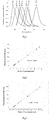
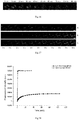
- the mixed sample solutions were left to react at 37°C for 1 hour, and the emission spectra of the samples were measured using a fluorescence spectrophotometer. The results are shown in FIG. 1 respectively. It can be seen from FIG. 1 that the above probes can achieve spectral coverage from an emission wavelength of 480 nm to 730 nm.
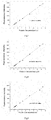
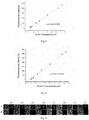
- a HaloTag protein tag was added to 30 ⁇ M of solutions of probe 57, probe 59, probe 60, probe 61, probe 62, probe 63, probe 69, probe 75, probe 76, and probe 82, respectively, to obtain mixed sample solutions with a final concentration of HaloTag protein tag of 0.1 ⁇ M, 0.5 ⁇ M, 0.7 ⁇ M, 1.2 ⁇ M, 4.5 ⁇ M, 8.1 ⁇ M, 13.1 ⁇ M, 14.8 ⁇ M.
- the mixed sample solutions were left to react at 37°C for 1 hour.
- the fluorescence emission spectrophotometer was used to detect the change in excitation emission spectrum of the samples, and the relationship between HaloTag protein tag concentration and fluorescence intensity was plotted according to the emission spectrum intensity. The results are shown in FIG. 2 to FIG. 11 respectively.
- the concentration of HaloTag protein in the range of 0.1 ⁇ M to 14.8 ⁇ M has a good linear relationship with the fluorescence intensity of the probes. Therefore, the protein tag can be quantitatively detected according to the standard curve.
- Hela cells are used as an example to test the labeling effect of compounds in mammalian cells.
- Hela cells and Hela-WT cells Hela primitive cell, without a protein tag expressed
- Probe 57, probe 59, probe 60, probe 61, probe 69, probe 75, probe 76, probe 82 were added to the culture medium and diluted to 5 ⁇ M, respectively.
- the cells were incubated in a 37°C carbon dioxide incubator for 2 hours, and the fluorescence changes of the labeled cells were detected by imaging with a Leica TPS-8 confocal microscope.
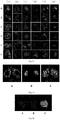
- Results of group 12B show that no corresponding fluorescent signal could be detected in Hela-WT cells after the addition of the above probes, indicating that the probe fluorescence is not affected by the intracellular environment; while a strong fluorescence signal could be detected in Hela cells expressing the protein tag in group 12A, and the fluorescence signal is enhanced by nearly 200 times.
- Hela cells were used as examples to detect the effect of probes on labeling HaloTag protein tags in different subcellular organelles.Hela cells were implanted 5000 cells per well in 96-well glass-bottom cell culture plates. After 14 hours, lipo2000 kit was used to transfect the plasmids localized by HaloTag protein tags in different organelles.
- the original culture medium was removed 24 hours after transfection, and the cells were washed twice with a phenol red-free DMEM medium, and incubated for 2 hours in a phenol red-free medium containing 0.2 ⁇ M probes, and the effect of cell labelling was detected by imaging using a Leica TCS-8 confocal microscope.
- the results are shown in FIG. 13 .
- the probe can clearly display a variety of subcellular organelle structures without washing, such as cytoskeleton, mitochondria, nucleus, Golgi, whole cells, and lysosomes.
- the above results demonstrate that the probe can be a powerful tool for labeling a variety of cellular subcellular organelles.
- Hela cells were implanted 5000 cells per well in a 96-well glass-bottom cell culture plate, and after 14 hours, pcdna3.1-SNAP-NLS and pcdna3.1-mito-HaloTag (HaloTag protein-tagged mitochondrial localization plasmid) were co-transfected with a lipo2000 kit, 0.1 ⁇ g per well; the original medium was removed 24 hours after transfection, a phenol red-free DMEM medium was used twice, and the cells were incubated for 2 hours with phenol red-free medium containing 0.2 ⁇ M reference probe 85 and probe 57, respectively, and the effect of cell labeling was detected by imaging using a leica TCS-8 confocal microscope. The results are shown in FIG.
- the reference probe 85 and probe 57 can clearly display the structures of the mitochondrial and the nucleus at the same time without washing, and the co-localization coefficient of the fluorescence channel of nucleus labeled by the reference probe 85 and the fluorescence channel of mitochondria labeled by probe 57 is less than 0.1, indicating that the two fluorescent channels will not interfere with each other.
- a plasmid pcdna3.1-HaloTag (sample group) expressing the HaloTag protein tag and a control plasmid pcdna3.1-CAT (control group) not expressing the HaloTag protein tag were introduced into mice.
- This method is to dissolve the plasmid in a large volume of solution and inject it into mice quickly through tail vein injection. The mouse liver absorbs DNA and then expresses the target protein.
- the results are shown in FIG. 15 .
- the fluorescence of the liver of the control plasmid pcdna3.1-CAT injected with the probe 77 was very low, which was close to the background fluorescence level of the blank liver without the probe injected, and the liver of the HaloTag plasmid pcdna3.1-HaloTag injected with the probe 77 had strong fluorescence, and the signal intensity was more than 20 times that of the control group.
- the HaloTag protein in mammalian cells was taken as an example, and the AID degradation system in Hela cells was used as an example to detect the fluorescence changes of HaloTag protein binding probes after protein degradation.
- Hela cells were implanted 20,000/cm 2 in a 20mm glass-bottomed cell culture dish. After 14 hours, pcdna3.1-TIR1 and pcdna3.1-HaloTag-IAA17-H2B plasmids were transfected with lipofectmain2000 transfection reagent from invirtogen.
- the original cell culture medium was replaced with a phenol red-free DMEM medium containing 1 ⁇ M probe 61 to label the cells, and the cell samples were incubated in a 37°C carbon dioxide incubator for 1 hour.
- the fluorescence signal of cell labels was detected by imaging using a Leica SP8 laser confocal microscope.
- indole acetic acid (IAA) was added to induce the degradation of HaloTag-IAA17-H2B protein, and the changes in cell fluorescence during protein degradation were detected. The results are shown in FIG. 16 .
- HaloTag-IAA17-H2B protein was localized in the nucleus (0 min), and protein degradation was induced by the addition of indole acetic acid. With the increase of time, the fluorescent signal of HaloTag-IAA17-H2B protein gradually decreased, and when indoleacetic acid was added for 90 min, the fluorescence signal was almost invisible, and the rate of protein degradation was consistent with the results reported in the literature.
- the above experiments show that the fluorescent properties of probes in mammalian cells also depend on the presence of proteins. When proteins are present, fluorescence is activated, and when proteins are degraded, fluorescence disappears, which can be used to track and monitor the degradation process of target proteins.
- Hela cells were used as an example to detect the process of tracing, by a probe, the assembly of intercellular protein CX43 to form intercellular channels in mammalian cells.
- the C-terminus of CX43 gene was fused with HaloTag gene, and a Hela cell line stably expressing the fusion protein CX43-HaloTag was constructed and obtained by lentiviral infection technology.
- Hela-CX43-HaloTag cell lines were implanted in a 20 mm glass-bottom cell culture dish 10 hours before the probe labeling.
- the probe 61 ⁇ M was first diluted to 2 ⁇ M with phenol red-free DMEM medium and replaced the original cell culture medium. The cells were incubated in a 37°C carbon dioxide incubator for 1 hour. Thereafter, the cells were washed twice with fresh phenol red-free DMEM medium, and the unbound probe 61 was removed at intervals of 2 min. Then, a DMEM phenol-free medium containing 1 ⁇ M probe 57 was added to label the cells, and a Leica SP8 confocal microscope was used to monitor the fluorescence intensity and position changes of labeled cells at the corresponding fluorescence channels of probe 61 and probe 57 for a long time, which are shown in FIGS. 17A and 17B , respectively.
- FIG. 17A A long column-shaped specific fluorescent signal between the two cells can be seen in the probe 61 fluorescence channel, as shown in FIG. 17A , consistent with the results reported in the literature ( Guido Gaietta et al. Science 2002, 296, 503-507 .).
- the fluorescent signal could not be detected in its corresponding fluorescence channel.
- FIG. 17B it shows that the probe 61 labeled all the CX43 proteins present in the cell. With the increase of culture time, new CX43-HaloTag protein was continuously synthesized and labeled with probe 57.
- probe 48-labeled HaloTag protein tag and a reference probe 85-labeled SNAP protein tag were taken as examples (probe 48 and reference probe 85 have the same fluorescent dye portion).
- probe 48 and reference probe 85 have the same fluorescent dye portion.
- the purified HaloTag protein and SNAP protein were first diluted to 7.5 ⁇ M with PBS.
- Probe 48 and reference probe 85 were diluted to 15 ⁇ M with PBS, and 20 ⁇ L of probe 48 was added to 80 ⁇ L of HaloTag protein and mixed, 20 ⁇ L of reference probe 85 was added to 80 ⁇ L of SNAP protein and mixed, and a microplate reader was used to monitor the changes in fluorescence intensity of the two solutions excited at 620 nm and emitted at 650 nm, which lasted for two hours.
- t 1/2 of the HaloTag protein tag labeled by the probe 48 was less than 2 s, and the t 1/2 of the SNAP protein tag labeled by the reference probe 85 was about 7 min, and the fluorescence intensity is lower than the former by 1 time or more.
- the above experimental results prove that the probe-labeled HaloTag protein tag has a faster labeling speed and higher fluorescence intensity than the probe-labeled SNAP protein tag.
Landscapes
- Chemical & Material Sciences (AREA)
- Organic Chemistry (AREA)
- Health & Medical Sciences (AREA)
- Life Sciences & Earth Sciences (AREA)
- Engineering & Computer Science (AREA)
- Immunology (AREA)
- Molecular Biology (AREA)
- Physics & Mathematics (AREA)
- Biomedical Technology (AREA)
- Hematology (AREA)
- Urology & Nephrology (AREA)
- Analytical Chemistry (AREA)
- Biochemistry (AREA)
- General Health & Medical Sciences (AREA)
- General Physics & Mathematics (AREA)
- Pathology (AREA)
- Materials Engineering (AREA)
- Food Science & Technology (AREA)
- Medicinal Chemistry (AREA)
- Cell Biology (AREA)
- Biotechnology (AREA)
- Microbiology (AREA)
- Chemical Kinetics & Catalysis (AREA)
- General Chemical & Material Sciences (AREA)
- Bioinformatics & Cheminformatics (AREA)
- Bioinformatics & Computational Biology (AREA)
- Biophysics (AREA)
- Proteomics, Peptides & Aminoacids (AREA)
- Optics & Photonics (AREA)
- Nuclear Medicine, Radiotherapy & Molecular Imaging (AREA)
- Plural Heterocyclic Compounds (AREA)
- Medicines Containing Antibodies Or Antigens For Use As Internal Diagnostic Agents (AREA)
- Investigating Or Analysing Biological Materials (AREA)
- Investigating Or Analysing Materials By The Use Of Chemical Reactions (AREA)
- Investigating, Analyzing Materials By Fluorescence Or Luminescence (AREA)
Abstract
Description
- The present invention relates to a fluorescent probe and a preparation method and use thereof.
- Fluorescence specific labeling is a powerful tool for studying protein function and quantification. Contrast to other study methods, fluorescent labels have the irreplaceable advantages, such as being sensitive, in situ, instant, and visual. Currently, the most often used method of fluorescent labeling proteins is expressing the fluorescent protein in situ on the target protein by gene fusion technology, thereby realizing specific illumination of the target protein and making it possible to perform tracking studies of the target protein in cells or tissues under a fluorescence microscope. Fluorescent protein technology has been developed for a long time, and this technology is relatively mature. However, there are a few shortcomings. For example, fluorescent proteins matures and folds slowly and requires participation of oxygen, and tendency to aggregate. Once the fluorescent protein is expressed, it is difficult to carry out post-modification. In addition, most fluorescent proteins still have a shortcoming such as less photostability, etc. These shortcomings limit the application of fluorescent proteins in some extent.
- In fact, the chromophores structure of fluorescent protein is relatively simple, which makes it very difficult to construct different types or functionalized fluorescent proteins. Furthermore, there is little guideline to follow, and sea screen can only be carried out by means of random mutation. In contrast, organic small molecule fluorescent dyes are rich in molecular structure, but small molecule fluorescent probes still have many defects in protein-specific labeling. Recently, the emergence of chemical tag technology has effectively solved this problem. With chemical tags, the target protein is tagged with a polypeptide or a protein tag with specific recognition function, and small-molecule fluorescent probe-specific protein labeling is achieved by the highly specific binding of the tag to the substrate. Thus, chemistry tags combine the advantage of specificity through genetic encoding with a modular organic fluorophore which inherits all aspects of organic dye probes compared to fluorescent proteins. Currently, SNAP-tag (
K. Johnsson et. al. WO 2004031405 .), CLIP-tag (K. Johnsson et. al. WO 2008012296 .), Halo-tag (Wood, Keith V et. al. WO 2004072232 ), have been commercialized. - Although chemical tag such as SNAP-tag and Halo-tag are capable of specifically labeling their protein of interest during the labeling process, no matter free probes or labeled probes in the system all emit fluorescent. That is, the probes emits fluorescence within the system, no matter the probe binds to the target or not. This non-characteristic fluorescence emission is clearly a serious problem in current chemical labeling technology. Therefore, in a strict sense, this method still cannot achieve the same specificity as fluorescent protein. The only effective way to solve this problem is washing out the unlabeled probe. Apparently, the application of this technology will be severely limited in situations where it is needed quickly or the probe cannot be washed.
- If a method for fluorescent-activated protein-specific labeling for Halo tag is designed, which remains dark or emits very weak fluorescence before labeling, and the fluorescence of the dye is sharply enhanced once it is bind to the protein. Undoubtedly, this kinds of probes will be able to achieve the same specificity as fluorescent proteins, which will not only eliminate the washing out procedure of free probes, but also greatly reduce the background interference of free probes, furthermore will widen the application of HaloTag technology. A method for designing a fluorescently activated protein-specif.ic label suitable for this technique must consider a suitable fluorescence ON/OFF switching mechanism. The FRET mechanism is first applied to this design, which additionally adds the ligand with a fluorescence quenching group. Normally, the small molecule fluorescence is quenched by the quenching group; once the ligand binds to the chemical tag, the quenching group is released, to achieve fluorescence activation (T. Komatsu. et. al. J. Am. Chem. Soc. 2011, 133, 6745-6751.). However, the introduction of the quenching group greatly increases the molecular volume of the probe, which greatly reduces the labeling speed, and severely limits the real-time tracking and detection of proteins in cells and tissues by the probe. Furthermore, there must be a good energy level match between the fluorescent probe and the quenching group, which makes the FRET design of long wavelength fluorescent probes become very difficult, for example, the red light emitting dye. In addition, some dyes that are extremely sensitive to fluorescence have also been used to design fluorescent probes (TK Liu. et. al. ACS Chem. Biol. 2014, 9, 2359-2365.). These probes exhibit no fluorescence or weak fluorescence when the dyes are in polar fluids, such as cell fluid. When the ligand binds to the protein, the probe is placed in the non-polar pocket of the protein, result the probe emits stronger fluorescence. However, on the one hand, due to the presence of a more polar hydration layer on the surface of the protein, the fluorescence enhancement of the probe is limited; on the other hand, the cell or tissue itself is a very complex system, and the polarity of each organelle changes very much greatly, which can lead to polar-sensitive probes with a high background in cell or tissue imaging. Recently, the literature (TY Wang et. al. Chem Sci. 2016, 7, 301-307.) reported a molecular rotor fluorescent probe with viscosity sensitivity, which is sterically hindered after protein ligands are covalently bound to proteins. The action reduces the molecular rotor's degree of freedom, thereby allowing fluorescent of the probe to be activated. However, in this literature, the fluorescence intensity of the probe after after fluorescence activation is dim, and the fluorescence quantum yield is very low. Therefore, the method reported in this literature cannot be used as qualified fluorescent protein tags for labeling, tracking, localization and quantification of target proteins.
- The inventors have discovered that by linking a ligand moiety to a part of a viscosity-responsive fluorescent dye, a significant increase in fluorescent intensity is achieved after the ligand is bound to a tag protein, thereby obtaining a novel structured fluorescent probe, which is viscosity-responsive and can be used for specific labeling of proteins, which can be effectively used for labeling, tracking, localization and / or quantification of target proteins.
- A fluorescent probe is provided, which comprises a ligand moiety A, an optional linker moiety B, and a fluorescent dye moiety C. The fluorescent dye moiety C is a viscosity-responsive fluorescent dye which comprises an electron donor portion D, a conjugated system E and an electron acceptor moiety. The ligand moiety A is a group capable of specifically identifying and labeling a target protein of a protein tag or a fusion protein tag, and optionally, the ligand moiety A is capable of identifying and covalently labeling a target protein of a protein tag or a fusion protein tag.
- Optionally, the above-mentioned fluorescent probe is a compound having a structure represented by formula (I), or a salt thereof,
A-B-C (I)
wherein, - the linker moiety B is an optionally existing group independently selected from an alkylene group and a modified alkylene group;
- the fluorescent dye moiety C in the formula (I) is a structural moiety represented by a formula (I-R),

- wherein,
- in the formula (I-R), the hydrogen at the position connected to the linker moiety B or the ligand moiety A is replaced by the linker moiety B or the ligand moiety A;
- the electron donor moiety -D is -NX1-X2, X1 is independently selected from hydrogen, an alkyl group, or a modified alkyl group, X2 is independently selected from hydrogen, an alkyl group, or a modified alkyl group, and X1, X2 are optionally connected to each other to form an aliphatic heterocycle with the N atom;
- the conjugated system E is a group formed by conjugated connection of at least one of a double bond, a triple bond, an aromatic ring, and an aromatic heterocyclic, and has a structure represented by the following formula (I-1), wherein each hydrogen contained therein is optionally independently substituted with a substitent selected from a halogen atom, a nitro group, a hydrophilic group, an alkyl group, and a modified alkyl group, and the substituents are optionally connected to each other to form an aliphatic ring or an aliphatic heterocycle;

- optionally, the structure of formula (1-1) is connected to X1 and X2 to form an aliphatic heterocycle; the electron acceptor moiety has a structure represented by the following formula (1-2),

- wherein,
- R1 is selected from hydrogen, a halogen atom, a nitro group, an alkyl group, an aryl group, a heteroaryl group, a hydrophilic group or a modified alkyl;
- R2 is selected from hydrogen, a cyano group, a carboxyl group, a keto group, an ester group, an amide group, a thioamino group, a thioester group, a phosphite group, a phosphate group, a sulfonic acid group, a sulfonate group, a sulfone group, a sulfoxide group, an aryl group, a heteroaryl group, an alkyl group or a modified alkyl group;
- R3 is a cyano group;
- the electron acceptor moiety optionally forms a ring structure of the following formulae (I-2-a), (I-2-b), and (I-2-c):

- wherein Ra and Rb are independently selected from hydrogen, a hydrophilic group, an alkyl group, and a modified alkyl group, and Ra and Rb are optionally connected to each other to form an aliphatic ring or an aliphatic heterocycle;
- each Rc is independently selected from hydrogen, a halogen atom, a nitro group, an alkyl group, an aryl group, a heteroaryl group, a hydrophilic group or a modified alkyl group; each Rd is independently selected from hydrogen, a halogen atom, a nitro group, an alkyl group, an aryl group, a heteroaryl group, a hydrophilic group or a modified alkyl group or a group formed by conjugate connection of a double bond with at least one of an aromatic ring and an aromatic heterocyclic ring;
- each Y1 is independently selected from -O-, -S-,-(S=O)-, and-(NRi)-, wherein Ri is independently selected from hydrogen, an alkyl group, or a modified alkyl group;
- each Y2 is independently selected from=O,=S,=S=O, and=NRi, wherein Ri is independently selected from hydrogen, an alkyl group, or a modified alkyl group;
- each Y3 is independently selected from=O,=S,=S=O, and=NRi, wherein Ri is ndependently selected from hydrogen, an alkyl group, or a modified alkyl group;
- or, each Y3 is independently=C(Re)(CN);
- Re is selected from a cyano group, a carboxyl group, a keto group, an ester group, an amide group, a phosphite group, a phosphate group, a sulfonic acid group, a sulfonate group, a sulfone group, a sulfoxide group, an aryl group, a heteroaryl group, an alkyl group or a modified alkyl group;
- when R2 or Re is an aryl group or a heteroaryl group, the hydrogen atom on the ring is optionally independently substituted by a substitent selected from a halogen atom, a cyano group, a nitro group, a hydrophilic group, an alkyl group, or a modified alkyl group; optionally, the substituents are connected to each other to form a saturated or unsaturated aliphatic ring or aliphatic heterocycle;
- wherein,
- the "alkyl group" is a C1-C30 linear or branched alkyl ; optionally, a C1-C10 linear or branched alkyl;
- optionally, a C1-C7 linear or branched alkyl; optionally, C1-C5 linear or branched alkyl; optionally, selected from methyl, ethyl, n-propyl, isopropyl, n-butyl, isobutyl, tert-butyl, sec-butyl, n-pentyl, 1-methylbutyl, 2-methylbutyl, 3-methylbutyl, isopentyl, 1-ethylpropyl, neopentyl, n-hexyl, 1-methylpentyl, 2-methylpentyl, 3-methylpentyl, isohexyl, 1,1-dimethylbutyl, 2,2-dimethylbutyl, 3,3-dimethylbutyl, 1,2-dimethylbutyl, 1,3-dimethylbutyl, 2,3-dimethylbutyl, 2-ethylbutyl, n-heptyl, 2-methylhexyl, 3-methylhexyl, 2,2-dimethylpentyl, 3,3-dimethylpentyl, 2,3-dimethylpentyl, 2,4-dimethylpentyl, 3-ethylpentyl or 2,2,3-trimethylbutyl;
- the "alkylene group" is a C1-C30 linear or branched alkylene; optionally, a C1-C7 linear or branched alkylene; optionally, a C1-C5 linear or branched alkylene; the "modified alkyl group" is a group obtained by replacement of any carbon atom of an alkyl group with at least one group selected from a halogen atom, -O-, -OH, -CO-, -CS-, -NO2, -CN, -S-, -SO2-, -(S=O)-,

- the "modified alkylene" is a group obtained by replacement of any carbon atom of an alkylene group with at least one group selected from a halogen atom, -O-, -OH, -CO-, -NO2, -CN, -S-, -CS-, -SO2 -,-(S=O)-,

- the replacement of the carbon atom means that the carbon atom or the carbon atom and the hydrogen atom thereon together are replaced by a corresponding group;
- the "aliphatic ring" is a saturated or unsaturated 4- to 10-membered monocyclic or polycyclic aliphatic ring;
- the "aliphatic heterocycle" is a saturated or unsaturated 4- to 10-membered monocyclic or polycyclic aliphatic heterocycle containing at least one heteroatom selected from N, O, S, or Si; when the aliphatic heterocycle contains an S atom, the S is in the form of -S-, -SO-, or -SO2-; the aliphatic heterocycle is optionally substituted with a halogen atom, a nitro group, an alkyl group, an aryl group, a hydrophilic group, and a modified alkyl group;
- the "aryl or aromatic ring" is a 5- to 10-membered monocyclic or fused bicyclic aromatic group;
- the "heteroaryl or aromatic heterocyclic ring" is a 5- to 10-membered monocyclic or fused bicyclic
- heteroaromatic group containing at least one heteroatom selected from N, O, S or Si on the ring;
- optionally, the "heteroaryl or aromatic heterocyclic ring" is an 11- to 14-membered fused tricyclic heteroaromatic group containing at least one heteroatom selected from N, O, S, or Si on the ring;
- the "halogen atom" is independently selected from F, Cl, Br, I;
- the "hydrophilic group" is a hydroxyl group, a sulfonic acid group, a carboxyl group, a phosphite group, a primary amino group, a secondary amino group, or a tertiary amino group;
- the "monocyclic cycloalkylene group" is a 4- to 7-membered cycloalkylene group;
- the "bicyclic cycloalkylene group" is a 5- to 7-membered bicyclic cycloalkylene group;
- the "bridged aliphatic heterocycle" is a 5- to 20-membered bridged aliphatic heterocycle containing at least one hetero atom selected from N, O, or S on the ring;
- the "keto group" is an R-(C=O) R 'group;
- the "ester group" is an R(C=O) OR 'group;
- the "amide group" is a RCONR 'group;
- the "thioamide group" is an R(C=S) NR' group;
- the "thioester group" is an R(C=S) OR 'group;
- the "phosphite group" is an RP(=O)(OH)2 group;
- the "phosphate group" is a ROP(=O)(OH)2 group;
- the "sulfonic group" is an RSO3H group;
- the "sulfonate group" is an RSO2OR' group;
- the "sulfone group" is an RSO2R' group;
- the "sulfoxide" RSOR' group;
- the "primary amino group" is a RNH2 group;
- the "secondary amino group" is a RNHR' group;
- the "tertiary amino group" is an RNR'R "group;
- the "quaternary ammonium salt" RR'R"Ra'''N+ group;
- each R, R', R", R''' is independently a single bond, an alkyl group, an alkylene group, a modified alkyl group, or a modified alkylene group, and the modified alkyl group or modified alkylene group is a group obtained by replacement of any carbon atom of C1-C10 (preferably C1-C6) alkyl or alkylene group with a group selected from -O-, -OH, -CO-, -CS-,-(S=O)-;
- optionally, the modified alkyl group or modified alkylene group each is independently a group containing at least one group selected from -OH, -O-, an ethylene glycol unit (-(CH2CH2O)n-), a C1-C8 alkyl group, and a C1-C8 alkoxy group, a C1-C8 acyloxy group, a C1-C8 haloalkyl group, a monosaccharide group, a disaccharide group, a polysaccharide group, -O-CO-, -NH-CO-, -(-NH-CHR''''-CO-)n-, -SO2-O-, -SO-, -SO2-NH-, -S-S-, -CH=CH-, -C≡C-, a halogen atom, a cyano group, a nitro group, an o-nitrophenyl group, a benzoylmethyl group, and a phosphate group, wherein n is 1 to 100, optionally 1 to 50, optionally 1 to 30, optionally 1 to 10; R'''' is H or a residue of α amino acid; the "phosphate group" has the definition as described above;
- the "monosaccharide unit" is a saccharide unit that can no longer be simply hydrolyzed into smaller sugar molecules;
- the "disaccharide unit" is a saccharide unit formed by dehydration of two monosaccharides;
- the "polysaccharide unit" is a saccharide unit formed by dehydration of 10 or more monosaccharides;
- optionally, the C1-C8 alkyl group is methyl, ethyl, propyl, or isopropyl, and the C1-C8 alkoxy group is methoxy, ethoxy, propoxy, or isopropoxy, the C1-C8 acyloxy is acetoxy, ethyl, propyl, isopropyl, and the C1-C8 haloalkyl is trifluoromethyl, chloromethyl, bromomethyl;
- optionally, the aliphatic heterocycle is selected from azetidine, pyrrolidine, piperidine, tetrahydrofuran, tetrahydropyran, morpholine, and thiomorpholine;
- optionally, the heteroaryl ring is selected from thiophene, furan, and pyrrole.
- Optionally, the above-mentioned fluorescent probe is a compound having a structure represented by (I-a) or (I-b), or a salt thereof:

- The electron acceptor moiety has a structure represented by the following formulae (1-2) and (I-2-i),

- Optionally, the above-mentioned fluorescent probe is characterized in that:
- the protein tag is a purified product, an unpurified product, or an in situ state existing in a cell or a tissue;
- optionally, the protein tag is selected from a dehalogenase;
- optionally, the protein tag is a haloalkane dehalogenase (HaloTag) or a mutant thereof;
- optionally, the ligand moiety A is derived from a halogenated hydrocarbon compound;
- optionally, the ligand moiety A suitable for HaloTag is derived from a dehalogenase substrate;
- optionally, the ligand moiety A is a haloalkane group; optionally a haloethyl group, optionally a structure of the following formula:

- X is halogen, optionally chlorine;
- optionally, the linker moiety B is selected from a saturated linear or branched alkyl group having 1 to 30 carbon atoms, one or more carbon atoms on the alkyl chain being replaced with one or more -O-;
- said replacement of carbon atom with -O- means that a carbon atom or a carbon atom and the hydrogen atom thereon together are replaced with -O-;
- optionally, X1 is a C1-30 linear or branched alkyl group optionally substituted with one or more groups selected from a hydroxyl group, a cyano group, a halogen atom, a carboxyl group, and a quaternary ammonium group, and X2 is an C1-30 linear or branched chain alkyl or alkylene group
- optionally substituted one or more groups selected from a hydroxyl group, a cyano group, a halogen atom, a carboxyl group, and a quaternary ammonium group;
- optionally, X1 and X2 are each independently selected from C2-30 ether chain group which contains 1 to 10 oxygen atoms and is optionally substituted with one or more groups selected from a sulfonic acid group and a carboxyl group;
- optionally, X1 and X2 are each independently a C4-30 alkyl or alkylene group which is modified with - HN(C=O)-O-, and is optionally substituted with one or more groups selected from a sulfonic acid group and a carboxyl group;
- optionally, -NX1-X2 forms any group selected from the following formulae (I-i-1), (I-i-2)

- optionally, X1 is a C1-10 linear or branched alkyl group optionally substituted with one or more groups selected from a hydroxyl group, a cyano group, a halogen atom, a carboxyl group, and a quaternary ammonium group, and X2 is a C1-10 linear or branched chain alkyl or alkylene group indepently substituted with one or more groups selected from a hydroxyl group, a cyano group, a halogen atom, a carboxyl group, and a quaternary ammonium group;
- optionally, two adjacent substituents in the conjugated system E are connected to each other to form a saturated or unsaturated aliphatic ring or aliphatic heterocycle;
- optionally, H on CH in the conjugated system E is substituted with a halogen atom, a nitro group, a hydrophilic group, an alkyl group, or a modified alkyl group;
- optionally, the conjugated system E contains NH; optionally, H on the NH is substituted with an alkyl group or a modified alkyl group;
- optionally, the conjugated system E is selected from the structures of the following formulae (I-1-1) to (1-1-38):




- Optionally, the conjugated system E and -NX1-X2 form an aliphatic heterocycle as shown in (I-i-3) to (I-i-7):

- Alternatively, the conjugated system E and -NX1-X2 form the structure shown in (I-i-8) as follows:
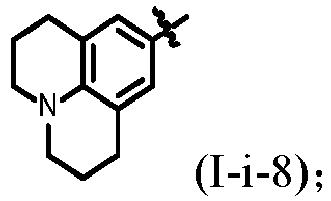


alternatively, the R2 is selected from hydrogen, a cyano group, a carboxyl group, a keto group, an ester group, an amide group, a thioamino group, a thioester group, and when R2 is selected from a keto group, an ester group, or an amide group, the carbonyl group in the keto group, the ester group or the amide group is connected to the alkenyl carbon of the formula (1-2) or (I-2-i); when R2 is selected from a thioamino group and a thioester group, the thiocarbonyl group in the thioamino group or the thioester group is connected to the alkenyl carbon of the formula (1-2) and the formula (I-2-i); Re is selected from a cyano group, a keto group, an ester group, and an amide group; when Re is selected from a keto group, an ester group, or an amide group, the carbonyl group in the keto group, the ester group, or the amide group is connected to the alkenyl carbon of the formula (I-2-a), the formula (I-2-b), or the formula (I-2-c); optionally, the electron acceptor moiety is one selected from the following formulae (1-2-1) to (1-2-38):


- Optionally, the above-mentioned fluorescent probe is characterized in that the fluorescent probe is selected from compounds of the following formulae or salts thereof:





- The salts of the above compounds may be an alkali metal salt, an alkaline earth metal salt, an anion salt, and optionally a sodium salt, a potassium salt, a calcium salt, a hydrochloride, a sulfate, a sulfonate, a carboxylate, and the like.
- In another aspect, a method for preparing the above-mentioned fluorescent probe is also provided, which comprises a step of reacting the fluorescent dye represented by formula (II) with a ligand and an optional linker:

- Wherein, after reactionD- group is formed from D' and is bound to a linking group or a ligand; or after reacton R2- group is formed from R2' and is bound to the linking group or the ligand.
- In another aspect, there is provided a fluorescent activated protein specific labeling method, comprising steps of contacting the above-mentioend fluorescent probe with a target protein of a protein tag or a fusion protein tag; performing labeling reaction between the ligand moiety of the fluorescent probe and the protein tag to label the protein tag with the fluorescent probe; optionally, the labeling of the protein tag with the fluorescent probeis covalently labeling;
optionally, a reaction medium of the labeling reaction is selected from a pure protein solution, a cell lysate or an in situ medium in which the target protein of a protein tag or a fusion protein tag is located; optionally, the in situ medium is intracellular media, organelle media, living tissue media, blood or body fluids. - In another aspect, there is provided use of the above-mentioend fluorescent probe for fluorescent labeling, quantification, detection or kinetic studies of proteins, and for imaging of cells, tissues, and living bodies.
- In another aspect, there is further provided a probe kit comprising the aforesaid fluorescent probe.
- Optionally, the probe kit further comprises a biocompatible medium; optionally, the biocompatible medium is at least one selected from dimethyl sulfoxide, a buffer, and physiological saline; optionally, the buffer includes phosphate buffer.
- The above-mentioned target protein of a protein tag or a fusion protein tag can be prepared by the existing genetic engineering techniques.
- The above-mentioned viscosity-responsive fluorescent dye means that the fluorescence intensity of the dye responds to the viscosity of the solution. As the viscosity of the solution increases, the fluorescence intensity increases. Optionally, the viscosity-responsive fluorescent dye is an organic dye molecule which, under the same concentration and excitation wavelength, at 25°C has a ratio
of the maximum fluorescence emission intensity of the dye in glycerol to the fluorescence intensity in methanol of greater than 2, optionally greater than 5, optionally greater than 10. The concentration of the viscosity-responsive dye ranges from 1 × 10⁻⁷ M to 1 × 10⁻⁵ M. - Depending on the specific situation, the person skilled in the art can select the corresponding tags and ligands as needed.
- Those skilled in the art can track and monitor the target protein of a protein tag or a fusion protein tag with equipment with corresponding configuration. The equipment used, as needed, includes equipment and facilities capable of testing or displaying fluorescence, such as fluorescence spectrometers, fluorescence Microscopes, confocal fluorescence microscopes, microplate readers, flow cytometers, and in vivo imagers.
- Depending on the needs, the operator can choose different types of dyes with different emission / excitation wavelengths.
- According to an embodiment of one aspect, the fluorescent probe has a wide range of fluorescence emission wavelengths.
- According to an embodiment of one aspect, the fluorescence intensity of the fluorescent probe increases as the environmental viscosity increases, is sensitive to viscosity and has viscosity responsiveness.
- According to an embodiment of one aspect, the fluorescent probe can be used for specific labeling of a protein tag of a protein tag or a fusion protein tag. After the fluorescent probe is bound to the protein tag, fluorescence can be activated, the fluorescent probe has good fluorescent molecular switching properties, and the fluorescence activation multiple is high, and the fluorescence activation brightness is high.
- According to an embodiment of one aspect, the fluorescent probe has a very fast speed of labeling the protein.
- According to an embodiment of one aspect, the fluorescent probe has a good linear relationship between the fluorescence intensity and the protein tag concentration and can be used for the quantitative detection of a target protein.
- According to an embodiment of one aspect, the fluorescent probe can achieve specific labeling of intracellular protein tags, and achieve fluorescence-specific lighting, and at the same time, the probe fluorescence is not affected by the intracellular environment.
- According to an embodiment of one aspect, a fluorescent probe can be used as a powerful tool for labeling cell subcellular organelle, such as labeling nucleus, mitochondria, Golgi apparatus, endoplasmic reticulum, whole cells, cytoskeleton, extracellular membrane, lysosome, intracellular membrane, or the like.
- According to an embodiment of one aspect, the spectra of fluorophores of different fluorescent probes do not interfere with each other, and fluorescent probes of different colors can be used for multi-color labeling of samples, and can simultaneously perform orthogonal label imaging.
- According to an embodiment of one aspect, the fluorescence of the fluorescent probe is not affected by the internal environment of the animal, and can be applied to a living animal, for example, to specifically label a Halo-Tag protein tag expressed in the liver and generate a strong fluorescent signal. According to an embodiment of one aspect, a fluorescent probe can be used to track and monitor the degradation process of a target protein.
- According to an embodiment of one aspect, the fluorescent probe monitors the assembly and degradation process of biological macromolecules in mammalian cells in real time.
- According to an embodiment of one aspect, the fluorescent probe can perform rapid contrast imaging on a tissue that is not suitable for washing, such as tissues, living bodies, and the like.
- According to an embodiment of one aspect, the fluorescent probe does not exhibit any detection signal when the fluorescent probe does not label the target protein of the protein tag or the fusion protein tag, and does not interfere with the detection of the sample, and can realize rapid quantitative detection of target protein in complex samples, and can also track the dynamics of the labeling reaction process.
-
-
FIG. 1 is a fluorescence emission diagram in which different wavelengths of fluorescence are activated after different probes are bound to a protein tag; -
FIG. 2 to FIG. 11 are standard curves of corresponding fluorescence intensity versus different HaloTag protein tag concentrations forprobe 57, probe 59,probe 60,probe 61, probe 62,probe 63,probe 75,probe 76, and probe 82, respectively; -
FIG. 12 is a fluorescence spectrum of cell labeled with different probes, wherein (1) to (8) areprobe 57, probe 59,probe 60,probe 61, probe 69,probe 75,probe 76, probe 82, group A is a Hela cell with a protein tag expressed, and group B is a Hela-WT cell (Hela primitive cell, without a protein tag expressed); -
FIG. 13 shows organelles labeled with different probes, wherein groups A to F areprobe 57, probe 59,probe 60,probe 61, probe 62,probe 63, respectively, and (1) to (6) are cytoskeleton, mitochondria, nucleus, Golgi apparatus, whole cell, lysosome, respectively; -
FIG. 14 is a two-color labeling of the same cell with different probes, wherein A is a mitochondria labeled with contrast probe 85, B is a nucleus labeled withprobe 57, and C is an orthogonal imaging of A and B; -
FIG. 15 shows the labeling of living mice with probe 77, wherein group A is a blank group, group B is a control group, and group C is a sample group; -
FIG. 16 shows the fluorescence changes ofprobe 61 in mammalian cells with the protein degradation; -
FIG. 17 shows tracing cell gap assembly process with different probes, wherein A represents the fluorescence channel ofprobe 61, B represents the fluorescence channel ofprobe 57, and C represents the superimposed fluorescent channel ofprobe 61 andprobe 57; -
FIG. 18 shows comparison of the labeling speed and fluorescence intensity of a HaloTag protein tag labeled probe 48 and a SNAP protein tag labeled contrast probe 85 under the same conditions. - Specific embodiments of the present invention will be described in detail below. It should be understood that the specific embodiments described herein are only used to illustrate the present invention by way of examples, and are not intended to limit the present invention.
- Molecular rotors were used as viscosity responsive fluorescent dyes to construct a fluorescent-activated covalently labeled
probe 1 for HaloTag labeling:
- N-methyl-N-(2-hydroxyethyl)-4-aminobenzaldehyde (0.358 g, 2mmol) and tert-butyl cyanoacetate (0.338 g, 2.4 mmol) were dissolved in 50 ml of absolute ethanol. Then add a catalytic amount of anhydrous zinc chloride, and heat it in an oil bath for 5 hours under Ar protection. After the reaction, the reaction solution was cooled to room temperature, and a part of the solvent was removed by rotary evaporation. A large amount of solid precipitated in the system, and filtered. The filter cake was washed twice with cold ethanol and dried under vacuum to obtain yellow compound 1 (0.49 g, 81%). 1H-NMR (400 MHz, DMSO-d6): δ=8.01 (s, 1H), 7.97 (d, 2H, J=9.2Hz), 6.85 (d, 2H, J=9.2Hz), 4.79 (bt, 1H), 3.59-3.55 (m, 4H), 3.08 (s, 3H), 1.50 (s, 9H) .
- The synthesis method was performed according to the method disclosed in the document(Craig M. Crews et.al. Nature Chemical Biology. 2011, 7, 538-543.). 1H-NMR (400 MHz, CDCl3) δ=6.47 (brs, 1H), 3.69 (t, J=4.9Hz, 2H), 3.63-3.60 (m, 2H), 3.56-3.53 (m, 2H), 3.52 (t, J= 6.6Hz, 2H), 3.44 (t, J=6.8Hz, 2H), 3.12 (t, J=4.9Hz, 2H), 1.79-1.71 (m, 2H), 1.60-1.53 (m, 2H), 1.46-1.39 (m, 2H), 1.36-1.28 (m, 2H) .
- Compound 1 (0.302 g, 1.0 mmol) and 4-dimethylaminopyridine (0.146 g, 1.2 mmol) were dissolved in 20 ml of anhydrous dichloromethane. Under the protection of argon, the above solution was slowly added dropwise to phenyl p-nitrochloroformate (0.242 g, 1.2 mmol) dissolved in 10 ml of anhydrous dichloromethane solution. After the dropwise addition was completed, the mixture was stirred at room temperature for 1 h. After the reaction, the solvent was evaporated to dryness, and the residue was dissolved in 10 ml of anhydrous N, N-dimethylformamide. Compound 2 (0.269 g, 1.2 mmol) and anhydrous triethylamine (0.16 ml, 1.2 mmol)were added and stired for 30 min at room temperature under Ar protection. After the reaction was completed, the solvent was rotated to dryness, and the residue was separated through a column to obtain 0.42 g of the
probe 1 with a yield of 70%. 1H-NMR (400 MHz, DMSO-d6): δ=8.18 (t, 1H), 8.01 (s, 1H), 7.97 (d, 2H, J=9.2 Hz), 6.85 (d, 2H, J=9.2Hz), 3.69 (t, J=4.9Hz, 2H), 3.63-3.60 (m, 2H), 3.56-3.53 (m, 2H), 3.59-3.55 (m, 4H), 3.52 (t, J=6.6Hz, 2H), 3.44 (t, J=6.8Hz, 2H), 3.12 (t, J=4.9Hz, 2H), 3.08 (s, 3H), 1.79-1.71 (m, 2H), 1.60-1.53 (m, 2H), 1.50 (s, 9H), 1.46-1.39 (m, 2H), 1.36-1.28 (m, 2H) . - Molecular rotors were used as viscosity responsive fluorescent dyes to construct a fluorescent-activated covalently labeled
probe 2 for HaloTag protein tags:
- The synthesis method was performed according to the method disclosed in the document (J. Das et.al. Bioorg. Med. Chem. Lett. 2005, 15, 337-343.). 1H-NMR (400 MHz, CDCl3) : δ=7.74 (d, 1 H, J=4.0 Hz), 7.55 (d, 1 H, J=4.0 Hz), 7.36-7.42 (m, 2 H), 4.12 (s, 2 H) .
- With reference to the synthetic method of
compound 1. 1H-NMR (400 MHz, DMSO-d6): δ=8.11 - 8.07 (m, 2H), 8.01 - 7.97 (m, 3H), 7.70 (d, 1H, J=8.8 Hz), 7.46 - 7.43 (m, 1H), 6.27 (dd, 1H, J=9.2, 1.6 Hz), 6.02 (s, 1H), 3.88 (t, 2H, J=5.6 Hz), 3.64 (t, 2H, J=5.6 Hz), 3.15 (s, 3H) . - With reference to the synthetic method of
probe 1, the yield was 75%. 1H-NMR (400 MHz, DMSO-d6) : δ=8.18 (t, 1H), 8.11-8.07 (m, 2H), 8.01-7.97 (m, 2H), 7.70 (d, 1H, J=8.8 Hz), 7.46-7.43 (m, 1H), 6.27 (dd, 1H, J=9.2, 1.6 Hz), 6.02 (s, 1H), 3.88 (t, 2H, J=5.6 Hz), 3.69 (t, J = 4.9 Hz, 2H), 3.64 (t, 2H, J=5.6Hz), 3.63-3.60 (m, 2H), 3.56-3.53 (m, 2H), 3.52 (t, J = 6.6 Hz, 2H), 3.44 (t, J = 6.8 Hz, 2H), 3.15 (s, 3H), 3.12 (t, J = 4.9 Hz, 2H), 1.79-1.71 (m, 2H), 1.60-1.53 (m, 2H), 1.46-1.39 (m, 2H), 1.36-1.28 (m, 2H) . - Molecular rotors were used as viscosity responsive fluorescent dyes to construct a fluorescent-activated covalently labeled
probe 3 for HaloTag protein tags:
- With reference to the synthetic method of
compound 1, the yield was 95%. 1H-NMR (400 MHz, CDCl3): δ=8.09 (s, 1H), 8.02 (d, 1H, J=8.0 Hz), 7.98 (d, 2H, J=9.2 Hz), 7.86 (d, 1H, J=8.4 Hz), 7.48 (t, 1H, J=7.8 Hz), 7.36 (t, 1H, J=7.36Hz), 6.73 (d, 2H, J=9.2 Hz), 3.88 (t, 2H, J=5.6 Hz), 3.64 (t, 2H, J=5.6 Hz), 3.15 (s, 3H) . - With reference to the synthetic method of
probe 1, the yield was 65%. 1H-NMR (400 MHz, DMSO-d6) : δ=8.18 (t, 1H), 8.02 (d, 1H, J=8.0 Hz), 7.98 (d, 2H, J=9.2Hz), 7.86 (d, 1H, J=8.4 Hz), 7.48 (t, 1H, J=7.8Hz), 7.36 (t, 1H, J=7.36Hz), 6.73 (d, 2H, J=9.2 Hz), 3.88 (t, 2H, J=5.6 Hz), 3.69 (t, J = 4.9 Hz, 2H), 3.64 (t, 2H, J=5.6Hz), 3.63-3.60 (m, 2H), 3.56-3.53 (m, 2H), 3.52 (t, J = 6.6 Hz, 2H), 3.44 (t, J = 6.8 Hz, 2H), 3.15 (s, 3H), 3.12 (t, J = 4.9 Hz, 2H), 1.79-1.71 (m, 2H), 1.60-1.53 (m, 2H), 1.46-1.39 (m, 2H), 1.36-1.28 (m, 2H) . - Molecular rotors were used as viscosity responsive fluorescent dyes to construct a fluorescent-activated covalently labeled
probe 4 for HaloTag protein tags:
- With reference to the synthetic method of
compound 1, the yield was 95%. 1H-NMR (400 MHz, DMSO-d6): δ=8.01 (s, 1H), 7.97 (d, 2H, J=9.2 Hz), 6.85 (d, 2H, J=9.2 Hz), 4.79 (bt, 2H), 3.85 (t, 4H, J=5.6 Hz), 3.60 (t, 4 H, J=5.6 Hz), 1.50 (s, 9H) . - With reference to the synthetic method of
probe 1, the yield was 35%. 1H-NMR (400 MHz, DMSO-d6) : δ=8.18 (t, 1H), 7.97 (d, 2H, J=9.2 Hz), 6.85 (d, 2H, J=9.2Hz), 4.79 (bt, 1H), 3.85 (t, 4H, J=5.6 Hz), 3.69 (t, J = 4.9 Hz, 2H), 3.63-3.60 (m, 2H), 3.60 (t, 4 H, J=5.6 Hz), 3.56-3.53 (m, 2H), 3.52 (t, J = 6.6 Hz, 2H), 3.44 (t, J = 6.8 Hz, 2H), 3.12 (t, J = 4.9 Hz, 2H), 1.79-1.71 (m, 2H), 1.60-1.53 (m, 2H), 1.50 (s, 9H), 1.46-1.39 (m, 2H), 1.36-1.28 (m, 2H) . - Molecular rotors were used as viscosity responsive fluorescent dyes to construct a fluorescent-activated covalently labeled
probe 5 for HaloTag protein tags:
- Probe 4 (0.581 g, 1.0 mmol) and 4-dimethylaminopyridine (0.146 g, 1.2 mmol) were dissolved in 20 ml of anhydrous dimethylformamide. Under the protection of argon, the above solution was slowly added dropwise to phenyl p-nitrochloroformate (0.242 g, 1.2 mmol) dissolved in 10 ml of anhydrous dichloromethane solution. After the dropwise addition was completed, the mixture was stirred at room temperature for 1 h. After the reaction was completed, sodium 3-amino-propanesulfonate (0.168 g, 1.2 mmol) and anhydrous triethylamine (0.16 ml, 1.2 mmol) were added and stirred for 30 min at room temperature under Ar protection. After the reaction was completed, the solvent was rotated to dryness, and the residue was separated on a reversed-phase column to obtain 0.397 g of the probe with a yield of 50%. 1H-NMR (400 MHz, DMSO-d6) : δ=8.18 (t, 2H), 7.97 (d, 2H, J=9.2Hz), 6.85 (d, 2H, J=9.2 Hz), 3.85 (t, 4H, J=5.6 Hz), 3.69 (t, J = 4.9 Hz, 2H), 3.63-3.60 (m, 2H), 3.60 (t, 8 H, J=5.6 Hz), 3.56-3.53 (m, 2H), 3.52 (t, J = 6.6 Hz, 2H), 3.44 (t, J = 6.8 Hz, 2H), 3.12 (t, J = 4.9 Hz, 2H), 1.79-1.71 (m, 2H), 1.60-1.53 (m, 2H), 1.50 (s, 9H), 1.46-1.39 (m, 2H), 1.36-1.28 (m, 4H) .
- Molecular rotors were used as viscosity responsive fluorescent dyes to construct a fluorescent-activated covalently labeled
probe 6 for HaloTag protein tags:
- The synthesis method was performed according to the method disclosed in the document (L. X. Wu, K. Burgess, J. Am. Chem. Soc. 2008, 130, 4089-4096.) . 1H-NMR (400 MHz, CDCl3): δ=7.63-7.48 (m, 5 H), 4.27 (s, 2 H), 3.13 (s, 3 H) .
- With reference to the synthetic method of
compound 1, the yield was 99%. 1H-NMR (400 MHz, CDCl3): δ=8.03 (s, 1H), 7.97 (d, 2H, J=9.2 Hz), 6.85 (d, 2H, J=9.2 Hz), 4.27 (s, 2 H), 3.55-3.59 (m, 4H), 3.08 (s, 3H), 3.13 (s, 3 H) . - With reference to the synthetic method of
probe 1, the yield was 70%. 1H-NMR (400 MHz, DMSO-d6): δ=8.18 (t, 1H), 8.03 (s, 1H), 7.97 (d, 2H, J=9.2 Hz), 6.85 (d, 2H, J=9.2 Hz), 4.27 (s, 2 H), 3.69 (t, J = 4.9 Hz, 2H), 3.63-3.60 (m, 2H), 3.59-3.55 (m, 4H), 3.56-3.53 (m, 2H), 3.52 (t, J = 6.6 Hz, 2H), 3.44 (t, J = 6.8 Hz, 2H), 3.13 (s, 3 H) 3.12 (t, J = 4.9 Hz, 2H), 3.08 (s, 3H), 1.79-1.71 (m, 2H), 1.60-1.53 (m, 2H), 1.46-1.39 (m, 2H), 1.36-1.28 (m, 2H) . - Molecular rotors were used as viscosity responsive fluorescent dyes to construct a fluorescent-activated covalently labeled
probe 7 for HaloTag protein tag:
- The synthesis method was performed according to the method disclosed in the document (L. X. Wu, K. Burgess, J. Am. Chem. Soc. 2008, 130, 4089-4096.) . 1H-NMR (400 MHz, CDCl3): δ=3.98 (q, 2 H, J=2.4 Hz), 3.01 (s, 3 H), 2.15 (t, 3 H, J=2.4 Hz) .
- With reference to the synthetic method of
compound 1, the yield was 97%. 1H-NMR (400 MHz, DMSO-d6): δ=8.00 (s, 1H), 7.97 (d, 2H, J=9.2 Hz), 6.85 (d, 2H, J=9.2 Hz), 3.98 (q, 2 H, J=2.4 Hz), 3.55-3.59 (m, 4H), 3.08 (s, 3H), 3.01 (s, 3 H), 2.15 (t, 3H, J=2.4 Hz) . - Compound 10 (0.546 g, 2 mmol), benzaldehyde (0.530 g, 5 mmol) and anhydrous zinc chloride (0.545 g, 4 mmol) were dissolved in 100 ml of anhydrous toluene. The oil bath was heated to reflux under Ar protection for 48 h.After the reaction is completed, the solvent was evaporated to dryness, the residue was dissolved in 100 ml of dichloromethane, washed three times with water, and the organic phase was dried over anhydrous sodium sulfate. The solvent was rotated to dryness, and the residue was separated by column chromatography to obtain 0.181 g of a red-brown solid with a yield of 25%. 1H-NMR (400 MHz, DMSO-d6): δ=8.21 (d, 2 H, J=8.8 Hz), 8.00 (d, 1 H, J=16 Hz), 7.85 (d, 2 H, J=8.0 Hz), 7.45-7.38 (m, 3 H), 7.24 (s, 1 H), 7.01 (s, 1 H), 6.92 (d, 2 H, J=8.8 Hz), 3.85 (t, 2H, J=5.6 Hz), 3.60 (t, 2 H, J=5.6 Hz), 3.10 (s, 3 H) .
- With reference to the synthetic method of
probe 1, the yield was 66%. 1H-NMR (400 MHz, DMSO-d6): 8.21 (d, 2 H, J=8.8 Hz), δ=8.18 (t, 1H), 8.00 (d, 1 H, J=16 Hz), 7.85 (d, 2 H, J=8.0 Hz), 7.45-7.38 (m, 3 H), 7.24 (s, 1 H), 7.01 (s, 1 H), 6.92 (d, 2 H, J=8.8 Hz), 3.85 (t, 2H, J=5.6 Hz), 3.69 (t, J = 4.9 Hz, 2H), 3.63-3.60 (m, 2H), 3.60 (t, 2 H, J=5.6 Hz), 3.56-3.53 (m, 2H), 3.52 (t, J = 6.6 Hz, 2H), 3.44 (t, J = 6.8 Hz, 2H), 3.12 (t, J = 4.9 Hz, 2H), 3.10 (s, 3 H), 1.79-1.71 (m, 2H), 1.60-1.53 (m, 2H), 1.46-1.39 (m, 2H), 1.36-1.28 (m, 2H) . - Molecular rotors were used as viscosity responsive fluorescent dyes to construct a fluorescent-activated covalently labeled
probe 8 for HaloTag protein tag:
- The synthesis method was performed according to the method disclosed in the document (Wang H. et al. Tetra Let. 2007, 48, 3471-3474.) 1H-NMR (400 MHz, DMSO-d6): δ=8.05 (m, 2 H), 7.01 (m, 2 H), 1.83 (s, 6 H) .
- Compound 12 (0.279 g, 1 mmol) was dissolved in 20 ml of anhydrous pyridine, and 1 ml of N-methyl-N-hydroxyethyl was added. The mixture was heated in an oil bath at 40 °C overnight under Ar protection. After the reaction, the solvent was rotated to dryness, and the residue was separated by column chromatography to obtain 0.187 g of a red product with a yield of 56%. 1H-NMR (400 MHz, DMSO-d6): δ=8.05 (m, 2 H), 7.01 (m, 2 H), 3.85 (t, 2H, J=5.6 Hz), 3.60 (t, 2 H, J=5.6 Hz), 3.10 (s, 3 H), 1.83 (s, 6 H).
- With reference to the synthetic method of
probe 1, the yield was 56%. 1H-NMR (400 MHz, DMSO-d6): δ=8.18 (t, 1H), 8.05 (m, 2 H), 7.01 (m, 2 H), 3.85 (t, 2H, J=5.6 Hz), 3.69 (t, J = 4.9 Hz, 2H), 3.63-3.60 (m, 2H), 3.60 (t, 2 H, J=5.6 Hz), 3.56-3.53 (m, 2H), 3.52 (t, J = 6.6 Hz, 2H), 3.44 (t, J = 6.8 Hz, 2H), 3.12 (t, J = 4.9 Hz, 2H), 3.10 (s, 3 H), 1.83 (s, 6 H), 1.79-1.71 (m, 2H), 1.60-1.53 (m, 2H), 1.46-1.39 (m, 2H), 1.36-1.28 (m, 2H) . - Molecular rotors were used as viscosity responsive fluorescent dyes to construct a fluorescent-activated covalently labeled
probe 9 for HaloTag protein tag:
- With reference to the synthetic method of
compound 1, the yield was 95%. 1H-NMR (400 MHz, DMSO-d6): δ=8.07 (s, 1H), 7.93 (d, 2H, J=9.2 Hz), 6.85 (d, 2H, J=9.2 Hz), 3.55-3.59 (m, 4H), 3.08 (s, 3H) . - With reference to the synthetic method of
probe 1, the yield was 35%. 1H-NMR (400 MHz, DMSO-d6): δ=8.18 (t, 1H), 8.07 (s, 1H), 7.93 (d, 2H, J=9.2 Hz), 6.85 (d, 2H, J=9.2 Hz), 3.69 (t, J = 4.9 Hz, 2H), 3.63-3.60 (m, 2H), 3.59-3.55 (m, 4H), 3.56-3.53 (m, 2H), 3.52 (t, J = 6.6 Hz, 2H), 3.44 (t, J = 6.8 Hz, 2H), 3.12 (t, J = 4.9 Hz, 2H), 3.08 (s, 3H), 1.79-1.71 (m, 2H), 1.60-1.53 (m, 2H), 1.46-1.39 (m, 2H), 1.36-1.28 (m, 2H) . - Molecular rotors were used as viscosity responsive fluorescent dyes to construct a fluorescent-activated covalently labeled
probe 10 for HaloTag protein tag:
- The synthesis method was performed according to the method disclosed in the document (
WO 2013142841 (A1 ), 2013.09.26.) . 1H-NMR (400 MHz, CDCl3): δ=7.92 (s, 1 H), 7.63 (d, 1 H, J=5.2 Hz), 7.31 (d, 1 H, J=5.2 Hz) . - Compound 15 (0.438 g, 2 mmol) was dissolved in 15 mL of N-methyl-N-hydroxyethylamine, copper powder (6.4 mg, 0.01 mmol), cuprous iodide (19 mg, 0.01 mmol), and tripotassium phosphate (0.850 g, 4 mmol) were added to the above solution, and heated at 80 °C in an oil bath overnight under Ar protection. After the reaction was completed, the mixture was cooled to room temperature, and the system was poured into 50 mL of water and extracted three times with 50 mL of dichloromethane. The organic phases were combined, the solvent was evaporated to dryness, and 0.362 g of a yellow product was obtained by column chromatography with a yield of 85%. 1H-NMR (400 MHz, CDCl3): δ=7.92 (s, 1 H), 7.63 (d, 1 H, J=5.2 Hz), 7.31 (d, 1 H, J=5.2 Hz), 3.85 (t, 2H, J=5.6 Hz), 3.60 (t, 2 H, J=5.6 Hz), 3.10 (s, 3 H) .
- Compound 16 (0.426 g, 2 mmol) was dissolved in 50 ml of anhydrous dichloromethane, 1 ml of triethylamine was added, and acetic anhydride (0.3 ml, 3 mmol) was slowly added dropwise under an ice bath. After the addition, the system was slowly warmed to room temperature and stirred for 3 h. After the reaction was completed, 100 ml of water was added to separate the organic phase. The aqueous phase was extracted twice with 50 ml of dichloromethane. The organic phases were combined, dried over anhydrous sodium sulfate, and the solvent was evaporated to dryness. The residue was used in the next step without further purification.
- The above residue was dissolved in 50 ml of dichloromethane, 5 ml of dimethylformamide was added, 2 ml of phosphorus oxychloride was added under ice bath conditions, and the mixture was stirred for 0.5 h under the protection of Ar. The system was slowly warmed to room temperature and stirred for 5 h. After the reaction, Add saturated sodium carbonate solution to adjust pH = 10.0, stir overnight at room temperature, separate the organic phase the next day, and extract the aqueous phase three times with 50 ml of dichloromethane. The organic phases were combined, washed twice with saturated brine, and the organic phases were dried over anhydrous sodium sulfate. The solvent was rotary evaporated to dryness, and the residue was subjected to column chromatography to obtain 0.285 g of a yellow solid with a yield of 59%. 1H-NMR (400 MHz, CDCl3): δ=10.01 (s, 1 H), 7.92 (s, 1 H), 7.63 (s, 1 H) 3.85 (t, 2H, J=5.6 Hz), 3.60 (t, 2 H, J=5.6 Hz), 3.10 (s, 3 H) .
- With reference to the synthetic method of
compound 1, the yield was 89%. 1H-NMR (400 MHz, DMSO-d6): δ=8.22 (s, 1H), 8.02 (s, 1H), 6.43 (s, 1H), 3.85 (t, 2H, J=5.6 Hz), 3.60 (t, 2 H, J=5.6 Hz), 3.10 (s, 3 H), 1.49 (s, 9H) . - With reference to the synthetic method of
probe 1, the yield was 65%. 1H-NMR (400 MHz, DMSO-d6): δ=8.22 (s, 1H), 8.18 (t, 1H), 8.02 (s, 1H), 6.43 (s, 1H), 3.85 (t, 2H, J=5.6 Hz), 3.69 (t, J = 4.9 Hz, 2H), 3.63-3.60 (m, 2H), 3.60 (t, 2 H, J=5.6 Hz), 3.56-3.53 (m, 2H), 3.52 (t, J = 6.6 Hz, 2H), 3.44 (t, J = 6.8 Hz, 2H), 3.12 (t, J = 4.9 Hz, 2H), 3.10 (s, 3 H), 1.79-1.71 (m, 2H), 1.60-1.53 (m, 2H), 1.49 (s, 9H), 1.46-1.39 (m, 2H), 1.36-1.28 (m, 2H) . - Molecular rotors were used as viscosity responsive fluorescent dyes to construct a fluorescent-activated covalently labeled probe 11 for HaloTag protein tag:
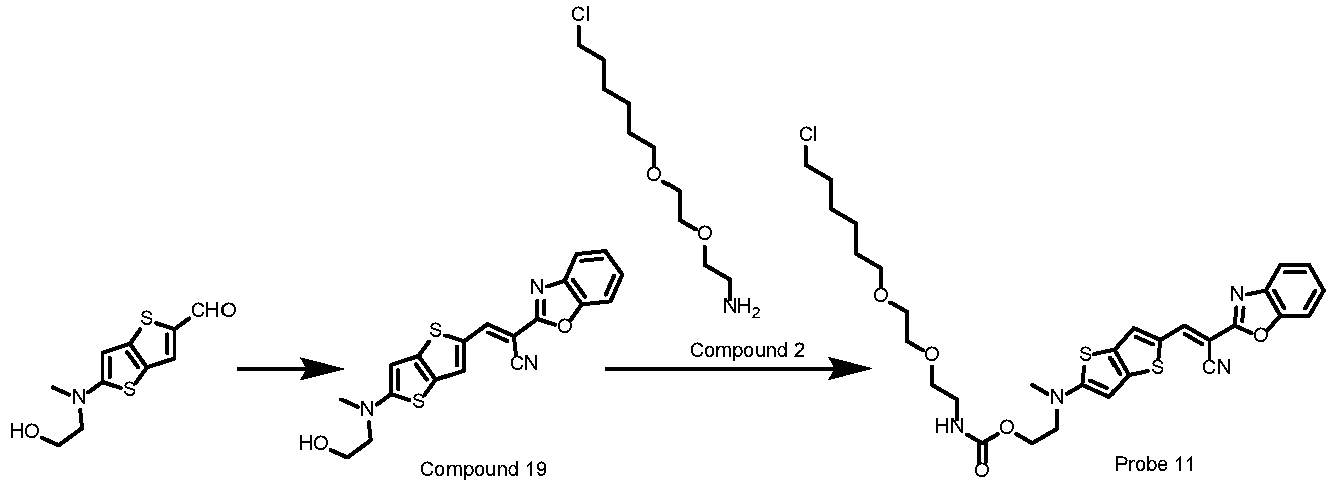
- With reference to the synthetic method of
compound 1, the yield was 93%. 1H-NMR (400 MHz, CDCl3): δ=8.22 (s, 1H), 8.02 (s, 1H), 7.74 (d, 1 H, J=4.0 Hz), 7.55 (d, 1 H, J=4.0 Hz), 7.36-7.42 (m, 2 H), 6.43 (s, 1H), 3.75 (t, 2H, J=5.6 Hz), 3.55 (t, 2 H, J=5.6 Hz), 3.10 (s, 3 H) . - With reference to the synthetic method of
probe 1, the yield was 66%. 1H-NMR (400 MHz, DMSO-d6): δ=8.22 (s, 1H), 8.18 (t, 1H), 8.02 (s, 1H), 7.74 (d, 1 H, J=4.0 Hz), 7.55 (d, 1 H, J=4.0 Hz), 7.36-7.42 (m, 2 H), 6.43 (s, 1H), 3.75 (t, 2H, J=5.6 Hz), 3.69 (t, J = 4.9 Hz, 2H), 3.63-3.60 (m, 2H), 3.56-3.53 (m, 2H), 3.55 (t, 2 H, J=5.6 Hz), 3.52 (t, J = 6.6 Hz, 2H), 3.44 (t, J = 6.8 Hz, 2H), 3.12 (t, J = 4.9 Hz, 2H), 3.10 (s, 3 H), 1.79-1.71 (m, 2H), 1.60-1.53 (m, 2H), 1.46-1.39 (m, 2H), 1.36-1.28 (m, 2H) . - Molecular rotors were used as viscosity responsive fluorescent dyes to construct a fluorescent-activated covalently labeled
probe 12 for HaloTag protein tag:
- With reference to the synthetic method of
compound 1, the yield was 96%. 1H-NMR (400 MHz, DMSO-d6): δ=8.22 (s, 1H), 8.02 (s, 1H), 6.43 (s, 1H), 3.85 (t, 2H, J=5.6 Hz), 3.60 (t, 2 H, J=5.6 Hz), 3.10 (s, 3 H) . - With reference to the synthetic method of
probe 1, the yield was 39%. 1H-NMR (400 MHz, DMSO-d6): δ=8.22 (s, 1H), 8.18 (t, 1H), 8.02 (s, 1H), 6.43 (s, 1H), 3.85 (t, 2H, J=5.6 Hz), 3.69 (t, J = 4.9 Hz, 2H), 3.63-3.60 (m, 2H), 3.60 (t, 2 H, J=5.6 Hz), 3.56-3.53 (m, 2H), 3.52 (t, J = 6.6 Hz, 2H), 3.44 (t, J = 6.8 Hz, 2H), 3.12 (t, J = 4.9 Hz, 2H), 3.10 (s, 3 H), 1.79-1.71 (m, 2H), 1.60-1.53 (m, 2H), 1.46-1.39 (m, 2H), 1.36-1.28 (m, 2H) . - Molecular rotors were used as viscosity responsive fluorescent dyes to construct a fluorescent-activated covalently labeled probe 13 for HaloTag protein tag:

- With reference to the synthetic method of
compound 16, the yield was 87%. 1H-NMR (400 MHz, CDCl3): δ=8.02 (s, 1 H), 7.66 (d, 1 H, J=8.4 Hz), 7.44-7.48 (m, 1 H), 7.41 (m, 1 H), 7.29 (m, 1 H), 3.60 (t, 2 H, J=5.6 Hz), 3.34 (t, J = 8.0 Hz, 3H), 3.10 (s, 3H) . - With reference to the synthetic method of compound 17, the yield was 56%. 1H-NMR (400 MHz, CDCl3): δ=9.92 (s, 1H), 7.81 (s, 1H), 7.68 (d, J = 9.0 Hz, 1H), 6.92 (d, J = 2.0 Hz, 1H), 6.82 (d, J = 9.1, 2.3 Hz, 1H), 3.61 (t, J = 8.0 Hz, 2H), 3.34 (t, J = 8.0 Hz, 2H), 3.10 (s, 3H) .
- With reference to the synthetic method of
compound 1, the yield was 91%. 1H-NMR (400 MHz, CDCl3): δ=8.02 (s, 1H), 7.81 (s, 1H), 7.68 (d, J = 9.0 Hz, 1H), 6.92 (d, J = 2.0 Hz, 1H), 6.82 (d, J = 9.1, 2.3 Hz, 1H), 3.61 (t, J = 8.0 Hz, 2H), 3.34 (t, J = 8.0 Hz, 2H), 3.11 (s, 3H), 1.48 (s, 9H) . - With reference to the synthetic method of
probe 1, the yield was 66%. 1H-NMR (400 MHz, CDCl3): δ=8.18 (t, 1H), 8.02 (s, 1H), 7.81 (s, 1H), 7.68 (d, J = 9.0 Hz, 1H), 6.92 (d, J = 2.0 Hz, 1H), 6.82 (d, J = 9.1, 2.3 Hz, 1H), 3.69 (t, J = 4.9 Hz, 2H), 3.63-3.60 (m, 2H), 3.61 (t, J = 8.0 Hz, 2H), 3.56-3.53 (m, 2H), 3.52 (t, J = 6.6 Hz, 2H), 3.44 (t, J = 6.8 Hz, 2H), 3.34 (t, J = 8.0 Hz, 2H), 3.12 (t, J = 4.9 Hz, 2H), 3.11 (s, 3H), 1.48 (s, 9H), 1.79-1.71 (m, 2H), 1.60-1.53 (m, 2H), 1.46-1.39 (m, 2H), 1.36-1.28 (m, 2H) . - Molecular rotors were used as viscosity responsive fluorescent dyes to construct a fluorescent-activated covalently labeled
probe 14 for HaloTag protein tag:
- With reference to the synthetic method of
compound 4, the yield was 93%. 1H-NMR (400 MHz, DMSO-d6): δ=8.45 (s, 1H), 8.09 (d, J =8.00 Hz, 2H), 8.07 (s, 1H), 7.94 (d, J =8.00 Hz, 2H), 7.51 (m, 1H), 7.41 (m, 1H), 6.45 (s, 1H), 3.61 (t, J = 8.0 Hz, 2H), 3.34 (t, J = 8.0 Hz, 2H), 3.21 (s, 3H) . - With reference to the synthetic method of
probe 1, the yield was 71%. 1H-NMR (400 MHz, DMSO-d6): δ=8.45 (s, 1H), 8.18 (t, 1H), 8.09 (d, J =8.00 Hz, 2H), 8.07 (s, 1H), 7.94 (d, J =8.00 Hz, 2H), 7.51 (m, 1H), 7.41 (m, 1H), 6.45 (s, 1H), 3.69 (t, J = 4.9 Hz, 2H), 3.63-3.60 (m, 2H), 3.61 (t, J = 8.0 Hz, 2H), 3.56-3.53 (m, 2H), 3.52 (t, J = 6.6 Hz, 2H), 3.44 (t, J = 6.8 Hz, 2H), 3.34 (t, J = 8.0 Hz, 2H), 3.21 (s, 3H), 3.12 (t, J = 4.9 Hz, 2H), 1.79-1.71 (m, 2H), 1.60-1.53 (m, 2H), 1.46-1.39 (m, 2H), 1.36-1.28 (m, 2H) . - Molecular rotors were used as viscosity responsive fluorescent dyes to construct a fluorescent-activated covalently labeled probe 15 for HaloTag protein tag:

- With reference to the synthetic method of
compound 16, the yield was 67%. 1H-NMR (400 MHz, CDCl3): δ=7.62 (d, 1 H, J=8.8 Hz), 7.15 (d, 1 H, J=5.6 Hz), 7.08-7.01 (m, 2 H), 6.81 (d, 1H, J=2.4 Hz), 3.62 (t, 4H, J = 8.0 Hz), 3.35 (t, 4H , J = 8.0 Hz) . - With reference to the synthetic method of compound 17, the yield was 67%. 1H-NMR (400 MHz, CDCl3): δ=9.99 (s, 1 H), 7.81 (s, 1 H), 7.68 (d, 1 H, J=9.0 Hz), 6.92 (d, 1 H, J=2.0 Hz), 6.81 (m, 1 H), 3.62 (t, 4H, J = 8.0 Hz), 3.35 (t, 4H , J = 8.0 Hz) .
- With reference to the synthetic method of
compound 1, the yield was 96%. 1H-NMR (400 MHz, CDCl3): δ=8.00 (s, 1 H), 7.83 (s, 1 H), 7.69 (d, 1 H, J=9.0 Hz), 6.92 (d, 1 H, J=2.0 Hz), 6.81 (m, 1 H), 3.62 (t, 4H, J = 8.0 Hz), 3.35 (t, 4H , J = 8.0 Hz), 1.49 (s, 9 H) . - With reference to the synthetic method of
probe 1, the yield was 44%. 1H-NMR (400 MHz, CDCl3): δ=8.18 (t, 1H), 8.00 (s, 1 H), 7.83 (s, 1 H), 7.69 (d, 1 H, J=9.0 Hz), 6.92 (d, 1 H, J=2.0 Hz), 6.81 (m, 1 H), 3.69 (t, J = 4.9 Hz, 2H), 3.62 (t, 4H, J = 8.0 Hz), 3.63-3.60 (m, 2H), 3.56-3.53 (m, 2H), 3.52 (t, J = 6.6 Hz, 2H), 3.44 (t, J = 6.8 Hz, 2H), 3.35 (t, 4H , J = 8.0 Hz), 3.12 (t, J = 4.9 Hz, 2H), 1.79-1.71 (m, 2H), 1.60-1.53 (m, 2H), 1.49 (s, 9 H), 1.46-1.39 (m, 2H), 1.36-1.28 (m, 2H) . - Molecular rotors were used as viscosity responsive fluorescent dyes to construct a fluorescent-activated covalently labeled
probe 16 for HaloTag protein tag:
- With reference to the synthetic method of
probe 5, the yield was 44%. 1H-NMR (400 MHz, CDC13): δ=8.18 (m, 2H), 8.00 (s, 1 H), 7.83 (s, 1 H), 7.69 (d, 1 H, J=9.0 Hz), 6.92 (d, 1 H, J=2.0 Hz), 6.81 (m, 1 H), 3.69 (t, J = 4.9 Hz, 2H), 3.62 (t, 4H, J = 8.0 Hz), 3.63-3.60 (m, 6H), 3.56-3.53 (m, 2H), 3.52 (t, J = 6.6 Hz, 2H), 3.44 (t, J = 6.8 Hz, 2H), 3.35 (t, 4H , J = 8.0 Hz), 3.12 (t, J = 4.9 Hz, 2H), 1.79-1.71 (m, 2H), 1.60-1.53 (m, 2H), 1.49 (s, 9 H), 1.46-1.39 (m, 4H), 1.36-1.28 (m, 2H) . - Molecular rotors were used as viscosity responsive fluorescent dyes to construct a fluorescent-activated covalently labeled probe 17 for HaloTag protein tag:

- With reference to the synthetic method of
compound 10, the yield was 91%. 1H-NMR (400 MHz, CDCl3): δ=8.22 (s, 1H), 8.02 (s, 1H), 6.43 (s, 1H), 3.61 (t, J = 8.0 Hz, 3H), 3.34 (t, J = 8.0 Hz, 3H), 3.11 (s, 3H), 3.00 (s, 3 H), 2.15 (t, 3 H, J=2.4 Hz), 1.48 (s, 9H) . - With reference to the synthetic method of
probe 1, the yield was 55%. 1H-NMR (400 MHz, CDCl3): 8.22 (s, 1H), δ=8.18 (t, 1H), 8.02 (s, 1H), 6.43 (s, 1H), 3.69 (t, J = 4.9 Hz, 2H), 3.63-3.60 (m, 2H), 3.61 (t, J = 8.0 Hz, 3H), 3.56-3.53 (m, 2H), 3.52 (t, J = 6.6 Hz, 2H), 3.44 (t, J = 6.8 Hz, 2H), 3.34 (t, J = 8.0 Hz, 3H), 3.12 (t, J = 4.9 Hz, 2H), 3.11 (s, 3H), 3.00 (s, 3 H), 2.15 (t, 3 H, J=2.4 Hz), 1.79-1.71 (m, 2H), 1.60-1.53 (m, 2H), 1.48 (s, 9H), 1.46-1.39 (m, 2H), 1.36-1.28 (m, 2H) . - Molecular rotors were used as viscosity responsive fluorescent dyes to construct a fluorescent-activated covalently labeled probe 18 for HaloTag protein tag:

- With reference to the synthetic method of
compound 14, the yield was 98%. 1H-NMR (400 MHz, CDCl3): δ=7.95 (s, 1 H), 7.81 (s, 1 H), 7.68 (d, 1 H, J=9.0 Hz), 6.92 (d, 1 H, J=2.0), 6.82 (d, 1 H, J=9.2 Hz), 3.85 (t, 2H, J=5.6 Hz), 3.60 (t, 2 H, J=5.6 Hz), 3.10 (s, 3 H) . - With reference to the synthetic method of
probe 9, the yield was 91%. 1H-NMR (400 MHz, CDCl3): δ=8.18 (t, 1H), 7.95 (s, 1 H), 7.81 (s, 1 H), 7.68 (d, 1 H, J=9.0 Hz), 6.92 (d, 1 H, J=2.0), 6.82 (d, 1 H, J=9.2 Hz), 3.85 (t, 2H, J=5.6 Hz), 3.69 (t, J = 4.9 Hz, 2H), 3.63-3.60 (m, 2H), 3.60 (t, 2 H, J=5.6 Hz), 3.56-3.53 (m, 2H), 3.52 (t, J = 6.6 Hz, 2H), 3.44 (t, J = 6.8 Hz, 2H), 3.12 (t, J = 4.9 Hz, 2H), 3.10 (s, 3 H), 1.79-1.71 (m, 2H), 1.60-1.53 (m, 2H), 1.46-1.39 (m, 2H), 1.36-1.28 (m, 2H) . - Molecular rotors were used as viscosity responsive fluorescent dyes to construct a fluorescent-activated covalently labeled probe 19 for HaloTag protein tag:

- With reference to the synthetic method of
compound 16, the yield was 78%. 1H-NMR (400 MHz, CDCl3): δ=8.07 (s, 1 H), 7.77 (d, 1 H, J=1.6 Hz), 7.66 (d, 1 H, J=8.4 Hz), 7.50 (dd, 1 H, J1=8.4 Hz, J2=1.6Hz), 3.61 (t, 2H, J = 8.0 Hz), 3.34 (t, 2H, J = 8.0 Hz), 3.11 (s, 3H) . - With reference to the synthetic method of compound 17, the yield was 81%. 1H-NMR (400 MHz, CDCl3): δ=9.99 (s, 1 H), 7.61 (d, 1 H, J=1.6 Hz), 7.49 (d, 1 H, J=8.4 Hz), 7.40 (dd, 1 H, J1=8.4 Hz, J2=1.6Hz), 3.61 (t, 2H, J = 8.0 Hz), 3.34 (t, 2H, J = 8.0 Hz), 3.11 (s, 3H) .
- With reference to the synthetic method of
compound 1, the yield was 98%. 1H-NMR (400 MHz, CDCl3): δ=8.01 (s, 1 H), 7.61 (d, 1 H, J=1.6 Hz), 7.49 (d, 1 H, J=8.4 Hz), 7.40 (dd, 1 H, J1=8.4 Hz, J2=1.6Hz), 3.61 (t, 2H, J = 8.0 Hz), 3.34 (t, 2H, J = 8.0 Hz), 3.11 (s, 3H), 1.50 (s, 9 H) . - With reference to the synthetic method of
probe 1, the yield was 66%. 1H-NMR (400 MHz, CDCl3): δ=8.18 (t, 1H), 8.01 (s, 1 H), 7.61 (d, 1 H, J=1.6 Hz), 7.49 (d, 1 H, J=8.4 Hz), 7.40 (dd, 1 H, J1=8.4 Hz, J2=1.6 Hz), 3.69 (t, J = 4.9 Hz, 2H), 3.63-3.60 (m, 2H), 3.61 (t, 2H, J = 8.0 Hz), 3.56-3.53 (m, 2H), 3.52 (t, J = 6.6 Hz, 2H), 3.44 (t, J = 6.8 Hz, 2H), 3.34 (t, 2H, J = 8.0 Hz), 3.12 (t, J = 4.9 Hz, 2H), 3.11 (s, 3H), 1.79-1.71 (m, 2H), 1.60-1.53 (m, 2H), 1.50 (s, 9 H), 1.46-1.39 (m, 2H), 1.36-1.28 (m, 2H) . - Molecular rotors were used as viscosity responsive fluorescent dyes to construct a fluorescent-activated covalently labeled
probe 20 for HaloTag protein tag:
- With reference to the synthetic method of
compound 1, the yield was 97%. 1H-NMR (400 MHz, CDCl3): δ=7.99 (s, 1 H), 7.61 (d, 1 H, J=1.6 Hz), 7.74 (d, 1 H, J=4.0 Hz), 7.55 (d, 1 H, J=4.0 Hz), 7.49 (d, 1 H, J=8.4 Hz), 7.36-7.42 (m, 3 H), 3.61 (t, 2H, J = 8.0 Hz), 3.34 (t, 2H, J = 8.0 Hz), 3.11 (s, 3H) . - With reference to the synthetic method of
probe 1, the yield was 65%. 1H-NMR (400 MHz, CDCl3): δ=8.18 (t, 1H), 7.99 (s, 1 H), 7.61 (d, 1 H, J=1.6 Hz), 7.74 (d, 1 H, J=4.0 Hz), 7.55 (d, 1 H, J=4.0 Hz), 7.49 (d, 1 H, J=8.4 Hz), 7.36-7.42 (m, 3 H), 3.69 (t, J = 4.9 Hz, 2H), 3.63-3.60 (m, 2H), 3.61 (t, 2H, J = 8.0 Hz), 3.56-3.53 (m, 2H), 3.52 (t, J = 6.6 Hz, 2H), 3.44 (t, J = 6.8 Hz, 2H), 3.34 (t, 2H, J = 8.0 Hz), 3.12 (t, J = 4.9 Hz, 2H), 3.11 (s, 3H), 1.79-1.71 (m, 2H), 1.60-1.53 (m, 2H), 1.46-1.39 (m, 2H), 1.36-1.28 (m, 2H) . - Molecular rotors were used as viscosity responsive fluorescent dyes to construct a fluorescent-activated covalently labeled probe 21 for HaloTag protein tag:

- With reference to the synthetic method of
compound 1, the yield was 87%. 1H-NMR (400 MHz, CDCl3): δ=7.99 (s, 1 H), 7.61 (d, 1 H, J=1.6 Hz), 7.49 (d, 1 H, J=8.4 Hz), 7.40 (dd, 1 H, J1=8.4 Hz, J2=1.6Hz), 3.61 (t, 2H, J = 8.0 Hz), 3.34 (t, 2H, J = 8.0 Hz), 3.11 (s, 3H) . - With reference to the synthetic method of
probe 1, the yield was 31%. 1H-NMR (400 MHz, DMSO-d6): δ=8.18 (t, 1H), 7.99 (s, 1 H), 7.61 (d, 1 H, J=1.6 Hz), 7.49 (d, 1 H, J=8.4 Hz), 7.40 (dd, 1 H, J1=8.4 Hz, J2=1.6 Hz), 3.69 (t, J = 4.9 Hz, 2H), 3.63-3.60 (m, 2H), 3.61 (t, 2H, J = 8.0 Hz), 3.56-3.53 (m, 2H), 3.52 (t, J = 6.6 Hz, 2H), 3.44 (t, J = 6.8 Hz, 2H), 3.34 (t, 2H, J = 8.0 Hz), 3.12 (t, J = 4.9 Hz, 2H), 3.11 (s, 3H), 1.79-1.71 (m, 2H), 1.60-1.53 (m, 2H), 1.46-1.39 (m, 2H), 1.36-1.28 (m, 2H) . - Molecular rotors were used as viscosity responsive fluorescent dyes to construct a fluorescent-activated covalently labeled probe 22 for HaloTag protein tag:

- With reference to the synthetic method of
compound 1, the yield was 91%. 1H-NMR (400 MHz, CDCl3): δ=7.98 (s, 1 H), 7.64-7.48 (m, 7 H), 7.40 (dd, 1 H, J1=8.4 Hz, J2=1.6 Hz), 3.61 (t, 2H, J = 8.0 Hz), 3.34 (t, 2H, J = 8.0 Hz), 3.13 (s, 3 H), 3.11 (s, 3H) . - With reference to the synthetic method of
probe 1, the yield was 67%. 1H-NMR (400 MHz, CDCl3): δ=8.18 (t, 1H), 7.98 (s, 1 H), 7.64-7.48 (m, 7 H), 7.40 (dd, 1 H, J1=8.4 Hz, J2=1.6 Hz), 3.69 (t, J = 4.9 Hz, 2H), 3.63-3.60 (m, 2H), 3.61 (t, 2H, J = 8.0 Hz), 3.56-3.53 (m, 2H), 3.52 (t, J = 6.6 Hz, 2H), 3.44 (t, J = 6.8 Hz, 2H), 3.34 (t, 2H, J = 8.0 Hz), 3.13 (s, 3 H), 3.12 (t, J = 4.9 Hz, 2H), 3.11 (s, 3H), 1.79-1.71 (m, 2H), 1.60-1.53 (m, 2H), 1.46-1.39 (m, 2H), 1.36-1.28 (m, 2H) . - Molecular rotors were used as viscosity responsive fluorescent dyes to construct a fluorescent-activated covalently labeled probe 23 for HaloTag protein tag:

- With reference to the synthetic method of
compound 1, the yield was 97%. 1H-NMR (400 MHz, CDCl3): δ=8.04 (d, 1 H, J=8.0 Hz), 7.90 (d, 1 H, J=8.0 Hz), 7.99 (s, 1 H), 7.61 (d, 1 H, J=1.6 Hz), 7.53 (t, 1 H, J=8.0 Hz), 7.49 (d, 1 H, J=8.4 Hz), 7.45 (t, 1 H, J=8.0 Hz), 7.40 (dd, 1 H, J1=8.4 Hz, J2=1.6 Hz), 3.61 (t, 2H, J = 8.0 Hz), 3.34 (t, 2H, J = 8.0 Hz), 3.11 (s, 3H) . - With reference to the synthetic method of
probe 1, the yield was 61%. 1H-NMR (400 MHz, CDCl3): δ=8.18 (t, 1H), 8.04 (d, 1 H, J=8.0 Hz), 7.90 (d, 1 H, J=8.0 Hz), 7.99 (s, 1 H), 7.61 (d, 1 H, J=1.6 Hz), 7.53 (t, 1 H, J=8.0 Hz), 7.49 (d, 1 H, J=8.4 Hz), 7.45 (t, 1 H, J=8.0 Hz), 7.40 (dd, 1 H, J1=8.4 Hz, J2=1.6 Hz), 3.69 (t, J = 4.9 Hz, 2H), 3.63-3.60 (m, 2H), 3.61 (t, 2H, J = 8.0 Hz), 3.56-3.53 (m, 2H), 3.52 (t, J = 6.6 Hz, 2H), 3.44 (t, J = 6.8 Hz, 2H), 3.34 (t, 2H, J = 8.0 Hz), 3.12 (t, J = 4.9 Hz, 2H), 3.11 (s, 3H), 1.79-1.71 (m, 2H), 1.60-1.53 (m, 2H), 1.46-1.39 (m, 2H), 1.36-1.28 (m, 2H) . - Molecular rotors were used as viscosity responsive fluorescent dyes to construct a fluorescent-activated covalently labeled probe 24 for HaloTag protein tag:

- With reference to the synthetic method of
compound 16, the yield was 81%. 1H-NMR (400 MHz, CDCl3): δ=8.67 (s, 1 H), 7.95 (d, 1 H, J=10.0 Hz), 7.15 (d, 1 H, J=2.4 Hz), 7.00 (dd, 1 H, J1=8.8 Hz, J2=2.4 Hz), 3.61 (t, 2H, J = 8.0 Hz), 3.34 (t, 2H, J = 8.0 Hz), 3.10 (s, 3 H) . - With reference to the synthetic method of compound 17, the yield was 56%. 1H-NMR (400 MHz, CDCl3): δ=10.06 (s, 1 H), 8.03 (d, 1 H, J=10.0 Hz), 7.07-7.04 (m, 2 H), 3.61 (t, 2H, J = 8.0 Hz), 3.34 (t, 2H, J = 8.0 Hz), 3.10 (s, 3 H) .
- With reference to the synthetic method of
compound 1, the yield was 96%. 1H-NMR (400 MHz, CDCl3): δ=8.03 (d, 1 H, J=10.0 Hz), 7.95 (s, 1 H), 7.07-7.04 (m, 2 H), 3.61 (t, 2H, J = 8.0 Hz), 3.34 (t, 2H, J = 8.0 Hz), 3.10 (s, 3H), 1.50 (s, 9H). - With reference to the synthetic method of
probe 1, the yield was 61%. 1H-NMR (400 MHz, DMSO-d6): δ=8.18 (t, 1H), 8.03 (d, 1 H, J=10.0 Hz), 7.95 (s, 1 H), 7.07-7.04 (m, 2 H), 3.69 (t, J = 4.9 Hz, 2H), 3.63-3.60 (m, 2H), 3.61 (t, 2H, J = 8.0 Hz), 3.56-3.53 (m, 2H), 3.52 (t, J = 6.6 Hz, 2H), 3.44 (t, J = 6.8 Hz, 2H), 3.34 (t, 2H, J = 8.0 Hz), 3.12 (t, J=4.9Hz, 2H), 3.10 (s, 3H), 1.79-1.71 (m, 2H), 1.60-1.53 (m, 2H), 1.50 (s, 9 H), 1.46-1.39 (m, 2H), 1.36-1.28 (m, 2H) . - Molecular rotors were used as viscosity responsive fluorescent dyes to construct a fluorescent-activated covalently labeled probe 25 for HaloTag protein tag:

- With reference to the synthetic method of
compound 1, the yield was 96%. 1H-NMR (400 MHz, CDCl3): δ=8.06 (s, 1 H), 8.03 (d, 1 H, J=10.0 Hz), 7.07-7.04 (m, 2 H), 3.85 (t, 2H, J=5.6 Hz), 3.60 (t, 2 H, J=5.6 Hz), 3.10 (s, 3 H) . - With reference to the synthetic method of
probe 1, the yield was 89%. 1H-NMR (400 MHz, DMSO-d6): δ=8.18 (t, 1H), 8.06 (s, 1 H), 8.03 (d, 1 H, J=10.0 Hz), 7.07-7.04 (m, 2H), 3.85 (t, 2H, J=5.6 Hz), 3.69 (t, J = 4.9 Hz, 2H), 3.63-3.60 (m, 2H), 3.60 (t, 2 H, J=5.6 Hz), 3.56-3.53 (m, 2H), 3.52 (t, J = 6.6 Hz, 2H), 3.44 (t, J = 6.8 Hz, 2H), 3.12 (t, J = 4.9 Hz, 2H), 3.10 (s, 3 H), 1.79-1.71 (m, 2H), 1.60-1.53 (m, 2H), 1.46-1.39 (m, 2H), 1.36-1.28 (m, 2H) . - Molecular rotors were used as viscosity responsive fluorescent dyes to construct a fluorescent-activated covalently labeled probe 26 for HaloTag protein tag:

- The synthesis method was performed according to the method disclosed in the document (Hwan Myung Kim et al. ANAL CHEM. 2014, 86, 308-311.) 1H-NMR (400 MHz, CDCl3): δ=10.13 (s, 1H), 7.83-7.89 (m, 2H), 7.25-7.34 (m, 1H), 7.13 (d, 1H), 6.73 (d, 1H), 3.68 (t, 2H, J=5.6 Hz), 3.53 (t, 2 H, J=5.6Hz), 3.08 (s, 3H) .
- With reference to the synthetic method of
probe 1, the yield was 82%. 1H-NMR (400 MHz, CDCl3): δ= 8.07 (s, 1H), 7.83-7.89 (m, 2H), 7.25-7.34 (m, 1H), 7.13 (d, 1H), 6.73 (d, 1H), 3.68 (t, 2H, J=5.6 Hz), 3.53 (t, 2 H, J=5.6 Hz), 3.08 (s, 3H), 1.52 (s, 9 H) . - With reference to the synthetic method of
probe 1, the yield was 82%. 1H-NMR (400 MHz, DMSO-d6): δ=8.18 (t, 1H), 8.07 (s, 1H), 7.83-7.89 (m, 2H), 7.25-7.34 (m, 1H), 7.13 (d, 1H), 6.73 (d, 1H), 3.69 (t, J = 4.9 Hz, 2H), 3.68 (t, 2H, J=5.6 Hz), 3.63-3.60 (m, 2H), 3.56-3.53 (m, 2H), 3.53 (t, 2 H, J=5.6 Hz), 3.52 (t, J = 6.6 Hz, 2H), 3.44 (t, J = 6.8 Hz, 2H), 3.12 (t, J = 4.9 Hz, 2H),, 3.08 (s, 3H), 1.79-1.71 (m, 2H), 1.60-1.53 (m, 2H), 1.52 (s, 9H), 1.46-1.39 (m, 2H), 1.36-1.28 (m, 2H) . - Molecular rotors were used as viscosity responsive fluorescent dyes to construct a fluorescent-activated covalently labeled probe 27 for HaloTag protein tag:

- With reference to the synthetic method of
probe 1, the yield was 86%. 1H-NMR (400 MHz, CDCl3): 8.08 (s, 1H), 7.83-7.89 (m, 2H), 7.49 (d, 1 H, J=8.4 Hz), 7.36-7.42 (m, 3 H), 7.25-7.34 (m, 1H), 7.13 (d, 1H), 6.73 (d, 1H), 3.61 (t, 2H, J = 8.0 Hz), 3.34 (t, 2H, J = 8.0 Hz), 3.11 (s, 3H) . - With reference to the synthetic method of
probe 1, the yield was 88%. 1H-NMR (400 MHz, DMSO-d6): δ=8.18 (t, 1H), 8.08 (s, 1H), 7.83-7.89 (m, 2H), 7.49 (d, 1 H, J=8.4 Hz), 7.36-7.42 (m, 3 H), 7.25-7.34 (m, 1H), 7.13 (d, 1H), 6.73 (d, 1H), 3.69 (t, J = 4.9 Hz, 2H), 3.63-3.60 (m, 2H), 3.61 (t, 2H, J = 8.0 Hz), 3.56-3.53 (m, 2H), 3.52 (t, J = 6.6 Hz, 2H), 3.44 (t, J = 6.8 Hz, 2H), 3.34 (t, 2H, J = 8.0 Hz), 3.12 (t, J = 4.9 Hz, 2H), 3.11 (s, 3H), 1.79-1.71 (m, 2H), 1.60-1.53 (m, 2H), 1.46-1.39 (m, 2H), 1.36-1.28 (m, 2H) . - Molecular rotors were used as viscosity responsive fluorescent dyes to construct a fluorescent-activated covalently labeled probe 28 for HaloTag protein tag:

- The synthesis method was performed according to the method disclosed in the document (M. Klikar et. al. New. J. Chem. 2017. 41. 1459-1472) .(The preparation of intermediates that are actually probes refers to the preparation methods in this document. Same as below.). 1H-NMR (400 MHz, DMSO-d6): δ=8.18 (t, 1H), 8.01 (s, 1 H), 7.47 (d, 2H, J=8.8 Hz), 6.76 (d, 2H, J=8.8 Hz), 3.78 (t, 2H, J=4.80 Hz), 3.69 (t, J = 4.9 Hz, 2H), 3.63-3.60 (m, 2H), 3.56-3.53 (m, 2H), 3.52 (t, J = 6.6 Hz, 2H), 3.44 (t, J = 6.8 Hz, 2H), 3.32 (t, 2H, J=4.80 Hz), 3.12 (t, J = 4.9 Hz, 2H), 3.02 (s, 3H), 1.79-1.71 (m, 2H), 1.60-1.53 (m, 2H), 1.50 (s, 9 H), 1.46-1.39 (m, 2H), 1.36-1.28 (m, 2H) .
- Molecular rotors were used as viscosity responsive fluorescent dyes to construct a fluorescent-activated covalently labeled probe 29 for HaloTag protein tag:

- The synthesis method was performed according to the method disclosed in the document (Ruikui Chen et. al. Chem. Mater. 2007. 19. 4007-4015.) and
probe 10. 1H-NMR (400 MHz, DMSO-d6): δ=8.18 (t, 1H), 8.01 (s, 1H), 7.84 (s, 1H), 7.24 (s, 1H), 3.78 (t, 2H, J=4.80 Hz), 3.69 (t, J = 4.9 Hz, 2H), 3.63-3.60 (m, 2H), 3.56-3.53 (m, 2H), 3.52 (t, J = 6.6 Hz, 2H), 3.44 (m, 4H), 3.12 (t, J = 4.9 Hz, 2H), 3.02 (s, 3H), 1.79-1.71 (m, 2H), 1.60-1.53 (m, 2H), 1.50 (s, 9 H), 1.46-1.39 (m, 2H), 1.36-1.28 (m, 2H) . - Molecular rotors were used as viscosity responsive fluorescent dyes to construct a fluorescent-activated covalently labeled
probe 30 for HaloTag protein tag:
- With reference to the synthetic method of probe 29. 1H-NMR (400 MHz, DMSO-d6): δ=8.18 (t, 1H), 8.07 (1H, d, J =8.0Hz), 8.01 (s, 1H), 7.90 (1H, d, J=8.0Hz), 7.84 (s, 1H), 7.53 (1H, t, J =8.0 Hz), 7.45 (1H, t, J =8.0 Hz), 7.24 (s, 1H), 3.78 (t, 2H, J=4.80 Hz), 3.69 (t, J=4.9Hz, 2H), 3.63-3.60 (m, 2H), 3.56-3.53 (m, 2H), 3.52 (t, J = 6.6 Hz, 2H), 3.44 (m, 4H), 3.12 (t, J = 4.9 Hz, 2H), 3.02 (s, 3H), 1.79-1.71 (m, 2H), 1.60-1.53 (m, 2H), 1.46-1.39 (m, 2H), 1.36-1.28 (m, 2H) .
- Molecular rotors were used as viscosity responsive fluorescent dyes to construct a fluorescent-activated covalently labeled fluorescent probe 31 for HaloTag :

- Refer to the method of probe 29 for synthesis. 1H-NMR (400 MHz, DMSO-d6): δ=8.18 (t, 1H), 8.07 (1H, d, J=8.0Hz), 8.01 (s, 1H), 7.90 (1H, d, J=8.0Hz), 7.84 (s, 1H), 7.53 (1H, t, J=8.0Hz), 7.45 (1H, t, J=8.0Hz), 7.24 (s, 1H), 3.78 (t, 2H, J=4.80Hz), 3.69 (t, J=4.9Hz, 2H), 3.63-3.60 (m, 2H), 3.56-3.53 (m, 2H), 3.52 (t, J=6.6Hz, 2H), 3.44 (m, 4H), 3.12 (t, J=4.9Hz, 2H), 3.02 (s, 3H), 1.79-1.71 (m, 2H), 1.60-1.53 (m, 2H), 1.46-1.39 (m, 2H), 1.36-1.28 (m, 2H) .
- Molecular rotors were used as viscosity responsive fluorescent dyes to construct a fluorescent-activated covalently labeled fluorescent probe 32 for HaloTag :

- Refer to the method of probe 29 for synthesis. 1H-NMR (400 MHz, DMSO-d6): δ=8.18 (t, 1H), 8.01 (s, 1H), 7.87 (m, 1H), 7.71 (m, 1H), 7.51 (d, J=5.4Hz, 1H), 7.32 (d, J = 5.4Hz, 1H), 3.78 (t, 2H, J=4.80Hz), 3.69 (t, J=4.9Hz, 2H), 3.63-3.60 (m, 2H), 3.56-3.53 (m, 2H), 3.52 (t, J=6.6Hz, 2H), 3.44 (m, 4H), 3.12 (t, J=4.9Hz, 2H), 3.02 (s, 3H), 1.79-1.71 (m, 2H), 1.60-1.53 (m, 2H), 1.49 (s, 9H), 1.46-1.39 (m, 2H), 1.36-1.28 (m, 2H) .
- Molecular rotors were used as viscosity responsive fluorescent dyes to construct a fluorescent-activated covalently labeled fluorescent probe 33 for HaloTag :

- With reference to the literature (ShengboZhu et. al. 2015. 16. 146-154) and the method of
probe 10 for synthesis. 1H-NMR (400 MHz, DMSO-d6): δ=8.18 (t, 1H), 8.01 (s, 1H), 7.68 (s, 1H), 7.55 (d, 1H, J=8.00Hz), 7.25 (d, 2H, J=8.00Hz), 6.78 (d, 2H, J=8.00Hz), 3.86 (t, 2H, J=4.80Hz), 3.69 (t, J=4.9Hz, 2H), 3.63-3.60 (m, 2H), 3.56 (t, 2H, J=4.80Hz), 3.56-3.53 (m, 2H), 3.52 (t, J=6.6Hz, 2H), 3.44 (t, J=6.8Hz, 2H), 3.12 (t, J=4.9Hz, 2H), 3.06 (s, 3H), 1.79-1.71 (m, 2H), 1.60-1.53 (m, 2H), 1.50 (s, 9H), 1.46-1.39 (m, 2H), 1.36-1.28 (m, 2H) - Molecular rotors were used as viscosity responsive fluorescent dyes to construct a fluorescent-activated covalently labeled fluorescent probe 34 for HaloTag :

- Refer to the method of probe 33 for synthesis. 1H-NMR (400 MHz, DMSO-d6): δ=8.31 (s, 1H), 8.22 (bt, 1H), 8.18 (t, 1H), 7.82 (d, 1H, J=4.00Hz), 7.58 (d, 2H, J=8.80Hz), 7.50 (d, 2H, J=4.00 Hz), 6.77 (d, 2H, J=8.80 Hz), 4.74 (bt, 1H), 3.69 (t, J = 4.9 Hz, 2H), 3.63-3.60 (m, 2H), 3.57 (t, 2H, J=5.20Hz), 3.56-3.53 (m, 2H), 3.52 (t, J=6.6Hz, 2H), 3.48-3.41 (m, 6H), 3.38 (t, 2H, J=5.20Hz), 3.27 (s, 3H), 3.12 (t, J=4.9Hz, 2H), 3.01 (s, 3H), 1.79-1.71 (m, 2H), 1.60-1.53 (m, 2H), 1.46-1.39 (m, 2H), 1.36-1.28 (m, 2H)
- Molecular rotors were used as viscosity responsive fluorescent dyes to construct a fluorescent-activated covalently labeled fluorescent probe 35 for HaloTag :

- Refer to the method of probe 33 for synthesis. 1H-NMR (400 MHz, DMSO-d6): δ=8.18 (t, 1H), 8.00 (s, 1H), 7.68 (d, 1H, J=4.0Hz), 7.56 (d, 2H, J=9.0Hz), 7.24 (d, 1H, J=4.0 Hz), 6.72 (d, 2H, J=9.0Hz), 3.85 (t, 2H, J=5.6Hz), 3.69 (t, J=4.9Hz, 2H), 3.63-3.60 (m, 2H), 3.60 (t, 2H, J=5.6Hz), 3.56-3.53 (m, 2H), 3.52 (t, J=6.6Hz, 2H), 3.44 (t, J=6.8Hz, 2H), 3.12 (t, J=4.9Hz, 2H), 3.10 (s, 3H), 1.79-1.71 (m, 2H), 1.60-1.53 (m, 2H), 1.46-1.39 (m, 2H), 1.36-1.28 (m, 2H)
-

- Refer to the method of probe 29 for synthesis. 1H-NMR (400 MHz, DMSO-d6): δ=8.18 (t, 1H), 7.89 (s, 2 H), 7.59 (s, 1H), 7.27 (s, 1 H), 7.05 (s, 1 H), 3.86 (t, 2H, J=4.80 Hz), 3.69 (t, J=4.9Hz, 2H), 3.63-3.60 (m, 2H), 3.56 (t, 2H, J=4.80Hz), 3.56-3.53 (m, 2H), 3.52 (t, J=6.6Hz, 2H), 3.44 (t, J=6.8Hz, 2H), 3.12 (t, J=4.9Hz, 2H), 3.06 (s, 3H), 1.79-1.71 (m, 2H), 1.60-1.53 (m, 2H), 1.46-1.39 (m, 2H), 1.36-1.28 (m, 2H)
- Molecular rotors were used as viscosity responsive fluorescent dyes to construct a fluorescent-activated covalently labeled fluorescent probe 37 for HaloTag :
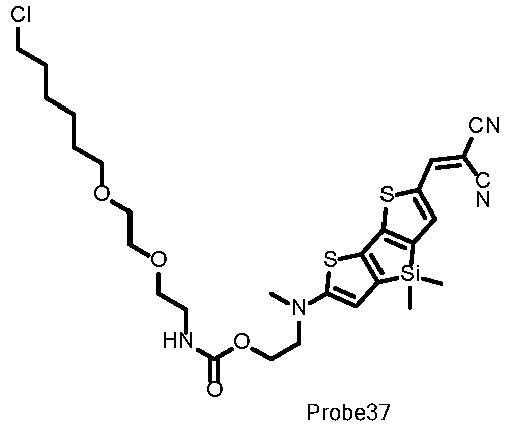
- With reference to the literature (Sangwon Ko et. al. J. Mater. Chem. 2010. 20. 2391-2399) and the method of
probe 10 for synthesis. 1H-NMR (400 MHz, DMSO-d6): δ=8.18 (t, 1H), 7.83 (s, 1H), 7.11 (s, 1H), 3.85 (t, 2H, J=4.80 Hz), 3.69 (t, J=4.9Hz, 2H), 3.63-3.60 (m, 2H), 3.56-3.53 (m, 2H), 3.52 (t, J=6.6Hz, 2H), 3.46 (t, 2H, J=4.80Hz), 3.44 (t, J=6.8Hz, 2H), 3.12 (t, J=4.9Hz, 2H), 3.06 (s, 3H), 1.79-1.71 (m, 2H), 1.60-1.53 (m, 2H), 1.46-1.39 (m, 2H), 1.36-1.28 (m, 2H), 0.46 (s, 6H) - Molecular rotors were used as viscosity responsive fluorescent dyes to construct a fluorescent-activated covalently labeled fluorescent probe 38 for HaloTag :

- Refer to the method of probe 37 for synthesis. 1H-NMR (400 MHz, DMSO-d6): δ=8.18 (t, 1H), 7.83 (s, 1H), 7.11 (s, 1H), 3.85 (t, 2H, J=4.80Hz), 3.69 (t, J=4.9Hz, 2H), 3.63-3.60 (m, 2H), 3.56-3.53 (m, 2H), 3.52 (t, J=6.6Hz, 2H), 3.46 (t, 2H, J=4.80Hz), 3.44 (t, J=6.8Hz, 2H), 3.12 (t, J=4.9Hz, 2H), 3.06 (s, 3H), 1.79-1.71 (m, 2H), 1.60-1.53 (m, 2H), 1.50 (s, 9 H), 1.46-1.39 (m, 2H), 1.36-1.28 (m, 2H), δ=0.42 (s, 6 H)
- Molecular rotors were used as viscosity responsive fluorescent dyes to construct a fluorescent-activated covalently labeled fluorescent probe 39 for HaloTag :

- Refer to the method of probe 37 for synthesis. 1H-NMR (400 MHz, DMSO-d6): δ=8.18 (t, 1H), 7.99 (s, 1 H), 7.11 (s, 1 H), 6.50 (s, 1 H), 3.85 (t, 2H, J=4.80Hz), 3.69 (t, J=4.9Hz, 2H), 3.63-3.60 (m, 2H), 3.56-3.53 (m, 2H), 3.52 (t, J=6.6Hz, 2H), 3.46 (t, 2H, J=4.80 Hz), 3.44 (t, J=6.8Hz, 2H), 3.12 (t, J=4.9Hz, 2H), 3.06 (s, 3H), 1.79-1.71 (m, 2H), 1.60-1.53 (m, 2H), 1.46-1.39 (m, 2H), 1.36-1.28 (m, 2H), 0.46 (s, 6 H)
- Molecular rotors were used as viscosity responsive fluorescent dyes to construct a fluorescent-activated covalently labeled
fluorescent probe 40 for HaloTag :
- With reference to the literature (Kassem Amro et. al. 2014. 70. 1903-1909) and the method of
probe 10 for synthesis. 1H-NMR (400 MHz, DMSO-d6): δ=8.18 (t, 1H), 8.00 (s, 1H), 7.57 (d, 1H, J=4.00Hz), 7.13 (d, 1H, J=4.00Hz), 6.95 (d, 1H, J=4.00Hz), 5.81 (d, 1H, J=4.00Hz), 3.69 (t, J=4.9Hz, 2H), 3.67 (t, 2H, J=5.60Hz), 3.63-3.60 (m, 2H), 3.56-3.53 (m, 2H), 3.52 (t, J=6.6Hz, 2H), 3.44 (t, J=6.8Hz, 2H), 3.35 (t, 2H, J=5.60Hz), 3.12 (t, J=4.9 Hz, 2H), 3.13 (s, 3H), 1.79-1.71 (m, 2H), 1.60-1.53 (m, 2H), 1.50 (s, 9H), 1.46-1.39 (m, 2H), 1.36-1.28 (m, 2H) - Molecular rotors were used as viscosity responsive fluorescent dyes to construct a fluorescent-activated covalently labeled fluorescent probe 41 for HaloTag :

- Refer to the
method ofprobe 40 for synthesis. 1H-NMR (400 MHz, DMSO-d6): δ=12.42 (s, 1 H), 10.01 (s, 1 H), 8.18 (t, 1H), 8.00 (s, 1H), 7.81 (s, 1 H), 7.57 (d, 1H, J=4.00Hz), 7.40 (m, 4 H), 7.13 (d, 1H, J=4.00 Hz), 6.95 (d, 1H, J=4.00 Hz), 6.29 (s, 2 H), 5.81 (d, 1H, J=4.00Hz), 5.46 (s, 2H), 4.40 (d, 2H, J=4.8Hz), 3.69 (t, J=4.9Hz, 2H), 3.67 (t, 2H, J=5.60Hz), 3.63-3.60 (m, 2H), 3.56-3.53 (m, 2H), 3.48-3.52 (m, 6H), 3.44 (t, J= 6.8 Hz, 2H), 3.38 (s, 3 H), 3.35 (t, 2H, J=5.60 Hz), 3.13 (s, 3H), 3.12 (t, J = 4.9 Hz, 2H), 1.79-1.71 (m, 2H), 1.60-1.53 (m, 2H), 1.46-1.39 (m, 2H), 1.36-1.28 (m, 2H) - Molecular rotors were used as viscosity responsive fluorescent dyes to construct a fluorescent-activated covalently labeled fluorescent probe 42 for HaloTag :

- Refer to the method of
probe 40 for synthesis. 1H-NMR (400 MHz, DMSO-d6): δ=8.18 (t, 1H), 8.00 (s, 1H), 7.74 (d, 1 H, J=4.0Hz), 7.57 (d, 1H, J=4.00Hz), 7.51 (d, 1 H, J=4.0Hz), 7.36-7.42 (m, 2H), 7.13 (d, 1H, J=4.00Hz), 6.95 (d, 1H, J=4.00Hz), 5.81 (d, 1H, J=4.00 Hz), 3.69 (t, J=4.9Hz, 2H), 3.67 (t, 2H, J=5.60Hz), 3.63-3.60 (m, 2H), 3.56-3.53 (m, 2H), 3.52 (t, J = 6.6Hz, 2H), 3.44 (t, J = 6.8Hz, 2H), 3.35 (t, 2H, J=5.60Hz), 3.13 (s, 3H), 3.12 (t, J=4.9Hz, 2H), 1.79-1.71 (m, 2H), 1.60-1.53 (m, 2H), 1.46-1.39 (m, 2H), 1.36-1.28 (m, 2H) - Molecular rotors were used as viscosity responsive fluorescent dyes to construct a fluorescent-activated covalently labeled fluorescent probe 43 for HaloTag :

- Refer to the method of
probe 40 for synthesis. 1H-NMR (400 MHz, DMSO-d6): δ=8.18 (t, 1H), 7.99 (s, 1H), 7.57 (d, 1H, J=4.0Hz), 7.13 (d, 1H, J=4.0Hz), 6.95 (d, 1H, J=4.0Hz), 5.81 (d, 1H, J=4.0 Hz), 3.85 (t, 2H, J=5.6 Hz), 3.69 (t, J = 4.9 Hz, 2H), 3.60 (t, 2 H, J=5.6Hz), 3.63-3.60 (m, 2H), 3.56-3.53 (m, 2H), 3.52 (t, J = 6.6Hz, 2H), 3.44 (t, J=6.8 Hz, 2H), 3.12 (t, J=4.9Hz, 2H), 3.10 (s, 3H), 1.79-1.71 (m, 2H), 1.60-1.53 (m, 2H), 1.46-1.39 (m, 2H), 1.36-1.28 (m, 2H) - Molecular rotors were used as viscosity responsive fluorescent dyes to construct a fluorescent-activated covalently labeled fluorescent probe 44 for HaloTag :

- With reference to the literature (Jing Jing et. al. Chem. Sci. 2012. 3. 3315-3320) and the method of
probe 10 for synthesis. 1H-NMR (400 MHz, DMSO-d6): δ=8.18 (t, 1H), 7.99 (s, 1H), 7.21 (s, 1H), 6.71 (d, 1H, J=8.0 Hz), 6.50 (m, 1H) 4.71 (t, 1H, J=5.6 Hz), 3.69 (t, J = 4.9Hz, 2H), 3.62 (m, 2H), 3.63-3.60 (m, 2H), 3.56 (m, 2H), 3.56-3.53 (m, 2H), 3.52 (t, J = 6.6 Hz, 2H), 3.44 (t, J = 6.8 Hz, 2H), 3.35 (m, 2H), 3.12 (t, J = 4.9 Hz, 2H), 3.00 (m, 2H), 1.79-1.71 (m, 2H), 1.60-1.53 (m, 2H), 1.49 (s, 9H), 1.46-1.39 (m, 2H), 1.36-1.28 (m, 2H) - Molecular rotors were used as viscosity responsive fluorescent dyes to construct a fluorescent-activated covalently labeled fluorescent probe 45 for HaloTag :

- Refer to the method of probe 44 for synthesis. 1H-NMR (400 MHz, DMSO-d6): δ=8.18 (t, 1H), 7.99 (s, 1H), 7.74 (d, 1H, J=4.0Hz), 7.55 (d, 1H, J=4.0Hz), 7.36-7.42 (m, 2H), 7.21 (s, 1H), 6.71 (d, 1H, J=8.0 Hz), 6.50 (m, 1H) 4.71 (t, 1H, J=5.6 Hz), 3.69 (t, J = 4.9Hz, 2H), 3.63-3.60 (m, 2H), 3.62 (m, 2H), 3.56-3.53 (m, 2H), 3.56 (m, 2H), 3.52 (t, J = 6.6 Hz, 2H), 3.44 (t, J = 6.8 Hz, 2H), 3.35 (m, 2H), 3.12 (t, J = 4.9 Hz, 2H), 3.00 (m, 2 H), 1.79-1.71 (m, 2H), 1.60-1.53 (m, 2H), 1.46-1.39 (m, 2H), 1.36-1.28 (m, 2H)
- Molecular rotors were used as viscosity responsive fluorescent dyes to construct a fluorescent-activated covalently labeled fluorescent probe 46 for HaloTag :

- With reference to the literature (Kaijun Tian et. al. Chem. Commun. 2011. 47. 10052-10054) and the method of
probe 10 for synthesis. 1H-NMR (400 MHz, DMSO-d6): δ=8.18 (t, 1H), 8.03 (s, 1 H), 7.36 (d, 1H, J=7.6Hz), 6.78 (t, 1H, J=7.2Hz), 6.49 (d, 1H, 7.8Hz), 3.69 (t, J = 4.9 Hz, 2H), 3.63-3.60 (m, 2H), 3.56-3.53 (m, 2H), 3.52 (t, J = 6.6 Hz, 2H), 3.46 (m, 4H), 3.44 (t, J = 6.8Hz, 2H), 2.35 (s, 3H), 3.12 (t, J = 4.9Hz, 2H), 1.79-1.71 (m, 2H), 1.60-1.53 (m, 2H), 1.50 (s, 9H), 1.46-1.39 (m, 2H), 1.36 (s, 6H), 1.36-1.28 (m, 2H) - Molecular rotors were used as viscosity responsive fluorescent dyes to construct a fluorescent-activated covalently labeled fluorescent probe 47 for HaloTag :

- Refer to the method of probe 46 for synthesis. 1H-NMR (400 MHz, DMSO-d6): δ=8.18 (t, 1H), 8.03 (s, 1H), 7.36 (d, 1H, J=7.6 Hz), 6.78 (t, 1H, J=7.2 Hz), 6.49 (d, 1H, 7.8 Hz), 3.69 (t, J=4.9Hz, 2H), 3.63-3.60 (m, 2H), 3.56-3.53 (m, 2H), 3.52 (t, J=6.6Hz, 2H), 3.44 (t, J=6.8Hz, 2H), 3.12 (t, J=4.9Hz, 2H), 3.11 (m, 4H), 2.35 (s, 3H), 1.79-1.71 (m, 2H), 1.60-1.53 (m, 2H), 1.46-1.39 (m, 2H), 1.36 (s, 6H), 1.36-1.28 (m, 2H)
- Molecular rotors were used as viscosity responsive fluorescent dyes to construct a fluorescent-activated covalently labeled fluorescent probe 48 for HaloTag :

- With reference to the literature (Chun-GueyWu et. al. 2013. 99. 1091-1100) and the method of
probe 10 for synthesis. 1H-NMR (400 MHz, DMSO-d6): δ=8.18 (t, 1H), 7.89 (s, 1H), 7.18 (s, 1 H), 6.96 (d, 1H), 3.85 (t, 2H, J=5.6Hz), 3.69 (t, J=4.9Hz, 2H), 3.63-3.60 (m, 2H), 3.60 (t, 2H, J=5.6Hz), 3.56-3.53 (m, 2H), 3.52 (t, J=6.6Hz, 2H), 3.44 (t, J=6.8Hz, 2H), 3.12 (t, J=4.9Hz, 2H), 3.10 (s, 3H), 1.79-1.71 (m, 2H), 1.60-1.53 (m, 2H), 1.50 (m, 15 H), 1.46-1.39 (m, 2H), 1.36-1.28 (m, 2H) - Molecular rotors were used as viscosity responsive fluorescent dyes to construct a fluorescent-activated covalently labeled fluorescent probe 49 for HaloTag :

- Refer to the method of probe 48 for synthesis. 1H-NMR (400 MHz, DMSO-d6): δ=8.18 (t, 1H), 7.89 (s, 1H), 7.74 (d, 1H, J=4.0Hz), 7.55 (d, 1H, J=4.0Hz), 7.36-7.42 (m, 2H), 7.18 (s, 1H), 6.96 (d, 1H), 4.12 (s, 2H), 3.85 (t, 2H, J=5.6Hz), 3.69 (t, J=4.9Hz, 2H), 3.63-3.60 (m, 2H), 3.60 (t, 2H, J=5.6Hz), 3.56-3.53 (m, 2H), 3.52 (t, J=6.6Hz, 2H), 3.44 (t, J=6.8Hz, 2H), 3.12 (t, J=4.9Hz, 2H), 3.10 (s, 3H), 1.79-1.71 (m, 2H), 1.60-1.53 (m, 2H), 1.50 (s, 6H), 1.46-1.39 (m, 2H), 1.36-1.28 (m, 2H)
- Molecular rotors were used as viscosity responsive fluorescent dyes to construct a fluorescent-activated covalently labeled
fluorescent probe 50 for HaloTag :
- Refer to the method of probe 48 for synthesis. 1H-NMR (400 MHz, DMSO-d6): δ=8.18 (t, 1H), 7.89 (s, 1H), 7.18 (s, 1H), 6.96 (d, 1H), 3.85 (t, 2H, J=5.6 Hz), 3.69 (t, J = 4.9 Hz, 2H), 3.63-3.60 (m, 2H), 3.60 (t, 2H, J=5.6Hz), 3.56-3.53 (m, 2H), 3.52 (t, J=6.6Hz, 2H), 3.44 (t, J=6.8Hz, 2H), 3.12 (t, J=4.9Hz, 2H), 3.10 (s, 3H), 1.79-1.71 (m, 2H), 1.60-1.53 (m, 2H), 1.46-1.39 (m, 2H), 1.36-1.28 (m, 2H)
- Molecular rotors were used as viscosity responsive fluorescent dyes to construct a fluorescent-activated covalently labeled fluorescent probe 51 for HaloTag :

- Refer to the method of literature (Gen-ichi Konishi. et. al. Tetrahedron. 2014, 70, 7551-7559) for synthesis. 1H-NMR (400 MHz, CDCl3): δ=9.92 (s, 1H), 7.82 (s, 1H), 7.71 (m, 1H), 7.60 (m, 2H), 6.78 (s, 2H), 3.82 (t, 2H, J=5.6Hz), 3.54 (t, 2H, J=5.6Hz), 3.10 (s, 3H), 1.42 (s, 6H)
- Refer to the method of
compound 1 for synthesis, the yield of 96%.1H-NMR (400 MHz, CDCl3): δ=8.07 (s, 1H), 7.82 (s, 1H), 7.71 (m, 1H), 7.60 (m, 2H), 6.78 (s, 2H), 3.82 (t, 2H, J=5.6 Hz), 3.54 (t, 2 H, J=5.6 Hz), 3.10 (s, 3H), 1.50 (s, 9H), 1.42 (s, 6H) - According to the synthesis method of
probe 1, the yield was 85%.1H-NMR (400 MHz, DMSO-d6): δ=8.18 (t, 1H), 8.07 (s, 1H), 7.82 (s, 1H), 7.71 (m, 1H), 7.60 (m, 2H), 6.78 (s, 2H), 3.82 (t, 2H, J=5.6Hz), 3.69 (t, J=4.9Hz, 2H), 3.63-3.60 (m, 2H), 3.56-3.53 (m, 2H), 3.54 (t, 2H, J=5.6Hz), 3.52 (t, J=6.6Hz, 2H), 3.44 (t, J = 6.8Hz, 2H), 3.12 (t, J = 4.9 Hz, 2H), 3.10 (s, 3H), 1.79-1.71 (m, 2H), 1.60-1.53 (m, 2H), 1.50 (s, 9H), 1.46-1.39 (m, 2H), 1.42 (s, 6H), 1.36-1.28 (m, 2H) - Molecular rotors were used as viscosity responsive fluorescent dyes to construct a fluorescent-activated covalently labeled fluorescent probe 52 for HaloTag :

- Refer to the method of literature (Gamba-Sánchez. et. al. Tetrahedron Lett. 2015, 56, 4308-4311) for synthesis. 1H-NMR (400 MHz, CDCl3): δ=6.52 (s, 2H), 3.48-3.52 (m, 4H), 3.38 (s, 3H)
- Refer to the method of
compound 1 for synthesis, the yield of 96%.1H-NMR (400 MHz, CDCl3): δ=7.89 (s, 1H), 7.18 (s, 1H), 6.96 (d, 1H), 3.85 (t, 2H, J=5.6 Hz), 3.60 (t, 2H, J=5.6 Hz), 3.52-3.48 (m, 4H), 3.38 (s, 3H), 3.10 (s, 3H), 1.50 (s, 6H) - According to the synthesis method of
probe 1, the yield was85%.1H-NMR (400 MHz, DMSO-d6): δ=8.18 (t, 1H), 7.89 (s, 1H), 7.18 (s, 1H), 6.96 (d, 1H), 3.85 (t, 2H, J=5.6Hz), 3.69 (t, J=4.9Hz, 2H), 3.63-3.60 (m, 2H), 3.60 (t, 2H, J=5.6Hz), 3.56-3.53 (m, 2H), 3.52 (t, J=6.6Hz, 2H), 3.52-3.48 (m, 4H), 3.44 (t, J=6.8Hz, 2H), 3.38 (s, 3H), 3.12 (t, J=4.9Hz, 2H), 3.10 (s, 3H), 1.79-1.71 (m, 2H), 1.60-1.53 (m, 2H), 1.50 (s, 6H), 1.46-1.39 (m, 2H), 1.36-1.28 (m, 2H) - Molecular rotors were used as viscosity responsive fluorescent dyes to construct a fluorescent-activated covalently labeled fluorescent probe 53 for HaloTag :

- Refer to the method of literature (Gamba-Sánchez. et. al. Tetrahedron Lett. 2015. 56. 4308-4311) for synthesis. 1H-NMR (400 MHz, CDCl3): δ=6.56 (s, 2H), 3.42 (s, 3H)
- Refer to the method of
compound 1 for synthesis, the yield of 96%.1H-NMR (400 MHz, CDCl3): δ=7.92 (s, 1H), 7.18 (s, 1H), 6.96 (d, 1H), 3.85 (t, 2H, J=5.6 Hz), 3.60 (t, 2H, J=5.6 Hz), 3.42 (s, 3H), 3.10 (s, 3H), 1.50 (s, 6H) - According to the synthesis method of
probe 1, the yield was 85%. 1H-NMR (400 MHz, DMSO-d6): δ=8.18 (t, 1H), 7.92 (s, 1H), 7.18 (s, 1H), 6.96 (d, 1H), 3.85 (t, 2H, J=5.6Hz), 3.69 (t, J=4.9Hz, 2H), 3.63-3.60 (m, 2H), 3.60 (t, 2H, J=5.6Hz), 3.56-3.53 (m, 2H), 3.52 (t, J=6.6Hz, 2H), 3.44 (t, J=6.8Hz, 2H), 3.42 (s, 3H), 3.12 (t, J=4.9Hz, 2H), 3.10 (s, 3H), 1.79-1.71 (m, 2H), 1.60-1.53 (m, 2H), 1.50 (s, 6H), 1.46-1.39 (m, 2H), 1.36-1.28 (m, 2H) - Molecular rotors were used as viscosity responsive fluorescent dyes to construct a fluorescent-activated covalently labeled fluorescent probe 54 for HaloTag :

- Refer to the method of compound 47 for synthesis, the yield of 86%.1H-NMR (400 MHz, CDCl3): δ=7.83 (s, 1H), 7.11 (s, 1H), 3.52-3.48 (m, 4H), 3.85 (t, 2H, J=4.80Hz), 3.46 (t, 2H, J=4.80 Hz), 3.38 (s, 3H), 3.06 (s, 3H), 0.46 (s, 6H)
- According to the synthesis method of
probe 1, the yield was 85%. 1H-NMR (400 MHz, DMSO-d6): δ=8.18 (t, 1H), 7.83 (s, 1H), 7.11 (s, 1H), 3.52-3.48 (m, 4H), 3.85 (t, 2H, J=4.80Hz), 3.69 (t, J=4.9Hz, 2H), 3.63-3.60 (m, 2H), 3.56-3.53 (m, 2H), 3.52 (t, J=6.6Hz, 2H), 3.46 (t, 2H, J=4.80Hz), 3.44 (t, J=6.8Hz, 2H), 3.38 (s, 3H), 3.12 (t, J=4.9Hz, 2H), 3.06 (s, 3H), 1.79-1.71 (m, 2H), 1.60-1.53 (m, 2H), 1.46-1.39 (m, 2H), 1.36-1.28 (m, 2H) 0.46 (s, 6 H) - Molecular rotors were used as viscosity responsive fluorescent dyes to construct a fluorescent-activated covalently labeled fluorescent probe 55 for HaloTag :

- Refer to the method of
compound 1 for synthesis, the yield of 77%. 1H-NMR (400 MHz, CDCl3): δ=7.89 (s, 1H), 7.18 (s, 1H), 6.96 (d, 1H), 3.85 (t, 2H, J=5.6Hz), 3.60 (t, 2H, J=5.6 Hz), 3.48 (s, 3H), 3.10 (s, 3H), 1.50 (s, 6H) - According to the synthesis method of
probe 1, the yield was 82%. 1H-NMR (400 MHz, DMSO-d6): δ=8.18 (t, 1H), 7.89 (s, 1H), 7.18 (s, 1H), 6.96 (d, 1H), 3.85 (t, 2H, J=5.6Hz), 3.69 (t, J=4.9Hz, 2H), 3.63-3.60 (m, 2H), 3.60 (t, 2H, J=5.6Hz), 3.56-3.53 (m, 2H), 3.52 (t, J = 6.6 Hz, 2H), 3.48 (s, 3H), 3.44 (t, J = 6.8 Hz, 2H), 3.12 (t, J = 4.9 Hz, 2H), 3.10 (s, 3H), 1.79-1.71 (m, 2H), 1.60-1.53 (m, 2H), 1.50 (s, 6H), 1.46-1.39 (m, 2H), 1.36-1.28 (m, 2H) - Molecular rotors were used as viscosity responsive fluorescent dyes to construct a fluorescent-activated covalently labeled fluorescent probe 56 for HaloTag :

- Refer to the method of
compound 1 for synthesis, the yield of 77%. 1H-NMR (400 MHz, CDCl3): δ=7.93 (s, 1H), 7.11 (s, 1H), 6.42 (s, 1H), 3.85 (t, 2H, J=4.80Hz), 3.46 (t, 2H, J=4.80 Hz), 3.32 (s, 3 H), 3.06 (s, 3H), 0.42 (s, 6H) - According to the synthesis method of
probe 1, the yield was 82%. 1H-NMR (400 MHz, DMSO-d6): δ=8.18 (t, 1H), 7.93 (s, 1H), 7.11 (s, 1H), 6.42 (s, 1H), 3.85 (t, 2H, J=4.80Hz), 3.69 (t, J=4.9Hz, 2H), 3.63-3.60 (m, 2H), 3.56-3.53 (m, 2H), 3.52 (t, J=6.6Hz, 2H), 3.46 (t, 2H, J=4.80Hz), 3.44 (t, J = 6.8Hz, 2H), 3.32 (s, 3H), 3.12 (t, J=4.9Hz, 2H), 3.06 (s, 3H), 1.79-1.71 (m, 2H), 1.60-1.53 (m, 2H), 1.46-1.39 (m, 2H), 1.36-1.28 (m, 2H), 0.42 (s, 6 H) - Molecular rotors were used as viscosity responsive fluorescent dyes to construct a fluorescent-activated covalently labeled
fluorescent probe 57 for HaloTag :
- Refer to the method of
compound 1 for synthesis, the yield of 65%. 1H-NMR (400 MHz, CDCl3): δ=8.11 (s, 1H), 7.97 (d, J=9.0 Hz, 2H), 6.69 (d, J=9.5 Hz, 2H), 3.38 (s, 6H) - Compound (0.216 g, 1 tendency for 53) and compound 2 (0.223 g, 1 tendency) dissolved in 150 mL water DMF, join six fluoride phosphate benzotriazole 3-1 - base - oxygen radicals pyrrole alkyl phosphate (0.512 g, 1 tendency) and 0.1 mL triethylamine, Ar protection under the condition of reaction and a half hours, spin dry solvents, residue column chromatography separation yellow solid 0.156 g, yield was 72%. 1H-NMR (400MHz, DMSO-d6): δ=8.18 (t, 1H), 8.11 (s, 1H), 7.97 (d, J=9.0 Hz, 2H), 6.69 (d, J=9.5Hz, 2H), 3.69 (t, J=4.9Hz, 2H), 3.63-3.60 (m, 2H), 3.56-3.53 (m, 2H), 3.52 (t, J=6.6Hz, 2H), 3.44 (t, J = 6.8Hz, 2H), 3.38 (s, 6H), 3.12 (t, J = 4.9Hz, 2H), 1.79-1.71 (m, 2H), 1.60-1.53 (m, 2H), 1.46-1.39 (m, 2H), 1.36-1.28 (m, 2H)
- Molecular rotors were used as viscosity responsive fluorescent dyes to construct a fluorescent-activated covalently labeled fluorescent probe 58 for HaloTag :

- Refer to the method of
probe 57 for synthesis. 1H-NMR (400 MHz, DMSO-d6): δ=8.18 (t, 1H), 8.07 (s, 1H), 7.93 (d, 2H, J=9.2Hz), 6.85 (d, 2H, J=9.2Hz), 3.69 (t, J = 4.9Hz, 2H), 3.63-3.60 (m, 2H), 3.56-3.53 (m, 6H), 3.52 (t, J=6.6Hz, 2H), 3.44 (t, J=6.8Hz, 2H), 3.12 (t, J = 4.9 Hz, 2H), 3.08 (s, 3H), 1.79-1.71 (m, 2H), 1.60-1.53 (m, 2H), 1.46-1.39 (m, 2H), 1.36-1.28 (m, 2H) - Molecular rotors were used as viscosity responsive fluorescent dyes to construct a fluorescent-activated covalently labeled fluorescent probe 59 for HaloTag :

- Refer to the method of
compound 1 for synthesis, the yield of 65%. 1H-NMR(400 MHz, CDCl3) : δ=7.92 (s, 1H), 7.49 (s, 2H), 3.37-3.26 (m, 4H), 2.80-2.67 (m, 4H), 2.07-1.85 (m, 4H) - Refer to the method of
probe 57 for synthesis. 1H-NMR (400 MHz, DMSO-d6) : δ=8.18 (t, 1H), 7.92 (s, 1H), 7.49 (s, 22H), 3.69 (t, J=4.9Hz, 2H), 3.63-3.60 (m, 2H), 3.56-3.53 (m, 2H), 3.52 (t, J=6.6Hz, 2H), 3.44 (t, J=6.8Hz, 2H), 3.37-3.26 (m, 4H), 3.12 (t, J=4.9Hz, 2H), 2.80-2.67 (m, 4H), 2.07-1.85 (m, 4H), 1.79-1.71 (m, 2H), 1.60-1.53 (m, 2H), 1.46-1.39 (m, 2H), 1.36-1.28 (m, 2H) - Molecular rotors were used as viscosity responsive fluorescent dyes to construct a fluorescent-activated covalently labeled
fluorescent probe 60 for HaloTag :
- Refer to the method of probe 44 for synthesis. 1H-NMR (400 MHz, CDCl3) : δ=7.84 (s, 1H), 7.71 (m, 1H), 7.55 (d, 1H), 6.73 (d, 1H), 3.90-3.86 (m, 4H), 3.61 (s, 3H)
- Refer to the
method ofprobe 57 for synthesis. 1H-NMR (400 MHz, DMSO-d6) : δ=8.18 (t, 1H), δ=7.84 (s, 1H), 7.71 (m, 1H), 7.55 (d, 1H), 6.73 (d, 1H), 3.90-3.86 (m, 4H), 3.69 (t, J = 4.9 Hz, 2H), 3.63-3.60 (m, 2H), 3.61 (s, 3H), 3.56-3.53 (m, 2H), 3.52 (t, J=6.6Hz, 2H), 3.44 (t, J=6.8Hz, 2H), 3.12 (t, J=4.9Hz, 2H), 1.79-1.71 (m, 2H), 1.60-1.53 (m, 2H), 1.46-1.39 (m, 2H), 1.36-1.28 (m, 2H) - Molecular rotors were used as viscosity responsive fluorescent dyes to construct a fluorescent-activated covalently labeled
fluorescent probe 61 for HaloTag :
- Refer to the method of
probe 10 for synthesis. 1H-NMR (400 MHz, CDCl3) : δ=8.22 (s, 1H), 8.02 (s, 1H), 6.43 (s, 1H), 3.10 (s, 6H) - Refer to the method of
probe 57 for synthesis. 1H-NMR (400 MHz, DMSO-d6) : δ=822 (s, 1H), 8.18 (t, 1H), 8.02 (s, 1H), 6.43 (s, 1H), 3.69 (t, J=4.9Hz, 2H), 3.63-3.60 (m, 2H), 3.56-3.53 (m, 2H), 3.52 (t, J = 6.6 Hz, 2H), 3.44 (t, J = 6.8 Hz, 2H), 3.12 (t, J = 4.9 Hz, 2H), 3.10 (s, 6H), 1.79-1.71 (m, 2H), 1.60-1.53 (m, 2H), 1.46-1.39 (m, 2H), 1.36-1.28 (m, 2H) - Molecular rotors were used as viscosity responsive fluorescent dyes to construct a fluorescent-activated covalently labeled fluorescent probe 62 for HaloTag :

- Refer to the method of compound 42 for synthesis, 1H-NMR (400 MHz, CDCl3): δ= 8.07 (s, 1H), 7.83-7.89 (m, 2H), 7.25-7.34 (m, 1H), 7.13 (d, 1H), 6.73 (d, 1H), 3.08 (s, 6H)
- Refer to the
method ofprobe 57 for synthesis. 1H-NMR (400 MHz, DMSO-d6) : δ=8.18 (t, 1H), 8.07 (s, 1H), 7.83-7.89 (m, 2H), 7.25-7.34 (m, 1H), 7.13 (d, 1H), 6.73 (d, 1H), 3.69 (t, J = 4.9 Hz, 2H), 3.63-3.60 (m, 2H), 3.56-3.53 (m, 2H), 3.52 (t, J = 6.6 Hz, 2H), 3.44 (t, J=6.8Hz, 2H), 3.12 (t, J=4.9Hz, 2H), 3.08 (s, 6H), 1.79-1.71 (m, 2H), 1.60-1.53 (m, 2H), 1.46-1.39 (m, 2H), 1.36-1.28 (m, 2H) - Molecular rotors were used as viscosity responsive fluorescent dyes to construct a fluorescent-activated covalently labeled
fluorescent probe 63 for HaloTag :
- Refer to the method of compound 23 for synthesis,1H-NMR (400 MHz, CDCl3) : δ=7.95 (s, 1H), 7.81 (s, 1H), 7.68 (d, 1H, J=9.0Hz), 6.92 (d, 1H, J=2.0), 6.82 (d, 1H, J=9.2Hz), 3.10 (s, 6H)
- Refer to the method of
probe 57 for synthesis.1H-NMR (400 MHz, DMSO-d6) : δ=8.18 (t, 1H), 7.95 (s, 1H), 7.81 (s, 1H), 7.68 (d, 1H, J=9.0Hz), 6.92 (d, 1H, J=2.0), 6.82 (d, 1H, J=9.2 Hz), 3.69 (t, J = 4.9 Hz, 2H), 3.63-3.60 (m, 2H), 3.56-3.53 (m, 2H), 3.52 (t, J=6.6Hz, 2H), 3.44 (t, J=6.8Hz, 2H), 3.12 (t, J=4.9Hz, 2H), 3.10 (s, 6H), 1.79-1.71 (m, 2H), 1.60-1.53 (m, 2H), 1.46-1.39 (m, 2H), 1.36-1.28 (m, 2H) - Molecular rotors were used as viscosity responsive fluorescent dyes to construct a fluorescent-activated covalently labeled fluorescent probe 64 for HaloTag :

- Refer to the method of literature (Eric T. Kool et. al. Bioconjug Chem. 2016. 27. 2839-2843) for synthesis. 1H-NMR (400 MHz, CDCl3): δ=3.74-3.70 (m, 2H), 3.69-3.65 (m, 2H), 3.63-3.56 (m, 4H), 3.53 (t, J = 6.7Hz, 2H), 3.47 (t, J = 6.7Hz, 2H), 2.42 (s, 1H), 1.82 - 1.72 (m, 2H), 1.66-1.55 (m, 2H), 1.50 - 1.31 (m, 4H)
- Refer to the method of
probe 57 for synthesis.1H-NMR (400 MHz, DMSO-d6): δ= 7.95 (s, 1H), 7.81 (s, 1H), 7.68 (d, 1H, J=9.0 Hz), 6.92 (d, 1H, J=2.0), 6.82 (d, 1H, J=9.2 Hz), 3.74-3.70 (m, 2H), 3.69-3.65 (m, 2H), 3.63-3.56 (m, 4H), 3.53 (t, J = 6.7Hz, 2H), 3.47 (t, J=6.7Hz, 2H), 3.10 (s, 6H), 2.42 (s, 1H), 1.82-1.72 (m, 2H), 1.66-1.55 (m, 2H), 1.50 - 1.31 (m, 4H) - Molecular rotors were used as viscosity responsive fluorescent dyes to construct a fluorescent-activated covalently labeled fluorescent probe 65 for HaloTag :

- Refer to the method of
probe 57 for synthesis. 1H-NMR (400 MHz, DMSO-d6): δ=8.18 (t, 1H), 7.95 (s, 1H), 7.81 (s, 1H), 7.68 (d, 1H, J=9.0 Hz), 6.92 (d, 1H, J=2.0), 6.82 (d, 1 H, J=9.2 Hz), 3.85 (t, 2H, J=5.6 Hz), 3.69 (t, J = 4.9 Hz, 2H), 3.63-3.60 (m, 2H), 3.60 (t, 2 H, J=5.6 Hz), 3.56-3.53 (m, 2H), 3.10 (s, 3 H) 3.52 (t, J = 6.6 Hz, 2H), 3.44 (t, J=6.8Hz, 2H), 3.12 (t, J=4.9Hz, 2H), 1.79-1.71 (m, 2H), 1.60-1.53 (m, 2H), 1.46-1.39 (m, 2H), 1.36-1.28 (m, 2H) - Molecular rotors were used as viscosity responsive fluorescent dyes to construct a fluorescent-activated covalently labeled fluorescent probe 66 for HaloTag :

- Refer to the method of
probe 63 for synthesis. 1H-NMR (400 MHz, DMSO-d6) : δ=8.18 (t, 1H), 7.95 (s, 1H), 7.81 (s, 1H), 7.68 (d, 1H, J=9.0Hz), 6.92 (d, 1H, J=2.0), 6.82 (d, 1H, J=9.2Hz), 3.69 (t, J = 4.9Hz, 2H), 3.63-3.60 (m, 2H), 3.56-3.53 (m, 2H), 3.52 (t, J=6.6Hz, 2H), 3.44 (t, J = 6.8Hz, 2H), 3.12 (t, J = 4.9Hz, 2H), 3.10 (s, 3H), 1.79-1.71 (m, 2H), 1.60-1.53 (m, 2H), 1.46-1.39 (m, 2H), 1.36-1.28 (m, 2H) - Molecular rotors were used as viscosity responsive fluorescent dyes to construct a fluorescent-activated covalently labeled fluorescent probe 67 for HaloTag :

- Refer to the method of literature (Simon J. A. Pope. et. al. Chem. Commun. 2009. 4278-4280) for synthesis. 1H-NMR (400 MHz, CDCl3): δ= 3.61 (t, 2H), 3.08 (t, 2H), 2.07-1.82 (m, 8H)
- Referto the
method ofprobe 57 for synthesis. 1H-NMR (400 MHz, DMSO-d6) : δ=8.16 (t, 1H), 7.95 (s, 1H), 7.81 (s, 1H), 7.68 (d, 1H, J=9.0Hz), 6.92 (d, 1H, J=2.0), 6.82 (d, 1H, J=9.2 Hz), 3.61 (t, 2H), 3.10 (s, 6H), 3.08 (t, 2H), 2.07-1.82 (m, 8H) - Molecular rotors were used as viscosity responsive fluorescent dyes to construct a fluorescent-activated covalently labeled fluorescent probe 68 for HaloTag :

- Refer to the method of literature (Simon J. A. Pope. et. al. Chem. Commun. 2009. 4278-4280) for synthesis.1H-NMR (400 MHz, CDCl3) : δ=3.85 (t, J = 5.2 Hz, 2H), 3.81 (t, J = 5.7 Hz, 2H), 3.72 (t, J = 5.7 Hz, 2H), 3.27 (sext, J = 5.2 Hz, 2H)
- Refer to the method of
probe 57 for synthesis.1H-NMR (400 MHz, DMSO-d6) : δ=8.19 (t, 1H), 7.95 (s, 1H), 7.81 (s, 1H), 7.68 (d, 1H, J=9.0Hz), 6.92 (d, 1H, J=2.0), 6.82 (d, 1H, J=9.2Hz), 3.85 (t, J=5.2Hz, 2H), 3.81 (t, J = 5.7 Hz, 2H), 3.72 (t, J = 5.7 Hz, 2H), 3.27 (sext, J = 5.2 Hz, 2H), 3.10 (s, 6H) - Molecular rotors were used as viscosity responsive fluorescent dyes to construct a fluorescent-activated covalently labeled fluorescent probe 69 for HaloTag :

- Refer to the method of compound 34 for synthesis, 1H-NMR (400 MHz, CDCl3): δ=7.99 (s, 1H), 7.61 (d, 1H, J=1.6 Hz), 7.49 (d, 1H, J=8.4 Hz), 7.40 (dd, 1H, J1=8.4 Hz, J2=1.6 Hz), 3.11 (s, 6H)
- Refer to the method of
probe 57 for synthesis. 1H-NMR (400 MHz, DMSO-d6): δ=8.18 (t, 1H), 7.99 (s, 1H), 7.61 (d, 1H, J=1.6 Hz), 7.49 (d, 1H, J=8.4 Hz), 7.40 (dd, 1H, J1=8.4 Hz, J2=1.6Hz), 3.69 (t, J=4.9Hz, 2H), 3.63-3.60 (m, 2H), 3.56-3.53 (m, 2H), 3.52 (t, J=6.6Hz, 2H), 3.44 (t, J=6.8Hz, 2H), 3.12 (t, J=4.9Hz, 2H), 3.11 (s, 6H), 1.79-1.71 (m, 2H), 1.60-1.53 (m, 2H), 1.46-1.39 (m, 2H), 1.36-1.28 (m, 2H) - Molecular rotors were used as viscosity responsive fluorescent dyes to construct a fluorescent-activated covalently labeled
fluorescent probe 70 for HaloTag :
- Refer to the method of probe 64 for synthesis. 1H-NMR (400 MHz, DMSO-d6) : δ=7.99 (s, 1H), 7.61 (d, 1H, J=1.6Hz), 7.49 (d, 1H, J=8.4Hz), 7.40 (dd, 1H, J1=8.4Hz, J2=1.6Hz), 3.74-3.70 (m, 2H), 3.69-3.65 (m, 2H), 3.63-3.56 (m, 4H), 3.53 (t, J = 6.7Hz, 2H), 3.47 (t, J = 6.7Hz, 2H), 3.11 (s, 3H), 2.42 (s, 1H), 1.82-1.72 (m, 2H), 1.66-1.55 (m, 2H), 1.50 - 1.31 (m, 4H)
- Molecular rotors were used as viscosity responsive fluorescent dyes to construct a fluorescent-activated covalently labeled fluorescent probe 71 for HaloTag :

- Refer to the method of compound 34 for synthesis, 1H-NMR (400 MHz, CDCl3): δ=8.06 (s, 1 H), 8.03 (d, 1H), 7.07-7.04 (m, 2H), 3.10 (s, 6H)
- Refer to the method of
probe 57 for synthesis.1H-NMR (400 MHz, DMSO-d6): δ=8.18 (t, 1H), 8.06 (s, 1H), 8.03 (d, 1H), 7.07-7.04 (m, 2H), 3.69 (t, J = 4.9Hz, 2H), 3.63-3.60 (m, 2H), 3.56-3.53 (m, 2H), 3.52 (t, J = 6.6 Hz, 2H), 3.44 (t, J = 6.8 Hz, 2H), 3.12 (t, J = 4.9 Hz, 2H), 3.10 (s, 6 H), 1.79-1.71 (m, 2H), 1.60-1.53 (m, 2H), 1.46-1.39 (m, 2H), 1.36-1.28 (m, 2H) - Molecular rotors were used as viscosity responsive fluorescent dyes to construct a fluorescent-activated covalently labeled fluorescent probe 72 for HaloTag :

- Referto the method of
probe 70 for synthesis. 1H-NMR (400 MHz, DMSO-d6) : δ=8.06 (s, 1H), 8.03 (d, 1H), 7.07-7.04 (m, 2H), 3.74-3.70 (m, 2H), 3.69-3.65 (m, 2H), 3.63-3.56 (m, 4H), 3.53 (t, J = 6.7 Hz, 2H), 3.47 (t, J = 6.7 Hz, 2H), 3.10 (s, 6 H), 2.42 (s, 1H), 1.82 - 1.72 (m, 2H), 1.66-1.55 (m, 2H), 1.50-1.31 (m, 4H) - Molecular rotors were used as viscosity responsive fluorescent dyes to construct a fluorescent-activated covalently labeled fluorescent probe 73 for HaloTag :

- Refer to the method of compound 33 for synthesis, 1H-NMR (400 MHz, CDCl3): δ=8.00 (s, 1H), 7.68 (d, 1H, J=4.0Hz), 7.56 (d, 2H, J=9.0Hz), 7.24 (d, 1H, J=4.0Hz), 6.72 (d, 2H, J=9.0 Hz), 3.10 (s, 6H)
- Referto the method of
probe 57 for synthesis.1H-NMR (400 MHz, DMSO-d6): δ=8.18 (t, 1H), 8.00 (s, 1H), 7.68 (d, 1H, J=4.0Hz), 7.56 (d, 2H, J=9.0Hz), 7.24 (d, 1H, J=4.0Hz), 6.72 (d, 2H, J=9.0Hz), 3.69 (t, J = 4.9Hz, 2H), 3.63-3.60 (m, 2H), 3.56-3.53 (m, 2H), 3.52 (t, J=6.6Hz, 2H), 3.44 (t, J=6.8Hz, 2H), 3.12 (t, J=4.9Hz, 2H), 3.10 (s, 6H), 1.79-1.71 (m, 2H), 1.60-1.53 (m, 2H), 1.46-1.39 (m, 2H), 1.36-1.28 (m, 2H) - Molecular rotors were used as viscosity responsive fluorescent dyes to construct a fluorescent-activated covalently labeled fluorescent probe 74 for HaloTag :

- Refer to the
method ofprobe 40 for synthesis.1H-NMR (400MHz, CDCl3): δ=7.99 (s, 1H), 7.57 (d, 1H, J=4.0Hz), 7.13 (d, 1H, J=4.0Hz), 6.95 (d, 1H, J=4.0Hz), 5.81 (d, 1H, J=4.0 Hz), 3.00 (s, 6H) - Refer to the method of
probe 57 for synthesis. 1H-NMR (400 MHz, DMSO-d6): δ=8.18 (t, 1H), δ=7.99 (s, 1H), 7.57 (d, 1H, J=4.0Hz), 7.13 (d, 1H, J=4.0Hz), 6.95 (d, 1H, J=4.0Hz), 5.81 (d, 1H, J=4.0 Hz), 3.69 (t, J = 4.9Hz, 2H), 3.63-3.60 (m, 2H), 3.56-3.53 (m, 2H), 3.52 (t, J=6.6Hz, 2H), 3.44 (t, J=6.8Hz, 2H), 3.12 (t, J=4.9Hz, 2H), 3.00 (s, 6H), 1.79-1.71 (m, 2H), 1.60-1.53 (m, 2H), 1.46-1.39 (m, 2H), 1.36-1.28 (m, 2H) - Molecular rotors were used as viscosity responsive fluorescent dyes to construct a fluorescent-activated covalently labeled
fluorescent probe 75 for HaloTag :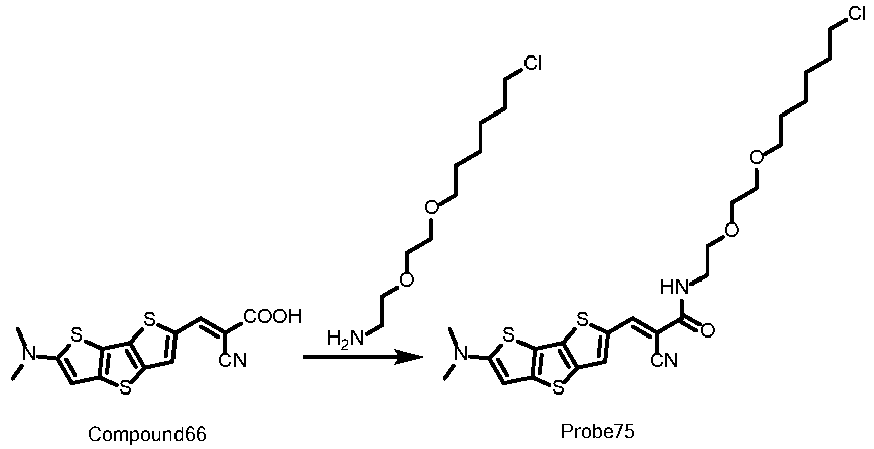
- Refer to the method of probe 29 for synthesis. 1H-NMR (400 MHz, CDCl3): δ=8.01 (s, 1H), 7.84 (s, 1H), 7.24 (s, 1H), 3.02 (s, 6H)
- Refer to the method of
probe 57 for synthesis. 1H-NMR (400MHz, DMSO-d6): 8.18 (t, 1H), 8.01 (s, 1H), 7.84 (s, 1H), 7.24 (s, 1H), 3.69 (t, J=4.9Hz, 2H), 3.63-3.60 (m, 2H), 3.56-3.53 (m, 2H), 3.52 (t, J=6.6Hz, 2H), 3.44 (t, J=6.8Hz, 2H), 3.12 (t, J=4.9Hz, 2H), 3.02 (s, 6H), 1.79-1.71 (m, 2H), 1.60-1.53 (m, 2H), 1.46-1.39 (m, 2H), 1.36-1.28 (m, 2H) - Molecular rotors were used as viscosity responsive fluorescent dyes to construct a fluorescent-activated covalently labeled
fluorescent probe 76 for HaloTag :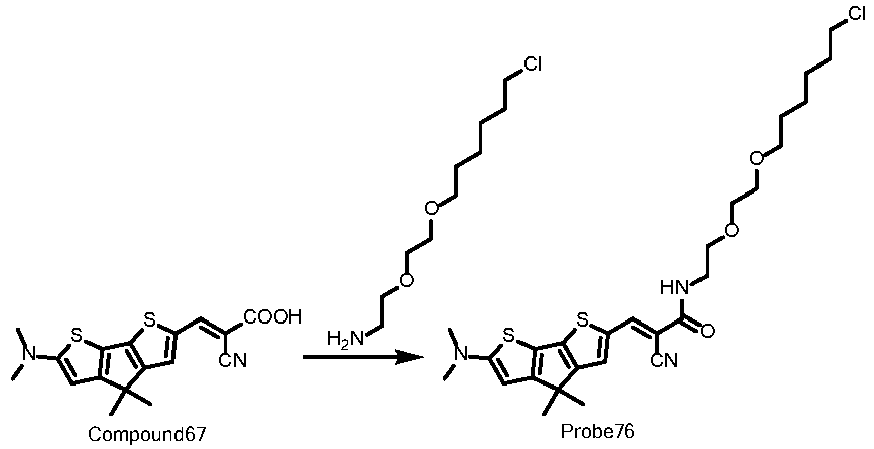
- Refer to the method of probe 48 for synthesis. 1H-NMR (400 MHz, CDCl3) : δ= 7.89 (s, 1 H), 7.18 (s, 1H), 6.96 (s, 1H), 3.10 (s, 6H), 1.50 (m, 6H)
- Refer to the method of
probe 57 for synthesis. 1H-NMR (400MHz, DMSO-d6) : δ=8.18 (t, 1H), 7.89 (s, 1H), 7.18 (s, 1H), 6.96 (s, 1H), 3.69 (t, J = 4.9Hz, 2H), 3.63-3.60 (m, 2H), 3.56-3.53 (m, 2H), 3.52 (t, J=6.6Hz, 2H), 3.44 (t, J=6.8Hz, 2H), 3.12 (t, J=4.9Hz, 2H), 3.10 (s, 6H), 1.79-1.71 (m, 2H), 1.60-1.53 (m, 2H), 1.50 (m, 6H), 1.46-1.39 (m, 2H), 1.36-1.28 (m, 2H) - Molecular rotors were used as viscosity responsive fluorescent dyes to construct a fluorescent-activated covalently labeled fluorescent probe 77 for HaloTag :

- Referto the method of probe 64 for synthesis. 1H-NMR (400 MHz, DMSO-d6) : δ= 7.89 (s, 1H), 7.18 (s, 1H), 6.96 (s, 1H), 3.74-3.70 (m, 2H), 3.69-3.65 (m, 2H), 3.63-3.56 (m, 4H), 3.53 (t, J=6.7Hz, 2H), 3.47 (t, J=6.7Hz, 2H), 3.10 (s, 6H), 2.42 (s, 1H), 1.82 - 1.72 (m, 2H), 1.66-1.55 (m, 2H), 1.50 (m, 6H), 1.50-1.31 (m, 4H)
- Molecular rotors were used as viscosity responsive fluorescent dyes to construct a fluorescent-activated covalently labeled fluorescent probe 78 for HaloTag :

- Refer to the method of
compound 1 for synthesis, 1H-NMR (400 MHz, CDCl3): δ= 8.01 (s, 1 H), 7.18 (s, 1H), 6.96 (s, 1H), 3.10 (s, 6H), 1.50 (m, 6H) - Compound 68 (0.376g, 1.0mmol) and compound 2 (0.446g, 2mmol) were mixed in 10mL DMF with 0.1ml triethylamine and stirred at room temperature for two days. 1H-NMR (400 MHz, DMSO-d6): δ=8.01 (s, 1H), 7.18 (s, 1H), 6.96 (s, 1H), 3.69 (t, J = 4.9Hz, 2H), 3.63-3.60 (m, 2H), 3.56-3.53 (m, 2H), 3.52 (t, J = 6.6 Hz, 2H), 3.44 (t, J = 6.8 Hz, 2H), 3.12 (t, J = 4.9Hz, 2H), 3.10 (s, 6H), 1.79-1.71 (m, 2H), 1.60-1.53 (m, 2H), 1.50 (m, 6H), 1.46-1.39 (m, 2H), 1.36-1.28 (m, 2H)
- Molecular rotors were used as viscosity responsive fluorescent dyes to construct a fluorescent-activated

fluorescent probe 79 for HaloTag :
Refer to the method of probe 78for synthesis. 1H-NMR (400 MHz, DMSO-d6): δ= 7.88 (s, 1 H), 7.18 (s, 1H), 6.96 (s, 1H), 3.69 (t, J = 4.9 Hz, 2H), 3.63-3.60 (m, 2H), 3.56-3.53 (m, 2H), 3.52 (t, J = 6.6 Hz, 2H), 3.44 (t, J = 6.8 Hz, 2H), 3.12 (t, J = 4.9 Hz, 2H), 3.10 (s, 6H), 1.79-1.71 (m, 2H), 1.60-1.53 (m, 2H), 1.50 (m, 6H), 1.46-1.39 (m, 2H), 1.36-1.28 (m, 2H) - Molecular rotors were used as viscosity responsive fluorescent dyes to construct a fluorescent-activated covalently labeled
fluorescent probe 80 for HaloTag :
- Refer to the method of
compound 1 for synthesis, 1H-NMR (400 MHz, CDCl3): δ=8.01 (s, 1H), 7.18 (s, 1H), 6.96 (s, 1H), 3.10 (s, 6H), 0.41 (m, 6H) - Refer to the method of probe 78 for synthesis. 1H-NMR (400MHz, DMSO-d6): δ=8.01 (s, 1 H), 7.18 (s, 1H), 6.96 (s, 1H), 3.69 (t, J = 4.9Hz, 2H), 3.63-3.60 (m, 2H), 3.56-3.53 (m, 2H), 3.52 (t, J = 6.6 Hz, 2H), 3.44 (t, J = 6.8 Hz, 2H), 3.12 (t, J = 4.9 Hz, 2H), 3.10 (s, 6H), 1.79-1.71 (m, 2H), 1.60-1.53 (m, 2H), 1.46-1.39 (m, 2H), 1.36-1.28 (m, 2H), 0.42 (m, 6H)
- Molecular rotors were used as viscosity responsive fluorescent dyes to construct a fluorescent-activated covalently labeled fluorescent probe 81 for HaloTag :

- Refer to the method of
compound 1 for synthesis, 1H-NMR (400 MHz, CDCl3): δ=8.00 (s, 1H), 7.57 (d, 1H, J=4.00Hz), 7.13 (d, 1H, J=4.00Hz), 6.95 (d, 1H, J=4.00Hz), 5.81 (d, 1H, J=4.00 Hz), 3.13 (s, 6H) - Refer to the method of probe 78 for synthesis. 1H-NMR (400 MHz, DMSO-d6): δ=8.00 (s, 1H), 7.57 (d, 1H, J=4.00Hz), 7.13 (d, 1H, J=4.00Hz), 6.95 (d, 1H, J=4.00Hz), 5.81 (d, 1H, J=4.00Hz), 3.69 (t, J=4.9Hz, 2H), 3.63-3.60 (m, 2H), 3.56-3.53 (m, 2H), 3.52 (t, J=6.6Hz, 2H), 3.44 (t, J=6.8Hz, 2H), 3.13 (s, 6H), 3.12 (t, J=4.9Hz, 2H), 1.79-1.71 (m, 2H), 1.60-1.53 (m, 2H), 1.46-1.39 (m, 2H), 1.36-1.28 (m, 2H)
- Molecular rotors were used as viscosity responsive fluorescent dyes to construct a fluorescent-activated covalently labeled fluorescent probe 82 for HaloTag :

- Refer to the method of compound 49 for synthesis, 1H-NMR (400 MHz, CDCl3): δ= 7.89 (s, 1H), 7.18 (s, 1H), 6.96 (s, 1H), 3.47 (s, 3 H), 3.10 (s, 6H), 1.50 (m, 6H)
- Refer to the method of probe 78 for synthesis. 1H-NMR (400 MHz, DMSO-d6): δ=8.18 (t, 1H), 7.89 (s, 1H), 7.18 (s, 1H), 6.96 (s, 1H), 3.69 (t, J = 4.9Hz, 2H), 3.63-3.60 (m, 2H), 3.56-3.53 (m, 2H), 3.52 (t, J=6.6Hz, 2H), 3.44 (t, J=6.8Hz, 2H), 3.12 (t, J=4.9Hz, 2H), 3.10 (s, 6H), 1.79-1.71 (m, 2H), 1.60-1.53 (m, 2H), 1.50 (m, 6H), 1.46-1.39 (m, 2H), 1.36-1.28 (m, 2H)
- Molecular rotors were used as viscosity responsive fluorescent dyes to construct a fluorescent-activated covalently labeled fluorescent probe 83 for HaloTag :

- Refer to the method of
compound 50 for synthesis, 1H-NMR (400 MHz, CDCl3): δ= 7.89 (s, 1H), 7.18 (s, 1H), 6.96 (s, 1H), 3.47 (s, 3H), 3.10 (s, 6H), 0.42 (m, 6H) - Refer to the method of probe 78 for synthesis. 1H-NMR (400 MHz, DMSO-d6): δ=8.18 (t, 1H), 7.89 (s, 1H), 7.18 (s, 1H), 6.96 (s, 1H), 3.69 (t, J = 4.9 Hz, 2H), 3.63-3.60 (m, 2H), 3.56-3.53 (m, 2H), 3.52 (t, J = 6.6 Hz, 2H), 3.44 (t, J = 6.8 Hz, 2H), 3.12 (t, J = 4.9 Hz, 2H), 3.10 (s, 6 H), 1.79-1.71 (m, 2H), 1.60-1.53 (m, 2H), 1.46-1.39 (m, 2H), 1.36-1.28 (m, 2H), 0.41 (m, 6H)
- Molecular rotors were used as viscosity responsive fluorescent dyes to construct a fluorescent-activated covalently labeled fluorescent probe 84 for HaloTag :

- Refer to the method of compound 49 for synthesis, 1H-NMR (400 MHz, CDCl3): δ=8.00 (s, 1H), 7.57 (d, 1H, J=4.00Hz), 7.13 (d, 1H, J=4.00Hz), 6.95 (d, 1H, J=4.00Hz), 5.81 (d, 1H, J=4.00 Hz), 3.47 (s, 3H), 3.13 (s, 6H)
- Refer to the method of probe 78 for synthesis. 1H-NMR (400 MHz, DMSO-d6): δ=8.18 (t, 1H), 8.00 (s, 1H), 7.57 (d, 1H, J=4.00Hz), 7.13 (d, 1H, J=4.00Hz), 6.95 (d, 1H, J=4.00 Hz), 5.81 (d, 1H, J=4.00Hz), 3.69 (t, J=4.9Hz, 2H), 3.63-3.60 (m, 2H), 3.56-3.53 (m, 2H), 3.52 (t, J=6.6Hz, 2H), 3.44 (t, J=6.8Hz, 2H), 3.13 (s, 6H), 3.12 (t, J=4.9Hz, 2H), 1.79-1.71 (m, 2H), 1.60-1.53 (m, 2H), 1.46-1.39 (m, 2H), 1.36-1.28 (m, 2H)
- Molecular rotors were used as viscosity responsive fluorescent dyes to construct a fluorescent-activated covalently labeled fluorescent probe 85 for SNAP :

- Refer to the method of compound 49 for synthesis, the yield of 45%. 1H-NMR (400 MHz, DMSO-d6): δ=12.42 (s, 1H), 10.01 (s, 1H), 7.89 (s, 1H), 7.18 (s, 1H), 7.81 (s, 1H), 7.4 (m, 4H), 6.96 (d, 2H, J=5.6Hz), 6.29 (s, 2H), 5.46 (s, 2H), 4.40 (d, 2H, J=4.8Hz), 3.85 (t, 2H, J=5.6 Hz), 3.60 (t, 2 H, J=5.6 Hz), 3.10 (s, 3H), 1.50 (m, 15 H)
- Molecular rotors were used as viscosity responsive fluorescent dyes to construct a fluorescent-activated covalently labeled fluorescent probe 86 for HaloTag :

- With reference to the literature (Kimin Lim et. al. 2011. 115. 22640-22646) and the method of
probe 10 for synthesis. 1H-NMR (400 MHz, DMSO-d6): δ=8.18 (t, 1H), 7.48 (s, 1H), 7.41 (s, 1H), 7.32 (m, 2H), 3.69 (t, J = 4.9 Hz, 2H), 3.63-3.60 (m, 2H), 3.56-3.53 (m, 2H), 3.52 (t, J = 6.6 Hz, 2H), 3.44 (t, J=6.8Hz, 2H), 3.13 (s, 6H), 3.12 (t, J=4.9Hz, 2H), 1.79-1.71 (m, 2H), 1.60-1.53 (m, 2H), 1.48 (s, 6H), 1.46-1.39 (m, 2H), 1.36-1.28 (m, 2H) . - A probe was mixed with a corresponding HaloTag protein tag to obtain a mixed sample. The final concentration of the probe in the mixed sample was 5 µM and the final concentration of the protein tag was 10 µM. The mixed sample was incubated at 37°C for 1 hour, and the sample was detected using a fluorescence spectrophotometer. The fluorescence intensity was changed, and the results are shown in Table 1.
- From the quantum yield of free probes in Table 1, it can be known that the fluorescence of the probes of the examples and the reference probes is extremely low when these probes do not react with the protein tag, which is close to the background fluorescence level of the PBS buffer solution, indicating that when the probes do not react with the protein tag, the fluorescence of the viscosity-responsive fluorescent probe is not activated, wherease from the quantum yield after the binding of the protein tag, it can be seen that after the probe of the example reacts with the protein tag, a significant fluorescence signal enhancement can be detected in the corresponding excitation emission channel, and the fluorescence activation multiple can reach several hundred times to more than one thousand times, and has high brightness, which indicates that the fluorescence can be activated after the probe of the example binds to the protein tag, and the probe has good fluorescent molecular switching properties. As can be seen from Table 1, the probes of the Examples have a wide range of fluorescence emission wavelengths, are greatly different in the fluorescence intensities in glycerol and methanol, and are sensitive to changes in viscosity and have viscosity responsiveness.
Table 1 Detection results of fluorescence emission spectra of different probes Name The quantum yield of the free probe The quantum yield after binding to Halotag Emissio n / nm Fluorescence enhancement ratio Probe 1 < 0.001 0.52 480 500 560 Probe 2 0.001 0.48 510 410 410 Probe 3 0.0011 0.45 515 512 399 Probe 4 < 0.001 0.42 480 490 562 Probe5 < 0.001 0.46 480 1174 790 Probe 6 < 0.001 0.40 530 989 1183 Probe 7 < 0.001 0.46 580 1502 1455 Probe 8 0.0018 0.47 535 296 320 Probe9 < 0.001 0.50 480 745 851 Probe 10 < 0.001 0.42 550 431 655 Probe 11 0.0013 0.46 590 520 422 Probe 12 0.0012 0.41 555 750 405 Probe 13 < 0.001 0.56 570 816 391 Probe 14 < 0.001 0.52 610 771 560 Probe 15 < 0.001 0.53 570 379 320 Probe 16 < 0.001 0.49 572 490 311 Probe 17 < 0.001 0.56 575 498 402 Probe 18 0.0017 0.51 568 444 301 Probe 19 0.0012 0.53 625 561 299 Probe 20 < 0.001 0.47 640 612 341 Probe 21 < 0.001 0.48 628 560 1481 Probe 22 < 0.001 0.36 632 610 1821 Probe 23 < 0.001 0.52 637 712 1235 Probe 24 < 0.001 0.52 622 590 1681 Probe 25 < 0.001 0.51 620 670 1621 Probe 26 < 0.001 0.56 590 910 1123 Probe 27 < 0.001 0.43 620 665 1134 Probe 28 < 0.001 0.41 566 551 1132 Probe 29 < 0.001 0.53 640 621 998 Probe 30 < 0.001 0.60 620 535 1125 Probe 31 < 0.001 0.41 660 875 1135 Probe 32 < 0.001 0.46 609 638 997 Probe 33 < 0.001 0.47 620 957 1781 Probe 34 < 0.001 0.32 615 857 1774 Probe 35 0.0012 0.45 618 433 972 Probe 36 0.001 0.58 630 488 1258 Probe 37 0.0012 0.56 655 469 1135 Probe 38 0.0011 0.56 650 503 1011 Probe 39 0.0016 0.38 700 335 892 Probe 40 0.001 0.47 657 421 759 Probe 41 0.0015 0.44 700 418 101 Probe 42 0.0013 0.39 702 375 178 Probe 43 < 0.001 0.37 651 982 1028 Probe 44 < 0.001 0.63 521 1586 1459 Probe 45 < 0.001 0.54 545 958 752 Probe 46 < 0.001 0.58 520 563 682 Probe 47 < 0.001 0.45 523 358 235 Probe 48 < 0.001 0.57 645 428 480 Probe 49 < 0.001 0.54 680 541 334 Probe 50 < 0.001 0.53 637 416 358 Probe 51 < 0.001 0.48 625 392 359 Probe 52 < 0.001 0.47 670 435 270 Probe 53 < 0.001 0.48 690 579 401 Probe 54 < 0.001 0.41 710 498 391 Probe55 < 0.001 0.39 660 382 211 Probe 56 < 0.001 0.47 725 989 436 Probe 57 < 0.001 0.56 480 1026 762 Probe 58 < 0.001 0.58 480 519 419 Probe 59 < 0.001 0.45 500 498 370 Probe 60 0.0011 0.65 520 751 1199 Probe 61 0.0012 0.59 552 668 817 Probe 62 < 0.001 0.57 590 592 711 Probe 63 0.0015 0.70 570 486 531 Probe 64 < 0.001 0.60 585 519 632 Probe 65 < 0.001 0.66 570 798 391 Probe 66 < 0.001 0.53 550 512 386 Probe 67 < 0.001 0.48 580 576 276 Probe 68 < 0.001 0.50 580 681 381 Probe 69 < 0.001 0.47 610 491 317 Probe 70 0.0026 0.58 630 258 431 Probe 71 0.0028 0.61 620 475 321 Probe 72 0.001 0.47 640 486 268 Probe 73 0.0031 0.55 620 561 325 Probe 74 0.0025 0.42 630 611 297 Probe 75 0.0021 0.56 620 589 500 Probe 76 0.0011 0.58 640 666 386 Probe 77 0.0014 0.53 652 721 479 Probe 78 < 0.001 0.41 660 369 452 Probe 79 < 0.001 0.51 725 419 498 Probe 80 0.0011 0.44 740 641 712 Probe 81 < 0.001 0.40 743 563 521 Probe 82 < 0.001 0.51 660 781 475 Probe 83 < 0.001 0.53 680 456 652 Probe 84 < 0.001 0.47 680 431 522 Reference Probe85 < 0.001 0.32 645 321 510 Probe 86 0.0012 0.52 550 610 470 - 5 µM HaloTag protein tag was added to 3 µM of solutions of
probe 57,probe 60,probe 61,probe 63,probe 75,probe 76, and probe 79, respectively, to prepare HaloTag protein tag and probe mixed sample solutions. The mixed sample solutions were left to react at 37°C for 1 hour, and the emission spectra of the samples were measured using a fluorescence spectrophotometer. The results are shown inFIG. 1 respectively. It can be seen fromFIG. 1 that the above probes can achieve spectral coverage from an emission wavelength of 480 nm to 730 nm. - A HaloTag protein tag was added to 30 µM of solutions of
probe 57, probe 59,probe 60,probe 61, probe 62,probe 63, probe 69,probe 75,probe 76, and probe 82, respectively, to obtain mixed sample solutions with a final concentration of HaloTag protein tag of 0.1 µM, 0.5 µM, 0.7 µM, 1.2 µM, 4.5 µM, 8.1 µM, 13.1 µM, 14.8 µM. The mixed sample solutions were left to react at 37°C for 1 hour. The fluorescence emission spectrophotometer was used to detect the change in excitation emission spectrum of the samples, and the relationship between HaloTag protein tag concentration and fluorescence intensity was plotted according to the emission spectrum intensity. The results are shown inFIG. 2 to FIG. 11 respectively. - It can be seen from
FIG. 2 that the concentration of HaloTag protein in the range of 0.1µM to 14.8µM has a good linear relationship with the fluorescence intensity of the probes. Therefore, the protein tag can be quantitatively detected according to the standard curve. - Hela cells are used as an example to test the labeling effect of compounds in mammalian cells.Hela cells and Hela-WT cells (Hela primitive cell, without a protein tag expressed) stably expressing HaloTag protein tags were planted in 14 mm 96-well glass bottom cell culture plates and stabilized for 10 hours.
Probe 57, probe 59,probe 60,probe 61, probe 69,probe 75,probe 76, probe 82 were added to the culture medium and diluted to 5 µM, respectively. The cells were incubated in a 37°C carbon dioxide incubator for 2 hours, and the fluorescence changes of the labeled cells were detected by imaging with a Leica TPS-8 confocal microscope. Results of group 12B show that no corresponding fluorescent signal could be detected in Hela-WT cells after the addition of the above probes, indicating that the probe fluorescence is not affected by the intracellular environment; while a strong fluorescence signal could be detected in Hela cells expressing the protein tag in group 12A, and the fluorescence signal is enhanced by nearly 200 times. - The above experiments show that the probe can achieve specific labeling of intracellular protein tags and achieve specific fluorescence lighting. At the same time, the probe fluorescence is not affected by the intracellular environment.
- In order to verify that
probe 57, probe 59,probe 60,probe 61, probe 62, and probe 63 can be used to label target proteins located in different organelles, Hela cells were used as examples to detect the effect of probes on labeling HaloTag protein tags in different subcellular organelles.Hela cells were implanted 5000 cells per well in 96-well glass-bottom cell culture plates. After 14 hours, lipo2000 kit was used to transfect the plasmids localized by HaloTag protein tags in different organelles. The original culture medium was removed 24 hours after transfection, and the cells were washed twice with a phenol red-free DMEM medium, and incubated for 2 hours in a phenol red-free medium containing 0.2 µM probes, and the effect of cell labelling was detected by imaging using a Leica TCS-8 confocal microscope. The results are shown inFIG. 13 . The probe can clearly display a variety of subcellular organelle structures without washing, such as cytoskeleton, mitochondria, nucleus, Golgi, whole cells, and lysosomes. The above results demonstrate that the probe can be a powerful tool for labeling a variety of cellular subcellular organelles. - Hela cells were implanted 5000 cells per well in a 96-well glass-bottom cell culture plate, and after 14 hours, pcdna3.1-SNAP-NLS and pcdna3.1-mito-HaloTag (HaloTag protein-tagged mitochondrial localization plasmid) were co-transfected with a lipo2000 kit, 0.1 µg per well; the original medium was removed 24 hours after transfection, a phenol red-free DMEM medium was used twice, and the cells were incubated for 2 hours with phenol red-free medium containing 0.2 µM reference probe 85 and
probe 57, respectively, and the effect of cell labeling was detected by imaging using a leica TCS-8 confocal microscope. The results are shown inFIG. 14 . The reference probe 85 and probe 57 can clearly display the structures of the mitochondrial and the nucleus at the same time without washing, and the co-localization coefficient of the fluorescence channel of nucleus labeled by the reference probe 85 and the fluorescence channel of mitochondria labeled byprobe 57 is less than 0.1, indicating that the two fluorescent channels will not interfere with each other. - The above experiments show that the spectra of fluorescence groups of different probes would not interfere with each other, and orthogonal label imaging can be performed at the same time.
- First, a plasmid pcdna3.1-HaloTag (sample group) expressing the HaloTag protein tag and a control plasmid pcdna3.1-CAT (control group) not expressing the HaloTag protein tag were introduced into mice. This method is to dissolve the plasmid in a large volume of solution and inject it into mice quickly through tail vein injection. The mouse liver absorbs DNA and then expresses the target protein. 20 hours after the plasmid injection, 0.4 µM probe 77 dissolved in 200 ul of PBS was injected into the mice via tail vein injection to label the HaloTag protein tag; 6 hours later, the mice were dissected out, and the fluorescence differences in the liver parts of different mouse samples were detected by KODAK multispectral in vivo imaging system.
- The results are shown in
FIG. 15 . The fluorescence of the liver of the control plasmid pcdna3.1-CAT injected with the probe 77 was very low, which was close to the background fluorescence level of the blank liver without the probe injected, and the liver of the HaloTag plasmid pcdna3.1-HaloTag injected with the probe 77 had strong fluorescence, and the signal intensity was more than 20 times that of the control group. - The above experiments show that the fluorescence of the probe is not affected by the internal environment of the animal, and the probe can be applied to living animals and can specifically label the HaloTag protein tag expressed in the liver and generate a strong fluorescent signal.
- In order to verify the correlation between the fluorescent activation of the probe and the presence of protein, the HaloTag protein in mammalian cells was taken as an example, and the AID degradation system in Hela cells was used as an example to detect the fluorescence changes of HaloTag protein binding probes after protein degradation. First, Hela cells were implanted 20,000/cm2 in a 20mm glass-bottomed cell culture dish. After 14 hours, pcdna3.1-TIR1 and pcdna3.1-HaloTag-IAA17-H2B plasmids were transfected with lipofectmain2000 transfection reagent from invirtogen. 24 hours after cell transfection, the original cell culture medium was replaced with a phenol red-free DMEM medium containing 1
µM probe 61 to label the cells, and the cell samples were incubated in a 37°C carbon dioxide incubator for 1 hour. After the labeling was completed, the fluorescence signal of cell labels was detected by imaging using a Leica SP8 laser confocal microscope. Then, indole acetic acid (IAA) was added to induce the degradation of HaloTag-IAA17-H2B protein, and the changes in cell fluorescence during protein degradation were detected.The results are shown inFIG. 16 . HaloTag-IAA17-H2B protein was localized in the nucleus (0 min), and protein degradation was induced by the addition of indole acetic acid. With the increase of time, the fluorescent signal of HaloTag-IAA17-H2B protein gradually decreased, and when indoleacetic acid was added for 90 min, the fluorescence signal was almost invisible, and the rate of protein degradation was consistent with the results reported in the literature. The above experiments show that the fluorescent properties of probes in mammalian cells also depend on the presence of proteins. When proteins are present, fluorescence is activated, and when proteins are degraded, fluorescence disappears, which can be used to track and monitor the degradation process of target proteins. - To verify that the probe can be used to monitor the assembly and degradation of biomacromolecules in mammalian cells in real time, Hela cells were used as an example to detect the process of tracing, by a probe, the assembly of intercellular protein CX43 to form intercellular channels in mammalian cells.The C-terminus of CX43 gene was fused with HaloTag gene, and a Hela cell line stably expressing the fusion protein CX43-HaloTag was constructed and obtained by lentiviral infection technology. Hela-CX43-HaloTag cell lines were implanted in a 20 mm glass-bottom
cell culture dish 10 hours before the probe labeling. When labeling, theprobe 61 µM was first diluted to 2 µM with phenol red-free DMEM medium and replaced the original cell culture medium. The cells were incubated in a 37°C carbon dioxide incubator for 1 hour. Thereafter, the cells were washed twice with fresh phenol red-free DMEM medium, and the unboundprobe 61 was removed at intervals of 2 min. Then, a DMEM phenol-free medium containing 1µM probe 57 was added to label the cells, and a Leica SP8 confocal microscope was used to monitor the fluorescence intensity and position changes of labeled cells at the corresponding fluorescence channels ofprobe 61 and probe 57 for a long time, which are shown inFIGS. 17A and 17B , respectively. A long column-shaped specific fluorescent signal between the two cells can be seen in theprobe 61 fluorescence channel, as shown inFIG. 17A , consistent with the results reported in the literature (Guido Gaietta et al. Science 2002, 296, 503-507.). When theprobe 57 was just added, the fluorescent signal could not be detected in its corresponding fluorescence channel. As shown inFIG. 17B , it shows that theprobe 61 labeled all the CX43 proteins present in the cell. With the increase of culture time, new CX43-HaloTag protein was continuously synthesized and labeled withprobe 57. After 1 hour of labeling, the fluorescence signal ofprobe 57 appeared on the edge of the original interstitial channel labeled withprobe 61 and gradually increased, while the fluorescence signal of the oldinterstitial channel probe 61 gradually decreased, indicating that the CX43-HaloTag protein newly synthesized in the interstitial channel gradually replaces the original CX43-HaloTag protein from the periphery to the center. The superimposed channel is shown inFIG. 17C , which is consistent with the results reported in literatures. The above experimental results prove that HaloTag series of compounds can be used for real-time monitoring of the assembly and degradation of biological macromolecules in cells. - To verify that the probe-labeled HaloTag protein tag has a faster labeling speed and higher fluorescence intensity than the probe-labeled SNAP protein tag, a probe 48-labeled HaloTag protein tag and a reference probe 85-labeled SNAP protein tag were taken as examples (probe 48 and reference probe 85 have the same fluorescent dye portion). When labeling, the purified HaloTag protein and SNAP protein were first diluted to 7.5 µM with PBS.
- Probe 48 and reference probe 85 were diluted to 15 µM with PBS, and 20 µL of probe 48 was added to 80 µL of HaloTag protein and mixed, 20 µL of reference probe 85 was added to 80 µL of SNAP protein and mixed, and a microplate reader was used to monitor the changes in fluorescence intensity of the two solutions excited at 620 nm and emitted at 650 nm, which lasted for two hours.
- As shown in
FIG. 18 , t1/2 of the HaloTag protein tag labeled by the probe 48 was less than 2 s, and the t1/2 of the SNAP protein tag labeled by the reference probe 85 was about 7 min, and the fluorescence intensity is lower than the former by 1 time or more. The above experimental results prove that the probe-labeled HaloTag protein tag has a faster labeling speed and higher fluorescence intensity than the probe-labeled SNAP protein tag.
Claims (9)
- A fluorescent probe comprising a ligand moiety A, an optional linker moiety B, and a fluorescent dye moiety C, the fluorescent dye moiety C being a viscosity-responsive fluorescent dye which comprises an electron donor moiety D, a conjugated system E and an electron acceptor moiety, the ligand moiety A being a group capable of specifically identifying and labeling a target protein of a protein tag or a fusion protein tag, and optionally, the ligand moiety A being a group capable of specifically identifying and covalently labeling a target protein of a protein tag or a fusion protein tag.
- The fluorescent probe according to claim 1, which is a compound having a structure represented by formula (I), or a salt thereof,
A-B-C (I)
wherein,the linker moiety B is an optionally existing group selected from an alkylene group and a modified alkylene group;the fluorescent dye moiety C in the formula (I) is a structural moiety represented by formula (I-R), wherein,in the formula (I-R), the hydrogen at the position connected to the linker moiety B or the ligand moiety A is replaced by the linker moiety B or the ligand moiety A;the electron donor moiety -D is -NX1-X2, wherein X1 is independently selected from hydrogen, an alkyl group, or a modified alkyl group, X2 is independently selected from hydrogen, an alkyl group, or a modified alkyl group, and X1, X2 are optionally connected to each other to form an aliphatic heterocycle with the N atom;the conjugated system E is a group formed by conjugated connection of at least one of a double bond, a triple bond, an aromatic ring, and an aromatic heterocycle, and has a structure represented by the following formula (I-1), wherein each hydrogen contained therein is optionally independently substituted with a substitent selected from a halogen atom, a nitro group, a hydrophilic group, an alkyl group, and a modified alkyl group, and the substituents are optionally connected to each other to form an aliphatic ring or an aliphatic heterocycle;
 optionally, the structure of formula (I-1) is connected to X1 and X2 to form an aliphatic heterocycle; the electron acceptor moiety has a structure represented by the following formula (1-2),
 wherein,R1 is selected from hydrogen, a halogen atom, a nitro group, an alkyl group, an aryl group, a heteroaryl group, a hydrophilic group or a modified alkyl group;R2 is selected from hydrogen, a cyano group, a carboxyl group, a keto group, an ester group, an amide group, a thioamino group, a thioester group, a phosphite group, a phosphate group, a sulfonic acid group, a sulfonate group, a sulfone group, a sulfoxide group, an aryl group, a heteroaryl group, an alkyl group or a modified alkyl group;R3 is a cyano group;the electron acceptor moiety optionally forms a ring structure of the following formulae (I-2-a), (I-2-b), and (I-2-c):
 wherein Ra and Rb are independently selected from hydrogen, a hydrophilic group, an alkyl group, and a modified alkyl group, and Ra and Rb are optionally connected to each other to form an aliphatic ring or an aliphatic heterocycle;each Rc is independently selected from hydrogen, a halogen atom, a nitro group, an alkyl group, an aryl group, a heteroaryl group, a hydrophilic group or a modified alkyl group; each Rd is independently selected from hydrogen, a halogen atom, a nitro group, an alkyl group, an aryl group, a heteroaryl group, a hydrophilic group or a modified alkyl group or a group formed by conjugate connection of a double bond with at least one of an aromatic ring and an aromatic heterocyclic ring;each Y1 is independently selected from -O-, -S-, -(S=O)-, and-(NRi)-, wherein Ri is independently selected from hydrogen, an alkyl group, or a modified alkyl group;each Y2 is independently selected from =O, =S, =S=O, and=NRi, wherein Ri is independently selected from hydrogen, an alkyl group, or a modified alkyl group;each Y3 is independently selected from =O, =S, =S=O, and=NRi, wherein Ri is independently selected from hydrogen, an alkyl group, or a modified alkyl group;or, each Y3 is independently =C(Re)(CN);Re is selected from a cyano group, a carboxyl group, a keto group, an ester group, an amide group, a phosphite group, a phosphate group, a sulfonic acid group, a sulfonate group, a sulfone group, a sulfoxide group, an aryl group, a heteroaryl group, an alkyl group or a modified alkyl group;when R2 or Re is an aryl group or a heteroaryl group, the hydrogen atom on the ring is optionally independently substituted by a substitent selected from a halogen atom, a cyano group, a nitro group, a hydrophilic group, an alkyl group, or a modified alkyl group; optionally, the substituents are connected to each other to form a saturated or unsaturated aliphatic ring or aliphatic heterocycle;wherein,the "alkyl" is a C1-C30 linear or branched alkyl; optionally, a C1-C10 linear or branched alkyl; optionally, a C1-C7 linear or branched alkyl; optionally, C1-C5 linear or branched alkyl; optionally, selected from methyl, ethyl, n-propyl, isopropyl, n-butyl, isobutyl, tert-butyl, sec-butyl, n-pentyl, 1-methylbutyl, 2-methylbutyl, 3-methylbutyl, isopentyl, 1-ethylpropyl, neopentyl, n-hexyl, 1-methylpentyl, 2-methylpentyl, 3-methylpentyl, isohexyl, 1,1-dimethylbutyl, 2,2-dimethylbutyl, 3,3-dimethylbutyl, 1,2-dimethylbutyl, 1,3-dimethylbutyl, 2,3-dimethylbutyl, 2-ethylbutyl, n-heptyl, 2-methylhexyl, 3-methylhexyl, 2,2-dimethylpentyl, 3,3-dimethylpentyl, 2,3-dimethylpentyl, 2,4-dimethylpentyl, 3-ethylpentyl or 2,2,3-trimethylbutyl;the "alkylene" is a C1-C30 linear or branched alkylene; optionally, a C1-C7 linear or branched alkylene; optionally, a C1-C5 linear or branched alkylene; the "modified alkyl group" is a group obtained by replacement of any carbon atom of an alkyl group with at least one group selected from a halogen atom, -O-, -OH, -CO-, -CS-, -NO2, -CN, -S-, -SO2-, -(S=O)-,
 the "modified alkylene" is a group obtained by replacement of any carbon atom of an alkylene group with at least one group selected from a halogen atom, -O-, -OH, -CO-, -NO2, -CN, -S-, -CS-, -SO2 -,-(S=O)-,
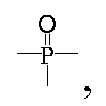 the replacement of the carbon atom means that the carbon atom or the carbon atom and the hydrogen atom thereon together are replaced by a corresponding group;the "aliphatic ring" is a saturated or unsaturated 4- to 10-membered monocyclic or polycyclic aliphatic ring;the "aliphatic heterocycle" is a saturated or unsaturated 4- to 10-membered monocyclic or polycyclic aliphatic heterocycle containing at least one heteroatom selected from N, O, S, or Si; when the aliphatic heterocycle contains an S atom, the S is in the form of -S-, -SO-, or -SO2-; the aliphatic heterocycle is optionally substituted with a halogen atom, a nitro group, an alkyl group, an aryl group, a hydrophilic group, and a modified alkyl group;the "aryl or aromatic ring" is a 5- to 10-membered monocyclic or fused bicyclic aromatic group;the "heteroaryl or aromatic heterocyclic ring" is a 5- to 10-membered monocyclic or fused bicyclic heteroaromatic group containing at least one heteroatom selected from N, O, S or Si on the ring;optionally, the "heteroaryl or aromatic heterocyclic ring" is an 11- to 14-membered fused tricyclic heteroaromatic group containing at least one heteroatom selected from N, O, S, or Si on the ring;the "halogen atom" is independently selected from F, Cl, Br, I;the "hydrophilic group" is a hydroxyl group, a sulfonic acid group, a carboxyl group, a phosphite group, a primary amino group, a secondary amino group, or a tertiary amino group;the "monocyclic cycloalkylene group" is a 4- to 7-membered cycloalkylene group;the "bicyclic cycloalkylene group" is a 5- to 7-membered bicyclic cycloalkylene group;the "bridged aliphatic heterocycle" is a 5- to 20-membered bridged aliphatic heterocycle containing at least one hetero atom selected from N, O, or S on the ring;the "keto group" is an R-(C=O) R 'group;the "ester group" is an R(C=O) OR 'group;the "amide group" is a RCONR 'group;the "thioamide group" is an R(C=S) NR' group;the "thioester group" is an R(C=S) OR 'group;the "phosphite group" is an RP(=O)(OH)2 group;the "phosphate group" is a ROP(=O)(OH)2 group;the "sulfonic group" is an RSO3H group;the "sulfonate group" is an RSO2OR' group;the "sulfone group" is an RSO2R' group;the "sulfoxide" RSOR' group;the "primary amino group" is a RNH2 group;the "secondary amino group" is a RNHR' group;the "tertiary amino group" is an RNR'R "group;the "quaternary ammonium salt" RR'R"R'''N+ group;each R, R', R", R''' is independently a single bond, an alkyl group, an alkylene group, a modified alkyl group, or a modified alkylene group, and the modified alkyl group or modified alkylene group is a group obtained by replacement of any carbon atom of C1-C10 (preferably C1-C6) alkyl or alkylene group with a group selected from -O-, -OH, -CO-, -CS-, -(S=O)-;optionally, the modified alkyl group or modified alkylene group each is independently a group containing at least one group selected from -OH, -O-, an ethylene glycol unit (-(CH2CH2O)n-), a C1-C8 alkyl group, and a C1-C8 alkoxy group, a C1-C8 acyloxy group, a C1-C8 haloalkyl group, a monosaccharide group, a disaccharide group, a polysaccharide group, -O-CO-, -NH-CO-, -(-NH-CHR''''-CO-)n-, -SO2-O-, -SO-, -SO2-NH-, -S-S-, -CH=CH-, -C=C-, a halogen atom, a cyano group, a nitro group, an o-nitrophenyl group, a benzoylmethyl group, and a phosphate group, wherein n is 1 to 100, optionally 1 to 50, optionally 1 to 30, optionally 1 to 10; R'''' is H or a residue of α amino acid; the "phosphate group" has the definition as described above;the "monosaccharide unit" is a saccharide unit that can no longer be simply hydrolyzed into smaller sugar molecules;the "disaccharide unit" is a saccharide unit formed by dehydration of two monosaccharides;the "polysaccharide unit" is a saccharide unit formed by dehydration of 10 or more monosaccharides;optionally, the C1-C8 alkyl group is methyl, ethyl, propyl, or isopropyl, and the C1-C8 alkoxy group is methoxy, ethoxy, propoxy, or isopropoxy, the C1-C8 acyloxy is acetoxy, ethyl, propyl, isopropyl, and the C1-C8 haloalkyl is trifluoromethyl, chloromethyl, bromomethyl;optionally, the aliphatic heterocycle is selected from azetidine, pyrrolidine, piperidine, tetrahydrofuran, tetrahydropyran, morpholine, and thiomorpholine;optionally, the heteroaryl ring is selected from thiophene, furan, and pyrrole.
 - The fluorescent probe according to claim 1 or claim 2, wherein the fluorescent probe is a compound having a structure represented by (I-a) or (I-b), or a salt thereof,


- The fluorescent probe according to any one of claims 1 to 3, wherein,
the protein tag is a purified product, an unpurified product, or an in situ state existing in a cell or a tissue;
optionally, the protein tag is selected from a dehalogenase;
optionally, the protein tag is a haloalkane dehalogenase (HaloTag) or a mutant thereof;
optionally, the ligand moiety A is derived from a halogenated hydrocarbon compound;
optionally, the ligand moiety A suitable for HaloTag is derived from a dehalogenase substrate; optionally, the ligand moiety A is a haloalkane group; optionally a haloethyl group, optionally a structure of the following formula: X is halogen, optionally chlorine;optionally, the linker moiety B is selected from a saturated linear or branched alkyl group having 1 to 30 carbon atoms, one or more carbon atoms on the alkyl chain being replaced with one or more -O-; said replacement of carbon atom with -O- means that a carbon atom or a carbon atom and the hydrogen atom thereon together are replaced with -O-;optionally, X1 is a C1-30 linear or branched alkyl group optionally substituted with one or more groups selected from a hydroxyl group, a cyano group, a halogen atom, a carboxyl group, and a quaternary ammonium group, and X2 is an C1-30 linear or branched chain alkyl or alkylene group optionally substituted one or more groups selected from a hydroxyl group, a cyano group, a halogen atom, a carboxyl group, and a quaternary ammonium group;optionally, X1 and X2 are each independently selected from C2-30 ether chain group which contains 1 to 10 oxygen atoms and is optionally substituted with one or more groups selected from a sulfonic acid group and a carboxyl group;optionally, X1 and X2 are each independently a C4-30 alkyl or alkylene group which is modified with - HN(C=O)-O-, and is optionally substituted with one or more groups selected from a sulfonic acid group and a carboxyl group;optionally, -NX1-X2 forms any group selected from the following formulae (I-i-1), (I-i-2)
 optionally, X1 is a C1-10 linear or branched alkyl group optionally substituted with one or more groups selected from a hydroxyl group, a cyano group, a halogen atom, a carboxyl group, and a quaternary ammonium group, and X2 is a C1-10 linear or branched chain alkyl or alkylene group indepently substituted with one or more groups selected from a hydroxyl group, a cyano group, a halogen atom, a carboxyl group, and a quaternary ammonium group;optionally, two adjacent substituents in the conjugated system E are connected to each other to form a saturated or unsaturated aliphatic ring or aliphatic heterocycle;optionally, H on CH in the conjugated system E is substituted with a halogen atom, a nitro group, a hydrophilic group, an alkyl group, or a modified alkyl group;optionally, the conjugated system E contains NH; optionally, H on the NH is substituted with an alkyl group or a modified alkyl group;optionally, the conjugated system E is selected from the structures of the following formulae (I-1-1) to (1-1-38):


 optionally, the conjugated system E and -NX1-X2 form an aliphatic heterocycle as shown by (I-i-3) to (I-i-7):
 alternatively, the conjugated system E and -NX1-X2 form the structure shown in (I-i-8) as follows:
 optionally, R2 and Re are independently a group selected from the following structures, or a bicyclic or polycyclic fused aromatic ring or fused aromatic heterocyclic ring formed by fusion of the following structure itself or with each other: optionally is a bicyclic or tricyclic fused aromatic ring or fused aromatic heterocyclic ring;

 optionally, H on CH in the above structures of R2 or Re is substituted with a halogen atom, a cyano group, a nitro group, a hydrophilic group, an alkyl group, or a modified alkyl group; optionally, R2 or Re is a NH-containing group selected from the above structures, and optionally, H on the NH is substituted with an alkyl group or a modified alkyl group;alternatively, the R2 is selected from hydrogen, a cyano group, a carboxyl group, a keto group, an ester group, an amide group, a thioamino group, a thioester group, and when R2 is selected from a keto group, an ester group, or an amide group, the carbonyl group in the keto group, the ester group or the amide group is connected to the alkenyl carbon of the formula (I-2) or (I-2-i); when R2 is selected from a thioamino group and a thioester group, the thiocarbonyl group in the thioamino group or the thioester group is connected to the alkenyl carbon of the formula (I-2) and the formula (I-2-i); Re is selected from a cyano group, a keto group, an ester group, and an amide group; when Re is selected from a keto group, an ester group, or an amide group, the carbonyl group in the keto group, the ester group, or the amide group is connected to the alkenyl carbon of the formula (I-2-a), the formula (I-2-b), or the formula (I-2-c);optionally, the electron acceptor moiety is one selected from the following formulae (1-2-1) to (1-2-38):





- The fluorescent probe according to any one of claims 1 to 4, wherein the fluorescent probe is selected from the following compounds or salts thereof:


- A method of preparing the fluorescent probe according to any one of claims 1 to 5, comprising a step of reacting a fluorescent dye represented by formula (II) with a ligand and an optional linker:

- A fluorescent activated protein specific labeling method, comprising steps of contacting the fluorescent probe according to any one of claims 1 to 5 with a target protein of a protein tag or a fusion protein tag; performing labeling reaction between the ligand moiety of the fluorescent probe and the protein tag to label the protein tag with the fluorescent probe; optionally, the labeling of the protein tag with the fluorescent probe is covalently labeling;
optionally, a reaction medium of the labeling reaction is selected from a pure protein solution, a cell lysate or an in situ medium in which the target protein of a protein tag or a fusion protein tag is located; optionally, the in situ medium is intracellular media, organelle media, living tissue media, blood or body fluids. - Use of the fluorescent probe according to any one of claims 1 to 5 for fluorescent labeling, quantification, detection or kinetic studies of proteins, and for imaging of cells, tissues, and living bodies.
- A probe kit comprising the fluorescent probe according to any one of claims 1 to 5,
optionally, the probe kit further comprises a biocompatible medium; optionally, the biocompatible medium is at least one selected from dimethyl sulfoxide, a buffer, and physiological saline; optionally, the buffer includes phosphate buffer.
Applications Claiming Priority (2)
| Application Number | Priority Date | Filing Date | Title |
|---|---|---|---|
| CN201710909828.2A CN109574880B (en) | 2017-09-29 | 2017-09-29 | Fluorescent probe and preparation method and application thereof |
| PCT/CN2018/108519 WO2019062876A1 (en) | 2017-09-29 | 2018-09-29 | Fluorescent probe, preparation method therefor and use thereof |
Publications (2)
| Publication Number | Publication Date |
|---|---|
| EP3690002A1 true EP3690002A1 (en) | 2020-08-05 |
| EP3690002A4 EP3690002A4 (en) | 2021-06-23 |
Family
ID=65900709
Family Applications (1)
| Application Number | Title | Priority Date | Filing Date |
|---|---|---|---|
| EP18861947.2A Pending EP3690002A4 (en) | 2017-09-29 | 2018-09-29 | FLUORESCENT PROBE, METHOD OF MANUFACTURING AND USE |
Country Status (4)
| Country | Link |
|---|---|
| US (1) | US12492337B2 (en) |
| EP (1) | EP3690002A4 (en) |
| CN (1) | CN109574880B (en) |
| WO (1) | WO2019062876A1 (en) |
Cited By (1)
| Publication number | Priority date | Publication date | Assignee | Title |
|---|---|---|---|---|
| JP2024528240A (en) * | 2021-08-06 | 2024-07-26 | フルオレッセンス ダイアグノシス(シャンハイ) バイオテック カンパニー リミテッド | Fluorescent dyes and their manufacture and use |
Families Citing this family (16)
| Publication number | Priority date | Publication date | Assignee | Title |
|---|---|---|---|---|
| CN111592472B (en) * | 2019-04-28 | 2022-10-21 | 纳莹(上海)生物科技有限公司 | Fluorescent dye and preparation method and application thereof |
| CN110437219A (en) * | 2019-07-09 | 2019-11-12 | 济南大学 | A kind of detection viscosity and the difunctional fluorescence probe of sulfur dioxide |
| CN113501790B (en) * | 2020-03-23 | 2025-10-03 | 纳莹(上海)生物科技有限公司 | A fluorescent dye and its preparation method and use |
| CN111748003B (en) * | 2020-06-24 | 2021-10-15 | 河北大学 | N-acetamidogalactose-modified 3-nitrophthalimide derivatives, preparation methods and applications, and liver targeting probes |
| CN111892534A (en) * | 2020-08-04 | 2020-11-06 | 中国科学技术大学 | pH-sensitive fluorescent probe, and preparation method and application thereof |
| CN112625006B (en) * | 2020-12-22 | 2022-03-29 | 吉林大学 | A stilbene skeleton-based fluorescent imaging probe for cellular lipid droplets and its application |
| CN112679425B (en) * | 2020-12-31 | 2022-06-14 | 华南理工大学 | Fluorescent probe with AIE property, preparation and application thereof in detection of transthyretin tetramer protein |
| CN112592283B (en) * | 2021-01-25 | 2022-06-07 | 井冈山大学 | Fluorescent compound for detecting viscosity of wine beverage and preparation and application thereof |
| CN112898963B (en) * | 2021-02-01 | 2022-04-22 | 中南大学 | Fluorescent probe for detecting viscosity, preparation method and application thereof |
| CN113582931B (en) * | 2021-07-13 | 2022-10-28 | 上海师范大学 | Fluorescent dye probe for latent fingerprint detection and preparation method and application thereof |
| CN113563229B (en) * | 2021-07-20 | 2023-06-02 | 湘潭大学 | Preparation and application of isophorone-cinnamaldehyde-based viscosity fluorescent probe |
| JP7727997B2 (en) * | 2021-08-20 | 2025-08-22 | 国立研究開発法人情報通信研究機構 | Polymers and light-controlling elements |
| CN113979917B (en) * | 2021-09-24 | 2023-11-17 | 南京大学 | Trimethyltetracyanine dye, synthesis method and use |
| CN114106581B (en) * | 2021-10-11 | 2023-06-16 | 南京邮电大学 | Organic micromolecular dye, J aggregation nano particles, and preparation methods and application thereof |
| WO2024049924A1 (en) * | 2022-08-30 | 2024-03-07 | The Regents Of The University Of California | Optical systems and platforms for simultaneously analyzing multiple solution properties |
| CN119264072B (en) * | 2024-12-06 | 2025-05-02 | 国科大杭州高等研究院 | Fluorescent probe for cell imaging and its synthesis method and application |
Family Cites Families (18)
| Publication number | Priority date | Publication date | Assignee | Title |
|---|---|---|---|---|
| US2776310A (en) * | 1954-12-01 | 1957-01-01 | Eastman Kodak Co | Methine dye and process for its preparation |
| DE3818404A1 (en) * | 1988-05-31 | 1989-12-07 | Basf Ag | METHOD FOR TRANSMITTING AZO DYES |
| DE4004600A1 (en) * | 1990-02-15 | 1991-08-22 | Basf Ag | METHOD FOR TRANSMITTING AZO DYES |
| NZ538986A (en) | 2002-10-03 | 2006-06-30 | Ecole Polytech | Substrates for O6-alkylguanine-DNA alkyltransferase |
| EP1594962B1 (en) | 2003-01-31 | 2014-08-27 | Promega Corporation | Covalent tethering of functional groups to proteins |
| WO2007041241A2 (en) * | 2005-09-30 | 2007-04-12 | The Trustees Of Columbia University In The City Of New York | Compositions and methods for detecting ligand-receptor interactions |
| US7781187B2 (en) * | 2005-12-30 | 2010-08-24 | Corning Incorporated | Fluorescent dyes |
| EP1882688A1 (en) | 2006-07-25 | 2008-01-30 | EPFL Ecole Polytechnique Fédérale de Lausanne | Labelling of fusion proteins with synthetic probes |
| CN102127059B (en) * | 2010-12-22 | 2013-08-21 | 江苏迈健生物科技发展有限公司 | Near-infrared fluorescent probe with maximum Stoke displacement |
| JP5914070B2 (en) * | 2012-03-15 | 2016-05-11 | 株式会社Adeka | Novel compound and colored photosensitive composition |
| US8841409B2 (en) | 2012-03-22 | 2014-09-23 | Polyera Corporation | Conjugated polymers and their use in optoelectronic devices |
| WO2015070122A1 (en) * | 2013-11-08 | 2015-05-14 | The Cleveland Clinic Foundation | Protein disulfide isomerase inhibiting anticancer agents |
| AU2013405234B2 (en) * | 2013-11-12 | 2017-08-10 | Cognoptix, Inc. | Method for measuring fluorescence in ocular tissue |
| CN103666456B (en) * | 2013-12-02 | 2015-02-04 | 大连理工大学 | A class of boron fluoride complexed dipyrromethene fluorescent probes, its preparation method and application |
| CN106573880B (en) * | 2014-03-19 | 2019-07-30 | 阿米达斯公司 | Amyloid targeting agents and methods of using the same |
| CN104745177A (en) * | 2015-04-07 | 2015-07-01 | 华东理工大学 | Light activated fluorescent probe having protein label positioning function as well as preparation method and application thereof |
| CN113444046B (en) | 2016-07-20 | 2023-10-27 | 纳莹(上海)生物科技有限公司 | Fluorescent probe and preparation method and application thereof |
| CN107663384B (en) | 2016-07-20 | 2020-05-12 | 上海高驰资产管理有限公司 | A kind of fluorescent dye and its preparation method and use |
-
2017
- 2017-09-29 CN CN201710909828.2A patent/CN109574880B/en active Active
-
2018
- 2018-09-29 EP EP18861947.2A patent/EP3690002A4/en active Pending
- 2018-09-29 US US16/652,208 patent/US12492337B2/en active Active
- 2018-09-29 WO PCT/CN2018/108519 patent/WO2019062876A1/en not_active Ceased
Cited By (2)
| Publication number | Priority date | Publication date | Assignee | Title |
|---|---|---|---|---|
| JP2024528240A (en) * | 2021-08-06 | 2024-07-26 | フルオレッセンス ダイアグノシス(シャンハイ) バイオテック カンパニー リミテッド | Fluorescent dyes and their manufacture and use |
| EP4382526A4 (en) * | 2021-08-06 | 2025-03-26 | Fluorescence Diagnosis (shanghai) Biotech Company Ltd. | Fluorescent dye, and preparation method therefor and use thereof |
Also Published As
| Publication number | Publication date |
|---|---|
| EP3690002A4 (en) | 2021-06-23 |
| CN109574880A (en) | 2019-04-05 |
| US20200248069A1 (en) | 2020-08-06 |
| WO2019062876A1 (en) | 2019-04-04 |
| US12492337B2 (en) | 2025-12-09 |
| CN109574880B (en) | 2022-06-17 |
Similar Documents
| Publication | Publication Date | Title |
|---|---|---|
| US12492337B2 (en) | Fluorescent probe, preparation method therefor and use thereof | |
| EP3489324A1 (en) | Fluorescent probe and preparation method and use thereof | |
| EP3798221A1 (en) | Fluorescent probe and preparation method and use thereof | |
| JP7227741B2 (en) | Carboxy X rhodamine analog | |
| US9631096B2 (en) | Dye compositions, methods of preparation, conjugates thereof, and methods of use | |
| EP3489323A1 (en) | Fluorescent dye and preparation method and use thereof | |
| US20150192589A1 (en) | Method using fluorescent turn-on probes for cell-specific detection | |
| WO2010126077A1 (en) | Near-infrared fluorescent compound | |
| CN107098923A (en) | One class feux rouges targets fluorescent dye and preparation method thereof and purposes near infrared emission lysosome | |
| CN107118586A (en) | The purposes of the vinyl compound of nitrogen heterocycle substitution | |
| CN114106027A (en) | Fluoroboron fluorescent dye-tetrazine fluorescent probe and preparation method and application thereof | |
| EP4103652A1 (en) | Fluorescent rhodamine dyes with enhanced cell permeability | |
| JP2001002951A (en) | New fluorescent dyes and their use as fluorescent markers | |
| KR101590527B1 (en) | New indocyanine derivatives, composition comprising same, and detection probes for thiol-containing compounds | |
| Koh | A new method to red shifting fluorescein-based dye through ICT introduction | |
| WO2024230718A1 (en) | Microenvironment viscosity sensitive fluorescent dye, preparation method therefor, and use thereof | |
| CN121909257A (en) | Dendrimers comprising fluorescent dyes | |
| CN118271279A (en) | Near-infrared rhodamine dye and preparation method and application thereof | |
| Wang | Synthesis of Fluorescent Molecules and their Applications as Viscosity Sensors, Metal Ion Indicators, and Near-Infrared Probes |
Legal Events
| Date | Code | Title | Description |
|---|---|---|---|
| STAA | Information on the status of an ep patent application or granted ep patent |
Free format text: STATUS: THE INTERNATIONAL PUBLICATION HAS BEEN MADE |
|
| PUAI | Public reference made under article 153(3) epc to a published international application that has entered the european phase |
Free format text: ORIGINAL CODE: 0009012 |
|
| STAA | Information on the status of an ep patent application or granted ep patent |
Free format text: STATUS: REQUEST FOR EXAMINATION WAS MADE |
|
| 17P | Request for examination filed |
Effective date: 20200330 |
|
| AK | Designated contracting states |
Kind code of ref document: A1 Designated state(s): AL AT BE BG CH CY CZ DE DK EE ES FI FR GB GR HR HU IE IS IT LI LT LU LV MC MK MT NL NO PL PT RO RS SE SI SK SM TR |
|
| AX | Request for extension of the european patent |
Extension state: BA ME |
|
| RAP1 | Party data changed (applicant data changed or rights of an application transferred) |
Owner name: SHANGHAI GLORY CAPITAL MANAGEMENT., LTD. |
|
| DAV | Request for validation of the european patent (deleted) | ||
| DAX | Request for extension of the european patent (deleted) | ||
| A4 | Supplementary search report drawn up and despatched |
Effective date: 20210527 |
|
| RAP1 | Party data changed (applicant data changed or rights of an application transferred) |
Owner name: FLUORESCENCE DIAGNOSIS (SHANGHAI) BIOTECH COMPANY LTD. |
|
| STAA | Information on the status of an ep patent application or granted ep patent |
Free format text: STATUS: EXAMINATION IS IN PROGRESS |
|
| 17Q | First examination report despatched |
Effective date: 20250312 |