EP3689779B1 - Bag-like container - Google Patents
Bag-like container Download PDFInfo
- Publication number
- EP3689779B1 EP3689779B1 EP18863197.2A EP18863197A EP3689779B1 EP 3689779 B1 EP3689779 B1 EP 3689779B1 EP 18863197 A EP18863197 A EP 18863197A EP 3689779 B1 EP3689779 B1 EP 3689779B1
- Authority
- EP
- European Patent Office
- Prior art keywords
- layer
- bag
- container
- bottom sheet
- seal
- Prior art date
- Legal status (The legal status is an assumption and is not a legal conclusion. Google has not performed a legal analysis and makes no representation as to the accuracy of the status listed.)
- Active
Links
Images


Classifications
-
- B—PERFORMING OPERATIONS; TRANSPORTING
- B65—CONVEYING; PACKING; STORING; HANDLING THIN OR FILAMENTARY MATERIAL
- B65D—CONTAINERS FOR STORAGE OR TRANSPORT OF ARTICLES OR MATERIALS, e.g. BAGS, BARRELS, BOTTLES, BOXES, CANS, CARTONS, CRATES, DRUMS, JARS, TANKS, HOPPERS, FORWARDING CONTAINERS; ACCESSORIES, CLOSURES, OR FITTINGS THEREFOR; PACKAGING ELEMENTS; PACKAGES
- B65D81/00—Containers, packaging elements, or packages, for contents presenting particular transport or storage problems, or adapted to be used for non-packaging purposes after removal of contents
- B65D81/34—Containers, packaging elements, or packages, for contents presenting particular transport or storage problems, or adapted to be used for non-packaging purposes after removal of contents for packaging foodstuffs or other articles intended to be cooked or heated within the package
- B65D81/3446—Containers, packaging elements, or packages, for contents presenting particular transport or storage problems, or adapted to be used for non-packaging purposes after removal of contents for packaging foodstuffs or other articles intended to be cooked or heated within the package specially adapted to be heated by microwaves
- B65D81/3461—Flexible containers, e.g. bags, pouches, envelopes
-
- B—PERFORMING OPERATIONS; TRANSPORTING
- B32—LAYERED PRODUCTS
- B32B—LAYERED PRODUCTS, i.e. PRODUCTS BUILT-UP OF STRATA OF FLAT OR NON-FLAT, e.g. CELLULAR OR HONEYCOMB, FORM
- B32B1/00—Layered products having a non-planar shape
-
- B—PERFORMING OPERATIONS; TRANSPORTING
- B32—LAYERED PRODUCTS
- B32B—LAYERED PRODUCTS, i.e. PRODUCTS BUILT-UP OF STRATA OF FLAT OR NON-FLAT, e.g. CELLULAR OR HONEYCOMB, FORM
- B32B27/00—Layered products comprising a layer of synthetic resin
- B32B27/06—Layered products comprising a layer of synthetic resin as the main or only constituent of a layer, which is next to another layer of the same or of a different material
- B32B27/10—Layered products comprising a layer of synthetic resin as the main or only constituent of a layer, which is next to another layer of the same or of a different material of paper or cardboard
-
- B—PERFORMING OPERATIONS; TRANSPORTING
- B65—CONVEYING; PACKING; STORING; HANDLING THIN OR FILAMENTARY MATERIAL
- B65D—CONTAINERS FOR STORAGE OR TRANSPORT OF ARTICLES OR MATERIALS, e.g. BAGS, BARRELS, BOTTLES, BOXES, CANS, CARTONS, CRATES, DRUMS, JARS, TANKS, HOPPERS, FORWARDING CONTAINERS; ACCESSORIES, CLOSURES, OR FITTINGS THEREFOR; PACKAGING ELEMENTS; PACKAGES
- B65D75/00—Packages comprising articles or materials partially or wholly enclosed in strips, sheets, blanks, tubes or webs of flexible sheet material, e.g. in folded wrappers
- B65D75/28—Articles or materials wholly enclosed in composite wrappers, i.e. wrappers formed by associating or interconnecting two or more sheets or blanks
- B65D75/30—Articles or materials enclosed between two opposed sheets or blanks having their margins united, e.g. by pressure-sensitive adhesive, crimping, heat-sealing, or welding
-
- B—PERFORMING OPERATIONS; TRANSPORTING
- B32—LAYERED PRODUCTS
- B32B—LAYERED PRODUCTS, i.e. PRODUCTS BUILT-UP OF STRATA OF FLAT OR NON-FLAT, e.g. CELLULAR OR HONEYCOMB, FORM
- B32B2439/00—Containers; Receptacles
- B32B2439/40—Closed containers
- B32B2439/46—Bags
-
- B—PERFORMING OPERATIONS; TRANSPORTING
- B32—LAYERED PRODUCTS
- B32B—LAYERED PRODUCTS, i.e. PRODUCTS BUILT-UP OF STRATA OF FLAT OR NON-FLAT, e.g. CELLULAR OR HONEYCOMB, FORM
- B32B2439/00—Containers; Receptacles
- B32B2439/70—Food packaging
-
- B—PERFORMING OPERATIONS; TRANSPORTING
- B65—CONVEYING; PACKING; STORING; HANDLING THIN OR FILAMENTARY MATERIAL
- B65D—CONTAINERS FOR STORAGE OR TRANSPORT OF ARTICLES OR MATERIALS, e.g. BAGS, BARRELS, BOTTLES, BOXES, CANS, CARTONS, CRATES, DRUMS, JARS, TANKS, HOPPERS, FORWARDING CONTAINERS; ACCESSORIES, CLOSURES, OR FITTINGS THEREFOR; PACKAGING ELEMENTS; PACKAGES
- B65D2581/00—Containers, packaging elements, or packages, for contents presenting particular transport or storage problems, or adapted to be used for non-packaging purposes after removal of contents
- B65D2581/34—Containers, packaging elements, or packages, for contents presenting particular transport or storage problems, or adapted to be used for non-packaging purposes after removal of contents for packaging foodstuffs or other articles intended to be cooked or heated within
- B65D2581/3401—Cooking or heating method specially adapted to the contents of the package
- B65D2581/3402—Cooking or heating method specially adapted to the contents of the package characterised by the type of product to be heated or cooked
- B65D2581/3405—Cooking bakery products
- B65D2581/3406—Pizza or bread
-
- B—PERFORMING OPERATIONS; TRANSPORTING
- B65—CONVEYING; PACKING; STORING; HANDLING THIN OR FILAMENTARY MATERIAL
- B65D—CONTAINERS FOR STORAGE OR TRANSPORT OF ARTICLES OR MATERIALS, e.g. BAGS, BARRELS, BOTTLES, BOXES, CANS, CARTONS, CRATES, DRUMS, JARS, TANKS, HOPPERS, FORWARDING CONTAINERS; ACCESSORIES, CLOSURES, OR FITTINGS THEREFOR; PACKAGING ELEMENTS; PACKAGES
- B65D2581/00—Containers, packaging elements, or packages, for contents presenting particular transport or storage problems, or adapted to be used for non-packaging purposes after removal of contents
- B65D2581/34—Containers, packaging elements, or packages, for contents presenting particular transport or storage problems, or adapted to be used for non-packaging purposes after removal of contents for packaging foodstuffs or other articles intended to be cooked or heated within
- B65D2581/3401—Cooking or heating method specially adapted to the contents of the package
- B65D2581/3402—Cooking or heating method specially adapted to the contents of the package characterised by the type of product to be heated or cooked
- B65D2581/3422—Cooking rice dishes
-
- B—PERFORMING OPERATIONS; TRANSPORTING
- B65—CONVEYING; PACKING; STORING; HANDLING THIN OR FILAMENTARY MATERIAL
- B65D—CONTAINERS FOR STORAGE OR TRANSPORT OF ARTICLES OR MATERIALS, e.g. BAGS, BARRELS, BOTTLES, BOXES, CANS, CARTONS, CRATES, DRUMS, JARS, TANKS, HOPPERS, FORWARDING CONTAINERS; ACCESSORIES, CLOSURES, OR FITTINGS THEREFOR; PACKAGING ELEMENTS; PACKAGES
- B65D2581/00—Containers, packaging elements, or packages, for contents presenting particular transport or storage problems, or adapted to be used for non-packaging purposes after removal of contents
- B65D2581/34—Containers, packaging elements, or packages, for contents presenting particular transport or storage problems, or adapted to be used for non-packaging purposes after removal of contents for packaging foodstuffs or other articles intended to be cooked or heated within
- B65D2581/3401—Cooking or heating method specially adapted to the contents of the package
- B65D2581/3402—Cooking or heating method specially adapted to the contents of the package characterised by the type of product to be heated or cooked
- B65D2581/3424—Cooking fish or shellfish
-
- B—PERFORMING OPERATIONS; TRANSPORTING
- B65—CONVEYING; PACKING; STORING; HANDLING THIN OR FILAMENTARY MATERIAL
- B65D—CONTAINERS FOR STORAGE OR TRANSPORT OF ARTICLES OR MATERIALS, e.g. BAGS, BARRELS, BOTTLES, BOXES, CANS, CARTONS, CRATES, DRUMS, JARS, TANKS, HOPPERS, FORWARDING CONTAINERS; ACCESSORIES, CLOSURES, OR FITTINGS THEREFOR; PACKAGING ELEMENTS; PACKAGES
- B65D2581/00—Containers, packaging elements, or packages, for contents presenting particular transport or storage problems, or adapted to be used for non-packaging purposes after removal of contents
- B65D2581/34—Containers, packaging elements, or packages, for contents presenting particular transport or storage problems, or adapted to be used for non-packaging purposes after removal of contents for packaging foodstuffs or other articles intended to be cooked or heated within
- B65D2581/3437—Containers, packaging elements, or packages, for contents presenting particular transport or storage problems, or adapted to be used for non-packaging purposes after removal of contents for packaging foodstuffs or other articles intended to be cooked or heated within specially adapted to be heated by microwaves
- B65D2581/3471—Microwave reactive substances present in the packaging material
- B65D2581/3472—Aluminium or compounds thereof
-
- B—PERFORMING OPERATIONS; TRANSPORTING
- B65—CONVEYING; PACKING; STORING; HANDLING THIN OR FILAMENTARY MATERIAL
- B65D—CONTAINERS FOR STORAGE OR TRANSPORT OF ARTICLES OR MATERIALS, e.g. BAGS, BARRELS, BOTTLES, BOXES, CANS, CARTONS, CRATES, DRUMS, JARS, TANKS, HOPPERS, FORWARDING CONTAINERS; ACCESSORIES, CLOSURES, OR FITTINGS THEREFOR; PACKAGING ELEMENTS; PACKAGES
- B65D2581/00—Containers, packaging elements, or packages, for contents presenting particular transport or storage problems, or adapted to be used for non-packaging purposes after removal of contents
- B65D2581/34—Containers, packaging elements, or packages, for contents presenting particular transport or storage problems, or adapted to be used for non-packaging purposes after removal of contents for packaging foodstuffs or other articles intended to be cooked or heated within
- B65D2581/3437—Containers, packaging elements, or packages, for contents presenting particular transport or storage problems, or adapted to be used for non-packaging purposes after removal of contents for packaging foodstuffs or other articles intended to be cooked or heated within specially adapted to be heated by microwaves
- B65D2581/3486—Dielectric characteristics of microwave reactive packaging
- B65D2581/3494—Microwave susceptor
- B65D2581/3497—Microwave susceptor attached to the side walls
Definitions
- the present invention relates to a bag-like container configured to contain food to be cooked with a microwave oven.
- a bag-like container For microwave cooking, a bag-like container is provided with a heating element that generates heat when heated with a microwave oven so that food can be cooked until browned, and bag-like containers of this type have been variously proposed.
- Jpn. Pat. Appln. KOKAI Publication No. 2001-322684 discloses a bag-like container of this type, in which a heating element layer is provided on one face of a heat-sealing polyester film and the container is shaped like a bag so as to brown a surface of the food.
- US 2010/195939 relates to a bag like container according to the preamble of claim 1.
- US 4 735 513 relates to flexible packaging sheets.
- US 6 414 288 relates to a microwave packaging kit for improved cooking performance.
- a container composed mainly of a resin film such as that described above has a risk that the resin film will be damaged from heat generated by a heating element at the time of microwave cooking.
- the present invention aims to provide a bag-like container that can be prevented from becoming damaged from heat generated by a heating element when a content is cooked with a microwave oven.
- the present invention is defined by claim 1 and relates to a bag-like container which includes a bottom sheet including a first paper base layer and a heating element layer configured to generate heat by absorbing electromagnetic waves; and a top sheet bonded to the bottom sheet in such a manner as to be separable from the bottom sheet with a content to be cooked being contained, wherein the top sheet transmits the electromagnetic waves.
- the bag-like container which can be prevented from becoming damaged from heat generated by a heating element when a content is cooked with a microwave oven.
- FIG. 1 to FIG. 7 a bag-like container 1 according to one embodiment of the present invention will be described with reference to FIG. 1 to FIG. 7 .
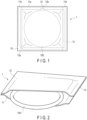
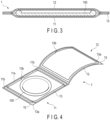
- FIG. 1 to FIG. 3 are respectively a plan view, a perspective view, and a cross-sectional view which each show a configuration of the bag-like container 1 according to one embodiment of the present invention.
- FIG. 4 is a perspective view showing the configuration of the bag-like container 1 in one example of use.
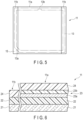
- FIG. 5 is a plan view showing a configuration of a bottom sheet 11 for use in the bag-like container 1.
- FIG. 6 is a cross-sectional view showing the configuration of the bottom sheet 11.
- FIG. 7 is a cross-sectional view showing a configuration of a top sheet 12 for use in the bag-like container 1.
- the bag-like container 1 is a storage container used to heat a content 100 that is food when it is cooked with a microwave oven, and to scorch or brown the content 100.
- Examples of the content 100 include a pizza, a rice ball, fried rice, okonomiyaki, grilled fish, etc.
- the bag-like container 1 includes the bottom sheet 11 and the top sheet 12, which is fixed to the bottom sheet 11, with the content 100 being held between the bottom sheet 11 and the top sheet 12.
- the bag-like container 1 is formed into a bag shape by thermally welding the bottom sheet 11 and the top sheet 12 together. With the content 100 being contained and closely sealed in the bag-like container 1, the bag-like container 1 has a seal portion 13 that extends along the periphery of the bottom sheet 11 and the top sheet 12, and a steam release portion 14 that releases internal steam when internal pressure increases at the time of cooking.
- the bottom sheet 11 has a multi-layered structure made of a plurality of materials, and is formed into, e.g., a rectangular sheet shape.
- the bottom sheet 11 includes a heating portion 11a and a non-heating portion 11b, as shown in FIG. 1 and FIG. 4 to FIG. 6 .
- the heating portion 11a is provided throughout the region of the bottom sheet 11, except at the opposed margins thereof.
- the non-heating portion 11b is provided in the pair of opposed margins of the bottom sheet 11.
- the heating portion 11a of the bottom sheet 11 includes a first paper base layer 21, a first resin film layer 22, a heating element layer 23, and a first seal layer 24 in order of distance from the outer face side of the bottom sheet 11 when viewed as a part of the bag-like container 1.
- the heating portion 11a is configured in a manner such that the heating portion 11a can generate heat by absorbing electromagnetic waves such as microwaves emitted by a microwave oven.
- the first paper base layer 21 is made of a paper base material composed mainly of paper.
- the first paper base layer 21 has a printed surface on the outer face side of the bag-like container 1, and this printed surface is overcoated with paint in order to secure a waterproofing property.
- the first resin film layer 22 is provided on the first paper base layer 21, on the side closer to the inner face of the bag-like container 1.
- the first resin film layer 22 is made of, e.g., a PET film.
- the first resin film layer 22 may be a single layer or may have a multi-layered structure in which resin layers of the same kind or various kinds are stacked together.
- a thermoplastic resin film made of, e.g., an olefin-based resin such as polyethylene or polypropylene, a polyester-based resin such as polyethylene terephthalate, or a polyamide-based resin such as nylon 6 is used.
- the heating element layer 23 includes a metal evaporated film 23a and a protection layer 23b.
- the metal evaporated film 23a is evaporated on the first resin film layer 22, on the side closer to the inner face of the bag-like container 1.
- the protection layer 23b is made of a resin coating film on the metal evaporated film 23a, on the side closer to the inner face of the bag-like container 1.
- the metal evaporated film 23a is made of, e.g., a mixture of aluminum and aluminum oxide.
- the metal evaporated film 23a may be a thin film of an evaporated film, conductive ink, a metal foil, etc., made of a conducting substance that generates heat by absorbing microwaves.
- Examples of a conducting substance include a metal such as aluminum, tin, zinc, iron, copper, etc., and a mixture of one type or two or more types of oxides of these metals.
- the protection layer 23b is made of, e.g., vinyl chloride-polyvinyl acetate-based resin.
- the protection layer 23b is necessary for the metal evaporated film 23a to be formed on a part of the bottom sheet 11.
- the protection layer 23b is for the metal evaporated film 23a, which is formed throughout the face of the first resin film layer 22, to be formed on a part of the bottom sheet 11 by forming the protection layer 23b on a part of the metal evaporated film 23a, and removing the remaining part of the metal evaporated film 23a, on which the protection layer 23b is not formed.
- the protection layer 23b may not be provided.
- the first seal layer 24 is provided on the protection layer 23b, on the side closer to the inner face of the bag-like container 1.
- the first seal layer 24 is made of, e.g., a resin material having a thermal adhesion property.
- the first seal layer 24 is made of a sealant film.
- a preferable example of a resin material that forms the first seal layer 24 made of a sealant film is an olefin-based resin such as a polyethylene resin or a polypropylene resin.
- the non-heating portion 11b of the bottom sheet 11 includes the first paper base layer 21, the first resin film layer 22, and the first seal layer 24 in order of distance from the outer face side of the bottom sheet 11 when viewed as a part of the bag-like container 1.
- the non-heating portion 11b corresponds to the heating portion 11a with no metal evaporated film 23a, nor the protection layer 23b.
- the non-heating portion 11b is configured to transmit electromagnetic waves emitted by a microwave oven.
- the first paper base layer 21 and the first resin film layer 22 are bonded together with adhesive, while the protection layer 23b and the first seal layer 24 are bonded together with adhesive.
- the top sheet 12 has a multi-layered structure made of a plurality of materials, and is formed into the same shape as the bottom sheet 11 when viewed in a planar view, for example, a rectangular sheet shape. As shown in FIG. 7 , the top sheet 12 includes a second paper base layer 31, a second resin film layer 32, and a second seal layer 33 in order of distance from the outer face side of the top sheet 12 when viewed as a part of the bag-like container 1.
- the top sheet 12 has no heating element layer, and is configured to transmit electromagnetic waves emitted by a microwave oven.
- the second paper base layer 31 is made of a paper base material composed mainly of paper.
- the second paper base layer 31 has one printed surface on the outer face side of the bag-like container 1, and this printed surface is overcoated with paint in order to secure a waterproofing property.
- the second resin film layer 32 is provided on the second paper base layer 31, on the side closer to the inner face of the bag-like container 1.
- the second resin film layer 32 is made of, e.g., a PET film.
- the second resin film layer 32 may be a single layer or may have a multi-layered structure in which resin layers of the same kind or various kinds are stacked together.
- a thermoplastic resin film made of, e.g., an olefin-based resin such as polyethylene or polypropylene, a polyester-based resin such as polyethylene terephthalate, or a polyamide-based resin such as nylon 6 is used.
- the second resin film layer 33 is provided on the second resin film layer 32, on the side closer to the inner face of the bag-like container 1. Upon receipt of heat, the second seal layer 33 is bonded to the first seal layer 24.
- the second seal layer 33 is made of, e.g., a resin material having a thermal adhesion property.
- the second seal layer 33 is made of, e.g., a sealant film.
- a preferable example of a resin material that forms the second seal layer 33 made of a sealant film is an olefin-based resin such as a polyethylene resin or a polypropylene resin.
- the seal portion 13 is formed by applying heat with the bottom sheet 11 and the top sheet 12 being in contact with each other, thereby bonding a part of the first seal layer 24 of the bottom sheet 11 and a part of the second seal layer 33 of the top sheet 12.
- the seal portion 13 is provided on the periphery of the bottom sheet 11 and the top sheet 12, along their shared four sides, in such a manner as to be inclined relative to their shared adjacent two sides in their share single corner.
- the seal portion 13 is formed in a rectangular frame shape along the rectangular margin of each of the bottom sheet 11 and the top sheet 12.
- the seal portion 13 has a relief portion 13a in one corner of each of the bottom sheet 11 and the top sheet 12 so as to serve as their shared unsealing base point, in a manner such that the relief portion 13a is inclined relative to the two adjacent sides of each of the bottom sheet 11 and the top sheet 12 so as to be relieved from the aforementioned corner.
- the seal portion 13 seals the bottom sheet 11 and the top sheet 12 on their shared periphery with a strength that allows a user to separate the bottom sheet 11 and the top sheet 12 from each other.
- the seal portion 13 includes a weak seal portion 13b as a part thereof.
- the weak seal portion 13b is included in a part of the heating portion 11a of the bottom sheet 11.
- the relief portion 13a is formed by sealing the bottom sheet 11 and the top sheet 12 in such a manner as to avoid their shared single corner. In this corner of each of the bottom sheet 11 and the top sheet 12, a tap portion 15 is formed for a user to pick apart each of the bottom sheet 11 and the top sheet 12.
- the weak seal portion 13b is set to break under a lower pressure than a pressure under which the bag-like container 1 breaks when the inner pressure of the bag-like container 1 increases by the action of steam.
- the weak seal portion 13b is configured to be smaller in width than the remaining part of the seal portion 13.
- the weak seal portion 13b corresponds to a part of the seal portion 13 provided on the heating portion 11a, and is provided in one location of the center of the side on which the heating portion 11a is formed.
- the steam release portion 14 is provided on the top sheet 12 or the seal portion 13, and is partially broken automatically or manually by a user at the time of cooking. In this manner, the steam release portion 14 releases steam that is generated when heating the content 100.
- the steam release portion 14 corresponds to the weak seal portion 13b.
- the seal portion 13 is formed by heat-sealing the four sides of each of the bottom sheet 11 and the top sheet 12 in a manner such that the seal portion 13 is relieved from one of their shared corners, with the content 100 being arranged between the bottom sheet 11 and the top sheet 12. In this manner, the bag-like container 1 is formed into a bag shape in which the content 100 is contained.
- the bag-like container 1 containing the content 100 is used.
- the top sheet 12 transmits electromagnetic waves, and the content 100 is irradiated to be cooked with the transmitted electromagnetic waves. Furthermore, the heating element layer 23 of the bottom sheet 11 is also irradiated with electromagnetic waves.
- Irradiation of electromagnetic waves causes the heating element layer 23 to generate heat. Specifically, the heating portion 11a of the bottom sheet 11 generates heat, so that the surface of the content 100 in contact with this heating portion 11a is cooked and browned.
- the weak seal portion 13b as the steam release portion 14 breaks, thereby forming a vent through which the inside and the outside are continuous. In this manner, steam inside the bag-like container 1 is discharged to the outside. Specifically, when the inner pressure increases, the bag-like container 1 can release the inner pressure, thereby making it possible to prevent the bag-like container 1 from breaking.
- the bag-like container 1 is used as described above.
- the bottom sheet 11 according to Example 1 had a layered structure in which the first paper base layer 21, the first resin film layer 22, and the heating element layer 23 are provided in order from the outer face of the bag-like container 1 to the inner face thereof, without providing the first seal layer 24.
- first paper base layer 21 high-quality paper having a basis weight of 64 g/cm 2 was used.
- a material for the first resin film layer 22 had a double-layered structure made of PET.
- a susceptor (1015HT manufactured by TORAY ADVANCED FILM CO., LTD.) in which a mixture of aluminum and aluminum oxide is evaporated to form a thin-film shape on a PET film corresponding to one layer of the first resin film layer 22 was used.
- the bottom sheet 11 according to Example 2 had a layered structure in which the first paper base layer 21, the first resin film layer 22, and the heating element layer 23 are provided in order from the outer face of the bag-like container 1 to the inner face thereof, without providing the first seal layer 24.
- first paper base layer 21 high-quality paper having a basis weight of 66 g/cm 2 was used.
- PET was used as a material for the first resin film layer 22.
- heating element layer 23 a susceptor (1015HT manufactured by TORAY ADVANCED FILM CO., LTD.) in which a mixture of aluminum and aluminum oxide is evaporated to form a thin-film shape on a PET film corresponding to the first resin film layer 22 was used.
- the bottom sheet 11 according to Example 3 had a layered structure in which the first paper base layer 21, the first resin film layer 22, and the heating element layer 23 are provided in order from the outer face of the bag-like container 1 to the inner face thereof, without providing the first seal layer 24.
- first paper base layer 21 high-quality paper having a basis weight of 70 g/cm 2 was used.
- a material for the first resin film layer 22 had a triple-layered structure made of PE, PET, and PET.
- a susceptor (1015HT manufactured by TORAY ADVANCED FILM CO., LTD.) in which a mixture of aluminum and aluminum oxide is evaporated to form a thin-film shape on a PET film corresponding to one layer of the first resin film layer 22 was used.
- the bottom sheet 11 according to Example 4 had a layered structure in which the first paper base layer 21, the first resin film layer 22, and the heating element layer 23 are provided in order from the outer face of the bag-like container 1 to the inner face thereof, without providing the first seal layer 24.
- first paper base layer 21 high-quality paper having a basis weight of 120 g/cm 2 was used.
- PET was used as a material for the first resin film layer 22.
- heating element layer 23 a susceptor (1015HT manufactured by TORAY ADVANCED FILM CO., LTD.) in which a mixture of aluminum and aluminum oxide is evaporated to form a thin-film shape on a PET film corresponding to the first resin film layer 22 was used.
- the bottom sheet 11 according to Example 5 had a layered structure in which the first paper base layer 21, the first resin film layer 22, and the heating element layer 23 are provided in order from the outer face of the bag-like container 1 to the inner face thereof, without providing the first seal layer 24.
- first paper base layer 21 high-quality paper having a basis weight of 140 g/cm 2 was used.
- a material for the first resin film layer 22 had a triple-layered structure made of PE, PET, and PET.
- a susceptor (1015HT manufactured by TORAY ADVANCED FILM CO., LTD.) in which a mixture of aluminum and aluminum oxide is evaporated to form a thin-film shape on a PET film corresponding to one layer of the first resin film layer 22 was used.
- the bottom sheet 11 according to Example 6 had a layered structure in which the first paper base layer 21, the first resin film layer 22, and the heating element layer 23 are provided in order from the outer face of the bag-like container 1 to the inner face thereof, without providing the first seal layer 24.
- first paper base layer 21 high-quality paper having a basis weight of 280 g/cm 2 was used.
- a material for the first resin film layer 22 had a double-layered structure made of PP and PET.
- a susceptor (1015HT manufactured by TORAY ADVANCED FILM CO., LTD.) in which a mixture of aluminum and aluminum oxide is evaporated to form a thin-film shape on a PET film corresponding to one layer of the first resin film layer 22 was used.
- the bottom sheet according to Comparative Example 1 had a layered structure in which the first resin film layer 22, the first paper base layer 21, the first resin film layer 22, and the heating element layer 23 are provided in order from the outer face of the bag-like container 1 to the inner face thereof, without providing the first seal layer 24. That is, the first resin film layer 22 is provided on each of the faces of the first paper base layer 21.
- high-quality paper having a basis weight of 35 g/cm 2 was used.
- PET was used as a material for the first resin film layer 22.
- a susceptor (1015HT manufactured by TORAY ADVANCED FILM CO., LTD.) in which a mixture of aluminum and aluminum oxide is evaporated to form a thin-film shape on a PET film corresponding to one layer of the first resin film layer 22 was used.
- the bottom sheet according to Comparative Example 2 had a layered structure in which the first resin film layer 22, the first paper base layer 21, the first resin film layer 22, and the heating element layer 23 are provided in order from the outer face of the bag-like container 1 to the inner face thereof, without providing the first seal layer 24. That is, the first resin film layer 22 is provided on each of the faces of the first paper base layer 21.
- high-quality paper having a basis weight of 66 g/cm 2 was used.
- PET was used as a material for the first resin film layer 22.
- a susceptor (1015HT manufactured by TORAY ADVANCED FILM CO., LTD.) in which a mixture of aluminum and aluminum oxide is evaporated to form a thin-film shape on a PET film corresponding to one layer of the first resin film layer 22 was used.
- a pizza as the content 100 was placed directly on the bottom sheet 11 according to each of the examples and the comparative examples, without assembling the bottom sheet 11 into the bag-like container 1, and the pizza was cooked at 700 W for 2 minutes and 10 seconds using RE-TS3 manufactured by SHARP CORPORATION.
- a state of the bottom sheet 11 after cooking was evaluated, as was a browned surface of the pizza and its feel of crispiness as texture.
- Examples in which a bottom surface of the pizza was browned are evaluated as " ⁇ ". Examples in which a bottom surface of the pizza was slightly browned are evaluated as “ ⁇ ”. Examples in which a bottom surface of the pizza was not browned are evaluated as " ⁇ ”. Examples in which the pizza exhibited crunchiness when it was eaten as a preferable feel of crispiness are evaluated as " ⁇ ”. Examples in which the pizza exhibited a feel of crispiness that was not preferable but not defective as a commercial product, in other words, examples in which the pizza was rather crispy, are evaluated as " ⁇ ”. Examples in which the pizza exhibited no feel of crispiness and was unfit for a commercial product are evaluated as " ⁇ ".
- Comparative Examples 1 and 2 show that wrinkles occurred along the entire bottom sheet 11 at the time of cooking. This is because moisture contained in the first paper base layer 21 was evaporated, and steam generated by this evaporation caused partial interlayer separation between the first paper base layer 21 and the first resin film layer 22.
- a surface of the pizza was not browned or, if it was browned, it was slightly browned in Comparative Examples 1 and 2.
- a surface of the pizza was suitably browned.
- a possible cause for this is a gap between the pizza and the bottom sheet 11 due to the occurrence of wrinkles in Comparative Examples 1 and 2.
- an area on which the pizza was placed was not curled. This appears to be a reason why a surface of the pizza was suitably browned in each of the examples.
- Examples 4 to 6 With respect to a feel of crispiness, crunchiness was exhibited in Examples 4 to 6. In Examples 1 to 3 and Comparative Examples 1 and 2, crunchiness or rather crunchiness was exhibited; however, a feel of crispiness was less than in Examples 4 to 6.
- the first paper base layer 21 having a larger basis weight is further improved in its heat insulation property, whereas the first paper base layer 21 having a smaller basis weight lets heat out of the heating element layer 23. This appears to be a reason why Examples 1 to 3 and Comparative Examples 1 and 2 exhibited less of a feel of crispiness than Examples 4 to 6. However, all the Examples and the Comparative Examples exhibited a feel of crispiness fit for a commercial product.
- the result described above shows that it is preferable that the first paper base layer 21 be provided on the outermost face in order to prevent wrinkles from occurring in the bottom sheet 11 through cooking, and the formation of the first paper base layer 21 and the heating element layer 23 brings about a browned surface and a feel of crispiness. Furthermore, all the Examples and the Comparative Examples were free from any damage such as melting of the bottom sheet 11 due to heating of the heating element layer 23.
- the bag-like container 1 thus configured can brown a surface of the content 100 with the heating element layer 23 by microwave cooking, and also bring about a feel of crispiness in accordance with the type of the content 100. Furthermore, the first paper base layer 21 included in the bottom sheet 11 improves the bottom sheet 11 in heat resistance as compared to a bottom sheet composed mainly of a resin film, not a paper material.
- the bag-like container 1 is improved in heat resistance by providing the bottom sheet 11 including the heating element layer 23 with the first paper base layer 21 and the first resin film layer 22. This prevents the bottom sheet 11 from acquiring damage such as melting due to heat generated in the heating element layer 23 when heated.
- the bag-like container 1 is configured in a manner such that the seal portion 13 is formed by heat-sealing the periphery of the bottom sheet 11 and the periphery of the top sheet 12. This configuration prevents the first resin film layer 22 in the seal portion 13 from thermally contracting when the first resin film layer 22 contracts by heat from microwave cooking.
- the bag-like container 1 is configured in a manner such that both the bottom sheet 11 and the top sheet 12 include the paper base layers 21 and 31 and the resin film layers 22 and 32, while only the bottom sheet 11 includes the heating element layer 23. This achieves a balance between a strength and heat contraction of both sheets. As a result, the bag-like container 1 enables the bottom sheet 11 and the top sheet 12 to be deformed by approximately the same amount at the time of microwave cooking. As a result, curling of the bottom sheet 1I can be suppressed at the time of cooking, so that the deformation of the bottom sheet 11 can be prevented as much as possible.
- FIG. 9 shows: the bottom sheet 11 before cooking (warming) with a microwave oven; the bottom sheet 11 after the pizza as the content 100 that was placed directly on the bottom sheet 11 without fixing thereto was cooked (warmed) without using the top sheet 12; and the bottom sheet 11 from which the top sheet 12 was peeled off while its one side was left unpeeled after the pizza contained as the content 100 in the bag-like container 1 was cooked (warmed) therein.
- the pizza was cooked at 700 W for 2 minutes and 10 seconds using RE-TS3 manufactured by SHARP CORPORATION.
- high-quality paper 66 g/cm 2
- the bottom sheet 11 forms a sheet shape before warming.
- the bottom sheet 11 had curls in its corners and margins as shown in the center of FIG. 9 .
- the top sheet 12 had no curls in its corners and margins as shown in the right side of FIG. 9 .
- the configuration in which the bottom sheet 11 and the top sheet 12 have similar layered structures enables the bag-like container 1 to achieve a balance between a strength and heat contraction, and as much as possible prevent the bottom sheet 11 from deforming through microwave cooking,.
- the bag-like container comprising a resin film layer as its outermost face has, as in Comparative Examples 1 and 2 shown in FIG. 8 , corrugation that causes the bottom and top sheets to heat contract at the time of cooking. This is because steam generated by evaporation of moisture in the paper base layer causes partial interlayer separation between the paper base layer and the resin film layer.
- the bag-like container 1 comprises the paper base layers 21 and 31 as its outermost face releases the evaporated steam from the paper base layers 21 and 31, through their surfaces on the outer face side of the container, so that the aforementioned corrugation can be prevented.
- the bag-like container 1 is configured in a manner such that the non-heating portion 11b without having the heating element layer 23 extends along each of the two opposed margins of the bottom sheet 11 formed as a rectangular shape.
- the aforementioned margins each corresponding to the non-heating portion 11b can be set to be a lower temperature than the heating portion 11a.
- its margins each corresponding to the non-heating portion 11b can be prevented from increasing in temperature.
- the bag-like container 1 makes a user less likely to feel heat when he or she grasps a margin corresponding to the non-heating portion 11b after cooking.
- the bag-like container 1 is configured in a manner such that the tap portion 15 is provided on its one corner, and the non-heating portion 11b is provided on each of the two opposed margins of the bottom sheet 11. Therefore, at least a part of the tap portion 15 is positioned on the non-heating portion 11b, so that the vicinity of the tap portion 15 can be prevented from having a high temperature after microwave cooking. As a result, the bag-like container 1 can make a user less likely to feel heat when he or she grasps the tap portion 15. Thus, the bag-like container 1 can be easily opened.
- the bag-like container 1 is configured in a manner such that each of the bottom sheet 11 and the top sheet 12 forms a rectangular shape in which the weak seal portion 13b is provided as the steam release portion 14 on the center of one side of the rectangular shape.
- This configuration enables steam to be released from the weak seal portion 13b when the inner pressure increases at the time of cooking. Therefore, the bag-like container 1 allows the aforementioned steam to be released through the center of one side of the bag-like container 1, that is, through the remainder of the bag-like container 1, other than its corners. This prevents a seal in a corner which is easily curled at the time of cooking from being peeled off, thereby being able to prevent the occurrence of a curl in the bottom sheet 11.
- the bag-like container 1 can be easily opened because the tap portion 15 positioned in one corner and the margins each positioned in the non-heating portion 11b are prevented from becoming hot due to steam.
- the bag-like container 1 can be prevented from being damaged from heat generated by the heating element layer 23 when the content 100 is cooked with a microwave oven.
- the bag-like container 1 explained above as one example is formed by heat-sealing the bottom sheet 11 and the top sheet 12 with the content 100 being arranged therebetween.
- the bag-like container 1 is not limited to this example.
- the bag-like container 1 may be formed into a bag shape by heat-sealing the three sides of both the bottom sheet 11 and the top sheet 12 in advance, with the one side being open.
- the bag-like container 1 formed in this way may be configured in a manner such that any content 100 is contained therein in homes and then the bag-like container 1 containing this content 100 is cooked with a microwave oven.
- the bag-like container 1 thus configured is usable for, for example, not only cooking the content 100 but also refrigerating or freezing the content 100 in homes.
- the steam release portion 14 described above as one example is composed of the weak seal portion 13b that is formed by making a width of one part of the seal portion 13 smaller than the remaining part of the seal portion 13.
- the steam release portion 14 may be formed in a manner such that the weak portion 13b is formed by applying a parting agent to a part of the seal portion 13.
- the steam release portion 14 may be formed by providing the top sheet 12 with a vulnerable portion that breaks when the inner pressure of the bag-like container 1 increases at the time of cooking, or may be formed by providing in advance the top sheet 12 with a hole for releasing steam, sealing this hole with a seal, etc.
- the steam release portion 14 described above as one example is formed on a part of the heating portion 11a of the bottom sheet 11.
- the steam release portion 14 is not limited to this example, and may be formed on the non-heating portion 11b.
- the heating portion 11a of the bottom sheet 11 described above as one example is provided throughout the face of the bottom sheet 11, except for the two opposed sides.
- the heating portion 11a is not limited to this example.
- the heating portion 11a may be formed into a desired browned shape, or may be formed partially in the bag-like container 1 depending on the content 100 contained therein so that the necessary heating amount can be produced.
Landscapes
- Engineering & Computer Science (AREA)
- Mechanical Engineering (AREA)
- Life Sciences & Earth Sciences (AREA)
- Food Science & Technology (AREA)
- Chemical & Material Sciences (AREA)
- Composite Materials (AREA)
- Package Specialized In Special Use (AREA)
- Packages (AREA)
Description
- The present invention relates to a bag-like container configured to contain food to be cooked with a microwave oven.
- For microwave cooking, a bag-like container is provided with a heating element that generates heat when heated with a microwave oven so that food can be cooked until browned, and bag-like containers of this type have been variously proposed. Jpn. Pat. Appln. KOKAI Publication No.
2001-322684 -
US 2010/195939 relates to a bag like container according to the preamble ofclaim 1.US 4 735 513 relates to flexible packaging sheets.US 6 414 288 relates to a microwave packaging kit for improved cooking performance. - However, a container composed mainly of a resin film such as that described above has a risk that the resin film will be damaged from heat generated by a heating element at the time of microwave cooking.
- Under these circumstances, the present invention aims to provide a bag-like container that can be prevented from becoming damaged from heat generated by a heating element when a content is cooked with a microwave oven.
- The present invention is defined by
claim 1 and relates to a bag-like container which includes a bottom sheet including a first paper base layer and a heating element layer configured to generate heat by absorbing electromagnetic waves; and a top sheet bonded to the bottom sheet in such a manner as to be separable from the bottom sheet with a content to be cooked being contained, wherein the top sheet transmits the electromagnetic waves. - According to the present invention, it is possible to provide the bag-like container which can be prevented from becoming damaged from heat generated by a heating element when a content is cooked with a microwave oven.
-
-
FIG. 1 is a plan view showing a configuration of a bag-like container according to one embodiment of the present invention. -
FIG. 2 is a perspective view showing the configuration of the bag-like container partially cut away. -
FIG. 3 is a cross-sectional view of the configuration of the bag-like container. -
FIG. 4 is a perspective view showing the configuration of the bag-like container in one example of use. -
FIG. 5 is a plan view showing a configuration of a bottom sheet for use in the bag-like container. -
FIG. 6 is a cross-sectional view showing the configuration of the bottom sheet. -
FIG. 7 is a cross-sectional view showing a configuration of a top sheet for use in the bag-like container. -
FIG. 8 is an explanatory drawing showing evaluation results of the bottom sheet of the bag-like container. -
FIG. 9 is an explanatory drawing showing evaluation results of the bottom sheet of the bag-like container. - Hereinafter, a bag-
like container 1 according to one embodiment of the present invention will be described with reference toFIG. 1 to FIG. 7 . -
FIG. 1 to FIG. 3 are respectively a plan view, a perspective view, and a cross-sectional view which each show a configuration of the bag-like container 1 according to one embodiment of the present invention.FIG. 4 is a perspective view showing the configuration of the bag-like container 1 in one example of use.FIG. 5 is a plan view showing a configuration of abottom sheet 11 for use in the bag-like container 1.FIG. 6 is a cross-sectional view showing the configuration of thebottom sheet 11.FIG. 7 is a cross-sectional view showing a configuration of atop sheet 12 for use in the bag-like container 1. - As shown in
FIG. 1 to FIG. 3 , the bag-like container 1 is a storage container used to heat acontent 100 that is food when it is cooked with a microwave oven, and to scorch or brown thecontent 100. Examples of thecontent 100 include a pizza, a rice ball, fried rice, okonomiyaki, grilled fish, etc. - The bag-
like container 1 includes thebottom sheet 11 and thetop sheet 12, which is fixed to thebottom sheet 11, with thecontent 100 being held between thebottom sheet 11 and thetop sheet 12. The bag-like container 1 is formed into a bag shape by thermally welding thebottom sheet 11 and thetop sheet 12 together. With thecontent 100 being contained and closely sealed in the bag-like container 1, the bag-like container 1 has aseal portion 13 that extends along the periphery of thebottom sheet 11 and thetop sheet 12, and asteam release portion 14 that releases internal steam when internal pressure increases at the time of cooking. - The
bottom sheet 11 has a multi-layered structure made of a plurality of materials, and is formed into, e.g., a rectangular sheet shape. Thebottom sheet 11 includes aheating portion 11a and anon-heating portion 11b, as shown inFIG. 1 andFIG. 4 toFIG. 6 . Theheating portion 11a is provided throughout the region of thebottom sheet 11, except at the opposed margins thereof. Thenon-heating portion 11b is provided in the pair of opposed margins of thebottom sheet 11. - Next, a layered structure of the
bottom sheet 11 will be described with reference toFIG. 6 andFIG. 7 . As shown inFIG. 6 , theheating portion 11a of thebottom sheet 11 includes a firstpaper base layer 21, a firstresin film layer 22, aheating element layer 23, and afirst seal layer 24 in order of distance from the outer face side of thebottom sheet 11 when viewed as a part of the bag-like container 1. Theheating portion 11a is configured in a manner such that theheating portion 11a can generate heat by absorbing electromagnetic waves such as microwaves emitted by a microwave oven. - The first
paper base layer 21 is made of a paper base material composed mainly of paper. For example, the firstpaper base layer 21 has a printed surface on the outer face side of the bag-like container 1, and this printed surface is overcoated with paint in order to secure a waterproofing property. - The first
resin film layer 22 is provided on the firstpaper base layer 21, on the side closer to the inner face of the bag-like container 1. The firstresin film layer 22 is made of, e.g., a PET film. The firstresin film layer 22 may be a single layer or may have a multi-layered structure in which resin layers of the same kind or various kinds are stacked together. For the firstresin film layer 22, for example a thermoplastic resin film made of, e.g., an olefin-based resin such as polyethylene or polypropylene, a polyester-based resin such as polyethylene terephthalate, or a polyamide-based resin such asnylon 6 is used. - The
heating element layer 23 includes a metal evaporatedfilm 23a and aprotection layer 23b. The metal evaporatedfilm 23a is evaporated on the firstresin film layer 22, on the side closer to the inner face of the bag-like container 1. Theprotection layer 23b is made of a resin coating film on the metal evaporatedfilm 23a, on the side closer to the inner face of the bag-like container 1. - The metal evaporated
film 23a is made of, e.g., a mixture of aluminum and aluminum oxide. The metal evaporatedfilm 23a may be a thin film of an evaporated film, conductive ink, a metal foil, etc., made of a conducting substance that generates heat by absorbing microwaves. Examples of a conducting substance include a metal such as aluminum, tin, zinc, iron, copper, etc., and a mixture of one type or two or more types of oxides of these metals. - The
protection layer 23b is made of, e.g., vinyl chloride-polyvinyl acetate-based resin. Theprotection layer 23b is necessary for the metal evaporatedfilm 23a to be formed on a part of thebottom sheet 11. As a specific example, theprotection layer 23b is for the metal evaporatedfilm 23a, which is formed throughout the face of the firstresin film layer 22, to be formed on a part of thebottom sheet 11 by forming theprotection layer 23b on a part of the metal evaporatedfilm 23a, and removing the remaining part of the metal evaporatedfilm 23a, on which theprotection layer 23b is not formed. When the metal evaporatedfilm 23a is formed throughout the face of thebottom sheet 11, therefore, theprotection layer 23b may not be provided. - The
first seal layer 24 is provided on theprotection layer 23b, on the side closer to the inner face of the bag-like container 1. Thefirst seal layer 24 is made of, e.g., a resin material having a thermal adhesion property. For example, thefirst seal layer 24 is made of a sealant film. A preferable example of a resin material that forms thefirst seal layer 24 made of a sealant film is an olefin-based resin such as a polyethylene resin or a polypropylene resin. - As shown in
FIG. 6 , thenon-heating portion 11b of thebottom sheet 11 includes the firstpaper base layer 21, the firstresin film layer 22, and thefirst seal layer 24 in order of distance from the outer face side of thebottom sheet 11 when viewed as a part of the bag-like container 1. Specifically, thenon-heating portion 11b corresponds to theheating portion 11a with no metal evaporatedfilm 23a, nor theprotection layer 23b. Thus, thenon-heating portion 11b is configured to transmit electromagnetic waves emitted by a microwave oven. - In the
heating portion 11a of thebottom sheet 11 thus configured, the firstpaper base layer 21 and the firstresin film layer 22 are bonded together with adhesive, while theprotection layer 23b and thefirst seal layer 24 are bonded together with adhesive. - The
top sheet 12 has a multi-layered structure made of a plurality of materials, and is formed into the same shape as thebottom sheet 11 when viewed in a planar view, for example, a rectangular sheet shape. As shown inFIG. 7 , thetop sheet 12 includes a secondpaper base layer 31, a secondresin film layer 32, and asecond seal layer 33 in order of distance from the outer face side of thetop sheet 12 when viewed as a part of the bag-like container 1. Thetop sheet 12 has no heating element layer, and is configured to transmit electromagnetic waves emitted by a microwave oven. - The second
paper base layer 31 is made of a paper base material composed mainly of paper. For example, the secondpaper base layer 31 has one printed surface on the outer face side of the bag-like container 1, and this printed surface is overcoated with paint in order to secure a waterproofing property. - The second
resin film layer 32 is provided on the secondpaper base layer 31, on the side closer to the inner face of the bag-like container 1. The secondresin film layer 32 is made of, e.g., a PET film. The secondresin film layer 32 may be a single layer or may have a multi-layered structure in which resin layers of the same kind or various kinds are stacked together. For the secondresin film layer 32, for example a thermoplastic resin film made of, e.g., an olefin-based resin such as polyethylene or polypropylene, a polyester-based resin such as polyethylene terephthalate, or a polyamide-based resin such asnylon 6 is used. - The second
resin film layer 33 is provided on the secondresin film layer 32, on the side closer to the inner face of the bag-like container 1. Upon receipt of heat, thesecond seal layer 33 is bonded to thefirst seal layer 24. Thesecond seal layer 33 is made of, e.g., a resin material having a thermal adhesion property. Thesecond seal layer 33 is made of, e.g., a sealant film. A preferable example of a resin material that forms thesecond seal layer 33 made of a sealant film is an olefin-based resin such as a polyethylene resin or a polypropylene resin. - The
seal portion 13 is formed by applying heat with thebottom sheet 11 and thetop sheet 12 being in contact with each other, thereby bonding a part of thefirst seal layer 24 of thebottom sheet 11 and a part of thesecond seal layer 33 of thetop sheet 12. Theseal portion 13 is provided on the periphery of thebottom sheet 11 and thetop sheet 12, along their shared four sides, in such a manner as to be inclined relative to their shared adjacent two sides in their share single corner. Specifically, theseal portion 13 is formed in a rectangular frame shape along the rectangular margin of each of thebottom sheet 11 and thetop sheet 12. At the same time, theseal portion 13 has arelief portion 13a in one corner of each of thebottom sheet 11 and thetop sheet 12 so as to serve as their shared unsealing base point, in a manner such that therelief portion 13a is inclined relative to the two adjacent sides of each of thebottom sheet 11 and thetop sheet 12 so as to be relieved from the aforementioned corner. - The
seal portion 13 seals thebottom sheet 11 and thetop sheet 12 on their shared periphery with a strength that allows a user to separate thebottom sheet 11 and thetop sheet 12 from each other. Theseal portion 13 includes aweak seal portion 13b as a part thereof. For example, theweak seal portion 13b is included in a part of theheating portion 11a of thebottom sheet 11. - The
relief portion 13a is formed by sealing thebottom sheet 11 and thetop sheet 12 in such a manner as to avoid their shared single corner. In this corner of each of thebottom sheet 11 and thetop sheet 12, atap portion 15 is formed for a user to pick apart each of thebottom sheet 11 and thetop sheet 12. - The
weak seal portion 13b is set to break under a lower pressure than a pressure under which the bag-like container 1 breaks when the inner pressure of the bag-like container 1 increases by the action of steam. Theweak seal portion 13b is configured to be smaller in width than the remaining part of theseal portion 13. For example, theweak seal portion 13b corresponds to a part of theseal portion 13 provided on theheating portion 11a, and is provided in one location of the center of the side on which theheating portion 11a is formed. - The
steam release portion 14 is provided on thetop sheet 12 or theseal portion 13, and is partially broken automatically or manually by a user at the time of cooking. In this manner, thesteam release portion 14 releases steam that is generated when heating thecontent 100. For example, thesteam release portion 14 corresponds to theweak seal portion 13b. - In the bag-
like container 1 thus configured, theseal portion 13 is formed by heat-sealing the four sides of each of thebottom sheet 11 and thetop sheet 12 in a manner such that theseal portion 13 is relieved from one of their shared corners, with thecontent 100 being arranged between thebottom sheet 11 and thetop sheet 12. In this manner, the bag-like container 1 is formed into a bag shape in which thecontent 100 is contained. - Next described is one example of how the bag-
like container 1 containing thecontent 100 is used. When microwave cooking is performed using the bag-like container 1, thetop sheet 12 transmits electromagnetic waves, and thecontent 100 is irradiated to be cooked with the transmitted electromagnetic waves. Furthermore, theheating element layer 23 of thebottom sheet 11 is also irradiated with electromagnetic waves. - Irradiation of electromagnetic waves causes the
heating element layer 23 to generate heat. Specifically, theheating portion 11a of thebottom sheet 11 generates heat, so that the surface of thecontent 100 in contact with thisheating portion 11a is cooked and browned. - At the time of microwave cooking, when the inner pressure of the bag-
like container 1 increases by the action of steam generated by thecontent 100, theweak seal portion 13b as thesteam release portion 14 breaks, thereby forming a vent through which the inside and the outside are continuous. In this manner, steam inside the bag-like container 1 is discharged to the outside. Specifically, when the inner pressure increases, the bag-like container 1 can release the inner pressure, thereby making it possible to prevent the bag-like container 1 from breaking. - After microwave cooking, a user picks apart the
tap portion 15 to separate thebottom sheet 11 and thetop sheet 12 from each other, as shown inFIG. 4 . This enables the cookedcontent 100 to be taken out. The bag-like container 1 is used as described above. - Next, an evaluation test for evaluating characteristics of the
bottom sheet 11 used in the bag-like container 1 thus configured will be described along with evaluation results with reference toFIG. 8 . - This evaluation test used, as the
bottom sheet 11 according to the present embodiment, Examples 1 to 6 and Comparative Examples 1 and 2. In Examples 1 to 6, the firstpaper base layer 21 is formed on the outermost face side of the bag-like container 1. In Comparative Examples 1 and 2, a resin layer is formed on the outermost face side of the bag-like container 1, that is, the firstresin film layer 22 is formed on the outermost face side outside the firstpaper base layer 21. Each of the examples and the comparative examples was configured as described below. - The
bottom sheet 11 according to Example 1 had a layered structure in which the firstpaper base layer 21, the firstresin film layer 22, and theheating element layer 23 are provided in order from the outer face of the bag-like container 1 to the inner face thereof, without providing thefirst seal layer 24. For the firstpaper base layer 21, high-quality paper having a basis weight of 64 g/cm2 was used. A material for the firstresin film layer 22 had a double-layered structure made of PET. For theheating element layer 23, a susceptor (1015HT manufactured by TORAY ADVANCED FILM CO., LTD.) in which a mixture of aluminum and aluminum oxide is evaporated to form a thin-film shape on a PET film corresponding to one layer of the firstresin film layer 22 was used. - The
bottom sheet 11 according to Example 2 had a layered structure in which the firstpaper base layer 21, the firstresin film layer 22, and theheating element layer 23 are provided in order from the outer face of the bag-like container 1 to the inner face thereof, without providing thefirst seal layer 24. For the firstpaper base layer 21, high-quality paper having a basis weight of 66 g/cm2 was used. PET was used as a material for the firstresin film layer 22. For theheating element layer 23, a susceptor (1015HT manufactured by TORAY ADVANCED FILM CO., LTD.) in which a mixture of aluminum and aluminum oxide is evaporated to form a thin-film shape on a PET film corresponding to the firstresin film layer 22 was used. - The
bottom sheet 11 according to Example 3 had a layered structure in which the firstpaper base layer 21, the firstresin film layer 22, and theheating element layer 23 are provided in order from the outer face of the bag-like container 1 to the inner face thereof, without providing thefirst seal layer 24. For the firstpaper base layer 21, high-quality paper having a basis weight of 70 g/cm2 was used. A material for the firstresin film layer 22 had a triple-layered structure made of PE, PET, and PET. For theheating element layer 23, a susceptor (1015HT manufactured by TORAY ADVANCED FILM CO., LTD.) in which a mixture of aluminum and aluminum oxide is evaporated to form a thin-film shape on a PET film corresponding to one layer of the firstresin film layer 22 was used. - The
bottom sheet 11 according to Example 4 had a layered structure in which the firstpaper base layer 21, the firstresin film layer 22, and theheating element layer 23 are provided in order from the outer face of the bag-like container 1 to the inner face thereof, without providing thefirst seal layer 24. For the firstpaper base layer 21, high-quality paper having a basis weight of 120 g/cm2 was used. PET was used as a material for the firstresin film layer 22. For theheating element layer 23, a susceptor (1015HT manufactured by TORAY ADVANCED FILM CO., LTD.) in which a mixture of aluminum and aluminum oxide is evaporated to form a thin-film shape on a PET film corresponding to the firstresin film layer 22 was used. - The
bottom sheet 11 according to Example 5 had a layered structure in which the firstpaper base layer 21, the firstresin film layer 22, and theheating element layer 23 are provided in order from the outer face of the bag-like container 1 to the inner face thereof, without providing thefirst seal layer 24. For the firstpaper base layer 21, high-quality paper having a basis weight of 140 g/cm2 was used. A material for the firstresin film layer 22 had a triple-layered structure made of PE, PET, and PET. For theheating element layer 23, a susceptor (1015HT manufactured by TORAY ADVANCED FILM CO., LTD.) in which a mixture of aluminum and aluminum oxide is evaporated to form a thin-film shape on a PET film corresponding to one layer of the firstresin film layer 22 was used. - The
bottom sheet 11 according to Example 6 had a layered structure in which the firstpaper base layer 21, the firstresin film layer 22, and theheating element layer 23 are provided in order from the outer face of the bag-like container 1 to the inner face thereof, without providing thefirst seal layer 24. For the firstpaper base layer 21, high-quality paper having a basis weight of 280 g/cm2 was used. A material for the firstresin film layer 22 had a double-layered structure made of PP and PET. For theheating element layer 23, a susceptor (1015HT manufactured by TORAY ADVANCED FILM CO., LTD.) in which a mixture of aluminum and aluminum oxide is evaporated to form a thin-film shape on a PET film corresponding to one layer of the firstresin film layer 22 was used. - The bottom sheet according to Comparative Example 1 had a layered structure in which the first
resin film layer 22, the firstpaper base layer 21, the firstresin film layer 22, and theheating element layer 23 are provided in order from the outer face of the bag-like container 1 to the inner face thereof, without providing thefirst seal layer 24. That is, the firstresin film layer 22 is provided on each of the faces of the firstpaper base layer 21. For the firstpaper base layer 21, high-quality paper having a basis weight of 35 g/cm2 was used. PET was used as a material for the firstresin film layer 22. For theheating element layer 23, a susceptor (1015HT manufactured by TORAY ADVANCED FILM CO., LTD.) in which a mixture of aluminum and aluminum oxide is evaporated to form a thin-film shape on a PET film corresponding to one layer of the firstresin film layer 22 was used. - The bottom sheet according to Comparative Example 2 had a layered structure in which the first
resin film layer 22, the firstpaper base layer 21, the firstresin film layer 22, and theheating element layer 23 are provided in order from the outer face of the bag-like container 1 to the inner face thereof, without providing thefirst seal layer 24. That is, the firstresin film layer 22 is provided on each of the faces of the firstpaper base layer 21. For the firstpaper base layer 21, high-quality paper having a basis weight of 66 g/cm2 was used. PET was used as a material for the firstresin film layer 22. For theheating element layer 23, a susceptor (1015HT manufactured by TORAY ADVANCED FILM CO., LTD.) in which a mixture of aluminum and aluminum oxide is evaporated to form a thin-film shape on a PET film corresponding to one layer of the firstresin film layer 22 was used. - In the evaluation test, a pizza as the
content 100 was placed directly on thebottom sheet 11 according to each of the examples and the comparative examples, without assembling thebottom sheet 11 into the bag-like container 1, and the pizza was cooked at 700 W for 2 minutes and 10 seconds using RE-TS3 manufactured by SHARP CORPORATION. A state of thebottom sheet 11 after cooking was evaluated, as was a browned surface of the pizza and its feel of crispiness as texture. - Examples in which a bottom surface of the pizza was browned are evaluated as "∘". Examples in which a bottom surface of the pizza was slightly browned are evaluated as "△". Examples in which a bottom surface of the pizza was not browned are evaluated as "×". Examples in which the pizza exhibited crunchiness when it was eaten as a preferable feel of crispiness are evaluated as "∘". Examples in which the pizza exhibited a feel of crispiness that was not preferable but not defective as a commercial product, in other words, examples in which the pizza was rather crispy, are evaluated as "△". Examples in which the pizza exhibited no feel of crispiness and was unfit for a commercial product are evaluated as "×".
- For a result of the evaluation test, as shown in
FIG. 8 , Comparative Examples 1 and 2 show that wrinkles occurred along theentire bottom sheet 11 at the time of cooking. This is because moisture contained in the firstpaper base layer 21 was evaporated, and steam generated by this evaporation caused partial interlayer separation between the firstpaper base layer 21 and the firstresin film layer 22. - On the other hand, no wrinkles occurred in each of the examples in which the first
paper base layer 21 was provided on the outermost face. However, in Examples 1 and 2, curls occurred in some corners and margins of thebottom sheet 11. In Examples 3 and 4, curls occurred in some corners and margins of thebottom sheet 11; however, the deformation amount was smaller than in Examples 1 and 2. In Examples 5 and 6, slight curls occurred in some corners and margins of the bottom sheet. The result shows a tendency for the curl amount to decrease as a basis weight of the firstpaper base layer 21 increases. - With respect to a browned surface, a surface of the pizza was not browned or, if it was browned, it was slightly browned in Comparative Examples 1 and 2. On the other hand, in each of the examples, a surface of the pizza was suitably browned. A possible cause for this is a gap between the pizza and the
bottom sheet 11 due to the occurrence of wrinkles in Comparative Examples 1 and 2. On the other hand, in each of the examples, although curls occurred to a greater or lesser extent, an area on which the pizza was placed was not curled. This appears to be a reason why a surface of the pizza was suitably browned in each of the examples. - With respect to a feel of crispiness, crunchiness was exhibited in Examples 4 to 6. In Examples 1 to 3 and Comparative Examples 1 and 2, crunchiness or rather crunchiness was exhibited; however, a feel of crispiness was less than in Examples 4 to 6. The first
paper base layer 21 having a larger basis weight is further improved in its heat insulation property, whereas the firstpaper base layer 21 having a smaller basis weight lets heat out of theheating element layer 23. This appears to be a reason why Examples 1 to 3 and Comparative Examples 1 and 2 exhibited less of a feel of crispiness than Examples 4 to 6. However, all the Examples and the Comparative Examples exhibited a feel of crispiness fit for a commercial product. - The result described above shows that it is preferable that the first
paper base layer 21 be provided on the outermost face in order to prevent wrinkles from occurring in thebottom sheet 11 through cooking, and the formation of the firstpaper base layer 21 and theheating element layer 23 brings about a browned surface and a feel of crispiness. Furthermore, all the Examples and the Comparative Examples were free from any damage such as melting of thebottom sheet 11 due to heating of theheating element layer 23. - The bag-
like container 1 thus configured can brown a surface of thecontent 100 with theheating element layer 23 by microwave cooking, and also bring about a feel of crispiness in accordance with the type of thecontent 100. Furthermore, the firstpaper base layer 21 included in thebottom sheet 11 improves thebottom sheet 11 in heat resistance as compared to a bottom sheet composed mainly of a resin film, not a paper material. - Thus, the bag-
like container 1 is improved in heat resistance by providing thebottom sheet 11 including theheating element layer 23 with the firstpaper base layer 21 and the firstresin film layer 22. This prevents thebottom sheet 11 from acquiring damage such as melting due to heat generated in theheating element layer 23 when heated. - The bag-
like container 1 is configured in a manner such that theseal portion 13 is formed by heat-sealing the periphery of thebottom sheet 11 and the periphery of thetop sheet 12. This configuration prevents the firstresin film layer 22 in theseal portion 13 from thermally contracting when the firstresin film layer 22 contracts by heat from microwave cooking. - The bag-
like container 1 is configured in a manner such that both thebottom sheet 11 and thetop sheet 12 include the paper base layers 21 and 31 and the resin film layers 22 and 32, while only thebottom sheet 11 includes theheating element layer 23. This achieves a balance between a strength and heat contraction of both sheets. As a result, the bag-like container 1 enables thebottom sheet 11 and thetop sheet 12 to be deformed by approximately the same amount at the time of microwave cooking. As a result, curling of the bottom sheet 1I can be suppressed at the time of cooking, so that the deformation of thebottom sheet 11 can be prevented as much as possible. - As a specific example, the results of the case in which the
content 100 was cooked using only thebottom sheet 11 and the case in which thecontent 100 was cooked in the bag-like container 1 will be described with reference toFIG. 9. FIG. 9 shows: thebottom sheet 11 before cooking (warming) with a microwave oven; thebottom sheet 11 after the pizza as thecontent 100 that was placed directly on thebottom sheet 11 without fixing thereto was cooked (warmed) without using thetop sheet 12; and thebottom sheet 11 from which thetop sheet 12 was peeled off while its one side was left unpeeled after the pizza contained as thecontent 100 in the bag-like container 1 was cooked (warmed) therein. For this, the pizza was cooked at 700 W for 2 minutes and 10 seconds using RE-TS3 manufactured by SHARP CORPORATION. For the firstpaper base layer 21 and the secondpaper base layer 31 of both thebottom sheet 11 and thetop sheet 12, high-quality paper (66 g/cm2) was used. - As shown in the left side of
FIG. 9 , thebottom sheet 11 forms a sheet shape before warming. However, when the pizza was cooked using only thebottom sheet 11 without thetop sheet 12, thebottom sheet 11 had curls in its corners and margins as shown in the center ofFIG. 9 . On the other hand, when the pizza was cooked using the bag-like container 1, thetop sheet 12 had no curls in its corners and margins as shown in the right side ofFIG. 9 . As is clear from this, the configuration in which thebottom sheet 11 and thetop sheet 12 have similar layered structures enables the bag-like container 1 to achieve a balance between a strength and heat contraction, and as much as possible prevent thebottom sheet 11 from deforming through microwave cooking,. - With the configuration in which the
bottom sheet 11 and thetop sheet 12 respectively have the paper base layers 21 and 31 as the outermost face of the bag-like container 1, wrinkles can be prevented at the time of cooking. Specifically, for example, the bag-like container comprising a resin film layer as its outermost face has, as in Comparative Examples 1 and 2 shown inFIG. 8 , corrugation that causes the bottom and top sheets to heat contract at the time of cooking. This is because steam generated by evaporation of moisture in the paper base layer causes partial interlayer separation between the paper base layer and the resin film layer. However, the bag-like container 1 according to the present embodiment comprises the paper base layers 21 and 31 as its outermost face releases the evaporated steam from the paper base layers 21 and 31, through their surfaces on the outer face side of the container, so that the aforementioned corrugation can be prevented. - Furthermore, the bag-
like container 1 is configured in a manner such that thenon-heating portion 11b without having theheating element layer 23 extends along each of the two opposed margins of thebottom sheet 11 formed as a rectangular shape. With the bag-like container 1 thus configured, the aforementioned margins each corresponding to thenon-heating portion 11b can be set to be a lower temperature than theheating portion 11a. Specifically, with the bag-like container 1 thus configured, its margins each corresponding to thenon-heating portion 11b can be prevented from increasing in temperature. As a result, the bag-like container 1 makes a user less likely to feel heat when he or she grasps a margin corresponding to thenon-heating portion 11b after cooking. - Similarly, the bag-
like container 1 is configured in a manner such that thetap portion 15 is provided on its one corner, and thenon-heating portion 11b is provided on each of the two opposed margins of thebottom sheet 11. Therefore, at least a part of thetap portion 15 is positioned on thenon-heating portion 11b, so that the vicinity of thetap portion 15 can be prevented from having a high temperature after microwave cooking. As a result, the bag-like container 1 can make a user less likely to feel heat when he or she grasps thetap portion 15. Thus, the bag-like container 1 can be easily opened. - Furthermore, the bag-
like container 1 is configured in a manner such that each of thebottom sheet 11 and thetop sheet 12 forms a rectangular shape in which theweak seal portion 13b is provided as thesteam release portion 14 on the center of one side of the rectangular shape. This configuration enables steam to be released from theweak seal portion 13b when the inner pressure increases at the time of cooking. Therefore, the bag-like container 1 allows the aforementioned steam to be released through the center of one side of the bag-like container 1, that is, through the remainder of the bag-like container 1, other than its corners. This prevents a seal in a corner which is easily curled at the time of cooking from being peeled off, thereby being able to prevent the occurrence of a curl in thebottom sheet 11. In addition to the advantageous effect described above, the bag-like container 1 can be easily opened because thetap portion 15 positioned in one corner and the margins each positioned in thenon-heating portion 11b are prevented from becoming hot due to steam. - As described above, the bag-
like container 1 according to one embodiment of the present invention can be prevented from being damaged from heat generated by theheating element layer 23 when thecontent 100 is cooked with a microwave oven. - The present invention is not limited to the foregoing embodiment. For example, the bag-
like container 1 explained above as one example is formed by heat-sealing thebottom sheet 11 and thetop sheet 12 with thecontent 100 being arranged therebetween. However, the bag-like container 1 is not limited to this example. The bag-like container 1 may be formed into a bag shape by heat-sealing the three sides of both thebottom sheet 11 and thetop sheet 12 in advance, with the one side being open. The bag-like container 1 formed in this way may be configured in a manner such that anycontent 100 is contained therein in homes and then the bag-like container 1 containing thiscontent 100 is cooked with a microwave oven. The bag-like container 1 thus configured is usable for, for example, not only cooking thecontent 100 but also refrigerating or freezing thecontent 100 in homes. - In addition, the
steam release portion 14 described above as one example is composed of theweak seal portion 13b that is formed by making a width of one part of theseal portion 13 smaller than the remaining part of theseal portion 13. For example, thesteam release portion 14 may be formed in a manner such that theweak portion 13b is formed by applying a parting agent to a part of theseal portion 13. Thesteam release portion 14 may be formed by providing thetop sheet 12 with a vulnerable portion that breaks when the inner pressure of the bag-like container 1 increases at the time of cooking, or may be formed by providing in advance thetop sheet 12 with a hole for releasing steam, sealing this hole with a seal, etc. at the time of distribution of the bag-like container 1 containing thecontent 100 as a commercial product, and letting a user tear off this seal at the time of cooking. Thesteam release portion 14 described above as one example is formed on a part of theheating portion 11a of thebottom sheet 11. However, thesteam release portion 14 is not limited to this example, and may be formed on thenon-heating portion 11b. - The
heating portion 11a of thebottom sheet 11 described above as one example is provided throughout the face of thebottom sheet 11, except for the two opposed sides. However, theheating portion 11a is not limited to this example. Theheating portion 11a may be formed into a desired browned shape, or may be formed partially in the bag-like container 1 depending on thecontent 100 contained therein so that the necessary heating amount can be produced.
Claims (3)
- A bag-like container (1) comprising:a bottom sheet (11) including a first paper base layer (21) and a heating element layer (23) configured to generate heat by absorbing electromagnetic waves, a first resin film layer (22) provided between the first paper base layer (21) and the heating element layer (23), a first seal layer (24) provided on the heating element layer (23);a top sheet (12) bonded to the bottom sheet (11) in such a manner as to be separable from the bottom sheet (11) with a content to be cooked being contained, wherein the top sheet (12) is configured to transmit the electromagnetic waves, the top sheet (12) including a second paper base layer (31) provided on an outermost face side, a second resin film layer(32) provided on the second paper base layer (31), a second seal layer (33) provided on the second resin film layer (32), the second seal layer (33) being thermally bonded to the first seal layer (24);wherein the bag-like container (1) includes a seal portion (13) provided along a periphery of the bottom sheet (11) and the top sheet (12), the seal portion (13) being configured to heat-seal the first seal layer (24) and the second seal layer (33);each of the bottom sheet (11) and the top sheet (12) forms a rectangular shape;the bottom sheet (11) includes a non-heating portion (11b) provided along two opposed sides in the periphery, wherein the non-heating portion (11b) is configured to transmit the electromagnetic waves;characterized in that a part of the seal portion (13) includes a relief portion (13a) configured to form an unsealing base point for the bottom sheet (11) and the top sheet (12), to be arranged at the non-heating portion (11b), and to be placed in one corner of each of the bottom sheet (11) and the top sheet (12) in such a manner as to be inclined relative to two adjacent sides in the corner.
- The bag-like container (1) according to claim 1, further comprising a steam release portion (14) provided on a center of one side of the seal portion (13).
- The bag-like container according to claim 2, wherein the steam release portion (14) is provided on a part of the seal portion (13), and is a weak seal portion (13b) smaller in width than a remaining part of the seal portion (13).
Applications Claiming Priority (2)
| Application Number | Priority Date | Filing Date | Title |
|---|---|---|---|
| JP2017190666A JP7199800B2 (en) | 2017-09-29 | 2017-09-29 | bag-like container |
| PCT/JP2018/035564 WO2019065675A1 (en) | 2017-09-29 | 2018-09-26 | Bag-like container |
Publications (3)
| Publication Number | Publication Date |
|---|---|
| EP3689779A1 EP3689779A1 (en) | 2020-08-05 |
| EP3689779A4 EP3689779A4 (en) | 2021-06-16 |
| EP3689779B1 true EP3689779B1 (en) | 2023-12-20 |
Family
ID=65901413
Family Applications (1)
| Application Number | Title | Priority Date | Filing Date |
|---|---|---|---|
| EP18863197.2A Active EP3689779B1 (en) | 2017-09-29 | 2018-09-26 | Bag-like container |
Country Status (5)
| Country | Link |
|---|---|
| US (1) | US12240678B2 (en) |
| EP (1) | EP3689779B1 (en) |
| JP (1) | JP7199800B2 (en) |
| TW (1) | TWI773832B (en) |
| WO (1) | WO2019065675A1 (en) |
Families Citing this family (2)
| Publication number | Priority date | Publication date | Assignee | Title |
|---|---|---|---|---|
| WO2021183673A1 (en) * | 2020-03-11 | 2021-09-16 | Church & Dwight Co., Inc. | Peelable package |
| USD999067S1 (en) | 2021-03-10 | 2023-09-19 | Church & Dwight Co., Inc. | Peelable package |
Family Cites Families (20)
| Publication number | Priority date | Publication date | Assignee | Title |
|---|---|---|---|---|
| JPS6219583Y2 (en) * | 1980-12-22 | 1987-05-19 | ||
| JPS5929390B2 (en) | 1980-12-25 | 1984-07-20 | 株式会社不二精機製造所 | Continuous fluid injection processing equipment for cylindrical workpieces |
| US4735513A (en) * | 1985-06-03 | 1988-04-05 | Golden Valley Microwave Foods Inc. | Flexible packaging sheets |
| US4865921A (en) * | 1987-03-10 | 1989-09-12 | James Riker Corporation Of Virginia | Microwave interactive laminate |
| US4985606A (en) * | 1988-10-03 | 1991-01-15 | Rudolph Faller | Multi-ply film susceptor for microwave cooking |
| US5180894A (en) * | 1990-06-19 | 1993-01-19 | International Paper Company | Tube from microwave susceptor package |
| US5952025A (en) * | 1994-07-22 | 1999-09-14 | American Packaging Corporation | Bag and method of making the same |
| US5489766A (en) * | 1994-10-24 | 1996-02-06 | Advanced Deposition Technologies, Inc. | Food bag for microwave cooking with fused susceptor |
| JP3571191B2 (en) | 1997-08-29 | 2004-09-29 | カネボウ株式会社 | Water-in-oil type emulsion composition |
| JPH11171258A (en) * | 1997-12-09 | 1999-06-29 | Sanyo Engineering Kk | Food packaging method and packing container to be used for microwave oven |
| JP3062468B2 (en) * | 1998-01-23 | 2000-07-10 | 日清食品株式会社 | Food packaging for microwave cooking |
| US6414288B1 (en) * | 1999-02-22 | 2002-07-02 | The Procter & Gamble Company | Microwave packaging kit for improved cooking performance |
| US6306448B1 (en) * | 1999-07-15 | 2001-10-23 | General Mills, Inc. | Easily expandable, nontrapping, flexible paper, microwave package |
| JP2001322684A (en) | 2000-05-18 | 2001-11-20 | Dainippon Printing Co Ltd | Packaging material for microwave cooking and packaging bag using the same |
| JP4595402B2 (en) * | 2004-02-12 | 2010-12-08 | 凸版印刷株式会社 | Bag-like container |
| US7361872B2 (en) * | 2005-08-16 | 2008-04-22 | Graphic Packaging International, Inc. | Variable serving size insulated packaging |
| JP2007253986A (en) * | 2006-03-22 | 2007-10-04 | Meiko Shoji Kk | Disinfecting sheet packaging |
| US20140339105A1 (en) * | 2007-05-10 | 2014-11-20 | The Hillshire Brands Company | Packaging for food product |
| CA2719414C (en) * | 2008-03-27 | 2013-09-03 | Graphic Packaging International, Inc. | Self-venting microwave heating package |
| US20100195939A1 (en) * | 2009-01-26 | 2010-08-05 | Sterling Tucker | Multi-layer laminated film for making a retail-ready microwave oven cooking pouch |
-
2017
- 2017-09-29 JP JP2017190666A patent/JP7199800B2/en active Active
-
2018
- 2018-09-26 WO PCT/JP2018/035564 patent/WO2019065675A1/en not_active Ceased
- 2018-09-26 EP EP18863197.2A patent/EP3689779B1/en active Active
- 2018-09-27 TW TW107134026A patent/TWI773832B/en active
-
2020
- 2020-03-26 US US16/831,075 patent/US12240678B2/en active Active
Also Published As
| Publication number | Publication date |
|---|---|
| EP3689779A4 (en) | 2021-06-16 |
| JP7199800B2 (en) | 2023-01-06 |
| TWI773832B (en) | 2022-08-11 |
| US20200223615A1 (en) | 2020-07-16 |
| JP2019064643A (en) | 2019-04-25 |
| WO2019065675A1 (en) | 2019-04-04 |
| US12240678B2 (en) | 2025-03-04 |
| EP3689779A1 (en) | 2020-08-05 |
| TW201919962A (en) | 2019-06-01 |
Similar Documents
| Publication | Publication Date | Title |
|---|---|---|
| US8642935B2 (en) | Microwave interactive flexible packaging | |
| US4756917A (en) | Packaging sheet and containers and pouches using the sheet | |
| JP5508900B2 (en) | Microwave oven cooking bag | |
| US9162808B2 (en) | Insulated food container | |
| US12240678B2 (en) | Bag-like container | |
| JPH1059433A (en) | Packaging bag having automatic pressure adjusting function | |
| JP2008174310A (en) | Label for fracture due to microwave, and package for microwave treatment | |
| JP3476427B2 (en) | Insulated exterior bag and microwave oven package | |
| JPH05505163A (en) | microwave food packaging | |
| JP4968442B2 (en) | Sealed container for microwave oven heating | |
| JP5344221B2 (en) | Microwave oven packaging bag | |
| JP2007119064A (en) | Sealed container for microwave oven heating | |
| CA2047993A1 (en) | Microwave package with easy open seal | |
| JP5682907B2 (en) | Microwave oven cooking container | |
| JP2003237852A (en) | Microwave oven bag | |
| JP6921516B2 (en) | Package and laminate | |
| JP2008013223A (en) | Packaging bag | |
| JP6031796B2 (en) | Lid with vapor venting function | |
| JPH0995365A (en) | Airtight packaging bag and airtight packaging container | |
| JPH0995367A (en) | Airtight packaging bag and airtight packaging container | |
| JP2013071780A (en) | Packaging bag for heating in microwave oven | |
| JP7711374B2 (en) | Microwave pouch | |
| EP4301093A1 (en) | Set for microwave heating and package | |
| JPH0232976A (en) | Packaging material, and container and packaging bag using said packaging material | |
| US20110192889A1 (en) | Insulated food container |
Legal Events
| Date | Code | Title | Description |
|---|---|---|---|
| STAA | Information on the status of an ep patent application or granted ep patent |
Free format text: STATUS: THE INTERNATIONAL PUBLICATION HAS BEEN MADE |
|
| PUAI | Public reference made under article 153(3) epc to a published international application that has entered the european phase |
Free format text: ORIGINAL CODE: 0009012 |
|
| STAA | Information on the status of an ep patent application or granted ep patent |
Free format text: STATUS: REQUEST FOR EXAMINATION WAS MADE |
|
| 17P | Request for examination filed |
Effective date: 20200326 |
|
| AK | Designated contracting states |
Kind code of ref document: A1 Designated state(s): AL AT BE BG CH CY CZ DE DK EE ES FI FR GB GR HR HU IE IS IT LI LT LU LV MC MK MT NL NO PL PT RO RS SE SI SK SM TR |
|
| AX | Request for extension of the european patent |
Extension state: BA ME |
|
| DAV | Request for validation of the european patent (deleted) | ||
| DAX | Request for extension of the european patent (deleted) | ||
| A4 | Supplementary search report drawn up and despatched |
Effective date: 20210518 |
|
| RIC1 | Information provided on ipc code assigned before grant |
Ipc: B65D 81/34 20060101AFI20210511BHEP Ipc: B65D 75/60 20060101ALI20210511BHEP |
|
| GRAP | Despatch of communication of intention to grant a patent |
Free format text: ORIGINAL CODE: EPIDOSNIGR1 |
|
| STAA | Information on the status of an ep patent application or granted ep patent |
Free format text: STATUS: GRANT OF PATENT IS INTENDED |
|
| INTG | Intention to grant announced |
Effective date: 20230920 |
|
| GRAS | Grant fee paid |
Free format text: ORIGINAL CODE: EPIDOSNIGR3 |
|
| GRAA | (expected) grant |
Free format text: ORIGINAL CODE: 0009210 |
|
| STAA | Information on the status of an ep patent application or granted ep patent |
Free format text: STATUS: THE PATENT HAS BEEN GRANTED |
|
| AK | Designated contracting states |
Kind code of ref document: B1 Designated state(s): AL AT BE BG CH CY CZ DE DK EE ES FI FR GB GR HR HU IE IS IT LI LT LU LV MC MK MT NL NO PL PT RO RS SE SI SK SM TR |
|
| REG | Reference to a national code |
Ref country code: GB Ref legal event code: FG4D |
|
| REG | Reference to a national code |
Ref country code: CH Ref legal event code: EP |
|
| REG | Reference to a national code |
Ref country code: DE Ref legal event code: R096 Ref document number: 602018063026 Country of ref document: DE |
|
| REG | Reference to a national code |
Ref country code: IE Ref legal event code: FG4D |
|
| PG25 | Lapsed in a contracting state [announced via postgrant information from national office to epo] |
Ref country code: GR Free format text: LAPSE BECAUSE OF FAILURE TO SUBMIT A TRANSLATION OF THE DESCRIPTION OR TO PAY THE FEE WITHIN THE PRESCRIBED TIME-LIMIT Effective date: 20240321 |
|
| REG | Reference to a national code |
Ref country code: LT Ref legal event code: MG9D |
|
| PG25 | Lapsed in a contracting state [announced via postgrant information from national office to epo] |
Ref country code: LT Free format text: LAPSE BECAUSE OF FAILURE TO SUBMIT A TRANSLATION OF THE DESCRIPTION OR TO PAY THE FEE WITHIN THE PRESCRIBED TIME-LIMIT Effective date: 20231220 |
|
| REG | Reference to a national code |
Ref country code: NL Ref legal event code: MP Effective date: 20231220 |
|
| PG25 | Lapsed in a contracting state [announced via postgrant information from national office to epo] |
Ref country code: ES Free format text: LAPSE BECAUSE OF FAILURE TO SUBMIT A TRANSLATION OF THE DESCRIPTION OR TO PAY THE FEE WITHIN THE PRESCRIBED TIME-LIMIT Effective date: 20231220 |
|
| PG25 | Lapsed in a contracting state [announced via postgrant information from national office to epo] |
Ref country code: LT Free format text: LAPSE BECAUSE OF FAILURE TO SUBMIT A TRANSLATION OF THE DESCRIPTION OR TO PAY THE FEE WITHIN THE PRESCRIBED TIME-LIMIT Effective date: 20231220 Ref country code: GR Free format text: LAPSE BECAUSE OF FAILURE TO SUBMIT A TRANSLATION OF THE DESCRIPTION OR TO PAY THE FEE WITHIN THE PRESCRIBED TIME-LIMIT Effective date: 20240321 Ref country code: FI Free format text: LAPSE BECAUSE OF FAILURE TO SUBMIT A TRANSLATION OF THE DESCRIPTION OR TO PAY THE FEE WITHIN THE PRESCRIBED TIME-LIMIT Effective date: 20231220 Ref country code: ES Free format text: LAPSE BECAUSE OF FAILURE TO SUBMIT A TRANSLATION OF THE DESCRIPTION OR TO PAY THE FEE WITHIN THE PRESCRIBED TIME-LIMIT Effective date: 20231220 Ref country code: BG Free format text: LAPSE BECAUSE OF FAILURE TO SUBMIT A TRANSLATION OF THE DESCRIPTION OR TO PAY THE FEE WITHIN THE PRESCRIBED TIME-LIMIT Effective date: 20240320 |
|
| REG | Reference to a national code |
Ref country code: AT Ref legal event code: MK05 Ref document number: 1642296 Country of ref document: AT Kind code of ref document: T Effective date: 20231220 |
|
| PG25 | Lapsed in a contracting state [announced via postgrant information from national office to epo] |
Ref country code: NL Free format text: LAPSE BECAUSE OF FAILURE TO SUBMIT A TRANSLATION OF THE DESCRIPTION OR TO PAY THE FEE WITHIN THE PRESCRIBED TIME-LIMIT Effective date: 20231220 |
|
| PG25 | Lapsed in a contracting state [announced via postgrant information from national office to epo] |
Ref country code: SE Free format text: LAPSE BECAUSE OF FAILURE TO SUBMIT A TRANSLATION OF THE DESCRIPTION OR TO PAY THE FEE WITHIN THE PRESCRIBED TIME-LIMIT Effective date: 20231220 Ref country code: RS Free format text: LAPSE BECAUSE OF FAILURE TO SUBMIT A TRANSLATION OF THE DESCRIPTION OR TO PAY THE FEE WITHIN THE PRESCRIBED TIME-LIMIT Effective date: 20231220 Ref country code: NO Free format text: LAPSE BECAUSE OF FAILURE TO SUBMIT A TRANSLATION OF THE DESCRIPTION OR TO PAY THE FEE WITHIN THE PRESCRIBED TIME-LIMIT Effective date: 20240320 Ref country code: NL Free format text: LAPSE BECAUSE OF FAILURE TO SUBMIT A TRANSLATION OF THE DESCRIPTION OR TO PAY THE FEE WITHIN THE PRESCRIBED TIME-LIMIT Effective date: 20231220 Ref country code: LV Free format text: LAPSE BECAUSE OF FAILURE TO SUBMIT A TRANSLATION OF THE DESCRIPTION OR TO PAY THE FEE WITHIN THE PRESCRIBED TIME-LIMIT Effective date: 20231220 Ref country code: HR Free format text: LAPSE BECAUSE OF FAILURE TO SUBMIT A TRANSLATION OF THE DESCRIPTION OR TO PAY THE FEE WITHIN THE PRESCRIBED TIME-LIMIT Effective date: 20231220 |
|
| PG25 | Lapsed in a contracting state [announced via postgrant information from national office to epo] |
Ref country code: IS Free format text: LAPSE BECAUSE OF FAILURE TO SUBMIT A TRANSLATION OF THE DESCRIPTION OR TO PAY THE FEE WITHIN THE PRESCRIBED TIME-LIMIT Effective date: 20240420 |
|
| PG25 | Lapsed in a contracting state [announced via postgrant information from national office to epo] |
Ref country code: AT Free format text: LAPSE BECAUSE OF FAILURE TO SUBMIT A TRANSLATION OF THE DESCRIPTION OR TO PAY THE FEE WITHIN THE PRESCRIBED TIME-LIMIT Effective date: 20231220 Ref country code: CZ Free format text: LAPSE BECAUSE OF FAILURE TO SUBMIT A TRANSLATION OF THE DESCRIPTION OR TO PAY THE FEE WITHIN THE PRESCRIBED TIME-LIMIT Effective date: 20231220 |
|
| PG25 | Lapsed in a contracting state [announced via postgrant information from national office to epo] |
Ref country code: SK Free format text: LAPSE BECAUSE OF FAILURE TO SUBMIT A TRANSLATION OF THE DESCRIPTION OR TO PAY THE FEE WITHIN THE PRESCRIBED TIME-LIMIT Effective date: 20231220 |
|
| PG25 | Lapsed in a contracting state [announced via postgrant information from national office to epo] |
Ref country code: SM Free format text: LAPSE BECAUSE OF FAILURE TO SUBMIT A TRANSLATION OF THE DESCRIPTION OR TO PAY THE FEE WITHIN THE PRESCRIBED TIME-LIMIT Effective date: 20231220 Ref country code: SK Free format text: LAPSE BECAUSE OF FAILURE TO SUBMIT A TRANSLATION OF THE DESCRIPTION OR TO PAY THE FEE WITHIN THE PRESCRIBED TIME-LIMIT Effective date: 20231220 Ref country code: RO Free format text: LAPSE BECAUSE OF FAILURE TO SUBMIT A TRANSLATION OF THE DESCRIPTION OR TO PAY THE FEE WITHIN THE PRESCRIBED TIME-LIMIT Effective date: 20231220 Ref country code: IT Free format text: LAPSE BECAUSE OF FAILURE TO SUBMIT A TRANSLATION OF THE DESCRIPTION OR TO PAY THE FEE WITHIN THE PRESCRIBED TIME-LIMIT Effective date: 20231220 Ref country code: IS Free format text: LAPSE BECAUSE OF FAILURE TO SUBMIT A TRANSLATION OF THE DESCRIPTION OR TO PAY THE FEE WITHIN THE PRESCRIBED TIME-LIMIT Effective date: 20240420 Ref country code: EE Free format text: LAPSE BECAUSE OF FAILURE TO SUBMIT A TRANSLATION OF THE DESCRIPTION OR TO PAY THE FEE WITHIN THE PRESCRIBED TIME-LIMIT Effective date: 20231220 Ref country code: CZ Free format text: LAPSE BECAUSE OF FAILURE TO SUBMIT A TRANSLATION OF THE DESCRIPTION OR TO PAY THE FEE WITHIN THE PRESCRIBED TIME-LIMIT Effective date: 20231220 Ref country code: AT Free format text: LAPSE BECAUSE OF FAILURE TO SUBMIT A TRANSLATION OF THE DESCRIPTION OR TO PAY THE FEE WITHIN THE PRESCRIBED TIME-LIMIT Effective date: 20231220 |
|
| PG25 | Lapsed in a contracting state [announced via postgrant information from national office to epo] |
Ref country code: PL Free format text: LAPSE BECAUSE OF FAILURE TO SUBMIT A TRANSLATION OF THE DESCRIPTION OR TO PAY THE FEE WITHIN THE PRESCRIBED TIME-LIMIT Effective date: 20231220 Ref country code: PT Free format text: LAPSE BECAUSE OF FAILURE TO SUBMIT A TRANSLATION OF THE DESCRIPTION OR TO PAY THE FEE WITHIN THE PRESCRIBED TIME-LIMIT Effective date: 20240422 |
|
| PG25 | Lapsed in a contracting state [announced via postgrant information from national office to epo] |
Ref country code: PT Free format text: LAPSE BECAUSE OF FAILURE TO SUBMIT A TRANSLATION OF THE DESCRIPTION OR TO PAY THE FEE WITHIN THE PRESCRIBED TIME-LIMIT Effective date: 20240422 Ref country code: PL Free format text: LAPSE BECAUSE OF FAILURE TO SUBMIT A TRANSLATION OF THE DESCRIPTION OR TO PAY THE FEE WITHIN THE PRESCRIBED TIME-LIMIT Effective date: 20231220 |
|
| REG | Reference to a national code |
Ref country code: DE Ref legal event code: R097 Ref document number: 602018063026 Country of ref document: DE |
|
| PG25 | Lapsed in a contracting state [announced via postgrant information from national office to epo] |
Ref country code: DK Free format text: LAPSE BECAUSE OF FAILURE TO SUBMIT A TRANSLATION OF THE DESCRIPTION OR TO PAY THE FEE WITHIN THE PRESCRIBED TIME-LIMIT Effective date: 20231220 |
|
| PLBE | No opposition filed within time limit |
Free format text: ORIGINAL CODE: 0009261 |
|
| STAA | Information on the status of an ep patent application or granted ep patent |
Free format text: STATUS: NO OPPOSITION FILED WITHIN TIME LIMIT |
|
| PG25 | Lapsed in a contracting state [announced via postgrant information from national office to epo] |
Ref country code: SI Free format text: LAPSE BECAUSE OF FAILURE TO SUBMIT A TRANSLATION OF THE DESCRIPTION OR TO PAY THE FEE WITHIN THE PRESCRIBED TIME-LIMIT Effective date: 20231220 |
|
| PG25 | Lapsed in a contracting state [announced via postgrant information from national office to epo] |
Ref country code: SI Free format text: LAPSE BECAUSE OF FAILURE TO SUBMIT A TRANSLATION OF THE DESCRIPTION OR TO PAY THE FEE WITHIN THE PRESCRIBED TIME-LIMIT Effective date: 20231220 Ref country code: DK Free format text: LAPSE BECAUSE OF FAILURE TO SUBMIT A TRANSLATION OF THE DESCRIPTION OR TO PAY THE FEE WITHIN THE PRESCRIBED TIME-LIMIT Effective date: 20231220 |
|
| 26N | No opposition filed |
Effective date: 20240923 |
|
| PG25 | Lapsed in a contracting state [announced via postgrant information from national office to epo] |
Ref country code: MC Free format text: LAPSE BECAUSE OF FAILURE TO SUBMIT A TRANSLATION OF THE DESCRIPTION OR TO PAY THE FEE WITHIN THE PRESCRIBED TIME-LIMIT Effective date: 20231220 |
|
| REG | Reference to a national code |
Ref country code: CH Ref legal event code: PL |
|
| PG25 | Lapsed in a contracting state [announced via postgrant information from national office to epo] |
Ref country code: LU Free format text: LAPSE BECAUSE OF NON-PAYMENT OF DUE FEES Effective date: 20240926 |
|
| REG | Reference to a national code |
Ref country code: BE Ref legal event code: MM Effective date: 20240930 |
|
| PG25 | Lapsed in a contracting state [announced via postgrant information from national office to epo] |
Ref country code: BE Free format text: LAPSE BECAUSE OF NON-PAYMENT OF DUE FEES Effective date: 20240930 |
|
| PG25 | Lapsed in a contracting state [announced via postgrant information from national office to epo] |
Ref country code: CH Free format text: LAPSE BECAUSE OF NON-PAYMENT OF DUE FEES Effective date: 20240930 |
|
| PG25 | Lapsed in a contracting state [announced via postgrant information from national office to epo] |
Ref country code: IE Free format text: LAPSE BECAUSE OF NON-PAYMENT OF DUE FEES Effective date: 20240926 |
|
| PGFP | Annual fee paid to national office [announced via postgrant information from national office to epo] |
Ref country code: DE Payment date: 20250929 Year of fee payment: 8 |
|
| PGFP | Annual fee paid to national office [announced via postgrant information from national office to epo] |
Ref country code: GB Payment date: 20250723 Year of fee payment: 8 |
|
| PGFP | Annual fee paid to national office [announced via postgrant information from national office to epo] |
Ref country code: FR Payment date: 20250731 Year of fee payment: 8 |
|
| PG25 | Lapsed in a contracting state [announced via postgrant information from national office to epo] |
Ref country code: CY Free format text: LAPSE BECAUSE OF FAILURE TO SUBMIT A TRANSLATION OF THE DESCRIPTION OR TO PAY THE FEE WITHIN THE PRESCRIBED TIME-LIMIT; INVALID AB INITIO Effective date: 20180926 |
|
| PG25 | Lapsed in a contracting state [announced via postgrant information from national office to epo] |
Ref country code: HU Free format text: LAPSE BECAUSE OF FAILURE TO SUBMIT A TRANSLATION OF THE DESCRIPTION OR TO PAY THE FEE WITHIN THE PRESCRIBED TIME-LIMIT; INVALID AB INITIO Effective date: 20180926 |