EP3689747A1 - Methods for arranging passenger seats and passenger service units in aircraft cabins - Google Patents
Methods for arranging passenger seats and passenger service units in aircraft cabins Download PDFInfo
- Publication number
- EP3689747A1 EP3689747A1 EP19212726.4A EP19212726A EP3689747A1 EP 3689747 A1 EP3689747 A1 EP 3689747A1 EP 19212726 A EP19212726 A EP 19212726A EP 3689747 A1 EP3689747 A1 EP 3689747A1
- Authority
- EP
- European Patent Office
- Prior art keywords
- seat
- passenger
- service unit
- datum
- angle
- Prior art date
- Legal status (The legal status is an assumption and is not a legal conclusion. Google has not performed a legal analysis and makes no representation as to the accuracy of the status listed.)
- Granted
Links
Images








Classifications
-
- B—PERFORMING OPERATIONS; TRANSPORTING
- B64—AIRCRAFT; AVIATION; COSMONAUTICS
- B64F—GROUND OR AIRCRAFT-CARRIER-DECK INSTALLATIONS SPECIALLY ADAPTED FOR USE IN CONNECTION WITH AIRCRAFT; DESIGNING, MANUFACTURING, ASSEMBLING, CLEANING, MAINTAINING OR REPAIRING AIRCRAFT, NOT OTHERWISE PROVIDED FOR; HANDLING, TRANSPORTING, TESTING OR INSPECTING AIRCRAFT COMPONENTS, NOT OTHERWISE PROVIDED FOR
- B64F5/00—Designing, manufacturing, assembling, cleaning, maintaining or repairing aircraft, not otherwise provided for; Handling, transporting, testing or inspecting aircraft components, not otherwise provided for
- B64F5/10—Manufacturing or assembling aircraft, e.g. jigs therefor
-
- B—PERFORMING OPERATIONS; TRANSPORTING
- B64—AIRCRAFT; AVIATION; COSMONAUTICS
- B64D—EQUIPMENT FOR FITTING IN OR TO AIRCRAFT; FLIGHT SUITS; PARACHUTES; ARRANGEMENT OR MOUNTING OF POWER PLANTS OR PROPULSION TRANSMISSIONS IN AIRCRAFT
- B64D11/00—Passenger or crew accommodation; Flight-deck installations not otherwise provided for
- B64D11/06—Arrangements of seats, or adaptations or details specially adapted for aircraft seats
-
- B—PERFORMING OPERATIONS; TRANSPORTING
- B64—AIRCRAFT; AVIATION; COSMONAUTICS
- B64D—EQUIPMENT FOR FITTING IN OR TO AIRCRAFT; FLIGHT SUITS; PARACHUTES; ARRANGEMENT OR MOUNTING OF POWER PLANTS OR PROPULSION TRANSMISSIONS IN AIRCRAFT
- B64D11/00—Passenger or crew accommodation; Flight-deck installations not otherwise provided for
-
- B—PERFORMING OPERATIONS; TRANSPORTING
- B64—AIRCRAFT; AVIATION; COSMONAUTICS
- B64D—EQUIPMENT FOR FITTING IN OR TO AIRCRAFT; FLIGHT SUITS; PARACHUTES; ARRANGEMENT OR MOUNTING OF POWER PLANTS OR PROPULSION TRANSMISSIONS IN AIRCRAFT
- B64D11/00—Passenger or crew accommodation; Flight-deck installations not otherwise provided for
- B64D11/003—Stowage devices for passengers' personal luggage
-
- B—PERFORMING OPERATIONS; TRANSPORTING
- B64—AIRCRAFT; AVIATION; COSMONAUTICS
- B64D—EQUIPMENT FOR FITTING IN OR TO AIRCRAFT; FLIGHT SUITS; PARACHUTES; ARRANGEMENT OR MOUNTING OF POWER PLANTS OR PROPULSION TRANSMISSIONS IN AIRCRAFT
- B64D11/00—Passenger or crew accommodation; Flight-deck installations not otherwise provided for
- B64D11/06—Arrangements of seats, or adaptations or details specially adapted for aircraft seats
- B64D11/0639—Arrangements of seats, or adaptations or details specially adapted for aircraft seats with features for adjustment or converting of seats
- B64D11/064—Adjustable inclination or position of seats
-
- B—PERFORMING OPERATIONS; TRANSPORTING
- B64—AIRCRAFT; AVIATION; COSMONAUTICS
- B64D—EQUIPMENT FOR FITTING IN OR TO AIRCRAFT; FLIGHT SUITS; PARACHUTES; ARRANGEMENT OR MOUNTING OF POWER PLANTS OR PROPULSION TRANSMISSIONS IN AIRCRAFT
- B64D11/00—Passenger or crew accommodation; Flight-deck installations not otherwise provided for
- B64D11/06—Arrangements of seats, or adaptations or details specially adapted for aircraft seats
- B64D11/0696—Means for fastening seats to floors, e.g. to floor rails
-
- B—PERFORMING OPERATIONS; TRANSPORTING
- B60—VEHICLES IN GENERAL
- B60N—SEATS SPECIALLY ADAPTED FOR VEHICLES; VEHICLE PASSENGER ACCOMMODATION NOT OTHERWISE PROVIDED FOR
- B60N2/00—Seats specially adapted for vehicles; Arrangement or mounting of seats in vehicles
- B60N2/005—Arrangement or mounting of seats in vehicles, e.g. dismountable auxiliary seats
- B60N2/01—Arrangement of seats relative to one another
-
- B—PERFORMING OPERATIONS; TRANSPORTING
- B60—VEHICLES IN GENERAL
- B60N—SEATS SPECIALLY ADAPTED FOR VEHICLES; VEHICLE PASSENGER ACCOMMODATION NOT OTHERWISE PROVIDED FOR
- B60N2/00—Seats specially adapted for vehicles; Arrangement or mounting of seats in vehicles
- B60N2/005—Arrangement or mounting of seats in vehicles, e.g. dismountable auxiliary seats
- B60N2/015—Attaching seats directly to vehicle chassis
- B60N2/01508—Attaching seats directly to vehicle chassis using quick release attachments
- B60N2/01516—Attaching seats directly to vehicle chassis using quick release attachments with locking mechanisms
- B60N2/01558—Attaching seats directly to vehicle chassis using quick release attachments with locking mechanisms with key and slot
- B60N2/01575—Attaching seats directly to vehicle chassis using quick release attachments with locking mechanisms with key and slot key sliding inside the vehicle floor or rail
-
- B—PERFORMING OPERATIONS; TRANSPORTING
- B60—VEHICLES IN GENERAL
- B60N—SEATS SPECIALLY ADAPTED FOR VEHICLES; VEHICLE PASSENGER ACCOMMODATION NOT OTHERWISE PROVIDED FOR
- B60N2/00—Seats specially adapted for vehicles; Arrangement or mounting of seats in vehicles
- B60N2/24—Seats specially adapted for vehicles; Arrangement or mounting of seats in vehicles for particular purposes or particular vehicles
- B60N2/242—Bus seats
-
- B—PERFORMING OPERATIONS; TRANSPORTING
- B64—AIRCRAFT; AVIATION; COSMONAUTICS
- B64D—EQUIPMENT FOR FITTING IN OR TO AIRCRAFT; FLIGHT SUITS; PARACHUTES; ARRANGEMENT OR MOUNTING OF POWER PLANTS OR PROPULSION TRANSMISSIONS IN AIRCRAFT
- B64D11/00—Passenger or crew accommodation; Flight-deck installations not otherwise provided for
- B64D2011/0038—Illumination systems for cabins as a whole
-
- B—PERFORMING OPERATIONS; TRANSPORTING
- B64—AIRCRAFT; AVIATION; COSMONAUTICS
- B64D—EQUIPMENT FOR FITTING IN OR TO AIRCRAFT; FLIGHT SUITS; PARACHUTES; ARRANGEMENT OR MOUNTING OF POWER PLANTS OR PROPULSION TRANSMISSIONS IN AIRCRAFT
- B64D11/00—Passenger or crew accommodation; Flight-deck installations not otherwise provided for
- B64D2011/0046—Modular or preassembled units for creating cabin interior structures
-
- B—PERFORMING OPERATIONS; TRANSPORTING
- B64—AIRCRAFT; AVIATION; COSMONAUTICS
- B64D—EQUIPMENT FOR FITTING IN OR TO AIRCRAFT; FLIGHT SUITS; PARACHUTES; ARRANGEMENT OR MOUNTING OF POWER PLANTS OR PROPULSION TRANSMISSIONS IN AIRCRAFT
- B64D11/00—Passenger or crew accommodation; Flight-deck installations not otherwise provided for
- B64D2011/0053—Cabin passenger reading lights
-
- B—PERFORMING OPERATIONS; TRANSPORTING
- B64—AIRCRAFT; AVIATION; COSMONAUTICS
- B64D—EQUIPMENT FOR FITTING IN OR TO AIRCRAFT; FLIGHT SUITS; PARACHUTES; ARRANGEMENT OR MOUNTING OF POWER PLANTS OR PROPULSION TRANSMISSIONS IN AIRCRAFT
- B64D45/00—Aircraft indicators or protectors not otherwise provided for
- B64D2045/007—Indicators or signs in the cabin, e.g. exit signs or seat numbering
-
- B—PERFORMING OPERATIONS; TRANSPORTING
- B64—AIRCRAFT; AVIATION; COSMONAUTICS
- B64D—EQUIPMENT FOR FITTING IN OR TO AIRCRAFT; FLIGHT SUITS; PARACHUTES; ARRANGEMENT OR MOUNTING OF POWER PLANTS OR PROPULSION TRANSMISSIONS IN AIRCRAFT
- B64D2231/00—Emergency oxygen systems
- B64D2231/02—Supply or distribution systems
- B64D2231/025—Oxygen masks; Mask storages; Features related to mask deployment
-
- B—PERFORMING OPERATIONS; TRANSPORTING
- B64—AIRCRAFT; AVIATION; COSMONAUTICS
- B64D—EQUIPMENT FOR FITTING IN OR TO AIRCRAFT; FLIGHT SUITS; PARACHUTES; ARRANGEMENT OR MOUNTING OF POWER PLANTS OR PROPULSION TRANSMISSIONS IN AIRCRAFT
- B64D47/00—Equipment not otherwise provided for
- B64D47/02—Arrangements or adaptations of signal or lighting devices
Definitions
- Passenger service units which are also referred to as PSUs, are used in aircraft cabins to provide various safety and convenience features available to passengers.
- a passenger service unit includes one or more oxygen masks, lights, ventilation fans, and attendant call button and indicators.
- Passenger service units are typically positioned in overhead compartments of the cabin, above passenger seats. The position of each passenger service unit depends on the position of at least one passenger seat to ensure that the passenger service unit is within the reach of a passenger in that seat. For example, one seat in row of seats serviced by the same passenger service unit is used as a reference.
- Seat positions in an aircraft cabin can be changed during operation of the aircraft.
- the aircraft capacity may be increased or decreased based on seasonal demands and/or new routes.
- Different seat capacities correspond to different seating configurations and, more specifically, to different pitches between seats in adjacent rows. Moving a seat to a new position often requires changing the position of the corresponding passenger service unit to ensure accessibility of that passenger service unit by passengers.
- each seat and, separately, of each passenger service unit is referenced to various structural components in the cabin, such as fuselage components. These components are stationary and provide fixed references for new positions of the passenger seats and of the passenger service units.
- an aircraft operator is supplied with documentations showing different seating configurations available for the aircraft cabin. Each configuration includes a referenced position of each seat and, separately, a referenced position of each passenger service unit relative to different structural components. This documentation is used to change the seating configuration, which involves repositioning of seats and corresponding passenger service units.
- the passenger service units are referenced to structural components of the cabin rather than to seats in these conventional seating configuration documents.
- Such cabin reconfiguration processes are slow and can take multiple days to complete in large aircraft cabins, often designed to carry hundreds of passengers. Aircraft operators are interested in minimizing this time, during which aircraft is not operated.
- Fast and efficient methods and tools for rearranging passenger seats and passenger service units in aircraft cabins are advantageous for reducing the aircraft downtime.
- Aircraft operators often need to implement new seating configuration, thereby increasing or decreasing the seating capacity in the aircraft cabin, in response to demand fluctuations (e.g., seasonal adjustment), new routes, and the like. Since conventional methods of rearranging passenger seats and passenger service units take long time, often multiple days, aircraft operators are forced to select between reducing the aircraft downtime and using the most desired seating configuration. Methods and tools described herein provide a reduction in the time for arranging passenger seats and passenger service units (often a substantial reduction), thereby allowing these aircraft operators to use desired seating configurations more frequently.
- FIG. 1A is a schematic illustration of aircraft cabin 100, comprising passenger seats 110 arranged into rows and spaced apart by first seat pitch 101, at least in this example.
- passenger seat 111 and second passenger seat 112 are two adjacent seats, each having a reference point such as support fittings. The distance between these reference points of passenger seat 111 and second passenger seat 112 is equal to first seat pitch 101. In general, any reference point can be used to determine the seat pitch.
- the seat pitch corresponds to a specific seating configuration. When passenger seats 110 are rearranged into a new seating configuration, the seat pitch is changed in some examples, as further described with reference to FIG. 1B .
- passenger seats 110 including passenger seat 111 and second passenger seat 112, are supported on and attached to seat rail 130. While schematic side views of FIGS. 1A-D illustrate only one seat rails, one having ordinary skill in the art would understand that multiple rails are often used to support various seat sets.
- each passenger seat has a corresponding passenger service unit, positioned in overhead compartment 190 in aircraft cabin 100.
- the same passenger service unit is often used for multiple seats positioned in the same row, e.g., two, three, or more seats.
- seats positioned in different rows such as passenger seat 111 and second passenger seat 112 use different passenger service units.
- passenger service unit 121 corresponds to passenger seat 111
- second passenger service unit 122 corresponds to second passenger seat 112.
- the alignment between passenger seat 111 and passenger service unit 121 allows a passenger in passenger seat 111 to access various components and features in passenger service unit 121.
- the gap between passenger service unit 121 and second passenger service unit 122 is covered by one or more filler panels 180.
- FIG. 1B is a schematic illustration of aircraft cabin 100, in which passenger seats 110 are spaced apart by second seat pitch 102, which is different than first seat pitch 101 shown in FIG. 1A and described above. Specifically, the distance between the reference points of passenger seat 111 and second passenger seat 112, e.g., their support fittings, is now equal to second seat pitch 102. It should be noted that the pitch between passenger service unit 121 and second passenger service unit 122 for this seating configuration is also different in this seating configuration than that shown in FIG. 1A . In some examples, the pitch between passenger service unit 121 and second passenger service unit 122 is equal or substantially equal to the corresponding seat pitch, e.g., within 25%, within 10%, or even within 5%.
- the gap between passenger service unit 121 and second passenger service unit 122 depends on the pitch between passenger service unit 121 and second passenger service unit 122 and the lengths of passenger service unit 121 and second passenger service unit 122.
- This gap is covered by one or more filler panels 180. As such, in some examples, a different set of filler panels 180 is needed for different seating configurations.
- FIG. 1C is a schematic illustration of two adjacent passenger seats, showing the space between these passenger seats available for accessing the passenger service unit corresponding to the rear seat.
- adjacent passenger seats are referred to as seats positioned in adjacent rows, usually behind one another, and offset relative to each other along seating rail 130. As noted above, this offset is referred to as a seat pitch.
- FIG. 1C illustrates passenger seat 111, second passenger seat 112, and passenger service unit 121, which correspond to passenger seat 111. Dashes lines extending to passenger service unit 121 represent an accessibility zone. This zone may be impacted by illustrates passenger seat 111 and/or second passenger seat 112 being reclined.
- Passenger service unit 121 comprises light 123, ventilation 124, control interface 125, and oxygen module 129. Additional details of passenger service unit 121 are presented in FIG. 3 .
- control interface 125 includes call button 126 and call indicator 127.
- one or more or even all components of control interface 125 are positioned in passenger seat 111, e.g., in the arm rest.
- FIG. 1C illustrates oxygen module 129 with an oxygen mask in a deployed state, showing that the oxygen mask is deployed within the accessibility zone.
- the position of passenger service unit 121, relative to passenger seat 111 determines accessibility of various components of passenger service unit 121. Furthermore, recline angle 195 of second passenger seat 112, relative to passenger seat 111, and the reline angle of second passenger seat 112 impacts this accessibility. Specifically, when second passenger seat 112 is reclined, the space in front of passenger seat 111 is reduced. Likewise, when passenger seat 111 is reclined, the passenger, seated in passenger seat 111, is further away from passenger service unit 121. In some examples, the position passenger service unit 121 is selected such that passenger service unit 121 remains accessible to the passenger, seated in passenger seat 111, regardless of the recline position of passenger seat 111 or the recline position of second passenger seat 112.
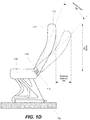
- FIG. 1D is a schematic illustration of passenger seat 111, illustrating various details of recline angle 195, height 196, and reclining distance 193.
- passenger seat 111 comprises seat cushion 116 and back rest 117, which is able to recline relative to seat cushion 116 about reclining axis 118.
- Height 196 is measured in a vertical direction (perpendicular to seat rail 130) between reclining axis 118 and the top of back rest 117 when back rest 117 is not reclined.
- Reclining distance 193 is a horizontal distance (measured along seat rail 130) which the top of back rest 117 during the complete recline. Reclining distance 193 depends on both recline angle 195 and height 196 of back rest 117.
- Reclining distance 193 indirectly impacts accessibility of passenger service unit 121 by the passenger, seated in passenger seat 111.
- Reclining distance 193 indirectly impacts accessibility of passenger service unit 121 by the passenger, seated in passenger seat 111.
- recline angle 195 is considered when determining position of passenger service unit 121 in overhead compartment 190.
- FIG. 1D also illustrates seat cushion reference point 119, which is defined as an intersection of seat cushion 116 and back rest 117 or, more specifically, of passenger facing surfaces of seat cushion 116 and back rest 117.
- seat cushion reference point 119 is accessible and is used for positioning locating device 170 or, more specifically, for determining a reference in overhead compartment 190 when installing passenger service unit 121.
- the position of seat cushion reference point 119 does not change when back rest 117 reclines relative to seat cushion 116.
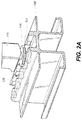
- FIG. 2A is a schematic illustration of a bottom portion of passenger seat 111 and a portion of seat rail 130 showing this attachment.
- passenger seat 111 comprises support fitting 115 is used for attachment.
- Seat rail 130 comprises receiver set 139, providing different position options for passenger seat 111.
- a receiver is defined as a channel in seat rail 130 extending between two adjacent openings able to receive support fitting 115.
- support fitting 115 protrudes in one of these openings and slid toward a receiver.
- FIG. 2A illustrates support fitting 115 protruding through first receiver 131 after the installation.
- first receiver 131 is identified by first marker 141, which is a part of first marker set 140.
- First marker set 140 also comprises additional markers, such as third marker 143.
- Third marker 143 identifies third receiver 133 and is spaced apart from first marker 141 by first seat pitch 101. Overall, any two adjacent markers in first marker set 140 are spaced apart by first seat pitch 101. Therefore, when passenger seats are installed or repositioned on seat rail 130 in accordance with first marker set 140, the spacing between these seats will be equal to first seat pitch 101.
- First marker set 140 corresponds to one seating configuration.
- seat rail 130 also comprises second marker set 150. Any two adjacent markers of second marker set 150 are spaced apart by second seat pitch 102, which is different from first seat pitch 101. In these examples, seat pitch 102 is smaller than first seat pitch 101. Second marker set 150 corresponds to another seating configuration, different from the seating configuration identified by first marker set 140.
- Second marker set 150 comprises second marker 151 and fourth marker 154.
- second marker 151 identifies second receiver 132
- fourth marker 154 identifies fourth receiver 134.
- at least one marker of first marker set 140 and one marker of second marker set 150 identifies the same receiver.
- fourth marker 154 identifies third receiver 133, which is also identified by third marker 143 of first marker set 140. In this example, the pitch between any two adjacent markers of second marker set 150 is still different from that of first marker set 140.
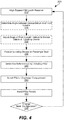
- FIG. 4 is a process flowchart corresponding to method 200 for arranging a set of passenger seats 110 and a set of passenger service units 120 in aircraft cabin 100, in accordance with some examples.
- Various examples of these seating configurations are described above with reference to FIGS. 1A-1C .
- different seating configurations have different seat pitches.
- the positon of each passenger service unit depends on the position of the corresponding passenger seat, to ensure accessibility of this passenger service unit. As such, in some examples, changing the position of a seat requires repositioning the corresponding passenger service unit.
- method 200 commences with aligning support fitting 115 of passenger seat 111 with first receiver 131 on seat rail 130 (block 210).
- First receiver 131 is a part of receiver set 139 as, for example, shown in FIGS. 2A- 2C and described above.
- Seat rail 130 comprises first marker set 140, each identifying one receiver in receiver set 139, such that any two adjacent markers in first marker set 140 are spaced apart by first seat pitch 101.
- seat rail 130 also comprises second marker set 150, which is different from first marker set 140 as described above with reference to FIGS. 2B and 2C .
- the operation of aligning support fitting 115 with first receiver 131 also comprises attaching passenger seat 111 to seat rail 130.
- This attachment is schematically shown in FIG. 2A .
- support fitting 115 comprises a nut, which, during installation, is tightened against seat rail 130. At least a portion of support fitting 115 protrudes into first receiver 131 after the attachment. Therefore, a top lip of seat rail 130, which defines receiver set 139, is compressed between portions of support fitting 115.
- Locating device 170 comprises device datum 176 and front locator 171.
- Front locator 171 forms angle 164 with device datum 176.
- angle 164 is adjustable.
- locating device 170 is reconfigurable. In one configuration, angle 164 is set to first angle 161, while in another configuration angle 164 is set to second angle 162. As such, front locator 171 is tiltable or rotatable relative to device datum 176.
- first angle 161 and second angle 162 represent different seating configurations.
- method 200 comprises determining first angle 161 between device datum 176 and front locator 171 of locating device 170 (block 215).
- first angle 161 is determined at least based on distance 163 between device datum 176 and passenger service unit 121 and further based on first seat pitch 101. For example, a larger angle is used when distance 163 is increased. This relationship ensures that passenger service unit 121 is not positioned too far ahead of passenger seat 111.
- first angle 161 is used for first seat pitch 101 while second angle 162 is used for second seat pitch 102.
- second angle 162 is used for second seat pitch 102.
- the value of first angle 161 is selected such that the oxygen mask does not interfere with the back rest of second passenger seat 112 even when second passenger seat 112 is reclined.
- first angle 161 is further selected based on height 196 of back rest 117 of passenger seat 111 and recline angle 195 of back rest 117.
- passenger seat 111 and second passenger seat 112 have the same size and function.
- height 196 of back rest 117 of passenger seat 111 is the same as that of second passenger seat 112.
- recline angle 195 of back rest 117 of passenger seat 111 is the same as that of second passenger seat 112.
- Reclining the back rest of second passenger seat 112 determines the space available for accessing passenger service unit 121 corresponding to passenger seat 111. This space will depend on the height of the back rest of second passenger seat 112 and the recline angle of that back rest.
- angle 164 between device datum 176 and front locator 171 of locating device 170, is adjustable. This feature allows using locating device 170 for different types of seats, seat pitches, and aircraft cabins.
- method 200 comprises adjusting angle 164 between device datum 176 and front locator 171 (block 220). For examples, the value of first angle 161, determined during operation represented by block 215 and described above, is used to reconfigure locating device 170.
- Method 200 comprises positioning locating device 170 on passenger seat 111 (block 230) as, for example, is shown in FIG. 5A .
- device reference point 179 of locating device 170 coincides with seat cushion reference point 119 of passenger seat 111.
- rear locator 174 is positioned against back rest 117 of passenger seat 111.
- device datum 176 of locating device 170 is positioned against seat cushion 116 and in contact with seat cushion 116 as, shown in FIG. 5A .
- this operation establishes spatial reference between locating device 170 on passenger seat 111. Passenger seat 111 is tilted or not tilted during this operation.
- Method 200 proceeds with determining first front reference 191 in overhead compartment 190 (block 230).
- First front reference 191 is used for positioning passenger service unit 121, during installation of passenger service unit 121.
- first front reference 191 corresponds to the front edge of passenger service unit 121 as, for example, shown in FIG. 5A .
- first front reference 191 corresponds to a specific feature of passenger service unit 121, e.g., a component of passenger service unit 121.
- First front reference 191 is determined relative to seat cushion reference point 119 such that various components of passenger service unit 121 are within reach of passenger in passenger seat 111. Referring to FIG. 5A , first front reference 191 depends on first angle 161 between device datum 176 and front locator 171. As described above, first angle 161 is selected based on distance 163 between device datum 176 and passenger service unit 121 and further based on first seat pitch 101.
- Determining first front reference 191 is performed using front locator 171 of locating device 170.
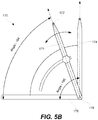
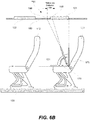
- front locator 171 is equipped with laser pointer 172 (shown in FIG. 5B ), which projects a light to overhead compartment 190. The light point on the surface of overhead compartment 190 identifies first front reference 191. In some examples, the light point is continuously present during installation of passenger service unit 121.
- front locator 171 is equipped with extendable arm 173 (shown in FIG. 5C ). During this operation, extendable arm 173 extends to overhead compartment 190 and either contact overhead compartment 190 at first front reference 191 or simply points first front reference 191 at overhead compartment 190. In some examples, in order to retract extendable arm 173, an installer adds a marking, identifying first front reference 191.
- method 200 further comprises determining first rear reference 192 in overhead compartment 190 (block 240). This operation is performed using rear locator 174 of locating device 170. Similar to first front reference 191, first rear reference 192 is used during installation of passenger service unit 121. For example, passenger service unit 121 is positioned between first front reference 191 and first rear reference 192. In specific examples, first front reference 191 corresponds to the front edge of passenger service unit 121, while first rear reference 192 corresponds to the rear edge of passenger service unit 121 as shown in FIG. 5A . A combination of first front reference 191 and first rear reference 192 is used for more precise positioning of passenger service unit 121.
- angle 165 between device datum 176 and rear locator 174 is fixed.
- rear locator 174 is vertical or substantially vertical, e.g., perpendicular or substantially perpendicular to seat rail 130, e.g., at an angle of between 80° and 100° or more specifically between 85° and 95°. Therefore, the distance between device datum 176 and overhead compartment 190 does not have major impact on the position of first rear reference 192.
- angle 165 between device datum 176 and rear locator 174 is determined based on type of passenger seat 111.
- rear locator 174 is positioned against back rest 117 of passenger seat 111 when device reference point 179 coincides with seat cushion reference point 119 and, also, when device datum 176 is positioned against seat cushion 116.
- sliding device datum 176 on seat cushion 116 until rear locator 174 is pressed against back rest 117 is used to ensure that when device reference point 179 coincides with seat cushion reference point 119.
- method 200 further comprises installing passenger service unit 121 in overhead compartment 190 (block 250). This operation is performed at least in accordance with first front reference 191. For example, the front edge of passenger service unit 121 is aligned with first front reference 191. In some examples, first rear reference 192 is also used during this operation. Passenger seat 111 is already attached to and not movable relative to seat rail 130 during this operation. In some examples, the installation of passenger service unit 121 is performed while first front reference 191 is maintained using locating device 170 as, for example, shown in FIG. 5A .
- method 200 further comprises installing one or more filler panels 180 (block 260).
- One or more filler panels 180 are positioned between passenger service unit 121 and second passenger service unit 122 as shown in FIG. 5A .
- second passenger service unit 122 is adjacent to passenger service unit 121.
- the gap between passenger service unit 121 and second passenger service unit 122 is filled with one or more filler panels 180.
- the gap depends on the seat pitch and the length of passenger service unit 121 and second passenger service unit 122.
- the gap between passenger service unit 121 and second passenger service unit 122 will be different seat pitches, such as first seat pitch 101 and second seat pitch 102.
- filler panels 180 are supplied as a kit comprising different width panels.
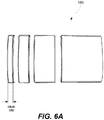
- FIG. 6A One example of such a kit is shown in FIG. 6A .
- first front reference 191 comprises two reference points 198, separated by reference distance 199.
- Reference distance 199 provides a range for positioning passenger service unit 121, e.g., to overcome obstacles in overhead compartment 190. In specific examples, this range is used for positioning the front edge of passenger service unit 121 during installation of passenger service unit 121. This range provides flexibility in installation and to ensure that the entire gap between passenger service unit 121 and second passenger service unit 122 is filled with one or more filler panels 180. Specifically, filler panels 180 have specific widths and can accommodate some specific examples but not all sizes of the gap. Having an installation range for passenger service unit 121 ensures that the selected gap is filled completely. In some examples, reference distance 199 is greater than width 189 of the narrow-most filler panel of one or more filler panels 180 thereby ensuring the complete fill of the gap.
- the seating configuration in aircraft cabin 100 needs to be changed (block 270 in FIG. 4 ).
- passenger seat 111 and second passenger seat 112 are initially installed using first seat pitch 101 between the seats.
- a new configuration uses second seat pitch 102 between the seats.
- seat rail 130 comprises second marker set 150, corresponding to second seat pitch 102.
- method 200 comprises aligning support fitting 115 of passenger seat 111 with second receiver 132 of receiver set 139 on seat rail 130 (repeating block 210 in accordance with second marker set 150).
- FIGS. 2A , 2B , and 7 illustrate second receiver 132 being identified by second marker 151 of second marker set 150.
- Method 200 proceeds with positioning locating device 170 on passenger seat 111 (repeating block 230) such that device reference point 179 coincides with seat cushion reference point 119 of passenger seat 111.
- device datum 176 is positioned on seat cushion 116 and in contact with seat cushion 116. It should be noted that this operation is performed while support fitting 115 is aligned with second receiver 132. In fact, support fitting 115 is attached to seat rail 130 at this location.
- Method 200 then proceeds with determining second front reference 197 in overhead compartment 190 (repeating block 240). As described above, this operation is performed using locating device 170. Second front reference 197 is determined in a manner similar to first front reference 191. However, passenger seat 111 is positioned in accordance with second marker set 150 during this operation. Therefore, unless second receiver 132 is the same as first receiver 131 on seat rail, second front reference 197 will likely be at a different location than first front reference 191.
- second front reference 197 is determined using second angle 162 between device datum 176 and front locator 171. Second angle 162 is selected based on distance 163 between device datum 176 and passenger service unit 121 and further based on second seat pitch 102. In some examples, second angle 162 is the same as first angle 161. Alternatively, second angle 162 is different from first angle 161.
- method 200 proceeds with installing passenger service unit 121 in overhead compartment 190 at least in accordance with second front reference 197 (repeating block 250) and installing filler panels 180 (repeating block 260).
- the set of filler panels 180 corresponding second seat pitch 102 is different form the set of filler panels 180 corresponding to first seat pitch 101.
- changing the seating configuration also triggers one or more optional operations depicted by blocks 215 and 220 and described above.
- locating device 170 is supplied as a standalone component as shown in FIGS. 5B and 5C .
- locating device 170 is supplied as a part of kit, which also includes one or more passenger seats 110.
- FIG. 5D illustrates one example of kit 500, comprising locating device 170 and passenger seat 111.
- locating device 170 is configured to operate with a particular type of passenger seats and in a particular aircraft cabin.
- locating device 170 is designed to change the configuration for a new seat type, a new cabin type, and/or a new seat pitch. Overall, locating device 170 is used for determining positions of passenger service units relative to corresponding passenger seats in aircraft cabins.
- locating device 170 comprises device datum 176, front locator 171, and device reference point 179.
- Device datum 176 is used for positioning on and being in contact with seat cushion 116 of passenger seat 111 as, for example, is shown in FIG. 5A .
- device datum 176 is shaped to conform to the surface of seat cushion 116. The correspondence of these shapes is used, in part, to control position of device datum 176 on seat cushion 116.
- device datum 176 is straight to accommodate different types of seats.
- Front locator 171 is connected and positioned at angle 164 relative to device datum 176.
- angle 164 is fixed and corresponds to a specific seat type, cabin type, and/or seat pitch.
- angle 164 is adjustable and can be selected based on a specific seat type, cabin type, and/or seat pitch.
- one locating device 170 is used for different seat types, cabin types, and/or seat pitches.
- Front locator 171 is configured to determine first front reference 191 in overhead compartment 190.
- front locator 171 is equipped with laser pointer 172 as shown in FIG. 5B or extendable arm 173 as shown in FIG. 5C .
- locating device 170 is compact (e.g., less than 0.5 meters in size or even less than 0.3 meters) and is still able to precisely determine first front reference 191 in overhead compartment 190.
- overhead compartment 190 is more than 1 meter or even 1.5 meters away from seat cushion 116, which supports device datum 176 during operation of locating device 170.
- Device reference point 179 is identified by at least one of device datum 176 or front locator 171 as, for example, is shown in FIGS. 5A and 5B .
- Device reference point 179 is configured to coincide with seat cushion reference point 119 of passenger seat 111 when device datum 176 of locating device 170 is positioned on and in contact with seat cushion 116 of passenger seat 111 as, for example, is shown in FIG. 5A .
- locating device 170 further comprises rear locator 174 as, for example, is shown in FIGS. 5A and 5B .
- Rear locator 174 is connected to device datum 176 and front locator 171 and configured to determine first rear reference 192 in overhead compartment 190.
- first rear reference 192 is used in combination with first front reference 191 to precisely position passenger service unit 121.
- the distance between first front reference 191 and first rear reference 192 are equal or substantially equal to a length of passenger service unit 121.
- Angle 165 between device datum 176 and rear locator 174 is fixed.
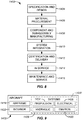
- method 200 for arranging passenger seats 110 and locating device 170, used in method 200, disclosed herein are used on aircraft 1402. Accordingly, the manufacture of method 200 is described in the context of an aircraft manufacturing and service method 1400 as shown in FIG. 8 and aircraft 1402 as shown in FIG. 9 .
- illustrative method 1400 may include specification and design 1404 of aircraft 1402 and material procurement 1406.
- component and subassembly manufacturing stages 1408 and system integration stage 1410 of aircraft 1402 takes place.
- aircraft 1402 may go through certification and delivery 1412 in order to be placed in service 1414.
- routine maintenance and service 1416 which may also include modification, reconfiguration, refurbishment, and so on).
- a system integrator may include without limitation any number of aircraft manufacturers and major-system subcontractors; a third party may include without limitation any number of vendors, subcontractors, and suppliers; and an operator may be an airline, leasing company, military entity, service organization, and so on.
- aircraft 1402 produced by illustrative method 1400 may include an airframe 1418 with plurality of systems 1420 and interior 1422.
- high-level systems 1420 include one or more of a propulsion system 1424, an electrical system 1426, a hydraulic system 1428, and an environmental system 1430.
- a propulsion system 1424 examples include one or more of a propulsion system 1424, an electrical system 1426, a hydraulic system 1428, and an environmental system 1430.
- an aerospace example is shown, the principles of the examples described herein may be applied to other industries.
- Devices and methods embodied herein may be employed during any one or more of the stages of method 1400.
- components or subassemblies corresponding to stages 1408 and 1410 may be fabricated or manufactured in a manner similar to components or subassemblies produced while aircraft 1402 is in service.
- one or more device examples, method examples, or a combination thereof may be utilized during stages 1408 and 1410, for example, by expediting or substantially expediting assembly of or reducing the cost of an aircraft 1402.
- one or more of device examples, method examples, or a combination thereof may be utilized while aircraft 1402 is in service, for example and without limitation, to maintenance and service 1416.
Landscapes
- Engineering & Computer Science (AREA)
- Aviation & Aerospace Engineering (AREA)
- Manufacturing & Machinery (AREA)
- Transportation (AREA)
- Seats For Vehicles (AREA)
Abstract
Description
- Passenger service units, which are also referred to as PSUs, are used in aircraft cabins to provide various safety and convenience features available to passengers. In some examples, a passenger service unit includes one or more oxygen masks, lights, ventilation fans, and attendant call button and indicators. Passenger service units are typically positioned in overhead compartments of the cabin, above passenger seats. The position of each passenger service unit depends on the position of at least one passenger seat to ensure that the passenger service unit is within the reach of a passenger in that seat. For example, one seat in row of seats serviced by the same passenger service unit is used as a reference.
- Seat positions in an aircraft cabin can be changed during operation of the aircraft. For example, the aircraft capacity may be increased or decreased based on seasonal demands and/or new routes. Different seat capacities correspond to different seating configurations and, more specifically, to different pitches between seats in adjacent rows. Moving a seat to a new position often requires changing the position of the corresponding passenger service unit to ensure accessibility of that passenger service unit by passengers.
- Currently, the position of each seat and, separately, of each passenger service unit is referenced to various structural components in the cabin, such as fuselage components. These components are stationary and provide fixed references for new positions of the passenger seats and of the passenger service units. For example, an aircraft operator is supplied with documentations showing different seating configurations available for the aircraft cabin. Each configuration includes a referenced position of each seat and, separately, a referenced position of each passenger service unit relative to different structural components. This documentation is used to change the seating configuration, which involves repositioning of seats and corresponding passenger service units. For clarity, it should be noted that the passenger service units are referenced to structural components of the cabin rather than to seats in these conventional seating configuration documents. Such cabin reconfiguration processes are slow and can take multiple days to complete in large aircraft cabins, often designed to carry hundreds of passengers. Aircraft operators are interested in minimizing this time, during which aircraft is not operated.
- What is needed are methods and systems for arranging passenger seats and passenger service units in aircraft cabins in fast and efficient manner.
- Disclosed are methods for arranging passenger seats and passenger service units in aircraft cabins as well as locating devices used in these methods. These methods and devices provide fast and efficient ways for directly referencing the position of each passenger service unit relative to a corresponding passenger seat. For example, a passenger seat is positioned on a seat rail using rail markers. Each set of markers corresponds to a different seating configuration. A locating device is then placed on the passenger seat such that the device datum contacts the seat cushion. A locator of the locating device determines a reference, in an overhead compartment, for installing a passenger service unit, corresponding to this seat. The reference is based on an angle between the datum and the locator, which is adjustable in some examples.
- Illustrative, non-exclusive examples of various inventive features according to the present disclosure are described in the following enumerated paragraphs:
- A1.
Method 200 for arranging a set ofpassenger seats 110, comprisingpassenger seat 111, and a set ofpassenger service units 120, comprisingpassenger service unit 121, inaircraft cabin 100, comprisingseat rail 130,method 200 comprising: aligning support fitting 115 ofpassenger seat 111 withfirst receiver 131 of receiver set 139 onseat rail 130, whereinseat rail 130 comprisesfirst marker set 140, each identifying one receiver inreceiver set 139 such that any two adjacent markers infirst marker set 140 are spaced apart byfirst seat pitch 101, and whereinfirst receiver 131 is identified byfirst marker 141 of first marker set 140; positioning a locatingdevice 170 onpassenger seat 111 such thatdevice reference point 179 of locatingdevice 170 coincides with seatcushion reference point 119 ofpassenger seat 111 and such thatdevice datum 176 of locatingdevice 170 is positioned on and in contact withseat cushion 116 ofpassenger seat 111; and usingfront locator 171 of locatingdevice 170, determining firstfront reference 191 inoverhead compartment 190 for installingpassenger service unit 121, corresponding topassenger seat 111, wherein firstfront reference 191 depends onfirst angle 161 betweendevice datum 176 andfront locator 171, and whereinfirst angle 161 is selected based ondistance 163 betweendevice datum 176 andpassenger service unit 121 and further based onfirst seat pitch 101. - A2.
Method 200 of paragraph A1, whereinangle 164 betweendevice datum 176 andfront locator 171 is adjustable. - A3.
Method 200 of paragraph A2, further comprising adjustingangle 164 betweendevice datum 176 andfront locator 171. - A4.
Method 200 of any one of paragraphs A1 - A3, further comprising determiningfirst angle 161 at least based ondistance 163 betweendevice datum 176 andpassenger service unit 121 and further based onfirst seat pitch 101. - A5.
Method 200 of any one of paragraphs A1-A4, whereinfirst angle 161 betweendevice datum 176 andfront locator 171 is further selected based onheight 196 ofback rest 117 ofpassenger seat 111 andrecline angle 195 ofback rest 117. - A6.
Method 200 of any one of paragraphs A1-A5, whereinfront locator 171 comprises one oflaser pointer 172 orextendable arm 173. - A7.
Method 200 of any one of paragraphs A1-A6, further comprising, usingrear locator 174 of locatingdevice 170, determining firstrear reference 192 inoverhead compartment 190 for positioningpassenger service unit 121, whereinpassenger service unit 121 is positioned between firstfront reference 191 and firstrear reference 192. - A8.
Method 200 of paragraph A7, whereinangle 165 betweendevice datum 176 andrear locator 174 is fixed. - A9.
Method 200 of paragraph A8, whereinangle 165 betweendevice datum 176 andrear locator 174 is determined based on the type ofpassenger seat 111. - A10.
Method 200 of paragraph A7, whereinrear locator 174 is positioned againstback rest 117 ofpassenger seat 111 whiledevice reference point 179 of locatingdevice 170 coincides with seatcushion reference point 119 anddevice datum 176 is positioned againstseat cushion 116 ofpassenger seat 111. - A11.
Method 200 of any one of paragraphs A1-A10, further comprising, installingpassenger service unit 121 inoverhead compartment 190 at least in accordance with firstfront reference 191. - A12.
Method 200 of paragraph A11, wherein front edge ofpassenger service unit 121 is aligned with firstfront reference 191. - A13.
Method 200 of paragraph A11, further comprising installing one ormore filler panels 180, such that one ormore filler panels 180 are positioned betweenpassenger service unit 121 and secondpassenger service unit 122, adjacent topassenger service unit 121. - A14.
Method 200 of paragraph A13, wherein firstfront reference 191 comprises tworeference points 198, separated byreference distance 199. - A15.
Method 200 of paragraph 14, whereinreference distance 199 is greater thanwidth 189 of a narrow-most filler panel of one ormore filler panels 180. - A16.
Method 200 of paragraph 15, wherein at least two of one ormore filler panels 180 have different widths. - A17.
Method 200 of any one of paragraphs A1-A16, whereinseat rail 130 comprises second marker set 150, each identifying one receiver in receiver set 139 such that any two adjacent markers insecond marker set 150 are spaced apart bysecond seat pitch 102, different fromfirst seat pitch 101. - A18.
Method 200 of paragraph A17, further comprising: aligning support fitting 115 ofpassenger seat 111 withsecond receiver 132 of receiver set 139 onseat rail 130, whereinsecond receiver 132 is identified by asecond marker 151 ofsecond marker set 150; positioning locatingdevice 170 onpassenger seat 111 such thatdevice reference point 179 of locatingdevice 170 coincides with seatcushion reference point 119 ofpassenger seat 111 and such thatdevice datum 176 of locatingdevice 170 is positioned on and in contact withseat cushion 116 ofpassenger seat 111; and usingfront locator 171 of locatingdevice 170, determining secondfront reference 197 inoverhead compartment 190 for installingpassenger service unit 121, corresponding topassenger seat 111, whereinsecond front reference 197 is determined by asecond angle 162 betweendevice datum 176 andfront locator 171, whereinsecond angle 162 is selected based on adistance 163 betweendevice datum 176 andpassenger service unit 121 and further based onsecond seat pitch 102. - A19.
Method 200 of paragraph A18, whereinsecond angle 162 is different fromfirst angle 161. - A20.
Method 200 of paragraph A19, further comprising, installingpassenger service unit 121 inoverhead compartment 190 at least in accordance with secondfront reference 197. - B1. Locating
device 170 for determining position ofpassenger service unit 121 relative topassenger seat 111 inaircraft cabin 100, locatingdevice 170 comprising:device datum 176, for positioning on and in contact withseat cushion 116 ofpassenger seat 111;front locator 171, connected and positioned atangle 164 relative todevice datum 176, and configured to determine firstfront reference 191 inoverhead compartment 190; anddevice reference point 179, identified by at least one ofdevice datum 176 orfront locator 171 and configured to coincide with seatcushion reference point 119 ofpassenger seat 111 whendevice datum 176 of locatingdevice 170 is positioned on and in contact withseat cushion 116 ofpassenger seat 111. - B2. Locating
device 170 of paragraph B1, whereinangle 164 betweendevice datum 176 andfront locator 171 is adjustable. - B3. Locating
device 170 of any one of paragraphs B1-B2, whereinfront locator 171 comprises one of alaser pointer 172 or anextendable arm 173. - B4. Locating
device 170 of any one of paragraphs B1-B3, further comprisingrear locator 174, connected todevice datum 176 andfront locator 171 and configured to determine firstrear reference 192 inoverhead compartment 190, such that distance between firstfront reference 191 and firstrear reference 192 are equal or substantially equal to the length ofpassenger service unit 121. - B5. Locating
device 170 of paragraph B4, whereinangle 165 betweendevice datum 176 andrear locator 174 is fixed. -
-
FIG. 1A is a schematic illustration of an aircraft cabin, showing passenger seats spaced apart by a first seat pitch, in accordance with some examples. -
FIG. 1B is a schematic illustration of the aircraft cabin ofFIG. 1A , now showing the passenger seats spaced apart by a second seat pitch, which is different from the first seat pitch. -
FIG. 1C is a schematic illustration of two adjacent passenger seats, showing the position and accessibility of a passenger service unit, corresponding to the rear passenger seat, in accordance with some examples. -
FIG. 1D is a schematic illustration of a passenger seat, illustrating the reclining angle and the reclining distance of this seat, in accordance with some examples. -
FIG. 2A is a schematic illustration of a seat rail supporting a seat, in accordance with some examples. -
FIGS. 2B and 2C are schematic illustrations of seat rails, showing different examples of markers on these seat rails. -
FIG. 3 is a block diagram of the passenger service unit, in accordance with some examples. -
FIG. 4 is a process flowchart corresponding to a method for arranging passenger seats and passenger service units in an aircraft cabin, in accordance with some examples. -
FIG. 5A is a schematic illustration of aligning a passenger service unit relative to the passenger seat using a locating device, in accordance with some examples. -
FIG. 5B is a schematic illustration of one example of the locating device. -
FIG. 5C is a schematic illustration of another example of the locating device. -
FIG. 5D is a schematic illustration of a kit comprising a locating device and a passenger seat. -
FIG. 6A is a schematic illustration of a set comprising multiple filler panels having different widths. -
FIG. 6B is a schematic illustration of aligning a passenger service unit relative to the passenger seat using a locating device, which provides two front reference points from the front locator of the locating device. -
FIG. 7 is a schematic illustration of positioning a passenger seat in accordance with a second set of markers and aligning a passenger service unit relative to this passenger seat, in accordance with other examples. -
FIG. 8 is a process flowchart corresponding to a method for manufacturing and service the aircraft. -
FIG. 9 illustrates a block diagram of an example of an aircraft, in accordance with some examples. - In the following description, numerous specific details are set forth in order to provide a thorough understanding of the presented concepts. In some examples, the presented concepts are practiced without some or all of these specific details. In other instances, well known process operations have not been described in detail so as to not unnecessarily obscure the described concepts. While some concepts will be described in conjunction with the specific examples, it will be understood that these examples are not intended to be limiting.
- Fast and efficient methods and tools for rearranging passenger seats and passenger service units in aircraft cabins are advantageous for reducing the aircraft downtime. Aircraft operators often need to implement new seating configuration, thereby increasing or decreasing the seating capacity in the aircraft cabin, in response to demand fluctuations (e.g., seasonal adjustment), new routes, and the like. Since conventional methods of rearranging passenger seats and passenger service units take long time, often multiple days, aircraft operators are forced to select between reducing the aircraft downtime and using the most desired seating configuration. Methods and tools described herein provide a reduction in the time for arranging passenger seats and passenger service units (often a substantial reduction), thereby allowing these aircraft operators to use desired seating configurations more frequently.
-
FIG. 1A is a schematic illustration ofaircraft cabin 100, comprisingpassenger seats 110 arranged into rows and spaced apart byfirst seat pitch 101, at least in this example. Specifically,passenger seat 111 andsecond passenger seat 112 are two adjacent seats, each having a reference point such as support fittings. The distance between these reference points ofpassenger seat 111 andsecond passenger seat 112 is equal tofirst seat pitch 101. In general, any reference point can be used to determine the seat pitch. The seat pitch corresponds to a specific seating configuration. When passenger seats 110 are rearranged into a new seating configuration, the seat pitch is changed in some examples, as further described with reference toFIG. 1B . - Referring to
FIG. 1A ,passenger seats 110, includingpassenger seat 111 andsecond passenger seat 112, are supported on and attached toseat rail 130. While schematic side views ofFIGS. 1A-D illustrate only one seat rails, one having ordinary skill in the art would understand that multiple rails are often used to support various seat sets. Furthermore, referring toFIG. 1A , each passenger seat has a corresponding passenger service unit, positioned inoverhead compartment 190 inaircraft cabin 100. One having ordinary skill in the art would understand that the same passenger service unit is often used for multiple seats positioned in the same row, e.g., two, three, or more seats. However, seats positioned in different rows, such aspassenger seat 111 andsecond passenger seat 112 use different passenger service units. As shown,passenger service unit 121 corresponds topassenger seat 111, while secondpassenger service unit 122 corresponds tosecond passenger seat 112. The alignment betweenpassenger seat 111 andpassenger service unit 121 allows a passenger inpassenger seat 111 to access various components and features inpassenger service unit 121. The gap betweenpassenger service unit 121 and secondpassenger service unit 122 is covered by one ormore filler panels 180. -
FIG. 1B is a schematic illustration ofaircraft cabin 100, in which passenger seats 110 are spaced apart bysecond seat pitch 102, which is different thanfirst seat pitch 101 shown inFIG. 1A and described above. Specifically, the distance between the reference points ofpassenger seat 111 andsecond passenger seat 112, e.g., their support fittings, is now equal tosecond seat pitch 102. It should be noted that the pitch betweenpassenger service unit 121 and secondpassenger service unit 122 for this seating configuration is also different in this seating configuration than that shown inFIG. 1A . In some examples, the pitch betweenpassenger service unit 121 and secondpassenger service unit 122 is equal or substantially equal to the corresponding seat pitch, e.g., within 25%, within 10%, or even within 5%. It should be noted that the gap betweenpassenger service unit 121 and secondpassenger service unit 122 depends on the pitch betweenpassenger service unit 121 and secondpassenger service unit 122 and the lengths ofpassenger service unit 121 and secondpassenger service unit 122. This gap is covered by one ormore filler panels 180. As such, in some examples, a different set offiller panels 180 is needed for different seating configurations. -
FIG. 1C is a schematic illustration of two adjacent passenger seats, showing the space between these passenger seats available for accessing the passenger service unit corresponding to the rear seat. For purposes of this disclosure, adjacent passenger seats are referred to as seats positioned in adjacent rows, usually behind one another, and offset relative to each other alongseating rail 130. As noted above, this offset is referred to as a seat pitch. -
FIG. 1C illustratespassenger seat 111,second passenger seat 112, andpassenger service unit 121, which correspond topassenger seat 111. Dashes lines extending topassenger service unit 121 represent an accessibility zone. This zone may be impacted by illustratespassenger seat 111 and/orsecond passenger seat 112 being reclined.Passenger service unit 121 comprises light 123,ventilation 124,control interface 125, andoxygen module 129. Additional details ofpassenger service unit 121 are presented inFIG. 3 . Specifically, in some examples,control interface 125 includescall button 126 andcall indicator 127. Alternative, one or more or even all components ofcontrol interface 125 are positioned inpassenger seat 111, e.g., in the arm rest. Nevertheless, at least some components ofpassenger service unit 121 should be accessible to the passenger seated inpassenger seat 111, e.g., to adjust the direct and flow rate ofventilation 124, turn light 123, reach an oxygen mask ofoxygen module 129 when deployed. For example,FIG. 1C illustratesoxygen module 129 with an oxygen mask in a deployed state, showing that the oxygen mask is deployed within the accessibility zone. - Referring to
FIG. 1C , the position ofpassenger service unit 121, relative topassenger seat 111, determines accessibility of various components ofpassenger service unit 121. Furthermore,recline angle 195 ofsecond passenger seat 112, relative topassenger seat 111, and the reline angle ofsecond passenger seat 112 impacts this accessibility. Specifically, whensecond passenger seat 112 is reclined, the space in front ofpassenger seat 111 is reduced. Likewise, whenpassenger seat 111 is reclined, the passenger, seated inpassenger seat 111, is further away frompassenger service unit 121. In some examples, the positionpassenger service unit 121 is selected such thatpassenger service unit 121 remains accessible to the passenger, seated inpassenger seat 111, regardless of the recline position ofpassenger seat 111 or the recline position ofsecond passenger seat 112. -
FIG. 1D is a schematic illustration ofpassenger seat 111, illustrating various details ofrecline angle 195,height 196, andreclining distance 193. Specifically,passenger seat 111 comprisesseat cushion 116 andback rest 117, which is able to recline relative toseat cushion 116 about recliningaxis 118.Height 196 is measured in a vertical direction (perpendicular to seat rail 130) betweenreclining axis 118 and the top ofback rest 117 whenback rest 117 is not reclined.Reclining distance 193 is a horizontal distance (measured along seat rail 130) which the top ofback rest 117 during the complete recline.Reclining distance 193 depends on bothrecline angle 195 andheight 196 ofback rest 117.Reclining distance 193 indirectly impacts accessibility ofpassenger service unit 121 by the passenger, seated inpassenger seat 111. As noted above and briefly referring toFIG. 1C , whensecond passenger seat 112 is reclined, the space in front ofpassenger seat 111, available to access various features ofpassenger service unit 121, is reduced. As such,recline angle 195 is considered when determining position ofpassenger service unit 121 inoverhead compartment 190. -
FIG. 1D also illustrates seatcushion reference point 119, which is defined as an intersection ofseat cushion 116 and back rest 117 or, more specifically, of passenger facing surfaces ofseat cushion 116 andback rest 117. Unlike recliningaxis 118, seatcushion reference point 119 is accessible and is used for positioning locatingdevice 170 or, more specifically, for determining a reference inoverhead compartment 190 when installingpassenger service unit 121. In some examples, the position of seatcushion reference point 119 does not change whenback rest 117 reclines relative toseat cushion 116. - As noted above,
passenger seat 111 is attached to and supported byseat rail 130.FIG. 2A is a schematic illustration of a bottom portion ofpassenger seat 111 and a portion ofseat rail 130 showing this attachment. Specifically,passenger seat 111 comprises support fitting 115 is used for attachment.Seat rail 130 comprisesreceiver set 139, providing different position options forpassenger seat 111. A receiver is defined as a channel inseat rail 130 extending between two adjacent openings able to receivesupport fitting 115. During installation and/or changing the position of passenger seat 111 (e.g., rearranging passengers seats in accordance with a new seating configuration), support fitting 115 protrudes in one of these openings and slid toward a receiver. For example,FIG. 2A illustrates support fitting 115 protruding throughfirst receiver 131 after the installation. - Referring to
FIGS. 2B and 2C ,first receiver 131 is identified byfirst marker 141, which is a part of first marker set 140. First marker set 140 also comprises additional markers, such asthird marker 143.Third marker 143 identifiesthird receiver 133 and is spaced apart fromfirst marker 141 byfirst seat pitch 101. Overall, any two adjacent markers in first marker set 140 are spaced apart byfirst seat pitch 101. Therefore, when passenger seats are installed or repositioned onseat rail 130 in accordance with first marker set 140, the spacing between these seats will be equal tofirst seat pitch 101. First marker set 140 corresponds to one seating configuration. - Referring to
FIGS. 2B and 2C ,seat rail 130 also comprises second marker set 150. Any two adjacent markers of second marker set 150 are spaced apart bysecond seat pitch 102, which is different fromfirst seat pitch 101. In these examples,seat pitch 102 is smaller thanfirst seat pitch 101. Second marker set 150 corresponds to another seating configuration, different from the seating configuration identified by first marker set 140. - Second marker set 150 comprises
second marker 151 andfourth marker 154. Referring toFIG. 2B ,second marker 151 identifiessecond receiver 132, whilefourth marker 154 identifiesfourth receiver 134. In some examples, at least one marker of first marker set 140 and one marker of second marker set 150 identifies the same receiver. Referring toFIG. 2C ,fourth marker 154 identifiesthird receiver 133, which is also identified bythird marker 143 of first marker set 140. In this example, the pitch between any two adjacent markers of second marker set 150 is still different from that of first marker set 140. -
FIG. 4 is a process flowchart corresponding tomethod 200 for arranging a set ofpassenger seats 110 and a set ofpassenger service units 120 inaircraft cabin 100, in accordance with some examples. Various examples of these seating configurations are described above with reference toFIGS. 1A-1C . In some examples, different seating configurations have different seat pitches. Furthermore, the positon of each passenger service unit depends on the position of the corresponding passenger seat, to ensure accessibility of this passenger service unit. As such, in some examples, changing the position of a seat requires repositioning the corresponding passenger service unit. - In some examples,
method 200 commences with aligning support fitting 115 ofpassenger seat 111 withfirst receiver 131 on seat rail 130 (block 210).First receiver 131 is a part of receiver set 139 as, for example, shown inFIGS. 2A- 2C and described above.Seat rail 130 comprises first marker set 140, each identifying one receiver in receiver set 139, such that any two adjacent markers in first marker set 140 are spaced apart byfirst seat pitch 101. It should be noted thatseat rail 130 also comprises second marker set 150, which is different from first marker set 140 as described above with reference toFIGS. 2B and 2C . - In some examples, the operation of aligning support fitting 115 with
first receiver 131 also comprises attachingpassenger seat 111 toseat rail 130. This attachment is schematically shown inFIG. 2A . In some examples, support fitting 115 comprises a nut, which, during installation, is tightened againstseat rail 130. At least a portion of support fitting 115 protrudes intofirst receiver 131 after the attachment. Therefore, a top lip ofseat rail 130, which definesreceiver set 139, is compressed between portions of support fitting 115. - Some operations of
method 200 are performed usinglocating device 170, shown inFIGS. 5A-6A andFIG. 7 . Locatingdevice 170 comprisesdevice datum 176 andfront locator 171.Front locator 171forms angle 164 withdevice datum 176. In some examples,angle 164 is adjustable. In these examples, locatingdevice 170 is reconfigurable. In one configuration,angle 164 is set tofirst angle 161, while in anotherconfiguration angle 164 is set tosecond angle 162. As such,front locator 171 is tiltable or rotatable relative todevice datum 176. In some examples,first angle 161 andsecond angle 162 represent different seating configurations. - In some examples,
method 200 comprises determiningfirst angle 161 betweendevice datum 176 andfront locator 171 of locating device 170 (block 215). Referring toFIG. 5A ,first angle 161 is determined at least based ondistance 163 betweendevice datum 176 andpassenger service unit 121 and further based onfirst seat pitch 101. For example, a larger angle is used whendistance 163 is increased. This relationship ensures thatpassenger service unit 121 is not positioned too far ahead ofpassenger seat 111. - Furthermore, a larger angle is used when the seat pitch is decreased, e.g.,
first angle 161 is used forfirst seat pitch 101 whilesecond angle 162 is used forsecond seat pitch 102. This correspondence ensures thatpassenger service unit 121 is not positioned oversecond passenger seat 112, which is in front ofpassenger seat 111, as shown inFIG. 5A . For example, the value offirst angle 161 is selected such that the oxygen mask does not interfere with the back rest ofsecond passenger seat 112 even whensecond passenger seat 112 is reclined. - In some examples, the value of
first angle 161 is further selected based onheight 196 ofback rest 117 ofpassenger seat 111 andrecline angle 195 ofback rest 117. As described above,passenger seat 111 andsecond passenger seat 112 have the same size and function. As such,height 196 ofback rest 117 ofpassenger seat 111 is the same as that ofsecond passenger seat 112. Similarly,recline angle 195 ofback rest 117 ofpassenger seat 111 is the same as that ofsecond passenger seat 112. Reclining the back rest ofsecond passenger seat 112 determines the space available for accessingpassenger service unit 121 corresponding topassenger seat 111. This space will depend on the height of the back rest ofsecond passenger seat 112 and the recline angle of that back rest. Since this height and reclining angle are the same forpassenger seat 111 andsecond passenger seat 112, the characteristics of passenger seat 111 (rather than the characteristics of second passenger seat 112) are used, in some examples, for determining the position ofpassenger service unit 121 relative topassenger seat 111 or, more specifically, the value offirst angle 161. - As noted above and shown in
FIG. 5B ,angle 164, betweendevice datum 176 andfront locator 171 of locatingdevice 170, is adjustable. This feature allows usinglocating device 170 for different types of seats, seat pitches, and aircraft cabins. In some examples,method 200 comprises adjustingangle 164 betweendevice datum 176 and front locator 171 (block 220). For examples, the value offirst angle 161, determined during operation represented by block 215 and described above, is used to reconfigure locatingdevice 170. -
Method 200 comprises positioning locatingdevice 170 on passenger seat 111 (block 230) as, for example, is shown inFIG. 5A . At the end of this operation,device reference point 179 of locatingdevice 170 coincides with seatcushion reference point 119 ofpassenger seat 111. At this point,rear locator 174 is positioned againstback rest 117 ofpassenger seat 111. Furthermore,device datum 176 of locatingdevice 170 is positioned againstseat cushion 116 and in contact withseat cushion 116 as, shown inFIG. 5A . Overall, this operation establishes spatial reference between locatingdevice 170 onpassenger seat 111.Passenger seat 111 is tilted or not tilted during this operation. -
Method 200 proceeds with determining firstfront reference 191 in overhead compartment 190 (block 230). Firstfront reference 191 is used for positioningpassenger service unit 121, during installation ofpassenger service unit 121. In some examples, firstfront reference 191 corresponds to the front edge ofpassenger service unit 121 as, for example, shown inFIG. 5A . Alternatively, firstfront reference 191 corresponds to a specific feature ofpassenger service unit 121, e.g., a component ofpassenger service unit 121. - First
front reference 191 is determined relative to seatcushion reference point 119 such that various components ofpassenger service unit 121 are within reach of passenger inpassenger seat 111. Referring toFIG. 5A , firstfront reference 191 depends onfirst angle 161 betweendevice datum 176 andfront locator 171. As described above,first angle 161 is selected based ondistance 163 betweendevice datum 176 andpassenger service unit 121 and further based onfirst seat pitch 101. - Determining first
front reference 191 is performed usingfront locator 171 of locatingdevice 170. In some examples,front locator 171 is equipped with laser pointer 172 (shown inFIG. 5B ), which projects a light tooverhead compartment 190. The light point on the surface ofoverhead compartment 190 identifies firstfront reference 191. In some examples, the light point is continuously present during installation ofpassenger service unit 121. Alternatively,front locator 171 is equipped with extendable arm 173 (shown inFIG. 5C ). During this operation,extendable arm 173 extends tooverhead compartment 190 and either contactoverhead compartment 190 at firstfront reference 191 or simply points firstfront reference 191 atoverhead compartment 190. In some examples, in order to retractextendable arm 173, an installer adds a marking, identifying firstfront reference 191. - In some examples,
method 200 further comprises determining firstrear reference 192 in overhead compartment 190 (block 240). This operation is performed usingrear locator 174 of locatingdevice 170. Similar to firstfront reference 191, firstrear reference 192 is used during installation ofpassenger service unit 121. For example,passenger service unit 121 is positioned between firstfront reference 191 and firstrear reference 192. In specific examples, firstfront reference 191 corresponds to the front edge ofpassenger service unit 121, while firstrear reference 192 corresponds to the rear edge ofpassenger service unit 121 as shown inFIG. 5A . A combination of firstfront reference 191 and firstrear reference 192 is used for more precise positioning ofpassenger service unit 121. - In some examples,
angle 165 betweendevice datum 176 andrear locator 174 is fixed. For example, when locatingdevice 170 is positioned onpassenger seat 111 as shown inFIG. 5A , such thatdevice reference point 179 coincides with seatcushion reference point 119 and such thatdevice datum 176 is in contact withseat cushion 116,rear locator 174 is vertical or substantially vertical, e.g., perpendicular or substantially perpendicular toseat rail 130, e.g., at an angle of between 80° and 100° or more specifically between 85° and 95°. Therefore, the distance betweendevice datum 176 andoverhead compartment 190 does not have major impact on the position of firstrear reference 192. In some examples,angle 165 betweendevice datum 176 andrear locator 174 is determined based on type ofpassenger seat 111. - Referring to
FIG. 5A , in some examples,rear locator 174 is positioned againstback rest 117 ofpassenger seat 111 whendevice reference point 179 coincides with seatcushion reference point 119 and, also, whendevice datum 176 is positioned againstseat cushion 116. For example, slidingdevice datum 176 onseat cushion 116 untilrear locator 174 is pressed againstback rest 117 is used to ensure that whendevice reference point 179 coincides with seatcushion reference point 119. - Referring to
FIG. 4 ,method 200 further comprises installingpassenger service unit 121 in overhead compartment 190 (block 250). This operation is performed at least in accordance with firstfront reference 191. For example, the front edge ofpassenger service unit 121 is aligned with firstfront reference 191. In some examples, firstrear reference 192 is also used during this operation.Passenger seat 111 is already attached to and not movable relative toseat rail 130 during this operation. In some examples, the installation ofpassenger service unit 121 is performed while firstfront reference 191 is maintained usinglocating device 170 as, for example, shown inFIG. 5A . - Referring to
FIG. 4 ,method 200 further comprises installing one or more filler panels 180 (block 260). One ormore filler panels 180 are positioned betweenpassenger service unit 121 and secondpassenger service unit 122 as shown inFIG. 5A . Specifically, secondpassenger service unit 122 is adjacent topassenger service unit 121. The gap betweenpassenger service unit 121 and secondpassenger service unit 122 is filled with one ormore filler panels 180. It should be noted that the gap depends on the seat pitch and the length ofpassenger service unit 121 and secondpassenger service unit 122. As such, the gap betweenpassenger service unit 121 and secondpassenger service unit 122 will be different seat pitches, such asfirst seat pitch 101 andsecond seat pitch 102. To accommodate this gap variation and to ensure that the entire gap is covered,filler panels 180 are supplied as a kit comprising different width panels. One example of such a kit is shown inFIG. 6A . - Referring to
FIG. 6B , in some examples, firstfront reference 191 comprises tworeference points 198, separated byreference distance 199.Reference distance 199 provides a range for positioningpassenger service unit 121, e.g., to overcome obstacles inoverhead compartment 190. In specific examples, this range is used for positioning the front edge ofpassenger service unit 121 during installation ofpassenger service unit 121. This range provides flexibility in installation and to ensure that the entire gap betweenpassenger service unit 121 and secondpassenger service unit 122 is filled with one ormore filler panels 180. Specifically,filler panels 180 have specific widths and can accommodate some specific examples but not all sizes of the gap. Having an installation range forpassenger service unit 121 ensures that the selected gap is filled completely. In some examples,reference distance 199 is greater thanwidth 189 of the narrow-most filler panel of one ormore filler panels 180 thereby ensuring the complete fill of the gap. - In some examples, the seating configuration in
aircraft cabin 100 needs to be changed (block 270 inFIG. 4 ). For example,passenger seat 111 andsecond passenger seat 112 are initially installed usingfirst seat pitch 101 between the seats. A new configuration usessecond seat pitch 102 between the seats. As noted above,seat rail 130 comprises second marker set 150, corresponding tosecond seat pitch 102. - In order to change the seating configuration, operations of
method 200 corresponding to blocks 210 - 260 are repeated. These operations are performed in a manner similar to the one described above. However, the passenger seats and passenger service units are placed into new positions. Specifically, the passenger seats are positioned in accordance with second marker set 150, while the passenger service units are positioned in accordance with the new position of the seats. - Specifically,
method 200 comprises aligning support fitting 115 ofpassenger seat 111 withsecond receiver 132 of receiver set 139 on seat rail 130 (repeatingblock 210 in accordance with second marker set 150).FIGS. 2A ,2B , and7 illustratesecond receiver 132 being identified bysecond marker 151 of second marker set 150.Method 200 proceeds with positioning locatingdevice 170 on passenger seat 111 (repeating block 230) such thatdevice reference point 179 coincides with seatcushion reference point 119 ofpassenger seat 111. Furthermore,device datum 176 is positioned onseat cushion 116 and in contact withseat cushion 116. It should be noted that this operation is performed while support fitting 115 is aligned withsecond receiver 132. In fact, support fitting 115 is attached toseat rail 130 at this location. -
Method 200 then proceeds with determining secondfront reference 197 in overhead compartment 190 (repeating block 240). As described above, this operation is performed usinglocating device 170. Secondfront reference 197 is determined in a manner similar to firstfront reference 191. However,passenger seat 111 is positioned in accordance with second marker set 150 during this operation. Therefore, unlesssecond receiver 132 is the same asfirst receiver 131 on seat rail, secondfront reference 197 will likely be at a different location than firstfront reference 191. - In some examples, second
front reference 197 is determined usingsecond angle 162 betweendevice datum 176 andfront locator 171.Second angle 162 is selected based ondistance 163 betweendevice datum 176 andpassenger service unit 121 and further based onsecond seat pitch 102. In some examples,second angle 162 is the same asfirst angle 161. Alternatively,second angle 162 is different fromfirst angle 161. - Finally,
method 200 proceeds with installingpassenger service unit 121 inoverhead compartment 190 at least in accordance with second front reference 197 (repeating block 250) and installing filler panels 180 (repeating block 260). In some examples, the set offiller panels 180 correspondingsecond seat pitch 102 is different form the set offiller panels 180 corresponding tofirst seat pitch 101. - In some examples, changing the seating configuration also triggers one or more optional operations depicted by blocks 215 and 220 and described above.
- Various operations of
method 200, described above, are performed usinglocating device 170. In some examples, locatingdevice 170 is supplied as a standalone component as shown inFIGS. 5B and5C . Alternatively, locatingdevice 170 is supplied as a part of kit, which also includes one or more passenger seats 110.FIG. 5D illustrates one example ofkit 500, comprising locatingdevice 170 andpassenger seat 111. In either case, locatingdevice 170 is configured to operate with a particular type of passenger seats and in a particular aircraft cabin. In some examples, locatingdevice 170 is designed to change the configuration for a new seat type, a new cabin type, and/or a new seat pitch. Overall, locatingdevice 170 is used for determining positions of passenger service units relative to corresponding passenger seats in aircraft cabins. - Referring to
FIGS. 5A-5D , locatingdevice 170 comprisesdevice datum 176,front locator 171, anddevice reference point 179.Device datum 176 is used for positioning on and being in contact withseat cushion 116 ofpassenger seat 111 as, for example, is shown inFIG. 5A . In some examples,device datum 176 is shaped to conform to the surface ofseat cushion 116. The correspondence of these shapes is used, in part, to control position ofdevice datum 176 onseat cushion 116. Alternatively,device datum 176 is straight to accommodate different types of seats. -
Front locator 171 is connected and positioned atangle 164 relative todevice datum 176. In some examples,angle 164 is fixed and corresponds to a specific seat type, cabin type, and/or seat pitch. Alternatively,angle 164 is adjustable and can be selected based on a specific seat type, cabin type, and/or seat pitch. In other words, onelocating device 170 is used for different seat types, cabin types, and/or seat pitches. -
Front locator 171 is configured to determine firstfront reference 191 inoverhead compartment 190. For example,front locator 171 is equipped withlaser pointer 172 as shown inFIG. 5B orextendable arm 173 as shown inFIG. 5C . These features ensure that locatingdevice 170 is compact (e.g., less than 0.5 meters in size or even less than 0.3 meters) and is still able to precisely determine firstfront reference 191 inoverhead compartment 190. It should be noted that, in some examples,overhead compartment 190 is more than 1 meter or even 1.5 meters away fromseat cushion 116, which supportsdevice datum 176 during operation of locatingdevice 170. -
Device reference point 179 is identified by at least one ofdevice datum 176 orfront locator 171 as, for example, is shown inFIGS. 5A and5B .Device reference point 179 is configured to coincide with seatcushion reference point 119 ofpassenger seat 111 whendevice datum 176 of locatingdevice 170 is positioned on and in contact withseat cushion 116 ofpassenger seat 111 as, for example, is shown inFIG. 5A . - In some examples, locating
device 170 further comprisesrear locator 174 as, for example, is shown inFIGS. 5A and5B .Rear locator 174 is connected todevice datum 176 andfront locator 171 and configured to determine firstrear reference 192 inoverhead compartment 190. As described above, firstrear reference 192 is used in combination with firstfront reference 191 to precisely positionpassenger service unit 121. In some examples, the distance between firstfront reference 191 and firstrear reference 192 are equal or substantially equal to a length ofpassenger service unit 121.Angle 165 betweendevice datum 176 andrear locator 174 is fixed. - As discussed above, various examples of
method 200 for arrangingpassenger seats 110 and locatingdevice 170, used inmethod 200, disclosed herein are used onaircraft 1402. Accordingly, the manufacture ofmethod 200 is described in the context of an aircraft manufacturing andservice method 1400 as shown inFIG. 8 andaircraft 1402 as shown inFIG. 9 . During pre-production,illustrative method 1400 may include specification anddesign 1404 ofaircraft 1402 andmaterial procurement 1406. During production, component andsubassembly manufacturing stages 1408 andsystem integration stage 1410 ofaircraft 1402 takes place. Thereafter,aircraft 1402 may go through certification anddelivery 1412 in order to be placed inservice 1414. While in service by a customer,aircraft 1402 is scheduled for routine maintenance and service 1416 (which may also include modification, reconfiguration, refurbishment, and so on). - Each of the processes of
method 1400 may be performed or carried out by a system integrator, a third party, and/or an operator (e.g., a customer). For the purposes of this description, a system integrator may include without limitation any number of aircraft manufacturers and major-system subcontractors; a third party may include without limitation any number of vendors, subcontractors, and suppliers; and an operator may be an airline, leasing company, military entity, service organization, and so on. - As shown in
FIG. 8 ,aircraft 1402 produced byillustrative method 1400 may include anairframe 1418 with plurality ofsystems 1420 and interior 1422. Examples of high-level systems 1420 include one or more of apropulsion system 1424, anelectrical system 1426, ahydraulic system 1428, and anenvironmental system 1430. Although an aerospace example is shown, the principles of the examples described herein may be applied to other industries. - Devices and methods embodied herein may be employed during any one or more of the stages of
method 1400. For example, components or subassemblies corresponding tostages aircraft 1402 is in service. Also, one or more device examples, method examples, or a combination thereof may be utilized duringstages aircraft 1402. Similarly, one or more of device examples, method examples, or a combination thereof may be utilized whileaircraft 1402 is in service, for example and without limitation, to maintenance andservice 1416. - Although the foregoing concepts have been described in some detail for purposes of clarity of understanding, it will be apparent that certain changes and modifications may be practiced within the scope of the appended claims. It should be noted that there are many alternative ways of implementing the processes, systems, and devices. Accordingly, the present examples are to be considered as illustrative and not restrictive. Further, the disclosure comprises examples according to the following clauses:
- Clause 1. A method (200) for arranging a set of passenger seats (110), comprising a passenger seat (111), and a set of passenger service units (120), comprising a passenger service unit (121), in an aircraft cabin (100), comprising a seat rail (130), the method (200) comprising: aligning a support fitting (115) of the passenger seat (111) with a first receiver (131) of a receiver set (139) on the seat rail (130), wherein either: the seat rail (130) comprises a first marker set (140), each identifying one receiver in the receiver set (139) such that any two adjacent markers in the first marker set (140) are spaced apart by a first seat pitch (101), or the seat rail (130) comprises a first marker set (140), each marker of the first marker set (140) identifying one receiver in the receiver set (139) such that any two adjacent markers in the first marker set (140) are spaced apart by a first seat pitch (101), and wherein the first receiver (131) is identified by a first marker (141) of the first marker set (140); positioning a locating device (170) on the passenger seat (111) such that a device reference point (179) of the locating device (170) coincides with a seat cushion reference point (119) of the passenger seat (111) and such that a device datum (176) of the locating device (170) is positioned on and in contact with a seat cushion (116) of the passenger seat (111); and using a front locator (171) of the locating device (170), determining a first front reference (191) in an overhead compartment (190) for installing the passenger service unit (121), corresponding to the passenger seat (111), wherein the first front reference (191) depends on a first angle (161) between the device datum (176) and the front locator (171), and wherein the first angle (161) is selected based on a distance (163) between the device datum (176) and the passenger service unit (121) and further based on the first seat pitch (101).
- Clause 2. The method (200) of Clause 1, wherein an angle (164) between the device datum (176) and the front locator (171) is adjustable.
- Clause 3. The method (200) of Clause 2, further comprising adjusting the angle (164) between the device datum (176) and the front locator (171).
- Clause 4. The method (200) of any of Clauses 1-3, further comprising determining the first angle (161) at least based on the distance (163) between the device datum (176) and the passenger service unit (121) and further based on the first seat pitch (101).
- Clause 5. The method (200) of any of Clauses 1-4, wherein the first angle (161) between the device datum (176) and the front locator (171) is further selected based on a height (196) of a back rest (117) of the passenger seat (111) and a recline angle (195) of the back rest (117).
- Clause 6. The method (200) of any of Clauses 1-5, wherein the front locator (171) comprises one of a laser pointer (172) or an extendable arm (173).
- Clause 7. The method (200) of any of Clauses 1-6, further comprising, using a rear locator (174) of the locating device (170), determining a first rear reference (192) in the overhead compartment (190) for positioning the passenger service unit (121), wherein the passenger service unit (121) is positioned between the first front reference (191) and the first rear reference (192).
- Clause 8. The method (200) of Clause 7, wherein an angle (165) between the device datum (176) and the rear locator (174) is fixed.
- Clause 9. The method (200) of Clause 8, wherein the angle (165) between the device datum (176) and the rear locator (174) is determined based on a type of the passenger seat (111).
- Clause 10. The method (200) of any of Clauses 7-9, wherein the rear locator (174) is positioned against a back rest (117) of the passenger seat (111) while the device reference point (179) of the locating device (170) coincides with the seat cushion reference point (119) and the device datum (176) is positioned against the seat cushion (116) of the passenger seat (111).
-
Clause 11. The method (200) of any of Clauses 1-10, further comprising, installing the passenger service unit (121) in the overhead compartment (190) at least in accordance with the first front reference (191). - Clause 12. The method (200) of
Clause 11, wherein a front edge of the passenger service unit (121) is aligned with the first front reference (191). - Clause 13. The method (200) of any of Clauses 11-12, further comprising installing one or more filler panels (180), such that the one or more filler panels (180) are positioned between the passenger service unit (121) and a second passenger service unit (122), adjacent to the passenger service unit (121).
- Clause 14. The method (200) of Clause 13, wherein the first front reference (191) comprises two reference points (198), separated by a reference distance (199).
- Clause 15. The method (200) of Clause 14, wherein the reference distance (199) is greater than a width (189) of a narrow-most filler panel of the one or more filler panels (180).
- Clause 16. The method (200) of Clause 15, wherein at least two of the one or more filler panels (180) have different widths.
- Clause 17. The method (200) of any of Clauses 1-16, wherein either: the seat rail (130) comprises a second marker set (150), each identifying one receiver in the receiver set (139) such that any two adjacent markers in the second marker set (150) are spaced apart by a second seat pitch (102), different from the first seat pitch (101); or the seat rail (130) comprises a second marker set (150), each marker of the second marker set (150) identifying one receiver in the receiver set (139) such that any two adjacent markers in the second marker set (150) are spaced apart by a second seat pitch (102), different from the first seat pitch (101).
- Clause 18. The method (200) of Clause 17, further comprising: aligning the support fitting (115) of the passenger seat (111) with a second receiver (132) of the receiver set (139) on the seat rail (130), wherein the second receiver (132) is identified by a second marker (151) of the second marker set (150); positioning the locating device (170) on the passenger seat (111) such that the device reference point (179) of the locating device (170) coincides with the seat cushion reference point (119) of the passenger seat (111) and such that the device datum (176) of the locating device (170 is positioned on and in contact with the seat cushion (116) of the passenger seat (111); and using the front locator (171) of the locating device (170), determining a second front reference (197) in the overhead compartment (190) for installing the passenger service unit (121), corresponding to the passenger seat (111), wherein the second front reference (197) is determined by a second angle (162) between the device datum (176) and the front locator (171), wherein the second angle (162) is selected based on a distance (163) between the device datum (176) and the passenger service unit (121) and further based on the second seat pitch (102).
- Clause 19. The method (200) of Clause 18, wherein the second angle (162) is different from the first angle (161).
- Clause 20. The method of Clause 19, further comprising, installing the passenger service unit in the overhead compartment at least in accordance with the second front reference.
- Clause 21. A locating device (170) for determining position of a passenger service unit (121) relative to a passenger seat (111) in an aircraft cabin (100), the locating device (170) comprising: a device datum (176), for positioning on and in contact with a seat cushion (116) of the passenger seat (111); a front locator (171), connected and positioned at an angle (164) relative to the device datum (176), and configured to determine a first front reference (191) in an overhead compartment (190); and a device reference point (179), identified by at least one of the device datum (176) or the front locator (171) and configured to coincide with a seat cushion reference point (119) of the passenger seat (111) when the device datum (176) of the locating device (170) is positioned on and in contact with the seat cushion (116) of the passenger seat (111).
- Clause 22. The locating device of Clause 21, wherein the angle between the device datum and the front locator is adjustable.
- Clause 23. The locating device of any of Clauses 21-22, wherein the front locator comprises one of a laser pointer or an extendable arm.
- Clause 24. The locating device of any of Clauses 21-23, further comprising a rear locator, connected to the device datum and front locator and configured to determine a first rear reference in the overhead compartment, such that a distance between the first front reference and the first rear reference is equal or substantially equal to a length of the passenger service unit.
- Clause 25. The locating device of Clause 24, wherein an angle between the device datum and the rear locator is fixed.
- Clause 26. An aircraft cabin (100) comprising the locating device (170) of any of Clauses 21 to 25.
- Clause 27. An aircraft comprising the aircraft cabin (100) of Clause 26.
- Clause 28. An aircraft cabin (100) comprising a locating device (170) for determining position of a passenger service unit (121) relative to a passenger seat (111) in the aircraft cabin (100), the locating device (170) comprising: a device datum (176), configured to be positioned on and in contact with a seat cushion (116) of the passenger seat (111); a front locator (171), connected and positioned at an angle (164) relative to the device datum (176), and configured to determine a first front reference (191) in an overhead compartment (190) in the aircraft cabin (100); and a device reference point (179), identified by at least one of the device datum (176) or the front locator (171) and configured to coincide with a seat cushion reference point (119) of the passenger seat (111) when the device datum (176) of the locating device (170) is positioned on and in contact with the seat cushion (116) of the passenger seat (111).
- Clause 29. The locating device of Clause 28, wherein the angle between the device datum and the front locator is adjustable.
- Clause 30. The locating device of any of Clauses 28-29, wherein the front locator comprises one of a laser pointer or an extendable arm.
- Clause 31. The locating device of any of Clauses 28-30, further comprising a rear locator, connected to the device datum and front locator and configured to determine a first rear reference in the overhead compartment, such that a distance between the first front reference and the first rear reference is equal or substantially equal to a length of the passenger service unit.
- Clause 32. The locating device of Clause 31, wherein an angle between the device datum and the rear locator is fixed.
- Clause 33. An aircraft comprising the aircraft cabin (100) of any of Clauses 28-32.
- Although the foregoing concepts have been described in some detail for purposes of clarity of understanding, it will be apparent that certain changes and modifications may be practiced within the scope of the appended claims. It should be noted that there are many alternative ways of implementing the processes, systems, and apparatus. Accordingly, the present examples are to be considered as illustrative and not restrictive.
Claims (15)
- A method (200) for arranging a set of passenger seats (110), comprising a passenger seat (111), and a set of passenger service units (120), comprising a passenger service unit (121), in an aircraft cabin (100), comprising a seat rail (130), the method (200) comprising:aligning a support fitting (115) of the passenger seat (111) with a first receiver (131) of a receiver set (139) on the seat rail (130),wherein the seat rail (130) comprises a first marker set (140), each identifying one receiver in the receiver set (139) such that any two adjacent markers in the first marker set (140) are spaced apart by a first seat pitch (101), andwherein the first receiver (131) is identified by a first marker (141) of the first marker set (140);positioning a locating device (170) on the passenger seat (111) such that a device reference point (179) of the locating device (170) coincides with a seat cushion reference point (119) of the passenger seat (111) and such that a device datum (176) of the locating device (170) is positioned on and in contact with a seat cushion (116) of the passenger seat (111); andusing a front locator (171) of the locating device (170), determining a first front reference (191) in an overhead compartment (190) for installing the passenger service unit (121), corresponding to the passenger seat (111),wherein the first front reference (191) depends on a first angle (161) between the device datum (176) and the front locator (171), andwherein the first angle (161) is selected based on a distance (163) between the device datum (176) and the passenger service unit (121) and further based on the first seat pitch (101).
- The method (200) of claim 1, wherein an angle (164) between the device datum (176) and the front locator (171) is adjustable and the method comprises adjusting the angle (164) between the device datum (176) and the front locator (171).
- The method (200) of claim 1 or 2, further comprising determining the first angle (161) at least based on the distance (163) between the device datum (176) and the passenger service unit (121) and further based on the first seat pitch (101).
- The method (200) of any of claims 1-3, wherein the first angle (161) between the device datum (176) and the front locator (171) is further selected based on a height (196) of a back rest (117) of the passenger seat (111) and a recline angle (195) of the back rest (117).
- The method (200) of any of claims 1-4, wherein the front locator (171) comprises one of a laser pointer (172) or an extendable arm (173).
- The method (200) of any of claims 1-5, further comprising, using a rear locator (174) of the locating device (170), determining a first rear reference (192) in the overhead compartment (190) for positioning the passenger service unit (121), wherein the passenger service unit (121) is positioned between the first front reference (191) and the first rear reference (192), and wherein, optionally, the angle (165) between the device datum (176) and the rear locator (174) is determined based on a type of the passenger seat (111).
- The method (200) of claim 6, wherein the rear locator (174) is positioned against a back rest (117) of the passenger seat (111) while the device reference point (179) of the locating device (170) coincides with the seat cushion reference point (119) and the device datum (176) is positioned against the seat cushion (116) of the passenger seat (111).
- The method (200) of any of claims 1-7, further comprising, installing the passenger service unit (121) in the overhead compartment (190) at least in accordance with the first front reference (191).
- The method (200) of claim 8, wherein a front edge of the passenger service unit (121) is aligned with the first front reference (191).
- The method (200) of any of claims 7-8, further comprising installing one or more filler panels (180), such that the one or more filler panels (180) are positioned between the passenger service unit (121) and a second passenger service unit (122), adjacent to the passenger service unit (121).
- The method (200) of any of claims 1-10, wherein the seat rail (130) comprises a second marker set (150), each identifying one receiver in the receiver set (139) such that any two adjacent markers in the second marker set (150) are spaced apart by a second seat pitch (102), different from the first seat pitch (101).
- The method (200) of claim 11, further comprising:aligning the support fitting (115) of the passenger seat (111) with a second receiver (132) of the receiver set (139) on the seat rail (130),
wherein the second receiver (132) is identified by a second marker (151) of the second marker set (150);positioning the locating device (170) on the passenger seat (111) such that the device reference point (179) of the locating device (170) coincides with the seat cushion reference point (119) of the passenger seat (111) and such that the device datum (176) of the locating device (170 is positioned on and in contact with the seat cushion (116) of the passenger seat (111); andusing the front locator (171) of the locating device (170), determining a second front reference (197) in the overhead compartment (190) for installing the passenger service unit (121), corresponding to the passenger seat (111),wherein the second front reference (197) is determined by a second angle (162) between the device datum (176) and the front locator (171),wherein the second angle (162) is selected based on a distance (163) between the device datum (176) and the passenger service unit (121) and further based on the second seat pitch (102). - A locating device (170) for determining position of a passenger service unit (121) relative to a passenger seat (111) in an aircraft cabin (100), the locating device (170) comprising:a device datum (176), for positioning on and in contact with a seat cushion (116) of the passenger seat (111);a front locator (171), connected and positioned at an angle (164) relative to the device datum (176), and configured to determine a first front reference (191) in an overhead compartment (190); anda device reference point (179), identified by at least one of the device datum (176) or the front locator (171) and configured to coincide with a seat cushion reference point (119) of the passenger seat (111) when the device datum (176) of the locating device (170) is positioned on and in contact with the seat cushion (116) of the passenger seat (111).
- An aircraft cabin (100) comprising the locating device (170) of claim 13.
- An aircraft comprising the aircraft cabin (100) of claim 14.
Applications Claiming Priority (1)
| Application Number | Priority Date | Filing Date | Title |
|---|---|---|---|
| US16/254,467 US10850852B2 (en) | 2019-01-22 | 2019-01-22 | Methods for arranging passenger seats and passenger service units in aircraft cabins |
Publications (2)
| Publication Number | Publication Date |
|---|---|
| EP3689747A1 true EP3689747A1 (en) | 2020-08-05 |
| EP3689747B1 EP3689747B1 (en) | 2023-06-14 |
Family
ID=68762499
Family Applications (1)
| Application Number | Title | Priority Date | Filing Date |
|---|---|---|---|
| EP19212726.4A Active EP3689747B1 (en) | 2019-01-22 | 2019-11-29 | Methods for arranging passenger seats and passenger service units in aircraft cabins |
Country Status (3)
| Country | Link |
|---|---|
| US (1) | US10850852B2 (en) |
| EP (1) | EP3689747B1 (en) |
| CN (1) | CN111452976B (en) |
Families Citing this family (18)
| Publication number | Priority date | Publication date | Assignee | Title |
|---|---|---|---|---|
| FR3086269B1 (en) * | 2018-09-20 | 2020-12-11 | Airbus Sas | SYSTEM FOR FIXING FURNITURE ELEMENTS ON A VEHICLE FLOOR INCLUDING PANELS WITH PERFORATED SIDE WALLS |
| GB2594657B (en) | 2019-01-22 | 2023-05-03 | Fyusion Inc | Damage detection from multi-view visual data |
| US11176704B2 (en) | 2019-01-22 | 2021-11-16 | Fyusion, Inc. | Object pose estimation in visual data |
| US11783443B2 (en) | 2019-01-22 | 2023-10-10 | Fyusion, Inc. | Extraction of standardized images from a single view or multi-view capture |
| US12243170B2 (en) | 2019-01-22 | 2025-03-04 | Fyusion, Inc. | Live in-camera overlays |
| US10887582B2 (en) | 2019-01-22 | 2021-01-05 | Fyusion, Inc. | Object damage aggregation |
| US12203872B2 (en) | 2019-01-22 | 2025-01-21 | Fyusion, Inc. | Damage detection from multi-view visual data |
| US12204869B2 (en) | 2019-01-22 | 2025-01-21 | Fyusion, Inc. | Natural language understanding for visual tagging |
| US11124303B2 (en) * | 2019-03-29 | 2021-09-21 | The Boeing Company | Seat indexing systems and methods |
| US12244784B2 (en) | 2019-07-29 | 2025-03-04 | Fyusion, Inc. | Multiview interactive digital media representation inventory verification |
| US11562474B2 (en) | 2020-01-16 | 2023-01-24 | Fyusion, Inc. | Mobile multi-camera multi-view capture |
| US11776142B2 (en) | 2020-01-16 | 2023-10-03 | Fyusion, Inc. | Structuring visual data |
| US11605151B2 (en) | 2021-03-02 | 2023-03-14 | Fyusion, Inc. | Vehicle undercarriage imaging |
| CN113070827B (en) * | 2021-03-15 | 2024-05-14 | 广州飞机维修工程有限公司 | Repairing and positioning device for aircraft seat slide rail beam |
| DE102021123319A1 (en) | 2021-09-09 | 2023-03-09 | Deutsches Zentrum für Luft- und Raumfahrt e.V. | Positioning aid for positioning an airplane seat |
| EP4265519B1 (en) * | 2022-04-21 | 2025-02-12 | Goodrich Lighting Systems GmbH & Co. KG | Aircraft overhead passenger service unit |
| US20230373352A1 (en) | 2022-05-20 | 2023-11-23 | Goodrich Lighting Systems GmbH & Co. KG | Aircraft passenger service unit, aircraft passenger service unit assembly, and method of adapting an aircraft passenger service unit |
| USD1055834S1 (en) * | 2023-03-31 | 2024-12-31 | Textron Innovations Inc. | Aircraft passenger service unit |
Citations (8)
| Publication number | Priority date | Publication date | Assignee | Title |
|---|---|---|---|---|
| JPH02279433A (en) * | 1989-04-19 | 1990-11-15 | Tenryu Kogyo Kk | Changing method for cabin space in vehicle and seat therefor |
| US6453568B1 (en) * | 1998-11-21 | 2002-09-24 | Jeff Hymer | Laser protractor |
| US20060037205A1 (en) * | 2004-08-18 | 2006-02-23 | Sergyeyenko Oleksiy P | Laser square protractor kit |
| US20110071437A1 (en) * | 2009-09-18 | 2011-03-24 | Alan Craig Merchant | Apparatus for measuring anatomic angles |
| US20120072079A1 (en) * | 2009-03-24 | 2012-03-22 | Airbus Operations Gmbh | Reconfiguration of cabin layouts |
| US20150090839A1 (en) * | 2013-09-30 | 2015-04-02 | Peco Manufacturing Co., Inc. | Passenger Service Unit and Related Systems |
| US20150166178A1 (en) * | 2012-02-14 | 2015-06-18 | C&D Zodiac, Inc. | Passenger service unit pod assembly |
| US20180134394A1 (en) * | 2016-11-16 | 2018-05-17 | Airbus Operations Gmbh | Aircraft seat kit, and aircraft seat and cabin arrangement with different types of seat rail adapters |
Family Cites Families (1)
| Publication number | Priority date | Publication date | Assignee | Title |
|---|---|---|---|---|
| EP3168152B1 (en) * | 2015-11-13 | 2018-10-24 | Goodrich Lighting Systems GmbH | Aircraft overhead passenger service unit |
-
2019
- 2019-01-22 US US16/254,467 patent/US10850852B2/en active Active
- 2019-11-29 EP EP19212726.4A patent/EP3689747B1/en active Active
- 2019-12-06 CN CN201911239054.2A patent/CN111452976B/en active Active
Patent Citations (8)
| Publication number | Priority date | Publication date | Assignee | Title |
|---|---|---|---|---|
| JPH02279433A (en) * | 1989-04-19 | 1990-11-15 | Tenryu Kogyo Kk | Changing method for cabin space in vehicle and seat therefor |
| US6453568B1 (en) * | 1998-11-21 | 2002-09-24 | Jeff Hymer | Laser protractor |
| US20060037205A1 (en) * | 2004-08-18 | 2006-02-23 | Sergyeyenko Oleksiy P | Laser square protractor kit |
| US20120072079A1 (en) * | 2009-03-24 | 2012-03-22 | Airbus Operations Gmbh | Reconfiguration of cabin layouts |
| US20110071437A1 (en) * | 2009-09-18 | 2011-03-24 | Alan Craig Merchant | Apparatus for measuring anatomic angles |
| US20150166178A1 (en) * | 2012-02-14 | 2015-06-18 | C&D Zodiac, Inc. | Passenger service unit pod assembly |
| US20150090839A1 (en) * | 2013-09-30 | 2015-04-02 | Peco Manufacturing Co., Inc. | Passenger Service Unit and Related Systems |
| US20180134394A1 (en) * | 2016-11-16 | 2018-05-17 | Airbus Operations Gmbh | Aircraft seat kit, and aircraft seat and cabin arrangement with different types of seat rail adapters |
Also Published As
| Publication number | Publication date |
|---|---|
| US10850852B2 (en) | 2020-12-01 |
| US20200231286A1 (en) | 2020-07-23 |
| CN111452976A (en) | 2020-07-28 |
| EP3689747B1 (en) | 2023-06-14 |
| CN111452976B (en) | 2025-03-07 |
Similar Documents
| Publication | Publication Date | Title |
|---|---|---|
| US10850852B2 (en) | Methods for arranging passenger seats and passenger service units in aircraft cabins | |
| EP3024621B1 (en) | Adaptive manufacturing table | |
| CN109987246B (en) | Apparatus, system, and method for supporting a wing assembly | |
| EP3401218B1 (en) | Apparatus and methods to attach an object to an overhead section of a cabin of an aircraft | |
| US7857259B2 (en) | Modular seat system for a vehicle | |
| US9216829B2 (en) | System and method for rigging a control surface of an aircraft | |
| WO2014011337A1 (en) | Line mounting system | |
| EP3640559B1 (en) | Method for mounting air conditioner air outlet structure and air conditioner air outlet installation structure | |
| US20220234759A1 (en) | System and method for positioning a sub-assembly for installation | |
| CN111292629A (en) | Electronic display screen of many screen combinations | |
| US11362494B2 (en) | Assembly, system, and methods for installing conductive elements in an aircraft | |
| CN109227151A (en) | Multi-head high-efficiency Mechanical Processing Center | |
| US10992120B2 (en) | Sidewall closeout area assembly, system, and method for routing conductive elements in an aircraft | |
| CN109332971A (en) | A roof frame positioning tool for automatic welding of passenger car roof cover | |
| US20210394907A1 (en) | Seat track fittings and methods for installing passenger seats in aircraft cabins using seat track fittings | |
| CN108621076B (en) | Aircraft fuel tank assembly fixture | |
| US12539972B2 (en) | Passenger suite armrest assembly | |
| EP4219306B1 (en) | Stowage bin lighting assembly and method for lighting a stowage bin assembly of a vehicle | |
| US20200307808A1 (en) | Seat indexing systems and methods | |
| CN219765879U (en) | Double-valve regulating mechanism | |
| EP4442505A1 (en) | Modular backrest structure for aircraft seats | |
| US12515801B2 (en) | Modular backrest structure for aircraft seats | |
| US11866176B2 (en) | Variable reclination backrest for a seat assembly | |
| US20250353598A1 (en) | Modular power box mounting system | |
| JPH1087238A (en) | Elevator car panel mounting device and mounting method |
Legal Events
| Date | Code | Title | Description |
|---|---|---|---|
| PUAI | Public reference made under article 153(3) epc to a published international application that has entered the european phase |
Free format text: ORIGINAL CODE: 0009012 |
|
| STAA | Information on the status of an ep patent application or granted ep patent |
Free format text: STATUS: THE APPLICATION HAS BEEN PUBLISHED |
|
| AK | Designated contracting states |
Kind code of ref document: A1 Designated state(s): AL AT BE BG CH CY CZ DE DK EE ES FI FR GB GR HR HU IE IS IT LI LT LU LV MC MK MT NL NO PL PT RO RS SE SI SK SM TR |
|
| AX | Request for extension of the european patent |
Extension state: BA ME |
|
| STAA | Information on the status of an ep patent application or granted ep patent |
Free format text: STATUS: REQUEST FOR EXAMINATION WAS MADE |
|
| 17P | Request for examination filed |
Effective date: 20210108 |
|
| RBV | Designated contracting states (corrected) |
Designated state(s): AL AT BE BG CH CY CZ DE DK EE ES FI FR GB GR HR HU IE IS IT LI LT LU LV MC MK MT NL NO PL PT RO RS SE SI SK SM TR |
|
| STAA | Information on the status of an ep patent application or granted ep patent |
Free format text: STATUS: EXAMINATION IS IN PROGRESS |
|
| 17Q | First examination report despatched |
Effective date: 20210525 |
|
| GRAP | Despatch of communication of intention to grant a patent |
Free format text: ORIGINAL CODE: EPIDOSNIGR1 |
|
| STAA | Information on the status of an ep patent application or granted ep patent |
Free format text: STATUS: GRANT OF PATENT IS INTENDED |
|
| RIC1 | Information provided on ipc code assigned before grant |
Ipc: B60N 2/015 20060101ALN20220729BHEP Ipc: B60N 2/24 20060101ALN20220729BHEP Ipc: B60N 2/01 20060101ALN20220729BHEP Ipc: B64D 11/00 20060101ALN20220729BHEP Ipc: B64D 45/00 20060101ALN20220729BHEP Ipc: B23Q 16/02 20060101ALI20220729BHEP Ipc: G01C 15/00 20060101ALI20220729BHEP Ipc: B64F 5/10 20170101ALI20220729BHEP Ipc: B64D 47/02 20060101ALI20220729BHEP Ipc: B64D 11/06 20060101AFI20220729BHEP |
|
| INTG | Intention to grant announced |
Effective date: 20220907 |
|
| GRAJ | Information related to disapproval of communication of intention to grant by the applicant or resumption of examination proceedings by the epo deleted |
Free format text: ORIGINAL CODE: EPIDOSDIGR1 |
|
| STAA | Information on the status of an ep patent application or granted ep patent |
Free format text: STATUS: EXAMINATION IS IN PROGRESS |
|
| GRAP | Despatch of communication of intention to grant a patent |
Free format text: ORIGINAL CODE: EPIDOSNIGR1 |
|
| STAA | Information on the status of an ep patent application or granted ep patent |
Free format text: STATUS: GRANT OF PATENT IS INTENDED |
|
| INTC | Intention to grant announced (deleted) | ||
| RIC1 | Information provided on ipc code assigned before grant |
Ipc: B60N 2/015 20060101ALN20221220BHEP Ipc: B60N 2/24 20060101ALN20221220BHEP Ipc: B60N 2/01 20060101ALN20221220BHEP Ipc: B64D 11/00 20060101ALN20221220BHEP Ipc: B64D 45/00 20060101ALN20221220BHEP Ipc: B23Q 16/02 20060101ALI20221220BHEP Ipc: G01C 15/00 20060101ALI20221220BHEP Ipc: B64F 5/10 20170101ALI20221220BHEP Ipc: B64D 47/02 20060101ALI20221220BHEP Ipc: B64D 11/06 20060101AFI20221220BHEP |
|
| RIC1 | Information provided on ipc code assigned before grant |
Ipc: B60N 2/015 20000101ALN20230105BHEP Ipc: B60N 2/24 19900101ALN20230105BHEP Ipc: B60N 2/01 20000101ALN20230105BHEP Ipc: B64D 11/00 19680901ALN20230105BHEP Ipc: B64D 45/00 19680901ALN20230105BHEP Ipc: B23Q 16/02 19850101ALI20230105BHEP Ipc: G01C 15/00 19680901ALI20230105BHEP Ipc: B64F 5/10 20170101ALI20230105BHEP Ipc: B64D 47/02 19680901ALI20230105BHEP Ipc: B64D 11/06 19680901AFI20230105BHEP |
|
| INTG | Intention to grant announced |
Effective date: 20230124 |
|
| RAP3 | Party data changed (applicant data changed or rights of an application transferred) |
Owner name: THE BOEING COMPANY |
|
| GRAS | Grant fee paid |
Free format text: ORIGINAL CODE: EPIDOSNIGR3 |
|
| GRAA | (expected) grant |
Free format text: ORIGINAL CODE: 0009210 |
|
| STAA | Information on the status of an ep patent application or granted ep patent |
Free format text: STATUS: THE PATENT HAS BEEN GRANTED |
|
| AK | Designated contracting states |
Kind code of ref document: B1 Designated state(s): AL AT BE BG CH CY CZ DE DK EE ES FI FR GB GR HR HU IE IS IT LI LT LU LV MC MK MT NL NO PL PT RO RS SE SI SK SM TR |
|
| REG | Reference to a national code |
Ref country code: CH Ref legal event code: EP |
|
| REG | Reference to a national code |
Ref country code: DE Ref legal event code: R096 Ref document number: 602019030947 Country of ref document: DE |
|
| P01 | Opt-out of the competence of the unified patent court (upc) registered |
Effective date: 20230601 |
|
| REG | Reference to a national code |
Ref country code: AT Ref legal event code: REF Ref document number: 1579078 Country of ref document: AT Kind code of ref document: T Effective date: 20230715 |
|
| REG | Reference to a national code |
Ref country code: LT Ref legal event code: MG9D |
|
| REG | Reference to a national code |
Ref country code: NL Ref legal event code: MP Effective date: 20230614 |
|
| PG25 | Lapsed in a contracting state [announced via postgrant information from national office to epo] |
Ref country code: SE Free format text: LAPSE BECAUSE OF FAILURE TO SUBMIT A TRANSLATION OF THE DESCRIPTION OR TO PAY THE FEE WITHIN THE PRESCRIBED TIME-LIMIT Effective date: 20230614 Ref country code: NO Free format text: LAPSE BECAUSE OF FAILURE TO SUBMIT A TRANSLATION OF THE DESCRIPTION OR TO PAY THE FEE WITHIN THE PRESCRIBED TIME-LIMIT Effective date: 20230914 Ref country code: ES Free format text: LAPSE BECAUSE OF FAILURE TO SUBMIT A TRANSLATION OF THE DESCRIPTION OR TO PAY THE FEE WITHIN THE PRESCRIBED TIME-LIMIT Effective date: 20230614 |
|
| REG | Reference to a national code |
Ref country code: AT Ref legal event code: MK05 Ref document number: 1579078 Country of ref document: AT Kind code of ref document: T Effective date: 20230614 |
|
| PG25 | Lapsed in a contracting state [announced via postgrant information from national office to epo] |
Ref country code: RS Free format text: LAPSE BECAUSE OF FAILURE TO SUBMIT A TRANSLATION OF THE DESCRIPTION OR TO PAY THE FEE WITHIN THE PRESCRIBED TIME-LIMIT Effective date: 20230614 Ref country code: NL Free format text: LAPSE BECAUSE OF FAILURE TO SUBMIT A TRANSLATION OF THE DESCRIPTION OR TO PAY THE FEE WITHIN THE PRESCRIBED TIME-LIMIT Effective date: 20230614 Ref country code: LV Free format text: LAPSE BECAUSE OF FAILURE TO SUBMIT A TRANSLATION OF THE DESCRIPTION OR TO PAY THE FEE WITHIN THE PRESCRIBED TIME-LIMIT Effective date: 20230614 Ref country code: LT Free format text: LAPSE BECAUSE OF FAILURE TO SUBMIT A TRANSLATION OF THE DESCRIPTION OR TO PAY THE FEE WITHIN THE PRESCRIBED TIME-LIMIT Effective date: 20230614 Ref country code: HR Free format text: LAPSE BECAUSE OF FAILURE TO SUBMIT A TRANSLATION OF THE DESCRIPTION OR TO PAY THE FEE WITHIN THE PRESCRIBED TIME-LIMIT Effective date: 20230614 Ref country code: GR Free format text: LAPSE BECAUSE OF FAILURE TO SUBMIT A TRANSLATION OF THE DESCRIPTION OR TO PAY THE FEE WITHIN THE PRESCRIBED TIME-LIMIT Effective date: 20230915 |
|
| PG25 | Lapsed in a contracting state [announced via postgrant information from national office to epo] |
Ref country code: FI Free format text: LAPSE BECAUSE OF FAILURE TO SUBMIT A TRANSLATION OF THE DESCRIPTION OR TO PAY THE FEE WITHIN THE PRESCRIBED TIME-LIMIT Effective date: 20230614 |
|
| PG25 | Lapsed in a contracting state [announced via postgrant information from national office to epo] |
Ref country code: SK Free format text: LAPSE BECAUSE OF FAILURE TO SUBMIT A TRANSLATION OF THE DESCRIPTION OR TO PAY THE FEE WITHIN THE PRESCRIBED TIME-LIMIT Effective date: 20230614 |
|
| PG25 | Lapsed in a contracting state [announced via postgrant information from national office to epo] |
Ref country code: IS Free format text: LAPSE BECAUSE OF FAILURE TO SUBMIT A TRANSLATION OF THE DESCRIPTION OR TO PAY THE FEE WITHIN THE PRESCRIBED TIME-LIMIT Effective date: 20231014 |
|
| PG25 | Lapsed in a contracting state [announced via postgrant information from national office to epo] |
Ref country code: SM Free format text: LAPSE BECAUSE OF FAILURE TO SUBMIT A TRANSLATION OF THE DESCRIPTION OR TO PAY THE FEE WITHIN THE PRESCRIBED TIME-LIMIT Effective date: 20230614 Ref country code: SK Free format text: LAPSE BECAUSE OF FAILURE TO SUBMIT A TRANSLATION OF THE DESCRIPTION OR TO PAY THE FEE WITHIN THE PRESCRIBED TIME-LIMIT Effective date: 20230614 Ref country code: RO Free format text: LAPSE BECAUSE OF FAILURE TO SUBMIT A TRANSLATION OF THE DESCRIPTION OR TO PAY THE FEE WITHIN THE PRESCRIBED TIME-LIMIT Effective date: 20230614 Ref country code: PT Free format text: LAPSE BECAUSE OF FAILURE TO SUBMIT A TRANSLATION OF THE DESCRIPTION OR TO PAY THE FEE WITHIN THE PRESCRIBED TIME-LIMIT Effective date: 20231016 Ref country code: IS Free format text: LAPSE BECAUSE OF FAILURE TO SUBMIT A TRANSLATION OF THE DESCRIPTION OR TO PAY THE FEE WITHIN THE PRESCRIBED TIME-LIMIT Effective date: 20231014 Ref country code: EE Free format text: LAPSE BECAUSE OF FAILURE TO SUBMIT A TRANSLATION OF THE DESCRIPTION OR TO PAY THE FEE WITHIN THE PRESCRIBED TIME-LIMIT Effective date: 20230614 Ref country code: CZ Free format text: LAPSE BECAUSE OF FAILURE TO SUBMIT A TRANSLATION OF THE DESCRIPTION OR TO PAY THE FEE WITHIN THE PRESCRIBED TIME-LIMIT Effective date: 20230614 Ref country code: AT Free format text: LAPSE BECAUSE OF FAILURE TO SUBMIT A TRANSLATION OF THE DESCRIPTION OR TO PAY THE FEE WITHIN THE PRESCRIBED TIME-LIMIT Effective date: 20230614 |
|
| PG25 | Lapsed in a contracting state [announced via postgrant information from national office to epo] |
Ref country code: PL Free format text: LAPSE BECAUSE OF FAILURE TO SUBMIT A TRANSLATION OF THE DESCRIPTION OR TO PAY THE FEE WITHIN THE PRESCRIBED TIME-LIMIT Effective date: 20230614 |
|
| REG | Reference to a national code |
Ref country code: DE Ref legal event code: R097 Ref document number: 602019030947 Country of ref document: DE |
|
| PLBE | No opposition filed within time limit |
Free format text: ORIGINAL CODE: 0009261 |
|
| STAA | Information on the status of an ep patent application or granted ep patent |
Free format text: STATUS: NO OPPOSITION FILED WITHIN TIME LIMIT |
|
| PG25 | Lapsed in a contracting state [announced via postgrant information from national office to epo] |
Ref country code: DK Free format text: LAPSE BECAUSE OF FAILURE TO SUBMIT A TRANSLATION OF THE DESCRIPTION OR TO PAY THE FEE WITHIN THE PRESCRIBED TIME-LIMIT Effective date: 20230614 |
|
| PG25 | Lapsed in a contracting state [announced via postgrant information from national office to epo] |
Ref country code: SI Free format text: LAPSE BECAUSE OF FAILURE TO SUBMIT A TRANSLATION OF THE DESCRIPTION OR TO PAY THE FEE WITHIN THE PRESCRIBED TIME-LIMIT Effective date: 20230614 |
|
| 26N | No opposition filed |
Effective date: 20240315 |
|
| PG25 | Lapsed in a contracting state [announced via postgrant information from national office to epo] |
Ref country code: SI Free format text: LAPSE BECAUSE OF FAILURE TO SUBMIT A TRANSLATION OF THE DESCRIPTION OR TO PAY THE FEE WITHIN THE PRESCRIBED TIME-LIMIT Effective date: 20230614 Ref country code: IT Free format text: LAPSE BECAUSE OF FAILURE TO SUBMIT A TRANSLATION OF THE DESCRIPTION OR TO PAY THE FEE WITHIN THE PRESCRIBED TIME-LIMIT Effective date: 20230614 |
|
| REG | Reference to a national code |
Ref country code: CH Ref legal event code: PL |
|
| PG25 | Lapsed in a contracting state [announced via postgrant information from national office to epo] |
Ref country code: MC Free format text: LAPSE BECAUSE OF FAILURE TO SUBMIT A TRANSLATION OF THE DESCRIPTION OR TO PAY THE FEE WITHIN THE PRESCRIBED TIME-LIMIT Effective date: 20230614 |
|
| PG25 | Lapsed in a contracting state [announced via postgrant information from national office to epo] |
Ref country code: LU Free format text: LAPSE BECAUSE OF NON-PAYMENT OF DUE FEES Effective date: 20231129 |
|
| PG25 | Lapsed in a contracting state [announced via postgrant information from national office to epo] |
Ref country code: CH Free format text: LAPSE BECAUSE OF NON-PAYMENT OF DUE FEES Effective date: 20231130 |
|
| PG25 | Lapsed in a contracting state [announced via postgrant information from national office to epo] |
Ref country code: MC Free format text: LAPSE BECAUSE OF FAILURE TO SUBMIT A TRANSLATION OF THE DESCRIPTION OR TO PAY THE FEE WITHIN THE PRESCRIBED TIME-LIMIT Effective date: 20230614 Ref country code: LU Free format text: LAPSE BECAUSE OF NON-PAYMENT OF DUE FEES Effective date: 20231129 Ref country code: CH Free format text: LAPSE BECAUSE OF NON-PAYMENT OF DUE FEES Effective date: 20231130 |
|
| REG | Reference to a national code |
Ref country code: BE Ref legal event code: MM Effective date: 20231130 |
|
| REG | Reference to a national code |
Ref country code: IE Ref legal event code: MM4A |
|
| PG25 | Lapsed in a contracting state [announced via postgrant information from national office to epo] |
Ref country code: IE Free format text: LAPSE BECAUSE OF NON-PAYMENT OF DUE FEES Effective date: 20231129 |
|
| PG25 | Lapsed in a contracting state [announced via postgrant information from national office to epo] |
Ref country code: BE Free format text: LAPSE BECAUSE OF NON-PAYMENT OF DUE FEES Effective date: 20231130 |
|
| PG25 | Lapsed in a contracting state [announced via postgrant information from national office to epo] |
Ref country code: IE Free format text: LAPSE BECAUSE OF NON-PAYMENT OF DUE FEES Effective date: 20231129 Ref country code: BE Free format text: LAPSE BECAUSE OF NON-PAYMENT OF DUE FEES Effective date: 20231130 |
|
| PG25 | Lapsed in a contracting state [announced via postgrant information from national office to epo] |
Ref country code: BG Free format text: LAPSE BECAUSE OF FAILURE TO SUBMIT A TRANSLATION OF THE DESCRIPTION OR TO PAY THE FEE WITHIN THE PRESCRIBED TIME-LIMIT Effective date: 20230614 |
|
| PG25 | Lapsed in a contracting state [announced via postgrant information from national office to epo] |
Ref country code: BG Free format text: LAPSE BECAUSE OF FAILURE TO SUBMIT A TRANSLATION OF THE DESCRIPTION OR TO PAY THE FEE WITHIN THE PRESCRIBED TIME-LIMIT Effective date: 20230614 |
|
| PG25 | Lapsed in a contracting state [announced via postgrant information from national office to epo] |
Ref country code: CY Free format text: LAPSE BECAUSE OF FAILURE TO SUBMIT A TRANSLATION OF THE DESCRIPTION OR TO PAY THE FEE WITHIN THE PRESCRIBED TIME-LIMIT; INVALID AB INITIO Effective date: 20191129 |
|
| PG25 | Lapsed in a contracting state [announced via postgrant information from national office to epo] |
Ref country code: HU Free format text: LAPSE BECAUSE OF FAILURE TO SUBMIT A TRANSLATION OF THE DESCRIPTION OR TO PAY THE FEE WITHIN THE PRESCRIBED TIME-LIMIT; INVALID AB INITIO Effective date: 20191129 |
|
| PG25 | Lapsed in a contracting state [announced via postgrant information from national office to epo] |
Ref country code: TR Free format text: LAPSE BECAUSE OF FAILURE TO SUBMIT A TRANSLATION OF THE DESCRIPTION OR TO PAY THE FEE WITHIN THE PRESCRIBED TIME-LIMIT Effective date: 20230614 |
|
| PGFP | Annual fee paid to national office [announced via postgrant information from national office to epo] |
Ref country code: DE Payment date: 20251128 Year of fee payment: 7 |
|
| PGFP | Annual fee paid to national office [announced via postgrant information from national office to epo] |
Ref country code: GB Payment date: 20251127 Year of fee payment: 7 |
|
| PGFP | Annual fee paid to national office [announced via postgrant information from national office to epo] |
Ref country code: FR Payment date: 20251125 Year of fee payment: 7 |